An unidentified member of the 7th Wisconsin (Marc & Beth Storch Collection)
The following letter was written by Robert M. Work (1836-1914), who moved from Crawford county, Pennsylvania, to Centralia, Wood county, Wisconsin prior to the 1860 US Census where he worked as a day laborer in the Edwards & Clinton’s Mill. He was married to Margaret F. Morgan on 3 January 1865 in Wood county.
According to the 1890 Veterans Schedule, Robert enlisted in Co. G, 7th Wisconsin Infantry on 29 August 1861 and was mustered out of the regiment three years later on 29 August 1864. Suffering from chronic diarrhea, the latter part of his time in the service was in Co. A, 23rd Veteran Reserve Corps.
The 7th Wisconsin reached Washington on the 26th of September 1861 and joined King’s Brigade, at Camp Lyon, on the 2nd of October. They were brigaded with the Second and Sixth Wisconsin and the Nineteenth Indiana Regiments—four regiments that would earn the nickname “the Iron Brigade” in August 1862. They marched from Camp Lyon by way of the Georgetown Aqueduct on 5 October to a new camp at Fort Tillinghast near the Arlington House where they remained until March 10, 1862. It was from this location that Robert wrote his letter.
Gen. Irvin McDowell and staff, Arlington House 1862.
Transcription
Camp Arlington February 23, 1862
Absent friend Susan,
I embrace the present opportunity this Sunday morning to converse with you a short time on paper as circumstances prevents us from being together to converse other ways.
I received a very pretty little envelope or rather a couple of them three days since. One was a letter from you and the other was a piece of paper wit ha very nice picture and flower and some very sweet verses written on it but no name signed to it. But it was sent about Valentine’s Day which I suppose accounts for it. I think that it was some pretty girl that sent it and I guess one about your size. I would of answered your letter sooner but I sent one to you the same day that I received yours. I sent one in the morning and received yours in the evening. Your letter found me enjoying good health and I hope that this may find you enjoying the same blessing as it leaves me at present.
I sent you two more papers last week and will send you one of Harpers with this. I sent you my likeness in the letter that I sent to you and John which I suppose that you have received it before this time. I would like to get yours but I suppose that you can’t get it taken but I hope that this war will soon be over so that I can get back and see the original. Sometimes I think that it will soon be ended and other times that it is going to take longer to put down this rebellion that we think for but our troops are doing great execution in Tennessee, Kentucky, and Missouri which according to the statement of the papers, they have the rebels pretty much drove out of those states.
Well, one thing is that we are getting them pretty well surrounded and another that our troops come out victoriously every attack that is made so that it is considerable encouragement. I think that we will get a chance at them if ever this infernal mud dries up. But it don’t look much like drying up very soon for it has rained more or less every day for a week and there is no end to the mud.
Yesterday was a great day here. It was General Washington’s birthday. They made everything shake here all forenoon firing their big cannons in the forts. We are camped in between two forts and there is several other forts not over a half or three quarters of a mile of [us] and they kept up a perfect roar all forenoon. We was called out at half past ten o’clock and we marched down to the Arlington House about a half a mile from here. It is the house where Washington was married. It is used now for General King’s Headquarters, our Brigadier General. The man that owns the house now, his name is Lee. He is a general in the rebel army. I guess that Uncle Sam holds a claim on it now. It is a very pretty house and a nice place. One can see all over Washington and Georgetown and up and down the Potomac for a good ways. It is located on the bank of the Potomac and on a high piece of land.
Well we went down there and they read Washington’s farewell address and delivered a couple of speeches and the bands played a while and then the whole brigade (four regiments) deployed out and fired ten rounds of blank cartridges. We made considerable noise for a while. One of the boys in our regiment got shot through the leg with a ramrod. The Second Wisconsin regiment was in line behind us up on the hill and one of the boys left his ramrod in his gun and shot it off and it went through his leg. It did not break any bones.
About them taxes, Frank asked me if I wanted him to pay them and I wrote to him that I did if he had enough of my money. He has never answered my letter. John might ask him if he paid it if he sees him and it won’t make a great deal of difference if it ain’t paid.
Well, I send my respects to your Mother and all the rest of the family. So you must keep up good spirits and be a good girl and live in hopes to see somebody soon that is a soldier now. Write soon to your friend for it is a great pleasure to sit down and read a letter from you. So goodbye from your affectionate friend, — R. M. Work
I have not had any letter since I wrote to you last. Since I have been writing those few words, the mail has come and I heard them call my name. I must see what they have for me. Well, I fid that I have a letter from Father and one from Margaret. Father is well and I will write a few lines and send with this to Margaret.
The following affidavits were written by Thomas Robert Harvey (1840-1926), a native of Upper Clapton—a suburb of London—England, who came to the United States prior to the American Civil War and while living in the States, volunteered for the US Navy and served as an Ordinary Seaman from 27 May 1861 to 12 September 1862. Following his discharge from the Navy, he then voluntarily accepted payment from a draftee and went as a substitute into Co. A, 1st Michigan Light Artillery where he served as a private (later corporal) from 27 February 1863 to 28 July 1865 under the alias, Samuel Hanning.
The two affidavits transcribed below summarize Thomas Harvey’s war experience rather extensively as he was required to provide ample evidence of his service to qualify for a pension—particularly since he had served under two names. The process of filing for a pension was compounded by the fact that he returned to London sometime after the war and did not begin the process of seeking a disability pension until the turn of the century. He worked as a mariner for a long time until cataracts—a common affliction in career mariners—caused him to give up the sea as a profession. He married a semi-crippled woman named Mary Sharp in 1914 who managed to take care of him late in life but lived in relative poverty in his final years.
I was requested to transcribe these documents by my friend Gina Denham of the United Kingdom who is compiling material on the 137 members of the London Branch of the US Civil War Veterans. Through her efforts, much has been learned of the service of these members and she hopes to publish a book on the subject which promises to be quite interesting.
A record from Thomas R. Harvey’s Pension File (as are the other documents) although these are not available on Fold 3.
London, 17/5/1903
Messrs. Longshaw and Ballard Dear Sirs,
Maj. Gen. James Blair Steadman and Major S. B. Moe
Yours of April 5th [came] to hand for which I thank you very much. I appeared before U S. Consulate gents to London. As my business brings me here at present. He questioned me for about an hour. During our conversation, I told him I was Dispatch Orderly for Gen. James B[lair] Steadman of Ohio. When he asked me who was A. A. Gen’l. for Steadman, I told him Maj. S. B. Moe. He told me he was a particular friend of his and advised me to write to him which I have done mentioning several things which transpired while serving as Orderly under him so he ought to know my statements are true and that I am what I represent myself to be—Thomas R. Harvey and Samuel Hanning.
Council General asked me about our battery as to position we were in at Battle of Chickamauga and I told him we were ambushed and lost the guns. He told me my statement was correct and that he was close to Battery A, 1st Michigan Artillery at the time. I also told him that Gen’l Starkweather charged with his Brigade and saved four of our guns. We got one more gun back after the Battle of Missionary Ridge. The other one we heard was thrown in Chickamauga Creek, but however we never saw it again. When we got the guns back, most of the prolongs were lost so me, being a sailor previous to this, I told Capt. Edward Hale if I could get rope, I could make the prolongs which he did so as we could handle the guns and I made them. This was during the siege of Chattanooga. We were then stationed at the foot of Cameron Hill near the Tennessee River but as most of our horses were killed at Chickamauga, we were finally stationed at Fort Creighton [on the high ground east of Chattanooga] facing Missionary Ridge which Rebels still held at this time and also Lookout Mountain on our right. From this fort we fired minute guns for Abraham Lincoln after he was assassinated. 1
Shortly after joining Battery A, 1st Michigan Lt. Artillery, then well known as the famous Loomis’ Battery as they were a full battery of rifled guns, I was taken down with typhoid fever which terminated in the chronic diarrhea. When the army moved from Murfreesboro, Tennessee, I was sent back to Nashville, Tennessee., where I remained in hospital some time but did not get much better. So one morning the doctor asked me how I felt so I told him I felt like going to my Battery as I was quite satisfied if I stayed in hospital, I should have been dead years ago. He said I could go to Convalescent Camp but was not well enough to go to the front but however, hearing my Battery was at Tullahoma, Tenn., I took french leave of hospital, jumped a freight train going to Tullahoma, but when I got there, I found the Battery had shifted to Manchester so to Manchester I went to find they had gone on to Anderson Station, Tennessee. So the road to Manchester, only being a branch road from the main line, I had to come back to Tullahoma and take the main road which is the Nashville and Chattanooga Railroad to Anderson Station, about 25 miles north of Bridgeport, Alabama.
Some of the boys was at the Station when the train arrived so I had little trouble in finding the Battery. When I reported myself to Capt. Van Pelt who commanded the battery, he said, “You are not looking very strong,” so he brought me to Doctor Powers, then Dr. for Battery A, who told me I was far from being well and to be very careful of what I ate. But I was proper hungry so some of the boys went and got me some fresh pork and green corn which makes my mouth water to think of. I had a good square meal and from that day got hearty and well.
Dear Sirs, I have asked Major S. B. Moe, A.A.G. for Gen. Steadman if he would kindly write you and let you know the statements I made to him were true. If not, would he kindly write to me. There is a fact I did not mention to Maj. S. B. Moe which I thought better not to mention but I know had I have mentioned same he would recognize me right away, and that is this. Once every week I came on Orderly for the General. On this occasion, you acted as body guard for him and rode four paces in rear of him no matter where he went. You were not supposed to carry any dispatches when you were orderly for the General unless there was an engagement on somewhere near and then if he saw fit, he could send the dispatch with his Orderly. It so happened I was Orderly for the General this day. The General J. B. Steadman and Capt. Kirk, Capt. of Commissary Department, rode over to Lookout Mountain together. Capt, Kirk’s Orderly was with him so we and him rode four paces in rear of the General & Capt. Kirk. As we were coming home from Lookout Mountain it came on to rain very heavy. We tried to find shelter but as we got wet through before we could find any, we let the horses walk but the first camp we struck the General and Capt. Kirk went into the sutler’s and invited myself and Kirl’s Orderly in to have some bread and cheese and a bottle of beer. While there, I heard the General tell Capt. Kirk he would go home and put on dry clothes and would not go out anymore that day. Well you see me being Orderly for him this day, as long as he did not go out, I was not supposed to go. So I put my horse up and then changed myself. Having the colored woman that cooked for the Orderlies ask me if I wished and dinner, I told her no. All the rest of the Orderlies out when I turned in for a sleep, it appears they got a wore shortly after. There was trouble. Only a short distance away I think it was at Lafayette, Georgia, but however the House Orderly brought a dispatch to me and said I was to carry same. I told him I was Orderly for the General this particular day and was exempt from carrying dispatches so he took the dispatch back to Maj. S. B. Moe, A. A. G. who sent it back to me. I was just going back to sleep again when the House Orderly came back with the dispatch again. I asked him said I was to carry same. He said Maj. S. B. Moe, A. A. G., do I said without thinking what I was doing, and not knowing there was trouble going on at the time, told the Orderly to tell Maj. S. B. Moe to put the dispatch where Paddy put the dollar. Of course you know where that was, never dreaming he would do so, which however he did.
The 29th Indiana Infantry were acting as Headquarters Guard. Maj. S. B. Moe, A. A. G., called one of them and sent in to arrest me and put me in the guard house. Gen’l Steadman brought me out again the next morning. I was at Headquarters for about two weeks after coming out of the guard house but not put on actual duty—simply keeping my horse and accoutrements clean. Sargeant Peet, Sargeant of Escorts, asked me to say I was stubborn and would not submit so he went me back to my battery again. This is the only trouble I got into all the time I was in the army. Had the Orderly told me they were fighting only a short distance away, and the rest of the Orderlies were out with dispatches, then I should have understood what was wrong and carried the dispatch.
Mr. Longshaw, I think if you would drop him a line—address Maj. S. B. Moe, Chattanooga, Tenn.—he is well known there. I am giving a description of myself when a soldier as near as I can. Hazel eyes, dark hair, height 5 feet 6.6 or 7 inches. Complexion dark. [Tattoo of American, English, &French Flags on right arm. Also bracelets in wrists.]
I have a sister living here in London. If I can find her, I will send a photograph of myself while in the army. I think she has it yet if you think it will doo any good. P. S. Write soon with good news.
I remain your humble servant, — Thos. R. Henry, alias Samuel Hanning, O. T. 1282648
Kindly address all letters for me to Mr. William Vert, Margaret Road off Stuart Road, Liverpool. They will forward same on to me.
1 Battle of Chickamauga September 19-21; 5 pieces captured after 27 Officers and men and 50 horses had been killed and disabled; one with 3 caissons was recaptured on September 19, and two more on the 20th, but all were unfit for duty and the Battery was ordered to Chattanooga; one gun was recaptured at Mission Ridge and the last at Atlanta. Siege of Chattanooga, Tenn., September 24-November 23. Battles of Chattanooga November 23-25. Battery stationed at Chattanooga as garrison till July, 1865.
Affidavit of Service, dated 2 February 1904
Joined the navy on or about May 1861 at Peck Slip, New York, and was discharged at Boston, Mass., on or about September 1862. When I went by way of Fall River to New York and thence to Buffalo where sailed on the Inland Lakes until the the vessels laid up for winter. When went to work in Chicago at V. A. Turpin’s Packing House, corner of Grove and 22 Streets, Chicago, Ills. and afterwards worked for A. B. Meeker & Co., corner of Archer Road and Ogden Slip, Chicago, Ills. until coming on spring when went to Detroit in the State of Michigan. Thinking I might get an early chance to ship as I was then below the Sea in the Straits of Mackinaw, alsi in Michigan, but come to the conclusion I would enlist.
I did go as a substitute but the man I went for—I don’t know his name. He said as long as I intended going in the army, I might go in his place. I rather think he gave me 150 dollars. I think he belonged to Cassopolis in State of Michigan. My reason for assuming an alias was simply because my parents while I was serving in the Navy wished me to come home to England as soon as my time was up in the Navy which I promised them I would do, but instead of doing so, I enlisted in Battery A, 1st Michigan Light Artillery on or about February 1863. C[yrus] O. Loomis was in Detroit at this particular time recruiting for the Battery. He had a talk with and finally enlisted him in Battery A, 1st Michigan Lt. Art. Was sent from Fort Wayne, Detroit, to Murfreesboro, Tennessee, to join the battery shortly after the Battle of Stone River.
Shortly after joining Battery A, 1st Mich. Art., was taken down with typhoid fever which finally ended in the chronic diarrhea when I was sent from the hospital at Murfreesboro, Tennessee—forget whether it was No. 1 or No. 2 Hospital I was in at this time but remember it was near Stone River. When the army moved from Stone River, I was sent back to Nashville, Tenn. I rather think the Hospital I was in here was the Zollicoffer Building.
After being there about two months I should think, the doctor wanted me to go into the Convalescent Camp but I returned to Battery A, 1st Michigan Lt. Artillery [instead], then at Anderson Station, Tennessee, and remained with them until Gen. James B. Steadman took command at Chattanooga of the army when I was detailed as Orderly for J. B. Steadman for about 6 months, when I was sent back to my battery again, then stationed at Fort Creighton and camped close to Chattanooga & Knoxville Railway where remained in the Artillery Reserve until the war was finished and the battery ordered to Jackson, Michigan, where was discharged on the 28th day of July by mustering out of battery.
Battles
Chickamauga, Siege of Chattanooga. Held a position on Chattanooga Flats near the creek the time General Hooker stormed Lookout Mountain and was in the reserve camped at foot of Cameron Hill during the Battle of Missionary Ridge. At Chickamauga, we lost our guns for a while, being led into an ambush. Van Pelt was captain commanding us at this time. He lost his life in the battle. After the Battle of Lookout Mountain and Missionary Ridge, his wife sent to Capt. Ed. Hale, then commanding the battery, requesting Captain Hale to get his remains if possible which we finally did and sent them to her to Coldwater, Michigan, where Mrs. Van Pelt lived at the time. Sergeant George Jack was severely wounded in the same battle. Myself, F. Upton, S. Griffin, J. Johnson, carried him into our lines after dark the same night. I have had the pleasure of seeing him once since. I have merely mentioned the facts so as you can ask any of my comrades if these statements are true or not. If you find they are not, then I can’t be the man I represent myself to be.
List of Comrades in Battery A, 1st Michigan Lt. Artillery
A cdv of Samuel W. Finton who served in Battery A, 1st Michigan Light Artillery. Lookout Mountain 1864.(David Daily Collection)
Captain C. O. Loomis Captain Van Pelt Capt. Edward Hale Capt. Wilbur —-Sergeants—- Ed. Vanderhoff George Jack William Peet Bruce Hawley —-Corporals—- Solomon Mann Fritz Upton Davis —-Lieutenants—- Gus. Bauchman Mitchel Roerdon Doctor Powers —-Privates—- H. Bluff J[ames] Johnson S. Griffin Jack F[ranklin] Hyde P[eter] Montavaun Starr Munger Searles S. Lawrence T. Mott H. Vorhees T. Robinson A. Patterson A[ndrew] Hanna Murry D[aniel] Warren J[ames] McCarty C[harles] Lee Garrison
Navy
Capt. Henry Eagle of the USS Frigate Santee
When I first joined the Navy in New York, was sent on Board the Receiving Ship North Carolina, then laying off the Battery in New York Harbor, when was transferred to the U. S. Frigate [Santee] then laying at Portsmouth, New Hampshire, Mass. From Portsmouth we sailed for Pensacola, Florida. As we had some cases on board for Billy Wilson’s Zouaves, then stationed at Fort Pickens which we took on shore in our boats, pulling up the river to land them at Fort Pickens past Fort Brancas and Fort McCrea—two of the Rebel forts. We were armed with a cutlass and revolver so as to defend ourselves in case they sent a boat or boats to try and capture us. Captain Henry Eagle telling us as we pulled from the ship we might have to fight for it but he did not think they would be mean enough to fire on our boats from the forts, however they did not bother us so we landed the cases and the soldiers showed us around the fort. Poor fellows. I little thought at the time I should hear afterward that the fort had been taken and the men all massacred. If this statement is not true, I was misinformed as I heard there was not one left to tell the tale. [See Battle of Santa Rosa]
USS Frigate Santee
We went from Pensacola to Hampton Roads, Virginia, and left there for Galveston just before the Rebel Frigate Merrimac came down the river and sunk the U. S. Frigate Cumberland and think they burnt the Congress and run the Minnesota aground at Sewell’s Point when the Monitor arrived just in time to save her and send the Merrimac back with four feet of water in her hold.
During [our] stay at Galveston, most of the men had scurvy. Farragut sent a gunboat down with several doctors on board to examine the crew. They made their report and we were ordered home but first to Ship Island to get a new rudder before going to Boston to be discharged. At this time, my time was up in the Navy but Commodore Farragut saw fit to hold us longer. Think there were 75 of us that had joined for one year. The rest of the crew were enlisted for three years. However, for the 3 or 4 months, was detained, I received wither one htird or one fourth more pay than I had been getting. Was Ordinary Seaman [OS] on board. Service rendered in Navy Blockading [at] Galveston. Capture of the Privateer Royal Yacht at Galveston [7 November 1861] which we finally set fire to although she sunk before she was properly burnt up. We brought 13 prisoners out of 35 which composed the crew alive, and I think four of them were wounded. Commander Chubb, I think, was the name of her commander.
We also captured a schooner named the C. P. Knapp [27 October 1861] but we captured him before we reached Galveston. He had the English Ensign flying so Captain Henry Eagle ordered the French Ensign to be hoisted at our peak in place of the Stars and Stripes. It worked all right for as soon as the captain of the schooner made us out a French Man-of-War, he hauled down the English flag and run up the Stars and Bars. He was getting well under our guns at this time—too close to get away—when the French flag come down and to his astonishment, the glorious Old Stars and Stripes took its place so we captured him.
We also captured the Delta of Liverpool loaded with saltpeter. She was trying to get into Galveston at night when a gun from the frigate brought him to. We boarded her [and] made prisoners of the crew. Put a prize crew on board and sent her home, I think, to New York, but I am not quite sure whether it was New York or Boston.
Was also for a time in a pilot boat mounting two guns cruising around the coast of Texas. We captured a schooner loaded with tobacco trying to get out of Galveston. The captain’s name was Anthony Frietas. I knew him before the war started as I boarded with him when he kept a sailor’s boarding house on Front Levee in New Orleans. A good few of our boys knew him. He introduced a bucket full of liquor to the boys and they were silly enough to drink too much of it. The consequence was he was trying to get away with us in the place of us running away with him, but the officers kept sober so we made a prize of her.
The Santee was a sailing frigate so we often run short of water as we had no way of condensing it without steam so we had two tenders to supply us—one a schooner called The Rachel Seaman, the other the barque Arthur mounting seven guns. They also cruised around the coast looking for blockade runners. One morning the captain of the barque Arthur reported to Captain Henry Eagle, commanding the U. S. Frigate Santee, that he had been fired upon from a fort down the coast. Think it was at Brazos. Captain Eagle asked him if he returned the fire. He said no. So he told him to go back and return the fire. He also sent the schooner Rachel Seaman mounting two guns with him and 10 men of a crew with orders to silence the fort and then for the Rachel Seaman to enter the river and fill some empty water casks she had on board and bring back for the Santee’s crew as they were suffering very much at the time for both food and water. Was one of the men on board the Rachel Seaman at this time. We first went to Madagorda and fired away for a while but as they did not respond, we sailed for Brazos. The fort [Fort Velasco] opened on us so we returned the fire but we did not silence the fort although it was rumored our officers in charge of the expedition told Captain Henry Eagle they had done so, or I fully believe he would have left the blockade and soon have silenced the fort. However, he mustered the Rachel Seaman‘s crew aft and much to our surprise he gave us great credit for what we had done in silencing the fort when in reality we had established nothing.
I now finish up my affidavit by respectfully requesting that the Pension Office will put me in communication with any survivors in the two services so that I may be able to correspond with them and thus establish my identity as the man I claim to be and who actually rendered the services alleged.
P. S. I have also sent a photograph of my myself to my solicitor taken while I was in Battery A, 1st Michigan Lt. Artillery taken at Murfreesboro, Tenn., and also two letters written by me while serving under my alias name of Samuel Hanning signed in my real name Thos. R. Harvey.
— Thomas R. Harvey
List of officers and comrades in U. S. Frigate Santee in 1861 and 1862 while blockading Galveston, Texas post.
Capt. Henry Eagle —Lieutenants—- Harold Jewett Mitchell —Midshipman—- Rogers Brown —-Petty Officers— Boatswain’s Mate Couners Capt. of Forecaste Murray Capt. Fore Top Murray —-Seamen— George Beacher Peter Winter Billy Shine J. Murphy Brown Garsha C. Hawkins Master’s mate Lambert
London, February 2, 1904. Thomas R. Harvey, alias Samuel Hanning, O. T. No. 1282648
The following are from a collection of letters found in an antique store by Cianna Lee who made them available for transcription and publication on Spared & Shared by express consent. They were written by Will Johnston, Jr. of Fort Wayne, Indiana to his friend Burritt K. Lawlin of New York City, both written during the American Civil War. The main topics pertain to recruiting and the drafts—a frequent topic among civilian males of military age. The content suggests that Will and Burritt were warm friends and grew up together in New York City.
Root & Co. in Fort Wayne, Indiana
I could not confirm Will’s parentage but I did find evidence of him in Fort Wayne, Indiana, where he appears to have remained for some time. It appears that he was a junior partner in Root & Company—a wholesale and Retail Dealer in Dry Goods, Notions &c. located at 90 Columbia Street. In 1864, he was boarding at the Hamilton House. In 1866, he was boarding at the Aveline House. I also found a 28 year-old William Johnston, a native of New York, working as a clerk and insurance agent in Fort Wayne in the 1870 US Census.
Will wrote the letters to his friend, Burritt Keeler Lawlin (1843-1916), the son of sea captain Richard Edmonston Lawlin (1808-1861) and Maria Keeler (1816-1896) of New York City. He graduated in 1858 from the New York City Free Academy. It appears that Burritt lived with his widowed mother at their home at 180 W. 21st Street in New York City at the time these letters were addressed to him. Burritt was married in January 1864 to Louise Johnson Orrell (1843-1931). In the 1880 US Census, Burritt was enumerated in Brooklyn where he superintended a chemical works.
A stern-faced Burritt Keeler Lawlin stands between his sitting father and mother surrounded by his younger and old sisters. Circa 1850.
Letter 1
Fort Wayne, Indiana July 25, 1862
Old friend Burritt,
Your very interesting & lengthy letter of the 19th inst. came to hand on the 23rd and although considerable time has elapsed since I wrote you (May 7) and as I had commenced to entertain the opinion pretty freely that you were a bad egg in the way of corresponding, yet your reasons for the delay are quite acceptable & I excuse you freely, and exonerate you entirely for I know that you must have suffered considerably by the accident that occurred to you in the way of smashing your finger & I can assure you that I sympathize with you deeply in the loss of part of your hand, but at the same time I congratulate you that the same thing did not happen to your right hand, which would have been considerably worse, for then I would not have received a letter, for an awful long time. I would have had to wait until you had become proficient in left hand writing which I think would have been quite some time. But I am very, very happy to receive one from you at this late hour and hope that by the time you write again your left hand will be entirely healed.
Your description of the dissolution of the partnership heretofore existing between Coutant & Lawlin is very graphic as is also the selling out of your remaining interest in the concern. But I suppose you made it pay or else you would not have sold out. But Burritt, I think the smoking arrangement was a pretty good joke on the person that was so generous as to buy you out. I suppose you told him all about the smoking arrangements & the defect in the flue previous to the purchase—ahem. Yes, I guess so. But Burritt, you done well I think by selling out if that was your fix. So both you and John T had withdrawn from business & returned to your Country seats? John T did sent me a paper & there was an article in it that stated the object of his withdrawal from the firm was in consequence of business in Europe that required his services but that while gone and on the other side of the water, he would bear in mind the happy hours he had spent in the business and would work while there in whatever way he could for the interest of the paper—ahem—when decidedly good. So he has retired. He has gone to Europe to engross his mind in business & lo and behold, he is rusticating in a sweet little town in the centre of the state—Tuthill, Ulster Co. by name. Why Europe must have been condensed to a considerable extent since I last heard it spoken of. But so the world goes & my best wishes for John T wherever he is or wherever he goes—Europe or Tuthill.
But I suppose now he will be going to war in consequence of the late call for 300,000 volunteers. I think the Government are going to get all the men they want without any trouble for recruits are coming in from all parts. Indiana’s quota I think will be raised very easily. It is eleven regiments of Infantry and 6 batteries of artillery. I believe the New York quota is 56,000—I mean the state. But that grand Union Meeting must have been a big thing. I would like to have been in New York at the time. I expect the meeting was as large as the one last April—if not larger, was it not? The papers state the number at 50,000. Quite a crowd.
There is to be two regiments raised in the county and I guess they will get them very easily for recruiting is very brisk. They raised 30 or 40 men in this town alone the other day—Tuesday I think. It seems small to the eyes of New York folks but 30 or 40 men from this little place in one day is considered big. I expect those men authorized by the Governor to go around to the different houses and ascertain the names of all able bodied men have got all the boys down so that in case of emergency they can call on them.
Do any of the boys talk of enlisting? If so, who? I suppose there will be some out of that vast crowd of bummers around 577 Eighth Avenue or do you ever get up that far now as I see you are away downtown as it were. But by the way, our big friend John P. Gunn went and came back again. How is that, eh? All right I suppose. Has Bill Wallace got back yet? But I guess Bill will stand it a little longer than Johnny Gunn—at least I think so. Jack Yannett I hear is nurse in the hospital on Lexington Avenue at a big salary and I hope he may get along for Jack is a good-natured boy and I think a great deal of him. I suppose you know very little about things that transpired around 42nd Street and thereabouts, but I expect you get up there occasionally as you are not altogether down town. Just a nice little walk up there
I heard about Geo. Menzies being wounded at that Battle on James Island but did not know the nature of his wound until I heard it from you. But I must say, take the thing all through, he met with several very narrow escapes and he must feel quite thankful to think that that button was in the way of that bullet that flattened and also that musket stopped several other bullets that might otherwise have injured him for life. But I think, take it all in all, he came out quite lucky and I suppose by this time he has entirely recovered from his wound so that he is able to resume active duties.
I had a letter from brother Tom last week and he underwent considerable hardship during those six days battles on the Peninsula. He does not mention any narrow escapes from the fact that he was not in the humor for writing but he may tell me something about it in another letter—if he is spared to write another, which is hard to tell but I sincerely hope and trust he may and also that he may be spared to return home again. But it is left with God to do as He thinks best of course. It is impossible for us weak creatures to overrule His actions and must therefore yield to His kind Providence and abide by them.
Things around here are brisk. The farms are getting over harvest time and now are coming in to dispose of their wheat and convert the proceeds into Dry Goods &c. Consequently it makes trade brisk. Burrett, this is the greatest, biggest, littlest town for business I ever saw. Our sales amount on an average to about $400 a day which is pretty steep and we do the second best trade in town—if not the first. And what helps trade, aside from the farmers, is this. There are machine shops in the town belonging to the Pittsburgh, Fort Wayne and Chicago Railroad and there is about $30,000 paid out every month by the R.R. in this town alone which also helps trade to a considerable extent. And I think, take it on the whole, Fort Wayne is about the most flourishing town anywhere. You can judge for yourself. Take New York for instance & I doubt if there was much trade done there as there is here at the present time—that is retail. I am not speaking of wholesale because the wholesale houses supply us.
But so much for Fort Wayne. There are 14 church, 1 great big court house, two large hotels, and several smaller ones. So you can form some idea of the town. It is very compact which I suppose accounts for the trade done here. As to gals, there are lots of them but the biggest lot of old maids ever was & the pretty young girls are few and between. But the rising generation seem to be the pretty part of the congregations, if I am not mistaken.
Burrett, the junior partner of our firm left for New York one week ago today to see the place & also his brother whom he has not seen since he left Germany eight years ago. He has become quite civilized since being out west and can talk very good English & puts on a good many airs for a German. But he left for New York & I gave him a letter of introduction to Alec. He said he would go there. Also one to Sam Houghton. But I suppose he has seen them both ‘ere this & made their acquaintance.
But Burritt, I must close & as I think I have granted your request in writing a long letter & hoping that you will not be so long in answering this as you were my last, II will finish up. Present my kind regards to Misses Tuthill & Craft & hope they are salubrious. Also remember me to Alec & all the boys & all the gals. In fact, remember [me] to all enquiring friends—also your folks, & I will write to John T as soon as I can make it convenient & as I have scribbled you off quite a long letter, I will close, hoping it may be satisfactory by subscribing myself your true friend & brother in the Lord, — Will Johnston Jr.
Letter 2
Fort Wayne, Indiana September 5, 1862
Friend Burritt,
Your esteemed favor of the 30th ult. reached me on the 3rd inst. & I now hasten in the most delicate manner possible to answer. In commencing, I will state that my headache has passed away and I am now all right with the exception of a cold in my head which makes me snuff and snort rather more than necessary but I guess that will soon pass away & I will be all right again. I hope this may find you enjoying that good health which is the greatest of all blessings.
There seems to be nothing else but war now-a-days and there is scarcely anything else to talk about. But war news just about now is getting exciting for between the big fight at Bull Run & Manassas, papers reported marching on Baltimore with 40,000 men. Our army falling back to Washington and I am afraid badly whipped, with the loss of some of the best generals—Stevens among the rest—and the defeat of our troops in Kentucky & the arrival of the rebels on Cincinnati all tend to make the thing look bad. Burritt, what’s the world coming to? I think that the North ought to get a good thrashing for their drowsiness in the last year’s action for we have been doing all with gloves on. Oh Burritt, I think it is time to have our eyes open and to be up and doing for the Rebels have taken advantage of our carelessness and now playing Old Ned with us on all sides. But it is not too late yet to make amends. We can go at it with a will yet. But we have got to do it at once. All they think about in this town is business. War don’t seem to trouble them much whereas they ought to suspend business every day at a certain hour and drill the men into a state of efficiency and then if they were called out, the would be all right. But no, they don’t think of that. But Burritt, they will get their eyes opened when it’s a little too late. But it’s all right, I suppose. I am getting to be so that I don’t care one snap and I don’t care how soon that draft comes for I want to know my situation. If I am to be drafted, all right; and if I ain’t, it’s all right. That’s whats the matter.
Burritt, the third regiment from this place is nearly full and is ordered off tomorrow for Kentucky. We have sent over two regiments away already and still they are going to draft. I expect the 79th [New York] Regiment was in the battles in Virginia as I see Gen. Stevens was killed and I know they will avenge his death. I am very anxious to hear from the boys in that regiment and I guess you are too. But I suppose you will know by the time you write your next. I expect that you will also see brother Tom before you write again & may have some good news for me.
I have not as yet received that answer from John T. yet but I expect it every day—it being three weeks today since I wrote him. But I expect he is having suc a nice time with those young ladies that he has no time to write to his friends. Well, it’s all ok. I don’t blame him. Burritt, there are very few pretty women here to have fun with—very few and far between. But they’re good enough for the place. The softest lot of individuals you ever saw and regular saps. But I don’t care, Burritt, as long as I don’t claim any of them. I have one at home—that’s good enough.
Letter 3
Addressed to Mr. Burritt K. Lawlin, 180 W. 21st Street, New York City
New York Store Fort Wayne, Indiana July 29, 1863
Friend B.K.,
Your valued favor of the 18th came to hand in due time & contents noted & appreciated. The Riot of which you give such interesting particulars must have indeed thrown the City into a state of extraordinary excitement as it was a new thing & particularly such a magnanimous affair. The atrocities committed by this pack of thieves & murderers seems to be unparalleled and innocents seemed to have shared alike the fate of the guilty and it is a great wonder to me that more lives were not lost for it was indeed fearful. Would that every one of these cutthroats had shared the fate of some of those inoffensive Blacks who were allowed neither time nor space to prepare but were hurled into eternity. That row—or riot rather—carried with it a stigma which shall hang on New York for years to come.
It was a sad day for Col. [Henry F.] O’Brien 1 when he opened on the rioters with blank cartridges for he paid dear for his foolish acts. Why didn’t he charge on them with grape & canister in the first place? The idea of trying to subdue a crowd by reasoning—perfectly ridiculous. But they saw the folly of it after it was too late. I am glad however to know that through the influence of the police & military, the riot has been [s]quelched. I hope the Draft will be enforced and right away too and I would like as you say to see every one of these tarriers drafted for they deserve to be drafted half a dozen times.
I noticed on the list of drafted men in the 22nd Ward the names of J. R. Frith & Sam Cornish and I could not but laugh and say Bully for them and thats so. I think the City Fathers has been doing a very sweet thing in appropriating such an enormous amount of money to buy these tarriers off. But I hope it won’t pass. It has already been vetoed by the Mayor, but it seems likely that the council will pass it over his veto—the contemptible Red months. But it’s all you can expect from such a set of Demagogues as compose that Board and the sooner they get kicked out the better. I do not think that the row is going to help the Democratic Party—so called, but will decrease it considerably.
The Draft has not yet taken place in Indiana. Neither can we tell when it will but the enrollment has been completed some time and they are awaiting orders from Washington. I expect to see a little row when it does come and will feel disappointed if we don’t have it, altho the squelch in New York may teach them a thing or two.
Your [New York] Herald came to hand this morning for which accept my thanks. I noticed by pencil mark that Alec has lost his wife which is indeed a severe blow to him as death seems to have been sent to his thresh hold in rapid succession. I sympathize with him and trust that he may be sustained through all these dispensations of Divine mercy. My health is good and am doing as well as can be expected. Hope you are well. Trade is moderate & a fair chance for increase.
My Kind regards to all hands and my love to you, sweet one—ahem, and that’s whats the matter. Tell my enquirers that I am O.K. & still remember them altho’ in a Hoosier country & amidst new scenes. As time is short, I will close hoping to hear from you soon & believe me, your true friend— Will Johnston Jr.
1 As the Draft Riots in Manhattan spiraled into their second day of violence, Colonel Henry F O’Brien of the 11th New York Infantry, the Fire Zouaves, found himself in the sights of the rioters. O’Brien, an Irish immigrant, had been a captain in the 155th New York part of Corcoran’s Irish Legion. He had resigned in February of 1863 and at the time of the riot he and his family lived on Second Avenue between 33rd and 34th Streets. In the spring of 1863, O’Brien had been named colonel of the 11th and charged with rebuilding the decimated regiment by recruiting in Manhattan. Early in the day on the 14th, O’Brien’s home was targeted by the mob because of his support for the draft and recruiting efforts. After harassing the family, the rioters spared the house from being burned and moved on. In response, O’Brien led his truncated regiment to the relief of a group of NYPD officers who had been assailed and beaten by the mob on Second Avenue and 23rd Street. During the clash, a number of shots were fired and rioters and civilians killed including a child. After the mob ran away, O’Brien set off alone to find his family and ensure their safety. A group of rioters recognized the tall strong O’Brien in his army uniform and attacked him at 34th Street and Second Avenue. Initially able to drive several men away, he stumbled into a drug store just three doors down from his house. The mob returned in greater numbers clamoring to get at O’Brien. As the mob broke the store’s glass, the colonel strode out into the July sun and was pummeled by the mob. Beaten with clubs and kicked, he was burnt, dragged by his hair and feet over the cobblestones and half lynched. O’Brien, beaten and bloody, survived the mobs torture for hours. In the evening, someone summoned a priest to give the last rites. After they were concluded, the priest was chased off and O’Brien’s torture continued. At 8pm, having been dragged into his own backyard and stripped of his uniform, his torment came to an end as his body finally gave out. Two priests bore his broken body in a wheelbarrow to the morgue at Bellevue Hospital. Colonel O’Brien’s hours long torture was a testament to the fury of the mob. He was buried in a paupers grave and eventually moved to a plot in Cavalry Cemetery that remains unmarked to this day.
Brutal Murder of Col. Henry F. O’Brien
Letter 4
New York Store Fort Wayne, Indiana August 12, 1863
Friend B.K.,
I received your letter of Aug 3 in due time & as a few leisure moments present themselves, I thought I would seize the favored opportunity & make an attempt (at least) to answer your document of interested matter pertaining both to home & foreign relations.
In regard to the [New York City Draft] Riot & the consequences, I will say that I see by the papers that some of them are coming in control with a just reward which they really deserve. One has been sentenced to 15 years imprisonment which is too good a sentence. It should have been, as you say, a coming in contact with a hemp rope which is far more appropriate, but it is as it is & I don’t see how I can make their sentence any more severe although I wish it lay in my power for if they wouldn’t swing higher than the poor black man they hung in Clarkson Street, then I don’t know anything. I hope not one of them will escape a sentence for they are alike as far as intentions are concerned & would have committed more atrocious crimes if it lay in their power. But I will pass on merely wishing them “Bad Luck” meted out to them in a legal manner for District Attorney Smith is a brick & will do the thing right.
One of the first victims to the insane fury of the rioters was a negro cartman residing in Carmine Street. A mob of men and boys seized this unfortunate man on Monday evening, and having beaten him until he was in a state of insensibility, dragged him to Clarkson Street, and hung him from a branch of one of the trees that shade the sidewalk by St. John’s Cemetery. The fiends did not stop here, however. Procuring long sticks, they tied rags and straw to the ends of them, and with these torches they danced round their victim, setting fire to his clothes, and burning him almost to a cinder. The remains of the wretched negro hung there till near daylight on Tuesday morning, when they were removed by the police. Harpers Weekly, 1 August 1863
I do not apprehend a renewal of these crimes in New York for they will be laboring under too great fear to attempt a renewal & the draft will take place & be put through in reality & inasmuch as Mayor [George] Opdyke has vetoed the Appropriation Bill, I hope the draft will take every one of them—old & young. But I can afford to wait a while in patience to see this thing transpire.
The draft in Indiana has not as yet been announced but we are looking for it every day & everything is in preparation to begin. I did think we would have a row here in case the draft took place, but I do not believe we will for these Copperheads are beginning to realize that this “Damned Abolition Administration”—as they call it—has got the screws turned on them and they must either yield or perish, the former of which they will most probably do and it is altogether likely that no grumbling will come out of their mouths. But if they do feel disposed to so act—all right. We’ll show them how it’s done and that’s whats the matter. We have a Governor who is a wholesome man & who understands the wants of the people & he is the soldiers friend if there ever was one & he is bound that the rights of the soldier shall be protected and that the law shall be enforced in the entire state for his name is [Oliver P.] Morton, who is ever on the alert for Copperheads & D[emocrat] uprisings which have for their object the overthrow of law & order.
I grieve to learn of Alec’s misfortune which has come this time with a terrible blow for he has been deprived of his bosom companion who has ever been his joy & portion. The news to me was unexpected for it had never been intimated to me by anyone that she was sick & of course her demise coming as it did grieved me as I said before but these afflictions are the all wise dispensations of God & although they are terrible bereavements to the afflicted ones, yet we must abide by them as all wise & powerful for we are not our own keepers. “The Lord gave & the Lord hath taken away.” Blessed be the name of the Lord.
One other thing troubles me and which you make the subject of your special remarks & that is Mr. Rankin’s intended departure from his congregation after a stay of a dozen years but my curiosity is excited as regards his destination for you say he would like to come West & I would like very well to have him too for he is one I would dearly long to see and hope if he does come West I may be thus privileged. I rather estimate that he is going to Illinois if at all but of course do not know for certain. Please ascertain if possible & report for I am anxious to know.
Trade is picking up and we expect that by the 1st of September we will be in the midst of a busy season for it promises to be very busy. Weather good. The boy is well and flourishing & if he could only have some New York friends & acquaintances and his little—-you know, he would be all right. My compliments to your lady love when you write for presume she is still rusticating & my regards to all enquirers. Don’t forget to remember me to Sam & tell him “his time is up” & I am getting [im]patient. Am glad to hear your Mission School is flourishing & that your concerts are so interesting. I wish I could drop in for an evening and listen to familiar voices for I would relish it so much. Nothing more “just now” but remain as ever your true friend, — Will Johnson, Jr.
The Hoosier girls are bricks. I wish you could get a glimpse at some of them. It would make your mouth & eyes water, but I cannot do justice to them through this medium & will therefore desist hoping that you may one day see for yourself. — Will
A later vintage envelope with the Root & Company emblem
The following letter was written by Pvt. Ferdinand Fitch Fobes (1842-1863) of Co. I, 105th Ohio Volunteer Infantry (OVI). Ferdinand was the son of Simon Perkins Fobes (1815-1891) and Catherine A. Fitch (1815-1901) of Wayne, Ashtabula county, Ohio. He died of disease while in the service on 4 September 1863 at Murfreesboro, Tennessee. He is buried in the Stones River National Cemetery.
Ferdinand wrote his letter in late November 1862, several weeks after the Battle of Perryville where they had their baptism of fire. Of the men from the regiment who were engaged in the battle, one-third were killed or wounded. Following the battle, the regiment moved to Danville and then to Munfordville where they garrisoned the town and guarded the bridges.
Transcription
Camp near Munfordville, Kentucky November 29th 1862
Mother Fobes,
I received your letter just about one hour ago that was written the 22nd of November. I am well.
Yesterday the 105th Regiment got orders to pack everything by two o’clock so to take the cars for Nashville. We was marched down to the depot and put up the tents supposing we would take the cars in the morning but here we are. Company I [was] detailed for the controlling guard. We put up a tent a few rods from the camp so as we can see that everything will go on straight and good order. The order [came] a few minutes ago to have our guns in a clean and good order for general inspection tomorrow morning if we don’t move. I suppose the whole Brigade will leave this place soon and the Kentucky regiments will be left to guard this place and the bridge just as sure as the railroad bridge be left in the hands of the Kentuckians just as sure the bridge will be burnt. The bridges will be as safe without any guard as with the Kentucky troops. That is the general opinion of the regiment.
Jesse’s health is good now. Hip has got well. My back and hips has not troubled me since i was in Danville. My health is good and my appetite never was better. I never had a pair of boots suit me better. I sold my shoes that I [had] drawn a short time before I got my bboots. I have got four pair of stockings. I think they will do me this winter. I have not worn the stockings you sent me while in Louisville. The army socks wear like iron. I have darned them once. My mittens will last me this winter. I am going to draw some undershirts and the drawers will last me this winter. If you have a chance to send me anything by Rod or someone else, you may send me a small light quilt if you are a mind to. I can have it to lay on. It will make the cold side of the ground a little warmer. And send me what eatables you think best. If you send me any butter, don’t send just enough for an aggravation. If you have lots of dried apples and berries, send me some. If you have got apple butter, send me. I can off it and some loaf sugar.
If we leave here, I think it will be safe to send a box by Rod, or someone. A little cheese for the soldiers is the best thing they can eat. I had what I called an extra Thanksgiving supper. I was guarding a barn [that] had corn and oats in about a mile from camp. A cow came along [and] I thought to myself, if she was not milk[ed], her bag might cake before she got. I got a quart of milk from her. I took some of the hard tack, shaved them up fine, had a fine, good supper. I have not any more time and space to write tonight so goodbye from your son, — F. F. Fobes
Jacket Cover of Steven L. Warren’s book, “The Second Battle of Cabin Creek.”
The following rare letter was penned by John M. Davis while serving in Gano’s Brigade in the fall of 1864. He datelined his letter from their encampment near Boggy Depot following a raid north of the Arkansas River to capture a federal supply train from Fort Scott. The combined Confederate force of Texans and Native Americans found and captured the train after a pitched night battle at Cabin Creek, Cherokee Nation on Sept. 19, 1864.
“Watie’s mounted infantry and cavalry excelled at conducting raids on Federal supply lines and outposts. As time went on, Watie’s command included pro southern members of other tribes along with Cherokees. On September 19th, 1864, Watie’s command, along with some white Texas cavalry units under Brigadier General Richard Gano, teamed up to carry out an attack on a large Federal supply train and haying operation that was gathering forage for horses. The train consisted of 205 wagons, and left Fort Scott, Kansas on September 12th, bound for Fort Gibson, Indian Territory, and Fort Smith, Arkansas. It was escorted by both white cavalrymen from Kansas cavalry units as well as Union Cherokee cavalry. This successful and destructive raid occurred near Cabin Creek in the Indian Territory, and is often referred to as the Second Battle of Cabin Creek.” [Source: Iron Brigadier]
The letter was written on scraps of CSA Provision Forms, further evidence of the scarcity of paper. In his letter, Davis claims that “The boys are [now] dressed in Federal uniforms which saves our women a good deal of hard labor,” after raiding the federal stores.
Transcription
Near Boggy Depot, Choctaw Nation 1 October 6th 1864
Dear sir, I received your favor of the 1st September and I hasten to respond grateful for the blessings of Almighty God in being able so to do.
In relation to your inquiries, I am sorry that I am not situated to answer your questions satisfactory. Mr. Huddleston made a crop on the place this year. It produced good wheat every year it has been sown and made a good corn crop this year I am told by a neighbor that came from there a few days ago.
I went into the war the spring of ’62 and served one year and was discharged and last November I joined this command—Gano’s Brigade 2—and have had but little opportunity of seeing anything about your timber, but my impression is that it has been but little disturbed as there is but little improvement going on in the country.
This Brigade is moving toward Red River now, their horses being worn down by hard service. When we get to Red River I may get to go home. Then I will take a pleasure in giving you any information I can. Excuse this scribble. I am writing you on my mess box with a bad pen and am tired having marched 12 miles today. This Brigade is just off a heavy tour north of Arkansas River where we broke up two Federal stations, killing about 100 Indians and Federals, wounding a good many, taking 111 prisoners, destroying and bring off two million and a half of property wagons, mules, and supplies generally. The boys are dressed in Federal uniforms which saves our women a good deal of hard labor.
I would give you a full detail but duty calls me. I will frank this as I have no stamps. Yours, — John M. Davis
P. S. I use your old envelope as they are scarce in camp. Two million and a half dollars worth of property was destroyed and brought off taking in hay to the account. — J. M. Davis
Richard Montgomery Gano (1830-1917)
1Boggy Depot was the location of the first Chickasaw agency in the West and served sometimes as the capital of the Choctaw Nation from 1858 to 1860. During the Civil War it housed the principal Confederate supply depot in Indian Territory. After the war a flour mill and a cotton gin operated northeast of town, and a salt works was established along nearby Salt Creek.
2 Gano’s Brigade existed from its formation in the summer of 1863 to its reassignment under Gen.Hamilton Bee in early 1865. Though the units that composed the brigade changed throughout its existence, they were the Twenty-ninth Texas Cavalry Regiment, the Thirtieth Texas Cavalry Regiment, the First Regiment Arizona Brigade, theFifth Texas Partisan Rangers, the Thirty-third Texas Cavalry Regiment, Welch’s Texas Cavalry Company, Wells’s Texas Battalion, the Eleventh Texas Field Artillery Battery, and the Seventeenth Texas Field Artillery Battery. Throughout its history Gano’s Brigade fought alongside Confederate Indians, led by Gen. Stand Watie. The brigade’s actions mainly consisted of raids on Union supply trains and troops maneuvering in Arkansas and the Indian Territory.
I had hoped to be able to identify the author of this letter, known only as “Henry,” who wrote to his sister Mary and his mother from the camp of the 97th New York Infantry near Hatcher’s Run, Virginia, in mid-February 1865. Unfortunately I was not able to do so. The only clue in the letter was a reference to some hometown boys from the Construction Corps named “Padson” but I suspect the surname was misspelled. It may have been Pattison or Patterson instead.
In any event, the letter contains a description of the fight at Hatcher’s Run (aka Dabney’s Mill) where the two sides fought back and forth for three days, ending in a tactical draw. The Union advance was stopped, but would not be forced back. The Federals dug in, having moved three miles closer to the vital railroad that kept Petersburg and Richmond alive. Grant was unable to permanently cut the Boydton Plank Road but found that the Confederates were already barely using it due to the threat of being raided. There had been almost no traffic on the road to sweep up. The fighting extended the Union siege lines another three miles and forced the Confederates to do the same, even though they were already dangerously near the breaking point.
The 97th New York regiment, Col. Charles Wheelock, was organized at Boonville, and there mustered in the service of the United States for three years February 18, 1862. In May, 1863, it received by transfer the three years’ men of the 26th Infantry; June 7, 1864, the men of the Sad Infantry, not mustered out with their regiment, and August 10, 1864, 103 men of the 94th Infantry. At the expiration of its term of enlistment, the men entitled thereto were discharged, and the regiment retained in service. The companies were recruited principally: A and C at Boonville; B in Lewis county; D and F at Salisbury; E at Prospect and vicinity; G in Herkimer county; H at Utica and Lowville; I at Little Falls; and K at Rome
Transcription
Camp of the 97th N. Y. State Volunteer. Near Hatcher’s Run, Virginia February 21st 1865
Dear Sister,
I now seat myself to write a few lines homeward to let you know that I am well and I can thank the Lord for it. We had a pretty hard time on this last raid on the left of the line. We had 10 killed and 20 wounded. That is a good many for one regiment. Mary, I saw the Padson boys last night. You know that they are in the Construction Corps. They was surprised to see me. We had a good old chat together. They are about half of a mile from our camp and so you see that I see them often now.
There is good news in camp now. The news came to our regiment last night that Charleston is evacuated. If it is true, it is a glorious victory. We have got them fenced in now and I hope that we may drive them out of Richmond next summer. I guess that Old Grant will try and flank them as he did last summer. Well Mary, a few words to mother. — Henry
Dear Mother, I must not neglect in writing a few words to you. I received your letter just before we started on the last raid and had hardly time to read it. We had a very hard time of it. I will tell you as near as I can about the raid and you can judge for yourself. We started on the morning of the 5th, crossed Hatcher’s Run and laid in line of battle all night and in the morning we fell back over the run again and laid in most in the forenoon and at one o’clock we attacked the enemy. We succeeded finely at first. We drove them about one mile as I thought into their works and then they received reinforcements and drove us back at a double quick. And when we was falling back, one division of the 6th Corps fired upon us.
Well the morning of the 7th we tried them in another place and there we lost a good many of our regiment. I could not see what the whole thing amounted to. It did not amount to shop [?] I don’t think.
Mother, we are putting up new shanties and when we get them finished, I will write a good long letter to you. Give my love to all. — Henry
How Henrietta might have looked in 1863(Megan Kemble Collection)
What a pleasure it is to read the words that spill from the glib tongue of an intelligent young woman. What follows is a letter composed in the midst of the American Civil War by 24 year-old Mary “Henrietta” Miller (1839-1912) of Claverack, Columbia county, New York, the daughter of William Albertson Miller (1813-1872) and Mary Hulst (1816-1883). Henrietta was an 1860 graduate of the Hudson Valley River School in Claverack (later renamed Claverack College).
Henrietta wrote the letter to her cousin, Peter Henry Hulst (1841-1926). Peter “spent his earlier years in Fishkill-on-the-Hudson and at Carthage Landing. He later moved to Jonesville in Saratoga county where he taught school and began the study of medicine (Homeopathy), graduating from the Albany Medical College in 1866. He then practiced medicine in Schuylerville for a short time, moving to Greenwich in 1869.” [Obituary, Glens Falls, The Post Star, 28 October 1926]
In her letter, Henrietta suggests that she and her younger sister Adriana (“Addie”) Miller (1846-1905) had intended to relocate to Kentucky to teach school but decided against it when Addie fell ill. She did eventually move to Kentucky where she met James Solomon Crumbaugh in Scott county and after their marriage in December 1866, they settled in Old Crossing, Kentucky, where James ran a mill and Henrietta taught European Literature. In 1900 they moved to Kaufman county, Texas with their two children.
Henrietta’s letter dares to express her thoughts on politics, a subject rarely broached by women except in private conversation in mid 19th Century. She observes the political nature and consequences of the Conscription Act of 1863 and refers to President Lincoln as the “Republican Autocrat”—a sentiment shared by a great many Americans, particularly New Yorkers.
Transcription
Addressed to Mr. Peter H. Hulet, Jonesville, Saratoga county, New York
Clarverack, Columbia county, New York September 17th 1863
My dear cousin,
I imagine you are “wondering” why you do not receive a more prompt reply to your last—especially as it was principally in answer to our plan of “going South.” Well, Cousin Peter, as you can perceive at a glance, we are still in old Claverack and the reason why we gave up our idea of going to Kentucky was mainly on account of Addie’s health. She had taken a severe cold and her old trouble—a bad cough—is again with her. It would have been impossible for her to teach anywhere then and the season was too far advanced for them to wait. They had to have a final answer immediately. She is getting better we think though she is not looking much better yet.
I am now engaged in teaching the school in this village. They give twenty dollars and I board myself. I have been teaching two weeks and have nearly forty pupils; consequently am very busy. I don’t know, I am sure, when Addie’s debt can be discharged. She and Ma are very much discouraged about it. Indeed, it is making mother almost sick, and I sometimes feel, cousin, as if my own courage would forever fail me when I look at the silver threads in my mother’s hair and mark the careworn lines on her face growing deeper and deeper every day. I wish she wouldn’t worry so much about it and I do try to be as hopeful as I can on her account.
Thank you for your suggestions and kind promises of assistance to Addie. If we had gone to Kentucky, we should have been very glad to avail ourselves of them. However, you must not defer your visit to Claverack because there will be no necessity for you to see Mr. M[iller] now; but do come and stay a few weeks, can’t you? I always think with feelings of the utmost pleasure of our visit to Aunty’s last autumn and Addie and I talk it over very often and mark it as a bright era in the past.
I am very glad that you have escaped the draft. Indeed, I must congratulate you upon being within the charmed circle of the Republican Party just now as recent developments have proven fully, the potent as well as “honest” measures pursued by the “Republican Autocrat” for shielding those who will have a voice at the polls next fall and turning the conscription upon the worthless democracy. However, coz., it is a subject of intense gratification to me that notwithstanding the undue share of conscripts that fall to the part of the Democrats, they are abundantly able to hire “substitutes” and I reckon they’ll get some of them from the opposite party as there are yet a few of Uncle Abe’s admirers and most obedient servants who have not more of the “green” currency than they know what to do with. But perhaps you are like some of the gentlemen that I know; “you do not like to hear a lady talk politics.” If no, pardon me and I will change the subject. Nonetheless, “them’s my sentiments.”
Ma has been up to see Grandma this fall. Went a few weeks ago. She made a very short visit as she was expecting us to go to Kentucky. The weather here has been very warm and pleasant. Now it is cloudy and cold. I have to walk about a mile to my schoolroom and I should like it to be pleasant weather all the time if it could be so, but I anticipate many a cold, wet walk this winter. School has just opened at the Seminary and I dare say Mr. [Alonzo] Flack 1 has begin again upon his well beaten track of—I guess I won’t say it after all, for I could not say any good of him so it is better to leave the sentence unfinished.
I am glad your health is improved. Are you taking vocal or instrumental music, or both? Pa and Ella have the whooping cough. They have been very bad but seem to be getting over it now somewhat. Dear cousin, I must beg your kind indulgence for this disconnected and ill written missive. I am not very well nor very much in the mood for writing tonight so I will close. Please write me soon and accept the love & best wishes of your affectionate cousin, — Henrietta
1 Alonzo Flack was born in Argyle, New York on September 19, 1823. While attending Union College (1845-1849), Flack joined the Methodist Episcopal Church and received a license as a preacher. He subsequently studied theology at the Concord Biblical Institute in New Hampshire and was recrutied by Bishop Osman C. Baker in 1854 to serve as principal for a new school at Charlotte. In 1855, Flack became principal of the Claverack College and Hudson River Institute. He later assumed the presidency of Claverack College in 1869. Flack was noted for his deep belief in the reform movements of the period, including temperance reform, the enfranchisment of women and ecclesiastical reform. He was granted a Doctor in Philosophy degree by the University of the State of New York in 1875. Much esteemed by his students, Flack served for thirty years as a teacher and administrator at the school, until his death in 1885. He was succeeded by his son, Rev. Arthur H. Flack, who occupied the position until 1900. The College, located in Claverack, New York, offered academic and classical studies to ladies and gentlemen and was very highly regarded. Alumni included author Stephen Crane, feminist Margaret Sanger, and President Martin van Buren. [sources consulted: Minutes of the annual conferences of the Methodist Episcopal Church: Spring conferences of 1885. (p. 97)]
The following letter was written by Benjamin Milton Miller (1843-1877) while serving as a sergeant in Co. K, 21st Kentucky Infantry. Benjamin was the son of George Miller (1793-1848) and Louisa Yates (1820-1869) of Edmunton, Metcalfe county, Kentucky. He lays “claim” to a young woman named “Kate” in this letter who may very well be the woman he married in 1865, Eliza Catherine Kirkewall (1842-1929).
In his letter, Ben mentions that they have recently had an organizational change. Indeed, the 21st Kentucky had been part of the 21st Army Corps until October 1863 when they were reassigned to the 4th Army Corps.
Benjamin wrote the letter to his friend, James W. Pool (1838-1933) who was identified as a merchant clerk in 1860 in Edmunton.
Transcription
Camp on South Mountain of Walden’s Ridge November 15th, 1863
Kind friend a old associate,
Yours of the 30th of last month came to hand a few days since. It found me in the enjoyment of good health. I was very glad to hear from you and I was somewhat surprised to hear of Ben Clark’s marrying but was not astonished to hear that S. R. W. Ried was still waiting to marry. But you said that you was still in good spirits about yourself as Ben was colder than you ever was. Well gee, it seems that there is and will be a chance for you and I both when such men as Ben and Sam could not call names until you was certain you could tell me who you thought it was.
Well gee, you said that Kate was still single. That is good news to me and I am inclined to think like you. I think if my claim is not as good, it is at least the oldest but I expect she has done away with all the claims that I have. You will do me a favor to ask her if she has not.
Gee, I’ve no news of importance to write to you. Waller and McWare [were] both well the last I heard of them. We are not allowed to leave our fort to visit each other. Tell Mama and Uncle Jack that I am well. But I must tell you of last night’s adventure. Mr. Bragg sent a cannon ball over to see us and lit in our camp. But it did not kill nor hurt any person. But tore the top off of our tent so I was busy in the forenoon to fix the top on my tent and then I thought I would write to you.
Give my best respects to A. F. Newman and Sam Scott. Tell whether or not Sam is setting to Miss Nannie Wren. Gee, I am the same old Miller yet that I was three years ago. Have my own fun with the Boys. But I must tell you that I have not drank a drop of whiskey for six months. But I take my deck [of cards] and sit down with the Yankees and ease them of their money and they swear [they] will not play poker with me. But then James Long and me will light them up with Chuckerluck [Chuck-A-Luck] 1 and Fairer Banks [“Farobank”] 2. So I shall want me a piece of land when I come back to Edmunton. Gee, I hope by the next time I write to you that I can interest you and have more news to write to you. So give my love to all the Boys and girls and to all my friends.
So I will close by saying write soon. I am your friend, — B. M. Miller
P. S. Direct your letter to 1st Brigade, 2nd Division, 4th Army Corps
Please tell ma how to direct her letters as we have been changed from our division since I wrote to her. — B. M. Miller
1 Chuck-a-luck is a game of chance and as such, favors the dealer rather than the players. No skill is necessary. The person hosting the game (dealer) has a cloth marked into six spaces numbered 1-6. This “playing board” can be traced into the dirt if one did not have a cloth. Players would select their number by placing their money on the appropriate square. The dealer then rolls three dice. If the player’s number comes up on one of the dice, he wins and gets his money back. If that number comes up on two dice, the player doubled his money; if the number comes up three times, one’s winnings are tripled. The odds, however, are in the dealer’s favor, because he got all the money left that did not come up on the dice.
2 The faro table was typically oval, covered with green baize, and had a cutout for the banker. A board with a standardized betting layout consisting of all cards of one suit pasted to it in numerical order, called the “layout”, was placed on top of the table. Traditionally, the suit of spades was used for the layout. Each player laid his stake on one of the 13 cards on the layout. Players could place multiple bets and could bet on multiple cards simultaneously by placing their bet between cards or on specific card edges. Players also had the choice of betting on the “high card” bar located at the top of the layout.
How Edward might have looked (Graham Pilecki Collection)
The following letter was composed by Edward H. Johnston, an alumnus of Hamilton College from the class of 1837. Beyond this information, little else can be verified regarding his subsequent endeavors, although it can be reasonably inferred that he pursued a career in education in Virginia, a region characterized by a scarcity of public schools that necessitated the employment of private tutors. Such tutors were primarily recruited from the North and often resided with affluent families aiming to equip their sons for higher education. Furthermore, it is likely that he hailed from the vicinity of Sidney, New York, where his mother was still residing as of 1842.
Johnston wrote the letter to his good friend Henry A. Clark (1818-1906), the son of Henry and Catherine (Brown) Clark of Sidney, Delaware county, New York. Henry attended Cazenovia Seminary in the 1830s and graduated from Hamilton College (Clinton, N. Y.) in 1838. He studied law in Buffalo and was admitted to the bar in 1841. By 1842, when this letter was written, he was living in Bainbridge, New York, working as a lawyer. He was a member of the New York State Senate in 1862-63. In 1865 he married Ellen A. Curtiss.
Edward’s letter succinctly addresses the opportunities for teaching in Virginia and recounts his recent visits to Washington City and New York City, where he reunited with former acquaintances. Among them was Horace Dresser, a graduate of Union College and one of the pioneering lawyers who offered his expertise in defending and aiding fugitive slaves. The residents of the Susquehanna River valley, where Edward was raised, alongside the students at his college, exhibited strong anti-slavery sentiments; however, it appears that his time spent in Virginia, witnessing the realities of slavery firsthand, has tempered Edward’s perspectives on the institution, which he articulated in his correspondence.
Hamilton College in the 1830s.
Transcription
Addressed to Mr. Henry A. Clark, Esq., Bainbridge, Chenango county, New York
Martinsville [Henry County, Virginia] February 20th 1842
Dear friend,
I promised to write to Benjamin but I think that I shall not comply with the promise since it is somewhat doubtful whether my letter would find him at Sidney or not, if he is yet at Sidney. I can through you inform him respecting those things concerning which he wished to obtain information.
Respecting schools I wish that you would tell Benjamin that I should not think that it was advisable for him to come as far South as this unless he designs to teach longer than one year. If he wishes to teach two or three years, he would run no risk for I am very sure that he would in a very short time succeed in obtaining a school. A teacher is now wanted at Halifax Court House sixty-nine miles from this place. Salary $500 and only 13 students.
I had a very quick trip from Sidney down. I left Sidney Plains on the evening of the 1st of January and arrived at Martinsville on the evening of the 16th January. I spent one day at Kingston, Ulster County and one day at Philadelphia, thus I was only seven days coming a distance of 814 miles.
John B. Fry is at Washington City getting a salary of $1000 per year for officiating as a clerk in the general Land Office. I have received a letter from John since I returned and have answered him. John is doing well—remarkable well considering the advantages which he has enjoyed.
There has been much sickness in Martinsville since I returned. Two-thirds of the citizens of the place have been attacked with a fever which is peculiar to this country at this season of the year. There have been but few deaths yet. A young lady of the same family where I board has recently died. Both black and white are sick and the well being less in number than the sick are scarcely able to take care of them. Fine times for the doctors. They are making their fifty dollars per day.
I have sent two of my students to college—one to Washington College of this state, and the other to the University of North Carolina at Chapel Hill. The one whom I have sent to Chapel Hill possesses superior talents. He intends to study law. Remember me to your landlord’s sister and to Miss Davidson, Miss Patience Newell and Miss Adaline Bigelow. I have understood that I said something when at Esqr. Sayre’s which displeased Miss Adaline. Tell her that I now ask her pardon. My respect to Esqr. Sayre and his wife and children—especially to Horace. Remember me to Joseph Bush, Junior and to Mr. Rockwell, his tutor.
The weather has been very pleasant during the month past, during the most of the time it has been uncommonly warm, which, I presume has been the cause of the sickness which is now prevailing.
Returning through New York, I called at Gilbert’s office but did not find him in. I called at Dresser’s office [89 Nassau Street] and found him busily engaged in making out his Brief—preparing to defend a poor negro. Dresser had much to say upon the subject of abolition. 1
There is not a slave holder at the South who does not desire the happiness of his fellow men as much as the abolitionists do. They will not suffer their slaves to want for food or clothing. When a slave is sick, they employ the best of physicians. It is altogether different with the poor at the North. When our poor are sick at the North, it is frequently the case that they are not able to employ a physician. When there is a scarcity of corn at the North, the poor have to beg for their bread. When there is a failure in the grain crops at the South, the master brings flour for his servants. The slave has no care upon his mind respecting his wife or children. But I will drop this subject as I suppose it is not at all interesting to you.
If you can make it convenient, please write to me immediately. Tell me whether Benjamin is at Sydney or not, and whether he intends to remain, and how long, &c. Remember me to my Sidney friends. Tell mother that I am perfectly well and an enjoying fine spirits. I shall expect to receive a letter from you in a few weeks. Yours sincerely, — E. H. Johnston
1 Horace Dresser (1803-1877), the Vigilance Committee’s leading attorney, argued most of the cases before Riker. A graduate of Union College [in 1828], Dresser later became famous as the author of works on legal and historical subjects. When he died, in 1877, the New York Timesrecalled that “at a time when it was exceedingly unpopular,” Dresser had been “the very first lawyer to plead the cause of the slave in the New York courts.” In the 1830s, Dresser was indeed “called upon in all slave cases,” as the Colored American put it. His “services are abundant,” it added, “but [his] remuneration is comparatively nothing at all.”
Against formidable odds, Dresser occasionally won legal victories. Sometimes he was able to obtain writs of habeas corpus to bring to court and liberate individuals held in captivity by kidnappers. Regarding fugitive slaves, however, there was little Dresser or his associate Robert Sedgwick could do, given the attitude of local officials and the duty to return fugitives that was required by the Constitution as well as by both federal and state law. In one instance, Dresser learned that an alleged runaway was about to be taken before the recorder. He rushed to the office only to see Riker rule in favor of the claimant and remark, “I am glad the man has got his nigger again.” [Source: “Gateway to Freedom; the origins of the Underground Railroad” by Eric Foner, Harper’s Magazine, 2024]
In 1971 an article entitled “Asa Smith Leaves the War” appeared in American Heritage Magazine detailing the story of a Union soldier, Asa Dennis Smith (Co. K, 16th Massachusetts Infantry), who received a grievous facial wound on June 30, 1862 at Glendale/Frayser’s Farm and, after being refused medical help was left for dead but somehow managed to survive. The article was based in large part on Smith’s handwritten autobiography (which I have not been able to locate) and details his determination to survive in spite of what was believed to be a mortal, and untreatable wound. Later in life he even became a physician himself, practicing in Boston and Dorchester.
The following extract comes from the American Heritage article:
“…. I turned my head to the right to speak a word of defiance in the ear of Corporal William E. Eldridge, and before it was turned square to the front something hit me. It felt as though an immense timber had struck me end first, with great force. It was not painful; but seemed to partly daze me. I did not fall, but dropped my rifle and put my hand to my chin, and found that it felt as though torn to pieces. Lieutenant Meserve saw me and told me to go to the rear as soon as possible. From the direction that die ball came, I am of the opinion that it was fired by one of the sharpshooters in the trees.
I started for the yd Corps field hospital, which was established in the Willis Church, a small building on the Quaker Road (so called) leading to Malvcrn Hill. It was but a short distance in the rear, and the nearest way was through the wood and was marked by small hospital flags at intervals. On my way I found two or three small, coarse towels which evidently had been thrown away by some soldier, and used them to try to staunch the hemorrhage, which was quite severe. On arriving at the field hospital station, I found several surgeons busily at work, with men wounded in apparently about every conceivable manner. The operating tables were made from the seats of the church, placed upon empty beef or pork barrels.
I got a seat beside a young rebel who was shot in one foot and waited for a time, but as nobody came to my assistance I went outside and found D. Harris Clark of Co. B, who was on detail and was an old acquaintance. He found a young New York surgeon and prevailed upon him to attend to my case. Upon his coming (as I could not talk) I made him understand that I wished to know if I would recover, upon which he shook his head and said, “Doubtful.” And, after a short interval, “I have seen men recover who were hurt as badly as you are.” This was not very encouraging; but somehow hope was strong and I made up my mind to try for it. The surgeon took a bandage and, passing it under my chin, pinned the ends together on the top of my head, and said, “This is all I can do for you now.” Then he ordered Clark to take my equipment oil and get a board and lay me upon it alongside the church, which he did, using my cartridge box and haversack for a pillow.”
Five of Asa Smith’s letter were acquired recently by Richard Weiner who has made them available for transcription and publication on Spared & Shared. There is some excellent content within the letters—particularly the last letter written from a hospital two weeks after his injury, conveying the optimistic spirit and fortitude which was responsible for his survival and his being able to establish a future life marked by a high level of accomplishment. I agree with Richard, his story would make a great movie.
Camp of the 16th Massachusetts in “Camp Hamilton” near Fortress Monroe
Camp Hamilton April 27, 1862
Dear Sister,
I am sorry to hear that mother is no better, but hope she soon will be. Am afraid she frets too much about Wallace. 1 Nothing of importance in this department. The Galena has arrived and yesterday struck her masts, having nothing but her smoke stacks above the deck, which is shot proof. She is a wicked looking craft and as the [CSS] Virginia, is daily expected. They may soon have a chance to try her. It seems to me that the three vessels can whip anything the Rebs can bring along.
The Michigan 1st has got to Newport News to be brigaded but I don’t know whether they will go farther or not. The darkies are at work building a railroad from the fort to our camp where the new store houses are and I shouldn’t wonder if it was extended farther.
We are all in an uproar as we have got new tents. We had just got fixed up around our old tents when they were condemned and the Sibley’s given to us. We have got them floored but have not built the porch yet and are all littered up with boards and tools. I think it is wasting labor to make the improvements as we are soon coming home. The fall of Yorktown must soon take place and soon after you will see me at hoe.
There are men here who are willing to bet that the 16th will be discharged in less than six weeks but I am not quite so sanguine as that. I have written to Wallace once since he left here but have not heard from him excepting what you have written. We hear firing every day but no great move has been made as yet. It would not be strange if they were waiting for Banks and McDowell to come nearer before they strike.
Wounded men are brought to the Chesapeake Hospital nearly every day and a few prisoners have been brought to the fort. Never fear but “Little Mac” will come out all right. Give my love to mother and all the rest of the folks and excuse the looks of this.– Asa D. Smith
I reckon there is enough on the card.
1 William “Wallace” Smith enlisted in the 22nd Massachusetts Infantry on September 17th, 1861 and the two brothers exchanged letters about the soldier’s life. Some of Wallace’s letters to Asa, as well as a few from the family at home to Asa, are available in the Gilder Lehrman Collection 13742.
Letter 2
Gosport Navy Yard May 12, 1862
Dear Mother,
Here I am in Dixie, safe and secure. We left camp last Thursday and went on board a steamer where we staid until the next morning when we went back and pitched tents again feeling blue, you may believe. I was detailed on guard and if I ever wanted to be out of the army, it was then. In the afternoon our boys started for the boat to escort the body of our late comrade, but before they had gone half way there, orders came to pack immediately and they were sent back. I went to the Officer of the Guard, Lieut. Flagg, and got released from that duty and got ready for the tramp, and in less than 15 minutes we were on the way to the fort where we embarked on board the Nelly Baker, the old Nahant boat. We lay on board all night and kept crossing and recrossing the [Hampton] roads till we landed at 7 in the morning near Willoughby’s Point where we expected to [ ] as the Monitor and 4 war vessels had been shelling Sewall’s Point during the afternoon and the Rip Raps had kept up a steady fire all the evening.
We immediately took up the line of march for Norfolk (Gen. Wool with Generals Mansfield and Weber being with us). We pushed on at an awful rate. It was very hot and dusty so you could hardly see 20 feet at times, and soon the boys began to throw away overcoats, blankets, and oftentimes knapsack and all its contents, and for two or three miles the sides of the road were lined with cast away property, but I had left everything I wanted to spare in the old camp and hung to mine, though it seemed as if I should drop sometimes. I believe nothing but pride kept me in the ranks. But anyway, I stuffed my hat with leaves and pressed on. A great many fell out and one sergeant of Co. A was sun struck but will probably recover.
We passed a deserted cavalry camp early in the morning and were told that they left it about three hours before. We expected a fight which did a great deal toward keeping up our pluck, and some tall walking was done. After marching several miles the cavalry reported the bridge burned and we had to countermarch a considerable distance to take another road but we pushed on at no time stopping to rest over 10 minutes until within three miles of the city when the word passed down the lines, “a battery ahead to be carried,” and the order was given to “unsling knapsacks” and pile them up on the side of the road.
The lightening us of our load and news of a battery started us a nearly a double quick but soon a clearing showed us volumes of smoke—a sign that they were leaving, and when we came in, not a “Secesh” was to be seen. The 20th New York entered first and planted their colors on the ramparts. The 16th was the 3rd regiment to enter. We found the works strong but there was no regular ditch in front so they could have been easily stormed. They are said to be between 5 and 6 miles long & to mount 92 guns. Part of the barracks were burned but they did not wait to finish the job nor even to spike a gun.
Col. Powell T, Wyman, 16th Massachusetts
We stopped here and rested and each man made a dipper full of coffee as we had had nothing but hard tack and cold water for about 36 hours and at length the 16th started for the city. Col. [Powell T.] Wyman claiming the honor by right of seniority, we entered it a little before dark and showed them the first Yankee flag that they had seen for some time, and I assure you I never felt prouder in my life than when marching through the streets of Norfolk. The greater part of the people looked on in sullen silence but our welcome was a great deal more cordial than I expected. One old man approached the color bearer and taking off his hat exclaimed, “I thank God I’m all right now.” Another one took off his hat at the sight and said, “I bless God that I have lived to see the star spangled banner once more.” One woman waved her handkerchief saying, “Oh! how I have longed to see this day,” and many similar scenes I witnessed.
As we drew near the city, we saw the light of a tremendous fore and rightly guessed that it proceeded from the Navy Yard. They had set fire to all the shops but two (one machine shop and the foundry) and all the vessels at the yard, 8 in number. They also burned the cotton warehouse in Portsmouth and threw some 500 boxes of tobacco overboard, some of which we fished up for our own use. On halting in the city we found out the cause of our crossing the roads so often, and saw its effects as it was reported in the city that Wool was advancing with over 40,000 men while we probably numbered less than 6,000, but we took care not to undeceive them, giving them to understand that the main body had camped a few miles back, as the Merrimack was within 5 miles with 500 men on board.
At about 9 o’clock the right wing crossed the ferry and took possession of the yard, the rest remaining in Norfolk till last night. Co. K was put on guard in the city of Portsmouth and we had a hard night without overcoats or blankets and nothing but the pavements for a bed. Ater sweating so through the day, it seemed as if we should freeze and we are no better off now as our knapsacks have not arrived and our tents are at Old Point. We had not got the first relief posted before we heard a crash and soon found a gang with some boxes in the street. We charged on them when they scattered leaving us 4 boxes of flintlock guns, 1 of sabers, and 1 of cartridge & cap boxes. We also found two buildings occupied by the rebels as commissary stores which we took possession of and yesterday we fed on secesh ham and hard tack, and during the night we found several soldiers. They are the worst dressed men you ever saw.
About 5 yesterday morning we heard a loud report which proved to be the blowing up of the Merrimac. Three of her crew were brought here—two of them Lowell men. The rest landed at Craney Island and were taken by the garrison to Richmond. They say they could not get out nor touch us without shelling their own cities so they blew her up. They say that the Monitor used her up badly.
Yesterday 4 men-of-war came up and anchored between the cities, broadside on. They were greeted with cheer on cheer from the citizens, and during the day the American flag was hoisted on a great many private houses.
Last night Co. K was on patrol and ordered all citizens indoors at 8:30 o’clock. The watchmen objected to going but were told their term of service had expired. The streets were travelled all night. What little sleep we got was on the sidewalk in from of the Ocean House. A flag of truce from Gen. Hager came down last night to the Colonel who commands this side of the river. I hear that Gen. Viele is to command here. I forgot to state that Old Abe came round every boat at the fort and bid us God speed. Co. H is at Craney Island.
We have no certain news since Thursday. How is Wallace? I hope this may find your health improved. Can’t tell half the news. We make it too fast. Direct as usual to the fort. Send me 1 dollar if handy. Suppose we have taken at least 200 cannon and any quantity of other stuff. Am first rate. Love to all, Asa.
Letter 3
Camp near Fair Oaks June 20th 1862
Dear Mother,
I intended to have written before but was unable and am taking my chance now, only on picket reserve. I have received but one letter from you since we left Suffolk but got a paper yesterday. Did you receive that note?
I got a line from Wallace yesterday. He has joined his regiment. He was at White House when the 29th landed, only two or three days before our arrival. I suppose before this reaches you, the papers will have notified you that we have smelt powder but I will tell you our movements as well as I can.
Sunday afternoon [15 June 1862] we had a smart thunder shower and in the midst of it, the Rebs made a dash at our pickets and took a captain and forty men. Some two or three were killed, including Gen. Sickle’s aide. We were under arms and stood through the shower formed in line of battle. Again at three the next morning we were turned out by skirmishing on the pickets toward our left and several times since Sunday they have thrown a few shells amongst us, but without doing much hurt. On Wednesday the 18th at about 10 o’clock, the bugle sounded (the signal for a general alarm) and the whole Army of the Potomac was under arms. After standing in line about an hour, we were dismissed with orders to fall in at half past three, ready for action.
At the appointed time we formed and marched to the line where the 69th New York were picketing where we found Gen. Hooker & Grover, and were ordered to deploy in the woods between the Williamsburg road and the railroad, and drive in the enemy’s pickets as far as it would be safe in order to find out the chances for taking artillery through.
We started in with good relish, well pleased at the chance of meeting some rebels, and as for myself, I had a curiosity to know how I should feel under fire. After going a short distance through a very thick wood, we came to a swamp where we waded above our knees in water. We soon pushed through and very soon after the firing began on the left and in a few minutes became general along the whole line. We advanced so rapidly that we could not keep their cover, but left as quick as possible, and here they met their greatest loss, our boys raking them terribly. We were so eager that we paid little attention to cover, and before long we received a whole volley probably from their reserve which took off some of our boys. But we pushed them through the woods clear to their rifle pits although we suffered badly.
It was at the time of the volley that I first thought of cover, a son of Dr. Sherman of Waltham, and a number of our company falling dead within five feet of me. There were four of us standing in a small open space when a dozen or more bullets whistled by us and he fell, shot in the mouth. I got behind a stump and the others behind trees and watched for a chance to return compliments, the rebels all bring hid, and for the first time I felt mad. We kept our position and when one showed himself, we fired. But soon the order came to fall back and we slowly retreated. We were obliged to leave our comrade where he fell as it would have been death to have approached him but it seemed hard although we knew he was beyond surgical aid.
Our loss in this skirmish of 3/4 of an hour was 18 killed, 25 wounded, and 11 missing—more than the 1st Regiment lost at Williamsburg in ten hours of skirmishing. Lieut. Rogers of Co. F was instantly killed and Capt. Donovan of Co. D is missing. The loss in my own company in killed—Orderly Sergeant Charles F. Coburn, & Private Robert Sherman; in wounded Gregg. Smith, James Leverton, and Henry J. Miller (neither of them dangerously); and missing Joseph Corrigan. Both of our dead were left where they fell, it being impossible to bring them off. The death of Sergt. Coburn is a great loss to us as he was a general favorite.
The wounded were sent to White House yesterday, We don’t know the loss of the Rebs but it was certainly greater than our own. I know of 5 killed by Co. K alone. I believe we performed out duty to the satisfaction of the General and the other regiments call it a spunky affair. I heard an officer of the 26th Pennsylvania say that it was the most dashing affair that has happened on the peninsula.
I am certain of one thing—that the boys are not so anxious to get into another fight as they were the first one but will fight as hard as they feel rather sore to think we got cut up so. As for me, I have seen enough of it though I thought but little of it at the time and we were actually laughing and joking when we entered the woods, we were so pleased to get a chance.
I was detailed to work on the redoubt yesterday and so am on the reserve, although the regiment is on the advance. I hear that two men were wounded out there last night. There is a brisk cannonading going on to the right of us. I forgot to say that we brought in 7 prisoners with us. While we were in the woods one of our guns threw a few shells which it is said did good execution. I am in good health and feeling first rate but have a good deal of duty to do. With love, — Asa
Letter 4
Addressed to Mrs. E. Smith, Newton, Lower Falls, Massachusetts
Fair Oaks June 27, 1862
Dear Mother,
There was a fight here day before yesterday. The attack was made by our division and Kearney’s was also engaged. We got possession of the belt of woods in the front of us. My company was not engaged but was under fire a good share of the day. Seven companies were in the fight, and the loss of the regt was 26 in killed, wounded, and missing. Lieut. Flagg was wounded in the arm. Keyes was hit in the head by a shell but it did not explode and only stunned him. The 1st [Massachusetts] lost 86 in killed, wounded and missing. The 11th had 20 wounded.
The enemy attacked of General [Fitz John] Porter yesterday and dispatches were read to us last night stating that he had turned their left and whipped them at every point. The bands played on receipt of the news for the first time since they have been here. The cannonading has been going on all the morning and we are under arms, expecting they will try to break through near us. I am all right so far. Expect Wallace has been into it. Meagher’s Brigade captured 18 pieces of artillery yesterday, We have lost all our rubber blankets. We left them outside the woods when we went into support the 2nd New Hampshire and have not seen them since.
This life is a hard one but we hope to get through soon. Give love to all the folks. — Asa
Letter 5
In hospital July 13, 1862
Dear Mother,
I just received your letter and was glad to hear that you took it so well. I don’t know where the story could start from that I was dead for I am sure I don’t intend to die at present, though I didn’t know yesterday but I should. It seems there is a vein on the inside my lip which is inclined to trouble me. It had bled a little once before but yesterday morning when I woke, I found it had bled freely during my sleep. I called the nurse and while cleaning my mouth, it commenced to bleed again and continued until the nurse got frightened and went for the doctor who came, but before it stopped I was so weak that they had to hold me up. I never came so near to fainting in my life.
If that will not bleed any more, I shall do first rate but I am a little afraid of it. The doctors told me yesterday that they thought I should not be badly disfigured but would never be able to chew anything and I guess that so for most all my jawbone is missing but I can stow away spoon victuals beautifully.
Just before you letter came, I received letter from Ben Hall saying if I wanted any assistance to telegraph him. I suppose it has been on behalf of the Engine Company so you see the boys don’t forget us.
I am in hopes to get along well and come home in the course of a month or two and tell M. there’s little danger of my joining the regiment. I have no cartridge teeth. 1 I shall be discharged as soon as I get well. I am obliged to the neighbors for their kindness. Should like to see some Boston papers. Will try and write oftener. Love to all, — Asa
Monday morning. Am first rate.
1 Despite his severe injury, Asa retained his sense of humor. Here he reassures his family he won’t reenlist given that he no longer has teeth with which to bite open a cartridge to load his musket.Medical records reveal that Asa was admitted to the hospital at the Naval Academy, Annapolis, Maryland, on 4 June 1862 with a compound fracture of the lower jaw. The treatment consisted of the removal of that portion of the jaw lying between the molars of the opposite sides. The secondary hemorrhage described in this letter was arrested by the application of ice. He recovered and was discharged on 27 July 1862 with very little disfiguration. In 1866 it was reported that the bone had reunited though he was still unable to masticate solid food. The disability was considered total and permanent.



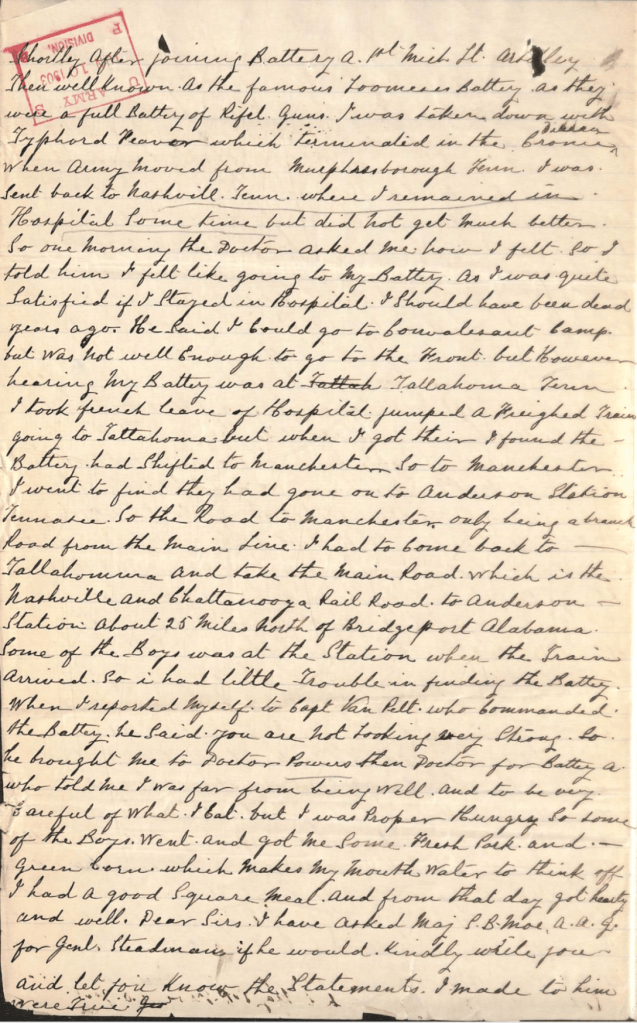


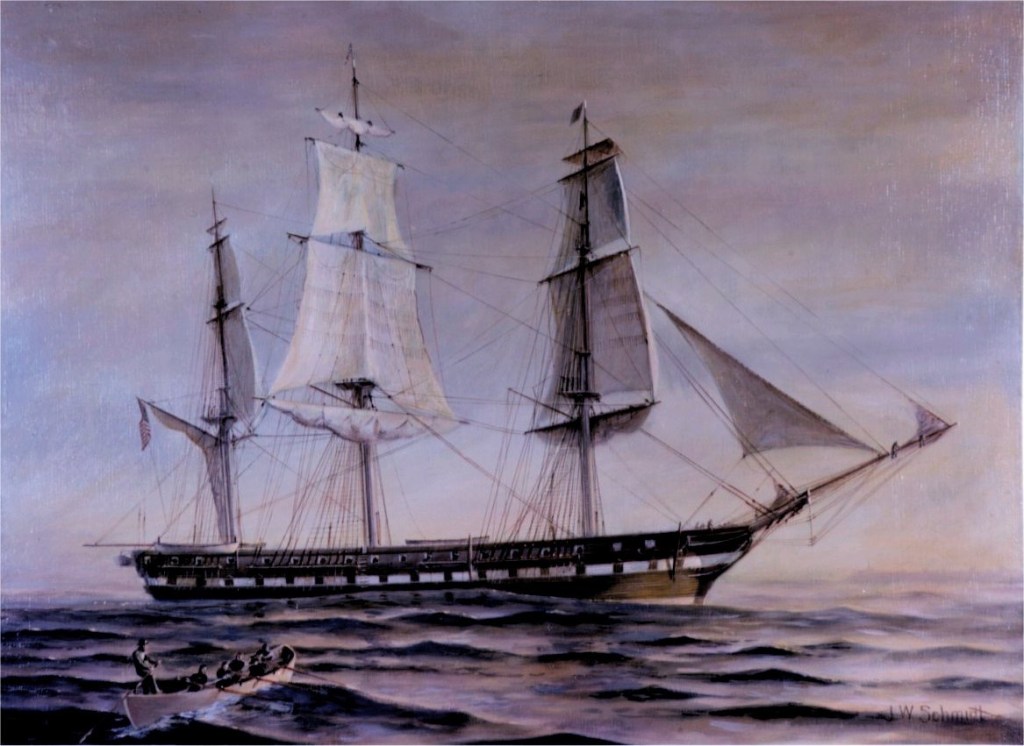


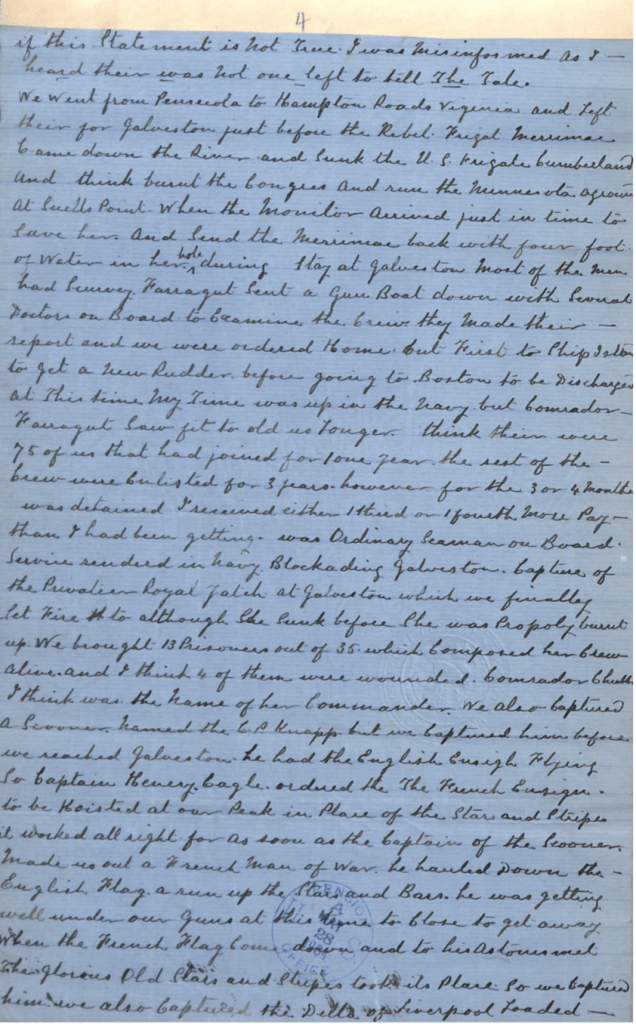

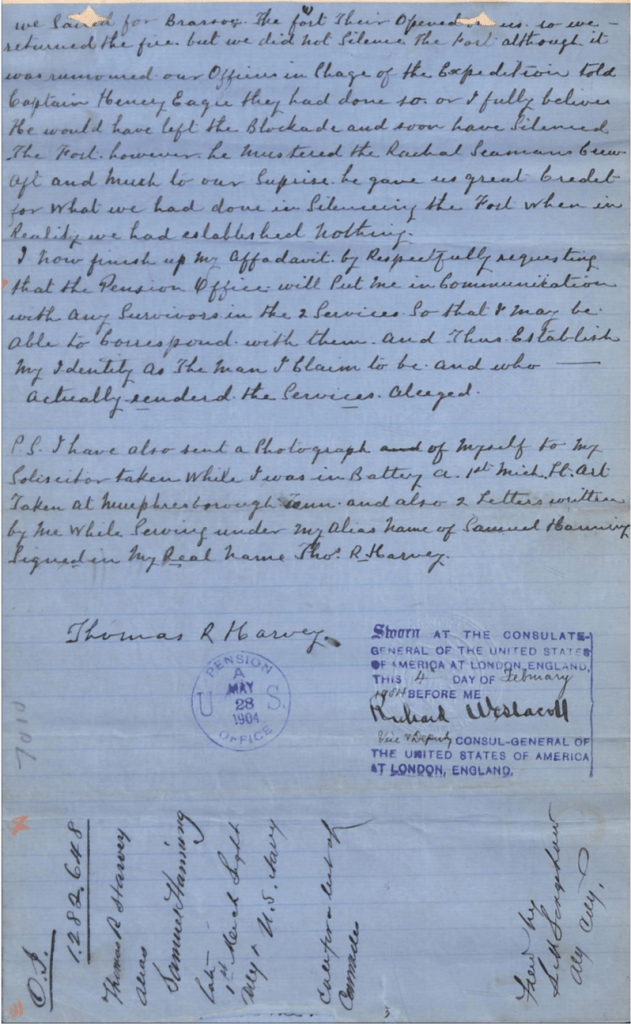
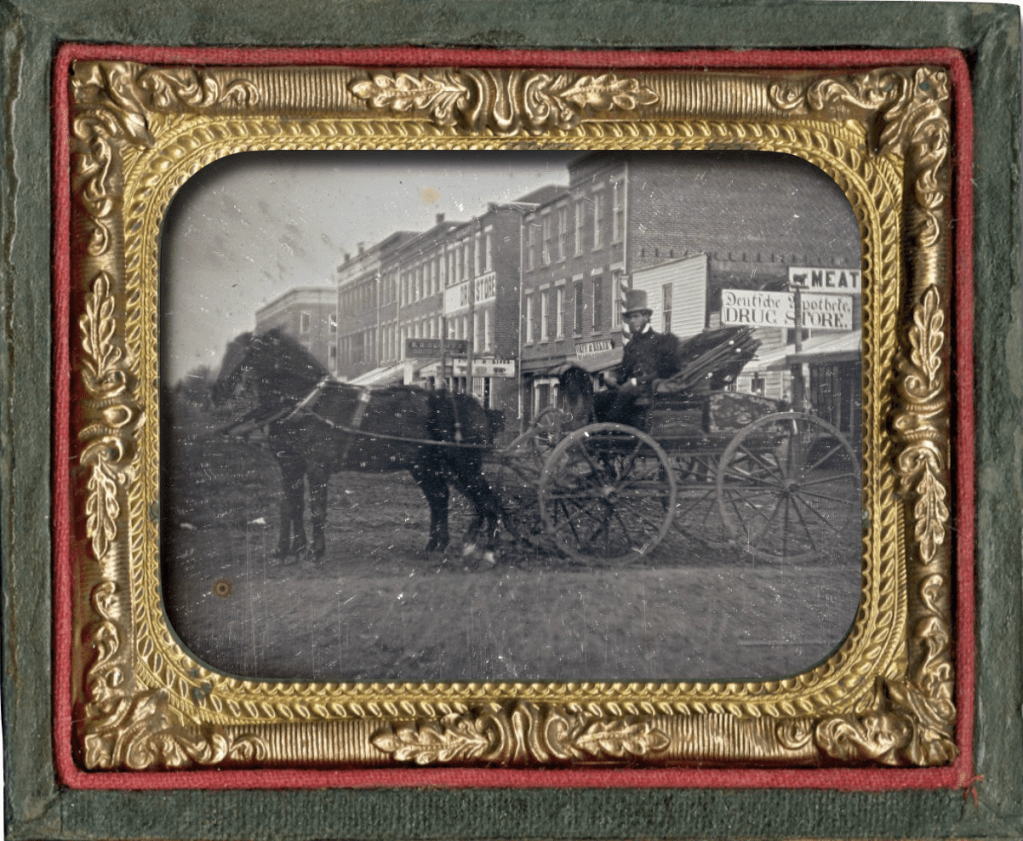

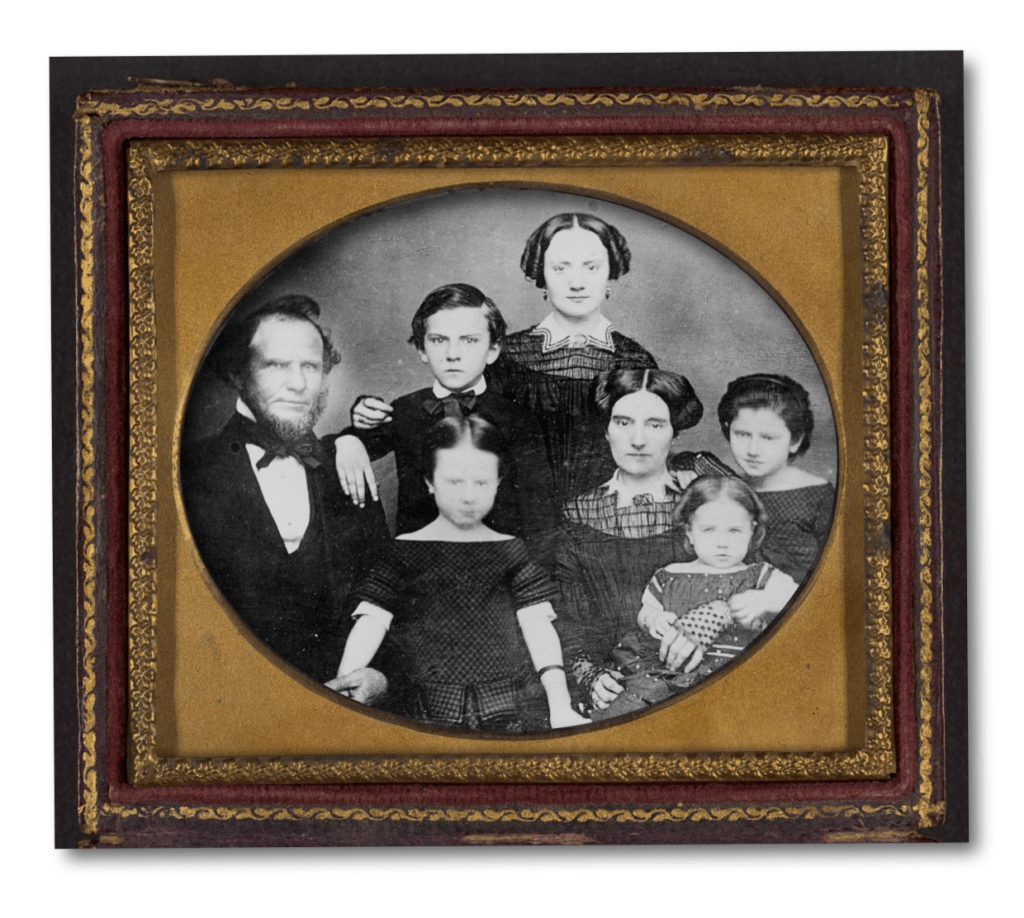


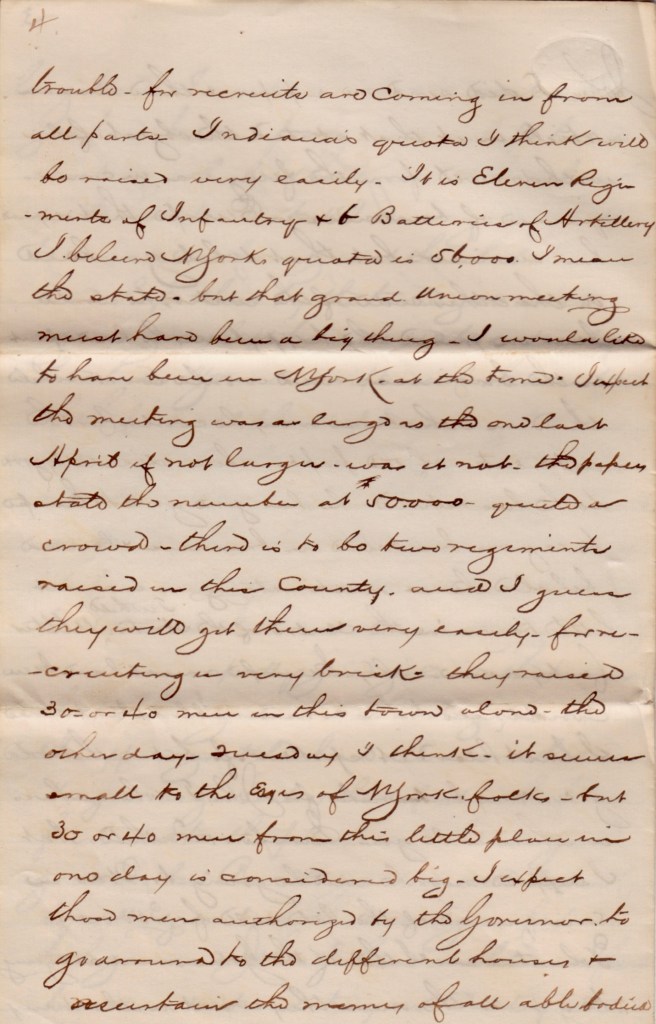
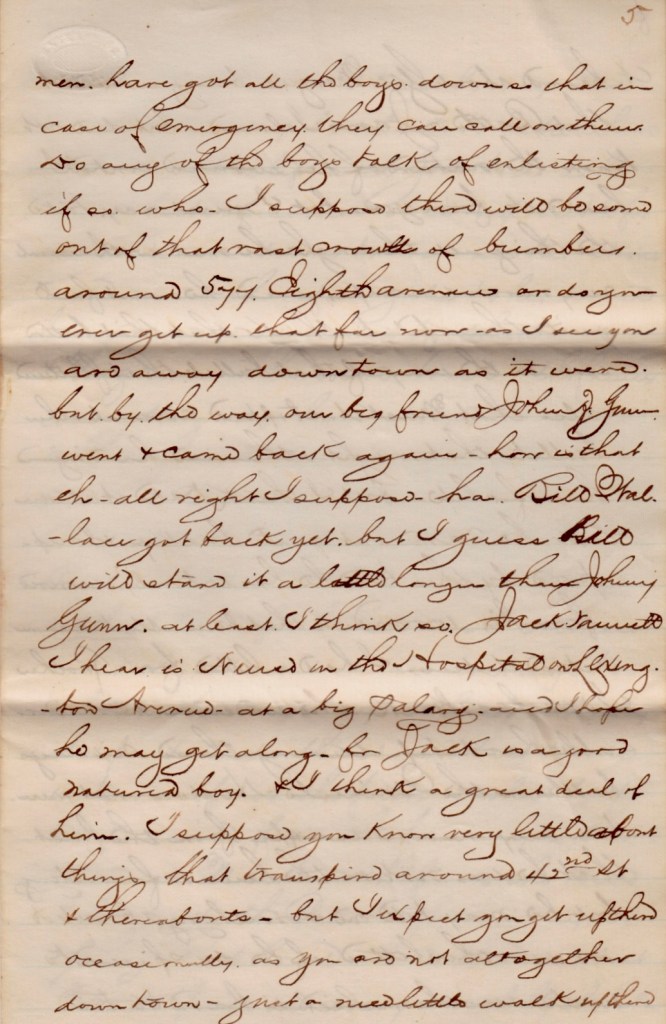

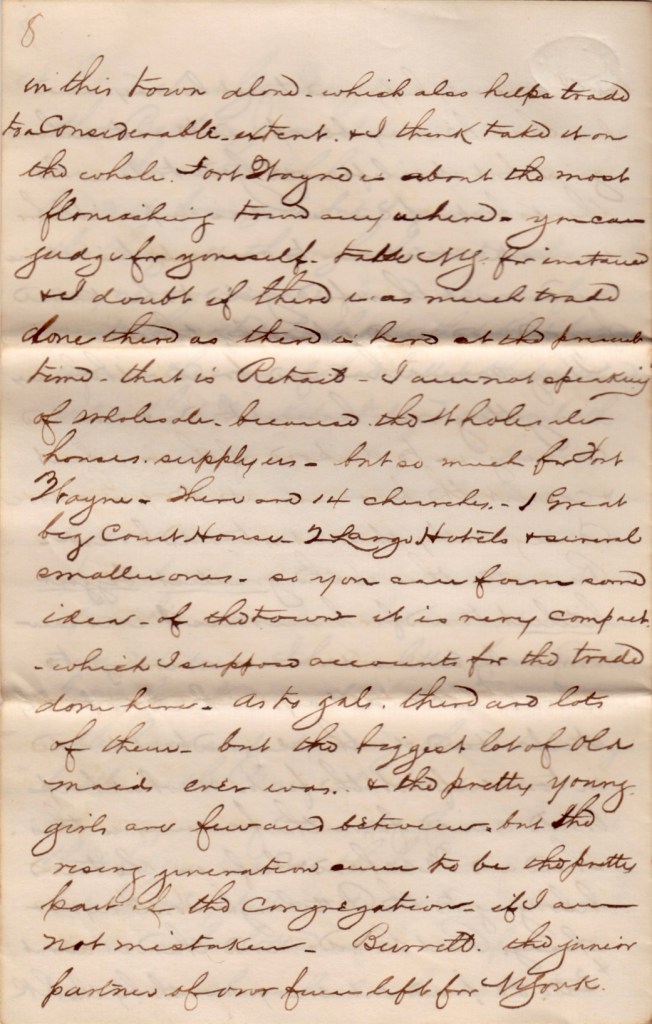

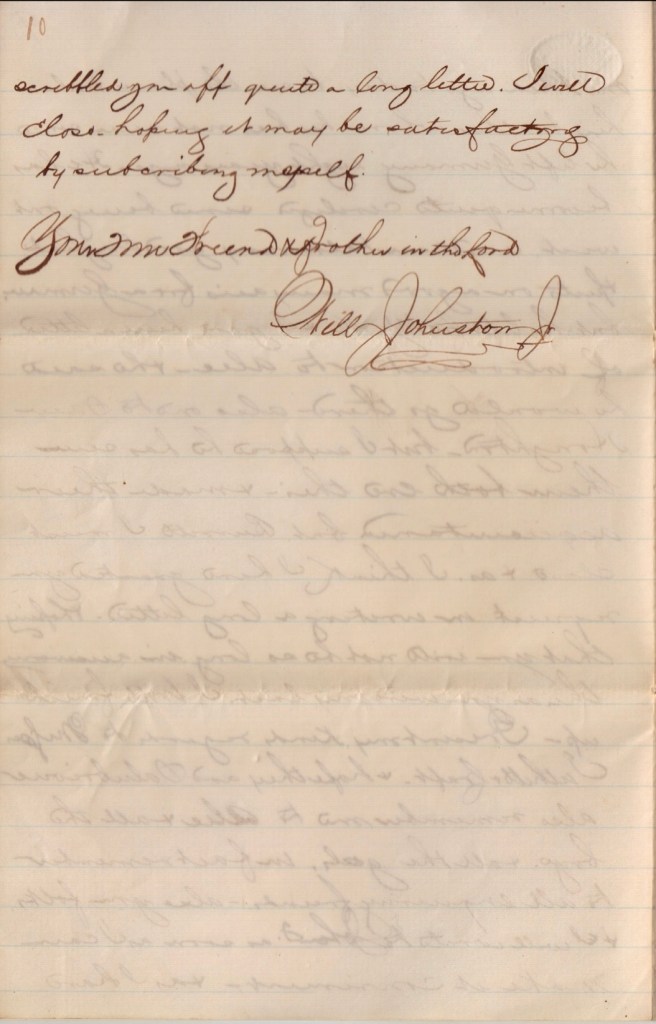
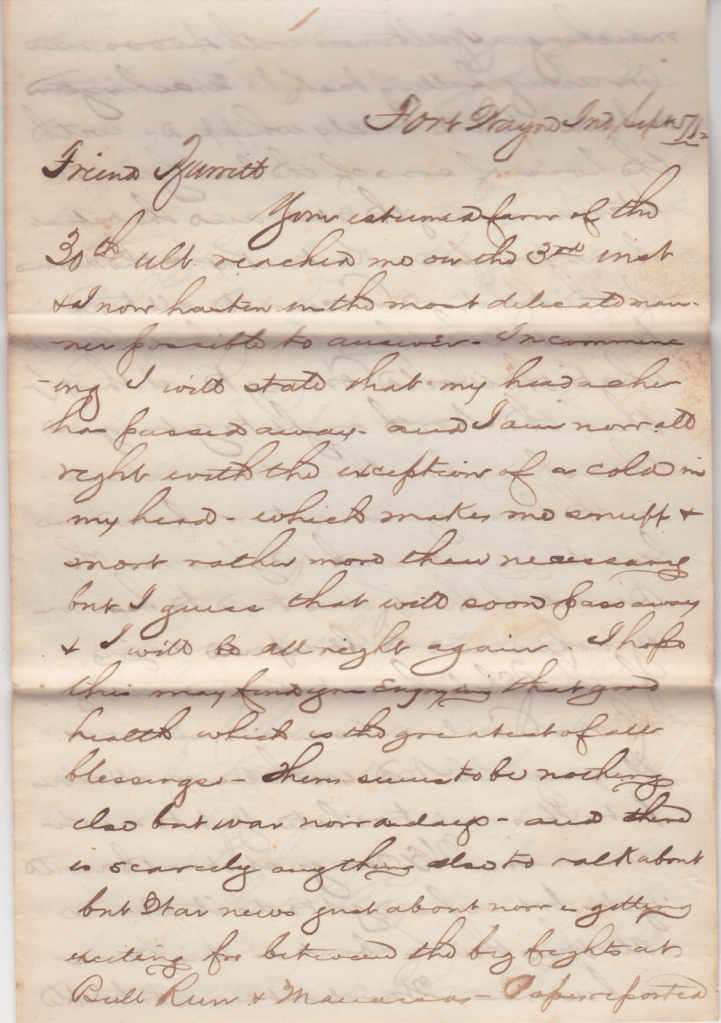
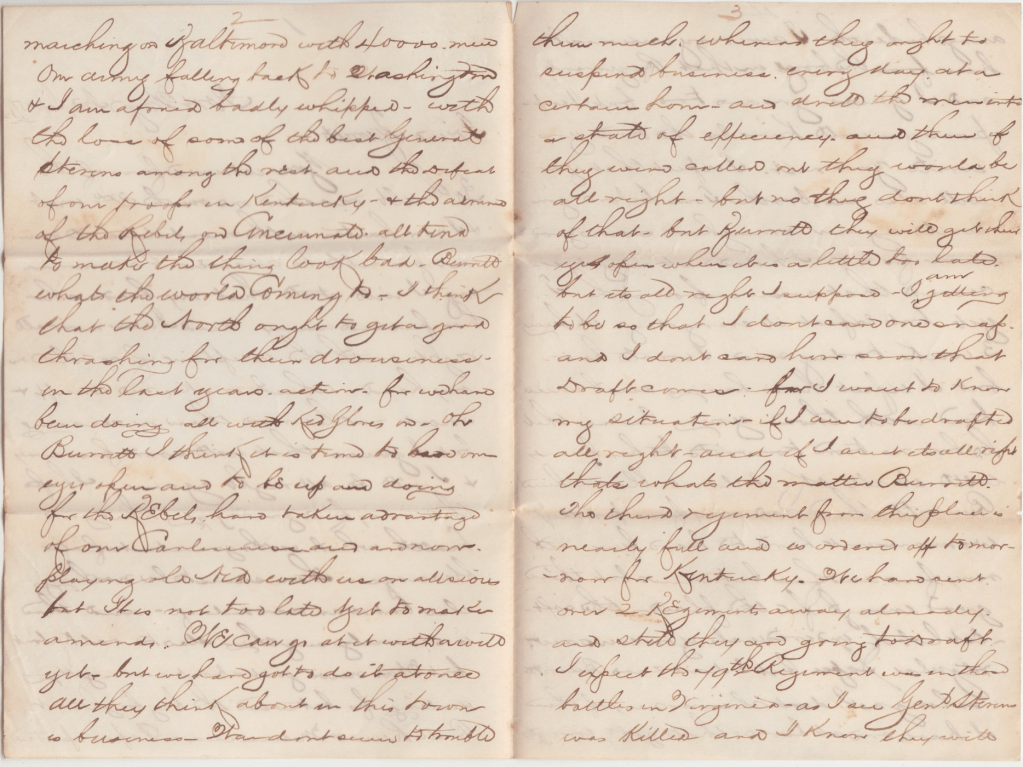

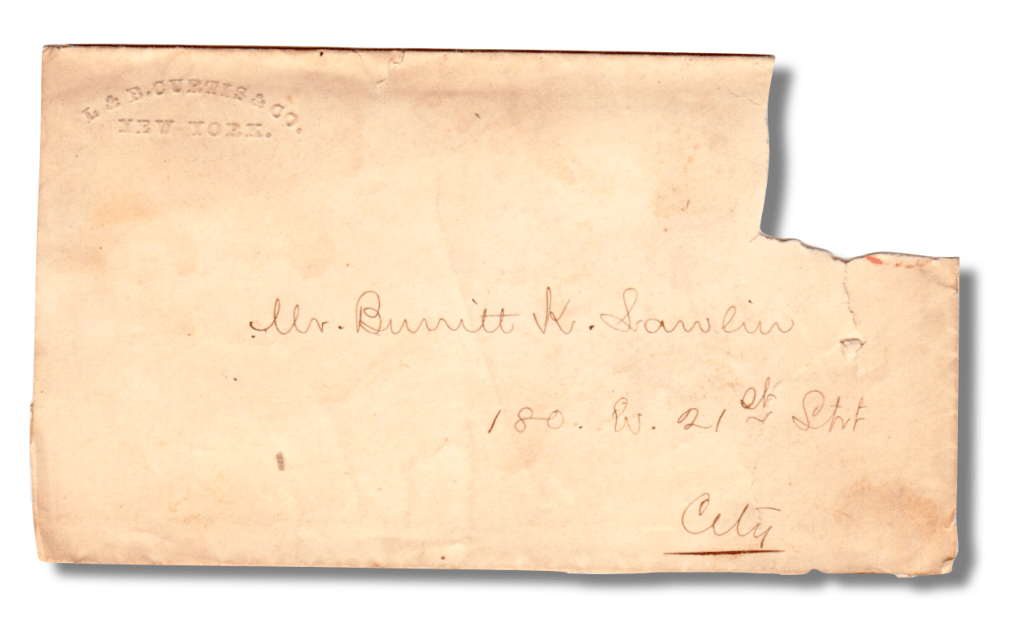



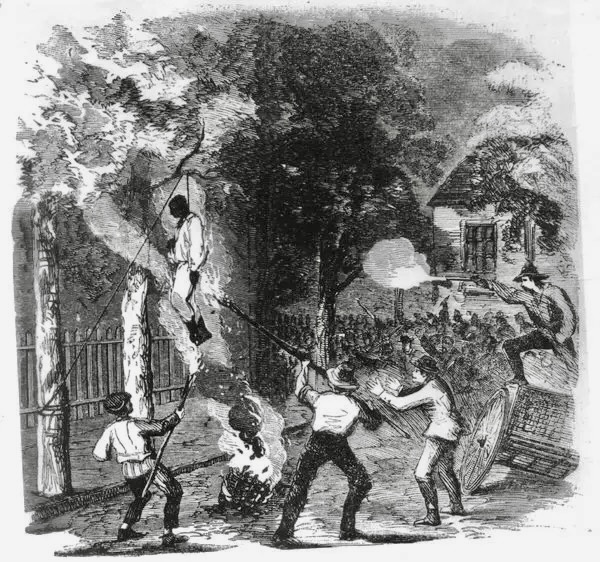

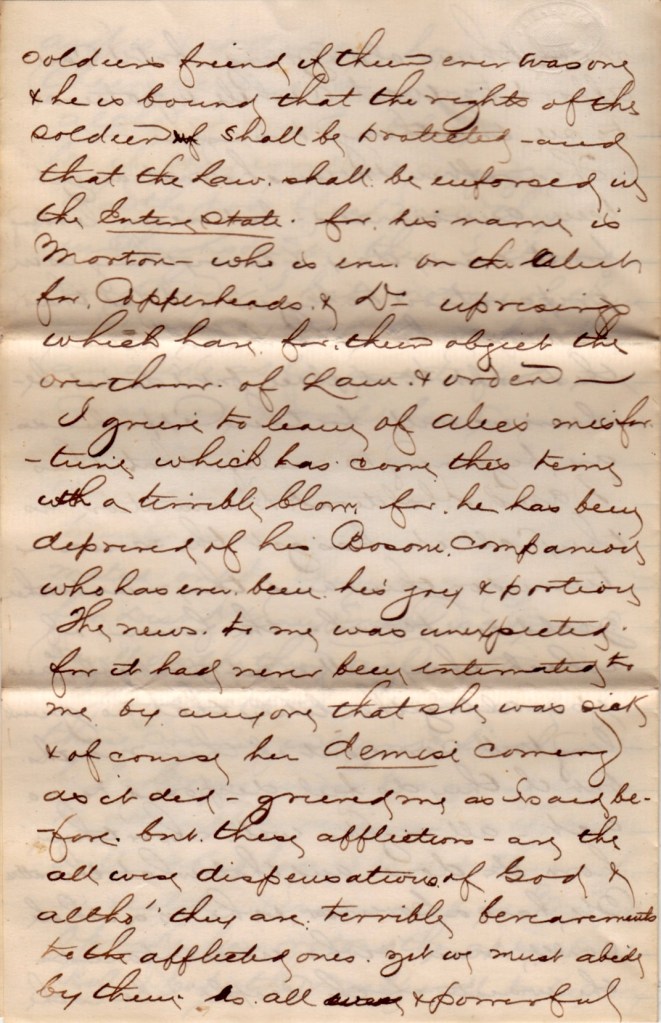

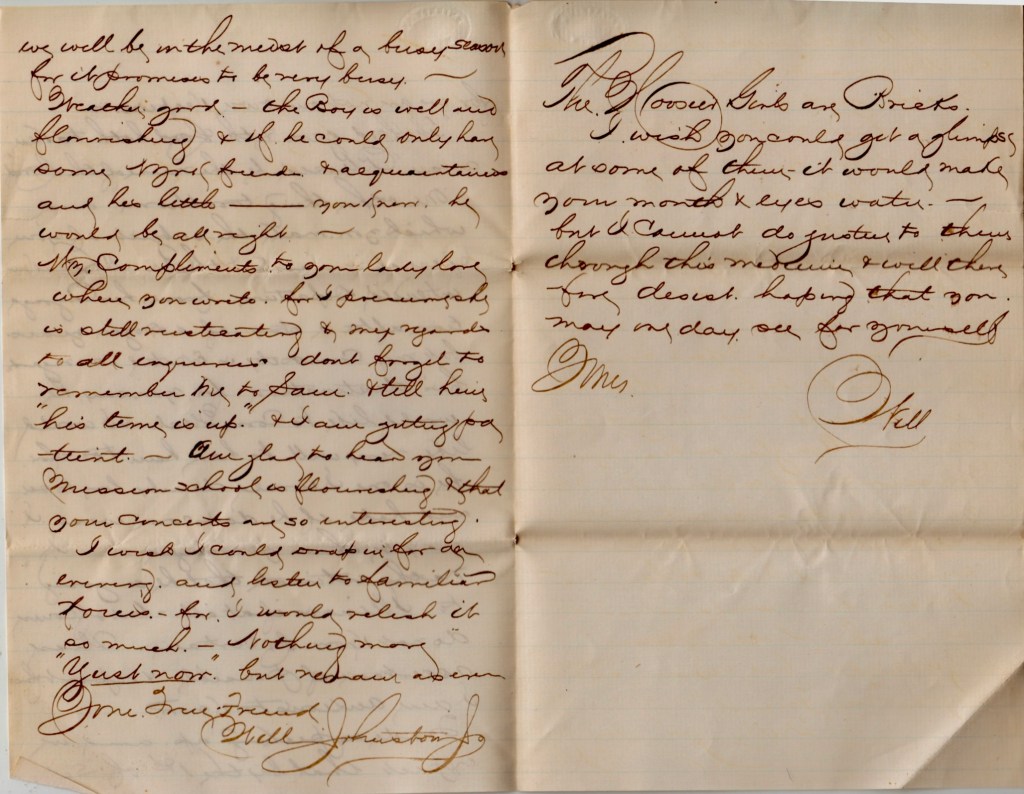
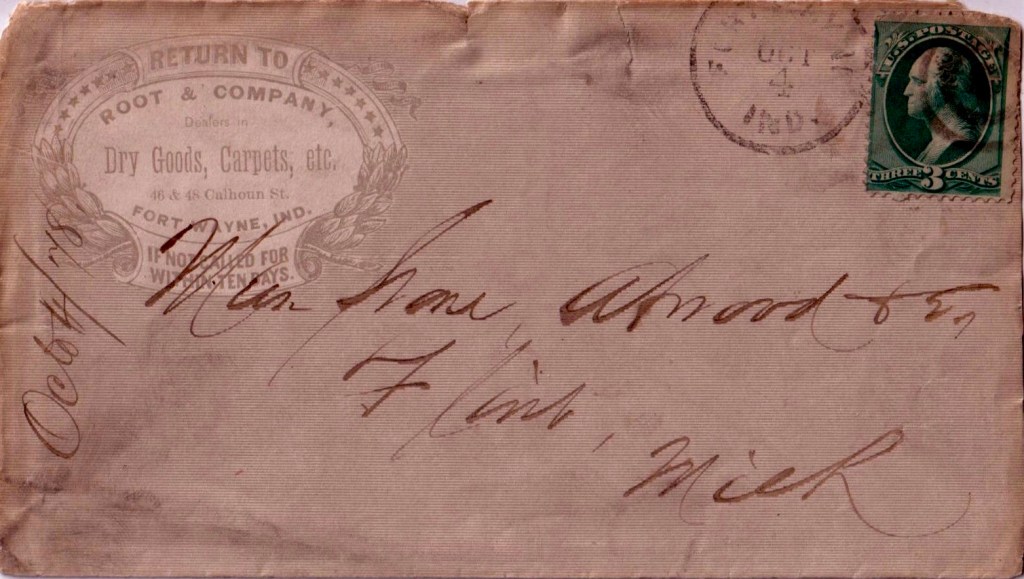

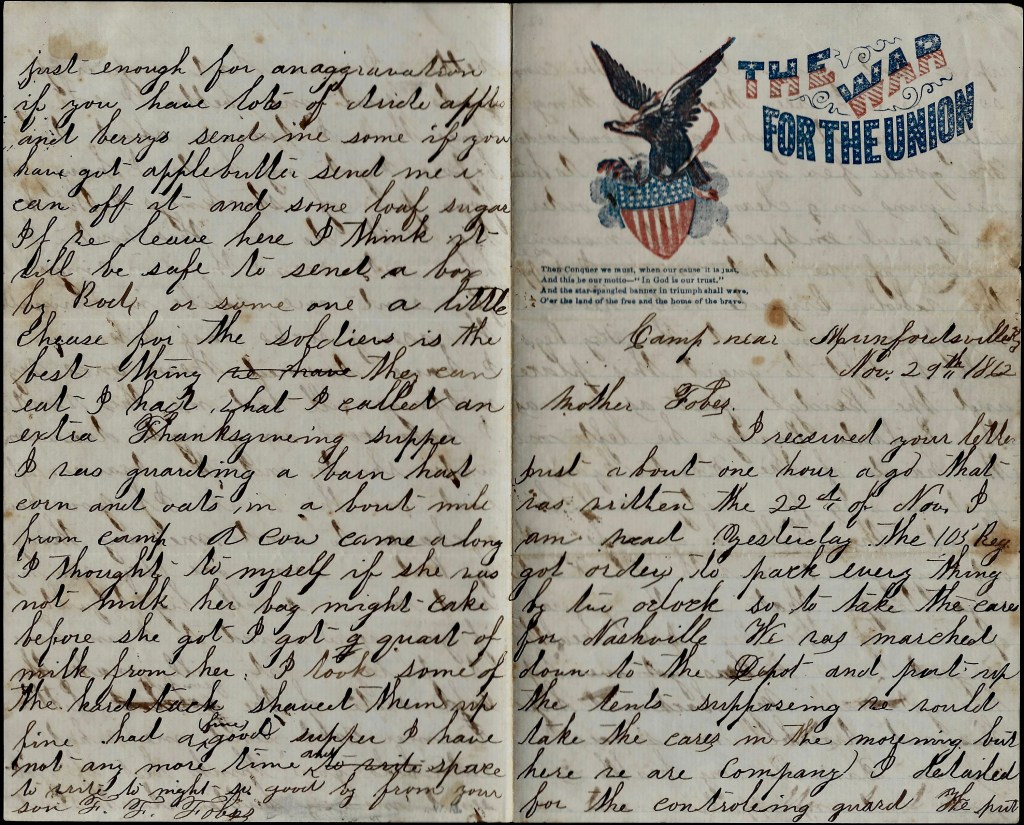
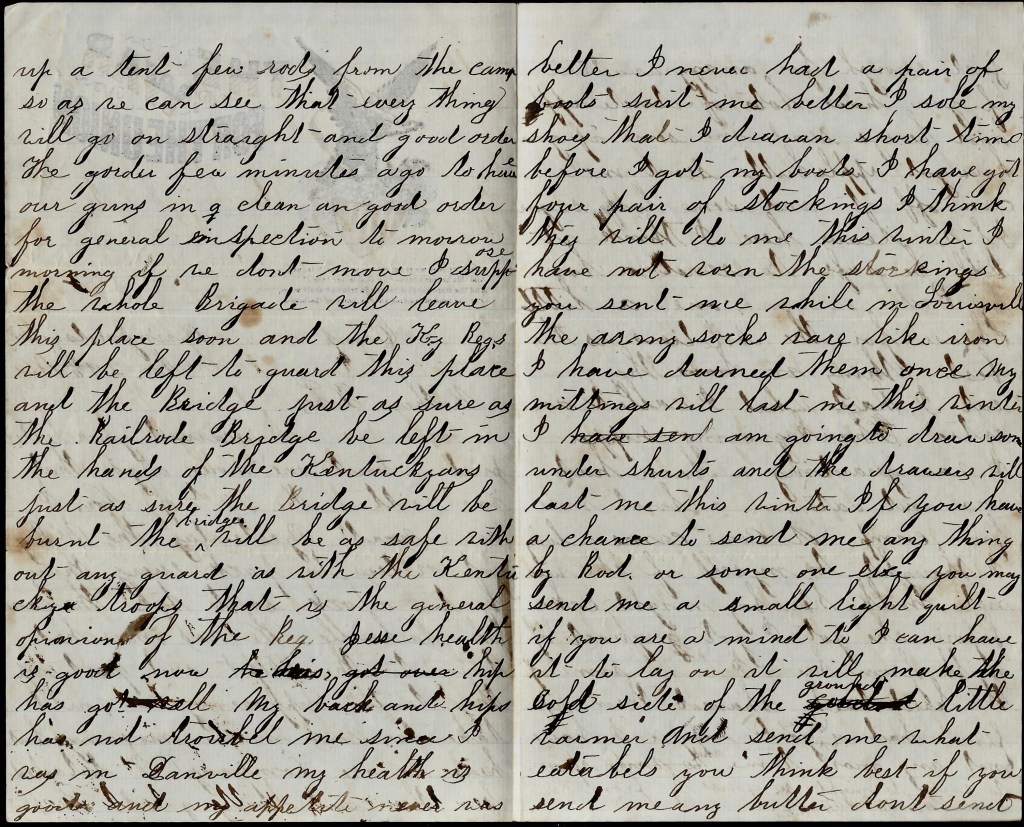
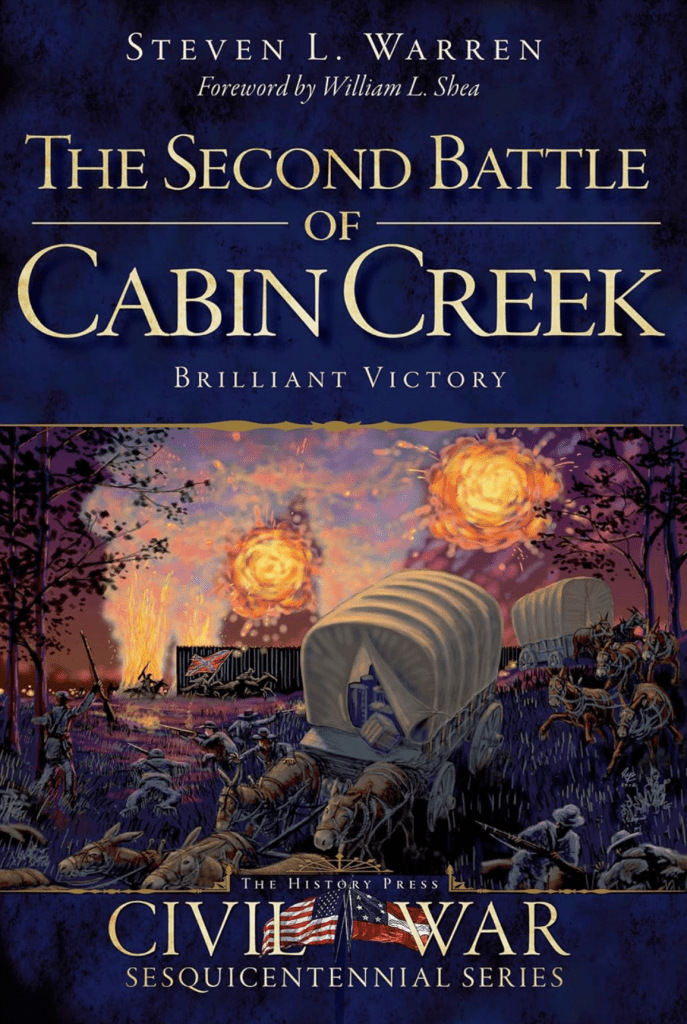
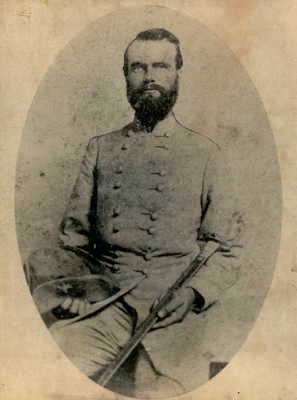


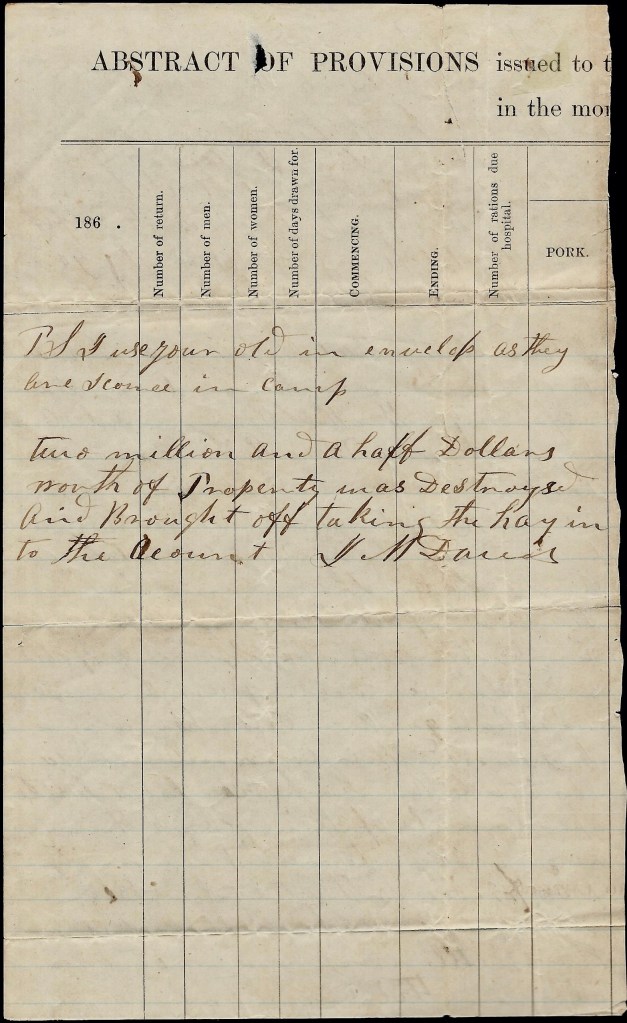

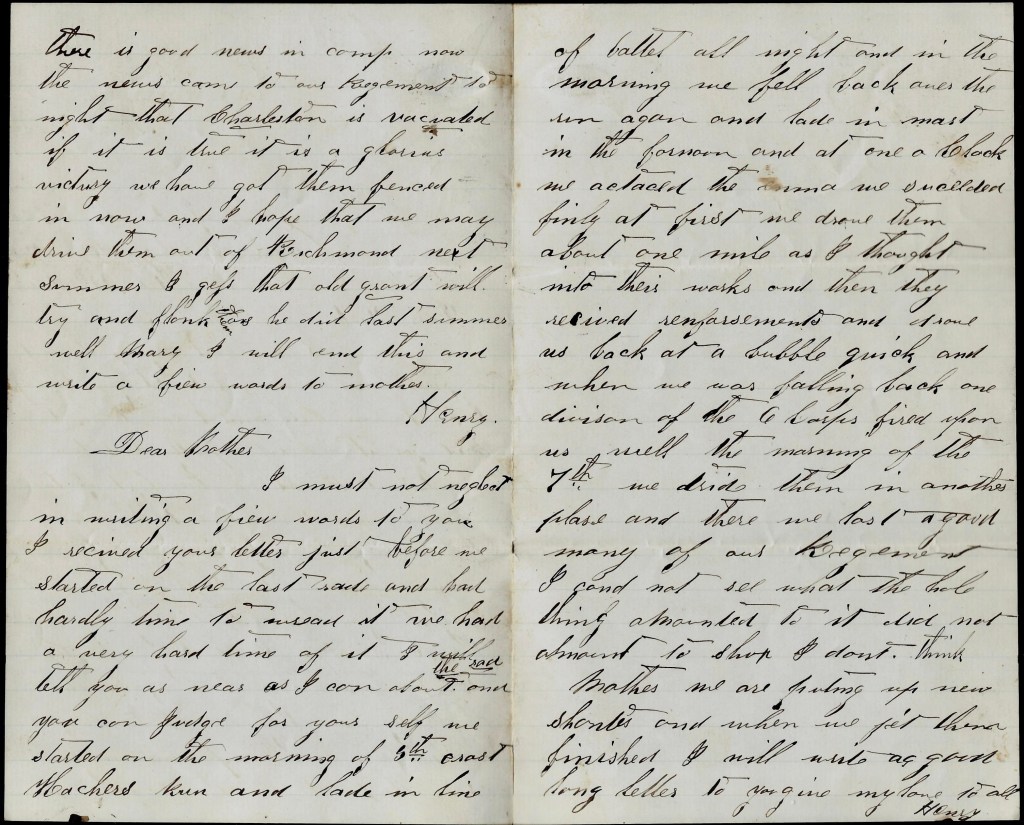
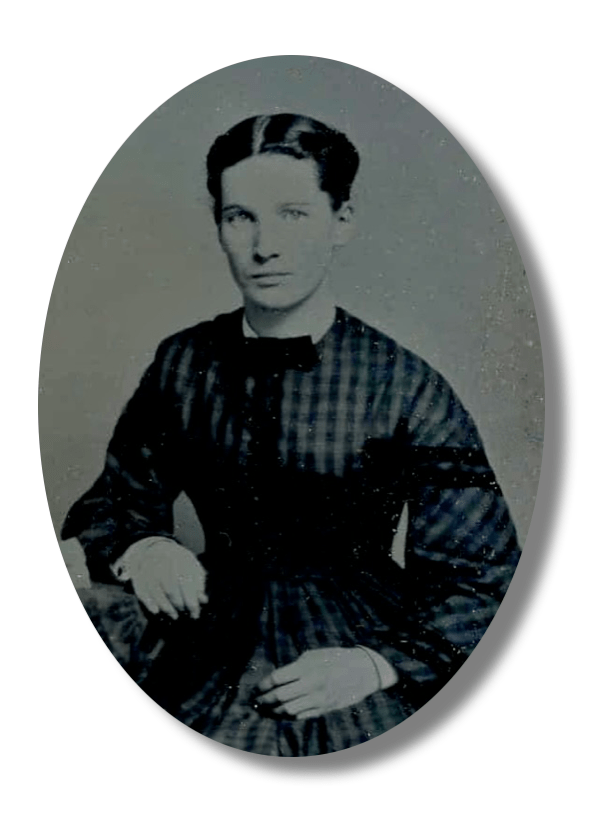
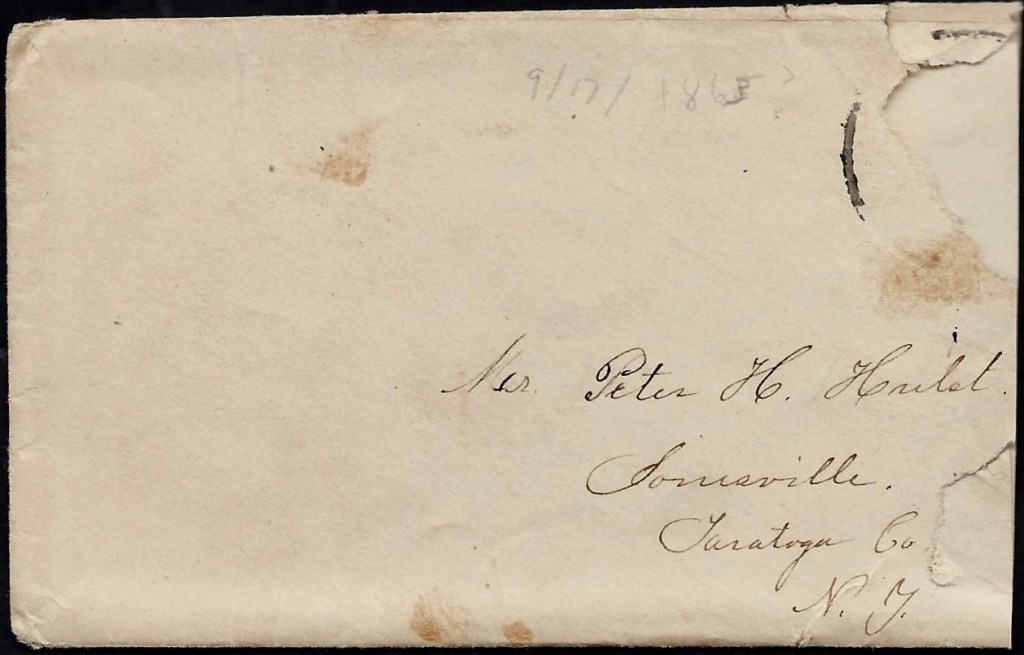
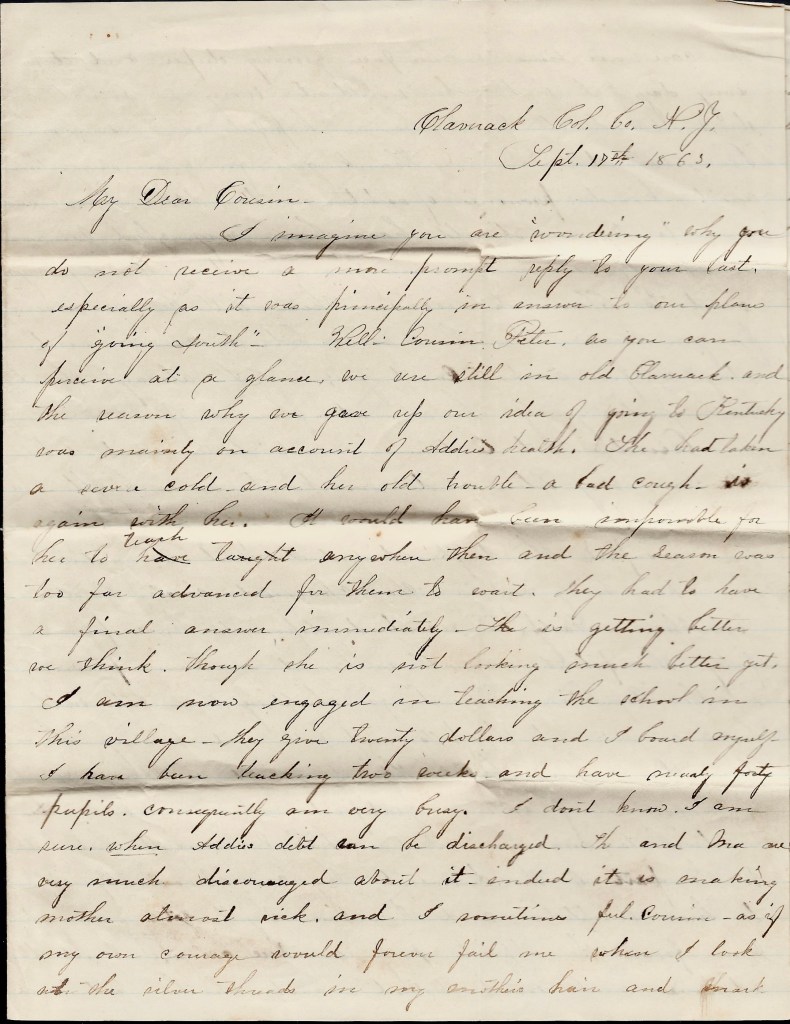
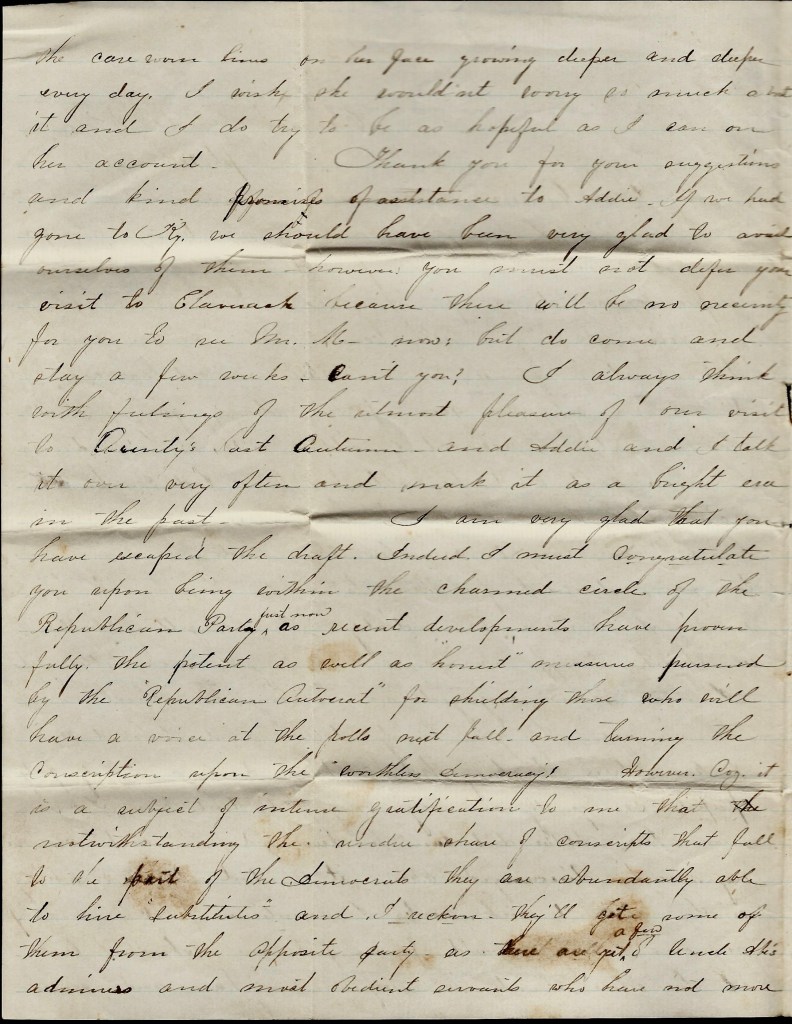

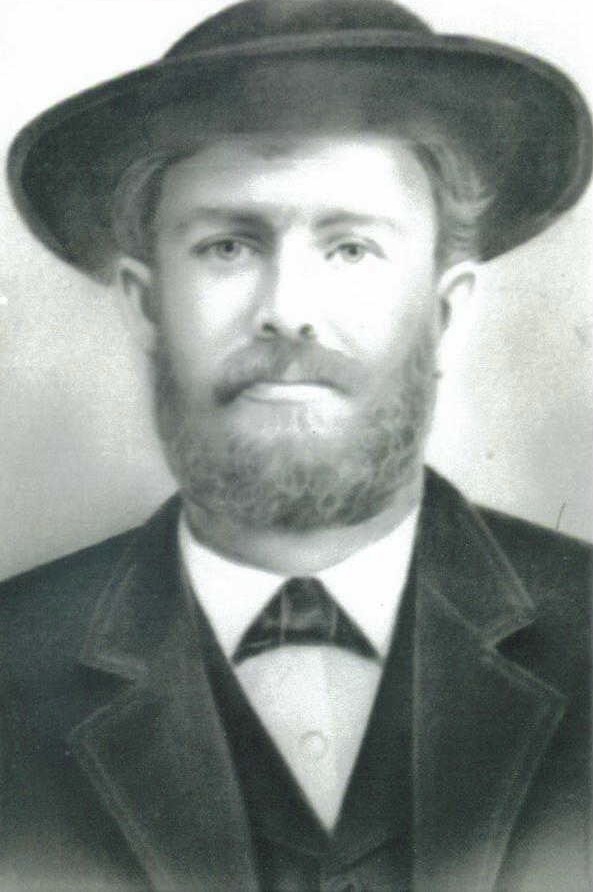
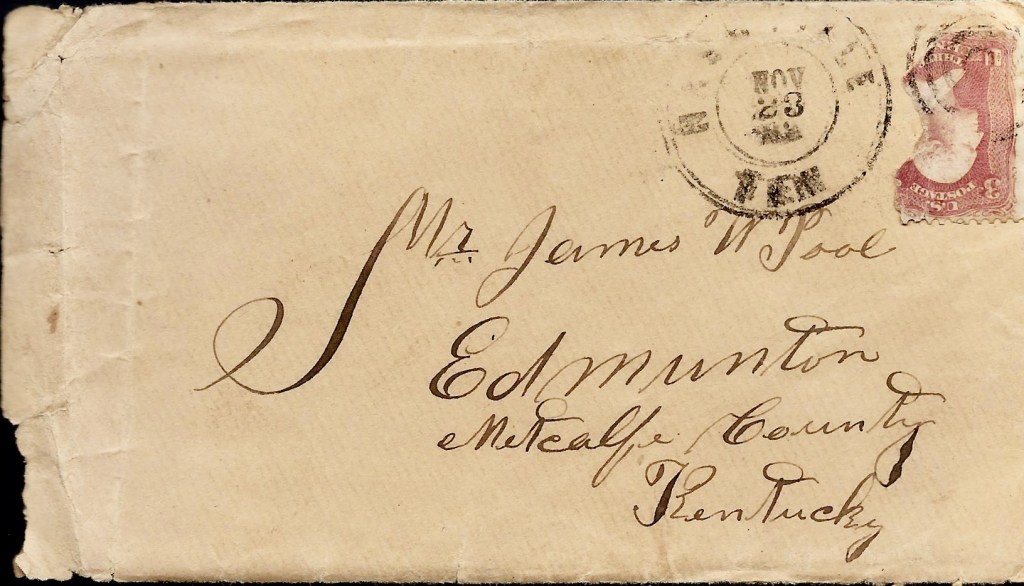

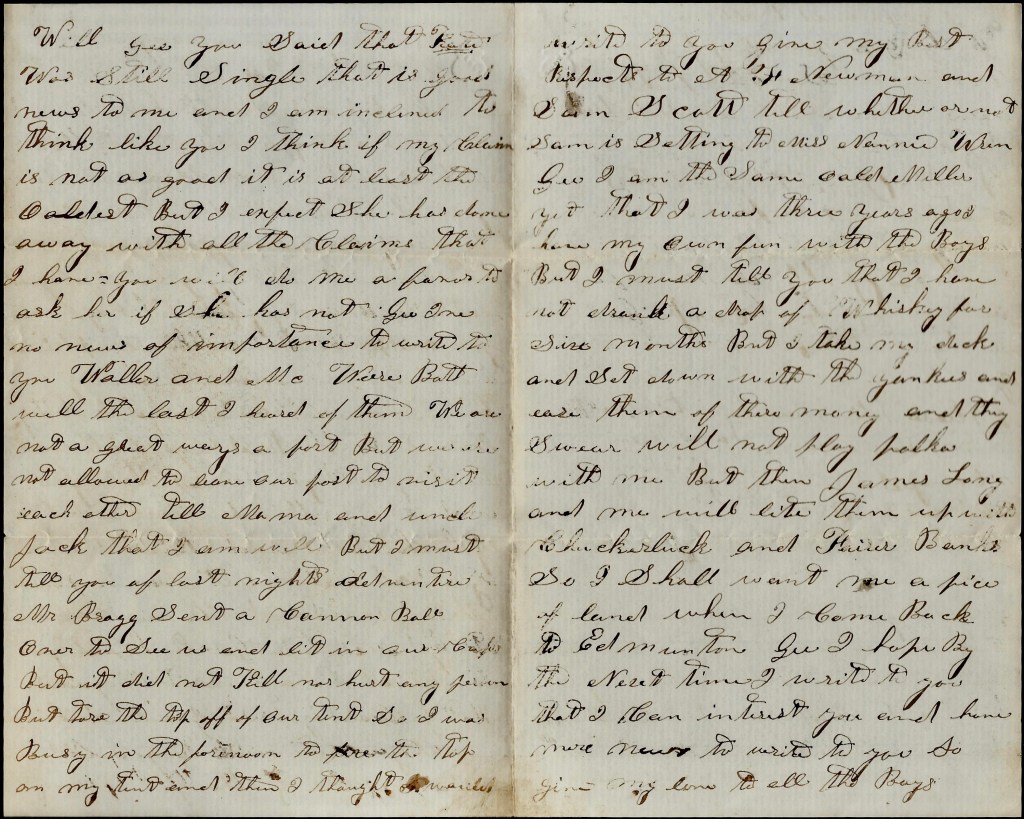




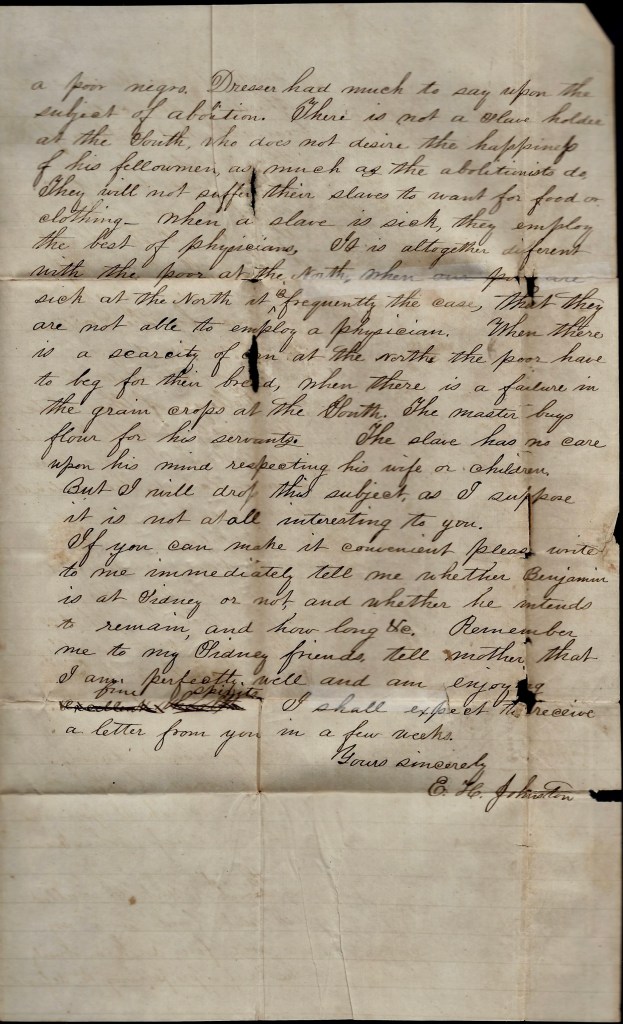

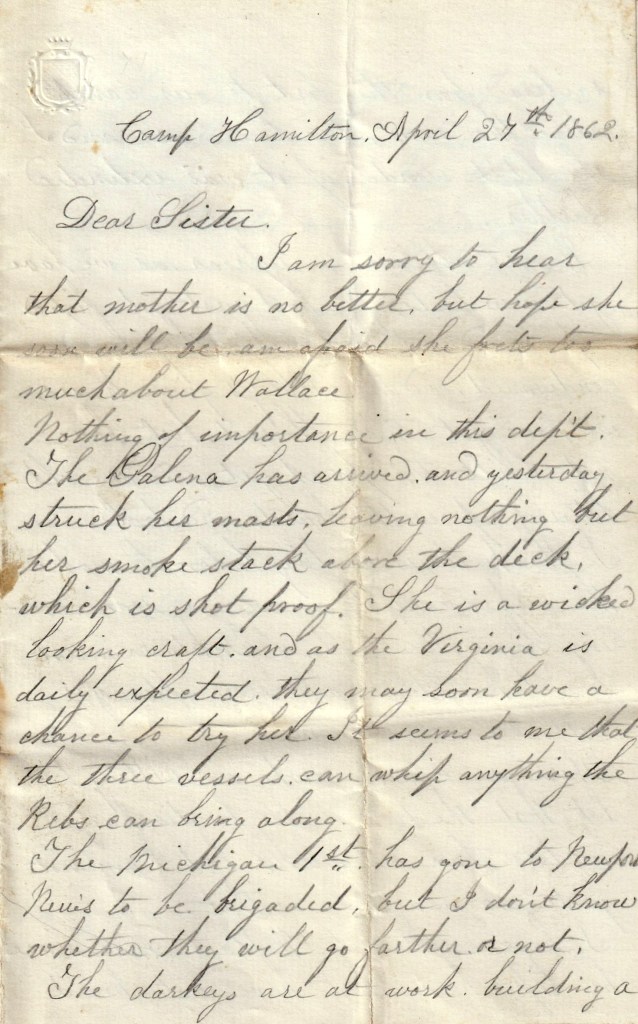
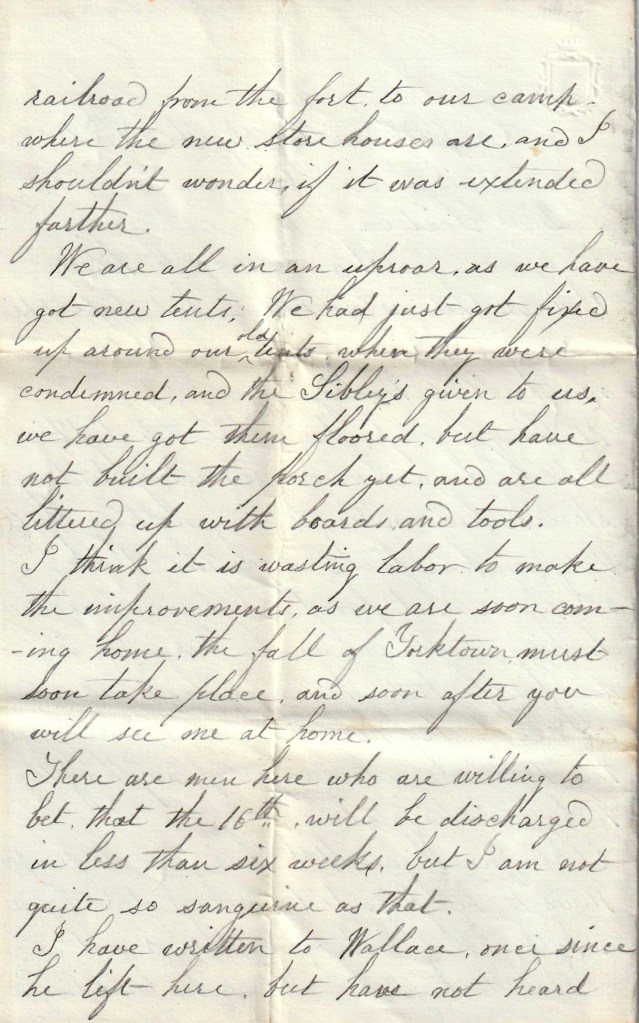


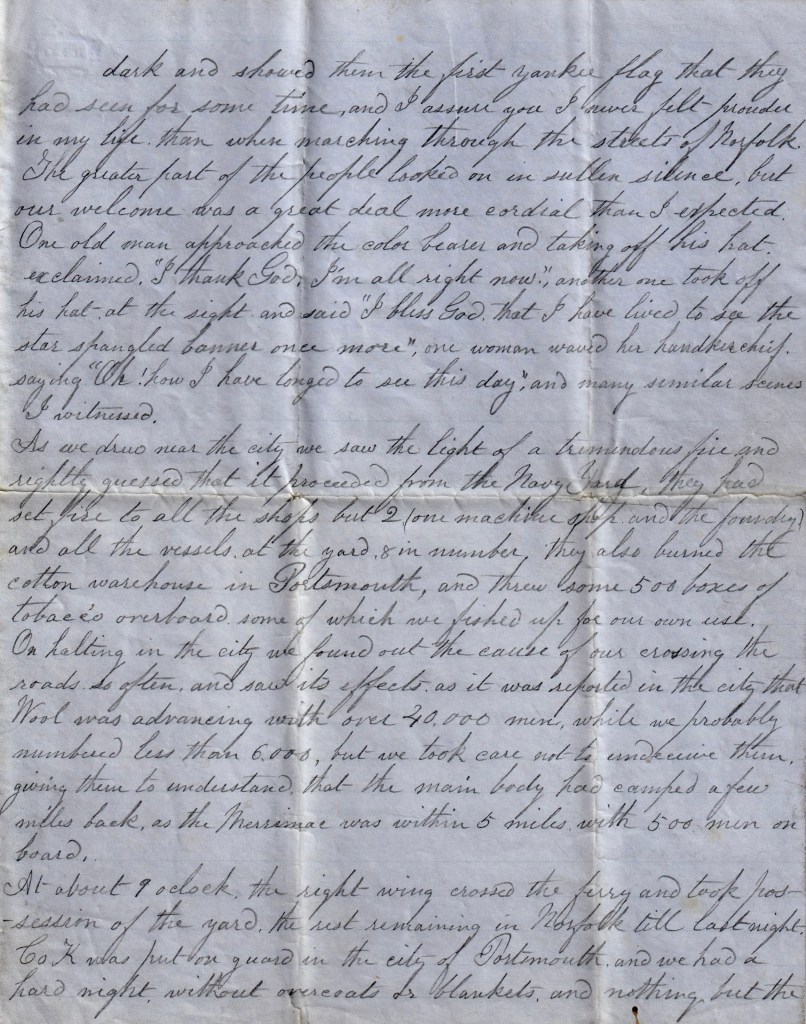


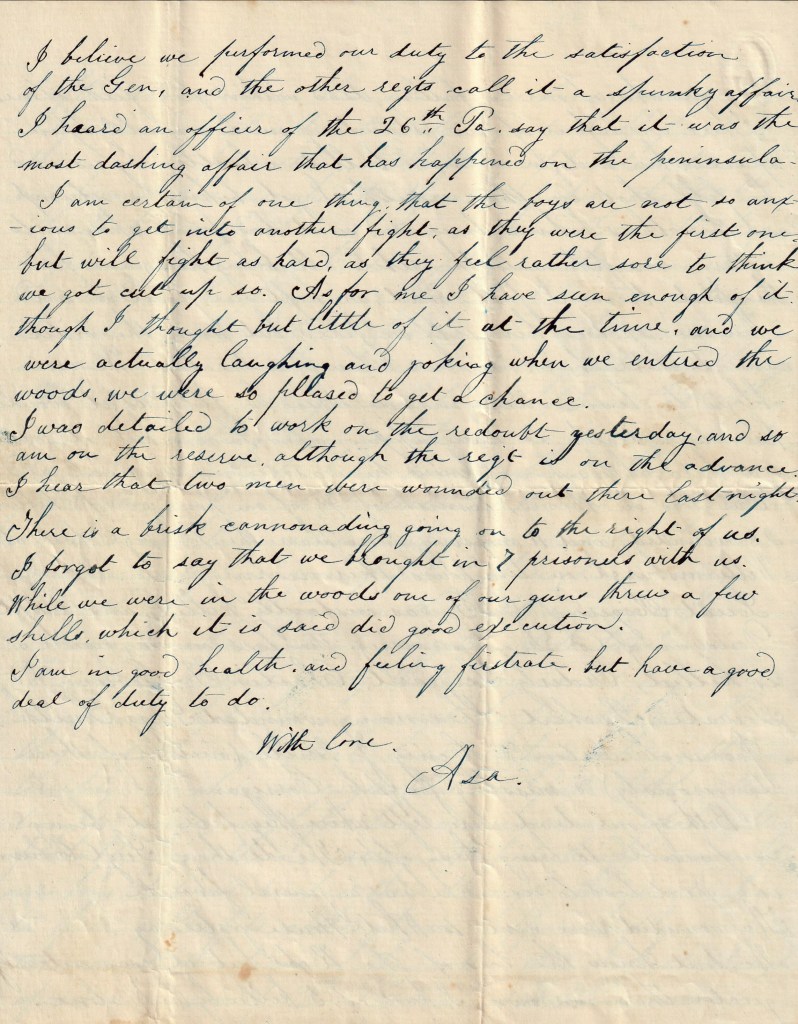

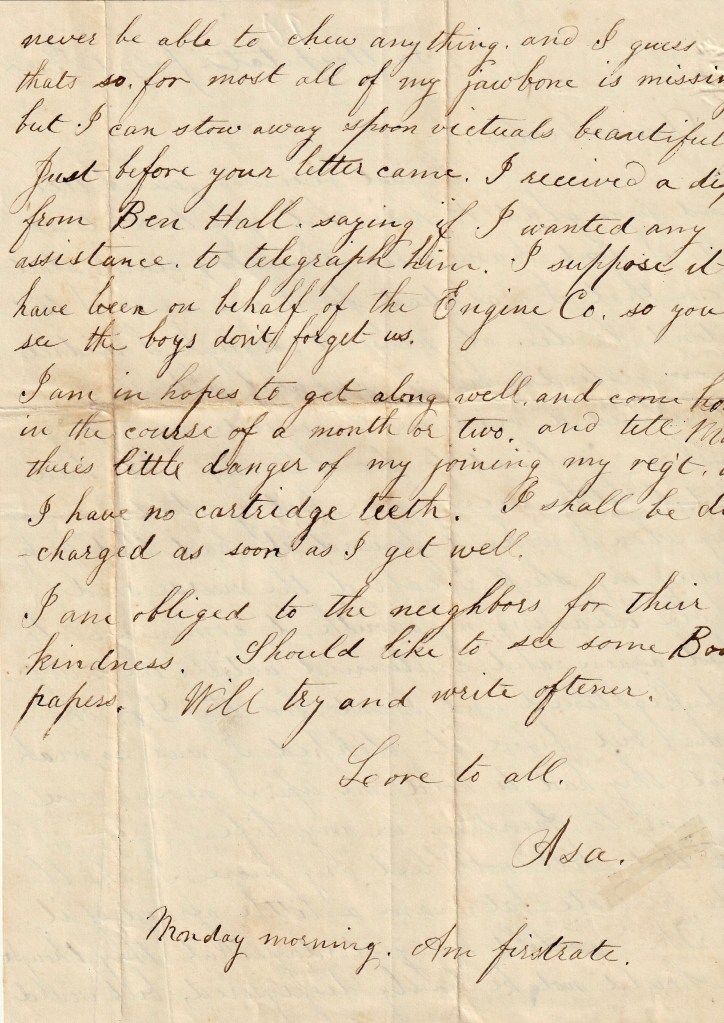
 Spared & Shared 23