Tag Archives: civil-war

1862: Lewis Augustus Snook to John L. Koons

The following letter was written by Lewis Augustus Snook (1836-1928), the son of Daniel Snook (1799-1886) and Ann Margaret Hill (1799-1848). It was Lewis’ older brother Josiah Snook (b. 1827) who took over his father’s farmstead (pictured above at the homestead) but at the time this letter was written in the fall of 1862, 63 year-old Daniel still lived with several of his children in the house, including 26 year-old Lewis and 32 year-old Mary. When the 1860 US Slave Schedules were tallied, Daniel Snook owned two slaves—two mulatto females, age 20 and 24.

Lewis’s letter describes passing over the battlefield at Sharpsburg four days after the battle. He observed that most of the Union solders had been buried but there were yet Confederate soldiers still awaiting burial.

This letter is from the personal collection of Greg Herr and was made available for transcription and publication on Spared & Shared by express consent.

Transcription

Utica Mills [Frederick county, Maryland]
October 26, 1862

Dear Sir,

I thought it was now time for me to write to you in answer to your letter of the 27th June but I know that I have not waited as long as you have or did. But I thought you would like to hear from your poor old pap and the rest of the family. We are all very well at present and hope you are the same.

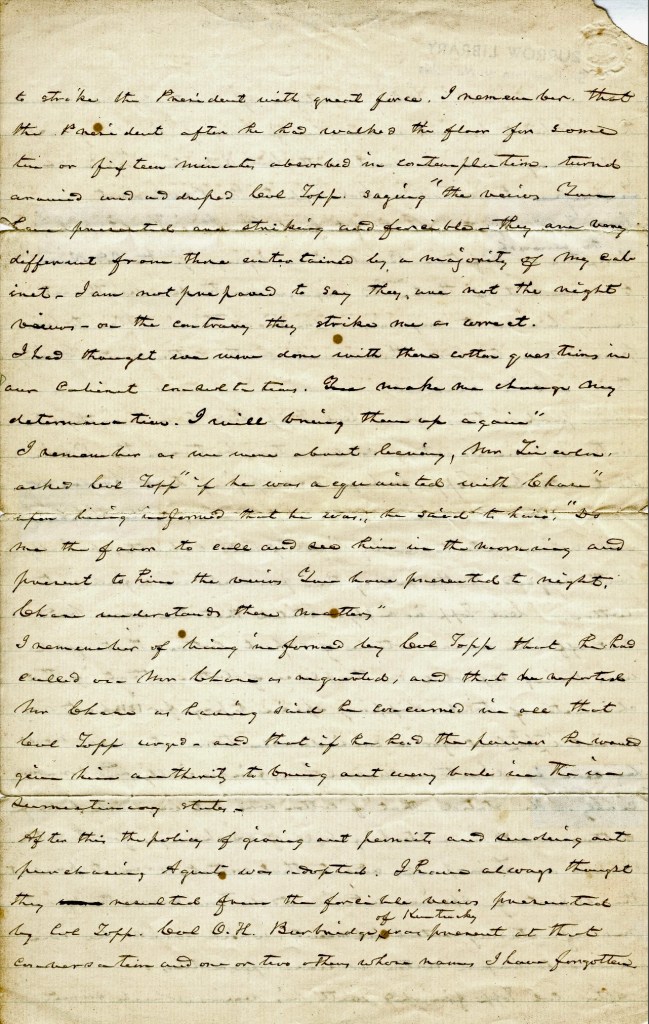
You wrote in your last letter that you was in a bakery. I guess by this time you are perfect, but I must now tell you what is going on down here. Uncle Sam is everywhere we thought, but when the rebels come over to pay us a visit, there was not a blue coat to be seen. They [the rebels] was in Frederick about a week but they did us no damage but took about a hundred dollars worth of corn and oats and paid us off with their script. But the Federals soon moved them away when they got after them.

We could hear the cannon for five days continually. I was on the battle ground at Sharpsburg four days after the fight. I saw horses and rebs—plenty of them. The Union men was buried before I got there. There was great confusion here when the rebs came to town and I and Josiah did skedaddle with the rest to our sister state and took six of our horses along. But we came home again in a few days. Mary & Joe saw Frank Koons 1 in Frederick a few days after the fight. He had received a wound in the heel from a buck shot.

The draft in this county keeps the people in trouble. There is 259 out of this county which will take about the tenth man that is subject to the draft. We are all in as good a spirits as could be expected in war times— Darkeys and all of us. Oh, Dan Shaffer is not married yet. There is still hopes for you. Oh by the way, I just thought of one thing. Would you let me have them pants of yours made of some homemade goods that you wore some the last winter you was here. If you would sell them to me, I will pay you what is right unless you wish to keep them. Mary told me to ask you about them and if you think you will spare them, please write directly and let me know or I must buy a pair before long. But I will wait to hear from you. Let me know the least you can take for them and what kind of money—I guess green backs—and I can send it to you.

Do not neglect writing directly for Mary is wanting to hear from you bad. She often wants me to write to you but you are so slow to answer. Nothing more at this time. Our compliments to you, — Lewis A. Snook

This is a very rainy night. Write soon. Goodbye.


1 Frederick Frank Koons [Koontz] (1833-1915), a native of Frederick county, Maryland, who was a machinist in Ashland, Ohio. He enlisted as a private in June 1861 to serve in Co. G, 23rd Ohio Infantry. He was wounded at South Mountain on 14 September 1862. He later rose to 1st Sergeant of his company. He was married to Sarah Ellen Potter in August 1853.

1864 Interview with Lincoln on Cotton Policy

The following declaration was made years after the war by Brutus Junius Clay (1808-1878) who represented Kentucky in the 39th Congress from March 1863 to March 1865. He was the chairman of the Committee on Agriculture so naturally had reason to be concerned about the Cotton growing industry. In this statement, Clay “makes oath” that in January or February 1864, he went with Col. Robertson Topp (1807-1876), a Memphis lawyer, who made huge investments in real estate and agricultural ventures prior to the secession of Tennessee and naturally lost heavily as a result of the war. Clay claims that it was Col. Topp who convinced Lincoln to change his Administration’s policy on the sale of cotton early in 1864.

Historian Gabor Boritt argued: “The good Whig Lincoln saw commerce as a glue that bound the Union together. Throughout the war he showed much more leniency toward trade across hostile lines than did Congress, not to mention the military. Immediately after the firing on Sumter.” According to Boritt, “As Lincoln shifted the tactics of his peace work in 1863, cotton came to play an increasing role in his thinking. He tried to be careful, recognizing inherent dangers in his policy, fearing an atmosphere where ‘profit controls all,’ even the army. Nonetheless by early 1864 he prepared a careful program with the aid of Chase, and others, that invited Southern planters, for three years unable to freely market their cotton, to take the oath of allegiance and sell their product to government agents for twenty-five percent of its market value. They were to receive the rest of their purchase price after the war, provided they had remained loyal to the United States.” [Source: Gabor Boritt, Lincoln and the Economics of the American Dream, pp. 243-244]

The document resides in Burrow Library in Memphis.

Transcription

[Brutus Junius] Clay, a citizen of Kentucky, makes oath that whilst he was a member Congress in January or February 1864, he went with Col. Robertson Topp of Tennessee to introduce Col. Topp to the President. Col. Topp’s object was to get from the President permission for the owners of ten or fifteen boats then lying up the Red River to come out of that river and engage in trade without being liable to seizure or confiscation. Also to be permitted to load those boats with cotton and bring that out to market.

These propositions from Col. Topp lead to a lengthy and intensely interesting conversation between the President and Col Topp, occupying two hours or more. The President detailed at length the reasons and views entertained by himself and cabinet, especially with regard to the policy then pursued in reference to cotton. Col. Topp in reply stated that the war had cut off the usual article of export—cotton, [and] that gold was being exported in the place of cotton. That if that character of trade, shipping specie to pay for imports was permitted [ ] for a considerable time, its effect would be seen in disastrous [ ], financially and commercially. He stated that if cotton was let in, each bale of cotton would be a sterling bill of exchange for its [ ] value in Liverpool, and to that extent, serve to prevent the export of specie, and in addition, serve the great manufacturing establishments which would be compelled to import cotton or cease operations.

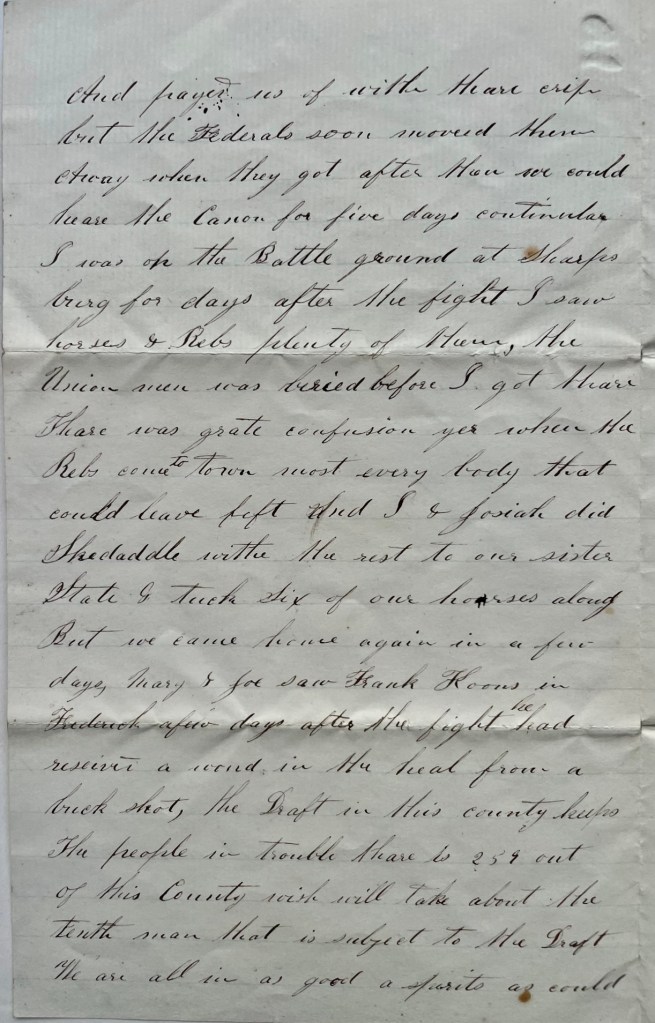
After Col. Topp finished with his views, which seemed to strike the President with great force, I remember that the President after he had walked the floor for some ten or fifteen minutes absorbed in contemplation, turned around and addressed Col. Topp, saying, “The views you have presented are striking and forcible. They are very different from those entertained by a majority of my cabinet. I am not prepared to say they are not the right views. On the contrary, they strike me as correct.

I had thought we were done with there cotton questions in our cabinet consultations. You make me change my determination. I will bring them up again.”

I remember as we were about leaving, Mr. Lincoln asked Col. Topp if he was acquainted with Chase. Upon being informed that he was, he said to him, “Do me the favor to call and see him in the morning and present to him the views you have presented tonight. Chase understands these matters.”

I remember of being informed by Col. Topp that he had called on Mr. Chase as requested, and that he reported Mr. Chase as having said how concerned in all that Col. Topp urged, and that if he had the power, he would give him authority to bring out every boat in the [ ] states.

After this the policy of giving out permits and searching out purchasing agents was adopted. I have always thought they resulted from the forcible views presented by Col. Topp. Col. O. H. Burbridge of Kentucky was present at that conversation and one or two others whose names I have forgotten.