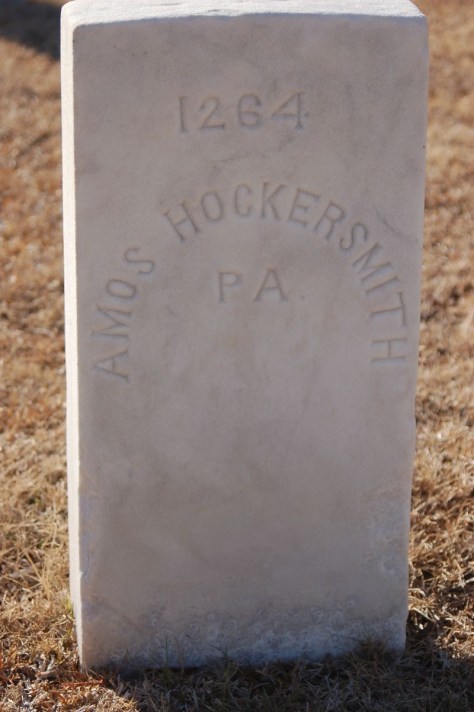
These letters were written by Amos J. Hockensmith (1833-1863), the son of Samuel Hockensmith (1786-1854) and Mary Lydia Mellott (1790-1853), and the husband of Martha Hollenshead (1833-1918). Amos wrote the letters while serving as a private in Co. H, 158th Pennsylvania Drafted Militia to his wife and children back home in Hustontown, Fulton county, Pennsylvania. During the American Civil War, this sparsely populated, rural farming community was dominated by anti-war Democrats. Very few local men volunteered for service and when the draft was instituted, the local population actively resisted and evaded enrollment officers.
Amos and Mary had been married for ten years and were the parents of two girls, Mary Alice (b. 1855) and Clarissa Elmira (b. 1858), when he was mustered into the service of his country on 4 November 1862. He died of disease on 7 May 1863 at Washington, North Carolina. The hospital surgeon claims he was admitted on 24 April 1863 suffering with Rubella and Erysipelas. Another report claims he had the measles.
Letter 1
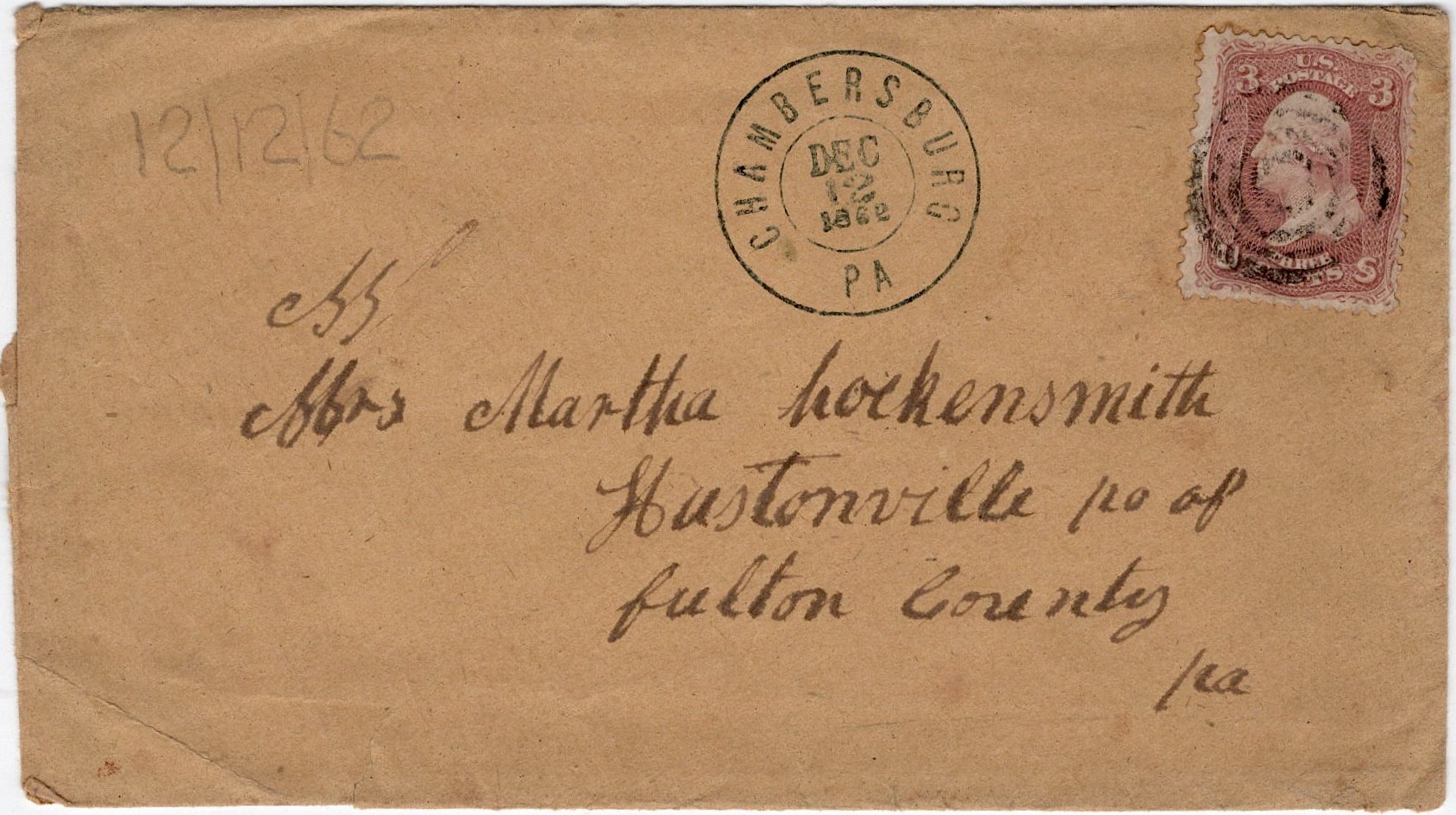
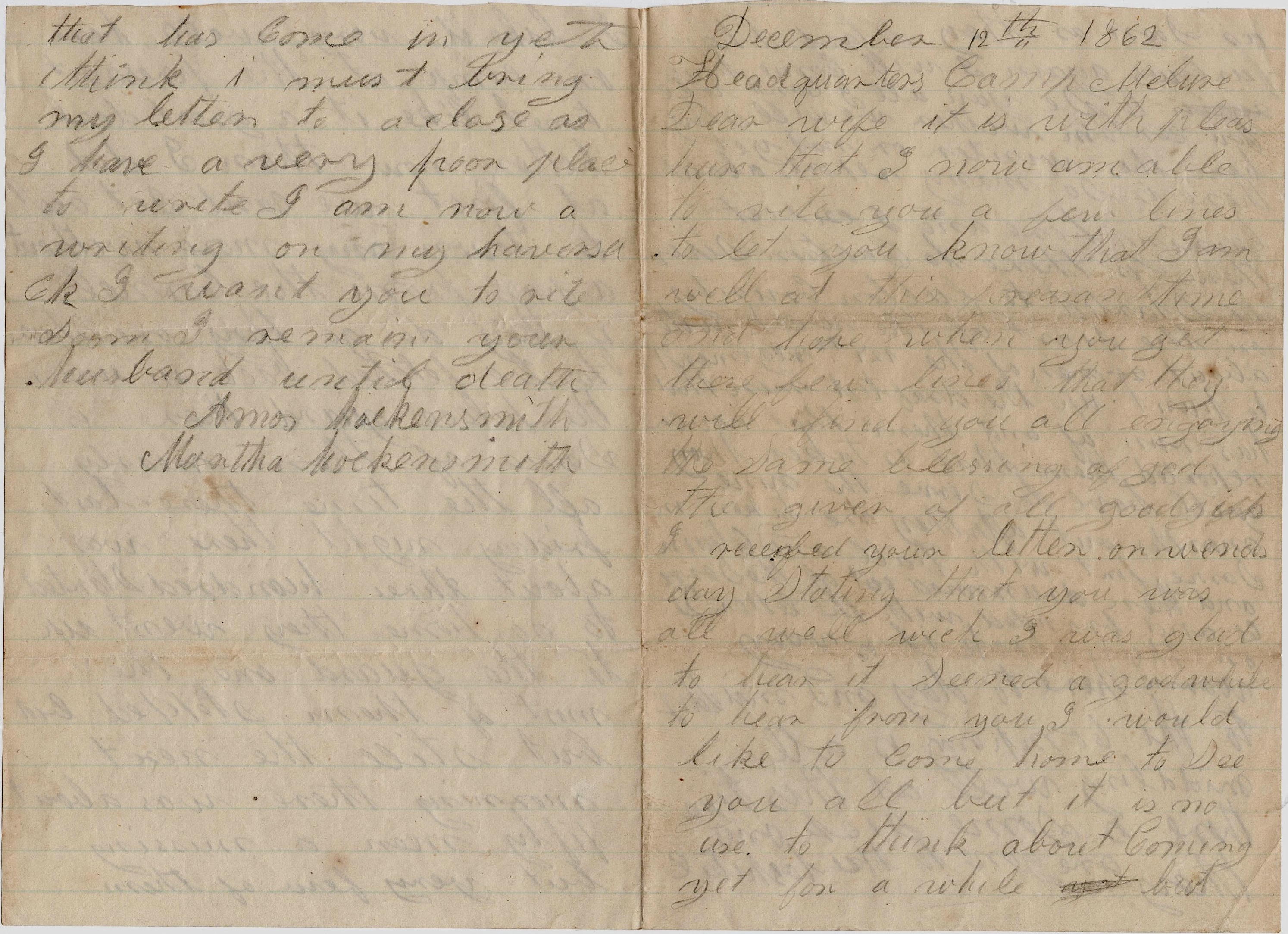
Headquarters Camp McClure [near Chambersburg, Pa.]
December 12th 1862
Dear Wife,
It is with pleasure that I now am able to write you a few lines to let you now that I am well at the present time and hope when you get these few lines that they will find you all enjoying the same blessing of God, the Giver of all good gifts.
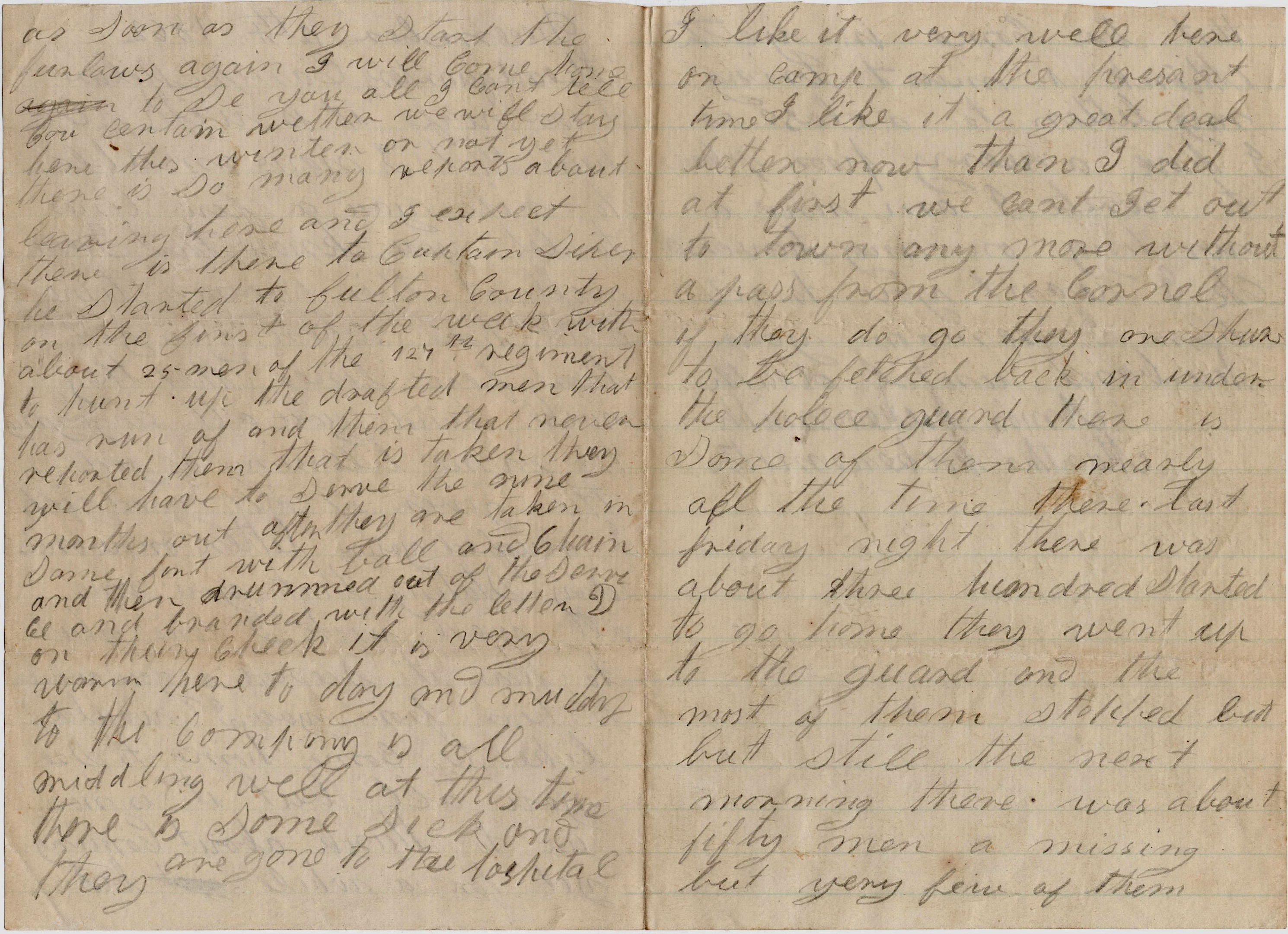
I received your letter on Wednesday stating that you was all well which I was glad to hear. It seemed a good while to hear from you. I would like to come home to see you all but it is no use to think about coming yet for a while. But as soon as they start the furloughs again, I will come home to see you all. I can’t tell for certain whether we will stay here this winter or not yey. There is so many reports about leaving here and I expect there is there too. Captain Sikes, he started to Fulton county on the first of the week with about 25 men of the 127th Regiment to hunt up the drafted men that has run off and them that never reported. Them that is taken, they will have to serve the nine months out after they are taken into some fort with ball and chain and then drummed out of the service and branded with the letter “D” on their cheek.
It is very warm here today and muddy too. The company is all middling well at this time. There is some sick and they are gone to the hospital. I like it very well here on camp at the present time. I like it a great deal better now than I did at first. We can’t get out to town anymore without a pass from the Colonel. If they do go, they are sure to be fetched back in under the police guard. There is some of them nearly all the time there. Last Friday night, there was about three hundred started to go home. They went up to the guard and the most of them stopped but still the next morning there was about 50 men a missing [and] but very few of them that has come in yet.
I think I must bring my letter to a close so as I have a very poor place to write. I am now a writing on my haversack. I want you to write soon. I remain your husband until death. Amos Hockensmith
To Martha Hockensmith
Letter 2
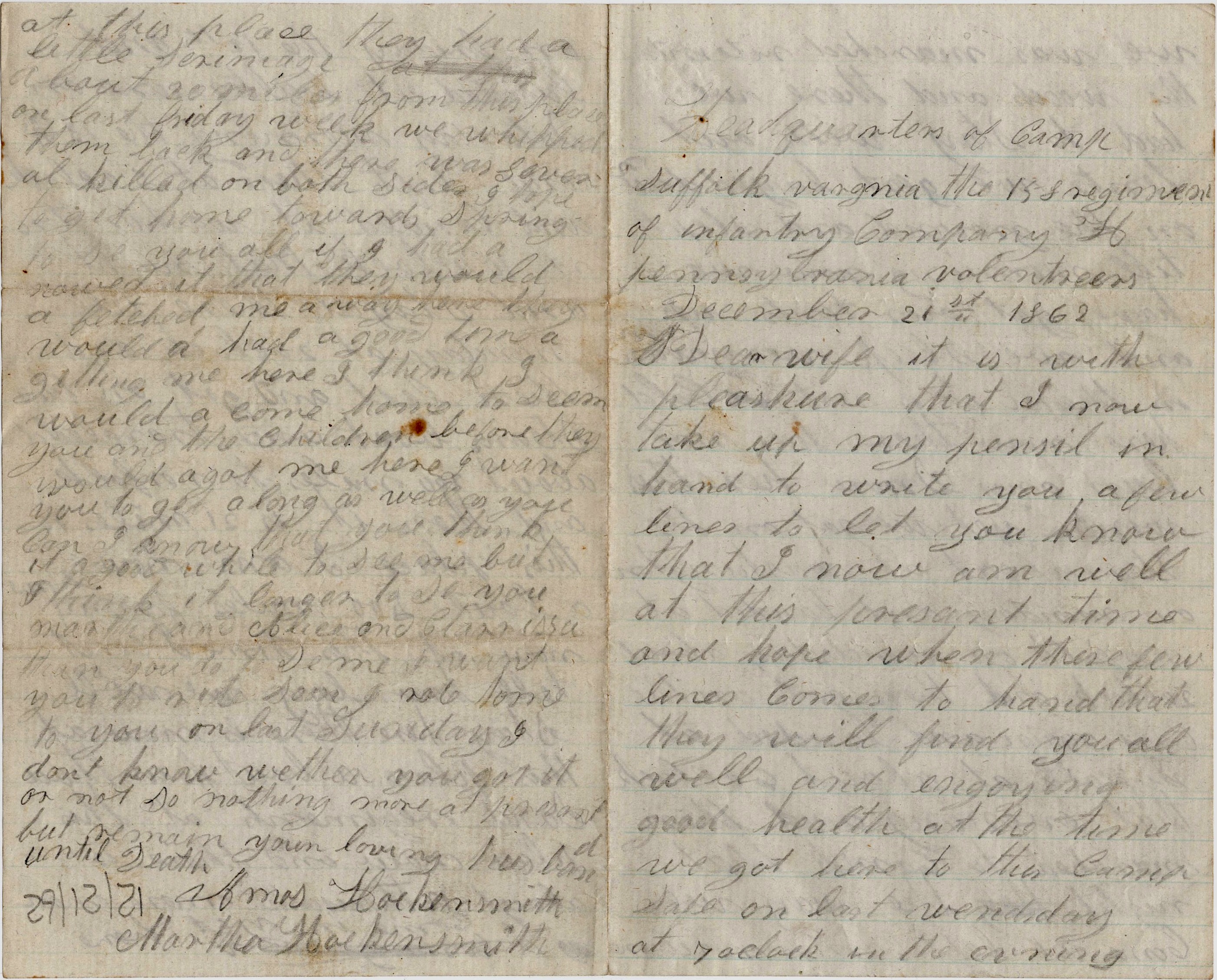
Headquarters of Camp Suffolk, Virginia
The 158th Regiment of Infantry, Company H, Pennsylvania Volunteers
December 21st, 1862
Dear wife,
It is with pleasure that I now take up my pencil in hand to write you a few lines to let you know that I now am well at this present time and hope when these few lines comes to hand that they will find you all well and enjoying good health at this time.
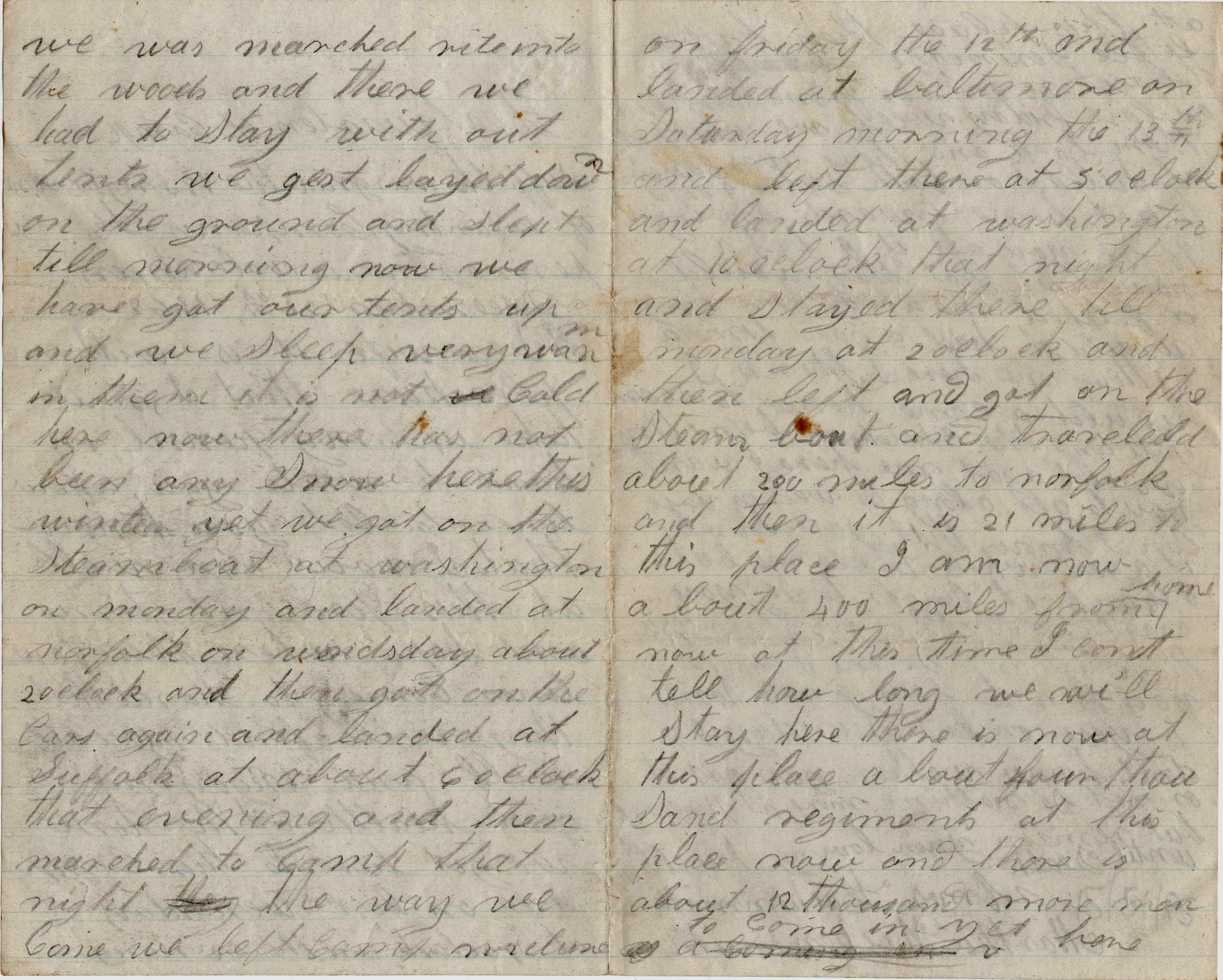
We got here to this camp safe on last Wednesday at 7 o’clock in the evening. We was marched right into the woods and there we had to stay without tents. We just laid down on the ground and slept till morning. Now we have got our tents up and we sleep very warm in them. It is not cold here now. There has not been any snow here this winter yet. We got on the steamboat at Washington on Monday and landed at Norfolk on Wednesday about 2 o’clock and then got on the cars again and landed at Suffolk at about 6 o’clock that evening and then marched to camp that night.
The way we came—we left Camp McClure [near Chambersburg, Pa.] on Friday the 12th and landed at Baltimore on Saturday morning the 13th and left there at 3 o’clock and landed at Washington at 10 o’clock that night and stayed there till Monday at 2 o’clock and then left and got on the steamboat and traveled about 200 miles to Norfolk and then it is 21 miles to this place.
I am now about 400 miles from home now at this time. I can’t tell how long we will stay here. There is now at this place about four thousand regiments at the place now and there is about 12 thousand more men to come in yet at this place. They had a little skirmish about 30 miles from this place on last Friday week. We whipped them back and there was several killed on both sides.
I hope to get home towards spring to see you all. If I had a knowed it that they would a fetched me away here, they would a had a good time a getting me here, I think. I would a come home to seen you and the children before they would a got me here. I want you to get along a well as you can. I know that you think it a good while to see me but I think it longer to see you than you to see me. I want you to write soon. I wrote home to you on last Sunday. I don’t know whether you got it or not. So nothing more at present but remain your loving husband. — Amos Hockensmith
To Martha Hockensmith
Letter 3
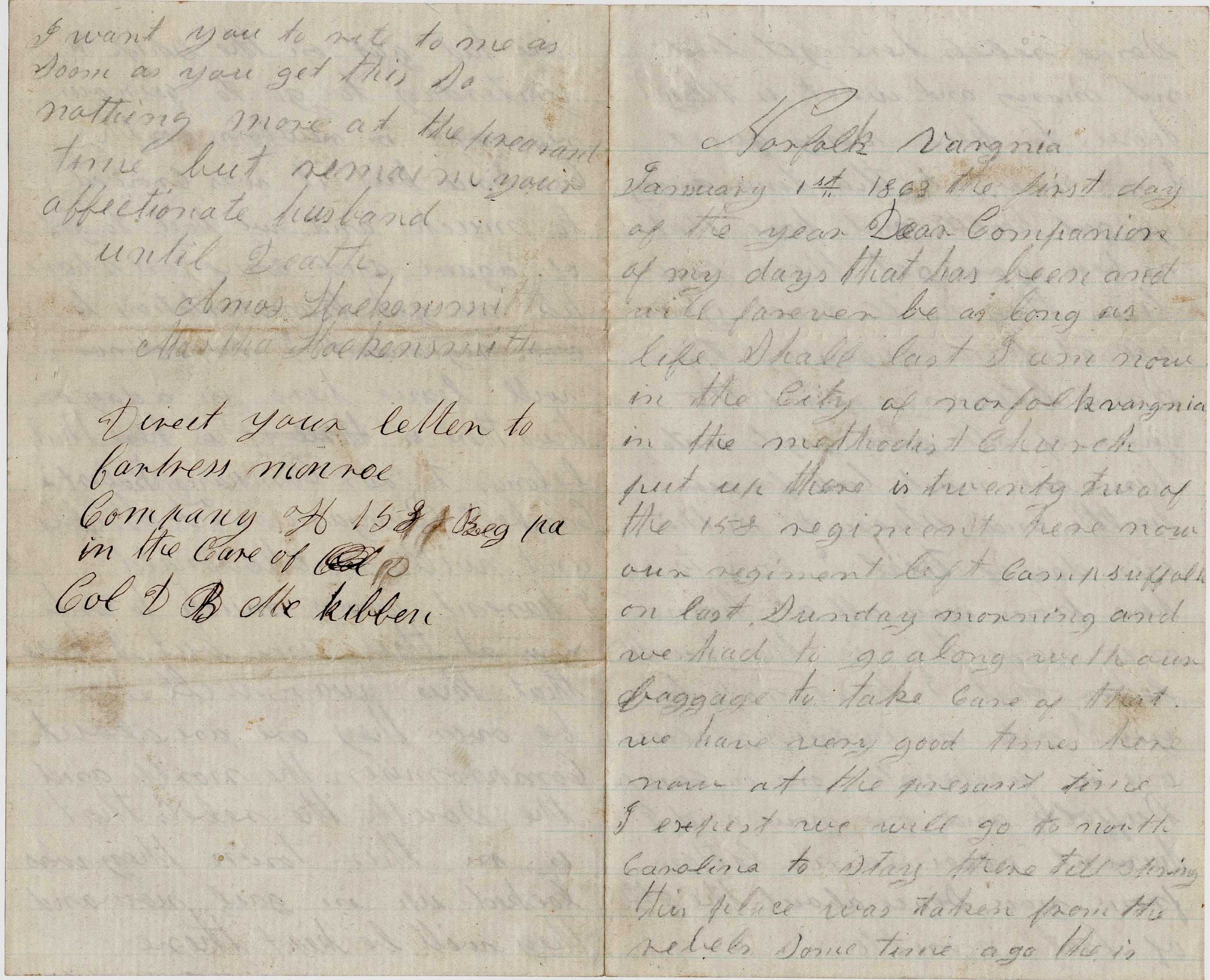
Norfolk, Virginia
January 1st 1863, the first day of the year.
Dear Companion of my days that has been and will forever be as long as life shall last,
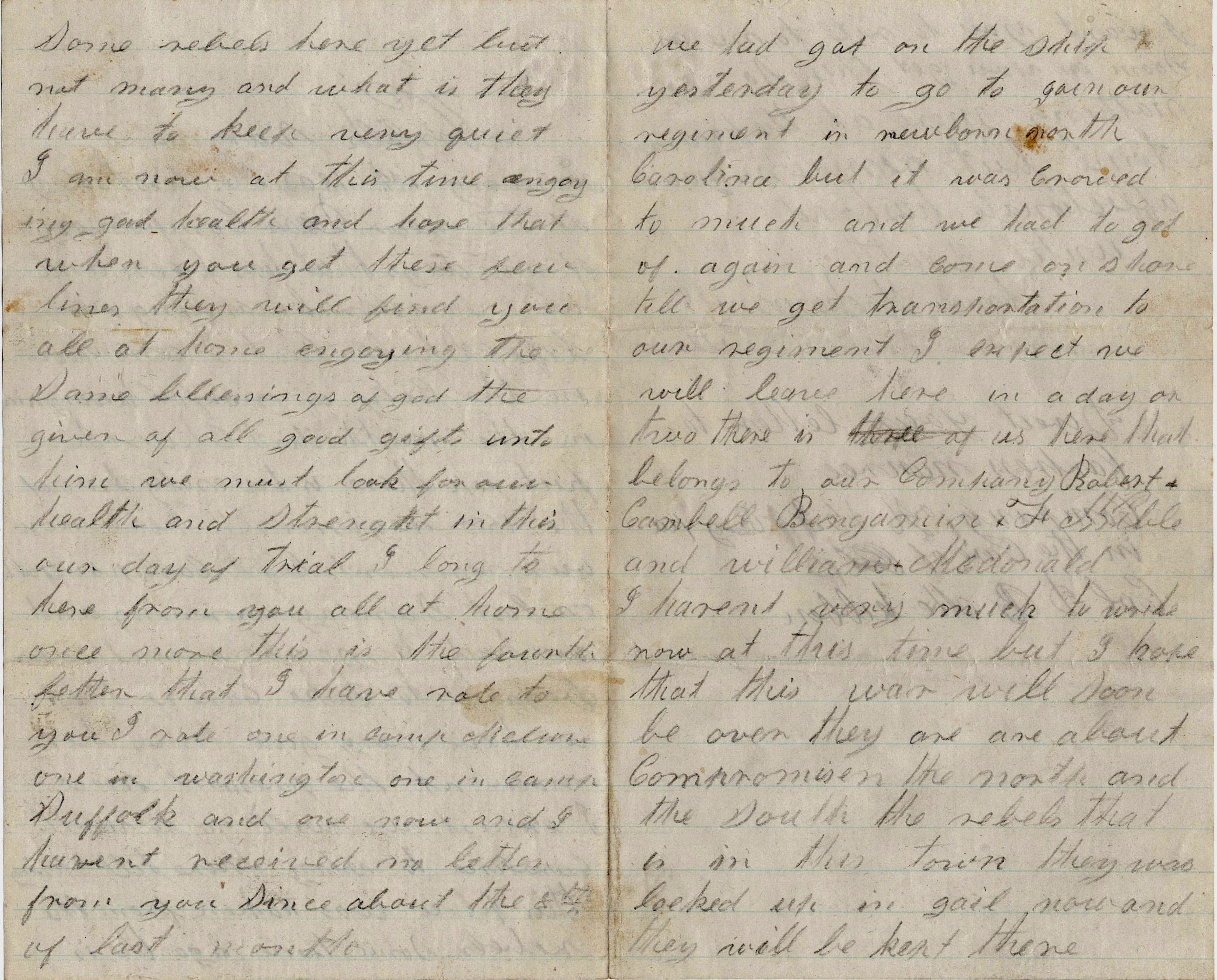
I am now in the City of Norfolk, Virginia, in the Methodist Church. Put up there is twenty-two of the 158th Regiment here now. Our regiment left Camp Suffolk on last Sunday morning and we had to go along with our baggage to take care of that. We have very good times here now at the present time. I expect we will go to North Carolina to stay there till spring. This place was taken from the rebels some time ago. There’s some rebels here yet but not many and what is, they have to keep very quiet.
I am now at this time enjoying good health and hope that when you get these few lines, they will find you all at home enjoying the same blessings of good gifts. Unto Him we must look for our health and strength in this our day of trial. I long to hear from you all at home once more. This is the 4th letter that I have wrote to you. I wrote one in Camp McClure, one in Washington, one in Camp Suffolk, and one now and I haven’t received no letter from you since about the 8th of last month.
We had got on the ship yesterday to go to join our regiment in New Bern, North Carolina, but it was crowded too much and we had to get off again and come on shore till we get transportation to our regiment. I expect we will leave here in a day or two. There is three of us here that belongs to our company—Robert Campbell, Benjamin F. Wibble, and William McDonald. I haven’t very much to write now at this time but I hope that this war will soon be over. They are about compromising—the North and the South. The rebels that is in this town, they was locked up in jail now and they will be kept there.
I want you to write to me as soon as you get this. So nothing more at the present time but remain your affectionate husband until death, — Amos Hockensmith
To Martha Hockensmith.
Direct your letters to Fortress Monroe, Company H, 158th Regt. Pa., in the care of Col. D. B. McKibbin
Letter 4
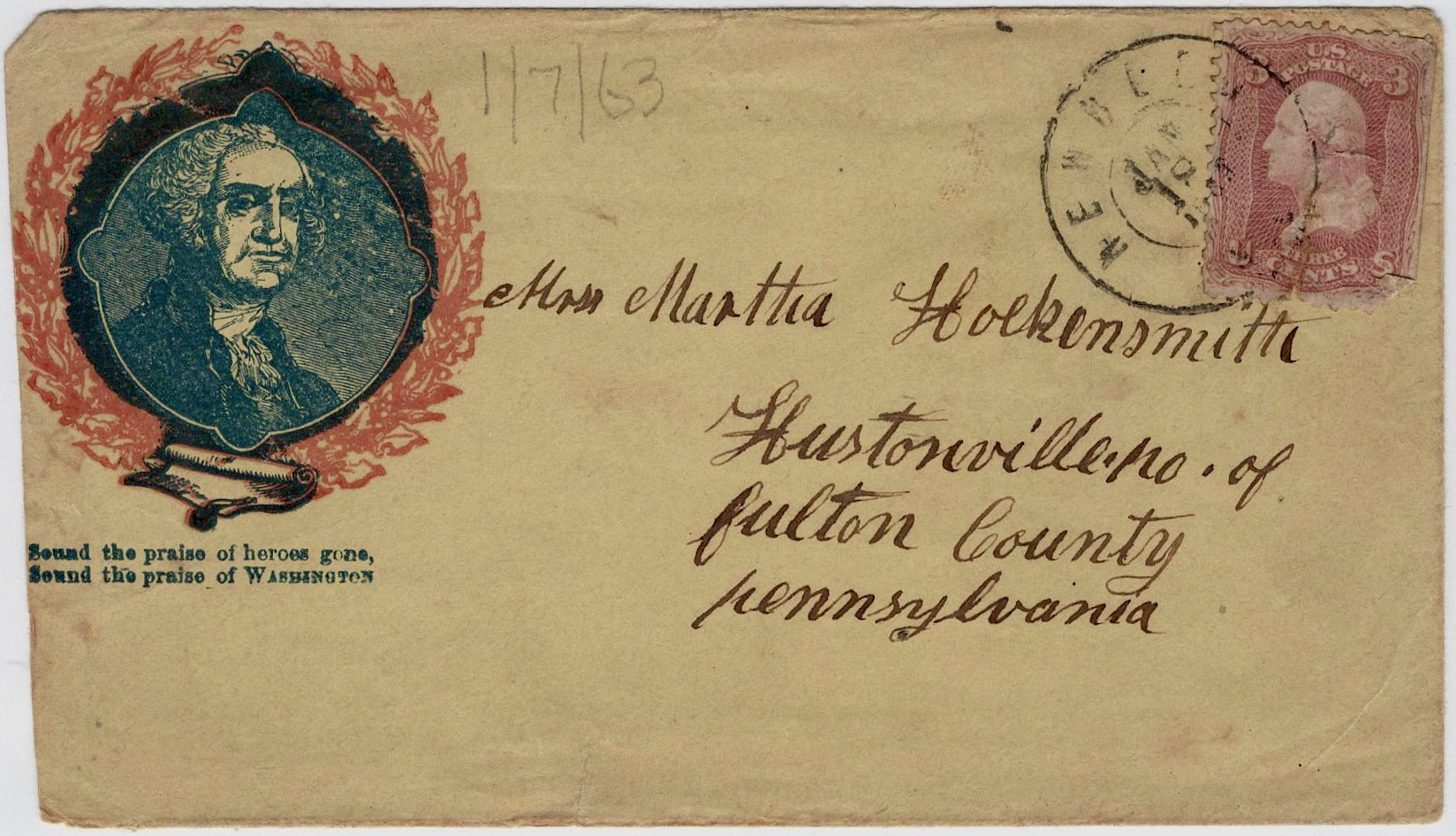
Newbern, North Carolina
January 7th 1863
Dear wife,
It is with pleasure that I now write you a few lines to let you know that I am well at this time and hope that these few lines will find you all well when you get them and enjoying the same blessings of God, the giver of all good gifts.
I received your letter on the third of this month stating that you was all well but Clarissa which I was very sorry to hear but I hope when you get these few lines that Clarissa will be well enough again.
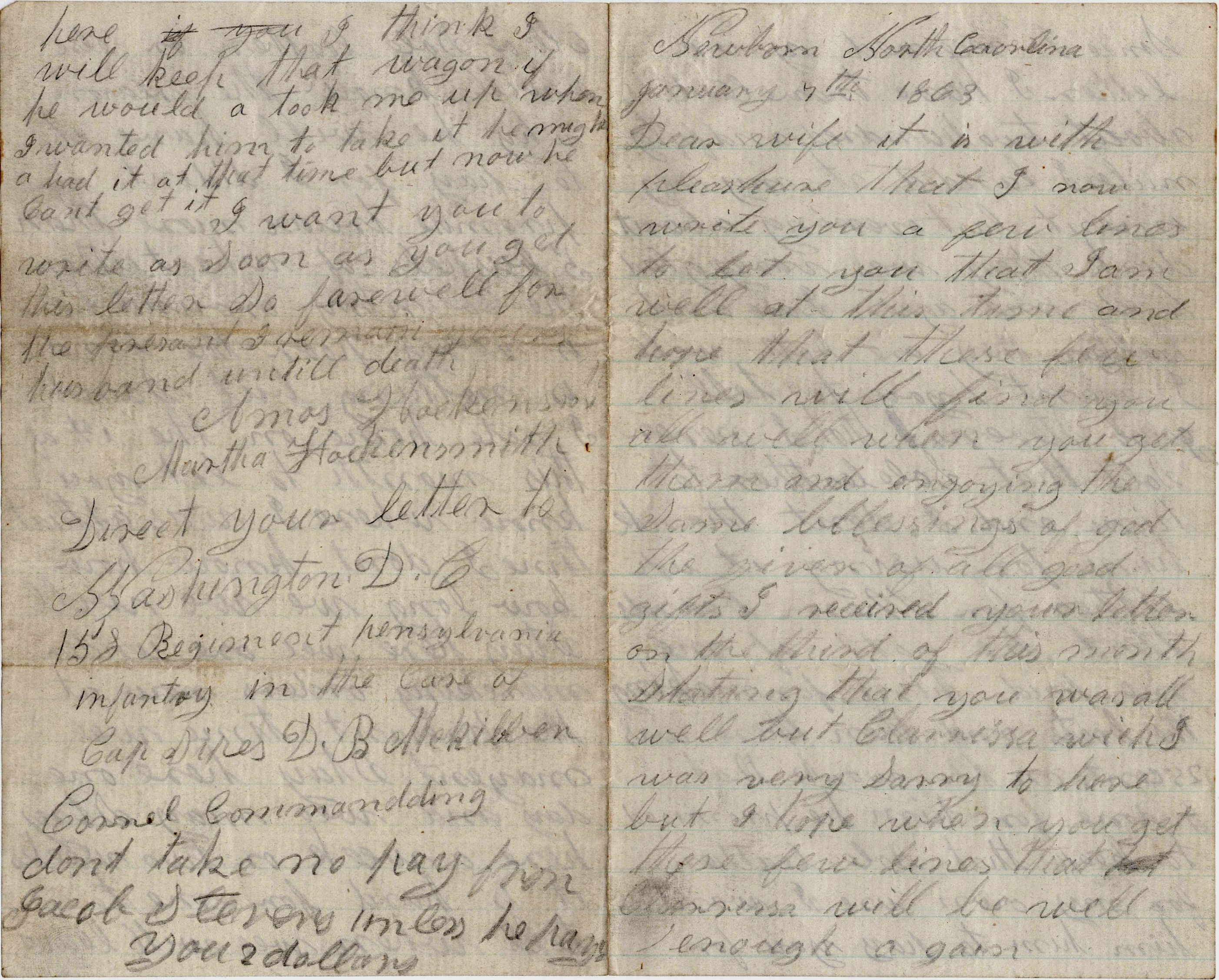
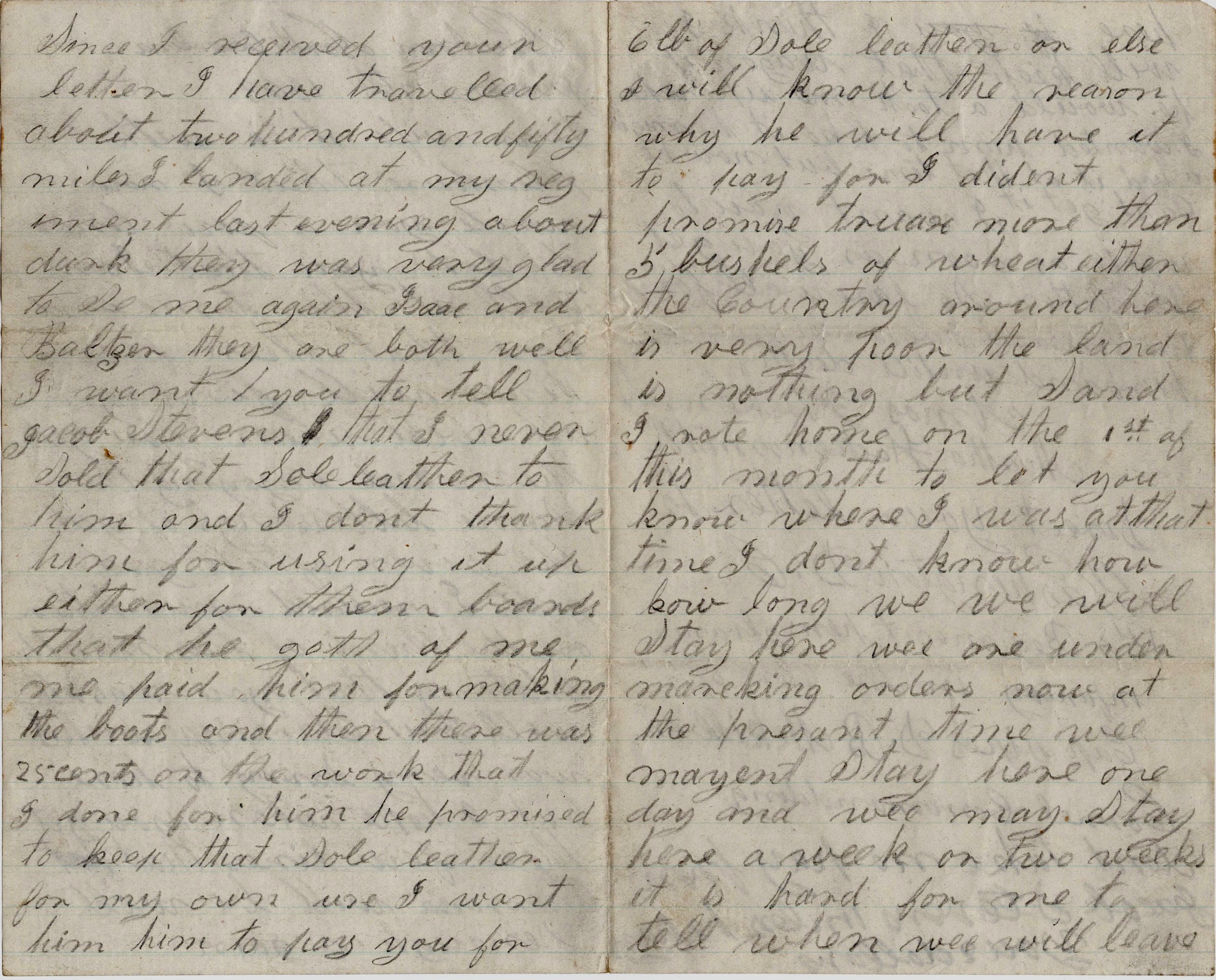
Since I received your letter, I have traveled about two hundred and fifty miles. I landed at my regiment last evening about dark. They was very glad to see me again. Isaac [Hollenshead] and Baltzer [Mellott], they are both well. I want you to tell Jacob Stevens that I never sold that sole leather to him and I don’t thank him for using it up either for them boards that he got of me. Me paid him for making the boots and then there was 25 cents on the work that I done for him. He promised to keep that sole leather for my own use. I want him to pay you for 6 lb. of sole leather or else I will know the reason why he will have it to pay for I didn’t promise Truax more than 5 bushels of wheat either.
The country around here is very poor. The land is nothing but sand. I wrote home on the 1st of this month to let you know where I was at that time. I don’t know how long we will stay here. We are under marching orders now at the present time. We mayn’t stay here one day and we may stay here a week or two weeks. It is hard for me to tell when we will leave here.
I think I will keep that wagon. If he would a took me up when I wanted him to take it, he might a had it at that time, but now he can’t get it.
I want you to write as soon as you get this letter. So farewell for the present. I remain your husband until death, — Amos Hockensmith
To Martha Hockensmith
Direct your letter to Washington D. C., 158th Regiment Pennsylvania Infantry, in the care of Capt. Sipes, D. B. McKibbin, Colonel Commanding.
Don’t take no pay from Jacob Stevens unless he pays you two dollars.
Letter 5
Newborn, North Carolina
[January 16, 1863]
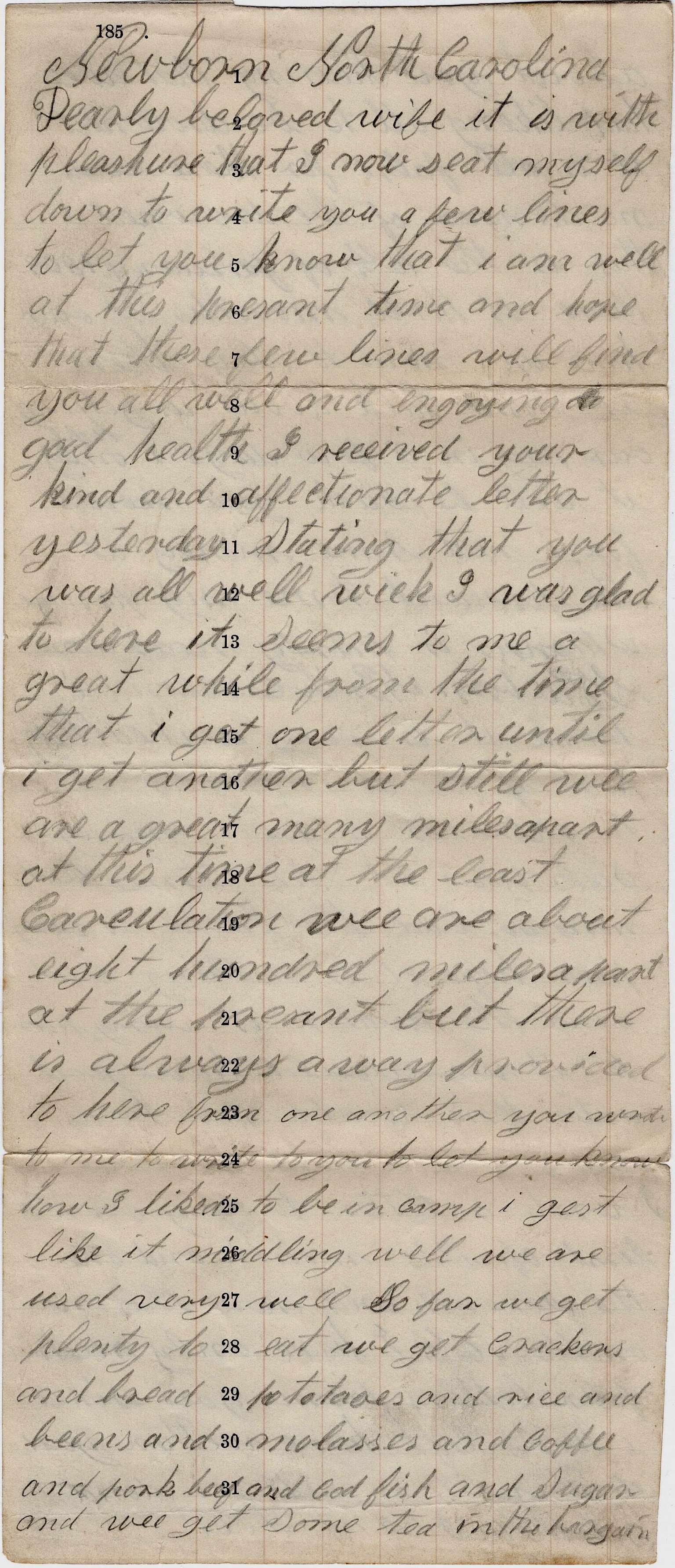
Dearly beloved wife,
It is with pleasure that i now seat myself down to write you a few lines to let you know that I am well at this present time and hope that these few lines will find you all well and enjoying ditto good health. I received your kind and affectionate letter yesterday stating that you was all well which I was glad to hear. It seems to me a great while from the time that I get one letter until I get another but still we are a great many miles apart at this time. At the least calculation, we are about eight hundred miles apart at the present but there is always a way provided to hear from one another.
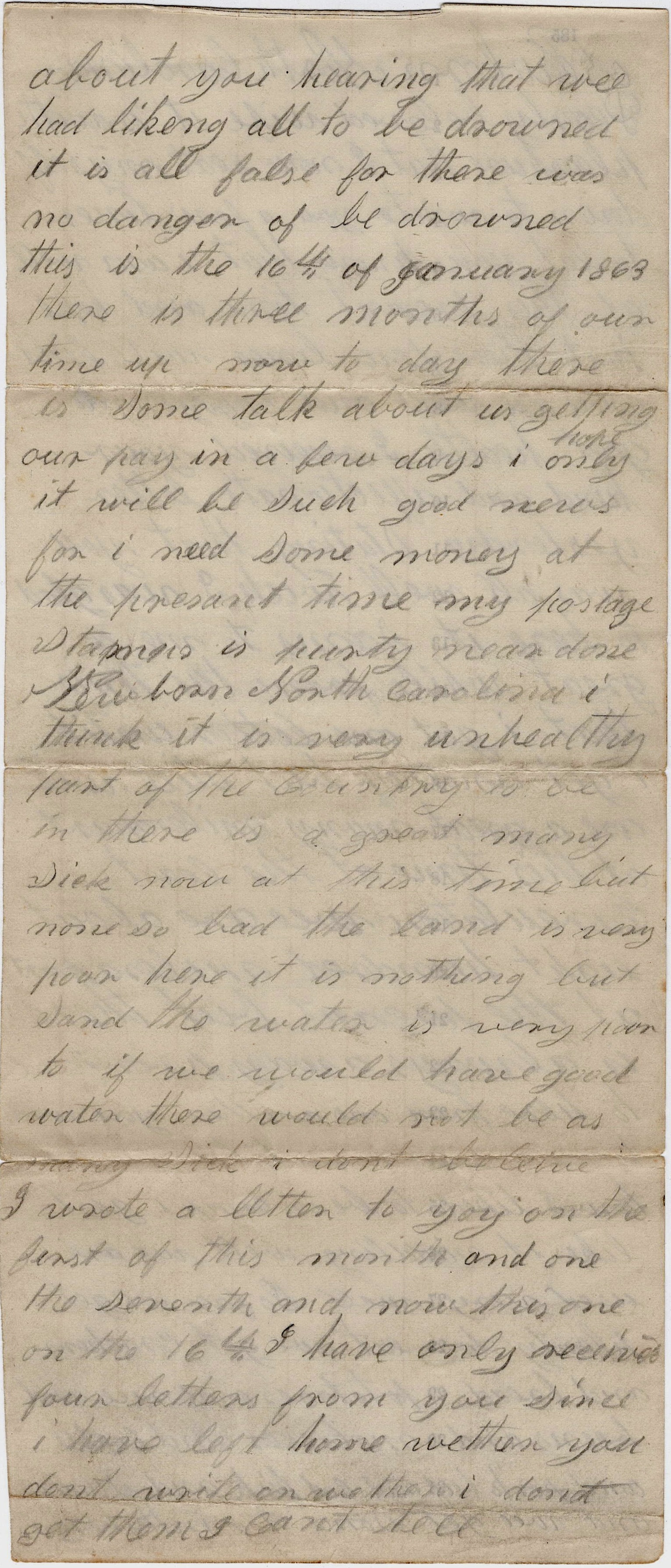
You wrote to me to write to you to let you know how I like to be in camp. I just like it middling well. We are used very well so far. We get plenty to eat. We get crackers and bread, potatoes and rice and beans, and molasses and coffee and pork beef and cod fish and sugar. And we get some tea in the bargain.
About you hearing that we had likend all to be drowned, it is all false for there was no danger of being drowned.
This is the 16th of January, 1863. There is three months of our time up now. Today there is some talk about us getting our pay in a few days. I hope only it will be such good news for I need some money at the present time. My postage stamps is pretty near done.
Newbern, North Carolina, I think it is a very unhealthy part of the country to be in. There is a good many sick now at this time but none so bad. The land is very poor here. It is nothing but sand. The water is very poor too. If we would have good water, there would not be as many sick, I don’t believe.
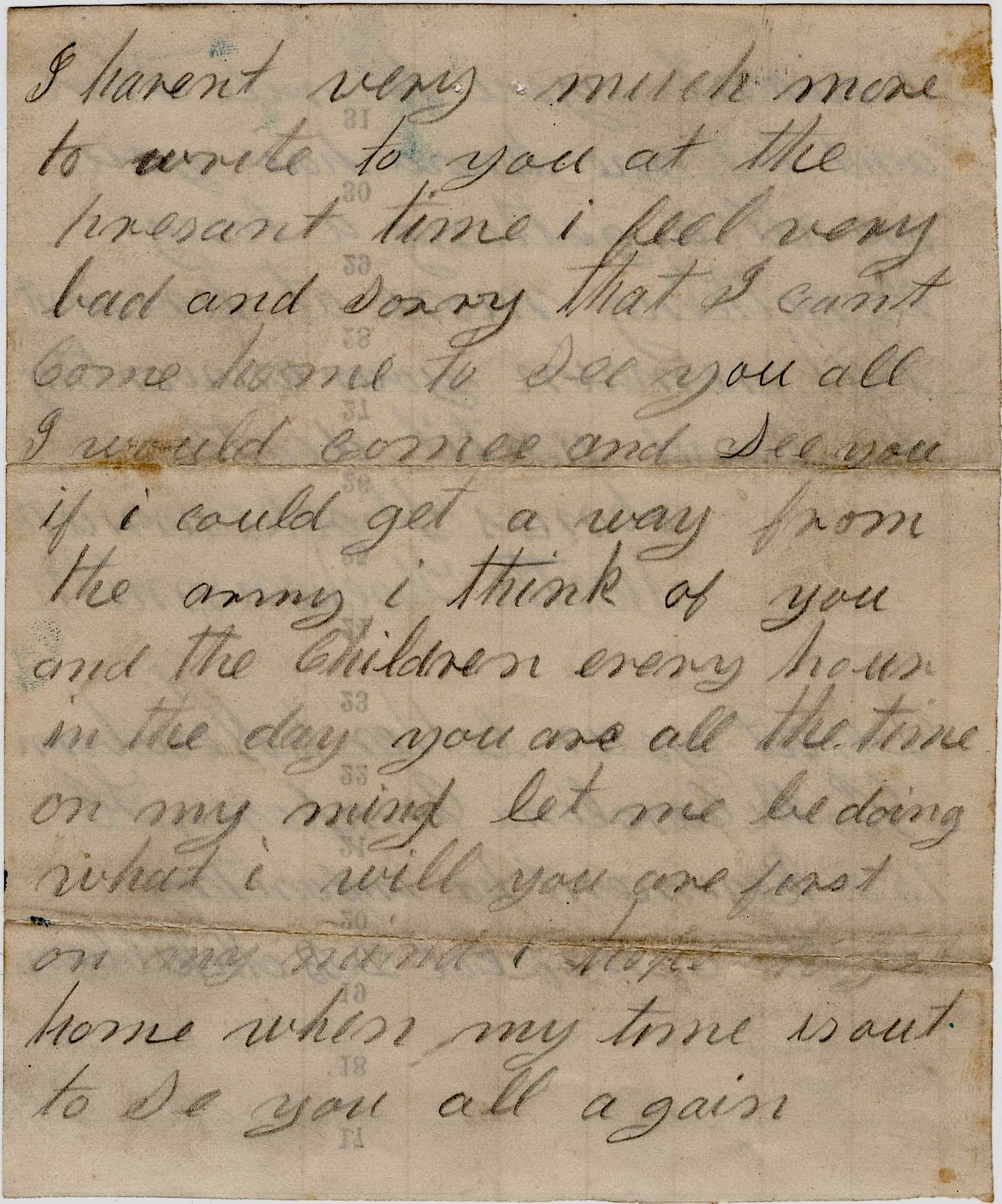
I wrote a letter to you on the first of this month and one the seventh, and now this one on the 16th. I have only received four letters from you since I have left home. Whether you don’t write or whether I don’t get them, I can’t tell.
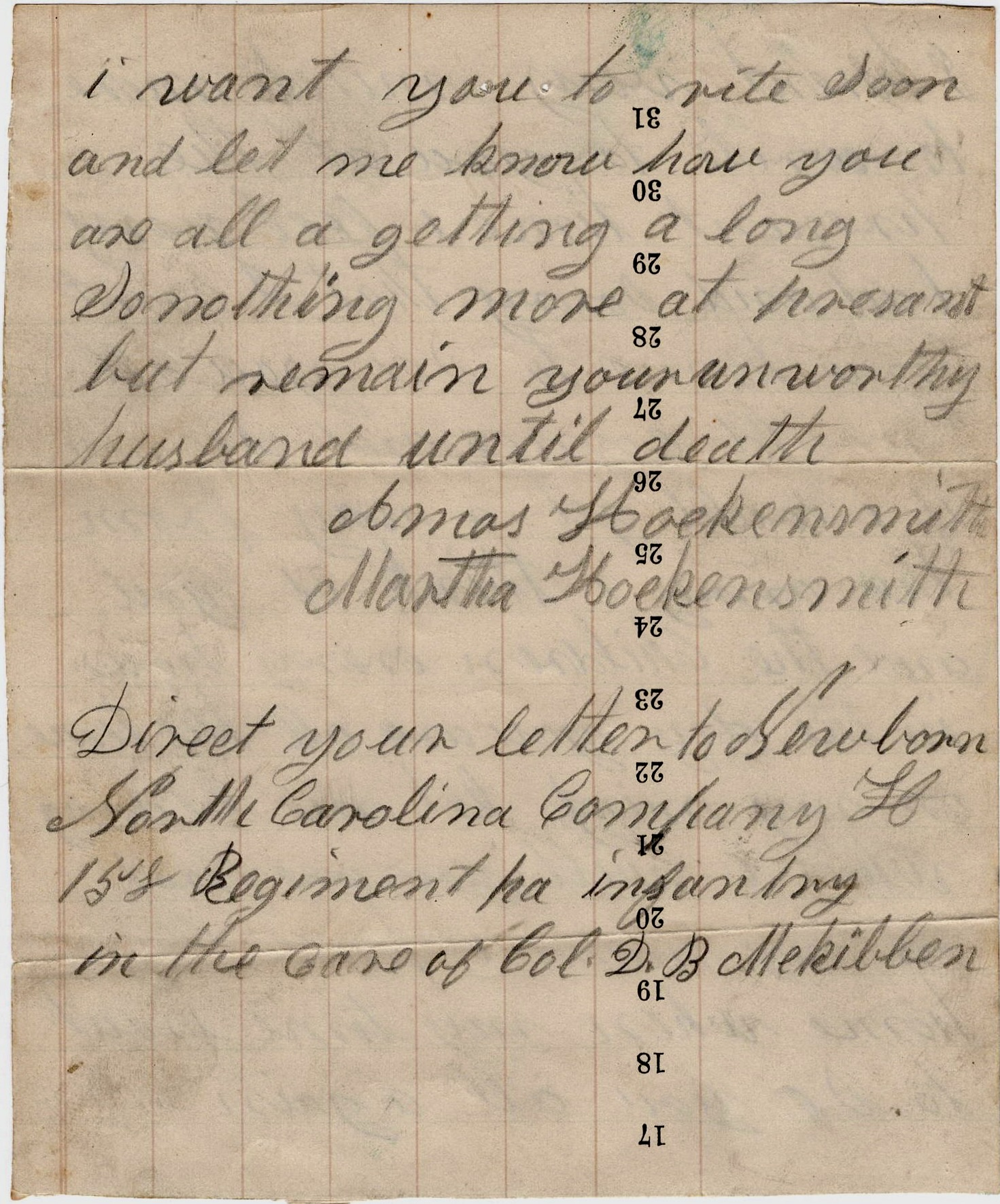
I haven’t very much more to write to you at the present time. I feel very bad and sorry that I can’t get home to see you all. I would come and see you if I could get away from the army. I think of you and the children every hour in the day. You are all the time on my mind, let me be doing what I will. You are first on my mind. I hope to get home when my time is out to see you all again. I want you to write soon and let me know how you are all a getting along. So nothing more at present but remain your unworthy husband until death. — Amos Hockensmith
to Martha Hockensmith
Direct your letter to Newbern, North Carolina, Company H, 158th Regiment Pa. Infantry, in the care of Col. D. B. McKibbin
Letter 6
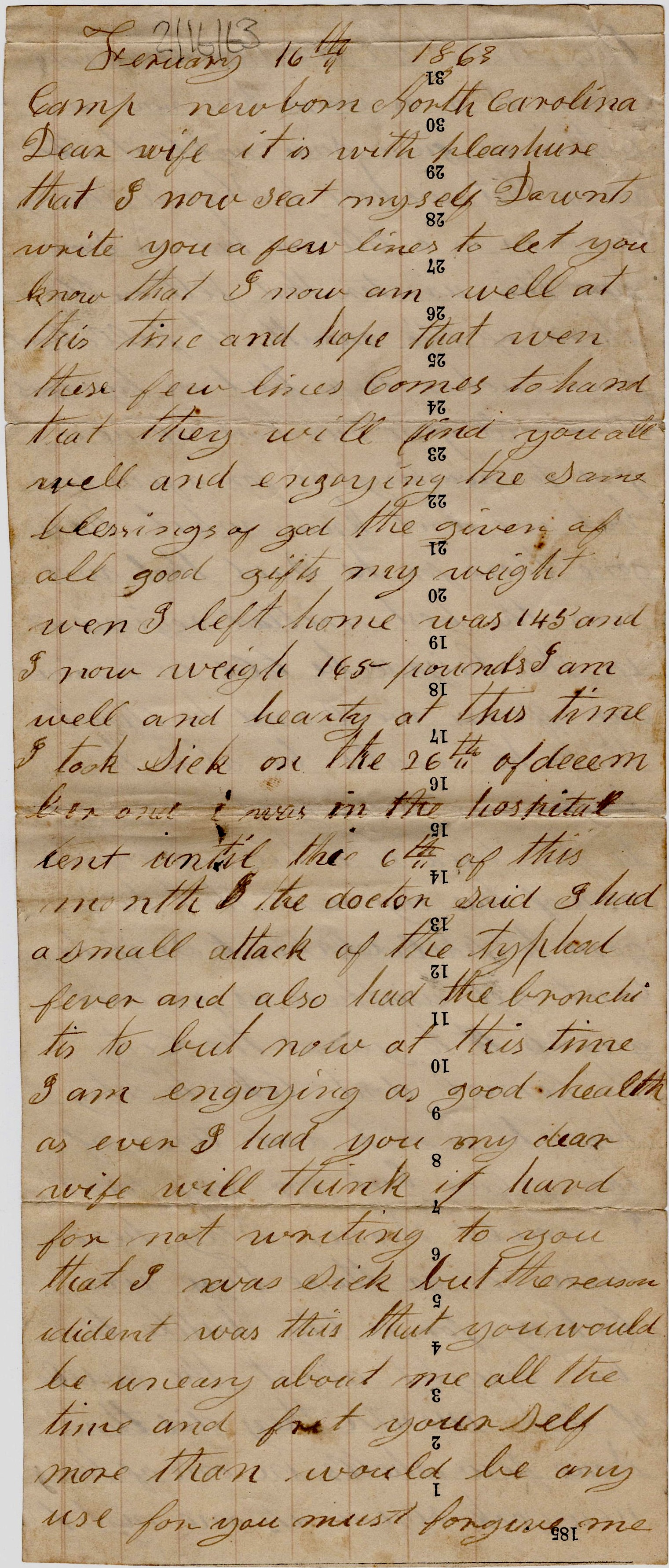
Camp Newbern, North Carolina
February 16th 1863
Dear wife,
It is with pleasure that I now seat myself down to write you a few lines to let you know that I now am well at this time and hope that when these few lines comes to hand, that they will find you all well and enjoying the same blessings of God, the giver of all good gifts.
My weight when I left home was 145 and I now weigh 165 pounds. I am well and hearty at this time. I took sick on the 26th of December and I was in the hospital tent until the 6th of this month. The doctor said I had a small attack of the typhoid fever and also had the bronchitis too but now at this time I am enjoying a good health as ever I had. You, my dear wife, will think it hard for not writing to you that I was sick, but the reason I didn’t was this—that you would be uneasy about me all the time and fret yourself more than would be of any use for. You must forgive me this time.
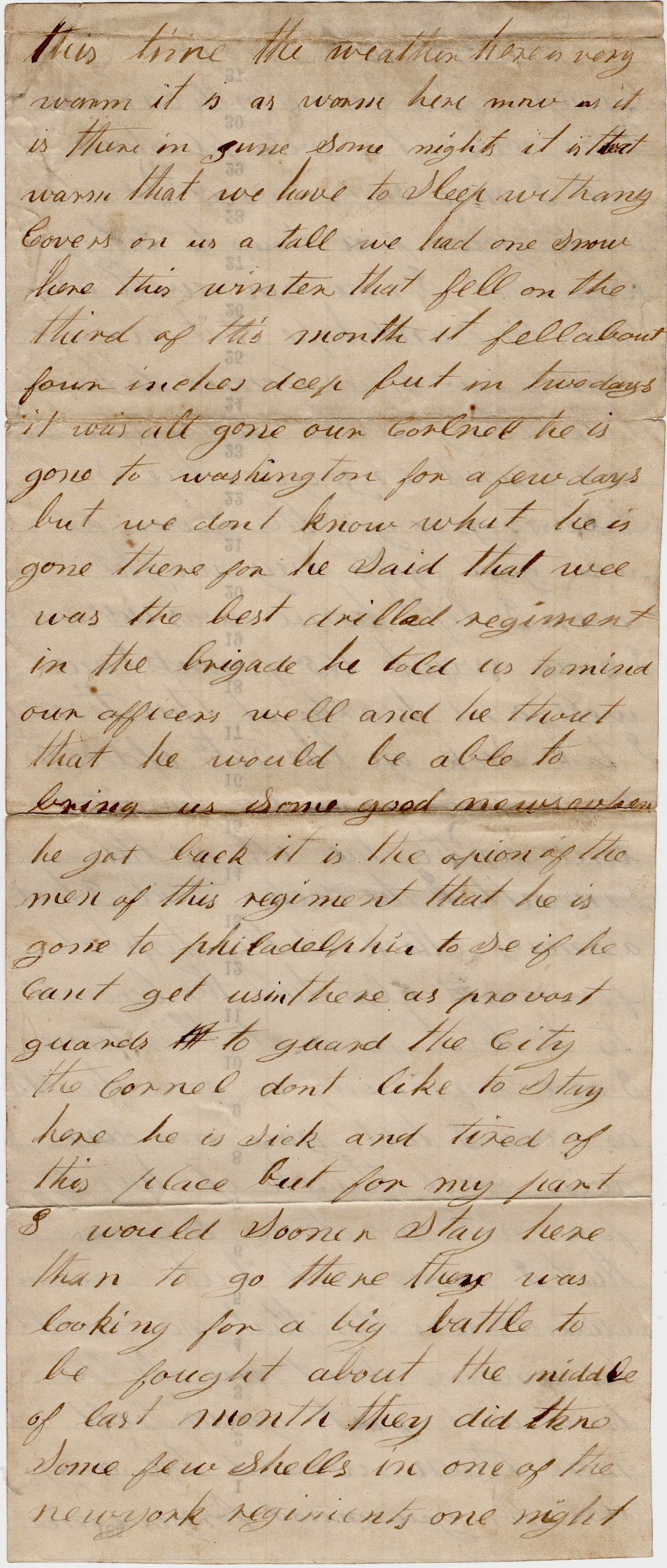
The weather here is very warm. It is as warm here now as it is there in June. Some nights it is that warm that we have to sleep with[out] any covers on us at all. We had one snow here this winter. That fell on the 3rd of this month. It fell about four inches deep, but in two days it was all gone.
Our Colonel, he is gone to Washington for a few days but we don’t know what he is gone there for. He said that we was the best drilled regiment in the brigade. He told us to mind our officers well and he thought that he would be able to bring us some good news when he got back. It is the opinion of the men of this regiment that he is gone to Philadelphia to see if he can’t get us in there as provost guards to guard the city. The Colonel don’t like to stay here. He is sick and tired of this place, but for my part, I would sooner stay here than to go there.
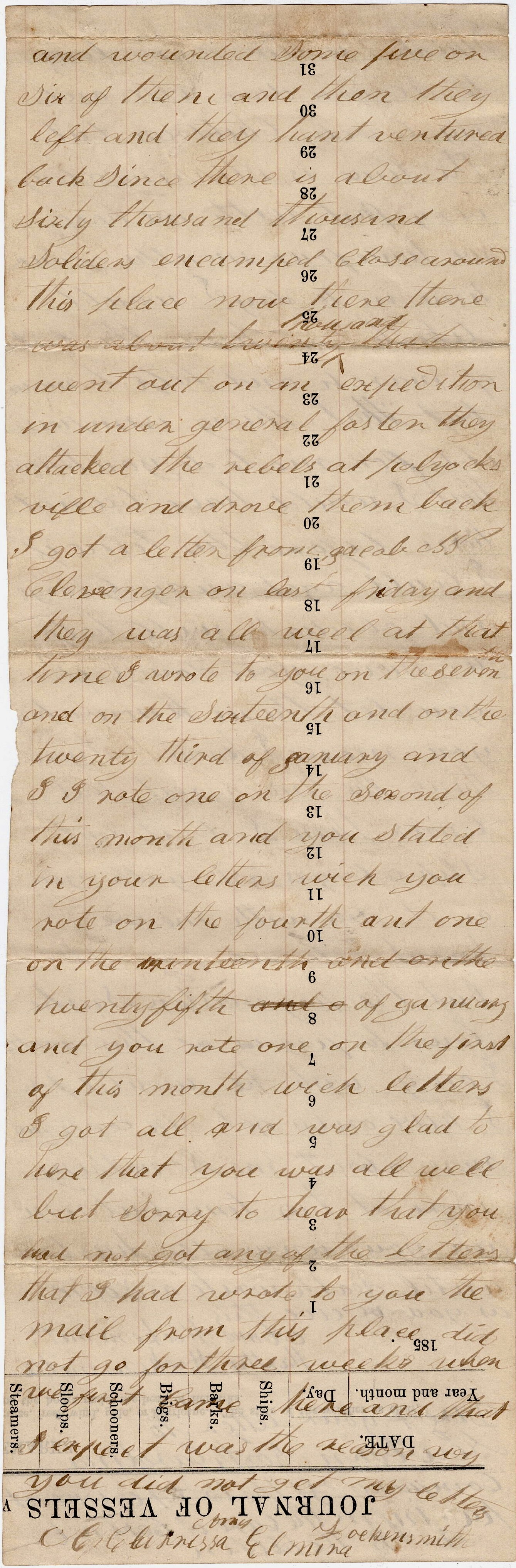
They was looking for a big battle to be fought about the middle of last month. They did throw some few shells in one of the New York regiments one night and wounded some five or six of them and then they left and they hant ventured baxck since. There is about sixty thousand soldiers encamped close around this place now. There was about twenty thousand that went out on an expedition in under General Foster. They attacked the rebels at Hollyocksville [?] and drove them back.
I got a letter from Jacob W. Clevenger on last Friday and they was all well at that time. I wrote to you on the 7th and on the 16th and on the 23rd of January and I wrote one on the 2nd of his month and you stated in your letters which you wrote on the 4th and one on the 19th, and one on the 25th of January, and you wrote one on the 1st of this month which letters I got all and was glad to hear that you was all well but sorry to hear that you had not got any of the letters that I had wrote to you. The mail from this place did not go for three weeks when we first came here and that, I expect was the reason you did not get my letters.
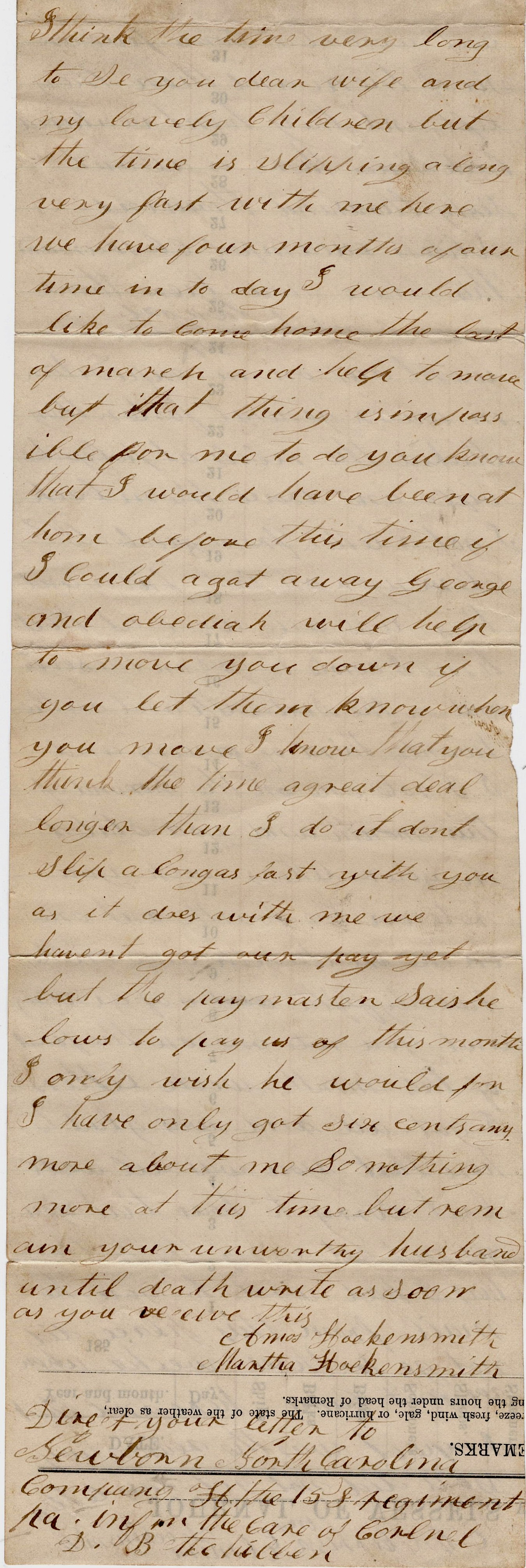
I think the time very long to see you, dear wife and my lovely children, but the time is slipping along very fast with me here. We have four months of our time in today. I would like to come home the last of March and help to move but that thing is impossible for me to do. You know that I would have been at home before this time if I could a got away. George and Obediah will help to move you down if you let them know when you move. I know that you think the time a great deal longer than I do. It don’t slip along as fast with you as it does with me.
We haven’t got our pay yet but the paymaster says he lows to pay us off this month. I only wish he would for I have only got six cents anymore about me. So nothing more at this time but remember your unworthy husband until death. Write as son as you receive this. — Amos Hockensmith
To Martha Hockensmith
Direct your letter to Newbern, North Carolina, Company H, the 158th Regiment Pa. Infantry, in the care of Colonel D. B. McKibbin
Letter 7
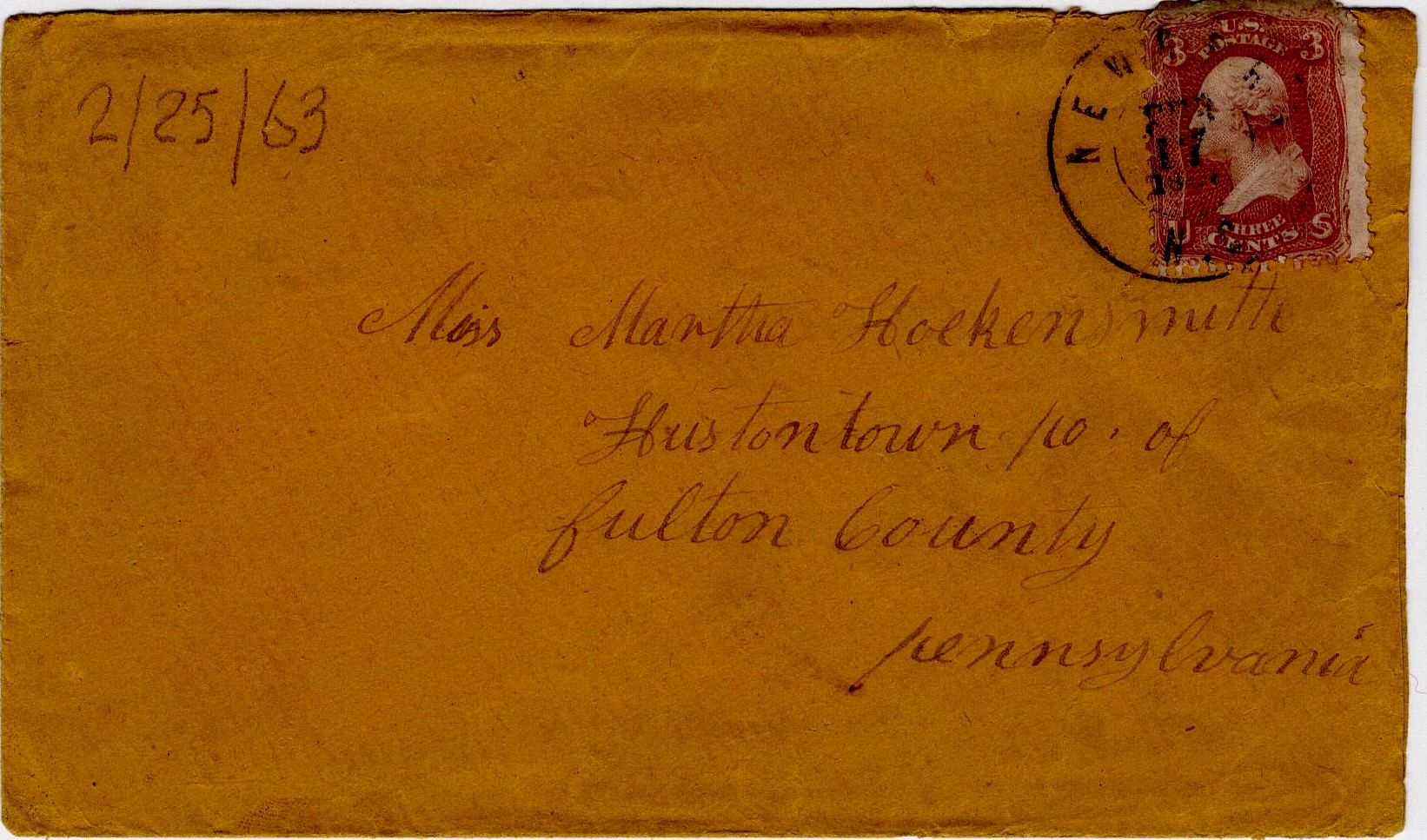
Camp near Newbern, North Carolina
February 25th 1863
Dear and well beloved wife,
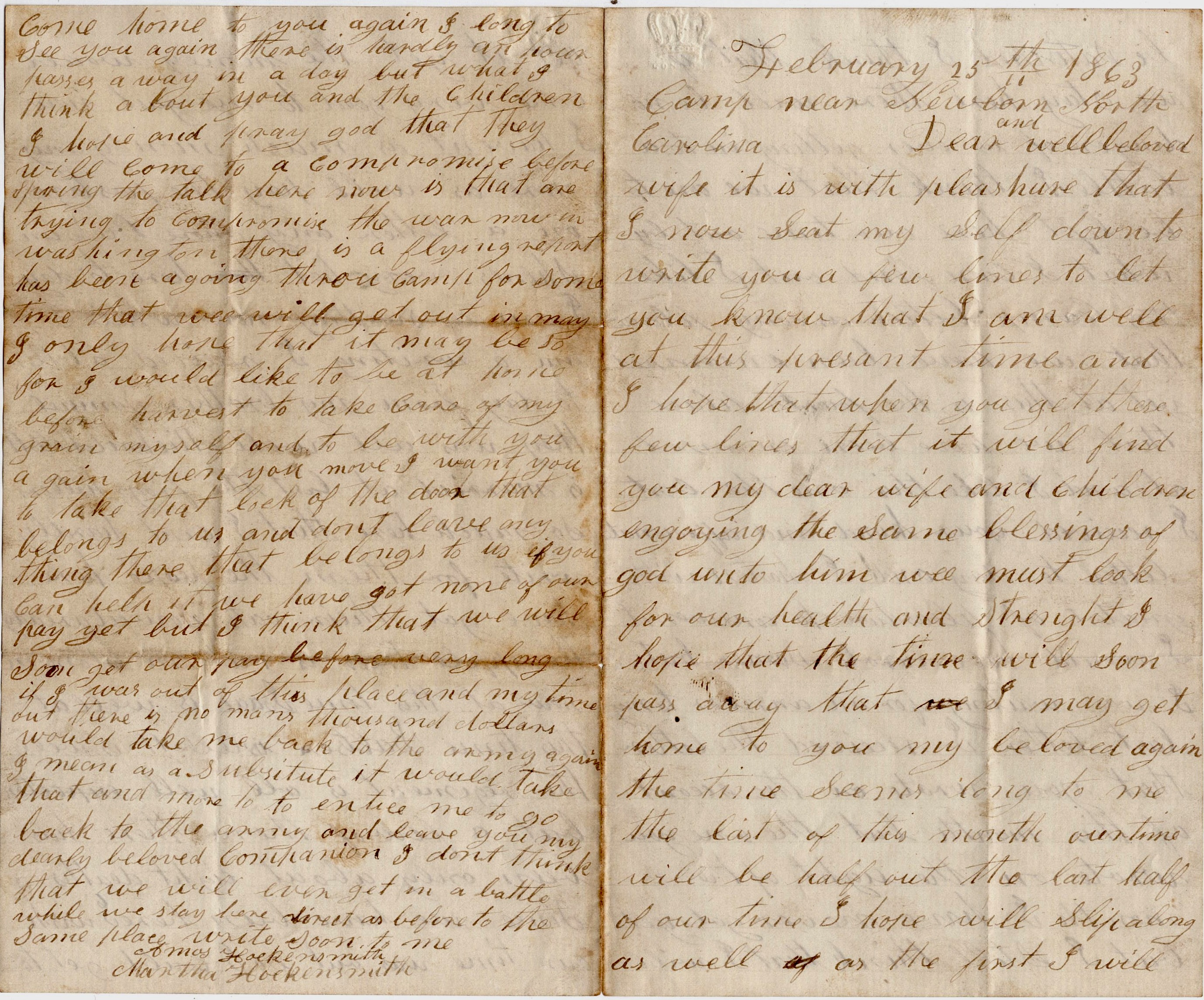
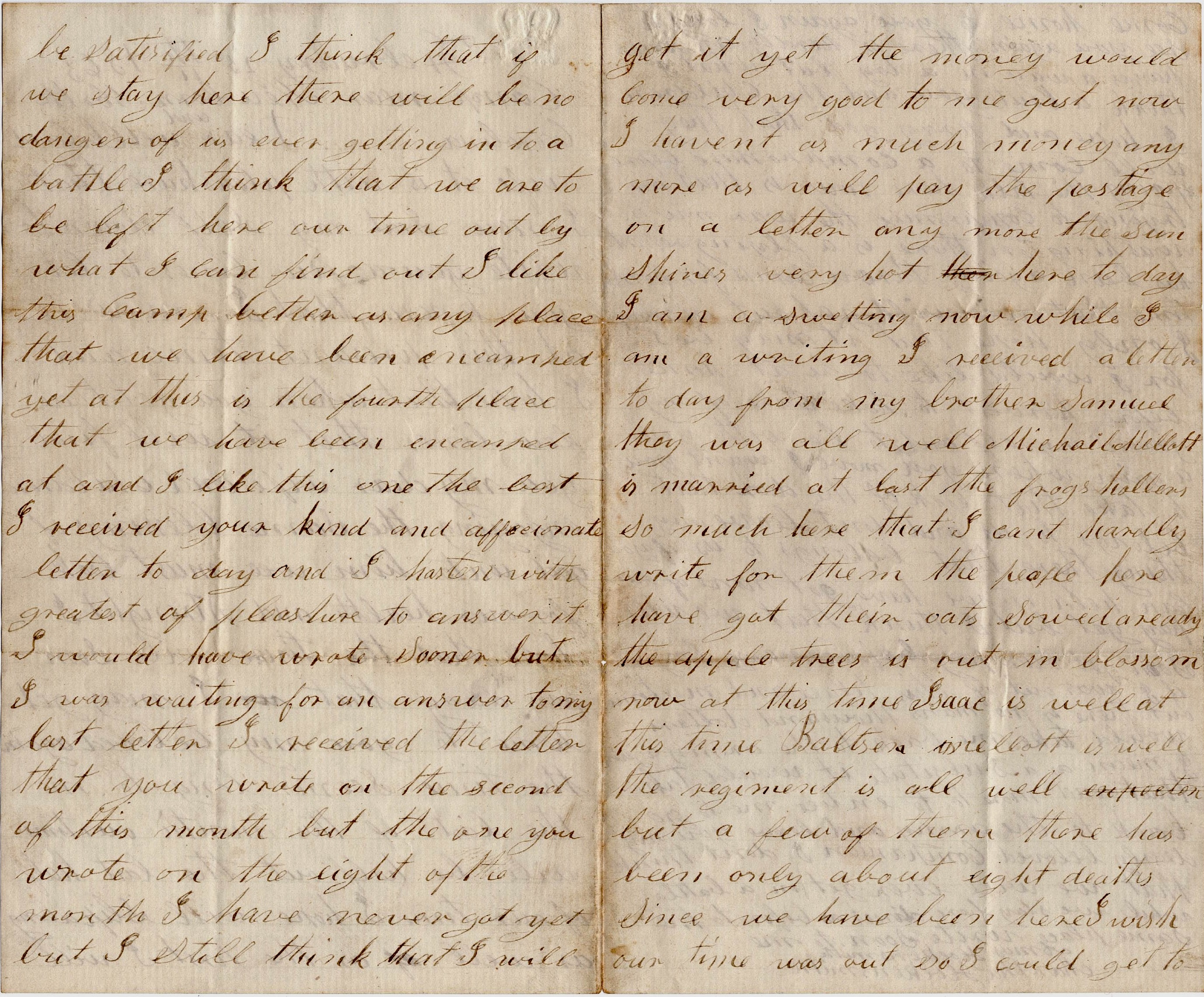
It is with pleasure that I now seat myself down to write you a few lines to let you know that I am well at this present time and I hope that when you get these few lines that it will find you, my dear wife and children, enjoying the same blessings of God. Unto Him we must look for our health and strength. I hope that the time will soon pass away that I may get home to you, my beloved, again. The time seems long to me. The last of the month our time will be half out. The last half of our time I hope will slip along as well as the first. I will be satisfied, I think, that if we stay here there will be no danger of our ever getting into a battle. I think that we are to be left here [until] our time [is] out by what I can find out.
I like this camp better as any place that we have been encamped yet. This is the fourth place that we have been encamped at and I like this one the best.
I received your kind and affectionate letter today and I hasten with greatest of pleasure to answer it. I would have wrote sooner but I was waiting for an answer to my last letter. I received the letter that you wrote on the 2nd of this month but the one you wrote on the 8th of the month, I have never got yet. But I still think that I will get it yet. The money would come very good to me just now. I haven’t as much money anymore as will pay the postage on a letter any more.
The sun shines very hot here today. I am a sweating now while I am writing. I received a letter today from my brother Samuel. They was all well, Michael Mellott is married at last. The frogs hollers so much here that I can’t hardly write for them. The people here have got their oats sowed already. The apple trees is out in blossom now at this time. Isaac is well at this time. Baltzar Mellott is well. The regiment is all well but a few of them. There has been only about eight deaths since we have been here.
I wish our time was out so I could get to come home to you again. I long to see you again. There is hardly an hour passes away in a day but what I think about you and the children. I hope and pray God that they will come to a compromise before spring. The talk here now is that [they] are trying to compromise the war now in Washington. There is a flying report has been a going through camp for some time that we will get out in May. I only hope that it may be so for I would like to be at home before harvest to take care of any grain myself and to be with you again. When you move, I want you to take that lock off the door that belongs to us and don’t leave my things there that belongs to us if you can help it.
We have got none of or pay yet but I think that we will soon get our pay before very long. If I was out of this place and my time was out, there is no man’s thousand dollars would take me back to the army again—I mean as a substitute. It would take that and more to entice me to go back to the army and leave you my dearly beloved companion. I don’t think that we will ever get in a battle while we stay here.
Direct as before to the same place. Write soon to me, — Amos Hockensmith
To Martha Hockensmith
Letter 8
[Camp near Newbern, North Carolina]
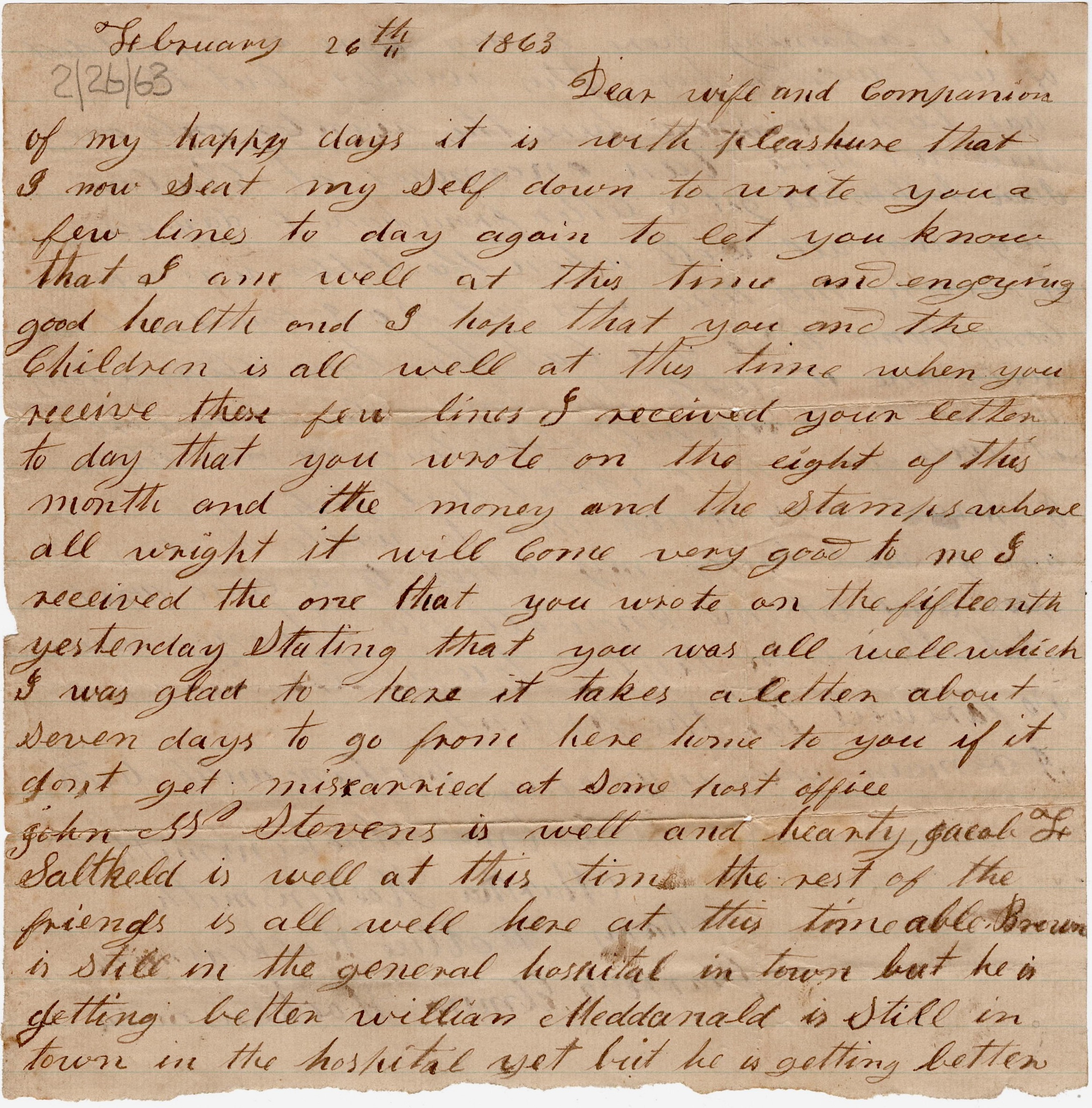
February 26th 1863
Dear wife and companion of my happy days,
It is with pleasure that I now seat myself down to write you a few lines today again, to let you know that I am well at this time and enjoying good health and I hope that you and the children is all well at this time when you receive these few lines.
I received your letter today that you wrote on the 8th of this month and the money and the stamps were all right. It will come very good to me. I received the one that you wrote on the 15th yesterday stating that you was all well which I was glad to hear, It take a letter about seven days to go from here home to you if it don’t get miscarried at some post office.
John W. Stevens is well and hearty. Jacob F. Saltkeld is all well here at this time. Abel Brown is still in the general hospital in town but he is getting better. William McDonald is still in town in the hospital yet but he is getting better.
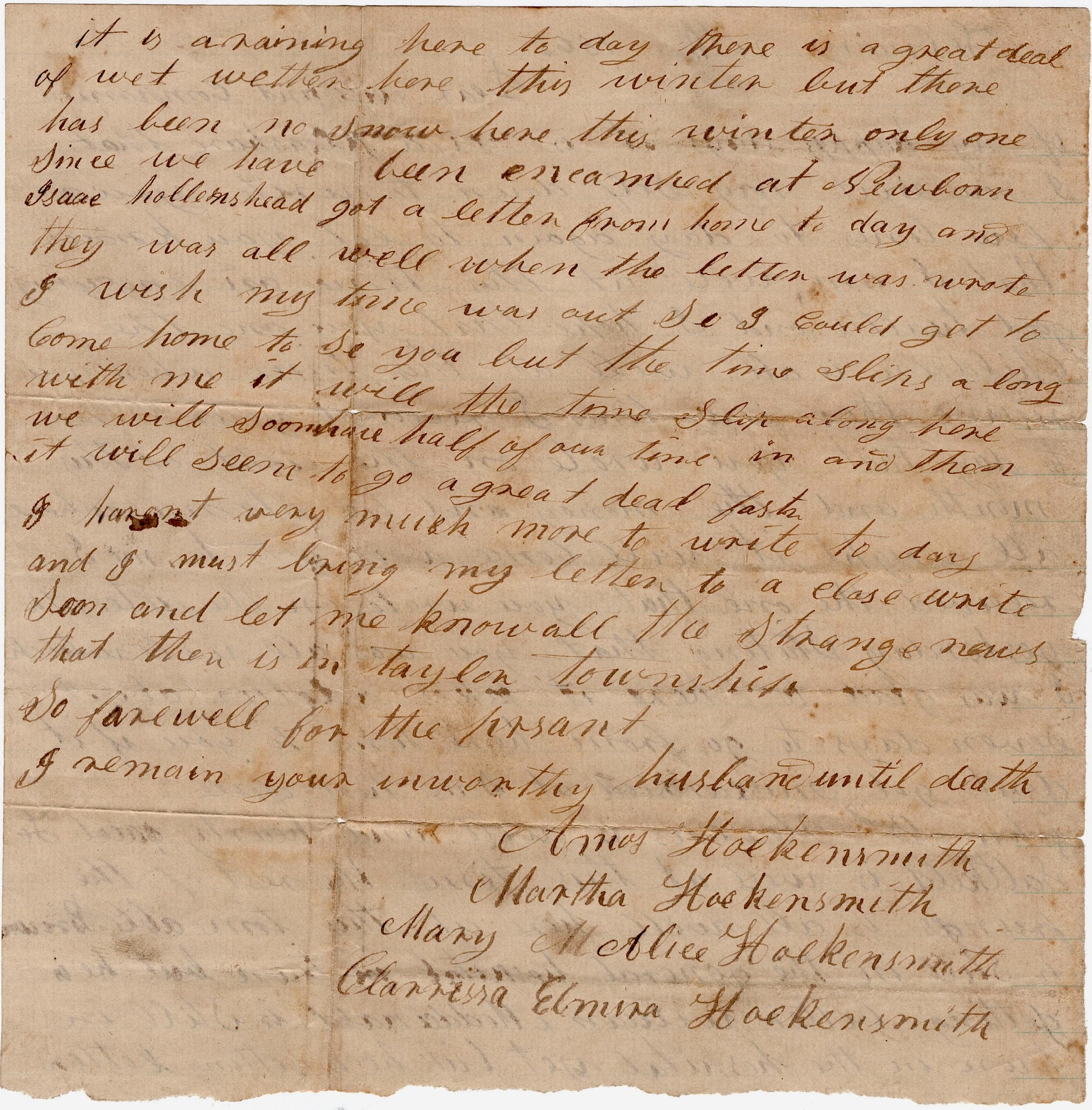
It is raining here today. There is a great deal of wet weather here this winter but there has been no snow here this winter—only one since we have been encamped at Newbern. Isaac Hollenshead got a letter from home today and they was all well when the letter was wrote. I wish my time was out so I could get to come home to see you but the time slips along with me. We will soon have half of our time in and then it will seem to go a great deal faster.
I haven’t very much more to write today and I must bring my letter to a close. Write soon and let me know all the strange news that there is in Taylor Township. So farewell for the present. I remain your unworthy husband until death, — Amos Hockensmith
To Martha Hockensmith, Mary Alice and Clarissa Elmira Hockensmith
Letter 9
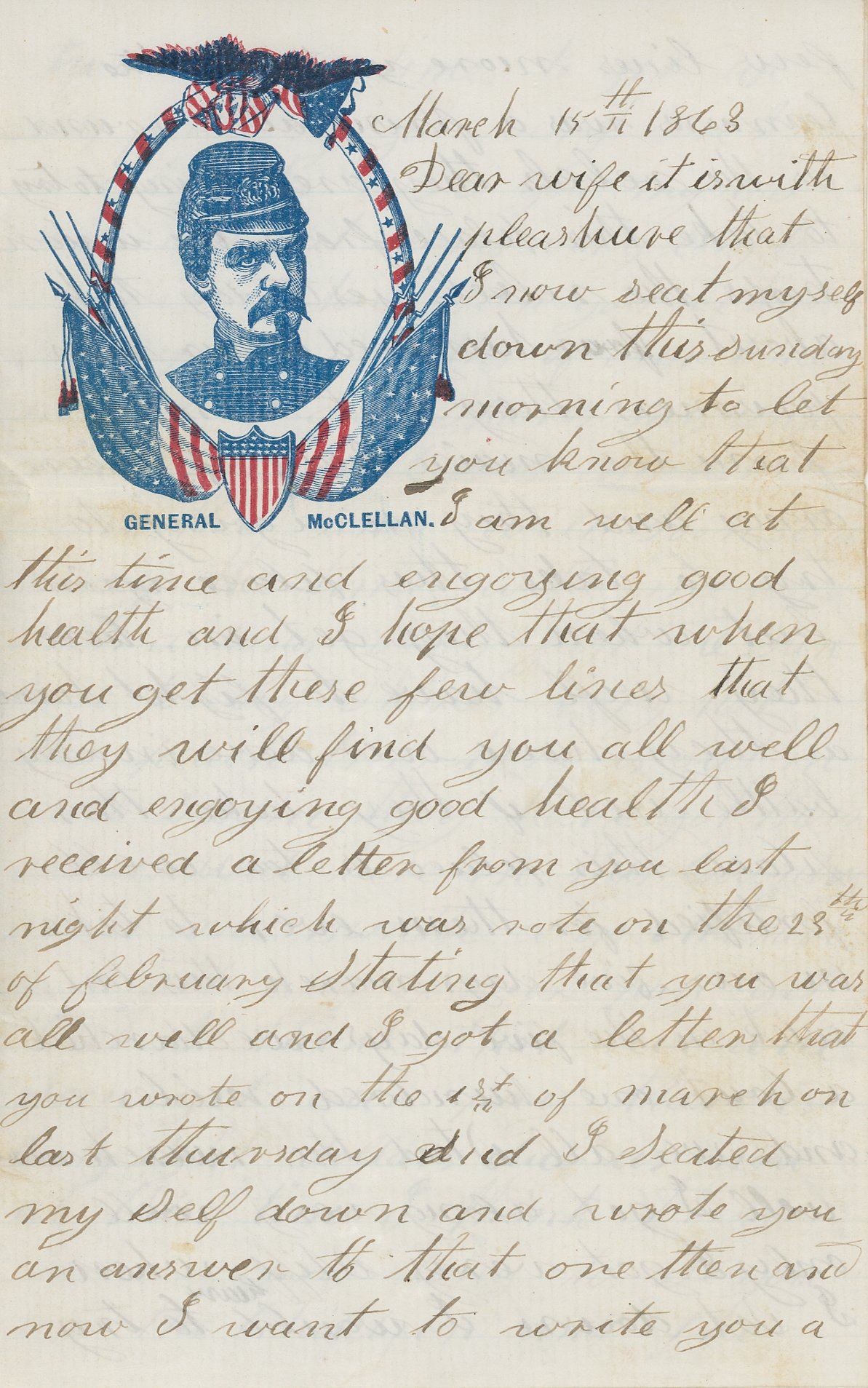
[Editor’s Note: Written during the Confederate attack on Fort Anderson (Battle of Deep Gully) near New Bern, North Carolina, the letter provides a firsthand account of the military activity surrounding the engagement, including cannon fire, Confederate advances, the capture of Union prisoners, and the strength of the Union defenses.]
[New Bern, North Carolina]
March 15th 1863
Dear Wife,
It is with pleasure that I now seat myself down this Sunday morning to let you know that I am well at this time and enjoying good health and I hope that when you get these few lines, that they will find you all well and enjoying good health.
I received a letter from you last night which was wrote on the 23rd of February stating that you was all well and I got a letter that you wrote on the 1st of March on last Thursday and I seated myself down and wrote you an answer to that one then and now I want to write you few lines more.
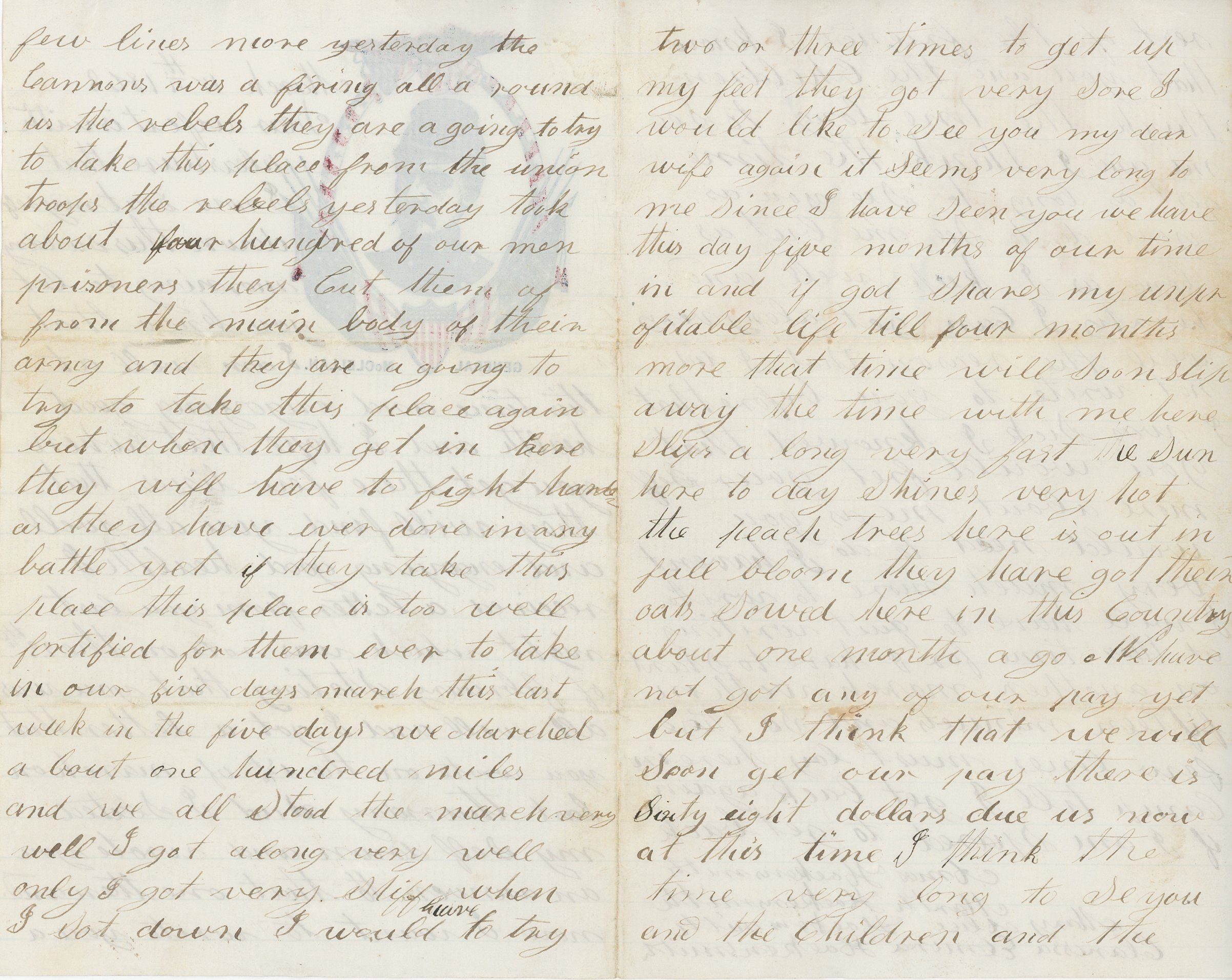
Yesterday the cannons was a firing all around us. The rebels, they are a going to try to take this place from the Union troops. The rebels yesterday took about four hundred of our men prisoners. They cut them off from the main body of their army and they are a going to try to take the place again. But when they get in here, they will have to fight hard as they have ever done in any battle yet if they take this place. This place is too well fortified for them ever to take.
In our five days march this last week, in the five days we marched about one hundred miles and we all stood the march very well. I got along very well, only I got very stiff. When I sat down, I would have to try two or three times to get up. My feet, they got very sore.
I would like to see you my dear wife again. It seems very long to me since I have seen you. We have this day five months of our time in and if God spares my unprofitable life till four months more, that time will soon slip away. The time with me here slips along very fast. The sun here today shines very hot. The peach trees here is out in full bloom. They have got their oats sowed here in this country about one month ago.
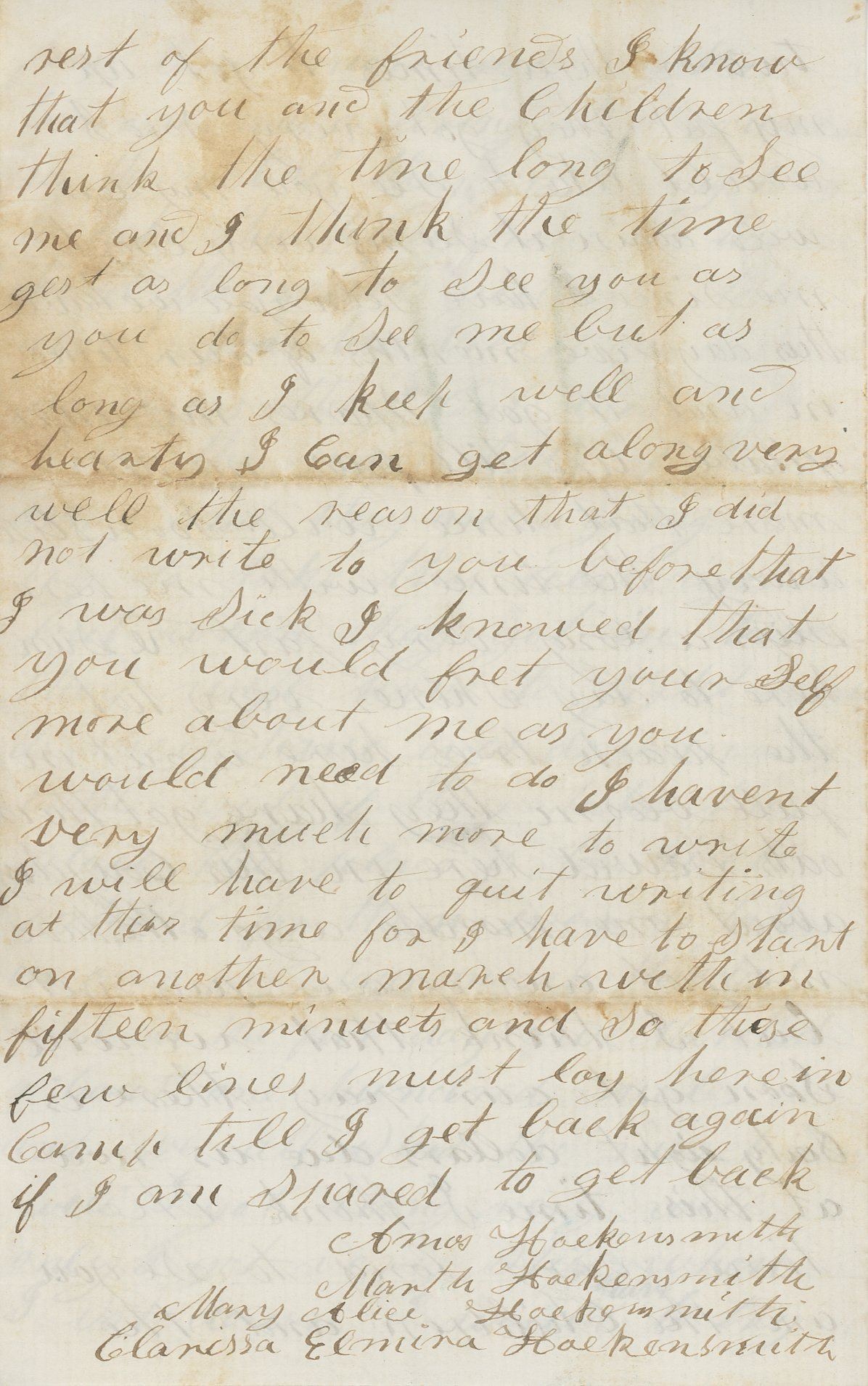
We have not got any of our pay yet but I think that we will soon get our pay. There is sixty-eight dollars due us now at this time. I think the time very long to see you and the children and the rest of the friends. I know that you and the children think the time long to see me and I think the time just as long to see you as you do to see me. But as long as I keep well and hearty, I can get along very well.
The reason that I did not write to you before that I was sick I knowed that you would fret yourself more about me as you would beed to do. I haven’t very much more to write. I will have to quit writing at this time for I have got to start on another march within fifteen minutes and so these few lines must lay here in camp till I get back again, if I am spared to get back.
Amos Hockensmith
To Martha Hockensmith, Mary Alice Hockensmith, Clarissa Elmira Hockensmith.
Letter 10
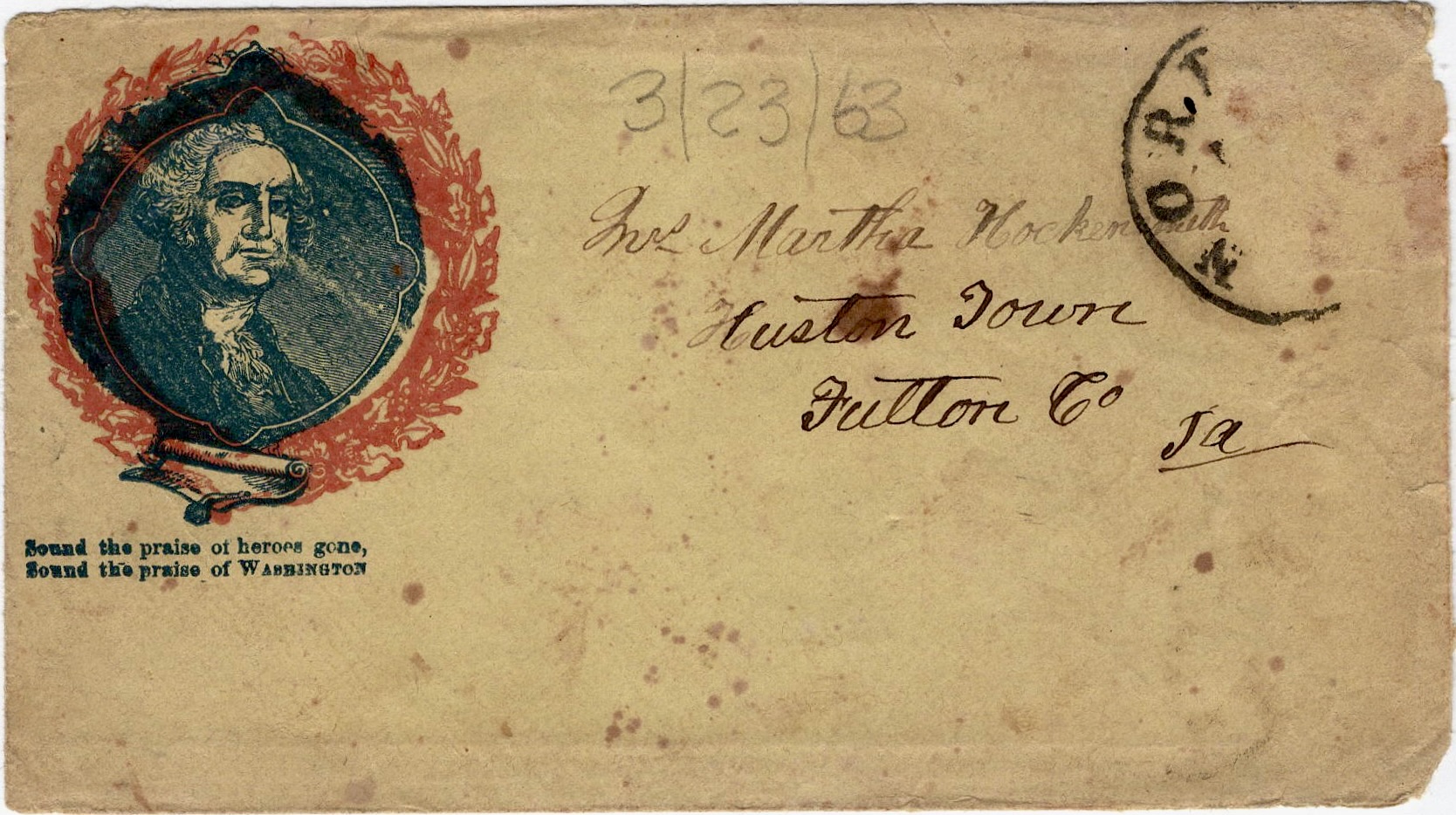
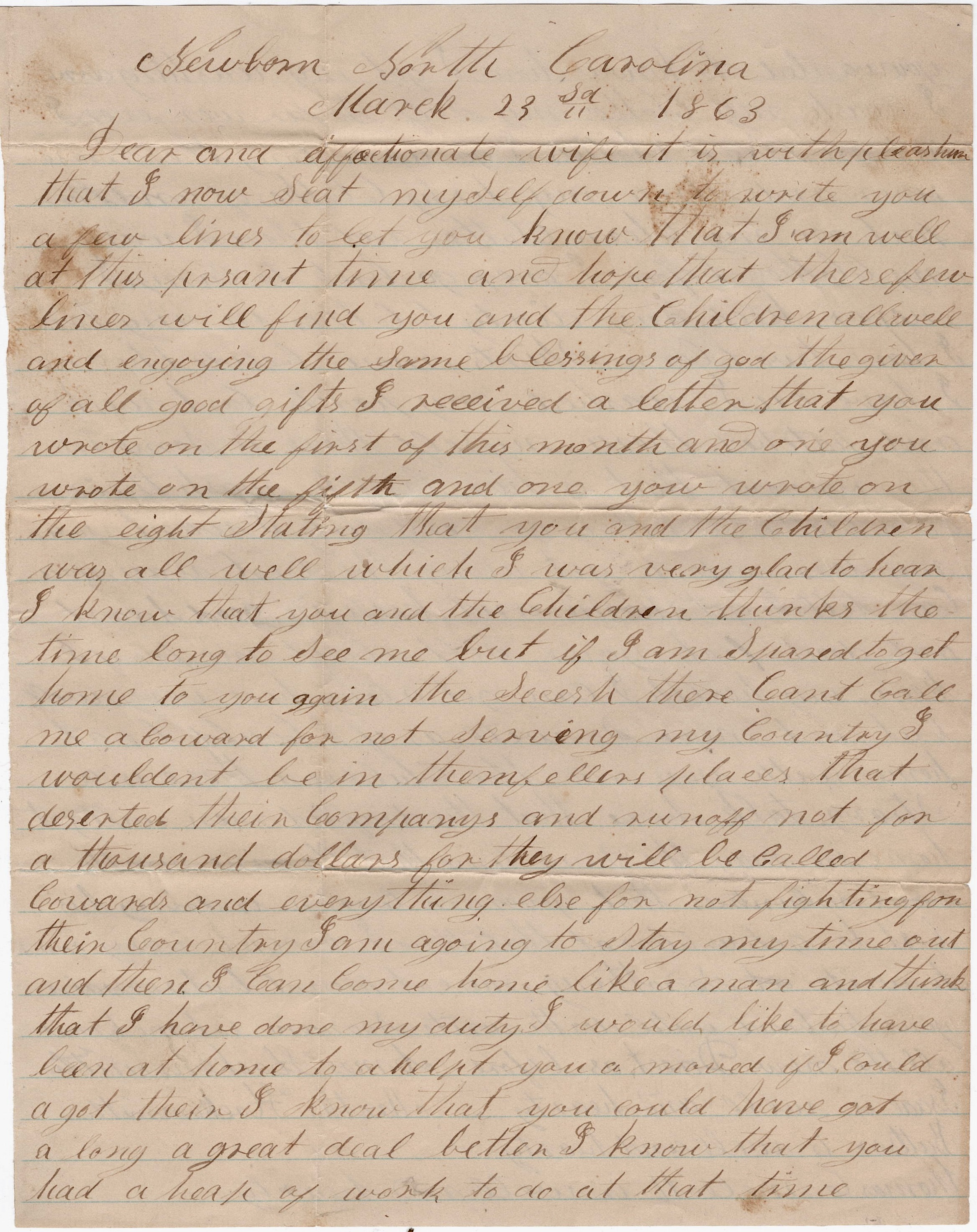
Newborn [New Bern], North Carolina
March 23rd 1863
Dear and affectionate wife,
It is with pleasure that I now seat myself down to write you a few lines to let you know that I am well at this present time and hope that these few lines will find you and the children all well and enjoying the same blessings of God, the giver of all good gifts. I received a letter that you wrote on the 1st of this month and one you wrote on the 5th and one you wrote on the 8th stating that you and the children was all well which I was very glad to hear.
I know that you and the children thinks the time long to see me but if I am spared to get home to you again, the Secesh there can’t call me a coward for not serving my country. I wouldn’t be in them fellers places that deserted their companies and run off—not for a thousand dollars, for they will be called cowards and everything else for not fighting for their country. I am going to stay my time out and then I can come home like a man and think that I have done my duty.
I would like to have been at home to helped you a moved if I could a got there. I know that you could have got along a great deal better. I know that you had a heap of work to do at that time.
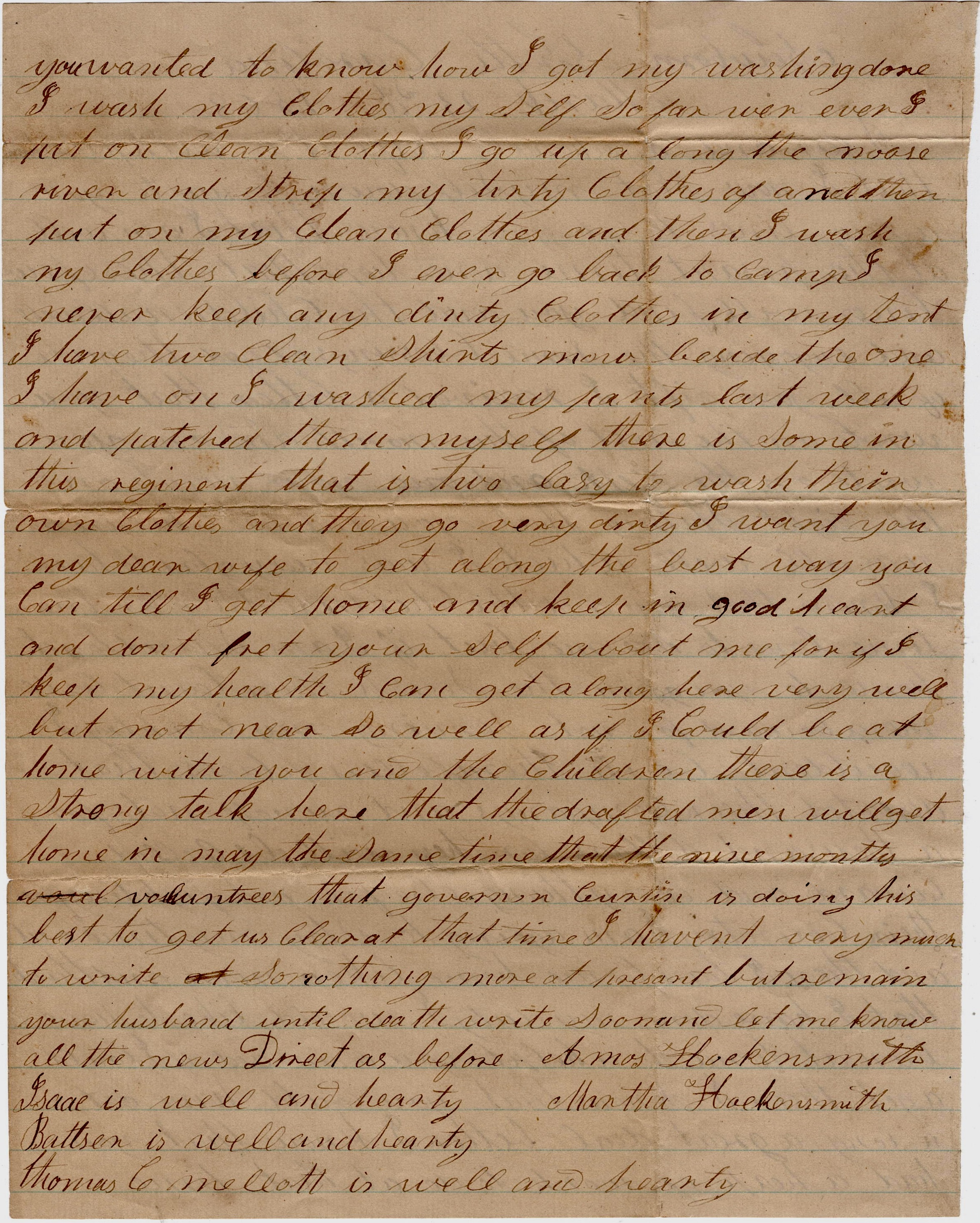
You wanted to know how I got my washing done. I wash my clothes myself so far. Whenever I put on clean clothes, I go up along the Noose [Neuse] River and strip my dirty clothes off and then put on my clean clothes and then I wash my clothes before I ever go back to camp. I never keep any dirty clothes in my tent. I have two clean shirts now besides the one I have on. I washed my pants last week and patched them myself. There is some in the regiment that is too lazy to wash their own clothes and they go very dirty.
I want you, my dear wife, to along the very best way you can till I get home and keep in good heart and don’t fret yourself about me for if I keep my health, I can get along here very well, but not near so well as if I could be at home with you and the children.
There is a strong talk here that the drafted men will get home in May, the same time that the nine-months volunteers [and] that Governor Curtis is doing his best to get us clear at that time. I haven’t very much to write so nothing more at present but remain your husband until death. Write soon and let me know all the news. Direct as before. — Amos Hockensmith
Isaac is well and hearty. Battsen is well and hearty. Thomas C. Mellott is well and hearty.
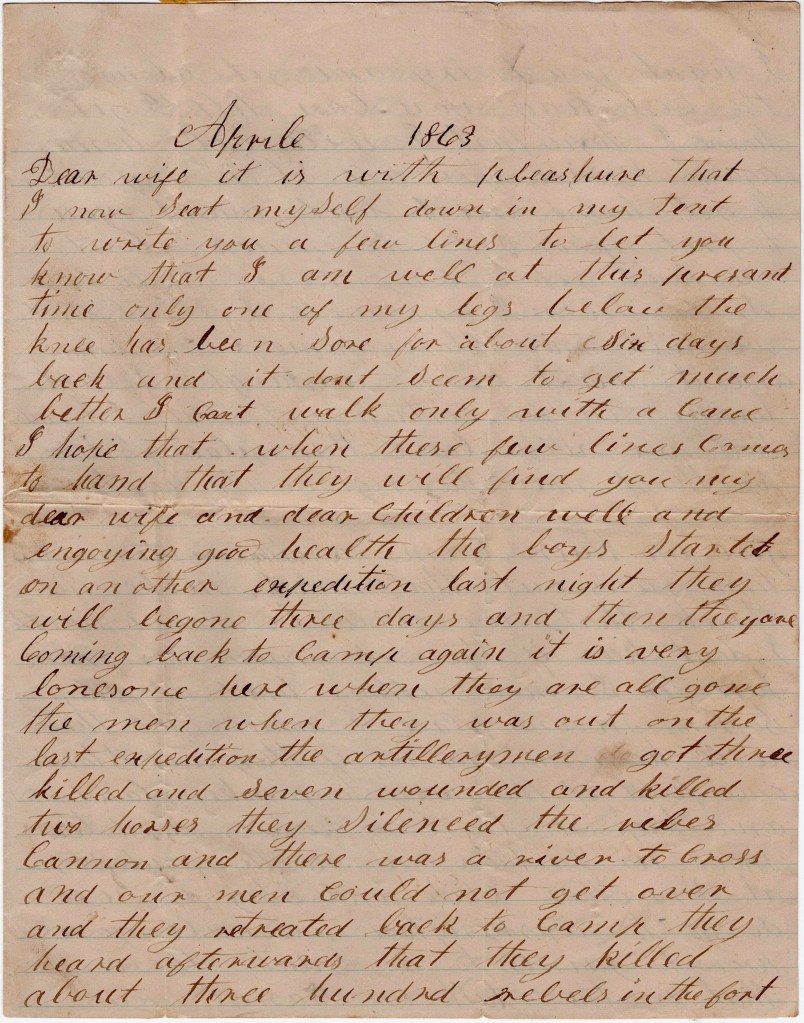
Letter 11
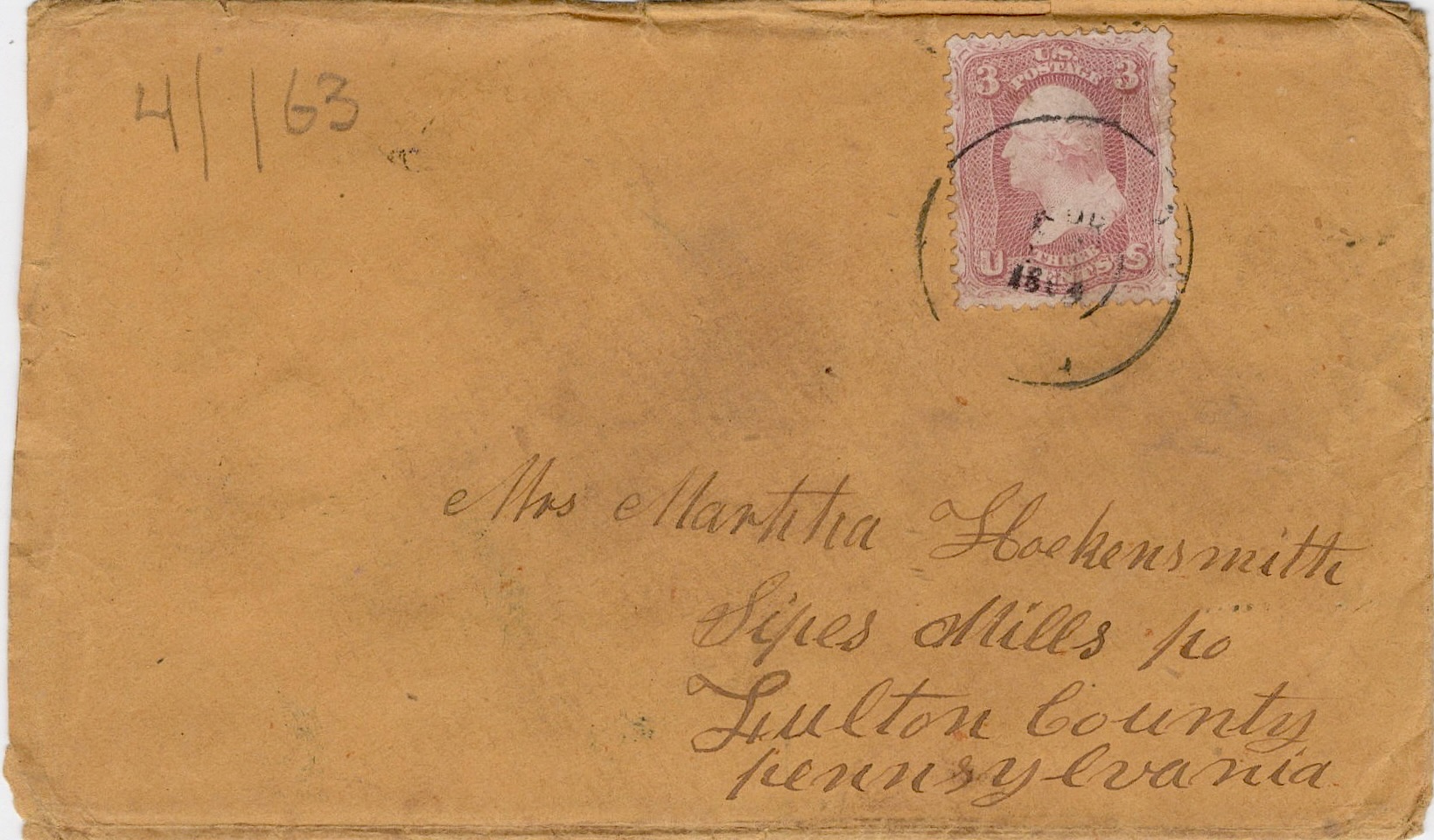
[Camp near New Bern, North Carolina]
April 1863
Dear wife,
It is with pleasure that I now seat myself down in my tent to write you a few lines to let you know that I am well at this present time—only one of my legs below the knee has been sore for about six days back and it don’t seem to get much better. I can’t walk only with a cane. I hope that when these few lines comes to hand, that they will find you, my dear wife and children, well and enjoying good health.
The boys started on another expedition last night. They will be gone three days and then they are coming back to camp again. It is very lonesome here when they are all gone. The men, when they was out on the last expedition, the artillerymen got three killed and seven wounded and killed two horses. They silenced the reb’s cannon and there was a river to cross and our men could not get over and they retreated back to camp. They heard afterwards that they killed about three hundred rebels in the fort.
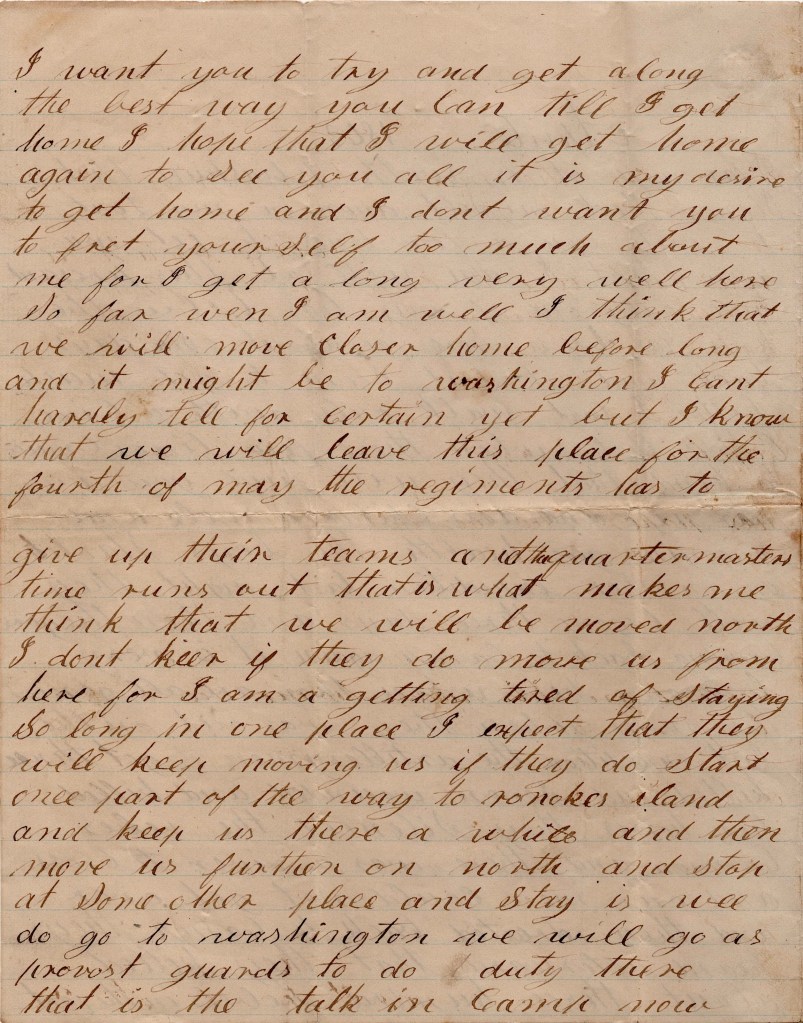
I want you to try and get along the best way you can till I get home. I hope that I will get home again to see you all. It is my desire to get home and I don’t want you to fret yourself too much about me for I get along very well here so far when I am well. I think that we will move closer home before long and it might be to Washington. I can’t hardly tell for certain yet but I know that we will leave this place for the 4th of May the regiments has t give up their teams and the quartermasters time runs out. That is what makes me think that we will be moved north. I don’t keer [care] for I am a getting tired of staying so long in one place. I expect that they will keep moving us if they do start once. Part of the way to Roanoke Island and keep us there a while and them nove us further on north and stop at some other place and stay. If we do go to Washington, we will go as provost guards to do duty there. That is the talk in camp now.
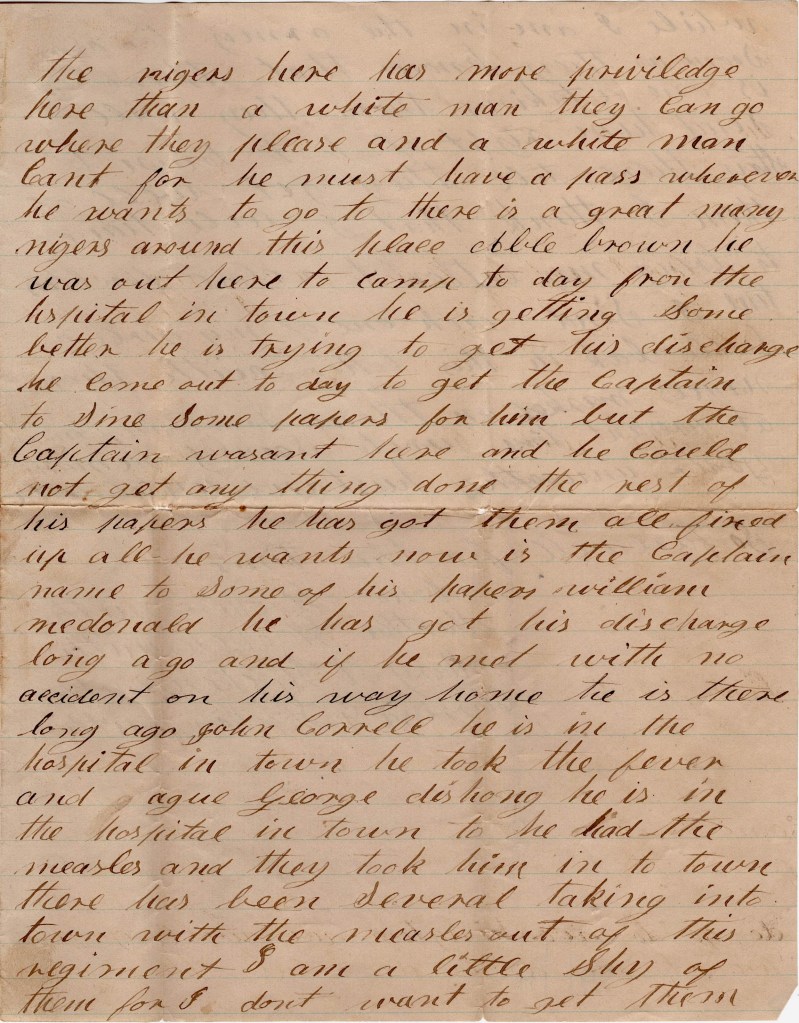
The niggers here has more privilege here than a white man. They can go where they please and a white man can’t for he must have a pass wherever he wants to go to. There is a great many niggers around this place. Abel Brown, he was out here to camp today from the hospital in town. He is getting some better. He is trying to get his discharge. He come out today to get the captain to sign some papers for him but the captain wasn’t here and he could not get anything done. The rest of his papers, he has got them all fixed up. All he wants now is the captain’s name to some of his papers.
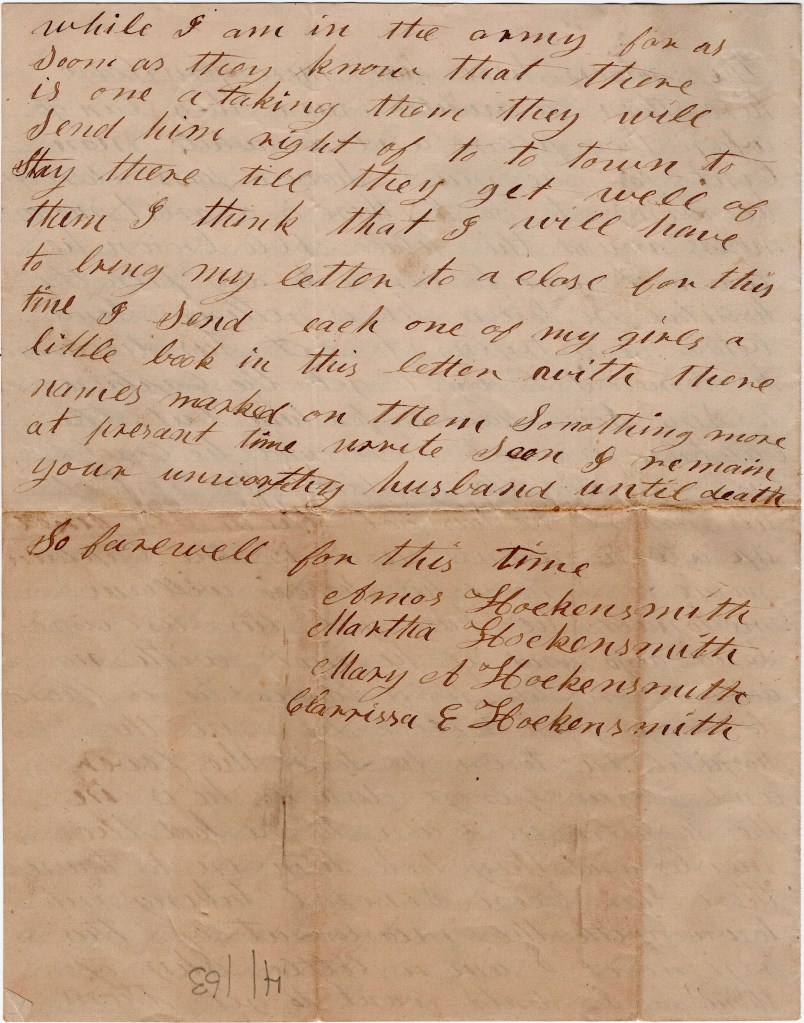
William McDonald, he has got his discharge long ago and if he met with no accident on his way home, he is there long ago. John Correll, he is in the hospital in town. He took the fever and ague. George Dishong, he is in the hospital in town too. He had the measles and they took him into town. There has been several taken into town with the measles of this regiment. I am a little shy of them for I don’t want to get them while I am in the army for as soon as they know that there is one a taking them, they will send him right off to town to stay there till they get well of them.
I think that I will have to bring my letter to a close for this time. I send each one of my girls a little book in this letter with their names marked on them. So nothing more at present time. Write soon. I remain your unworthy husband until death. So farewell for this time. — Amos Hockensmith
To Martha, Mary A., and Clarissa E. Hockensmith