
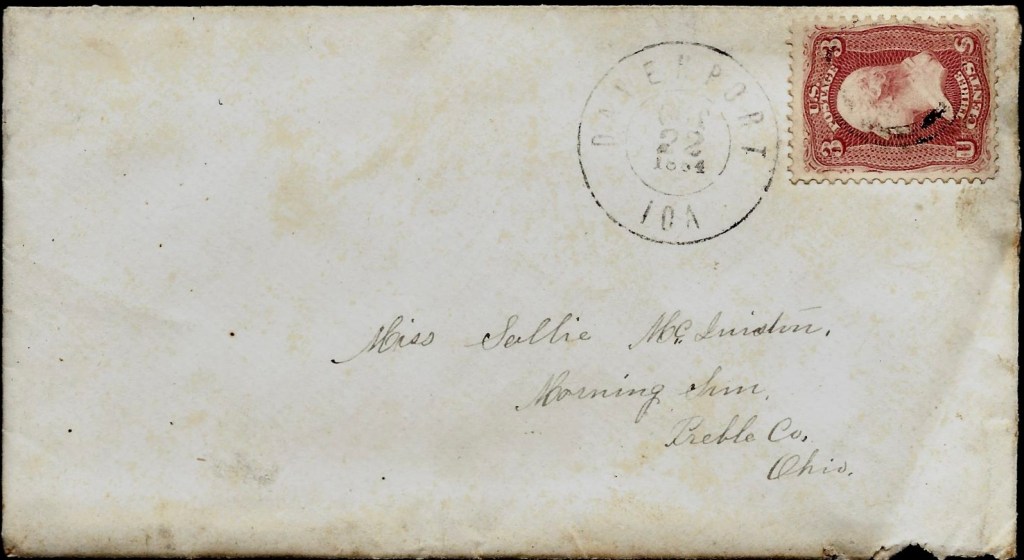
The following incredible and newsy letter was penned in October 1864 by “Carrie O.” whom I later determined to be Caroline Victoria Ozias (1843-1902). Caroline was born in Twin, Preble county, Ohio, the daughter of Peter Leo Ozias (1812-1893) and Rebecca Kesler (1818-1863). It seems she never married. She died of pneumonia when she was 59 years old.
We learn many things from Carrie’s letter but her post script suggests that she was attending school at the time and my hunch is that she was attending the Davenport Female College.
Carrie wrote the letter to her childhood friend, Sarah (“Sallie”) Rachel McQuiston (1843-1926), the daughter of David McQuiston and Margaret Hamilton of Preble county, Ohio.
Transcription
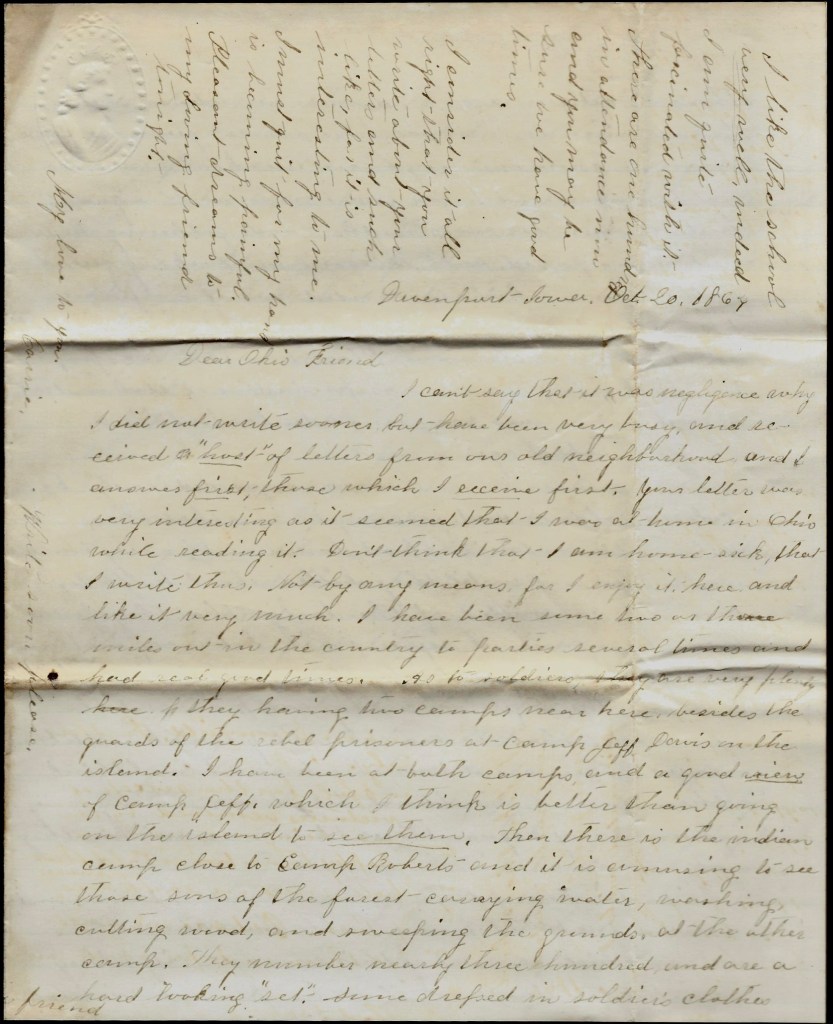
Davenport, Iowa
October 20, 1864
Dear Ohio Friend,
I can’t say that it was negligence why I did not write sooner but have ben very busy and received a “host” of letters from our old neighborhood and I answer first those which I receive first. Your letter was very interesting as it seemed that I was at home in Ohio while reading it. Don’t think that I am homesick that I write thus—not by any means for I enjoy it here and like it very much. I have been some two or three miles out in the country to parties several times and had real good times.
As to soldiers, they are pretty plenty here, they having two camps near here, besides the guards of the rebel prisoners at Camp Jeff Davis on the island. 1 I have been at both camps, and a good view of Camp Jeff which I think is better than going on the island to see them.
Then there is the Indian camp close to Camp Roberts 2 and it is amusing to see those sons of the forest carrying water, washing, cutting wood, and sweeping the grounds at the other camp. They number nearly three hundred and are a hard looking “set”—some dressed in soldier’s clothes, others in citizen’s dress, and others in Indian stuff. They are prisoners brought here several years ago from Minnesota and the ring leaders are kept very close, not being allowed to go out even with a “guard.” 3 Quite a number were in the woods gathering hazelnuts as we passed, with a dignified looking “guard” with them which reminded me of a former teacher of mine who considered it his duty to prop himself up at some conspicuous place every noon to watch the pupils in their play, which was productive of evil instead of good, as he was very impudent about it.

To my subject again, the rebs are guarded (partly) by colored soldiers 4 and you may be sure that their aristocratic southern blood boiled at the very thought and it was not until they killed about half a dozen that they submitted of the darkies that they forced them to submit. I rejoice in it, but imagine their feelings at being guarded by the race they always were taught to hate. The “sogers” in a large camp are not the same ones that we see when they come home to their friends. There are a number here whom I think their friends would not like to own. Being away from many acquaintances, they care not how they act.
We had a heavy draft in some parts of this county and I learned that my old friend Preble [county, Ohio] had the same. In Poweshiek Co. (west of this near Iowa City), they resisted the draft, killed a provost marshal [John Bashore] and several others. The man who shot the marshal was wounded and taken. A rope was put around his neck and he was forced to name his accomplices, about a dozen of whom are now in jail. General [N. B.] Baker went from here with some soldiers and Governor Stone hastened there. Upon the whole they had quite a time resisting this “abolition tyrant.” Pa was in Grinnell the same night the soldiers came. He said it looked very warlike for so small a place. The soldiers realized what northern traitors are and felt like giving them their just dues. A few of the butternuts hid among the bushes near where the marshal and several others were obliged to pass and shot at them, killing him. Then, not satisfied with that, they beat his head almost into a jelly. It caused quite an excitement for a time. Price was in the southern part of Iowa and it was rumored that he intended making his way through to the island and take the rebel prisoners. I think until he gets this far, he will deserve them. 5
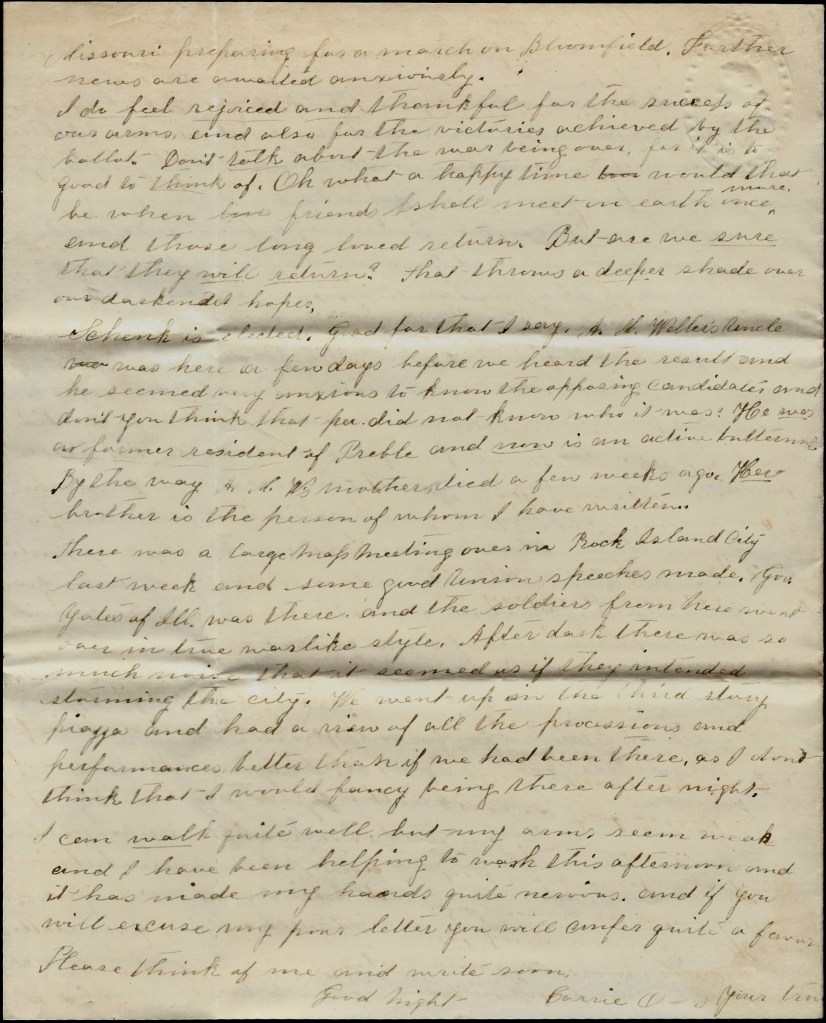
The guerrillas are in Davis County. They entered from Missouri one hundred and fifty strong mostly attired in Federal uniform. Soon after crossing the border they separated into bands and went plundering, murdering, and deceiving by the uniform. 6 The latest news is that four hundred citizens have congregated at Bloomfield and arming themselves to meet five hundred guerrillas reported to be at Memphis, Missouri, preparing for a march on Bloomfield. Further news are awaited anxiously.
I do feel rejoiced and thankful for the success of our arms and also for the victories achieved by the ballot. Don’t talk about the war being over for it is too good to think of. Oh! what a happy time would that be when friends shall meet on earth once more and those long loved return. But are we sure that they will return? That throws a deeper shade over our darkened hopes.
Schenk is elected. Good for that I say. A[ndrew] M. Weller’s Uncle was here a few days before we heard the result and he seemed very anxious to know the opposing candidates, and don’t you think that pa did not know who it was. He was a former resident of Preble [County, Ohio] and now is an active butternut. By the way, A. M. W.’s mother 7 died a few weeks ago. Her brother is the person of whom I have written.
There was a large mass meeting over in Rock Island City last week and some good Union speeches made. Governor Yates of Illinois was there and the soldiers from here went over in true warlike style. After dark there was so much noise that it seemed as if they intended storming the city. We went up in the third story piazza and had a view of all the processions and performances—better than if we had been there as I don’t think that I would fancy being there after night. I can walk quite well but my arms seem weak and I have been helping to wash this afternoon and it has made my hands quite nervous, and if you will excuse my poor letter, you will confer quite a favor.
Please think of me and write soon. Goodnight. — Carrie 0. Your true friend.
I like the school very well indeed. I am quite fascinated with it. There are one hundred in attendance now and you may be sure we have good times. I consider it all right that you write about your letters and such like, for it is interesting to me. I must quit for my hand is becoming painful. Pleasant dreams to my loving friend tonight. My love to you, — Carrie
Write soon please.
1 Though I have not heard of it being called “Camp Jeff Davis” before, it’s clear that Carrie is referring to the Rock Island Prison which was located on a government-owned island between Davenport, Iowa, and Moline, Illinois, in the Mississippi River.
2 Camp Roberts was the headquarters of the 8th and 9th Cavalry. It was established 14 July 1863 on Duck Creek near Oakdale. It was afterward called Camp Kinsman and the buildings were turned over to the orphans of soldiers and became the Davenport Orphan’s Home.
3 These Indians—part of the Minnesota Sioux—were among the nearly 300 that were rounded up after the Sioux Uprising in Minnesota in August 1862. They were brought to Davenport where they were confined in a prison area 200 feet square containing four buildings: two for prisoners to sleep in (no beds were provided), one for a hospital, and one for the guardhouse. It wasn’t until April 1866 that those who had survived were released.
4 It was the 108th USCT assigned the duty of guarding Revel Prisoners at the Rock Island Arsenal.
5 For more details on this Draft Resistance Incident in Poweshiek county, Iowa, readers are referred to a post by David Connon entitled, Draft Dilemma in Poweshiek County: The Murder of Marshals,” Emerging Civil War, March 29, 2018
6 In the book entitled, “The Confederate Invasion of Iowa,” author Russell Corder informs us that the raid took place in mid-October 1864. “Twelve young men, dressed in Federal uniforms, mounted on splendid horses, and armed with from two to seven revolvers each, entered Davis Co. near its southeast corner in the early morning with two prisoners, young men whom they had captured in Clark Co., in the Northeast corner of Missouri.”
7 Sarah (Higgins) Weller (1811-1864) died on 21 September 1864. She was buried in Roselawn Cemetery in Lewisburg, Preble county, Ohio.




Camp “Jeff Davis”. Maybe the locals alternative reference ? “Sogers” maybe the USCT slang speech for Southern
Prisoners ?
LikeLike