
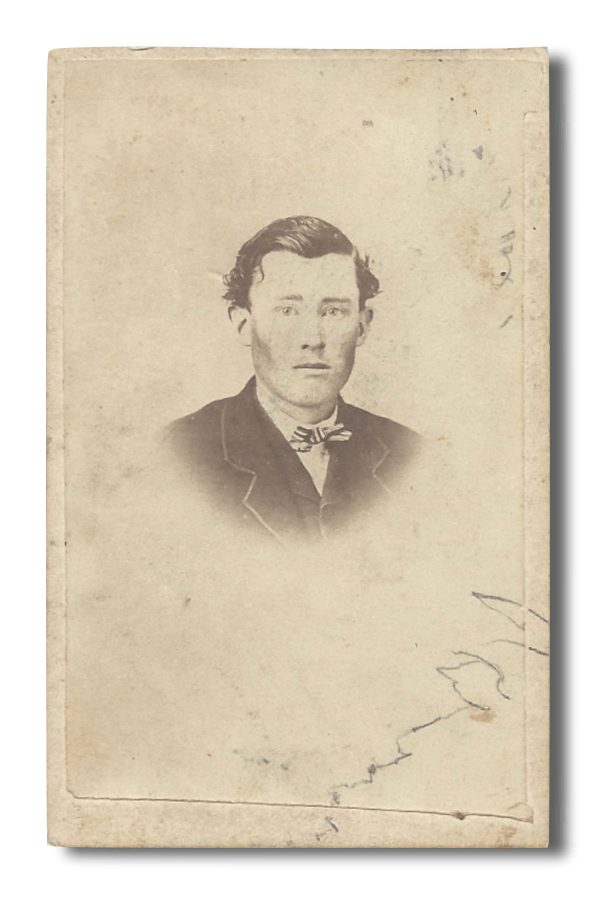
The following letter was written by Corp. William Galbreath Snodgrass (1838-1915) of Co. B, 32nd Ohio Infantry. At the time this letter was penned from the Union entrenchments near Vicksburg in late May 1863, the 32nd Ohio was brigaded with the 8th & 81st Illinois, and the 7th Missouri in John D. Stevenson’s 3rd Brigade, of John Logan’s 3rd Division, in McPherson’s 17th Corps. William entered the service on 9 August 1861 as a private but was promoted to a corporal by March 1863 and mustered out as the 1st Sergeant of his company when he mustered out as a veteran in July 1865.
William was raised in Union county, Ohio, the son of Samuel Snodgrass (1804-1870) and Agnes Nancy Morrison (1813-1876). He addressed his letter to his cousin “Lib” but she is not further identified and no envelope accompanies the letter. The owner of the letter claims it was purchased in an estate sale in Ohio.
William’s highly entertaining and informative letter chronicles the movements of the 32nd Ohio from the time of their departure from Milliken’s Bend in late April to the end of May when they were laying siege to Vicksburg.
Transcription
Near Vicksburg [Mississippi]
May 28th [1863]
Cousin Lib,
I received your letter a week ago last Sunday. We were on the march then and had stopped to rest and was sitting on the side of the road when the mail was fetched up and distributed. it was the first mail we had received for some time. We left Milliken’s Bend the 25th of April and have been on the move ever since. We have had several fights with the rebs and have whipped them pretty decently every time. I expect you have saw an account of what we have been doing since we left the river. Our Division (that is Logan’s) was in every fight. But we were very lucky We have only had one man wounded in our company yet and that was only a flesh wound. That was Isaiah Hamilton of Logan county. In the rounds, we took over 6,000 prisoners and about 70 pieces of artillery, 8 pieces of which our regiment with the 8th Illinois had the honor of taking.
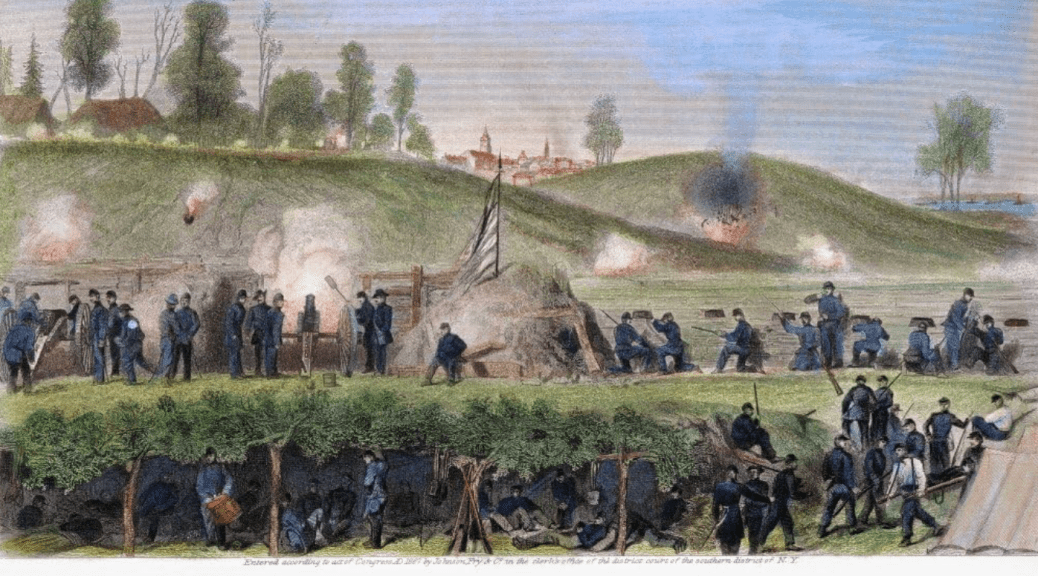
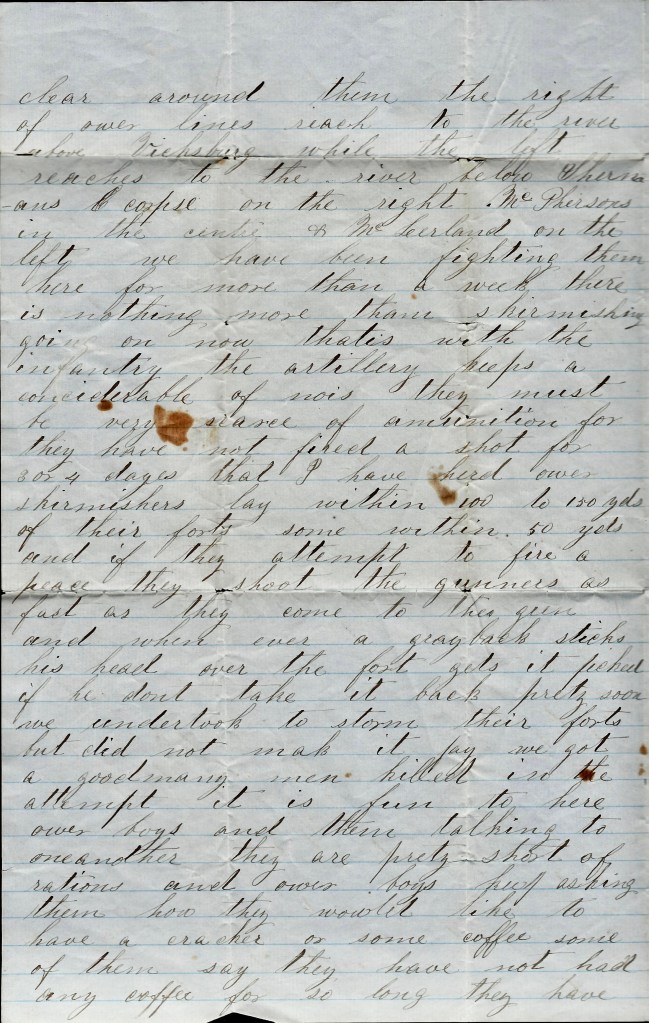
We have a lot more of the rebs penned up here in Vicksburg which we intend shall not get away. We have a strong force clear around them. The right of our lines reach to the river above Vicksburg while the left reaches to the river below. Sherman’s Corps on the right, McPherson’s in the center, & McClernand on the left. We have been fighting them here for more than a week. There is nothing more than skirmishing going on now—that is, with the infantry. The artillery keeps a considerable of noise. They must be very scarce of ammunition for they have not fired a shot for 3 or 4 days that I have heard. Our skirmishers lay within 100 to 150 yards of their forts—some within 50 yards—and if they attempt to fire a piece, they shoot the gunners as fast as they come to their gun. And when a grayback sticks his head over the fort, gets it picked if he don’t take it back pretty soon.
We undertook to storm their forts but did not make it pay. We got a good many men killed in the attempt. It is fun to hear our boys and then talking to one another. They are pretty short of rations and our boys keep asking them how they would like to have a cracker or some coffee. Some of them say they have not had any coffee for so long they have forgot how it tastes and we ask them how much they would give for a daily paper. I think the Southern Confederacy is playing out pretty fast. Flour here sells at $125 per barrel and there is none hardly for that. There was only one family in Raymond that had any flour and that is a considerable of a place. We got the rebel mail there. Had a heap of fun reading them. I got a couple of rings out of one that some fellow was sending to his sweetheart. There were letters in there from all parts of te rebel army—some from Charleston, S. C., some from Bragg’s army, Vicksburg, Port Hudson, and a great many of them talk very discouraging and the most of them said they were pretty short of rations.
The women here are very sassy when our boys first come in but they generally get pretty humble. We have passed through some of the nicest country that I ever saw. We came past one of Jeff Davis’s plantations. The boys tore everything to pieces. The people here will learn one lesson before they are through with this rebellion—that is, when they are as well fixed as they were when this war commenced, that is to be contented with their lot.
Last Monday the rebs came out with a flag of truce. I do not know the object of it or anything about it but as soon as it came out our boys went up to the forts and the rebs came out and were talking together and joking, but they would not allow us to go inside of the fort. The flag came out about three o’clock and they did not do any fighting that day and some of our boys were over among the rebs until night. The most of them thought we had them. They said we could not take them by storm but we could starve them out. The was 3 or 4 over here in our camp and they offered a dollar apiece for crackers. the boys gave them a few. They say our shells are killing lots of their cattle and mules in there. They said we killed them faster than they could eat them.
The boys are all well. Will Mc 1 is all right. While we were in Raymond, he took possession of the printing office and done a big business while he stayed there. You said you had written two letters since you had got any from me but I never got it. No more. — Wm. G. Snodgrass
1 “Will Mc” was probably William Mosby McLane (b. 1839) who mustered out of the regiment at Chattanooga on 19 August 1864 after three years service. Draft registration records indicate that William was a “teacher” in Champaign county, Ohio, before he enlisted. He returned to Ohio until the close of the war then ventured west to help build railroads. McLain’s last job was with Texas & Pacific Railroad and there he died of heart disease September 8, 1873 in Gladewater, Texas at the age of 35. For a wonderful article on McLain, see “William McLain: On the Subject of Surrendering” appearing on Emerging Civil War, May 1, 2020.



 Spared & Shared 23