
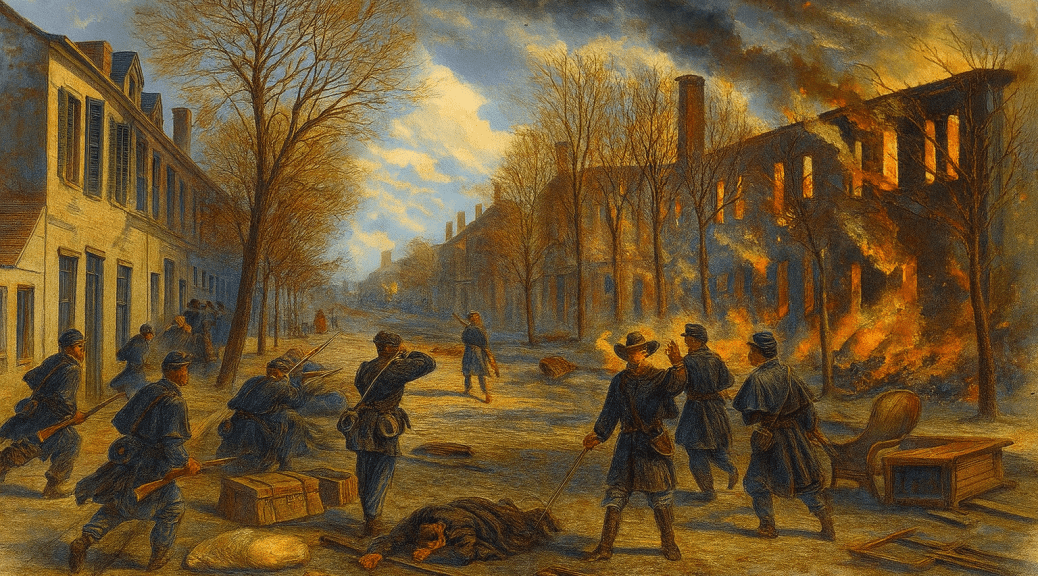
The following excerpts from letters and diaries of soldiers and citizens, still retained in private collections, were all published on Spared & Shared in the last 15 years and shed light on the Battle of Fredericksburg and the morale of the armies before and after the battle. These accounts offer a thought-provoking perspective, exposing hidden truths and intimate experiences only found in private letters. Filled with raw emotion, these letters and diaries help us shape our understanding of the war.
There are a total of 83 different Union soldiers (in 73 different regiments) who wrote letters or kept diaries from which these extracts were drawn; 4 in the Army of the Potomac (AOP) Headquarters, 18 in the Left Grand Division, 26 in the Center Grand Division, 28 in the Right Grand Division, 5 in the Reserve Grand Division, and 2 unidentified soldiers. Unfortunately, there are only three from Confederate soldiers, two of whom were eyewitness to the battle. In addition, I’ve included here 3 excerpts from letters written by Union soldiers not at the battle, and 2 by civilians (see index).
As one delves into these personal accounts, a stark and unsettling reality unfolds. The morale of Burnside’s Army of the Potomac was anything but strong; it was a concoction of disillusionment and despair. Many enthusiastic volunteers who had rushed to enlist in 1861 now languished in fatigue and frustration, disheartened by the agonizingly slow march towards victory over the rebellion. While a fresh influx of recruits and new regiments in the fall of 1862 offered a fleeting glimmer of hope, the Lincoln Administration’s pivot to the liberation of slaves crushed the spirits of many. There was a pervasive belief that their officers were inept and cowardly, with the fighting spirit burning bright among the troops, who felt betrayed by their leaders. A growing consensus painted politicians and War Department officials as corrupt self-serving puppets, prioritizing their selfish agendas over the fight for the nation’s soul.
Entering the Battle of Fredericksburg, the Army of the Potomac faced more than just the enemy; they grappled with relentless weather torments that delayed their movements, sometimes limited their rations, and they were plagued by shoddy footwear—many were left completely barefoot. Anxious and apprehensive about being forced into a winter campaign, they resented the pressure from a demanding public, who seemed oblivious to the harsh realities they endured.
After the Battle of Fredericksburg, the morale of the Army of the Potomac reached an unprecedented low, surpassed only perhaps by the disheartening experience known as “Burnside’s Mud March” a few weeks later. A significant number of Union soldiers came to believe that continuing the fight against the Confederate army was futile, deeming it impossible to ever conquer them. Despair nearly took hold, and it may have prevailed entirely were it not for the astute leadership of President Lincoln, who publicly recognized that although the assault on Lee’s Army of Northern Virginia had failed, the Union army had displayed remarkable skill and courage in their efforts, while he also acknowledged and empathized with their considerable losses.
All of the letters and journal entries presented here are organized in chronological order by their writing dates, providing a clear insight into the state and morale of Burnside’s army leading up to the battle. I have categorized them into three distinct sections: Before, During, and After the Battle; however, it is important to note that letters dated during or after the battle often include descriptions of the preceding events. One letter, in particular, stands out as the definitive account of the battle from start to finish: the account by Edgar A. Burpee of the 19th Maine Infantry. I am particularly grateful to Derrick Williams for generously sharing this remarkable piece from his personal collection. If you find yourself short on time, I strongly recommend dedicating at least a moment to read Burpee’s letter, dated 15 December 1862.
Related Reading
Burnside’s Bleak Midwinter, by Albert Conner, Jr., and Chris Mackowski, 3/21/2017. (HistoryNet)

Before Battle Letters
James Henry Clark, Co. A, 3rd Vermont, 2nd Brig., 2nd Div., VI Corps.—Left Grand Division (The Civil War Letters of James Henry Clark)
Camp near Aquia Creek, November 19, 1862 to his cousin.
“You ask me what I think about the war. Well, that is a hard question and I don’t know as I can make you understand just what I do think about it. In the first place, I will tell you what I know and then what I think about it. First, they are making a regular political thing of this war. The Democrats and the Republicans are now having a great struggle to see which shall be master instead of united and forming one grand Union Party as they should do till this war was ended. But this party spirit has become so powerful that the two parties are almost at swords points—they having become so antagonistic—and as long as it remains so just so long the war will not be prosecuted successfully. That makes out to be one fact. And now secondly, our generals, I think, are too jealous of each other. One is afraid that the other will do something and get his name up and they are so jealous that they do not cooperate nor work together as they might if it were otherwise. And then we have a great many officers that are both unworthy and inefficient and really incapacitated for the offices they hold which were, perhaps, obtained for them through their wealth or the interference of friends, or maybe by their former station in society. This is all wrong and not as it should be.”
Henry Fitch, citizen, Bergen Square, New Jersey (S&S18)
Bergen, New Jersey, probably Wednesday, November 19, 1862 to his son.
“I see by the papers that railroad is finished from Aquia Creek to Falmouth, that the pontoon bridges have arrived ready to be used for the crossing of the Rappahannock at Fredericksburg and that our gunboats are on their way up the river and nearly to Fredericksburg. From all this I infer that you will move soon from Stafford Court House and will meet the enemy in battle at Fredericksburg unless they retire beyond reach of our gunboats to a more defensible position. I see by the papers that the force of the enemy under Gen. Lee at Fredericksburg is estimated at 100,000 & will reach 125,000 before Burnside gets ready to fight them, but that Burnside says he has plenty of men to do all his work.”
Samuel Brown Beatty, Co. E, 57th Pennsylvania Infantry, 2nd Brig., 1st Division., III Corps.—Center Grand Division (S&S22)
Camp on the Rappahannock, Eleven miles from Fredericksburg, Va., November 20, 1862, to his wife.
“Sabbath morning, Nov. 23—Four miles from Fredericksburg. As I did not get my letter sent when I commenced it, I thought I would write some more and let you know something about our travels since we crossed the Potomac. We have marched about one hundred and seventy-five miles and we are not at Richmond yet. It is getting some cold and disagreeable but I have not suffered any with cold yet. I have all the clothes I can carry on the march and I hear nothing about winter quarters yet. We have eaten our last cracker this morning and we do not know when we will get any more but we have never starved yet and I think we will get bread before very long. I am very glad that you do not know how we get along here in the army but then it might be worse.
I got a letter from you last night dated the 10th. I was glad to hear that you were well. You must not get discouraged about anything much less about writing for I get the most of your letters and it does me a great deal of good to hear from you. I still hope that I will see you at some time and then I will be able to tell you all about our fatiguing marches and sufferings and privations. I suppose tomorrow we will try to cross the Rappahannock River and the Rebels are on the other side and we will have to force our way across, but we will do our best to cross.”
George Morgan, Co. F, 11th New Hampshire Infantry, 2nd Brig, 2nd Div., IX Corps—Right Grand Division (When I come Home)
Fredericksburg, November 21, 1862, to his father.
I have a little leisure time and I will try and write you a letter to let you know that I am alive and well but we are a having a pretty hard time of it. It has been a raining now for three or four days and it is muddy and bad traveling now. We got here the 12th. The city is held by the Rebels. We come right close to the city but they did not trouble us any. They say that Burnside has sent in a flag of truce giving them a short time to surrender the city. If they don’t surrender, I suppose that we shall have to fight a battle here before many days. I can write what they tell me but we don’t know where we are a going nor what we are a going to do one day afore hand. They tell us that we are a going from here to Richmond. They say that we have got to stay here about a week so that they can get along supplies. It is sixty miles from here to Richmond. They say that we can go there in six days but suppose that we shall have to fight some before we get there.
Last night we had to move off into a piece of woods. It got so muddy that we could not stay where we were. We built up a good big fire and so we laid very comfortable all night. There is a large army here now and there is a good many of them sick. There has eight or ten died out of our regiment. There has not any died out of our company but there will be alot of them die before spring if we stay out here…It is a pretty hard case to get much to eat but meat and hard bread. We get some fresh beef and salt pork and some bacon. We ain’t allowed to steal anything on the road. The Rebels property is all guarded. The army ain’t allowed to destroy anything as they pass along.”
Horace Augustus Derry, Co. D, 20th Massachusetts, 3rd Brig., 2nd Div., II Corps—Right Grand Division (S&S10)
November 22nd 1862, Camp near Falmouth, Va., written to his mother
“…We are paddling around in the mud now up to our knees. It has been raining for 3 or 4 days but it is a little pleasanter today and we are drying our things. Yesterday in the afternoon, I was ordered to go and get 24 men and go on guard over to Gen. [Darius] Couch’s Headquarters and over we went through the mud. We stopped there until dark and then there was 24 more came and I went and found out there was some mistake about it and they told me I might take my men and go back to camp and back we went through the mud again and that is about the way things are done all of the time. I shall be glad when we get some of our old officers back that knows something. Captain [Ferdinand] Dreher has got command of the regiment now. He is a Dutchman. You know we have been on the march the most of the time since I came back. One day they marched us 20 miles and all we have on the march to eat is raw pork and hard bread. The boys find a great deal of fault and say they do not have enough of that. We are close to Falmouth and on the other side of the [Rappahannock] River we can see the rebels on picket and we expect to cross in a few days. The pickets are near enough to talk to each other. We do not get many letters now for the mail does not go nor come regular now and I do not think it will until we get into winter quarters and I don’t know when that will be. I do not see much signs of it now and for my part, I do not want to go into winter quarters. I want to fight it out and come home…”
William Washburn, Jr., Co. A, 1st Massachusetts Infantry, 1st Brig., 2nd Division., III Corps—Center Grand Division (S&S20)
Camp Mass. 35th Regt. near Falmouth, Va., November 22d [1862] to his friend.
“Fredericksburg, which is in plain view from the place I write from, is a much smaller city than I expected to find it. It looks very prettily from a distance, situated as it is in a hollow on the banks of a fine river, with very high hills in nearly every side. If its streets present no better appearance upon close inspection than did those of Falmouth, I can’t speak much in its favor as a cleanly city. However, I may not have an opportunity to form an opinion in that respect, for there’s every prospect now of being obliged to shell the place before the rebels will surrender it. In that event, it will probably be entirely destroyed, or so disfigured as to make it impossible to gain an idea of its previous appearance. We have now been here for three days, and during that time the cars have been running constantly to and from Fredericksburg, either bringing reinforcements to, or carrying supplies from there.
Today, the sun has appeared for the first time since arriving in Falmouth. The roads are in a terrible condition from the heavy rains which have just ceased. Wagon trains, ambulances, and every conceivable kind of vehicle traveling the turnpikes, meet with the same fate, viz: “Stuck fast in the mud.” A few days of sunshine will dry up the roads in a measure, and allow the forward movement to go on. Another great drawback to the advance is the want of shoes. Perhaps you will be loathe to believe it, but it is a fact nevertheless, that a great many of our soldiers—even in this new regiment, are entirely destitute of shoes or boots. Some are actually bare-footed, and out of my company alone, numbering now but sixteen, twelve are unable to march any great distance because of the worn out condition of their shoes. Requisition after requisition has been sent in to headquarters, and always with the same result. “You will get them as soon as they come,” is the invariable answer, and in the meanwhile, the soldier is obliged to go around in his bare feet, or wear shoes so full of holes as to render his going any distance without wetting his feet an impossibility. Whose fault is it? If government is unable to better provide for its soldiers than this at this season of the year, it had much better send the men home for they cannot stand it a great while longer. I’ve sent in a new requisition for shoes for my men this morning, and the only comfort I got was that they were probably on their way from Washington.”
Dwight Jairus Brewer, Co. F, 20th Michigan Infantry, 1st Brig., 1st Div., IX Corps—Right Grand Division (S&S22)
Opposite Fredericksburg, November 24th [1862] to his sister.
“We are now 30 or 40 miles from Richmond and about 6 miles from Aquia Landing. Our forces are in possession of that place and the railroad from there here so that it is easy to get provisions to us. We shall probably cross the river—or attempt to cross—soon as our men are placing a pontoon bridge across. The rebels can be seen on the other side and our men talk with them across the river.”
George W. Fraser, Co. E, 122nd Pennsylvania Infantry, 1st Brig., 3rd Div., III Corps—Center Grand Division (S&S17)
Camp near Rappahannock River, November 25, 1862, to his brother.
“We are encamped about 1½ miles from the river opposite Fredericksburg. The town is said to be still in the possession of the rebels but will soon be shelled if not evacuated. We occupy the left of the Center Division of the Army of Virginia, being the Third Army Corps. The whole army commanded by Gen. Burnside moves together whenever any part of it moves. We are all in very good health and some of us are growing stouter although rations are very scarce on account of the large number of troops gathered here and the inconvenience of the transportation.”
Wilber H. Merrill, Co. H, 44th New York Infantry, 3rd Brig., 1st Div., V Corp—Center Grand Division (S&S23)
Camp near Fredericksburg, VA., November 25, 1862, to his parents.
Well here we are down near Fredericksburg where we were soon after we left Harrison’s Landing. The rebels occupy the town in force. The report is that Burnside has given them fourteen hours to remove the women and children. They say that they are busy at it now. I don’t believe that they will stand and fight here but they may. I don’t pretend to know. Only sunrise will tell.”
William Henry Jordan, Co. K, 7th Rhode Island, 1st Brig., 2nd Div., IX Corps—Right Grand Division (William Henry Jordan)
Camp near Fredericksburg, Va., November 26, 1862, to his parents.
“We have been laying here for several days for some reason unknown to us. How long we shall stay here, I do not know. I suppose you have read all about it in the papers before this time and I do not know what to write. There is all kinds of stories agoing in camp. The story is now that we have orders not to open upon the town for there is not going to be any more fighting till after Congress sits. It looks very reasonable by our laying still here so long for our batteries are all planted, ready at a moment’s warning, and the City would be ruined in a very few moments.
I think God is having a hand in it and it will be all right. I fear that you borrow too much trouble about us. Oh, do not feel too uneasy about me — only remember me at the throne of grace. I feel confident that God will carry me through if I trust in Him which I am endeavoring to do.”
George Morgan, Co. F, 11th New Hampshire Infantry, 2nd Brig., 2nd Div., IX Corps—Right Grand Division (When I come Home)
Falmouth Heights, Virginia, November 27, 1862, to Austin
“I take my pen to write you a few lines to let you know that I am well. I say that I am well enough but I have got the yellow jaundice and half of the regiment has got them and I want mother to send me out a little wormwood in a letter for that is the best of anything that I can take.
It is Thanksgiving in New Hampshire but it is about the same with us as any other day. We don’t have anything to do today. The officers has all gone off — I suppose to a good supper. The weather here is a getting cold and rainy. Last Tuesday, three of our company went off on picket duty. We went over to the Rappahannock River. We was posted right along on the side of the river opposite the city of Fredericksburg. The river ain’t more than 10 or 15 rods [~70 yards] wide. The Rebel pickets were right along on the other side of the river but they did not trouble us nor we them. We could talk with them across the river but I did not say a word to them.
That [Fredericksburg] is a nice looking place — what we could see. The buildings come right down to the river. There was two bridges destroyed here by our folks — one railroad bridge and one other, but they are a going to put a pontoon bridge across and they say that we have got to go across into the city but I don’t know when. Then we shall have to fight some. They have been telling that they were a going to bombard the city the next day ever since we have been here. The thing of it is, they don’t dare to fight. They are afraid of the Rebels. I expect this war will be settled up before long. They are all a getting tired of it and they don’t want to fight any longer.
We have got to go into winter quarters before long for it is getting cold now. The ground freezes here every night and we shall all freeze to death if we don’t go down further south before long. But I guess I can stand it as long as the rest can. The biggest part of them has got their boots all wore out — some of them are just about barefooted. My old shoes are good yet but I should [have] a pair of boots now. I have not had my feet wet since I have been out here by the shoes leaking…The teams out here are as bad off as the soldiers. The horses and mules are as poor as crows. They are a dying off every day. They will have to have a new set before long.”
Martin VanBuren Culver, Co. A, 16th Connecticut Infantry, 2nd Brig., 3rd Div., IX Corps—Right Grand Division (S&S4)
Camp near Fredericksburg, Va. November 27, 1862, to his sister
….I don’t know how long we shall lay here but there don’t seem to be any move at present. But still we may move tomorrow….It is cold here. We have to wear our overcoats most all the time. We have got a new colonel from the 8th [Connecticut]. His name is Upham. He is only acting in place of Beach for he has gone home sick. I don’t think that he will get back this winter if the war lasts. We have all kinds of rumors here everyday but I don’t mind anything about them. They [say] that we shall be home by Christmas but I don’t want you to say so from me for I don’t think that. It is too good to be true. But I wish that it might be so for I have got sick of it and all the rest of the soldiers and I think that they have got sick both North and South. I think that it will be settled this winter but it may not be so…..This is a lonesome day to me for I am thinking of home today all the time. I am out of money, out of tobacco, and out of everything else. If you will send me some money and a pair of gloves, I can get along till we get paid off—if I live long enough….
Charles Clarence Miller, Co. D, 140th New York Infantry, 3rd Brig., 2nd Div., V Corps—Center Grand Division (S&S21)
November 27th 1862, Camp near Fredericksburg, to his parents.
“Since I wrote to you we have moved on again towards Aquia Creek and Fredericksburg. There is about 40 thousand rebels at Fredericksburg. We are in camp only two and one half miles from there but we have a very large force here but it will be a very hard place to take, I think, on the account of crossing the river as there is no bridge over the river. But we could easy burn the city by throwing shells into it as we are elevated so much higher than it. They have given them so long a time to surrender and if they do not, we will burn it to ashes.”
Joseph Donnell Eaton, Co. I, 1st Maine Cavalry, Escort 1st Corps Headquarters—Left Grand Division (S&S9)
Frederick City [Maryland], November 27, 1862 to his father
“…The Army of the Potomac has come to a halt at the Rappahannock but I trust it will soon be on the move again. Burnside will cross in spite of all opposition, though no doubt he will have to burn the city of Fredericksburg. He holds the very position that McDowell held last May when we were there and I tell you, when he opens his siege guns on that city, it will be a hot place. I hope this winter campaign will close this war. The weather is fine now and if it continues so for a few weeks, no doubt there will be considerable fighting. I would like to see it all, but in this war — especially this winter campaign — it is a duty of each soldier to himself to look out for himself. I am not afraid of the fighting for I can go into a fight as easy as to a day’s work in the field, but the exposure that cavalry is subject to will kill ten to the bullet’s one. And as long as I have the privilege of good quarters and a chance to take care of myself, I shall do so…”
Will Dunn, Co. F., 62nd Pennsylvania Infantry, 2nd Brig., 1st Div., V Corps—Center Grand Division (The Civil War Letters of Will Dunn)
Camp near Falmouth, November 29, 1862, to his parents.
“There is some very strange rumors in camp now about peace being declared. It is rumored that the rebel generals A. P. Hill and Robert E. Lee of the Confederate States of America and Ambrose Burnsides—now commander of the Army of the Potomac—has come to Washington to have an interview with Abraham Lincoln, President of the United States, and I hope they will compromise and in our favor for I think the rebels is at our mercy. We have army enough for to go right through them.”
John Hancock Boyd Jenkins, 40th New York Infantry, 3rd Brig., 2nd Div., V Corps—Center Grand Division (Teach my Hands to War)
Near Fredericksburg, Virginia, December 3, 1862, to Mary.
“I only received your long and welcome letter today at noon. The delay was caused partly by our being on the march from Warrenton to Fredericksburg with our communication lines cut off, and partly by the “red tape” regulations in regard to mail carriers. Letters have now to go first to Corps Headquarters. They they are sorted & sent to the Division Headquarters. Then sorted again & sent to Brigade Headquarters where they are sorted again & sent to the regiments. This delays letters a long while, though I think it will be better when the new plan gets fairly to work.
We are at present tolerably comfortable and several cords of clothing, blankets, &c arrived yesterday, which was not at all disagreeable. The boys got up a torchlight procession last night in honor of it and all night & today the camp has been perfumed with old trousers, shoes, and such articles burnt to get rid of them…
The way the wood will disappear wherever we camp this winter would astonish you. I suppose we have burnt 200,000 cords where we are encamped now. This, of course, I mean for the whole army.
I am sorry to have disappointed you by not coming, as we both expected, but you must lay it to the account of Horace Greeley and the “On to Richmond” crowd. Only for their forcing on the army when half prepared, I would have seen you & done what I could to change the direction of my letters…
I don’t know about letting you off so long without changing your name, but I can’t lose sight of the fact that I am no better to be brought home safe than were any of our gallant dead in this awful war. I humbly trust that whether He brings me through safe or not, He will give me strength to serve Him with a whole heart. Don’t think I’m canting, Mary. Twenty pound shells bring eternity very close, and I’m not of the stuff that can look lightly on “falling into the hands of the living God.” I know, Mary, that many irreligious men have done well in battle, but what right has a creature owing everything to his Maker to offend Him when so utterly dependent on His mercy? Still, let us hope that we may yet live together and serve Him as He would.
Aunt Caroline’s wonder why they fight is natural enough, but the President’s Message answers all of her questions. Separation would be continual war. We must conquer or be slaves to the leaders of the South. Better short misery than long. Better a general war for a few years than a border war always existing.”
Anthony Gardner Graves, Co. F, 44th New York Infantry, 3rd Brig., 1st Div., V Corps—Center Grand Division (S&S22)
Camp of the 44th Regiment N. Y. S. Vols., Near Falmouth, Va., December 3rd 1862 to his friend.
“The weather is very cool now-a-days—especially in the night, and one army blanket is hardly sufficient to keep us warm. It is blowing a perfect gale here today and I assure you, it is anything but comfortable out of doors. We are laying within three miles of Falmouth. Our camp is in the centre of a large pine wood. The trees are all cut down and stumps dug out and cleared way for our camp. Most of the men have logged their poncho tents up as though they was going to stay here all winter. We (the sergeants) have got a large bell [Sibley] tent which we got when we was at Headquarters doing Provost duty. It is large and if we should go into winter quarters, we will log it up and make comfortable winter quarters for us.
We have been out at this place two weeks and the reason for our delay here is on account of the army being entirely out of commissary stores. Another thing, the whole Rebel army is on the opposite side of the river and it would be impossible for this army to cross the Rappahannock here without a great sacrifice of lives, and the different armies advancing on the rebel Capitol by the way of the Peninsula, Petersburg, and on the south side, which will compel the rebel army to fall back from the Rappahannock on Richmond. Then we will advance and not until. The Rebels are in a bad state and they know it. They are half clothed and half fed, with their supplies cut off from the army for one week would compel them to lay down their arms. They are now calling on every available man to come to the rescue for they see that they are in a tight place. Our forces are advancing on them from all directions and they will soon creep into their hole at Richmond. There is one thing certain, if Richmond is not taken this winter, I don’t think it ever will be for the two year and nine months men’s time will expire in the spring which will take off half of our army so something must be done this winter.”
Charles Robert Avery, Co. K, 36th Massachusetts Infantry, 2nd Brig., 3rd Div., VI Corps—Left Grand Division (S&S12)
Opposite Fredericksburg, Va., December 5th 1862 to his father.
“We have been camped here for more than a fortnight & done nothing but cook, eat, drill, & sleep. Fredericksburg has not been shelled yet. When will it be? If the Rebs contest the ground, it will be sharp work for the Army of the Potomac to get over to them so as to have any sight at all as they are up on a hill & have their own chosen position. But then if Burnside undertakes to make an advance, I think that it will be a perfect success.
You get more news in one day than I do in one week. How does the President’s message take in Springfield? I think that goes ahead of the [Emancipation] Proclamation in one sense. It is a trying thing that will work on both sides alike. If it does not, I shall be much mistaken. If that is what Burnside is waiting for before he advances, we most likely shall not see Richmond this winter which I was in hopes to do. I hear by the Baltimore Clipper that the Reb’s military authorities will contest every step of ground even if the civil [authorities] should surrender to us the City of Fredericksburg…We have heavy frosts out here but they do not affect me & we have warm days to match. It has rained for 2 hours now so we have a prospect of more mud seeing that we did not have any when we first camped here. If we can stand this climate, what can’t we do when we get home. I expect to be at home next summer though I may slip up on my calculations…”
Will Dunn, Co. F., 62nd Pennsylvania Infantry, 2nd Brig., 1st Div., V Corps—Center Grand Division (The Civil War Letters of Will Dunn)
Camp near Falmouth, Va., December 6, 1862, to his parents.
“We are having very disagreeable weather. It commenced raining here yesterday morning and it turned into snow in the afternoon and it snowed all night until the morning. It was a hard looking for a person to live in those little shelter tents. Last winter there was thirteen of us in one tent and fine boys they were, but poor fellows—they are all either dead or discharged. There is only three of us left and we still tent to together. Us three boys has a log house built and a fire in it. We live very comfortable. I wish we would stay here all winter but that will not be for there is all appearances of a move now. It’s my wish and always has been to push on and I hope it will be settled some way this winter. I would like very much for to be ready to go home early next spring. I think when the western army makes a strike and our fleets begin to work, I think this will make Johnny Reb jump out of some of the Cotton States.”
George W. Shoemaker, Co. G, 126th Pennsylvania Infantry, 1st Brig., 3rd Div., V Corps—Center Grand Division (S&S13)
Camp near Fredericksburg, Virginia, December 7, 1862 to his sister.
“…you said in your other letter that you wanted to know how my clothes and boots is. We have got plenty of clothes for we can get clothes any time now. And my boots is very near as good as when I got them. And the whole regiment refused coats like you spoke about the drafted men having for we had more clothes than we could carry. I have got two blouses to wear now and if they would give us as much to eat as wear, we could get along. But we have plenty now for there is plenty of sutlers coming since we have got paid off. But they sell everything for four prices.”
Peter V. Blakeman, Co. A, 122nd New York Infantry, 1st Brig., 3rd Div., VI Corps—Left Grand Division (S&S4)
Virginia, Sunday [December] 7th 1862
…We started Thursday [December 4, 1862] on the march and had a hard one that day and the next day we started very early and about eight o’clock it began to rain and rained until 3 and then it began to snow and grow cold and at dark it was freezing cold and the ground was was two inches of snow on it and snowing like the devil. We had to scrape the snow off a spot to lay down on and was as wet as could be. There was no wood to be got but green pine and it was most dark when we got to our stopping place and we had a hard time of it. I faired rather worse than the company for they got there by 2 o’clock and had time to get up their tents and make a fire but we had nothing to eat — any of us. I are with the train as guard. I have nothing to do with the camp.¹ — Peter V. Blakeman
Herschel Wright Pierce, Co. A, 76th New York Infantry, 2nd Brig., 1st Div., I Corps—Left Grand Division (S&S21)
Camp of the 76th New York Vols, Aquia Creek, [Virginia], December 8th 1862, to his brother.
“I have nothing new to write except that it is intensely cold here with about 2 inches snow on the ground and as we have no stoves, it is extremely uncomfortable in the tents. We build a fire in front of our tents and enjoy it afterwards as well as we can. My fingers are now almost stiff with the cold and I have to write on my knee which accounts in a great measure for these uncouth characters and cold as it is, I must write today as we march again tomorrow. All manor of rumors are afloat and Heavy Rifled Siege Pieces are passing this point for the front at or near Fredericksburg. I suppose we shall be thrown to the front in Doubleday’s Division as it is well known that this brigade is a Fighting Brigade. Whether we shall fight at, or along the Rappahannock depends on the Rebs themselves. If they stand, there must be a fight. If they retreat, we shall follow them up.”
Cornelius Van Houten, 1st New Jersey Light Artillery, Battery B, 2nd Div., III Corps—Center Grand Division (Cornelius Van Houten)
Camp near Fredericksburg, Va., December 8th 1862, to his father.
“I had not been on duty two days before we had orders to march. Well we have been marching ever since until we encamped here and now we are under strict marching orders. We marched out to Warrenton. We stayed there a few days, then we marched back to Fairfax. Then we had travelled 80 miles. Then to Fredericksburg is a long distance. I don’t exactly know how far it is. Through all this march, it rained constantly. You can judge how the roads were with a whole division traveling over it. We marched for ten days steady. You can think how pleasant it was after we marched all day to encamp with no tents—nothing but the coverings of our guns to cover us—hungry, wet and cold, tired. I tell you, Father, I thought something about my snug little room above the warm dining room.
Father you must not blame me for getting a little homesick and wishing the war was over so I could come home. Father, if I could come home safe, I would be contented to live on the poorest fare and in a barn or cellar for we have no tents yet. It has been snowing and it is very, very cold. It seems to me I never was so cold as now. But I must not fill your ears with my troubles. You have enough to think of taking care of the family. Don’t think of me for I guess I shall live through it and if God spares me to come home again, I will be an Old Soldier or Patriot—but my patriotism is most worn out.
Father, you must not expect to see me this winter for we are not going in winter quarters at all. We expect to encamp out all the rest of our time unless Richmond is taken before spring, which event I am afraid will not happen.”
Hannibal Augustus Johnson, Co. B, 3rd Maine Infantry, 2nd Brig., 1st Div., III Corps—Center Grand Division (S&S22)
Camp near Falmouth, Virginia, December 8th, 1862, to his friend.
“The weather for the past week has been very cold—full as cold as we found it anytime last winter—and on the 4th of the month, snow fell about two inches deep and at this moment it is none the less, the sun not being warm enough since its fall to melt it a bit. If we lived like a civilized being, we should think nothing of the cold, but to have nothing to cover you from the snow, rain, wind and cold with the exception of a thin piece of cotton duck four feet square [which] is rough enough for an Indian who is used to such treatment but it comes hard for us. And withal this, the North is clamorous for an advance. Now take it home to yourself, how could you live to be very thinly clothed and as poorly fed (for I have just made a dinner off of the worst of wormy hard bread—worms just like those you find in a chestnut) to lay out on the frozen ground and with snow on that that with nothing over your head but the cold sky for when we are on the move, we seldom ever put up our shelters at night when we know we are to start again at early dawn with only one of them government blankets over you. Do you think you could stand it long? If you think you can, just make your bed tonight out in the yard with only one blanket over you and in the morning I think if you had life enough left to speak, you would say that it is impossible for a winter campaign in as cold a climate as we are in now.
This morning I came very near freezing one of my hands in going to the spring after water for my humble breakfast (for we have no protection for our hands) and it was a long time after I got back to my tent before I got the frost out of it. We have been on the ground that we are at present eight days and the men have built themselves log basements and shelters for a roof but this had to be done all between drill hours for they drill us just as if we were raw recruits. But the general commanding, seeing how the men were suffering from exposure, this morning opened his hard heart enough to countermand the order for drill today so that the men might make themselves comfortable and the brigade campground looks like a mammoth ship yard for most every man is at work on pine, black walnut, and red oak logs, and by night there will be a vast village of log houses and in these houses with a fire all night, it is all you can do to keep warm. If I had not received a box from home with underclothes, vest, boots, &c., I do think I should of froze to death for government is very dilatory in getting clothes for the men for men with bare feet is a very frequent sight. Also men without a single shirt to cover themselves with, for many are the cases in the regiment like this.
Yesterday there was a great rejoicing in camp for the men had six potatoes apiece given them by our able Commissary and we had been out so long that their appearance was like the sun after a long storm, and says we to ourselves, goodbye wormy bread for one meal at least. Are not these pleasant auspices for a winter’s campaign? Is not the future encouraging to us? Should you not think our courage will be good? Now you may think I am in bad humor, getting discouraged, discontented, heartsick, and all this, and that under such circumstances apt to exaggerate somewhat, but such is not the case. I am in as [good] spirits as ever I wish to be, but the other day I see something in one of the New England papers that got my dander up and I have only partially got over it now. It was this. There was some three-cent correspondent that chanced to be at our Division Headquarters on Thanksgiving Day and he went on to tell what they had for their dinner such as turkeys, chickens, puddings, wine sauce, and all this and that, and wound up by saying that by being in the field, we continue to live in style and how fortunate the Division was in having such as able Commissary and Quartermaster and went on to give them a puff. But if the fool had come into our regiment and seen the dinner the men that doing all that is done, suffering all that can be thought of, I think he would sing another tune for all in the name of heaven we had on Thanksgiving Day was wormy hard bread and coffee without a particle of sugar to make it palatable. And after all this, this ignoramus went on to say how well we were provided for and this same jackass went on to say that the men were all clothed and in the best of spirits, eager for an advance—the sooner the better. Now this is one of the damndest lies ever told. The men are in rags and they do not want to advance—no more than a cat wants two tails.
Now this is not an act of the men being afraid to meet the enemy for fighting is the very last thing thought of by them. The enemy that they do fear though is the cold weather which will kill more than the bullet ever thought of doing. So when you hear anyone say that the men want to advance during the cold weather, you may say to yourself that he has only visited the comfortable quarters of the general, not the uncomfortable ones of the privates. On Thanksgiving Day I could not help thinking of the two such days I passed in your family—the first one when I was with Kitty’s family, and then we passed the day at your Father’s hospitable home. The second [time was] at your home and I could not contrast those two days with the one just past and gone and note the difference. But I hope and pray that my last day of this kind is passed—that is, as a soldier—for I have passed two of them. On the first one we had pea soup. The second I have already numerated. My Father was going to send me a box of articles such as we have on such a day at home, but I, fearing I should not receive it, wrote him accordingly and I am much obliged for your good intentions. I will take the will for the deed.
I am afraid as you say that the 8th Massachusetts have seen their pleasantest times as soldiers for men now in the field are put in to fight, not to be a mere show, although some of them go in fortifications to drill at Heavy Artillery and do not have the many changes a soldier in the field is subjected to. But this class gets as much praise as if they had done all the fighting that has been done but we being in Kearney’s old Division and having got a good name (for our Division is called the “Fighting Division” by all that know us), we have got to keep in the field to keep our name where they now are. And the other day, after being reviewed by General Hooker, he told us that the first troops that entered Richmond would be Kearney’s & Hooker’s old divisions.
I am glad to hear of one person being tenderhearted, meaning yourself, and no doubt such scenes as those you passed through at the departure of the 8th [Massachusetts] aroused such a kindred feeling, and I myself considered that as one of my redeeming traits before enlisting. But being associated with nothing but men for the last 19 months, and those men seeking the blood of their fellow man, I say I have lost some of the more sensitive feelings I at one time possessed. But at the same time, I can say that in all the temptations that has been around me, that today my morals are better than they were the day I left my own native state which I know many cannot say.”
Charley Howe, 36th Massachusetts Infantry, 3rd Brig., 1st Div., IX Corps—Right Grand Division (Letters of Charley Howe)
Near Fredericksburg, Va., December 9th 1862, to his parents.
“Since I last wrote, the company has been on picket on the Rappahannock. We went down Thursday afternoon and everything betokened fair weather. The old City of Fredericksburg was in plain sight and the clocks could be heard to strike very plainly. The evening was beautiful—not a cloud to be seen, and the moon and stars shining in all their splendor. Dogs seem to be numerous in Fredericksburg for their barking and fighting could be heard all night long. Occasionally a loud laugh, cheer or rather yell from the opposite side of the river convinced us that the rebels were not far distant. At length all was quiet. Everyone seemed to have gone to rest but the pickets who stood carefully watching the river and rebel guards lest the skunks should cut up some of their midnight gun games and take us prisoners in the face of our army.
About two o’clock A. M., clouds made their appearance and in half an hour a cold rain began to fall which turned to snow sometime in the forenoon. About five o’clock P. M. we started for camp and when we reached it, we were a gay looking set—ice and snow clinging to our clothes and equipments. Our tents, which we fortunately had left standing afforded us but little shelter but not until we had built some roaring fires could we feel comfortable. Soon we were told that a mail had arrived and to my great satisfaction I received father’s letters of the 23rd and December 1st. This with a good supper counterbalanced my uncomfortable feeling and (to use a favorite term), I was all hunk…
What do you think of the [President’s] message [to Congress]? My opinions is that if the South don’t accept of it, they will accept of nothing and we will stay our three years out. But they will come to terms—mark my word. That message came from a long head. I think more of Mr. Lincoln than I ever did before and he can be pardoned for his past slowness. He calculated to suit in a measure all parties. Of course all will have to knuckle a little, but for all that, I think all will be satisfied unless it is the damned abolitionists. But it is not for me to comment on it. All I hope is that the loafers up North will shut up their blab about the South’s repenting their folly and all such nonsense as that.”
George W. Fraser, Co. E, 122nd Pennsylvania Infantry, 1st Brig., 3rd Div., III Corps—Center Grand Division (S&S17)
Camp near Falmouth, Va., December 9, 1862, to his brother.
“Our present camp is within 1½ miles of the town of Falmouth which is situated on the Rappahannock river opposite Fredericksburg. The rebels are said to occupy that city with a strong force. Our pickets are on this side of the river and the rebels right opposite. It is rumored in camp that three of their pickets were frozen to death the other night. This is indeed quite true as they are very scant in clothing—some having no shoes to their feet and not more to cover their body than a shirt and a pair of torn pants. They are indeed a pitiful set of human beings. I and no one else can understand why so many troops should be lying idle here at this point. Some think that the army is waiting for supplies; others think that Burnside is afraid to make the attack and waiting for Congress to try to offer a compromise to the rebels. But I am very much inclined to think that we are holding them at bay here at Fredericksburg while the greater part of the army is approaching Richmond by way of the Peninsula and James river. This is only my opinion and I hope is very near correct. We are not yet in winter quarters but it is generally supposed that we will stay here for some time. Some of the boys have built their winter huts. I have none yet but will commence building tomorrow. There is snow on the ground but the weather is generally very pleasant for this season of the year….Our regiment is not as healthy as it might be. The general complaint is rheumatic fever and jaundice.”
James Sanks Brisbin, 6th U. S. Cavalry, 2nd Brig., Cavalry Div. —Right Grand Division (S&S23)
Camp 6th US Cavalry, Belle Plain, Virginia, December 9th, 1862 to his wife.
“The river is now frozen over but not hard enough to bear. If the river gets solid, I think we will either go over or the Rebs will come over. All the people of Falmouth and Fredericksburg are camped out. It must be pretty cold on the women & children.
I think the great battle of the war is at hand. All other battles will be as nothing when compared with it. They say we have four hundred thousand men here. I think not so many as that but we certainly have three hundred thousand and that is a good many men. The Rebels must have two hundred and fifty thousand so we will be able to get up quite a respectable fight. Half a million of men fighting will raise considerable smoke and dust and make quite a noise.
I suppose you would not care if there was a fight & they did keep me under arrest and keep me out of it, but I would not miss the next battle for anything. I would rather lose a leg. Our men are all anxious for a fight & confident they can whip the Rebels. The next battle will end the war, one way or the other. If we are defeated, I think the Confederacy will be acknowledged. But if we whip them, they will make peace. God grant the war may soon end.”
Jacob Pyewell, Co. I, 106th Pennsylvania Infantry, 2nd Brig., 2nd Div. II Corps—Right Grand Division (S&S22)
Camp near Falmouth, Virginia, December 10, 1862, to his family.
“We had orders last night to have 3 days rations cooked and in our haversack and be ready to march at a moment’s notice so that don’t look as if we would stop here much longer. To where we will go from here, I cannot tell you but I suppose it will be on towards Frederick[sburg] and from there on to Richmond. From what I can learn, the Rebels are pretty strong at Frederick[sburg] but we will weaken them when we get at them. I think somehow or other that we will go right through to Richmond this time. We will go right through on the fast time this time. I don’t think there is going to be any more skedaddles. I think now we have got the force to put down this rebellion and the right man [Gen. Ambrose Burnsides] at our head and I do believe that he intends to settle this [war] this winter.”
Charles Clarence Miller, Co. D, 140th New York Infantry, 3rd Brig., 2nd Div.; V Corps—Center Grand Division (S&S21)
Camp near Fredericksburg, December 10, 1862, to his parents.
“We are in camp near Falmouth & Fredericksburg is across the river Rappahannock. Last Friday it snowed all day and most all night and it is still on the ground but not as much as it has thawed some and made it very muddy, but today it is pretty warm and I think that the snow will go very fast and if it does, it will be very muddy.
Today they are a giving the boys 60 rounds of cartridges each as tomorrow they say we have to move again but they do not know where but think into winter quarters. That is the reason that we have to get those cartridges for as every man has to have sixty rounds when they encamp for the winter. I think that it is about time that they did move again as we have not got much more wood to burn. If the war lasts two years longer, there won’t be woods left for to make rail fences as we burn all that we can find when we stop.”
John W. Lund, Co. C, 8th New York Cavalry; 1st Brig., Cavalry Div. —Right Grand Division (S&S23)
Belle Plains, Va., December 11th 1862, to his family.
“I wrote a few lines to Lucy some time last month. We were then in Warrenton but our headquarters are now at Belle Plains. It is about 5 miles from Fredericksburg. We are now doing picket duty on the Rappahannock below Fredericksburg. We have not had any fighting since we left Warrenton but we are expecting a large battle in a few days as there is any quantity of rebs on the other side of the river. We have exchanged papers with their pickets and traded sugar and coffee for tobacco as it is a scarce article with them and tobacco with us. I don’t know as I can write anything about the war as you know more about it than we do here. It is not very often that we get a newspaper without our friends send them to us…
We have had some snow here and very cold weather but it is quite pleasant now—but not very pleasant soldiering for we have not had as much as a shelter tent since we came into Virginia. But hard fare will not kill what is left of us or we should have been dead long ago. You wrote that John Balch said he was sick of a soldier’s life. He has not seen any of it yet. Let them follow the 8th Cavalry where they have been for the past three months and they will know something about soldier’s life.”
William Capers Dickson, Co. I, Cobb’s Legion (Cavalry) Battalion (S&S13)
Camp near the Rapid Ann [Rapidan river], December 12th 1862 to his sister
“I cannot find words to express how miserable I was when on opening it I beheld what it contained. I could hardly realize that my dear brother was indeed dead. But I can dwell on the subject no longer. It makes me miserable. The weather is very pleasant at present though there has been snow on the ground for five or six days and it was so cold part of the time that some of the men’s whiskers froze where they breathed on them. There was heavy firing going on yesterday some miles from here, supposed to be at Fredericksburg, and the report has just come in that it was Gen. [J. E. B.] Stuart and that he had blown up the pontoon bridges there and taken three companies of Yankees. I think there is to be an awful battle fought at Fredericksburg and I pray that God may prosper our side. The Yankee force there is suppose to be about two hundred and forty thousand and our force one hundred and twenty thousand. They have the advantage in numbers but God will defend the right.”
During the Battle Letters & Diaries
Samuel Holmes Doten, Co. E, 29th Massachusetts Infantry, 2nd Brig., 1st Div., IX Corps—Right Grand Division (S&S23)
“Thursday, December 11th—We were ordered at one o’clock this morning to issue cartridges to the men and at 8 o’clock we were in line ready to start. We waited till 4 o’clock p.m. and marched to the banks of the river when we were ordered back again. We pitched some of our tents. Everything had been got ready to leave this place for the other side of the river. At daylight this morning, our batteries opened and were replied to with spirit. We have 140 guns in position and shelled the woods and city. The city was soon on fire in several places and was burning. We laid three pontoon bridges over but with heavy loss and sent over a Brigade but it was then too dark to send more. The Rebels made some good shots at the bridge. Columbus Adams returned to the company today.
Friday, December 12th—Broke camp at about 8 o’clock this morning and took up line of march for the river at 10 o’clock. We crossed over the pontoon bridge at double quick and into the city and formed line of battle. The city is badly riddled with shot and shell. At 3 o’clock p.m. our batteries begun to shell over us and the enemy to reply. Troops have been crossing above and below all day. At 3:30 o’clock p.m. the Rebel batteries got good range of us and dropped their compliments among us. Lieut. Carpenter [Co. H] was wounded in the arm and many shells struck close to us. At sunset the shelling stopped. I found a Secesh flag—a small one. It was in a house that had been shelled. We held our position for the night and laid down on the ground beside our stacks.
Saturday, December 13th—We passed a chilly night. Got breakfast at 7 o’clock and at 9 o’clock formed in line of battle and marched down river. At 9:30 the rebels fired the first gun. It is a good day and pleasant but very smokey. The firing has been very heavy on the right and left flanks and at times the musketry has also been heavy. We are the centre division and stationed in front, close to the banks of the river. At 4 o’clock we were ordered to the left. The Brigade formed in line of battle on the battlefield just within reach of the rebel guns. We remained here ready for action but was not called in. J[ames] L. Pettis of my company was wounded by a rifle shot.
Sunday, December 14th—We started last night at about twelve o’clock and went to the bridge to relieve the Brigade, then on guard. When we got there we found it already done by Gen. Sigel so we marched back to where we started from at daylight, position just to the right of the one near the river under the hill. At 7 o’clock we fired our first gun for the day and was quickly replied to. We soon after marched back to near the bridge and then stood all day in the mud. As the City Mayor’s house was nearby, I went into it. It is terribly shattered and torn to pieces. It was an elegant house and surrounded with beautiful grounds. After dinner I heard that some of the captains of the 18th Mass. Regt. were wounded. Went up to a house nearby that was used for a hospital and found Capts. [William H.] Winsor & Drew of Plymouth, both wounded quite severely. They told me that Capt. Collingwood of Plymouth was also wounded but I could not find him. At night our regiment took position on higher ground and laid down for the night.
Monday, December 15th—This morning the sunrise was bright and clear. We found that our troops on the other side of the river had not been idle through the night but had thrown up four batteries for large guns as we cannot make headway with small guns or light batteries against their entrenchments. It is said that we have 10-inch Columbiads in Battery. If so, we shall soon have music about us. Our plans of operation seem to be Hooker on the right, Franklin on the left, and Sumner in the center. Hooker and Franklin were engaged yesterday and suffered severely and apparently gained nothing. Sumner was also engaged and suffered some with a like result. We have lost from six to eight thousand in killed, wounded, and missing. We have stood to our arms all day ready for any emergency. At about eight o’clock this evening we were ordered to be ready to march and all orders to be given silently as possible. Soon all the troops were moving as they have been ever since dark over the pontoon bridge back to the old camps. All the afternoon the ambulances have been very busy carrying over the wounded. We have orders to bring up the rear and to take up the bridge over the creek, three in number.
Tuesday, December 16th—We succeeded in taking up all the bridges and loading them into boats and as they were outside of our picket line and the pickets taken off. It was dangerous work but we accomplished it by two o’clock this morning and then took up our line of march over the river bridge and back to our old camp where we arrived at three o’clock this morning, tired and wet through with sweat. Thus ends our crossing of the Rappahannock. We did not expect to get much sleep and was not disappointed. At daylight this morning we had rain and having no tent up, we had to get wet. At about 9 o’clock a.m. it cleared away cold. We pitched our tent and tried to dry our clothes. [James L.] Pettis was carried to Washington. [Benjamin F.] Bates, when he found or rather thought we were going into battle, made good time over the bridge to Falmouth. Six batteries have been shelling the rebel’s batteries. What we are to do next is not yet revealed. Quite a number of stragglers left over the other side were taken prisoners this morning. The bridges are all taken up and as far as that is concerned, all is about as it was before.”
Alonzo Clarence Ide, Co. C, 2nd Michigan Infantry, 1st Brig., 1st Div., IX Corps—Right Grand Division (S&S23)
“Thursday, Dec. 11th—The battle of Fredericksburg has commenced. Our batteries are shelling the town. We have orders to be in readiness to march at 4 in the morning in light marching order.
Friday, Dec. 12th—Time 9 a.m. Our Brigade has just crossed the river. We crossed on the pontoon bridge and are now in Fredericksburg occupying the lower part of the town.
Saturday, Dec. 13th—The ball has opened once more this morning. The fighting so far has been mostly done with artillery.
Sunday, Dec. 14th—Time 4 p.m. This day has been comparatively quiet. There has been more or less cannonading and some skirmishing going on today.
Monday, Dec, 15th—Today as regards fighting has been pretty much like yesterday with but few exceptions.
Tuesday, Dec. 16th—Last night we recrossed the river at about eleven a.m. [p.m.] and now occupy our former camp opposite Fredericksburg.”
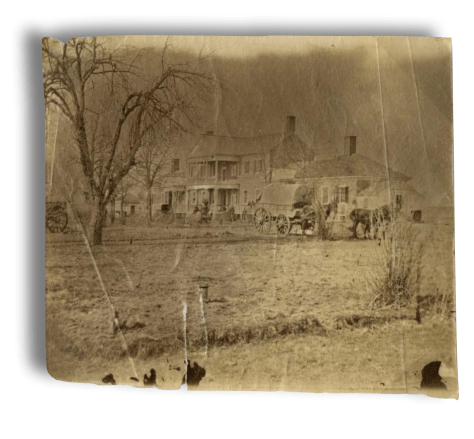
Delos Hull, Co. H, 8th Illinois Cavalry, 1st Brigade, Cavalry Division, IX Corps, Right Grand Division (S&S23)
Thursday, December 11th 1862—We were off at the appointed time. Took the road to Falmouth. Went to Gen. Sumner’s Headquarters and was drawn up in line and stood there all day. Our forces commenced to built three pontoon bridges across the river. They made out to get one nearly done when the Reb sharpshooters opened on them from the houses and began to pick off our men who were to work in the bridges. This was a signal for the ball to commence which it did in good earnest and continued for nearly 4 hours when both sides seemed to have a desire to rest a spell for they both ceased firing. It’s so very smokey [like] a fog.
Friday, December 12th 1862—Were routed out at 5 o’clock a.m. and started for Headquarters at 7 o’clock and were drawn up in line & stood there all day. There was not much fighting done—only artillery. There was considerable of that. We returned to Belle Plains at night. The weather was good but it was very smokey. Troops were crossing all day.
Saturday, December 13th 1862—Were routed out at 5 o’clock and started at 7 o’clock for Headquarters. Arrived there at 8 and was drawn up in line. There was a good deal of skirmishing and artillery fighting all the forenoon and about one o’clock it became a general engagement. We were drawn up on a hill where we could see all the movements. It was awful hard fighting. It raged with all the fury imaginable from one o’clock until 7 p.m. when both sides seemed willing to rest for the night. Our loss was much heavier than the enemy’s for they had earthworks and our Boys had nothing to protect them. When the firing ceased we held about the same ground as in the morn. The weather was fine, only it was quite smokey. Gen. [William B.] Franklin captured a battery and a brigade of infantry from the enemy.
Sunday, December 14th 1862—Were routed out at 5. We started at 7 o’clock for Headquarters. Arrived there and were drawn up in line when Cos. E, H, K, and D were detailed to go across the river and relieve Cos. L, I, C, & F who were on picket. Went down to go across the river and as we went over the hill on this side of the river, the Rebs saw us and began to shell us which they kept up pretty lively until we got across. We had to go about one mile to the right of Fredericksburg (up the steam nearly opposite of Falmouth) where we found them. Our line of pickets were only half a mile from the enemy’s batteries and right out on the flat in plain sight where if more than two of us got together, they would throw a shell at us. The pickets were not more than 70 or 80 rods apart. The weather was very warm and nice although a little smokey. There was not much fighting—only the artillery and a little skirmishing with the pickets. Our [men] were getting up their wounded all day.
Monday, December 15th 1862—We remained on picket all day. No. fighting except a few shots exchanged between the batteries. Spent most of the day in searching the houses to see what we could find. There were two splendid houses and the residence of Mrs. Ann E. Fitzgerald. The other a Mr. Hoover (I believe) in the latter was left a splendid piano and in fact in both of them nearly all the furniture was left. Weather clear.
Tuesday, December 16th 1862—Were routed out at about 3 o’clock and ordered to pack up and mount which we did and came down to the bridge to come across the river and found the artillery and infantry all moving. They seemed to be recrossing the river. We recrossed and came to [camp]. We remained in camp all day. No forage for our horses. We got all of two quarts of oats.
Joshua H. Tower, Co. F, 1st Massachusetts Heavy Artillery (S&S23)
Fort DeKalb [Arlington, Height’s Va.], December 13, 1862, to his sister.
“There is a battle being fought at Fredericksburg about sixty miles from here and about half way between here and Richmond. The papers say it will be the bloodiest battle of the century. Already there are five thousand sick and wounded in the hospitals from that fight. The Union forces under Gen. Burnside have got possession of Fredericksburg and are driving the rebels out of their fortifications but it will cost seas of blood to do it and then they will retreat into other fortifications to be still driven, unless some fortunate circumstance shall give us Richmond while Burnside is engaging the rebels at Fredericksburg.
17th. Since writing the above, news has arrived that Gen. Burnside has retreated across the Chickahominy [Rappahannock] and abandoned the fight after losing ten thousand men killed, wounded and missing. Burnside, in his dispatch to the general government, says he felt that the enemy’s works could not be carried and that a repulse would be disastrous to his army. Finally, I can’t tell anything about it when the war will end or which will come off victorious, but hope we shall come [out] top of the heap.”
John Boultwood Edson, Co. E, 27th New York Infantry, 2nd Brig., 1st Div., VI Corps—Left Grand Division (S&S23)
On the Battlefield of Fredericksburg, December 13th [1862], to his father.
“This is the second night that we have bivouacked upon the battlefield. The enemy is in strong position before us. We crossed in force yesterday morning the night before after our forces had finished shelling the city. Our regiment was ordered over & deployed as skirmishers and scour the country a short distance in front after which we returned across the river. The next morning—yesterday I mean—the whole Left Grand Division crossed. Our position is near the center. Our lines is about 10 miles long so you may judge of the quantity of ground we cover and have to fight over. Our brigade lay under the fire of the rebel batteries all day. Tomorrow we take the front as skirmishers. I may fall. It is a hard contested field. It is (nip & tuck) with both sides so far although I believe the advantage if any is with Stonewall Jackson. I hear [he] commands the rebels.
We attacked them on the left this forenoon with a view of flanking them but did not make much headway. They have a very strong position. The troops have to spend the night in the open air & tonight are not allowed to unpack their knapsacks. This order is that we may be ready to support the skirmishers in case they are being driven in…I will now close this as I write under some difficulties sitting upon my knapsack & it upon the ground. The Rebel campfires are only a little over half a mile distance. So goodbye. If we meet no more here below, may we meet in a far better world where war & conflict is not thought of. May God defend the right is the sincere prayer of your son…”
Herbert Daniels, 7th Rhode Island Infantry, 1st Brig., 2nd Div., IX Corps—Right Grand Division (S&S22)
Fredericksburg, Virginia [14 December 1862] Sunday Morning 10 o’clock, to his friend.
“There has been a great battle & Percy & I were in it but we were not hurt. The mail is going in a few minutes so I can’t write much. Lieut. [George A.] Wilbur was hit in the leg—not very bad. Mr. [Harris C.] Wright [of Co. B] was badly wounded. I can’t find out whether he is alive or not. He was rather rash, went up with the Colonel to the front while the rest of us were lying down. Thursday they shelled the city all day but we did nothing but look on. Friday forenoon we entered the city and stayed all day & night until yesterday noon when we went in the field and stayed till dark, lying down behind a hill except when we stood up to fire. The Colonel [Bliss] said the fire was as hot as men were ever exposed to. Only 18 men of our company & 14 of Percy’s could be found at night and yet there was but 1 known to be killed. Not a man in the regiment ran away or flinched. [Lieut.] Col. [Welcome Ballou] Sayles was killed instantly. We shall miss him very much. I don’t believe we shall go into battle again today.”
Josiah R. Kirkbride, Co. C, 23rd New Jersey Infantry, 1st Brig., 1st Div., VI Corps—Left Grand Division (S&S23)
Near Fredericksburg, [Virginia], December 14, 1862, to dear ones at home.
“I have half hour to write in. Yesterday we were in a very heavy battle for about two hours. I came out safe and sound. There is a few out of our company wounded. They are Capt. [Samuel] Carr in the foot, Alonzo [Moorehead] Bodine in the back, and one or two others. There is a very heavy battle here and we do not know when it will stop. We may soon be in it again but we are getting the best of them. We were in one of the heaviest [fights] ever was seen. The shells bursted all around us but I am safe. Give my love to all. So goodbye for the present. Pray for me.”
Austin Doras Fenn, Co. H, 10th Vermont Infantry (S&S22)
[Rockville, Maryland-, December 14, 1862 to his wife.
“…The last news we have got here from Burnside [at Fredericksburg,] he was driving the rebels right along. He won’t when he has drove the rebels out of one place have to sit on his ass six weeks to talk about it. I believe he will have Richmond by New Years.”
Theodore Harmon, Co. I, 153rd Pennsylvania Infantry, 1st Brig., 1st Div., XI Corps—Reserve Grand Division (Harman’s Civil War Letters)
[Camp] Dumfries, Virginia, December 14, 1862, to his wife.
“And now I must let you know that we had a very hard march and hain’t done marching yet. We have marched now for days through the mud and dirt till over our shoes. That was the hardest job that I ever had but this morning I feel good. I am ready for another march and I think we will march off very shortly. I thought we would take off already but we wait for our rations. They are all we just got two crackers and one pound of steak for one day and that was rare but the men ate it raw. But I can’t do that. I just threw my steak in the fire till it was roasted, then I ate it. I tell you, Louisa, soldiering is a hard life but I like it better than I did. I think we will be down in Fredericksburg tomorrow. Then we will have some fighting to do. But that is just what I like.
I seen more soldiers this morning than I ever seen [before]. They are all moving down to Fredericksburg. They’ve been marching through this place since this morning daylight but I think we will start pretty soon too and I think they are about 30 thousand of soldiers that camped here last night and they are all going down to Fredericksburg. And if we are all down, they are about three hundred thousand soldiers there.”
John Boultwood Edson, Co. E, 27th New York Infantry, 2nd Brigade, 1st Div., VI Corps—Left Grand Division (S&S23)
Still on the Battlefield, Monday morning, December 15th [1862] to his father.
“Yesterday all day we were on picket and had to lay under their fire all day. Whenever we would put up our heads, they would pop at us. The Rebs are very strongly fortified. It will be a great sacrifice of lives to take their position. Yesterday being Sunday, they did not commence on either side.”
George Everett White, Co. K, 120th New York Infantry, 2nd Brig., 2nd Div., III Corps—Center Grand Division (S&S10)
On the Battlefield, December 15, 1862 to his father.
“We came on the field Saturday. Have laid under fire ever since. We expect to have a fight any moment. The Rebs are in the woods about 25 rods in front. I have not time to write. Much the most is just going out. ‘Tis a big fight, this being the 3rd day. We are alright yet. Nobody hurt in our regiment. We are in the extreme front. Will write more at the close up etc. of the battle. We are in Sickles Division, Gen. Hall’s Brigade. The dead and wounded lie around very thick. Can’t write any more.”
Edson Emery, Co. E, 2nd Vermont Infantry, 2nd Brig., 2nd Div., VI Corps—Left Grand Division (S&S19)
Battlefield Fredericksburg, Va., December 15, 1862 to his Mother.
“This is the first opportunity I have had to write you. This is the fifth day of the fight here. Saturday our regiment was engaged. We lost about 60 men in killed & wounded. Our company had four wounded—no one that you knew except Fred Chamberlain. He was only slightly wounded. We was very fortunate. We was under a terrible fire. The great share of the fighting has been with artillery but we expect hard infantry fighting before it is over, The whole Rebel Army is here & they have great advantage in position. They are protected on a high hill. Our line is about six miles long. We are now waiting for our reserves to come up. Then I suppose we shall try to carry their works. Philo is well & tough. Our regiment done splendidly in the fight, so our Generals say. It is fine weather now.”
Edgar A. Burpee, Co. I, 19th Maine Infantry, 1st Brig., 2nd Div., II Corps—Right Grand Division (S&S23)
Fredericksburg [Virginia], December 15th 1862, to his father. [Includes several sketches]
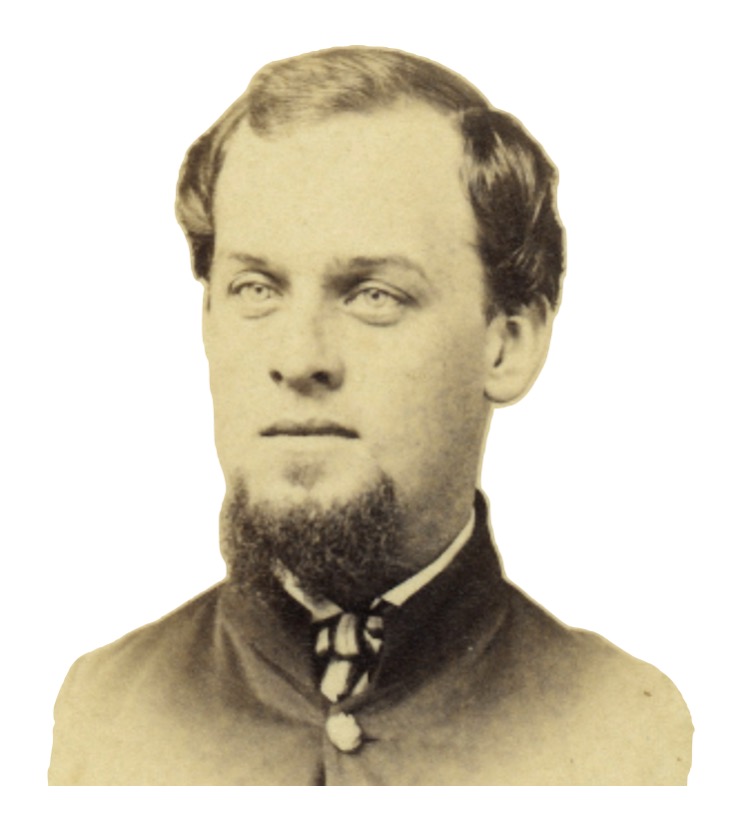
“Have just sent you a few lines stating we had gained possession of this city and I was yet safe. While waiting for our troops to get arranged properly for an advance, I will commence to you a statement of what has occurred since I wrote you while on picket. We were relieved from picket at about 7 o’clock in the eve and after a march of 1.5 hours reached our encampment which, by the way had been moved to a hill a short distance from the one we had occupied two days before. After pitching tents, and building fires, we commenced anew to enjoy ourselves. This was Wednesday evening and while sitting by our fire—for I tented with the Lieutenants—who should approach us but Geo. Green of our city on his way to see Edward. We were very glad to see him and our tongues were busy enough talking about Rockland people and news. We had him sleep with us that night and he will tell you about what transpired so I will not pause here to write about it.
At about 2 o’clock, Lieut. [Gershom F.] Burgess was summoned to the Colonel’s quarters and when he came back he reported that we had received orders to march in the morning at 6 o’clock with our rations and blankets but not knapsacks & other baggage must be left behind, and all our preparations must be made quietly. Being acting orderly, I summoned the company at 4 o’clock and gave them the orders and all immediately commenced operations. At the appointed hour we were in the line and took up our line of march down the hill to the plain and found our whole corps in motion & when our place in the line approached, we found them. Let me say, however, that at about 5:30 o’clock, while we were busy at our work, the report of a gun was heard which rolled through the morning air like a deep roar of the thunder. This was a signal gun and to us indicated that something was in the process of being done. At 6 another was heard and immediately after the rattle of musketry and some other guns intertwined with musketry from our forces at the river engaged in laying the pontoon bridge.
We marched with our Corps about a mile near the river and on a plain between the two hills stacked arms and lay down awaiting the order to move forward. We were here waiting for the pontoon bridge to be laid so we could cross. This was done by the Engineer Corps supported by the advance of our division (our division being in the advance of the whole corps). All this time the guns of both forces were constantly being fired and such a roar I never heard before. It seems as if the very heavens were filled with thunder and it was striving to see how much noise it could make. We found afterward that our force were engaged in shelling the city.
About 4 o’clock we moved forward toward the city and came upon the river bank amidst the dropping of rebel shells, and at double quick crossed the pontoon bridge & set foot in the doomed city for the first time. We filed out into the street that runs along the river’s bank, having the honor of being the first regiment of our brigade in which was the 7th Michigan & 16th Massachusetts had preceded us, and as we entered, ran up the street some 5 or 6 rods in the advance of us skirmishing and the bullets of the rebs came whistling thickly over our heads and into our midst.
When we first enter the city, you come upon the river’s bank which gently rises from its edge and extends to the middle of the place & then descends again so the city sits upon a hill. Its streets are laid out in regular squares (I shall draw you a plan as soon as I can). Some skirmishing going on in the next street above us. The men nicely protected from the rebel shots.

When the pontooniers commenced to lay the bridge, the rebs kept silent till they had laid about 6 rods & then from the houses & the guard house marked [on sketch], their sharpshooters rapidly picked off the men This was a trying time. Every man who stepped out to do anything was of course a mark. The 7th Michigan being at supporting distance was ordered to cross in boats. No one seemed willing to run the risk. Gen. Burnside addressed them saying he wanted the men to cross & appealed to their patriotism &c. (so report says) when they immediately volunteered to go. After taking a drink of whiskey, the boats pushed off and in a few minutes touched the other shore notwithstanding the rebel shots from this city. The first man who landed fell dead & some of the others were wounded but ashore the rest went & soon after others and a struggle for the mastery began which ended in our gaining the ground.

Our batteries too poured into the Rebels showers of shell so that they completely riddled the houses nearby killing a large number of the enemy. Several houses were at this time on fire having been set by our shells and as it was near dark, the light of them aided us in our operations. The men were ordered to remain in this street till morning and make themselves as comfortable as possible. By 7 o’clock the firing had nearly ceased and our pickets were thrown up the street when our men commenced to making themselves comfortable by ransacking the houses and stores, tearing down fences and out buildings. In 15 minutes after they commenced, the street was filled with soldiers running to and fro, loaded with boards, beds and bedding and clothes of all descriptions, crockery ware and household furniture, tobacco, bee hives, flour, sugar, and every variety of goods from apothecary, dry goods, grocery, liquor, and jewelry, stoves. It was amusing though sad scenes were occurring around us, to see the different acts, faces & attitudes of the men & hear their expressions. One fellow came out of a house dressed up in women’s clothes & his queer pranks caused a great deal of merriment. Eatables were freely distributed and fires being built them men commenced to cook their suppers.
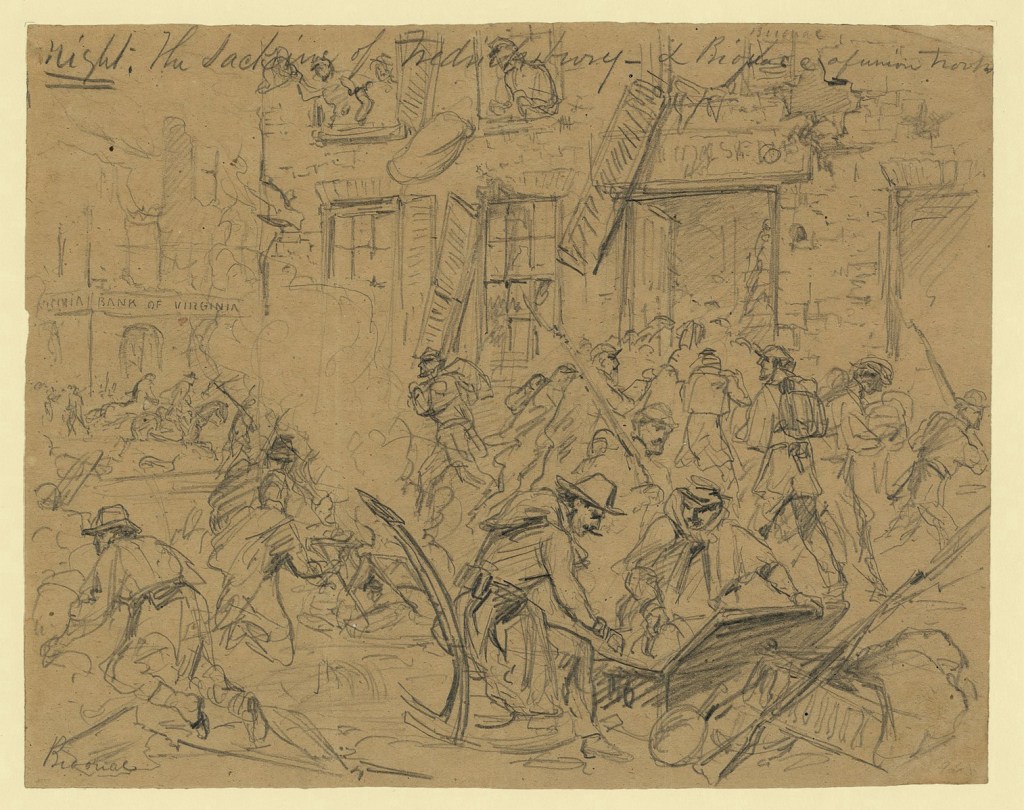
The old regiments declared thy never lived as before. Everything was in abundance, so much so that it was hard to give away many kinds of articles. Bread and flapjacks with honey & preserves were quickly made and devoured. Every pocket was filled with tobacco or some trinket or other. Our haversacks were well stoved with some article of food and most of us had a good bed with a prospect of a night of rest. The men seemed wild with joy, yet found so many things they would love to carry with them they seemed almost frantic because they had no place to put them.
All this time the dead and wounded were being brought down the street. The surgeons were busy attending to those badly wounded and the little foothold we had gained now became at once a scene of revelry & a hospital. On going up the street we could see & stumbled over the dead of both sides, some with their legs or arms shot off, some struck in the head with shell, and others rifled by bullets. Some of the wounded would crawl to some place of shelter and there groan till their comrades came to their relief. It was indeed a sad scene and many a brave heart softened by the thoughts of the many who would mourn the loss of those who lay about us gave forth its feelings of pity and sympathy.
We lay down and slept what we could but ready at any moment to form in line of battle for as there was but few men over comparatively and danger of an attack was apprehended. Morning came and at any early hour we formed again into line and moved up or toward one square and formed in line of battle. By this we advanced toward the enemy and at the same time made space for more who came after, to form in our rear to support us. Thus we moved forward, one square at a time, the enemy at times shelling us at a furious rate—especially when they saw our troops pass by the streets. We were ordered to lie low or march in a stooping position so that we were often covered from the enemy by the houses or fences.
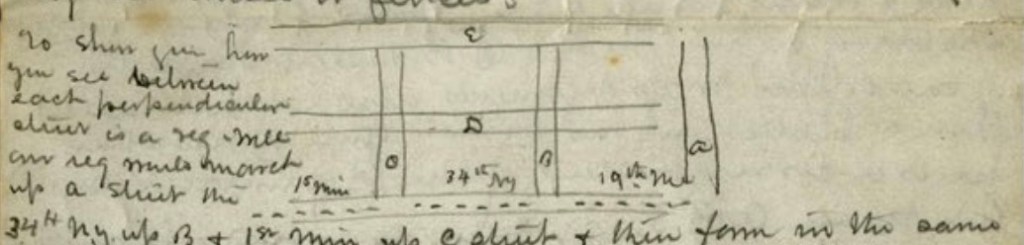
To show you how you see between each perpendicular street is a regiment. Our regiment marched up A street, the 34th New York up B, 1st Minnesota up C street, and then form in the same position in D street as we were on the first, and so on, one square at a time. Also a line of regiments was extended along nearly the whole length of the city so we advanced in strong force. We lay on the 2nd street till about noon waiting for other brigades to come over and during that time our men were sacking houses & cooking, for the inhabitants, when they left the city, did it in haste and most of them left everything they had in their houses without moving them. As the men went into the houses, used their dishes, stoves, wood, and flour, &c. and a fine meal was prepared. It was curious to observe the effects of our shot and shell. Some struck chimneys, others would go straight through a house & inside would smash looking glasses, tables, chairs, and cut up all kinds of capers. One house had 25 shot holes through it. And most every one had a mark of a shell in it.
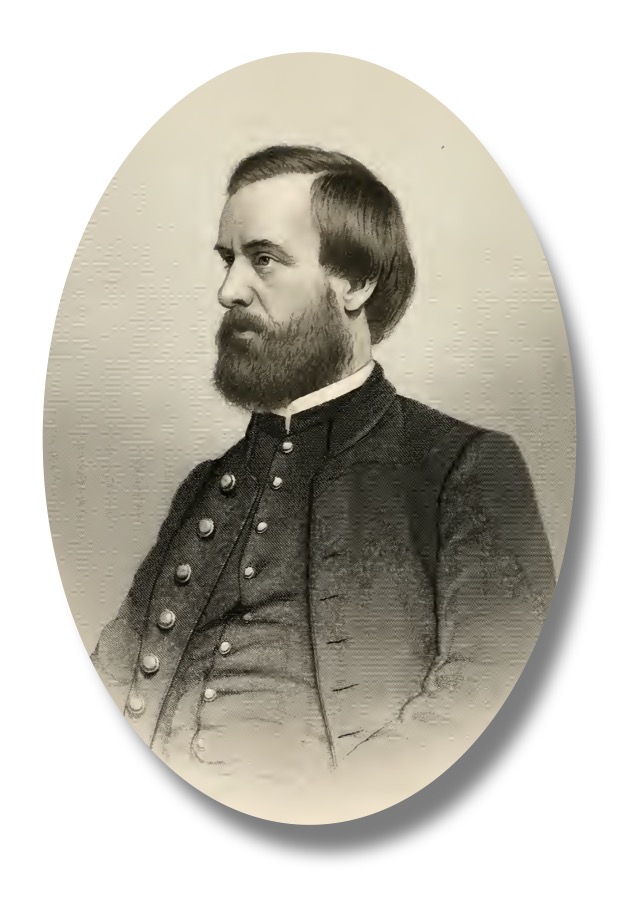
The ambulance corps were also engaged carrying off the dead and wounded. As the rebs were in the buildings & fired from them, it gave our men a very hard chance to make their shots effective. Consequently we suffered considerably. All about the streets, many a dead rebel lay, showing our men had not fought in vain. In the street where we were two or three rebels lay; one had his whole side and his arm off, another had the top of his head and brains carried away—both shocking sights. The Rev. A[arthur] B[uckminster] Fuller, chaplain of one of the Mass. Regiments also lay here dead from a bullet in his breast. You remember he is a correspondent of the Boston Journal and signed his name A. B. F.
At noon we moved up another square in to Princess Ann Street—one of the main streets of the city. At this time the part of the city seemed alive with troops and we had quite a force here. The rebels had also fallen back to the outskirts of the place so we had almost complete possession. As we were nearer the rebels they threw shells into us quite freely but fortunately no one was seriously injured. I assure you these shells are frightful things as [Gen.] Heintzelman calls them and when they come too near they make feller haul in his head just a little. The rebels have good range and plunked the shell right into the street where we was most every time.
About the middle of the p.m., or rather toward night, we began to prepare to sleep. Orders came to lie down by the side of the street, on the sidewalk, and to have no fires. Great care was taken by our officers to keep the men from being exposed and of doing anything whereby the enemy might know how much of a force we had in the city. At this order our men immediately searched the houses nearby and brought from them bedding and a line of beds could be seen all along the street in a few moments. Our company was not behind in the matter. We found some nice feather beds and mattresses and “laid in” for a good rest. But we were disappointed in this for just as we had prepared our hotel for occupancy, the Colonel sent word for us to go out on picket and we had to leave all and instead of rest, the prospect was that we should have a night of weary watchfulness.
Obeying orders—a soldier’s stern duty—we with another company from our regiment proceeded two squares further in the advance and after being divided into the outer picket and reserve, commenced our night’s labor. Lieut. Burgess was in command of the outer picket and was stationed behind a house one square forward of us thus [sketch].
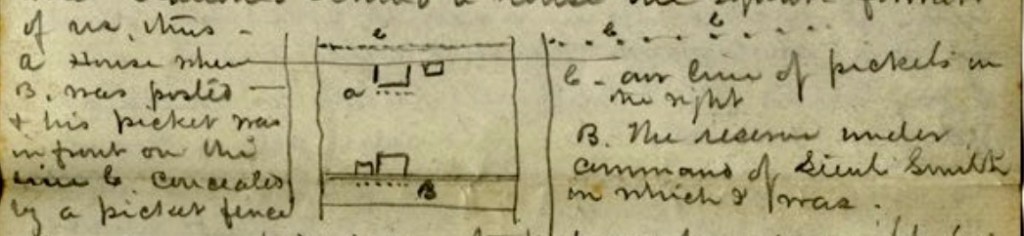
The advance picket was to keep awake all night but in the reserve one part slept and the other kept awake, ready for an emergency. The rebel pickets were in front of us only a short distance and we could hear them talk & walk about. Also as they were at work digging their rifle pits. The house where Lieut. Burgess was stationed was open and his men were allowed in part to remain in it. I visited it and found it one of the most richly furnished and elegantly finished mansion I have seen in all my journey. The furniture was of latest style and much of it was fancy articles such as inlaid tables, chess tables, stands, &c. &c. large pictures hung about the room, statuary, large vases or flowers stood upon the mantle, rich carpets covered the floor, extensive libraries were in appropriate apartments, closets of china, glass and crockery ware, vessels for liquor, grand piano, harp, and huge stands of music. Larder filled with all kinds of eatables. Clothing apartments hung with the most costly apparel. In fact, everything to make a home pleasant & happy—all that one could wish was found there—and all strewn in confusion about the house having been left by the flying occupants and sacked by the soldiers. It was sad to see such a waste of property, and if the owners ever return, they must feel heart sick.
A widow lady lived there and she had a daughter who it appears is quite genteel and of a literary turn. I picked up an account book and found in it a photograph which I will send in one of my letters. If I had only known as much as I do now, I would have had some silver ware to send home for there was plenty of it about me. I set out to take 2 silver candle sticks but thought I could not send them home for perhaps a very long time. Picketing here was fine fun and our boys enjoyed it to its fullest extent. Towards morning when it became light enough for the rebels to see our men, they began to shell us and they sent them over us and they would burst over us and the pieces would fly in all directions. We had to lie down on the ground and they passed by without injury to any of us. The rebels were on the alert all the time and the moment one of our men showed himself, either a sharpshooter or the batteries on the hill beyond would send a shot at him. This music was kept up all the forenoon and we had exercise enough to keep us warm by dodging shells and changing about keeping watch.
About twelve o’clock skirmishing commenced on our left and in half an hour our troops became engaged in good earnest. Regiments were sent out to reinforce the picket. Some brigades advanced. Batteries came to the front and a general movement commenced along the whole line. We were relieved by another company & rejoined our regiment which was in line and on the move. The streets were filled with moving lines of soldiers. Officers were busy riding with speed to different parts of the city. Orderlies from the headquarters of the generals commanding issued forth with orders and the different brigades were quickly formed in position to advance. The whole force moved to the left and by the streets running directly from the river toward the rebel batteries, went onto the field. We advanced slowly down the street under cover of the houses till we came near the scene of conflict. We could here see nearly the whole field and our brave men as they advanced under the heavy fire from the enemy’s batteries and the musketry fire from their rifle pits which made our situation very critical. Our men were suffering greatly.
The wounded were brought in twos and threes and in quick succession. The dead thickly lay upon the field and our lines became rapidly thinned and we seemed to gain but little ground. The rebels had a grand position. Their fire was direct and yet they could cross fire and their men was entirely concealed by their pits. Their lines of battle stood up in the hill ready for reinforcement and it appears almost impossible for us to make any impression upon them. At this time our division was waiting ready to advance when the division now in the field should become exhausted. The fire from both sides now became general and the roar of the artillery, the shriek of the shells, the rattle of the musketry, seemed to shake both heaven and earth. If a man’s knees shook any, he could well say he wasn’t scared any—it was only the ground trembling under his feet. While waiting, I received a letter from Mother containing another from Sina and as we were all down on the ground, I [got] down on my knees and read them. I assure you, I enjoyed them and did not feel any more lost as to what they contained & read them as well as if in the quiet of our paint shop. The last of Sina’s letter encouraged me much and I felt to go forward with a stronger purpose to do my duty, and more cheerful heart, trusting that all would be well with me, even if among the killed.
Gen. [Oliver O.] Howard walked often along the line & encouraged us by his words and presence. A balloon was in the air in rear of the city to observe all the movements. (Johnnie used to write that he could not see all that was going on and therefore could not write but little about a battle. I say the same so you must excuse what I leave out. I saw though more than I can write & so much I don’t know what to write about first.)
About 4 o’clock our brigade was ordered in and down the street with a rush we went. As soon as our front came in sight, bang went the rebel guns and whiz came their shells at us. Our regiment was in the advance but happily the shells went over us and before they could get their range, we were under the hill out of range. On came the other regiments and we were formed into division. I suppose this was with the intention of charging up the hill in this manner. We immediately lay flat upon the ground to keep out of the rebels sight but a shell from their flank battery soon convinced us that they saw us and they commenced a cross fire which had their range been perfect, would have cut us up terribly. They could but depress their gun enough to hit us and out the “buggers” came out of their earthwork and commence to shovel away and then they could not bring their piece to bear correctly and they they run their gun out of the work on the top of the hill and in plain sight of us, commenced a rapid fire which sent the shells into our brigade nearly every lick. I kept my eye on them and one I saw go over and strike in the regiment just in our rear, then another beyond, & the next one came right for me. I tell you, I would have sold my skin for a five cent piece when that whizzing, ragged thing made for me. But before I had time to think twice, it struck about 15 or 20 feet in front of me on a line with the cannon & sent the dirt about like grain from a seed planter (or sower). I assure you, they strike solid. They go ker chuck and make the splinters fly furiously.
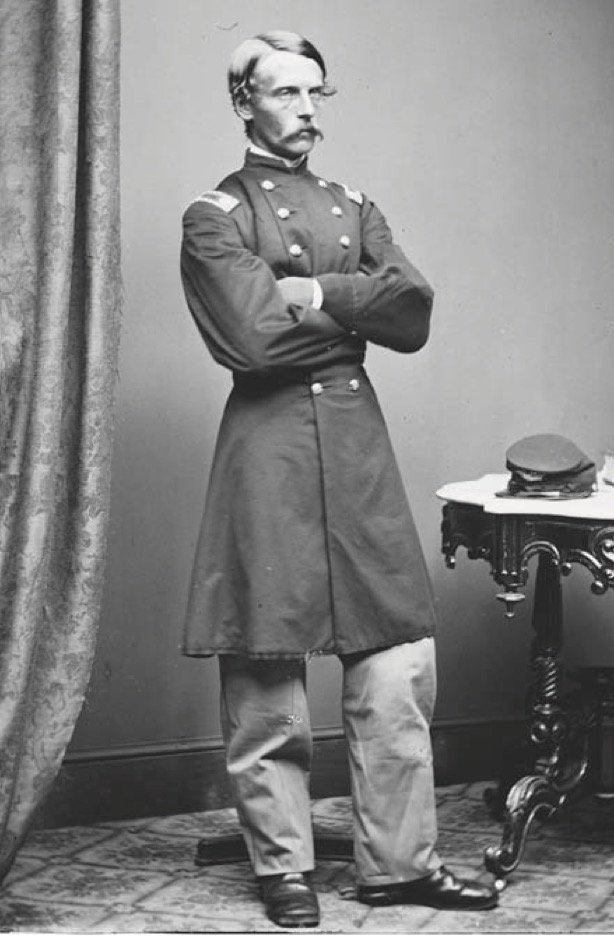
As we were drawn up, one shell came and struck in the center of one of the regiments in our rear and all back of us skedaddled some three rods, when by the efforts of their officers they were rallied. Our regiment remained firm and in their advance preserved their line perfectly and gained by their good behavior the praises of the general in command. Gen. Howard and the old regiments in our brigade. Gen. Howard came along after dark and said, “Men of the 19th Maine, you have done nobly. Your constancy deserves great praise.” Our officers led us in with a coolness seldom exhibited by many of those in volunteer service. Col. [Francis E.] Heath is a fine officer. He is cool in danger. Courageous in battle and rigid in discipline yet kind and indulgent to his men. Our lieutenants performed their duties in this trying time with much credit to themselves and by their example, Co. I came up to the mark promptly.
We lay here with this battery playing upon us for perhaps 10 or 15 minutes when our batteries commenced to return their fire and soon silenced it. All the men were driven from their gun & we saw one shell burst under the gun & there it up much as two feet but did not disable it, I think. When our shells struck their earthworks, the dirt flew high in the air and the rebs skulked out of that quickly. Just in front of us a line of skirmishers kept picking off the men at their guns and along the rebel lines. One reb was standing on the hill when a skirmisher just forward of our company loaded his gun and days, “I’ll have that fellow.” He fired but missed him. He cooly loaded again and says, “I’ll have him this time.” Just after he fired, the rebel clapped his hand to his head and dropped. Bully for the skirmisher. One more mustered out of service. I could tell many of just such incidents as this but cannot.”
After Battle Letters
George Morgan, Co. F, 11th New Hampshire Infantry, 2nd Brig., 2nd Div., IX Corps—Right Grand Division (When I Come Home)
Near Fredericksburg, Virginia, December 16, 1862, to Austin
“I have not had a chance to send this letter out till now. I have been in one hard battle and come out without being hurt and I never want to go into another — they call it that. There was seventeen out of our regiment killed on the field and a large number wounded. Benjamin [P.] Nelson was killed. The ball went through his head. He was close to me when the ball hit him. And George [H.] Filbrick [Philbrick] was killed, and they are all that we know were killed out of our company. Charles [C.] Pike was wounded in the face. George [M.] Jewett was wounded through the hand, and Robert Blood was badly wounded, and Dave Bunker, John Lorden, and John Rollins, and [I] don’t think of anymore in our company that was badly wounded. David [B.] Fellows is a missing. They don’t know where he is. You will probably get the news about this battle through the newspapers before you can get any letter from me…
We are now back to our old campground. We went over to the City [of Fredericksburg] last Friday morning. They bombarded the city a Thursday and drove the rebels out. There was a lot went over before we went. We laid by the side of the river that day and night. There is a steep high bank along side of the river and we laid close down to the river so their shells went over us, but some of them struck into the river. They killed one man that afternoon that belonged to the 12th regiment right to the end of the pontoon bridge. We saw the shell when it struck. There was a regiment a coming over the hill and the rebels throwed over and one struck right in among them and it laid out three. I don’t know whether it killed them all or not. They carried them off in an ambulance. It is hard business to see them killed. We went up on to the street and there we see some half a dozen dead rebels. They said there was a lot more but I did not want to see them.
They got quite a lot of stuff out of the houses. They got flour and some tobacco and a lot of other stuff. They next day was Saturday and we went into the battle about one o’clock and we stayed on the field till after dark and then we went back down to the river. They carried off our wounded that night and the dead lay there. Now they don’t dare to go and bury them. They went up and picked up some blanket and other stuff but the rebel sharpshooters fired at them. I would not [have] went for all the stuff that there was there. There was lots of stuff left on the field and the rebels will get it.
Austin, you wanted to know how near I came a getting hit. I can’t tell you exactly but I guess that the bullets came nearer me than you would want them to come to you. There was one shell that throwed the dirt and mud all over me. The damn things whistled pretty close to me sometimes. When I come home, I will tell you about it — probably some that you won’t hardly believe. It would make your hair stand on your head to have seen that battle.
You wanted to know how near we were to the rebels. I should think it was about 50 rods to their entrenchments. I don’t think that I killed any — at any rate, I hope that I did not. I don’t think there was any rebels killed in that place to speak of. I don’t blame the rebels for fighting. I would fight if I were in their place as our army is a destroying and wasting their property. But they will get sick of it after awhile. I wish that we had some of the newspaper writers here where we could handle them. They never would write another letter for a newspaper. They lie like the devil.
We have not heard a word from David Fellows yet. I guess that Dave must be dead. The wounded soldiers, I don’t know how they be. I have not heard anything about them.”
John W. Morgan, Co. B, 7th Indiana Infantry, 2nd Brig., 1st Div., I Corps—Left Grand Division (S&23)
Fredericksburg, Virginia, December the 17th 1862, to his mother.
“I wrote father a letter on the 15th and told him what I was doing that night. About nine o’clock, [Lt.] Col. [John F.] Cheek come to the Capt. [William Cyress Banta] and told him to get his men in line without making a bit of noise. He said that we was going to charge the enemy batteries. I began to think that somebody was going to get hurt and I made my calculations to hurt somebody if I didn’t get hurt first. But I soon found instead of charging the enemy’s batteries that we were going to get on our own side of the [Rappahannock] river as easy and as quick as possible. We wasn’t allowed to speak above our breath nor let our canteens rattle. Our cannoneers wrapped their blankets round the wheels to keep them from making noise.
Just before dark a barrel of whiskey came to us to give us before making the charge. I seen the barrel but didn’t know what it was for—only to give because we was so exposed to bad weather. They wouldn’t of got me to drank any if I had knew it was to charge a battery. I think that I have got nerve enough to go anywhere the 7th Indiana Regiment goes and it will go anywhere it is ordered. If it is ordered to charge a battery, it will do it without whiskey. I guess that this beats any retreat that has been made since the war commenced. We went across the river and hardly a man spoke a word.
Gen. McClellan went up in a balloon and looked at the enemy’s breastworks and told Gen. Burnside that he would not undertake to take them and he knew that if he didn’t fight that he had to get out of there without the enemy knowing it. I don’t know how many we had killed and wounded. We have not made any report yet.”
Samuel Holmes Doten, Co. E, 29th Massachusetts Infantry, 2nd Brig., 1st Div., IX Corps—Right Grand Division (S&S23)
“Wednesday, December 17th—It is a very cold morning. Had a good night’s rest last night. At 12 o’clock we were ordered for picket duty. Started after dinner. I had one half of the pickets & Lt. Col. Barnes the other half. Set the pickets above the railroad bridge on the river. They exchanged prisoners today. Saw a lot of secesh prisoners. They were a motley group and poorly clad but full of grit. Said they were tired of the war but could hold out as long as we could. I am acting Major of the regiment. It is very cold weather.”
John H. Backster, Co. F, 27th New Jersey Infantry, 2nd Brig., 1st Div., IX Corps—Right Grand Division (S&S18)
In Camp two miles from Fredericksburg, December 17th [1862] to his Parents
“Two days march brought us to the place where we are now encamped called Falmouth. Thursday morning [11 December], I was awakened by the booming of cannon. Our batteries had opened on the rebels to cover our men that were building pontoon bridges across the Rappahannock. We were held in readiness for marching all that day. At night we encamped in the same place of the night before. Friday morning [12 December] we were marched forward with the expectation of being in a battle. That day we crossed the river and occupied Fredericksburg and lay between our batteries and the rebel batteries. In the afternoon of Friday, the rebels dropped a few shells among us or solid shot. One shot passed directly over my head and struck within a few feet of where I was standing. One shell bursted above our heads, a piece of which struck a man belonging to our company by the name of Bonnell who was the only man in our regiment hurt.
Fredericksburg is deserted by the inhabitants and presents a forlorn appearance. There is hardly a house but what has been struck by a shell or cannon shot. The rebels threw many thousand dollars worth of tobacco in the river. Our troops found a great deal of tobacco in the city. Thursday and Friday the battle was fought mainly with artillery. Our batteries soon stopped the rebels from sending shells.
Friday night [12 December] we encamped in the city right out in the open air. I slept soundly. We were not allowed to make fires that night as we were within fair range of the rebel batteries and if they had known our position, they could have shelled us very easily. Friday afternoon I saw five dead rebels. They were laying in a garden unburied. They were sharpshooters that had been picking off our men when they were building the pontoon bridges. Saturday morning [13 December] we were moved very early so as not to be seen by the enemy under the brow of a hill about a quarter of a mile down the river and on the side toward the rebels. We lay under the shelter of this hill all day. We had to lay flat down holding our pieces in our right hands ready to move at a moment’s notice. We were acting as reserves ready to go to the front in case our troops were defeated. That day there was some very hot work in front and our heavy artillery firing. We lay between the rebel batteries and our own all day and could hear the shells and shot whistling over our heads. We were out of danger—the hills sheltering us from the fire of the rebels. From where we lay, we could hear the musketry firing of both sides which was kept up incessantly all day long. Some of our divisions suffered a great deal on that day. Our troops attacked the rebels in their chosen positions which gave the rebels a great advantage over our troops. This day was the turning point of the battle and I fear we lost more by advancing on Fredericksburg than we gained.
Saturday night we were ordered to move down the river which we did, moving down the river a quarter of a mile where we marched straight out from the river towards where the battle was raging. Our brigade formed a short distance from the battlefield and under the protection of rising ground which hid us from the rebels. As soon as the brigade was formed, we were ordered to lie down. We expected to go in the battle which was then raging but did not go. We slept on our arms that night in readiness to move at short notice. We had plenty of straw to lay upon. The rebels had encamped in the same place a few nights before. In the morning [14 December] we moved back to the city where we stayed all day. The night before a few shells passed over where we were sleeping. I think our colonel expected our brigade to go in battle the day after we were led up to support our men.
Balloon ascensions were made by our men all day Saturday [13 December]. It think it was lucky for us that we were not led forward as the rebels had all the advantage. Sunday, there was very little firing going on. Sunday night we slept in the city in the open air near the place where we stayed the night before.”
Samuel Sylvestor O’Dare, Co. F, Baker’s 1st California (71st Pennsylvania), 2nd Brig., 2nd Div., II Corps—Right Grand Division (S&S22)
Fredericksburg, Virginia, December 17, 1862, to his parents.
“I take the pleasure of writing you a few lines. I have again come out of battle safe. We had a hard fight at Fredericksburg. We were among the first to cross the river and was exposed to a heavy fire near all the time for 4 days and lost many men.”
Charles Tolman Moody, Co. H. 5th New Hampshire Infantry, 1st Brig., 1st Div., II Corps—Right Grand Division (S&S1)
December 17, 1862, Camp near Falmouth [Virginia] to his Mother.
“…We have had one more battle & a hard one too. My Captain was killed. Capt. [William J.] Keller wounded in the arm. Josiah [S.] Brown killed. Luther [A.] Chase killed. Charles Hart killed. Oh, I cannot tell you all of them. They are too numerous to be mension. Julious Hut wounded. Mr. Shoales wounded & pretty all killed & wounded. There is 60 or 70 men [left] in our [entire] regiment. I don’t know what they will do with us. The Col. [Cross] is wounded & started for home this morning. Our Major killed. Jackson was hit with a shell & I have not heard of him since. I do not know where he is. Our battle was in Fredericksburg City, the other side of the [Rappahannock] River. We had to fall back this side of the River. They licked us. They had forts built in all directions for those large cannons so they could fire on us in all directions. A man could not step on the battlefield without stepping on a wounded or a dead man. Mother, it is awful to think of it. I never have been so homesick since I left home as I did when I came back in camp & to look at the regiment & see what few men there was. We left Concord with 1000 men and now sixty or seventy men left in the whole regiment. Just think of that. This makes 10 battles our regiment has been in. It is awful lonesome here. I hardly know what to do with myself. The Boys look down-hearted enough, I tell you. I wish they would let us come home now there is so few of us. Lieut. [Samuel B.] Little was all cut up—hit in 3 places. He came to us before we was going on the field. I don’t know whether I shall ever come home to wear those clothes or not…”
George W. Fraser, Co. E, 122nd Pennsylvania Infantry, 1st Brig., 3rd Div., III Corps—Center Grand Division (S&S17)
Camp near Fredericksburg, Va., December 17, 1862, to his brother.
“You may have heard some stirring news from the army near Fredericksburg. I mentioned in my last that we were to march on the 11th inst. We did so on that morning but did not go more than a mile from camp where we slept that night. On that morning about four o’clock the firing on Fredericksburg commenced and all the boys were anxious for the fight. On the 12th in the afternoon we crossed the river on the Pontoon bridge at Fredericksburg. When our company was about half-way across the shells and balls from the rebel batteries behind the town came whizzing over our heads, some dropping within six feet of us in the river, others bursting over our heads. Some of us were terribly scared, but scared as I was, I had to laugh to see how the boys would “juke” when a shell would fly by our heads. Our regiment was hurried across the bridge as soon as possible and we lay along the right bank of the river until the firing on us ceased. During the day I and some others went into the town and entered some of the houses. They were all deserted and I never seen furniture in such confusion as they are there. The beds torn up, cupboards, desks, and bureaus torn apart, and the dishes, clothing, &c. scattered all over the house. It is pitiful indeed to look upon. Such confusion I never before did see and it is utterly impossible for me to describe the sight. I captured about four yards of the finest Brussel carpet, some neat patch work, a molasses kettle containing some flour, two pairs of scissors, a needle case, and many other small articles. Anthony captured a silver table-spoon, some sugar, flour, &c. We could have got any amount of the most costly china-ware, flour, and furniture.
Fredericksburg seems to have been a rich and intelligent town but it is ruined considerably by the shells that were thrown into it. In almost every house we would find a library containing the best of books. I wish you could only see how things look in the ruined town. That same evening we recrossed the river to cross again the next day. We encamped on a muddy field for the night and recrossed the river once more the next day and landed safe on the other side. We were taken out on picket within 300 yards of the rebel breastworks. There we lay flat on our backs or bellies behind a low bank of a fence. We were not allowed to rise or else the rebels would have fired on us. We lay here all night and the next day (Sunday 14th inst.) resting as best we could while the shells were flying over us, some bursting just over our heads. When we were taken out on picket on the 13th, the rebels spied us and directed a few shells at us but we lay down flat and they passed over us without doing any harm. On the 13th there was very hard fighting all day and continued until late at night. On Monday the wounded were removed across the river and early on Tuesday morning we recrossed the river and returned to our old camp. So here we are all safe and sound and not a man killed or wounded [though] a few are missing. As luck would have it, we did not get into the fight. Carroll’s Brigade belonging to our Division was in the fight and suffered considerable. The loss in killed is estimated at 1,700 or 2,000 and wounded and missing about 5,000 or 6,000. I suppose you have the news more correct in the newspapers. I enclose a few relics from Fredericksburg for Emma. I send them in place of a Christmas gift.”
Samuel Holmes Doten, Co. E, 29th Massachusetts Infantry, 2nd Brig., 1st Div., IX Corps—Right Grand Division (S&S23)
“Thursday, December 18th—It has been a bitter cold night but as the sun gets up, it is a little warmer. Everything has been quiet through the night. A fatigue party went over to bury the dead. We were relieved by the 7th Connecticut at about six o’clock p.m. and got back to camp at about 7:30 p.m. Got supper and turned in for the night.”
Eben Lawrence, Co. C, 16th Massachusetts Infantry, 1st Brig., 2nd Div., III Corps—Center Grand Division (S&S22)
Headquarters 16th Regt. M. V., Camp near Falmouth, Va., December 18th 1862, to his father.
“As I have a few spare moments, I thought that I would write you a few lines informing you of my soldiering the last seven days which have been very hard indeed—the hardest that I have yet seen. The 10th [of December] orders came to get ready and prepare for battle. At 4 o’clock everything was arranged. No sooner than had we got ready when the signal gun bawled a loud roar for the battle to commence. Directly after the signal gun’s load report died away, they commenced and such a roaring of artillery was never heard before. Our division was ordered about two miles from near a piece of woods where we remained all day and night waiting for orders to move elsewhere.
Orders soon came and we marched near Burnside’s Headquarters, formed in line of battle, and remained there until night, and then were ordered to the river about 3 miles below Fredericksburg. We remained by the river side until Sunday morning [14 December] when we crossed. Then we marched up to the front and formed line of battle and laid down on the wet ground so the Rebs could not see us. In a few moments orders came for two companies to go and hold the line of advance. Companies A & K were the first to go. Co. A had 6 men wounded. Co. K had 7 wounded, 2 killed. The companies that then had to go were Co’s I & E. E had 1 wounded and none killed. Co. I had one wounded.
About 4 o’clock (Sunday) the rebels hoisted a flag of truce when the firing stopped on both sides, laid down their guns and met each other half way and [had] quite a little chat. They wanted to exchange tobacco for coffee. Quite a number of us let them have our portions of coffee for tobacco. They say that they want this war could be settled without fighting. I tell you what—it is not very friendly to meet them rebels or even to have them meet us. We would meet them half way from the outer lines, shake hands and chat a spell, bid each other goodbye, and then run back and get our guns and fire to each other.
At night our company and Co. D went on guard and laid down on our bellies on the cold wet ground within 100 yards of the rebels. About every 10 or 15 minutes—whiz, a ball would come and strike in a few feet of us. Laid 7 and a half hours at night—Sunday night—flat on the ground, watching for the rebels.
Monday night we had to go on the advance lines again and it was sad to see our dead lay scattered all over the ground in such large numbers. I laid [with]in a few feet of many a brother soldier. I could stretch out my foot and touch some of the dead, they were so near me. What a night that was. Dear father, a man cannot find words to express the horrors of war. It is dreadful. But alas! such is the voice of many. Monday about 12 o’clock at night we recrossed the river and now remain in our old camping ground. You can plainly see about where we lay by looking at the map of Virginia. We lay about 2 miles below the city of Fredericksburg on the west side of the Rappahannock River. We never can take the town of Fredericksburg and hold it.”
Edgar E. Griggs, Co. D, 29th New Jersey Infantry, Provost Guard, General Headquarters, AOP (S&S19)
Potomac Bridge, December 18, 1862 to his friend.
“I suppose you have heard of the great battle which occurred within a few miles of here. I wasn’t very near, but near enough to hear it. The cannonading commenced on Thursday and continued all day, and it was renewed the next day. But Saturday was awful, and it was a day I never shall forget. There was a constant roar of artillery and infantry from morning until night. I could see the shells burst in the air, and vast volumes of smoke, arose from the deadly weapons of destruction. There wasn’t any fighting on Sunday of any account, but was renewed on Monday. Our troops had possession of the city [of Fredericksburg], but the Rebs have it so strongly fortified beyond the town, that we couldn’t advance without a great loss on our side. So that night our troops fell back across the river, but they hold the town at their will, and you see after fighting and losing so many lives, we gained nothing, and such is the way the war is carried on, and has been ever since it commenced. And I hope we may soon see an end to it. This last battle was fought without the consent of Burnside for he said they were too strongly fortified for him to attack them with the force he had, but Halleck ordered him to go at it and he would send him reinforcements. So he went at it, and gained nothing.
Our company with three others, went to Fredericksburg on Saturday morning to help put across the two pontoon bridges (so I haven’t seen any of them since Friday). When they got there, the shells fell around among them, so the officers had to move them off out of danger.”
George E. Gulick, Co. K, 30th New Jersey Infantry, Provost Guard, General Headquarters, AOP (S&S22)
Aquia Creek, December 18th 1862, to his friend.
“We got to Liverpool Point about sunset the last day’s march and there we stayed all night for we were the last regiment to cross the [Potomac] River. So we got to Aquia Creek the next morning where we went into camp and we have been here ever since, working all the time on loading boats and loading up cars such as ammunition for Burnside’s army which they made use [of] at the Battle of Fredericksburg which lasted 5 days—one of the greatest battles that has been fought yet.
I was not very close to the fight but two companies were in sight of it last Sunday night & helped guard about 200 prisoners all night long. I can see rebels everyday now. The worst of all is to see the killed and wounded. Last night I helped carry 400 wounded men from the cars to the boat to take them to the hospital. It nearly made me sick [to] look at them. Some were wounded in the leg, face, right through the back, and still they were alive and it is no telling how soon we may be called to go into a battle because we are not at Washington now in our nice little bunks.
We get 8 hard crackers to eat everyday and a little salt pork and a little shelter tent to sleep under—just large enough to hold two. Things look more like war down here. I believe some of the 15th [New Jersey] Regiment was in the fight but I don’t think they all were. The rebels are a great looking set of soldiers. Some have not got any clothes scarcely and some without shoes and dirty and very scurvy. They say that we are not going to whip them yet awhile.”
Constantine Alexander Hege, Co. H, 48th North Carolina Infantry (S&S23)
Near Fredericksburg, Virginia, Thursday morning, December 18, 1862, to his parents.
“I am somewhat unwell at present. I was taken with a chill and then a pain in my side night before last, but I feel right smart better this morning. I think that it was just a bad cold which I taken because I have nothing but old pieces of shoes on my feet. My toes are naked and my clothing are a getting ragged…There has been a very hard battle fought here last Saturday and our regiment was in the hardest of the fight. I did not have to go into the battle because I am so near barefooted. The Colonel gave orders that all the barefooted men should stay at the camp. I can tell you I was glad then that my shoes did not come because I would rather loose a hundred dollars than to go in a battle. There were a great many killed and wounded it is said that there were ten thousand Yankees killed during the battle. I do not know how many of our men were killed but I know that there were a great many wounded. There were 19 men wounded and one killed in our company. The human suffering, the loss of life, and above all, the loss of many a precious soul that is caused by war. Would to God that this war might close off this year and that we all could enjoy the blessing of a comfortable house and home one time more. I never knew how to value home until I came in the army.”
Lucien W. Hubbard, 14th Connecticut Infantry, 2nd Brig., 3rd Div.; II Corps—Right Grand Division (May Heaven Protect You)
Camp near Falmouth, December 18, 1862, to his mother
“We have been into another great battle. Our regiment went in the battle with 362 men and came out with 105. Our Lt. Col. was wounded and our major. We had 1 Lieut. killed and all the line officers except 4 are wounded. Our company lost two killed and considerable many wounded. George Carlock was killed. Fred Standish was wounded in the hand.
We had good times while we were in Fredericksburg, We rummaged the houses and found flour and meal and sugar, butter, jellies, tea coffee and all the dishes you can think of. I made some slapjacks and I got some dried apples and made some apple dumplings and I found a piece of fresh pork and made a pot pie. Oh we lived high and slept in a cellar. I received your photograph and I never saw a better likeness in my life. I send you an old copper coin I found in Fredericksburg. I had a lot of them but they were all stole from me. I send Sarah a piece of red cambric I found in the city. I received the letter she wrote me.
We have evacuated Fredericksburg and have gone back to our old camp again. I will write a few lines to Mrs. Grey on this sheet. Give my love to Jose and Sarah and Charlie. Tell him to be a good boy and mind his mother. Give my love to Mrs. Perry and all the people in general. Tell them that I am bullet proof. A ball dare not hit me for fear that will stop it or else it is afraid it will knock me down.”
George Morgan, Co. F, 11th New Hampshire Infantry, 2nd Brig., 2nd Div., IX Corps—Right Grand Division (When I Come Home)
Falmouth Heights near Fredericksburg, Va., December 19, 1862
“The army here now is pretty quiet. They got pretty badly whipped in the last battle — or to say the least about it, we had to double quick back across the river the next Monday night. They would have taken the whole of us if we had not got back across the river — that is, our division.
Our folks have been over to bury the dead. They went over with a white flag. The city was full of rebels and they had to go away out back of the city to get onto the battlefield. They wanted me to go out of our company but I swore that I would not go. Anyway, I went a little ways with them and turn around and went back. Them that went said it was a horrible sight to see the dead bodies in that place. They dug ditches ten or fifteen rods long and throwed them right in two or three deep and they said that some of them weren’t covered more than six inches deep and they were robbed of everything they had. Some of them were stripped off naked. When I came off the field, it was after dark and I went by lots of dead bodies and if I had had courage, I could have got any quantity of stuff out of their pockets — and they most all had some money — but I would not have put my hand in one of their pockets if I knew that I could a got a hundred dollars. They won’t get me to touch a dead soldier if I can help it. Ben Nelson they said had thirty dollars in his pocket and they stole that. The rebels got a lot of stuff there.
This is the damnedest place that a man ever got into. There is a good many of the old soldiers that swear that they never will fire another gun in a battle. Our army never can lick the rebels in God’s world. The soldiers are a dying off fast out of our regiment. There was two died last night and there is a lot more sick ones. They don’t mind much about a man’s life out here. It is cold enough to freeze the devil here this morning. The ground is froze as hard as a rock. Last night after dark our regiment had to go over the river to carry off a pontoon bridge. They did not dare to go down with the teams so we had to carry the plank and timbers on our backs about a mile. They worked mighty still, I tell you. They did not speak a loud word.”
Barzilla Merrill, Co. K, 154th New York Infantry, 1st Brig., 2nd Div., XI Corps—Reserve Grand Division (S&S23)
Camp near Fredericksburg, December 19, 1862, to his wife.
“When we came back to Fairfax the second time, we lay in camp about two weeks. Then we had orders to march—Sigel’s whole corps. Consequently we started one week ago yesterday morning, taking a southerly course marching every day, and last night we got into camp here, averaging about eight miles per day. Some of the way the roads were very bad—mud was ankle deep; some of the way the roads were good. Part of the time there was short rations. The teams are in this morning and we have plenty to eat again. We had to march about half of one night. The same day or the day after we started, the battle commenced to Fredericksburg. It was the design of Sigel’s Corps to flank the enemy as near as I can learn but we did not get through in time or I think that we would have had to have walked in.
As near as I can learn about the battle, it was a whole slaughter on our side and not a very heavy loss on the side of the enemy. Our men succeeded in taking the place and the enemy fell back to their pits and batteries and they just mowed us and we could not make our big guns work very much and the next day night we evacuated the city. While our folks were there, they destroyed large stores of their provision that was stored there.
We are now about four miles from the city and in sight of the enemy’s campfires. Their pickets and ours—some of them—are not more than a hundred rods apart. There is no firing of pickets now on either side. How this thing will come out, I can’t tell. I think they won’t fight anymore just yet.”
Andrew J. Lane, Co. D, 32nd Massachusetts Infantry, 2nd Brig., 1st Div., V Corps—Center Grand Division (S&S23)
Camped in our old camp about 3 miles from Fredericksburg, December 19th 1862, to his brother.
“We have been in a tough old fight, I tell you. But the Rockport boys come out all safe. We did not have any killed in our company. We had five men wounded. Our regiment went up on the charge bayonet. The rebels are on a hill entrenched and they can’t be drove out very easy as there is a clear field in front of them for half mile that we had to cross. Our army had to fall back. We stayed in Fredericksburg two nights. It was directed we fell back in the night to this side of the river. Then we was ordered to our old camp. We just got in when we was ordered to go on picket. We have been on picket two days. Come off last night. I haven’t had a chance to write before since the fight and haven’t got much [time] now. I will give you the details some other time about the battle when I have more time. There ain’t any snow here now. It is good weather.”
Stephen Selby Fish, 17th New York Infantry, 3rd Brig., 1st Div., V Corps—Center Grand Division (S&S23)
Camp 17th New York, Near Potomac Creek, Va., December 19th 1862 to a friend.
“I tell you, Eliza, you can but faintly conjecture the feelings of a person when entering the jaws of death. Despite the strongest drive and the calmest mind, there are emotions that thrill the whole being of a most uncomfortable character. The feeling is prevalent to a much less degree when in a fair engagement on a charge or otherwise energetically employed than when as our Division was all day Sunday lying under a slight cover but short range from the foe, when but a stir to raise a head was a summons for a score of bullets.
The details of the Battle at Fredericksburg you will of course read in print long before this reaches you. The 5th Army Corps [of] Gen. Butterfield (formerly Gen. Porter) went upon the field Saturday p.m. They gained at dusk a ridge which had been contested for by both armies all day. This we held during the night when we were relieved. There was no general engagement Sunday except such as I mentioned above, which is more properly picket firing than a battle, but I assure you it is more torturing to be on picket where for either party but to show their heads is to call for a death warrant than to fight a fair field battle.
I know the most fictitious minded of us never hugged a delusive hope with greater ardor than we did the ground the 14th December 1862. When night brought relief, it was with ecstasy that we “Schanged posish.” That bloody chapter is ended. Many thousands of brave men have fallen victims of the foeman’s steel; yet no advantage is gained. We are no nearer the close of the war for aught that has been sacrificed to the rashness of the Commander in Chief of the USA. The foe have their position and fortifications in such a manner in the rear of Fredericksburg that will cost the sacrifice of more men than Uncle Samuel has to spare at this time.
I do not think it should be charged to the gallant Burnside that he has slaughtered a legion of freedom’s sons to no purpose; but I do think the military dictator at Washington will have to answer for the lives of thousands if he gave preemptory orders to storm the enemy’s works when the commander in the field and all his marshalls in council assembled decided that it would be of no avail. Burnside managed the fight nobly. His Marshall Corps, Division, and Brigade commanders heartily cooperated and the men fought as bravely and desperately as those engaged in a righteous cause ever could. The fight of Saturday is the true and only Waterloo that has been reenacted during the contest. The battle opened and closed upon the same fields with but very little change of position. One Brigade and Division was led to the front…” [rest of letter missing]
Ebenezer Buel, Co. B, 9th New York Cavalry, Cavalry Brig., 1st Div., XI Corps—Reserve Grand Division (S&S10)
Headquarters 9th New York Vol. Cavalry, Camp near Stafford Court House, Va., December 19, 1862 to his wife
“…There is yet no definite report from the late battle but we met a serious repulse and for the present everything is in a state of uncertainty. There has just come orders into camp for all to saddle up & our squadron is to go out at midnight on a reconnaissance. I shall not go this time but remain to take care of things in camp. The roads are in a most dreadful state & a movement is a calamity—especially if in the night. The weather is cold & piercing—especially in the night. I do not know how long we shall be here but most likely not a long time. I hope not for it is not possible to get forage for our horses. The country is so lean hereabouts, it affords no help and the going is so bad transportation for it cannot be got…”
David Vining Lovell, Co. E, 17th Maine Infantry, 3rd Brig., 1st Div., III Corps—Center Grand Division (S&S21)
Camp near Falmouth [Virginia], December 19th 1862 to his sister.
“I thought as I had a few moments to spare I would write you a few lines to let you know that Dave come out of the fight all right. It was a hard fight but our boys stood up to it like men. There was but 2 killed out of our regiment but some of the other regiments got cut up awfully. A battlefield is an awful place—if once seen, can never be forgotten. The cries of the wounded and the dying is more than humanity can bare—some crying for help—some for water—some for their friends to come and get them and not leave them there to die. It is awful.
Fredericksburg was a fine little place before the fight but is about all burned now. There was 4 churches and a lot of stores. It is about 6 times as big [as] Yarmouth, but our force threw shot and shell into it all day before we went over to the fight and then after we went over the bridge the Rebs began to throw shell into it. So between the two, they have just about stove it all to pieces.
I had a letter from Mary yesterday and one from Timothy and Lewis. They [were] all well. Timothy is sick of the sham. He don’t know anything about it yet. Let him go into one fight and be under fire for 60 hours in the very front in the mud, 3 or 4 inches deep, and nothing to eat but hard bread and raw pork—and not enough of that—and then he will know something about war. I wish it was at an end for I have seen all I wanted to see but we have got to see more before long. I think there will be another fight before long but there may not be another fight for some time.”
Daniel Wilson George, Co. E, 5th New Hampshire Infantry, 1st Brig., 1st Div., II Corps—Right Grand Division (S&S23)
Camp near Falmouth, Va., December 19, 1862, to his cousin.
“With much pleasure I take my pen in hand to let you know that I am alive and well. I have been in a great many hard places since that I left New Hampshire and expect to go into some more before I get home. Last Saturday I was in a battle and a hard one too. This regiment lost one hundred and seventy-eight men killed and wounded and there is eight for duty now in the 5th New Hampshire Vols. I got two guns shot out of my hands and got knocked over in the bargain, lamed my back but I have got over it now so that I am alright. Morrison [George] got shot through the thigh. It was a flesh wound. Joseph George got hit but not bad.
I have been in nine battles and this is the first time that I have got hit atall. I have been well through this campaign and hope to remain so. I have been with the regiment wherever they have been—through thick and thin.”
Anthony Gardner Graves, Co. F, 44th New York Infantry, 3rd Brig., 1st Div., V Corps—Center Grand Division (S&S22)
Camp of the 44th Regiment N. Y. S. Vols., Near Fredericksburg, Va., December 19, 1862 to his Father.
“Our army has moved and again met with defeat. We left our camp at daylight on the morning of the 11th and marched to within a mile of the river in front of the city where we lay for two days awaiting for the pontoon bridges to be built, the workmen being drove away by the rebel sharpshooters who was concealed in the buildings in the city. General Burnside gave orders to have the place shelled when some two hundred pieces of cannon opened onto it and the city was soon to be seen on fire in three or four places. The cannonading was terrible—the severest that I ever heard. The rebels “skedaddled” from the city and workmen went to work again on the bridges and at night had them all finished.
In the morning (Saturday) Sumner’s Corps commenced crossing and at about ten o’clock they engaged the enemy and the fighting was obstinate in both sides, neither gaining any advantage. At 4 o’clock we was ordered over and took up a position on the edge of the town where the shell, shot, and bullets was flying in all directions and we had to lay flat on our faces to escape the bullets. At about half past five we was ordered to advance on the double quick and hold a position which was about a mile across an open plain. We all fell promptly into our places and at the command, we went forward on the double quick with fixed bayonets through a perfect shower of shot and shells. The Colonel and Adjutant were both wounded in the early part of the engagement. They was both slightly wounded in the arm. I did not expect to ever get over the field in safety for the men was dropping on both sides of me, but thank God I am again spared.
We gained our position at about dark where we layed down under the protection of the bank which gave us very good shelter. We lay in this position for thirty-six hours with nothing to eat but a few hard crackers. Monday night at 11 o’clock under the protection of darkness, we was relieved by the 9th Army Corps. We then went into the city, stacked our muskets on the side walk, cooked some coffee and pork, and then made our beds the best we could in the street and went to sleep. Just think of the poor soldiers a laying down in the gutters of the street with but one thin government blanket to keep us warm, while the people in the North can sit by their warm fires and say, “Why don’t the army move and finish up this rebellion.” But I tell you, it does very well to talk, but to put down the rebellion is another thing. For my part, I hope it will soon be ended. But I commence to think it never will be by the force of arms. Our men don’t fight as well as they did when we first come out. There is not the same spirit in the men. They have been in so many battles and seen so much hardships that they are demoralized. Our regiment has now been in six battles and lost heavily in them all, while there is regiments that have been lying around Washington and different places ever since the war broke out that have never seen a battle.
Our loss in this last battle was not very severe. We had two or three killed and about forty wounded. Our company went in with twenty-nine men. We had none killed and but two wounded. Their names are Corporal Robert F. Buchanan and John Eller. Buchanan in the right arm and Eller had his thumb shot off. There is two men missing but I think they are stragglers and will soon turn up. We are now encamped in the same place we were before the advance. The weather is very cold down here. Last night it froze everything up. This morning our canteens froze tight up so that we could not get any water out of them.”
John Hawn Boon, C. A, 24th New Jersey Infantry, 1st Brig., 3rd Div., II Corps—Right Grand Division (S&S23)
Camp Knight, December 20, 1862 to his family.
“Well, brother, we have had a big fight in Fredericksburg but I was not in it. I was sick with the lung fever but I am better. But if I had been well, I would [have] been in it too. I hope that this letter will find you all well, and in good spirits, for I am. Well, Edward, there was two men killed in our company. One of them was Jonathan Simpkins and the other was Levy Kelley. But there were fourteen wounded but I can’t tell you their names. Jacob Nixon was one that was wounded. He was wounded in the arm and leg, and Henry Donaldson right through the stomach, but I don’t know whether they are dangerous or not. But the rest of our company is not severely wounded, I don’t think.
Edward, I tell you that it was awful to hear the guns. But I don’t know how it must of been for them that were in the fight. I laid in the tent sick. Edward, I have seen Isaac Nixon and Isaac Hawn and [they] look as hardy as bricks. There was in the fight. Isaac Hawn got shot in the hand but Isaac Nixon did not get a mark. I have seen a few others that you know. I have seen George Efert and John McClain.”
Nathaniel Low, Jr., Co. K, 11th New Hampshire Infantry, 2nd Brig., 2nd Div., IX Corps—Right Grand Division (S&S9)
Camp of Gen. Ferrero Brigade, Falmouth, Va., December 20, 1862 to his wife.
…It is a week ago that we had the big battle. God grant that I may never see another day like it. It will be a day never to be forgotten by those engaged. It is called the bloody fight of the war. I don’t think you were out of my mind for a whole hour during the day. I remember when we were making a charge in the face of the rebel cannons, their fire was deadly. It was mowing our ranks down. The chances looked black for our lives. The men began to falter. It was then I remembered what you wrote—“Nat, be brave.” I jumped forward, waved my sword, told the boys to follow or be branded as cowards & I believe if I say it myself, Company K got to the front first & stayed there. Anyway Major [Evarts Worchester] Farr says Co. K is the fighting company. We hear that our lamented, brave Capt. [Amos Blanchard] Shattuck is to be buried tomorrow at Manchester with Masonic honors. Poor Shattuck. I can’t help thinking of him…”
Theodore Harmon, Co. I, 153rd Pennsylvania Infantry, 1st Brig., 1st Div., XI Corps—Reserve Grand Division (Harman’s Civil War Letters)
Camp near Stafford’s Court House, Virginia, December 20, 1862 to his wife.
“I sit down this afternoon with a sad heart to drop a few lines to you and to your parents to let you know that I have just arrived from the camp where [your brother] Josiah was camped. I went out yesterday and stayed till this forenoon but when I came to the camp, I enquired for Company D [129th Pennsylvania Infantry] and when I found it, I went to the tent where there I seen Hiram Hankee [Hankey] and P. Rime and Ed Brinker. And then I asked where Josiah was and then they told me that he was wounded and was in the hospital. Then that broke my heart to hear such news but they said he was just slightly wounded. The doctor dressed the wound and took the ball out and then he felt better again. But the doctor said that it weren’t dangerous with him.
And John Schiffer is wounded and taken prisoner but he is paroled but not exchanged yet. And James Heller is in the hospital too but he has got the rheumatism. He wasn’t in the battle and he can be glad of it. They say it was awful to see our men fall and the balls came just like hail and killed our men like flies. The loss [in] killed, wounded, and taken prisoner of that regiment was about one hundred and forty men and out of Company D was twelve wounded and two killed and four taken prisoner and a few missing.
But they told me that they have seen enough of fighting. They don’t want to see more of it. War is a bad thing to hear of but it is worse to see it. I think I have seen enough of it too. I don’t want to see more of it either. I am just seen enough of it if I only wouldn’t never see more of it. It is nothing but humbug and money machine. Our officers is too dumb to fight. They know how to take the men in the fight but they don’t know how to get them out. I think our loss is about ten thousand killed and wounded and the rebels is about twenty-five hundred killed and wounded. That’s what the rebel paper says…
We are about ten miles from Fredericksburg but they say we will go back again to Fairfax [Court House]. But if we must march back again, we must have shoes. We are almost bare footed. Our shoes are worn out. But I think we will get them before long. But other clothes, I have plenty. I have two good overcoats but I wish one of them was at home. I have plenty without one. I found one. The clothes is plenty. The camps are all full of good clothes but the shoes is very scarce.”
James Henderson Rutledge, Co. K, 50th Virginia Infantry (S&S23)
Camp near Richmond, December 21, 1862, to his parents.
“There was a considerable fight at Fredericksburg last week and we whipped the Yankees badly. We are expecting no fight here soon.”
Charles Clarence Miller, Co. D, 140th New York Infantry, 3rd Brig., 2nd Div., V Corps—Center Grand Division (S&S21)
Camp near Fredericksburg, Va., December 22nd 1862, to his parents.
“I thought that I would write a few lines to let you know that I am still well and alive after the great battle that we have had at Fredericksburg. And I hope that this letter may find you still well and alive. We are in camp in the same place where we were when we left for the field of battle. As I have little time, I will try and tell you a little of the fight at Fredericksburg.
Thursday the 11th, we left for the march about 4 o’clock in the morning. We traveled nearly 4 miles when we were halted to wait for orders. We had not stopped long before we had to move on so then went on till about one mile from the city where we again stopped at the foot of a hill so that the rebels could not see us. When we got there, our batteries had opened fire upon the city and before long they had it in flames. We lay there nearly two days. At night I went to look at the desolated city as it was in flames. It was a splendid sight to behold.
Saturday morning [13 December] we are still here but it is pretty foggy and the batteries are still. About noon they opened fire from both sides at a horrible rate but our batteries soon silenced their guns as they could not throw their shells over to our batteries. Along in the afternoon, our infantry opened a tremendous fire upon the rebel’s entrenchments. We were then called into line for to cross the river. We left at 4 o’clock and just as we were approaching the pontoon bridge, a shell from one of the rebel batteries burst right in front of our company. It made the boys dodge, I tell you. At last we got across and we marched up one of the streets [and] out on the field of battle with the shells and bullets a flying over our heads.
We were at last ordered to lay down on our arms to be ready at a moment’s warning. We had not been there long when the firing ceased on both sides and we stayed there till next morning when we were ordered back to the city where we stayed two days. The next day I went to look on the field of battle but they did not let us go out of the yard as the rebel sharpshooters would pick our men off as we lay about 200 yards from the field. I could see the dead lying all over the field. I then went into some of the houses and of all the scenes to behold, was in that city. There was not one house in the city, I think, that did not have a cannon ball through it.
At last we were ordered back on the other side of the river in the night. It was raining and it was very muggy. At last we got across and stayed till the next day when we went back to our old camp where we are still. How long we will remain here, I cannot tell.”
Lt. Frederick E. Ranger, Co. F, 22nd New York Infantry, 1st Brig., 1st Div., I Corps—Left Grand Division (S&S4)
Bivouac 4 miles from Belle Plain, Monday Eve, December 22nd 1862 to his father
“…I wrote to Agnes a long letter Thursday, August 18th, with an account of the Battle [of Fredericksburg] & our doings to that date. At that time we [were] lying about a mile from the Rappahannock. Friday (19th) was terrible cold. Our regiment was ordered on picket down on the river bank. I was having a little touch of some sore throat & it was so cold & looked like a storm. I got excused & stayed by my stove. They suffered terribly with cold. Saturday morning (20th), the regiment was relieved, broke camp & took up our line of march for Belle Plain by the way of White Oak Church. I tell you, you have not seen any very colder weather up in Glens Falls than we had Saturday — ground frozen harder than a rock & water in the boys canteens froze solid while marching along. We marched about 10 miles & stopped here in not a very good place. They say we are about 4 miles from Belle Plain. That night we arrived, the train did not come up & I had the pleasing prospect of spending the night without a blanket. Co. F boys laid in a good stock of dry cedar rails & I sat up & kept a rousing fire going all night, managing to catch a short nap now & then. Yesterday expected to move all day so did not put my tent but got my blankets & slept warm as toast with Sal & Dixie. Today we did not move & so have put up the tent & stove. Expect to move tomorrow. Don’t know where we shall go but should not wonder if nearer to Belle Plain so as to be nearer our supplies. Everyone talks of winter quarters as a sure thing but I put no trust in winter quarters till it is a sure thing, though I think very likely that we will lay still some time. There is a rumor also that we will soon be mustered out — too good to be true…”
James Harvey Aldrich, Co. B, 9th New Hampshire Infantry, 1st Brig., 2nd Div., IX Corps—Right Grand Division (S&S19)
Camp near Fredericksburg, Virginia, December 23, 1862 to his brother.
“I will tell you about the battle that we had here to Fredericksburg. The city is on one side of the Rappahannock river and our batteries on the other side. Our folks open[ed] on the city at five o’clock [and] they kept it up all day all along the bank of the river—the hardest cannonading that I ever heard. They destroyed the city. The women and children run the streets saying where shall I go. They fled over behind a large ridge behind the enemy breastworks.
Friday our folks laid the pontoon bridge and the whole army crossed over into the destroyed city. We laid there that day. Saturday the whole army advanced on them. They mowed us down like slaughtered sheep. We laid there in the city Sunday & Monday, and Monday night we crossed back over onto our side of the river and went to our old campground and here we are now. You may call it what you please—I call it badly whipped. I presume that they will have it a great Union victory up to Lisbon. Well enough of that. The soldiers say that they never will go into another fight like that. I for one never will go into another battle like that.”
David Walker Beatty, Co. K, 63rd Pennsylvania Infantry, 1st Brig., 1st Div., III Corps—Center Grand Division (S&S22)
Division Hospital near Fredericksburg, Va., December 23rd, 1862 to his mother.
“I came here just the day before the fight commenced at this place and was therefore not in the fight. Our regiment was engaged but did not suffer very much. The 57th [Pennsylvania] suffered a great deal. Father was wounded in the leg but I guess not very severely. I did not see him after he was wounded. He was sent away to Washington to the hospital. The doctor of the 57th tell me that his leg will soon be well. We are very well taken care of here and I hope soon to be with the regiment again. The regiment is encamped about a half a mile from here and I see some of the boys nearly every day. John Linn has got here at last. He got here a few days before the fight. He was in it and they say fought very well. He gave me a letter when he came containing a white handkerchief.”
Theodore H. Parsons, Co. C, 91st Pennsylvania Infantry, 1st Brig., 3rd Div., V Corps—Center Grand Division (S&S23)
Camp near Fredericksburg, Virginia, December 23rd 1862, to widow.
“I received your letter of inquiry in regard to your husband William Henry [Brown] and I am sorry to inform you that he was mortally wounded on the 13th inst. and died from the effects of his wounds on the morning of the 16th. He was brought to this side of the river and had his leg amputated and had attention paid him until he was buried. I was present with him when he died and I think that death relieved him of a great deal of pain for he suffered untold agony from the time he was wounded.
He was struck by a shell which injured both legs and tore off part of his thigh. The account of his burial by the Hon. John Covode is very near correct with the difference that it was not on the battlefield but three miles away that he died and I left Conrad and John Wright to bury him as I was ordered away with the company. His body can be sent home but we are all out of money. He will have to be embalmed and I would like to know whether you would like to have his body remain where it is until some of his relatives come for it or whether you will wait until the regiment is paid off when Conrad proposes to send him home. It will cost about $50 to get his body to Philadelphia.”
Barzilla Merrill, Co. K, 154th New York Infantry, 1st Brig., 2nd Div., XI Corps—Reserve Grand Division (S&S23)
Camp near Fredericksburg, December 23, 1862, to his wife.
“We are now in camp near Fredericksburg, probably one mile from the Rappahannock, and the rebel army about the same distance on the other side and Fredericksburg between. There was a hard battle here a few days ago. Our folks succeeded in taking the city and the rebels fell back on the hills beyond where their batteries and pits were. There they held the ground. Our men were marched up right in front of their batteries and were mowed down tremendously. Finally our men were ordered to fall back with a heavy loss and so ended the fight. Our men destroyed large stores of provision that was stored in Fredericksburg by the rebs and what will be the next move, I can’t tell. I don’t think that things will lay as they now do very long. Some think the rebs are falling back now. Some say that Sigel is moving to try and cut off their retreat. I don’t know anything about it. One thing we are not far from the enemy and there is a large number of men camped within a few miles of here. The 64th and 44th [New York regiments] are not far off. Alva has been over to the 44th and has seen Wilbur. He is well. He said that he would be over to our regiment soon. I have been to the 64th that lays nearer. The country about here is rough—hilly on both sides of the [Rappahannock] river—and things bear the marks of war. Things destroyed the same as further back from Fairfax. Down here the most of the way was through woods and the roads were muddy. Distance about sixty miles.”
Unidentified Union Soldier (S&S23)
Camp in the pines near Belle Plains, Virginia, December 23, 1862, to his father.
“We have been in one more battle and one midnight skedaddle—that’s Burnside for them. But it must be acknowledged it was done systematically. Some of our batteries muffled their wheels with blankets. All moved off as quiet as mice. Our officers did not speak gruff that night passing you.
We were not engaged with our muskets on the left. It was all artillery except a little picket firing. Enough of that. I can tell you more when the war is over and the soldiers are at leisure. We do not hear anything about the 130th Regiment at all. Will and I have bought ourselves boots. We got tired of wading Virginia mud with shoes, but only take care of the boots. They will be well seasoned for us when we get home which I hope will not be long. This unnatural war must stop.
The soldiers were in good spirits until this retreat but now they say let the South have all they want. They’ll get it anyhow, We have no general sharp enough for Lee and another thing—if one man gets a start, then out goes he for somebody else in two weeks. This is nothing short of a political war. What do they care at Washington as long as the money rolls into their pockets. That’s what I think, and that I know to be the opinion of the men in general.
If I was at home now, they might draft me and then do what they could. I can see into this war now. I thought I was going for the cause of my country but far different—it is to fill some man’s pocket.”
William Andrew Robinson, Co. E, 77th Pennsylvania Infantry, (S&S23)
In camp on Mill Creek, Tennessee, December 23, 1862 to his brothers.
“It is with a sad heart that I have been looking over the Northern papers and reading of the terrible loss of life at Fredericksburg. What is the cause or who is to blame is not for us to say, but I sincerely hope that the ones that urged the movement will have their heads taken off. The New York Tribune can see cause for congratulation in the almost one-sided contest. What words of cheer for the soldier in the field. Congratulations for what? Why 15,000 men lie wounded and bleeding upon the battlefield who were rushed upon formidable entrenchments without the aid of artillery to show the people that we mean fight go it blind. Tis only human life we sacrifice. Tis necessary to convince the people that we are doing something for all the immense expense they have so liberally subscribed and some clap their hands and urge our Generals forward while they sit out of all danger and write abusive articles charging treason upon one and imbecility upon another and urge removals.
I am sick and weary of the doings at Washington. Too many Generals and too few who seek the true glory of our country. Too many who are wishing for place & power who are dishonest at heart and wish the glory of a successful campaign but if it fails, they avoid any of the responsibilities. We gain with such men but disgrace to our arms. Some of them are willing to stoop to anything or would walk over our whole army lying dead upon the battleground only so that their wicked ambition be gratified. Others are like owls. They see clearest when tis darkest and when daylight comes to common men, they are blind and talk wisely of the wonderful future and glory of our land when slavery—their hobby—is dead. The present with them is nothing. They are wise and strain their eyes like “bats” to see what they can’t comprehend and know nothing of. We need men who can comprehend the present—who are equal for the occasion. One such man is far better than a dozen such as we are cursed with now.
Quarreling among our Generals has become the whole business of the Nation almost. To save the Nation is only of small importance to who is responsible for the failures of the Army of the Potomac and the campaign of Kentucky & Tennessee by Gen. Buell. Stars shine upon too many unworthy shoulders and men crowd around Washington offering advice and urging this policy and that, who, for the good of the country, ought to “stretch the hemp.”
Lives are being sacrificed daily—hourly, one of which is worth ten thousand such miserable knaves and Old Abe who no doubt is honest is too slow and stupid to see it. Rumors fly thick of cabinet resignations—Seward, Bates, Blair, Stanton. Burnsides and Halleck to be removed. What does it mean! and where does it end? Are we drifting to a dictatorship or is the Old Rail Splitter going to try a lone hand and handle the maul himself? The log is large and full of knots. But with good and sharp wedges and a large maul and a vigorous and skillful man hold of the handle, I have faith it can be split.”
Alva Cole Merrill, Co. K, 154th New York Infantry, 1st Brig., 2nd Div., XI Corps—Reserve Grand Division (S&S23)
Camp near Falmouth, Va., December 23, 1862, to his mother.
“We left camp near Fairfax December 10th, marched all day, passed by Fairfax Station, then we marched a little each day for 8 days. December 12th we reached Dumfries. The rebel cavalry left there about three hours before we got there. December 14th we reached Stafford Court House. The next day we marched to within 8 miles of Fredericksburg. The next day we was called out about 8 o’clock in the evening and marched till 1 o’clock that night mud knee deep. Then we was ordered to stack arms and be ready to fall in at a minute’s warning. We laid there till 3 o’clock the next day. Then we marched about a mile and camped where we now are.
We are not in the reserve now. We are in the front and so near the rebs as any of them. I presume that you have got news that our men have taken Fredericksburg—another great Union victory. But the truth is our men got whipped there—pretty bad too. Burnside shelled the town in the first place and drove them out onto the hills in their breastworks. Then Halleck ordered him to cross the river which he did and tried to storm their batteries which they could not do and had to fall back with great loss on our side. Our men are all on this side of the river. Our pickets are on this side of the river and theirs on the other.
We are encamped within about a mile of the river [and] can see the rebel fortifications from our camp. How long we shall lay here, I do not know. Hope not long. I had rather march than to lay still.”
Wesley Winship, Co. G, 1st New York Infantry, 3rd Brig., 1st Div., III Corps—Center Grand Division (S&S16)
Camp near Fredericksburg, Va., December 24th 1862, to his Brother.
“After traveling for nearly one year in Virginia and Maryland, this afternoon finds me about 3 miles from Fredericksburg on the opposite side of the river. By going down to our pickets by the river, the Rebel pickets can plainly be seen on the other bank and drilling on the hill beyond. James, you know what—soldiering is better than I can tell you. But I can tell you it’s not the life for me. The exposure is enough to destroy anyone. I am glad that you was lucky enough to get out of it as soon as you did. You saved perhaps your life by the means. To soldier the second winter as we do or as like to do this with nothing but the small shelter tent would be very apt to go pretty hard with one not used to it. But I expect if life is spared me to be free in the spring. Our time is out the 23rd of April next and then they may go to grass for all I care. I haven’t received any pay for 7 months and am therefore pretty hard up. But I trust in Providence for better days a coming.”
Theodore Atkins, 1st New York Independent (“Cowans”) Battery; Artillery Brig., 2nd Div., VI Corp—Left Grand Division (S&S22)
Camp at Belle Plain, December 24th 1862, to his friend.
“While so many poor fellows that went into the fight [at Fredericksburg] of that terrible week as well and sound as I now lay cold in death or maimed for life by the flying shells or bullets. It is an awful sight to see so many good men lay dead on the ground or groaning with the agony of their wounds, the pain of which is terribly augmented by their exposure to the cold. Though I am happy to say the wounded were taken away as fast as the circumstances would admit.
I have felt in hopes that the winter campaign would be over now but my hopes are now very much blasted for I see by what papers I get the people North are clamoring still for no winter quarters for the Army. I wonder if they know or can realize what it is to engage in a winter campaign faring as we do. They certainly cannot or they would never be so inhuman as they are towards their own sons, brothers, and friends. The people read the stories sent home by the false letters sent home by the Army correspondents and they no doubt believe what they read but when we read them, we know of their falsity. Now if I or any other person should write home the facts about the suffering and hardships of the Army, they would at once call me a traitor. But if like many that do write I should fill letters with false statements, then I might be called a reliable correspondent by those toadies so I do not write because if I did, I should try to tell the truth.
I know this much—the whole Army has suffered and nearly frozen for want of mittens, shoes, and blankets during the cold marches, night and day, the last two or three weeks. But I won’t say any more of this now for fear you will think me a grumbler.”
Charles Hiram Morrill, Co. E, 10th New Hampshire Infantry, 1st Brig., 3rd Div., IX Corps—Right Grand Division (S&S13)
Fredericksburg, Va., December 25, 1862, to his Mother.
“Our regiment is out on picket duty this morning. We are in sight of the Rebel pickets. They are on one side of the river and we on the other. Our men talk with them when they are a mind to. They say that they want the war to close as much as we do. They say they don’t think that they can whip us out but they shall fight us as long as we shall want to fight. I don’t blame them one bit for fighting us.”
Wilber H. Merrill, Co. H, 44th New York Infantry, 3rd Brig., 1st Div., V Corps—Center Grand Division (S&S23)
Camp near Falmouth [Virginia], December 25th 1862, to his aunt.
“I thought that you would like to hear from me after the battle so here goes. I have passed through another awful shower of lead & iron & escaped unharmed while many of my comrades have been mangled & torn in pieces by my side. This makes the 6th battle that I have been in & I think that I have great reason to be thankful that I have thus far escaped unharmed. The 154th [New York] Regiment lays about three miles from here. Last Sunday Alva was over here to see me. I tell you, I was glad to see him & to see him looking so tough. He stayed all day & we had a first rate visit. He seems to like soldiering first rate. Yesterday morning as I was standing by the cook fire, someone came up behind me and slapped his paws on my neck with the power of an elephant. On looking around, who should I see but Uncle Barzilla. Maybe you think that I wasn’t some tickled & he seemed to be in the same fix. I believe that I never was as glad to see anyone as to see him. He stayed most all day with me & I tell you, we kept up a pretty brisk chatting. He looks as tough as I ever saw him. He looks a little black & smoky but that is not unusual for a soldier. He is just as full of his times as ever and says he like soldiering first rate. They have not been in any battle yet & I hope they will not be obliged to for it is anything but a pleasant place to be on a battlefield & see the mangled forms and hear the dying and wounded. To hear them calling for water or to be carried off from the battlefield—it is enough to melt the hardest of hearts. We lay on the battlefield amongst the dead and wounded 36 hours & I tell you, we had to hug the ground pretty tight to keep our skulls whole…
In the last fight we lost about 50 killed and wounded. Our Lieutenant Colonel [Freeman Conner] had his right arm broken and out of the Dayton boys was John Mayer shot through the leg. The rest of the boys are usually well excepting [Charles] Hart Blair. He is not very well.”
John Henry Backster, Co. F, 27th New Jersey Infantry, 2nd Brig., 1st Div., IX Corps—Right Grand Division (S&S18)
Camp opposite Fredericksburg near Falmouth, Virginia, December 26th [1862] to his Mother.
“We are at the same camp at which we were when I wrote you my last letter which is the same place that we came to the night our forces evacuated Fredericksburg. There were three pontoon bridges across the river. Our brigade was among those that crossed the middle bridge which was across the river at the city. Over this bridge the center of Burnside’s Grand Army retreated on that eventful night.
Our regiment was encamped for the night in the street a short distance from the bridge when the order came to be ready for moving at an instant’s notice. Most of our boys were sound asleep and had to be awakened. I had not laid down or spread my blanket, therefore I was soon ready. We had no tents to take down as we all slept in the open air. The officers issued their commands in whispers so as not to apprise the enemy of our movements. We all supposed we were to march on the enemy’s works. In fact, our officers thought the same thing and told us to keep perfectly cool and to aim low and so forth. All this gave the impression that we were to make a night attack on the rebels. We all knew the danger of such a proceeding but had determined to face it and stand up to the scratch although to tell the truth, we disliked the job. About nine o’clock at night, our brigade moved. At the bridge we were delayed a good while as they had to place dirt on the bridge so that we would not be heard when crossing. That night we marched about two miles to the place where we still are encamped. How long we will stay here, I cannot even conjecture. I do not think there will be any more fighting for some time although no one can tell as to that except the chief dignitaries at Washington and Gen. Burnside. I saw numbers of ambulances containing wounded, and wounded men on stretchers, crossing the bridge. This was on Sunday [14 December] as we lay in the city all that day.
On Saturday [13 December] when the fighting was the fiercest, we were in hearing [distance] of every volley of musketry that was fired on both sides. Our position was under the brow of a hill where we lay flat down so as not to be seen by the enemy. There we lay on our arms all day Saturday. Once in awhile the rebels would throw a shell over our heads but happily on this day, not one took effect. The day before [12 December] we were in a much more dangerous position. Then the rebels had the range of our regiment and what is more, of our company. The reports in the papers of the wounded in our regiment are untrue. Nobody in Co. B was touched as stated by the Sussex Register. The only man wounded in our regiment belonged to our company as I saw him when he was wounded. He was standing only a few feet from me when struck. This happened Friday afternoon [12 December]. A few moments before [William] Bonnell was wounded, a solid shot passed over where Charles Crissey and I were laying and struck in the ground a few feet beyond. It struck with awful force, burying itself deep in the ground. Saturday night [13 December] we were moved very near the battlefield. I could not realize that we were in such close proximity to such awful suffering. Every hour, numbers of wounded men would hobble by where we were laying but that has all passed now. We were on the other side of….[remainder of letter missing]”
William B. Glass, Co. F, 155th Pennsylvania Infantry, 2nd Brig., 3rd Div., V Corps—Center Grand Division (S&S23)
Camp near Fredericksburg, Va., December 26th 1862 to his sister.
“We are going to move camp in a day or two. The Colonel says to go into winter quarters & we will lay inactive all winter. Everybody that I talk to think this war is about ended. The old soldiers are sick of it and the new troops do not relish the idea of being pushed forward into any more traps like Fredericksburg. General Hooker said last night that, “The Army had seen its last battle. The Union Army appeared to him to be in a deep well and the Rebs are keeping guard at the top. Before next spring, something must be done or the contest will not be ended by arms.” This he was heard to say by a Lieutenant last night when responding to the toast, “Success to the Union Army.” They had a great time at headquarters last night and the wine, &c. suffered badly. Hooker is a good man & he said last night ‘that instead of the officers laughing, they should all be weeping for the condition of the Union.’”
Unidentified Union Soldier of 146th New York Infantry, 3rd Brig., 2nd Div., V Corps—Center Grand Division (S&S23)
[2nd part of letter], dated December 27, [1862]
“We went over to Fredericksburg the day I began this letter. Staid there two days. Saw balls and shells, some of which came among us but we did not take an active part in the fight though one of our men near me had his leg broke by a cannon ball. We lay with our guns loaded and half cocked with fixed bayonets and 60 rounds of ammunition & the 2nd day we were ordered to storm some batteries half a mile from us at 3 o’clock.
At 2.30, Gen. Hooker came over the river and our Colonel told him to look at the batteries and rifle pits. He did so and shook his head and the Colonel told him, “I am ready to go into that hell of fire but I do not want to take my men there.” Hooker reported to Burnside and Burnside and Sigel went up in their balloon. When they come down, the whole army was ordered to wait till dark and then retreat, which we did.
That five day battle, all of which we saw, resulted in our defeat and never was an army whipped worse or with more disgrace. The only wonder was that the Rebels did not discover us while we lay in the city and just annihilate the whole army as they could have rained shot and shell into us as they pleased for their batteries were in the form of a crescent on a hill or slope and rose in tiers, one above another.”
William H. Whyte, 68th Pennsylvania Infantry, 1st Brig., 1st Div., III Corps—Center Grand Division (S&S22)
Camp near Falmouth [Virginia], December 27th 1862, to his mother.
“Our regiment has just come in off picket…Jackson has crossed and is in our rear. Ours and their pickets were so close that we could not make a fire. I suppose before long we will have another fight. It is impossible for the Northern politicians to let us lay still. Where is the rotten spoke? It is somewhere. Our leaders are good and at Washington it must lay. [Gen. Henry] Halleck telegraphed to Burnside to cross the river and take the army to Richmond—a move must be made if they went there on crutches! I wish you could see. Worse than moving an army up crooked hill if all the other side was a flat back as far as the majors. It was perfectly awful. And as to the newspapers saying the army is not disheartened, all I want would you to be out here and see. They never will cross again in such fine spirits. I am contented and perfectly satisfied (if I had my underclothes). I have good health and good living and a fine marque. But if I had been in the ranks, I would have been dead. I never could have carried the load a private has to do.”
William Henry Jordan, Co K, 7th Rhode Island Infantry, 1st Brig., 2nd Div., IX Corps—Right Grand Division (William Henry Jordan)
Camp near Fredericksburg, Sunday, December 28, 1862, to his parents.
“Our colonel [Zenas Randall Bliss] and some others went over the river where they were in a boat with a flag of truce and in the evening some of the boys went over after a captain’s body and the rebs shook hands very friendly with them. We feel somewhat encouraged about the war. We think it will close soon and may God hasten the time… John Greene and the boys are here with us. Their battery [Battery D, 1st R. I. Light Artillery] is but a few rods from us. I saw Albert Straight the other day. He told me that Caleb [H. H.] Greene was badly wounded. The ball went into his mouth and came out the back part of his head and John Greene told me the other day that he heard he was dead. I hope he is living.
Our regiment has dwindled down to almost nothing. It is not more than half as large as it was when we came out. A great many have died of sickness, some killed in the battle, many wounded and some sick. They are making a complete burying ground of Virginia. I cannot describe the scene.
Ira Tillinghast [Co. E] is in the hospital and is in very bad shape. He has been sick ever since we have been here. He has got the rheumatism very bad. I saw him this morning and he looked little better. I hope he will get better soon.”
Isaac Bradley, Co. E, 27th Connecticut Infantry, 3rd Brig., 1st Div., II Corps—Right Grand Division (S&S13)
Camp near Falmouth [Virginia], December 28, 1862, to his sister.
“The day before we went out on a review by Burnside, Hancock, and Sumner. The waving of hats were scattering and the cheering rather faint. Burnside does not take very well since the battle [of Fredericksburg]. The old soldiers want McClellan to lead them. He is [a] black, dark-whiskered looking fellow reminding me of Black Bess, the highwayman in Claude Duval. Hancock looks whiter but Sumner I liked the best. That little, profane, cursing Yank was there. We have not heard of [George] Brown, [James G.] Clinton, [Edward] Thompson, or Andrew [B.] Castle since although we have looked for them. Jenett Morris has been here and says that Father is in Washington. If this is so, I wish he would come here for he could as well as not & go over to Fredericksburg, I think. We have been moving the sick today to Washington which we think indicates a march soon or as the papers would say, [to] make room for “probable emergencies.” We soldiers think the latter means fight but we don’t know whether there is to be a fight or march. The defeat has discouraged many of the regiments. We call Fredericksburg the “Burnside Slaughter House.” I do not think the place could be taken by a force of 5 times as large as it was. It is a strong place & why the Army was not all cut up was because the “Rebs” did not choose to do it for it might have been done easily.”
Charley Howe, 36th Massachusetts Infantry, 3rd Brig., 1st Div., IX Corps—Right Grand Division (Letters of Charley Howe)
On the Rappahannock, December 28th 1862 to his parents.
“We are having beautiful weather—rather chilly in the morning and evening but quite warm during the day. The old soldiers tell us that we have seen the coldest weather already and that last winter was not near so cold as this has been. I calculate that next month will bring mud enough for us. At nine o’clock this morning our regiment left camp and started for picket duty on the river and here we are. Our company with two others are held as reserve about a half mile back of the outpost and the only orders we have had were to make ourselves comfortable.
Fredericksburg is in plain sight. The inhabitants returned to their shattered dwellings after the fight and now the church bells are pealing forth their “melodious strains” (Shakespeare) calling them to church where probably we will be cursed and damned with a vengeance. I don’t know why it is, but this is the first Sunday that has seemed to me like a Sabbath. Everything is calm and lovely. The boys all appear to be in a deep study and scarcely a word has been spoken since the church bells began ringing. Probably they are comparing in their minds the prayers that will be offered up within pistol shot of here with those that the people at home are undoubtedly offering. I reckon there will be some difference…
I forget whether I told you about my visit to a hospital after the fight. Well the first sight that met my eyes was a man stretched on a table and the doctors were taking off his leg. Beside the table was a lot of legs and arms piled up cob-house fashion. Presently two men came with a box and commenced throwing them into it. Not succeeding in getting all in, he planted his foot on them and stomped and crowded until he made room enough and then flung the rest after which he went and buried them.
You have heard that “the ruling passion is strong in death.” Well, I believe it. I was talking with a man wounded in the hand and hip seriously and says he to me, “We couldn’t lick the damn cusses no more than hell’s froze over. Why,” says he, “them cussed batteries are thicker than fiddlers in hell.” Well, thought I, if a man in your condition can keep up pluck, the ruling passion is strong in death.”
Joseph Newton Jenkins, Co. H, 30th New Jersey Infantry, Provost Guard, General Headquarters, AOP (S&S18)
Aquia Creek, December 29th [1862] to his friend
“On December 1st at 4 A.M., we left our comfortable quarters at Washington & marched 4 days down through Maryland & crossed over here. We are doing guard & fatigue duty on the wharf. We could hear the cannonading before Fredericksburg very plainly as it is but 12 miles from here. On Saturday [13 December]—when the fight was the hardest—I was up there most all day & could see our men drop & then close up, but could not tell who they were. The rebs honored our little party with 2 shells. One went off in the mud about 20 feet from me & the other buried itself in the bank & I dug it out. If you will pay the postage, I will send it to you by mail. It weighs about 9 lbs. & is charged yet. Not half of their shells explode & half of those that do explode, go off up in the air. I saw lots of them.
Our loss there was not a man short of 16,000 killed & wounded. We unloaded 3 trains every night for 7 days in succession & put them on board of transports & for the past 4 days we have been loading the sick that have been sent from the Hospitals up at the front. I suppose you have read the papers & have studied the maps in them & have the opinion that it is a very strong point & so it is—-but alas!! Those newspaper correspondents have very fertile imaginations & make things worse than they really are.
They had horn batteries like this [see sketch] mounting 3 guns each—just plain earthworks thrown up. But the hillside was full of rifle pits & filled with men who had nothing to do but load & fire just as fast as they wished & as our men come up 3 lines of battle deep, they could pick off our men with ease while we could see nothing of them at all. Wherever our men made a charge, the rebs held their fire till they were very close & then they would mow them down with grape & canister & then they would fall back again or lie down just as they were ordered. If we had had 6 heavy siege guns there to up [end] their batteries with, we would have had better luck. But it looks now as though we were going to whip them by another way. They have cleared the hospitals at Falmouth of every man—wounded & sick—which makes me think that our folks mean to go at them again soon & they are building 4 large hospitals near here & building railroads & public buildings here which makes me think that we are to hold Aquia creek for the future.”
Frank Ball, Co. F, 105th New York Infantry, 1st Brig., 2nd Div., I Corps—Left Grand Division (S&S23)
[Falmouth, Virginia,] December 30th [1862] to his brother.
“We are well down [here in ] Dixie. There is no prospects of any fighting. All quiet along the Rappahannock since the last slaughter. Now and then a thirty-two [pounder] wakes up to let the Confederates know we are still here.
Raish, you spoke in your letter of several things true. This thing is carried on under a cloak. We have many changes here. Sumner and Franklin and Burnside all left us. You wanted to know my Corps and Division at the fight of Antietam and South Mountain. My regiment was in Hooker’s Corps and [James B.] Rickett’s Division, [Abram] Duryée’s Brigade. Like everything else, we’ve been changed. We are in Reynold’s [1st] Corps, Robinson’s [2nd] Division, Root’s [1st] Brigade. We was in Gibbon’s Division, General Franklin’s Grand Left at the Battle of Fredericksburg, Va. You can guess it’s hard to keep track.
Raish, we want Little Mac back. He is the only man that can handle this army. See how quick he made the Rebs dust out of Maryland? Between me and you, the Army of the Potomac is on the point of [ ]. Raish, if a [ ] tomorrow.
Capt. [Abraham] Moore starts for Brockport on furlough. We got a small regiment—about 200 men. Many of them is detailed on extra duty. There is some talk of consolidating my regiment with others and making one of three. Raish, this is hard when a regiment has been cut up. Of course the absent commissioned officers will take command and we will have probably strange officers.
My Brigade comprises the following regiments—viz: the 104th New York, 16th Maine, 94th New York, 107th Pennsylvania. This is the Brigade that drove the Rebs at Fredericksburg in Franklin’s left on a bayonet charge. Raish, I held trumps that day but when I went in, I as leave [had] been out. But thank God, I come out all right. But many that was my comrades lies over the river filling soldiers’ graves. Raish, I seen many sights [as] I walked over the dead and dying. I’ve been to Rebeldom. I was there two weeks and exchanged. I was in the same tobacco house that Hank Hewitt was and Alf Raymond. From there to Fortress Monroe. From there to Annapolis, Maryland. I seen the Monitor and the sunken Cumberland and the Congresssunken by the Rebel Merrimack of Newport News.
Raish, a soldier sees many things. I seen enough. Now I want to see York State.”
Daniel Wiley Lafferty, 64th New York Infantry, 1st Brig., 1st Div., II Corps—Right Grand Division (The Glorious Dead)
Philadelphia, Pennsylvania, December 31, 1862, to his sister.
“I got a letter from one of the boys last night in the company. We had one killed, 11 wounded in the company the last battle [Fredericksburg] that took one third of them. They have 22 left now. What do you think of Burnside? Give me Mac yet and that is what they all say in the field and they are the ones to pay up, I think. But I hope I shall get out of it.”
Barzilla Merrill, Co. K, 154th New York Infantry, 1st Brig., 2nd Div., XI Corps—Reserve Grand Division (S&S23)
Camp near Fredericksburg, January 1, 1863, to his wife.
“I have thought for some time that I would write to you a little about how the war is moving. Maybe you will call me a secesh but this ain’t so. I love my country and its government and I feel like weeping over the deplorable condition that we as a nation are in this pleasant New Years morning. What shall I say? I lack words to describe. One thing I will say and I think that I will be safe in the statement, and that is this: unless God by His almighty power interposes, we are lost as a nation. I never was more disappointed in my life than I was when I came down here and see how this thing run. So far as the soldiers are concerned, they have come forth nobly and they have come with the intention to help crush the rebellion and save the Union. Well, where shall I place the blame? Right where it belongs—on our leading [military] men. They don’t seem to think of the government or the good of the soldiers. They think of the large pay and they seem to be jealous of each other. They all seem to want to be the largest toad in the puddle. Consequently when one makes a move, another will try and take off his head. This is generally done and generally to the expense of the lives of a great many men. I think that I am correct in this statement. Now, what is the result? The result is the soldiers are becoming discouraged and disheartened. I have heard men that have been in all through the service say that they were sick and discouraged and did not never want to go in another battle. All seem to be of the opinion that have been disappointed. I think that I have spoke the mind of nearly all what is to be done.
What is to be done? I know of no better way to answer the question than to take the statement that I made a while ago for an answer and I leave it there. Judging from appearances, I am rather inclined to think that we fall back until spring. Then have this ground to go over again. But this I don’t know. It is only my opinion. Men are sickening and dying and they are badly exposed to the weather. Our tents are poor and that makes a poor place to sleep and I think before there is much more done, our [forces] will [be] considerably diminished by sickness and death. There could never have been better weather for this business than it has been since I have been here and what has been done—nothing. No, this statement ain’t right. There has been lots of our men killed. Now it is so late that it ain’t safe to advance on account of our artillery and baggage wagons. And another thing, the government teams are poor and jaded out so I don’t see as we can do much more this winter—only to fall back and prolong the thing. All this is only my notion of the thing. It won’t cost much. I don’t know as it would be best for you to show this to anyone. I might write more on this subject, but let this suffice while I write today.”
George W. Shue, Co. I, 23rd Pennsylvania Infantry, 1st Brig., 3rd Div., VI Corps—Left Grand Division (Fighting with Birney’s Zouaves)
Diary, January 1, 1863 [Camp near Falmouth].
“The weather today clear and very pleasant. However, the night was very cold and sharp. This [is] the first day of the year. It is said among some classes if the year comes in pleasant or mild, it will be to the reverse at the end. There is nothing more today than there usually has been in the Army of the Potomac as all is still and quiet. I now am come to the feeling that this campaign now along the Rappahannock will afford a dark page in history and a dull picture. The news is not to us encouraging as the Rebels seem to be in good spirits and very active and our own are quite to the reverse. The Rebels now show a very bold front. They can be seen marching in column on the South bank of the river. They have been lately supplied with good tents from some source. In fact, they look and appear as though [they] are in a prosperous state — more so than ever.”
George Morgan, Co. F, 11th New Hampshire Infantry, 2nd Brig., 2nd Div., IX Corps—Right Grand Division (When I Come Home)
Falmouth [Virginia], January 1, 1863 to Austin.
“We have had a warm spell of weather now for about a week. The mud is all dried up and it is good traveling now. We was off on picket last night down on the river. It turn up cold and the ground froze and we had a pretty cold time of it. When we go on picket, we stay one day and one night and the whole regiment goes on at a time. The road was full of rebels on the other side of the river. The rebels have dug rifle pits all along on the other side of the river. It will be a hard case for our army to get over there again…As for the army, it is in poor condition and I don’t think it can last longer than spring. The men are getting so that they won’t fight much and I hope that New Hampshire won’t send out any more soldiers for it is no use for the whole world knows that the North never can lick them and I hope they never will.”
David Watson Sharpe, Co. B, 1st Connecticut Heavy Artillery, Unattached Artillery, General Headquarters, AOP (S&S13)
Camp near Fredericksburg, January 1st 1863, to his brother.
“We left Fort Richardson the 2nd of December and were told that we were going to take a battery of the siege guns and assist in the taking of Fredericksburg — also that we would be back in two weeks. We were ordered to leave everything behind except our shelter tents, overcoats, and one blanket. After we got here, General Burnside said he should keep us with the army so we sent for the knapsacks and received them yesterday. This battle has proved an entire failure. We occupy the same position we did before the battle. Our battery is planted on a hill about half a mile from Fredericksburg with the river between. We could see about half of the battleground. Our men fought like tigers but it was of no use. They charged on the rebel batteries three times and were met by a terrible shower of grape & canister shot, shell and bullets which mowed them down by hundreds. Our army is all back this side of the river again.
I had an adventure with the rebs the day after our army recrossed the river. I was doing down to a spring near the river to fill a canteen when a squad of rebels fired at me. The bullets struck pretty close to me. I filled my canteen and went back, they firing at me as long as I was in sight. I put up my canteen, borrowed an Enfield rifle and went down to give them a little back. I got behind a haystack and commenced firing at them. I shot at one fellow just as he was drawing bead on me over a little ridge — only his head and breast was in sight. I think my bullet went through his heart for his gun went off in the air, the bullet whistling over my head, and he fell dead across the ridge. The body lay there a few minutes when one of his comrades reached over, took the body by the feet and dragged it behind the ridge. I wounded another one so he had to be carried off on a stretcher. I fired about a dozen shots. They fired several shots pretty close to me. The pickets do not fire at each other now. The rebels are throwing up breastworks on the opposite side of the river. What do you think of Burnside now? I think that Little Mac is the only man fit to lead this army. The army is discontented and a great many say they will not cross the river again under Burnside. McClellan is more popular than ever with the army.”
Charley Howe, 36th Massachusetts, 3rd Brig., 1st Div., IX Corps—Right Grand Division (Letters of Charley Howe)
Near Fredericksburg, January 1st 1863 to his parents.
“I do not know of much news to write about. We are in the same old place we have been in for the lat month or more. I cannot account for this inactivity although I think it’s the best thing Burnsides can do to remain where he is. We manage to keep warm nights with both ends of our tent blocked up and a good fire inside, but if we were on the march and had to sleep in the cold ground after being sweaty all day, half of us would freeze to death before a week.
There is some talk of the right of the army swinging to the left and left to the right. That movement would change fronts and the right would be in and about Alexandria while the left would be at Aquia Creek. I can’t see the object of such a move unless they think they have too large an army, for as sure as the army should get within gun shot of Maryland, more than one third would desert. I’ve had many an old soldier say in earnest that if they should ever get into Maryland again, they’d never come back into Virginia. We do not ask for winter quarters but let us stay where we are at present until cold weather is past.
I will not say anything as to Burnsides qualities and abilities as a General, but mark my word, McClellan is not dead yet. He is the only man that can handle this army.”
James Henry Clark, Co. A, 3rd Vermont Infantry, 2nd Brig., 2nd Div., VI Corps—Left Grand Division (The Civil War Letters of James Henry Clark)
Camp near White Oak Church, January 2, 1863, to his uncle.
“Our regiment was in the engagement of South Mountain, Antietam, and the Rappahannock [Battle of Fredericksburg]. We were not in only one musketry engagement and that [was] at the Rappahannock. We were in the open field and the rebels gave away very soon after we commenced firing. We were under heavy artillery fire both at South Mountain and Antietam. We lost only three men killed and twelve wounded on the Rappahannock. Our regiment was very lucky and hope we shall continue to be so.”
William Henry Owen, US Regulars, Headquarters 2nd Div., II Corps—Right Grand Division (S&S22)
[Probably early January 1863] to a friend.
“I am writing in Mother’s tent, a dwelling nine feet square, logged up about two feed with an ordinary “Wall Tent” on top. Imagine Mother in such a domicile, on a high hill overlooking Fredericksburg & within range of the rebel batteries! I am Quartermaster on Genl. Howard’s Staff. He was a college mate of mine & afterwards went to West Point. He is about my age, is a noble man, very pious, very kind, very just & as brave as a lion. He lost his right arm at Fair Oaks, but was at his post again in less than three months. All his staff are pleasant gentlemen. They are very polite & kind to Mother & she enjoys herself exceedingly. My situation is a pleasant one, though important & responsible. I have much less to do than when in a Brigade. My duties are chiefly administrative—to approve requisitions of the Brigade Quartermaster & to look out for the Division Train, consisting of eighty wagons & four hundred & eighty mules. My duty does not call me into battle. On all such occasions, Quartermasters are under the strictest orders to remain with their trains. Nonetheless, I sometimes slip away to take a closer view & know what the whistling of bullets & shells means.
Fred was posted on the roof of a house in Fredericksburg during the late battle to signalize & was much exposed. I watched his waving flag through my glass, from this side, with great anxiety, as you may suppose. Though for several hours the target of innumerable shells, he escaped almost by a miracle, without a scratch. I hope soon to be able to tell you that he has got a higher position & one less dangerous.”
George W. Shue, Co. I, 23rd Pennsylvania, 1st Brig., 3rd Div., VI Corps—Left Grand Division (Fighting with Birney’s Zouaves)
Diary, January 3, 1863 [Camp near Falmouth].
“The weather today clear and very pleasant. The air is cool though not heavy. The night was very frosty. The weather is likely to be cold after this as there is some indication of a change. There is nothing new today along the lines as all is still and quiet and bears in that way for a continuance of quietness for some time to come. The army is fast recovering from its demoralized state caused by the disaster of Fredericksburg. However, the men that have the fighting to do are and have been confident of their being able to conquer the Rebels if the Commanders do their duties and also if they are able to command the army that is now fronting on Fredericksburg. Our gallantry on the field is superior to that of the enemy and it can be shown if it is not fortifications that is to be stormed as is here on our immediate front. It is McClellan that is wanted and it is he and this army that can conquer.”
Jacob M. Buroway, Co. A, 107th Ohio Infantry, 2nd Brig., 1st Div., XI Corps—Reserve Grand Division (S&S22)
Camp near at Stafford’s Station, about 13 miles from Fredericksburg
75 miles from Washington City, Sunday, January the 4th A. D. 1863 to his brother.
“The boys are all getting out of heart. They hain’t very willing to fight anymore and I will tell why. Lincoln’s last proclamation that he has distributed out amongst his men tells that he is agoing to fight to have those black negroes free and the biggest part of the boys swears that they will throw [down their] arms and go home if that is the case for what use is it for us to risk our lives just on account of having those black free? Two regiments of the South stacked arms and went home. Then they sent one regiment of cavalry after them to bring them back and they stayed at home also. And we heard that two of our Illinois regiments went home too and the Governor of Pennsylvania says he will draw his men all in till spring and won’t let a man fight anymore if they won’t settle before long. But our old bullheaded Governor from Ohio—he is agoing to give two hundred thousand more men if it won’t be settled till spring and if he can’t get them many to [en]list, then he will draft them. And if it will come to that—which I hope [it] may not—then I just do wish that the men would take up arms and fight and wouldn’t go. They wouldn’t need to be afraid at all that those old soldiers would fight against them for they would all rather fight for to go home.
Now I will tell you, General Burnside is making applications for another fight at Fredericksburg. Our captain says it might probably not go two weeks till we might get in a fight for the rebels are behind us and before us—but just a few that are behind us. But we are only thirteen miles from where that hard fight was at Fredericksburg. But I hope they will have more sense as to attack at Fredericksburg again for as sure as they will, we will be whipped worse than ever. But I think there is no rest till the 107th [OVI] Regt. is cut to pieces like all the rest of the regiments are. Our colonel thinks it will [not] be settled till spring. Oh, I wish to God that would come to be true. Wouldn’t I be glad if I only could come home till the Fourth of July which I still have a little hope that we will.”
George W. Shue, Co. I, 23rd Pennsylvania, 1st Brig., 3rd Div., VI Corps—Left Grand Division (Fighting with Birney’s Zouaves)
Diary, January 4, 1863 [Camp near Falmouth].
“The weather today cold and cloudy. The clouds flew from the northwest. They are heavy and look as though rain might fall from them tonight. There is nothing new today. All is still and quiet. There is nothing that can bring us to a move. You can look up and down the [Rappahannock] river and all has the appearance of quietness. To the southeast lays Fredericksburg where the sight is first brought to the spires that reach far into the air. This all has the appearance of home, however it looks deserted by its inhabitants — which it is to a great extent since our troops occupied it first. We are on picket yet on the river about 1½ miles below Fredericksburg. The Rebels hold the south bank of the river and we the north. The most friendly feeling exists between the pickets of the two armies. There is no conversation passes between the pickets of the both armies. There was a light shower this evening.”
Lucien W. Hubbard, 14th Connecticut Infantry, 2nd Brig., 3rd Div., II Corps—Right Grand Division (May Heaven Protect You)
Camp near Falmouth, January 5, 1863
“I am in the hospital and have been for the last week and a half. When I was in Fredericksburg, someone at the hospital stole my woolen blanket and canteen and I had nothing but a rubber blanket to cover me and that I made a kind of a tent of to keep the dew off from me. I lay under that without anything over me to cover me with four or five nights and froze two of my toes and one morning I woke up and I was so lame I could not move. Well I lay there two days without anything over me and I tried to get some of the boys to tell the Dr. to come and see me but they did not tell him and there I lay until I got awful lousy and dirty and one morning Sergt. [William H.] Hawley brought me down a bed quilt he had and covered me with it. The next night I was put into the hospital and have been in here ever since. They think some of sending me to Washington. They have got my papers all made out. The Dr. says that I am too young to be out here.
There is not much excitement here at present. The regiment was called up the other night. They heard that Stuart’s Cavalry was coming. They drew three days rations and had 40 rounds of cartridges issued out and the wagons were to carry 60 rounds more and they were to march in 12 hours but we have not moved yet or there ain’t no signs of it.”
Alexander McNeil, Co. C, 14th Connecticut Infantry, 2nd Brig., 3rd Div., II Corps—Right Grand Division (S&S13)
Falmouth, Va., January 6th 1863 to a friend.
There has been no movement in the Army of the Potomac since the repulse at Fredericksburg. Our regiment, they say, has been reported unfit for duty. There are two companies that has not got a commissioned officer left. Some are dead, others wounded, & some have resigned & gone home. There seems to be a difference of opinion amongst the soldiers with regard to the capability of the two generals — Burnside & McClellan. Because Burnside did not succeed in driving or beating the Rebels at Fredericksburg, that is no reason in my mind why Burnside should be thrown overboard. The Rebels were strongly fortified & in the centre where our boys were engaged, our troops had no chance whatever of getting artillery to bear on the Rebel batteries. The fire of the Rebels of grape, canister & shrapnel on our boys who went up to storm the batteries were truly terrific. But better luck next time. God works in mysterious ways & will eventually bring out everything according to the purposes of His will. It may look dark at present for us, but God can bring light out of darkness & give us the victory.
Thomas William Dick, Co. H, 12th Pennsylvania Reserves (41st Pennsylvania), 3rd Brig., 3rd Div., I Corps—Left Grand Division (S&S20)
Camp Near Belle [Plain] Landing January 8, 1863, to his parents.
“As my letters since the battle have been brief and unsatisfactory, I will embrace the present opportunity to give you a detailed account of the affair as near as I can. I believe the last place I wrote from previous to the battle was Brooks Station. On the morning of the 8th December we were ordered in off picket, drew rations, and took up the line of march towards the Rappahannock. It was a bitter cold day and rather discouraging for soldiers, but all were willing to endure the exposure and brave the danger—if we only accomplished our object! But alas we failed!
We marched all day and that night until 10 o’clock. We then encamped in a dense pine thicket, and as there had a skift of snow fallen recently, you may know it was not a very inviting place to spend the night—for if we happened to touch a tree, the snow would come down upon us in a perfect torrent. Nevertheless it served to keep the wind off, and we unpacked our blankets and slept as soundly as if we had been at home in feather beds. [Sgt. John P.] Griffith and I slept together. Our bed consisted of some pine and cedar tops cut fine covered with two gum blankets and a shelter tent and our great coats. This formed the under part of our bed. We had over us two woolen blankets and a gum. Considering the circumstances it was a pretty good bed. We remained there the next day and night and also the day following. On the evening of that day—which was the 10th of the month—we received orders to be ready to march at midnight. Then we gave up all hopes of sleeping that night and began preparation for the march. This was soon accomplished for it requires but little time for Uncle Sam’s boys to make ready to move to any point whatever.
After we had made all necessary preparations, the boys gathered around the campfire to talk about the probable object of the movement—but the conversation assumed rather a serious turn for nearly all came to the conclusion that we would soon be in battle. And we well knew that some one of our number must fall. Yet about 12 o’clock when the Capt. came around with the familiar command, “fall in boys,” they fell in ranks as promptly and marched off as gaily as ever. We marched to the [Rappahannock] river and there received orders to protect the engineer corps while they threw the pontoons across. We could plainly see the rebels lights on the other side, however they made no show of resistance until the bridges were built when the pickets opened fire, which resulted in wounding three or four of the workmen. In fact I think their opposition at this point was a mere feint and our generals permitted themselves to be drawn into the trap. That evening our troops commenced crossing, but our division did not cross until the evening of the following day. We slept that night on the south side of the Rappahannock. Little did I think that that night was the last for poor Griffith on earth. But we know not what a day may bring forth.
The next morning we again moved down toward the enemy and soon the distant sharp report of artillery announced to us the fact that we had found them. Our troops advanced steadily forward under the shot and shell of the enemy. We moved on for some distance and then halted for some time but not long, for as usual the old reserve corpse had to kick up the fight. So we were ordered to charge on the enemy’s works which I think was done in gallant style. We had to advance over a piece of low marshy ground and the rebels were posted in the woods on a range of hills in front of us, thus having all advantage in position. But still we advanced over their rifle pits and had them driven away from their guns, but we had no support and consequently had to fall back.
I think whoever is responsible for this grand movement across the Rappahannock managed it very badly for any person of common sense with no military ability would know that it was impossible to take that position. And the testimony of the different generals goes to show that it lies with Burnsides entirely. Even in his own testimony he assumes the whole responsibility. I think Old Burnie a gallant man and a good military man in his place, but I am afraid he has got too high. I believe with him that McClellan can do more with this army than any other man. No wonder our army is discouraged. We have been slaughtered for nothing. We have always been led to expect great things and nearly always been disappointed. We are all willing to do or to suffer anything for our glorious cause but we are not willing to see our comrades cut down beside us and still accomplish nothing. All we want is good leaders—God-fearing men who will do their duty, for surely the army has done its duty. The people have done theirs, so it must be with our leaders.
I never felt so lonely in my life as I did after the battle [with] the last of my messmates gone. In fact, all the company feel the loss of the three that were killed very deeply.”
Jonathan W. Larabee, Co. H, 5th Vermont Infantry, 2nd Brig., 2nd Div. VI Corps—Left Grand Division (S&S23)
Camp in the field, January 11, 1863, to his aunt.
“Now Lois, I am a going to talk plain with you. I am agoing to tell you just as I think speak my mind on the subject to a letter and if you don’t like it, why it is all just as well. Not that I wish to hurt the feelings of you or any other friends—if I may so call them—but that I wish to have you understand that there is not the least bit of honor in this unjust war. And more than that, it is a disgrace to the soldier that will fight in such an unjust and unholy cause. And there is no more signs of its being settled than there was a year ago. The thing of it is just here—there are men cooped up in cities perfectly out of danger that are making money. They are doing well. They cry, “Push on!” Well, we do and lose fifteen or twenty thousand men. [When] a dispatch is sent to Washington of our loss, it is looked over with a critic’s eye and then what do they say? “Why what is that? Twenty thousand men? That is nothing out of six or eight hundred thousand men. Oh, that is nothing.”
I suppose you had rather I would be murdered and cut up into pieces than see me get out of it any way only honorable. You don’t have to suffer the pain. You are alright. Go it down there in Virginia and you might as well say we are doing well enough here in Vermont. But I will ask you one question, what are we fighting for? It is impossible for you to answer that question unless you say to free niggers? That is all. There is no Union freed by it—no country saved. But there is an enormous amount of lives lost. But [that] is [apparently] of no account. That is what they enlisted for—to be shot. But never mind the soldiers. Save them cursed niggers, let it cost what it may in blood or treasure.
But there is one thing very certain—that is that it will not cost me much blood unless they catch me for I am bound to never go with them again near enough to the enemy to get shot. I had as leave they would catch me too as not. I don’t know as I have much to live for more than a wife. The rest seem to take up against me—some in one way and some in another. But it is all well enough. I can take care of myself without depending on Vermont. There is just as good people in Canada as there is in Vermont and they get as good living there as they do in the United States…
Now you may take this letter as you will for I mean every word of it and more too. If I can’t play off and get my discharge, I shall go to Canada or start for there at least for I never can endure this long. This murdering men for the fun of the thing don’t set on my stomach at all. But don’t never say any more about a man gaining any honor here in this unholy and unjust cause for there is none to be gained. I can see it here but you only get the hearsay of the thing which probably sounds very well to you up there but here is where you can see it one day after another. If a man is sick and can’t go and falls out of the ranks, he is cashiered, his pay stopped, sent to Harper’s Ferry to perform so many weeks hard labor with ball and chain.”
Cornelius Van Houten, 1st New Jersey Light Artillery, Artillery Brig., 2nd Div., III Corps—Center Grand Division (Cornelius Van Houten)
Falmouth, Virginia, January 11, 1863, to his father.
“I am very sorry there are so many deserters but I expected nothing else for all they came for was the bounty. If you want to see a set of homesick men, you could have seen them in those new regiments at the Battle of Fredericksburg. We had one regiment to support our Battery and I tell you, if we didn’t have some fun. They pretend to say that if the war was over with before they were discharged, that they would be the first to go home, but I guess they will be mistaken…
There is a rumor in camp that we move tomorrow but I hope it is not so for we have too nice quarters to leave them this time of the year. In my next, I will tell you about the position of Fredericksburg. We are lying now about two miles from the city. We can see the Rebels breastworks as plain as can be.”
Wilber H. Merrill, Co. H, 44th New York Infantry, 3rd Brig., 1st Div., V Corps—Center Grand Division (S&S23)
Camp near Falmouth, Va., January 12th 1863, to his aunt.
“Now, Aunt, I am going to tell you just what I think of this war. I think if the War Department would let the generals in the field have their way a little more and not do all the bossing themselves, I think the war would progress a great deal faster. Washington shelters some of our worst enemies. I think to burn Washington & hang some of the leaders would be a blessing to our country. I don’t think that all of our officers are true blue but I do think that we have some that would like to finish up the muss. I think the war might of been settled before this time had we had the right men in the War Department and also had true generals to lead us on to victory. Tis not the soldiers fault. They fight brave enough & are faithful enough. But I will tell you one thing, there is some that are getting their nest feathered pretty well & they don’t care how long the war lasts nor how many homes are caused desolate by its power. What care they for the sufferings & privations of the poor soldier as long as they get good salaries & good quarters furnished them.
I think as I always did about McClellan. He is the man who had ought to command the army and that is what every soldier will tell you here. They all have confidence in him and when he leads them into battle, they know that he is not leading them into a trap where slaughter is needless & where there is some chance for their lives. Look at Burnside’s Great Battle of Fredericksburg. What did it all amount to? I will tell you—the slaughter of 8 to 10 thousand men while their loss must of been light. He must of been very near sighted or else his judgment must of been very poor. Burnside is a good man in his place, but not to command as large an army.
The President’s [Emancipation] Proclamation I don’t think amounts to any certain sum for how is he a going [to] set the slaves free before he has them in his hands? Then the first place, he has got to catch them before he can free them. I say if we are fighting to free the slaves—as it seems that we are, [then] take them as fast as we can get them and arm them and let them help free themselves. Their blood is no better to be spilt than mine. I think things look rather dark now but I hope it will look brighter soon. I allow myself to think so at any rate. I can’t tell how soon we may be called on to fight another battle for you know that a soldier don’t know one day what will happen another. I don’t think there will be another fight right here but can’t tell.”
Jacob L. Mardis, Co. A, 40th Pennsylvania Infantry (11th Pa. Reserves), 3rd Brig., 3rd Div., I Corps—Left Grand Division (S&S21)
Annapolis, Maryland, [15?] January 1863 to his parents.
“I was taken prisoner at Fredericksburg on the 13th of December 1862 and am very thankful to the Almighty for the preservation of my life through the many dangers I passed. While many fell on both sides, I escaped with a slight wound in the thigh which disabled [me] so that I could not follow the regiment. I was taken to Richmond and paroled and there we had to lay in prison four weeks among lice and dirt and not half enough to eat. I caught cold while I was there for I had no clothing except what I had on as I lost my knapsack on the battlefield.
On my way coming from City Point on the boats to Annapolis, I took sick with the measles. There was none among the prisoners that knew [how], or any person on to take care of me, [so] I concluded it would be best to go to the hospital. I am now getting better as I am very well taken care of and I hope in a few days I will be as well as ever. By coming [to the hospital], I got rid of the lice and got a change of clothes. The rest of the prisoners that were on the boat were taken to Parole Camp where they will [be] kept until duly exchanged and then of course we will [be] sent to our regiments.
I wish this war was over for I am getting tired of it. I have thought more about home the last four weeks than I did all the time before.”
Nehemiah Willard, Co. K, 86th New York Infantry, 1st Brig., 3rd Div., III Corps—Center Grand Division (S&S16)
Camp near Fredericksburg, Va., January 17th 1863 to his Brother.
“We are now & since two or three weeks before the Battle of Fredericksburg have been on our present encampment about 2 miles north of said city, doing picket duty, drilling &c. The regiment was in the city during the whole affair and the most of the time so placed that the shot and shell from both the Rebs and our guns passed directly over their heads & some plenty near enough to admit of comfortable feelings. However, none were killed & but two wounded & those the day previous while attempting to cross the river into the town. I being left in charge of our company effects—tents, knapsacks, &c.—had an opportunity of viewing the battle “rage from afar.” It was a grand sight, but horrible was the slaughter. I saw thousands of the wounded as they were recrossing [the river] and going in search of hospitals…[Our brother] Wesley is supposed to have been taken prisoner at the Battle of Fredericksburg as nothing has been heard of him, nor those with him since. He belonged to the Pioneer Corps.”
Dexter E. Buell, Co. B, 27th New York Infantry, 2nd Brig., 1st Div., VI Corps—Left Grand Division (S&S23)
Camp near Fredericksburg, Va., January 17, 1863 to his folks.
“We just came in from picket yesterday. We are under marching orders. We expect to go across the river and try them once more but there is hundreds that will never cross the river. I have heard more than one half of the boys in our company [say] that they would never go in another battle. They say it is too bad to go through what we have and then slink out but they say they will do it. This fighting for Niggers is played out. Some of them Black Abolitionists ought to be made to fight their share of the battles.
We expect to be on the move before long. Can’t tell how soon. We have warm days and cold nights. We don’t expect to have much snow down here. Our men are working daily building corduroy roads for the Johnny boys same as they did on the Peninsula. All of the boys are getting sick of this thing. They begin to count the days thinking how near our time is out. I wish it was out tomorrow, if not sooner.”
Lt. Col. Clark Swett Edwards, F&S, 5th Maine Infantry (S&S4)
Camp near White Oak Church, Virginia, January 17, 1863, to his wife.
“I got orders yesterday to hold my regiment in readiness to march at a moment’s notice but it is against the wish of almost every officer in the Army to go over the river again under Burnside. I was at Franklin’s Headquarters this morning and his adjutant general told me he hoped it might rain two or three days so we could not go and that is the way they all talk about the matter. But I am ready to do my duty but it looks a little hard to go under those we do not want. Only give us Mac [McClellan and] all will be right again. I get along finely with the regiment. All goes along smooth. I hope I may get my commission soon for Colonel and then I will be satisfied.”
Lt. Col. Clark Swett Edwards, F&S, 5th Maine Infantry (S&S4)
Camp near White Oak Church, Virginia, January 18, 1863, to his wife.
“As it is Sunday evening, I thought I must write you again tonight as I may not get a chance very soon again. My regiment got in off picket at noon all as well as usual but they had a hard time as it was very cold while out and tonight is one of the coldest I have seen. Last night it froze hard enough to bear my horse anywhere in the roads so you can judge how it is with the poor soldiers. And still the prospect is a fight soon. We are now under marching orders and I think it must be over the river but I dread the consequence as the army is disheartened. Burnside is bound to cross the river at this place and to retrieve his loss but all the generals are opposed to it so you can judge of our prospect. It is heart sickening, I can assure you. But I shall do my duty regardless of others, or at least I think I will now, but no one can tell till after the fight is over. I feel for others as well as myself. I know if a fight comes off now, that the wounded must suffer greatly, but then I will not borrow trouble as it comes soon enough. The sick of my regiment I sent away this morning to Aquia Creek but as the hospital tents were not ready to receive them, so they only went a mile or so and were sent back. I ordered to send them in the morning again but this moving the sick this cold weather is awful.”
Susan Walker Burnham, civilian, Busti, New York (S&S23)
Busti [New York], January 21, 1863, to her brother.
“I must tell you something about my boys in the army. Soon after the Battle of Fredericksburg, the sad news came to us that Charles was among the missing. We received a letter from Mr. H[iram] T[hompson] Houghton, a member of his company, giving us the particulars of the fight of Saturday, December 13th, stating that he thought Charles was a prisoner and that he also had a son [William Henry Houghton] among the missing. (They were in the Left Grand Division under General Franklin.)
You may judge of our feelings during a month of dreadful suspense and anxiety when a few days ago we received a letter from Charles stating that their division crossed the Rappahannock a little below Fredericksburg Friday, December 12th and Saturday 13th about 9 o’clock in the morning the fighting commenced and soon after, their Brigade was ordered to charge on the Rebs who were concealed in a piece of woods nearly half a mile from them. He says “away we went across an open field, the Rebs pouring grape and canister into us all the time and the men falling all around us, till some of us succeeded in reaching the railroad which was about 10 rods [@ 55 yards] from the woods when we were ordered to halt & commence firing. we went to work and succeeded in keeping the Rebs back about an hour when first we knew about 300 of us were surrounded and captured, which would not have happened if our Generals had sent in support as they ought to.”
They were then taken to the rear of the Rebel army and kept over night and the next day marched toward Richmond. They marched to Hanover Junction and then put aboard of the cars and arrived at the Libby Prison about dark, Wednesday December 17th. He says they were treated pretty well by those that captured them and by the Rebel soldiers generally, but those that never fired a gun nor smelt powder use them rather rough. The women especially seemed very bitter toward them and would frequently come out and sing out to them, “On to Richmond! On to Richmond, you black Du[t]ch you!”
They were put into a room (250 of them) 120 feet long by 50 wide where a streak of daylight was almost a stranger and kept half starved. All they had to eat was half a pint of rice and bean soup and a small piece of bread twice a day. He said he thought he had seen some hard times before but he had never seen anything like that. They remained there until the 9th of January when they were released on parole and sent to Annapolis, Maryland.
Charles was taken sick the same day they left the prison and is in the U. S. General Hospital at Annapolis. He wrote a line to us the day he arrived there stating that he had a fever but was not seriously sick and was gaining. I am in hopes he can come home. If he don’t, I think his father will go and see him.”
Unidentified “Charlie,” Headquarters 1st Division, 2nd Army Corps (S&S1)
Camp near Falmouth, Virginia, January 21, 1863, to a friend.
“The army are again on the move, or rather on the attempt to move but the mud—Oh! Mud is beyond description. It commenced raining again yesterday morning and at the same time the left Grand Division moved up toward the right, to a position about 5 miles above Falmouth where I expect a crossing will be attempted. Last night and today the Center Grand Division followed making a complete change of front. Sumner’s Grand Division (the Right) remains as yet in its old position but are under marching orders and probably will go tonight on in the morning if the men can possibly wallow through the mud. The roads present a woeful specticle. Wagons sunk half out of sight, mules tangled and floundering in every shape. Drivers look as though they had been hod carriers for years without a changing their suit. Artillery making desparate efforts to get forward but all to no use. Mud is commander-in-chief and has ordered the army to halt. How long such a state of affairs is to exist I cannot tell but I look for no change in 3 or 4 weeks. It will be impossible for the army to acomplish much until there is some bottom to the roads.
January 28th. Circumstances prevented me from finishing my letter the other day [and I hope you] will excuse all matter that is too old. You have doubtless seen the particulars of the fruitless attempt of the army to cross the Potomac and that they have again returned to their old quarters in somewhat disheartened state. Never before has the Army of the Potomac been so completely discouraged and it will require the energy and zeal of a McClellan to restore again that old cheerfulness and confidence which once made it the pride of the world.”
Lt. Col. Clark Swett Edwards, F&S, 5th Maine Infantry (S&S4)
Camp near White Oak Church, Virginia, January 26, 1863, to his wife.
“Tuesday morn (27th). I have just heard that Burnside, Sumner, & Franklin have been relieved from their commands. If so, I hardly see what we are coming to but perhaps it is all for the best…I am ready to do anything within my power to restore the Union. Our two last moves I felt to be out of place & out of season &c., but not a man under me ever heard a murmur or complaint against the move and I have always been ready to reprimand all officers under me where I heard a complaint against the government. I know I have wrote you some things against the powers at Washington for removing Little Mac, and now I think they done wrong. But not an enlisted man ever heard me complain of it.”
James Padden, Co. F, 43rd New York Infantry, 1st Brig., 2nd Div., VI Corps—Left Grand Division (S&S22)
Camp near Falmouth, February 1, 1863, to his parents.
“I have been very lucky since I came out here. We were only in one battle and that was a terrible one—that is Fredericksburg. We were three days and nights in the front line of battle. Our soldiers got [an] awful cutting up there. We expect to have another battle very soon and here [at] the same place.”
William H. Leslie, Co. B, 11th Massachusetts Infantry, 1st Brig., 2nd Div., III Corps—Center Grand Division (S&S21)
Camp near Fredericksburg, February 5, 1863, to his Uncle.
“…Suffer? Do you know that the soldiers suffer? Why, it is beyond description here in the winter with only a little piece of shelter tent over us. Our canteens of water will freeze solid in our tents. Our food [is] poor, our officers drunk and abusive. One half of them want to resign and they will not accept of their resignations. The comfort of the soldier [is] forgotten—no matter about him if he suffers. He is nothing but a private. He has no sympathy. A soldier is not used so well as the Negro. I suppose you know that our Division is not much better than an armed mob. But Old Joe Hooker has got the command of the army and the first thing he does is to order his old division somewhere in some scrape just as though the division had not done enough. It [our division] has made him a Major General and [the] commander of this great Army [of the Potomac]! It has made General Sickles a Major General. It has made General Naglee a Major General. It has made Gen. Grover a Major General. And it has made generals enough to stop fighting!
I have had enough fighting myself. In fact, the army is discouraged. Unless there is some great thing happens, this army will never fight. You recollect the letter you wrote to me about McClellan? It was but a few days after that he was superseded [by Burnside]. I would like to ask you, Uncle, if our army has prospered since that. What have we done? Why lost fifteen thousand men in one battle. I was not particularly engaged in that battle [at Fredericksburg] but I could see the whole scene. It was an awful sight. I could not help thinking of thousands that would be fatherless. But Uncle, do you think McClellan would have fought such a battle? I do not blame Burnside for I think there is someone else to blame for that slaughter. “Mac” would never tried to have gone across the river until he had shelled them out. But that is done.”
James Webster Carr, Co. C, 2nd New Hampshire Infantry, 1st Brig., 2nd Div., III Corps—Center Grand Division (S&S17)
Near Falmouth, Virginia, February 11th 1863 to his friend.
“I led the company at Fredericksburg. I shot 60 rounds from a Springfield rifle musket while skirmishing on Sunday. I have killed as many of them as I want to if they will lay down their arms. If not, some more of them must die or they must kill me. I do not deem this child’s play by no means, nor want them handled with gloves on.”
Henry Heber Woodruff, Co. D, 16th Michigan Infantry, 3rd Brig., 1st Div. V Corps—Center Grand Division (S&S23)
Camp near Potomac Creek, Va., February 20, 1863 to his Uncle & Aunt.
“Perhaps you wonder how I like a soldiers life. How I stand it, &c. Well, it agrees with me. My health never was better, notwithstanding “rheumatism and cramps” attendants to exposure. Do I like it? Yes. while the war lasts. No, in time of peace. Very little comfort and pleasure is there in it but any amount of privations. Hunger, thirst, weariness, exposure to wet, cold, and bullets, lack of society of the right kind, no females to refine, no one to nurse you, to speak a kind word if you are sick, nothing but military law which obliges an inferior to be an absolute slave to a superior, no one but rough men—who you must hold with a tight rein or lose your discipline—to associate with, which makes you as rough as they. What are the deductions to be drawn? Simply old men or men with families stay at home. Oblige every young man to come. Young men can stand it—old ones ought not [come] if they can [avoid it].
What do you think of lying 36 hours on your back on the ground, not a thing under you, and the ground as wet as water can make it? The weather next thing to freezing? Our Brigade had to do it at the Battle of Fredericksburg. All a man had to do if he wanted a bullet was to raise up, He got it quick enough. Well, we were relieved and had a rest of twelve hours sleeping on a brick pavement with nothing but an overcoat to cover me.
What then? Why our Brigade “had the honor” to be chosen, tired as we were, to cover the retreat from the town. So under cover of the darkness, we silently moved out to the front where the famous Irish Brigade had been driven in and more than slaughtered to reconnoiter. Whenever the moon came out from the clouds, we would lie down so as not to be seen and when some unfortunate fellow would rattle his tin pail, curses not loud but deep would go up. Well, there we lay half the night watching the dead so think we could hardly tell the living from the dead.
At three o’clock we silently withdrew to the edge of the town. By this time the rain had begun to pour down. Then we stood three hours as motionless as statues [at the] ready, a line of skirmishers just in advance to give us warning. We stood until broad daylight until the last man was over and then we turned and took a double quick and crossed the [one] remaining pontoon bridge, taking it up as we crossed. You may think this fun but it is terrible on the constitution. I do not tell you this intending to make great pretensions of my endurance for I could tell of greater hardships than these, but to give you some little idea of a solder’s life.”
Abraham Stokes Jones, F&S, 72nd Pennsylvania, 2nd Brig., 2nd Div., II Corps—Right Grand Division (S&S22)
Camp near Falmouth, 19 April 1863, to his sister.
“…this morning the first things my eyes rested upon when I awoke were the steeples of Fredericksburg, and casting them a little farther on, without moving my head, I could survey the whole battlefield where on the night of December 13th, I tried to do what good I could among the poor victims of a rebellion born in hell—tumbling over dead & dying, in mud and gore, among agonizing groans, execrations, oaths & prayers, witnessing scenes that angels weep over—if they ever weep, and as I lay there contemplating the misery of that battle, my eyes resting upon the scene of its occurrence, I could not but feel a shudder at the thought that we will most likely soon brave another, severer even than that, and none know who may suffer in the next. But then the thoughts of home come again, and again I thought of your good kind letter and I felt willing to endure the privations, hardships, and dangers of this life so long as it may be necessary to secure the safety and comfort of our friends at home in return for their encouragement to us.”
Index to letters:
Army of Potomac Headquarters
Provost Guard, 29th New Jersey (Griggs)
Provost Guard, 30th New Jersey (Gulick)
Provost Guard, 30th New Jersey (Jenkins)
Unattached Artillery. Co. B, 1st Connecticut H. A. (Sharpe)
[4]
Left Grand Division
I Corps, Headquarters (Eaton)
I Corps, 1, 1, 22nd New York (Ranger)
I Corps, 1, 2, 7th Indiana (Morgan)
I Corps, 1, 2, 76th New York (Pierce)
I Corps, 2, 1, 105th New York (Ball)
I Corps, 3, 3, 12th Pennsylvania Reserves (Dick)
I Corps, 3, 3, 11th Pennsylvania Reserves (Mardis)
VI Corps, 1, 1, 23rd New Jersey (Kirkbride)
VI Corps, 1, 2, 27th New York (Edson) (2)
VI Corps, 1, 2, 27th New York (Buell)
VI Corps, 2, 1, 43rd New York (Padden)
VI Corps, 2, 2, 2nd Vermont (Emery)
VI Corps, 2, 2, 3rd Vermont (Clark) (2)
VI Corps, 2, 2, 5th Vermont (Larabee)
VI Corps, 2, Artillery Brig. 1st New York Independent (Atkins)
VI Corps, 3, 1, 122nd New York (Blakeman)
VI Corps, 3, 1, 23rd Pennsylvania (Shue) (3)
VI Corps, 3, 2, 36th Massachusetts (Avery)
[18]
Center Grand Division
III Corps, 1, 1, 63rd Pennsylvania (Beatty)
III Corps, 1, 1, 68th Pennsylvania (Whyte)
III Corps, 1, 2, 57th Pennsylvania (Beatty)
III Corps, 1, 2, 3rd Maine (Johnson)
III Corps, 1, 3, 1st New York (Winship)
III Corps, 1, 3, 17th Maine (Lovell)
III Corps, 2, 1, 2nd New Hampshire (Carr)
III Corps, 2, 1, 1st Massachusetts (Washburn)
III Corps, 2, 1, 16th Massachusetts (Lawrence)
III Corps, 2, 2, 120th New York (White)
III Corps, 3, 1, 86th New York (Willard)
III Corps, 3, 1, 122nd Pennsylvania (Fraser) (3)
III Corps, 2, Battery B, 1st New Jersey L. A. (Van Houten) (2)
V Corps, 1, 3, 16th Michigan (Woodruff)
V Corps, 1, 3, 44th New York (Merrill) (3)
V Corps, 1, 3, 44th New York (Graves) (2)
V Corps, 1, 2, 32nd Massachusetts (Lane)
V Corps, 1, 2, 62nd Pennsylvania (Dunn) (2)
V Corps, 1, 3, 17th New York (Fish)
V Corps, 2, 3, 140th New York (Miller) (3)
V Corps, 2, 3, 40th New York (Jenkins)
V Corps, 2, 3, 146th New York (Unknown)
V Corps, 3, 1, 91st Pennsylvania (Parsons)
V Corps, 3, 1, 126th Pennsylvania (Shoemaker)
V Corps, 3, 2, 155th Pennsylvania (Glass)
[25]
Right Grand Division
Cavalry Division, 6th US Cavalry (Brisbin)
Cavalry Division, 8th New York Cavalry (Lund)
II Corps, 1, 1, 5th New Hampshire (Moody)
II Corps, 1, 1, 5th New Hampshire (George)
II Corps, 1, 1, 64th New York (Lafferty)
II Corps, 1, 3, 27th Connecticut (Bradley)
II Corps, 2, US Regulars (Owen)
II Corps, 2, 1, 19th Maine (Burpee)
II Corps, 2, 2, 71st Pennsylvania (O’Dare)
II Corps, 2, 2, 72nd Pennsylvania (Jones)
II Corps, 2, 2, 106th Pennsylvania (Pyewell)
II Corps, 3, 1, 24th New Jersey (Boon)
II Corps, 3, 2, 14th Connecticut (Hubbard) (2)
II Corps, 3, 2, 14th Connecticut (McNeil)
II Corps, 3, 2, 20th Massachusetts (Derry)
IX Corps, 1, 1, 2nd Michigan (Ide)
IX Corps, 1, 1, 20th Michigan (Brewer)
IX Corps, 1, 2, 27th New Jersey (Backster) (2)
IX Corps, 1, 2, 29th Massachusetts (Doten) (3)
IX Corps, 1, 3, 36th Massachusetts (Howe) (3)
IX Corps, 2, 1, 9th New Hampshire (Aldrich)
IX Corps, 2, 1, 7th Rhode Island (Jordan) (2)
IX Corps, 2, 1, 7th Rhode Island (Daniels)
IX Corps, 2, 2, 11th New Hampshire (Low)
IX Corps, 2, 2, 11th New Hampshire (Morgan) (5)
IX Corps, 3, 1, 10th New Hampshire (Morrill)
IX Corps, 3, 2, 16th Connecticut (Culver)
[27]
Reserve Grand Division
XI Corps, 1, 1, 153rd Pennsylvania (Harmon) (2)
XI Corps, 1, 2, 107th Ohio (Boroway)
XI Corps, 2, 1, 154th New York (B. Merrill) (3)
XI Corps, 2, 1, 154th New York (A. Merrill)
XI Corps, 1, Cav. Brig., 9th New York Cavalry (Buel)
[5]
Unidentified Soldier (1)
Citizens
(Burnham)
(Fitch)
[2]
Union soldiers (not at Fredericksburg)
1st Massachusetts Heavy Artillery (Tower)
10th Vermont Infantry (Fenn)
77th Pennsylvania Infantry (Robinson)
[3]
Confederate Soldiers
Cobb’s Legion Cavalry Battalion (Dickson)
48th North Carolina (Hege)
50th Virginia (Rutledge)
[3 Confederate soldier voices, 2 not at battle.]
 Spared & Shared 23
An amazing collection Griff! Thanks for posting.
LikeLike