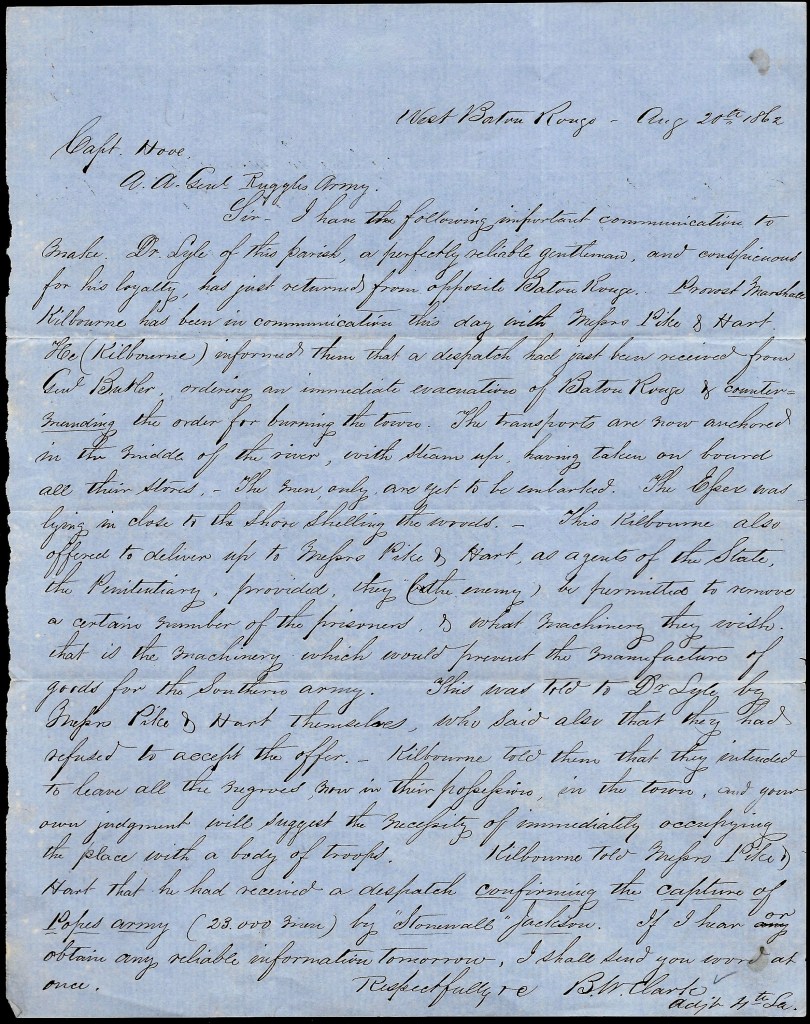

The following letter was penned by Benjamin “Webster” Clark (1832-1885) who enlisted as a private in Co. F, 4th Louisiana Infantry and was promoted to Color Sergeant in late May 1861, and to 1st Lieutenant/Adjutant of the Regiment in May 1862. In the spring of 1864 he became the Lieut.-Colonel of the 1st Cavalry Battalion, Louisiana State Guards, and eventually made Colonel of the 8th Louisiana Cavalry Regiment. He was paroled at Natchitoches, La., on 6 June 1865.
Webster was the son of Samuel M. D. Clark (1800-1854) and Maria Glover (1814-18xx) of West Baton Rouge Parish, Louisiana. He was married after the war to Bessie Williams (1849-1894).
Webster wrote the letter to Roy Mason Hooe of King George county, Virginia who entered the Confederate service as a Lieutenant/Adjutant to Gen. Daniel Ruggles and was promoted to Captain in late December 1861. He later served in Chalmer’s Cavalry Division. He returned as a Major on Gen. Ruggle’s staff in 1865. Prior to the Civil War, Roy served as a Midshipman, 4th Class in the US Navy.
Readers are referred to the Battle of Baton Rouge (1862) by Jim Bradshaw for greater historical context.
Transcription
West Baton Rouge
August 20th 1862
Capt. Hooe, A.A.G. [Daniel] Ruggles Army
Sir, I have the following important communication to make. Dr. Lyle of this parish, a perfectly reliable gentleman, and conspicuous for his loyalty, has just returned from opposite Baton Rouge. Provost Marshal Kilbourne 1 has been in communication this day with Messrs. Pike & Hart. 2 He (Kilbourne) informed them that a dispatch had just been received from Gen. Butler, ordering an immediate evacuation of Baton Rouge & countermanding the order for burning the town. The transports are now anchored in the middle of the river with steam up, having taken on board all their stores. The men only are yet to be embarked. The Essex was lying in close to the shore shelling the woods.

This Kilbourne also offered to deliver up to Messers. Pike & Hart, as agents of the State, the Penitentiary, provided they (they enemy) be permitted to remove a certain number of the prisoners & what machinery they wish—that is, the machinery which would prevent the manufacture of goods for the Southern army. This was told to Dr. Lyle by Messrs. [W. S.] Pike & [S. M.] Hart themselves who said also that they had refused to accept the offer. Kilbourne told them that they intended to leave all the negroes now in their possession in the town and your own judgement will suggest the necessity of immediately occupying the place with a body of troops. Kilbourne told Messrs. Pike & Hart that he had received a dispatch confirming the capture of Pope’s Army (23,000 men) by “Stonewall” Jackson. If I hear or obtain any reliable information tomorrow, I shall send you word at once.
Respectfully, &c. — B. W. Clark, Adjt. 4th Louisiana
1 Possibly James G. Kilbourne, Asst. Quartermaster, 4th Louisiana Infantry Native Guard (Union).
2 Samuel M. (“Major”) Hart and William Spencer Pike were lessees of the Louisiana Penitentiary from 1857 to 1862. After the expiration of their lease, they continued for a time to administer the affairs of the institution as agents. Hart & Pike utilized convict labor to manufacture textile goods and paid the State half of their profits. The factory was completely destroyed during the Civil War, however.