
The following letter makes a good read but unfortunately the soldier who wrote it only signed his name “John” and there are too few clues within the letter to lead me conclusively to his identity or even the regiment he was in. He does indicate that they were under the overall command of Gen. Henry W. Benham who was responsible for the engineering activities near Petersburg so I’m going to assume this soldier was in either the 15th or 50th New York Engineers. Early in the letter he speaks of constructing the hospitals at the “Point” which would have been City Point. This activity seems consistent with the engineers.
T R A N S C R I P T I O N
Camp near Petersburg
[Monday] December 12th 1864
Dear Brother,
We have made quite a move since I wrote you last. I don’t owe you a letter but since I have the time to spare, I thought I would give you a little sketch of our march to this place.
Friday [9 December] was an awful cold day. We went down to the Point [City Point] to work on the hospitals as usual, It was rather hard work to keep warm. Friday night it commenced raining [and] in the morning [10 December] there was an inch and a half of snow on the ground. We went down to work. It grew warmer and made it too muddy to work so we came back to camp at noon. They told us we might get us up some wood for ourselves to last over Sunday [so] we started with a wheelbarrow and got two loads chopped and wheeled up into our shanty. We had to go three quarters of a mile for wood is getting about played out in this section.
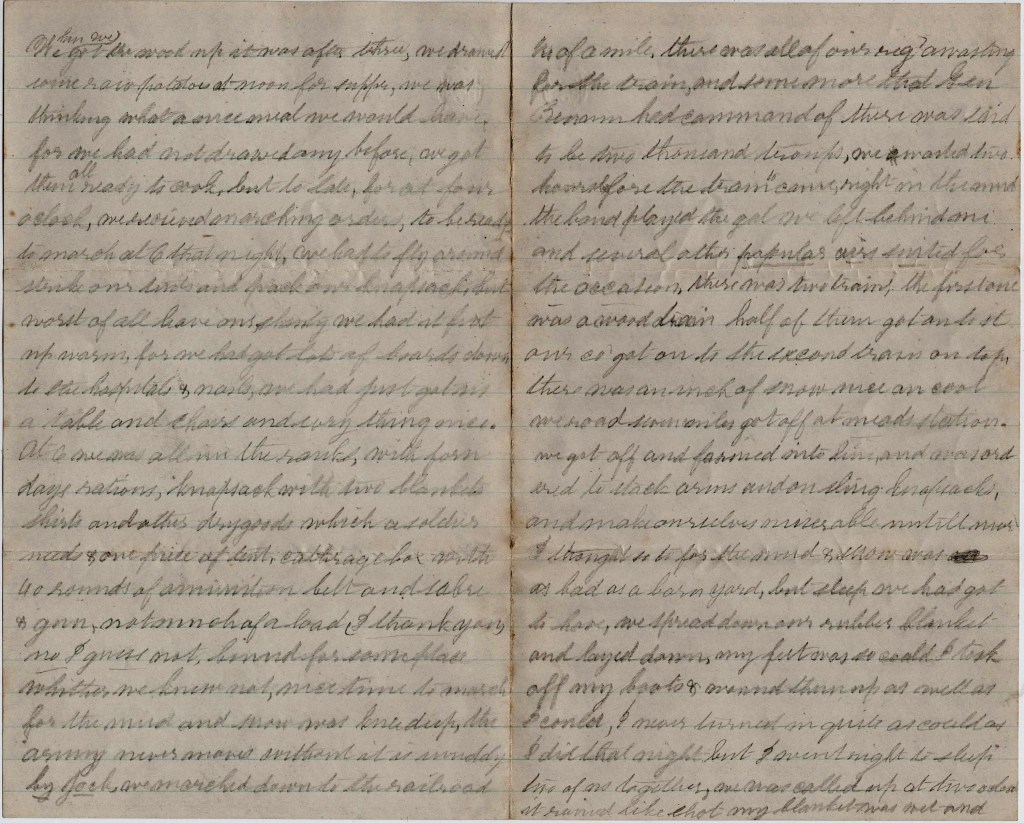
When we got the wood up, it was after three. We drawed some raw potatoes at noon for supper. We was thinking what a nice meal we would have for we had not drawed any before. We got them all ready to cook but too late for at four o’clock we received marching orders, to be ready to march at 6 that night. We had to fly around, strike our tents and pack our knapsacks, but worst of all, leave our shanty. We had it fixed up warm for we had got lots of boards down to the hospitals & nails. We had just got us a table and chairs adn everything nice
At six we was all in the ranks with four days rations, knapsack with two blankets, shirts and other dry goods which a soldier needs & one piece of tent, cartridge box with 40 rounds of ammunition, belt and saber and gun—not much of a load, I thank you. No, I guess not. Bound for someplace whither we knew not. Nice time to march for the mud and snow was knee deep. The army never moves without it is muddy, by Josh.
We marched down to the railroad one quarter of a mile. There was all of our regiment awaiting for the train and some more that Gen. [Henry Washington] Benham had command of. There was said to be two thousand troops. We waited two hours before the train to come right in the mud. The band played, “The Gal we left behind me” and several other popular airs suited for the occasion. There was two trains, The first one was a wood train. Half of them got onto it. Our company got on to the second train on top. There was an inch of snow—nice and cool. We rode seven miles, got off at Meade Station. We got off and formed into line and was ordered to stack arms and unsling knapsacks and make ourselves miserable until night. I thought so too for the mud & snow was as bad as a barn yard, but sleep we had got to have. We spread down our rubber blanket and laid down. My feet was so cold, I took off my boots & warmed them up as well as I could. I never turned in quite as cold as I did that night but I went right to sleep., two of us together.
We was called up at two o’clock. It rained like shot. My blanket was wet and my feet too. We got ready in a short time and marched two hours. We halted and stacked our arms. There was a house nearby and some outbuilding (some General’s headquarters). We had got to have some wood (there was a guard around the buildings). There was no wood near so they commenced pulling down the barn and hog pen. They stripped them pretty quick. There was 50 or 60 fires started in a short time. They hadn’t got fairly to going before the order came to put them all out. If we didn’t, the shells would be a flying around us. I thought we must be amongst them for we heard the picket firing plain when daylight came. We could see our line of works plain.
We ate our breakfast, stayed there until eleven, and then we fell in and marched to where we are now. I tell you, our knapsacks was pretty heavy before we got [here]. Some of the boys threw away one of their blankets, they was so wet and heavy, but I got through with mine and stood it first rate. We got here about noon. There was winter huts built that some soldiers vacated but all mud and snow—pretty shabby for they was built in a hurry. We put our tent cloth on [one] and cleaned them out as well as we could. We had to be pretty thick for their wasn’t huts enough. There was twelve of us together—just as thick as we could stand up. I never felt thecold so much as I did that night. It seemed as though we should freeze. The wind blew hard and froze hard as a rock. It don’t look much like the Sunny South they tel about, and our old tent you could throw your hat through it anywhere.
We are within one mile of Petersburg and in the rear of Fort Petersburg. We can see the steeples at Petersburg and the buildings that they have got our prisoners in. John, you ought to see the guns that they have got mounted on this fort. They look huge, I tell you. They say they could throw a shell into Petersburg with them. I don’t doubt it for they look as though they was capable of doing. The pickets are a firing all the while at each other. I could hear them plain enough when I was at the Point and most too plain here. I would rather [ ] to the rear if they would let me,
John. I must stop for we have had orders to clean up our guns for inspection. I will tell you the rest I have done in another sheet. — George

 Spared & Shared 23