Category Archives: 50th New York Engineers

1862: Adam Clark Baum to Josephine (Stone) Baum

The following letters were written by Adam “Clark” Baum (1832-1888), the son of John P. Baum (1797-1854) and Magdalena Elwood (1799-1854), and the husband of Josephine (“Josie”) Stone (1836-1912) of Syracuse, Onondaga county, New York. Clark and Josie had one child at the time of this 1862 letter—an infant named Josie.

During the Civil War, Clark was appointed in August 1862 as an Assistant Surgeon of the 50th New York Engineers. He resigned his commission on 31 January 1865.
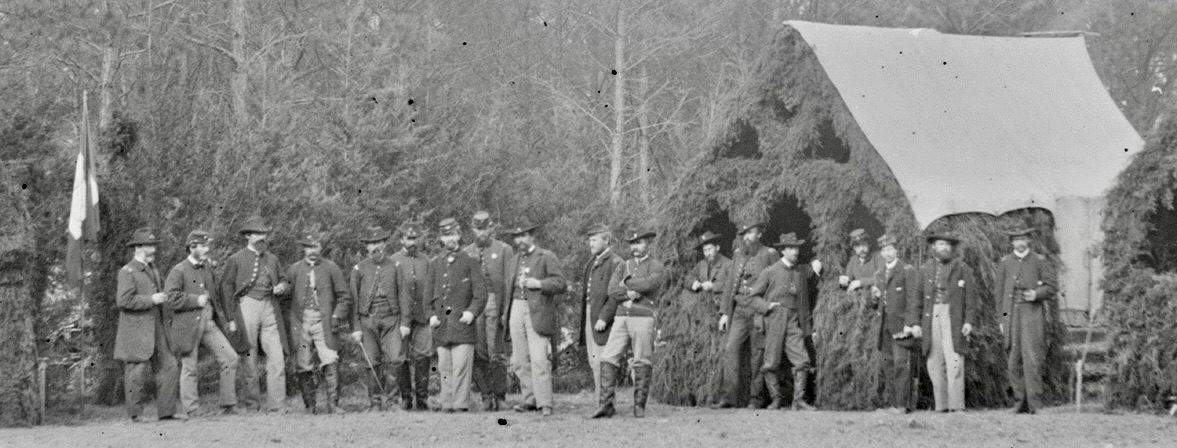
Officers of the 50th New Engineers in 1865

Letter 1

[Editor’s Note: The 1st draft of this transcription was kindly provided by Abbey Weber Jones.]

Friday, November 28, 1862, 3 p.m.

Darling Josie,

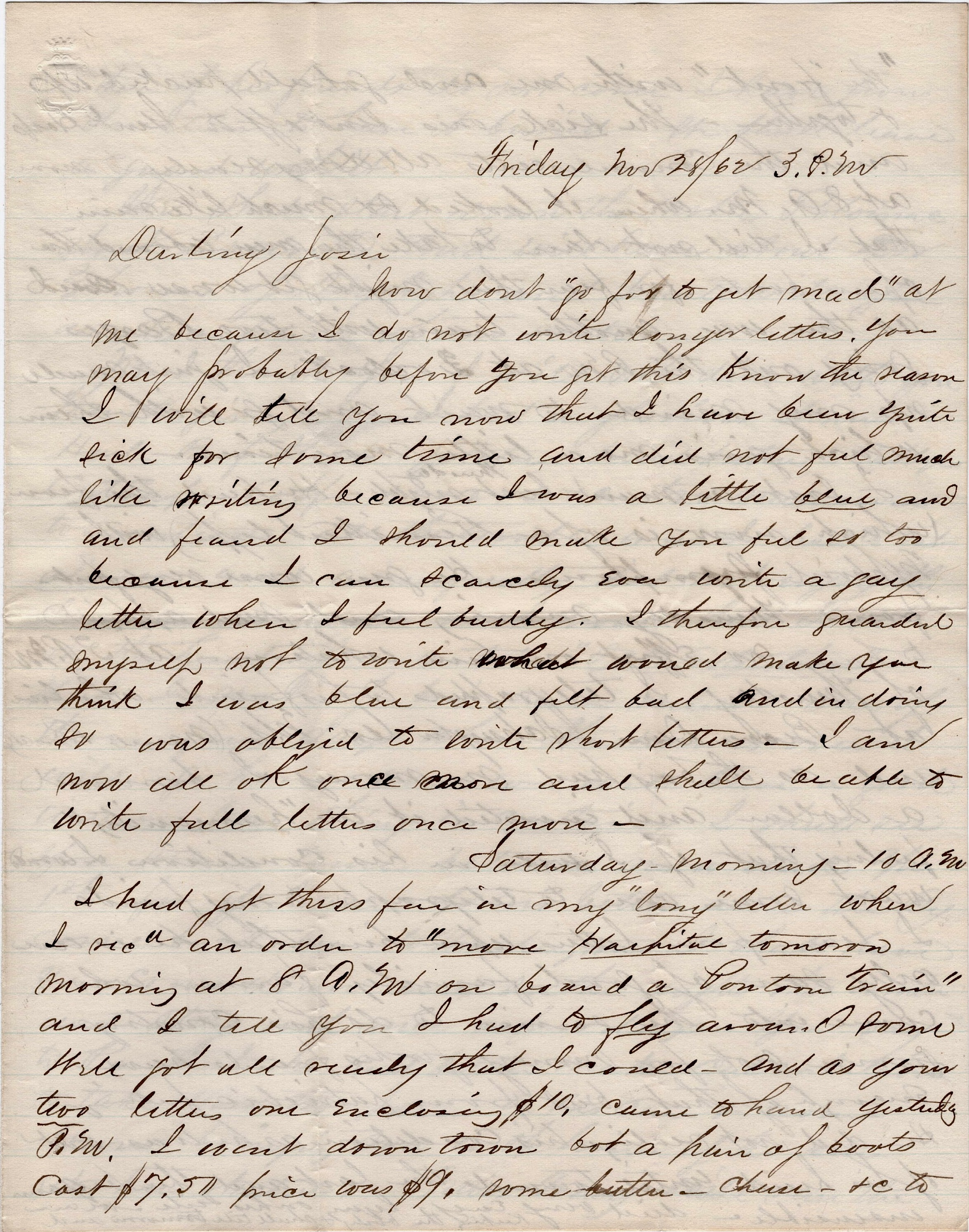
Now don’t “go for to get mad” at me because I do not write longer letters. You may, probably before you get this, know the reason. I will tell you now that I have been pretty sick for some time and did not feel much like writing because I was a little blue and I feared I should make you feel so too, because I can scarcely ever write a gay letter when I feel badly. I therefore guarded myself not to write what would make you think I was blue, and felt bad, and in doing, so was obliged to write short letters. I am now all OK once more and shall be able to write full letters once more.

Saturday morning, 10 a.m. I had got this far in my “long” letter when I received an order to “move hospital tomorrow morning at 8 a.m. on board a pontoon train” and I tell you, I had to fly around some. Well got all ready that I could—and as your two letters, one enclosing $10, came to hand yesterday p.m., I went downtown [&] bought a pair of boots. Cost $7.50. Price was $9. Some butter, cheese, &c. to “the front” with me and got all packed up & together, the sick ones sent off to General Hospital, and the convalescents all ready to move at 8 a.m. when it looked so much like rain that I did not dare to take the men aboard the open boats for fear they might get worse. And as there was another train with two barges going out this p.m. at 3 o’clock, I just made up my mind to wait and go with them which gives me a little more time.

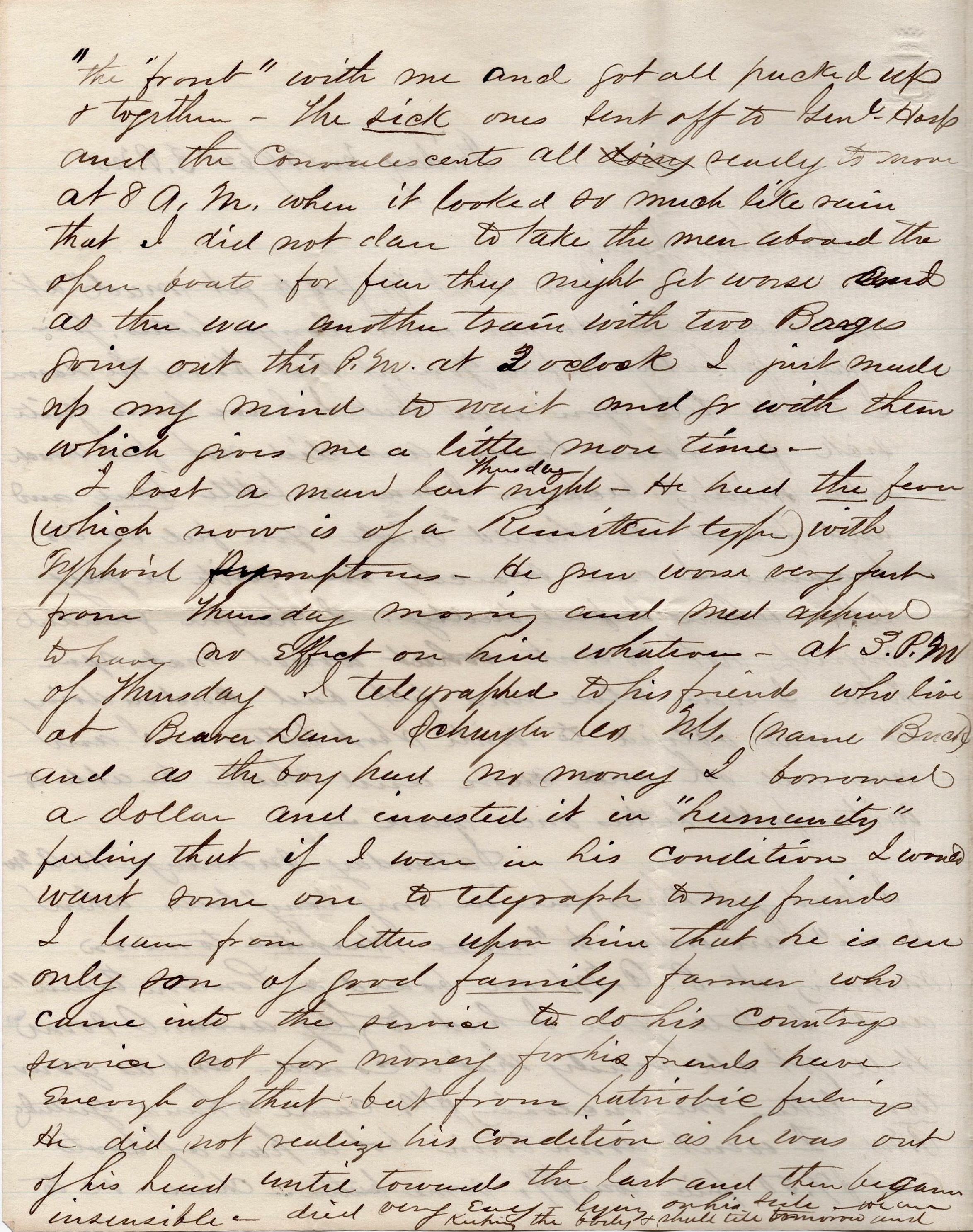
I lost a man last Thursday night [27 November]. He had the fever (which now is of a remittent type) with typhoid symptoms. He grew worse very fast from Thursday morning and meds appeared to have no effect on him whatever. At 3 p.m. of Thursday, I telegraphed to his friends who live at Beaver Dam[s], Schuyler Co., New York (name Buck) and as the boy had no money, I borrowed a dollar and invested it in “humanity” feeling that if I were in his condition, I would want some one to telegraph to my friends. I learn from letters upon him that he is an only son of a good family farmer who came into the service to do his country’s service, not for money—for his friends have enough of that—but from patriotic feelings. He did not realize his condition as he was out of his head until towards the last and then became insensible. [He] died very easy, lying on his side. We are keeping the body & shall till tomorrow and then if his friends do not come, I have given directions to have it buried. We shall leave a guard with it. 1

We shall start down the noble Potomac about 3 o’clock and will have about 2 or 3 hours of daylight and I will write you a description of our route.

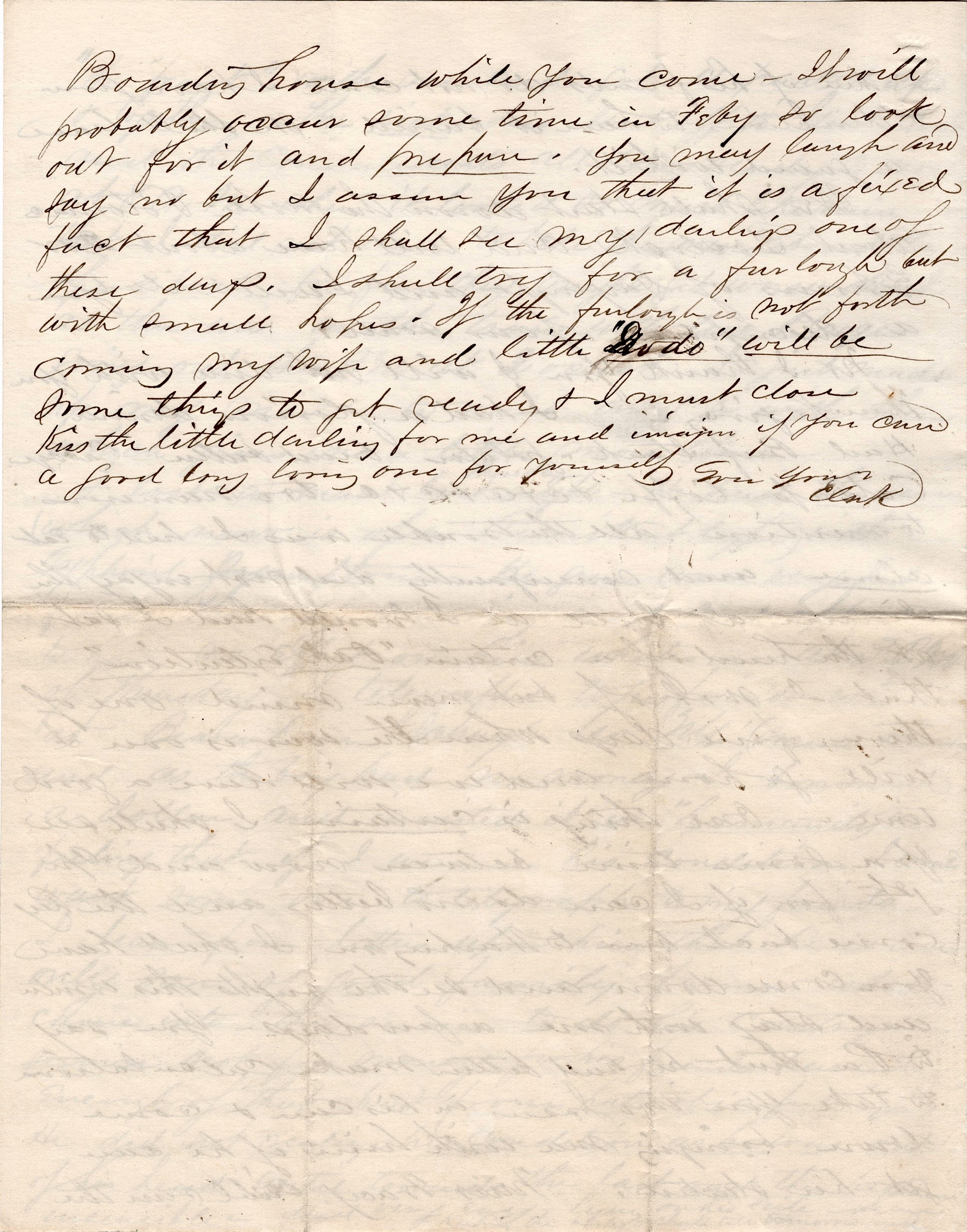
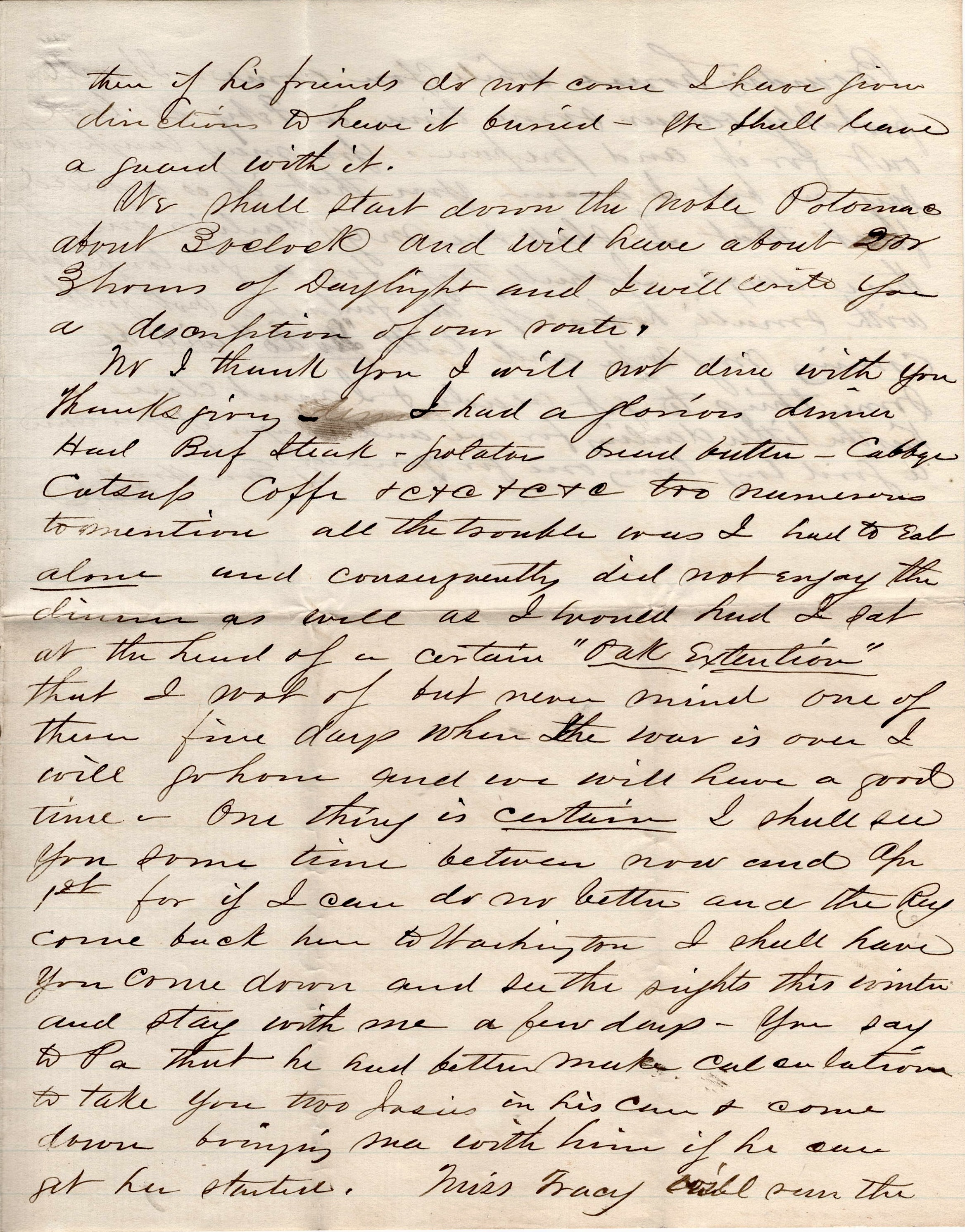
No, I thank you, [but] I will not dine with you Thanksgiving. I had a glorious dinner. Had beef steak, potatoes, bread, butter, cabbage, catsup, coffee &c., &c., &c. too numerous to mention. All the trouble was, I had to eat alone and consequently did not enjoy the dinner as well as I would had I sat at the head of a certain “Oak Extension” that I [ ] of. But never mind, one of these fine days when the war is over, I will go home and we will have a good time. One thing is certain, I shall see you some time between now and April 1st, for if I can do no better and the regiment comes back here to Washington, I shall have you come down and see the sights this winter and stay with me a few days. You say to Pa that he had better make calculations to take you two Josies in his car & come down, bringing Ma with him if he can get her started. Miss Tracy will run the boarding house while you come. It will probably occur some time in February so look out for it and prepare. You may laugh and say no, but I assure you that it is a fixed fact that I shall see my darlings one of these days. I shall try for a furlough but with small hopes. If the furlough is not forthcoming, my wife and little “Dodo” will be

Some things to get ready [yet] & I must close. Kiss the little darling for me and imagine if you can, a good long loving one for yourself. Ever yours, –Clark

1 The dead soldier was Datus Ensign Buck (1841-1862), the son of Daniel S. Buck of Beavers Dams, Schyler county, New York. Datus les buried in the US Soldiers’ and Airmen’ Home National Cemetery in Washington D. C.
Letter 2

[Editor’s Note: This transcribed letter is among six of Asst. Surgeon Adam Clark Baum’s letter that are listed for sale by The Excelsior Brigade. Since I have not seen the original letter, I cannot attest to the accuracy of this transcription.]

Camp of Detachment, 50th New York Volunteer Engineers
Near Rappahannock Station, VA
Tuesday, November 10th 1863

My Darling,

Once more upon the line of the Rappahannock, calmly settled in the old routine of camp like after the excitement horrors and scenes of suffering incident to the battle. Not a great battle like Chancellorsville, Fredericksburg or Gettysburg or Chickamauga, but a short sharp and bloody fight in which perhaps as much skill and quite as much bravery and indomitable courage were shown as at any of the above named great battles. Our men fought splendidly and the enemy with his usual desperation. But to take things as they transpired I must begin back. I wrote you Friday that we were ordered forward to the Rappahannock. Well, Saturday morning our trains no. 1 and 2 with bridge material for two bridges, left camp at 4 a.m. The headquarters wagons with hospital and ambulances and myself did not move until 8 a.m. We found the roads full of troops and trains and our progress was slow. At last about 4 p.m. we came upon our behind and quietly waiting the advance of the line of battle which was drawn up in the woods out of sight of the rebs. As we were engineer officers, they let us through the line and then we saw a large undulating plain spread out before us about 1 ½ miles wide. 

On the further side of which the bluff of the river bank loomed up bristling with cannon and bayonets of the rebs and about half way across the plain was the reb pickets and advance line. Also our pickets and advance line and supports all watching and waiting for something to turn up. At last General Sedgwick gave the orders. The bugle sounds and our men advance the 6th Corps upon the right of the railroad and the 5th Corps upon the left. The rebs discharge their pieces and fall back followed by our men. Both sides firing as rapidly as possible. The advance of both sides being in “skirmish line” (in which the men are from 10 feet to 10 rods apart according to the strength of the line). About this time the rebs opened their batteries with shell. We soon drive them off a knoll and very soon a heavy boom, a puff of smoke, followed by others in quick succession tell us that a couple of our batteries have gained a position on the knoll and are pouring destruction into the work of the rebs. We ride forward to a knoll near the center of the plain near the railroad, so we can see better. Ahh, that won’t do. No excuse time “Johnnie” I do not care for any of your civilities of that sort. Those “rotten” messengers you are sending us are not required here. We don’t care for any. Please excuse me.

Some of the shells burst unpleasantly near us and we “retire in disgust” and at double quick too. I assure you to a more sheltered position. Well our skirmishers slowly advance across that plain. Standing up like men without a particle of cover while the rebs crawled back dodging about from point to point to escape the shots. The rebel batteries soon see they have something more to do than fire at our batteries. Our men are getting too near. Some of their gunners are picked off by our sharpshooters. They then load with grape and shrapnel and fire at our advancing troops. My God, what a gap they make. But it is closed up again as they move forward. The skirmishers gain the foot of the hill about 50 yards from the works and stop and uncap their guns, grasp them at a “charge bayonet” and with a cheer that is heard two miles, rush upon the works. My God what a havoc the grape and canister make among them. No firing on our side now. Our cannons are directed to the work on the other side of the river and our men having taken the caps off their guns by order so they could not stop to fire if they choose to. Our skirmishers jump on the works and gun in hand over they jump. My god. Why are the support so far behind? Will those few brave men be sacrificed before the support reaches them. “Forward G-d d—n you double quick crises an offer. Up they rush just in time for at least half of the skirmish line who first gained the works are either killed or wounded in the hand to hand conflict. Officers after discharging their pistols are obliged to use the sword in defense and offense. Sixteen out of 22 officers of the 6th Maine Regiment were either killed or wounded.

One sergeant of the 6th Maine jumped over the works in advance of all his comrades. He was alone and was obliged to throw down his gun and surrender. His comrades soon after coming up with a cheer rushed in to the rescue. He caught up his gun and with the butt of it knocked down his guard and went in again. All the officers of his company were killed or wounded and he was left in command of his company. When the rebs were overpowered or rather “over cowed” as our boys call it and threw down their arms and surrendered, he (the Sargent) went up to take their colors. The rebs refused to let him have them saying they would not give them up to a noncommissioned officer. He threw down his gun and with two or three comrades had a regular fist fight with the rebs color guard. They had a regular knock down. Our Maine boys being too much the “johnnies”. The sergeant knocked down the color sergeant caught the colors and with a cheer jumped upon them. About this time the fight was terrible along the whole line of the works. The 6th Corps were having all they could do and the 5th were not idle. What means they came another brigade of the “Johnnies” rushing across the bridge to rescue their comrades. Our boys let them come on. What is that? Why don’t they fire upon them? Ah, I see why. It is one division of the 5th Corps are coming to the rescue. All marching by the flank and just in time to fix the “Johnnies.” Not a word. Not a shot. They come up as coolly as though at dress parade, file along slowly and take position to cover the bridge. The only way the Johnnies can get back. They see it but too late. They make a rush. But no you don’t every man that make the attempt fails. “lay down your arms and surrender”. There is no alternative and they “gracefully” submit.

This brigade (North Carolina and Georgia troops) had “double quicked” six miles to reinforce their comrades. They rushed across the bridge just after our men had got possession of their works and in less than 20 minutes everyone was “gobbled up” that was not killed or wounded. Some attempt to swim the river but were drowned or shot down in the attempt. Every man, every gun and everything they had on this side of the river is ours. Seven cannons, 2,234 prisoners, one pontoon bridge, 9 stands of colors, 1 brigadier general, 2 or 3 colonels, lots of captains and lieutenants and etc. our loss in killed and wounded is a little under 300. Almost the entire loss was sustained by the 3 or 4 regiments forming the advance line of skirmishers. During the fore part of the night, the rebs attempted to destroy their pontoon bridge, which they were obliged to leave. But our sharpshooters would not let ‘em. Our men held one end of the bridge and they the other. In the morning our troops were in possession of both sides of the river and the infantry of the 5th and 6th Corps were across. 
How it was done, I have not heard, but think the “Johnnies” evacuated as we heard no firing during the night.

In the morning our detachment went down, repaired the reb bridge and laid another ½ mile below the railroad bridge and the artillery, etc., went across chasing the rebs beyond Culpepper—they offering no resistance. Yesterday they drove them to the Rapidan and Headquarters of the Army of the Potomac established themselves last night near Brandy station about 6 miles beyond the river. The rebs were building splendid winter quarters at Brandy Station intending to make the line of the Rappahannock their advance. They had fortified here at the station on both sides of the river and below but more particularly on this side took them by surprise and “wasted” them for once on their own ground. I understand there were 2,000 more prisoners taken yesterday at near Rapidan and Sulphur Springs. Did not see them. Those taken at this point were fine look men. Comfortable clothed. Good shoes and many with good boots. Did not look as though they had suffered much for the necessaries of life. I send you a little sketch of the battlefield. It is correct although not very nice. You can get a very good idea of the “position” and “situation.”

The mail has gone for today so this letter will answer for my Wednesday’s letter. Have made up my mind to send you little sketches of any point of interest in our travels. They will be interesting to look at by and by when we have at last succeeded in “crushing” and this “cruel war is over”. The work on the south side of the river was somewhat “knocked into pie” by our large siege guns on the right. Before the rebs evacuated that work they filled up a rifle pit that our men had dug when we were here before and yesterday when our men opened it they found eight dead rebs. They had been buried there by their comrades or rather thrown into the pit and covered up to deceive us in regard to their loss. I have seen 21 of their dead and these eight make 29. How many more I do not know. Our loss in killed and wounded is probably greater than theirs as they were protected by works and we were without cover.

Wednesday your letter of November 5th came to hand last night. Yes, indeed New York has done nobly. We can now day show us a state that has done better than the old “Empire”. Bully for the Empire.

I regret to hear that you are “ailing” and “pining away” to 160 pounds. By George, I would hardly dare go home now if I was discharged for fear you would be inclined to give me a dressing and rather guess you could do it.

You say you have not received a letter from me in a long time. I have written regularly two letters each week. Although no always on the regular days.

Give my love to all friends. Especially our folks. Tell Miss Tracy I am “most out of tobacco and whiskey, entirely out of wine. Have got a few sweet potatoes, 10 or 12 cans of fresh tomatoes, 10 or 12 pounds of butter, some dried apples and peaches, about 1 peck of fresh apples and a few necessaries.

Kiss the little darling. Ever your own, — Clark


Letter 3

[Editor’s Note: This transcribed letter is among six of Asst. Surgeon Adam Clark Baum’s letter that are listed for sale by The Excelsior Brigade. Since I have not seen the original letter, I cannot attest to the accuracy of this transcription.]

Headquarters, 2nd Battalion
50th New York Volunteer Engineers
Cold Harbor, Va
June 11th 1864

My Darling,

Having a little time to myself this forenoon, I thought I would anticipate my usual Sunday letter. For in my opinion, we shall not be where we can write much tomorrow.

We are still lying here gazing at the rebs and the rebs gazing at us. Our lines of battle being up in many places to within 100 yards (300 feet) of the rebel works. And in some places, our pickets are within a less distance than that even. In one place, our pickets got up so close that they could hear the men talk in an ordinary tone and could understand them. The officers were giving instructions to the men providing our men made an attack during the night. You may think that it is very strange that men could live in such a place. It is strange but never the less true. I’ll tell you how it is brought about. When our Army finds a “mares nest” and they want to advance their lines, they take the shovel and go to work throwing up a “rifle pit”, which consists of a bank of earth with a ditch (from which the earth is thrown) behind the bank ramping in direction and length as the case may require. This rifle pit is many times strengthened by “reveting” it which is to lay up logs like the side of a log house and pack the dirt against that wall. The wall of course being on our side of the work. The bank of earth is from 4 to 10 feet thick from 3 to 6 ½ feet high. The lines are not straight but usually run in an irregular zig-zag course. Taking advantage of the ground. When the line is formed and troops in the work, the “skirmishers” or “picket” are thrown out in advance during the night, each man with his gun and spade. He digs a pit for himself. The following night the pickets are thrown out still further and they dig pits each for himself a little in advance and the troops connect the pits of the previous night, making a line of it and so they advance slowly. Until the lines are so close that if a man shows his head on either side it is certain death. An officer has just told me that a portion of our lines in place was within 30 yards (90 feet) of the rebels works and our pickets in advance of that even. I can hardly believe it yet it must be so as he is a reliable man. We have now here 12 or 14 lines of works that have been made in that way. Some of the front ones were built by the rebs and “our fellows” after driving them out faced the works the other and are using them.

Today our men are at work on breastworks in rear of our camp, which with other infallible signs indicate another “flank movement” probably to the James River and to the south of Richmond. Movements of our troops and trains indicate that and more too. If I was certain no eyes but yours and friends at home were to see this, I could tell you what. But I guess I won’t for if I am not mistaken, you will hear of it before this reaches you. There are about 5000 men at work on the rear line of works today and I presume before I am able to send this letter, we shall be started on another flank movement.

Strange things occur in this war—many things you hear nothing of. For instance, the day before yesterday, the rebs and our men got tired shooting and stopped without any arrangement between them. After the shooting had been stopped for a little time, one of our men exposed his hat on a ram rod above the work. The rebs did not shoot. By and by he exposed his head a little. Then a reb showed his—no shooting. Then one exposed a little more, then the other a little more, and so on till both stood up in full view of the other and then others tried it without any trouble. Then they began to talk backwards and forwards and ten on both sides began to get up on the work and then to walk out towards the others works and so on until they were having a nice friendly chat. Men all left their guns in the pits and met as friends (some say shaking hands and drinking together but that I don’t know about) and were laying down on the top of the works until by and by the field officer of the day of the 6th Corps (Colonel Johns of the 7th Massachusetts, came along and put a stop to it. He told them that he rode down to the front line of the works on horseback, a thing he would not have done for his life under other circumstances for it would have been certain death. And dismounting outside our works and told the rebs and our men to get back behind their works or he would order the 2nd line of works to fire on them all. So the rebs went back to their work and our men to theirs and after they had gotten back, they hollered to each other “get back under cover for we are going to shoot.” “Watch out, Yanks, I’m going to shoot,” “Take care there Johnnie, your head in the way of my bullet,” and such interchanges of cordiality until by and by they got busily to work again “shooting to kill.” This is a true statement. Colonel Johns, the field officer of the day of the 6th Corps, told me this himself, and he is a straight forward reliable old soldier. You may know this from the fact that he has been field officer of the day for 10 days past and in such a time as this it is an important position.

Shall write you again in a few days. Probably from the James River when I will ‘answer” your letters about little Josie’s Erysipelas. I would not do anything for her except to keep her bowels regular and perhaps a little Sulphur and molasses.

In regard to the winter, I think you may safely rent the rooms for if I get out this fall, I shall want to spend the winter in New York.

Much love to all. Be a good girl and keep your skirts clean and you nose tied up.

In regard to females visiting the hospitals of Washington, the story you write sound swell and if it is even true, should awake your sympathies. Allow one who has “seen service” to advise you to do what you can for the sanitary commission at home and let these special visits with baskets, etc. be made by others. It is no place for a woman who does not make that her business. They do more harm than good in such hospitals as Washington affords. They might do goo in our field hospital or depots like Fredericksburg or Belle Plain or White House. But in regularly organized hospitals where everything is arranged in a systematic manner, “outside” women are worse than useless.

Ever your own,

Clark

1864: George to his brother John

The following letter makes a good read but unfortunately the soldier who wrote it only signed his name “John” and there are too few clues within the letter to lead me conclusively to his identity or even the regiment he was in. He does indicate that they were under the overall command of Gen. Henry W. Benham who was responsible for the engineering activities near Petersburg so I’m going to assume this soldier was in either the 15th or 50th New York Engineers. Early in the letter he speaks of constructing the hospitals at the “Point” which would have been City Point. This activity seems consistent with the engineers.

T R A N S C R I P T I O N

Camp near Petersburg
[Monday] December 12th 1864

Dear Brother,

We have made quite a move since I wrote you last. I don’t owe you a letter but since I have the time to spare, I thought I would give you a little sketch of our march to this place.

Friday [9 December] was an awful cold day. We went down to the Point [City Point] to work on the hospitals as usual, It was rather hard work to keep warm. Friday night it commenced raining [and] in the morning [10 December] there was an inch and a half of snow on the ground. We went down to work. It grew warmer and made it too muddy to work so we came back to camp at noon. They told us we might get us up some wood for ourselves to last over Sunday [so] we started with a wheelbarrow and got two loads chopped and wheeled up into our shanty. We had to go three quarters of a mile for wood is getting about played out in this section.

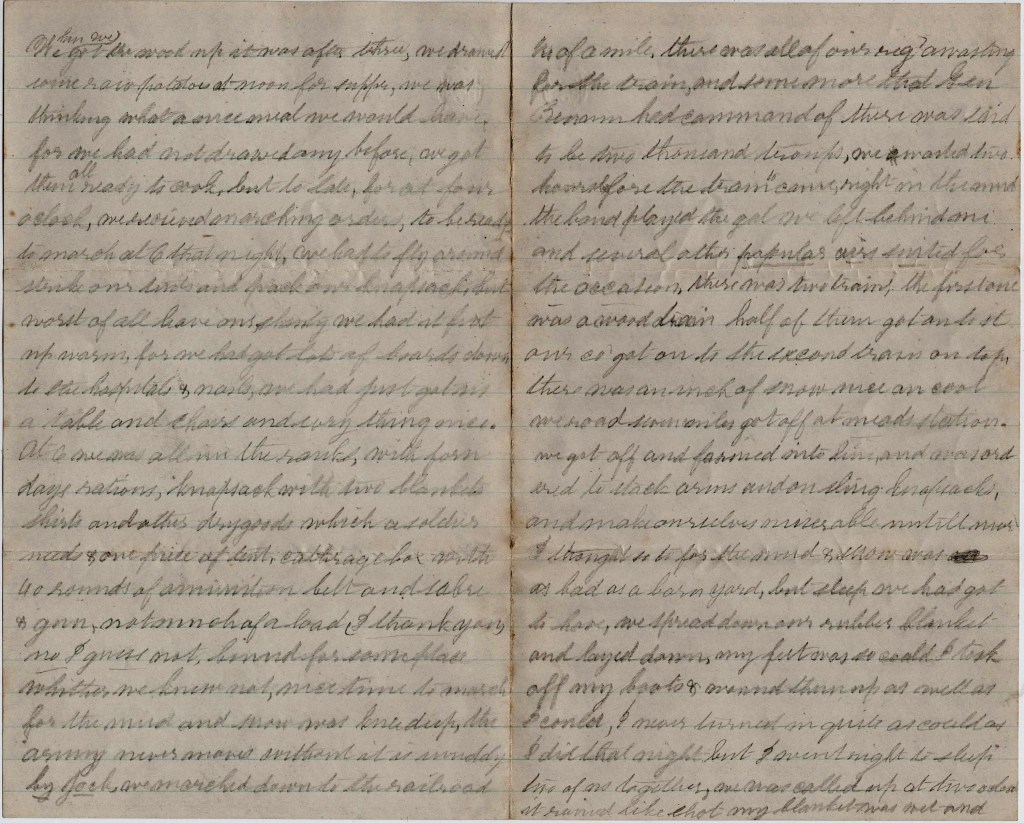
When we got the wood up, it was after three. We drawed some raw potatoes at noon for supper. We was thinking what a nice meal we would have for we had not drawed any before. We got them all ready to cook but too late for at four o’clock we received marching orders, to be ready to march at 6 that night. We had to fly around, strike our tents and pack our knapsacks, but worst of all, leave our shanty. We had it fixed up warm for we had got lots of boards down to the hospitals & nails. We had just got us a table and chairs adn everything nice

At six we was all in the ranks with four days rations, knapsack with two blankets, shirts and other dry goods which a soldier needs & one piece of tent, cartridge box with 40 rounds of ammunition, belt and saber and gun—not much of a load, I thank you. No, I guess not. Bound for someplace whither we knew not. Nice time to march for the mud and snow was knee deep. The army never moves without it is muddy, by Josh.

We marched down to the railroad one quarter of a mile. There was all of our regiment awaiting for the train and some more that Gen. [Henry Washington] Benham had command of. There was said to be two thousand troops. We waited two hours before the train to come right in the mud. The band played, “The Gal we left behind me” and several other popular airs suited for the occasion. There was two trains, The first one was a wood train. Half of them got onto it. Our company got on to the second train on top. There was an inch of snow—nice and cool. We rode seven miles, got off at Meade Station. We got off and formed into line and was ordered to stack arms and unsling knapsacks and make ourselves miserable until night. I thought so too for the mud & snow was as bad as a barn yard, but sleep we had got to have. We spread down our rubber blanket and laid down. My feet was so cold, I took off my boots & warmed them up as well as I could. I never turned in quite as cold as I did that night but I went right to sleep., two of us together.

We was called up at two o’clock. It rained like shot. My blanket was wet and my feet too. We got ready in a short time and marched two hours. We halted and stacked our arms. There was a house nearby and some outbuilding (some General’s headquarters). We had got to have some wood (there was a guard around the buildings). There was no wood near so they commenced pulling down the barn and hog pen. They stripped them pretty quick. There was 50 or 60 fires started in a short time. They hadn’t got fairly to going before the order came to put them all out. If we didn’t, the shells would be a flying around us. I thought we must be amongst them for we heard the picket firing plain when daylight came. We could see our line of works plain.

We ate our breakfast, stayed there until eleven, and then we fell in and marched to where we are now. I tell you, our knapsacks was pretty heavy before we got [here]. Some of the boys threw away one of their blankets, they was so wet and heavy, but I got through with mine and stood it first rate. We got here about noon. There was winter huts built that some soldiers vacated but all mud and snow—pretty shabby for they was built in a hurry. We put our tent cloth on [one] and cleaned them out as well as we could. We had to be pretty thick for their wasn’t huts enough. There was twelve of us together—just as thick as we could stand up. I never felt thecold so much as I did that night. It seemed as though we should freeze. The wind blew hard and froze hard as a rock. It don’t look much like the Sunny South they tel about, and our old tent you could throw your hat through it anywhere.

We are within one mile of Petersburg and in the rear of Fort Petersburg. We can see the steeples at Petersburg and the buildings that they have got our prisoners in. John, you ought to see the guns that they have got mounted on this fort. They look huge, I tell you. They say they could throw a shell into Petersburg with them. I don’t doubt it for they look as though they was capable of doing. The pickets are a firing all the while at each other. I could hear them plain enough when I was at the Point and most too plain here. I would rather [ ] to the rear if they would let me,

John. I must stop for we have had orders to clean up our guns for inspection. I will tell you the rest I have done in another sheet. — George

1862: William T. Elwell to a Friend

The following letter was written by William T. Elwell (1837-1898), the son of John Elwell and Mary Gould of Caton, Steuben county, New York. William enlisted on 18 September 1861 as a private in Co. K of the 50th New York Engineers. On 1 November 1861 he was transferred to Co. D. In 1863 he was transferred to the 81st Company, 2nd Battalion Veteran’s Reserve Corps (VRC), and later still to Co. E of the 12th VRC. In 1869, he filed for an invalid’s pension.

William died in 1898 and was buried in Loudonville Cemetery in Loudonville, Ashland county, Ohio.

I could not find an image of William but here is one of Harrison Carl Johnson (1840-1922) of Co. G, 50th New York Engineers. (Ancestry.com)

T R A N S C R I P T I O N

Camp Lesley 1
Washington D. C.
June 3rd 1862

The Picket Guard [a poem]

“All quiet along the Potomac,” they say except now and then a stray picket
is shot as he walks on his beat to and fro by a rifleman hid in the thicket.
Tis nothing. A private or two now or then will not count in the news of the battle,
Not an officer lost—only one of the men moaning out all alone the death rattle.

All quiet along the Potomac tonight
where the soldiers lie peacefully dreaming.
Some thought it was fun to get whipped at Bulls Run
but wait till they get to Manassas.
With bullets and lead at the side of the head
Your’ll see the brave 50th a running. — W. T. E.

Camp Lesley
Washington D. C.
June 5th 1862

Dear friend,

I received your letter of the 3rd and was glad to hear that you was all well as it found me enjoying good health at heart but leaves me a cripple in my leg. I am quite lame so that I cannot do any duty but I have not been to the doctor but once and I have got to wait till the young doctor comes home for I won’t go to the old doctor, and then I shall either get a furlough or my discharge for I cannot do anything here.

I shall know after my payday. Tell Anna not to send me anything. If that box has not gone to Dennis for I do not want anything more from home. I have just found out where father is and found also [where] my brother-in-law is, but have not seen either of them. But I have sent father a letter and shall see him before long.

We have just received our tents. They are the Sibley tents with 20 in a tent which akes it very disagreeable now, I tell you. We are all well at present and I hope that we will stay so. We are in hopes that we will have a neat little fight before long so that we can try our pluck to see whether we are good for anything or not.

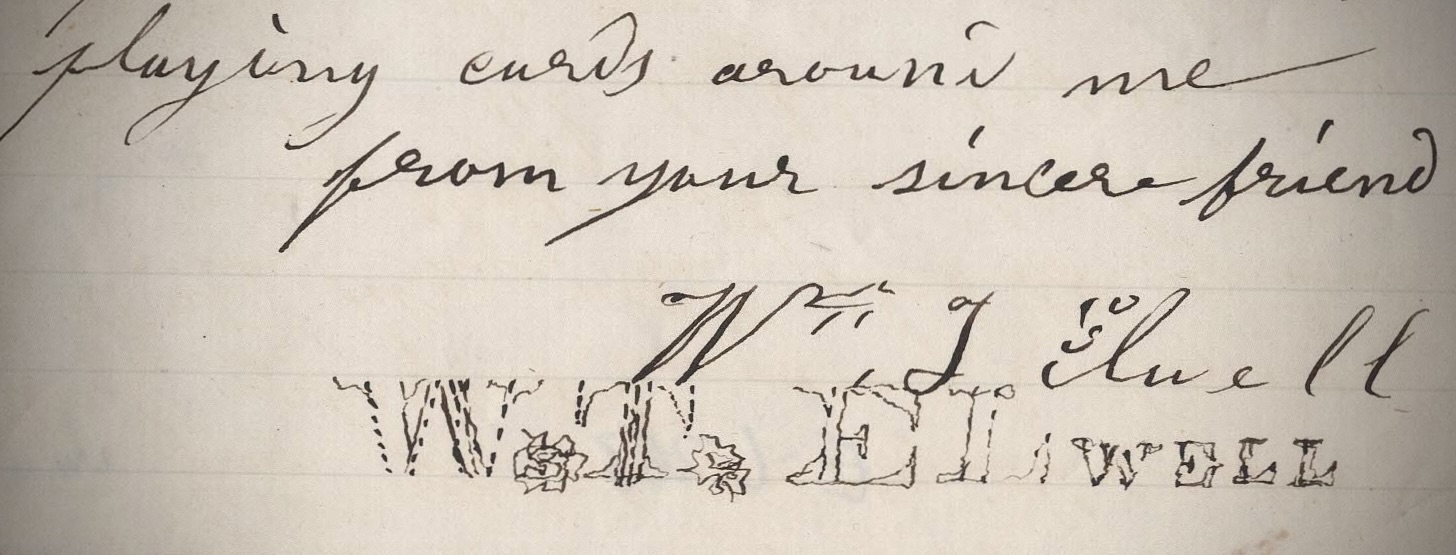
I shall have to stop for I sit here cramped up in a corner and the rest playing cards around me. From your sincere friend, — Wm. T. Elwell


1 Camp Lesley was located about a half mile north of the Navy Yard on the Anacostia River. It eventually became known as the Washington Engineer Depot. It was the camp of the 50th New York Engineers.

1864: Henry Russell to Abigail Saphronia Skinner

The following letters were written by Henry Russell (1843-1891), the son of Josiah G. Russell and Lucinda Cobb of Tioga county, New York. Henry enlisted on 1 November 1, 1861 at Binghamton to serve three years in the 16th New York Independent Battery but he was discharged for disability less than a year later on 12 August 1862 at Fairfax Seminary General Hospital. After regaining his health, Henry reenlisted on 4 January 1864 as a private in Co. E, 50th New York Engineers. He mustered out with his company on 13 June 1865, at Fort Barry, Va.

Henry wrote all of the letter to his “Dear Abbie”—Abigail Saphrona Skinner (1848-1921). They were married in 1865 when Henry returned from the service.

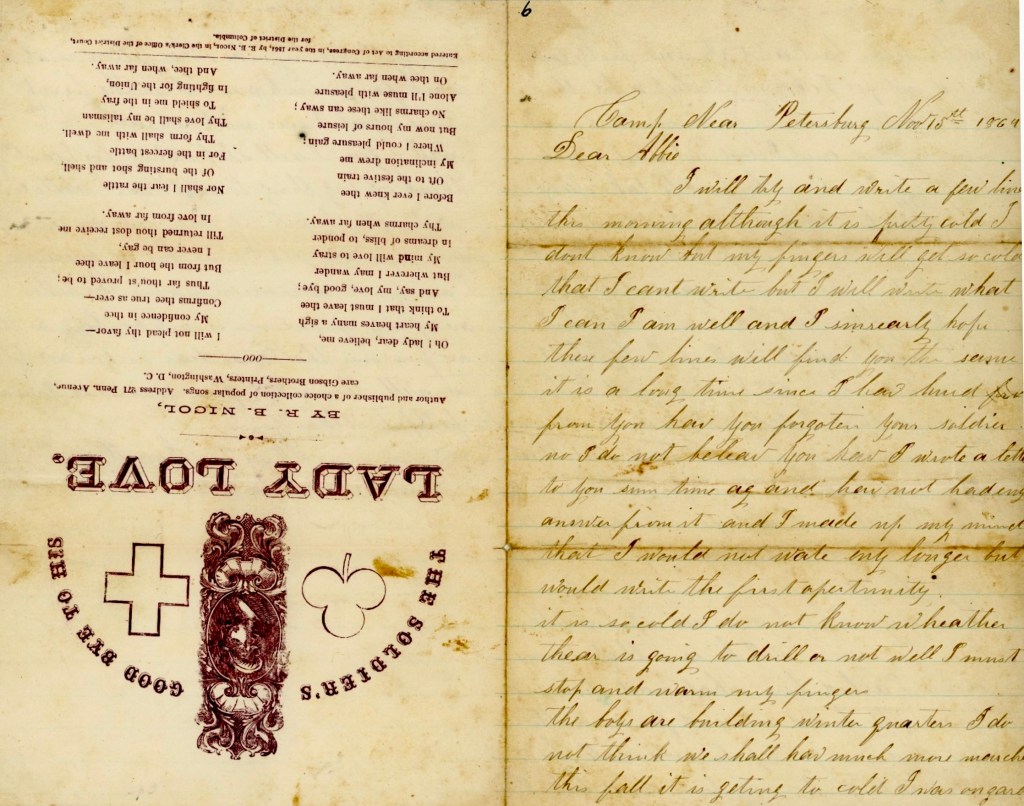
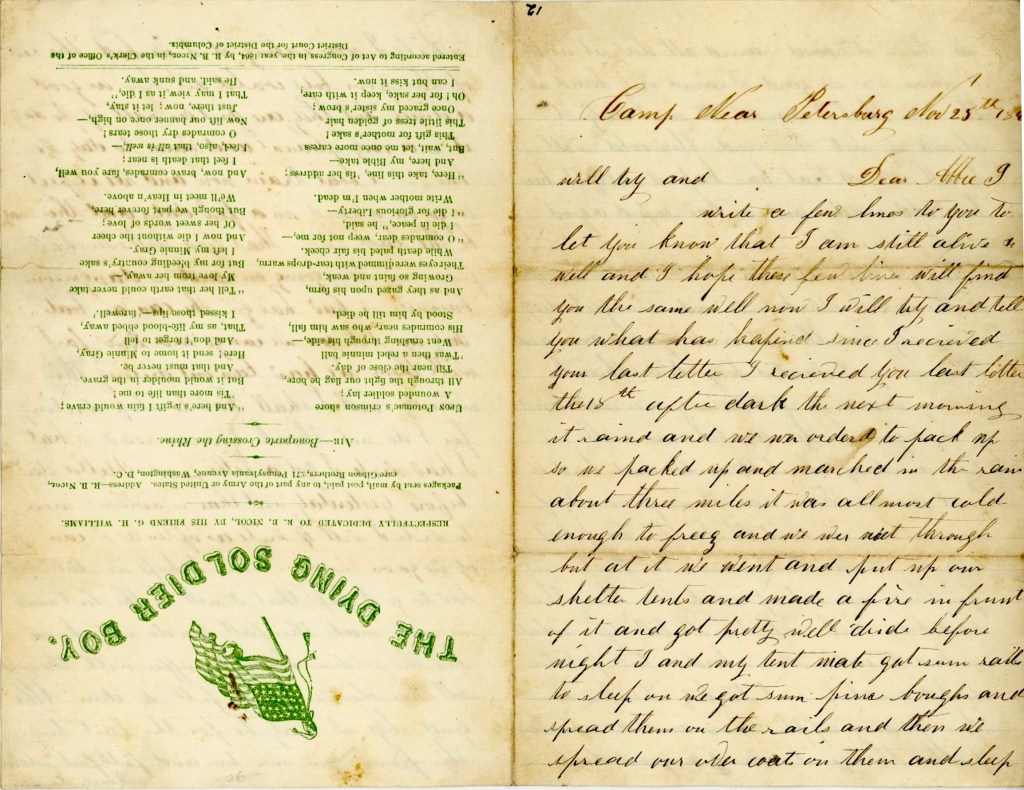
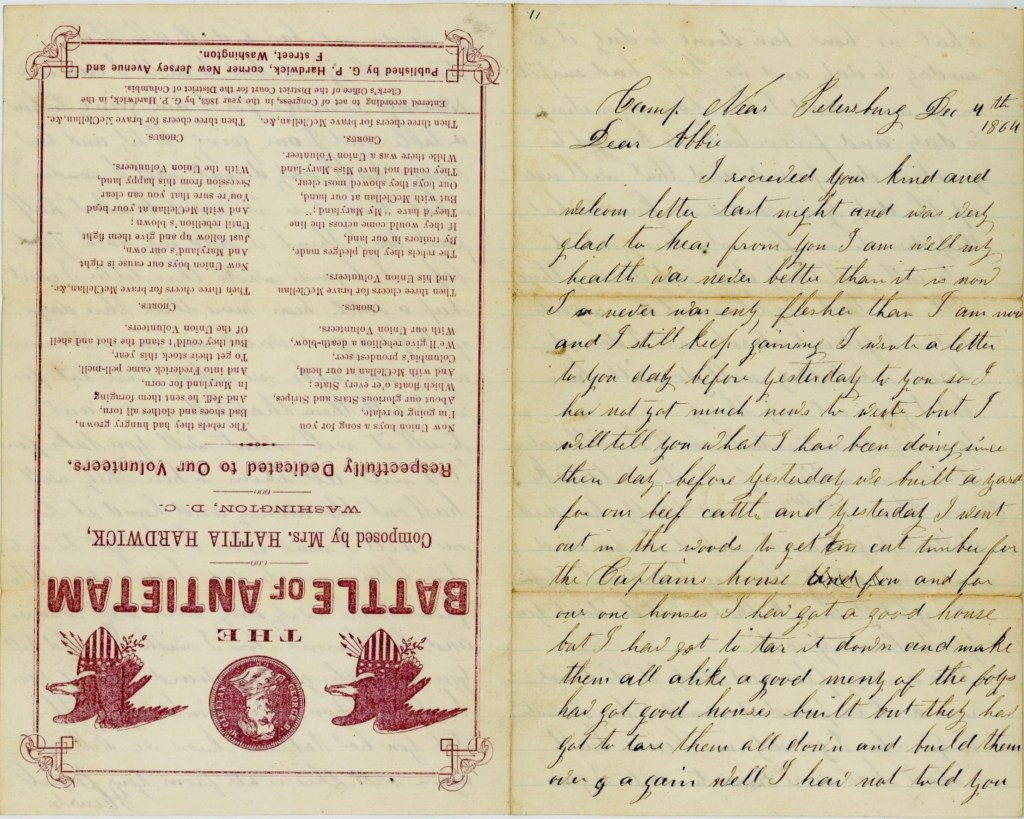
All three of Henry’s letters were written on patriotic stationery with printed poems or songs, including “The Battle of Antietam,” “Lady Love,” and “The Dying Soldier Boy.”

Letter 1

Camp near Petersburg
October 29, 1864

Dear Abbie,

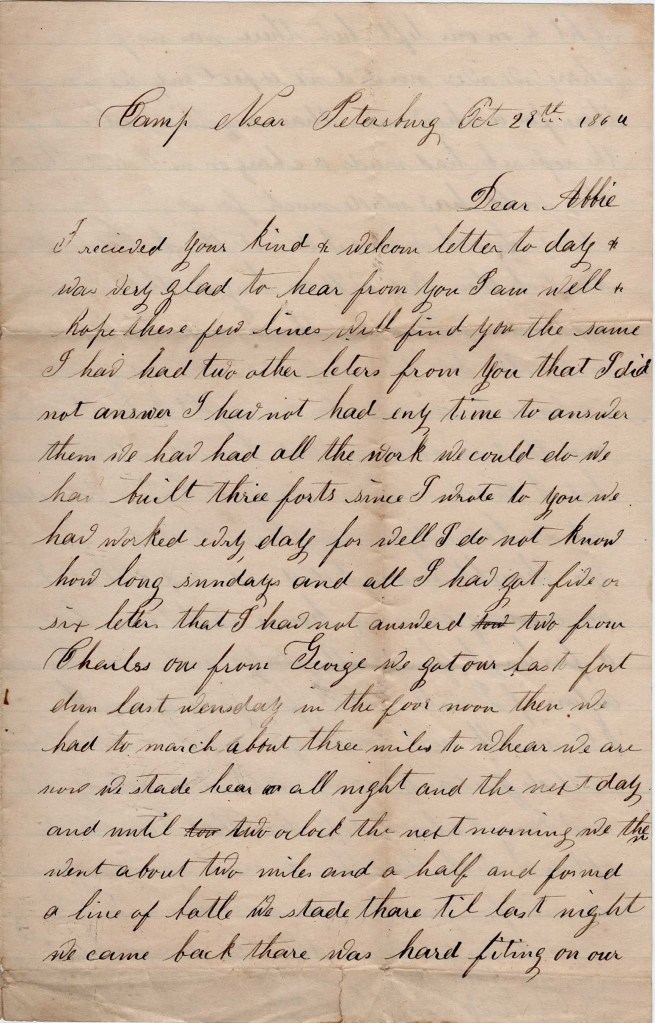
I received your kind & welcome letter today & was very glad to hear from you. I am well & hope these few lines will find you the same. I had had two other letters from you that i did not answer. I have not had any time to answer them. We have had all the work we could do. We have built three forts since I wrote to you. We have worked every day for—well, I do not know how long, Sundays and all. I have got five or six letters that I have not answered; two from Charles, one from George.

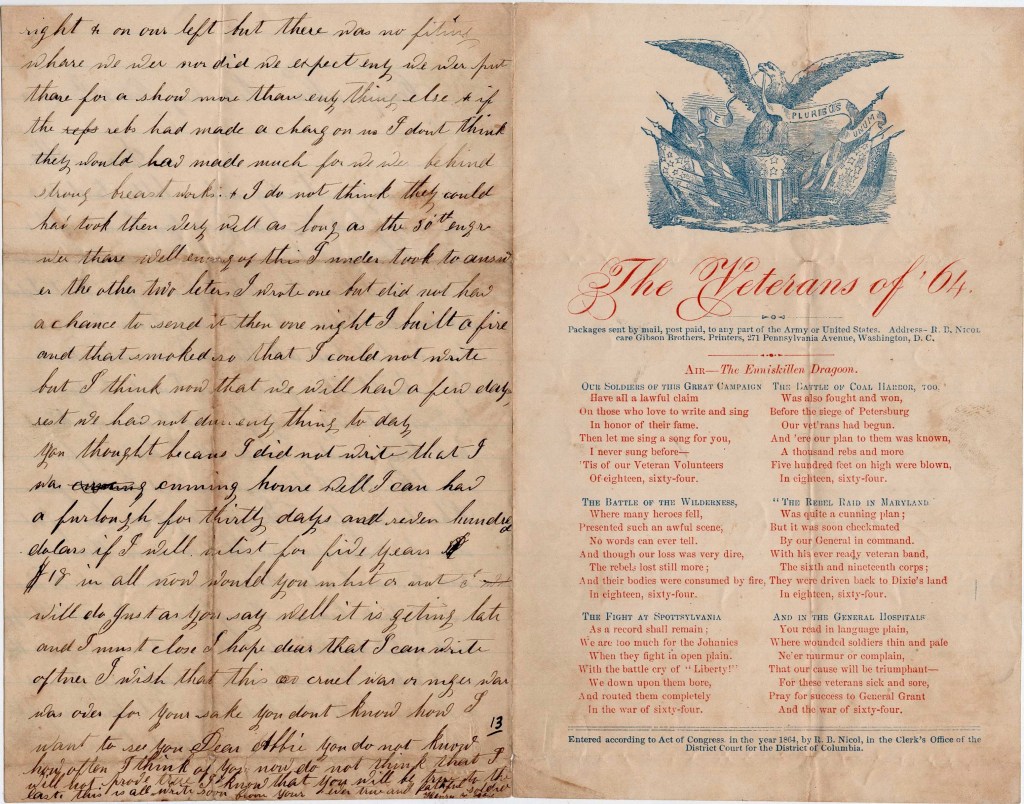
We got our last fort done last Wednesday [Oct. 26] in the forenoon. Then we had to march about three miles to where we are now. We stade here all night and the next day and until two o’clock the next morning [Oct. 28]. We then went about two miles and a half and formed a line of battle. We stade there til last night [when] we came back. There was hard fighting on our right & on our left but there was no fighting where we were not did we expect any. We were put there for a show more than anything else. If the rebs had made a charge on us, I don’t think they would have made much for we were behind strong breastworks & I do not think they could had took them very well as long as the 50th Engineers were there. Well enough of this. 1

I undertook to answer the other two letters. I wrote one but did not have a chance to send it. Then one night I built a fire and that smoked so that I could not write but I think now that [I can write as] we will have a few days rest. We have not done anything today. You thought because I did not write that I was coming home. Well, I can have a furlough for thirty days and seven hundred dollars if I will enlist for five years. Now would you enlist or not? I will do just as you say.

Well, it is getting late and I must close. I hope, dear, that I can write oftener. I wish that this cruel war, or nigger war, was over for your sake. You don’t know how I want to see you. Dear Abbie, you do not know how often I think of you. Now do not think that I will not prove true. I know that you will be true to the last. This s all. Write soon from your ever true and faithful Henry

To Abbie.

1 The “hard fighting” heard by Henry was undoubtedly from Grant’s 6th offensive against Petersburg with the goal of cutting the Confederate supply lines. An offensive was initiated on the right while Grant struck the Boydton Plank Road on the left. Troops such as the 50th Engineers temporarily filled the breastworks in the middle of the Union line while the assaults were being made.


Letter 2

Camp near Petersburg
November 15, 1864

Dear Abbie,

I will try and write a few lines this morning although it is pretty cold. I don’t know but my fingers will get so cold that I can’t write but I will write what I can. I am well and I sincerely hope these few lines will find you the same.

It is a long time since I have heard from you. Have you forgotten your soldier? No, I do not believe you have. I wrote a letter to you some time agoand have not had any answer from it and I made up my mind that I would not wait any longer but would write the first opportunity. It is so cold I do not know whether there is going to be drill or not. Well, I must stop and warm my fingers.

The boys are building winter quarters. I do not think we shall have much more marching this fall. It is getting too cold. I was on guard last night and it was pretty cold. I did not get a chance to sleep a bit. The night before I was on guard, my tent mate was on guard and I did not sleep much that night because he had to take one of the blankets and it was pretty cold and I did not try to sleep that night and the next night I was on guard and there was two nights that I did not sleep. But last night I made it all up. I slept ten knots an hour. Did I not do well? I slept so sound that I did not hear the drum this morning for roll call but that did not make any difference to me. The Lieutenant sent for me and another fellow that did not get up to roll call. The Lieutenant wanted to know the reason why I was not up. I told him the reason. Well, he said, that was no excuse. I asked him what made him send for us and why he did not send for some other that did not get up to roll call. He told me to go to my tent and here I am writing. The other fellow is at work for punishment. It is the first time that I ever missed roll call.

Well, I guess I will stop writing for I can’t think of anything to write so I will close. Write often. I will try and write something of more importance next time but if you are as I am, you do not care whether the letters are of any importance or not as long as they are from one that is as dear as you are to me. Well, this is all. From your ever true and faithful soldier, — Henry Russell


Letter 3

Camp near Petersburg
November 25, 1864

Dear Abbie,

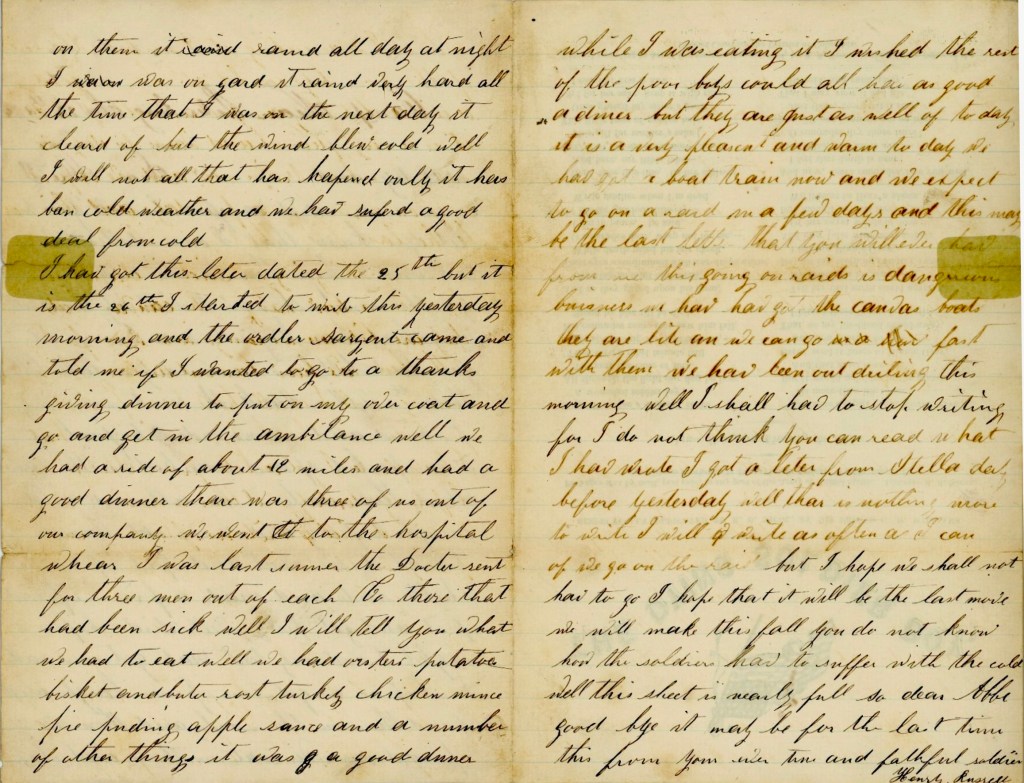
I will try and write a few lines to you to let you know that I am still alive & well and I hope these few lines will find you the same. Well, now, I will try and tell you what has happened since I received your last letter. I received your last letter the 18th after dark. The next morning it rained and we were ordered to pack up so we packed up and marched in the rain about three miles. It was almost cold enough to freeze and we were wet through but at it we went and put up our shelter tents and made a fire in front of it and got pretty well dried before night. I and my tent mate got some rails to sleep on. We got some pine boughs and spread them on the rails and then we spread our overcoats on them and sleep on them. It rained all day. At night I was on guard. It rained very hard all the time that I was on. The next day it cleared off but the wind blew cold. Well, I will not [tell] all that happened, only it has been cold weather and we had suffered a good deal from cold.

I had got this letter dated the 25th but it is the 26th. I started to write this yesterday morning and the Orderly Sergeant came and told me if I wanted to go to a Thanksgiving dinner to put on my overcoat and go and get in the ambulance. Well, we had a ride of about 12 miles and had a good dinner. There was three of us out of our company. We went to the hospital where I was last summer. The doctor sent for three men out of each company—those that had been sick. Well, I will tell you what we had to eat. We had oysters, potatoes, biscuits and butter, roast turkey, chicken, mince pie, pudding, apple sauce, and a number of other things. It was a good dinner. While I was eating it, I wished the rest of the boys could all have as good a dinner but they are just as well off today. It is very pleasant and warm today.

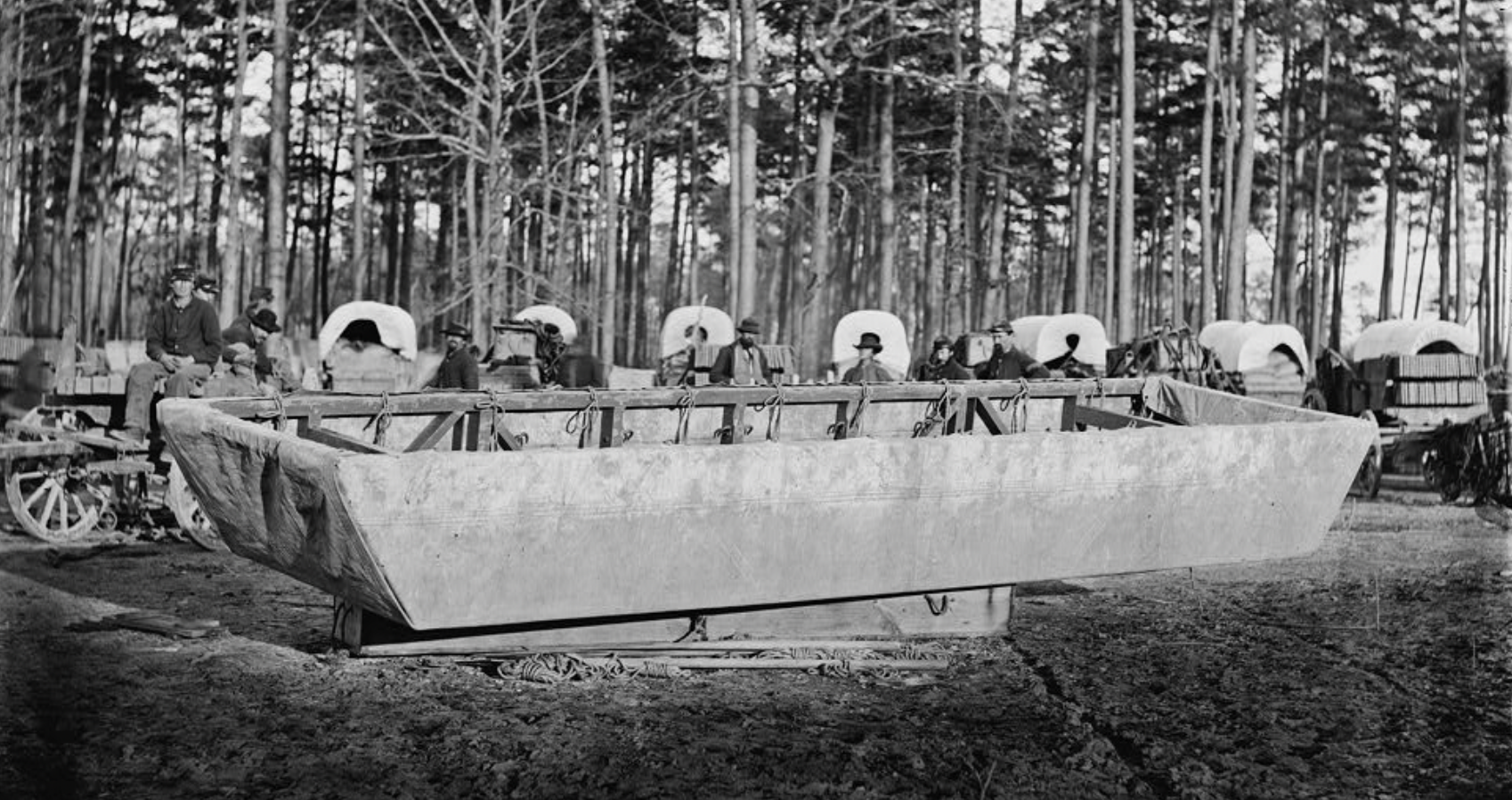
We have got a boat train now and we expect to go on a raid in a few days and this may be the last letter that you will ever have from me. This going on raids is dangerous business, We have got the canvas boats. They are light and we can go fast with them. We have been out drilling this morning.

A canvas boat used by the 50th New York Engineers,

Well, I shall have to stop writing for I do not think you can read what I have wrote. I got a letter from Stella day before yesterday. Well, there is nothing more to write. I will write as often as I can if we go on the raid but I hope we shall not have to go. I hope that it will be the last move we will make this fall. You do not know how the soldiers have to suffer with the cold. Well, this sheet is nearly full so dear Abbie, goodbye. It may be for the last time. This from your ever true and faithful soldier, — Henry Russell


Letter 4

Camp of the 50th New York Engineers in front of Petersburg, Va, in the winter of 1864-65. Notice the canvas pontoon boats parked at left (No. 14).

Camp near Petersburg
December 4, 1864

Dear Abbie,

I received your kind and welcome letter last night and was very glad to hear from you. I am well. My health was never better that it is now. I never was any fleshier that I am now and I still keep gaining.

I wrote a letter to you day before yesterday to you so I have not got much news to write but I will tell you what I have been doing since then. Day before yesterday we built a yard for our beef cattle and yesterday I went out in the woods to get cut timber for the Captain’s house and for our own houses. I have got a good house but I have got to tear it down and make them all alike. A good many of the boys have got good houses built but they has got to tear them all down and build them over again.

Well, I have not told you what we have been doing today. It is Sunday today and we had an inspection of arms and I have been to meeting today and five o’clock we have got to go out on dress parade and that will use up the day.

You wanted to know what they done to me for not being out at roll call. Well, they did not do anything with me. Last night one of our sergeants did not get out at roll call. I do not know what they will do with him but I guess not anything.

You say do not enlist. Well, I will not. I have no intention of it. It would take more than 18 or 20 hundred dollars to get me to enlist so you need not worry about that. If I get out of this alright, I think that will do, don’t you? Yes, I know you do.

It is a very pleasant day. It did not rain as I expected it would when I wrote to you. When I get my house built, I shall have more time to write, I guess, if we do not have to drill all the time. Well, if we have to drill, I can write evenings for I am going to have a table and I am going to try and have things halfway decent.

Well, I wonder what time it is. It must be about half past two, I think. I sold my watch just before I began to write this letter. I can’t keep a watch here more than three days. If I get a good watch, someone will come along and ask me what I will take for it. I tell them that I do not want to sell it. Well, what will you take for it? I will tell them when they will haul out the money and hand it to me.

Well, I must close. I have got to write two letters more today. I expect a letter from home every day now. Well, dearest and best [friend], I must close. I wish I could tell you my feelings toward you. If you knew, then you never would regret the step you have taken. I know we will meet again. Well, this is all from your faithful, — Henry

1862: Harrison Snow to Elsie Ann Snow

The following letter was written by Harrison Snow (1840-1898) who joined his older brother Alfred Henry Snow (1838-1915) in enlisted in Co. G, 50th Regiment, New York Engineers. Harrison began his service as a private but was later made an artificer. The 50th New York Engineers became famous for their ability to quickly build pontoon bridges, construct field fortifications, and to conduct sapper and mining operations, sometimes under enemy fire.

Harrison and Alfred were the sons of Asa Stearns Snow (1805-1882) and Mary C. Eighmey (1803-1900) of Caroline, Tompkins county, New York. He wrote the letter to his younger sister, Elsie Ann Snow (1844-1939).

A Cabinet Card with image of blockhouse built at Fairmont, West Virginia in 1863 by a detachment of Co. G, 50th New York Engineers.

T R A N S C R I P T I O N

Washington D. C.
March 8th 1862

Dear Sister,

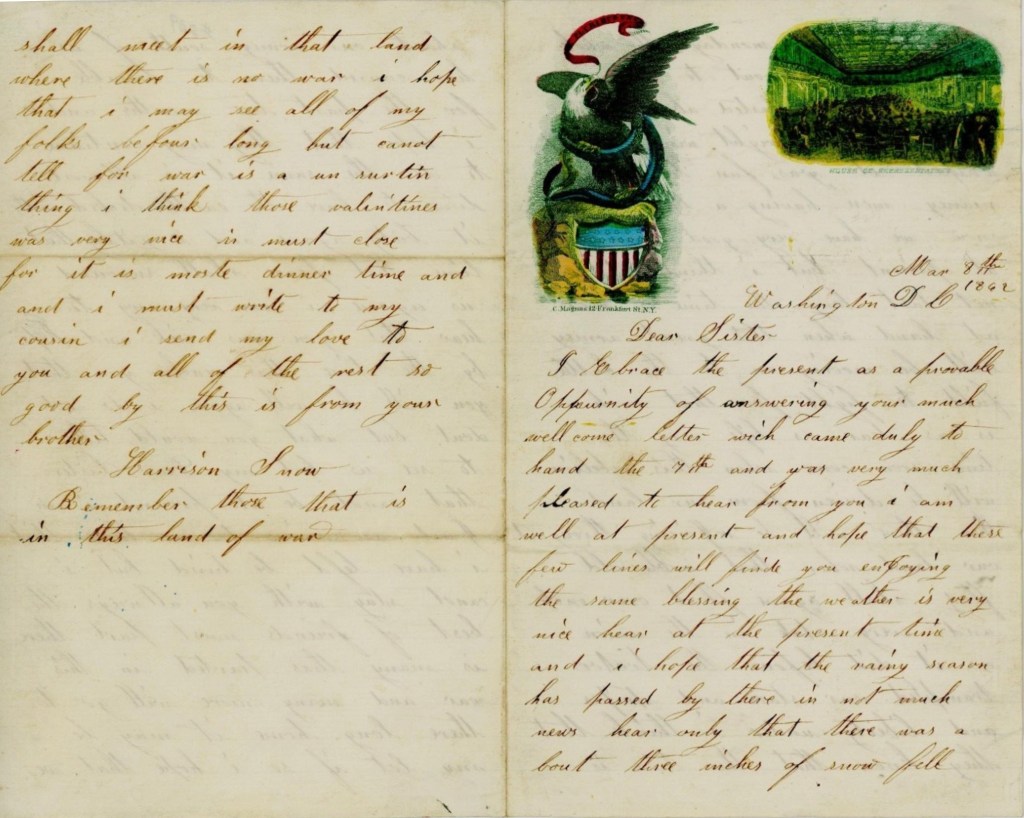
I embrace the present as a favorable opportunity of answering your much welcome letter which came duly to hand the 7th and was very much pleased to hear from you. I am well at present and hope that these few lines will find you enjoying the same blessing. The weather is very nice here at the present time and I hope that the rainy season has passed by.

There is not much news here, only that there was about three inches of snow fell here on last Monday. The whole regiment turned out to have a snow ball [fight]. It lasted about three hours when the right wing gave up whipped. It was fun to see so many men having a battle with snow. We have very good times here at present but I think it will not last long. The time is near at hand when this great army will be moving on to the battlefield to fight for that which is as dear as life. May the time soon come when this rebellion will be driven from our land. There there will be rejoicing throughout our land when that old noble flag shall again float over each and every state in the Union as it did before the traitors trampled our Stars & Stripes and liberty under. I think that they know that their time is short. Our army south of us has caused them to tremble for the past two months and I hope that they may continue to do the same. It is almost time to have the earth decked with its beauty again and may it be that time that peace shall surround us again.

I was very sorry to hear that you was sick and hope by the time this reaches you that you will be well again. I do not doubt but what you would like to see us but my dear sister, that cannot be at present, I am just as anxious to see those that I have left behind but I cannot stay with you always. The best. of friends must part. There is many that parted in this war and many more will go to their long home. It may be my lot. If so, I hope that we shall meet in that land where there is no war. I hope that I may see all of my folks before long but cannot tell for war is an uncertain thing.

I think those valentines was very nice. I must close for it is most dinner time and I must write to my cousin. I send my love to you and all of the rest, so goodbye. This is from your brother, — Harrison Snow

Remember those that is in this land of war.

1861: Alfred Henry Snow to Elsie Ann Snow

A post war image of Alfred and his wife, Rebecca Jane (Dodd) Snow. They were married in 1866.

The following letter was written by Alfred Henry Snow (1838-1915) of Co. G, 50th Regiment, New York Engineers. Alfred began his service as a private but was later made an artificer. The same can be said for Alfred’s younger brother, Harrison Snow (1840-1898) who joined and served with him in the same company. The 50th New York Engineers became famous for their ability to quickly build pontoon bridges, construct field fortifications, and to conduct sapper and mining operations, sometimes under enemy fire.

Alfred was the son of Asa Stearns Snow (1805-1882) and Mary C. Eighmey (1803-1900) of Caroline, Tompkins county, New York. He wrote the letter to his younger sister, Elsie Ann Snow (1844-1939).


A Cabinet Card with image of blockhouse built at Fairmont, West Virginia in 1863 by a detachment of Co. G, 50th New York Engineers.

Transcription

[Hall’s Hill, near Arlington, Virginia]
October 4, [1861]

Dear sister,

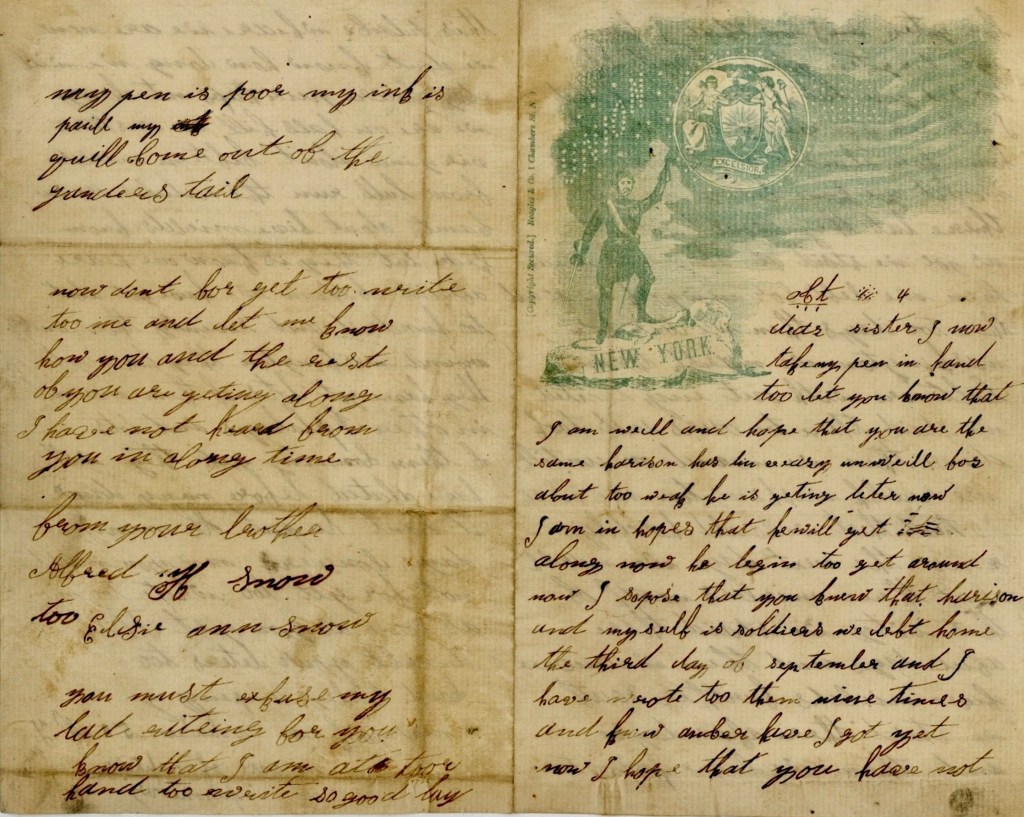
I now take my pen in hand to let you know that I am well and hope that you are the same. [Brother] Harrison has been very unwell for about two weeks. He is getting better now. I am in hopes that he will get along now. He begins to get around now.

I suppose that you knew that Harrison and myself is soldiers. We left home the third day of September and I have wrote to them nine times and no answer have I got yet. Now I hope that you have not forgotten me. I know that I have not forgotten you. I should like to see you but I don’t think that I will see you very soon. We left home for Elmira. We thought that [we] would go home before we left there but they would not let us go. We stayed at Elmira two weeks, then we left for New York. We stayed there two days. The we left for Washington. We marched through Baltimore without any trouble. We stayed there two hours and took dinner, then we moved on until we reached Washington. We was so tired that we could hardly rest.

The next day we marched about three miles north of that city and then we moved five miles farther south. We stayed there a few days and then we came here to this place where we are now. We don’t know how long we will stay here—perhaps not long. We are on Hall’s Hill in western Virginia about fifteen miles from Bull Run. The rebels are encamped about five miles from here but there is no one here afraid of them. We have got about two hundred and seventy thousand around Washington. They have got lots of them around in other places and lots of them coming yet. They will have a battle before many days—it can’t be put off many days longer.

Now you must not forget to write to me as soon as you get this. Direct your letters to Camp Lesley, Company G, 50th New York Volunteers, in care of Captain [Walker V.] Personius

My pen in poor,
my ink is pail,
my quill come out of
the gander’s tail.

No don’t forget to write to me and let me know how you and the rest of you are getting along. I have not heard from you in a long time. From your brother, — Alfred H. Snow

to Elsie Ann Snow

You must excuse my bad writing for you know that I am a poor hand to write. So good day.

1865: Unidentified Engineer

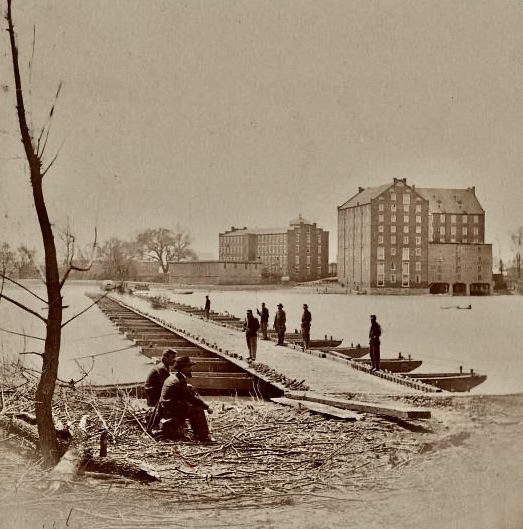
I can’t be certain of the identity of the author of this partial letter There is a remote possibility that it was written by Lawrence Manning of the 50th New York Engineers. I also can’t be certain of the date or location but believe it to have been written from either Richmond, or across the James river, in Manchester, Virginia, in April 1865. Whoever wrote the letter was involved in laying down a pontoon bridge which I think was necessary after the retreating Confederates burned Mayo’s Bridge over the James.

The Engineers laying down the first of two pontoon bridges over the James River between Richmond and Manchester, Va. in April 1865

Transcription

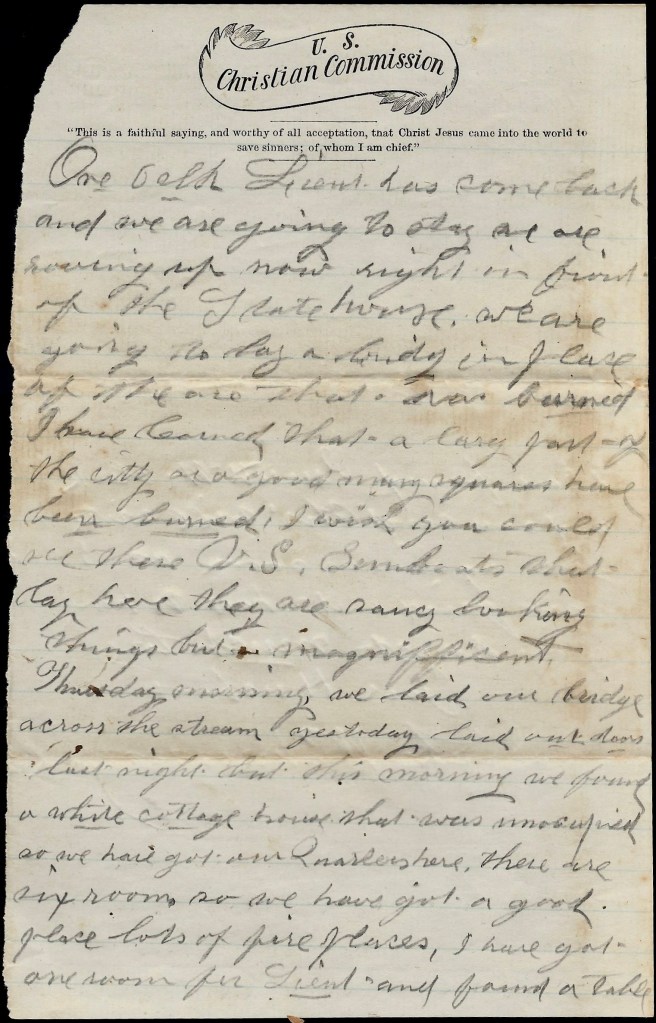
One o’clock, Lieutenant has come back and we are going to stay. We are roving up now right in front of the statehouse. We are going to lay a bridge in place of the one that was burned. I have learned that a large part of the city—or a good many squares—have been burned. I wish you could see these U. S. Gunboats that lay here. They are saucy looking things but magnificent.

This CDV was sold with the letter but it was not identified so can’t be certain it is the author. It dates to 1864/5 and was taken at Couch & Burns Photographers, Hampton, Va.

Thursday evening. we laid our bridge across the stream yesterday. Laid out doors last night but this morning we found a white cottage house that was unoccupied so we have got our quarters here. There are six rooms so we have got a good place—lots of fire places. I have got one room for Lieutenant and found a table and a stool upstairs. The rooms are all plastered and whitewashed so it is very pleasant.

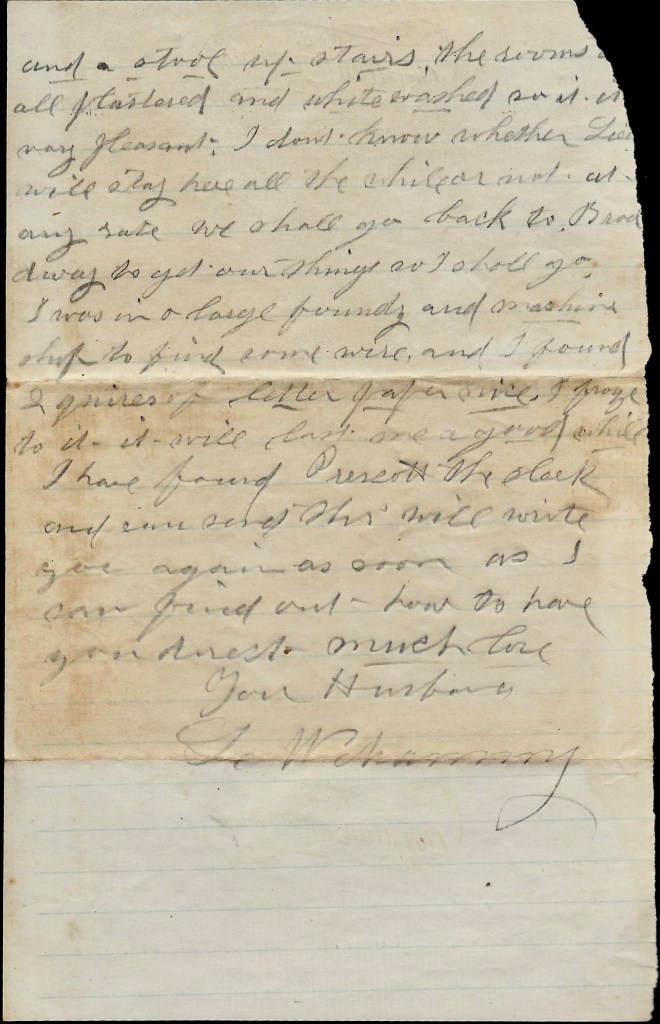
I don’t know whether Lieutenant will stay here all the while or not. At any rate, we shall go back to Broadway [Landing] to get our things so I shall go. I was in a large foundry and machine shop to find some wire and I found two quires of letter paper—nice. I froze to it. It will last me a good while. I have found Prescott the clerk and can send this. Will write you again as soon as I can find out how to have you direct. Much love, your husband, — L. W. Manning

1861: Alfred L. Edwards to Philander Merrill

I could not find an image of Alfred but here is Franklin D. Cornish who served in the same regiment. (Photo Sleuth)

This letter was written by Alfred L. Edwards (1841-1918) who enlisted on 26 August 1861 as a private in Co. E, 50th New York Engineers and remained in the regiment until mustering out on 20 September 1864 at Elmira, New York.

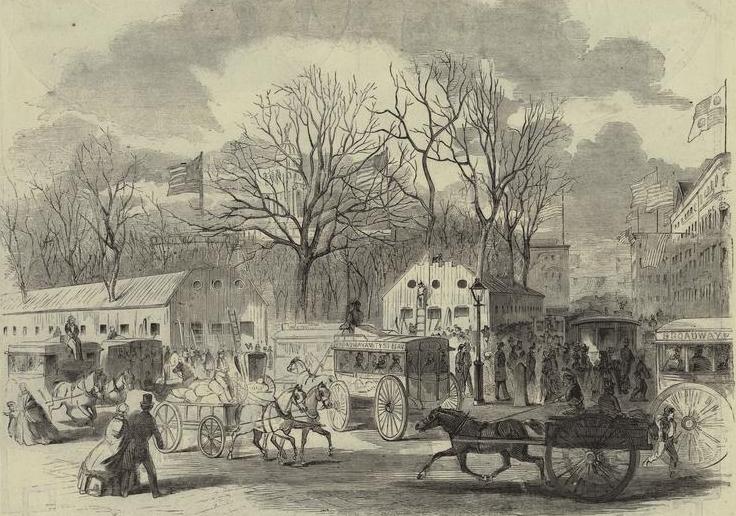
Alfred datelined his letter from New York City on 20 September 1861 two days after his arrival. He shares the news with his mother that they were ordered to encamp on the battery overlooking New York Harbor which was still occupied by members of Ellsworth’s New York Fire Zouaves (11th New York Infantry) despite their having been ordered to Fortress Monroe. A newspaper article described the situation as follows:

“The New York Fire Zouaves—the “Pet Lambs”—have again been distinguishing themselves. On Thursday last they were assembled on the battery, New York, where they indulged in a series of free fights, at one time assuming the proportions of a riot. They also tossed in blankets a number of inoffensive laborers, and seizing a reporter of the Times tossed him in a tent cloth, and otherwise maltreated him, and finally robbed him of fifteen dollars. When appealed to Col. Lozier to behave in a more orderly, and to go without further difficulty to Fort Monroe, but twenty-five out of three hundred were willing to go—the others, on various pretenses, utterly refusing to leave New York. It is high time that these cowardly miscreants—the terror of all peaceable and unarmed citizens, the disgrace to the profession of arms, and the butt for the ridicule of the fie—were treated as mutineers or deserters; reduced to order or shot. It is idle to waste more time or more words on them.”The Daily Gazette and Republican, Trenton, NJ 23 September 1861

Alfred wrote the letter to his mother, Rumina (Gates) Merrill (1818-1895). The envelope was addressed to Rumina’s second husband, Philander Merrill (1795-1883) of Ketchumville, Tioga county, New York. Rumina’s first husband, Cyrus Edwards, died prior to the 1850 US Census at which time the widow Rumina was enumerated with her two boys, Alfred and Cyrus, in Maine, Broome county, New York.

To read other letters I have transcribed and posted on Spared & Shared that were written by members of the 50th New York Engineers, see:

Cornelius Van Huysen, Co. A, 50th New York Engineers (1 Letter)
Abner G. Hill, Co. B, 50th New York Engineers (1 Letter)
William H. Lunn, Co. E, 50th New York Engineers (1 Letter)
Halsey Amos Rhodes, Co. H, 50th New York Engineers (1 Letter)

Temporary Barracks erected in Battery Park in NYC in 1861

Transcription

Addressed to Philander Merrills, Ketchumville, Tioga county, New York

Camp Lesley
New York City
[Friday,] September 20th [1861]

Dear Mother,

We started from Elmira [on Tuesday,] the 17th at four o’clock p.m. in a train of 24 cars, 17 with soldiers. We got [here] next day [Wednesday] at 8 a.m. We are camped on the Bay. Last night we slept on our arms. We expected to be attacked by the New York Fire Zouaves. There was some 300 or 400 on the ground when we came here and they were not going to leave. They had been ordered to leave in the morning at six o’clock but swore they would not, but the Mayor sent the police force in the afternoon and they left. We expected they would return but they did not.

We leave here today at two o’clock. Where to I don’t know. We are all well. I have [seen] more here than I ever seen in my life. Ships and boats are moving all the time. I counted two hundred and sixty-three in view. I am laying flat on my belly and nothing to write on but a board and can’t write good. I will let you know where I be in a day or two.

— A. L. Edwards

I will direct my letters after this in this style, — Alfred L. Edwards, Ketchumville