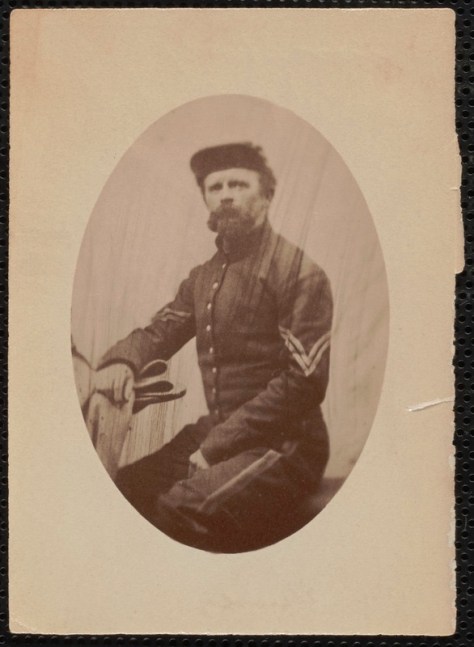
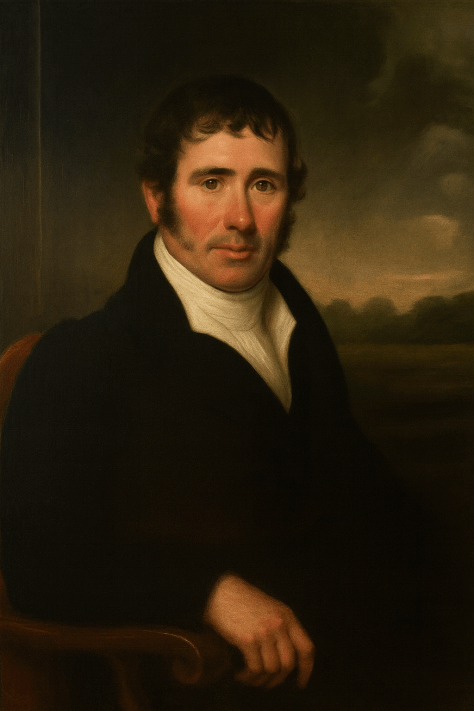
I could not find an image of Charles but here is one of Edward Hall who served in Co. A, 23rd Massachusetts Infantry (Photo Sleuth)
The following letter was written by Charles L. Thompson (1838-1890), a carpenter from New Bedford, Massachusetts, who volunteered to serve in Co. D, 23rd Massachusetts Infantry. He mustered in as a private on 28 September 1861 and rose in rank to sergeant, quartermaster sergeant, and finally to 2nd Lieutenant, though he was never mustered in as an officer before leaving the service in 1865.
Charles was the son of Amasa T. Thompson (1806-1865) and Betsy Maria Eaton (1811-1851). In 1850, the Thompson family was enumerated as farmers in Plymouth county, Massachusetts.
T R A N S C R I P T I O N
Addressed to Miss Sarah E. Morton, New Bedford, Mass., No, 35 Cove Street
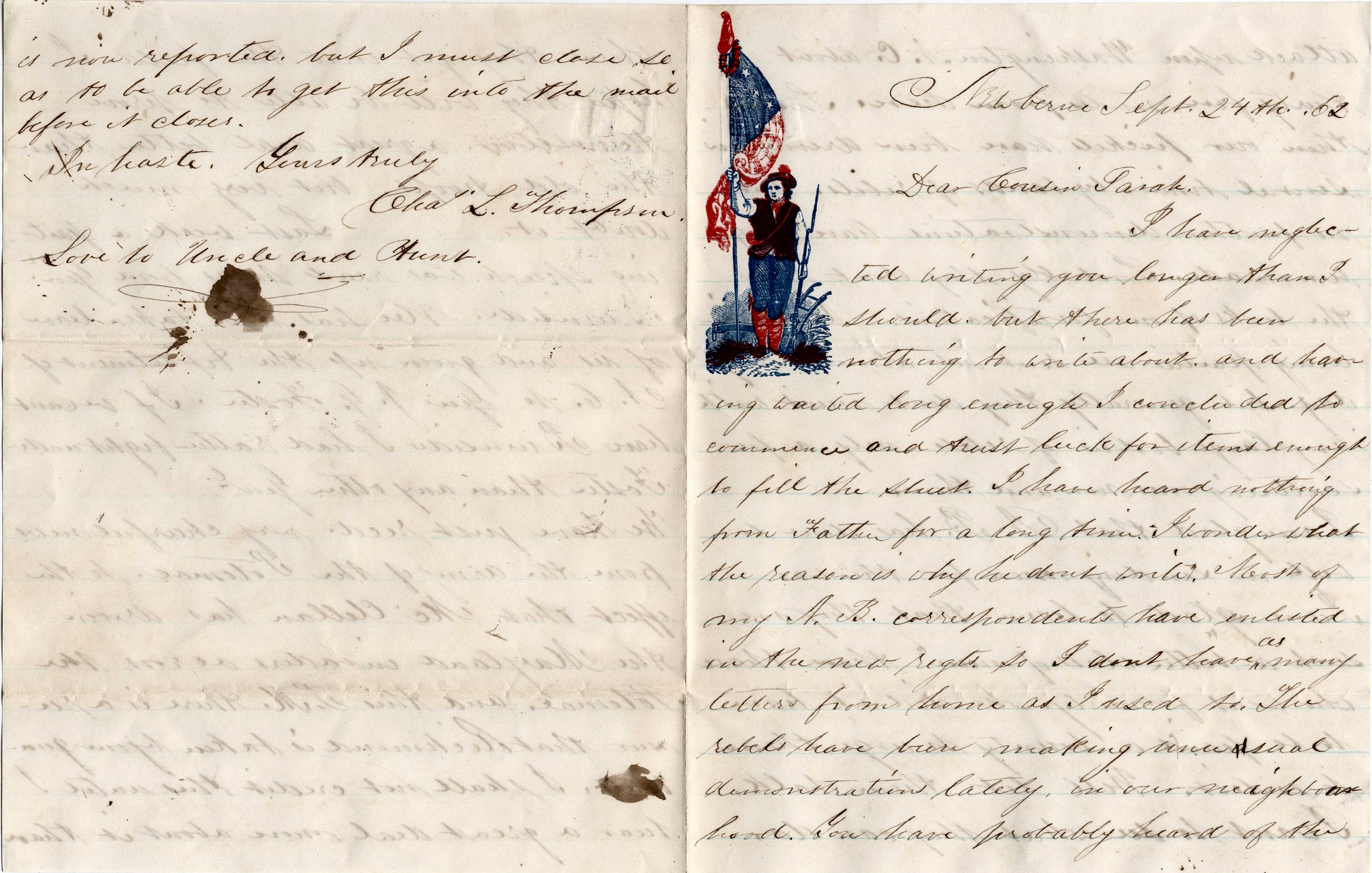
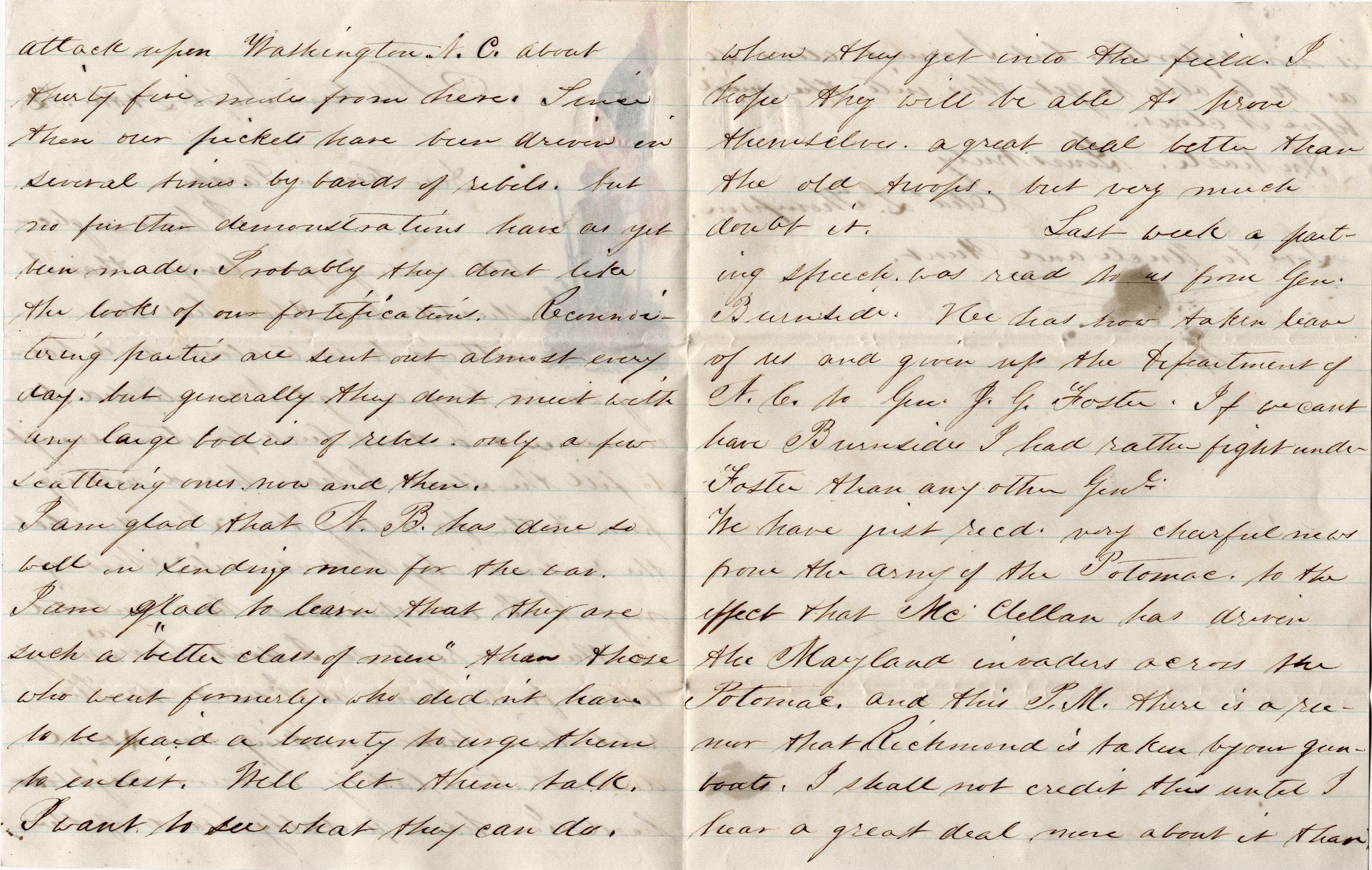
Newbern [North Carolina] September 24th 1862
Dear Cousin Sarah,
I have neglected writing you longer than I should but there has been nothing to write about and having waited long enough, I concluded to commence and trust luck for items enough to fill the sheet. I have heard nothing from Father for a long time. I wonder what the reason is why he don’t write? Most of my New Bedford [N. B.] correspondents have enlisted in the new regiments so I don’t have as many letters from home as I used to.
The rebels have been making unusual demonstrations lately in our neighborhood. You have probably heard of the attack upon Washington, N. C. about 35 miles from here. Since then our pickets have been driven in several times by bands of rebels, but no further demonstrations have as yet been made. Probably they don’t like the looks of our fortifications. Reconnoitering parties are sent out almost every day but generally they don’t meet with any large bodies of rebels—only a few scattering ones now and then.
I am glad that N. B. has done so well in sending men for the war. I am glad to learn that they are such a “better class of men” than those who went formerly who didn’t have to be paid a bounty to urge them to enlist. Well let them talk. I want to see what they can do when they get into the field. I hope they will be able to prove themselves a great deal better than the old troops, but very much doubt it.
Last week a parting speech was read to us from Gen. Burnside. He has now taken leave of us and given up the Department of North Carolina to Gen. J. G. Foster. If we can’t have Burnside, I had rather fight under Foster than any other general.
We have just received very cheerful news from the Army of the Potomac to the effect that McClellan has driven the Maryland invaders across the Potomac and this p.m. there is a rumor that Richmond is taken by our gunboats. I shall not credit this until I hear a great deal more about it than is now reported. But I must close so as to be able to get this into the mail before it closes.
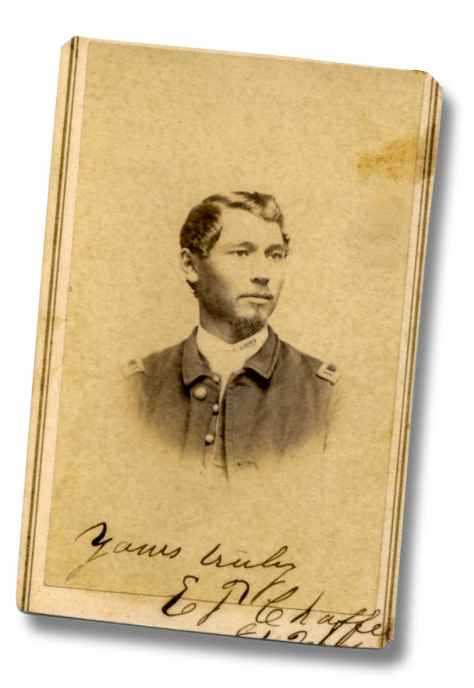
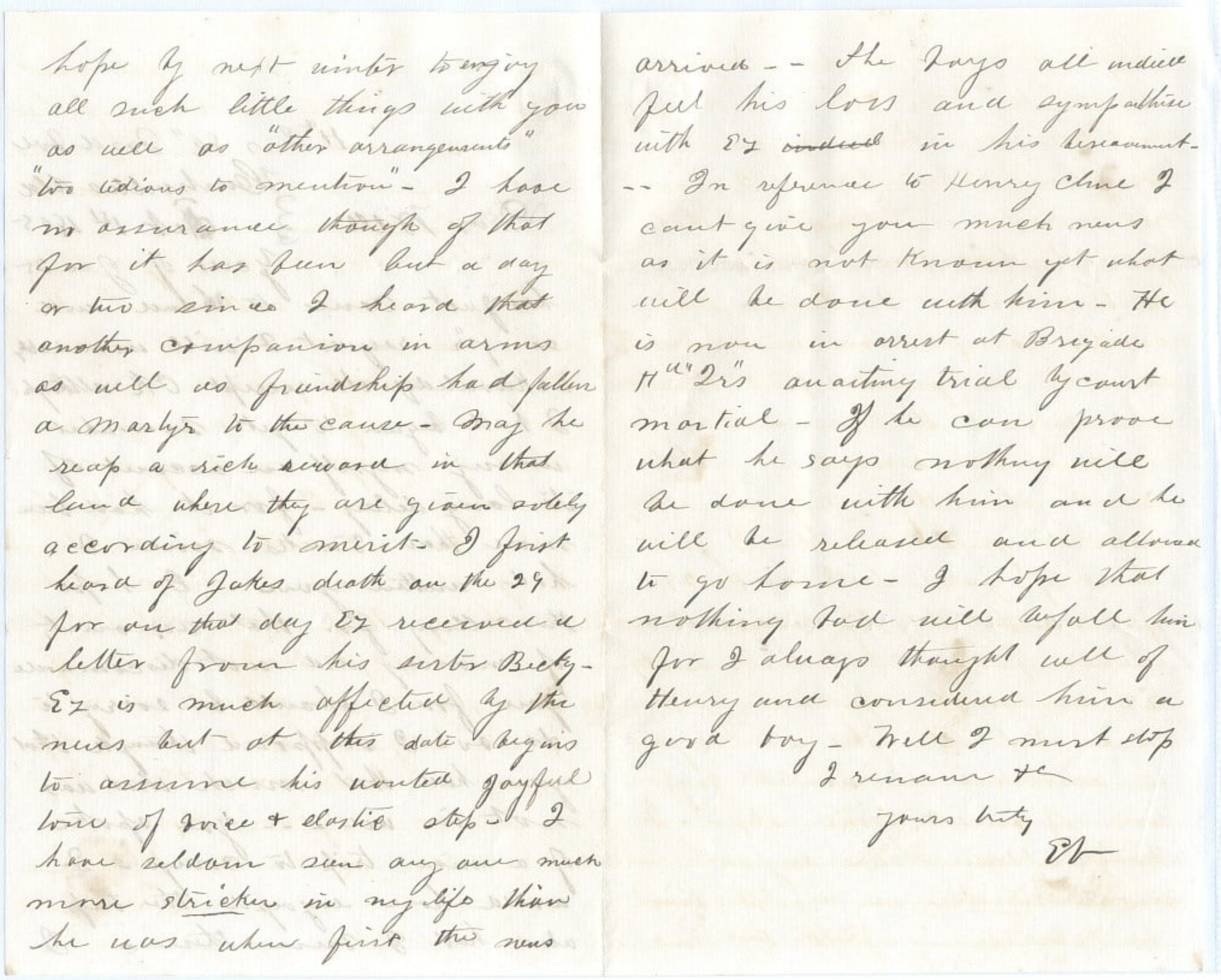
The following letter was written by Ebenezer (“Eb”) Thayer Chaffee (1841-1922), the son of Rev. William Chaffee (b. 1801) and Abigail Thayer (b. 1806), who were residents of Hartford City, Blackford county, Indiana, at the time of the 1860 Census. He wrote the letter to his older brother, William Carey Chaffee (1835-1927).
Eb enlisted on 25 August 1862 as a private and was mustered into Co. K, 84th Indiana Infantry. He mustered out on 14 June 1865 at Nashville, Tennessee. His records indicate that he was wounded (date and place not stated) by a gunshot wound in his right arm. He received a commission as a 1st Lieutenant on 29 September 1864 (1st Lieut. & Adjutant) and was transferred to F&S at that time. After the war he lived in Hartford City, Indiana, where he was employed as a hardware merchant.
The young soldier mentioned as being in trouble in the last paragraph of Chaffee’s letter was Henry Cline of the 84th Indiana. Henry was from Hartford City and was mustered out on 14 June 1865 at Nashville, Tennessee.
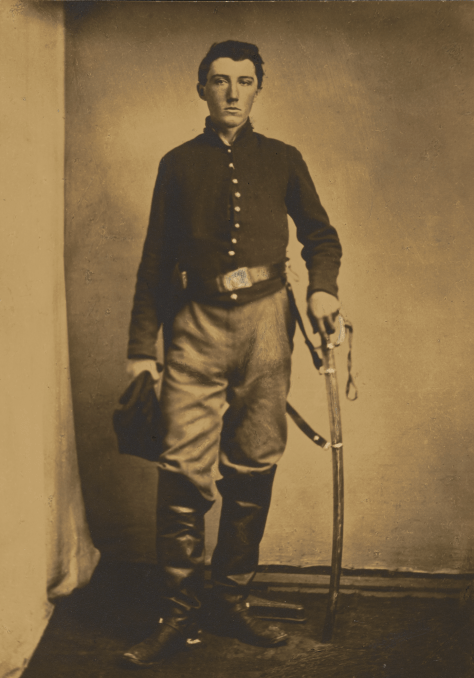
This letter and the cdv of Chaffee are from the collection of Dale Niesen who made them available for publication on Spared & Shared by express consent.
T R A N S C R I P T I O N
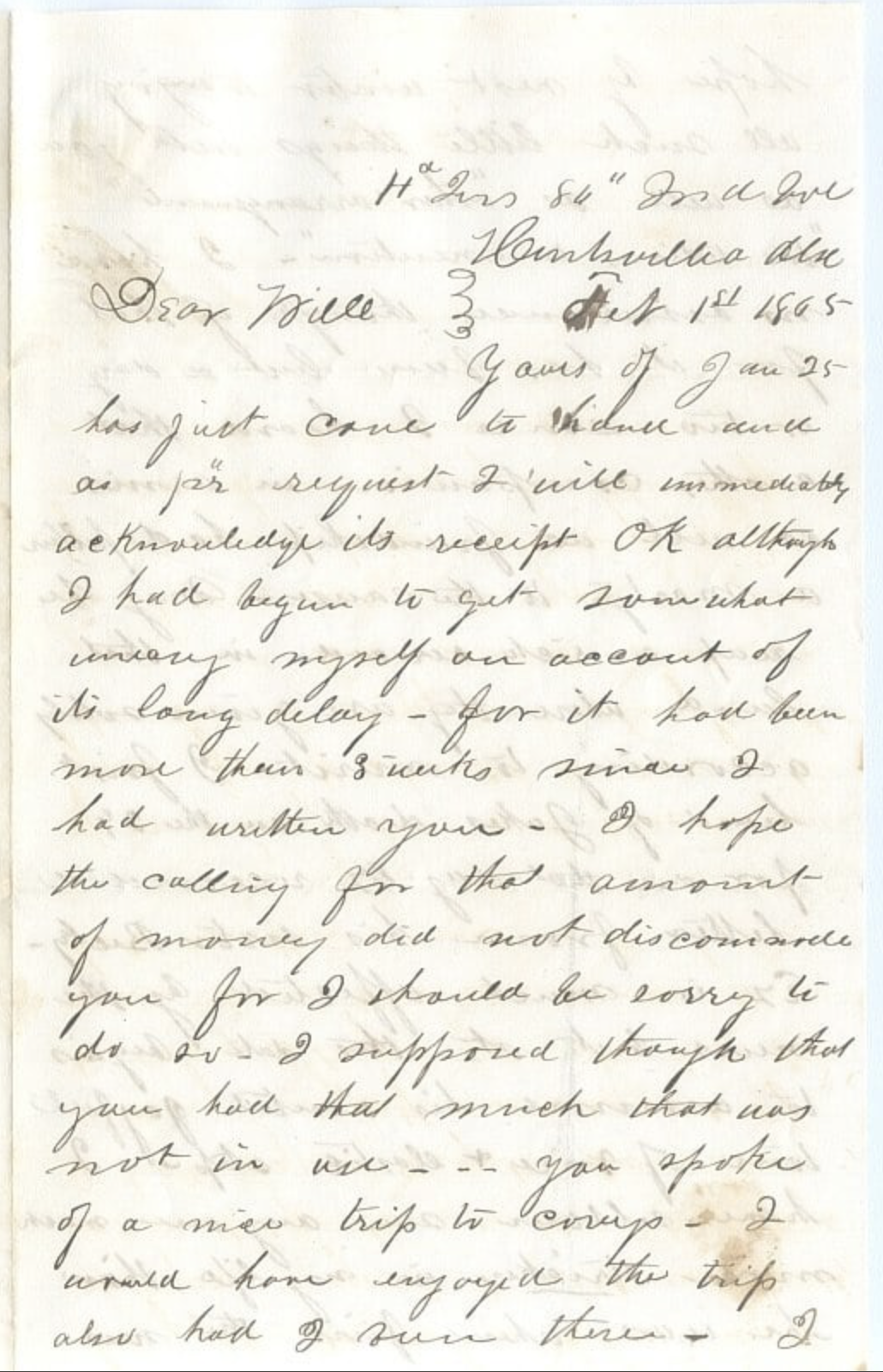
Headquarters 84th Indiana Volunteers Huntsville, Alabama February 1st 1865
Dear Will,
Yours of January 25th has just come to hand and as per request, I will immediately acknowledge its receipt OK although I had begun to get somewhat uneasy myself on account of its long delay, for it had been more than three weeks since I had written you. I hope the calling for that money did not discommode you for I should be sorry to do so. I supposed though that you had that much that was not in use.
You spoke of a nice trip to Corup [?]. I would have enjoyed the trip also had a been there. I hope by next winter to enjoy all such little things with you as well as “other arrangements too tedious to mention.” I have no assurance though of that for it has been but a day or two since I heard that another companion in arms as well as friendship had fallen a martyr to the cause. May he reap a rich reward in that land where they are given solely according to merit. I first heard of Jake’s death on the 29th for on that day Ez received a letter from his sister Becky. Ez is much affected by the news but at this date begins to assume his wonted joyful tone of voice & elastic step. I have seldom seen anyone much more stricken in my life than he was when first the news arrived. The boys all indeed feel his loss and sympathize with Ez in his bereavement. 1
In reference to Henry Cline, I can’t give you much news as it is not known yet what will be done with him. He is now in arrest at Brigade Headquarters awaiting trial by court martial. If he can prove what he says, nothing will be done with him and he will be released and allowed to go home. I hope that nothing bad will befall him for I always thought well of Henry and considered him a good boy. Well, I must stop. I remain &c., yours truly, — Eb
1 It was Jacob (“Jake”) Stahl whose death was mourned as another “martyr to the cause.” Jake was a sergeant in Co. K, 84th Indiana Infantry, and he died on 22 January 1865 from wounds he received in the fighting at Rocky Face Ridge on 9 May 1864. He was the son of Abraham Stahl (1809-1889) and Elisabeth Waltz ( 1808-1875) of Hartford City, Blackford county, Indiana. Jake’s older brother, Ezra (“Ez”) Mann Stahl was also in the 84th Indiana.
I could not find an image of Martin but here is one of Stephen A. Forbes who also enlisted in the 7th Illinois Cavalry. Martin and Stephen were approximately the same age. (Illinois Library Digital Collections)
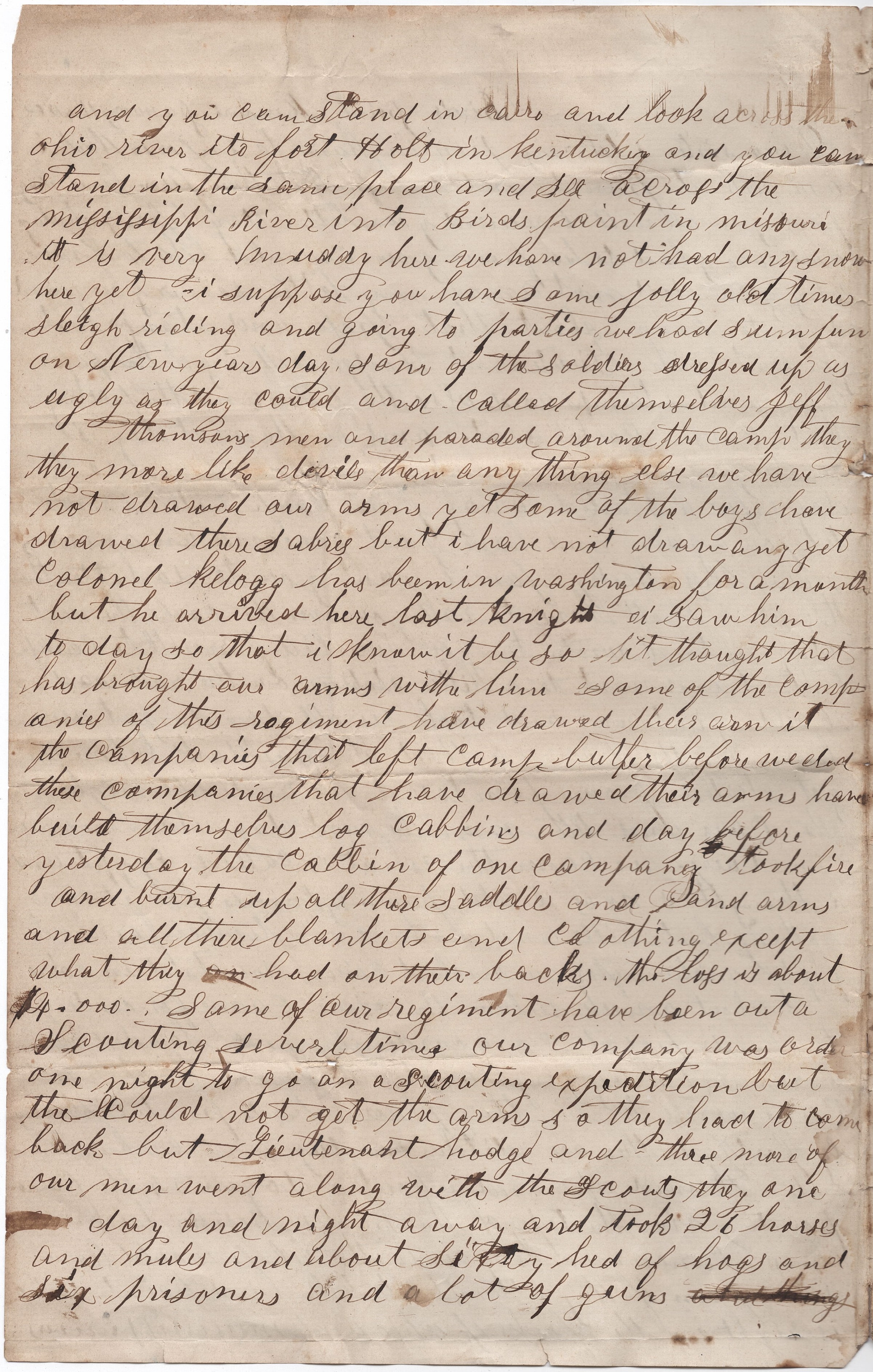
The following letter was written by Martin L. Wallick of Orange, Knox county, Illinois, who enlisted in September 1861 to serve as a private in Co. D, 7th Illinois Cavalry. He reenlisted in March 1864 as a veteran but did not survive the war. He died of disease at Decatur, Alabama on 10 August 1865.
In the 1860 US Census, Martin was enumerated in his parent’s household in Knoxville, Knox county, Illinois. He was identified as a 16 year-old; born in Pennsylvania. His father was Joseph Wallick (1811-Aft1862). His older sister was Rebecca Jane Wallick (1842-1917).
T R A N S C R I P T I O N
Bird’s Point, Missouri January 4, 1862
Dear Sister,
I take my pen in hand to inform that I am well at present and I hope that these few lines may find you all well. I received your letter day before yesterday and was glad to hear from you. I would like to know why you did not answer my letter sooner. You wanted to know about that paper and stamps that you sent with Lieutenant Hodge. Well, I got the paper and stamps also, the letter and the [ ] that cousin Rachel sent, and so the next day I wrote you an answer but never received any so the day before I started away from Camp Butler, I wrote to you again and have just received an answer. Now Miss Becky Jane, I want you to do better than this or I shall have too rake you over the coals.
The next day after I wrote to you, we bid farewell to Camp Butler and went to a little station on the railroad called Jimtown. We rode all night in the cars and till noon the next day when we arrived in Cairo. We came to what is called and I thought in was in old Pennsylvania for it was nothing but hills and hollows and timber for about fifty miles before we reached Cairo. We stayed in Cairo about a week when the order came for us to go to Bird Point so accordingly we loaded our horses and baggage onto a steamboat and came across to this place.
Birds Point is strongly fortified. There are ditches dug and embankments throwed up and about a dozen 24-pound cannons pointing over the top of the banks besides twelve brass cannons so you see the rebels would have some fun if they attempted to take Bird’s Point.
Cairo is right in the forks of Ohio and Mississippi rivers and you can stand in Cairo and look across the Ohio river to Fort Holt in Kentucky and you can stand in the same place and see across the Mississippi river into Bird Point in Missouri. It is very muddy here. We have not had any snow here yet. I suppose you have some jolly old times sleigh riding and going to parties. We had some fun on New Years day. Some of the soldiers dressed up as ugly as they could and called themselves Jeff Thompson‘s men and paraded around the camp. They were more like devils than anything else.
We have not drawed our arms yet. Some of the boys have drawed their sabers but I have not drawn any yet. Colonel [William Pitt] Kellogg has been in Washington for a month but he arrived here last night. I saw him today so that I know it be so. It’s thought the [he] has brought our arms with him. Some of the companies of this regiment that have drawed their arms have built themselves log cabins and day before yesterday the cabin of one company took fire and burnt up all their saddles and arms and all their blankets and clothing except what they had on their backs. The loss is about $4,000.
Some of our regiment have been out a scouting several times. Our company was ordered one night to go on a scouting expedition but they could not get the arms so they had to come back. But Lieutenant Hodge and three more of our men went along with the scouts. They [were] one day and night away and took 26 horses and mules and about sixty head of hogs and six prisoners and a lot of guns. There [was] no one hurt except that Lieutenant Hodge got kicked on the leg by a horse but is getting well fast.
The paymaster is in Cairo and he will commence paying the soldiers at this place on next Monday. I guess we will get our pay in about a week and then I will send you a letter about once a week. You said something about me sending you some money. Well, I will try to send you some. Now Jane, I want you to go to school. Tell Jim I want him to go too. Let [me] know when you write if you heard from any of our friends. I have not received any from anybody but you since I have been in camp. If you write to Pap, tell him to write me. Tell him how to direct his letter. Now Jane, you told me in one of your letters that Aunt did not want me to pay Woolsey for that horse but he has got the bonds for to show. He said that he took the bonds to Aunt but said she would not accept them. Now if aunt don’t want me to pay, write Wright Woolsey for that horse. She must get Levi to write to me that they don’t want to do so and they must tell whether Wright Woolsey did offer them bonds to aunt or not…
Our captain [Wright Woolsey] is sick about all the time. He is a going to resign and go home and we are a going to have Lieutenant Hodge for our captain and I am mighty glad of it, you had better believe.
Jane, I want you to excuse this poor writing for it is a pretty cold day and we have no fire in our tent and my hands are so numb that I can hardly write at all. Jane, I have not been inside of a house since we got to Camp Butler. Tell Jake I will give him a dollar for that valise if he will give you that chest. Nothing more at present. So goodbye. From Martin L. Wallick
Write soon and tell me all the news. Direct as you did box, only send to Birds Point, Missouri
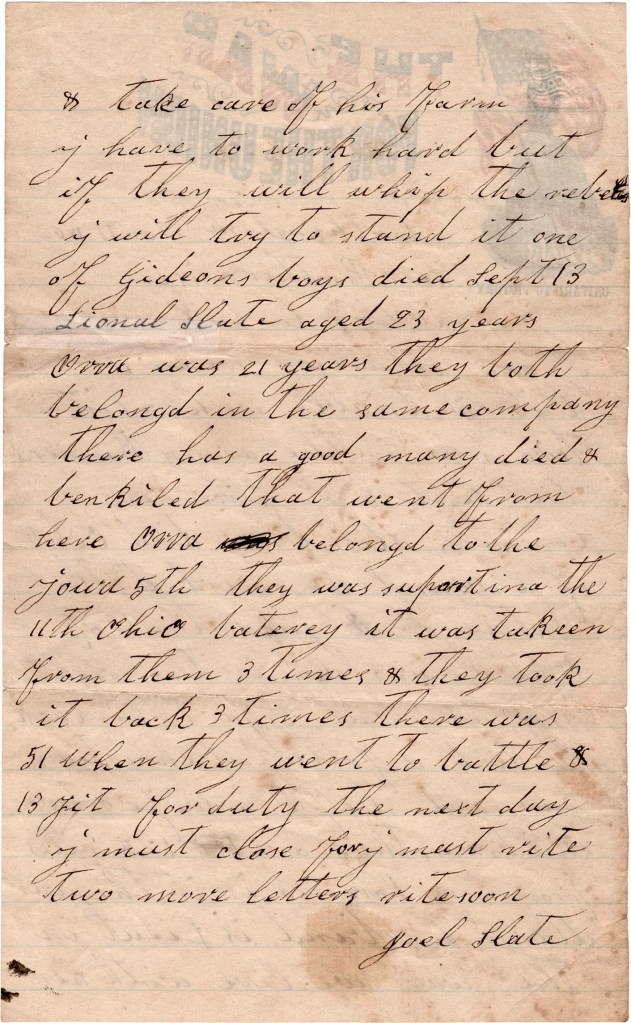
The following letter was written by Joel Slate (1800-1874). He was married to Mary Hale (1803-1874) in 1822 at Bernardson, Massachusetts. In 1860, they were enumerated in South English, Keokuk county, Iowa, where he farmed.
I could not find an image of Orra Slate but here is a great cdv of William T. Crozier of Co. K, 5th Iowa Infantry. (Iowa Civil War Images)
Joel’s letter conveys the sad intelligence of two son’s deaths in the service. The eldest son, Israel Bernard Slate (1827-1862) was a private in the 2nd Iowa Light Artillery. He died of disease on 18 September 1862 at Corinth, Mississippi. He was married to Mary E. Voorhies (b. 1830), had two young children named William and Amelia, and was enumerated in Adel, Dallas county, Iowa as a farmer in the 1860 US Census.
The other son was Orra Slate (1841-1862) who joined Co. F, 5th Iowa Infantry in July 1862. He was wounded at Iuka on 19 September 1862 and died on 5 October at Jackson, Tennessee.
Also mentioned is another son named Lorenzo D. Slate (1835-1923) who served in Co. H, 33rd Iowa Infantry, and a son-in-law, William H. Gore (1832-1906) who was a 2nd Lieutenant (later Captain) in Co. H, 33rd Iowa.
Joel also conveys the news that a nephew, son of of his brother Gideon Hurlbert Slate (1792-Aft1850), Lionel L. Slate (1837-1862) also died on 13 September 1862 at Jefferson Barracks in St. Louis. He was also on Co. F, 5th Iowa Infantry. Lionel’s brother Charley would also die some two weeks after this letter was written.
T R A N S C R I P T I O N
South English [Keokuk county, Iowa] November 11th 1862
Dear Brother & Sister,
I sit down to inform you of our situation. We are well but in trouble. We have lost two sons in the army. Bernard died September 15th of fever near Corinth, Mississippi. Orra died October 5th of a wound he received at the Battle of Iuka the 19th of September. He was shot in the right lung. The ball lodged in his back. He died a faithful Christian. Bernard left a wife & two children. They are 125 miles from here.
Lorenzo is in the war. Mary’s husband [William H. Gore] is Lieutenant in the war. We live here and take care of his farm. I have to work hard but if they will whip the rebels, I will try to stand it. One of Gideon’s boys died September 13th—Lionel Slate, aged 23 years.
Orra was 21 years. They both belonged in the same company. There has a good many died and been killed that went from here. Orra belonged to the Iowa 5th. They was supporting the 11th Ohio Battery. It was taken from them three times and they took it back three times. There was 51 when they went to battle & 13 fit for duty the next day. 1
I must close for I must write two more letters. Write soon. — Joel Slate
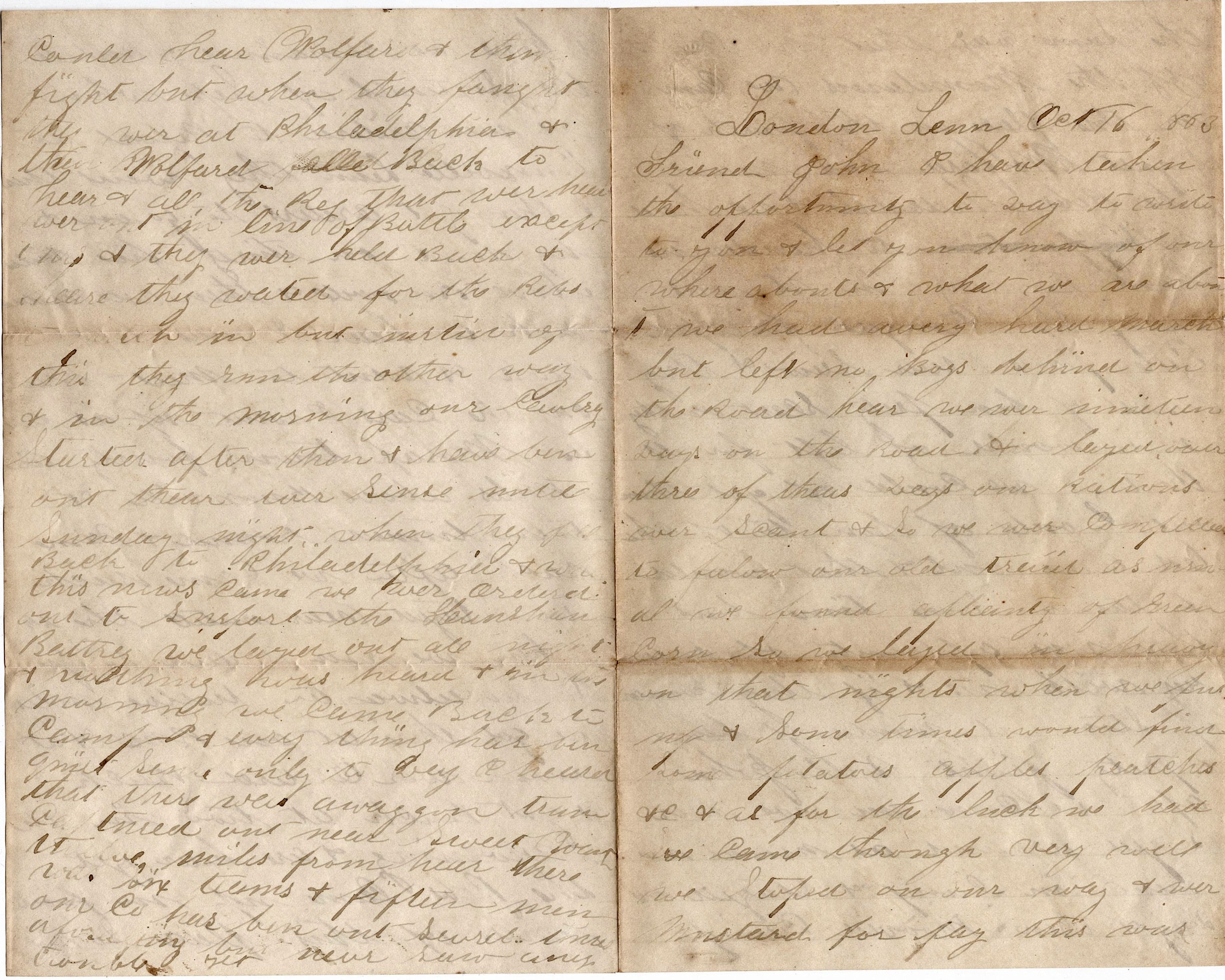
The following letter was written by Johnson O. Foote (1844-1933), the son of Orley Newell Foot (1818-1888) and Fanny Bowker (1822-1904) of Defiance county, Ohio. Johnson helped to raise and enlisted in Co. F, 111th Ohio Vol. Infantry (OVI) at the age of 18 as a drummer on 25 August 1862. He was promoted to corporal in January 1864, to commissary sergeant in May 1864, given as commission as 2nd Lieutenant in May 1865, and mustered out of the regiment in late June 1865.
Foote wrote the letter to Corporal John W. Cleland (1843-18xx) who enlisted in the same company in September 1862 at age 19. He was promoted to 1st Sergeant in March 1863. In April 1864, Sgt. Cleland was promoted to 2nd Lieutenant and in May 1865 to 1st Lieutenant. He was mustered out of the service with his company in June 1865 at Salisbury, North Carolina. Cleland may have been on detached duty or in the hospital at Knoxville at the time this letter was penned.
The Daily Argus-Leader, Sioux Falls, S. D., 17 April 1933
T R A N S C R I P T I O N
Addressed to John W. Cleland, Co. F, 111th OVI, Knoxville, Tenn. To follow the regiment.
Loudon, Tennessee October 16, 1863
Friend John,
I have taken the opportunity today to write to you and let you know of our whereabouts and what we are about. We had a very hard march but left no boys behind on the road here. We were 19 days on the road and laid over three of these days. Our rations were scant and so we were compelled to follow our old train. As usual as we found plenty of green corn so we laid in heavy on that nights when we put up and sometimes would find some potatoes, apples, peaches, &c., and as for the luck we had, came through very well.
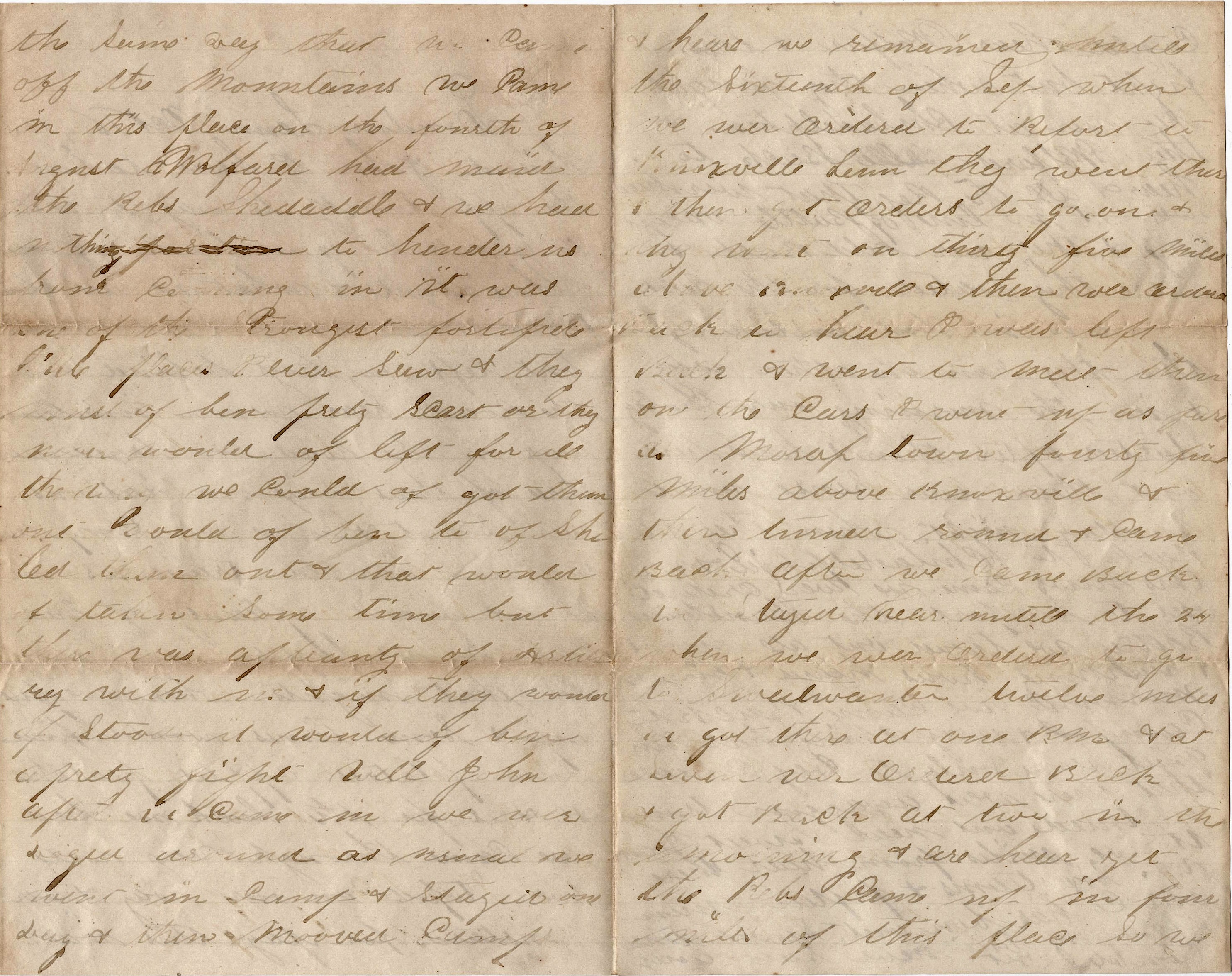
We stopped on our way and were mustered for pay. This was the same way that we came off the mountains. We came in this place on 4th of August. [Col. Frank] Wolford [and his cavalry brigade] had made the rebs skedaddle and we had nothing to hinder us from coming in. It was one of the roughest fortified places I ever saw and they must of been pretty scared or they never would of left for all the [?] we could of got them out. Could have been to of shelled them out and that would of taken some time but there was plenty of artillery with us and if they would of stood, it would of been a pretty fight.
Well, John, after we came in, we were dragged around as usual. We went in camp and stayed one day and then moved camp and here we remained until the 16th of September when we were ordered to report to Knoxville, Tennessee. They went there and then got orders to go on and they went on 35 miles above Knoxville and then were ordered back to here.
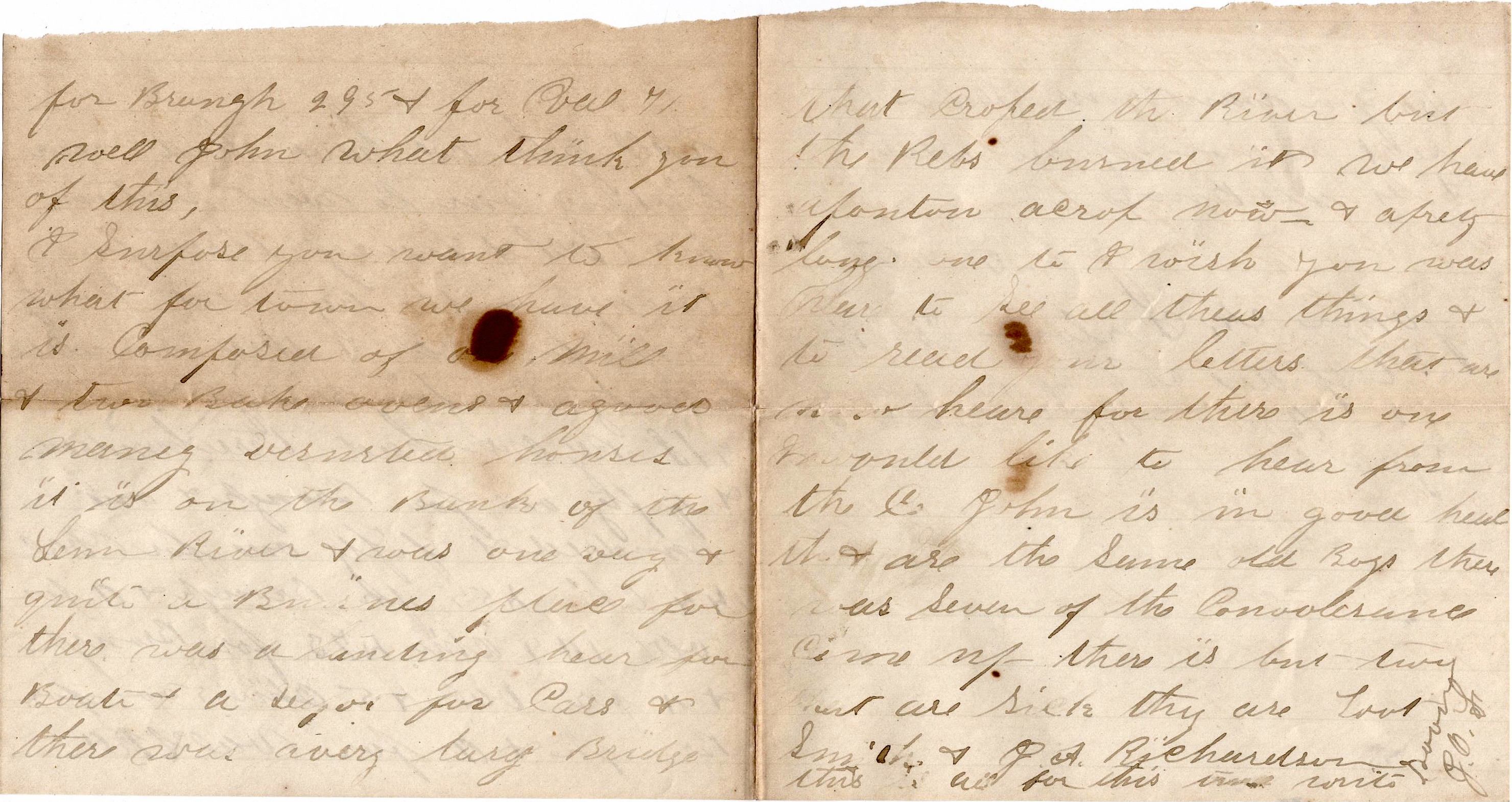
I was left back and went to meet them on the cars and went up as far as Morristown, 45 miles above Knoxville, and then turned round and came back. After we came back, we stayed here until the 24th when we were ordered to go to Sweetwater 12 miles. We got there at 1 PM and at 7 were ordered back and got back at two in the morning and are here yet.
The rebs came up [with]in 4 miles of this place so we could hear Wolford and them fight but when they fought, they were at Philadelphia and then Wolford fell back to here and all the regiments that were here were out in line of battle except ours and they were held back and here they waited for the rebs to march in but instead of this, they run the other way. And in the morning our cavalry started after them and have been out there ever since until Sunday night when they fell back to Philadelphia. And when this news came, we were ordered out to support the Henshaw Battery.
We laid out all night and nothing was heard and in the morning we came back to camp and everything has been quiet since—only today I heard there was a wagon train captured out near Sweetwater 12 miles from here. There was six teams and 15 men. Our Co. has been out several times a foraging but never saw any trouble yet.
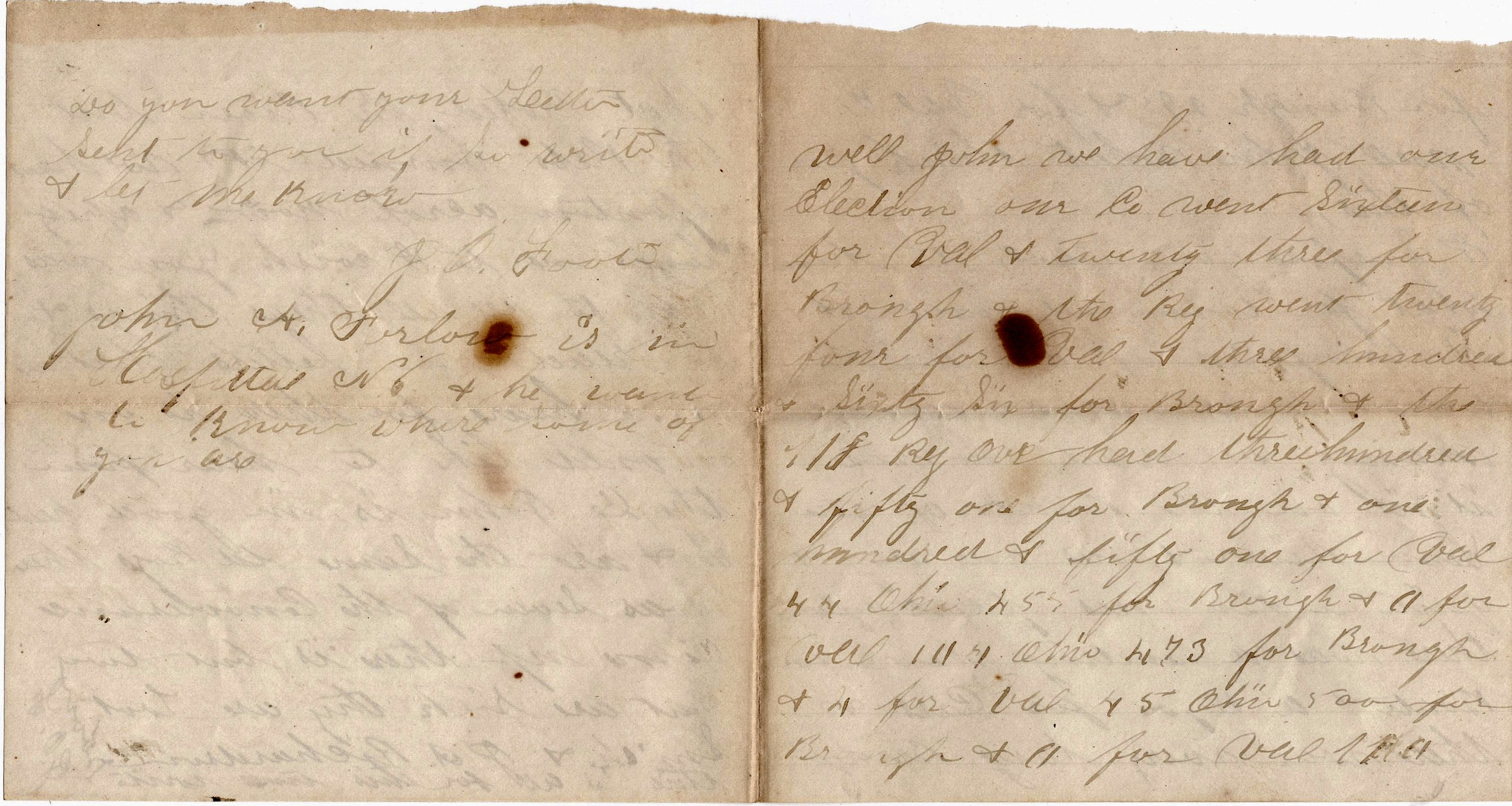
Well John, we have had our election. Our Co. went 16 for Vallandigham and 23 for Brough and the Reg. went 24 for Val. and 366 for Brough and the 118th Reg. OVI had 351 for Brough and 151 for Val. [The] 44th Ohio 455 for Brough and 11 for Val. [The] 104th Ohio 473 for Brough and 4 for Val. [The] 45th Ohio 500 for Brough and 11 for Val. Well, John, what think you of this?
Building the pontoon bridge at Loudon after Rebels burnt the bridge.
I suppose you want to know what for [a] town we have. It is composed of one mill and two bake ovens and a good many deserted houses. It is on the bank of the Tennessee river and was one day quite a business place for there was a landing here for boats and a depot for cars, and there was a very large bridge that crossed the river but the Rebs burned it. We have a pontoon across now and a pretty long one too. I wish you was here to see all these things and to read your letters that are now here for there is one I would like to hear from. The company, John, is in good health and are the same old boys. There was seven of the convalescents came up. There is but two that are sick. They are Loot Smith and J[ames] A. Richardson. Do you want your letters sent to you? If so, write and let me know. — J. O. Foote
John A. Forlow is in Hospital N6 & he wants to know where some of you are.
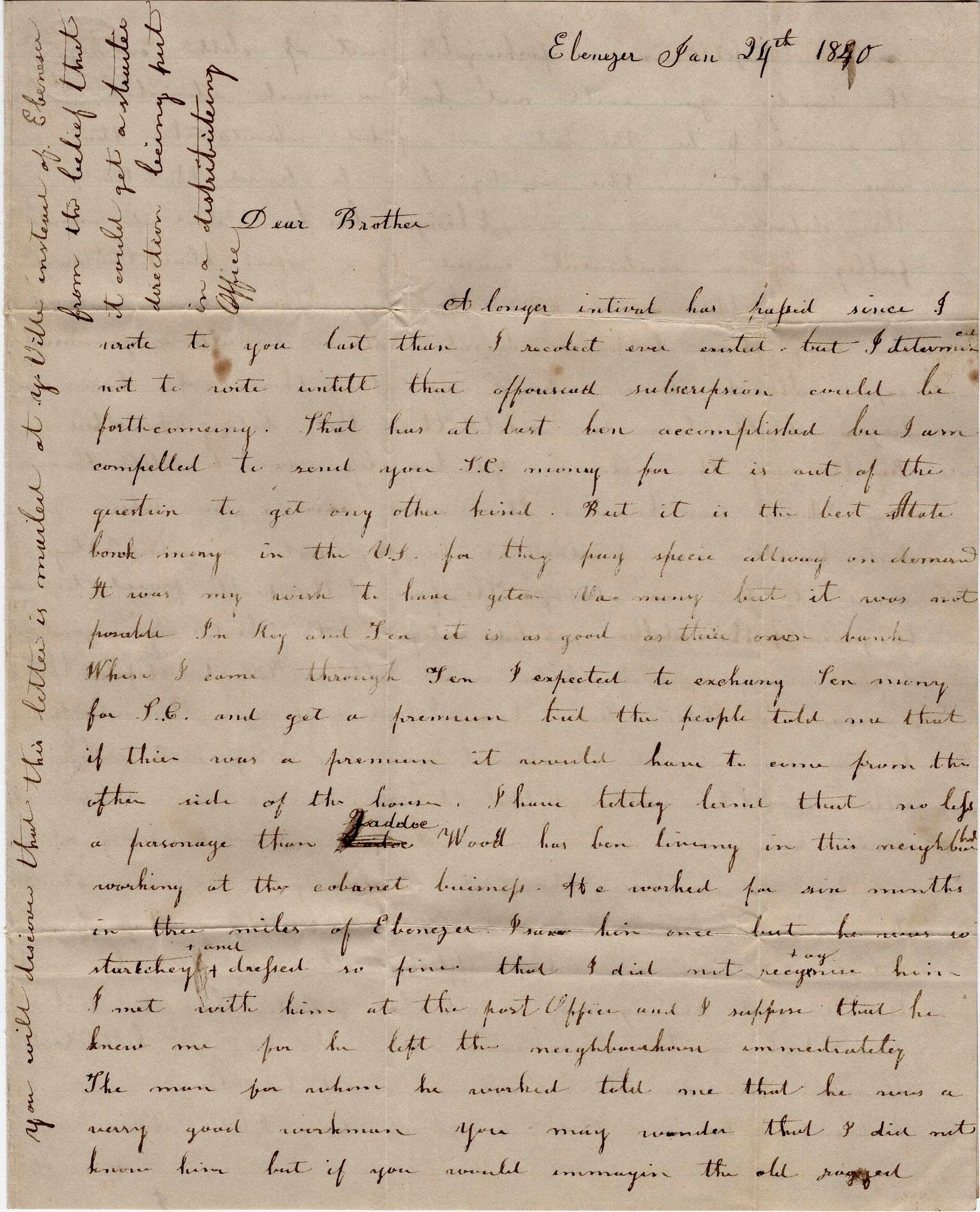
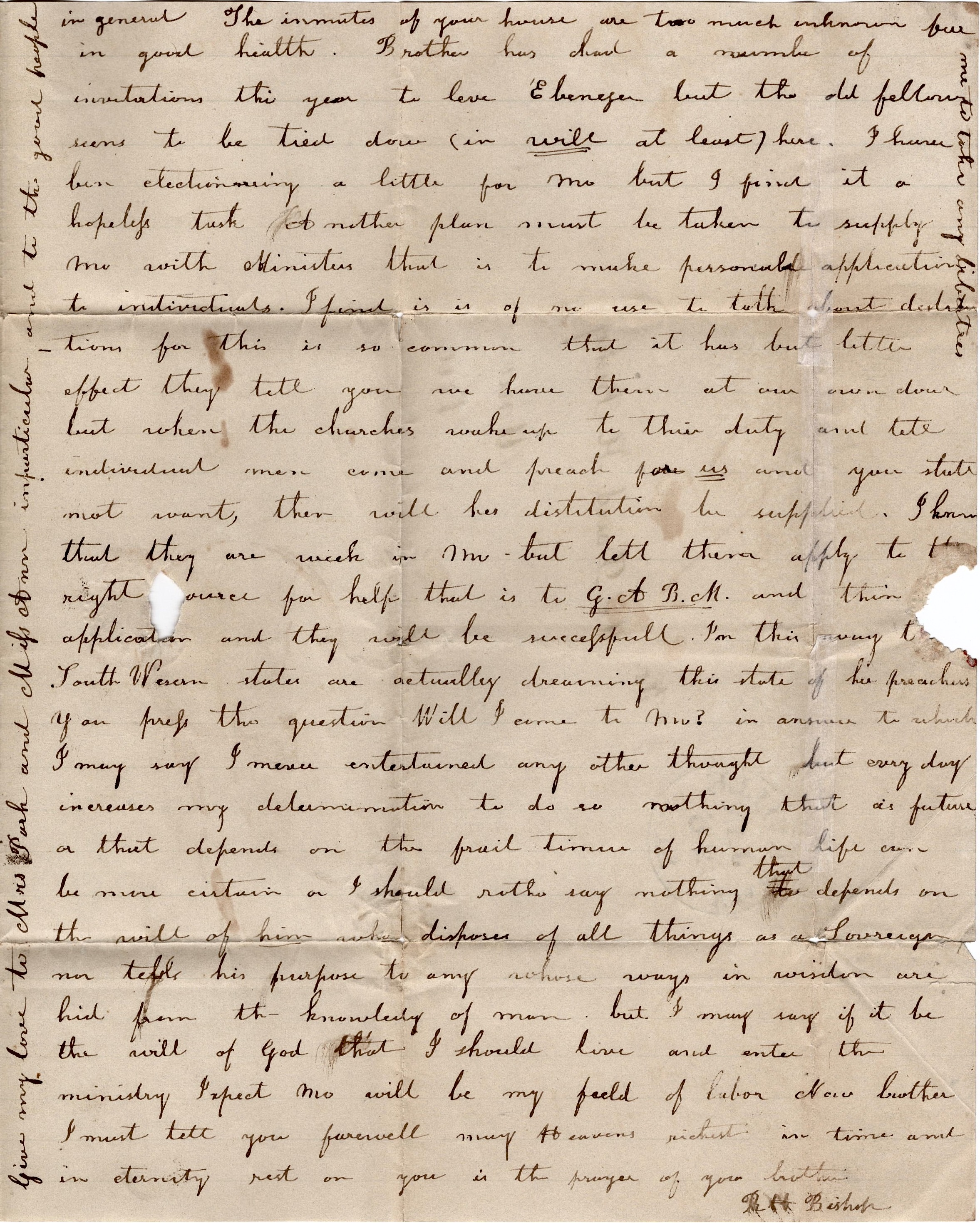
The following letter was written in January 1840 by Robert Henry Bishop (1815-1843), the son of James Bishop (1765-1823) and Mary Shields (17xx-1831) of Amherst Court House, Virginia. We learn from the letter that Robert has made the journey from Missouri to South Carolina by way of Tennessee and that he was visiting or living with a brother who resided in York District, South Carolina. The brother was Rev. Pierpont Edwards Bishop (1804-1859), an Old School Presbyterian who supplied the pulpit in Ebenezer from 1833 to 1846.
Robert was listed among the members of the senior class at South Carolina College (University of South Carolina) in 1843 but he apparently died while a student at the college in 1843. He was buried in the First Presbyterian Churchyard in Columbia. He was 28 years old.
He wrote the letter to his brother, David Harbison Bishop (1806-1891), who married first in 1834 at Union, Missouri, to Mary Ann Park (1818-1838) and second to Susan Bragg Stevens (1817-1841). Susan was a sister of Isaac Ingalls Stevens.
While major, large-scale slave revolts were rare in the United States, they evoked profound fear among white enslavers and the general public, as evidenced by this letter from South Carolina.
T R A N S C R I P T I O N
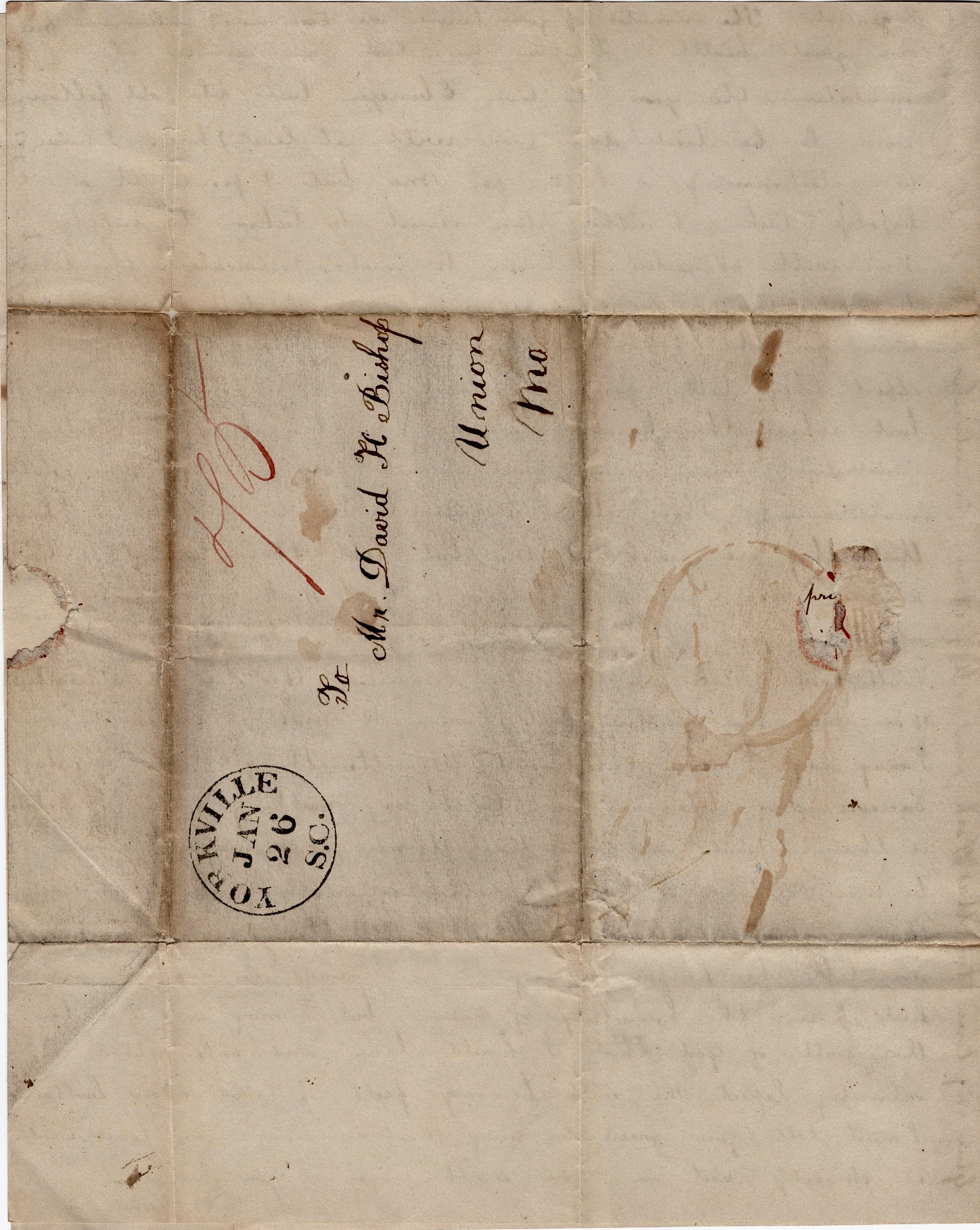
Addressed to Mr. David H. Bishop, Union, Missouri
Ebenezer [South Carolina] January 24, 1840
Dear Brother,
A longer interval has passed since I wrote to you last than I recollect ever existed but I determined not to write until that aforesaid subscription could be forthcoming. That has at last been accomplished but I am compelled to send you South Carolina money for it is out of the question to get any other kind. But it is the best State Bank money in the United States for they pay specie always on demand. It was my wish to have gotten Virginia money but it was not possible. In Kentucky and Tennessee it is as good as their own bank. When I came through Tennessee I expected to exchange Tennessee money for South Carolina and get a premium but the people told me that if there was a premium, it would have to come from the other side of the house.
I have lately learned that no less a personage than Addoc [?] Wood has been living in the neighborhood working at the caninet business. He worked for six months [with]in three miles of Ebenezer. I saw him once but he was so starchey [?] and dressed so fine that I did not recognize him. I met with him at the Post Office and I suppose that he knew me for he left the neighborhood immediately. The man for whom he worked told me that he was a very good workman. You may wonder that I did not know him but if you would imagine the old ragged sinner dressed in a fashionable suit of cloth cutting the dandy, you will not be so much astonished. He is said to be the best and fastest cabinetmaker that ever worked in this country. How he learned the trade this deponent sueth not.
Ebenezer has been stirred upwards fully by an excitement caused by a report that the negroes were on the eve of open hostility. The excitement was in everything, both in kind and in results as you might expect. I think it is a hard case that those who have no negroes should have to watch them that belong to others. By the way, the negroes in Y. D. [York District] have less reason to revolt than any I have ever known. I have never seen a place where the strict discipline and kindness so happily met or where they seemed to be more happy. The fears of the people proved to be groundless. The rebellion existed only in the heated imagination of some cruel fellows.
Tell Col. Chiles that I received a letter from home a few days since for which he has my warmest thanks. It was every way just such a letter as I like. Nothing that I have received since I left Union has given me more real pleasure in testimony of which I will embrace the first opportunity to write in return. From him I learned the continued ill health of Miss Ann in whose affliction there seems to be much to call forth the sympathy of all her friends. I had hoped to have heard of her improvement but the Colonel gave little room to expect so desirable a termination of her disease.
Brother and Sis and that stranger of whom I have spoke are in good health. Brother has had a number of invitations this year to leave Ebenezer but the old fellow seems to be tied down (in will at least) here. I have been electioneering a little for Missouri but I find it a hopeless task. Another plan must be taken to supply Missouri with ministers—that is, to make personal application to individuals. I find it is of no use to talk about destitution for this is so common that it has but little effect. They tell you we have them at our own door but when the churches wake up to their duty and tell individual men, come and preach for us, and you state mot want [?], then will her destitution be supplied. I know that they are weak in Missouri, but let them apply to the right source for help. That is, to go to G. A. B. M. and their application and they will be successful. In this way, the Southwestern States are actually draining this state of her preachers. You press the question, “Will I come to Missouri?” In answer to which I may say I never entertained any other thought but every day increases my determination to do so. Nothing that is future or that depends on the frail times of human life can be more certain or I should rather say nothing that depends on the will of Him who disposes of all things as a Sovereign not tells His purpose to any whose ways in wisdom are hid from the knowledge of man. But I may say if it be the will of God that I should live and enter the ministry, I expect Missouri will be my field of labor.
Now brother, I must tell you farewell. May Heavens richest in time and in eternity rest on you is the prayer of your brother, — R. H. Bishop
Give my love to Mrs. Park and Miss Ann in particular and to the good people in general in general. The inmates of your house are too much unknown for me to take any liberties. You will discover that this letter is mailed at Yorkville instead of Ebenezer from the belief that it could get a straiter direction being put in a distributing office.
I could not find an image of Ned but here is one of Albert Sturdy of the 18th Massachusetts Infantry. (Digital Commonwealth)
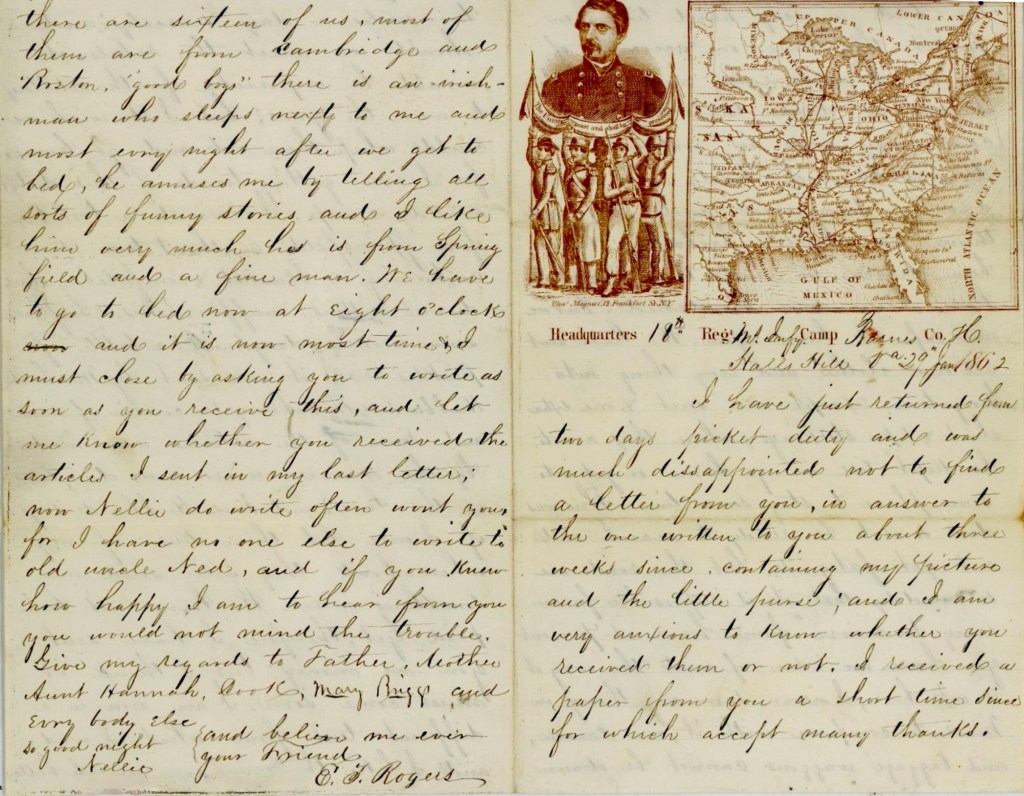
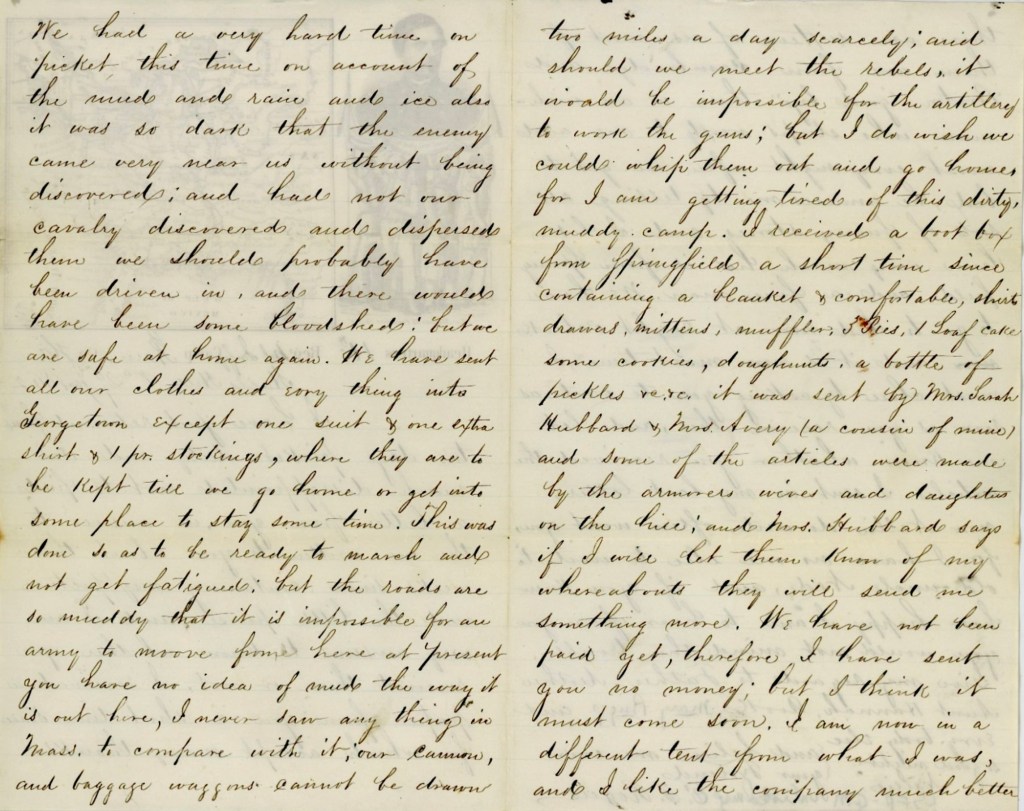
The following letter was written by Edwin (“Ned”) T. Rogers (1819-1868), a book keeper from Springfield, Massachusetts, who enlisted at the age of 42 in Co. H, 18th Massachusetts Infantry. He was the son of Sable and Rebecca Rogers. He was clerk of Company H and responsible, in part, for keeping the Descriptive Roll for the Company. He was mustered out of military service on Sept. 2, 1864 at the expiration of his three year enlistment. Following his military service Edwin returned to Springfield where he ran a meat market and provision store on “the Hill.” He died in Springfield on July 13, 1868 due to “Excessive Dissipation.”
T R A N S C R I P T I O N
Headquarters, 18th Regiment Massachusetts Infantry Camp Barnes, Co. H, Hall’s Hill, Va. January 29, 1862
I have just returned from two days picket duty and was much disappointed not to find a letter from you in answer to the one written to you about three weeks since, containing my picture and the little purse; and I am very anxious to know whether you received them or not. I received a paper from you a short time since for which accept many thanks.
We had a very hard time on picket this time on account of the mud and rain and ice. Also it was so dark that the enemy came very near us without being discovered and had not our cavalry discovered and dispersed them, we should probably have been driven in, and there would have been some bloodshed. But we are safe at home again.
We have sent all our clothes and everything into Georgetown except one suit & one extra shirt & 1 pr stockings where they are to be kept till we go home or get into some place to stay some time. This was done so as to be ready to march and not get fatigued. But the roads are so muddy that it is impossible for an army to move from here at present. You have no idea of mud the way it is out here. I never saw anything in Massachusetts to compare with it. Our cannon and baggage wagons cannot be drawn two miles a day scarcely. And should we meet the rebels, it would be impossible for the artillery to work the guns. But I do wish we could whip them out and go home for I am getting tired of this dirty, muddy camp.
I received a boot box from Springfield a short time since containing a blanket & comfortable shirts, drawers, mittens, muffler, 3 pies, 1 loaf cake, some cookies, doughnuts, a bottle of pickles, &c., &c. It was sent by Mrs. Sarah Hubbard & Mrs. Avery (a cousin of mine) and some of the articles were made by the armorer’s wives and daughters on the hill. And Mrs. Hubbard says if I will let them know of my whereabouts, they will send me something more.
We have not been paid yet, therefore, I have sent you no money; but I think it must come soon. I am now in a different tent from what I was, and I like the company much better. There are sixteen of us. Most of them are from Cambridge and Boston—“good boys.” There is an Irishman who sleeps next to me and most every night after we get to bed, he amuses me by telling all sorts of funny stories and I like him very much. He is from Springfield and a fine man. We have to go to bed now at eight o’clock and it is now most time & I must close by asking you to write as soon as you receive this and let me know whether you received the articles I sent in my last letter. Now Nellie, do write often won’t you, for I have no one else to write to old uncle Ned, and if you knew how happy I am to hear from you, you would not mind the trouble. Give my regards to Father, Mother, Aunt Hannah, Cook, Mary Briggs, and everybody else. So goodnight and believe me ever your Friend, — E. T. Rogers
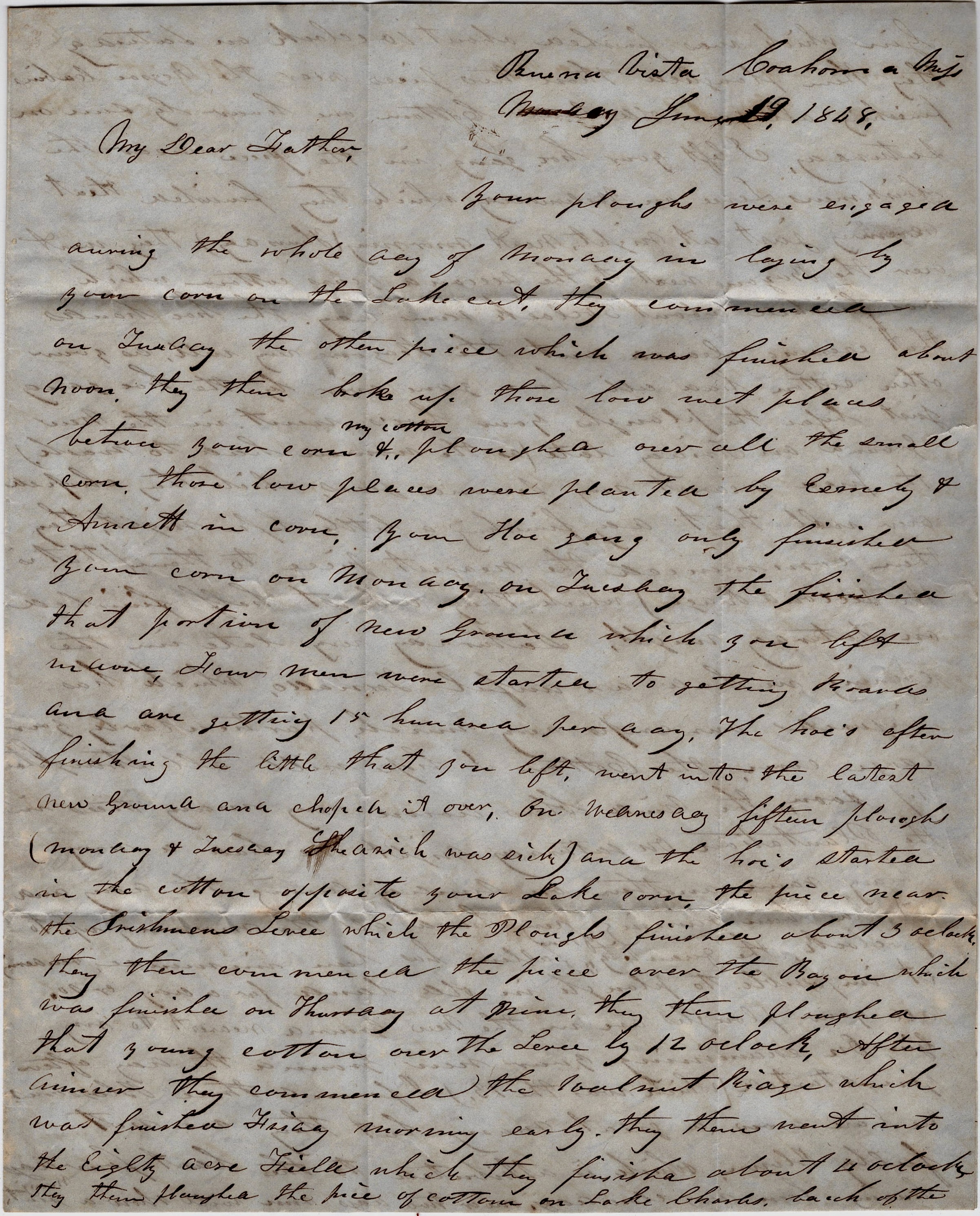
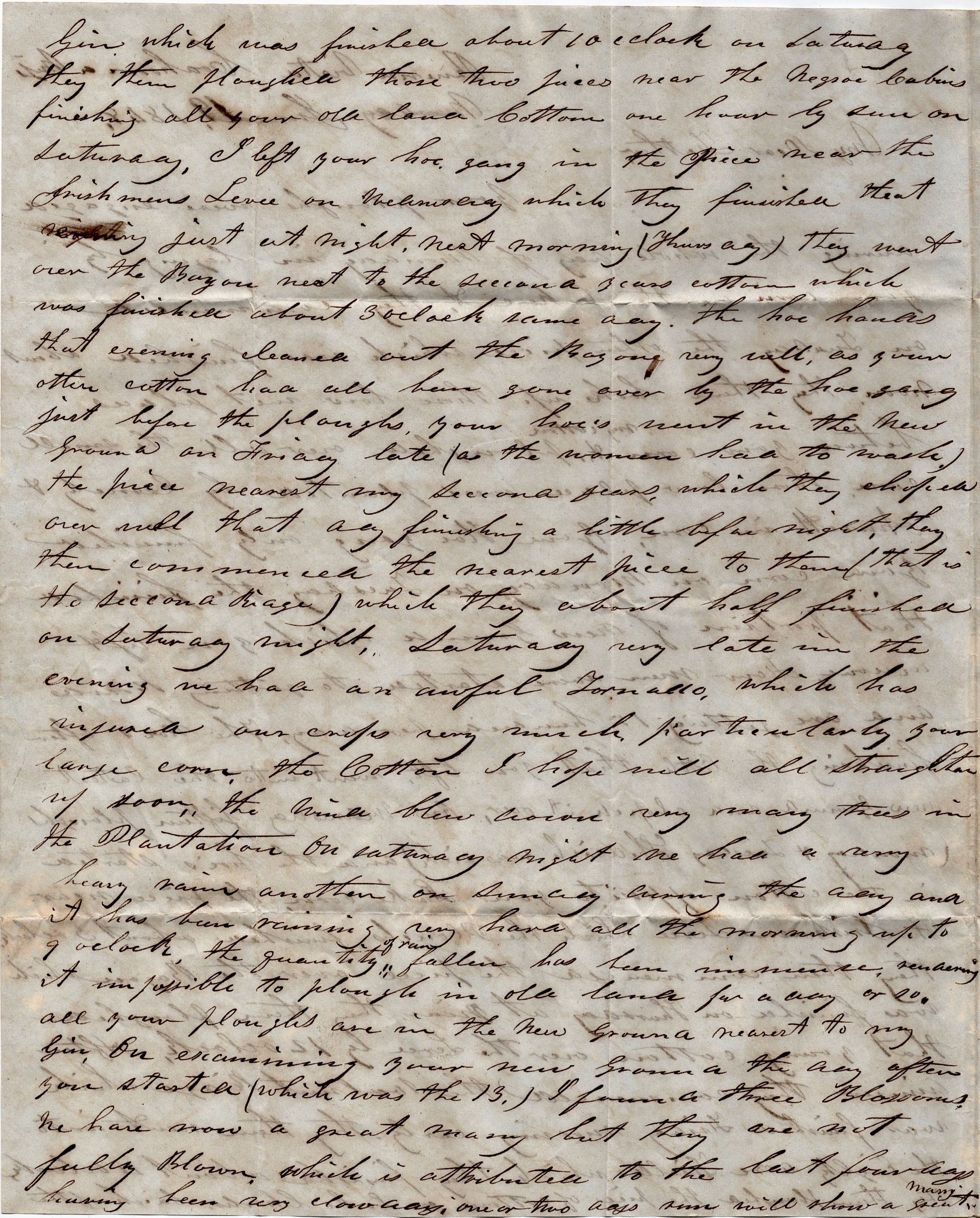
This letter was written by Thomas Henry McNeill (1821-1866), the son of Malcom McNeill (1796-1875) and Martha Rivers. Malcom McNeill began accumulating property in Kentucky where he relocated in 1817, and later bought thousands of acres in Mississippi and within the city of Natchez, which greatly increased in value. An 1884 history of Christian and Trigg counties as “perhaps the richest man in the county, with a large estate and many negroes both there and in Mississippi.”
Thomas Henry McNeill first went to Mississippi to tend his father’s plantations there which were sited along the Mississippi River. He began purchasing his own lands in 1853, initially in the extreme southwestern corner of Coahoma Co. near his father’s plantation in that area. He accumulated 1,945 acres on the Mississippi River there, including a gift from his father of 698 acres. In 1857 he purchased 1,100 acres about ten miles north but still on the River, and sold the southern properties. He called the new plantation “Dogwood” and the Mississippi river now flows over half of that property.
Thomas married first Rebecca Ann Tuck, daughter of Davis Green Tuck and Elizabeth M. Toot, on 26 October 1842 in Christian County, Kentucky. He married second Ann Eliza Arthur, daughter of William Arthur and Susannah Hill Peters on 11 June 1861 in Marshall County, Mississippi. He died at his plantation in Coahoma County, Mississippi at age 45.
T R A N S C R I P T I O N
Addressed to Major Malcom McNeill, Lafayette, Christian county, Kentucky
Buena Vista, Coahoma, Mississippi Monday, June 12, 1848
My dear Father,
Your ploughs were engaged during the whole day of Monday in laying by your corn on the Lake cut. They commenced Tuesday the other piece which was finished about noon. They then broke up those low, wet places between your cotton and my cotton, plowed over all the small corn. Those low places were planted by Emily & Amrett in corn. Your hoe gang only finished your corn on Monday. On Tuesday they finished that portion of new ground which you left undone. Hoe men were started to getting [ ] and are getting 15 hundred per day. The hoe’s after finishing the little that you left, went into the latest new ground and chopped it over.
On Wednesday fifteen plows (Monday & Tuesday Harich [?] was sick) and the hoe’s started in the cotton opposite your lake corn—the piece near the Irishmen’s levee—which the plows finished about 3 o’clock. They then commenced the piece over the Bayou which was finished on Thursday at nine. They then plowed that young cotton over the levee by 12 o’clock. After dinner they commenced the Walnut Ridge which was finished Friday morning early. They then went into the eighty acre field which they finished about 4 o’clock. They then plowed the piece of cotton on Lake Charles, back of the gin which was finished about 10 o’clock on Saturday. They then plowed those two pieces near the negro cabins, finishing all your old land cotton one hour by sun on Saturday.
I left your hoe gang in the office near the Irishman’s Levee on Wednesday which they finished that just at night. Next morning (Thursday) they went over the Bayou and to the Second year’s cotton which was finished about 3 o’clock same day. The hoe hands that evening cleaned out th bayou very well as your other cotton had all been gone over by the hoe gang just before the plows. Your hoe’s went in the new ground on Friday late (as the women had to wash) the piece nearest my second years, which they chopped over well that day, finishing a little before night. They then commenced the nearest piece to them (that is the second ridge) which they about half finished on Saturday night.
Saturday very late in the evening we had an awful tornado which has injured our crops very much, particularly your large corn. The cotton, I hope, will all straighten up soon. The wind blew down very many trees in the Plantation. On Saturday night, we had a very heavy rain. Another on Sunday during the day and it has been raining very hard all the morning up to 9 o’clock. The quantity of rain fallen has been immense, rendering it impossible to plow in old grounds for a day or so. All your plows are in the new ground nearest to my gin. On examining your new ground the day after you started (which was the 13th) I found three [cotton] blossoms. We have now a great many but they are not fully blown, which is attributed to the last few days having been very cloudy. One or two days sun will show a great many.
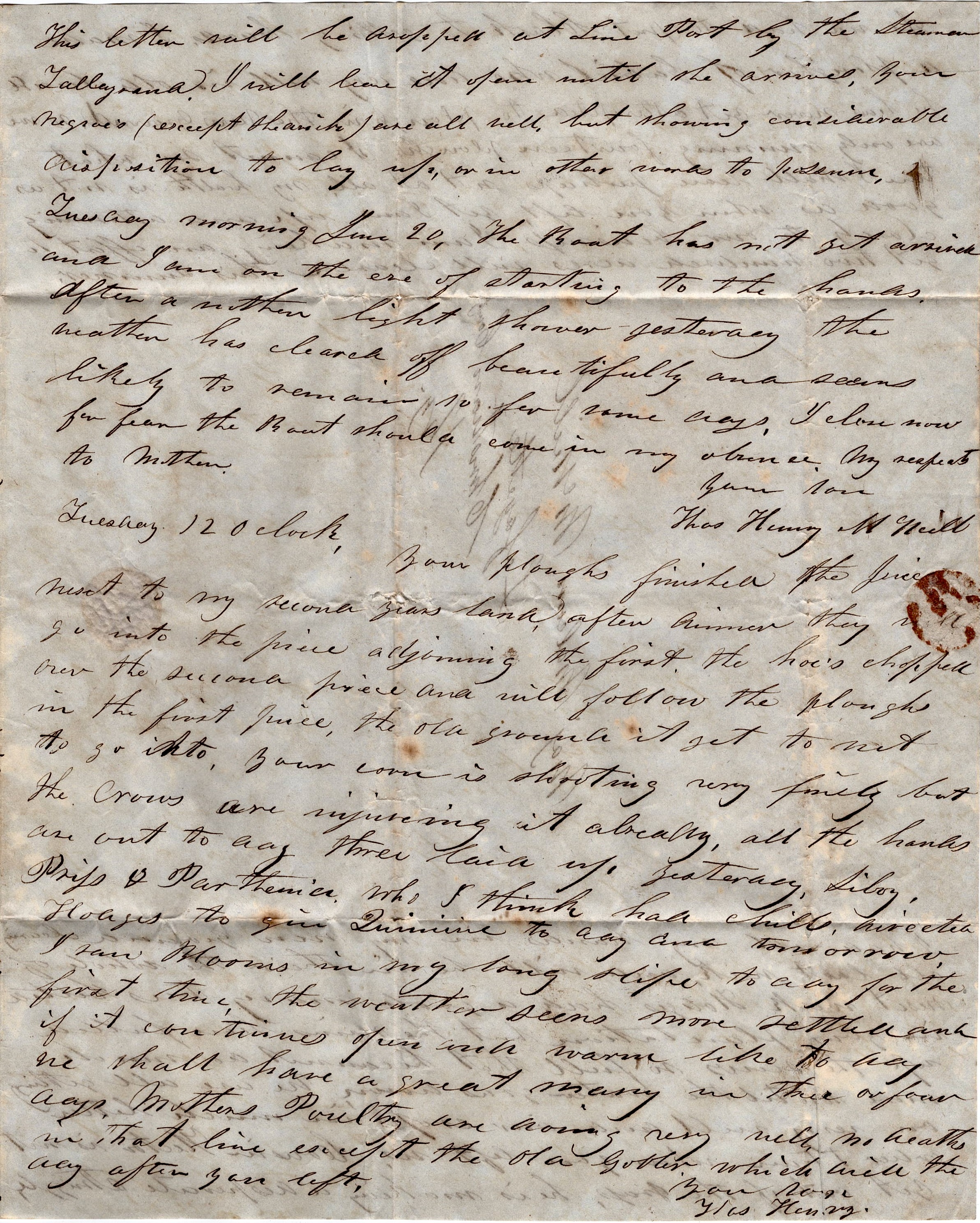
This letter will be dropped at Line Port by the Steamer Talleyrand. I will leave it open until she arrives. Your negroes (except Harick) are all well, but showing considerable disposition to lay up, or in other words, to possum.
Tuesday morning, June 20, the boat has not yet arrived and I am on the eve of starting to the lands. After another light shower yesterday the weather has cleared off beautifully and seems likely to remain so for a few days. I close now for fear the boat should come in my absence. My respects to Mother. Your son, — Thos. Henry McNeill
Tuesday 12 o’clock. Your plows finished the field next to my second year’s land. After dinner they will go into the piece adjoining the first. The hoe’s chopped over the second piece. The old ground is yet too wet to go into. Your corn is shooting very finely but the crows are injuring it already. All the hands are out today. Three laid up yesterday—Libby, Priss and Parthenia—who I think had chills. Directed Hoages to give quinine today and tomorrow. I saw blooms in my long [ ] today for the first time. The weather seems more settled and we shall have a great many in three or four days. Mother’s poultry are doing very well. No deaths in that line except the old gobbler which died the day after you left. Your son, — Thos. Henry
As we had to put Clark to getting boards, I made a plower of Gabriel who does very well in old land. He has never attempred to plow in the new ground so we are only running fourteen plows. I cannot say what time I shall leave. Perhaps not at all. My health is not as good as when you left yet I am up and attending closely to our business. I am making an effort to get two hundred acres well cleared this summer.
I had all my hands in my new ground clearing all last week and will be in there the whole of next week. Hoages had a good many trees belted in your plantation but the rains have filled up the sloughs so full that he cannot as much more until the water goes down, We are all getting on very well and our crops in much better order than when you left us. Cousin Hector is not yet out of the grass. He is making a desperate struggle…
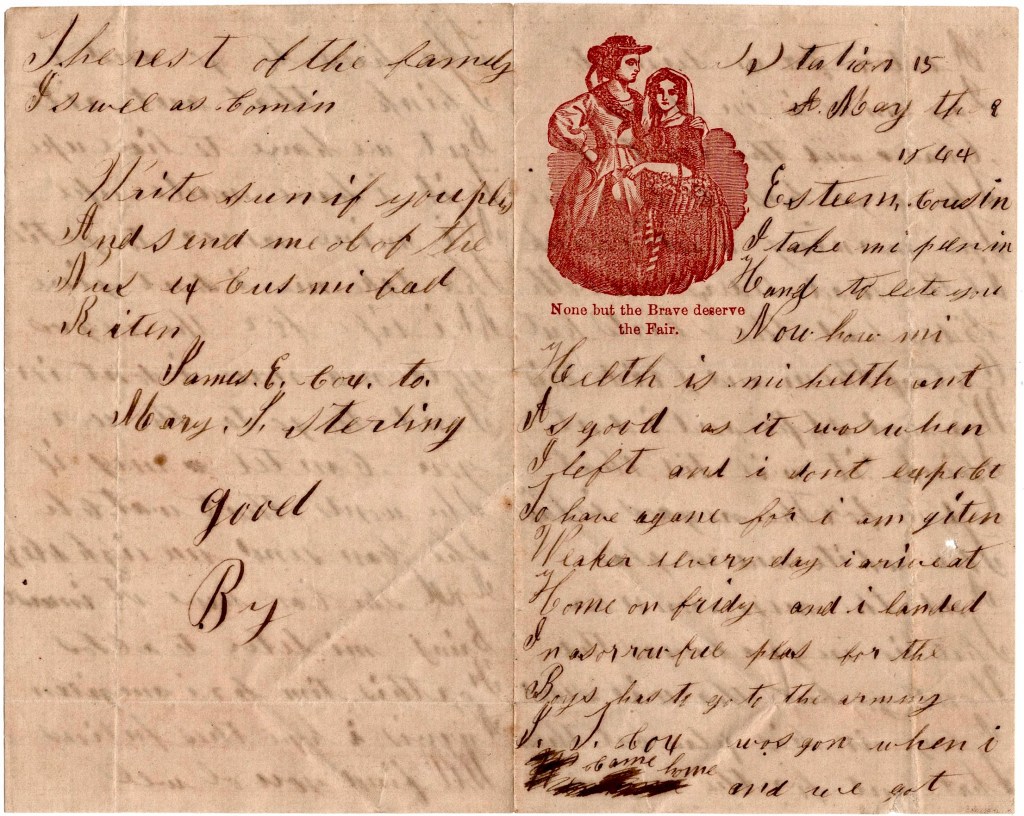
This letter was written by James E. Cox (b. 1843) whom I believe was the son of Amos H. Cox (b. 1813) and Mary Sterling (b. 1814) who were married in Tuscarawas county, Ohio in 1830. In the 1860’s the family lived in Franklin, Harrison county, Ohio.
During the Civil War, attitudes toward Black people in Harrison County, Ohio, were progressive for the time, largely shaped by the influence of abolitionist-leaning Quakers and Presbyterians. However, this local abolitionist sentiment existed within the context of Ohio’s statewide discriminatory “Black Laws,” which restricted the rights of African Americans.
T R A N S C R I P T I O N
Station 15 [Harrison county, Ohio] May 2, 1864
Esteemed cousin,
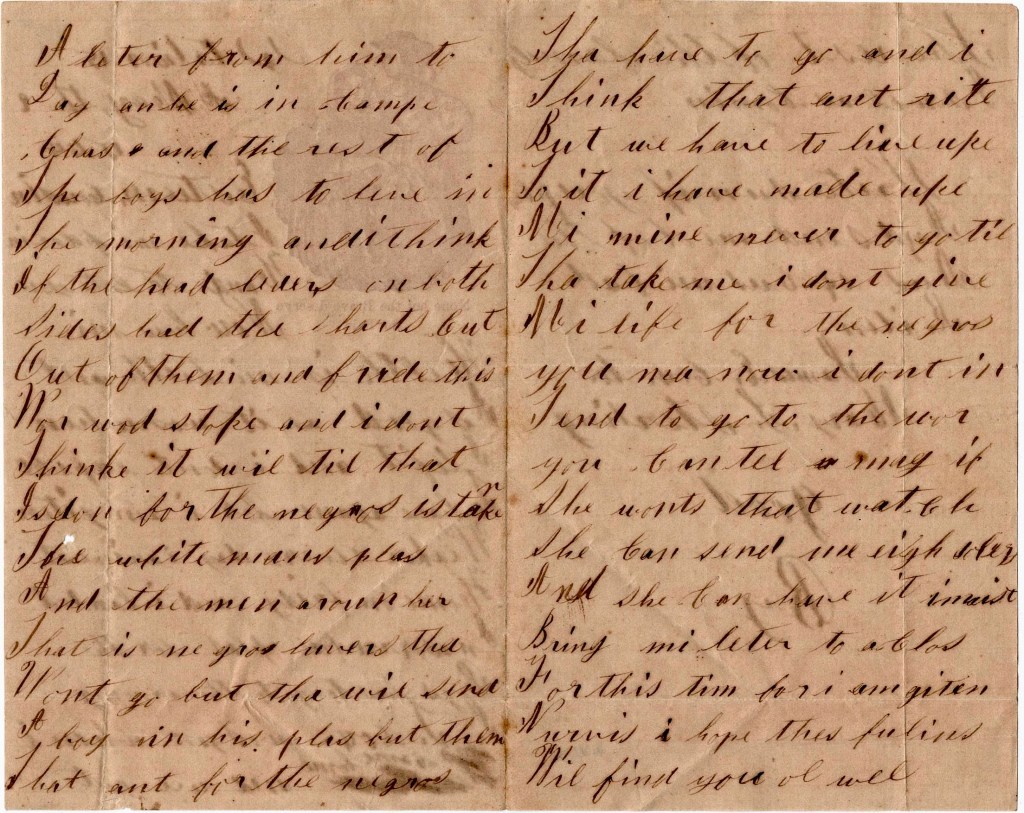
I take my pen in hand to let you know how my health is. My health ain’t as good as it was when I left and I don’t expect to have [it] again for I am getting weaker every day. I arrived at home on Friday and I landed in a sorrowful place for the Boys has to go to the army. J. T. Cox was gone when I came home and we got a letter from him today and he is in Camp Chase and the rest of the Boys has to leave in the morning. 1
I think if the head leaders on both sides had the hearts cut out of them and fried, this war would stop. And I don’t think it will till that is done for the negroes is taken the white man’s place. And the men around here that is negro lovers, they won’t go, but they will send a boy in his place. But them that ain’t for the negroes, they have to go, and I think that ain’t right. But we have to live up to it. I have made up my mind never to go till they take me. I don’t give my life for the negroes. You may know I don’t intend to go to the war.
You can tell Mag if she wants that watch, she can send me eight dollars and she can have it. I must bring my letter to a close for this time for I am getting nervous. I hope these feelings will find you all well. The rest of the family is well as common.
Write soon if you please and send me all of the news. Excuse my bad writing. — James E. Cox to Mary J. Sterling
Goodbye
1 Probably John T. Cox who served in the 162nd Ohio (National Guard). This regiment was mustered into service on 20 May 1864 at Camp Chase, Ohio.
The following letter was written by John Tolles Phillips (1838-1905) who enlisted at the age of 23 on September 20, 1861, at Warsaw. He mustered in as private in Co. A, October 5, 1861, to serve three years. As noticed in this letter, the regiment was not fitted out as a cavalry unit until June 1862. Prior to that they were detached as reserve artillery or as train guards in the Army of the Potomac. John was wounded at Berryville, Va., on December 1, 1862 and later transferred on March 31, 1864, to the 49th Company, Second Battalion, Veteran Reserve Corps.
John wrote the letter to his cousin, Kate N. Tolles of Attica, Wyoming county, New York. According to find-a-grave, John was born in Orangeville and while an infant his parents moved to Attica where he lived for 66 years.
T R A N S C R I P T I O N
Headquarters Camp Fenton, Washington D. C. 9th Regt. N. Y. Volunteers, Co. A February 9, 1862
Dear Cousin,
Your Father’s [letter] of the 30th came to hand the 6th and I assure you I was glad to hear from him. I have regained my health so that I think I can stand it. We have not moved from where we first went into camp and I do not see much prospect of it. Some of our boys are getting homesick and trying to get discharged but it is more work to get a discharge than it is worth. If I could be certain that I should have my health, I do not want to come home till this war is closed. We have not got any of our arms yet but our sabers and I do not know as we ever shall. The orders has come here that the cavalry is going to be reduced to fifty regiments. There is talk here that the remainder are going to be mustered into infantry. If our captain and company goes, I am going to go with them and if they come home, I shall come too.
We have got our Sibley tents. Our company bought lumber and made a floor to these. There has to be twelve in a tent. We have a circle stove but we have two small sheet iron stoves and we do our own cooking on them. Most of the boys do their washing. We can get it done for four cents apiece. I do my own.
Has Mrs. Hubbard consented to let her sons go yet? There is a man in our company that looks like Clark and if he had come from Bennington, I should have thought it was him. hardly a day passes but what the ambulance passes here carrying the soldiers to their long home. There was eight or ten died in our regiment since we come here.
Where is Ralph now? Has he been home since he went away, or has Ed been back yet? How do they get along? Are they satisfied? Where is George this winter? Does he peddle milk? We can get milk here by paying five cents a pint and half water.
It rains here most of the time. The mud is getting so deep it is most impossible to get around. I do not believe that you can read what I have wrote so I guess I will stop. Write soon. — J. T. Phillips
















 Spared & Shared 23