The following letter was written by Evan Thomas Rinehart (1828-1891), formerly the regimental quartermaster of the 165th Pennsylvania Infantry—a nine-months unit that mustered out of the service in July 1863. After he was mustered out, I believe that Evan was made a government paymaster though I have not found an 1863 record to confirm it. One such appointment of “E. T. Rinehart” dated 12 March 1864 does appear in military records.
Evan’s parents were Israel Rinehart (1792-1871) and Mary Snader (1797-1865). In 1850, he resided in Frederick, Maryland. He was married in 1861 to Euphenia Knox of Adams, Pennsylvania. He died in Baltimore in 1891. Evans’ older brother, William Rinehart (1825-1874) was a prominent neo-classical, Italian trained, sculptor. Another brother, Daniel Rinehart (1823-1886) served as captain of Company F, 7th Maryland Volunteers.
While waiting to be transported to Union-occupied Vicksburg, Rinehart’s letter gives us a good picture of St. Louis in the fall of 1863. He describes the appearance of the city, the activities, and the politics prevailing at that time, split primarily over the issue of immediate or gradual emancipation of slaves.
T R A N S C R I P T I O N
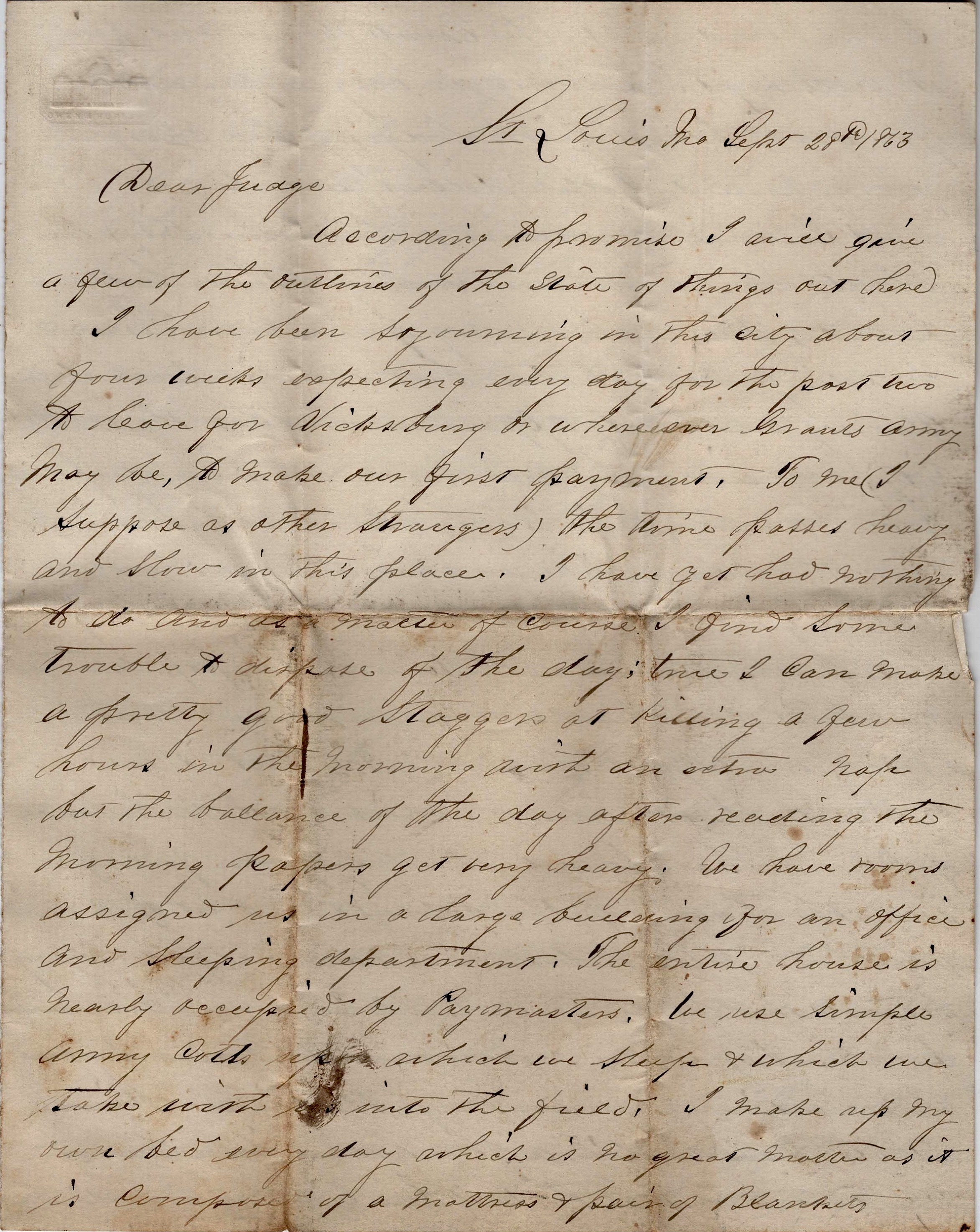
St. Louis, Missouri
September 29th 1863
Dear Judge,
According to promise I will give a few of the outlines of the state of things out here. I have been sojourning in this city about four weeks expecting every day for the past two to leave for Vicksburg or wherever Grant’s army may be to make our first payment. To me—I suppose as other strangers—the time passes heavy and slow in this place. I have yet had nothing to do and as a matter of course I find some trouble to dispose of the day. True, I can make a pretty good staggers at killing a few hours in the morning with an extra nap but the balance of the day after reading the morning papers get very heavy.
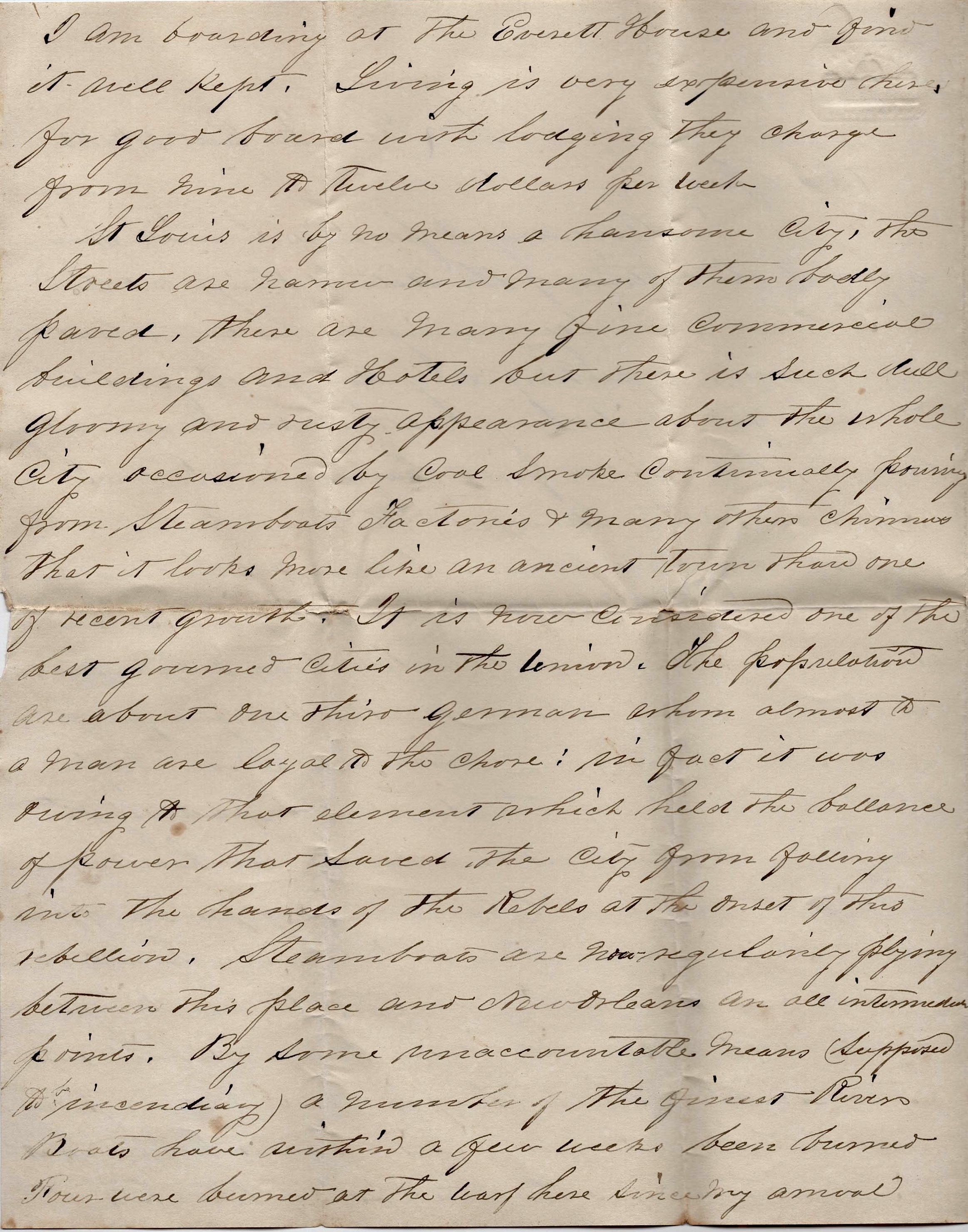
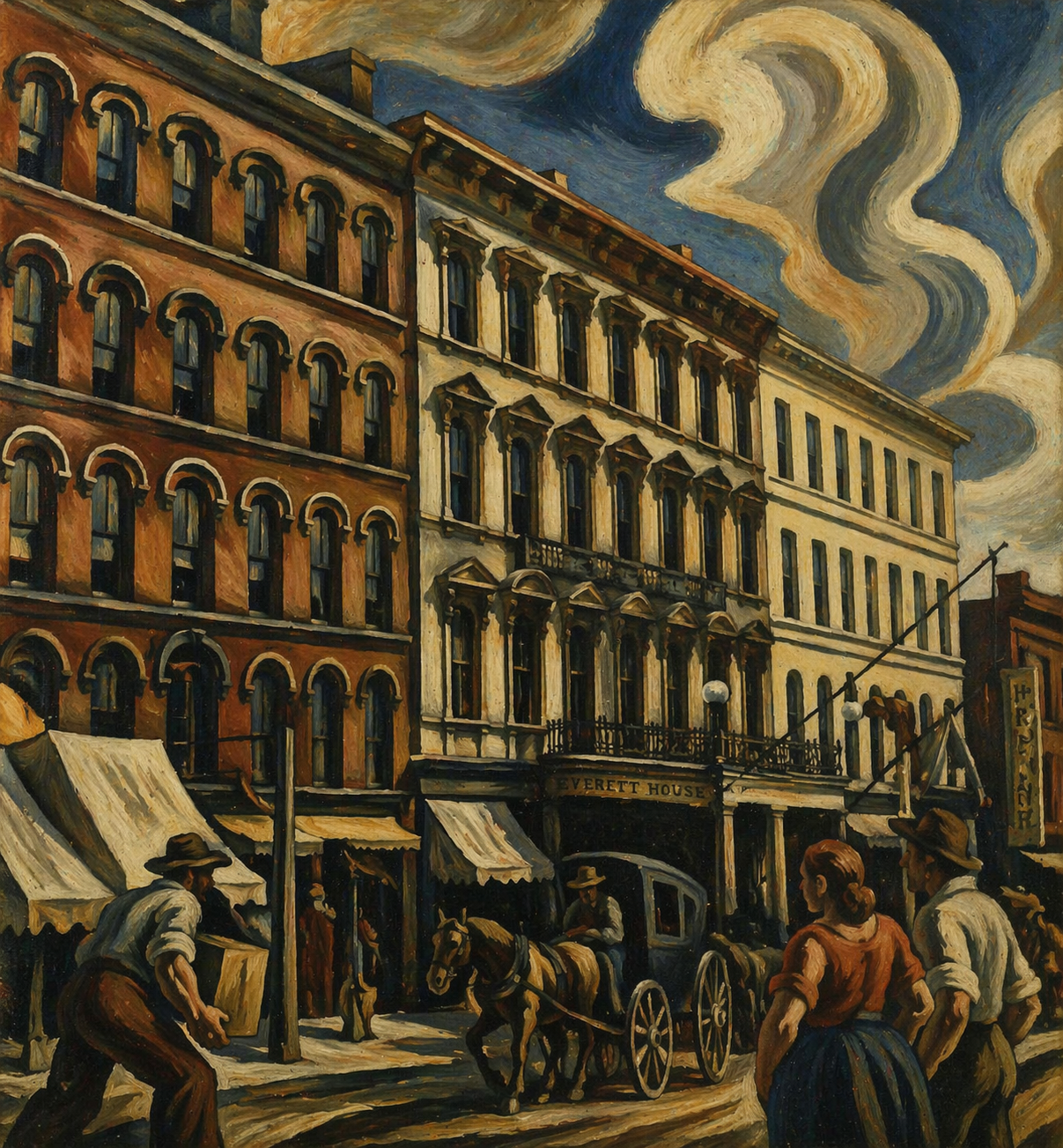
We have rooms assigned us in a large building for an office and sleeping department. The entire house is nearly occupied by Paymasters. We use simple army cots upon which we sleep & which we take with us into the field. I make up my own bed every day which is no great matter as it is composed of a mattress & pair of blankets. I am boarding at the Everett House and find it well kept. Living is very expensive there. For good board with lodging they charge from nine to twelve dollars per week.
St. Louis is by no means a handsome city. The streets are narrow and many of them badly paved. There are many fine commercial buildings and hotels but there is such dull, gloomy and rusty appearance about the whole city occasioned by coal smoke continually pouring from steamboats, factories, and many other chimneys that it looks more like an ancient town that one of recent growth. It is now considered one of the best governed cities in the Union. The population are about one third German whom almost to a man are loyal to the core. In fact, it was owing to that element which held the balance of power that saved the city from falling into the hands of the Rebels at the onset of this rebellion.
Steamboats are now regularly flying between this place and New Orleans and all intermediate points. By some unaccountable means—supposed to be incendiary—a number of the finest river boats have within a few weeks been burned. Four were burned at the wharf since my arrival.
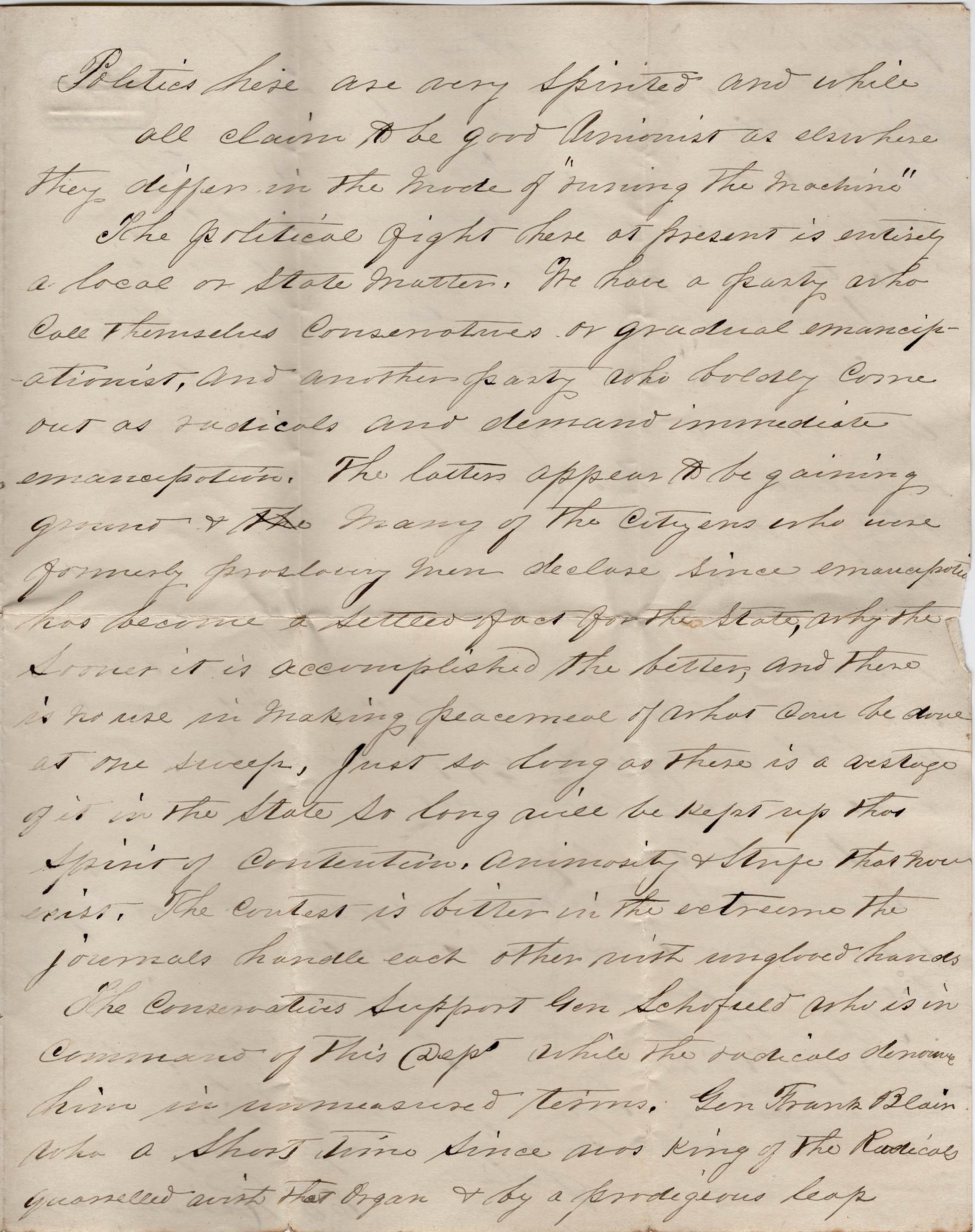
Politics here are very spirited and while all claim to be good Unionists as elsewhere, they differ in the mode of “running the machine.” The political fight here at present is entirely a local or state matter. We have a party who call themselves conservatives or gradual emancipationists, and another party who boldly come out as radicals and demand immediate emancipation. The latter appear to be gaining ground & many of the citizens who were formerly proslavery men declare since emancipation has become a settled fact for the state, why the sooner it is accomplished the better and there is no use in making piecemeal of what can be done at one sweep. Just so long as there is a vestige of it in the state, so long will be kept up this spirit of contention, animosity, & strife that now exists.
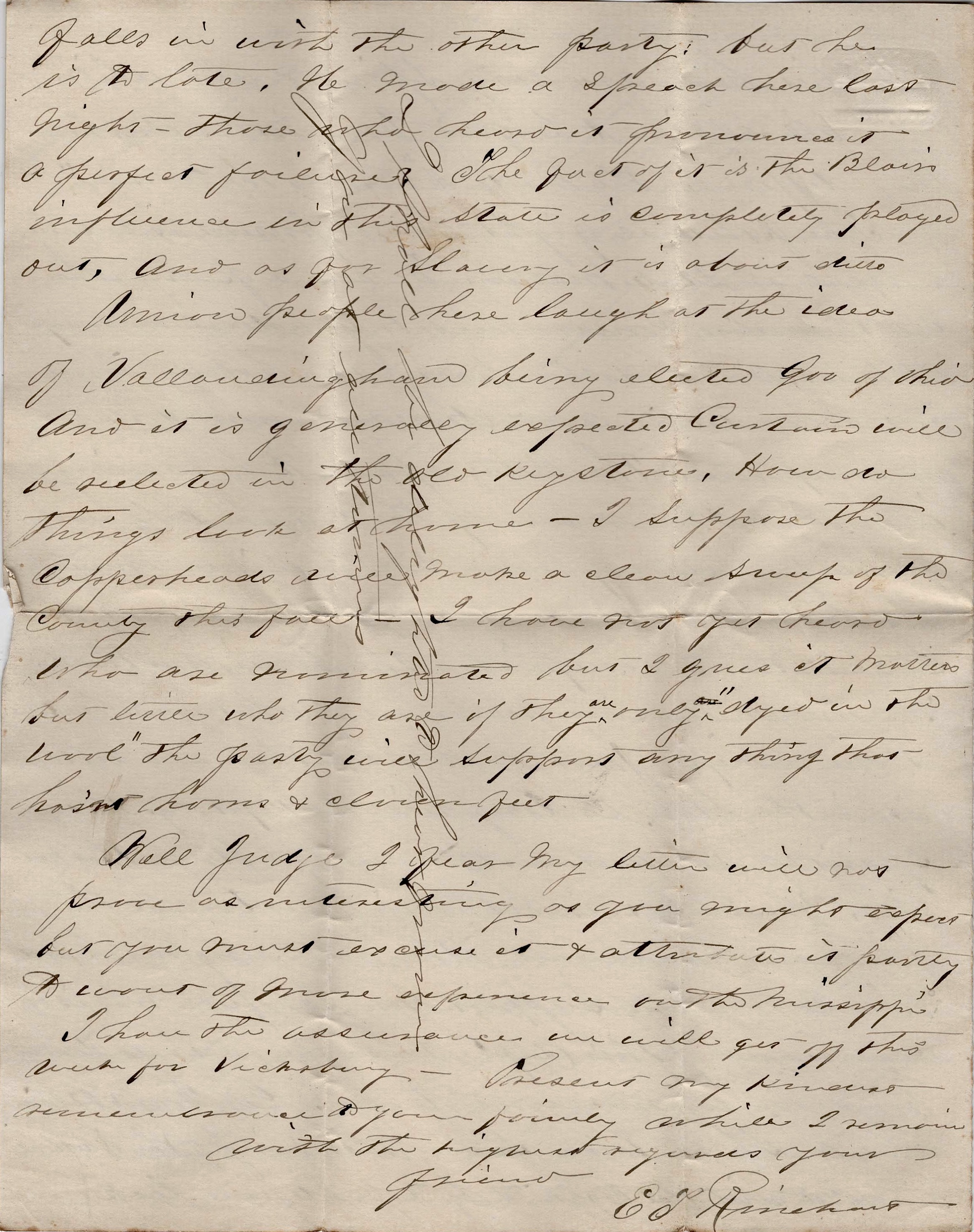
The contest is bitter in the extreme. The journals handle each other with ungloved hands. The conservatives support Gen. Schofield who is in command of this department while the radicals denounce him in unmeasured terms. Gen. Frank Blair who a short time since was king of the radicals quarreled with that organ & by a prodigious leap falls in with the other party. But he is too late. He made a speech here last night. Those who heard it pronounce it a perfect failure. The fact of it is the Blair influence in this state is completely played out, and as for slavery, it is about ditto.
Union people here laugh at the idea of Vallandigham being elected governor of Ohio and it is generally expected Curtain will be reelected in the Old Keystone. How do things look at home? I suppose the Copperheads will make a clean sweep of the county this fall. I have not yet heard who are nominated but I guess it matters but little who they are if they are only “dyed in the wool.” The party will support anything that hasn’t horns & cloven feet.
Well, Judge, I fear my letter will not prove as uninteresting as you might expect but you must excuse it & attribute it partly to want of more influence on the Mississippi. I have the assurance we will get off this week for Vicksburg. Present my kindest remembrance to your family while I remain with the highest regards your friends, — E. T. Rinehart