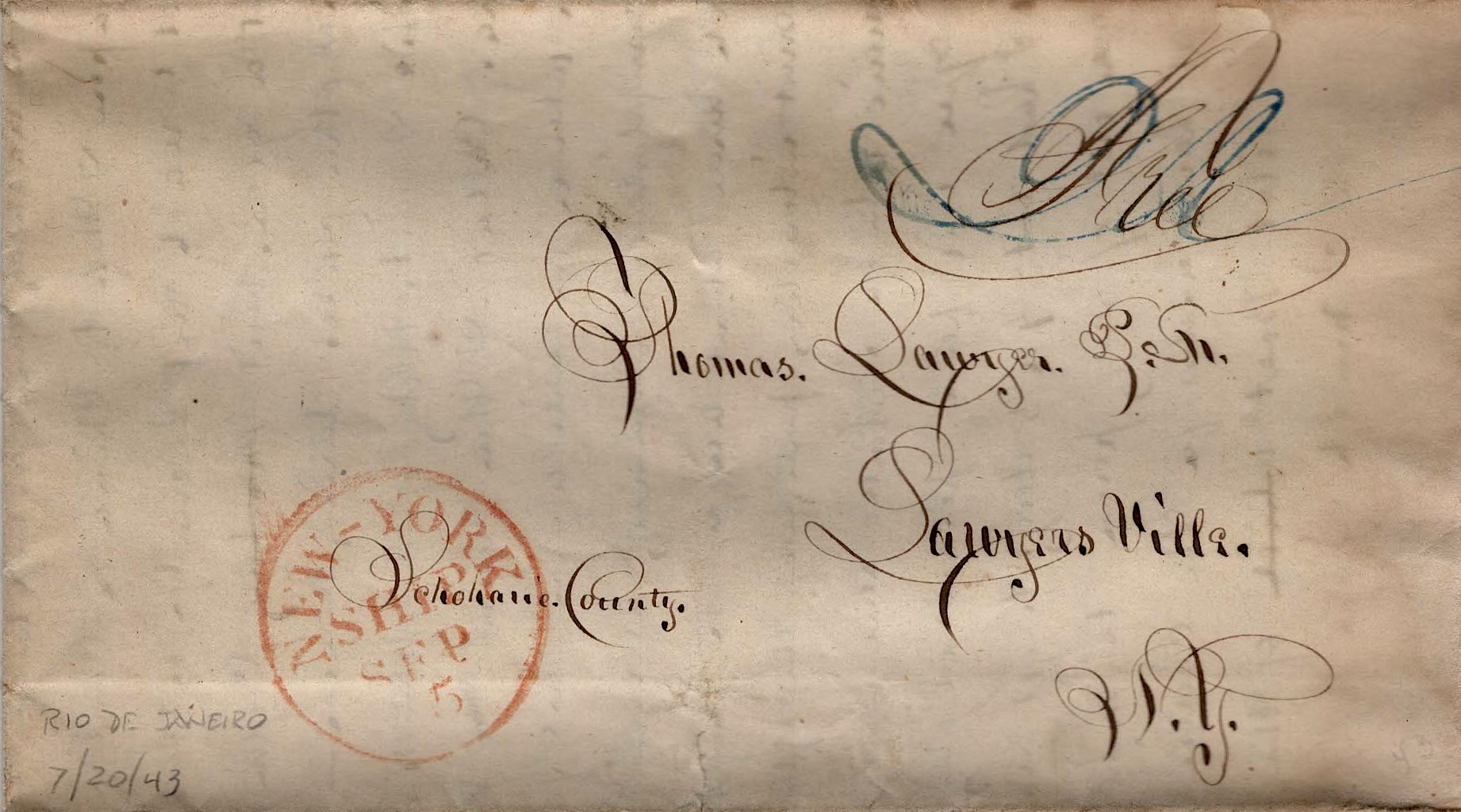
The following letter was written by August Frederick Lawyer (1807-1863) to his father, Thomas Lawyer (1785-1868), an attorney practicing in Lawyersville, Schoharie county, New York, where he also served as the town’s post master.
We learn from this letter that Frederick arrived in Rio de Janiero aboard the USS Warren, a second class sloop-of-war built at the Boston Navy Yard between 1825-1827. The letter reveals that they were on a journey that would take them around the globe. In October 1843, she departed for the Pacific, where she acted as a guard ship at Monterey during the Mexican–American War before transferring to San Francisco as a stores and receiving ship. Further research from period newspapers inform us that Frederick was serving as the Assistant Surgeon aboard the vessel.
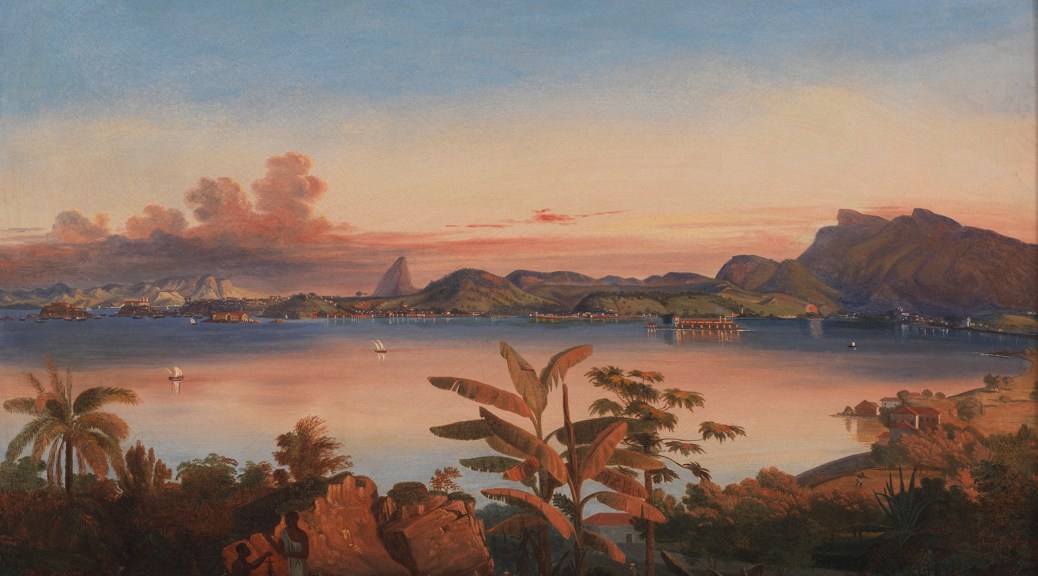
The letter provides us with a description by first hand observation of the harbor and city of Rio de Janiero in 1843.
T R A N S C R I P T I O N
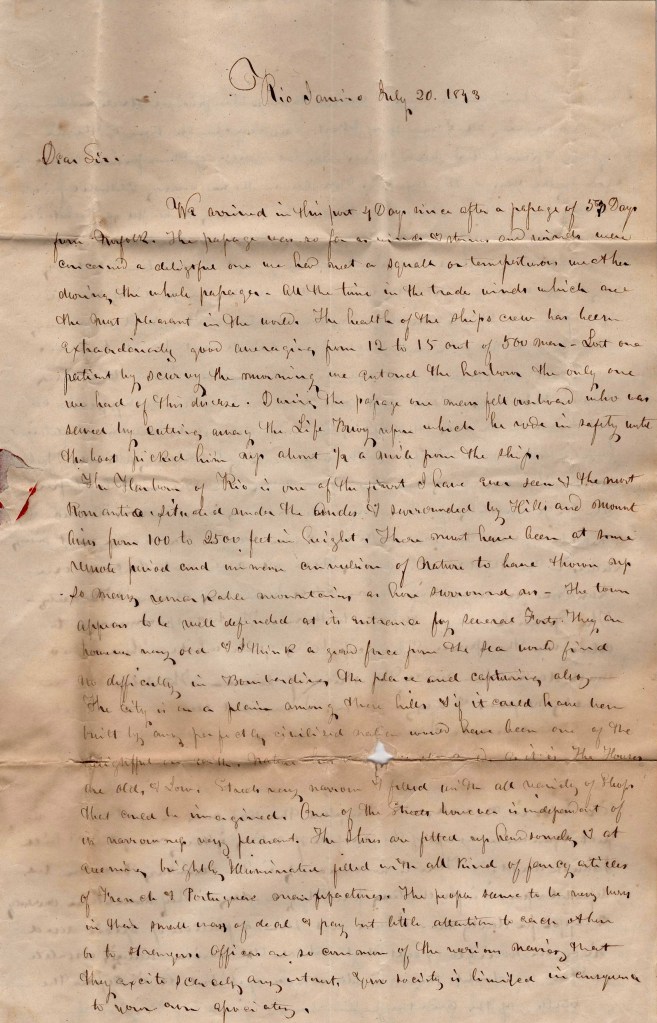
Rio [de] Janeiro [Empire of Brazil]
July 20, 1843
Dear Sir.
We arrived in this port 4 days since after a passage of 53 days from Norfolk. The passage was so far as winds & storms were concerned a delightful one. We never met a squall or tempestuous weather during the whole passage [but were] all the time in the trade winds which are the most pleasant in the world. The health of the ship’s crew has been extraordinarily good, averaging from 12 to 15 men out of 500 men. Lost one patient by scurvy the morning we entered the harbor—the only one we had of this disease. During the passage one man fell overboard who was saved by cutting away the life buoy upon which he rode in safety until the boat picked him up about ½ a mile from the ship.
The Harbor of Rio is one of the finest I have ever seen & the most Romantic, situated under the Andes [Serro do Mar Mountains] & surrounded by hills and mountains from 100 to 2500 feet in height. There must have been at some remote period an immense convulsion of Nature to have thrown up so many remarkable mountains as here surround us. The town appears to be well defended at its entrance by several Forts. They are, however, very old & I think a good force from the sea would find no difficulty in bombarding the place and capturing also.
The city is in a plain among these hills & if it could have been built by any perfectly civilized nation would have been one of the most delightful on earth. Nature has [paper torn] … as it is. The houses are old & low. Streets very narrow filled with all variety of shops that could be imagined. One of the streets, however, is independent of its narrowness—very pleasant. The stores are fitted up handsomely & at evening brightly illuminated, filled with all kinds of fancy articles of French & Portuguese manufacture. The people seem to be very busy in their small way of deal & pay, but little attention to each other or to strangers. Officers are so common of the various navies that they excitge scarcely any interest. Your society is limited in consequence to your own.
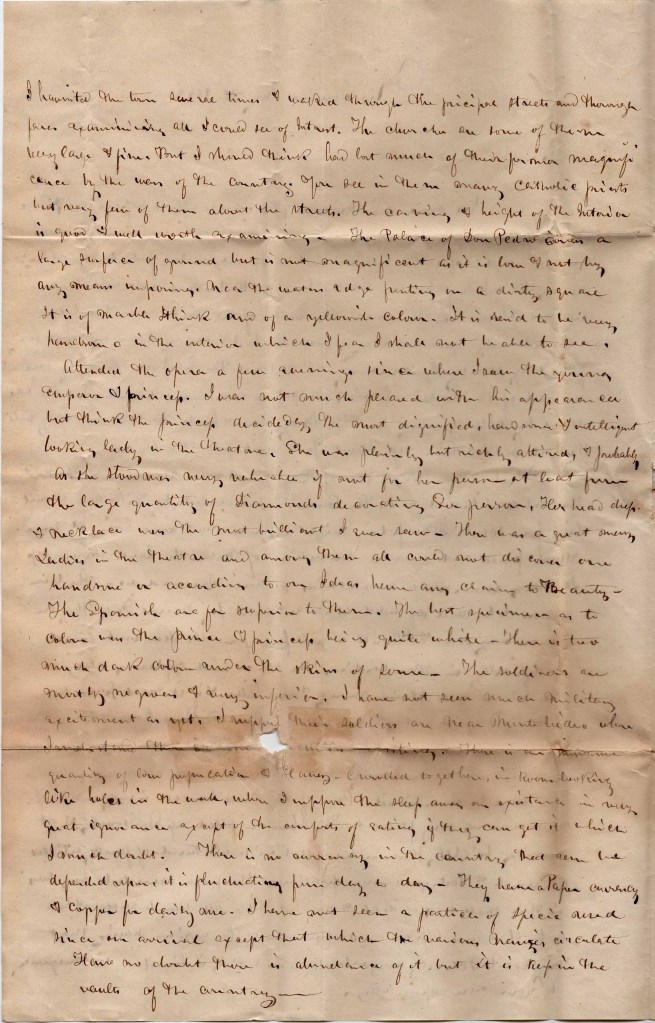
I haunted the town several times & walked through the principal streets and thoroughfares examining all I could see of interest. The churches are some of them very large & fine, but I should think had lost much of their former magnificence by the wars of the country. You see in them many catholic priests but very few of them about the streets. The carving & height of the interior is good & well worth examining.
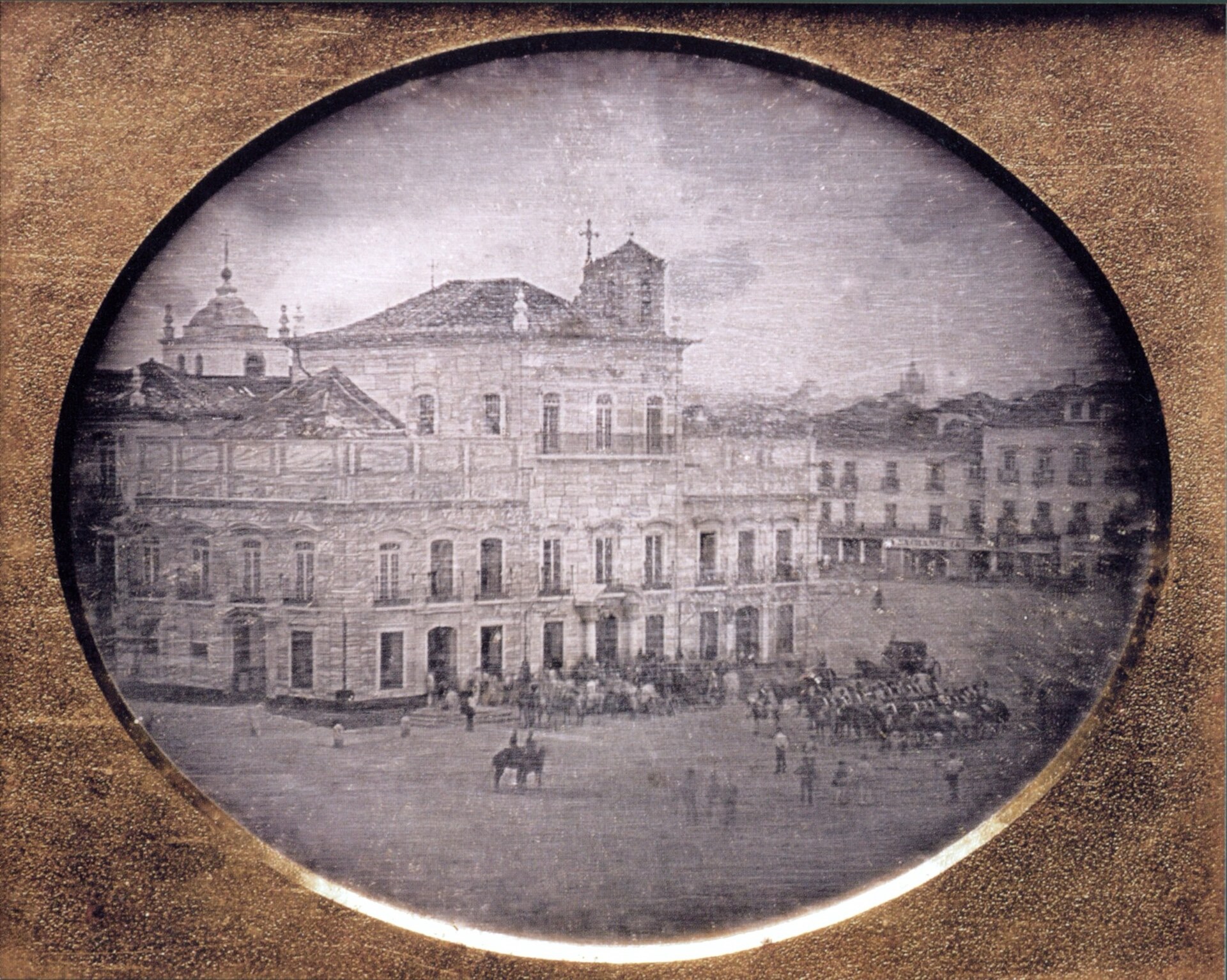
The Palace of Dom Pedro covers a large surface of ground but is not magnificent as it is low & not by any means imposing, near the water’s edge, fronting on a dirty square. It is of marble, I think—one of a yellowish color. It is said to be very handsome in the interior which I fear I shall not be able to see.
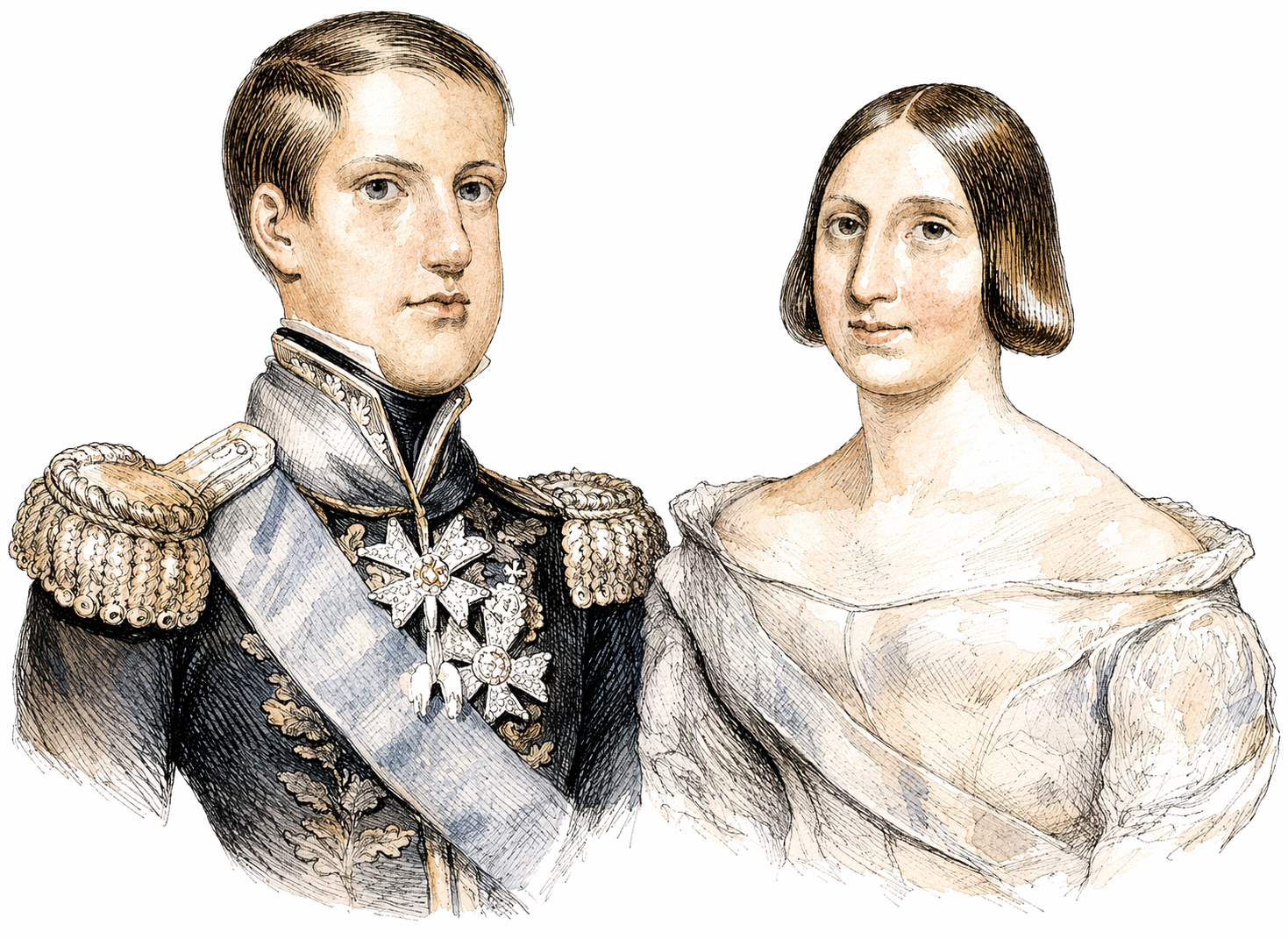
Attended the opera a few evenings since where I saw the young Emperor & princess. I was not much pleased with his appearance but think the princess decidedly the most dignified, handsome & intelligent-looking lady in the theatre. She was plainly but richly attired, & probably as she stood was very valuable—-if not for her person, at least for the large quantity of diamonds decorating her person. Her head dress & necklace was the most brilliant I ever saw. There was a great many Ladies in the theatre and among them all could not discover one handsome or, according to our ideas, have any claim to beauty. The Spanish are far superior to them. The best specimen as to color was the prince & princess, being quite white. There is too much dark color under the skins of some. The soldiers are mostly negroes & very inferior.
I have not seen much military excitement as yet. I suppose their soldiers are near Montevideo where I understand there is some hostilities existing. 1 There is an immense quantity of low population & slavery crowded together in rooms, looking like holes in the wall, where I suppose they sleep away an existence in very great ignorance except of the comforts of eating, if they can get it, which I much doubt. There is no currency in the country that can be depended upon. It is fluctuating from day to day. They have a paper currency and copper for daily use. I have not seen a particle of specie used since our arrival except that which the various navies circulate. Have no doubt there is abundance of it, but it is kept in the vaults of the country.
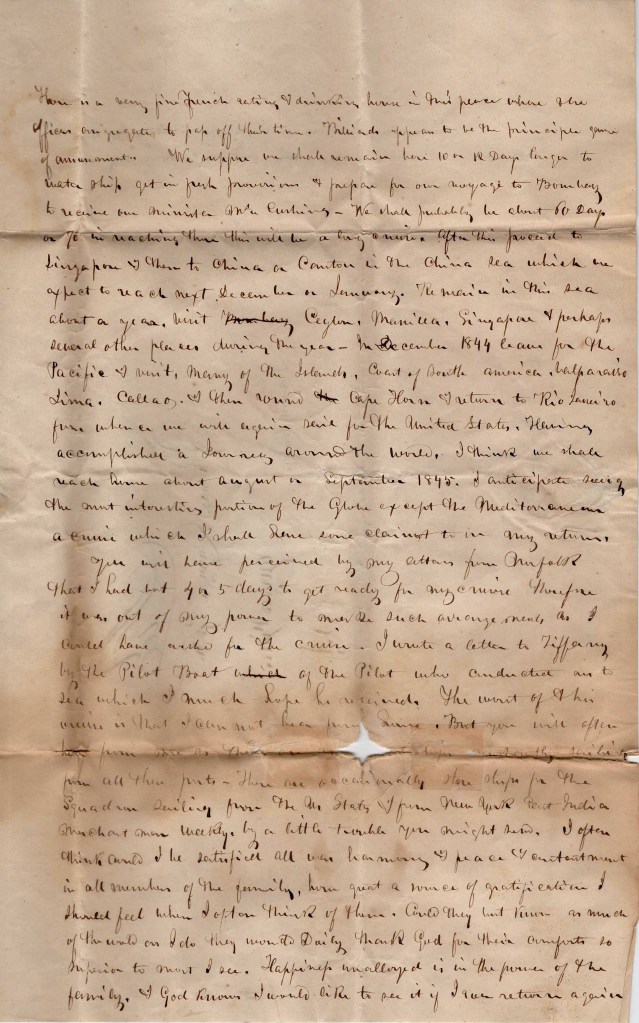
There is a very fine French eating & drinking house in this place where the officers congregate to pass off their time. Billiards appears to be the principal game of amusement. We suppose we shall remain here 10 or 12 days longer to water ship, get in fresh provisions, & prepare for our voyage to Bombay to receive our minister, Mr. [Caleb] Cushing. 2 We shall probably be about 60 days or 70 in reaching there. This will be a long cruise. After this, [we’ll] proceed to Singapore & then to China or Canton in the China Sea which we expect to reach next December or January, remain in this sea about a year, visit Ceylon, Manilla, Singapore & perhaps several other places during the year. In December 1844, [we’ll] leave for the Pacific & visit many of the Islands, coast of South America, Valparaiso, Lima, Callao, & then round Cape Horn & return to Rio Janeiro, from whence we will again sail for the United States, having accomplished a journey around the world. I think we shall reach home about August or September 1845. I anticipate seeing the most interesting portion of the Globe except the Mediterranean, a cruise which I shall have some claim to on my return.
You will have perceived by my letters from Norfolk that I had but 4 or 5 days to get ready for my cruise. Therefore, it was out of my power to make such arrangements as I could have wished for the cruise. I wrote a letter to Tiffany by the Pilot Boat of the pilot who conducted us to sea which I hope he received. The worst of this cruise is that I cannot hear from home. But you will often hear from me as there are ships constantly sailing from all these ports. There are occasionally store ships for the Squadron sailing from the United States & from New York East India merchantmen weekly by a little trouble you might send [me a letter]. I often think, could I be satisfied [if] all was harmony & peace & contentment in all members of the family, how great a sense of gratification I should feel when I often think of them. Could they but know as much of the world as I do, they would daily thank God for their comforts so superior to most I see. Happiness unalloyed is in the power of the family & God knows I would like to see it if I ever return again.
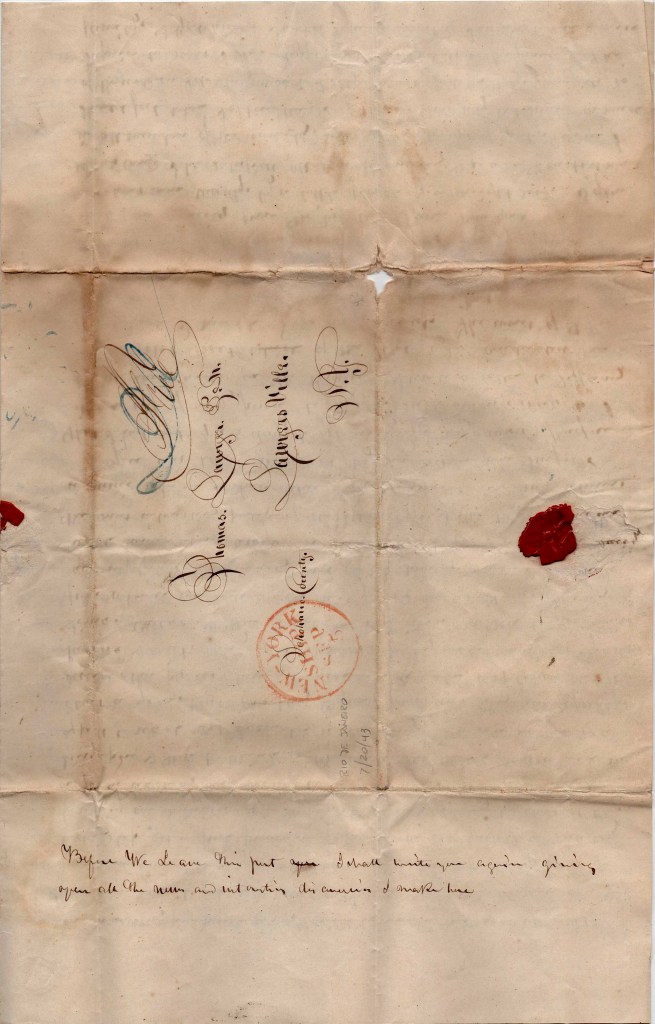
Before we Leave this port, I shall write you again giving you all the news and interesting discoveries I make here.
1 In 1843, Brazil was not officially at war with Montevideo, but was heavily involved in the region’s instability during the Uruguayan Civil War (Guerra Grande, 1839–1851). Brazil watched the 1843 start of the Great Siege of Montevideo closely, supporting the Colorado faction to prevent the expansion of Argentine dictator Juan Manuel de Rosas.
2 Caleb Cushing (1800-1879) was appointed in 1843 by President Tyler to be commissioner and United States Minister to China, holding this position until March 4, 1845.