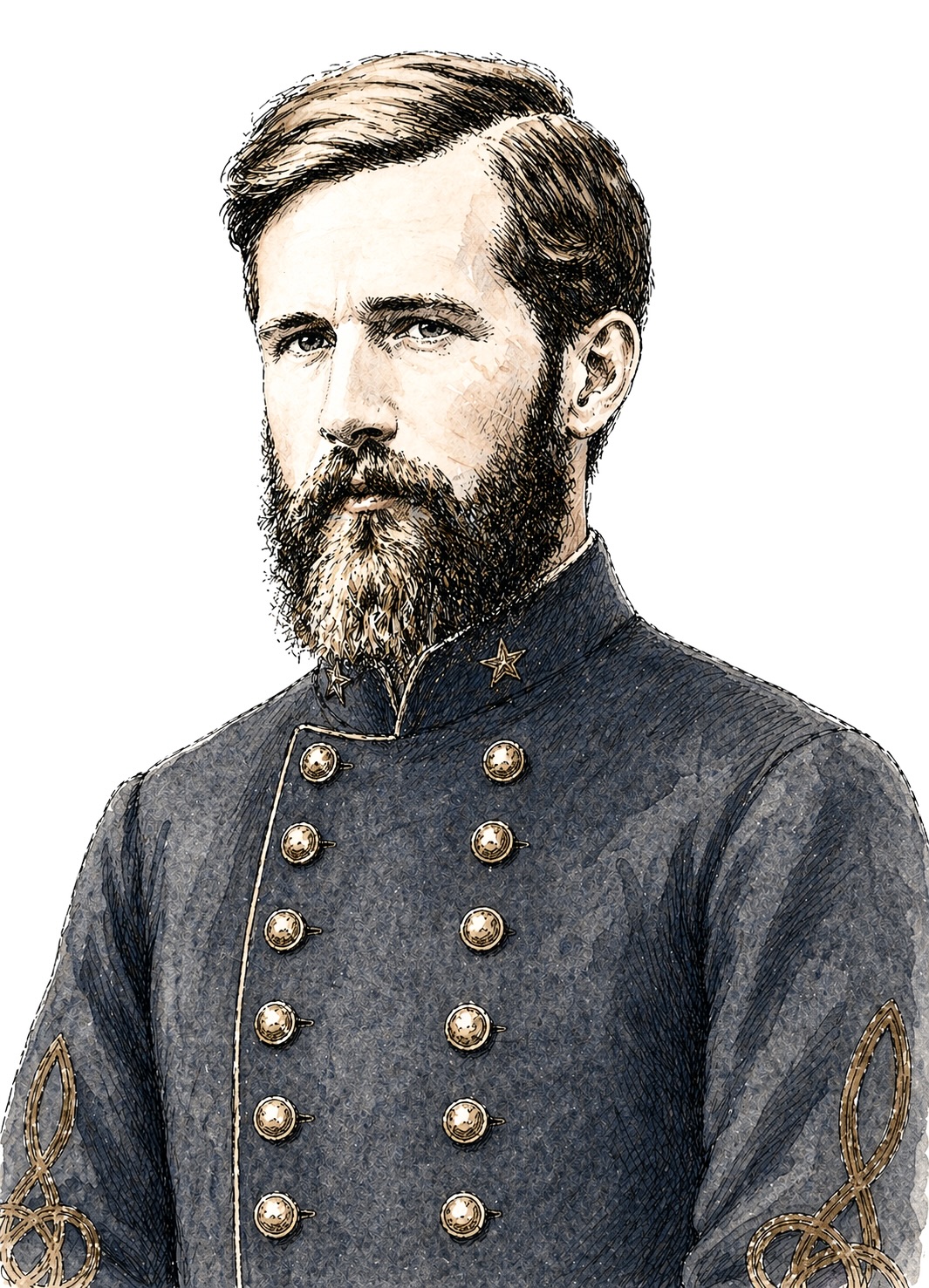
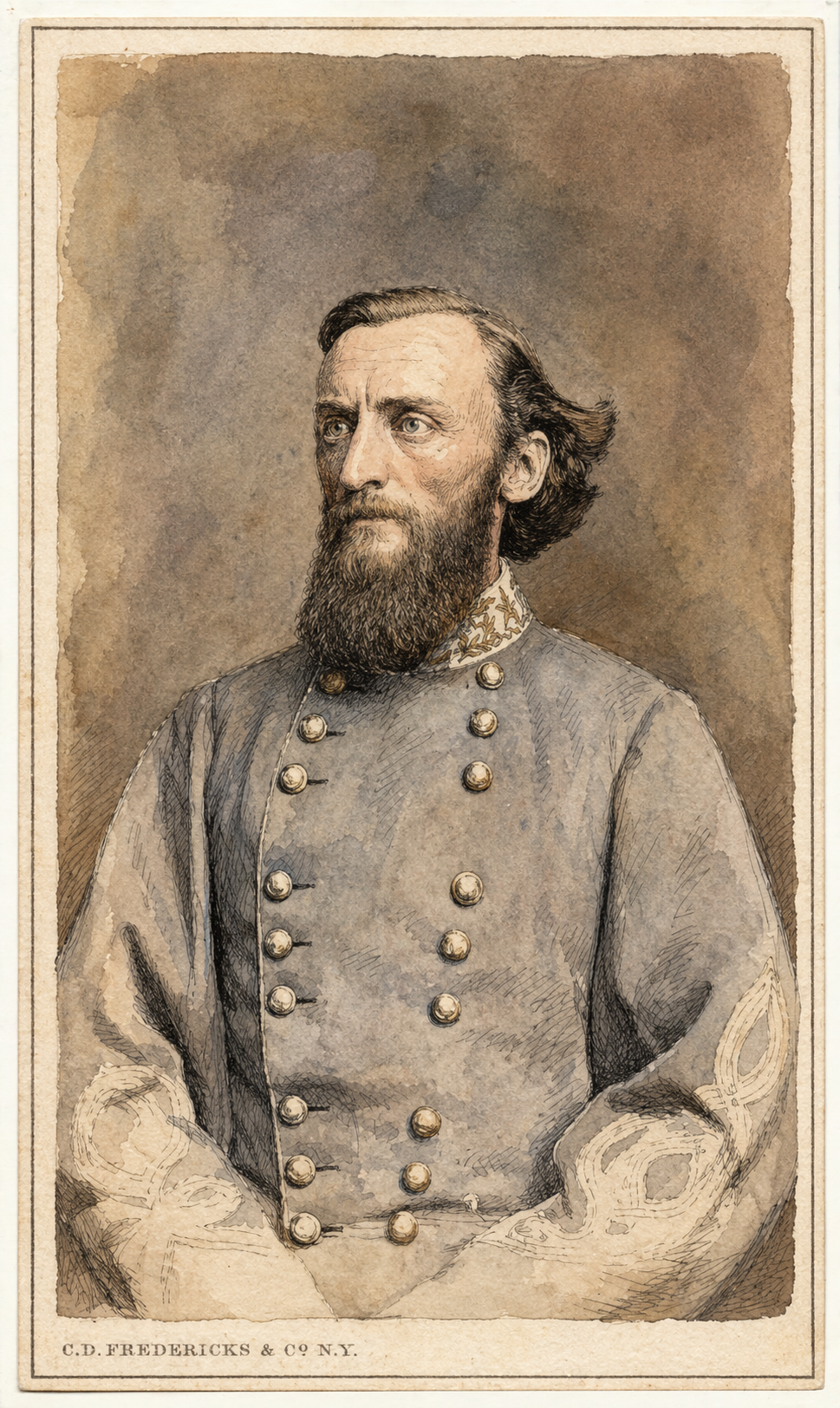
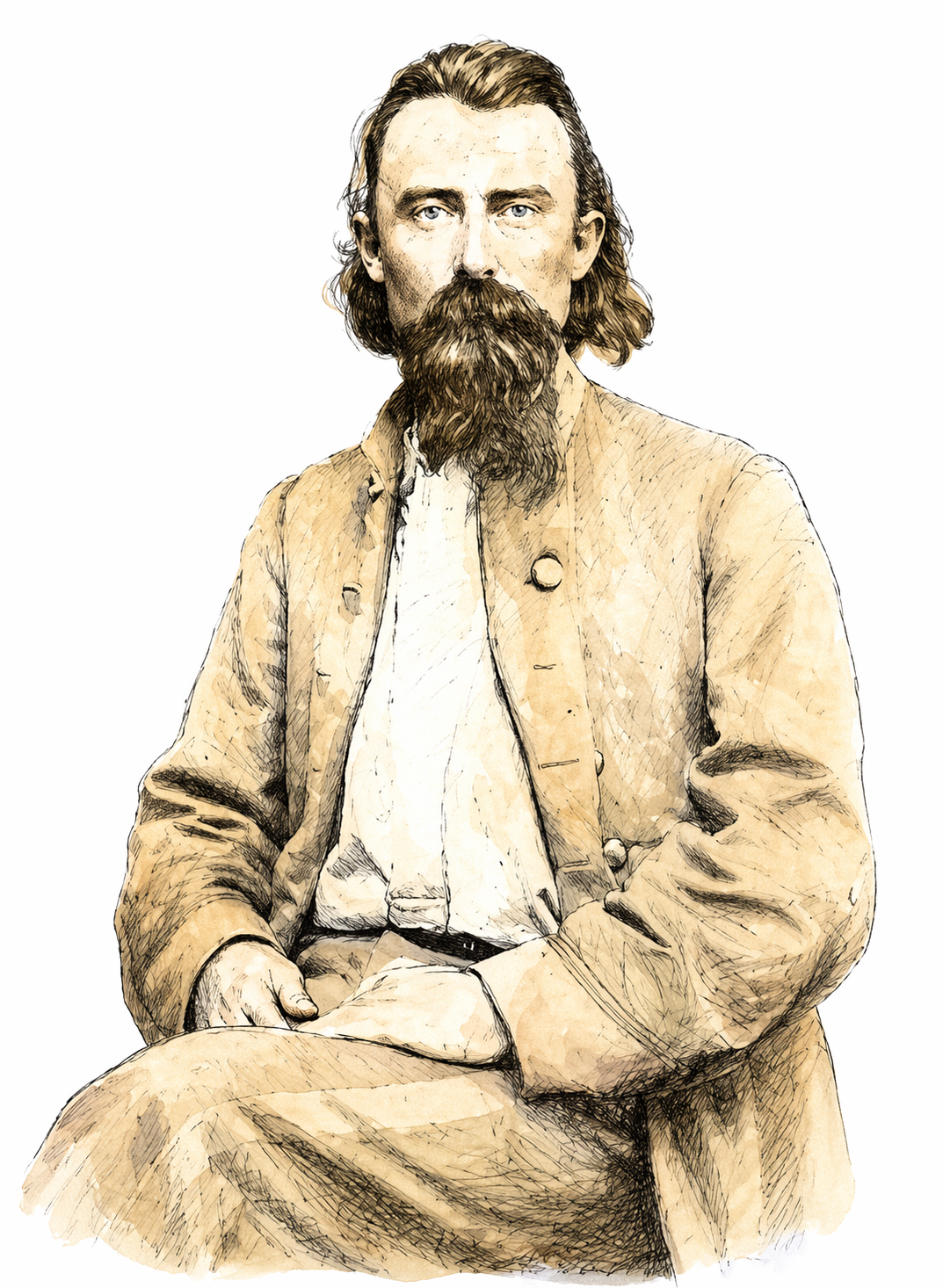
The following letters were written by Maj. Henry Ewing (1840–1873), the son of Orville Ewing (1806-1876) and Milbrey Horn Williams (1815-1864) of Nashville, Tennessee. Henry served as an Assistant Adjutant-General on the staff of Confederate Brigadier General John S. Marmaduke during the American Civil War, specifically within the Trans-Mississippi Department in Arkansas and Missouri. He was associated with the Missouri Cavalry in Marmaduke’s Division and participated in campaigns in the region.
Henry Ewing was Assistant Adjutant-General for Brigadier General J. S. Marmaduke during the American Civil War. “At the time of the secession crisis Henry was a student at the University of Virginia and a member of one of the student-organized military companies at the university. As a member of the “Southern Guard” Henry participated in the seizure of the arsenal at Harpers Ferry on 18 April 1861. On 14 June 1861 Henry enlisted in the 20th Tennessee and applied for a commission. Receiving a commission in the State Militia he served as General Felix K. Zollicoffer’s aide. Eventually, Richmond also issued a commission to Henry. Before the war was over, Ewing participated in several battles including Shiloh, and served with Marmaduke’s cavalry and with Sterling Price in his raid in Missouri, September-October 1864. Following the war, Ewing eventually settled in St. Louis and published the Sr. Louts Times. He died 13 June 1873.” Source: “The Tennessee Cavalier in the Missouri Calvary” by William J. Crowley, 1978.
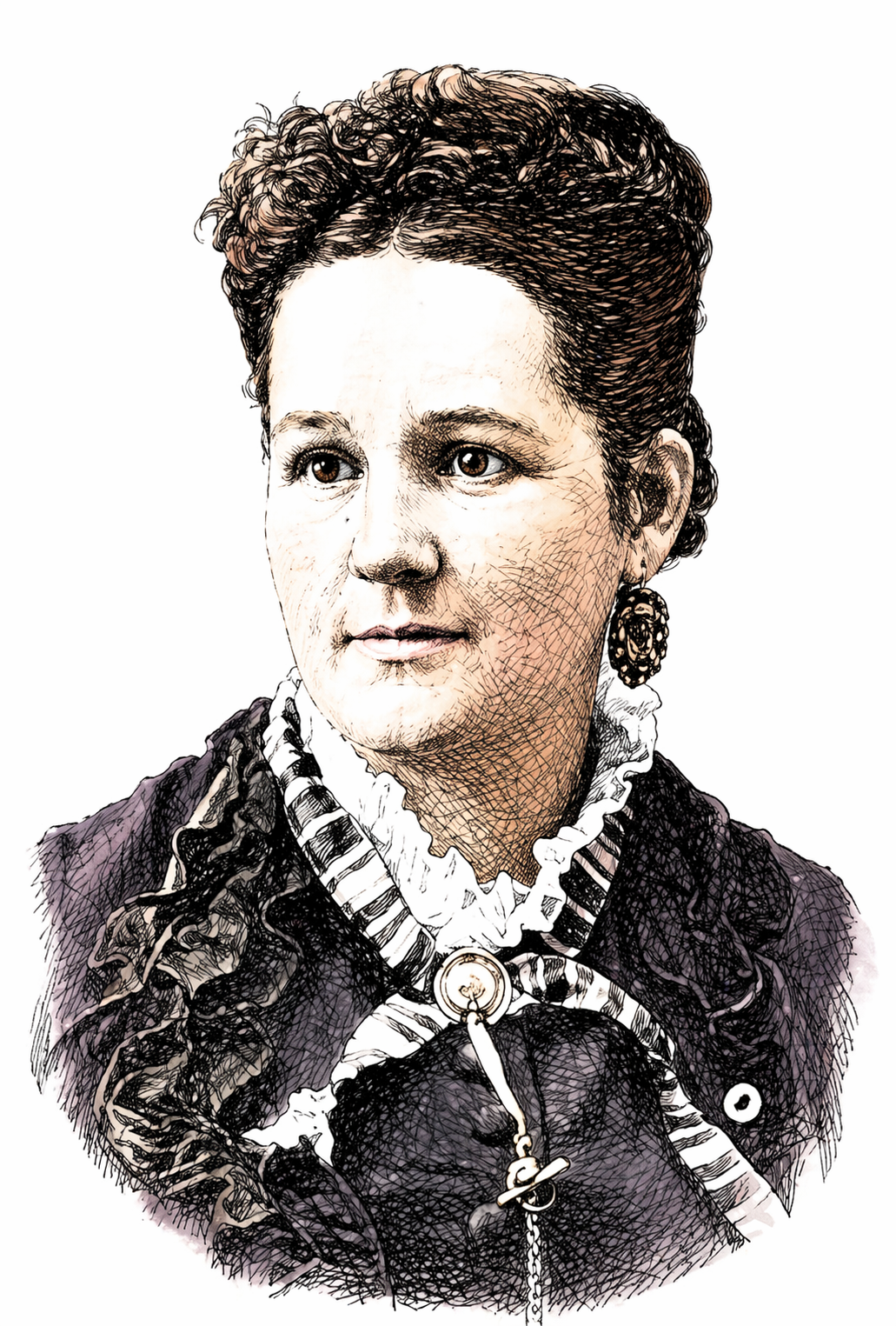
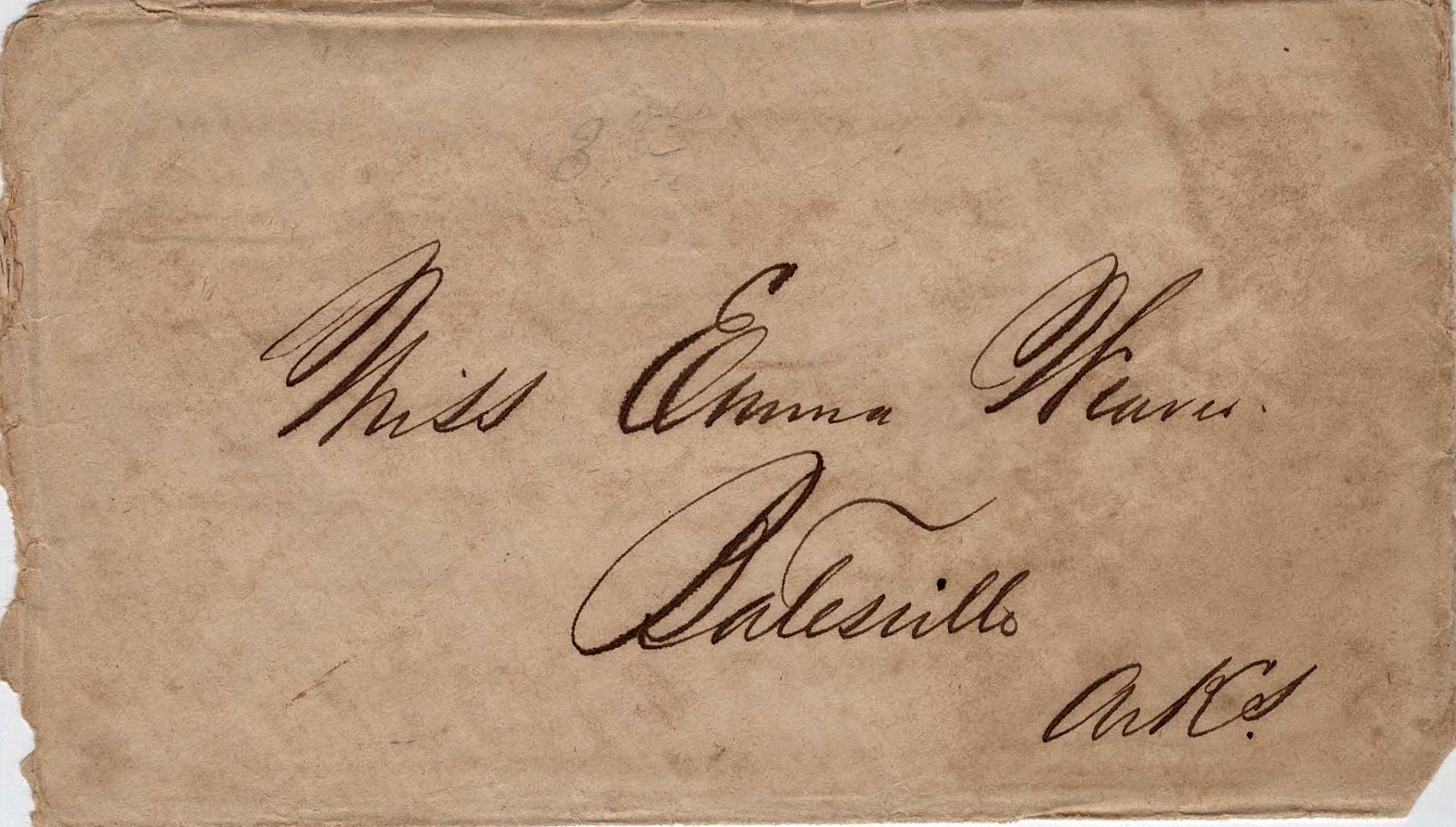
Henry addressed his letters to Miss Emma Weaver of Batesville, Arkansas. There is a comprehensive biographic sketch of Emily Weaver (1847-1917) on the Encyclopedia of Arkansas which informs us that she was charged by Union authorities as a Confederate spy in 1864 and sentenced to be hung though her case was eventually dropped for insufficient evidence. She was born to Abram and Mary (Burton) Weaver of Chester Valley, Pennsylvania but came with her mother and six of seven brothers to Batesville in 1859; her father intending to finalize is business affairs in Pennsylvania and set up a new business in Memphis, Tennessee. When family plans were disrupted by the Civil War, Emily’s father joined the Union army while three of her older brothers joined the Confederacy. It was in Batesville that Emma befriended Gen. Marmaduke and members of his staff, including Henry Ewing with whom she must have carried on an extensive correspondence. They referred to each other as “cousins,” though they were only cousins via Henry’s marriage to Emma Patrick Burton Burr (1845-1932) of Batesville. Emma was the daughter of Batesville merchant, Edwin T. Burr and was enumerated in the 1850 Census as a five year old daughter. Family lore says she married Major Henry Ewing in a romantic wedding at Engleside (the Burr family plantation home on the White River), Batesville, Arkansas on June 2, 1863. Henry’s first letter was written on 29 May 1863—just days before the couple’s wedding. The other three letters were written later in the summer of 1863.
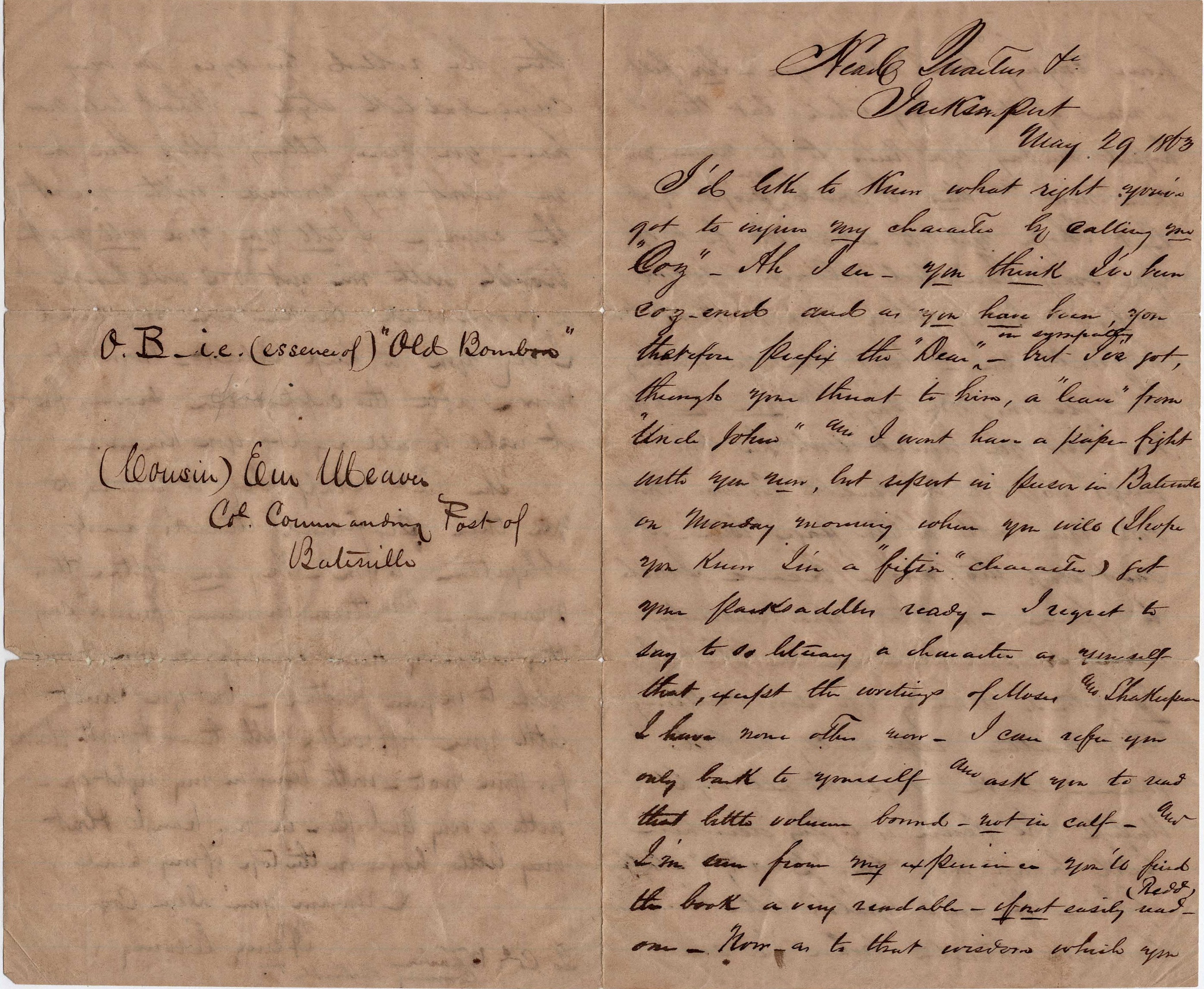
Letter 1
Headquarters &c.
Jacksonport [Arkansas] 1
May 29, 1863
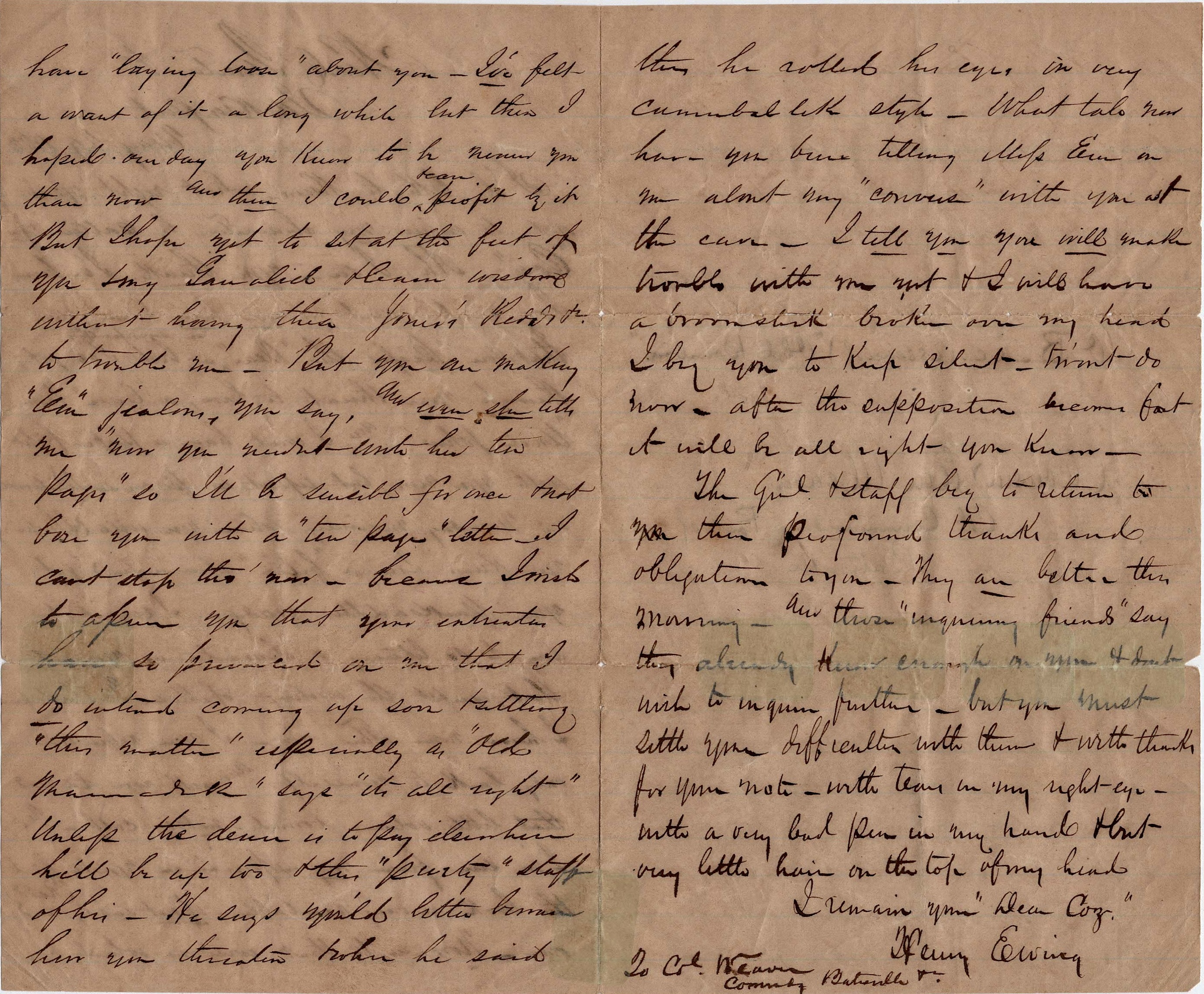
I’d like to know what right you’ve got to injure my character by calling me “Coz.” Ah, I see. You think I’ve been coz–ened and as you have been, you therefore prefix the “Dear” on sympathy—but I’ve got through your threat to him, a “leave” from “Uncle John” and I won’t have a paper fight with you now, but report in person in Batesville on Monday morning where you will (I hope you know I’m a “fightin” character) get your packsaddles ready. I regret to say to so literary a character as yourself that, except the writings of Moses—also Shakespeare, I have none other now. I can refer you only back to yourself and ask you to read that little volume bound—not in calf—and I’m sure from my experience you’ll find the book a very readable effort—an easily read one.
Now as to that wisdom which you have “laying loose” about you—I’ve felt a want of it a long while but then I hoped one day, you know, to be nearer you than now, and then I could profit by it. But I hope yet to set at the feet of your long [ ] and learn wisdom without having these Jones’s Redds, 2 &c. to trouble me. But you are making “Em” jealous, you say, and even she tells me “Now you musn’t write her ten pages” so I’ll be sensible for once & not bore you with a “ten Page” letter. I can’t stop though now because I wish to assure you that your entreaties have so prevailed on me that I do intend coming up soon & settling “this matter”—especially as “Old Marmaduke” says “it’s all right.” Unless the devil is to play elsewhere, he’ll be up too & other “purty” staff of his. He says [ ] letter burns him you threaten & when he said this, he rolled his eyes in very cannibal like style. What tale now have you been telling, Miss Em, on me about my “converse” with you at the cave? I tell you, you will make trouble with me yet & I will have a broomstick broken over my head. I beg you to keep silent. T’won’t do now. After the supposition becomes fact, it will be all right, you know.
The General & staff beg to return to you their profound thanks and obligation to you. They are better this morning, and those “inquiring friends” say they already know enough on [ ] don’t wish to inquire further. But you must settle your difficulties with them & with thanks for your note—with tears in my right eye—with a very bad pen in my hand, & but very little hair on the top of my head, I remain your “Dear Coz.”
— Henry Ewing
To Col. Weaver, Commanding Batesville &c.
1 At various times Jacksonport, Jackson county, Arkansas, was headquarters for such noted military leaders as Frederick Steele, Earl Van Dorn, John S. Marmaduke, Dandridge McRae and Jo Shelby. Jacksonport is approximately 20 miles from Batesville.
2 Could this be slang for hemorrhoids?
Letter 2
[Editor’s Note: This letter was penned just one week after the Battle of Helena. During that assault on the Union garrison, Marmaduke commanded a cavalry division tasked with attacking the Union-held Battery A from the north. Marmaduke’s attack, part of a failed, disjointed three-pronged assault, was inefficiently supported by Brigadier General Marsh Walker, leading to personal animosity. This rivalry continued after the battle, leading to a duel near Little Rock on September 6, 1863, in which Marmaduke killed Walker.]
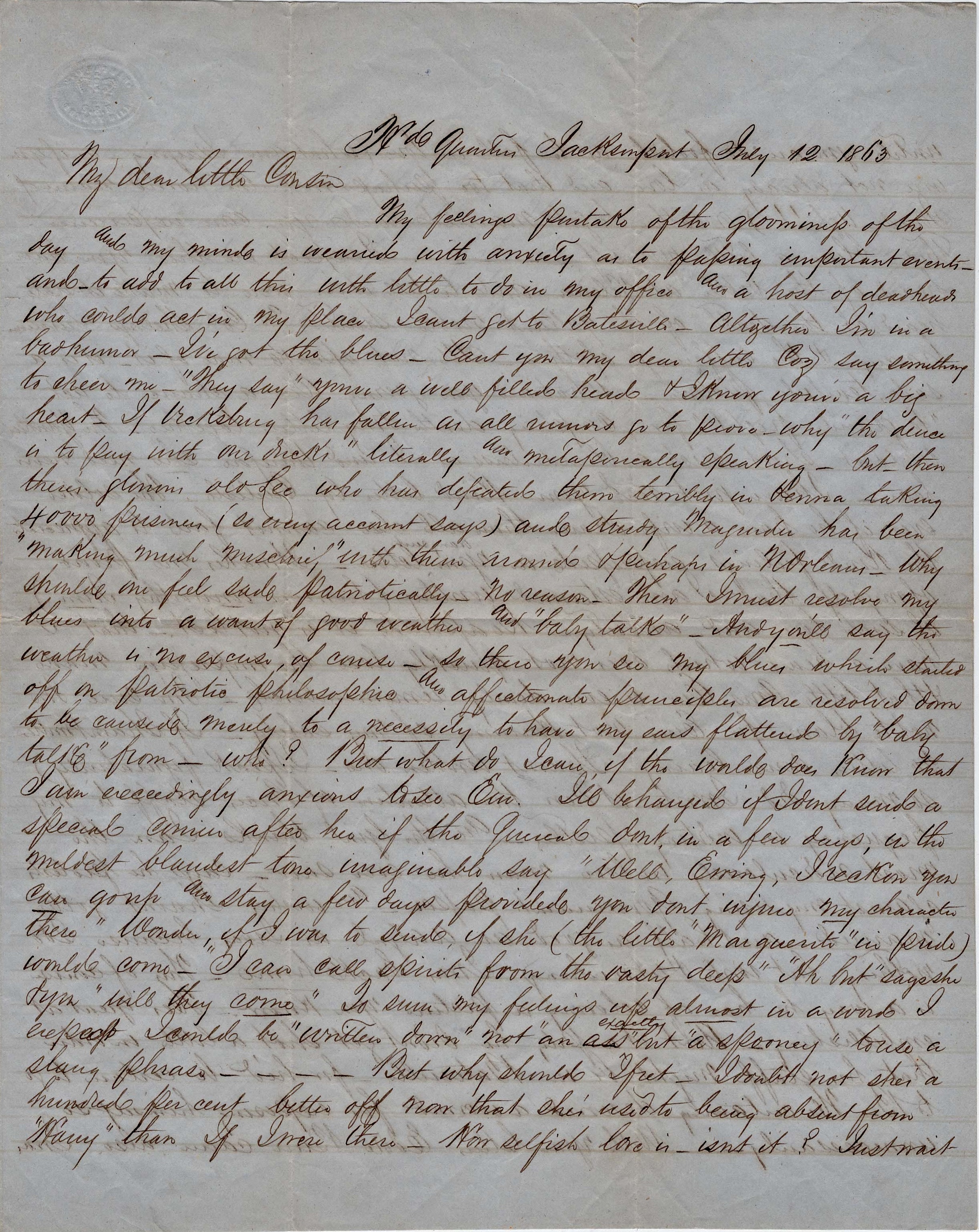
Headquarters Jacksonport [Arkansas]
July 12 1863
My dear little cousin,
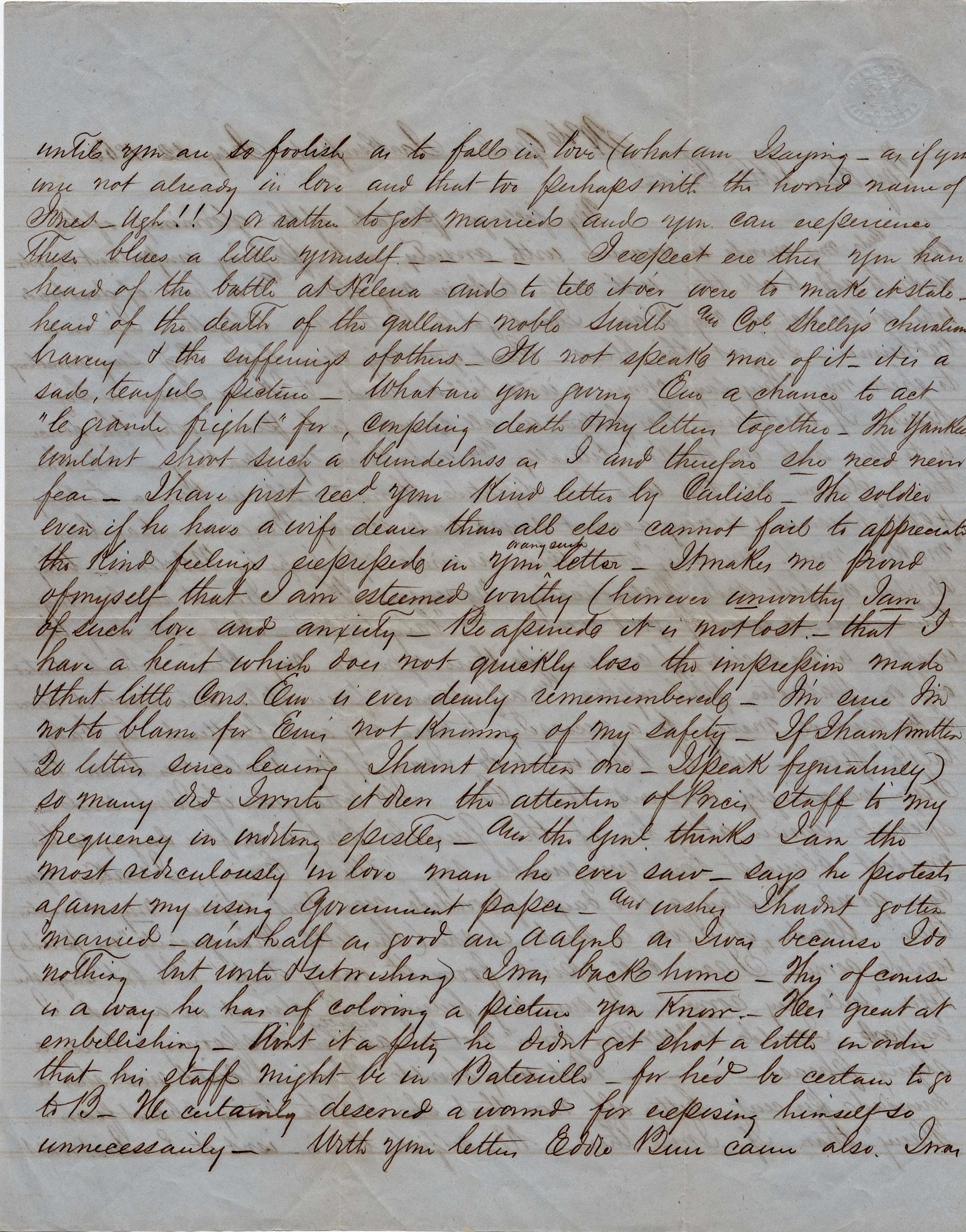
My feelings partake of the gloominess of the day and my mind is wearied with anxiety as to passing important events, and—to add to all this—with little to do in my office and a host of deadheads who could act in my place, I can’t get to Batesville. Altogether, I’m in a bad humor. I’ve got the blues. Can’t you, my dear little Coz, say something to cheer me? “They say” you’re a well filled head and I know you’re a big heart. If Vicksburg has fallen as all rumors go to prove, why “the deuce is to pay with our ducks” literally and metaphorically speaking. But then there’s glorious Old Lee who has defeated them terribly in Pennsylvania, taking 40,000 prisoners (so every account says) and sturdy Magruder has been “making much mischief” with them around & perhaps in New Orleans. Why should one feel sad patriotically? No reason. Then I must resolve my blues into a want of good weather and “baby talk.” Andy will say the weather is no excuse of course—so there you see my blues which started off on patriotic philosophic and affectionate principles are resolved down to be caused merely to a necessity to have my ears flattened by “baby talk” from—who? But what do I care if the world does know than I am exceedingly anxious to see Em. I’ll be hanged if I don’t send a special courier after her. If the General [Marmaduke] don’t in a few days, in the mildest, blandest tone imaginable say, “Well Ewing, I reckon you can go up and stay a few days provided you don’t injure my character there.” Wonder if I was to send [for her], if she (the little “Margarite” in prode) would come. “I can call spirits from the vasty deep.” “Ah, but says she [ ], will they come.”
To sum my feelings up almost in a word, I expect I could be “written down” not an ass exactly, but “a spooney” to use a slang phrase. But why should I fret. I doubt not she’s a hundred percent better off now that she’s used to being absent from “Harry” than if I were there. How selfish love is—isn’t it? Just wait until you are so foolish as to fall in love with (what am I saying—as if you were not already in love and that too perhaps with the horrid name of Jones.– ugh!!) or rather to get married and you can experience these blues a little yourself.
I expect ere this, you have heard of the battle at Helena and to tell it o’er were to make it stale. [You probably] heard of the death of the gallant, noble Smith and Col. [Jo] Shelby’s chivalrous bravery 1 & the sufferings of others. I’ll not speak more more of it—it is a sad, tearful picture. What are you giving, Em, a chance to act “le grande fight” for, coupling death & my letters together. The Yankees wouldn’t shoot such a blunderbuss as I and therefore, she need never fear.
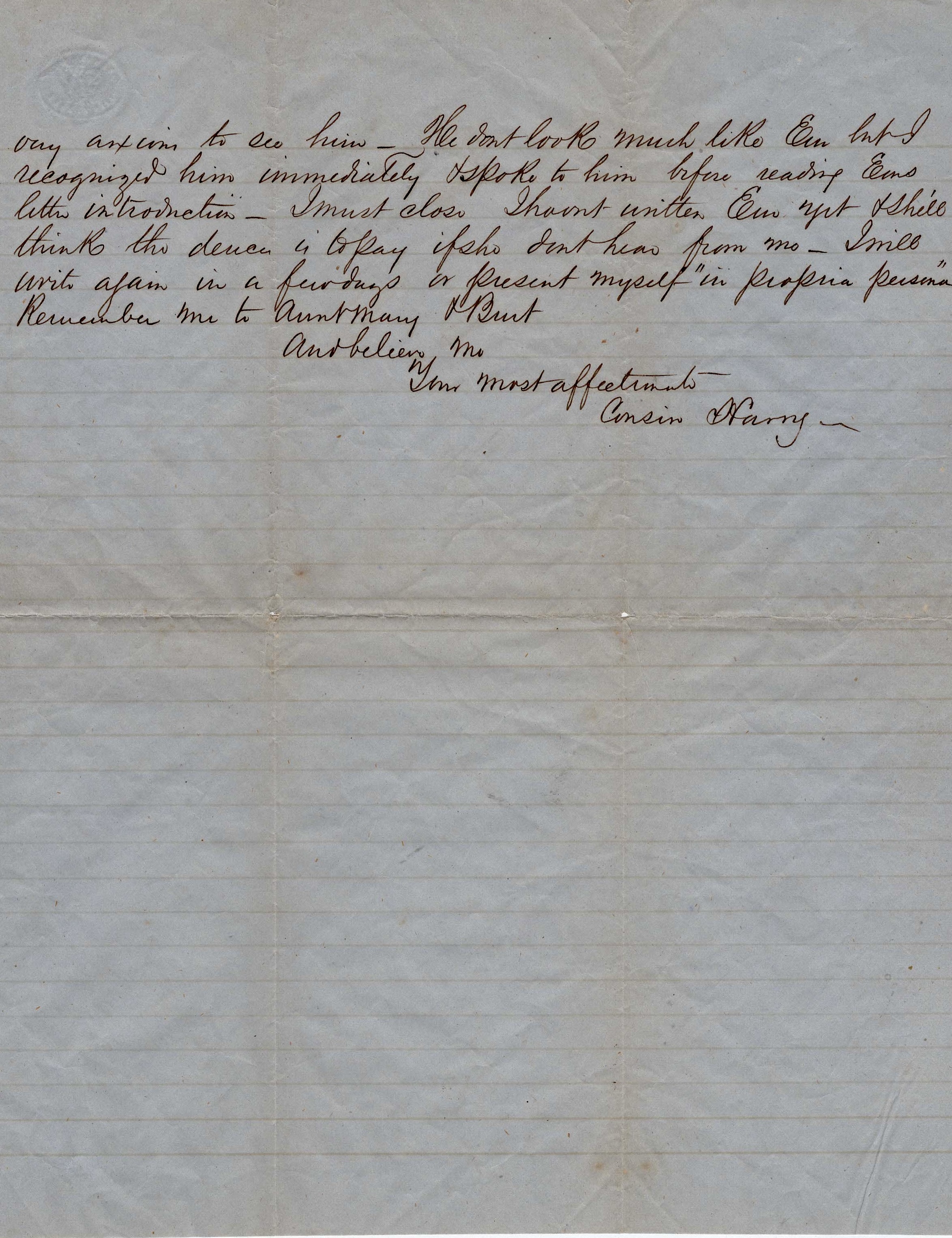
I have just received your kind letter by Carlisle. The soldier, even if he has a wife dearer than all else, cannot fail to appreciate the kind feelings expressed in your letter. It makes me proud of myself that I am esteemed worthy (however unworthy I am) of such love and anxiety. Be assured it is not lost—that I have a heart which does not quickly love the impression made & that little cousin Em is ever dearly remembered. I’m sure I’m not to blame for Em’s not knowing of my safety. If I haven’t written 20 letters since leaving, I hain’t written one. I speak figuratively. So many did I write it drew the attention of [Gen.] Price’s staff to my frequency in writing epistles and the General thinks I am the most ridiculously in love man he ever saw. Says he protests against my using government paper and wishes I hadn’t gotten married—ain’t half as good as Asst. Adjutant as I was because I do nothing but write & sit wishing I was back home. This of course is a way he has of coloring a picture you know. He’s great at embellishing. Ain’t it a pity he didn’t get shot a little in order that his staff might be in Batesville, for he’d be certain to go to Batesville. He certainly deserved a wound for exposing himself so unnecessarily. 2
With your letters Eddie Burr came also. I was very anxious to see him. He don’t look much like Em but I recognized him immediately & spoke to him before reading Em’s letter of introduction.
I must close. I haven’t written Em yet & she’ll think the deuce is to pay if she don’t hear from me. I will write again in a few days or present myself “in propria persona.” Remember me to Aunt Mary & Burt, and believe me your most affectionate cousin, — Harry
1 Col. Jo Shelby earned fame in the attack on Helena for his “audacious” and gallant leadership. He was wounded during the battle and credited with saving his battery.
2 General Sterling Price had a reputation for always being active in the front lines with his men. He did not command from behind and while his heroism was never questioned, it sometimes led to poor coordination between cooperating commands. It was Price who led the attack on Battery C (Graveyard Hill) and, after it was captured, stayed with his troops under intense artillery fire from Union batteries and the Union gunboat Tyler.
Letter 3
Headquarters Marmaduke’s Division
Near Jacksonport [Arkansas]
August 4, 1863
My dear little coz.,
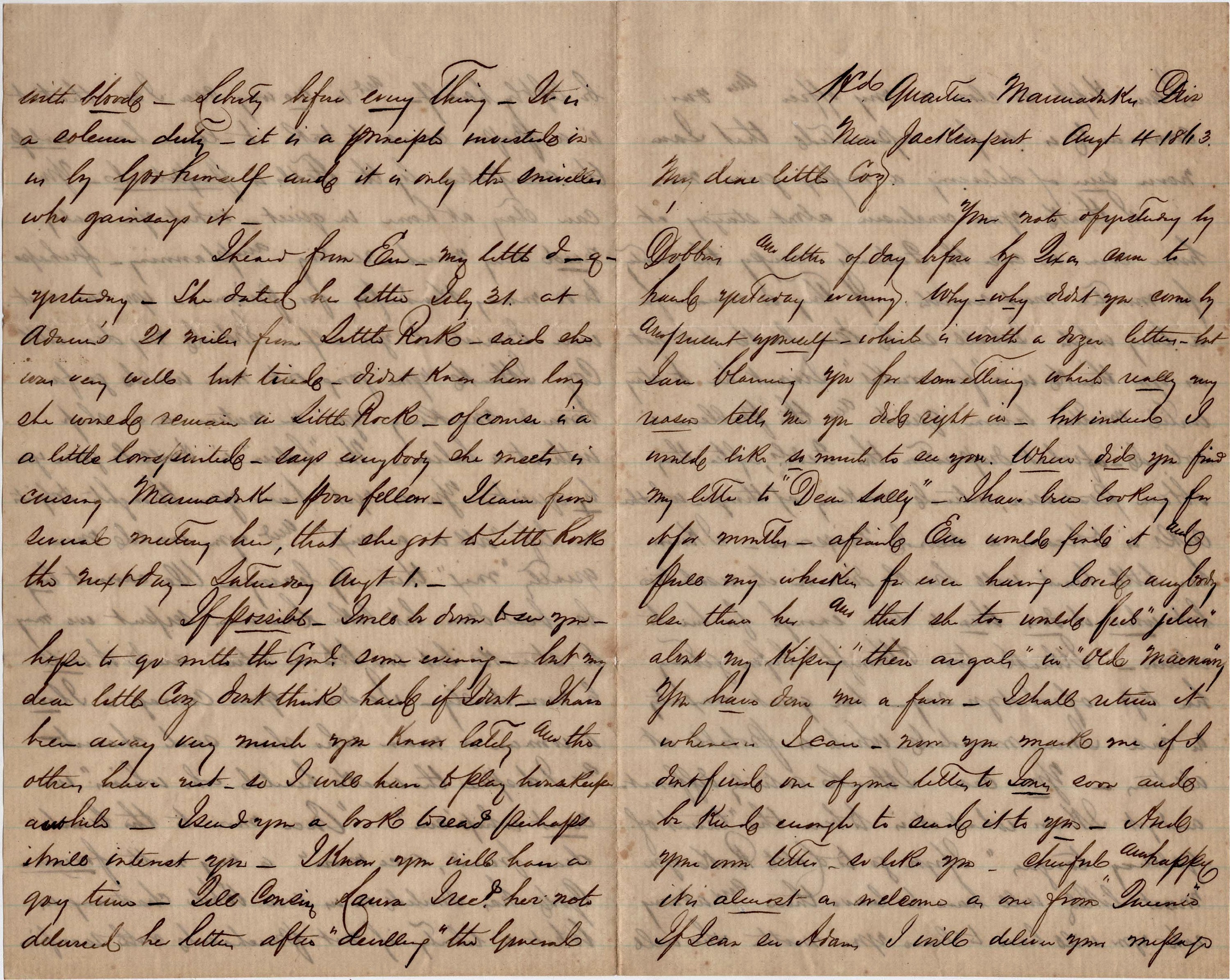
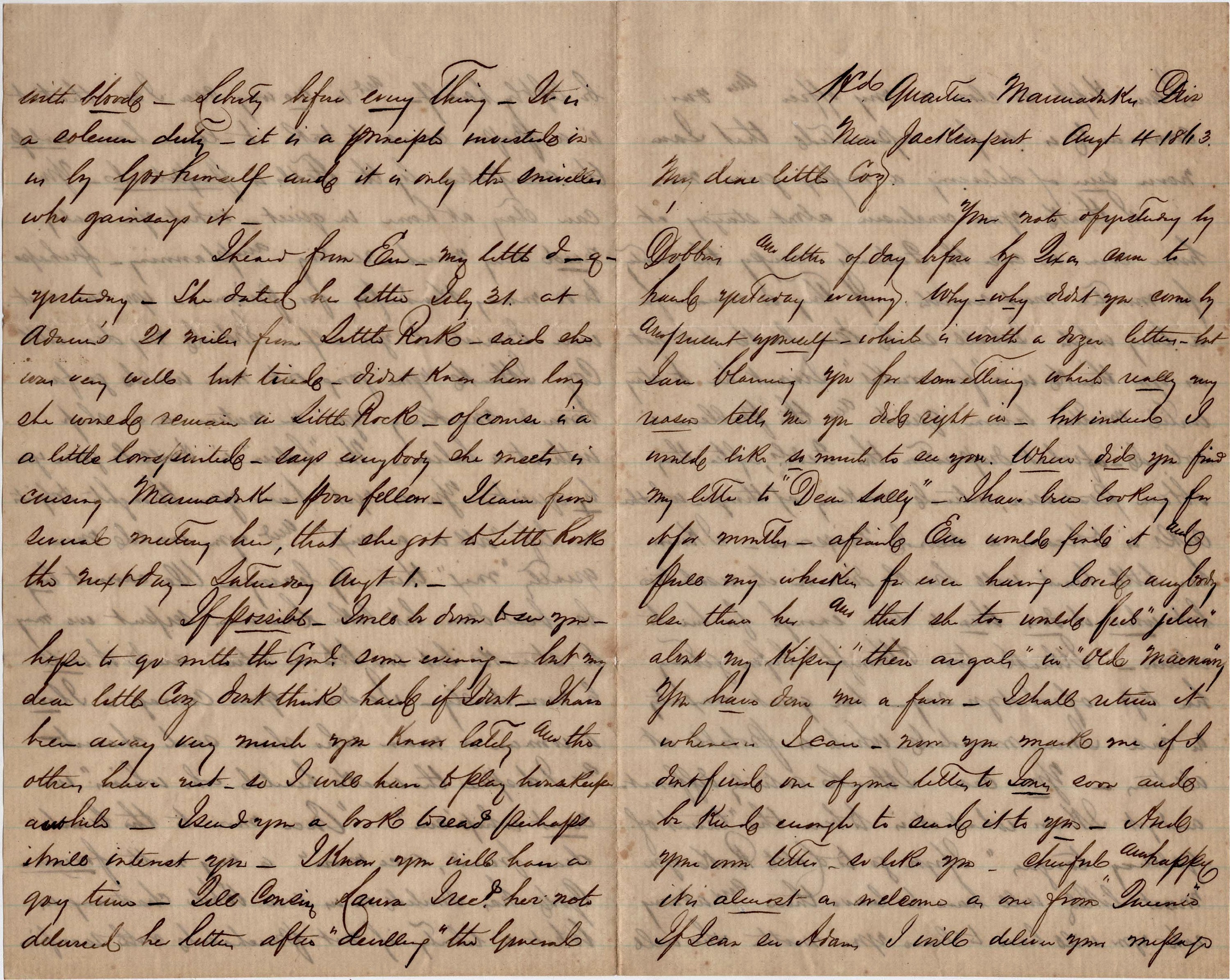
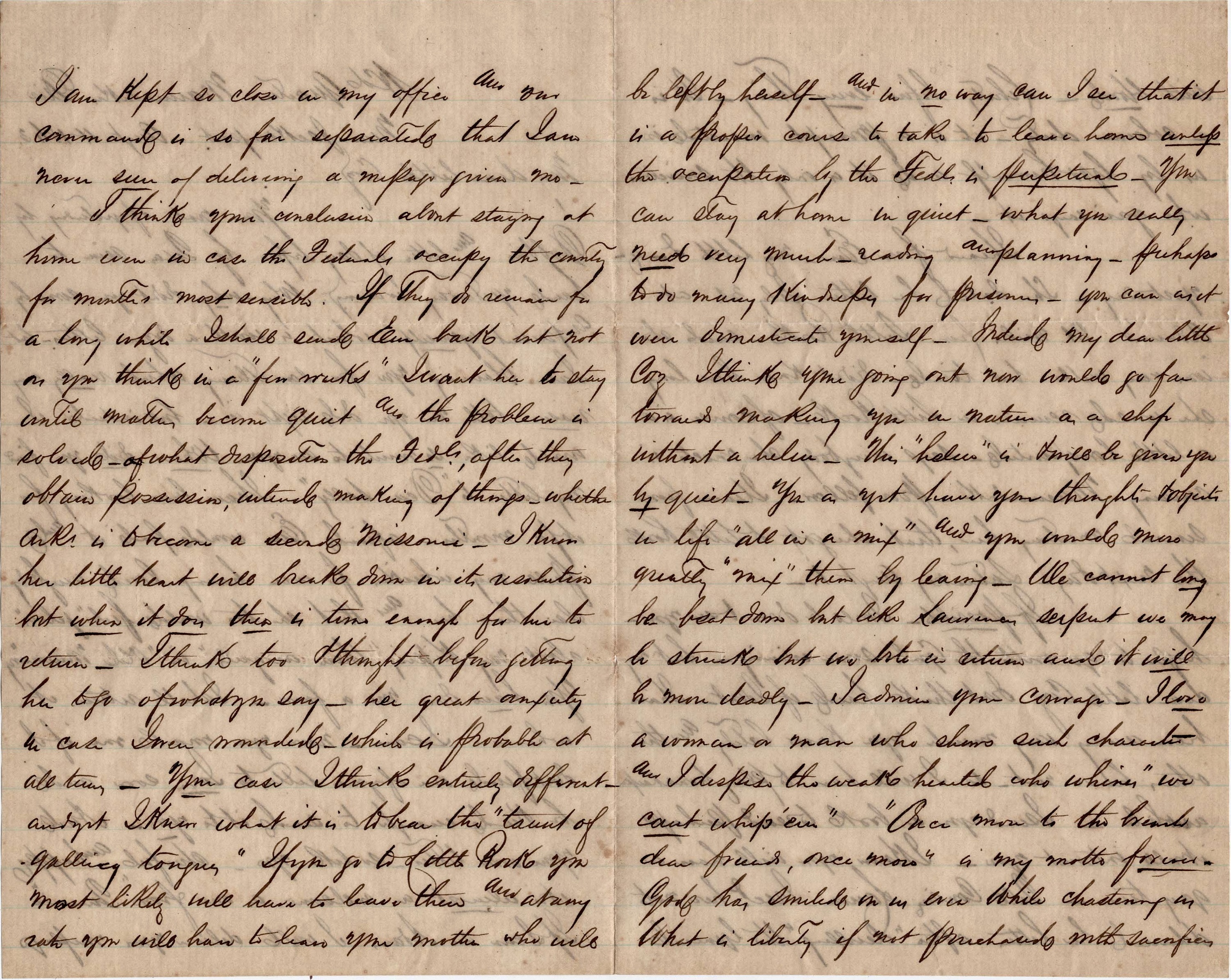
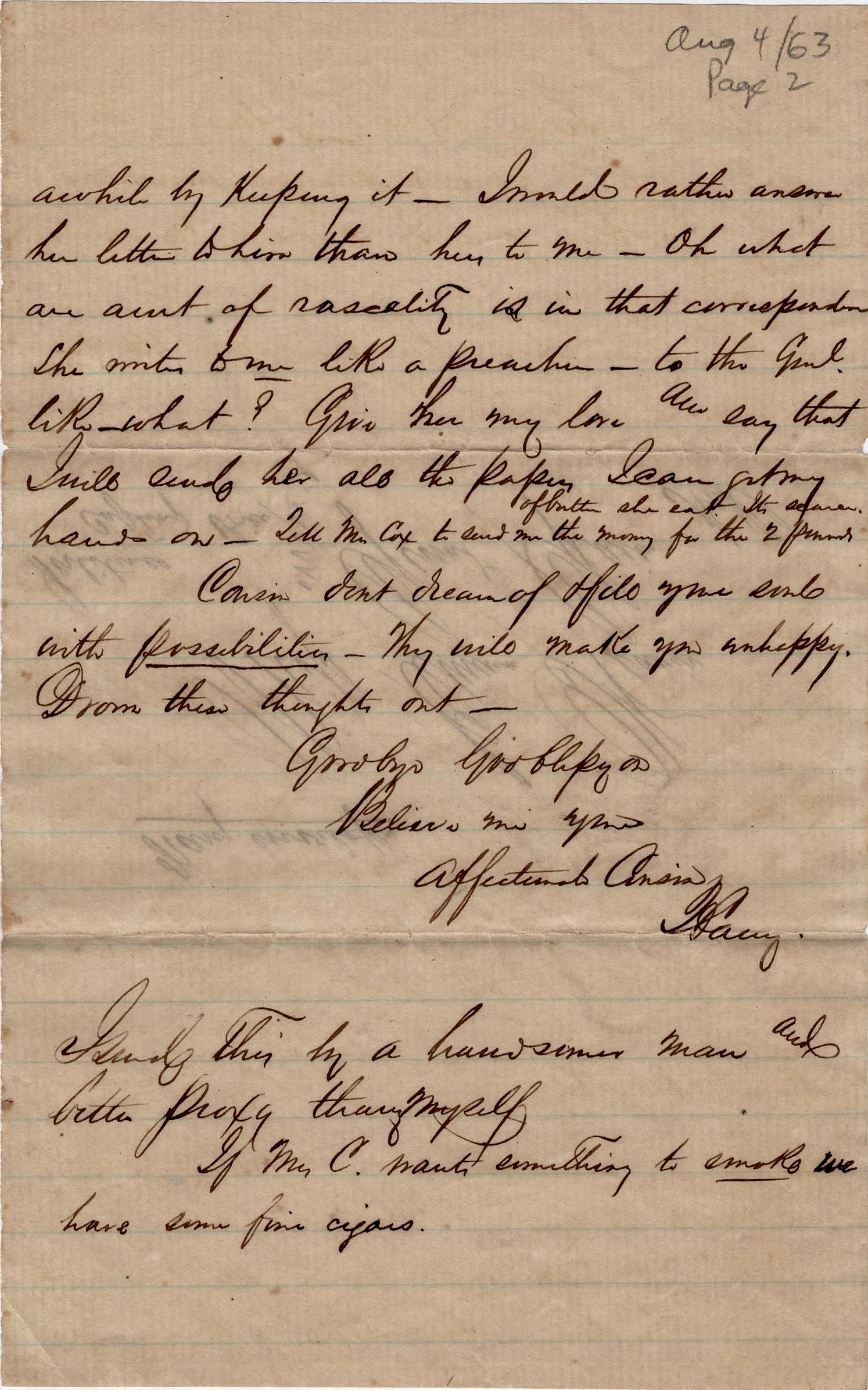
Your note of yesterday by Dobbins and letter of today before by [ ] came to hand yesterday evening. Why—why, don’t you come by and present yourself, which is worth a dozen letters. But I am blaming you for something which really my reason tells me you did right in. But indeed, I would like so much to see you. Where did you find my letter to “Dear Sally?” I have been looking for months, afraid that Em would find it and pull my whisker for ever having loved anybody else than her and that she too would feel “jealous” about my keeping “them angals” in “Old Macnany [?]” You have done me a favor. I shall return it whenever I can. Now you mark me if I don’t find one of your letters to Jones soon and be kind enough to read it to you. And your own letter—so like you—cheerful and happy. It is almost a welcome as one from “Queenie.” If I can see Adam, I will deliver your message. I am kept so close in my office as our command is so far separated that I am never seen of delivering a message given me.
I think your conclusion about staying at home even in case the Federals occupy the country for most sensible. If they do remain for a long while, I shall send Em back but not as you think in a “few weeks.” I want her to stay until matters become quiet and the problem is solved. Of what disposition the Federals, after they obtain possession, intends making of things—whether Arkansas is to become a second Missouri—I know her little heart will break down in its resolution, but when it does, there is time enough for her to return. I think too & thought before getting her to go of what you say—her great anxiety in case I were wounded, which is probable at all times. Your case, I think, entirely different, and yet I know what it is to bear the “taunt of gallency tongue.” If you go to Little Rock, you most likely will have to leave them and at any rate, you will have to leave your mother who will be left by herself and in no way can I see that it is a proper course to take to leave home unless the occupation of the Federals is perpetual. You can stay at home in quiet—what you really need very much—reading and planning, perhaps to do many kindnesses for prisoners. You can, as it were, domesticate yourself. Indeed, my dear little coz, I think your going out now would go far towards making you as [ ] as a ship without a helm. This “helm” is and will be given you by quiet. You, as yet, have your thoughts & objects in life “all in a mix” and you would more greatly mix them by leaving? We cannot long be beat down but like Laurence’s serpent, we may be struck, but we bite in return and it will be more deadly. 1
I admire your courage. I love a woman or man who shows such character and I despise the weak hearted who whines, “We can’t whip ’em.” “Once more to the breach, dear friends, once more!” is my motto forever. God has smiled on us even while chastening us. What is liberty if not purchased with sacrifices with blood? Liberty before everything. It is a solemn duty. It is a principle invested in us by God Himself and it is only the sniveler who gainsays it.
I heard from Em, my little d____q___ yesterday. She dated her letter July 31st at Adam’s, 21 miles from Little Rock. Said she was very well but tired. Didn’t know how long she would remain as Little Rock, of course, is a little low spirited. Says everybody she meets is cursing Marmaduke—poor fellow. I learn from several meeting her that she has got to Little Rock the next day—Saturday August 1st.
If possible, I will be down to see you. Hope to go with the General some evening but my dear little Coz, don’t think hard if I don’t. I have been away very much you know lately and the others have not so I will have to play housekeep awhile. I send you a book to read. Perhaps it will interest you. I know you will have a gay time. Tell cousin Laura I received her note, delivered her letter after “dueling” the General awhile by keeping it. I would rather answer her letter to him than hers to me. Oh what an amount of rascality is in that correspondence. She writes to me like a preacher; to the General like—what? Give her my love and say that I will send her all the papers I can get my hands on. Tell Mr. Cox to send me the money for the two pounds of butter she eat. It’s scarce.
Cousin, don’t dream of & fill your [ ] with possibilities. They will make you unhappy. Drown these thoughts out. Goodbye. God bless you. Believe me your affectionate cousin, — Harry
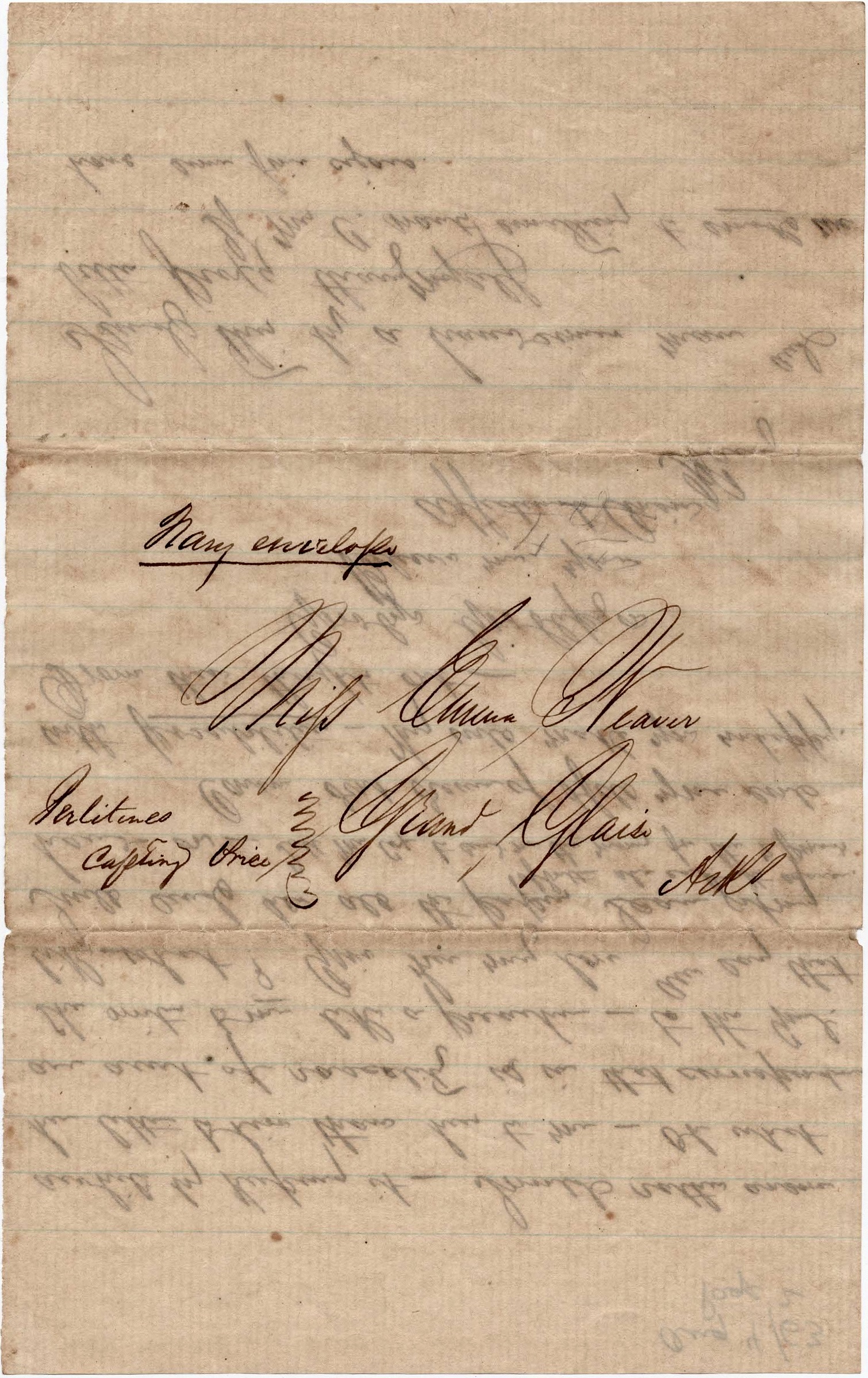
I send this by a handsome man and better proxy than myself. If Mr. Cox wants something to smoke, we have some fine cigars.
1 This allegorical reference remains an enigma. I could not find any reference to it in period literature yet, ironically, decades later, D. H. Lawrence’s wrote a poem called “Snake,” in which the allegory of the serpent being “struck down but biting” was the subject. It represents the conflict between innate, natural impulses and the destructive influence of societal conditioning, or “voices of education.”
Letter 4
Headquarters &c. Des Arc [Arkansas]
August 18, 1863
My dear little “Coz,”
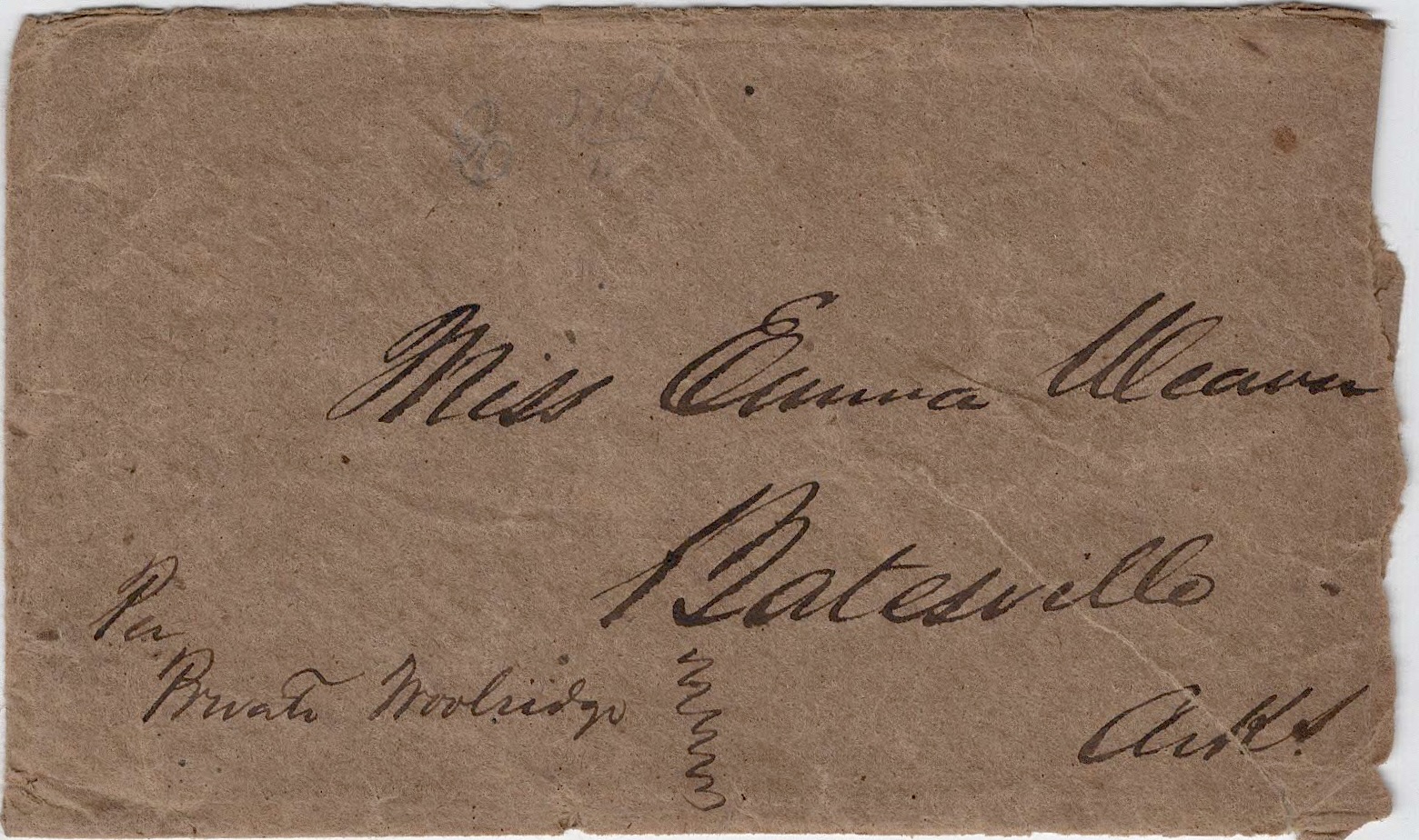
Capt. Hooper formerly of Col. Greene’s staff, returns to Jacksonport tomorrow and if Col. Greene is still in Batesville, will also go there. If not, he promises to send this to you. It may be my last chance to write you & notwithstanding my intense laziness, I cannot resist writing it if it “just a little.”
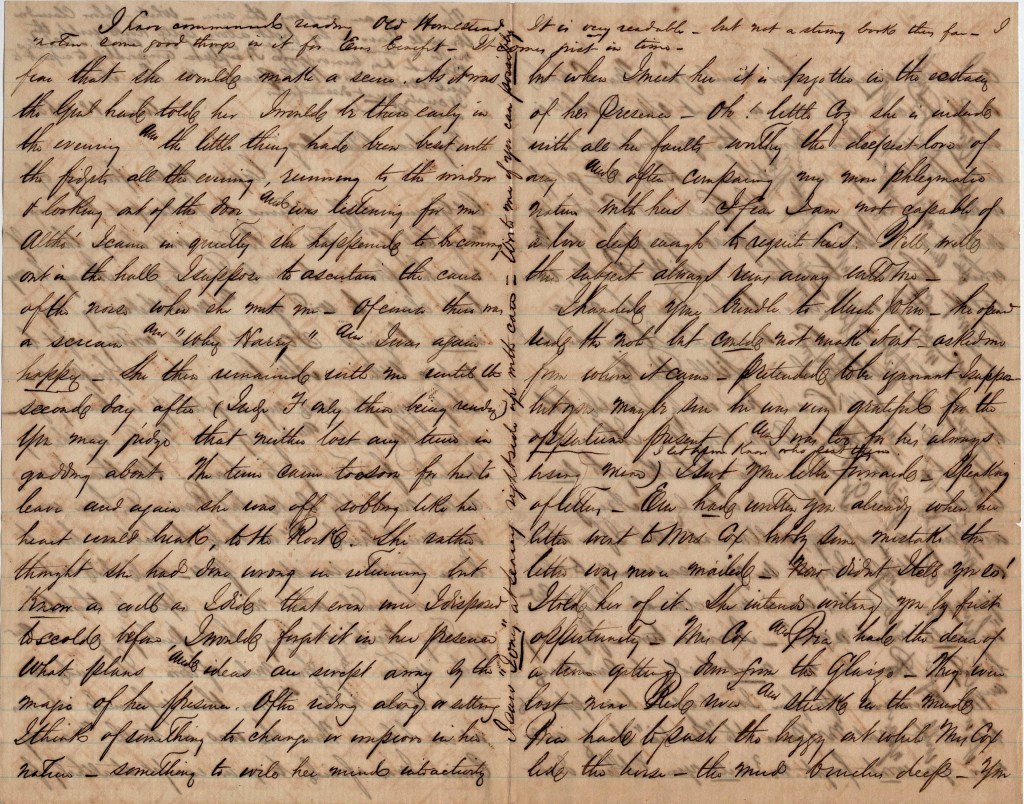
After leaving you at Simpson’s, I hope you pardoned my impoliteness in leaving you alone. [Major Charles Cicero] Rainwater 1 and myself, as Newton would say, “rushed frantically” to Searcy. We thought we could make it by dark but Rainwater’s horse was very much tired and we had to halt an hour to let a terrific rainstorm pass, and ride out with it until about nine. I feared that Em, getting tired of waiting, had perhaps gone on and when within three or four miles of town and hurriedly on went to one hotel, I was then informed she was at one below. There she was in truth and really cousin, I was afraid to go in except stealthily for fear that she would make a scene. As it was, though General [Marmaduke] had told her I would be there early in the evening, the little thing had been beset with the fidgets all the evening, running to the window & looking out of the door and was listening for me. Although I came in quietly, she happened to be coming out in the hall, I suppose, to ascertain the cause of the noise when she met me. Of course there was a scream and “Why Harry!” and I was again happy. She then remained with me until the second day after (Judge F, only then being ready). You may judge that neither lost any time in gadding about. The time came too soon for her to leave and again she was off, sobbing like her heart would break to the [Little] Rock. She rather thought she had done wrong in returning but know as well as I did that even when I disposed to scold her before, I would forget it in her presence. What plans and ideas are swept away by the masses of her presence. After riding along or sitting, I think of something to change or improve in her nature—something to wile her mind interactively . But when I meet her, it is forgotten in the ecstasy of her presence.
Oh! little Coz, she is indeed with all her faults worthy the deepest love of any and often comparing my more phlegmatic nature with hers, I fear I am not capable of a love deep enough to requite hers. Well, well, the subject always runs away with me.
I handed your bundle to Uncle John. He opened, read the note but could not make it out. Asked me from whence it came. Pretended to be ignorant, I suppose, but you may be sure he was very grateful for the opportune present (and I was too for he’s always using mine). I let him know who lost them. I sent your letter forward.
Speaking of letters, Em had written you already when her letter went to Mrs. [Laura A. Erwin] Cox but by some mistake the letter was never mailed. Now didn’t I tell you so! I told her of it. She intends writing you by first opportunity. Mrs. Cox and [General] Price had the devil of a time getting [ ] from the Glaizo. They were lost near Red River and stuck in the mud. Price had to push the buggy out while Mrs. Cox led the horse—the mud 6 inches deep. You can well imagine how much fun Mrs. Cox had out of Price. She was in great spirits while in Searcy. Was there during the gunboat excitement but packing up ready to leave. Did not get off until next day when the General sent Carlyle along with her. She will be great company for Em while they are together in Little Rock. Rare talks they will have. While here, she got a letter from [her husband] Maj. [Thomas] Cox in which I believe she said he would shortly be in Little Rock. 2
My dear little cousin, how dearly I would like to find my table with you tonight. I know not why it is, but I have tire of talking some to others, “mums the word entirely.” Are you adopting any of my well meant but I fear stupid antics. Would I might see you occasionally to cheer you up. But the war is not eternal, I hope, and “we will meet again.” I write on time. Forgive my brevity. Remember me kindly to Aunt Mary and Mrs. Kinnard & for fear I won’t again have opportunity to write to all at Mr. B’s and to “Auntie” dearly and now you won’t forget ne? Will you? Please don’t. It would hurt me, and believe me, my dear little cousin, I will often be carried back in memory and my heart will yearn to see you & see you help to make your happy. Goodbye. God bless you, — your cousin & friend, — Harry
The enemy are crossing the river—White—below Clarendon. We will have a big fight above Little Rock unless they make a rear movement by way of Pine Bluff. Shelby’s Brigade has been ordered I suppose temporarily to support Gen. Walker. It creates great dissatisfaction in the Brigade.
1 Major Charles Cicero Rainwater (b. 1838) was appointed ordnance officer on the staff of Gen. John S. Marmaduke in 1863.
2 Lilburn “Thomas” Cox (1829-1871) was born in Indiana but came to Springfield, Missouri, in the fall of 1836. He served in the Missouri Militia during the Mexican War and later became a protege of Gen. Sterling Price. In 1858, Cox relocated to Batesville and married in 1842 to Elizabeth Hayden. He was a school teacher in Batesville and attempted to establish a law practice. Before the Civil War, Thomas purchased the Batesville mansion built by his father-in-law and hosted many dignitaries. During the war, the house was occupied at times by Gen. John S. Marmaduke. In January 1869, Thomas remarried to Laura A. Erwin (b. 1836). In 1860 he owned 2,650 acres of land in Independence county. A Quaker, Thomas owned only one slave in 1860. After Thomas’s death in 1871, Laura A. Erwin Cox was remarried July 2, 1874 to Dr. David Ewing, believed to be the former husband of Em Ewing mentioned in her letter reproduced above.
The “Independence Chronicle” printed a letter written by Laura A. Erwin Cox to her husband dated September 14, 1863. In an edition printed in October 1963 the newspaper expressed appreciation to Miss Elenor Gray of Batesville who was a grand-niece of Laura A. Erwin Cox. The newspaper terms the letter one of the most graphic accounts of the Battle of Little Rock and the retreat of the Confederate army. The writer of the letter was in Little Rock when the evacuation began and accompanied the soldiers at least as far as Arkadelphia, Arkansas. It is believed that she had left the Cox home in Batesville when northern Arkansas fell into Union hands. The letter reads:
September 13, 1863
My Dear Tom,
Here I am, right side up with care, but quite a wonder considering what I have gone through with in the last 5 days. You will have heard of the evacuation of Little Rock by our troops, that the enemy now holds our Capitol, etc. This was done on the 10th. I closed a long letter to you on the morning of the 10th, and at that time it was thought we could hold the place, but a few hours soon told a different tale. The enemy advanced below town, crossed in force, but did not come up on our fortifications as was expected by Gen. Price, but shunned them as all sensible people would do when they could effect their aim without it.
Gen. Price estimated their strength at 30,000 some more (cavalry infantry under [Gen.] Steele, Davidson, Curtis). On the morning of the 10th it was found that they were crossing some 4 to 6 miles below the Rock. Marmaduke’s Cavalry was immediately crossed on this side, sent down to keep them in check til the infantry could come over, which they did immediately commenced the retreat, which was about 10 o’clock. The cavalry was fighting all the time in the most daring and gallant manner ever witnessed. They, thinking all the time that the infantry was to support them, gave a general fight which every man was anxious for. There was no infantry engaged—only the entire cavalry force (including Newton’s & Dobbins’ regiments which were under Marmaduke also). The artillery was partly engaged. Pratt’s Battery did good work, also Woodruff’s, which was made up of volunteers.
At 1 o’clock it was generally known that a general retreat was ordered. The cavalry stood up to the last minute disputing every inch as they fell back. Never did men fight better, never more hurt at the giving up a place, for they felt it would be a long retreat. The men all would have felt better satisfied if they would have given them a trial. Many blame Gen. Price— think the force not so great, but it is bound to be large. They move with entire confidence. I suppose Gen. Price knows best, but it does look like it was rather badly managed. Had his fortifications been extended down the river and up–instead of putting the entire works in front of the town, the time might have been prolonged, if not successful entirely. I will not criticize ‘Old Pap’s’ generalship for he has plenty of that. He may be all right in his notions. The retreat did not take him by surprise for to my certain knowledge there has been more arrangements to evacuate the place than to hold it.
It’s all gone up now—all North Arkansas. Where their lines will be in four weeks, no one knows. I left at 4:30 that evening, came out with brother as our cavalry retreated. When I left Dr. K., our cavalry was in line across the lower end of town below the P. O. fighting. I helped Dr. K. bind up some of our wounded. You have no idea what a cram there was. Marmaduke through Price was influenced by some of the citizens not to fight so close to town, and he was very much enraged. He sent me and Em Ewing to get out of town. Mrs. Peyton and a few others said he was going to raise H— before he left Town. He fought them all the way through the town, but lost only a few men. He killed a Federal with his pistol in the street by Dr. Peyton’s near the middle of the town. He acted in a reckless manner all day. His men all followed him. They captured three pieces of artillery and brought them off. The men were dismounted—all save the General and his Escort when they charged the Battery. The General told them the first man that lagged or faltered, he would shoot them down. They killed 3 men off of the Battery after they took it. They would not give up. It was their intention to destroy the main portion of the Town & would have done it, but were hurried too much. There is not much love for Little Rock in the soldiers.
We followed the trains and infantry on, traveling all in a cram, the cavalry fighting in the rear. We all stopped about 3 o’clock in the night and took a rest until daylight. I slept under a tree with brother Bill and slept as sound as if I were a thousand miles from the enemy. Daylight found us all on the stir, the enemy were crowing the rear, the cavalry still fighting them. Brother and I came on, stopped about 12 and got dinner—the first eating done for several meals. We managed to get to stay in a house the next night. The [wagon] trains, passing all night, put us behind again. The Feds followed on to Benton in Saline County where Marmaduke gave them a little fight and repulsed their cavalry force that had been following them. They were soon reinforced by their infantry, and Marmaduke had to fall back. The infantry of Gen. Price was halted at Salmi River & a portion of the train. If the force had not been too large they could have fought them there, but owing to their attempting to flank our forces, they had to go to Rock Port 35 miles from here where we left them yesterday morning.
We got here to cousin Ann McFadden’s last night, tired and hungry, for something to eat had played out on the road from Little Rock here. I brought George and Fanny [horses] with me. I have given you a faint idea of the retreat & hope soon to be able to give you a more minute description by word of mouth. This is my first big retreat and I hope my last for, I assure you, it was not pleasant. The dust was so thick for your life you could not see a man five steps from you. I passed more broken down wagons, buggies, etc than you could imagine could be in same distance. I saw everybody but you on the retreat.
Mrs. Hull was along, seemed cheerful as a bird–could not tell whether she was white or black hardly. Col. Hull is in Missouri. I left Dr. Peyton’s wife 2 miles back of Arkadelphia with a host of ladies (camped). Every house in Arkadelphia and around is full. Poor Em Ewing, I left her just crying to kill nearly, in the streets. Maj. just got to say goodbye as he galloped by, the balls flying after them. Em had no way of coming out. I hated to leave her. Since I have been with Em of late I find her quite a different girl from what Nannie has always represented her to be. She has one of the best husbands except mine. He [Harry Ewing] is a noble fellow. Although Nan says Em has picked up a stranger, she tried to pick him up and failed as she has in a few other cases.
Dr. Kirkwood went down the morning of the fight and tendered his services as a Sergeant or as a man for the ranks. He thought he would be successful that morning. John Kirkwood was a volunteer gunner of Maj. Woodruff’s Battery and will make a good soldier, but Dr. tried to keep him out as long as possible. Dr. was very uneasy when he found we were going to evacuate the place. The people accused the Dr. then of being Fed, but I don’t think he would wish us anything but success, but his confidence in our cause is light. He really wishes it different, but can’t feel it will be & speaks it out while others think as he does and say nothing. But he will play his hand as to get along with them, I know. He wanted me to stay, but really I felt as if I could not stand to hear them exulting over their success.
And to be there and not hear a word from you–I could not think of it. Yet it looks just now like to keep out of the war lines will be next to impossible. Whether our army will make a stand here or not I can’t tell, but I think if the enemy still come on, they will fall back as far as Washington where they are sending all the Government stores now. Gen. Cabel’s Command got to Arkadelphia yesterday. Gen. Price & Staff got there this morning. I have just learned that it is thought the enemy will not move on here immediately. They could put this outfit through rapidly if they were to push them now for they need rest, and they are somewhat demoralized. Quite a number deserted on the retreat, mostly Arkansas men, Reg. and the infantry. The Negroes dropped off by the dozens the first night we left Little Rock.
I do hope the Feds will put the last white man that sneaked in home in the ranks & pray they may all be killed the first battle. Many of the desertions are not aiming to quit the service, but are opposed to being sent so far from home. It looks like we are losing ground here, but I hope things will change. Tis a long lane that has no turn to it. The Rebels are having a hard time. There is said to be 2,000 cavalry from the Missisippi River to be at Arkadelphia tomorrow. The militia is all encamped at town and all the old men have volunteered for 12 months in this county. Uncle James Wilson is orderly Sergeant of A Company & left this morning for Camp. McFadden is also out in a Pioneer company. The entire country is deserted by the men around here, but they are too late going out I fear. The Federals now have the best part of the State. I would not give North Arkansas for 50 times the extent of this country. From here to Little Rock there is not enough corn to feed a regiment of cavalry for three months, and the people are living on half rations—Little Rock not excepted. I positively nearly starved since I left home for something I was used to eating.
How often I have thought of the poor soldiers & as I came along the road, I was reminded of the hardships my poor brothers have undergone while on those marches east of the Mississippi River. I shall feel more for the poor soldiers now than ever. One poor fellow I saw dying by the roadside. How much I wanted to get out and do something for him. I asked Col. Newton’s wagonmaster to see to him, but he was hurried so I doubt but that he was left to die alone and maybe unburied.
I find this whole country filled with sick. The Citizens–McFaddens all sick and their neighbors. I hope I will not get sick. I had my spell in Little Rock, had only been up 4 days when I left. I feel quite well now since I got enough to eat again. This country does not look like it did when I was here before. I feel a lonesome or blue spell coming on me. It is so quiet here still I have been in such a crowd for so long, I know I will be lonesome here. Lou Ross heard I was here last night, and she came calling on me this morning has just [illegible] Lou was very glad to see me. She is about all of my old friends left around here that is not married 2, 3 children. Lou wanted to know where mine were. I told her I hung them up in my wardrobe before I left home.
Brother Bill has gone down to Aunt Rutha’s, three miles from here. He will go to his command in the morning. I am half crazy to hear from you. If you wrote me at Little Rock I have never gotten a letter since you got my letter written you at Little Rock. I was there 4 weeks, and during that time I wrote you from 3 to 4 times a week. I hope you got them. I suppose Capt. Price will find your letters to me in the mail destined for Little Rock which will be opened at Arkadelphia now. He told me he would attend to it for me. He came on yesterday with us, is quite unwell, has been on the decline since the Helena fight. I hope he will get better for he is an excellent young man and a good friend of mine. He has been very kind attentive since I left home.
Col. Shaver came during the skedaddle out of Little Rock to assist me in getting out. He said his ambulance tent and his servant with himself was at my service. He was most the most excited man I saw during the day.
Head, John Smith & about 20 others came after me as they feared I had no way of getting out, knowing I was there. I will never forget such friends for they are true friends. Head is a great soldier. John Smith is highly complimented by the Reg. for his bravery. He makes a good soldier with a Reg. of Henry Smiths who, bye the bye, I hear has gone to Mexico, family and all. I guess ’tis so he would rather go to Africa than fight. I don’t know where Freas is now, but is out of danger, I guess. Can’t hear from up there now. You need not be surprised to hear of me being homesick. I would give a great deal to see Pa, Ma little Matt now, and if I don’t get to see a big six footer down here pretty soon I don’t know what I will do. I’ve not got the patience of Job. It seems an age since I saw you. I hope I will see you soon, but I see but little hope of it now. May paper is out. I must close. Truly yours, — Laura
P. S. I am going to write Mr. Ruse [Ross?] tomorrow. Maybe he can get a letter to you or has heard from you. If our army has to fall back from here, I will go as far as Judge Rose’s if our army can make a stand there I think I’ll go no further unless I get with you. I will keep George [horse] with me as long as I stay within our lines, but in case I have to remain in the enemy’s lines I will leave him with Brother or some Officer for you. Fanny [horse] I will keep with me and take the chances. Truly yours, — Laura