The following letters were written by Felix Thomas Griffin (1838-1905), the son of Richard Callaway Griffin (1798-1849) and Phoebe Yates (1801-1858). Felix was commissioned a Lieutenant in Co. A (“Irvin Guards”), 9th Georgia Infantry, in June 1861, but transferred to Co. C, 11th Battalion Georgia Light Artillery in December 1861. He was elected 1st Lieutenant in January 1862. In the Battle of Crampton’s Gap (South Mountain), Felix and Sergeant John C. Dyson were wounded and Private George D. Bruckner was killed.
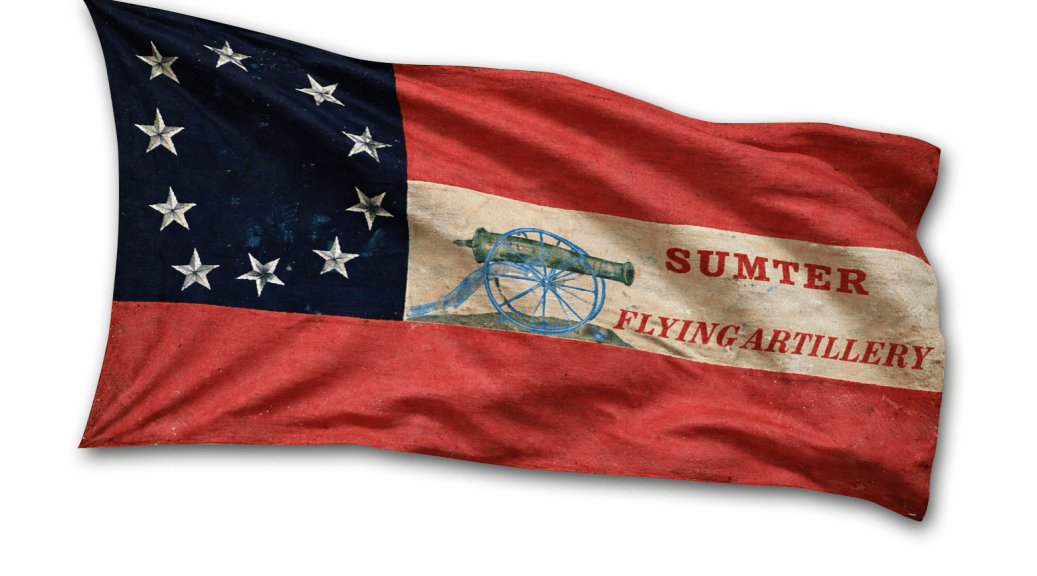
Captain John T. Wingfield’s Company C was one of three batteries comprising the artillery battalion led to Gettysburg by Major John Lane, which was attached to the infantry division of Major General Richard H. Anderson of the Third Corps, commanded by Lieutenant General A. P. Hill. Capt. John T. Wingfield, Senior 1st Lieutenant Frank Arnold, Junior 1st Lieutenant Felix T. Griffin, Senior 2nd Lieutenant Joseph W. Barnett. The battalion was usually referred to as Cutts’ Battalion, after Lieutenant Colonel Allen S. Cutts, who missed the campaign due to an undefined “indisposition.” It was officially the 11th Battalion of Georgia Artillery, which was called the “Sumter Battalion,” from Americus, Georgia. However, Company C traced its roots back to Company A of the 9th Georgia infantry – the “Irvin Guards” from Wilkes County, Georgia.
At Gettysburg, Company C was equipped with five pieces – three 3-Inch navy Parrotts, and two heavy 20-pounder Parrotts. During the battle a total of 406 rounds were expended, including 300 rounds of navy Parrott ammunition and 106 rounds of 20-pounder Parrott shell. Approximately 85-90 rounds were fired on July 2 and the remainder on July 3.
After the war, in 1868, Felix married Laura Corintha Strother (1847-1890). Both Felix and Laura were buried in the Old Griffin Cemetery in Thomson which was bordered by Little River and on the property which was once the Griffin Plantation, purchased by Felix’s grandfather, Jeremiah John Griffin (1774-1847). It seems that Jeremiah was a wealthy landowner in McDuffie County when two Englishmen discovered gold near Thurmond Lake in 1823. They couldn’t afford to buy land, so they approached local farmers. Jeremiah bought about 3,000 acres along Little River, essentially establishing a gold mining monopoly. He used slaves to extract gold from the quartz by a chemical process that involved pulverizing the quartz, mixing it with mercury and heating it to 400 degrees. Jeremiah’s claim to fame was the invention of the stamp mill in 1833. Similar in concept to a grist mill for flour, the stamp mill automated much of the process of extracting gold using water power rather than human power. The process is explained in more detail in an article in the Augusta Chronicle of March 30, 2008, headlined “McDuffie County was rich in ore.”
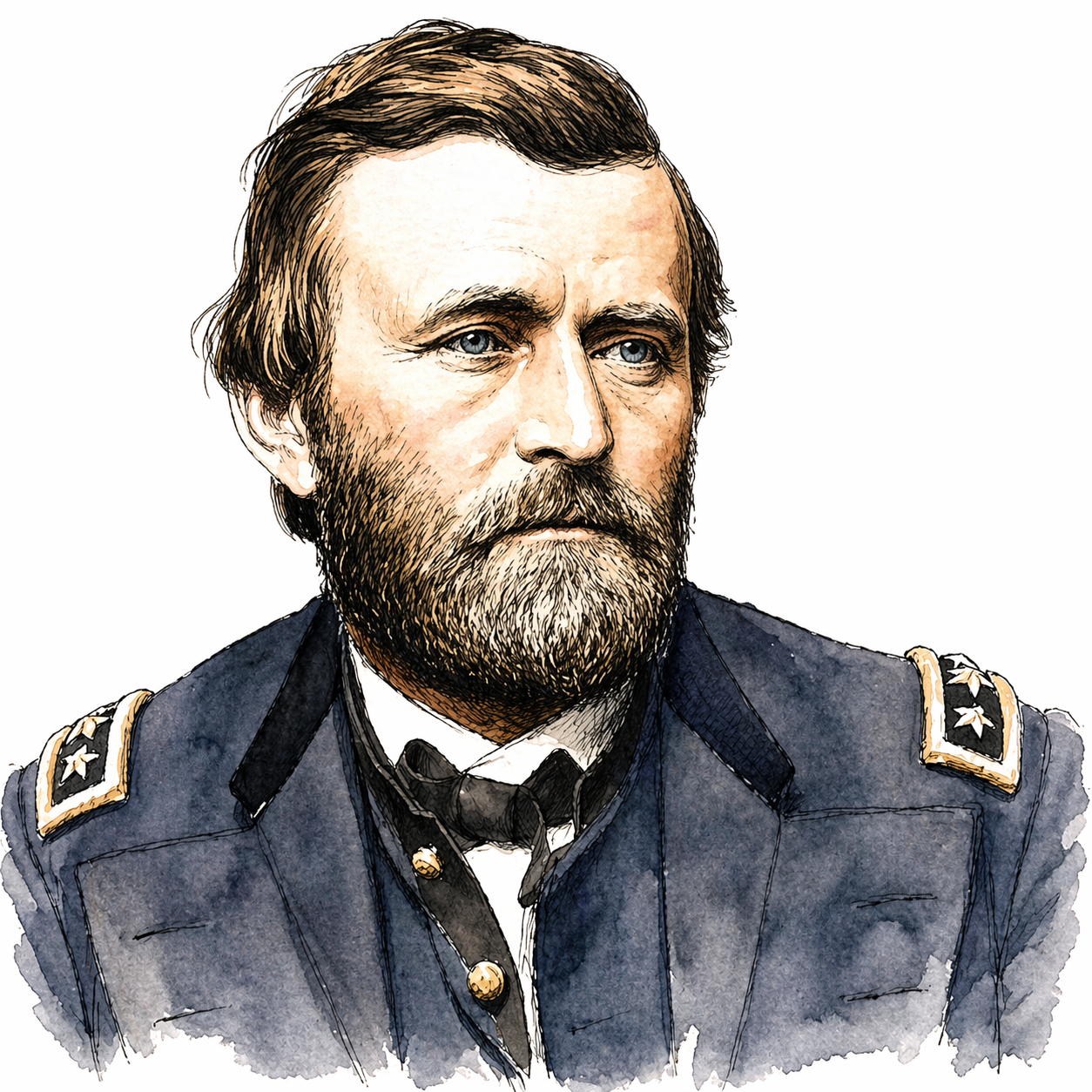
The letters were addressed to Col. Joseph Belknap Smith (1815-1898), the son of Joseph Nicholas Smith (1771-1857) and Polly Emerson (1784-1868) of Strafford county, New Hampshire. Joseph Belknap Smith (1802-1916) was a speculator and one of the founders of the Columbia Mining Company in eastern Georgia, not far from the Savannah river, where gold mining had been going on since the 1820s. By the 1850s, the mining operations required capital and equipment to extract the gold from veins deep in the ground. It also required steady labor for digging, hauling, and washing the ore—a labor that was supplied principally by slaves. The slaves were either owned outright by investors or hired from local slaveholders, of which there were many in the area. For example, Felix Shanks and his brother George owned 50 slaves between them, some of whom may have been hired by Smith seasonally. Smith’s operations at Columbia included a stamp mill and ore-processing machinery, producing as much as $2 million in gold before the Civil War (roughly 4 tons of gold). Records held in the Duke University Archives indicate that he employed about 120 enslaved laborers and processed 10 tons of ore per day.
Letter 1
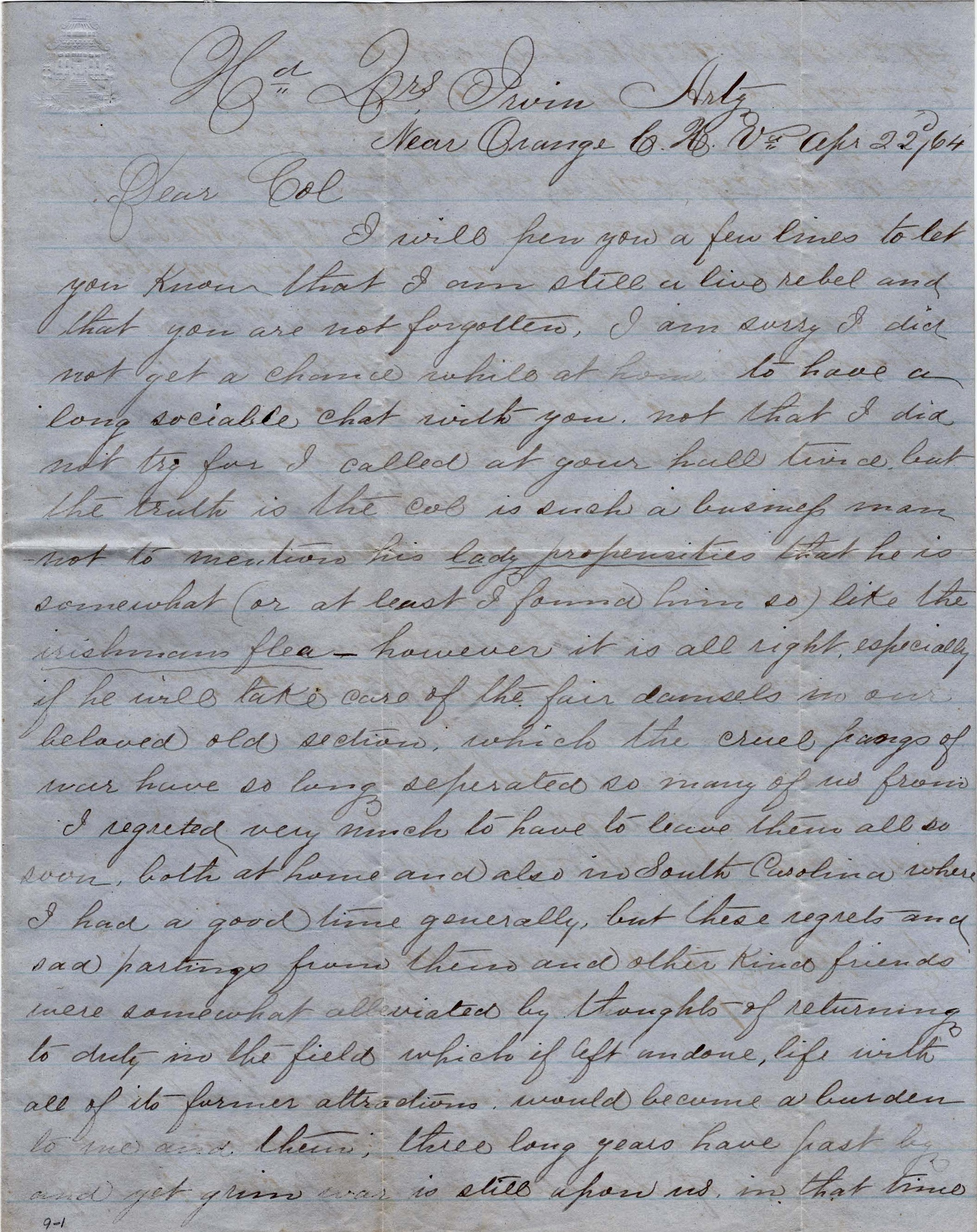
Headquarters Irvin Artillery
Near Orange Court House, Virginia
April 22nd 1864
Dear Colonel,
I will pen you a few lines to let you know that I am still a live rebel and that you are not forgotten. I am sorry I did not get a chance while at home to have a long sociable chat with you—not that I did not try for I called at your hall twice, but the truth is the Colonel is such a business man not to mention his lady propensities that he is somewhat (or at least I found him so) like the irishman’s flea. However, it is all right, especially if he will take care of the fair damsels in our beloved old section which the cruel fangs of war have so long separated so many of us from. I regretted very much to have to leave them all so soon, both at home and also in South Carolina where I had a good time generally, but these regrets and sad partings from them and other kind friends were somewhat alleviated by thoughts of returning to duty in the field which if left undone, life with all of its former attractions would become a burden to me and them.
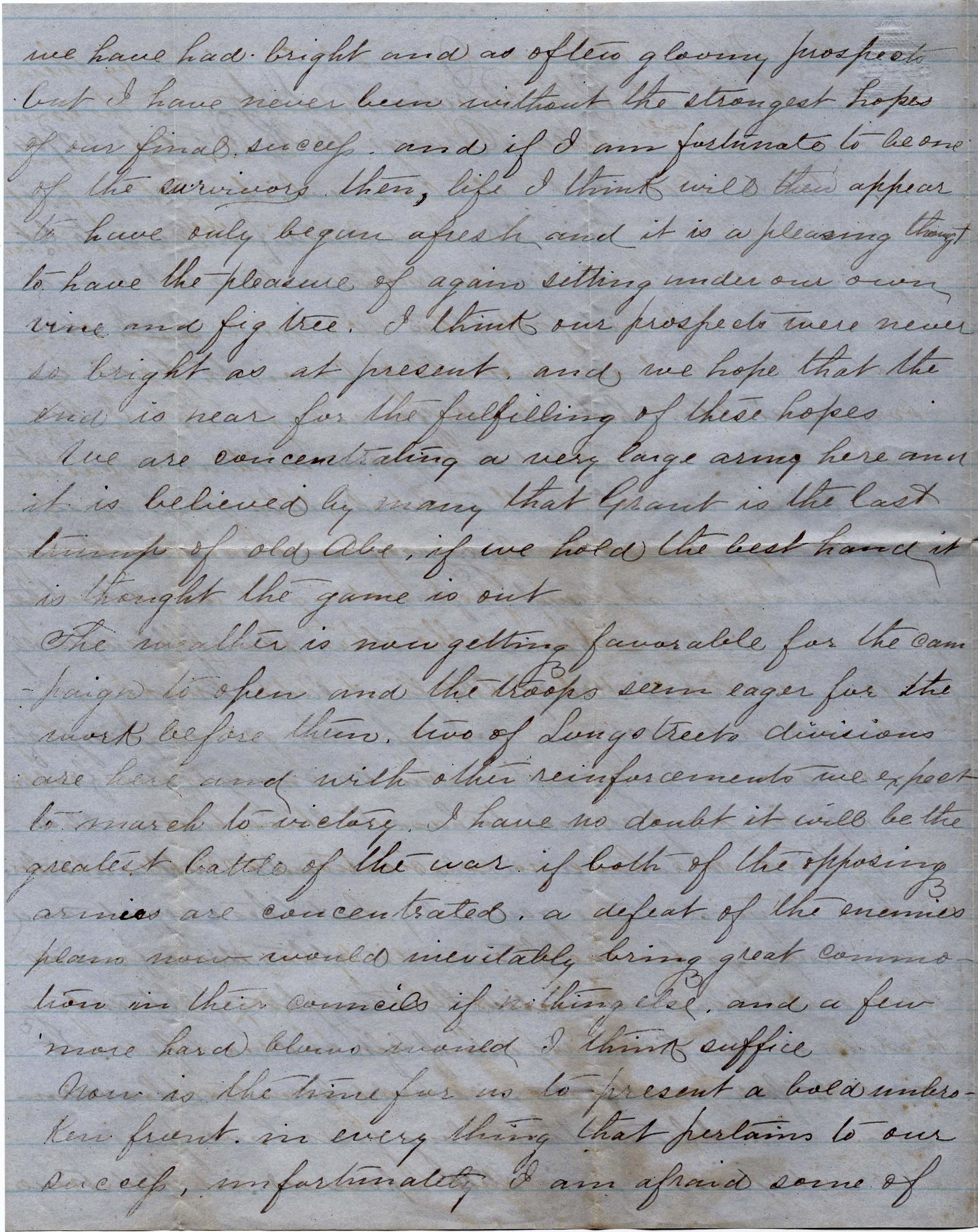
Three long years have passed by and yet grim war is still upon us, and in that time we have had bright and as often gloomy prospects. But I have never been without the strongest hopes of our final success, and if I am fortunate to be one of the survivors, then life, I think, will then appear to have only begun afresh and it is a pleasing thought to have the pleasure of again sitting under our own vine and fig tree. I think our prospects were never so bright as at present and we hope that the end is near for the fulfilling of these hopes.
We are concentrating a very large army here and it is believed by many that Grant is the last trump of Old Abe. If we hold the best hand, it is thought the game is out.
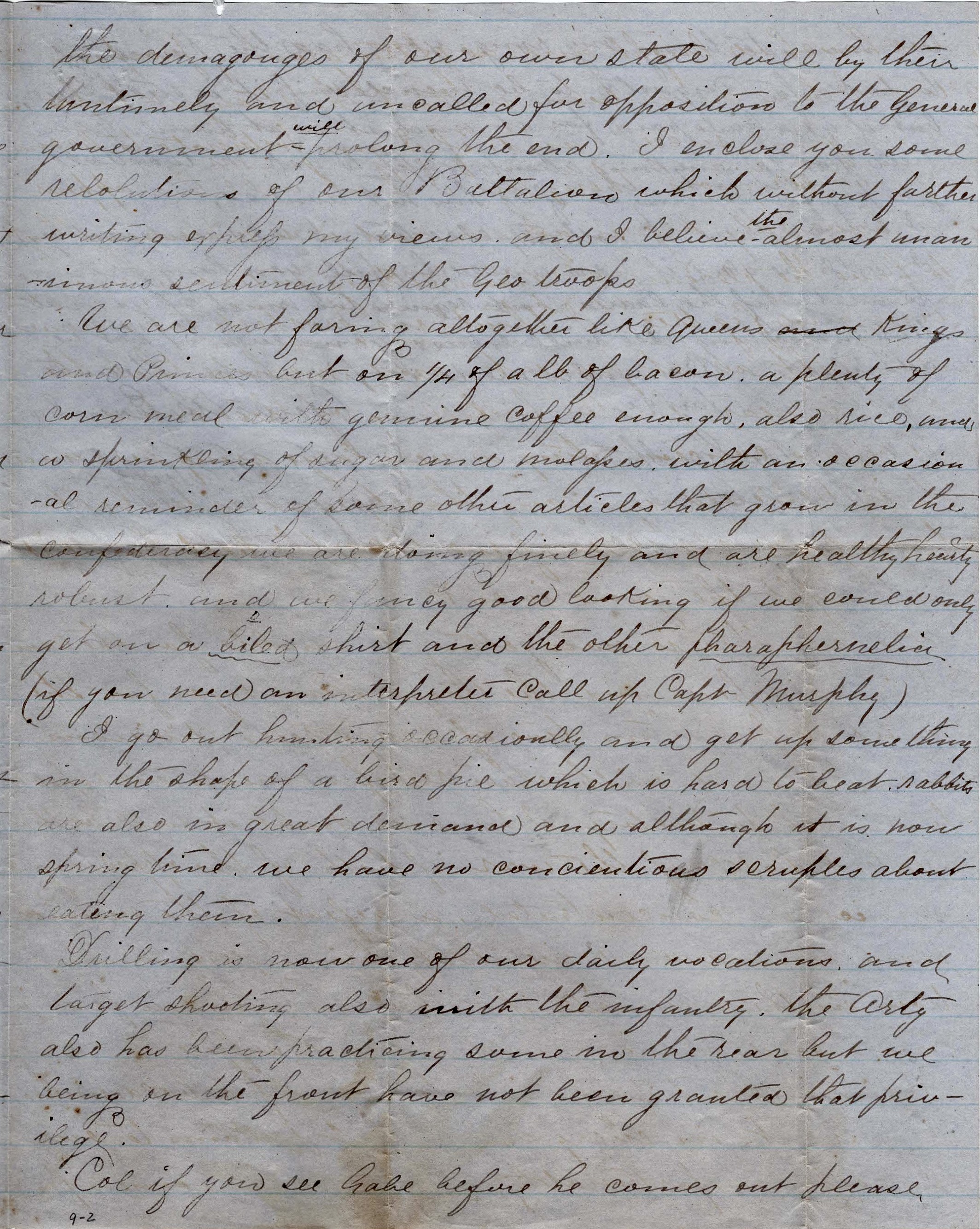
The weather is now getting favorable for the campaign to open and the troops seem eager for the work before them. Two of Longstreet’s divisions are here and with other reinforcements, we expect to march to victory. I have no doubt it will be the greatest battle of the war if both of the opposing armies are concentrated. A defeat of the enemy’s plan now would inevitably bring great commotion in the councils if nothing else. And a few more hard blows would, I think, suffice. Now is the time for us to present a bold unbroken front in everything that pertains to our success. Unfortunately, I am afraid some of the demagogues of our own state will by their untimely and uncalled for opposition to the general government, prolong the end. I enclose you some resolutions of our Battalion which without farther writing express my views and I believe them [to be] the almost unanimous sentiment of the Georgia troops.
We are not faring altogether like Queens and Kings and Princes but on 1/4 of a pound of bacon, a plenty of corn meal with genuine coffee enough, also rice, and a sprinkling of sugar and molasses, with an occasional reminder of some other articles that grow in the Confederacy. We are doing finely and are healthy, hearty, robust, and we fancy good looking—if we could only get on a boiled shirt and the other paraphernalia (if you need an interpreter, call up Capt. Murphy).
I go out hunting occasionally and get up something in the shape of a bird pie which is hard to beat. Rabbits are also in great demand and although it is now spring time, we have no contentious scruples about eating them.
Drilling is now one of our daily vocations and target shooting also with the infantry. The artillery also has been practicing some in the rear but we being in the front, have not been granted that privilege.
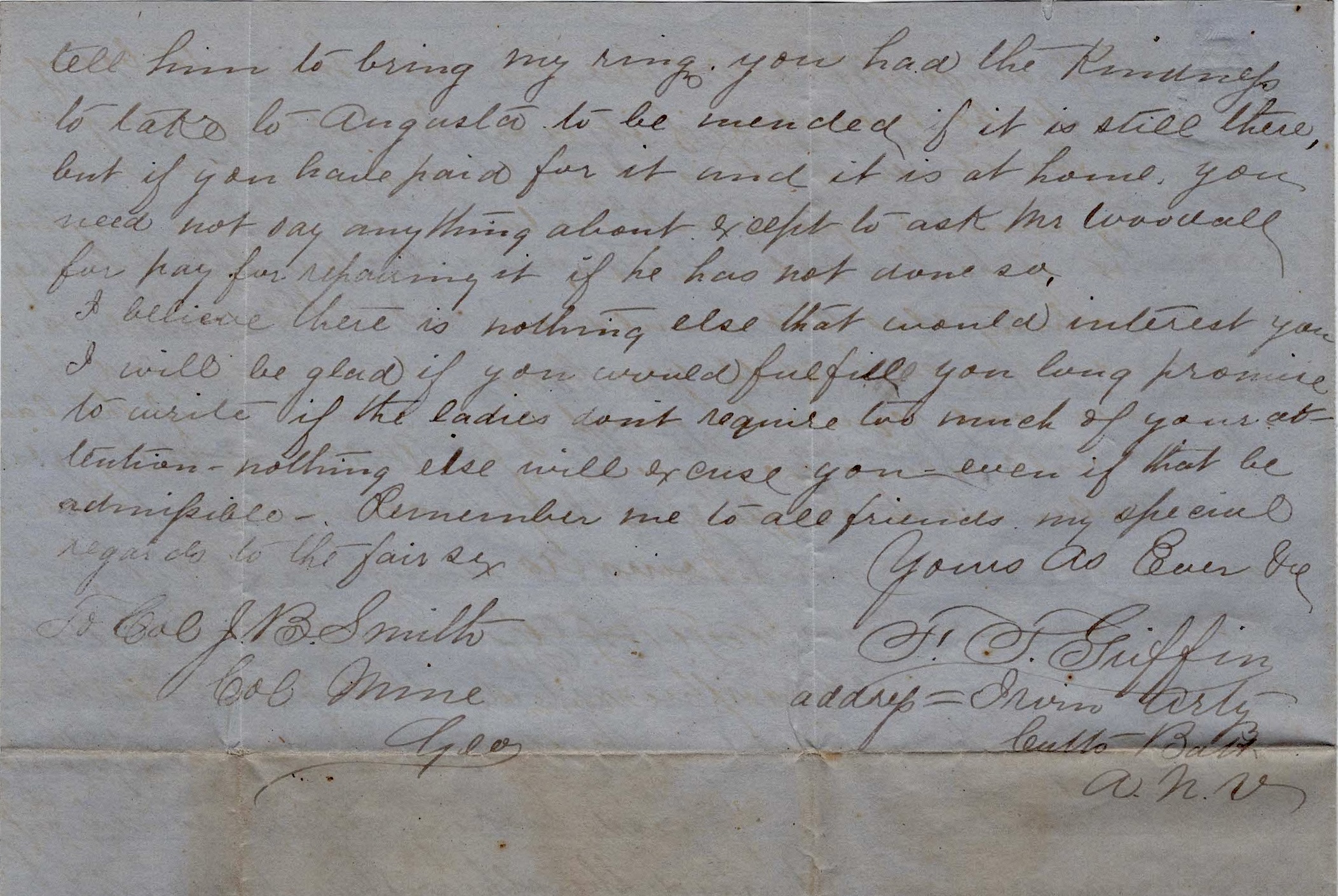
Colonel, if you see Gabe before he comes out, please tell him to bring my ring you had the kindness t take to Augusta to be mended, if it is still there. But if you have paid for it and it is at home, you need not say anything about [it] except to ask Mr. Woodall for pay for repairing it if he has not done so.
I believe there is nothing else that would interest you. I will be glad if you would fulfill your long promise to write if the ladies don’t require too much of your attention. Nothing else will excuse you—even if that be admissible. Remember me to all friends. My special regards to the fair sex. Yours as ever &c. — F. T. Griffin
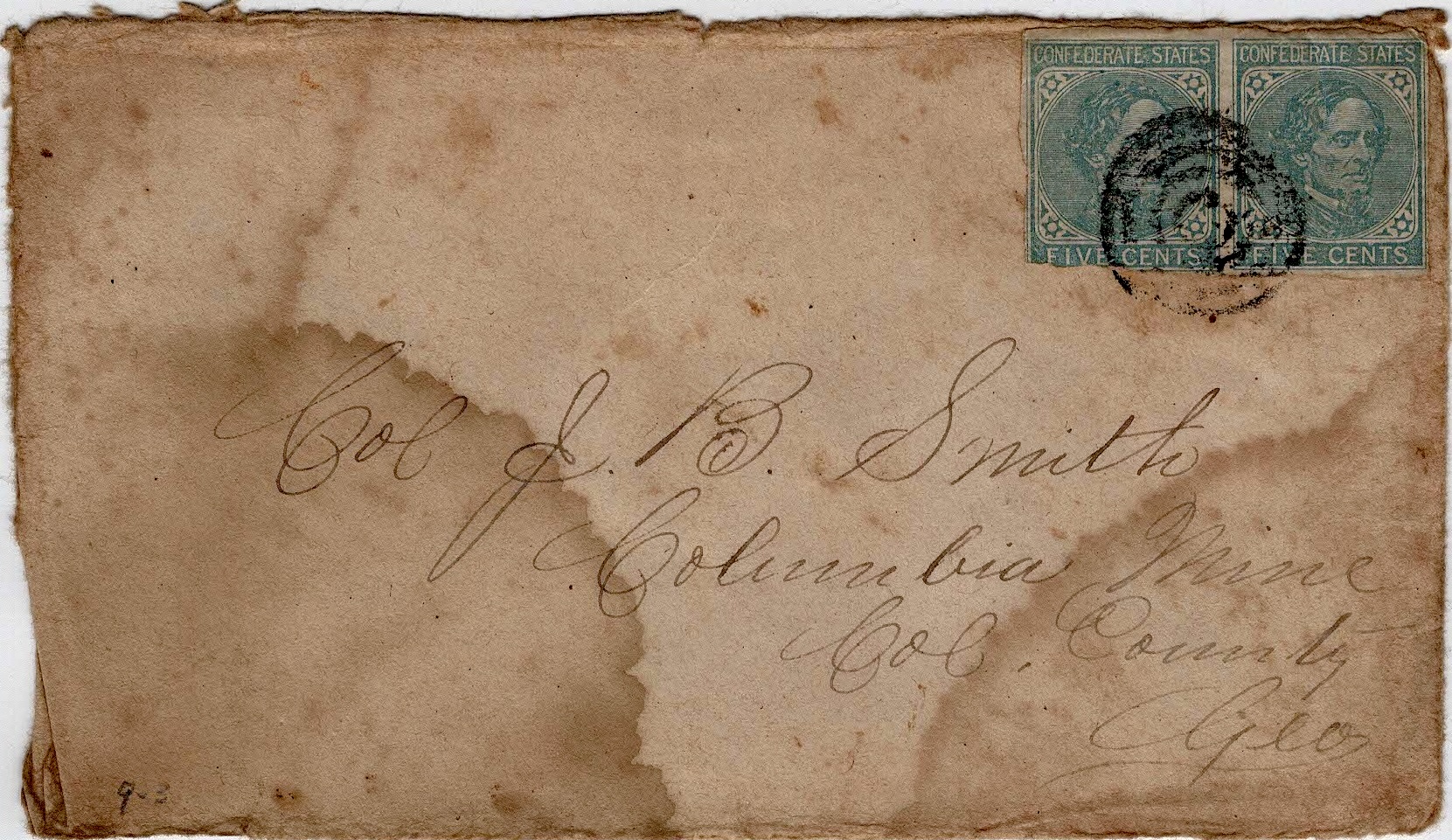
Address, Irvin Artillery, Cutts’ Battalion, Army of Northern Virginia
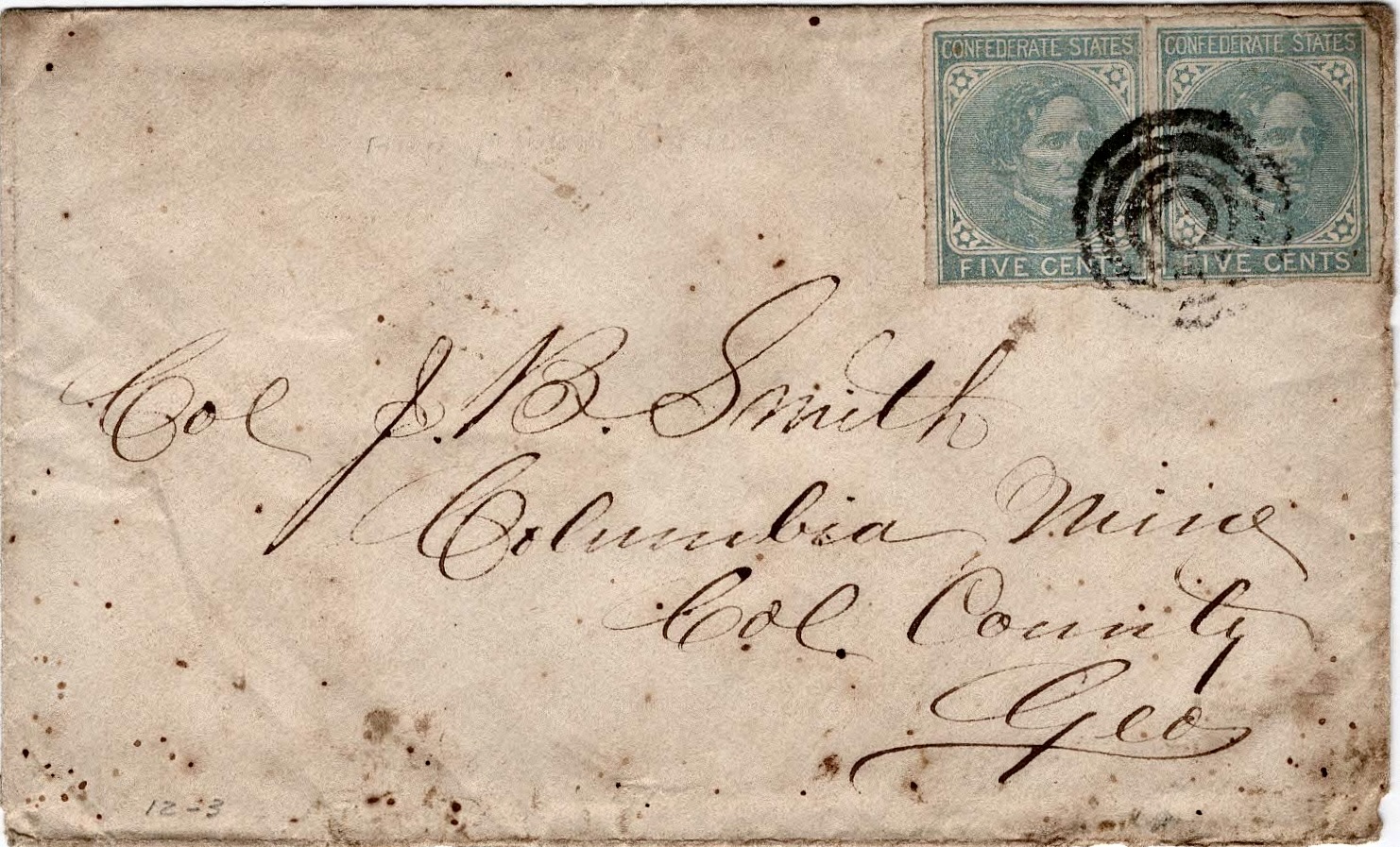
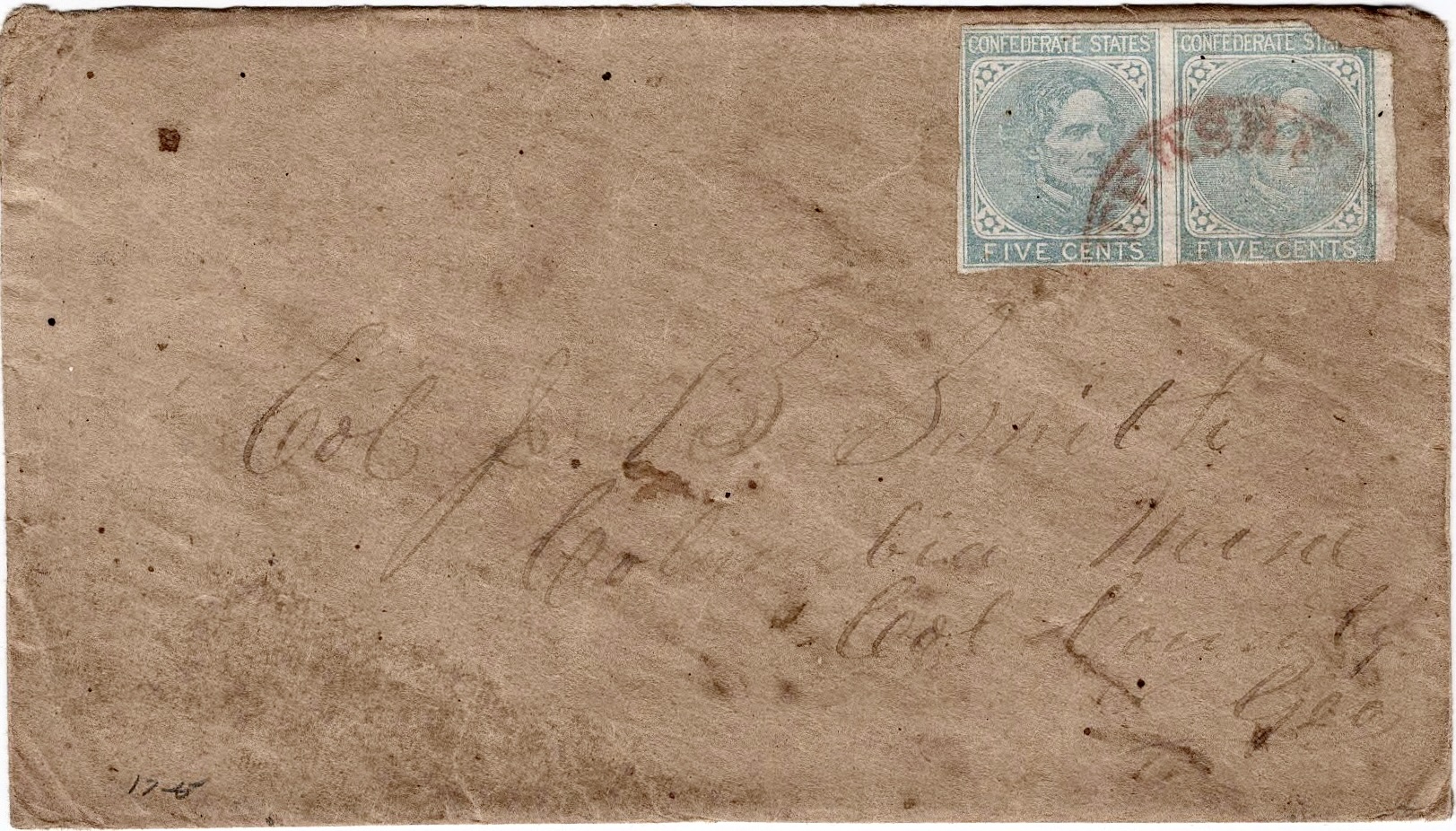
To Col. J. B. Smith, Columbia Mine, Georgia
Letter 2
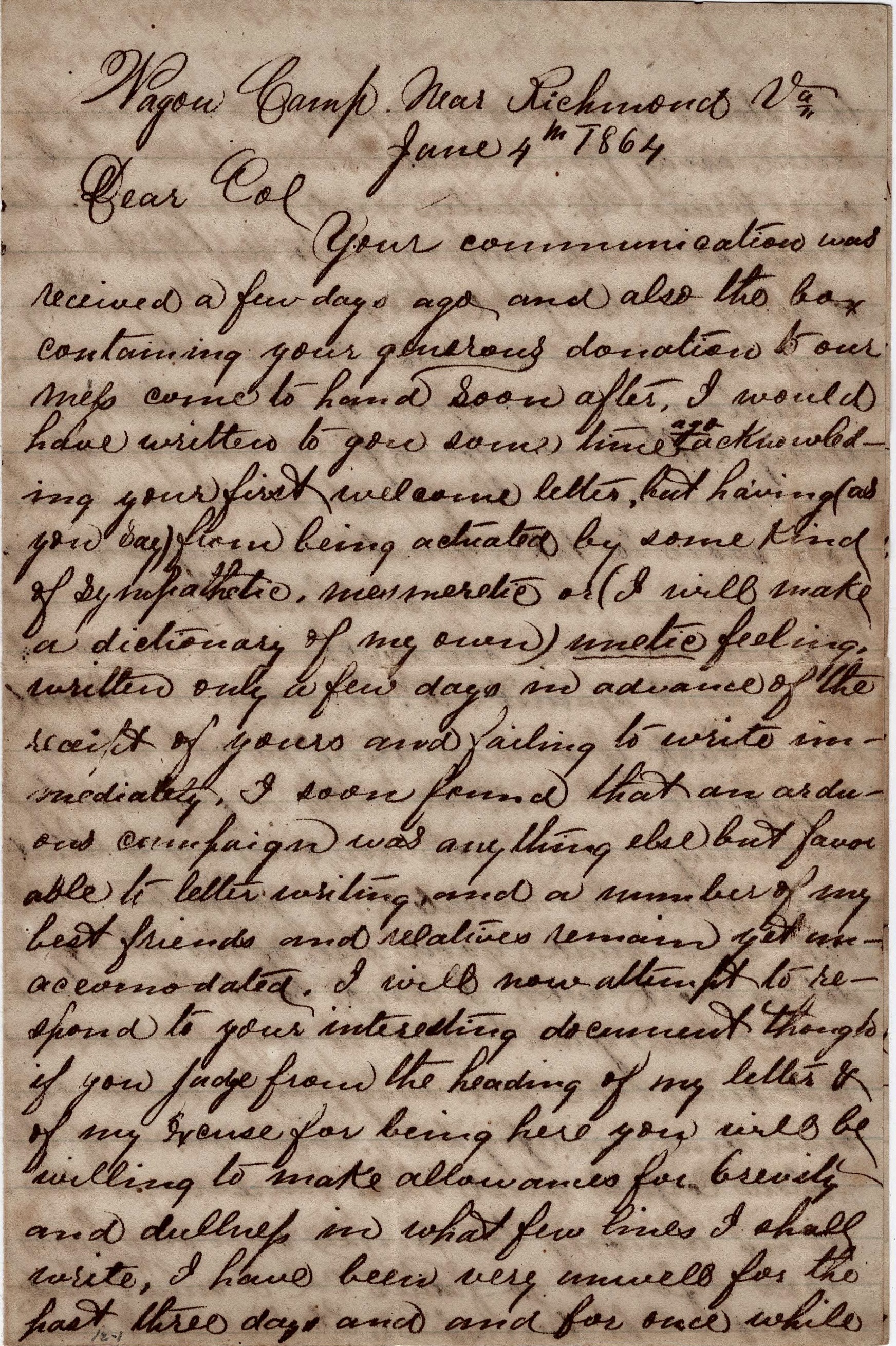
Wagon Camp near Richmond, Virginia
June 4th 1864
Dear Colonel,
Your communication was received a few days ago and also the box containing your generous donation to our mess come to hand soon after. I would have written to you some time ago acknowledging your first welcome letter, but having (as you say) from being actuated by some kind of sympathetic, mesmeretic or (I will make a dictionary of my own) unetic feeling, written only a few days in advance of the receipt of yours and failing to write immediately I soon found that an arduous campaign [and] was anything else but favorable to letter writing, and a number of my best friends and relatives remain yet unaccommodated.
I will now attempt to respond to your interesting document though if you judge from the heading of my letter & of my excuse for being here, you will be willing to make allowances for brevity and dullness in what few lines I shall write. I have been very unwell for the past three days and for once, while the storm of battle is raging, I am safely stored away from bullets and shells with our brave quartermasters and commissaries. But I am so much improved today that I think of going on the field tomorrow though my surgeon advises me not to get out so soon.
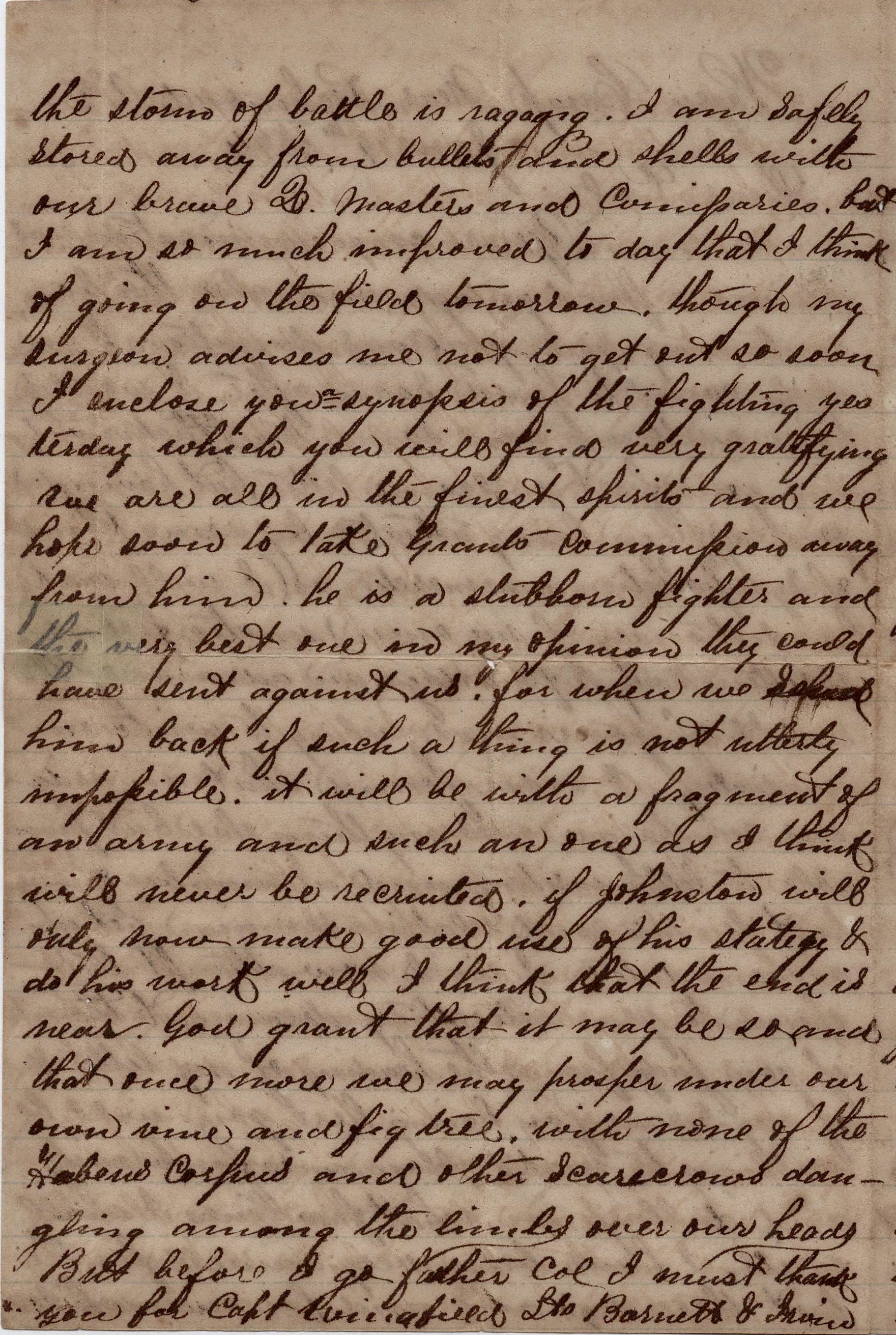
I enclose you a synopsis of the fighting yesterday which you will find very gratifying. We are all in the finest spirits and we hope soon to take Grant’s commission away from him. He is a stubborn fighter and the very best one in my opinion they could have sent against us for when we send him back—if such a thing is not utterly impossible—it will be with a fragment of an army and such an one as I think will never be recruited. If Johnston will only now make good use of his strategy & do his work well, I think that the end is near. God grant that it may be so and that once more we may prosper under our own vine and fig tree with none of the Habeas Corpus and other Scarecrows dangling among the limbs over our heads.
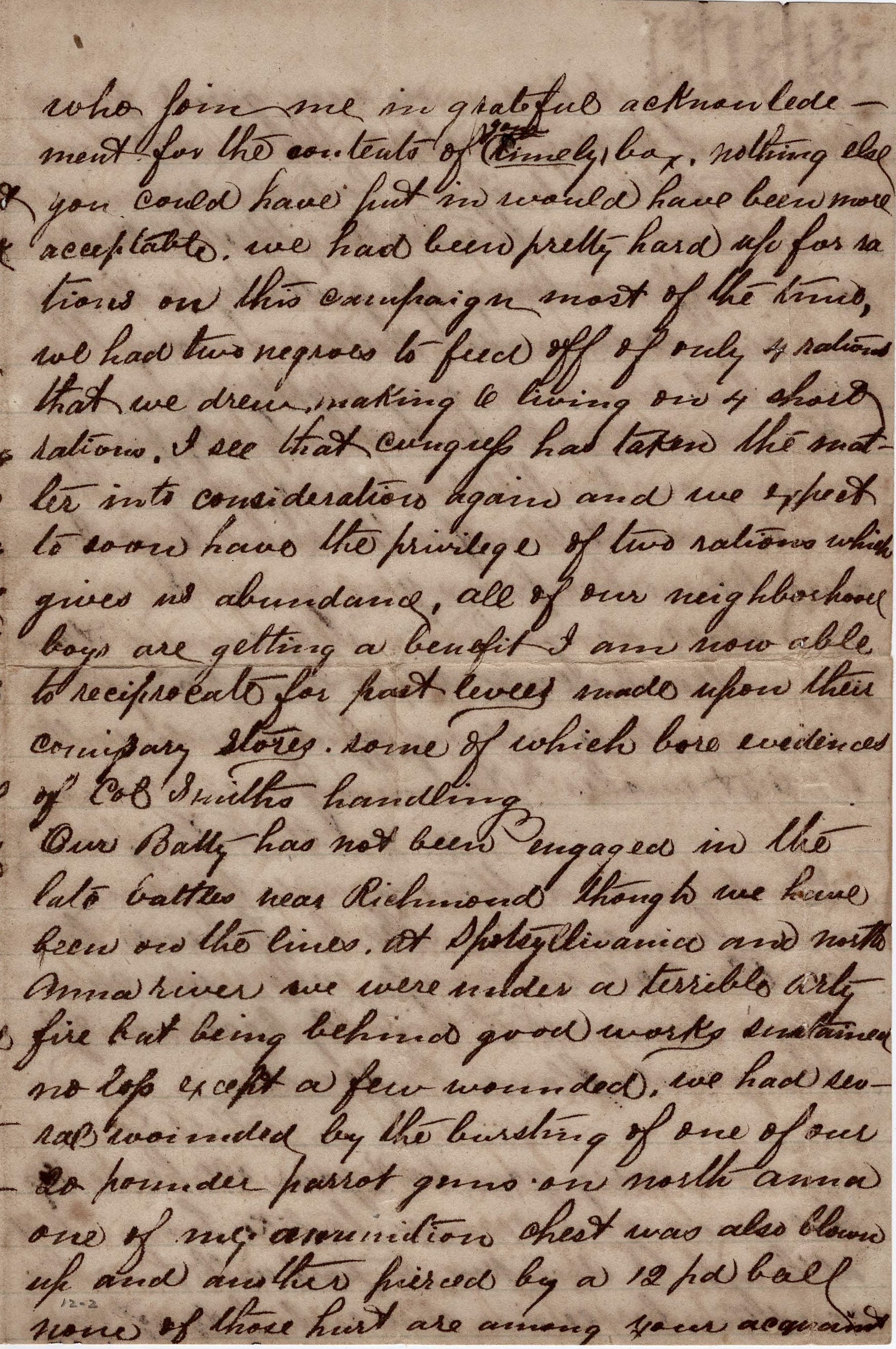
But before I go farther, Colonel, I must thank you for Capt. Wingfield, Lts. Barnett and Irvin who join me in grateful acknowledgement for the contents of your timely box. Nothing else you could have put in would have been more acceptable. We had been pretty hard up for rations on this campaign most of the time. We had two negroes to feed off of only 4 rations that we drew, making 6 living on four short rations.
I see that Congress has taken the matter into consideration again and we expect to soon have the privilege of two rations which gives us abundance. All of our neighborhood boys are getting a benefit. I am now able to reciprocate for past levees made upon their commissary stores, some of which bore evidences of Col. Smith’s handling.
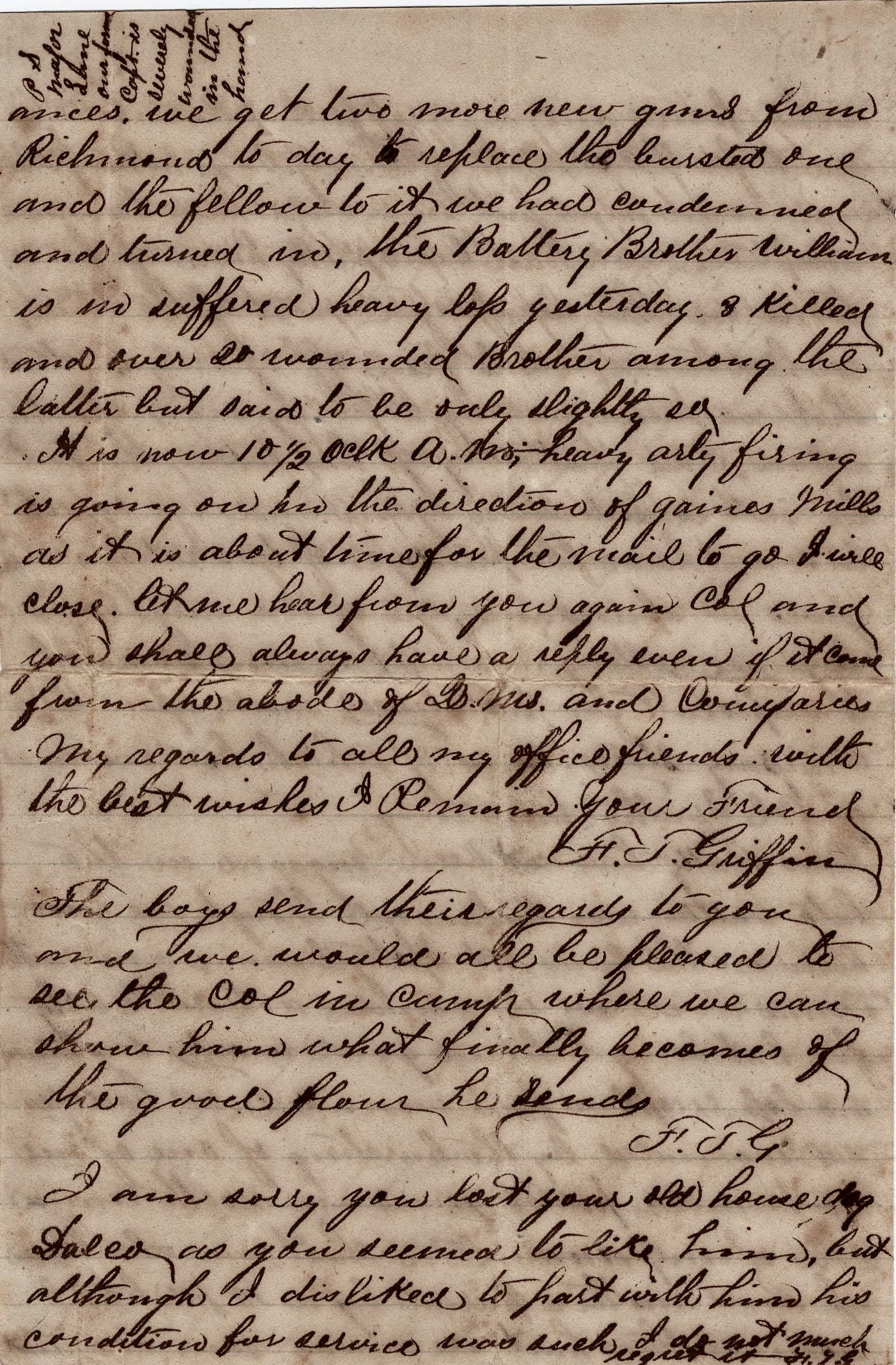
Our Battery has not been engaged in the late battles near Richmond though we have been on the lines. At Spotsylvania and North Anna River we were under a terrible artillery fire but being behind good works, sustained no loss except a few wounded. We had several wounded by the bursting of one of our 20-pounder Parrott guns on North Anna. One of my ammunition chests was also blown up and another pierced by a 12 pound ball. None of those hurt are among your acquaintances. We get two more new guns from Richmond today to replace the bursted one and the fellow to it we had condemned and turned in. The Battery brother William is in suffered heavy loss yesterday—three killed and over 20 wounded (brother among the latter but said to be only slightly so.)
It is now 10.30 o’clock a.m.; heavy artillery firing is going on in the direction of Gaines Mills. As it is about time for the mail to go, I will close. Let me hear from you again, Colonel, and you shall always have a reply even if it comes from the abode of quartermasters and commissaries. My regards to all my office friends. With the best wishes, I remain your friend, — F. T. Griffin
The boys send their regards to you and we would all be pleased to see the Colonel in camp where we can show him what finally becomes of the good flour he sends. — F. T. Griffin
I am sorry you lost your old house dog, Dalco, as you seemed to like him, but although I disliked to part with him, his condition for service was such I do not much regret it. — F. T. G.
P. S. Major [John] Lane, our former Captain, is severely wounded in the hand.
Letter 3
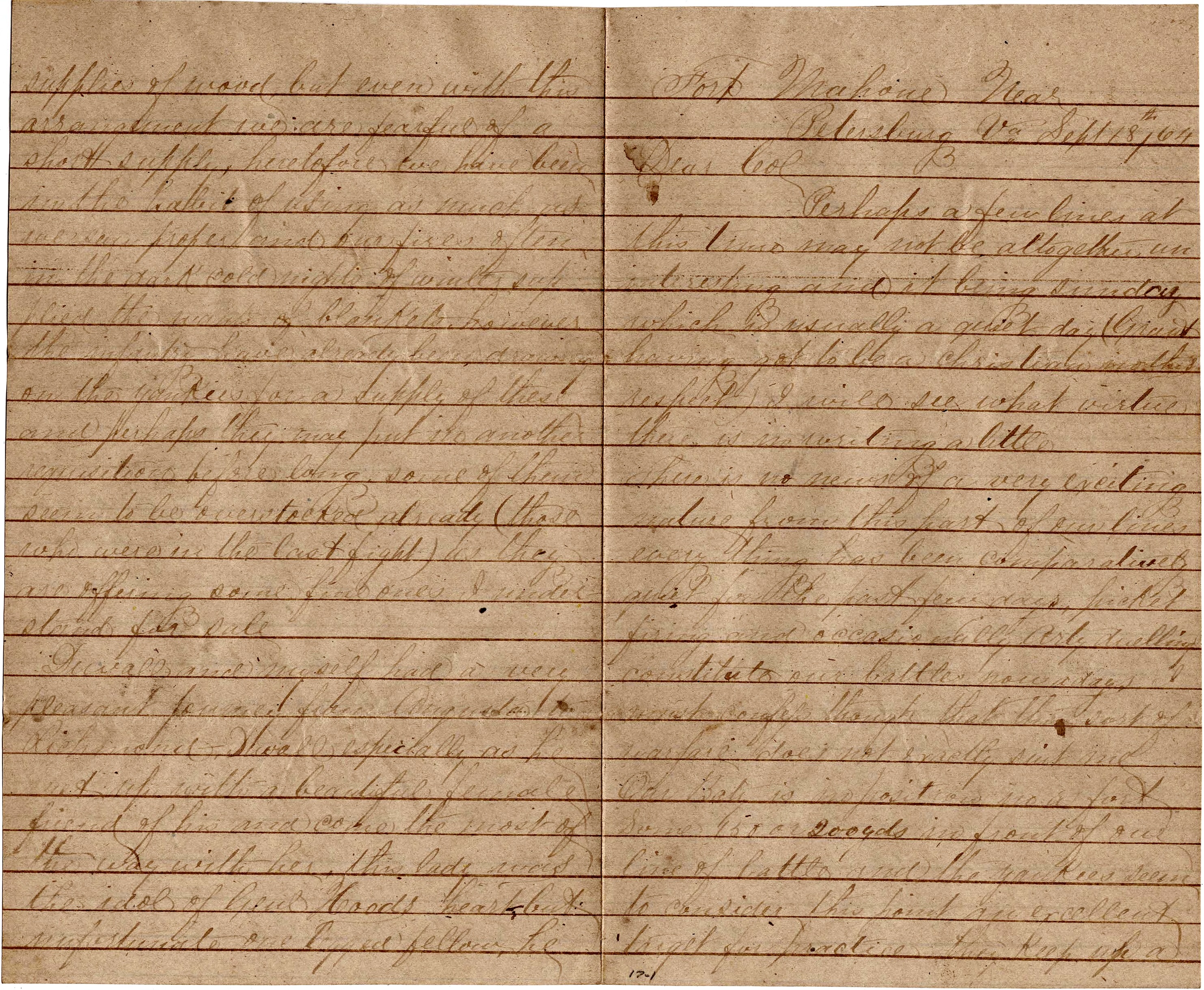
Fort Mahone
Near Petersburg, Virginia
September 18, 1864
Dear Colonel,
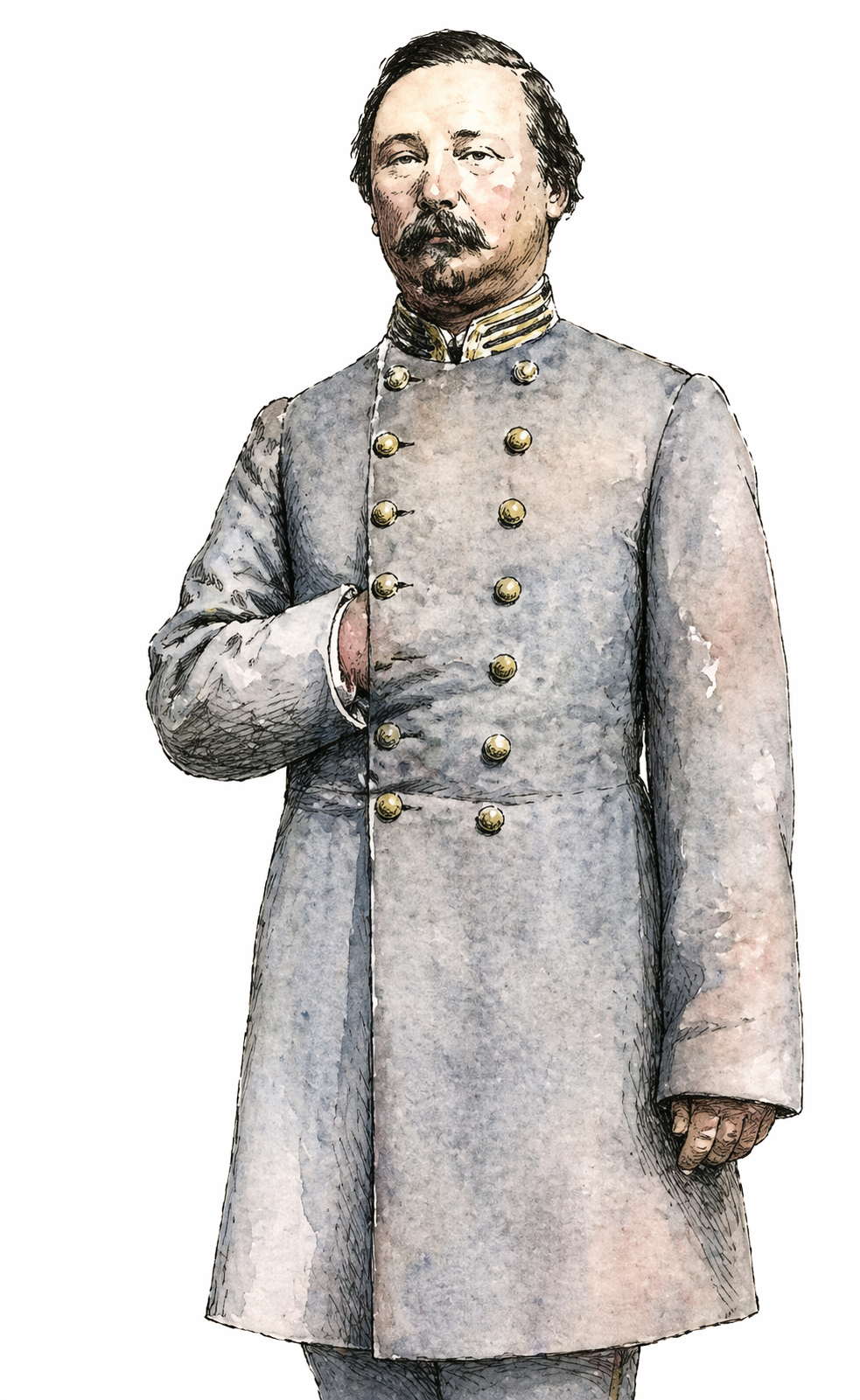
Perhaps a few lines at this time may not be altogether uninteresting, and it being Sunday which is usually a quiet day (Grant having got to be a Christian in this respect), I will see what virtue there is in writing a little. There is no news of a very exciting nature from this part of our lines. Everything has been comparatively quiet for the past few days. Picket firing and occasionally artillery dueling constitute our battles nowadays. I must confess though that this sort of warfare does not exactly suit me.
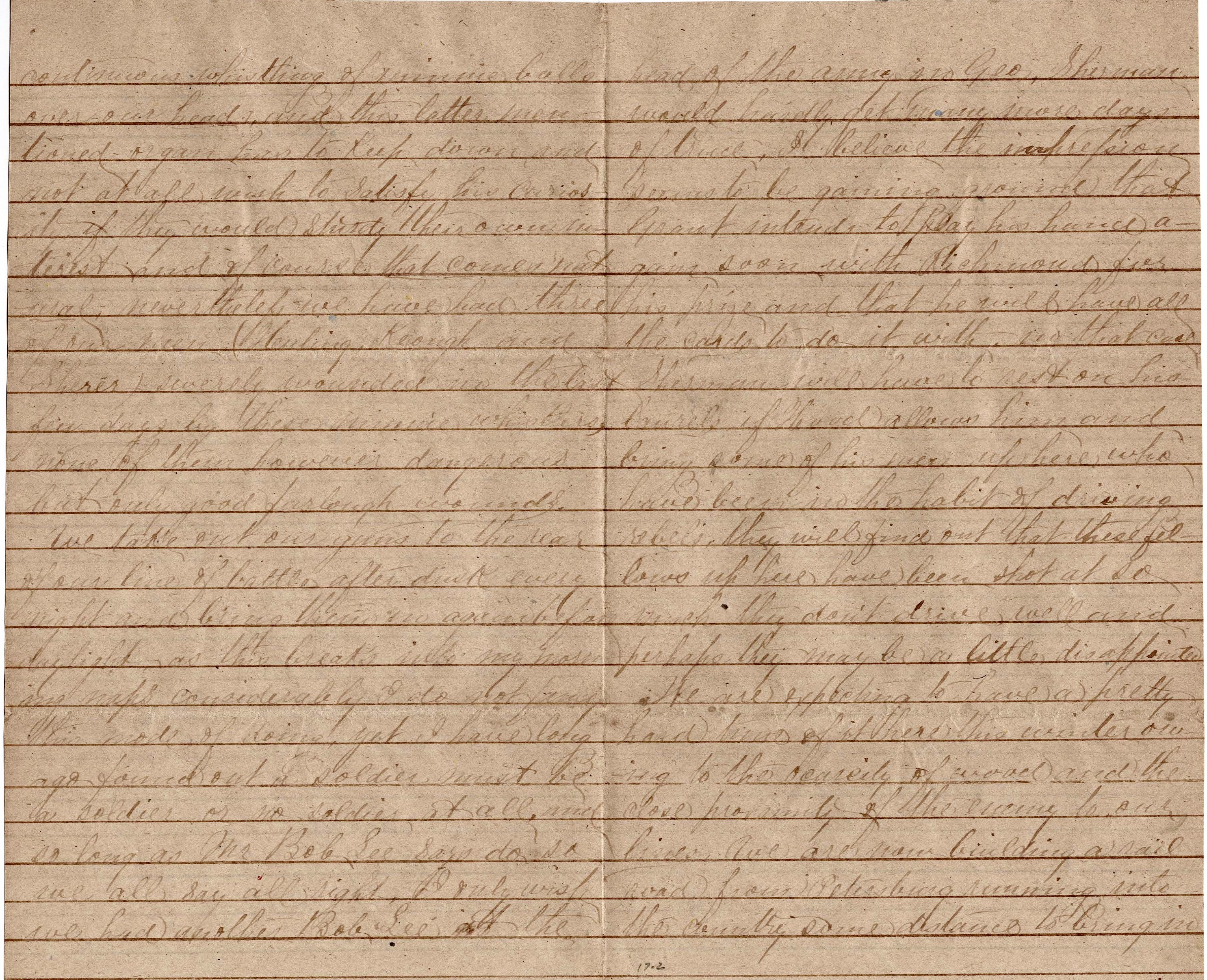
Our battery is in position in a fort some 150 or 200 yards in front of our line of battle and the Yankees seem to consider this point an excellent target for practice. They keep up a continuous whistling of Minié balls over our heads and this latter mentioned organ has to keep down, and not at all wish to satisfy his curiosity, if they would study their own interest and of course that comes natural. Nevertheless, we have had three of our men (Henling, Keough, and [Lewis D.] Sherer) severely wounded in the last few days by these Minié whistlers, none of them however dangerous, but only good furlough wounds.
We take out our guns to the rear of our line of battle after dusk every night and bring them in again before daylight. As this breaks into my morning naps considerably, I do not find this mode of doing [enjoyable], yet I have long ago found out a soldier must be a soldier or no soldier at all. And so long as Mr. Bob Lee says do so, we all say all right. I only wish we had another Bob Lee at the head of the army in Georgia. Sherman would hardly get many more days of truce. I believe the impression seems to be gaining ground that Grant intends to play his hand again soon with Richmond, for his prize and that he will have all the cards to do it with. In that case, Sherman will have to rest on his laurels—if Hood allows him—and bring some of his men up here who have been in the habit of driving rebels. They will find out that these fellows up here have been shot at so much they don’t drive well and perhaps they may be a little disappointed.
We are expecting to have a pretty hard time of it here this winter owing to the scarcity of wood and the close proximity of the enemy to our lines. We are now building a railroad from Petersburg running into the country some distance to bring in supplies of wood, but even with this arrangement we are fearful of a short supply. Heretofore we have been in the habit of using as much as we saw proper and our fires often in the dark cold nights of winter supplied the wants of blankets. However, the infantry have already been drawing on the Yankees for a supply of these and perhaps they may put in another requisition before long. Some of them seem to be overstocked already (those who were in the last fight) as they are offering some fine ones I understand for sale.
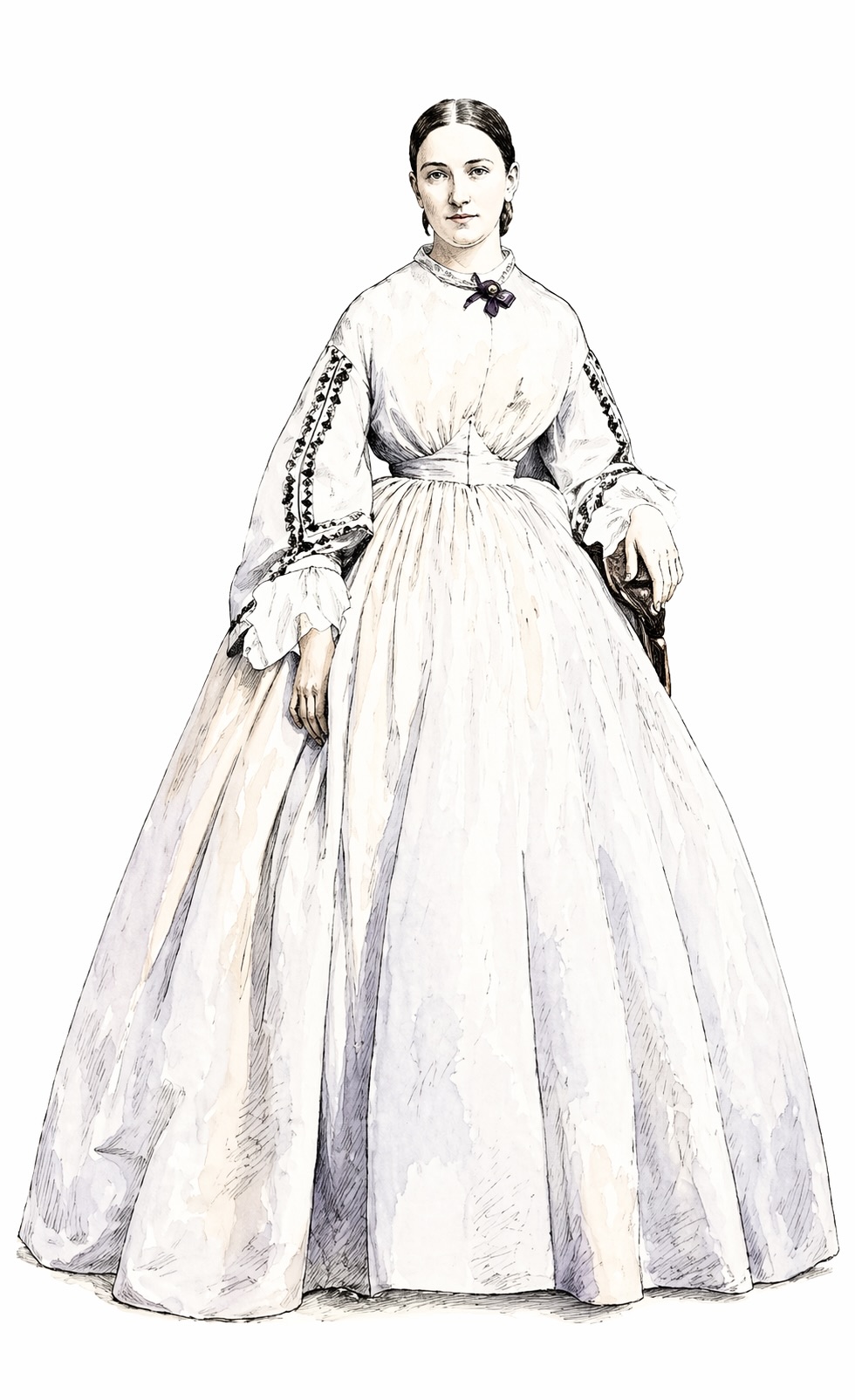
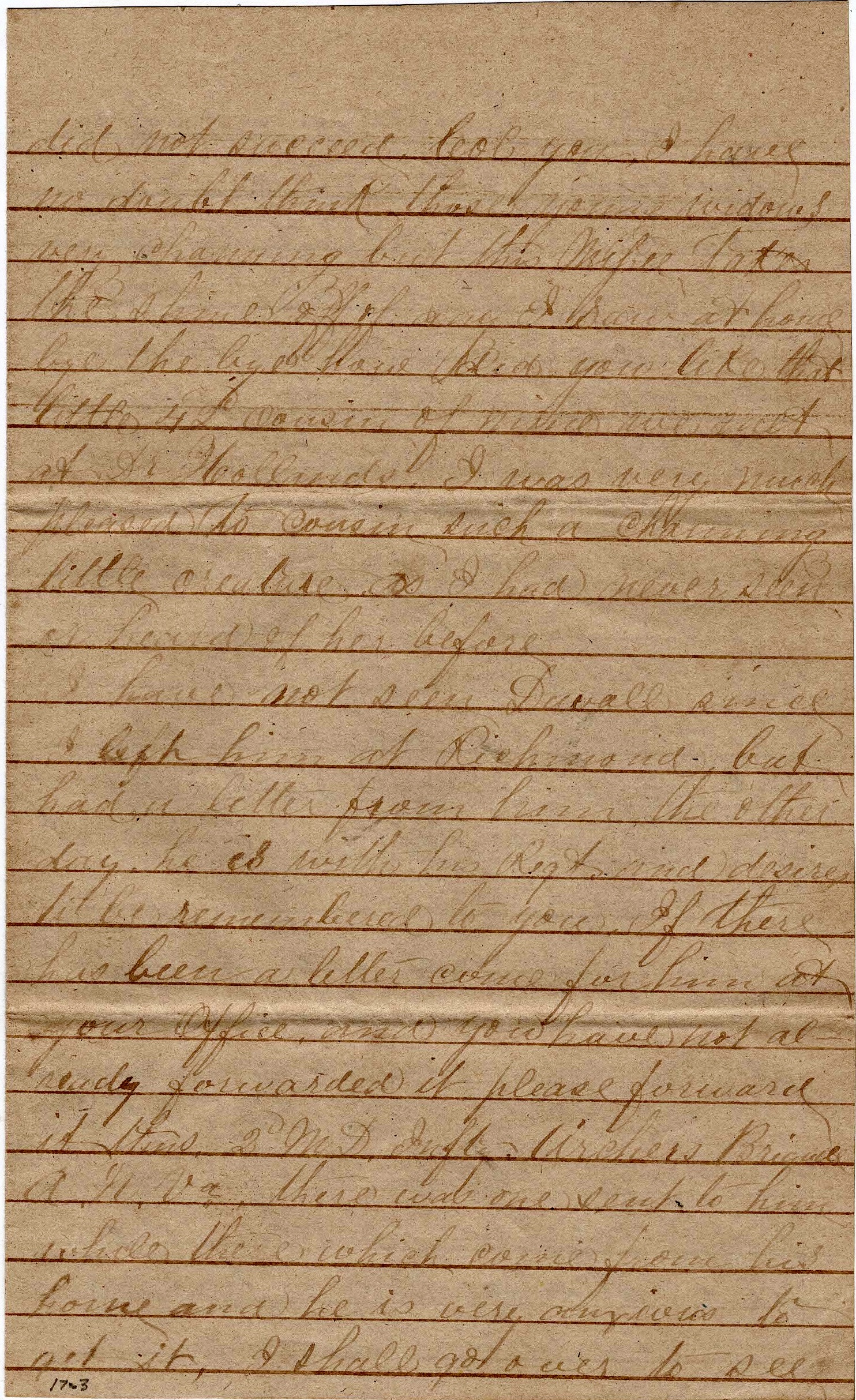
[Ferdinand C.] Duvall 1 and myself had a very pleasant journey from Augusta to Richmond—Duvall especially as he met up with a beautiful female friend of his and come the most of the way with her. This lady was the idol of General Hood’s heart, but unfortunately, [being a] one legged fellow, he did not succeed. Colonel, you—I have no doubt—think those young widows very charming but this Missee takes the shine off of any I saw at home. 2
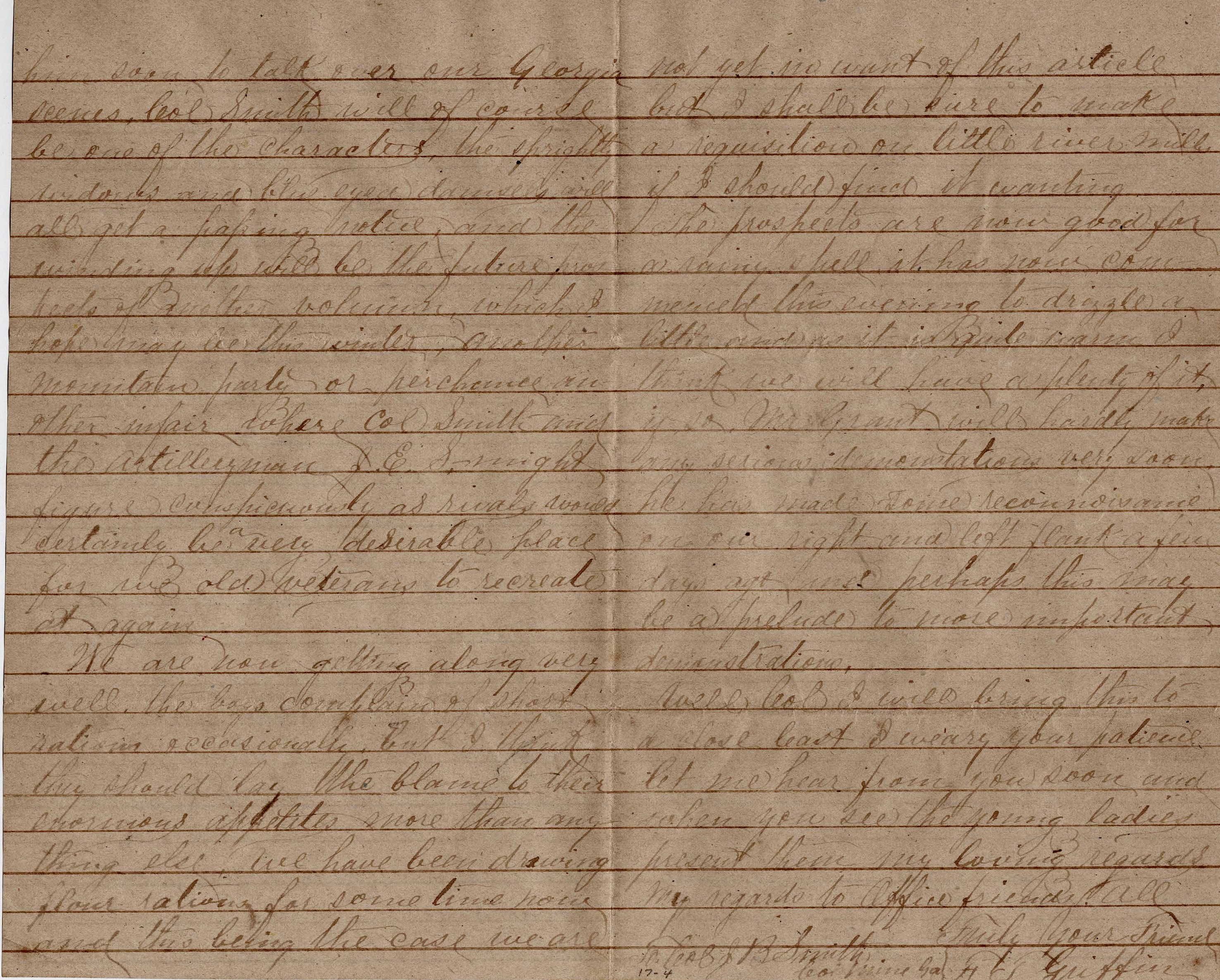
Bye the bye, how did you like that little 42nd cousin of mine we met at Dr. Holland’s? I was very much pleased to cousin such a charming little creature as I had never seen or heard of her before. I have not seen Duvall since I left him at Richmond, but had a letter from him the other day. He is with his regiment and desires to be remembered to you. If there has been a letter come for him at your office and you have not already forwarded it, please forward it thus: 2nd Maryland Infantry, Archers Brigade, Army of Northern Virginia. There was one sent to him while there which came from his home and he is very anxious to get it. I shall go over to see him soon to talk over our Georgia scenes. Col. Smith will of course be one of the characters. The sprightly widows and blue eyed damsels will all get a passing notice and the winding up will be the future prospects of another volume which I hope may be this winter, another mountain party or perchance another infair where Col. Smith and the artilleryman J. E. S. might figure conspicuously as rivals would certainly be a very desirable place for we old veterans to recreate at again.
We are now getting along very well. The boys complain of short rations occasionally, but I think they should lay the blame to their enormous appetites more than anything else. We have been drawing flour rations for some time now and this being the case, we are not yet in want of this article. But I shall be sure to make a requisition on Little River Mill if I should find it wanting.
The prospects are now good for a rainy spell. It has now commenced this evening to drizzle a little and as it is quite warm, I think we will have a plenty of it. If so, Mr. Grant will hardly make any serious demonstrations very soon. He has made some reconnaissance on our right and left flank a few days ago, and perhaps this may be a prelude to more important demonstrations.
Well, Colonel, I will bring this to a close lest I weary your patience. Let me hear from you soon and when you see the young ladies, present them my loving regards. My regards to office friends. Truly your friend, — F. T. Griffin
1 Ferdinand C. Duvall (1835-1878) of Ann Arundel county, Maryland, served as the Captain of Co. C, 2nd Maryland Infantry. He was wounded seriously in the right thigh in the fighting at Peebles’ Farm on 30 September 1864 less than two weeks after this letter was written.
2 The beautiful female friend was undoubtedly Sally Buchanon (“Buck”) Preston of South Carolina. Gen. John Bell Hood famously courted her and described the courtship as his “hardest battle.” Hood married someone else after the war as did Duvall. Sally was mentioned in Mary Chestnut’s diary and claimed that all the men loved Buck. She also wrote that Buck confided to her that she would not marry Hood “if he had a thousand legs instead of having just lost one.”
Letter 4
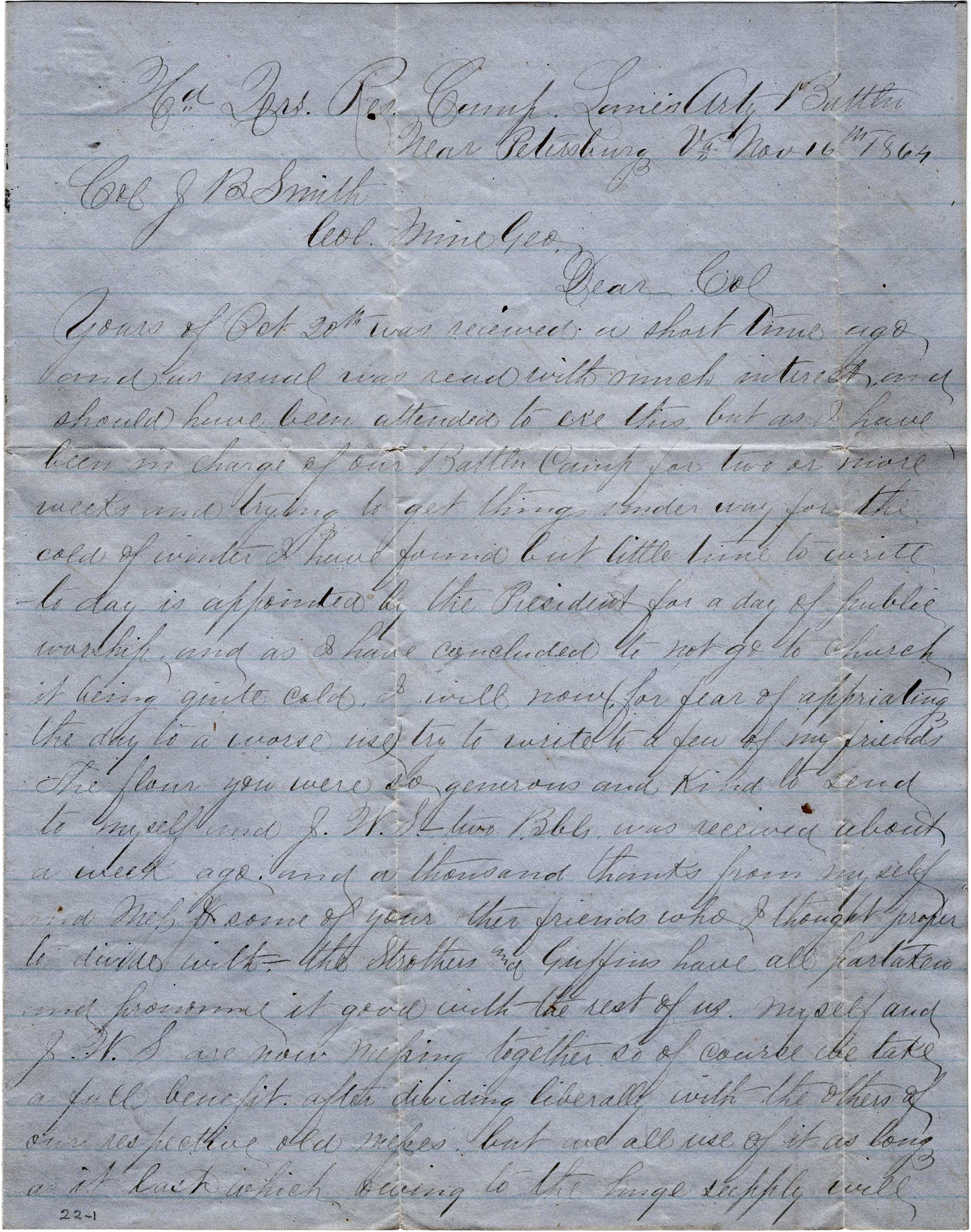
Headquarters Reserve Camp
Lane’s Artillery Battery
Near Petersburg, Virginia
November 16, 1864
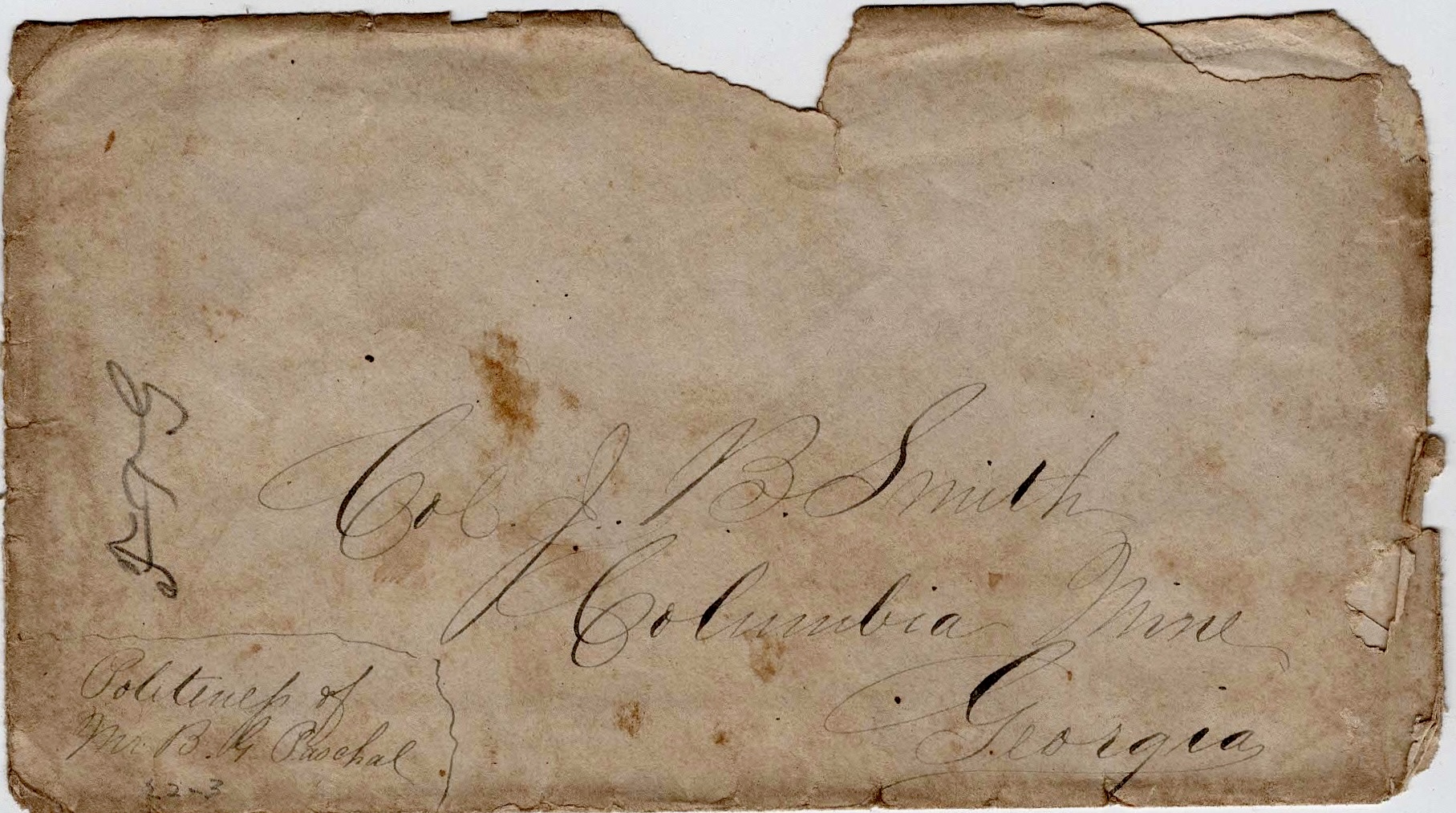
Col. J. B. Smith
Columbia Mine, Georgia
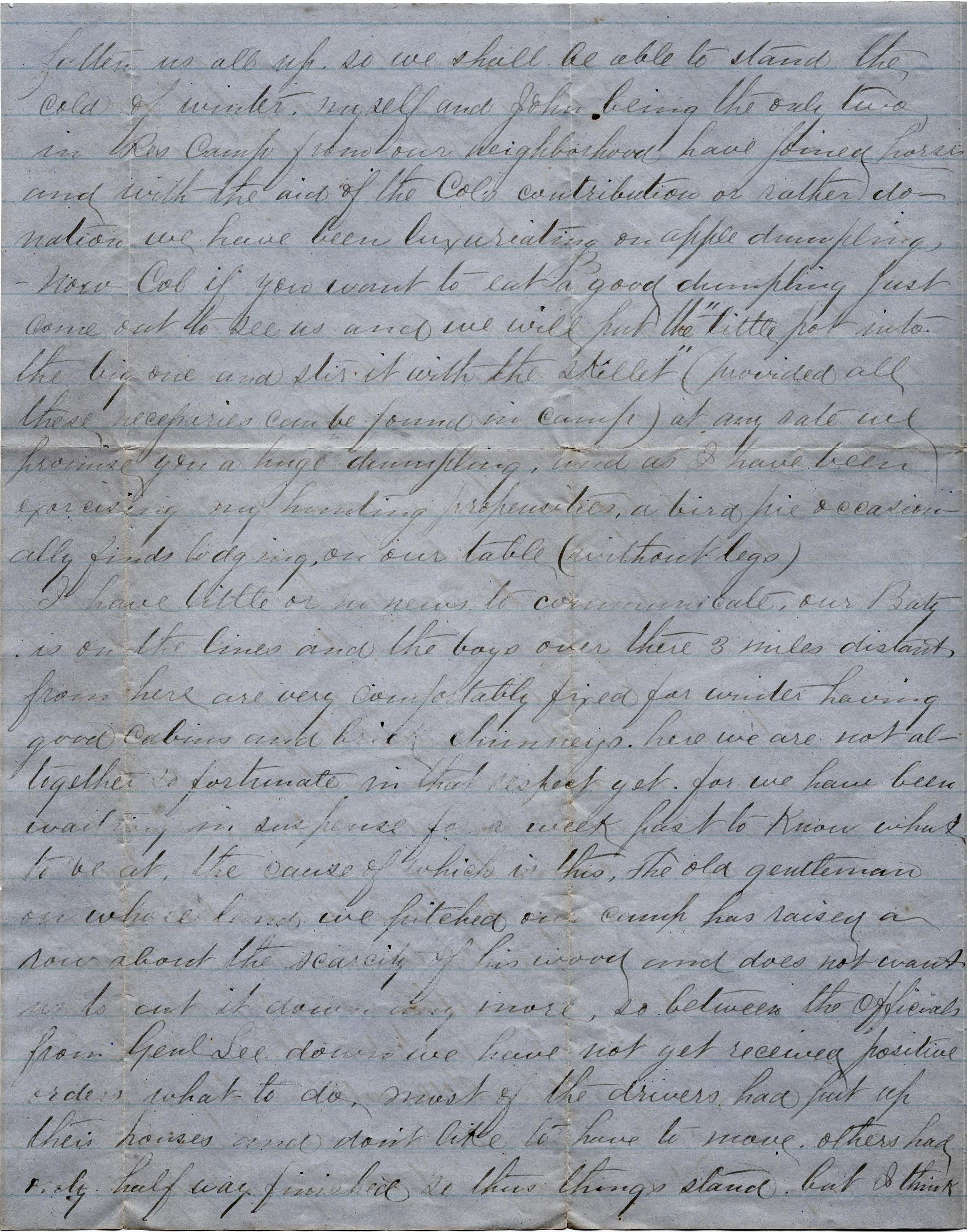
Dear Colonel, yours of October 20th was received a short time ago and as usual was read with much interest and should have been attended to ere this but as I have been in charge of our battery camp for two or more weeks and trying to get things under way for the cold of winter, I have found but little time to write. Today is appointed by the President for a day of public workship and as I have concluded to not go to church—it being quite cold—I will now (for fear of appropriating the day to a worse use) try to write to a few of my friends.
The flour you were so generous and kind to send to myself and J. W. S[hank]—two barrels—was received about a weeks ago and a thousand thanks from myself and mess & some of your other friends who I thought proper to divide with. The Strothers and Griffins have all partaken and pronounced it good with the rest of us. Myself and J. W. Shank are now messing together so of course we take a full benefit, after dividing liberally with the others of our respective old messes. But we all use of it as long as it lasts which, owing to the huge supply, will fatten us all up so we shall be able to stand the cold of winter. Myself and John [Shank] being the only two in Reserve Camp from our neighborhood, have joined horses andn with the aid of the Colonel’s contribution, or rather donation, we have been luxuriating on apple dumplings. Now Colonel, if you want to eat a good dumpling, just come out to see us and we will put the little pot into the big one and stir it with the skillet (provided all these necessaries can be found in camp)/ At any rate, we promise you a huge dumpling and as I have been exercising my hunting propensities, a bird pie occasionlly finds lodging on our table (without legs).
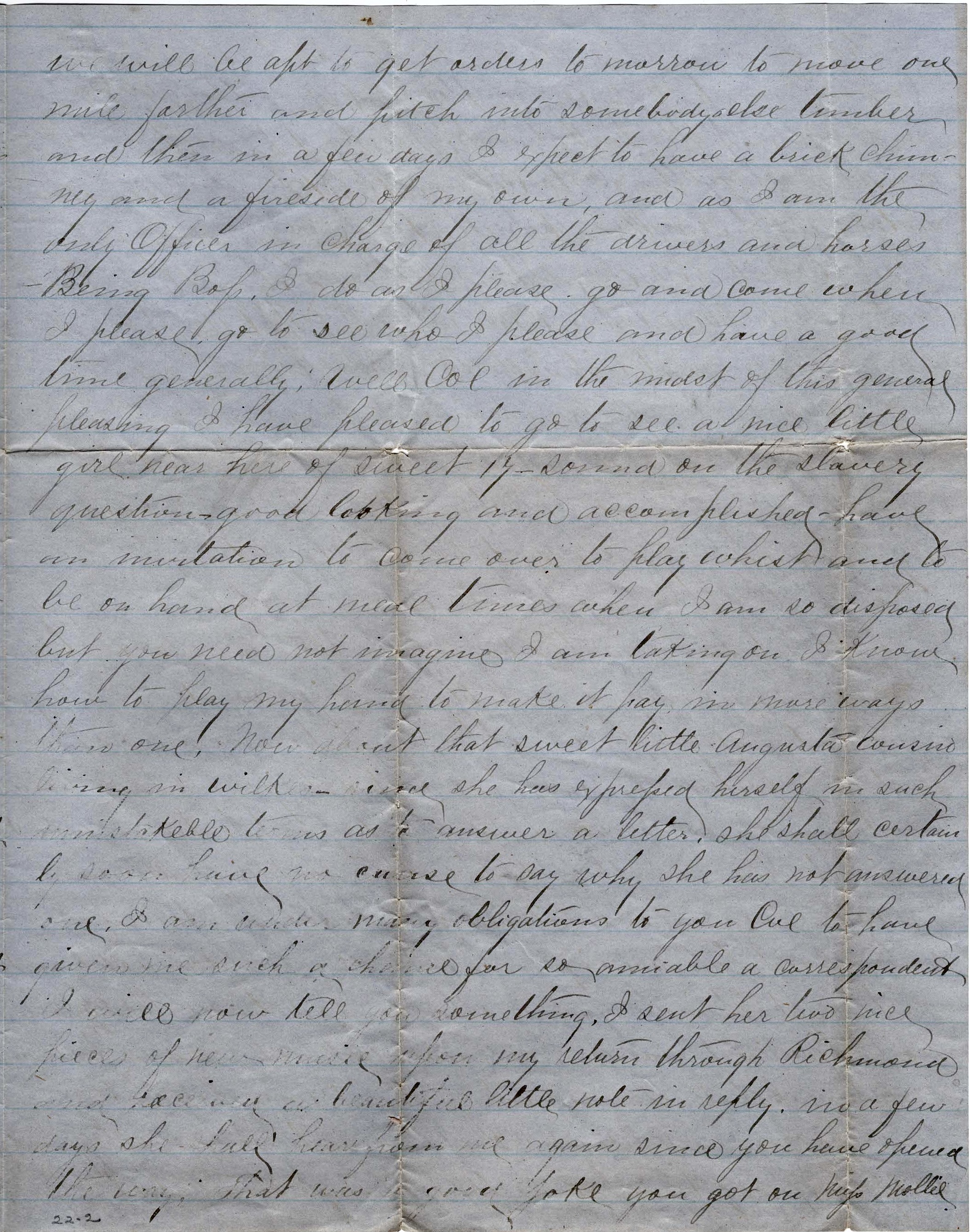
I have little or no news to communicate. Our Battery is on the lines and the boys over there three miles distant from here are very comfortably fixed for winter, having good cabins and brick chimneys. Here we are not altogether so fortunate in that respect yet for we have been waiting in suspense for a week just to know what to be at, the cause of which is this. The old gentleman on whose land we pitched our camp has raised a row about the scarcity of his wood and does not want us to to cut it down any more, so between the officials from Gen. Lee down, we have not yet received positive orders what to do. Most of the drivers had put up their houses and don’t like to have to move. Others had only half way finished so thus things stand. But I think we will be apt to get orders tomorrow to move one mile farther and pitch into somebody else’s timber and then in a few days I expect to have a brick chimney and a fireside of my own. And as I am the only officer in charge of all the drivers and horses, being boss, I do as I please—go and come when I please to go. to see who I please, and have a good time generally.
Well, Colonel, in the midst of this general pleasing, I have pleased to go to see a nice little girl near here of sweet 17—sound on the slavery question—good-looking and accomplished. Have an invitation to come over to play whist and to be on hand at meal times when I am so disposed. But you need not imagine I am taking on. I know how to play my hand to make it pay in more ways than one.
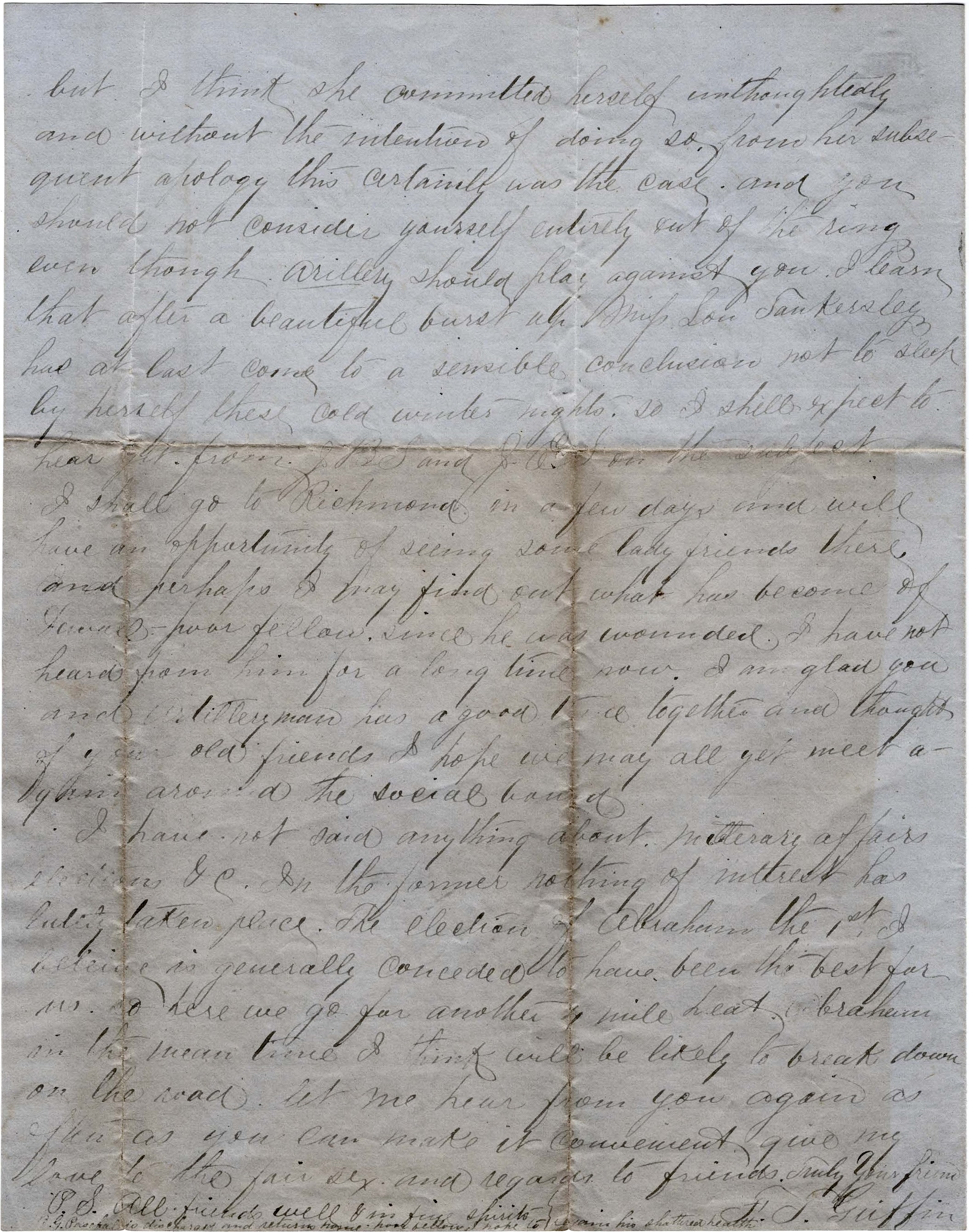
Now about that sweet little Augusta cousin living in Wilkes [county]. Since she has expressed herself in such unmistakeable terms as to answer a letter, she shall certainly soon have no excuse to say why she has not answered one. I am under many obligations to you, Colonel, to have given me such a chance for so amiable a correspondent. I will now tell you something. I sent her two nice pieces of new music upon my return through Richmond and received a beautiful little note in reply. In a few [words], says she shall hear from me again since you have opened the way. That was a good joke you got on Miss Molly but I think she committed herself unthoughtedly and without the intention of doing so. From her subsequent apology, this certainly was the case, and you should not consider yourself entirely out of the ring even though artillery should play against you. I learn that after a beautiful burst up, Miss Lou Tankersley has at last come to a sensible conclusion not to sleep by herself these cold winter nights, so I shall expect to hear yet from J. B. S. and J. E. S. on the subject.
I shall go to Richmond in a few days and will have an opportunity of seeing some lady friends there and perhaps I may find out what has become of [Ferdinand C.] Duvall. Poor fellow. Since he was wounded [at Peebles’ Farm], I have not heard from him for a long time now. I am glad you and artilleryman has a good time together and thought of your old friends. I hope we may all yet meet again around the social band.
I have not said anything about military affairs, elections, &c. In the former, nothing of interest has lately taken place. The election of Abraham the 1st I believe is generally conceded to have been the best for us so here we go for another 4 mile heat. Abraham in the meantime, I think, will be likely to break down on the road. Let me hear from you again as often as you can make it convenient. Give my love to the fair sex and regards to friends. Truly your friend, — F. T. Griffin
P. S. All friends well & in fine spirits. B. G. Paschal is discharged and returns home, poor fellow, I hope to regain his shattered health.


It’s fascinating to see these letter’s from my great grandfather, Felix Griffin. My wife and I have been researching old family records but these letters were unknown to us before now. They give a good light on the camp life that he went through. If you’re interested, there is a very good book titled “The Sumter Flying Artillery” by James L. Speicher that gives a comprehensive account of the unit during the war. Thanks. James Griffin
LikeLike