The following letters were written by Thomas Henry Barnfield (1833-1920), a native of Kentucky, who resided in Randolph county, Illinois, at the time of the Civil War. He served four years in Co. K, 5th Illinois Cavalry, rising from the rank of private to 2nd Lieutenant. He mustered out of the 5th Illinois Cavalry on 17 March 1865. Soon after, he reenlisted as a private in Co. I, of the 8th Regiment US Veteran Volunteer Infantry.
Thomas wrote the letter to John Preston Mann (b. 1822) who served with him in the 5th Illinois Cavalry. After mustering out of the regiment, John began practicing law in Rockwood, Illinois. John was married to Nancy Clendening. In 1867, Henry Barnfield married Nancy’s sister, Martha Alice Clendenin (1836-1890). After he left the service, Henry farmed in Randolph county for a while and then relocated to Bartlett Springs, Lake county, California, where he died in 1920.
Barnfield’s first letter describes the Battle of Egypt Station that unfolded as follows: “Grierson’s raiding cavalry left Memphis, Tennessee on 21 December and first demolished a Confederate supply depot at Verona. Moving south while wrecking bridges and track along the Mobile and Ohio Railroad, the Union raiders encountered the Confederate defenders at Egypt Station. After their victory, Grierson’s cavalry headed southwest to Vicksburg which it reached on January 5, 1865. The raiders destroyed a large amount of Confederate supplies and also damaged the Mississippi Central Railroad. Some of the men captured by Grierson’s raiders proved to be former Union soldiers who volunteered to fight for the Confederacy rather than languish in prison camps. When John Bell Hood’s army retreated into northern Mississippi after the Battle of Nashville, it was unable to obtain supplies because Grierson’s raiders had damaged the railroad so badly.”
To read other post-war letters by Barnfield, see 1865-66: Thomas Henry Barnfield to John Preston Mann.
Letter 1
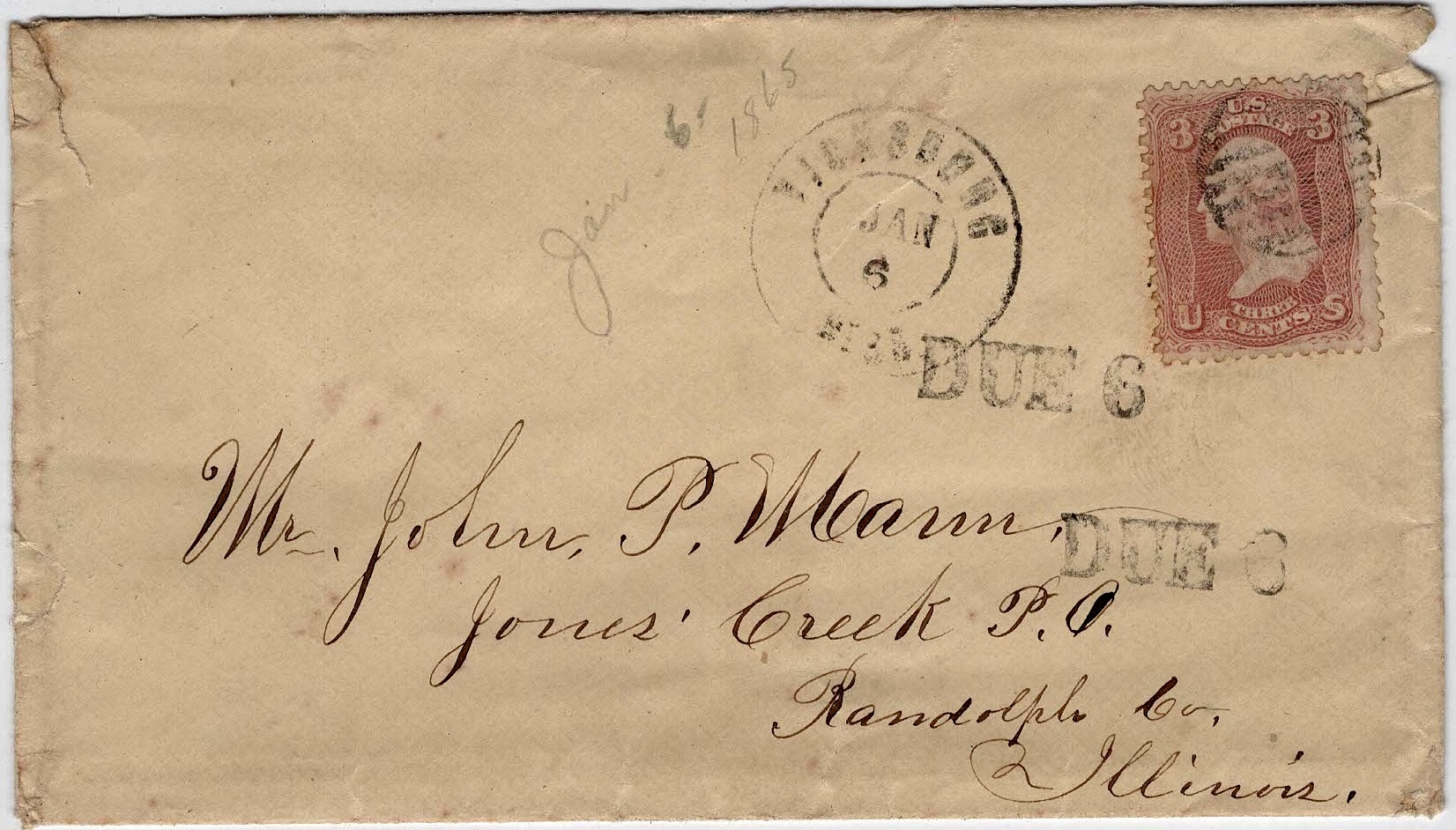
Vicksburg [Mississippi]
January 5, 1865
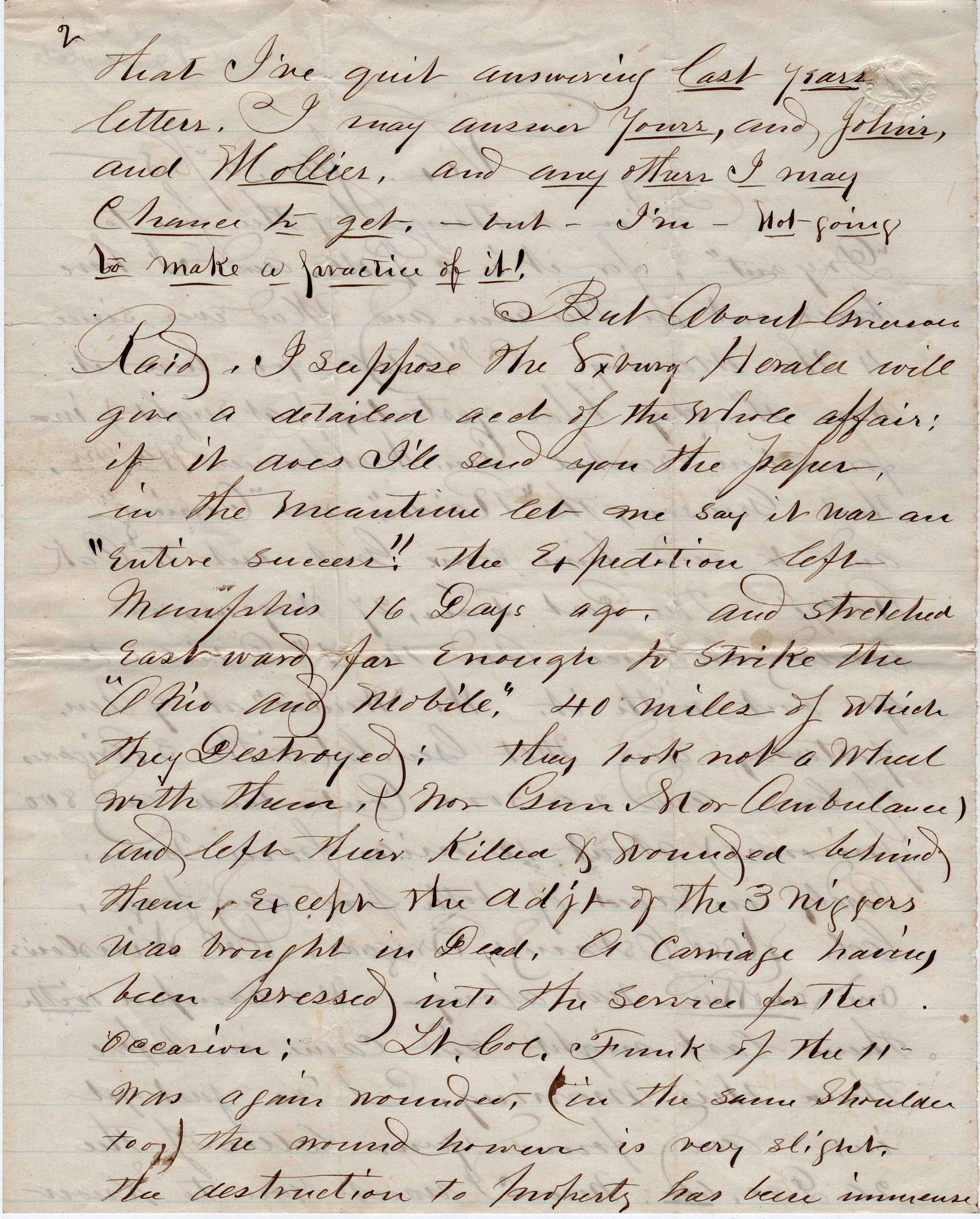
I’m sitting by the fire to “Dry out” for it is 2 p.m. and I have been out in the rain and mud ever since 4 this morning. I’ll tell you how it was. The day before yesterday (at night) information reached Gen. Washburne’s Headquarters that [Brig. Gen. Benjamin] Grierson—the “Raiders”—was “coming” and to send him some grub out to “Oak Ridge.” The post train, 27 wagons, was loaded at once and the 5th [Illinois Cavalry] detailed to go out with it. We “wented” at 9 a.m. yesterday and met Gen. G[rierson] (with 3 brigades of cavalry and 2 or 3,000 contrabands and 800 prisoners) about 12 miles from town, badly in need of both food and forage, Col. [Embry D.] Osband’s Brigade, 1 Col. [Edward Francis] Winslow’s and another was along. We camped with them last night and came in before them this morning. I’ve just got in and found your letter of the 26th December ’64. Now I want you to know that I’ve quit answering last year’s letters. I may answer yours and John’s and Mollie’s, and any others I may chance to get, but, I’m not going to make a practice of it!
But about Grierson’s Raid. I suppose the Vicksburg Herald will give a detailed account of the whole affair. If it does, I’ll send you the paper. In the meantime let me say it was an “entire success.” The expedition left Memphis 16 days ago and stretched eastward far enough to strike the “Ohio & Mobile” [railroad], forty miles of which they destroyed. They took not a wheel with them (nor gun nor ambulance) and left their killed and wounded behind them except the adjutant of the 3 niggers was brought in dead—a carriage having been pressed into the service for the occasion.
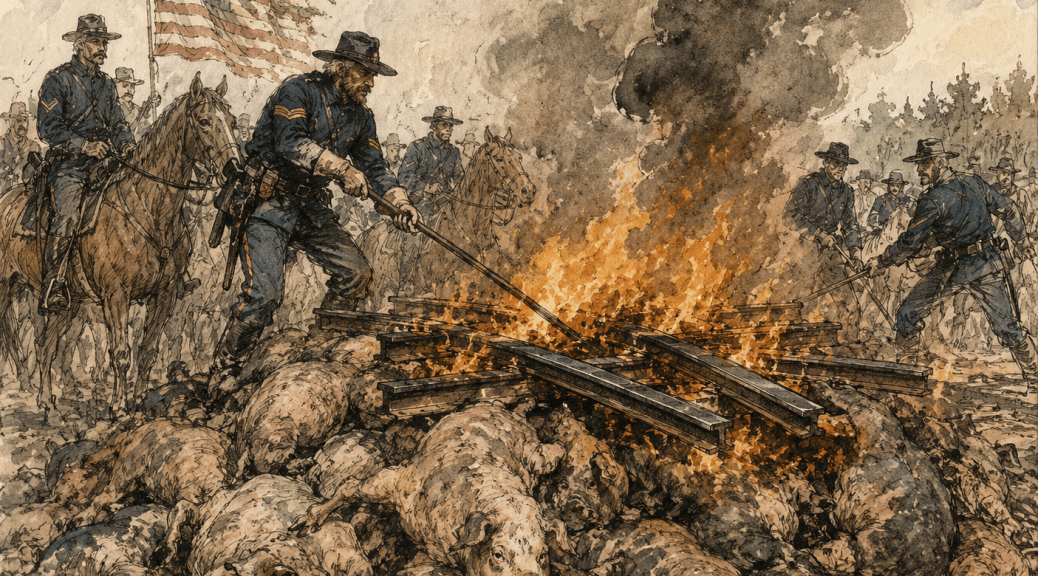
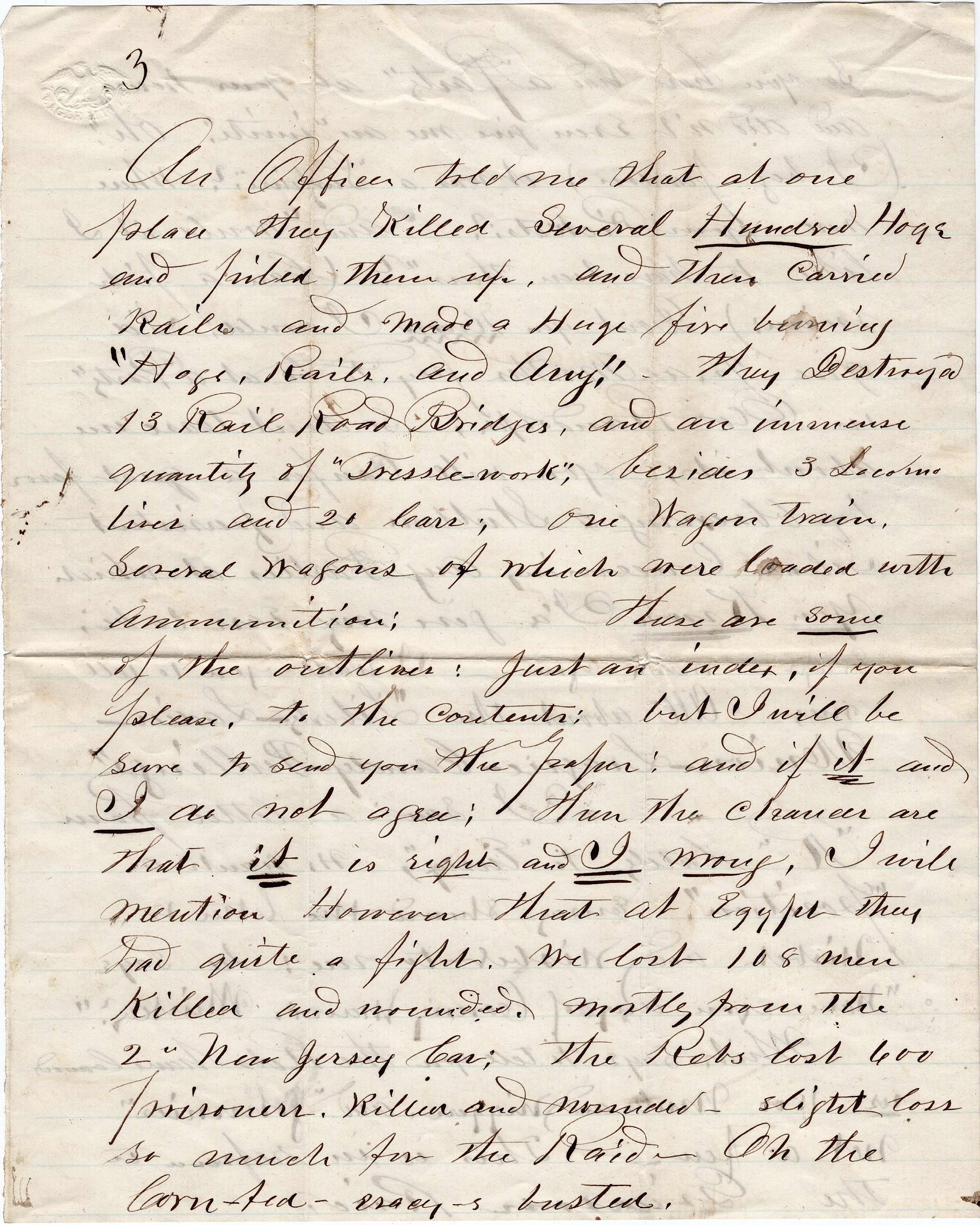
Lt. Col. [Henry W.] Funk of the 11th [Illinois Cavalry] was again wounded (in the same shoulder too). The wound is however very slight. The destruction to property has been immense. An officer told me that at one place they killed several hundred hogs and piled them up and then carried rails and made a huge fire burning “Hogs, Rails, and Any.” They destroyed 13 railroad bridges and an immense quantity of “trestle-work,” besides three locomotives and twenty cars, one wagon train—several wagons of which were loaded with ammunition.
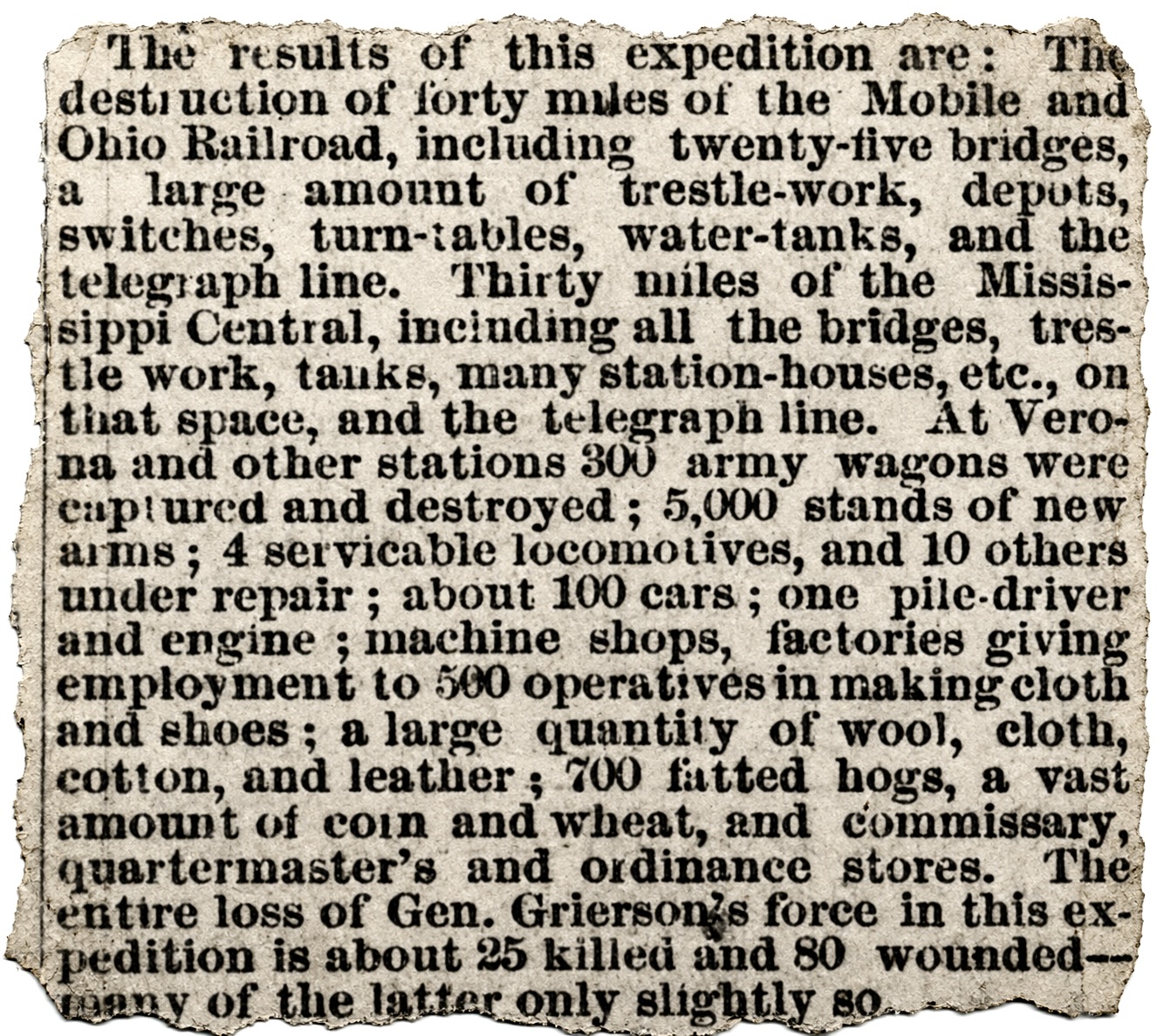
These are some of the outlines: Just an index, if you please, to the contents. But I will be sure to send you the paper and if it and I do not agree, then the chances are that it is right and I wrong. I will mention, however, that at Egypt they had quite a fight. We lost 108 men killed and wounded—mostly from the 2nd New Jersey Cavalry. The Rebs lost 600 prisoners, killed and wounded—slight loss. So much for the raid. Oh the Corn-fed-eracy’s busted.
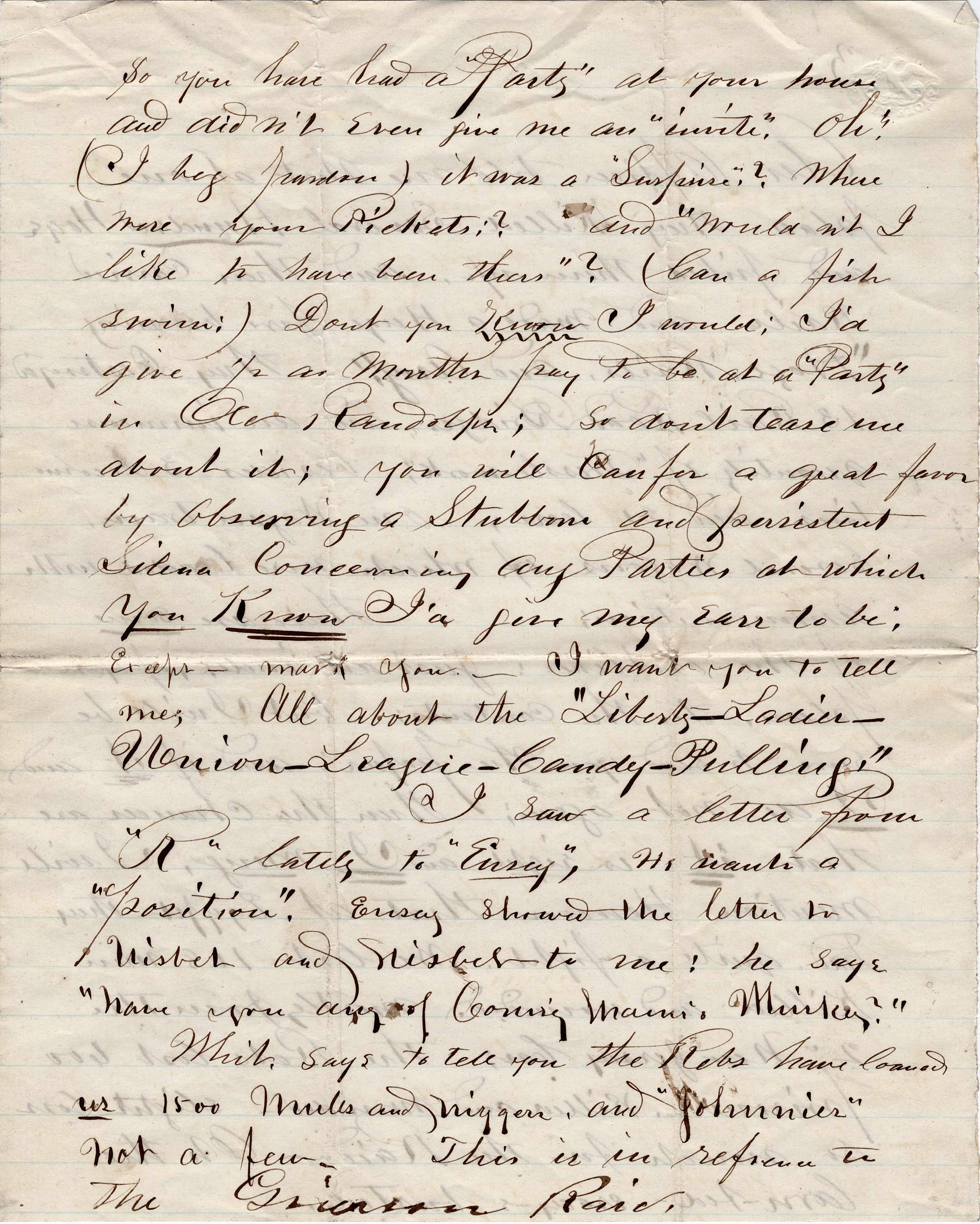
So you have had a “party” at your house and didn’t even give me an “invite?” Oh (I beg pardon) it was a “Surprise?” Where were your pickets? And “wouldn’t I like to have been there?” (Can a fish swim?) Don’t you know I would. I’d give half a month’s pay to be at a “Party” in Old Randolph. So don’t tease me about it. You will confer a great favor by observing a stubborn and persistent silence concerning any parties at which you know I’d give my ear to be. Except—mark you—I want you to tell me all about the “Liberty Ladies—Union League—Candy-pullings.”
I saw a letter from “R” lately to “Enrey.” He wants a “position.” Enrey showed the letter to Nisbet and Nisbet to me. He says, “have you any of Commissary Mann’s Whiskey?” Whit. says to tell you the Rebs have loaned us 1500 mules and niggers, and Johnnies—not a few. This is in reference to the Grierson Raid.
[Unsigned or incomplete but the distinctive handwriting is clearly that of Tom Barnfield]
1 Grierson sent Osband’s brigade to the south with the mission of tearing up additional railroad track. The remainder of Grierson’s column moved southwest to Lexington and then Benton. On January 1, 1865, Osband’s brigade marched south through Vaiden and West Station, destroying an estimated 2.5 mi (4.0 km) of track, plus bridges, culverts, stations, and water tanks. The following day, a Confederate force was reported assembling at Goodman so Osburn moved his brigade southwest toward Ebenezer. Near Franklin, the 3rd U.S. Colored Cavalry ran into a Confederate force led by Brigadier General William Wirt Adams. The 11th Illinois took position on the right flank while the 4th Illinois supported the 3rd U.S. Colored. After a struggle lasting one hour and a half, both sides disengaged. Osband lost one officer killed and one wounded, and three enlisted men killed, seven wounded, and two missing. Two enlisted men were too severely wounded to be moved and were left at Franklin. Osband’s brigade moved through Ebenezer and joined Grierson’s main column at Benton at night on January 2. Adams reported 22 casualties: two officers and five enlisted men killed, and three officers and 12 men wounded.
Letter 2
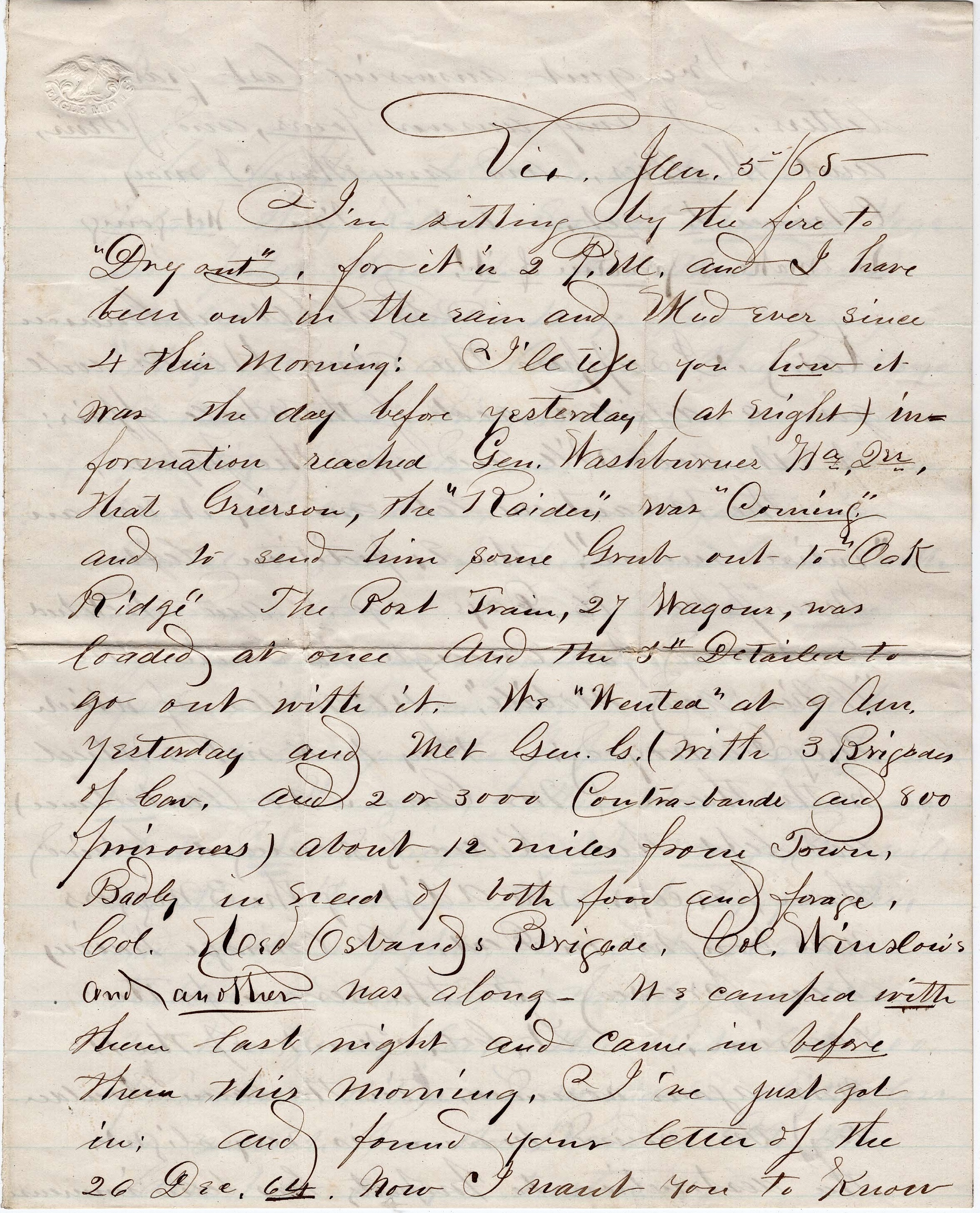
[probably written in mid-February, 1865]
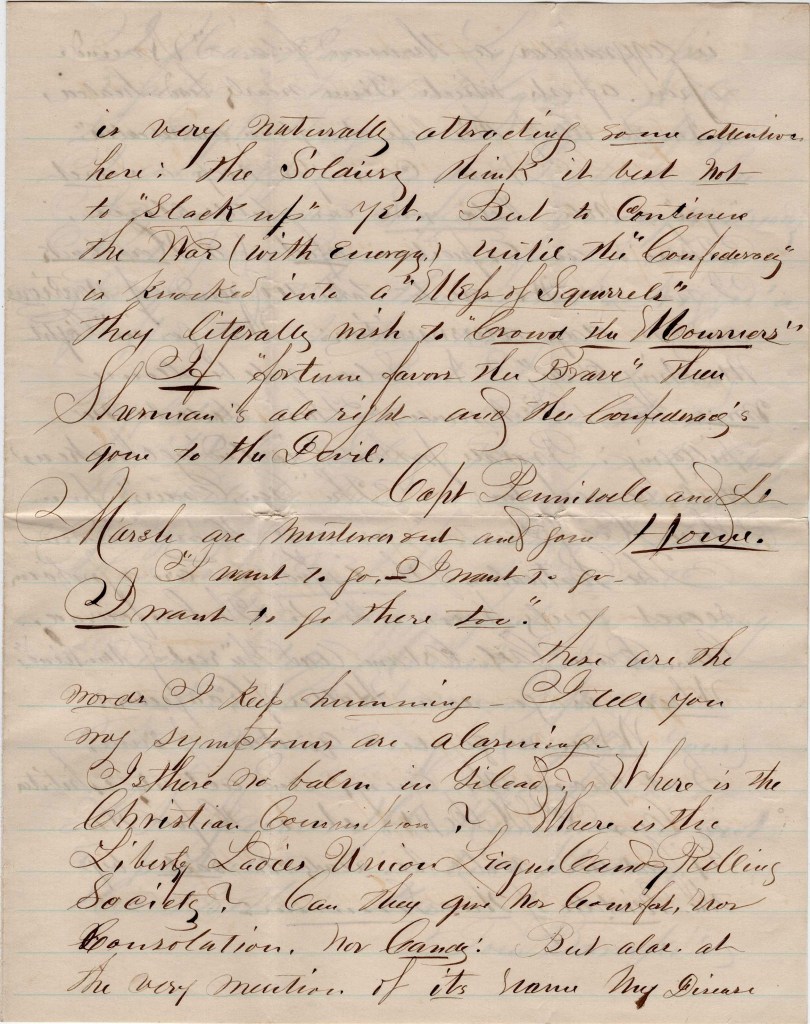
…is very naturally attracting some attention here. The soldiers think it best to not to “slack up” yet, but to continue the war (with energy) until the “Confederacy” is knocked into a “Mess of squirrels.” They literally wish to “crowd the mourners.” If “fortune favors the brave,” then Sherman’s all right and the Confederacy’s gone to the Devil.
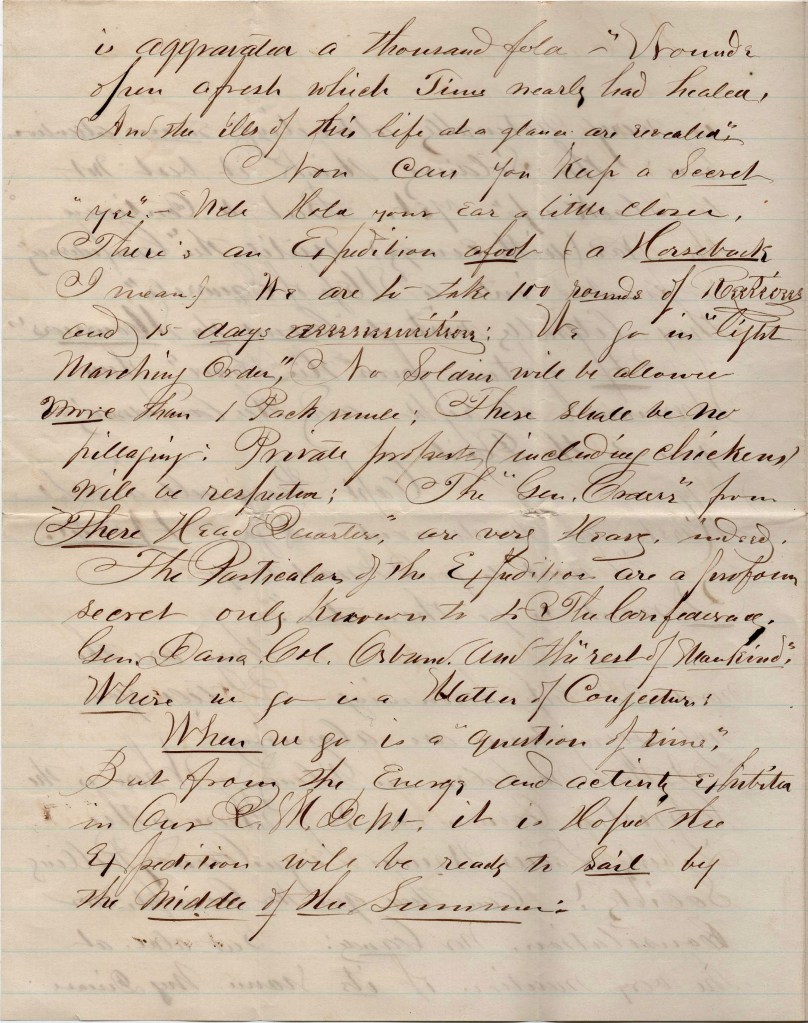
Capt. [Kendall B.] Peniwell and Lt. [Clement] March [of Co. B, 5th Ill. Cav.] are mustered out and gone home. “I want to go. I must go. I want to go there too.” These are the words I keep humming. I tell you, my symptoms are alarming. Is there no balm in Gilead? Where is the Christian Commission? Where is the Liberty Ladies Union League Candy Pulling Society? Can they give no comfort nor consolation? No candy? But alas! at the very mention of its name, my disease is aggravated a thousand fold. “Wound open afresh which time nearly had healed, and the ills of this life at a glance are revealed.”
Now can you keep a secret? “Yes?” Well hold your ear a little closer. There’s an expedition afoot (a horesback, I mean). We are to take 100 rounds of rations nd 15 days ammunition. We go “in light marching order.” No soldier will be allowed more than 1 pack mule. There shall be no pillaging. Private property (including chickens) will be respected. The “General Orders” from “These Headquarters” are very heavy indeed. The particulars of the expedition are a profound secret only known to the Confederacy. Gen. Dana, Col. Orbund and the “rest of mankind.” When we go is a “question of time” but from the energy and activity exhibited in our Quartermaster Department, it is hoped the expedition will be ready to sail by the middle of the summer.
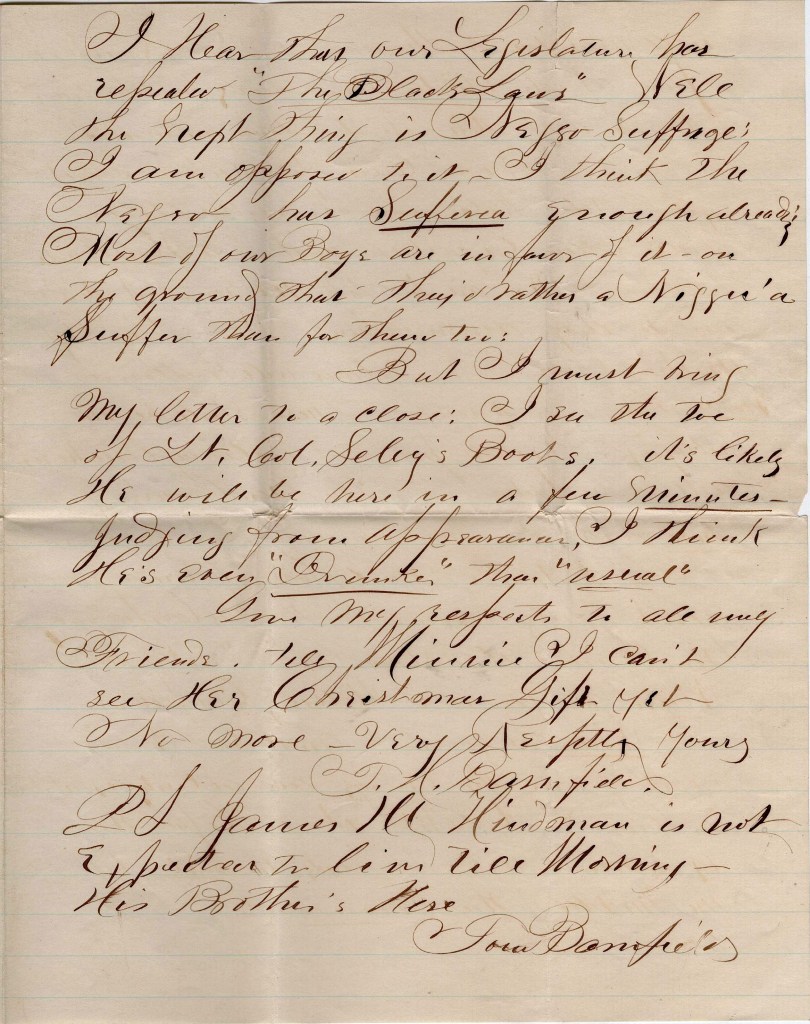
I hear that our [Illinois] Legislature has repealed “the Black Laws.” 1 Well the next thing is Negro Suffrage. I am opposed to it. I think the Negro has suffered enough already. Most of our Boys are in favor of it on the ground that they’d rather a Nigges suffer than for them to.
But I must bring my letter to a close. I see the toe of Lt. Col. [Abel Hildreth] Seley’s boots. It’s likely he will be here in a few minutes. Judging from appearances, I think he’s even “drunker” than “usual.” 2
Give my respects to all my friends. Tell Minnie I can’t see her Christmas gift yet. No more. Very respectfully yours. — T. Barnfield
P. S. James Hindman is not expected to live till morning. His brother is here. — Tom Barnfield
1 “Illinois was infamous throughout the free states for its anti-Black policies. The Illinois legislature updated and intensified the state’s racist laws from the 1820s through the 1850s. In addition to requiring that Black people register with local officials and criminalizing African Americans’ public assembly, state laws barred Black people from testifying in court cases involving whites and promised public education to white children only….The Illinois legislature updated the black laws many times, and in 1853 it attempted to bar Black migration into the state. Black Illinoisans fought these policies for decades. The legislature finally repealed the black laws on Feb. 7, 1865.” (Source: Slavery and Racist Laws.)
2 LTC Abel Hildreth Seley (1821-1886) must have had rather large feet. Seley was working for a railroad company in Nashville when the Civil War began and left immediately to return to Illinois (where his family resided) to “put down the Rebellion.”