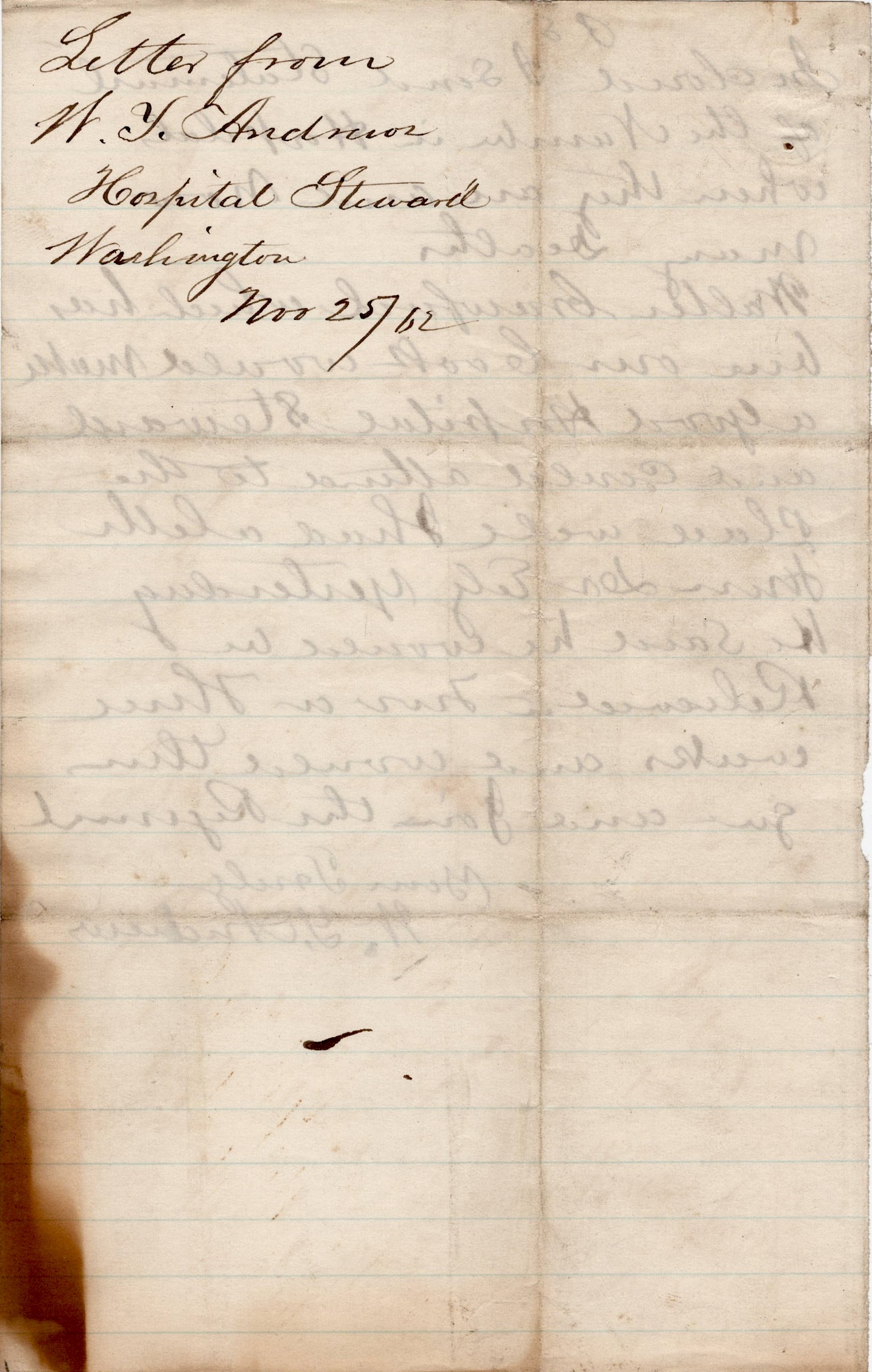
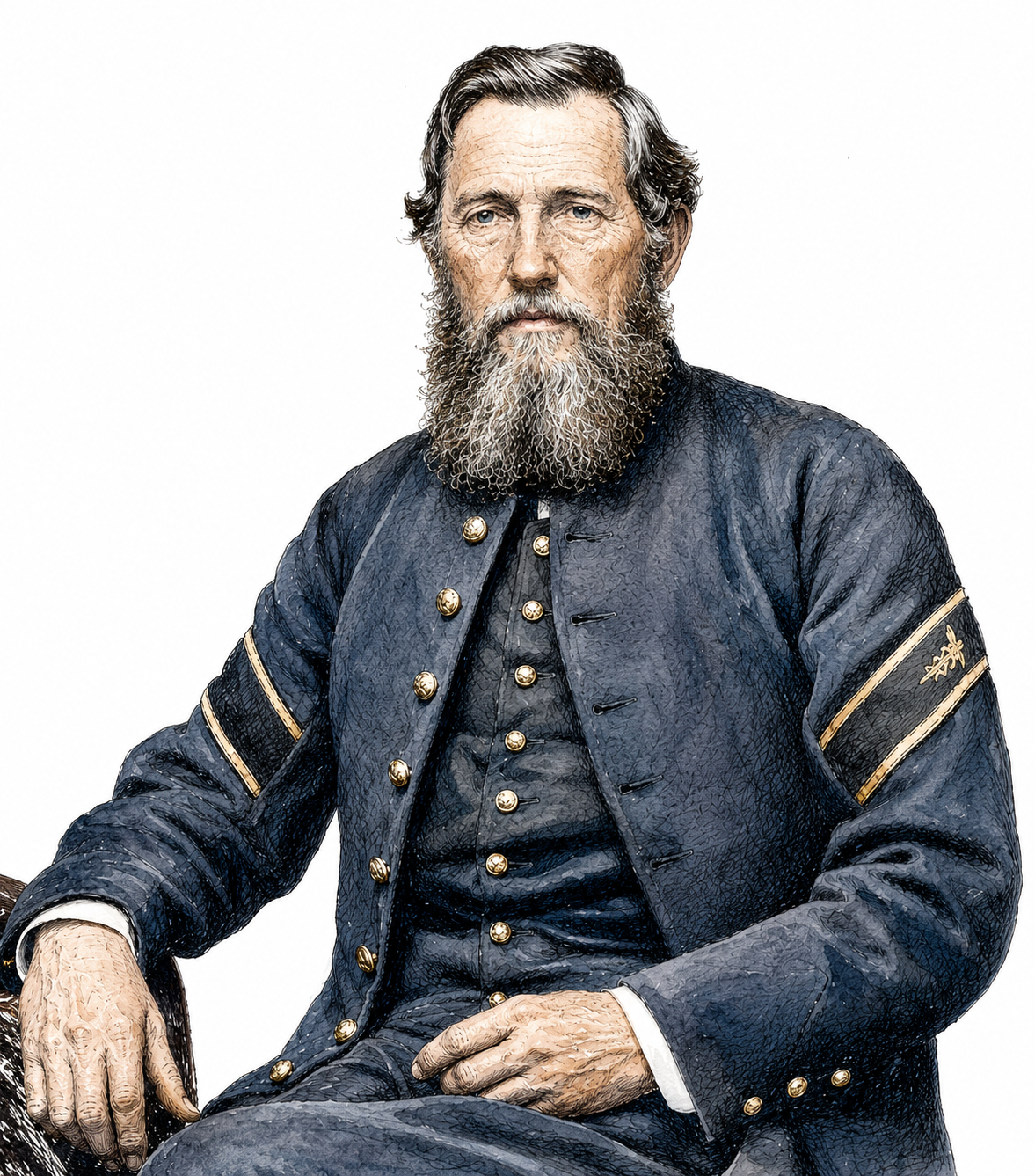
The following letter was written by 46 year-old Wakeman Young Andrews (1816-1886)—a man described as “earnest and true in all his dealings” who served as a hospital steward in the 108th New York Infantry during the American Civil War. He served with his son, Samuel W. Andrews (1844-1872) in Company I. Samuel survived the war but died of consumption in June 1872. Wakeman was discharged for disability on 27 December 1862, just one month after this letter was penned. He died in Rochester, Monroe county, New York, at the age of 69.
Wakeman datelined his letter from Washington D. C. in late November 1862, a couple of months after the Battle of Antietam where the regiment first saw the elephant. At Antietam, they suffered 30 killed, 122 wounded, and 43 missing.
[Editor’s Note: My thanks to Abbey Weber Jones for providing a first draft transcription of this letter.]
T R A N S C R I P T I O N
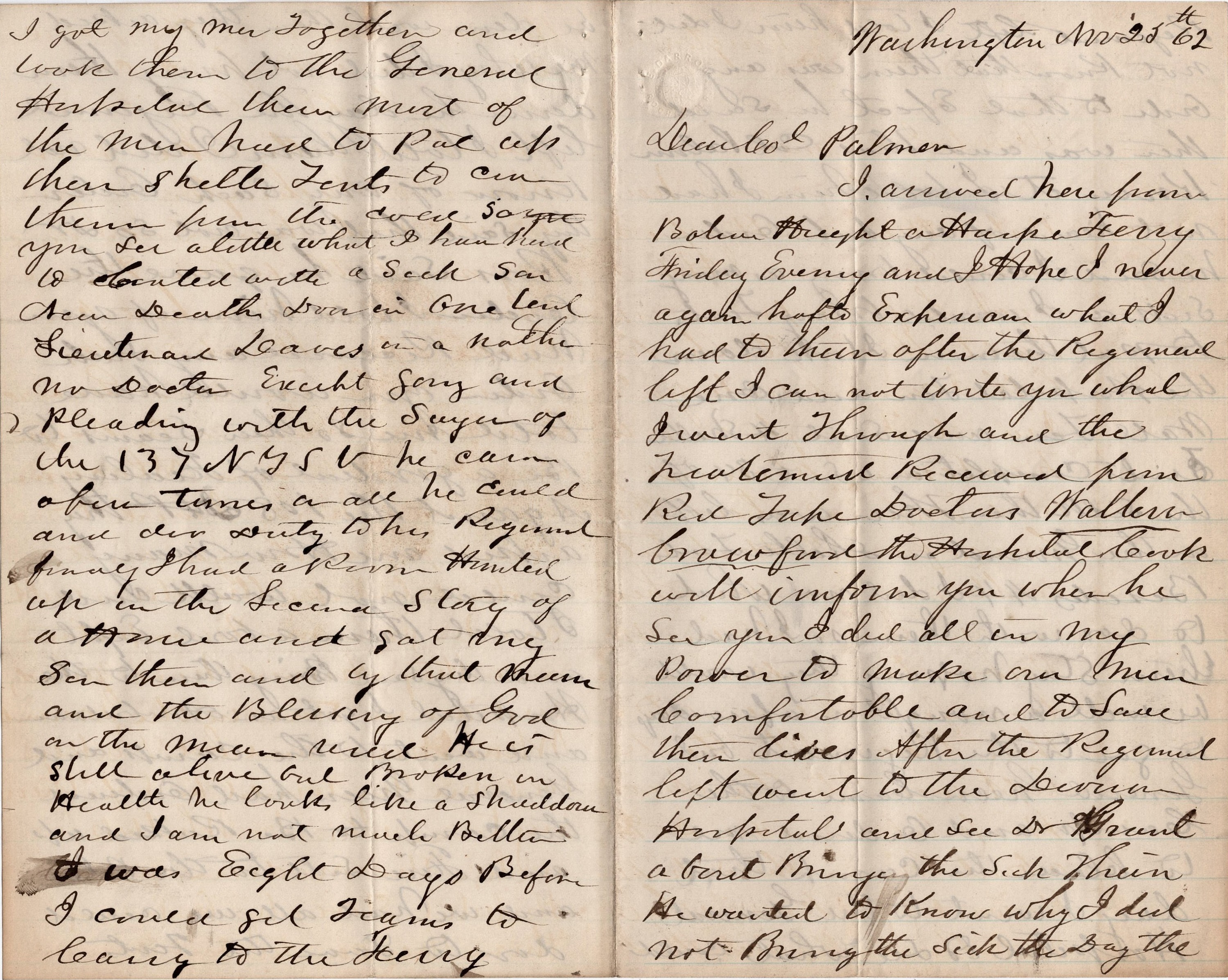
Washington [D. C.]
November 25th 1862
Dear Col. [Oliver Hazard] Palmer,
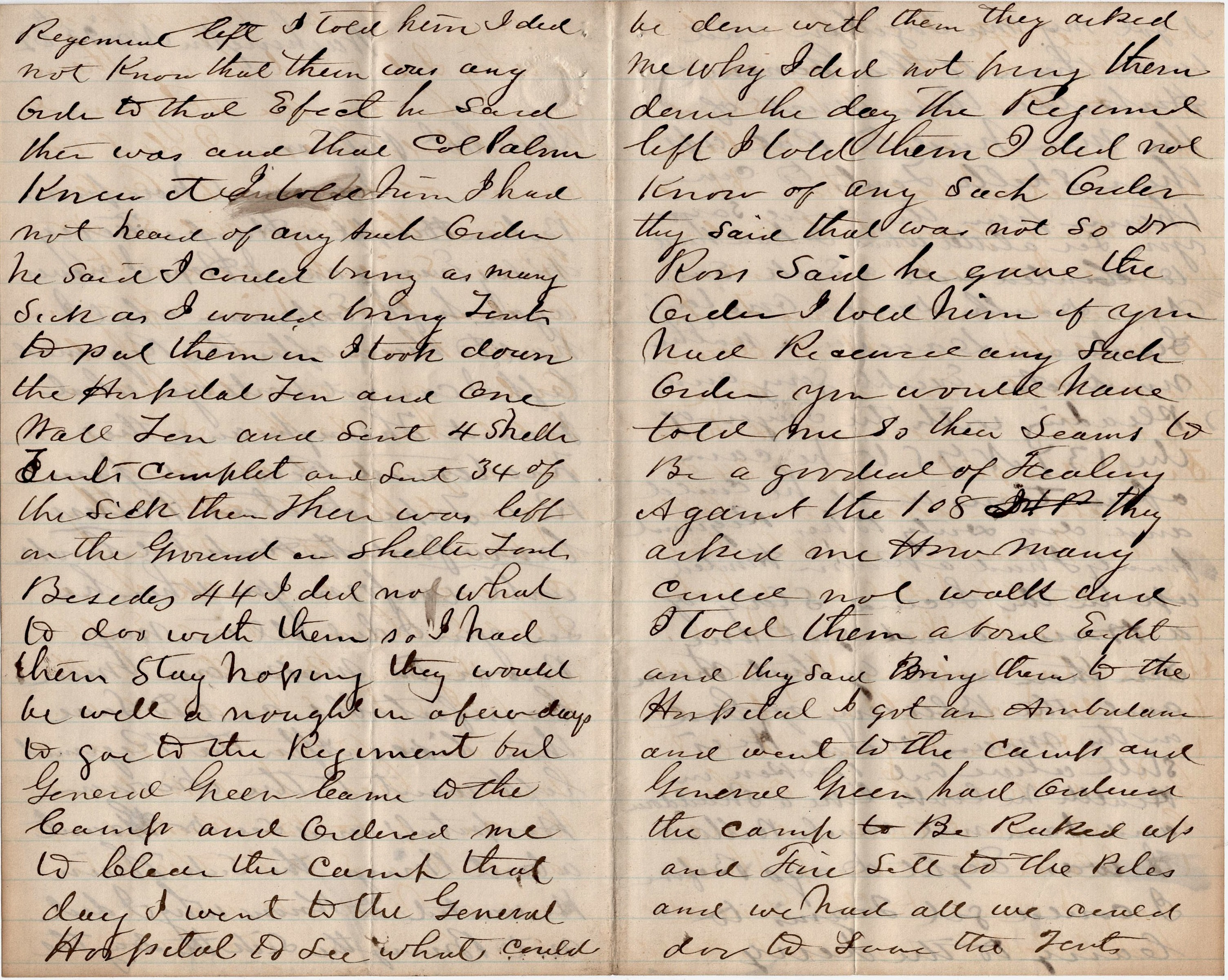
I arrived here from Bolivar Hospital at Harpers Ferry Friday evening and I hope I never again hafto experience what I had to [go] thru after the regiment left. I cannot write you what I went through and the treatment received from Red Tape Doctors. Walter Crawford, the hospital cook, will inform you when he sees you. I did all in my power to make our men comfortable and to save their lives. After the regiment left, [I] went to the Division Hospital and seen Dr. Grant about bringing the sick there. He wanted to know why I did not bring the sick the day the regiment left. I told him I did not know that there was any order to that effect. He said there was and that Col. Palmer knew it. I told him I had not heard of any such order. He said I could bring as many sick as I would bring tents to put them in.
I took down the hospital ten[t] and one wall ten[t] and sent 4 shelter tents complete and sent 34 of the sick. Then there was left on the ground on[ly] shelter tents, besides 44 [patients]. I did know what to do with them so I had them stay hoping they would be well enough in a few days to go to the regiment. But General Green came to the camp and ordered me to clear the camp that day. I went to the General Hospital to see what could be done with them. They asked me why I did not bring them down the day the regiment left. I told them I did not know of any such order. They said that was not so. Dr. Ross said he gave the order. I told him if you had received any such order, you would have told me. So, there seems to be a good deal of feeling against the 108th [New York Infantry]. They asked me how many could not walk and I told them about eight and they said bring them to the hospital. I got an ambulance and went to the camp and General Green had ordered the camp to be racked up and fire set to the piles and we had all we could do to save the tents.
I got my men together and took them to the General Hospital. Then most of the men had to put up their shelter tents to cover them from the cold. So you see a little what I have had to contend with—a sick son near death’s door in one tent, Lieutenant [John M.] Davey in another, no doctor, except going and pleading with the surgeon of the 137th New York S. V. He came a few times or all he could and [still] do duty to his regiment. Finally I had a room hunted up in the second story of a house and sent my son there. And by that means and the blessings of God and other means used, he is still alive but broken in health. He looks like a shadow and I am not much better.
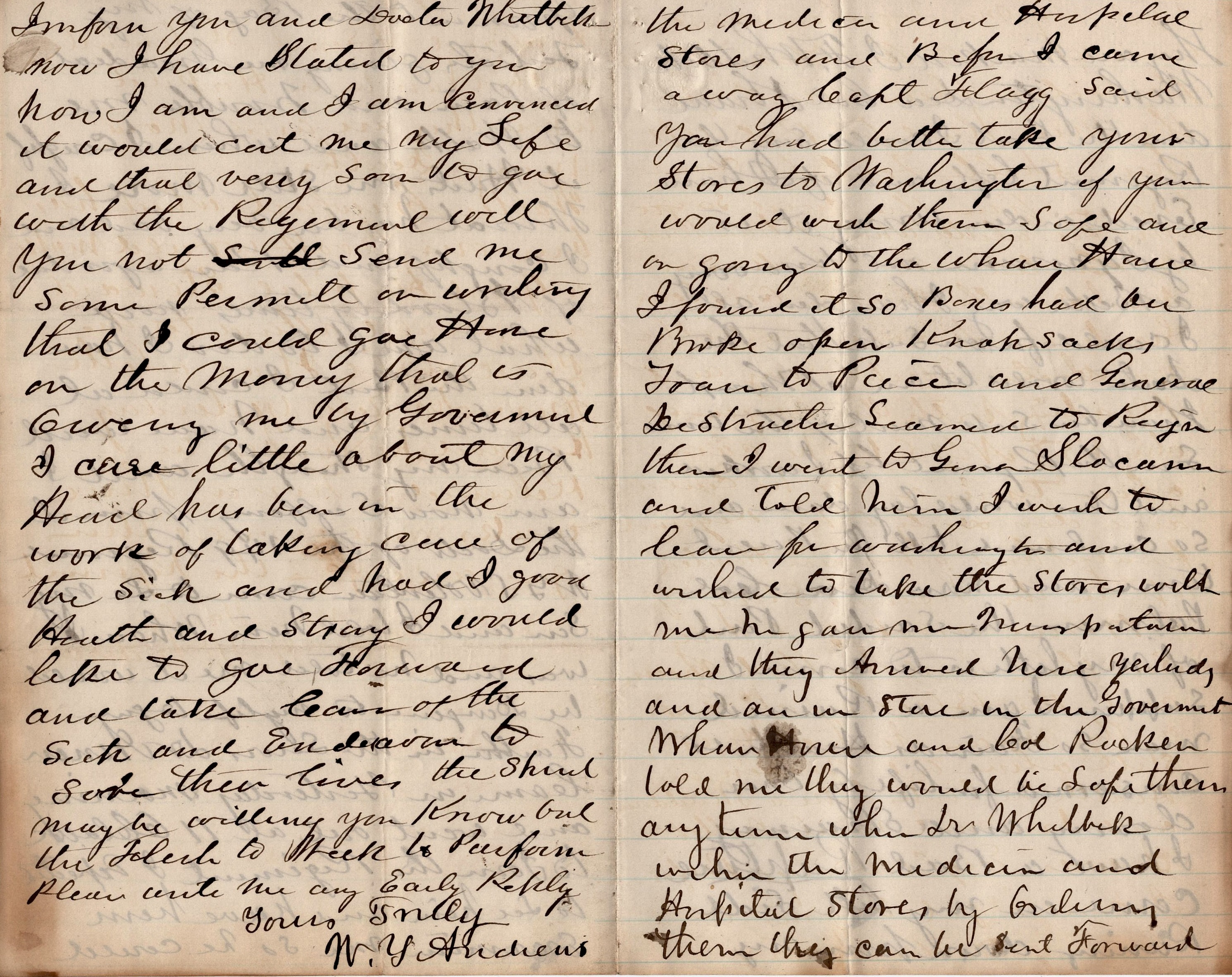
I was eight days before I could get teams to carry to the ferry the medicine and hospital stores. And before I came away, Capt. Flagg said, “you had better take your stores to Washington if you would wish them safe.” And on going to the warehouse, I found it so. Boxes had been broke[n] open, knapsacks torn to piece[s] and general destruction seemed to reign. Then I went to General Slocum and told him I wish to leave for Washington and wished to take the stores with me. He gave me transportation and they arrived here yesterday and are in store in the government warehouse and Col. Rucker told me they would be safe there anytime with Dr. [John F.] Whitbeck within the medicine and hospital stores. By ordering them, they can be sent forward.
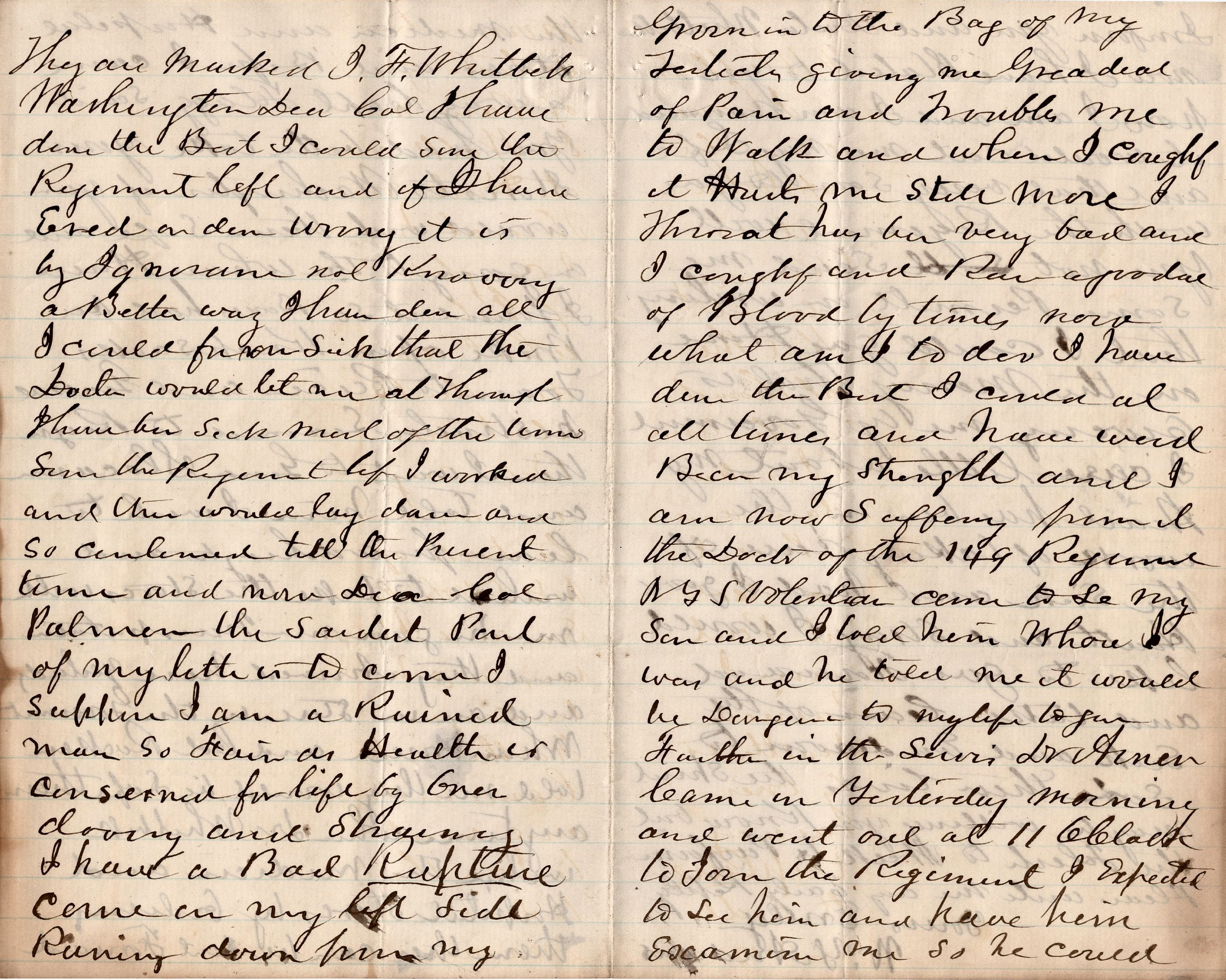
They are marked J. F. Whitbeck, Washington, District of Columbia. I have done the best I could since the regiment left and if I have erred or done wrong, it is by ignorance—not knowing a better way. I have done all I could for our sick that the Doctor would let me, although I have been sick much of the time since the regiment left. I worked and then would lay down and so continued till our present time.
And now, dear Col. Palmer, the saddest part of my letter is to come. I suppose I am a ruined man so far as health is concerned for life by over doing and straining, I have a bad rupture come on my left side running down from my groin in the bag of my testicles giving me [a] great deal of pain and [it] troubles me to walk. And when I cough, it hurts me still more. [My] throat has been very bad and I cough and run a good deal of blood by times. Now what am I to do? I have done the best I could at all times and have [ ] been my strength and I am now suffering from it.
The doctor of the 149th Regiment New York S. Volunteers came to see my son and I told him [the doctor] who I was and he told me it would be dangerous to my life to go further in the service. Dr Arner [1st Assistant Surgeon] came in yesterday morning and went out at 11 o’clock to join the regiment. I expected to see him and have him examine me so he could inform you and Doctor Whitbeck. Now I have stated to you how I am and I am convinced it would cost me my life—and that very soon—to go with the regiment. Will you not send me some permit in writing that I could go home? On the money that is owing me by [the] government, I care little about. My head has been in the work of taking care of the sick and had I good health and [was] strong, I would like to go forward and take care of the sick and endeavor to save their lives. The spirit may be willing you know, but the flesh too weak to perform. Please write me any early reply.
Yours truly, W. Y. Andrews [Wakeman Young Andrews]
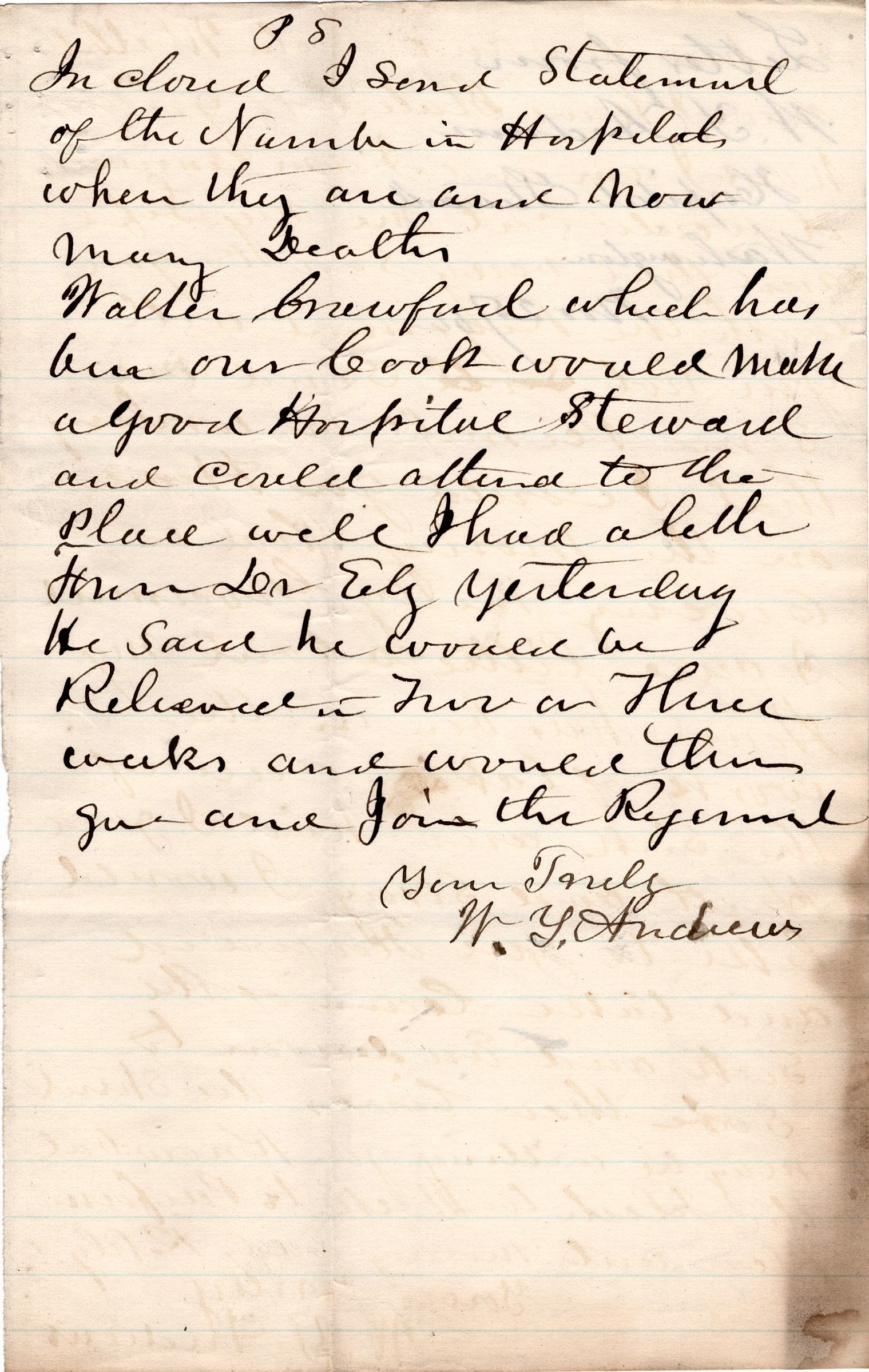
P. S. Enclosed I send statement of the number in [the] hospital, where they are, and how many deaths. Walter Crawford, which has been our cook, would make a good hospital steward and could attend to the place well. I had a letter from Dr. W[illiam] S[mith] Ely, 2nd Assistant Surgeon] yesterday. He said he would be released in two or three weeks and would then go and join the regiment. Yours truly — W. Y. Andrews