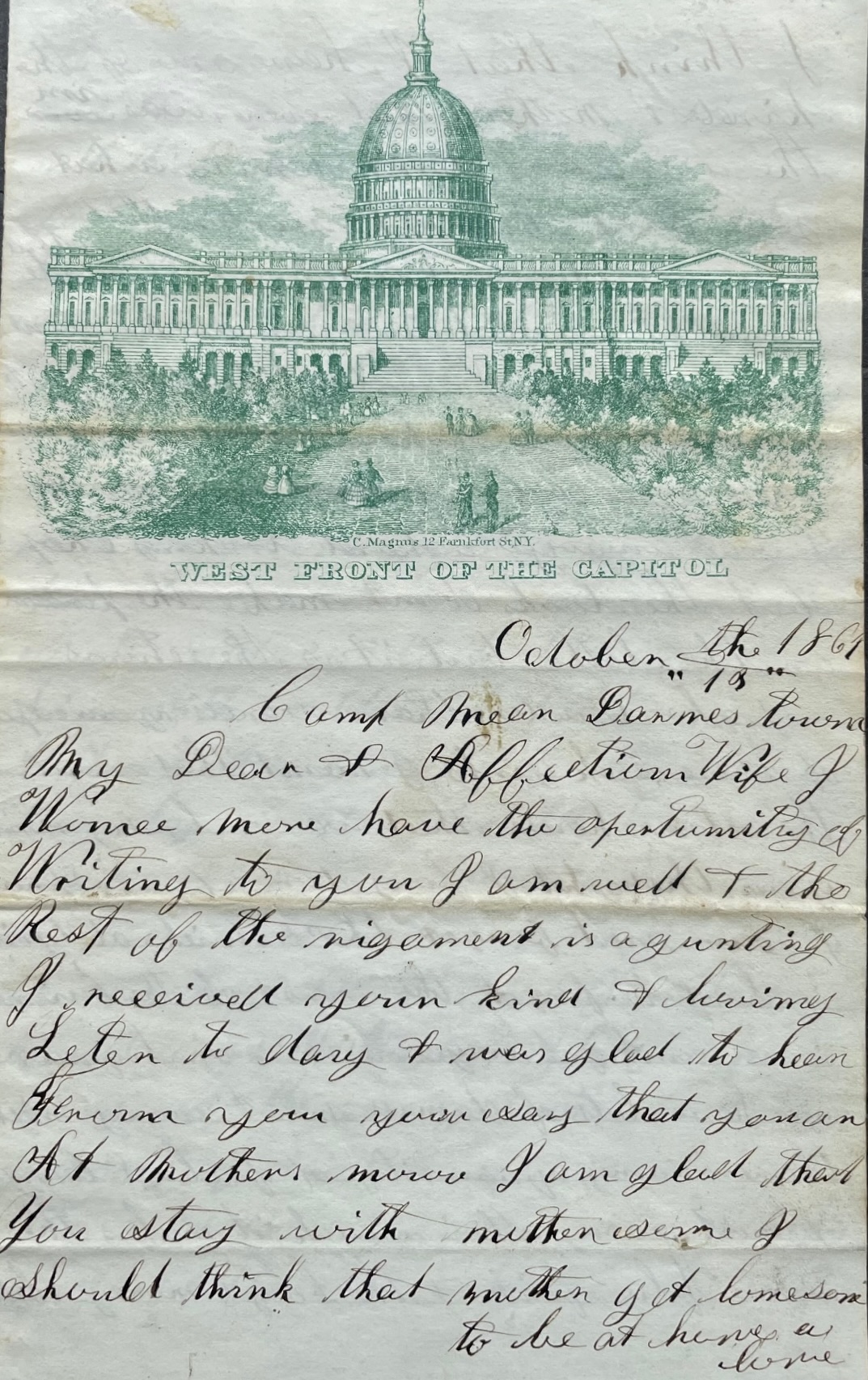
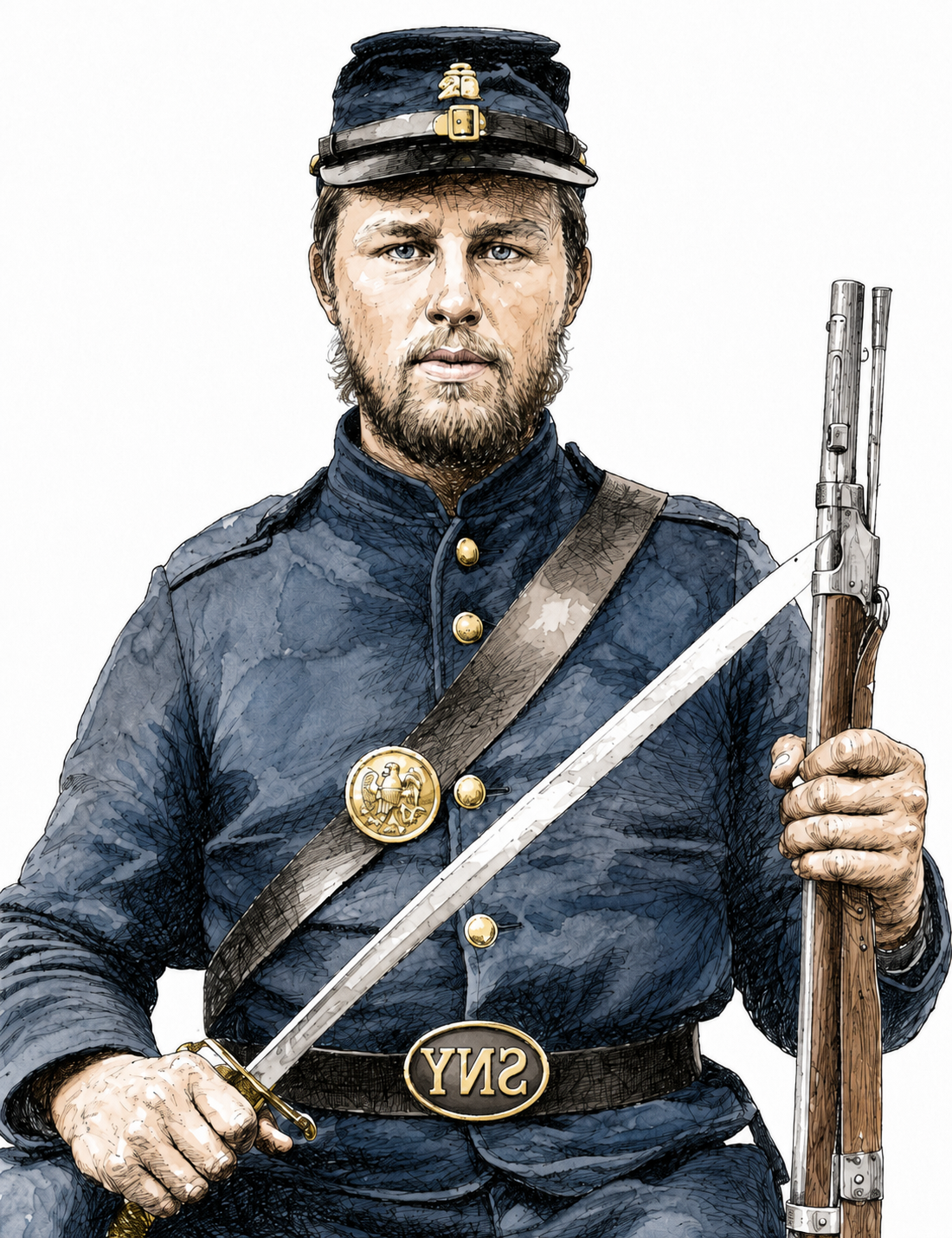
The following letter was written by 21 year-old Joseph J. G. Nellist (1839-1896) who enlisted on 26 April 1861 at Lockport to serve two years in Co. K, 28th New York Infantry. He was taken prisoner on 9 August 1862 at Cedar Mountain, Virginia, paroled at Aiken’s Landing on 13 September 1862, and rejoined his regiment on 21 October 1862. This conflicts slightly from his claim on the 1890 Veterans Schedule that he spent “3 months in Libby Prison.” He mustered out of the service with his company on 2 June 1863.
Joseph was the son of George Nellist (1814-1858) and Ann Brecken (1815-1888) of Somerset, Niagara county, New York—Quakers, and both emigrants from England. He was married to Loretta E. Root (1842-1884) sometime between July 1860 when the US Census was taken and the date of his enlistment in 1861.
Most of the companies in the 28th New York Infantry—sometimes called the “Niagara Rifles”—were recruited in Niagara county, one of which was Co. K. It drew its roster from young men living in or near Lockport. On June 25, 1861, the regiment left the state for Washington D. C. where it was assigned on July 7 to Butterfield’s brigade, Keim’s division of Gen. Patterson’s force. They moved to Darnestown, Maryland, on 20 August 1861 and remained there until Oct. 20th, when they were ordered to Ball’s bluff but did not arrive in time to take part in the battle.
For a good description of the 28th New York at Cedar Mountain where Joseph was taken prisoner in August 1862, see “A combat more persistent or heroic can scarcely be found”—the 28th New York at Cedar Mountain.
[Editor’s Note: The first draft of this transcript was kindly prepared by Abbey Weber Jones.]
T R A N S C R I P T I O N
October 18, 1861
Camp Near Darnestown [Maryland]
My Dear & Affection[ate] Wife,
I once more have the opportunity of writing to you. I am well & the rest of the regiment is adjusting. I received your kind & loving letter today & was glad to hear from you. You say that you are at Mother’s now. I am glad that you stay with Mother some. I should think that Mother gets lonesome to be at home alone.
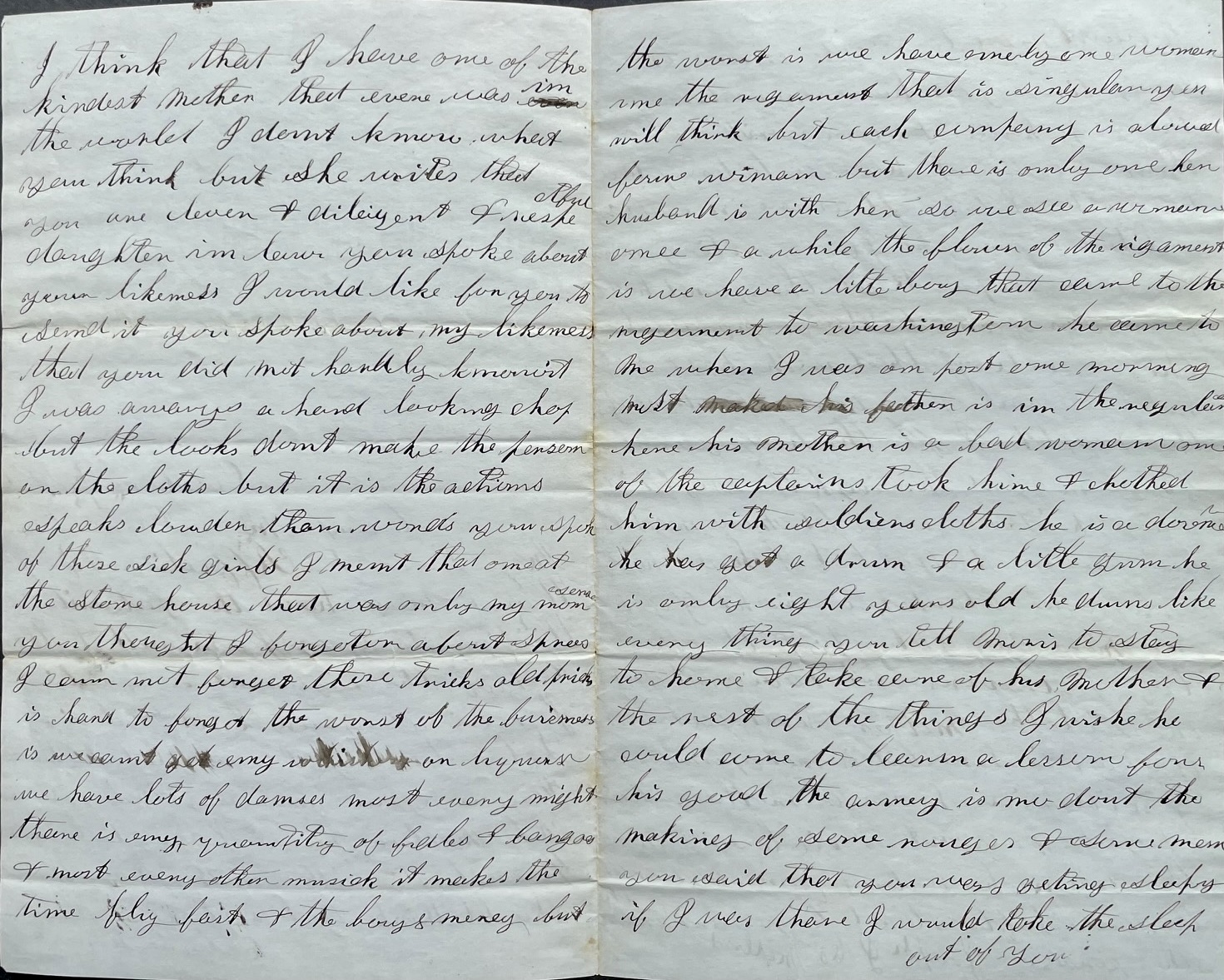
I think that I have one of the kindest mothers that ever was in the world. I don’t know what you think, but she writes that you are a clever & diligent & respectful daughter in law. You spoke about your likeness. I would like for you to send it. You spoke about my likeness—that you did not hardly know it. I was always a hard-looking chap, but the looks don’t make the person or the clothes; but it is the actions [that] speak louder than words.
You spoke of those sick girls. I met that one at the stone house. That was only my [sermon?]. You thought I [had] forgotten about [drunken] sprees. I cannot forget those tricks. Old friends is hard to forget. The worst of the business is we can’t get any whiskey or liquor. We have lots of dances most every night. There is any quantity of fiddles & banjos & most every other music. It makes the time fly fast & the boys merry. But the worst is we have only one woman in the regiment. That is singular, you will think, but each company is allowed four women but there is only one. Her husband is with her, so we see a woman once & a while. 1
The flower of the regiment is we have a little boy that came to the regiment to Washington. He came to me when I was on post one morning most naked. His father is in the regulars here. His mother is a bad woman. One of the captains took him & clothed him with soldiers clothes. He is a drummer. He has got a drum & a little gun. He is only eight years old. He drums like everything. 2
You tell Morris to stay to home & take care of his mother & the rest of the things. I wish he could come to learn a lesson for his good. The army is no doubt the making of some rogues & some men. You said that you were getting sleepy. If I was there I would take the sleep out of you.
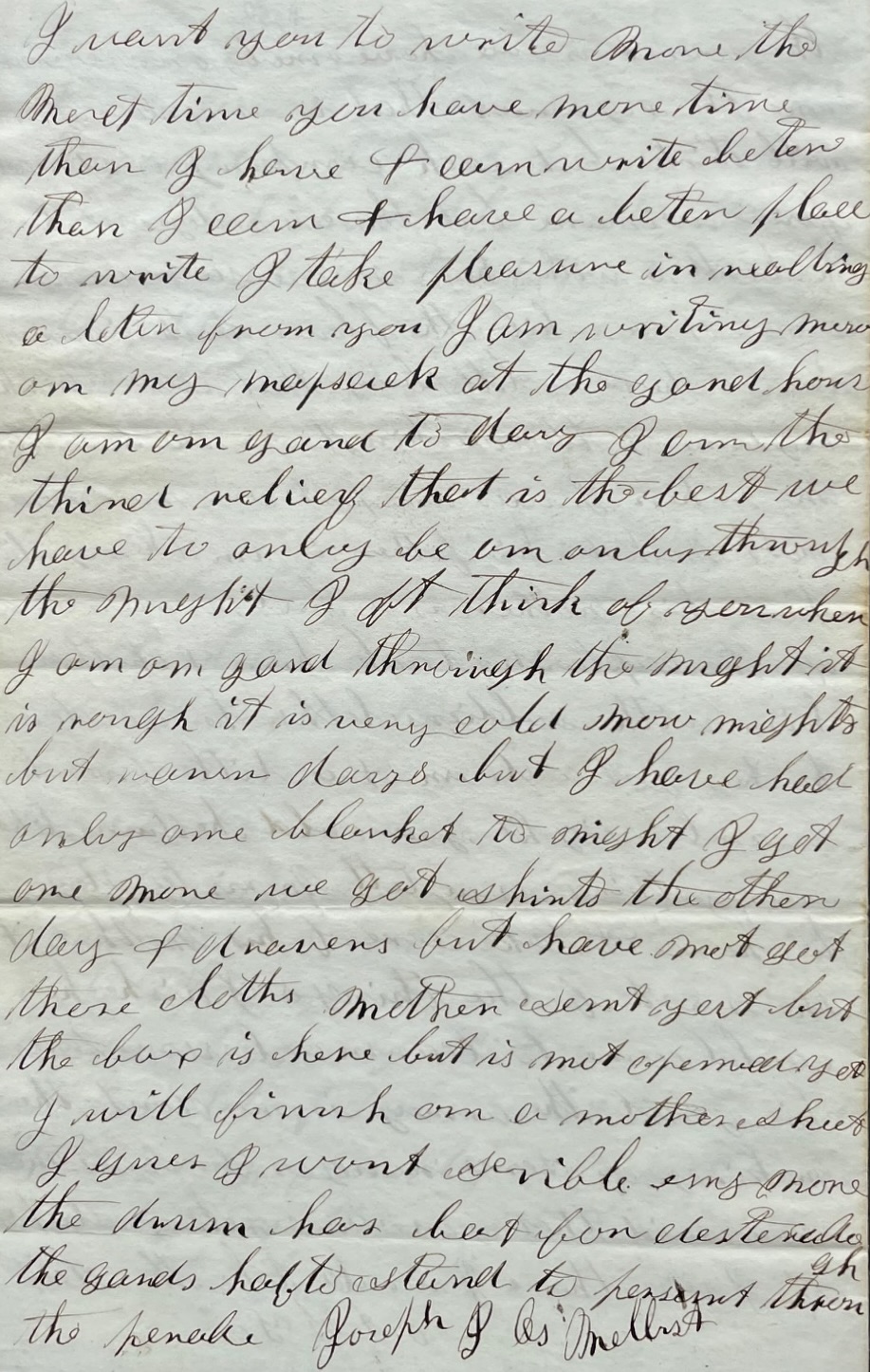
I want you to write more the next time. You have more time than I have & can write better than I can & have a better place to write. I take pleasure in reading a letter from you. I am writing now on my knapsack at the guard house. I am on guard today. I am the third relief. That is the best [relief]. We have to only be on [duty] only through the night. I oft think of you when I am on guard through the night. It is rough. It is very cold snow[y] nights, but warm days. But I have had only one blanket. Tonight I got one more. We got shirts the other day & drawers but have not got those clothes Mother sent yet, but the box is here but is not opened yet. I will finish on another sheet. I guess I won’t scribble anymore. The drum has beat for [illegible]. The guards have to stand to [illegible] through the [illegible]. — Joseph J. G. Nellist
1 The presence of women in the camp was not unheard of in the early stages of the war, as a few men were sometimes permitted to bring their wives, provided they contributed through cooking or laundry services.
2 Regrettably I cannot find any on-line resource to corroborate this claim though it is undoubtedly true.