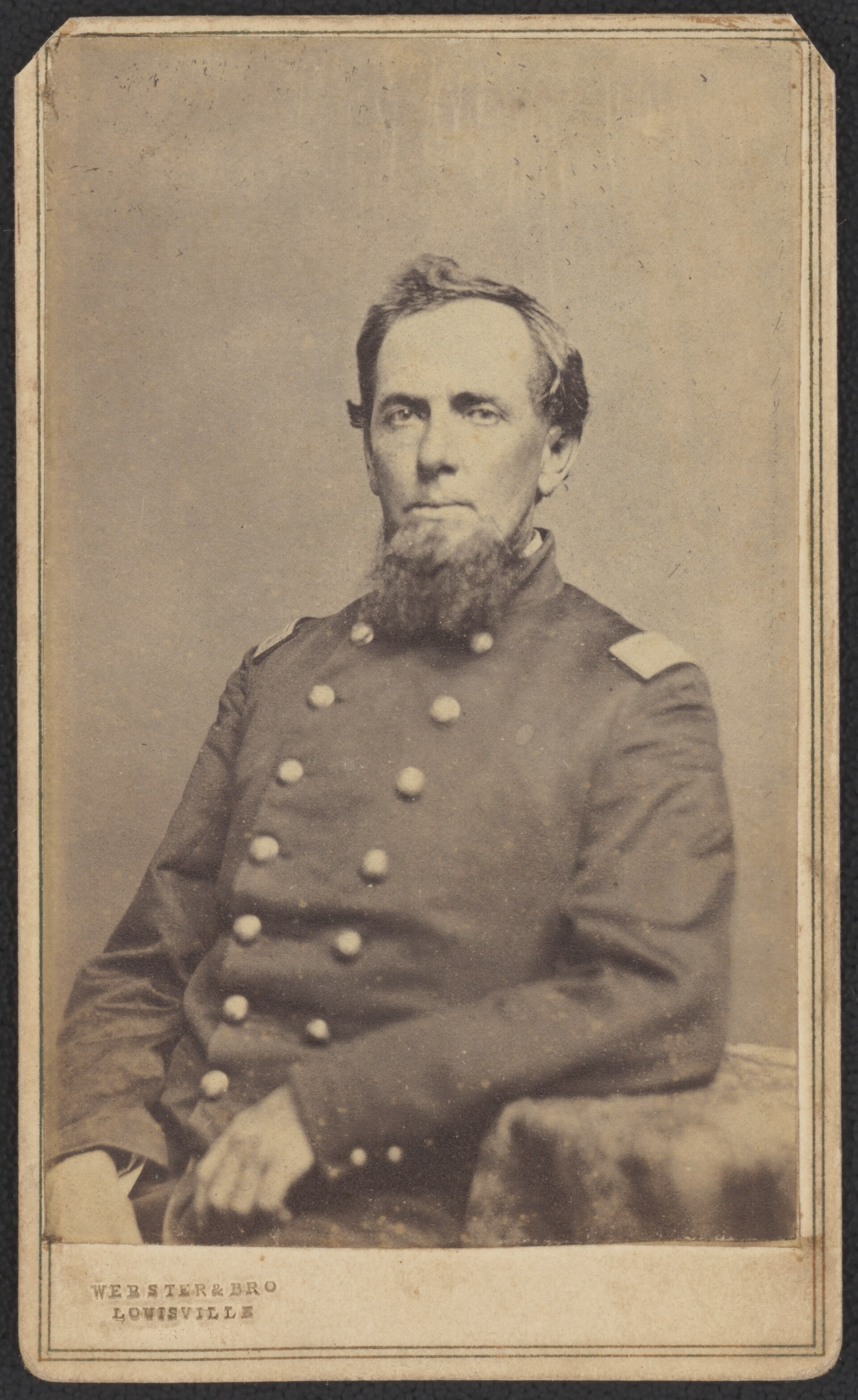
This lengthy and informative letter was penned by Robert Samuel Munford (1809-1897), the son of Richard Jones Munford (1776-1843) and Elizabeth Embry (1781-1881). A historical marker near the village of Munfordville describes Robert as a pioneer and the father of the village. He attended Centre College and became a surveyor. The marker states further that Mr. Munford held all country offices, and every seeker of roads and lands applied to him for information. He regards all the villagers as his children, and all strangers who enter Munfordville as his own visitors.” The historical sign gives one such visitor as John Muir, the celebrated American naturalist who walked from Indianapolis to the Gulf in 1867 and described visiting with Robert Munford in his book, “A Thousand Mile Walk to the Gulf.“
Robert’s letter describes the death and burial of William Curtis Johnston (1839-1862), the chaplain of the 13th Kentucky Infantry. William was born in Trebizond, Turkey, to missionary parents. He graduated from Yale in November 1860, and entered the Theological Seminary in Danville, Kentucky. After he was ordained as a minister of the Presbyterian Church, he became a Civil War chaplain for the Union, and saw some war action. He died of typhoid pneumonia in Munfordville, Kentucky, on December 3, 1862, and was buried on a local farm belonging to one of his church members. Nineteen years later he was reinterred in Evergreen Cemetery, in New Haven, Connecticut, to be with his family. William never married but was engaged at the time he died. His mother wrote a book about William, which is still available, entitled The Young Chaplain, but she never mentions his engagement.
Robert’s letter is addressed to Cornelia S. Hall who was engaged to be married to William C. Johnston. Aside from the details of William’s death and burial, Robert provides her with information pertaining to a $1000 Life Insurance Policy that William had purchased, naming Cornelia as the beneficiary.
Note: This letter is from the private collection of Greg Herr and was offered for transcription and publication on Spared & Shared by express consent.
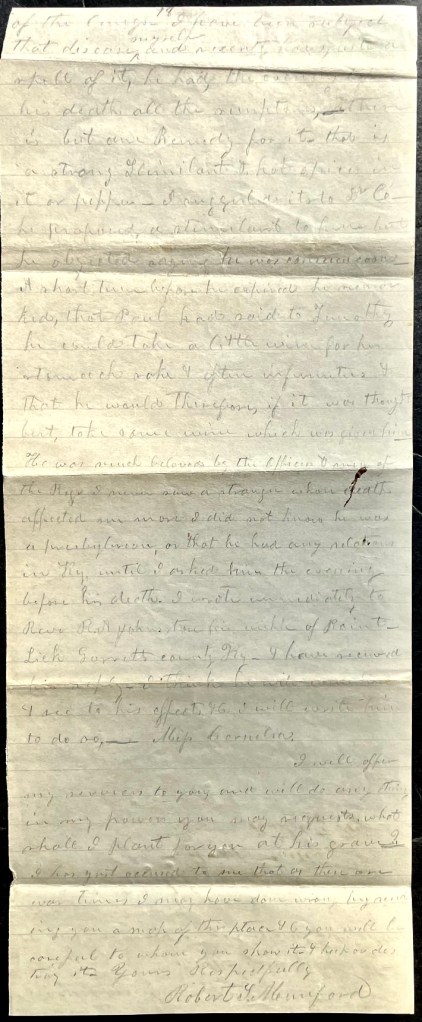
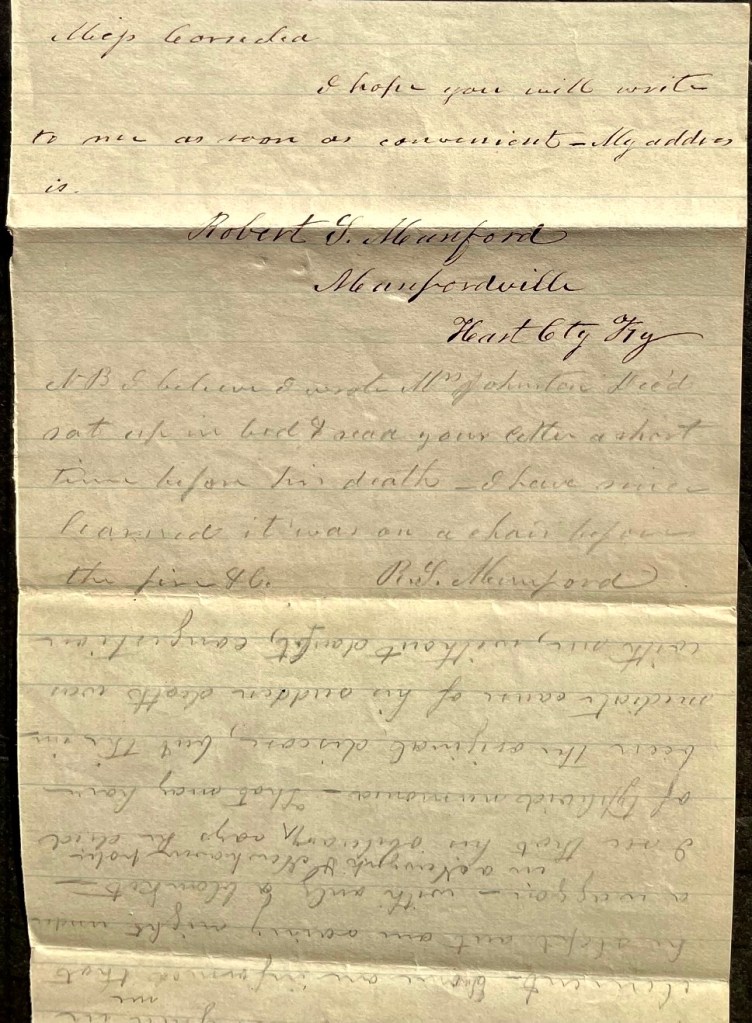
T R A N S C R I P T I O N
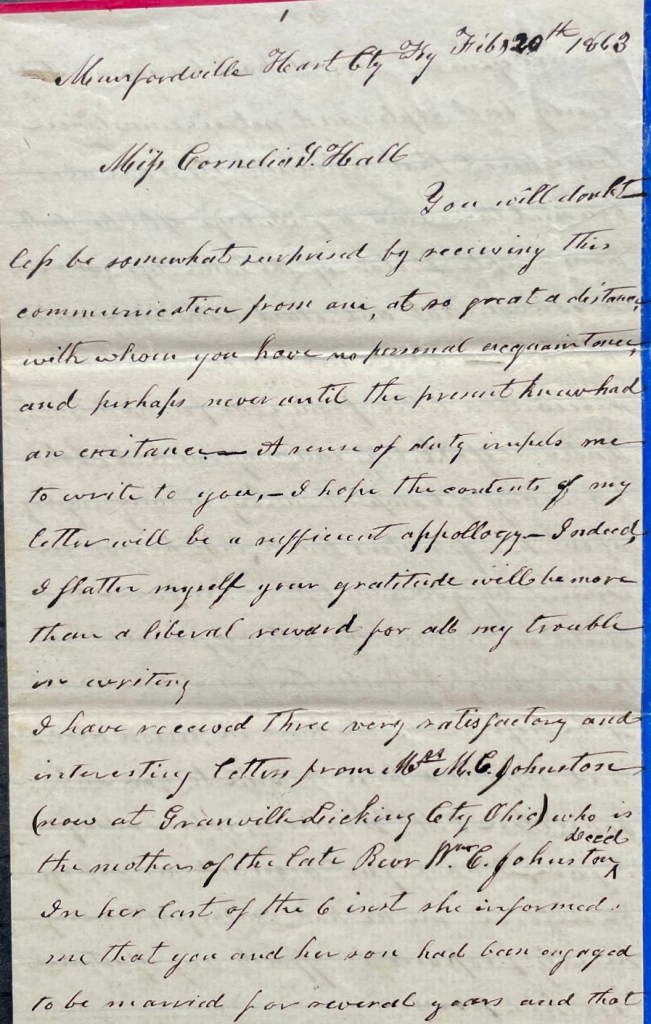
Munfordville, Hart county, Kentucky
February 20th 1863
Miss Cornelia S. Hall,
You will doubtless be somewhat surprised by receiving this communication from one so great a distance with whom you have no personal acquaintance, and perhaps never until the present knew had an existence. A sense of duty impels me to write to you. I hope the contents of my letter will be a sufficient apology. Indeed, I flatter myself your gratitude will be more than a liberal reward for all my trouble in writing.
I have received three very satisfactory and interesting letters from Mrs. M[arianne] C. [Howe] Johnston (now at Granville, Licking county, Ohio) who is the mother of the late Rev. Wm. C. Johnston, dec’d. In her last of the 6th inst., she informed me that you and her son had been engaged to be married for several years and that said engagement would have been consumated early last September had not circumstances transpired that prevented it. I had also learned the same a few days after his death from Capt. [Wallace] Victor of the same regiment who was a convalescent and staid with him until he died.
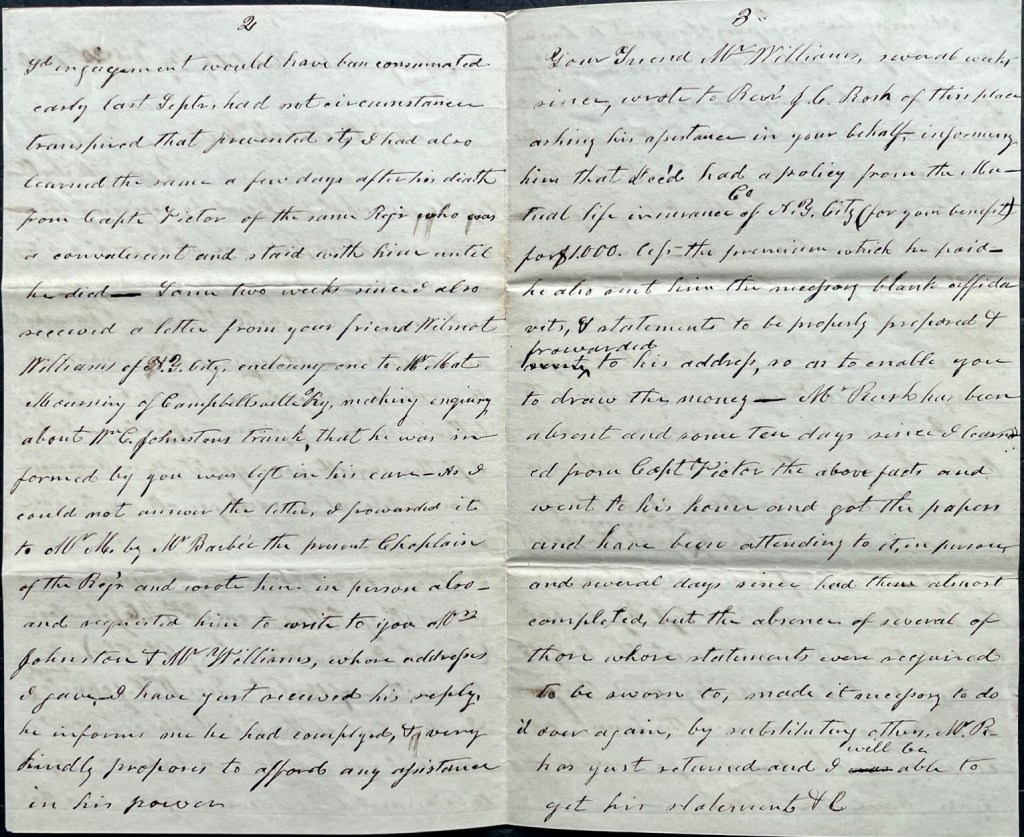
Some two weeks since, I also received a letter from your friend Wilmot Williams of New York City enclosing one to Mr. Mat Manning of Campbellsville, Kentucky, making enquiry about Wm. C. Johnston’s trunk [and] that he was informed by you was left in his care. As I could not answer the letter, I forwarded it to Mr. Manning by Mr. Barbie, the present chaplain of the regiment, and wrote him in person also, and requested him to write to you. Mr. Johnston & Mr. Williams, whose addresses I gave. I have just received his reply. He informs me he had complied & very kindly proposes to afford any assistance in his power.
Your friend, Mr. Williams, several weeks since, wrote to Rev. J[ames] C. Rush of this place [chaplain of Col. Grider’s regiment] asking for assistance in your behalf, informing him that deceased had a policy from the Mutual Life Insurance Co. of New York City (for your benefit) for $1000 less the premium which he paid. He also sent him the necessary blank affidavits & statements to be properly prepared & forwarded to his address so as to enable you to draw the money. Mr. Rush has been absent and some ten days since I learned from Capt. Victor the above facts and went to his home and got the papers and have been attending to it in person, and several days since had them almost completed, but the absence of several of those whose statements were required to be sworn to made it necessary to do it over again, but substituting others. Mr. Rush has just returned and I will be able to get his statement, &c.
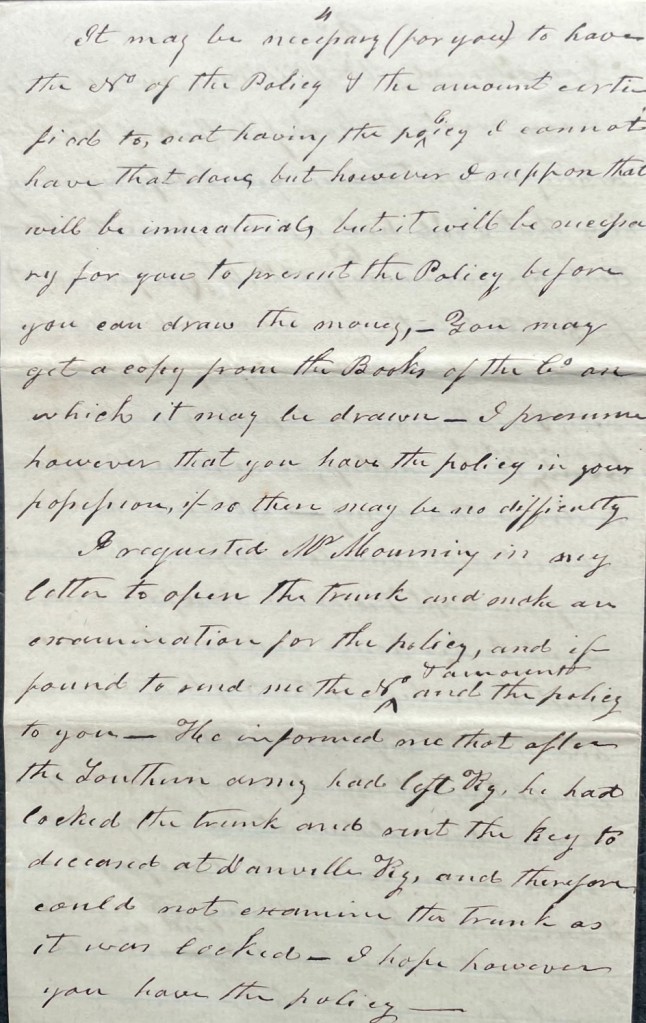
It may be necessary (for you) to have the No. of the policy & the amount certified to. Not having the policy. I cannot have that done, but however I suppose that will be immaterial, but it will be necessary for you to present the policy before you can draw the money. You may get a copy from the books of the company on which it may be drawn. I presume, however, that you have the policy in your possession. If so, there may be no difficulty.
I requested Mr. Manning in my letter to open the trunk and make an examination for the policy, and if found, to send me the No. & the amount and the policy to you. He informed me that after the Southern army had left Kentucky, he had locked the trunk and sent the key to deceased at Danville, Kentucky, and therefore could not examine the trunk as it was locked. I hope, however, you have the policy.
February 21st, 1863
Miss Cornelia,
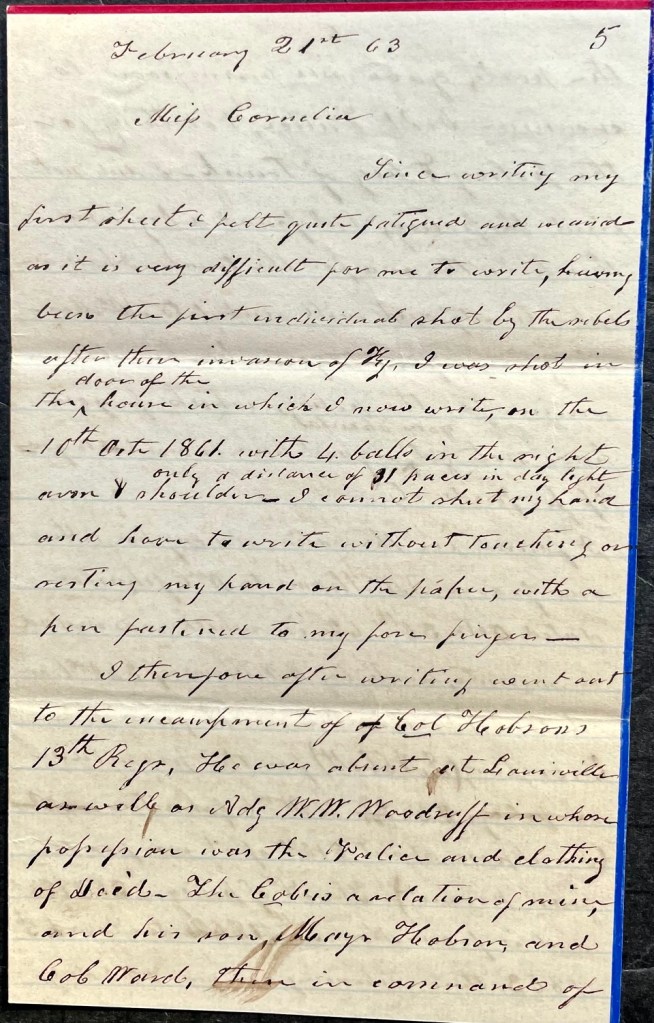
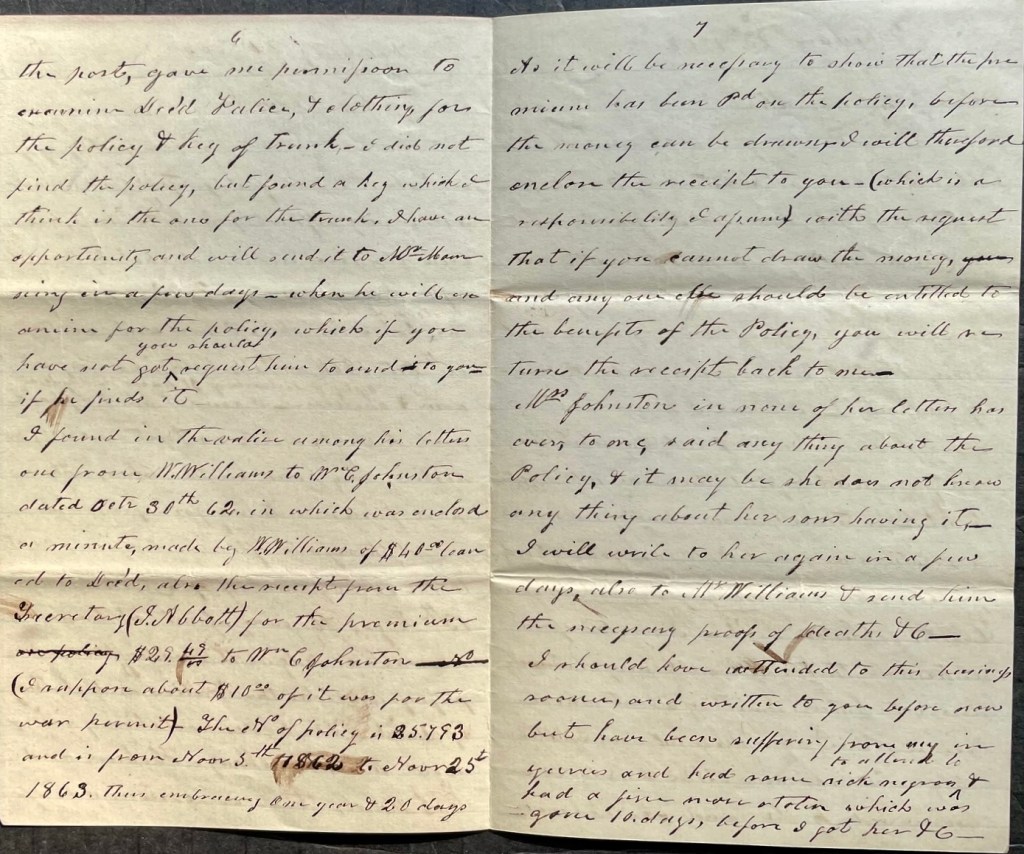
Since writing my first sheet, I felt quite fatigued and wearied as it is very difficult for me to write, having been the first individual shot by the rebels after their invasion of Kentucky. I was shot in the door of the house in which I now write on the 10th of October 1861 with 4 balls in the right arm & shoulder, only a distance of 31 paces in daylight. I cannot shut my hand and have to write without touching or resting my hand on the paper, with a pen fastened to my fore finger. I therefore, after writing, went out to the encampment of Col. [Edward Henry] Hobson’s 13th [Kentucky Volunteer] Regiment. He was absent at Louisville as well as Adj. W. W. Woodruff in whose possession was the valise and clothing of deceased. The Col. is a relation of mine and his son, Major Hebron and Col. [James H.] Ward [27th Kentucky], then in command of the post, gave me permission to examine deceased valise and clothing for the policy & key of trunk. I did not find the policy but found a key which I think is the one for the trunk. I have an opportunity and will send it to Mr. Manning in a few days—when he will examine for the policy, which if you have not got, you should request him to send to you if he finds it.
I found in the valise among his letters, one from W. Williams to Wm. C. Johnson dated October 30, 1862 in which was enclosed a minute, made by W. Williams of $40 loaned to deceased. Also the receipt from the Secretary (I. Abbott) for the premium $29.49 to C. Johnston (I suppose about $10 of it was for the war permit). The No. of policy is 25893 and is from November 5th 1862 to November 25, 1863, thus embracing one year & 20 days.
As it will be necessary to show that the premium has been paid on the policy before the money can be drawn, I will therefore enclose the receipt to you (which is a responsibility I assume) with the request that if you cannot draw the money and anyone should be entitled to the benefits of the policy, you will return the receipt back to me.
Mrs. Johnson in none of her letters has ever, to me, said anything about the policy, and it may be she does not know anything about her sons having it. I will write to her again in a few days. Also to Mr. Williams & send him the necessary proof of death, &c. I should have attended to this business sooner and written to you before now, but have been suffering from my injuries and had some sick negroes to attend to & had a fine mare stolen which was gone 10 days before I got her, &c.
February 23rd 1863
Now Miss Cornelia,
I hope you will permit me to say notwithstanding I am to you a stranger, that from what Mrs. Johnston wrote me (in her last) of your delicate health, and of the death of all your family except yourself leaving you alone without anyone to assist you, that I feel for you a great deal of sympathy. I think I know something of the tender sensibilities that surround & find their way into a lady’s heart—particularly when standing in such a relation as you did, to our young, good, pious, lovely and worthy beloved William Curtis Johnston, deceased. I can therefore anticipate that you would very naturally desire to know something about where his remains were deposited and whether they will remain there undisturbed or removed by the family to New Haven.
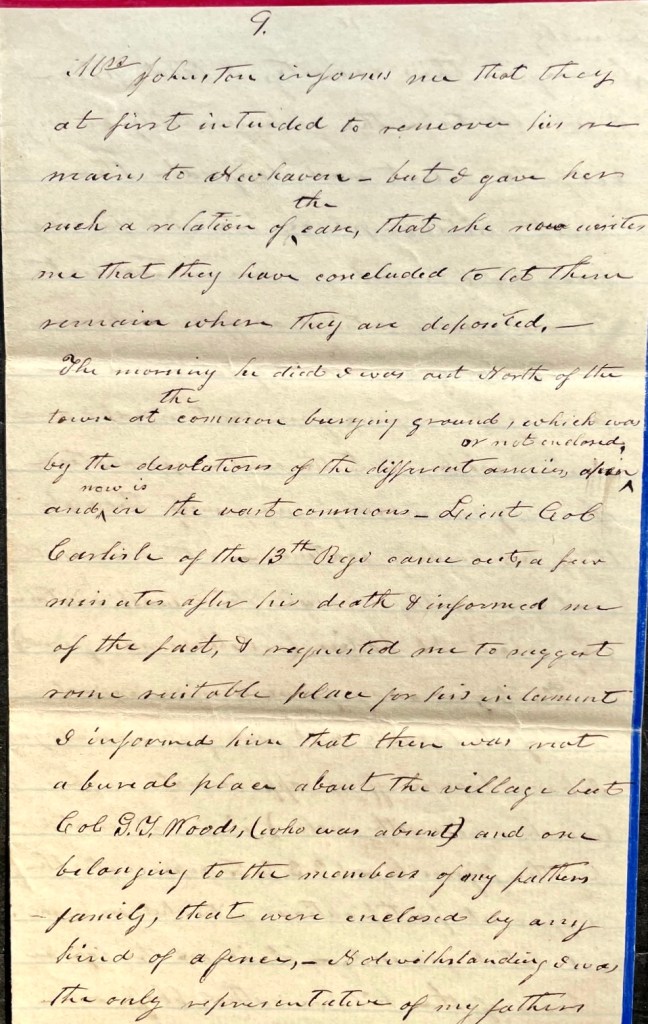
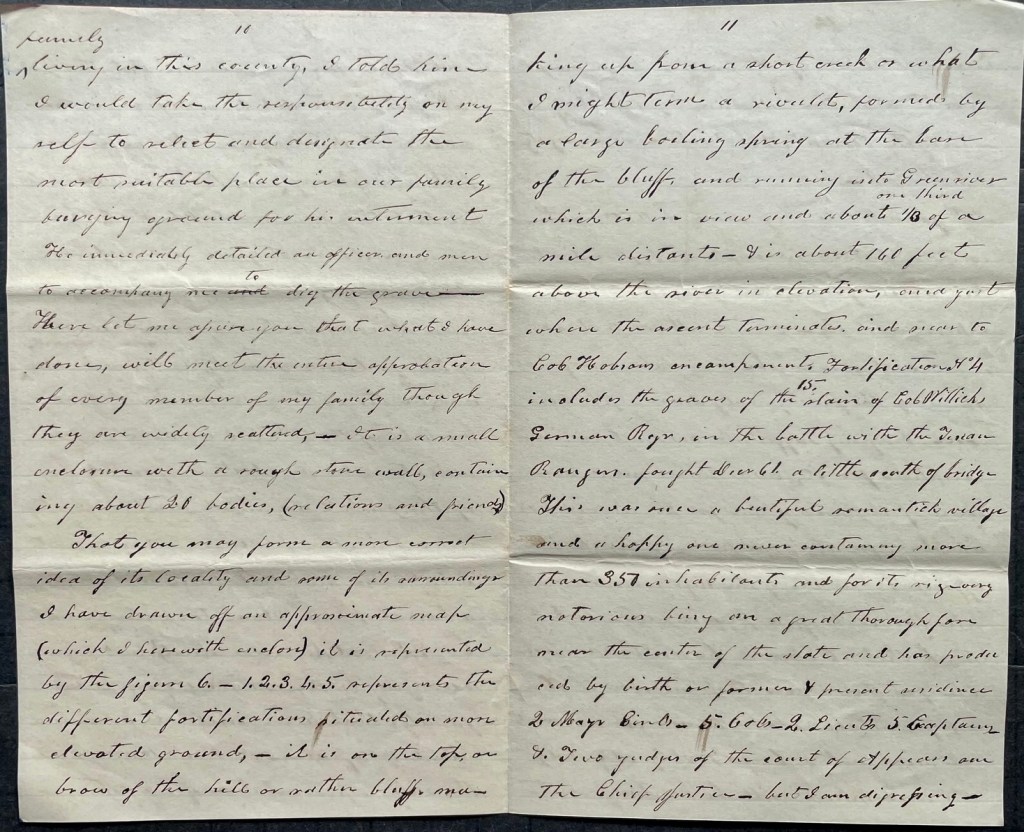
Mrs. Johnston informs me that they at first intended to remove his remains to New Haven, but I gave her such a relation of the care that she now writes me that they have concluded to let them remain where they are deposited. The morning he died, I was out north of the town at the common burying ground which was by the desolations of the different armies, open or not enclosed, and now is in the vast commons. Lieut. Col. [John Brawner] Carlile of the 13th Regiment came out a few minutes after his death & informed me of the fact, & requested me to suggest some suitable place for his interment. I informed him that there was not a burial place about the village but Col. G. Y. Woods (who was absent) and one belonging to the members of my father’s family, that were enclosed by any kind of a fence. Notwithstanding I was the only representative of my father’s family living in this county, I told him I would take the responsibility on myself to select and designate the most suitable place in our family burying grouund for his interment.
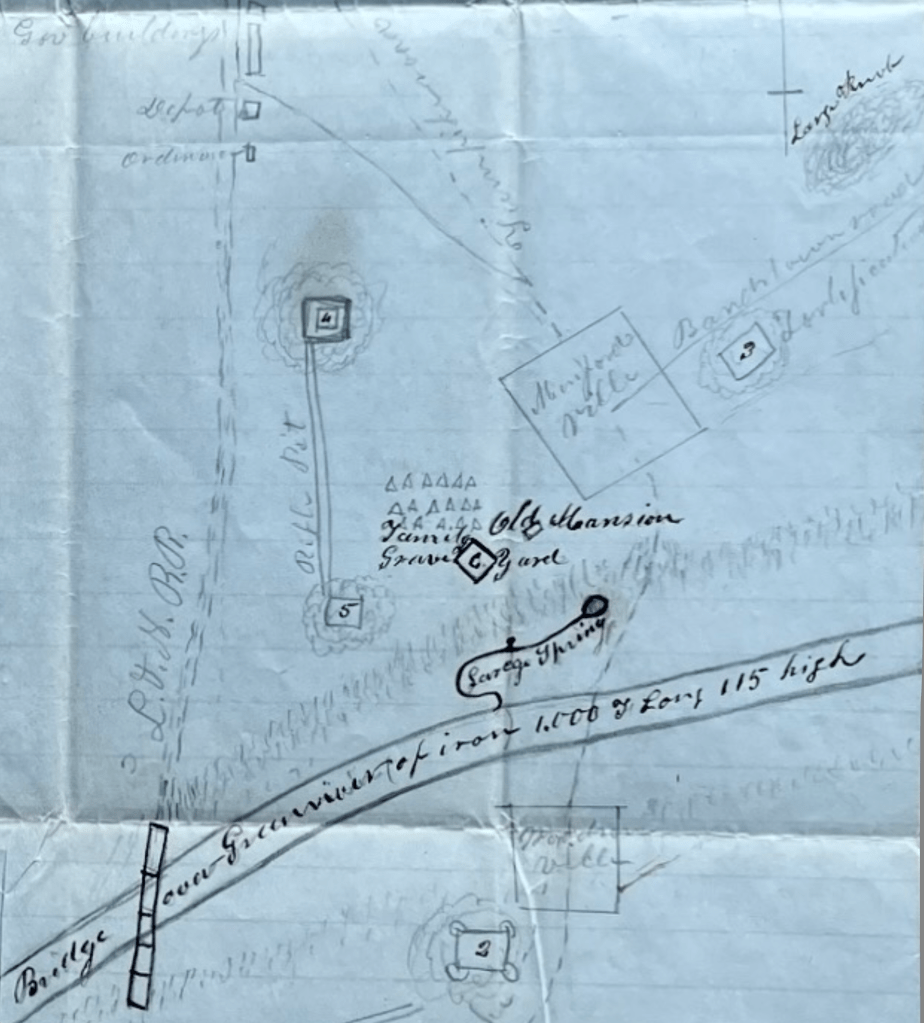
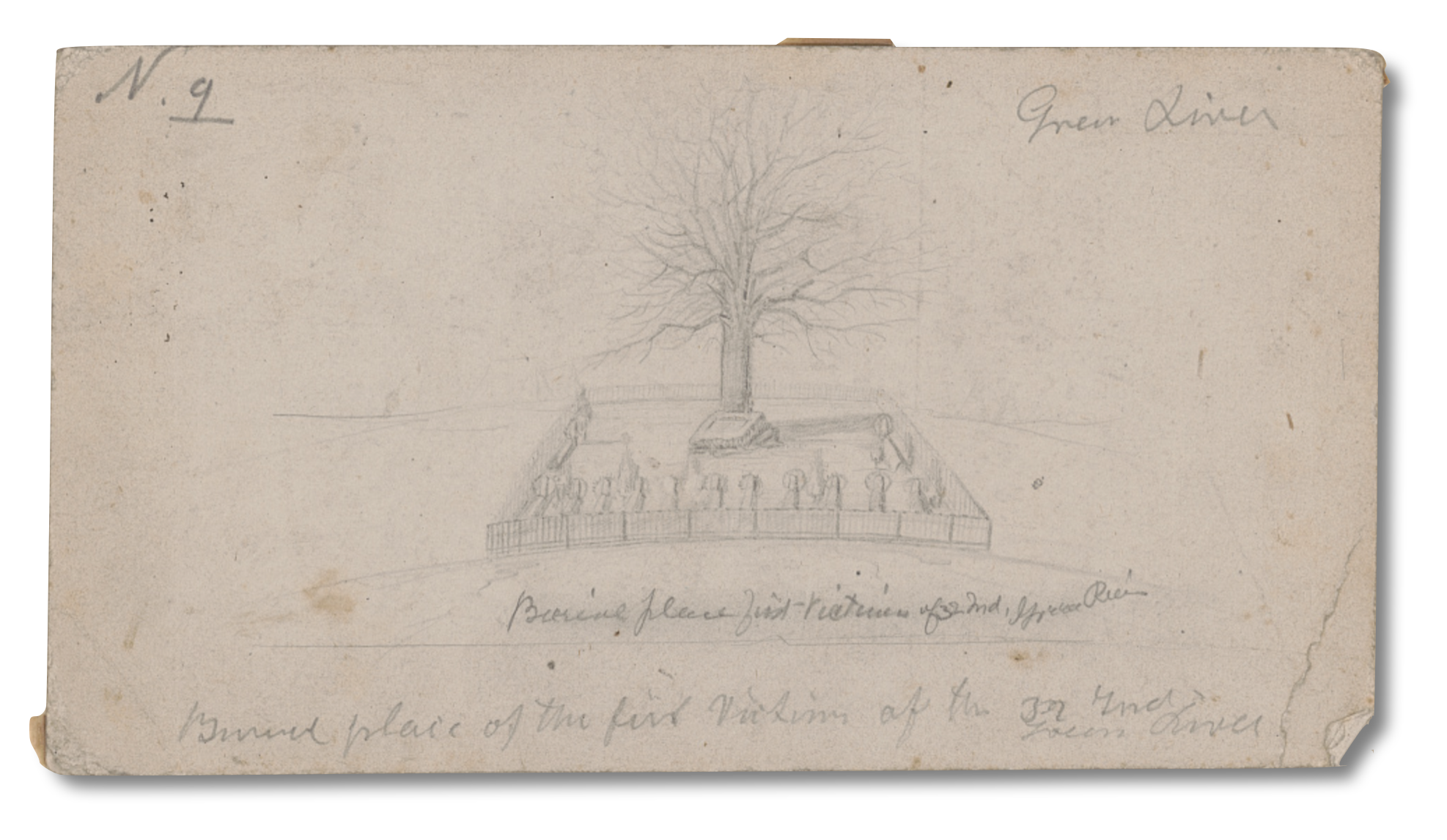
He immediately detailed an officer and men to accompany me to dig the grave. Here let me assure you that what I have done will meet the entire approbation of every member of my family though they are widely scattered. It is a small enclosure with a rough stone wall, containing about 20 bodies (relations and friends). That you may form a more correct idea of the locality and some of its surroundings, I have drawn off an approximate map (which I herewith enclose). It is represented by the figure 6. 1.2.3.4.5. represents the different fortifications situated on more elevated ground. It is on the top or brow of the hill or rather bluff making up from a short creek or what I might term a rivulet, formed by a large boiling spring at the base of the bluff, and running into Green River which is in view and about one-third of a mile distant, & is about 160 feet above the river in elevation, and just where the ascent terminates, and near to Col. Hebron’s encampment.
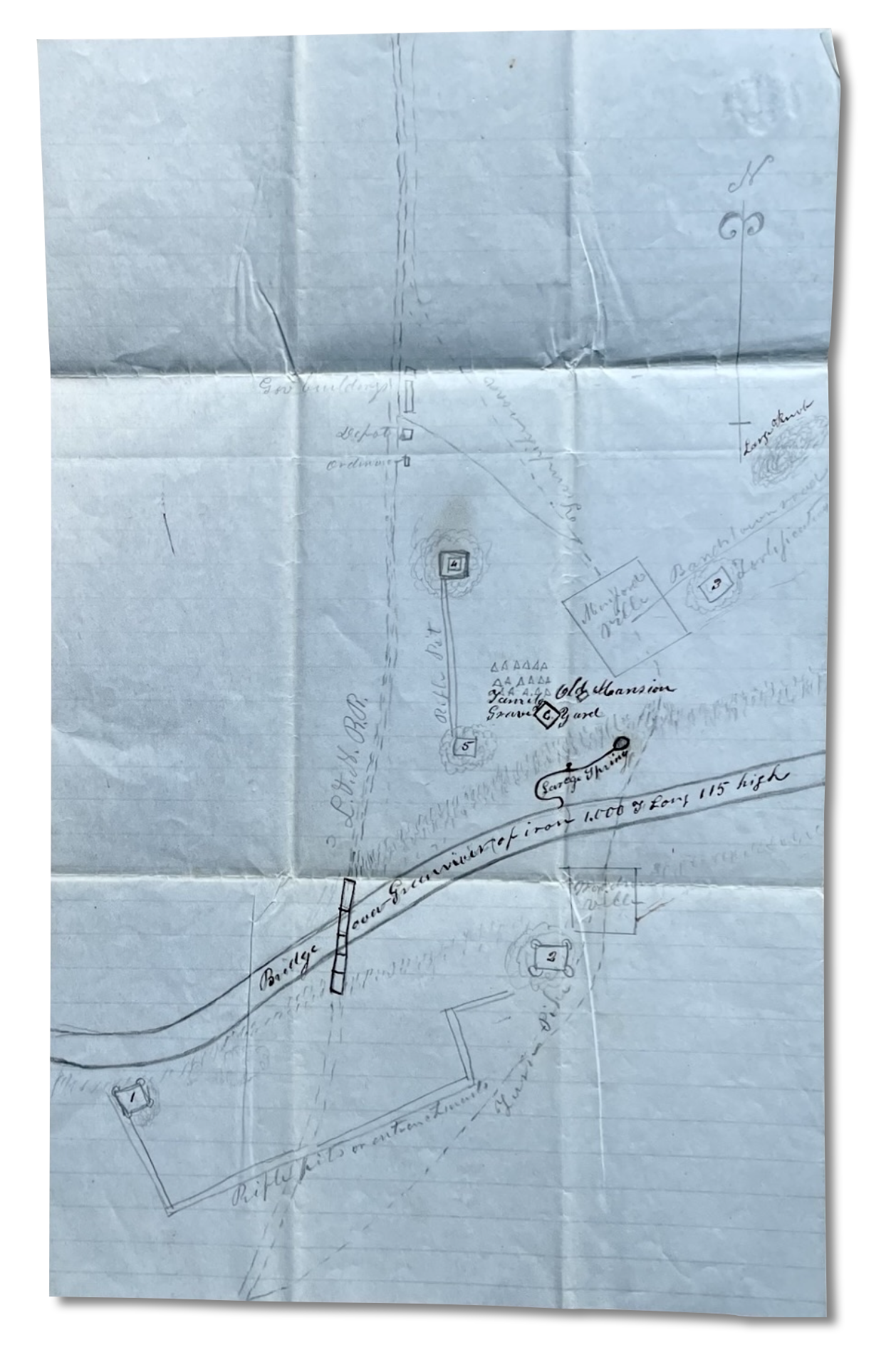
Fortification No. 4 includes the graves of the 15 slain of Col. Willich’s German [32nd Indiana] regiment in the battle with the Texas Rangers fought December ’61 a little south of the bridge.
This was once a beautiful, romantic village and a happy one never containing more than 350 inhabitants and for its size, very notorious being on a great thoroughfare near the center of the state and has produced by birth our former and present residence, two Major Generals, five Colonels, two Lieutenanys, five Captains, & two judges of the Court of Appeals—one the Chief Justice. But I am disgressing. The desolation of the armies have swept over it and the surrounding country as a mighty torrent & destruction as a mighty whirlwind.
Mrs. Johnston is very desirous that a stone with a suitable inscription be placed at his grave and has asked me to superintend it. I will attend to it as soon as I can make a suitable arrangement. She says the family only desires a plain one & by my suggestion has sent an inscription for it, and desires me to use some of the money die for his services as chaplain for that purpose. I think the officers & privates of the regiment will bear all the cost of a plain one but I think that it should be of Italian marble for the reason that marble is the only suitable stone to use for monuments. It need not be so costly or gaudy. The inscription will be [ ] in cost.
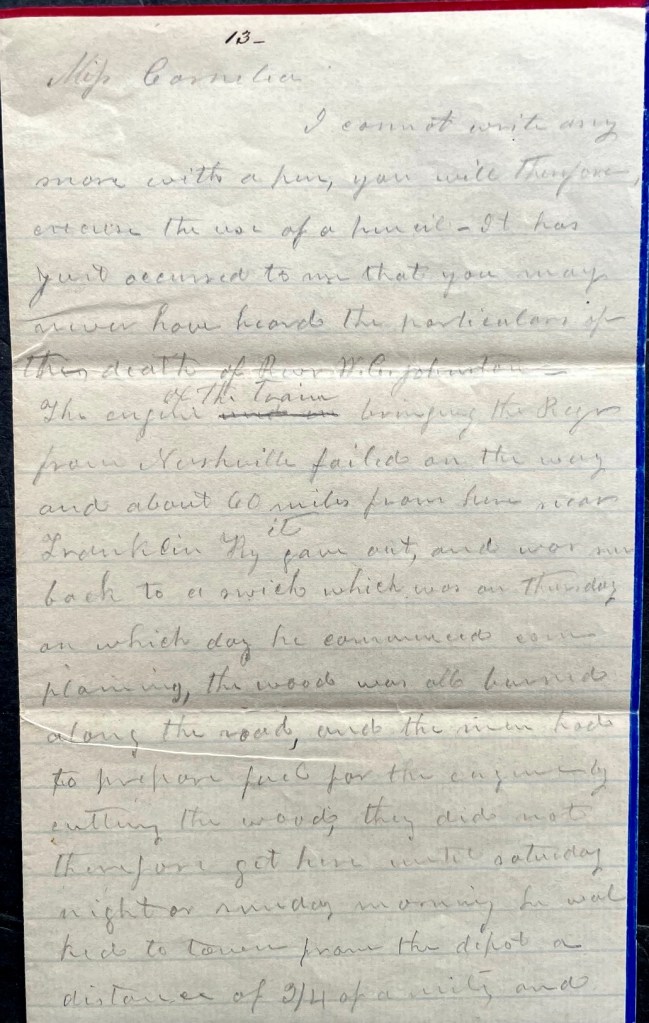
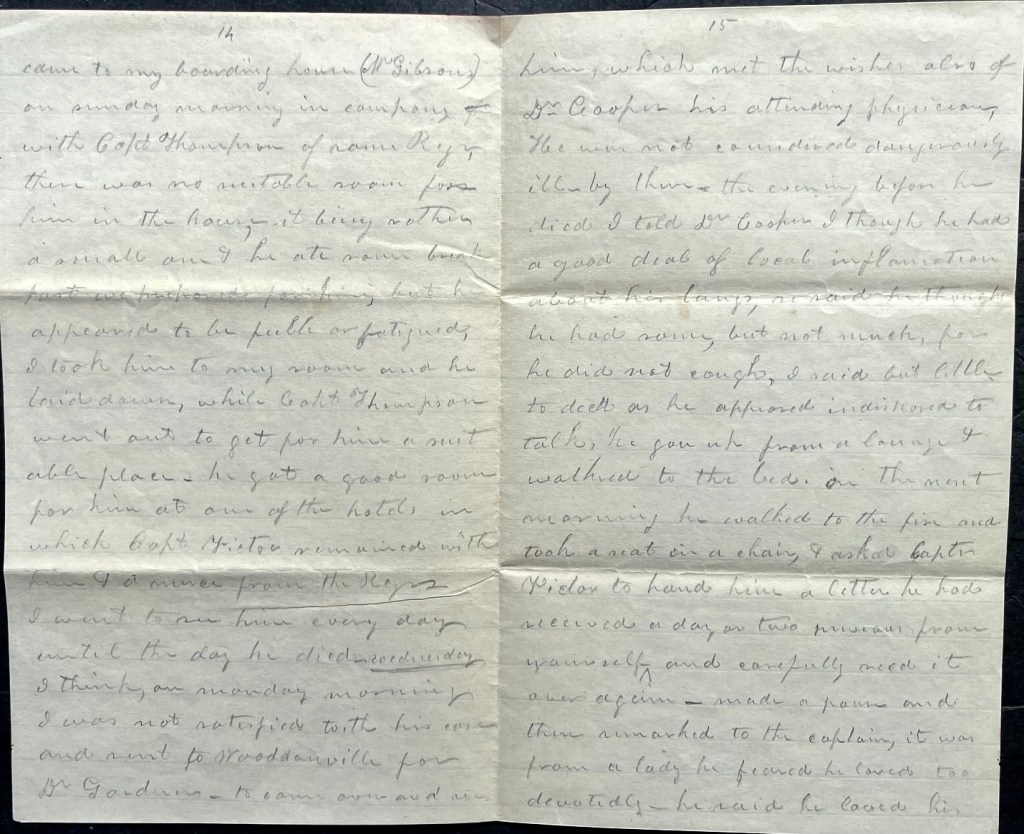
Miss Cornelia, I cannot write any more with a pen. You will therefore excuse the use of a pencil. It has just occured to me that you may never have heard the particulars of the death of Rev. W. C. Johnston. The engine of the train bringing the regiment from Nashville failed on the way and about 60 miles from here near Franklin, Kentucky, it gave out, and was sent back to a switch which was on Thursday on which day he commenced complaining. The woods was all burned along the road and the men had to prepare fuel for the engineer by sutting the wood. They did not, therefore, get here until Saturday night or Sunday morning. He walked to town from the depot, a distance of 3/4 of a mile and came to my boarding house (Mr. Gibson’s) on Sunday morning in company with Capt. Thompson of same regiment. There was no suitable room for him in the house, it being a rather small one, and he ate some breakfast we provided for him, but he appeared to be full or fatigued. I took him to my room and he laid down while Capt. Thompson went out to get for him a suitable place. He got a good room for him at one of the hotels in which Capt. Victor remained with him & a nurse from the regiment. I went to see him every day until the day he died—Wednesday, I think.
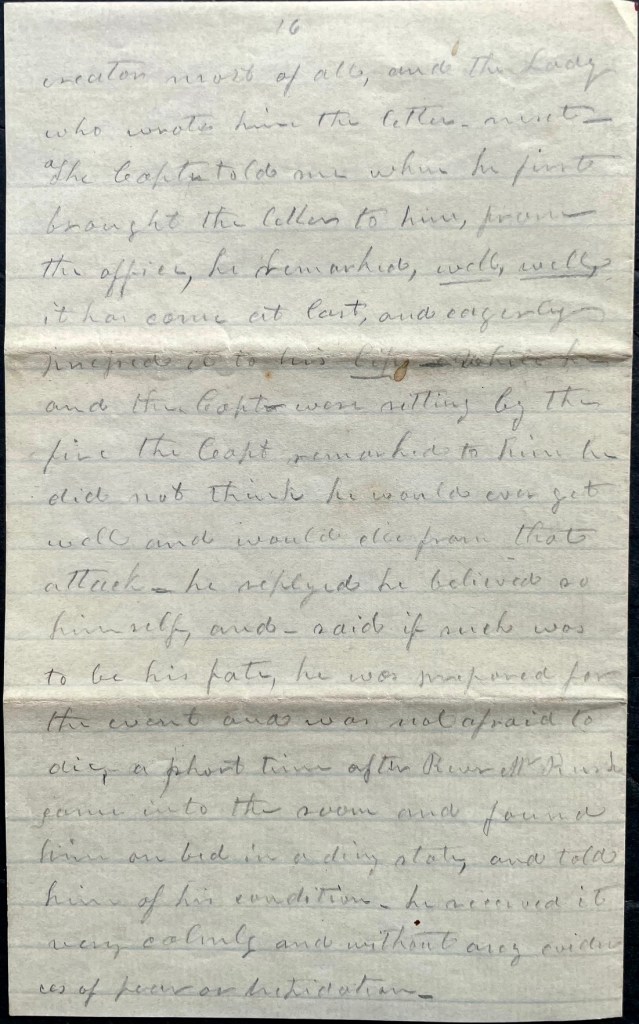
On Monday morning I was not satisfied with his care and went to Woodsonville for Dr. [William Harrison] Gardner to come over and see him which met the wishes also of Dr. [Edward S.] Cooper, his attending physician. He was not considered dangerously ill by them. The evening before he died, I told Dr. Cooper I though he had a good deal of local inflammation about his lungs. He said he thought he had some but not much for he did not cough. I said but little to the deceased as he appeared indisposed to talk. He got up from a lounge & walked to the bed. On the next morning he walked to the fire and took a seat in a chair and asked Capt. Victor to hand him a letter he had received a day or two previous from yourself and carefully read it over again, made a pause, and then remarked to the captain, it was from a lady he feared he loved too devotedly. He said he loved his Creator most of all and the Lady who wrote him the letter next.
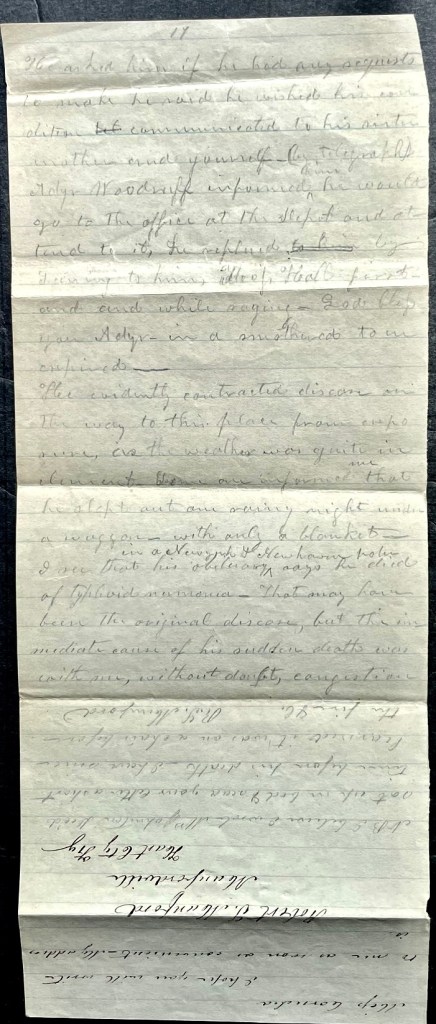
The captain told me when he first brought the letter to him from the office, he remarked, “Well, well, it has come at last.” and eagerly pressed it to his lips. While he and the captain were sitting by the fire, the captain remarked to him he did not think he would ever get well and would die from that attack. He replied [that] he believed so himself and said if such was to be his fate, he was prepared for the event and was not afraid to die. A short time after review, Mr. Rush came into the room and found him on bed in a dying state and told him of his condition. He received it very calmly and without any evidence of fear or trepidation. He asked him if he had any requests to make, He said he wished his condition communicated to his sister, mother, and yourself (by telegraph). Adj. Woodruff informed him he would go to the office at the Depot and attend to it. He replied by turning to him, “Miss Hall first” and while saying, “God bless you, Adjutant,” in a smothered tone expired. 1
He evidently contracted disease on the way to this place from exposure as the weather was quite inclement. Someone informed me that he slept out one rainy night under a wagon with only a blanket. I see that his obituary in a New York & New Haven paper says he died of typhoid pneumonia. That may have been the original disease but the immediate cause of his sudden death was with me, without doubt, congestion of the lungs. I have been subject of that disease myself and recently had quite a spell of it. He had the all the symptoms before his death. There is but one remedy for it—that is, a strong stimulant & hot spices in it or pepper. I suggested it to Dr. Cooper. He proposed a stimulant to him but he objected. He was concious a short time before he expired [at which time] he remarked that Paul had said to Timothy he would take a litle wine for his stomach’s sake & other infirmities, & that he would therefore, it it was thought best, take some wine which was given him.
He was much beloved by the officers and men of the regiment. I never saw a stranger whose death affected me more. I did not know he was a Presbyterian ot that he had any relations in Kentucky until I asked him the evening before his death. I wrote immediately to Rev. R. N. Johnston, his uncle of Point Lick, Garrett county, Kentucky. I have received his reply. I think he will come and see to his effects, &c. I will write him to do so.
Miss Cornelia, I will offer my services to you and will do anything in my power you may request. What shall I plant for you at his grave? It has just occured to me that as these are war times, I may have done wrong by drawing you a map of this place & you will be careful to whom you show it, & keep or destroy it. Yours respectfully, — Robert S. Munford
Miss Cornelia, I hope you will write to me as soon as convenient. My address is, Robert T. Munford, Munfordville, Hart county, Kentucky
N. B. I believe I wrote Mr. Johnston, deceased, sat up in bed & read your letter a short time before his death. I have since learned it was on a chair before the fire, &c. — R. S. Munford
1 A letter from Adjutant W. W. Woodruff of the 13th Kentucky Regiment to Mrs. Johnston, datelined from Munfordville on 4 December 1862 stated: Mrs. Johnston: “It is my painful duty to inform you of the death of your excellent son—the Chaplain of our regiment. We left Nashville on the 25th Nov. On Thursday, the 27th, he complained of having a cold, and feeling unwell. We were on our return from Tennessee to this place; but, owing to various trivial accidents to the locomotive, we were detained on the road until Sunday, Nov. 30. Upon arriving at this place, Col. Hobson, Col. Carlile, and Capt. Thompson had him removed to a hotel. He seemed to get a little worse, but no anxiety was felt for him. During the night of the 2d (Tuesday), he became alarmingly ill, and Wednesday morning, the surgeon pronounced that he would not live through the day.
I visited him about half-past 9 o’clock A. M. He seemed to breathe hard, and suffered some. Rev. James C. Rush, who was in attendance, determined to inform him of his real condition. He called him, and Mr. Johnston turned on his back, and Mr. Rush told him his time was short in this world, and if he had any directions to give, he would receive them. He then gave your name and that of two sisters, wishing to be remembered to you It was with great difficulty he spoke. After a moment’s pause, he quoted a passage of Scripture, which I could not understand. I then suggested to him, if he would have me telegraph to you. He replied in the affirmative. I then took leave of him, and he gave me his blessing, which were the last intelligible words he uttered. I proceeded to the office and telegraphed. He was very low. While waiting there, I received intelligence that he was dead, which I immediately telegraphed to you. He died about lo o’clock A. M., Dec. 3d, of typhoid pneumonia and was buried this morning at the same hour, in the private burying-ground of Mr. Robert Munford, a Presbyterian gentleman of this place. The regiment accompanied the corpse to the grave.” [Source, Recollections of My Father, 1876. pp. 114-115]


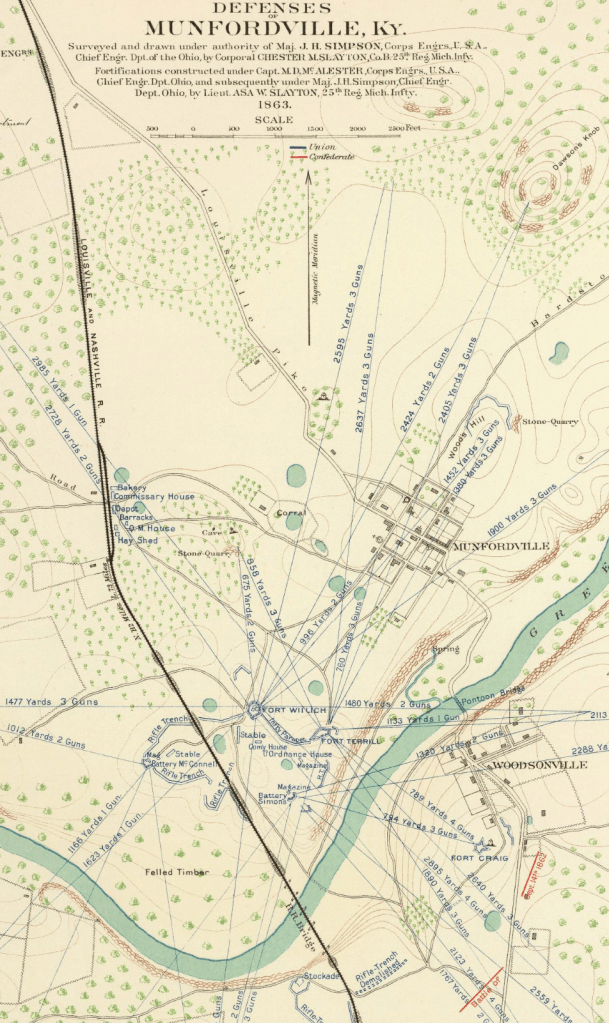
Side by side hand drawn map by Robert S. Munford (left) with 1863 Military Map of same area.