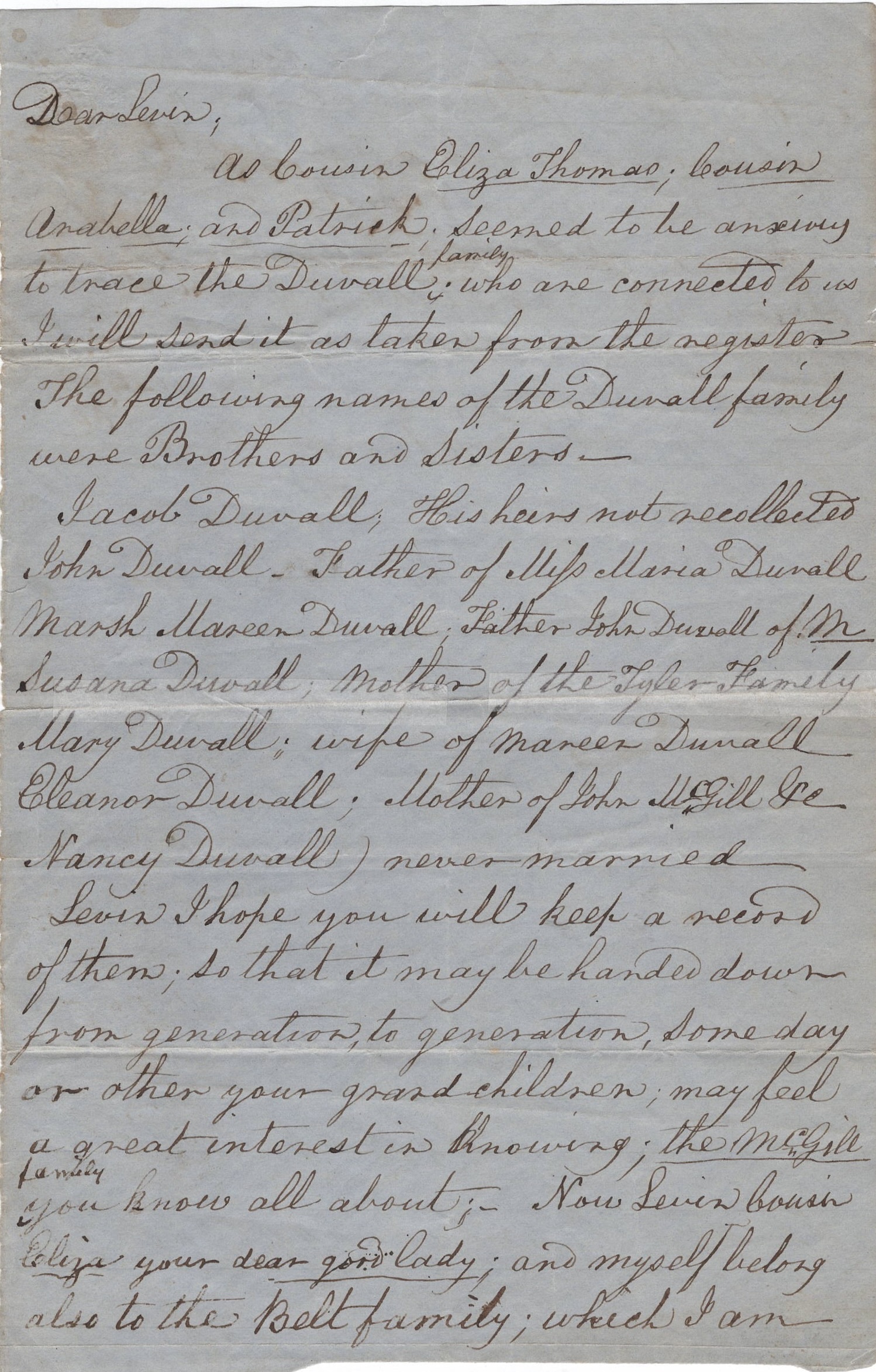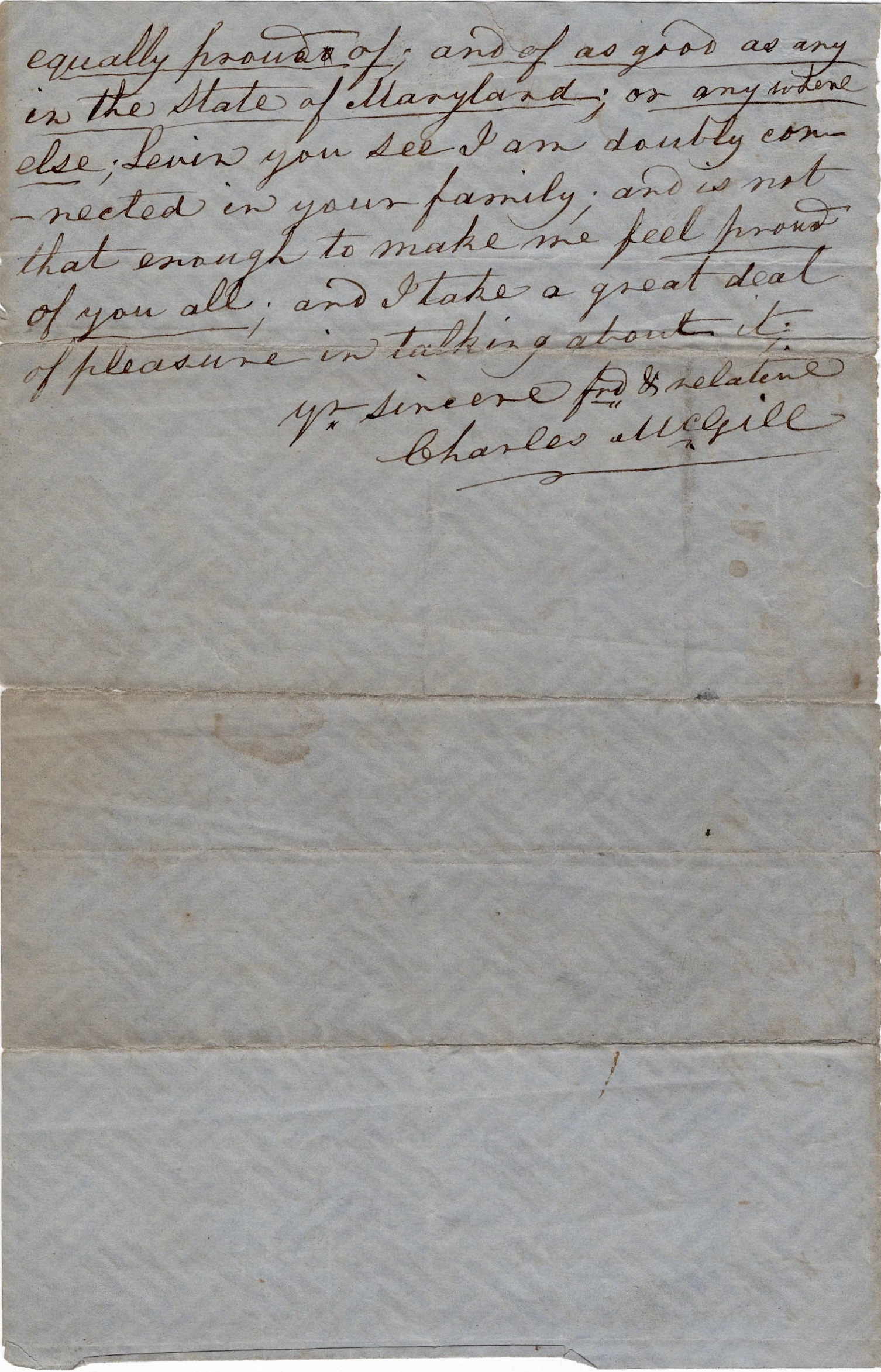
These letters were written by Charles McGill (1792-1859) and his younger brother, Robert Tyler McGill (1795-1875). They were the sons of John McGill (1762-1827) and Elizabeth Belt (1763-1834). Charles and Robert lived very different lives. For 26 years, Charles was employed as a seaman in the merchant service, earning a reputation for nautical skills and for withstanding the severest privations and hardships. Once his entire crew fell victims to yellow fever in a foreign port. Once he was upon the ocean for days in a small boat, without food or drink, his ship having sunk and with it the earnings of his previous life. After many voyages, sometimes prosperous, but often of shipwreck or perilous disaster, he retired from a profession he had served so well about 1836, since which time he has resided in Georgetown, D. C. His later years were marked by declining health as is evident in these letters. He died at Berkeley Spring, Virginia, on 26 August 1859.
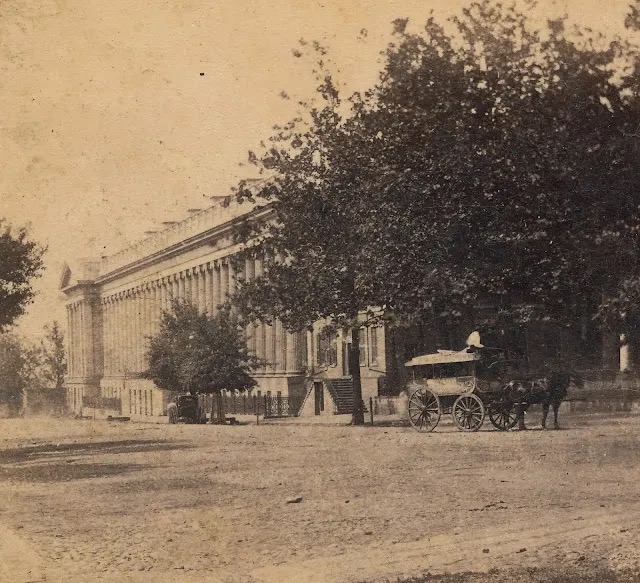
Robert, on the other hand, lived on the family farm in Prince George’s County, Maryland, until he took a job in 1825 as a clerk in the Treasury Department in Washington City, from which place he wrote many of the letters in this collection during the Civil War. His job at the Department was to settle the accounts of Navy agents.
All of the letters, either by Charles or Henry, were written to their relative, Levin West (1789-1863), or after his death on 18 June 1863, to Levin’s youngest daughter Susan (1841-1937). Levin had a farm in Petersville, Frederick county, Maryland. At the time of the 1850 US Census, Levin owned seven slaves ranging in age from 3 to 40. In 1860, he owned 9 slaves ranging in age from 8 to 60. Levin’s home in Petersville was a stone structure constructed in the Federal style with later additions in brick. It was built in 1815 and still stands today as a historic site.
It is challenging to discover letters penned by gentlemen whose lifespans coincided with the emergence of the new Nation, one of whom witnessed its fragmentation.
Letter 1
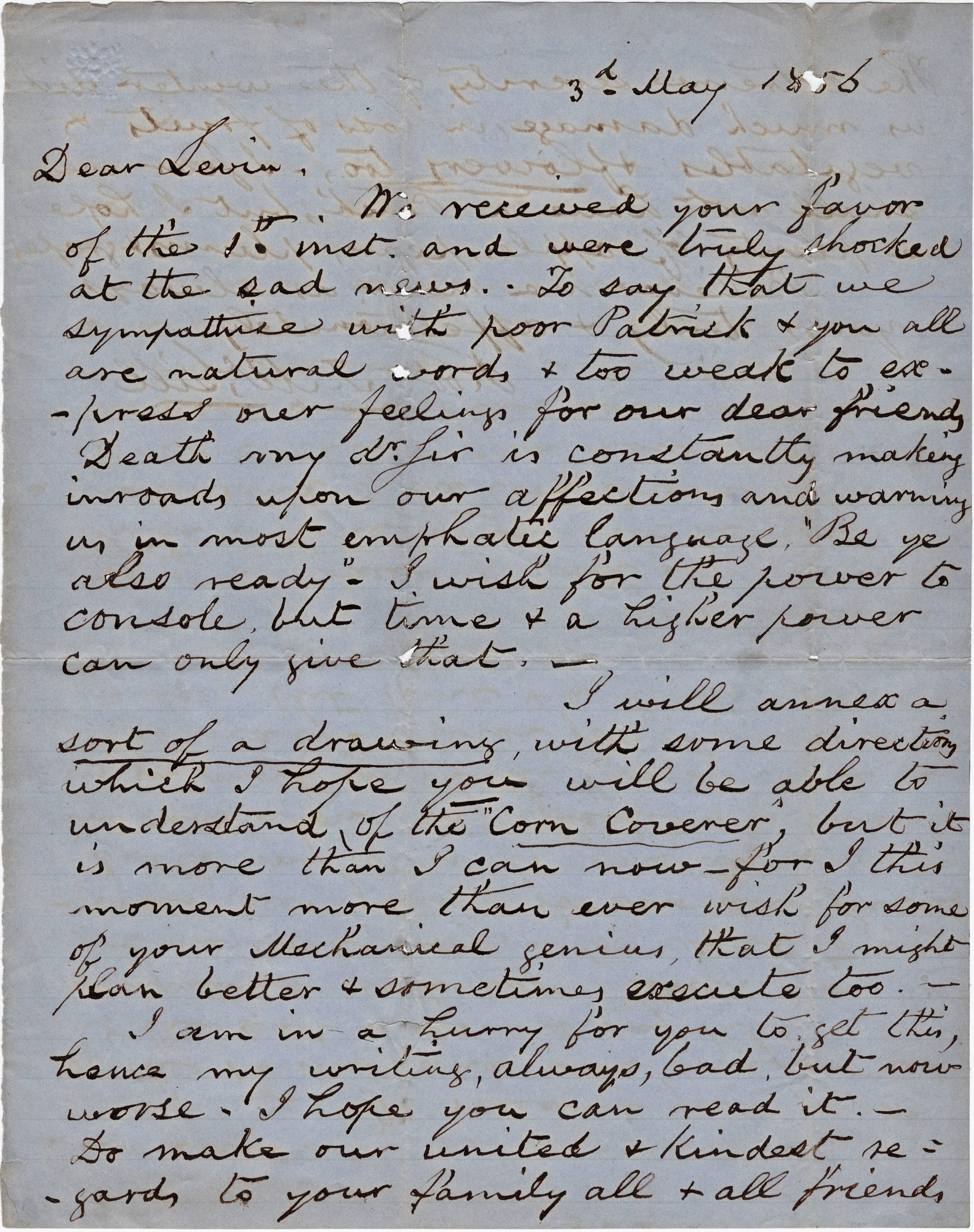
3d May 1856
Dear Levin,
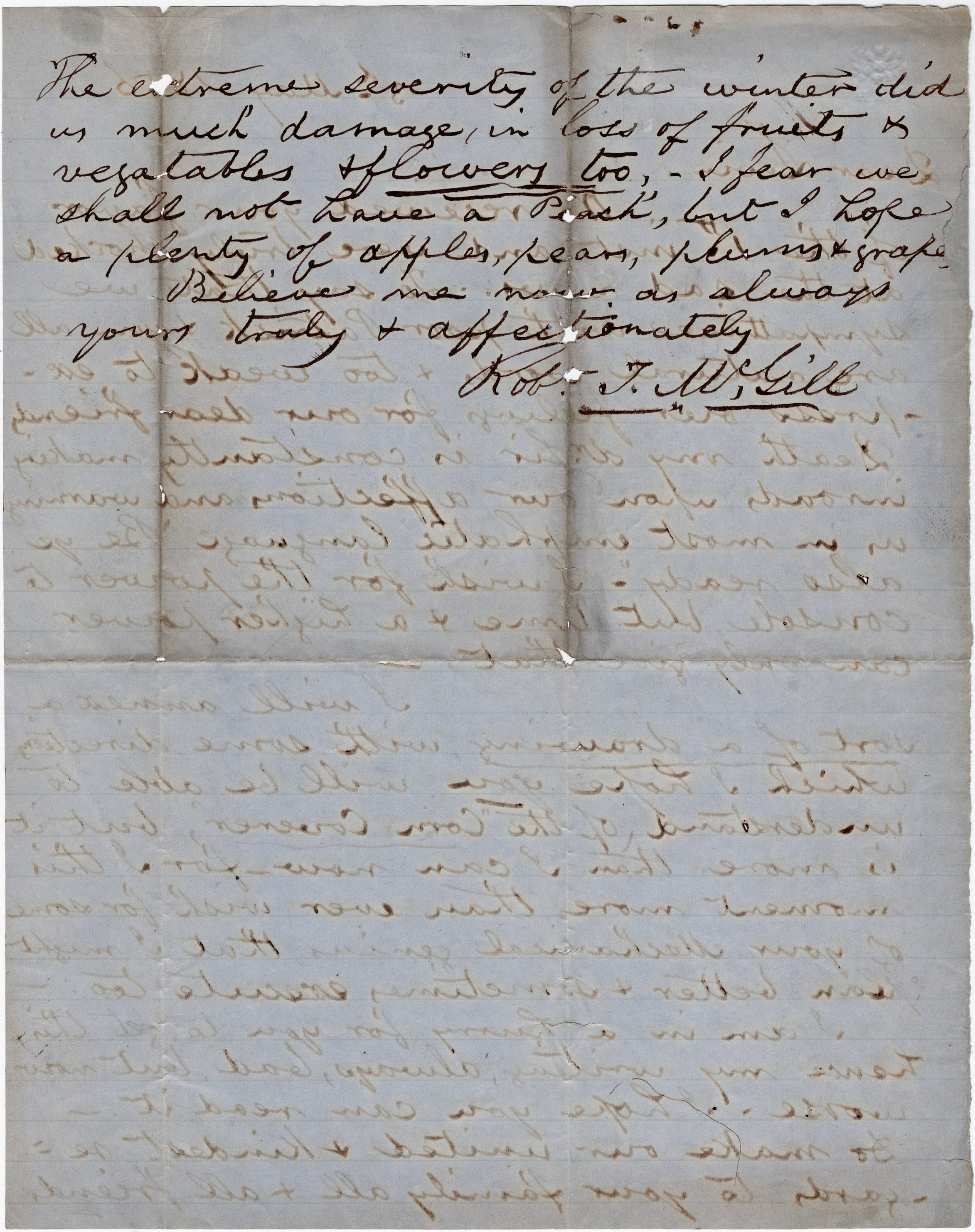
We received your favor of the 1st inst. and were truly shocked at the sad news. To say that we sympathize with poor Patrick and you all are natural words & too weak to express our feelings for our dear friends. Death, my dear sir, is constantly making inroads upon our affections and warning us in most emphatic language, “Be ye also ready.” I wish for the power to console, but time and a higher power can only give that.
I will annex a sort of drawing with some directions which I hope you will be able to understand of the “corn coverer,” but it is more than I can now for I, this moment more than ever, wish for some of your mechanical genius that I might plan better and sometimes execute too. I am in a hurry for you to get this, hence my writing—always bad—but now worse. I hope you can read it. Do make our united and kindest regards to your family all and all friends.
The extreme severity of the winter did us much damage in loss of fruit & vegetables & flowers too. I fear we shall not have a peach, but I hope a plenty of apples, pears, plums and grapes. Believe me now as always yours truly & affectionately, — Robt. T. McGill
Letter 2
Georgetown
April 2, 1857
Dear Levin,
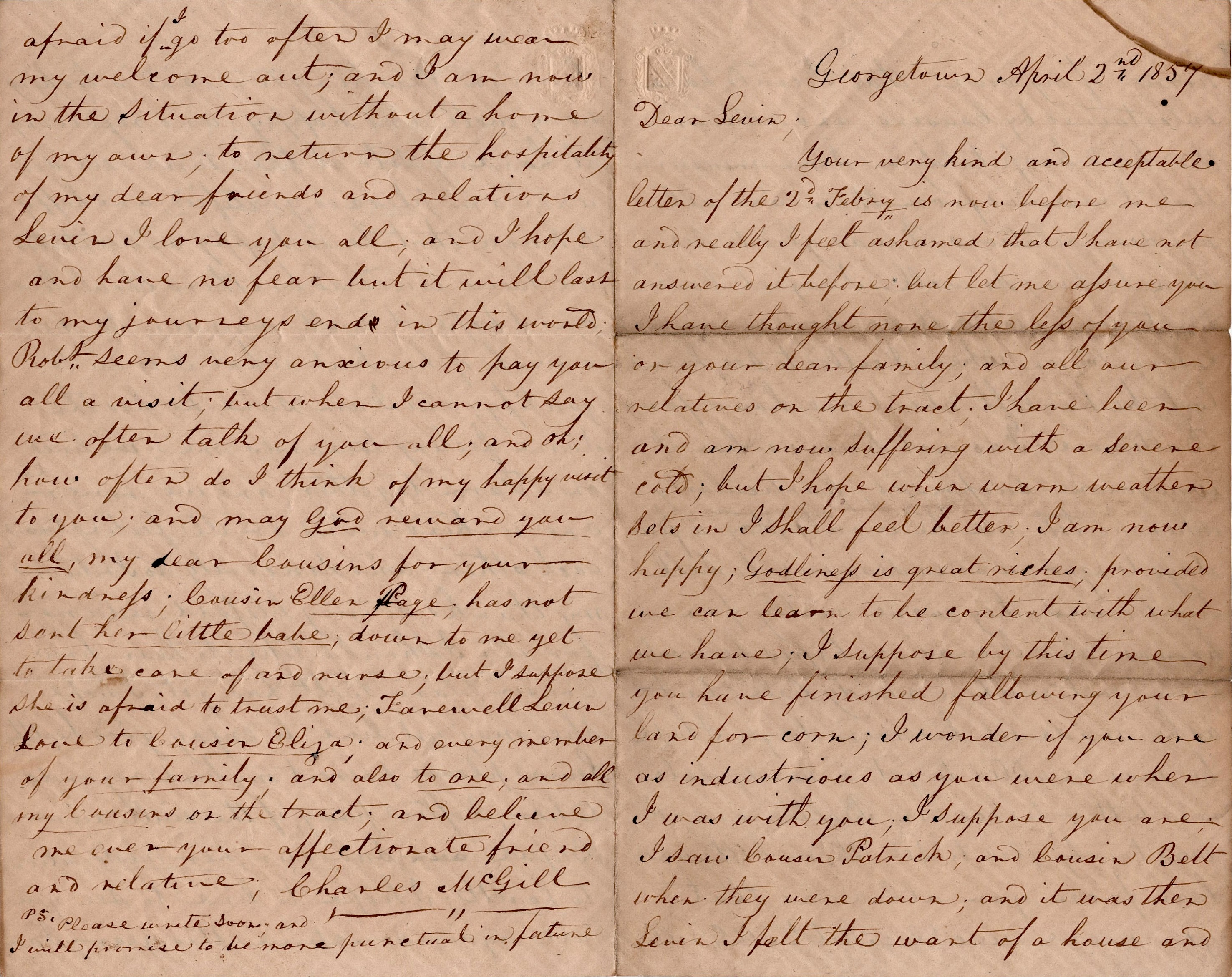
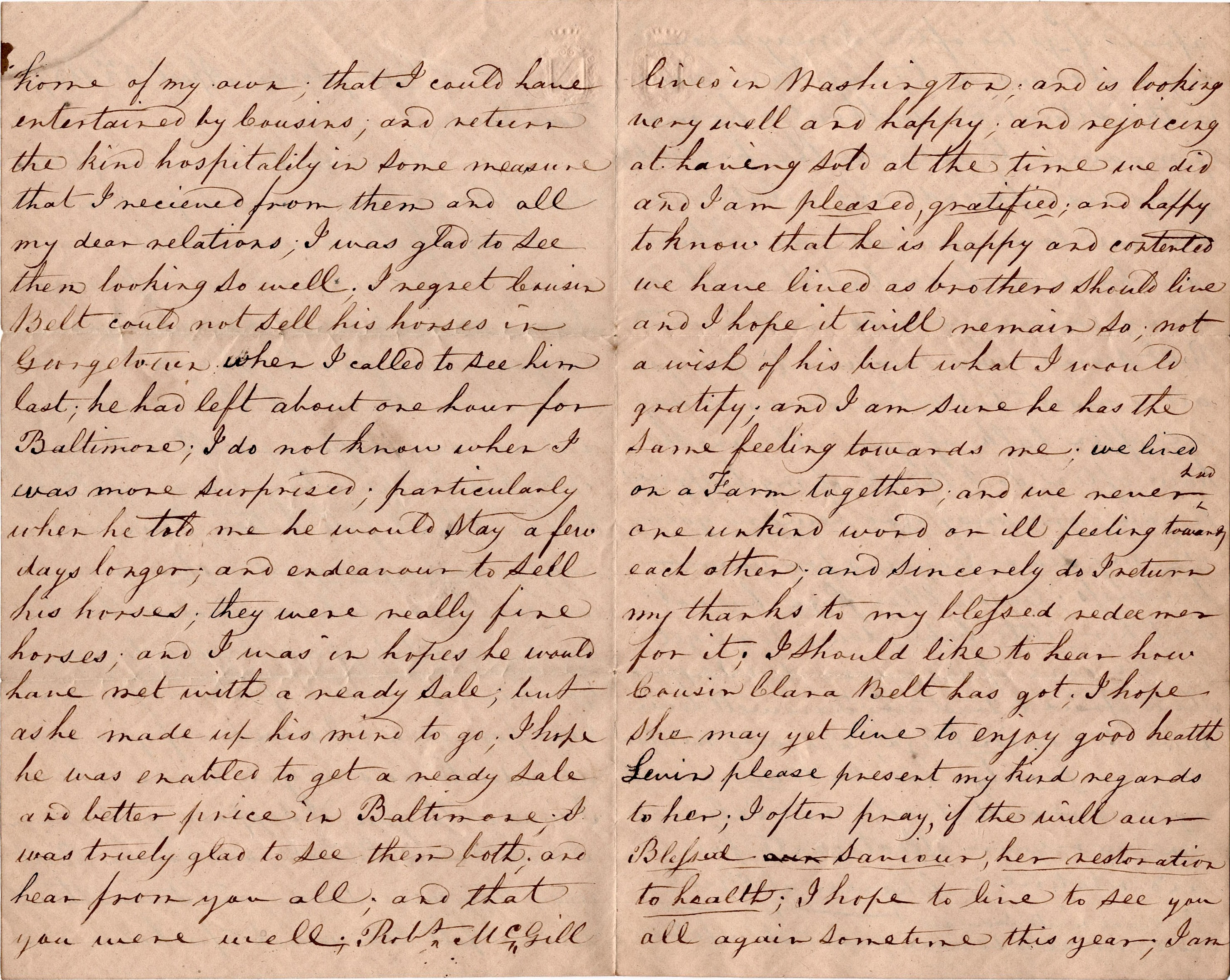
Your very kind and acceptable letter of the 2nd February is now before me and really I feel ashamed that I have not answered it before. But let me assure you I have thought nonetheless of you or your dear family, and all our relations on the tract. I have been and am now suffering with a severe cold but I hope when warm weather sets in I shall feel better. I am now happy. Godliness is great riches, provided we can learn to be content with what we have. I suppose by this time you have finished fallowing your land for corn. I wonder if you are as industrious as you were when I was with you. I suppose you are. I saw Cousin Patrick and cousin Belt when they were down, and it was then, Levin, I felt the want of a house and home of my own that I could have entertained my cousins and return the kind hospitality in some measure that I received fro them and all my dear relations. I was glad to see them looking so well. I regret cousin Belt could not sell his horses in Georgetown. When I called to see him last, he had left about one hour [previous] for Baltimore. I do not know when I was more surprised—particularly when he told me he would stay a few days longer and endeavor to sell his horses. They were really fine horses and I was in hopes he would have met with a ready sale. But as he made up his mind to go, I hope he was enabled to get a ready sale and better proce in Baltimore. I was truly glad to see them both and hear from you all and that you were well.
Robert McGill lives in Washington and is looking very well and happy and rejoicing at having sold at the time we did and I am pleased, gratified, and happy to know that he is happy and contented. We have lived as brothers should live and I hope it will remain so. Not a wish of is but what I would gratify, and I am sure he has the same feeling towards me. We lived on a farm together and we never had one unkind word or ill feeling towards each other, and sincerely do I return my thanks to my blessed Redeemer for it. I should like to hear how cousin Clara Belt has got [along]. I hope she may yet live to enjoy good health. Levin, please present my kind regards to her. I often pray, if the will our Blessed Savior, her restoration to health. I hope to live to see you all again sometime this year. I am afraid if I go too often, I may wear my welcome out and I am now in the situation without a home of my own to return the hospitality of my dear friends and relations.
Levin, I love you all and I hope and have no fear but it will last to my journey’s end in this world. Robert seems very anxious to pay you all a visit but when, I cannot say. We often talk of you all and oh! how often do I think of my happy visit to you. And may God reward you all, my dear cousins, for your kindness. Cousin Ella Page has not sent her little babe down to me yet to take care of and nurse but I suppose she is afraid to trust me. Farewell Levin. Love to cousin Eliza, and every member of your family. And also to one and all my cousins on the tract, and believe me ever your affectionate friend and relative, — Charles McGill
P. S. Please write soon and I will promise to be more punctual in future.
Letter 3
Washington City
Tuesday, 14 July 1857
Dear Levin,
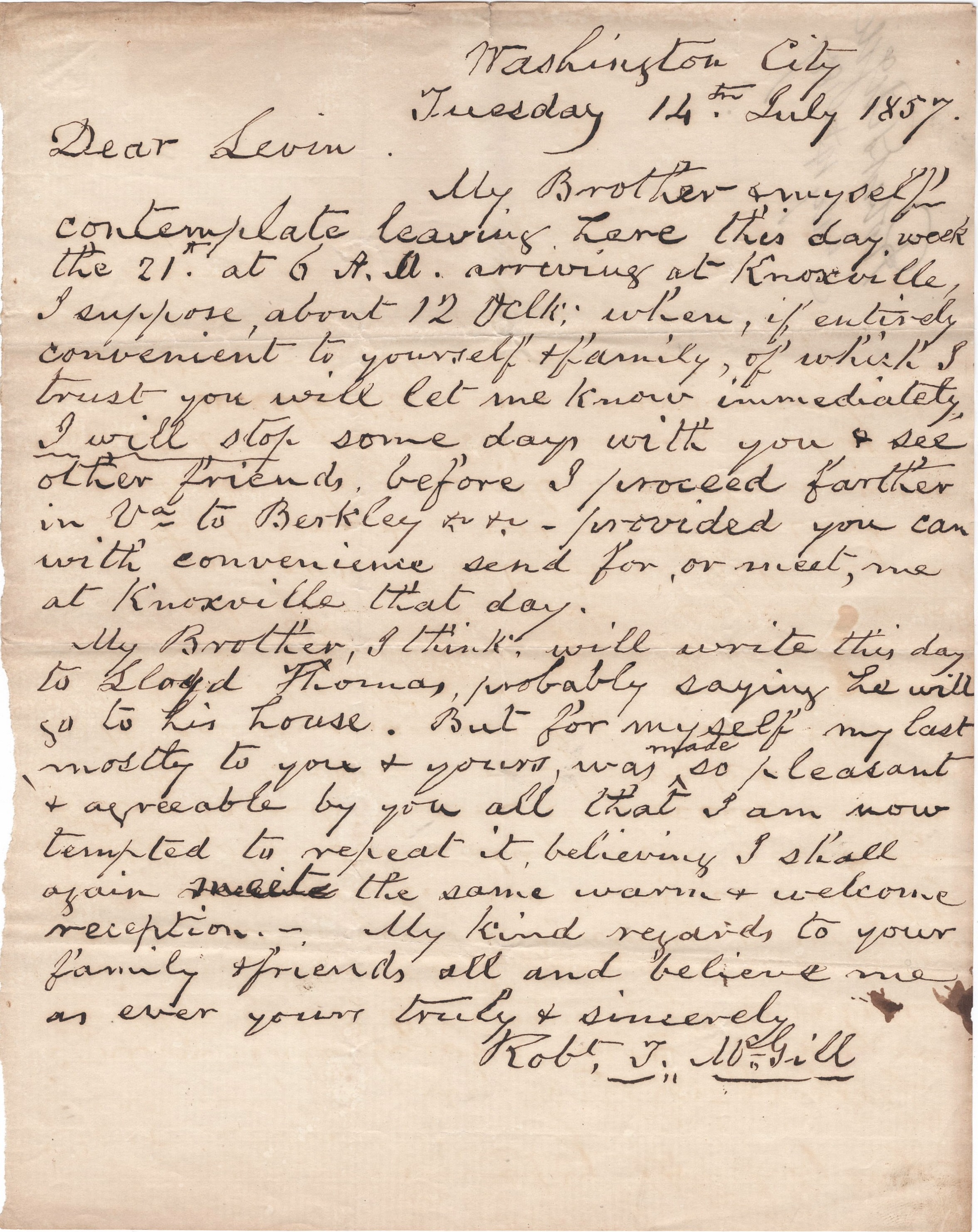
My brother [Charles] and myself contemplate leaving here this day week the 21st at 6 a.m., arriving at Knoxville [Frederick Co., Maryland], I suppose, about 12 o’clock, when, if entirely convenient to yourself and family, of which I trust you will let me know immediately, I will stop some days with you and see other friends before I proceed farther in Virginia to Berkley, &c. &c. provided you can with convenience send for, or meet, me at Knoxville that day.
My Brother, I think, will write this day to Lloyd Thomas, probably saying he will go to his house. But for myself, my last, mostly to you and yours, was made so pleasant and agreeable by you all that I am now tempted to repeat it, believing I shall again meet the same warm & welcome reception. My kind regards to your family and friends all, and believe me as ever yours truly and sincerely, — Robert T. McGill
Letter 4
Georgetown, District of Columbia
Thursday, December 24th 1857
Dear Levin.
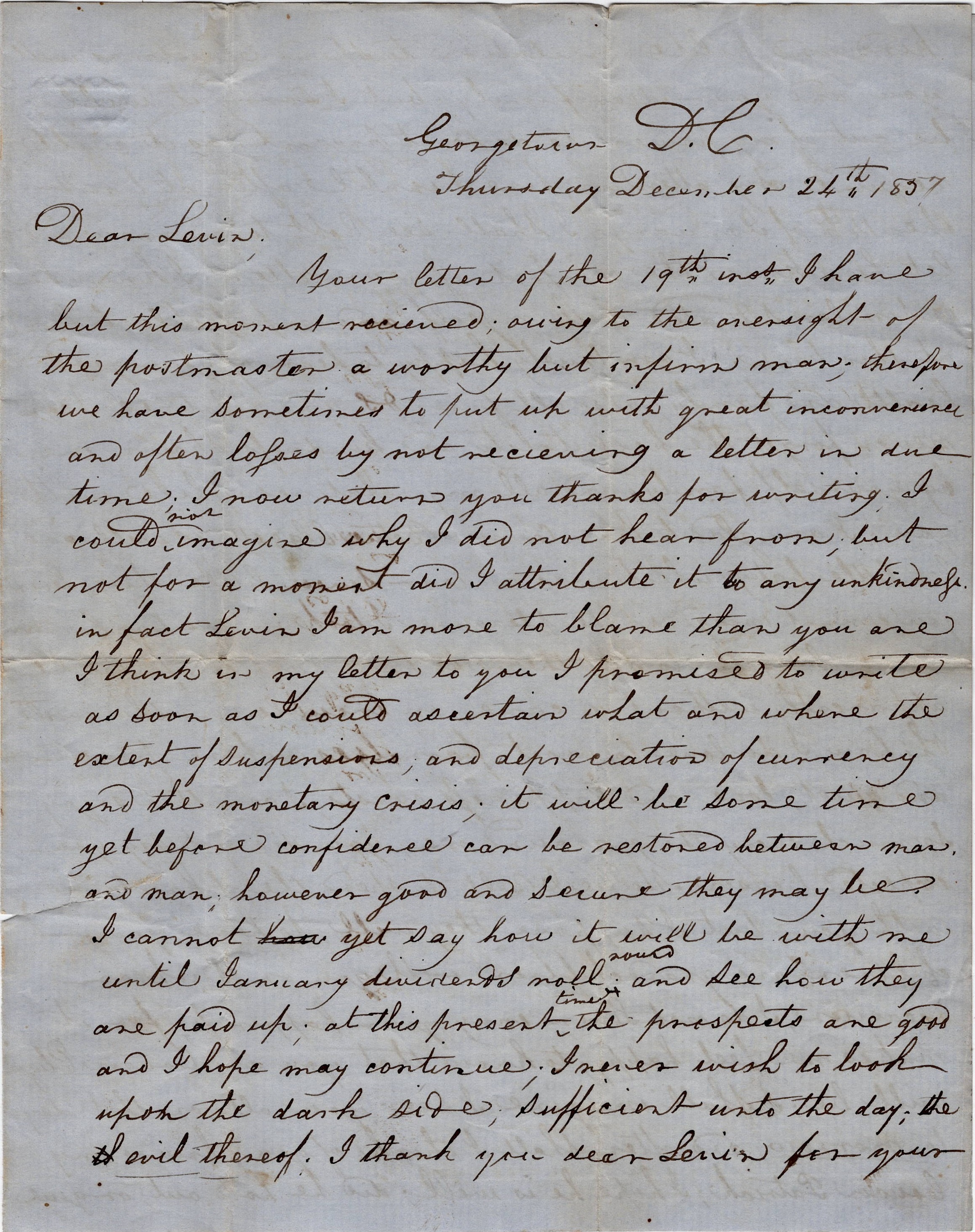
Your letter of the 19th inst. I have but this moment received owing to the oversight of the postmaster—a worthy but inform man. Therefore we have sometimes to put up with great inconvenience and often losses by not receiving a letter in due time. I now return you thanks for writing. I could not imagine why I did not hear from you but not for a moment did I attribute it to any unkindness. In fact, Levin, I am more to blame than you are. I think in my letter to you I promised to write as soon as I could ascertain what and where the extent of suspensions and depreciation of currency and the monetary crisis. It will be some time yet before confidence can be restored between man and man, however good and secure they may be. I cannot yet say how it will be with me until January dividends roll round and see how they are paid up. At the present time, the prospects are good and I hope may continue. I never wish to look upon the dark side, sufficient unto the day, the evil thereof.
I thank you dear Levin for your kind and polite invitation to spend Christmas with you and your dear family, but I am sorry it will be out of my power to do so at present as it will require my attention here until after at least the 14th of January. I shall see Robert tomorrow and let him know the purport of your letter. I know he is similarly situated with myself and impossible to leave at this time.
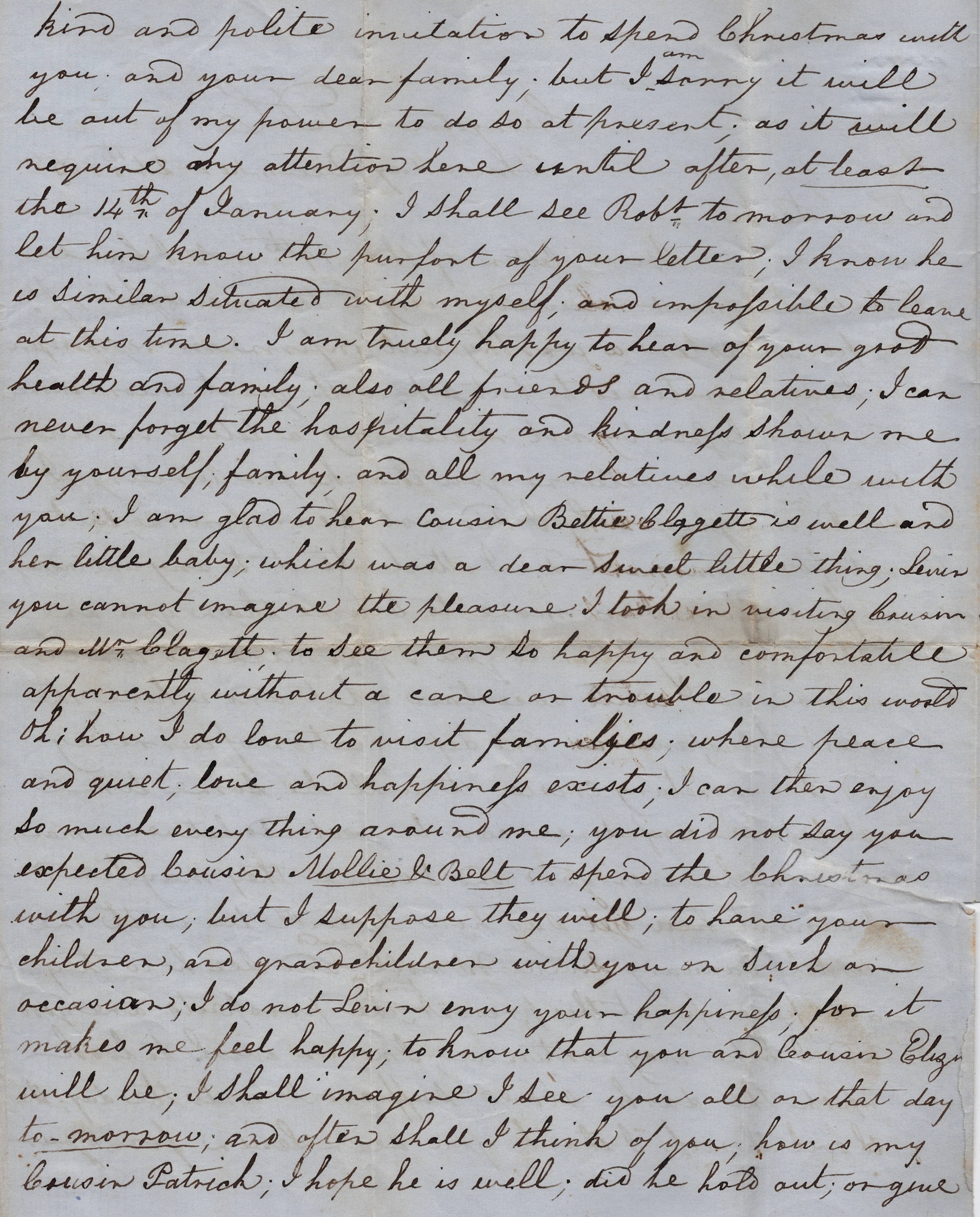
I am truly happy to hear of your good health and family. And all friends and relatives. I can never forget the hospitality and kindness shown me by yourself, family, and all my relatives while with you. I am glad to hear cousin Bettie Clagett is well and her little baby which was a dear sweet little thing. Levin, you cannot imagine the pleasure I took in visiting cousin and Mr. Clagett—to see them so happy and comfortable—apparently without a care or trouble in this world. Oh how I do love to visit families where peace and quiet, love and happiness exists. I can then enjoy so much everything around me. You did not say you expected cousin Mollie and Belt to spent the Christmas with you but I suppose they will [and] to have your children and grandchildren with you on such an occasion. I do not, Levin, envy your happiness for it makes me feel happy to know that you and cousin Eliza will be. I shall imagine I see you all on that day tomorrow and often shall I think of you.
How is my cousin Patrick? I hope he is well. Did he hold out or give out during seeding time? I think I know the field where you had so much work and hard labor to prepare for seeding—the field opposite the barn where you had potatoes. I do not think a much worse field could be found to put in order for wheat; so I thought at the time. I believe if perseverance and hard labor would accomplish anything, it was bound to be done, and I am glad to hear of your success.
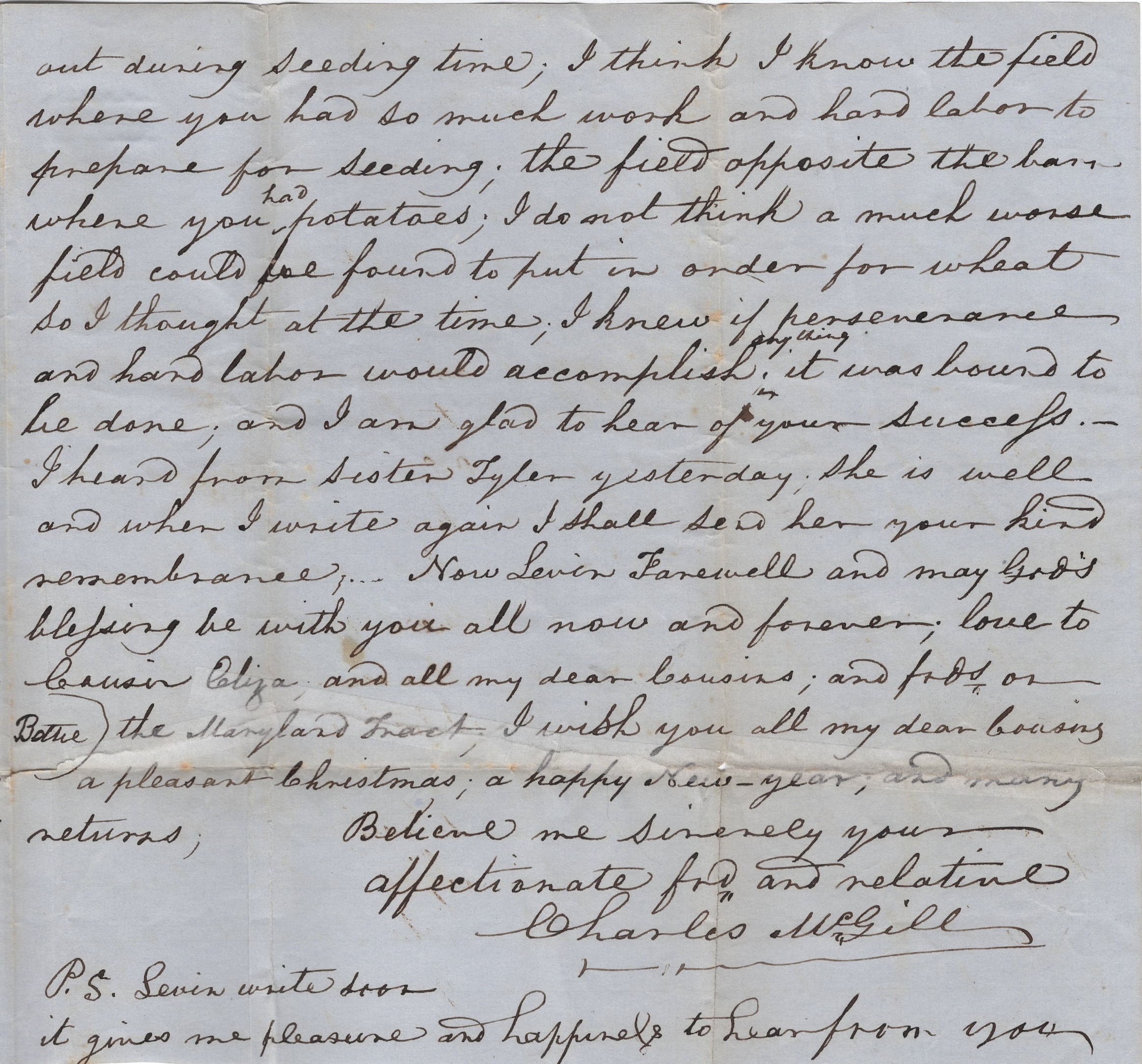
I heard from sister Tyler yesterday. She is well and when I write again, I shall send her your kind remembrance. Now Levin, farewell and may God’s blessing be with you all now and forever. Love to cousin Eliza and all my dear cousins, and friends on the Maryland Tract. I wish you all my dear cousins, a pleasant Christmas, a Happy New Year, and many returns. Believe me sincerely your affectionate friend and relative, — Charles McGill
P. S. Levin. write soon. It gives me pleasure and happiness to hear from you.
Letter 5
Berkeley Springs [Virginia]
August 11th 1858
Dear Levin,
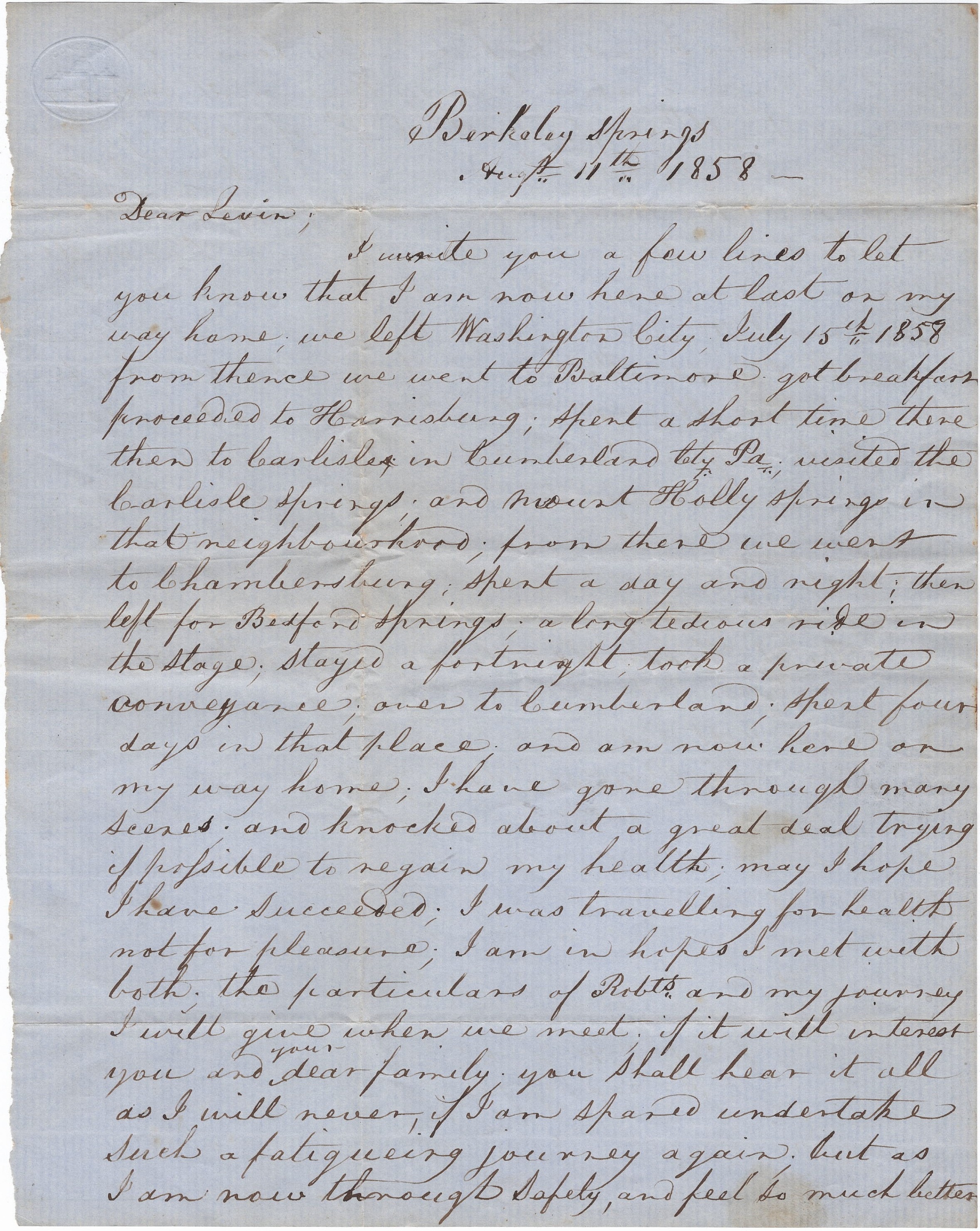
I wrote you a few lines to let you know that I am now here at last on my way home. We left Washington City July 15th 1858. From thence we went to Baltimore, got breakfast, proceeded to Harrisburg, spent a short time there, then to Carlisle in Cumberland county, Pa., and visited the Carlisle Springs, and Mount Holly Springs in that neighborhood. From there we went to Chambersburg, spent a day and night, then left for Bedford Springs—a long tedious ride in the stage. Stayed a fortnight, took a private conveyance over to Cumberland, spent four days in that place, and am now here on my way home.
I have gone through many scenes and knocked about a great deal trying if possible to regain my health. May I hope I have succeeded. I was traveling for health—not for pleasure. I am in hopes I met with both.
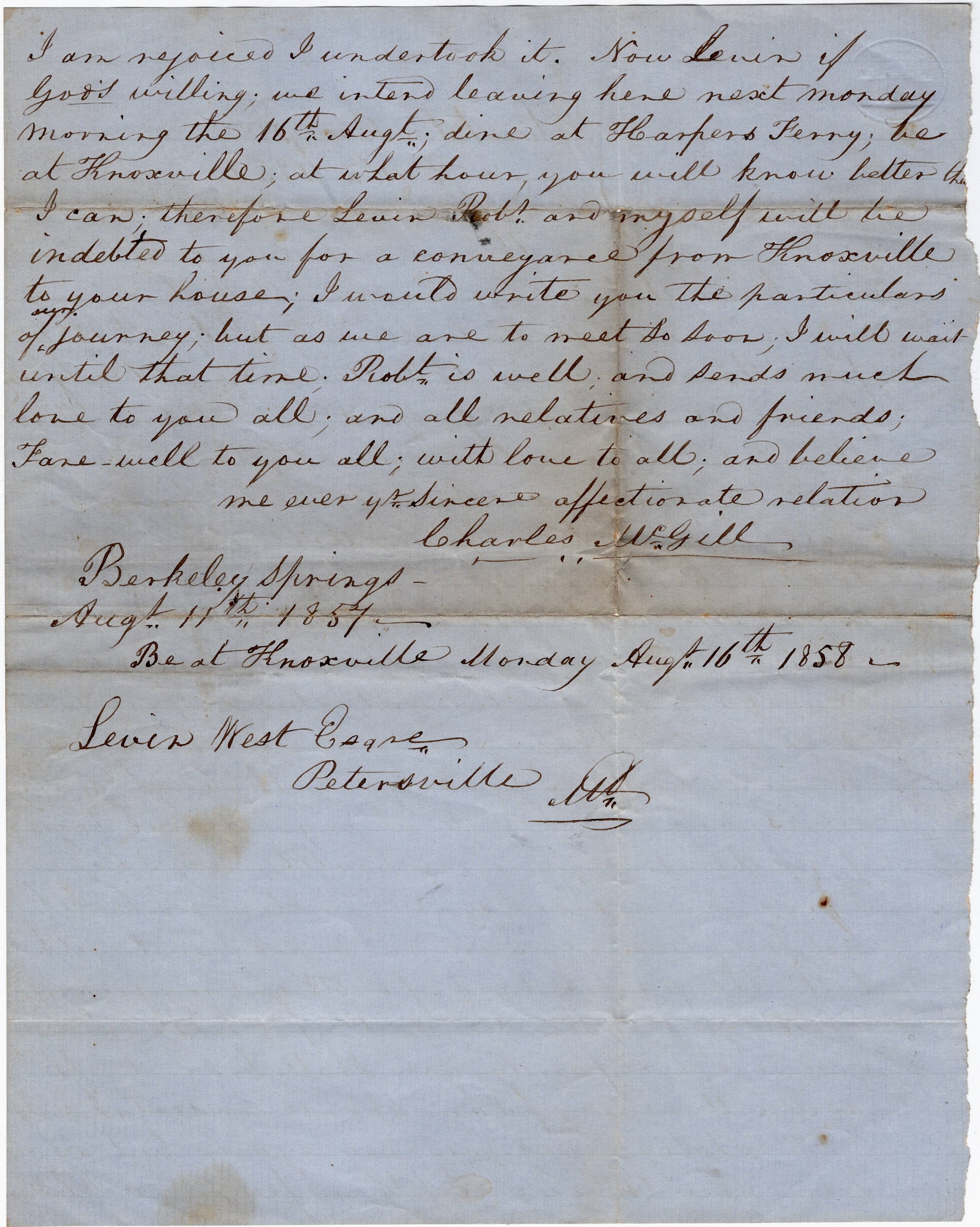
The particulars of Robert’s and my journey I will give when we meet, it is will interest you and your dear family. You shall hear it all as I will never—if I am spared—undertake such a fatiguing journey again. But as I am now through safely and feel so much better, I am rejoiced I undertook it. Now Levin, ig Fod’s willing, we intend leaving here next Monday morning the 16th August, dine at Harpers Ferry, be at Knoxville, at what hour, you will know better than I can. Therefore, Levin, Robert and myself will be indebted to you for a conveyance from Knoxville to your house. I would write you the particulars of our journey but as we are to meet so soon, I will wait until that time. Robert is well and sends much love to you all; and all relatives and friends. Farewell to you all; with love to all; and believe me ever your sincere, affectionate relation, — Charles McGill
Berkeley Springs
August 11th 1857 [1858]
Be at Knoxville Monday, August 16th, 1858
Levin West, Esq., Petersville, Maryland
Letter 6
Georgetown, D. C.
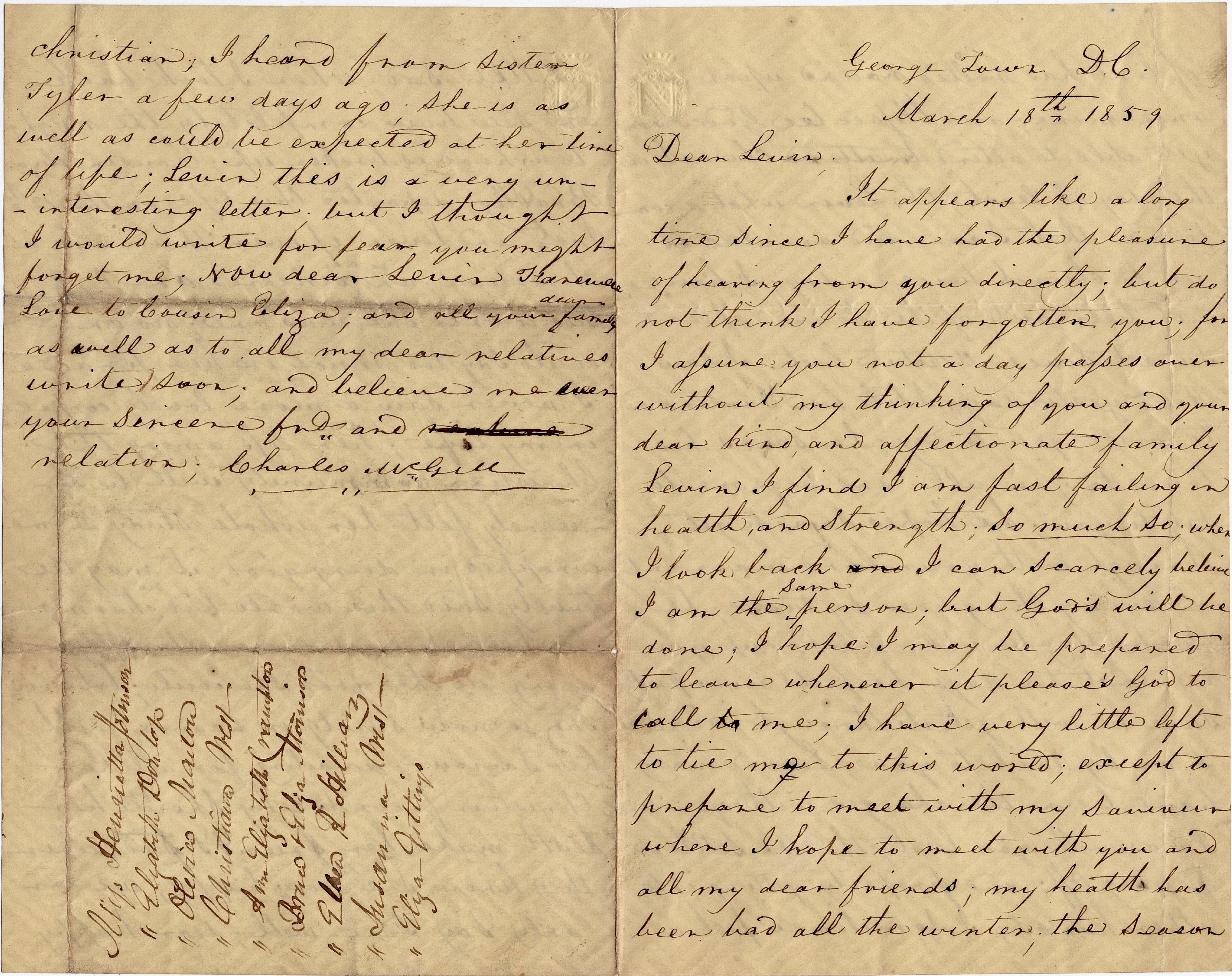
March 18th 1859
Dear Levin,
It appears like a long time since I have had the pleasure of hearing from you directly. But do not think I have forgotten you for I assure you, not a day passes over without my thinking of you and your dear, kind and affectionate family.
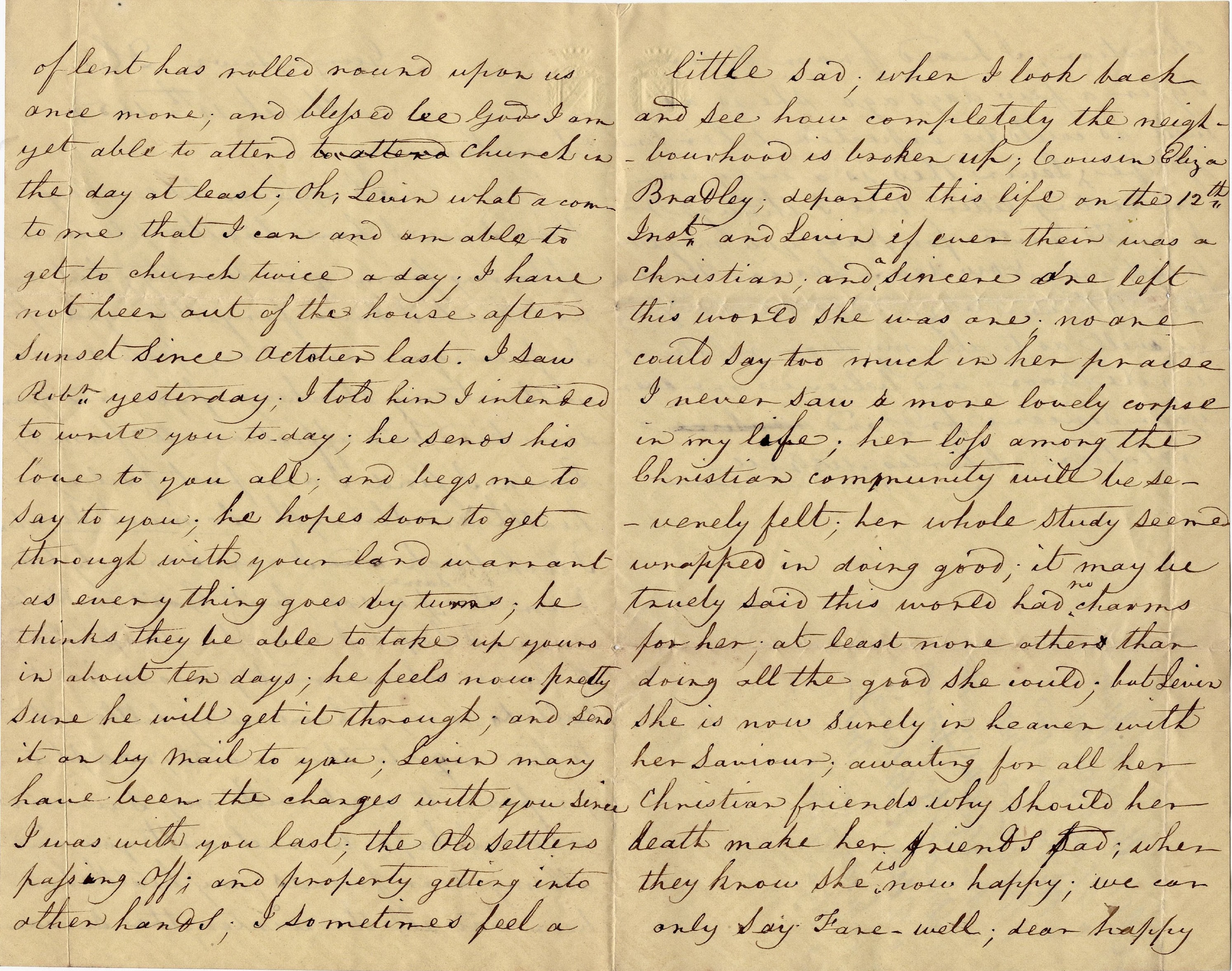
Levin, I find I am fast failing in health and strength, so much so when I look back, I can scarcely believe I am the same person. But God’s will be done. I hope I may be prepared to leave whenever it pleases God to call me. I have very little left to tie me to this world except to prepare to meet with my Savior where I hope to meet with you and all my dear friends. My health has been bad all winter. The season of Lent has rolled round upon us once more and blessed be God, I am yet able to attend church in the day at least. Oh Levin, what a comfort to me that I can and am able to get to church twice a day. I have not been out of the house after sunset since October last.
I saw Robert yesterday. I told him I intended to write you today. He sends his love to you all and begs me to say to you e hopes soon to get through with your land warrant as everything goes by turns. He thinks they [will] be able to take up yours in about ten days. He feels now pretty sure he will get it through and send it on by mail to you.
Levin, many have been the changes with you since I was with you last. The old settlers passing off, and property getting into other hands. I sometimes feel a little sad when I look back and see how completely the neighborhood is broken up.
Cousin Eliza [McGill] Bradley departed this life on the 12th inst. and Levin, if ever there was a Christian and a sincere one left this world, she was one. No one could say too much in her praise. I never saw a more lovely corpse in my life. Her loss among the Christian community will be severely felt. Her whole study seemed wrapped in doing good. It may be truly said this world had no charms for her—at least none others than doing all the good she could. But Levin, she is now surely in Heaven with her Savior, awaiting for all her Christian friends. Why should her death make her friends sad when they know she is now happy? We can only say farewell, dear happy Christian. I heard from her sister Tyler a few days ago. She is as well as could be expected at her time of life. 1
Levin, this is a very uninteresting letter but I thought I would write for fear you might forget me. Now dear Levin, farewell. Love to cousin Eliza and all your dear family as well as to all my dear relatives. Write soon and believe me ever your sincere friend and relation, — Charles McGill
1 Eliza McGill (Thomas) Bradley (1834-1859) was the daughter of John McGill Thomas (1800-1834) and Harriet Margaret Dunlop Thomas Lufborough (1809-1886). She was the wife of Joseph Habersham Bradley, Jr. (1831-1874). She was buried at Oak Hill Cemetery in Washington D. C. Eliza’s husband bore a “remarkable resemblance to John Wilkes Booth and on April 15, 1865, the night after the tragic event in Ford’s Theater, he was driving home in his buggy along a lonely road when he was held up by policemen and arrested. When he protested, he was told that he was John Wilkes Booth and was taken to jail. He insisted he was not, but to no avail. After a good while he got in touch with friends who identified him and he was released and went home.” [Source: Find-A-Grave]
Letter 7
Georgetown, D. C.
June 6th 1859
Dear Levin,
Your letter of the 27th of April is now before me and am sorry to say unanswered to this late date, but I assure you, Levin, I thought of you and all your family daily and have said to myself day after day, well tomorrow I will answer Levin’s letter.
I have not been well all winter, and spring I have not been out of the house after sundown since October last; but I am very thankful that it is no worse. I put my faith and trust in my blessed Redeemer and bow with submission to His will, and never feel unhappy if possible under any circumstances; keep clear of all excitement upon any subject, particularly when I find the person I am conversing with or myself becoming so, for every word spoken after that only serves to make it worse and worse, and engenders ill feelings and I thank God I do not harbor any ill feelings against that person living. But some I want to have as little to do with possible, and pity them for their faults and pray for them too. 1
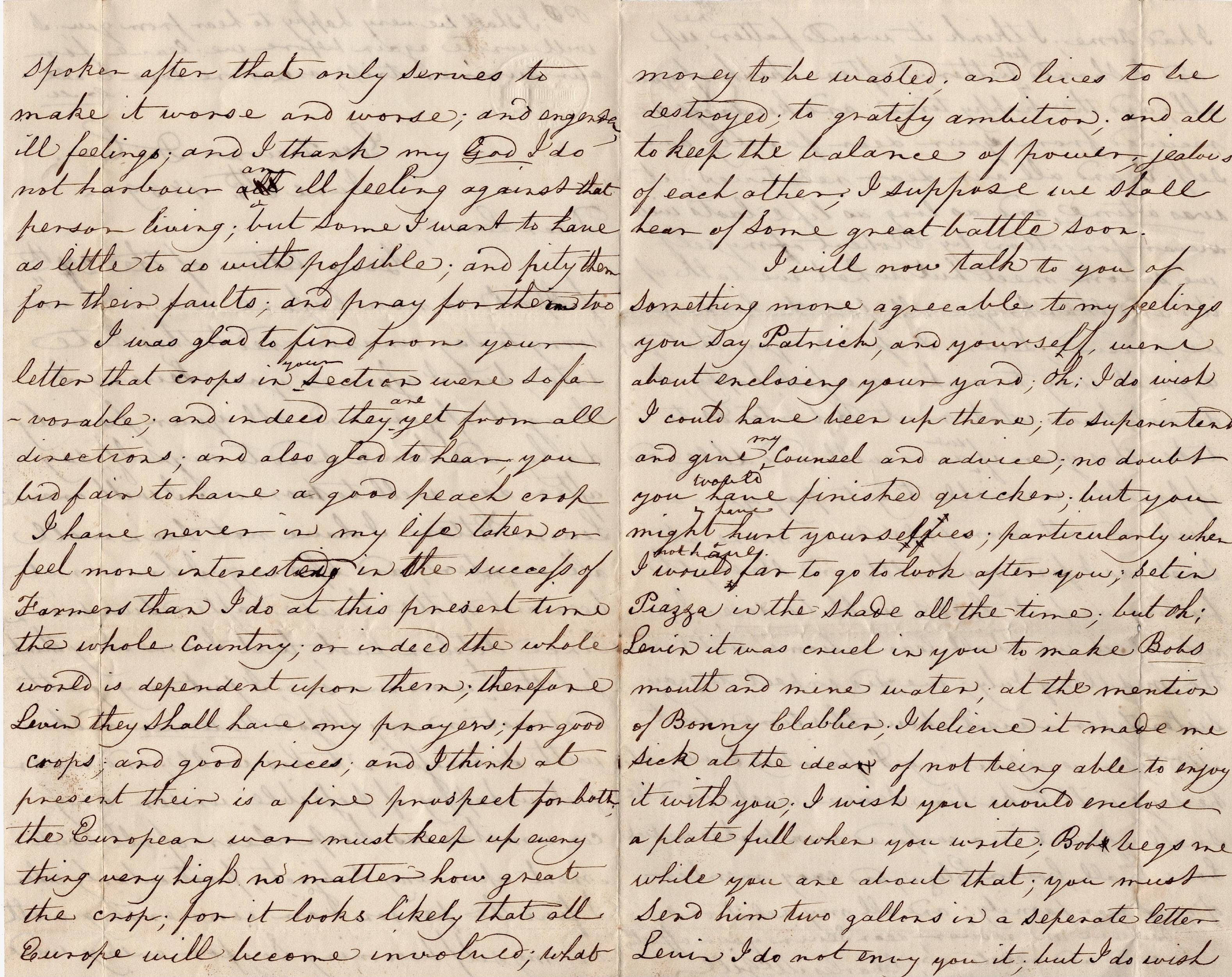
I was glad to find from your letter that crops in your section were so favorable, and indeed they are yet from all directions. And also to hear you bid fair to have a good peach crop. I have never in my life taken or felt more interest in the success of farmers than I do at the present time. The whole country—or indeed the whole world—is dependent upon them. Therefore, Levin, they shall have my prayers for good crops and good prices, and I think at present there is a fine prospect for both. The European war must keep up everything very high no matter how great the crop, for it looks likely that all Europe will become involved. What money to be wasted, and lives to be destroyed, to gratify ambition, and all to keep the balance of power, jealous of each other. I suppose we shall hear of some great battle soon. 2
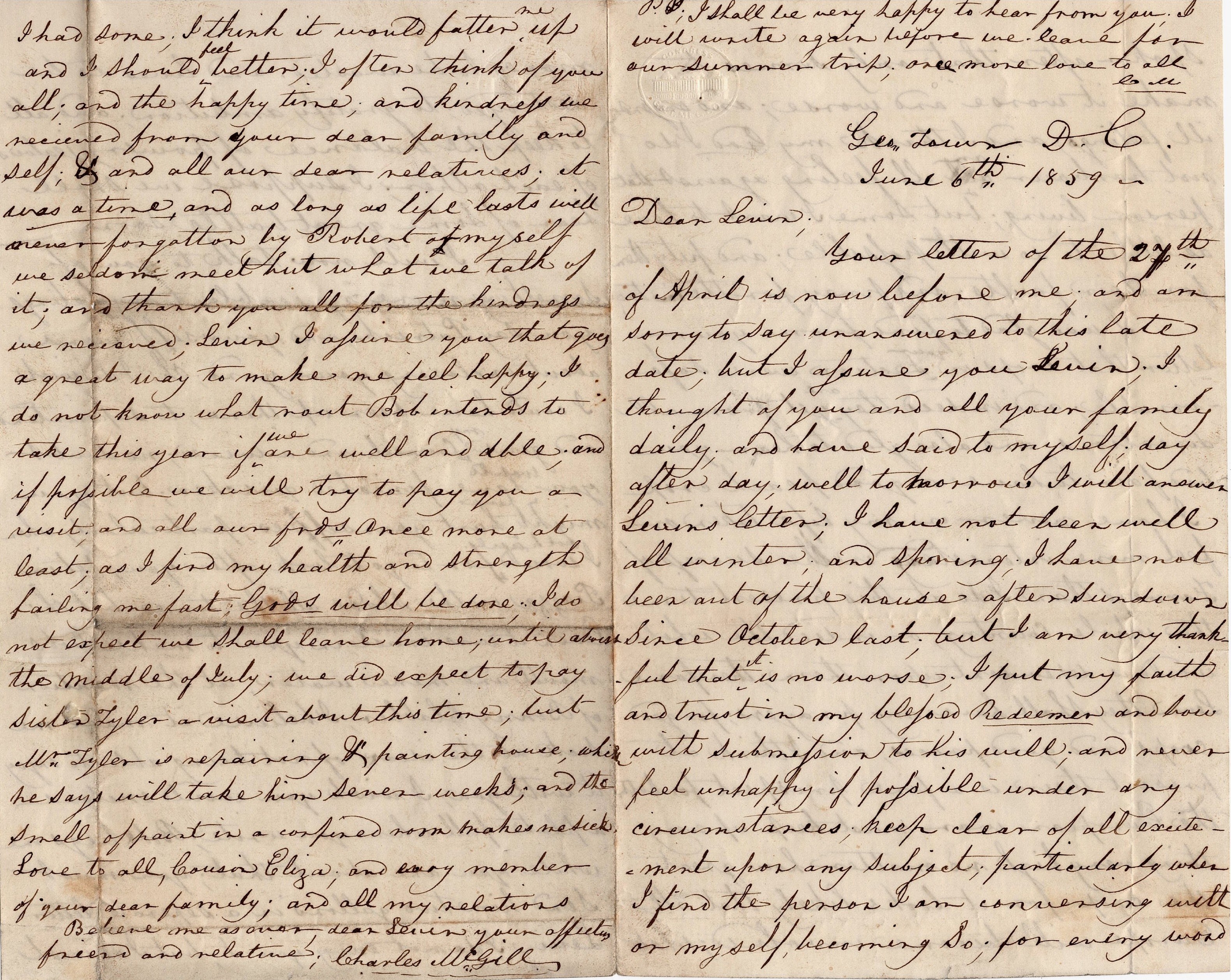
I will now talk to you of something more agreeable to my feelings. You say Patrick and yourself were about enclosing your yard. Oh, I do wish I could have beeb up there to superintend and give my counsel and advice. No doubt you would have finished quicker, but you might have hurt yourselves—particularly when I would only go so far to look after you, sitting on piazza in the shade all the time. But oh! Levin, it was cruel in you to make Bob’s mouth and mine water at the mention of Bonny Clabber [curdled sour milk]. I believe ut made me sick at the idea of not being able to enjoy it with you. I wish you would enclose a plate full when you write. Bob begs me while you are about that; you must send him two gallons in a separate letter. Levin, I do not envy you it, but I do wish I had some. I think it would fatten me up and I should feel better.
I often think of you all and the happy time and kindness we received from your dear family and self, and all our dear relatives. It was a time, and as long as life lasts, will never be forgotten by Robert or myself. We seldom meet but what we talk of it and thank you all for the kindness we received. Levin, I assure you that goes a great way to make me feel happy. I do not know what rout Bob intends to take this year. If we are well and able, and if possible, we will try to pay you a visit, and all our friends once more at least. As I find my health and strength failing me fast, God’s will be done. I do not expect we shall leave home until about the middle of July. We did expect to pay sister Tyler a visit about this time, but Mr. Tyler is repairing & painting house which he says will take him seven weeks and the smell of paint in a confined room makes me sick. Love to all, cousin Eliza, and every member of your dear family, and all my relations. Believe me as ever, dear Levin, your affectionate friend and relative, — Charles McGill
1 Charles appears purposely vague but I believe he is referring to the rising sectional crisis in America.
2 The European war Charles refers to was the Second Italian War of Independence (also known as the Austro-French-Piedmontese War) fought between April and July 1859. The Battle of Solferino was the climatic battle of that war, fought on 24 June 1859.
Letter 8
Washington City, D. C.
13th July 1859
Dear Levin,
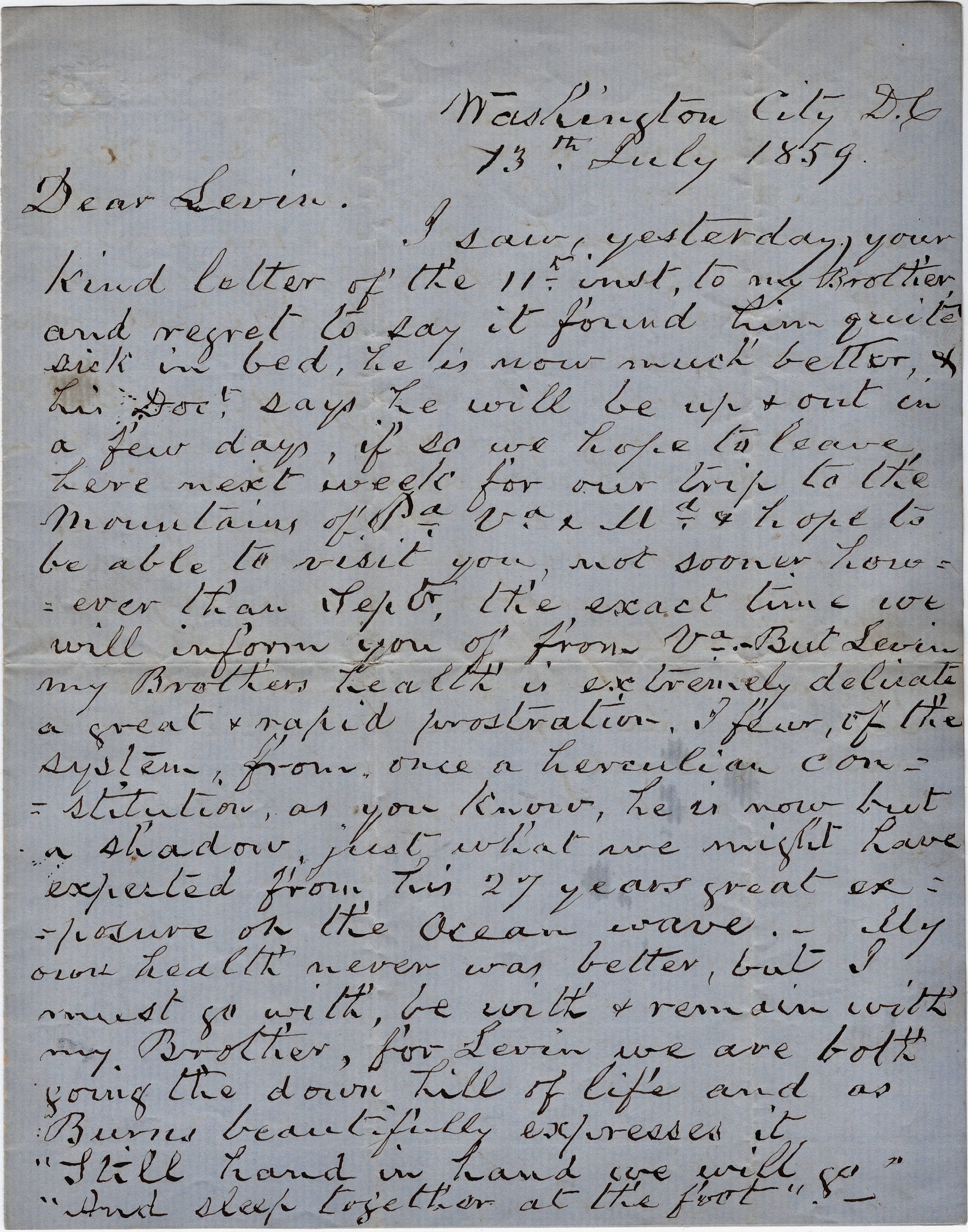
I saw yesterday your kind letter of the 11th inst. to my brother [Charles] and regret to say it found him quite sick in bed. He is now much better & his doctor says he will be up and out in a few days. If so, we hope to leave here next week for our trip to the mountains of Pennsylvania, Virginia, and Maryland, and hope o be able to visit you—not sooner, however, than September. The exact time we will inform you of from Virginia. But Levin, my brother’s health is extremely delicate—a great and rapid prostration, I fear, of the system. From once a herculean constitution, as you know, he is now but a shadow—just what we might have expected from his 27 years great exposure on the ocean wave. My own health never was better but I must go with, be with, and remain with my brother, for Levin, we are both going down hill of life and as Burns beautifully expresses it, “Still hand in hand we will go. And sleep together at the foot.”
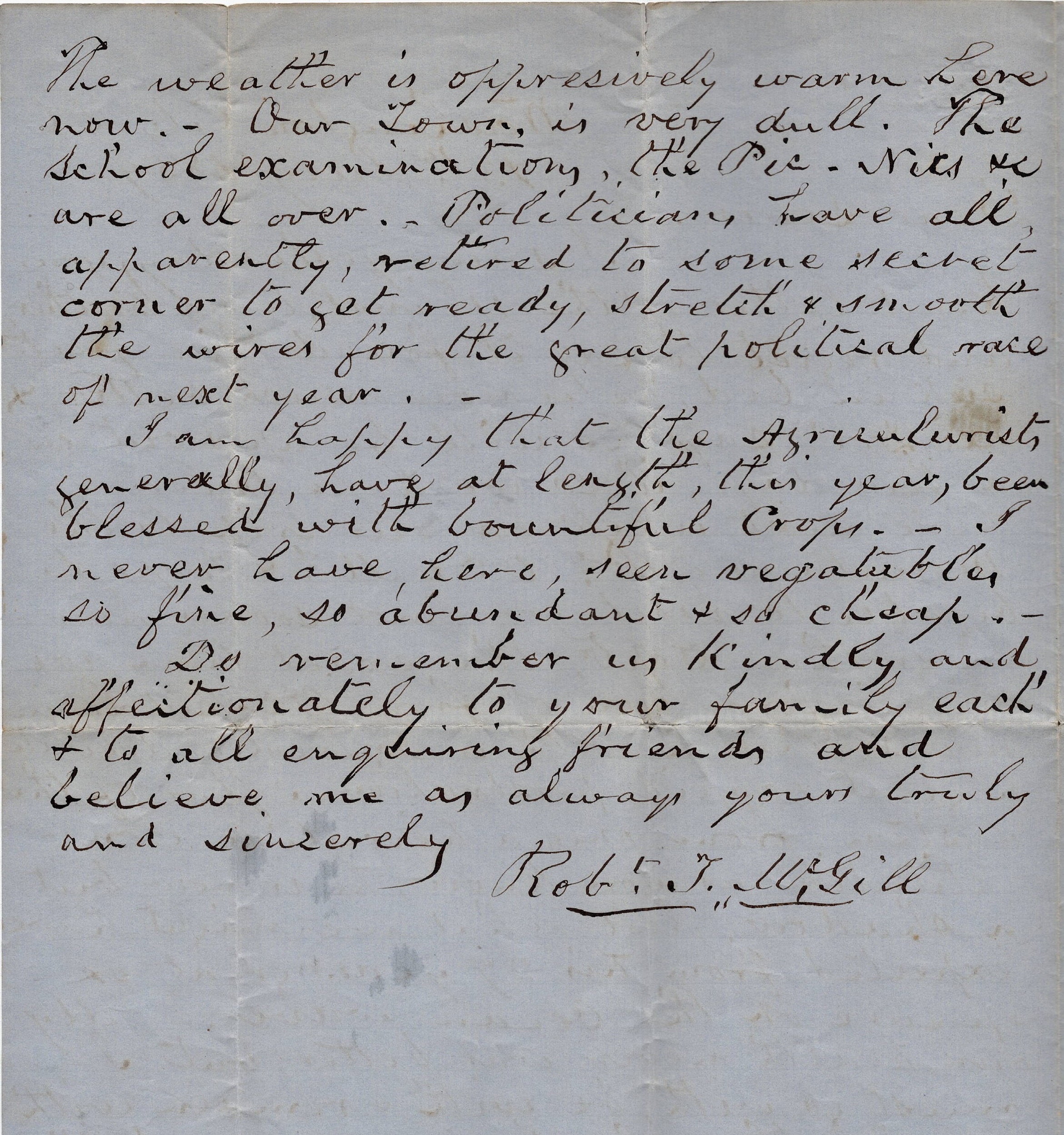
The weather is oppressively war here now. Our town is very dull. The school examinations, the picnics, &c. are all over. Politicians have all apparently retired to some secret corner to get ready, stretch and smooth the wires for the great political race of next year.
I am happy that the Agriculturists generally have at length, this year, been blessed with bountiful crops. I never have here seen vegetables so fine, so abundant, and so cheap.
Do remember us kindly and affectionately to your family each & to all enquiring friends and believe me as always yours truly and sincerely, — Robert. T. McGill
Letter 9
Jordon [ ] Springs, Virginia
Monday, August 20th 1860
Dear Levin,
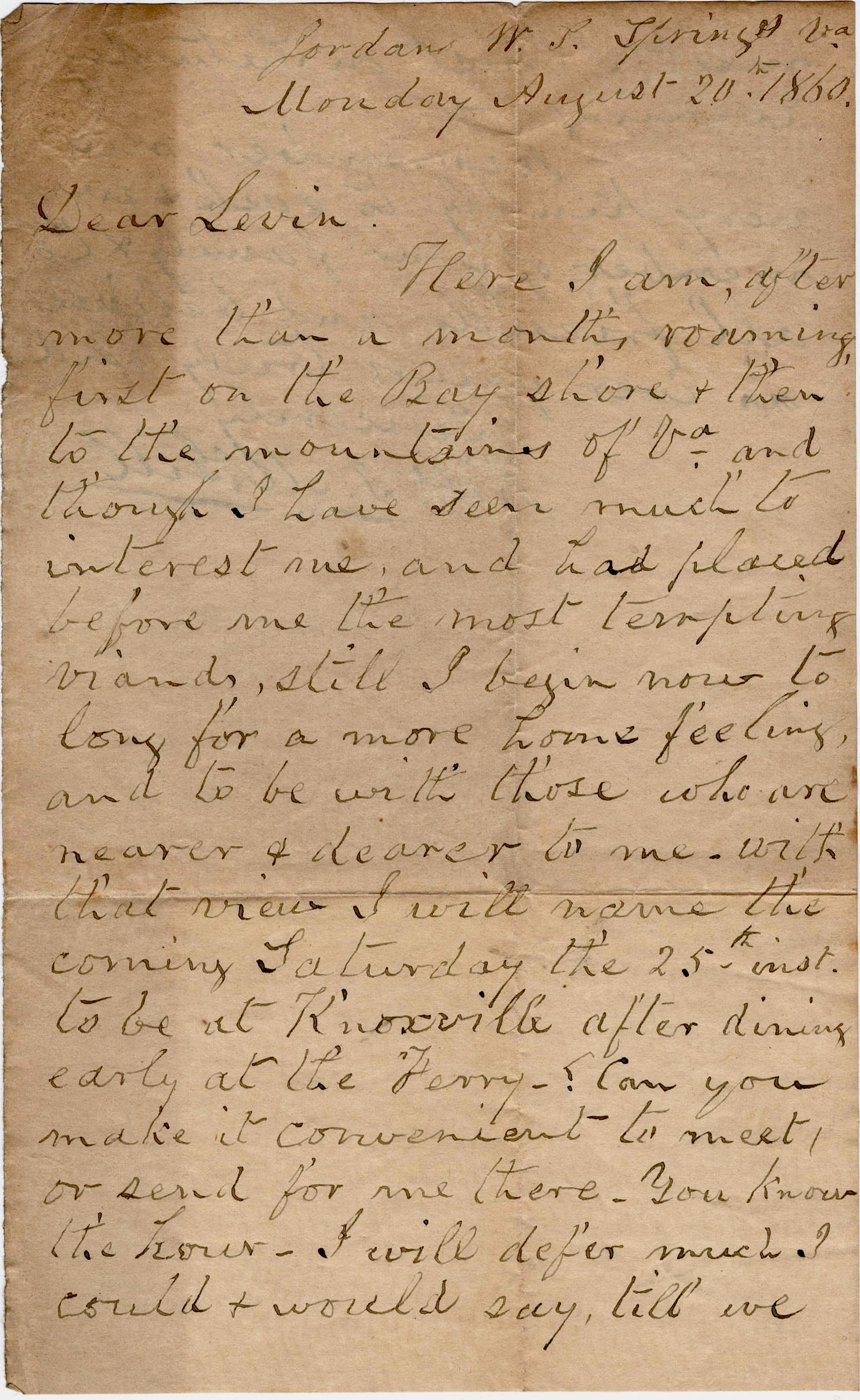
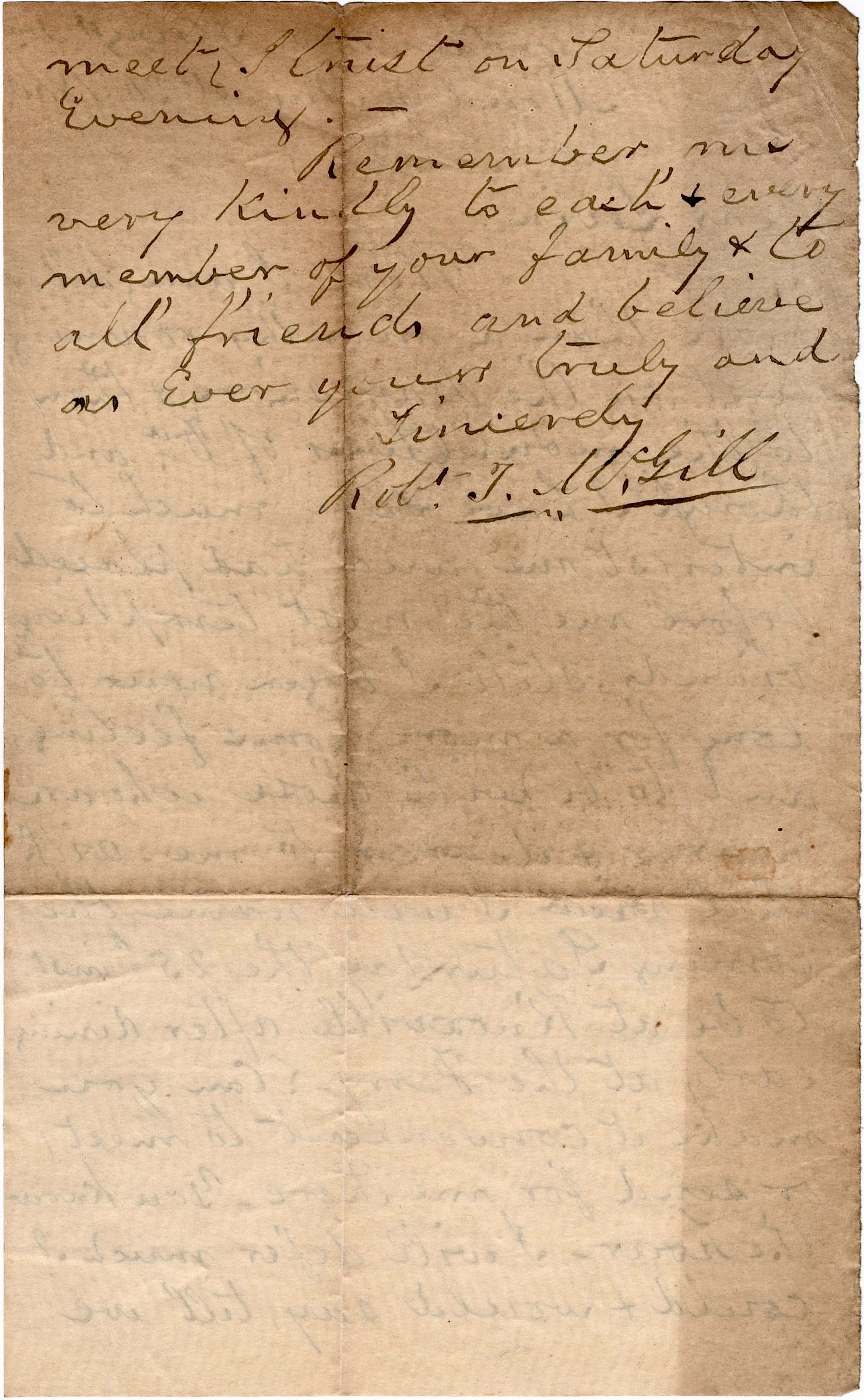
Here I am after more than a month roaming, first on the bayshore and then to the mountains of Virginia and though I have seen much to interest me, and had placed before me the most tempting viands, still I begin now to long for a more home feeling and to be with those who are nearer and dearer to me. With that view, I will name the coming Saturday, the 25th inst. to be at Knoxville [Maryland] after dining early at the [Harper’s] Ferry. Can you make it convenient to meet or send for me there? You know the hour. I will defer much. I could and would say till we meet, I trust on Saturday evening.
Remember me very kindly to each and every member of your family and to all friends and believe as ever yours truly and sincerely, — Robt. T. McGill
Letter 10
Washington City, D. C.
Monday, 1st October 1860
My dear friend,
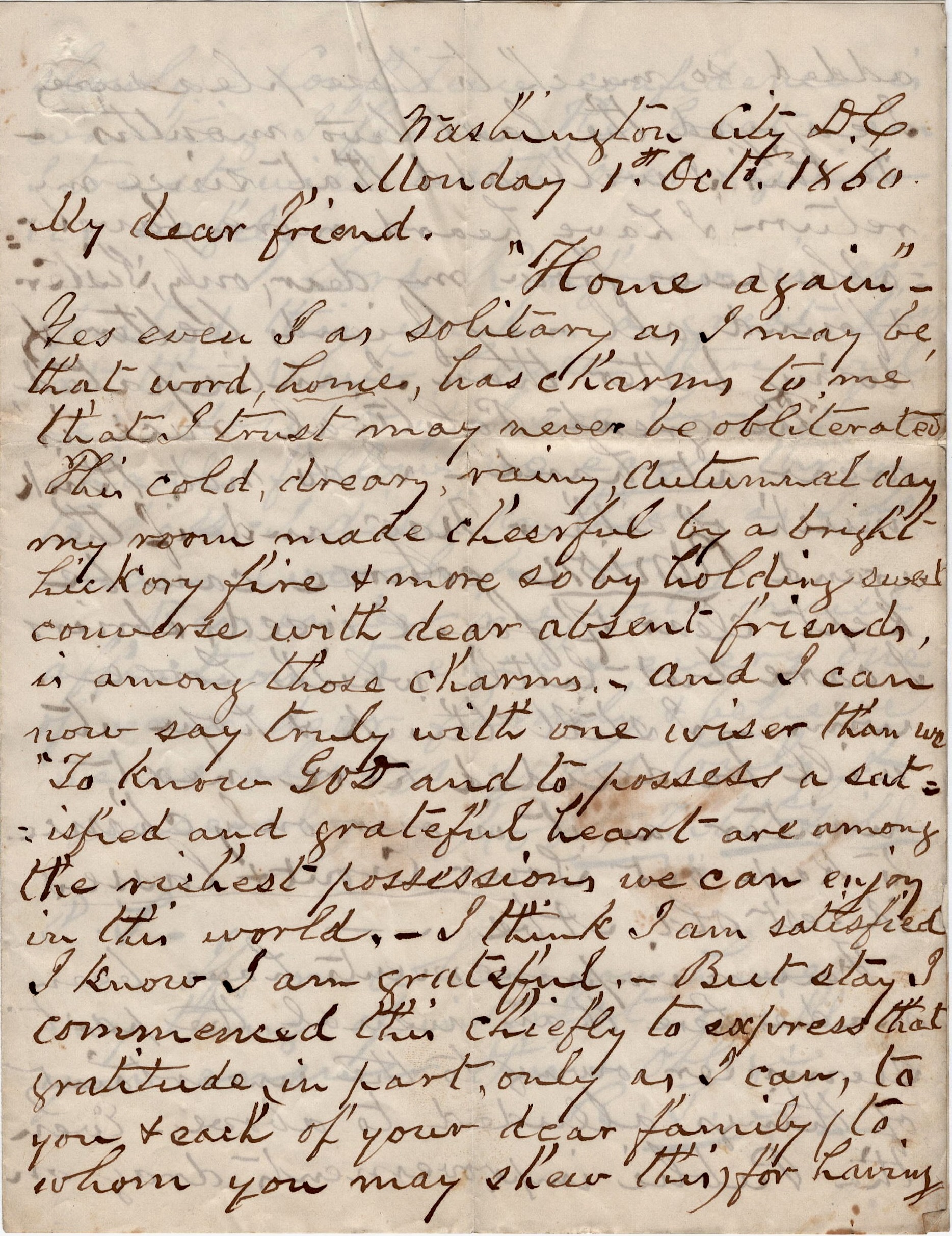
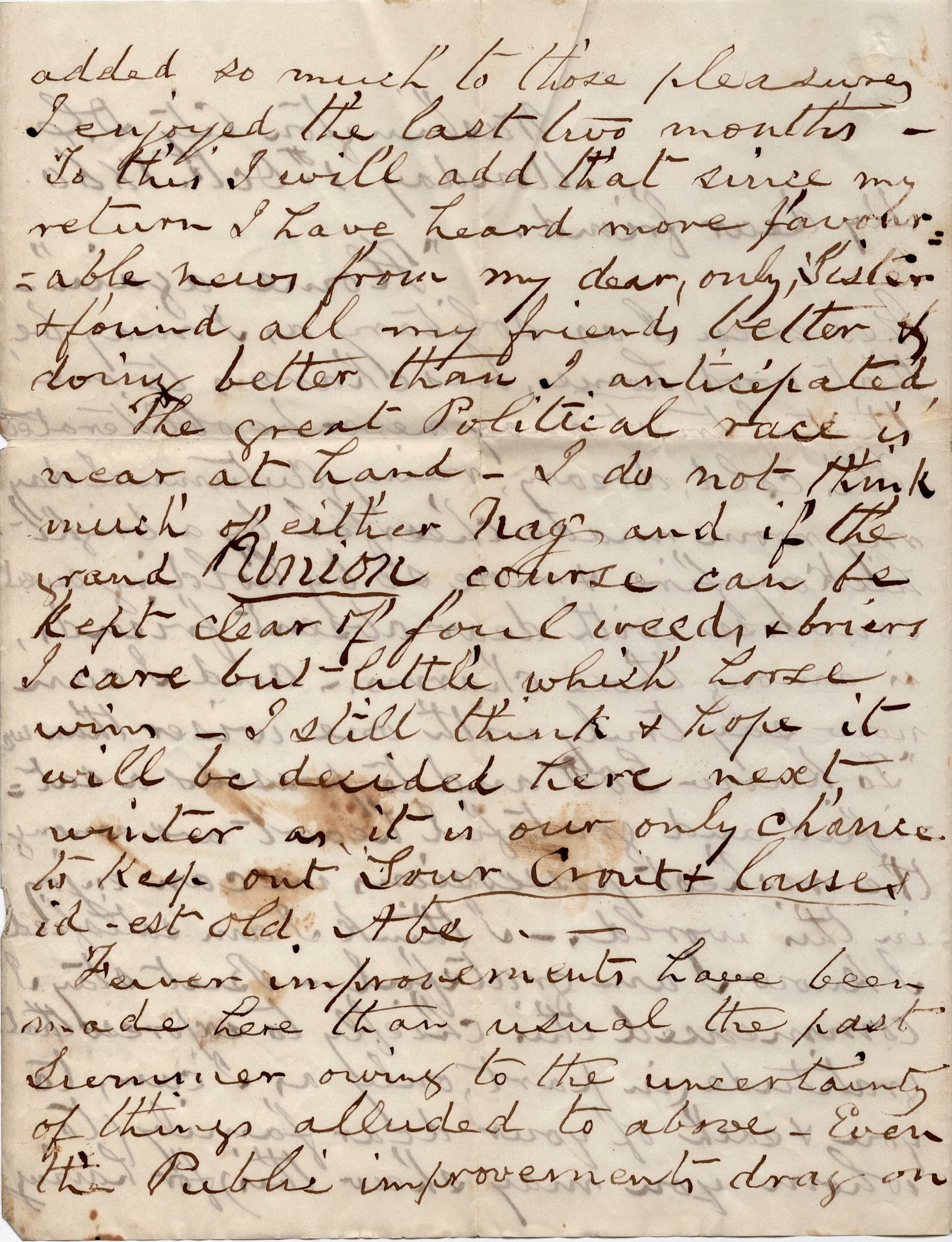
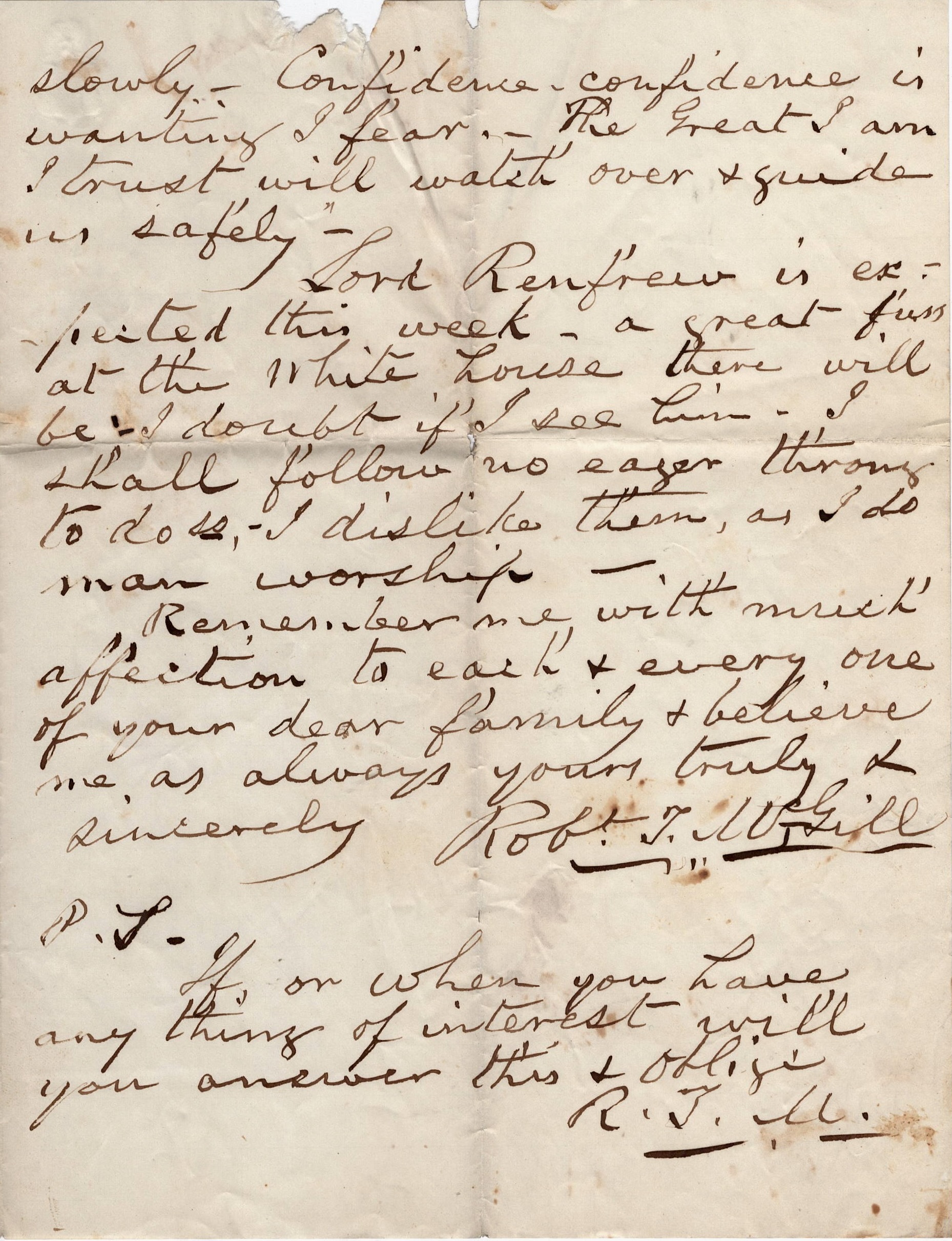
“Home again.” Yes. even I as solitary as I may be, that word home has charms to me that I trust may never be obliterated. This cold, dreary, rainy Autumnal day, my room made cheerful by a bright hickory fire, and more so by holding sweet converse with dear absent friends, is among the charms. And I can now say truly with one wiser than we, “To know God and to possess a satisfied and grateful heart are among the richest possessions we can enjoy in this world.” I think I am satisfied. I know I am grateful. But I commenced this chiefly to express that gratitude in part, only as I can, to you and each of your dear family, to whom you may show this, for having added so much to those pleasures I enjoyed the last two months.
To this I will add that since my return, I have heard more favorable news from my dear, only, sister and found all my friends better and doing better than I anticipated.
The great Political race is near at hand. I do not think much of either nag, and if the grand Union course can be kept clear of foul weeds and briars, I care but little which horse wins. I still think & hope it will be decided here next winter as it is our only chance to keep out Sour Crout & lasses id-est Old Abe. 1
Fewer improvements have been made here than usual the past summer owing to the uncertainty of things alluded to above. Even the public [infrastructure] improvements drag on slowly. Confidence—confidence is wanting I fear. The Great I am I trust will watch over and guide us safely.
Lord Renfrew is expected this week. A great fuss at the White House there will be. I doubt if I see him. I shall follow no eager throng to do so. I dislike them as I do man worship. 2
Remember me with much affection to each and every one of your dear family and believe me as always yours truly and sincerely, — Robt. T. McGill
P. S. If or when you have anything of interest, will you answer this and oblige? — R. T. M.
1 I find myself uncertain about Robert’s message in this context. The mention of sauerkraut poses a challenge to interpret. I consulted historian Jonathan White for clarity, and he proposed that this reference might pertain to the substantial German support that Abraham Lincoln garnered during the 1860 election.
2” Lord Renfew” was the incognito alias used by the 19-year-old Prince of Wales (who later became King Edward VII) during his historic tour of North America. To avoid diplomatic protocol complications and intense press scrutiny, he traveled as “Lord Baron Renfrew” while visiting the United States.
Letter 11
Washington City, D. C.
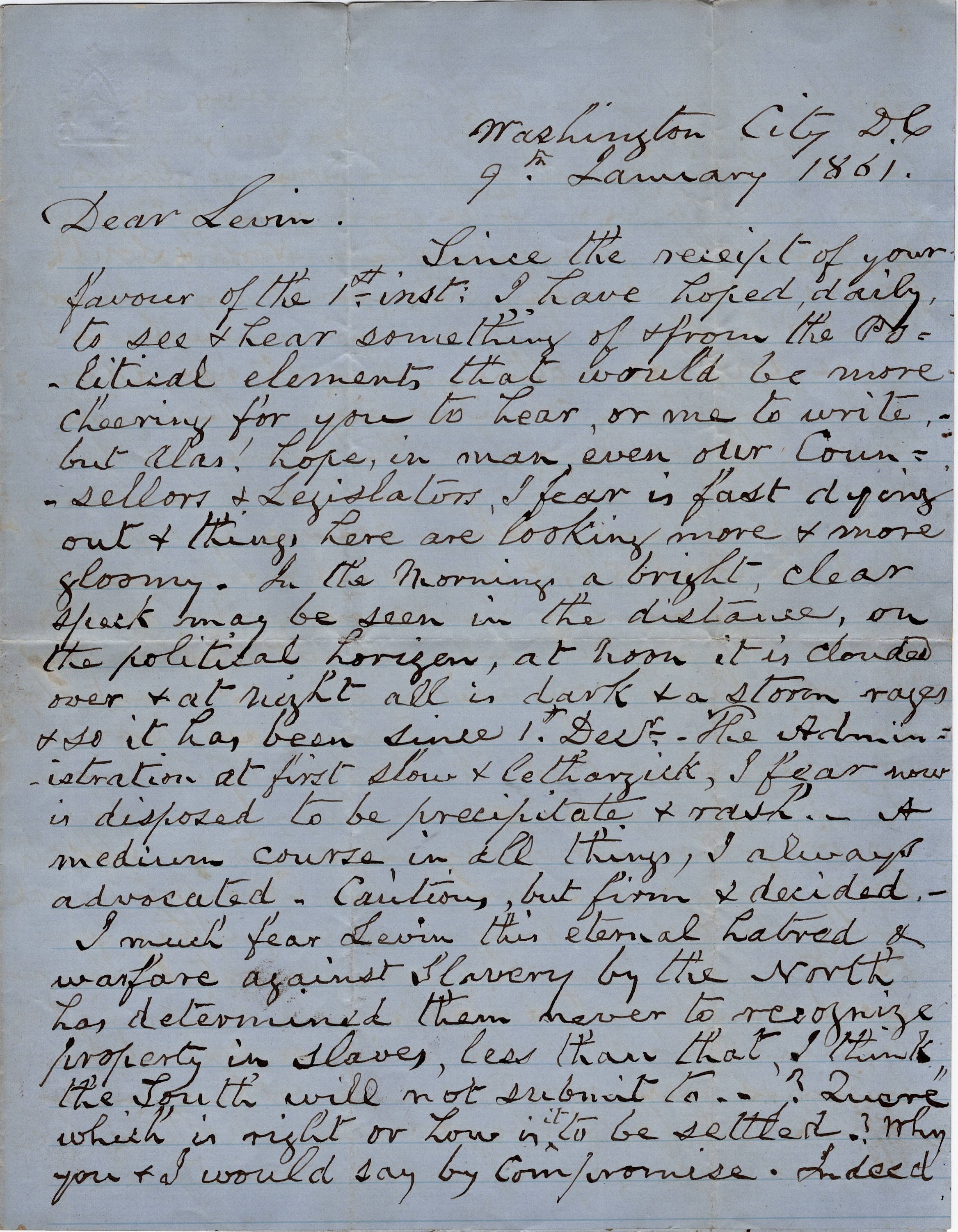
9th January 1861
Dear Levin,
Since the receipt of your favor of the 1st inst., I have hoped daily to see and hear something of and from the political elements that would be more cheering for you to hear or me to write, but alas! hope in man, even our counsellors, and legislators, I fear is fast dying out & things are looking more and more gloomy. In the morning, a bright clear speck may be seen in the distance on the political horizon; at noon, it is clouded over; and at night all is dark and a storm rages. And so it has been since 1st December. The Administration, at first slow and lethargic, I fear now is disposed to be precipitate and rash. A medium course in all things, I always advocated. Cautious, but firm and decided.
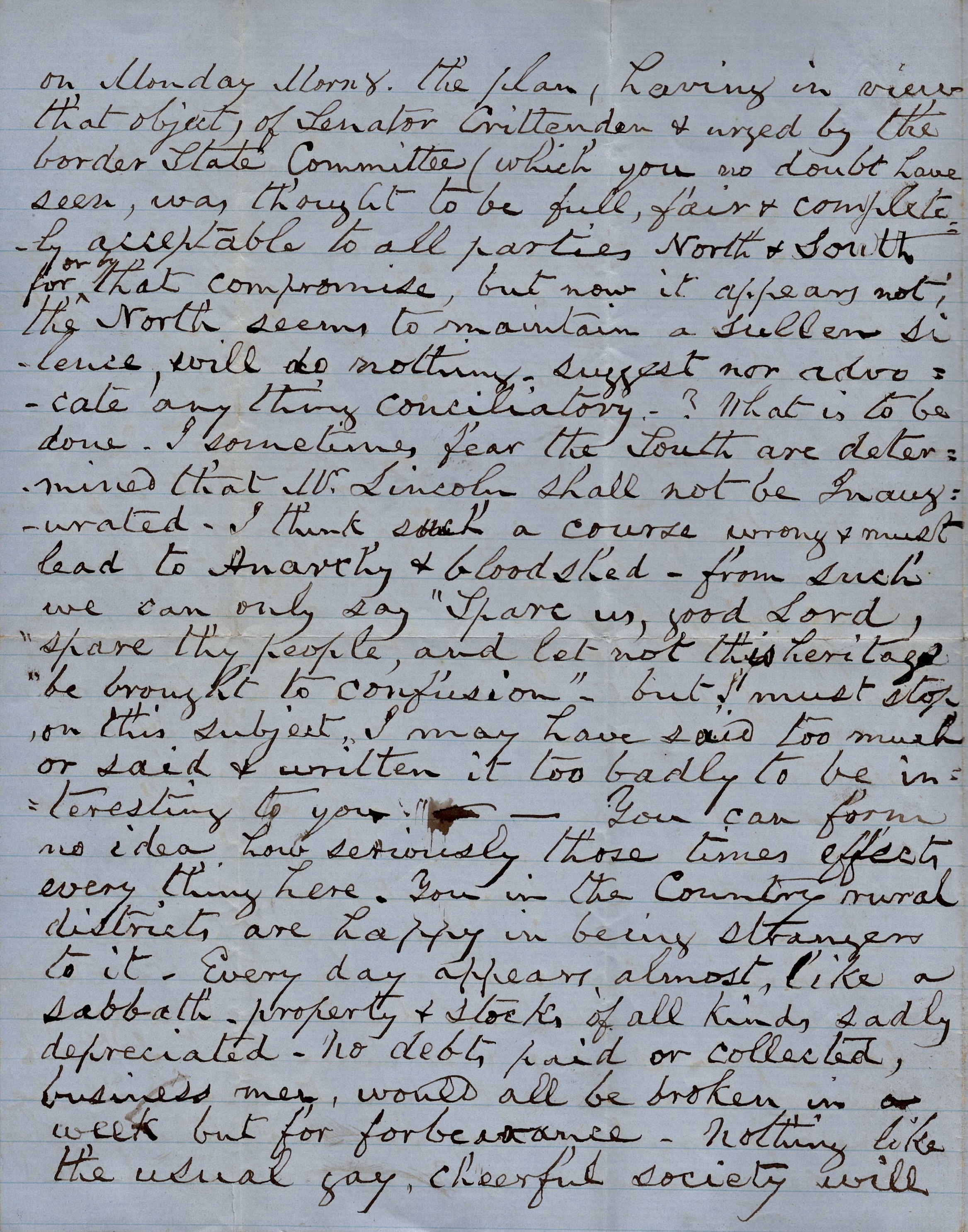
I much fear, Levin, this eternal hatred & warfare against slavery by the North has determined them never to recognize property in slaves. [Anything] less than that, I think the South will not submit to. “Quere” —which is right or how is it to be settled? Why you and I would say by compromise. Indeed, on Monday morning the plan, having in view that object, of Senator Crittenden & urged by the Border State Committee (which you no doubt have seen) was thought to be full, fair, and completely acceptable to all parties North and South for or by that compromise, but now it appears not. The North seems to maintain a sullen silence, will do nothing, suggest nor advocate anything conciliatory. What is to be done?
I sometimes fear the South are determined that Mr. Lincoln shall not be inaugurated. I think such a course wrong & must lead to anarchy & bloodshed. From such we can only say, “Spare us, good Lord, spare the people, and let not this heritage be brought to confusion.” But I must stop on this subject. I may have said too much or said and written it too badly to be interesting to you.
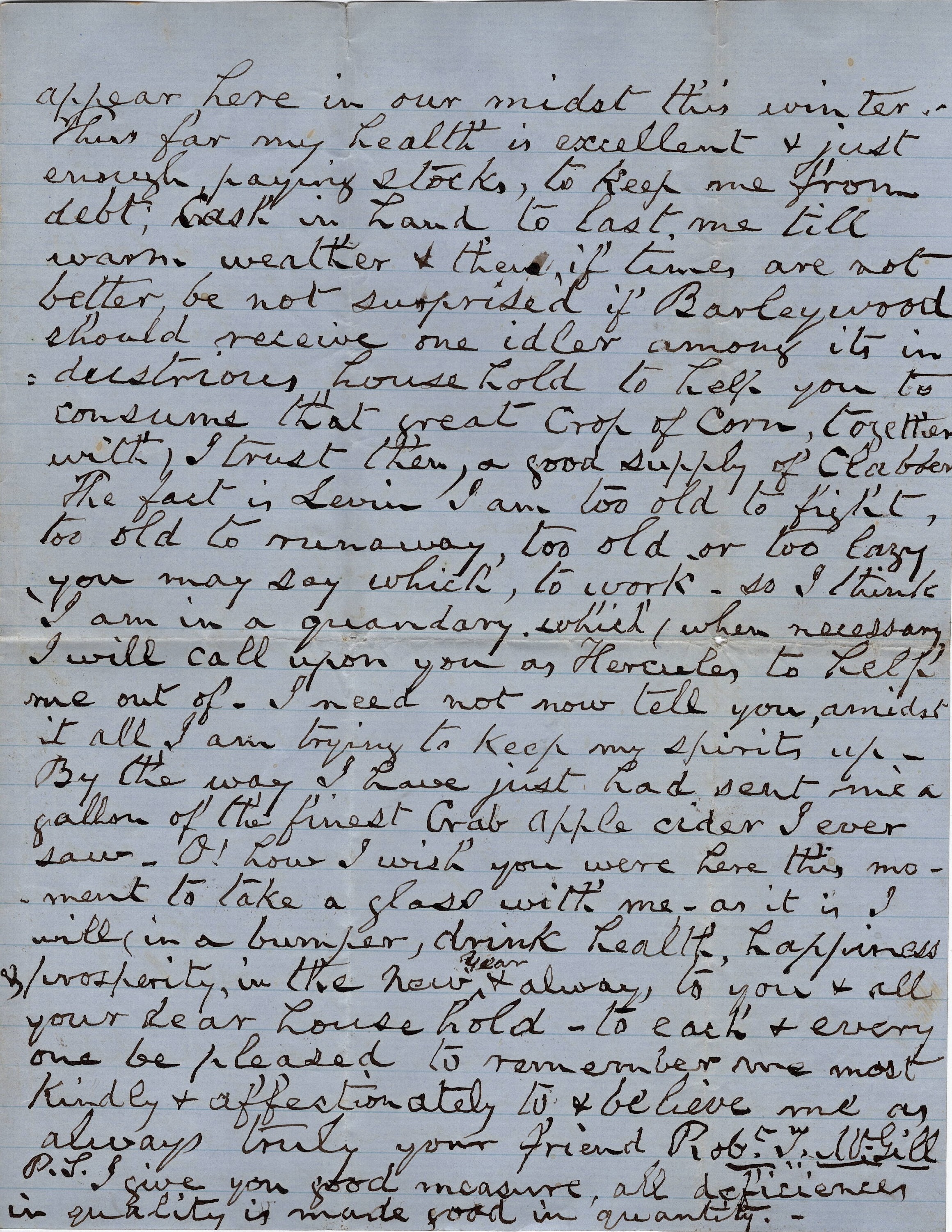
You can form no idea how seriously these times affects everything here. You in the country, rural districts, are happy in being strangers to it. Every day appears almost like a Sabbath—property and stocks of all kinds sadly depreciated. No debts paid or collected. Business men would all be broken in a week but for forbearance. Nothing like the usual gay, cheerful, society will appear here in our midst this winter. Thus far my health is excellent & just enough paying stocks to keep me from debt. Cash in hand to last me till warm weather & then, if times are not better, be not surprised if Barleywood should receive one idler among its industrious household to help you to consume that great crop of corn, together with, I trust then, a good supply of Clabber.
The fact is, Levin, I am too old to fight, too old to run away, too old or too lazy—you may say which—to work. So I think I am in a quandary which, when necessary, I will call upon you as Hercules to help me out of. I need not tell you amidst it all, I am trying to keep my spirits up. By the way, I have just had sent me a gallon of the finest Crab Apple Cider I ever saw. Oh! how I wish you were here this moment to take a glass with me. As it is, I will (in a bumper) drink health, happiness, and prosperity in the New Year and always to you and all your dear household, to each and everyone, be pleased to remember me most kindly and affectionately to, and believe me as always truly your friend. — Robt. T. McGill
P. S. I give you good measure, all deficiencies in quality is made good in quantity.
Letter 12
Washington City, D. C.
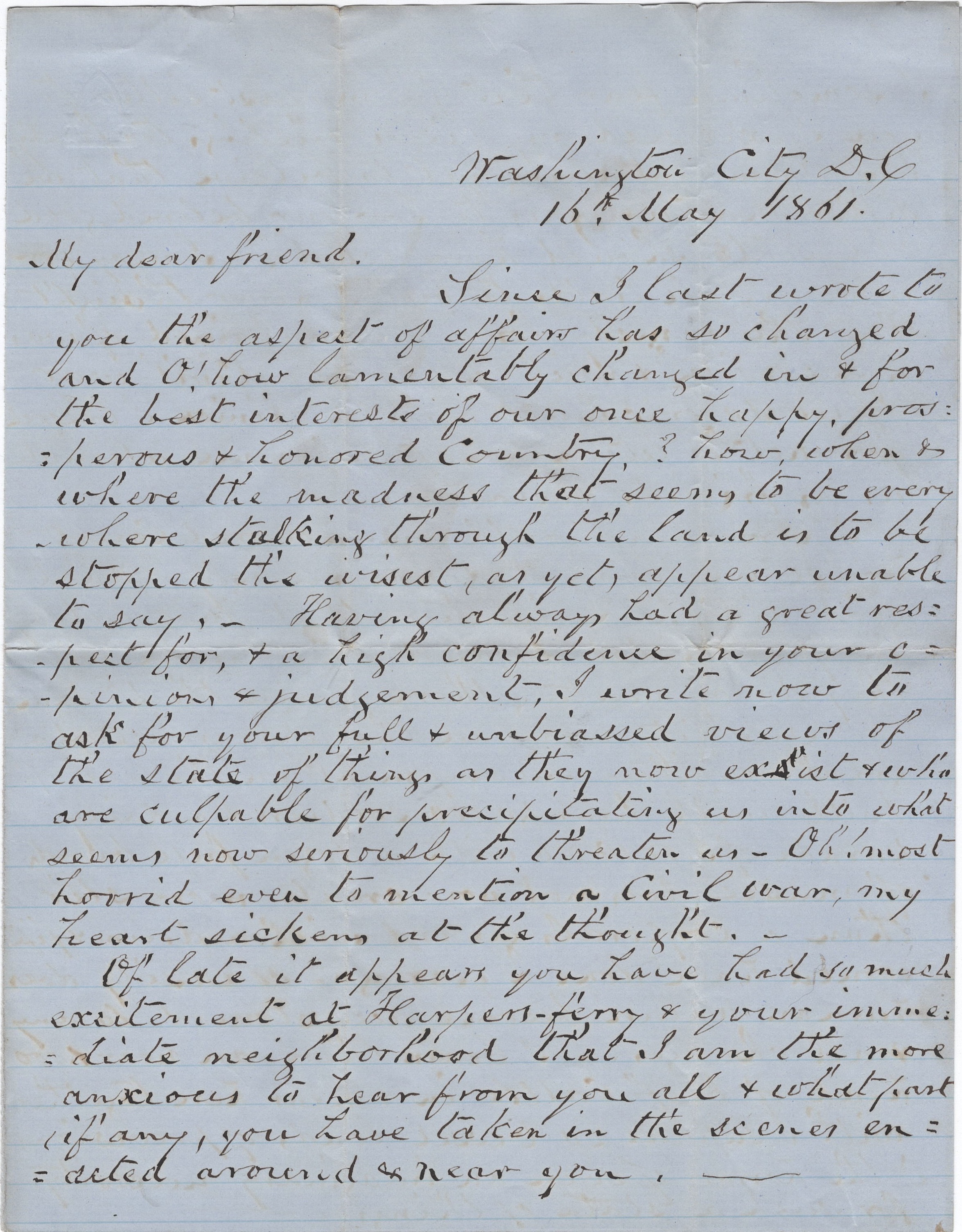
16th May 1861
My dear friend,
Since I last wrote to you, the aspect of affairs has so changed and O! how lamentably changed in and for the best interests of our once happy, prosperous and honored country? How, when and where the madness that seems to be everywhere stalking through the land is to be stopped, His wisest (as yet) appear unable to say. Having always had a great respect for & a high confidence in your opinions and judgment, I write now to ask for your full and unbiased views of the state of things as they now exist and who are culpable for precipitating us into what seems now seriously to threaten us. Oh! most horrid even to mention a Civil war. My heart sickens at the thought.
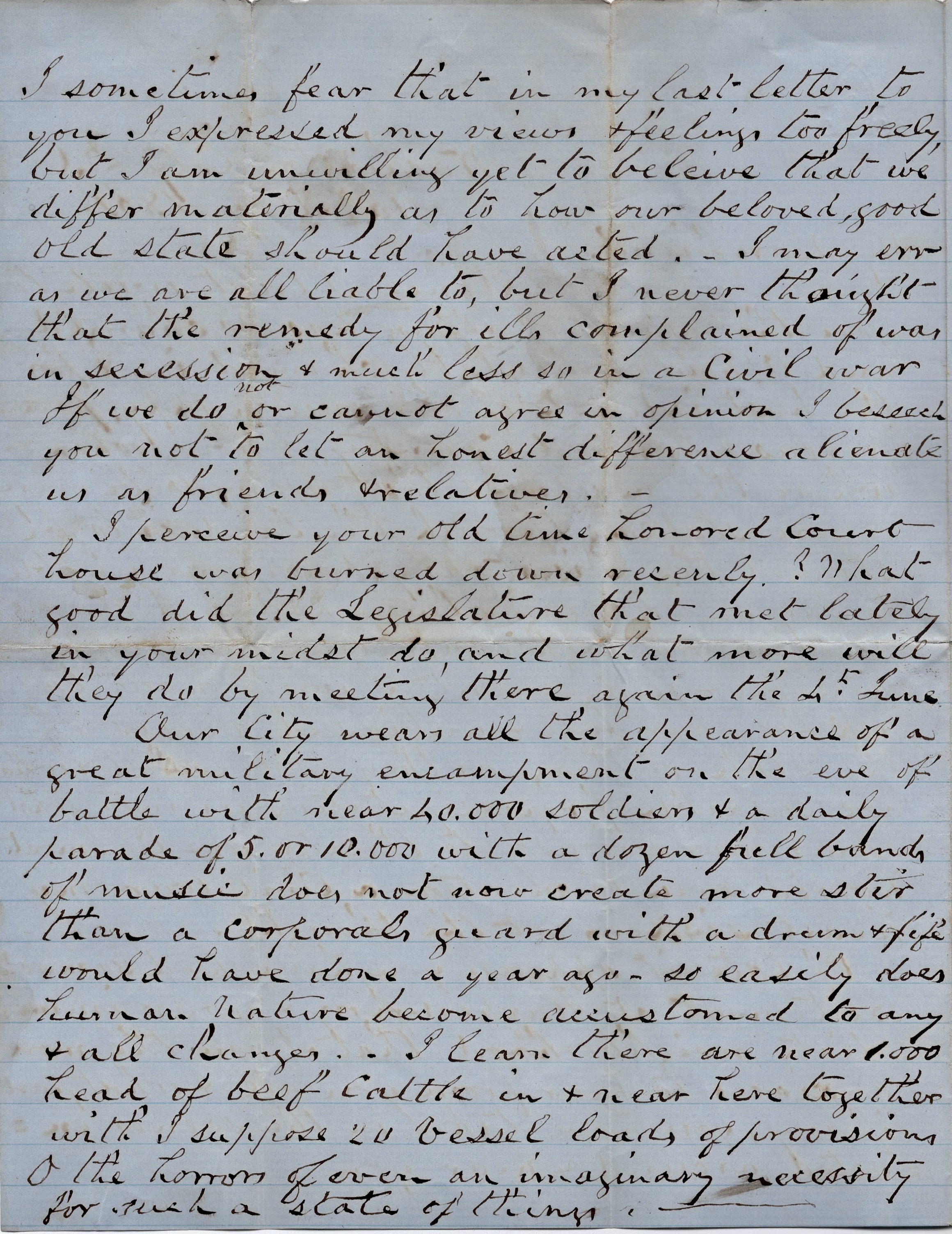
Of late it appears you have had so much excitement at Harpers Ferry & your immediate neighborhood that I am the more anxious to hear from you all and what part, if any, you have taken in the scenes conducted around and near you. I sometimes fear that in my last letter to you, I expressed my views & feelings too freely but I am unwilling yet to believe that we differ materially as to how our beloved, good old state should have acted. I may err as we are all liable to, but I never thought that the remedy for ills complained of was in secession & much less so in a Civil war. If we do not or cannot agree in opinion, I beseech you not to let an honest difference alienate us as friends & relatives.
I perceive your old time honored courthouse was burned down recently. What good did the Legislature that met lately in your midst do, and what more will they do by meeting there again the 4th of June?
Our city wears all the appearance of a great military encampment on the eve of battle with near 40,000 soldiers and a daily parade of 5 or 10,000 with a dozen full bands of music does not now create more stir than a corporal’s guard with a drum & fife would have done a year ago—so easily does human nature become accustomed to any and all changes. I learn there are near 1,000 head of beef cattle in and near here together with I suppose 20 vessel loads of provisions. O the horrors of even an imaginary necessity for such a state of things.
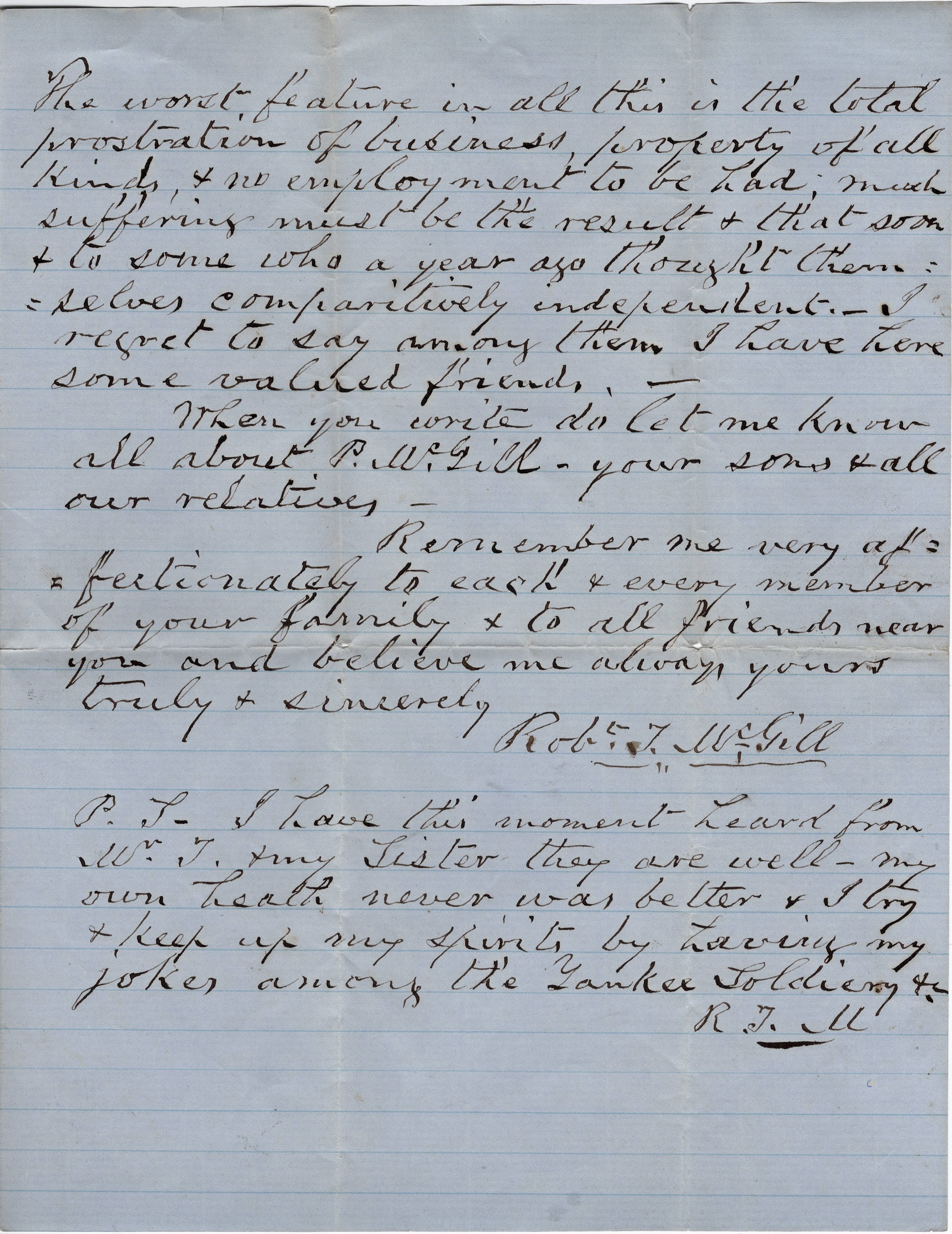
The worst feature in all this is the total prostration of business, property of all kinds, and no employment to be had; much suffering must be the result & that soon & to some who a year ago thought themselves comparatively independent, I regret to say among them I have here some valued friends.
When you write, do let me know all about P. McGill, your son,s, and all our relatives. Remember me very affectionately to each and every member of your family and to all friends near you and believe me always yours, truly and sincerely, — Robt. T. McGill
P. S. I have this moment eard from Mr. T & my sister. They are well. My own health never was better and I try and keep up my spirits by having my jokes among the Yankee Soldiery, &c. — R. T. M
Letter 13
Washington City, D. C.
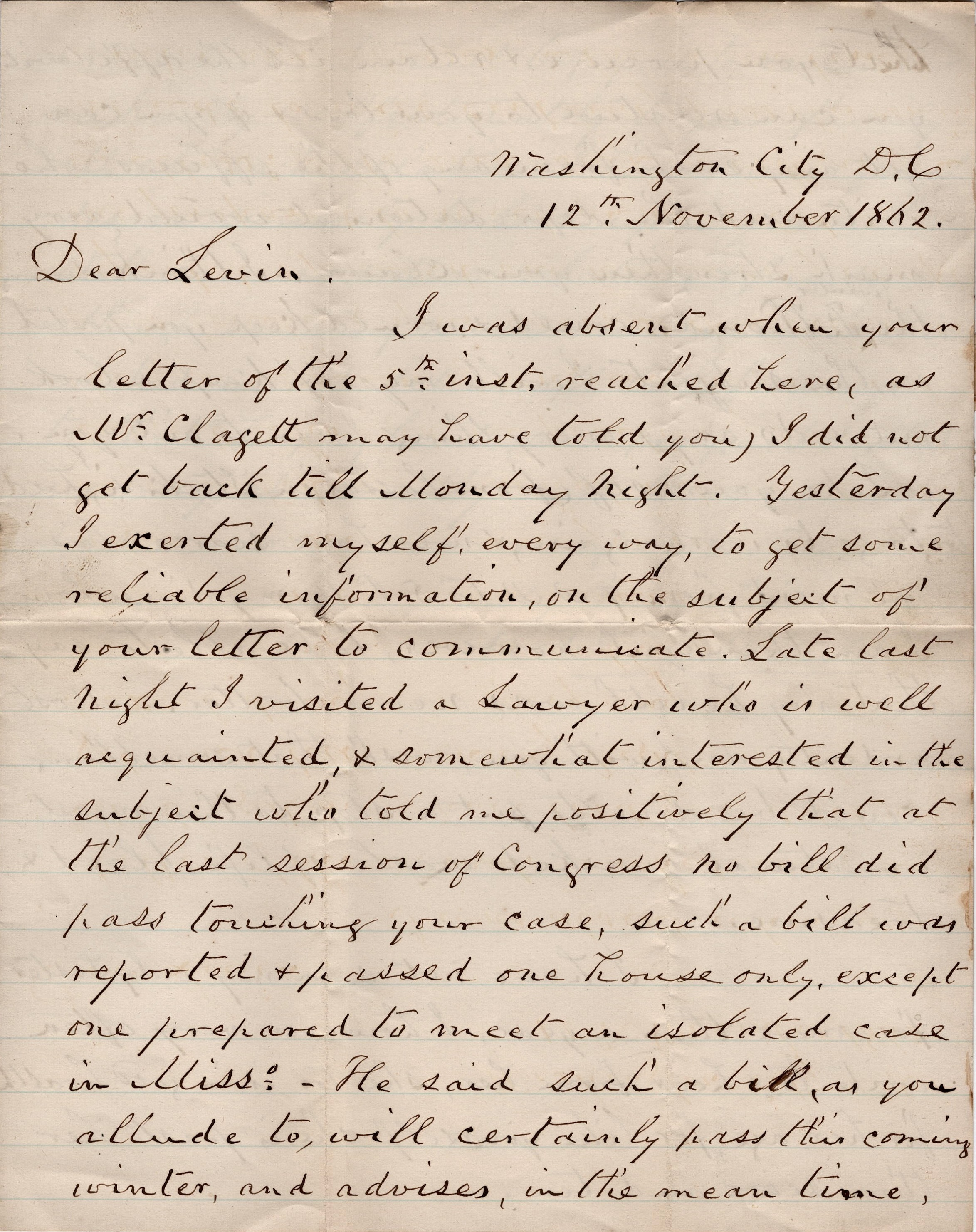
12th November 1862
Dear Levin,
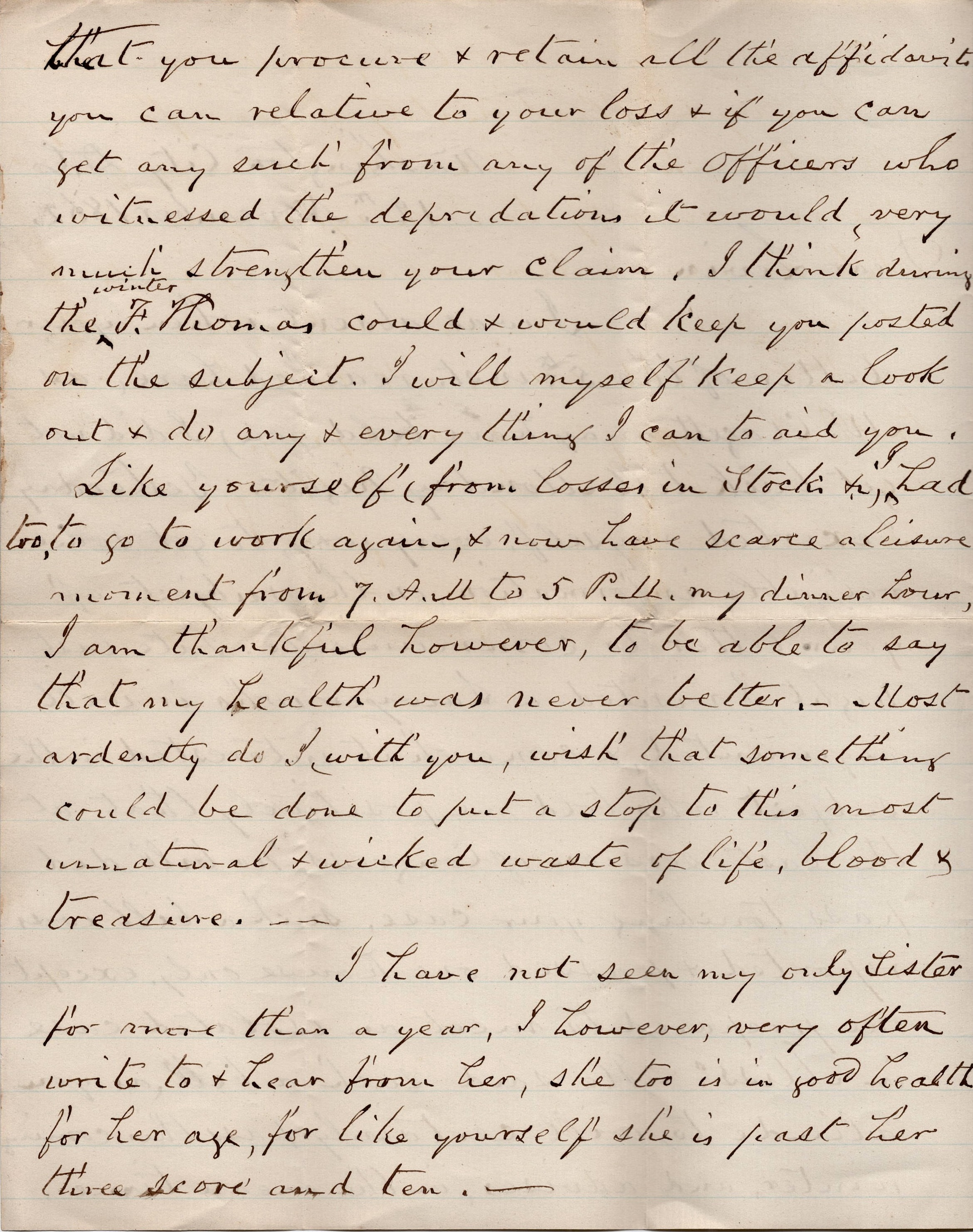
I was absent when your letter of the 5th inst. reached here, as Mr. Clagett may have told you. I did not get back till Monday night. Yesterday I exerted myself every way to get some reliable information on the subject of your letter to communicate. Late last night I visited a lawyer who is well acquainted and somewhat interested in the subject who told me positively that at the last session of Congress, no bill did pass touching your case. Such a bill was reported and passed one house only, except one prepared to meet an isolated case in Missouri. He said such a bill as you allude to will certainly pass this coming winter and advises in the meantime that you procure and retain all the affidavits you can relative to your loss, and if you can et any such from any of the officers who witnessed the depredations, it would very much strengthen your claim.
I think during the winter, F. Thomas could & would keep you posted on the subject. I will myself keep a look out and do any and everything I can to aid you. Like yourself (from losses in stock, &c.) I had too to go to work again and now have scarce a leisure moment from 7 a.m. to 5 p.m., my dinner hour. I am thankful, however, to be able to say that my health was never better. Most ardently do I (with you) wish that something could be done to put a stop to this most unnatural and wicked waste of life, blood and treasure.
I have not seen my only sister for more than a year. I however very often write to and hear from her. She too is in good health for her age, for like yourself, she is past her three score and ten.
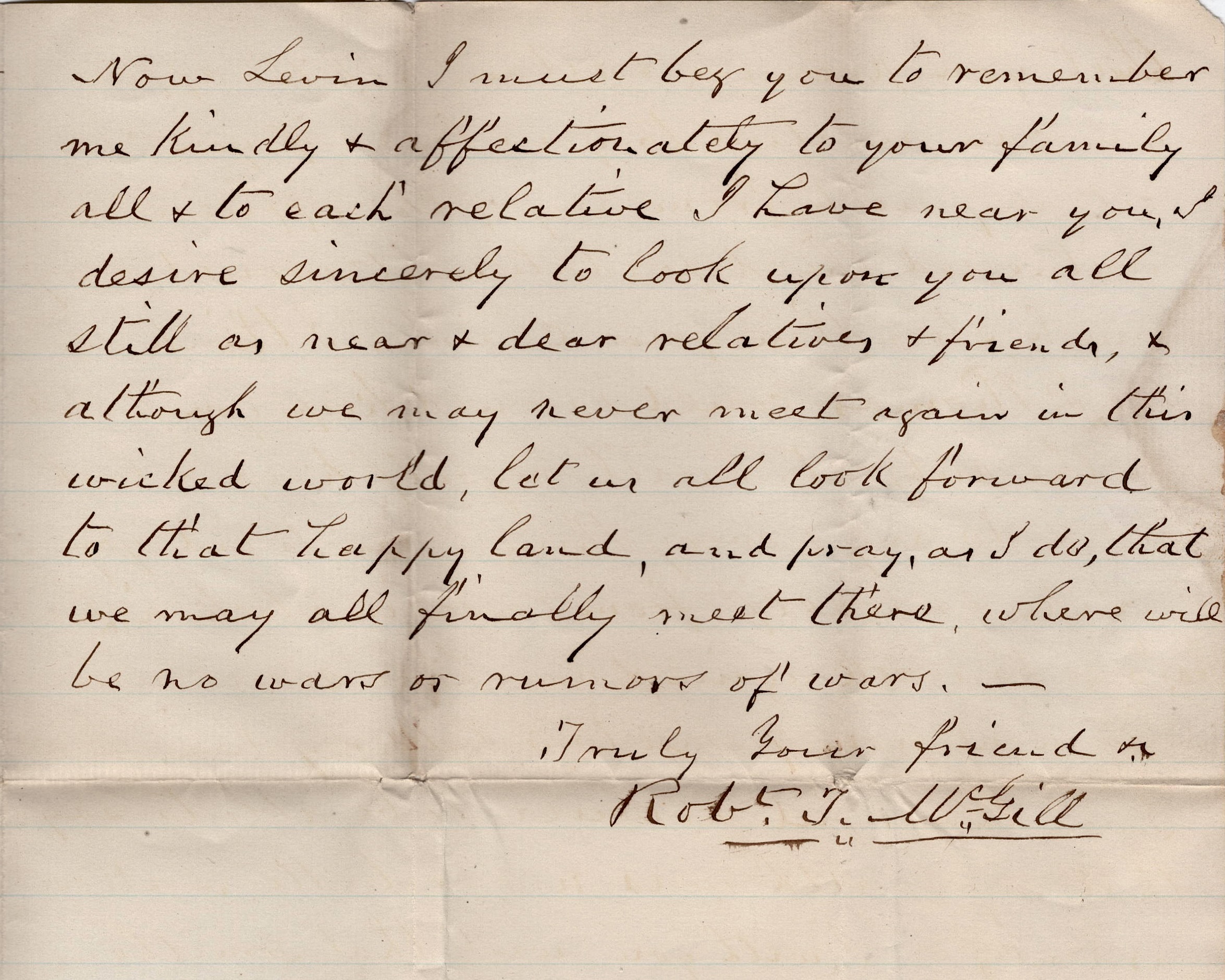
Now Levin, I must beg you to remember me kindly and affectionately to your family all and to each relative I have near you. I desire sincerely to look upon you all still as near and dear relatives and friends, and although we may never meet again in this wicked world, let us look forward to that happy land, and pray, as I do, that we may all finally meet there, where there will be no wars or rumors of wars. Truly your friend, &c, — Robt. T. McGill
Letter 14
Washington City, D. C.
18th November 1862
Dear Levin,
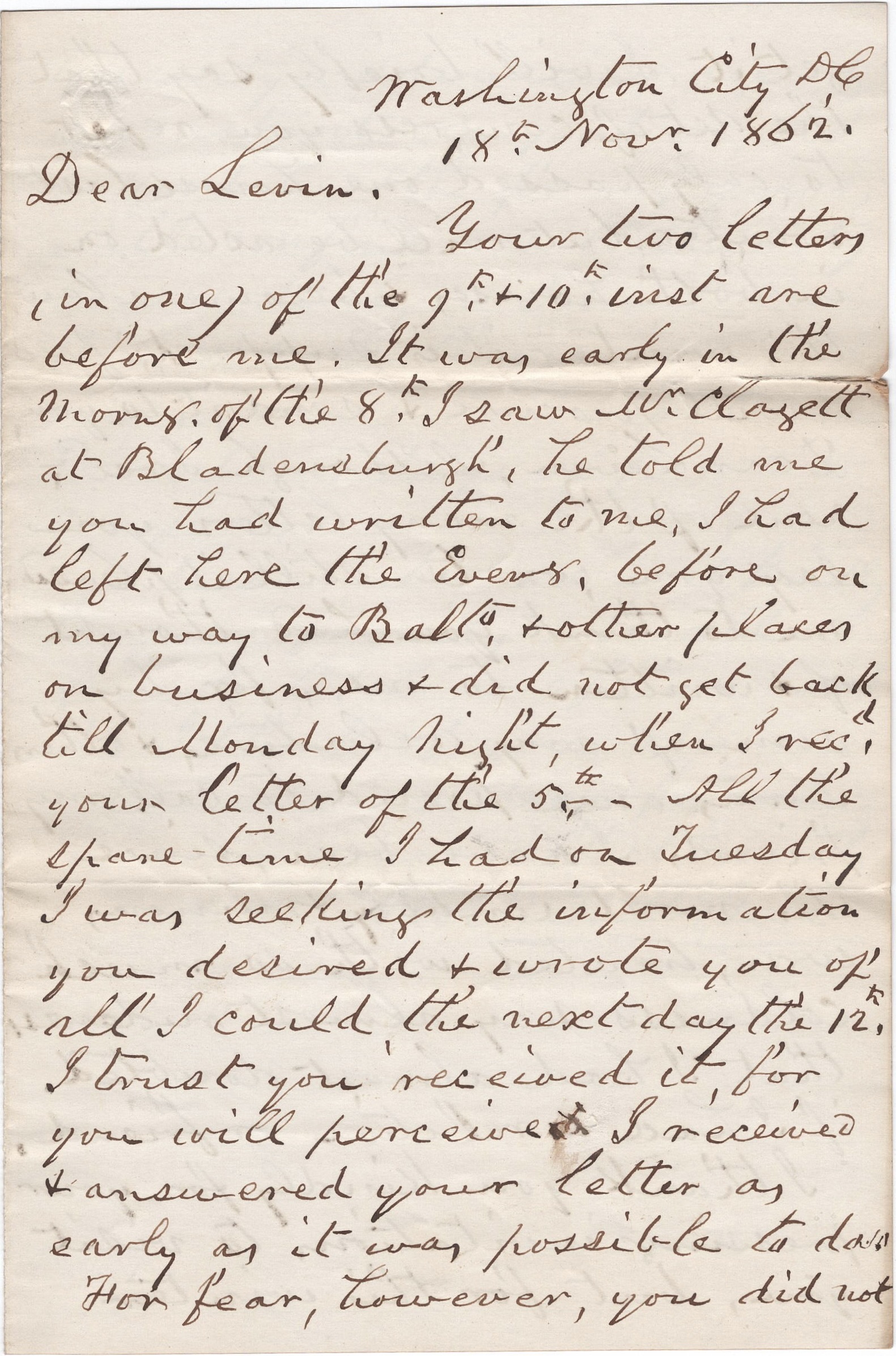
Your two letters (in one) of the 9th and 10th inst. are before me. It was early in the morning of the 8th I saw Mr. Clagett at Bladensburgh. He told me you had written to me. I had left here the evening before on the way to Baltimore and other places on business and did not get back till Monday night when I received your letter of the 5th. All the spare time I had on Tuesday I was seeking the information you desired and wrote you of all I could the next day of the 12th.
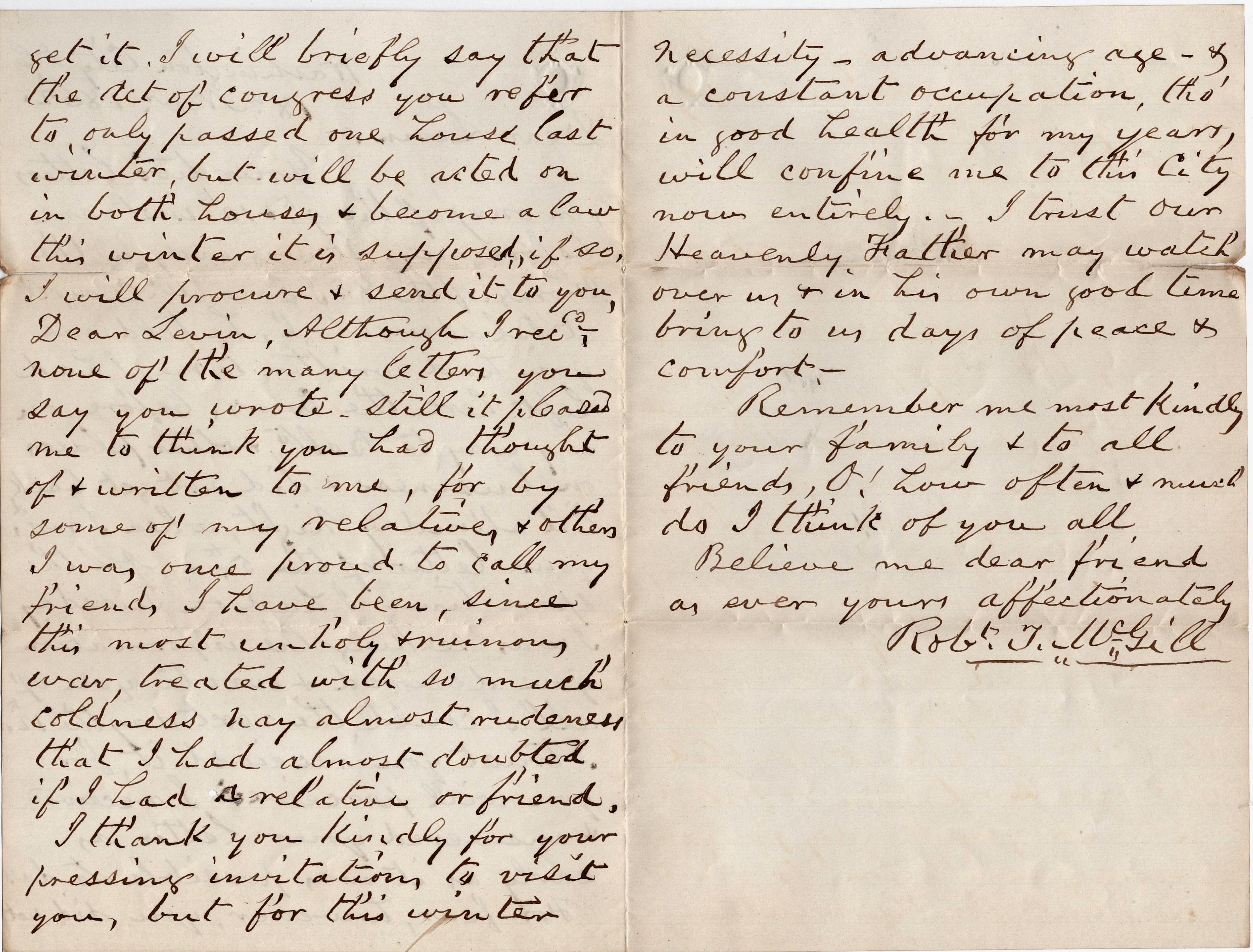
I trust you received it for you will perceive I received and answered your letter as early as it was possible to do so. For fear, however, you did not get it, I will briefly say that the Act of Congress you refer to only passed one house last winter, but will be acted on in both houses & become a law this winter, it is supposed. If so, I will procure & send it to you.
Dear Levin, although I received none of the many letters you say you wrote, still it pleases me to think you had thought of and written to me, for by some of my relatives & others I was once proud to call my friends, I have been since this most unholy & ruinous war, treated with so much coldness—nay, almost rudeness, that I had almost doubted if I had a relative or friend. I thank you kindly for your pressing invitation to visit you, but for this winter, necessity, advancing age, and a constant occupation (though in good health for my years), will confine me to this city now entirely. I trust our Heavenly Father may watch over us and in His own god time, bring to us days of peace and comfort.
Remember me most kindly to your family and to all friends. Oh! how often and much do I think of you all. Believe me dear friend, as ever yours affectionately, — Robt. T. McGill
Letter 15
Washington City, D. C.
21st December 1862
Dear Levin,
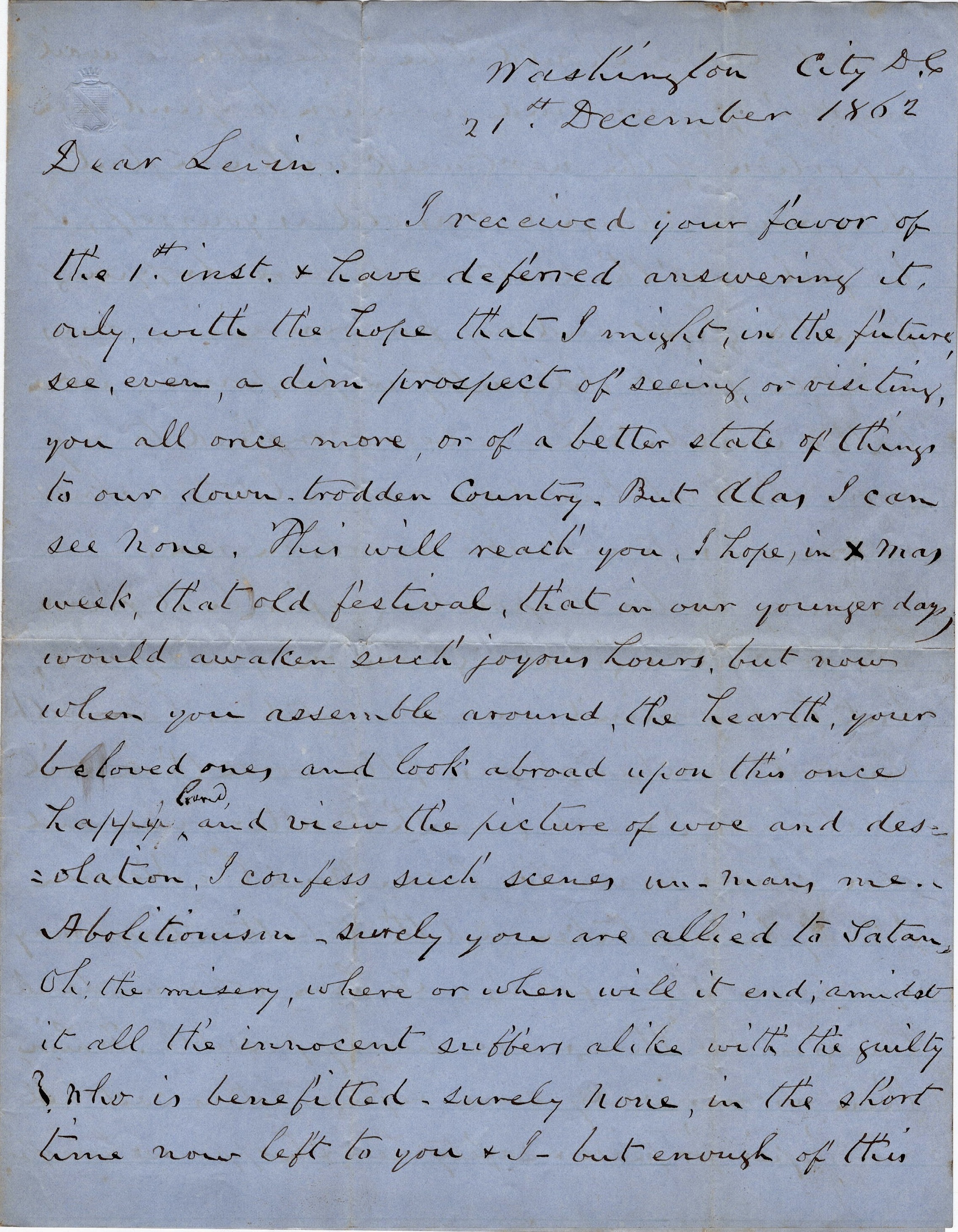
I received your favor of the 1st inst. and have deferred answering it, only with the hope that I might in the future see even a dim prospect of seeing or visiting you all once more, or of a better state of things to our down-trodden country. But alas! I can see none. This will reach you, I hope, in xmas week—that old festival that in our younger days would awaken such joyous hours. But now when you assemble around the hearth your beloved ones, and look abroad upon this once happy land and view the picture of woe and desolation, I confess such scenes unman me. Abolitionism—surely you are allied to Satan. Oh! the misery, where and when will it end? Amidst it all the innocent suffers alike with the guilty. Who is benefitted? Surely none in the short time now left to you and I. But enough of this.
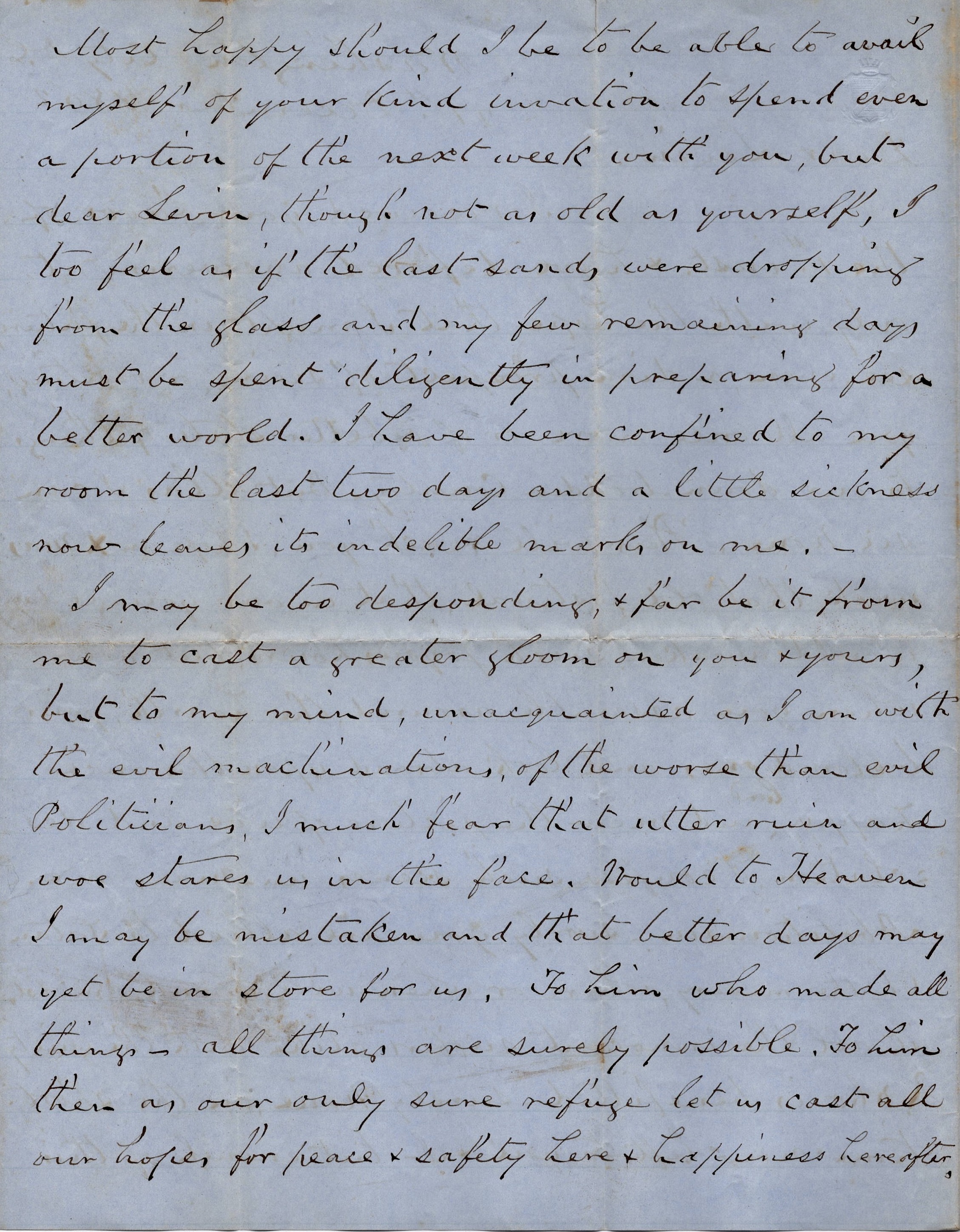
Most happy should I be to be able to avail myself of your kind invitation to spend even a portion of the next week with you, but dear Levin, though not as old as yourself, I too feel as if the last sands were dropping from the glass and my few remaining days must be spend diligently in preparing for a better world. I have been confined to my room the last two days and a little sickness now leaves its indelible marks on me.
I may be too desponding and far be it from me to cast a greater gloom on you and yours, but to my mind, unacquainted as I am with the evil machinations of the worse than evil politicians, I much fear that utter ruin and woe stares us in the face. Would to Heaven I may be mistaken and that better days may yet be in store for us. To Him who made all things—all things are surely possible. To Him then as our only sure refuge, let us cast our hopes for peace and safety here and happiness hereafter.
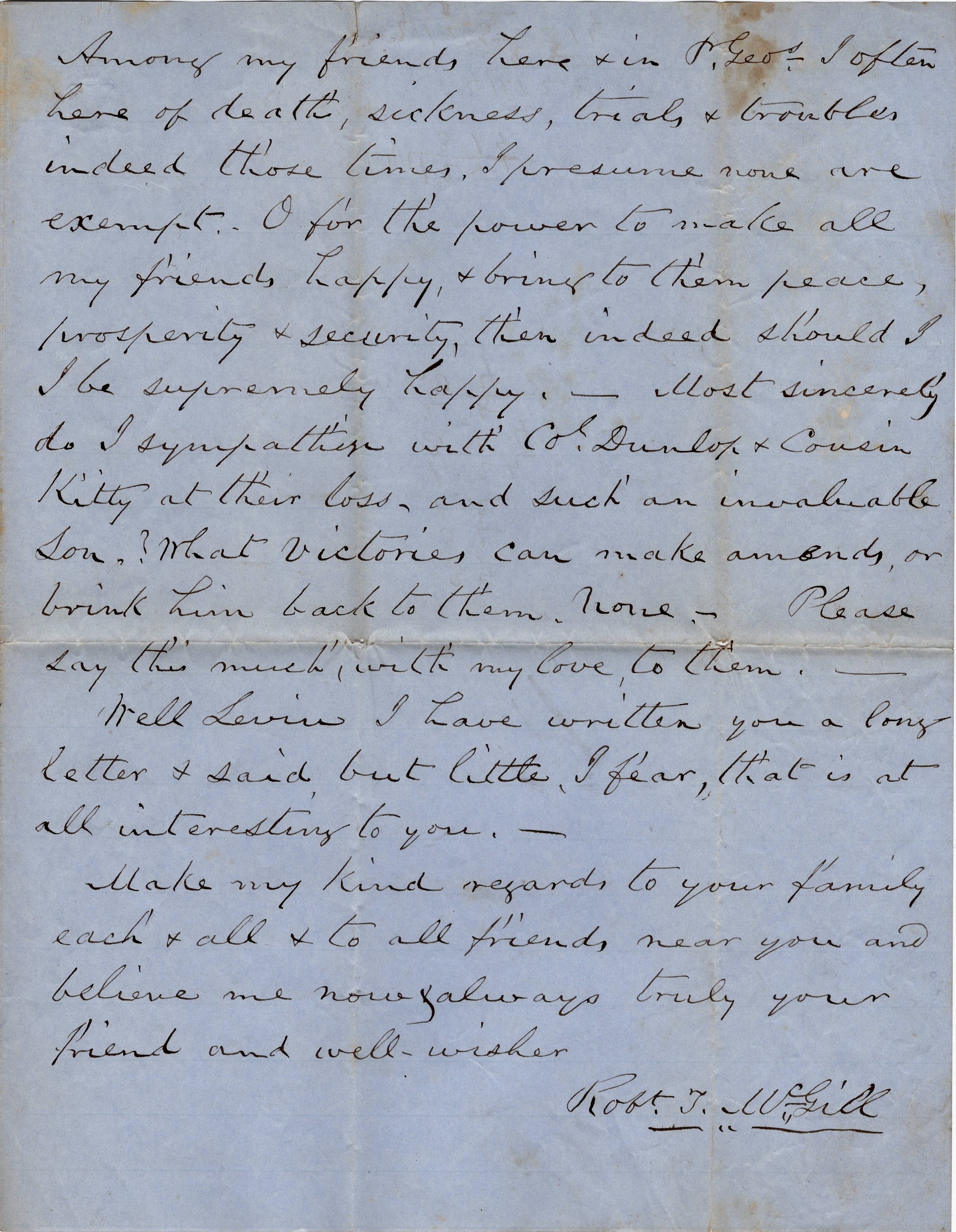
Among my friends here in [ ], I often hear of death, sickness, trials and troubles. Indeed, those time, I presume none are exempt. O for the power to make all friends happy and bring to them peace, prosperity and security. Then indeed should I be supremely happy. Most sincerely do I sympathize with Col. Dunlop & cousin Kitty at their loss, and such and invaluable son. What victories can make amends or bring him back to them? None. Please say this much, with my love tho them.
Well, Levin, I have written you a long letter and said but little, I fear, that is at all interesting to you. Make my kind regards to your family each and all and to all friends near you and believe me now and always truly your friend and well wisher. — Robt. T. McGill
Letter 16
Washington City, D. C.
Sunday evening, February 22nd, 1863
Dear Levin,
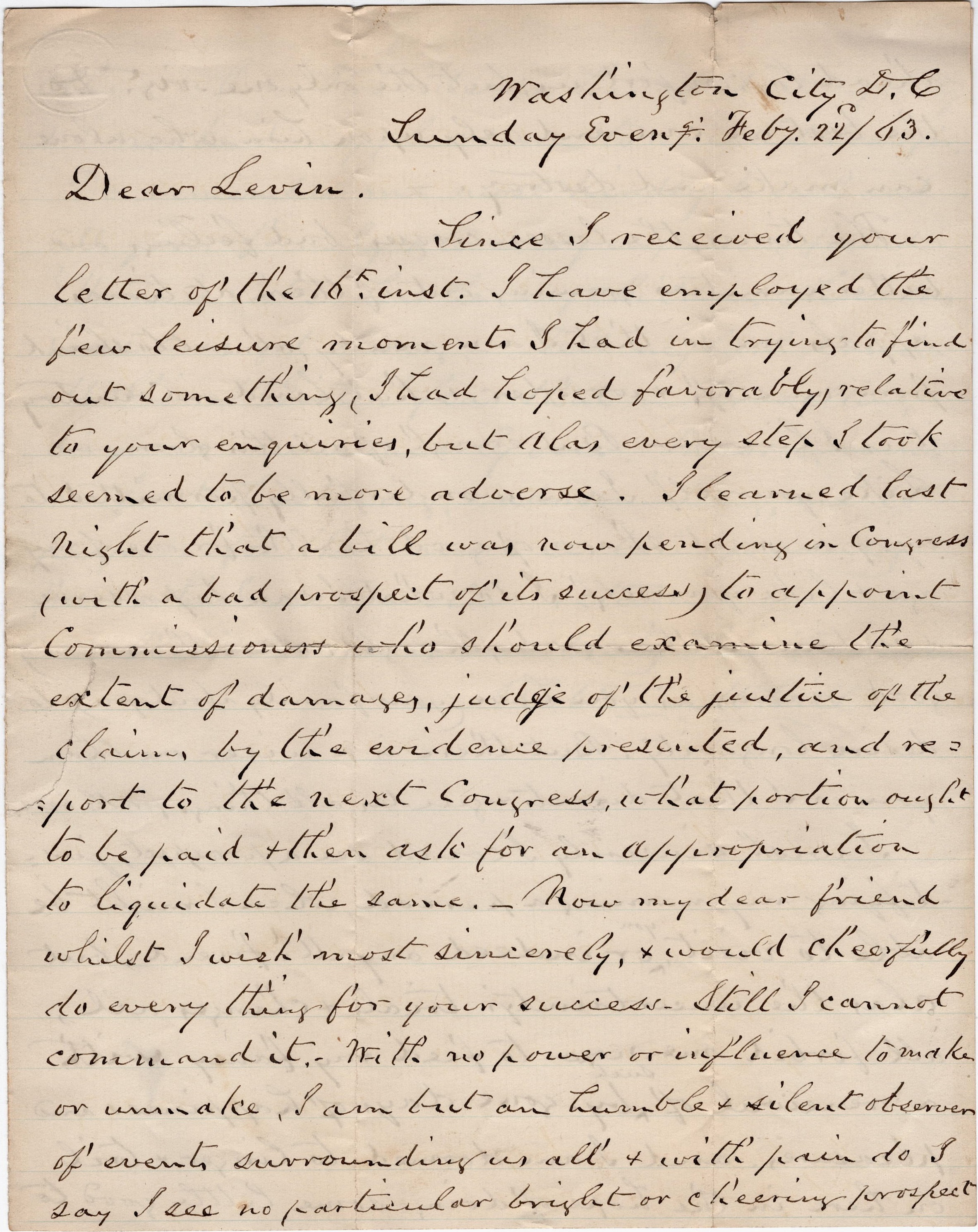
Since I received your letter of the 16th inst. I have employed the few leisure moments I had in trying to find out something (I had hoped favorably) relative to your enquiries, but alas! every step I took seemed to be more adverse. I learned last night that a Bill was now pending in Congress (with a bad prospect of its success) to appoint Commissioners who should examine the extent of damages, judge of the justice of the claims by the evidence presented, and report to the next Congress, what portion ought to be paid & then ask for an appropriation to liquidate the same. Now my dear friend, whilst I wish most sincerely & would cheerfully do everything for your success, still I cannot command it. With no power or influence to make or unmake, I am but an humble and silent observer of events surrounding us all, and with pain do I say I see no particular bright or cheering prospect ahead to comfort us, but the only one—viz: Do the best we can and rely upon Him who alone can make and destroy.
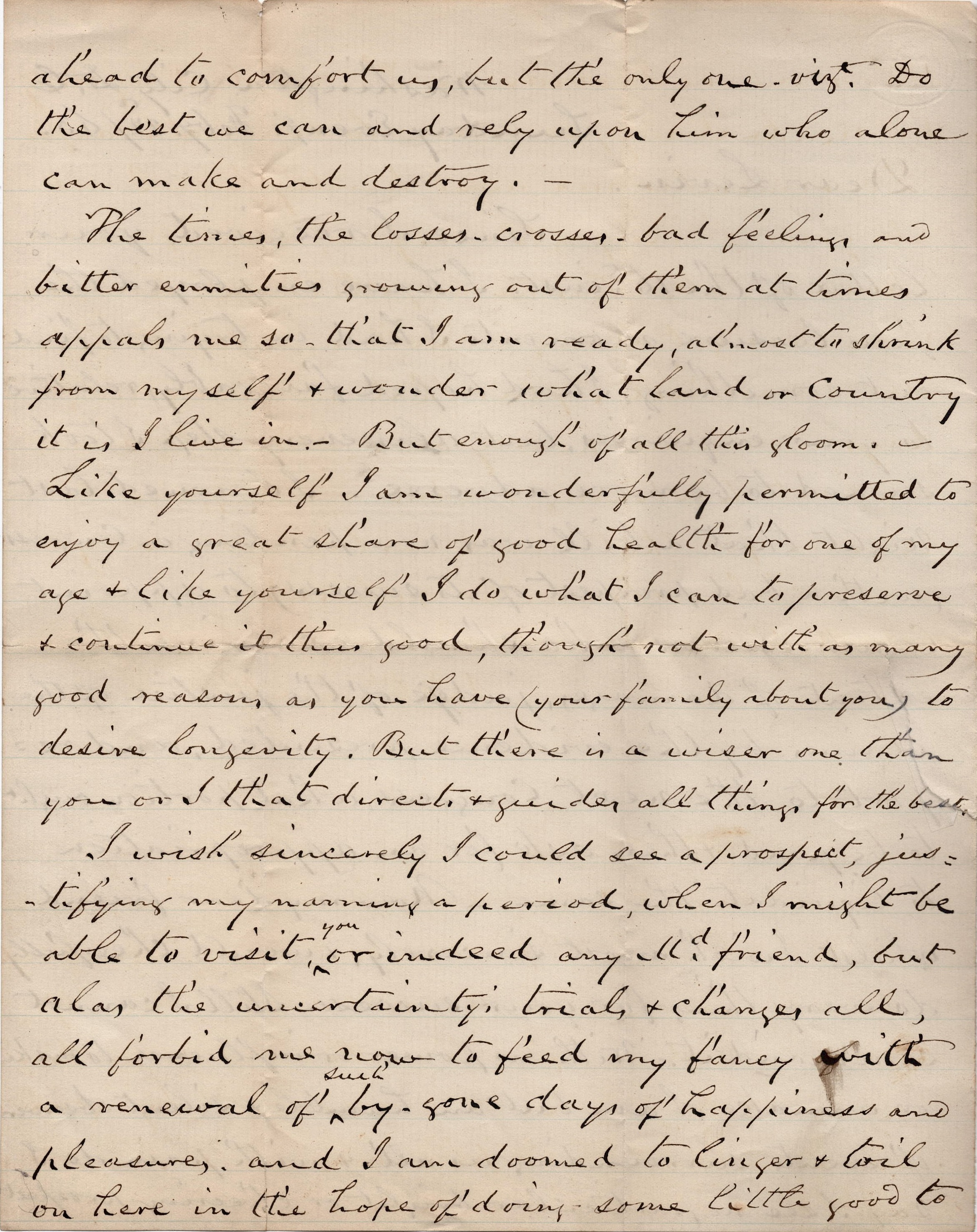
The times, the losses, crosses, bad feelings and bitter enmities growing out of them at times appalls me so that I am ready almost to shrink from myself & wonder what land or country it is I live in. But enough of all this gloom. Like yourself, I am wonderfully permitted to enjoy a great share of good health for one of my age and like yourself, I do what I can to preserve and continue it thus good, though not with as many good reasons as you have (your family about you) to desire longevity. But there is a wiser one than you or I that directs and guides all things for the best.
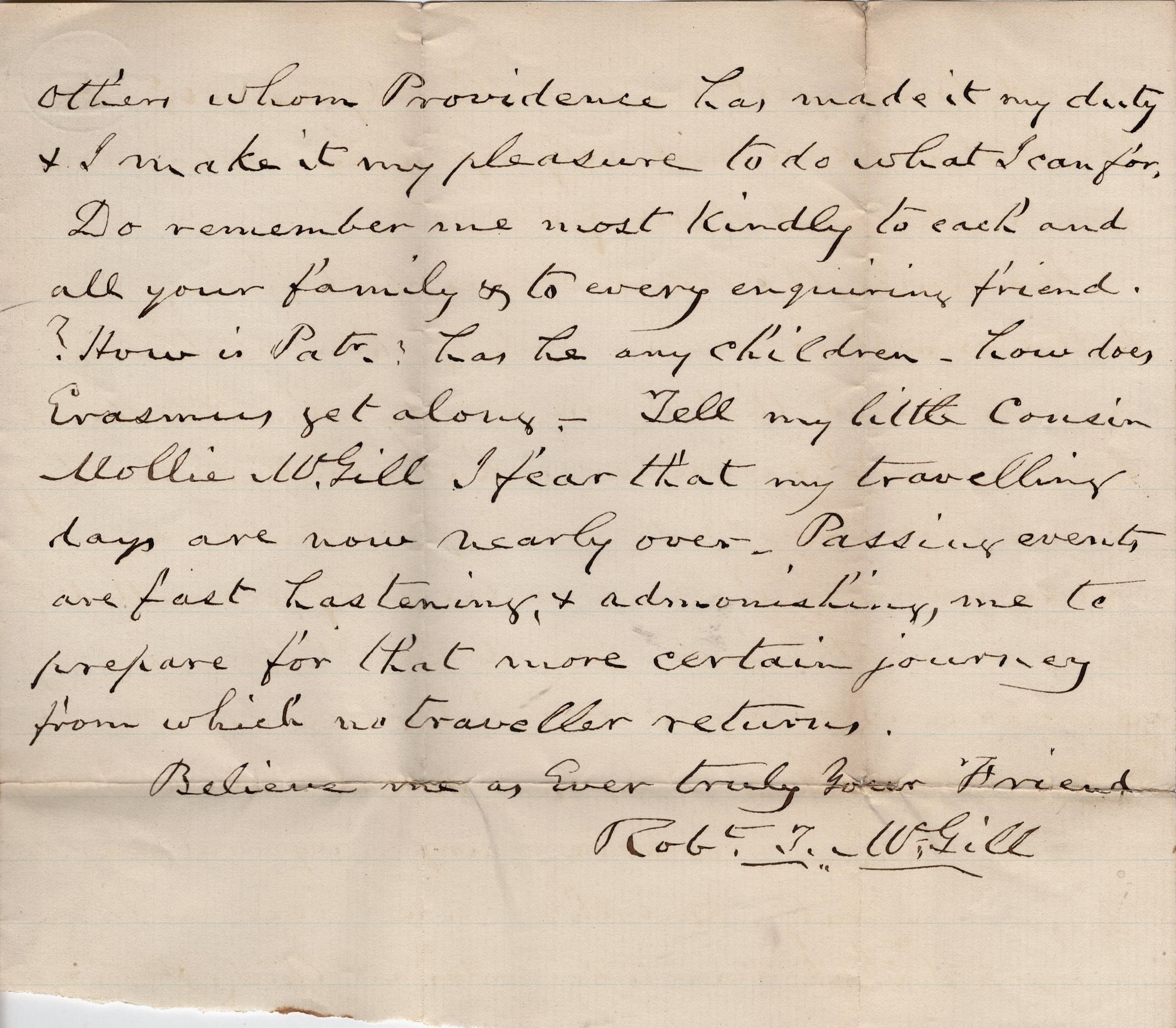
I wish sincerely I could see a prospect justifying my naming a period when I might be able to visit you or indeed any Maryland friends but alas! the uncertainty, trials and changes all, all forbid me now to feed my fancy with a renewal of such bygone days of happiness and pleasure, and I am doomed to linger and toil on here in the hope of doing some little good to others who Providence has made it my duty and I make it my pleasure to do what I can for.
Do remember me most kindly to each and all your family & to every enquiring friend. How is Parick? Has he any children? How does Erasmus get along? Tell my little cousin Mollie McGill I fear that my traveling days are now nearly over. Passing events are fast hastening and admonishing me to prepare for that more certain journey from which no traveler returns.
Believe me as ever truly your friend, — Robt. T. McGill
Letter 17
Washington City, D. C.
26th July 1863
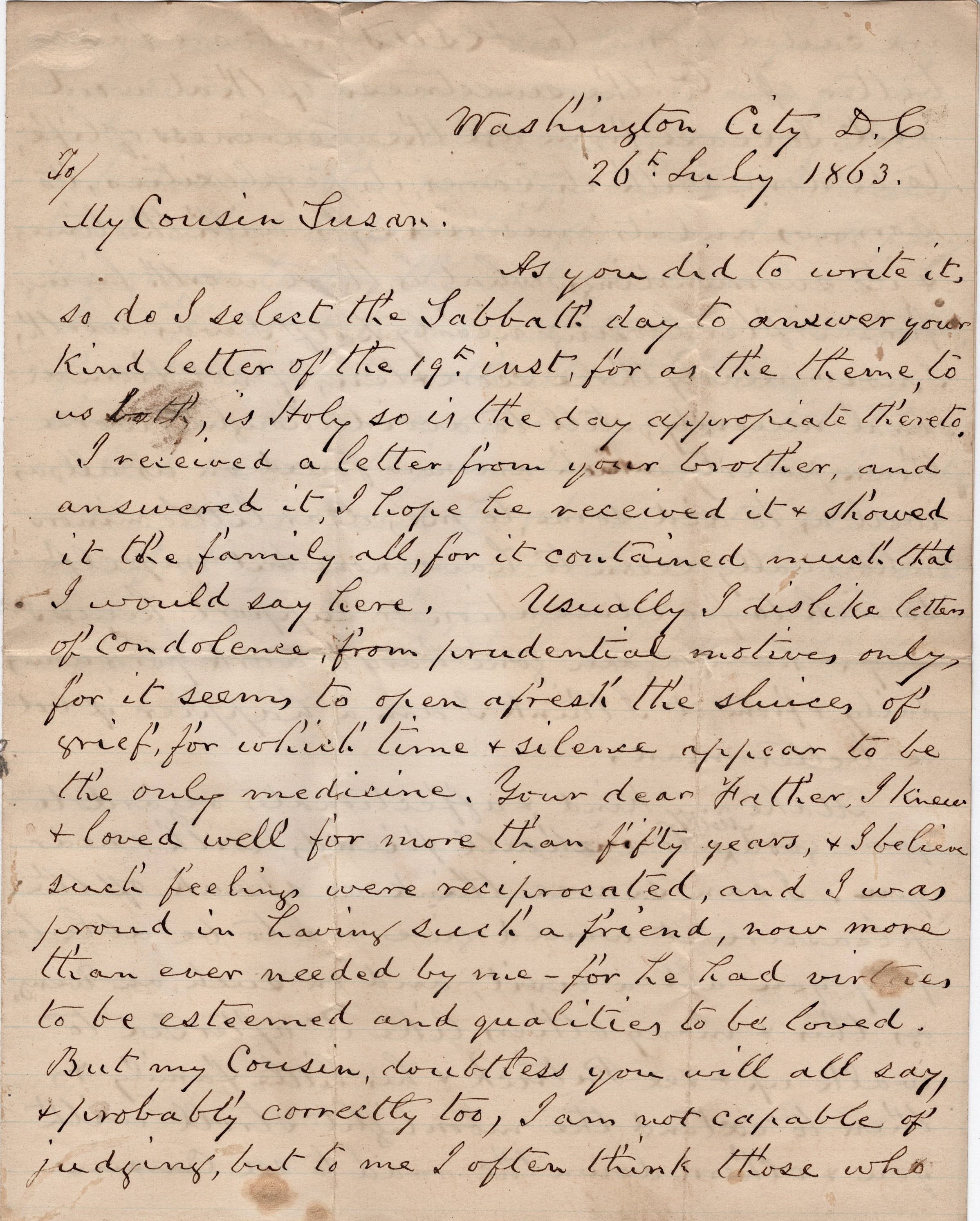
My cousin Susan,
As you did to write it, so so I select the Sabbath day to answer your kind letter if the 19th inst. for as the theme to us both, is Holy, so is the day appropriate thereto.
I received a letter from your brother and answered it. I hope he received it and showed it to the family all, for it contained much that I would say here. Usually I dislike letters of condolence from prudential motives only, for it seems to open afresh the sluice of grief for which time and silence appear to be the only medicine. your dear Father I knew and loved well for more than fifty years, and I believe such feelings were reciprocated, and I was proud in having such a friend, now more than ever needed by me, for he had virtues to be esteemed and qualities to be loved.
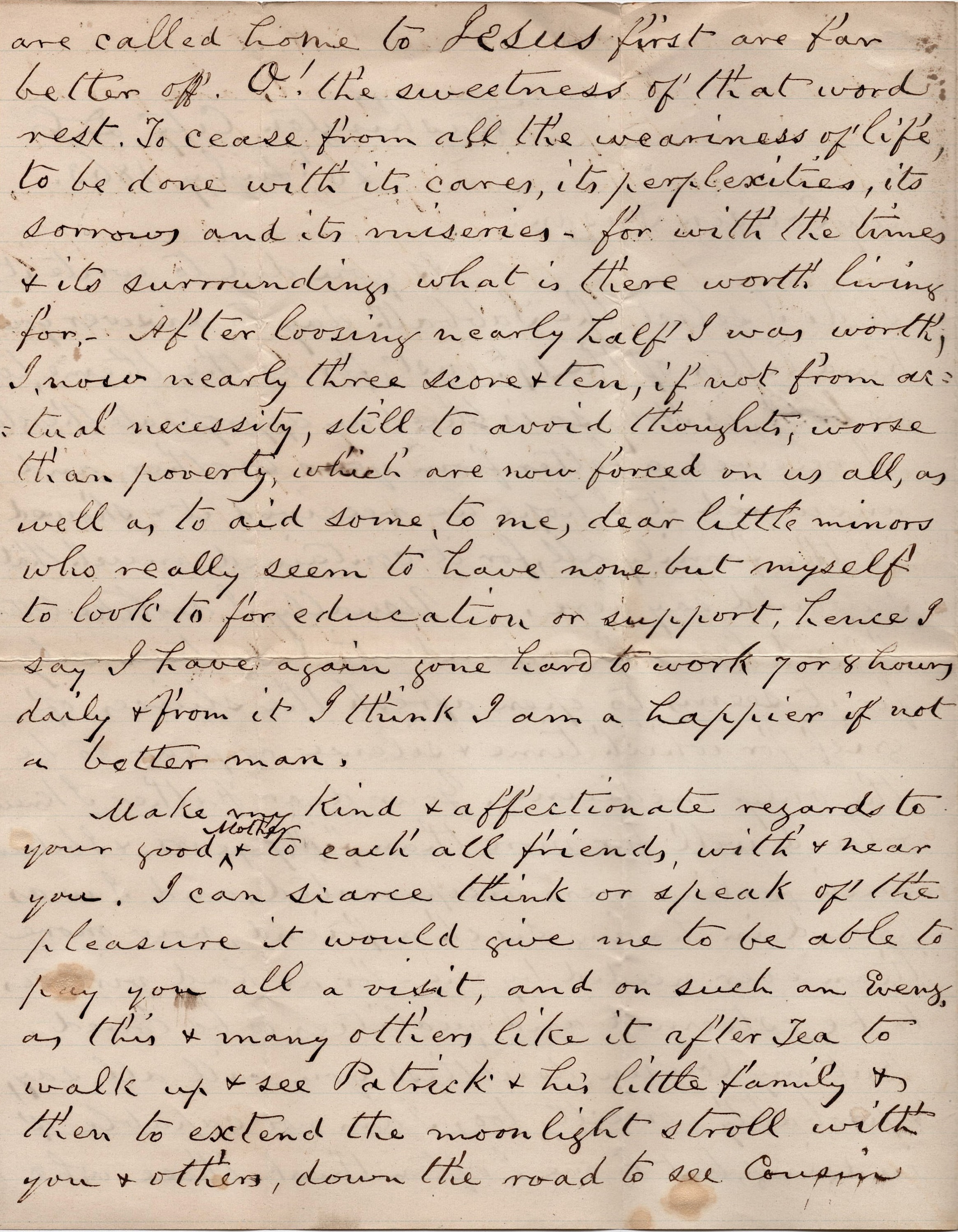
But my cousin, doubtless you will say & probably correctly too, I am not capable of judging, but to me I often think those who are called home to Jesus first are far better off. O! the sweetness of that word—rest. To ceasse from all the weariness of life, to be done with its cares, its perplexities, its sorrows, and its miseries. For with the times and its surroundings, what is there worth living for? After losing nearly half I was worth, I now nearly three score and ten, if not from actual necessity, still to avoid thoughts worse than poverty, which are now forced on us all, as well as to aid some to me dear little minors who really seem to have none but myself to look to for education, or support, hence I say I have gone hard to work 7 or 8 hours daily and from it, I think, I am a happier if not a better man.
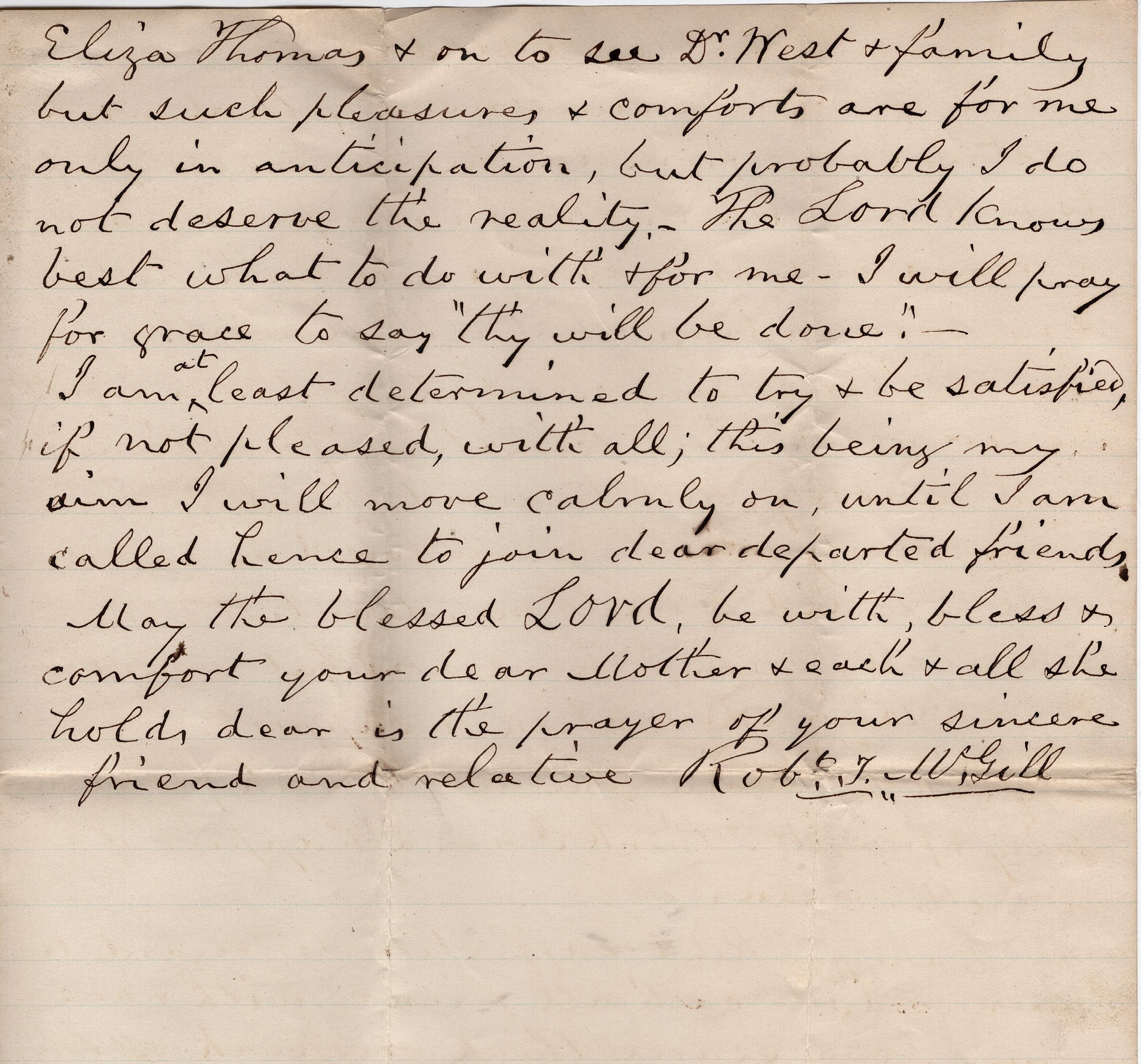
Make my kind and affectionate regards to your good Mother and to each and all friends with and near you. I can scarce think or speak of the pleasure it would give me to be able to pay you all a visit, and on such an evening as this and many others like it, after tea, to walk up and see Patrick and his little family & then to extend the moonlight stroll with you and others down the road to see cousin Eliza Thomas and on to see Dr. West and family. But such pleasures and comforts are for me only in anticipation, but probably I do not deserve the reality. The Lord knows best what to do with and for me. I will pray for grace to say, “Thy will be done.”
I am at least determined to try and be satisfied if not pleased with all—this being my aim, I will move calmly on until I am called hence to join our departed friends. May the blessed Lord be wi, bless and comfort your dear Mother and each and all she holds dear is the prayer of your sincere friend and relative, — Robt. T. McGill
Letter 18
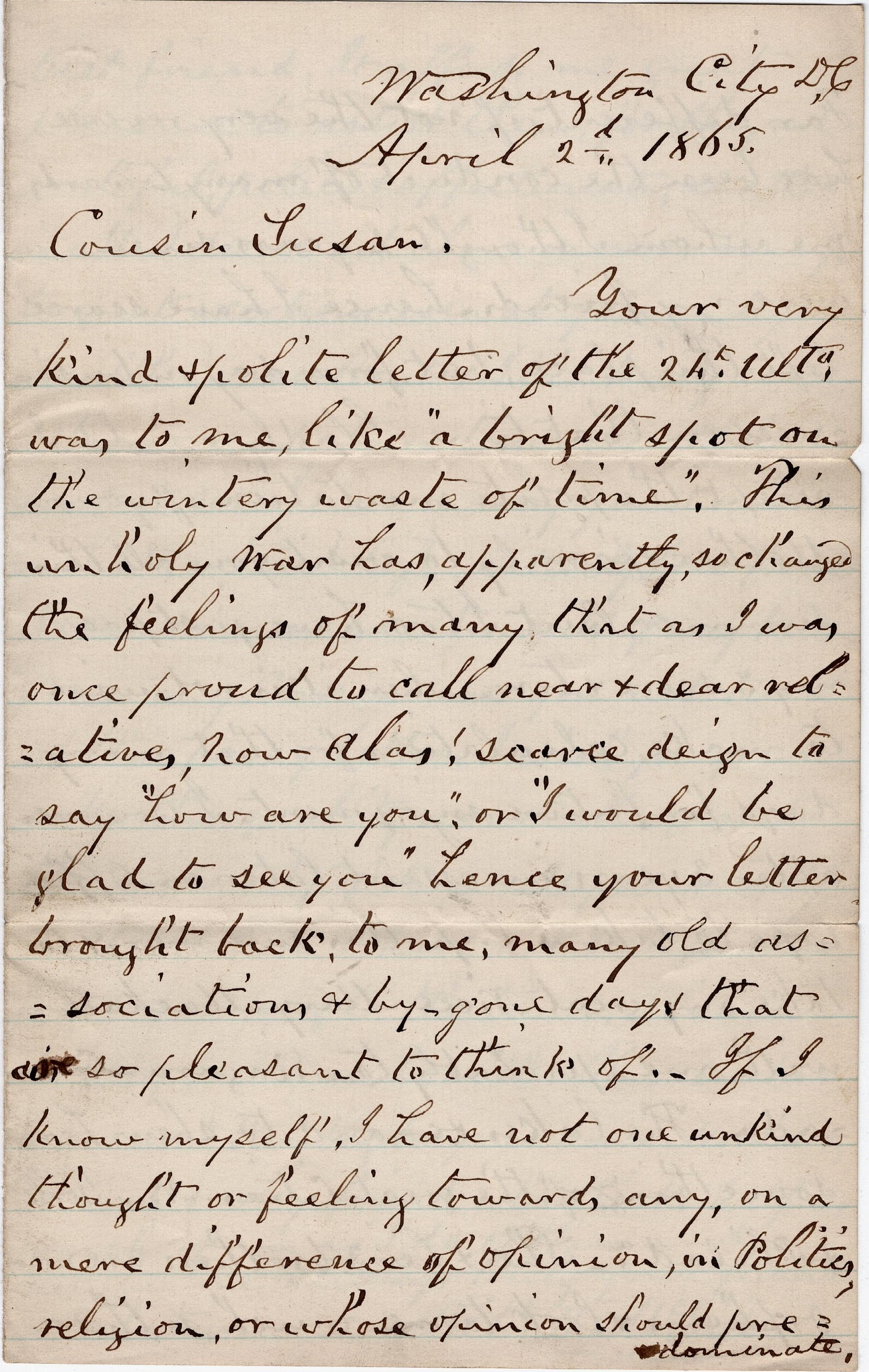
Washington D. C.
April 2nd 1865
Cousin Susan,
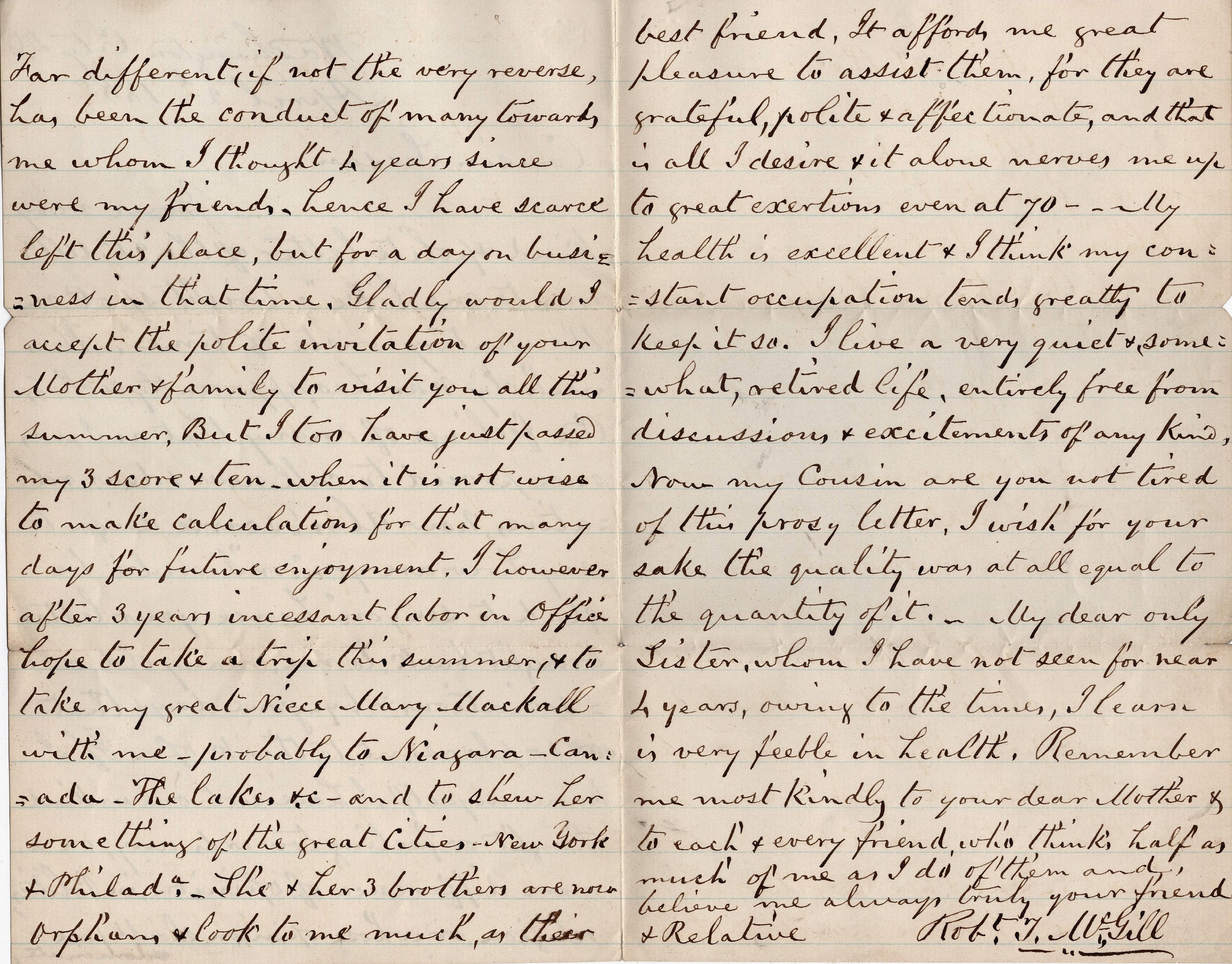
Your very kind and polite letter of the 25th ult. was to me like a bright spot on the wintery waste of time. This unholy war has apparently so changed the feelings of many that as I was once proud to call near and dear relatives, now alas! scarce deign to say “How are you? or “I would be glad to see you.” Hence, your letter brought back to me many old associations and bygone days that are so pleasant to think of. If I know myself, I have not one unkind thought or feelings towards any, on a mere difference of opinion in politics, religion, or whose opinion should predominate. Far different, if not the very reverse, has been the conduct of many towards me whom I thought 4 years since were my friends. Hence, I have scarce left this place but for a day on business in that time.
Gladly would I accept the polite invitation of your Mother and family to visit you all this summer. But I too have just passed my three score and ten, when it is not wise to make calculations for that many days for future enjoyment. I however, after three years incessant labor in office, hope to take a trip this summer and to take my great niece Mary Mackall with me—probably to Niagara, Canada, the Lakes, &c. and to show her something of the great cities—New York and Philadelphia. She and her three brothers are now orphans adn look to me much as their best friend. It affords me great pleasure to assist them for they are grateful, polite, and affectionate, and that is all I desire, and it alone nerves me up to great exertions even at 70.
My health is excellent and I think my constant occupation tends greatly to keep it so. I live a very quiet and somewhat retired life, entirely free from discussions and excitements of any kind. Now, my cousin, are you not tired of this prosy letter? I wish for your sake the quality was at all equal to the quantity of it. My dear only sister, whom I have not seen for near 4 years owing to the times, I learn is very feeble in health. Remember me most kindly to your dear Mother and to each and every friend who thinks half as much of me as I do of them, and believe me always truly your friend and relative, — Robt. T. McGill
Some notes on family relationship recorded by Charles McGill before his death in 1859: