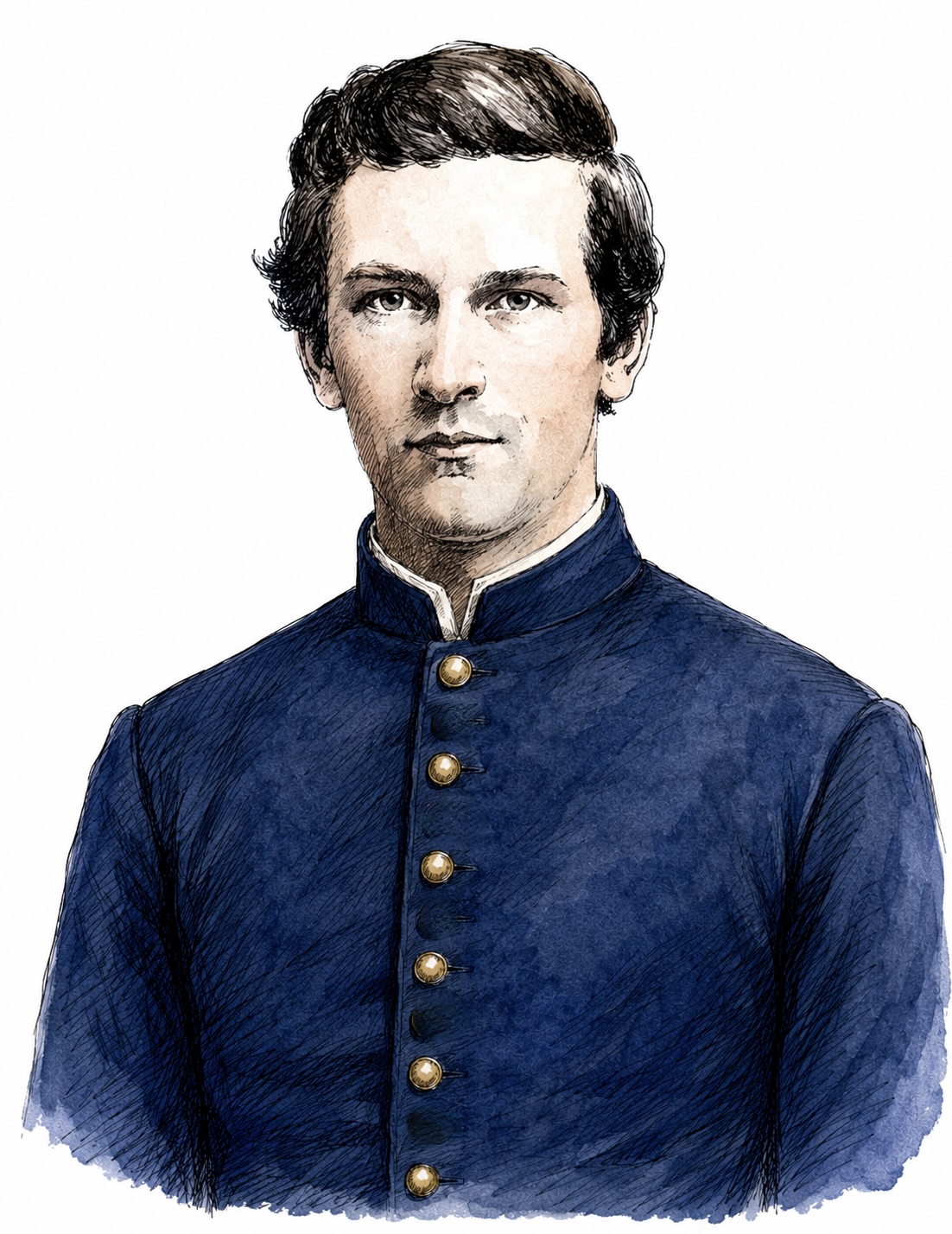
This letter was written by Joseph Henry Capen (1840-1867) of Boston, Massachusetts, to his brother Samuel Billings Capen. They were the sons of Samuel Childs Capen (1812-1879) and Ann Billings (1805-1864). Joseph was working as a clerk in Boston at the time of his enlistment as a private in Co. F, 44th Massachusetts Infantry in August 1862. The 44th Massachusetts—known as the “Second New England Guards“—was a nine-month regiment recruited heavily from the Boston area.
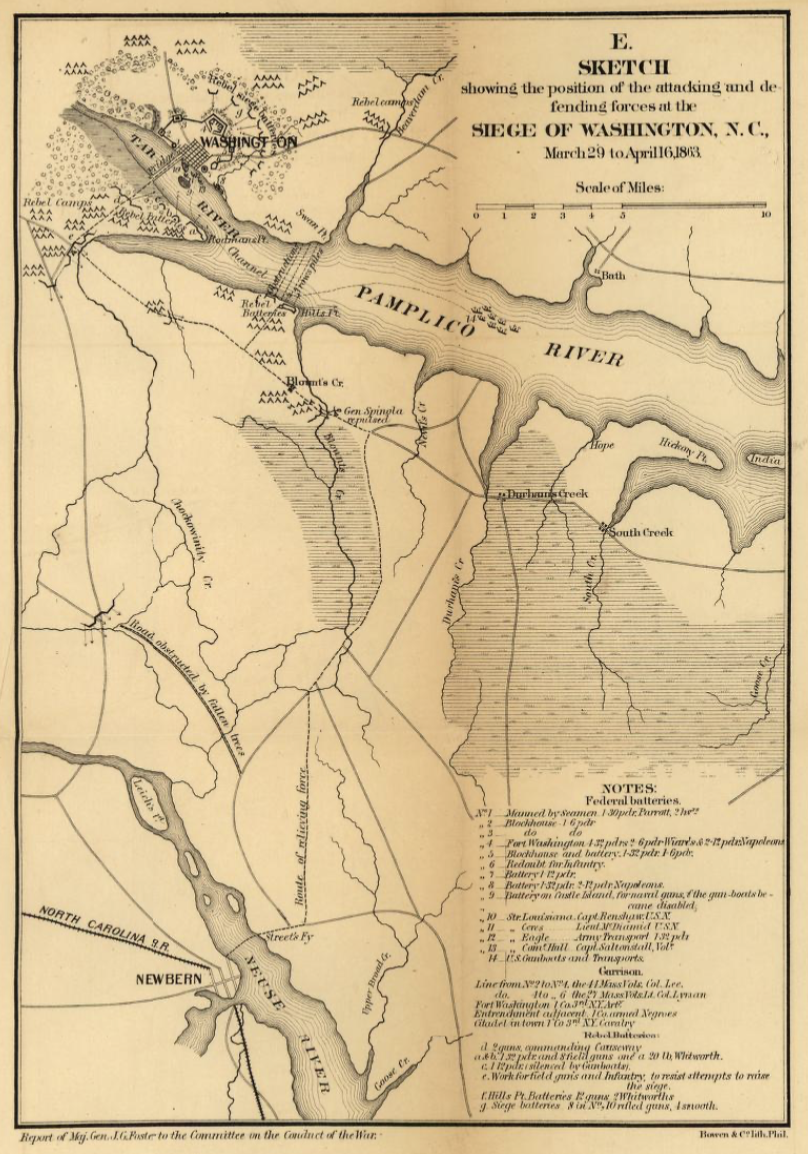
Joseph’s letter gives us incredible detail of his activities between March 26 and April 2, 1863 during which time the Battle (or Siege) of Washington was taking place some 30+ miles distant from their camp. (see Siege of Washington, N. C.) Joseph gives us a chronology of the gunboat cannonading that could be heard from their camp at picket outpost near Batchelder’s Creek north of Newbern.
Over the years, I have transcribed a number of letters by members of the 44th Massachusetts. They include:
Henry C. Whittier, Co. A, 44th Massachusetts (1 Letter)
James Haynes Murray, Co. C, 44th Massachusetts (45 Letters)
Franklin David Child, Co. D, 44th Massachusetts (4 Letters)
William Carlton Ireland, Co. D, 44th Massachusetts (55 Letters)
Frederick A. Sayer, Co. D, 44th Massachusetts (2 Letters)
James Schouler Cumston, Co. E, 44th Massachusetts (2 Letters)
George Russell, Co. E, 44th Massachusetts (1 Letter)
Joseph Henry Capen, Co. F, 44th Massachusetts (1 Letter)
Herbert Merriam, Co. H, 44th Massachusetts (4 Letters)
Daniel C. Smith, Co. I, 44th Massachusetts (8 Letters & Diary)
Richard Harding Weld, Co. K, 44th Massachusetts (6 Letters)
T R A N S C R I P T I O N
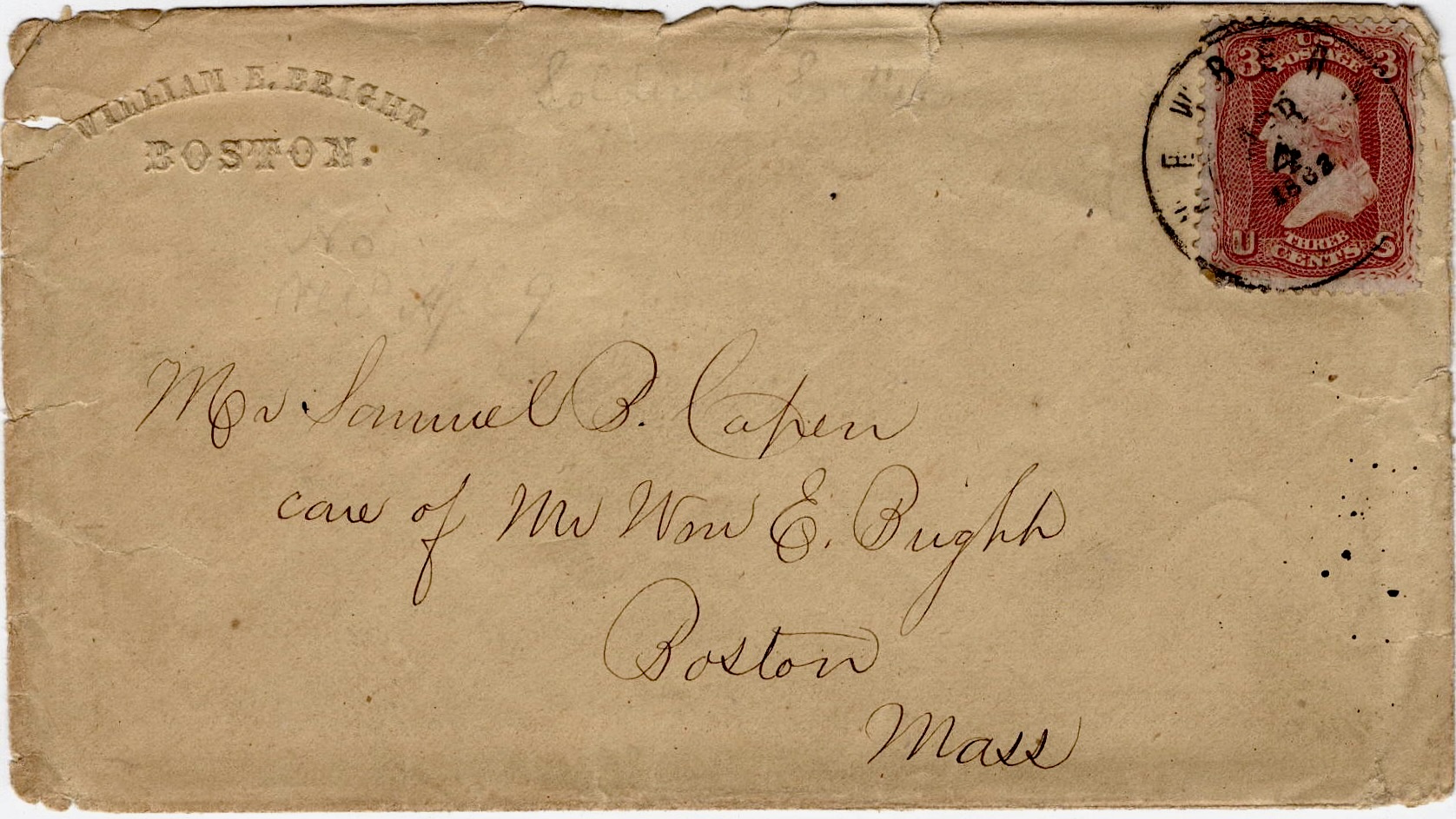
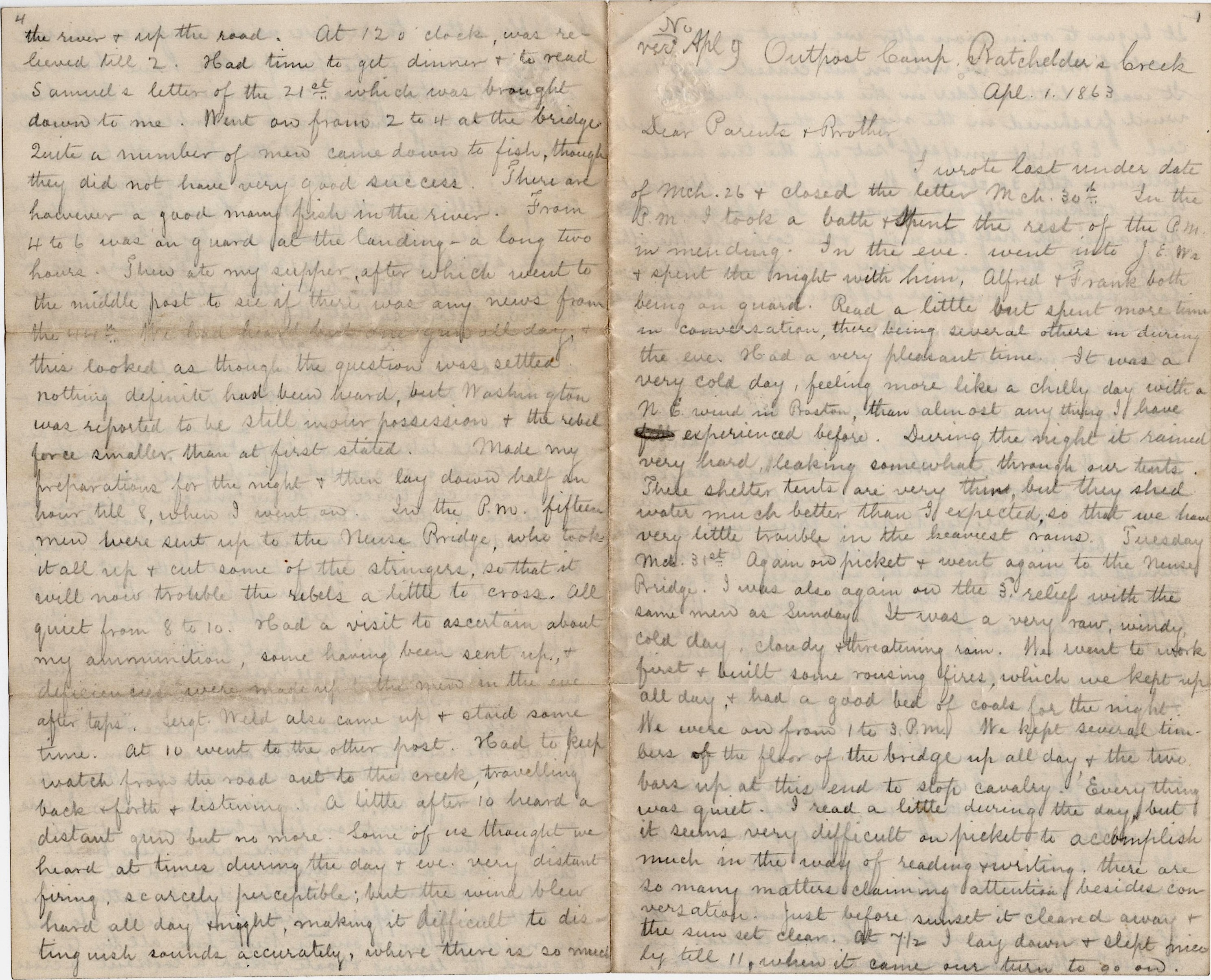
Outpost Camp Batchelder’s Creek
April 1, 1863
Dear Parents and Brother,
I wrote last under date of March 26 and closed the letter March 30th, In the p.m., I took a bath & spent the rest of the p.m. in mending. In the eve, went into J[ames] E. W.’s and spent the night with him, Alfred and Frank both being on guard. Read a little but spent more time in conversation, there being several others in during the evening. Had a very pleasant time. It was a very cold day, feeling more like a chilly day with a northeast wind in Boston, than almost anything I have experienced before. During the night it rained very hard, leaking somewhat through our tents. These shelter tents are very thin, but they shed water much better than I expected so that we have very little trouble in the heaviest rains.
Tuesday, March 31st. Again on picket and went again to the Neuse Bridge. I was also again on the 3rd Relief with the same men as Sunday. It was a very raw, windy, cold day, cloudy & threatening rain. We went to work first and built some rousing fires which we kept up all day and had a good bed of coals for the night. We were on from 1 to 3 p.m. We kept several timbers of the floor of the bridge up all day and the two bars up at this end to stop cavalry. Everything was quiet. I read a little during the day but it seems very difficult on picket to accomplish much in the way of reading & writing. There are so many matters claiming attention besides conversation. Just before sunset it cleared away and the sun set clear. At 7.30 I lay down and slept nicely till 11 when it came our turn to go on.
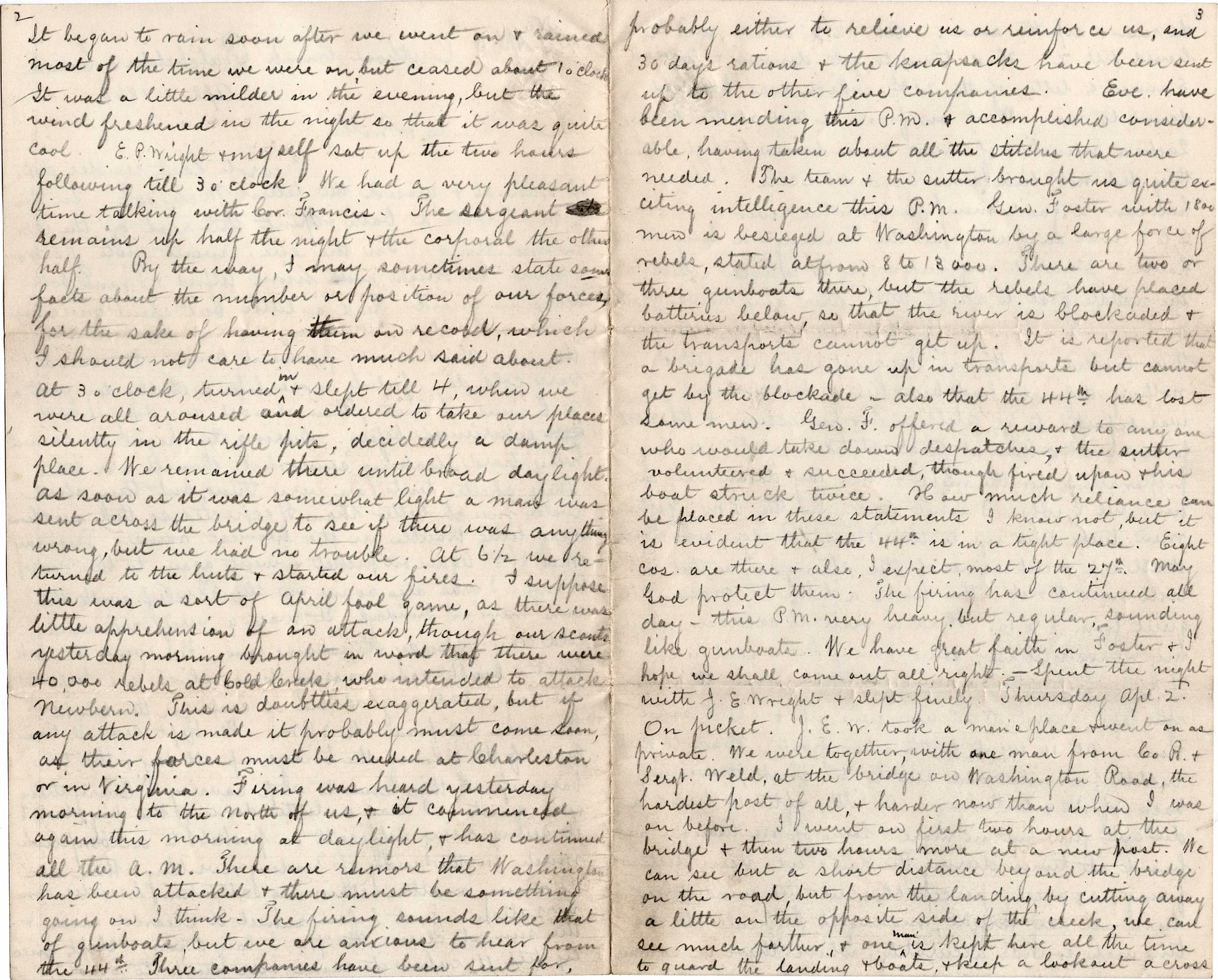
It began to rain soon after we went on & rained most of the time we were on but ceased about 1 o’clock. It was a little milder in the evening, but the wind freshened in the night so that it was quite cool. E[dward] P. Wright and myself sat up the two hours following till 3 o’clock. We had a very pleasant time talking with Corp. [Charles] Francis. The sergeant remains up half the night & the corporal the other half. By the way, I may sometimes state some facts about the number or position of our forces for the sake of having them on record, which I should not care to have much said about.
About 3 o’clock, turned in and slept till 4 when we were all aroused and ordered to take our place silently in the rifle pits, decidedly a damp place. We remained there until broad daylight. As soon as it was somewhat light, a man was sent across the bridge to see if there was anything wrong, but we had no trouble. At 6.30 we returned to the huts and started our fires. I suppose this was a sort of April fool game as there was little apprehension of an attack, though our scouts yesterday morning brought in word that there were 40,000 rebels at Cold Creek who intended to attack Newbern. This is doubtless exaggerated but if any attack is made, it probably must come soon, as their forces must be need at Charleston or in Virginia.
Firing was heard yesterday morning at daylight & has continued all the a.m. There are rumors that Washington [North Carolina] has been attacked & there must be something going on, I think. The firing sounds like that of gunboats but we are anxious to hear from the 44th. Three companies have been sent for, probably either to relieve us or reinforce us, and 30 days rations and knapsacks have been sent up by the other five companies.
Evening. Have been mending this p.m. and accomplished considerable, having taken about all the stitches that were needed. The team and sutler brought us quite exciting intelligence this p.m. Gen. Foster with 1800 men is besieged at Washington by a large force of rebels, stated at from 8 to 13,000. There are two or three gunboats there, but the rebels have placed batteries below so that the river is blockaded & the transports cannot get up. It is reported that a brigade has gone up in transports but cannot get by the blockade. Also that the 44th has lost some men. Gen. Foster offered a reward to anyone who would take down dispatches & the sutler volunteered and succeeded, though fired upon & his boat struck twice. How much reliance can be placed on these statements, I know not, but it is evident that the 44th is in a tight place. Eight companies are there & also, I expect, most of the 27th [Mass.]. May God protect them. The firing has continued all day. This p.m. very heavy, but regular, sounding like gunboats. We have great faith in Foster & I hope we shall come out all right. Spent the night with J[ames] E. Wright & slept finely.
Thursday, April 2nd. On picket. J[ames] E. W. took a man’s place & went on as a private. We were together with one man from Co. B and Sergt. [George Minot] Weld at the bridge on Washington Road, the hardest post of all, and harder now than when I was on before. I went on first two hours at the bridge and then two hours more at a new post, We can see but a short distance beyond the bridge on the road but from the landing, by cutting away a little on the opposite side of the creek, we can see much farther, and one man is kept here all the time to guard the landing & boats & keep a lookout across the river and up the road. At 12 o’clock, was relieved till 2. Had time to get dinner and to read Samuel’s letter of the 21st which was brought down to me. Went on from 2 to 4 at the bridge. Quite a number of men came down to fish, though they did not have very good success. There are, however, a good many fish in the river. From 4 to 6 was on guard at the landing—a long two hours. Then at my supper, after which went to the middle post to see if there was any news from the 44th. We had heard but one gun all day. This looked as the question was settled. Nothing definite had been heard, but Washington was reported to be still in our possession & the rebel force smaller than at first stated.
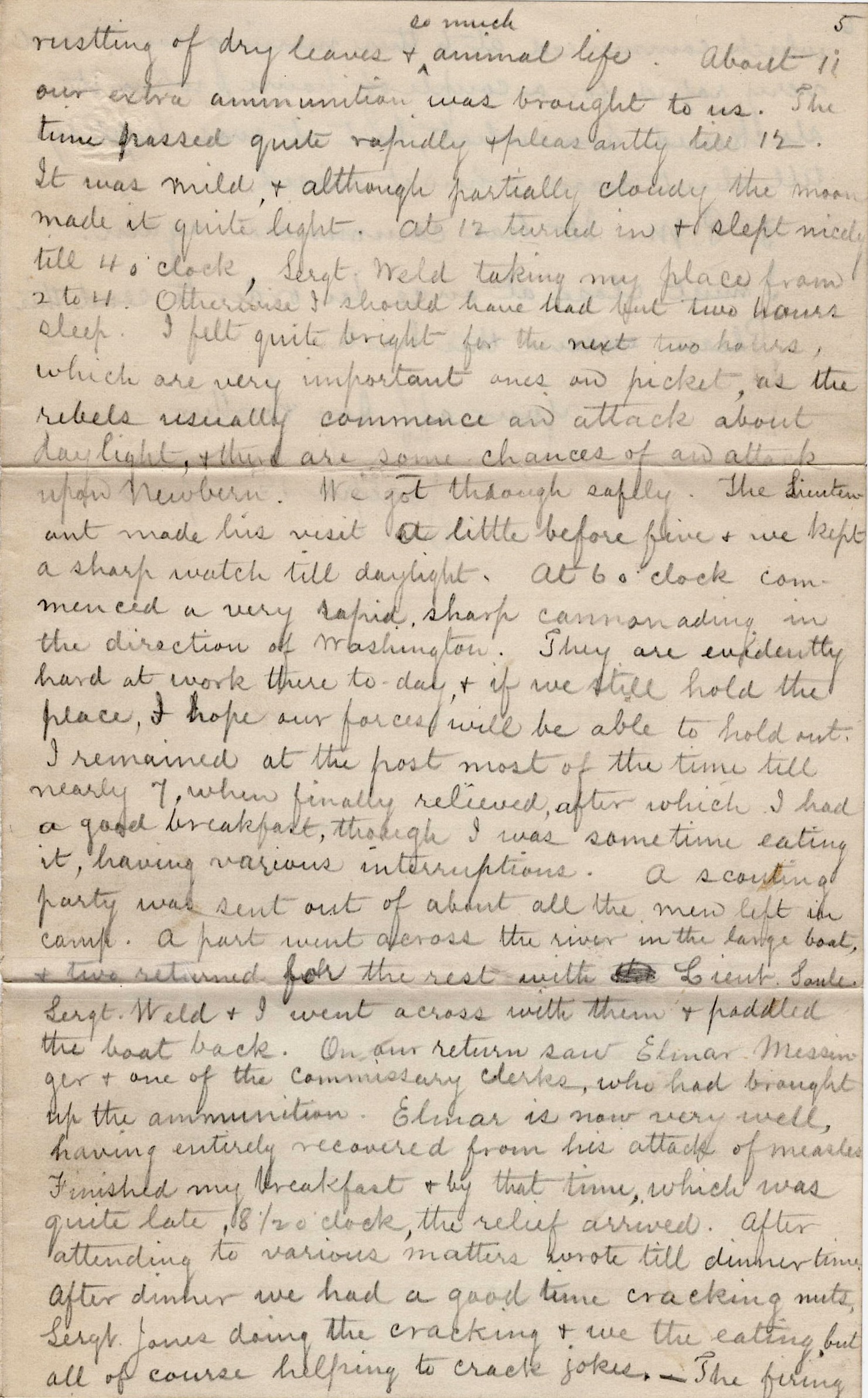
Made my preparations for the night and then lay down half an hour till 8 when I went on. In the p.m., fifteen men were sent up to the Neuse Bridge who took it all up and cut some of the stringers so that it will now trouble the rebels a little to cross. All quiet from 8 to 10. Had a visit to ascertain about my ammunition, some having been sent up. Difficulties were made up to the men in the eve after “taps.” Sergt. [George M.] Weld also came up and stayed some time. At 10, went to the other post. Had to keep watch from the road out to the creek, traveling back and forth & listening. A little after ten, heard a distant gun but no more. Some of us thought we heard at times during the day and evening very distant firing, scarcely perceptible, but the wind blew hard all day and night, making it difficult to distinguish sounds accurately where there is so much rustling of dry leaves and so much animal life. About 11 our extra ammunition was brought to us. The time passed quiet, rapidly, and pleasantly till 12. It was mild and although partially cloudy, the moon made it quite light.
At 12 o’clock, turned in and slept nicely til 4 o’clock, Sergt. [George M.] Weld taking my place from 2 to 4. Otherwise I should have had but two hours sleep. I felt quite bright for the next two hours, which are very important ones on picket, as the rebels usually commence an attack about daylight & there are some chances of an attack upon Newbern. We got through safely. The Lieutenant made his visit a little before five and we kept a sharp watch till daylight.
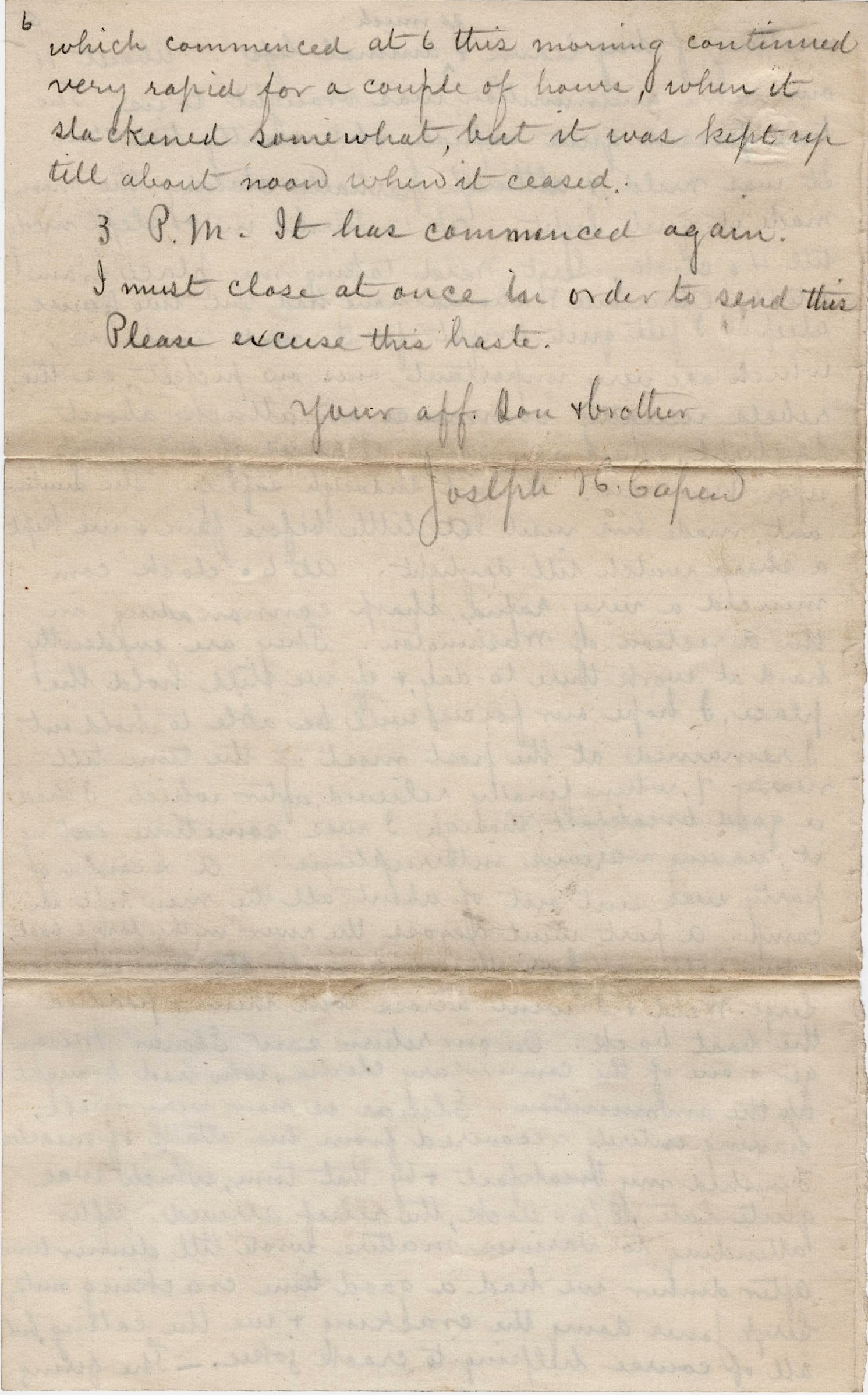
At 6 o’clock commenced a very rapid, sharp cannonading in the direction of Washington. They are evidently hard at work there today and if we still hold the place, I hope our forces will be able to hold out. I remained at the post most of the time till nearly 7 when finally relieved, after which I had a good breakfast, though I was some time eating it, having various interruptions. A scouting party was sent out of about all the men left in camp. A part went across the river in the large boat and two returned for the rest with Lieut. Soule. Sergt. [George M.] Weld, and I went across with them and paddled the boat back. On our return saw Elmer Messinger and one of the commissary clerks who had brought up the ammunition. Elmer is now very well, having entirely recovered from his attack of measles. Finished my breakfast & by that time, which was quite late, 8.20 o’clock, the relief arrived. After attending to various matters, wrote till dinner time. After dinner we had a good time cracking nuts. Sergt. Jones doing the cracking, and we the eating, but all of course helping to crack jokes.
The firing which commenced at 6 this morning continued very rapid for a couple of hours, when it slackened somewhat, but it was kept up till about noon when it ceased. 3 p.m. It has commenced again. I must close at once in order to send this. Please excuse this haste. Your affectionate son & brother, — Joseph H. Capen