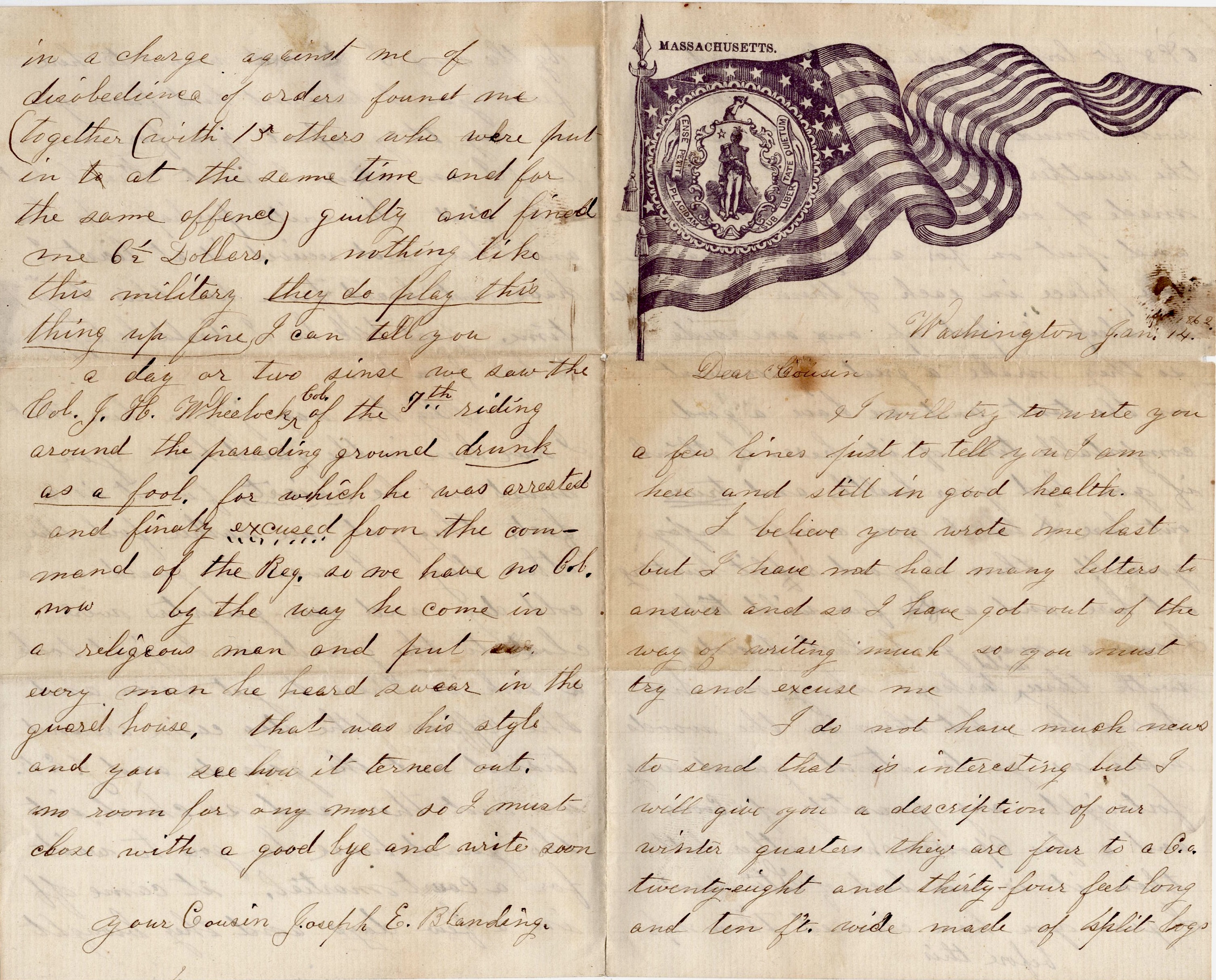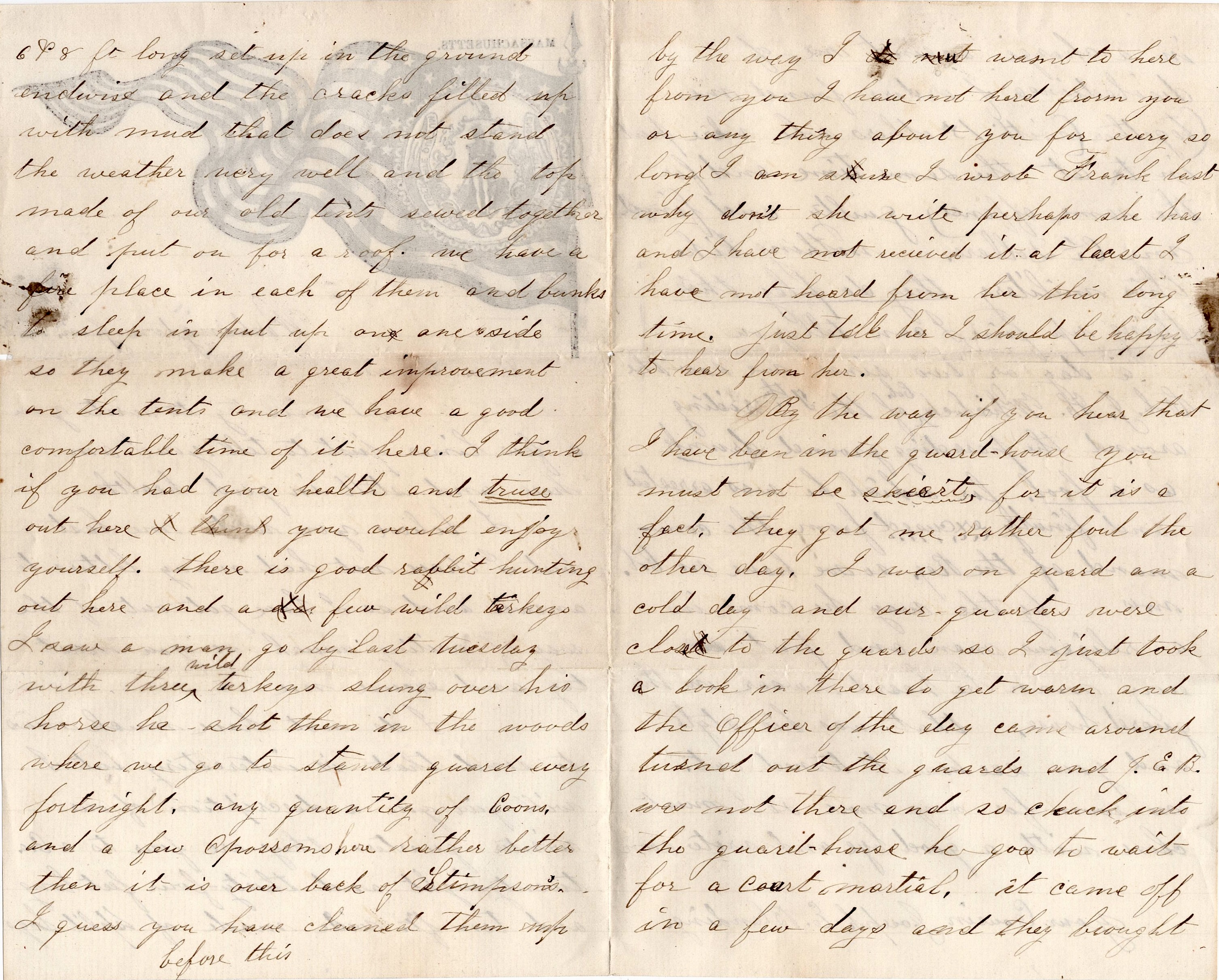
The following letter was written by Joseph Emmons Blanding (1841-1862), the son of Asa Blanding (1797-1861) and Caroline Mann (1807-1847) of Attleboro, Bristol county, Massachusetts. A carpenter by trade before the war, Joseph enlisted on 15 June 1861 to serve in Co. I, 7th Massachusetts Infantry. He was wounded on 1 July 1862 in the Battle of Malvern Hill and died two months later on 11 September 1862 [one report says from wounds, one from dysentery].
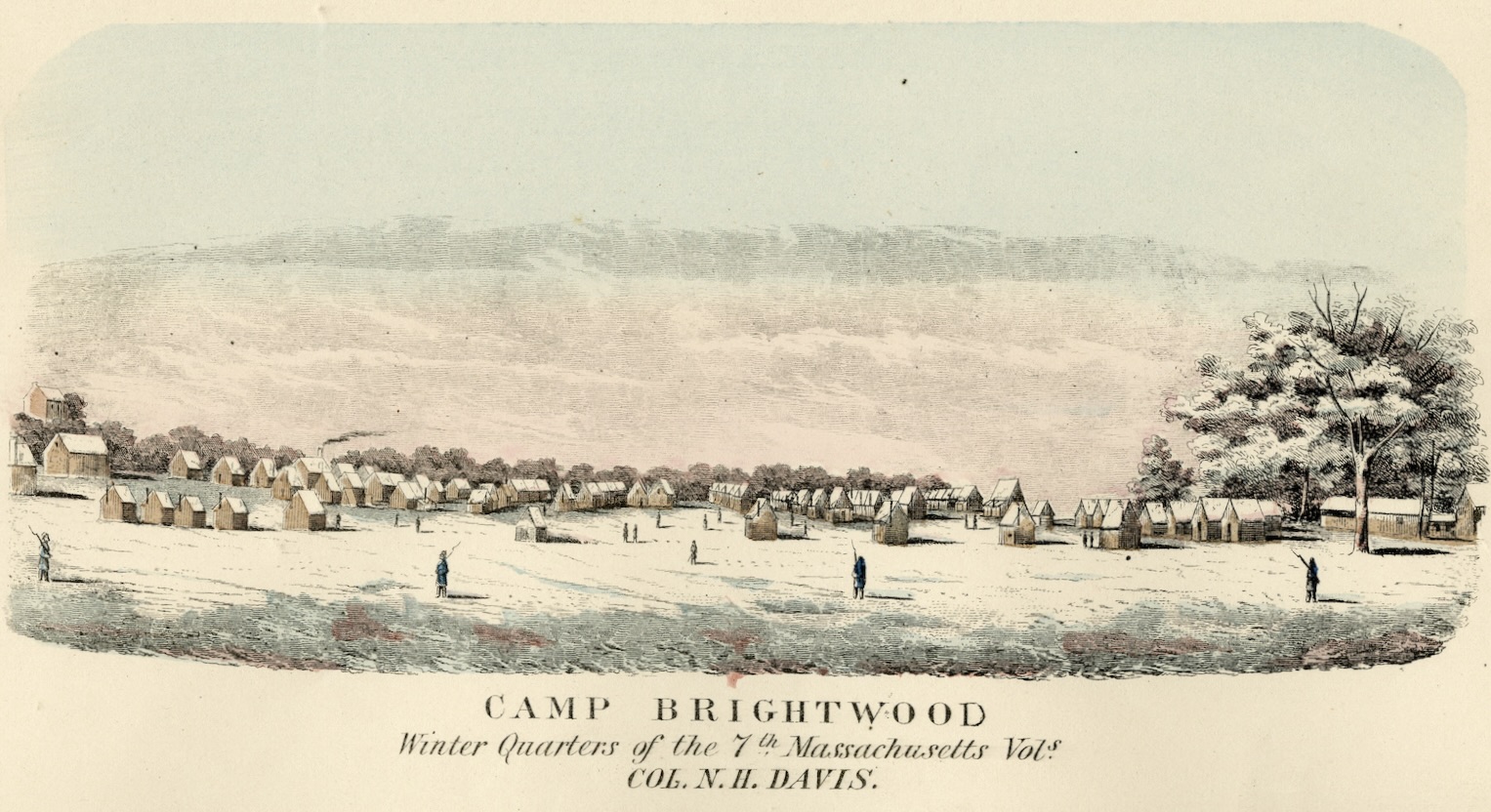
Joseph wrote the letter from the regiment’s winter quarters at Camp Brightwood outside Washington D. C.
T R A N S C R I P T I O N
[Camp Brightwood] Washington [D. C.]
January 14, 1862
Dear Cousin,
I will try to write you a few lines just to tell you I am here and still in good health. I believe you wrote me last but I have not had many letters to answer and so I have got out of the way of writing much so you must try and excuse me.
I do not have much news to send that is interesting but I will give you a description of our winter quarters. They are four to a company, 28 and 34 feet long, and ten feet wide made of split logs 6 and 8 feet long set up in the ground endwise and the cracks filled up with mud that does not stand the weather very well and the top is made of our old tents sewed together and put on for a roof. We have a fire place in each of them and bunks to sleep in put up on one side so they make a great improvement on the tents and we have a good, comfortable time of it here.
I think if you had your health and truse [?] out here, you would enjoy yourself. There is good rabbit hunting out here and a few wild turkeys. I saw a man go by last Tuesday with three wild turkeys slung over his horse. He hot them in the woods where we go to stand guard every fortnight. Any quantity of coons and a few opossums here—rather better than it is over back of Stimpson’s. I guess you have cleaned them up before this.
By the way, I want to hear from you. I ave not heard from you or anything about you for ever so long. I am sure I wrote Frank last. Why don’t she write. Perhaps she has and I have not received it—at least I have not heard from her this longtime. Just tell her I should be happy to hear from her.
By the way, if you hear that I have been in the guard house, you must not be skeert, for it is a fact. They got me rather foul the other day. I was on guard on a cold day and our quarters were close to the guards so I just took a look in there to get war, and the Officer of the Day came around, turned out the guards, and J. E. B. was not there and so—chuck into the guard house he goes to wait for a court martial. It came off in a few days and they brought in a charge against me of disobedience of orders, found me (together with 13 others who were put in at the same time and for the same offense) guilty and fined me 6.50 dollars. Nothing like this miliary. they do play this thing up fine, I can tell you.
A day or two since we saw the Col. J[oseph] H[enry] Wheelock, colonel of the 7th, riding around the parade ground drunk as a fool for which he was arrested and finally excused from the command of the regiment so we have no colonel now. By the way, he come in a religious man and put every man he heard swear in the guard house. That was his style and you see how it turned out. 1
No room for any more so I must close with a good bye and write soon.
Your cousin, — Joseph E. Blanding
1 Colonel Joseph Henry Wheelock resigned, citing that his health was “too feeble to endure the hardships of camp life in this latitude and at his season of the year.” Wheelock would die in Washington in May. [Source: The civil War in the East]