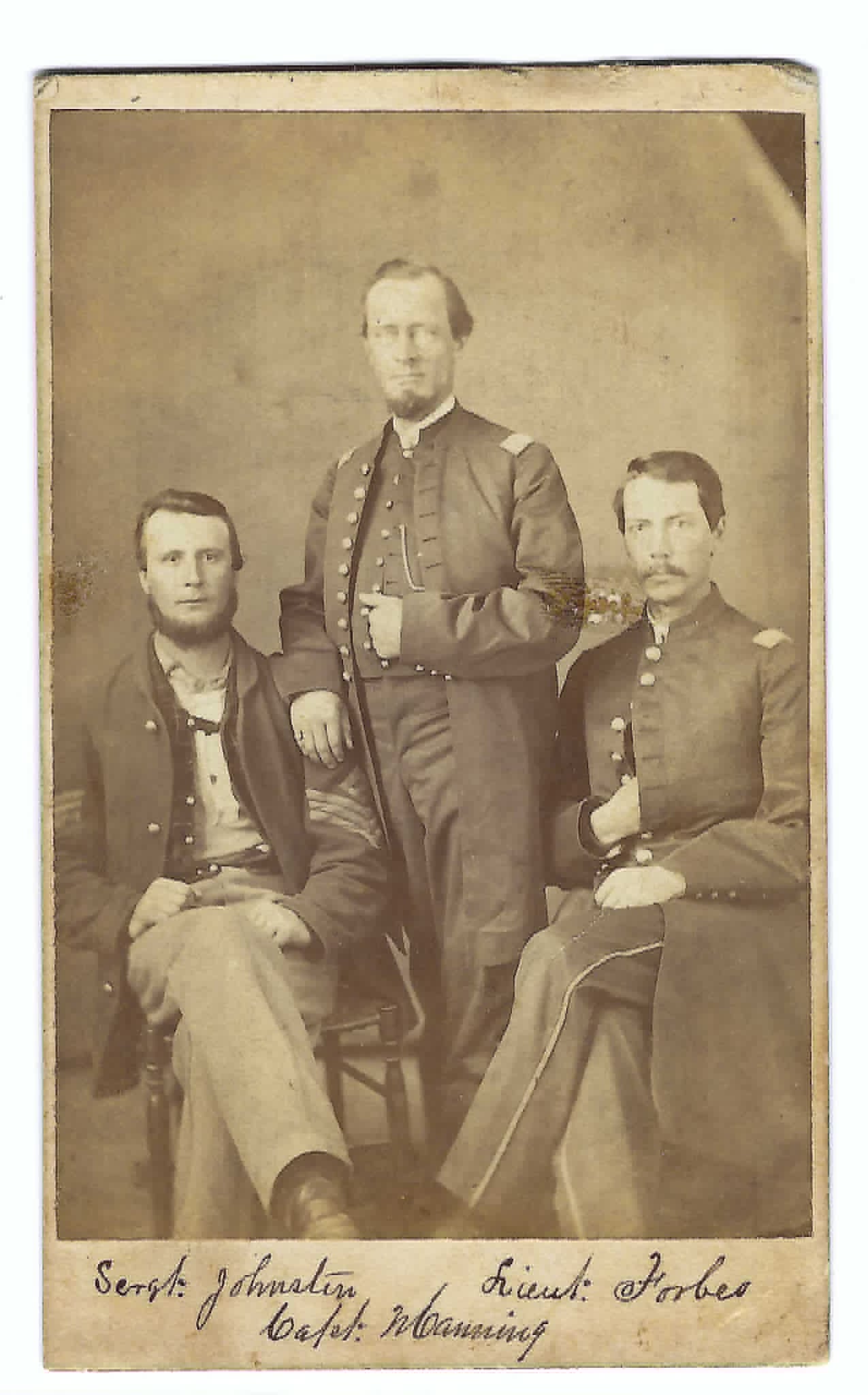
The following letters were written by Morgan “Lewis” Low (1827-1873), the son of Jacob Low (1807-1875) and Catherine Morgan (1814-1892) of Lowville, Columbia county, Wisconsin. Lewis’ parents came to Wisconsin in 1843 from Poughkeepsie, New York, a few years after their marriage. They settled first in Green Bay where they conducted the Astor House Hotel. They later moved to Fort Winnebago where the operated a mercantile for two years, and then in 1845 established the family homestead in Lowville. Lewis was the oldest of four children; his younger siblings were Bartlett (b. 1839), Melissa (b. 1841), and John (b. 1842).
During the American Civil War, Lewis volunteered his services in Co. K, 32nd Wisconsin Volunteer Infantry, rising in rank from 1st Lieutenant to Captain. Muster rolls inform us he entered the service in mid-September 1862 and mustered out on 12 June 1865. He was promoted to captain of Co. K on 3 February 1864 although he commanded the company for several months previous. Before he left the service, Lewis was married on 14 October 1864 while home on furlough to Sarah Hand (1839-1914).
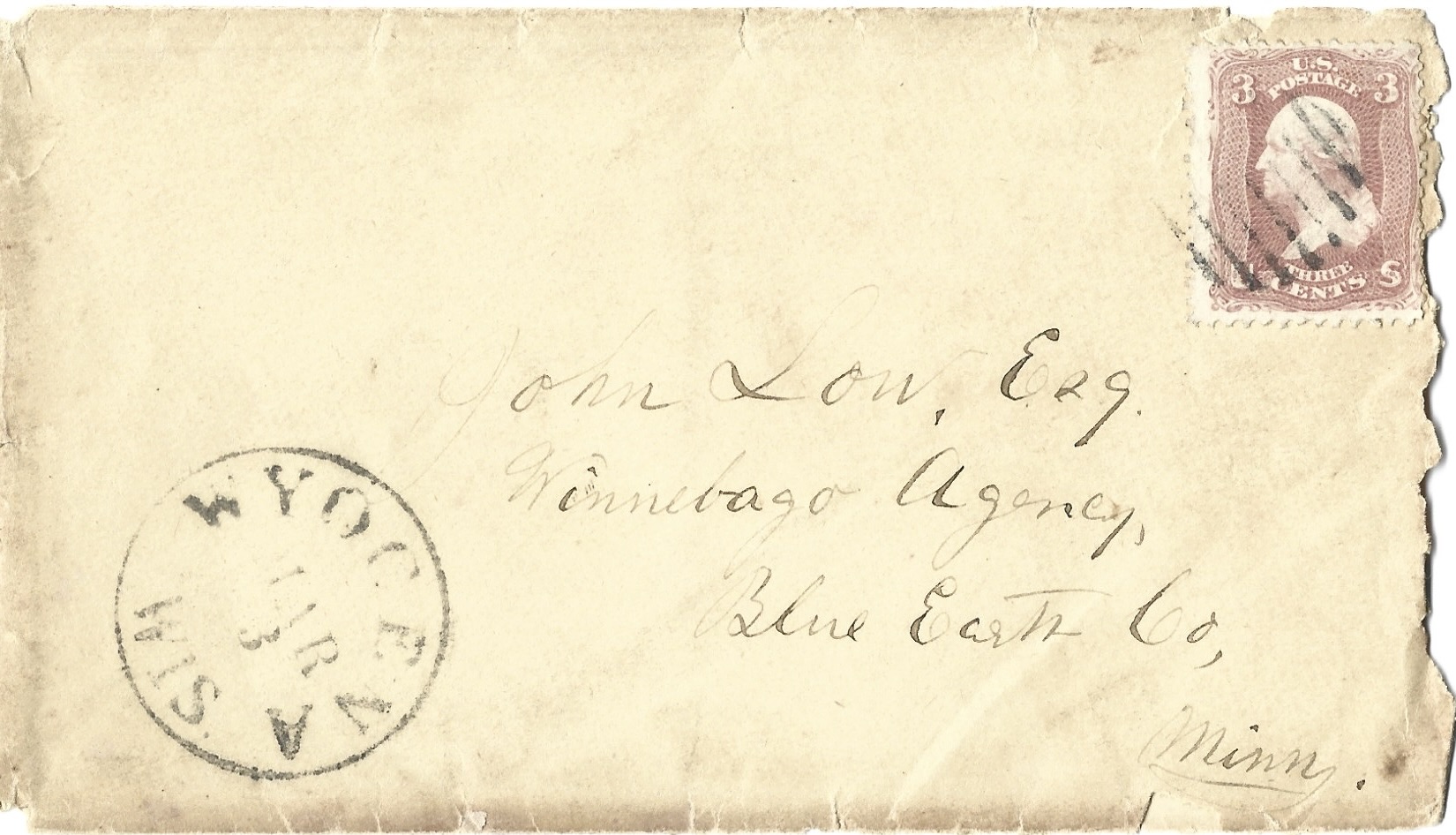
There are 14 letters in this small collection, all written by Lewis Low and addressed to his younger brother, John Henry Low (1842-1926) who with his descendants should probably be credited for having preserved Lewis’ letters. John was married to Josephine Martha Jones (1850-1930) in 1869. John lived out his days in the vicinity of Bear Lakes, Minnesota where he first went trapping in the winter of 1865. At the time these letters were received during the war, he was attempting to farm in Blue Earth County, Minnesota.
Lewis’s letters to his brother offer a vivid and deeply personal account of his life in the service from 1863 through the end of the Civil War. He chronicles the hardships of camp life, long marches, picket duty, illness, inadequate rations, and the uncertainty of military campaigns, while continually expressing concern for his family’s well-being and gratitude for letters from home. His letters emphasize the endurance, discipline, and sacrifice demanded of the common soldier, reflecting both pride in preserving the Union and sorrow for the immense human cost of the conflict. As Confederate defeat draws near, his confidence in ultimate victory grows, and by the war’s conclusion his thoughts turn from military service to the long-awaited prospect of returning home, leaving behind a compelling record of a dutiful citizen-soldier sustained by patriotism, perseverance, and devotion to family.
Letter 1

Memphis [Tennessee]
June 23, 1863
Brother John,
Yours of June 12th is this day received and this day will be answered. Have been looking for a little of your chirography some time. It beats “old cloven foot [ ] toil” [the Devil”] why our folks don’t write you. Probably thy haven’t heard from you yet, for in the last one I received from there. they said no word had reached them from you since you left Lowville. You state that there is a great deal of marsh in that section of country now. There is some advantage in that even for it will eventually be a great stock region and as you and me are stock men, it will suit our taste to a demonstration.
Now John, if Colwell don’t come to time with the breaking, just order it up and “play it alone” by buying more cattle and hiring a man. Get a plow and run it yourself. It is getting late in the season and it is time you bested yourself though by the time this reaches you, you will have got some broke, no doubt. if you have joined with Colwell’s and think that one team cannot break enough, hire a team to break 20 or 30 acres. It may be possible that breaking teams are scarce and that it will be hard work for you to hire any done. How this is, I cannot tell. You know best. But one thing is certain—that I wish to see you have 50 acres broke this summer. Now don’t you wish the same thing? Bu so doing, next year you can have quite a crop and it will belong to John Low. This winter you can fence it and probably more. Should advise advise you when winter comes to fence on 80, breaking the rest up next season when you can probably be able to run a team of your own.
My idea is for you to “play it high” though I will never council you to run in debt. I will find time to furnish you means and will advise Father to do the same if I can’t furnish enough or if it so happens that Uncle Samuel should not pay me for a long time. A fellow in a new country should be a little ahead of his neighbors by so doing, he has a decided advantage. Those in Lowville who broke and fenced largely and kept on doing so at an early day are now comparatively independent. When your land comes into market, money can be soon raised to pay for it and if there is a nice field joining yours on either of the four sides, across the creek or not, of 160 acres that you would like, just keep your eye on it till it comes into market. Even though it is claimed, money will buy it.
I suppose you are not in immediate need of money now. We are expecting to get two months pay every day. Other troops are being paid off but it is thought the paymaster will wait till about the 10th of July and then pay us for four months and that amount will be due me on the last day of the month. It may be that Father will want some money to help him through the harvest and if he does, I will have to send it to him of course. I will find out. But then if you wanted money, just promise to pay after harvest and I will see that it is paid.
Big crops in Wisconsin this year. That is what will set you all on your feet, provided they get a good price which they will, no doubt. Now don’t you go preempting any more land for other people for if I understand [correctly], the Preemption Law will not let a man preempt more than one piece. It would not be advisable to risk losing the place you are improving for the sake of making a hundred or two dollars, though if you think you can go into a wholesale business of it and make “right smart” of money “made in.”
You are right about getting close to market. It makes a dang sight of difference whether a man is 14 or 40 miles away to market on the river or on a line of railroad. If I was in position where I dare, I would try to have you secure me a hunk of land near you but I dare not attempt it for several good reasons. One is it might keep 4 or 5 hundred dollars from you just at the time you needed it [and] would do me no good if a stray bullet should give me a final discharge. Then I am forced in a position where I would have to ask the advice and get the consent of another if I wished to have life endurable. This last is the most weighty of all and dang me if I wouldn’t like to visit Poynette [Columbia county, WI] just now and to see about a little affair of my own. Now this is between you and me, John.
You spoke about making me proposition. Well, make it. No fear of my misconstruing what you may write. We both agree too well to make any great blunder in talking with each other. It will do you no harm to make me any propositions you may see fit.
So you have been writing and receiving letters from Janesville? Oh ho! my boy, you are in for it are you. You rascal. All right, my covy [?]. You say she wrote me a letter. How the devil do you know she did? Was she soury, surly or mad, you ask, just as though you were perfectly ignorant of her “phelinks,” [?] considering you are, though this there is a question about it. I will tell. It was a kind of a sweetish [?] affair—a great many expressions of injured innocent maidenly tears—a perfect loathing contempt for me, and last of all, a long tall farewell, which winds up effectively, my hobbling in that direction.
On the 6th of June, the loyal people of Memphis had a celebration of the anniversary of the day in which the Federal troops took possession of the city. It was a very nice affair with a large procession, but on the 25th, they had an election and elected the same mayor they had in secesh times, or who done all he could to help this state out of the Union. He also issued a proclamation to the people to observe the day appointed by Jeff Davis for fasting and prayer but said not a word when Abe Lincoln appointed a day for the same purpose. What loyalty this is, isn’t it?
We have received news here of the fall of Port Hudson or the capture of 9,000 prisoners. Hope it will prove to be carried. the 32nd Wisconsin and the 25th Indiana are to be mounted, the men to furnish themselves with Spencer Repeating rifles. It will be the crack corps of the army.
I have received a letter from Add Webb. He is at Vicksburg. Also got one from Mrs. Herring and one from Mrs. Delaney. Will write more in my next. — Lu.
When I get paid off, I will send you my photograph and shall then request yours in return. Write to me as usual at this place. Harley sends his best wishes. [ ] has sore eyes but they are getting better.


Letter 2

Memphis, [Tennessee]
July 22, 1863
Yours of the 11th came to hand yesterday. Had been looking for one from you for some time—if we answer each other’s letters promptly. I see that it takes quite a while for them to get around. I also received one from Mother. She says harvest help is going to be scarce and [she’s] afraid they will have to scratch to get the crop secured. Good weather, however, will greatly facilitate the arrangements.
I see by your letter that it is a pretty hard job to get anyone to break or help break [sod]. I am sorry that you cannot hire any team to break 15 or 20 acres for you. If you can get somebody to break only 5, give them a job even at $3.50 per acre. It will all help. In a new country it is pretty hard to get the machine running. I cannot tell one tenth as much about it as you can. You are there and I [am] thousands of miles away. I am glad you have a sawmill so close to you. It will be a great benefit in the future. Will the land be sold as soon as the commissioner appraises it? And will the sale be sometime this winter or next spring? Let me know in your next the price set on the land.
The way you spoke of getting more land is, in my way of thinking, a very lousy one, for you have to furnish a man with the money and let him purchase it in his own name so that he has the advantage and can do as he pleases after getting the money, though, by Jacks, I should like you to have 80 or a quarter more. you spoke about acting as my agent. I do not wish to do anything which would place me in an awkward position and must be free and untrammeled when I return home. If I had a leave of absence of 60 days, I could come to a satisfactory conclusion both to you and myself. This though, is impossible at present. That other person you spoke about cannot [ ] any nonsense on me for I am not wholly gone over he dam in that direction or any other. Now, John, as for your not having any cash of your own and that you will have to run hard into debt is shear nonsense for we are to help each other and Father is to help us all. Without so doing, it will be up hill business for us all. I want you to bear one thing in mind. That what money you get from loan or through me is yours eternally and that you need not think yourself in debt to any of us for it is the policy to set one up at a time.
I shall go to Minnesota as soon as the war is over and if it suits me square there, buy you out or something of the kind. But it would not be good for me to do as you said nor would it for you. If Father has a good crop and decent prices this year, you can be boosted right along and I have written so to our folks at home. I received a letter from John Ward, California. Things remain there about the sameYou have probably heard of the death of Andrew McFarlain. 1 He was mortally wounded at Vicksburg and died by the time they got him home. What glorious victories we have ben achieving lately. A few more such and the war will end.
I have a slight headache and therefore cannot write you very comfortably. Will do better next time. Your tall brother, — Lewis
1 Capt. Andrew J. MacFarlane (1840-1863) served in Co. K, 23rd Wisconsin Infantry. He died on 4 July 1863 of wounds received at Vicksburg on 20 May 1863. He was buried in Portage, Columbia county, Wisconsin.


Letter 3

Memphis [Tennessee]
September 1, 1863
Brother John,
Yours of the 24th ult. came to hand yesterday and I proceed immediately to answer it, nit deeming it brotherly to wait as you have 4 or 5 weeks. Am bound to lampoon you a little for not writing sooner. I received a letter from Bart day before yesterday. He says they are having tough times in harvest. It will cost them a great deal. Bart won’t make anything but will come out clear. I fear Miles will never want to have anything to do with farming again. Every time he has attempted it, [ ] was lodged, help scarce, and wheat low. It looks bad for him. Father is feeling blue but I think he will have a big pile of grain to dispose of. I sent him 200 dollars to help him through harvest and threshing. He will see that you have money to buy your land. I think it a good idea to put in some bids for timber lots. Do it in this way. Put in about three bids for three different lots and have your bids from very low to middling and high. For instance, you bid $1 per acre one, $2 per acre for another, and 5 for an acre for the last. Then if you should get all three, then take the lowest and forfeit the others. Or if you should get the two highest, then take the lowest and forfeit the other. It may be that to do this you will have us my or Bert’s or Miles’ names, if such a thing can be done. Will they allow anyone to bid who is not an actual settler? Do not do anything which will in any way oust you from your present claim.
Father says that he and me can and will swing you out all right. I don’t see how I can come home this fall though I will attempt it in a short time. Mother is not in good health this summer. If I should get lucky enough to get a furlough, I will pay you a flying visit. I have at this time a great deal on my mind and will have to do some nice figuring. Think I am the boy to do it.
We have just received an order for the regiment to be mounted. We will probably make this place our headquarters and make numerous scouts into Jeff’s dominion. We will not be ready for our first expedition under a month or six weeks. There are a good many of the officers belonging to this regiment sick and a great many of the men are ditto. Stoner Hassell has the ague. Lib[erty] Jewett has been sick but is better. John McCann is sick with the ague. The health of the regiment is improving. We have cool nights now.
Mrs. Delaney has written me two letters full of sisterly love. I have answered them both. I have received letters from Lile and Mr. Helling. Don’t you think they are a little jealous of me as well as some others in Lowville. I am too [ ] to suit some of the narrow minded so will write to you always just before starting on an expedition and immediately after returning. Your Bro. — Lewis


Letter 4

Memphis [Tennessee]
September 27, 1863
Brother John,
Yours of the 16th inst. is at hand. I am glad to see you so prompt. “Shouldn’t wonder” if you come to something yet. I thought you would get tired of keeping “Batch” and find it much more pleasant to board—particularly if there was a young lady in the cars, as it is with me. I have been boarding since the 20th of July at one Dr. Bailey’s. He has a very pretty daughter and, of course, a great many pretty girls come to see her which makes it very pleasant for thy big brother. I have formed many acquaintances and I will feel loathe to part with them knowing that i will probably never find a place till I arrive home which I like so well as this.
Father tells me that I must look out for the fair faced Southern ladies or I will lose my gizzard. No fear of that. John, you seem to hint at something concerning me at Poynette. Strange, passing strange! that someone does not want school children to bring their letters. Folks will have strange notions, you know.
I am glad to hear that you have put up so much hay. Suppose you calculate to make something on it. In regard to selling your farm, I am unable to advise. You are the proper judge. Be careful about offering it or sale if by so doing, it will be liable to be jumped. Trust in no one’s honesty. Think that if your claim does not suit you and that if you can better yourself somewhere else, that you had better do it, get the money down if possible, or a great share of it—enough or more to clear you.
The news here is that France has recognized the Rebels and formed a treaty of “offense and defense.” If this is the case, it is well to quit farming if possible and get all the money you can and all consolidated to keep the homestead in tip top order and have every possible comfort for the older folks that we can. If the report is true & we are involved in a war with foreign forces, agriculture will drop around one’s head like a torn, tattered and worthless garment. Wheat will not be worth 25 cents a bushel. The army will then, sooner or later, take everybody and fortunate will he be who secures a good position. If you could—in case new regiments are formed—get a commission. It would be well.
The Orderly Sergeant is not to be sneezed at for it is but a step to a 2nd Lieutenant—$95 per month. Now this news may not be true. I merely caution you of it is. In case it is, if Miles should go to recruiting and volunteer, he rushing to the “old flag,” could you not collide with him for something.
Outr stay at Memphis is limited. We are under marching orders. Was also a few days ago but it was revoked as only a Brigade or two was to move. Now, however, the whole Corps—16th—is to leave and the 15th will come in our place. Think we are going to reinforce Rosecrans on some flank movement on Beauregard. We shall see hot work inside of two months. I will write to you again on the eve of departure and when in the field. We are sure to go out as infantry. I am in command of Co. K. Others will probably tell you why. — Lewis Low
Do not write till you hear from me again. It will probably be a week or ten days before we leave. — Lewis Low


Letter 5

Memphis [Tennessee]
November 16, 1863
Brother John,
Your note of the 9th ult. is at hand. I was under the impression that I had written to you since I told you not to write till you heard from me but it seems I was mistaken. I have been waiting for a day or two to hear from you to know where to direct. Will now run the risk. I received your letter while on a scout. Was at Collierville. Got there on the 3rd after dark about half an hour after the fight. Indeed, was sorry we was too late to have a hand in, but our time will come by and by.
We are under marching orders—two brigades of us. We will probably leave in the morning. We will be absent from Memphis about a week. We are going to look after Forrest, the great guerrilla chieftain. We are to be mounted sure as mounted infantry first and after a litle while we will be known as the 5th Wisconsin Cavalry. This I am glad of. It will add $19.50 per month to my pay or about enough to board me. We will have the best guns in the service—the Spencer carbine or rifle. The rifle shoots eight times without loading. The caps are on the end of the metallic cartridge so we do not have to cap our guns. We can shoot them 8 times without taking them down from the shoulder. The carbine shoots ten times and is just like the rifle, only lighter and smaller calibre. When the 8 or 10 shots are fired, we just take a handful of cartridges and drop them into the butt of the gun and are ready to shoot again. Can put in the two charges quicker than we can load the old guns.
I hope you will have a pleasant trip and a good time. Father tell s me that he stands a chance of being a state agent to look after the welfare of Wisconsin soldiers. This will pay him well besides giving him a chance to travel. Things come along smoothly in the company and I still remain in command. Hope as you say to remain in command till the war ends.
Do you ever hear from John Hall? Does he ever say anything about going to Minnesota? Guess he lacks the courage. Will write to you again immediately after we come back from this even if we have a fight.
Very respectfully, — Lewis Low, 1st Lieut. Commanding Co. K, 32nd Wisconsin Volunteers
What a sting when a fellow signs his name officially.


Letter 6

Lafayette [Tennessee]
January 22, 1864
Brother John,
Yours of January 4th is at hand and I was “right glad” to hear from you again after a silence of two months. You have no doubt had a taste—and a small one too—of soldier’s life. About the time you were having your hardest time, I was undergoing some “I reckon” and as you gave me a brief history of your expedition, I suppose you expect me to return the compliment by giving an outline of our “rampage.”
We left Memphis on the 26th of November, went to Germantown, Collinville, and was on our way to Moscow when it rained so hard that Grissum Creek was impassable and we had to lay still one day. After the water had subsided, we crossed and marched through Moscow to Lagrange where we stayed several days during which time we had all sorts of rumors afloat in regard to the enemy’s intentions and position. Before we left Memphis, we had orders to be mounted and made a good deal of calculation on it and were designated as Morgan’s Light Brigade, 32nd [Wisconsin] and 25th Indiana. The rebs under Lee—a son of Gen. Lee of the Potomac—and Chalmers were hovering around to make a strike on the railroad which they did at a place called Saulsbury, some 60 miles east of Memphis. They did but little damage.
I was sent out the next day with Co. K as a guard with a construction train to repair the track. Before we left Lagrange, firing was heard in the direction of Davis’ Mills, nearly south of Lagrange and about 8 miles distant and Saulsbury was directly east about 10 miles at Grand Junction. Three miles east of Lagrange I learned that a cavalry scout had been sent out that morning of 3 or 4 companies. I went on with the team to within a mile or so of Saulsbury to where the track had been torn up, and the railroad hands commenced to straighten the rails and re-lay the track. When we had got this spot nearly finished, and order came from the commander of Grand Junction to bring the train back as it was in danger of being captured. I had, while waiting for the hands to repair the damages, sent a sergeant and ten men ahead with the Chief Engineer and Telegraph Operator to see how much damage had been done, expecting to soon catch up with them, but when the order to return came, I sent a land car ahead after them and after waiting about an hour, I returned without them. But the time I got to Lagrange, quite heavy firing was heard to the westward and I was told by a staff officer who was at the depot waiting for us to burry up to the regiment as they were waiting for us.
After getting to the regiment, we waited two hours during which time the firing to the westward grew heavier. At last, two aides came for us to go to the depot and take the cars for Moscow. When we reached Moscow, the firing was still heavy. We debarked and started for the scene of action, not half a mile distant, but by the time we got in range, the Rebs fell back without giving us a chance to fire a shot. We marched over the scene of conflict which was a narrow bend in the Wold River. The dead and wounded lay strewn about pretty loosely and any quantity of horses were piled up. Our losses were about 40 in killed, wounded & missing. The enemy’s loss was about 140 in all.
The next day we marched to Lafayette and found a goodly number of the Rebs wounded in homes along the road. In one house we found 5. We stayed in Lafayette ten days, By the way, the Rebs burnt the depot here the same night that the fight was at Moscow. The we marched to Moscow, stayed there a few days and marched to Lagrange where the men which I had left at Saulsbury joined us “all right.” Stayed in Lagrange a few days and left for Grand Junction. Stayed there a few more when we were ordered late in the afternoon to take the cars and go to Lafayette as quick as possible, When we got within three miles of there, we met a squad from two different regiments who had been driven out of Lafayette by Forrest’s forces. We deployed them as skirmishers ahead of the train and came slowly along for about a mile. When the enemy fired on the skirmishers, the train stopped and we debarked and formed, marched in line of battle to support the skirmishers or we went through a hell of a swamp, through head-top brush, through sloughs and mud half way up to our knees and it was raining hard all the time. In fact, had rained all day.
We came up to within a few rods of the skirmishers but could not see the enemy, it being dark and had been before we left the cars. Our skirmishers were firing rapidly as well as the enemy. We could see the flashes of the guns on both sides and the balls whistled over our heads pretty freely. At last the Rebs fell back. In fact, they had been doing that all the time for we kept coming up. We drove them out of Lafayette and laid out till 3 in the morning when we went to Collierville and expected to find them along the way closer than away from their camp fires but bot no fight out of them. One captain and one lieutenant out of the 25th Indiana were captured that day by getting behind.
The enemy lost at Lafayette 33 killed, 4 or 5 prisoners, and we found 15 wounded in one house the next day. Our loss was 4 killed, no missing, and 3 or 4 wounded. We stayed in Collierville part of a day and part of a night. We were waked up at 12 o’clock and ordered to rise at three. Marched to Mt. Pleasant and Hudsenville [?] to the Coldwater where we camped for the night. It took us two days to march back. It rained like “suds.”
The 2nd day [ ] as it rained in the morning, snowed at noon, and by night it was frozen hard enough to bear me up on the mud. I froze two of my fingers that day. When we got to Collierville, we had no tents and had to lay out doors and it was bitter cold. This was damn tough. Next day we got ahead of the companies—New Years Day—and about night moved off the conductor and engineer both drunk so we had a serious time. Think I never suffered more in a day in my life.
Got to Moscow and the engine had no wood or water. Stayed here all night waiting for another engine. This was a colder night than the one before. he boys stayed in sheds, in houses, and around fires and suffered a good deal. Next morning went by rail to Grand Junction where the boys got their tents, built winter quarters, and were pretty comfortable when we were ordered to march to this place. While we were at Grand Junction, those companies—A, F, C & H—who had got their horses, were allowed to turn them over and the saddles for the whole brigade were displaced off in a similar manner and we were dismounted again.
We are now ordered to prepare for “long and tedious marches.” Our pay is to come soon and we are to be rigged for a long campaign under Sherman with no baggage. We are ordered to turn over everything when we get to Memphis and will go there in a few days. The supposition is that we go to Texas or Mobile, which—I do not know. Think we will see plenty of fighting this spring. We take no tents along.
I wrote to you before I left Memphis last fall that I was in command of Co. K and I now state that I have been so all the time since the 17th day of September, 1863 and expect to stay in command for a while, “you bet.” I am 1st Lieutenant yet by may be something else after a while. It takes papers a great while to come around. Before—and in fact the day before we left Memphis—the Colonel asked me who I wished to send home & recruit for the company. I sent the Orderly, E. H. Benson, and I hear that he has more than recruits enough to fill the company up chock full. 98 enlisted—to the maximum. Old Tim Madden has enlisted. Old Bently of Poynette, ditto. And for my company too. The regiment, when the recruits get here, will number over a thousand again and there will not be a drafted man in it.
I shiuld have written you before but have been really busy making out my reports and being on the go a great deal. have but few opportunities. The Orderly visited Father’s folks and Miles’. He told some big yards about Lu which made the folks think I was going to marry a Southern girl. This pleased me and I defended the southern beauties with spirit. This settled the question in their minds and they think me spoken for. But John, you and me know how to come the “strategy.” Does John Hall stay with you and does he think of settling by you? Give him my best wishes. How are you financially? And when will you be able to enter your land? I will write to you again before we start on the “expedition.”
Direct to Memphis as usual and I will get your letters after a while. The mail generally follows a regiment unless they have their communications cut. I have written rather lengthy this time but will do so no more. Write soon. Your brother, — Lewis Low


Letter 7

Camp in the field 5 miles west of Jackson, Mississippi
February 6, 1864
Brother John,
I was too busy to write you at Memphis or Vicksburg and can say but a few words now. The advance has been skirmishing with the enemy yesterday and today. I think they will not stand at Jackson. We will pursue, I think, till we chase them into their holes somewhere. I saw Father in Memphis. You probably know he is State Agent and will be south for two or three months. I am in hopes I shall see him again before the expiration of my term. I think I shall come home after this campaign is over on a leave of absence—say in June or August.
Write me as usual giving the company and regiment but address me as Lieutenant till you hear from me again. I will soon be Captain. Your brother, — Lewis

Letter 8

On board transport “Era”
15 miles below Helena, Arkansas
March 14, 1864
Brother John,
I think it is about time I answered your last. You no doubt think I am not going to hurry myself about the matter, In due time you will perceive that it has been no fault of mine. You see by the heading that I am aboard the bosom of the waters again. Neptune, I fear, will get disgusted with freedom with which I make his element and raise a muss one of these “poetic” mornings. I wrote you some time last winter that the 32nd were going to form part of a column which would raid it through Mississippi & raise hell with the Rebs. Well, we went out on said raid and are on our way back again but mind you, we are not going to stay in Memphis or its vicinity during the summer, but go to Athens, Tennessee in the vicinity of Knoxville & Chattanooga near to the Georgia line.
By the bye, your having read by this time of Sherman’s great raid into central Mississippi and knowing that you had a brother connected with it, you probably feel anxious to hear something from his own pen in relation to it. The 4th Division of the 16th Corps de Armie, left Memphis February 1st in transports for Vicksburg where we arrived on the 3rd, disembarked and marched out east of the city 5 miles where the 3rd Division—Smith’s—joined us. We left on the 4th and the 17th Corps started about the same time from Natchez, all marching eastward, we crossing Big Black River at Messengers Ferry on pontoons—they are the bridge. After three days march we reached Jackson where the 17th Corps joined us, they having captured the Reb’s pontoons which was already laid down along Pearl River at this place.
The 32nd [Wisconsin] was the last regiment to cross and had to destroy the pontoons after them and had to march till two the next morning to catch up with the main body. Jackson is 50 miles east of Vicksburg. We marched to Meridian—the great railway center—going through Brandon, Hillsboro, Decatur, & Morton, all of which placed we sacked and burned, in some not leaving a house. Our march was along the Mississippi & Alabama Railroad which was completely destroyed.
At Meridian we destroyed their hospitals, arsenals, machine shops, barracks, and at the last place we destroyed the railroad for 25 miles in each direction making 100 in all. Here the army divided out for a day or two to destroy things. Our brigade had a little brush at Marion, 8 miles north of Meridian. Co. K only had three or four shots at the fleeing rebs. The army came back by a different route from that which they went out on and destroyed all the property in our reach, brought in about 5,000 negroes, and some 3 or 4 hundred prisoners. Had a few smart skirmishes, 1 wounded and one killed in Co. B [?] by straggling. That is all.
Meridian is 150 miles east of Vicksburg. I will write you more at another time. Direct to Cairo. I have got my commission as captain of Co. K, dated February 30, so you can address me as Captain Low. Guess I will stay in Co. K a while yet. I will be in Memphis by tomorrow evening & will see “dad” there. Your brother, — Lewis


Letter 9
Memphis [Tennessee]
March 16, 1864
Brother John,
I have been so busy that I have failed to mail the letter I wrote you while on the river. That & this is my only apology for not communicating with you sooner. Arrived i Memphis safe, sound, and well. We are camped on the Arkansas shore and I have to run across the river frequently thereby taking up much of my time. We are making preparations to leave here but how soon that will be, I know not. We have no tents and the weather is very cool for this climate this season of the year. I will write to you as soon as I get to a stopping place. When that will be, I do not know. You can direct to Co. K, as usual leaving off the place but simply say, via Cairo.
I see Father eavery day now and it seems almost like being home. I will probably be home in May or June. If I do not come this summer, it will be very likely that I do not come till the war is over or my time expires. I want to come home on Mother’s account more than anything else and then there is that on my mind which you spoke of. Guess I won’t pull much wool over your eyes nor do I want to. But I keep Miles & Melissa & Mother in a stew. They think I am going to marry some Southern girl. Now you know I am not “heavy” on the [ ].
I received a letter from a very bewitching girl in Fall River. I will of course answer it and keep up a flirtation but it must not get out or it will raise hell with me in another quarter. Your brother, Capt. Lewis Low


Letter 10

Decatur, Alabama
May 8, 1864
Brother John,
I hardly know when I wrote you last or when I last heard direct from you. One thing is certain, it is time you communicated with the army. And fearing that you will suspend me for not making my usual report. I hear that Father is home and think he is, but still I have not heard from them so I do not know positively. I hardly think he will go back to Memphis though he may come to Nashville. I have not heard how our people are getting along with spring work. I think that they must be later than usual on account of the season. You must be busy too with your work. How many acres have you to put in? John, I want you to make arrangements to break up a good piece this summer. If you wish to run a team of your own and have not team enough, you can take my 4 year olds and probably Father would let you have his 5 year olds. I hope you have heard from the Dept. in relation to your land and that you have bought it—at least I hope so. I am anxious to hear from you and from home & hear how you are all getting along, &c.
I think I wrote you once since I came to this place. Most of the troops from this vicinity have left and have gone to Chattanooga and will go from there to the front with Sherman who will, no doubt, take Atlanta. Think though that there will be some hard fighting in that direction before a great while. Grant will clean the Rebs out of Richmond and that vicinity this summer. This done and the Rebellion is used up. They even now are getting heartily sick of it and are deserting. Deserters still continue to come into our lines at this place. 85 came in in one squad day before yesterday and half of them enlisted into our army.
We are bothered on the picket line almost every day. The enemy seem delighted when they can get into a skirmish either us. They maneuver in all shapes to get us at a disadvantage and watch close to try and take us by surprise but we have thus far been too heavy for them. They even brought up 3 cannon a few days ago but did not succeed in driving the reserve in at all. We have had several short skirmishes with them. A few nights ago they attacked the line at midnight and kept it up till 7 the next morning when I came out with a fresh lot of men to relieve the others. The rebs, seeing us, fell back and during the 24 hours that I was on, they only fired 20 or 30 shots and whenever we advanced on them, they fell back. This morning they attacked our lines about daylight but it being a usual thing, it created no stir till the fire became general along the entire line though by far the heaviest in the center. We then fell in and went into the fortifications—our camp is inside of the works—where we could see all that was going on on both sides. The Rebs drove our cavalry & infantry pickets—about 150—back one quarter of a mile when 4 small companies of cavalry went out and the whole file charged the Rebs on the run, the infantry on the left and the cavalry on the right. The Rebs thinking that we must have a heavy support threw down their guns and ran, our men firing till the enemy opened a battery on us. This we in turn charged and they limbered up and skedaddled. So ended the skirmish of this morning.
We lost but one killed and 8 or ten wounded. The enemy’s loss could not be ascertained as they were seen carrying off a great many wounded. We took a few prisoners who say that this place will be attacked by ten thousand men with 48 hours. We have only about 24 hundred but can defend the place against that number successfully. We are strongly fortified. If there is a fight here, I will write to you immediately afterwards. We have been building fortifications day and night for a week past and we will have them completed. Then the Rebs may come just as fast as they choose. I have not heard from Miles & Melissa in a long time. Think they are all busy in spring work. I hope we will get paid off in a week or so. There is over 4 months pay due us now.
May 13th. I did not send this as soon as I expected to thinking I would wait the said 48 hours and see what it might bring forth. There has been no fighting at all on the lines till yesterday afternoon. I was on picket myself in charge of the extreme left of the line. The center was attacked about 2 o’clock but the boys soon drove them back. If it had not been for a mistake at guard mounting in the Sergt. Major, I would have been in the center. It seems to be my luck lately to keep clear of all brushes with the enemy.
I believe I told you that Samuel Dumbleton was drowned [on 26 March 1864] at Paducah, Kentucky. Add Webb’s time is out in May. Our armies in Louisiana & Arkansas seem to have got badly scooped this spring but Grant is doing the thing up brown and you will soon hear from Sherman. I should like to come home this spring but will no doubt have to wait till the campaign is over. I guess that Bert don’t get along so well at home as you used to but keep still about it. You know he is not given to heavy work but rather the reverse. I have got a good thing [ ] Fall River gal. Don’t think I’m trying to pull wool over you [ ]. Write soon and an old fashioned letter let it be. Your brother, — Lewis Low, Capt.


Letter 11

Decatur, Alabama
June 4, 1864
Brother John,
Yours of the 26th ult. is at hand, just received. Have been looking for a letter from you for some time. I wrote you some time since but it appears that you have not as yet received it. I am glad to hear that you are going to breaking up some more land. Hope you will break up 40 or 50 acres this season for the more you break, the better it is for you. I suppose that there is plenty of wild pasture and will be for some years so that you can cultivate all the land that you break.
I wish you had went home and got a yoke of my steers—the 4 year olds—if they would answer your purpose and afterwards sell them and use the money. If cattle are high after harvest, go home, drive out my two yoke and [ ] yours with as many as Father wishes to send. Whether this will pay or not, you can best judge for you all on the spot. I think your head is all right on the land speculation. Go in or as deep as you wish. I will back you. Remember one thing though, John—that there is going to be hard times soon after this war closes but I am not able to say whether it will affect the land speculation or not. There will be a host of men thrown out of employment which will reduce the price and demand for laborers, and it may have the effect of throwing a great many out into the new countries in search of homes. This may make the times with you just as good as ever and possibly better.
You’re right, however, there is a good deal between this and next spring. If Bart does not take that 80 of prairie which you have bid for—provided you get it—do not feel alarmed. It will be a good thing for you. It will then make you a nice large farm. Don’t feel squeamish about taking in for fear you cannot. Swing clear for all you have to do is to call on my pile in Father’s hands and the money shall come. I do not wish to have a little one-horse farm in a few years from now, but a large one—one that you will not be cramped up in when pasture becomes scarce. I shall send home in a few days, I think, about $300 and by the 1st of July the Government will owe me $260 more. But do not expect to get it till they owe me as much more. My pay is $130.50 per month now—a pretty good thing for a boy like me. I was in hopes of hearing something from Phine Kidd through you and feel disappointed that you too have played off on her. What a rakish set these Lows are?
I hear from Miles occasionally.. Had a letter from him a few days since. He says the girls are all right. That Miss Sarah Hand is teaching in Poynette and that Alma is teaching in Lodi. Think they must give satisfaction at one place so long. I must write to Mrs. White and see what has become of “Dulcinea.”
We went on a reconnoissance a few days ago and had a little brush with the foe. After going some four miles, we found their pickets which we drove in and kept up a skirmish with them till 9 at night, steadily driving them all the time. We drove them 18 miles from where we first found their pickets about 3 in the afternoon and as we were coming out of a piece of woods, they opened a battery of three guns on us, the first shell bursting over [Company] K but doing no damage. They shelled us pretty lively for a few moments but our battery opened on them and exploded one of their caissons, killing several men and horses. They had 5 more guns in reserve but did not use them. They all skeddaddled like wild fire before us. They had two regiments and a battalion of cavalry and one regiment of infantry and an 8 gun battery. We had three regiments of infantry, a regiment of cavalry with a 4 gun battery. I cannot say how many Rebs we killed but I saw one dead Reb Major and a Captain, besides a good many privates. Our cavalry lost 5 wounded, two killed. One regiment had 3 wounded—slightly only. About a week afterwards a regiment and two guns of our battery went out and were driven back and came near losing the cannon.
I have jumped David Chase & Charles Carman and have appointed those who I think are deserving to be sergeant. Write soon, John, and direct to me at Decatur, Alabama
— Lewis Low, Capt.
Do all in your power for Lincoln. Kill Fremont at the polls, Make him smell bad. Go for “Old Abe.” Don’t by any means help that damn Fremont. I shall not vote for him in any emergency. Abe is my first and last choice. If Fremont is nominated at Baltimore. I shall [quit?] the ticket.


Letter 12
Decatur, Alabama
July 3, 1864
Brother John,
Yours of the 17th of June is at hand containing the photograph. You have changed some in two years but for better, I think—at least it is a dang good picture. I suppose you had it taken for some fair creature who is skirmishing for a position on your staff. You have repeatedly told me that there was nothing but Hoosiers, Suckers, Squaws and half breeds in that section of country. Now don’t try to throw sand in my eyes in that way. I’ll bet 40 rounds of whiskey that there is a nice girl up there that you are very intimate with and with whom you have layed plans for future campaigns and are trying to lead me away from your base. Be this as it may, you have my best wishes. You are deserving of a nice little woman.
I hope you have had rain long ere this for I see by the papers that it was heavy at Wynona. Our people have been fortunate enough to have a nice shower and the prospect is good for about half a crop but no more. I learn, however, wheat is bringing $2 per bushel which is as good as a full crop at 90 cents or $1. It may be that the people are a little scared and excited. Mother writes me that you have concluded to take my money and buy land in speculation. All right. When does Burt intend to go to Minnesota? What can you get 200 acres for and can you get that much in a nice locality where every foot could be made plow land and not over three miles from timber and [ ] you 40 acres of timber? I merely ask for information—not knowing what may happen. I should [have] said 200 acres to be prairie. I expect a “blow up” at headquarters in Lowville in every sense of the word. I will tell you something about it.
Father and Mother both seem to feel exercised for fear that I will or will not get married—that I will marry somebody because she suits me and that I will not first canvass the matter with them. They want to have me tell them if I am engaged and how many years we had better be on probation and what I intended to do after the war was over. Now how in the devil can I tell what I shall do> And in regard to getting a wife, when I conclude to marry, in all probability there will be no hanging back to get old people’s consent. I shall not marry as a matter of convenience to myself, let alone anyone else. This idea of marrying is a matter which concerns me and me alone and I’ll be hanged if I don’t do as I please about it and have so written to them. They will no doubt tell me to go my way and do as I please—that I need not look to them for aid and comfort—at least I expect such will be the case. I can’t help it if it is. Have got sick and tired of hearing about the matter of matrimony. In my next, I can tell you how to cut [ ] and if it against me, I will want you to look out for about 200 acres of good prairie which I will then want you to buy for me and I will send you the money immediately after next pay day which will probably be the 15th of September. Do you think there will be any good prices of land at that time? If however, the thing should not go as I anticipate it will, then I will not want the land. At all events, I can let you know by my next.
I must not close this without getting in a little military news. Think I told you that we had been ordered to join Sherman & that we got one days march in that direction when we were ordered back to this place where we have remained ever since. Then a week ago today we were ordered out with one days rations with 5 of the companies of this regiment and a like number from the 17th Army Corps; 22nd Indiana and 18th Michigan. Went out a mile and found their pickets which were driven in. Companies A & K were then ordered to the front as skirmishers and were ordered to lay down close to the enemy but out of gunshot [range]. We could plainly hear the enemy giving orders to their skirmishers and wanted to go at them but the commander of the expedition would not let us. We layed there till 12 at night when we were ordered back to camp. Stayed here one day when [Company] K was ordered to go again with the regiments above mentioned. We were the advance guard sent out on the Courtland road four miles, turned to the right down a narrow lane which ran to the river reaching which we went down its banks going through fields, through woods, and at times finding it difficult to get our three ambulances through. At 5 in the afternoon, we found a wood road and were joined by 700 cavalry (4th Tennessee).
At dark we come out upon a main road which we took and kept till at night when we halted for a rest. One company being in advance was sent out on picket, At 12 we started again, one company sent to the extreme rear. Marched till daylight when we heard the enemy’s bugles, formed line of battle and moved forward. Our company was ordered to the front on the left of the line as skirmishers and had to double quick for half a mile to get to our position as the whole column was moving forward. Got to our place, deployed and charged the enemy on the double quick. Drove them out for the troops behind to gobble up. They now doing all the [ ] while we did all the work. While they were getting plunder, we were a mile and a half ahead chasing the enemy away from their camp, killing one of their men, followed them through the fields for half a mile when we were relieved by other companies. My men by this time were tired out. we captured 50 horses, 200 stands of arms, 30 [ ]. One company charged directly through their camp and left everything. — Lewis


Letter 13
Decatur, Alabama
July 31, 1864
Brother John,
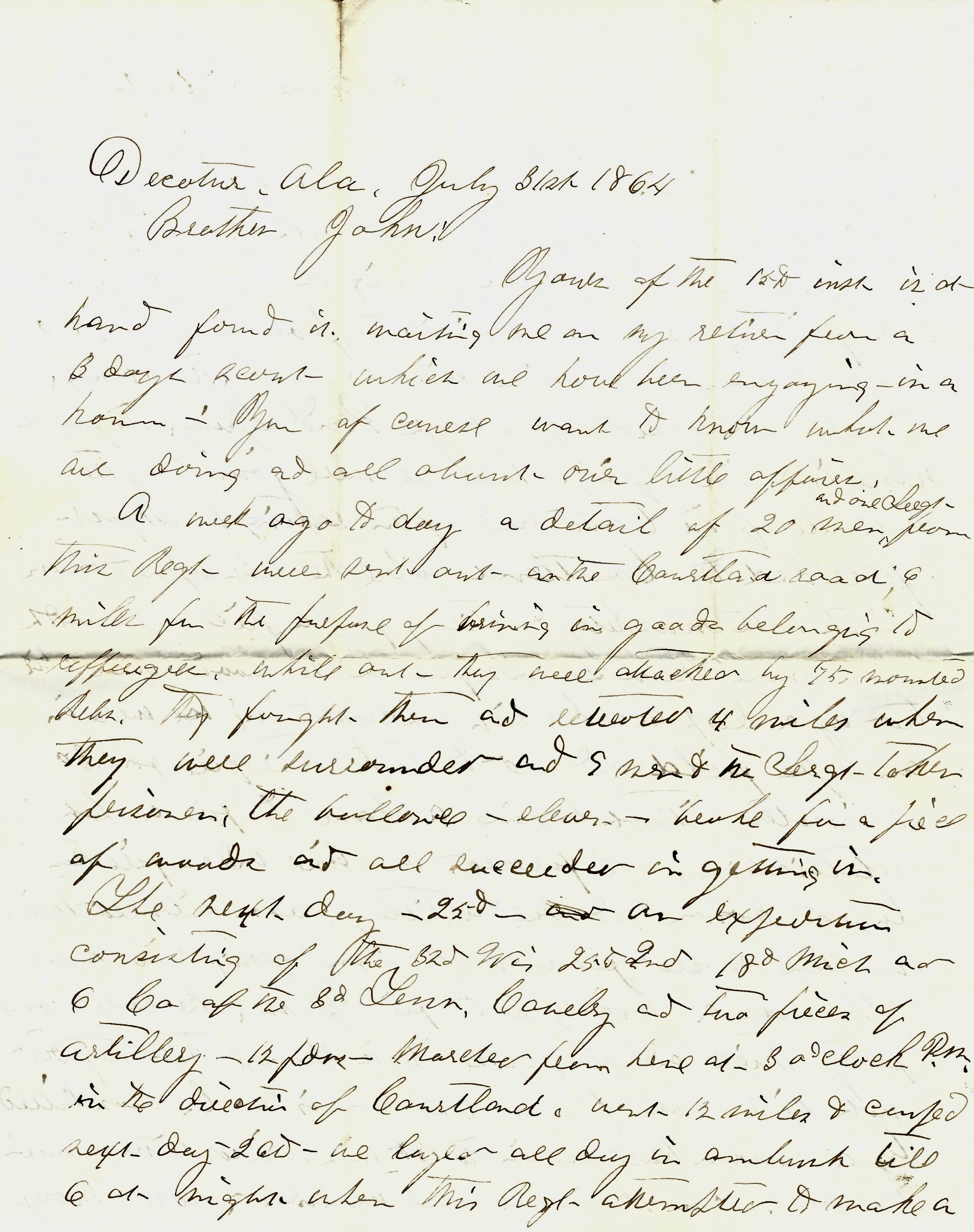
Yours of the 15th is at hand. Found it waiting me on the return from a 3 days scout which we have been enjoying. You of course want to know what we are doing and all about our little affairs.
A week ago today a detail of 20 men and one sergeant from this regiment were sent out on the Courtland Road 6 miles for the purpose of bringing in goods belonging to refugees. While out, they were attacked by 75 mounted Rebs. They fought them and retreated 4 miles when they were surrounded and 9 men and the sergeant taken prisoners. The balance—eleven [men]—broke for a piece of woods and all succeeded in getting in.
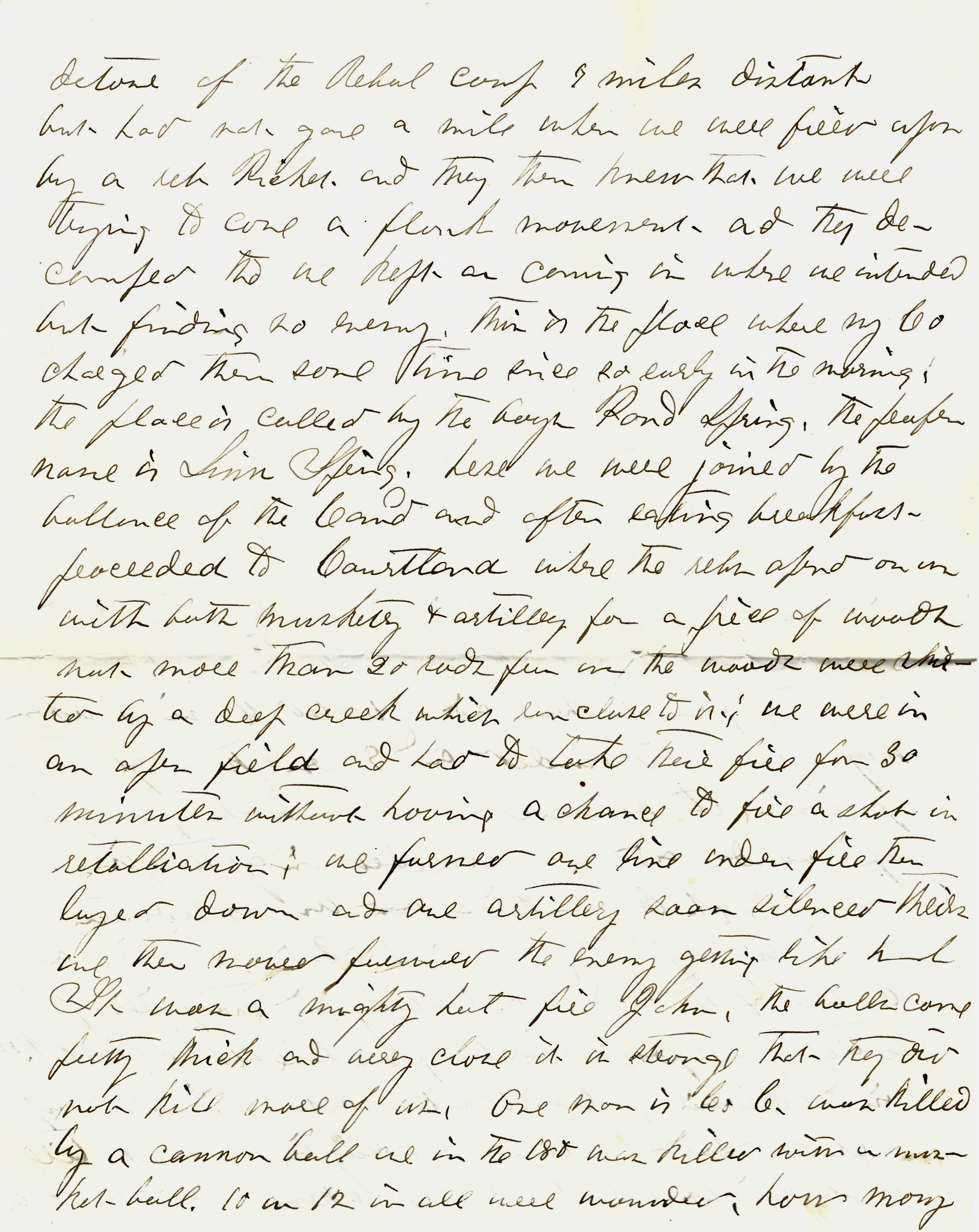
The next day, 25th, an expedition consisting of the 32d Wisconsin, 25th Indiana, 18th Michigan and six companies of the 3rd Tennessee cavalry and two pieces of artillery—12 pounders—marched from here at 3 o’clock p.m. in the direction of Courtland, Went 12 miles and camped. Next day, 25th, we laid all day in ambush till 6 at night when this regiment attempted to make a detour of the Rebel camp 3 miles distant but had not gone a mile when we were fired upon by a Reb picket ad they then knew that we were trying to make a flank movement and they decamped though we kept on coming in where we intended but finding no enemy. This is the [same] place where my company charged them some time since so early in the morning. The place is called by the boys “Pond Spring” [but] the proper name is Linn Spring. Her we were joined by the balance of the cavalry and after eating breakfast, proceeded to Courtland where the rebs opened on us with both musketry and artillery from a piece of woods not more than 20 rods from us. The woods were skirted by a deep creek which enclosed [ ]. We were in an open field and had to take their fire for thirty minutes without having a chance to fire a shot in retaliation. We formed our line under fire, then laid down and our artillery soon silenced theirs. We then moved forward, the enemy getting like hell. It was a mighty hot fire, John. The balls come pretty thick and very close. It is strange that they did not kill more of us. One man in Co. C was killed by a cannon ball. One in the 18th was killed with a musket ball. Ten or twelve in all were wounded. How many the enemy lost, I don’t know, but they left 4 or 5 dead and carried some off.
I must say that Company K behaved splendidly, though I am its commander. They kept a perfect line, halted and dressed up. They also deployed right under fire just as cooly as though they were on drill or dress parade.
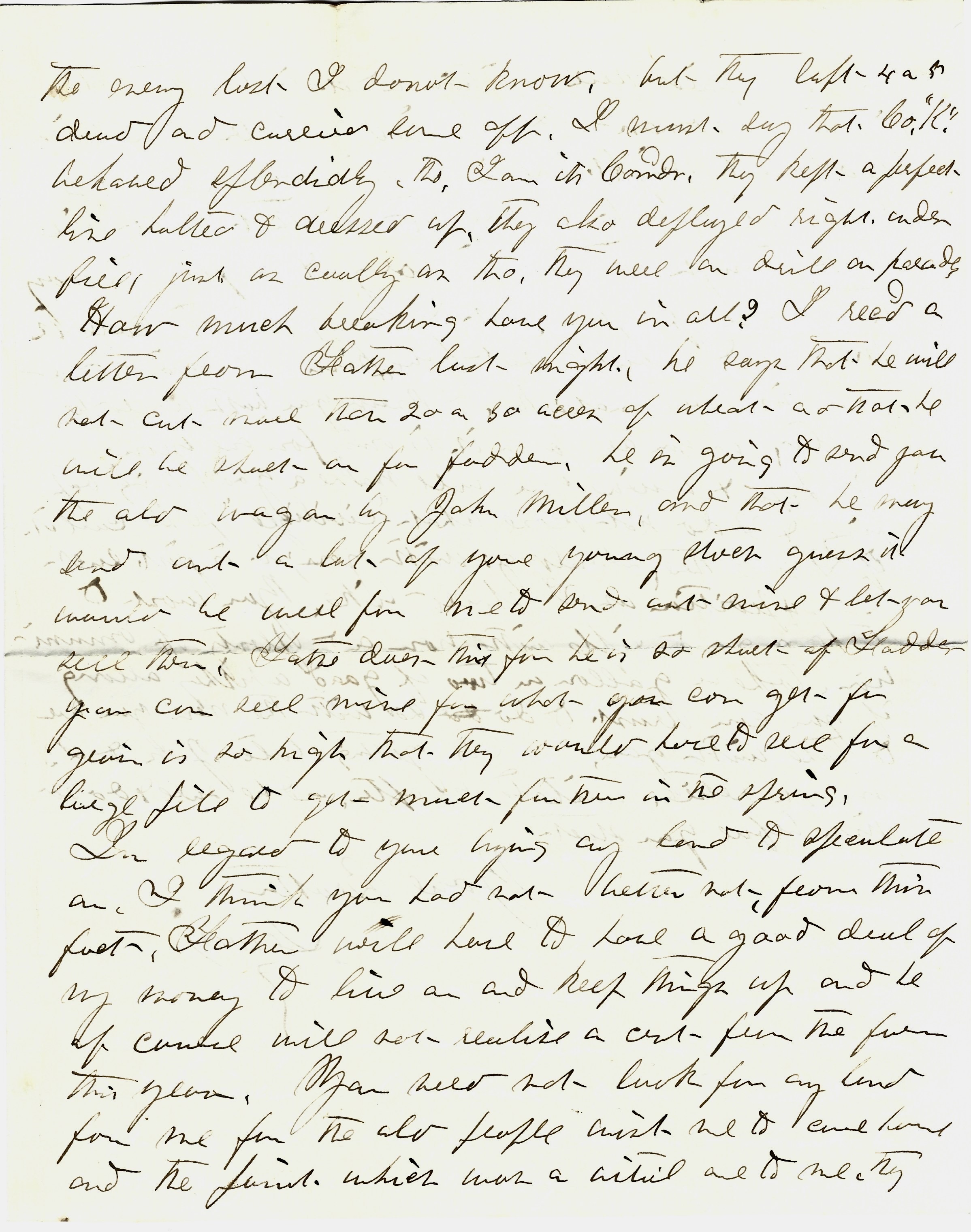
How much breaking have you in all? I received a letter from Father last night. He says that he will not cut more than 20 or 30 acres of wheat so that he will be short for fodder. He is going to send you the old wagon by John Miller and that he may send out a lot if you have young stock. Guess it would be well for me to send out mine and let you sell them. [ ] for he is so short of fodder, you can sell mine for what you can get for grain is so high that they would have to sell for a large pile to get much for her in the spring.
In regard to your buying any land to speculate on, I think you had better not, from this fact. Father will have to have a good deal of my money to live on and keep things up and he of course will not realize a crop from the farm this year. You need not look for any land for me for the old people wish me to come home and the [ ] which was a critical one to me, thy have to defend their position and it is perfectly satisfactory—woman.
I received a letter from Miles also last night. He is in Milwaukee. I hope youwill not be drafted and that Burt will not though the call is large and I fear it may take one of you. Yet I am glad the call is made and would not have him—the President—recall his proclamation though I knew you both would be drafted. If you are, John, it is only for one year.
I hope and believe you will make a good thing trapping and I do not care what “civilized” people call it. If I were there. I should go with you. It is just such an expedition as I should like. You want to take a good rifle with you and plenty of ammunition. Take a gallon or two of good whiskey along if you can trust to do so with the men you are to take with you. It is getting late, John, and I must retire. Write to me after and be sure to do so just before you start. Your brother, — Lewis
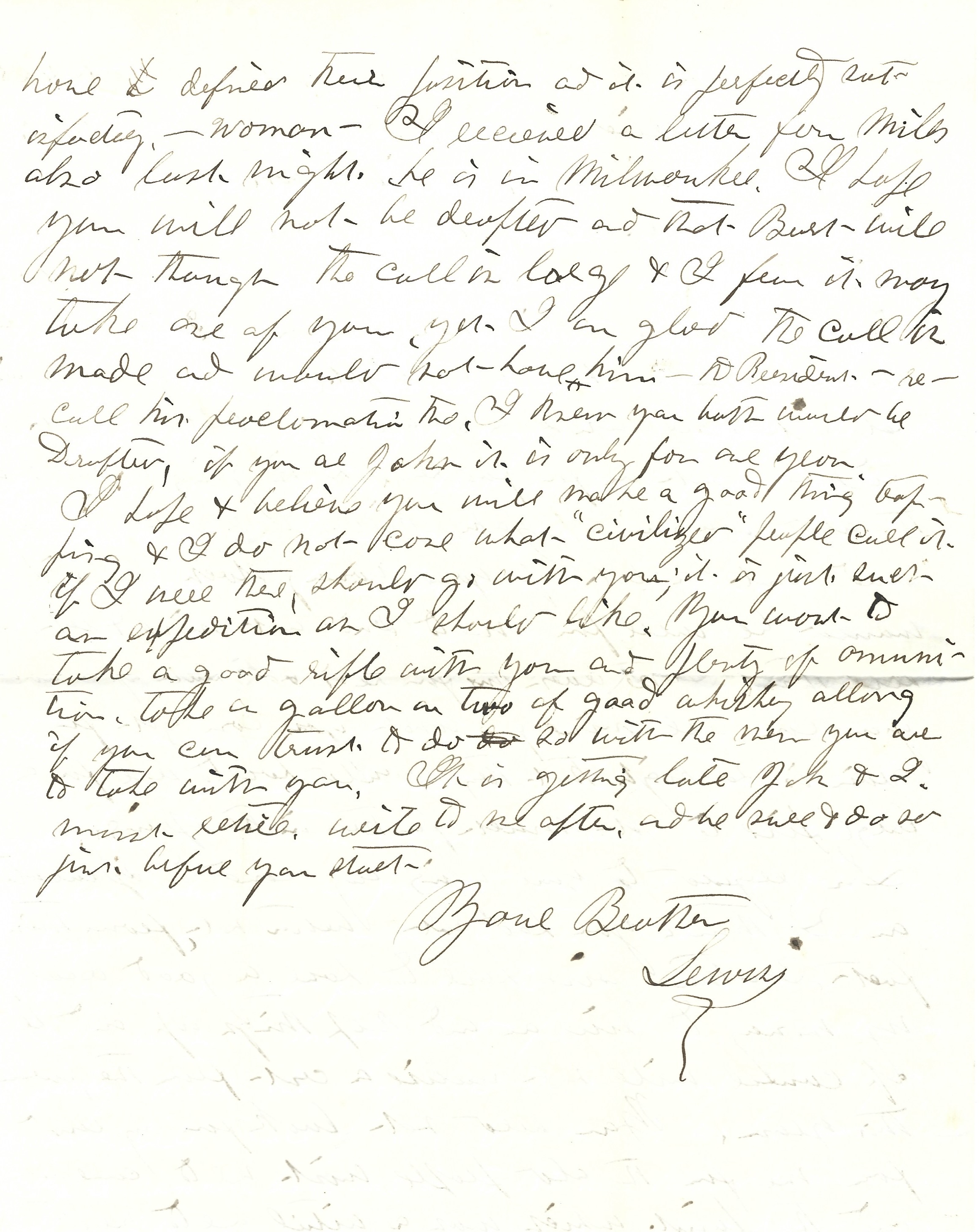
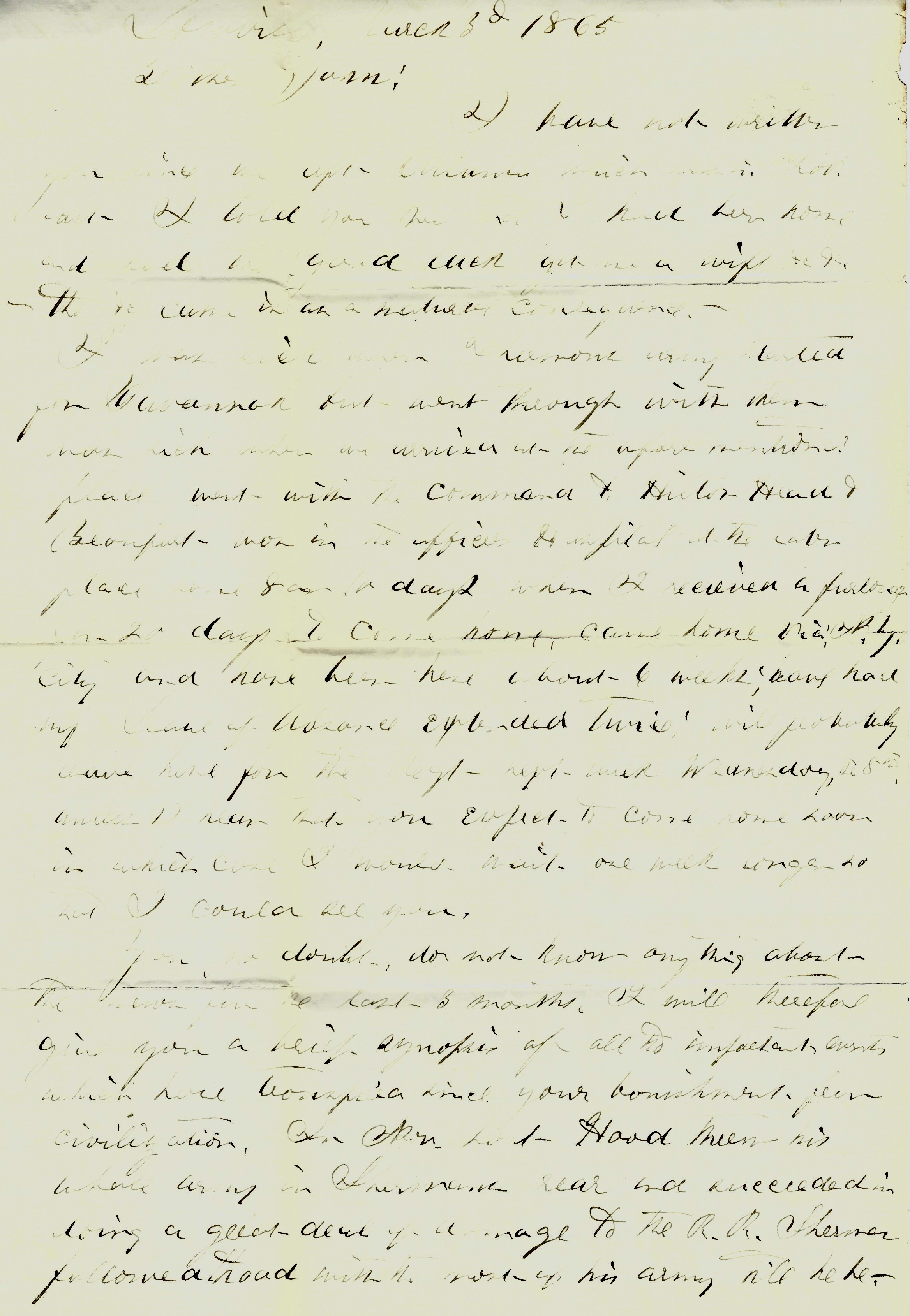
Letter 14
Lowville [Wisconsin]
March 3, 1865
Brother John,
I have not written you since we left Atlanta which was in November last. I told you then that I had been home and had the good luck to get me a wife &c. &c., that it came in asa natural consequence.
I was sick when Sherman’s army started for Savannah but went through with them. Was sick when we arrived at the aforementioned place, went with the command to Hilton head and Beaufort, was in the officer’s hospital at the latter place some 8 or ten days when I received a furlough for 20 days to come home. Came home via New York City and have been here about six weeks. Have had my leave of absence extended twice. Will probably leave here for the regiment next week Wednesday, the 8th, unless I hear that you expect to come home soon in which case I would wait one week longer so that I could see you.
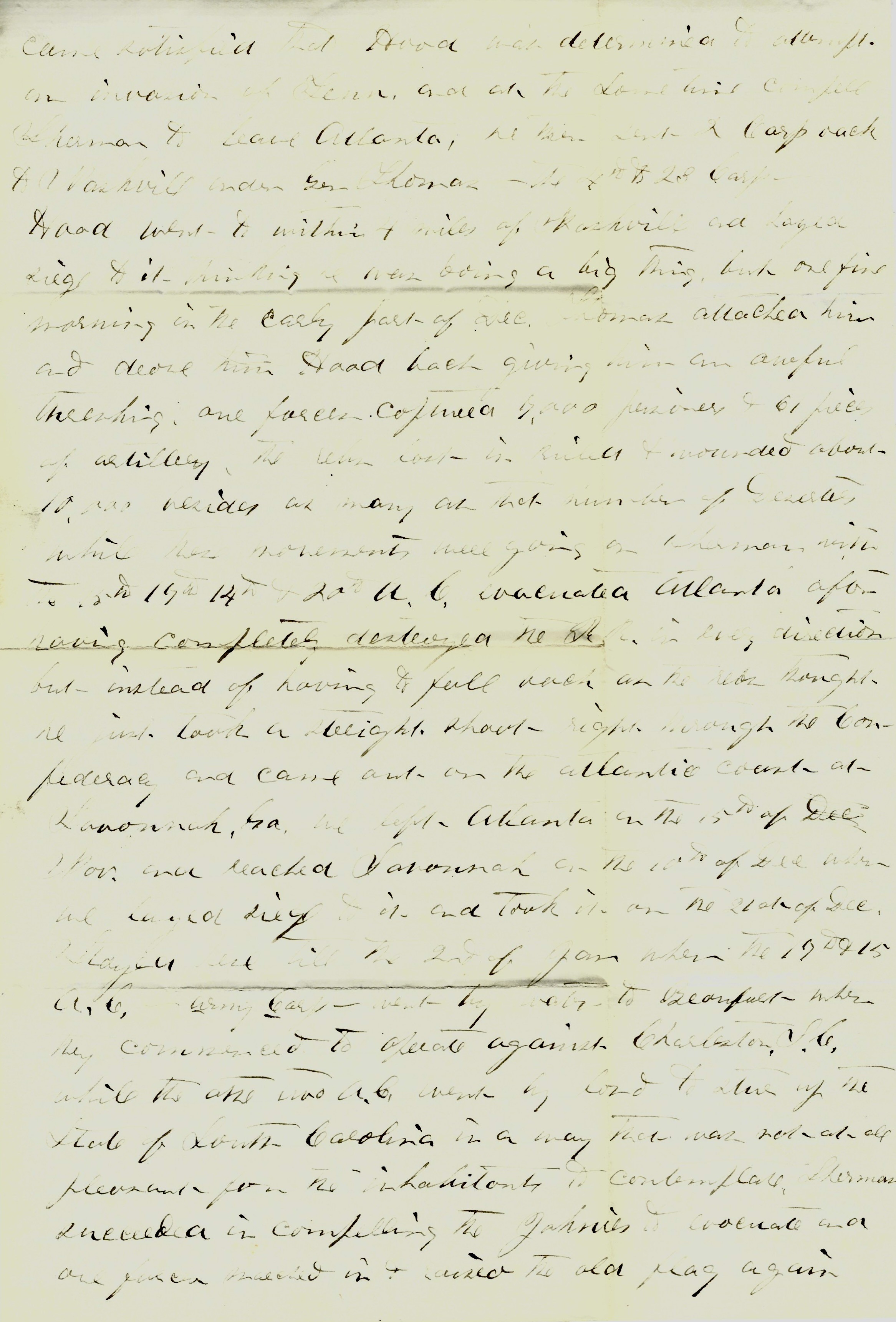
You no doubt do not know anything about the news from the last three months. I will therefore give you a brief synopsis of all the important events which have transpired since your banishment from civilization. In November last, Hood threw his whole army in Sherman’s rear and succeeded in doing a great deal of damage to the railroad. Sherman followed with the most of is army till he became satisfied that Hood was determined to attempt an invasion of Tennessee and at the same time compel Sherman to leave Atlanta. He then sent two Corps back to Nashville under Gen. Thomas—the 4th & 23rd Corps. Hood went to within 4 miles of Nashville and laid siege to it thinking he was doing a big thing but one fine morning in the early part of December, Thomas attacked him and drove Hood back, giving him an awful thrashing. Our forces captured 7,000 prisoners and 61 pieces of artillery. The Rebs lost in killed and wounded about 10,000 besides as many as that number of deserters.
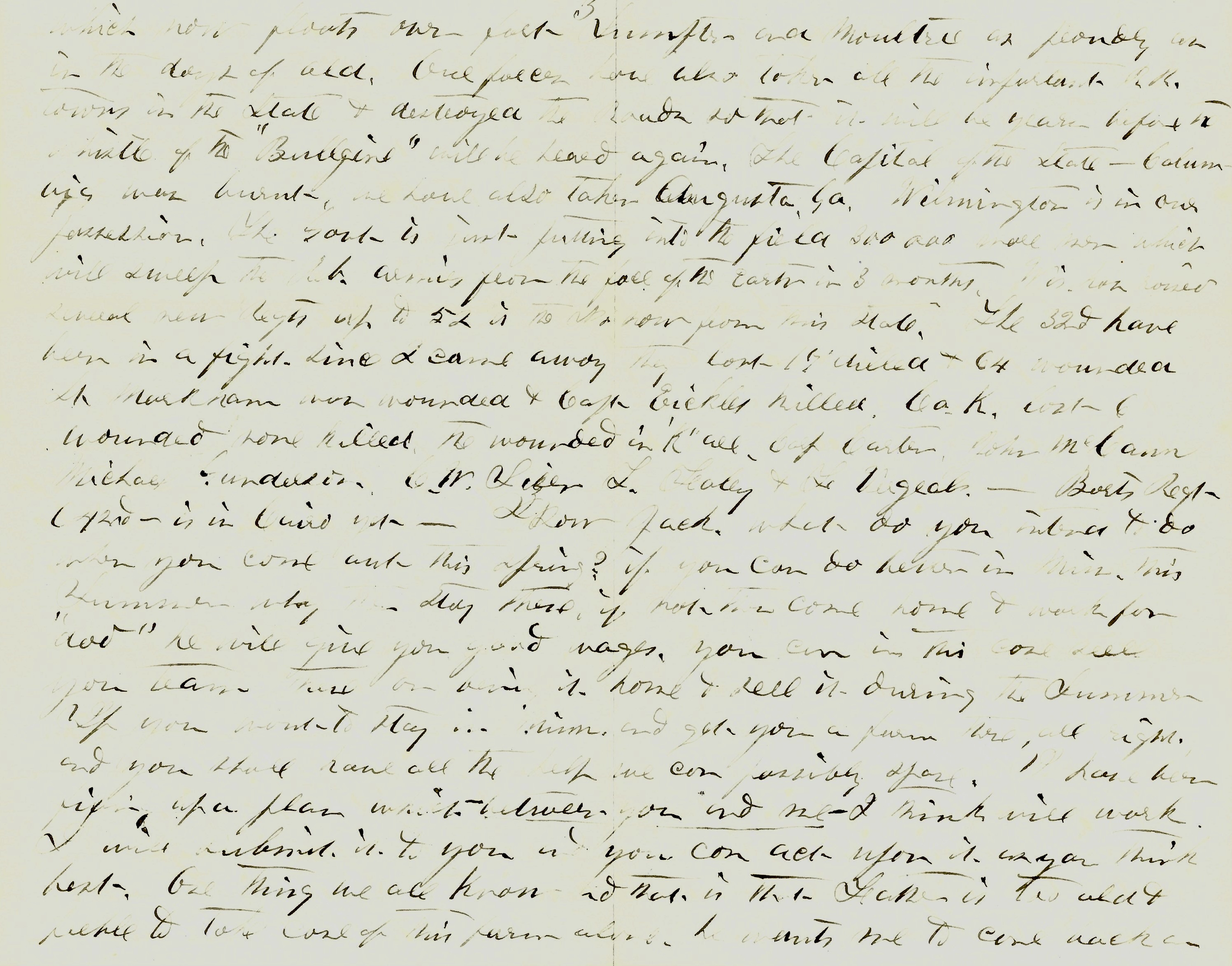
While these movements were going on, Sherman with the 15th, 17th, 14th, and 20th Army Corps evacuated Atlanta after having completely destroyed the railroad in every direction but instead of having to fall back as the Rebs thought, he just took a straight shoot right through the Confederacy and came out on the Atlantic coast at Savannah, Ga. We left Atlanta on the 5th of November and reached Savannah on the 10th of December when we laid siege to it and took it on the 21st of December. Stayed here till the 2nd of January when the 17th and 15th Army Corps went by water to Beaufort where they commenced to operate against Charleston, S. C. while the other two Army Corps went by land to stir up the state of South Carolina in a way that was not at all pleasant for the inhabitants to contemplate. Sherman succeeded in compelling the Johnnies to evacuate and our forces marched in and raised the old flag again which now floats over Fort Sumter and Moultrie as proudly as in the days of old. Our forces have also taken all the important railroad towns in the state and destroyed the roads so that it will be years before the whistle of the “Bullgins” [?] will be heard again. The Capitol of the State, Clumbia, was burnt. We have also taken Augusta, Georgia. Wilmington is in our possession. The Government is just putting into the field 300,000 more men which will sweep the Reb armies from the face of the earth in three months. Wisconsin has raised several new regiments—up to 52 is the number now from this state.
The 32nd have been in a fight since I came awy. they lost 17 killed and 64 wounded. Lt. Markham was wounded and Capt. Eickles killed. Co. K lost six wounded, none killed. The wounded in Co. K are Corp. [Joseph] Carter, John McCann, Michael Gunderson, W. W. Sizer, T[imothy] Foley, & F[rederick]. Vergeals [?] Bert’s regiment (42nd) is in Cairo yet.
Now Jack, what do you intend to do when you come out this spring? If you can do better in Minnesota this summer, why then stay there. If not, come home to work for “dad.” He will give you good wages. You can in this case sell your team there or bring it home and sell it during the summer. If you want to stay in Minnesota and get you a farm there, all right. And you shall have all the help we can possibly spare.
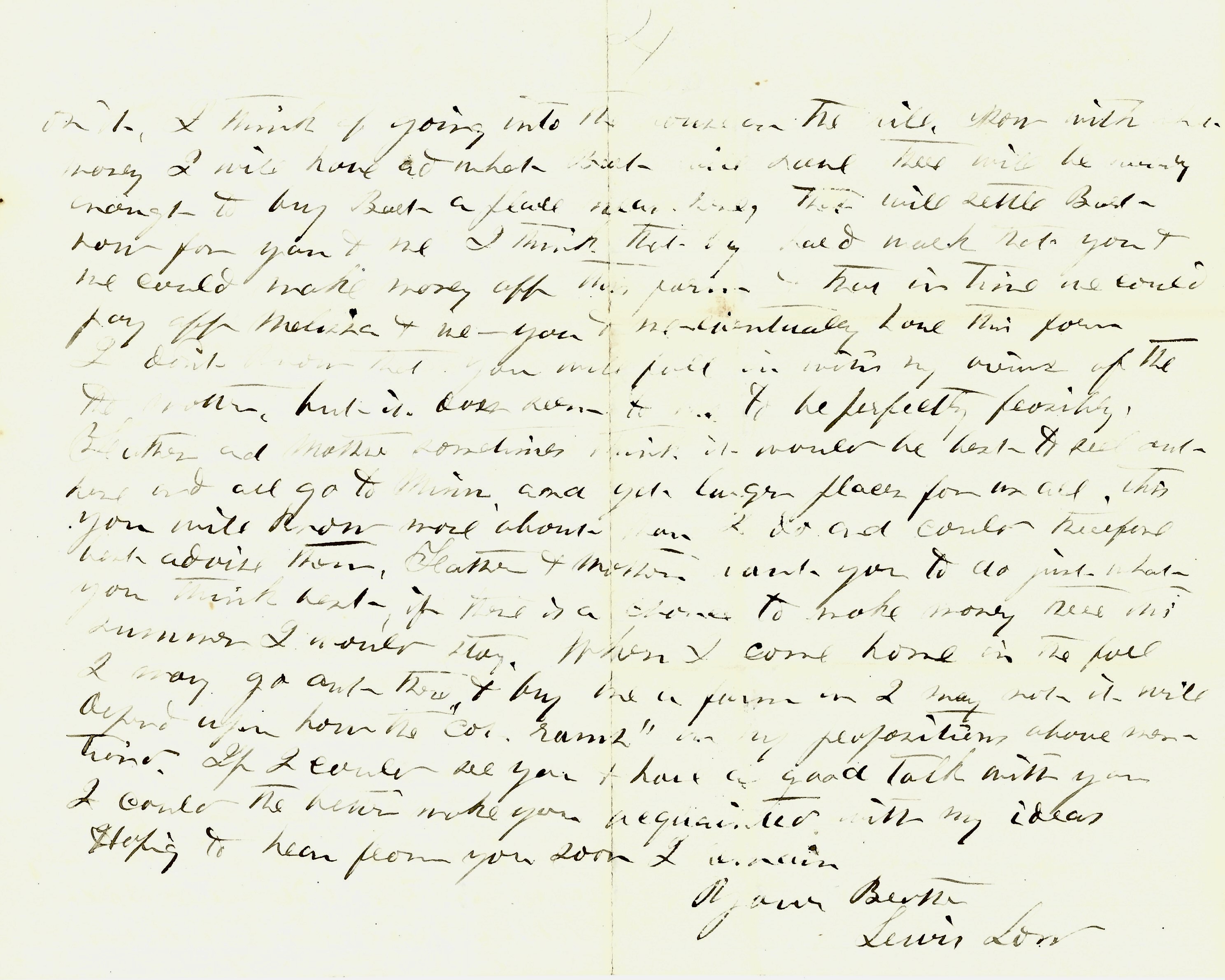
I have fixing upon a plan which between you and me I think will work. I will submit it to you and you can act upon it as you think best. One thing we all know and that is that Father is too old and feeble to take care of his farm alone. He wants me to come back and work on it. I think of going into the house on the hill. With what money I will have and what Bert will have, there will be money enough to buy Bert a place nearby. That will settle Bert. Now for you and me. I think that by hard work that you and me could make money off the farm and that in time we could pay off Melissa & we—you and me—eventually have this farm. I don’t know that you will fall in with my whims of the matter, but it does seem to be perfectly feasible. Father and Mother sometimes think it would be best to sell out here and all go to Minnesota and get larger places for us all. This you will know more about than I do and could therefore best advise them. Father and Mother wants you to do just what you think best if there is a chance to make money here this summer, I would stay. When I come home in the fall, I may go out there and buy me a farm and I may not—it will depend upon how the “cor. rams” in my propositions above mentioned. If I could see you and have a good talk with you, I could better make you acquainted with my ideas.
Hoping to hear from you soon, I remain your brother, — Lewis Low