
The following letter was written by Pvt. William S. Cooper (b. 1843), the son of James Cooper, Jr. (1809-1870) and Susanna M. Travis (1808-1867) of Fairbury, Livingston county, Illinois. He enlisted on 11 October 1861 in Co. C, 39th Illinois Infantry (“Yates’ Phalanx”) and was discharged for disability on 12 December 1863.
William wrote his letter from the parole hospital at Annapolis Maryland in mid-October 1862. He was taken prisoner on 26 May 1862 at Strasburgh, Virginia, and spent the summer held in Confederate prisons until he was sent to Annapolis to await exchange. His health precluded his ever returning to his regiment, however. After he was discharged, he relocated to Colorado.
This letter is from the personal collection of Greg Herr and was offered for transciption and publication on Spared & Shared by express consent.
T R A N S C R I P T I O N
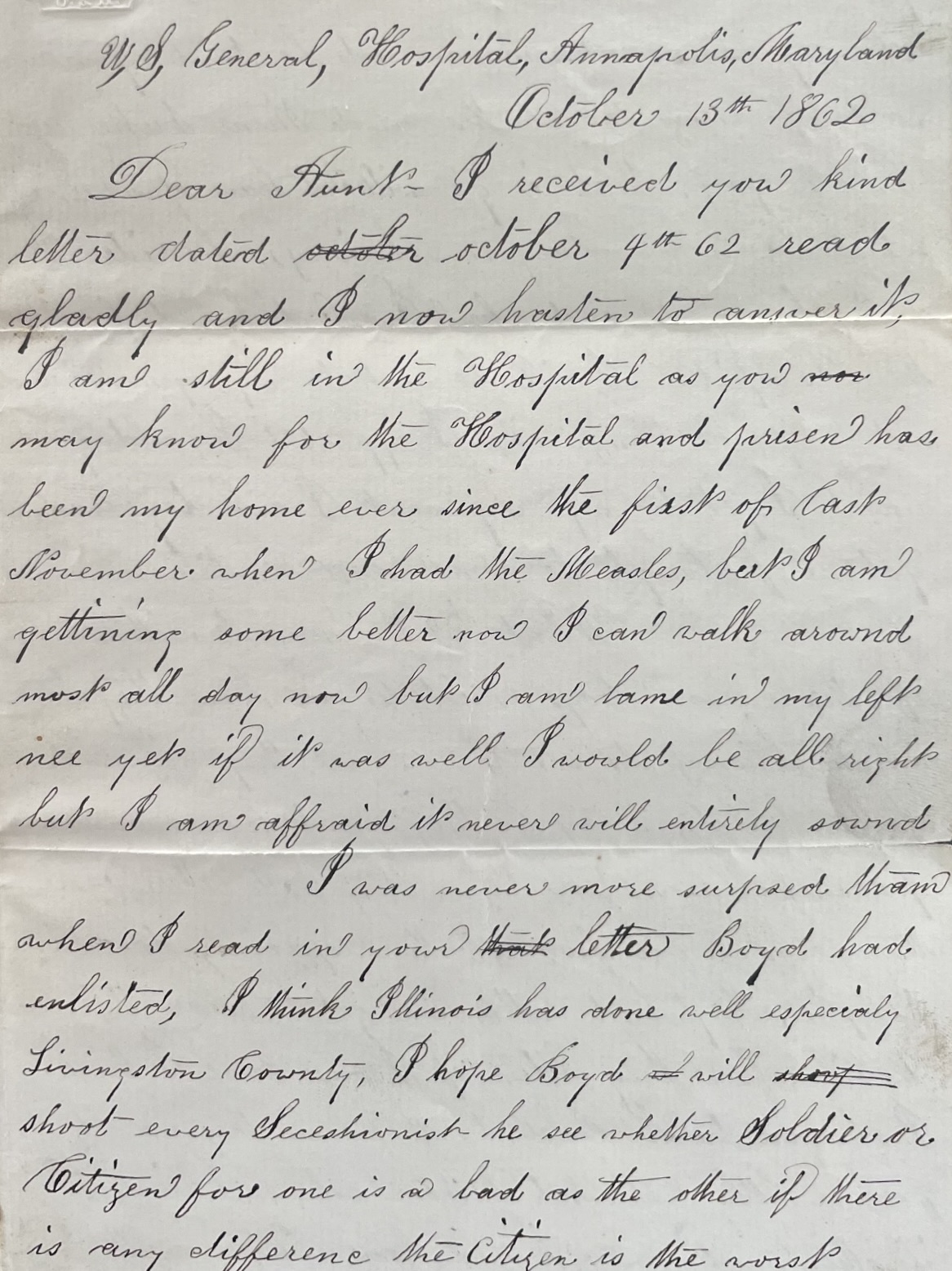
U. S. General Hospital
Annapolis, Maryland
October 13th 1862
Dear Aunt,
I received your kind letter dated October 4th ’62 read gladly and I now hasten to answer it. I am still in the hospital as you may know for the hospital and prison has been my home ever since the 1st of last November when I had the easles, but I am getting some better now. I can walk around most all day now but I am lame in my left knee yet. If it was well, I would be all right. But I am afraid it never will entirely [be] sound.
I was never more surprised than when I read in your letter Boyd 1 had enlisted. I think Illinois has done well—especially Livingston county. I hope Boyd will shoot ever secessionist he sees, whether soldier or citizen for one is as bad as the other. If there is any difference, the citizen is the worst.
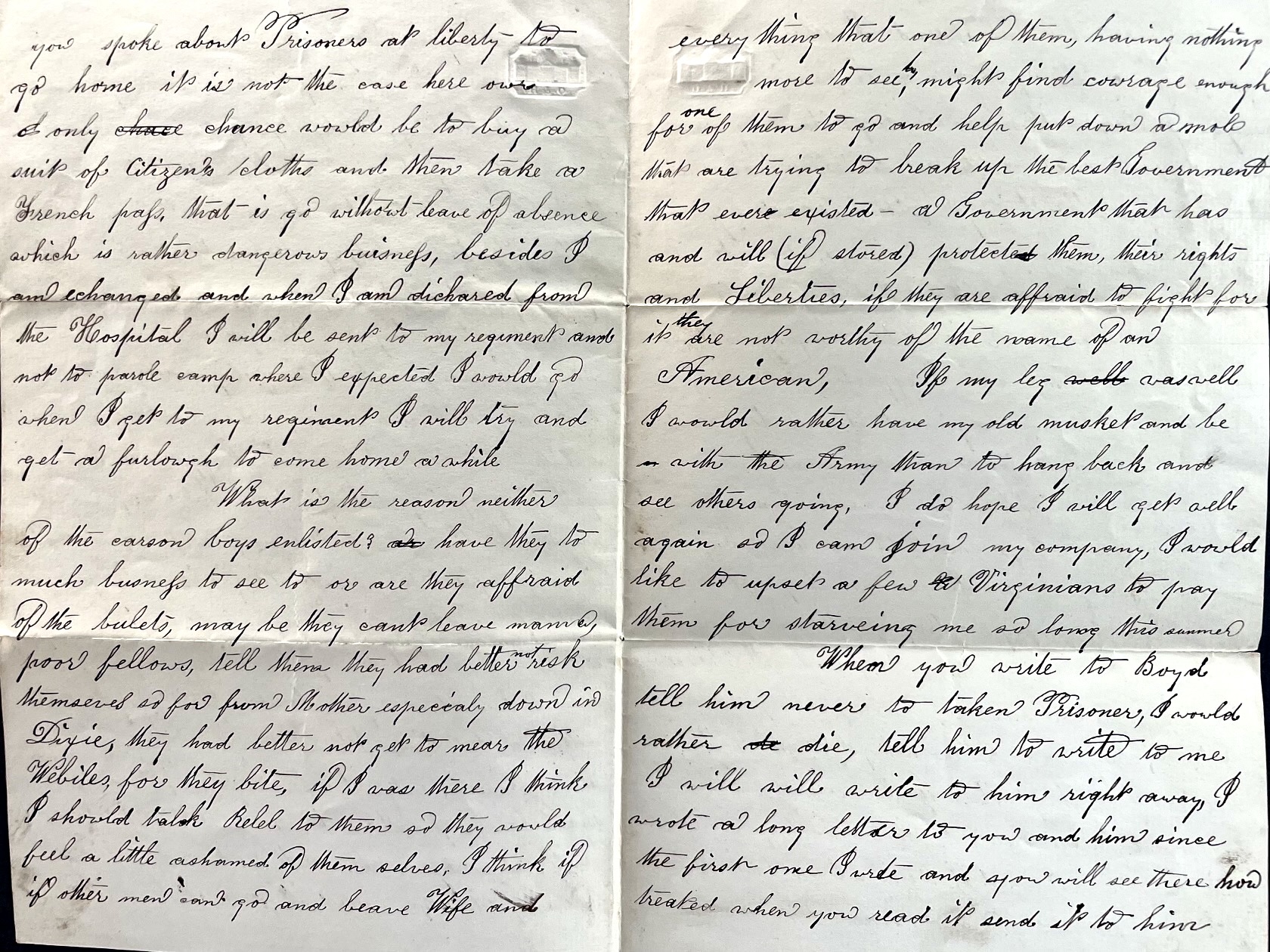
You spoke about prisoners at liberty to go home. It is not the case here. Our only chance would be to buy a suit of citizen’s clothes and then take a French pass—that is, to go without leave of absence which is a rather dangerous business. Besides, I am exchanged and when I am discharged from the hospital, I will be sent to my regiment and not to parole camp where I expected I would go. When I get to my regiment, I will try and get a furlough to come home a while.
What is the reason neither of the Carson boys enlisted? Have they too much business to see to, or are they afraid of the bullets? Maybe they can’t leave mama. Poor fellows. Tell them they had better not risk themselves so far from Mother—especially down in Dixie for they bite. If I was there, I think I should talk Rebel to them so they would feel a little ashamed of themselves. I think of other men can’t go and leave wife and everything that one of them, having nothing more to see by, might find courage enough for one of them to go and help put down a mob that are trying to break up the best government that ever existed—a government that has, and will (if restored) protect them, [and] their rights and liberties. If they are afraid to fight for it, they are not worthy of the name of an American.
If my leg was well, I would rather have my old musket and be with the Army than to hang back and see others going. I do hope I will get well again so I can join my company. I would like to upset a few Virginians to pay them for starving me so long this summer.
When you write to Boyd, tell him never to [be] taken prisoner. I would rather die. Tell him to write to me. I will write to him right away. I wrote a long letter to you and him since the first one I wrote and you will see there how [I was] treated. When you read it, send it to him.
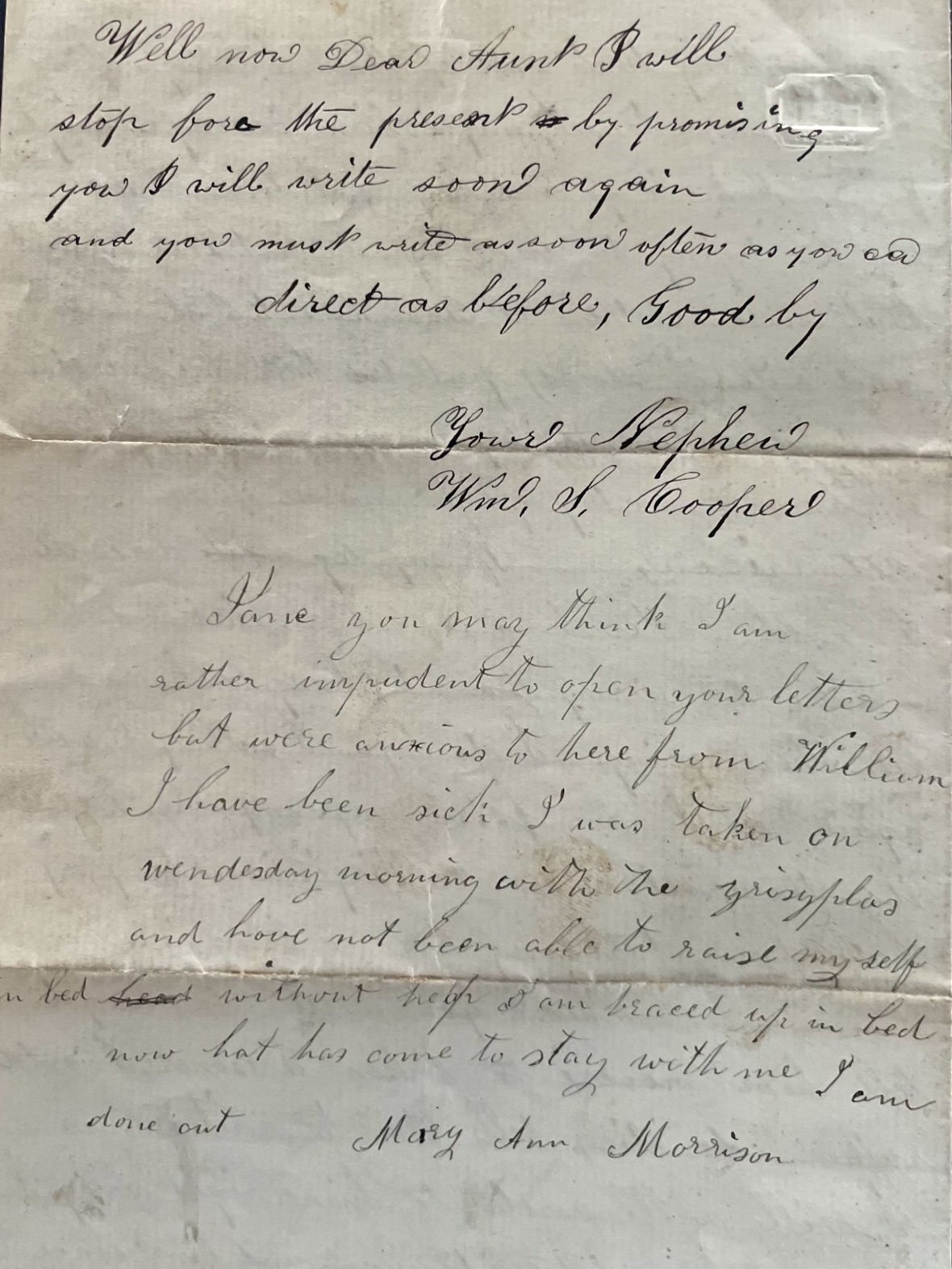
Well now, dear Aunt, I will stop for the present by promising you I will write soon again. And you must write as soon [and] as often as you can. Direct as before. Goodbye. Your nephew, — Wm. S. Cooper
[In a different hand]
Jane, you may think I am rather impudent to open your letters but were anxious to hear from William. I have been sick. I was taken on Wednesday morning with erysipelas and have not been able to raise myself in bed without help. I am braced up in bed now. Hat has come to stay with me. I am done out. — Mary Ann Morrison
1 Boyd P. Tanner (1838-1863) enlisted in August 1862 and mustered into Co. E, 129th Illinois Infantry on 8 September 1862. He died of disease on 18 January 1863 at Fountain Head, Tennessee. He was married to Sarah Jane Harlan (1837-1929) in 1858. After Boyd’s death, she married Jesse Greene (1829-1912) in 1864 and lived out her days in Pontiac.


While I had three 2nd great grandfathers and 9 more relatives fight for the North, its amazing to read this letter as one of my 2nd great grandfathers had a younger brother serve
LikeLike