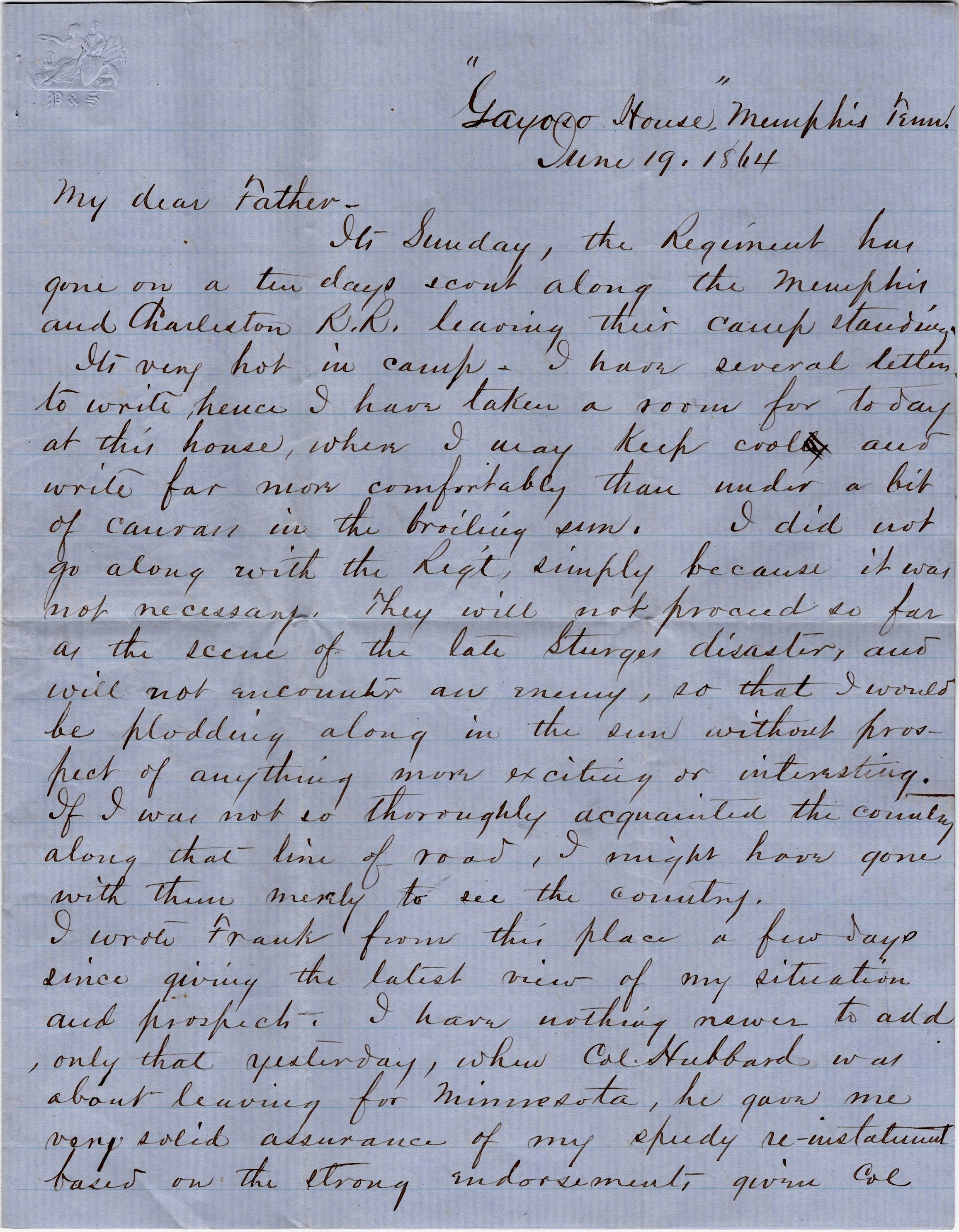
This letter was written by Joseph Randal Vail (1840-1875) of Marshall County, IL who enlisted in the 47th Illinois Infantry as a corporal, and eventually became the regiment’s adjutant before his 1864 discharge. The letter was once a part of a more complete collection of his letters that discussed fights with the Rebels at Corinth, Vicksburg, and Lake Chicot, Arkansas. For example, writing six days after Corinth, he was impressed with the Confederates: “Their energy and determination, even among the privates, is worthy of emulation in a better cause.” He was less impressed with his own army’s chaplains: “Laying around hotels smoking cigars, or in the shade sipping wine, when thousands of men in agony cry aloud night and day all around them for help, a little care, a drink of water! God pity them” (10 October 1862). His regiment fought valiantly in the failed assault on Vicksburg: “Generals & all who witnessed the charge of the 11th & 47th call it magnificent, gloriously done, but that is poor remuneration to our poor fellows who have lost legs & arms by the move” (23 May 1863). The regiment also played a central role in the small Battle of Lake Chicot: “The fire was terrible for nearly two hours, but there was no flinching, no attempt to retreat from that close range shower of grape, shell and canister” (11 June 1864). In addition to the discussions of combat, Vail also offers strong opinions about military politics, from the regimental level up through the highest ranks. He hopes General Banks is named Secretary of War–“Put him anywhere but in the field” (2 May 1864).
Joseph wrote this letter to his father from the Gayoso House in Memphis—a large luxury hotel overlooking the Mississippi river that served as the primary headquarters of the Union occupying force in Memphis throughout most of the Civil War. We learn from the letter that Joseph was facing a court martial for some unnamed offense that he felt totally innocent of, and though he claimed it did not upset him, he devoted the better part of six pages discussing it. His military record reveals that he was honorably discharged suggesting the charges were either dropped or he was vindicated. But his troubled mind apparently haunted him into civilian life for his obituary informs us that he committed suicide at Castleton, Stark county, Illinois on 9 August 1875 by severing both his jugular vein and windpipe. He left the following note: “Please deliver my love to father and family. Tell them to despise me. Fontron [his employer], I have done you great injury. Please give father all my papers you will find in my trunk. — Joseph R. Vail” [see Joseph Randal Vail on Find-A-Grave]
Over the last 20 years I have transcribed a number of letters by member of the 47th Illinois Infantry. They include:
Unidentified Soldier, 47th Illinois (1 Letter)
Carey C. Wright, Co. B, 47th Illinois (1 Letter)
Charles R. Martin, Co. D, 47th Illinois (3 Letters)
Alfred C. Baxter, Co. I, 47th Illinois (2 Letters)
James Harvey Enslow, Co. I, 47th Illinois (1 Letter)
David Fisher McGowan, Co. I, 47th Illinois (7 Letters)
James Hervey Mitchell, Co. I, 47th Illinois (1 Letter)
Robert Pyle, Co. K, 47th Illinois (Diary)
George Ray, Co. K, 47th Illinois (1 Letter)
[My thanks to Abbey Weber Jones for providing a first draft of this transcription for Spared & Shared.]
T R A N S C R I P T I ON
“Gayoso House”
Memphis, Tennessee
June 19, 1864
My dear Father,
It’s Sunday. The regiment has gone on a ten day scout along the Memphis and Charleston R.R. leaving their camp standing. It’s very hot in camp. I have several letters to write, hence I have taken a room for today at this house where I may keep cool and write far more comfortably than under a bit of canvas in the broiling sun. I did not go along with the regiment, simply because it was not necessary. They will not proceed so far as the scene of the late Sturges disaster, and will not encounter an enemy, so that I would be plodding along in the sun without prospect of anything more exciting or interesting. If I was not so thoroughly acquainted [with] the country along that line of road, I might have gone with them merely to see the country.
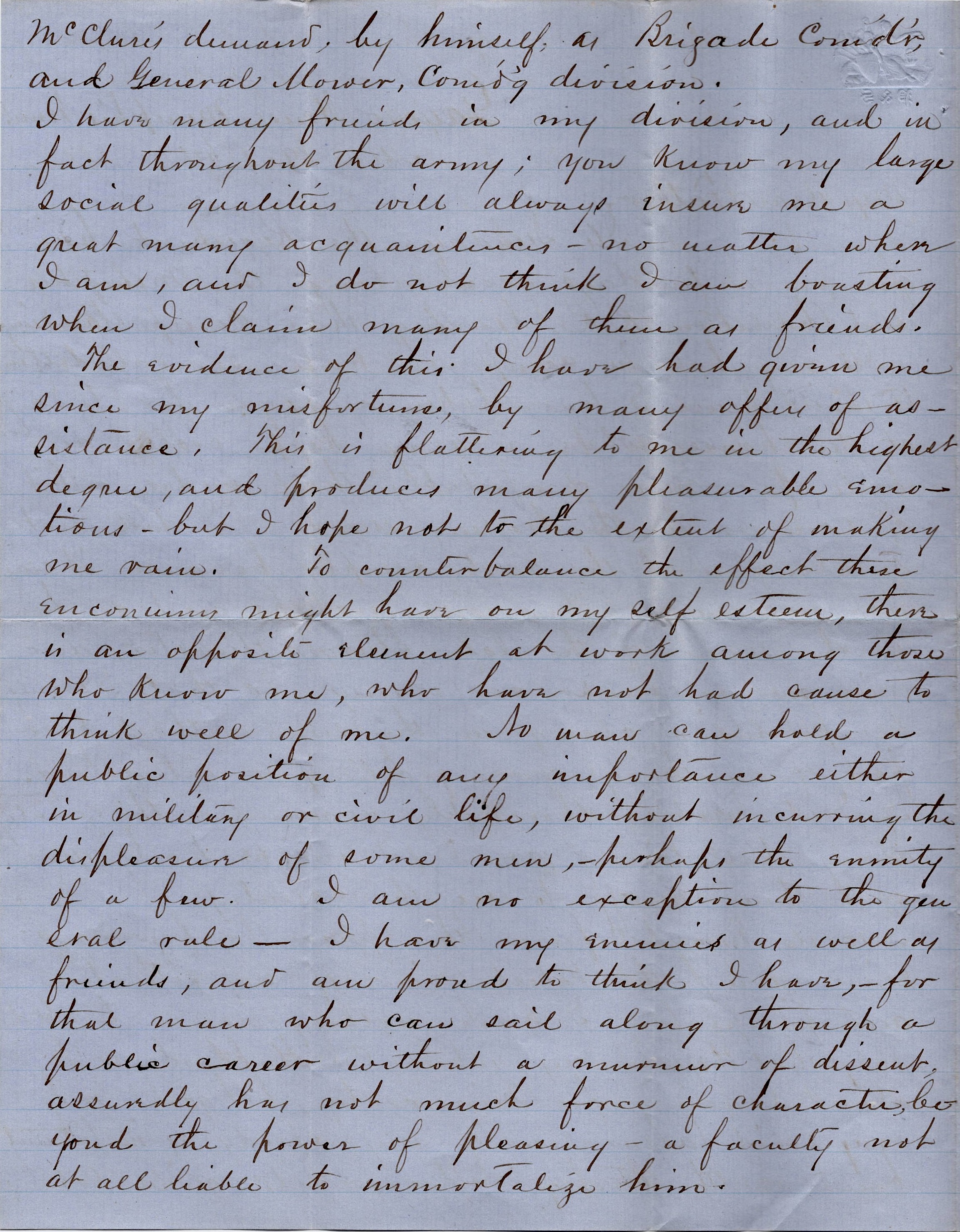
I wrote Frank from this place a few days since giving the latest view of my situation and prospects. I have nothing newer to add. Only that yesterday, when Col. Hubbard was about leaving for Minnesota, he gave me very solid assurance of my speedy re-instatement based on the strong endorsement given Col. McClure’s demand, by himself, as Brigade Commander and General Mower, commanding division.
I have many friends in my division, and in fact throughout the army; you know my large social qualities will always insure me a great many acquaintances – no matter where I am, and I do not think I am boasting when I claim many of them as friends.
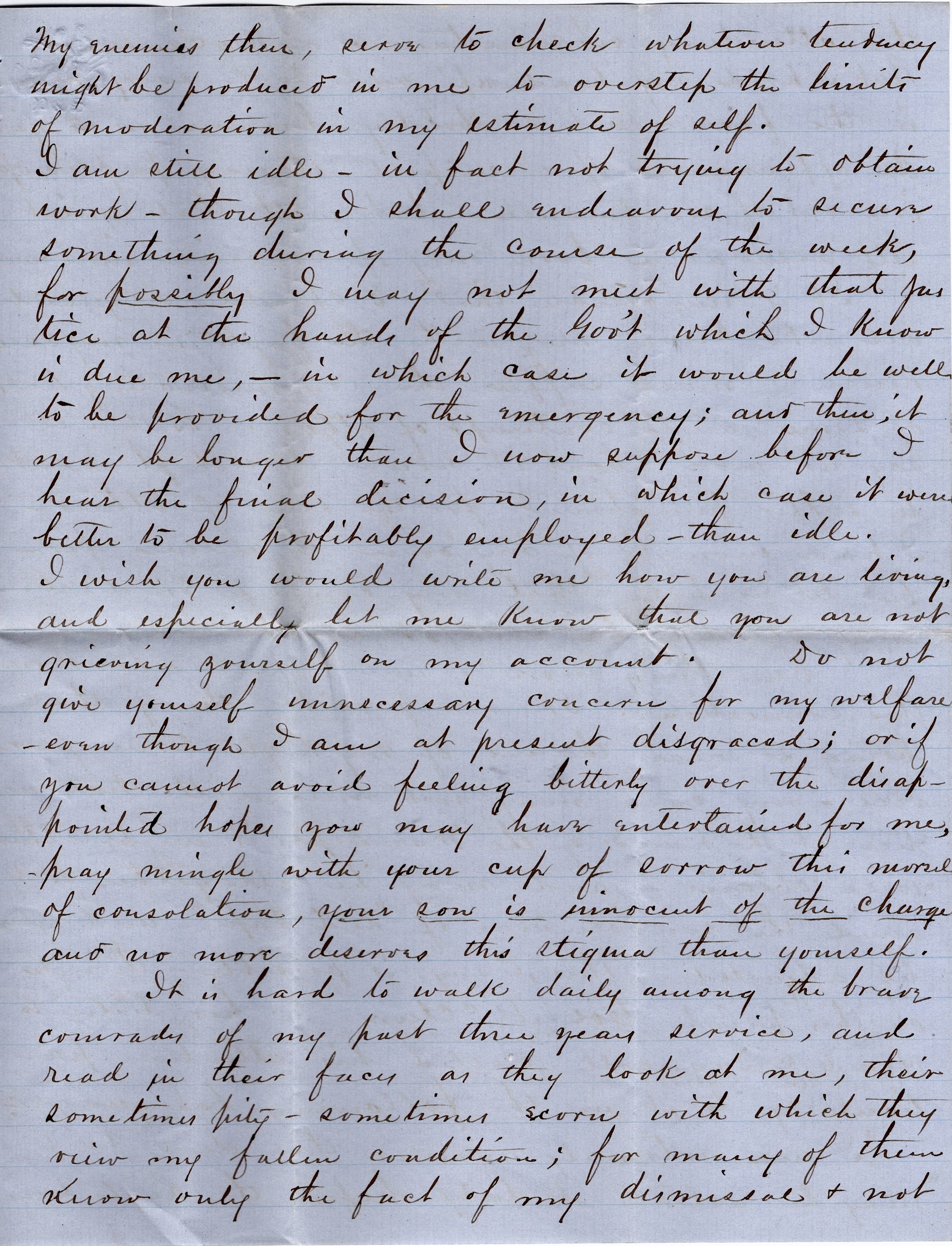
The evidence of this I have had given me since my misfortune, by many offers of assistance. This is flattering to me in the highest degree, and produces many pleasurable emotions, but I hope not to the extent of making me vain. To counterbalance the effect these inconveniences might have on my self esteem, there is an opposite element at work among those who know me, who have not had cause to think well of me. No man can hold a public position of any importance either in military or civil life, without incurring the displeasure of some men—perhaps the enmity of a few. I am no exception to the general rule. I have my enemies as well as friends, and am proud to think I have, for that man who can sail along through a public career without a murmur of dissent assuredly has not much force of character, beyond the power of pleasing—a faculty not at all liable to immortalize him. My enemies then, serve to check whatever tendency might be produced in me to overstep the limits of moderation in my estimate of self.
I am still idle—in fact, not trying to obtain work, though I shall endeavor to secure something during the course of the week, for possibly I may not meet with that justice at the hands of the Govt. which I know is due me, in which case it would be well to be provided for the emergency; and then, it may be longer than I now suppose before I hear the final decision in which case it were better to be profitably employed than idle.
I wish you would write me how you are living, and especially let me know that you are not grieving yourself on my account. Do not give yourself unnecessary concern for my welfare even though I am at present disgraced; or if you cannot avoid feeling bitterly over the disappointed hopes you may have entertained for me, pray mingle with your cup of sorrow this morsel of consolation, your son is innocent of the charge and no more deserves this stigma than yourself.
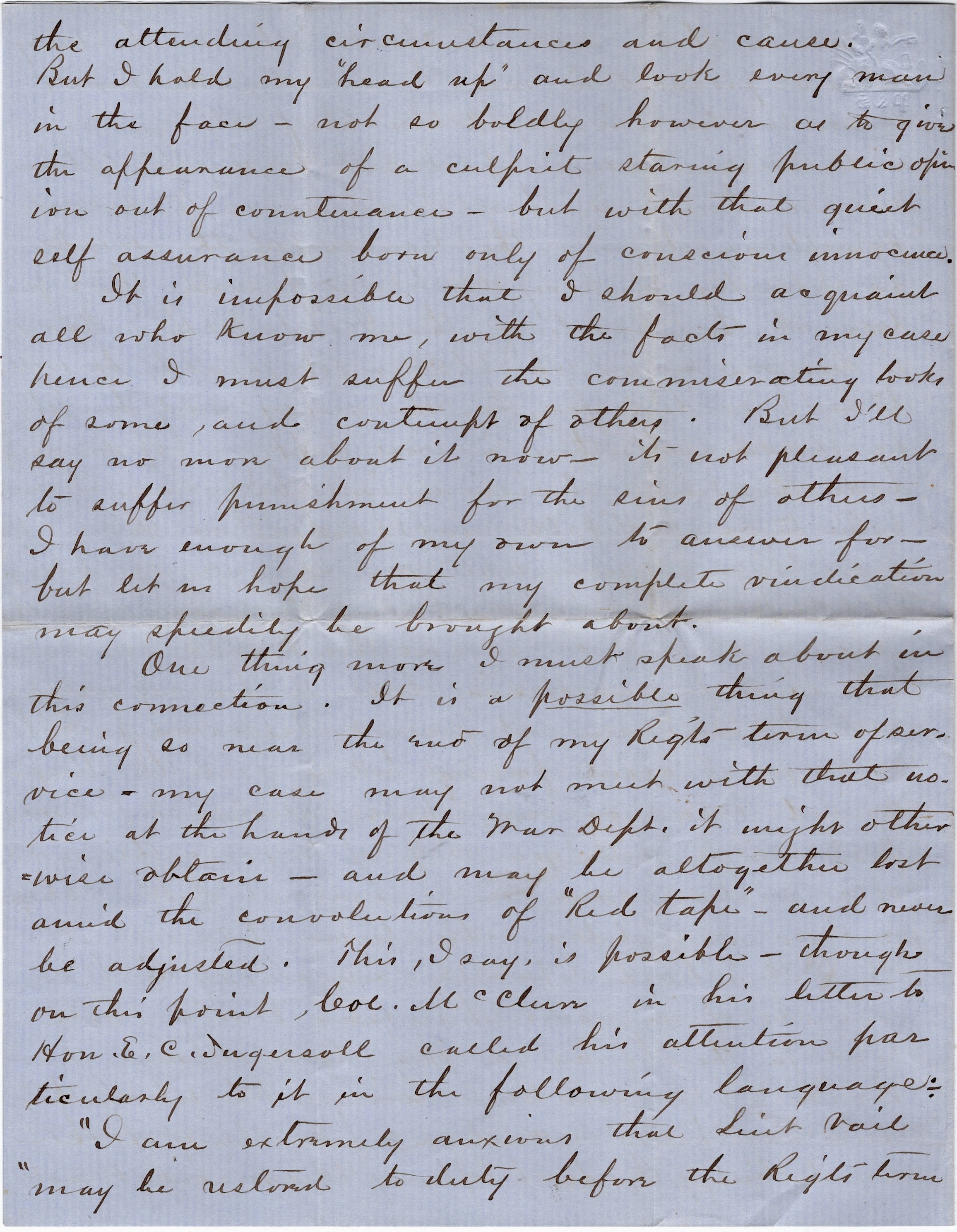
It is hard to walk daily among the brave comrades of my past three years service, and read in their faces as they look at me, their sometimes pity—sometimes scorn with which they view my fallen condition; for many of them know only the fact of my dismissal & not the attending circumstances and cause. But I hold my “head up” and look every man in the face—not so boldly however as to give the appearance of a culprit staring public opinion out of countenance, but with that quiet self assurance born only of conscious innocence.
It is impossible that I should acquaint all who know me, with the facts in my case. Hence I must suffer the commiserating looks of some, and contempt of others. But I’ll say no more about it now; it’s not pleasant to suffer punishment for the sins of others. I have enough of my own to answer for. But let us hope that my complete vindication may speedily be brought about.
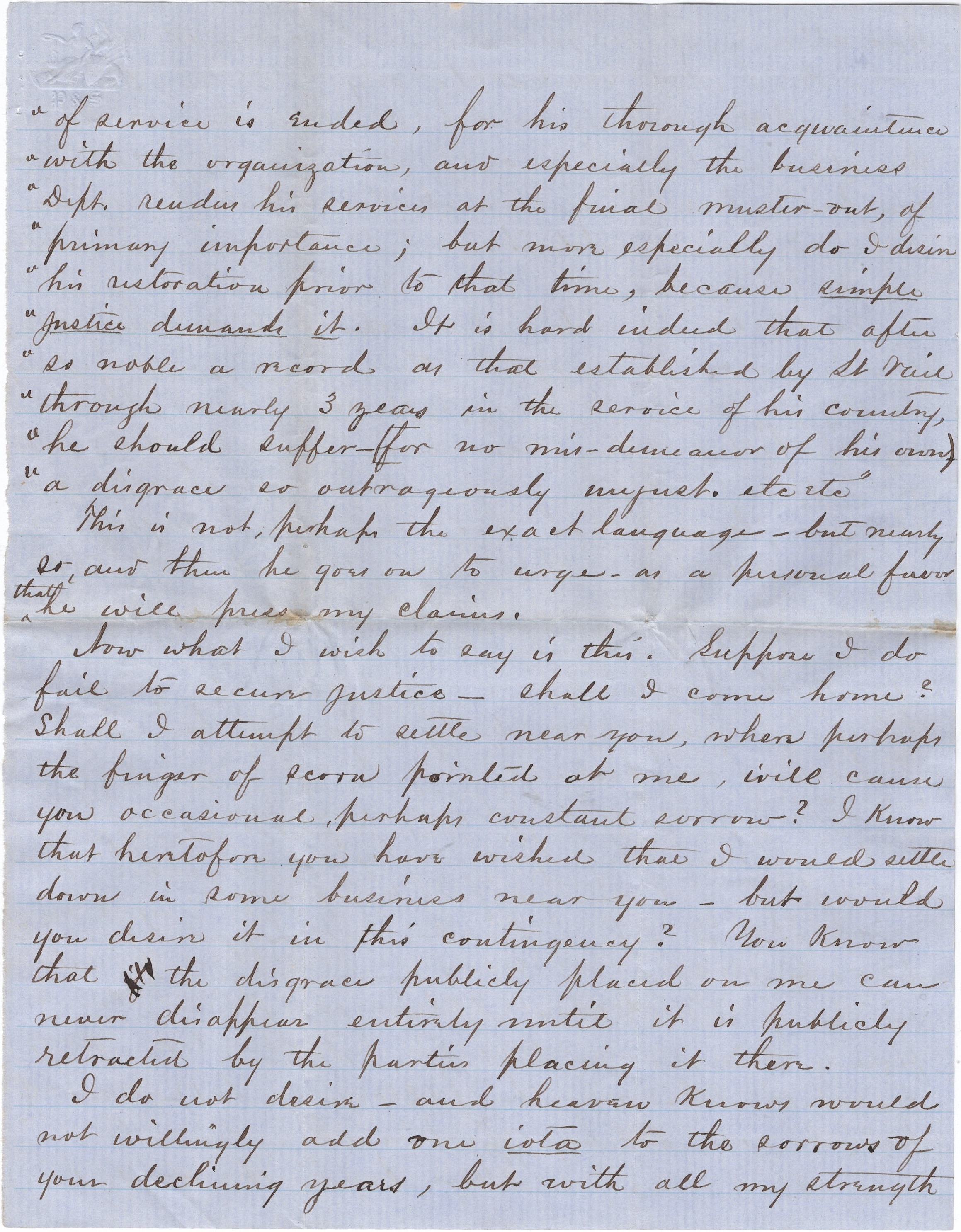
One thing more I must speak about in this connection. It is a possible thing that being so near the end of my regiment’s term of service, my case may not meet with that notice at the hands of the War Department it might otherwise obtain and may be altogether lost amid the convolutions of “Red tape” and never be adjusted. This, I say, is possible, though on this point, Col. McClure—in his letter to Hon. E. C. Ingersoll [Edward C. Ingersoll]—called his attention particularly to it in the following language; “I am extremely anxious that Lieut. Vail may be restored to duty before the regiment’s term of service is ended, for his thorough acquaintance with the organization, and especially the business department render his services at the final muster-out, of primary importance; but more especially do I desire his restoration prior to that time, because simple justice demands it. It is hard indeed that after so noble a record as that established by Lt. Vail through nearly 3 years in the service of his country, he should suffer (for no mis-demeanor of his own), a disgrace so outrageously unjust, etc., etc.” This is not, perhaps the exact language, but nearly so, and then he goes on to urge as a personal favor that he will press my claims.
Now what I wish to say is this. Suppose I do fail to secure justice, shall I come home? Shall I attempt to settle near you, when perhaps the finger of scorn pointed at me, will cause you occasional, perhaps constant sorrow? I know that heretofore you have wished that I would settle down in some business near you, but would you desire it in this contingency? You know that the disgrace publicly placed on me can never disappear entirely until it is publicly retracted by the parties placing it there.
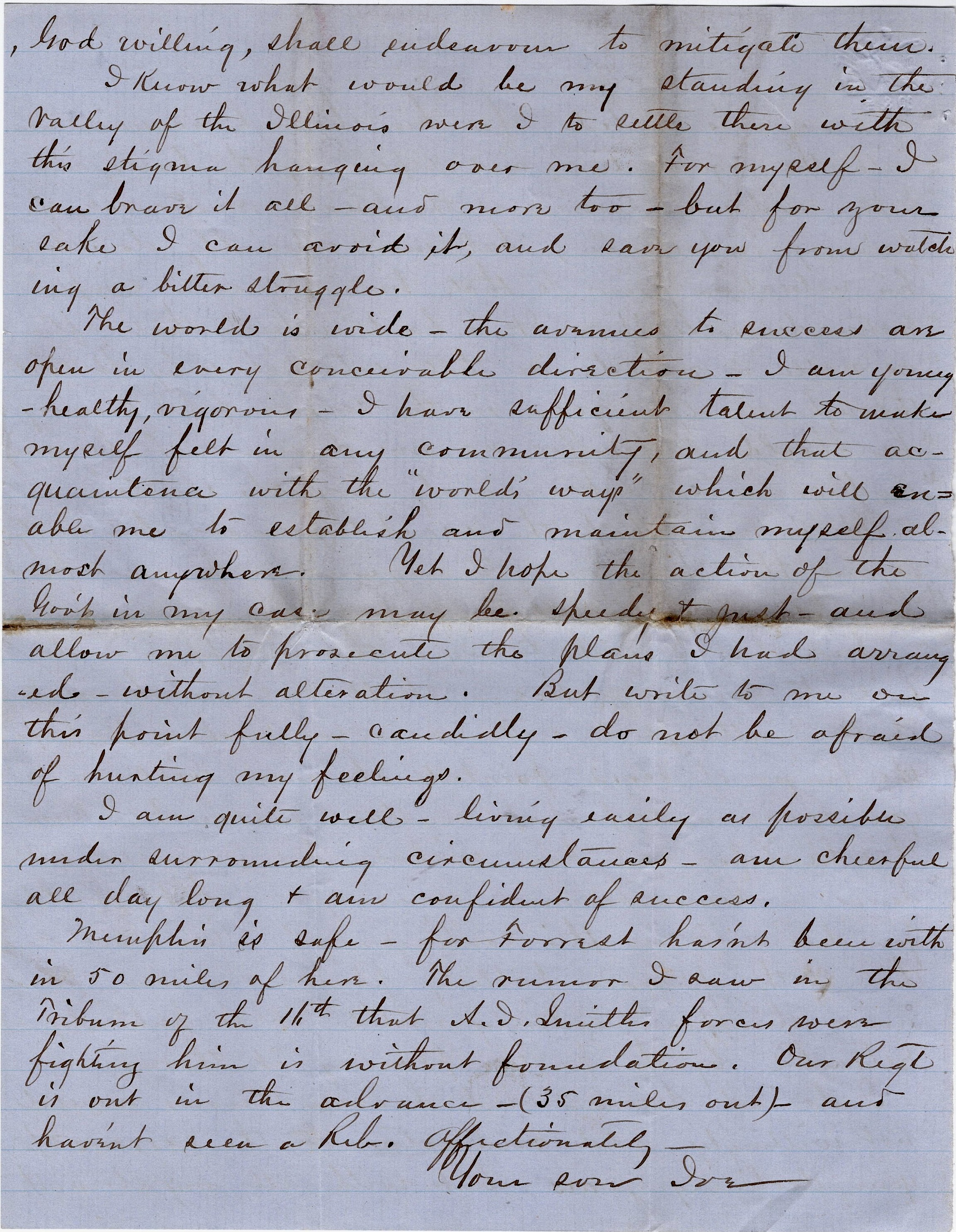
I do not desire—and heaven knows would not willingly add one iota to the sorrows of your declining years—but with all my strength, God willing, shall endeavor to mitigate them. I know what would be my standing in the Valley of the Illinois were I to settle there with this stigma hanging over me. For myself, I can brave it all, and more too. But for your sake I can avoid it, and save you from watching a bitter struggle.
The world is wide, the avenues to success are open in every conceivable direction. I am young, healthy, vigorous. I have sufficient talent to make myself felt in any community, and that acquaintance with the “world’s ways” which will enable me to establish and maintain myself almost anywhere. Yet I hope the action of the government in my case may be speedy & just and allow me to prosecute the plans I had arranged without alteration. But write to me on this point fully—candidly. Do not be afraid of hurting my feelings. I am quite well – living easily as possible under surrounding circumstances. Am cheerful all day long & confident of success.
Memphis is safe, for Forrest hasn’t been within 50 miles of here. The rumor I saw in the Tribune of the 14th that A. J. Smith’s [Andrew Jackson Smith] forces were fighting him is without foundation. Our Regt is out in the advance (35 miles out) and haven’t seen a Reb.
Affectionately, your son Joe