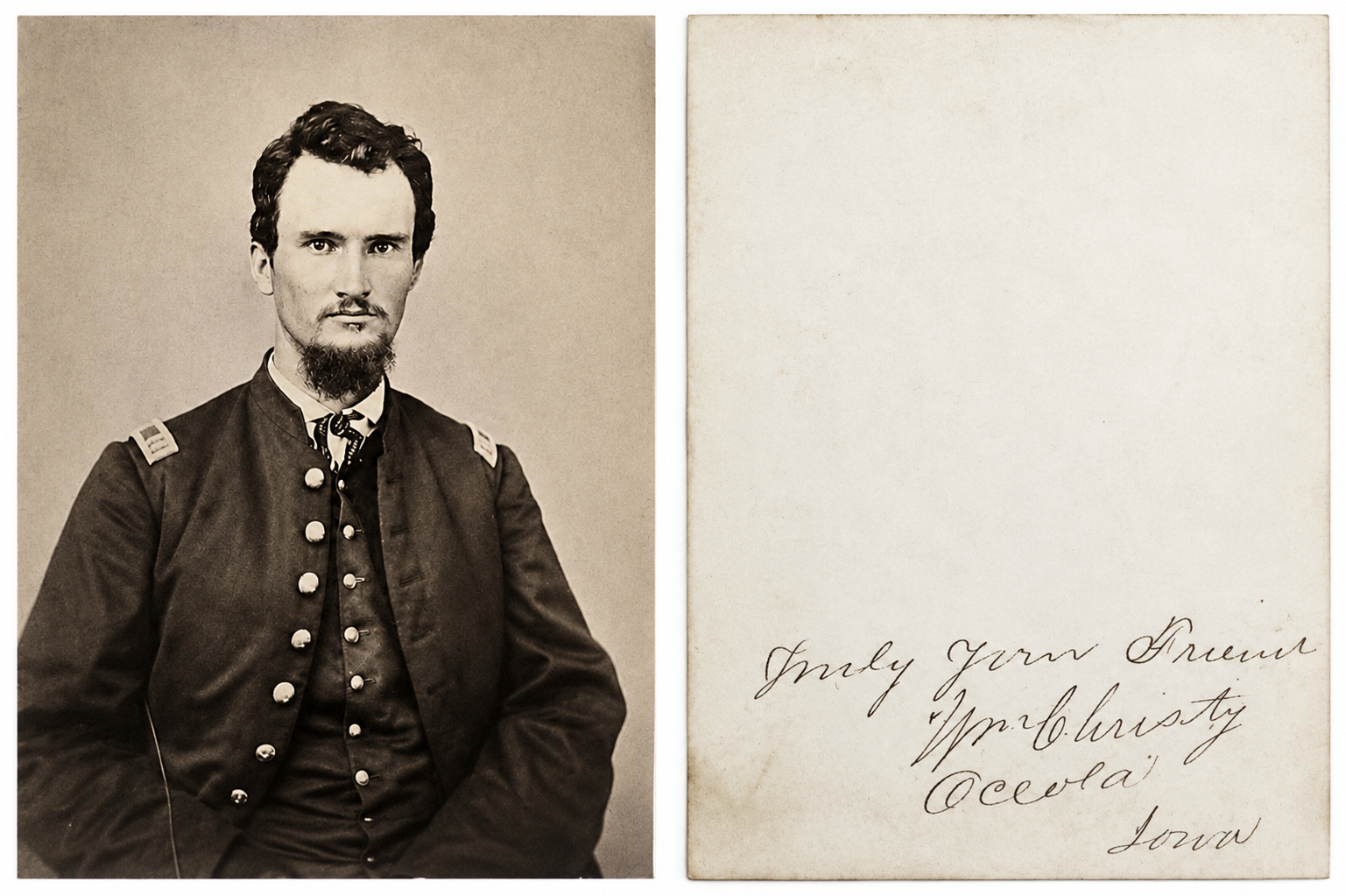
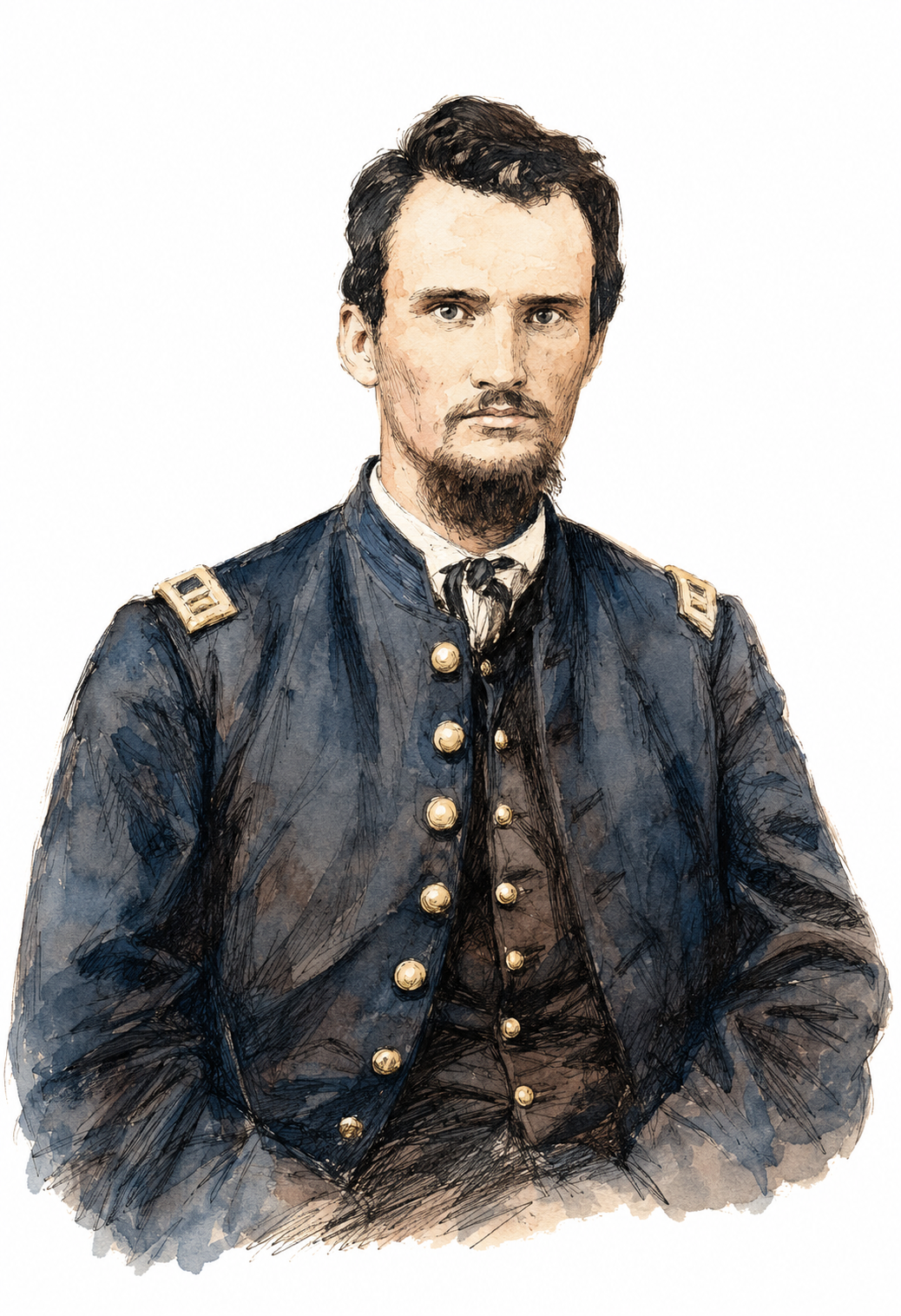
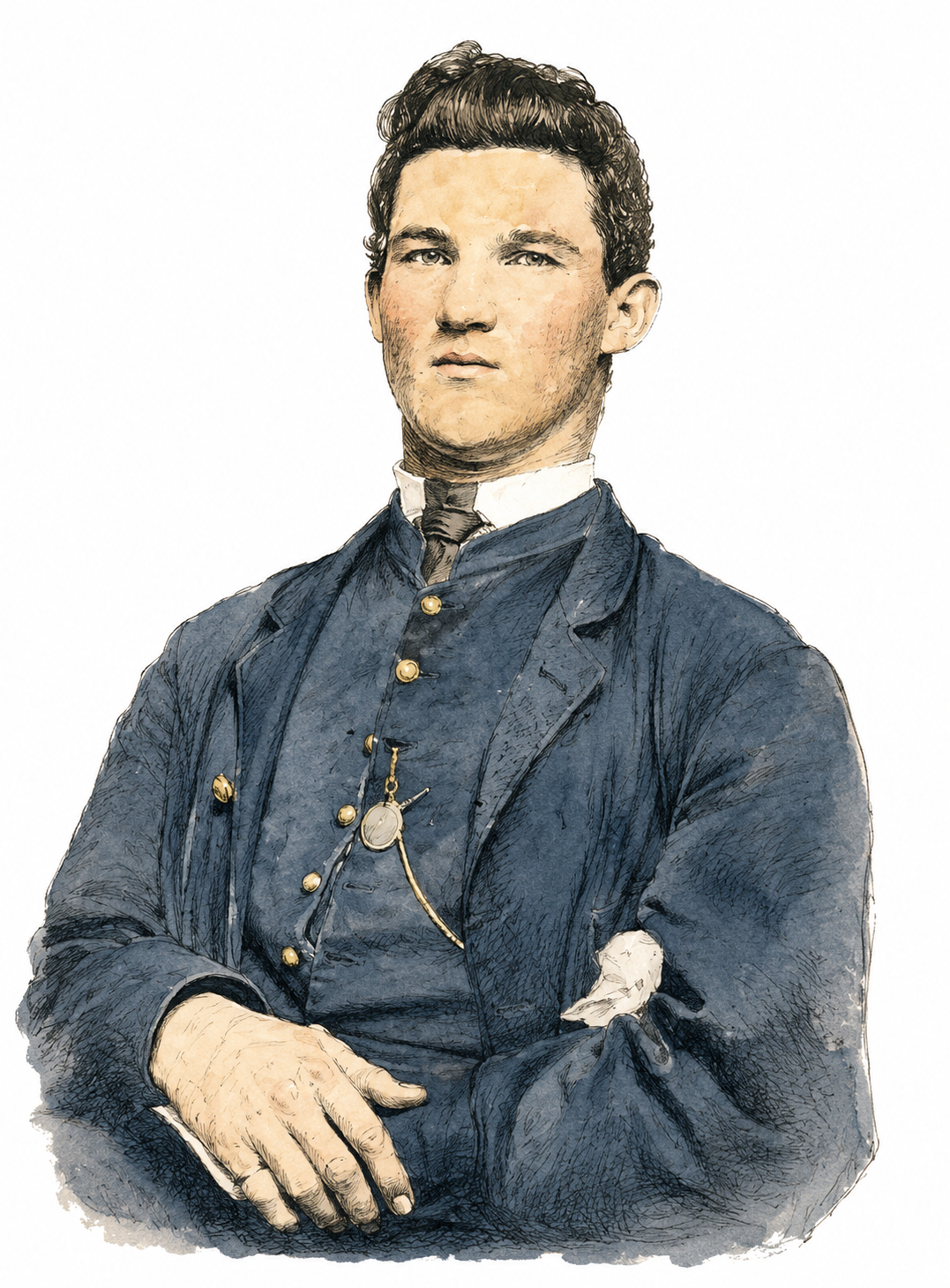
The following letter was written by William Christy while serving as a sergeant in Co. I, 15th Iowa Infantry. He was born at Warren, Trumbull county, Ohio, February 14, 1841, the oldest son of George L. Christy (1815-1869) and Jane Marshall (1819-1901). In 1854 his father relinquished mercantile pursuits and moving westward, established himself as a farmer in Clarke county, Iowa, where William received a good education.
During the Civil War, William Christy enlisted as a private in Co. I, 15th Iowa Infantry, serving in that regiment one year. William enlisted with his younger brother, Isaac “Marshall” Christy (1844-1905). William was quickly promoted to sergeant; Marshall remained a private. After a year in the infantry, William was transferred to the Eighth Iowa Cavalry, rising to the rank of captain. He was attached to Sherman’s army until Atlanta was reached, when his regiment turned back with Thomas to hold Tennessee. During a skirmish in the rear of Atlanta, Captain Christy was wounded severely and fell into the hands of the enemy. He spent a whole year in Confederate prisions and hospitals, being for a short time successively in Millen and Andersonville. Exchanged in February, 1865, he rejoined his troop a poor advertisement for the fare in southern prisons, weighing less than 100 pounds. Captain Christy was afterward brevetted lieutenant-colonel of his regiment and remained with it till its disbandment in August, 1865, participating in the capture of Macon, Selma and Montgomery. Four wounds, two of them through the body, were retained as mementos of the days of raid and combat.
“Upon his return to Iowa, Colonel Christy attended college for a year and then entered a banking house at Osceola, Iowa. He was elected State Treasurer in 1872, by the modest majority of 62,000, and was reelected two years later. In 1876 he went back to the banking business in Des Moines. Colonel Christy came to Arizona in 1882, for the benefit of an oppressing asthma. He was one of the founders of the Valley Bank of this city, and has added materially to his worldly possessions in lands of the valley and by his interest in a number of profitable enterprises. Five children have been the fruit of a union contracted in 1866, with Miss Carrie E. Bennett, at Aurora, Ill. The family residence is located upon the outskirts of Phoenix and in the development of his fertile acres the financier finds his chief enjoyment.”
William’s letter describes the Battle of Shiloh in which the 15th Iowa Infantry suffered considerable losses in their first engagement. For another great account of the Battle of Shiloh from the perspective of the 15th Iowa Infantry, readers are referred to: The Civil War Diary of Cyrus F. Boyd, published in 1953, which is availsable on-line.
T R A N S C R I P T I O N
[Editor’s Note: This transcript was shared by Marcus Crane on his Facebook site along with images of the original letter itself but they were so badly out of focus that I could not verify the accuracy of the transcription. That being said, I feel that this transcription must be pretty accurate as the statements made seem to be corroborated by other accounts]
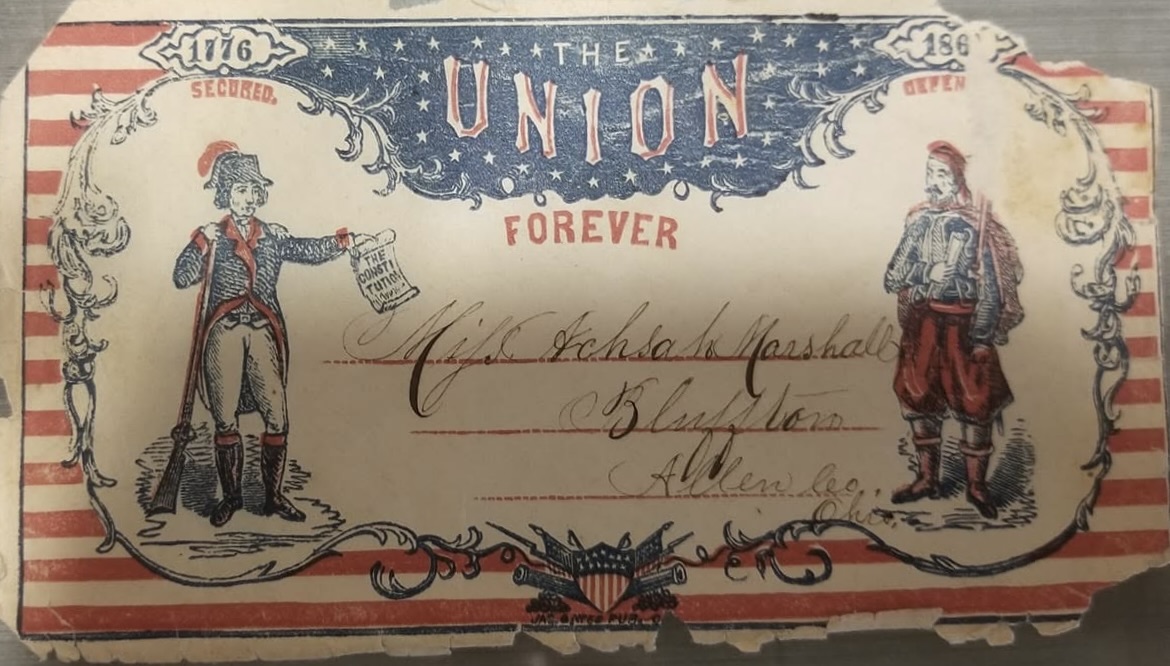
Pittsburg Landing, Tennessee
April 17, 1862
Esteemed cousin,
I received your welcome comliment a few days since. Was glad to [hear] from you and yours. We are well as could be expected for soldiers in Tennessee. The diahhrea has had its effect on most of us. Only a few has escaped its fury. Marshall has had it very bad but is better. The regiment is not half fit for duty. We are encamped on a beautiful knoll in the timber about three miles from the river towards the enemy. Trees are covered with their green robes of summer. Peaches are the size of a cherry. Other fruit in proportion. Grass has just started. It is backward for the climate. The weather is quite warm and wet mud very deep, but drying up rapidly.
I do not like htis country. There is too much timber and clay. The soil is not more than 4 inches deep. I prefer the praities. We left our cheerful quarters in Benton Barracks [on] April 1 and arrived here the morning of the 6th just as the roar of the enemy’s guns were giving their salutations to the morn. We ate a hard cracker for breakfast, shouldered our muskets, and started for the scene of action—a distance of three miles.
We were marched to within range of the enemy’s guns and then formed in line, thye firing voley after voley into our ranks which began to thin them by this time. We then fired and layed down. We soon scattered and bushwacked for two hours when we were outflanked and had to retreat. I waited til they got close enough to be sure and then fired and had the pleasure of seeing one of the graybacks fall, you bet. The bullets whistled around me thick. Then I ran my best. I was afraid of being shot in the back but as luck would have it, I came out all right. Our forces were driven back slowly till 4 p.m. Our artillery was put in position and supported the infantry. We opened on them and such anotherroar was never heard on this continent. I was behind a 64-pounder siege gun. When they fired, it kicked back 20 feet. It was deserted when the enemy made a charge but the infantry kept it from being taken with the aid of two gunboats. They were repulsed with great slaughter. Their firing nearly ceased—ours [was] more constant and destructive. Our loss in killed and wounded is from ten to fifteen thousand. Theirs from fifteen to twenty. Our loss on Sunday was as great as theirs, but on Monday their was five to one.
We were reinforced by a regiment of artillery which did fearful work on the enemy. They fought like men but they could not stand against the unerring aim of our guns. They were on the wrong side. We lost out of our regiment 25 killed and 175 wounded, 25 missing. We lost out of our company 3 killed, 15 wounded. Our 2nd Lt. [Robert W. Hamilton was]killed, Captain [James G. Day] and 1st Lieutenant [James M. Reid] wounded.
We are now encamped nearest the enemy. We are the advance of the Army of Tennessee. As soon as the roads get better, we will advance on tyhe enemy now at Corinth. They are strongly fortified. We have artillery enough to shell them out. We have six or eight hundred guns of heavy caliber.
I have been over the battlefield and such a sight I never expect to see. It far surpassed my expectations. I could stand in one place and count 300 dead. One cannon ball went through a tree and killed secesh. They all lay in a heap in one place. The wounded caught on fire and burned to death. Many wounded. It was a fearful sight to behold. I shall have to quit for want of space. Write as often as convenient. Direct to St. Louis. They will follow.
I would give 4 cents to be at Uncle B’s long enough to see you all and help you eat some of that sugar you were making not long since. But it is no go. So be it.
I received a letter from Aunt Mary yesterday. Uncle John was poorly. He had taken a back seat behind mother. Grandmother was quite poorly. The rest of the friends are quite well. It may bother you to read this. My pen is very poor and no place to write. I am sitting on the ground, a board on my lap. You can guess at the convenience of the thing.
You said you were in hopes I would return a Democrat. I think democracy has played out but all other parties, but Universalists—that is the party to which I belong. Give my love to all the friends and cousins. Yours truly, — William Christy