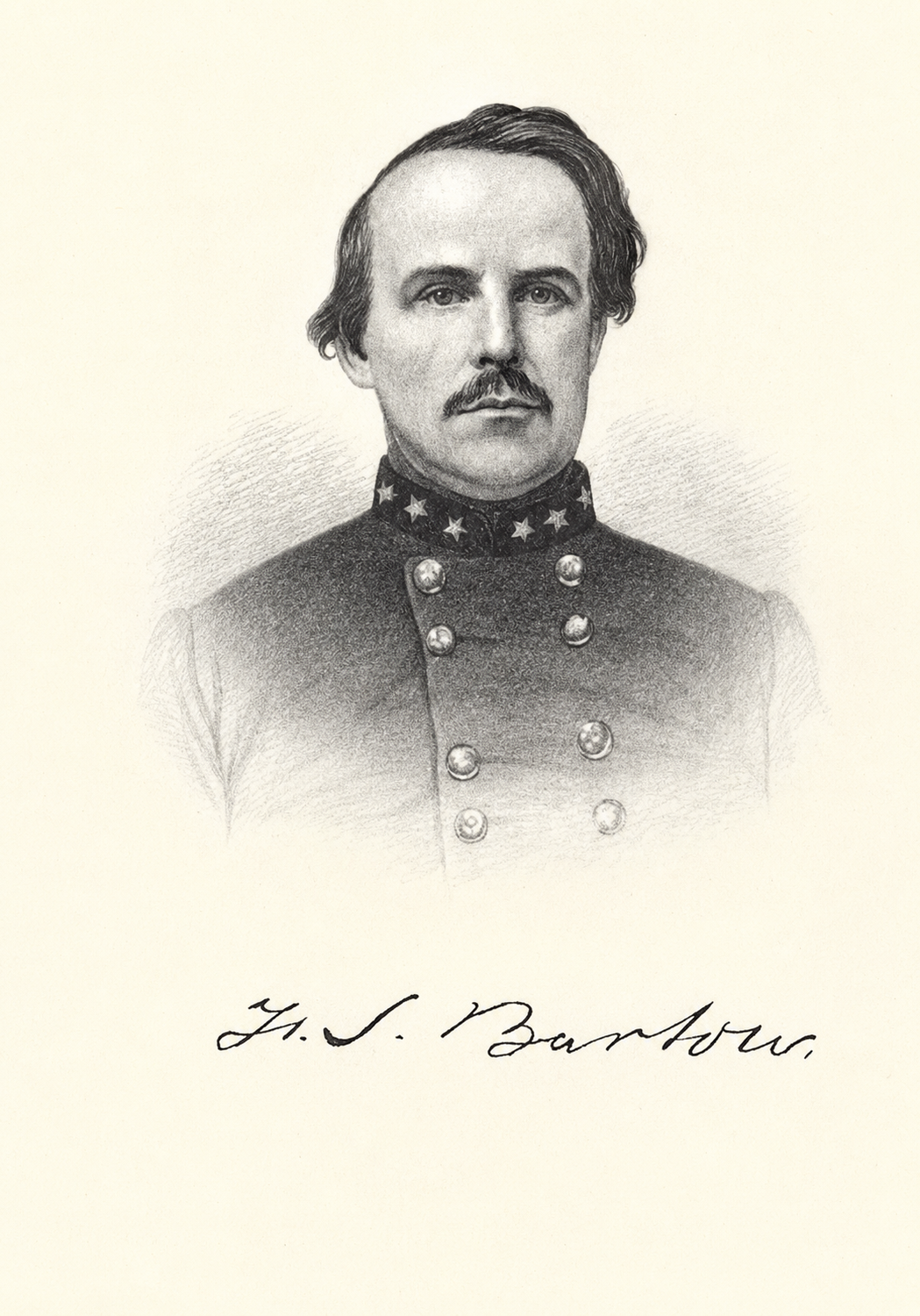
The following letter was written by Francis Stebbins Bartow (1816-1861) who had it all before the Civil War—a law career, a senator for a father-in-law, wealth in plantations and slaves, political rank and military ambitions. But he risked it all on the battlefield and became the first high-ranking Georgian to be killed in the Civil War. Bartow was born in 1816 in Savannah. His marriage to the daughter of U.S. Senator and former Attorney General John Macpherson Berrien’s daughter helped launch his political career in the state legislature. In 1856, he was elected captain of Savannah’s Oglethorpe Light Infantry and led the daring capture of Fort Pulaski in early 1861.
“Shortly thereafter, Bartow was elected a delegate to the state secession convention in Milledgeville, where as a member of the so-called immediate secessionist faction he used his great oratorical skills to influence the convention to pass an ordinance of secession. Following the withdrawal of Georgia from the Union in January 1861, Bartow was elected to the Provisional Confederate Congress in Montgomery, Alabama. There he unsuccessfully schemed with his friends Thomas R. R. Cobb and Howell Cobb to get the latter elected as the new Confederacy’s first president. He also chaired the state house military affairs committee and in this role reputedly selected gray as the color for the Confederate uniforms.
Having campaigned vigorously to create a new nation ruled by slaveholders, Bartow then decided to fight for it. After the Civil War began in April 1861, he rushed home to take the “Oglethorpes” to the front in Virginia. He became embroiled in a confrontation with Governor Brown when he armed his unit with muskets that Brown claimed belonged to Georgia and were intended strictly for state defense, not for troops going into Confederate national service. A heated exchange of letters followed, in which Brown demanded the return of the muskets and Bartow not so politely told him he had no time for such foolishness. At the close of one letter to the governor, Bartow declared, “I go to illustrate, if I can, my native State,” a bombastic yet wonderfully turned phrase that would later adorn his tombstone.
After arriving in Virginia, Bartow was elected colonel of the Eighth Georgia Infantry Regiment. By July 1861 he was in command of a brigade, which he clumsily led into combat at the First Battle of Manassas. On July 21, during a critical moment, he seized the regimental colors and attempted to lead a charge on a Union battery, but he was shot through the heart. He died moments later, supposedly uttering the oft-quoted last words, “They have killed me boys, but never give up the field,” which, along with his earlier quip to Governor Brown, are inscribed on his tombstone.” [New Georgia Encylopedia]
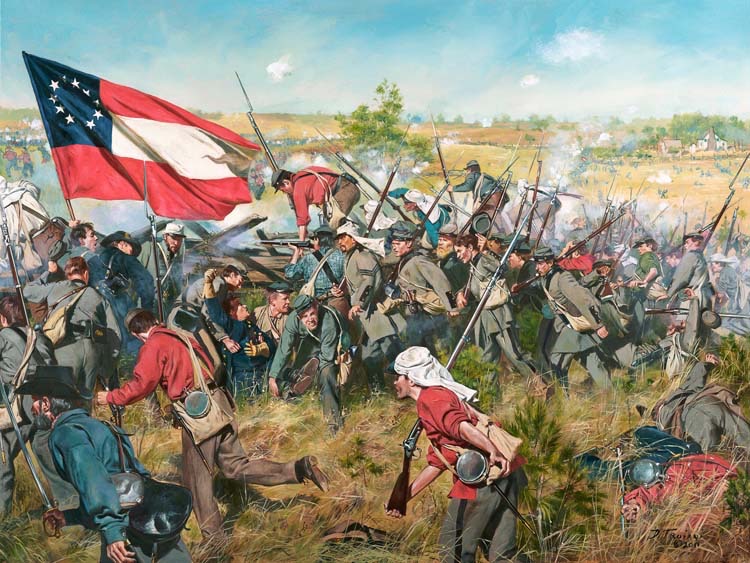
Note: The image in the header of this web page is Don Troiani’s Painting entitled, “Never Give up the Field.” Bartow (wearing a blue uniform) is depicted at center, sitting on the ground clutching his wound, surrounded by his men in gray.
T R A N S C R I P T I O N
Montgomery [Alabama]
March 9, 1861
My dear Henry,
I received your letter yesterday. I am about to set out for Savannah this evening to attend the [Georgia Secession] Convention. I assure you that attention of this government has been directed to the condition of Fort Pulaski and the defenses of Savannah. I have not been [indifferent?] of these important interests, and [emissaries?] were sent there for the very purpose of reporting to the President [Jefferson Davis] the exact condition of things there. I have read to the Secretary of War, several portions of your letter as I thought important to communicate. [ ] has been ordered to the post & to assume charge of its defenses. The President has sent to Gov. [Joseph E.] Brown for 200 volunteers — also for Savannah. I will see when I get home if we cannot furnish you a regiment from that place.
Permit me to say that two governments cannot better have control of military operations. You are mistaken in your estimate of the power and resources of this government. We have plenty of money & our state ought to be relieved of the cost of supporting an army & providing munitions, as soon as this can be done consistent with our safety. All the apparent conflicts can be easily [furnished?] by a clear understanding of the true position of affairs. I should exceedingly regret in the very commencement of our independence, any misunderstanding between the State of Georgia and the Confederate Government.
I am so sure of the intelligence of our state to harbor any doubt. I hope I may see you in Savannah. Give my regards to Gov. Brown.
I am very truly your friend, — F. S. Bartow


