My passion is studying American history leading up to & including the Civil War. I particularly enjoy reading, transcribing & researching primary sources such as letters and diaries.
The following letter was written by Capt. Gideon J. Jenkins (1815-1893) of Co. K, 17th New York Infantry (the “Westchester Chasseuers”). Gideon was born and raised in Warsaw, Wyoming county, New York, where he worked principally in the mercantile business before the Civil War, including a two year stint in the State Assembly. At the outbreak of hostilities, Gideon stepped up to recruit the boys of Company K in his hometown and was awarded the command of it as they marched off to defend Washington D. C. toting their percussion muskets and wearing their uniforms—“light blue pants and dark blue jackets of strict regulation pattern.” The regiment was held in reserve, in garrison at Fort Ellsworth at the time of the Battle of First Manassas, though we learn from this letter that Gideon’s Company K was guarding government property in Alexandria on the day of the “Great Battle.”
Gideon’s account of the great skeddadle of McDowell’s army after the battle—still in flight in the early morning hours of the following day—is quite remarkable. He wrote the letter his wife of 25 years, Mary Amelia (Hovey) Jenkins (1816-1894), informing her that “Don’t worry about us. We may die. We may get killed or wounded, but some of us will never run.” Serving with him in the same regiment were his two sons—Charles Victor (“Vic”) Jenkins (b. 1839), and Adelbert (“Del”) H. Jenkins (b. 1841), both of whom are mentioned in this letter.
Being in his mid forties, however, the rigors of camp life proved to be too much for Gideon and he fell victim to typhoid fever, so debilitating that he was forced to resign his commission in December 1861, after only seven months service. In 2021, I transcribed another letter by a member of Gideon’s company named Manser M. Dunbar who also wrote from Fort Ellsworth, though a month later. In it, Manser mentions Gideon’s already having become ill: “I am sorry that our Captain is sick and First Lieutenant. All the commissioned officer we have is 2nd Lieutenant but I guess we will get along some way. We must hope for the best and do our duty in all cases and leave the rest with Providence.” [See 1861: Manser M. Dunbar to his Parents on Spared & Shared 22.]
McDowell’s Army in General Stampede towards Arlington Heights following defeat at Bull Run,
Transcription
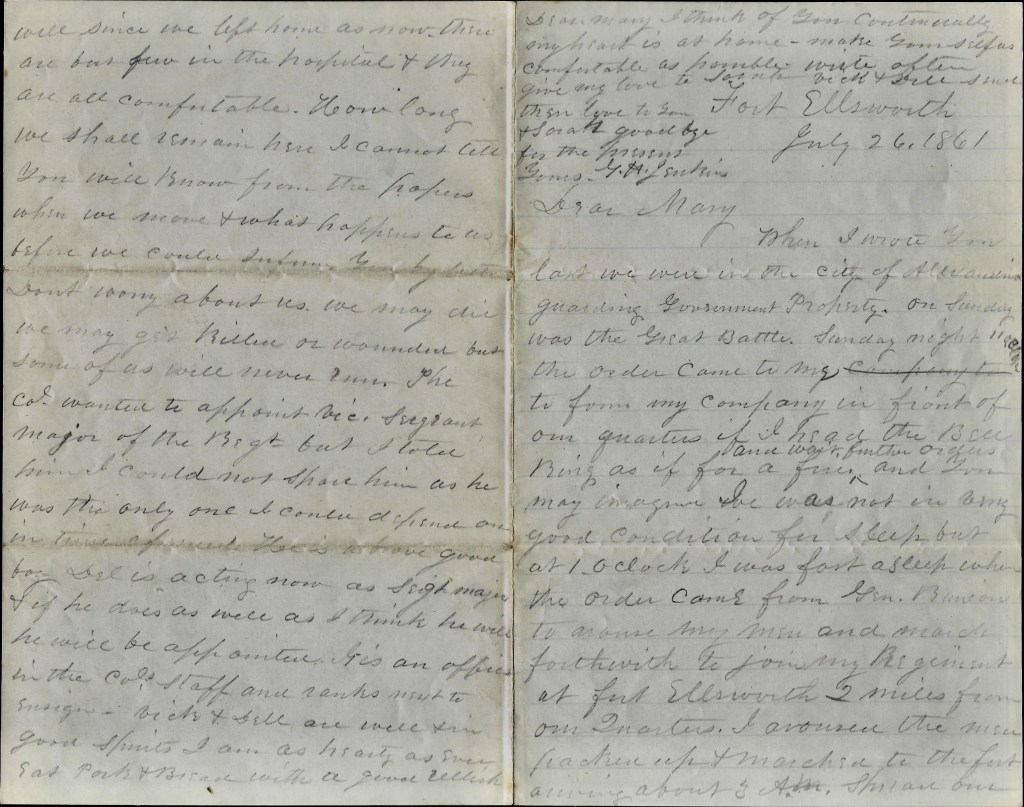
Fort Ellsworth July 26, 1861
Dear Mary,
When I wrote you last we were in the city of Alexandria guarding government property. On Sunday was the Great Battle. Sunday night 11 o’clock, the order came to me to form my company in front of our quarters if I heard the bell ring as if for a fire and wait further orders, and you can imagine I was not in very good condition for sleep. But at 1 o’clock I was fast asleep when the order came from Gen. Bunion to arouse my men and march forthwith to join my regiment at Fort Ellsworth, 2 miles from our quarters.
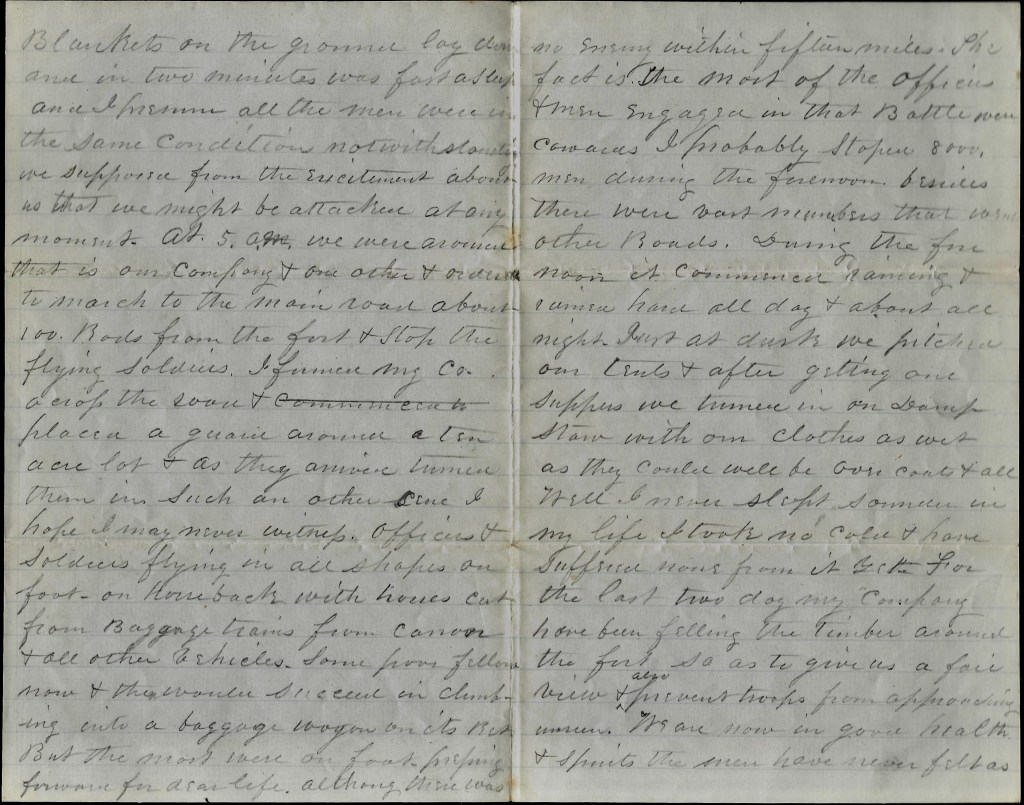
I aroused the men, packed up, & marched to the fort, arriving about 3 a.m. [We] spread our blankets on the ground, lay down, and in two minutes was fast asleep, and I presume all the men were in the same condition notwithstanding we supposed from the excitement about us that we might be attacked at any moment. At 5 a.m. we were aroused—that is, our company and one other—& ordered to march to the main road about 100 rods [550 yards] from the fort & stop the flying soldiers. I formed my company across the road & placed a guard around a ten-acre lot & as they arrived, turned them in. Such another scene I hope I may never witness—officers & soldiers flying in all shapes on foot, on horseback with horses cut from baggage trains, from cannon, & all other vehicles. Some poor fellow now & then would succeed in climbing into a baggage wagon on its bed, but the most were on foot pressing forward for dear life, although there was no enemy within fifteen miles. The fact is, the most of the officers & men engaged in that battle were cowards. I probably stopped 8,000 men during the forenoon besides there were vast numbers that went other roads.
During the forenoon, it commenced raining & rained hard all day, & about all night. Just at dark we pitched our tents & after getting our suppers, we turned in on damp straw with our clothes as wet as they could well be—overcoats & all. Well, I never slept sounder in my life. I took no cold & have suffered none from it yet. For the last two days my company have been felling the timber around the fort so as to give us a fair view & also prevent troops from approaching unseen. We are now in good health & spirits. The men have never felt as well since we left home as now. There are but few in the hospital & they are all comfortable. How long we shall remain here I cannot tell. You will know from the papers when we move & what happens to us before we could inform you by letter.
Don’t worry about us. We may die. We may get killed or wounded, but some of us will never run. The Col. wanted to appoint Vic Sergeant Major of the regiment, but I told him I could not spare him as he was the only one I could depend on in time of need. He is a brave good boy. Del is acting now as Sergt. Major & if he does as well as I think he will, he will be appointed. G is an officer in the Col.’s staff and ranks next to ensign. Vick & Dell are well & in good spirits. I am as hearty as ever. Eat pork & bread with a good relish.
Dear Mary, I think of you continually. My heart is at home. Make yourself as comfortable as possible. Write often. Give my love to Frank. Vick & Dell send their love to you & for all. Goodbye for the present. Yours, — G. H. Jenkins
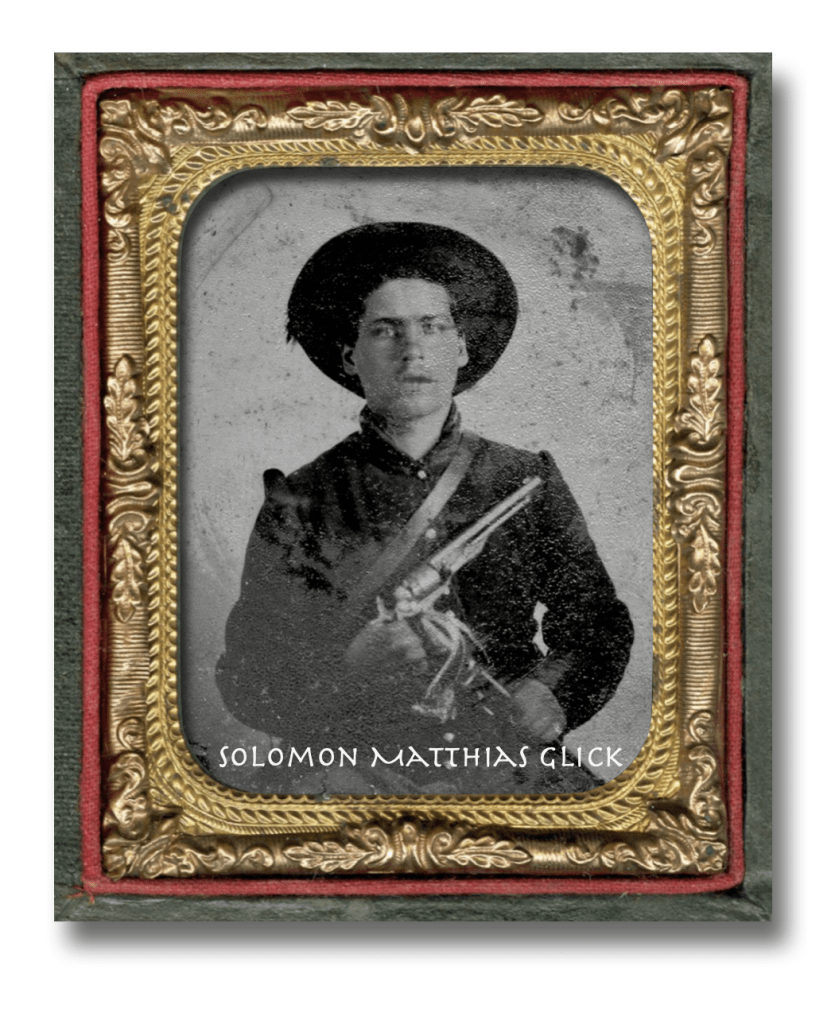
The following letters were written by Solomon (“Sol”) Matthias Glick (1844-1937) while serving in Co. I, 4th Indiana Cavalry. He enlisted in August 1862 and was honorably discharged in June 1865. This regiment was originally termed the 77th Indiana Infantry but was soon after redesignated the 4th Indiana Cavalry. The regiment was divided into three different battalions—Co. I being in the 3rd Battalion led by Col. Isaac P. Gray. This battalion was stationed for a time at Gallatin, Tennessee, watching John Hunt Morgan’s forces, and was engaged in a victorious fight near Munfordville in December 1862, described by this letter from William to his uncle. The regiment reunited near Murfreesboro in March 1863 and participated together in the fight at Chickamauga.
Solomon’s parents were Joseph Glick (1812-1895) and Delilah Glick (1817-1897) who came to Bartholomew county, Indiana, in 1846 from Pickaway county, Ohio. He wrote the letters to his older brother, Uriah Francis Glick (1839-1895). Describing Solomon’s 49 war-time letters after perusing them nearly fifty years ago, the director of the Historical Museum in Columbus, Indiana, Garry Shalliol wrote that “Solomon was a scholarly and moral type who wrote frequently to his family. His first letter voiced approval that he had ‘seen but one deck of cards’ since joining up and pronounced all the men in his mess ‘gentlemen.’ Solomon visited the rebel prisoners at Camp Morton [in Indianapolis] and even did guard duty there before being sent south through Columbus on a troop train.”
“The letters…are more interesting, perhaps, for their reflections on army life than as records of grand military movement and tactics. The cavalry in those days served as the eyes and ears of the army, so scouting, skirmishing, foraging, and courier duty fell to a unit like the 4th Indiana” in the Western Theatre of the war.”
“Battle appears as only a small part of the life of a cavalryman, Solomon reported the fighting in a matter-of-fact way. For example, after Co. L saw its first action he wrote home, ‘The company all have been tried as to their grit and only one has been found that would show the white feather.’ Once his unit came upon two regiments of hidden rebel infantry—‘I paused a couple of seconds. It was get out of there, a trip to Richmond, or death and perhaps the latter. A ball struck every foot of the ground I passed over and more than once I felt the cold air and jar as they went past—zip, zip, zoo, zip.’ Another time he took part in a saber charge, helped capture two cannon, 60 soldiers, and wrote, ‘that shows what 50 men can do when they go at it right.’ Thre is little of the agony of war in Solomon’s letters. If he had private thoughts about life, death and war, he kept them out of his letters.” [The Republic, Columbus, Indiana, 11 April 1979]
[Note: Scans of these letters were provided by Solomon’s g-g-grandson, James Hatch, who made them available for transcription and publication on Spared & Shared by express consent.]
Letter 1
August 2nd [1862]
Dear Brother,
I think it is the intention of going right to work at the Secesh and are not going to have any carbines and I shall take my revolver along. — Sol M. Glick
Deliver this to H. S. Glick or some of the family.
Letter 2
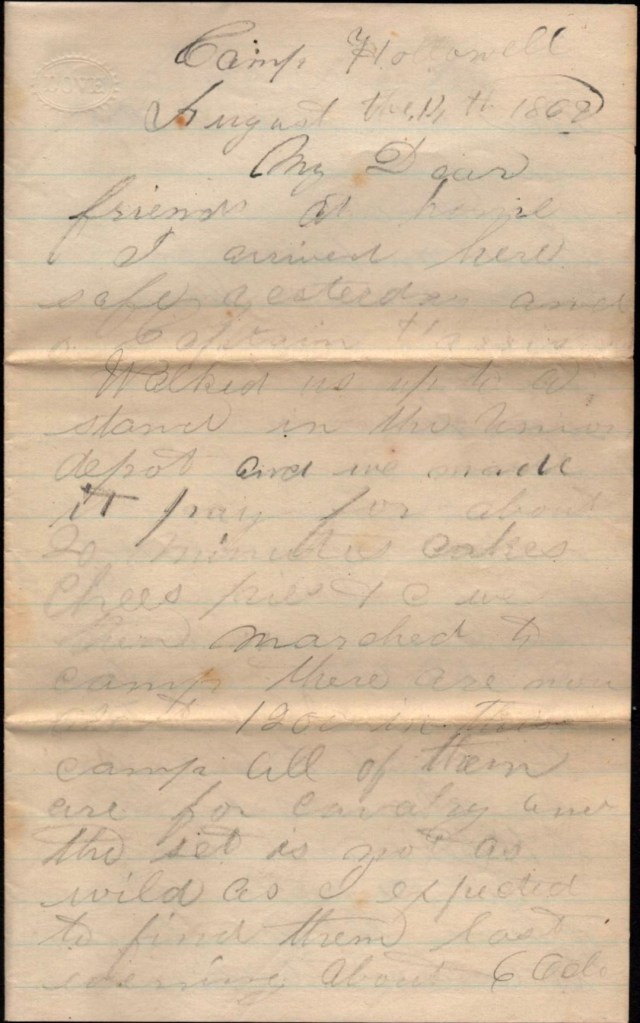
Camp Hollowell August 11th 1862
My dear friends at home,
I arrived here yesterday and a Capt. Harris walked up to a stand in the Union Depot and we made it pay for about 20 minutes—cakes, cheese, pies, &c. We then marched to camp, There are about 1200 in this camp—all of them for cavalry, and this set is not as wild as I expected to find them.
Last evening about 6 o’clock we got our tents and blankets and I slept as ell as I ever did in my life. Lived on baker’s bread, sugar, bacon, beans, molasses. Yesterday we drew some nice beef. This morning I was down to the other camp in which Trotter is in. I talked to John Butler, Dave Van, Jim Van, Andy Robertson, Dock Brunsfield and a lot more. I was in the depot today and saw James Collier, S. Hall, and Logan Collier and a lot more of them get off the cars. It rained today like everything but the tents kept us dry.
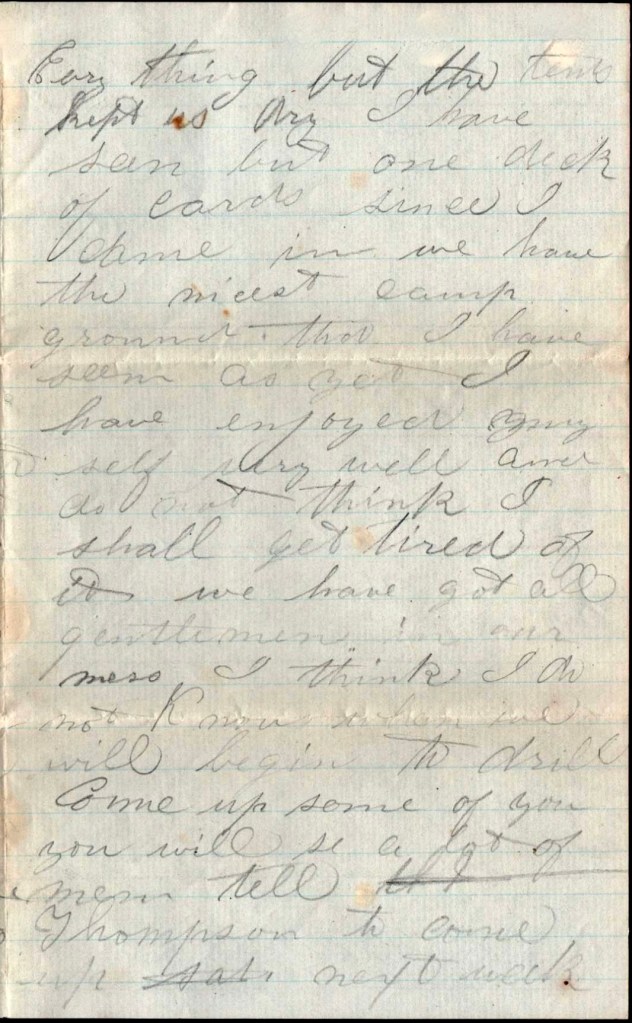
I have een but one deck of cards since I came in. We have the nicest camp ground I have seen yet. I have enjoyed myself very well and do not think I shall get tired of it. We have got all gentlemen in our mess, I think. I do not know when we will begin to drill. Come up, some of you. You will see a lot of men. Tell Thompson to come up next week.
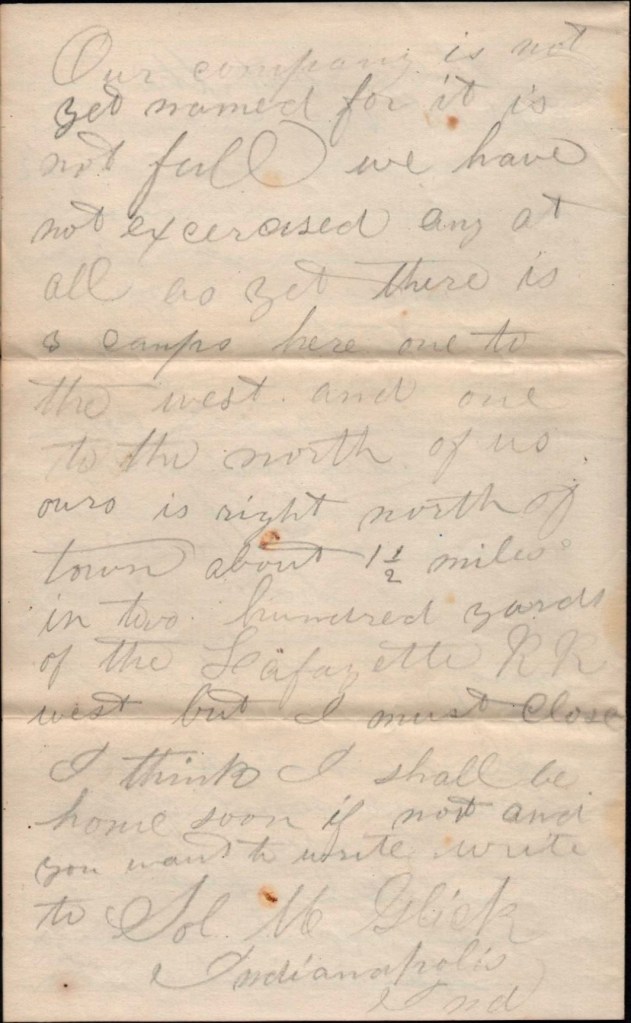
Our company is not yet named for it is not full. We have not exercised any at all as yet. There is three camps here. Our is right north of town about 1.5 miles in two hundred yards of the Lafayette Railroad west. But I must close. I think I shall be home soon. If not and you want to write, write to Sol M. Glick, Indianapolis, Indiana
Letter 3
Camp Hollowell, Indianapolis August 17, 1862
Friends at home,
My pencil is once more in hand to let you know how I am getting along. My time has passed very pleasantly since I have been in camp, My health has not suffered in the least from the change.
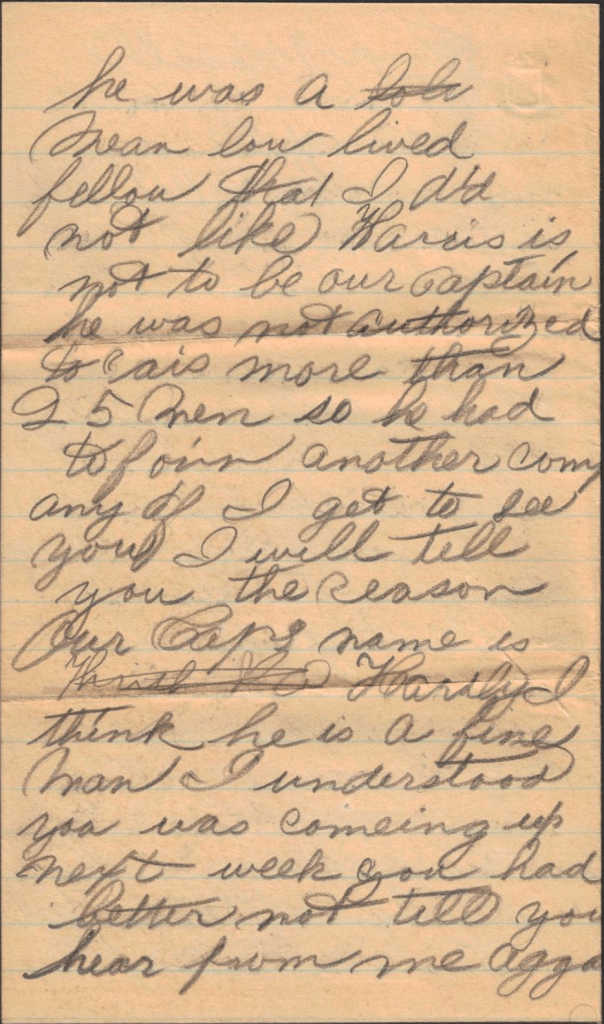
We were inspected yesterday and I was accepted. Only one of the company was rejected and that did not insult me for he was a mean, low-lived fellow that I did not like. Harris is not to be our captain. He was not authorized to raise more than 25 men so he had to form another company and if I get to see you, I will tell you the reason. Our captain’s name is Hartly. I think he is a fine man.
I understood you was coming up next week. You had better not till you hear from me again as I got word a moment ago that we would move tomorrow. If we do, we will get our arms, horses, and perhaps bounty. I was to Camp Morton this forenoon to see the secesh prisoners but I have to hurry for the corporal will soon call for the guards and I am one today. It is the first time I have stood. I go on at 6 o’clock and come off at 8 o’clock. Go on at 2, come off at 4. Go on at 8 in the morning, come off at 10, and then I am free till the company take their turn. Very easy time.
I have had very easy times so far. The rest of the boys are all well. Don’t come till I find out how things stand. If we don’t go, I will send all the money I can spare home if I get any. Be assured I am satisfied with my situation. Yours, — Sol M. Glick
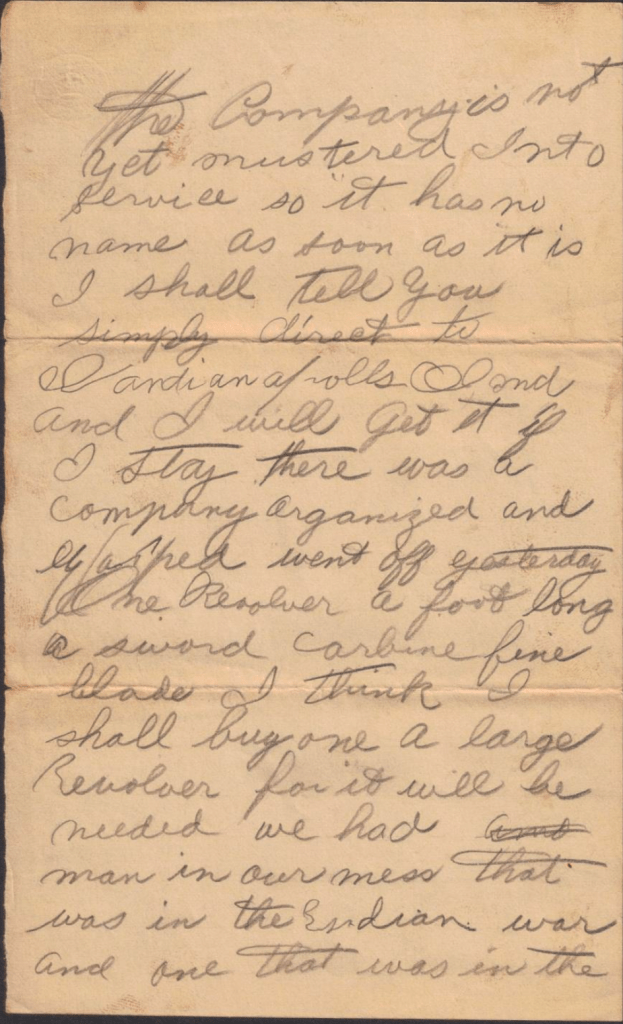
The company is not yet mustered into service so it has no name. As soon as it is, I shall tell you. Simply direct to Indianapolis, Indiana, and I will get it if I stay. There was a company organized and equipped went off yesterday. [They received] one revolver a foot long, a sword, carbine, fine blade. I think I shall buy one—a large revolver—for it will be needed. We had a man in our mess that was in the Indian War and one that was in the Mexican War. He is one of our cooks. We pay 60 cents a month for cooks and it saves a great deal of trouble too.
But I must close for this evening. Write as often as you know where we are. Yours, — S. M. Glick
Letter 4
Camp Morton, Indianapolis September 1st 1862
Dear Brothers,
I am well as ever after standing guard last night. This evening after roll call, we got the news that there were 40,000 rebels between Lexington and Louisville, Kentucky, and that we had to go down tomorrow. I don’t know whether it is authentic or not. If it is, I shall do my duty though we should like to be better drilled. We don’t know anything hardly till it comes to pass. It may be that we will stay here a month.
That revolver is very rusty from too little care and you will have to clean it before you use it. You will see a broad piece of iron passing through the barrel. Turn out the screw at the side of it and drive out the pin. Leave the trigger set the way it is and bring the ramrod down as if you were going to ram in a ball and force the barrel off. then take out the cylinder. Maybe I will take it along.
The trumpet sounds and lights must go out. Yours as ever, – S. M. G.
Letter 5
Murfreesboro, Tennessee February 21st 1863
Brother Uriah,
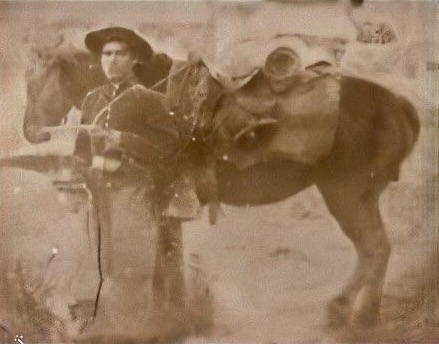
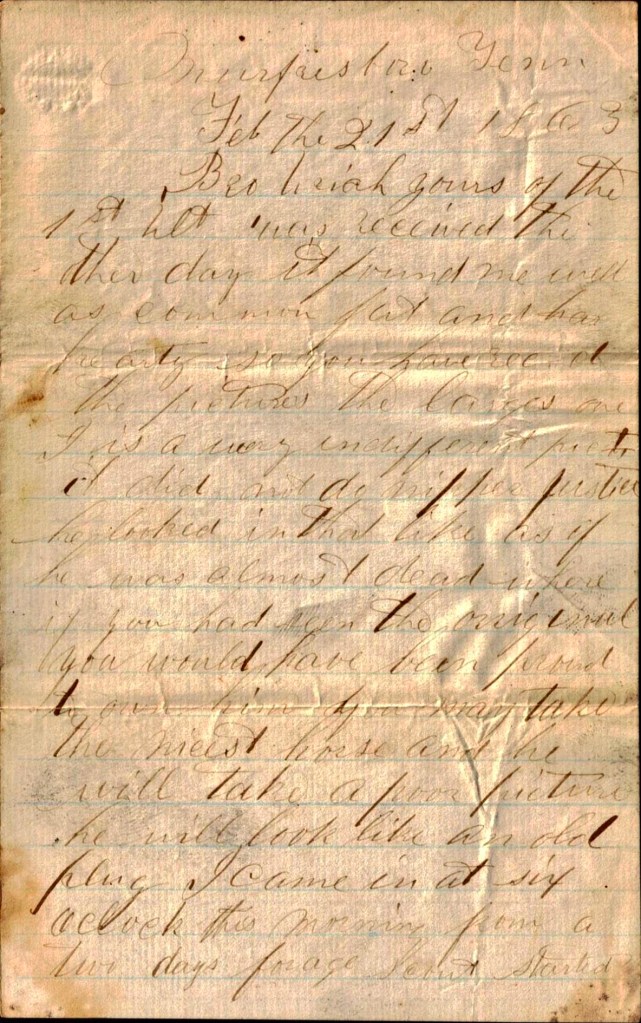
Yours of the 1st ult. was received the other day. It found me well as common—fat and hearty. So you have received the pictures. The largest one is a very indifferent picture. It did not do Nipper justice. He looked in that like as if he was almost dead where[as] if you had seen the original, you would have been proud to own him. You may take the nicest horse and he will take a poor picture. He will look like an old plug.
Solomon and his mount, “Nipper,” ready to go on a scout.
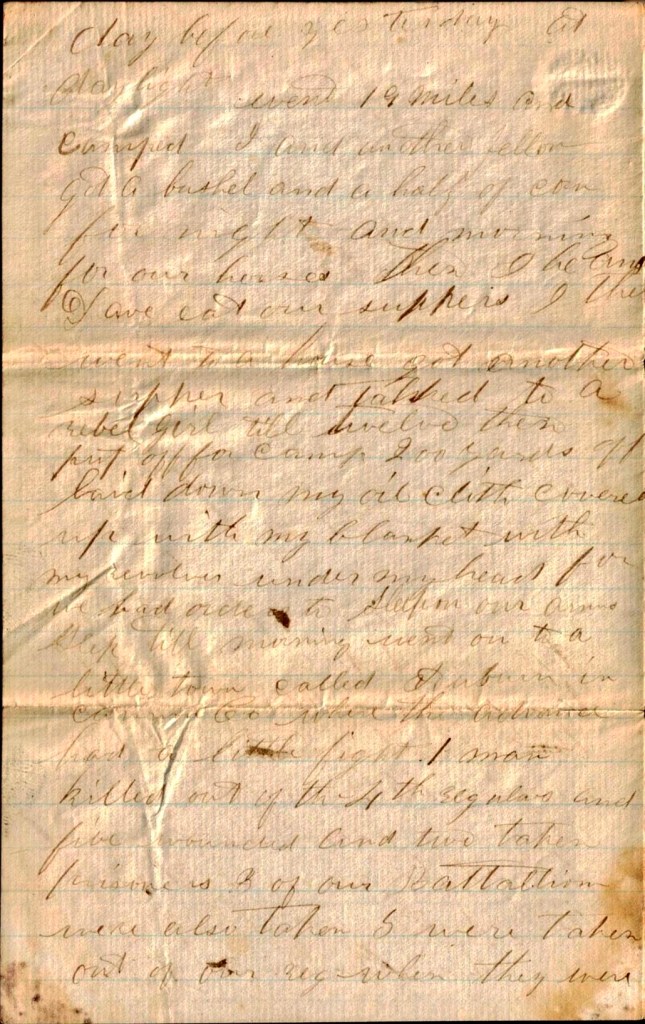
I came in at six o’clock this morning from a two-day’s forage scout. Started day before yesterday at daylight, went 19 miles and camped. I and another fellow got a bushel and a half of corn for night and morning for our horses. Then I, he and Dave eat our suppers. I then went to a house, got another supper, and talked to a rebel girl until twelve. Then put off for camp two hundred yards off, laid down my oil cloth, covered up with my blanket with my revolver under my head for we had orders to sleep on our arms. Slept till morning, [then] went to a little town called Auburn in Cannon county where the advance had a little fight. One man killed out of the 4th Regulars and five wounded and two taken prisoners. Three of our Battalion were also taken. Five were taken out of our regiment when they were on that road two weeks before. Two of them belonged to our Company named Byrnie and Buchannan. They were noted stragglers. Our battalion went out to clean some of the skunks out but all we could see of them were their little squads of spies on the hills around us, but they would run. We only got three and some horses.
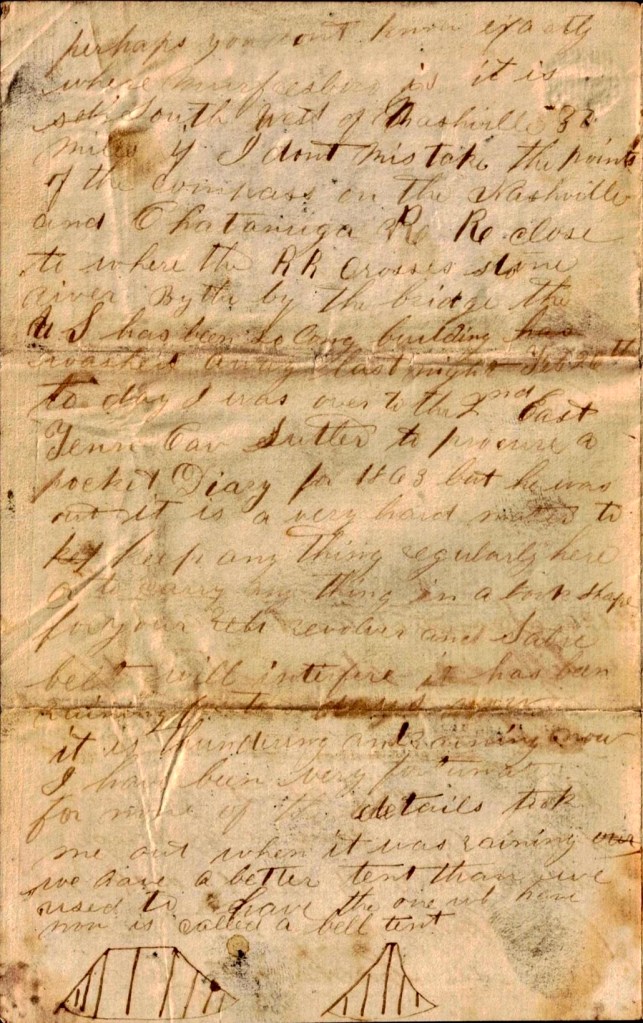
Feb. 26th. Scouted and laid around till sundown, started for Murfreesboro, rode all night, [and] got there about 6 o’clock. Out about Auburn there are some very large hills. There is one 16 or 18 miles from Murfreesboro that you can see back into town. Perhaps you don’t know exactly where Murfreesboro is. It is southwest of Nashville 30 miles if I don’t mistake the points of the compass, on the Nashville and Chattanooga Railroad close to where the railroad crosses Stone River. By the by, the bridge the U.S. has been so long building washed away last night.
Feb. 26, today I was over to the 2nd East Tennessee Cavalry’s sutler to procure a pocket diary for 1863 but he was out. It is a very hard matter to keep anything regularly here or to carry anything in book shape for your revolver and saber belt will interfere.
It has been raining here for ten days. It is thundering and raining now. I have been very fortunate for none of the details took me out where it was raining. We have a better tent than we used to have. The one we have now is called the bell tent. [tent sketch] — Solomon
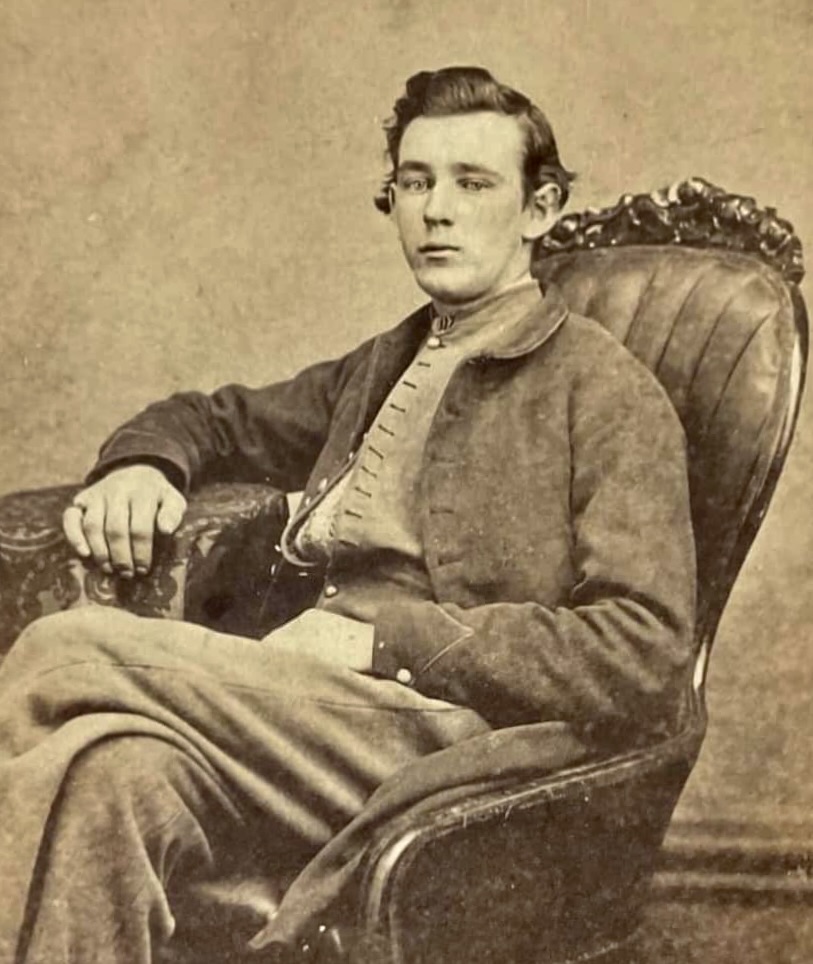
I could not find an image of James but here is one of Jerome H. Sessions who also served in Co. K, 9th Iowa Infantry. (Collection of Al & Claudia Niemiec)
The following letter was written by Pvt. James Knox Polk McCoy (1845-1862) of Tipton, Cedar county, Iowa, who enlisted on 14 September 1861 in Co. K, 9th Iowa Infantry and was killed on 7 March 1862 at the Battle of Pea Ridge, Arkansas. Although the muster records indicate that he was 18 years old at the time of enlistment, he was not. He was born in August 1845 so he would have only been 16 when he enlisted and when he died.
James was the son of George William McCoy (1814-1881) and Harriet Sarah Nye (1822-1906). He wrote the letter to his older sister, Laura Lavinia (McCoy) Willard (1841-1915). Laura was only 16 when she married James G. Willard, 13 years her senior, in 1857.
[Note: This letter is from the private collection of Mike Huston and was transcribe and published on Spared & Shared by express consent.]
“Thin Blue Line, Battle of Pea Ridge,” by Daniel Hoffbauer. The painting depicts the 9th Iowa in action north of Elkhorn Tavern, with Lt. Col. Francis Jay Herron on his horse. They suffered 35% casualties, the most of any Union regiment in the battle. Herron was wounded, caprured and received the Medal of Honor for his actions.
Transcription
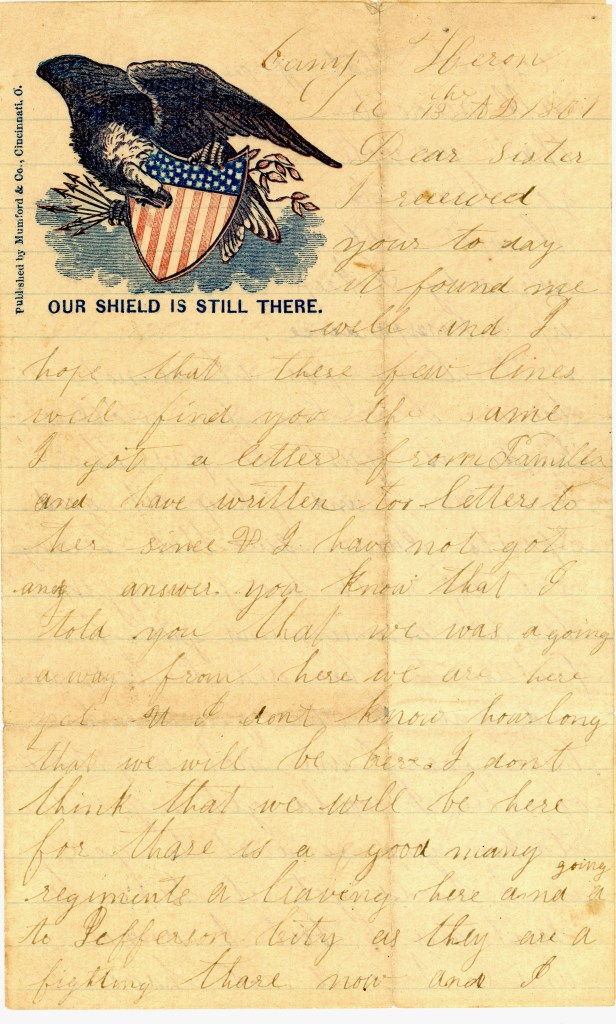
Camp Herron December 13th 1861
Dear Sister,
I received yours today. It found me well and I hope that these few lines will find you the same. I got a letter from Pamela and have written two letters to her since I have not got any answer, You know that I told you that we was a going away from here. We are here yet. I don’t know how long that we will be here for there is a good many regiments a leaving here and a going to Jefferson county as they are a fighting there now and I expect that from all accounts that we will go there too.
I will tell you why I keep up a correspondence with Karen [?] for it not because I love her at all. I do it just to pass the time away and to keep up good spirits. I am sure that he may sit up with her from June to all eternity and give his picture to her and his body, soul and all, to her for what I care for I am not any beau of hers. I would get my picture taken and send it to you if I could get it taken to suit me but I cannot so I will not have it taken at all.
I am glad to hear that the money I sent has got home safe. I would like to see you all and I hope that the time will come when I may see you. Dear sister, I have no more to write at present. You needn’t say anything about what I have said and I trust that you won’t.
It is very warm down here now. Your affectionate brother, — J. K. P. McCoy
to Laura L. Willard
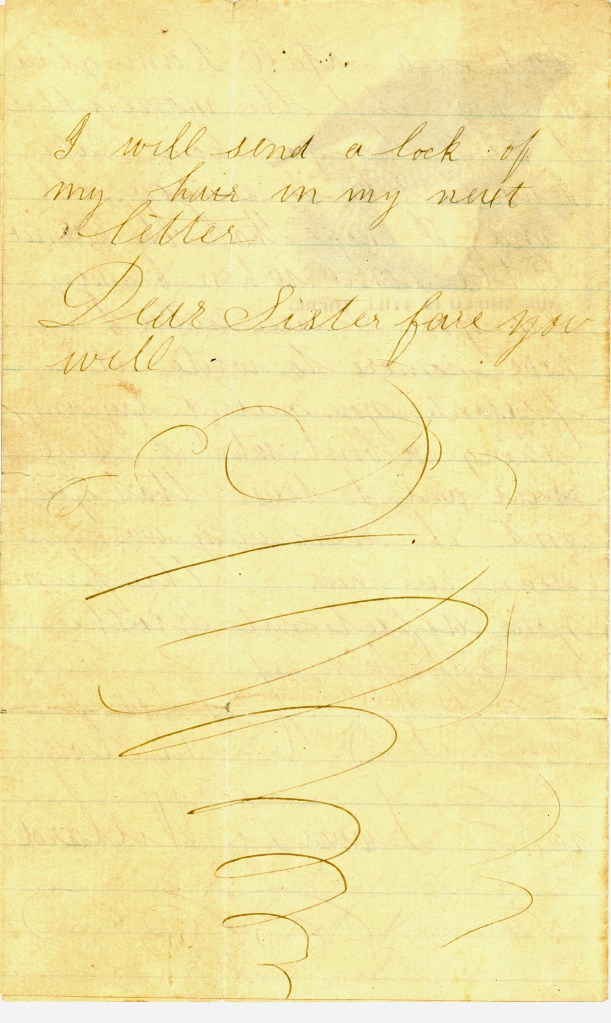
I will send a lock of my hair in my next letter. Dear sister, fare you well.
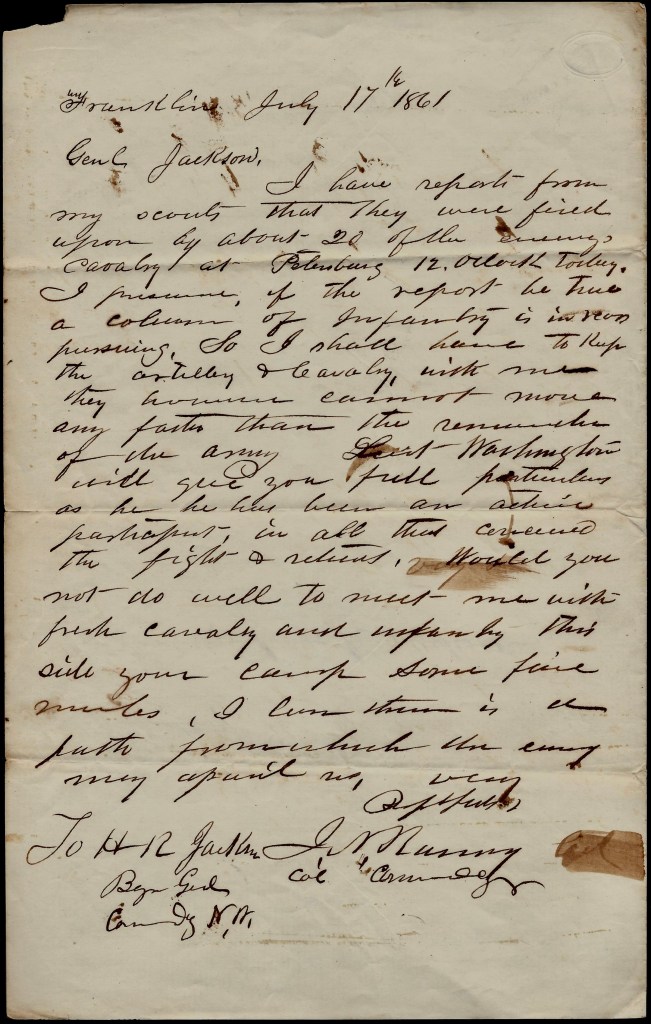
The following early-war letter was written by James N. Ramsey, the Colonel commanding the 1st Georgia Volunteer Infantry regiment not long after joining General Robert S. Garnett’s forces in the Army of the Northwest in West Virginia. After Garnett was killed in the closing phases of the Battle of Corrick’s Ford, Ramsey (though very ill at the time) assumed command of the army, and led his hungry and exhausted troops to Montgomery, Virginia, where they were reinforced. Ramsey wrote the letter to his commanding officer, Brig. Gen. Henry Rootes Jackson.
The “Petersburg” mentioned in this letter refers to the county seat of Grant county in what is now West Virginia.
Transcription
Franklin [now West Virginia] July 17, 1861
General Jackson,
I have reports from my scouts that they were fired upon by about twenty of the enemy’s cavalry at Petersburg, 12 o’clock today. I presume, if the report be true, a column of infantry is in rear pursuing so I shall have to keep the artillery and cavalry with me. They however cannot move any faster than the remainder of the army. Lieut. Washington will give you full particulars as he has been an active participant in that that concerned the fight & retreat. Would you not do well to met me with fresh cavalry and infantry this side your camp some five miles. I learn there is a path from which the enemy may attack us. Very respectfully, — J. N. Ramsey, Col. Commanding
To H. R. Jackson, Brig. Gen., Commanding [Army of the] N. W.
The following letter was written by Andrew Benton (1839-1920), the son of Henry Benton (1814-1906) and Mary Ann Marks (1817-1882) of Saratoga county, New York. Andrew wrote the letter from a camp near Centreville, Virginia, in mid-October 1863 while serving as a private in the 11th New York Independent Battery (Light Artillery). He had enlisted in December 1861 and served three years.
Despite rumors of Meade’s replacement following the Battle of Gettysburg, Andrew’s letter expresses confidence not only in their commander but in the army’s ability to whip Lee’s army wherever it goes. As an artillery unit, Andrew had reason to boast as the 11th New York Light Artillery took a position near the stone wall at the point of Pickett’s attack on July 3rd and opened fire “with great deliberation and desired effect”—firing a total of 89 rounds.
Transcription
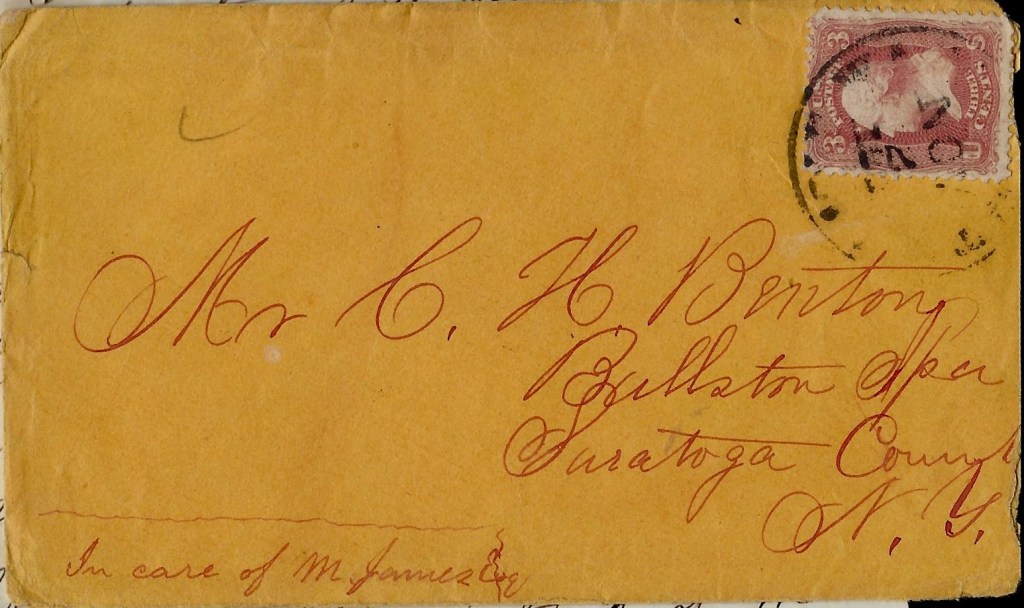
Addressed to Mr. C. H. Benton, Ballston Spa, Saratoga, New York
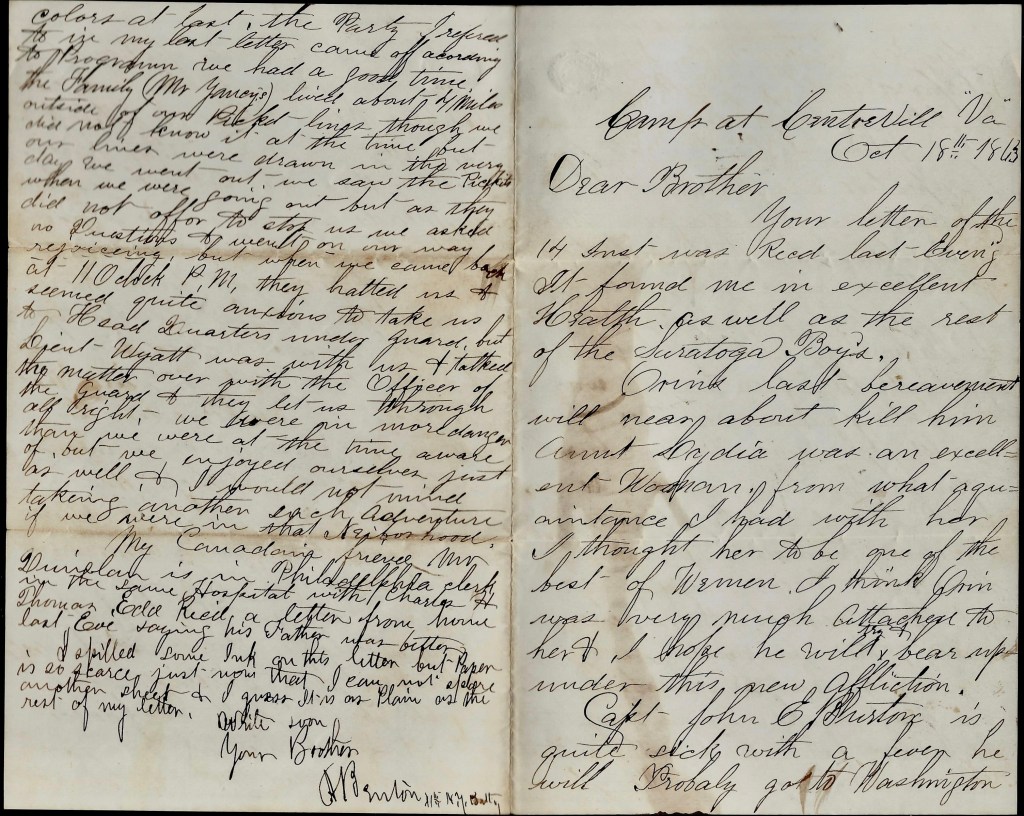
Camp at Centreville, Virginia October 18th 1863
Dear Brother,
Your letter of the 14 inst. was received last evening. It found me in excellent health as well as the rest of the Saratoga Boys.
Orin’s last bereavement will near about kill him. Aunt Lydia was an excellent woman from what acquaintance I had with her. I thought her to be one of the best of women. I think Orin was very much attached to her & I hope he will try and bear up under the new affliction.
Capt. John E Burton is quite sick with a fever. He will probably go to Washington today or tomorrow. Davis Shephard will go with him to take care of him.
When I last wrote you, I expected ‘ere this, that there would be a battle in this vicinity but it has not come yet. There is a good deal of stir. Yesterday a large force of infantry, artillery, & cavalry went to the front & it was thought by some that there would be some powder burnt today but all if quiet so far & the body of the army is marching towards Fairfax. We have not received any orders yet but expect them any moment. There is various rumors in camp of the whereabouts of the Gray backs. Some say that they have fallen back; others that they are going into Maryland. Well, I don’t care if they do go into Maryland. We have whipped them there & I think can do it again. They know better than to attack us here & Meade’s force is so small that I don’t think he will follow them if they fall back. There is another report in camp but it is not credited much by soldiers. It is said that Meade is superseded by General Warren, now commanding 2nd Corps. I hope this is not the case. I think Meade is just the man to command the Army of the Potomac.
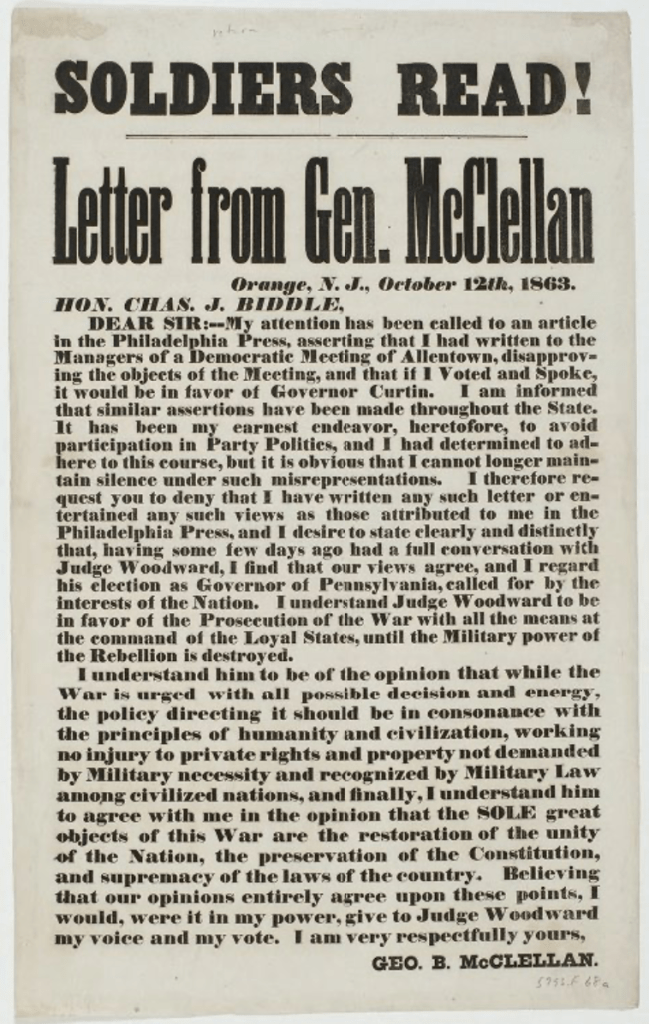
What do you think of McClellen’s letter to Chas. J. Biddle? I think it will surprise some people but I lost confidence in him some time ago. Well, I am glad he has shown [his] colors at last. The party I referred to in my last letter came off according to program. We had a good time. The family (Mr. Yancy’s) lived about 4 miles outside of our picket lines, though we did not know it at the time, but our lines were drawn in the very day we went out. We saw the pickets when we were going out but as they did not offer to stop us, we asked no questions & went on our way rejoicing. But when we came back at 11 o’clock p.m., they halted us & seemed quite anxious to take us to Headquarters under guard. But Lieut. Wyatt was with us & talked the matter over with the Officer of the Guard & they let us through all right. We were in more danger than we were at the time aware of, but we enjoyed ourselves just as well & I would not mind taking another such adventure if we were in that neighborhood.
My Canadian friend, Mr. Durislan, is in Philadelphia , clerk in the same hospital with Charles H. Thomas. Edd received a letter from home last eve saying his Father was better.
I spilled some Ink on this letter but paper is so scarce just now that I cannot spare another sheet & I guess it is as plain as the rest of my letter. Write soon. Your brother, — A. Benton, 11th N.Y. Battery
Richard Draper Douglass was born in Westport, Essex County, New York, October 23, 1836, the youngest child of William Stewart Douglass (1798-1860) and Jane G. (Arthur) Douglass (1803-1842). Richard studied at Phillips Academy, Exeter, New Hampshire; and Williston Seminary. He was a graduate of Amherst College (Class of 1860), and Bangor Theological Seminary (1863).
“As an agent of the U.S. Christian Commission, he served in Alabama, Tennessee, and Virginia before taking a position in the Commissary Department of the United States Army at City Point, Virginia, in early 1865, which position ended soon after the war was over. After a brief stint in business in Boston, Douglass became a special relief agent for the Brooklyn Children’s Aid Society (1867-1873) and general superintendent of the society (1873-1885). On September 13, 1864, Douglass married Mary Abbie Lawrence (1839-1931), daughter of Ephraim Appleton Lawrence. Richard Douglass died in Brooklyn, New York, April 2, 1885.” [See New York State Library: Richard Draper Douglass Papers, 1853-1875]
The News-Herald, 7 March 1931
In the March 6, 1931 issue of the New York Times, an article about the life of Mrs. Douglass, told of her Red Cross work with the Christian Commission at Lookout Mountain and later in Nashville, Tenn. during the Civil War. It also spoke of how she managed the Seaside Home for over 40 years at Coney Island in New York. Children from the city were cared for here over the summer. Presumably these kids had ties to the Childrens Aid Society which her husband had headed before his death. She attended Mount Holyoke Seminary (now a college) for several years and used that training to teach Sunday school for many years at the Plymouth church where she had been a member for over 60 years.
It should be noted that there are some newspaper articles claiming Rev. Douglass to be a physician, an officer, on Gen. Grant’s staff, etc., but I could not find evidence of any such claims. Neither could I find any evidence that Mary Douglass was commissioned a Major.
Transcription
Addressed to Mrs. R. D. Douglass, U. S. Christian Commission, Nashville, Tenn., Hospital No. 3, Lookout Mountain
City Point, Virginia October 5th 1864
My Dear Darling,
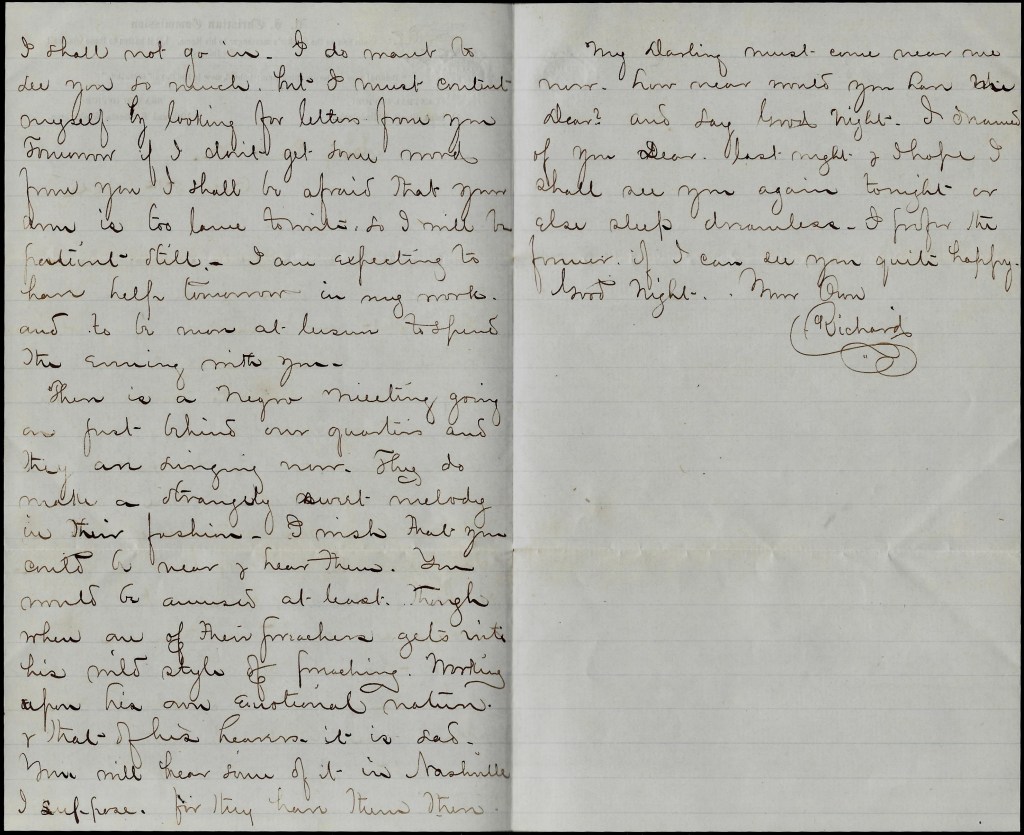
Would give so much comfort to her own if she were here tonight—for I am mangy—not in mind but in body, and I would like to put my head into your hands for a thorough cleaning, as you alone know how to do that for me in the way which I like best. It has been an extremely warm day and the labor of loading & unloading boxes and barrels into and out of wagons, of storing them in our warehouse, or overseeing a gang of hands & running about considerable, has kept me active and so quite happy most of the day.
This evening we have service but I shall not go in. I do want to see you so much but I must content myself by looking for letters from you tomorrow. If I don’t get some word from you, I shall be afraid that your arm is too lame to write, so I will be patient still. I am expecting to have help tomorrow in my work and to be more at leisure to spend the evening with you.
There is a Negro Meeting going on just behind our quarters and they are singing now. They do make a strangely sweet melody in their fashion. I wish that you could be near & hear them. You would be amused at least. Though when one of their preachers gets into his wild style of preaching, working upon his own emotional notion, and that of his hearers, it is sad. You will hear some of it in Nashville, I suppose, for they have them there.
My darling must come near me now—how near would you have me, dear? and say Good Night. I dreamed of you, dear, last night. I hope I shall see you again tonight or else sleep dreamless. I prefer the former if I can see you quite happy. Good night. Your own, — Richard
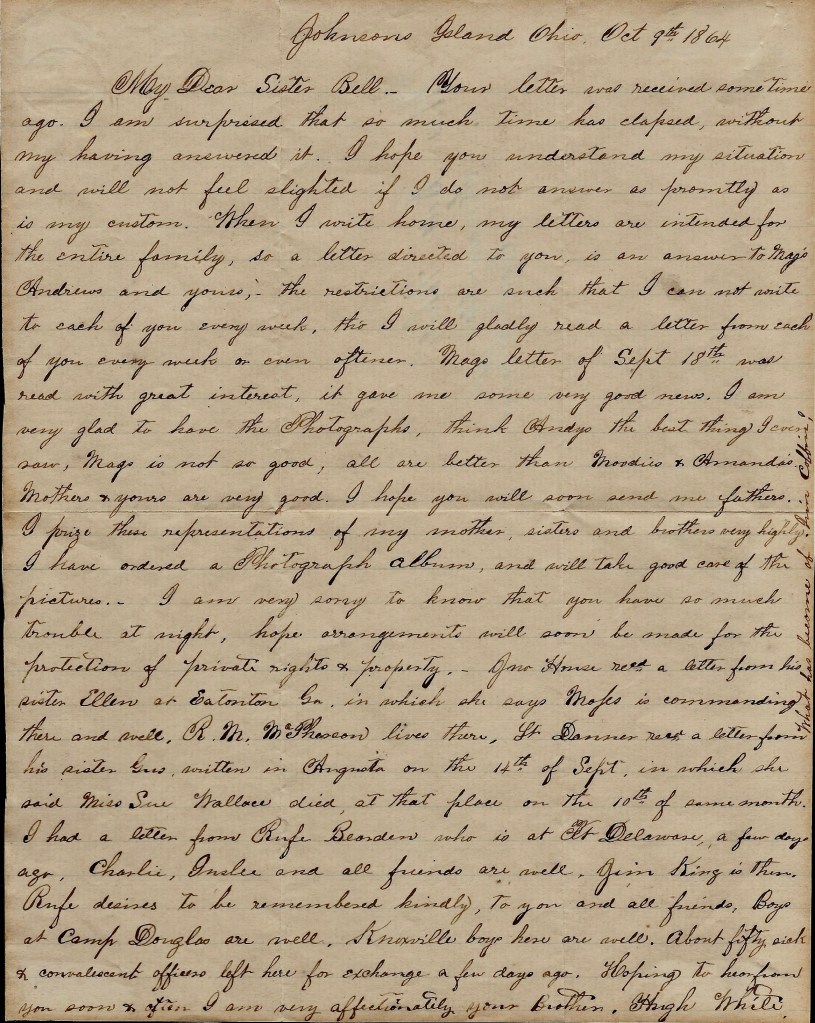
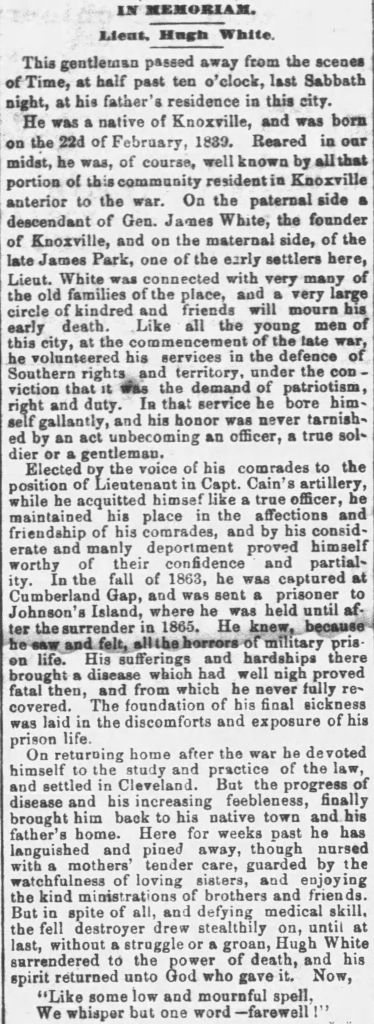
The following letter was written by Hugh Lawson White (1839-1871), the son of Judge George M. White (1800-1884) and Isabella McNutt (1780-1842) of Knoxville, Tennessee. When the Civil War began, “like all the young men of Knoxville,” Hugh volunteered his services “in the defense of Southern rights and territory under the conviction that it was the demand of patriotism, right and duty.” He was elected by his comrades as a Lieutenant in Capt. W. C. Kain’s Light Artillery Company. In the fall of 1863, he was captured at Cumberland Gap and sent a prisoner to Johnson’s Island where he was held until after the surrender in 1865. While in prison, he contracted a disease which impaired him and no doubt prematurely ended his life in 1871. After the war he studied and practiced law for a time but his health failed him.
Transcription
Johnson’s Island, Ohio October 9th 1864
My dear sister Bell,
Your letter was received sometime ago. I am surprised that so much time has elapsed without my having answered it. I hope you understand my situation and will not feel slighted if I do not answer as promptly as is my custom. When I write home, my letters are intended for the entire family, so a letter directed to you is an answer to Mag’s, Andrew’s and yours. The restrictions are such that I cannot write to each of you each week though I will gladly read a letter from each of you every week or even oftener. Mag’s letter of September 18th was read with great interest. It gave me some very good news. I am very glad to have the photographs. Think Andy’s the best thing I ever saw. Mag’s is not so good. All are better than Moodie’s and Amanda’s. Mother’s and yours are very good. I hope you will soon send me father’s. I prize these representations of my mother, sisters, and brothers very highly. I have ordered a photograph album and will take good care of the pictures. I am very sorry to know that you have so much trouble at night. Hope arrangements will soon be made for the protection of private rights and property. Jno. House received a letter from his sister Ellen at Eatonton, Ga., in which she says [brother] Moses [White] 1 is commanding there and well. R. M. McPherson lives there. Lt. Danner received a letter from his sister Gus, written in Augusta on the 14th of September, in which she said Miss Sue Wallace died at that place on the 10th of same month. I had a letter from Rufe Beardon who is at Ft. Delaware a few days ago. Charlie, Inslee and all friends are well. Jim King is there. Rufe desires to be remembered kindly to you and all friends. Boys at Camp Douglas are well. Knoxville boys here are well. About fifty sick and convalescent officers left here for exchange a few days ago. Hoping to hear from you soon & often. I am very affectionately your brother, — Hugh White
What has become of Jim Coffin!
1 Moses P. White (1829-1907) of Knoxville was the Colonel of the 37th Tennessee Infantry.
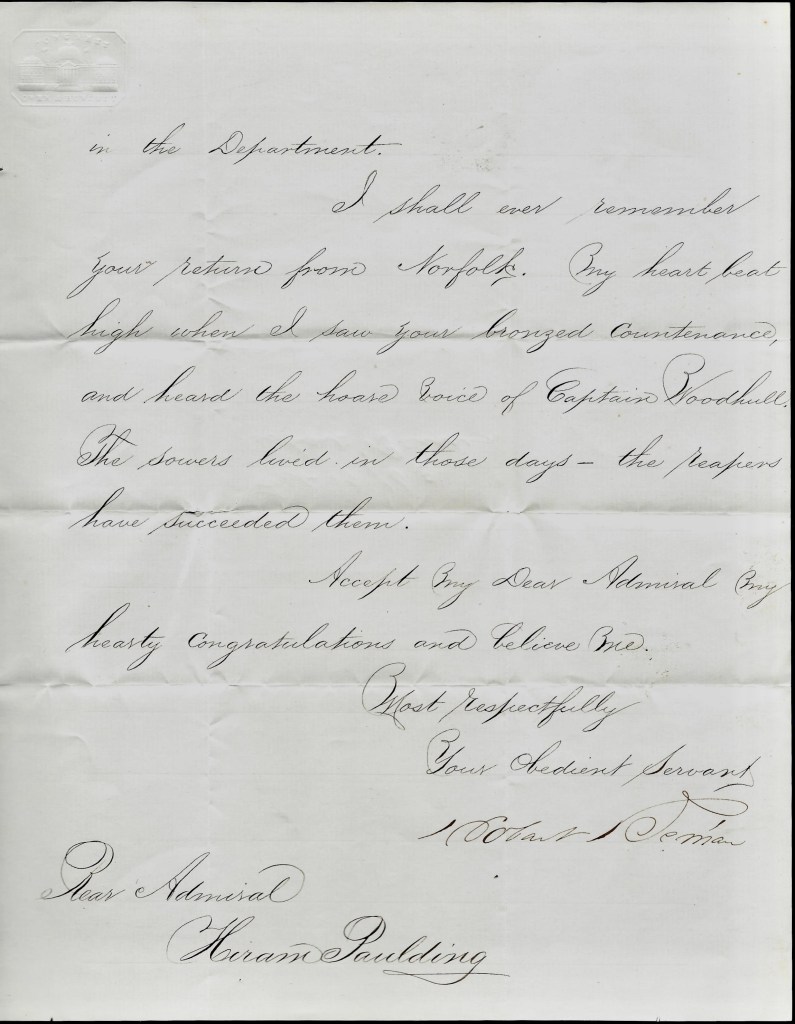
The following letter was written by Hobart Beman, an auditor in the Treasury Department assigned to the claims of Navy Department personnel. Clearly Hobart had a familiarity with the Hiram Paulding, the commander of the Brooklyn Navy Yard and the Navy commander tasked by Abraham Lincoln and Gideon Wells to go to the Gosport Navy Yard at Norfolk to try to save it and the US vessels in dock there from falling into the hands of the insurrectionists in 1861. In this friendly note, Hobart congratulates Paulding for his Senate confirmation to be promoted from a Captain to a Rear Admiral in the Navy.
Transcription
Treasury Department Fourth Auditor’s Office February 9, 1863
My Dear Admiral,
The announcement in yesterday’s paper of your confirmation by the Senate, was, I assure you, a subject of most sincere gratification. Its antecedents only embellish the compliment.
A period existed in the history of the Insurrection, when the “faithful among the faithless” was but few; and I shall always recur with heartfelt satisfaction, to the days and nights of toil and anxiety, when I had the honor to be associated with the Secretary [of the Navy] and yourself in the Department.
I shall ever remember your return from Norfolk. My heart beat high when I saw your bronzed countenance and heard the horse voice of Captain Woodhull. The sowers lived in those days—the reapers have succeeded them.
Accept my dear Admiral, my heart congratulations and believe me most respectfully, your obedient servant, — Hobart Beman
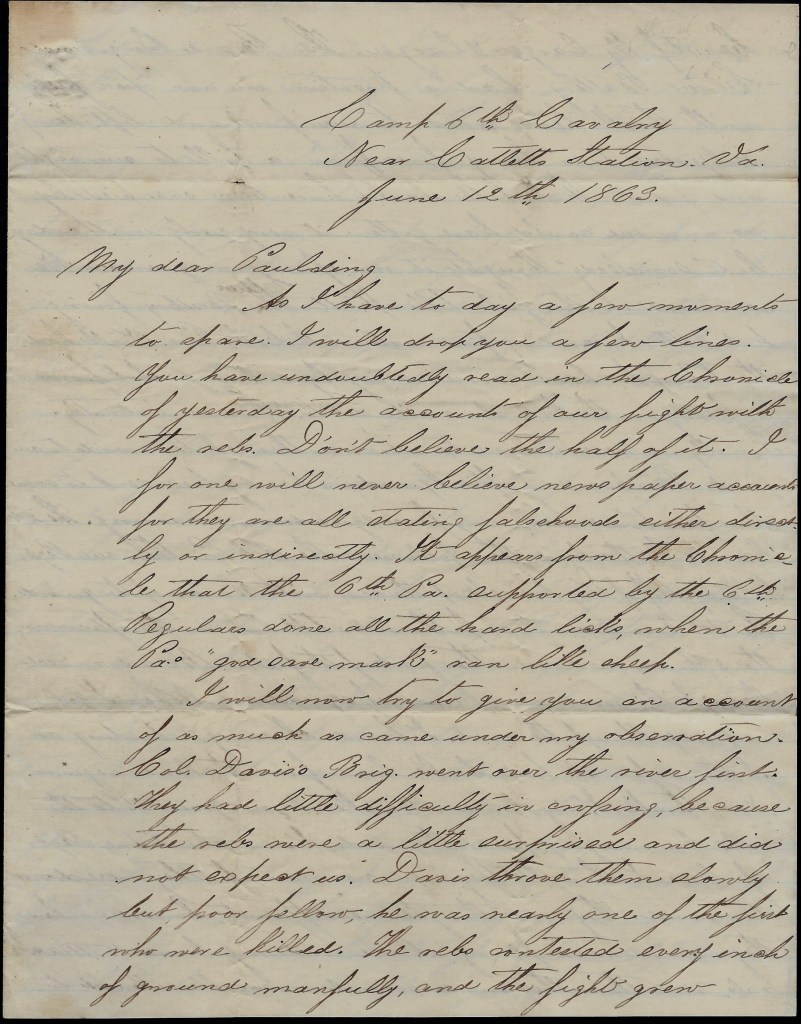
The following letter was written by Lt. Christian Balder of the 6th US Cavalry describing the Battle of Brandy Station. A few weeks after this letter was penned, Balder was killed at the Battle of Fairfield and his comrade, Tattnall Pauling—the recipient of this letter—was taken prisoner.
Lt. Christian Balder, 6th US Cavalry
Transcription
Camp 6th Cavalry Near Catlett’s Station, Virginia June 12th, 1863
My dear Paulding,
As I have today a few moments to spare, I will drop you a few lines. You have undoubtedly read in the Chronicle of yesterday the account of our fight with the rebs. Don’t believe the half of it. I for one will never believe newspaper accounts for they are all stating falsehoods—either directly or indirectly. It appears from the Chronicle that the & 6th Pennsylvania supported by the 6th Regulars, done all the hard licks, when the Pennsylvanians “God save mark” ran like sheep.
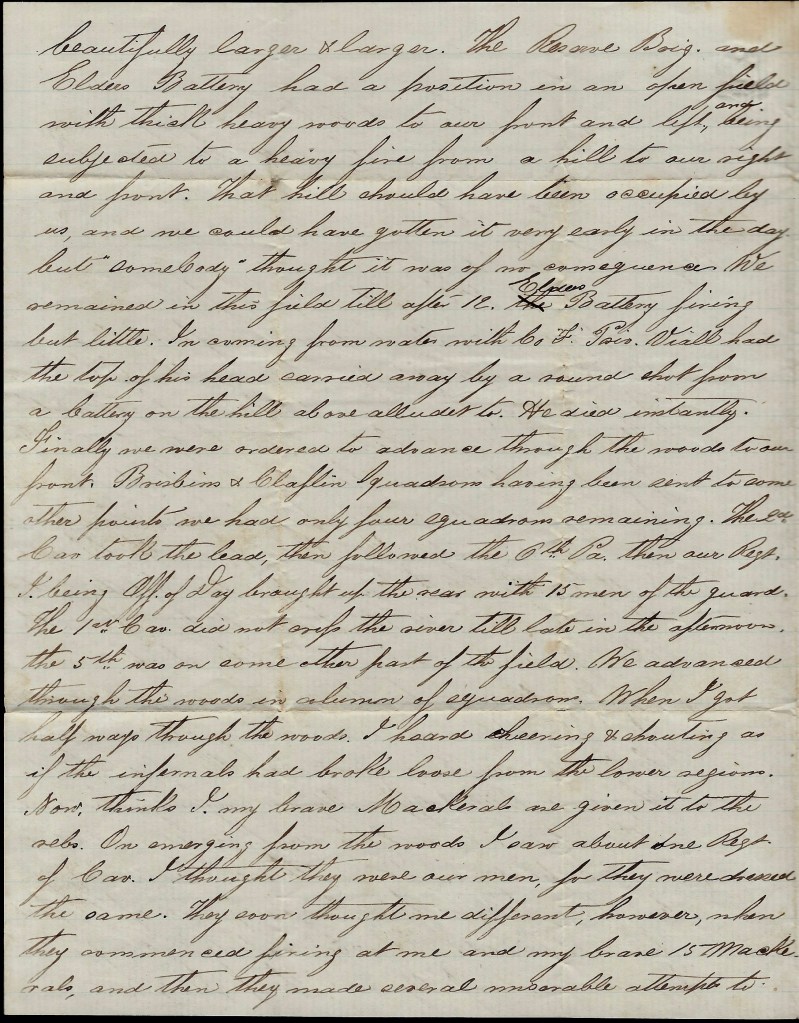
I will now try to give you an account of as much as came under my observation. Col. Davis’s Brigade went over the river first. They had little difficulty in crossing because the rebs were a little surprised and did not expect us. Davis drove them slowly but poor fellow, he was nearly one of the first who were killed. The rebs contested every inch of ground manfully and the fight grew beautifully larger and larger. The Reserve Brigade and Elders Battery had a position in an open field with thick heavy woods to our front and left, and being subjected to a heavy fire from a hill to our right and front. That hill should have been occupied by us, and we could have gotten it very early in the day but “somebody” thought it was of no consequence. We remained in this field till after 12; Elder’s Battery firing but little.
In coming from water with Co. F, Private Viall had the top of his head carried away by a round shot from a battery on the hill above alluded to. He died instantly. Finally we were ordered to advance through the woods to our front. Brisbin’s and Clafin Squadron having been sent to some other points, we had only four squadrons remaining. The 2d Cavalry took the lead, then followed the 6th Pennsylvania, then our regiment. I, being Officer of the Day, brought up the rear with 15 men of the guard. The 1st Cavalry did not cross the river till late in the afternoon. The 5th was on some other part of the field. We advanced through the woods in column of squadron. When I got half ways through the woods, I heard cheering and shouting as if the infernals had brook loose from the lower region. Nor, thinks I, my brave Mackerals are giving it to the rebs. On emerging from the woods, I saw about one regiment of cavalry. I thought they were our men for they were dressed the same. They soon thought me different, however, when they commenced firing at me and my brave 15 Mackerals, and then they made several miserable attempts to…[missing page?]
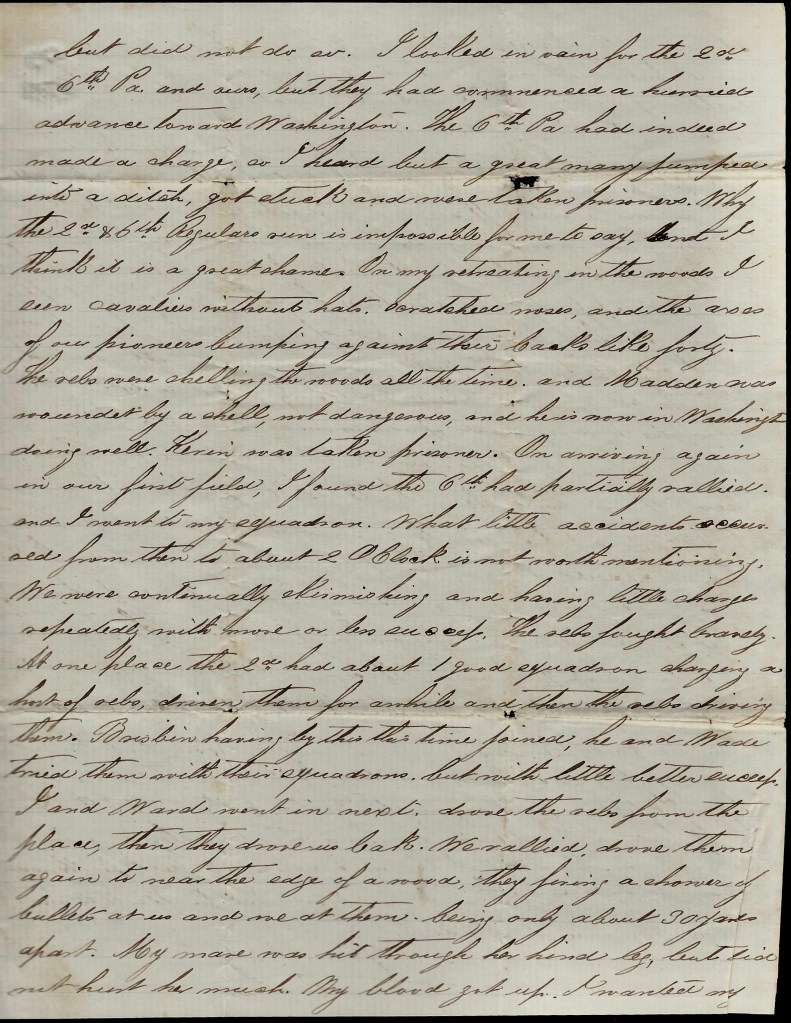
…but did not do so. I looked in vain for the 2nd, 6th Pennsylvania, and ours, but they had commenced a hurried advance toward Washington. The 6th Pennsylvania had indeed made a charge, so I heard, but a great many jumped into a ditch, got stuck, and were taken prisoners. Why the 2nd & 6th Regulars run is impossible for me to say and I think it is a great shame. On my retreating in the woods, I seen cavaliers without hats, scratched noses, and the axes of our pioneers bumping against the backs like forty. The rebs were shelling the woods all the time, and Madden was wounded by a shell, not dangerous, and he is now in Washington doing well. Herin was taken prisoner.
On arriving again in our first field, I found the 6th had partially rallied and I went to my squadron. What little accidents occurred from then to about 2 o’clock is not worth mentioning. We were continually skirmishing and having little charges repeatedly with more or less success. The rebs fought bravely. At one place the 2nd had about 1 good squadron charging a host of rebs, driving them for a while, and then the rebs driving them. Brisbin having by this time joined, he and Wade tried them with their squadrons but with little better success. I and Ward went in next. We rallied, drove them again to near the edge of a wood, they firing a shower of bullets at us and we at them, being only about 30 yards apart. My mare was hot through her hind leg, but did not hurt her much. My blood got up. I wanted my squadron to charge with me. Ward and Tupper done the same but would not get those dowboys to come on. They all fight very well with the carbine and pistol, but have no confidence in the sabre.
I was in front of the squadron waving my sabre and entreating and cursing them alternately when turning only for one moment to my men, trying to get them on, when all of a sudden, a rebel officer came dashing at me at full speed, making a tremendous right cut at me. But fortunately, I just perceived him in the nick of time. I parried his cut successfully and striking his sabre clean out of his hand. He fled by me and one of my men shot him through the heart. We stood fully 15 or 20 minutes opposite each other, the rebs afraid to charge, and only firing at us. I then seen about a regiment of rebs coming through a field on our right, and I thought it time to retire. But poor Ward had been killed. He worked like a Trojan to get his men to go in with the sabre, but could not succeed. About half an hour after that Stoll was killed whilst skirmishing with a part of that regiment. I had seen so many on my right. So you see we lost just one-third of our officers in killed, wounded and missing. Out of about 280 men, we had about 50.
I never gave the rebs so much credit before but I must now say they go in with a will. Is it not strange now that the papers never say anything about the 2nd & 6th who fought fine in the afternoon, no matter what they done in the morning. Their list of killed and wounded speak for themselves.
My dear Paulding, I must now stop. Write to me soon. My love to Nichols. Yours truly, — Balder
The following letters were written by Joseph Litchfield Locke (1841-1899) of Co. I, 33rd Massachusetts Infantry. Joseph was the son of Rev. William Sherburne Locke (1808-1896) and Caroline Dame Tibbets (1809-1893).
Lt. Joseph Litchfield Locke, 33rd Massachusetts Infantry (R. J. Ferry Collection)
According to his obituary, appearing in The Inter Ocean of 17 July 1899, Joseph was born in Canada in 1843 and came to Chicago twenty-five years ago. He was a member of the firm J. L. Locke & Co., cap manufacturers, at No. 254 Monroe Street. During the war, Mr. Locke served as a lieutenant in the 33rd Massachusetts Volunteer Infantry, gaining his promotion from the ranks by gallantry on the field. He was a charter member of the Menoken club. A widow, two brothers, and two sisters survive him. His brothers are Judge James [William] Locke of Jacksonville, Florida, who has been on the U. S. Supreme Court bench for many years, and Eugene O[lin] Locke, clerk of the United States Supreme court [should be the US District Court of the Southern District of Florida] in the same city.”
Joseph’s military record informs us that he mustered in to the regiment as a corporal in early August 1862. He was promoted to sergeant in early March 1863, and commissioned a lieutenant in September 1864. He mustered out of the regiment on 11 June 1865 at Washington D. C.
[Note: These letters are from the private collection of R. J. Ferry and were transcribed and published on Spared & Shared by express consent.]
Log Houses occupied by the 154th New York near Stafford Court House. Sgt. Marcellus Warner Darling Memoirs. Locke’s description of the winter quarters occupied by the 33rd Massachusetts sound similar.
Camp near Stafford Court House, Va. February 20th 1862 [should be 1863]
Shoulder Straps Rank
This sheet of paper is rather dirty and soiled but soldier’s things will get so & it must go. We are in our new houses, there being 14 for the company and five in each house. Their dimensions are as follows: 12 feet long, 6 wide, walls 4 feet high. Facing the street the door and fire place occupy the whole end. Our bunks are crossing at the rear, the lower one 6 inches from the ground, upon which 3 lie, the upper one 2.5 feet above that. They are made of small poles laid across larger ones and covered with boughs. Our fireplace is built up of sticks laid up in Virginia mud and lined with ditto two or three inches thick which bakes as hard as a rock—a perfect brick in a short time.
There is one piece of good news to me and will probably interest you. My friend Jacob Aling has received an appointment to the Military Academy at West Point and received his discharge and gone home. I was sorry to have him leave but am glad for his part. He is a young man who will make his mark.
I received a letter yesterday from home saying you would get my box off before long. Yes, I have received my old stocking, a lot of postage stamps, the paper in a paper besides a number of other papers which are very agreeably received in this out of the world place. I haven’t much of anything new to write and have a number of other letters to write. I got Letta’s letter and was glad to hear from her and to see that she can write some if not in writing letters.
I write to Gene and give him a talking to when I get time. Why doesn’t he like Mr. Wheeler? I’m most afraid the fault is a good deal on his own part. Ask any questions about soldier’s life, military affairs, &c. that any of you would like to know & I’ll try to give you what information I am able on any subject.
[Shoulder straps sketch]
We were reviewed a few days ago by General Hooker, Sigel & a number of other Major Generals were present.
Letter 2
The 33rd Massachusetts Infantry, part of the XI Army Corps, arrived on the field at Gettysburg on the first day of battle. Most of the XI Corps was deployed north of Gettysburg in an attempt to hold the Rebel advance in check. However, two brigades of the Corps (von Steinwehr’s Division), which included the 33rd Massachusetts, were ordered to remain on Cemetery Hill as a reserve to support the Federal artillery being placed there. For details of their actions over the course of the battle, see 33rd Massachusetts Infantry at Gettysburg by Patrick Browne posted on Historical Disgression on 11 May 2013.
The 33rd Massachusetts Infantry monument is located at the intersection of Slocum and Wainwright Avenues near Steven’s Knoll. It was placed in 1885.
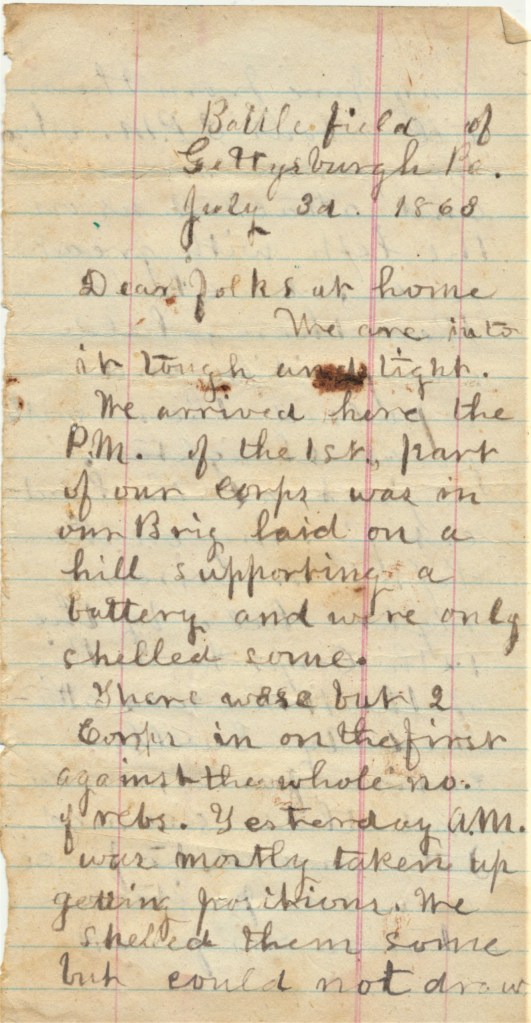
Battlefield of Gettysburg, Pa. July 3d 1863
Dear folks at home,
We are into it tough and tight. We arrived here the p.m. of the 1st. Part of our Corps was in. Our Brigade laid on a hill supporting a battery and were only shelled some. There were but two Corps in on the first against the whole number of rebs. Yesterday a.m. was mostly taken up getting positions. We shelled them some but could not draw any fire from them till about 3 p.m. when they opened on us and attacked us on the left with great force, but we held them there, held our position, and repulsed them with greater slaughter.
Just as the hardest fighting on the left, our extreme right held by the 12th Corp & our Brigade of the 11th was attacked by Ewell’s entire force, massed, and they seemed determined to force our position & turn our flank. Had they done it, it would have been all up with us but we held it handsomely & being reenforced by the 6th Corps about 6, kept our position & repulsed them & small [loss] to us as we were in good rifle pits. Our regiment has had quite a number killed and many wounded. ‘Tis uncertain how many.
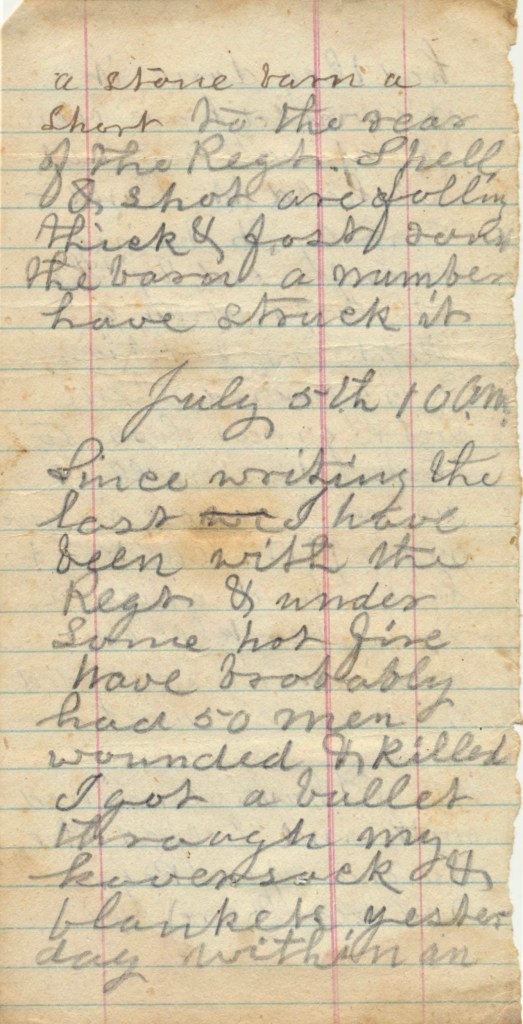
I have remained with and helped the Surgeon of our regiment. We were (and are) in a stone barn a short [distance] to the rear of the regiment. Shell and shot are falling thick and fast around the barn [and] a number have struck it. 1
July 5th, 10 a.m. Since writing the last, I have been with the regiment & under some hot fire. Have probably had 50 men wounded & killed. I got a bullet through my haversack & blankets yesterday within an inch of my side. It put a hole through my tin plate & broke a “hard bread” (the boys think it must have gone swift to do that). We have whipped the rebs with great slaughter. They made [a] desperate attempt to break our lines but couldn’t do it. Our loss was light compared with them. We think they skedaddled last night. — Jose
These flowers I picked in the cemetery where some of our heaviest batteries were planted & which were used rough by them shells & which was charged by them and defended by our Corps in which was our regiment.
1 The XI Corps Hospital took over the George Spangler farm in the middle of the afternoon on 1 July 1863 and remained there through the next two days of fighting and for several days afterward. “The wounded soon began to pour in, giving us such sufficient occupation that from the 1st of July till the afternoon of the fifth, I was not absent from the hospital more than once and then but for an hour or two,” said 26-year-old Dr. Daniel G. Brinton, surgeon-in-chief, Second Division, XI Corps, U.S. Volunteers. “Very hard work it was, too, & little sleep fell to our share. Four operating tables were going night and day. Many of them were hurt in the most shocking manner by shells. My experience at Chancellorsville was nothing compared to this & and I never wish to see such another sight. For myself, I think I never was more exhausted.” A Spangler surgeon who was approaching total exhaustion called the work “too much for human endurance.”
The hospital would use almost every inch of that Pennsylvania bank barn. Dr. Brinton estimated that 500 wounded and dying men filled it. A hospital worker guessed 400. Men were crammed so closely together that they passed deadly infectious diseases such as typhoid fever to one another. Many men died of these diseases rather than the battle wound that brought them to the hospital. Pvt. Reuben Ruch, age 19 of the Easton area, 153rd Pennsylvania, said: “This barn was full of wounded men from one end to the other. Where there was room for a man you could find one. The hay mows, the feed room, the cow stable, the horse stable and loft.” The hospital grew to about 1,900 wounded on July 4-5 after the Confederates retreated and it was safe for ambulances to search on and around the battlefield for wounded men left behind. Even though the hospital served the XI Corps and its 26 regiments at Gettysburg, it hosted Confederate and Union wounded and men from more than 50 regiments altogether. Many Confederates were placed in the barn’s wagon shed to separate them from the Army of the Potomac wounded. The barn and other outbuildings quickly filled, so men were then placed in the open because not enough tents were provided after the battle.
“At the doorway I saw a huge stack of amputated arms and legs, a stack as high as my head!” said Pvt. William Southerton, age 21, 75th Ohio. “The most horrible thing I ever saw in my life! I wish I had never seen it! I sickened.” Wounded Pvt. Justus Silliman of the 17th Connecticut said, “The barn more resembled a butcher shop than any other institution. One citizen on going near it fainted away and had to be carried off.” [See Restored George Spangler Farm tells grim stories of Gettysburg dead and wounded.”]
Letter 3
Camp near Berlin Station, Virginia July 12, 1863
Dear folks at home,
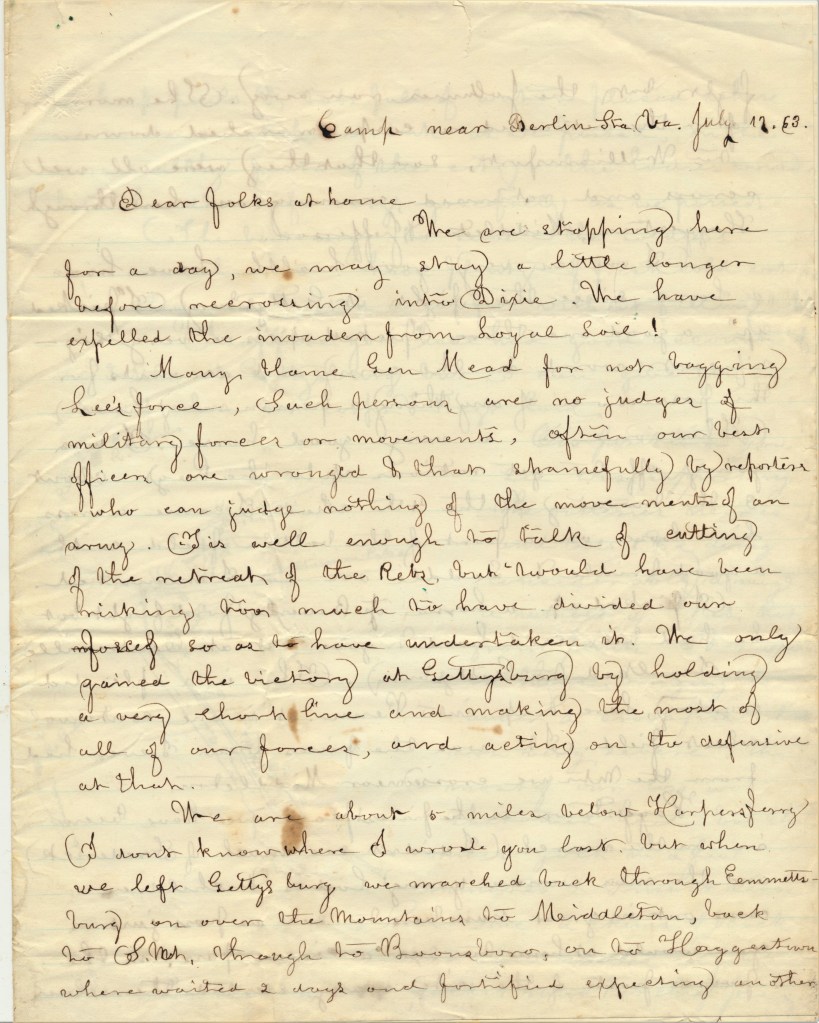
We are stopping here for a day. We may stay a little longer before recrossing into Dixie. We have expelled the invader from Loyal soil! Many blame Gen. Meade for not bagging Lee’s force. Such persons are no judges of military forces or movements. Often our best officers are wronged & that shamefully by reporters who can judge nothing of the movements of an army. ‘Tis well enough to talk of cutting off the retreat of the Rebs but ‘twoud have been risking too much to have divided our forces so as to have undertaken it. We only gained the victory at Gettysburg by holding a very short line and making the most of all of our forces and acting on the defensive at that.
We are about 5 miles below Harper’s Ferrry. (I don’t know where I wrote you last but when we left Gettysburg, we marched back through Emmettsburg on over the mountains to Middleton, back to South Mountain, through to Boonsboro, on to Hagerstown, where [we] waited two days and fortified expecting another fight, but the Johnnies ran away. The morning after they retreated, our Corps marched down to Williamsport, saw that they were all well across and returned coming on here through Hagerstown, Middleton & Jefferson.
I am in very good health. Have had a horse since the fight at Gettysburg. I “picked up” a good one there (“picked up” is a very significant word in the army and accounts for the possession of anything a person may have). This one is a very good horse. I was going off to get rations up to the regiment about 3 the morning of the 4th when I came across him loose on a part of the battlefield with a good bridle and saddle on so I mounted it. I picked up a horse at [the] Beverly Ford fight but he had been used hard & gave out at Centreville so I walked to Gettysburg.
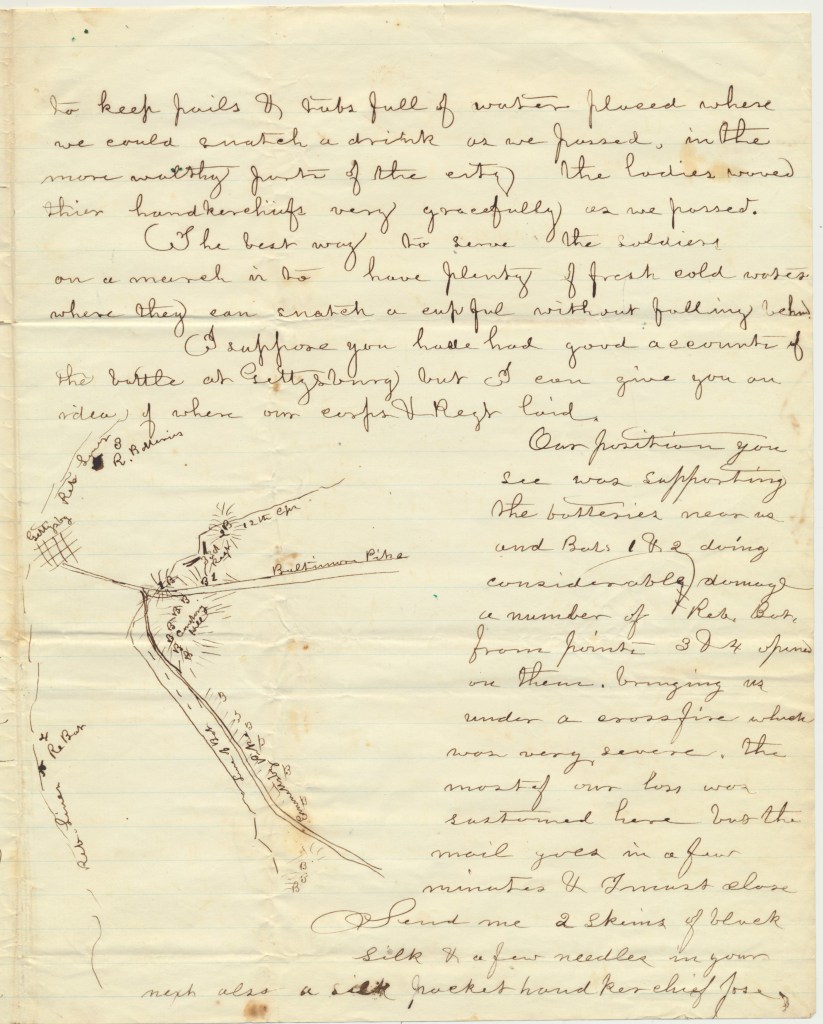
This is a splendid country, here and up into Pennsylvania. It is one continuous wheat field. It was the finest view I ever had from the mountains we crossed near Middleton. Hagerstown is the finest place we have been in on the march (I didn’t see much of Frederick) and the men, women, and young ladies & children came out in great numbers to see us pass just as you would at home to see a circus pass, in the porer parts of the city. Many exerted themselves to keep pails and tubs full of water placed where we could snatch a drink as we passed in the more worthy part of the city. The ladies waved their handkerchiefs very gracefully as we passed. The best way to serve the soldiers on a march is to have plenty of fresh cold water where they can snatch a cupful without falling behind.
I suppose you have had good accounts of the battle at Gettysburg but I can give you an idea of where our corps & regiment laid.
Locke’s Sketch of the 33rd Massachusetts’ position in Culp’s Meadow at Gettysburg
Our position, you see, was supporting the batteries near us and Battery 1 & 2 doing considerable damage. A number of Reb batteries from points 3 and 4 opened on them, bringing us under a crossfire which was very severe. The worst of our loss was sustained here.
But the mail goes in a few minutes & I must close. Send me two skeins of black silk & a few needles in your next. Also a silk pocket handkerchief. — Jose
Letter 4
Bristoe Station, Va. September 20, 1863
Dear folks at home,
We still remain at this place and probably shall for some time to come as our Corps is considerably scattered at present and we are doing duty which some one must do—viz: guard the railroad. Our Corps (what is here) now guards the railroad from Manassas Junction to the Rappahannock. One Division (the 1st) is at the siege of Charleston [and] one Brigade of our Division is in Alexandria.
I have been quite anxious lately for fear you did not receive my letter containing $50 in which I told about my box as I have not heard from you concerning it. We have received no boxes since the 10th inst. and I understand there is a lot of them now at Culpeper which will be sent here soon and probably mine is in it, if everything is right.
I got a letter from Gene a few days ago. He had not been there long but seemed to like.
We get but little news lately from anywhere but think everything is going on right. Our army has been for a long time and is now receiving great reinforcements. A great many conscripts besides over 30,000 men have lately returned from New York City who have been there from this army protecting and enforcing the law during the draft. We have received no conscripts and ’tis doubtful whether we get any for some time at least. Tis strange how a regiment will get reduced. Our regiment numbered (without the two companies which went into the 41st) 1,000 able bodied? men. We have had but few men killed in battle and we now draw rations for 461 men. Hardships pick off men faster than bullets. You may well believe that the most of the men we have now are tough.
Our regiment does a good deal of scouting now-a-days and under the direction of a boy 18 or 19 years old are quite successful. This young fellow (Doughty) came with the family when but five years old from the North somewhere so are good Union people. His father is in Richmond a prisoner. Young Doughty’s mother & sister live about 4 and a half miles from here. 1 He went as guide of a part a few days ago and alone took two cavalry Rebs prisoners and led our men to a house where there were 13 large trunks belonging to Reb officers and packed with their uniforms, &c. All of these our men opened and took everything out they wanted. There was a good deal of valuable property in them and our men came in loaded with booty.
We are having the weather very cool now and have had a long, cold storm for a few days past. Meg, postage stamps have “played out” as you may see by the envelope.
The bushwhackers are very bad and saucy around here. Not long ago they took a captain, five men and four horses—not long before they took Lieut. [Arthur C.] Parker of our regiment (he came out as Orderly Sergt. of Co. I) detailed on Gen. Meade’s staff as aide-de-camp. He visited the regiment, started off, and has not been heard from since. 2 They also took three teams out of a train of sutler’s wagons when the train was guarded by cavalry before & behind. They are very bold.
Write soon & I’ll let you know as soon as I get the box. — Jose.
1 My hunch is that the young man named Doughty was James R. Doughty (1842-1875), the son of Abraham Doughty (b. 1800) and Eunice Reynolds (180801872). This family came from New York to farm in Prince William county, Virginia, prior to 1850. After the war, James worked as a clerk in the Treasury Department for a time but in 1875 he was killed while working as a flagman on the Baltimore & Potomac Railroad when he fell under the wheels of the cars near Bowie Station.[Still need to verify his identity]
2 Arthur C. Parker was a 21 year-old student when he enlisted on 23 July 1862 as a 1st Sergeant in Co. I, 33rd Massachusetts. He was promoted to 2nd Lieutenant on 3 March 1863 and was killed by guerrillas on 16 August 1863 at Catlett’s Station, Virginia.
Letter 5
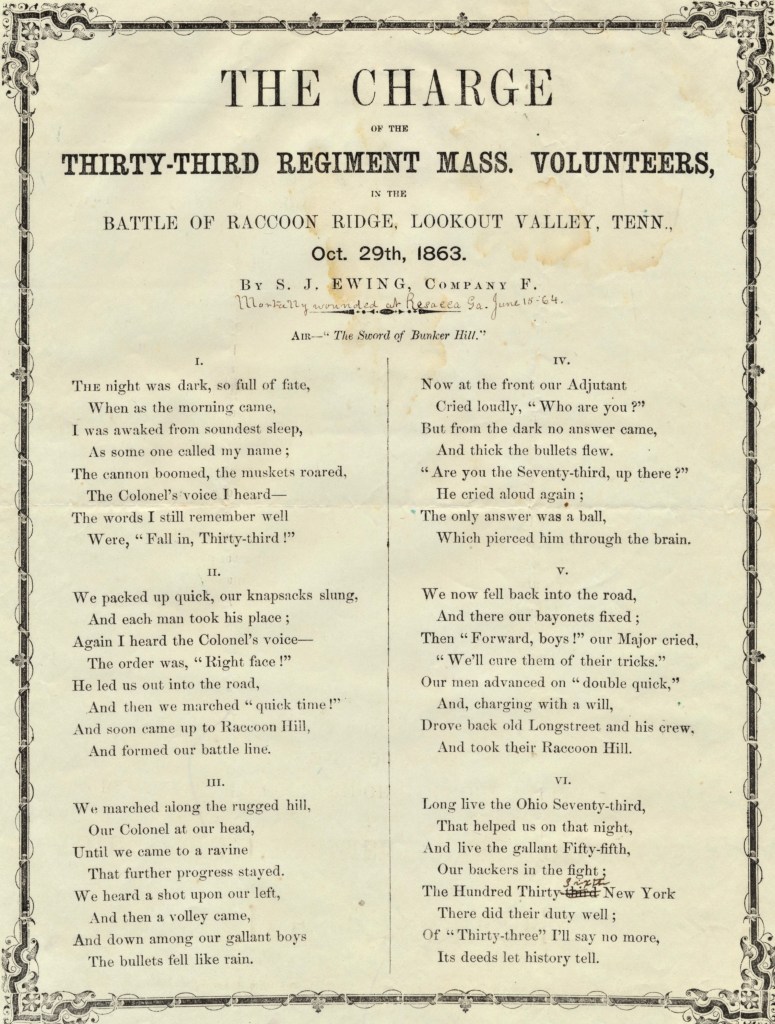
The following letter provides us with a riveting account of the 33rd Massachusetts’ participation in the Battle of Raccoon Ridge, Lookout Valley, Tennessee on 29 October 1863.
Camp near Lookout Mountain November 3rd 1863
Dear Folks at home,
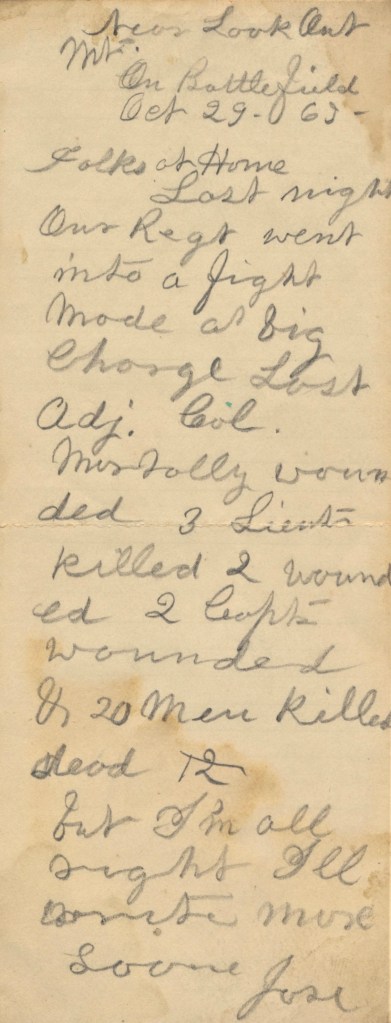
Locke’s cryptic note reassuring the folks at home he was yet alive.
I wrote you a few lines the morning after the gallant charge and heavy loss of the 33rd [Massachusetts] on the 29th ult., but you of course would like to hear further particulars. I’ll tell you how we came here from Stevenson.
On October 24th, we marched back to Bridgeport, staid one night, and then marched across the river and went about five miles to Stuart’s Store where we staid till the morning of the 27th when we went on. About noon we stopped two hours at Shell Mound where is a very large cave. A small river runs out of it of splendid cool and clear water. It is as large as the one running from the Massebesic to the Merrimack at Goffs Falls. I went into it most a mile. Boats can go up the stream a good many miles.
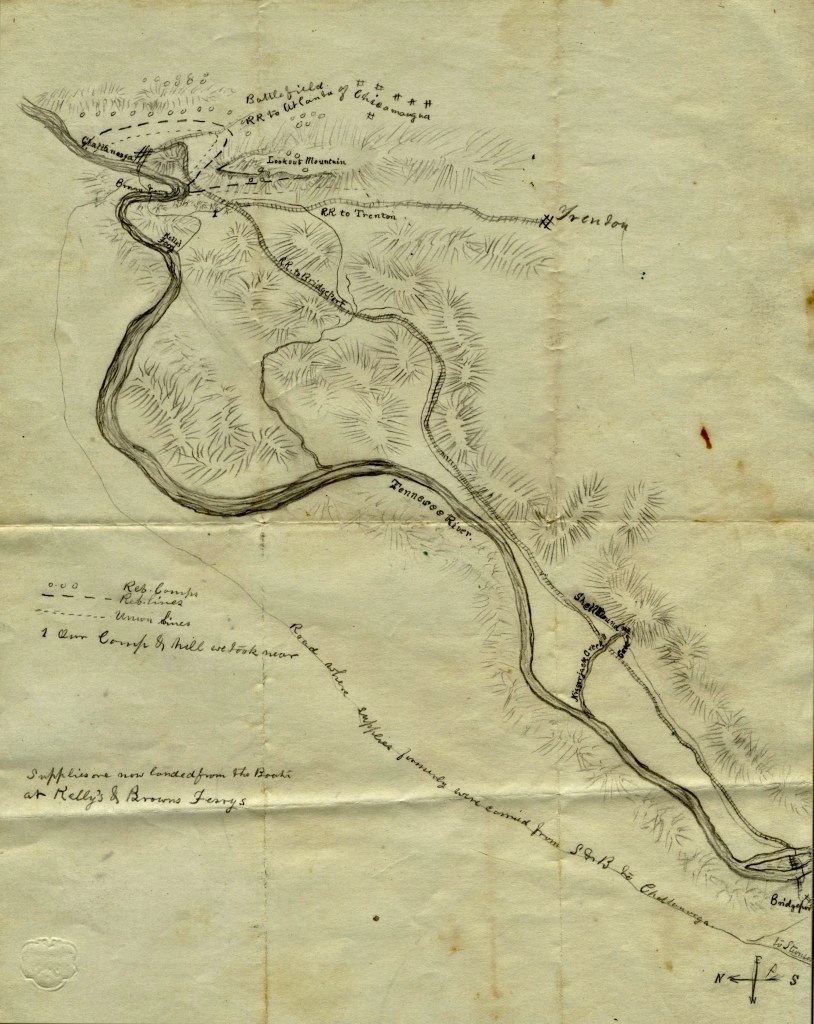
We kept on and staid that night among the mountains and the next p.m. came in sight of Lookout Mountain, advanced, drove in the reb pickets & kept on but were soon opened on from the batteries on the mountain & they shelled us pretty sharp before we fell back. We lost Sergt. Adams of Co. F from Lowell here. He was killed on the spot. This was at “4” on the map. From here we fell back round the hills and marched on towards the river & went in camp at “10.” Here we all went to sleep quietly (excepting Companies A, B, & G which went off scouting so were not in the fight).
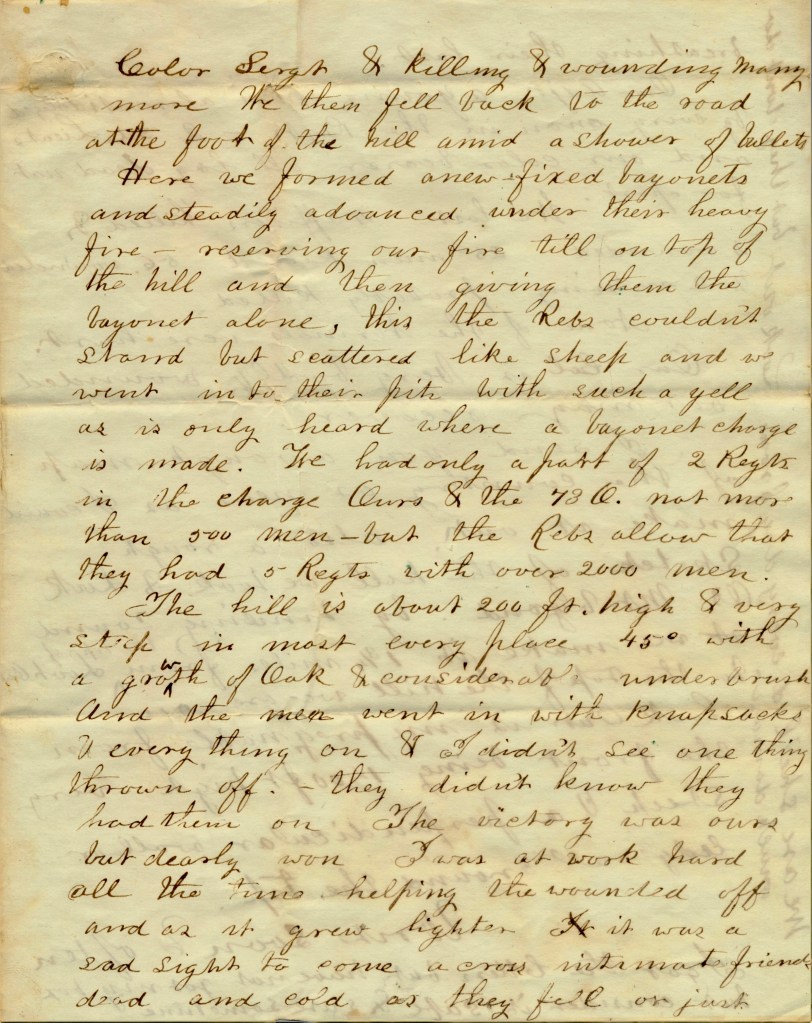
At 1 o’clock we were all [awakened by] firing about a mile off and soon we were turned [out] by the bugle and the regiment ordered off at double quick. The Chaplain & I followed hard after keeping close up to pick up any wounded. It was very dark—about 1:30 o’clock—and as we advanced up the hill in line of battle, there was some confusion and some of the officers thought the 73rd Ohio was partly ahead of us and when near the top of the hill, the adjutant hallowed and asked if the 73rd was ahead and the rebs cried out, “Yes! 73rd. Don’t shoot your own men!” and then gave us a terrible volley, wounding our Colonel, killing our Color Sergeant, and killing & wounding many more.
We then fell back to the road at the foot of the hill amid the shower of bullets. Here we formed anew, fixed bayonets, and steadily advanced under their heavy fire—reserving our fire till on top of the hill and then giving them the bayonet alone. This the rebs couldn’t stand but scattered like sheep and we went into their pits with such a yell as is only heard where a bayonet charge is made. We had only a part of two regiments in the charge, ours and the 73rd Ohio—not more than 500 men. But the rebs allow that they had five regiments with over 2,000 men. 1
The hill is about 200 feet high and very steep in most every place—45o—with a growth of oak and considerable underbrush. And the men went in with knapsacks & everything on & I didn’t see one thing thrown off. They didn’t know they had them on. The victory was ours but dearly won. I was at work hard all the time helping the wounded off and as it grew lighter, it was a sad sight to come across intimate friends dead and cold as they fell or just breathing their last.
Our adjutant—a young man almost idolized by every man in the regiment, two 2nd Lieutenants, and our Color Bearer all lay dead not far apart. We lost four officers killed and four wounded, 25 men killed, 56 wounded, and two missing—probably killed. None of the Normals were hurt. Our Colonel is very badly wounded but may recover.
I send you a rough map of the country as near as I could make it out. Also a rough sketch of the hill we took & Lookout Mountain beyond. By timing sound, we make it 1.75 miles from the top of Lookout [Mountain] to the top of the hill we are on. Lookout is impregnable from the front, being 1400 feet hight—very steep & a perpendicular wall or ledge all round the top.
Write soon & often. I got the letters but have not got my box but consider it safe and sure sometime. We are shelled every day from Lookout but they don’t do much damage.
1 Locke’s account squares well with Samuel H. Hurst, 73rd Ohio Infantry. “When we had approached within 2 or 3 rods of the enemy’s breastworks there opened upon us a most murderous fire from a force on our right flank, completely enfilading our line. The appearance of this force on our flank seemed to forbid our farther advance. I knew we had no support on our right, and we had not held communication with the 33rd Massachusetts at any time during the engagement. Regarding the Seventy-third as the directing battalion, I had paid no attention to our support on the left, and it was impossible for me to learn whether Col. Underwood was advancing or not, while heavy and irregular firing, with cries of “Don’t fire upon your own men,” coming from the left of our front, only increased the confusion. Under the circumstances I deemed it rash to advance farther until I knew that one, at least, of my flanks was protected. I ordered the regiment to retire a few rods, which they did in perfect order, and lay down again, while I sent Capt. Higgins to ascertain the position and movements of the 33rd Massachusetts. Learning that, though they had fallen back, they were again advancing, I was preparing to go forward also, when information came that the 33rd had turned the enemy’s flank, was gallantly charging him in his breastworks, and driving him from the left crest of the hill.”
Poem composed by S. J. Ewing of Co. F, 33rd Massachusetts. Ewing was later mortally wounded at the Battle of Resaca,. Georgia, on 15 June 1864
Letter 6
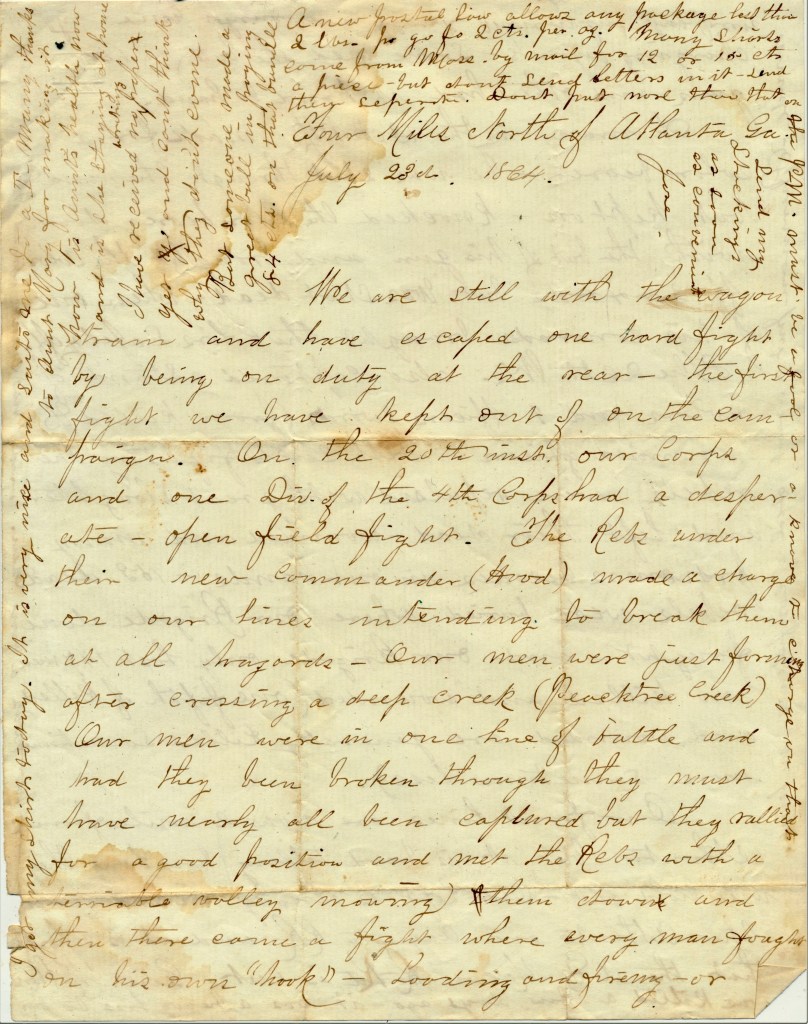
This letter describes in detail the action of the 33rd Massachusetts and other regiments in their brigade during the Battle of Peachtree Creek that took place on 20 July 1864. It was a desperate hand-to hand struggle in which both sides incurred heavy losses.
Four miles north of Atlanta, Ga. July 23rd 1864
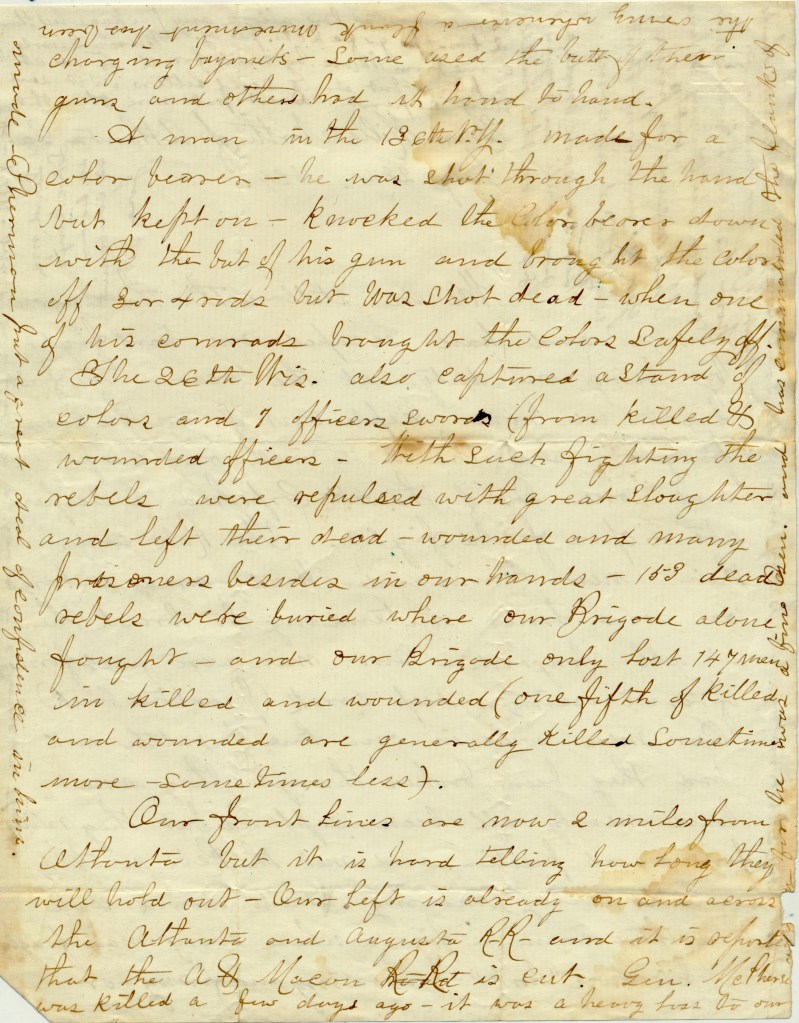
We are still with the wagon train and have escaped one hard fight by being on duty at the rear—the first fight we have kept out of on the campaign. On the 20th inst. our Corps and one Division of the 4th Corps had a desperate open field fight. The Rebs under their new commander (Hood) made a charge on our lines intending to break them at all hazards. Our men were just forming after crossing a deep creek (Peachtree Creek). Our men were in one line of battle and had they been broken through they must have nearly all been captured but they rallied for a good position and met the Rebs with a terrible volley mowing them down and then there come a fight where every man fought on his own “hook”—loading and firing—or charging bayonets. Some used the butts of their guns ad others had it hand to hand.
A man in the 136th New York made for a color bearer—he was shot through the hand but kept on—knocked the color bearer down with the butt of his gun and brought the colors off 3 or 4 rods but was shot dead—when one of his comrades brought the colors safely off. 1
The 26th Wisconsin also captured a stand of colors 2 and 7 officers swords (from killed and wounded officers). With such fighting the rebels were repulsed with great slaughter and left their dead, wounded, and many prisoners besides in our hands. 153 dead rebels were buried where our Brigade alone fought and our Brigade only lost 147 men in killed and wounded (one-fifth of killed and wounded are generally killed—sometime more, sometimes less).
Our front lines are now two miles from Atlanta but it is hard telling how long they will hold out. Our left is already on and across the Atlanta & Augusta Railroad and it is reported that the Atlanta & Macon Railroad is cut. Gen. McPherson was killed a few days ago. It was a heavy loss to our [ ] for he was a fine General and has commanded the flanks of the army whenever a flank movement has been made. Sherman put a great deal of confidence in him.
I got my shirt today. It is very nice and suits me to a “T.” Many a thanks to Aunt Mary for making it. How is Aunt’s health now? and is she staying at home? I have received no writing paper yet and can’t think why they don’t come. But someone made a great bull in paying 84 cents on this bundle. A new postal law allows any package less than two pounds to go for 2 cents per ounze. Many shirts come from Massachusetts by mail for 12 to 15 cents apiece. But don’t send letters in it. Send them separate. Don’t put more than that or the post master must be a fool or a knave to charge on that.
1 Locke’s post-battle rendition of this incident corresponds favorably to other post-war accounts, one of which states: “The men of the 136th New York Regiment bore an honorable part in this battle, during which one of their number, Private Dennis Buckley, of Co. G, captured the battle flag of the 31st Mississippi, knocking down the Confederate color bearer with the butt of his musket and wrenching the colors from his grasp. While Buckley was waving the captured flag defiantly at the ranks of the enemy a bullet fired at him struck the flagstaff, glanced, and hit him in the forehead, killing him instantly. A year or more after the war closed the War Department gave a Medal of Honor to be delivered to the mother of Dennis Buckley, in recognition of his heroism at the battle of Peach Tree Creek and the capture by him of one of the enemy’s flags.”
2 The 26th Wisconsin has always laid claim that they captured the colors of the 33rd Mississippi at the Battle of Peachtree Creek. Certainly Locke’s post-battle account confirms that claim though he does not provide any specifics. It has become a matter of dispute through the years as to who actually captured that flag. [See The Capture of the 33rd Mississippi Infantry’s Colors on Civil War Talk, 14 October 2013.]
Letter 7
The following letter was written soon after Sherman’s Army had passed through Milledgeville, Georgia, on its March to the Sea. [See Week 31: The sack of Milledgeville, by Michael K. Shaffer in the Atlanta Journal Constitution.
[Early December 1864]
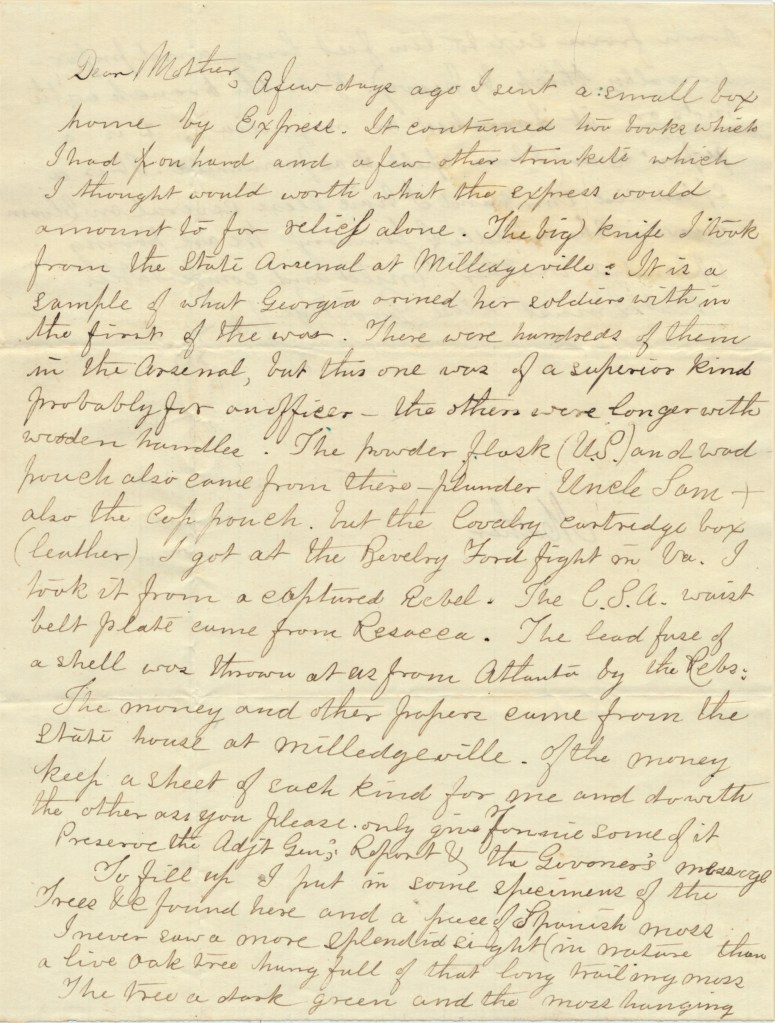
Dear Mother
A few days ago I sent a small box home by Express. It contained two books which I had on hand and a few other trinkets which I thought would [be] worth what the express would amount to for relief alone. The big knife I took from the State Arsenal at Milledgeville. It is a sample of what Georgia armed her soldiers with in the first of the war. There were hundreds of them in the Arsenal, but this one was of a superior kind—probably for an officer. The others were longer with wooden handle. The powder flask (U.S.) and wad pouch also came from there—plunder Uncle Sam + also the cap pouch, but the cavalry cartridge box (leather) I got at the Beverly Ford fight in Virginia. I took it from a captured rebel. The C.S.A. waist belt plate came from Resaca. The lead fuse of a shell was thrown at us from Atlanta by the Rebs.
The money and other papers came from the State House at Milledgeville. Of the money, keep a sheet of each kind for me and do with the other as you please—only give Fannie some of it. Preserve the Adjt. Gen. Report & the Governor’s Message. To fill up [the box], I put in some specimens of the trees &c. found here and a piece of Spanish moss. I never saw a more splendid sight in nature than a live oak tree hung full of that long trailing moss—the tree a dark green and the moss hanging down from six to ten feet long and proportionally thick and heavy. But the branch with buds on it I marked as Magnolia. It is a ge-pon’ icar (I have spelt it as pronounced) It is a splendid shrub and I have seen several in bloom now in the middle of January. We are having splendid weather, mild and comfortable.
































 Spared & Shared 23