All posts by Griff

My passion is studying American history leading up to & including the Civil War. I particularly enjoy reading, transcribing & researching primary sources such as letters and diaries.

1862-63: William Hickman Harris Moody to Granville Peaslee Moody

The following letters were written by William (“Will”) Hickman Harris Moody (1842-1864), the son of Rev. Granville Moody (1812-1887) and Lucretia Elizabeth Harris (1818-1886). When he was 19 years old, William enlisted on 4 January 1862 as a private in Co. H, 74th Ohio Infantry—a regiment commanded by his father. He was immediately elevated to the rank of 2nd Lieutenant. We learn from the letter that William was taken prisoner by some of Gen. John Hunt Morgan’s men in Tennessee in early September 1862. He was paroled but was waiting to be exchanged when this letter was penned on 21 September. Mostly likely William had returned to his regiment in time to participate in the Battle of Stones River three months later. William died of typhoid fever in September 1864 at Marietta, Georgia.

Unlike his son, Granville Moody would have a long and interesting career:

A later history described him in some detail. ‘He was of Puritan stock, born in Portland, Maine, January 2, 1812…He settled in Muskingum County, Ohio, when eighteen years old, and engaged in mercantile pursuits. While teaching in a Methodist Sabbath school, he was converted…He joined the Ohio Methodist Conference in 1833.

The Methodists had been given a lot for a church on the north side of Town Street between High and 3rd Streets (now a part of the site of John F. Wolfe Columbus Commons) by the Proprietors of Columbus. Other denominations had been given other lots. The Methodists began with a small, one-room church, and built, built and rebuilt as the congregation grew larger. By 1845, there was a brick church of some size on the lot. It was to this church that Granville Moody came as pastor.

“He served it two years, from the fall of 1845 to that of 1847. He had great success and reported a membership of 644 the first year and 600 the second year. Encouraged by this growth, the society felt strong enough to divide. William Neil gave them a lot on the west side of High Street between Gay and Long Streets … on which Wesley Chapel was built. The location was then considered the northern part of the city. A colony of 190 members went out of Town Street” to this new site.

After leaving Columbus in 1847, Granville Moody continued to grow in influence and position in the Methodist Church in Ohio and the Midwest. And then came the Civil War.

At the outbreak of the war, Gov. William Dennison offered Moody command of the 74th Ohio Volunteer Infantry, whose duty soon became guarding several thousand Confederate prisoners at the Camp Chase Confederate Prison Camp five miles west of Columbus. Moody was considered to be a firm, but fair, administrator.

When the rebels later learned that he was leaving, they promised him the same treatment if he were to become a prisoner of the Confederacy. “Should Colonel Moody, at any time become a prisoner of our [Confederate] government, we hereby earnestly request for him the highest consideration and treatment, as a proper acknowledgment of his kindness and care for us.” But some wondered how well he might fight.

The doubters soon found out.

Col. Moody led the 74th Ohio into the Battle at Stones River (Dec. 31, 1862- Jan. 2, 1863) near Murfreesboro, Tennessee. A later account noted that “his horse was shot from under him, he took a bullet in his right calf and he narrowly escaped a fatal wound when one or more bullets shattered a revolver he carried in his right breast pocket, more bullets shredded his uniform so much that one man called him the ‘ragged colonel.'”

As a practicing Methodist minister, Moody continued to preach to his men and others while in uniform in the Union Army. But as one account put it, “the rigors of campaign and camp took a toll on the 50-year-old Moody and prompted his resignation in May, 1863. It was accepted with regret.”

Moody continued to preach and serve as a Methodist minister through the rest of the Civil War and after. The “Fighting Parson” closed a long career of service to church and society with his death in 1887 in Mt. Pleasant, Iowa. He was buried nearby. ” [Source: Ed Lentz, The Columbus Dispatch, 16 April 2023]

See also: Facing the Iron Hail: The 74th Ohio at Stones River by Dan Masters.

[Note: The 1st letter is from the private collection of Greg Herr and was transcribed and published on Spared & Shared by express consent.]

Letter 1

Springfield, Ohio
September 21st 1862

Col. G. Moody,

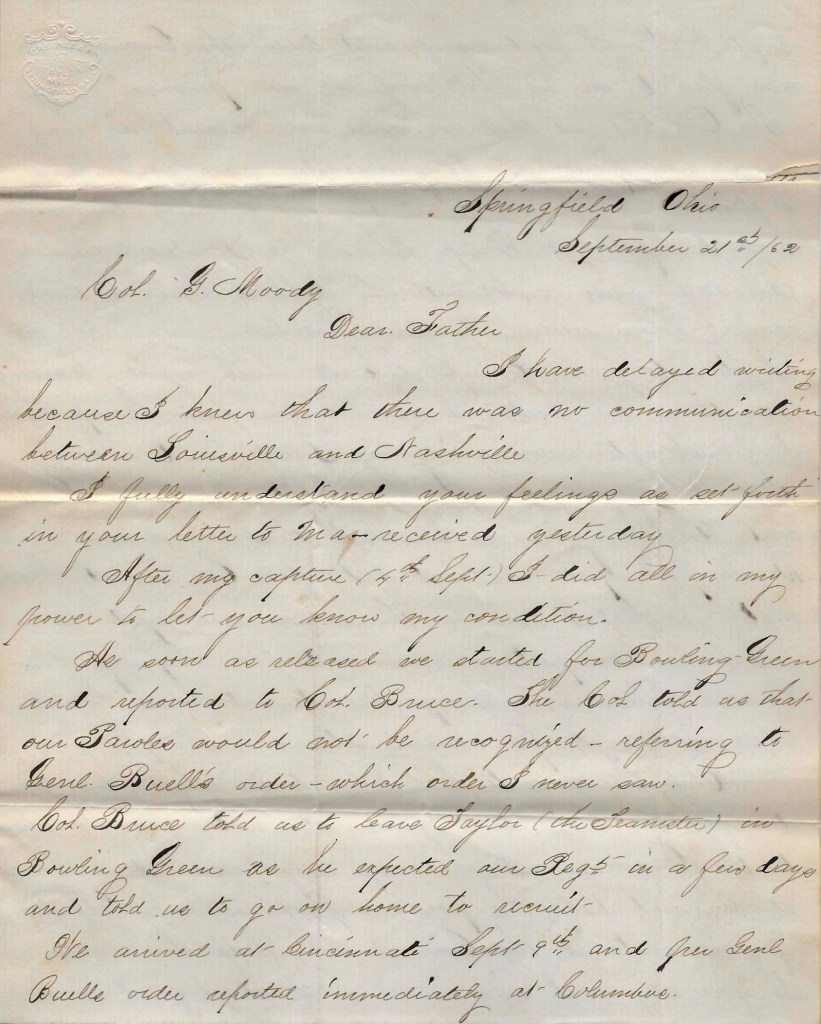
Dear father, I have delayed writing because I knew that there was no communication between Louisville and Nashville. I fully understand your feelings as set forth in your letter to Ma received yesterday.

After my capture (4th September), I did all in my power to let you know my condition. As soon as released, we started for Bowling Green and reported to Col. Bruce. The Colonel told us that our paroles would not be recognized—referring to Gen. Buell’s orders—which order I never saw. Col. Bruce told us to leave Taylor (the teamster) in Bowling Green as he expected our regiment in a few days and told us to go on home to recruit.

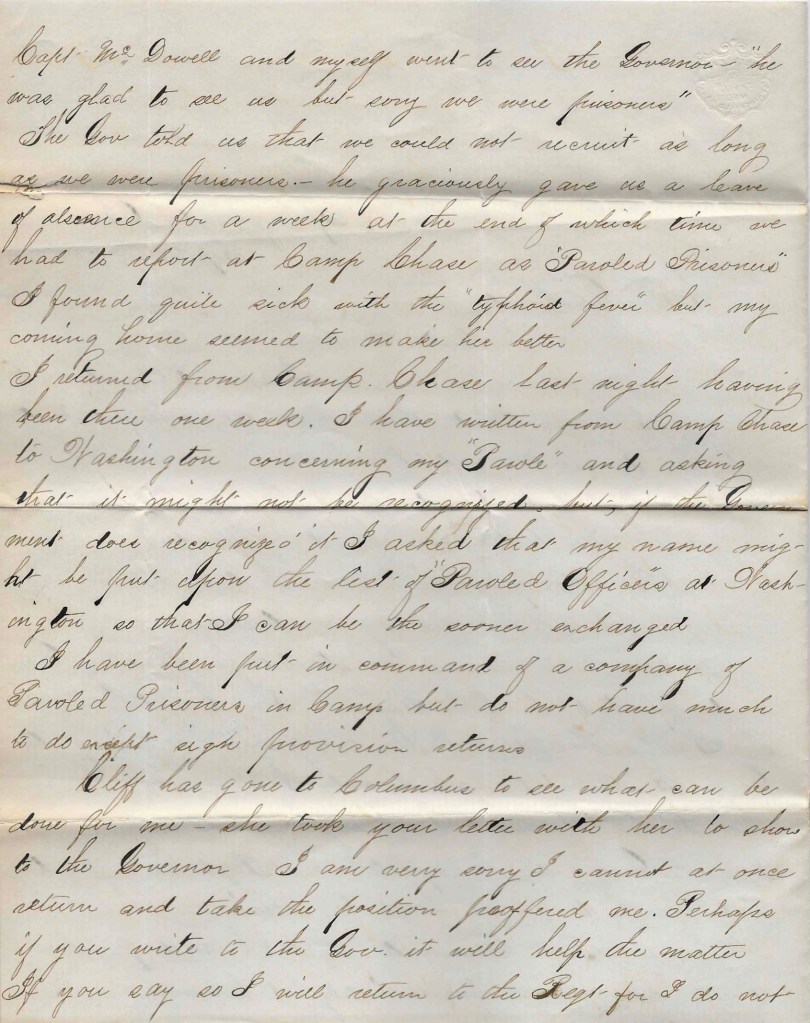
We arrived at Cincinnati September 9th and per Gen. Buell’s order, reported immediately at Columbus. Capt. [Austin] McDowell [of Co. D] and myself went to see the Governor. He was glad to see us but “sorry we were prisoners.” The Gov. told us that we could not recruit as long as we were prisoners. He graciously gave us a leave of absence for a week at the end of which time we had to report at Camp Chase as “paroled prisoners.” I found [Ma] quite sick with the “typhoid fever: but my coming home seemed to make her better.

I returned from Camp Chase last night having been there one week. I have written from Camp Chase to Washington concerning my “parole” and asking that it might not be recognized but, if the government does recognize it, I asked that my name might be put upon the list of “paroled officers” at Washington so that I can be the sooner exchanged. I have been put in command of a company of paroled prisoners in Camp but do not have much to do except sign provision returns.

[Brother] Cliff[ord] has gone to Columbus to see what can be done for me. She took your letter with her to show to the Governor. I am very sorry I cannot at once return and take the position proffered me. Perhaps if you write to the Governor, it will help the matter. If you say so, I will return to the regiment for I do not consider my parole binding, a copy of which I send:

Hartsville, Tennessee
September 4th 1862

2nd Lt. ——– captured by our forces under Gen. John H. Morgan is hereby given a parole of thirty days at the end of which he will report to the Provost Marshal at Knoxville, Tennessee (by letter) to be held as a Prisoner of War until exchanged. By order of Gen. John H. Morgan, — J. C. McCann, Lt. Col., commanding Morgan’s Regt.

I did not sign this nor did I swear to anything except secrecy. If this is legal, I am willing to abide by it. If not, I am not.

I miss you so much. I should like to be with you above all things. I like the service and think that I might be able to make my mark. I will give you a synopsis of my trip in my next. Capt. [Austin] McDowell wrote you a few days since. I will say that I have not met with a person who blames us in the least. The rebels treated us very well with the exception of plundering. I hope you can make some arrangements for my speedy return to the regiment. Ma is a great deal better. Was up nearly all day yesterday.

Granville Moody, the “Famous Fighting Methodist Preacher” (Military Images Digital)

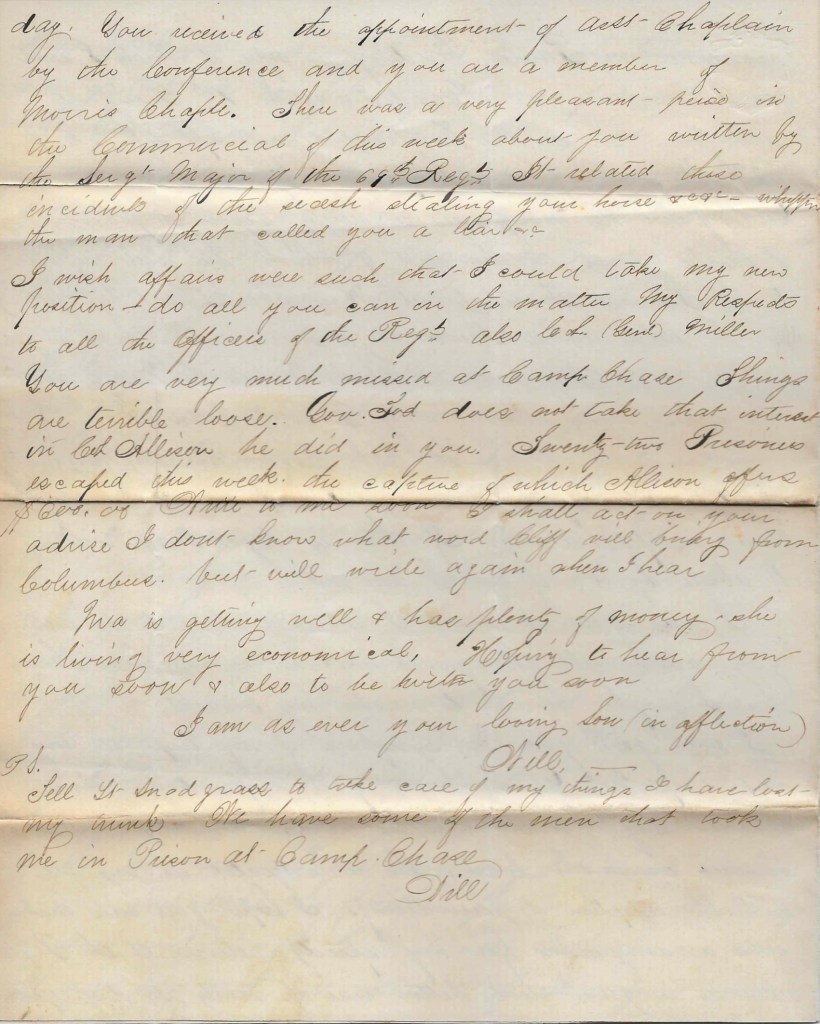
You received the appointment of Asst. Chaplain by the Conference and you are a member of Morris Chapel. There was a very pleasant piece in the [Cincinnati] Commercial of this week about you written by the Sergeant Major of the 69th Regiment. It related those incidents of the secesh stealing your horse &c., whipping the man that called you a liar, &c.

I wish affairs were such that I could take my new position. Do all you can in the matter. My respects to all the officers of the regiment; also Col. (Gen.) Miller. You are very much missed at Camp Chase. Things are terrible loose. Gov. Tod does not take that interest in Col. [Charles W. B.] Allison he did in you. Twenty-two prisoners escaped this week. The capture of which Allison offers $600.

Write to me soon. I shall act on your advice. I don’t know what word Cliff will bring from Columbus but will write again when I hear. Ma is getting well and has plenty of money. She is living very economical. Hoping to hear from you soon & also to be with you soon. I am as ever your loving son (in affection), — Will

P. S. Tell Lt. Snodgrass to take care of my things. I have lost my trunk. We have some of the men that took me in prison at Camp Chase. — Will
Letter 2

Headquarters 3rd Brigade, 2d Division, 14th A. C.
Murfreesboro. Tennessee
May 25, 1863

Dear Father,

I received the enclosed letter yesterday. I spent the evening with Col. Miller and Lady Munger and Lady Gabbath May 25th. Col. very kind says he has a letter he intends sending you. He sends his compliments to the friends that made him a life member of the Missionary Society, considering it a high compliment. Mrs. Miller wishes your photograph. By all means send it to me also.

There was a drunken row in the 74th yesterday. All of Co. I engaged in the fight. Lt. McGreavy knocked down. Had his clothes almost entirely torn from his person. Maj. Bell went in on his muscle, knocking down several. Col. Miller I think will investigate the matter.

Send me a field glass and write soon to your loving son, — Wm. H. H. Moody. Lt. and Top. Engineer, 3rd Brigade

to Col. G. Moody, Springfield, Ohio


Letter 3

Headquarters Topographical Eng. Department
3rd Brigade, 2nd Division
Murfreesboro, Tenn.
June 12th 1863

Dear Mother,

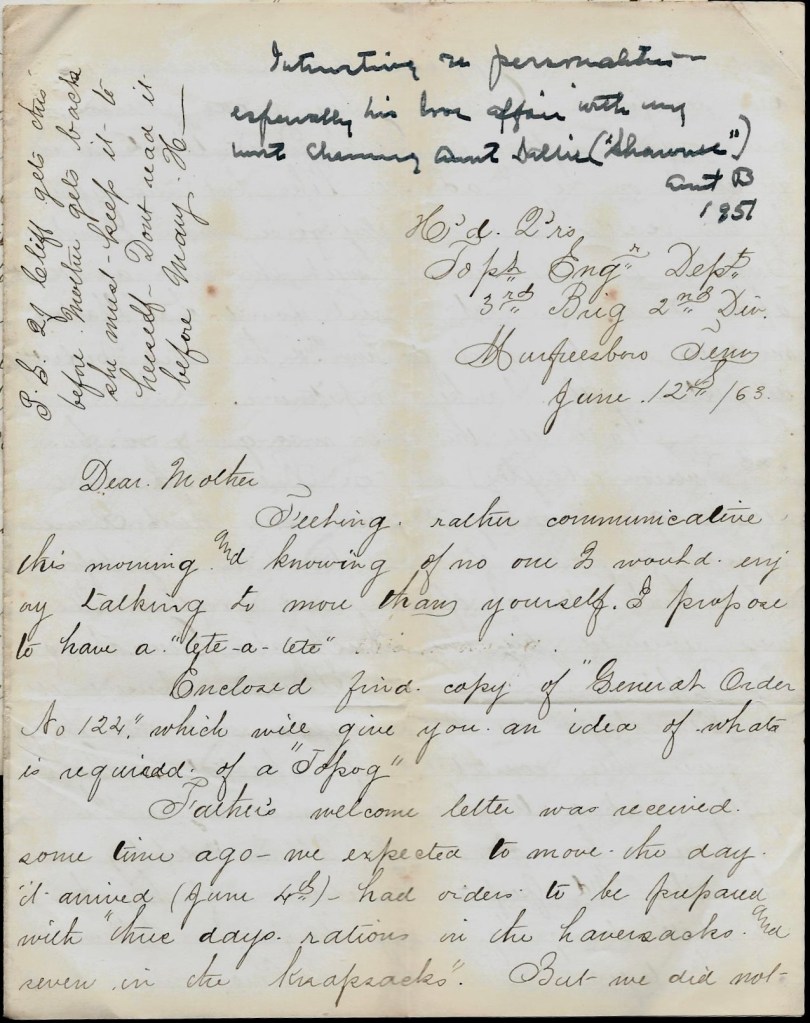
Feeling rather communicative this morning and knowing of no one I would enjoy talking to more than yourself, I propose to have a “tete-a-tete.”

Enclosed find copy of “General Order No. 124” which will give you an idea of what is required of a “Topog.”

Father’s welcome letter was received some time ago. We expected to move the day it arrived (June 4th)—had orders to be prepared with “three days rations in the haversacks and seven in th knapsacks.” But we did not move. The “rebs” supposed that Rosecrans had reinforced Grant and they made a “reconnoissance in force”—drove in General Davis’ pickets—made an attack on the Bradyville Pike but were repulsed by the “videttes” and a “Cavalry force” under General Turchin. Simultaneously with this was an attack upon Franklin, but Forrest found that “Yankee mudsills” were too much for him and he retired, perfectly disgusted with Yankee impertinence.

While all this fuss was going on the 2nd Division (Negly) were on Review. I have seen a great many reviews—saw General Rosecrans’ Division (a portion of it “Regulars”) the day before but I think (general opinion) ours excelled. We were reviewed by the “Inspector General” of this Department—Col. Ducat. There was present all the generals in the departments, together with their “staff” and wives—these constituted the spectators. Gen. Negley wished to show how well drilled “his boys” are so he had the 19th Illinois “deploy as skirmishers” and perform the evolutions of the “skirmish drill.” closing by giving the famous “Ellsworth cheer and tiger.” Then the 18th Ohio were ordered to show themselves adept in the “bayonet exercise” closing with the command, “left rear volt—in high tierce—parrie—thrust—guard.” The whole Division was then formed in “double column” and thence “into square.” After deploying, the command “Repare for Review” was given and then commenced “Review” proper. Pa can show you how it is done.

Our Brigade was highly complimented by the Reviewing Officer. But the grand feature of the day was the banquet furnished by Gen. Negley in the evening. Col. Miller and staff were invited of course. The General has caused quite a number of the “flies of his tents” to fly into position in line of battle which formed a canopy for those assembled. The silver band of the 19th Regulars dispensed “Nation at Air,” “Operatic Gems,” while General Rosecrans, Thomas, Sheridan, Garfield, and lesser lights” paid their respects to the richly ladened tables. Mrs. Gen. Negley, Mrs. Quartermaster Taylor, and many other ladies were present adding much to the appearance of affairs. Old Von was there. He took me off to one side and had quite a lengthy talk with me—spoke highly of Pa. Said “by some means a misunderstanding had arisen—that he hoped Pa would find out some time that he was not the enemy Pa supposed him. Said he never wished the Colonelcy of the 74th. All he wanted was a wider sphere in which to work. He has that place now—does not wish a change. Expressed his friendship for me—said I ought to be his Adjutant. Called me “Billie” &c. &c. I suppose you have before this learned the fate of the 74th Ohio.

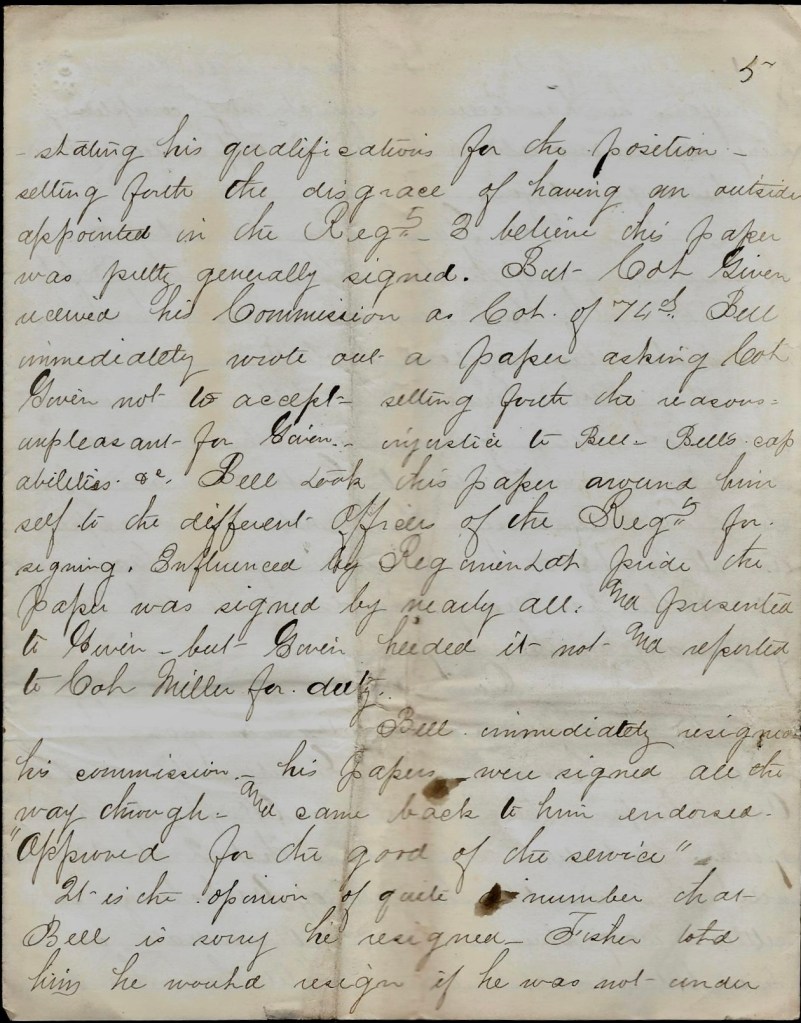
Commissions were forwarded to Von—Bell and Fisher. Von would not accept, therefore the other commissions were “null and void.” Lt. Col. Given of the 18th Ohio—the senior Lt. Col. of this department—had a promise from Gov. Tod that he should be promoted to fill the first vacancy. Col. Given telegraphed to Tod as soon as Von refused the promotion. In the meanwhile, Bell started a petition for him (Bell) to be appointed Colonel of the 74th stating his qualification for the position—setting forth the disgrace of having an outside appointed in the Regiment. I believe this paper was pretty generally signed. But Col. Given received his commission as Colonel of the 74th. Bell immediately wrote out a paper asking Col. Given not to accept, setting forth the reasons—unpleasant for Givens—injustice to Bell—Bell’s capabilities, &c. Bell took this paper around himself to the different officers of the regiment for signing. Influenced by the regiment’s pride, the paper was signed by nearly all and presented to Given—but—Given heeded it not and reported to Col. Miller for duty.

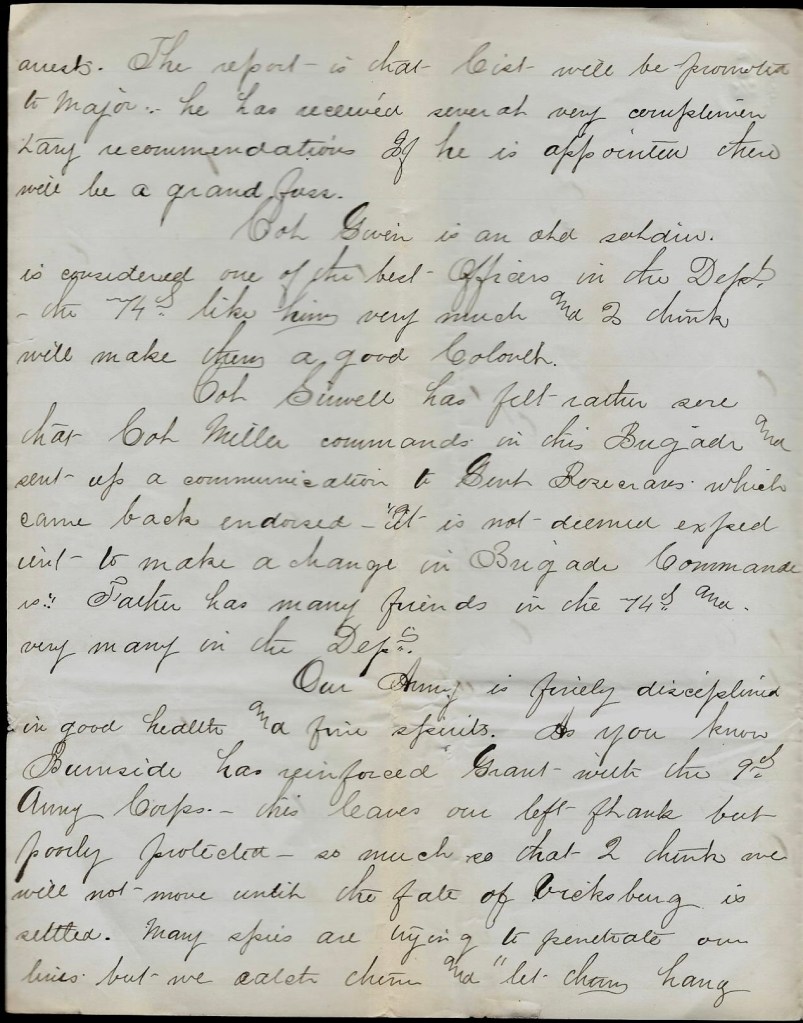
Bell immediately resigned his commission. His papers were signed all the way through and came back to him endorsed, “Approved for the good of the service.” It is the opinion of quite a number that Bell is sorry he resigned. Fisher told him he would resign if he was not under arrest. The report is that Cist will be promoted to Major. He has received several very complimentary recommendations. If he is appointed there will be a grand fuss. Col. Given is an old soldier, is considered one of the best officers in the department—the 74th like him very much and I think will make them a good colonel.

John Franklin Miller

Col. [William] Sirwell [78th Pennsylvania] has felt rather sore that Col. [John Franklin] Miller [29th Indiana] commands in this Brigade and sent up a communication to Gen. Rosecrans which came back endorsed, “It is not deemed expedient to make a change in Brigade Commanders.” Father has many friends in the 74th and very many in the Department.

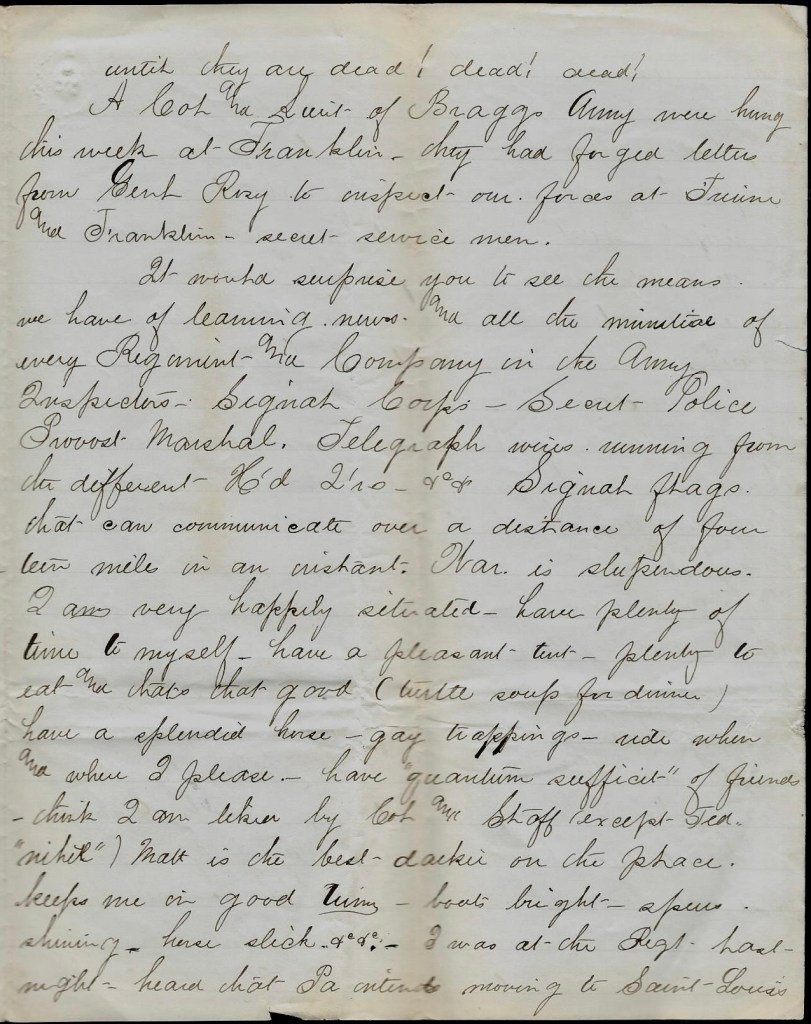
Our Army is finely disciplined, in good health, and fine spirits. As you know, Burnside has reinforced Grant with the 9th Army Corps. This leaves our left flank but poorly protected—so much so that I think we will not move until the fate of Vicksburg is settled. Many spies are trying to penetrate out lines but we catch them and “let them hang until they are dead! dead! dead! A colonel and lieutenant of Bragg’s Army were hung this week at Franklin. They had forged letters from Gen. Rosy to inspect our forces at Triune and Franklin—secret service men.

The Philadelphia Inquirer, 10 June 1863

It would surprise you to see the means we have of learning news and all the minutiae of every regiment and company in the army—inspectors—signal corps—secret police—provost marshal—telegraph wires running from the different headquarters, &c. &c. Signal flags that can communicate over a distance of fourteen miles in an instant. War is stupendous. I am very happy situated—have plenty to eat and that’s that good (turtle soup for dinner)—have a splendid horse—gay trappings—ride when and where I please—have “quantum sufficit” of friends—think I am liked by Col. & staff (except Ted. “nickel”). Matt is the best darkie on the place—keeps me in good trim—boots bright—spurs shining—horse slick, &c. &c.

I was at the regiment last night. Heard that Pa intends moving to Saint Louis, having received the Chaplaincy of that Post. I say go. I also learned (thanks to somebody) that “I am going to resign in September, come home and take to myself a wife.” Just remark to my friends that I am soldiering at present and expect to for some time to come unless health or life should fail. I should like to be home with you over Sunday. I would like some of Grandma’s good dinner.

We had a splendid serenade last week by the “glee club” of the 79th Pennsylvania. One member of which sings the finest “falsetto” I ever heard sing. The staff were invited up to Mrs. Miller’s private rooms and we spent a very pleasant evening.

I am sorry that I can’t hear from sister Lizzie more than I do, nor little Molly. What’s the matter—are they sick? I want you to buy Brother Granville a handsome birthday present (July 2nd or 3rd)—some first rate present and give it to him for me. I will send some money perhaps before long. If not, I have plenty at home.

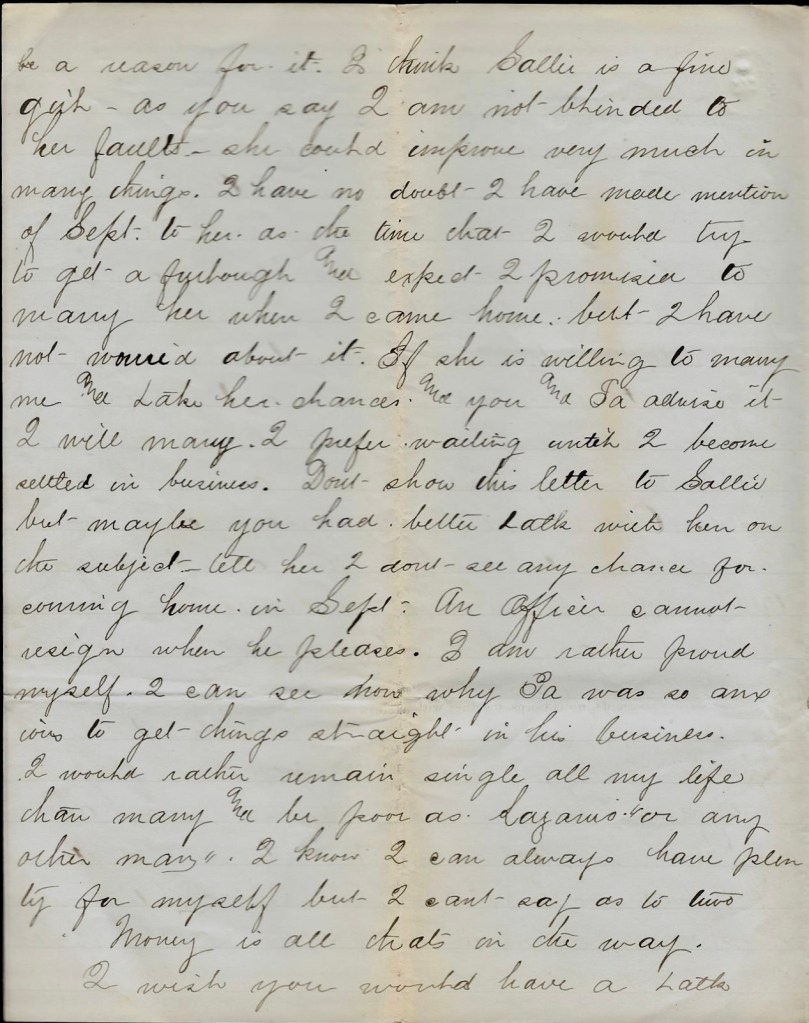
2 p.m. I have just received your letter of June 7th containing wedding cards. “Long may Annie Wave” and I am sure her shadow will never grow less. I am very thankful for the good motherly letter. I must confess I feel rather queer—to tell you the truth, I have never felt sure I was going to marry. I have been perfectly honest with Sallie but I did not know that the day or month was fixed. One thing I am certain of, I won’t marry anybody until I am able to support them. My expenses here are necessarily heavy. Besides, I have not stinted myself in anything. A staff officer can’t save near as much as a line officer—a servant—a cook—table expenses—servant’s rations—clothes—spending money, &c. &c. When I leave the service, I have no business that I can go into immediately. If I was worth $10,000 I wouldn’t care to marry. It is very uncertain—in fact, improbable, that I can get home in September even should there be a reason for it. I think Sallie is a fine girl. As you say, I am not blinded to her faults. She could improve very much in many things. I have no doubt I have made mention of September to her as the time that I would try to get a furlough and expect I promised to marry her when I came home, but I have not worried about it. If she is willing to marry me and take her chances and you and Pa advise it, I will marry. I prefer waiting until I become settled in business. Don’t show this letter to Sallie but maybe you had better talk with her on the subject. Tell her I don’t see any chance for coming home in September. An officer cannot resign when he pleases. I am rather proud myself. I can see now why Pa was so anxious to get things straight in his business. I would rather remain single all my life than marry and be poor as Lazarus “or any other man.” I know I can always have plenty for myself but I can’t say as to two. Money is all that’s in the way. I wish you would have a talk with Sallie. I think I could break her of most of her bad habits. I assure you I have a due appreciation of my name and family. I don’t consider they condescend much.

While I was in Columbus, I met Beckie and Sallie is not the only person I could marry. Keep this to yourself.

This afternoon at 3 o’clock, two men are to be hung for murder. Great crowds of soldiers are passing here “en route” for the execution. This will be the fifth hung in this department within a fortnight: “Sic semper tyrannus.”

I must close as I wish a nap before Brigade Drill. Tell Pa to write. How about a [ ] glass? Give my love to Aunt Jane. I should like to hear from her. Love to Cliff (answer my letter), Lizzie, Mary, Granville, Charley & Grandma. Tell them all how much I love htem. Love to dear Pa (Col.) and believe me your loving son, — Wm. H. H. Moody, Lieut. & Topographical Engineer

[to] Mrs. L. E. Moody, Springfield, Ohio
1862: Thomas P. Mullen to his Friend
The following letter was written by Thomas P. Mullen (1834-1863), a private in Co. E, 29th Massachusetts Infantry. Thomas was the son of Nathaniel P. Mullen (1808-1881) and Jeanette Tilden (1814-1886). Thomas was residing in Kingston, Plymouth county, Massachusetts, just prior to his enlistment. He died of chronic diarrhea in a Washington D. C. Hospital on 9 January 1863.

Transcription

Map of the area between Fortress Monroe and Newport News, Virginia as of 1 April 1862 when Thomas wrote the letter. (LOC)

Camp Butler
Newport News [Virginia]
April 1st 1862

Dear Friend,

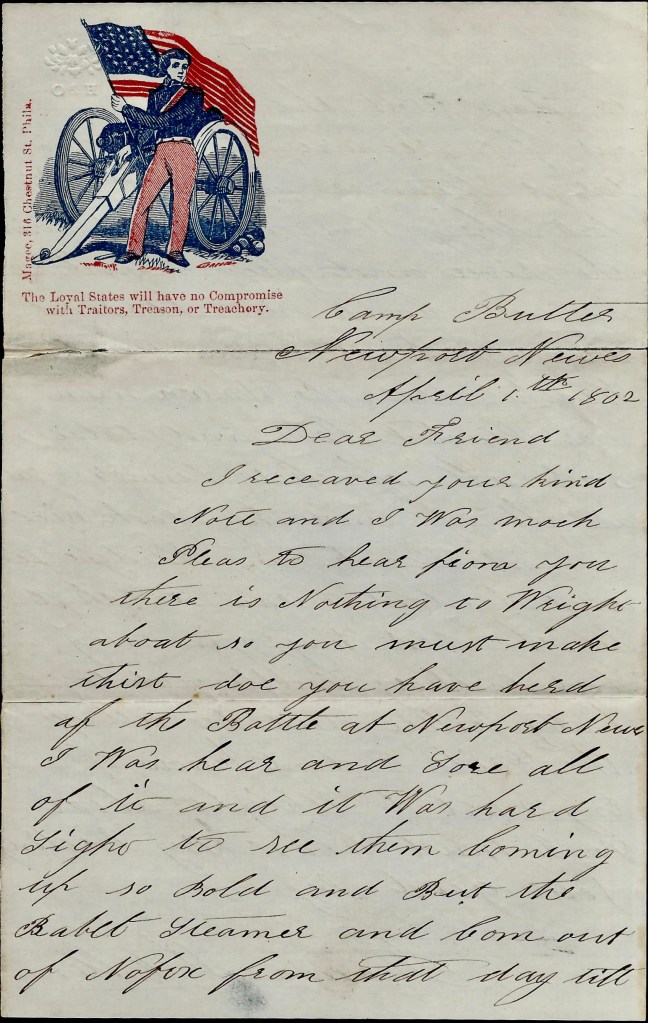
I received your kind note and I was much pleased to hear from you. There is nothing to write about so you must make this do. You have heard of the Battle at Newport News. I was here and saw all of it and it was a hard sight to see—them coming up so bold and [ ]. The Rebel steamer [CSS Virginia] come out of Norfolk from that day till today, but she won’t come out far because there is two large steamers down to the Fort [Monroe]. There was one came down the river and fired four shells in our camp but she went away quick. 1

It is beautiful weather here. The Union men has planted peas and potatoes and all of their summer vegetables are all up and they look nice. I ain’t broke my pledge yet and I don’t mean to. That is the best way. Give my love to Mary Frittle and to Hattie Frittle and to all of the girls. I don’t know of anymore to write about so I must close by bidding you goodbye. — Thomas [ ] Millen

1 The Battle of Hampton Roads between the U.S.S. Monitor and C.S.S. Virginia occurred off the shore of Newport News March 8-9 of 1862.

1861: David Sibley Thurber to Lucy S. Osgood

I could not find an image of David but here is a tintype of Albert Dyer, Co. C, 13th Massachusetts from the collection of Kevin Canberg. Albert is wearing the early uniform of the 13th Massachusetts, including their originally-issued headgear.

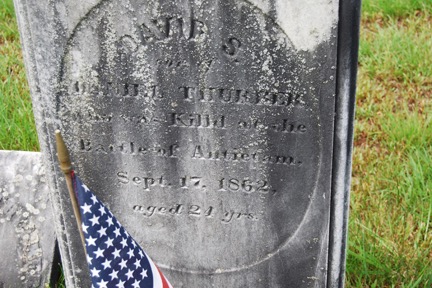
The following letter was written by Pvt. David Sibley Thurber (1838-1862) of Co. D, 13th Massachusetts Infantry. Born in Mendon, Massachusetts, to Daniel and Hannah (Sibley) Thurber, David was 23 years old and working as a clerk in Boston when he enlisted in April 1861. David addressed the letter to Lucy S. Osgood (1823-1902) of Newport, New Hampshire, who may have been affiliated with the Teacher’s Institute in that village. Perhaps David’s sister was a student there.

David was killed at the Battle of Antietam on 17 September 1862, struck down in Miller’s Cornfield. The regiment took 301 men into the fight and brought out 165.

Transcription

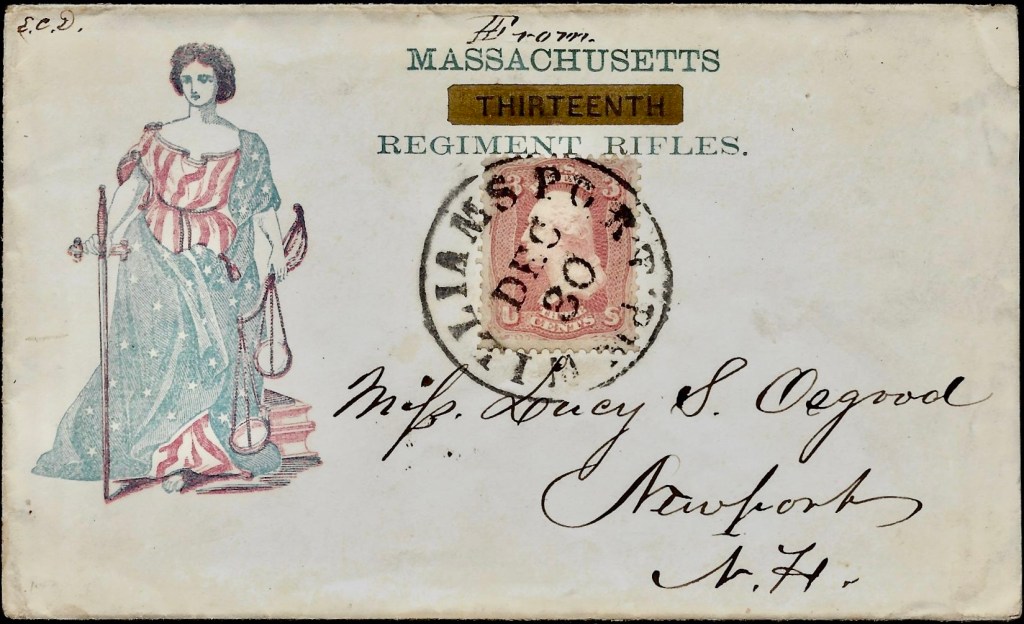
Addressed to Miss Lucy S. Osgood, Newport, New Hampshire

Camp Jackson
Williamsport [Maryland]
Sunday night, December 22, 1861

Dear Sister

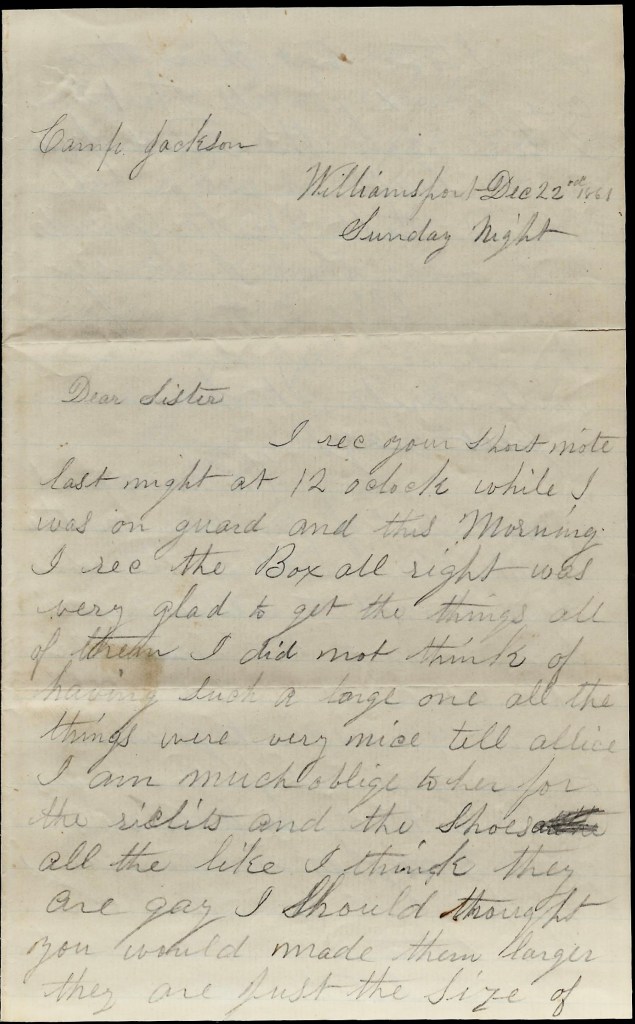
I received your short note last night at 12 o’clock while I was on guard and this morning I received the box all right. Was very glad to get the things—all of them. I did not think of having such a large one. All the things were very nice. Tell Alice I am much obliged to her for the [ ] and the shoes and all the like. I think they are gay. I should thought you would made them larger. They are just the size of our stove but then they are nice for all that. I tell you, the fried pies went well—as well as all the things. Tell Metcalf’s wife and him that I am very much obliged to them for the things they sent. I will write to him in a few days.

We have had a good deal of fun here for the last two weeks as the rebels have showed themselves a good deal down to the river. The last week we was called out at 9 o’clock to go down to the river at Falling Waters, about 6 miles, and we was gone 3 nights and two days, sleeping all the time on the stones and under the fence. I tell you it was cold enough. And one day we had a little fighting to do for about two hours. We did not have a man hurt but are sure we killed some of the rebels. There was about 4,000 of them and we had only about 500. But the fighting was all across the river and they dare not try to cross. I tell you, it was fun to hear the balls whistle by your ears. I suppose you have seen accounts of it in the papers. I will tell you more about it in my next.

Give love to Addie, Alice, and all. And write soon. Yours in haste, D. S. Thurber

Merry Christmas to all.

1862: William Andrew Robinson to his Brothers

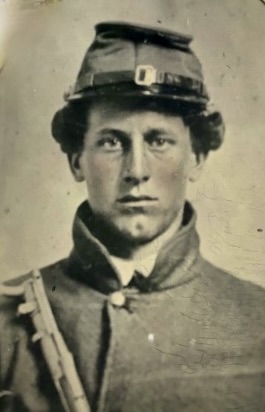
William Andrew Robinson, 77th Pennsylvania

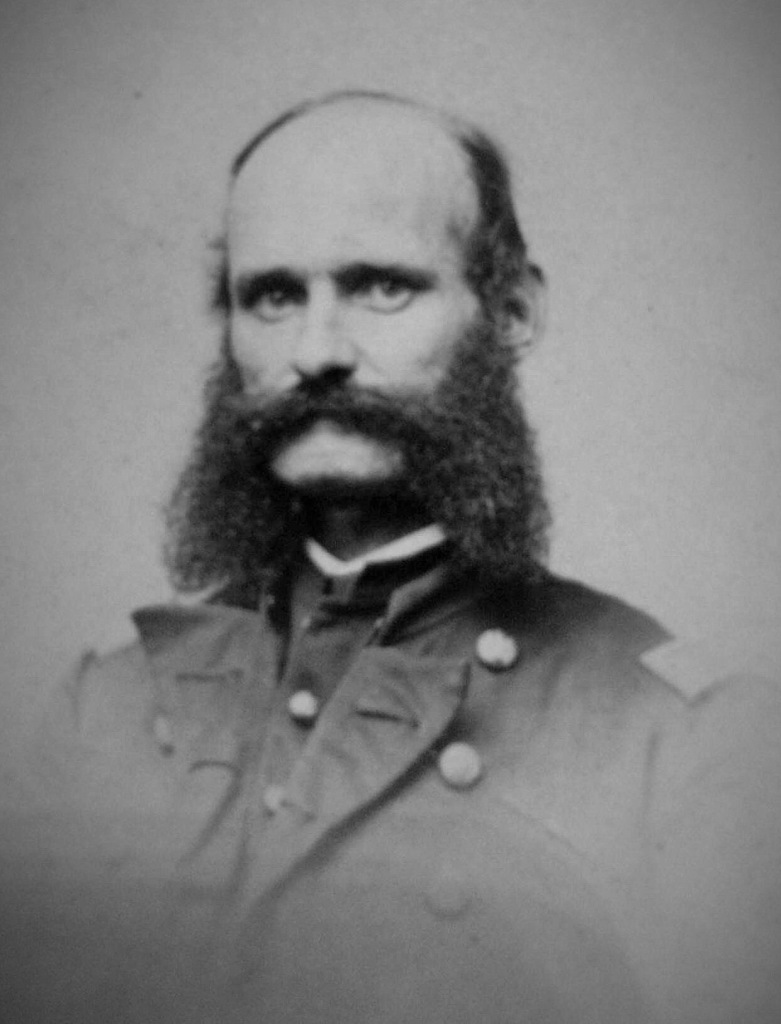
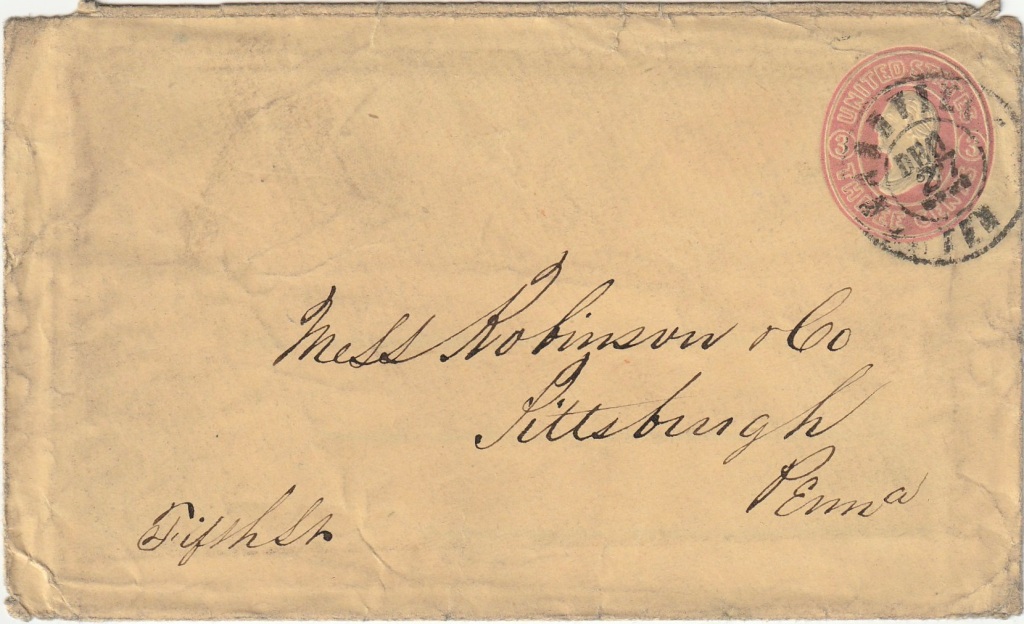
The following letter was penned by William Andrew Robinson (1830-1902) in December 1862 while serving as the Captain of Co. E, 77th Pennsylvania Infantry. He later rose in rank to Lt. Colonel of the regiment. The 77th was formed in September and October 1861 for a three-year service. It participated in several battles including the Battle of Shiloh, the siege of Corinth, the Battle of Stones River, the Battle of Chickamauga, the Atlanta campaign, the Nashville campaign, and the Battle of Nashville. The regiment was later assigned to Texas and finally mustered out in Philadelphia on January 16, 1866.

William A. Robinson was twenty-nine years old when he enlisted. His family was from the Lawrenceville neighborhood of Pittsburgh. He was captured after the Battle of Chickamauga and was a Prisoner of War in Libby Prison in Richmond, Virginia. After his release from Libby Prison, he was recaptured and sent to Georgia. He was mustered out of the Army on January 15, 1866 and returned to Pittsburgh and civilian life on February 1, 1866.

In this letter, William conveys his response to the intelligence received regarding Burnsides’ loss at the Battle of Fredericksburg. He expresses his profound dismay with the generals who appear to prioritize personal glory over the welfare of their country. William writes, “Stars shine upon too many unworthy shoulders and men crowd around Washington offering advice and urging this policy and that, who, for the good of the country, ought to ‘stretch the hemp,'” he wrote. He also expresses his dissatisfaction with the way President Lincoln is prosecuting the war. “Lives are being sacrificed daily—hourly, one of which is worth ten thousand such miserable knaves and Old Abe who no doubt is honest is too slow and stupid to see it.” He then asks, “Are we drifting to a dictatorship or is the Old Rail Splitter going to try a lone hand and handle the maul himself? The log is large and full of knots. But with good and sharp wedges and a large maul and a vigorous and skillful man hold of the handle, I have faith it can be split.” William closes his 4-page letter with a description of a foraging expedition and his plans for a Christmas dinner.

[Note: This letter is from the private collection of Richard Weiner and was transcribed and published on Spared & Shared by express consent.]

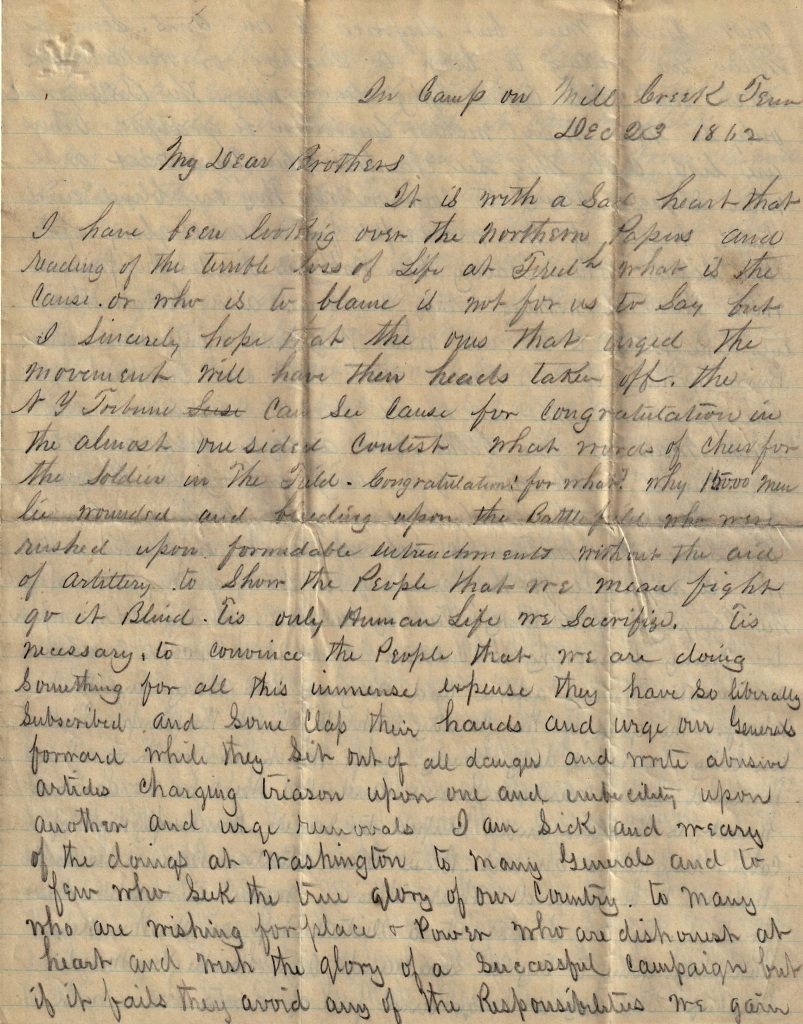
Transcription

In camp on Mill Creek, Tennessee
December 23, 1862

My Dear Brothers,

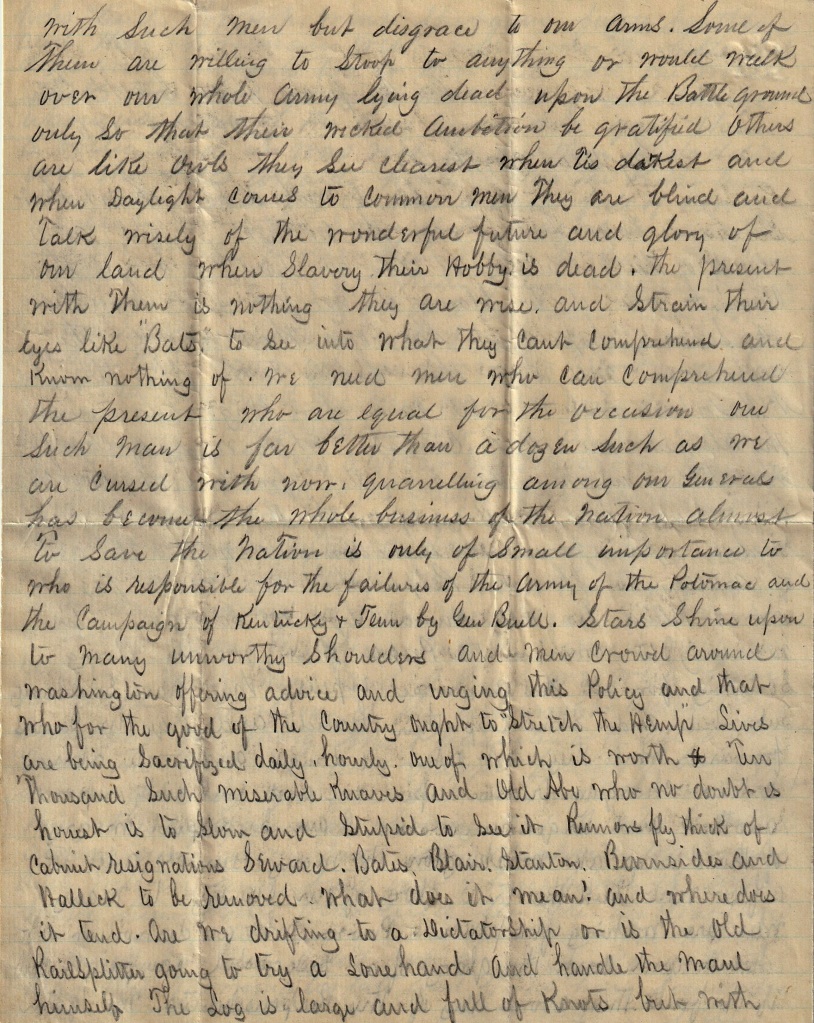
It is with a sad heart that I have been looking over the Northern papers and reading of the terrible loss of life at Fredericksburg. What is the cause or who is to blame is not for us to say, but I sincerely hope that the ones that urged the movement will have their heads taken off. The New York Tribune can see cause for congratulation in the almost one-sided contest. What words of cheer for the soldier in the field. Congratulations for what? Why 15,000 men lie wounded and bleeding upon the battlefield who were rushed upon formidable entrenchments without the aid of artillery to show the people that we mean fight go it blind. Tis only human life we sacrifice. Tis necessary to convince the people that we are doing something for all the immense expense they have so liberally subscribed and some clap their hands and urge our Generals forward while they sit out of all danger and write abusive articles charging treason upon one and imbecility upon another and urge removals.

I am sick and weary of the doings at Washington. Too many Generals and too few who seek the true glory of our country. Too many who are wishing for place & power who are dishonest at heart and wish the glory of a successful campaign but if it fails, they avoid any of the responsibilities. We gain with such men but disgrace to our arms. Some of them are willing to stoop to anything or would walk over our whole army lying dead upon the battleground only so that their wicked ambition be gratified. Others are like owls. They see clearest when tis darkest and when daylight comes to common men, they are blind and talk wisely of the wonderful future and glory of our land when slavery—their hobby—is dead. The present with them is nothing. They are wise and strain their eyes like “bats” to see what they can’t comprehend and know nothing of. We need men who can comprehend the present—who are equal for the occasion. One such man is far better than a dozen such as we are cursed with now.

Quarreling among our Generals has become the whole business of the Nation almost. To save the Nation is only of small importance to who is responsible for the failures of the Army of the Potomac and the campaign of Kentucky & Tennessee by Gen. Buell. Stars shine upon too many unworthy shoulders and men crowd around Washington offering advice and urging this policy and that, who, for the good of the country, ought to “stretch the hemp.”

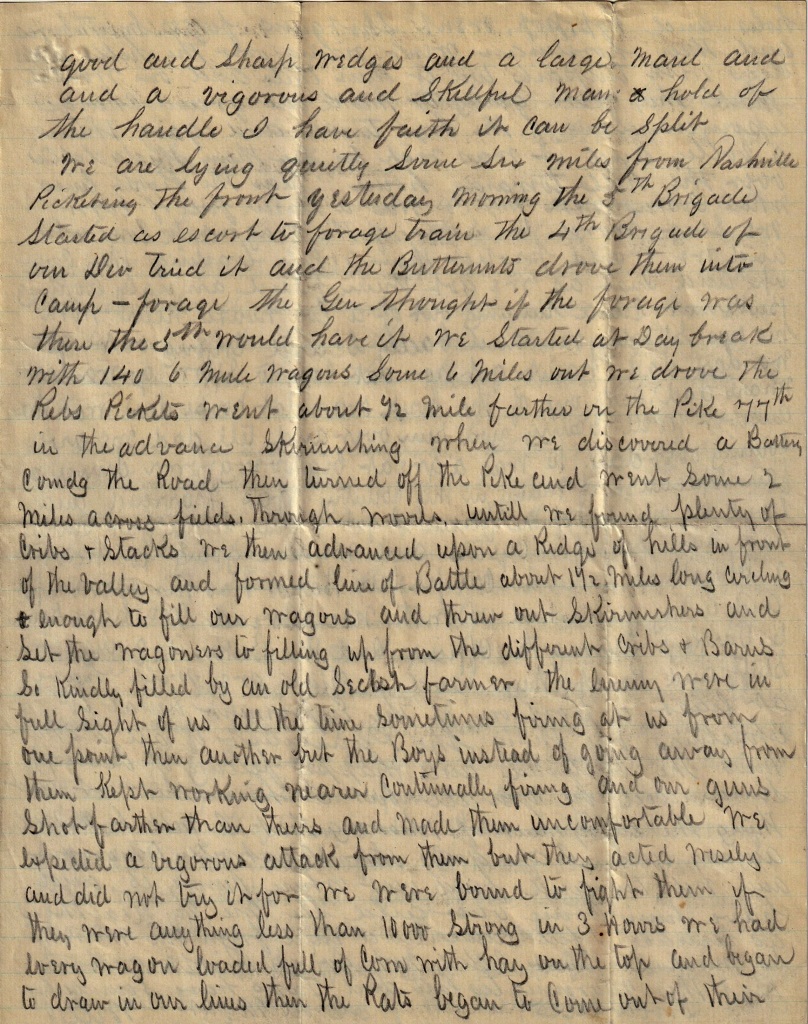
Lives are being sacrificed daily—hourly, one of which is worth ten thousand such miserable knaves and Old Abe who no doubt is honest is too slow and stupid to see it. Rumors fly thick of cabinet resignations—Seward, Bates, Blair, Stanton. Burnsides and Halleck to be removed. What does it mean! and where does it end? Are we drifting to a dictatorship or is the Old Rail Splitter going to try a lone hand and handle the maul himself? The log is large and full of knots. But with good and sharp wedges and a large maul and a vigorous and skillful man hold of the handle, I have faith it can be split.

We are lying quietly some six miles from Nashville, picketing the front. Yesterday morning the 5th Brigade started as escort to forage train the 4th Brigade of our Division, tried it, and the Butternuts drove them into camp—forage. The General thought if the forage was there, the 5th would have it. We started at daybreak with 140 6-mule wagons. Some 6 miles out, we drove the Reb’s pickets, went about half mile further on the Pike, 77th [Pennsylvania Infantry] in the advance skirmishing, when we discovered a battery commanding the road, then turned off the Pike and went some two miles across fields, through woods, until we found plenty of cribs and stacks. We then advanced upon a ridge of hills in front of the valley and formed line of battle about one and a half miles long circling enough to fill our wagons and threw out skirmishers and set the wagoners to filling up from the different cribs and barns so kindly filled by an old Secesh farmer. The enemy were in full sight of us all the time, sometimes firing at us from one point, then another, but the Boys instead of going away from them, kept working nearer, continually firing, and our guns shot farther than theirs and made them uncomfortable.

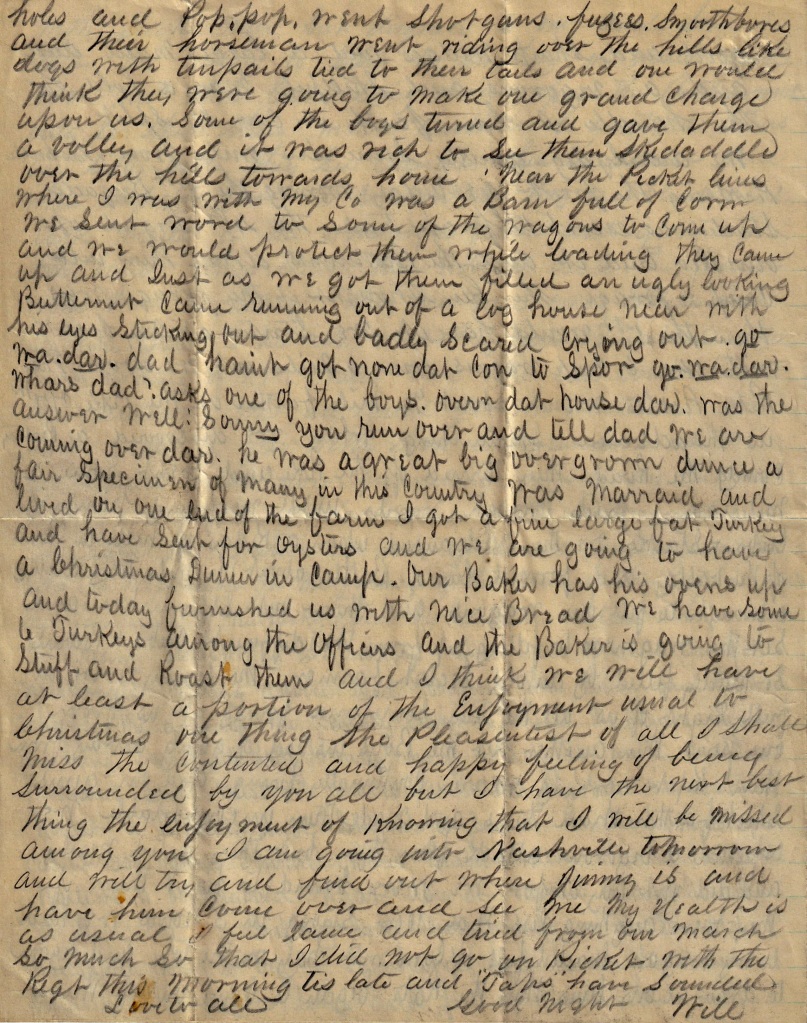
We expected a vigorous attack from them but they acted wisely and did not try it for we were bound to fight them if they were anything less than 10,000 strong. In 3 hours we had every wagon loaded full of corn with hay on the top and began to draw in our lines. Then the rats began to come out of their holes and pop—pop, went shotguns, fuses, smoothbores and their horsemen went riding over the hills like dogs with tin pails tied to their tails and one would think they were going to make one grand charge upon us. Some of the boys turned and gave them a volley and it was rich to see them skedaddle over the hills towards home.

Near the picket lines where I was with my company was a barn full of corn. We sent word to some of the wagons to come up and we would protect them while loading. They came up and just as we got them filled, an ugly-looking Butternut came running out of a log house near with his eyes sticking out and badly scared, crying out, “Go way, dar. Dad hainn’t got none dar corn to spare. Go way dar!” Where’s Dad? asks one of the boys. “Over’n dat house dar,” was the answer. Well, sonny, you run over and tell dad we are coming over dar. He was a great big overgrown dunce—a fair specimen of many in this country. Was married and lived on one end of the farm.

I got a fine, large, fat turkey and have sent for oysters and we are going to have a Christmas dinner in camp. Our baker has his ovens up and today furnished us with nice bread. We have some 6 turkeys among the officers and the baker is going to stuff and roast them and I think we will have at least a portion of the enjoyment usual to Christmas. One thing—the pleasantest of all—I shall miss the contented and happy feeling of being surrounded by you all but I have the next best thing; the enjoyment of knowing that I will be missed among you. I am going into Nashville tomorrow and will try and find out where Jimmy is and have him come over and see me.

My health is as usual. I feel lame and tired from our march, so much so that I did not go on picket with the regiment this morning. Tis late and “Taps” have sounded. Love to all. Good night, — Will

1865: Hiram Elliott to Jane (May) Elliott

I could not find an image of Hiram but here is one of Pvt. Abraham Neidigh of Co. D, 59th Indiana (Photo Sleuth)

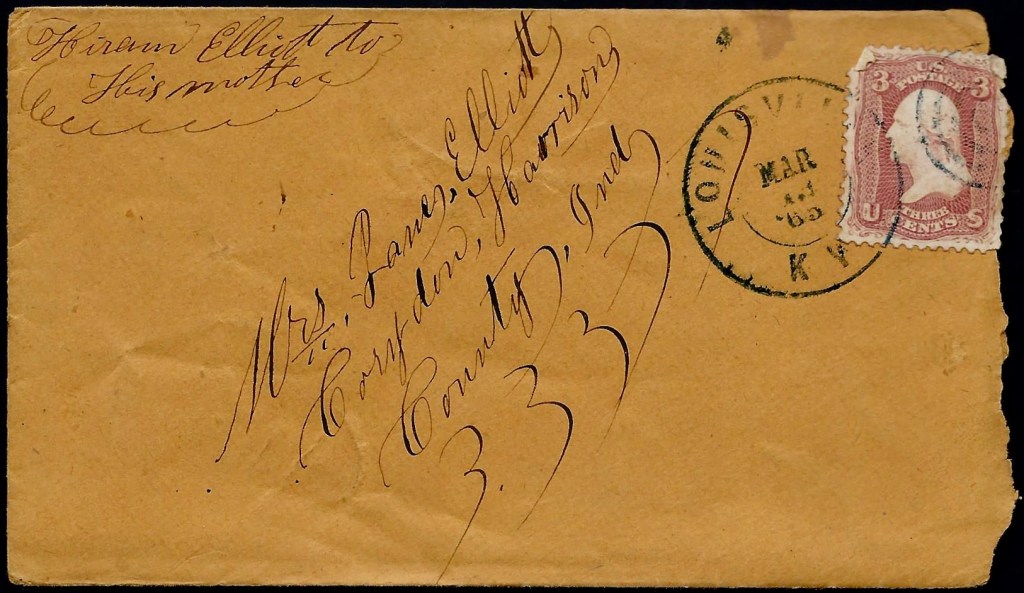
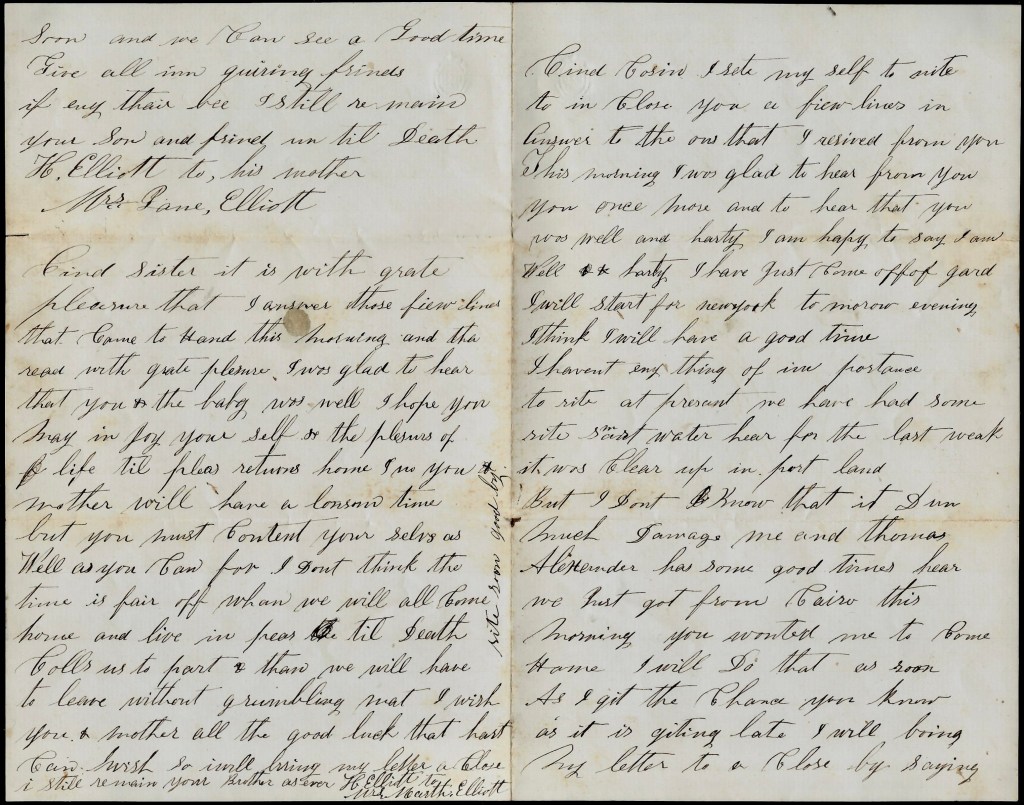
The following letter was written by Hiram Elliott (1843-1926), the son of Nathaniel Elliott (1802-1846) and Jane May (1803-1885) of Corydon, Harrison county, Indiana. Hiram wrote the letter in March 1865 while serving in Co. K, 59th Indiana Volunteers. He addressed to the letter to his mother but also included messages to his sister Martha (“Mat”) Elliott (1826-Aft1903), the wife of William A. Davis (1830-1865) and his cousin Jesse.

Jesse was living at home and working as a carpenter/house joiner in Harrison county, Indiana, at the time of the 1863 Draft Registration. He enlisted on 19 February 1864 as a recruit and was mustered out of the regiment on 17 July 1865. Hiram mentions his brother, Pleasant Elliott, who was drafted into Co. G, 9th Indiana Infantry in September 1864. Pleasant was mustered out of the regiment on 8 June 1865.

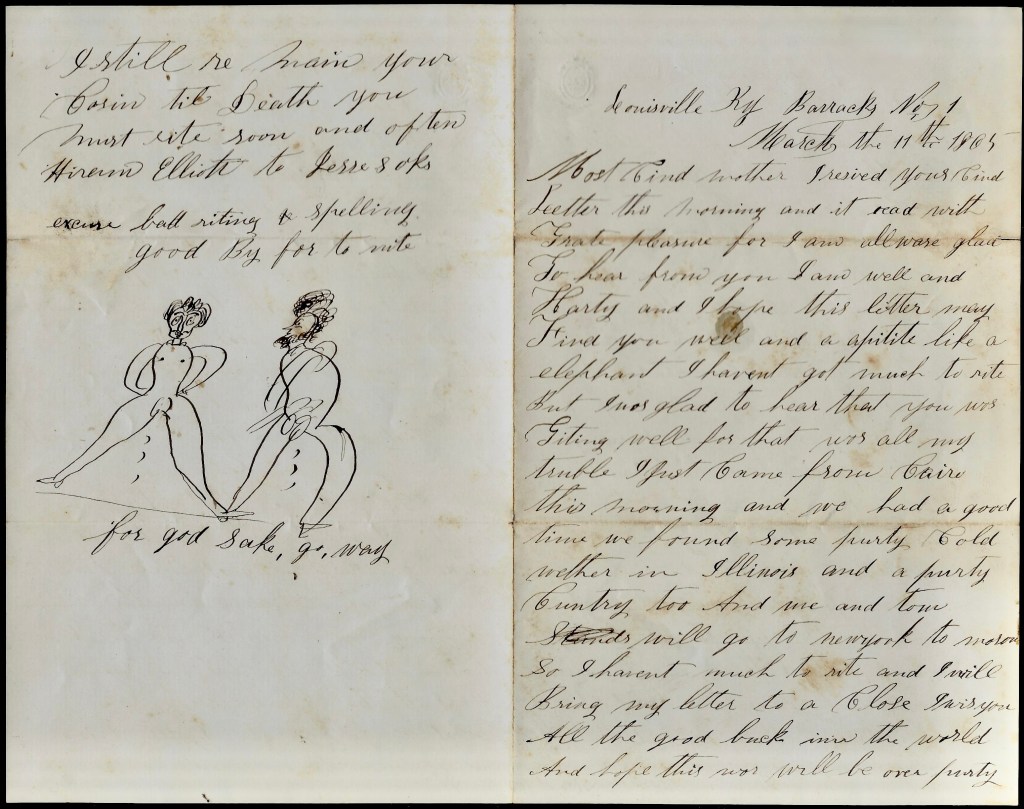
Transcription

Addressed to Mrs. Jane Elliott. Corydon, Harrison county, Indiana

Barracks No. 1
Louisville, Kentucky
March the 11th 1865

Most kind Mother,

I received your kind letter this morning and it [was] read with great pleasure for I am always glad to hear from you. I am well and hearty and I hope this letter may find you well and [with] an appetite like a elephant.

I haven’t got much to write but I was glad to hear that you was getting well for that was all my trouble. I just came from Cairo this morning and we had a good time. we found some pretty cold weather in Illinois and a pretty country too. And me and Tom will go to new York tomorrow so I haven’t much to write and I will bring my letter to a close. I wish you all the good luck in the world and hope this war will be over pretty soon and we can see a good time. Give [my respects to] all enquiring friends, if any there be. I still remain your son and friend until death, — H. Elliott

To his mother, Mrs. Jane Elliott

Kind sister, it is with great pleasure that I answer those few lines that came to hand this morning and that [were] read with great pleasure. I was glad to hear that you and the baby was well. I hope you may enjoy yourself and the pleasure of life till [brother] Pleas[ant] returns home. I know you and mother will have a lonesome time but you must content yourselves as well as you can for I don’t think the time is far off when we will all come home and live in peace till death calls us to part. Then we will have to leave without grumbling. Mat, I wish you and mother all the good luck that heart can wish.

So I will bring my letter to a close. I still remain your brother as ever, — H. Elliott

[to] Mrs. Martha Elliott

Write soon. Goodbye.

Kind Cousin, I seat myself tonight to enclose you a few lines in answer to the one that I received from you this morning. I was glad to hear from you once more and to hear that you was well and hearty. I am happy to say I am well and hearty. I have just come off of guard. I will start for New York tomorrow evening. I think I will have a good time. I haven’t anything of importance to write at present. We have had some right smart water here for the last week. It was clear up in port land but I don’t know that it done much damage. Me and Thomas Alexander has some good times here. We just got [here] from Cairo this morning.

You wanted me to come home. I will do that as soon as I get the chance, you know. As it is getting late, I will bring my letter to a close by saying I still remain your cousin till death. You must write soon and often. — Hiram Elliott

to Jesse Soks

Excuse bad writing & spelling. Goodbye for tonight.

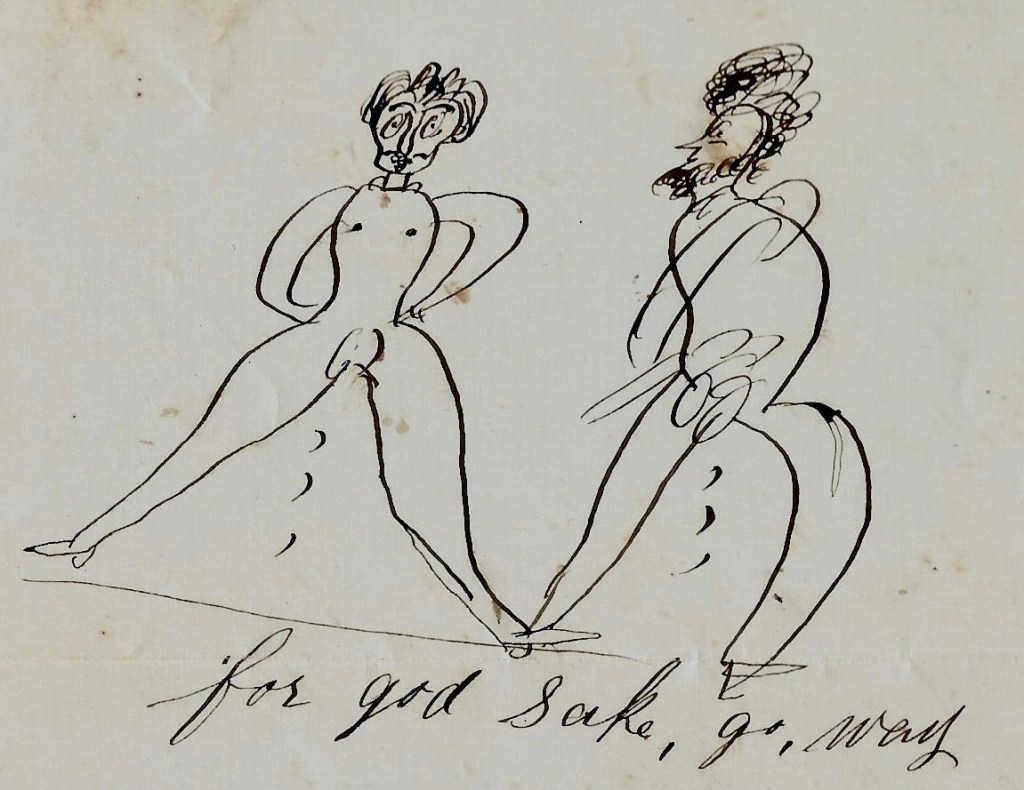
Not sure what to make of this sketch—“For God’s sake, go away!”
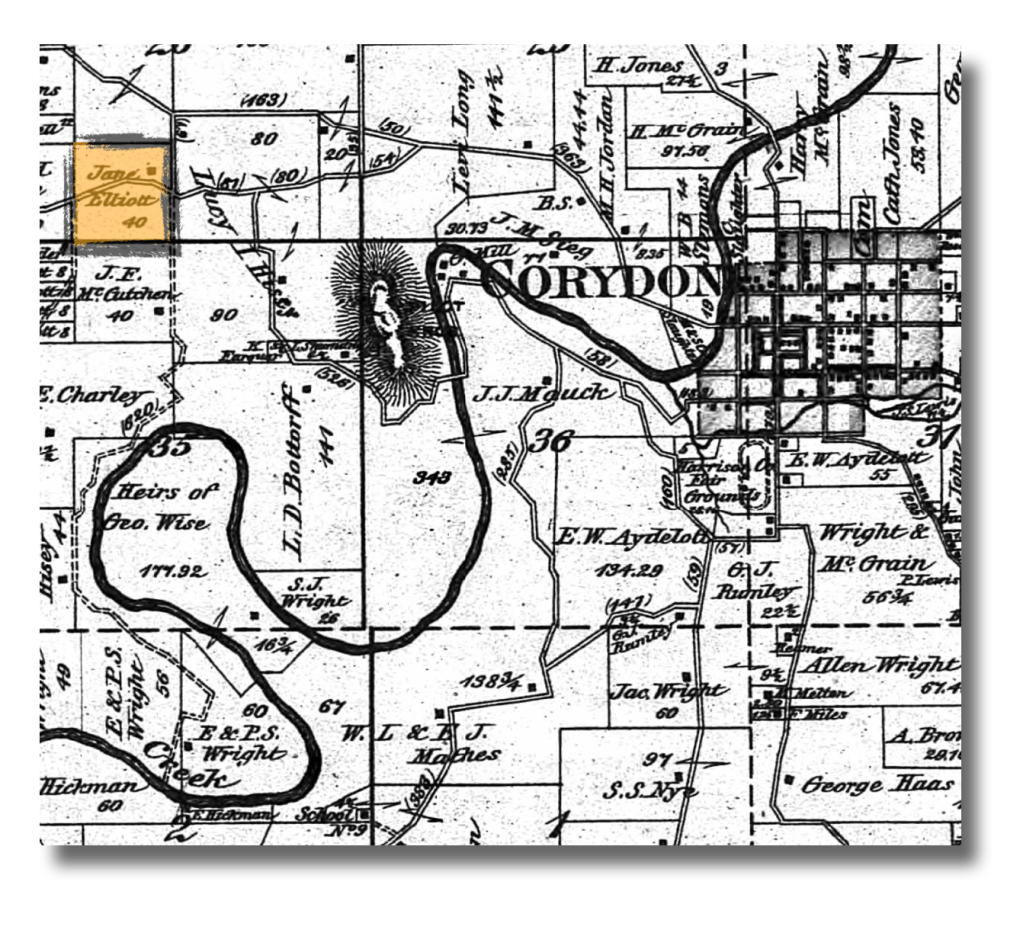
The location of Mrs. Jane Elliott’s farm west of Corydon, Harrison county, Indiana.

1865: Adam Moses Hallidy to his Wife

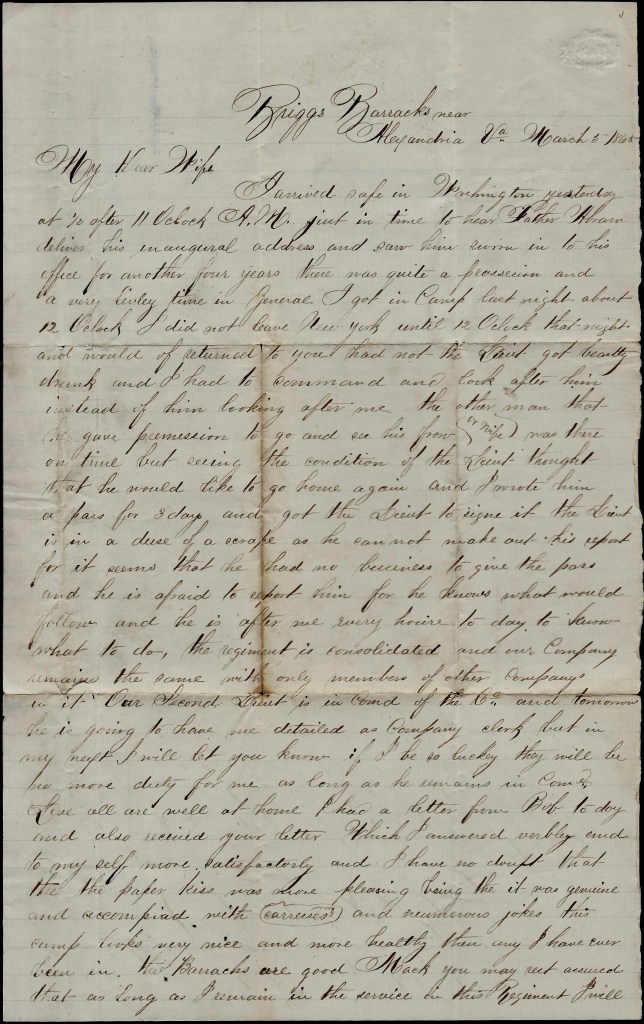
The following letter was written by Adam Moses Hallidy (1837-1910) of Whippany, New Jersey to his wife of almost a year, Margaret (“Mack”) McClelland (1839-1920). Adam was the son of David Hallidy (1804-1856) and Maria Ann Gamble (1813-Aft1865).

Adam enlisted on 26 February 1862 as a private in Co. K, 2nd District of Columbia Infantry.

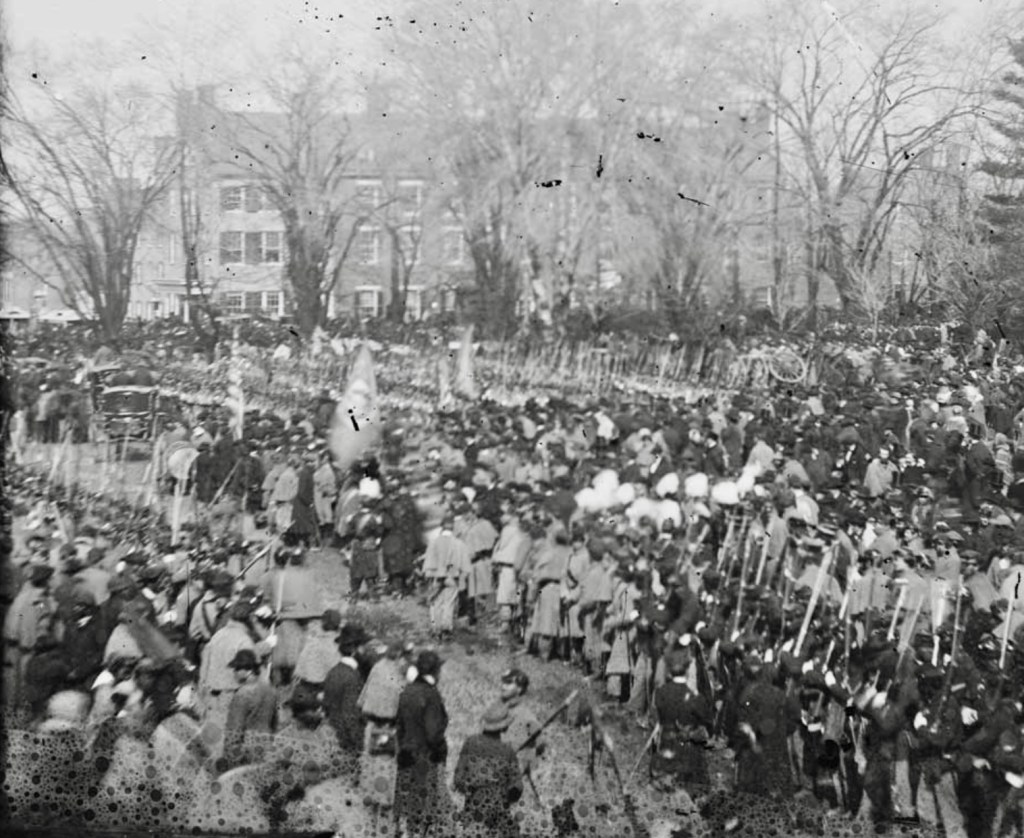
Union Black Soldiers marching in Procession of Lincoln’s Second Inaugural on 4 March 1865

Transcription

Briggs Barracks 1 near Alexandria, Va.
March 5th 1865

My dear wife,

I arrived safe in Washington yesterday at half after 11 o’clock A.M. just in time to hear Father Abram deliver his inaugural address and saw him sworn in to his office for another four years. There was quite a procession and a very lively time in general.

I got in camp last night about 12 o’clock. I did not leave New York until 12 o’clock that night and would of returned to you had not the Lieutenant got beastly drunk and I had to command and look after him instead of him looking after me. The other man that he gave permission to go and see his frau (or wife) was there on time but seeing the condition of the Lieutenant, thought that he would like to go home again and I wrote him a pass for three days and got the Lieutenant to sign it. The Lieutenant is in a deuce of a scrape as he cannot make out his report for it seems that he had no business to give the pass and he is afraid to report him for he knows what would follow and he is after me every hour today to know what to do.

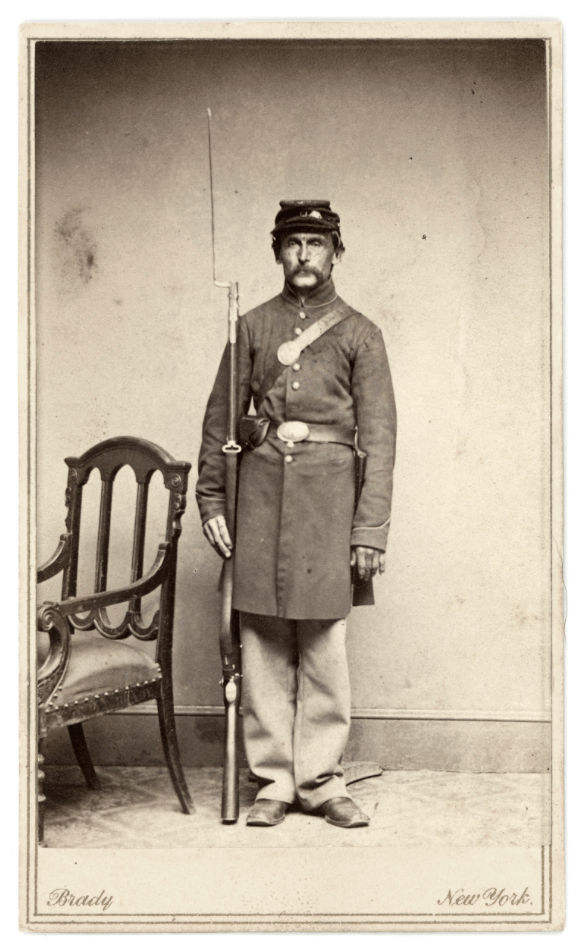
I could not find an image of Adam but here is a CDV of Mark R. Earl, a private in Co. A of the 2nd D. C. Infantry. (Photo Sleuth)

The regiment is consolidated and our company remains the same with only members of other companies in it. Our 2nd Lieutenant is in command of the company and tomorrow he is going to have me detailed as company clerk, but in my next I will let you know if I be so lucky. There will be no more duty for me as long as he remains in command.

All are well at home. I had a letter from [brother] Bob today and also received your letter which I answered verbally and to myself more satisfactorily and I have no doubt that the paper kiss was more pleasing being that it was genuine and accompanied with caresses and numerous jokes.

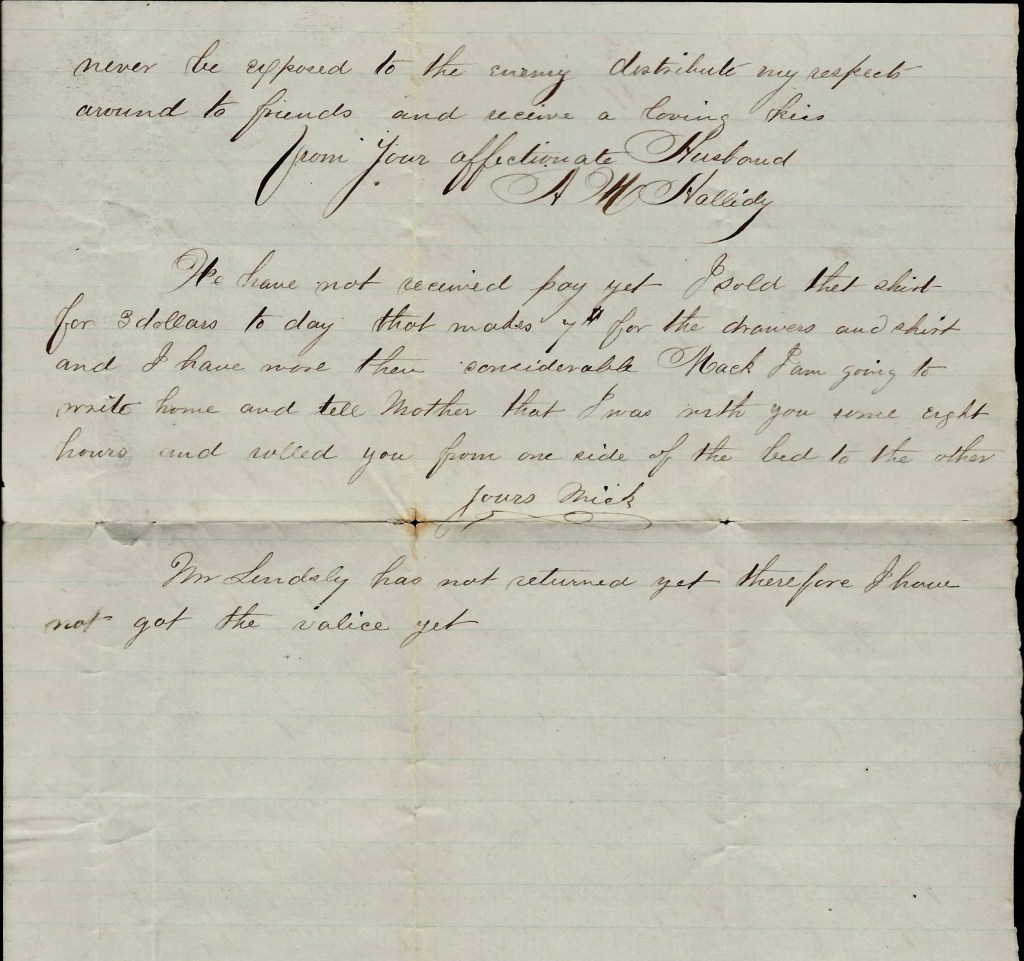
This camp looks very nice and more healthy than any I have ever been in. The barracks are good. Mack, you may rest assured that as long as I remain in the service of the regiment, I will never be exposed to the enemy. Distribute my respects around to friends and receive a loving kiss from your affectionate husband, — A. M. Hallidy

We have not received pay yet. I sold that shirt for three dollars today, That made $7 for the drawers and shirt and I have more than considerable. Mack, I am going to write home and tell mother that I was with you some eight hours and rolled you from one side of the bed to the other. Yours– Mick

Mr. Lindsly has not returned yet. Therefore, I have not got the valise yet.


1 Brigg’s Barracks were sold at public auction at Alexandria on 2 November 1865. They were described by the quartermaster as five barracks, each 20 by 100 feet; one mess house, 26 by 140 feet; two officers’ quarters, each 16 by 24 feet; one officers’ quarters 16 by 39 feet; one headquarters, 20 by 30 feet; one adjutant’s office, 16 by 30 feet; two stables, guard house, and outhouses. The Barracks were first mentioned in period newspapers in July 1864.

1862: Henry Bloomfield McIlvaine to Margaret (Mitchell) McIlvaine

The following letter was written by Major Henry Bloomfield McIlvaine (1828-1883) of the 5th New York Heavy Artillery. Henry enlisted on 2 December 1861 at New York City as a 1st Lieutenant in Co. A, 5th New York Heavy Artillery and was promoted to Major in March 1862. He was married to Margaret (“Maggie’) J. Mitchell (1840-1920).

Henry wrote this letter from Harpers Ferry, Virginia, some three weeks prior to the Stonewall Jackson’s attack on the town during the Maryland Campaign. At the time, Henry was serving as Chief of Artillery and clearly overconfident in his assessment of their readiness to defend the strategically important town. “I do not think that the enemy can ever get here, or anywhere near it,” he wrote his wife. The town and Union garrison of 13,000 men were surrendered to Stonewall Jackson on 15 September 1862—the largest single Union surrender of the war.

Transcription

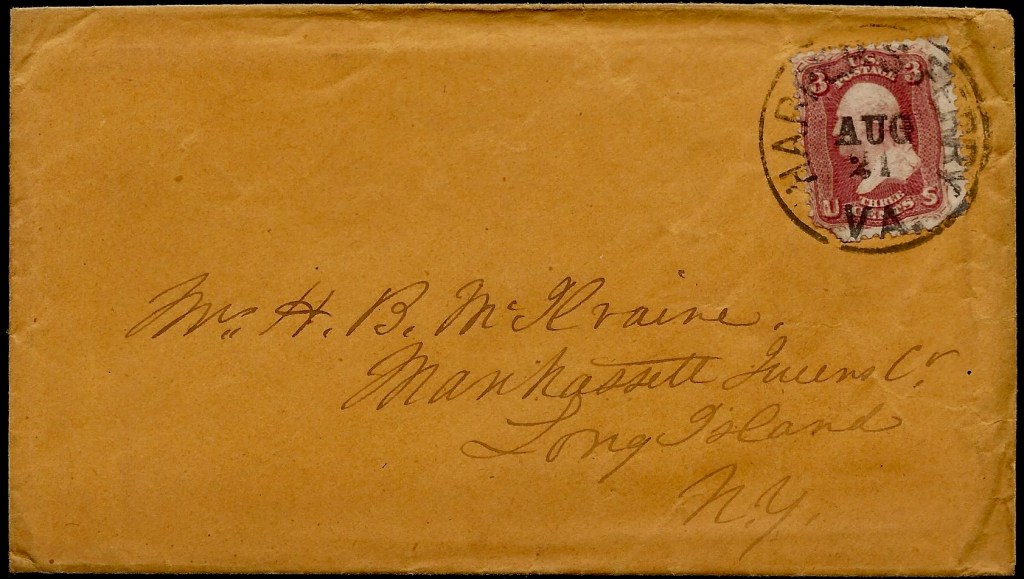
Mrs. H. B. McIlvaine, Manhassett, Queens county, Long Island, N. Y.

Headquarters, Harpers Ferry, Va.
August 21st 1862

My dear precious Maggie,

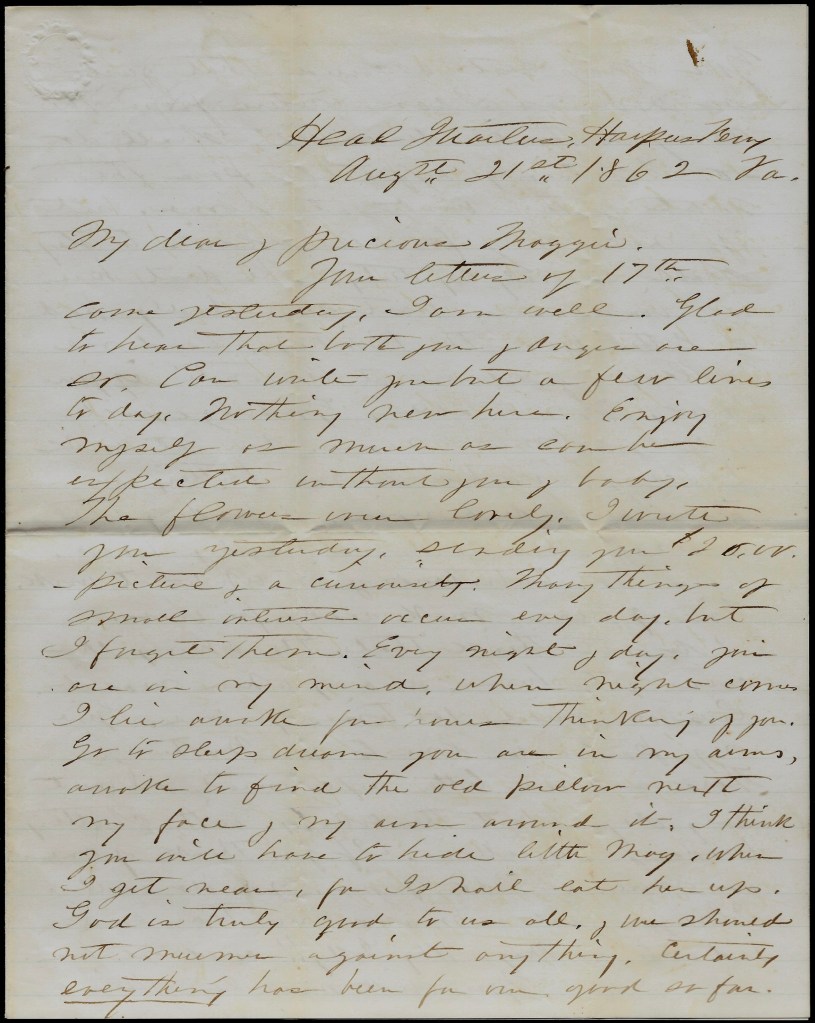
Your letter of 17th came yesterday. I am well. Glad to hear that both you and Angie are so. Can write you but a few lines today. Nothing new here. Enjoy myself as much as can be expected without you and baby. The flowers were lovely. I wrote you yesterday sending you $20, picture and a curiosity. Many things of small interest occur every day but I forget them. Every night and day, you are in my mind. When night comes, I lie awake for hours thinking of you. Go to sleep—dream you are in my arms. Awake to find the old pillow next my face & my arm around it. I think you will have to hide little Mag when I get near for I shall eat her up. God is truly good to us all. We should not murmur against anything. Certainly everything has been for our good so far. You may rest assured that just so soon as I can retire from the army without discredit, shall do so. I certainly expect to pass the most of this winter at home, but if necessary for all soldiers to stay, shall do only my duty.

The dust here is immense. Want rain badly. Had a letter from the Bishop. Send me Mr. Cox’s address at Cincinnati if you know. Love to all. Goodbye. Will write you more soon.

Am at work placing another two gun battery on the Shenandoah River defending the arsenal, the ford, railroad & road. Have 30 contrabands & 5 whites at work. Time of peace, make ready for war. I do not think that the enemy can ever get here, or anywhere near it.

Kiss our child 100 times for me. Give my particular love to your mother.

There is some excitement almost every day about the country with strolling bands of guerrillas. If you think of me as much as I do of you, you do well. I love you just as must or more than ever and as to our Mag—Why Golly!! could eat her.

Yours with much love, — H

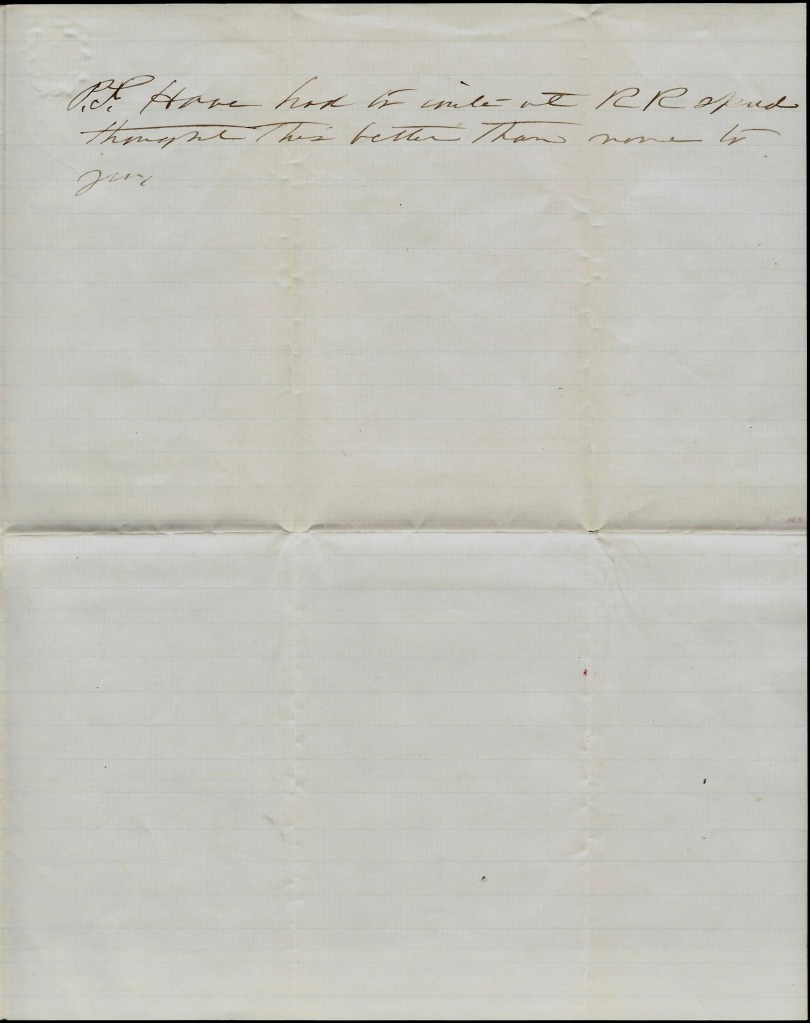
P. S. Have had to write at railroad speed. Thought this better than none to you.

1863-64: John W. Oliver to his Parents

I could not find an image of John but here is one of Lucius Hagadorn who also served in the 7th New York Heavy Artillery (Photo Sleuth)

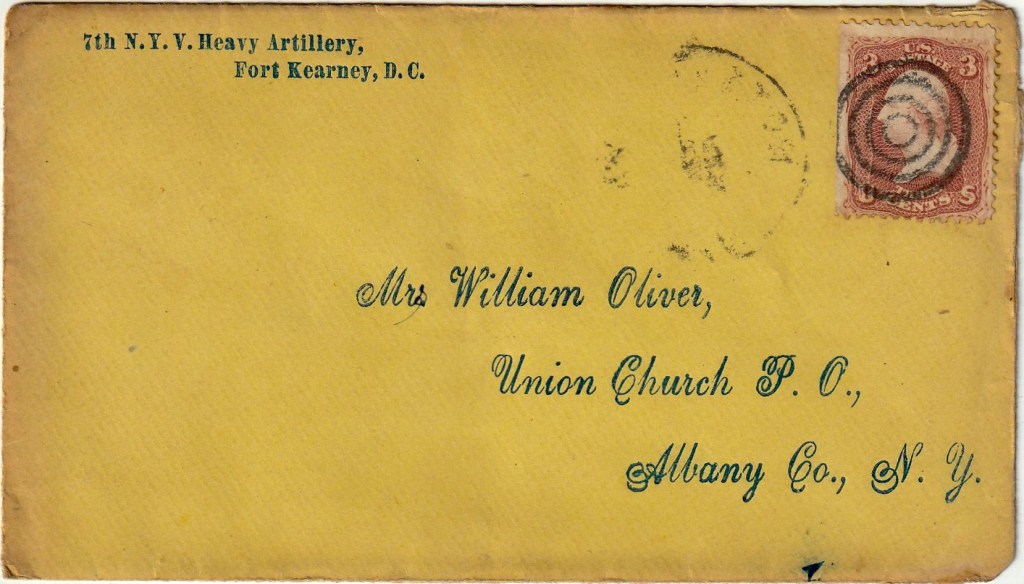
The following letters were written by John W. Oliver (1842-1895), the son of William Oliver (1815-1886) and Elizabeth Clute (1820-1888) of Union Church, Albany county, New York.

When he was 19 years old, John enlisted at Albany as private in Co. D, 113th New York Infantry on August 18, 1862, to serve three years. Before the end of 1862, the regiment had been reorganized as the 7th New York Heavy Artillery and garrisoned at Fort Kearney near Washington D. C. When the regiment was taken to the front and used as infantrymen in the spring of 1864, John was captured on June 16, 1864, at Petersburg, Va.; held at Andersonville prison for several months; paroled, December 6, 1864, at Charleston, S. C; returned to duty, April 5, 1865; promoted corporal, May 25, 1865; reduced, date not stated; mustered out with detachment June 16, 1865, at Fort Federal Hill, Baltimore, Md.

After the war, John married Mary E. Cady (1846-1881) and resided in Watervliet, Albany county, New York.

[Note: Three of the letters presented here are from the collection of Richard Weiner and were transcribed and published by express consent on Spared & Shared.]

Letter 1

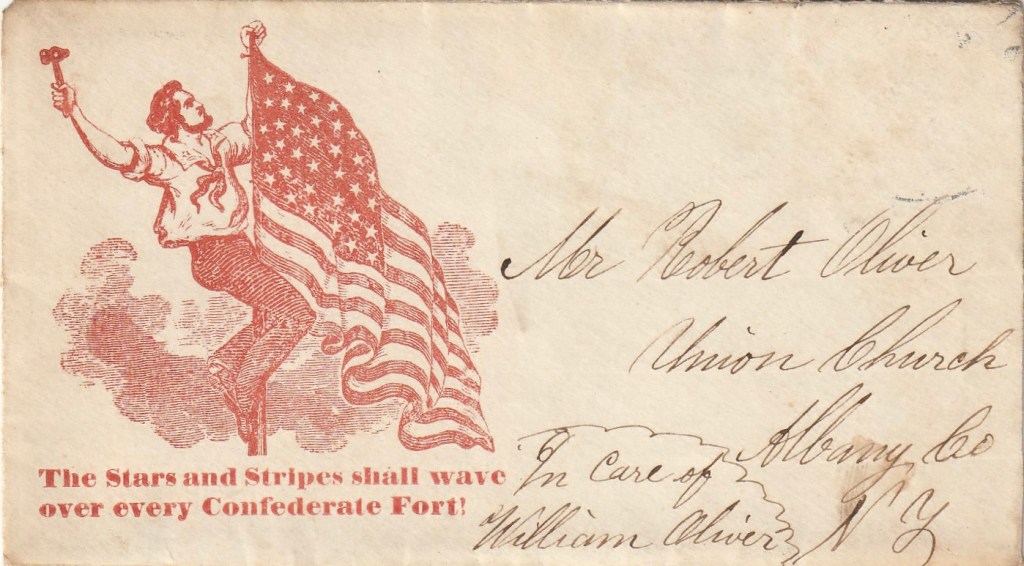
Addressed to Mr. William Oliver, Union Church, Albany Co., New York

Fort Kearney
Tuesday, February 3rd 1863

Dear Parents and Brother,

I now take the opportunity to answer your letter that I received yesterday. It found us all well and I hope this will find you the same. I received your letter with the postage stamps. The one had six in it and this last letter had 3 in so it is all right.

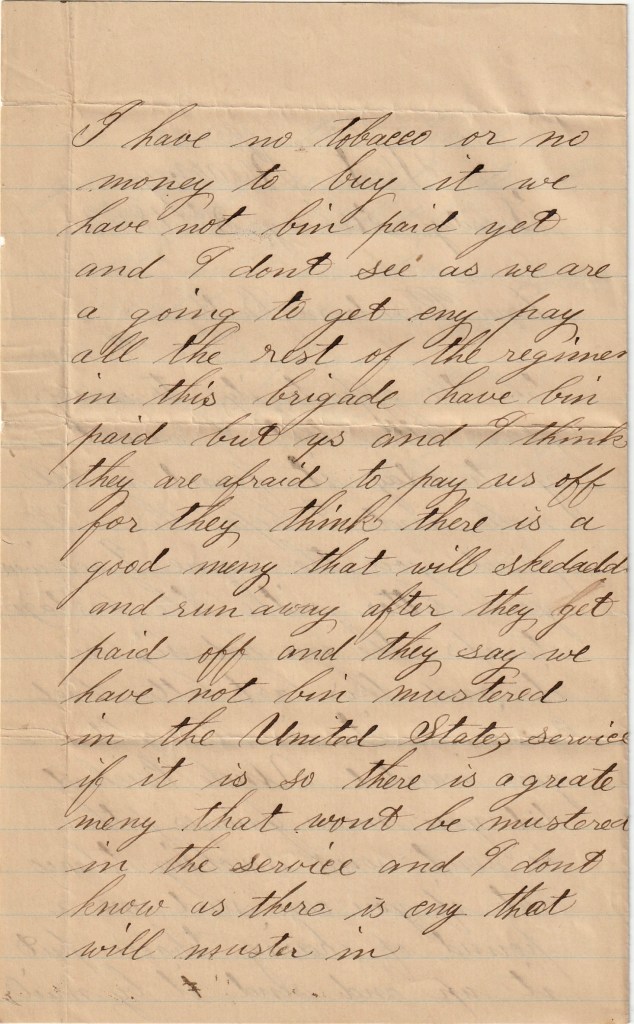
You wanted Uncle Richard. Did you mean James’ father? He sent some smoking tobacco but if you can send me a pound of chewing tobacco, put it up and send it by mail. I have no tobacco or no money to buy it. We have not been paid yet and I don’t see as we are a going to get any pay. All the rest of the regiments in this brigade have been paid but us and I think they are afraid to pay us off for they think there is a god many that will skedaddle and run away after they get paid off. And they say we have not been mustered in the United States service. If it is so, there is a great many that won’t be mustered in the service adn I don’t know as there is any that will muster in.

You said you hoped we would stay at this place. I think we will stay here this winter at least and then perhaps we will go to North Carolina. That is the talk some around camp. I hope it will come to a close soon so that we can come home.

Oh, how is Uncle Coon’s folks getting along? I have not heard you say anything about them. And what is John Jo a doing? Is he home now? You must tell him I have not had an answer from the letter I sent to him yet.

Brother, you must write every week and I will answer it if I can. No more at this time. Give my respects to all. Tell Grammy that I am well and send my respects. Write soon as you get this. From your son and brother, — John W. Oliver


Letter 2

Fort Kearney
Sunday, February 22nd, 1863

Dear Parents and Brother,

I now take my pen in hand to inform you that we are all well and I hope this will find you the same. I received your letter in due time but have neglected to answer it until now.

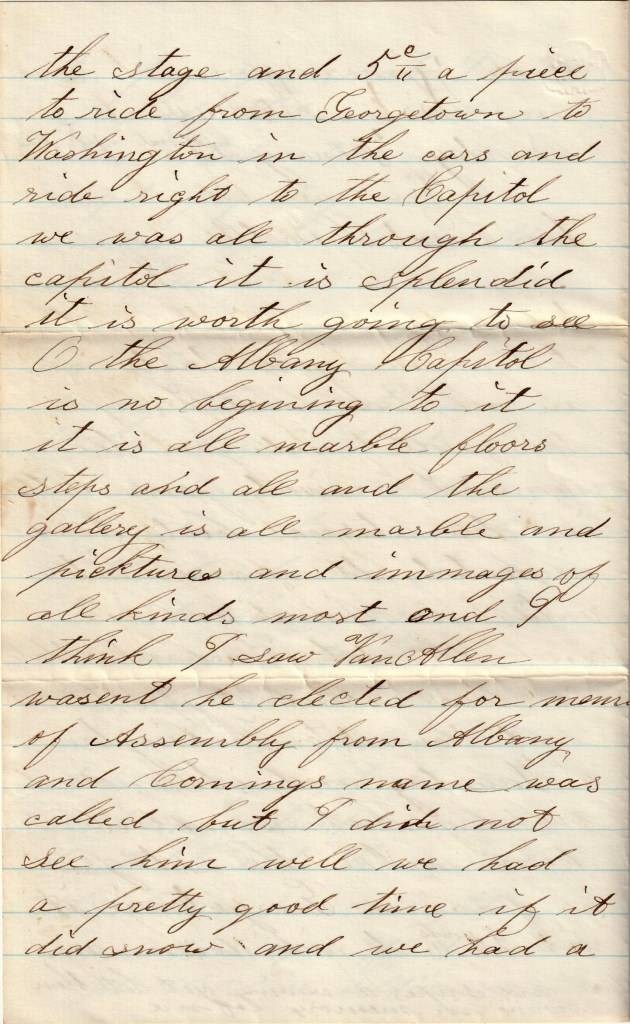
James and me and Sergeant [Edward S.] Burbanks that is our 2nd Sergeant went down to Washington a Tuesday and it snowed all day but we went down with the stage as far as Georgetown. It cost 25 cents to ride down in the stage and 5 cents apiece to ride from Georgetown to Washington in the cars and ride right to the Capitol. We was all through the Capitol. It is splendid. It is worth going to see. The Albany Capitol is no beginning to it. It is all marble floors, steps, and all, and the gallery is all marble and pictures and images of all kinds most, and I think I saw Van Allen. Wasn’t he elected for Member of Assembly from Albany. And Corning’s name was called but I did not see him.

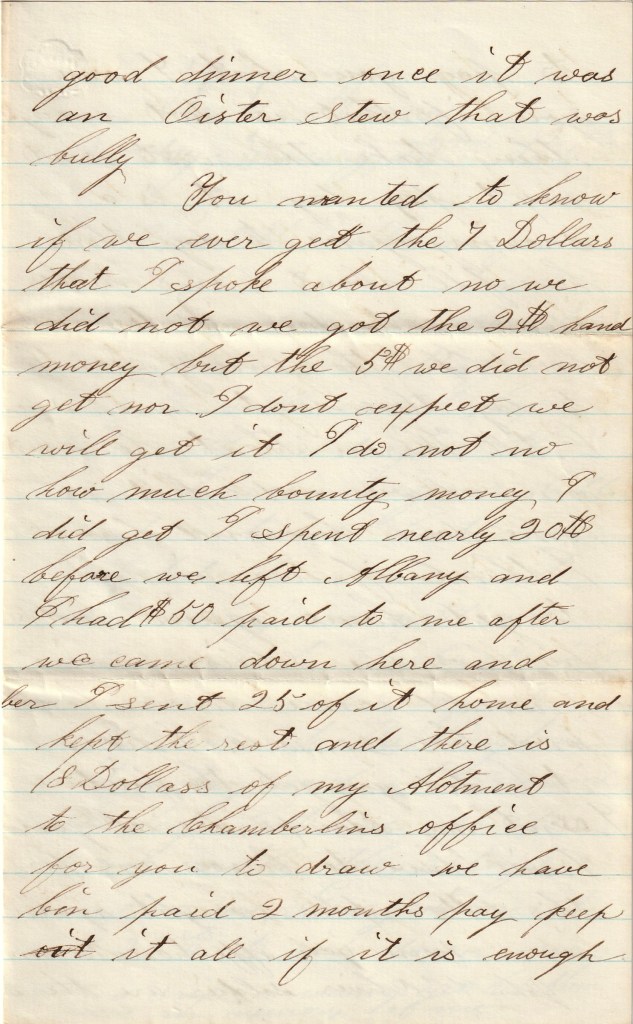
Well, we had a pretty good time [even] if it did snow, and we had a good dinner once. It was an oyster stew that was bully.

You wanted to know if we ever got the 7 dollars that I spoke about. No, we did not. We got the $2 hard money but the $5 we did not get nor I don’t expect we will get it. I do not know how much bounty money I did get. I spent nearly $20 before we left Albany and I had $50 paid to me after we came down here and I sent $25 of it home and kept the rest. And there is 18 dollars of my Allotment to the Chamberlin’s office for you to draw. We have been paid two months pay. Keep it all if it is enough to pay you what I owe you. If that is not enough, then take the rest out next pay day.

It is a snowing again today. There has fell about 6 or 8 inches of snow today. It does not look like the Sunny South today. There is too much snow.

Oh, tell Warren that he must come down and enlist or come down here and work. I think if ever I live to get home again and be free from a soldier again, I would come down here and live so well I like it. Did you get the picture I sent? My stamps are all gone. I will have to borrow one for this letter. Please write again soon. From your affectionate son, — John W. Oliver


Letter 3

[Note: The following letter was found in an antique store at Chickamauga, Georgia by Marilyn J, McCartney.]

Fort K[e]arney
Washington D. C.
June 25th 1863

Dear Parents,

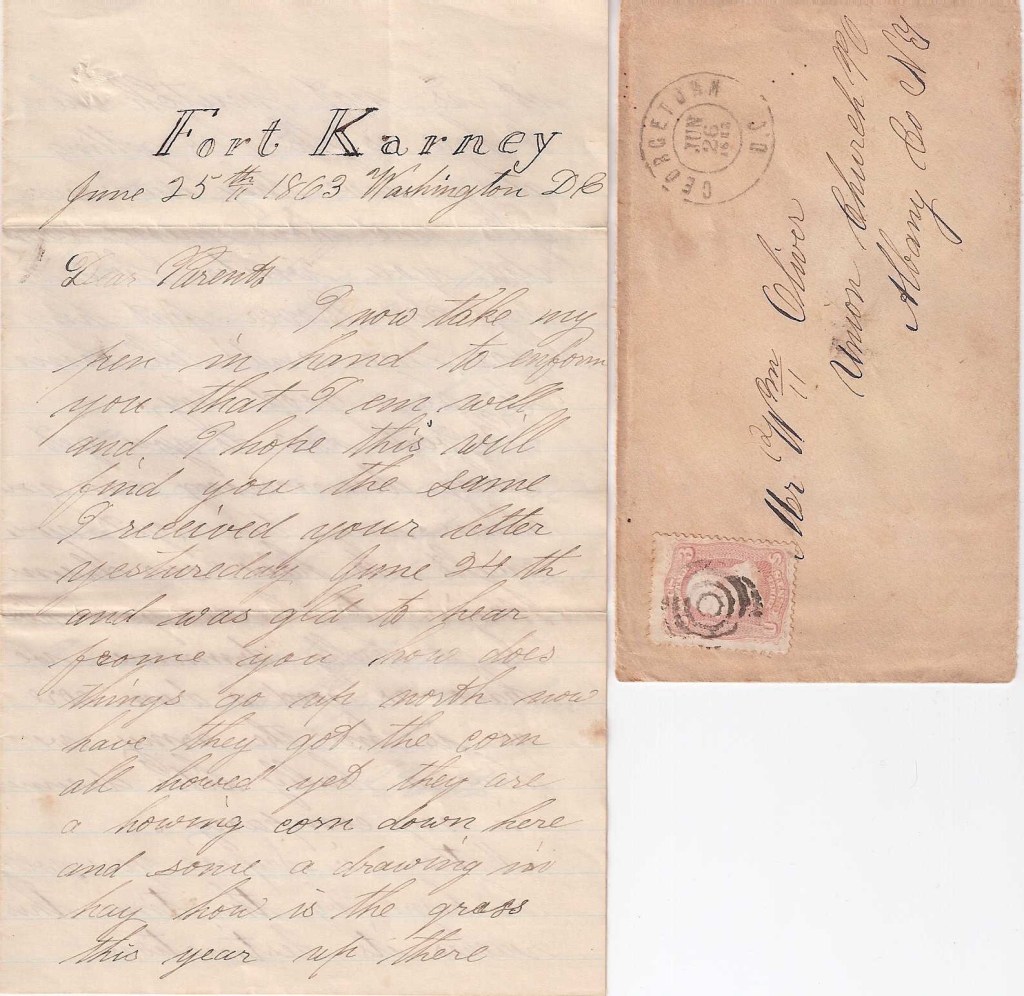
I now take my pen in hand to inform you that I am well and I hope this will find you the same. I received your letter yesterday, June 24th, and was glad to hear from you. How does things go up North now? Have they got the corn all hoed up yet? They are a hoeing corn down here and some a drawing in hay. How is the grass this year up there? It is not much here. How is the bees getting along? Have they swarmed yet? And how many swarms did you winter?

How is my dog Rover? Pat him for me and tell him to be a good boy.

Robert, how do you get along drumming? Can you drum any tune yet? You ought to have your drum major to learn you. He is a bully drummer. We have as good a drum corps as is in the army. We have a bully little drummer in our company.

Mother, I suppose you will be home by the time this reaches its destination. I hope you have had a good time or visit rather. Did you go to Uncle John’s? What for a woman is she, do you think? I would think enough of her to call her Aunt. That is all. Tell Mrs. Cole that I answered her letter as soon as I got it. Did you get the papers I sent? No more at present. I remain your affectionate son, — John W. Oliver

To his parents.


Letter 4

Fort Kearney
Washington D. C.
February 24th 1864

Dear Parents,

I received your letter last week but have not had much time to write since until this morning. It found us all well and I hope this will find you all the same. I and James [Vanderbilt] was away Sunday all day down to Chain Bridge and Monday was Washington’s Birthday so we did not have any drill and we went down to the Potomac. We came home in time for dress parade and yesterday Corporal McCullic [McCollock], William J. Stalker and me went down to Washington after two of the boys that went off day before yesterday without permission and was not back yesterday morning when we started.

You spoke about writing two letters to my one. I have answered every letter you sent. Then you could not have got my one letter. And about Rachel Oliver, I sent the last letter to her. Oh, tell Rob I have not seen that picture yet. That one he sent was not the genuine article. Then they are all a selling out around there? Tell Father he must sell out and move to Albany or come down to New Jersey. I don’t intend to live up there anymore, if I had my discharge tomorrow.

Give my respects to all enquiring friends. No more at present. From your son, — John W. Oliver

Give the song to Robert. Cut it off.

1862: James V. Vanderbilt to Relatives

The following letter was written by 20 year-old James V. Vanderbilt of Co. D, 7th New York Heavy Artillery. James enlisted as a private in Co. D (originally the 113th New York Infantry) on 18 August 1862 to serve three years. At the time of his enlistment, his residence was given as Corymans, New York. He was described as a blue-eyed, dark-haired farmer who stood 5 foot 6 inches in height. He was promoted to corporal on 1 March 1863 and again to sergeant on 29 December 1863.

The letter was written from Ft. Kearny just outside Washington, D.C. during the early, passive phase of the regiment’s service, while they were part of the D. C. defensive ring. However, beginning mid-way through 1864, the unit was sent to the front as infantrymen and were heavily involved in battles, with much loss. James was killed in action on 3 June 1864 at the Battle of Cold Harbor, Virginia.

During the action on Petersburg on 16 June 1864, James’ cousin, John W. Oliver—who served with him in the regiment, was captured and sent to Andersonville prison, where he stayed until being paroled on 12/6/64. He is listed as having ‘returned’ to his unit on 4/8/65.

[Note: This letter is from the private collection of Richard Weiner and was transcribed ands published on Spared & Shared by express consent.]

7th New York Heavy Artillery (serving as infantry) preparing to leave the trenches and charge the Confederate line in Barlows charge near Cold Harbor Friday June 3rd, 1864, sketched by Alfred Waud.

Transcription

Fort Kearney
December 30th 1862

To Uncle & Aunt, Cousin, and Libbie too.

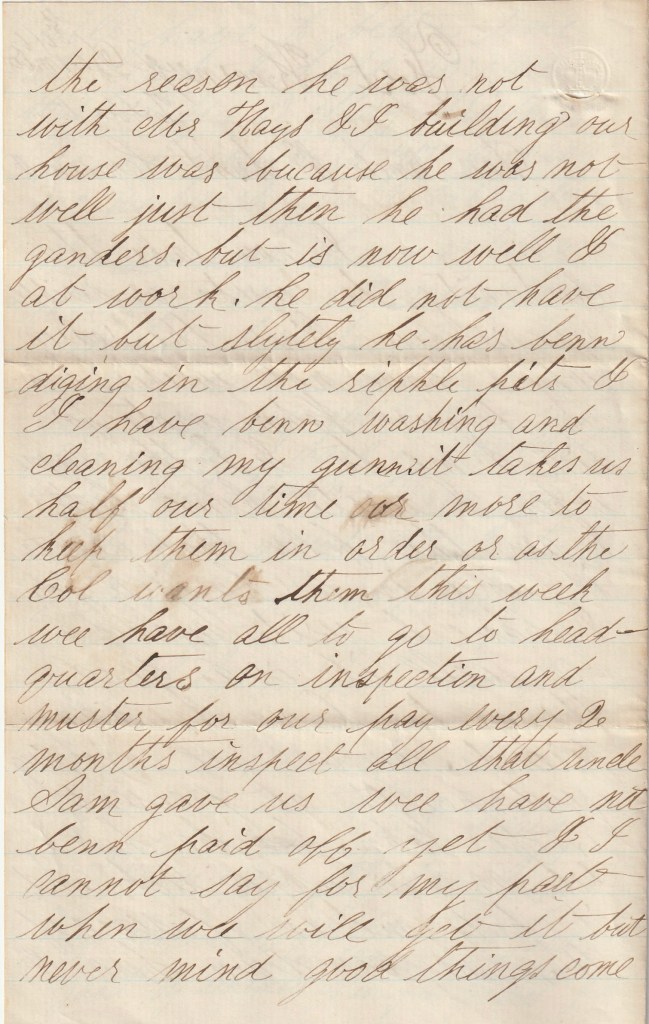
I now take the opportunity to write or scribble you a few lines. The reason why I have not written before was because [Cousin] John [Oliver] wrote for him & me too & I the same when I write home. But I am the feller that can do it and in a hurry too for I have to write many a one. Well, it is a good thing to have so many friends. We are all enjoying good health at present except John. He has a boil on his upper lip and it puts me in [mind] of some of those negroes down here and the reason he was not with Mr. Hayes & I building out house was because he was not well just thern. He had the ganders [jaundice]. But he is now well and at work. He did not have it but slightly.

He has been digging rifle pits & I have been washing and cleaning my gun. It takes us half our time or more to keep them in order as the Colonel wants them. This week we have all to go to headquarters on inspection and muster for our pay. Every two months [they] inspect all that Uncle Sam gave us. We have not been paid off yet and I cannot say for my part when we will get it. But never ind, good things come slow.

You spoke about that money John signed off. You cannot get it until we get paid here. When we get paid, we will let you know. Then go and try him. Some think it was a smart game but I think that it is alright.

We have our house done and are living like pigs in the clover and have bunks & floor and roof & window & stove. I tell you, we live good. Sometimes we have cabbage soup [or] stewed apples. If we only have money, we can live good as any of them. But we are close up for money. I never see a Christmas before but what I had 3 cents to my name. We did not have much Christmas but I hope we will have a better time—at least I hope so. You wished us a merry Christmas. Thank you. [We] wish you a merry one [too]. We wish you a happy new year.

We are now a Heavy Artillery [regiment] and the boys are all satisfied. We will not have to go in the field or have to march far at a time now. We will have to have other clothes. I have a new coat with red trimming. When you write, you must direct to the 7th New York Heavy Artillery, N. Y. S. Vol.,, Co. D, Washington D. C., Fort Kearney

From your nephew, — James V. Vanderbilt

Our respects to all enquiring friends. Goodbye. Remember us in your prayers. I hope to meet you all again if not in this world, in the world to come. Tell the rest to direct the same.

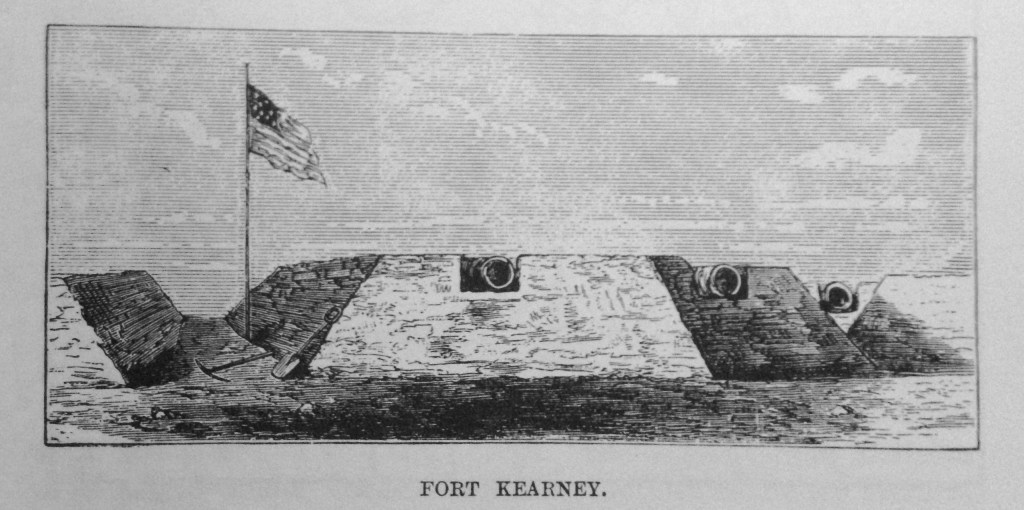
Fort Kearney as built by the 15th New Jersey Infantry in September 1862

1864: Watson Asbury Cleveland to William Bryan Cleveland

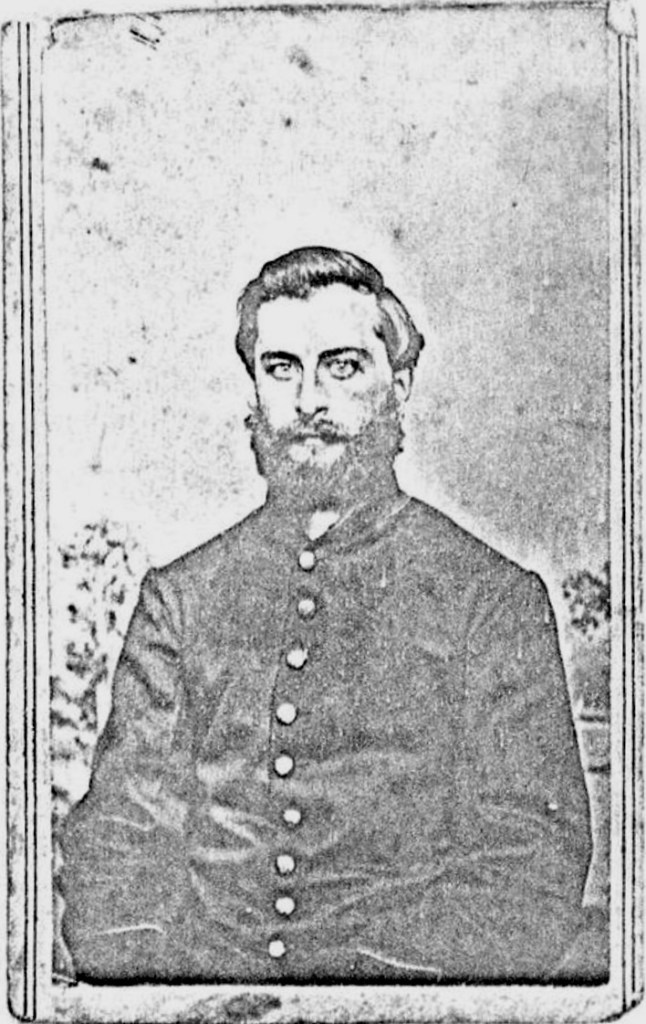
Watson Asbury Cleveland, 1863

The following letter was written by Watson Asbury Cleveland (1837-1915), the son of Josiah Douglas Cleveland (1792-1851) and Lucy Bryan (1794-1873) on Masonville, New York. He wrote the letter to his brother, William Bryan Cleveland (1820-1883).

Watson resided in Berrien county, Michigan, when he enlisted on 28 July 1861 as a private in Co. B, 6th Michigan Infantry. He mustered out of the regiment on 23 August 1864 at Kalamazoo, Michigan. At the time this letter was written in May 1864, during the Red River Campaign, the few remaining members of the original regiment (just 160 men and officers) were converted into the 6th Michigan Heavy Artillery and posted at Port Hudson, Louisiana. In June 1864, the regiment moved from Port Hudson to Morganza, Louisiana.

Watson was married to Jennie Atkinson of Sycamore, Illinois, in December 1867. They settled with other members of the religious sect known as the “Christophers” near Abilene, Kansas in 1872.

[Note: This letter was provided for transcription and publication on Spared & Shared by Denise Hill, a descendant relative of the author.]

Transcription

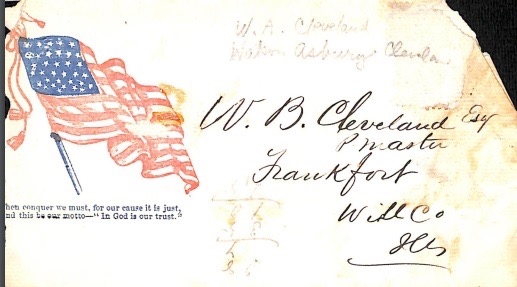
Addressed to W. B. Cleveland, Postmaster, Frankfort, Will county, Illinois

Port Hudson [Louisiana]
May 6, 1864

Wm. B. Cleveland Esq.
My dear Brother,

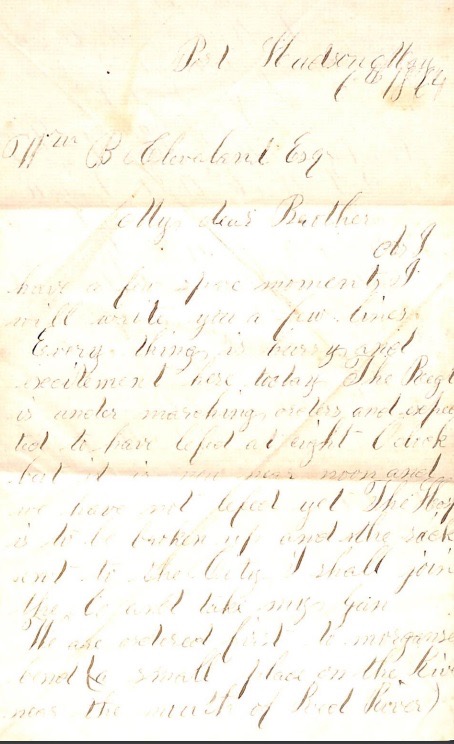
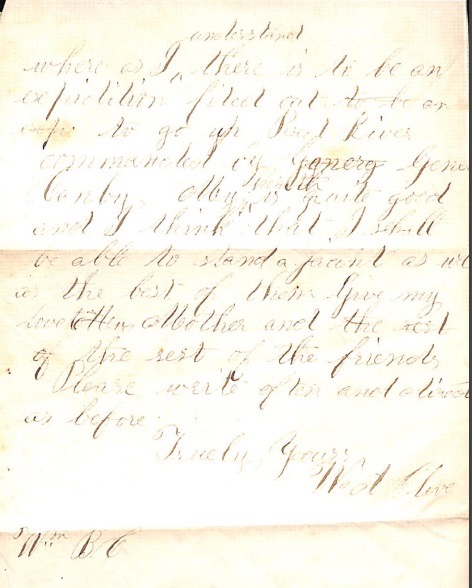
As I have a few spare moments, I will write you a few lines. Everything is busy and excitement here today. The Regiment is under marching orders and expected to have left at eight o’clock, but it is now near noon and we have not left yet. The Hospital is to be broken up and the sick sent to the City. I shall join the company and take my gun. We are ordered first to Morganza Bend (a small place on the river near the mouth of Red River) where as I understand there to be an expedition fitted out to go up Red River commanded by [Brig.] General [Edward] Canby.

My health is quite good and I think that I shall be able to stand a jaunt as well as the best of them. Give my love to mother and the rest of the friends. Please write often and direct as before. Truly yours, — W. A. Cleveland