My passion is studying American history leading up to & including the Civil War. I particularly enjoy reading, transcribing & researching primary sources such as letters and diaries.
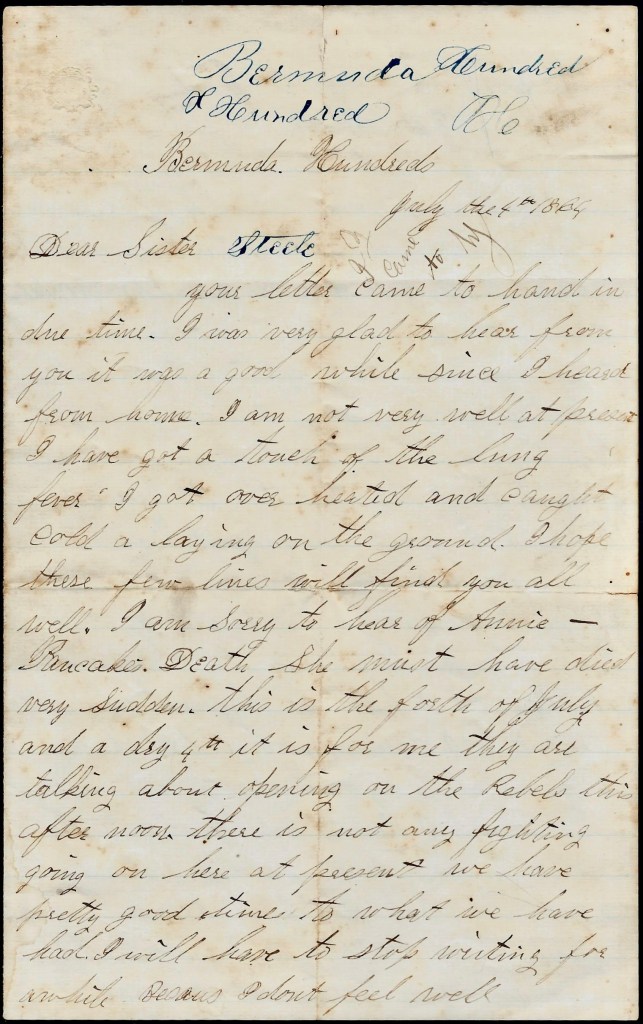
The following letter was written by John R. Heafer (1845-1864), the 19 year-old son of John Heafer (b. 1820) and Nancy (b. 1826) who moved with his family from Charleston, Jefferson county, Virginia, to a farm in Bloomington, McLean county, Illinois in the 1850s. John was serving as a private in Co. B, 39th Illinois Infantry when he wrote this letter from Bermuda Hundred in July 1864.
He was carried on the muster rolls as “Hafter” which may explain why he can’t be found under his given name. Unfortunately he did not survive the war. He was killed along with many other comrades in his regiment on 13 October 1864 in the Battle of Darbytown Road. The Union advance was repulsed with heavy casualties and John’s body was left on the field.
John wrote the letter to his sister, Sarah (“Sallie”) Heafer (b. 1844), the wife of William M. Steele, a former soldier in Co. A, 94th Illinois Infantry and a teamster working in Bloomington. He later became a minister.
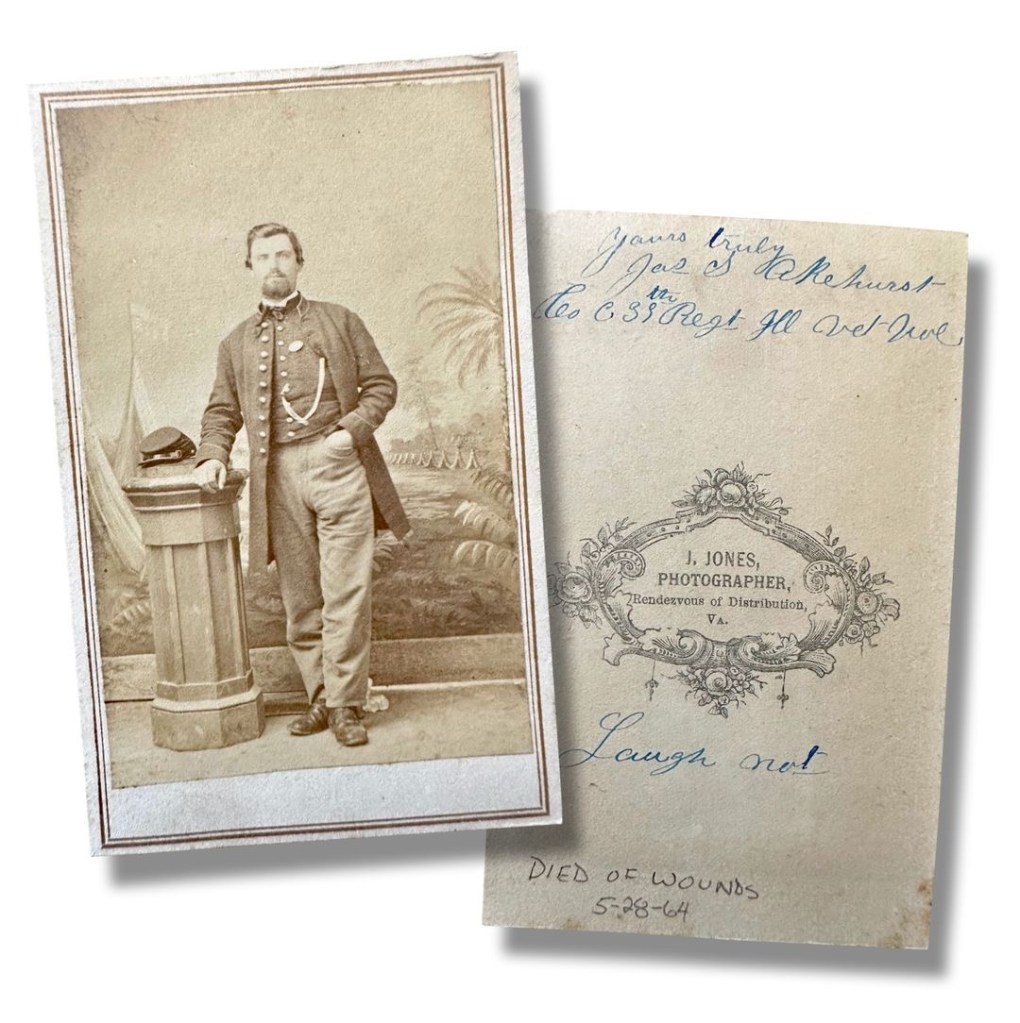
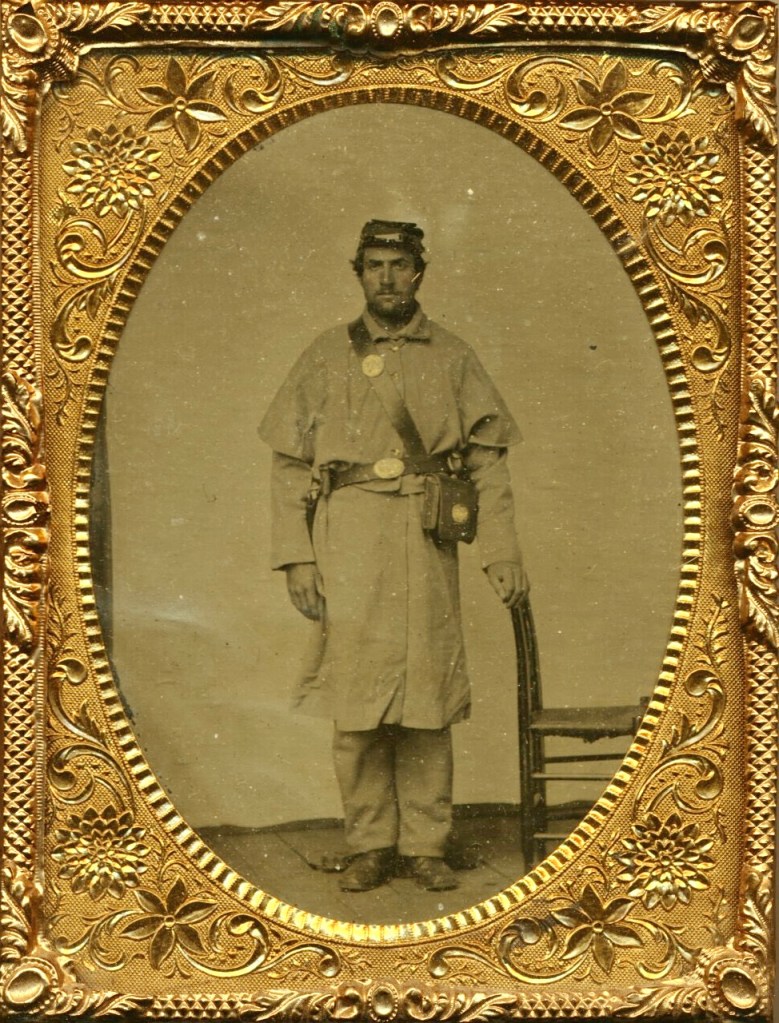
I could not find an image of Robert, but here is a cdv of James S. Akehurst (1843-1864) of Pontiac, Illinois, not previously published to my knowledge. James served as a private in Co. C, 39th Illinois Infantry. He enlisted in October 1861 and was wounded on 20 May 1864 at Drewry’s Bluff, Virginia. The wound to his left arm was so severe it required amputation but the procedure did not save him—he died on 28 May 1864 at Hampton, Virginia. The news must have come as quite a shock to his wife, Elizabeth, who had promised to love and respect James “till death do us part” only three months earlier. James’ image was taken in front of a backdrop that features tropical type vegetation suggesting the cdv was probably taken in 1863 while the regiment was on the South Carolina coast. (Courtesy of Claudia & Al Niemiec Collection)
Transcription
Bermuda Hundred [Virginia] July 4th 1864
Dear Sister,
You letter came to hand in due time. I was very glad to hear from you. It was a good while since I heard from home. I am not very well at present. I have got a touch of the lung fever. I got over heated and caught cold a laying on the ground. I hope these few lines will find you all well. I am sorry to hear of Annie Pancake’s death. 1 She must have died very sudden.
This is the Fourth of July and a dry 4th it is for me. They are talking about opening on the Rebels this afternoon. There is not any fighting going on here at present. We have pretty good times to what we have had. I will have to stop writing for a while because I don’t feel well.
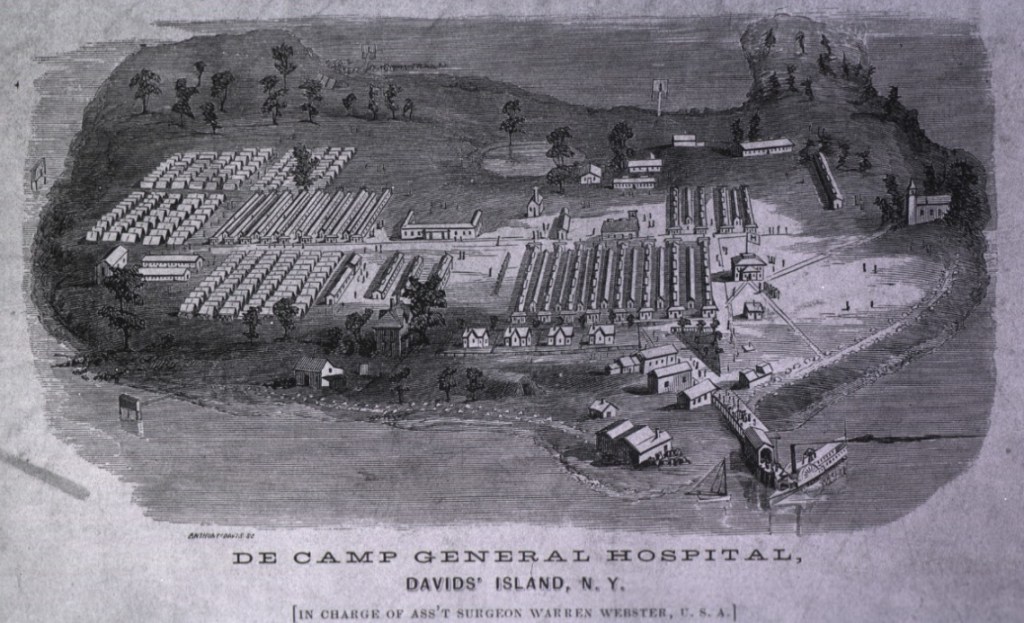
July 7th, Thursday. Dear sister, I will commence and finish this letter and I am better. I was very sick for a few days in my quarters and was getting worse until the doctor came to see me and saw me to the Convalescent Hospital. I am better now. The doctor says I have not got the lung fever. I guess I have got the pleurisy. I think I will soon get over it.
The weather is very warm here but it is cool enough in the hospital tent. You will have to excuse this writing as I have to lay on my side to write. I commenced this letter a few days ago but could not finish it. I told Ed[win] Wolcott to write me a letter because I thought I would not be able to write for some time but I guess I can a little yet. But you need not expect many.
There is good news here now. They are fighting at Petersburg. But we can’t hear anything from Grant. The rebels are deserting by hundreds. I have seen a good many go by here today. I will have to come to a close. My love to all. — John R. Hafer
P. S. Be sure and send the photograph.
Mr. John R. Heafer, Co. B, 39th Regt. Illinois Vols., 1st Brigade, 1st Division, 10th A. C.
1 Ann Marie Pancake (1847-1864) died on 20 June 1864 when she was 17 years old. She is buried in Evergreen Memorial Cemetery in Bloomington.
The following letter was written by John L. Koons who we learn had just arrived in Marysville, Yuba county, California, after passage from the east coast to San Francisco by way of the Isthmus of Panama. He apparently had friends of relatives in Marysville that he stayed with before securing a job. He wrote the letter to his father and though I cannot say with certainty where his father lived, my hunch is that he was from Pennsylvania.
In his letter, John informs his father that there are many Chinese emigrants working in Marysville. It is reported that by 1860, 30 percent of the miners in California were Chinese. By 1870, this number had risen to half the miners. [Source: Introduction to Marysville’s Chinatown.]
Transcription
Marysville, [California] April 12, 1863
Dear Father,
I take the pleasure to write you a few lines. I am well at present and hope you are the same. I wrote to you from the Isthmus [of Panama]. I suppose you got the letter. We had a very nice trip all the way. We only had a few days that it was rough. I stood the trip very well. I did not miss one meal on the steamer. I was always ready for my grub. We got into San Francisco on the 6th of April about 4 o’clock in the afternoon.
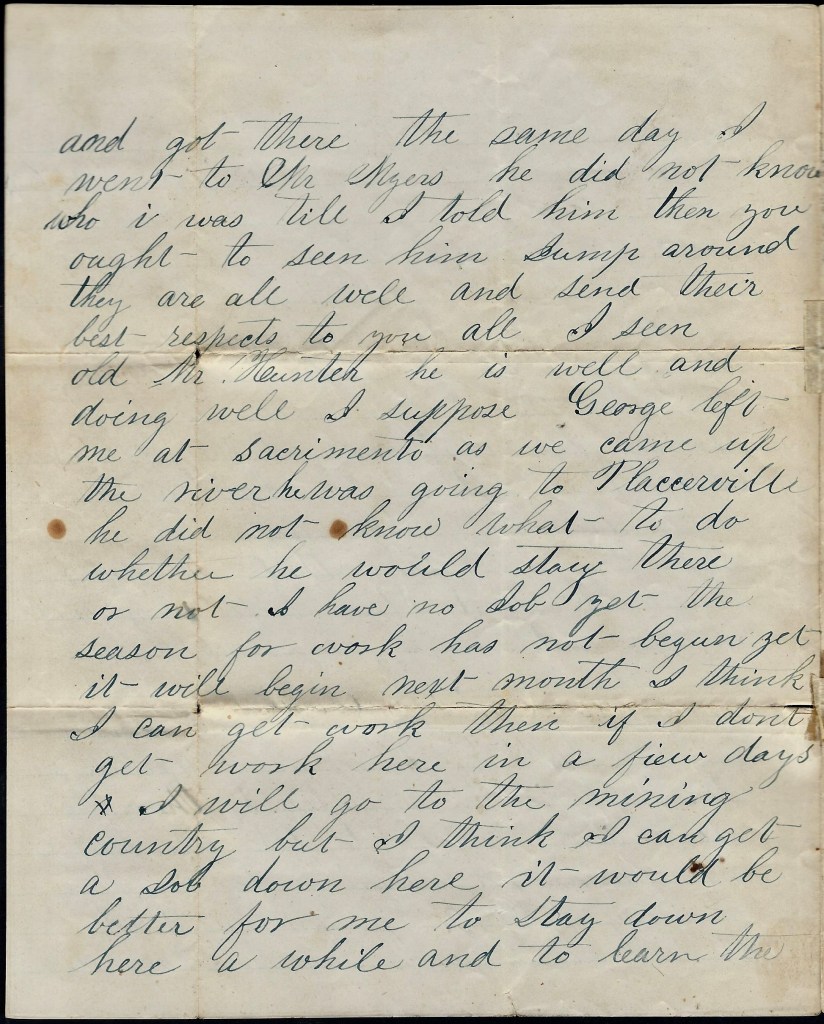
We stayed there two days and then started up the river and got to Sacramento on the morning of the 9th of April and I started the same day for Marysville and got there the same day. I went to Mr. Myers. He did not know who I was till I told him. Then you ought to have seen him jump around. They are all well and send their best respects to you all. I seen old Mr. Hunter. He is well and doing well, I suppose.
George left me at Sacramento as we came up the river. He was going to Placerville. He did not know what to do—whether he would stay there or not. I have no job yet. The season for work has not begun yet. It will begin next month. I think I can get work then. If I don’t get work here in a few days, I will go to the mining country but I think I can get a job down here. It would be better for me to stay down here a while and to learn the ways of the country. I like the country as far as I have seen very well. The trees and grass is very green and nice. At the market there is potatoes, cabbage, and all kind of garden stuff of this year’s growth. The weather is so nice, I know you would like it here Father. The weather is not so changeable as it is in the states.
We can look from Marysville to the mountains and the tops are covered with snow but it is very nice in the valley. I am getting along very well. The country seems to agree with me. I weigh about ten lbs. more than I did when I started from home. I see a good many different kinds of people here but the chiney [Chinese] men is the funniest looking things I ever seen. They have great long hair braided and hanging down their backs. Some of them touch the ground.
Well, I guess I must close my letter for this time. The next time I can give you more of the particulars as I will be better posted. Give my love to all enquiring friends, if there be any. Nothing more at present but remain your affectionate son, — John L. Koons
When you write to me, direct your letter in care of C. Myers, Marysville, California
Write as soon as you get my letter as I am very anxious to hear from you. — J. L. Koons
The following letter was written by Robert Reid Hemphill (1840-1908), the son of Rev. William Ramsey Hemphill (1806-1876) and Hannah Smith Lind (1808-1895) of Abbeville, South Carolina. He first entered the service in June 1861 as a private in the 7th South Carolina Infantry. He was made the orderly for Gen. M. L. Bohnam and was present at 1st Manassas. In June 1862 he transferred to Co. G (“the Marshall Riflemen”), 1st South Carolina (Orr’s Rifles) where he eventually rose in rank to Sergeant Major (May 1864) in William McNeill Whistler’s unit, Orr’s Rifles, McGowan’s Brigade, Wilcox’s Division, Hill’s Corps, under General Robert E. Lee. He was wounded at Chancellorsville and at Gettysburg on 3 July 1863, taken a POW at Falling Waters on 14 July 1863 but exchanged soon afterwards, and surrendered at Appomatox.
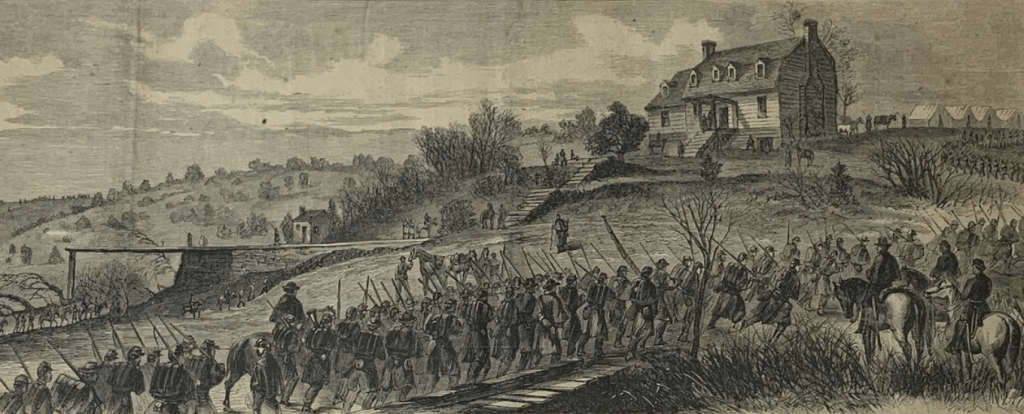
Robert’s letter gives us a good Confederate account of the Mine Run Campaign conducted in late November—early December 1862 in which Meade attempted to cross the Rapidan river and surprise Lee’s army but delays in river crossings and bad weather confounded his plans and he wisely withdrew before fully engaging with the Confederates who were well-fortified in breastworks.
Robert graduated from Erskine College in 1859 and married Eugenia Cornelia Brewton of Spartanburg county in 1870. He later served in the state legislature and became a judge.
Union troops at Germanna Ford during the Mine Run Campaign
[Note: This letter is from the personal collection of Greg Herr and was offered for transcription and publication on Spared & Shared by express consent.]
Transcription
Camp near Orange Court House, Va. December 5th 1863
Dear Brother,
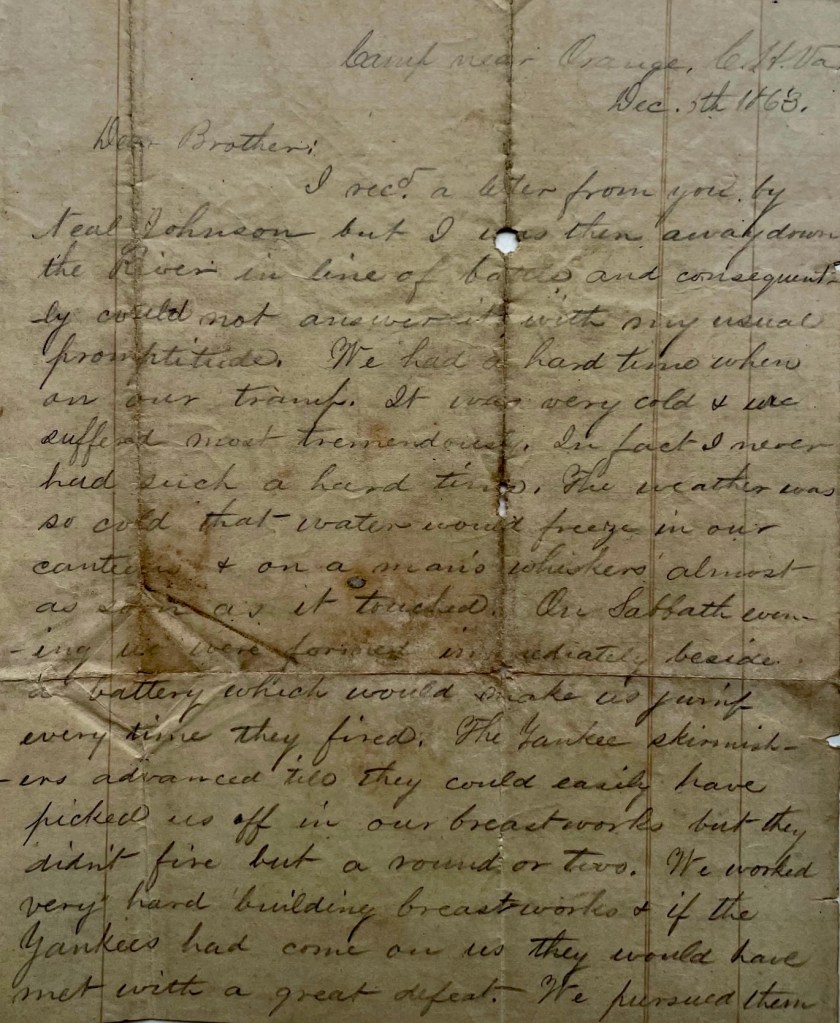
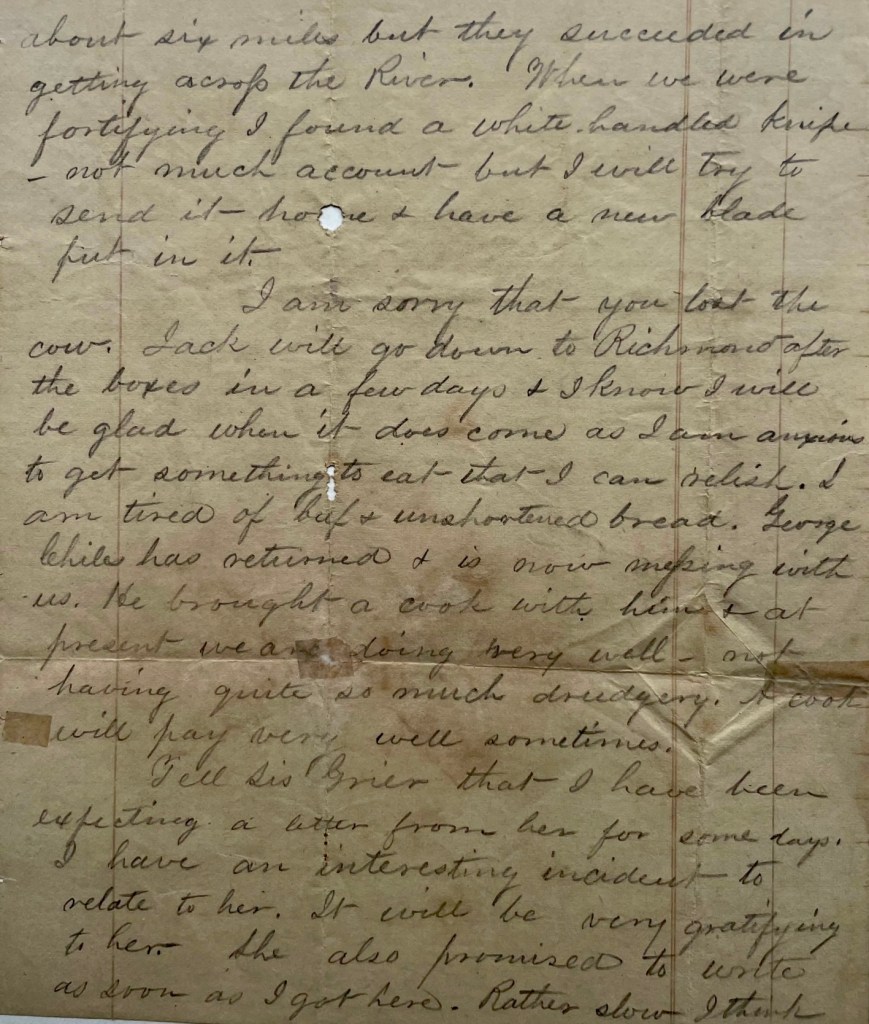
I received a letter from you by Neal Johnson but I was then away down the River in line of battle and consequently could not answer it with my usual promptitude. We had a hard time when on our tramp. It was very cold and we suffered most tremendously. In fact, I never had such a hard time. The weather was so cold that water would freeze in our canteens and on a man’s whiskers almost as soon as it touched. On Sabbath evening we were formed immediately beside a battery which would make us jump every time they fired. The Yankee skirmishers advanced till they could easily have picked us off in our breastworks but they didn’t fire but a round or two. We worked very hard building breastworks & if the Yankees had come on us, they would have met with a great defeat. We pursued them about six miles but they succeeded in getting across the [Rapidan] River. When we were fortifying, I found a white-handled knife—not much account but I will try to send it home & have a new blade put in it.
I am sorry that you lost the cow. Jack will go down to Richmond after the boxes in a few days & I know I will be glad when it does come as I am anxious to get something to eat that I can relish. I am tired of beef and unshortened bread. George Chiles has returned & is now messing with us. He brought a cook with him and at present we are doing very well—not having quite so much drudgery. A cook will pay very well sometimes.
Tell Sis Grier that I have been expecting a letter from her for some days. I have an interesting incident to relate to her. It will be very gratifying to her. She also promised to write as soon as I got here. Rather slow I think. I hate to make so many calls on you but I think John Simpson will be along at Christmas & would bring a supply of provisions. It would do well enough to put in a little meal or flour by way of variety. Also get a few goobers from Thom. Fair. I will leave the other articles to the judgement of the family, feeling assured that you will satisfy me. I came near starving last winter & I intend to try to guard against such suffering. You will have to excuse me.
What became of “this is the kind of corn we raise at ‘our house’?”
What about Brothers? Tell the folks at home to not interfere with things that don’t concern them. Next time they must refer to the English Grammar & Dictionary before they start another petition up to Gen’l Lee. The Gen’l received it and sent it down to Capt. Prato for his decision. I notice some names to it that were complaining when I was at home. I don’t see why Mother and Bella ever signed it knowing that Brothers in an unaccommodating speculation. He was not reported for extortion as the petition says, but so many complaints were sent on to members of Co. G in letters from home that Prato ordered him to report. If any more petitions are sent here about Brothers “asidulously laboring” “incalculating” services “volunteerly” rendered, we will indict the crowd for “murdering the King’s English.”
Old Andy ought to put two n’s in cannot. The President of the D. W. F. C. says that he (Brother) supplied “shoes too of a better quality than is furnished, &c.” He ought to take out the is and substitute are.
Love to all. Write soon & a long letter. Affectionately, — Robt. R. Hemphill
I want a pair of gloves as soon as I can get them.
The following letter was written by Sgt. John K. Simon (1829-Aft1880) to his wife, Phebe (Birdsall) Simon (1830-1897). John served in the 5th New Jersey Infantry (Part of the Jersey Brigade). He enlisted on August 19, 1861, and mustered in as a sergeant in Co. D on August 22. He was promoted to the rank of 2nd Lieutenant on May 26, 1862 and later promoted to 1st Lieutenant on May 19, 1863. He was promoted to the rank of Captain in May 1864 and mustered out of the service on September 7, 1864.
The 5th New Jersey Volunteer Infantry Regiment was organized at Camp Olden, Trenton, New Jersey, in July 1861, and was mustered in on August 22, 1861. It participated in a number of important engagements, including the Battle of Fair Oaks, Seven Pines, Malvern Hill, Second Battle of Bull Run, Fredericksburg, Chancellorsville, Gettysburg, the Wilderness, Spotsylvania Court House, Cold Harbor, and the Siege of Petersburg.
[Note: This letter is from the personal collection of Greg Herr and was offered for transcription and publication on Spared & Shared by express consent.]
Transcription
Camp Baker, Lower Potomac February 5, 1862
Dear Wife,
I take this time and opportunity to write a few lines to you to inform you that I am well and hope that you and the children are all well at home. I have not had a letter from home this week. The last one that I got was last Saturday and that was the one that William wrote and I have been looking for one all this week. I hope that you all will continue in good health at home. Kiss the children for me and tell them to be good children till Pa comes home.
I have been out making roads this last two days and I find it pretty hard work and we have to go about two miles to our place of work. We are all at it. I suppose there is about 35 hundred men at it so we will soon be done with it. I have not got my boots yet but I expect them every day now as the sutler has gone up to Washington on Sunday and he has not come back yet but as soon as he comes back, why I will get them.
Give my love to all the folks on there and tell them I am well and hope they are all the same. The rebels across the river keep firing at every boat that they see but they don’t do any damage to them as yet. The health of our regiment keeps very good owing to the weather.
That money I sent home I wish you would get gold for it and you can keep it better as there is no discount on gold but there may be on these treasury notes and if you can get gold without any trouble, why do so, I will write soon again and a longer letter as there is no fire in the Captain’s tent where I am writing this and it is cold here so good night and may God bless you and the children and me and all the rest of us is the prayer of your affectionate husband, — Sergt. J. K. Simon
I could not find an image of Thomas but here is one of John Robbins who served in Co. G, 34th New York Infantry (Photo Sleuth)
These letters were written by Thomas H. Guinnip (1839-1873) who was 22 years year old when he enlisted on 18 May 1861 at Addison to serve two years as private in Co. E, 34th New York Infantry. He mustered out with the company on 30 June 1863, at Albany, N. Y. He was sick and absent from the regiment most of the fall of 1862 and detailed in the discharge office at Washington D. C. in January 1863.
The 34th New York Infantry mustered into the U. S. service at Albany June 15, 1861, for two years. It left the state for Washington on July 3; was quartered at Kalorama heights until July 28, when it moved to Seneca mills and was there assigned to Gen. Stone’s brigade. The regiment moved to Edwards ferry on Oct. 21, to Poolesville, Md., Oct. 23, and there established Camp McClellan, which was occupied until Feb. 24, 1862, when orders were received to move to Harper’s Ferry.
Thomas was the son of Parley Guinnip (18xx-1857) and Eliza M. Smith (1816-1876) of Addison, Steuben county, New York.
[Note: These letters are from the personal collection of Greg Herr and were offered for transcription and publication on Spared & Shared by express consent.]
Letter 1
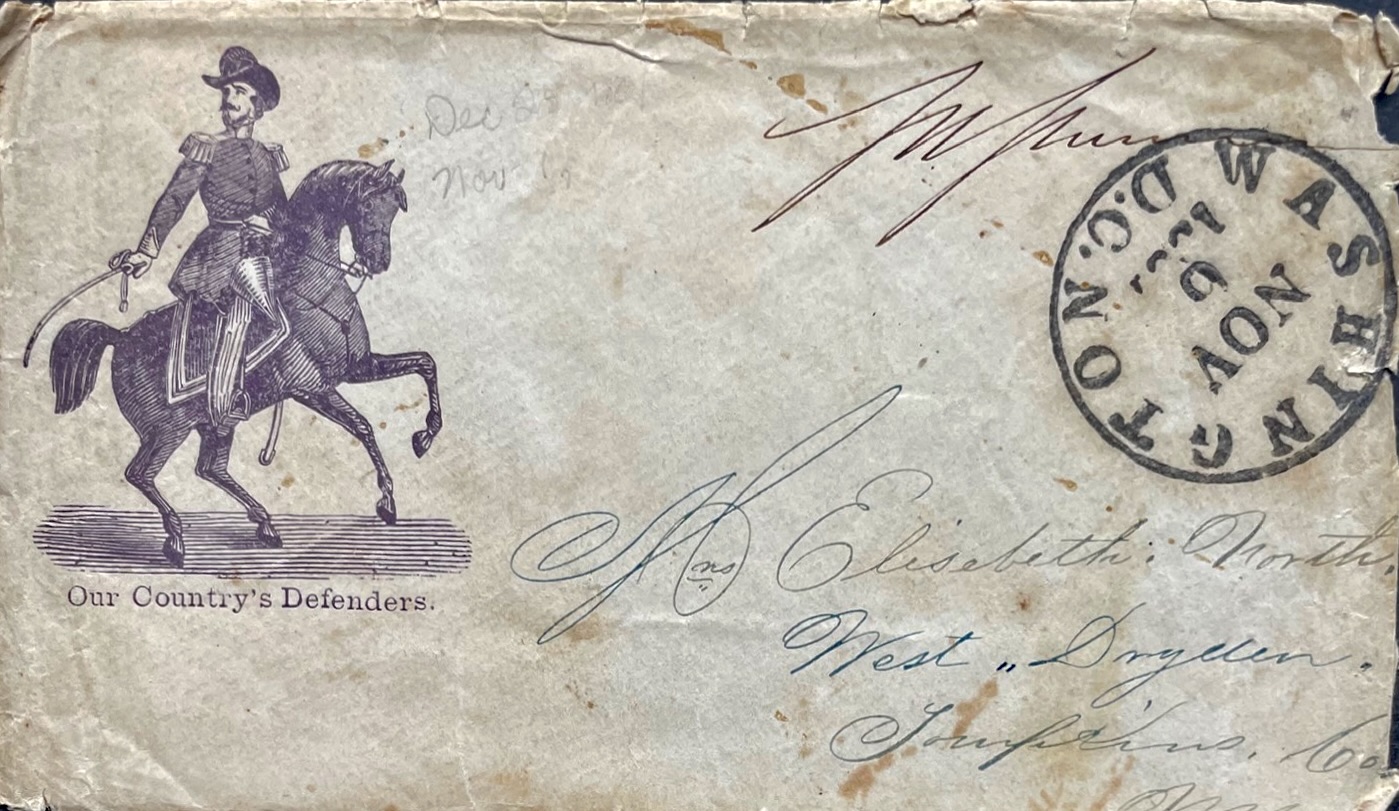
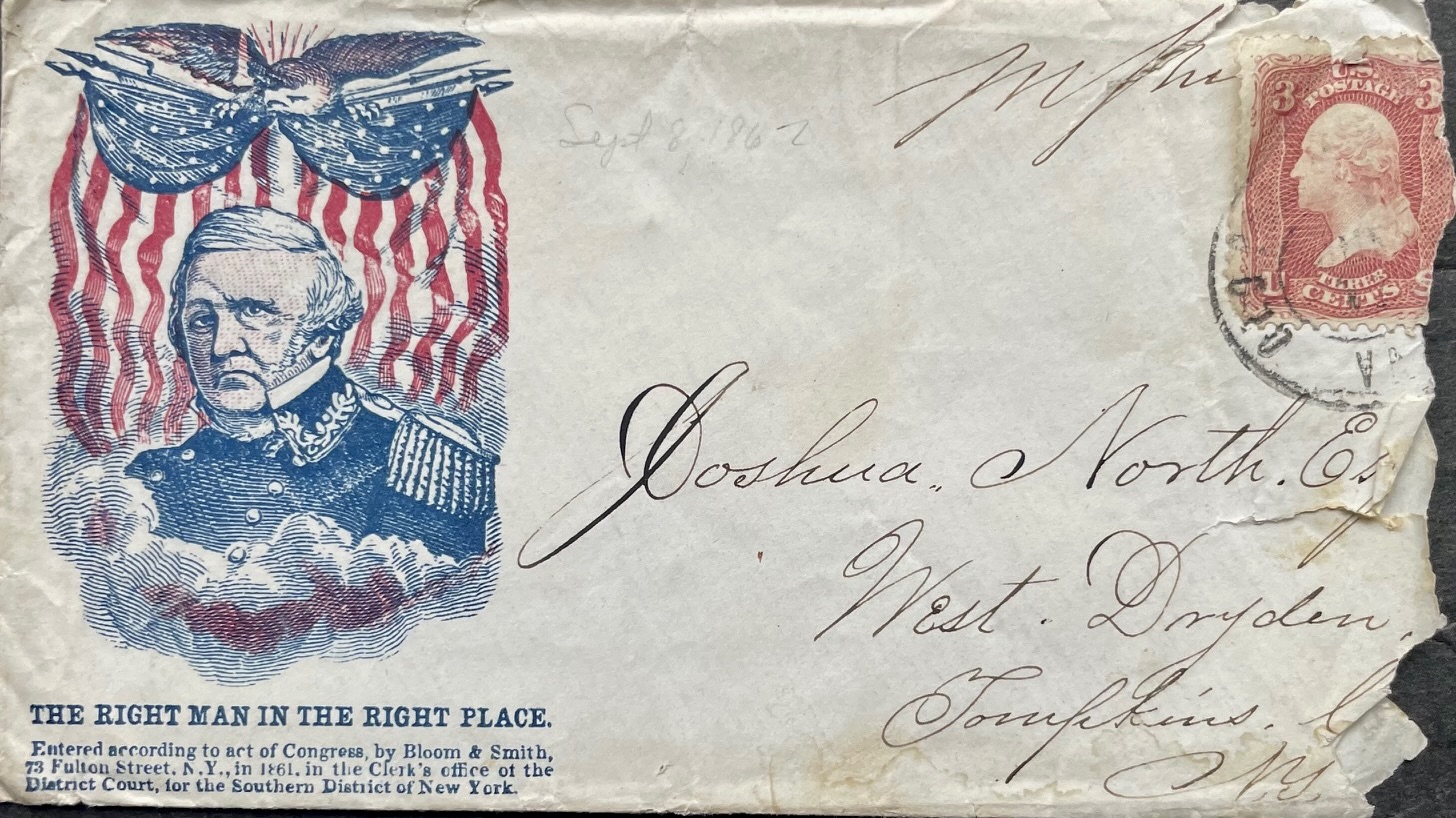
Addressed to Mrs. Elizabeth North, West Dryden, Tompkins county, New York
Camp McClellan November 1, 1861
Dear Grandma,
It has been a long time since I received your very kind epistle and I should of answered it long ere this had it not been that I had been so busy that I could not find time to write. I am quite healthy at present. My throat has got well and does not bother me any more. Our company are all well and in good spirits. I hope that this epistle will find you and family enjoying the best kind of health. There is not anything equal to good health in my estimation.
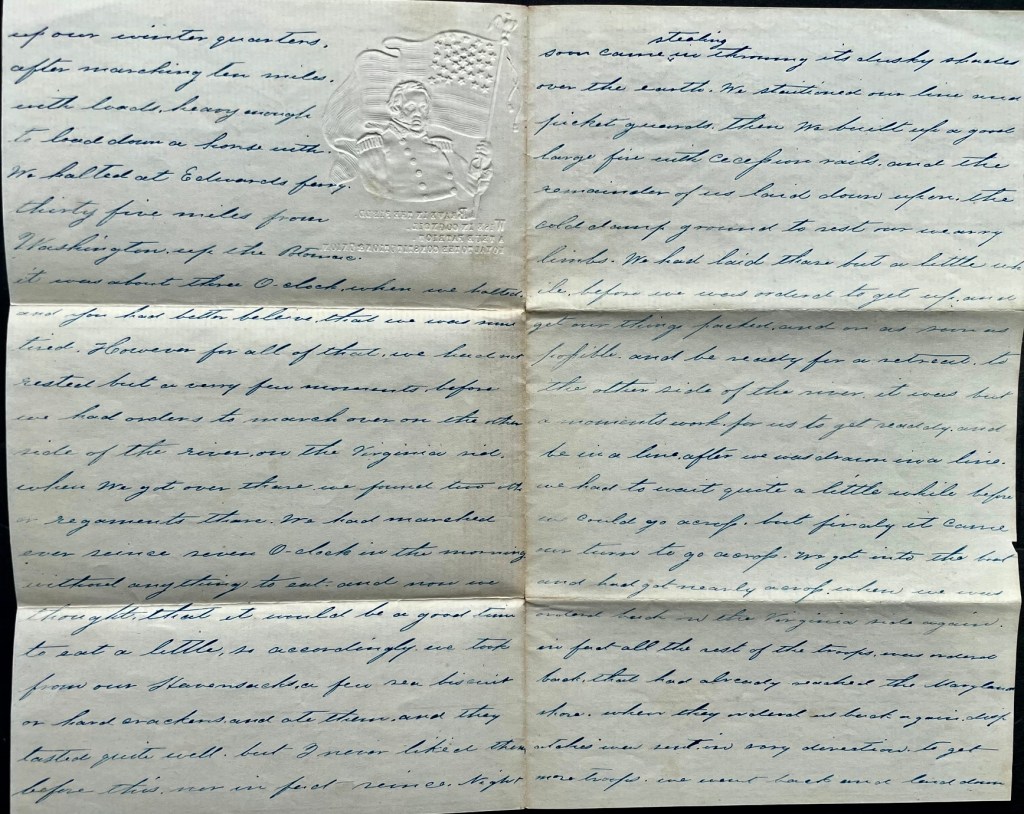
One week ago last Monday we packed up our knapsacks and other fixings too numerous to mention for a long and weary march. We was going somewhere to join the rest of the brigade and take up our winter quarters. After marching ten miles with loads heavy enough to load down a horse with, we halted at Edwards Ferry, thirty-five miles from Washington up the Potomac. It was about three o’clock when we halted and you had better believe that we was some tired. However, for all of that, we had not rested but a very few moments before we had orders to march over on the other side of the river—-on the Virginia side. When we got over there we found two other regiments there.1 We had marched ever since seven o’clock in the morning without anything to eat and now we thought that it would be a good time to eat a little. So accordingly we took from our haversacks a few sea biscuit or hard crackers and ate them and they tasted quite well. But I never like them before this, nor in fact since.
Night son came stealing in, throwing its dusky shades over the earth. We stationed our line and picket guards. Then we built up a good large fire with secession rails, and the remainder laid down upon the cold, damp ground to rest our weary limbs. We had laid there but a little while before we was ordered to get up and get our things packed and on as soon as possible and be ready for a retreat to the other side of the river. It was but a moment’s work for us to get ready and be in a line. After we was drawn in a line, we had to wait quite a little while before we could go across but finally it came our turn to go across. We got into the boat and had got nearly across when we was ordered back on the Virginia side again. In fact, all the rest of the troops was ordered back that had already reached the Maryland shore. When they ordered us back again, dispatches were sent in every direction to get more troops. We went back and laid down and went to sleep.
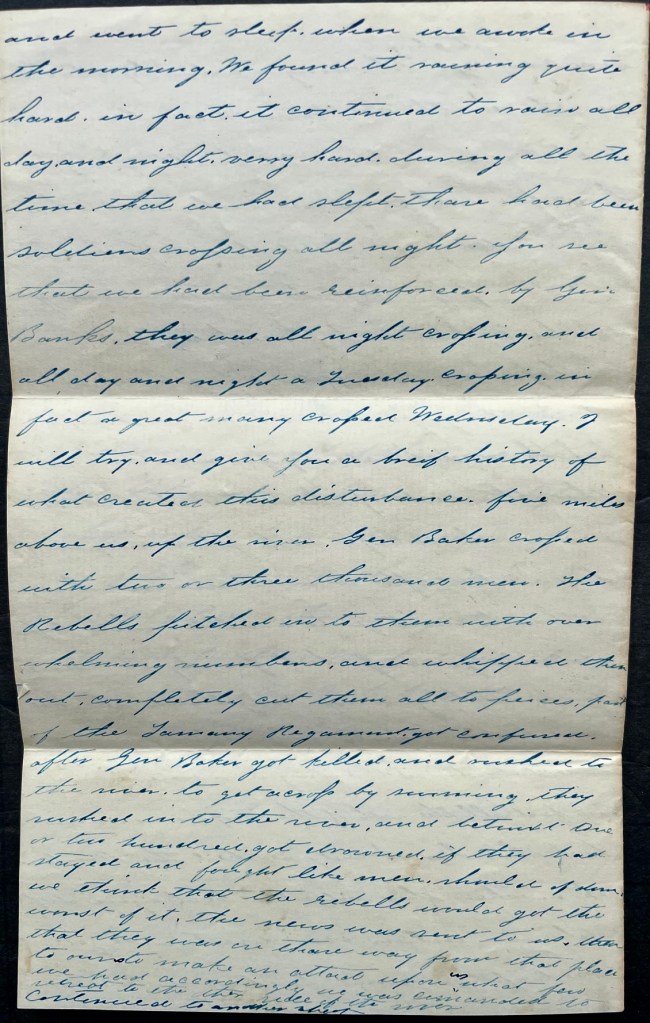
When we awoke in the morning, we found it raining quite hard. In fact, it continued to rain all day and night very hard. During all the time that we had slept, there had been soldiers crossing all night. You see that we had been reinforced by Gen. Banks. They was all night crossing and all day and night a Tuesday crossing. In fact, a great many crossed Wednesday.
I will try and give you a brief history of what created this disturbance five miles abofve us, up the river. Gen. [Edwin Dickinson] Baker crossed with two or three thousand men. The Rebels pitched into them with overwhelming numbers and whipped them out, completely cut them all to pieces. Part of the Tamany Regiment got confused after Gen. Baker got killed and rushed to the river to get across by swimming. They rushed into the river and betwixt one or two hundred got drowned. If they had stayed and fought like men should of done, we think that the rebels would got the worst of it. The news was sent to us then that they were on their way from that place to ours to make an attack upon us—what few we had. Accordingly we was commanded to [retreat]. But as good luck would have it, we was not molested during the night.
The death of Gen. Baker at the Battle of Balls Bluff, 21 October 1861
Tuesday it was very cold and rainy. Also muddy. I can tell you one thing and that is it pleased the privates to see the officers take it. They was around all day a shivering and shaking and their nice uniforms all covered with mud. The highest officer in the lot had no better fare than the privates did. They had to stand and take the rain and eat those hard crackers. I tell you, it went pretty hard with them. But us privates made the secession hog and cattle suffer. There must of been some fifty or sixty hogs shot besides fifteen or twenty cattle shot by our troops within twenty-four hours time, and we used secession rails to cook our meat with and to warm us with. We also converted five or six stacks of good unthrashed wheat straw to our use. We had permission by headquarters to help ourselves to what we could find when we got on the sacred soil and I think that we obeyed those orders to the fullest extent. We used and destroyed about two thousand dollars worth of stuff that belonged to the Rebel farmers. I think that they will remember the 34th [New York] for sometime. Also the rest of the regiments that was there with us.
But we soon had some fun about four o’clock Tuesday afternoon. We had our reserve force down to the river and our pickets upon the hill a quarter of a mile from the reserve, and still we had our advance pickets at the edge of the woods about a hundred rods from our other pickets. And all at once, we heard the most hideous yells that you ever heard and at the same instant we heard the report of guns and we looked and saw about three thousand rebels coming at us. Our picket was in a line. Also the reserve was in a line. We was all in fact in a line in a moment’s warming and commenced to return the fire. All at once our artillery opened upon them and you ought to of seen them retreat. They went in every direction. Some lost their guns and one of the drummers lost their drums. They wounded the general of our cavalry. His name was Gen. [Frederick William] Lander. He was wounded in the leg. He will probably recover soon. We had one man that belonged to the Minnesota 1st killed. After they shot him, they run their bayonets into his breast in the most brutal manner. 2
We killed a good man of their men. We cannot tell how many of their men that we killed but we must of killed a great many from the fact they was quite a spell a picking up their dead and wounded. You see that our shells from our two pieces of artillery raised hob with them. They had about two thousand men back in the woods as a reserve so as to rush in upon us. If they had of come upon us, they would of been very likely to of whipped us out for we had only about three thousand troops and they was all scattered around and there was no possible chance for us to retreat from the fact that we could not get across the river. But our artillery saved us.
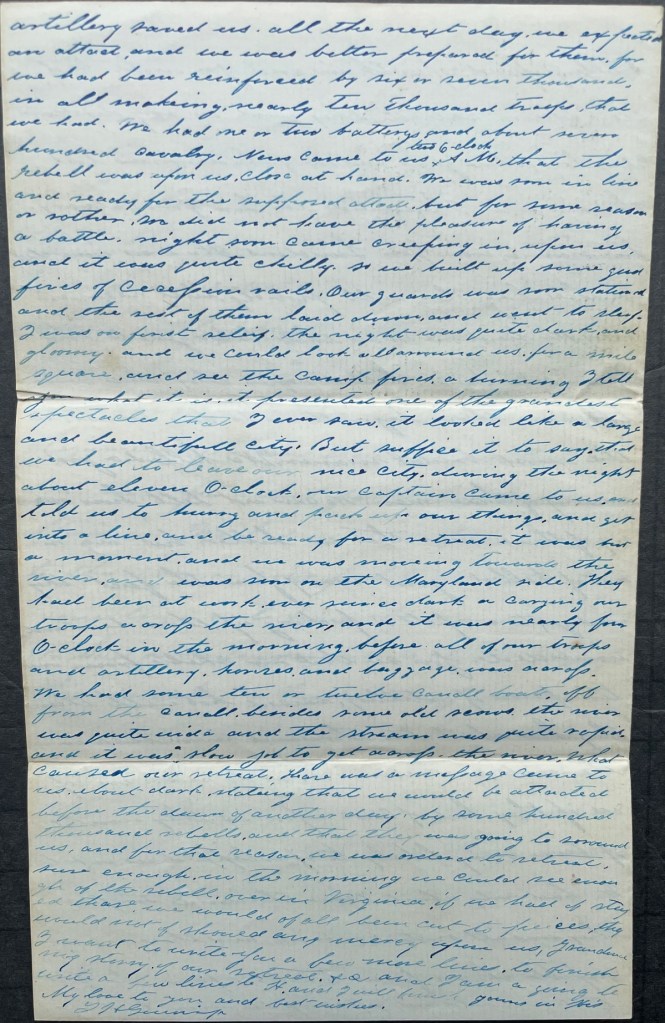
All the next day we expected an attack and we was better prepared for them for we had been reinforced by six or seven thousand, in all making nearly ten thousand troops that we had. We had one or two batteries and about seven hundred cavalry. News came to us about 6 o’clock a.m. that the rebels was upon us, close at hand. We was soon in line and ready for the supposed attack, but for some reason or another, we did not have the pleasure of having a battle.
Night soon came creeping in upon us and it was quite chilly so we built up some good fires of secession rails. Our guards was soon stationed and the rest of them laid down and went to sleep. I was on first relief. The night was quite dark and gloomy and we could look all around us for a mile square and see the camp fires a burning. I tell you what, it presented one of the grandest spectacles that I ever saw. It looked like a large and beautiful city. But suffice it to say that we had to leave our nice city. During the night about eleven o’clock, our captain came to us and told us to hurry and pack up our things and get into line and be ready for a retreat. It was but a moment and we was moving towards the river and was soon on the Maryland side. They had been at work ever since dark a carrying our troops across the river and it was nearly four o’clock in the morning before all of our troops and artillery, horses, and baggage was across.
We had some ten or twelve canal boats off from the canal besides some old scows. The river was quite wide and the stream was quite rapid and it was a slow job to get across the river. What caused our retreat? There was a message came to us about dark stating that we would be attacked before the dawn of another day by some hundred thousand rebels and that they was going to surround us and for that reason we was ordered to retreat. Sure enough, in the morning we could see enough of the rebels over in Virginia, if we had of stayed there, we would of all been cut to pieces. They would not of showed any mercy upon us.
Grandma, I want to write you a few more lines to finish my story of our retreat & I am going to write a few lines to H and I will finish yours in his. My love to you and best wishes. — T. H. Guinnip
1 The two regiments belonged to Gen. Gorman’s Brigade, Gen. Stone’s Division); they were the New York 2nd and the Minnesota 1st.
2 The unfortunate soldier in the 1st Minnesota, Co. I, was Lewis F. Mitchell of Wabasha County. Lewis received two bayonet wounds through the chest according to a surgeon’s report. Sgt. Charles Davison of Co. G wrote of the skirmish on 22 October 1861 as follows: “Last eve, one hour and a half before dark, a couple of regiments of rebels marched up into the woods and surprised our skirmishers. When eight rods off a “secesh” rose up and hollood to one of our men, who had just deployed and were ready to advance: ‘Don’t be alarmed, boys, there is not a ‘sesech’ within three miles,’ and immediately they ran up and fired. The skirmishers immediately opened and let our two pieces of artillery throw shell, grape, and cannister amongst them, which was done promptly and rapidly. At the same time a company of Sharpshooters —the Tiger Zouaves, of Boston—peppered away at them. It soon silenced them. All this time, the Minnesota First and other forces along the river were standing in line prepared for an emergency. Among the regiments here are the New York 2nd, Indiana 16th, and a Pennsylvania regiment. In the skirmish, Gen. Landers was wounded in the calf, and Mitchell, of Company I, was killed. Both legs were broken, a bullet through his head, and the brutal rebels not being satisfied with that, thrust a bayonet through his neck. He was missing last night, but was not found until this morning, and has just been taken over the river.”Sources: The Central Republican, Faribault, Mn, Wed, Nov 6, 1861, p 2.; History of Stearns County. Biographies & Historical Sketches of Wabasha County, Minnesota.
Letter 2
Addressed to Mrs. E. North, Ludlowville, Tompkins county, New York
Camp McClellan Near Poolesville [Maryland] December 9th 1861
Dear Grandma,
Through kind Providence I seat myself down once more to reply to your very welcome letter which came at hand in due seasons, and was read with the greatest pleasure, and the advice which was in it, was duly accepted, and I hope that I always shall abide by it—at least I shall try hard. I do not know how I ever shall repay you and Uncle North for the good advice that you have been so kind, both of you, in offering. It all has come very acceptable, and I think that I have taken all advice with a good cheer and profit by it.
My health is improving quite fast. I am getting so fat that you would hardly recognize me if you should see me. I have had quite a hard cold for a week or two and cannot speak above a whisper but that’s nothing, for about half of the regiment have hard colds. That’s nothing—no more or less than what we have at home. Two more members of our company deserted a night or two ago. I would not give much for the peace that a few miserable deserters will get. It is poor business, if ever so well followed. Let the consequences be what they might. I should never make an attempt to forsake my country’s flag and let it be trampled beneath the feet of the enemy. Let us do our duty and remember what we left our peaceful home and friends for. I can go home any time that I take a notion to, and I have ben advised to do so by members of the company. Even our captain advised me to go home. But as long as I am able to get around, I would much rather be here, trying to render my beloved country some good, than to be laying around Addison. But if I commence to come down any this winter, I shall go home. I think some of obtaining a furlough of a month and go home. I should like to see my folks very much. I’ll warrant you that I think as much of my friends as anyone else does of their friends, but as for being real homesick and faint-hearted, that does not both me any. I think that I’m going to know what soldiering is.
It has been cold, wet, muddy and disagreeable weather here until within the last past week, which has been beautiful and appears like our Indian Summers at the North. I tell you what it is, these little tents of ours are cold and uncomfortable these cold frosty nights. I tell you, it makes a person get in all kinds of shapes to stand on guard these cold nights.
We are a having a brigade drill this afternoon. It is one of the grandest sights that I ever saw. It comes off every Monday afternoon and every Wednesday afternoon we have brigade inspection, and have their shoes blacked up and their brass scoured up. The brigade has their new uniforms which is very nice and you better believe that it is a beautiful sight to see the whole brigade out consisting of four regiments—some four thousand men, dressed all up alike parading around and the officers looks nice, all mounted on their charges. It would pay anyone that never saw sich a sight to go a hundred miles to see it. I have often wished that you and Uncle might pop in some time and see what a nice little house I have. It is said that I have got the nicest tent in the lot and the best arranged one—neatest and cleanest. There is four of us in it and my tent mates are all fine fellows and we live high for soldiers. We spare no pains nor money, but we have roast turkeys, oysters, chickens, cakes, pies, and other luxuries too numerous to mention. It cost Uncle Sam but little for what we eat, but cost us a good deal.
Grandma, I am going to write Mr. North or I would write more to you. Accept my best wishes, &c. — T. H. Guinnip.
Letter 3
Addressed to Mrs. Elisabeth North, West Dryden, Tompkins county, New York
I wish you all a Merry Christmas and a Happy New Year, Grandma. I thought that I would write you a few more lines while I was about it. We are having so much duty to do now days that we have to do our writing nights, and we hardly get to writing before the drum beats the reveille for us to fall in for roll call, and in a few moments after that, the drums beats the taps for the lights to be extinguished, and the officer of the day goes all through the camp and if he finds any lights burning, it is his duty to put the ones that is using them in the guard house. But they cannot fool this chicken much. When I hear the approach of the footsteps of the officer of the day, I put the light in under a large cap that I have, and when his footsteps recede, then I take the cap off from the candle as if nothing had happened. But if they should catch us at it, good day…
It is nearly one o’clock at night, but then we all so enough every day to get put into the guard house. But the inmates of the guard house has never been honored with my presence yet. I hope that they never will be either. Our company has had the least men in the guard house of any company in the regiment. But then we have played a great many [ ] service. We have been soldiering.
Grandma, if there is any one of you up that speculate much, you can tell them there they can mark their future down here. I will give you a list of the prices of things down here. Apples is worth from eight to eleven dollars per barrel. Butter is worth 30 cents per pound. Cheese at 20 cents. Eggs 30 cents per dozen, and in fact, everything is in like proportion to the above named articles. I paid ten cents for two common sized apples the other day. I told you that I would give you a list of the things that we have been given in the army—four pair of pants, four pair drawers, 4 pair of socks, two pair of shoes, four shirts, one every day coat, and one nice dress coat. Them things that I have just mentioned are good, woolen goods, one [ ] or dozen collars as we call them. They are made of leather, one knapsack, one haversack, one canteen, one cartridge box, one cap box, bely and bayonet sheath, one gun, and bayonet, and there is other things that we have had that I cannot think of now. Oh, we have had one cap and one nice belt with all of the trimmings on. You can see that it costs Uncle Sam quite a sum to clothe and furnish one man with all of his equipage necessary for a soldier. What must it cost to fit up seven hundred thousand men ready for service? I am afraid that it would make a poor man of us to take care of so many men.
Tell Horatio that Fairfield Smith has been sick for a great while and is quite feeble and has just got a furlough and started for home this morning. Tell Mr. North that I can not find that regiment that his grandson is in, but that I will not give up the idea of ferreting him out for I feel sorry for the poor [ ] not getting letters from his friends, &c. I think that after a while that I will run across him.
Well there Grandma, this is rather the dullest and coldest Christmas that I ever spent before in my life. I could get along a standing on guard today provided that I could get something good for my Christmas dinner, but that is out of the question. We have run rather short of provision for a few days back but as a general thing we have no reason to complain for we love good enough for soldiers. To be sure, if we was at home, we would want to live better, but there is a great many poor at the North that does not begin to live as well as the soldiers. We may read the annals of history and we cannot find where that there has been an army yet of so soon, and armed, and as well fed and clothed as the present army is.
I must bring my letter to a close for now it is after one and I have yet to go out on guard. Please excuse this poor writing. I am in such a place that I can hardly write. Please give all of our friends out your way my best wishes and love and tell them that I am well, tough and hearty, and like soldiering first rate. I would not be much surprised but what we will be in a battle ere this letter reaches you. If we do, I will try and kill a secesh for you and Uncle North. Give all of your family my love and regards, and please write soon. Eat a good New Year’s dinner for me. Accept of my love, — T. H. Guinnip
Letter 4
Addressed to Joshua North, Esq., West Dryden, Tompkins county, N. York
Camp McClellan, N. Y. S. V. December 25th 1861
Joshua North, Esq.
Much esteemed friend, having a few liesure moments to spare, I sit down to reply to your very kind and welcome letter that came to hand in due season. It found me well and in good spirits and I hope that the epistle will find you the same. I also hope that you will find this letter as interesting to you as yours was to me.
Things are quite at a stand still here on the Potomac at present, but probably will not be so for a great while. I think that the Army of the Potomac will make an attack upon Leesburg before a great while. There is estimated to be nearly four hundred thousand of our troops on the Potomac now ready at a moments warning to make an attack upon the rebellious, and still we are making preparations all of the while for a battle. McCall’s Division is on their march over in Virginia and they are nearly opposite of us at Edward’s Ferry where I think that they intend to encamp for a while. Some thinks that they intend to attack Leesburg adn we that is on the Potomac will be kept as a reserve for them to fall back on. And others think that we will be sent in advance of McCall’s Division and keep them as a reserve. But I think that we will make an attack upon Leensburg with our division, or in other words Gen. Sturgis [?] Divsion. That being the case, Co. E will be pretty apt to see some pretty hardd fighting for our regiment will be in the center of the brigade near the colors. The Minnesota 1st is on the right flank, and the New York 2nd is on the left flank. Our company are the first company right of the colors so you can plainly see that we occupy a precarious position.
But for all of that we are not much scared yet. For my part, I am ready any time for to do my best to help put down this accursed rebellion. Orders was read on dress parade a few nights ago for every captain to have his company ready for a march at a moment’s warning. Accordingly, the captains of the different companies have their companies orders to have their knapsacks all packed and everything ready for a march at a moment’s warning. We have been aroused from our profound slumbers and sweet repose a number of times lately to go down at the river, a distance of two miles, for the pickets would get an idea that the enemy was a crossing and would send up a message to the camp, and every time that there is an alarm made, they are sure to send our company off to see and find out the cause of the alarm. I sometimes think that maybe we are considered the bravest company in the regiment. Then again, I will think that maybe they want us to get killed off. But that does not worry us much.
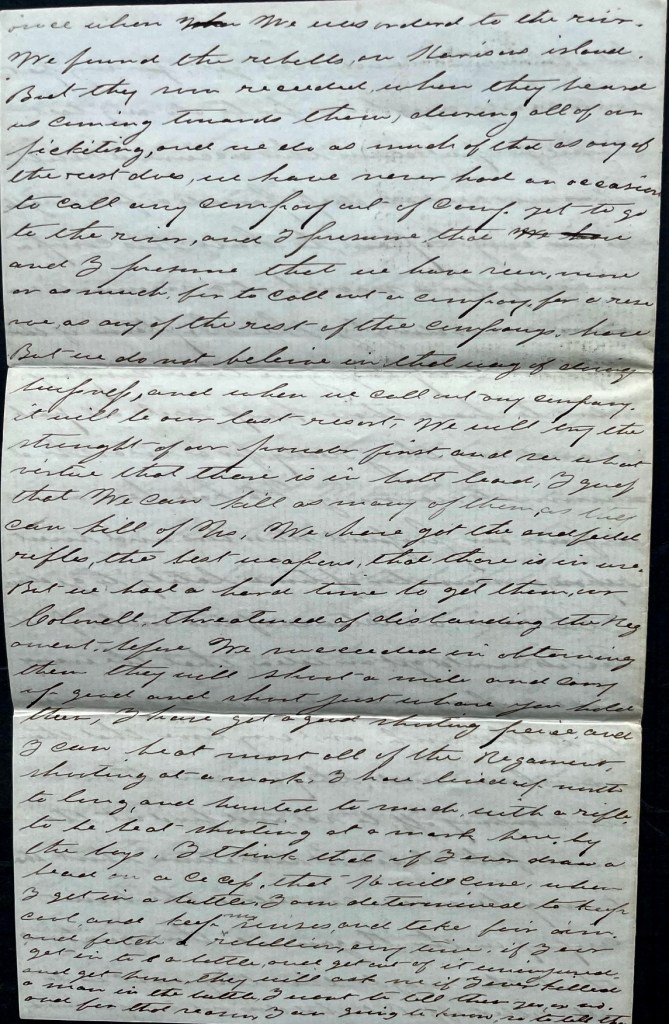
Once when we was ordered to the river, we found the rebels on Harrison’s Island. But they soon receded when they heard us coming towards them, clearing all of our picketing, and we do as much of that as any of the rest does. We have never had an occasion to call any company out of camp yet to go to the river and I presume that we have seen more, or as much, for to call out a company as any of the rest of the companies have. But we do not believe in that way of doing business and when we call out any company, it will be our last resort. We will try the strength of our powder first and see what virtue that there is in hot lead. I guess that we can kill as many of them as they can kill of us.
We have got the Enfield rifles—the best weapons that there is in use. But we had a hard time to get them. Our Colonel threatened of disbanding the regiment before we succeeded in obtaining them. They will shoot a mile and [ ] and shoot just where you hold them. I have got a good shooting piece and I can beat most all of the regiment shooting at a mark. I have lived up north too long and hunted too much with a rifle to be beat shooting at a mark here by the boys. I think that if I ever draw a bead on a secesh, that he will [ ]. When I get in a battle, I am determined to keep cool and keep my senses and take fair aim and fetch a rebellion every time. If I ever get into a battle and get out of it uninjured and get home, they will ask me if I ever killed a man in the battle, I want to tell them yes, and for that reason I am going to know, so to tell them.
I think that this war will be of a short duration if England does not interfere for we have got the enemy in pretty close quarters. Those here ain’t got much room to play in. We have got them very near surrounded and will soon whip them out. The intention of our folks is to starve them out. Also make them a great exposure. We do this in order to lose as few lives as possible and spill as little blood as they can. If foreign powers pitch in, it will be a general war throughout the whole globe. If England intercedes in behalf of the Southern Confederacy, I am in during the war if it lasts forty years. For my part, I cannot see why foreign powers cannot tend to their own business and not mind other folks business and be a meddling that which ought not to concern them. But England has been trying to pick a muss with the United States for a great while by catching the [paper creased and words illegible] and now she can pitch in and we will soon clean her out. I hope that the government will never be unwise and foolish enough to give up Slidell and Mason. Let the British Lion pick a fuss as soon as she sees fit and we will take what little conceit out of her that she possesses by letting the American Eagle loose which will pitch at her in such a power that will not be imaginable to Her Majesty. By the time that the Eagle pecks her eyes out, the Lion will give one piteous growl and lay down in the dust to be trampled beneath our feet—the feet of a Republican Government. Never again will she reign over our enlightened people, but will sink forever in the waters of oblivion, never to rise again. And then we will give three cheers and hoist the stars and stripes over the grave of the British Lion, and then what a rejoicing there will be throughout the land…
For my part, I do not think that England will be foolish enough to declare war against us. If she does, France, Ireland, and other dominions stand ready to lend us a helping hand, if needed, and I think they will pitch into England whether we want them to or not. They have been trying to get a chance at her and I guess that they will succeed this time in producing the desired effect. All of the way that England can fight us is by water and we can blockade the ports and we have got plenty of the best kind of material and good workmen and soon will have as good, if not better, navy than hers. Then we will meet them halfway and I guess that we will give them as much as they can stand. I think then they will begin to learn to take a joke by that time. I noticed in the paper that Gen. Scott had just arrived safely in Washington. I wonder what arrangements that he made with France while he was gone. We will hear soon probably.
I cannot see as Congress is doing anything much about this warfare. For some reason or other, they do not accomplish much.
There has been two that has deserted [from] our company lately’ one by the name of Andrew Smith, and one said drunkard. I hope that when I desert from the good adn glorious cause that I am engaged in, that some kind friend will shoot me and they will do me a great kindness in doing so. For my part, I cannot see how rational a war that pretends to be perfectly consistent with the loss of his country, and is a lover of his country, and likes his liberty, and thinks anything of himself and friends can forsake his friends, home, and come down here and enlist in this glorious cause to serve his country, and help raise the insulted flag back again out of the dust to its former position, and not findings things quite as nice and comfortable as he supposes that he would previous to leaving home and joining the army also finding that the enemy about rather careless and pints their guns at a fellow, gets scared out and deserts. Yes, I say again deserts. That word might not be in the english language, especially at present. I say in the english language of the past, oh foolish, foolish man, hast them no shame, nor respect for thyself nor thy friends? [more on desertion]
Please give all of your family my love and accept of the same yourself, — T. H. Guinnip
Letter 5
U. S. General Hospital Annapolis, Maryland November 22nd 1862
Dear Brother,
I have to acknowledge the receipt of your kind note of the 20th inst. and hasten to answer it. I am delighted to learn that you all are in the enjoyment of health & happiness. Health is one of the greatest blessings that we can be in possession of, and little do we appreciate its value until we come to be deprived of it. I sincerely hope that you all may continue to enjoy that great blessing of health. I am in hopes that I shall be enabled soon to join my regiment. My health is fast improving. I got ready to rejoin my regiment last Monday but the doctor would not allow me to leave. He said that I was not sufficiently recovered from the effects of my wound for to rejoin the regiment and that when he thought proper, that he would let me go.
You informed me that there is a company being organized in Addison which is called the National Guards, which James McKay has the honor of being Captain of. I think this company has made a good selection of a man for its captain adn in fact, they might of searched the town of Addison through & through and a better man for a captain they would not of found. You say that this company is to rendezvous at Elmira for the purpose of guarding fords, prisons, & drafted men, that they get ten shillings per day for their services & everything found, including clothes, rations, &c. You furthermore state that you wish to become a member of his company but Ma will not give her consent to have you enlist. I think Ma had better let you join that company. You say that they cannot transfer you from the State service to the United States service and if that be true, why of course Ma had ought to give her consent to let you enlist. But before you enlist (that is, if Ma should give her consent to let you enlist), investigate the thing thoroughly. Do not leap too soon. So not allow them to play roots [a ruse?] on you by making you believe that the company cannot be transferred over to the United State service. they sometimes say a great many nice and pretty things in order to get men to enlist in the army and when they enlist and come to try the realities of a soldiers life, they find things altogether different from what they was represented to of been.
In military, you cannot tell what you will do or what you will not do for in the military regulations, there is no such words as can’t, won’t, &c. Military discipline is very strict and well it should be for what would an army amount to without good discipline. The regulations of this large army have got to be obeyed and adhered to in order for us to meet with future success. It has been through want of discipline & the lack of competent officers that we have not succeeded ere this of putting down the rebellion. Moreover, let me state that we have been ill favored with a great many traitors in our army and when shall we get rid of them? I hope soon but fear never.
If the boys succeed in getting good officers commissioned & non commissioned officers as they have in electing their captain, I trust that they will have a good company. I think that now is a good & grand chance for you to enlist. In fact, it is the best chance for enlisting that I have heard of. Your pay is good. You will get a good uniform. Your rations will be good. You will have good, comfortable quarters to stay in. In fact, you will have a good times and have everything comfortable, and by all means, Ma had ought to let you join that company. You would not have to suffer as they do in the army. Our life here is fraught with danger. We have hardships to meet, fatigues to undergo, death to encounter, huger and thirst to endure, obstacles to surmount, and battles to fight & victories to gain. Yet the consciousness of an righteous cause, the holiness of its claims, and the certainty of our ultimate triumph, cheers, animates, and inspires us to continual and persevering efforts till the rebellion is crushed and the cause of our government is completely triumphant. But should it be my fate to fall, I can go to my early grave without a murmur, and consoled that, “They who for their country die, will fill an honored grave; for glory lights the soldier’s tomb, and beauty weeps the brave.”
Sam Kimball is here with me now. He came down from the parole camp to see me. He is as full and tough as a bear. And I think that you will see him before a great while for he says that he is going home this week sometime.
I am very sorry to learn that Captain Henry Baldwin is so very low. When you write to me again, please let me know where he is and if he is getting any better than he was at the time you wrote to me before. John Campbell owes me $1.87. Lyman Deland owes me 56 cents and if you will get it for me you may have it. If they have got the money, they will let you have it.
Horatio, I guess that I shall have to write to you hereafter for the rest of our folks do not care about writing to me for some reason unknown to me & best known to theirselves. As for Adelia, she has never wrote me a word since I left home. I guess that Maggy is mad at me for something or else she would write me a few lines occasionally. You say that Ma is a regular secesh and says that this is an unjust war. Well, she tells the truth. This I believe myself to be an unjust wicked rebellion, but on our part. I think that it is the most just but at the same time, both North and South, are in the wrong—especially the South. I am very sorry indeed to hear you find so much fault with McClellan. You Northern people who have never been in under his command here in the army know nothing about him at all. We soldiers who have served under him like him, and had the utmost confidence in his ability to of put down the rebellion provided he had not of been thwarted by politicians and other [ ] men who stand high in the influence of the government but who are hostile to McClellan and as a consequence an enemy to the country, its prosperity, & people. Under such circumstances, how could we expect him to accomplish his undertakings to put an end to the rebellion.
We have good confidence in General Burnside & hope that he will meet with success in bringing this wicked war to a termination. That is the best and worse wish that we can wish him. It makes no difference who brings this accursed rebellion to a close if it is only done, but for all. McClellan was the right man in the right place. Please excuse all errors & imperfections & remember me to all enquiring friends. Hoping this will find you in good health, I have the pleasure to remain your brother, — Thos. H. Guinnip
Letter 6
U. S. General Hospital Annapolis, Maryland December 1, 1862
Joshua North, Esqr.
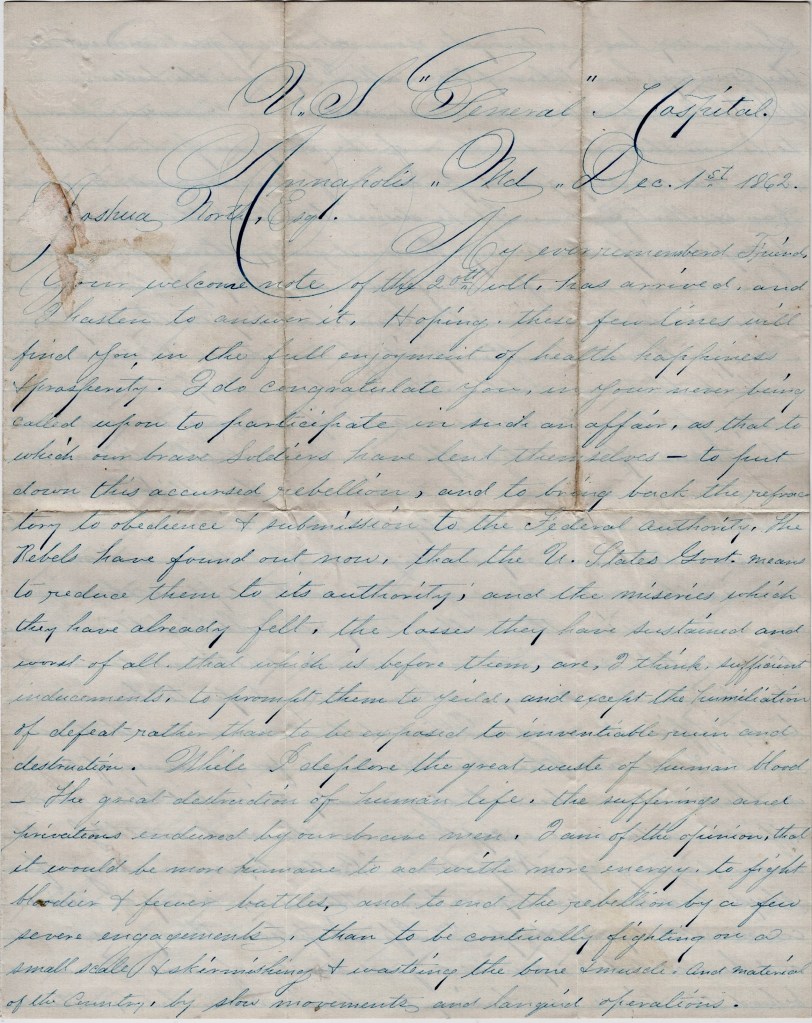
My ever remembered friend, your welcome not of the 20th ult. has arrived and I hasten to answer it, hoping these few lines will find you in the full enjoyment of health, happiness & prosperity. I do congratulate you in your never being called upon to participate in such an affair as that to which our brave soldiers have lent themselves—to put down this accursed rebellion, and to bring back the refractory to obedience & submission to the Federal authority. The Rebels have found out now that the U, States Govt. means to reduce them to its authority, and the miseries which they have already felt, the losses they have sustained, and worst of all , that which is before them, are, I think, sufficient inducements to prompt them to yield and accept the humiliation of defeat rather than to be exposed to inevitable ruin and destruction. While I deplore the great waste of human blood, the great destruction of human life, the sufferings and privations endured by our brave men, I am of the opinion that it would be more humane to act with more energy to fight bloodier and fewer battles and to end the rebellion by a few severe engagements than to be continually fighting on a small scale & skirmishing & wasting the bone & muscle and materiel of the country by slow movements and languid operations.
Since my last writing to you, changes of great moment to the country have taken place, all I hope for the better. McClellan has been removed and Gen. Burnside seems to be now the general favorite of the army. In particular Burnside has already given promise of being a good General and an excellent fighter. If he desires to retain the affection & confidence of the ARmy, he must gratify them with fighting. Our men are eager for the fray and they prefer death in action to inglorious indolence and loitering in the camps. This speaks well for the spirit of our brave soldiers. I think that our soldiers have shown a spirit not unworthy of their ancestors, and if we are cursed with the presence of worthless officers, let not the defeat which our arms have experienced be attributed to the men in the ranks. Only let worth & valor be encouraged & rewarded, and my word for it, that there are men now in the ranks who as generals will yet plant their victorious banners on the walls of every rebel stronghold in Dixie. But until such encouragements is held out to worth & valor in our Army, we can never hope to have a truly efficient army. What doth it avail us that our rank & file are the best materials for an army of any in the world, when it is generally conceded that our officers with rare exceptions are the most worthless. It wsa a saying of Napoleon, “Better have an army of sheep commanded by a lion, than an army of lions commanded by a sheep.” If Napoleon’s theory was correct and he was looked upon as a good master of war, then we are behind the times in having our brave men led by imbeciles.
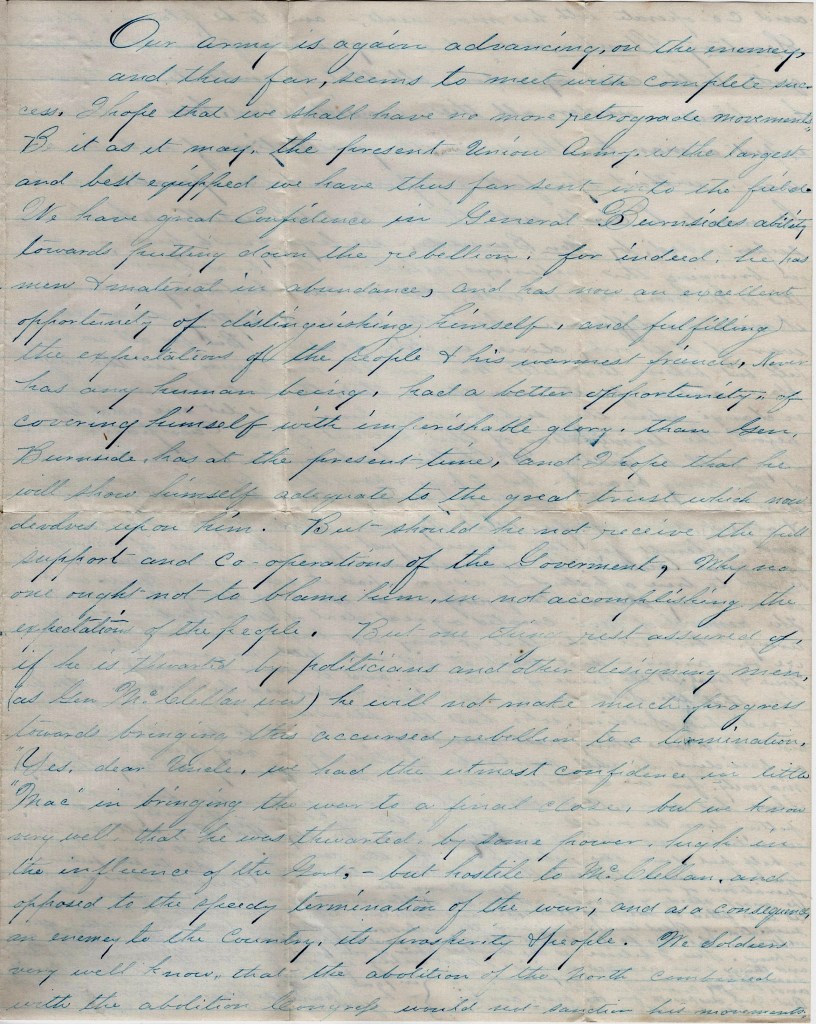
Our army is again advancing on the enemy and thus far seems to meet with complete success. I hope that we shall have no more retrograde movements. Be it as it may, the present Union Army is the largest and best equipped we have thus far sent into the field. We have great confidence in General Burnside’s ability towards putting down the rebellion for indeed, he has men and materiel in abundance, and has now an excellent opportunity of distinguishing himself and fulfilling the expectations of the people and his warmest friends. Never has any human being had a better opportunity of covering himself with imperishable glory than Gen. Burnside has at the present time, and I hope that he will show himself adequate to the great trust which now devolves upon him. But should he not receive the full support and cooperation of the government, why no one ought not to blame him in not accomplishing the expectation of the people. But one thing rest assured of, if he is thwarted by politicians and other designing men (as Gen. McClellan was) he will not make much progress towards bringing this accursed rebellion to a termination.
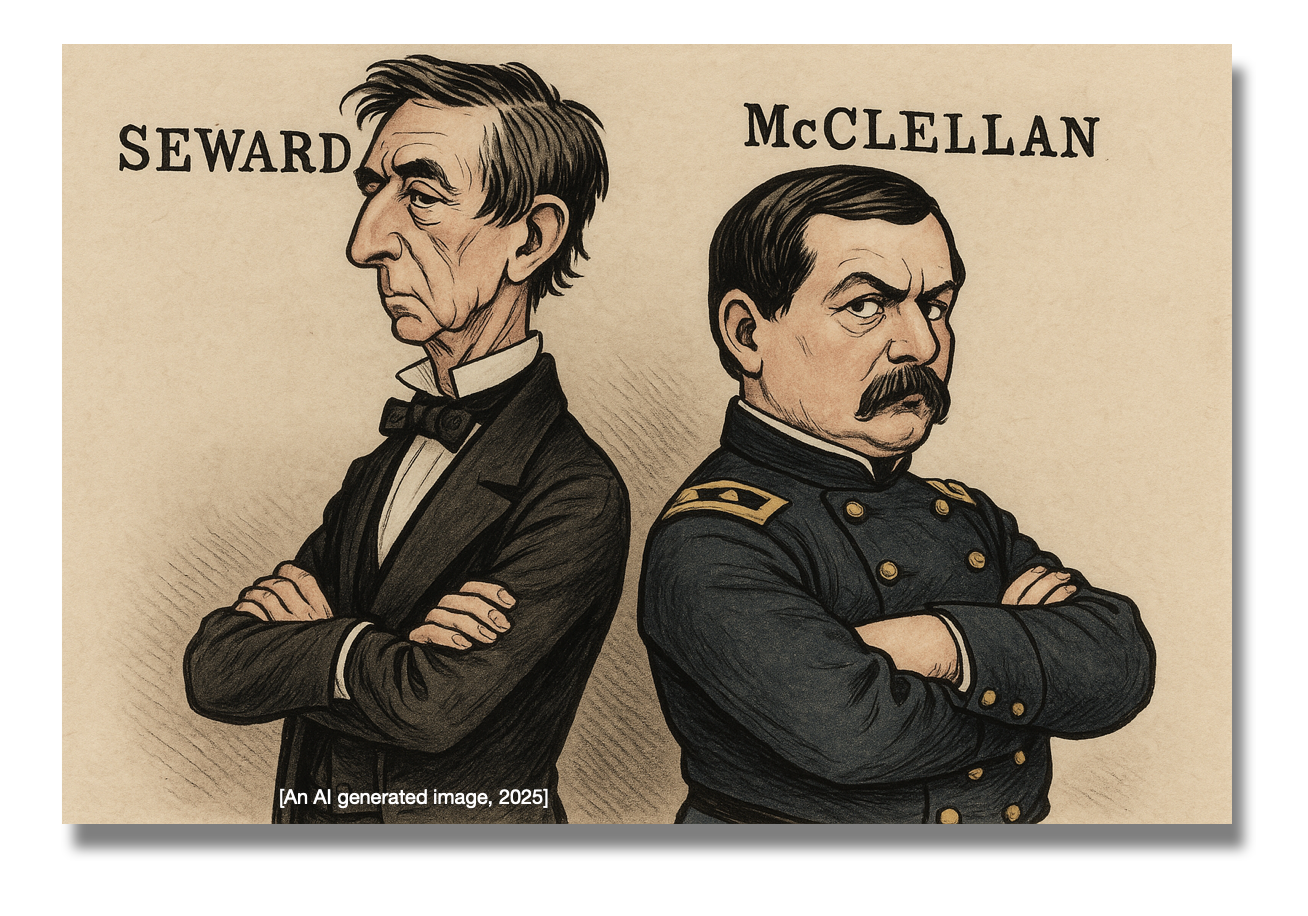
Yes, dear Uncle, we had the utmost confidence in Little “Mac” in bringing the war to a final close, but we know very well that he was thwarted by some power high in the influence of the government, but hostile to McClellan and opposed to the speedy termination of the war; and as a consequence, an enemy to the country, its prosperity and people. We soldiers very well know that the abolition of the North combined with the abolition Congress would not sanction his movements and cooperate with his movements. And to be plain & blunt, Secretary Stanton was not a very warm friend of little “Mac”—quite to the contrary. Done all that he could do to thwart his plans. Under all these considerations, how could we expect a man to thrive in the prosecution of ending the war without the full support and cooperation of the government. He could not thrive and the result is he has been superseded by Gen. Burnside. We hope and wish him success in bringing this nefarious rebellion to a final termination. This is the worse and best wish that we can bestow upon him.
“To be plain & blunt, Secretary Stanton was not a very warm friend of little “Mac”—quite to the contrary. Done all that he could do to thwart his plans.” — the opinion of Thomas H. Guinnip, 34th New York Infantry. Probably an opinion shared by many others in his regiment.
It makes no difference who is the cause of putting down the war if it is only done in due season. But for all, we cannot help but believe that little “Mac” was the right man in the right place and we furthermore think that the government has made a poor exchange when they superseded him. And let me add that before the termination of this present year’s campaign that they will be wishing McClellan back again to take command of the army again. But I hope and pray that he will turn a deaf ear to their calls for he has been shamefully treated & abused and I hope that he will show proper resentment and contempt for the same. Just upon the verge of accomplishing great victories, he was removed from his command but he was too true a patriot to resign. Had it been some generals we have in the army, they would of resigned at the very ofset of the transaction.
The removal of “Mac” created a great deal of dissatisfaction in the army, but we hope that it may not have a tendency to demoralize our army and think it will not. Little “Mac” was a brave man, true & loyal to the cause of his country and it would be needless for me to state that the soldiers all loved him and admired his bravery. Also, he loved his soldiers who had the pleasure to be under his command. And one thing rest assured of, if he is to be a candidate for a president, he will surely be elected by a very heavy and large majority for we consider we have soldiers enough to carry the day. Some have sworn that they will never raise another finger towards putting down the rebellion, but as the regulations of the army is strict, we entertain no idea of mutiny of such, who say, that they will not assist or help put down the rebellion. Ah, the removal of that true & patriotic general has been a lamentable transaction to the country. As to the future operations of our government in crushing the rebellion, there is but one way left—the most speedy and energetic action, the displacement of incompetent officers, their places to be filled by men of real merit and military talent, the discharge of every person suspected of Rebel tendencies, and the exclusion of politicians from any military office whatever. Let this be done and the speedy and happy termination of this rebellion are at hand. This I believe is the darkest hour of our government since the rebellion first broke out and things have reached a crisis. I trust ere long we shall find that the darkness of a long, dreary and lingering night has at last passed away and that joy cometh in the morning. But God disposeth for the best and our cause, like ourselves, is now in His hands.
Hoping this will find you & family in good health and able to make a lengthy reply. I have the pleasure to remain your old friend, — T. H. Guinnip
The following letters were written by Alonzo D. Bump (1837-1905) of Co. K, 77th New York Infantry. Alonzo enlisted as a private in August 1862 at Saratoga Springs, New York, mustering into Co. K on 17 September 1862. At the time of his enlistment, he was described as standing 5′ 4″ tall, with brown hair and hazel eyes. He gave his occupation as “mill operator.” He was married to Mary E. Richards on 21 June 1853 at Argyle, New York.
Many of Alonzo’s letters are archived at the History Center at Brookside Museum and formed the basis for a book written by David Allen Handy in 2022. The book jacket informs us that Alonzo “lived in the thriving small cotton mill town of Victory Mills, the home of the Saratoga Victory Manufacturing Company where he was employed as a weaver. With the desire to “go down to see the world,” Alonzo left behind Mary, his wife, and his three-year-old daughter, Mattie. Private Bump’s letters were largely written to Mary, though a small few were sent to his mother, sister, mother-in-law, and his two sisters-in-law. His letters reveal a deep love shared with Mary. For Alonzo, composing letters served as the primary instrument whereby he maintained his emotional ties with Mary and had a powerful therapeutic benefit for the married couple.”
The following letters are all in private collections and it isn’t known whether they were included among the letters in the book, “Theas Few Lines.”
Letter 1
Camp near Culpeper October 4th [1863]
Dear wife,
I now take my pen in hand to answer your kind letter that I received about 10 minutes ago and I sit right down to answer it. Well dear, I suppose that you want to know the news. Well our regiment hain’t a goin’ into cavalry for the Colonel wrote to Washington about it and they wrote back that they wanted regiments that had less than a year to stay for our regiment has got about 13 months months more to serve yet and then we shall be out of it I hope. But I think that this war will be over before our time is out for I don’t think that they can stand it a year longer. But still they may. But I think that if Old Rosecrans licks them at Chattanooga and Old Gilmore takes Charleston, that Rebeldom is about played out.
Dear, the order has just come again to move but we may not for the order may be countermanded for we have had the same orders twice before and we are here yet. Dear, I hope that you will get the money that I sent you by the time that you get this letter. But Dear, I hope that you won’t send my boots by mail for it will cost you so much for I could get a pair here for 9 dollars and if you send them by mail they will cost you most that.
Dear, you said that the girls had been over to Gailsville and there was some men a searching Mart’s house. 1 Well, dear, I hope that they won’t get Mart but if they do, they won’t shoot him for there has been an order read here through the whole army that there would be no more deserters shot but all back pay stopped from them But dear, when I was in Pennsylvania, I had all the chance to desert in world but I would not for when I come ome, I am coming home so I can stay with you in peace and not have to hide or anything else. Don’t you think that that is the best way, dear, for I know how how you would feel to have me come home and then have some man come in and take me. And I should feel bad too. But dear, I shall never desert my country and flag. But I am glad that they have got Nelse Harris. I hope that they will fetch him back.
Dear, take good care of little Mattie as you can and write often for I do too when we lay in camp, and when we are on the march, you must not expect to hear from me very often. Give my love to all the girls and here is a sweet kiss for you and one for your Mother. So goodbye for this time. From your husband, — Alonzo D. Bump
1 This is a reference to Martin (“Mart”) Davis who enlisted in August 1862 at Saratoga in Co. K, 77th New York Infantry. He deserted on 19 September 1862 at Albany, New York prior to the date of mustering in.
Letter 2
Camp on the Rapidan River October 9 [1863]
Dear Wife,
I now sit down to answer your letter, No. 4, which I received today. It found me well and I hope that this will find you the same. I was glad to hear that little Mattie was better. I received a letter from Ell Richards the same time and I was very much disappointed to see them come and I received one from Lide and a paper the same time so you see that I had a handful of letters and I was gone when the mail come in over to the regiment to see Capt. Rockwell. He came back yesterday to settle up his business. He says that he has got his discharge and I am glad of it. He has stayed as long as I thought he would when he come away. But never mind that. I am willing to stay my time out if I can only have my health. That is all that I ask. I am willing to do my duty as a soldier.
Dear, I come out here for a soldier and I mean to be one as long as I can. I have been so far. I am on duty now most every day. Yesterday I was out with the prisoners a building rifle pits. Dear, we are down on the Rapidan now where we can see the Rebels as plain as you can see the mill from our house. But dear, we have got our quarters where the Rebs can’t hurt us. But I feel sorry for the poor boys that are out in front on picket. Dear, we had three Rebels came over last night and they said that there was lots more a coming but they have not come yet. But they may tonight.
Dear, I hope that you. will send me my boots by Express for they will come just as safe as they will by mail and it won’t cost you half as much. Dear, I was glad to hear Ell say that I need not worry about you or Mattie, I hope that when she begins to quarrel with you that she will think of me and what I have told her. Dear, have patience and not get mad too quick but think twice before you speak once. But I am a going to write to Ell just as soon as I get this done.
Dear, I think that we shall fall back from here in a few days for the Rebs have got too strong a position here for us. I think that Old Meade will fight them at Culpeper if he can get them this side of the river. We can lick them but still we may not fight at all. I hope not on the Boys account. Dear, I am a going to see the captain before he goes home and maybe I shall send you my revolver to keep for me. But then a great many times it comes in lay and it may save my life sometime if I keep it here and then if I should get taken prisoner, they would take it from me. I don’t know what I shall do with it yet. But go and see him when he comes…[rest of letter missing]
Letter 3
Addressed to Ell Richards, Victory Mills, Saratoga County, New York
In Camp near Brandy Station November 13, [1863]
Dear Sister,
I received your kind letter last night and was glad to hear from you. It found me well and in good spirits and I hope that these few lines may find you the same. We have had another bloody battle here. We made a clean sweep of the Rebs. We took all that came over the river and I wish that it had been the whole of the Reb army. But dear, we cleaned the platter once and I think that we can do it again if they will only come out and fight us on good ground. But that they won’t do for they won’t fight unless they can get into their breastworks. But we drove them out of them this time and drove them into the river.
Well, Ell, I am glad that you have got those verses that I sent to you and I hope that you will get a pretty tune for them. Ell, give my best respects to all the girls in the Mill and tell them that Old Bump is alive yet.
Ell, I received that piece that you sent to me and it is a very good advice and I thank you for that. Ell, here is a sweet kiss for you and may it not be long before I shall be at home to press them to your cheek. So goodbye for this time. This from your brother. Love to sister, Ell. — Alonzo D. Bump
Letter 4
[The following letter is in the personal collection of Greg Herr and was offered for transcription and publication on Spared & Shared by express consent.]
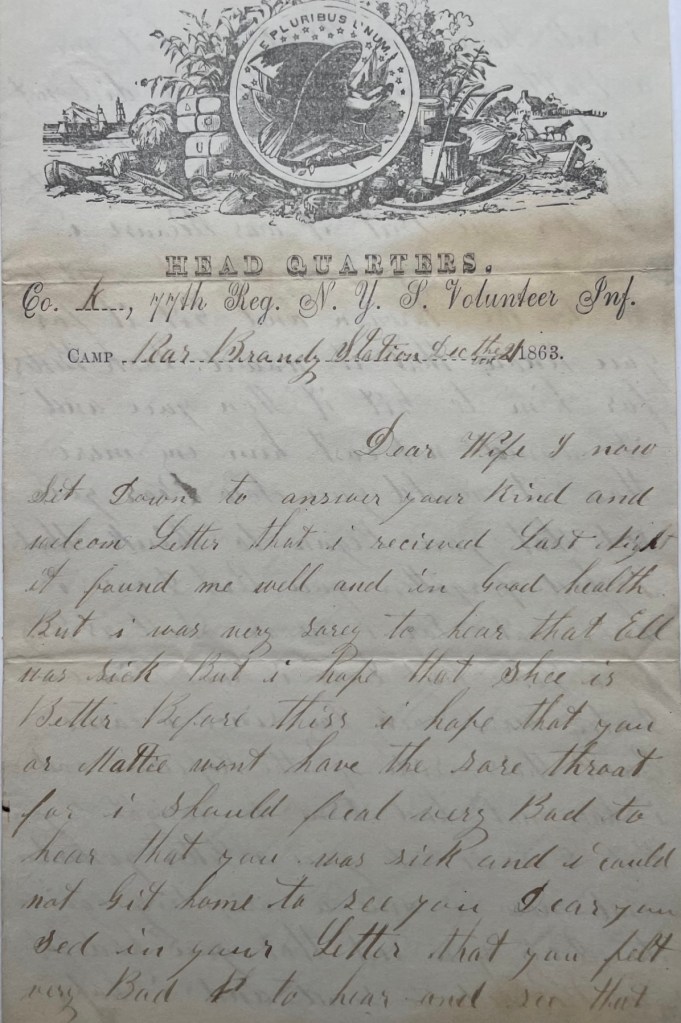
Headquarters Co. K, 77th N Y. Vol. Inf. Camp near Brandy Station December 21, 1863
Dear Wife,
I now sit down to answer your kind and welcome letter that I received last night. It found me well and in good health. But I was very sorry to hear that Ell was sick. But I hope that she is better before this. I hope that you or Mattie won’t have the sore throat for I should feel very bad to hear that you was sick and I could not get home to see you.
Dear, you said in your letter that you felt very bad to hear and see that I wrote home to Tipp to get me a bottle of gin but dear, I did not write to him because I did not think that you was willing to get it for me, but it was because I thought that you would not want to go to the tavern and get it for you know that it would look better for him to get it than you and it would not cost him any more than it would you. Now dear, you said that you began to think that I had forgotten you. But dear, I have not, nor I never shall as long as I live. But dear, I have been on duty most every day since I came back this side of the Rapidan and I have not had time to write to you. But dear, I wrote you a letter yesterday and now I am a writing again today.
You said that you had got my box ready to send and I hope that you have nailed it up well for they handle it rather rough when they are a coming on the cars and I hope that it will get here by Christmas or New Years. If it does, I will stuff my belly and you can bet on that.
Dear, give my love to all the girls and tell them to write to me and here is a sweet kiss for you all and I will write to you again soon. Write as often as you can and I will do the same, dear one. This from your ever true and loving husband, — Alonzo D. Bump
to Mary E. Bump
Dear, if you are sick, I want you to write to me and I will show it to the captain and maybe I can get a furlough first. So goodbye.
Letter 3
In Camp near Brandy Station March 19th [1864]
Dear Wife,
I now sit down to write you a few lines to let you know that I am well and hope that these few lines may find you the same. I have enough to eat and drink and a plenty of work to do and when I am to work, I feel better than I do to lay around in my tent for then I don’t have any appetite to eat and now I can eat my allowance three ties a say.
Mary, yesterday we had marching orders, come to the ready to march at short notice with three days rations, and we packed up our haversacks with soft bread and hard tack, pork, coffee, sugar, salt, pepper, and was ready and a waiting for the order to come to start. But the order was countermanded so we unpacked again and went to sleep as usual. There was a rumor around camp that Old Ewell’s Corps was on the move so we was on the lookout for him but he did not come, nor that hain’t all. I don’t think that he dare come here to fight us on our own ground for we can whip them every day in the week on fair footing. But we have never met them only once on good fair fighting and that was last fall to Rappahannock Station and there they had rifle pits dug. But they dare not stick up their heads to fire at us so we took 16 hundred prisoners there and killed a good many besides.
And at Gettysburg we coppered their goose too. If they had only stayed there one day longer, we would [have] took the whole of Old Lee’s army. But they slipped through the hole and left, and maybe it was just as well for us that they did leave for our Corps would had to went in on the Fourth of July for a celebration. But I for one am satisfied. As it was, I saved my head once from a shell or at least it came as near to me as I wanted it to.
But dear, probably I shall weary your patience by telling over old times. But I must write something to fill up my sheet so bear with it.
Dear, I received a letter from you last night and was glad to hear that you was well. I found one in it for Harry and he said that he was a going to write to Ell and he said that he would never bring her out and he thought all the more of her for doing so and I told him before I showed him the letter that if it was a going to make any trouble for my folks, that I should not let him see it and he said that it would not for Dear, I know that you all have trouble enough without my making any for you.
And Dear, tell Ell that Harry thanks her for it and says that he will do her as good a favor if he can. Dear, I feel sorry for him. I hope and pray that I shall never have any such trouble—not as long as I am in the army. And I don’t think I shall for I believe that I have got a woman that is true to me for Dear, I am you to you.
But dear, sometimes I am tempted to take a little meat for my health for I think that it would do me good. But then I don’t like the kind so I let it alone and hope that it won’t be long before I shall be at home to take my rations regular. Give my love to your mother and the girls and tell them to write to me often for I like to hear from them. I wish I had been there last night to went to the blow-out dance. I will bet I should had a good time with you and the girls and if I ever live to come home, I will have one good time, you can bet your boots and shirt.
Mary, I got a letter from mother last night stating that she had sent me a box. Bully for her. May peace go with her and Joy behind her for that, and as soon as I get it, I will write what she sent. So good night, dearest, from your ever true and loving spouse. — Alonzo D. Bump
Kiss Mattie for me Mary 50 times.
This is answer to No. 7 and 8. I suppose you have got the letter by this time that I sent by Orderly. Probably he put it in the office to Troy or Albany. He is home on a 10 days furlough. He lives to Sarasota Springs.
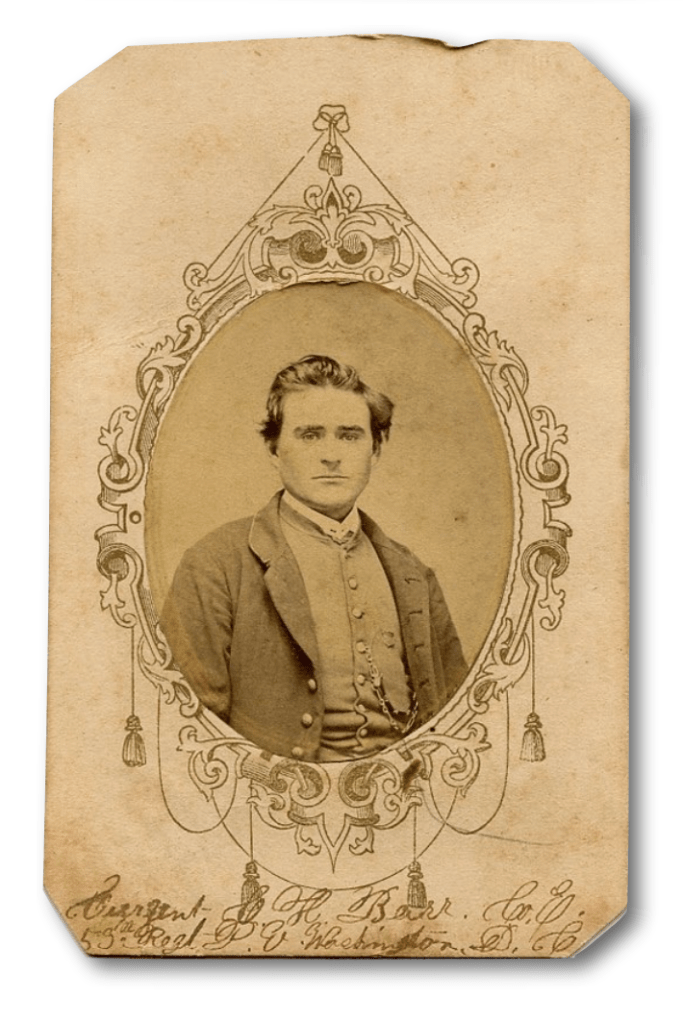
I could not find an image of George but here is one of Charles H. Barr of Co. E, 53rd Pennsylvania Infantry (Larry Lingle Collection)
This letter was written by George J. Whitman (1834-1917) who enlisted as a private in Co. G, 53rd Pennsylvania Infantry on 29 October 1861. Serving with him and mentioned in the letter are Thomas Tracy and Luther Armstrong—all of Potter county, Pennsylvania. The regiment moved to Washington in early November 1861 and encamped north of the Capitol before crossing the Potomac River on the 27th, and going into camp near Alexandria, VA. There, the regiment was assigned to the brigade commanded by General William. H. French, General William Sumner’s Division, of the newly organized Army of the Potomac. They would not be battle tested until June 1, 1862 at Fair Oaks in McClellan’s Peninsula Campaign.
George Whitman was the son of Peter and Sarah (Bennett) Whitman of West Bainbridge, Chenango county, New York. He was married to Ruth Hackett (1834-1918) in 1860 and residing in Ulysses, Potter county, Pennsylvania when he enlisted. After serving in the 52nd Pennsylvania, George served one and a half years in the 2nd Pennsylvania Cavalry.
[Note: This letter is from the personal collection of Greg Herr and was offered for transcription and publication on Spared & Shared by express consent.]
Transcription
[Camp near Alexandria, Virginia] December 8th 1861
Well Ruth,
You see here I am here. I am a talking to you once more. I feel pretty well this morning and hope that you can say the same. I suppose that it is very cold weather in Potter. Here it’s pleasant weather. The third of this month we see a snake crawling on the ground and se grasshoppers quite frequently so you can guess for yourself what weather we have here. I don’t know but you will get sick of such writing but Ruth, you must overlook all my mistakes.
My dear girl, you say that if you thought that if you could never see me again you should not want to live any longer. But you must not think so. Think it is all for the best and if we never meet here on earth, I hope that we may be so prepared that we may meet in heaven.
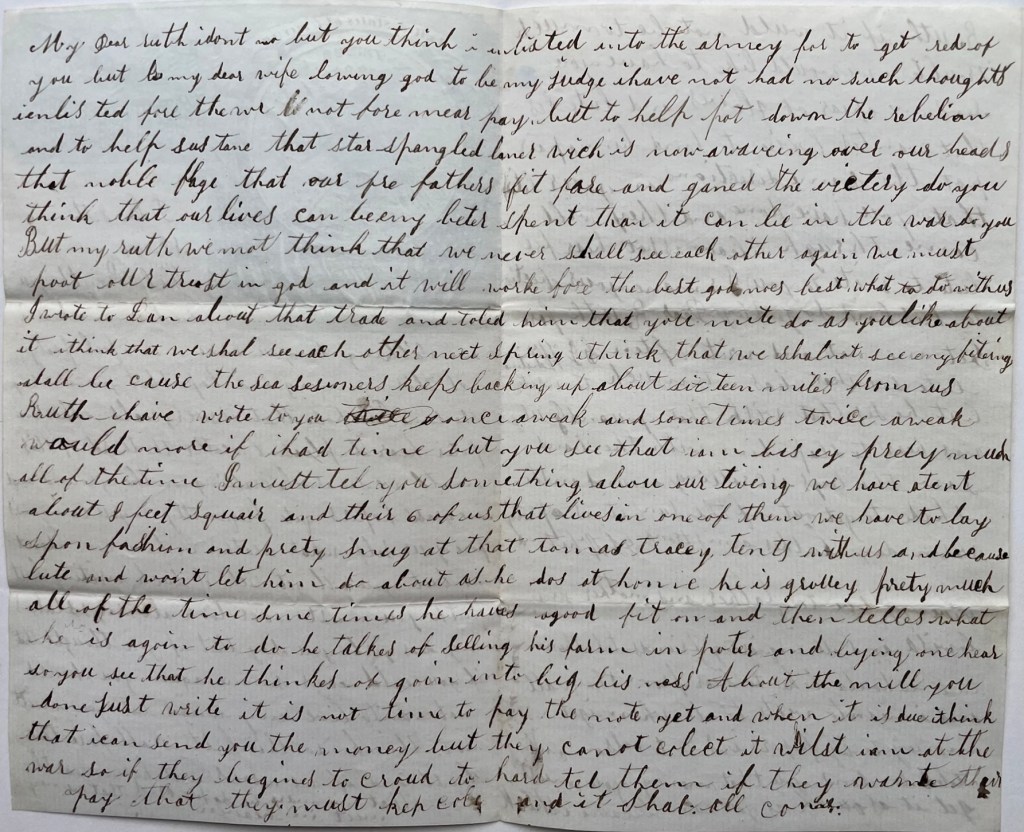
My dear Ruth, I don’t know but you think I enlisted into the army for to get rid of you but my dear wife, allowing God to my judge, I have not had no such thoughts. I enlisted for the war not for mere pay, but to help put down the rebellion and to help sustain that star spangled banner which is now a waving over our heads—that noble flag that our fore fathers fought for and gained the victory. Do you think that our lives can be any better spent than it can be in the war? Do you? But my Ruth, we mustn’t think that we never shall see each other again. We must put all trust in God and it will work for the best. God knows best what to do with us.
I wrote to Ian about that trade and told him that you might do as you like about it. I think that we shall see each other next spring. I think that we shall not see any fighting at all because the secessioners keep backing up about sixteen miles from us. Ruth, I have wrote to you once a week and sometimes twice a week. Would [write] more if I had time but you see that I am busy pretty much all the time.
I must tell you something about our living. We have a tent about 8 feet square and there’s six of us that lives in one of them. We have to lay spoon fashion and pretty snug at that. Thomas Tracy tents with us and because Lute and [I] won’t let him do about as he does at home, he is growling pretty much all of the time. Sometimes he haves a good fit on and then tells what he is a going to do. He talks of selling his farm in Potter and buying one here so you see that he thinks of going into big business.
About the mill, you done just right. It is not time to pay the note yet and when it is due, think that I can send you the money, but they cannot collect it whilst I am at the war so if they begin to crowd too hard, tell them if they want their pay, that they might keep cool and it shall all come.
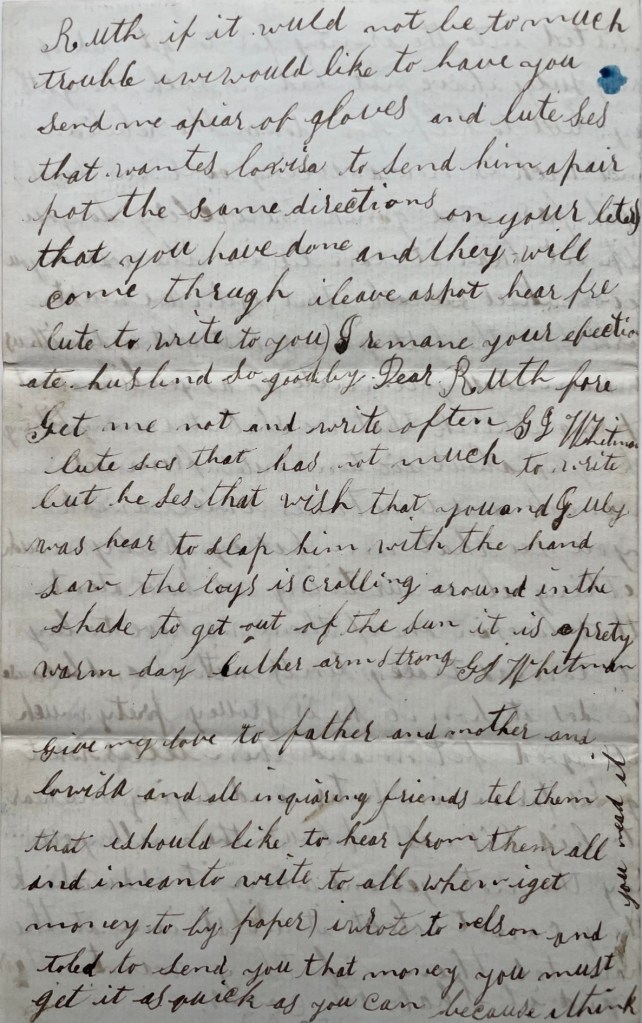
Ruth, if it would not be too much trouble, I would like o have you send me a pair of gloves and Lute says that he wants Louisa to send him a pair. Put the same directions on your letters that you have done ad they will come through. I leave a spot here for Lute to write to you. I remain your affectionate husband. So goodbye. — G. J. Whitman
Dear Ruth, forget me not and write often. Lute says that he has not much to write but he says that [he] wishes you and Julie was here to slap him with the hand. Some of the boys is crawling around in the shadde to get out of the sun. It is a pretty warm day. Luther Armstrong
Give my love to Father and Mother and Louisa and all inquiring friends. Tell them that I should like to hear from them all and I mean to write to all when I get money to buy paper. I wrote to Nelson and told [him] to send you that money. You must get it as quick as you can because I think you need it.
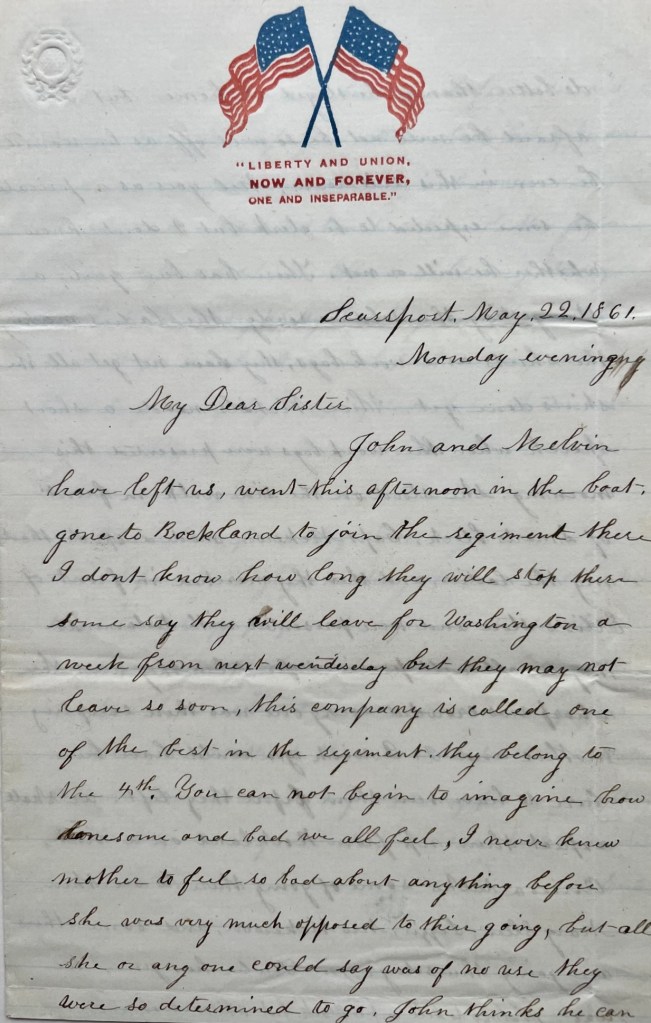
On patriotic stationery bearing the mantra “Liberty and Union, Now and Forever, One and inseparable,” 21 year-old Eveline Maria Wiswell (1840-1922) penned the following letter from Searsport, Waldo county, Maine to one of her sisters. Eveline was the daughter of Joseph Warren Wiswell (1806-1890) and Martha True (1800-1888). In her letter, datelined 22 May 1861, Eveline describes the departure of two brothers to serve in Company I, 4th Maine Infantry. They were Joseph “Melvin” Wiswell (1842-1921) and John Baker Wiswell (1838-1909).
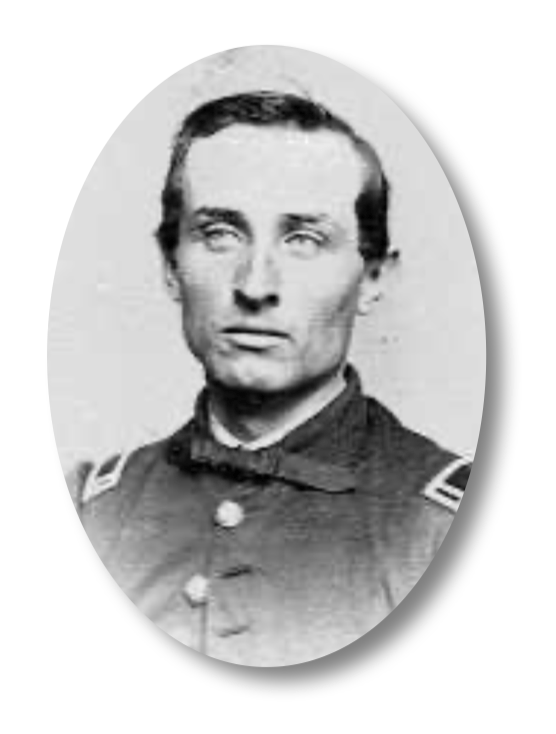
Lt. Melvin Wiswell, 14th Maine Infantry
Melvin was working as a railroad clerk in Searsport at the time of his enlistment. He joined the 4th Maine as a sergeant and was wounded in the Battle of 1st Bull Run. He was afterward discharged for promotion to be commissioned a 2nd Lieutenant in Co. G, 14th Maine Infantry. He was transferred to Co. D when promoted to Captain. Melvin’s older brother John was working as a blacksmith in Searsport and though he apparently intended to join the 4th Maine, he must have changed his mind and not mustered in for he did not enlist until December 1863 in Co. B, 14th Maine (Melvin’s regiment). He would later rise to the rank of 1st Lieutenant of his company before mustering out of the service.
The 4th Maine Volunteer Infantry Regiment was organized in Rockland in May 1861 and was mustered in on June 15, 1861 commanded by Colonel Hiram G. Berry.
[Note: This letter is from the private collection of Greg Herr and was offered for transcription and publication on Spared & Shared by express consent.]
Transcription
Searsport, Waldo county, Maine
Searsport, [Waldo county, Maine] Monday evening, May 22, 1861
My dear sister,
John and Melvin have left us. Went this afternoon in the boat. Gone to Rockland to join the regiment there. I don’t know how long they will stop there. Some say they will leave for Washington a week from next Wednesday but they may not leave so soon. This company is called one of the best in the regiment. They belong to the 4th.
You cannot begin to imagine how lonesome and bad we all feel. I never knew mother to feel so bad about anything before. She was very much opposed to their going, but all she or anyone could say was of no use—they were so determined to go. John thinks he can do better than if he stayed at home but I am afraid he will not be so well off as he would be even in this dull town. Mel goes as a private. He some expected to be clerk but I don’t know whether he will or not.
There has ben quite a stir getting the soldiers ready—the ladies making the shirts and work bags. They have not got all the shirts done yet. Alice Nichols 1 made a short speech when the work bags were presented this morning. She stood on the sidewalk in front of Smart’s Block. Capt. Nickerson made a speech thanking the ladies and then they marched in front of [Amos H.] Ellis’s [grocery & dry goods] store [on East Main Street] and were presented with testaments. They are all well provided for.
When they went, the wharf was crowded. Everyone was there excepting mother and I. I wish you could have been here to have seen them before they left. 2 We shall expect them up from Rockland on a visit. Orrissa talks some of going there to see them. Mary Ellen, Lizzie, Mrs. Nickerson, and some others are going Thursday. Jim Fowler has gone. He was expecting to sell out to Black, but Whitcomb objected. Whitcomb hires the girls and has Chadwick for cutter and pressman. They some hope Jim will come back but if he does not, Whitcomb and Chadwick will carry on the concern.
Thursday morn. I did not have time to finish this before so I have left it until now. Ellen came home yesterday. The hats were very pretty but they are both entirely too small for me, but I am in hopes I can swap mine for a larger one if they have any down here. I am ever so much obliged to you for it for I had been wishing for one all the spring. I do wish my head was not so large.
We had a letter from [sister] Abby. She is very anxious to get here before the boys go, so the girls have written her to come right off for fear the regiment should start. We shall look for her next week and we all think you had better come and go back with her. I don’t think there is much doubt but what she will come. I am in a great hurry for sis is waiting for the letter to carry down so please excuse all the mistakes. — Eveline
Unveiling of the Civil War Soldier’s Memorial in Searsport in 1866.
1 Possibly Mary Alice Nichols (1834-1916), the daughter of Capt. Peleg Pendleton Nichols & Mary Towle Fowler of Searsport. Alice married Benjamin Carver Smith (1834-1908) in June 1864.
2 The men were transported to Rockland aboard the steamer M Sanford and arrived at Camp Knox, on Tillson’s Hill, northeast Rockland, Knox County, Maine, in the afternoon on 20 May, 1861.
This is an 1851 stampless folded letter (SFL) from Benjamin Grist, a barely literate slave overseer in rural southeastern North Carolina to his cousin, Allen Grist, a very wealthy (and much more educated) businessman and slaveowner (owning more than 100 slaves) then in Wilmington N. C. Benjamin writes his “cuzen”, (who was also the owner of the plantation on which Benjamin worked), to provide an update on his trials and tribulations in overseeing Allen’s vast ‘turpentine’ plantation (a major business in that part of NC at the time). Much of the letter deals with problems with some of the slaves, including running away and then having to be ‘punished’ after being caught and returned, e.g. ”I give tham 40 [lashes] a peas [apiece].”
The letter is postmarked Wilmington, N. C., but is datelined “St. Pauls,” N. C. It has a manuscript “Way 5” rate mark, meaning that, rather than being brought to the local post office, it was hand-carried to a mail carrier who had the city of Wilmington on his route.
The turpentine business of Benjamin and Allen Grist are covered extensively in the book “American Lucifers: The dark history of Artificial Light, 1750-1865”, published in 2020 by Univ. NC Press, and the winner of that year’s Beverige Award by the American Historical Association. The book covers the early southern turpentine industry—in particular the use (and abuse) of slaves who were the primary source of extracting the resin from pine trees (from which turpentine was distilled). In 1860, Grist was listed as owning $50,000 in real estate and $92,900 in personal property, including 109 slaves, making him the largest slaveholder in Beaufort County. A. & J. R. Grist, turpentine farmers, held $44,000 in real estate and $125,750 in personal property and owned 72 slaves. In addition, as estate administrator for minor children related to his wife, Grist controlled another 48 slaves, for a total of 229. His son James R. Grist owned individually 84 slaves, giving the Grists ownership and management of 313 slaves. They leased additional slaves from other owners. [Source: NCPedia]
For readers unfamiliar with the pine tar industry of North Carolina, I will provide the following paragraph written by Ralph Goodrich (my g-g-grandmother’s brother) when he traveled from north to south through the pine forest region in 1859:
“These forests at first seemed to be without inhabitants either of man or of animals, but as we advanced from the dwarf and sparsely scattered pine & oak, which bordered on the outskirts, we came unexpectedly upon busy workmen. The thick undergrowth of brambles & briers was cut out. The pines were chipped into grooves about ten feet from the ground from which its pitch was oozing and dripping into the troughs beneath. Several log houses are scattered about, the furnace & warehouse, & barrels filled with the resin piled in stately rows or jumbled in utter confusion. In the distance we see clouds of smoke rising from huge black stacks of earth, while workmen are busy felling trees. We are in the midst of the tar and turpentine manufacturers, & in the midst of soot, smoke, and dirt. The ebony looks still more black, & the white man assumes a dusky countenance. We seemed to be hemmed in by a barrier of limitless forest, & shut out from every breeze so refreshing to the feverish cheek. At night we lay in a hammock tormented by mosquitoes, & lulled to sleep by the endless rattle of the locusts and the melancholy strain of the whippoorwill.” [Source: The Ralph Leland Goodrich Diaries, 1859-1867]
A Civil War linkage to the Grist family is the later use of the Grist mansion in Washington, NC. (https://www.ncpedia.org/biography/grist-james-redding), as a Union hospital. It still exists as a bed-and-breakfast residence and is notable for its secret rooms and passages (which may or may not have been of use during the Civil War).
Residence of J. Grist, Esq., Harper’s New Monthly Magazine, North Carolina Illustrated., p 751
[Note: This letter is from the personal collection of Richard Weiner and was offered for transcription and publication on Spared & Shared by express consent.]
Transcription
St. Pauls, North Carolina July 28, 1851
Cousin Allen,
Cane got home yesterday the 26th with Stanley & Fitch. Riley [?] came within six miles of home & slipped off and left the mule in the road & is gone. We pursued him that night and tracked him 10 miles on the other side of Fayetteville next morning & he quit the road. Gar, he is gone back again. You ought to of chained him [to] Stanley & Fitch. I give them 40 [lashes] apiece and put them to work & they are working very well.
Cousin Allen, you seem to raise great complaints against me about the negroes. You know I treat negroes well and does not miss use them. I will give you a true statement of Mrs. Howard’s negroes—Br___, Sal & B___ & ___ has not had a lick this year. John has had a light whipping—say 15 or 20 [lashes]. Griffin & Stafford has been whipped but they [ ]. Henry has had three whippings. James R[edding] Grist was here & had two of them put on him—the first one and the last one. The other I put on.
You [lecture?] to me for the wearing [of chains?] and if it is not done, you will be [disappointed?] and complain of me. I have done my very best to have the work done & to keep the negroes satisfactory.
Cane was mistaken about the warehouse. It was done & he has him working on the wagons ever since. It is so dry & hot here—nothing can stand. The corn is dying. I am 10 crops of boxes behind in my shipping for the want of barrels. I keep [ ] still running. James wrote you all about the business.
Last week the old boxes will ship about the same. They ship before the news ones and will not get quite as much. I shall do my very best to keep the business straight if possible. I shall write you a Sunday again.
Jerome T. Howard was 24 years old when he enlisted as a private on 29 September 1861 in Battery H, 1st New York Light Artillery. He was discharged for disability from that regiment but subsequently enlisted in Co. K, 14th New York Light Artillery. He mustered out in March 1865.
Davids Island during the Civil War. Site of the De Camp General Hospital.
Letter 1
Davids Island, New York Harbor September 8, 1864
Good morning Monroe,
How are you this morning? I hope you are well. I received your interesting letter this morning and was glad to hear from you. I do not think I can come home very soon. I may come till my time is out which is not for over two years yet to come but I should like to come and see you and your folks once more. But it is impossible at present. But I will come soon as I can. I will go to the front again in a few days as my wound is about healed up again, there to engage in another battle. I may get another piece of lead. If I do, I will get over it again. Now as you are a soldier, I suppose you will keep order that way if suppose if the redcoats appear this side of the big pond. The 87th Regiment of New York State National Guard will turn out in force with Colonel M. M. Smith to lead the van and make them get out of the way and wish themselves back to old England again.
Well, I guess you will do all that you can to drive them back but I guess there will not be any danger of their coming so you will have to wait till the time comes to show what you are made of. Then you will throw yourself like fun, no doubt—that is, if Colonel Smith will make a good officer. When it comes to close quarters, he will make you fellows fix bayonets and charge. How will you like that? I think you will like it first rate. You must not think there is danger ahead but press on and you will come out victorious. That is a soldier’s motto. No such word as fail.
I must close. Let me know how you like a soldier’s life. Farewell from your friend, — Jerome T. Howard
Monroe, in regard to politics, I think we do not agree. I did think something of our President when I voted for him to rule the destinies of this Nation, but my views are vastly changed and I may say materially changed in his taking the chair another four years. Those of the people who want another four years war, let them vote for Abraham Lincoln. As for me, I do not and I will not vote for him. I say put in a man that will give us peace and Little Mac is the man. But I suppose you do not think so. But he will show you when he gets in the chair. Those are my opinions and ever will be till I see something more about the man. — J. T. Howard
Letter 2
Davids Island, New York Harbor September 13, 1864
Friend Monroe,
How are you this evening? I guess you are well. At any rate, you had ought to be since you have become a soldier in the army of Horatio Seymour, governor of the State of New York. Well, I hope you will do your duty if you are called on. It may be to suppress a riot or something. Anyway, do your duty whatever it is and don’t flinch and do not get excited when you get the command to load and deploy as skirmishers or to advance fix bayonets and charge.
Monroe, you said you had no hired help now. Do you mean that your mother has to do her own work now or do you do it for her? I know that cannot be for she has got Fanny to help her.
Enclosed you will find a song for Fanny. You may give it to her. It is one that I found the other day down by the beach.
Monroe, they are preparing for two large battles and I may be in one of them and I may fall and if I do, I will have one consolation—that I fell doing my duty. But I guess I will live through it to try the Johnny Rebs another brush. I may come [home] before election. If I can, I will, but do not look for me for you may be disappointed.
I heard Lib Young is sick with the fever. If it is so, how is he? Let me know in your next letter. I must close. Don’t forget to write soon as you get this. This from your friend, — Jerome T. Howard