My passion is studying American history leading up to & including the Civil War. I particularly enjoy reading, transcribing & researching primary sources such as letters and diaries.
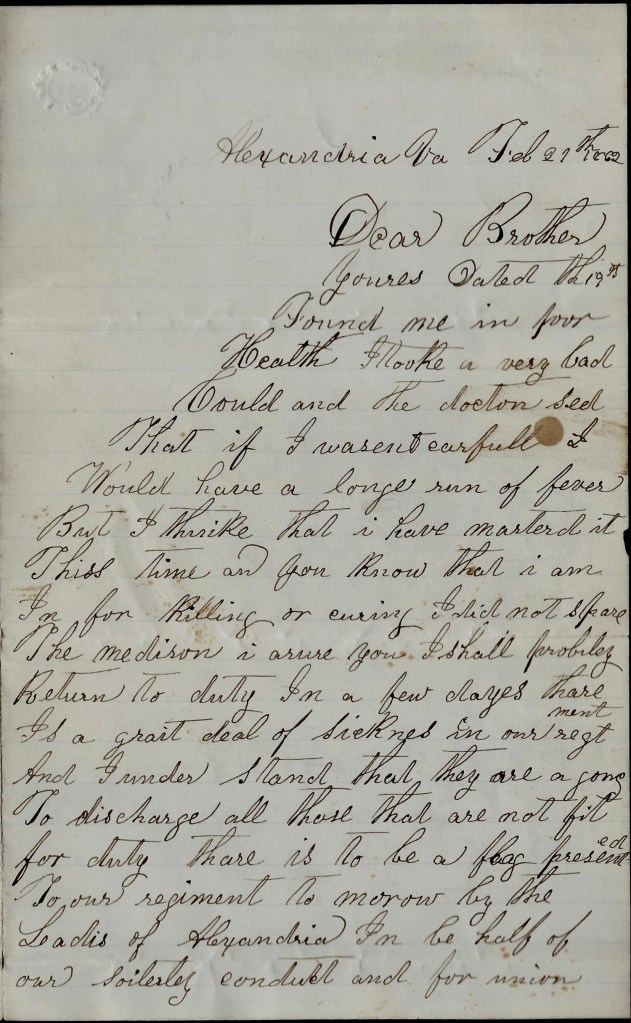
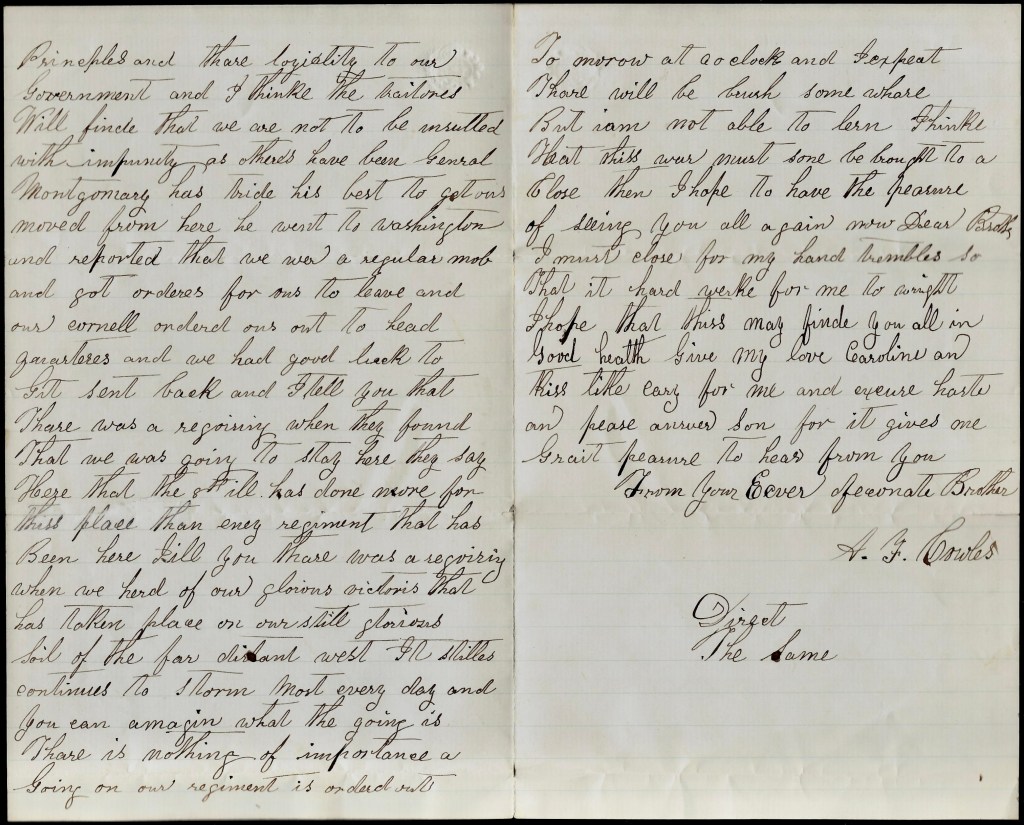
The following letters were written by Pvt. Adin F. Cowles (1831-1914) of Co. B, 8th Illinois Cavalry. In the 1860 US Census, 23 year-old Adin Cowles was enumerated in the household of John Gilkerson of Genoa in DeKalb county where he was identified as a farmhand. When he enlisted at ST. Charles, Illinois, as a corporal in September 1861, he gave his birth state as New York and he was described as standing 5′ 7.5″ tall, with black hair and grey eyes. He was the son of William and Caroline Cowles of Ithaca, Tomkins county, New York.
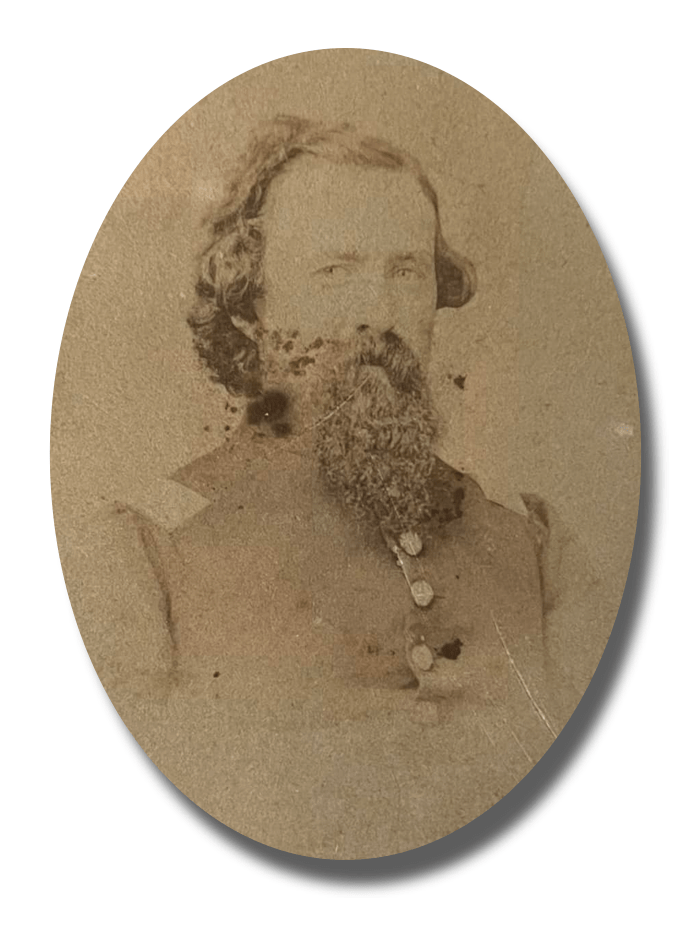
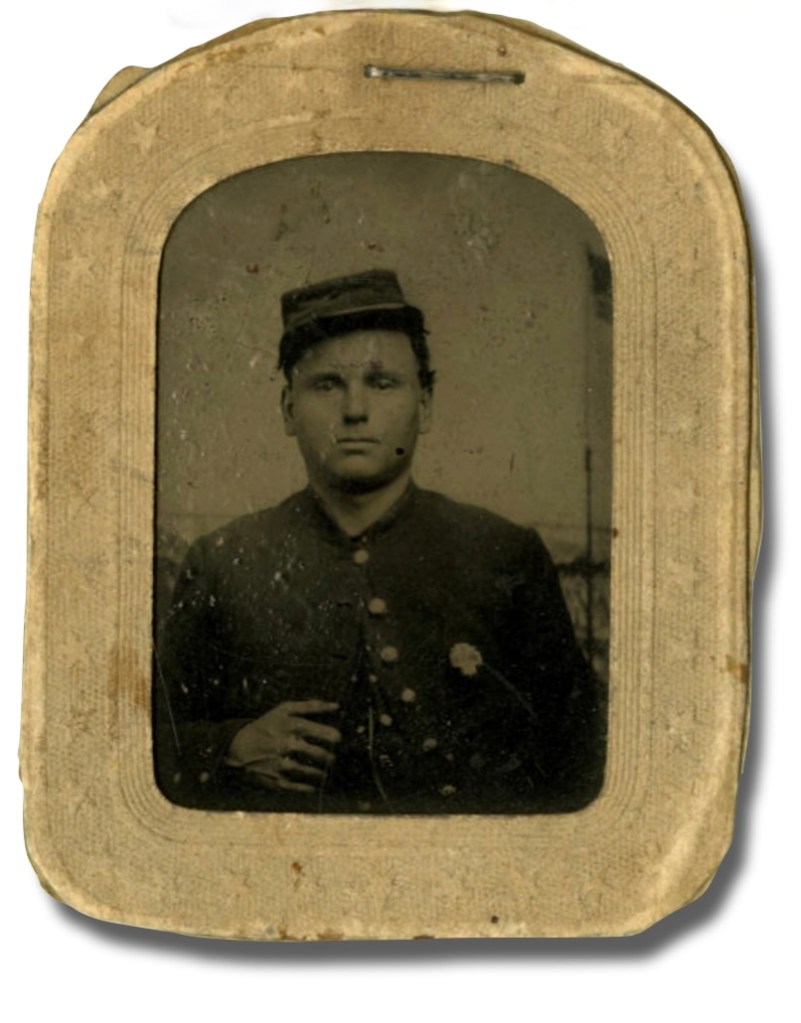
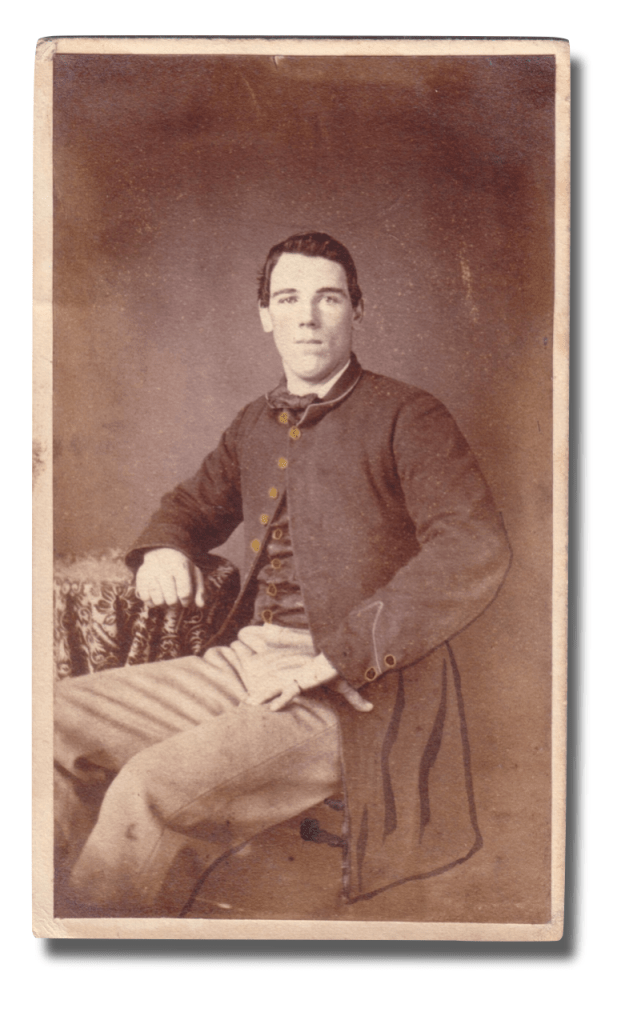
I could not find an image of Adin but here is Charles Henry Palmer of Pecatonica, Illinois, who served in Co. M, 8th Illinois Cavalry.
The 8th Illinois Cavalry served the duration of the war, and was the only Illinois cavalry regiment to serve the entire war in the Army of the Potomac. They also aided in the hunt for John Wilkes Booth and served as President Lincoln’s honor guard while he lay in state under the rotunda. Lincoln gave them the nickname of “Farnsworth’s Abolitionist Regiment” when he watched them march past the White House.
During the Gettysburg Campaign, the 8th Illinois Cavalry was in the division of Brig. Gen. John Buford. They deployed west of Gettysburg on June 30, 1863, under the command of Colonel William Gamble, and waited for oncoming Confederates that arrived early the following morning. The first shot of the subsequent battle was fired by Lieutenant Marcellus E. Jones of Company E, who borrowed a carbine from Sergeant Levi Shafer and fired at an unidentified officer on a gray horse over a half-mile away. The 8th, along with the rest of the brigade, performed a fighting withdrawal toward McPherson’s Ridge, delaying the Confederate division of Henry Heth for several hours and allowing the Union I Corps to arrive.
Letter 1
Headquarters Alexandria, [Virginia] February 11, 1862
Dear Brother,
Yours dated the 3rd reached its destination the 8th to find me still enjoying good health as usual… There is a good deal of sickness among the soldiers and there is some regiments that the whole of them are reported on the sick list with the measles and small pox and typhoid fever, &c. I can assure you that it is hard times &c. There is not a day passes but there is someone laid in their last resting place, &c. If the weather don’t change soon, there will [be] hard times for the sick for every place is full and they have had to remove the sick from here to Philadelphia to make room for others.
It has rained or snowed most evert day for the past month and I think that I never see such times since I can remember. And was I to tell you one half the suffering that I have sen, you would hardly believe what I say and had I not witnessed [it] myself, I could not believe that there was half the suffering that there is among our men. And I tell you that it looks hard to see men in the prime of life sink to the grave and many a poor fellow has given his life for his country with regret that they was not permitted to fill a soldier grave on a field of battle. And if I am called on to give my life, I hope that it may be where the balls fly the thickest. Then if I lose my life, I am content. There is nothing that I dread as sickness for if a soldier once gets in the hospital, he gets completely discouraged and gives up entirely and that is one reason that so many die.
You spoke of some of the regiments being discharged. That was the report here but I don’t think that they will disband our regiment for the reason that ours is considered the best and the only one that has got the complement of arms and they expect big things from us. And another reason is that we are the only drilled cavalry here so they say. Everyone that I have heard give us the praise of being the best men that has been here.
There is considerable excitement here on account of a minister that preached here last Sunday and he was requested to pray for the Union and he refused to so our men arrested him as a traitor. There was a good deal of stir here last night as near as I can learn. Our men set fire to the printing office & burnt it up. They tried to make the soldiers work the fire engines but they run off in another direction and let it burn. The cut the hose a’most to pieces and refused to put it out and if the folks in Alexandria don’t keep still of their disunion talk, there [will] be an example of some of them. There has been an order full to arrest anyone that speaks disrespectful to our soldiers or against the Union. I expect that the whole town will be burnt if they don’t keep still. There is lots of traitors here and we intend to clean them out.
I was out on a scout yesterday and we went within hearing of the enemy’s camps and we could hear their drums beat for reveille. Our pickets have been advanced of late. I don’t think that there will [be] anything done for some time for it would be almost impossible to move our artillery in this mud for I could hardly get through a horse back. I heard from [brother] Dexter 1 a few days ago. He said that [his wife] Ellens’ health was very poor and he did not expect that she would live long. And as near as I can learn by what he wrote, that he was having hard times. My sheet admonishes me that I must close. Give my love to Caroline and Ida and accept a share from me and please answer with speed. Give my likeness to Ida if you receive it in this and tell her that I shall try and come and see her if my life is spared.
Love, from your affectionate brother, — A. F. Cowles
Yours found me in poor health. I took a very bad cold and the doctor said that if I wasn’t careful, I would have a longer run of fever. But I think that I have mastered it this time and you know that I am in for killing or curing. I did not spare the medicine, I assure you. I shall probably return to duty in a few days. There is a great deal of sickness in our regiment and I understand that they are a going to discharge all those that are not fit for duty. There is to be a flag presented to our regiment tomorrow by the Ladies of Alexandria in behalf of our soldierly conduct and for Union principles and their loyalty to our government and I think the traitors will find that we are not to be insulted with impunity as others have been.
General ontgomery had tried his best to get us moved from here. He went to Washington and reported that we were a regular mob and got orders for us to leave and our Colonel ordered us out to headquarters and we had good luck to get sent back and I tell you that there was a rejoicing when they found that we was going to stay here. They say here that the 8th Illinois has done more for this place than any regiment that has been here. I tell you, there was a rejoicing when we heard of our glorious victories that has taken place on our still glorious soil of the far distant West [of Tennessee]. It still continues to storm most every day and you can imagine what the going is. There is nothing of importance a going on. Our regiment is ordered out tomorrow at 6 o’clock and I expect there will be [a] brush somewhere but I am not able to learn.
I think that this war must soon be brought to a close. Then I hope to have the pleasure of seeing you all again. Now dear brother, I must close for my hand trembles so that it [is] hard work for me to write. I hope that this may find you all in good health. Give my love [to] Caroline and kill little Cary for me and excuse haste and please answer soon for it gives me great pleasure to hear from you.
From your ever affectionate brother, — A. F. Cowles
Direct the same.
Letter 3
Brooks Station, Virginia May 30, 1863
Dear Brother,
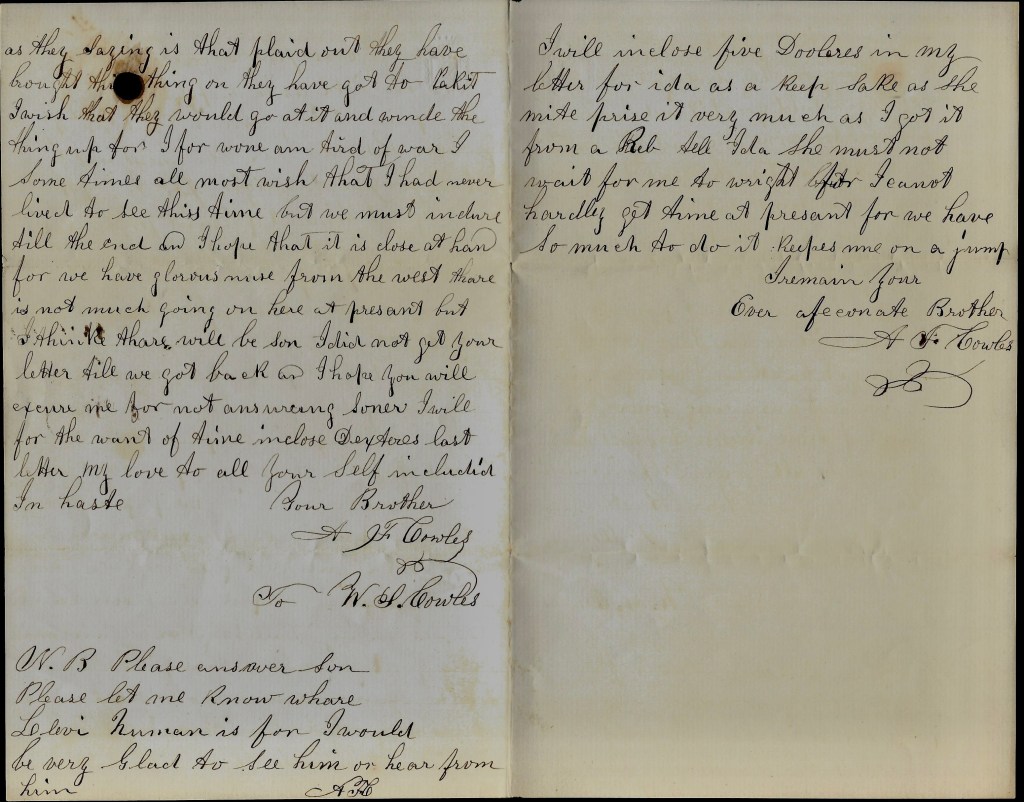
I take my pen in hand to again scribble a few lines to you hoping that they may find you all well. My health is first rate. I haven’t felt so well in a long time as I do at present. We have been very busy lately. We have not stayed any two days in a place for the past fifteen days. You probably have seen the mention in the papers of our raid. 1 We captured lots of horses & mules and took over a hundred prisoners & a number of smugglers and shipped over seven hundred negroes. Taking it all together, we have made a very good drive. We naturally made the secesh squirm when we took their negroes. It does me good to hear them beg, I tell you. We did not handle them with kid gloves, as the saying is. That played out. They have brought this thing on. They have got to take it. I wish they would go at it and wind the thing up for I for one am tired of war. I sometimes almost wish that I had never lived to see this time but we must endure till the end and I hope that it is close at hand for we have glorious news from the West.
There is not much going on here at present but I think thre will be soon. I did not get your letter till we got back and I hope you wil excuse me for not answering sooner. I will for the want of time enclose Dexter’s last letter.
My love to all, yourself included. In haste. Your brother, — A. F. Cowles
To W. S. Cowles
N. B. Please answer soon. Please let me know where Levi Newman is for I would be very glad to see him or hear from him. — A. F.
I will enclose five dollars in my letter for Ida as a keepsake as she might prize it very much as I got it from a Reb. Tell Ida she must not wait for me to write for I cannot hardly get time at present for we have so much to do, it keeps me on a jump. I remain your ever affectionate brother, — A. F. Cowles
1 This is probably a reference to Stoneman’s 1863 raid that was conducted in conjunction with the Chancellorsville Campaign.
I could not find an image of Rob but here is a cdv of Christian Hedges who served as the captain of Rob’s company.(Iowa Civil War Images)
These letters were written by Robert (“Rob”) M. Kepner (1838-1929), the son of Samuel Kepner (1811-1862) and Elizabeth Haslet (1815-1845) of Marengo, Iowa. Rob was “a young Iowa farm boy when he enlisted in Co. G of the 7th Iowa Infantry. On October 4th [1862], the second day of the Battle of Corinth, the regiment was fighting near Battery Powell. With the regiments on either side of them retreating, the 7th held their ground until ordered to fall back and the brigade reformed around them. Sometime during the desperate fighting Robert was shot in the face. Robert kept up an active correspondence with his younger sister but he always avoided the gory details that might frighten her. When he mentioned his wound he as often as not made light of it. He broke the news by telling her, “I have got a slight introduction to something less than a pound of Sesech lead in the face. I was struck by a miney (sic) ball in the left cheek just above the mouth—the ball striking the bone and glancing, lodged in the back part of the cheek, making rather an ugly, though not very painful wound. I am doing finely, and you need not feel the least uneasiness about me.”
There were several hospitals in Corinth, as well as the larger hotels and warehouses, which had been pressed into service to treat the wounded. Oddly, because his wound was not serious, Robert was sent to Pittsburg Landing and then put on a steamboat headed north. The boat docked at Mound City, Illinois and the wounded were off-loaded into the massive Mound City Naval Hospital. “There is about 1500 hundred sick and wounded in this one building here. I shall be perfectly sound in a week or two. I don’t think I shall be badly disfigured by the scratch, there will be a small scar, but as I had not a great deal of good looks to spare, I cannot say as this has helped my looks in the least.”
On November 10th, Robert, no worse for his ordeal, wrote to his sister again to assure her he was again “doing finely” and had returned to his regiment at Corinth.” [Source: Shiloh National Military Park]
Rob wrote some of his letters to his sister, Ellen Elizabeth Kepner (1842-1923) who would later (1866) marry James Henry Mead of Marengo, Iowa. Mead served in Co. E, 24th Iowa Infantry during the Civil War. It should be noted that Rob had a brother named Daniel S. Kepner (1840-1862) who was killed in action at Antietam while serving in Co. A, 14th Indiana Infantry. It should also be noted that though all the records I have found on Rob show his name to be Robert, for some reason he signed his named “Robbin” on this letter.
[Note: These letters are from the private collection of Greg Herr and were offered for transcription and publication on Spared & Shared by express consent.]
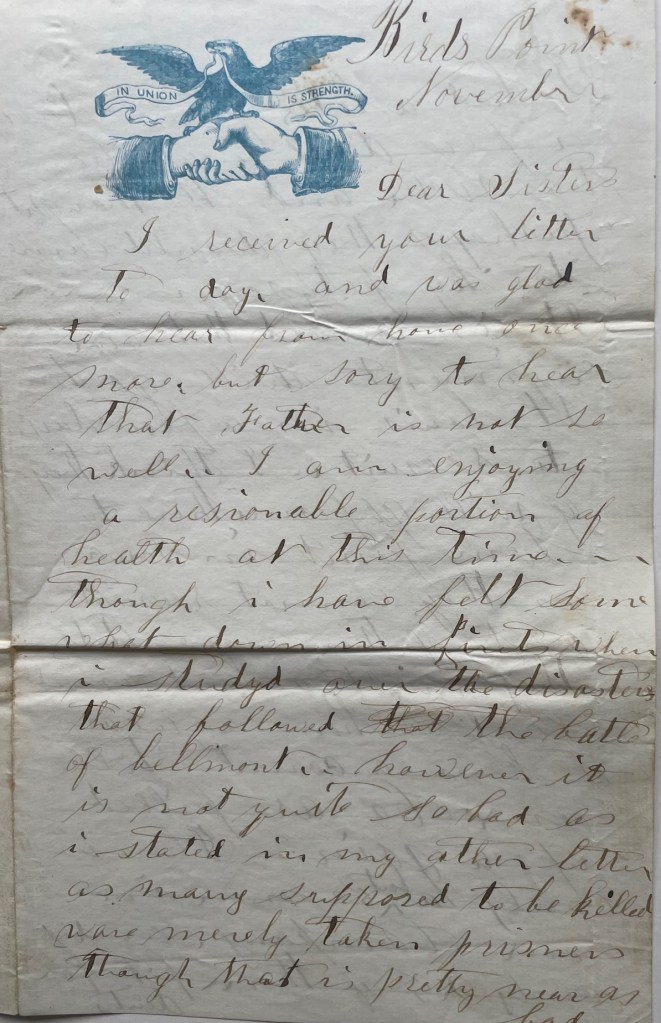
Letter 1
Bird’s Point [Missouri] [Mid] November [1861]
Dear Sister,
I received your letter today and was glad to hear from home once more but sorry to hear that Father is not so well. I am enjoying a reasonable portion of health at this time though I have felt somewhat down in spirits when I studied over the disaster that followed the Battle of Belmont. 1 However, it is not quite so bad as I stated in my other letter as many supposed to be killed were merely taken prisoners though that is pretty near as bad.
I had a letter from [brother] Dan [14th Indiana] a few days ago. He was well and he thought perhaps they would come to Kentucky pretty soon. It is rumored that our regiment will go to St. Louis in a few days to recruit. I think they will go from there to some point in Iowa as they cannot recruit out of there own state, they might about as well send us home as we are of no account till our companies are filled up again. There is only about 50 men in our company and only 25 of them fit for duty.
I wrote a letter about three weeks ago and sent some $15 dollars in scrip to Father but I have had no account of it yet. I begin to feel a little uneasy lest it has been miscarried or been detained in some other way. I want you to write whether you have got it or not that I may feel satisfied on the point.
It seems to be a noted fact that out of 12 of our boys who went to the hospital, but one or two have come away. John Zahast is still there and is not any better. He would not stand the trip were he to start home.
But I believe I have not much more to write. Therefore, I will bring this short epistle to a close but remain your affectionate brother till death. — R. M. Kepner to Miss E. E. Kepner
1 “The battle of Belmont was a bloody day for the Seventh. The regiment went into the fight with eight companies, number 410 men, Two companies-K and G-being detached as a fleet guard, were not in the fight. The regiment lost, in killed, wounded, and missing, 237 men. It was on this field that the gallant and lamented Wentz fell, with many other brave officers, viz: G. W. S. Dodge, 2d Lieut. Co. B; Benjamin Ream, 2d Lieut. Co. C; Charles Gardner, 2d Lieut. Co. I. Col. Lauman and Major Rice were both severely wounded, as were also Capt. Gardner, Co. B; Capt. Harper, Co. D; Capt. Parrott, Co. E; and Capt. Kitteridge, Co. F. It was in this fight that Iowa officers and soldiers proved to the world that they were made of the right kind of material, and added to the luster of our young and gallant State. On the evening of the 7th of Nov., 1861, the shattered remnant of the Seventh Iowa arrived at Bird’s Point, remained a few days, and were then ordered to Benton Barracks, St. Louis, Mo., to rest and recruit. This terminated the first battle of the Seventh Iowa.”
Letter 2
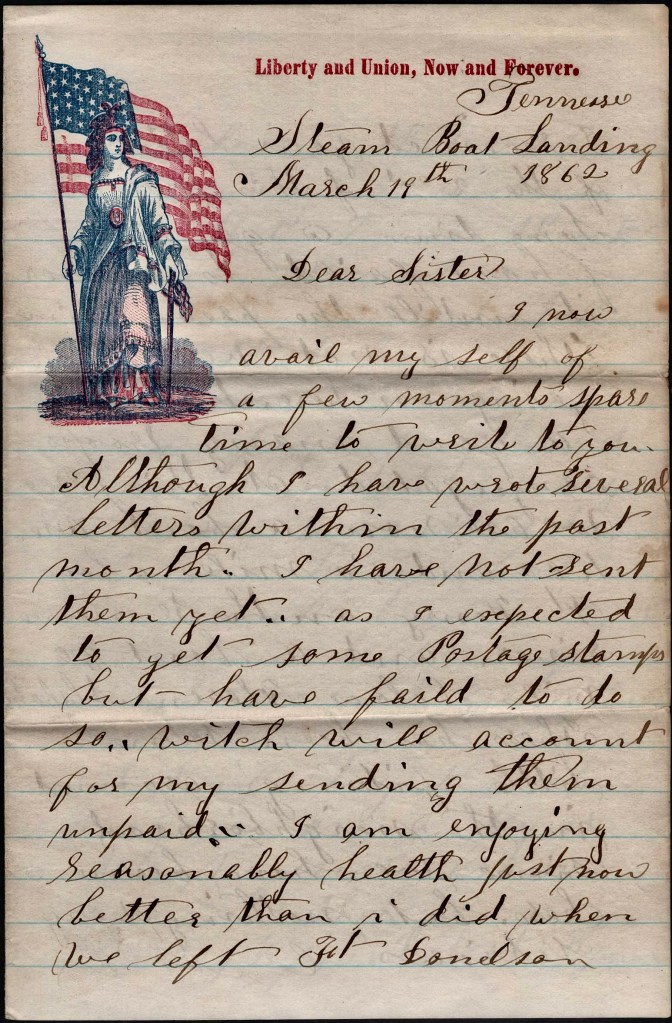
Steamboat Landing, Tennessee March 19th 1862
Dear Sister,
I now avail myself of a few moments spare time to write to you. Although I have wrote several letters within the past month, I have not sent them yet as I expected to get some postage stamps but have failed to do so which will account for my send them unpaid.
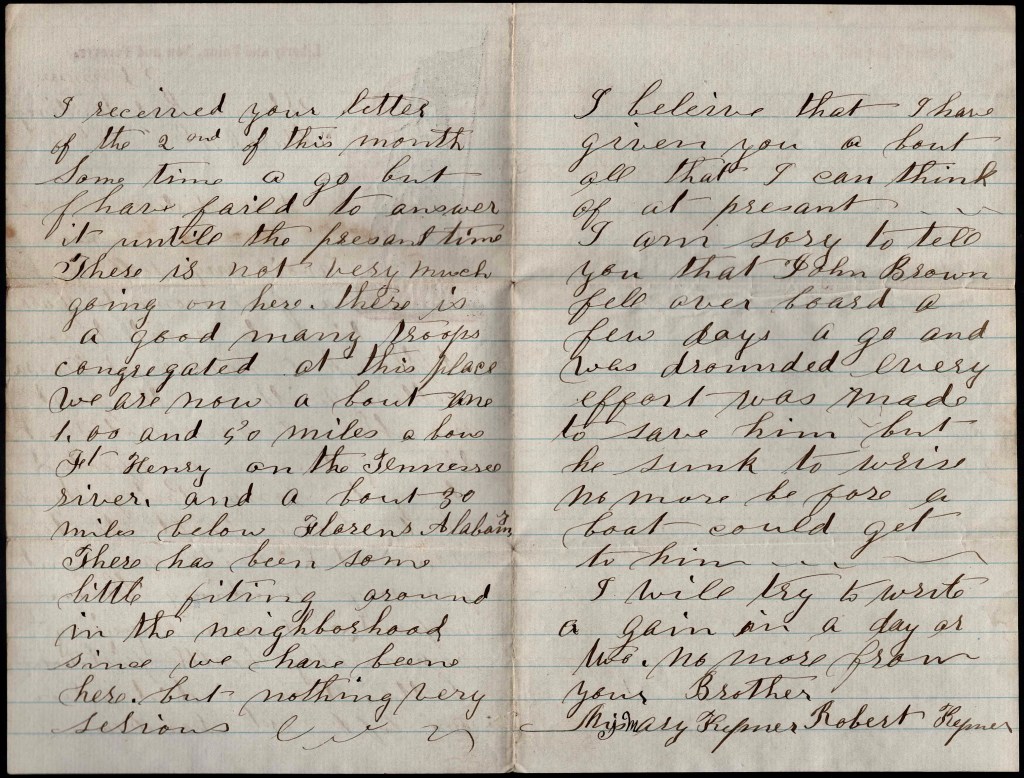
I am enjoying reasonably [good] health just now—better than I did when we left Fort Donelson. I received your letter of the 2nd of this month some time ago but I have failed to answer it until the present time. There is not very much going on here. There is a good many troops congregated at this place. We are now about one hundred and fifty miles above Fort Henry on the Tennessee river and about 30 miles below Florence, Alabama.
There has been some fighting around in the neighborhood since we have been here but nothing very serious. I believe that I have given you about all that I can think of at present. I am sorry to tell you that John Brown fell overboard a few days ago and was drowned. Every effort was made to save him but he sunk to rise no more before a boat could get to him.
I will try to write again in a day or two. No more from your brother, — Robert Kepner
To Miss Mary Kepner
Letter 3
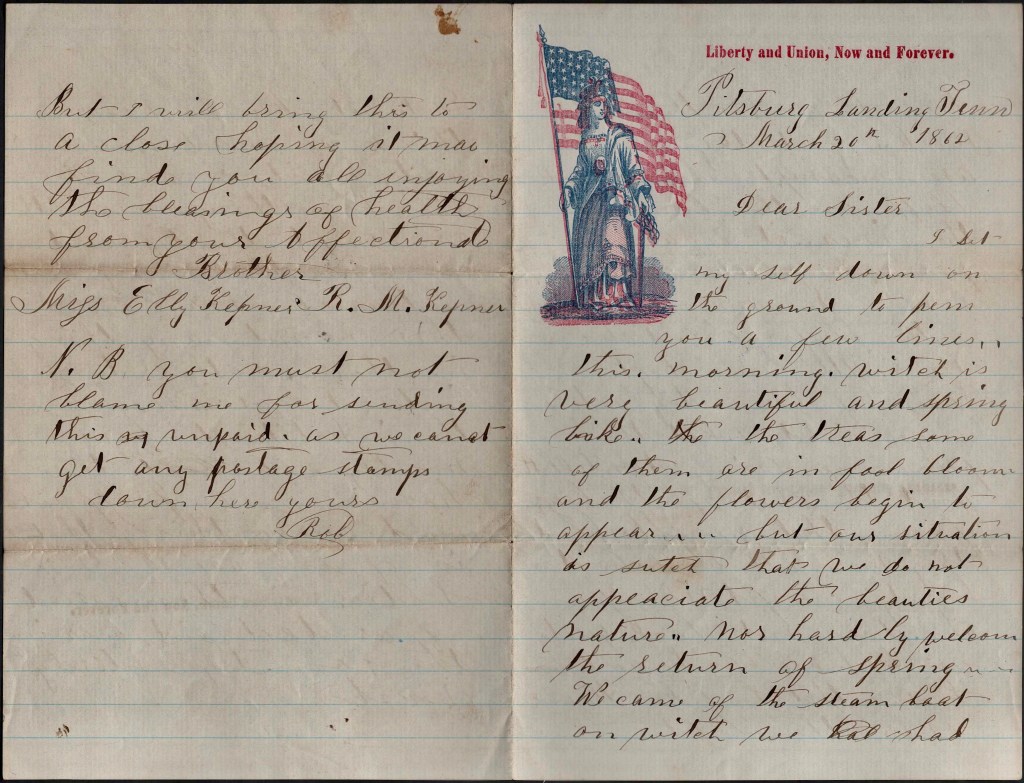
Pittsburg Landing, Tennessee March 20th 1862
Dear Sister,
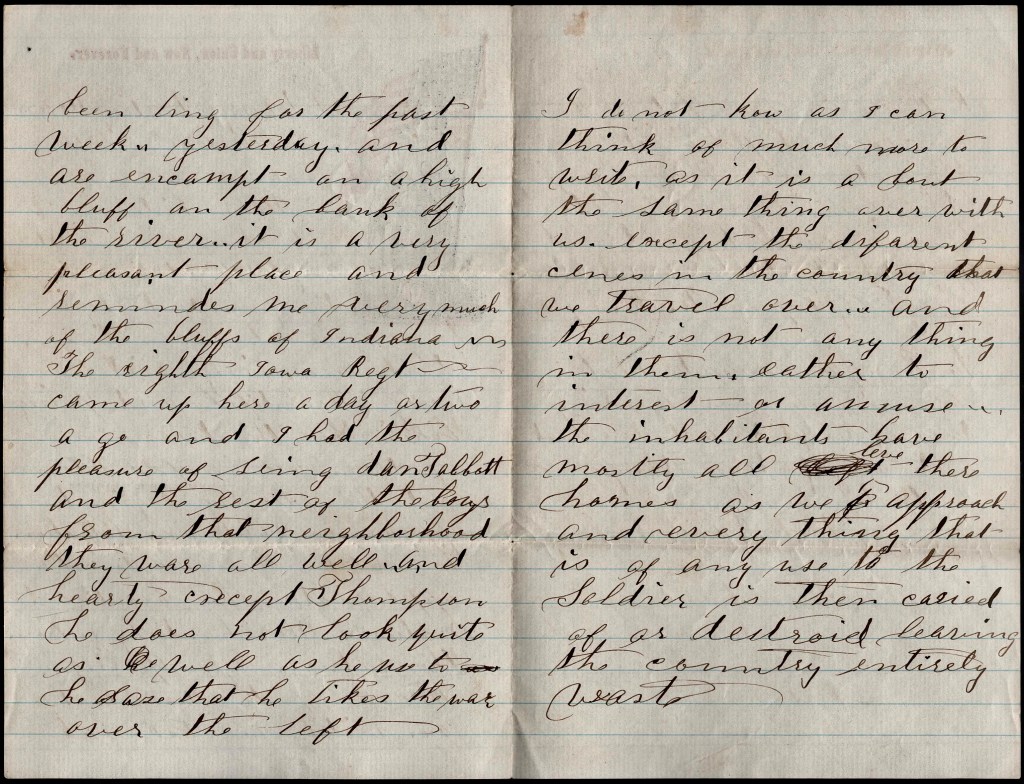
I sit myself down on the ground to pen you a few lines this morning which is very beautiful and spring-like. The trees—some of them—are in full bloom and the flowers begin to appear. But our situation is such that we do not appreciate the beauties of nature nor hardly welcome the return of spring. We came off the steamboat on which we had been living for the past week yesterday and are encamped on a high bluff on the bank of the river. It is a very pleasant place and reminds me very much of the bluffs of Indiana.
The 8th Iowa Regt. came up here a day or two ago and I had the pleasure of seeing Dan Talbott and the rest of the boys from that neighborhood. They were all well and hearty except Thompson. He does not look quite as well as he use to. He says that he likes the war over the left.
I do not know as I can think of much more to write as it is about the same thing over with us except the different scenes in the country that we travel over, and there is not anything in them either to interest or amuse. The inhabitants mostly all leave their homes as we approach and every thing that is of any use to the soldier is then carried off or destroyed leaving the country entirely waste.
But I will bring this to a close hoping it may find you all enjoying the blessing of health. From your affectionate brother, — R. M. Kepner
to Miss Elly Kepner
N. B. You must not blame me for sending this unpaid as we cannot get any postage stamps down here. Yours, — Rob
Letter 4
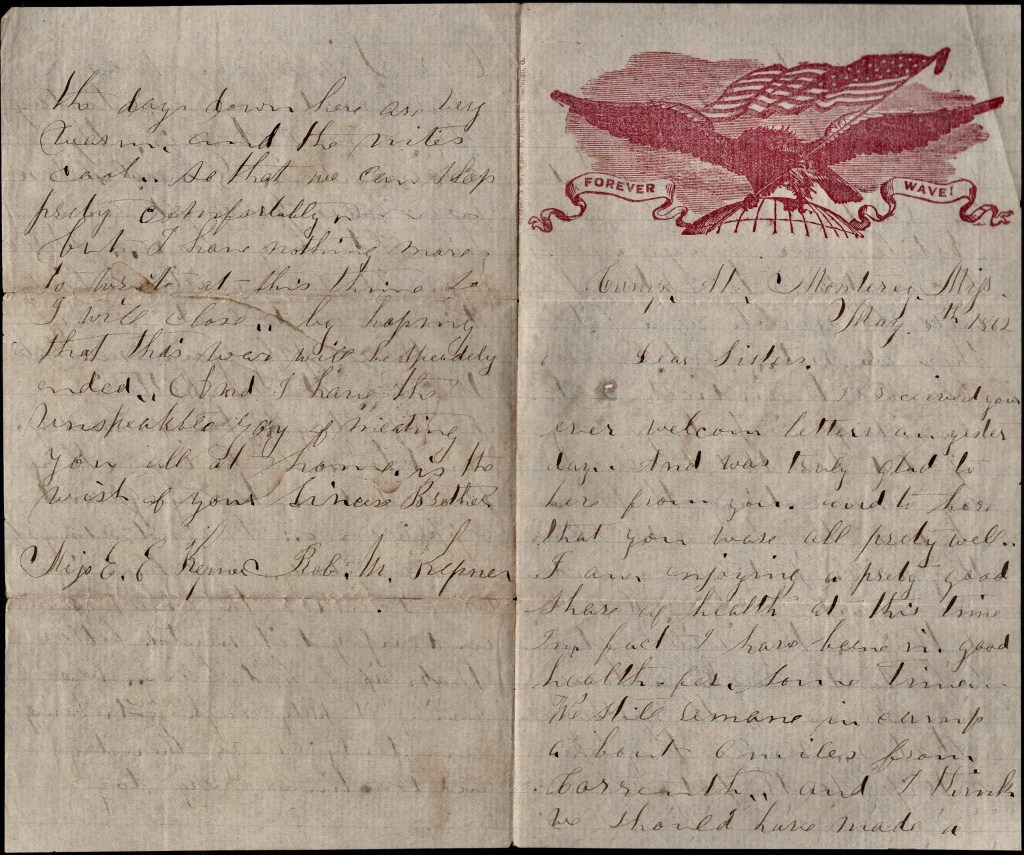
Camp at Monterey, Mississippi May 8, 1862
Dear sister,
I received your ever welcome letters on yesterday and was truly glad to hear from you and to hear that you was all pretty well. I am enjoying a pretty good share of health at this time. In fact, I have been in good health for some time.
We still remain in camp about 6 miles from Corinth and I think we should have made a move on that place before now had it not been for the recent heavy rain which have made the roads impossible for artillery or wagons. 1 I cannot say as to whether there will be much of a fight there or not but rumor seems. to indicate not as it is pretty generally reported here that the secesh are evacuating the place. But if they have not, I think they will pretty soon under an escort of Gen. Halleck’s. I think they will get liberty to make a tower in some of the northern states unless they take a trip south pretty soon.
Our Division was reviewed on yesterday by Gen. [Thomas A.] Davies. The commander, General Halleck was also present on his old bay horse. I tell you, it was quite a lively time and beat any 4th of July you ever saw. There was twelve Battalions of infantry and four of cavalry and to a looker on, they presented a truly grand appearance. I was not [there] myself as I was on duty but then I was where I could see the whole performance and enjoyed it much—better than if I had been in.
We are having it pretty rough now being on duty every other day and sometimes every day. The days down here are very warm and the nights cool so that we can sleep pretty comfortably. But I have nothing more to write this time so I will close by hoping that this war will be speedily ended and I have the unspeakable joy of meeting you all at home is the wish of your sincere brother, — Rob M. Kepner
to Miss E. E. Kepner
1 “On May 4 and 5 torrential rains pelted the area, turning the roads into ribbons of mud. A number of bridges were swept away by normally placid streams turned into raging. torrents.” Source: Siege and Battle of Corinth.
Letter 5
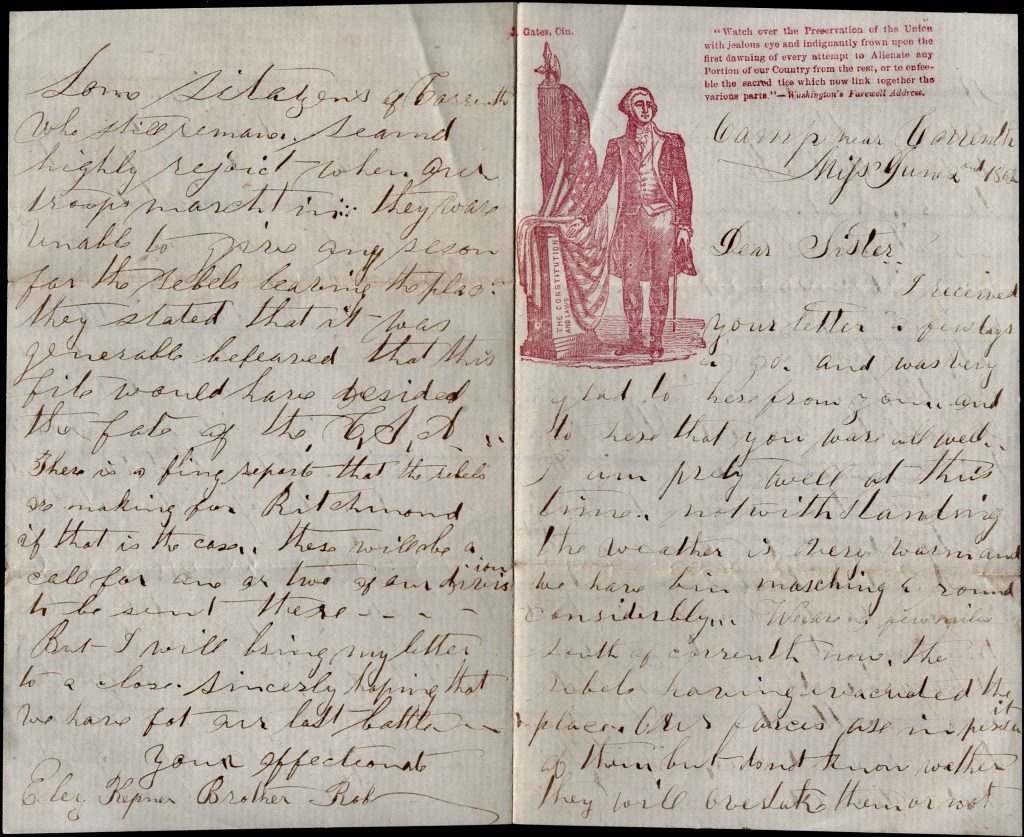
Camp near Corinth, Mississippi June 2, 1862
Dear Sister,
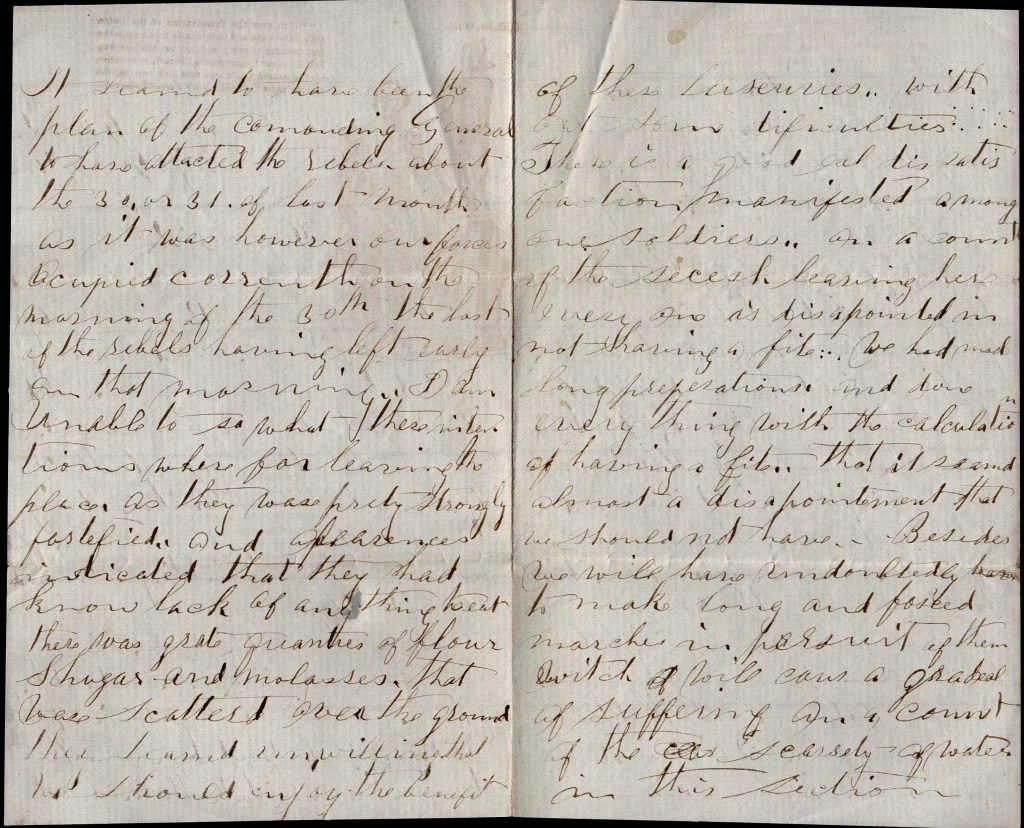
I received your letter a few days ago and was very glad to hear that you were all well. I am pretty well at this time notwithstanding the weather is very warm and we have been marching around considerably. We are a few miles south of Corinth now, the rebels having evacuated the place. Our forces are in pursuit of them but do not know whether they will overtake them or not. It seemed to have been the plan of the Commanding General to have attacked the rebels about the 30th or 31st of last month. As it was, however, our forces occupied Corinth on the morning of the 30th, the last of the rebels having left early on that morning. I am unable to say what their intentions were for leaving the place as they were pretty strongly fortified and appearances indicated that they had no lack of anything to eat. There was great quantities of flour, sugar, and molasses that was scattered over the ground. They seemed unwilling that we should enjoy the benefit of these luxuries without some difficulties.
There is a great deal dissatisfaction manifested among our soldiers on account of the secesh leaving here. Everyone is disappointed in not having a fight. We had made long preparations and done everything with the calculation of having a fight that it seemed almost a disappointment that we should not have. Besides, we will undoubtedly have to make long and forced marches in pursuit of them which will cause a great deal of suffering and cannot find scarcely any water in this section. Some citizens of Corinth who still remain seemed highly rejoiced when our troops marched in. They were unable to give up any reason for the rebels leaving the place. they stated that it was generally befeared that this fight would have decided the fate of the C. S. A. There is a flying report that the rebels are making for Richmond. If that is the case, there will be a call for one or two of our divisions to be sent there.
But I will bring my letter to a close sincerely hoping that we have fought our last battle. Your affectionate brother, — Rob
Letter 6
Camp in the field near Corinth, Miss. Sunday, June 8th 1862
Dear Sister,
As I thought you would be anxious to hear from me as often as possible, I have taken the present Sunday morning for doing so. I have nothing strange or important to write as the war seems pretty near dried up in this section. We are near a small town by the name of Booneville about 30 miles from Corinth. We have to move our camp about every day and progress a little farther into the South. Everything is so quiet here that you would hardly suppose that a rebel army had so recently been routed and scattered over the country.
The weather is pretty warm though we have had no real hot weather as yet. Health is pretty good among the soldiers at this time.
I should like very much to be at home a few days about this time but I expect it will be some time before I am granted that privilege. There is several of the boys of our company who were sick in the hospital have been sent to Keokuk. I almost wished I had been one of them. I think if I should get that near home, I would make an effort to get the rest of the way. I may get home pretty soon and again, it may be some time but I hope the time will be short until I can again greet all the friends at home. It is just harvest here and when I see the yellow grain shocked in the field, it makes me think of the god spread plains of Iowa. I would willingly change my musket for to follow the reaping machine though I never used to like the business.
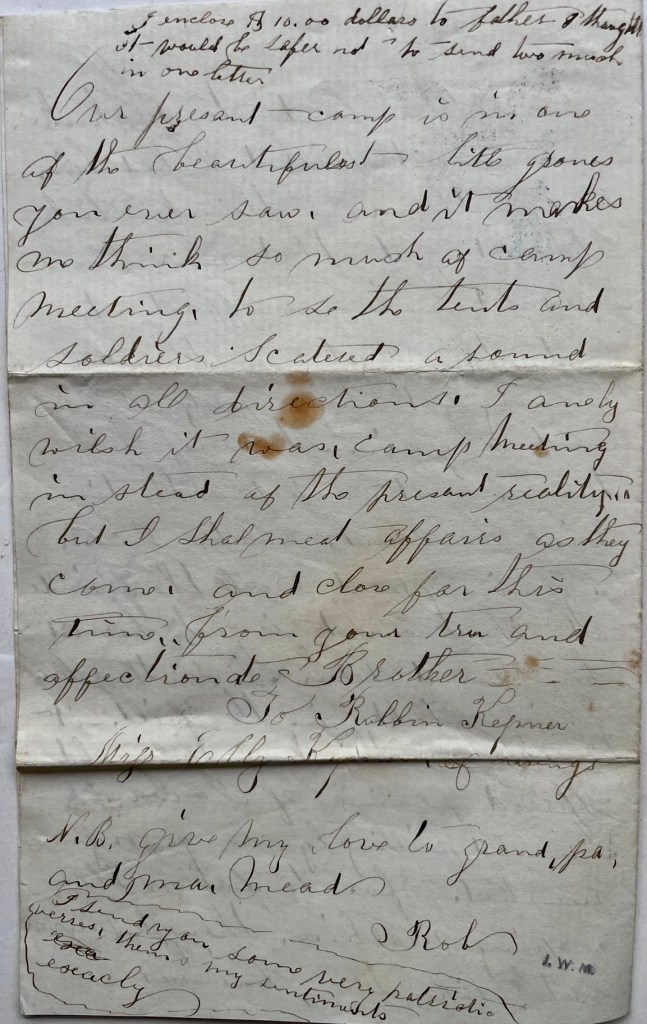
Our present camp is in one of the beautifulest little groves you ever saw and it makes me think so much of a [Methodist] camp meeting to see the tents and soldiers scattered around in all directions. I only wish it was camp meeting instead of the present reality but I shall meet affairs as they come and close for this time. From your true and affectionate brother, — Robbin Kepner
to Miss Elly Kepner
N. B. Give my love to grandpa and ma Mead. — Rob
I send you some very patriotic verses. Them’s my sentiments exactly.
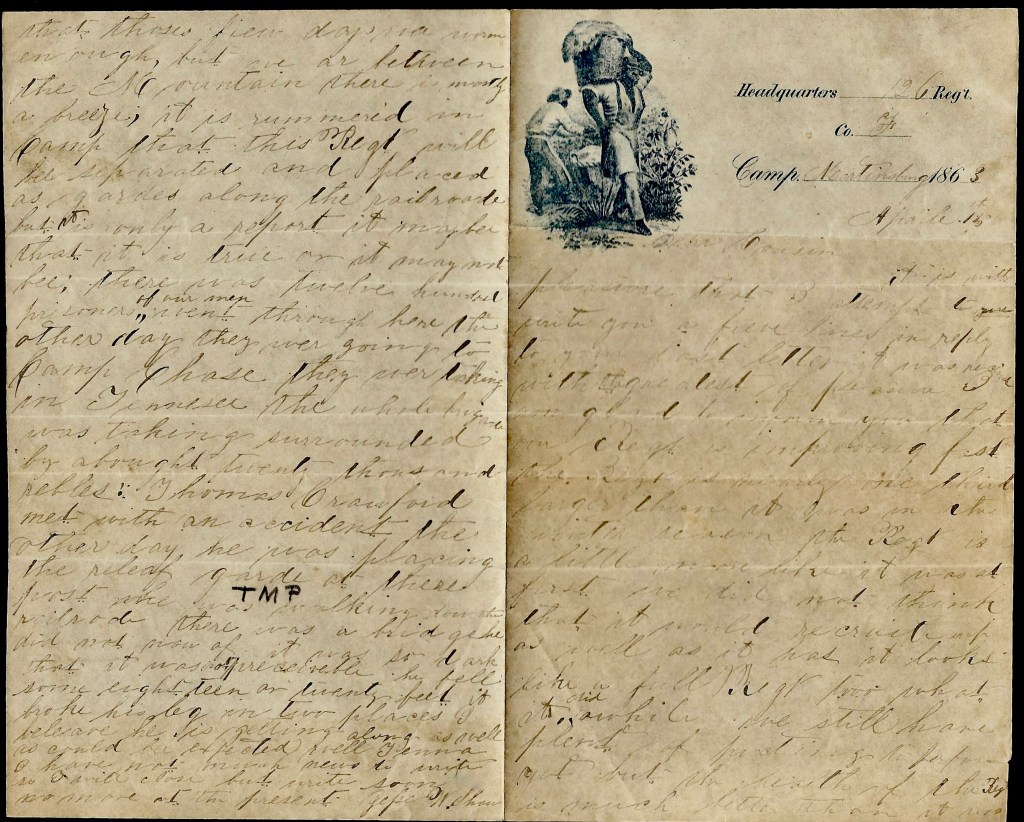
The following letters were written by Pvt. Jesse W. Shaw who enlisted when he was 20 years old in Co. F, 126th Ohio Volunteer Infantry (OVI) on 15 August 1862 for three years. He was discharged on 26 April 1865 for wounds received 11 months earlier in the Wilderness.
I could not find an image of Jesse but here is Joseph Whetstone of Co. A, 126th OVI (Ohio History Connection)
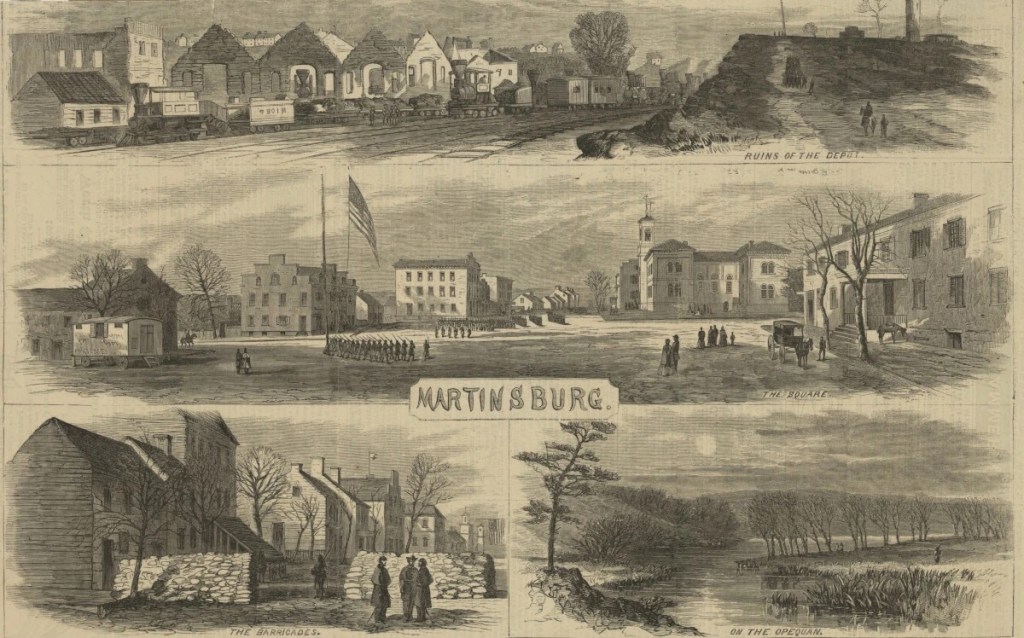
The 126th OVI was organized in September under Colonel Benjamin F. Smith and moved the same month to Parkersburg, West Virginia, and then to Cumberland, Md. It guarded the B&O Railroad during the winter, and in the spring of 1863 operated against guerrillas in West Virginia. In June the Regiment returned to the vicinity of Martinsburg and was severely pressed by the advance of Lee’s army, but escaped to Harper’s Ferry and afterwards moved to Washington City. It soon re-joined the Army of the Potomac and operated in Virginia under Grant. It took part in the battles of Snicker’s Gap, Opequan, Fisher’s Hill, the Wilderness and Petersburg, and joined the pursuit of Lee until the surrender. The Regiment was mustered out June 25, 1865, and lost during its term of service over 500 men in battle.
Letter 1
Headquarters 126th [Ohio] Regt., Co. F Camp Martinsburg April 15, 1863
Dear Cousin,
It is with pleasure that I attempt to write you a few lines in reply to your last letter. It was received with the greatest of pleasure. I am glad to inform you that our regiment is improving fast. The regiment is nearly one third larger than it was in the winter season. The regiment is a little more like it was at first. We did not think that it would recruit up as well as it has. It looks like a full regiment to what it did a while [ago]. We still have plenty of picketing to perform yet but the health of the regiment is much better than it was, so we have not quite so much guard [duty] to perform as we had some time past. But I must say that there is plenty of it yet. But there was a while that were on every other day. That, I think, is often enough. But the guard [duty] has been reduced a little. That is alright for there were more guards than there was any use of. There is too much duty at this place for one regiment to perform. There is no infantry troops here but the 126th. It is the only regiment that performs the duty.
We have begun to drill this spring so I suppose they will have us to drill this summer also but I think we will not keep it up quite so regular as we did the last summer. I suppose it will be kept up as long as we stay at this place.
The town ladies come to camp every nice evening to see us on dress parade. There is most sure to be some every evening of dress parade. The citizens want this regiment to stay here all summer. We have had several pretty nice days this spring but we have had a good little bit of rain this spring. This is a very wet day here and it appears as though it will remain ugly weather for a while but it is very changeable here. It is hard to tell one day what it will be like the next one. It being close to the mountains, is very changeable weather. There was one or two days that was very hot but the people say that it will get five times as hot after a while. If it does, it will be pretty warm weather for us soldiers for we thought that those few days was warm enough, but we are between the mountains [and] there is mostly a breeze.
It is rumored in camp that this regiment will be separated and placed as guards along the railroads but it is only a report. It may be that it is true or it may not be. There was twelve hundred prisoners of our men went through here the other day. They were going to Camp Chase. They were taken in Tennessee. The while brigade was taken—surrounded by about twenty thousand rebels. 1
Thomas Crawford met with an accident the other day [when] he was placing the relief guard at their post. He was walking down the railroad. There was a bridge he did not know of. It was so dark that it was imperceivable. He fell some eighteen or twenty feet. It broke his leg in two places. I believe he is getting along as well as could be expected.
Well, Tenna, I have not much news to write so I will close but write soon. No more at the present. — Jesse W. Shaw
1 These paroled Union soldiers being transported by traIn to Camp Chase to await exchange were surrendered to Brig. Gen. Nathan Bedford Forrest near Brentwood, Tennessee on 25 March 1863. The Union forces were commanded by Lt. Col. Edward Bloodgood who surrendered 800 men with very little resistance. Major General William S. Rosecrans was disgusted with the lack of fight and had Bloodgood court-martialed for cowardice. In a letter dated 9 April 1863 at Martinsburg, Lt. Rufus Ricksecker of the 126th OVI, wrote his folks that “Day before yesterday there was a long train went by of ‘Paroled Prisoners’ passed here; they stopped about half an hour; after the train had left I understood some of the 51st Ohio were along, I did not get to see any of them. This evening another one passed coming the other way with Rebels. I suppose they are going to be exchanged, they did not appear to like the idea very much, as they said they were so much better fed in the North.”[Source: The 126th Ohio Volunteer Infantry]
Letter 2
New Creek, Virginia May 17, 1863
Miss Tenna Caskey
Well Tenna, I thought that I would answer your letter which I received some time ago. We left Martinsburg April 26th. We took the train and rode to New Creek. There we stayed until morning and then was ordered to march to Greenland Gap. We went within 7 miles from the Gap the first day. We were all pretty well tired out [after] the first day’s march. There was 50 or more fell back and come up on the wagon train. We had the creek to cross about 30 times. It kept us wet all the time but we at last stopped for the night. We then got our supper and laid down to sleep. But we did not sleep very much for we were all wet.
We were ordered to march at four o’clock. We then proceeded for the Gap. We arrived at the Gap about 5 o’clock but found no rebels there. They had left but they had a pretty smart fight with 80 of [James Adelbert] Mulligan’s men. They fought 21 hundred of the rebels for five hours. The rebels charged on them three times but were repulsed every time. The 80 men were in a little fort. The rebs dismounted and went around the mountain and come down on them from the top and run them out but they were too spunky to give up so they run to an old Meeting House that stood close by. The rebs set the house on fire but they kept them away as long as they had plenty of ammunition but they run out. The last load they shot was their ramrods. Then threw their guns in the fire and surrendered. 1
The dead was all buried when we got there. The dead horses was lying around plenty. I saw the graves of part of the dead. There was two houses that stood close by that had 25 wounded and killed. They [the rebels] lost 80 killed and wounded. Only one of Mulligan’s men was killed at the time but there was two or three wounded and one died since. There was guns lying around on the ground but I did not pick any of them up. I thought that I had enough to carry for fifty cents per day.
Then we were ordered to follow them. We then proceeded 8 miles farther up the Alleghany Mountains. We arrived at a place by the name of Mt. Storm. There we lay two days. We had not been there long before we heard that the rebs was marching that way. Then the next thing was to prepare for them. We fortified with logs and stone the best we could and waited awhile for them but they did not come. We were then ordered back to New Creek. We had not got quite there until we received the dispatches that the rebs was going through the Gap. Then come the hard times. It was a pretty hard march in the forenoon but it was a harder one in the afternoon. We then started back to the Gap. We were as tired a lot of boys as ever I saw but we arrived there about sundown. We then formed our regiment in as good a position as we could which did not take no little time for they were pretty well scattered along the ways. We then built some fires and got our suppers.
Then come the time for picket to go out and we had already marched 30 miles. I for one had to go on picket. So had John. We were on the same post. I presume if the rebels had come we would not have run very much for we were too tired but we were not disturbed. We were there three or four days and then were ordered back to New Creek. But we had another hard march to perform. We marched 16 miles in the afternoon. We camped for the night 7 miles from New Creek Station. It was then raining. I used to think it was pretty hard for the soldiers to pay out after night in snow or rain but I have experienced right smart of it myself the last month. We are now at New Creek.
Well, I will have to close for this time. Write soon. Direct to New Creek Station, Va., Co. F, 126th Regt. O. V. I., in care of corporal Walton.
— Jesse W. Shaw
1 On April 25, 1863, about 1,500 Confederate soldiers under General William “Grumble” Jones advanced through Greenland Gap, a scenic 820-foot-deep pass in New Creek Mountain in Grant County. Jones’s Confederates clashed with 87 Union soldiers, who’d taken positions in a local church and cabins.The Northern troops held off several assaults over four hours of fighting. After the church was set on fire, the Union forces finally surrendered. The Union side lost two killed and six wounded, while the Confederates lost seven killed and 35 wounded.It was the beginning of what would become known as the Jones-Imboden Raid, an ambitious but ultimately unsuccessful bid by Confederates to disrupt the Baltimore and Ohio Railroad and weaken Union control in what would soon become the new state of West Virginia. For a good summary of this engagement at Greenland Gap, readers are referred to an article by George Skotch (2018) entitled, “To the Last Crust and Cartridge.”
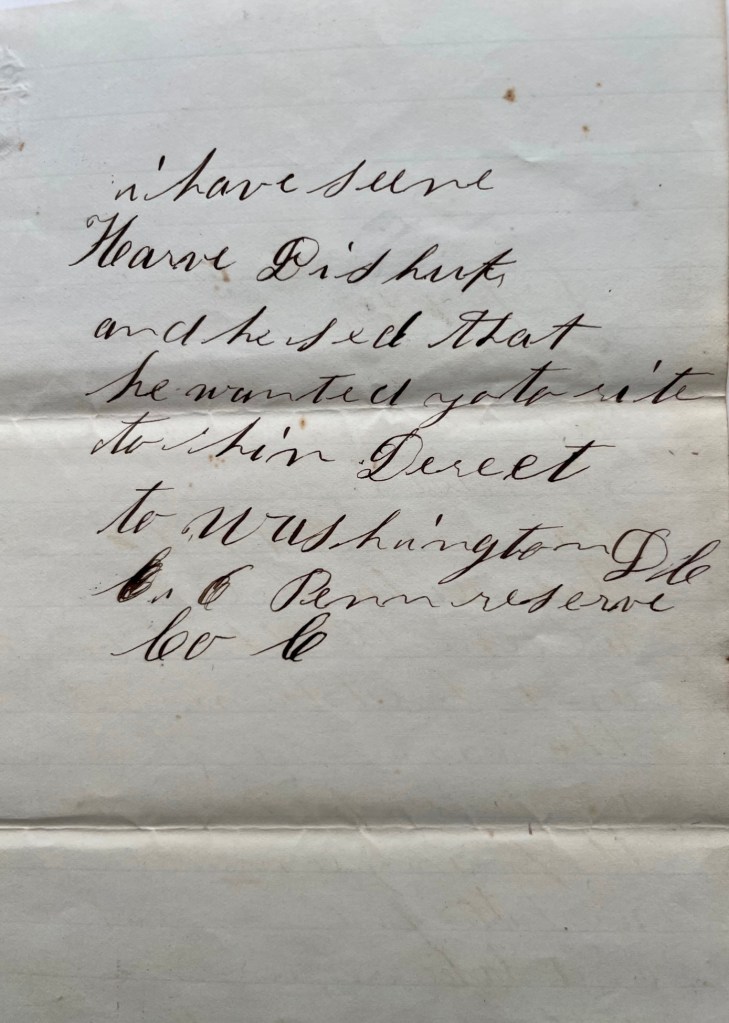
The following letter was written by a Union soldier from the state of Pennsylvania and we know that he had a brother named Moses, but beyond that, there are very few clues that would afford us an opportunity to learn his identity. It was unsigned and there is no envelope. The letter was written on stationery of the 84th Pennsylvania but the directions he provides his brother for answering his letter appears to state that he was in Co. C of the 6th Pennsylvania Reserves (35th Penn. Volunteers). Soldiers in Co. C, 6th Pennsylvania Reserves were recruited in Blair and Westmoreland counties.
Transcription
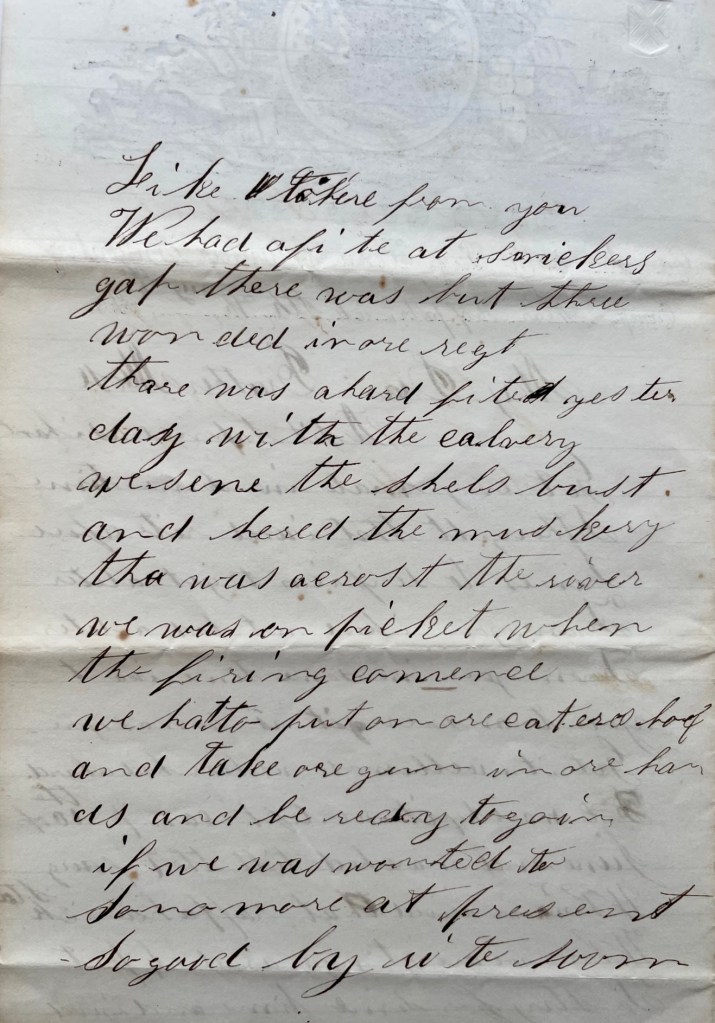
Co. I, 84th Regt. Penn. Volunteer Infantry Camp near Rappahannock Station. Va. August 5, 1863
My dear brother Mose,
As it happens as I hain’t got any mail in some time, I thought that I would write a few lines to see if I can get a letter from you. I have not had a letter from you in some time. I want you to answer it as soon as you get it.
Well, Mose, we have had a hard march of it. We left camp the 10th of June and marched till the 1st of August when we arrived at Rappahannock Station where we are now and I expect to stay for some time and would like to hear from you.
We had a fight at Snicker’s Gap. There was but three wounded in our regiment. There was a hard fight yesterday with the cavalry. We seen the shells burst and heard the musketry. They was across the river. We was on picket when the firing commenced. We had to put on our cartridge box and take our gun in our hands and be ready to go in if we was wanted to.
So no more at present. So goodbye. Write soon. I have seen Harve Dishart and he said that he wanted you to write to him. Direct to Washington D. C., 6th [?] Pennsylvania Reserves, Co. C.
The following brief letter was written by 35 year-old 1st Sergeant William Bredow of Waterville, Oneida county, New York, who enlisted in Co. E, 81st New York Infantry to serve three years. He was promoted from private to corporal in February 1862, to sergeant in July 1862, and to 1st Sergeant in January 1864 when he re-enlisted as a veteran. In February 1865 he was commissioned a 1st Lieutenant and he mustered out as the Captain of Co. H in August 1865.
I believe that William Bredow was born in Germany in 1836 and came to the United States in 1843 when he was seven years old.
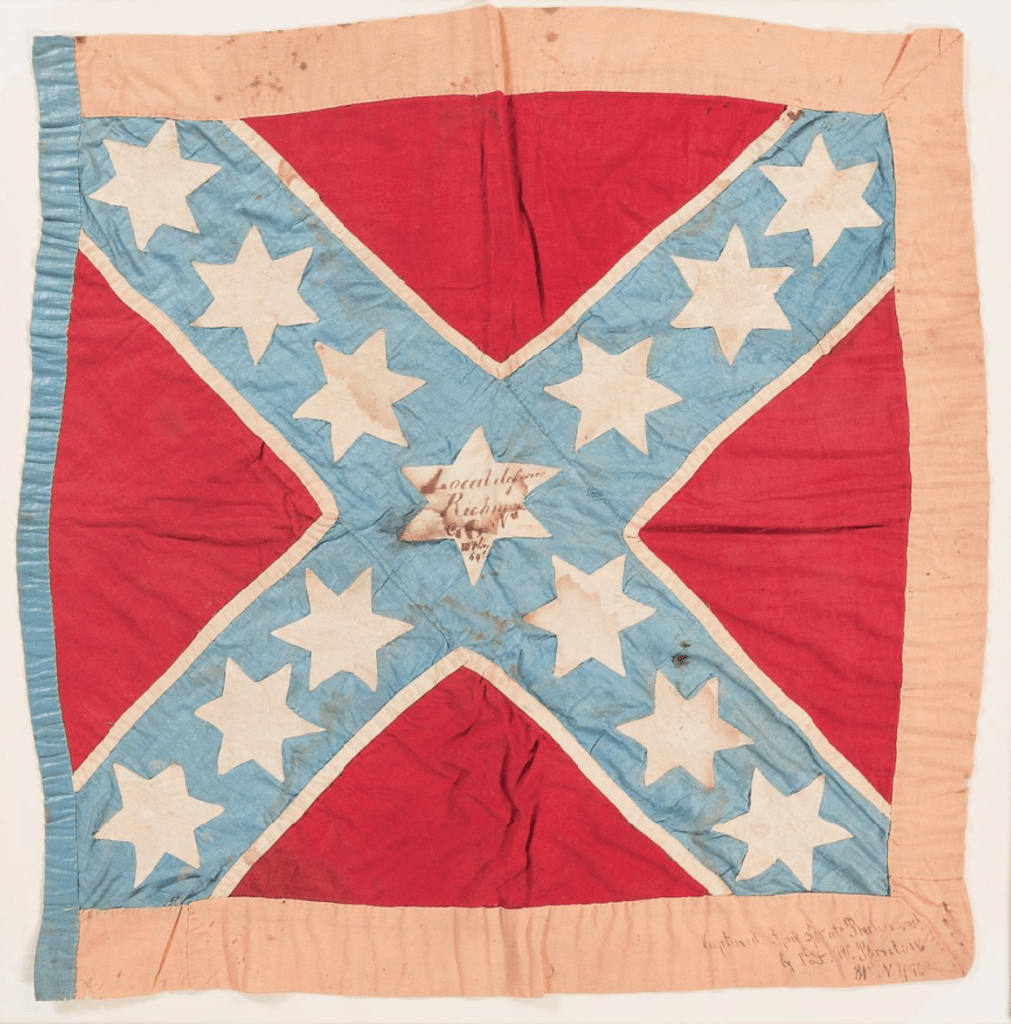
A small Confederate battle flag (24 inches by 25 inches) marked “Local defence/Richmond/Co. G/10th Va/10th May 1864″ and marked, Captured April 3rd 65 at Richmond by 1st Lt. W. Bredow, 81st NY Vols.” sold at auction recently for $55,000.
Note: This letter is from the personal collection of Greg Herr and was made available for transcription and publication on Spared & Shared by express consent.
Transcription
In front of Petersburg, Virginia near Bermuda Hundred September 16th 1864
Friend Tailiur!
I received your letter dated the 14th this month and am very much surprised to learn that you got no letter from me. I wrote one the next day as your brother-in-law Mr. Day in Hampton. The other I wrote the 11th this month. In the latter I answered you all the questions about payroll and so on and told you the news about our regiment. I hope you got both letters by this time. Your trunk is left by Captain [Lewis B.] Porter 1 in the storehouse in Norfolk.
I hope your leg will get well pretty soon and will not trouble you much. Everything is quiet here since you left. No excitement at all except this morning a couple boys were shot on picket by fooling with their guns. [John] Daily 2 out of Company B was brought in this morning about 5 o’clock shot through his buttocks, and now about half hour ago, [Francis P.] Graves 3 of Company I shot by Thomas McDonald 4 through the bowels.
Lieutenant [Maurice P.] Tidd joined the regiment yesterday. The boys sent their love to you. Hoping you got my letter by this time. I remain your friend, — W. Bredow
1 Lewis B. Porter was 30 years old when he enlisted on 5 September 1861 at Oswego to serve three years in Co. D, 81st New York Infantry. He was promoted to 1st Sergeant in August 1862, commissioned a 2nd Lt. in November 1862, and made Captain of Co. K in June 1864. He was wounded in action at Chaffin’s Farm, Va. two weeks after this letter was written and died of his wounds on 15 November 1864 at Fort Monroe, Va.
2 John Daly [or Dailey] was 36 years old when he enlisted at Oswego as a private in Co. B. in the fall of 1861. He was wounded “while on picket near Bermuda Hundred” and mustered out on 25 May 1865.
3 Francis (“Frank”) P. Graves of Rome, New York, was 19 when he enlisted in August 1862 to serve in Co. I with his brothers. He was wounded in action on 23 June 1864 at Cold Harbor but was standing duty on picket at Bermuda Hundred when he was “accidentally killed.”
4 Thomas McDonald was 18 when he enlisted on 14 December 1861 at Rome, New York to serve in Co. I. He was wounded in action at Cold Harbor on 3 June 1864 but survived the war.
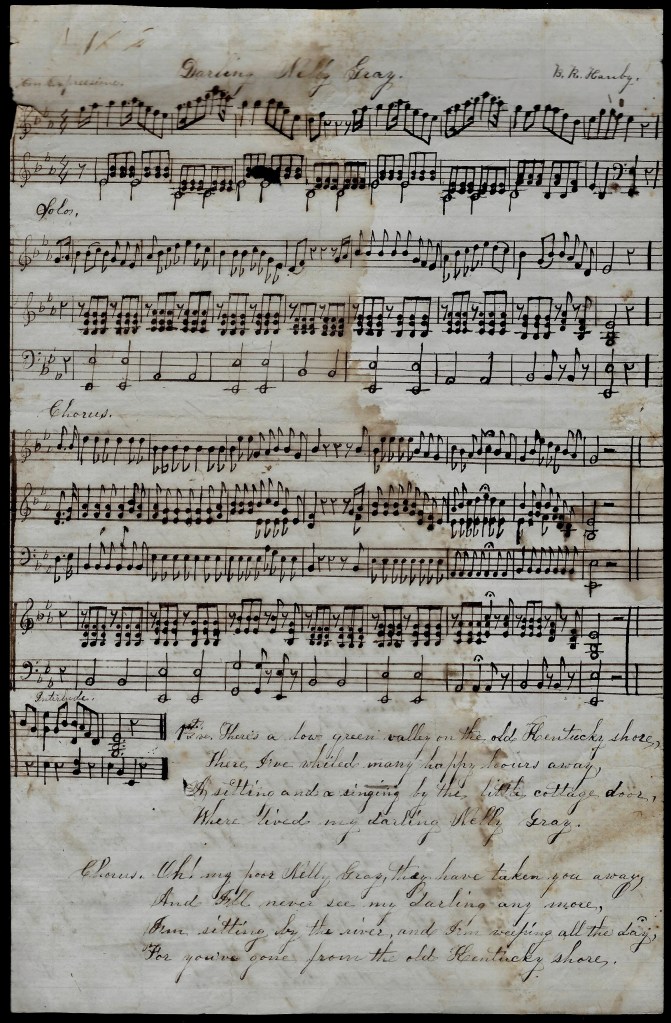
“Like Stephen Foster, Benjamin R. Hanby was a white, northern composer who wrote ‘plantation songs’ that evoked feelings and sentiments that he imagined were experienced by enslaved people working in southern plantation labor camps. Born in 1833 in Rushville, Ohio, he graduated from Otterbein College in Westerville in 1858 and went on to work as a minister at the United Brethren Church in New Paris, Ohio (1861–63). Today Hanby is mostly remembered as the composer of the 1865 Christmas song ‘Santa Claus, or Up on the Housetop.’ He died in Chicago in 1867.
‘Darling Nelly Gray’ was written in 1856 as a minstrel song to be performed in the theater by professionals wearing blackface and costumes that mock and demean African Americans. Like many minstrel songs, ‘Darling Nelly Gray’ was published in sheet-music form so that it could also be sung by amateurs in the parlor. Early minstrel songs (see ‘Jump Jim Crow’) were typically simplistic and mocked the speech of African Americans by featuring offensive dialect. But in the 1850s, as minstrel songs were increasingly designed for parlor performance, they took on a more refined character and expressed strong sentiments, more in line with the conventions of traditional parlor songs (see ‘The Blue Juniata‘ and ‘Hard Times Come Again No More‘).
Unlike Foster, whose family members were Democrats opposed to Abraham Lincoln and the Civil War, Hanby came from a family of ardent abolitionists. In addition, Hanby’s family and friends helped escaped slaves reach freedom along the Underground Railroad. Despite the minstrel characteristics of the song, it was almost certainly intended to encourage whites in the North to sympathize with the plight of enslaved African Americans and support abolitionism.” [Source: University of Pittsburgh]
The following song sheet is not dated nor are there any marking to indicate who hand-wrote it but it appears to be of Civil War era vintage.
Believed to beNewcomb Dyer, 46th Massachusetts; sold with the collection of his letters.
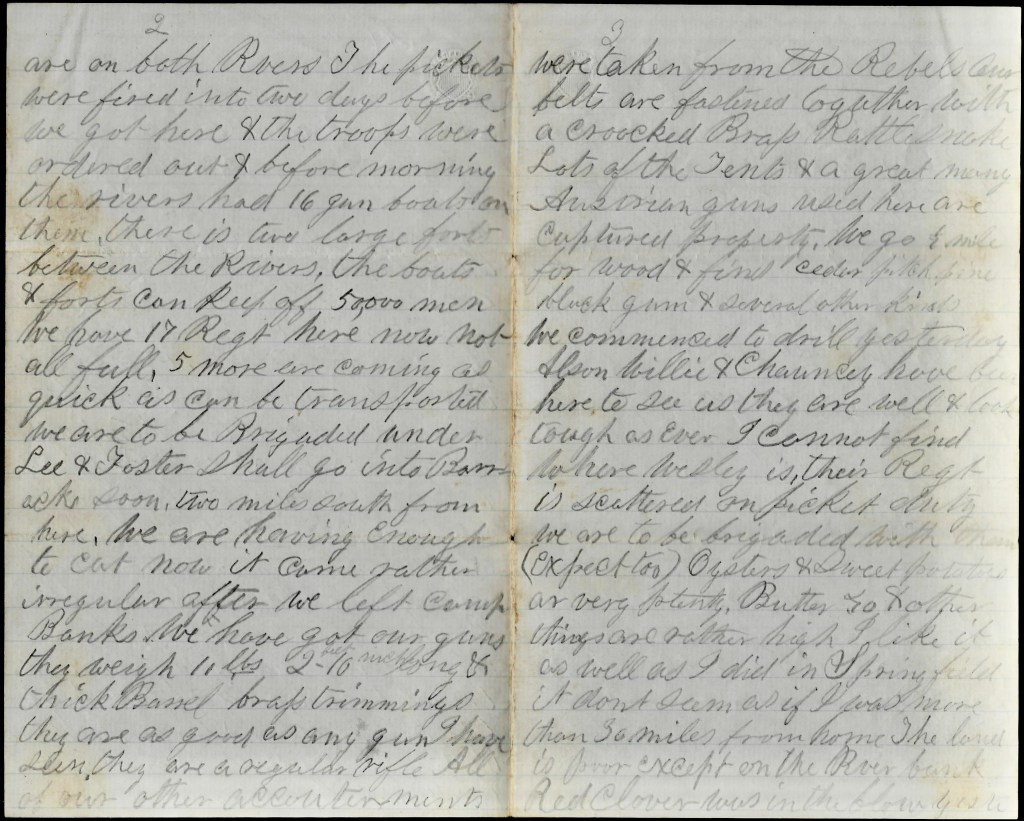
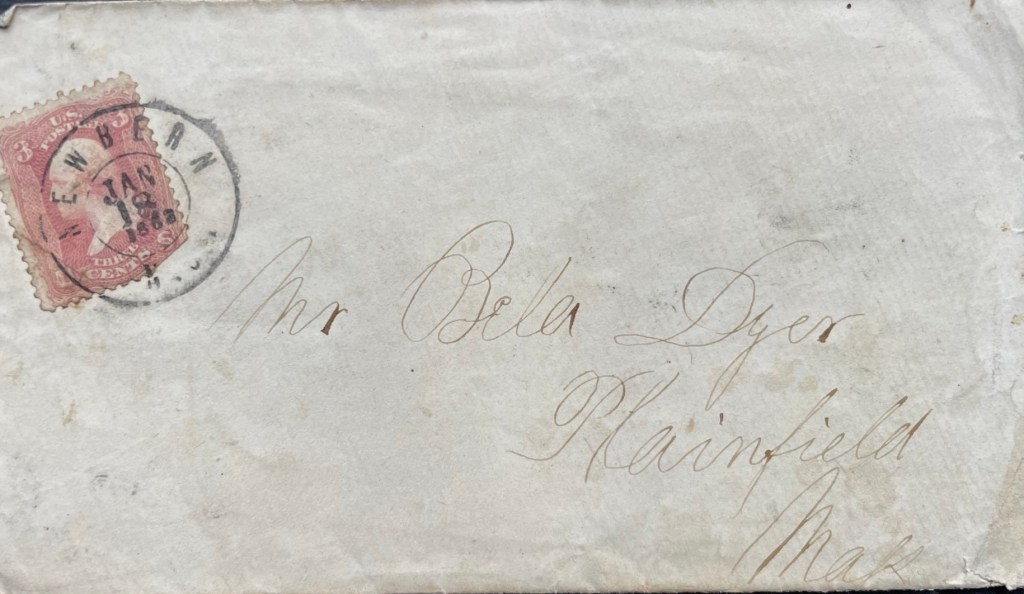
These letters were written by Newcomb Dyer (1837-1897), a farmer from Plainfield, Massachusetts, who enlisted as a private in Co. F of the 9-month 46th Massachusetts Infantry in September 1862. After training in Springfield, they were transported to New Bern, North Carolina on 15 November, where they mostly remained through March. His 21 November letter describes the regiment’s guns, adding that “all of our other accouterments were taken from the Rebels. Our belts are fastened together with a croocked brass rattlesnake. Lots of the tents & a great many Austrian guns used here are captured property.”
Dyer’s 12-page 22 December letter describes his participation in the Goldsborough Expedition, which included three battles. He praised the 3rd New York Cavalry: “The N.Y. boys all had short rifles, breech-loading, & would ride over fences 4 feet high & jump ditches 6 feet across & not stop. They did everything to keep the road clear & take the spies that were hovering around. . . . The Rebels fell trees in the road & did all they could to delay us, but the cavalry got by the trees & chased 300 Reb cavalry & 50 infantry, taking & killing 18.” At the Battle of Kinston, “we came on to the enemy. They were posted in a swamp. The water & mud was more than two feet deep. . . . The battle lasted four hours. The place where the Tenth Conn charged on a battery of Reb cannon was perfectly trimmed & the bark torn from the trees. It did not look as though a man could live after such a volley of musketry & grape shot. . . . The cavalry made a rush for the bridge & the Rebels were all ready to fire it. They had cotton & turpentine & started the fire. The cavalry fired & rushed on them. They spilt the turpentine on themselves & one was burnt to death. I saw him as we passed.” At the battle of White Hall, “the 46 was called on to volunteer to go & shoot at the Rebels. They were posted behind trees, logs & rifle pits.” Dyer was one of 4 volunteers: “We had to go down in fair sight of them. We got within from 25 to 50 rods. . . . they shot at us a great many times, Stevens & my backs were covered three times with splinters flung from boards & rails.” As they withdrew at night, “the balls struck just over my head & went into the house.” After the Battle of Goldsborough Bridge, “we had burnt the bridge & we started back at dark & marched 8 miles toward New Bern. We had fighting every day.”
Dyer’s 14 March 1863 letter describes the Battle of Fort Anderson or Deep Gully, in which the Confederates threatened New Bern: the river “was lined with Rebs & their batteries for more than two miles & they made an attempt to fling a pontoon bridge across the river, & had it more than halfway across but the gunboats tore it to pieces.” Dyer left the army in June at the end of his term, and settled in Missouri after the war.
A sixth-plate tintype in a worn case shows a Union soldier in a gray winter coat–possibly Newcomb Dyer in winter quarters in North Carolina.
Note: These letters are from the personal collection of Greg Herr and were offered for transcription and publication on Spared & Shared by express consent.
Letter 1
[There is no envelope with this penciled letter but it is assumed it was written to Bela and Ruth (Ranney) Dyer of Plainfield, MA]
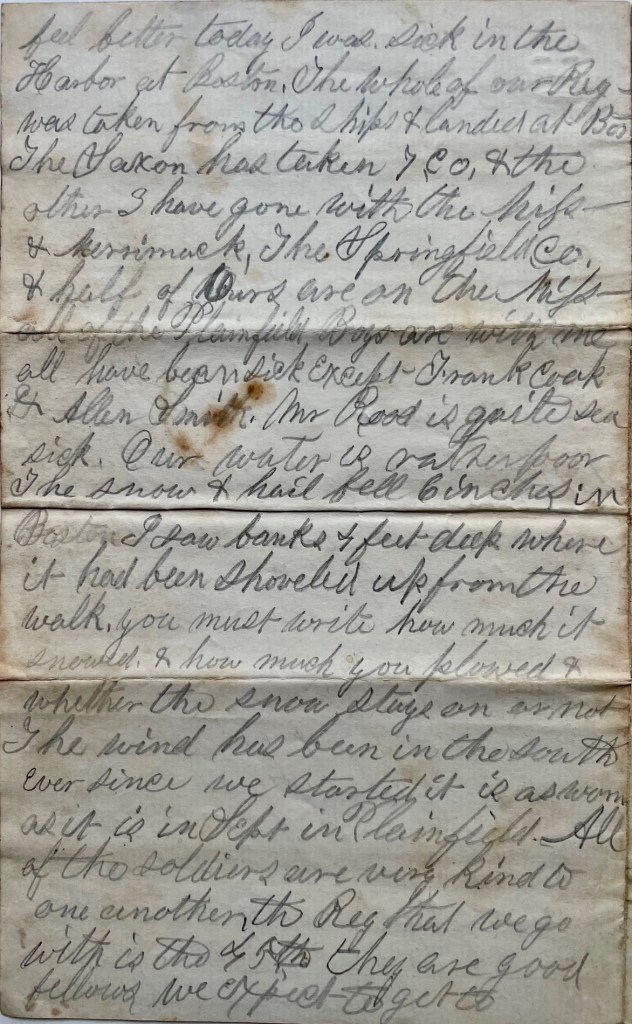
On board the Mississippi November 13th 1862
We are now about 40 miles from North Carolina coast going south. We started from Boston Monday at 6 o’clock in the evening. We went on board Wednesday night. Was taken off Sunday night & stayed in Faneuil Hall from 9 in the evening until 4 the next afternoon. The Boston folks were very kind to us. Mr. Hallett & Bassett brought us apples & crackers. Mrs. James Joy and Mr. Porter came there to see us.
We have come rather slow so far. The gunboat cannot sail as fast as this ship. The name of the boat is Huron. It has five guns—one 11-inch Columbiad and one Parrot pivot gun. The ocean today is as smooth as glass. We are near Hatteras. I saw two whales yesterday. There has three been seen today. I was sea sick yesterday. Feel better today. I was sick in the harbor at Boston. The whole of our regiment was taken from the ships & landed at Boston. The Saxon has taken seven companies and the other three have gone with the Mississippi & Merrimack. The Springfield company & half of ours are on the Mississippi. All of the Plainfield boys are with me. All have been sick except Frank Cook and Allen Smith. Mr. Rood is quite sea sick. Our water is very poor.
The snow and hail fell six inches in Boston. I saw banks 4 feet deep where it had been shoveled up from the walk. You must write how much it snowed & how much you plowed & whether the snow stays on or not. The wind has been in the south ever since we started. It is as war as it is in September in Plainfield. All of the soldiers are very kind to one another. The regiment that we go with is the 45th. They are good fellows. We expect to get to Beaufort tomorrow. You may send me some stamps. We could not get any good ones at Springfield. I have ordered 8 dollars of my pay to be sent home. You can get it when it comes. Five a month will be all that I shall be apt to want. I shall send a letter to W____ and Mary Ann when I get to Newbern. I will write some more when I get there.
Newbern. November 15th. We landed this morning at Beaufort. Arrived here at 11. We are all well. Saw Willie Halleck. He is well. Have not seen any of the other Plainfield boys. Direct to Newbern, N. C., 46th Regt. Mass. Vols., Care of Capt. [Russell H.] Conwell.
— Newcomb Dyer
Letter 2
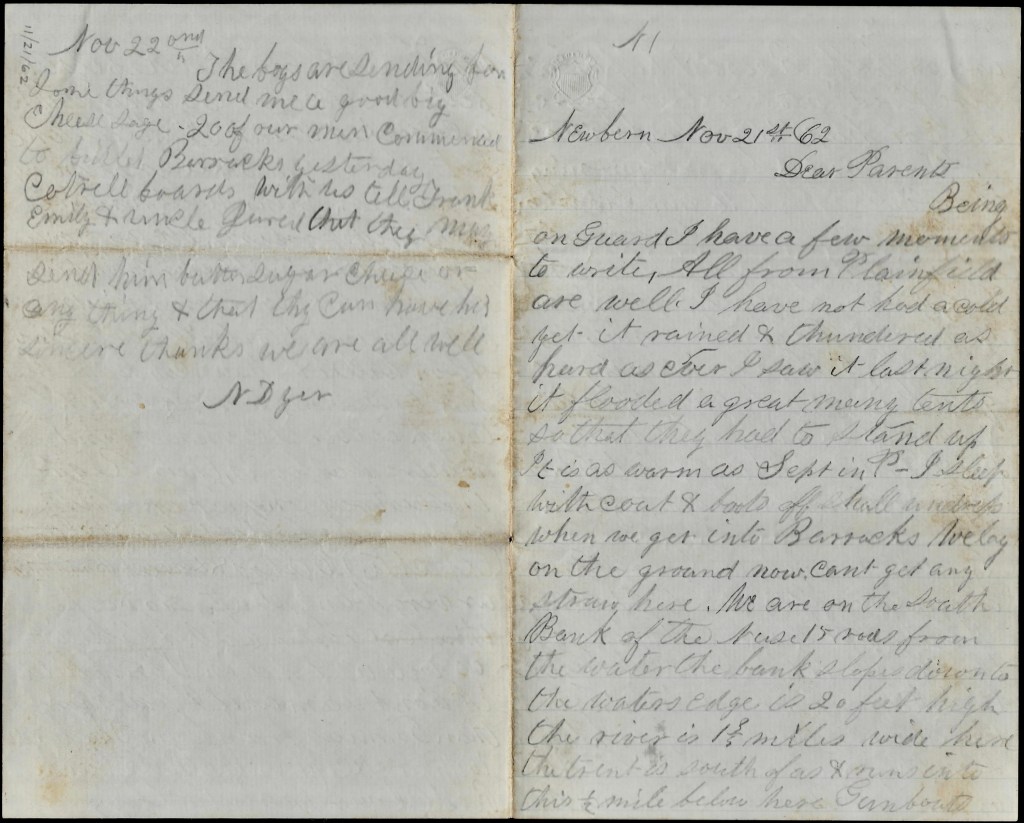
Newbern [North Carolina] November 21, 1862
Dear Parents,
Being on guard, I have a few moments to write. All from Plainfield are well. I have not had a cold yet. It rained and thundered as hard as ever I saw it last night. It flooded a great many tents so that they had to stand up. It is as warm as September in Plainfield. I sleep with coat and boots off. Shall undress when we get into barracks, We lay on the ground now. Can’t get any straw here. We are on the south bank of the Neuse [river] 15 rods [~80 yards] from the water. The bank slopes down to the water’s edge is 20 feet high. The river is 1 3/5 miles wide here. The Trent [river] is south of us and runs into this half mile below here. Gunboats are on both rivers. The pickets were fired into two days before we got here & the troops were ordered out & before morning the rivers had 16 gunboats on them. There is two large forts between the rivers. The boats & forts can keep off 50,000 men.
We have 17 regiments here now, not all full. Five more are coming as quick as can be transported. We are to be brigaded under Lee & Foster. Shall go into barracks soon two miles south from here. We are having enough to eat now. It came rather irregular after we left Camp Banks. We have got our guns. They weigh 11 lbs, two feet, 10 inches long and thick barrel brass trimmings. They are as good as any gun I have seen. They are a regular rifle. All of our other accoutrements were taken from the Rebels. Our belts are fastened together with a crooked brass rattlesnake. Lots of the tents & a great many Austrian guns used here are captured property. We go half mile for wood & find cedar pitch pine, black gum and several other kinds.
We commenced to drill yesterday. Alson, Willie, and Chauncey have been here to see us. They are well and look tough as ever. I cannot find where Wesley is. Their regiment is scattered on picket duty. We are to be brigaded with them (expect to).
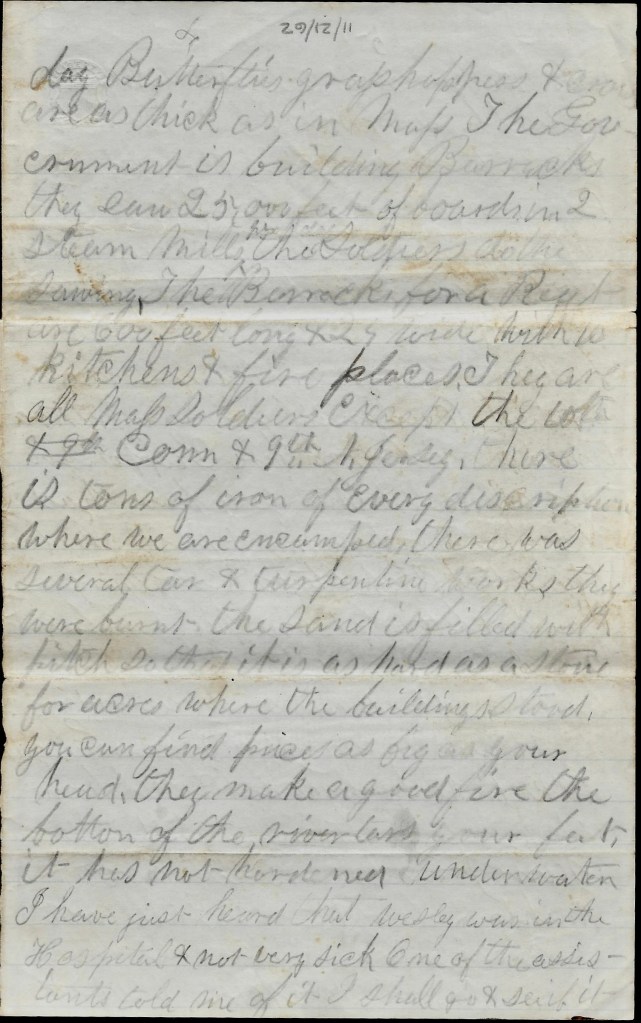
Oysters and sweet potatoes are very plenty. Butter 40 cents and other things are rather high. I like it as well as I did in Springfield. It don’t seem as if I was more than 30 miles from home. The land is poor except on the river bank. Red clover was in the blow yesterday. Butterflies, grasshoppers, and crows are thick as in Massachusetts. The government is building barracks. They saw 25,000 feet of boards in two steam mills, The soldiers do the sawing. The barracks for a regiment are 600 feet long & 24 wide with 10 kitchens & fireplaces. They are all Massachusetts soldiers except the 10th Connecticut and 9th New Jersey. There is tons of iron of every description where we are encamped. There was several tar and turpentine works. They were burnt. The sand is filled with pitch so that it is as hard as a stone for acres where the buildings stood. You can find pieces as big as your head. They make a good fire. The bottom of the river tars your feet. It is not hardened under water.
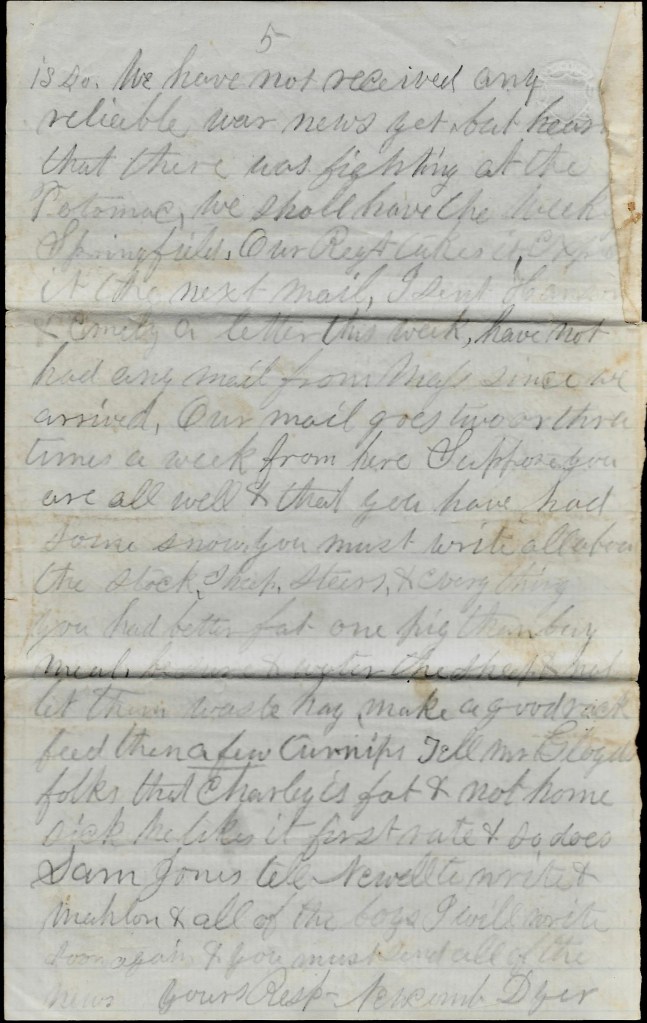
I have just heard that Wesley was in the hospital & not very sick. One of the assistants told me of it. I shall go and see if it is so. We have not received any reliable war news yet but hear that there was fighting at the Potomac. We shall have the weekly Springfield [paper]. Our regiment takes it. Expect it in the next mail. I sent Hanson and Emily a letter this week. Have not had any mail from Massachusetts since we arrived. Our mail goes two or three times a week from here. Suppose you are all well and that you have had some snow. You must write all about the stock, sheep, steers, and everything. You had better fat one pig than buy meal. Be sure to water the sheep & not let them waste hay. Make a good rack, Feed them a few turnips. Tell Mr. Gloyd’s folks that Charley is fat and not homesick. He likes it first rate & so does Sam Jones. Tell Newell to write & Mahlon & all of the boys. I will write soon again & you must send all of the news. Yours respectfully, – Newcomb Dyer
November 22. The boys are sending for some things. Send me a good big cheese sage. Twenty of our men commenced to build barracks yesterday, [George W.] Cottrell boards with us. Tell Frank, Emily & Uncle Jared that they may send him butter, sugar, cheese, or anything that they can have his sincere thanks. We are all well. — N. Dyer
Letter 3
January 1, 1863
As the mail does not go yet, I send a few lines more. Has the box of old clothes come yet? I had an overcoat & a pair of new pants made by Tilly Hanes. Write whether they have come or not. We expect to be paid for four months this week. Suppose that part of it will come to Plainfield. If it comes, let me know it. It will come in my name. Pa can keep it.
We have not received our box yet but a boat got stuck in the river yesterday with Express boxes on and we expect that it has got that 650 pound box on somewhere. Our regiment had four tons if stuff come last week. We had papers come as late as the 24th. Heard of the defeat of Burnside & that Plainfield had to raise five more. Are they agoing to enlist & who is going?
We do not have to work today or drill. All of the soldiers have an holiday. It is clear and cool. It has not frozen for more than a week & not but a few nights this year. Our tent has sent over 40 letters this mail. I have sent one to Hanson and Mahlon & Augusta.
The Co. A boys have caught a young wildcat & have got him in a wooden cage. They caught him in a box trap. He weighs about 20 pounds. He will travel around his cage and growl. He looks savage enough. There are some deer & have see them lately but we can’t get them. Turkey buzzards are as thick as crows are up our way.
Have our folks carried Augusta’s lamb over yet> If not, they must. It will grow faster over there. Fordyce is better today & will drill soon. His cold is most gone. Write soon. — N. Dyer
Letter 4
Newbern, North Carolina January 15th, 1863
Dear Parents,
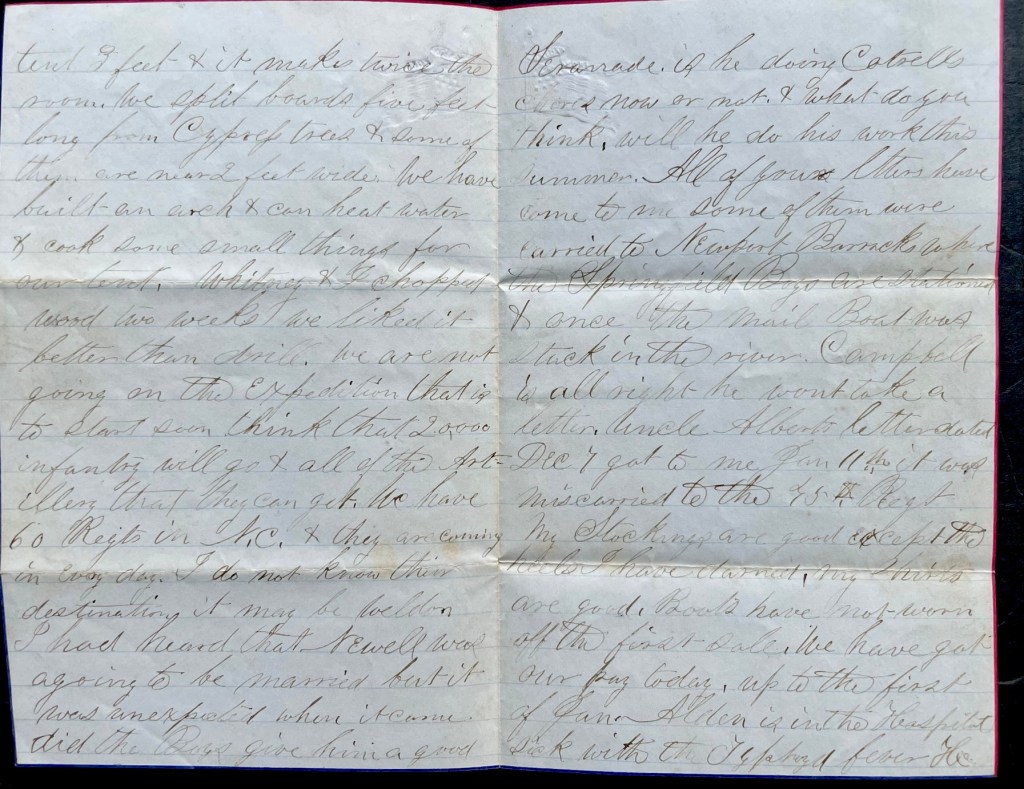
This morning I received a letter from you & Mary Dyer. Was glad to hear that you were well & that all things were going on so well. It is very pleasant & warm here. The ground has not frozen for two weeks. We have had but little rain yet but expect that it will come It is as warm as I want it should be now. We sleep without blankets warm nights. We are content and think that we are more healthy & comfortable than we should be in Barracks. We have raised our tent 3 feet and it makes twice the room. We split boards five feet long from Cypress trees and some of them are near two feet wide. We have built an arch & can heat water and cook some small things for our tent. Whitney & I chopped wood two weeks. We liked it better than drill. We are not going on the Expedition that is to start soon. Think that 20,000 infantry will go & all of the artillery that they can get. We have 60 regiments in North Carolina & they are coming in every day. I do not know their destination. It may be Weldon.
I had heard that Newell was a going to be married but it was unexpected when it came. Did the Boys give him a good serenade? Is he doing [George] Cottrell’s chores or not? And what do you think—will he do his work this summer? All of your letters have come to me. Some of them were carried to Newport Barracks where the Springfield Boys are stationed & once the mail boat was stuck in the river. Campbell is all right. He won’t take a letter. Uncle Albert’s letter dated December 7th got to me January 11th. It was miscarried to the 45th Regiment.
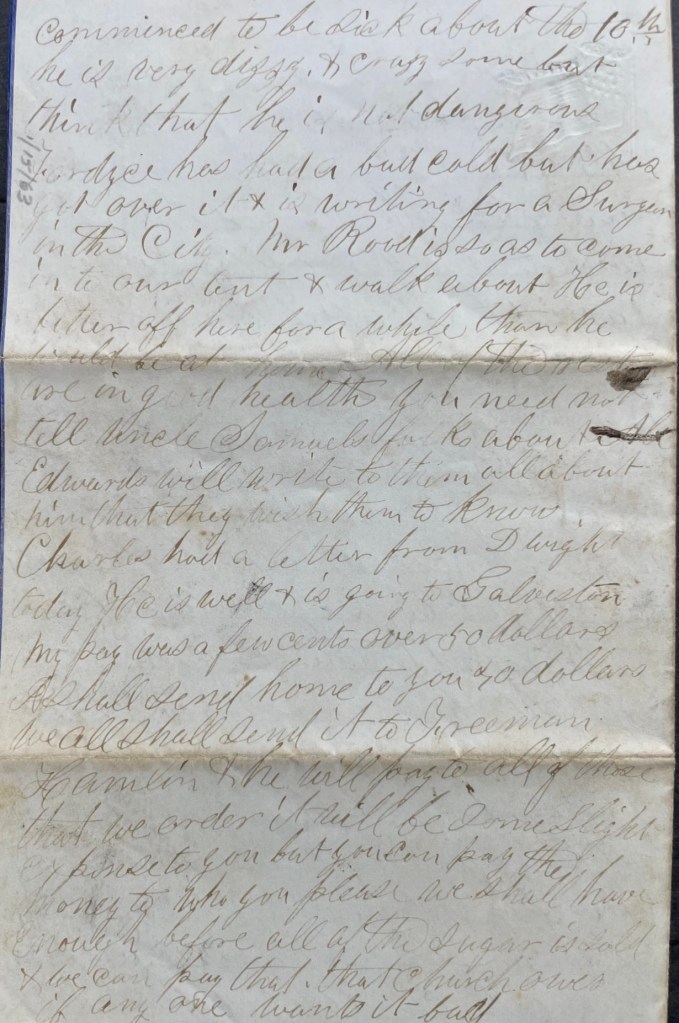
My stockings are good except heels. I have darned. My shirts are good. Boots have not worn off the first sole. We have got our pay today up to the first of January. Alden is in the hospital sick with the typhoid fever. He commenced to be sick about the 10th. He is very dizzy & crazy some but think that he is not dangerous. Fordyce has had a bad cold but has got over it & is writing for a Surgeon in the city. Mr. Rood is so as to come in to our tent and walk about. He is better off here for a while than he would be at home. All of the rest are in good health. You need not tell Uncle Samuel’s folks about Abe. Edwards will write to them all about him that they wish them to know.
Charlie had a letter from Dwight today. He is well & is going to Galveston. My pay was a few cents over 50 dollars. I shall send home to you 40 dollars. We all shall send it to Freeman Hamlin & he will pay to all of those that we order. It will be some slight expense to you but you can pay the money to who you please. We shall have enough before all of the sugar is sold & we can pay that that church owes if anyone wants it back.
Letter 5
Newbern, North Carolina January 28, 1863
Dear Father & Mother,
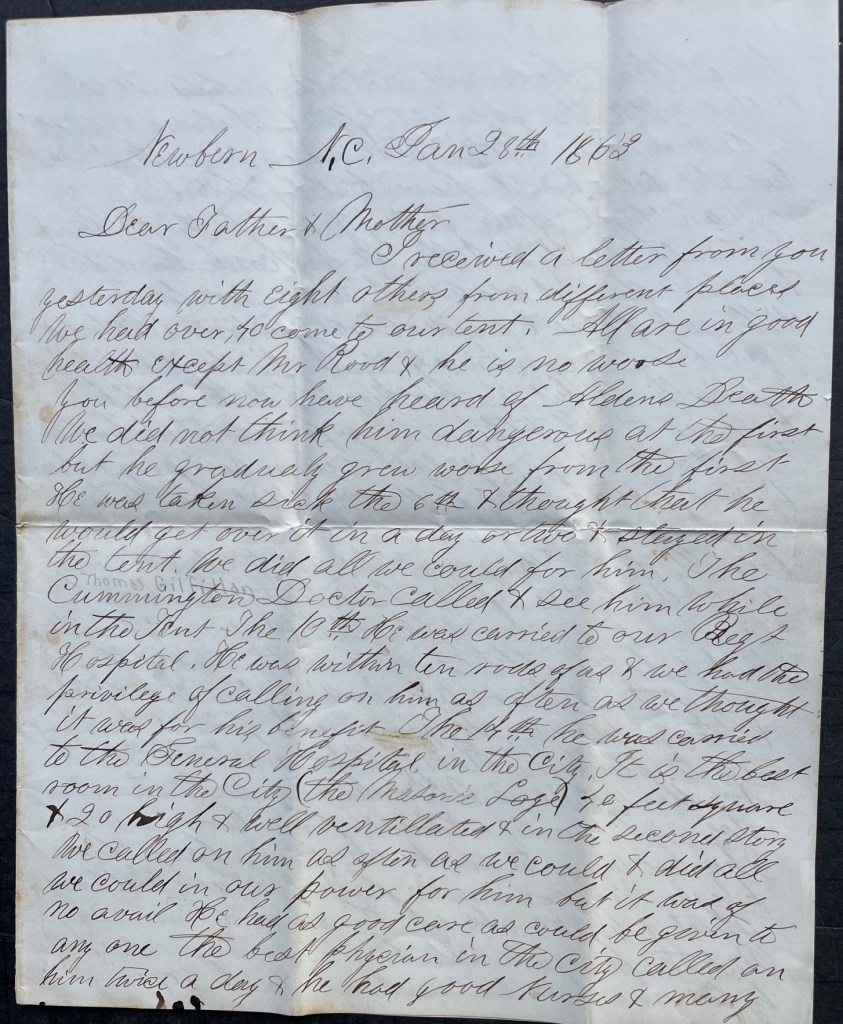
I received a letter from you yesterday with eight others from different places. We had over 40 come to our tent. All are in good health except Mr. Rood & he is no worse.
You before now have heard of [cousin] Alden [H. Dyer]’s death. We did not think him dangerous at the first but he gradually gre worse from the first. He was taken sick the 6th and thought that he would get over it in a day or two & stayed in the tent. We did all we could for him. The Cummington doctor [Thomas Gilfillan?] called & see him while in the tent. The 10th he was carried to our regimental hospital. He was within ten rods of us & we had the privilege of calling on him as often as we thought it was for his benefit. The 14th he was carried to the General Hospital in the City (the Masonic Lodge), 40 feet square and 20 high & well ventilated, and in the second story we called on him as often as we could and did all we could in our power for him. But it was of no avail. He had as good care as could be given to anyone. The best physician in the city called on him twice a day and he had good nurses and many things that he could not have had at home. It was with the greatest efforts that we could send home his body. There was a time that we thought we should have to bury him. You can think of our feeling & sympathy for Uncle Samuel’s family & Nellie. It will come hard for them. We do not realize it as we would in a different place & under circumstances that did not bring it continually with the dead and dying. It would be but a mockery to tell them of his kindness to all & the many friends that he has that daily miss his ever welcome company & cheerful way. He was the fattest and most healthy that ever I saw him. If he had lived, he would have been Orderly Sergeant. We are to choose today an Orderly & a 1st Lieutenant.
We moved our camp the 24th one mile south back and between the fork and on the edge of the city. All of the soldiers are inside of the fortifications & thousands are digging rifle pits & cutting trees to block the Rebs if they come to retake Newbern. We are skirmishing with them every day eight miles northwest from here. They are trying to make us keep a large force here or are coming in force. We hear that Longstreet & 40,000 are at Kinston & this side. But the funerals will be all on one side if they try to come here. We can keep back 50,000.
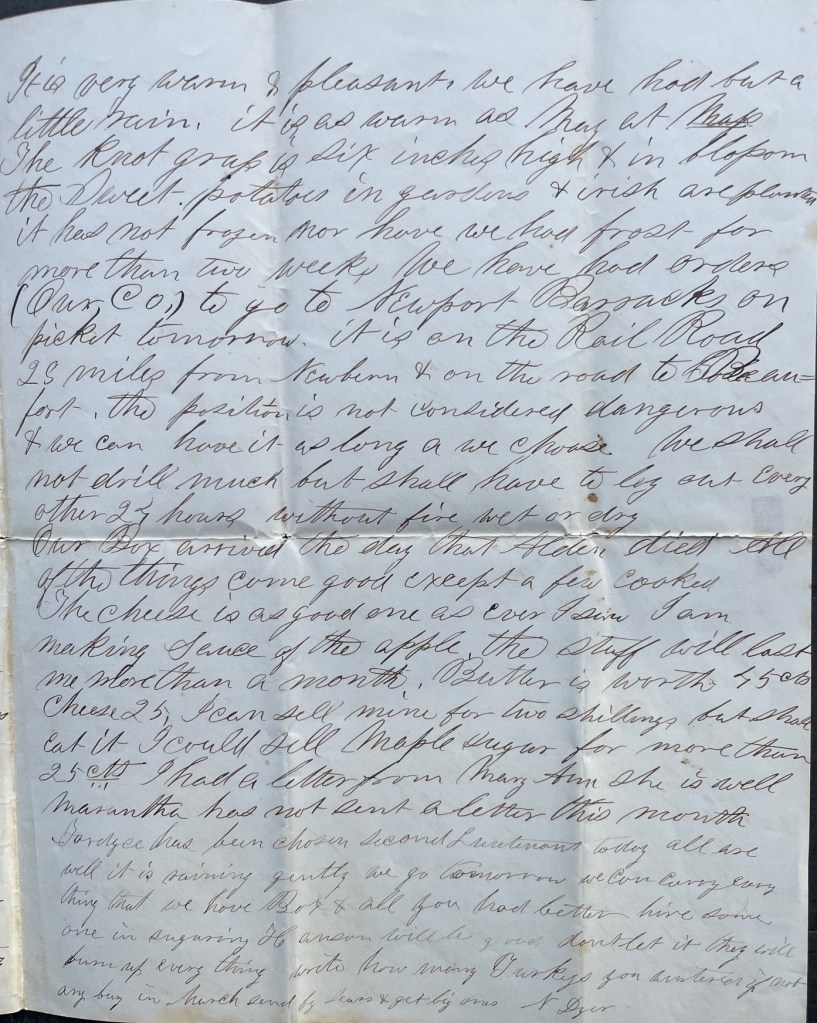
It is very warm & pleasant. We have had but a little rain. It is as warm as May at Massachusetts. The knot grass is six inches high & in blossom. The sweet potatoes in gardens & Irish [potatoes] are planted. It has not frozen nor have we had frost for more than two weeks. We have had orders (our company) to go to Newport Barracks on picket tomorrow. It is on the railroad 28 miles from Newbern & on the road to Beaufort. The position is not considered dangerous & we can have it as long as we choose. We shall not drill much but shall have to lay out every other 24 hours without fire, wet or dry.
Our box arrived the day that Alden died. All of the things come good except a few cookies. The cheese is as good one as ever I saw. I am making sauce of the apple. The stuff will last me more than a month. Butter is worth 45 cents, cheese 25. I can sell mine for two shillings but shall eat it. I could sell maple sugar for more than 25 cents. I had a letter from Mary Ann. She is well. Marantha has not sent a letter this month. Fordyce has been chosen 2nd Lieutenant today. All are well. It is raining gently. We go tomorrow. We can carry everything that we have, box and all. You had better hire someone in sugaring. Hanson will be good. Don’t let it. They will burn up everything. Write how many turkeys you wintered. If not any, buy in March. Send by Sears and get big ones. — N. Dyer
Letter 6
Addressed to Mr. Bela Dyer, Plainfield, Mass.
Newport Barracks 1 North Carolina February 2nd 1863
Dear Father & Mother,
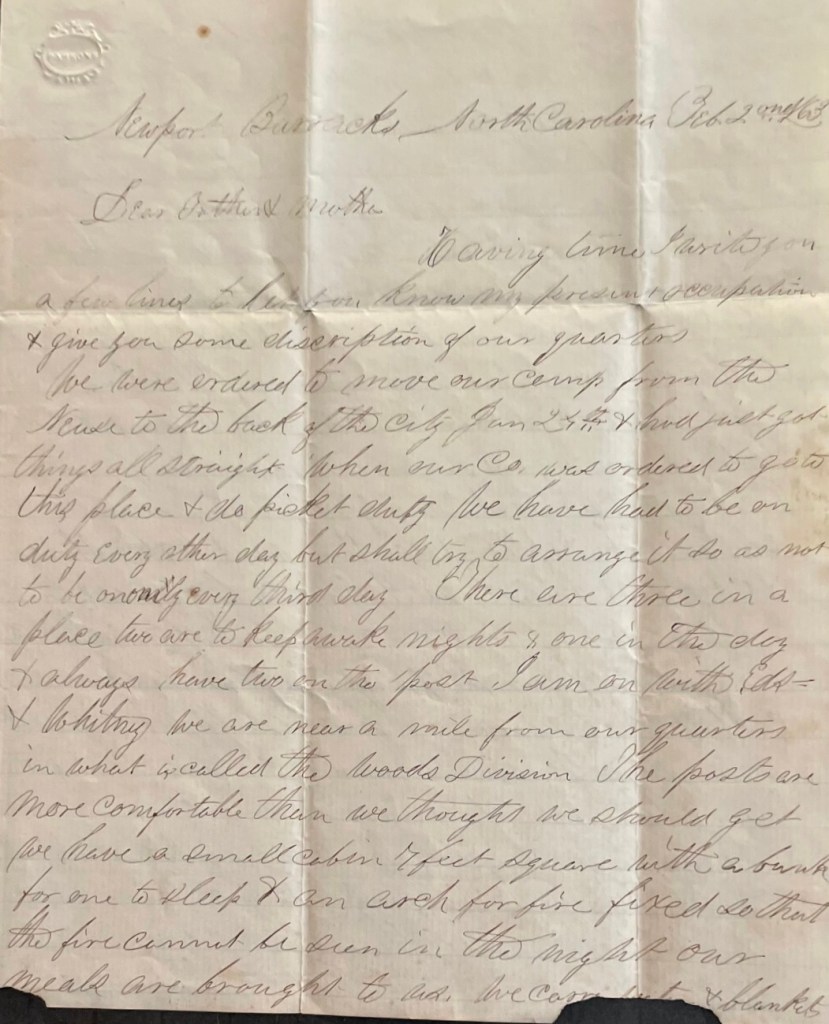
Having time, I write you a few lines to let you know my present occupation & give you some description of our quarters. We were ordered to move our camp from the Neuse to the back of the city January 24th & had just got things all straight when our company was ordered to go to this place & do picket duty. We have had to be on duty every other day but shall try to arrange it so as not to be on only every third day. There are three in a place; two are to keep awake nights and one in the day & alsys have two on the post. I am on with Eds. & Whitney. We are near a mile from our quarters in what is called the Woods Division. The posts are more comfortable than we thought we should get. We have a small cabin 7 feet square with a bunk for one to sleep & an arch for fire fixed so that the fire cannot be seen in the night. Our meals are brought to us. We carry [ ] & blankets from camp. We can sit on a good seat where it is warm & dry & do our duty. We like it far better than we did at Newbern.
Our ranch that we live in is built of logs 30 feet long, 20 wide with five windows and good floor & brick fireplace. All of our boys & [George W. Cottrell & Henry Dickson of Middlefield are with us. The 7th North Carolina Regt. built the quarters & occupied them before the capture of Newbern. We have a yoke of oxen that we took to draw wood. Water is near & good. We are three miles from the ocean in Carteret county as you can see on the Atlas. The captain and twenty others went to the shore & crossed 3 [?] and a half miles to an island 25 long and 3 wide trying to capture two spies that the Rebs keep to watch the movements of our shipping. They burnt the cabins that someone had occupied but did not see anyone. Justice Theodore & Allen Smith went. The rest of us were on guard.
The weather is very pleasant. The frogs are peeping & we are having a good time. There is lots of game here—bears, wildcats, otters, minks, & a great many kinds of birds. We cannot shoot them. It is against the rules to shoot within a mile of the pickets. We have several families that live close to us. They are in camp almost every day. We can get meal for 30 cents per peck, eggs for 25 cents a dozen. We are making hoecakes today. My address will be the same as ever but we shall not have the time to answer our letters before the return of mail that we did before. I am starting several & will finish when the mail comes in.
February 3rd. The mail has not come yet but one is to go out in a few minutes. I have got the first cold that I have had but shall get over it soon. Charley & Steven are some sick but will get better soon. I have sent a few lines to Mahlon to let them know how he was. You may tell them that he is not very sick and is out when it is pleasant. He has eaten too much. Mr. [Josiah] Rood is better but at Newbern. Write all the news & about Uncle Samuel’s folks.
It snowed two inches at Newbern last night. None here. Send me a box of Branch’s [ ] Pills in a paper or something. Give my respects to all. — Newcomb Dyer
1 The 7th Regiment North Carolina Infantry built the barracks south of Newport for quarters in the winter of 1861 and 1862. Shortly thereafter, the cluster of log huts was captured by Union troops, who added a hospital, headquarters, stables, storehouse and earthworks. Newport Barracks effectively became a Federal supply depot, since it was located near both the Atlantic Ocean and railroad tracks.
Letter 7
Newport Barracks North Carolina February 17th 1863
Dear Father & Mother,
I received your letter dated the 7th the 16th, and one from Nathan & Eliza & from Williamsburgh. The one from Marantha came to Newbern in four days. They do not come here as quick as to Newbern. Was glad to hear that all are well. As for money, I have near 7 dollars & don’t think I shall spend it before we are paid off. We may be paid the first of March or expect to be. We do not know how long we shall stay here but think that it will be as late as the first of April & hope it will be the remainder of the time. A company of cavalry are with us now & we expect another. Our company goes on short expeditions frequently. They have been on three. Brought us some horses and other things. We go on now about three times a week. It is far easier than our drill at Newbern.
I think the heifers will be worth more to come in as soon as you can have them. You had better not raise those little calves that we have this spring. I had rather winter the lambs. The hogs can eat the milk and save the corn for the steers. They ought to have some meal. Have you killed a pig or not? If you did not winter any turkeys, have Sears buy two good hens & a big gobbler when down to Hatfield. Have good ones or none. I think tat what sugar you have to sell you can get the most in molasses. Make clear & sell it at the door. It ought to fetch a dollar as sugar is now & other things. You can fix the buckets before you want them to be ready. Don’t feed the sheep more than they will eat & be careful & not let the lambs die.
My cheese & dried apple are not gone. The dried apple comes handy. You had better see if Sears cannot find a market for the molasses, what you have to sell more than to pay for making. May be that Levi Beals will take it. I should try and sell it if I could or it won’t come to much.
I had a bad cold the first of this month but am around & on guard all the time. It is hot and a cold don’t hang on long. Charley is in the hospital at Newbern. When the cars come in today, I will write how he is. Fordyce is better than he has been for several weeks & Mr. Rood is better. All the others are in good average condition. I have just heard from Charley and he is better and doing first rate.
February 18th. It is rainy. All are well. The mail goes this afternoon to Newbern. If you have got to buy flour, you had better buy some seed to [ ] & you can get better now than in the spring. You can go to Charlemont in a day or where you can get good. It wil pay & you had better sow all east of the house. I shall send a letter to Newell soon & you must write often. Yours, &c. — N. Dyer
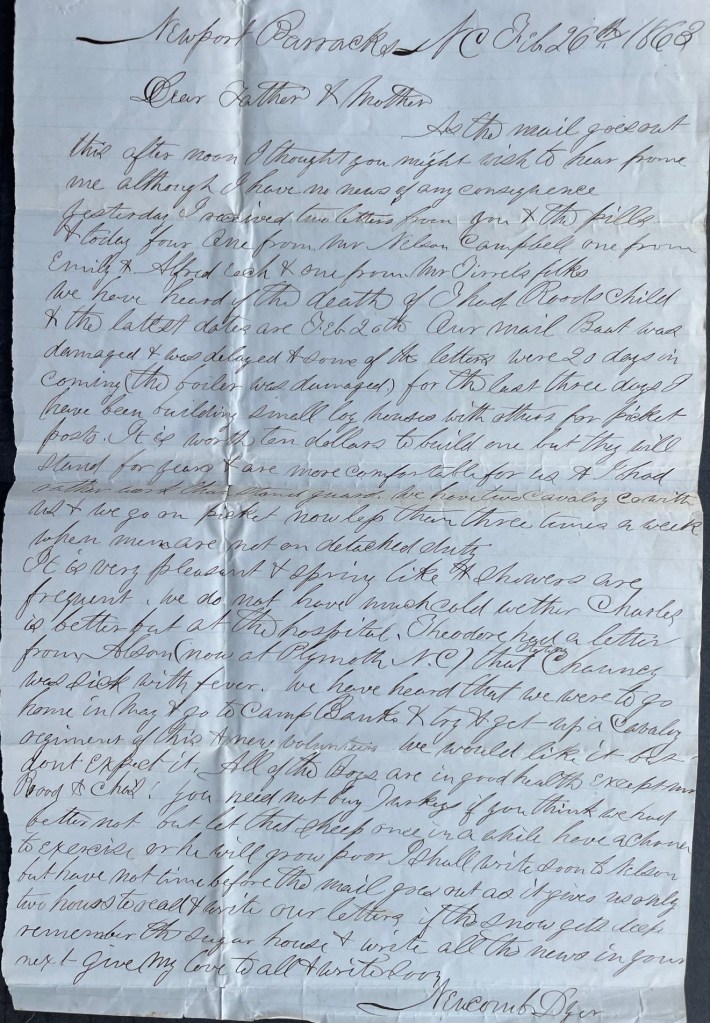
Letter 8
Newport Barracks, North Carolina February 26th 1863
Dear Father & Mother,
As the mail goes out this afternoon, I thought you might like to hear from me although I have no news of any consequence. Yesterday I received two letters from you & the pills & today four—one from Mr. Nelson Campbell, one from Emily & Alfred each, and one from Mr. Tirrel’s folks. We have heard of the death of Thad Rood’s child & the latest dates are February 20th. Our mail boat was damaged & was delayed & some of the letters were 20 days in coming (the boiler was damaged).
For the last three days I have been building small log houses with others for picket posts. It is worth ten dollars to build one but they will stand for years and are more comfortable for us and I had rather work than stand guard. We have two cavalry companies with us & we go on picket now less than three times a week when men are not on detached duty.
It is very pleasant & spring like & showers are frequent. We do not have much cold weather. Charles is better but at the hospital. Theodore had a letter from Alson (now at Plymouth, N. C.) that Chauncy was sick with fever. We have heard that we were to go home in May and go to Camp Banks & try to get up a cavalry regiment of this & new volunteers. We would like it but don’t expect it. All of the Boys are in good health except Mr. Rood & Charles.
You need not buy turkeys if you think we had better not, but let that sheep one in a while have a chance to exercise or he will grow poor. I shall write soon to Nelson but have not time before the mail goes out as it gives us only two hours to read and write our letters. If the snow gets deep, remember the sugar house & write all the news in your next. Give my love to all & write soon. — Newcomb Dyer
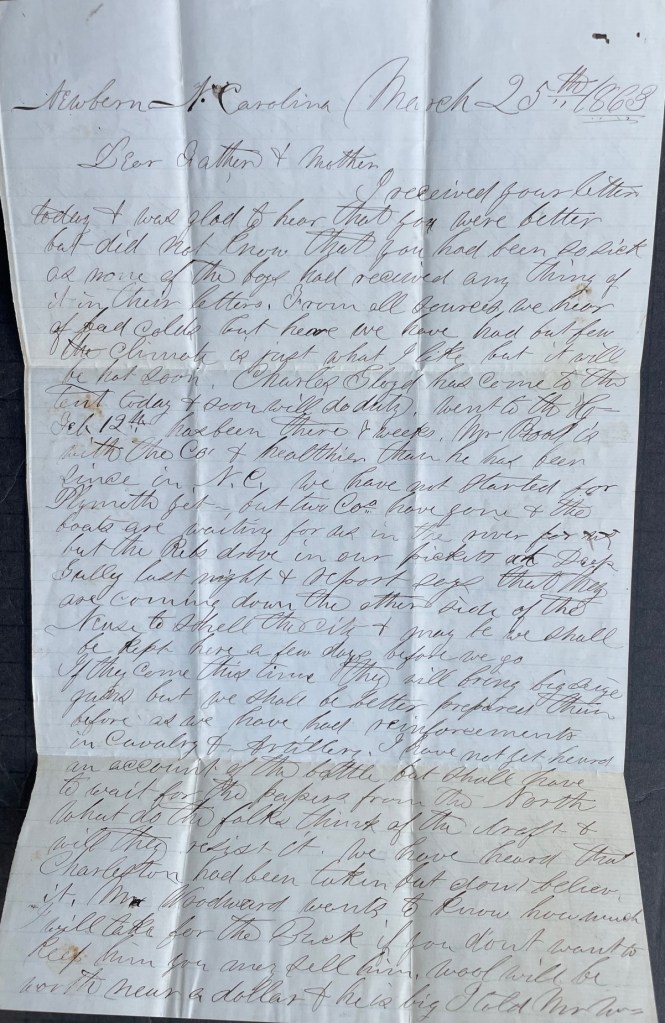
Letter 9
Newbern, North Carolina March 25th 1863
Dear Father and Mother,
I received your letter today and was glad to hear that you were better but did not know that you had been so sick as one of the boys had received any thing of it in their letters. From all sources, we hear of bad colds but here we have had but few. The climate is just what I like but it will be hot soon.
Charles Gloyd has come to the tent today and soon will do duty. Went to the hospital February 12th. Has been there 7 weeks. Mr. Rood is with the company & healthier than he has been since in North Carolina. We have not started for Plymouth yet but two companies have gone & the boats are waiting for us in the river. But the Rebs drove in our pickets at Deep Gully last night and report says that they are coming down the other side of the Neuse to shell the city & maybe we shall be kept here a few days before we go. If they come this time, they will bring big siege guns but we shall be better prepared than before as we have jad reinforcements in cavalry and artillery. I have not yet heard an account of the battle but shall have to wait for the papers from the North.
What do the folks think of the draft & will they resist it? We have heard that Charleston had been taken but don’t believe it. Mr. Woodward wants to know how much I will take for the Buck. If you don’t want to keep him, you may sell him. Wool will be worth near a dollar and he is big. I told Mr. Woodward that he might have him for what he was worth & you might keep the Cossett [pet lamb]. Kill all the little calves & I will buy one or two good ones. The pigs can eat the milk. Edwards is a good health. Weighs 203. I 207. Strawberries are in blossom and grass is getting up high where it can grow. Saw some of the best land in our last tramp that ever I saw. There will be plenty of it when the war is over.
I have had a letter from Nathan & Jerry. Nathan thinks that he shall work for Tirrell this summer. Heard from Uncle N. & Aunt Lucy the last mail. They were well.
26th. The mail goes today. We are all well & the weather 8s cool. If you want to make good molasses you must strain and skim the sap and syrup down every day. Write in your next all about sugaring & how many calves, their color, and the lambs & don’t let them die. How does the hay hold out? You had better sow the wheat early and get some good seed if possible. Wm. Dyer has clean.
We expect to go to Plymouth tomorrow & shall have a good ride. Who takes Gerry’s camp this year? As I have no more to write, I close with the expectation of hearing from you soon. — N. Dyer
P. S. Address is Newbern. Go to Plymouth this afternoon.
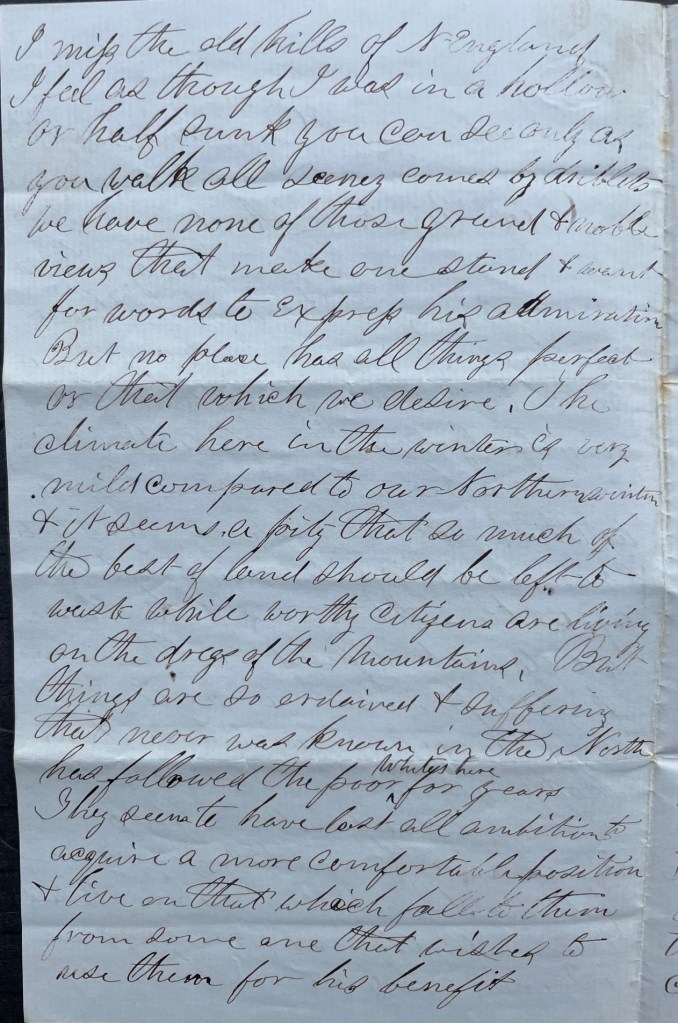
Letter 10
Newbern, North Carolina March 26th 1863
Dear Uncle & Aunt,
Today finds me writing although I have nothing of interest to communicate, having nothing but our daily routine of duties which we have become accustomed to that we feel entirely destitute of exercise or excitement that is agreeable. At times like these we do not depend on the comforts and position we retain but draw a great share of our happiness from the remembrance of the days spent in Massachusetts. Here we are thrown wholly from some portions of society, our habits changed & climate different from our own & scenery new to us. As I look away, I miss the old hills of New England. I feel as though I was in a hollow or half sunk. You can see only as you walk all scenery comes by driblets. We have none of those grand and noble views that make one stand and want for words to express his admiration. But no place has all things perfect or that which we desire. The climate here in the winter is very mild compared to our Northern winter & it seems a pity that so much of the best of land should be left to waste while worthy citizens are living on the dregs of the mountains.
But things are so ordained & suffering that never was known in the North has followed the poor whites here for years. They seem to have lost all ambition to acquire a more comfortable position & live on that which fall to them from someone that wishes to use them for his benefit. They themselves feel lower than the slave & every move & action indicates a crushed & wicked ambition. The slaves are smarter & more witty for the reason they have the society of their masters in a measure of which the Whites are deprived. Our soldiers will be nearer alike than when they went into camp for they partake of each others habits, but I hope to be in a condition not to make my friends ashamed of me.
The news here we get from the North. Have not had an account of our late skirmish in this place but suppose you have had it all. We were out five days, marched 60 miles & drove the Rebs 20 up the Trent River. Saw the best land that I have seen yet. One can make more money in five years than in a lifetime in Plainfield. The climate is good, far better in winter. One can work all winter on a farm. I could live here contented by having a few of my acquaintances with me.
So far I like a soldier’s life far better than I expected to. Have had but one cold & that through carelessness. Strawberries are in blossom & peaches & cherries were a month ago. The weather is getting rather warm but dress accordingly. Expect to go to Plymouth this afternoon as two of our companies went several days ago. The town is on the Roanoke River 160 miles from here. Think that we are to build forts and maybe fight some. We like to move. It kills time faster. C[harles] Gloyd is well and Mr. Rood better than any time since in the South. All others are well now. Write all the little news & accept of my thanks for your other long & interesting letter and I will close with the expectation of hearing from you soon. Yours respectfully, – N. Dyer
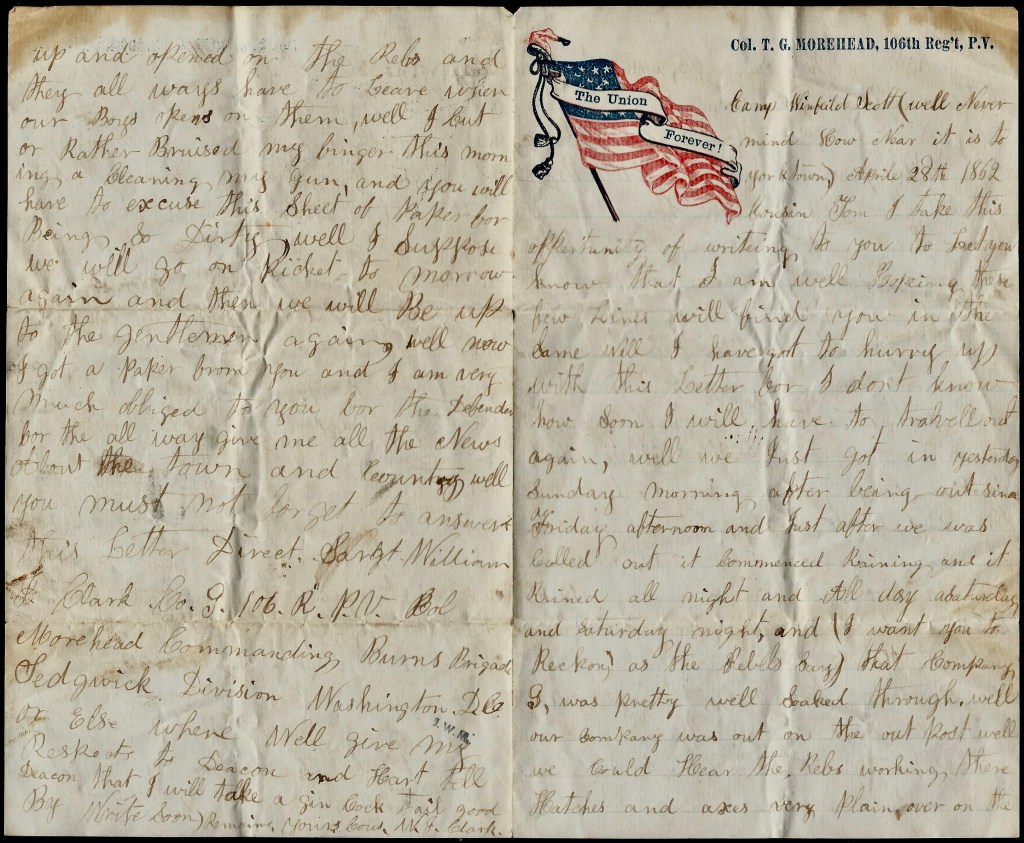
The following letter was written by 1st Sgt. William J. Clark (1839-1870) who mustered into Co. G, 106th Pennsylvania Volunteers on 27 August 1861 and was discharged for disability on 25 July 1862. After he was discharged from the service, William returned to Norristown where he became a railroad worker. He died of dropsy in 1870.
William was probably the son of David H. Clark and his wife Letitia, emigrants from Ireland who resided in Norristown, Pennsylvania. David was a weaver by trade.
Transcription
Addressed to Mr. Thomas C. S____, No. 160 Main Street, Norristown, Montgomery county, Pennsylvania
Camp Winfield Scott (well never mind how near it is to Yorktown) April 28th 1862
Cousin Tom,
I take this opportunity of writing to you to let you know that I am well, hoping these few lines will find you in the same. Well, I have got to hurry up with this letter for I don’t know how soon I will have to travel out again.
Well, we just got in yesterday, Sunday morning, after being out since Friday afternoon and just after we was called out it commenced raining and it rained all night and all day a Saturday and Saturday night and (I want you to reckon, as the Rebels say) that Company G was pretty well soaked through. Well our company was out on the outpost. Well we could hear the rebs working their hatchets and axes very plain over on the other side of the swamp.
Well they have batteries all along but our boys keep them very busy minding themselves and jumping and dodging our shell and bullets. Well Saturday night was the longest night I ever saw or ever put in I will tell you for our regiment was called out on last Friday afternoon and we was out all night Friday night and all day Saturday and then our company was put on the outpost at night. Well, that is nothing for we have just the little bit the best-looking company that I see about in this part of the country. Well we could hear the Rebels a working all night and then every one of their pickets carries a dark lantern and they tried their best to throw the light into the face of two of my men that I had on post for I had two posts with 12 men and a corporal for them both. But the secesh could not make anything out of the Blazers, as our boys call themselves.
Well, Tom, there is nothing but a continual roar of musketry and artillery a going on all the time. But we have got so used to it that we don’t mind it any more. Only once the week before last when our company and company D & F & K—four companies—got saluted by four shells from the Rebel’s batteries. Well, I will tell you how that happened. We were all out working at a fort all night and in the morning after we had finished the fort, we was a going back through the woods to our camp and we got out on a road that was clear and right on our right was a big open field with a Rebel battery. Well they opened on us of course. But they are very bad gunners for their shells all went over our heads. But we had to get out of the road as quick as we could for our artillery come up and opened on the Rebs and they always have to leave when our boys open on them,
Well, I cut or rather bruised my finger this morning a cleaning my gun and you will have to excuse this sheet of paper for being so dirty, Well, I suppose we will go on picket tomorrow again and then we will be up to the gentlemen again. Well, now I got a paper from you and I am very much obliged to you for The Defender for they always give me all the news about the town and country.
Well, you must not forget to answer this letter. Direct to Sergeant William J. Clark, Co. G, 106th Regiment P. V., Col. Morehead Commanding, Burns Brigade, Sedgwick’s Division, Washington D. C. or elsewhere.
Well, give my respects to Deacon and Hart. Tell Deacon that I will take a gin cocktail. Goodbye. Write son. I remain yours, Cousin W. J. Clark
James F. Salley, 2nd US Sharpshooters, Co. D, Maine. (Brian White Collection)
This letter was written by James F. Salley (1843-1864), the son of Ephraim Salley and Mary F. [Liniston] of Madison, Somerset county, Maine. James enlisted on 2 November 1861 when he was 19 years old in the 2nd United States Sharpshooters, Co. D (Maine). This regiment was placed in the defenses of Washington D. C. until April 1862 and were part of the “First Iron Brigade.” The regiment was broken up on February 20, 1865, and Company “D” transferred to the 17th Maine Volunteer Infantry Regiment. The regiment suffered loss of 8 officers and 117 enlisted men who were killed in action or mortally wounded and 2 officers and 123 enlisted men who died of disease, for a total of 250 fatalities.
James was one of those who did not return home. He was killed in action on 9 June 1864 in the multi-day Battle of Cold Harbor. He was initially buried on McGhee’s Farm (at the intersection of Gaines’ Mill and Cold Harbor) but later moved to the Cold Harbor National Cemetery.
Note: This letter is from the personal collection of Greg Herr and was made available for transcription and publication on Spared & Shared by express consent.
Transcription
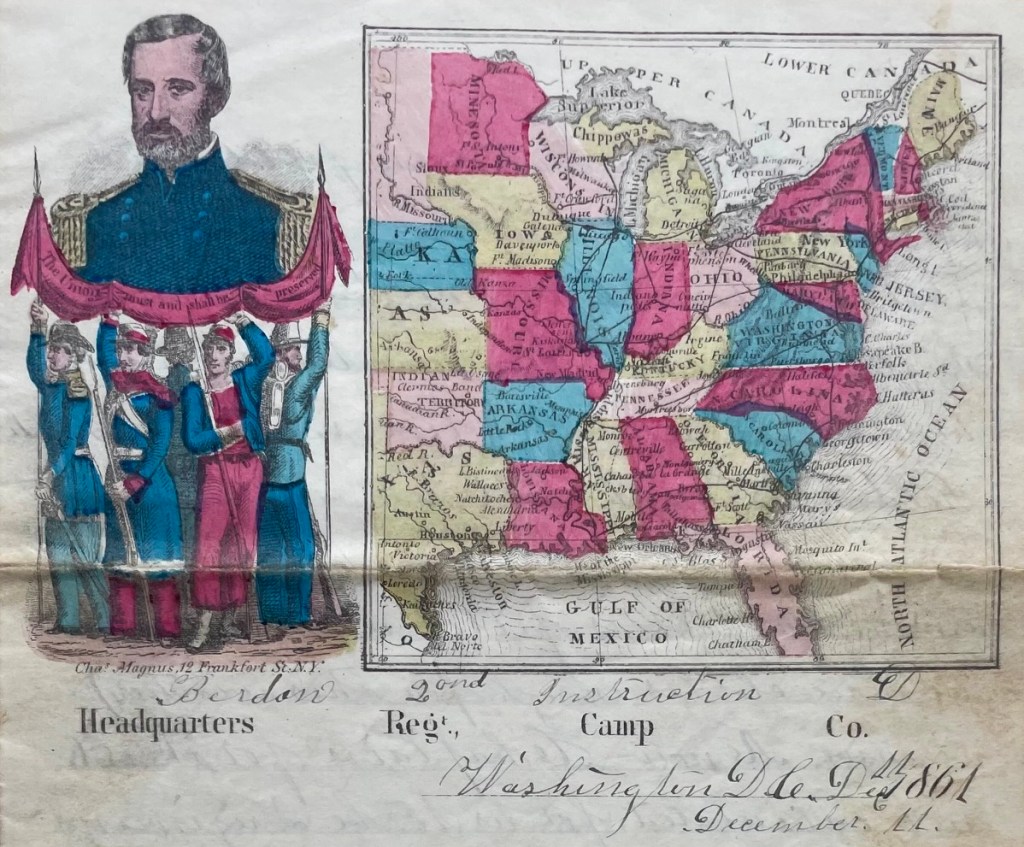
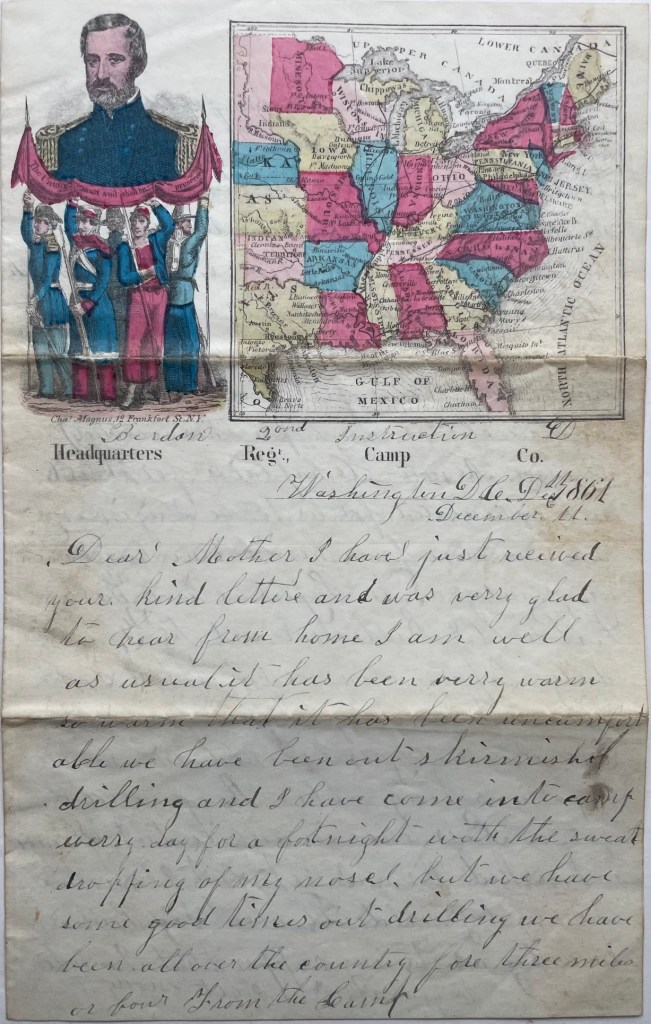
Patriotic letterhead “The Union Must & Shall be Preserved” on Salley’s letter.
Washington D. C. December 11, 1861
Dear Mother,
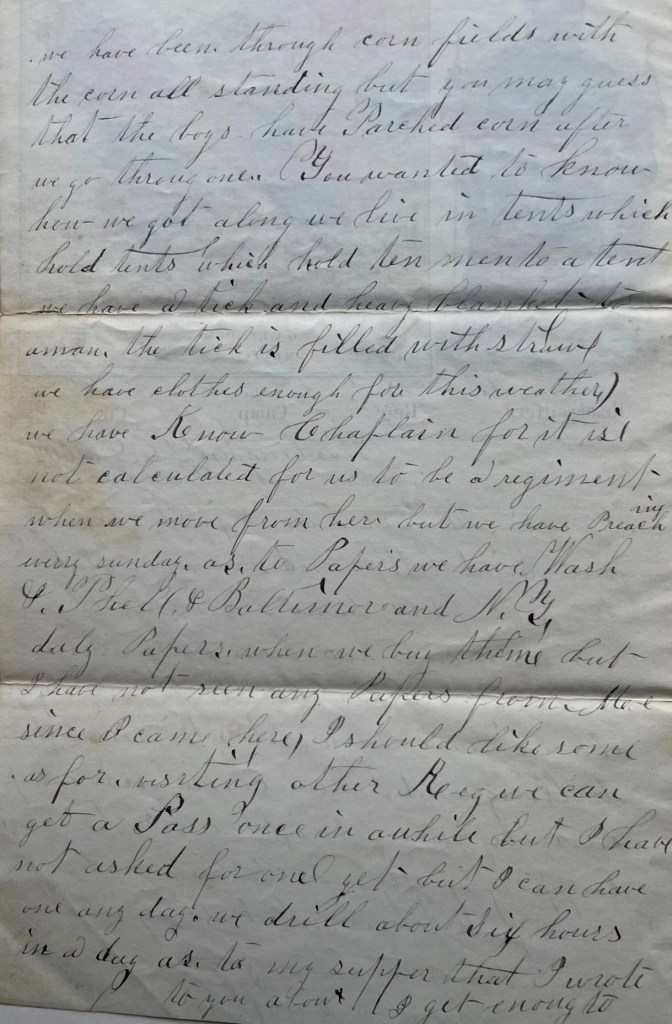
I have just received your kind letter and was very glad to hear from home. I am well as usual. It has been very warm—so warm that it has been uncomfortable. We have been out skirmish drilling and I have come into camp every day for a fortnight with the sweat dropping off my nose. But we have some good times out drilling. We have been all over the country for three miles or four from the camp. We have been through cornfields with the corn all standing but you may guess that the boys have parched corn after we go through one.
You wanted to know how we got along. We live in tents which hold ten men to a tent. We have a tick and heavy blanket to a man. The tick is filled with straw. We have clothes enough for this weather. We have no chaplain for it is not calculated for us to be a regiment when we move from here but we have preaching every Sunday. As to papers we have Washington & Philadelphia & Baltimore and New York daily papers when we buy them but I have not seen any papers from Maine since I came here. I should like some.
As for visiting other regiments, we can get a pass once in a while but I have not asked for one yet. But I can have one any day. We drill about six hours in a day. As to my supper that I wrote to you about, I get enough to make me as fat and lazy as a hog. We have shoes. I received Cephas’s letter at the same time that I did yours. Tell him that I will write in a few days. I have written to Sabrina but I have not heard from her yet.
I got a letter from Daniel which was mailed the first. I have answered it. I was glad to hear that you had had that cancer cut out and that it was doing well. I was sorry to hear that the folks had been sick but was glad that they were better. You wanted to know if there was anyone that I knew before I came here. I had seen Abel W. Hutchins but never saw any of the other boys till I came here but I guess that I can tell every man name in the company. There is a man by the name of Walker from Emden. He is in a Minn. Co. He is a brother to Eli and John.
You wanted to know if Thomas or Thompson. I could not tell which was here but I do not know who you meant. Tell Amelia that I will give her this sheet of paper. But it is getting late and I must close. Write often for I am disappointed when I look for a letter and it does not come. Write all the news. Give my best respects to all. Goodbye from your son, — James T. Salley
The following letter was written by “T. H. Hall”—a Federal soldier but not otherwise identified and the clues in the letter are limited. We know that he wrote the letter to his cousin whose name was Hannah Forest but there is no envelope to inform us of her location. He mentions receiving a letter from another soldier named Hiram Campbell who may have been a member of his regiment. Pursing that lead, I found a private by that name in Co. E, 4th Vermont Infantry. Looking through that roster, I found a Pvt. Thomas H. Hall in the same company so my hunch is that the author was this comrade of Campbell’s. Company E was raised in Windsor county, Vermont and I found a Hannah Forest (b. 1841) residing in Gaysville, Windsor county, Vermont in 1860 who may have been his cousin. Unfortunately I cannot confirm the soldier’s identity without reviewing regimental or hospital records further.
From the letter we learn that Hall was in the Judiciary Square Hospital in Washington D. C. He does not tell us how long he had been there, whether he had been wounded or sick, though he appears to have recovered and anticipated returning to his regiment. The hospital was designated as the Eye and Ear Hospital from November 5, 1862 to March 9, 1863, when Desmarres Eye and Ear General Hospital opened. Judiciary Square was then designated as a Stump Hospital in April 1864—most of its patients being amputees.
Transcription
Hand drawn patriotic header on Hall’s letter, 20 February 1864
U. S. Hospital Judiciary Square Washington D. C. February 20th 1864
Dear Cousin Hannah,
I now seat myself to answer your much welcome letter which I received some time since and happy was I to hear from you and to hear that you was well. I am well and never better and tough as a bear and fat as a pig. And as these lines leave me well, I hope they will find you enjoying the same blessing.
Well, Hannah, the hospital get afire last night in the 9th Ward about one o’clock and there was an awful hustling amongst us for a while but it was put out and it took fire again today but they put it out.
Well, how do you think we live here? I will tell you. Sometimes we have enough to eat and sometimes we do not. But we can buy what we want but we have to pay for it for things are extremely high here. Butter is 45 cents per pound, cheese 25, apples three for five cents, milk which is chalk and water ten cents a quart, and so on.
Well, I expect to go to my regiment soon. The doctor spoke to me about going some time ago and I expected to have gone before this but he has not said anything more about it. I had a letter from James yesterday. He was well and was enjoying himself very well. But Hiram Campbell was sick. He had had a fever but was getting better.
I have been over the City and to the Capitol and seen President Lincoln and the Capitol is a nice building—far nicer than I ever saw before. I have not had a letter from home for some time but shall look for one tonight.
Well, Hannah, there are wounded men here—lots of them—and you never saw how they suffer, some [in] one way and some another. Some have their legs are off and some their arms and the men are finding their graves every day and it seems hard. But I have got to stand my chance with the rest. There is some getting into the guard house but I have not been there yet, but I came awful near going there. I got a pass and another man stole it and went out and got drunk and did not come back in time and they have to get in and give up their passes or go to the guard house. But the head nurse, being a friend of mine, helped me and I got rid of going. Had it not been for him, I should have had to gone too but when they caught him, he had to go to the guard house and stay three days.
Well, I have not much to write this time. I have just been to dinner and what do you think we had? One small piece of soft bread and beef and rice soup and the soup we could not eat. Were I at home, I would not look at such a dinner. Well, I must close hoping to hear from you. I send my best respects to all enquiring friends and my love to you.
With the assurance of my high respect and personal regard, I am dear Hannah, your obedient servant and cousin, — T. H. Hall