All posts by Griff

My passion is studying American history leading up to & including the Civil War. I particularly enjoy reading, transcribing & researching primary sources such as letters and diaries.

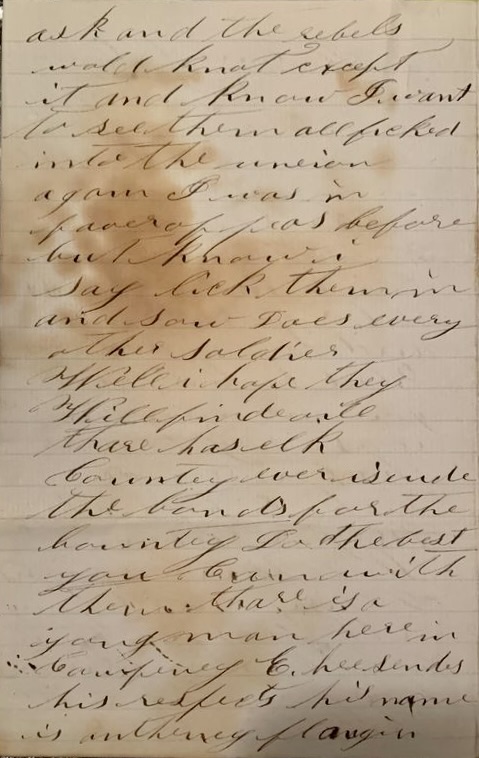
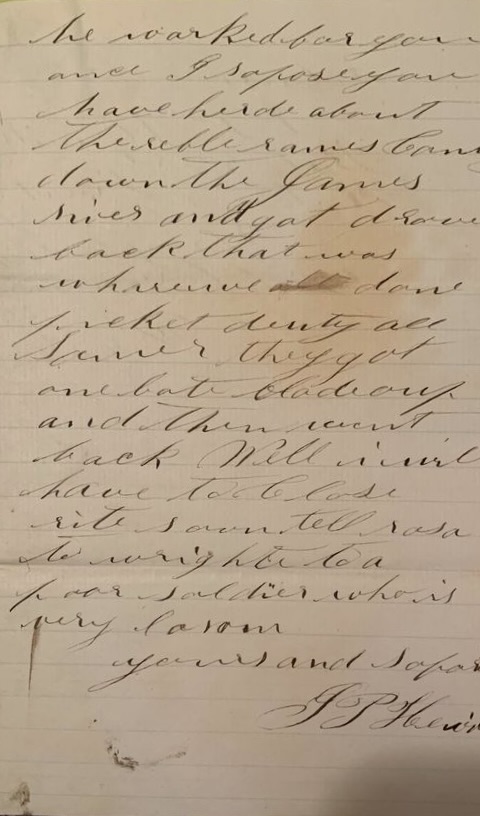
1862-65: Civil War Letters of Lloyd Benson Hodges, 40th Massachusetts

The following letters were written by Lloyd Benson Hodges (1837-1920) who served in Co. H, 40th Massachusetts from 1 August 1862 to 4 June 1865. He was wounded in action on 16 May 1864 at Drury’s Bluff, Virginia, and again on 4 June 1864 at Cold Harbor. He was discharged from the General. Hospital at York, Pennsylvania, in June 1865.
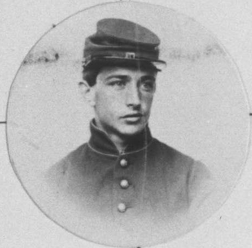
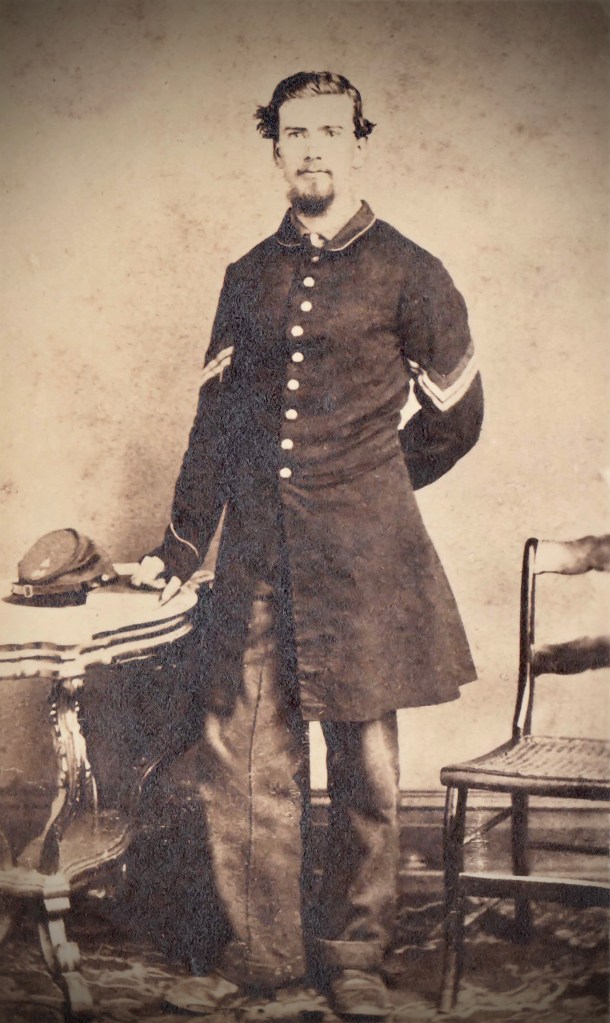
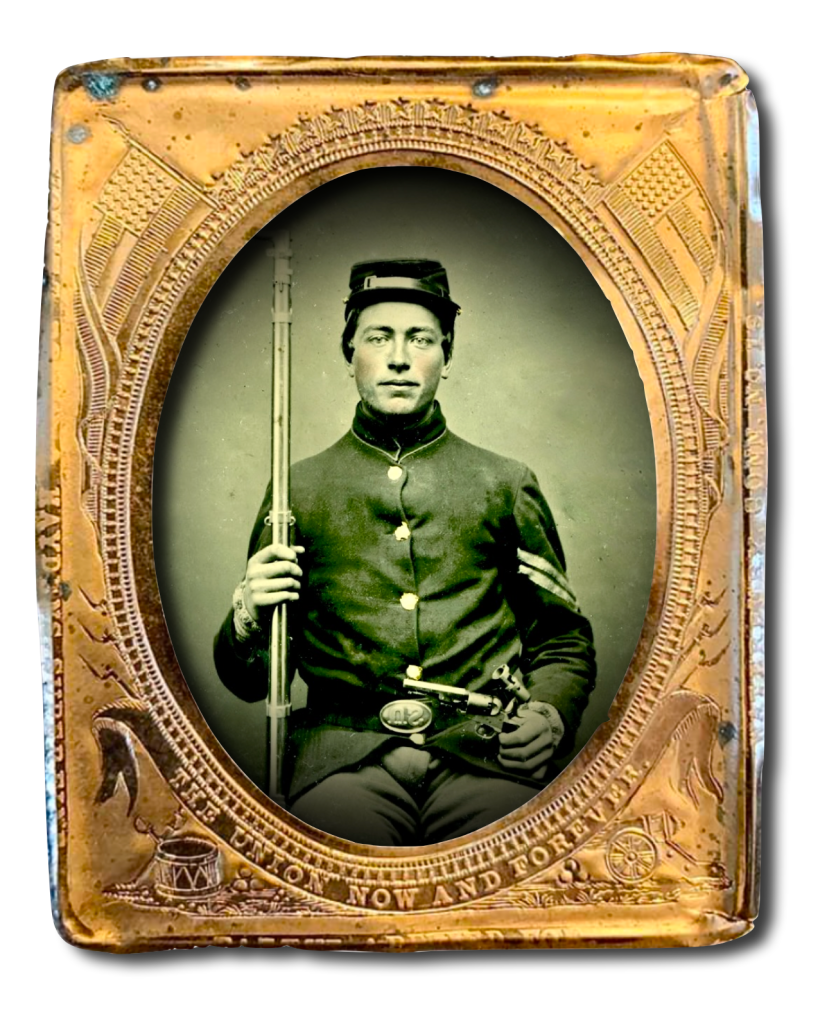
I could not find an image of Lloyd but here is one of Charles W. Crocker who served in Co. E of the 40th Massachusetts Infantry (Photo Sleuth)

Lloyd was the son of Elisha Hodges (1803-1865) and Sarah Ann Crowley (1807-1886) of Attleboro, Massachusetts. He married Sarah C. Gleason (1847-1920). He wrote all of these letters to his older sister, Mary Allen Hodges (b. 1830) who married Isaiah Standish Swift (1823-1897) in 1866.

The 40th Massachusetts left the state on 8 September 1862 and was comparatively inactive for some time and remained on picket and guard duty in and around Washington until the spring of 1863. On 15 April 1863, it moved to Suffolk, Va., then under siege, where it was engaged in two reconnaissances on April 24 and May 3. It then moved to West Point, Va., Yorktown, Williamsburg, White House landing in succession, and was engaged with the enemy at Baltimore cross-roads, on July 2. It then passed through Washington on the 11th, and went to Frederick, Md., where it joined the Army of the Potomac in the pursuit of Lee’s army after the battle of Gettysburg. On Aug. 6, it was ordered to Folly island, Charleston harbor, and occupied the trenches in front of Fort Wagner until the surrender of that stronghold. On account of its high repute for excellence in drill and discipline, it was equipped as mounted infantry at Hilton Head in Jan., 1864, and moved on Feb. 4, to Jacksonville, Fla., where it formed part of the Light brigade composed of the 40th, the independent battalion Mass. cavalry and Battery B, 1st U. S. Artillery, Col. Henry acting brigadier. It was engaged at Barber’s ford and Olustee, losing in the latter engagements 5 killed, 23 wounded and 4 missing.

Letter 1
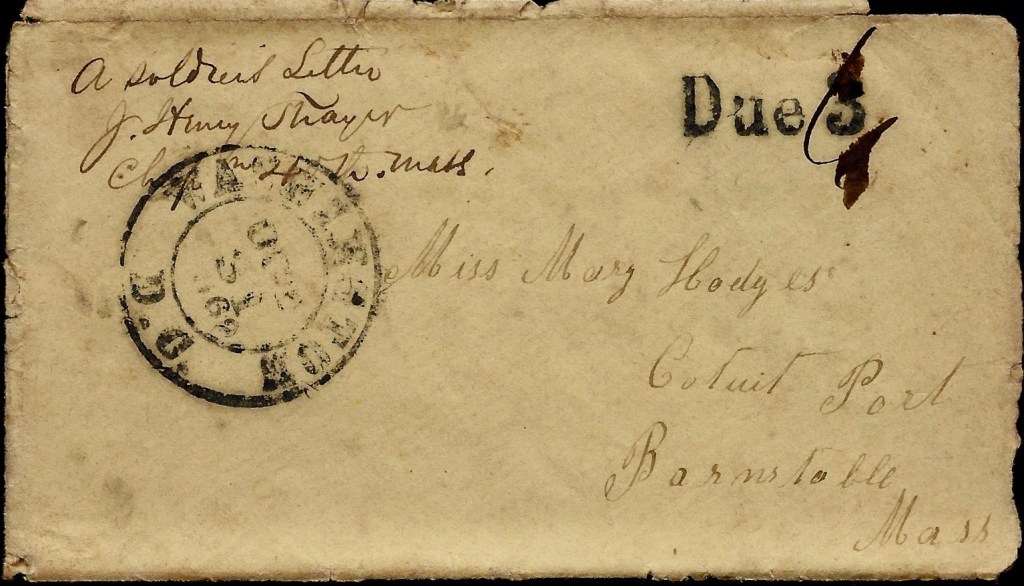
Minor’s Hill, Virginia
October 26, 1862

Dear Sister,

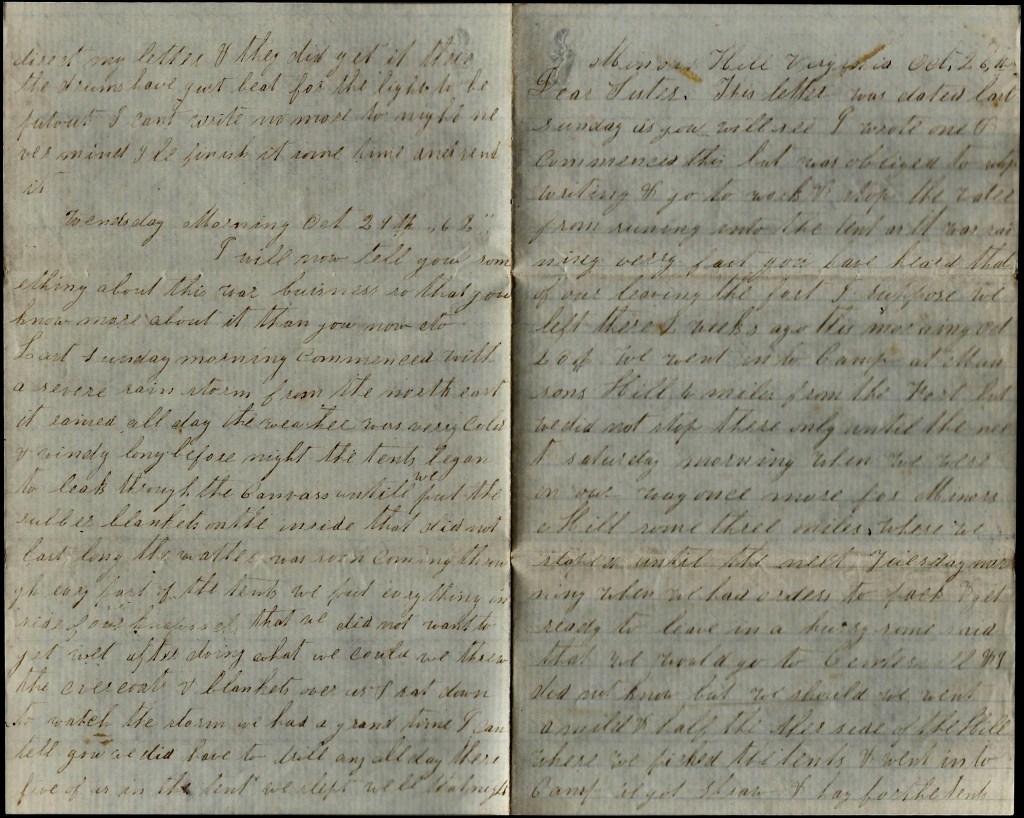
This letter was dated last Sunday as you will see. I wrote one & commenced this but was obliged to stop writing & go to work & stop the water from running into the tent as it was raining very fast.

You have heard of our leaving the fort [Fort Ethan Allen], I suppose. We left there two weeks ago this morning—[which is] October 28th. We went into camp. at Manson’s Hill 4 miles from the fort but we did not stop there—only until the next Saturday morning when we were on our way once more for Minors Hill, some three miles, where we stopped until the next Tuesday morning when we had orders to pack & get ready to leave in a hurry. Some said that we would go to Centerville & I did not know buy we should. We went a mile & a half this side of the Hill where we pitched the tents and went into camp. We got straw & hay for the tents& had put things in good shape not knowing but what we would stay there. The next morning we had orders to leave so we packed up once more & they marched us back to the same place we left the night before. We have not moved since then.

The night before we came back here, that box came. It was all right. They sent over a large box with the paper one inside, the first they let us know anything about it. There is not much difference in the size of the mittens. Henry took the ones with stripes around the wrists. We have not been out so as to use them much yet but if we stay here. we shall soon have use.

Father, I am very much obliged to you for them & for the box too. We came so little ways that I brought just as they give to us in one of the wagons. It will be a good thing as long as we stay here.

I am well now as usual & like soldiers life just as well as I expected too. It isn’t a bit worse than I thought it would be. There is one thing I don’t like about it and that is just as quick as I put my uniform clothes [on], they made me look a good deal larger than my other clothes. They make me look as large as a man & I ain’t a man yet nor won’t be one yet. I am nothing but a boy & that is all I’m going to be at present until I have had a chance to learn something at school or somewhere else. I thought of going last winter. I wish I had have gone to school. I wonder if it plagues others to write letters as it does me. I like to write & sometimes I can write well enough but I don’t know how to arrange them & put together & so I get one half written sometime & then tear it up because it don’t suit me. But I suppose we must live & learn. I’ve only written two letters since I have been here that I have not had an answer to since I’ve been here. I guess that they don’t mean to write me or mind me. I don’t care for I shan’t write to him again unless he does to me first. The other one I shall write once more. Perhaps I did not direct my letter [correctly] and they did not get it.

There, the drums have just beat for he lights to be put out. I can’t write no more tonight. Never mind. I’ll finish it sometime and send it.

Wednesday morning, October 29th, 1862. I will. now tell you something else about this war business so that you know more about it than you now do. Last Sunday morning [October 26th] commenced with a severe rain storm for the northeast. It rained all day. The weather was very cold & windy. Long before night, the tents began to leak through the canvass until we put the rubber blankets on the inside. That did not last long. The water was soon coming through every part of the tents. We put everything inside of our knapsacks that we did not want to get wet. After doing what we could, we threw the overcoats and blankets over us and sat down to watch the storm. We had a grand time, I can tell you. We did [not] have to drill any all all day. There [was] five of us in the tent. We slept well that night.

The next morn [October 27th] we were called out as usual at daylight to roll call. We did not know of leaving the streets when called out but it so happened that there was to be a review some three miles away that day so the regiment fell into line & began the march with overcoats and rubber blankets. As it stormed harder than ever, we could but just hear the beat of the drums at the head of the regiment. They took us two miles out in the mud & water with two other regiments—the 11th Rhode Island & 22nd Connecticut. Then orders came that there would be no review so turned right about face, and went back to camp. It was enough to make one laugh to see such a looking set of men covered with mud and wet all over. We had large fires in the streets close to the tents and dried our clothes.

The review took place yesterday [October 28th] at Hall’s Hill—you’ve heard of it. It was a fine day—as warm as summer—and there were many troops on the field, from ten to 12 thousand. The Review passed off well. Many officers were present—Brigadier General [Robert] Cowdin, who is in command of our Brigade; I think Gen. Sigel was there. It lasted but a few hours. At four o’clock we were home again. 1

We are called up mornings at half past five by the sound of the drums to answer to our names as they are called to see if all are here. It takes but a short time for that, then we have nothing more to do until half past 9 when we drill until 11 o’clock, an hour and a half [and again] in the afternoon from half past one until 3 o’clock. Then [we have] inspection at 4 o’clock when the officers look at everyone’s musket, belts, and everything else they want to see, if they are clean and free from rust. If there is a lot of dirt or stain found on the muskets, it must be taken off by hand—very quick too. The dress parade comes at 5 o’clock & roll call at nine in the evening again. That finishes up the day so you see that the work is not much—only about five hours in the day, but then one must be here just when they are wanted. It will not do [to] be five minutes late & if one is called for anything, one must drop whatever one is doing and leave. One does not have any excuse for stopping any at all. That is the worst part of being so strict in all things.

I suppose you would like to know what we have to eat. All companies draw from the quartermaster a certain amount of bread, both hard and soft. It is as good as you get from the bakery. they draw meat, both fresh and salted, rice, tea, sugar, coffee, molasses, candles, and sometimes potatoes & beans. We generally have salt beef for breakfast & bread with tea or coffee. I do not eat much salt meat or tea or coffee either. I don’t like the way they make it. Yesterday we had baked beans for breakfast. We had them over a week, sometimes fresh meat boiled & sometimes fired, boiled rice once in a while. There is always enough of it but molasses & sugar is do scarce that they do not have enough to eat it with so they throw large quantities of it. They have fresh meat soups once a week. After all that folks ay about the poor living, we think it not bad at all. There is always good bread—all one wants if he does not get the other things always. He will not suffer much for the want of something to eat.

The weather is the same as it is at home so far—cool nights and warm days. I have not time to write more. It is nearly 9 o’clock.

1 According to the regimental history of the 11th Rhode Island, the review “was not so grand an affair as we had hoped. Probably less than three brigades were present and passed in review before Gen. Abercrombie, whose headquarters were at Fort Ethan Allen. It was an imposing sight, however, to see even eight or ten thousand men march in review.”

Letter 2

Minor’s Hill, Virginia
November 25, 1862

Dear Sister,

It’s been a long time since I have written to you but I have been sick. That is the reason. I’m well now. I took cold & that brought on some fever & I was pretty sick for a few days. It has been three weeks today since I have done anything.

Henry is well. Such miserable weather I never saw as it has been until within a few days—cold, stormy and dreadful muddy. if you stepped out of doors, you would sink into the mud almost over shoe [top] and the sharp. wind & rain would take you in the face. The 8th of November the snow fell all day. It was on Saturday, I think.

There is a great deal of talk about our moving. We may go tomorrow & we may stay here all winter. Most of the regiment have fixed up their tents with a fireplace in them. They have torn down buildings to get boards and timber and bricks. If they do not stop here [for the winter], they will [be] disappointed after taking so much pains to get ready for winter. We have not been yet, though the time has been set many times when we should get paid. The most of the boys are out of money & they would like to see pay day. We are getting cold weather now. It seems to me about as cold as it is at home. The weather is dull and cloudy—the sky gray and cold-looking. We have not found the “Sunny South” yet.

There is many boxes coming every few days. I think their pies and cakes high. If they only knew it, a dollar and a half will not bring a very large box from Massachusetts. I have not sent for anything yet I should like to have them. Still I think it costs too much to get them here. I know that the boys don’t think about the cost. If they did, they would not have paid 20 and 25 cents apiece for pies as they did three months ago because they had 30 dollars in their pockets after they had been paid. They used money as if there was no end to it, buying everything they see. They lived high for a while. It cost some a dollar a day as long as they had money. At last they were out of money so that they did not have 5 cents to but tobacco. They they had to come down on hard bread and salt meat. I don’t know whether that is the best way or not. I think I shall wait before I send for any boxes & see if I can’t get along without them.

We have no business here & I don’t know but it good enough for me. If I don’t get what I want. I had a letter from Mother last week, I think, with a letter in it from Emma to her. Her school is almost out. Did you get the letter inside? I don’t know as I want anything in the shape of clothing. I will tell you why. The government allows each one 45 dollars a year for clothing besides their wages. If they take more than that amount, all they take over 45 dollars, they say, is taken out of their wages when they are paid. They say too that if you draw less than that amount, it will be made up to us. If we do not draw more than 25 or 35 dollars, the other 20 or 10 dollars will be paid us. But I am afraid they won’t get it, that is the reason I don’t want to get clothes anywhere else—only from the government. If I knew that we should get in cash what we did not take in clothing, I should get some other places but there is so much deceiving about this army business, that one can’t tell much about it.

The Lieutenant told us when we got our first suit of clothing that it would not cost us a cent. He said the State furnishes every man with a suit free of expense. We find on looking at the books that 27 dollars out of the 45 is hcarged for the first suit so if I should buy ten or 15 dollars worth of clothing thinking to get that amount from the government & not get it, I should not like it. I think that I had better draw the clothes & be on the sure side. I have not worn out my first shirts yet. I think I shall draw undershirts now.

I thought before I came into camp that I was coming to a place where I could not get anything like a piece of cloth or anything, but it is not so bad as there are many things [thrown] away and lost—stockings, pocket handkerchiefs. Sometimes you would see half a dozen in a day lying around. I have picked up some when I wanted them and just washed them in warm water & they look as well as new, only I don’t suppose it is a good plan to pick up such things much. But when I know when they are nothing but a little dirty, I am not afraid of them if I want them to use. You could not go anywhere without seeing half worn-out uniforms thrown away. They would make splendid mats for folks that cut old cloths to braid.

When men move, they often are obliged to leave things that are good but can’t carry….We can get anything we want on the ground or nearby by paying for it same as we could at home. Some costs more. There are two officers here with their families. I was down to Falls Church the other day—a small village store by here. We have been out on picket two or three miles several times. The people are all very good—all we have seen. One can go into their houses and talk with them. They will do anything they can for you. Once when we were out, when I went to a house to get sweet potatoes and peaches, they sent me down to their orchard and told me to take what peaches I wanted. I eat what I wanted and carried back a haversack full. That is the way we have lived since we went into camp. I think we have lived very well. We came out here just in time for such things. we have been in camp for three months. The next three will be much harder as the rainy season will soon commence.

What I mean by saying I like camp life as well as I expected too is that I knew all about it before I came. I do not like war and never intended to come to it & had waited 18 months for it to be settled before I did come. And after I got into camp, I was more surprised to find myself there than otherwise to know I was there because no one that knew me thought I ever would go. I knew it was a hard life & I knew to what the men were exposed to—everything worse than death—and knowing that I had not nor shall be disappointed in finding it hard, it is no reason why I should stay away because it is hard. Others have gone. I had two friends that went last fall. One of them now lies beneath the sands of South Carolina. Is it any worse for me to go than others? Others have gone as good as I am & I don’t know as I should stay at home idle. I do not think it the worst thing than can happen to one to die on the battlefield. I for one had rather die there than live the life of some I know. It would require less courage. There is nothing there that I fear but I won’t say more about that,

We do not expect it is going to happen. If you were here, it would seem more like the 4th of July than anything else. Folks get deceived about camp life. It’s not half so bad as they think. I have just been to supper. We had fresh meat soup. You spoke of my sending by the Cape boys a few lines to you sometimes. I might but neglect to do so.

— Lloyd


Letter 3

Minor’s Hill, Virginia
December 12, 1862

My Dear Sister,

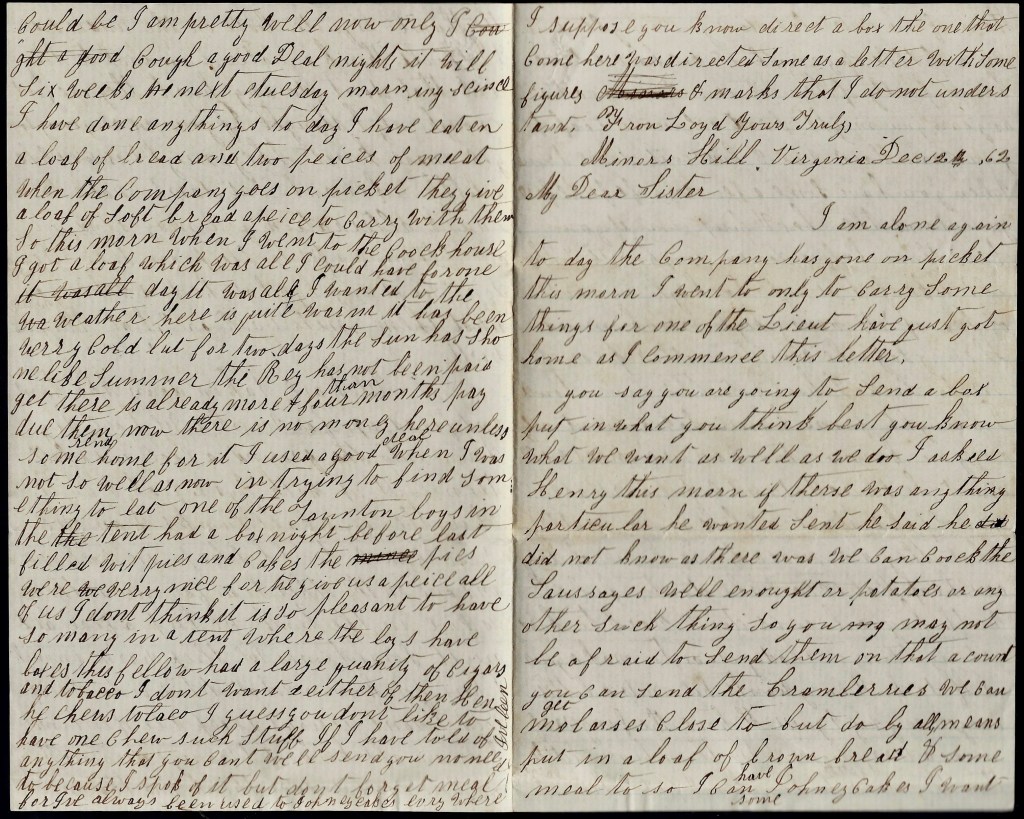
I am alone again today. The company has gone on picket this morn. I went only to carry some things for one of the lieutenants [and] have just got home as I commence this letter.

You say you are going to send a box. Put in what you think best. You know what we want as well as we do. I asked Henry this morn if there was anything particular he wanted sent. He said he did not know as there was. We can cook the sausages well enough, or potatoes, or any other such thing, so you may not be afraid to send them on that account. You can send the cranberries. We can get molasses close too but do by all means put in a loaf of brown bread & some meal too so I can have some Johnny cakes. I want them if no one else does. You might put in a little rye with it. We have white bread pretty often. It is not so good as yours….

Henry says he wants another pair of mittens. So do I. I have got the same towel I brought from home so we won’t need any. You know two can use one as well as not. Be sure and send the two pillow cases you spoke about a while ago, no matter what they are made of. Any kind of dark or cheap calico will do to fill with lay or leaves. Don’t work too hard getting things ready so as to make yourself sick. Henry wants his mittens a little larger every way. I guess I’ll have the fingers of mine a little loose & the thumbs are a little larger than they need to be when I put them on. The thumb is quite loose on the underside & I should think a quarter of an inch too long but that don’t do any hurt. They are good enough, only I thought if you were going to get more knit, they might as well be a little different. But don’t make too much alteration. You may send me one of them caps to sleep in. Henry, I guess, don’t want any by what he said. When you write, tell what them mittens cost or what they are worth.

We have taken down the tent and fixed up for winter. We have dug down into the ground a foot and a half, then built up with logs two feet and built what the boys call bunks, two on one side for two to sleep in each one and one on the other side for one as there is five in the tent. We keep a fire all night sometimes. We sleep warm enough. I have not known what it was to sleep cold. I don’t always sleep well. Often times I dream all kinds of strange dreams—things no one could ever think and that never could be. I am pretty well now, only I cough a good deal. It will be six weeks next Tuesday morning since I have done anything. Today I have eaten a loaf of bread and two pieces of meat.

When the company goes on picket, they give a loaf of soft bread apiece to carry with them. So this morn when I went to the cook house, I got a loaf which was all I could have for one day. It was all I wanted too.

The weather here is quite warm. It has been very cold but for two days the sun has shone like summer. The regiment has not been paid yet. There is already more than four months pay due them now. There is no money here unless some send home for it. I used a good deal when I was not so well as now in trying to find something to eat. One of the Taunton boys in the tent had a box night before last filled with pies and cakes. The pies were very nice for he gave us a piece. I don’t think it so pleasant to have so many in a tent where the boys have boxes. This fella had a large quantity of cigars and tobacco. I don’t want wither of them. Hen chews tobacco, I guess. You don’t like to have one chew such stuff.

Henry got a half peck of apples a few days ago that had been touched by the frost & the most of hem were bitter. He said he was going to make some sauce, he guessed. He said the bitter taste would all stew out of them but he did not make it. When they were half gone, I took the rest, cut them up, cut out what bitter I could, and made the sauce. It was bitter then so I sweetened it with some syrup he has. I put one side to cool. He tasted of it when he came in and said I got it too sweet, but the bitter taste was there. He would not eat any of it, but I liked it if it was bitter.

I cannot write well lately. I don’t [know] what the reason is. I don’t know whether you can read this letter or not. The last one I sent home last week was written miserable. I told them to burn it soon as they had read it. I guess you had better so so by this. Our Captain was the 1st Lieutenant in the Chelsea Company. I don’t know [how] he happened to be Captain of our company. He is little but seems to be pleasant. His name is Jenkins. I have not drilled and since he has been here.

When you direct now, you might leave out the Capt. Rogers for we have got another captain & they come just as well as with the captain’s name. I don’t know as Rogers ever meant to be our captain. He has never been near the company.

I must close for tonight. My candle is nearly burned out and I must fix up my bed. It makes me think of sleeping in a steamboat for their bunks are the same as they are in the cabins. There is more room since we fixed the tent. We can put wood in the last three days & not have it in the way. My mouth is sore on the inside. I wonder what makes it hurt but I must close now.

Saturday morning. Send me a little bit of ginger in the box if you have it. Two men were discharged from the regiment and left here for home last Monday morn. There was a good many sick once. Now I never would go to the hospital if I were sick. I don’t think it any place for sick folk such hospitals as there are here.

Letter 4

[Minor’s Hill, Virginia
Approximately 20 December 1862]

…Cotton cloth in Attleboro I hear is worth 53 cents a yard. I should not think it could be so high as that.

I do not think this war will close at present. I should not be surprised if it lasts until Lincoln’s term in office closes. That will be two years from next March. It will not be closed in a hurry, I can tell you. It must be many months first, if not years. I do not think we can ever whip the Rebels. We certainly never can unless there is different management among our officers. The Rebels are strong & at home. They are in earnest & never will give up until they get what they ask. The government must transport men and arms two thousand miles to fight them. I thought when we came out here the government would do something towards trying to close the war. They seem to be satisfied to let it drag along without trying to close it. Neither the government or the officers have acted to me since the war commenced as if they wanted to whip the Rebels. It is strange [that with] all the men and money we have had that we could not do it. It is something I know but little about so I will not say anything [more] about it.

I suppose you [are] pretty busy now. It is getting along towards Christmas & New Years. Two years ago this Christmas, I think it was, I was to Cape. I did not think then that two years would find [me] out in Virginia. We had roast beef for breakfast this morning. I don’t think we live well at all. We have too much salt meat & hard bread.

I must close now. Henry has just gone to drill & wants me to sew a button on his coat, I do not drill. Give my respects to Julia. Write when you can. Goodbye till I write again.

From Lloyd


Letter 5

[Minor’s Hill, Virginia
Approximately January 1, 1863] 1

…loaded in line ready to leave. It was that Gen. Cowdin had ordered us to report at Fairfax Seminary early Monday morn. Then I believed we should march. We had orders to be ready to fall into line at once. As no one expected to come back again, a great change took place in camp in a few moments. We packed up a few of the best things in a box that we could not carry. Many threw & gave away provision of all kinds. We went to the cook house. They put out the boxes of bread, meat, and lots of apple sauce for us to help ourselves. We filled our haversacks and were soon on our way to hunt Rebels.

We marched 7 or 8 miles through swamps, fields, and woods. We arrived at a place called Mills’ Cross Roads where a lot of rebels had been seen. We arrived there at 5 in the morn. No sign of rebels so we lay down, pulled our blankets over us and slept until daylight. No sign of rebels then [either]. We lay around all day waiting for orders to move on. It was another fine day—war and bright. We lay around on our blankets all day & had a fine time. Though the march the night before had worn us down, we had time to sleep it off and get rested.

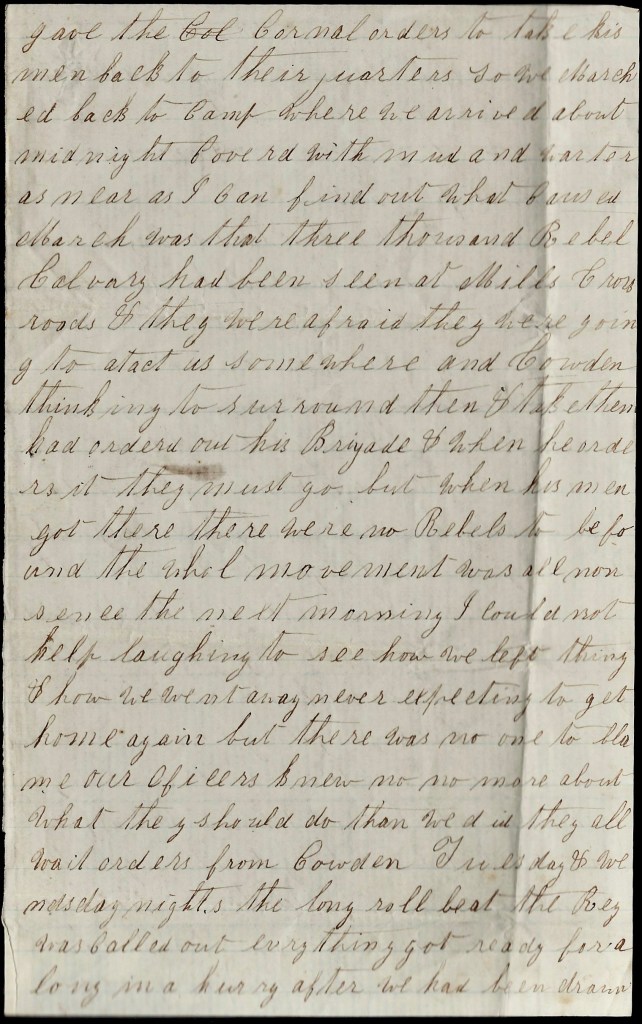
Monday night we made our beds close to our muskets and lay down expecting every moment to have orders to move on but I had been thinking all the afternoon that we should not go farther but they all said we should go on. There were seven thousand men there besides artillery and cavalry. At seven o’clock the order come to pack up and be ready to march. Soon after General Cowdin gave the orders to take his men back to Camp where we arrived about midnight covered with mud and water, As near as I can find out, what caused the march was that three thousand cavalry had been seen at Mills’ Cross Roads and they were afraid they were going to attack us somewhere and Cowdin, thinking to surround them & take them, had orders out to his brigade & when heard it, they must go. But when his men got there, there were no rebels and the whole movement was all nonsense.

The next morning I could not help laughing to see how we left things & how we went away never expecting to get home again. But there was no one to blame. Our officers knew no more about what they should do than we did. They all wait on orders from Cowdin.

Tuesday and Wednesday nights the long roll beat, the regiment was called out, everything got ready for a long [march] in a hurry. After we had been drawn up inn line, we were dismissed to our quarters with the order to be ready to fall into line at any moment but were not called upon to turn out & I guess we shall not again at present.

Falker was here today to borrow the White Slave, He sends his respects to you. I had a letter from Mother tonight.

We go on picket tomorrow again. We are very busy now. We do not get time to do much. I am glad we did not move on account of the box. I think the ladies were very kind to send things as they did. I am very much obliged to them and to the one who sent the books too. I think a good deal of them for before long, will come stormy days when I shall like to read them.

I do not think of anything I want now. I am well as ever. So is Hen[ry]. He did not say much about the box but I know he was glad to have it & it was very kind in you to think to send it for us. The weather here is quite warm. I have written this in a hurry. I will write again soon if I can. From your brother, — Lloyd

1 The beginning of this letter is missing but from the contents we know that it was written just after the march to Mills’ Cross Roads and returning to Minor’s Hill. The march to Mills’ Cross Roads is conformed by the Regimental History of the 11th Rhode Island, another regiment that made the trek. Both regiments left for Mills’ Crossing on Monday, 29 December 1862. That history describes the trip as follows (p. 76): “The route was over roads in a horrid condition, through mud and water, through woods and briars, over fences and broken bridges, double or single file, picking and threading our way, half moonlight and half darkness, for three hours and a half. This, in heavy-marching order; some knapsacks were very heavy, and the mettle of the. men was severely tried. The mud holes were nearly or quite knee deep.”


Letter 6

Minor’s Hill, Virginia
January 4th 1863

Dear Sister,

I write today not knowing when I shall have another chance to do so.

The box arrived here on Wednesday eve last, safe & sound. It was all right. Had not been opened on the way, I guess not. I expected to see a large box but not so large as this is. Falker came over the next day and took his things. Also Cals and Nickerson’s. You sent just what I wanted and lots of it too. Henry said the pieces of cake in the wooden box tasted like wedding cake. Those biscuits & doughnuts were very good. Hen carried two or three of the turnips to one of the houses where he was acquainted and got them to cook them & make them into a sauce though he might have done it himself as well. You did not know as I liked onions. I do like them. And turnips too—when they are made into a sauce. And we have seen so much cooking done here that almost anyone of us can cook such things.

We had baked beans for breakfast this morning & I cut one of the loaves of brown bread and had brown bread and beans for the first time since I have been in camp. I was glad to get a piece of white bread once more from home. That did not last long for I could not help eating it & Hen, I guess, liked it pretty well. The cake, pies, sauces, I shall try to keep some time. The books are very interesting if I can get time to read them. Some of them I mean to save if I can and carry them home for the White Slave, I liked too well to throw away, and them others too—I forgot the name of them—such ones as you have taken so many of them.

Have you heard what a time the 40th Mass has had for a week past. If you have not, perhaps you. would like to know. Last Sunday morning 5 companies of the regiment went out on picket. The day was pleasant and almost as warm as summer. We filled haversacks with bread, tea, coffee, sugar, & shouldered our knapsacks and muskets and blankets and marched out some three miles. There were six on the post that I was on. There was not much to do through the day—only one being required to stand guard. At 6 o’clock two go on guard and remain two hours; two sleep in before they go on again. I went on guard at eight o’clock with another fellow and off at ten and such an evening as it was. I never saw but a few like it here. It was almost as light as day. The full moon shone upon every shrub and bush and made me start more than once. They looked so much like a man that I thought some rebel might be near. I could hear bells ringing in some distant city or village and that, together with the loud barking of the watch dogs who were guarding their master’s property to prevent its being taken by some soldiers who are roaming around nights ready to take whatever they can lay hands on that they can make use of, and the rattling of the cow bells around us, made it seem more like home than anything else. A train of cars would sometimes pass near us and they looked quite natural. At such times I forget we are here engaged in war for it does not seem hardly possible that we are.

But I was going to tell you what we had been doing this week. I went off guard at ten o’clock, spread down my blankets before a blazing fire built in the center of the tent & after eating some hard bread & drinking some coffee, I lay down for a four hours sleep. I had slept but two hours when I was woke up & told we had orders to pack up and march to camp as we were going to break camp and march. You can judge perhaps what my feelings were when I found we had orders to leave the comfortable winter quarters. At first I did not believe we should go but we went to work to pack up and in a few minutes the captain came along with the rest of the company & we fell in to the ranks and marched to the camp in a hurry through woods and fields to camp. There all was confusion & hurry. The teams were already… [rest of letter missing]


Letter 7
[Note: I did attempt to transcribe this letter due to its being so faint as to be almost illegible.]
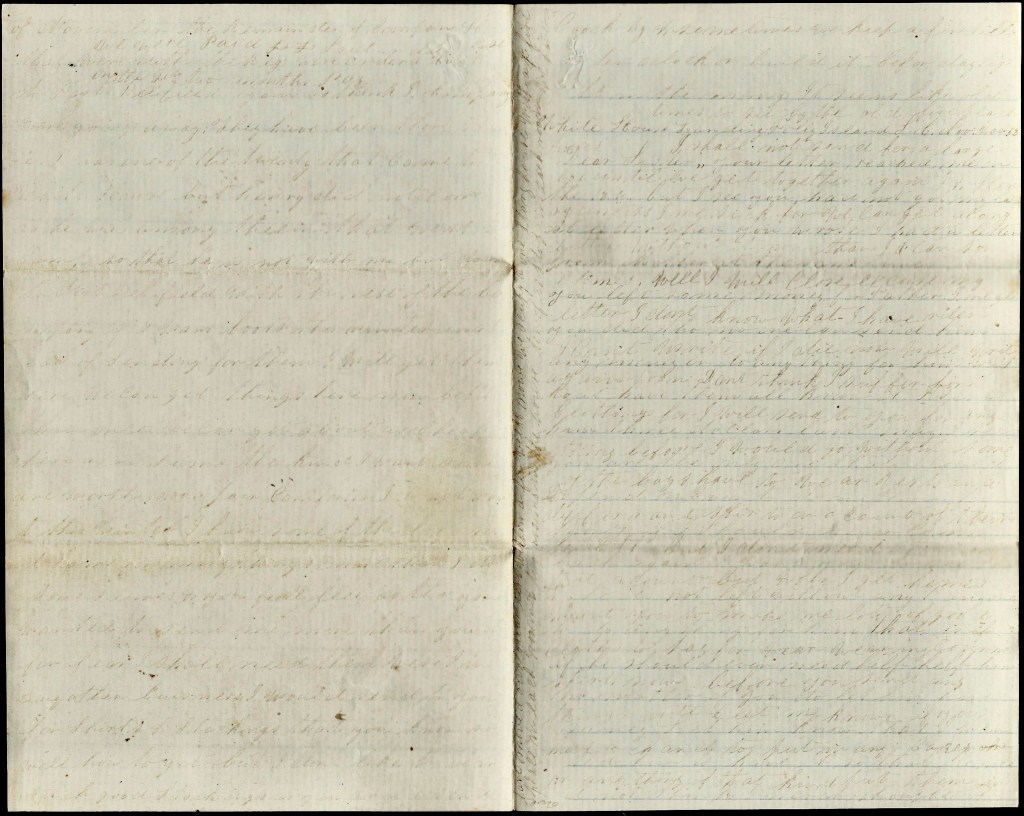

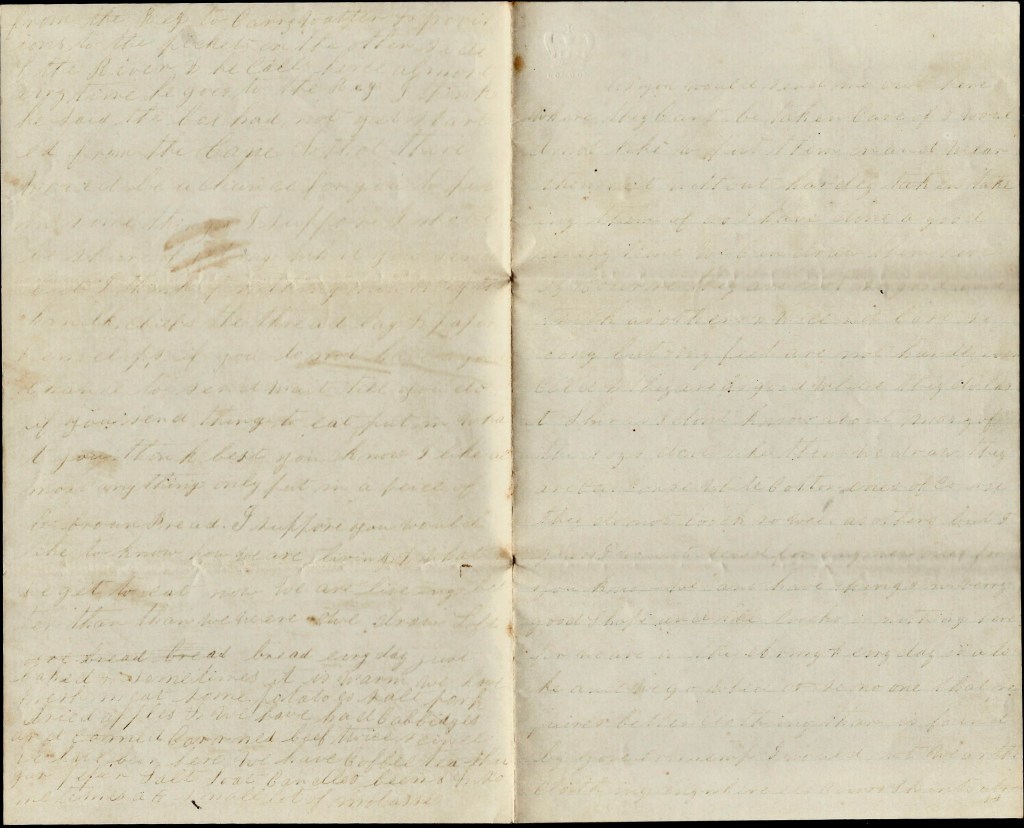
Letter 8

[Note: The 40th remained in the forces besieging Charleston until 16 January 1864 when relocated to Hilton Head, South Carolina, on 18 January. On the island, the regiment joined the 2nd Battalion, 4th Massachusetts Volunteer Cavalry Regiment (operating as the Independent Massachusetts Cavalry Battalion), and Battery B (Horse Artillery), 1st U.S. Artillery to form the Light Brigade attached to BGEN Truman Seymour’s Jacksonville Expedition forces. The 40th received horses and cavalry equipment and drilled as mounted infantry until its embarkation for Jacksonville on 4 February.]
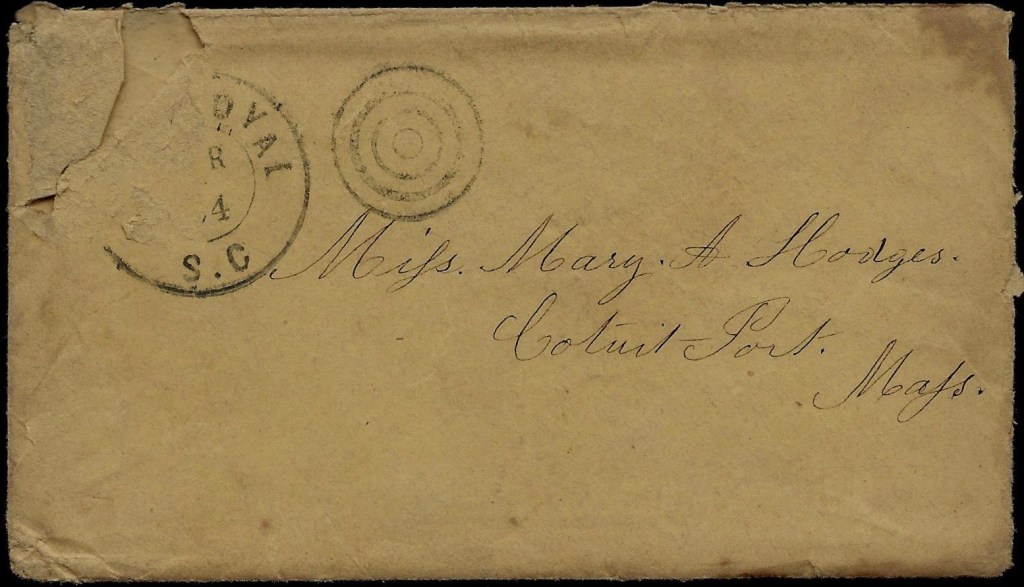
Jacksonville, Florida
March 3rd 1864

I received your last letter written January 26th some time ago. The paper with the handkerchief & yarn & other things in it I received, and I guess I got all of the other letters you sent after a while. Henry did not say anything about Gil’s being married. I did not think of her getting married at present, if ever he did. I did not think he would go to war, either but he seen a chance to make a lot of money out of it, else he never would have gone.

You need think no more of sending a box now. When I spoke of having one [sent], we were in camp & expected to stay there, but we can’t have a box no more until we get settled and in camp again and it is not likely we ever shall see that time. I am glad that you did not send me any more things. We can’t carry anything now—only an overcoat and blanket and not always that since they have taken our knapsacks.

You wanted to know if I would take a furlough if I could get one. I will answer by saying no matter how bad I want one, it would be impossible to get it. A few have had furloughs from the regiment but unless some officer will use his influence, a private cannot get a furlough. And it’s only a few favored ones that the officers will trouble themselves about for they, the officers, can do as they have a mind to and go about when they want with what strictly care for others. But one thing you must understand and that is that those away from the regiment who have been sick like Falker can get a furlough where they could not had they been with the regiment. During our marches last summer we left fifteen of Company H in different places in Virginia and those that went to the hospitals all got furloughs when they could not have got them in the regiment.

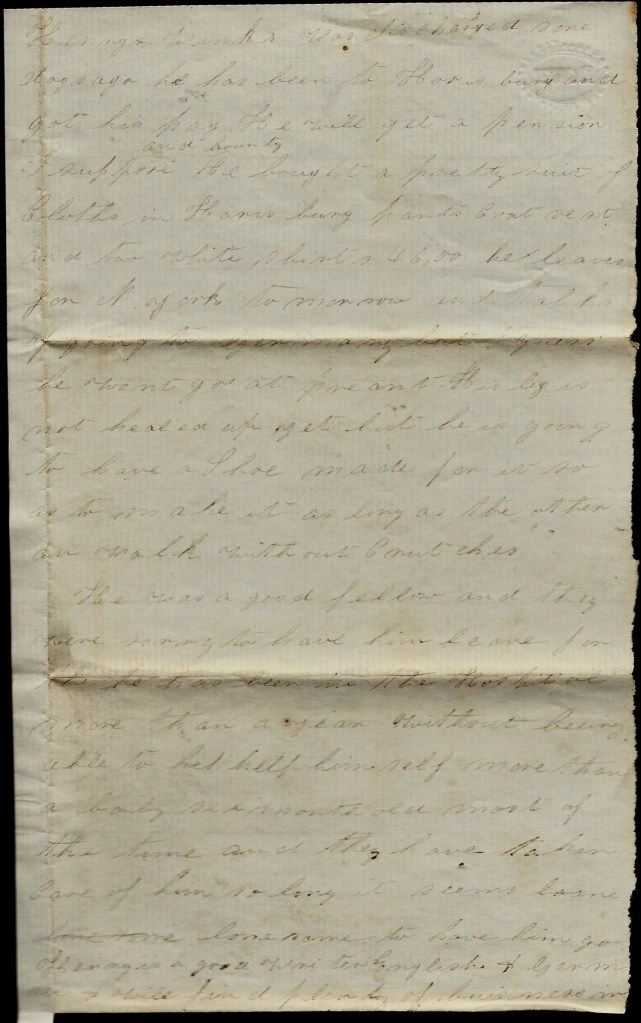
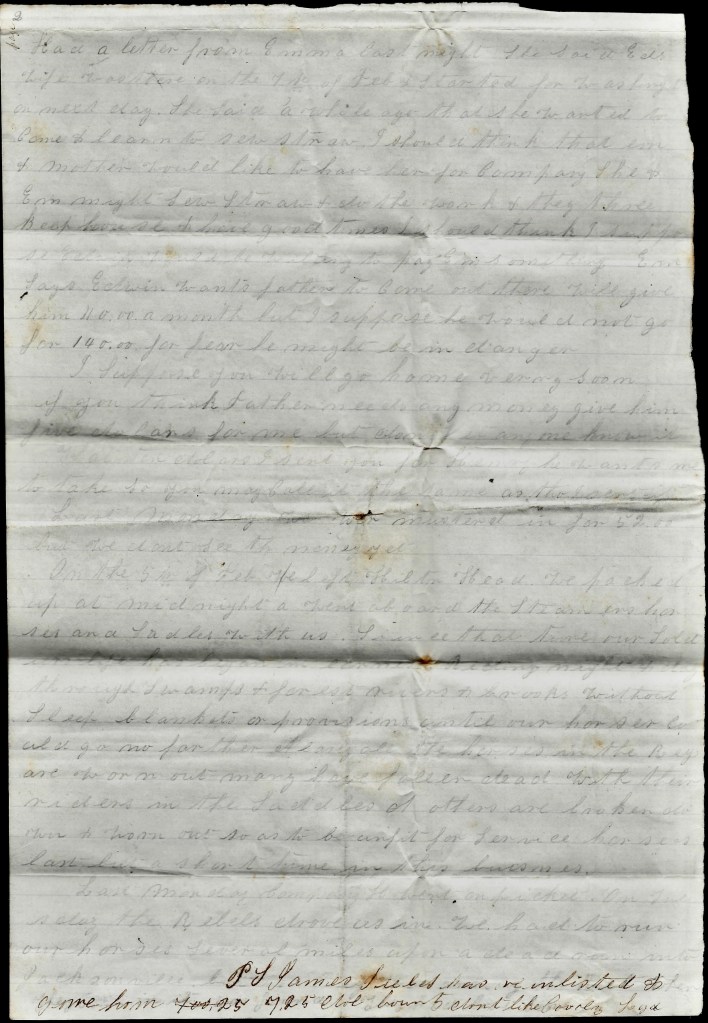
Had a letter from Emma last night. She said Ed’s wife was there on the 7th of February and started for Washington next day. She said a while ago that she wanted to come and learn to sew straw. I should think that Em and Mother would like to have her for company. She & Em might sew straw & do the work & they three keep house & have good times. I should think I suppose Edwin would be willing to pay Em something. Ed says Edwin wants father to come out there. Will give him $110 per month but I suppose he would not go for $140 for fear he might be in danger.

I suppose you will go home very soon. If you think father needs any money, give him five dollars, but don’t let anyone know it. The 10 dollars I sent you for Henry, he wants me to take so you may call it the same as though I sent it. Last Monday we were mustered in for $52 but we don’t see the money yet.

On the 5th of February we left Hilton Head. We packed up at midnight and went aboard the steamer E____ and a sadler with us. Since that time our soldier life has begun in earnest—riding night and day, through swamps and forests, river and brooks, without sleep, blankets or provisions, until our horses could go no further. Nearly all the horses of the regiment are worn out. Many have fallen dead with their riders in the saddles and others are broken down, too. worn out so as to be unfit for service horses. I ain’t but a short time in this business.

Friday 4th [February]. When we first landed at Jacksonville, it was said that that we should go as far as Tallahassee, the State capitol of Florida. After going about one hundred and fifty miles towards Lake City, we stopped at a place known by the name of Barbersford, reaching there on the 17th of February. We were now in the Rebel’s country 150 miles farther than any of our troops had ever been for they never had been farther than Jacksonville & they only shelled that place from the gunboats that lay on the St. Johns river. All our troops done was done without landing so that when we came here, we came into what to us was a new country.

At Barbersford, February 20th. So far all is gone well. We’re now within a day’s ride of the Gulf of Mexico. A few miles from us at the village of Baldwin were roads that ran to the Gulf, roads that branched off from the great railroad that ran fro mJacksonville to Tallahassee to Lake City. At Barbersford on the 20th, everything so far had fallen into our hands—Rebel troops, cannon, military stores, cotton, turpentine, flour, corn, roce, lots of artillery to the amount of more than two millions of dollars without firing a gun or any fighting. When we had met the Rebels, they had surrendered & given themselves up without offering to fight. During our marches through the long, dark nights, half did I expect to have a volley of shot & shell fired into our ranks, but nothing of the kind panned though.

We have pretty good proof that a large force of Rebels were drawn up in line at Camp Finegan and they were in camp but it so happened that we did not go the way they expected & when they found out we had passed them by another road & got in front of them, they left Camp Finegan in a hurry, Had our general known how the Rebels were situated & where they were, I think we should have had to fight that night for I think that we should have made an attack on them as they intended to on us had we happened to have gone farther to the left by a mile than we did. We have got some officers now that had as soon fight as go to dinner and sooner. That is as near as we come to getting into a fight on the night of the 9th of February.

This cavalry business was too much for me & I was not able to stand it—neither myself or my horse. They left me behind to run my own risk of being picked up by the Rebels but I did fear that. I kept up with them until the 10th of February when I could go no farther & stopped at the village of Baldwin, but after resting a few days, I went on.

On the morning of the 20th, our troops advanced towards Lake City. By that time I was at Barbersford & did not know what to do about going on. First I decided to go & then I thought I would not. I wanted to go but my horse was not able. Well, I did not go. About four o’clock on the 20th in the afternoon, I had begun to get hungry. I was getting some supper when I heard the roar of artillery. I knew of course too well what it meant—that our boys at last, of all their good success, had met the rebel army. The sound of cannon continued for two hours 14 miles away & then all is still. Our force of five thousand met 15 thousand [in the Battle of Olustee] & finding them too strong, retreated back to Barbersford after fighting a few hours. They reached Barbersford about midnight.

It was reported that the rebels were following us with a large force & now commenced our retreat on Sunday morning the 21st. The news spread that a great battle had been fought, that we were defeated, & that a rebel army was close to us pressing us on and much more of the same kind. Of course a great deal was added to the reports that was not true but every place was evacuated where we had troops. They made their way to Jacksonville where the gunboats would protect them.

The village of Baldwin was deserted by our troops where they had began to build fortifications. Every family [deserted], both black and white. The citizens were frightened to think the rebels were coming, expecting there would be fighting [so] all left the place.

Since the 21st of February, we have been retreating until last Tuesday night close to Jacksonville & have…

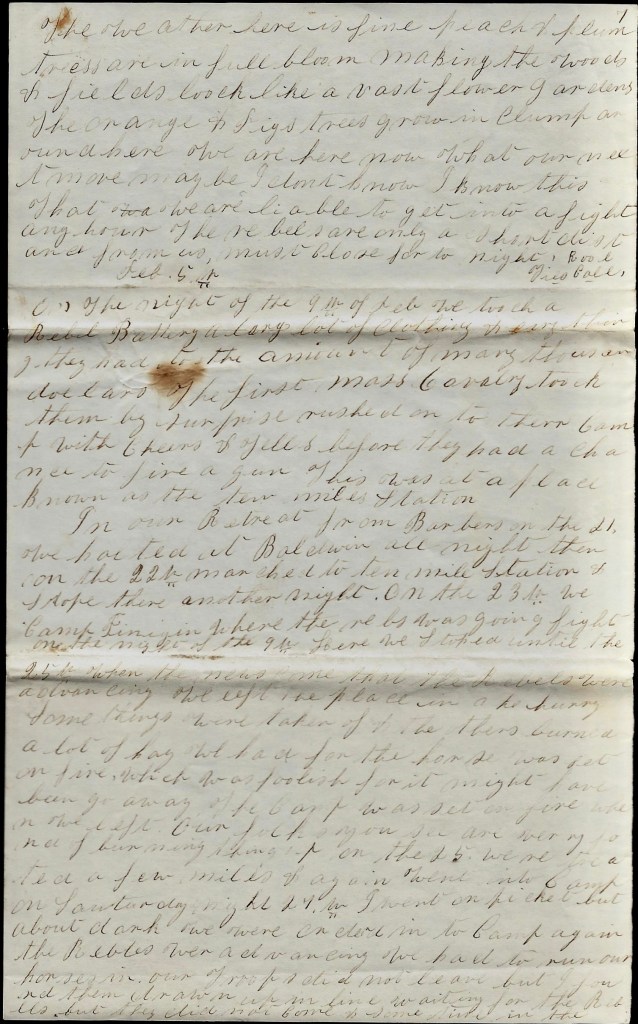
The weather here is fine. Peach and plum trees are in full bloom making the woods and fields look like a vast flower garden. the orange and fig trees grow in clumps around here. We are here now. What our next move may be, I don’t know. I know this, that we are liable to get into a fight anyhow. The rebels are only a short distance from us. Must close for tonight. Roll call.

On the night of the 9th of February we took a Rebel battery, a large lot of clothing & everything they had to the amount of many thousands of dollars. The 1st Mass Cavalry took them by surprise, rushed on to their camp with cheers and yells before they had a chance to fire a gun. This was at a place known as the Ten Mile Station.

In our retreat from Barbersford on the 21st, we halted at Baldwin all night, then on the 22nd marched to Ten Mile Station and stopped there another night. On the 23rd, we [came to] Camp Finegan where the rebs was going to fight on the night of the 9th. Here we stopped until the 25th when the news come that the rebels were advancing. We left the place in a hurry. Some things were taken and the others burned. A lot of hay we had for the horses was set on fire which was foolish for it might have been got away. The camp was set on fire when we left. Our folks you see are very fond of burning things up.

On the 25th we retreated a few miles & again went into camp. On Saturday night, 27th, I went on picket but about dark we were called into camp again as the rebels were advancing. We had to run our horses in. Our troops did not leave but I found them drawn up in line waiting for the Rebels but they did not come and some time in the [morning] went back on picket & came in Sunday night & found our troops had moved nearer Jacksonville but we found them. We lived in peace until the 29th when we went on picket again.

On the 1st of March, heavy firing commenced in the morning & the rebels were now advancing in earnest. The pickets were driven in or taken prisoners & at last we were ordered in and had to run the horses for miles. Had I been alone, I don’t think I would have rode so fast to be kept from being taken prisoner but as it was, I had to keep up with the other boys. We come to Jacksonville & had to look again but night come on and brought the fighting to a close. Our regiment lost but one killed that I have heard of Co. A, had five or six men taken prisoners, and others had some wounded.

That is the way we have been marching for the last two weeks. The 40th has lost men several different times. One of the Attleboro boys is wounded & a prisoner. Another was sent on picket & has not been heard of since. Some lie buried beneath the pine trees at Barbersford. It’s said that a flag of truce has been sent in by General Beauregard saying he would give Gilmore five days to evacuate the state.

On the night of the 21st, more than 20 thousands of dollars worth of provisions & hospital stores were burned. They were foolish to do so for it might have been taken away but our officers were frightened & they sent off the wounded in the cars & poured turpentine over large store houses of flour, rice, sugar, molasses, meat, coffee, apples, and large quantities of bread, piles of knapsacks left by the troops in their hasty retreat full of clothing. They were set fire, lighting [up] and wrapped the ruined village in flames, sending up vast columns of smoke that darkened the moon and stars.

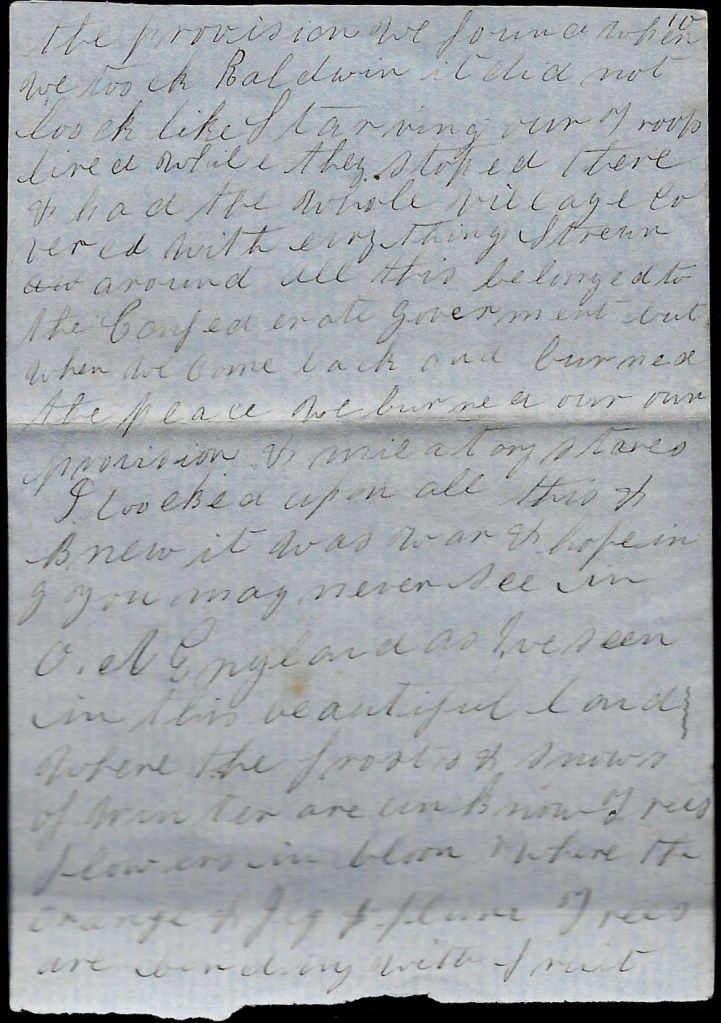
So one month has passed since we came here & it has been a month of war. True, we have marched through Rebel camps and captured millions worth of their property everywhere. We have been in every village & camp. Things were not used very nice. You may guess what became of them when the troops had full liberty to do as they pleased though they did not always trouble poor private families, but government property had to suffer. Cotton is very valuable but tons of it has been burned where we have been. Tis a great place for cotton here. They talk about starving the rebels out but if you had the provisions we found when we took Baldwin, it did not look like starving. Our troops lived [well] while they stopped there and had the whole village covered with everything strewn around. All this belonged to the Confederate government. But when we came back and burned the place, we burned the place [and] we burned our own provision & military stores.

I looked upon all this & knew it was war and [am] hoping you may never see in old New England as I’ve see in this beautiful land where the frosts and snows of winter are unknown, trees, flowers are in bloom, & where the orange and fig and plum trees are budding with fruit.

— Lloyd

P. S. James Field has reenlisted & I owe him $7.25. I don’t like cavalry.
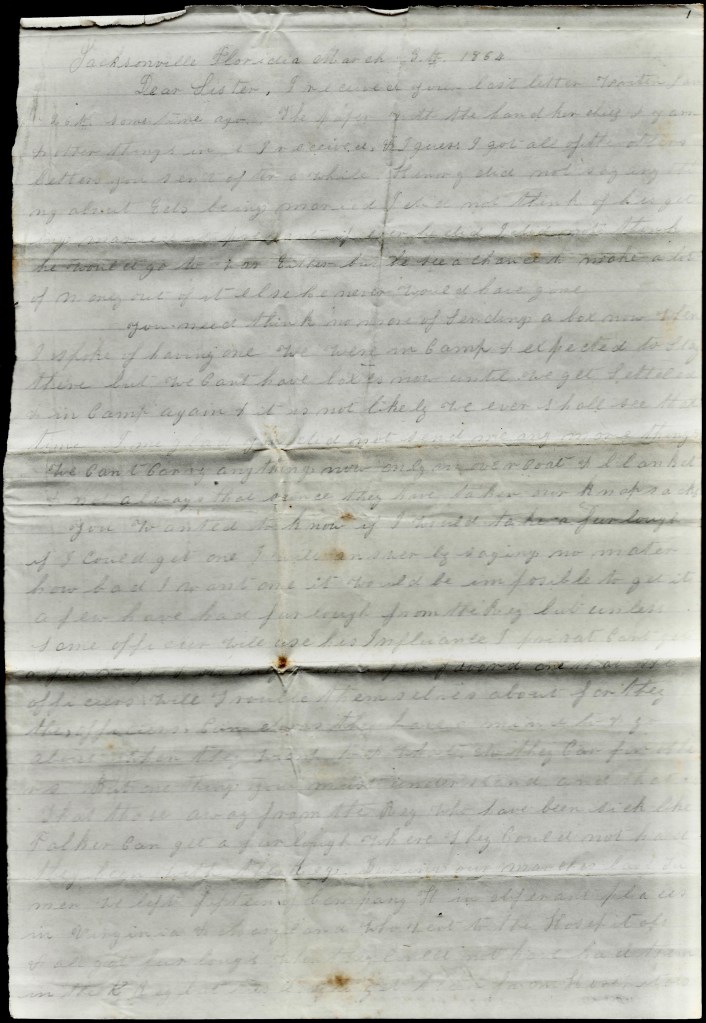

Letter 9

Jacksonville, Florida
Sunday, April 17th 1864

Dear Sister,

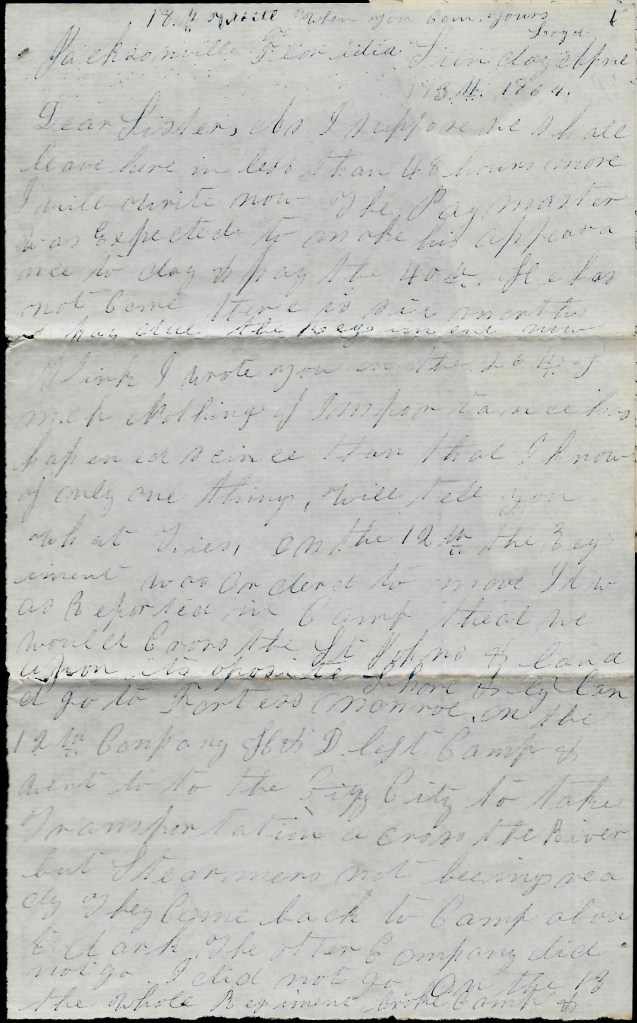
As I suppose we shall leave here in less than 48 hours more, I will write now. The paymaster was expected to make his appearance today to pay the 40th Massachusetts. He has not come. There is six months pay due the regiment now.

I think I wrote you on the 26th March. Nothing of importance has happened since then that I know of—only one thing [and I’ll] tell you what that is. On the 12th, the regiment was ordered to move. It was reported in camp that we would cross the St. Johns [river] & land upon its opposite shore & by land go to Fortress Monroe. On the 12th, Companies H & D left camp and went to the city to take transportation across the river but steamers not being ready, they came back to camp about dark. The other company did not go. I did not go. On the 13th, the whole regiment broke camp and crossed the river. I did not leave camp until the last one. Pet and myself waited in city until about midnight before the boat could take us. We landed on the opposite side of the river, climbing up a steep bank, landed safe. Large fires had been built which lit up the place. Saw several houses, half in ruins. Standing in among the groves of trees, I lay down at the foot of a large live oak, spread my overcoat over me and sheltered by its thick branches and leaves, slept until daylight. Pet, I don’t think, slept any. I lay near him. We fitted up a camp on the 14th at the Empire Mills on the bank of the river in a splendid place overlooking the St. Johns. On the 15th, again we recrossed the rover in boats & before midnight were back in our old camp—horses, wagons, & all the baggage. What the move was made for, or the object of it, I can’t say. A great move, wasn’t it?

There are but two families living in the many houses that remain around the ruins of the Empire Mills & the people in that part of the country are reported to be in starving condition almost.

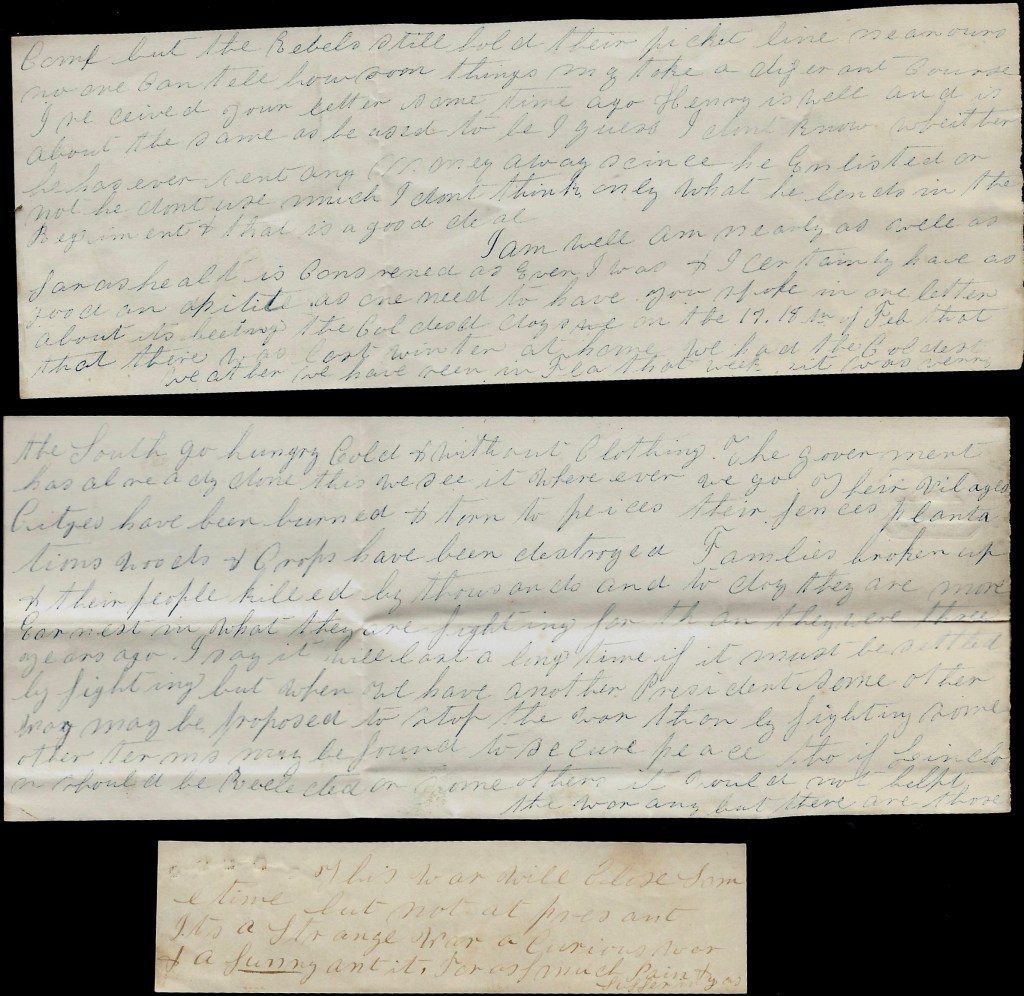
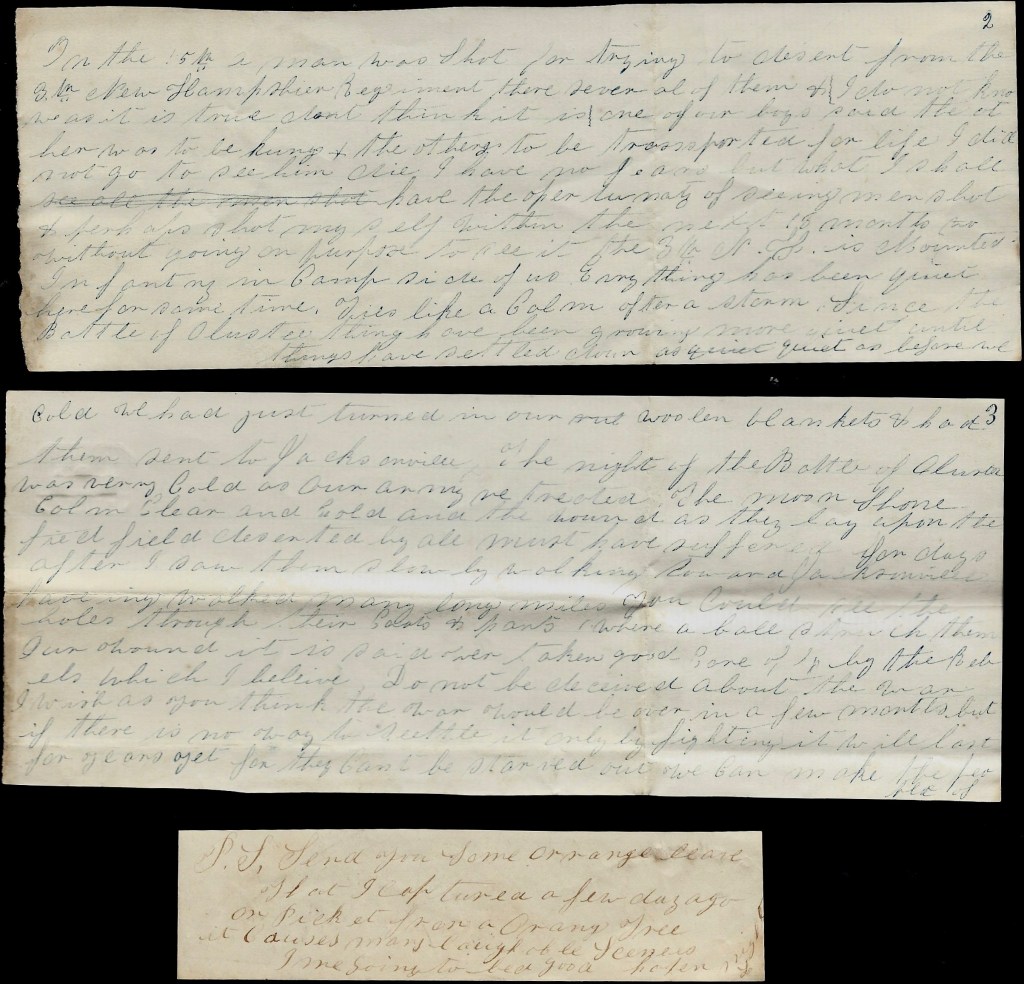
On the 15th, a man was shot [executed] for trying to desert from the 3rd New Hampshire Regiment. There are several [of them]—we don’t know if its true. Don’t think it is. One of our boys said the other was to be hung & the others to be transported for life. I did not go to see him die. I have no fears but what I shall have the opportunity of seeing men shot & perhaps shot myself within the next 18 months too without going on purpose to see it. The 3rd New Hampshire is Mounted Infantry in camp side of us. Everything has been quiet here for some. time. Tis like a calm after a storm. Since the Battle of Olustee, things have been growing more quiet until things have settled down as quiet as before we came but the rebels still hold their picket line near ours. No one can tell how soon things may take a different course.

I received your letter some time ago. Henry is well and is about the same as he used to be, I guess. I don’t know whether he has ever sent any money away since he enlisted or not. He don’t use much, I don’t think—only what he lends in the regiment & that is a good deal.

I am well. Am nearly as well as far as health is concerned as ever I was & certainly have as good a spirit as one needs to have. You spoke in one letter about its being the coldest day on the 17th and 18th of February that there was last winter at home. We had the coldest weather we have seen in Florida that week. It was very cold. We had just turned in our woolen blankets & had them sent to Jacksonville. The night of the Battle of Olustee was very cold. As our army retreated, the moon shone calm, clear, and cold and the wounded as they lay upon the field deserted by all must have suffered for days after. I saw them slowly walking toward Jacksonville having walked many long miles. You could see the holes through their coats and pants where a ball struck them. Our wounded, it is said, were taken good care of by the Rebels which I believe.

Do not be deceived about the war. I wish as you think the war would be over in a few months but if there is no way to settle it only by fighting, it will last for years yet for they can’t be starved out. We can make the people of the South go hungry, cold and without clothing. The government has already done this. We see it wherever we go. Their villages and cities have been burned & torn to pieces, their fences, plantations, woods and crops have been destroyed, families broken up and their people killed by thousands, and today they are more earnest in what they are fighting for than they were three years ago. I say it will last a long time if it must be settled by fighting. But when we have another President, some other way may be proposed to stop the war than by fighting. Some other terms may be found to secure peace. Though if Lincoln should be reelected or some others, it could not help the war any but there are those which if they should become President, we should see a change in things. The people of the South are waiting to see who is the next President. Some think and I suppose many more of them hope McClellan will be elected.

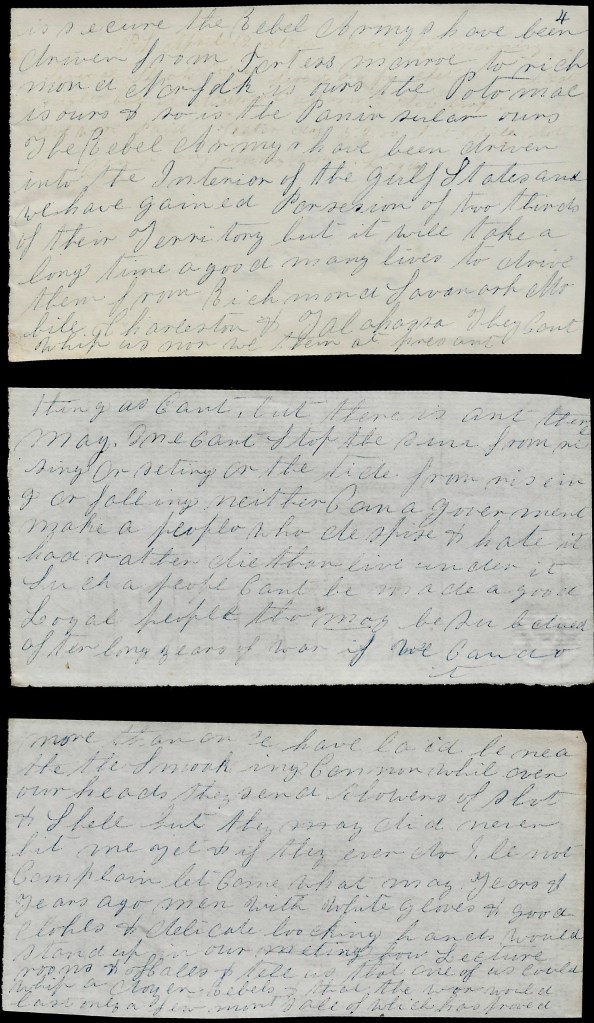
I know that in three years of war, we have gained much, for then the Rebels held the Potomac & the country about Norfolk, Suffolk, Fortress Monroe, & Yorktown. They were even swarming with their armies around Washington & even threatened the Capitol to lay it in ashes. Now Washington is secure. The Rebel armies have been driven into the interior of the Gulf States and we have gained possession of two-thirds of their territory. But it will take a long time and a good many lives to drive them from Richmond, Savannah, Mobile, Charleston and Tallahassee. They can’t whip us nor we them at present.

I would like to see the Rebs whipped & the country restored to its former power under one government, but one might as well look at the things as they are. In fact, they can’t help doing so when they have seen them as I have. I know the Rebels must be whipped. The Government will conquer them if it costs thousands of millions of dollars & lives—if it can, I mean. But if it can’t, there’re some who say there is no such thing as can’t, but there is. And they may. We can’t stop the sun from rising or setting or the tide from rising or falling neither. Can a government make a people who despise & hate it, had rather die than live under it, such a people can’t be made a good, loyal people though may be subdued after long years of war.

The fact that we may yet have a long war does not keep me awake any nights, nor does it take away my appetite. I’m too hard-hearted for the thought or sight of pain & suffering to trouble me in that way much, though of course I had rather it would not be. I can lie beneath a cannon with a cannonball for a pillow & sleep on the soft side of a board. More than once I have laid beneath the smoking cannon while over our heads they send showers of shot and shell. But they did never hit me yet & if they ever do, I’ll not complain, let come what may. Years and years ago, men with white gloves & good clothes and delicate looking hands would stand up in our lecture rooms & halls and tell us that one of us could whip a dozen rebels & that they war would last only a few months all of which has proved [false].

Letter 10

White House Landing
June 6th 1864

Dear Sister,

Don’t write to me until you hear from me again and tell you where to write. I have not received any letter from you for a long time and it has been some time since the regiment has had any mail at all unless it they have it since I left it two days ago. I left the regiment two days ago and came here Saturday morn and got here sometime around midnight.

I am wounded with a ball through the left side but not dangerous at all—only a flesh wound. The Rebs hit me at least five holes through my pants but only one ball hit me. Henry is hit in the right foot. He is here [too]. The 40th has only men enough to make about half of a company—70 men in all. All the Massachusetts regiments here are all cut to pieces. The 23rd has fifty men left. The Massachusetts 27th and 25th are all gone nearly.

We left Bermuda Hundred for Drury’s Bluff on the 29th of May. Crossed the James river on pontoons. The night was dark and stormy. We halted at midnight, rested until daylight, when we rook transports at City Point and sailed for Fortress Monroe. From there [we went] up the York river to Yorktown and West Point. Then up the Pamunkey river and landed at White House on the 31st.

From White House, we marched to the front and arrived, after a long and tiresome march, at Gaines Mills where they pushed [us] right into a fight which lasted until midnight. Henry was hurt that night, the first of June. Lieut. Colonel [George E.] Marshall was killed of the 40th before the battle fairly began. Lieut. Wier [?] of Co. H was wounded with several other officers.

On the morn of the 3rd, I left Henry at the hospital two miles in the rear of the battlefield. He was coming away with a lot of the other wounded. I give him some things to send home that I could not carry & left him to go to the front where the 40th was. I did not expect to see him again before I got where the regiment lay. The fight of the day before again began long before I found the regiment. The woods was full. of shot and shell. The road was full of wounded coming from the the field on the morning of the 3rd after the fight was over.

I was struck by a ball after which I started for the hospital, getting there in time to come in the train with Henry and others of the 40th. Company H went into the fight with 27 men and came out with 7. Again they charged on the rebels. [Company] I lost every man. Company E lost heavy. Company H lost killed L[ester A.] Perkins and [Gideon C.] Slade of Attleboro. J. C. Wilmarth of Attleboro missing. Capt. [Horatio] Jenkins of Company H a prisoner, & Lieut. Weinded [?] of Co. H. Almost every one of the Attleboro [boys] are wounded and in fact, all the regiments are as bad as ours. The New York Regiment lost all of their colonels and officers.

Don’t trouble yourself about us for tis impossible for one to get any better care at home than here. The Sanitary Commission is not idle day or nighttimes on the battlefield and in the hospital. There are men and women here to do anything. The wagon train that I come in from the front reached more than five [miles] in length loaded with wounded. Such trains are coming in all the time—thousands of them, the wounded, every twenty-four hours. [They are] wounded in all ways—hundreds have lost arms and legs. Tis almost impossible for a man or officer to go into the battles up in front twenty miles from here without any man getting hurt. I don’t know what they will do with us but where we shall go. When I find out, I will let you know.

We were in the 16th Army Corps in the Army of the Potomac on the Left Wing of Grant’s Army. The fighting where we were was at Gaines Mills six miles from Richmond.

From Lloyd


Letter 11

York, Pennsylvania
July 7th 1864

Mother,

I am not so well as I have been. My leg has been growing worse and has pained me dreadful at times, but for a day or two the doctor says it looks better.

I don’t see what should make you think we didn’t get enough to eat because I said I had milk twice a day. I did not say we had nothing. I have not left the room for my meals at all but had them brought to me. We always get fresh beef for dinner—all we asked for, but I did not think it best lying in a hospital on a bed to eat like a man doing a hard days work. After eating any reasonable amount, I would still be hungry. The doctor makes us eat all the meat we can. I soon found there was no need of getting rid of my appetite for it deserted me altogether & now I can’t eat anything hardly. The doctor gives me anything I ask for that he can give me—a few peas for dinner yesterday. He has sent me in potatoes, beef steak days until the sight of it made me sick. At last I told him I could not eat it.

I feel better this morn for the doctor gave me sleeping powders last night and something to kill the pain. While that lasts, I feel better.

I have not written Kelly. I know they don’t think I was able to go on a furlough and I don’t know as he could get me one if they did think me fit to go here but I can find out. I asked the doctor for wine but he give me whiskey. That is better than nothing though I don’t like it very well.

When you write, send me a little bit of cherry bark in the letter and if I want to use it I can. W won’t write anymore. It won’t do any good & I’ve nothing to say. I guess my leg will not be any worse. — Lloyd


Letter 12

York, Pennsylvania
July 13th 1864

Dear Sister,

l am still here and am likely to be for the present. Since I last wrote I have been sick and my leg grew worse but I am better now. My leg grew worse until I could not walk on it though I never have walked on it much. I have not walked or been out of my room for some time. I suffered a good deal of pain at times but I do not feel much pain now and my appetite is coming back.

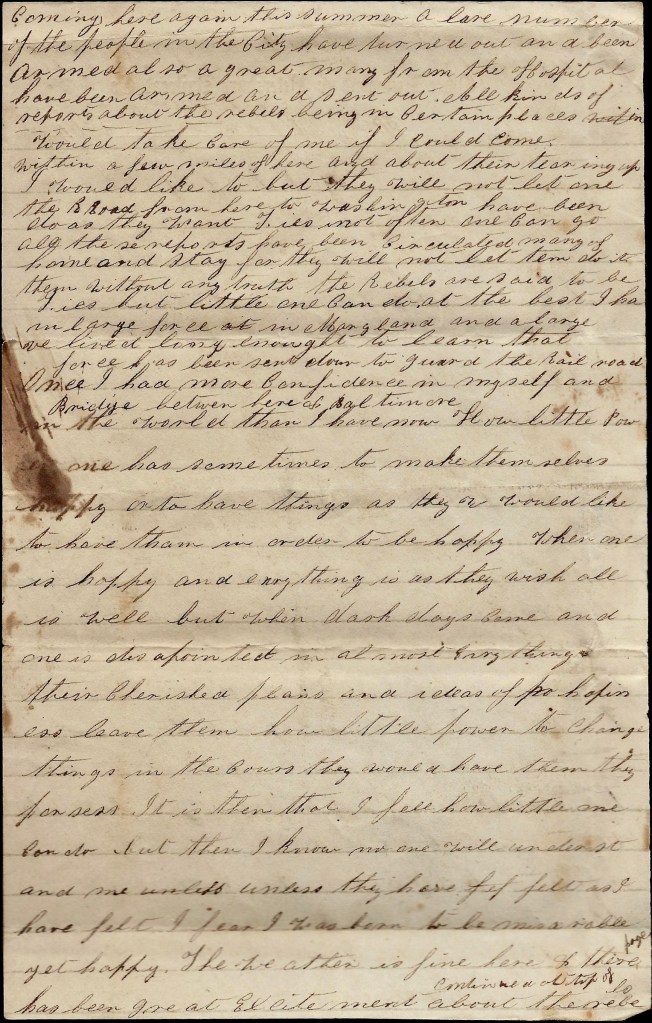
Emma sent me a letter a few days ago. It was from you, written the 27th of May about the time we left Bermuda Hundred for the Potomac Army. She said it came directed to me. I suppose it went to the Regiment and they sent it to me directed to West Mansfield. There were two stamps in it. You said you hoped that we were not wounded and that your letter would find us all. We [were] both well at that time though the Regiment had seen very hard fighting. In the letter you told me if I got wounded to come to you and you would take care of me if I could come. I would like to but they will not let one do as they want. Tis not often one can go home and stay for they will not let them do it. Tis but little one can do. I have lived long enough to learn that since I had more confidence in myself and in the world than I have now, how little power one has sometimes to make themselves happy or to have things as they would like to have them in order to be happy. When one is happy and everything is as they wish, all is well. But when dark days come and one is disappointed in almost everything, these cherished plans and ideas of happiness leave them. How little power to change things in the course they would have them they possess. It is then that I feel how little one can do. But then I know no one will understand me unless they have felt as I felt. I fear I was born to be miserable yet happy.

The weather is fine here and there has been great excitement about the Rebels coming here again this summer. A large number of the people in the city have turned out and been armed also a great many from the Hospital have been armed and sent out. All kinds of reports about the Rebels being in certain places within a few miles of here and about their tearing up the railroad from here to Washington. All these reports have been circulated, many of them without any truth. The Rebels are said to be in large force in Maryland and a large force has been sent down to guard the Railroad bridge between here and Baltimore. There were some Mass. boys transferred a few days ago but the doctor thought I was not able to go, else I should have gone too. I don’t know whether I shall go or not. Write soon if you have not. — Lloyd

Letter 13
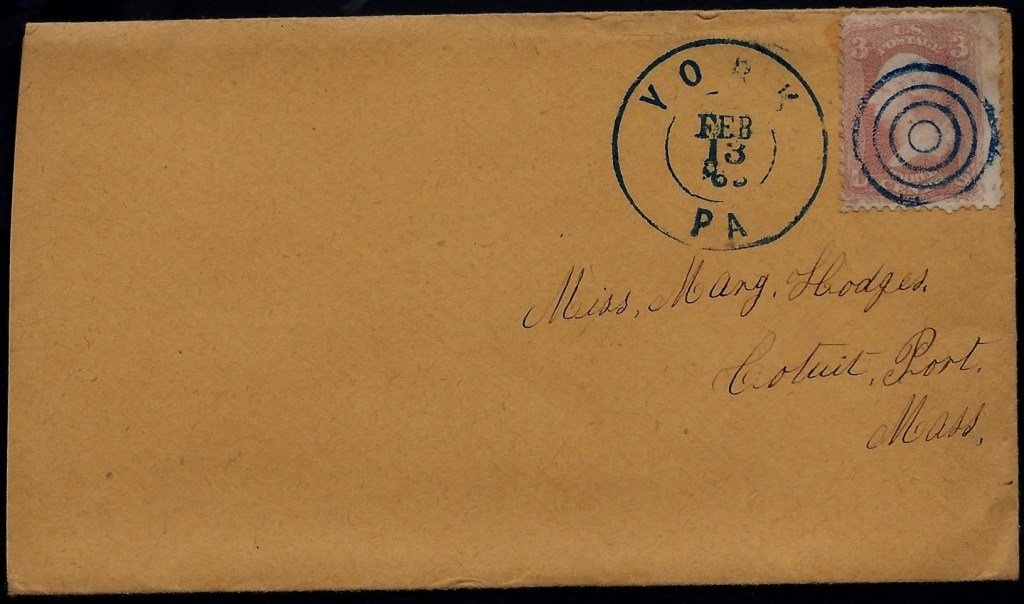
U.S. Gen. Hospital
York [Pennsylvania]
Feb 11, 1865

Dear Sister,

You people think I am not well by my not writing some but I don’t always feel like writing. I am well as usual, and will soon be well. I think you spoke about being detailed here to work but do not know as it would be easy to get detailed. And I am willing to [return to] my regiment again, I think. I have no longer three years to serve! only about six months and will be home by that time if I do not get shot again, and if I do. my life is worth no more than many others that have died. And if there is anything worth fighting at all, it is worth dying for. And if there should anything happen to me of that kind, I should die happy knowing there is a better land where we meet again but days as this are rather dark. There was a lot of boys went away to the front.

There is plenty of sleighing here now. I have have not been to S. for a number of days but I would go more if I felt as though I would be welcome for they are good folks and I like them but perhaps they think I am too cold, distant, reserved and they do not appear sociable. I know I am and I try to throw off such feelings and thoughts. I don’t think I succeed—not very well. You must know I never had a chance to cultivate the art of being agreeable very much. This town does not bear a very light, moral reputation, but there are lots of nice folks here.

I have not heard from home for a long time. I had a letter from Louisa a while ago. What do you think of making a theater out of a chapel or church dedicated to the worship of God? Our new chapel is finished at last and by orders of Dr. Mintzen, it has been fitted up as a theater. And many concerts have been given in it. It is used for a church on Sundays and it looks more like a theater than a church. It [been] used as church, theater, school room, lyceum room and various [other] purposes. These entertainments we suppose to be given for soldiers, but citizens come in from town.

I want you to send me fifteen dollars until we get paid which will be in March. There is ten months of pay due.

There was one of the Ohio boys transferred 2 days ago and he owed a woman here (who keeps a small shop) fifty-two dollars and went away without paying it as he had not any money and he had accumulated this bill in a few short weeks spending more than his pay. Another one of the boys lost 1.21 dollars in town! He had been drinking! Now that is the way the boys do most of them and you know there is but few people that think of saving money, and indeed I don’t think much of it for when we die, we leave all and it will do us no good, but it might do some others good.

Do you know that I have sometimes wished I was like Ed Ruyler and you know he can’t keep any money and I have [heard] you call him a fool, but though some say I have done well, yet he would be liked better than I and would feel more at home and at ease at all times and everywhere. You know that I have paid more attention to making money and saving it than I ought while neglecting often things of more importance. I think I have been most too good and honest. The world does not recognize such as me, I find, as well as others and I can’t blame people like those who are lively and possessing the act of being agreeable.

Write at once and send me the money if you can and I will send it back again. Write home. — Lloyd Hodges

1823: Hiram Ketchum to Gideon Lee

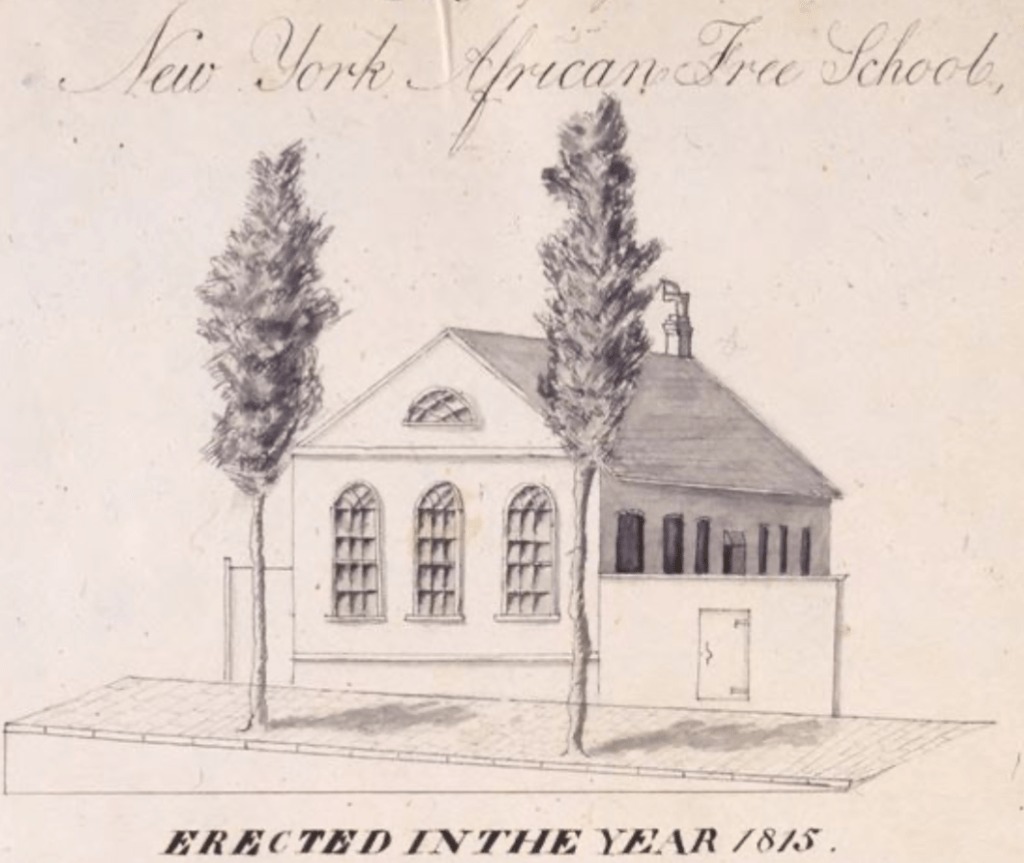
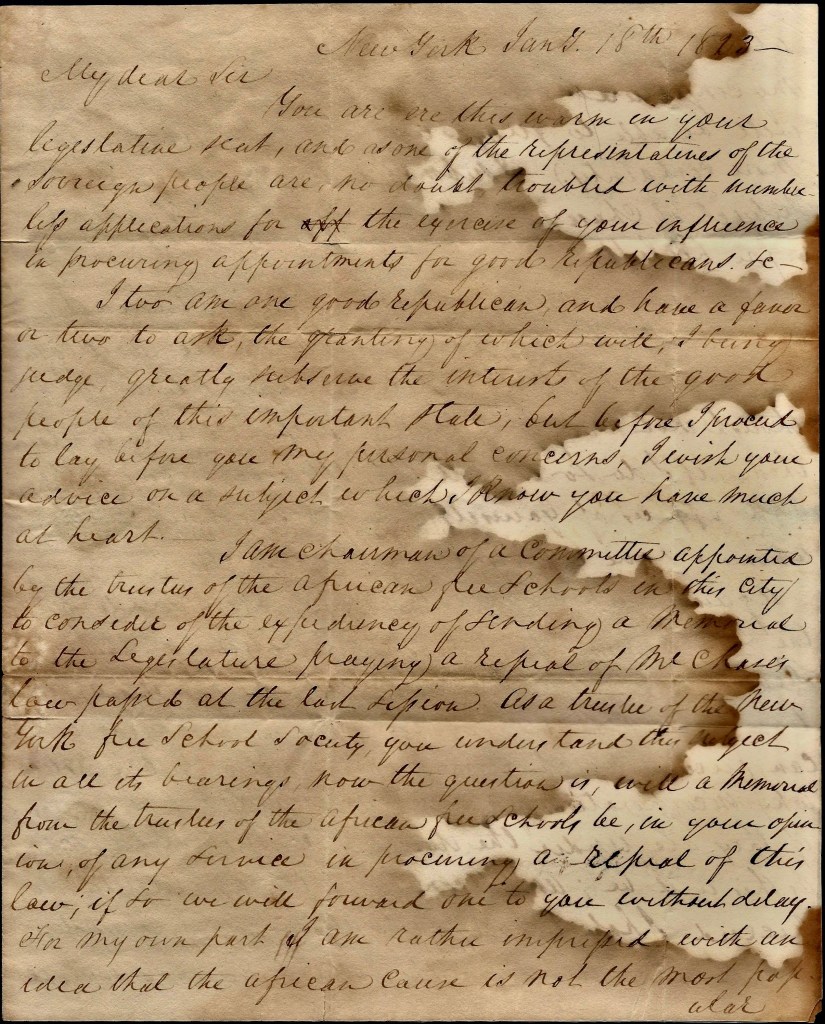
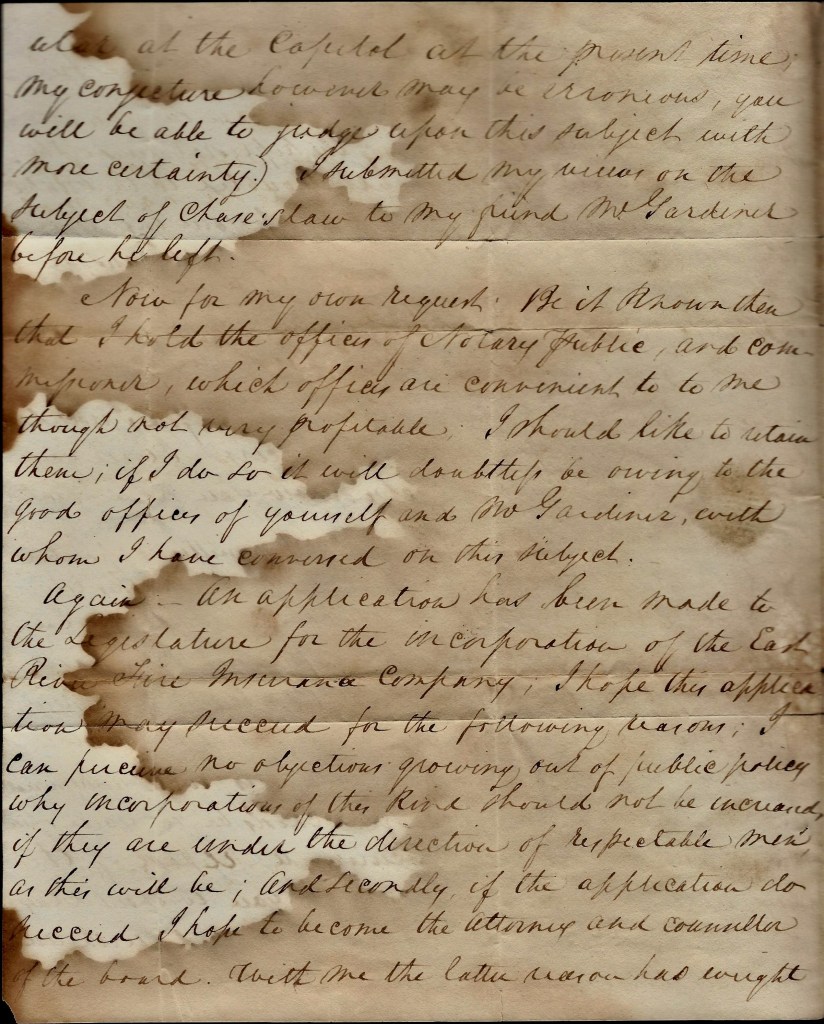
This letter was written by Hiram Ketchum, a lawyer, public servant, and a Trustee of the African Free School of New York City. He wrote the letter to Gideon Lee (1778-1841), a recently elected member of the New York State Assembly who shared some common interests with Ketchum. Lee later served as the mayor of New York City and was elected to the US Congress as a Jackson Democrat.

Hiram’s letter was penned in 1823–four years before slavery was fully and finally abolished in New York State. The impending abolishment of slavery caused tremendous social upheaval among the citizens of New York, particularly in New York City which was awash is social change, creating much anxiety among those who feared losing a grip on their power. In his letter, Hiram, calls attention to a bill passed in the previous session of the State Legislature called “Chase’s Law” which must have adversely affected the funding for the African Free School in New York City. The African Free School was founded by members of the New York Manumission Society, including Alexander Hamilton and John Jay, in 1787. The first school was established in 1794. In 1813 a state law provided that the African Free School would receive both city and county school funds. By 1820 the enrollment approached 700 students in multiple schools and they were gaining a reputation for success. Under the leadership of Charles C. Andrews, the institution grew significantly. Andrews believed passionately that his black students were just as bright as whites, if not even smarter. In 1834 the Free Schools were transferred to the control of the New York State Public School Society, the major local conduit for state funds. In reality, the schools had already ceased to be philanthropic institutions and had become public schools.

It is a matter of curiosity that when Gen. Marquis de La Fayette visited the United States in September 1824, one of his stops was to the African Free School on Mulberry Street in NYC, and it was Hiram Ketchum who gave the general a synopsis of the history of the school and proudly displayed examples of the black student’s work.

Transcription

New York [City]
January 18th 1823

My Dear Sir,

You are ere this warm in your legislative seat, and as one of the representatives of the sovereign people are no doubt troubled with numberless afflictions for the exercise of your influence in procuring appointments for good republicans, &c.

I too am one good republican and have a favor to ask, the granting of which will, I being judge, greatly subserve the interests of the good people of this important state. But before I proceed to lay before you my personal concerns, I wish your advice on a subject which I know you have much at heart.

I am chairman of a committee appointed by the trustees of the African Free Schools in this city to consider of the expediency of sending a memorial to the Legislature praying a repeal of Mr. Chase’s law passed at the last session. As a trustee of the New York Free School Society, you understand this subject in all its bearings. Now the question is, will a Memorial from the trustees of the African Free Schools be, in your opinion, of any service in procuring a repeal of this law; if som we will forward one to you without delay. For my own part, I am rather impressed with an idea that the African cause is not the most popular at the Capitol at the present time. My conjecture, however, may be erroneous. You will be able to judge upon this subject with more certainty. I submitted my views on the subject of Chase’s law to my friend Mr. Gardiner before he left.

Now for my own request. Be it known then that I hold the offices of Notary Public, and Commissioner, which offices are convenient to me though not very profitable. I should like to retain them; if I do so, it will doubtless be owing to the good offices of yourself and Mr. Gardiner, with whom I have conversed on the subject.

Again, an application has been made to the Legislature for the incorporation of the East River Fire Insurance Company. I hope this application may succeed for the following reasons. I can perceive no objections growing out of public policy why incorporations of this kind should not be increased if they are under the direction of respectable men as this will be; and secondly, if the application does succeed, I hope to become the attorney and counsellor of the board. With me the latter reason has weight though it is not one in which the public feel much interest.

I have been threatening ever since you left to take a walk to Art Street 1 to see how matters are conducted in your absence, but have not yet executed my purpose; it will not be long, however, before I shall.

There is no domestic intelligence of interest here. The ladies of our acquaintance are, I believe, all well. By the bye, have you made acquaintance with a certain long, tall but good and agreeable girl who inhabits the basement story of the house where you lodge? If you have, please remember me to her. When I was at Albany last summer, I found it quite pleasant to spend some time in her company. as you well know, where ere I am, I cannot “let the gals alone.”

Please remember me to your colleague, Mr. Gardiner. Very sincerely, — Hiram Ketchum

[to] Gideon Lee, Esqr.

1 Art Street is now 8th Street in Manhattan. Gideon Lee’s leather store was located 20 Ferry Street, His home on Art Street.

1862: Israel S. Geer to his Cousin Lucy

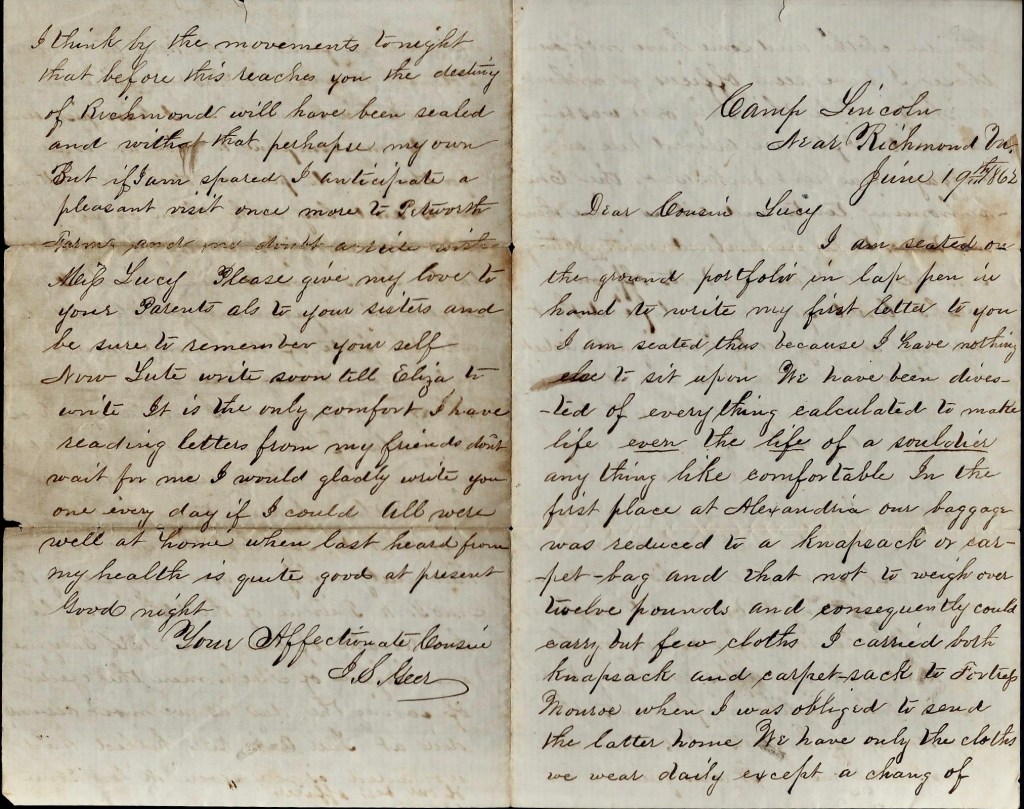
The following letter was written by Israel S. Geer (1822-1881) while serving as captain of Co. C, 3rd Regiment Michigan Infantry. Israel began his service in the 3rd Michigan on 13 May 1861 as a sergeant in Co. D, but was promoted to sergeant major and then captain of Co. C on 26 December 1861. He was residing in Hastings, Barry County, Michigan just prior to the war. Co. C was a challenging command. It was made up largely of German and Dutch immigrants, many of whom lived on the west side of the Grand River in Grand Rapids. This company was the descendant of the old Grand Rapids Rifles, also known as the “German Rifles,” a prewar local militia company composed solely of German immigrants.

On May 6, 1864 he was wounded (shot fracture of right leg with subsequent primary amputation of thigh in lower third) and taken prisoner at the Battle of the Wilderness, Orange County, Virginia; his surgeon being a Confederate doctor. He was paroled at Richmond, Virginia on September 12, 1864 and was mustered out on September 21, 1864 at the expriation of his term. He had fought in the battles of Bull Run, Yorktown, Williamsburg, Fair Oaks, Richmond, Charles City Crossroads, Malvern Hill, Manassas, Fredericksburg, Chancellorsville, Wilderness, Virginia and Gettysburg, Pennsylvania.

Transcription

Camp Lincoln
Near Richmond, Virginia
June 19, 1862

Dear Cousin Lucy,

I am seated on the ground, portfolio in lap, pen in hand to write my first letter to you. I am seated thus because I have nothing else to sit upon. We have been divested of everything calculated to make life—even the life of a soldier—anything like comfortable. In the first place, at Alexandria our baggage was reduced to a knapsack or carpet bag and that not to weigh over twelve pounds and consequently could carry but few clothes. I carried both knapsack and carpet sack to Fortress Monroe when I was obliged to send the latter home. we have only the clothes we wear except a change of under clothes and some have not even those. I have seen officers go without a shirt while their only one was being washed.

After we arrived here our baggage was sent back across the Chickahominy, tents and all, so since them we have been encumbered with nothing. I have not had my boots off in four weeks and you may depend that we are a very seedy looking set indeed. I will be glad when this war is over. If it was not for the looks of the thing and the disposition I have to carry through what I undertake, I would resign and go home.

It is one constant scene of excitement. Not one moment’s quiet rest from one week’s end to another. Nothing to be heard night or day but the roar of cannon or the crack of rifles. Nothing to be seen but warlike implements, the glittering of bayonets, and dead and wounded men. It was quiet when we were in front of the Rebel army on the Potomac to what it has been since we came to the Peninsula.

I have just been out to my company to give an order for the men to put on their accoutrements and lay with them on all night and be ready for an immediate attack. It is now eleven o’clock p.m. A general engagement which will decide the fate of Richmond may be expected to commence at any moment.

I should speak of the battles of Williamsburg and Fair Oaks but you have most likely read much more of them than I have time to write. Suffice it to say that the Michigan 3rd done their duty nobly as you may see by the New York Tribune of the 12th inst. Also the Herald of the same date. They give our Brigade of Michigan men the credit of saving the day as we most assuredly did at Fair Oaks. Our killed and wounded is very severe. We lost some of our best officers.

I think by the movements tonight that before this reaches you, the destiny of Richmond will have been sealed and with that, perhaps my own. But if I am spared, I anticipate a pleasant visit once more to Petworth Farm and no doubt a ride with Miss Lucy. Please give my love to your parents. Also to your sister and be sure to remember yourself. Now, Lute, write soon. Tell Eliza to write. It is the only comfort I have—reading letters from my friends. Don’t wait for me. I would gladly write you one every day if I could. All were well at home when last heard from. My health is quite good at present. Good night.

Your affectionate cousin, — I. S. Geer

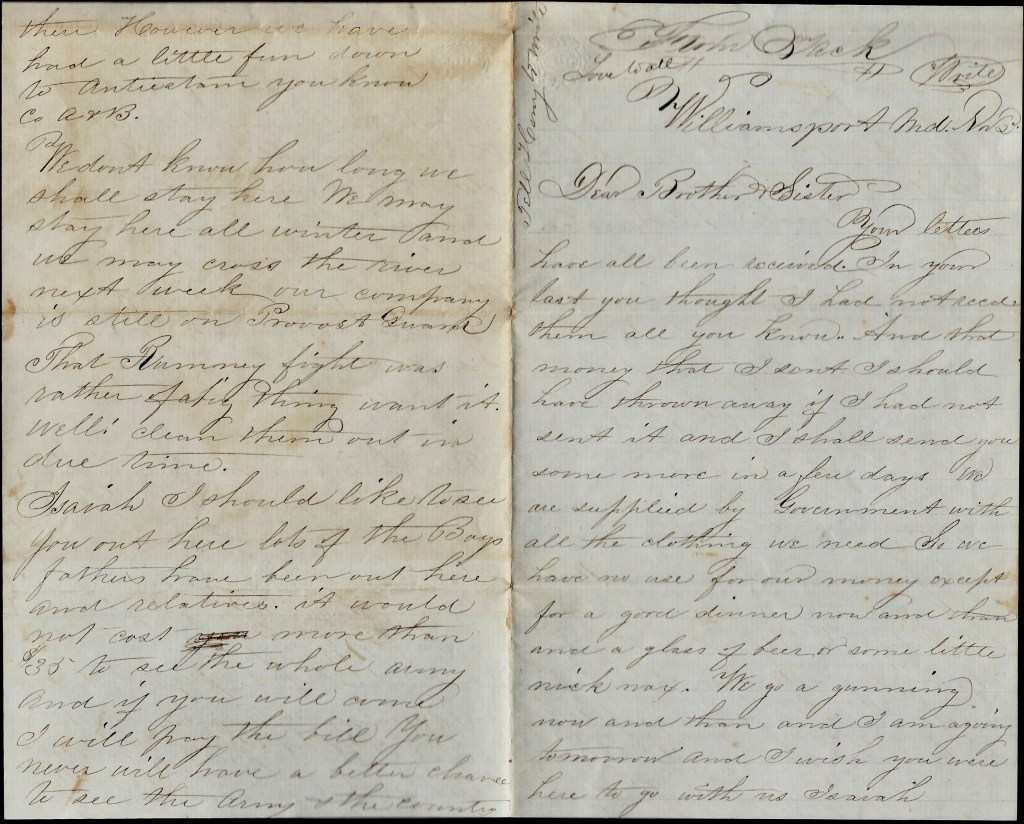
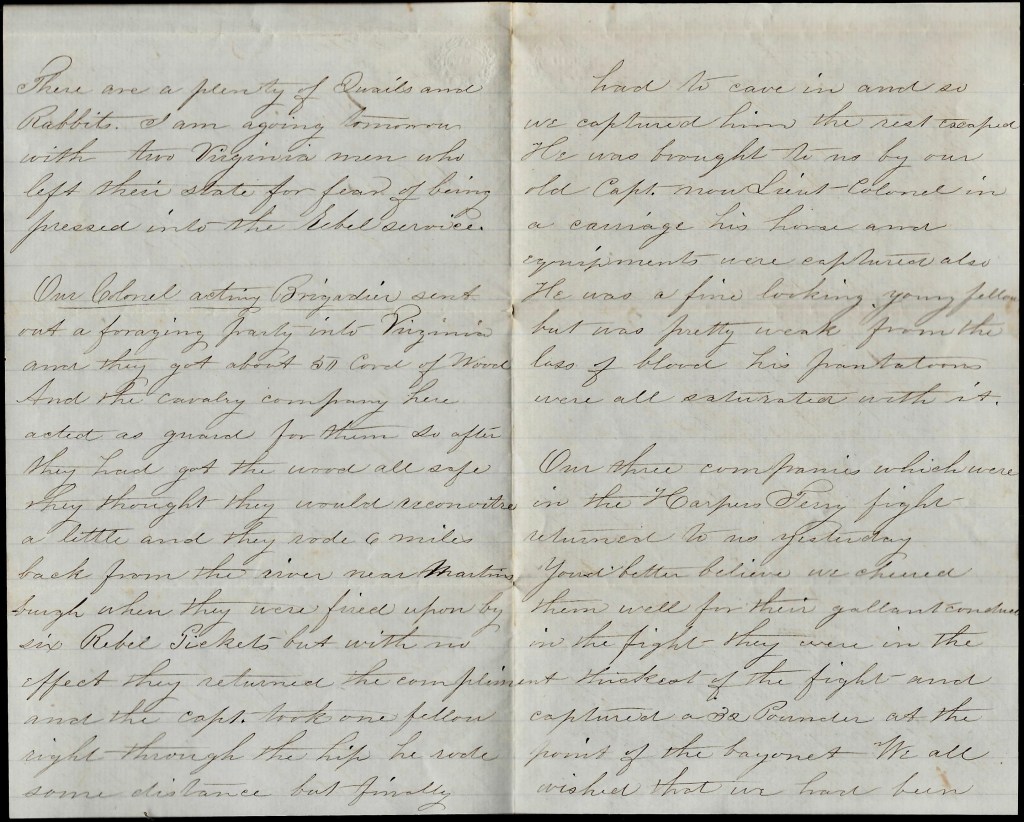
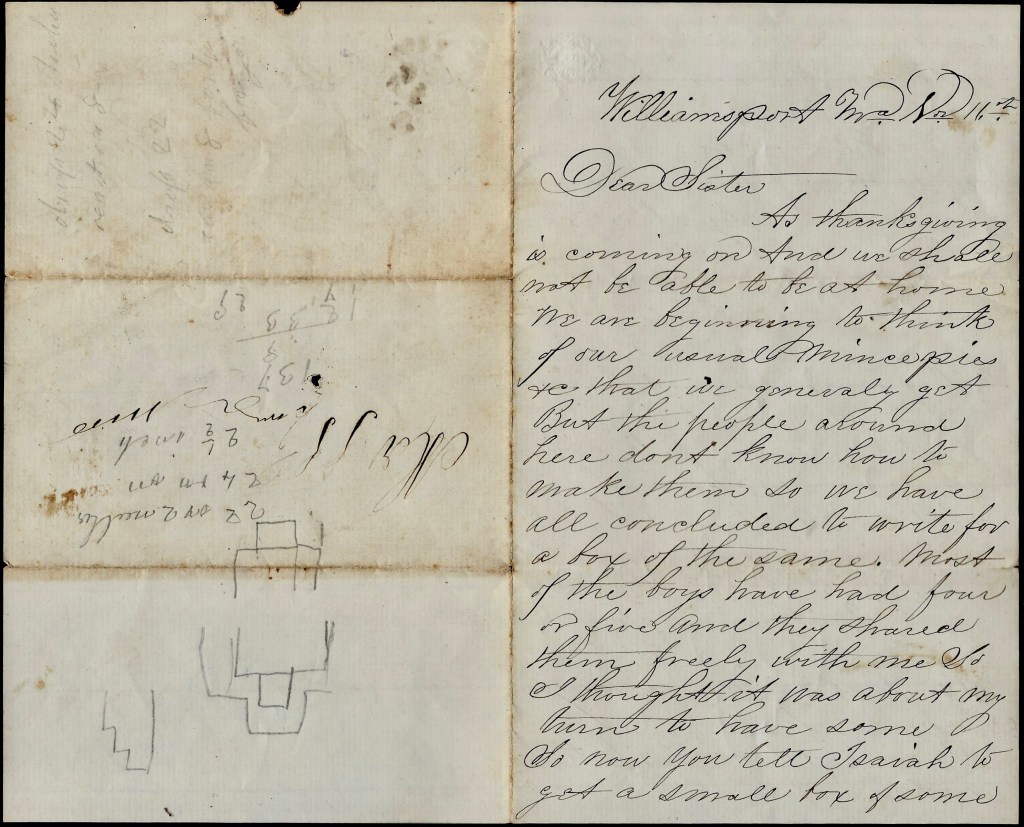
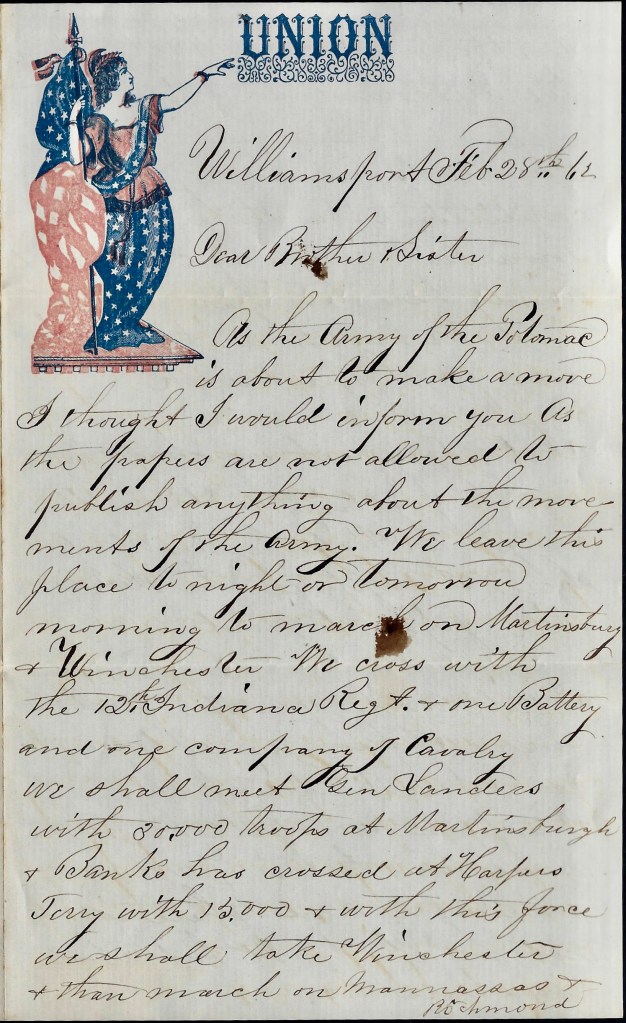
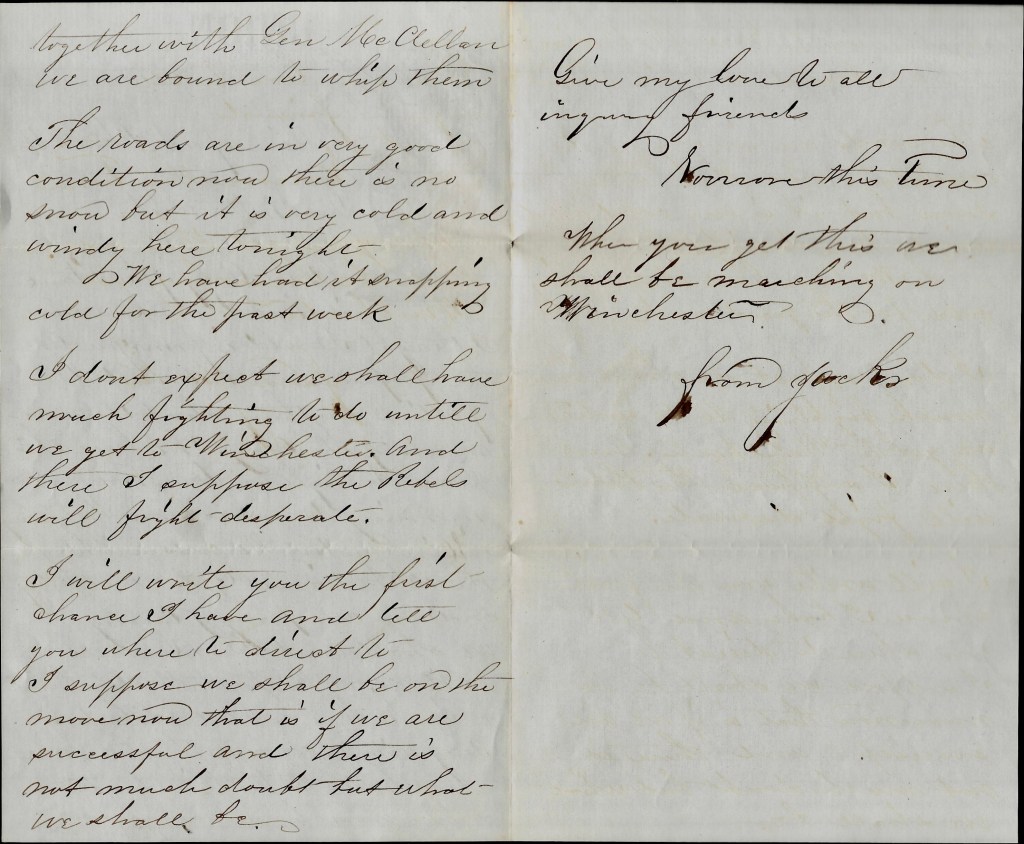
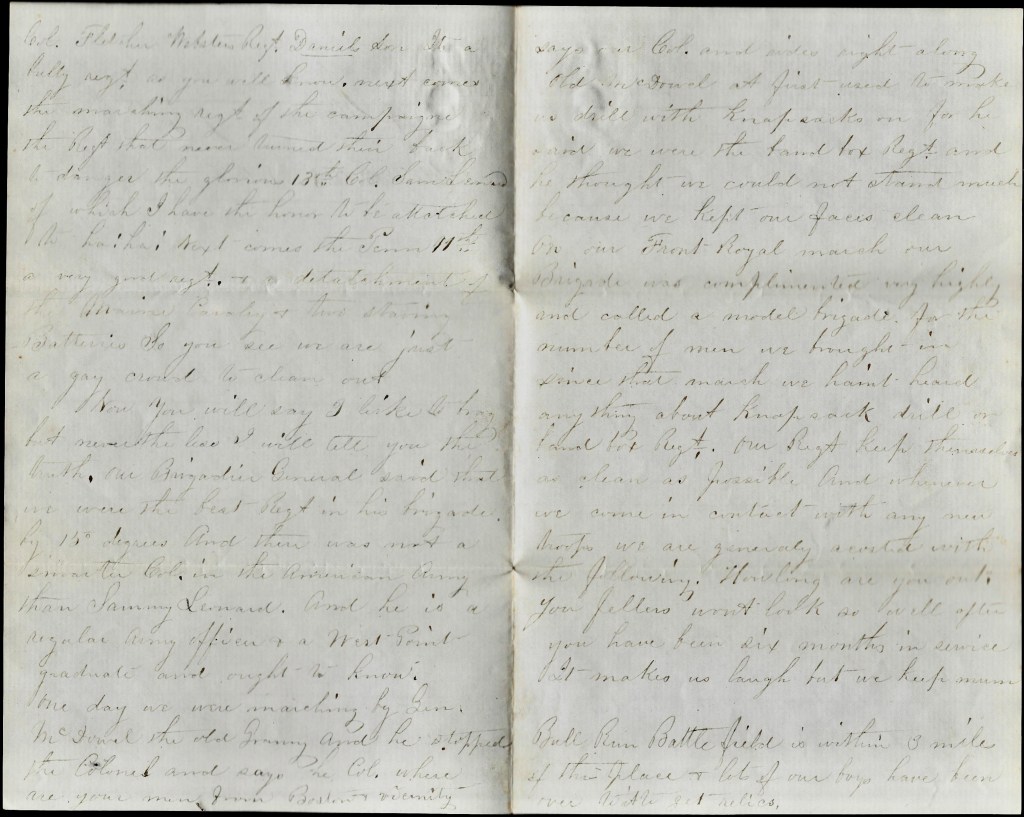
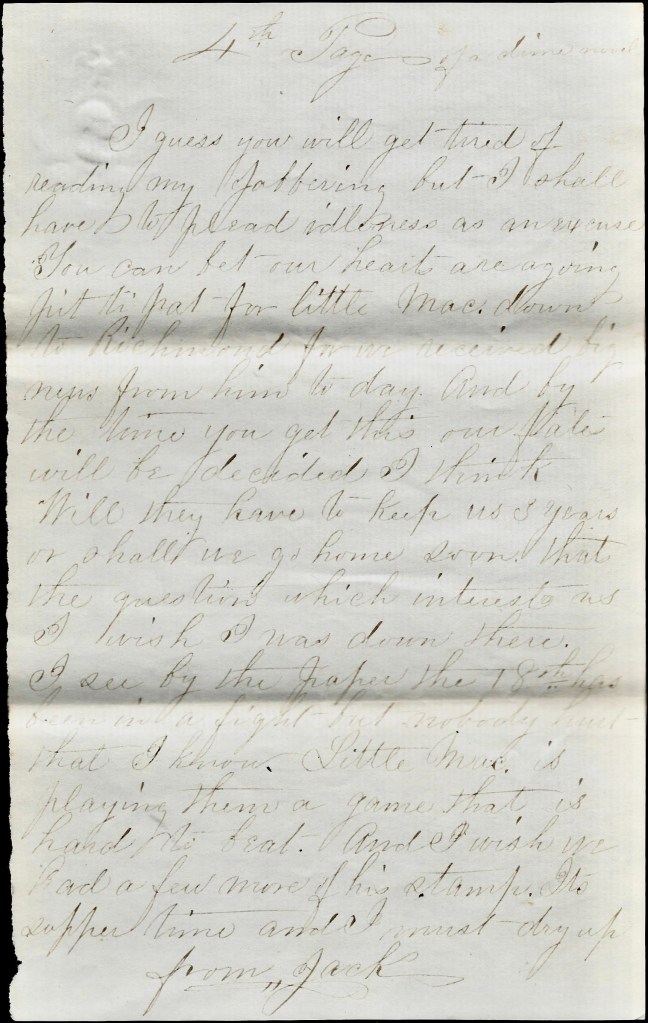
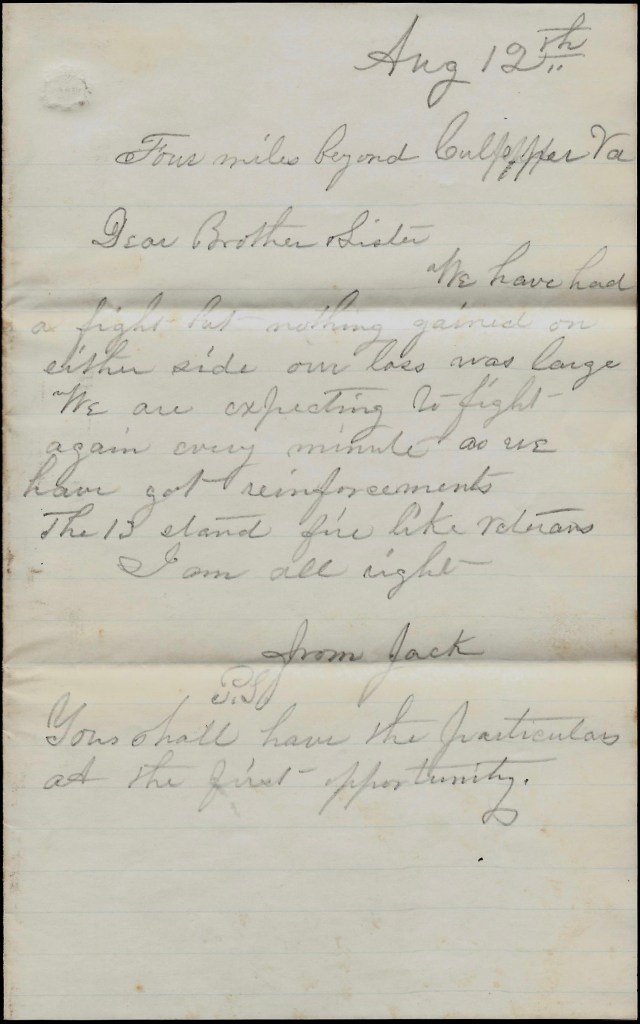
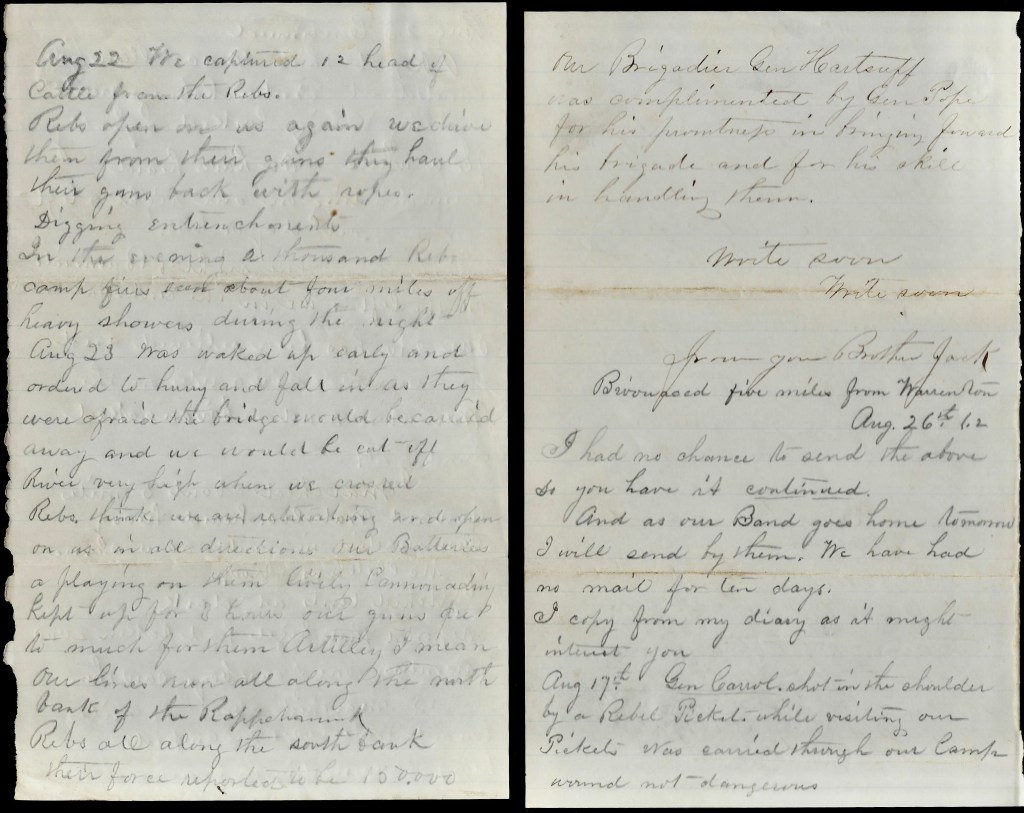
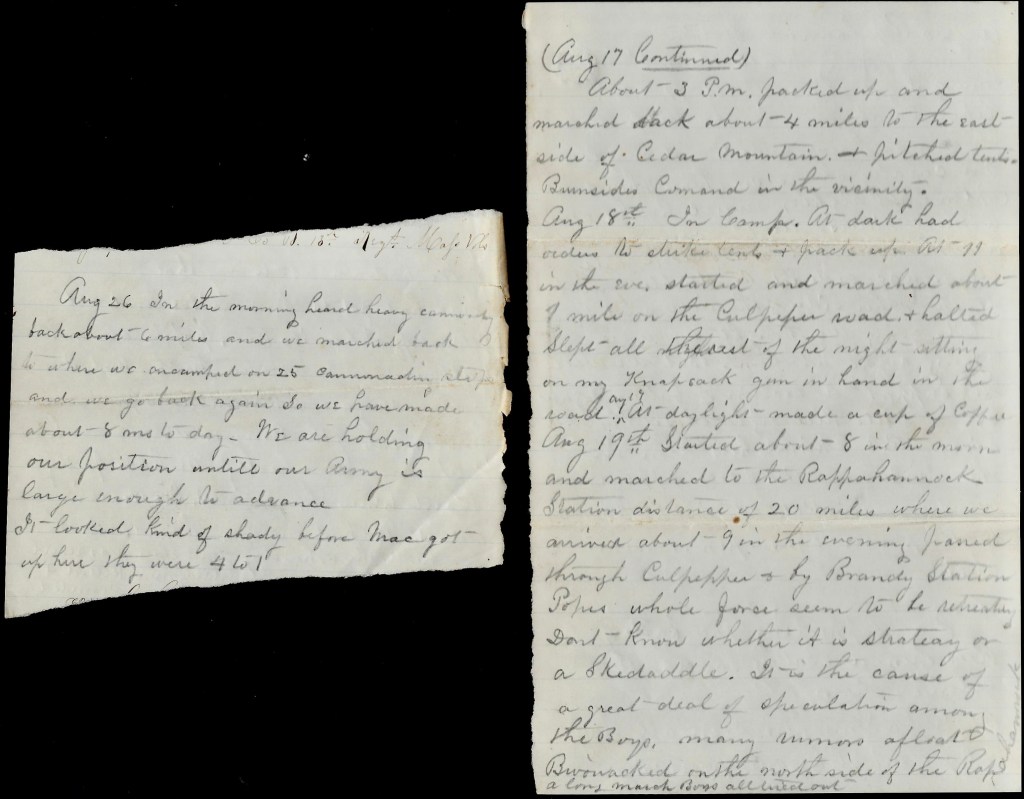
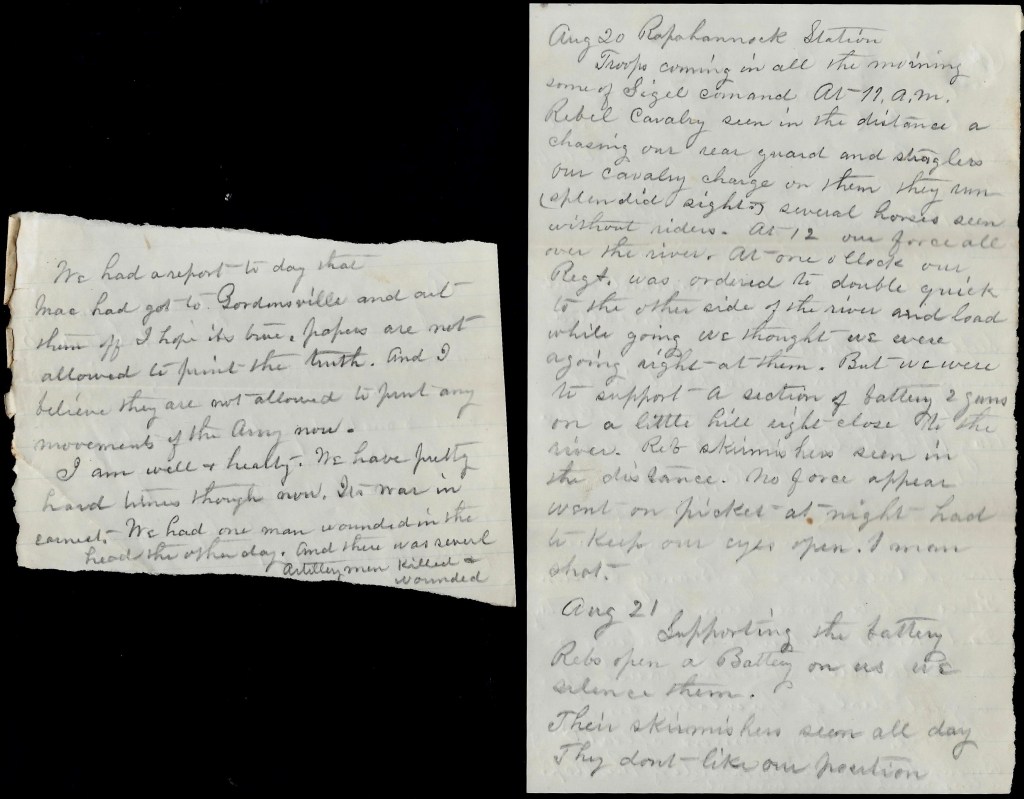
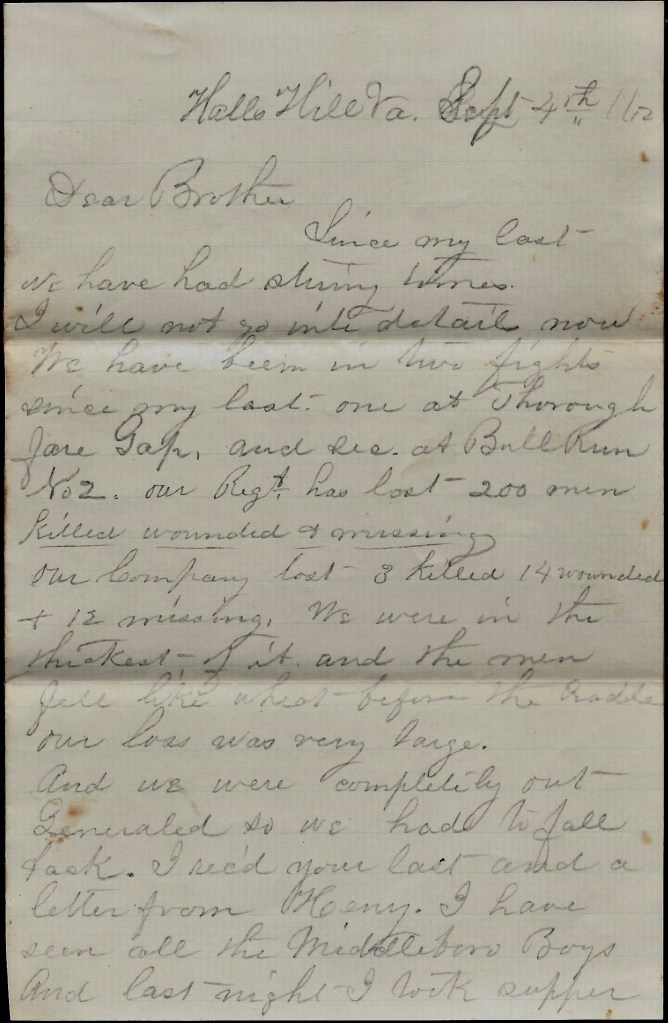
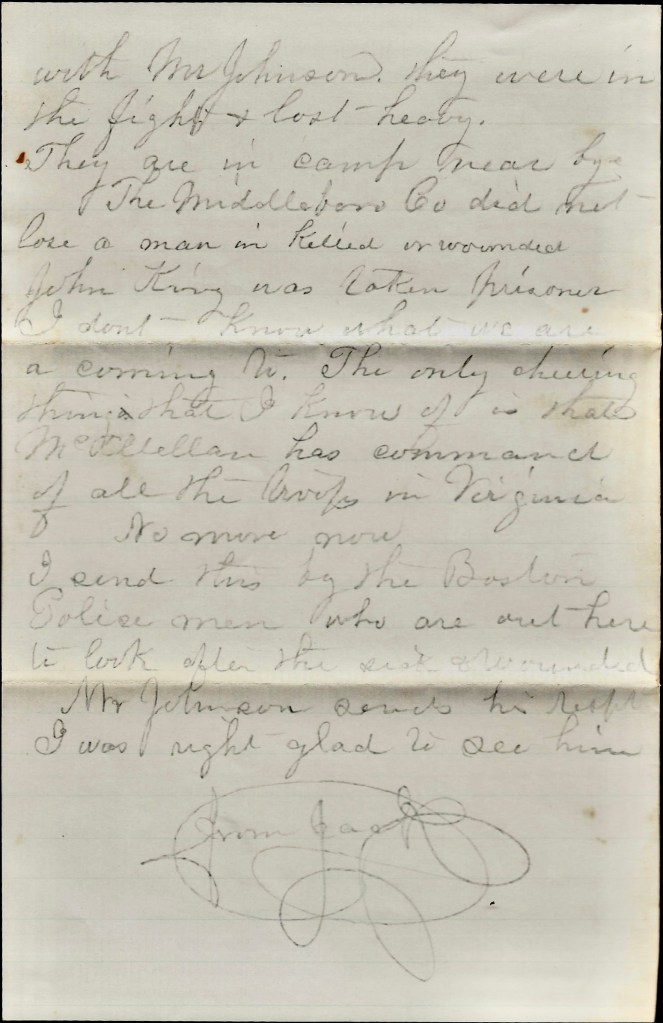
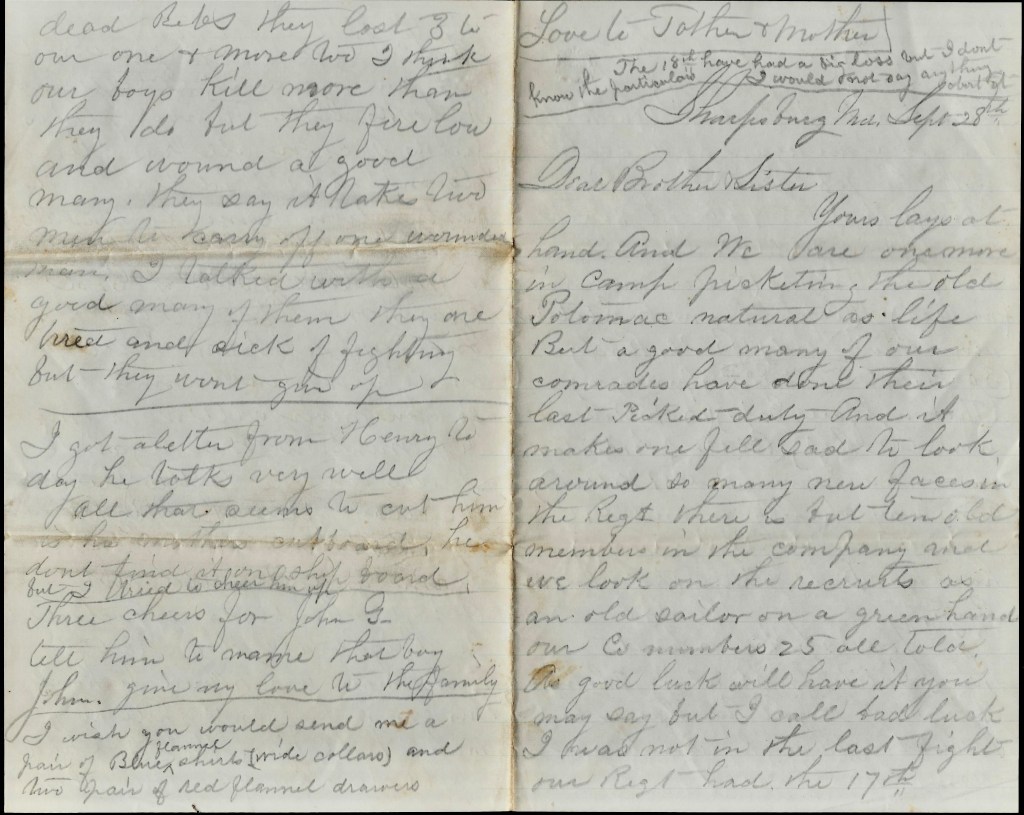
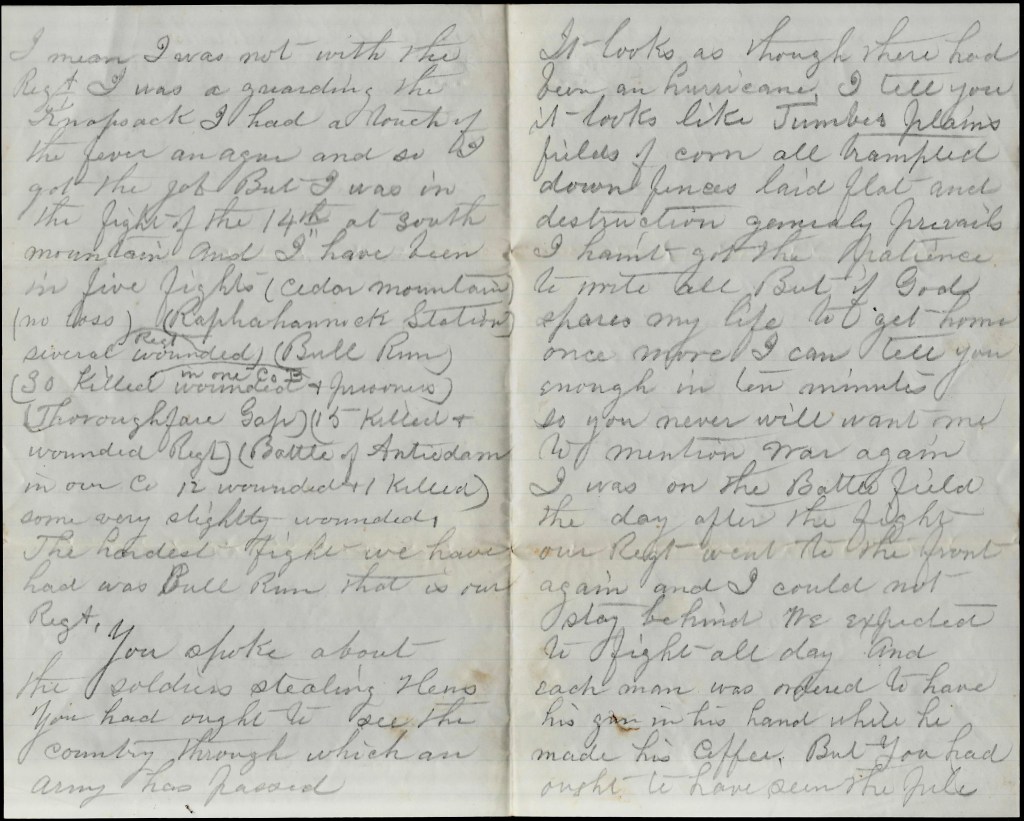
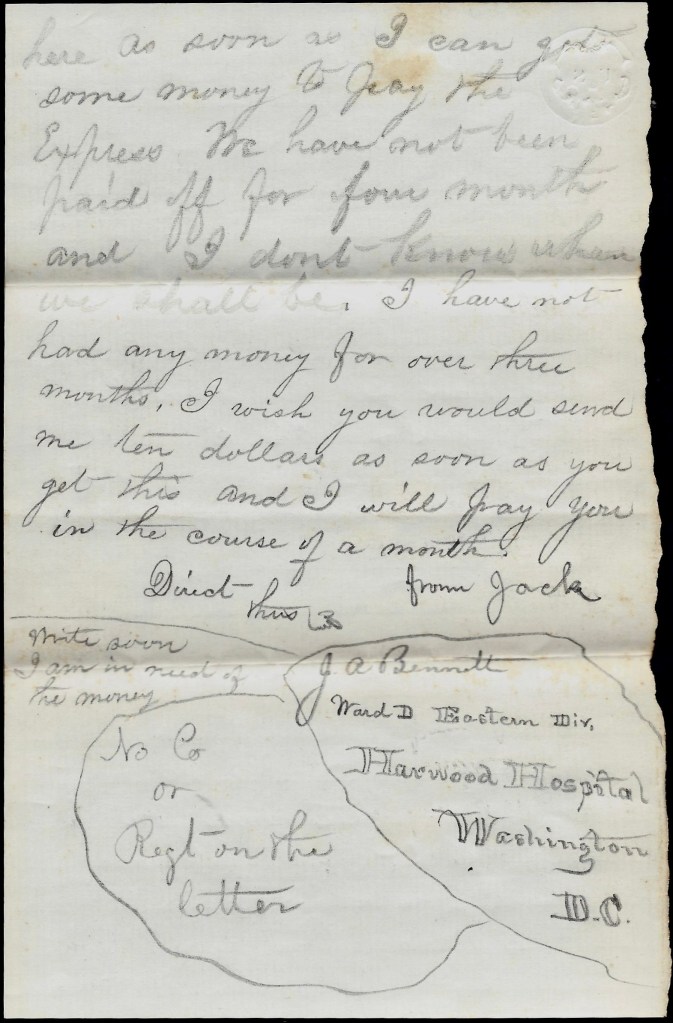
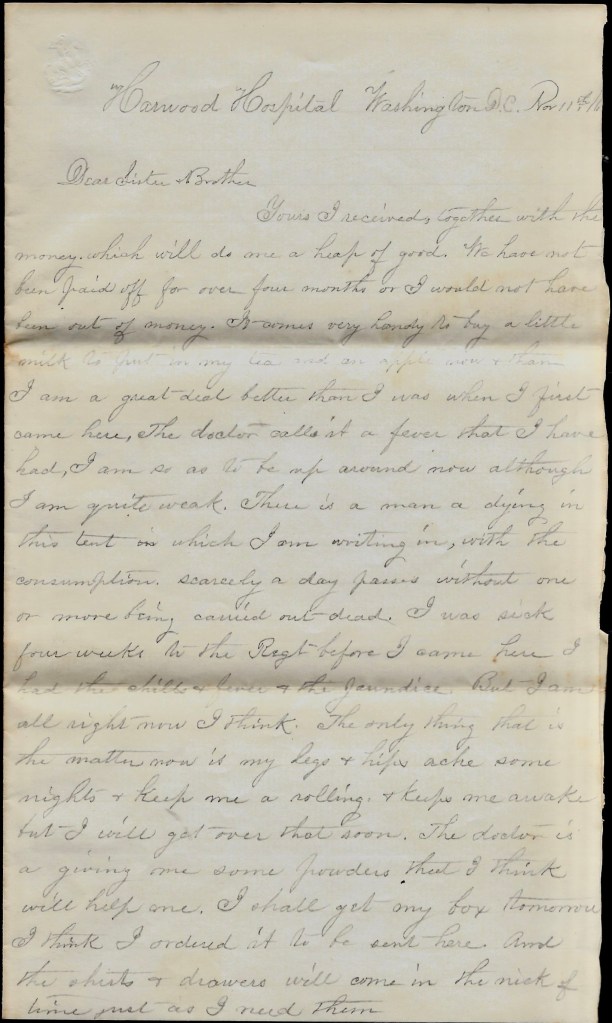
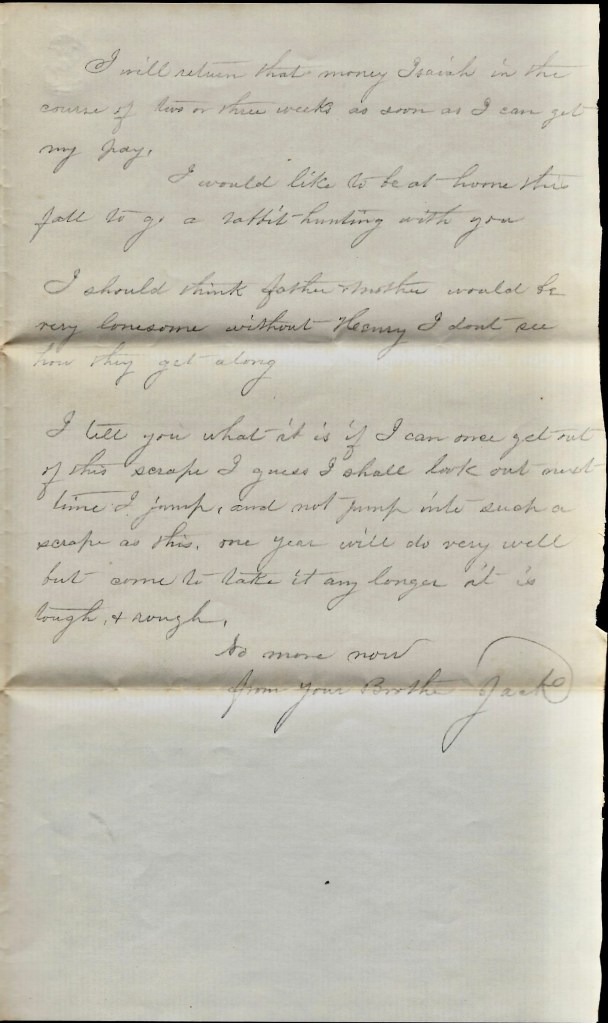
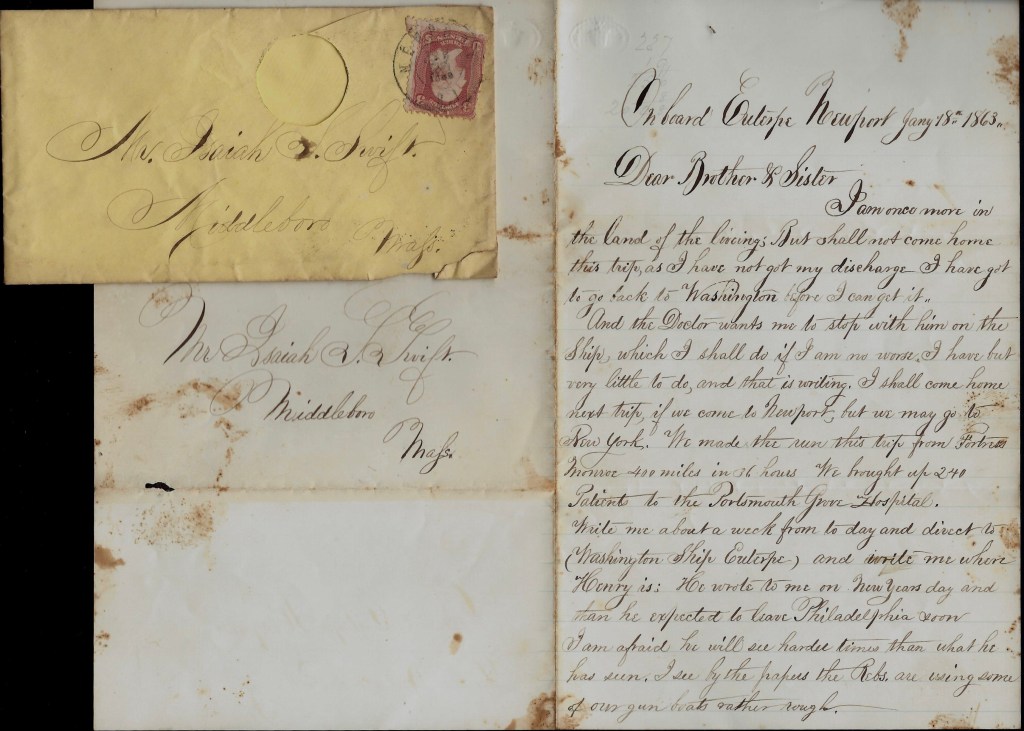
1861-63: John Allen Bennett to Isaiah Standish Swift

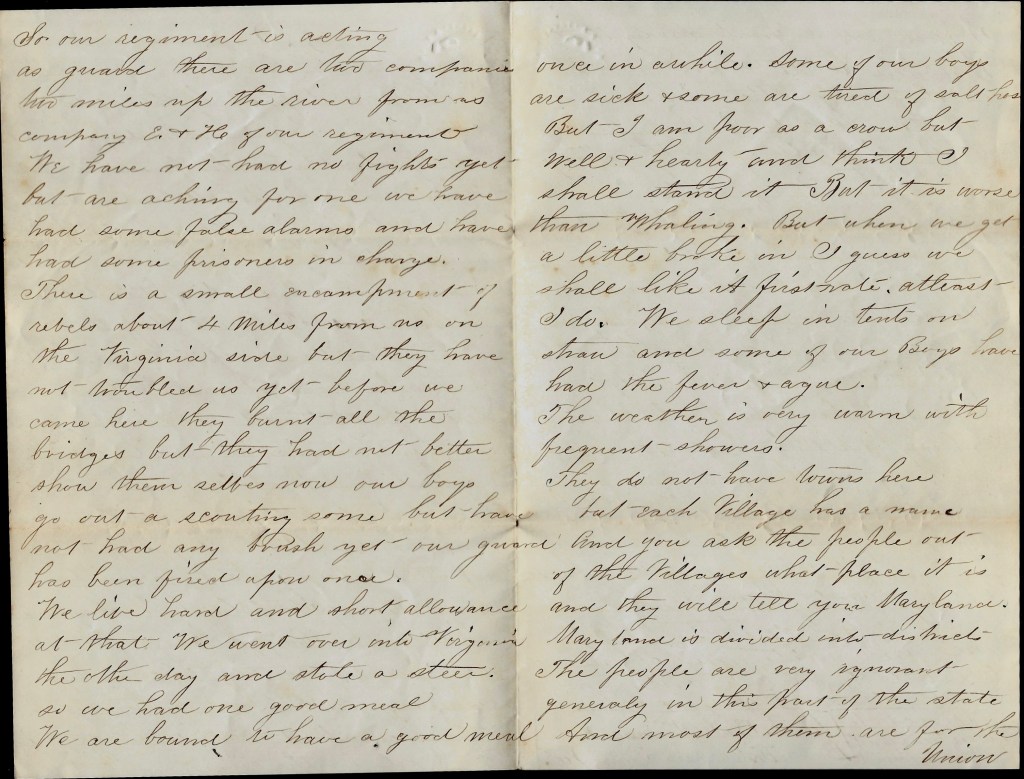
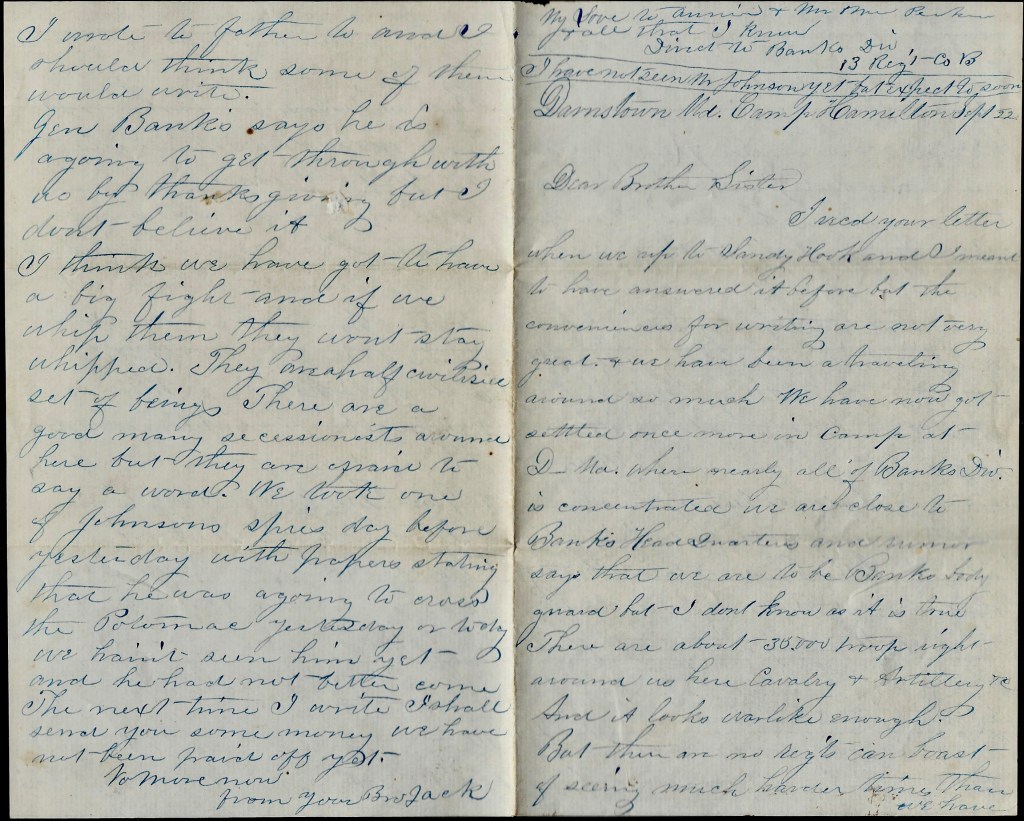
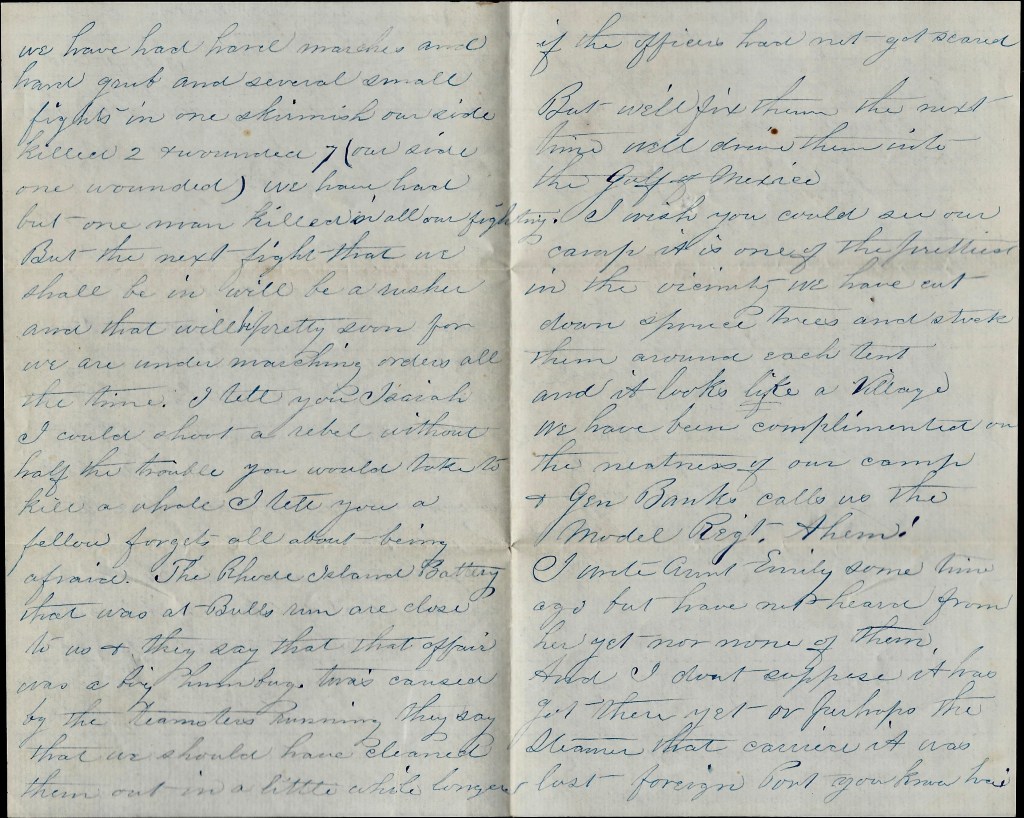
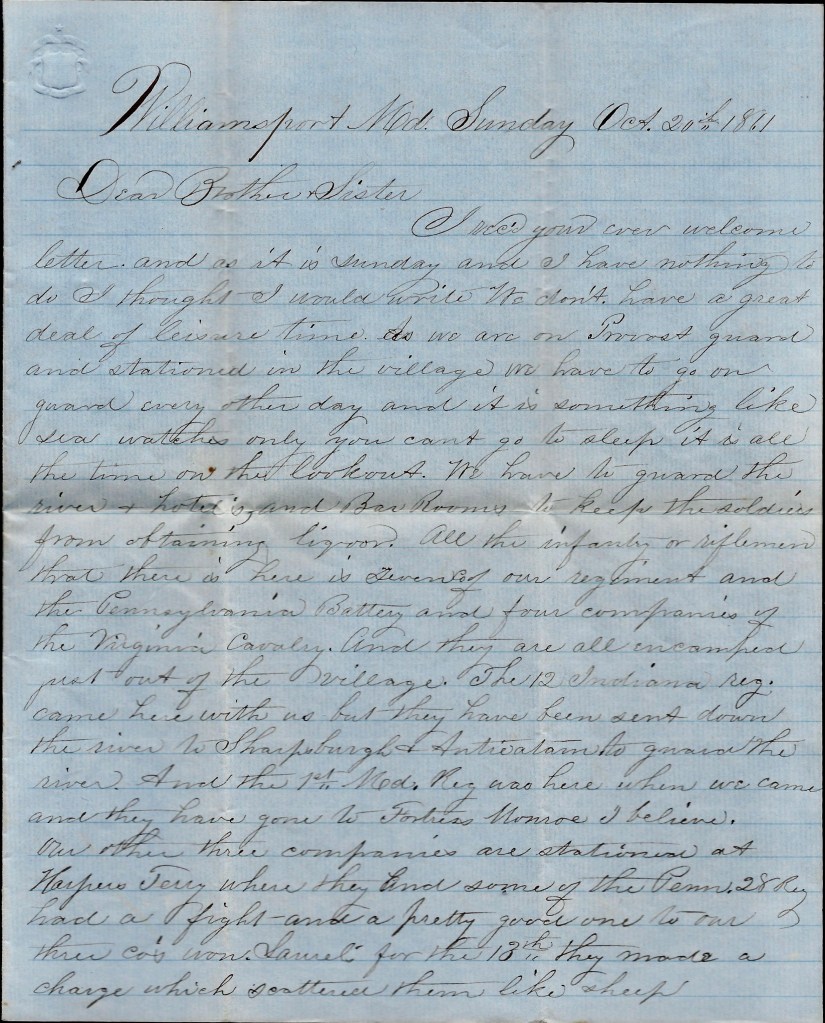
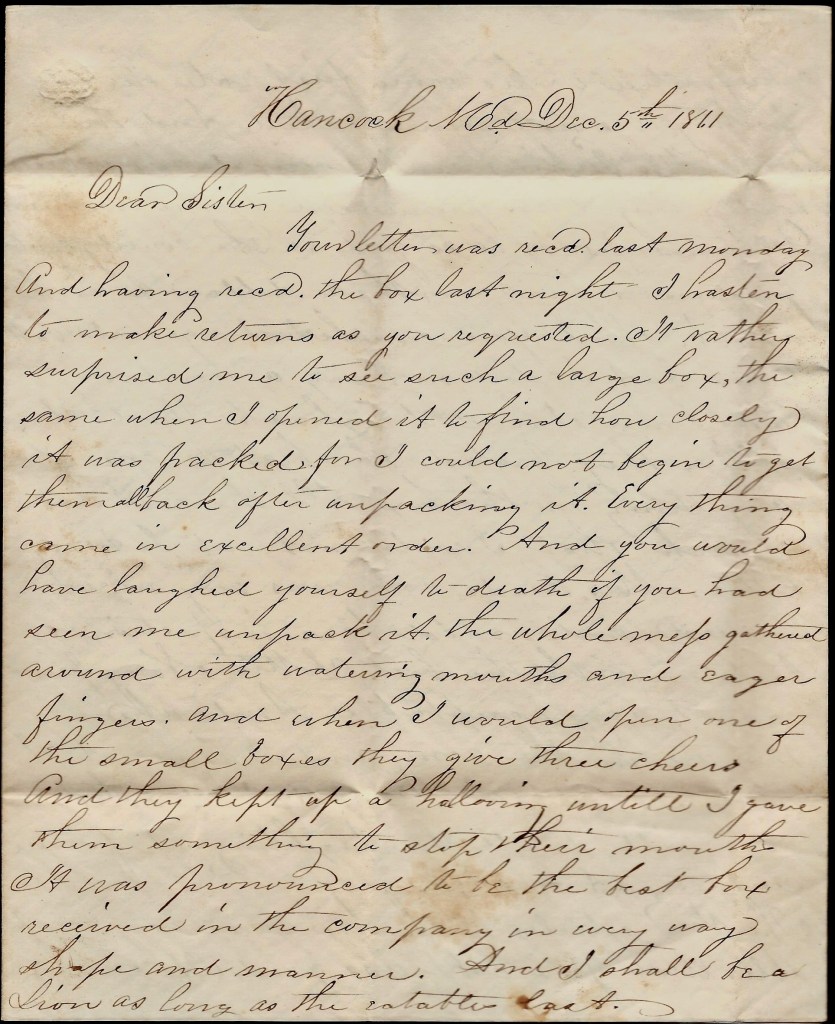
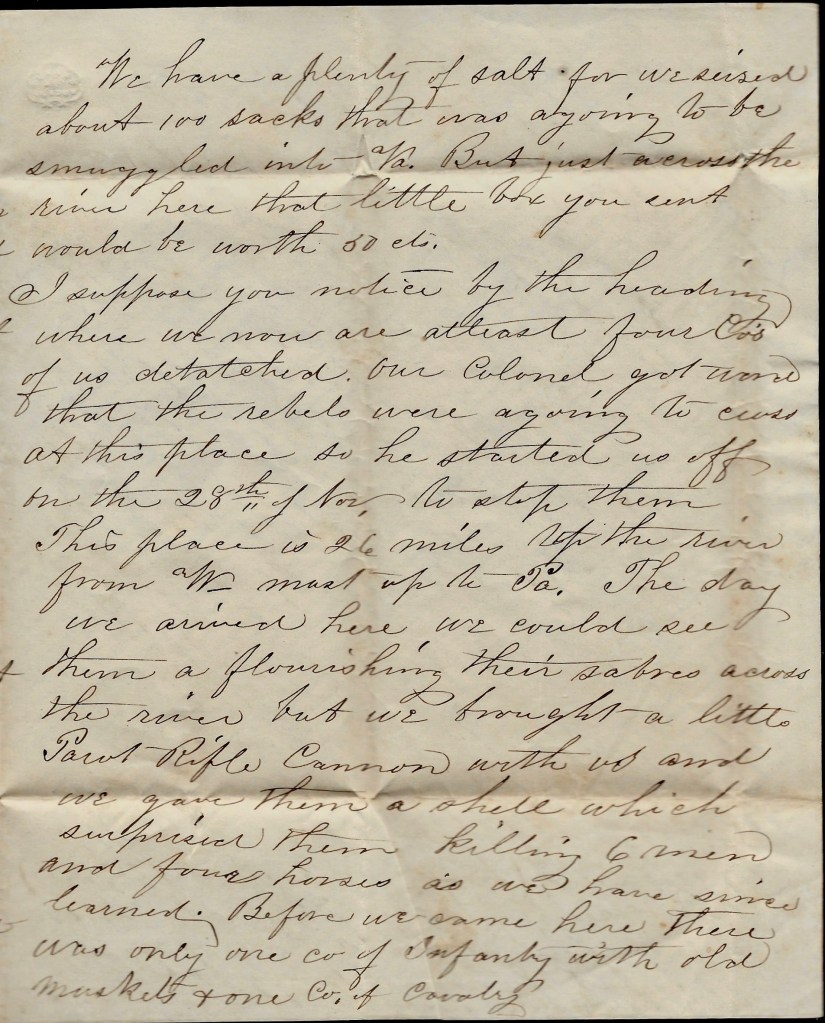
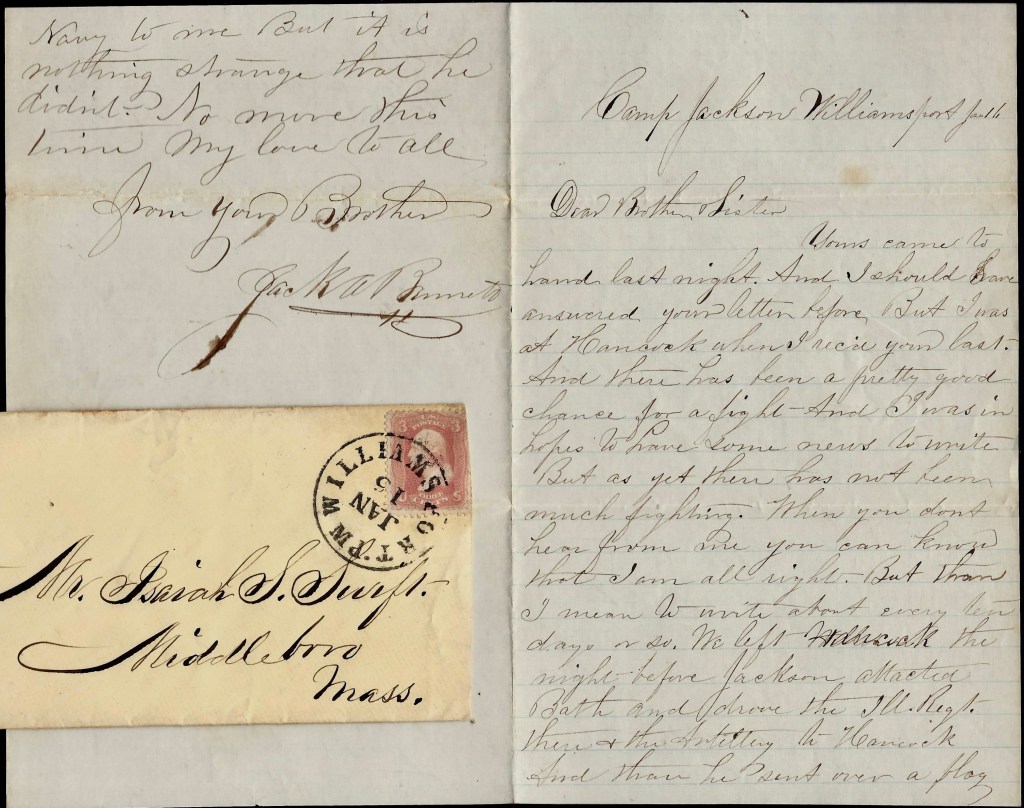
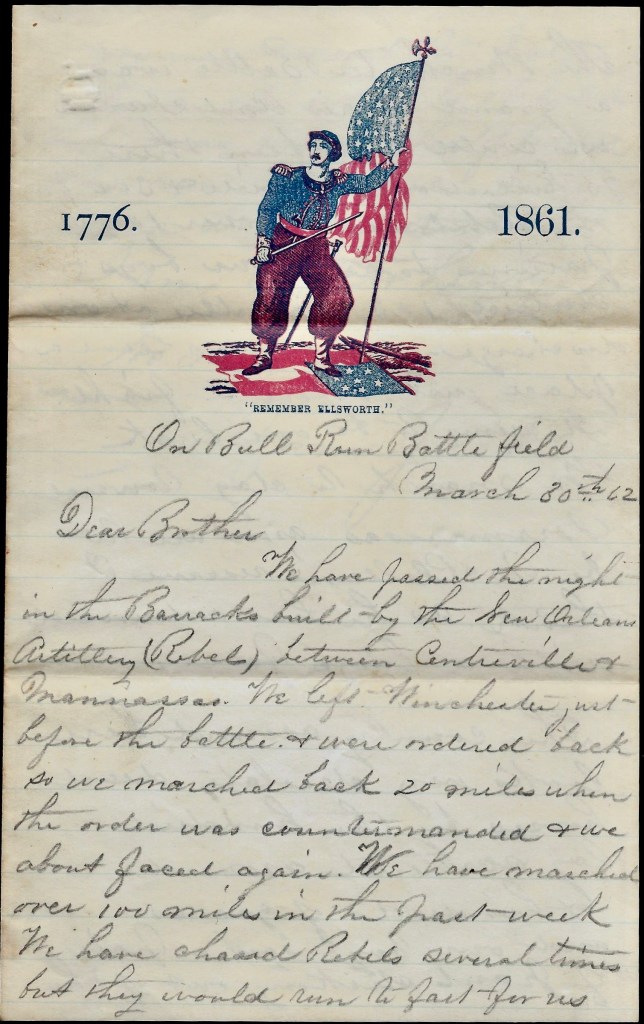
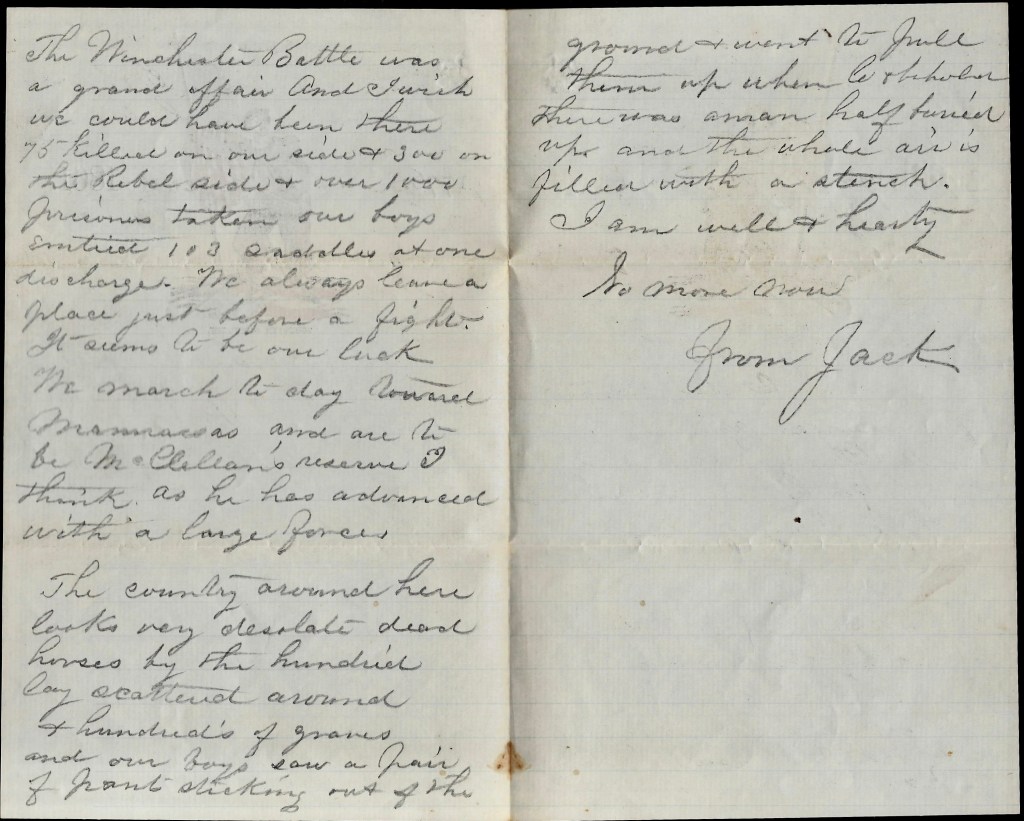
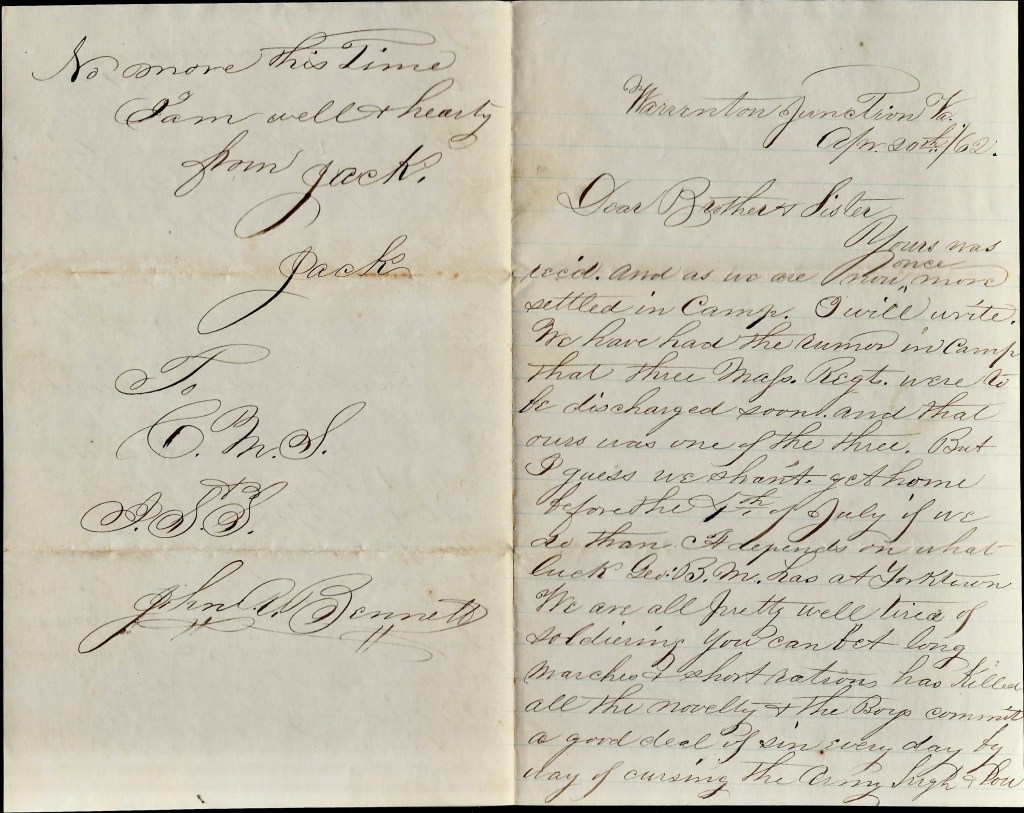
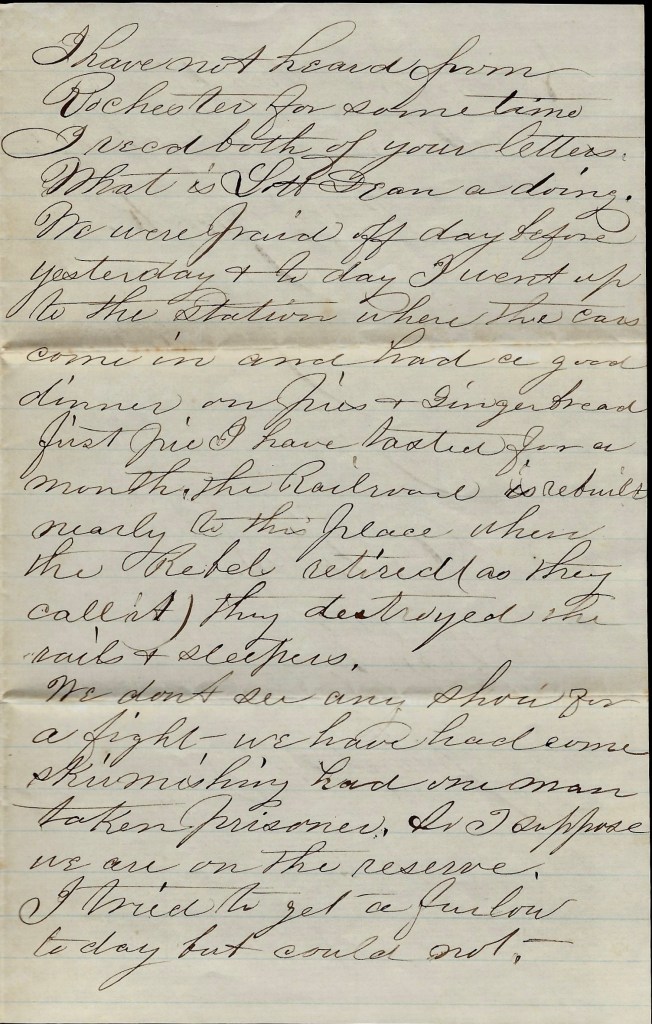
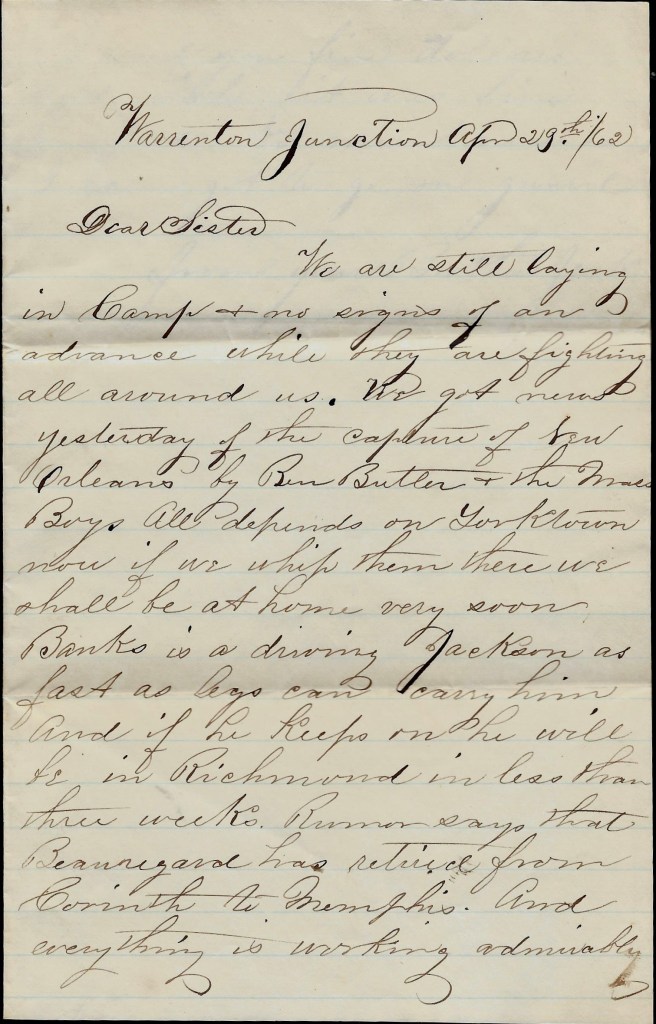
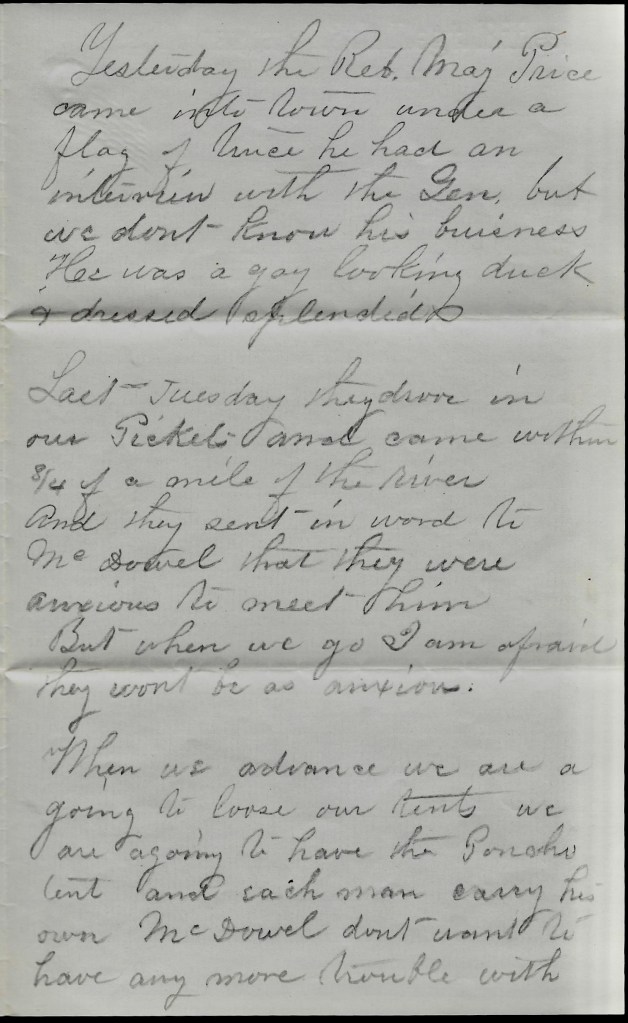
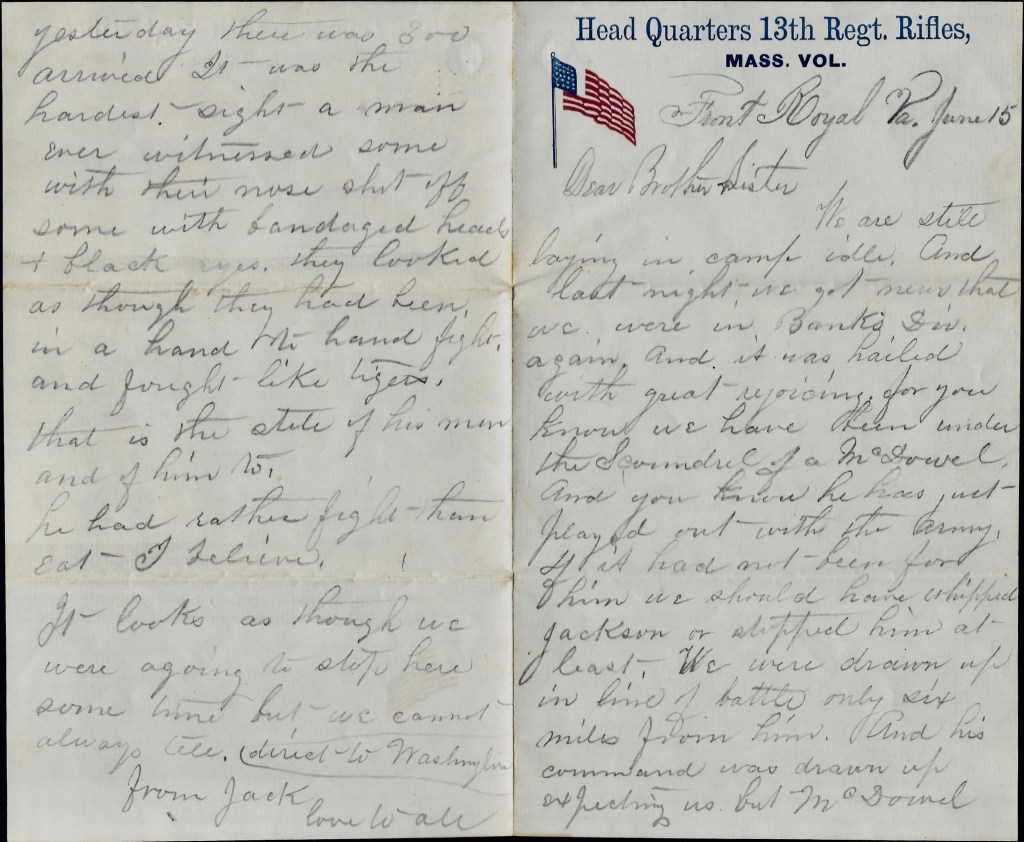
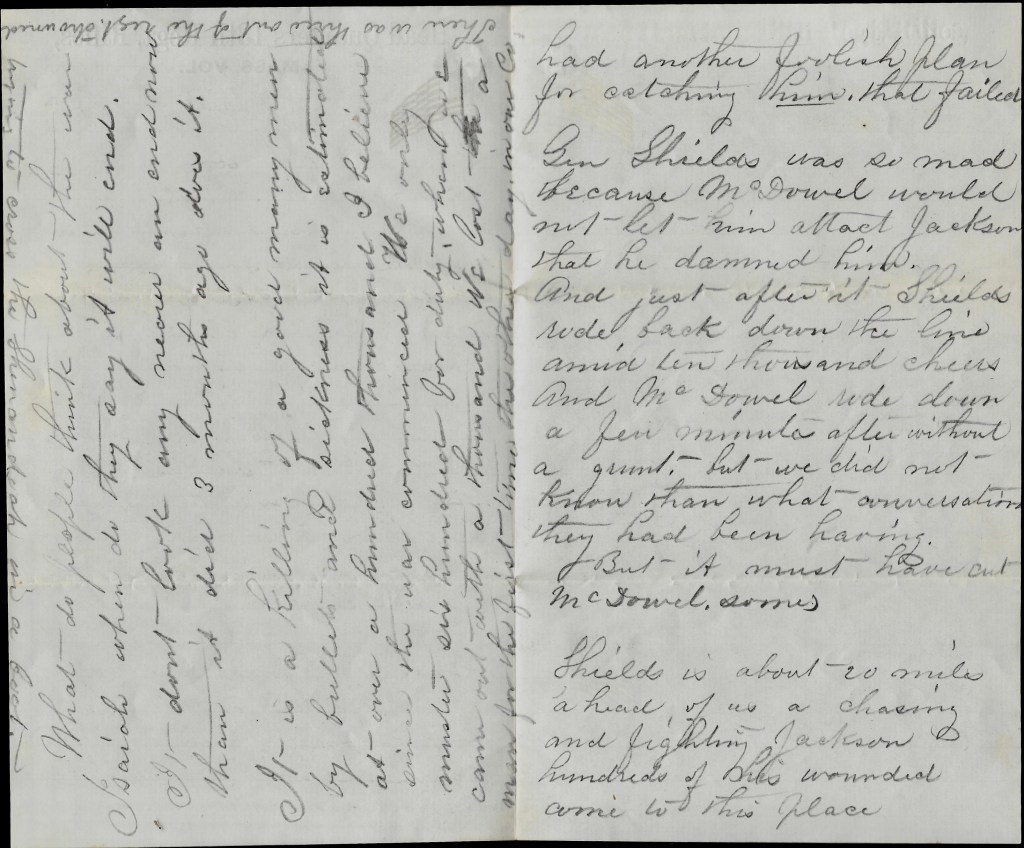
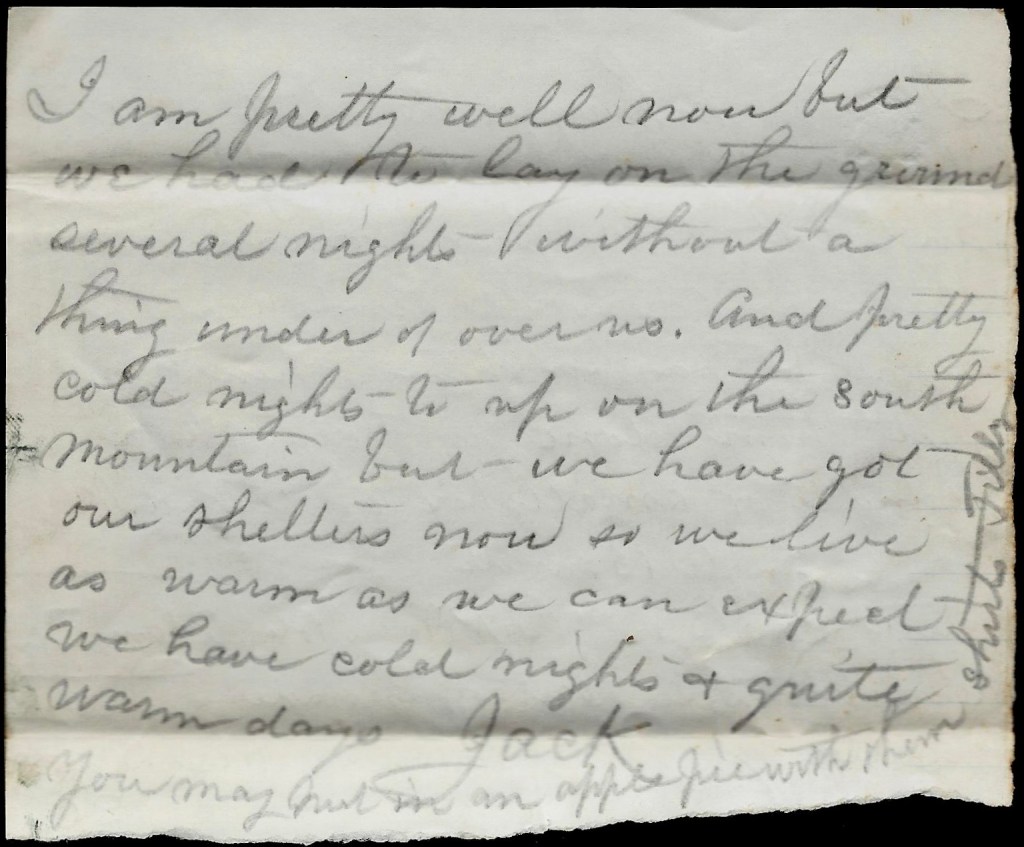
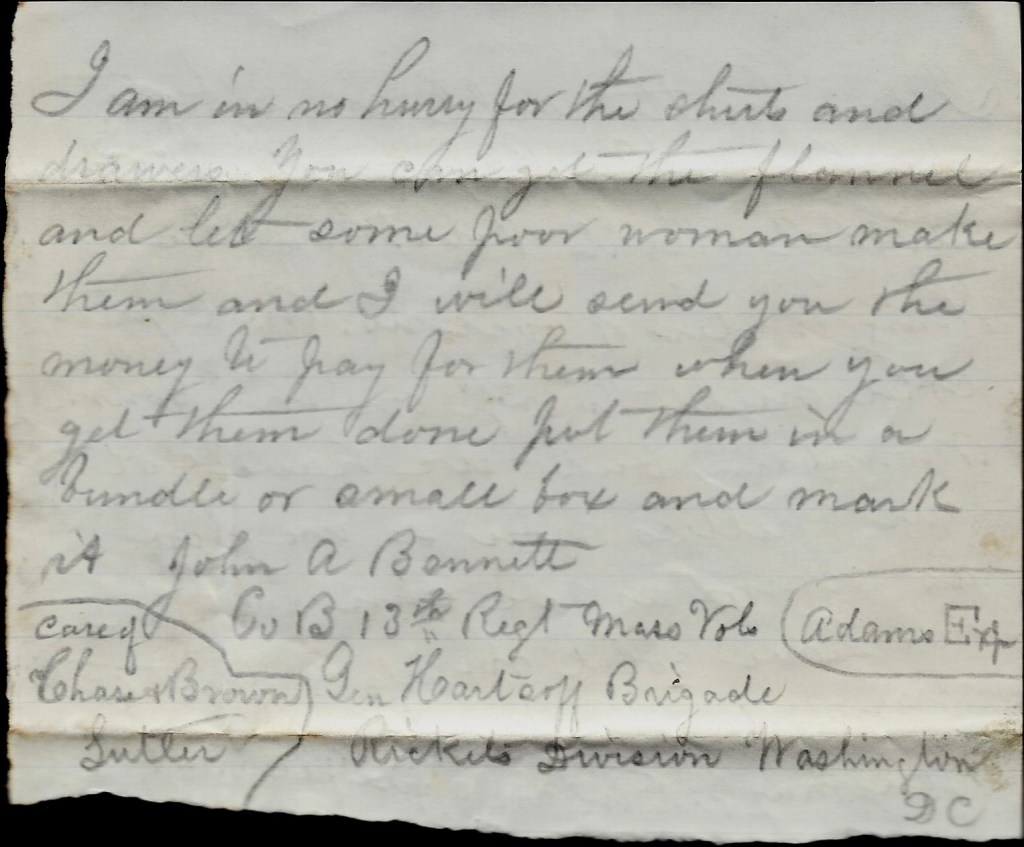
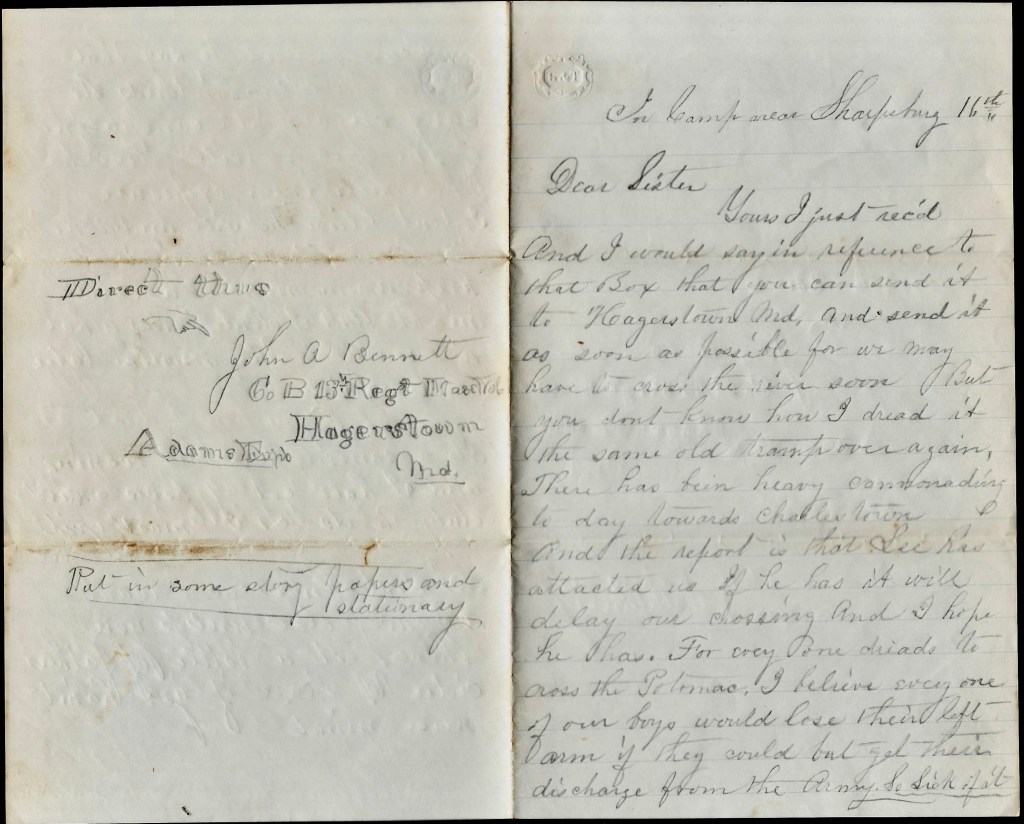
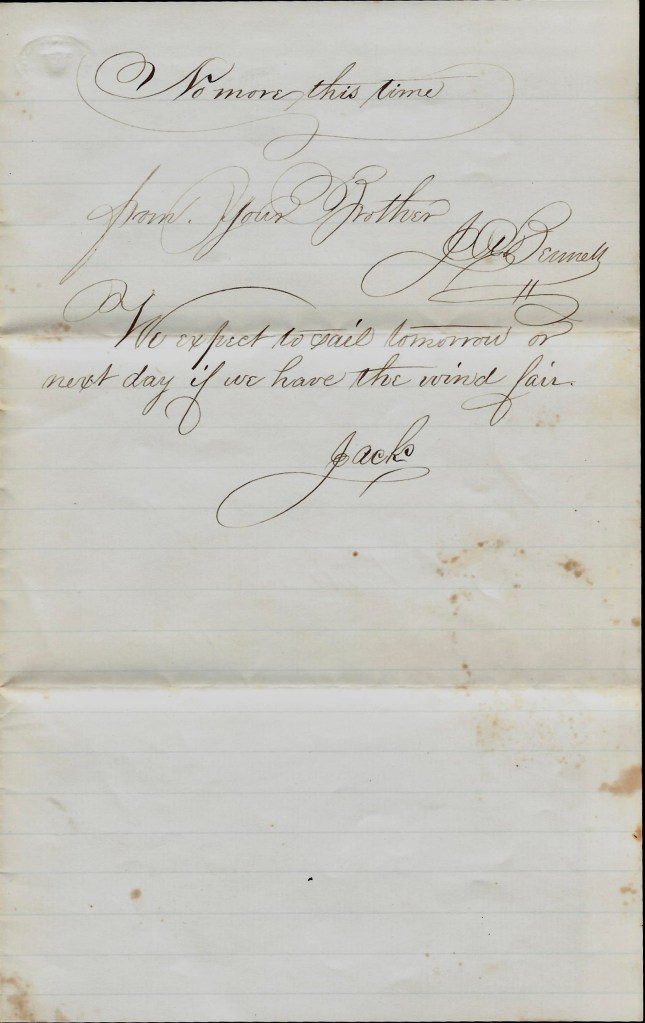
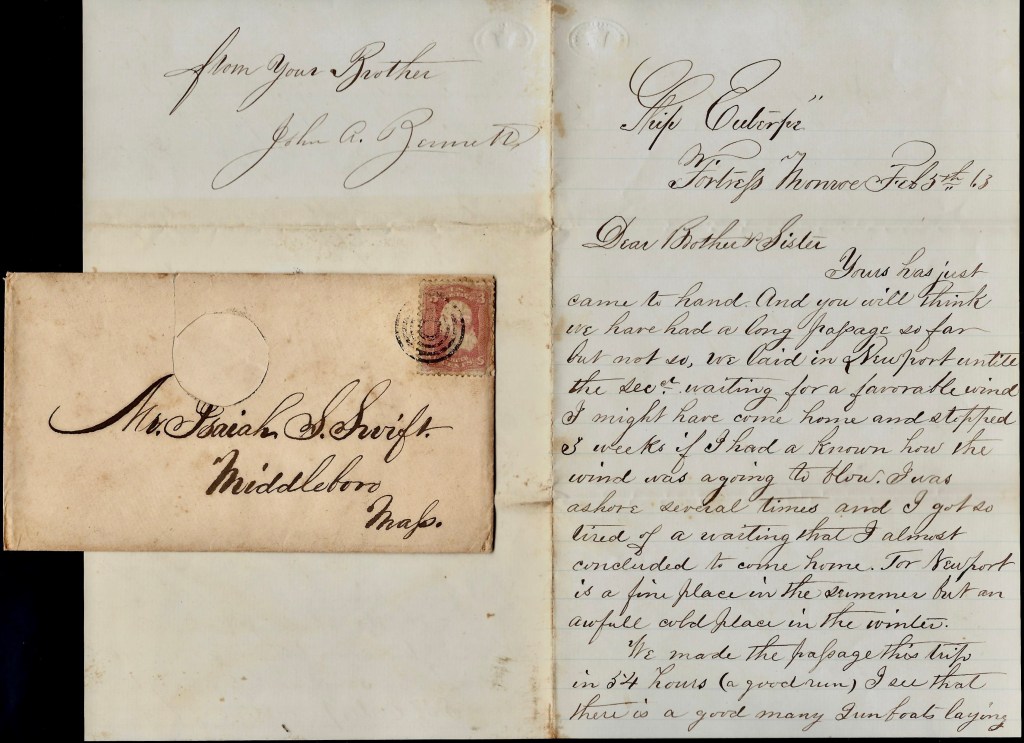
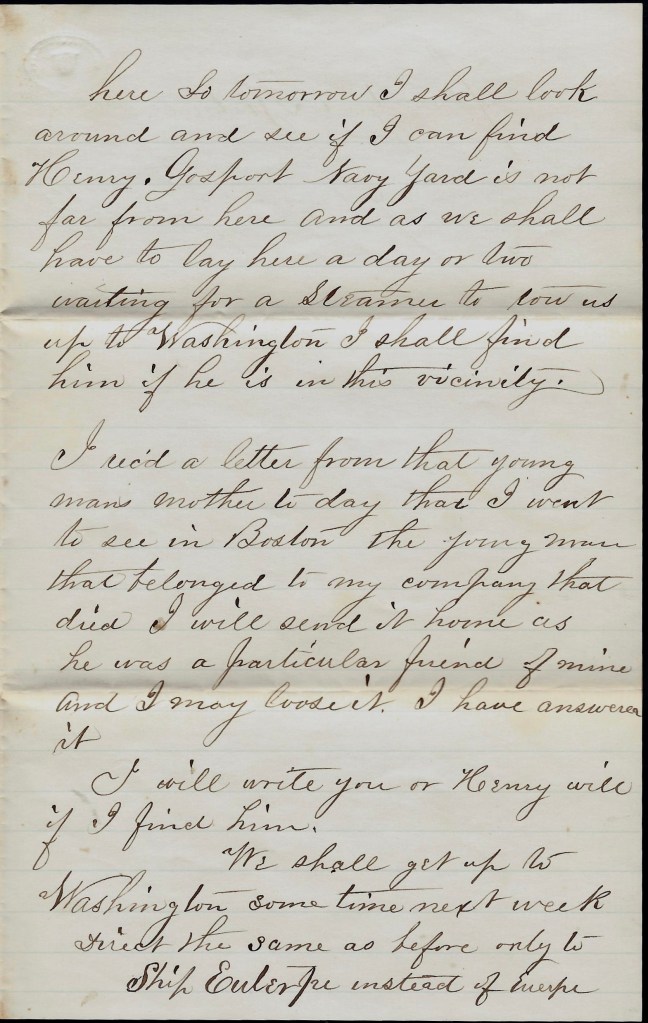
The following letters were written by John (“Jack”) Allen Bennett (1840-19xx), a native of North Rochester, Massachusetts, who enlisted when he was 20 years old in Co. B, 13th Massachusetts on 17 April 1861. He mustered out as a private on 23 March 1863, discharged on a medical disability. Before he was discharged, Jack was detailed to the ship Euterpe to assist in the transport of wounded soldiers from Virginia to Rhode Island hospitals. By the time of the 1863 draft registration, Jack was back home in Rochester, Plymouth county, Massachusetts, employed as a clerk. The registry indicates that he was discharged from the service and was married but I have not found any additional information on him.

Jack’s letters are sprinkled with terms commonly used by a sailer and he even mentions having spent some time at sea as a whaler prior to his enlistment. The 1860 US Census enumerates him in Rochester, Plymouth, Massachusetts, and he was identified as a 20 year-old “mariner.” In the same household in the same year was his 16 year-old half-brother Henry Harrison Bennett (1844-1934), a child of Phebe P. Wood (1801-1877), the third wife of John Bennett.

Jack wrote these letters to his brother-in-law, Isaiah Standish Swift (1823-1877), who was married to Catherine Matilda Bennett (1829-1865). Catherine and Jack were the children of John Bennett (1796-1875) but had different mothers. Catherine was the daughter of Sarah Clark (1798-1837) and Jack was the son of Martha Allen (1796-1841).

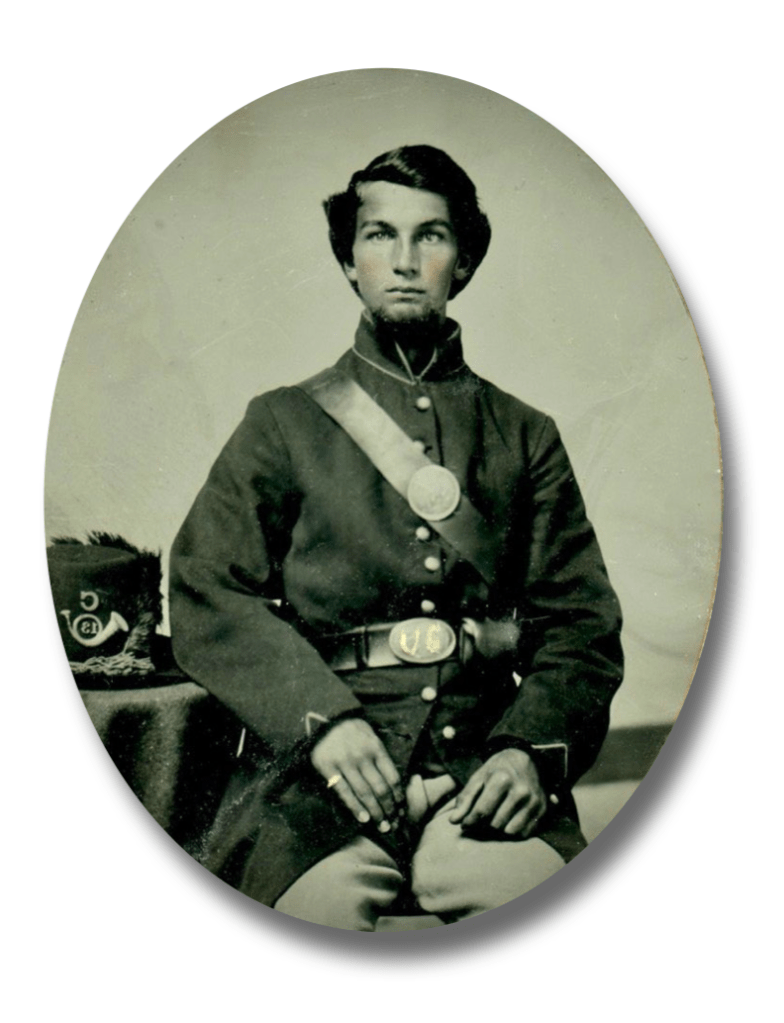
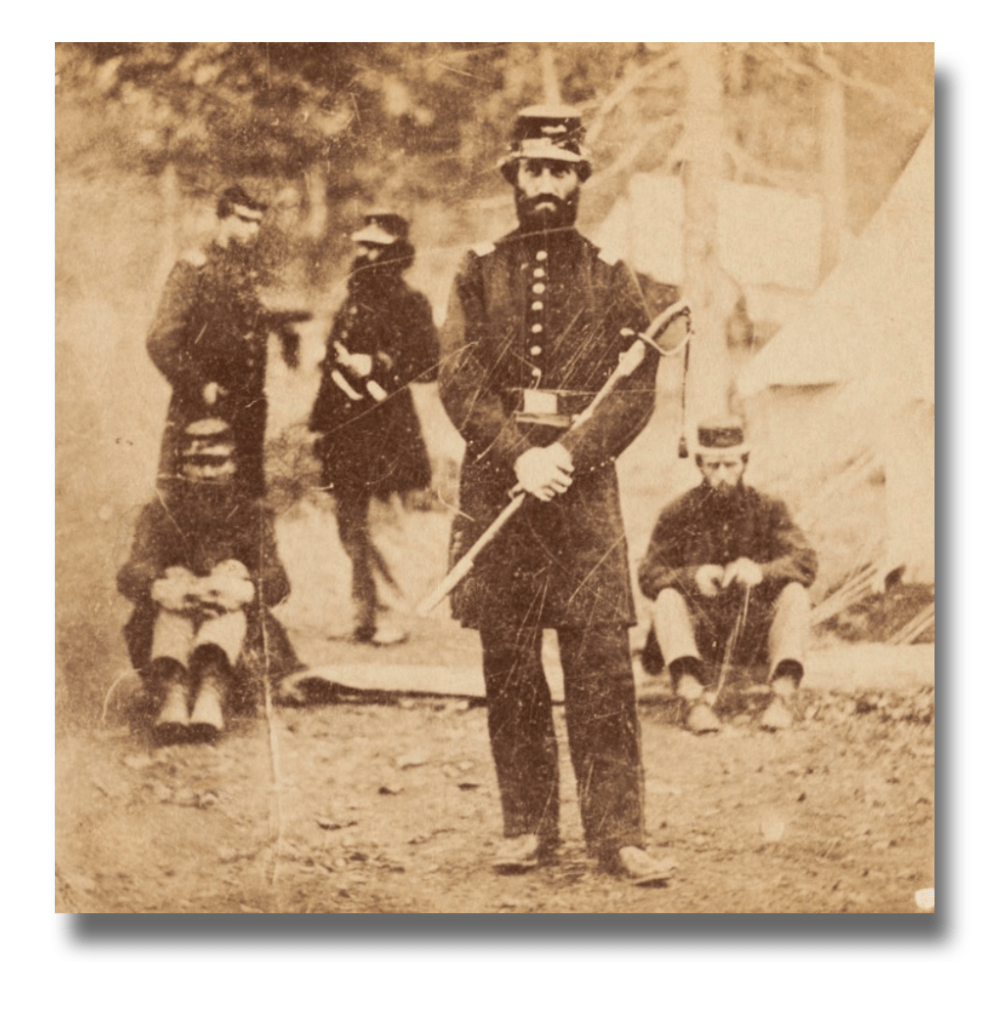
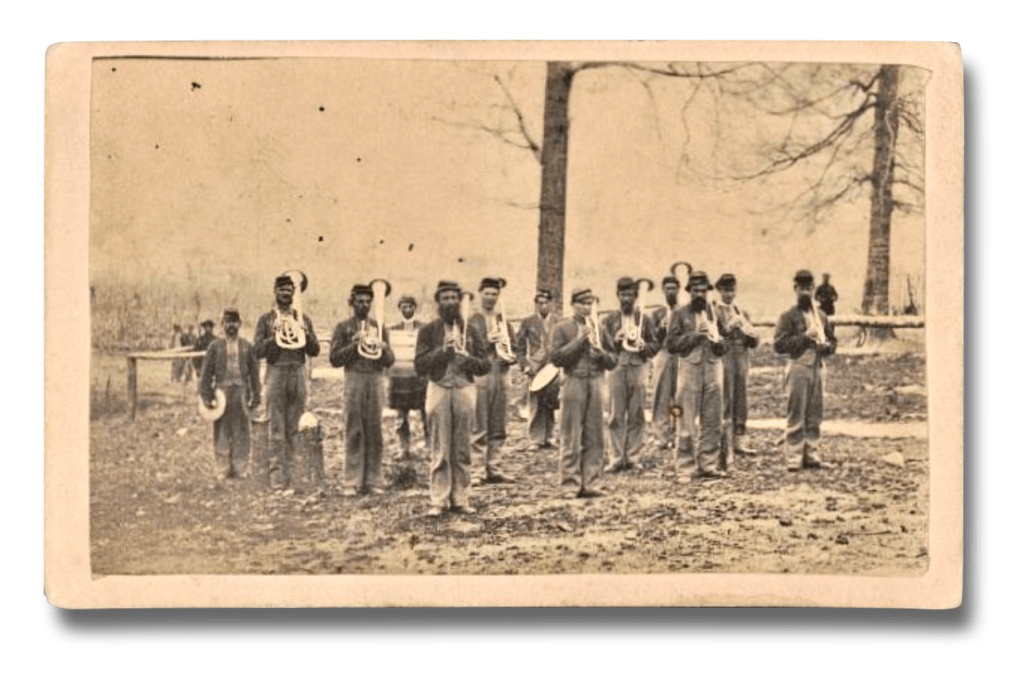
I could not find an image of Jack but here is one of Albert Dyer of Co. C, 13th Massachusetts (Kevin Canberg Collection)

Letter 1

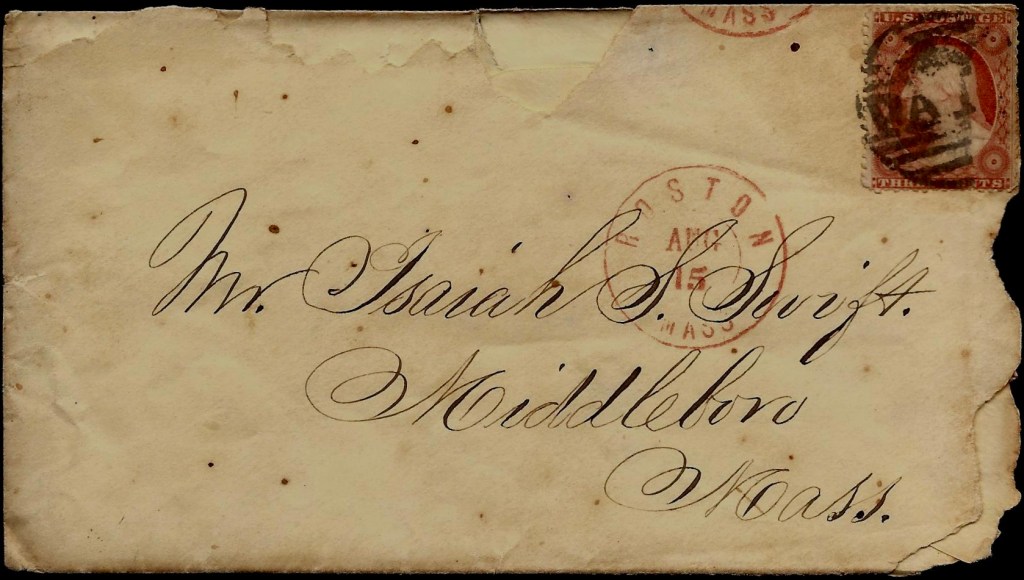
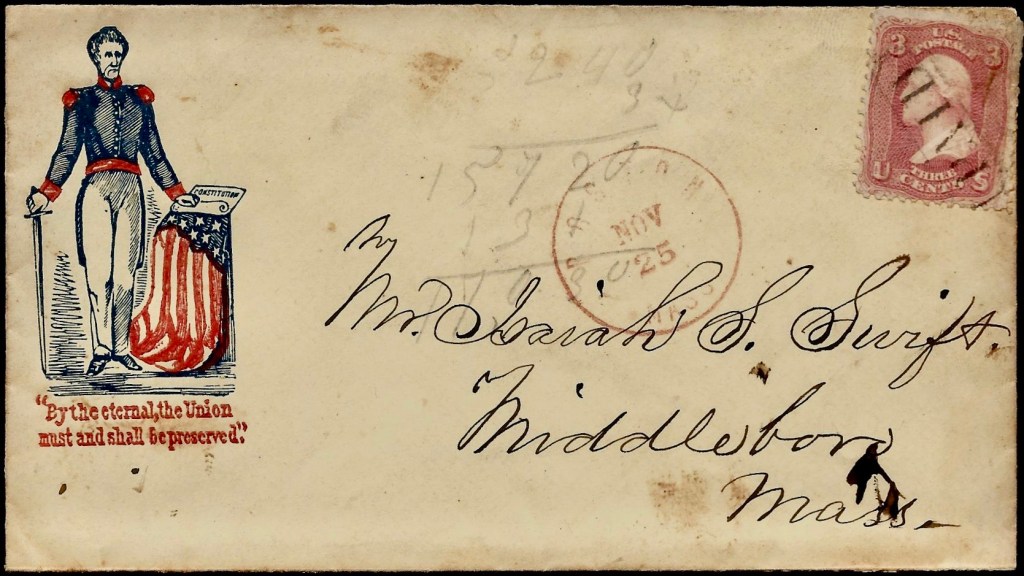
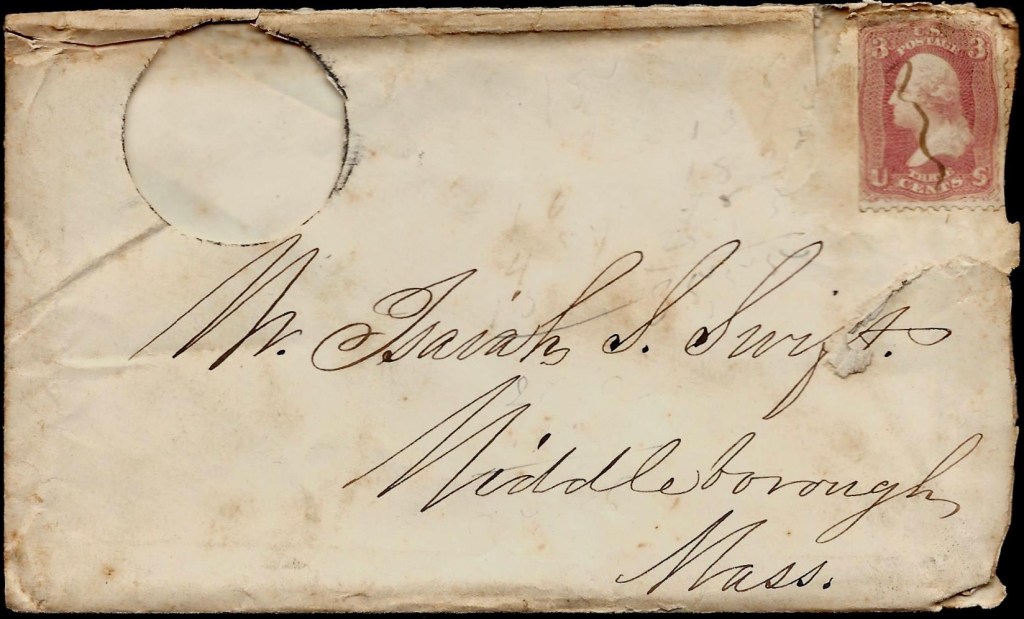
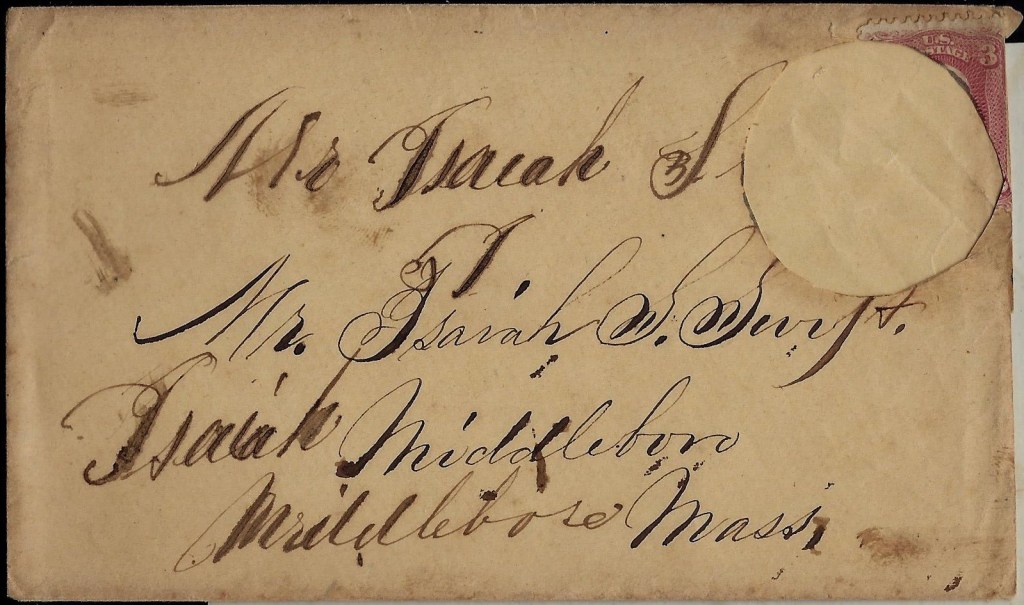
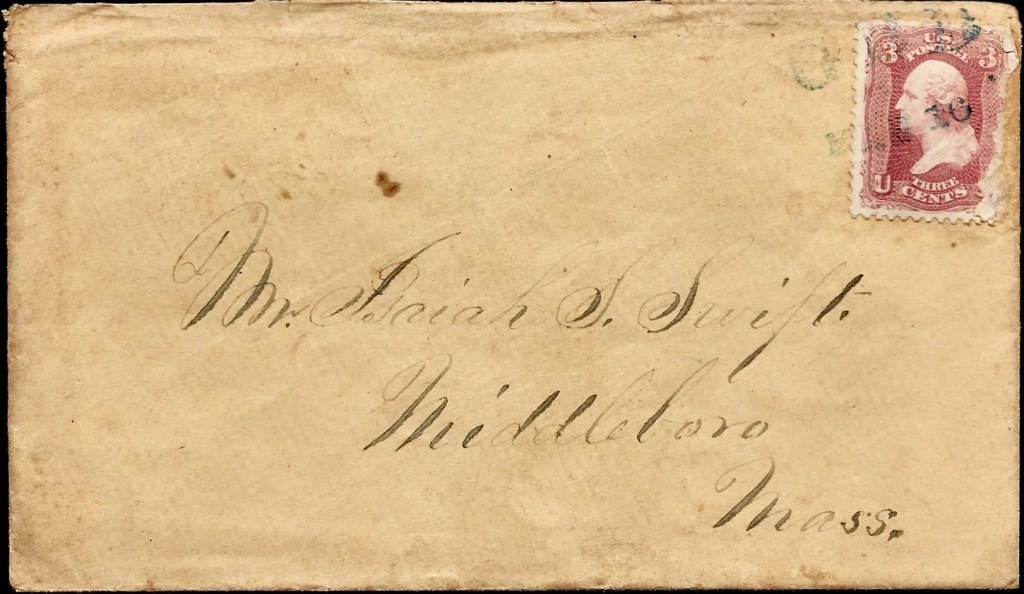
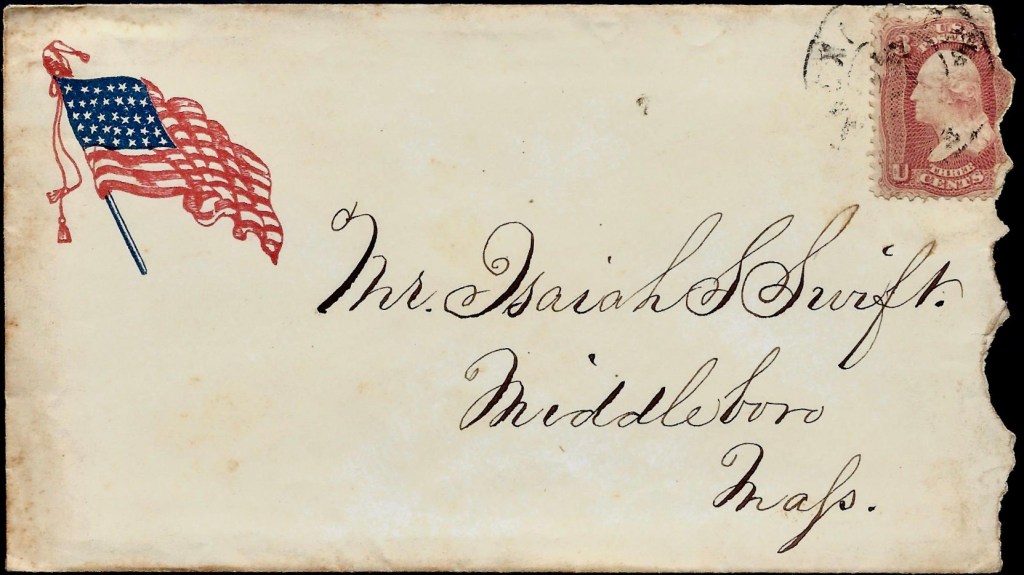
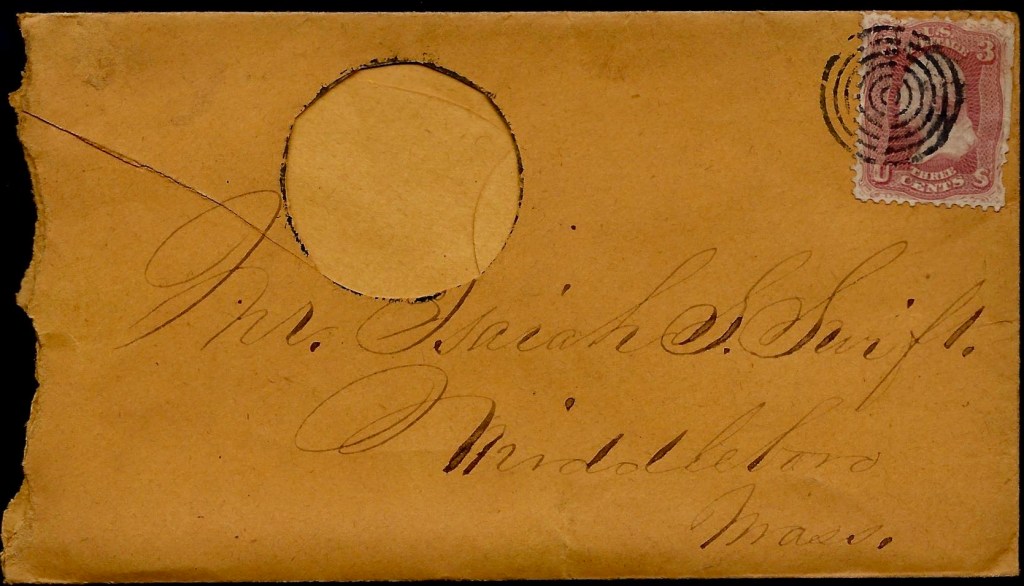
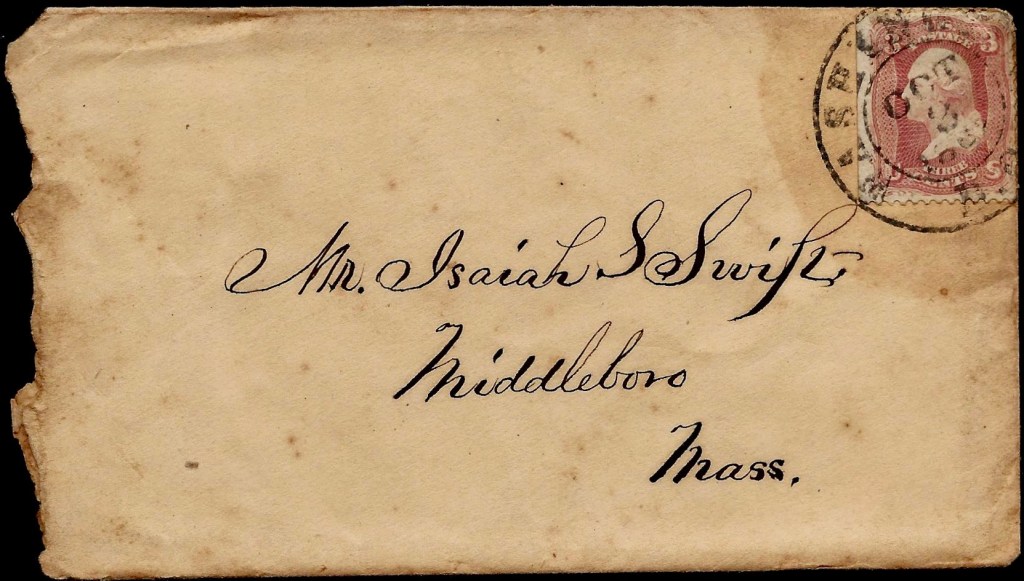
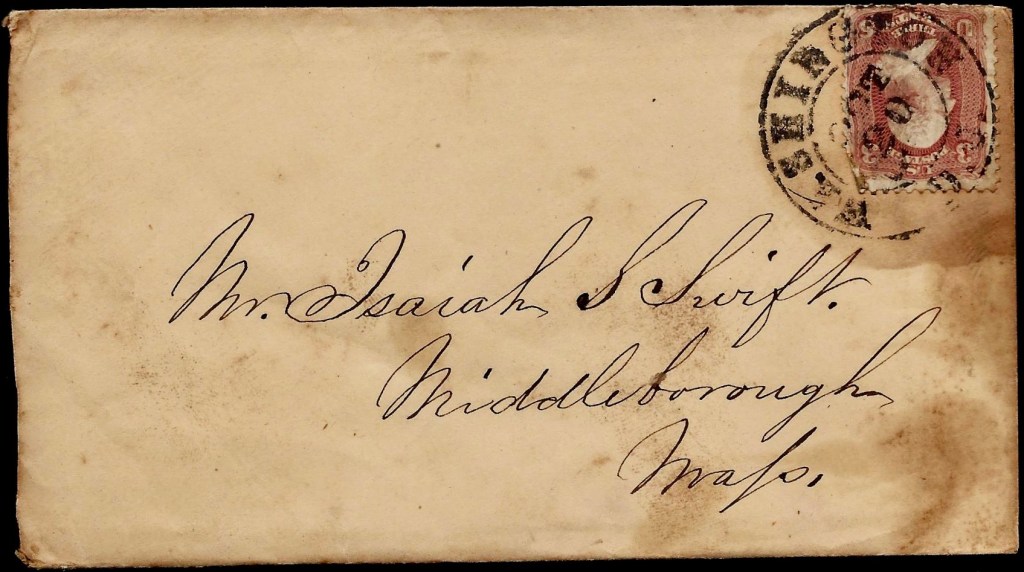
Addressed to Mr. Isaiah S. Swift. Middleboro, Massachusetts

Anterdam [Antietam] Iron Works
Washington county, Maryland

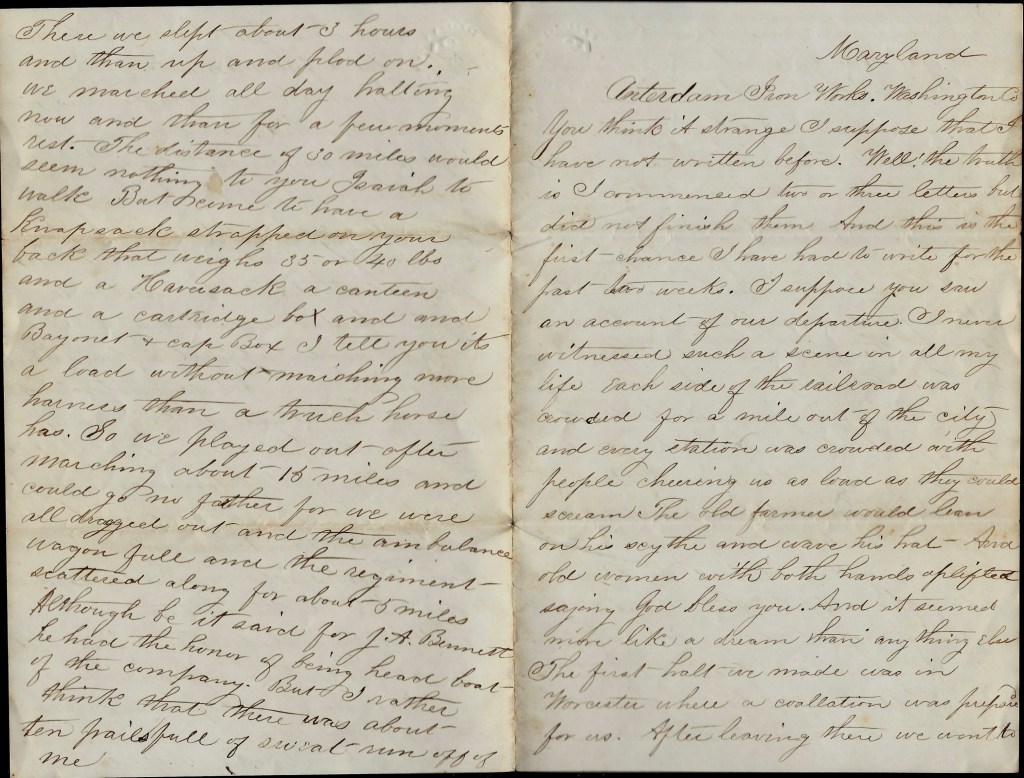
You think it strange that I have not written before, Well, the truth is I commenced two or three letters but did not finish them. And this is the first chance I have had to write for the past two weeks. I suppose you saw the account of our departure. I never witnessed such a scene in all my life. Each side of the railroad was crowded with people cheering us as loud as they could scream. The old farmer would lean on his scythe and wave his hat. And old woman with both hands uplifted saying, “God bless you!” And it seemed more like a dream than anything else.

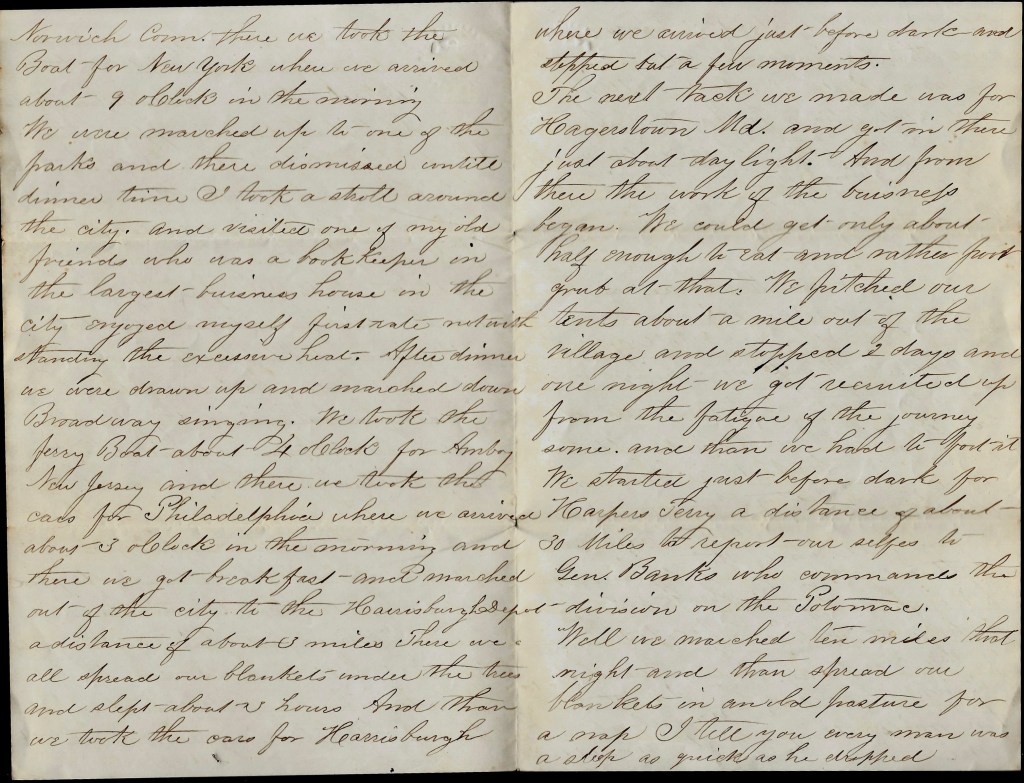
The first halt we made was in Worcester where a collation was prepared for us. After leaving there we went to Norwich, Connecticut. There we took the boat for New York where we arrived about 9 o’clock in the morning. We were marched up to one of the parks and there dismissed until dinner time. I took a stroll around the city and visited one of my old friends who was a bookkeeper in the largest business house in the city. Enjoyed myself first rate, notwithstanding the excessive heat.

After dinner, we were drawn up and marched down Broadway singing. We took the ferry boat about 4 o’clock for Amboy, New Jersey and there we took the cars for Philadelphia where we arrived about 3 o’clock in the morning and there we got breakfast and marched out of the city to the Harrisburg Depot—a distance of about three miles. There we all spread our blankets under the trees and slept about [ ] hours. And then we took the cars for Harrisburg where we arrived just before dark and stopped but a few moments.

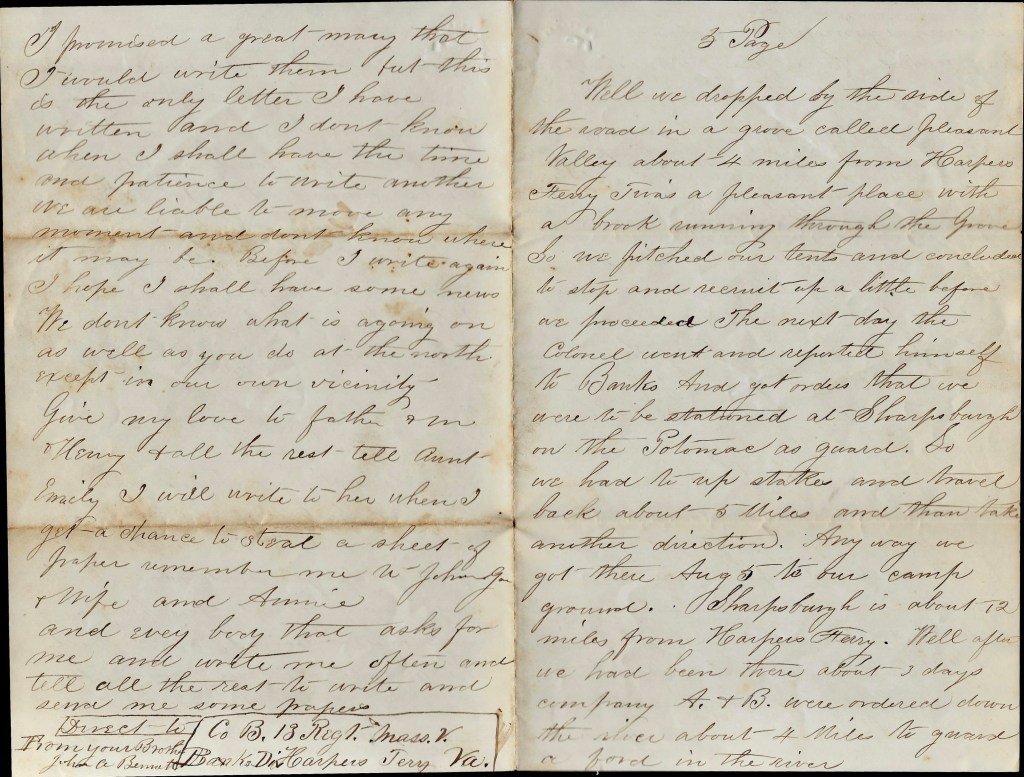
The next tracks we made was for Hagerstown, Maryland, and got in there just about daylight. And from there the work of the business began. We could get only about half enough to eat and rather poor grub at that. We pitched our tents about a mile out of the village and stopped two days and one night. We got recruited up from the fatigue of the journey some and then we had to foot it. We started just before dark for Harper’s Ferry—a distance of about 30 miles, to report ourselves to Gen. Banks who commands the division on the Potomac.

Well, we marched ten miles that night and then spread our blankets in an old pasture for a nap. I tell you, every man was asleep as quick as he dropped. There we slept about three hours and then up and plod on. We marched all day, halting now and then for a few moments rest. The distance of 30 miles would seem nothing to you, Isaiah, to walk, but come to have a knapsack strapped on your back that weighs 25 or 40 pounds and a haversack, a canteen, and a cartridge box, and bayonet & cap box, I tell you, it’s a load without marching more harness than a truck horse has. So we played out after marching about 15 miles and could go no farther for we were all dragged out, and the ambulance wagon full, and the regiment scattered along for about 5 miles, although be it said for J. A. Bennett he had the honor of being head boat of the company. But I rather think that there was about ten pail full of sweat run off of me.

Well we dropped by the side of the road in a grove called Pleasant Valley about 4 miles from Harper’s Ferry. Twas a pleasant place with a brook running through the grove. So we pitched our tents and concluded to stop and recruit up a little before we proceeded. The next day the Colonel went and reported himself to Banks and got orders that we were to be stationed at Sharpsburg on the Potomac as guards. So we had to up stakes and travel back about 5 miles and then take another direction. Anyway, we got there August 5th to our campground. Sharpsburg is about 12 miles from Harper’s Ferry.

Corp. James R. Hamilton of Co. A, 13th Massachusetts Infantry (Ancestry)

Well, after we had been there about three days, Company A & B were ordered down the river about 4 miles to guard a ford in the river. So our regiment is acting as guards. There are two companies up the river from us—Company E & H of our regiment. We have not had no fights yet but are aching for one. We have had some false alarms and have had some prisoners in charge. There is a small encampment of rebels about 4 miles from us on the Virginia side but they have not troubled us yet. Before we came here, they burnt all the bridges but they had not better show themselves now. Our boys go out a scouting some but have not had any brush yet. Our guard has been fired upon once.
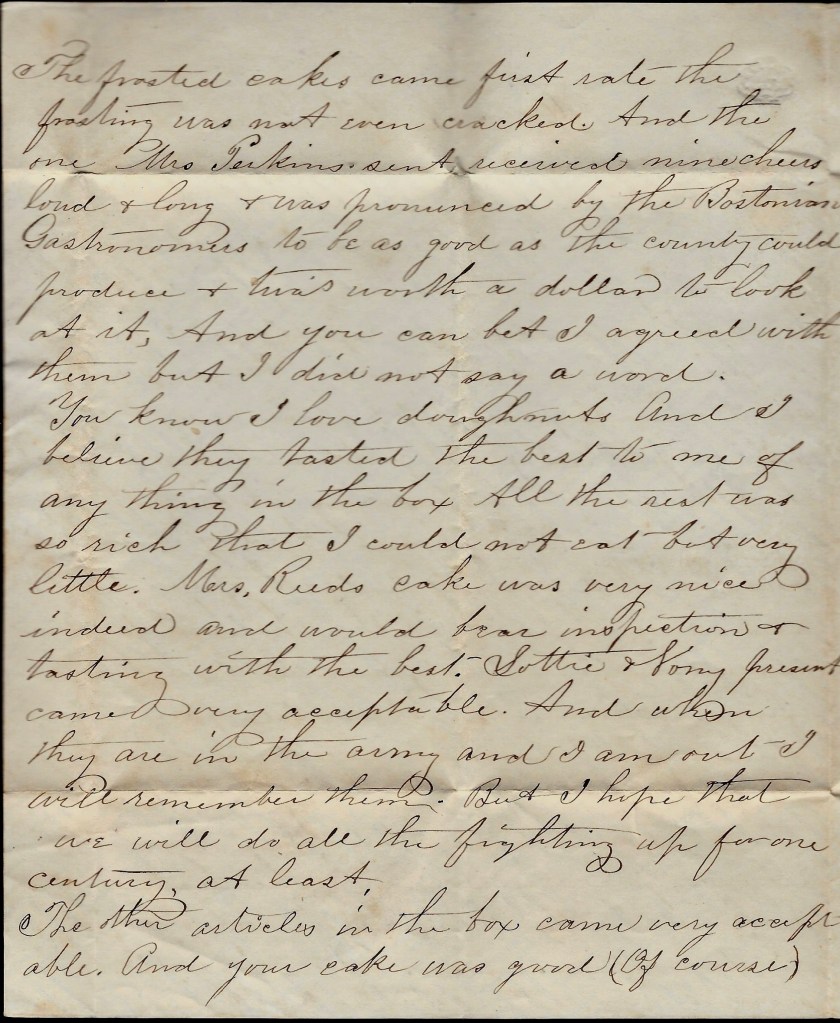
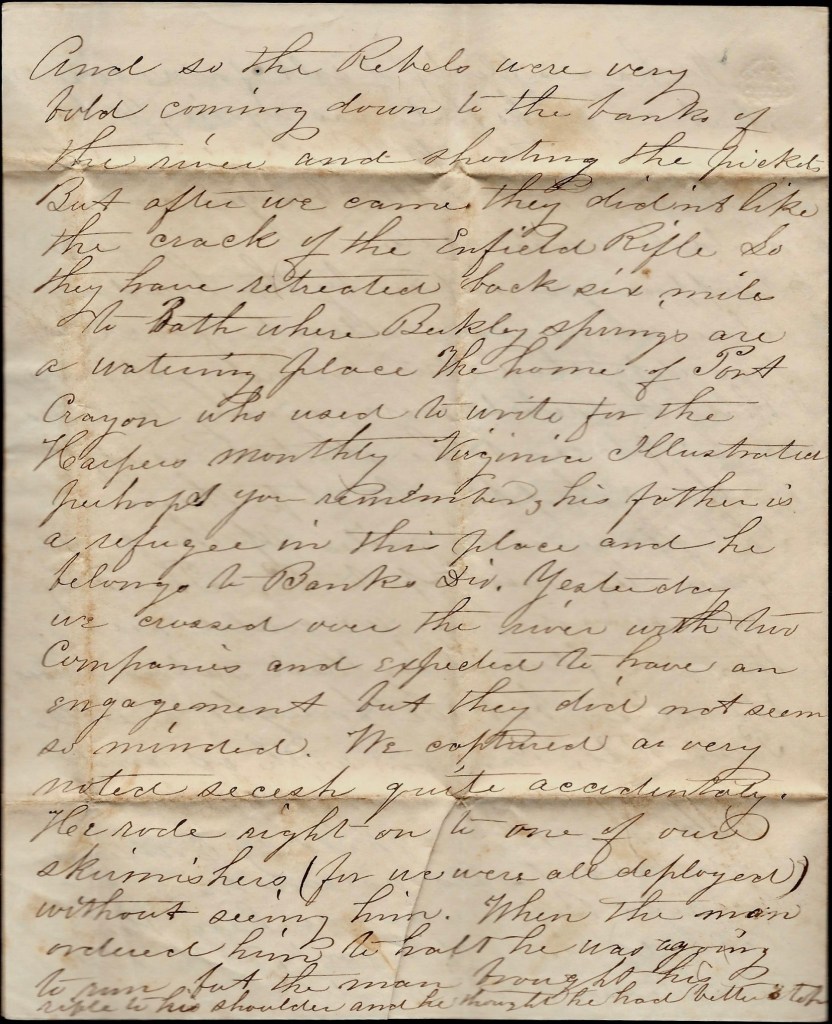
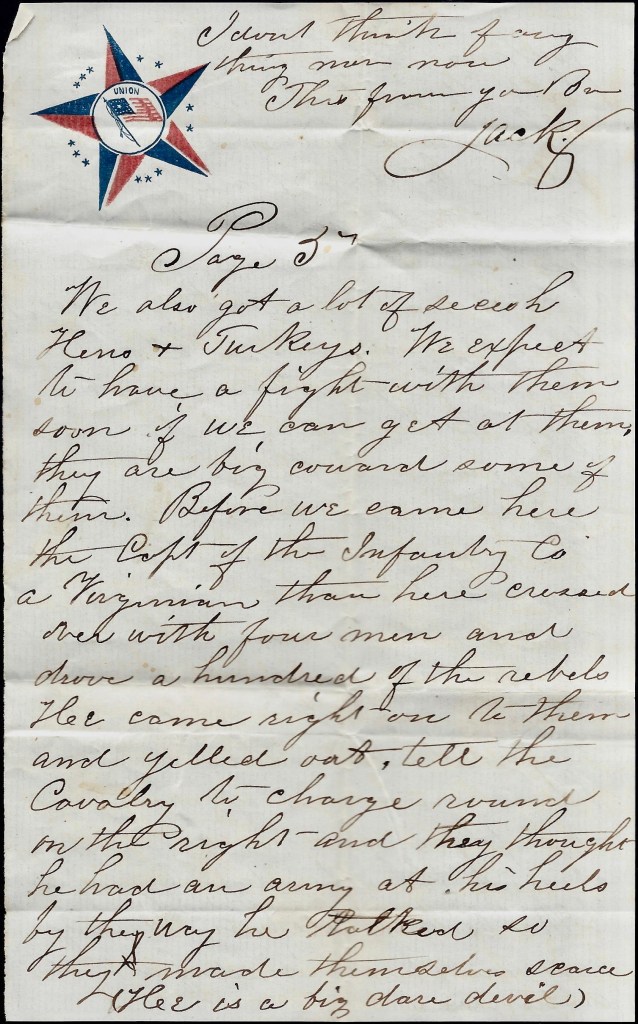
We live hard and short allowance at that. We went over into Virginia the other day and stole a steer so we had one good meal. We are bound to have a good meal once in a while. Some of our boys are sick & some are tired of salt horse. But I am poor as a crow but well & hearty and think I shall stand it. But it is worse than whaling. But when we get a little broke in, I guess we shall like it first rate—at least I do. We sleep in tents on straw and some of our boys have had the fever and ague. the weather is very warm with frequent showers.

They do not have towns here but each village has a name and they will tell you Maryland. Maryland is divided into districts. The people are very ignorant generally in this part of the state and most of them are for the Union.

I promised a great many that I would write them but this is the only letter I have written and I don’t know when I shall have the time and patience to write another. We are liable to move any moment and don’t know where it may be. Before I write again, I hope I shall have some news. We don’t know what is a going on as well as you do at the North except in our own vicinity.

Give my love to father & Henry & all the rest. Tell Aunt Emily I will write to her when I get a chance to steal a sheet of paper. Remember me to John [ ] & wife and Annie and everybody that asks for me and write me often and tell all the rest to write and send me some papers.

From your brother, — John A. Bennett

Direct to Co. B, 13th Regiment Massachusetts Vols., Banks Division, Harpers Ferry, Virginia


“Union Troops Being Towed Along the Chesapeake & Ohio Canal to Join General Banks’ Command in Late 1861.”  New York Illustrated News, November 1, 1861, Image by Thomas Nast  Coutesy of Princeton University Library.  Accessed via Crossroads of War.

Letter 2

Camp Hamilton
Darnstown, Maryland
September 22, [1861]

Dear Brother & Sister,

I received your letter when we [were] up to Sandy Hook and I meant to have answered it before but the conveniences for writing are not very great & we have been traveling around so much. We have now got settled once more in camp at Darnstown, Maryland, where nearly all of Banks’ Division is concentrated. We are close to Banks’ Headquarters and rumor says that we are to be Banks’ bodyguard but I don’t know as it is true. There are about 35,000 troops right around us here, cavalry & artillery, &c. And it looks warlike enough. But there are no regiments can boast of seeing much harder times than we have. We have had hard marches and hard grub and several small fights. In one skirmish our side killed two and wounded 7 (our side one wounded). We have had but one man killed in all our fighting. But the next fight that we shall be in will be a rusher and that will be pretty soon for we are under marching orders all the time.
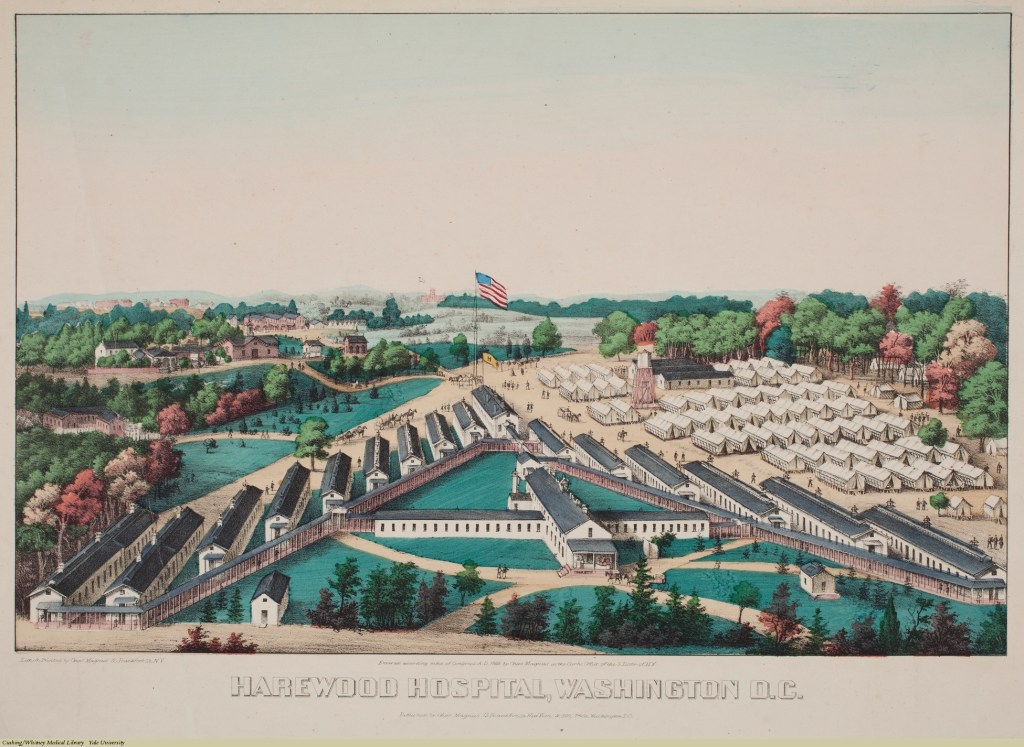
I tell you, Isaiah, I could shoot a rebel without half the trouble you would take to kill a whale. I tell you, a fellow forgets all about being afraid. The Rhode Island Battery that was at Bulls Run are close to us & they say that that affair was a big humbug. Twas caused by the teamsters running. They say that we should have cleaned them out in a little while longer if the officers had not got scared. But we’ll fix them the next time. We’ll drive them into the Gulf of Mexico.

I wish you could see our camp. It is one of the prettiest in the vicinity. We have cut down spruce trees and stuck them around each tent and it looks like a village. We have been complimented on the neatness of our camp & Gen. Banks calls us the model regiment, Ahem!

I wrote Aunt Emily some time ago but have not heard from her yet nor none of them, and I don’t suppose it has got there yet or perhaps the steamer that carried it was lost [in some] foreign port, you know. I wrote to father too and I should think some of them would write.

Gen. Banks says he is a going to get through with us by Thanksgiving but I don’t believe it. I think we have got to have a big fight and if we whip them, they won’t stay whipped. They are a half-civilized set of beings. There are a good many secessionists around here but they are afraid to say a word. We took one of Johnson’s spies day before yesterday with papers stating that he was a going to cross the Potomac yesterday or today. We hain’t seen him yet and he had not better come.

The next time I write, I shall send you some money. We have not been paid off yet. No more now. From your brother, — Jack

My love to Annie & Mr. & Mrs. Perkins & all that I know. Direct to Banks’ Division, 13th Regt. Co. B.

I have not seen Mr. Johnson yet but I expect to soon.


Letter 3

Williamsport, Maryland
Sunday, October 20th 1861

Dear Brother & Sister,

I received your ever welcome letter and as it is Sunday and I have nothing to do, I thought I would write. We don’t have a great deal of leisure time. As we are on Provost guard and stationed in the village, we have to go on guard every other day and it is something like sea watches, only you can’t go to sleep. It is all the time on the lookout. We have to guard the river & gotels and bar rooms to keep the soldiers from obtaining liquor. All the infantry or riflemen that there is here is seven companies of our regiment and the Pennsylvania Battery and four companies of the Virginia Cavalry. And they are all encamped just out of the village. The 12th Indiana Regiment came here with us but they have been sent down the river to Sharpsburg & Antietam to guard the river. And the 1st Maryland Regiment was here when we came and they have gone to Fortress Monroe, I believe.

Our other three companies [K, C, and I] are stationed at Harpers Ferry where they and some of the Pennsylvania 28th Regiment had a fight and a pretty good one too. Our three companies won laurels for the 13th. They made a charge which scattered them like sheep. 1 And all that were there say that they would clean out the whole southern army with a regiment like them three companies. And we think we are equal to them. Anyway, we are all crazy to be on the back of the Devilish Rebels & cowards. They took two of our Boys and stripped them and then pierced their bodies with bayonet holes—the Devils! We’ll show them what Massachusetts Boys are made of if they will give us a chance. But it seems to me they don’t want us to do the fighting, but it ain’t our fault. I guess they think we are pretty good on guard duty—our company, I mean, for they had us on provost guard in Darnstown. And then they took us the first thing here. We have to guard about 15 secessionist prisoners and all that refuse to do duty, &c., &c., in the regiments. And the other guard duty that I spoke of.

We were paid off last week with a month and a half pay—the first money that we have received from the government. $18.50. And I now send you a five dollar note so you can see some of the government bills. I shall send you some more when we get paid off next time which will be due the first of November and then we shall receive two months pay.

We are expecting to hear every day that Banks has crossed the river, but you will hear of it as soon as we shall as we are so far from Headquarters—some 65 miles—and no telegraph or cars. We expect that the force here will cross the river this week and take up our winter quarters in Martinsburg but we may have a little fighting to do for Martinsburg is now occupied by the rebels. But we can clean them out in ten minutes with our Pennsylvania Battery. I wish we could go down to Washington but the nearest we have been there was twenty-five miles and now we are near a hundred from there. No more of interest that I think of so goodbye.

Give my love to all, Henry & Annie White, & tell them to write me. From your brother, — Jack

Direct to Williamsport.

1 The Battle of Bolivar Heights took place on 16 October 1861. Five hundred Confederates under the command of Colonel Turner Ashby clashed with six hundred Federals under the command of Colonel John Geary. Ashby’s forces fall back towards Charles Town and Union flags are planted on the ridge. Some of Ashby’s men later returned to burn a prosperous flour mill on Virginius Island owned by a unionist citizen.


Letter 4

Williamsport, Maryland
November 2, [1861]

Dear Brother & Sister,

Your letters have all been received. In your last you thought I had not received them all you know and that money that I sent I should have thrown away if I had not sent it and I shall send you some more in a few days. We are supplied by Government with all the clothing we ned so we have no use for our money except for a good dinner now and then and a glass of beer or some little nicknack.

We go a gunning now and then and I am a going tomorrow and I wish you were here to go with us, Isaiah. There are a plenty of quails and rabbits. I am a going tomorrow with two Virginia men who left their state for fear of being pressed into the rebel service.

Lieut. C. B. Fox stands in front and center in this image taken at the winter camp of the 13th Massachusetts Infantry at Williamsport, Maryland. (Digital Commonwealth Massachusetts Collections Online)

Our Colonel, acting Brigadier, sent out a foraging party into Virginia and they got about 50 cord of wood. And the cavalry company here acted as guard from them so after they had got the wood all safe, they thought they would reconnoitre a little and they rode six miles back from the river near Martinsburg when they were fired upon by six Rebel pickets but with no effect. They returned the compliment and the captain took one fellow right through the hip. He rode some distance but finally had to cave in and so we captured him. The rest escaped. He was brought to us by our old captain, now Lieutenant Colonel, in a carriage. His horse and equipments were captured also. He was a fine-looking young fellow but was pretty weak from the loss of blood. His pantaloons were all saturated with it.

Our three companies which were in the Harpers Ferry fight returned to us yesterday. You’d better believe we cheered them well for their gallant conduct in the fight. They were in the thickest of the fight and captured a 32-pounder at the point of the bayonet. We all wished that we had been there. However, we have had a little fun down to Antietam you know—Co. A & B.

We don’t know how long we shall stay here. We may stay here all winter and we may cross the river next week. Our company is still on Provost Guard.

That Romney fight was rather a big thing, wasn’t it. 1 We’ll clean them out in due time.

Isaiah, I should like to see you out here. Lots of the Boy’s fathers have been out here and relatives. It would not cost more than $35 to see the whole army and if you will come, I will pay the bill. You never will have a better chance to see the army and the country. Tell Henry to write!

Love to all, from Jack

1 On October 24, Federal Ohio and Virginia infantry (with some light artillery and Ringgold Cavalry) attacked through Mechanicsburg Gap; on October 26 the Confederate defenders fled. There was a skirmish at Wire Bridge as part of this assault. It was as a result of this Federal success that Col. Benjamin F. Kelley issued his “Address to the People of Hampshire County and the Upper Potomac”. For a time after this, Federals under the command of Col. Samuel H. Dunning of the 5th Ohio Infantry occupied Romney.


Letter 5

Williamsport. Maryland
November 16th [1861]

Dear Sister,

As thanksgiving is coming on and we shall not be able to be at home, we are beginning to think of our usual mince pies, &c. that we generally get. But the people around here don’t know how to make them so we have all concluded to write for a box of the same. Most of the boys have had four or five and they shared them freely with me so I thought it was about my turn to have some. So now you tell Isaiah to get a small box of some kind and then if you. will make me a half dozen mince pies and a cake, &c. &c. &c. and send them to me, I will be everlastingly obliged to ye.

Now Tilly, I don’t want you to do it if you are not real smart. If you could get two or three of Aunt Emilie’s pies, I would like it, and send them by Adams Express Co. to Williamsport, Maryland. Co. B, 13th Regt. Mass. Vol.

No more now. No news of any consequence here. I received Isaiah’s letter last night. My love to all. From your brother, — Jack


Letter 6

Williamsport, [Maryland]
November 21, [1861]

Dear Brother,

It’s but a moment that I have to write as our mess are all a going out to a big dinner for we can’t get along without a turkey in some shape or other. But then I would like to be at home to help the rest eat. However, there will be more left for the rest for soldiers eat everything that is sat before them.

We were paid off yesterday and it came in the nick of time, you can bet. I wrote to you for a box. If you have not sent it, put in a pound of Navy chewing tobacco. I would like to have it for Thanksgiving but then the pies are pretty thick here now and perhaps they will taste better to top off with.

As I can send this by a member of the company who is a going to Boston, I enclose $11. Please give Henry $1 for spending money and I will send you some more next time. My love to all.

I received a letter from Aunt R. and she wanted to send me a box (very kind all at once). I told her I had plenty of everything. So goodbye.

Our Colonel has gone to Romney to see Gen. Kelly. Perhaps we shall both advance on Winchester soon (I hope so). Bully for the Naval Expedition.

Send me a story paper. — Jack


Letter 7

Hancock, Maryland
December 5th 1861

Dear Sister,

Your letter was received last Monday and having received the box last night, I hasten to make returns as you requested. It rather surprised me to see such a large box—the same when I opened it to find how closely it was packed for i could not begin to get them all back after unpacking it. Everything came in excellent order. And you would have laughed yourself to death if you had seen me unpack it. The whole mess gathered around with watering mouths and eager fingers. And when I would open one of the small boxes, they give three cheers. And they kept up a hallooring until I gave them something to stop their mouths. It was pronounced to be the best box received in the company in every way, shape and manner. And I shall be a Lion as long as the eatables last.

The frosted cakes came first rate. The frosting was not even cracked. And the one Mrs. Perkins sent received nine cheers loud and long & was pronounced by the Bostonian Gastronomers to be as good as the country could produce & was worth a dollar to look at it. And you can bet I agreed with them but I did not say a word.

You know I love doughnuts and I believe they tasted the best to me of anything in the box. All the rest was so rich that I could not eat but very little. Mrs. Reed’s cake was very nice indeed, and would bear inspection and tasting with the best. Lottie & Nony’s present came very acceptable. And when they are in the army and I am out, I will remember them. But I hope that we will do all the fighting up for one century at least.

The other articles in the box came very acceptable. And your cake was good (of course). We have plenty of salt for we seized about 100 sacks that was a going to be smuggled into Virginia. But just across the river here that little box you sent would be worth 50 cents.

I suppose you notice by the heading where we now are—at least four companies of us detached. Our Colonel got word that the rebels were a going to cross at this place so he started us off on the 28th of November to stop them. This place is 26 miles up the river from Washington, most up to Pennsylvania. The day we arrived here, we could see them a flourishing their sabres across the river but we brought a little Parrott rifle cannon with us and we gave them a shell. which surprised them, killing 6 men and four horses as we have since learned. Before we came here there was only one company of infantry with old muskets & one company of cavalry and so the Rebels were very bold coming down to the bank of the river and shooting the pickets. But after we came, they didn’t like the crack of the Enfield Rifle. So they have retreated back six miles to Bath where Berkeley Springs are—a watering place—the home of Port Crayon who used to write for the Harpers Monthly Virginia Illustrated. Perhaps you remember? His father is a refugee in this place and he belongs to Banks’ Division.

Yesterday we crossed over the river with two companies and expected to have an engagement but they did not seem so minded. We captured a very noted secesh quite accidentally. He rode right on to one of our skirmishers (for we were all deployed) without seeing him. When the man ordered him to halt, he was a going to run but the man brought his rifle to his shoulder and he thought he had better stop. We also got a lot of secesh hens and turkeys. We expect to have a fight with them soon if we can get at them. They are big cowards some of them.

Before we came here, the captain of the Infantry company—a Virginian than here, crossed over with four men and drove a hundred of the rebels. He came right on to them and yelled out, “Tell the cavalry to charge round on the right,” and they thought he had an army at his heels by the way he talked, so they made themselves scarce (he is a big dare devil). You may think it a yarn but it is the honest truth.

There is a funeral in this place today of one of his men that was shot above here on the river. And I can now hear the muffled drum and some of our boys have gone as escort and to fire a salute over his grave. I have seen a good many burials under arms since I have been out here, but thank God, not one of our boys have been shot—in our company, I mean. A man shot himself with a pistol the other day but he is now out of danger.

I suppose you received the money I. sent the other day. My respects to Mr. Perkins. Tell him I am very much obliged for that stationery.


Letter 8

Camp Jackson
Williamsport, [Maryland]
January 6th [1862]

Dear Brother & Sister,

Yours came to hand last night and I should have answered your letter before but I was at Hancock when I received your last.And there has been a pretty good chance for a fight and I was in hopes to have some news to write but as yet there has not been much fighting. When you don’t hear fro me you can know that I am all right but then I mean to write every ten days or so.

We left Hancock the night before Jackson attacked Bath and drove the Illinois regiment 1 there and the artillery to Hancock. And then he sent over a flag of truce to Gen. [Frederick W.] Lander in Hancock to have the women & children leave the town for he was going to destroy it. Gen. Lander’s reply was to Col. Ashby: “Waltz in and be damned.” So they fired three shells into the town doing no damage and then retired under a hot fire from our long-range Parrott cannon. 2 So they couldn’t stand the press. Five of our companies were ordered to Hancock with dispatch but they got fooled. We had just got down from there so we did not have to go.

Jackson captured the camp equippage of the [39th] Illinois Regiment and then went and attacked our forces in Romney and had them all taken away from him with the loss of fifteen or twenty men. The tents were marked “Jeff Davis Boys” but the “Jeff Davis Boys” could not keep them.

We don’t know when we shall advance; we don’t know nothing but blind obedience and patiently waiting for the time to come. We are still in our tents but we keep very comfortable with our thick blankets. We have a little stove in our tents and plenty of straw. There is about two inches of snow on the ground and the folks here call it a good sleighing but I can’t see it in that light.

I received a letter from Henry last night. He did not say anything about joining the Navy to me but it is nothing strange that he didn’t. No more this time. My love to all. From your brother. — Jack A. Bennett

1 Companies D, I, and K of the 39th Illinois Regiment under the command of Major Mann near Bath, Virginia, when they were attacked and after a brisk little fight, were repulsed; then, with two pieces of artillery, and a liberal display of strategy and courage, the enemy was held in check for nearly twenty-four hours. Company G, under command of Captain Slaughter, was also attacked at Great Cacapon Bridge, but repulsed the enemy with considerable loss. A heavy force was approaching, and this Company, not being able to ford the Potomac, retreated up the railroad to Cumberland, Maryland. Colonel Osborn, with the remaining portion of the regiment, was simultaneously attacked at Alpine Station. Companies C and F, in command of Captain Munn, drew into ambush about five hundred (500) of Ashby’s Cavalry, and, after killing and wounding 30, routed them. The regiment finally forded the Potomac, sustaining no serious loss, except in the matter of camp and garrison equipage, and took up a new position on the Maryland shore.

2 “There was a considerable commotion on yesterday in military circles, in consequence of intelligence from Hancock that Jackson had suddenly appeared opposite that place with an estimated force of 7,000 men; one 24-pounder and two 12-pounder rifled guns. He sent word to Gen. Lander to evacuate that place, or he would shell us out. Lander responded that he should not evacuate, and if Jackson opened fire upon the town he would hold him to a strict accountability, Jackson responded that he should assumed the responsibility and carry out his threat. Consequently he commenced a steady fire, which was continued up to dark last night, the date of the latest dispatches up to this time. The enemy’s fire caused out slight damage to the buildings, and taking no effect upon our troops.”


Letter 9

Williamsport, [Maryland]
February 9th [1862]

Dear Brother & Sister,

Yours came to hand. Since I wrote you last, Co. B has moved down into the town and we are now quartered under a roof. We are doing the picket duty and provost marshal duty too so we have to go on guard every other day. Nothing of any consequence has taken place in this vicinity. The victory in Tennessee was rather cheering news and I suppose we shall soon hear something from Missouri. Banks’ Division will advance sometime next fall.

The Boys are getting tired of soldiering. They want to be doing something. We have been a laying around this place about long enough. I hope they will do something before long.

I think I shall get a furlough and come home before long just to get out of town a day or two. A good many of the boys have been home. A New Bedford fellow went yesterday—Charles Howland of Co. B—a relation of Black Hawk. I heard from Henry the other day.

No more this time. From your brother, — Jack


Letter 10

Williamsport [Maryland]
February 28th, 1862

Dear Brother & Sister,

As the Army of the Potomac is about to make a move, I thought I would inform you as the papers are not allowed to publish anything about the movements of the army. We leave this place tonight or tomorrow morning to march on Martinsburg & Winchester. We cross with the 12th Indiana Regiment & one battery and one company of cavalry. We shall meet Gen. Lander with 30,000 troops at. Martinsburg & Banks has crossed at Harpers Ferry with 15,000 & with this force we shall take Winchester & then march on Manassas and Richmond. Together with Gen. McClellan, we are bound to whip them.

The roads are in very good condition now. There is no snow but it is very cold and windy here tonight. We have had it snapping cold for the past week. I don’t expect we shall have much fighting to do until we get to Winchester and there I suppose the Rebels will fight desperate.

I will write you the first chance I have and tell you where to direct to. I suppose we shall be on the move now—that is, if we are successful, and there is not much doubt but what we shall be. Give my love to all enquiring friends, No more this time. When you get this, we shall be marching on Winchester. – From Jack


Letter 11

Winchester, Virginia
March 14th 1862

Dear Brother & Sister,

Since I wrote you last, the great battle has been fought and no lives lost. We left Williamsport on the 1st about 7 o’clock in the evening and marched that night into Martinsburg, Va., a distance of 12 miles and arrived there at 12. We were the advance. The 12th Indiana Regt. and 1 company of cavalry and 1 battery of six guns followed in the rear and got into Martinsburg about 2 in the morning.

The 12th Indiana Regiment wearing Zouave uniforms

We were fired into twice by the Rebel pickets but no one was hurt. As soon as we arrived in town, our band played several national aires and then we all sat down on the side walk while our captains were finding us quarters and while sitting there, some half asleep, some eating, and some all tired, out a whole volley of bullets whistled right over our heads and by the time we were on our feet—slam, bang—it went again. I kind of shook myself to see if I was hot & found out I was all right, looked up the street, and I could see fellows flat on the street. Thinks I to myself, them poor fellows have lost the number of their mess. I then capped my rifle and hearing the order to fall in, I jumped into the ranks and stood ready for anything.

But there was some confusion for about 5 minutes you can bet until affairs was explained. You had ought to have seen the Band Boys leave their instruments & they yelled out, “Give us a rifle!” But you have ought to have heard one of our boys yell out to some chaps that were running, “Stop! You damn shoemakers, stop!” I don’t mean to infer that all shoemakers will run. We have got one company of Natick shoemakers in our regiment and some of them rather showed the white feather that night. They run so fast that they knocked down everything and everybody in their way.

The cause of the firing was this. Our advance guard consisting of about 50 men were a trying to cut off the rebel pickets and had taken a road that led around the town and they did not know exactly where the regiment was and one of the lieutenants of the artillery was a looking around for stabling for his horse when he came upon them. They challenged him but he—like a fool—turned his horse and run instead of answering the challenge when they, supposing him to be a Rebel picket, let him have [it], killing his horse but not injuring him. But it was lucky that they fired high for if they had not, they would have killed lots of our boys. But as it was, only one man was hurt & he was but slightly wounded. We thought that a lot of Rebel cavalry was a going to charge on us.

We stopped in Martinsburg until the 5th. Williams’ Brigade arrived in town the 3rd. We took several prisoners while we were here. The 5th we took up our march toward Winchester and marched to Bunker Hill—a distance of 10 miles. Here we captured six rebel pickets and our cavalry charged on some 50 more who fled but they had too fresh horses for our tired ones. We stopped in this place until the 11th when we marched toward Winchester along with Hamilton’s Brigade and Williams’ Brigade, about 10,000 strong—artillery, cavalry, and infantry. We had several pickets shot while at Bunker Hill & had 3 men wounded & killed in a skirmish.

On the 11th we marched until within 4 miles of the Rebel stronghold & bivouacked that night in a wood. We rolled ourselves up in our blankets expecting on the morrow to have a hard battle. It was the most splendid sight that ever I saw—to see the camp fires that night. Just as far as the eye could scan in every direction you could see them for Masj. Gen. Shield’s Division had come up in our rear and Gen. Banks we heard was handy so there must have been upwards of 50,000 a sleeping with a bright moon & clear sky for their roof out that night.

In the morning we were up long before the sun for I guess a good many did not sleep very sound. After drinking our coffee, we put on our equipments, looking well to the priming of our guns & seeing that every thing was all right for action. Just as soon as Old Sol showed himself, the drums beat the long roll and we all fell in and started for the enemy. It was the finest morning of the season and you had ought to have seem the bayonets a glistening in the sunlight.

We were in advance and were to act as skirmishers on the left flank—a post of honor. The New York 9th Regiment was next to us and then came the Pennsylvania 29th and Indiana 12th and Maryland 1st were all in advance & to act as skirmishers to make the attack. Behind us following in the line of battle was a line between two and three miles long of cavalry, artillery, and infantry. We marched along boldly until within about two miles of the town when we could see the fortifications and then we began to move cautiously but still kept advancing, expecting every minute to hear their batteries open on us. But we though it strange—we could see no one. We kept on until we stood upon their breastworks when lo and behold, everything was deserted and the bird had flown.

We then marched into the town and learned from the citizens that Jackson’s force had evacuated during the night, but that Jackson and Col. Ashby had rode out of town just as we hove in sight. So we took the place without a struggle & captured some 20 prisoners who stopped to get their breakfast. Jackson’s force was out about five miles, they say. And we have skirmished with them most every day. We have got some 50 or sixty prisoners. Today our regiment went out to shoot some of the devils but they had all run.

We expect to have a chance to clean them out soon. Winchester is quite a large place—about six thousand inhabitants. We are doing Provost duty and stop in the town. Generals are as thick as bees around here. No more now. From Jack


Letter 12

On Bull Run Battlefield
March 30th 1862

Dear Brother,

We have passed the night in the barracks built by the New Orleans Artillery (Rebels) between Centreville & Manassas. We left Winchester just before the battle & were ordered back, so we marched back 20 miles when the order was countermanded & we have about-faced again. We have marched over 100 miles in the past week. We have chased Rebels several times but they would run too fast for us.

The Winchester Battle 1 was a grand affair and I wish we could have been there. 75 killed on our side and 300 on the Rebel side & over 1,000 prisoners taken. Our boys emptied 103 saddles at one discharge. We always leave a place just before a fight. It seems to be our luck. We march today toward Manassas and are to be McClellan’s reserve, I think, as he has advanced with a large force.

The country around here looks very desolate—dead horses by the hundred lay scattered around & hundreds of graves and our boys saw a pair of pants sticking out of the ground and went to pull them up when lo & behold, there was a man half buried up and the whole air is filled with a stench.

I am well and hearty. No more now. From Jack

1 Jack’s battle remarks pertain to the Battle of First Kernstown which took place on 23 March 1862 but the 13th Massachusetts did not participate in it. In that engagement, Stonewall Jackson’s men surprised Col. Nathan Kimball’s command at Kernstown on the outskirts of Winchester. The Confederates fought hard but they were outnumbered by greater than two to one and were finally forced to retreat. Casualties were estimated at 590 Union, 718 Confederate. The 13th Massachusetts did not participate in the fight, having been ordered away the day before the battle.


Letter 13

Warrenton Junction, Virginia
April 20th 1862

Dear Brother & Sister,

Yours was received and as we are now once more settled in camp, I will write. We have had the rumor in camp that the Massachusetts Regiments were to be discharged soon and that ours was one of the three. But I guess we shan’t get home before the 4th of July if we do then. It depends on what luck G. B. M. [George B. McClellan] has at Yorktown. We are all pretty well tired of soldiering. You can bet long marches & short rations has killed all the novelty & the Boys commit a good deal of sin every day by way of cursing the army high and low.

I haven’t heard from Rochester for some time. I received both of your letters. What is Lott Dean a doing?

Warrenton, Virginia, in 1862

We were paid off day before yesterday and today I went up to the station where the cars come in and had a good dinner on pies and ginger bread—first pie I have tasted for a month. The railroad is rebuilt nearly to this place. When the rebels retired (as htey call it), they destroyed the rails and sleepers.

We don’t see any show for a fight. We have had some skirmishing. Had one man taken prisoner. So I suppose we are on the reserve. I tried to get a furlough today but could not. No more this time. I am well & hearty. From Jack

To. C. M. S. & I. S. S.    John A. Bennett


Letter 14

Warrenton Junction
April 29th 1862

Dear Sister,

We are still laying in camp & no signs of an advance while they are fighting all around us. We got news yesterday of the capture of New Orleans by Ben Butler and the Massachusetts Boys. All depends on Yorktown now. If we whip them there we shall be at home very soon.

Banks is a driving Jackson as fast as legs can carry him and if he keeps on he will be in Richmond in less than three weeks, Rumor says that Beauregard has retired from Corinth to Memphis and everything is working admirably.

I send you. five dollars and wish it was five hundred. No more now as I have to go on guard. From your brother, Jack


Letter 15

Falmouth, Virginia
Opposite Fredericksburg
May 20th 1862

Dear Brother & Sister,

We have had another march and are now under Gen. McDowell who is here in force. We expect to advance this week. The force here is about fifty thousand with cavalry and artillery, &c.

Rumor says there is a large Rebel force 8 miles from Fredericksburg. We have got one brigade across the river & the railroad bridge which the Rebs burnt is nearly rebuilt. We have got one pontoon [bridge] across & one canal boat bridge now.

Yesterday the Reb Major Price came into town under a flag of truce. He had an interview with the General but we don’t know his business. He was a gal-looking duck and dressed splendid.

Last Tuesday they drove in our pickets and came within three-quarters of a mile of the river and they sent in word to McDowell that they were anxious to meet him. But when we go, I am afraid they won’t be as anxious.

When we advance, we are a going to lose our tents. We are a going to have the poncho tent and each man carry his own. McDowell don’t want to have any more trouble with wagon trains. You remember he had command at Bull Run & has got a name to retrieve. The men & officers growl a good deal about the severity of McDowell but we will wait and see what his work shows before we condemn him altogether.

Don’t hear a word from Rochester. Direct to Washington. This is lovely country around here. Fredericksburg is the second oldest city in Virginia. — Jack


Letter 16

Front Royal, Virginia
June 15, 1862

Dear Brother & Sister,

We are still laying in camp idle. And last night we got news that we were in Banks Division again and it was hailed with great rejoicing for you know we have been under the scoundrel of a McDowell. And you know he has just played out with the army. If it had not been for him, we should have whipped Jackson or stopped him at least. We were drawn in line of battle only six miles from him and his command was drawn up expecting us but McDowell had another foolish plan for catching him that failed.

Gen. Shields was so mad because McDowell would not let him attack Jackson that he damned him. And just after it, Shields rode back down the line amid ten thousand cheers and McDowell rode down a few minutes after without a grunt. But we did not know what conversation they had been having, but it must have cut McDowell some.

Shields is about 20 miles ahead of us a chasing and fighting Jackson. Hundreds of his wounded come to this place. Yesterday there was 300 arrived. It was the hardest sight a man ever witnessed—some with their nose shot off—some with bandaged heads and black eyes. They looked as though they had been in a hand to hand fight and fought like tigers. That is the state of his men and of him too. He had rather fight than eat, I believe.

It looks as though we were a going to stop here some time but we cannot always tell. Direct to Washington. From Jack.

Love to all.

What do people think about the war, Isaiah? When do they think it will end? It don’t look any nearer an end now than it did three months ago, does it? It is a killing of a good many men by bullets and sickness. It is estimated at over a hundred thousand, I believe, since the war commenced. We only muster six hundred for duty when we came out with a thousand. We lost a man for the first time the other day in our company. There was three out of the regiment. Two wounded trying to cross the Shenandoah in a boat.


Letter 17

Manassas [Virginia]
July 1st 1862

Dear Sister & Brother,

As it is very warm this afternoon and we are not to have any drill and so to keep me out of mischief, I thought I would write. I have not got much news to write, if any. I got two letters from Rochester last week. Ain’t that wonderful. One from Henry & one from John Galen. I answered Henry’s right off and sent him a dollar to buy postage stamps so he could write to me once a week. I guess he won’t be offended, will he?

We are still on the same camp ground as when I wrote before. We have company drills every morning & Brigade drill every afternoon. I don’t know as you. know what our Brigade consists of [so] I will tell you. 1st comes the 9th Regt. N. Y. State Militia—the best regiment the state sent out. Next comes the Massachusetts 12th, Col. Fletcher Webster’s Regiment—Daniel’s son. It’s a bully regiment as you will know. Next comes the marching regiment of the campaign—the regiment that never turned their back to danger—the Glorious 13th, Col. Sam Leonard of which I have the honor to be attached to; ha. ha. Next comes the Pennsylvania 11th—a very good regiment, and a detachment of the Maine Cavalry and two [ ] Batteries. So you see we are just a gay crowd to clean out.

Now you will say I like to brag but nevertheless I will tell you the truth, our Brigadier General said that we were the best regiment in his brigade by 15 degrees and there was not a smarter Colonel in the American ARmy than Sammy Leonard. And he is a regular army officer and a West Point graduate and ought to know. One day we were marching by Gen. McDowell, the old granny, and he stopped the Colonel and says he, “Colonel, where are your men from.” “Boston and vicinity,” says our Colonel and rides right along. Old McDowell at first used to make us drill with knapsacks on for he said we were the band box regiment and he thought we could not stand much because we kept our faces clean.

On our Front Royal march, our Brigade was complimented very highly and called a model brigade for the number of men we brought in. Since that march, we hain’t heard anything about knapsack drill or “band box regiment.” Our regiment keep themselves as clean as possible. And whenever we come in contact with any new troops, we are generally accosted with the following, howling [at us]: “Are you out? You fellows won’t look so well after you have been six months in service!” It makes us laugh but we keep mum.

Bull Run Battlefield is within three miles of this place & lots of our boys have been over to get relics. And everyday we learn some new incident which happened at the battle. One old lady was killed during the engagement. She was very old and was entreated by the rebels to leave her house, but no, she had stayed there before during one battle of the Revolutionary [War] times which was fought there & she should stay now. So she stopped till our guns had unroofed her house and just as she was a coming out of the door, she was struck by a bullet and fell dead. She was buried in her own door yard.

Our troops had the rebels in full retreat once and as they were passing by a citizen’s house, he asked them what they were running for. They replied that the damned Yankees were too much for them. We have two or three graduates of Bull Run Battle in our regiment and we generally take them along with us to point out the particular places where there was a hard fight or where some officer fell.

I guess you will get tired of reading my jabbering but I shall have to plead idleness as an excuse. You can bet our hearts are a going pit ti pat for little Mac down to Richmond for we received big news from him today. And by the time you get this, our fate will be decided, I think. Will they have to keep us three years or shall we go home soon? That’s the question which interests us. I wish I was down there. I see by the paper that the 18th has been in a fight but nobody hurt that I know. Little Mac is playing them a game that is hard to beat. And I wish we had a few more of his stamp. It’s supper time and I must dry up. From Jack

Excuse this long letter and I will write a shorter one next time. — John


Letter 18

Warrenton, Virginia
July 20th [1862]

Dear Brother & Sister,

Seeing that it is Sunday, I ain’t very busy.

Well! Isaiah, what do you think of it now? Who is a going into Richmond first? I tell you we have got a hoss at last. Gen. Pope, I think. will be the boy for them yet. We have spared guerrillas long enough. They have even visited our camps and we have passed them on the march. Before now, when the boys wanted to shoot them, our Gen. would not allow such things. Look at Pope’s proclamation & see how he is a going to use them.

The village or city of Warrenton near where we are encamped is one of the handsomest places in Virginia. The celebrated Sulphur Springs are near us where Jeff Davis & family stopped last summer and the inhabitants are all strong secesh. Most all the men being in the CSA army, the farmers around about all act as Southern spies. When we march by a house, they are busy at work. After we pass, they saddle their horse and take some back road or path & go ahead of us and inform the Southern pickets or army. So you see they have some advantage over us. But I think Pope will doctor them chaps.

We have got over 70,000 men now in the Army of Virginia, our advance being in Gordonsville and a very important place as the railroad from Richmond terminates there—that is, it has stopped there for some time past. It was the way Jackson got up into the Valley quick before.

I was in Washington the other day. The Quartermaster of the Brigade detailed me to go down and bring up an ambulance so I had a chance to see the city. I was there all day. Saw all the sights and had a good time. The Capitol beats all I ever saw. It will pay to go a good ways to see.

I enclose five dollars that I cannot get rid of. Use it if you like. I want you to buy me 50 cents worth of stamps with it and send them in your next.

The talk is that we are a going to move on tomorrow but I cannot tell until tomorrow comes for you know it don’t take long to get ready.

We had all the cherries and blackberries we could eat ever since we have been here. They grow wild. Black heart cherries & the red ones enough to feed an army and whole field of blackberries. We have just about lived on them. From Jack


Letter 19

On August 6, Pope marched his forces (which included the 13th Massachusetts) south into Culpeper County with the objective of capturing the rail junction at Gordonsville, in an attempt to draw Confederate attention away from Maj. Gen. George B. McClellan’s withdrawal from the Virginia Peninsula.

Four miles beyond Culpeper, Virginia
August 12th [1862]

Dear Brother & Sister,

We have had a fight but nothing gained on either side. Our loss was large. We are expecting to fight again every minute as we have got reinforcements. The 13th [Massachusetts] stand fire like veterans. I am all right. From Jack

P. S. You shall have the particulars at the first opportunity.


Letter 20

The following letter describes the Battle of Cedar Mountain and the Union retreat to Warrenton, Virginia.

In camp one mile from the Rapidan River
Sunday, August 17th 1862

Dear Sister & Brother,

I dropped you a line the other day to let you know that I was a kicking yet. As we came very near having a fight and I did not know what the papers might say about it.

On the 9th, the day of the fight, our Division under command of Gen. Rickets, started in advance and were ahead until we arrived at a cross road leading from Sperryville, about three miles to the rear of the battlefield, and at this place we rested on our arms until nearly all Gen. Banks’ command had passed us. And about 2:30 o’clock we heard the cannons begin and was kept up till 5 o’clock when we began to hear the musketry volleys. It was then we were ordered forward and we could hear the volleys thick and fast as we were marching forward.

Sketch of the Battle of Cedar Mountain, drawn from the Union perspective. Slaughter Mountain rises on the left, the cornfield is in the middle of the image and the wheatfield is visible against the right edge. The Culpepper Road is visible cutting through the right side of the image, while the position of Ewell’s Division is in the center background.

When we arrived on the field, the Rebs had driven our forces one mile and the greatest confusion prevailed—riderless horses and Batteries dashing hither and thither running over men, & hundreds of wounded a limping past and men a running. And in fact, words cannot describe it. But the order of things soon changed. Fresh troops and our brave Generals soon put a stop to it.

We were ordered to the front at 7 o’clock—our whole Division—and thanks to our brave Colonel that we did not lose a man. They fired several volleys over our heads and killed and wounded several in the Massachusetts 12th which was just behind us. In fact, every other regiment lost more or less in the whole Division when we actually laid right under their noses. But the moon refused her light for a good purpose for once for we had just time to change our position, and our batteries getting in position, we soon made things howl and the Rebs had to fall back a little. At 1, their batteries were silenced and everything was quiet with the exception of a crack of a rifle now and then, telling us they were in hearing yet. 1

The next morning at daylight we expected the ball would open again but they did not reply to a shell we sent them but skirmishing was kept up all day. On Monday morning we sent them a flag of truce asking for an armistice for 24 hours for us to bury our dead as they still held the battle ground. It was then I went onto the battle ground and talked with the Rebs. We were all mixed up for a spell—those that went onto the grounds, Rebs and Union. I cannot describe the scene. It is beyond description. Imagination had pictured it bad enough but then it has got to be seen to be realized. Gen. Gordon says he lost 600 men in 30 minutes. The slaughter was immense. 2

The newspapers are never allowed to print the facts. No, not one half. The rebs outnumbered our forces and whipped us badly but I think that their loss was nearly as large as ours. Our men fought like old veterans—every man of them. But the Rebs fell back; we don’t know how far. And we advanced and are in advance of all the infantry.

We expect a fight to begin very soon. Our wagons have all gone to the rear and it means that they are not safe with us. We shall be in front the next fight we have when the ball opens. Still we may not have a fight for some time—it’s at their option. They can pitch in when they choose. They have got more men than we have now but we are in hopes to have more soon. They talk as fair as we do, and I think they are full as honorable in regard to prisoners taken & in relation to the army regulations and rules. But they are fighting on the wrong side of the question. But they can’t see it.

Our Brigadier General [George Lucas] Hartsuff was complimented by Gen. Pope for his promptness in bringing forward his brigade and for his skill in handling them. Write soon. Write soon. From your brother, — Jack

Bivouacked five miles from Warrenton, [Va.]
August 26th 1862

I had no chance to send the above so you have it continued. And as our band goes home tomorrow, I will send by them. We have had no mail for ten days. I copy from my diary as it might interest you.

August 17th—Gen. [Samuel Spriggs] Carroll shot in the shoulder by a Rebel picket while visiting our pickets. Was carried through our camp. Wound not dangerous. About 3 p.m., packed up and marched back about 4 miles to the east side of Cedar Mountain and pitched tents. Burnsides command in the vicinity.

August 18th—In camp. At dark had orders to strike tents and pack up. At 11 in the evening, started and marched about 7 miles on the Culpeper Road & halted. Slept all the rest of the night sitting on my knapsack, gun in hand in the road.

August 19th—At daylight made a cup of coffee. Started about 8 in the morn and marched to the Rappahannock Station—distance of 20 miles, where we arrived about 9 in the evening. Passed through Culpeper & Brandy Station. Pope’s whole force seems to be retreating. Don’t know whether it is a strategy or a skedaddle. It is the cause of a great deal of speculation among the Boys. Many rumors afloat. Bivouacked on the north side of the Rappahannock. A long march. Boys all tired out.

August 20th—Rappahannock Station. Troops coming in all the morning. Some of Sigel’s command. At 11 a.m., Rebel cavalry seen in the distance a chasing our rear guard and stragglers. Our cavalry charge on them. They run. (Splendid sight.) Several horses seen without riders. At 12 our force all over the river. At one o’clock our regiment was ordered to double quick to the other side of the river and load while going. We thought we were to support a section of battery, 2 guns, on a little hill right close to the river. Reb skirmishers seen in the distance. No force appear. Went on picket at night. Had to keep our eyes open. 1 man shot.

August 21st—Supporting the battery. Rebs open a battery on us. We silence them. Their skirmishers seen all day. They don’t like our position.

August 22nd—We captured 12 head of cattle from the Rebs. Rebs open on us again. We drive them from their guns. They haul their guns back with ropes. Digging entrenchments. In the evening a thousand Rebs campfires seen about four miles off. Heavy showers during the night.

August 23rd—We waked up early and ordered to hurry and fall in as they were afraid the bridge would be carried away and we would be cut off. River very high when we crossed. Rebs think we are retreating and open on us in all directions. Our batteries a playing on them. Lively cannonading kept up for three hours. Our guns are too much for their artillery. Our lines run all along the north bank of the Rappahannock. Rebs are along the south bank. Their force reported to be 150,000. Report that McClellan has landed at Fredericksburg. Great rejoicing. Things looked squally for awhile. We have heardd cannonading on our right and left for the past day or two. Sigel is on the right and Burnside is on the left and we in the center, McDowell. Our Division has been relieved and we marched six miles on the Warrenton Road & bivouacked.

Sunday 24th—Marched about 5 miles towards Waterloo. Hear heavy cannonading in front. Saw some of McClellan’s troops. Pitched tents at dark. Reported that Sigel has taken 2,000 prisoners. One of our boys saw them.

August 25th—Marched about 4 miles toward Waterloo and encamped. Heavy cannonading in front.

August 26th—In the morning heard heavy cannonading back about six miles and we marched back to where we encamped on 25th. Cannonading stopped and we go back again so we have made about 8 miles today. We are holding our position until our army is large enough to advance. It looked kind of shady before Mac got up here. They were 4 to 1 [odds against us]. We had a report today that Mac had got to Gordonsville and cut them off. I hope it’s true. Papers are not allowed to print the truth. And I believe they are not allowed to print any movements of the army now. I am well and hearty. We have plenty hard times now. It’s war in earnest. We had one man wounded in the head the other day. And there was several artillery men killed and wounded.

1 The battle was nearly over by the time the Brig. Gen. Ricketts’ Division was ordered forward at 7 p.m. Fresh Confederate troops arrived on the battlefield “through the dimming twilight along the Culpeper Road” to find “newly arrived Union brigades from Brigadier General James B. Ricketts’s division, which had established a line across the road roughly a mile and a half from the battlefield. Behind Ricketts’s line, which stretched from near the Brown Farm to the Hudson Farm east of the Culpepper Road, Banks cobbled together a second piecemeal line from rallied soldiers of his command. Concealed by the long shadows cast by the trees and fading light, Confederate batteries unlimbered their guns and let loose with canister and case shot on a Federal battery in the process of deploying near the Hudson Farm. Union artillery roared back in response, ultimately driving back the southern guns after a heated 15-minute exchange. Faced with a fresh Union position and with the growing darkness making it difficult to identify friendly units, Jackson called off the pursuit and pulled back his troops…The exhausted men of the Stonewall Brigade bivouacked that night just past the cornfield, where the Union artillery had been positioned for most of the fighting. Both side’s guns kept up the cannonade all night…By dawn, reinforcements had swelled the Union force, causing Jackson to call off any further advance on Culpepper Court House. His command spent the day tending to their wounded, burying the dead, and collecting some 5,300 muskets from the battlefield” (Source: The Stonewall Brigade).

2 “On August 11, Union burial parties visited the battlefield under a flag of truce. They found a shattered landscape, still covered with the dead and dying. In the wheatfield and woods where Gordon’s Brigade had fought, “there were ghastly piles of dead, with here and there a living sufferer, who had drawn his painful breath through more than thirty-six hours of exposure.” Near the former position of the Twenty-Seventh Indiana, the trees were “cut and scored” with musket balls, so thick that one man’s palm could cover seven bullet holes.” (Source: The Stonewall Brigade)


Letter 21

Hall’s Hill, Virginia
September 4th 1862

Dear Brother,

Since my last we have had stirring times. I will not go into detail now. We have been in two fights since my last. One at Thoroughfare Gap and second at Bull Run, No. 2. Our regiment has lost 200 men killed, wounded and missing. Our company lost 3 killed, 14 wounded, and 12 missing. We were in the thickest of it and the men fell like wheat before the cradle. Our loss was very large. And we were completely out-generaled so we had to fall back.

After the Battle of Second Bull Run, in falling back to Hall’s Hill, the 13th Massachusetts found the bridge over Cub Run a bottle neck, the steam too deep to ford, and a rain falling. Hundreds of soldiers and ambulances crammed the bridge, delaying the retreat.

I received your last and a letter from Henry. I have seen all the Middleboro Boys and last night I took supper with Mr. Johnson. They were in the fight and lost heavy. They are in camp. nearby. The Middleboro Company did not lose a man in killed or wounded. John King was taken prisoner.

I don’t know what we are a coming to. The only cheering thing that I know of is that McClellan has command of all the troops in Virginia. No more now.

I send this by the Boston Policemen who are out here to look after the sick and wounded. 1 Mr. Johnson sends his respects. I was right glad to see him. — Jack

1 The Springfield (Mass.) Weekly Republican of September 6, 1862, reported that “Eight car loads of hospital supplies from Boston, for our wounded soldiers in Virginia, passed through this city Sunday on the train for New York. There were also 80 volunteer surgeons on the train. Mayor Wightman of Boston, chief of Police Amory and 80 policemen, and a large number of nurses among whom was the charming songstress, Jennie Twichell Kempton. Boston has done nobly. All the eight car loads were collected during the day Sunday.“ The Springfield Republican also reported on 4 September 1862 that “The Boston police force have made themselves very useful in carrying the wounded from the boats and cars to the ambulances. Their strong arms have been a greatful assistance to the sufferers.”


Letter 22

Sharpsburg, Maryland
September 28th [1862]

Dear Brother & Sister,

Yours lays at hand. We are once more in camp, picketing the old Potomac, natural as life. But a good many of our comrades have done their last picket duty and it makes me feel sad to look around—so many new faces in the regiment. There is but ten old members in the company and we look on the recruits as an old sailor on a green hand. Our company number 25 all told. As good luck will have it, you may say (but I call bad luck), I was not in the last fight our regiment had the 17th. I mean I was not with the regiment. I was a guarding the knapsacks. I had a touch of the fever and ague and so I got the job. But I was in the fight of the 14th at South Mountain and I have been in five fights—Cedar Mountain (no loss), Rappahannock Station (several wounded in regiment), Bull Run (30 killed, wounded & prisoners in Co. B), Thoroughfare Gap (15 killed & wounded in regiment), Battle of Antietam (in our company 12 wounded and 1 killed)—some very slightly wounded. The hardest fight we have had was Bull Run—that is, our regiment.

You spoke about the soldiers stealing hens. You had ought to see the country through which an army has passed. It looks as though there had been a hurricane, I tell you. It looks like timber, plains, fields of corn all trampled down, fences laid flat, and destruction generally prevails. I hain’t got the patience to write all but if God spares my life to get home once more, I can tell you enough in ten minutes so you never will want me to mention war again.

I was on the battlefield the day after the fight. Our regiment went to the front again and I could not stay behind. We expected to fight all day and each man was ordered to have his gun in his hand while he made the coffee. But you had ought to have seen the piles of dead rebs. The lost three to our one and more too, I think. Our boys kill more than they do but they fire low and wound a good many. They say it takes two men to carry off one wounded man. I talked with a good many of them. They are tired and sick of fighting but they won’t give up.

I got a letter from Henry today. He talks very well. All that seems to cut him is his mother’s cupboard. He don’t find it on ship board.

Three cheers for John G. Tell him to name that boy John. Give my love to the family. I wish you would send me a pair of blue flannel shirts (wide collars) and two pair of red flannel drawers.

I am pretty well now but we had to lay on the ground several nights without a thing under or over us. And pretty cold nights too up on the South Mountain. But we have got our shelters now so we live as warm as we can expect. We have cold nights & quite warm days.

I am in no hurry for the shirts and drawers. You can get the flannel and let some poor woman make them and I will send you the money to pay for them. When you get them done, put them in a bundle or small box and mark it, John A. Bennett, Co. B, 13th Regt. Mass. Vols., General Hartsoff Brigade, Rickett’s Division, Washington D. C., Care of Chase & Brown, Sutler, Adams Express

You may put in an apple pie with them shirts.

The 18th have had a big loss but I don’t know the particulars. I would not say anything about it.


Letter 23

In camp near Sharpsburg [Maryland]
[October] 16th [1862]

Dear Sister,

Yours I just received and I would say in reference to that box that you can send it to Hagerstown, Maryland, and send it as soon as possible for we may have to cross the river soon. But you don’t know how I dread it—the same old tramp over again. There has been heavy cannonading today towards Charlestown and the report is that Lee has attacked us. If he has, it will delay our crossing and I hope he has for everyone dreads to cross the Potomac. I believe everyone of our boys would lose their left arm if they could but get their discharge from the army—so sick of it! Some pretend to say that Gen. McClellan intends to carry on a winter campaign. If he does, he will lose half his men from exposure. I don’t believe he will undertake it. We have all we can do to keep warm now in a cold night. And I don’t know what we would do two months later a marching.

It’s a raining here this evening. I have got 4 hours guard duty to do so I must quit. I don’t know as I want anything else unless you have got a bottle of father’s cider to spare. If you hain’t, never mind.

Direct thus: John A. Bennett, Co. B, 13th Regt. Mass. Vols., Hagerstown, Maryland, Adam’s Express

Put in some story papers and stationery.


Letter 24

Harewood Hospital, Washington [D. C.]
November 1st [1862]

Dear Brother & Sister,

You must not be surprised too much. Well, I stood it as long as I could and then I had to give up. I have got the jaundice & the fever & chills. I shall be all right in the course of two weeks. I left the regiment at Berlin as they were a crossing into Virginia. I left Sharpsburg before my box got there. If it could have been sent Monday, I could have got it. I don’t know as you have sent it. I have not received any letter from you to that effect. I would have supposed you would have written at the same time you sent the box. I shall have it ordered here as soon as I can got some money to pay the Express. We have not been paid off for four months and I don’t know when we shall be. I have not had any money for over three months. I wish you would send me ten dollars as soon as you get this and I will pay you in the course of a month. From Jack

Direct thus: J. A. Bennett, Ward D, Eastern Division, Harewood Hospital, Washington, D. C. No Company or Regiment on the letter.

Write soon. I am in need of the money.


Letter 25

Harewood Hospital
Washington D. C.
November 11th 1862

Dear Sister & Brother,

Yours I received together with the money, which will do me a heap of good. We have not been paid off for over four months or I would not been out of money. It comes very handy to buy a little milk to put in my tea an an apple now and then. I am a great deal better than I as when I first came here. The doctor calls it a fever that I have had. I am so as to be up around now although I am quite weak. There is a man a dying in this tent in which I am writing in, with the consumption. Scarcely a day passes without one or more being carried out dead. I was sick four weeks to the regiment before I came here. I had the chills and fever and the jaundice. But I am all right now, I think. The only thing that is the matter now is my legs and hips ache some nights & keep me a rolling & keeps me awake. But I will get over that soon. The doctor is a giving me some powders that I think will help me.

I shall get my box tomorrow, I think. I ordered it to be sent here and the shirts and drawers will come in the nick of time as I need them. I will return that money, Isaiah, in the course of two or three weeks as soon as I can get my pay. I would like to be at home this fall to go a rabbit hunting with you.

I should think father & mother would be very lonesome without Henry. I don’t see how they get along.

I tell you what it is. If I can once get out of this scrape, I guess I shall look out next time I jump and not jump into such a scrape as this. One year will do very well but come to take it any longer, it is tough and rough. No more now. From your brother, — Jack


Letter 26

On board Euterpe
Newport [Rhode Island]
January 18th 1863

Dear Brother & Sister,

I am once more in the land of the living but shall not come home this trip as I have not had my discharge. I have got to go back to Washington before I can get it. And the Doctor wants me to stop with him on the ship which I shall do if I am no worse.

I have but very little to do and that is writing. I shall come home next trip if we come to Newport, but we may go to New York. We made the run this trip from Fortress Monroe 400 miles in 36 hours. We brought 240 patients to the Portsmouth Grove Hospital. 1, 2

Write me about a week from today and direct to Washington, Ship Euterpe, and write me where Henry is. He wrote to me on New Years Day and that he expected to leave Philadelphia soon. I am afraid he will see harder times than he has seen. I see by the papers the Rebs are using some of our gunboats rather rough.

No more this time. From your brother, — J. A. Bennett

We expect to sail tomorrow or next day if we have the wind fair. — Jack

1 One wartime hospital was located in the present-day Melville district, formerly known as Portsmouth Grove. It was known by several names, earlier as Portsmouth Grove Hospital and later as the Lovell General Hospital, named in honor of Joseph Lovell, surgeon general of the Army from 1818 to 1836, according to local resident Frank Grzyb’s 2012 book, “Rhode Island’s Civil War Hospital.

2 The Providence Evening Press reported on Saturday, January 17, 1863, “Ship Euterpe, whose arrival we mentioned yesterday, has on board about 250 men. These soldiers will be transferred to the U. S. Military Hospital at Portsmouth Grove either today or tomorrow.”


Letter 27

Ship Euterpe
Fortress Monroe
February 5th 1863

Dear Brother & Sister,

Yours has just come to hand and you will think we have had a long passage so far but not so. We laid in Newport until the 2nd, waiting for a favorable wind. I might have come home and stopped three weeks if I had known how the wind was a going to blow. I was ashore several times and I got so tired of waiting that I almost concluded to come home for Newport is a fine place in the summer but an awful cold place in the winter.

We made the passage this trip in 54 hours (a good run). I see that there is a good many gunboats laying here so tomorrow I shall look around and see if I can find Henry. Gosport Navy Yard is not far from here and as we shall have to lay here a day or two waiting for a steamer to tow us up to Washington, I shall find him if he is in the vicinity.

I received a letter from that young man’s mother today that I went to see in Boston—the young man that belonged to my company that died. I will send it home as he was a particular friend of mine and I may lose it. I have answered it.

I will write you or Henry will if I find him. We shall get up to Washington some time next week. Direct the same as before—only to Ship Euterpe instead of Euerpe.

From your brother, — John A. Bennett

1862: Thomas J. Barnes to Robert D. Marshall

This letter was written by Thomas J. Barnes (1827-18xx) of Jackson, Mississippi, who wrote of the scarcity of men left in Hinds county and the crop failures due to the hot, dry weather in the summer of 1862.

Thomas wrote the letter to his uncle, Robert D. Marshall (1808-Aft1880), a native of Virginia, who was a merchant in Sweetwater, Marengo county, Alabama. He was married to Susan Daniels (1802-1855). By 1880 Robert had relocated to Kaufman county, Texas.

Transcription

[Jackson, Mississippi]
August 31, 1862

Capt. R. D. Marshall,

Dear uncle, I seat myself this Sabbath morning to write you a few lines to let you know that this leaves myself & family all well, hoping it will find you enjoying the same blessing. I have nothing new to write. All that I hear is war—war—war, and nothing else. I have not gone to war yet. I am too old for the present Conscript Act and as I now belong to the militia, have taken my chances several times in drawing, but have not been drafted yet. I am now acting as captain of a company. I shall not go until I am compelled as all the men are gone now nearly. Out of 1300 voters, nearly 1100 is gone out of this county.

If Congress lengthens the conscript to 45, then I shall go without one word. But some men will have to stay and try to make bread for our families and the army. Our crops are burned up. I never saw such prospects for a support in my life. After we saw our corn was ruined, we then planted more peas & potatoes and it has stayed so dry so long that we will neither make corn nor potatoes. So what we are to do, I am unable to say. But the good Lord knows best and will direct things in the right way after all although we can’t see it at the time.

We see several Alabama soldiers in Jackson. Dossey has stayed ten days with us. Also Bill Loftin from Liberty, and John Barnes—uncle Isaac’s son. Also Brother Stephen Etheredge’s son. I don’t know what his given name is. He was in Capt. Rembert’s Company. Etheredge has now been removed to Brandon Hospital, the county seat of Rankin county. He was improving slowly when I saw him last week.

I was very sorry to hear of the death of cousin Tom (your son). Please write me a long letter on receipt of this & give me all the news and be sure to let me know what has become of Uncle Tom. I have not heard from him since I saw you & I am anxious to hear. My mother’s family have nearly all died off except yourself and Uncle Tom and it affords me great pleasure to hear from you. I should have gone to seen you & stayed with you last winter but my time was so short and as I had a good deal of business to attend to, did not have the time. I took dinner with Bob and cousin Susie & Ginnie at Linden, and was much pleased with the way Bob was getting along. I have learned since that he has left for the war. He told me then that he was going ot get up a company.

I am not pleased with this country and if times ever get any better, I shall move back to Alabama or somewhere else. I have seen A. F. Knight several times, He still says he will pay that note as soon as he can sell cotton and not before. I believe I have written all I can think of at present. Excuse this bad writing as this is mean paper and a still meaner pen. I hope you can be able to read it. Judson and his children join me in love to you. Sister Lucinda and Kiah Nettles are living near me. All well.

Your friend & nephew, — Thomas J. Barnes

Be sure to write and direct to Jackson.

1864: Andrew Jackson Manley to Calvin R. Johnson

I could not find an image of Jack but here is a tintype of an unidentified infantryman who served in either the 9th, 10th, 11th, 12th, 13th, 14th, 15th, 16th, or 17th Wisconsin Infantry Regiments. The five-button sack coat was unique to these Wisconsin regiments.
(Wisconsin Veterans Museum)

The following letter was written by Andrew Jackson (“Jack”) Manley (1844-1905) of Co. I, 14th Wisconsin Infantry. Jack enlisted with the regiment at the time of its formation and was still a teenager when the regiment entered the fight at Pittsburg Landing on its second day—the first battlefield scene of many they were to witness during the war. In his History of Company I, Edgar Houton wrote of Shiloh: “We thought it very likely that the war would be over before we arrived on the scene of action…We clench our teeth, and our faces assume the ashy pallor of death as we grasp our old Belgian rifles and move forward…Behold, we are about to receive our first lesson on the fighting field, but the sensation is far different from what we had expected. No one can visualize accurately the field of battle. He may paint in the most vivid colors its horrors, but when he places the picture drawn by his imagination beside the reality he finds it falls far short of the real.”

Despite his youth, Jack was a favorite among the boys of his regiment and a obviously a favorite of his captain, Calvin R. Johnson—the recipient of this letter. He was made a sergeant quickly and promoted to first sergeant, and then 1st Lieutenant of his company by September 1862.

Jack was the son of Zenas “Turner” Manley (1792-1857) and Rachel Brown (1799-1869) of Greenfield, Monroe county, Wisconsin.

Worden’s Battalion was a group of Wisconsin soldiers who served in the 14th Wisconsin Volunteer Regiment who reenlisted in 1863 and were assigned to the 3rd Brigade, 3rd Division, 17th Army Corps. Capt. Calvin R. Johnson, to whom Jack addressed this letter, served as captain of Co. I throughout the war and afterwards became a Wisconsin state representative and county judge.

Transcription

Camp Worden’s Battalion
Near Atlanta, Georgia
September 16, 1864

Capt. [Calvin R.] Johnson,

Dear sir, I have received two letters from you lately and I will now endeavor to answer them.

I am as tough as ever and there is no end to my eating propensities. “Worden’s Battalion” is now in “full blast.” Capt. O[gden] W. Fox commanding—eight months without pay and still running at a “2-40” pace. Brig. General Col. Mallory has gone home on furlough, or some other business, and Maj. Col. Brig. Worden is commanding the Brigade. The campaign is over, and we have got back to the rear where “stile” lives and we begin to get down to “Regulations.”

Our musicians, who kept a respectable distance to the rear during the whole campaign, and from whom no sound of fife or drum was heard to cheer us on to battle, are now “right up to the chalk” and come down on their old music boxes like a “thousand of brick.” One would think they were inspired. It would be unjust to call it anything shorter.

It is now 4 p.m. We have just been out on Battalion Drill, Capt. O. W. Fox commanding. Had a “gay time.” We marched in line of battle and back again—changed from to rear—came to about face—stacked arms and rested in our places—endured a rest of 10 or 15 minutes—resumed arms—moved forward in two lines of battle, (closed en-mass)—double quicked to gain distance—wheeled into line—changed forward in common time—halted promiscuously, and voted a cessation of maneuvers—marched to camp by the right flank—right in front, and sought our quarters which was easily found. Thus ended lesson No (1).

Well, “Cap,” we have been over 8 months and a half without our pay, but they say it’s nothing when one gets used to it, and I believe it for when I look in my pocket book, I see just nothing.

We have positively prayed, cursed, and swore for the purpose of joining our regiment but all in vain. Oh no! it wouldn’t be military. If “military” says eat, we eat. If military says sleep, we sleep, or of military says thumbs up or thumbs down, why, then it’s thumbs up or down and “Simon” has “nary a word to say.”

I received a letter from Billy Hutchinson the other day in which he gave me a vivid description of the battle and skirmishes in which the Old 14th had participated since their baptism into the V. V. [Veteran Volunteer] Service. They had been in three pitched battles and several skirmishes but lost nary a man in killed or wounded. Bully for the Old 14th is all we can say.

Wilson [S.] Covill has received 2 letters from you and says he will answer them soon. He regrets he has not been able to write before. He wishes you would press his suit a little concerning his bounty, &c. &c. and he will be obliged…

The army has evidently fallen back to give the “Boys” a rest and consequently we have been out for two hours company drill in the forenoon, two hours Battalion drill in the afternoon. Also, Dress Parade and Company Inspection every evening, besides some considerable fatigue. Bully chance for resting, ain’t it?

I tell you, “Cap,” we have got a bully lot of boys in our little Battalion. Notwithstanding they have endured all the privation of a long and tedious campaign—erected 25 heavy lines of earthworks, besides an innumerable number of rifle pits—received no pay for over 8 months, they are still “true blue” and [have not] deserted us, and they will give a big majority to Old Abe providing he enforces the present draft. The 17th Wisconsin will go heavy for “Little Mac” of course.

The Boys are all in good spirits now but want their pay and swear they will have it before they stir a step on another campaign.

Oh, hear that. You have filled your quota in the town and I am glad to hear it. When you write again, tell me who enlisted for i am anxious to know. you will excuse my short letter as I can think of nothing more of interest. Yours as ever, — Jack Manley

1863-65: Nicholas Belveal to Mary Susan (Miller) Belveal

The following letters were written by Private Nicholas (“Nick”) Belveal (1839-1926) of Co. F, 33rd Iowa Infantry. Nicholas was 22 years old when he enlisted on 13 August 1862 and he remained almost three years with the regiment, mustering out on 17 July 1865 at New Orleans, Louisiana.

Nicholas was the son of Louis Belveal (1815-1880) and Rachael Ann Nelson Kelly (1823-1918) of Jackson, Keokuk county, Iowa—formerly of Shelbyville, Indiana. Nicholas was married to Mary S. Miller (1841-1884) in 1862. Sometime after the war the couple moved to Oakland, Alameda county, California.

Adding a note to Nick’s 1st letter was Joseph T. Miller (b. 1836), Nick’s brother-in-law who served in the same company.

I could not find an image of Nick but here is one of Pvt. Stephen Stolzer of Co. E, 33rd Iowa Infantry. He died of disease at Helena, Arkansas on 26 July 1863. (Iowa Civil War Images)

Letter 1

Tallahatchie River
March 9th 1863
On board steamer Lebanon No. 2

Dearly beloved wife & friends,

It is with the greatest of pleasure that I take the opportunity of informing you that we are all well & in good spirits & I sincerely hope these few lines may find you all in good health.

Well, Mary, I just finished washing & would like to see you—“that’s whats the matter.” Jo. T. is writing father Miller a letter. Well, Mary, I have not seen any more rebs since them I told you about. The darkies says the Rebs is scared nearly to death. They all leave as we advance. This is 13 days we have been out on the expedition and have not seem a reb yet. Oh yes, the cavalry took 2 prisoners.

This Yazoo Pass that you have heard of is about 2/3 as big as Skunk [River]. It empties into Cold Water which is a little bigger. Cold Water empties into the Tallahatchie which is about as big as Skunk [River] and as crooked, but it is a heap deeper. The darkies told us that their masters said if the Yankees got through the Yazoo Pass, Vicksburg was gone certain. The general belief of the soldiers is that the war is about over.

I haven’t got a letter from any of you since the one dated February 19th and I am a getting very anxious to hear from you again. But I think when the mail comes, I will get one. That will be this evening, I think.

Well, Mother, you said you was glad to think that I had quit swearing, I have not swore any since I was at home, not neither do I low it. We had preaching in the Cabin [of the steamboat] yesterday & I was in to hear it. Well, Mother, I have begun to live a religious life & I low to stick to it. You all know that the army is a hard place for a Christian to live but it don’t make any difference with me what others do or say. I low to try to do but what is right.

Sammy says he has nothing of importance to write—only he is well and would like to ses you all if he could. Only he wants to know whether Father has got that money from I. Morgan yet or not.

Well, I believe I have wrote all I have to write. I must close and let Joseph write some. I would like to see you all & I hope I will soon. So no more. Write soon. From your affectionate husband, — N. Belveal

To Mary S. Belveal

Dear Sister, I thought I would write you a few lines. I have just finished a good long letter to Father and Mother. Those lines leave me well and I hope they may find you the same as health is the greatest blessing we can enjoy here on earth and especially while we are in the army.

Well, Mary, I will tell you that I sent Martha 5 dollars in your care. I sent it with Nicholas when he sent his to you. Please do me the favor to hand it to her. I write her a letter the 24th of February. Something else. I have not much new to write this time but we are surrounded with trials here in the army. But Mary, I try to live up to my calling and serve my Master as much as I ever did in my life. And if I ever return to my home and friends, I hope to return untarnished by vice or if I die, to die a faithful soldier for my country and my Lord. But I must close. My best respects to you. Ever your brother, — Joseph T. Miller

To M. S. Belveal


Letter 2

October 11, 1863
On Board the Steamer Hawkeye

Dearly beloved wife and friends,

With the greatest pleasure I seat myself this morning in answer of your kind and welcome note which came to hand on the 7th inst. & found me as these leaves me well & hearty. And I sincerely hope these few lines may find you the same.

Well, Mary, I started up the river on the 3rd inst. guarding prisoners. We was ordered to Memphis and when we got there, we was ordered to St. Louis. And we are about 350 miles from St. Louis. We will get there about Tuesday evening if we don’t run in a sand bar.

Well, Mary, I stayed at Memphis & I am sorry to tell you that our dear brother Joseph is dead. He died on the 8th of August. I could not do anything about his affairs. I wanted to send his things home but they said that would be attended to and all be fixed up right. Mother wanted to know what he said but I could not find out as he was among strangers. He was doing well & getting along fine until he took the gangrene in his wound. Tell Mother I done all I could to fulfill her request but I couldn’t do anything that would be of any satisfaction to her. If I could, I would have done it. But poor brother, he is gone & we can’t help it. I hope we will all meet him again where there will be no wars nor troubles.

I left the camp last Sunday one week ago today. The Boys were all well & in good spirits when I left. We have got 326 prisoners—taking them to St. Louis & there is about half of them swears that they won’t never go back to the army anymore.

Well, Mary, if I had a furlough now I could soon be with you at home but I haven’t got one—that’s what the matter! Well, I must close for the boat shakes so that I can’t write to do any good. I will write again as soon as I get to camp. I would like mighty well to see you if I could & hope it will not be long until I can have that pleasure. So I will close for the present. So fare you well for a while. Ever your true and affectionate husband until death, N. B. to M. S. Belveal

Write soon.


Letter 3

Little Rock, Arkansas
November 4th 1863

Dearly beloved wife & friends,

With the greatest pleasure I take my pen in hand in order to drop you a few lines to let you know how I am getting along. I am well and hearty and I sincerely hope these few lines may find you all in good health. Well, Mary, I got a letter from you dated October 11th and also a few lines from Mother. You said you understood that we was going to Memphis but we have no orders to go there as I know of. I went to see about brother Joseph’s affairs but I couldn’t do anything about it. They told me that they would be sent home—that is, his clothes.

Well, the Boys has all got back and none of them got hurt. They didn’t see any Rebs—only deserters that come in and give themselves up. They average between 18 & 25. Well, Mary, I was mighty glad to hear of you being well again. You wrote in your other letter that you was only tolerable well. It gives me great satisfaction when I can hear of your being well.

Well, Mary, I was detailed yesterday to go after brick and we had to go about 15 miles through the thin settled country and cane brakes to no end. But the worst of all, I found a dead hog lying in the cane brake and I brought it to camp and told the captain about it and said, “Did you bring it in?” Yes. “Have you any to spare?” Yes. “Well I would like to have a piece of it as I suppose it hasn’t been dead long enough to spoil.” So we divided it.

Well, Mary, I haven’t any news to write that would be new to you but if I could only just get to see you, I could find a plenty to tell you but I hope the time will soon come when I can have that pleasure again for I want to see you mighty bad. Well, Mary, I have got $40 & I expect we will draw again in a few days 26 more, and I wish you had it all. Well, I believe I have wrote about all for this time. I will write Mother a few lines in answer to her kind note so no more at present. Ever your companion until death, — N. Belveal to M. S. Belveal

Write soon.

November 4th 1863. Much respected father and mother. I this evening seat myself in order to drop you a few lines in answer to your kind note which I gladly received last mail and was truly glad to hear of your being well. These lines leave me well and I hope they may find you the same, Well, Mother, I went to see about brother Joseph but I could not find out what he said before he died. I done all that I could. I couldn’t find just the spot where he was buried. Well, mother, I couldn’t find out anything about him that would console you any. If I could, I would. It is hard to give him up but we must give him up as cheerful as possible. He died a true patriot to his country. I have nothing of my [ ] to write, only I would like mighy well to see you all if I could. S I will close by requesting you to write soon. Ever your son until death, — N. Belveal


Letter 4

Little Rock, Arkansas
November 17th 1863

Dear Beloved Wife and friends,

With the greatest pleasure I this morning seat myself in order to drop you a few lines to let you know how I am getting along. I am well and hearty and I sincerely hope these lines may find you enjoying the same happy blessing. The boys is generally well. S. B. and J. Gill is well. J. Speirs is not well yet though I think he will be alright before long.

Well Mary, I was working on the fort yesterday. The detail of men to work on the fort per day is about 600—that is, from the different regiments. 1

Well Mary, I must tell you something about our meetings here in town. I was to meeting three times last Sunday and Sunday night. There is 6 different denominations here in town. I went to the Christian Church at 11 and 4 and as there was no preacher at that church at night we went to the Presbyterian Church at night. I got to hear a mighty good sermon in the forenoon and a tolerable good one in the afternoon, but at night it was rather a dry time.

Well Mary, you may guess how much satisfaction it was to get to hear some good preaching once more. It almost seems like I was free once more. I guess I must tell you there was lots of pretty girls there and they had to go home by theirselves. I tried to get some of the cowardly boys to go with them [but] they was afraid to venture.

Oh Mary, if I could only be at home where I could go with you to meeting, then it would be some satisfaction but I trust the time is not far distant when we can once more see that day. Prosperity and civility seems to once more reign over the town of Little Rock in which the inhabitants seem to be well pleased. As to produce, everything is very high. Pork is worth 15 cents per pound, mutton, beef 12.5, chickens 50 cents per head, potatoes 1.50 per bushel, corn meal 1.50, flour $10 and other things in proportion. What do you think of that?

Well Mary, Sergeant J. Bell is on his way home for the purpose of recruiting for Co. F and I send you $50 by him. I have no news of any importance to tell you this time I believe that would be new to you, but if I was only with you again I could talk you all to sleep. But I am in good spirits for I think the time will roll round some time when I will be again permitted to return to the one that I so dearly love. Well, Mary, tell brother J. F. Githen that I would like mighty well to hear from him if he has not forgotten me entirely though I don’t suppose he has time to write for nursing that boy. So I will bring my letter to a close by scbscribing myself your affectionate husband until death, — N. Belveal

To Mary S. Belveal. Write soon.

1 A month after occupying Little Rock, Gen. Steele ordered the start of construction of a new fort to defend the city from attack. It was a square redoubt with a network of batteries and rifle pits that was named Fort Steele.


Letter 5

Little Rock, Arkansas
June 21, 1864

Dearly beloved companion and friends,

With the greatest of pleasure I this morning seat myself for the purpose of dropping you a few lines in answer to your kind and welcome note of the 5th instant which came to hand in due time and found me as this leaves me—well and hearty. And I sincerely hope these lines may find you the same.

As to war news, I haven’t anything late. Times is quiet here and the weather extremely hot. And we had a General Review yesterday and today general inspection. They are spreading on the style rather thick to suit me. I hear that there was a fight at Brownsville yesterday between our cavalry forces and Old Shelby but I don’t know how true it is. But there was some infantry sent over there yesterday for some purpose. There was a detail from our regiment to go to Ft. Smith with a boat load of rations. The Rebs fired into the boat twice but they didn’t hurt anyone. They sent them their compliments and pushed on.

Well, Mary, I heard that Old Big Martha was married. If she is, tell her for me that I wish her much joy and a big boy. John M. Jones and J[ames R.] Speirs & J[ames] Gill is all well. Well, Mary, we haven’t been paid off yet. We had preaching in camp Saturday evening by the Chaplain of the 40th.

The Arkansas River has swollen about 6 feet in the last 24 hours. Business seems to be lively in town and all cheerful. The boys is all fixing for inspection.

I hant got any letter from Ben for so long that I can’t hardly recollect the time but I reckon he will write when he gets good and ready. I have wrote him two or three since I have got any from him. Well, Mary I don’t know what to write as I am out of news. We have got in the notion of getting up a singing. We have sent for 12 books to Chicago—price $3 per dozen. They are of the round note system. We have got tired of the old patent note.

Well, Mary, I will have to quite writing for want of something to write but if I was at home, I could tell you a great deal more than I can think to write. So I will close for the present hoping to hear from you soon. Fare you well for a while. As ever, your true companion until death. — N. Belveal

[to] Mary S. Belveal

Write soon. Co. F’s cook.


Letter 6

Little Rock, Arkansas
January 17th 1865

Dear beloved companion and friends,

I this evening seat myself for the purpose of dropping you a few lines to let you know that I am well and hearty and I truly hope re those lines reaches you they may find you enjoying the best of health and all the comforts that a lone life affords. Well Mary, I haven’t got any letter from you for some time but I think I will get one the next mail. The weather is warm and nice. Health is good.

Well Mary, there is a report that our Division is going to be assigned Post Duty here at this place. Our Brigade Commander is in command of this post now and John Brunt said he had seen the list of regiments that was to garrison this post. He said that ours was on the list and if that is so, it’s a good thing as we want our soldiering. We had General Inspection this afternoon which all went off nicely.

Well, my clothing bill for last year was $32.85 leaving me$9.15 to be paid in money at the next payment. I want to send you $1 when we are paid again.

Well, Mary, I was on picket last Saturday night and witnesses one of the unfortunate incidents of war. There was several of us —some of Co. A, F, and H—on the same post, and one of Co. A’s men saw a rat scrambling in the leaves and he thought he would kill it so he turned the butt of his gun and grasped it around the bayonet with his right hand and jabbed at the rat and the gun fired and the ball passed through his fingers, tearing them up badly. I brought him to camp. He was a recruit. He had only been on picket about four times—a dear initiation for him.

Well, Mary, I can’t think of much to write but the time is drawing nigh when I hope I will be permitted to bring my news instead of sending. The time seems to pass away very fast. Speirs & Gill and John Jones is well. Well, I believe I have wrote all that I can think of so I will close. Sam wants to write some to Thomas. So farewell for the present. As ever your companion until death, — N> B. to < S. B. Write soon.


Letter 7

Brazos Island, Texas
June 9, 1865

Dear beloved wife and parents,

I this morning seat myself for the purpose of dropping you a few lines to let you know that we are both well and hearty and I do sincerely hope this may find you the same. Well, Mary, instead of coming ome, we are now in Texas. We left Mobile on the 3rd day of June and sailed for this point which we reached on the 5th. We had a calm sea and a good ship which made the voyage pleasant. Our ship was 340 feet long and 1800 tons burthen. There is a current report here now that we are going to be relieved by an Army Corps of Colored Troops from New York. We are now at Point Isabela at the mouth of the Rio Grande River. It’s as any country. I haven’t had any letters for several days.

Our fleet and the French fleet is both laying out here in the Gulf. The French and Mexicans is still fussing and they can just fuss it out as far as I am concerned.

Sam has gone a fishing and I am going. We can catch lots of the best of salt water fish here. We have to use condensed water here altogether for the sea water is just as salty as brine.

Well, Maty, I haven’t got much to write and my hand shakes so bad that I can’t write what I want to. Well, I want to see you all mighty bad but I will have to wait until I can get home. The sun shines pretty hot here on this sand.

Well, I must quit for fear the mail goes off and leaves my letter. I have a poor place to write on. Keep in good faith for I feel pretty sure if we are releived here we will come home. So I will stop for the present, hoping to see you soon. As ever your true companion until death, — N. B. [to] M. S. B.

Write soon.


Letter 8

Encamped at the mouth of the Rio Grande, Texas
June 22, 1865

Dear Wife & parents & friends,

It’s with the greatest of pleasure that I this evening seat myself for the purpose of dropping you a few lines in answer to your kind, welcome note of the 11th ult. which just reached me and brought me the consoling news that you was all well. Those lines leaves us both well and I truly hope they may find you all the same.

Well, we are encamped on the boiling plains of Texas. The sun shines very hot but there is always a cool sea breeze as we are right on the beach. We can look for miles without seeing a tree or switch. We are on one side of the river and the French holds the other. Our boys get in a row with them once in a while and just clear them out. The Mexicans and French brings a heap of trade over.

As to when we will come home, I can’t tell. There is so many rumors that I can’t tell but the general opinion is that we will be relieved before long and sent home but don’t flatter yourselves for military power is uncertain, but dark has caught me and I will have to stop till morning.

This is the 23rd and finds us both well and I truly hope you are the same. O, Mary, you can’t imagine how bad I want to see you but the time is coming pretty close when they will have to let us out. But I can’t help but think we will get out before the 1st of October.

They try to make us drill two hours per day but we just fall in line and march off apiece and stack arms till the time is up and then come in. Our Colonel don’t care but it is the higher straps.

Well, Mary, you said you had not got any of them things yet. Some of the Boys sent things the same time & directed the same way that has gone to Washington, Iowa, and it might be that them things has gone there too. You could find out by writing a letter to the agent of Adams Express. John Jones & Wes Allen sent something at the same time and they have got home. I guess from the way you write, Mother don’t like Illinois very well. I haven’t got a word from them yet. I have wrote but don’t get any answer.

Well, Toad just come down here. There is horny toads here. This is a curious country. The wind blows nearly all the time from the same way. I don’t like this climate nor the country nor the people that lives here for they are such blockheads. Well, we have just went through the pretensions of drilling.

As to health, it is very good. We haven’t got any shade—only what we make out of our tents. Well, Mary, I can’t tell you when to look for me but I hope to be at home soon. Well, I believe I have wrote all that I can think of for the present so I will close hoping to see you soon. So fare you well for awhile. As ever your copanion until death, — N. B. [to] M. S. B.

Write soon.

1862: Francis Marion Crandall to Katherine Crandall

I could not find an image of Frank but here is one of an unidentified Wisconsin infantryman outfitted in the distinctive 5 button state blouse. (Michael Huston Collection)

The following letter was written by 19 year-old Francis (“Frank”) Marion Crandall (1843-1864), the son of Samuel Mortimer Crandall (1815-1855) and Elizabeth East (1823-18xx) of Baraboo, Sauk county, Wisconsin. Frank enlisted as a fifer in Co. A, 6th Wisconsin Infantry on 10 May 1861. He was wounded at the Battle of Antietam on 17 September 1862 and mustered out of the regiment on 6 July 1864, dying of disease at Chester, Delaware county, Pennsylvania. An article appearing in the Baraboo Weekly News on 9 November 1911 claims that “Mrs. J. G. Train” donated “many pictures including [one of] Leroy Gates; also ‘housewife.’ [Sewing kit] carried through the war by Frank M. Crandall.”

Frank wrote the letter to his cousin, Katherine (“Katie”) Crandall who was the daughter of David Phelps Crandall (1802-1877) and Priscilla East (b. 1815) who came to Sauk county, Wisconsin, from Montgomery, Mississippi.

At the time this letter was written in mid-May 1862, the Army of the Potomac was advancing on Richmond in the Peninsula Campaign. The 6th Wisconsin, however, were part of the 3rd Brigade in King’s Division, and stationed in the Dept. of the Rappahannock until June 1862.

Transcription

Fredericksburg, Virginia
May 13th 1862

Dear cousin,

I received your kind letter somewhere about 4 o’clock yesterday afternoon and was glad to receive one more letter before I died. I never expected to get another letter but I am glad that I was mistaken. I am sorry to hear of the death [of] Charley Brice. He was a fine young man, yet thousands have been killed who are no less dear.

Give my best respects to Martin & the girls and tell them I should be very much pleased to hear from them. Tell Martin to write. Have you received a letter from a Mr. Atwell? He old me he had written to you. He is a well educated young man and is a lawyer. You must write to him. He is also a schoolteacher at Waukechon.

Tell Sarah Martin & Leona Case that they had better write to me if they know when they are well off. Jake Langhart, I am sorry to say, is left behind. He was sick when we left. There was one time that they thought he would not live but they say that he is a good deal better now. 1

May 15th. I am once more seated to write. I am sitting wrapped up in two or three blankets so as to keep warm so you can form what sort of weather we have down here. The day that I went to see Jake [Langhart] I found a good Union family. He was very much pleased with me and would not let me depart without going into the house which I did and there I found a young lady, his daughter, about 19 years old and good-looking & smart.

I had a fine time last Sunday [11 May 1862]. I saw a skirmish between our cavalry under Col. Harris 2 and some rebel infantry. We took one Lieutenant & 17 privates with no loss. I must close. Love to all the folks. From your affectionate cousin, — Frank

1 Jacob C. Langhart served with Frank in Co. A, 6th Wisconsin Infantry. He was killed in action at the Battle of South Mountain on 14 September 1862.

2 Col. Ira Harris led the 5th New York Cavalry.

1864-65: Elihu Alonzo Crandall to Katherine Mary Crandall

This letter was written by Elihu “Alonzo” Crandall (1847-1918) of Baraboo, Sauk county, Wisconsin, who originally enlisted on 17 December 1863 in Co. F, 23rd Wisconsin Infantry. Alonzo wrote the letters to his cousin, Katherine (“Katie”) Mary Crandall (1842-Aft1900), whose brother, Robert Bruce Crandall (1839-1901) served in the same company. Alonzo later transferred to Co. I, 35th Wisconsin Infantry and mustered out of the service at Brownsville, Texas in March 1866. Elihu was the orphan of Samuel Mortimer Crandall (1815-1855) and Elizabeth East (1823-1857).

A post war image of Elihu Alonzo Crandall

Robert and Katie were the children of David Phelps Crandall (1802-1877) and Priscilla East (b. 1815) who came to Sauk county, Wisconsin, from Montgomery, Mississippi. Robert enlisted on the 14 Aug 1862 as a 1st Sergeant in Co. F, 23rd Wisconsin Infantry. He was later promoted to 2nd lieutenant for meritorious conduct and mustered out at Mobile, Alabama the 4th July 1865.

The 23rd Wisconsin served in the western theater of the war, primarily along the Mississippi River Valley.

The first letter presented here was written in October 1864 while Alonzo still served in the 23rd Wisconsin Infantry. It describes the expedition to Bayou Sarah and Jackson, Louisiana, where they encountered Confederates led by Col. John Scott’s Cavalry Brigade and Col. Frank P. Power’s Regiment who drove them from Thompson’s Creek near Jackson to St. Francisville on Oct 5th.

The second letter was written in July 1865 from Clarksville, Texas, after Alonzo had been transferred to Co. I, 35th Wisconsin Infantry. In that letter he describes having been attacked by sand fleas (though he described them as mosquitoes so small they couldn’t be seen) with a bite so strong that it could cut “through a piece of solid cast iron two inches thick.”

See also—1864: Elihu Alonzo Crandall to Katherine Mary Crandall on Spared & Shared 21. See also—1862: Robert Bruce Crandall to Katherine Mary Crandall on Spared & Shared 17. See also—1863: Robert B. Crandall Diary at the Sauk County Historical Society.

Letter 1

Alonzo’s provides us with details of the expedition from their encampment at Morganza Bend to Bayou Sara by steamboat on October 3-6, 1864. Action action Bayou Sara and Thompson’s Creek, near Jackson on October 5th is described. Some 3 regiments of infantry, 500 cavalry, and 3 sections of artillery participated on the expedition, including the 16th Ohio Infantry. A member of the 16th OVI named Corporal Theodore Wolback wrote of the landing at Bayou Sarah: “The force struck out from the river toward St. Francisville, the 16th in advance deployed as skirmishers. They passed through the town on a run finding but one person on the street, an old man in the act of hitching up in a buggy. He was taken charge of by a guard. A little beyond town our advance ran into some cavalry pickets, three I believe. One was sound asleep and was captured; the other two got away just in time to escape a like fate. The captured man was very communicative. He said he had fought under Zollicoffer at Mill Springs. A little further beyond we passed the residence of ex-Governor Harris. The old gent was at home and was very friendly to us, bringing milk out to the boys. A squad of rebel cavalry, that was cut off on a by-road by our main advance, galloped out on the main road and escaped with bullets singing after them. Not finding anything more of the enemy after going fifteen miles we returned.

Addressed to Miss Kittie M. Crandall, Baraboo, Sauk county, Wisconsin

Camp of 23rd Regt. Wisconsin Vols.
Morganza Bend, Louisiana
Thursday, October 6th 1864

Dear Cousin Kitty.

I now seat myself to pen you a few lines to let you know what we have been doing for the last 5 or 6 days. Last Sunday afternoon we got orders to move down the river the next morning as far as Bayou Sarah—distance of 15 miles. We marched to the landing and went on board the Ohio Belle about sunrise, landed at the bayou a little before noon and the first boat to land was the Laurel Hill [which] Col. [Joshua J.] Guppey and his] staff were on and Capt. [Jacob A.] Schlick [of Co. F, 23rd Wisconsin] was the first man to land. He took his horse with him and jumped on to him and put off up town and their pickets were in town. The captain captured some of them before he went a quarter of the way through the town, took him a mule & his arms. We took two more after the cavalry got ashore.

We moved up on the hill about a mile from the landing and formed a line of battle and laid that way all the rest of the day and all night. The next morning we was ordered up at 4 a.m., eat our breakfast, started at 5, went to Jackson, La., 13 miles by 11 o’clock. We eat dinner, stayed in town a little while, then fell in and fell back a mile from the town across a creek and went into camp for the night. We got our supper and sat down to eat it and Lt. Stanley told us the orders were to do all our cooking that night and not to build any fires in the morning.

But when a.m. came, he told us to build our fires and get breakfast and just after breakfast, we got up on the fence and saw them plant a battery or rather one piece and we got off of the fence. I had just got off and give Corp. Williams some sugar to sweeten his coffee and I had just put the sugar back into my haversack when a shell came from the rebel gun just over our heads and burst, killing a man in Co. C. It bruised his head and another struck him in the bowels, tearing him all to pieces. 1

They threw about six shells and then stopped. Then we fell back for Bayou Sarah and when we had got within about 2 miles of the town, their cavalry charged on our rear guard forcing us to stand. Our regiment filed off to the right in an open field where they could see us and we them. They planted a gun and opened on us. They killed some man in Co. G by the name of John Jones. 2 The shell struck right in front of where he was lying & glanced upwards and bursted in his head, throwing his brains all over [cousin] Robert and the other boys and wounded 3 others. They then fell back, Co. F being the lucky company. They left both the men on the field. Not a man in Co. F was hurt. They then fell back to the town on top of a high hill.

The rebels run 4 pieces and our guns disabling one gun and blowing up one caisson. They didn’t try it any more. We fell back to the boats, got on the boats, and got back to camp last night.

There was never a regiment in the U. S. Service that stood the fare [?]—or would of stood it, that is what the Colonel commanding the expedition gave us in praise. He (the Colonel) sat on his horse looking at the rebs telling the battery where to fire and the shell bursting all around and he sat there and never dodge nor stir. — Alonzo

I will close this letter now. I guess.

Is George and Jennie with you yet? If so, give them my love and and also Mr. Stanly’s folks. Tell them Lt. is well. Love to all, from your affectionate cousin, — Alonzo


1 Pvt. Martin Cook of Marcellon, Wisconsin, was the unlucky soldier. He was killed in action on 5 October 1864 at Jackson, Louisiana.

2 Corp. John G. Jones of Columbus, Wisconsin, was wounded in action at Vicksburg and killed in action on 5 October 1864 at Jackson, Louisiana.

Map from a description of the same expedition appearing on 16th Ohio Infantry website.

Letter 2

Addressed to Miss Kittie M. Crandall, Baraboo, Sauk county, Wisconsin

Camp 35th Regt. Wisconsin Infantry
At Clarksville, Texas
July 14, 1865

Dearest Cousin,

Today finds me in Co. I, 35th Regt. Wisconsin Volunteers in Clarksville, Texas opposite of Bagdad, Mexico. In the first place, I must tell you how our company is situated. There is [Jeremish] Sullivan, [Lucius A.] Crosier, and myself belonging to Co. I and Sullivan belongs to Co. G, and the rest [Patrick] Conley, [Hiram L.] Edwards, [James] Green, [William] Hickok, [George] Morg. Jones, Billy Jones, O[rson] C. Knapp, [Israel] Perry, are all in Co. K. That is the way we are split up. I don’t like the idea a bit but we must put up with it I suppose for it can’t last forever. We will be just as good as any shoulder strap one of these days if Lord willing and nothing happens.

We left Mobile on the night of the 8th on board of the N. P. Banks and arrived at Galveston on the afternoon of the 11th, stayed in port all night, and left again on the next morning at 4 o’clock for Brazos Santiago. Arrived there on the night of the 13th, landed, found the regiment. Was nine miles ahead. We were ordered to march it so we waited until night and marched within about a mile of the regiment and went into camp for the night. We laid in the sand where it was about 4 feet deep and it made us a nice, soft bed—almost too soft. But the mosquitoes like to eat me up. They were so small that you could not see them and they would bite a man through a piece of solid cast iron two inches thick. They were awful—almost as bad as at Cedar Point. Ask [your brother] Robert how bad they were there and he will tell you.

Just across the border from Bagdad on the American side of the Río Grande during the 1800s.

There is about 10,000 troops here at this point and about 70,000 in all. We expect Old General U. S. Grant here now every day. He was expected in Mobile the same day we left and I believe just as sincerely as ever I did anything in my life, when he comes to see how things are working, he will have the rest of the white troops mustered out and station the negroes here—or rather leave the negroes here that are here now for there is nothing whatever a going on here. But on the other side, the French and the Mexicans are pretty busy. Maximilian evacuated Bagdad yesterday. He heard that [Col. Juan Nepomuceno] Cortina was close onto him.

They don’t let anymore of our men or officers either to go over [into Mexico] anymore for the officers of the 28th Wisconsin used to go over there and gamble and one day one of the officers won $50 from a Mexican and the Mexican told him to give him back his money or he would blow out his brains. The officer told him it was the first and best shot and at the same time shot the Mexican dead and others. Was about 20 of our boys over there and they commenced to fire and had quite a time over it and ever since they don’t allow any of our boys to cross.

Well, I must close. Give my love to all the folks and my regards to Mr. Stanley’s folks. With lots and lots of love to thee, I remain as ever your affectionate cousin, — Alonzo E. Crandall, Drummer, Co. I, 35th Regt. Wisconsin Vols.

1865: Ichabod P. Hewitt to Samuel Erastus Barnes

The following letter was written by Ichabod P. Hewitt (1844-1907), the son of James and Phebe (Clark) Hewitt of Warren county, Pennsylvania, who entered as a private in Battery G, 3rd Pennsylvania Heavy Artillery (a.k.a 152nd Pennsylvania Regiment), in early February 1864. Muster roll records indicate that he deserted on 28 July 1865 following the cessation of hostilities. After the war, Ichabod took a job in the oil production industry.

Hewitt wrote the letter to Samuel Erastus Barnes (1844-1902), the son of Asa and Letitia (Fice) Barnes of Warren county, Pennsylvania. Erastus worked in the lumber industry.

[Note: This letter is from the personal collection of Jeff Hilsmeier and was transcribed and published on Spared & Shared by express consent.]

Transcription

Redoubt Converse [near Appomattox River]
Spring Hill, Virginia
February 13, 1865

Mr. E. Barnes,

Sir, I received your kind and welcome letter of the 5th instant and I was glad to hear from you once more but was sorry to hear that Rose was sick. I hope she may recover.

Well, Mister Barnes, I disagree with you in the peace question for Mister Lincoln has offered them all that they could ask and the rebels would not accept it and now I want to see them all licked into the Union again. I was in favor of peace before but now I say lick them in and so does every other soldier.

Well, I hope they will find oil there? Has Elk County ever sent the bonds for the county? Do the best you can with them.

There is a young man here in Company E. He sends his respects. His name is Anthony Flanagan. 1 He worked for you once.

I suppose you have heard about the rebel rams coming down the James River and got drove back. That was where we done picket duty all summer. The got one boat blowed up and then went back. 2

Well, I will have to close. Write soon. Tell Rosa to write a poor soldier who is very lonesome. Yours and so far, — I. P. Hewitt

Address:

I. P. Hewitt
Battery G, 3rd Pa. Artillery
Redoubt Converse
Spring Hill, Va.
Via Fortress Monroe
Care of Capt. [Joseph W.] Sanderson


1 Anthony Flanagan entered the service on 2 January 1864 and mustered out with Battery E on 9 November 1865.

2 Hewitt is probably referring to the Battle of Trent’s Reach in which a flotilla of Confederate warships attempted to break through the Union blockade on the James River and attack Grant’s supply depot at City Point. The CSS Drewry was so heavily damaged that her crew abandoned ship just in time because fifteen minutes later, at 6:55 am, a round from one of the batteries ignited the vessel’s powder magazine. Instantly the gunboat exploded violently and sank. The large shock wave also heavily damaged the nearby Scorpion which had to be abandoned as well. Two men were killed on the torpedo boat and it sank along with the Drewry.

1865 image of the CSS Drewry sunk in the James river channel