All posts by Griff

My passion is studying American history leading up to & including the Civil War. I particularly enjoy reading, transcribing & researching primary sources such as letters and diaries.

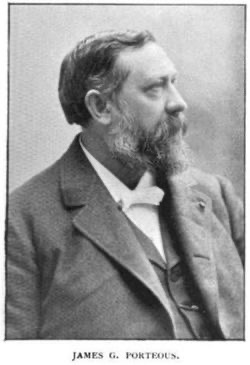
1865 Diary of James George Porteous, Surgeon of 46th New York Veteran Volunteers

The following diary was kept by James George Porteous (1839-1893), the oldest son of Andrew Halliday Porteous (181201884) and Jame B. Williamson (1814-1902) of Luzerne, Warren county, New York. James received his medical training at Harvard, graduating in 1862, and immediately offered his services as an assistant surgeon in the 118th New York Infantry, mustering in on 10 September 1862. on 12 November 1864 he was promoted to surgeon of the 46th New York Infantry and served with that regiment until mustering out on July 1865.

Porteous’ diary is for the year 1865 while serving in the 46th New York Infantry, a regiment recruited and organized in New York City and composed mostly of Germans.

A biographical sketch of Porteous states that “he greatly distinguished himself by his bravery and coolness in action, making it his invariable practice to accompany the command wherever it went, nobly sharing in its dangers and privations on the march and under fire. He was in many of the Battle and campaigns of the Army of the Potomac, and served throughout with the Army of the James, being especially conspicuous at South Anna, siege of Suffolk, City Point, Drury’s Bluff, Cold Harbor, Second Fair Oaks, Chapin’s Farm, Fort Harrison, Petersburg and Five Forks. He was known in the army as the “Fighting Surgeon” and his bravery on the occasion of Fort Harrison….” won him praise from Gen. Butler. “After the close of the James river campaign, Porteous was promoted to Surgeon and transferred to the 46th Regiment N. Y. Volunteers with which he remained until the close of the war.” [Source: Biographical Sketches of the State Officers and Members of the Legislature, New York State, p. 277]

After he returned to New York, he settled in Luzerne and practiced medicine. He was married to Sarah Frances (“Fanny”) Wilbur (1840-1911 on 21 September 1865, a date he recorded in this diary.

Transcription

January 1865

1—The beginning of a New Year is the time for good resolutions—those proving stories of the infernal regions, but I shall only make one at present—to try and keep my diary a little more full than the last. It is a splendid day but I am too sick to enjoy it.

2—Still too unwell to go out but rather better. The Asst. Surgeon of the 3rd Pennsylvania Heavy Artillery called in the evening. Received a letter from M. D. Rand.

3—Another birthday, making me 26 years old. My health has improved so much that I have been along the line. The Headquarters received 10 days furlough this morning. Snowing hard tonight.

4—Clear & cold. About one and a half inches of snow fell during the night. Received and answered a letter from home. Received Express receipt for two boxes liquor sent from New York. Health about the same as yesterday.

5—Clear but warmer. Some snow left yet. Received and answered a letter from home. Lieut. Baily called this morning. A new officer joined the regiment today. He formerly belonged to the 103rd New York.

6—Wet, disagreeable weather. No letters. The mail is very infrequent now and our quarters are so far from the troops that it is quite difficult to get papers. Lieutenants [Otto] Laddey and [Heinrich] Dreyer were here last night.

7—Pleasant except a little too much wind. Went over part of the line to see a few sick men. Received The Atlantic today from F. W. but no letter. Shall write again on the 10th if I do not receive one sooner.

8—Bright sunny day. Quite windy. Received and answered letters from Miss E. Hamlin & F. Wilbur. It has been very quiet along the line today. It is reported that we are to open on Petersburg with all our batteries next Thursday.

9—Warm and bright. Went over to Capt. [Patrick K.] Delaney’s [118th NY] near Aiken’s [Landing]. Remain to dinner with him and Mrs.  Called at Mrs. Myers on my way back. Received letters from home and from Miss McFitch & F. W.

10—Heavy thunder storm but clear this evening. Reading Shakespeare nearly all day. This evening Lieutenants [Ernst] Gerhardt & [Heinrich] Dreyer have been in my quarters a couple of hours.

11—Clear and warm. Received a letter from H. Northrup. Wrote to him and F. W. Sent to Dr. Hogan to enquire about leave of absence but am told to wait. Took a ride this afternoon with Adjutant [Ernst] Gerhardt

12—Clear and warm. Received a letter from home. In the afternoon rode up to Lieut. [James D.] Bailey’s and afterward to [Otto] Laddey’s in Ft. Mansfield. Lieut. [Heinrich] Dreyer called this evening.

13—The finest day we have had this winter. Rode out in the morning. Called on Miss Myers. The time seems very long with nothing to do and no chance to study.

14—Cloudy in the morning but clear and cold afternoon. Made another application for a leave of absence but hardly expect it to be successful. Col. [Adolphus] Becker is over his time on leave.

15—Fine warm day. Am still suffering with diarrhea. Remained in my tent all day. A couple of the Brigade staff called this afternoon but did to stop long.

16—Clear and warm. Dr. Hogan, Medical Director of the Division, called this afternoon with Capt. Brown. He does not talk as if there were much chance for me to go NNNorth. Received a letter from Col. [George F.] Nichols [of the 118th N. Y.].

17—Clear and warm. Went up to Lieut. [James D.] Bailey’s and from there to Division Headquarters and then with Dr. Hogan to the field hospital. My application for leave was approved at Division Headquarters.

18—Cloudy but warm. Received and answered letters from home and from F. W.  Dr. [Gustav] Ohnesorg was here to dinner. Remained in camp all day.

19—Cloudy and cold. This morning received a leave of absence for twenty days. Intend to start for the North tomorrow. Went to Ft. Mansfield this afternoon.

20—Start for home, Miss the train to City Point and ride down on horseback. Met Dr. Wright of the 1st New York going to New York. Took the Baltimore boat at five p.m. Dr. Wright is out of money and I pay his fare to New York.

21—So much ice that we just managed to get the one o’clock train. Reached New York at 12 midnight. Dr. Wright stayed with me at the Astor House. I cannot go on till 5 p.m. tomorrow.

22—Called at Helds’ Hotel to see Col. [Adolphus] Becker but he had gone out. Stayed in the house most of the day. At half past four took the cars at 27th Street for Boston.

23—Arrived at Boston at 3 a.m. Stopped at the Revere House. Called on F. W. at 2 p.m. and spent the afternoon and evening with her.

24—Forenoon had some photographs taken. Afternoon went with F. W. to Brighton sleigh riding. Spent the evening with her.

Harriet Goodhue Hosmer (American, 1830–1908), Zenobia in Chains, 1859. Marble, 49 inches high (88 inches with pedestal). 

25—Morning called on G. [Walter] Babb. Afternoon went to the Natural History Rooms to see Miss Hosmer’s Zenobia with F. W. Spent the evening with her. Proposed and accepted.

26—A.M. called on Rand with Mrs. Dix. Afternoon and evening with F. W. Last evening called on E. Babb and Mrs. Hay.

27—Took the 7:30 a.m. train for Ft. Edward but missed the connection at Rutland where I have to stay tonight at the Central House.

28—Took the 5:30 train. Arrived at Glens Falls at 9 a.m. Home at 12 noon. Found everything about as before I went away.

29—Stayed at home all day. The weather is clear and cold with plenty of snow.

30—Went to Little Falls. Saw a good many that I use to know but hardly any of them recognized me. I prefer the army to Luzerne.

31—Clear and cold. Stayed at home nearly all day. Evening at Joseph Ferguson’s, Met Miss Morgan.

February 1865

1—At home nearly all day. Time begins to drag. Hardly know what I would do if out of the service entirely.

2—At home. Expect to leave in the morning. Shall probably go by way of Boston.

3—Up at 4 a.m. and off again. Went to the landing with Ors. Randal. Stage to Saratoga. Took the evening train to Rutland.

4—Missed the morning express to Boston. Took the accommodations but did not connect at Bellow’s Falls and have to wait till 2:18 train. Left Bellow’s Falls at 5 p.m.

5—Arrived at Boston about 2 a.m. Stopped at the Revere House. Called on Fannie at 9 a.m. and spent the day and evening with her. Did not go to church.

6—Morning at the hotel. At 11 called on Fannie. Spent the afternoon with her & in the evening went with her to the Atheneum.

7—Started at 11:10 for the front by way of the shore line to New York. Arrived at New York at 9 p.m. and took the Baltimore train at 12 midnight. Afternoon and night a very hard storm.

8—Arrive in Baltimore at 9 a.m. Stopped at the Eutaw House till 4 p.m. and took the boat for Ft. Monroe. My valise had not got through, Left the check (No. 7026) at the House to have it forwarded by Express.

9—Arrived at Ft. Monroe at 7 a.m. City Point at 3 p.m. and camp at 4 p.m. ending my leave and seems like a midsummer night’s dream.

10—Went to Point of Rocks to see Col. [George F.] Nichols who is there sick. Met Balling [?], my old hospital steward who is now an assistant surgeon. Afternoon writing letters.

11—Clear and warm. Went to Ft. Mansfield to attend sick call. From there up to the quartermasters. Afternoon took a ride and wrote a couple of letters.

12—Clear but very windy. One of the men died in his quarters last night after a few hours illness. Received a letter and The Atlantic for February from Fannie.

13—Clear and cold. Went to Point of Rocks Hospital to see Col. [George F.] Nichols. He is improving but talks strongly of leaving the service. Afternoon reading and writing.

14—Clear and warmer though still so cold that the Appomattox is frozen over. Rode along the line in the morning. Quartermaster [Carl] Ferber called this afternoon. Wrote a letter in regard to my valise.

15—Wet, disagreeable day. No mail today. Spent most of the time in reading, playing chess, &c. Have not received any letters from home since my return. My values has not yet arrived.

16—Warm and cloudy. Rode down to Mrs. Myers. Made a short call. Studying, chess, and writing letters. Evening in Capt. [Victor] Praxmarer’s tent.

17—Warm and rainy. Considerable musketry on our right last night. Had a few words with Asst. Surgeon [Gustav] Ohnesorg in regard to something he had said of my neglecting duty. He signed a paper denying it. A letter from Fannie.

18—Clear and warm. Went to Point of Rocks Hospital to see Col. [George F. ] Nichols. He is getting along nicely. Had a long talk with him about old times [in the 118th New York] and future prospects.

19—Bright and warm. Stayed in camp all day. Received and answered a letter from father—the first since my return. I have very little to do now and the days seem quite long.

20—Warm and pleasant. Went to the Division Hospital to have two men examined for the Invalid Corps but the Board adjourned without action. Received a letter from Col. [Oliver] Keese [118th N. Y.]. Charleston reported evacuated.

21—Bright and warm. No letters today. Evacuation of Charleston confirmed. 200 guns left. Afternoon took a ride with the Adjutant [Ernst Gerhardt]. Went to the sutlers.

22—Bright and warm. Very heavy artillery firing. One of our regiment killed. Received a letter from Fannie. Nothing farther from Charleston.

23—Warm. Drizzling rain. Received a box of wedding cake sent by Fannie from her brother’s wedding. Lieut. [Otto] Laddey returned from leave of absence. Spent most of the day in reading and playing chess.

24—Warm and wet. Forenoon at home. Received a letter from Fannie and one from Mr. Hamlin. Afternoon went up to the sutlers with the Col. and Adjutant. Rather a jolly time.

25—Raining. Received a letter from home. Wrote to E. Hamlin, Fannie, and Father. Rest of the day reading and playing chess. Too wet to go out. Heavy mortar firing in the evening.

26—Warm and cloudy. Wrote to Mary Porteous and Col. Reese. Received letters from Fannie and several business notes. My valise is all right in Baltimore but the Express Co. cannot bring anything to the army at present.

27—Clear and warm. received a letter from Baltimore in relation to my valise. Saw Col. [George F.] Nichols yesterday. He is looking better. Most of the time today reading and writing. Dr. [Gustav] Ohnesorg talks of resigning.

28—Warm with some rain. No letters. Sent Squires over to B___’s. Monthly reports &c. sent to headquarters. Most of the day reading and smoking. Mustered for 6 months pay.

March 1865

1—Cool and cloudy. No letters. Went to Mr. Mill’s house with several officers where we had some m____. Maj. Schilling and a Lieutenant were at tea with us. Continued good news from the South.

2—Cool with rain nearly all day. Received and answered a letter from Fannie. Have not been away camp. Called at Mr. Rushmore’s who is sick. Reading & playing chess.

3—Warm and cloudy. Some rain. No letters. Rode out as far as Capt. Bailey’s quarters. Played a few games of chess. It is extremely dull for me in this regiment being all foreignors.

4—Rain in the forenoon. Clear p.m. but very windy. A letter from M. J. Fitch. Called at Mr. Rushmore’s. No salutes fired today as expected on account of Lincoln’s re-inauguration. Reading and playing chess.

5—Clear and warm. Received letters from home and one from Fannie. After dinner, rode out with Maj. Schilling and Capt. Becker. Evening writing letters.

6—Clear and warm. Rode down to Point of Rocks to see Col. [George F.] Nichols. He is getting along finely and expects to go to camp next eek. Afternoon reading and playing chess.

7—Clear and warm. The great event of the day was the paymaster’s arrival. I was paid up to the 1st of January 1865. Received and answered a letter from Fannie. Rode down on the line.

8—Warm and rainy. Received letters from home and a smoking cap from Fannie. Went out on the line and got very wet. Reading and writing, &c.

9—Warm and raining. Have not been away from camp. Wrote to father & gave L. Kreuder [sutler] some money $250 to Express home for me & $60 to P. T. Barnum & Co., New York

10—Morning raining. Afternoon clear. No mail. Went out to Lieut. [Otto] Laddey’s quarters to play chess. If clear in the morning, intend going to Point of Rocks.

11—Clear and warm. Went down to Point of Rocks and took dinner with Col. [George F.] Nichols. Called on Chaplain [Charles L.] Hagar [118th New York]. Read and answered a letter from Fannie. Ordered boots from G. Babb.

12—Clear and warm. Received letters from home. Rode up to Ft. Mansfield in the morning. Sent some flowers to Col. Nichols. Evening writing.

13—Clear and warm. Roads drying very fast. Received a letter from Lieut. Northrup. He expects to come over here this week. Went to Division Headquarters and Meade Station today. Had a pleasant ride.

14—Clear and Warm. Went to Point of Rocks and from there with Col. Nichols to City Point. Capt. Delaney called while I was gone. Ordered to send off all sick who are unable to march. Looks like a move.

15—Warm and cloudy with a good deal of wind and a little rain. All surplus baggage has been sent to the rear and we are ordered to be ready to move at a moments notice. Received and answered letters from Fannie and my father.

16—Cloudy with very high wind—a perfect hurricane in the evening. Went along the line and stopped awhile at Lieut. [Otto] Laddey’s. No move yet but all kinds of rumors. Received a paper from Fannie.

17—Clear and warm. Received letters from Fannie & M. J. Fitch. Went to City Point with Capt. [Ernst] Gerhardt. Called at the German relief Association. Had a likeness taken. No farther sign of a move.

18—Clear and warm. Took some men before the examining board, two to be transferred to the Invalid Corps & one discharged. The quartermaster sergeant returned tonight and says they would not let him have my valise. The sutler Kreuder is going to try to get it.

19—Clear and warm. Went over to Point of Rocks Hospital and from there with Col. Nichols to the Crow’s Nest Battery. We had a splendid ride over the old grounds where we used to be last spring.

20—Clear and very warm. There was heavy firing on our right in the morning and rumors of a fight. And in the afternoon, firing and more rumors of another fight on the left. Received a letter from Fannie. We are fixing up round our quarters very nicely.

21—Showers during the day with heavy rain in the evening. Dr. Chubb, Surgeon in Chief of the Brigade called. Dr. [Gustav] Ohnesorg is detailed to the 60th Ohio. Most of the day writing and playing chess.

22—Clear and cool. Having the grounds around my tent fitted up and a garden made. No mail. Went to Ft. Mansfield and along the line.

23—Clear and warm but very windy. Stayed in my quarters except going on the line to see some sick. We are to move in the morning at five to Ft. McGilvery. Relieved by the 50th Penn. Vols.

24—Clear and cool. Moved camp and got my quarters fitted up as well as could be expected. I am in the ravine just in rear of the fort. There was not room enough inside.

25—Clear and warm. The Rebs charged on the 3rd Brigade sexton our left, broke through capturing two forts [Fort Stedman] and a number of men but finally were driven out again with heavy loss. Our regiment lost two killed and two wounded. I was out on the field while the flag of truce was out and saw the Reb. Gen. [Matthew W.] Ransom.

26—Clear and cool. Went down to Point of Rocks to see Col. Nichols. They have just laid another pontoon bridge and expect Sheridan’s Cavalry to cross & join the Army of the Potomac tonight.

27—Clear and warm. Went to Meades Station to see Sheridan’s Cavalry pass and then over to Ft. Haskell with Maj. Verner. Received letter from Fannie and from home.

28—Clear and warm. Went over the lines with some officers of the English army. Received a letter from Fannie and one from Col. Reese. We are ordered to be ready to move at a moments notice.

29—Clear and warm. Nothing new along the lines and but little firing. The [New York] Herald had a very good account of Saturday’s fight. Wrote to Col. Reese and to Fannie.

30—Warm with rain all day, Last night we had another attack at half past 10 lasting two hours when the rebels were repulsed. The shelling was very heavy. My tent got well riddled. Two killed and 4 wounded in this regiment.

31—Morning rain. Afternoon clear. Making out reports for end of month. Met Dr. [John Call] Dalton, the physiologist at Brigade Headquarters. Saw Dr. Hogan, Division Medical Director, who says I am to be part on the staff of operating surgeons.

April 1865

1—Clear and warm. No news from the fighting on the left. Sent in my reports for the last month. Received a letter from father acknowledging the receipt of $250.

2—Clear and war. Our regiment made a charge at daylight but were repulsed. Lost 16 men. only three companies engaged. There has been heavy fighting along the lines all day. We have taken some works. Petersburg has been burning in several places.

3—Clear and warm. Entered Petersburg this morning. Richmond is also in our possession. Ours was the first brigade in and so are to be left to do provost duty. Made the acquaintance of Mr. [H. H.] Potter and family.

4—Clear and warm. Getting our camp in order. Our pleasant time is to be short. We are ordered to move in the morning. Called on Mrs. Potter, 33 Bolingbrook [Bolingbroke] Street. Saw Miss S. Smith.

5—Clear and warm. Went down town and called on Mrs. Potter before marching. She presented me with a nice S. C. Palmetto flag. Marched out two miles beyond Sutherland’s Station and went on picket.

6—Warm and cloudy. Ordered to go to an old Reb Hospital and take care of the wounded Rebs. Made one amputation of the thick lower third. Made the acquaintance of a Confederate Surgeon—Dr. Bedan.

7—Clear and warm. Remained here dressing wounds and sending Reb soldiers to Petersburg. Rations are short nd as we get no mail here it is hardly pleasant.

8—Clear and warm. Sent off all the patients from here but have 39 confeds in the old camp in the woods. Went down there to see them. They are doing well.

9—Clear and warm. Went to Petersburg. Called on Mr. Potter. Had a pleasant visit. The patient I operated on the other evening died of secondary hemorage.

10—Warm and rainy. Move up to Sutherland’s as the patients are all move from Garrets. Dr. Bedan, C. S., service is still with me.

11—Warm and rainy. Went out to Miss Anderson’s. They are pleasant people. Gen. Ewell, Custis Lee, Kershaw, and six other Reb Generals stop here tonight as prisoners. Gen. R. Lee has surrendered his army.

12—Warm and rainy. Still in hospital at Sutherland’s. Sent all of my patients off. Went to Mr. Well’s with Dr. Hamilton. Had a pleasant call.

13—Warm and showery. Came back to my regiment ten miles from Sutherland’s. Found them in a pleasant place near Ford’s Station. Received several letters.

14—Clear and warm. Went out riding with the Colonel and Adjutant. The country shows all the desolation of war. The people say they wish it was over.

15—Cool and wet. Went to Brigade Headquarters. Capt. Dreyer and several other officers called. We have a man making cigars of tobacco found on this place.

16—Clear and warm. Received a dispatch announcing the assassination of President Lincoln and Secretary Seward and son in Washington, Large numbers of recruits are passing on their way to the front.

17—Clear and warm. Went to Division Headquarters with Col. Becker and Adjutant Gerhardt. Stopped at Verner’s Battery. Saw Harvey Beach.

18—Clear and warm. Received my valise today. It has taken a long time to come. Went down to Petersburg this evening. Called at Mrs. Potter’s. Went out for a walk with Miss Smith.

19—Clear and warm. Stayed at Mrs. Potter’s last night. Had a very pleasant visit. Took the train at 1 p.m. for camp. Arrived this evening. Found 3 letters waiting.

20—Warm and cloudy. Received marching orders and started for Petersburg. Camped two miles from the city.

21—Warm and cloudy. Started at 5 a.m. for City Point. I stopped in Petersburg at Mrs. Potter’s. Ha a pleasant forenoon with her and Miss S. Smith. Arrived at City Point just in time to take the boat for Washington.

22—Clear and warm. Lay by last night in James River. We are having a pleasant trip but rather slow.

23—Clear and cool, at any rate, much colder than around Petersburg. Arrive in Alexandria this morning and camped about two miles from the city.

24—Clear and warm. Rode round to several of the forts in this vicinity. Called at Ft. Scott and spent the afternoon with Lieut. Wilbur & wife. Had a pleasant visit. Received a letter from Fannie.

25—Clear and warm. Remain in camp. Nothing doing and we are waiting for something to turn up.

26—Clear and warm. Move up from Alexandria to near Georgetown. We had quite a warm march but got in in good season.

27—Clear and warm. Move camp a few rods. I went to Washington with Gerhardt and stopped at Gerhardt’s Hotel. Had a very pleasant time. Washington has not changed much.

28—Clear and warm. Returned to camp. Everything begins to look as if we were to remain in this part of the country though I can see no reason for keeping troops here.

29—Clear in the morning. Wet in the afternoon. Maj. French joined the regiment today. He has always been detached on staff duty. No passes granted to go to Washington at present.

30—Clear and cool. We are not allowed to go into either Georgetown or Washington. Col. Gerhardt visits us this afternoon and there was quite a reunion among the officers.

May 1865

1—Cold, wet and disagreeable with no fire, poor tents, and not the best of fare. We are rather uncomfortable. I have done very little besides smoke.

2—Clear and warm. Went out riding with the adjutant and found a road to Washington without a guard. Went in and had a good dinner. The way leads round Georgetown.

3—Clear and warm. Went with Maj. French over to the 1st Division, 19th Army Corps near Finley Hospital. Passed the old camp we used to occupy when on duty in Washington with the 118th New York.

4—Clear and warm. Remained in camp. Made application for another Asst. Surgeon. Had Brigade Dress Parade in the afternoon—the first since our arrival here.

5—Clear and warm. Received a letter from Col. Reese. Mrs. Keese is better. Rode down to Georgetown in the evening but did not stop.

6—Clear and warm. Went to Washington with Maj. French and stayed till 9 p.m. Had a very pleasant time for that city.

7—Clear and warm. Remained in camp all day. Received a letter from Fannie.

8—Warm and showery. In the forenoon went to Court Martial as a witness. Afternoon went to Washington with Maj. French. Met Mr. Loring of Boston. Went to the theatre in the evening.

9—Cold and wet. Stayed at the Union Hotel, Georgetown, last night and came to camp early this morning. It has been a very disagreeable day.

10—Cold and wet. Remained in camp a good deal. Ordered some uniform from New York as I do not think we are to be mustered out as soon as expected.

11—Cold and wet. Nothing new going on. Do not hear from home very often. Received and answered a letter from Fannie.

12—Clear and warm. In the afternoon went down to Georgetown with the adjutant. Had a very pleasant ride.

13—Clear and warm. Played chess most of the morning. After dinner went down to Georgetown. No letters today.

14—Clear and warm. It is very tedious here in camp with nothing to do. We are all anxious to get home again as the war appears to be entirely over.

15—Clear and warm. Usual routine of camp duty. Intended to of to the theatre this evening with the Colonel but he could not get a pass. Received a letter from Fannie.

16—Clear and warm. Went over to Arlington and then down to Fort Scott to see Lieut. Wilkens’ and wife. Had a pleasant call. Received a letter from Fannie.

17—Clear and warm. Remained in camp all day. No letters and they are nearly the only relief to the monotony of camp life.

18—Clear and warm in the morning. Thunderstorm in evening. Went to Washington. Took dinner with W. Wilkens at Willard’s. Met Capt. Fitch and Lt. Chamberlain. Also Adjutant Donahoe of 10th New Hampshire.

19—Cool and cloudy. Division review in the afternoon. Gen. Grant was present. Everything went off pleasant. Major French was out at camp this afternoon.

20—Warm and cloudy with some rain. Took a ride up by Chain Bridge and back through Georgetown, Received and answered a letter from Fannie.

21—Wet. Remained in camp all day. There was a large number of visitors to the regiment. Received an order to muster out all except veterans.

22—Cloudy and warm. Marched at two o’clock for East Capitol Street where we bivouacked for the night preparatory to the Grand Review. Stayed at Gerhardt’s Hotel.

23—Very warm. A splendid day. Up at 4 a.m. and went to the camp at East Capitol Street. Column formed up and wait till a little after nine and then commenced our triumphant march. A pleasant change from facing Rebels to facing roses.

24—Clear and warm. In the city all day seeing the review of Sherman’s Army. They made a fine appearance.

25—Clear ad warm. Stayed in camp all day. Mr. Loring of Boston adn Maj. French called this afternoon.

26—Cold and wet. Remained in camp all day. Received letters from Fannie, Miss Hamlin, and one of my sisters.

27—Cold and wet. A very disagreeable day. Remained in camp all day. H. Beach called in the evening. He expects to go home soon.

28—Cool and cloudy. Took a short ride. The rest of the day in camp. Was rather surprised to receive a letter from Mrs. M. D. Tracy who I had not heard from in over two years.

29—Clear and warm. Went across the river to Ft. Scott to see Lieut. Wilbur. His wife has gone home. Received a letter from Col. Nichols. He is in Richmond.

30—Clear and warm. Called on Dr. Chubb. His regiment—the 20th Michigan—was mustered out today and start for home in two days. Harve Beach called in the evening. He is a nuisance.

31—Clear and warm. Remained in camp during the forenoon. Afternoon received an order to report in Washington at once with all camp in garrison equipage camped on Capitol Hill.

June 1865

1—Clear and warm. We are detached from our Old Brigade temporarily for duty in the city. I went to Dr. Fowler’s office to report and receive instructions but did not find him.

2—Clear and warm. Stayed in camp all day. The weather is very warm but our field and staff tents are in a nice shady place and we get along nicely. A letter from Fannie.

3—Clear and warm. Called on Dr. Fowler and Dr. Ensign. They appear to be pleasant fellows. No letters today.

4—Clear and warm. Remained in camp all day. 150 of our men started for home today. We are lucky in having a shade this warm weather.

5—Clear and warm. In camp nearly all day. In the evening went to a picnic where the principal business appeared to be drinking lager.

6—Cloudy and cool. Went into the city. Spent an hour in the Capitol. In the evening called on Mrs. Portallis and her daughter.

7—Clear and warm. Remained in camp during the day, In the evening took a ride in the city, The entire regiment ordered to the arsenal [penitentiary] to relieve a regiment without ammunition guarding the [Lincoln assassination] conspirators.

8—Clear and warm with a slight shower in the evening. Col. Beckert is under arrest for some trouble with Gen. [John F.] Hartranft last night. The Gen. says he was drunk.
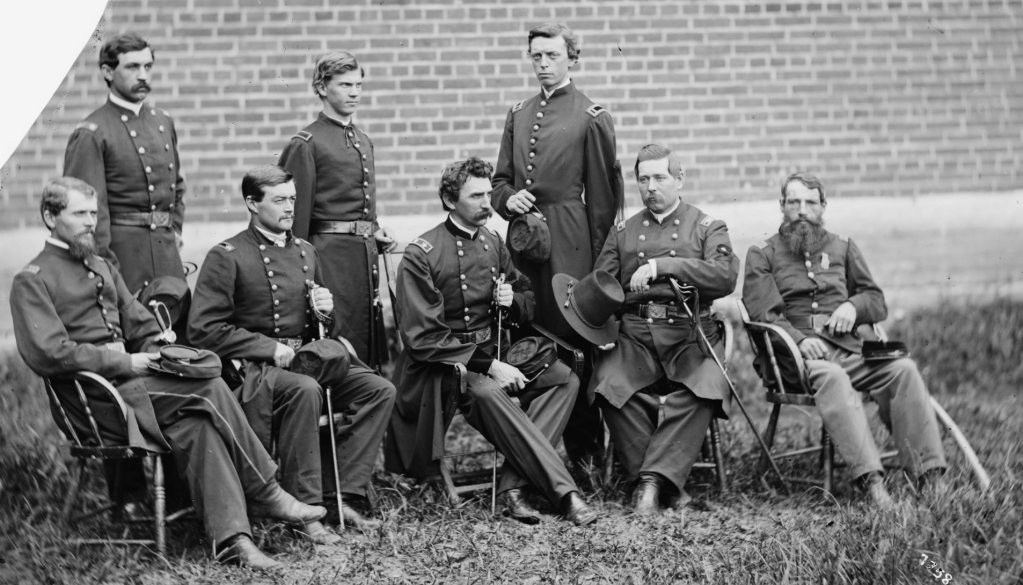
Alexander Gardner photograph of Gen. John F. Hartranft and staff, responsible for securing the conspirators at the Arsenal. Top row left to right: Lt. Col. S. W. Frehrich; Lt. Geissinger; Surgeon G. T. Porter. Bottom row left to right: Capt. A. R. Watts; Lt. Col. W. H. McCall; Gen. Hartranft; Col. L. A. Dodd; Capt C. Roth

9—Clear and warm. Down in the city during the morning. At noon, ordered back to our old camp at Tennalytown. Arrive in the evening and took our old position.

10—Cloudy and cool. Remained in camp all day. Capt. Kisselmark called for a short time. Received letter from Fannie.

11—Clear and warm. Remained in camp all day. There is great dissatisfaction among the officers at having Capt. [Victor] Praxmarer in command. He was half drunk on dress parade again tonight and made several mistakes.

12—Clear and cool. Remain in camp all day. Capt. Praxmarer put under arrest for being drunk on duty while Brigade Officer of the Day. [Otto] Laddey in command.

13—Warm and cloudy. Heavy thunder shower in the afternoon. Remained in camp all day. Came very near having a chill commence taking in again.

14—Warm and cloudy. Some rain. In camp all day. This life is becoming very tedious. No letters today.

15—Cool & cloudy. Forenoon in camp. Afternoon rode down to Georgetown. Rumor that we are to be sent to New York. Letter from Fannie and one from Dr. Ohnesorg.

16—Clear and warm. In the afternoon rode down to the Division Hospital and Georgetown. In the evening there was a Division Review by torchlight but an unfortunate shower soaked the crowd.

17—Cloudy and warm. Remained in camp all day. My horse has lamed himself so I cannot ride. Having at Laddey’s. Received a letter from Fannie.

18—Clear and warm. Remained in camp all day. Can learn nothing of how long we are to be kept in the service and hardly have a settled plan of where I shall go when I get out.

19—Rain. Remained in camp all day. Received and answered a letter from Fannie. Played several games of chess. Indeed, i do that nearly every day.

20—Rain all day. Remained in camp. It seems very dreary this listless life after active service. An even worse when wet.

….

July 1865

7—Clear and very warm. remained in our temporary camp. Four of the conspirators were hung today. Did not go to see the execution.

27—Clear and warm. Mustered out…

September 1865

21—Married to Fannie at 10 by Dr. E. E. Hale. At 11 started for home. Came to Rutland tonight.

W. Z. Bedon, Columbia, S. Carolina. Anderson’s Corps Hospital, Greenville, Miss.

1863-64: John Gilman to J W. Gilman

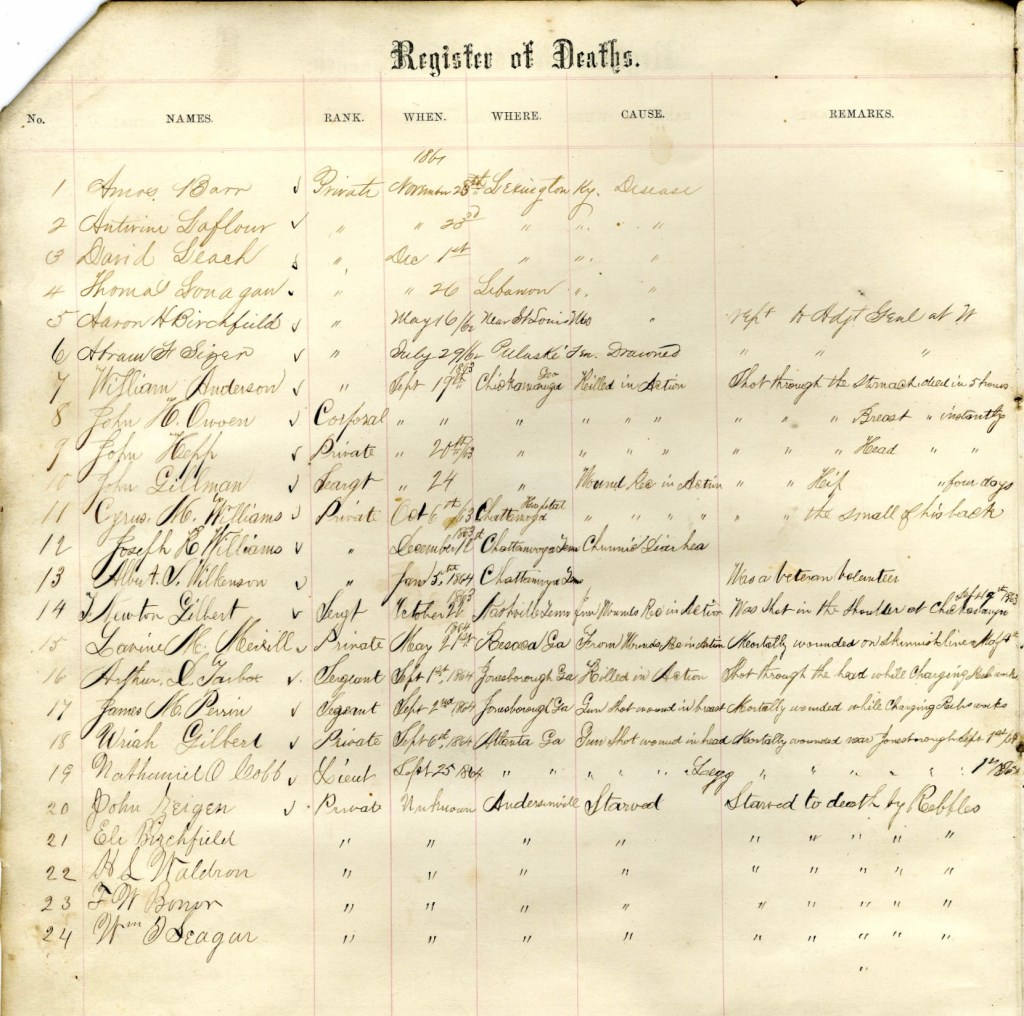
Three of the following five letter were written by John Gilman who enlisted in Co. A, 14th Ohio Infantry in mid-August 1861. He mustered in as a corporal and was promoted to sergeant before he was mortally wounded in the Battle of Chickamauga, dying of a gunshot wound to the hip three or four days afterwards.

Of the two remaining letters, one was written by Livingston Everett Beardsley (1840-1923) and the other by Capt. Albert Moore.

The Battle of Chickamauga, Georgia

Letter 1

Lavergne, Tennessee
February 28, 1863

Dear Brother,

Your letter of the 23rd inst. was received this afternoon. My health is as good as usual. The weather is warm but decidedly on the wet order. It rains nearly every other day and pours down occasionally between showers.

I have nothing new to write you. Everything is quiet in this vicinity. The fort at this place is nearly finished. It would have been done a week ago if it had not rained so much. The citizens here curse the war and everybody and everything connected with it.

We can whip the rebels in our front if we don’t get too strong a fire in the rear. Hang the Copperheads in the North & we will attend to the rebels in the South.

On the 18th inst. I sent you one hundred dollars in Uncle Sam’s promises to pay which I suppose you have received before this time.

We get the Louisville & Cincinnati & Nashville papers every day. I am second sergeant. — Jno.


Letter 2

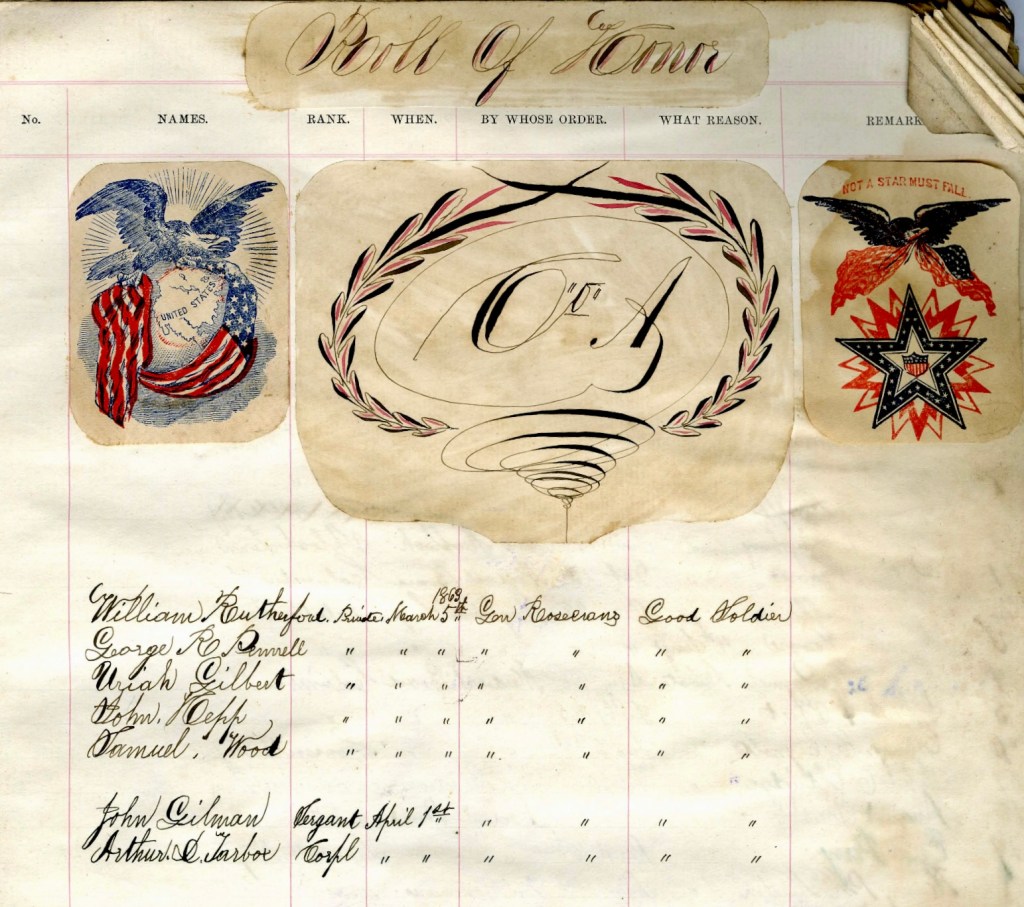
Page from the 14th OVI, Co. A Muster Roll Log, MSU Library Digital Collections

Lavergne, Tennessee
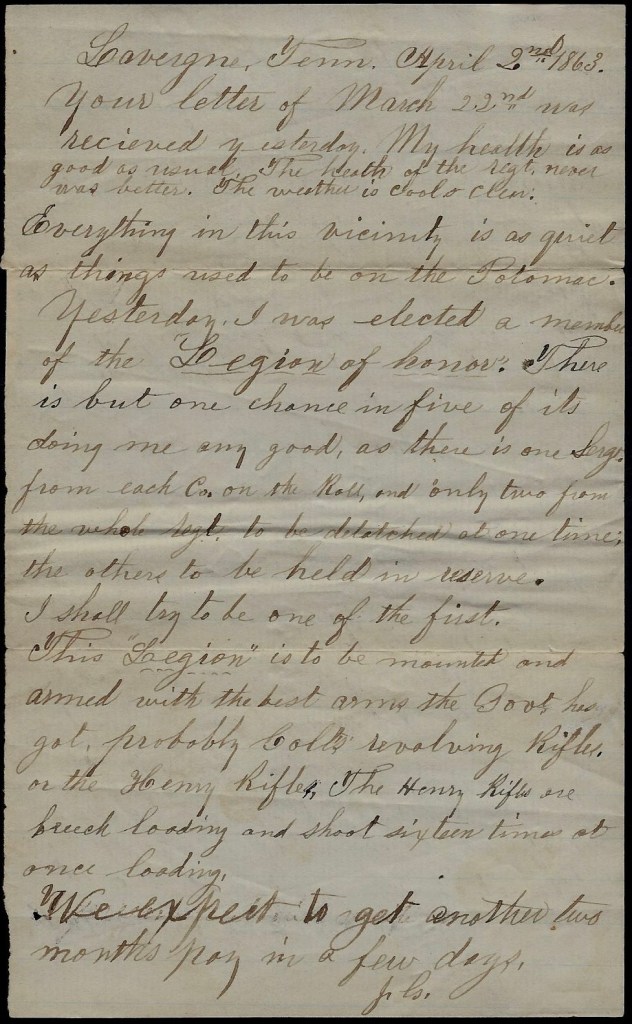
April 2, 1863

Your letter of March 22nd was received yesterday. My health is as good as usual. The health of the regiment never was better. The weather is cool & clear.

Everything in this vicinity is as quiet as things used to be on the Potomac. Yesterday I was elected a member of the “Legion of Honor.” There is but one chance in five of its doing me any good as there is one sergeant from each company on the roll and only two from the whole regiment to be detached at one time; the others to be held in reserve. I shall try to be one of the first. This “Legion” is to be mounted and armed with the best arms the government has got—probably Colt’s revolving rifles or the Henry rifles. The Henry rifles are breach-loading and shoot sixteen times at one loading.

We expect to get another two months pay in a few days.

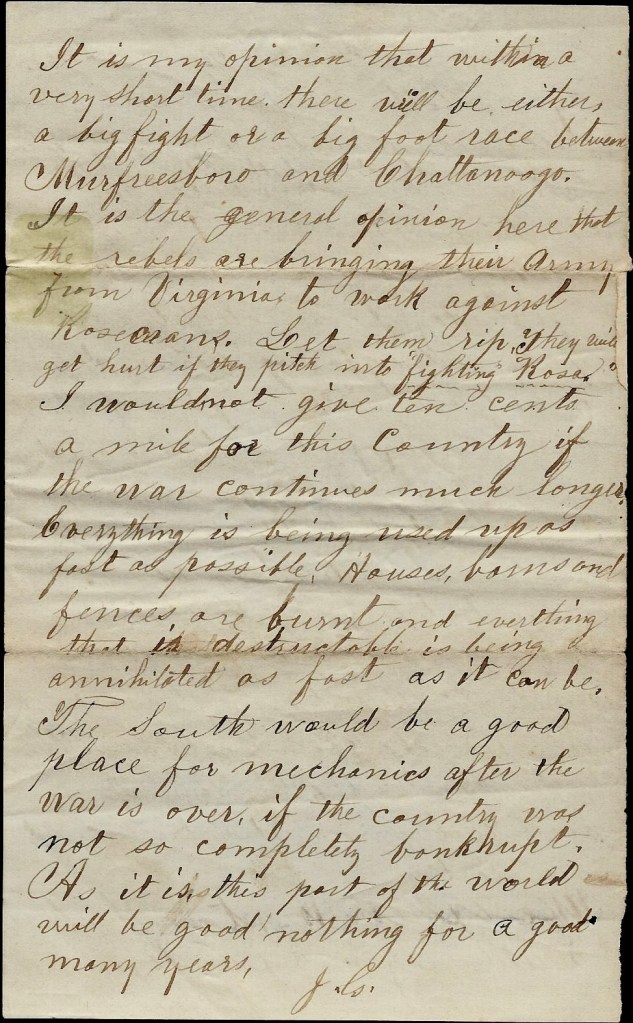
It is my opinion that within a very short time there will be either a big fight or a big foot race between Murfreesboro and Chattanooga. It is the general opinion here that the rebels are bringing their army from Virginia to work against Rosecrans. Let them rip. They will get hurt if they pitch into fighting “Rosa.” I wouldn’t give ten cents a mile for this country if the war continues much monger. Everything is being used up as fast as possible. Houses, barns and fences are burnt and everything that is destructible is being annihilated as fast as it can be. The South would be a good place for mechanics after the war is over if the country was not so completely bankrupt. As it is, this part of the world will be good [for] nothing for a good many years. — J. G.


Letter 3

Winchester, Tennessee
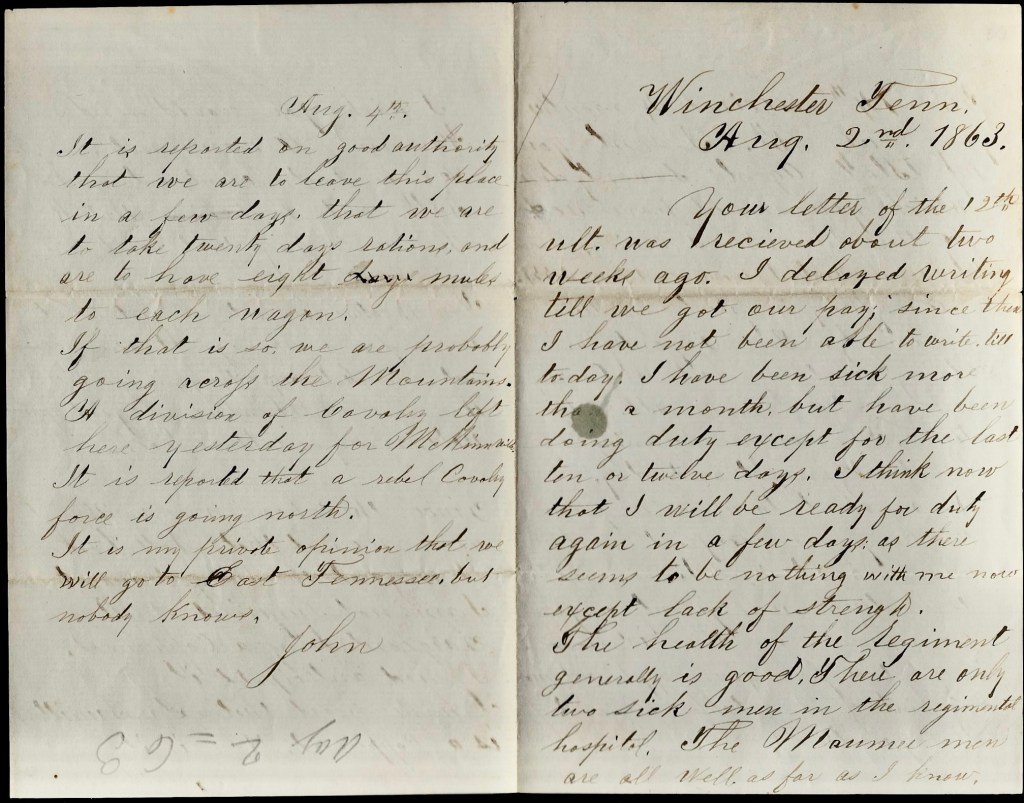
August 2nd 1863

Your letter of the 12th ult. was received about two weeks ago. I delayed writing till we got our pay. Since then I have not been able to write till today. I have been sick more than a month but have been doing duty except for the last ten or twelve days. I think now that I will be ready for duty again in a few days as there seems to be nothing with me now except lack of strength.

The health of the regiment generally is good. There are only two sick men in the regimental hospital. The Maumee men are all well as far as I know. The 14th [Ohio] received four months pay July 26th. I sent you by “State Agent” seventy dollars which you should have received by this time. This, I believe, makes the whole amount and I have sent you $255.

Everything is quiet in this vicinity. The infantry are doing nothing but the cavalry are on the move all of the time. The cars are running constantly night and day. We are about three miles from the camp we occupied last year about this time but then there was plenty of green corn here. Now there is none. We get a few green apples, not many. Any kind of vegetables are out of the question.

I wish you would send me Foreman Evans’ note. He is 2nd Lieutenant in the 38th [Ohio] and I think he will pay that note.

The weather is not so hot as it was a few weeks ago. It rains occasionally, just enough to keep things in good order. We have an abundance of good spring water, nearly as cold as ice.

Since the above was written I have received that roll book. It is just the thing I want. I am not surprised at Moses Sargeant being a Copperhead. I had anticipated it. I have heard that Dr. Burritt is a Copperhead. How is it?

August 4th. It is reported on good authority that we are to leave this place inn a few days, that we are to take twenty days rations, and are to have eight mules to each wagon. If that is so, we are probably going across the mountains. A division of cavalry left here yesterday for McMinnville. It is reported that a rebel cavalry force is going north.

It is my private opinion that we will go to East Tennessee but nobody knows. — John Gilman


Letter 4

Chattanooga, [Tennessee]
October 24, 1863

Mr. Gilman,

Dear sir, your letter of the 11th inst. was received today. It causes me great pain to corroborate the fearful statements you have already received. Your poor brother is no more. I saw him wounded on the field and tried to carry him back. Our troops were falling back at the same time and it was with the greatest exertion that I could keep up. John tried to assist me by hobbling along on one foot but he was so weak that we made slow progress.
I helped him in this way about half a mile when he became so exhausted that he could go no farther. Four Indiana boys were straggling back just where we were and volunteered to carry him to a hospital. I gave him into their hands and never saw him again. He was shot in the hip by a musket ball but in what direction the ball enters, I was unable to discover. It lodged inside. I did not think at the time that he was dangerously wounded but Frederick Barnes of our company who was also wounded and left in the hands of the Rebels but afterwards came into our lines by flag of truce says he saw John when he died, which was on Monday.

They had both been carried to the hospital but it was so full that they were left outside with a great many others. Barnes says he called to John about half an hour before he died and was answered. He says he heard John ask for a drink of water. He only took one swallow which seemed to choke him and he tried to vomit. A few minutes after this and his spirit had taken its flight for the untried realities of another world.
His loss is deeply lamented here. He was a good soldier and had gained the confidence and esteem of all who knew him. The only thing left that belonged to John is his pocket knife which is now in the possession of Barnes. I will endeavor to have it sent to you. Everything else fell into the hands of the Rebels.

Yours &c. — L[ivingston] E. Beardsley


Letter 5

Ringgold, Ga.
April 11th 1864

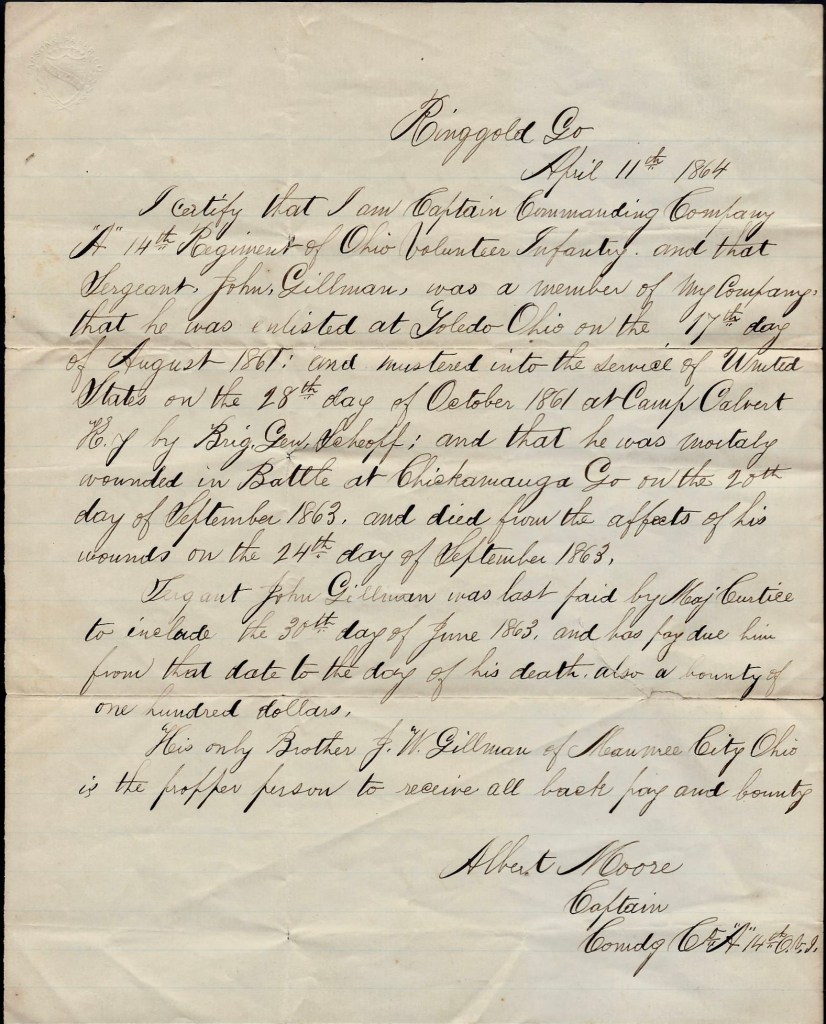
I certyify that I am captain commanding Company A, 14th Regiment of Ohio Volunteer Infantry and that Sergeant John Gillman was a member of my company, Co. A of the 14th Ohio Infantry. He was enlisted at Toledo, Ohio, on the 17th day of August, 1861, and mustered into the service of United States on the 28th day of October 1861 at Camp Calvert, Kentucky, by Brig. Gen. Scheoff, ad that he was mortally wounded in Battle at Chickamauga, Ga. on the 20th day of September 1863, and died from the effects of his wounds on the 24th day of September 1863.

Sergeant John Gillman was past paid by Maj. Curtice to include the 30th day of June 1863, and has pay due him fro that date to the day of his death, also a bounty of one hundred dollars.

His only brother, J. W. Gillman, of Maumee County, Ohio, is the proper person to receive all back pay and bounty.

Albert Moore, Captain, Commanding Co. A, 14th OVI

Register of Deaths in Co. A, 14th OVI, MSU Libraries Digital Collections

1863: Freeman Walker to Fannie (Walker) Miller

The following letter was written by Freeman Walker (1825-1864) who enlisted as a private in Co. K, 27th Georgia Infantry in March 1862. After he was promoted to sergeant, he was taken a prisoner in the fighting at South Mountain on 14 September 1862 and confined at Fort Delaware until 10 November 1862 when he was exchanged at Aiken’s Landing, Virginia. After returning to the regiment he was elected 2nd Lieutenant on 16 March 1863. In March 1864 he was reported as slightly wounded by a gunshot wound to his right leg. He died on 27 June 1864.

I’m reasonably confident that Freeman Walker was John Freeman Walker (b. 1825), the son of Johnson Walker (1794-1830) and Sarah Swindall (1797-1854) of Talbot county, Georgia. He had been married to Julia Ann Dixon (1825-1852) but she died in 1852, leaving him a widower with two children.

Freeman addressed his letter to Fannie. I suspect she was his older sister, Frances (“Fannie”) Walker, born 1817, and the wife of Green J. Miller.

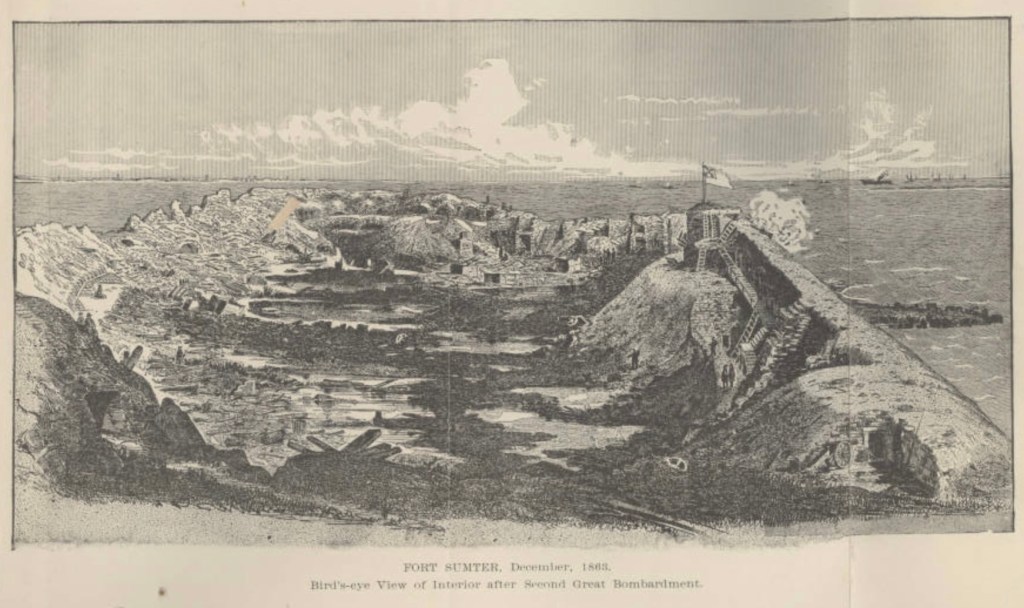
The interior of Fort Sumter during the time Freeman Walker was there, December 1863.

Transcription

James Island [South Carolina]
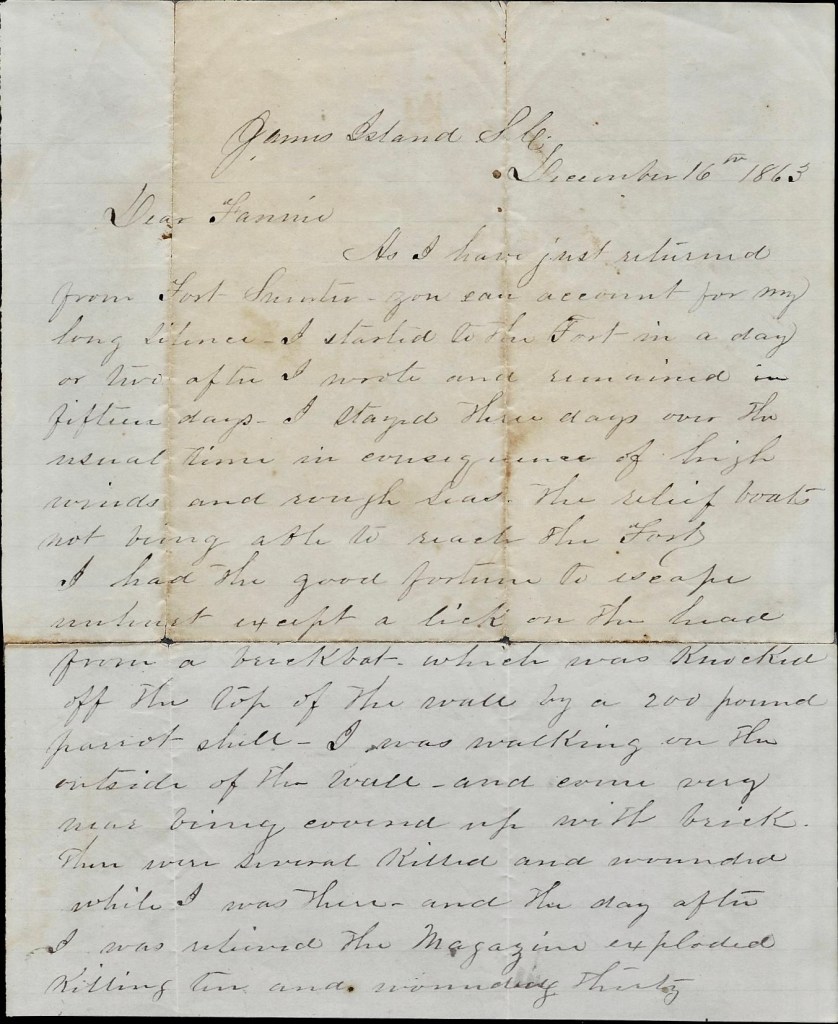
December 16th 1863

Dear Fannie,

As I have just returned from Fort Sumter you can account for my long silence. I started to the fort in a day or two after I wrote and remained fifteen days. I stayed three days over the usual time in consequence of high winds and rough seas, the relief boats not being able to reach the fort.

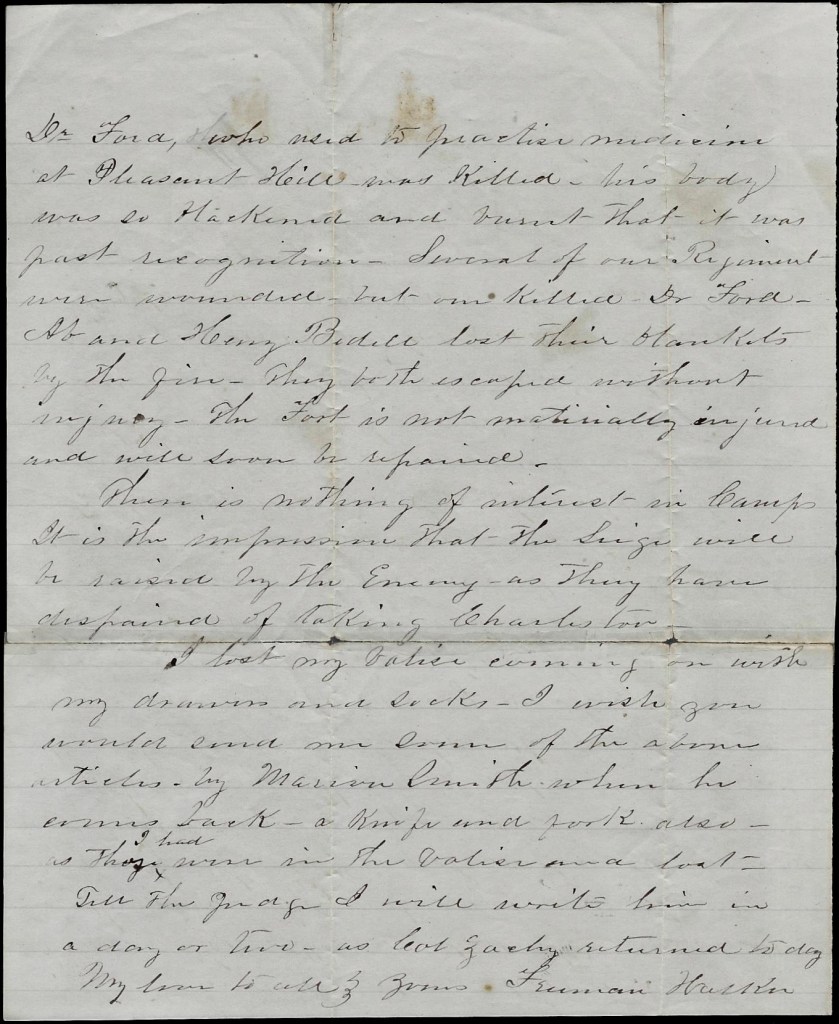
I had the good fortune to escape unhurt except a lick on the head from a brickbat which was knocked off the top of the wall by a 200 pound parrot shell. I was walking on the outside of the wall and come very near being covered up with brick. There were several killed and wounded while I was there and the day after I was relieved, the Magazine exploded killing ten and wounding thirty. Dr. [J. T.] Ford, who used to practice medicine at Pleasant Hill was killed. His body was so blackened and burnt that it was past recognition. Several of our regiment were wounded, but [only] one killed—Dr. Ford. Ab[ner] and Henry Bedell lost their blankets by the fire. They both escaped without injury. The fort is not materially injured and will soon be repaired. 1

There is nothing interest in camp. It is the impression that the siege will be raised by the enemy as they have despaired of taking Charleston.

I lost my valise coming on with my drawers and socks. I wish you would send me some of the above articles by Marion Smith when he comes back. A knife and fork also as they were in the valise and lost.

Tell the judge I will write him in a day or two as Col. Zachy returned today. My love to all. Yours, — Freeman Walker


1 In the history of the fort, it is stated that for an “unknown reason, “the small-arms magazine exploded in the officers’ quarters of a three-story building extending the entire length of the gorge on December 11, 1863, killing 11 and wounding 41 Confederates. The explosion also tilted the arch over the magazine’s entrance.” The explosion occurred at 9:30 a.m. on 11 December 1863; the cause of the explosion known only to those who perished in it. The enemy had not fired a shot for several days.

1863: Andrew Jeter Leftwich to Sarah Thomas Tuck

The following letter was written by Lt Andrew Jeter Leftwich (1836-1905), the son James Leftwich (1807-1882) and Elizabeth Eubank (1813-1852) of King William county, Virginia.

Andrew entered the Confederate service as 1st Sergeant of Battery G 2nd Battalion of the Virginia Artillery and was promoted to 1st Lieutenant of Co. G in the 22nd Virginia Infantry Battalion. He was taken a prisoner on 24 May 1864 at North Anna River and sent to the Old Capitol Prison in the District of Columbia where he remained until 15 June 1864 and then sent to Fort Delaware. He was not released from Fort Delaware until 17 June 1865. He was described as standing 5’8″ tall, with light hair, blue eyes and a ruddy complexion.

Andrew married Sarah (“Sallie”) Thomas Tuck (1840-1923) on 1 May 1866. He was a farmer in Mangohick district, King William County, in 1870 and 1880.

The 6th Michigan Cavalry, vanguard of Brig. Gen. Judson Kilpatrick’s cavalry division, overrun Brig. Gen. Henry Heth’s rearguard of the retreating Army of Northern Virginia at Falling Water on 14 July 1863

Transcription

Culpepper Court House
July 31st 1863

Miss Sallie T. Tuck
My dear friend,

Another opportunity being allowed, I will attempt to write you a few lines though I have written to King William [county] so frequently of late and have not received any letters from there since the Yankee raid through the county, I have almost despaired of getting any letters at all. I have come to the conclusion that none of my letters go to King William and I will write a very few more letters before I shall give it up as a bad job and cease writing until I get letters from there. because it is no use for me to write and then my letters not go where they are sent.

Your letter of the 26th of June was the last that I received and that came to hand a few days since (out of date, you may say). Notwithstanding it being of such a remote date, it gave me a great deal of pleasure though one portion of it gave me pain—that part in which you said I had broken my promise in regard to drinking intoxicating liquors and by that act I had caused you to break your promise in regard to dancing. Sallie, if I had known that my example was going to make you do wrong, I never would have broken my promise though I did not break it on account of a beverage but because I thought that it was good for my health as I think I have told you previously, it grieves me much to know that my examples (which ought to be that of a christian) is so much christian-like as to lead others far away from their Maker and from the path of rectitude. May the Lord help me in future to be more circumspect in my words & actions so that instead of leading anyone astray that I may be able by my words and actions to lead many into the fold of God. I see everyday that I live more and more to convince me of the fact that life is but a bubble which is liable to disappear at any moment and that all of the time that is allowed us here on earth is scarcely time enough to prepare for the next.

God has been more merciful to me than I could have any reason to expect (of late) during the recent battles in which I have been. One man was shot in my front, shielding me from the ball, and a few days ago not far from this place in a skirmish, on man was killed about three feet in front of me, being shot with two balls. He was so near that he bloodied me up when he fell back (there were four of us together). The other two, one was wounded, the other a part of his gun stock was shot off. I have been on a skirmish [line] most of the time in these battles and I think at [least] 100 balls have been shot at me alone and not one has ever touched me. Don’t you think that I have a great reason to be thankful to God for His mercy toward me in preserving my unprofitable life while he has taken those from my right and left?

You said that you had left out in your previous letter what you intended putting in the one of the 26th inst. and you left it out in that for the want of space or the lateness of the hour. Don’t leave it out in your next as you have raised my curiosity now and you thought I have my full portion of that.

I am now left alone in command of the company (I expect that is what makes me so low spirited). I told you in my last letter that Capt. [Alexander F.] Haynes, Lt. [Thomas C.] Jeter & [James E.] Johnson, were taken prisoners at Falling Waters by Yankee cavalry. May the Lord deliver me from Yankee cavalry in future—especially when I have marched all night in the mud and rain. I hope that you have a good time of it at the singing school. I want you to learn me some new Sunday School hymns when I come home (if it should ever be my privilege to do so again).

I complained in the first part of my letter about not getting letters from King William. I don’t attach any of the blame to any of my correspondents—not in the least, but to the mail. You spoke of R. Garnett’s writing to me. I wish you would tell him for me that I have not received his letter yet and that he must write again as I am very anxious to get a letter from him. Write to me soon and let me hear what they did in that part of King William and whether you caught the Yankee officer that you used to speak of in the way of jesting. You must excuse the tone in which this letter is written for I am in no humor for jesting at this time on account of our recent reverses.

Excuse all mistakes of every kind as I have not read this letter over to correct the errors. Give my best regards to Miss Sue, Lou & Charles. I must close this uninteresting letter. Believe me ever your sincere friend, &c. — And. J.

P. S. Direct your letter to Walker’s Brigade, Heth Division

Post war images of Andrew and Sallie were provided by Jennifer Melton, a descendant of the couple.

1846: Alexander Wilson McClure to his Brother

This partial and therefore unsigned letter was written by Alexander Wilson McClure (1808-1863) of Boston, Massachusetts. He graduated from Amherst in 1827 and at Andover Theological Seminary in 1830, and after preaching at Malden, Massachusetts, two years, he was ordained there in 1832. He subsequently was stationed at St. Augustine, Florida, where he labored successfully among the soldiers that were on duty there. In 1846 he returned to Boston, and soon after began the publication of the “Christian Observatory,” which he edited more than three years. He also assisted Dr. Parsons Cooke in conducting the “Puritan Recorders” In 1855 he became secretary of the American and Foreign Christian union, and labored for some time abroad. In 1859 he was disabled by illness. Mr. McClure was a prolific writer for the religious press, and published, among other works, a tract called the “Life-Boat,” which had a wide circulation; another entitled Four Lectures on Ultra. Universalism”; “A Series of Letters upon the Bible in the Public Schools,” written in controversy with a Roman Catholic priest in Jersey City; two volumes of the “Lives of the Chief Fathers of New England,” in the series published by the Massachusetts Sunday School Society : and “Translators Reviewed,” giving a biographical sketch of each translator concerned in King James’s version (New York, 1853). This has been adopted by the board of publication of the Reformed Dutch church.” [Source: Appleton’s Cyclopedia of American Biography]

[Note: This letter was transcribed by Lily Cutler; proofread and researched by Griff.]

Transcription

Portland, Maine
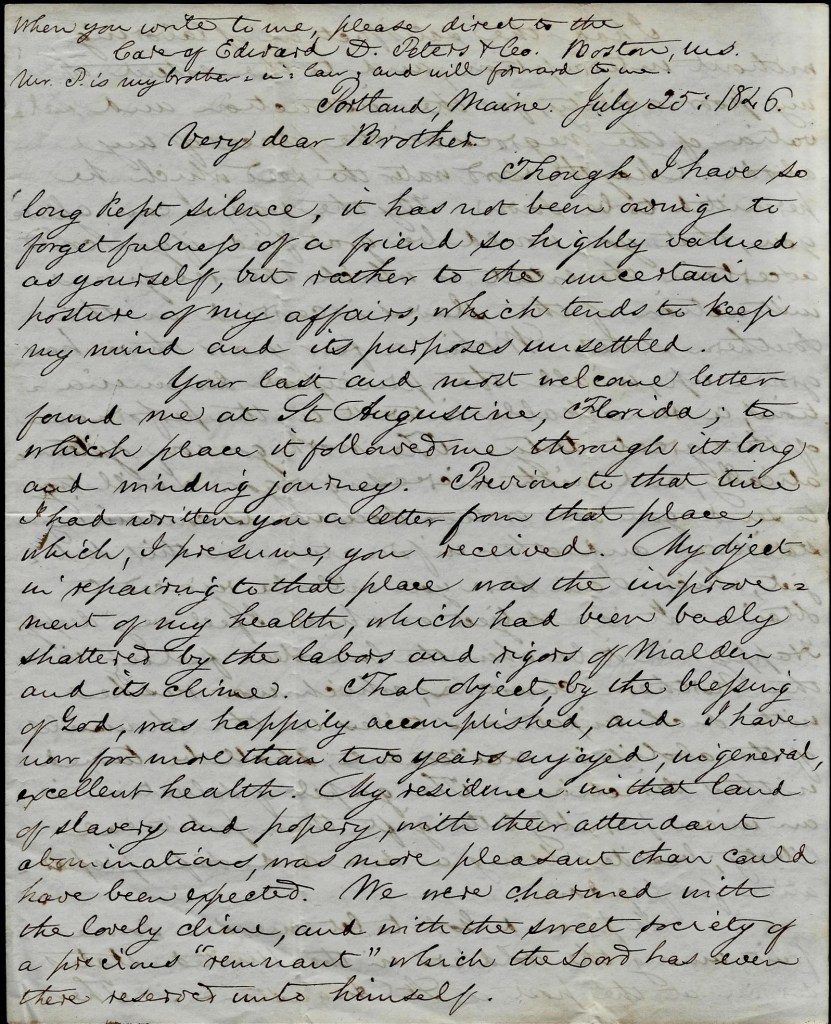
July 25, 1846

Dear Brother,

Though I have so long kept silence, it has not been owing to forgetfulness of a friend so highly valued as yourself, but rather to the uncertain posture of my affairs, which tends to keep my mind and its purposes unsettled. 

Your last and most welcome letter found me at St. Augustine, Florida; to which place it followed me through its long and winding journey. Previous to that time I had written you a letter from that place, which, I presume, you received. My object in repairing to that place was the improvement of my health, which had been badly shattered by the labors and rigors of Malden and its clime. That object, by the blessing of God, was happily accomplished, and I have now for more than two years enjoyed, in general, excellent health. My residence in that land of slavery and popery, with their attendant abominations, was more pleasant than could have been expected. We were charmed with the lovely clime, and with the sweet society of a precious “remnant,” which the Lord has even there reserved unto himself.

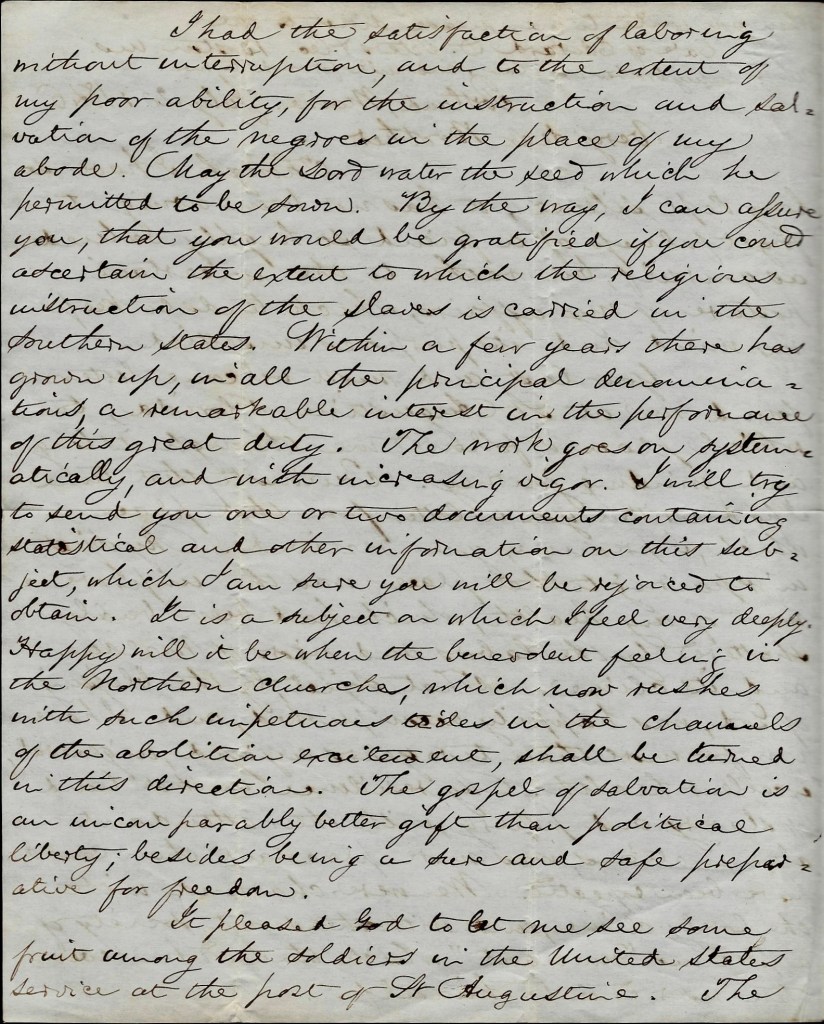
I had the satisfaction of laboring without interruption, and to the extent of my poor ability, for the instruction and salvation of the negroes in the place of my abode. May the Lord water the seed which he permitted to be sown. By the way, I can assure you, that you would be gratified if you could ascertain the extent to which the religious instruction of the slaves is carried in the Southern States. Within a few years there has grown up, in all the principal denominations, a remarkable interest in the performance of this great duty. The work goes on systematically, and with increasing vigor. I will try to send you one or two documents containing statistical and other information on this subject, which I am sure you will be rejoiced to obtain. It is a subject on which I feel very deeply. Happy will it be when the benevolent feeling in the Northern churches, which now rushes with such impetuous tides in the channels of the abolition excitement, shall be turned in this direction. The gospel of salvation is an incomparably better gift than political liberty; besides being a sure and safe preparative for freedom.

It pleased God to let me see some fruit among the soldiers in the United States service at the post of St. Augustine. The Temperance reform when once, with difficulty, it was introduced into the garrison, wrought wonders. There was almost a complete transformation among the men, as to their appearance and behavior. Some of them we received into the church, who were a great consolation to us. Soon after I left Florida, that regiment—the 8th U. S. Infantry—was sent to Mexico to fight President Polk’s iniquitous battles. Some of my praying soldiers were killed in the fights of Palo Alto and Palma de Resaca, where their regiment suffered the most of any. I hope they were prepared: but when I suffer myself to think of the atrocity of the orders under which they were thus exposed to a bloody death, I find it hard to keep from “speaking evil of the ruler of my people,” and “blaspheming the king.” I can only keep down the fire of indignation by that eternal mountain—the sovereignty of God in the affairs of men.

While we were in Florida, God consoled us for the departure of our first born, the bright and endearing Thomas who left us at Malden, by the birth of a lovely little daughter, who is now above three years old. Our other children, Mary, who is eleven years, and Willie, who is seven, are well, and are promising children in most respects. 

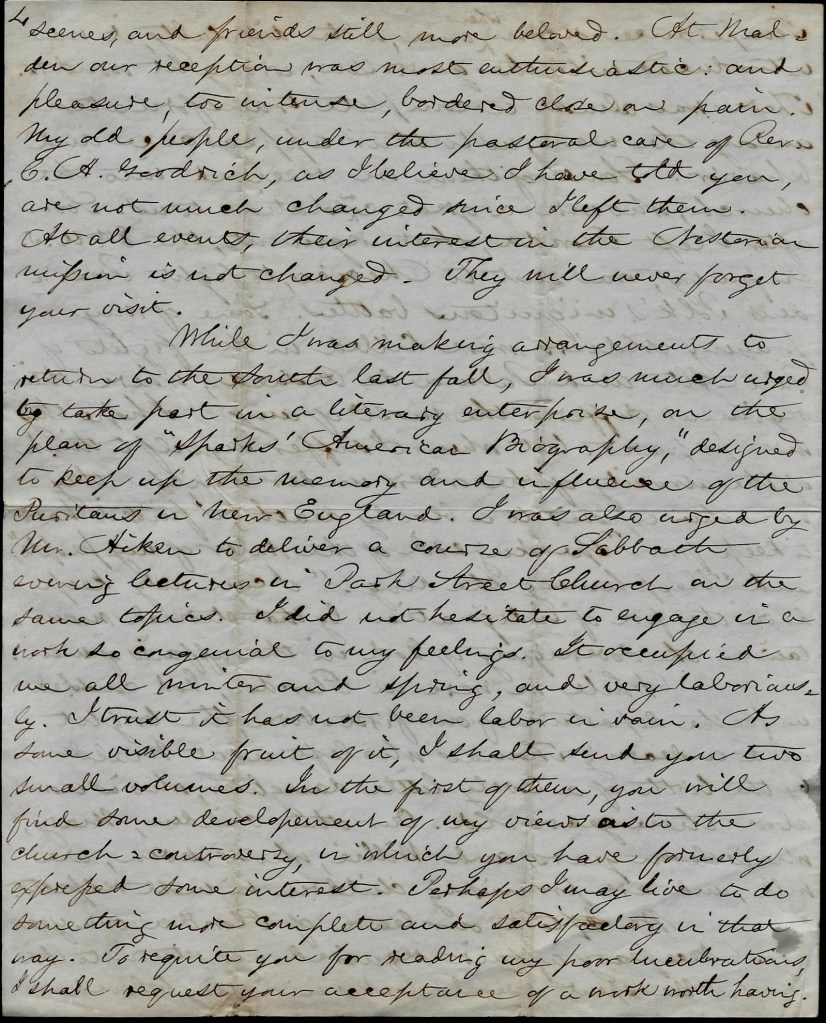
We took our leave of Florida one year ago. Necessary affairs required our return to the North. We spent several weeks in visiting beloved scenes, and friends still more beloved. At Malden our reception was most enthusiastic: and pleasure, too intense, bordered close on pain. My old people, under the pastoral care of Rev. C. A. Goodrich, as I believe I have told you, are not much changed since I left them. At all events, their interest in the Nestorian mission is not changed. They will never forget your visit. 

While I was making arrangements to return to the South last fall, I was much urged to take part in a literary enterprise, on the plan of “Sparks’ American Biography,” designed to keep up the memory and influence of the Puritans in New England. I was also urged by Mr. Aiken to deliver a course of Sabbath evening lectures in Park Street Church on the same topics. I did not hesitate to engage in a work so congenial to my feelings. It occupied me all winter and spring, and very laboriously. I trust it has not been labor in vain. As some visible fruit of it, I shall send you two small volumes. In the first of them, you will find some development of my views as to the church controversy, in which you have formerly expressed some interest. Perhaps I may live to do something more complete and satisfactory in that way. To requite you for reading my poor incubrations, I shall request your acceptance of a work worth having….

[rest of letter missing]

When you write to me, please direct to the care of Edward D[yer] Peters & Co. Boston.

 Mr. P is my brother in law, and will forward to me.

1862: Isaac W. Wiggins to James G. Smith

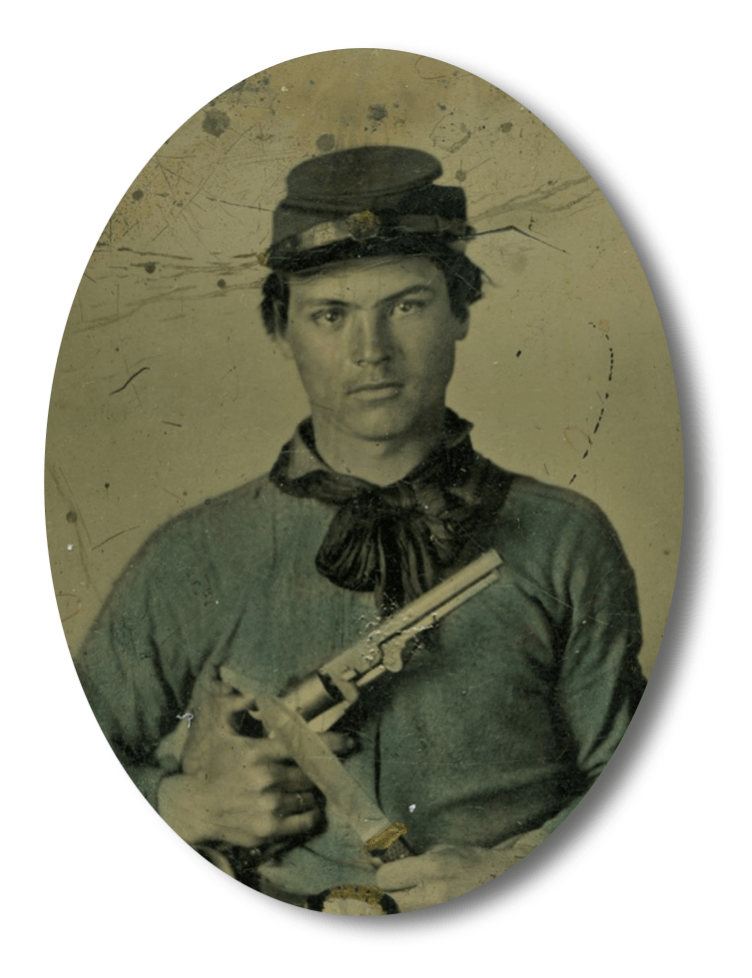
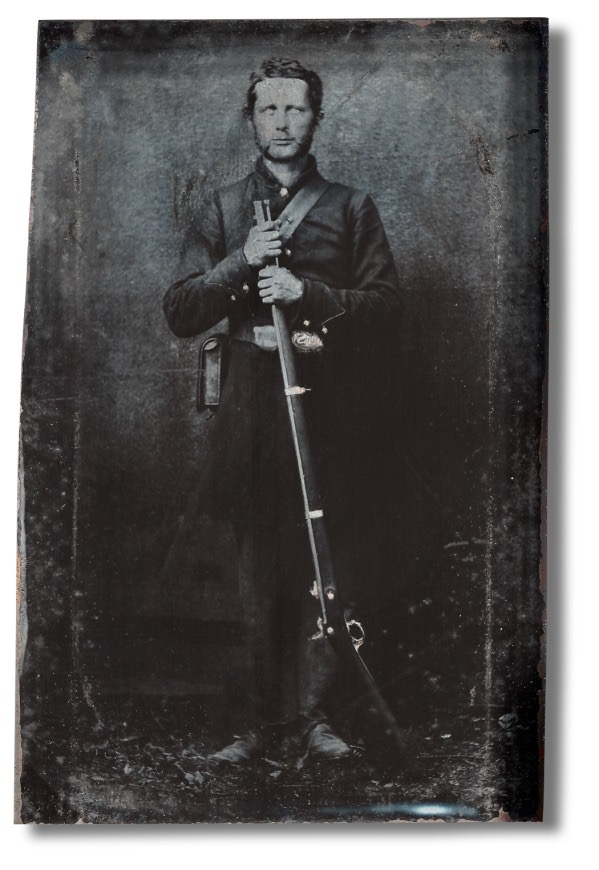
I could not find an image of Isaac but here is one of William Gallagher who served in Co. F, 30th Ohio Volunteer Infantry (Matt Cranford Collection)

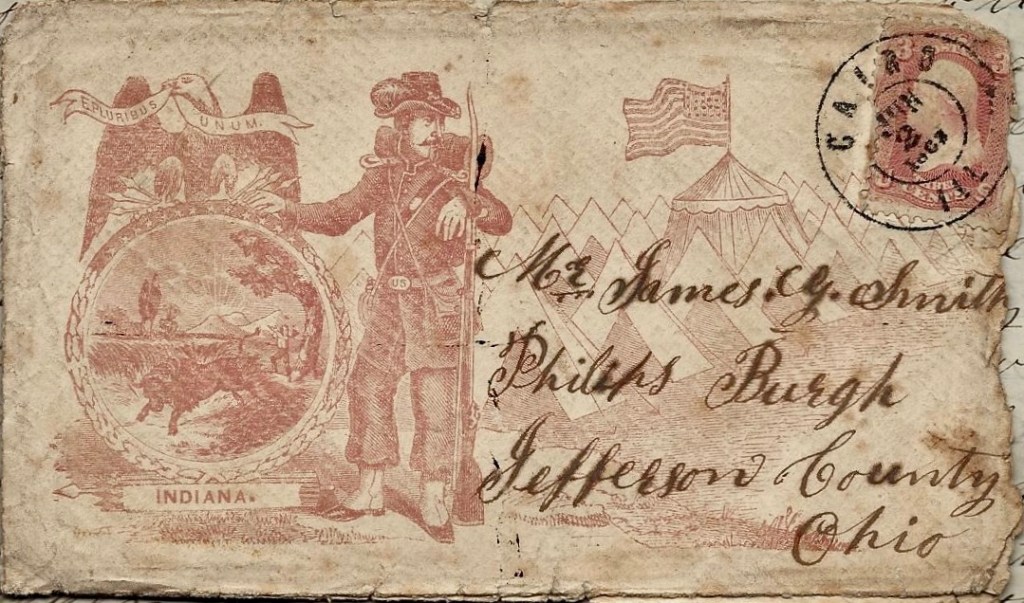
The following letter was written by Isaac W. Wiggins (1832-1864), the son of Thomas Wiggins (1805-1881) and Sarah Eleanor Lutz (1808-1853) of Jefferson county, Ohio. Isaac was married in May 1852 to Anna Maria Smith (1830-1904).

In August 1861, Isaac enlisted in Co. G, 30th Ohio Volunteer Infantry (OVI). He was wounded on 13 May 1864 in the Battle of Resaca, Georgia, and died in a field hospital on the 25th of May, leaving a wife and four children.

Isaac wrote the letter to his brother-in-law, James G. Smith (1843-1912), the son of Jeremiah Smith (1804-1877) and Hanna A. Haines (1814-1889) of Phillipsburg, Jefferson county, Ohio.

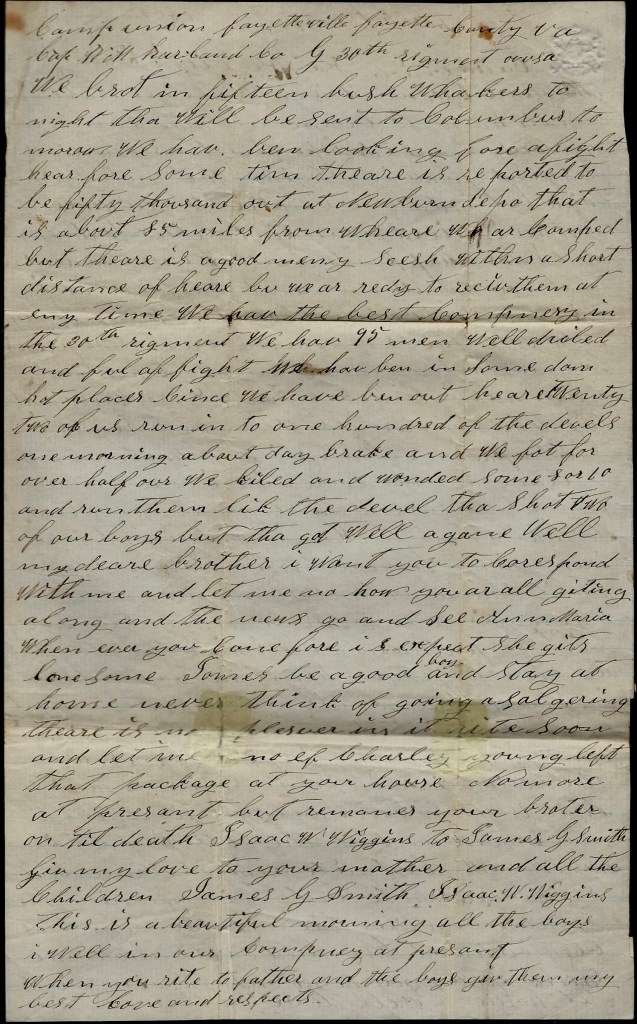
Transcription

Camp Union
Fayetteville, Fayette county, Va
March 29, 1862

My dear brother,

It is with pleasure I take my pen in hand to let you know that I am well at present and I do hope that these few lines may find you all enjoying that great blessing which but God alone can bestow.

Well, dear brother, I received your kind letter today and I was happy to hear from you and that you was all well and hearty. And I also received a letter from home today. Both wrote the 18th of March. I am well pleased to hear that Anna got my likeness and I am happy to hear that Ann Maria and the children are all well.

Well, James, I sent a package home with Charles Young to leave at your house and I hope he has left it there. I want you, if you please, to take it up to Anna and give it to her. I am happy to hear from Noah and Jabez that they are both well and I want you when you write to them to give them my best respects and love. I hope that they will all live to return home in peace and love. I’d like to see you all in it.

Well, tonight we have to drill damn near all day and I can’t get time to say my prayers. All the writing I do is from supper till tattoo. That is at 8 o’clock and 30 minutes, then all is quiet and all the lights put out.

I was on guard last night and it rained and snowed all night but this morning the sun rose beautiful and the songs of the bluebirds and the meadowlark made me think of bygone days and of loving friends at home.

“We have the best company in the 30th Regiment. We have 95 men, well drilled, and full of fight, We have been in some damn hot places since we have been out here.”

— Isaac W. Wiggins, Co. G, 30th OVI, 29 March 1862

Well, dear brother, we brought in fifteen bushwhackers tonight. They will be sent to Columbus tomorrow. We have been looking for a fight here for some time. There is reported to be fifty thousand out at Newbern Depot—that is about 85 miles from where we are camped—but there is a good many secesh within a short distance of here. But we are ready to receive them at any time. We have the best company in the 30th Regiment. We have 95 men, well drilled, and full of fight. We have been in some damn hot places since we have been out here. Twenty-two of us run into one hundred of the devils one morning about daybreak and we fought for over half an hour. We killed and wounded some 8 or 10 and run them like the devil. They shot two of our boys but they got well again.

Well, my dear brother, I want you to correspond with me and let me know how you are all getting along and the news. Go and see Anna Maria when you can for I expect she gets lonesome. James, be a good boy and stay at home. Never think of going a soldiering. There is no pleasure in it. Write soon and let me know if Charles Young left that package at your house. No more at present but remain your brother until death.

— Isaac Wiggins

to James G. Smith

Give my love to your mother and all the children. This is a beautiful morning. All the boys is well in our company at present. When you write to father and the boys give them my best love and respects.

Co. G, 30th Ohio Regiment

1862: Joshua A. Armstrong to Lucretia (Morse) Armstrong

The following letter was written by Joshua A. Armstrong (1831-1862), the son of Aquilla Armstrong (1803-1854) and Margaret Elizabeth Harris (1802-1848) of Lima, Allen county, Ohio. When he was 24, Joshua married Lucretia Matilda (“Tilly”) Morse (1837-1918) in 1855. The couple had three children—Isaac Morse (1858-1926), Alice (1859-1944) and Amasa (1861-1932)—by the time he enlisted as a sergeant in Co. F, 23rd Ohio Volunteer Infantry (OVI) in June 1861.

The 23rd OVI had the distinction of being led and staffed by some prominent men, not the least of which was its first colonel, William Rosecrans, who was ably followed by Rutherford B. Hayes. Also serving in the regiment was quartermaster sergeant William McKinley. The regiment saw its first action at Carnifex Ferry in present-day West Virginia, in September 1861. The regiment then spent most of the winter of 1861-62 at Fayetteville, Virginia. By mid-March, 1862, the regiment had relocated to Raleigh, Virginia, some 25 miles further south. Here, under the command of Lt. Col. Rutherford B. Hayes, the de facto colonel wrote his wife, “For the first time in months we are all together; ranks very full. Oh! it was a beautiful sight; we had plenty of cheering, music, and our best marching. The men were never in finer condition. You would enjoy seeing the 23rd now; well-dressed, bravely looking, and soldier-like.” 1

The regiment’s next encounter with the enemy was in the Battle of South Mountain on 14 September 1862 and the Battle of Antietam on 17 September 1862. After suffering severe losses in the former, the regiment pursued Lee’s army to Sharpsburg where they were in the thick of the fighting in the latter. Their casualties at Antietam? Eight killed, 58 men wounded, two missing.

Regrettably, one of those eight men killed was 31 year-old Sergt. Joshua Armstrong, husband and father to three children. In the book, Ohio at Antietam, there is a story of Joshua’s death, taking a “bullet to the heart” on the slope above Antietam creek while carrying the colors of the regiment and falling, “wrapped in the folds of the banner he had loved and borne so well; it was literally dyed with his blood.” This makes a good story but it may not be 100% accurate for in the Widow’s Pension application that Lucretia filed on 29 December 1862, she wrote that her husband died on or about the 20th day of September, at or near Sharpsburg, and in consequence of a wound received in the line of his duty in the Battle of Sharpsburg three days before his death.”

Lucretia remarried in November 1863 to Joshua W. Pillars and had at least six more children; the three children by her first marriage appear to have been adopted and raised by someone named William Hall who served as their legal guardian.

[Note: This letter was made available for transcription and publication on Spared & Shared by the express consent of Jim Powell who is the 3rd great-grandson of Sergt. Armstrong.]

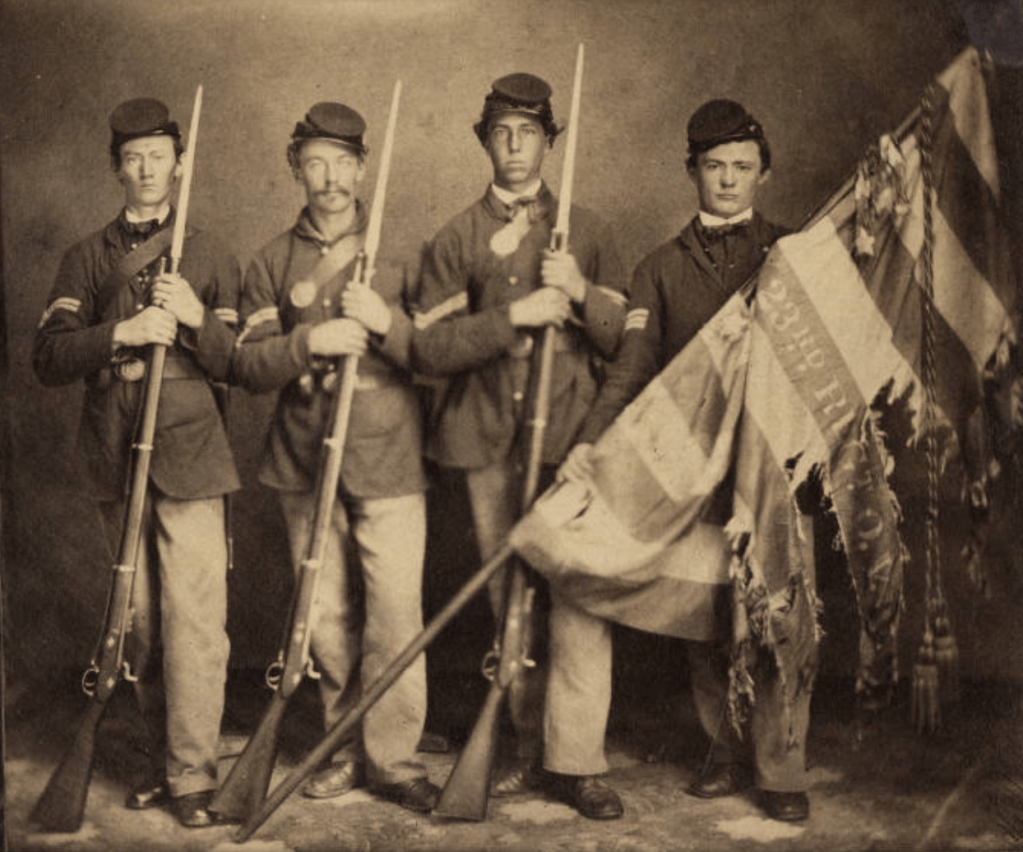
The flag and color guard of the 23rd Ohio Infantry (Ohio Memory)

Transcription

Camp Hays
Raleigh, Virginia
April 1st 1862

Dear wife,

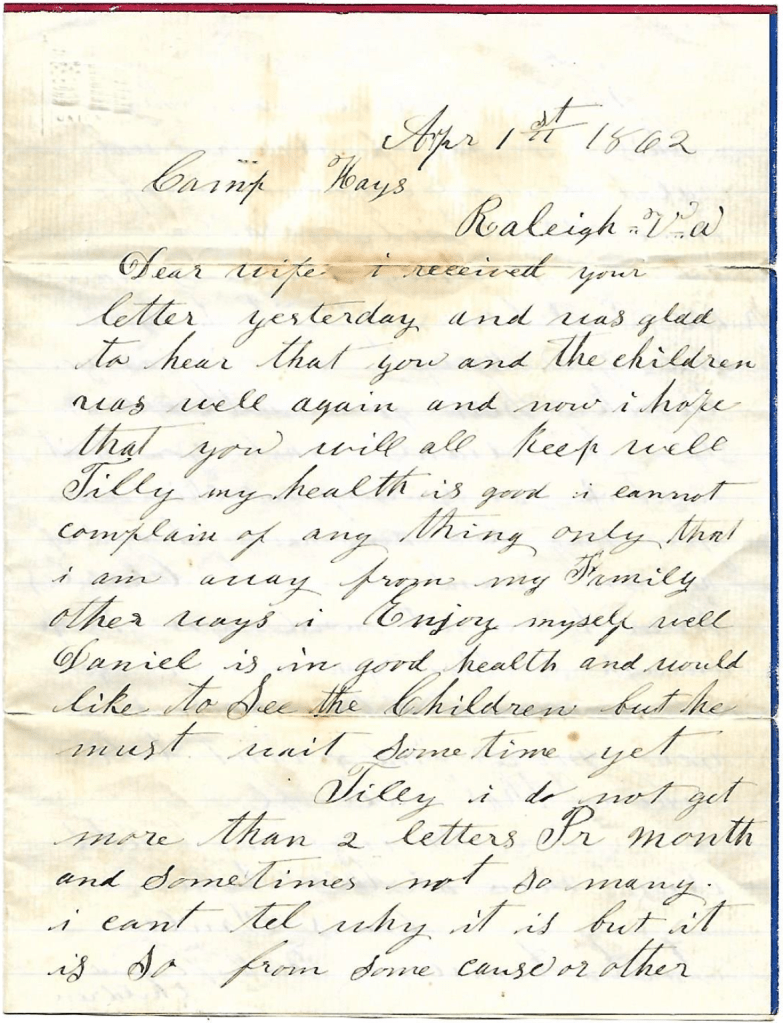
I received your letter yesterday and was glad to hear that you and the children was well again and now I hope that you will all keep well. Tilly, my health is good. I cannot complain of anything—only that I am away from my family. Otherwise I enjoy myself well. Daniel is in good health and would like to see the children but he must wait sometime yet.

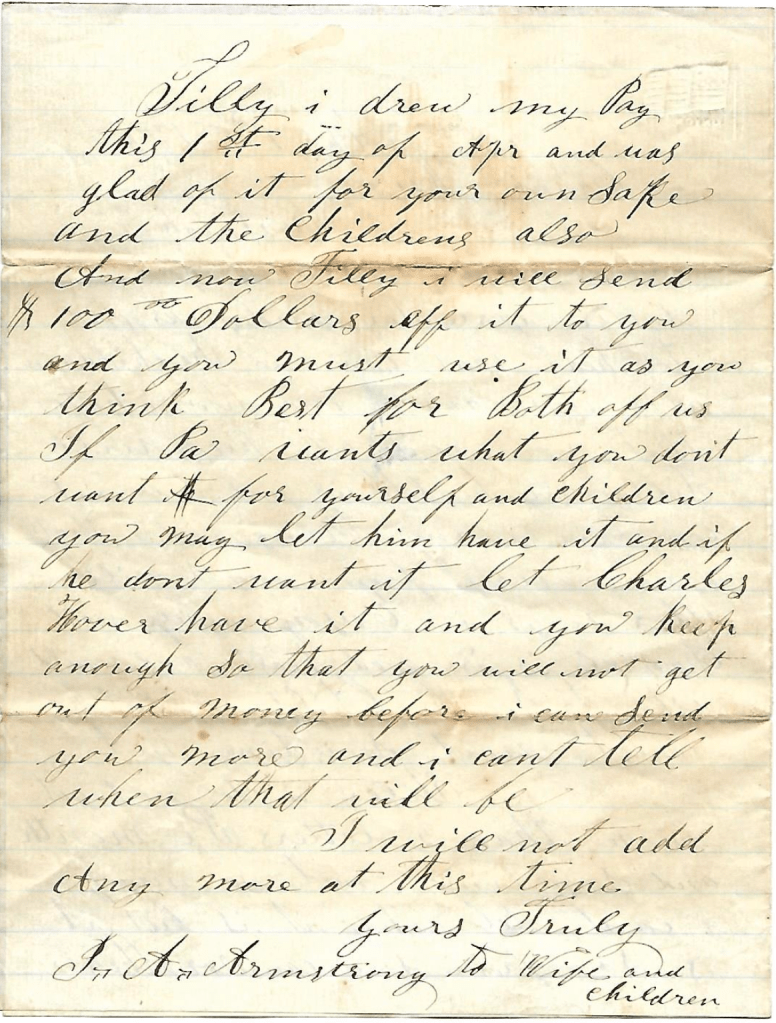
Tilly, I do not get more than two letters per month and sometimes not so many. I can’t tell why it is but it is so from some cause or other. Tilly, I drew my pay the 1st day of April and was glad of it for your own sake and the children also. And now Tilly I will send $100 dollars 2 off to you and you must use it as you think best for both of us. If Pa wants what you don’t want for yourself and children, you may let him have it and if he don’t want it, let Charles Hover have it and you keep enough so that you will not get out of money before I send you more and I can’t tell when that will be.

I will not add any more at this time. Yours truly, J. A. Armstrong

to wife and children

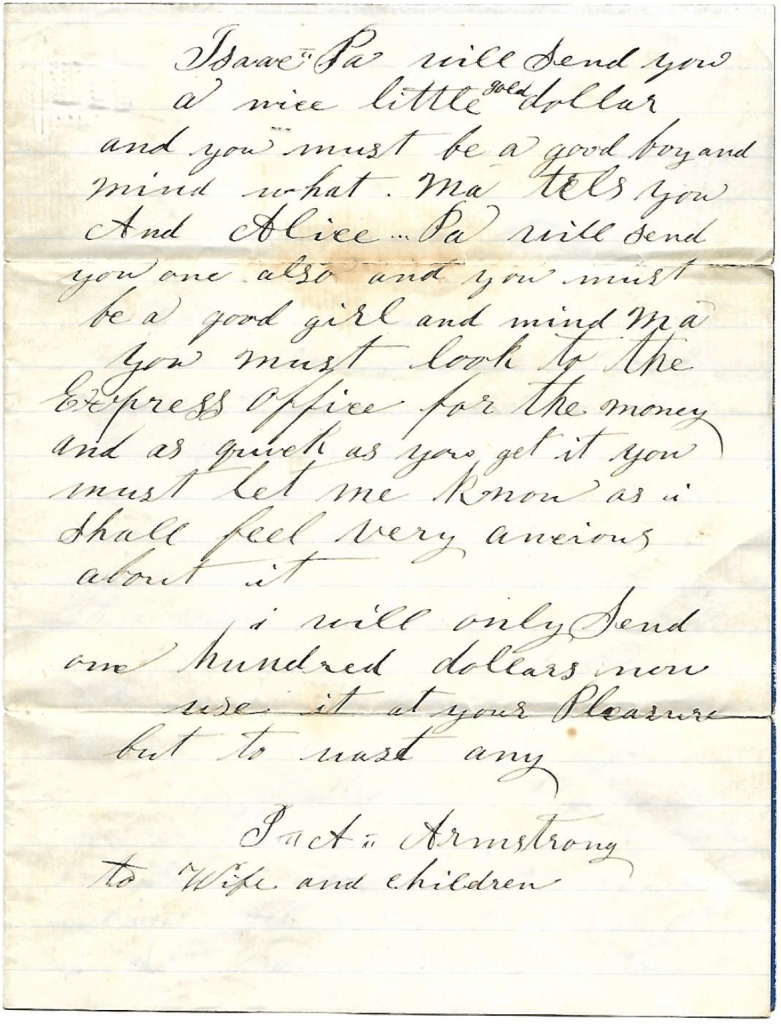
Isaac, Pa will send you a nice little gold dollar and you must be a good boy and mind what Ma tells you. And Alice, Pa will send you one also and you must be a good girl and mind Ma. You must look to the Express Office for the money and as quick as you get it you must let me know as I shall feel very anxious about it.

I will only send one hundred dollars now. Use it at your pleasure but [not] to waste any. — J. A. Armstrong

to wife and children

1 Rutherford B. Hayes to his wife, 13 March 1862.

2 $100 was a lot of money for a non-commissioned officer. This sum represented more than a half-year’s pay so the regiment either hadn’t been paid for a long time or it included a delayed bonus for enlistment.

1863: Unidentified “Wes” to William Harrison Campbell

The author of this letter has not been identified. His signature appears to read, “Wes Land” but I can find no one by that name, or similar name, in New Burlington, Indiana. Regardless of his identity, Wes provides his friend in the Iron Brigade some interesting news about the attempt to set up the draft in Indiana during the summer of 1863 and the resistance of the Copperheads.

Wes wrote the letter to his friend, William Harrison Campbell, a 23 year-old school teacher from Selma, Liberty Township, Delaware county, Indiana. Will enlisted in Co. K, 19th Indiana Infantry on 29 July 1861 as a first sergeant and was promoted to 2nd, then 1st Lieutenant during the war. The 19th Indiana was, of course, part of the famed Iron Brigade or “Black Hat” Brigade. He was discharged for medical disability in October 1863 on account of the wound he received at Gettysburg in his right hand.

Transcription

Addressed to Will H. Campbell. Co. K, 19th Indiana Vols., Washington D. C.

New Burlington, Indiana
June 18th 1863

Friend Will,

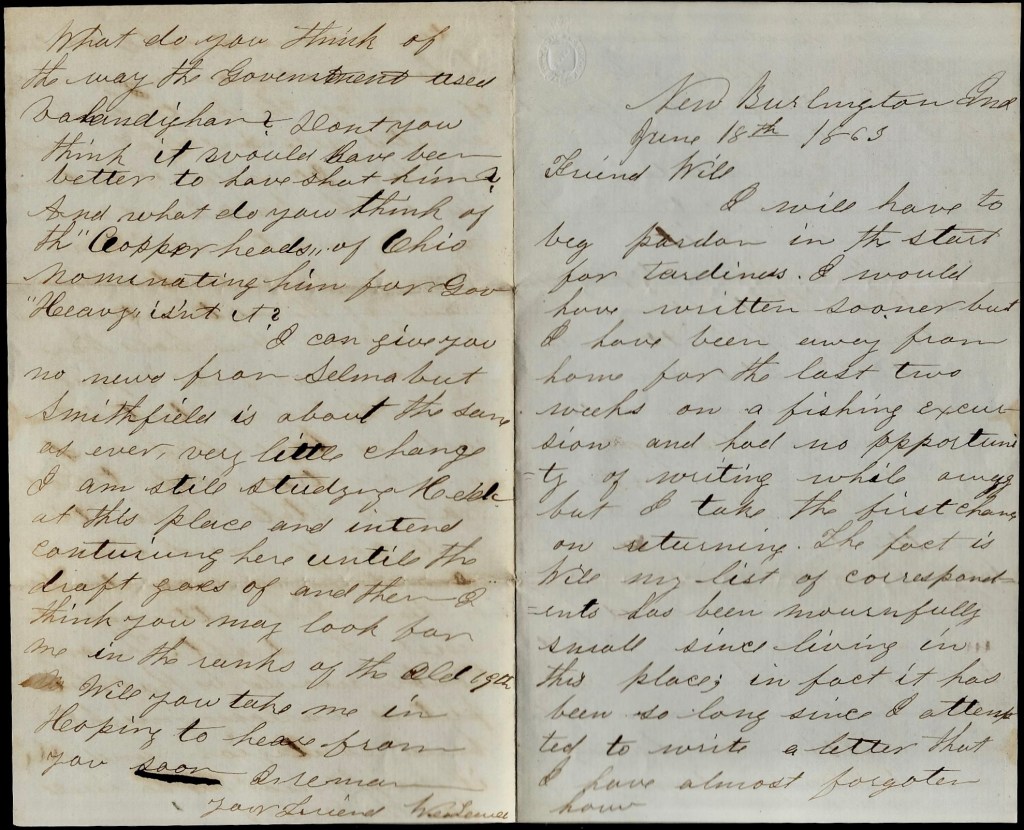
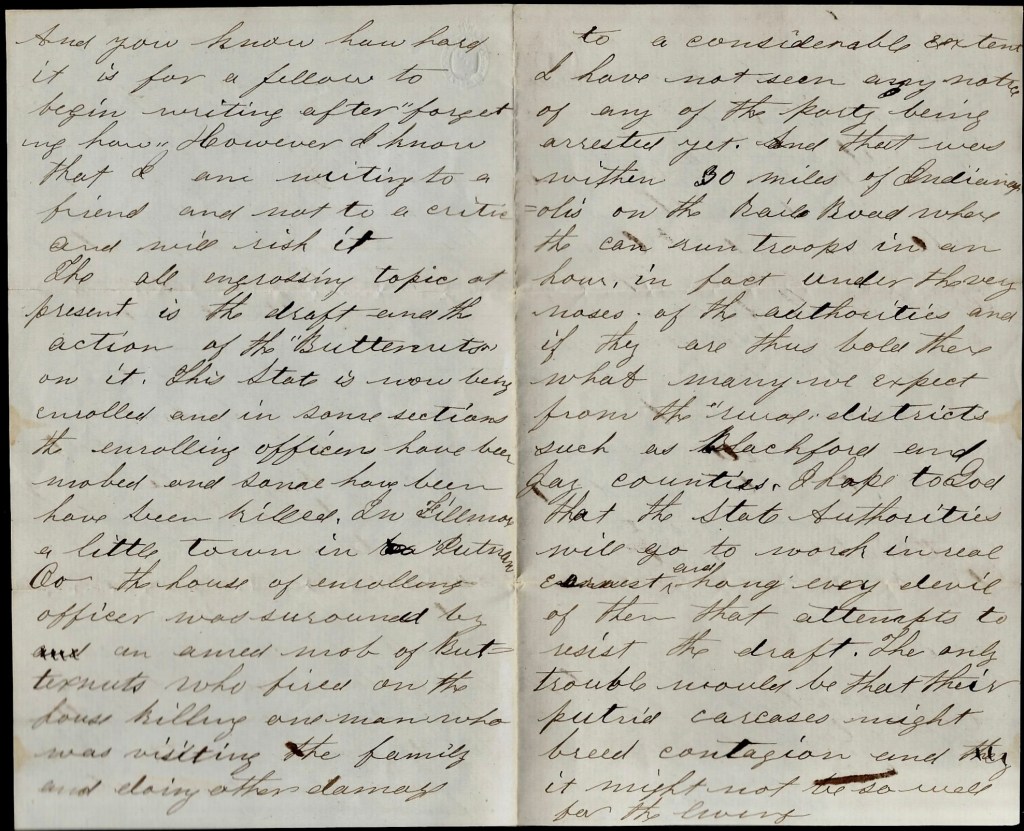
I will have to beg pardon in the start for tardiness. I would have written sooner but I have been away from home for the last two weeks on a fishing excursion and had no opportunity of writing while away. But I take the first chance on returning. The fact is, Will, my list of correspondents has been mournfully small since living in this place; in fact, it has been so long since I attempted to write a letter that I have almost forgotten how. And you know how hard it is for a fellow to begin writing after “forgetting how.” However, I know that I am writing to a friend and not to a critic and will risk it.

The all engrossing topic at present is the draft and the action of the “Butternuts” on it. This State is now being enrolled and in some sections the enrolling officers have been mobbed and some have been killed. In Fillmore—a little town in Putnam county—the house of the enrolling officer was surrounded by an armed mob of Butternuts who fired on the house killing one man who was visiting the family and doing some other damage to a considerable extent. I have not seen any notice of any of the party being arrested yet. And that was within thirty miles of Indianapolis on the railroad where they can run troops in an hour. In fact, under the very noses of the authorities, and if they are thus bold there, what may we expect from the rural districts such as Blackford and Jay counties?

I hope to God that the State Authorities will go to work in real earnest and hang every devil of them that attempts to resist the draft. The only trouble would be that their putrid carcasses might breed contagion and it might not be so well for the living.

What do you think of the way the Government used Vallandigham? Don’t you think it would have been better to have shot him? And what do you think of the “Copperheads” of Ohio nominating him for Governor? “Heavy,” isn’t it?

I can give you no news from Selma but Smithfield is about the same as ever—very little change. I am still studying H___ at this place and intend continuing here until the draft goes off and then I think you may look for me in the ranks of the Old 19th. Will you take me in? Hoping to hear from you soon, I remain your friend, — Wes Land

1862: Jabez B. Smith to James G. Smith

I could not find an image of Jabez but here is one of William L. S. Johnson of Co. I, 1st Ohio Vol. Infantry (William Griffing Collection)

The following letter was written by Jabez B. Smith who enlisted at the age of 18 on 7 October 1861 to serve as a private in Co. H, 1st Ohio Volunteer Infantry (OVI). He was promoted to corporal in 1863 and wounded in action and taken prisoner in the Battle of Chickamauga on 19 September 1863. He was taken to Andersonville Prison where he died of disease on 29 July 1864.

Jabez was the son of Jeremiah Smith (1804-1877) and Hanna A. Haines (1814-1889) of Phillipsburg, Jefferson county, Ohio. He enlisted in the 1st OVI with his older brother, Pvt. Noah H. Smith (1840-1864) who served in the same company. Unlike his brother Jabez, he was not wounded in the Battle of Chickamauga, but he was taken a prisoner there and also transported to Andersonville Prison in Georgia. He died of disease there too, on 2 July 1864, less than a month before his brother.

A descendant claims that Noah and Jabez were first taken to Belle Isle, then to Libby Prison for a few months, then to Danville, and finally to Andersonville.

Jabez wrote the letter to his brother, James G. Smith (1843-1912).

Letter 1

Addressed to Mr. James G. Smith, Phillipsburg, Jefferson county, Ohio

Camp Shiloh, Tennessee
April 23, 1862

Dear Brother,

It is with great pleasure that I now sit down to let you know that we are both well at present and hoping that these few lines may find you all enjoying the same blessing. I received your kind letter on the 20th of this month and was glad to hear from you and that you was all well.

The 64th [Ohio] is camped about two miles from our camp. We have both see father. He is well and hearty and sends his love to you all. The 1st Ohio Cavalry is here too. We have seen Jonathan. He is well and send his love to you all. He says that he thinks very hard of you that you do not write to him.

I suppose that you have heard of the great and glorious Battle of Pittsburg Landing. We were both in the fight and came out safe. Seven of our company was wounded, two of them dangerously. The other five are back to the company again. We went out on picket day before yesterday but before we went on post, our brigade made a reconnaissance for our own safety. We went about five or six miles when we came in sight of the rebel’s pickets when they took their old way of doing business—they ran like they always do, I did not get to shoot at this this time but our skirmishers did. the rebel’s cavalry fired on the 15th Regulars but did not hurt any of them. We didn’t follow them very far for it was raining and we turned about and came back to the picket line where we were posted to watch the rebels but they did not come near to bother us.

I must bring my letter to a close by asking you to write as soon as this comes to hand. Nothing more at present but remain your affectionate brother until death, — Jabez B. Smith

to James G. Smith

Direct to Pittsburg Landing, Hardin county, Tennessee in care of Capt. B. F. Prentiss

Do not fail to write as soon as this comes to hand. Goodbye.

1863: John Bogart to Emma Cherington Jefferis

The following letter was written by John Bogart (1836-1920), the son of John Henry Bogart (1809-1901) and Eliza Hermans (1810-1889) of Albany, New York. John received in B. A. from Rutgers College in 1853 and took a position in the engineering corps of New York City working on the state canals of New York State. During the Civil War, he worked as a civilian engineer at Ft. Monroe and other points. After the war, he held a variety of position as an engineer in public and privates works in the US and abroad. He was married in 1870 at West Chester, Pennsylvania, to Emma Cherington Jefferis (1846-1926), to whom he addressed this letter.

The author drops the names of several officers at Fortress Monroe but I can only confirm the identify of Col. Henry Brewerton who was an engineer in charge of fortifications and the author may have been an engineer as well serving on the staff of the old colonel. We learn from the letter that the author has been living with the Eaton family and the names of Mr. & Mrs. Eaton’s three daughters are given as Mary, Emily, and Buddie—in chronological order, oldest to youngest—but I have not confirmed that family’s identity as yet.

I should also note that the two letter segments, identified as “1” and “2” do not seem to go together as the dates are inconsistent with one another. In fact, the handwriting even appears to be different but the phraseology convinces me they were written by the same person and probably sent to the same woman.

John Bogart had a younger brother names James Henry Bogart (1839-1863) who served as 1st Lieutenant and Adjutant of the 43rd New York Infantry. Lt. Bogart was killed on 14 June 1863 in the Battle of Port Hudson.

Transcription

Fort Monroe, Virginia
December 6th 1863

Dear Miss Emma,

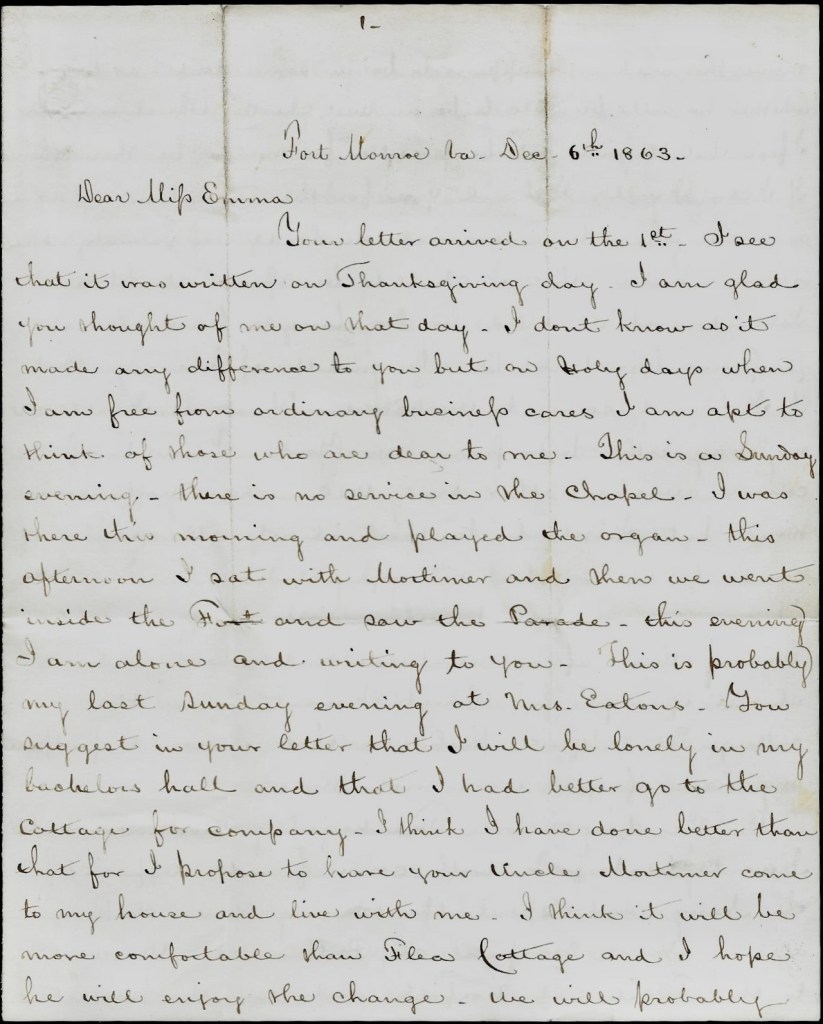
Your letter arrived on the 1st. I see that it was written on Thanksgiving Day. I am glad you thought of me on that day. I don’t know as it made any difference to you but on Holy days when I am free from ordinary business cares, I am apt to think of those who are dear to me. This is a Sunday evening. There is no service in the chapel. I was there this morning and played the organ. This afternoon I sat with Mortimer and then we went into the Fort and saw the parade. This evening I am alone and writing to you. This is probably my last Sunday evening at Mrs. Eaton’s.

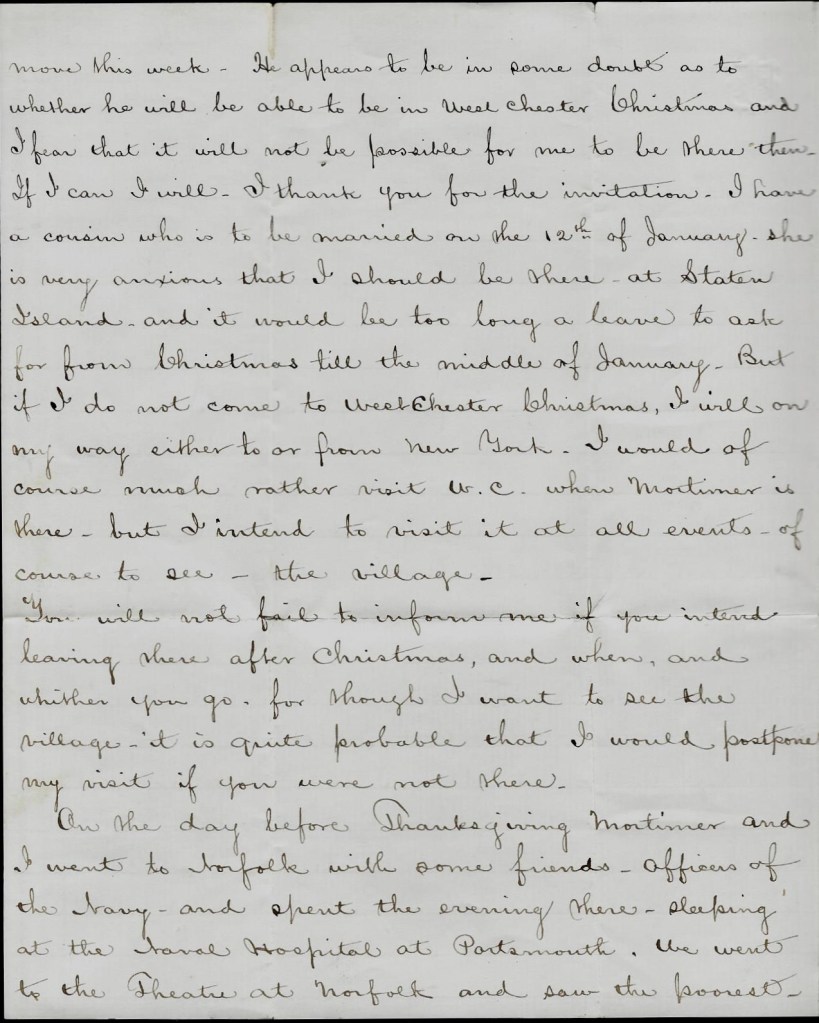
You suggest in your letter that I will be lonely in my bachelor’s hall and that I had better go to the cottage for company. I think I have done better than that for I propose to have your Uncle Mortimer come to my house and live with me. I think it will be more comfortable than Flea Cottage and I hope he will enjoy the change. We will probably move this week. He appears to be in some doubt as to whether he will be able to be in West Chester Christmas and I fear that it will not be possible for me to be there then. If I can, I will. I thank you for the invitation.

I have a cousin who is to be married on the 12th of January. She is very anxious that I should be there at Staten Island and it would be too long a leave to ask for from Christmas till the middle of January. But if I do not come to West Chester [for] Christmas, I will on my way either to or from New York. I would of course much rather visit West Chester when Mortimer is there, but I intend to visit it at all events—of course to see—the village. You will not fail to inform me if you intend leaving there after Christmas, and when, and whither you go, for though I want to see the village, it is quite probable that I would postpone my visit if you were not there.

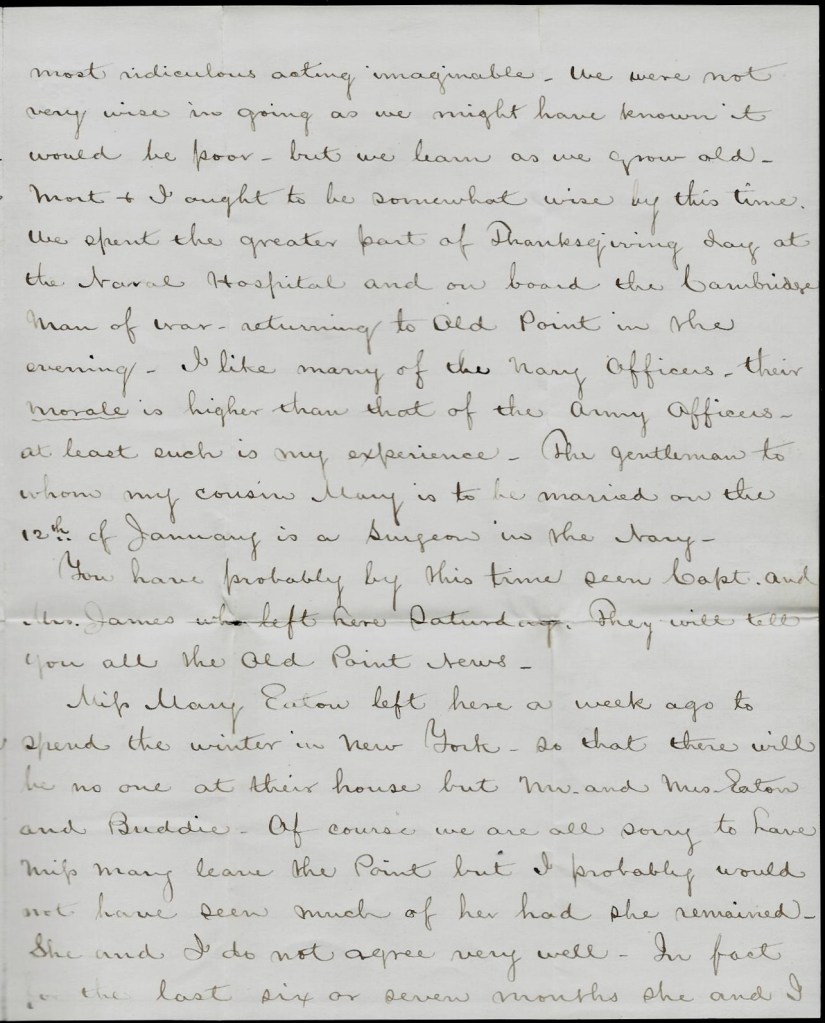
On the day before Thanksgiving, Mortimer and I went to Norfolk with some friends—officers of the Navy—and spent the evening there, sleeping at the Naval Hospital at Portsmouth. We went to the theatre at Norfolk and was the poorest, most ridiculous acting imaginable. We were not very wise in going as we might have known it would be poor—but we learn as we grow old. Mort and I ought to be somewhat wise by this time. We spent the greater part of Thanksgiving day at the Naval Hospital and on board the Cambridge Man-of-War, returning to Old Point in the evening. I like many of the Navy officers. Their morale is higher than that of the Army officers—at least such is my experience. The gentleman to whom my cousin Mary is to be married on the 12th of January is a surgeon in the Navy.

You have probably by this time seen Capt. and Mrs. James who left here Saturday. They will tell you all the Old Point news.

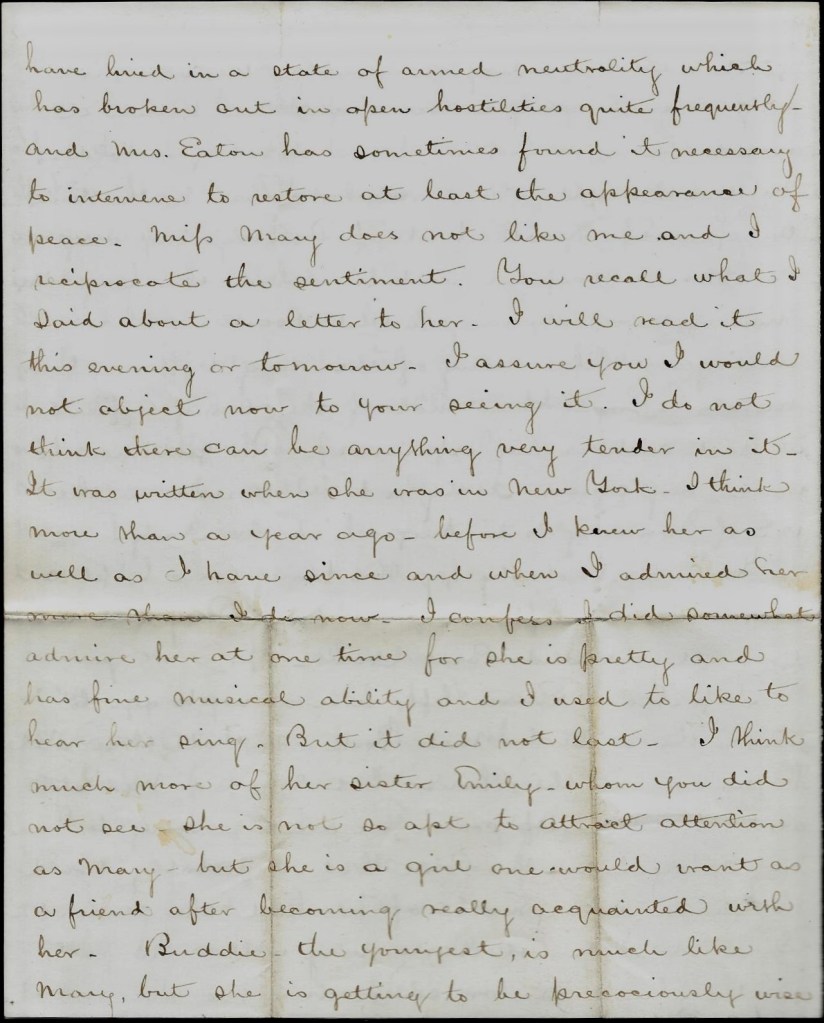
Miss Mary Eaton left here a week ago to spend the winter in New York, so that there will be no one at their house but Mr. and Mrs. Eaton and Buddie. Of course we are all sorry to have Miss Mary leave the Point but I probably would not have seen much of her had she remained. She and I do not agree very well. In fact, for the last six or seven months she and I have lived in a state of armed neutrality which has broken out in open hospitalities quite frequently and Mrs. Eaton has sometimes found it necessary to intervene to restore at least the appearance of peace. Miss Mary does not like me and I reciprocate the sentiment. You recall what I said about a letter to her. I will read it this evening or tomorrow. I assure you, I would not object now to your seeing it. I do not think there can be anything very tender in it. It was written when she was in New York, I think more than a year ago, before I knew her as well as I have since and when I admired her more than I do now. I confess I did somewhat admire her at one time for she is pretty and has fine musical ability and I used to like to hear her sing. But it did not last. I think much more of her sister Emily whom you did not see. She is not so apt to attract attention as Mary, but she is a girl one would want as a friend after becoming really acquainted with her. Buddie, the youngest, is much like Mary, but she is getting to be precociously wise.

[These two letter fragment do not appear to go together.]

Tuesday, the 27th.

I was so busy yesterday with the plan of a large fort that I did not finish my letter. I have read over what I wrote and it seems like a sermon. But never mind. I do not intend to “take back” what I wrote. I have nobody else, and never had, to whom I can write without a bit of restraint. So you will, unless you tell me not, continue to be sermonized if I am in a sermonizing mood. It is “perfectly splendid” to be able to write just what I think—just according to the present state of mind, without the feeling of there being a necessity to consult the peculiarities of my correspondent. I am terribly frank and I am afraid that you will say that I do not show much regard for my correspondent in writing so entirely selfishly or of myself. But that would be an error. It is the result and the proof of perfect regard. And a proof too that that correspondent is never long absent from my thoughts.

I have been looking at your letter again. You do not believe in sentences begun and not ended. If I should do so again, don’t imagine anything very horrid for the termination.

What a strange piece of experience you must have had at your friend’s house. It is strange what fascination there is in drink. I have an acquaintance who is ordinarily a temperate man, but who occasionally does not seem to know when to stop and consequently runs to horrible extremes. And he too has a wife and children.

We have had a strange affair here. I do not remember whether I mentioned it in my last. A general officer of volunteers has been staying at the Point some time—not on duty—with a family of wife and daughter, and after boarding several months without paying, it was discovered that he had been borrowing money from everybody that would lend and repaying nobody. However, under the fear of exposure he has gone forth to make an effort to get money enough to make a settlement. I hope he will do so. His daughter is a very pleasing girl and seems much grieved at her father’s delinquency.

Col. James was here a few days ago. We see little of him however now. I saw Mrs. Jefferis after her return. My sister and I are going to call there today or tomorrow. We started to do so while Mrs. Jefferis was away not knowing of her absence.

This letter was all written with the same pen (quill).

Col. [Henry] Brewerton is waiting for some work so I must say goodbye. Yours, — John B.

Last letter from you was waited for a long time.

I send you some sea horses prepared by my sister. If you think they are pretty, I can send you more.