All posts by Griff

My passion is studying American history leading up to & including the Civil War. I particularly enjoy reading, transcribing & researching primary sources such as letters and diaries.

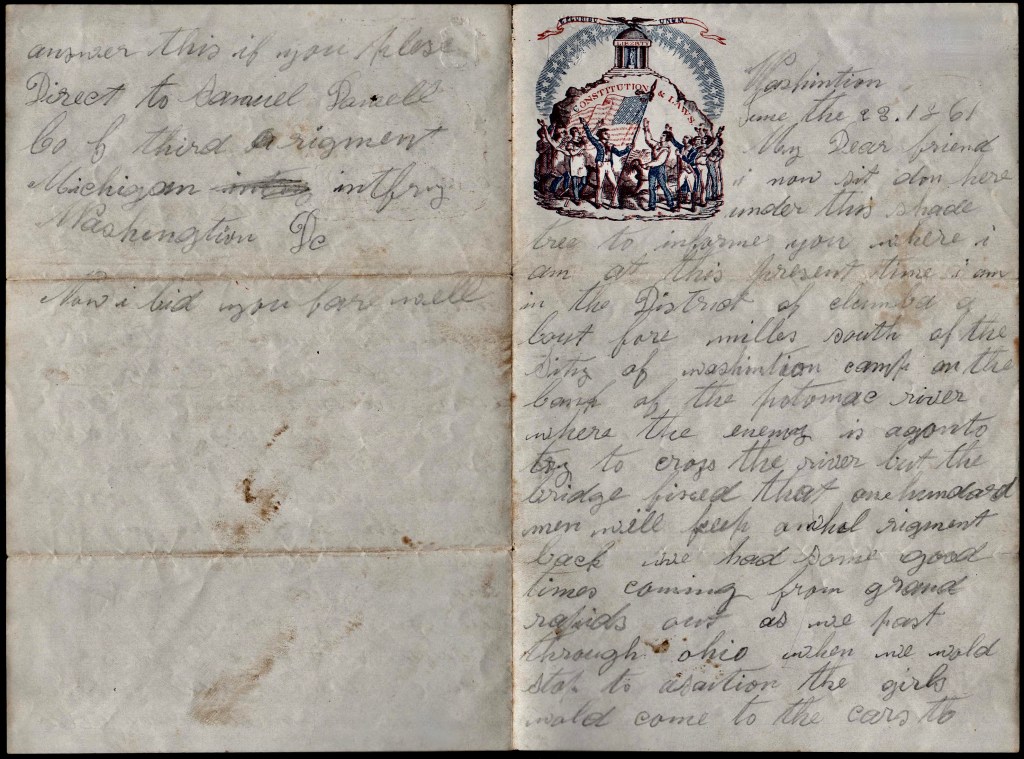
1861: Samuel Dowell to a Dear Friend

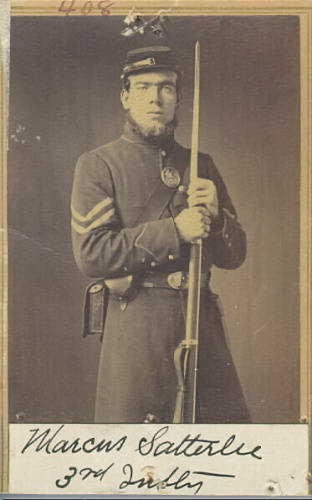
I could not find an image of Samuel but here is one of Marcus Satterlee wearing the uniform of the 3rd Michigan Infantry. (Michigan Digital Collection)

The following letters were written by Pvt. Samuel Dowell (1838-1862) of Co. G, 3rd Michigan Infantry (1st Organization). This regiment was mustered into service on 21 May 1861 and served in McDowell’s Army of Northeastern Virginia until August 1861 and then was attached to Richardson’s Brigade, Heintzelman’s Division, Army of the Potomac.

Samuel was the son of Charles Dowell (1799-1871) and Elizabeth Pool (1797-1860) of Windsor, Eaton county, Michigan. Samuel was killed at the Battle of Seven Pines on 31 May 1862.

Samuel wrote the letters to a dear friend whose name was Amelia Scofield.

Letter 1

Washington
June 23, 1861

My dear friend,

I now sit down here under this shade tree to inform you where I am at this present time. I am in the District of Columbia about four miles south of the City of Washington camped on the Potomac River where he enemy is agoin’ to try to cross the river. But the bridge [is] fixed [such] that one hundred men will keep a whole regiment back.

We had some good times coming from Grand Rapids out as we passed through Ohio. When we would stop to a station, the girls would come to the cars to shake hands with soldiers and bid them goodbye.

I received your letter when I was in Grand Rapids. I was in the hospital sick with the measles when Till give it to me but I am well now and hoping that these few lines will find you in the same state of health at this time and enjoying yourself, well and happy and merry and that you may have good times there. I would like to see you very well but now I am twelve hundred miles from you. I oft times think of you since I kissed your rosey cheeks. I am so sleepy that I [can’t] think of anything to write now for I was on guard yesterday.

Last night we heard that since we came here that we was all but seventeen of us when we came through Baltimore but there wasn’t a gun fired when we passed through last Sunday morning and arrived at this place in the afternoon. There is sixty thousand troops camped within eight miles of us.

No more at present but I remain your friend forever and I will write to you as often as I can. I send my best respects to you and all of your folks and to all enquiring friends. Please excuse my poor writing. Yours truly, — Samuel Dowell

to Amelia Scofield

Letter 2

Fort Richardson
Northeast Virginia
September 25, 1861

Dear friend,

I take this present time to write a few lines to you to let you know that I am well at this present time and hoping that these few lines will find you in the same state of health at this time and are enjoying yourself well.

I received your letter and was glad to hear from you once more. We are having good times here now and lots of fun and not much fighting. We have lots of music here. They are having a good time a dancing tonight. I am sorry that I did offend you in the last letter that I wrote to you. But you must excuse me for I was so sick that I did not know what I did [write] in the letter at that time.

No more at present. I send my best respects to you and to all enquiring friends and neighbors, — S. Dowell

The Young Soldier Dream
Amelia don’t secede

Kiss me Amelia ere I go
Armed and drilled to meet the foe;
Gun in hand and on my back
A sixteen pounder haversack.
I go, my country calls—adieu
To battle, my darling girl, be true
And come success comes scathe and need
Amelia, Amelia, don’t secede

When on the tented field perhaps
With rations short and shorter naps
With wheel present, advance, retreat
Thou’lt have O heavens at thy feet
Some are persuadingly present
Himself and an establishment
Amelia, no such trifler heed
Though the glitter’t secede

Cling unto thy mother dear
Let no home guards come a near
Dancing [  ] for the eyes
Making light of household ties
Prating of thy woman’s rights
Gallanting thee about o’night
Lest the rose should prove a weed
Basely crimsoned don’t secede

Goodbye Amelia, no regrets
If from balls and bayonets
From trials and battles
Far deadlier is the soup tureen
When badly seasoned than the bare
Of the loudest cannon that can roar
Safe delivery swiftly
Back to ease and the will fly
United then in word and deed
Amelia, dear, we’ll both secede

— S. Dowell

Prayer of the Young Soldier

[ ] of mercy, hear my prayers
Preserve my husband’s life
Cast o’er him thy protecting shield
In this unhallowed strife
Oh guard him in the battlefield
Unscathed through wars alarms
Restore him to his happy home
And his fond parents’ arms.

But if it be thy will, oh God
To take the life that gave
Then let him die where the stars and stripes
O’er his head shall ever wave.
If it be thy will in his country’s cause
My husband should lose his life
If fatherless he his only child
Widowed his wretched wife

Then let his name on history’s page
Be enrolled with the free and the brave
Let him nobly die a hero’s death
And rest in a hero’s grave.

— S. Dowell

1862: Samuel Anderson to his Parents

The following letter was written by Samuel Anderson (1836-1865) who enlisted on 22 October 1861 to serve in Co. K, 6th New York Cavalry for three years. He was promoted from private to corporal in February 1862 and later to sergeant though no date is given for that promotion in the muster rolls. Samuel reenlisted in mid-December 1863 and was captured at Perryville, Virginia, on 4 September 1864 and died in confinement at Salisbury, North Carolina, on 4 January 1865.

I could not find an image of Samuel but here is one of an unidentified trooper believed to have been in the 5th or 6th New York Cavalry (Megan Kemble Collection)

Samuel was the son of Irish emigrants John Anderson (1814-1869) and Mary Ford (1815-1885) of Argyle, Washington county, New York. One of their daughters, Sarah M. Anderson (1838-1889) was married to James H. Killmer (1826-1889) and they are the “Sarah and James” mentioned in the letter below. Their daughter Emma married John T. Martin and this couple built a two-story farmhouse in Acadia Parish, Louisiana, in 1893. It was in a King Edwards cigar box in the corner of a closet on the second floor of this farmhouse that Samuel’s letter was discovered when the house was being cleaned out some years ago. This letter and a few other more recent vintage letters are now in the possession of Danny Martin, the g-g-grandnephew of Samuel Anderson.

This letter was written in Warrenton, Virginia, a month before the battle of Fredericksburg. We learn that Samuel was detailed to General John Curtis Caldwell’s Headquarters and had been since the Battle of Antietam. This duty would have entailed providing an escort for the general or his immediate staff as well as serving as a courier.

[Note: This letter is from the personal collection of Danny Martin who made it available for transcription and publication on Spared & Shared by express consent.]

Transcription

Camp near Warrenton, Virginia
November 11th 1862

Dear Father & Mother,

I now take up my pen to address a few lines to you to let you know that I am well & hope that you are the same. We are now advancing on the enemy & we expect a big fight every day. We have not been paid since I wrote to you but I think it will come soon. I have not much time to write so I will not say much. I hope you are suited with your move & let me know all about it & what you can do.

I have not seen John since the Battle of Antietam but I hear that he is well. I have heard [from] Joe 1 two or three times & he is well. John told me that he would send you money every payday. Let me know how James & Sarah is getting along.

There is no use of my telling you what we are a doing for you can see it in the papers better than I can tell you. I am on Gen’l Caldwell’s staff now & have been for a month & I expect to stay with him for some time yet so that I have a good time of it.

Gen’l McClellan bid farewell to the Army yesterday & Gen’l Burnside took the command. I hope the change is for the better. We can hear Gen’l Hooker’s cannon playing on the rebels while I am writing & I expect to march right away.

The weather is quite cool and we have had one snowstorm last Thursday. It snowed hard all day. I cannot write any more at present. Write soon & give me all the in and out of your home.

Goodbye, — Samuel Anderson

Direct your letter to Corporal Anderson, 6th N. Y. Vol. Cavalry, Gen’l Caldwell’s Headquarters, Hancock’s Division, 2nd [Army] Corps.

Write soon.


1 Samuel’s younger brother, Joseph J. Anderson (1846-1904) enlisted in March 1862 in the 11th New York Cavalry. He served until 21 March 1865.

1863: Henry N. Chapman to Sarah (Newman) Chapman

I could not find an image of Henry but here is one of Lt. George B. Johnson who also served in the 8th New Hampshire Infantry (Dave Moran Collection)

The following letter was written by Henry Newman Chapman (1843-1917), the son of Jeremiah Chapman (1817-1854) and Sarah Newman (1810-1894) of Washington, Sullivan county, New Hampshire. Henry was born in Sanbornton, Belknap county, New Hampshire. He was a painter by profession.

Henry was 18 years old when he enlisted on 14 September 1861 as a private in Co. A, 8th New Hampshire Infantry. He was wounded on 27 May 1863 at Port Hudson and after recuperating in Baton Rouge, we learn that he was placed on duty as a hospital steward in the Theatre Hospital. He re-enlisted in 1864 and mustered out in January 1865.

I have not been able to find any information about the Theatre Hospital in Baton Rouge except for notices of certain Union soldiers dying there. Presumably the theatre stopped productions for a time in Baton Rouge due to the Union occupation and was converted into a hospital.

Transcription

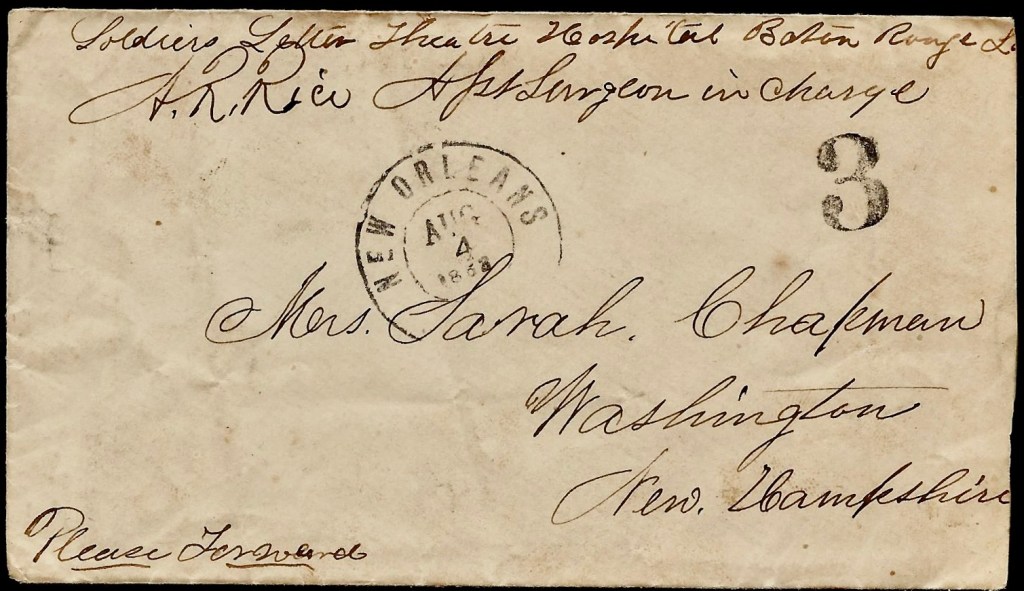
Mrs. Sarah Chapman, Washington, New Hampshire

Theatre Hospital
Baton Rouge
July 29th, 1863

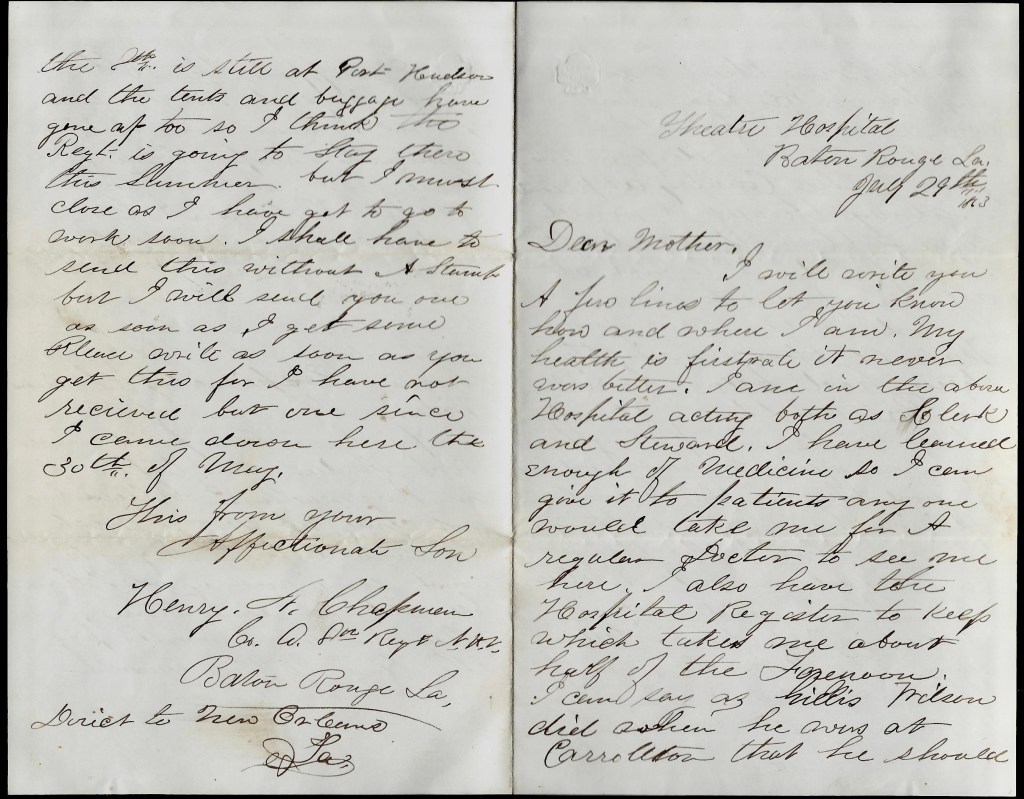
Dear Mother,

I will write you a few lines to let you know how and where I am. My health is first rate. It never was better. I am in the above hospital acting both as clerk and Steward. I have learned enough of medicine so I can give it to patients. Anyone would take me for a regular doctor to see me here. I also have the hospital registrar to keep which takes me about half of the forenoon.

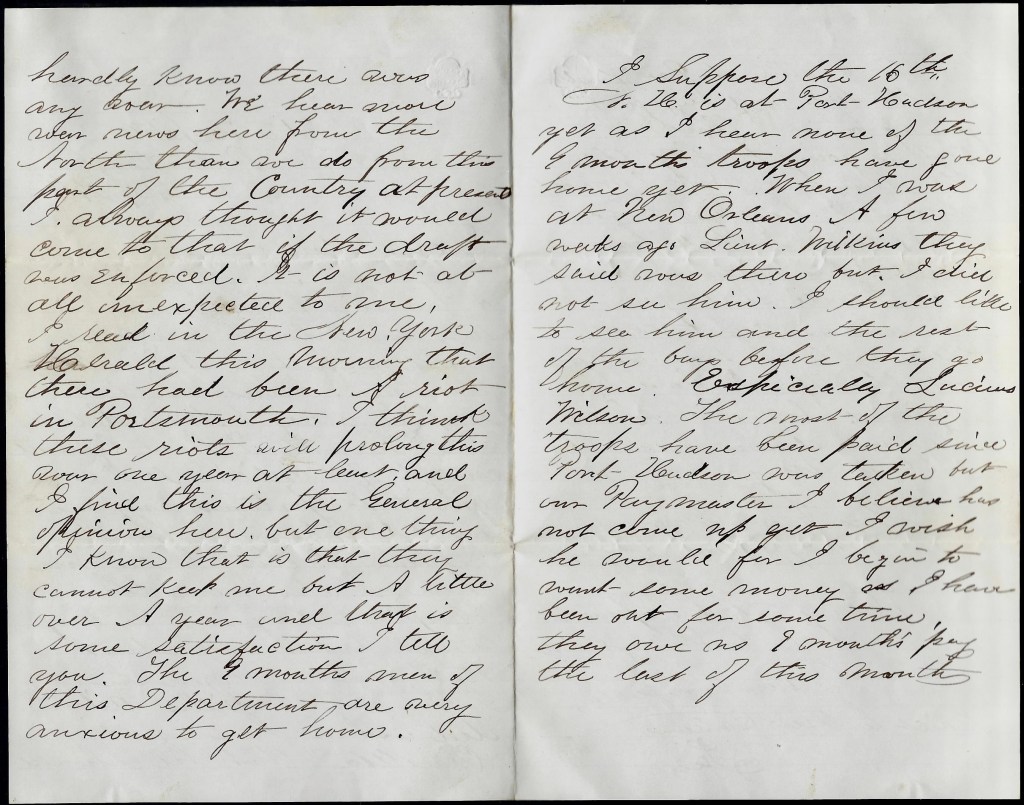
I can say as Hillis Wilson died when he was at Carrollton that we should hardly know there was any war. We hear more war news here from the North than we do from this part of the country at present. I always thought it would come to that if the draft was enforced. It is not at all unexpected to me. I read in the New York Herald this morning that there had been a riot in Portsmouth. I think these riots will prolong this war one year at least, and I find this is the general opinion here. But one thing I know—that is that they cannot keep me but a little over a year and that is some satisfaction, I tell you. The 9-month’s men of this Department are very anxious to get home.

I suppose the 16th New Hampshire is at Port Hudson yet as I hear none of the 9-month’s troops have gone home yet. When I was at New Orleans a few weeks ago, Lieut. Wilkins they said was there but I did not see him. I should like to see him and the rest of the boys before they go home—especially Lucius Wilson.

The most of the troops have been paid since Port Hudson was taken but our Paymaster I believe has not come up yet. I wish he would for I begin to want some money as I have been out for some time. They owe us 9-month’s pay the last of this month. The 8th is still at Port Hudson and the tents and baggage have gone up too so I think the regiment is going to stay there this summer.

But I must close as I have got to go to work soon. I shall have to send this without a stamp but I will send you one as soon as I get some. Please write as soon as you get this for I have not received but one since I came down here the 30th of May.

This from your affectionate son, — Henry N. Chapman, Co. A, 8th Regt. N. V. V., Baton Rouge, La.

Direct to New Orleans, La.

1861: Henry N. Allen to Estella Cowles

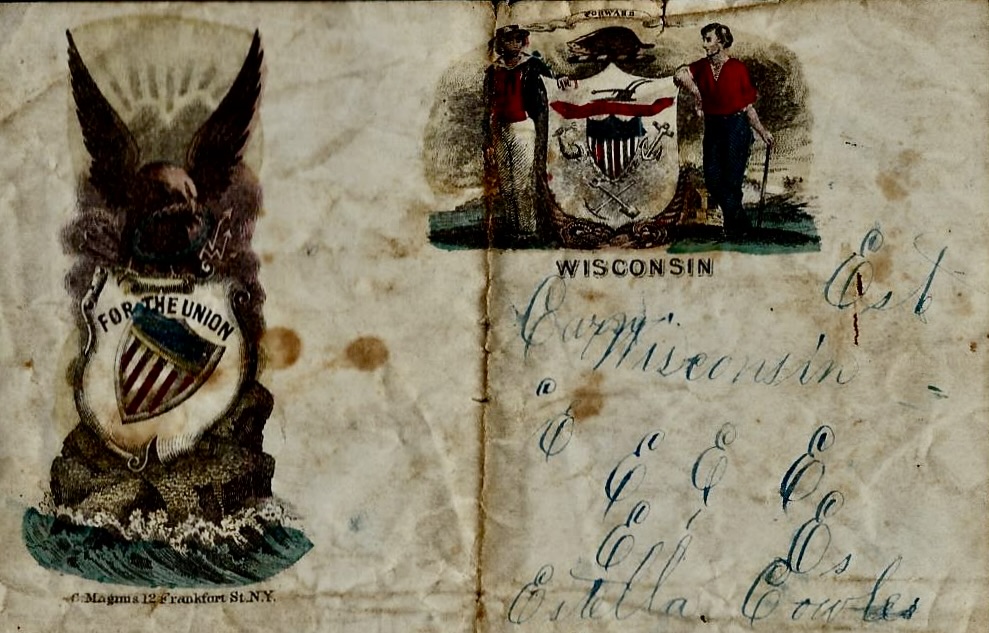
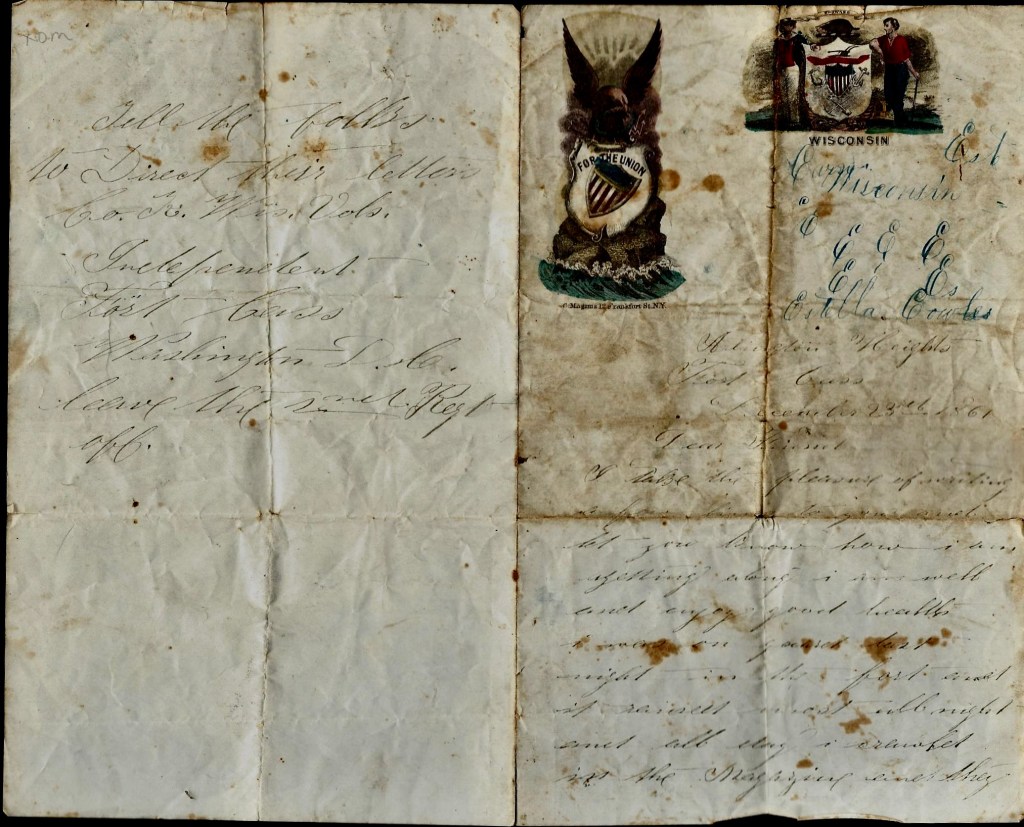
The following letter was written by Henry N. Allen (1841-1931), the son of Albert W. Allyn (1817-1889) and Mary P. Rice (1816-1889) of Shopiere, Rock county, Wisconsin.

Henry wrote the letter from Fort Cass in Arlington Heights in December 1861 while serving in Co. K, Wisconsin Volunteers, 2nd Wisconsin Infantry. The only Allen appearing on the roster of this company was “Henry E. Allen” who enlisted on 1 May 1861 and was transferred on 8 December 1861 to Battery A, 1st Wisconsin Heavy Artillery (H.A.). This may explain why Henry asked that the “2nd Regiment” be dropped from his address. He may not yet have realized they were to be known as Battery A, 1st Wisconsin H. A.

Battery A of the 1st Wisconsin H. A. was created entirely out of Co. K of the 2nd Wisconsin Infantry and were assigned at various times to Fort Cass, Fort Buffalo, Fort Ellsworth, Fort Worth, Fort Rodgers, and Fort Willard. They were mustered out of the service on 18 August 1865. According to muster rolls, Henry served his entire tour of duty with this unit and mustered out with the battery in 1865 as a corporal.

A pension record informs us that he died on 30 January 1931 at a Soldiers Home in California.

Transcription

Camp Wisconsin
Arlington Heights, Fort Cass
December 23rd 1861

Dear Friend,

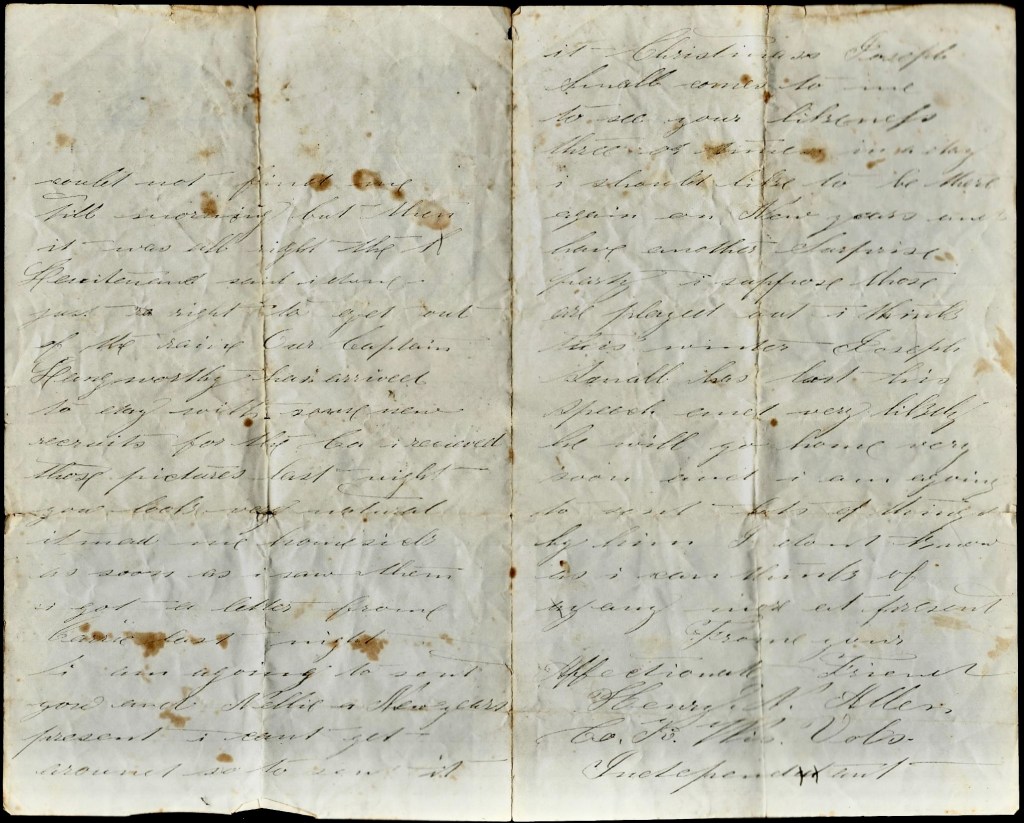
I take the pleasure of writing…to let you know how I am getting along. I am well and enjoy good health. I was on guard last night in the fort. It rained most all night and all day. I crawled in the magazine and they could not find me till morning but then it was all right. The Lieutenant said I did just the right thing to get out of the rain. Our Captain [Andrew] Langworthy has arrived today with some new recruits for the company. 1

I received those pictures last night. You look very natural. It made me homesick as soon as I saw them. I got a letter from Carrie last night. I am a going to send you and Nellie a New Year’s present. I can’t get around so to send it Christmas.

Joseph Small comes to me to see your likeness three or [four] times in a day. I should like to be there again on New Years and have another surprise party. I suppose those are played out, I think, this winter. Joseph Small has lost his speech [his voice] and very likely he will go home very soon and I am a going to send lots of things by him.

I don’t know as I can think of any more at present.

From your affectionate friend, — Henry N. Allen, Co. K, Wisconsin Volunteers Independent

Tell the folks to direct their letter to Co. K, Wisconsin Volunteers Independent, Fort Cass, Washington D. C. Leave the 2nd Regt. off.


1 Andrew Langworthy was wounded in the fighting at First Bull Run. He resigned his commission in February 1863.

1865: Adam Oscar Branstetter to Caroline M. Branstetter

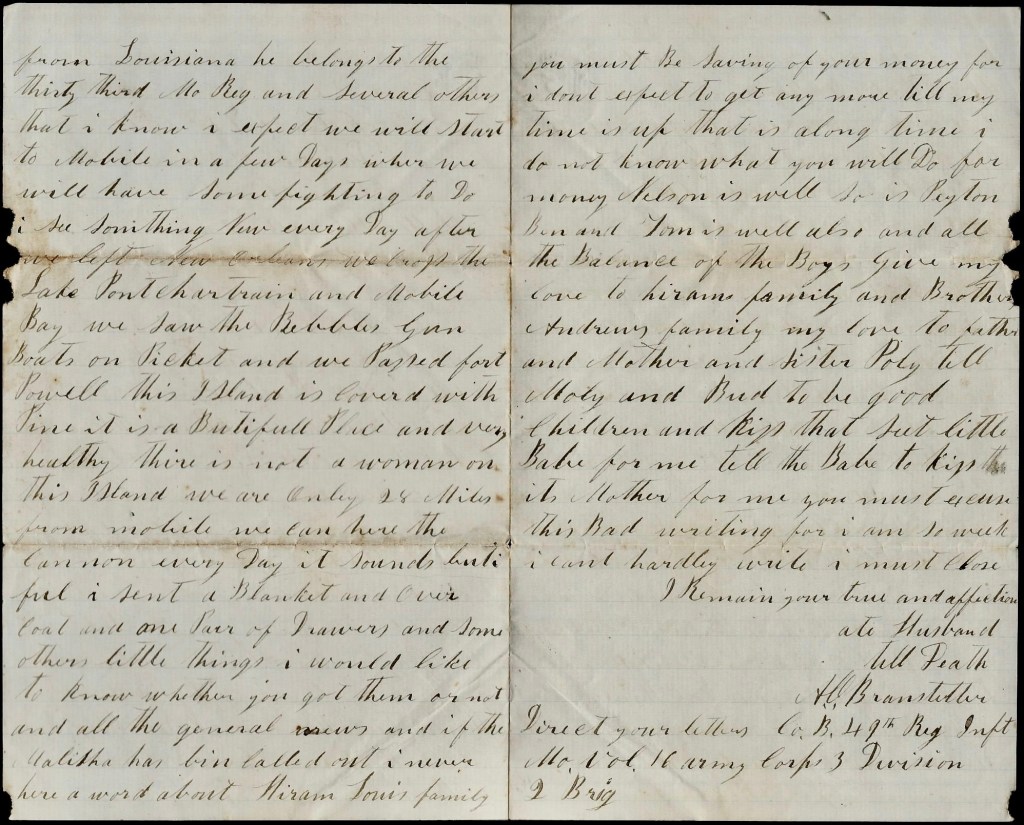
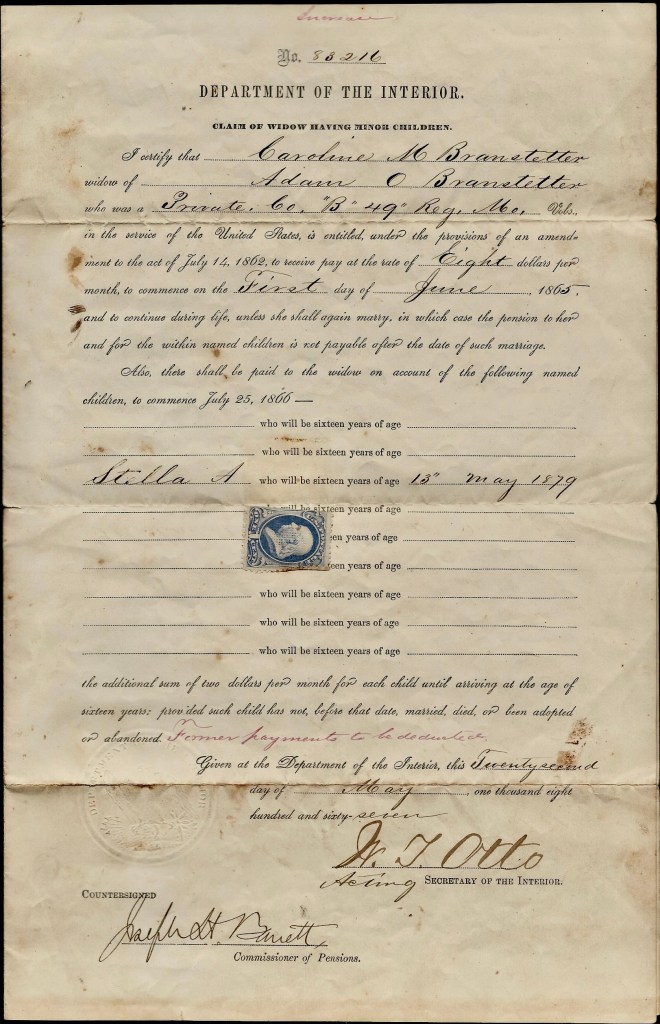
The following letter was written by Adam Oscar Branstetter (1834-1865), the son of Adam Grundy Branstetter (1784-1868) and Rachel E. Snavely (1788-1839) of Wellsville, Montgomery county, Missouri. Adam was married to Caroline (“Carrie”) M. Little (1829-1902) in April 1862. He managed to remain out of the war until September 1864 when he was enrolled as a private in Co. B, 49th Missouri (Union) Regiment. At the time of his enlistment he was described as a six foot tall, black-haired, 30 year-old farmer.

Unfortunately, Adam did not survive the war. He died on 3 June 1865 at Montgomery, Alabama, suffering from chronic diarrhea.

Transcription

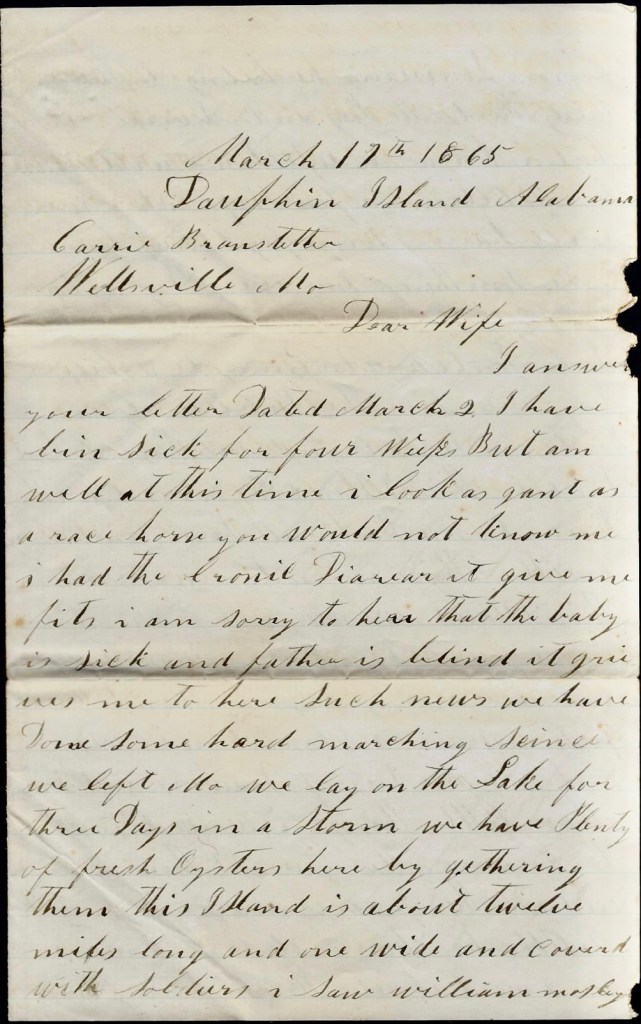
Dauphin Island, Alabama
March 17th 1865

Carrie Branstetter
Wellsville, Missouri

Dear wife, I answer your letter daed March 2nd. I have been sick for four weeks but am well at this time. I look as gaunt as a race horse. You would not know me. I had the chronic diarrhea. It gives me fits.

I am sorry to hear that the baby is sick and father is blind. It grieves me to hear such news.

We have done some hard marching since we left Missouri. We lay on the Lake for three days in a storm. We have plenty of fresh oysters here by gathering them. This island is about twelve miles long and one wide and covered with soldiers. I saw William Mosby from Louisiana. He belongs to the 33rd Missouri Regiment and several others that I know. I expect we will start to Mobile in a few days where we will have some fighting to do.

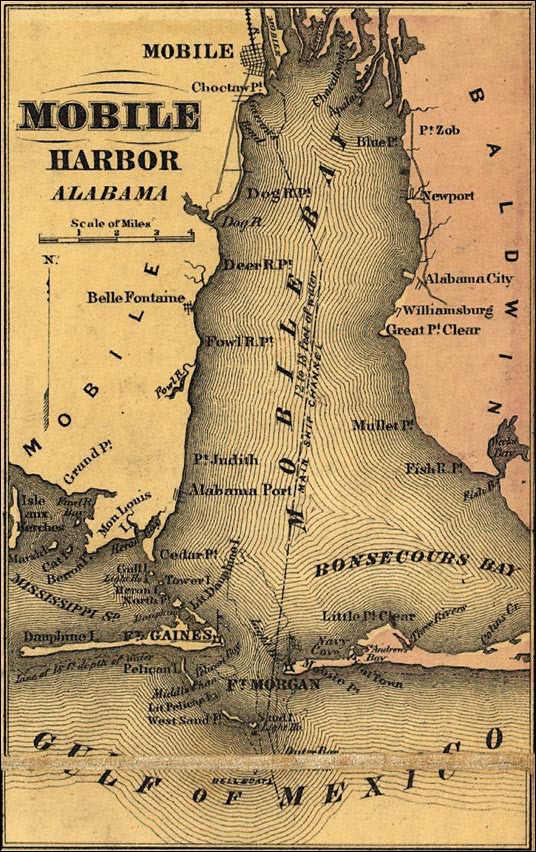
Map of Mobile Bay. Dauphin Island can be seen at lower left with Ft. Gaines at the eastern end of it.

I see something new every day. After we left New Orleans, we crossed The Lake Pontchartrain and Mobile Bay. We saw the rebel’s gunboats on picket and we passed Fort Powell. This island is covered with pine. It is a beautiful place and very healthy.

There is not a woman on this island. We are only 28 miles from Mobile. We can hear the cannon every day. It sounds beautiful.

I sent a blanket and overcoat and one pair of drawers and some other little things. I would like to know whether you got them or not and all the general news and if the militia has been called out. I never hear a word about Hiram Louis’ family.

You must be saving of your money for I don’t expect to get anymore till my time is up. That is a long time. I do not know what you will do for money. Nelson is well. So is Peyton, Ben and Tom is well also, and all the balance of the boys. Give my love to Hiram’s family and brother Andrew’s family. My love to Father and Mother and sister Polly. Tell Molly and Bud to be good children and kiss that sweet little babe for me. Tell the babe to kiss its Mother for me. You must excuse this bad writing for I am so weak I can’t hardly write.

I must close. I remain your true and affectionate husband till death, — A. O. Branstetter

Direct your letters to Co. B, 49th Regiment Infantry Missouri Volunteers, 10th Army Corps, 3rd Division, 2nd Brigade.

1862: John Morehead Edwards to Richard Bray Paschal

These two letters were written by John Morehead Edwards (1838-1907) of Chatham county who enlisted as a private in Co. M, 15th North Carolina Infantry on 4 June 1861. He was wounded slightly in 1 July 1862 in the Battle of Malvern Hill and later again on 10 May 1864 in the Battle of Spottsylvania after the regiment had been reorganized as the 32nd North Carolina Infantry.

After the war, John married Sallie Tyson (1854-1930) and together they had at least eight children. He is buried in the Sandy Branch Baptist Church Cemetery at Bear Creek, Chatham county, North Carolina.

Edwards wrote the first letter to his friend, Richard Bray Paschal (1820-1870) who was elected sheriff of Chatham county on 1854 and served six consecutive terms. In addition to his career as sheriff, Paschal served in the House of Delegates in 1865 and North Carolina Senate in 1866. Paschal’s diary is available on-line at the North Carolina Digital Heritage Center. It includes accounts of Paschal overseeing the trade of enslaved people in Chatham County, a reminder of the duties assigned to the position of sheriff.  Place names and people’s names, white and Black, are included in the diary.  [See R. B. Paschal Diary Transcript Now Available]

The second letter was written to Paschal’s eldest daughter, Mary Catherine Paschal (1846-1922) who married Stephen Wiley Brewer (1835-1897) in 1867.

Letter 1

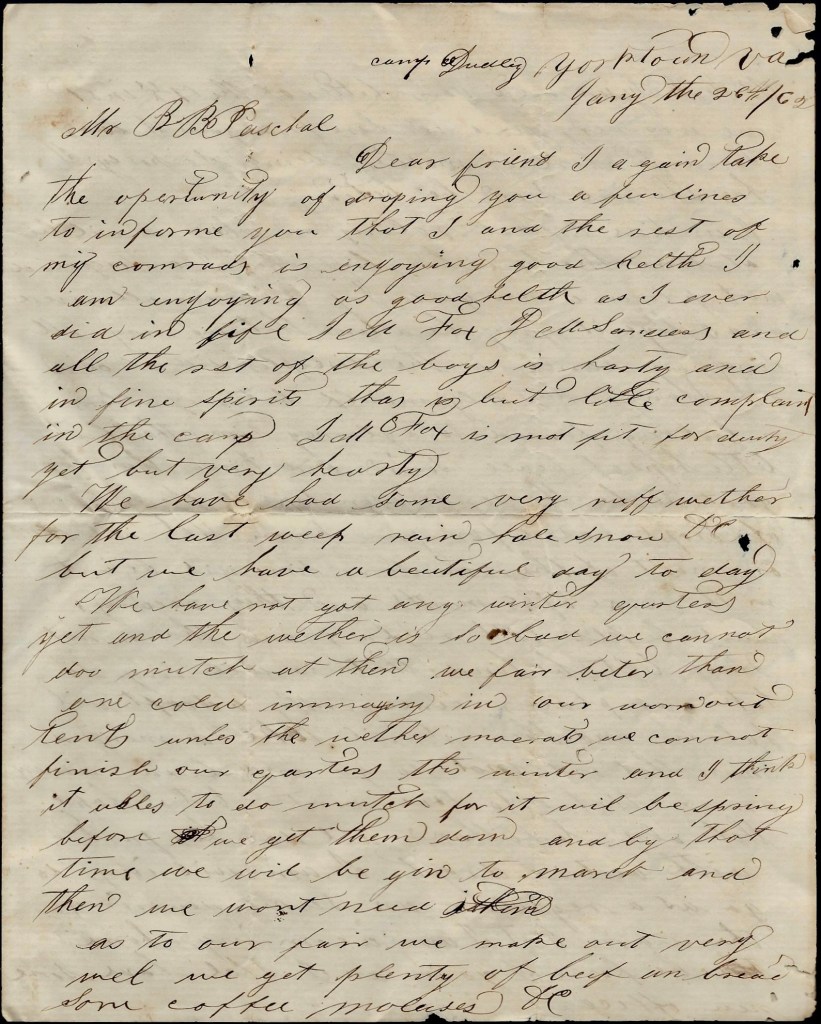
Camp Dudley
Yorktown, Virginia
January 26th 1862

Mr. R. B. Paschal,

Dear friend, I again take the opportunity of dropping you a few lines to inform you that I and the rest of my comrades is enjoying good health. I am enjoying as good health as I ever did in life. J[ohn] M. Fox, J[oseph] M. Saunders, and all the rest of the boys is hearty and in fine spirits. There is but little complaint in the camp. J. M. Fox is not fit for duty yet but very hearty.

We have had some very rough weather for the last week—rain, hail, snow, &c. but we have a beautiful day today. We have not got any winter quarters yet and the weather is so bad we cannot do much at them. We fare better than one could imagine in our worn out tents. Unless the weather moderates, we cannot finish our quarters this winter and I think it useless to do much for it will be spring before we get them done and by that time we will begin to march and then we won’t need them.

As to our fare, we make out very well. We get plenty of beef and bread. Some coffee, molasses, &c.

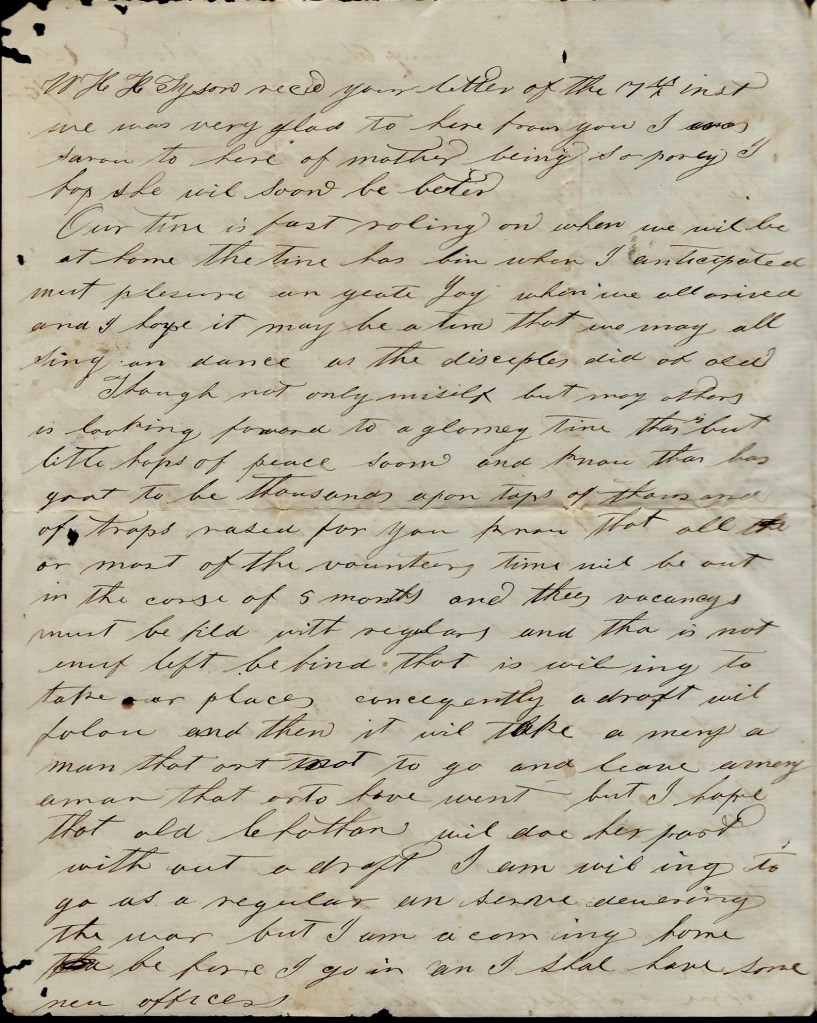
W. H. H. Tyson 1 received your letter of the 17th inst. We was very glad to hear from you. I was sorry to hear of mother being so poorly. I hope she will soon be better.

Out time is fast rolling on when we will be at home where I anticipate pleasure and great joy when we all arrive and I hope it may be a time that we may all sing and dance as the disciples did of old, though not only myself but many others is looking forward to a gloomy time. There is but little hope of peace soon and now there has got o be thousands upon tops of thousands of troops raised for you know that all, or most, of the volunteers time will be out in the course of five months and their vacancies must be filled with regulars and there is not enough left behind that is willing to take our places. Consequently a draft will follow and then it will take many a man that ought not to go and leave a man that ought to have went. But I hope that old Chatham will do her part without a draft. I am willing to go as a regular and serve during the war but I am a coming home before I go in and I shall have some new officers.

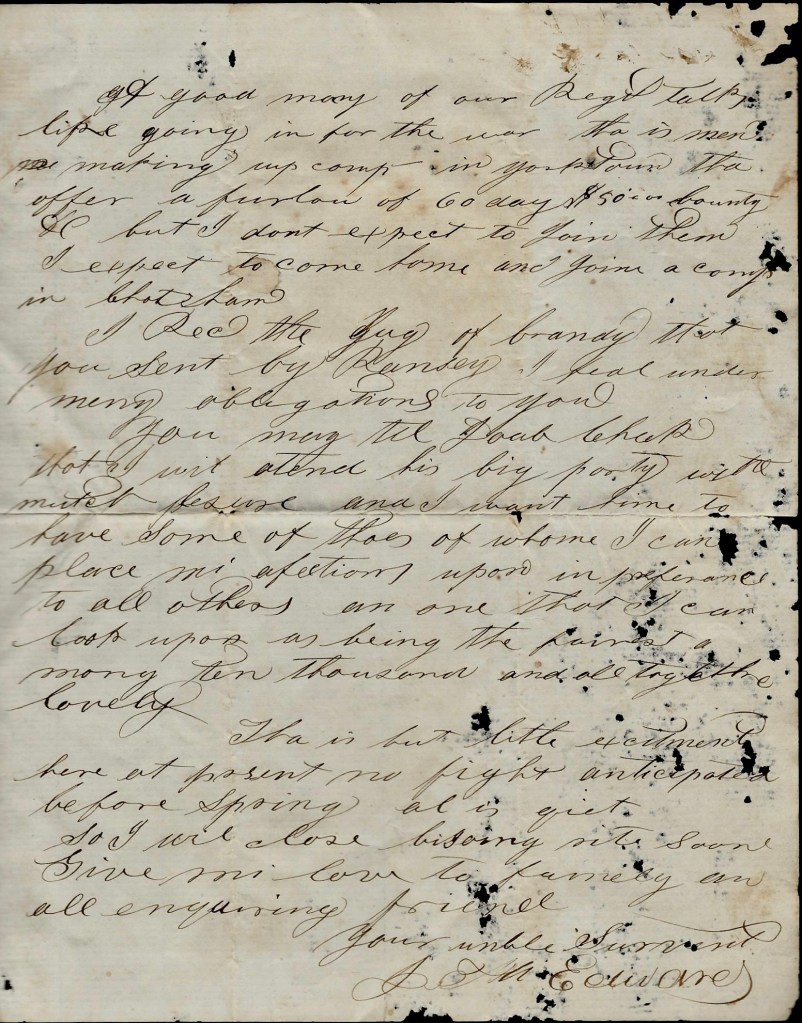
A good many of our regiment talk like going in for the war. There is men making up a company in Yorktown that offer a furlough of 60 days [and] $50 bounty, &c., but I don’t expect to join them. I expect to come home and join a company in Chatham.

I received the jug of brandy that you sent by Ramsey. I feel under many obligations to you.

You may tell Joab Cheek that I will attend his big party with much pleasure and I want him to have some of those of whom I can place my affections upon in preference to all others, and one that I can look upon as being the fairest among ten thousand and altogether lovely.

There is but little excitement here at present. No fight anticipated before spring. All is quiet. So I will close by saying write soon. Give my love to family and all enquiring friends. Your humble servant, — J. M. Edwards

1 William Henry Harrison Tyson of Chatham county while serving in Co. M, 15th North Carolina Infantry, formerly the 5th Volunteers. He was elected 2nd Lieutenant of that company on 2 May 1862. Later, during the Seven Days Battles, he was wounded at Malvern Hill on 1 July 1862. William’s company was later reorganized as Co. I of the 32nd North Carolina Infantry. In May 1864, William was promoted to Captain of his company. He resigned his commission on 7 March 1865.


Letter 2

Camp near Pines Bluff, Va.
12 November 1862

Miss M[ary] C[atherine] Paschal,

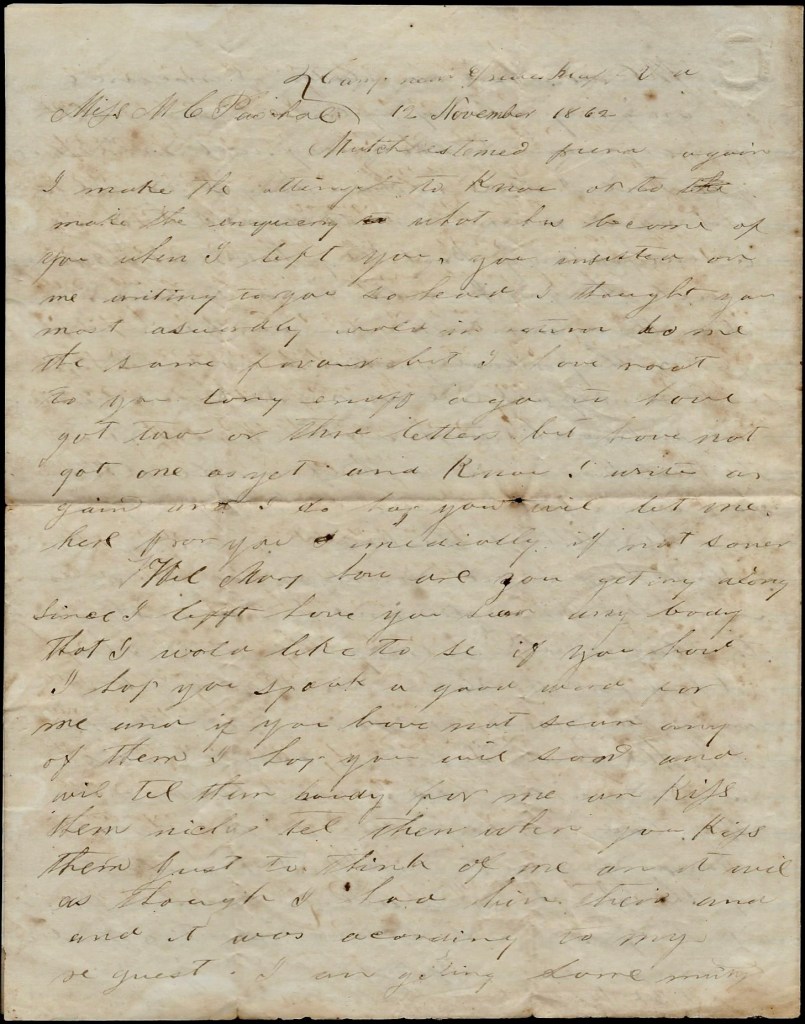
Much esteemed friend, again I make the attempt to know or to make the enquiry what has become of you. When I left you, you insisted on me writing to you so hard I thought you most assuredly would return to me the same favor, but I have wrote to you long enough ago to have got two or three letters, but have not got one as yet. And now I write again and I do hope you will let me hear from you immediately, if not sooner.

Well, Mary, how are you getting along since I left? Have you seen anybody that I would like to see. If you have, I hope you spoke a good word for me and if you have not seen any of them, I hope you will soon and will tell them howdy for me and kiss them nicely. Tell them when you kiss them just to think of me and it will be as though I had kissed them and it was according to my request.

I am getting some mighty good letters along now. I received three the other day all from the same neighborhood and they were addressed to Mr. Edwards in the most kindest terms imaginable, another Johnny in all its loving features and the third My Dear beloved Cousin John. I tell you, Miss Cite, it was more than I could face the case on. But I treated the cold under the existing circumstances with the exception of so much Dear Beloved Cousin John which was just about every third line. You just ought to have seen [illegible and uninteresting]…

I am in pretty good fix for writing love composition at this time for I think of nothing, talk of nothing, or dream of nothing [but] the girls. I wish I had another association to go to. I think I would bring things to a close. I have been the worst love sick that I ever was in all my life. I would not mind another right smart wound to get home. I reckon your Pa told you of the presents I received in the Pines. I received another the other day in a letter so you [may] guess I am getting pretty popular on Rocky River as well as Deep River. Bear Creek is not here from Deep River. I reckon the fat is all in the [ ].

I have been studying for I can’t get home at Christmas and the only way I see to get home is to get a furlough to get married. Gen. Daniel says he will give a furlough of 30 days to anybody that wants to get married so I believe I will take him up. Don’t you think it would be a good idea. I think if I continue to get such letters, I can have all things ready by Christmas. Well, we have [had] plenty of nonsense.

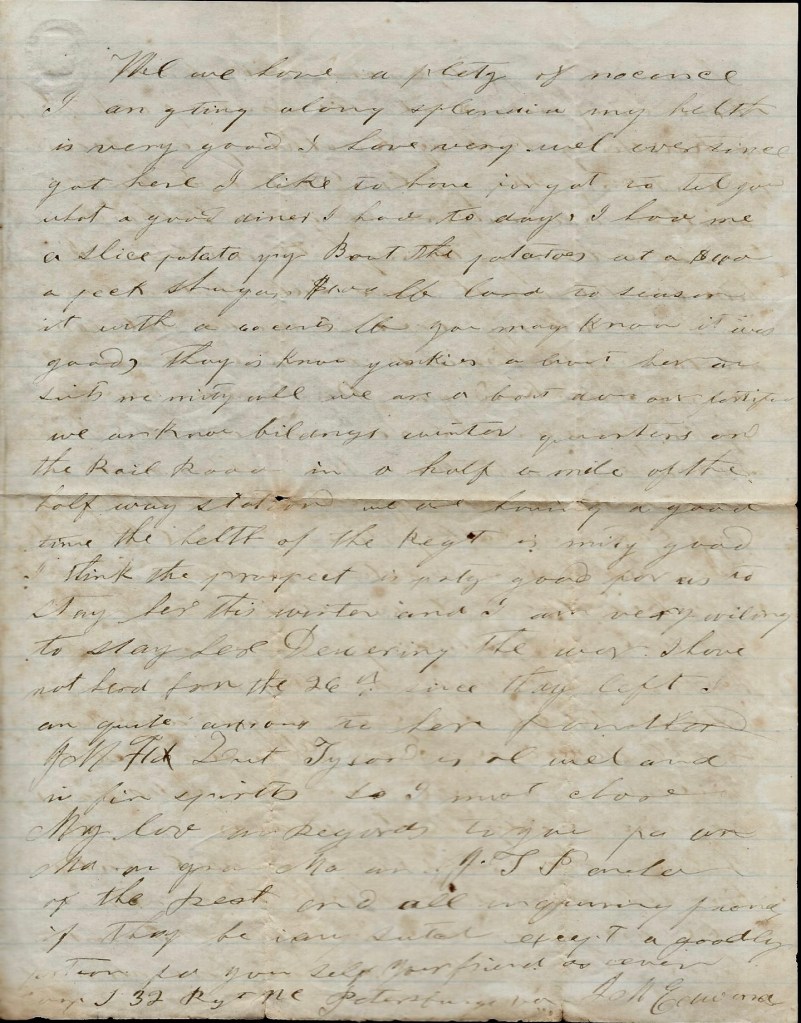
I am getting along splendid. My health is very good. I have [been] very well ever since we got here. I like to have forgot to tell you what a good dinner I had today. I have me a slice potato pie. Bought the potatoes at $1 apiece, sugar $1 a lb. You may know it was good.

There is no Yankees about here. It suits me mighty well. We are about done on fortifications. We are now building winter quarters and the railroad is within a half mile of the halfway station. We are having a good time. The health of the regiment is mighty good. I think the prospect is pretty good for us to stay here this winter and I am very willing to stay here during the war. I have not heard from the 26th since they left. Am quite anxious to hear from J. M. Fox. Lieut. [W. H. H.] Tyson is well and in fine spirits.

So I must close. My live and regards to your Pa and Ma and you…. Your friend as ever, — J. M. Edwards

Camp 32nd Regiment N. C. Petersburg, Va.


1862: Samuel Patton Inks to Susan Haygood

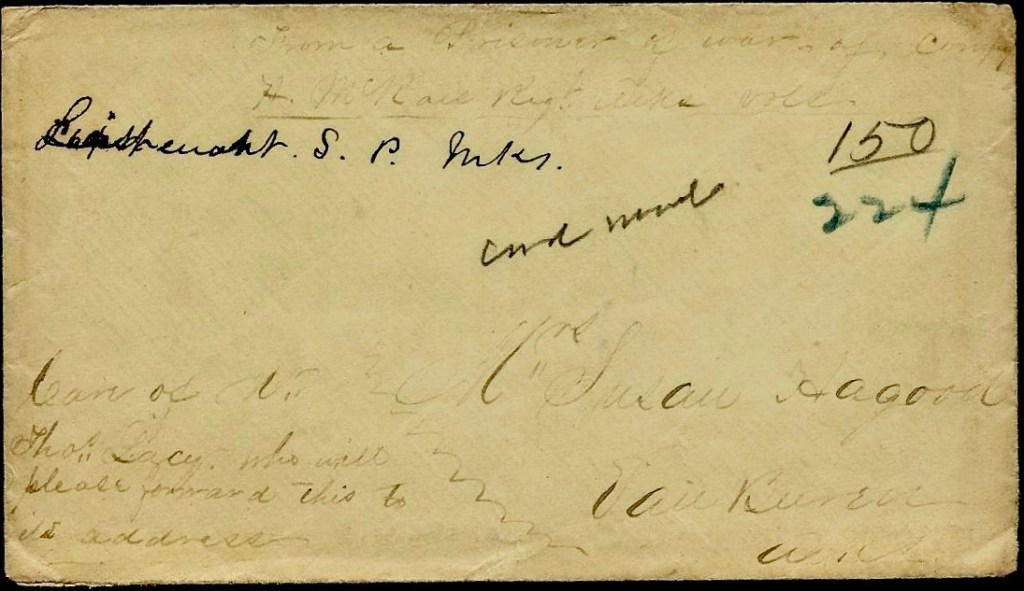
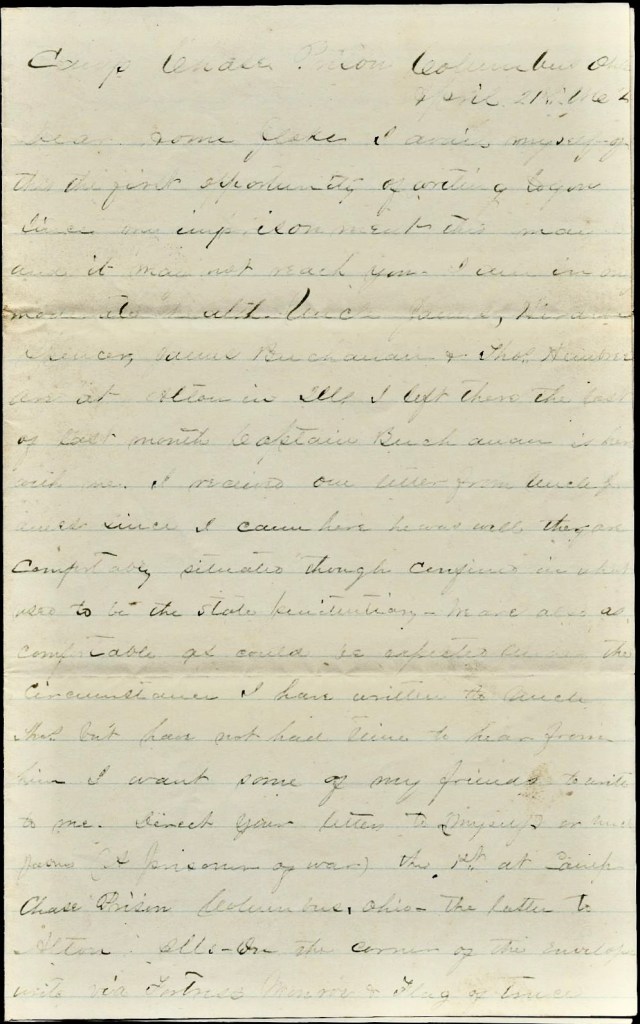
The following prisoner-of-war letter was written by 1st Lieutenant Samuel Patton Inks who served in McRae’s 15th Arkansas Regiment. He was taken prisoner at Pea Ridge and sent initially to Alton, Illinois, and then to Camp Chase in Columbus, Ohio, arriving at the latter prison on 1 May 1862. He was eventually forwarded on to Johnson’s Island, Ohio. After his release from prison, he performed quartermaster duties and served on Cabell’s Staff in 1864, being promoted to the rank of Captain.

Transcription

Addressed to Mrs. Susan Hagood, Van Buren, Arkansas; In care of Mr. Thomas Lacy who will please forward this to the address.

Camp Chase Prison
Columbus, Ohio
April 21st 1862

Dear Home Folks,

I avail myself of the first opportunity of writing to you since my imprisonment. This may and it may not reach you. I am in only moderate health. Uncle James, Hiram Spencer, James Buchanan, and Thomas Heinbree are at Alton in Illinois. I left there the last of last month. Captain Buchanan is her with me.

I received one letter from Uncle James since I am here. He was well. They are comfortably situated though confined in what used to be the state penitentiary. 1 We are also as comfortable as could be expected under the circumstances. I have written to Uncle Thomas but have not had time to hear from him. I want some of my friends to write to me. Direct your letters to myself or Uncle James (a prisoner of war)—the 1st at Camp Chase Prison, Columbus, Ohio; the latter to Alton, Illinois. On the corner of the envelope write via Fortress Monroe & Flag of Truce.

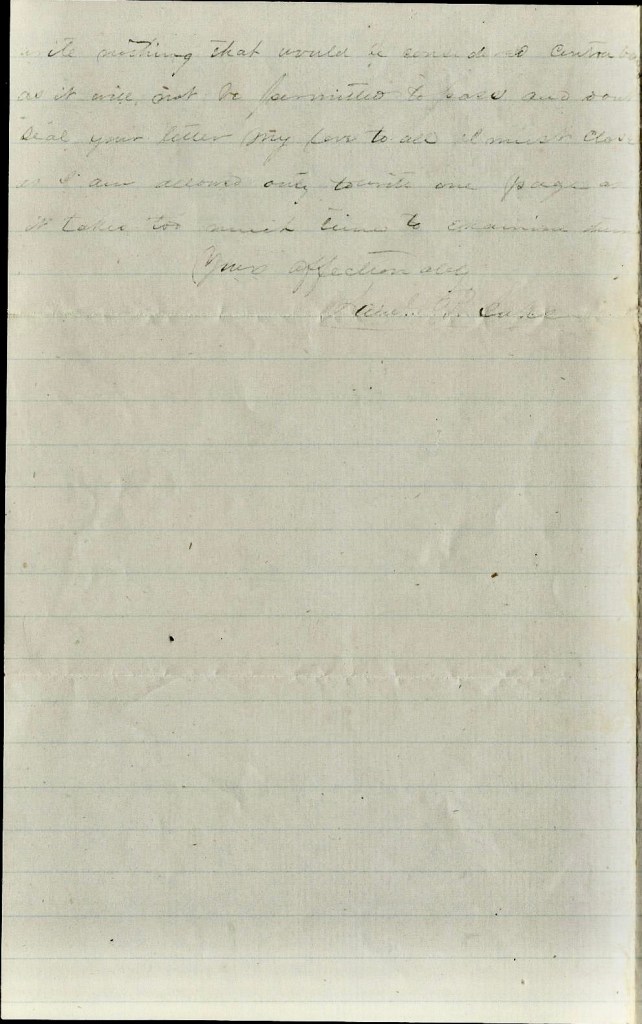
Write nothing that would be considered contraband as it will not be permitted to pass and don’t seal your letter. My love to all. I must close as I am allowed only to write one page as it takes too much time to examine them.

Your affectionately, — Samuel P. Inks

1 Samuel informs us in this letter that he was first confined in the State Prison at Alton, Illinois. In three years, more than 11,700 Confederate prisoners passed through the gates of the Alton Prison, which opened in 1833 and closed in 1860. “In December of 1861, after inspecting the facilities, Major General Henry Halleck, Commander of the Department of the Missouri, prepared to have the prison re-opened as a the Alton Federal Military Prison. On Feb. 9, 1862, the first prisoners arrived at the prison. Inmates of the prison included Confederate soldiers, citizens imprisoned for treason acts, and bushwackers or guerillas imprisoned for acts against the government. Much of the time, the prison was overcrowded, prisoners were malnourished and had inadequate clothing. Under these dilapidated conditions, prisoners were exposed to influenza, dysentery and small pox. The small pox epidemic grew in numbers, and the official military death toll listed 1,354 deceased. A monument dedicated to those who perished can be found at their burial site in the Confederate Cemetery. After the war, the prison was privately purchased and building blocks were removed. Only a small remnant of the wall (restored in 1973) may be visited today.[Source: Enjoy Illinois]

1862: James McCoy to Theodore Wilberforce McCoy

The following letter was written by James McCoy (1802-1865) and his wife Margaret Jane McKinney (1806-1873) of Indianapolis, Indiana. The letter was addressed to their son, Theodore Wilberforce McCoy (1839-1896) who enlisted early in the war, serving 3 months in Co. I, 6th Indiana Infantry, and then enlisted again on 29 August 1861 as a 2nd Lieutenant in Co. I, 39th Indiana Regiment (8th Indiana Mounted Infantry). He resigned his commission as a 1st Lieutenant on 1 September 1863 and returned to Indiana where he married Eliza Taggart in 1868 and eventually became a Presbyterian minister.

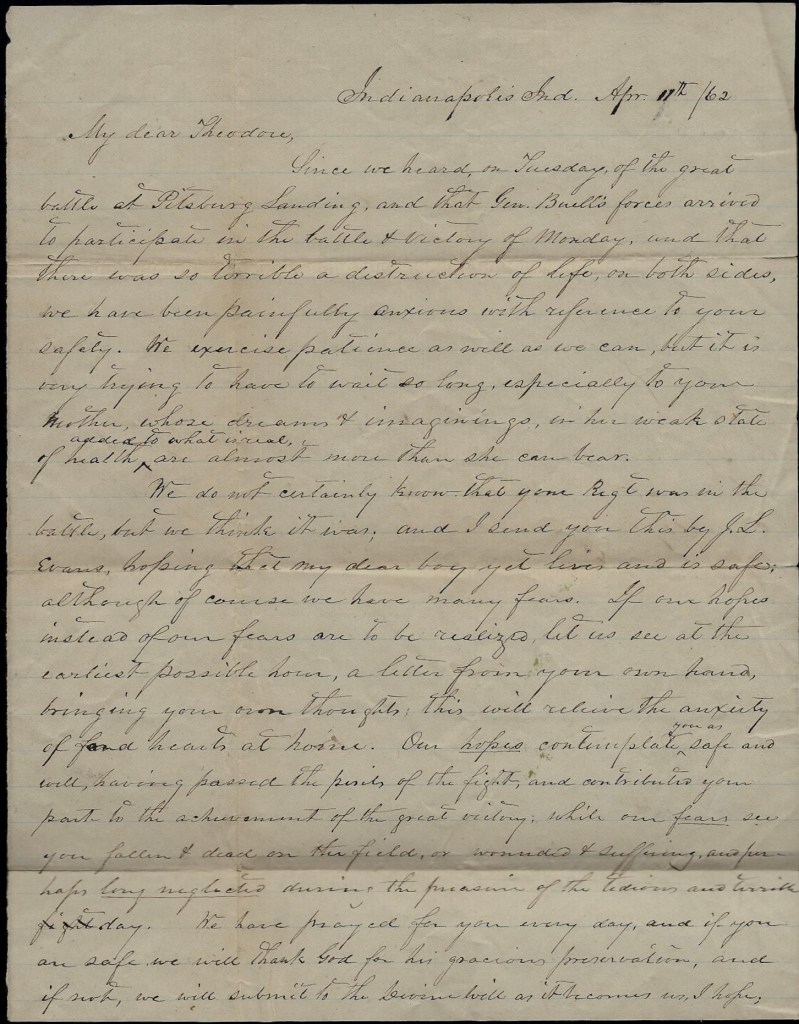
In this letter, Theodore’s parents beseech their son to write home as soon as possible to let them know of his safely following the Battle of Pittsburg Landing, or Shiloh. The 39th Indiana did indeed participate in the 2nd day’s fight of the battle. A soldier in Co. I names John M. Stites wrote of their involvement in a letter to his father which read:

“Our regiment got in the fight at 11 o’clock on the second day and was in it until it ended which was about 2 o’clock in the afternoon. All of the boys from around there went through it without a scratch. There was no anyone in our company killed and only two wounded. There was 31 in our regiment killed and wounded and 18 killed on the field and died of their wounds but that is nothing to the side of some of the rest as you have learned before this time for there was an awful sight met the eye when you walked over the field on the day after the battle was over. Go where[ever] you might, there was desolation met the eye. And there was one horrible sight and that was this—the enemy all had whiskey with powder in it and as soon as they were killed, they turned as black as negroes and it looked horrible.” [See—1862: John Muchmore Stites to William Muchmore on Spared & Shared 22.]

Transcription

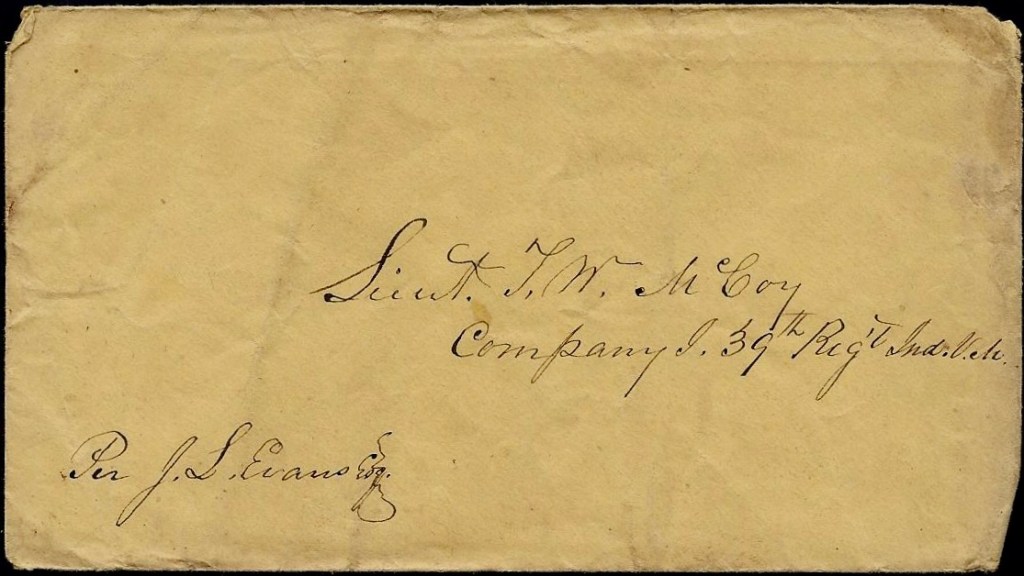
Addressed to Lieut. T. W. McCoy, Company I, 39th Regt. Indiana Volunteers

Indianapolis, Indiana
April 11th 1862

My dear Theodore,

Since we heard on Tuesday of the great battle at Pittsburg Landing, and that Gen. Buell’s forces arrived to participate in the battle and victory of Monday, and that there was so terrible a destruction of life on both sides, we have been painfully anxious with reference to your safety. We exercise great patience as well as we can, but it is very trying to have to wait so long—especially to your Mother whose dreams & imaginings in her weak state of health added to what is real are almost more than she can bear.

“Our hopes contemplate you as safe and well, having passed the perils of the fight, and contributed your part to the achievement of the great victory; while our fears see you fallen & dead on the field, or wounded & suffering…”

James McCoy to Lt. Theodore W. McCoy, 11 April 1862

We do not certainly know that your regiment was in the battle but we think it was and I send you this by J. L. Evans, hoping that my dear boy yet lives and is safe; although of course we have many fears. If our hopes instead of our fears are to be realized, let us see at the earliest possible hour a letter from your own hand, bringing your own thoughts. This will relieve the anxiety of fond hearts at home. Our hopes contemplate you as safe and well, having passed the perils of the fight, and contributed your part to the achievement of the great victory; while our fears see you fallen & dead on the field, or wounded & suffering and perhaps long neglected during the pressure of the tedious and terrible day.

We have prayed for you every day and if you are safe, we will thank God for his gracious preservation, and if not, we will submit to the Divine Will as it becomes us, I hope; believing that to Him you have committed your way, and your soul to His keeping, while periling your life in the righteous cause for which it is an honor to live, to suffer, and if need be, to die—a cause which God will surely make triumphant.

I wrote you to Nashville, Camp Andy Johnson, a long, long letter which you did not receive before marching, nor before you wrote me from Columbia, but which I hope you received afterwards. Ma is in bed today and has been in her room most of the time since we knew the battle was pending. I have no word from James since the 6th of March, when he was at Cumberland Ford, 14 miles from the Gap—well, except a bad cold. I will not write of other matters till we hear of your safety. If any casualty has happened to you, let the whole truth be sent us.

Ever your affectionate Father, Mother, & Sister

Per James McCoy

[In a different hand and in pencil]

Dear Theodore, if you have been in the battle, will not this satisfy you my dear child? If you value your own life & mine, do resign and come home. You are buoyed with future hopes and prospect of life & will you risk it any longer? I feel that I can’t live in this state of anxiety. The battles will be [ ].

1860: Margaret to her Uncle

I can’t be certain of the author or the date of this letter though I’m confident it was written in Belfast, Waldo county, Maine. I’m guessing the letter dates to about 1860 and I only know the author’s first name was Margaret. Whether the people described in her letter were relatives or simply acquaintances, I could not discern.

In her letter, Margaret describes a domestic abuse incident. The married couple was Lewis C. Smith (1823-1905) and Susannah C. Otheman (1831- Aft1910) who were married in Boston, Massachusetts, on 18 February 1849 by Rev. Edward Beecher of the Park Street Church. Lewis was a native of Belfast, Waldo county, Maine, but he came to the Boston area in the late 1840s to work in the meat business. By the mid 1850s, he had returned to Belfast, Maine, where he lived out his days. Susannah is enumerated with him in the 1870 US Census but appears to have left him not long after that date. I believe she relocated to Chelsea, Massachusetts and ran a boarding house as a “widowed” woman. Their daughter, Carro, was born in 1853. Another child named Edward Otheman Smith (1858-1929) who was born in Maine in 1858.

Also mentioned in the tale is Luther Mitchell Smith (1820-1908)—Lewis’ older brother. Luther and Lewis were the sons of Deacon Luther Smith (1783-1863) and Sally Page (1783-1846) of Belfast, Waldo county, Maine.

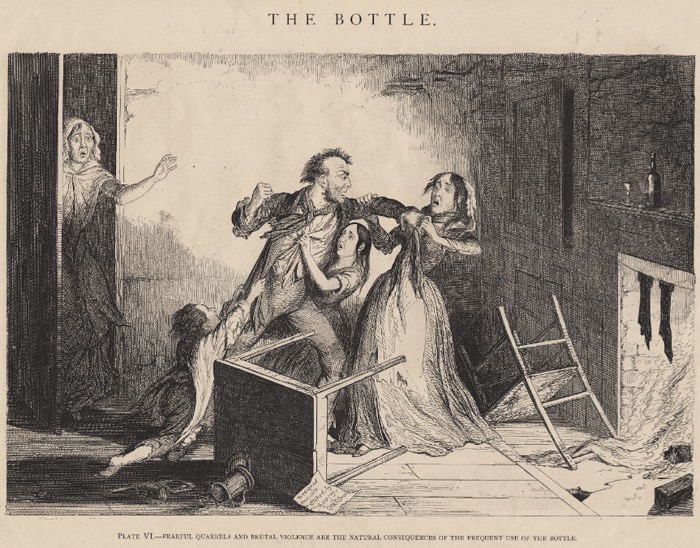
Domestic Violence was more common than imagined in mid-19th Century America, usually attributed to alcohol abuse. Some women divorced their husbands; many simply left and declared themselves “widows.”

Transcription

Poors Mills
[Belfast, Waldo county, Maine]
May 4th [@1860]

Dear Uncle,

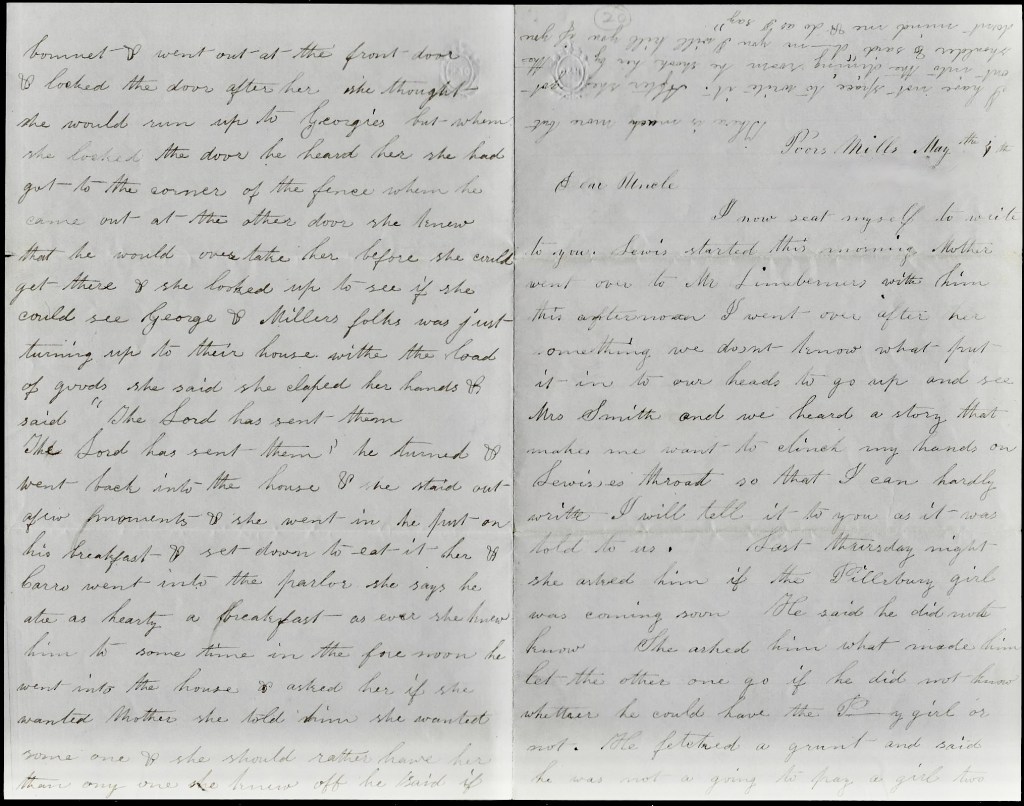
I now seat myself to write to you. Lewis started this morning. Mother went over to Mr. Limeberner’s 1 with him this afternoon. I went over after her. Something—we don’t know what—put it in to our heads to go up and see Mrs. Smith and we heard a story that makes me want to clinch my hands on Lewis’s throat so that I can hardly write. I will tell it to you as it was told to us.

Last Thursday night she asked him if the Pillsbury girl was coming soon. He said he did not know. She asked him what made him let the other one go if he did not know whether he could have the Pillsbury girl or not. He fetched a grunt and said he was not a going to pay a girl two dollars a week for her he had worked hard and hired a girl for her long enough. She told him if he did not hire her one, she should hire one herself for she was not able to do her work herself and another thing, the girl’s wages come out of her after all. Then he sprang up and began to walk the house. After awhile he went upstairs to bed and she went into the nursery and woke up Carro and told her she was afraid her father would kill her before morning, he was so mad, and she kept awake until most morning when she dropped to sleep. When she woke, it was daylight. She got up and got his breakfast ready [but] he did not get up and she felt faint & dizzy so she went into the parlor and laid down on the sofa.

She had not laid there but a few minutes before he came down and came directly in there & took the rocking chair and sat down and looked directly at her. She said she guessed she looked pale for she felt very faint. After he had watched her awhile, he got up & shut the doors and put down the curtains. When he dropped the one behind the sofa, he grabbed her & held his hand over her mouth and nose and began to swear at her. She tried to get away twice. She made out to get his hands off so that she caught her breath. She found that she was going. She told him that she should faint or die & not to kill her this time. He told her, “God damn you, die if you want to.” The next thing she knew she was out in the dining room staggering along towards the nursery door.

She called Carro and told her to get up for her father was trying to kill her. He told Carro to lie still and not ming anything her Mother said she was crazy and did not know what she was talking about. But Carro sprang up and come out & told him he had been doing something to her Mother, to look at the blood on her face, and see how black she is. “You have been hurting her some way.” Then he began to swear at Carro and Sue caught her bonnet and went out at the front door & locked the door after her. She thought she would run up to Georgie’s but when she locked the door he heard her. She had got to the corner of the fence when he came out at the other door, She knew that he would overtake her before she could get there and she looked up to see if she could see George & Miller’s folks was just turning up to their house with the load of goods. She said she clapped her hands & said, “The Lord has sent them. The Lord has sent them.” He turned & went back into the house & she stayed out a few moments & she went in. He put on his breakfast & sat down to eat it [while] her and Carro went into the parlor. She says he ate as hearty a breakfast as ever she knew him to.

Sometime in the forenoon, he went into the house & asked her is she wanted Mother. She told him she wanted some one & she should rather have her than any one she knew of. He said if she could hold her tongue and not go to blabbing everything that had been said or done since Gufts’s folks went away, he would come over and see if he could get Mother. She told him she should make no promises. He went out and in a few minutes he came back and said he was going and tried again to make her promise but she never answered him. He told her if her or the children went up to Georgie’s while he was gone, he would kill them when he got back. She did not dare to go nor let the children. At last George came from the mill and drove up into the dooryard with some lumber for Lewis. She went to the door. She asked him if he would go over to Luther’s for her. He said he would. She told him to go as quick as he could and tell Luther to come over as quick as he could. Luther wanted to start the next morning for Boston but Suse thought that he had better write. Lewis would miss him and mistrust something. He told her she should not stay there alone with Lewis another day. He would go & get Aunt Phebe.

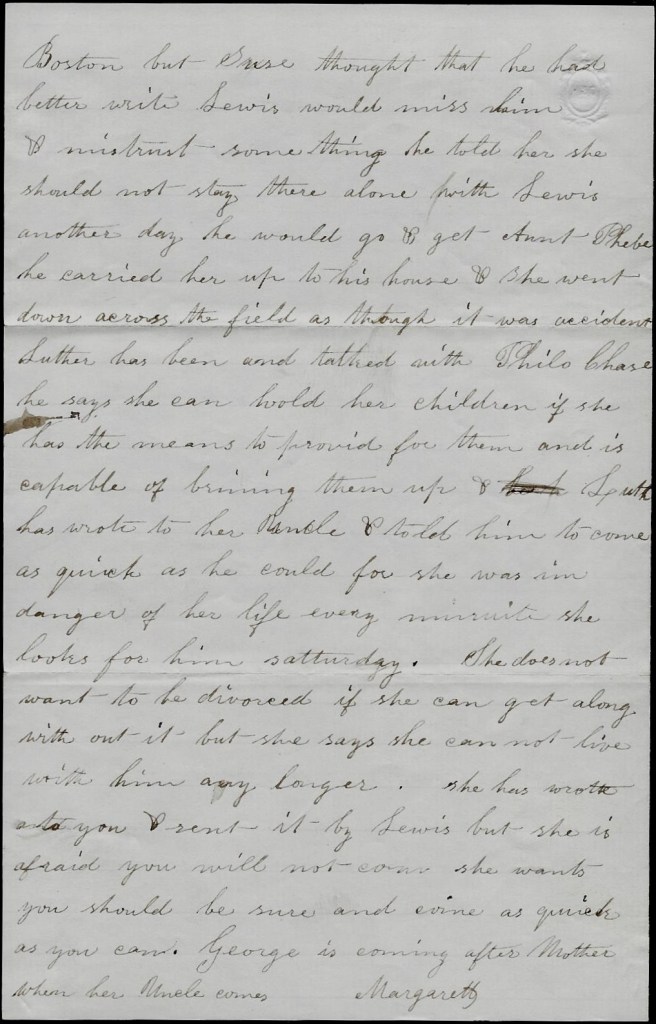
He carried her up to his house and she went down across the field as though it was accident. Luther has been and talked with Philo Chase. 2 He says she can hold her children if she has the means to provide for them and is capable of bringing them up & Luther has wrote to her Uncle & told him to come as quick as he could for she was in danger of her life every minute. She looks for him Saturday. She does not want to be divorced if she can get along without it but she says she cannot live with him any longer. She has wrote to you & sent it by Lewis but she is afraid you will not come. She wants you should be sure and come as quick as you can. George is coming after Mother when her Uncle comes. — Margarett

There is much more but I have not space to write it, After she’s got out into the dining room, he shook her by the shoulder and said, “Damn you, I will kill you if you don’t mind me & do as I say.”


1 Robert Limeburner (1822-1884) was a shipmaster and Master Mariner who resided in Belfast, Waldo county, Maine.

2 Philo Chase (1829-1898) was also a native of Waldo county, Maine. He was married to Mary Elizabeth Davis (1838-1911) in 1857. In the 1860 US Census, he was enumerated in Belfast as an attorney. He practiced in Belfast from 1857 until 1868 and then moved to New York City.

1862: William Henry Harrison Tyson to John M. Edwards

The following letter was written by William Henry Harrison Tyson of Chatham county while serving in Co. M, 15th North Carolina Infantry, formerly the 5th Volunteers. He was elected 2nd Lieutenant of that company on 2 May 1862. Later, during the Seven Days Battles, he was wounded at Malvern Hill on 1 July 1862. William’s company was later reorganized as Co. I of the 32nd North Carolina Infantry. In May 1864, William was promoted to Captain of his company. He resigned his commission on 7 March 1865.

Tyson wrote the letter to John M. Edwards of Chatham county, North Carolina. There were two by that name in the county—one of them a soldier in the same regiment as Tyson. My hunch is this is the older Edward who was a farmer born in 1821.

Transcription

[Before Richmond, Virginia]
[Early May 1862]

Mr. J. M. Edwards, Esq.

I will try to write you a few lines. I hope you will be well but I hope you will be at home when you get this from the fact that I do [not] wish any friend of mine to have to go through what we have to bear now. John, you know nothing about hard times. J[oseph] M. Saunders has been sick for the last two weeks but is now better. We have but 20 privates for duty in our company. The sick is in Petersburg and Richmond. We have to submit to conscription. It is a rough pill to take. [William Lord] London is our captain, [Leonidas J.] Merritt 1st Lieutenant, myself 2nd [Lieutenant], Jim Rogers 3rd.

We are now picketing all the time. We have nothing to eat and nothing to cook in the whole Peninsula from Yorktown to Richmond. John, get all the conscript men you can to come to our company. Tell Dr. Hedgepeth to come with you.

I have seen lots of Yankees. Our lines have been from 2[00] to 800 yards apart. The soldiers on each side devil’s each other. The Yankees ask our men how they like conscription [illegible]…have a good many of them march to Richmond every day.

J. M. Saunders says to be sure to bring him 1 pair pants, two shirts, cotton collars he prefers. I hope we will get the chance to come home some time in the summer. George is sick. A[lbert] G. Riggsbee is dead. 1 He died in Petersburg. Tell John Fox I think we are getting [illegible] …no difficulty in his staying at home some time yet. Write to me to Richmond, Va. 15th NC Troops, Gen. Cobb’s Brigade, Care of Capt. W. L. London. Give my love to all enquiring friends. Tell them to write to me. One box of clothing is at Morrisville, having it carried home. — Lieut. W. H. Tyson


1 Albert G. Riggsbee was 19 when he enlisted in Co. M, 15th North Carolina. He died on 2 May 1862.