My passion is studying American history leading up to & including the Civil War. I particularly enjoy reading, transcribing & researching primary sources such as letters and diaries.
The following letter was written by William Henry Harrison Tyson of Chatham county while serving in Co. M, 15th North Carolina Infantry, formerly the 5th Volunteers. He was elected 2nd Lieutenant of that company on 2 May 1862. Later, during the Seven Days Battles, he was wounded at Malvern Hill on 1 July 1862. William’s company was later reorganized as Co. I of the 32nd North Carolina Infantry. In May 1864, William was promoted to Captain of his company. He resigned his commission on 7 March 1865.
Tyson wrote the letter to his friend, Richard Bray Paschal who was elected sheriff of Chatham county on 1854 and served six consecutive terms. In addition to his career as sheriff, Paschal served in the House of Delegates in 1865 and North Carolina Senate in 1866. Paschal’s diary is available on-line at the North Carolina Digital Heritage Center. It includes accounts of Paschal overseeing the trade of enslaved people in Chatham County, a reminder of the duties assigned to the position of sheriff. Place names and people’s names, white and Black, are included in the diary. [See R. B. Paschal Diary Transcript Now Available]
Transcription
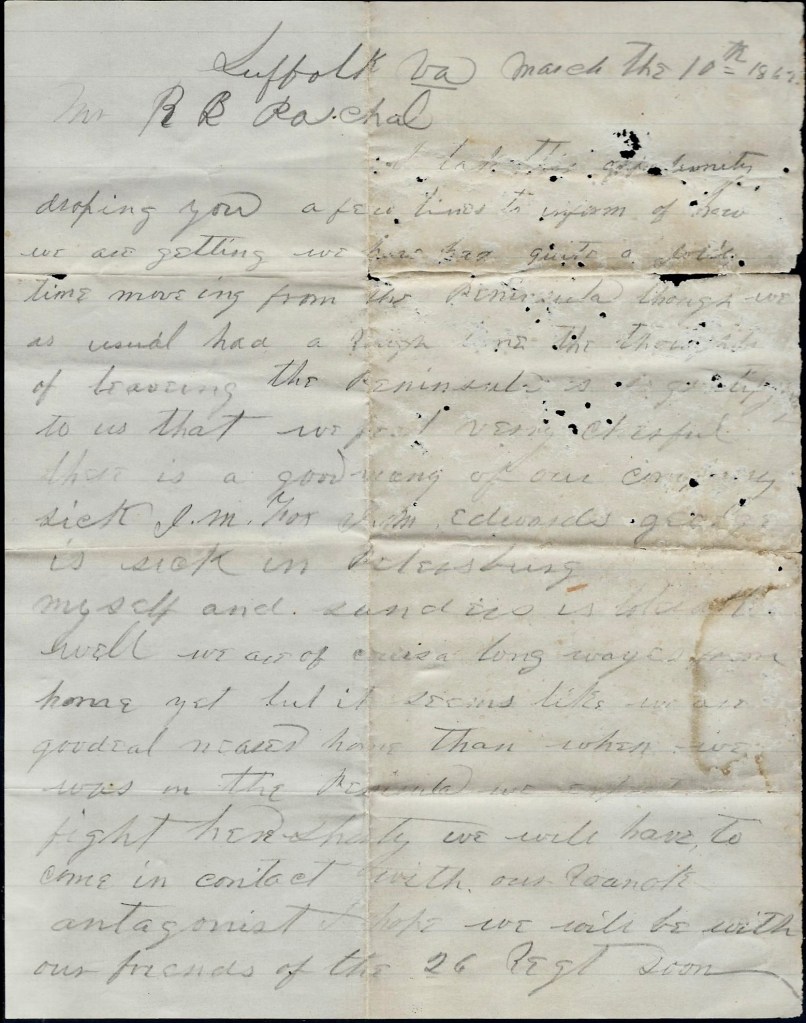
Suffolk, Virginia March 10th 1862
Mr. R. B. Paschal,
I take this opportunity of dropping you a few lines to inform of how we are getting [along]. We have had quite a long time moving from the Peninsula though we as usual had a rough time time. The thought of leaving the Peninsula is so gratifying to us that we feel very cheerful. There is a good many of our company sick in Petersburg. Myself and Saunders is [ ] well. We are of course a long ways from home yet but it seems like we are a good deal nearer home than when we was on the Peninsula.
We expect a fight here shortly. We will have to come in contact with our Roanoke antagonist. I hope we will be with our friends of the 26th Regiment soon. There is 6 or 7 regiments left at this place from the Peninsula. Our regiment, the 14th, and 53rd Virginia, 2nd Louisiana, 2nd and 16th Georgia, Cobb’s Legion from Georgia.
Pa was talking some time ago about coming to see us. Perhaps he will not start before he hears that we have moved. It would be no trouble for him to get to this place. I hope you will come with him when he comes. We have a large number of troops at this place.
I think that J. M. Fox will get a furlough to go home in a short time. There is only about 40 men in our company on duty. I wish I had time to tell you all about the movements of the army. I will write to you again shortly.
The following letter was written by 23 year-old Edward P. Rucker of Campbell county who served as a private in Co. A, 11th Virginia Infantry. Edward enlisted in April 1861 and was taken prisoner on 7 February 1864. He was released from the prison at Point Lookout on 17 June 1865 when he took the Oath of Allegiance.
Edward wrote the letter to Virginia Miller of Washington D. C.—a southern sympathizer who aided numerous imprisoned Confederate officers by sending them money to help them through their suffering as prisoners of war. Ms. Miller was the daughter of physician Dr. Thomas Miller who attended several U. S. Presidents up until the time Lincoln was elected. During the war, the family residence was kept under strict surveillance. She even hosted Mrs. Jefferson Davis while her husband was held a prisoner at Fortress Monroe after the war. The letter is only one page in length, which was the limit placed on prisoners for outgoing mail.
Though the author refers to her as his “cousin,” I don’t believe they were actually related. Several other Confederate prisoners also corresponded with Ms. Miller and called her cousin which may have been a means to better assure delivery and justify aid rendered by the Miller family.
In 1900, Virginia Miller wrote an article for the Columbia Historical Society that was entitled, “Dr. Thomas Miller and His Times.” In it she shared her recollections of growing up in the house at 246 F Street (since changed to 1331) in the District of Columbia which she described as a commodious, old-fashioned (built in 1793), three-story, brick house, with a garret and cellar and a large back building, with servants’ quarters, stables, etc., in the rear and a very large garden.” Just prior to the Civil War, Georgia Congressman Robert Toombs lived at 248 F Street but went South when Georgia seceded and it was a boarding house when the wounded Gen. Sickles boarded there after the Battle of Gettysburg. Virginia remembers seeing President Lincoln as a frequent visitor to see Gen. Sickles.
Transcription
Addressed to Miss Virginia J. Miller, 246 F Street, Washington D. C.
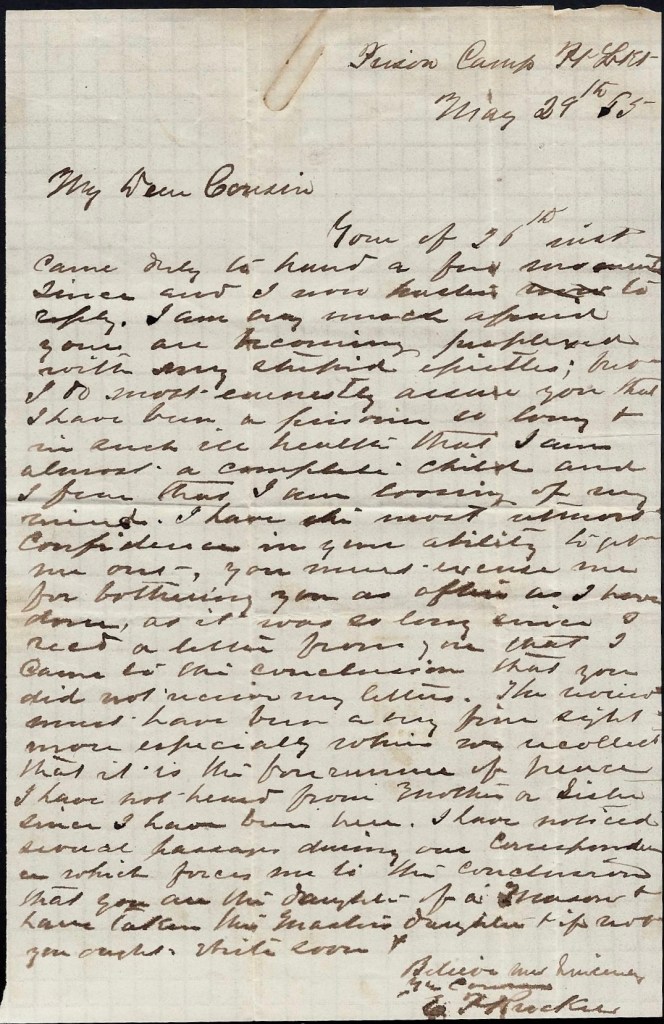
Prison Camp Point Lookout May 29th 1865
My dear cousin.
Yours of the 26th inst. came duly to hand a few moments since and I now hasten to reply. I am very much afraid you are becoming perplexed with my stupid epistles; but I do most earnestly assure you that I have been a prisoner so long & in such ill health that I am almost a complete child and I fear that I am loosing mom my mind. I have the most utmost confidence in your ability to get me out. You must excuse me for bothering you as often as I have done as it was so long since I received a letter from you that I came to the conclusion that you did not receive my letters.
The [Grand] Review must have been a very fine sight, more especially when we recollect that it is the forerunner of peace. I have not heard from Mother or Sister since I have been here. I have noticed several passages during our correspondence which forces me to the conclusion that you are the daughter of a Mason & have taken this Master’s daughter & if not, you ought. Write soon and believe me sincerely your cousin, — E. H. Booker
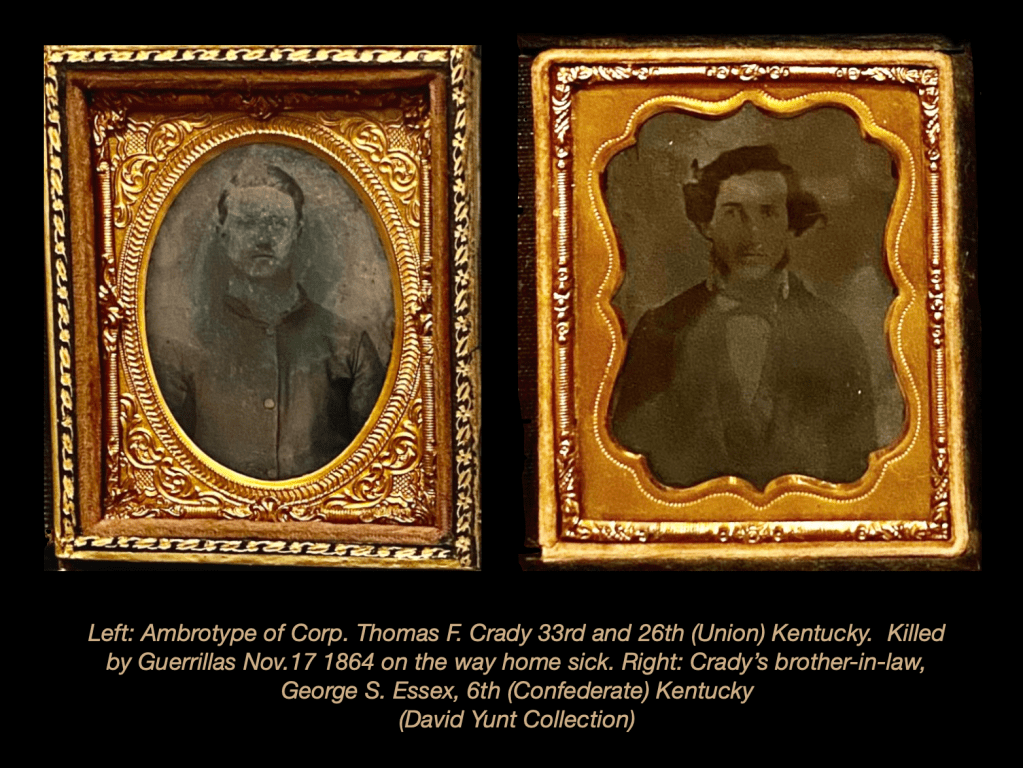
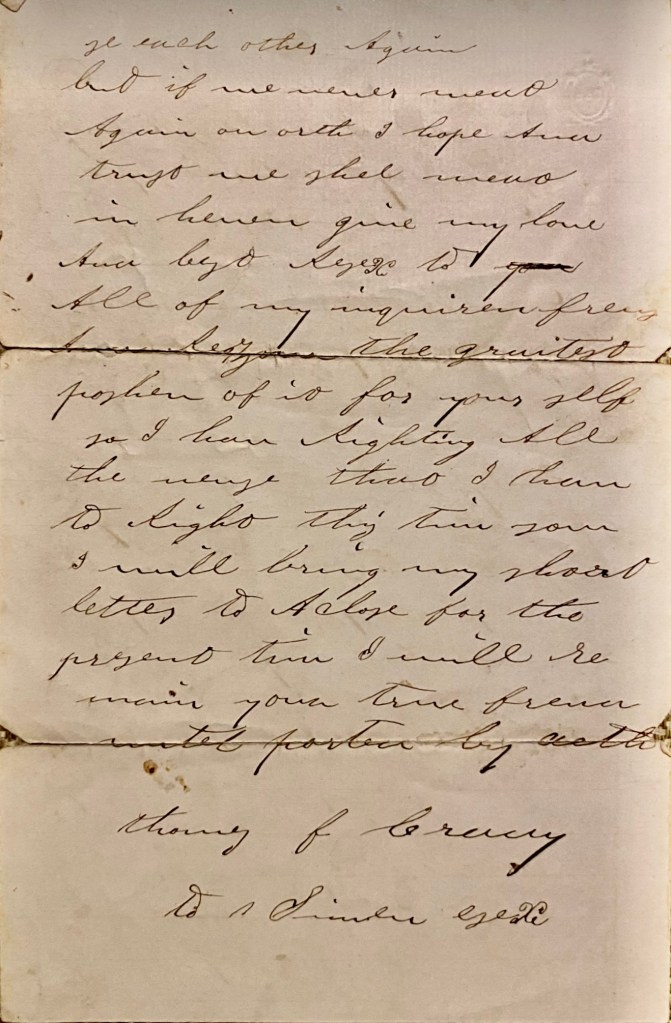
The following letter was written by Thomas Franklin Crady (1839-1864) of LaRue county, Kentucky. Thomas enlisted in August 1863 at Louisville as a corporal in Co. D, 33rd Kentucky (Union) Infantry. In April 1864 he was transferred to the 26th Kentucky (Union) Infantry. He fell ill later that year and was at his home when he was killed by guerrillas at Hodgenville, LaRue county, Kentucky on 17 November 1864.
Thomas wrote the letter to his brother-in-law George Simon Essex (1836-1915). George married Elizabeth J. Crady (1838-1922) in 1855 in LaRue county, Kentucky. During the Civil War, George cast his lot with the Confederacy, serving in Co. B, 6th Mounted Infantry.
This letter and the cased images are in the collection of David Yunt—a descendant of George S. Essex and were made available for publication on Spared & Shared by express consent. This letter would have been smuggled through enemy lines by hand.
Transcription
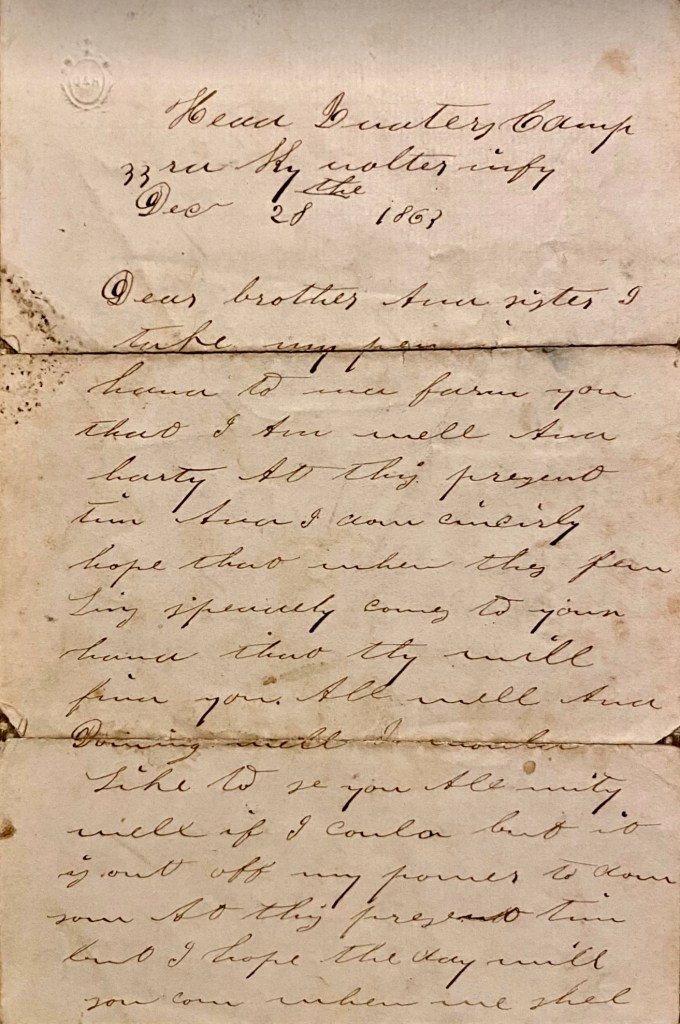
Headquarters Camp 33rd Kentucky Volunteer Infantry December 28th 1863
Dear brother and sister,
I take my pen in hand to inform you that I am well and hearty at this present time and I do sincerely hope that when these few lines speedily come to your hand, that they will find you all well and doing well.
I would like to see you all if I could but it is out of my power to come now at this present time and I hope the day will soon come when we shall see each other again. But if we never meet again on earth, I hope and trust that we shall meet in Heaven.
Give my love and best respects to all my enquiring friends and keep the greatest portion of it for yourself. So I have written all the news that I have to write this time so I will bring my short letter to a close for the present time. I will remain your true friend until parted by death.
The following letter was written by Bryant Green Dunlap (1833-1867) of Moore County, North Carolina, where he was practicing medicine prior to the Civil War. Bryant attended Jefferson Medical College in Philadelphia and graduated in 1860. With the war, Bryant returned to his home in Chatham county to offer his services in the 26th North Carolina Regiment known as the “Chatham Independent Guards.” Enlisting in May 1861, Bryant was quickly appointed as regimental Quartermaster and transferred to the Field and Staff of the regiment. His tenure in this position was short-lived as he was unable to post the necessary bond for an appointment to a quartermaster’s position. After resigning from this position in February 1862, he offered his services as a private in Co. E (The Vance Troop) of the 5th Regiment N. C. Calvary (63rd North Carolina Infantry). On October 29th, 1862 he was appointed Hospital Steward for the 5th Cavalry and transferred to the Field and Staff of that regiment.
While serving in one of the field hospitals he helped treat the wounds of Col. John R. Lane of the 26th and other members of his old troop after the battle of Gettysburg. In June of 1865 he was reported as a paroled prisoner in Richmond, Va.; likely serving in one of the military hospitals in that city after its April evacuation. Dunlap resumed his medical practice in Moore County after the war; however a wartime injury caused his early death in 1867. He is buried in the Short Family Cemetery in Moore County, North Carolina.
Bryant wrote the letter to his friend, Richard Bray Paschal who was elected sheriff of Chatham county on 1854 and served six consecutive terms. In addition to his career as sheriff, Paschal served in the House of Delegates in 1865 and North Carolina Senate in 1866. Paschal’s diary is available on-line at the North Carolina Digital Heritage Center. It includes accounts of Paschal overseeing the trade of enslaved people in Chatham County, a reminder of the duties assigned to the position of sheriff. Place names and people’s names, white and Black, are included in the diary. [See R. B. Paschal Diary Transcript Now Available]
Dear friend, I have the pleasure of acknowledging the reception of your kind letter which came duly to hand. It found me with no particular news, having passed through no thrilling scenes not made no hair breadth escapes. I am not prepared as the most of the soldiers and in these times to interest my friends in a correspondence. But as I wrote to a young lady once, ” will presume that it is me you want to hear from instead of news that you want” and proceed to tell you something of my own life and how I enjoy it.
I am in tolerable good health. The most of my time I have spent since I left home has been attending to the sick and I am now in Goldsboro on my way to Garysburg with ten sick men in [my] charge. I am stopping with them at the hospital until the Battalion can get to Garysburg and be prepared to do something with them. I have been acting Steward of the Hospital ever since I came to Goldsboro, but I do not know whether I will hold my office any longer or not as we are going into a regiment and I do not know who will be our surgeon. There is no responsibility in the office and take it every way. I think if I can get the permanent appointment, I shall be satisfied to hold it.
One of our company died the other night. His name was John A. Phillips of Moore county—a son of Martin Phillips. He was a good soldier and clever man. He leaves a wife and six children to mourn the loss. He died with Typhoid Fever. We have some other sickness in camp and some hard cases of Typhoid Fever.
Well, you spoke of the association. I should have been highly ratified to have been there—especially with so many inducements to enjoyment as you promised me, all of which I am very fond of. And as you know a soldier’s life is by no means a life of luxury and ease, it makes the enjoyment greater when they have an occasional chance of refreshments and fair Ladies. But I must beg to differ with you in one case and that is Miss Mag Fox thinking anything of your humble servant. I imagined on one occasion that, nothwithstanding, “I was a youth unknown to fame and fortune,” that I would be bold enough to write to her. I did so and silent contempt was my only response. That is, she never answered my letter. I did not blame her for there is such a mania for letter writing with young men in the army that I was ashamed of myself after I did the act, and could not keep from feeling like a poor man at a frolic.
But enough of this. I hope I have convinced you that I am neither insensible to the fair ladies charms or to your good opinion of my living in her affections, but that my only response to the case is what the man said about the Bull—Can’t quite come it. As I shall be in Garysburg after this, I shall be pleased to get a letter from you at any time. Direct to Garysburg, Col. Evans’ Regt., Partizan Rangers. Care of Capt. Harris, and remember me as ever your friend, — B. G. Dunlap
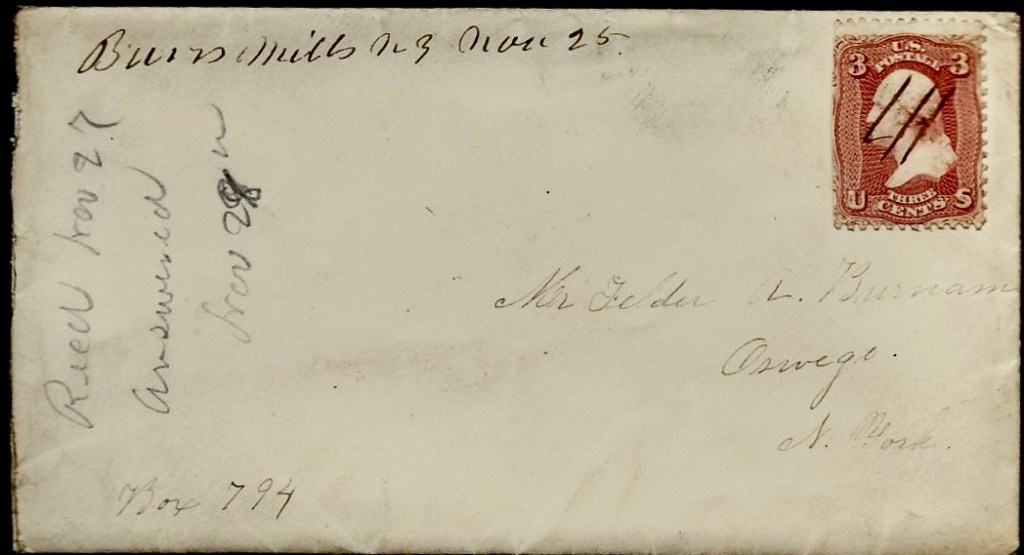
The following letter was written by Louisa Mary Burnam (1840-1924), the daughter of Nathaniel Noble Burnam (1809-1891) and Mary Florilla Leonard (1813-1880) of Burrville—a small village north of Waterville, the county seat of Jefferson county, New York. She wrote the letter to her older brother, Felder A. Burnam (1837-1914). Louisa married Schuyler Hose Bibbins (1833-1916) in 1865.
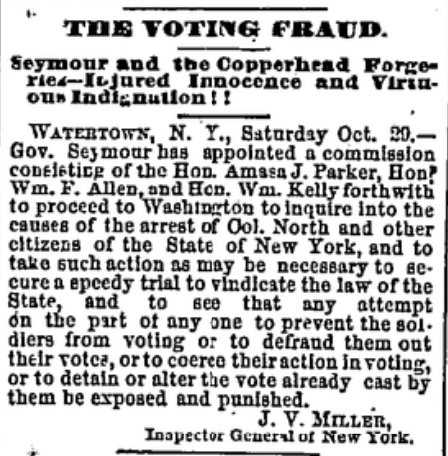
Louisa’s letter describes a Democratic mass meeting held in Watertown, New York, on the eve of the 1864 Presidential election. Allegations of lies and fraud perpetrated by the Democratic Party and the Copperheads are mentioned.
The Watertown, New York, Public Square as it looked in 1865
Transcription
Addressed to Mr. Felder L. Burnham, Oswego, New York
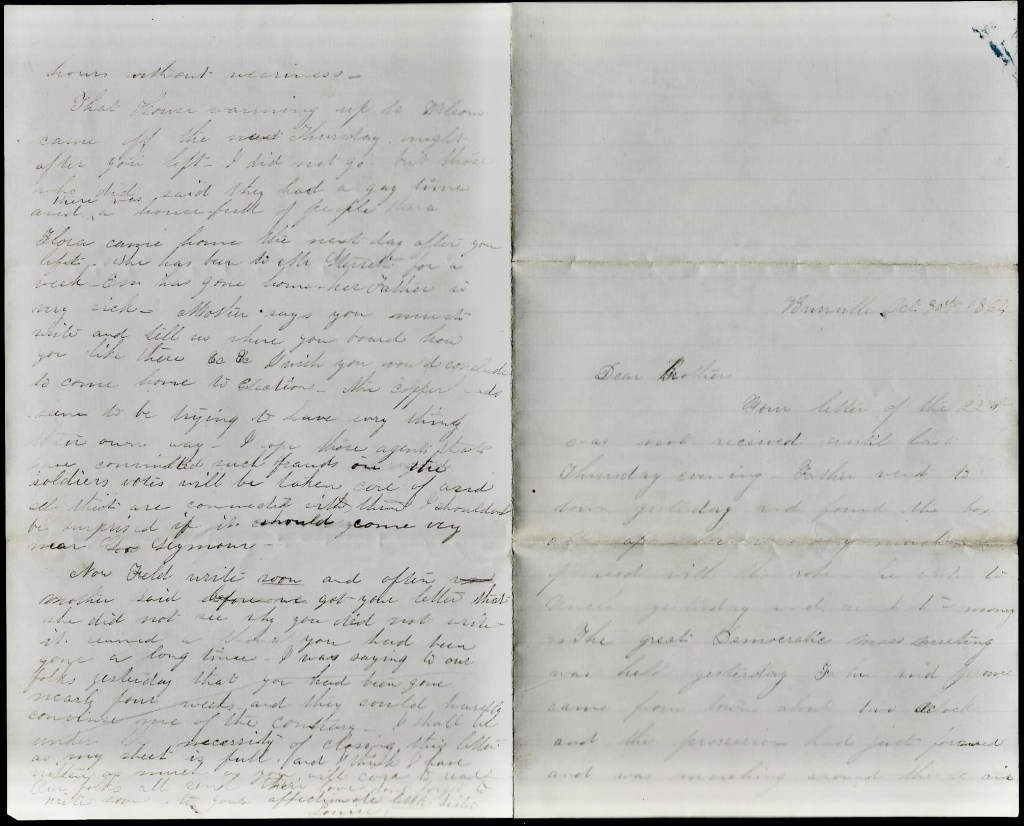
Burrville, October 30th 1864
Dear Brother,
Your letter of the 22nd was not received until last Thursday evening. Father went to town yesterday and found the box all safe [illegible]. He wrote to Uncle yesterday and sent the money.
The great Democratic mass meeting was held yesterday. Father and Jerome came from town [Watertown] about two o’clock and the procession had just formed and was marching around the square. There were about 80 on horse, Marshal and all, and the procession on foot reached from where Sterling Street comes on Washington Street down to Stones and more than half of those were Irish boys. They were led by two bands. They had a large flag and a banner. The devise on the banner was a Negro’s head. I do not know what the motto was—probably some takeoff on the Abolitionists. There were a great many in town but probably half or two-thirds of them were Union men who went out of curiosity. I think the Union Party got full as many converts as the Democrats.
An example of the kind of propaganda distributed by the Copperheads in the days prior to the Presidential Election of 1864.
George Butterfield of Rodman and Gustave Champion have intended to vote for McClellan but they say they cannot go such lies as they heard yesterday and they shall go for Lincoln and Charles Wright has said all the time that he should not vote and he now says he shall go for Lincoln. Gov. Seymour addressed the meeting. 1
Last Friday there was to have been a Union mass meeting but it was so very stormy that there did not a great many go and they concluded to adjourn it until next Thursday. If it is pleasant, we will show the Democrats what a mass meeting is. The people from Whiteside, Tylersville, and a part of Rutland are going to meet here and all the boys that can get horses are going horseback. They are sure of about 20 and all that can get flags are going to carry them.
We had a Union meeting in the Church last Wednesday evening. The house was well filled. The Hon. Mr. Foster of Kansas addressed the meeting. He spoke nearly two hours and a half and I do not think there were many in the house but what would have listened another two hours without weariness.
That house warming up to Wilson’s came off the next Thursday night after you left. I did not go but those who did say they had a gay time and there was a house-full of people there.
Allegations of Voting Fraud perpetrated on the Soldier’s Vote, Chicago Tribune, 30 October 1864
Flora came home the next day after you left. She has been to Mr. Sturett’s for a week. Em has gone home. Her Father is very sick. Mother says you must write and tell us where you board, how you like it there, &c. &c. I wish you would conclude to come home to election. The Copperheads seem to be trying to have everything their own way. I hope those agents that have committed such frauds on the soldiers votes will be taken care of and all that are connected with them. I shouldn’t be surprised if it should come very near Gov. Seymour.
Now Feld, write soon and often. Mother said before we got your letter that she did not see why you did not write. It seemed a shame you had been gone a long timer. I was saying to our folks yesterday that you had been gone nearly four weeks and they could hardly convince me of the contrary. I shall be under the necessity of closing this letter as my sheet is full and I think I have written as much as you will care to read. Our folks all send their love. Don’t forget to write soon to your affectionate little sister, — Louise
The home where Louise and Schuyler Hose Bibbins lived in Burrs Mills, NY, after the Civil War. From the Pictorial Souvenir of Burrs Mills & Vicinity, 1905.
1 After New York Governor Horatio Seymour was reelected in 1862, he became an outspoken critic of the Lincoln Administration, questioning the constitutionality of the Emancipation Proclamation and the wartime limits on press freedom and other civil liberties. He supported voluntary enlistments but opposed federal conscription as a violation of states’ rights. His speech after the draft riots of July 1863, in which he addressed the rioters as “my friends,” was widely viewed as tantamount to treason and led to his defeat in 1864. [Source: Encyclopedia of New York State]
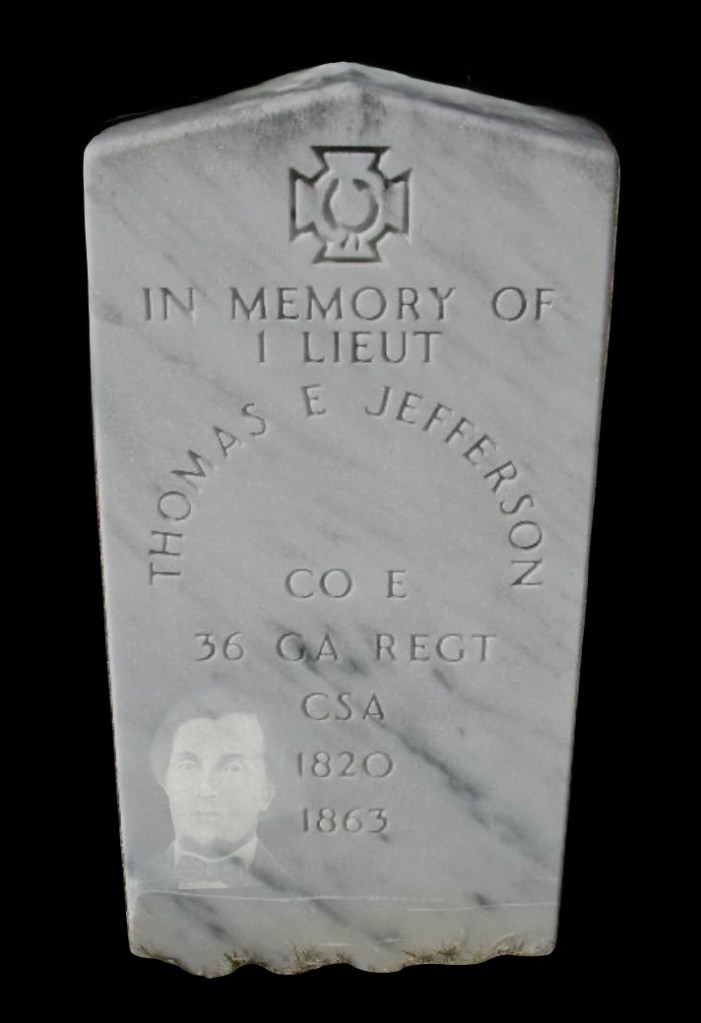
Headstone 1Lt. Thomas E. Jefferson, Co. E, 36th Georgia Infantry
The following letter was written by Thomas Emory Jefferson (1820-1863) of Cherokee county, Georgia, who was married to Mary Frances Foster in 1844 and made a living as a school teacher prior to the Civil War. Leaving his wife and three daughters, Thomas accepted a commission as 1st Lieutenant of Co. E, 36th Georgia Infantry when it was formed during the winter of 1861-62. Its first major engagement of the war was at Champion’s Hill and then again in the defense of Vicksburg where those who were not killed or escaped were surrendered to Grant’s army on 4 July 1863. The date of Thomas’s death is not known but he was killed in or about Vicksburg. He is now buried in the Cedar Hill Cemetery at Vicksburg
[Note: This letter is from the private collection of Jack Dunagan who made it available to Spared & Shared for transcription and publication by express consent. Jack is a descendant of Lt. Jefferson.]
Transcription
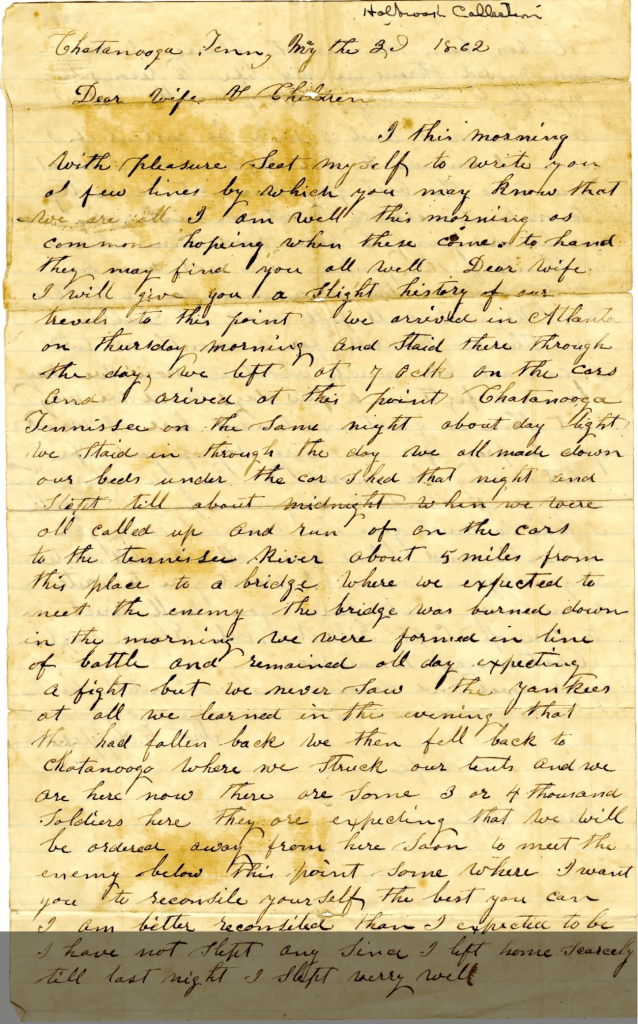
Chattanooga, Tennessee May 2nd 1862
Dear wife & children,
I this morning with pleasure seat myself to write you a few lines by which you may know that we are well. I am well this morning as common, hoping when these come to hand, they may find you all well.
Dear wife, I will give you a slight history of our travels to this point. We arrived in Atlanta on Thursday morning and staid there through the day. We left at 7 o’clock on the cars and arrived at this point, Chattanooga, Tennessee, on the same night about daylight. We staid in though the day. We all made down our beds under the car shed that night and slept till about midnight when we were all called up and run off on the cars to the Tennessee River about 5 miles from this place to a bridge where we expected to meet the enemy. The bridge was burned down in the morning. 1 We were formed in line of battle but we never saw the Yankees at all. We learned in the evening that they had fallen back. We then fell back to Chattanooga where we struck our tents and we are here now.
There are some 3 or 4 thousand soldiers here. They are expecting that we will be ordered away from here soon to meet the enemy below this point somewhere. I want you to reconcile yourself the best you can. I am better reconciled than I expected to be. I have not slept any since I left home scarcely till last night I slept very well. It has been the hardest thing I have ever passed through in my life, to reconcile myself to be away from you all. But I am here now and I will be content if I can. I intend to live right and I want you to do the best you can at home. Try to make something to eat for next year for we are going to have hard times sure.
I think if the Yankees does not come on to try to take this place in a day or two that our regiment will fall back to Dalton or Atlanta to drill for a month or two. I cannot tell much about it now. We may be in a fight in a few days and we may not. There is great excitement here. I want you to pray for me every day of your life that I may be spared to see you all again and if it should be my unhappy lot to fall, I hope to meet you in heaven.
May God be with and bless you all. I will write to you again soon. I want you to write to me every week sure. You will direct to care of Capt. Gilbert, Col. [Jesse A.] Glenn’s Regt., Chattanooga, Tennessee
Your loving and devoted husband until death, — Thos. E. Jefferson
to wife, Frances Jefferson
1 A pontoon bridge was later erected over the Tennessee river at this same location.
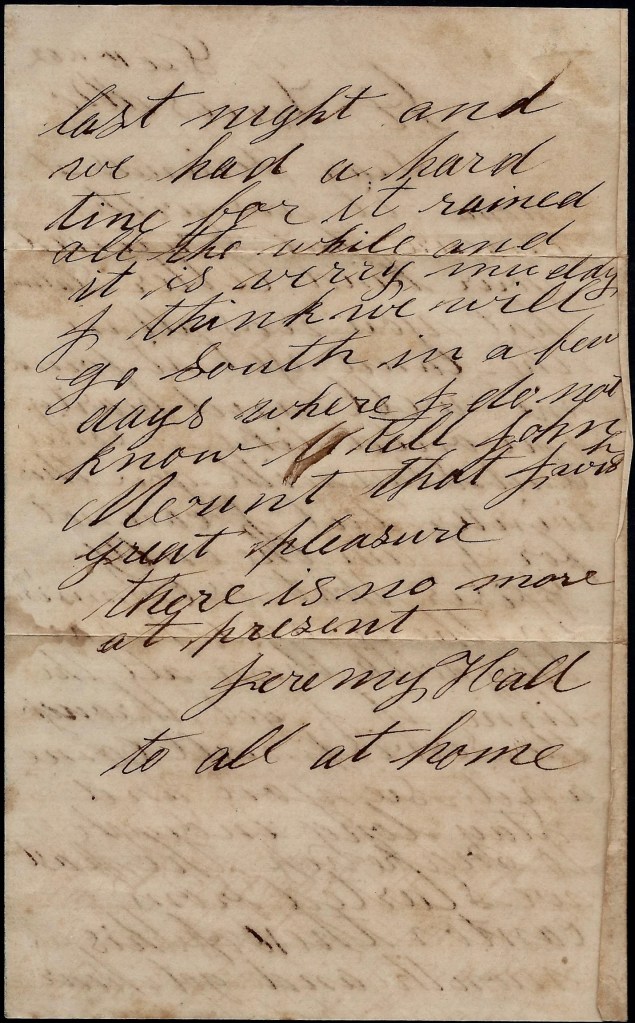
This letter was written by 2nd Lieutenant Jeremy Hall (1835-1910) who served in Co. B, 21st Missouri Infantry. Jeremy enters the service as the 1st Sergeant of his company but assumed command of the company at Chawalla, Tennessee on 12 July 1862 and received his commission on 11 October 1862.
Jeremy was the son of Abraham Hall (1802-1872) and Mary Ward (1810-1881) of Cherry Creek, Chautauqua county, New York.
Transcription
St. Louis, Missouri December 15th 1862
Dear friends at home,
It was with pleasure that I received your kind letter stating that you was all in the land [of the living] yet. It found me well and hearty. I would like to come and stay with you this winter but I cannot for I am the only officer that is commissioned in the company and I have to stay with them all the time. If I get through the service [alive], I will come and see you and stay long enough to make up the past. We started from Canton the 10th of this month and got here last night and we had a hard time for it rained all the while and it is very muddy. I think we will go South in a few days. Where? I do not know.
Tell John M___ that I wish [him] great pleasure. There is no more at present. — Jeremy Hall
The following letter was written by a young man named L. Russell to his friend, Daniel H. Whitney (1820-1904) of Seneca Castle, Ontario, New York. Daniel was the son of William E. Whitney (1770-1872) of Maine and Elizabeth Howard (1799-1900) of Geneseo, Livingston county, New York.
Transcription
Geneseo Saturday, December 20th 1841
Friend,
According to promise and the weather being stormy, I have nothing to do and can as well as not, spend my idle hours in writing to you. Lord whistles the wind around the old mansion. The snow is cutting all the fantastics that imagination can picture. A dense cloud obscures the heavens from which the snow is incessantly falling which, however, finds no rest on the earth for Boreas pipes loud and long and appear to be moving the snow about from place to place by the job. And to speak the truth, he is doing wonders around your father’s house and out buildings. In one place the snow is piled up not unlike a sugar loaf. In another may be seen the hull of a ship turned bottom side up with the figurehead Garha and moulded in the finest possible manner. But I am notable to give a full account of the tenth part of the wonderful, twisting and windings of this boisterous old Boreas for when he has nearly finished a piece of work, he destroys to build another.
I feel uncommon dull today although I am sitting by a fine blazing fire in the east chamber. But I suppose it is owing to the dreariness of the weather or to love—maybe both; but I need not be dull if the sighings of the wind has anything enlivening in its tuneful notes.
But to my promise—my journey. You know that I left your father’s for Pennsylvania on the 18th of October. But I shall say nothing of the five first days save that they were anything but agreeable and shall commence with the sixth, Saturday, October 23rd. I left the village of Bolivar at six in the morning in a snowstorm and walked to Smith Settlement over the gloomy hemlock hills to the village of Millgrove where I came to the Allegheny River, which is about eighty yards wide at this place and not motion enough in the water for me to perceive it running. Here I took dinner and concluded to stay until the snowstorm was over. I had no sooner finished my meal than looking out I found the storm had in measure abated. At the west, the clear blue was visible. I directly started on my journey for the village of Smethport, the distance being twenty miles and not a public house on the whole route.
Millgrove is in the extreme bend of the river and on the line between the state line of New York and Pennsylvania. My route lay up the stream which was an outcast by south course and the soil of a sandy loam for a mile or two. Corn grows well on this soil by what little I see though there but little attention paid to cultivating the lands in this section of country. Lumber is the all absorbing business of this part of the world save now and then hunting, drinking, and lawing. After leaving Millgrove I found a tolerable good road for a mile or two. the clouds having just passed over the sun shone out bright and clear. The snow on the mountains mixed with the evergreen pines and hemlock gave the scene a half melancholy, half cheerful appearance, whilst the reflections of the sun on the surface of the Allegheny [river] made its crystal waters as they meander through the valley cast many a pleasing reflection on the sides of the mountains.
But these few sunshiny minutes were of but short duration. I had not walked over three or four miles before I perceived at my right hand a dense black cloud arise above the western mountains which soon obscured the sky and blasted all my hopes of having better weather or roads the remaining part of my journey. The vivid flashes of lightning that darted through the clouds whilst the tremendous thunder that rolled along the valley of the Allegheny and its tributaries doubly echoing amongst the cliffs of the mountains. These with a heavy shower of rain incessantly falling added to the badness of the road which after leaving Millgrove a few miles are of about red clay and the mud was about half boot deep, put me out of all patience and I damned the road and cursed my own folly. Ten miles above Millgrove I crossed the river and had to walk a mile on, up and down hill in the same clay soil. These short hills are made by small brooks and rivulets putting into the river. There is a junction of the river a mile above where I crossed it and I followed up the west branch which is called Potato Creek. The turnpike here runs nearly on a south course. I was sometimes in sight of the stream over the points of high lands where the road was barely wide enough for two wagons to pass with a majestic mountain on one side and deep precipice on the other and sometimes three or four miles between houses.
The road over these hills was much better to walk upon than the road on the level valley. I tried my speed this afternoon and endeavored to reach the village of Smethport but fell short five miles when night overtook me. I stopped at the house of an old farmer by the name of Sartwelland put up for the night, tired and weary and angry with myself for having attempted a journey over this mountainous [terrain] at this advanced and inclement season of the year. The rain having poured down incessantly the whole afternoon, I was drenched to the skin with my feet wet and sore, having walked thirty-five miles. I dried my clothes and went to bed at an early hour when sleep soon overtook me. But it was neither sound nor undisturbed for I went through all the toils of the past day and was sunk in the mud to the depth of forty feet where I remain until I awoke the next morning.
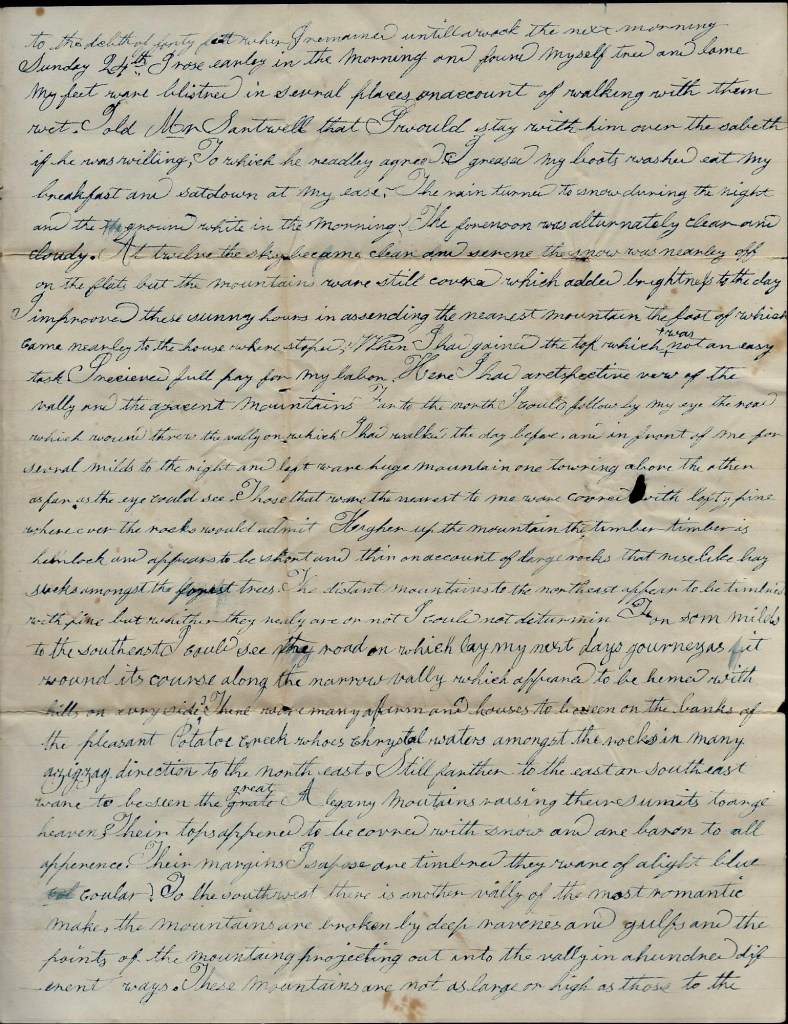
Sunday, 24th. I arose early in the morning and found myself tired and lame. My feet were blistered in several places on account of walking with them wet. Told Mr. Sartwell that I would stay with him over the Sabbath if he was willing to which he readily agreed. I greased my boots, washed, eat my breakfast, and sat down at my ease. The rain turned to snow during the night and the ground white in the morning. The forenoon was alternately clear and cloudy. At twelve the sky became clear and serene. The snow was nearly off on the flats but the mountain was still covered which added brightness to the day.
I improved these sunny hours in ascending the nearest mountain by foot of which came nearly to the house where it stopped. When I had gained the top which was not an easy task, I received full pay for my labor. Here I had a retrospective view of the valley and the adjacent mountains. Far to the north, I could follow by my eyes the road which wound through the valley on which I had walked the day before, and in front of me for several miles to the right and left were huge mountains, one towering above the other as far as the eye could see. Those that were the nearest to me were covered with lofty pines wherever the rocks would admit. Higher up the mountain the timber is hemlock and appears to be short and thin on account of large rocks that were like hay stacks amongst the forest trees. The distant mountains to the northeast appear to be timbered with pine but whether they nearly are or not, I could not determine. For some miles to the southeast I could see the road on which lay my next days journey as it wound its course along the narrow valley which appeared to be hemmed with hills on every side. There were many a farm and houses to be seen on the banks of the pleasant Potato Creek whose crystal waters amongst the rocks in many a zigzagging direction to the northeast. Still farther to the east or southeast were to be seen the great Allegheny Mountains raising their summits to angel heavens. Their tops appeared to be covered with snow and are barren to all appearances. Their margins I suppose are timbered. They were of a light blue color. To the southwest there is another valley of the most romantic make. The mountains are broken by deep ravines and gulfs and the pits of the mountains projecting out into the valley in a hundred different ways. These mountains are not as large or high as those to the west or north, which are nothing in comparison to the mountains to the east and southeast. But they are so broken and rocky that they make a more wild and romantic scene.
At two p.m., the weather became cloudy and I descended the mountain in a snowstorm and did not lack for an appetite at supper. More of the mountains in my next. — L. Russell
Your folks are all well and send their love to you. Hickliah, Sidney, Clarissa, and William are at the donation party tonight at the Rev. Mr. Shaw’s. I am tending the Old Mill. There is a plenty of water at present. Mr. Witney, if you have leisure, I would like you to write and inform me what branches you are studying and of your progress or what progress you make. The clock has just struck nine and I must close. Your sincere though illiterate friend.
Lock Weems, Jr. , 15th Alabama Volunteers, Half-Plate Ruby Ambrotype, Image taken on 16 January 1862, probably in Richmond, Va. (Richard J. Ferry Collection)
The following poignant letter was written by Lock Weems. Jr. (1835-1862), the son of Lock Weeks (1804-1853) and Maria F. Shepherd (1813-1850) of Columbus, Muskogee county, Georgia. Prior to 1860, Lock Jr., the subject of this post, moved to Macon, Alabama, where he entered the mercantile business. There he married Eugenia H. Blackmon on 21 February 1860. The couple’s only child, Feliciana, was born in 1861—just two months before 26 year-old Lock entered the service of the Confederacy on 3 July 1861 as lieutenant and adjutant of the 15th Alabama Volunteers.
The 15th Alabama was part of General Evander Law’s Brigade which was highly praised by Stonewall Jackson for their aggressive assault at Gaines’ Mill on 27 June 1862. Lock was in command of Co. A that day and bravely led his boys into the “storm of shot and shell” where he received a mortal wound early in the fight. We learn from this letter that it was a gun shot to the right breast that was not properly treated for a couple of days that led to his death on 10 July 1862. His body was sent to his birthplace in Columbus, Georgia where he was laid to rest at Linwood Cemetery. The news of his death was published in the Columbus Times:
Death of Capt. Lock Weems – A dispatch from Richmond, conveying the sad intelligence, reached this city last night. Only a few days ago reports came of his condition which greatly encouraged his friends to hope for his speedy recovery. But it has been ordered otherwise, and he has gone to swell the throng of noble martyrs to Southern liberty. This cruel war has robbed the country of a truer or braver spirit. Peace to his ashes and honor to his memory – Columbus Times.
[Note: This letter is from the private collection of Richard Ferry and was made available for transcription and publication on Spared & Shared by express consent.]
Transcription
At House of Mr. Johnson July 5, 1862
My dearest wife,
Your Pa has just [been] here. I was very glad indeed to see him. Uncle Haywood also came. Uncle Haywood will leave in a few minutes and I am able to write a short note.
I am rather badly wounded in the right breast—not dangerously. I have suffered very much [but] am getting along very well now. I had dispatched you saying that I was seriously wounded but I learn from your Pa that it was reported in Columbus that I was mortally hurt. I am sorry that such is the case for I regret that you all should have been so much troubled on my account. I will write you more at length when I have more leisure and more strength.
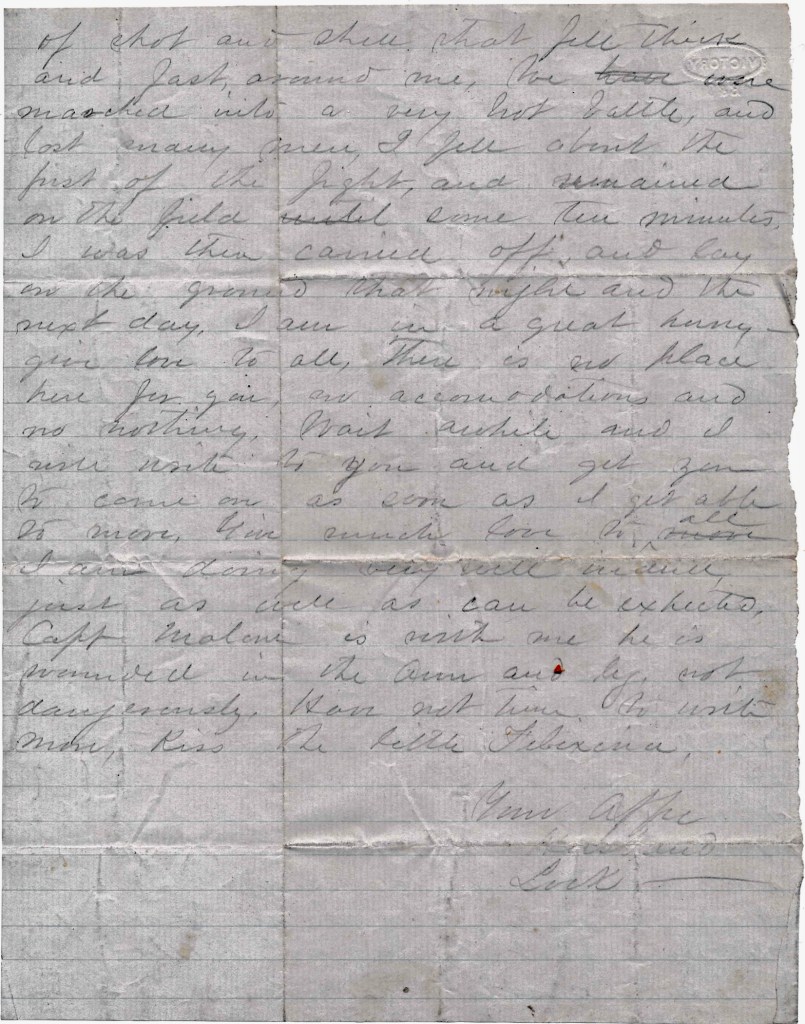
I do really thank God that it is as it is. I am grateful to Him that I am not killed. What a wonder that I was not in the storm of shot and shell that fell thick and fast around me. We were marched into a very hot battle and lost many men. I fell about the first of the fight and remained on the field some ten minutes. I was then carried off and lay on the ground that night and the next day.
I am in a great hurry. Give love to all. There is no place here for you, no accommodations, and no nothing. Wait awhile and I will write to you and get you to come on as soon as I get able to move. Give much love to all. I am doing very well indeed—just as well as can be expected. Capt. [George Yewel] Malone is with me. He is wounded in the arm and leg, not dangerously. 1
Have not time to write more. Kiss the little Felixina. Your affectionate husband, — Lock
1 Capt. George Y. Malone, Co. F, 15th Alabama Infantry, survived his wound at lived until 1906. His obituary states that he “retired from his position on account of severe wounds about the arm, which he received while doing valiant service for his country. He is mentioned in Col. Oates’ history of the 15th Alabama, and is paid high tribute for his bravery and judgement on the field of battle.”The descendants of Malone claim that Capt. Malone was carried to the rear but was abandoned when Col. Oates ordered his bearers back to the front, saying the Confederate forces needed the soldiers too much to spare them for such duties. After lying in the woods all night, Captain Malone was found by his personal slave, who cared for his wounds.
Luke James Leonard (1839-1873) was the son of James Leonard (1803-1874) and Ann Brady (1819-1890), emigrants of County Roscommon, Ireland, who arrived in the United States in the spring of 1852. They settled in the Cincinnati area, residing initially in Moscow, Covington, Ohio.
Luke served in the 1st Ohio Light Artillery. He enlisted on 25 August 1862 and was mustered out on 26 June 1865 after nearly three years service. Luke was married in 1868 to Mary Loughlin [Lofflien] (1847-1923) and made his living in Cincinnati after the war as a drayman until he was shot and killed by a watchman in a Cincinnati saloon on election day in 1873 while attempting to break up a fight.
In the following letter, Luke describes the Battle of Cloyd’s Mountain, considered a Union victory in western Virginia on 9 May 1864. The battle duration was relatively short but contained some of the most severe and savage fighting of the war, much of it being hand-to-hand combat. Union forces suffered 688 casualties (10%) while Confederate forces had 538 casualties (23%). The Union forces were able to destroy several bridges on the Virginia & Tennessee Railroad which was being used to transport Confederate troops and supplies.
[Note: This letter was made available to Spared & Shared for transcription and publication by Alice LeVert, a descendant of the Leonard family.]
Transcription
Meadow Bluff, West Virginia May 22, 1864
Dear Father,
I take my pen in hand to write you a few lines hoping that they will find you in as good health as this leaves me at present.
Well, I must tell you what is going on in camp. We got here two days ago after twenty days march. We fought two battles and drove [the] enemy. We killed and wounded 300 and took 300 prisoners and we lost about 500 killed and wounded. It was the Battle of Cloyd’s Mountain that we lost so many. It was the hardest fought battle of the war for the time it lasted. Our battery was in the fight. It lasted three hours. Sam Leonard was badly wounded and so was Tom Quinn. They was left in a house on the battlefield. That was all the 12th [Ohio Vol. Infantry men] that was hurt that you know.
Tom Clery is well and send you his best and so does Falk Quinn. We had a hard time of it. It rained ten days and nights but it is all over now. We have plenty now. I have heard the balls fly thicker than I ever want again.
Father, I want to hear from you for we have had no mail since we left Charleston [Charles Town]. But I think that we will get a mail soon and I think that you have not forgot me so I expect a lot of letters. I expect one from Tom.
We have demoralized the Rebels. We burnt up the railroad for about 15 miles and we burnt the finest bridge in Virginia. It took them three years to build it and we burnt it in 15 minutes.
Father, I must bring my letter to a close. You must direct your letter to Charleston to follow the battery. You must write soon for I want to hear from you. I will write you a long [letter] the next time. Give my [love] to all. So goodbye. From your son, — Luke Leonard
to his Father James Leonard
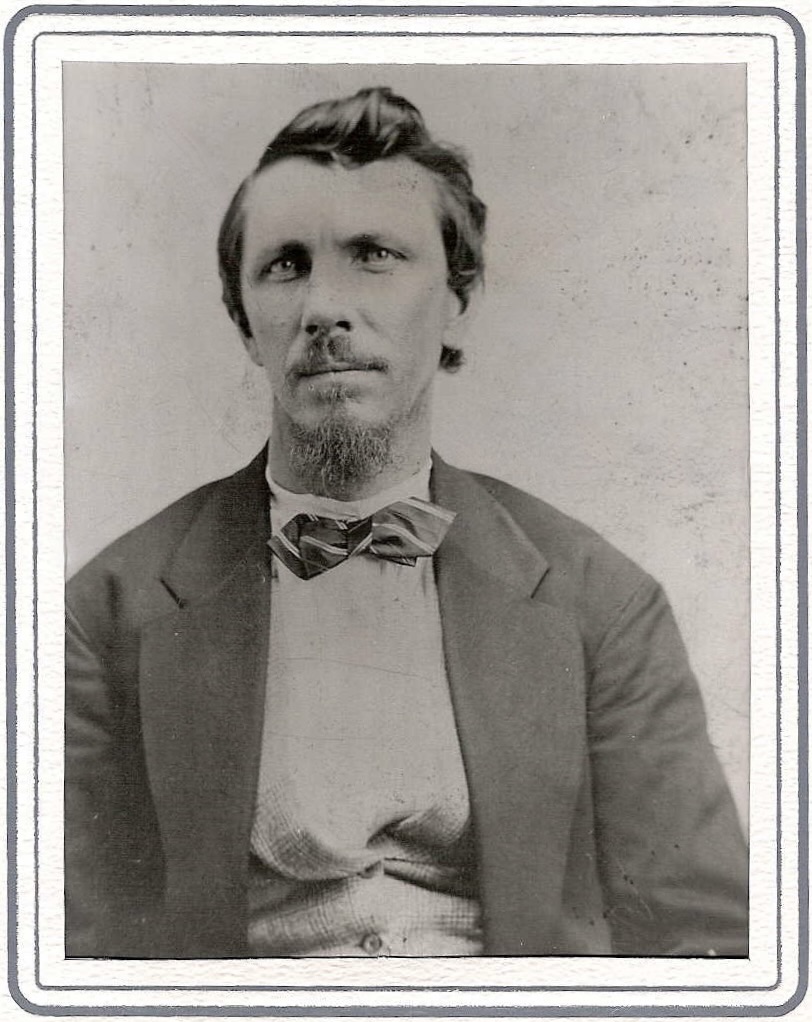
Post war image of Luke J. LeonardPost war image of Mary (Lofflien) Leonard

















 Spared & Shared 23