All posts by Griff

My passion is studying American history leading up to & including the Civil War. I particularly enjoy reading, transcribing & researching primary sources such as letters and diaries.

1864-66: Thomas Leonard to Luke James Leonard

The following letters were written by Thomas Leonard (1844-1908), the son of James Leonard (1803-1874) and Ann Brady (1819-1890), emigrants of County Roscommon, Ireland, who arrived in the United States in the early 1850s. They settled in the Cincinnati area, residing initially in Moscow, Covington, Ohio. Thomas wrote all of the letters to his older brother, Luke Leonard (1839-1873). A younger brother, Patrick Leonard (1850-1919) is also mentioned.

Thomas served in Co. B, 2nd Ohio Heavy Artillery from 6 July 1863 to 23 August 1865, a total of nearly 2 years and 2 months. He entered the service as a private and was discharged as a sergeant. Just prior to his enlistment, Thomas had been employed as a cooper. After the war, Thomas was married to Ann Tracy and made his living in Cincinnati as a tobacconist.

Luke James Leonard, 1st Ohio Light Artillery

Thomas’s older brother Luke James Leonard (1839-1873) served in the 1st Ohio Light Artillery. He enlisted on 25 August 1862 and was mustered out on 26 June 1865 after nearly three years service. Luke was married in 1868 to Mary Loughlin [Lofflien] (1847-1923) and made his living in Cincinnati after the war as a drayman until he was shot and killed by a police officer in a Cincinnati saloon in 1873.

There are four letters written by Thomas while serving in the 2nd Ohio Heavy Artillery—two datelined from Bowling Green in the spring of 1864, and two datelined from Knoxville late in 1864 and early 1865. The fifth letter may actually be of the greatest interest to historians for it was datelined from Buffalo, New York, in early June 1866 during the Irish Independence movement—also called the Fenian movement. It was penned just after the Fenians (Irish Americans), under the banner of the Irish Republican Army (IRA), invaded Canada with 1,500 men and established a beachhead just north of Fort Erie where they hoped to capture enough territory from Lower Canada to use as a bargaining chip with England to give Ireland its freedom. The US Government did little to intervene as it was felt by many US officials that England had given succor to the Confederacy. [See The Fenian Raid 1866]

[Note: These letters were provided to Spared & Shared for transcription and publication by Alice LeVert, a descendant of the Leonard family.]

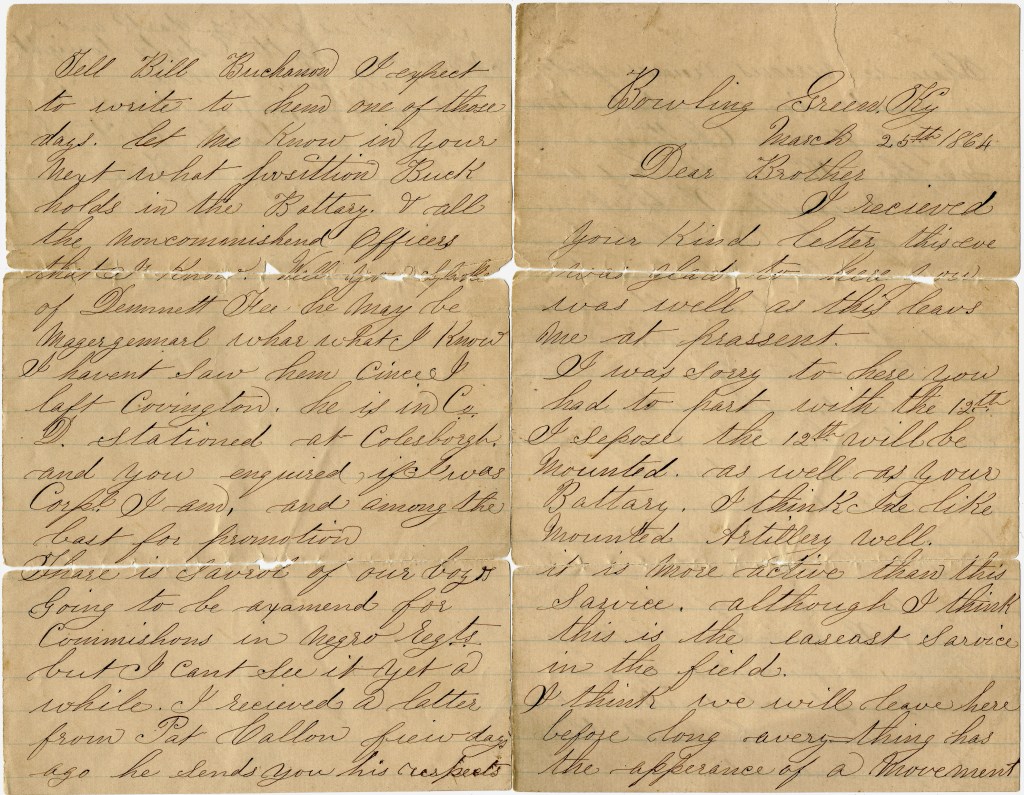
Letter 1

Bowling Green, Kentucky
March 25th 1864

Dear Brother,

I received your kind letter this eve. Was glad to hear you was well as this leaves me at present.

I was sorry to hear you had to part with the 12th. I suppose the 12th will be mounted as well as your Battery. I think I’d like Mounted Artillery well. It is more active than this service although I think this is the easiest service in the field.

I think we will leave here before long. Everything has the appearance of a movement. There is various rumors afloat in regards to our destination. One report says Chattanooga, another Knoxville, and one says Maysville. I think we will go to Cumberland Gap, however, there is a move on foot. Well it would be too bad to keep as big a regiment as this is on the Nashville Railroad. There is seventeen hundred and sixty (1760) of us. We was never together since we left Covington. There is four companies of our regiment here—namely B, C, F G. Our Battalion is larger than the whole of the 26th Kentucky Regiment.

I received a letter from Father a few days ago. He says I need not write to Moscow anymore as he moved that day for Cincinnati.

Tell Bill Buchanan I expect to write to him one of these days. Let me know in your next what position Buck holds in the Battery & all the non-commissioned officers that I know. Will [illegible] of Dimmett Fee. He may be Major General where what I know. I haven’t saw him since I left Covington. He is in Co. D stationed at Colesburgh and you enquired if I was corporal. I am and among the last for promotion.

There is several of our Boys going to be examined for commissions in Negro regiments but I can’t see it yet awhile. I received a letter from Pat Callou a few days ago. He send you his respects.

Well, it is getting dark and I am on patrol duty tonight and I’ll have to close. Tell Dimmett Fee I’ll write to him shortly. Write soon, — Tom

Letter 2

Bowling Green, Kentucky
April 21st 1864

Dear Brother,

Do you think me dead or do you think I have forgotten you? If so, you mistake me for I often times visit you in dream. Nor, don’t consider it laziness or an excess of duty that prevented me from writing. But it was neglect of sending a letter which I wrote the 11th of this month and instead of posting it, I laid it [aside] in my negligence & there it remained until now when I found it. And as you know my failing, I trust you will excuse me this time & I’ll promise you such will not happen again.

You said you haven’t heard from home since they moved. I received a letter from them some three weeks ago but they never gave me the direction of the house. So you see I can’t write until I hear from them again & maybe not then if they don’t give me the direction. They may give you the direction. If so, I hope you will send it to me. I wrote them we were going to move & I expect they will not write here until they hear from me some way.

Received a letter from Pat Callou the other day. Told me to send you his respects. I am at a loss for something more to write. I am glad to see you improve in writing but you ought to apply yourself to the spelling book. But you may say I ought to take this home.

It is very springlike here this last five days. It looks like we might have some rain tonight & my partner is on duty tonight. If we remain here, I expect I’ll get a furlough sometime in June or July. Seven of our company gets furlough every month. Tell Bill Buck I’m right side up with care. Give my respects to all the Boys. It appears as if Joe Day’s wife has been loading by detail, until she got the charge rammed home to her satisfaction. But you know it is good and I wouldn’t mind eulogizing a little myself tonight.

I’ll have to close for target practice. I’m ever your loving brother, — Tom

P. S. Co. B, 2nd Ohio Heavy Artillery, Bowling Green, Kentucky


Letter 3

Knoxville, Tennessee
November 11th 1864

Dear Brother,

Your kind letter as well as greenback just reported for duty and if it was ever needed, it is now. I was glad to hear you enjoy yourself so well. I received a letter from home day before yesterday and just answered it. I gave them fits for not writing to you. And I gave them your directions. Pat says Mother was in an awful way on account of a dream she had the other night. She dreamed she saw you & I slain on some battlefield the 3rd of September. How troublesome those dreams are to her. And you know she can dream just whatever she wants to. Pat says Ethod McMath is dead. I haven’t heard from Moscow for some time. I would like to know who was drafted there the last call.

Dimmett Fee is at home discharged. They say he went home covered all over with stripes. And he was nothing but High Private in the rear rank. A splendid joke on Dimmett, ain’t it?

We are in good winter quarters are and no doubt we will stay here all winter. We have a good deal of duty to do here. Still it ain’t hard as it is mostly Provost duty. I was at Chattanooga the other day with some 200 prisoners of war. Among them we had 14 commissioned officers. They were captured by Gen. [Alvin Cullem] Gillem and from the rebel Gen. [John C.] Vaughn. Both the generals are from Tennessee and commanded Tennessee men but the Yankee Boys rather flexed it to the Johnnies. They captured all their artillery which was 5 pieces known as McClung’s Battery 1 and I had the pleasure of guarding McClung to Chattanooga. We had one Lt. Col, one Major, and twelve line officers. Those fellows were captured about 17 miles above here. Our forces are still pursuing.

I am glad to hear you like your new captain for a good captain makes a good company. Tell Cooster I would like to hear from him once in a while.

We are stationed at Fort Sanders where the Johnnies made their disastrous charge. Persons say that where they were fighting the engagement, that the ditch (which is ten or twelve feet deep) was completely filled with dead men. 2

Well, I have written about all the news. We had the election. Our Battalion went 282 for Lincoln and 66 for McClellan.

Write soon. Direct as before and oblige your loving brother, — Tom

The Rebel Assault on Fort Sanders, Harper’s Weekly

1 McClung’a Battery was organized during the fall of 1861 and mustered into Confederate service at Knoxville, Tennessee. In January, 1862, it reported 79 men present for duty and later was active in the conflicts at Fishing Creek and Shiloh. The battery served at Vicksburg during the summer of 1862, was stationed at Port Hudson in August, then moved to East Tennessee. It was later detached with no guns to Saltville, Virginia and in April, 1864, had 4 officers and 47 men. In August the company was equipped with four guns, then most of the command was captured at Morristown on October 28. Captain Hugh L. W. McClung commanded the unit.

2 Tom is referring to the Battle of Fort Sanders that took place on 29 November 1863, almost a year earlier, when Gen. Longstreet launched an ill-advised frontal assault on the Knoxville fortress that resulted in 813 Confederate casualties—129 killed, 458 wounded, and 226 missing. See Battle of Fort Sanders.


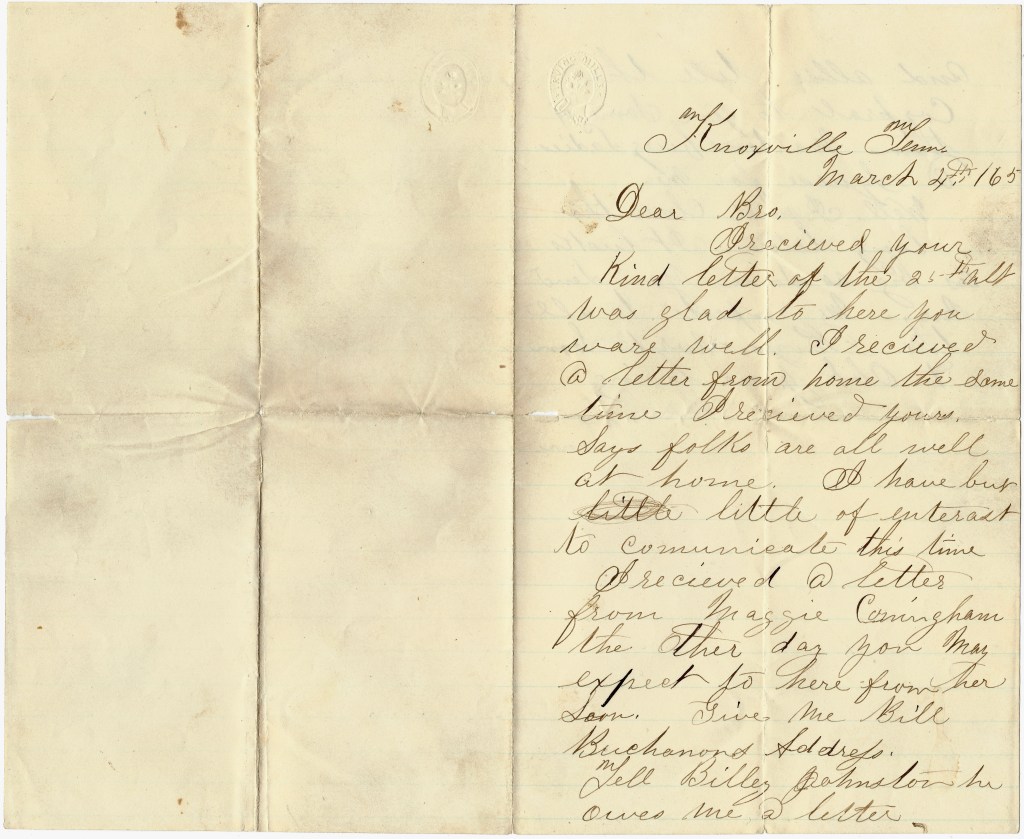
Letter 4

Knoxville, Tennessee
March 4th 1865

Dear Brother,

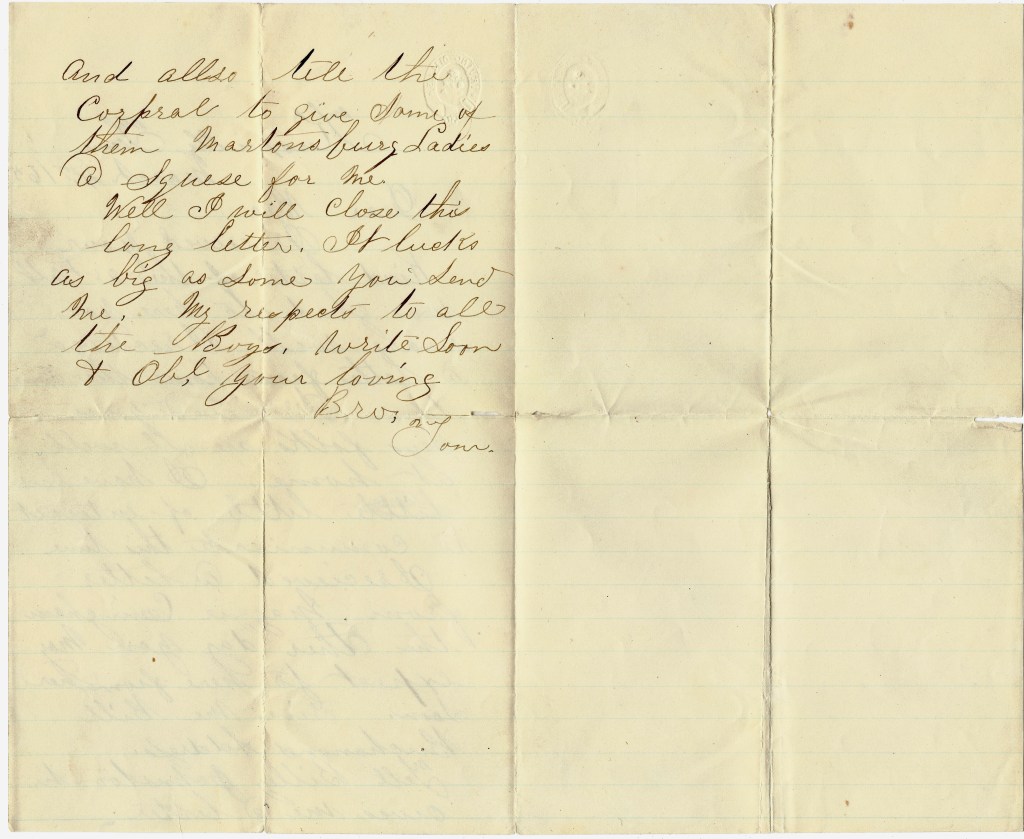
I received your kind letter of the 25th ultimo. Was glad to hear you was well. I received a letter from home the same time I received yours. Says folks are all well at home. I have but little of interest to communicate this time. I received a letter from Maggie Cunningham the other day. You may expect to hear from her soon. Give me Bill Buchanan’s address. Tell Billy Johnston he owes me a letter and also tell the corporal to give some of them Martinsburg [W. Virginia] Ladies a squeeze for me.

Well, I will close this long letter. It looks as big as some you send me. My respects to all the Boys. Write soon & oblige your loving brother, — Tom
Letter 5

Buffalo [New York]
June 8th 1866

Dear Folks,

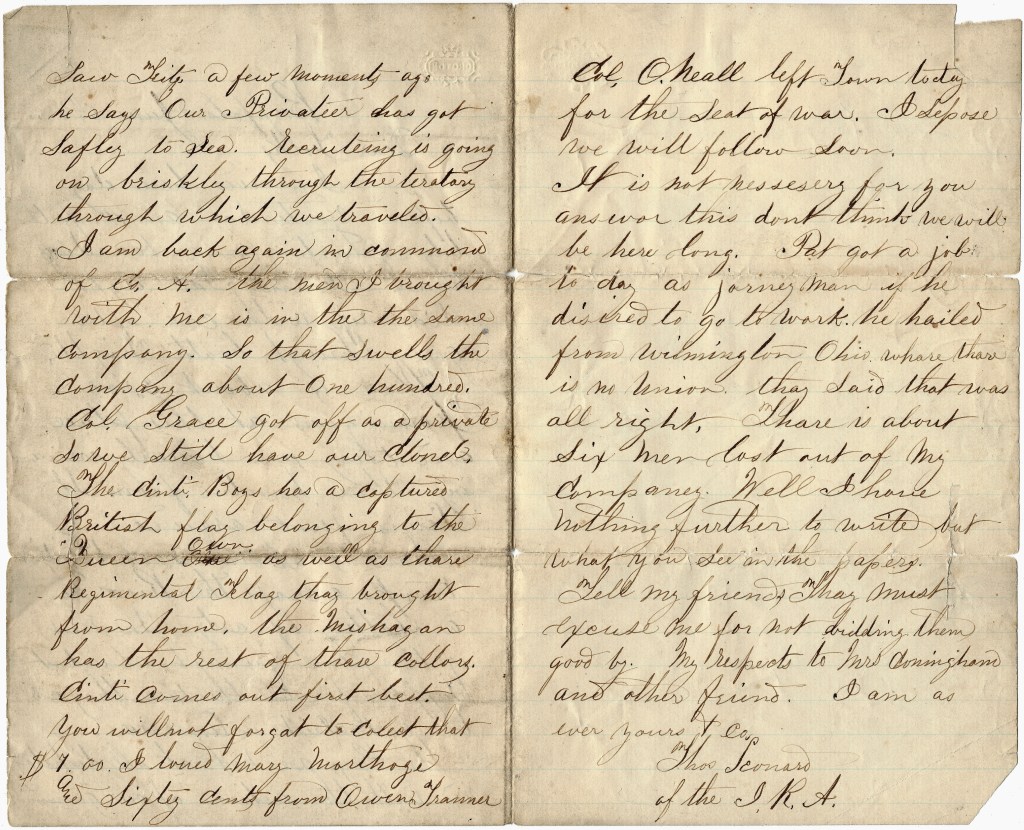
I arrived here day before yesterday. Am comfortably quartered in a boarding house. Found Pat right side up with care after going through both fights. There is about 3,000 Finnegans 1 at this place and they are hourly arriving. There hundred from St. Louis just arrived. There is about 2,000 British troops across the river and a battery of artillery. The Irish of this place furnished abundant supplies for all the men. They are the best Irish in America.

Irish veterans of the American Civil War launched attacks on Canada in an effort to win independence for Ireland

The Boys are not at all disheartened with the action of our government. Saw Fritz a few moments ago. He says our Privateer has got safely to sea. Recruiting is going on briskly through the territory through which we traveled.

I am back again in Co. A. The men I brought with me is in the same company. So that swells the company about one hundred. Col. Grace got off as a private. So we still have our Colonel. The Cincinnati Boys has a captured British flag belonging to the Queen’s Own as well as their Regimental flag brought from home. The Michigan has the rest of their colors. Cincinnati comes out first best. You will not forget to collect that $7 I loaned Mary Martha. And sixty cents from Owen Tranner.

Col. [John] O’Neill left town today for the Seat of War. I suppose we will follow soon.

It is not necessary for you to answer this. Don’t think we will be here long. Pat got a job today as journeyman if he desired to go to work. He hailed from Wilmington, Ohio, where there is no union. They said that was alright. There is about six men lost out of my company.

Well, I have nothing further to write but what you see in the papers. Tell my friends they must excuse me for not bidding them goodbye. My respects to Mrs. Coningham and other friends.

I am as ever yours & Co., — Thomas Leonard, of the I. R. A. [Irish Republican Army]

1 They were called variously as Fine, Fenians, or Finnegan’s.

1862: L. J. Mead to R. W. Mead

The author of this letter remains unidentified. He may have have been a member of either the 24th Missouri Infantry or the 1st Nebraska Infantry as both regiment moved from Helena, Arkansas, to Sulphur Spring, Missouri in early October 1862—an event that was mentioned in this letter. His name appears to read, “S. J. Mead” but I may be mistaken. He mentions sending money by Express to Brownsville. There was a town named Brownsville in Saline county, Missouri, that changed its name to Sweet Springs after the Civil War. There was a Mead family enumerated in the 1860 US Census in Jefferson, Saline county, Missouri but the 20 year-old Lemuel J. Mead does not appear to have had military service prior to 1863 and I can’t find a Mead in the 24th Missouri Infantry.

Transcription

[St. Louis, Missouri]
October 13th 1862

Folks at home,

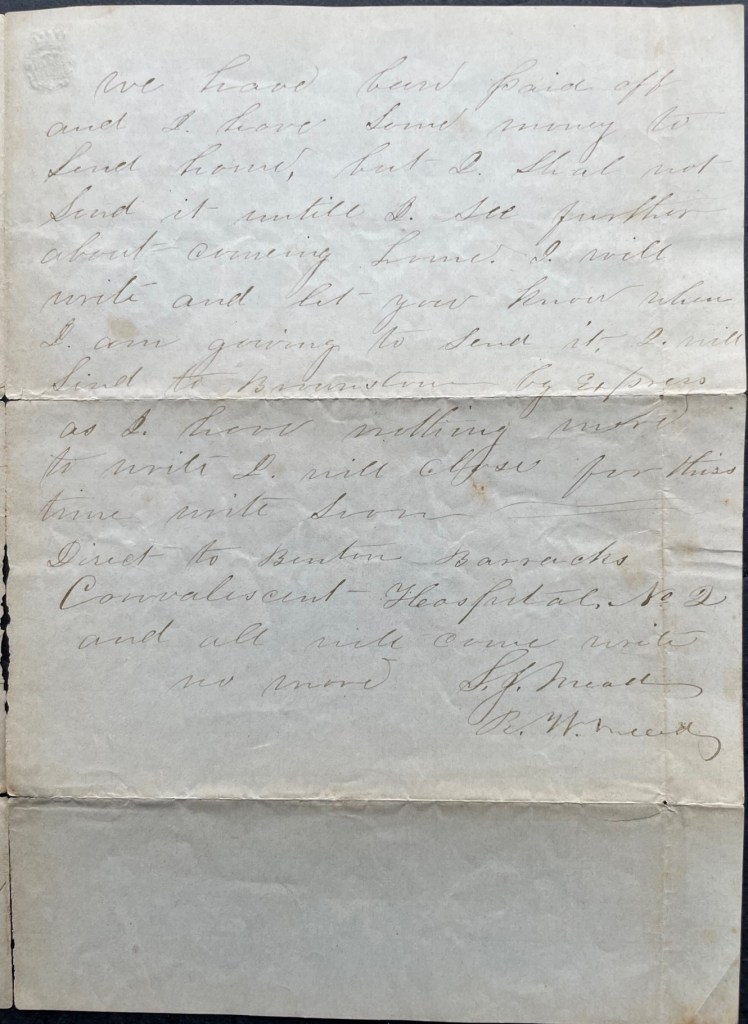
As I have changed my place of abode to Old Benton Barracks again, I thought I would write and let you know where I was and how I am getting along. I am not very well at the present time. I am complaining of my right lung being affected and the chronic diarrhea. Our regimental Dr. gave me a furlough two two weeks ago and I got all ready to come home except getting it signed by the Post Surgeon and just the evening before I went to him, orders came for no more furloughs to be signed which knocked me out of getting to come. I then was gave my Descriptive Roll and sent to St. Louis to the Convalescent Hospital at the barracks.

The Regiment came up as far as Sulphur Springs 25 miles below St. Louis. We had a very worrisome trip of about 600 miles on the boat and but little to eat on the trip. I am at a good place now and plenty to eat of everything. I do not know whether I can get to come home from here or not for there is so many sick here and they won’t give a furlough unless a man is at the point of death. But I am going to try and see or else I am going to get a discharge from the service if possible just as soon as I can get it.
We have been paid off and I have some money to send home, but I shall not send it until I see further about coming home. I will write and let you know when I am going to send it. I will send to Brownstown by Express. As I have nothing more to write, I will close for this time. Write soon.

Direct to Benton Barracks, Convalescent Hospital No. 2 and all will come right. No more. — S. J. Mead

R. W. Mead

1862: Henry Clay Ford to Joseph A. Sullard

I could not find an image of Henry but here is a cased image of Gordon B. Swift of Co. B, 72nd New York Infantry (Photo Sleuth)

This letter was written by Henry Clay Ford (1841-1915), the son of Isaac Ford of Franklin, Delaware county, New York. Henry was only five years old when his father was killed in an accident and his mother died when he was eight. He was then raised by his uncle Sullard who raised him and apprenticed him in the printer’s trade.

Henry volunteered on 21 May 1861 at the age of 19 in Co. I, 72nd New York Infantry—part of the famous Sickle’s Brigade. He was made a corporal when he mustered in and then was promoted to sergeant on 25 September 1862. He was first wounded at Chancellorsville where a bullet cut a furrow through his scalp. He was wounded again at Mine Run when he caught another bullet in the calf of his leg. But in the Battle of Cold Harbor he was struck four times which resulted in a long hospital stay that ended with his discharge for disability on 10 September 1864. [Source: Missouri Valley Times, 24 June 1915]

Henry wrote this letter to his uncle, Joseph A. Sullard (1796-Aft1870) and aunt, Lydia (Sterling) Sullard of Franklin, New York. After the war, Henry relocated to Iowa where he entered the newspaper publishing business.

Transcription

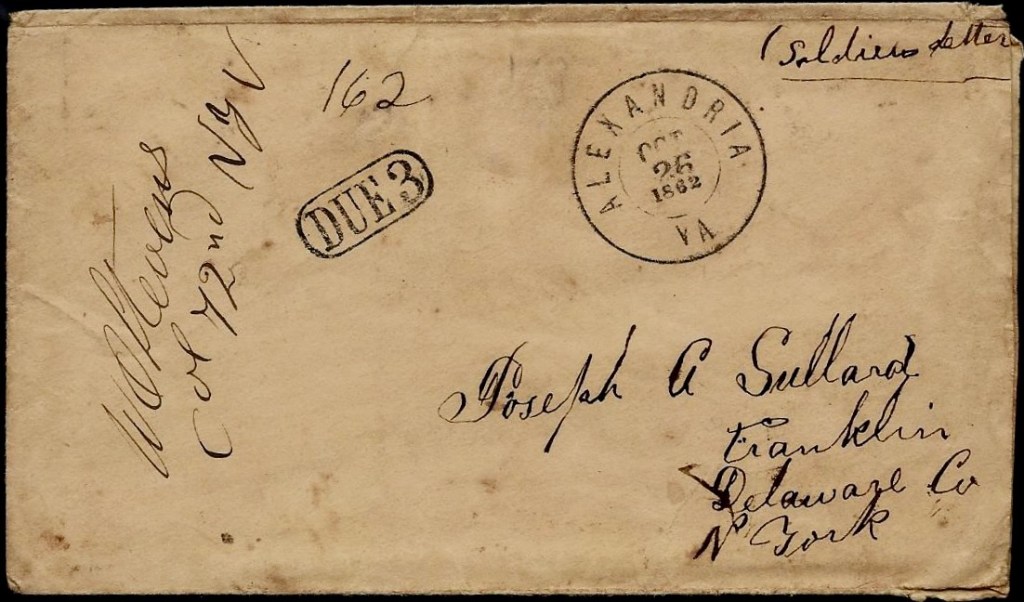
Envelope addressed to Joseph A. Sullard, Franklin, Delaware county, New York; includes the signature of “W. O. Stevens, Col. 72nd NYV” (William Oliver Stevens) who was commissioned as Capt. of Co. D, 72nd NY on June 21, 1861, promoted to Major on June 25, 1861, and became Col. commanding the regiment on Sept. 8, 1862. He was mortally wounded at the Battle of Chancellorsville on May 5, 1863, shot in the chest and captured by the Confederates, he died of his wounds on May 5, 1863. 

Alexandria, Virginia
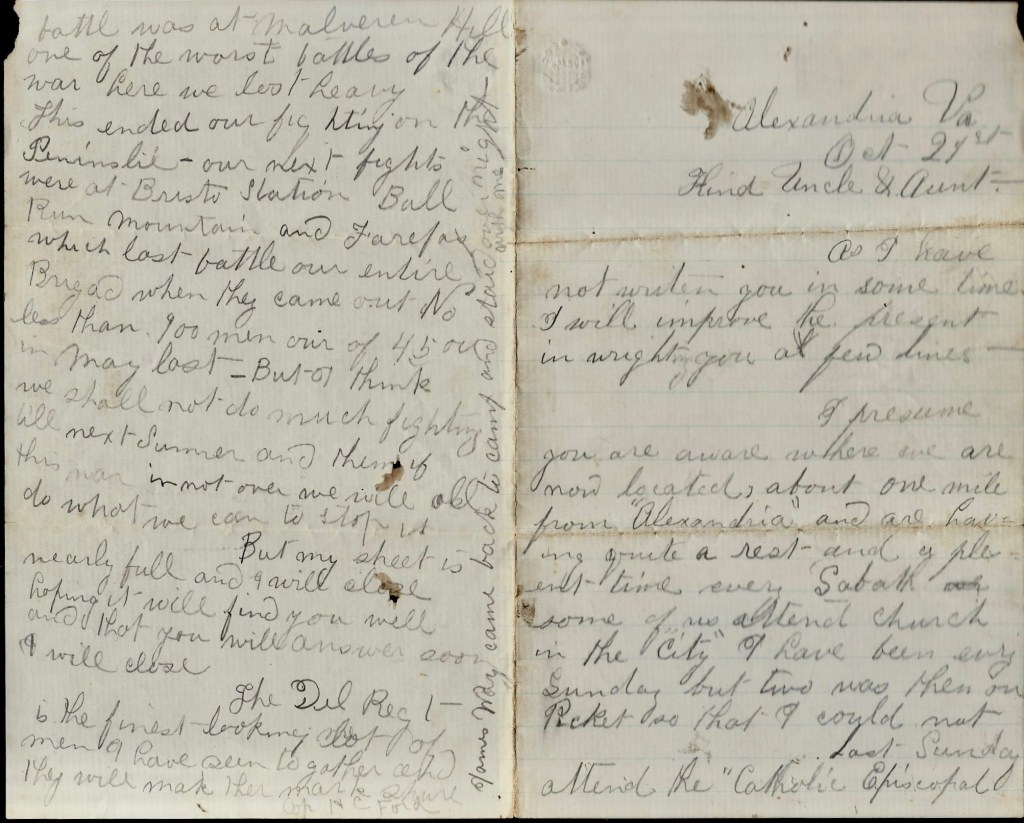
October 21st [1862]

Kind Uncle & Aunt,

As I have not written you in some time, I will improve the present in writing you a few lines.

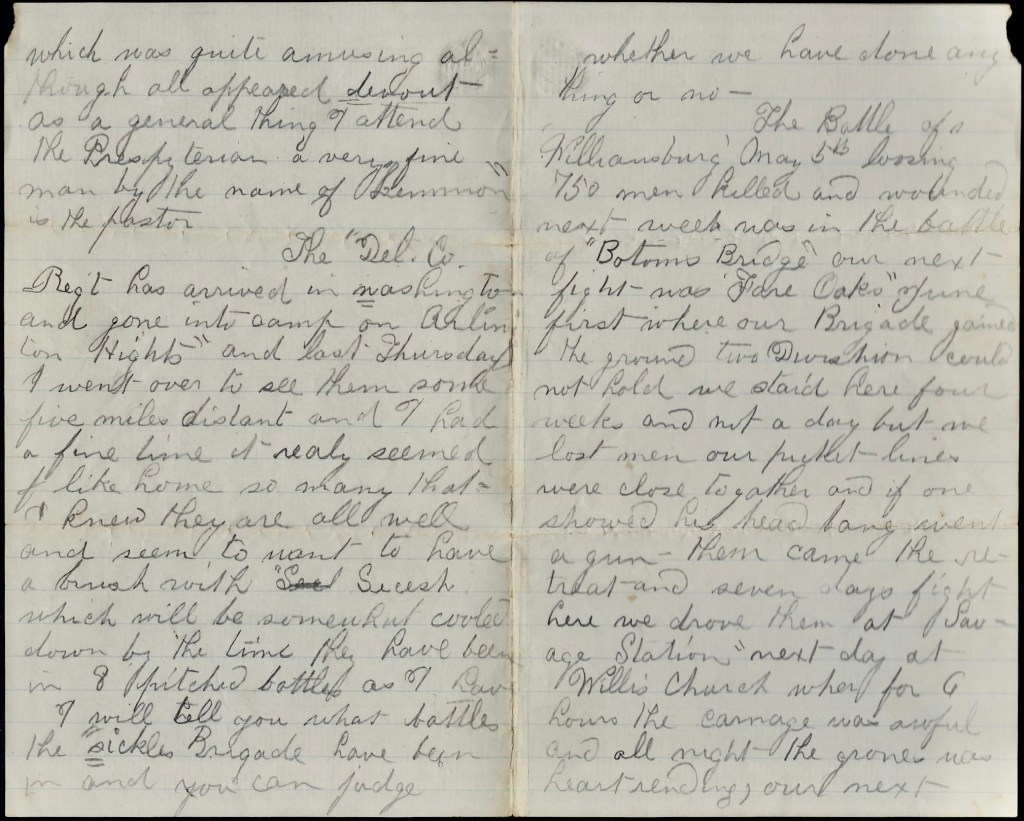
I presume you are aware we are now located about one mile from “Alexandria,” and are having quite a rest and a pleasant time. Every Sabbath some of us attend church in the “City.” I have been every Sunday but two—was then on Picket so that I could not. Last Sunday attend[ed] the Catholic Episcopal, which was quite amusing, although all appeared devout. As a general thing, I attend the Presbyterian. A very fine man by the name of “Lemmon” is the pastor.

The Delaware County Regiment has arrived in Washington and gone into camp on Arlington Heights and last Thursday I went over to see them, some five miles distant, and I had a fine time. It really seemed like home—so many that I knew. They are all well and seem to want to have a brush with Secesh, which will be somewhat cooled down by the time they have been in 8 pitched battles as I have. 

I will tell you what battles the Sickles’ Brigade have been in, and you can judge whether we have done anything or not. 

The Battle of Williamsburg, May 5th, losing 750 men killed and wounded. Next week was in the battle of Bottoms Bridge. Our next fight was Fair Oaks, June first, where our Brigade gained the ground two Divisions could not hold. We staid here four weeks and not a day but we lost men. Our picket lines were close together and if one showed his head, bang went a gun.

Then came the retreat and Seven Days fight. Here we drove them at Savage Station, next day at Willis Church, where for 6 hours the carnage was awful and all night the groans was heart rending. Our next battle was at Malvern Hill—one of the worst battles of the war. Here we lost heavy. This ended our fighting on the Peninsula. Our next fights were at Bristoe Station, Bull Run Mountain, and Fairfax, which last battle our entire Brigade, when they came out no less than 900 men out of 4,500 in May last. But I think we shall not do much fighting till next summer and then, if the war is not over, we will all do what we can to stop it.

But my sheet is nearly full and I will close hoping it will find you well and that you will answer soon. I will close.

The Delaware Regiment is the finest looking lot of men I have seen together and they will make their mark sure.  — Corp. H. C. Ford    

James Way came back to camp and stayed over night with me.

James Alexander DeArmon to Sarah (Dewese) Alexander

The following letter was written by J. Alexander DeArmon (1845-1894) who enlisted at the age of 18 in Co. K, 56th North Carolina Infantry in mid-August 1863. He was sick in July 1864 and furloughed in August 1864 to return in September and rejoin his regiment. He was surrendered at Appomattox Court House on 9 April 1865.

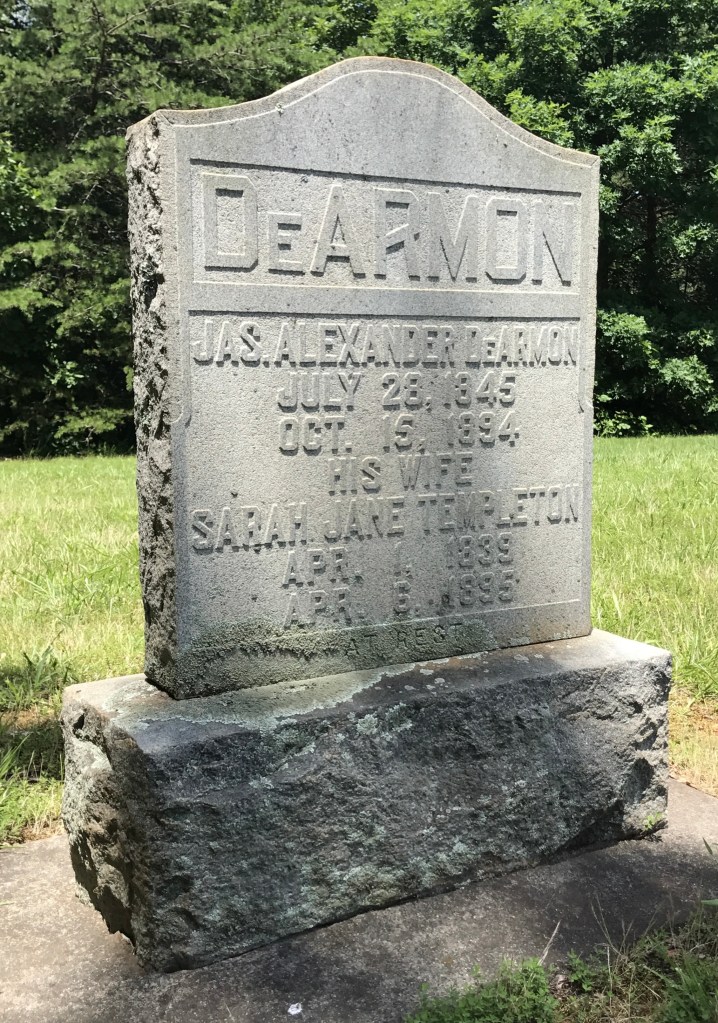
Alexander was the son Richard Lawson DeArmon (1818-1893) and Pamela Wilson Alexander (1819-1899) of Mecklenburg county, North Carolina. After the war, in November 1866, Alexander married Sarah Jane Templeton (1839-1895).

Transcription

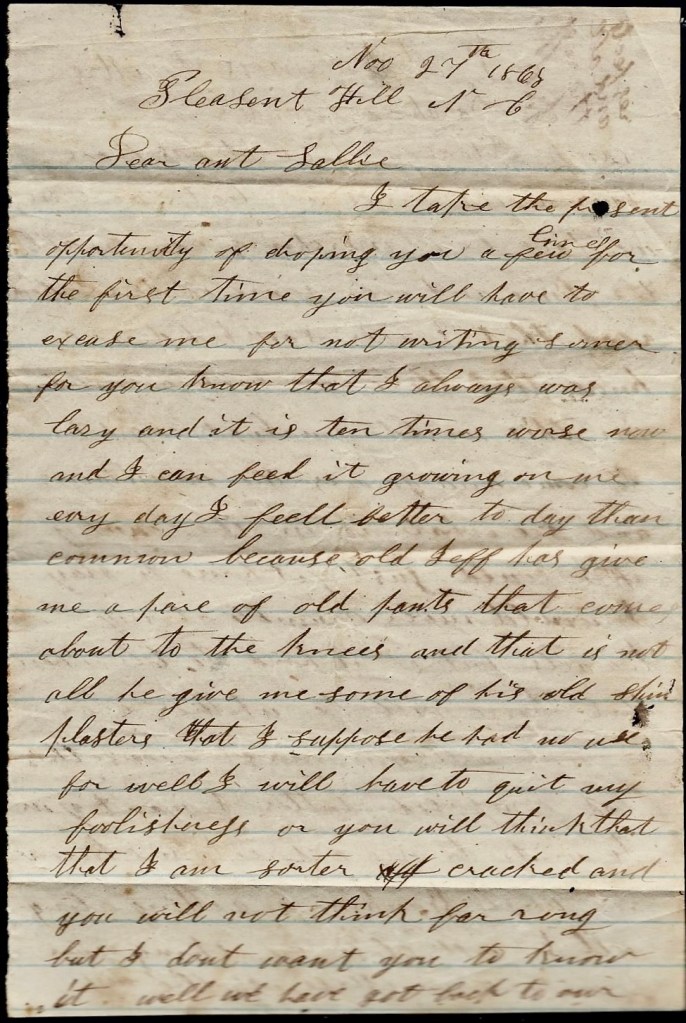
Camp Pleasant Hill, North Carolina
November 27, 1863

Dear Aunt Sally,

I take the present opportunity of dropping you a few lines for the first time. You will have to excuse me for not writing sooner for you know that I always was lazy and it is ten times worse now and I can feel it growing on me every day. I feel better today than common because Old Jeff has give me a pair of old pants that come about to the knees and that is not all. He give me some of his old shin plasters that I suppose he had no use for. Well, I will have to quit my foolishness or you will think that I am sorter cracked and you will not think far wrong. But I don’t want you to know it.

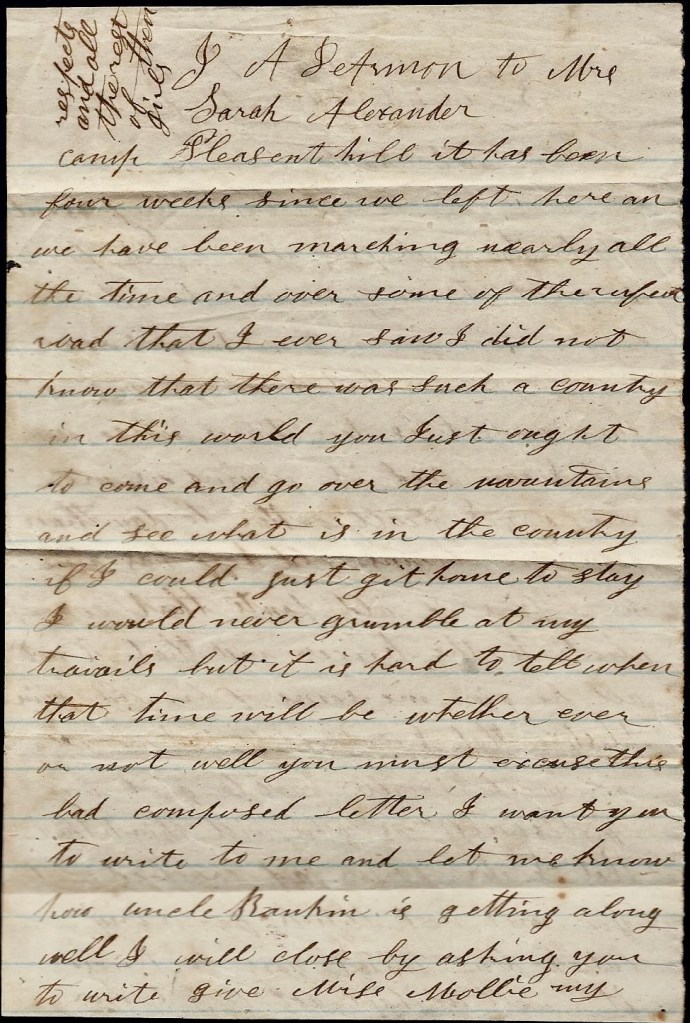
Well we have got back to our camp at Pleasant Hill. It has been four weeks since we left here and we have been marching nearly all the time and over some of the roughest roads that I ever saw. I did not know that was such a country in this world. You just ought to come and go over the mountains and see what is in the country. If I could just get home to stay, I would never grumble at my travails. But it is hard to tell when that time will be, whether ever or not.

Well you must excuse this bad[ly] composed letter. I want you to write to me and let me know how Uncle Rankin is getting along. Well, I will close by asking you to write. Give Miss Mollie my respects and all the rest of the girls. — J. A. DeArmon

to Mrs. Sarah Alexander

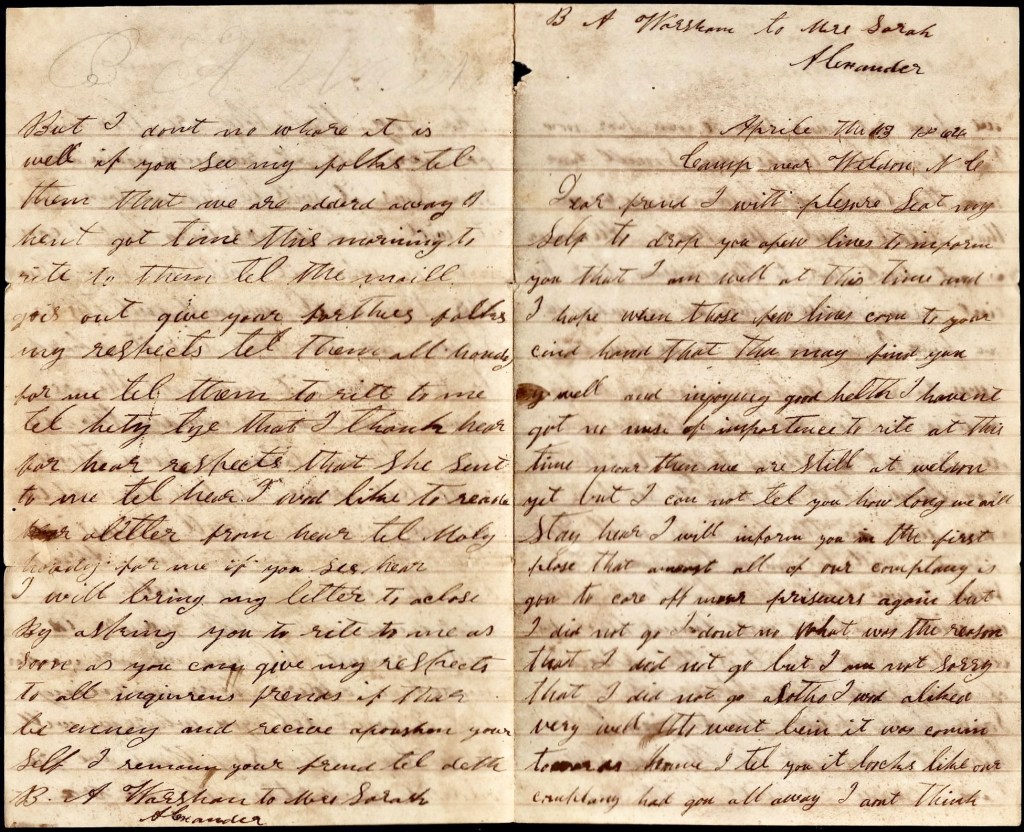
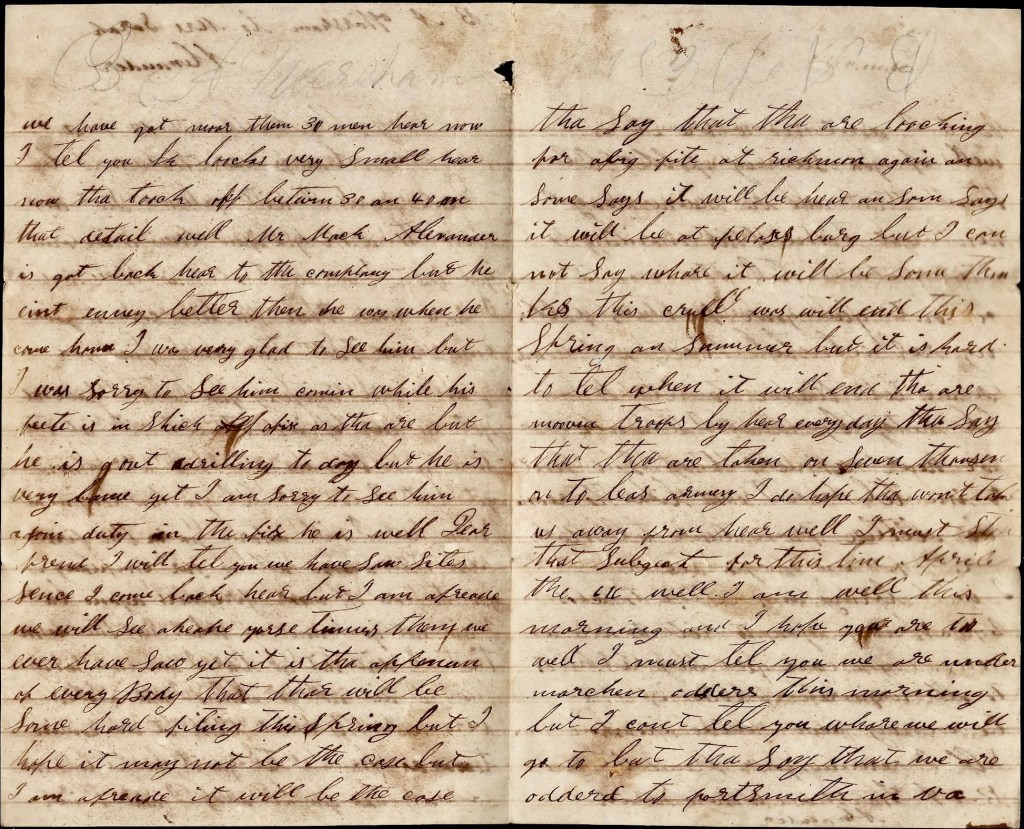
1864: Branch A. Worsham to Sarah (Dewese) Alexander

The following letter was written by Branch A. Worsham (1830-1864), a 32 year-old farmer at the time that he enlisted as a private in May 1862 to serve in Co. K, 56th North Carolina Infantry. He was wounded in the fighting at Ware Bottom Church in Virginia on 20 May 1864 and sent to a hospital in Richmond where he died on 7 June 1864. He was buried in Hollywood Cemetery in Richmond.

Branch was the son of Bennet Benjamin Warsham [or Washam] (1790-1845) and Nancy B. Warsham (1803-1869) of Mecklenburg county, North Carolina. Just prior to his enlistment, Branch married Nancy A. E. Johnston (b. 1835) but it does to appear they had any children.

Transcription

Camp near Wilson, North Carolina
April 7th 1864

Dear friend,

I with pleasure seat myself to drop you a few lines to inform you that I am well at this time and I hope when these few lines come to your kind hand that they may find you well and enjoying good health.

I haven’t got no news of importance to write at this time more than we are still at Wilson yet but I cannot tell you how long we will stay here. I will inform you in the first place that most all of our company is gone to carry off more prisoners again but I did not go. I don’t know what was the reason that I did not go but I am not sorry that I did not go although I would a liked very well to went, being it was coming to or near home. I tell you, it looks like our company had gone all away. I don’t think we have got more than 30 men here now. I tell you, it looks very small here now. They took off between 30 and 40 on that detail.

Well, Mr. Mack Alexander is got back here to the company but he ain’t any better than he was when he come home. I was very glad to see him but I was sorry to see him coming while his feet is in such a fix as they are. But he is not drilling today but he is very lame yet. I am sorry to see him a doing duty in the fix he is in.

Well, dear friend, I will tell you we have saw sights since I come back here but I am afraid we will see a heap worse times than we ever have saw yet. It is the opinion of everybody that there will be some hard fighting this spring but I hope it may not be the case. But I am afraid it will be the case. They say that they are looking for a big fight at Richmond again and some says it will be here and some says it will be at Petersburg but I can not say where it will be. Some think this cruel war will end this spring or summer but it is hard to tell when it will end. They are moving troops by here everyday. They say that they are taking on seven thousand onto cars every [day]. I do hope they won’t take us away from here. Well, I must stop that subject for this time.

April 14th. Well, I am well this morning and I hope you are to. Well, I must tell you we are under marching orders this morning but I can’t tell you where we will go to but they say that we are orders to Portsmouth in Virginia, but I don’t know where it is. Well, if you see my folks, tell them that we are ordered away. I hain’t got time this morning to write to them till the mail goes out. Give your father’s folks my respects. Tell them all howdy for me. Tell them to write to me. Tell Hetty Tye that I thank her for her respects that she sent to me. Tell her I would like to read a letter from her. Tell Molly howdy for me if you see her.

I will bring my letter to a close by asking you to write to me as soon as you can. Give my respects to all inquiring friends, if there be any, and receive a portion yourself. I remain your friend till death, — B. A. Worsham

To Mrs. Sarah Alexander

1862-64: David Rankin Alexander to his Family

The following letters were written by David “Rankin” Alexander (1834-1864), the son of James Wilson Alexander (1796-1857) and Jane Johnston (1796-1862). Rankin was married to Sarah J. Dewese.

David enlisted at the age of 27 on 16 September 1861 as a private in Co. C, 37th North Carolina Infantry until he was wounded at the 2nd Battle of Manassas on 29 August 1863 and spent the next several months recuperating at home. “The 37th NC Regiment was one of the regiments that kept pace with the ‘Foot Cavalry,’ covering more than fifty miles in two days, its fare being principally green corn gathered by the wayside. At Manassas Junction it was one of the regiments that charged Brig. Gen. George W. Taylor’s New Jersey Brigade across Bull Run Creek on August 27th, completely annihilating it. Moving back to the Junction it feasted sumptuously for several hours upon the captured stores, then took its position with Maj. Gen. Jackson’s forces behind the unfinished railroad cut to await the coming of Maj. Gen. Pope’s army. On August 28th it made its appearance and formed in three lines of battle—came on like the waves of the ocean; several well directed volleys hurled them back, but quickly reforming, they came again and again until night put an end to the terrible slaughter. This was kept up upon on August 29th and 30th; the 37th NC Regiment manfully held its position, although at times it would scarcely have a round of ammunition left to the man. Maj. Gen. A.P. Hill (VA) and Brig. Gen. Lawrence O. Branch (NC) could often be seen dismounted urging their men to hold their ground at the point of the bayonet. The loss of the 37th NC Regiment in the three (3) days’ fighting was 13 killed and 67 wounded.”

After Rankin returned to the regiment he was promoted in rank to sergeant but was killed in action on 3 May 1864 in the Wilderness.

Letter 1

[On the completion of its organization it was moved to New Bern, NC, where it received its baptism of fire on March 14, 1862, in battle at that place. Lt. Col. William M. Barbour commanded it, Col. Charles C. Lee being assigned to the command of the left wing of Brig. Gen. Lawrence O. Branch’s (NC) army. Although fighting under great disadvantage, the regiment behaved with great credit to itself and showed plainly of what material it was composed, reinforcing most beautifully Col. Reuben P. Campbell, of the 7th NC Regiment, whose lines were first broken. It is well to state in the beginning that the greater part of the regiment was composed of hardy mountaineers, as fine a looking body of men as ever marched to the tap of a drum. Outnumbered at every point, the small army of Brig. Gen. Branch was compelled to fall back to Kinston and after a short rest the 37th NC Regiment was taken to Falling Creek.]

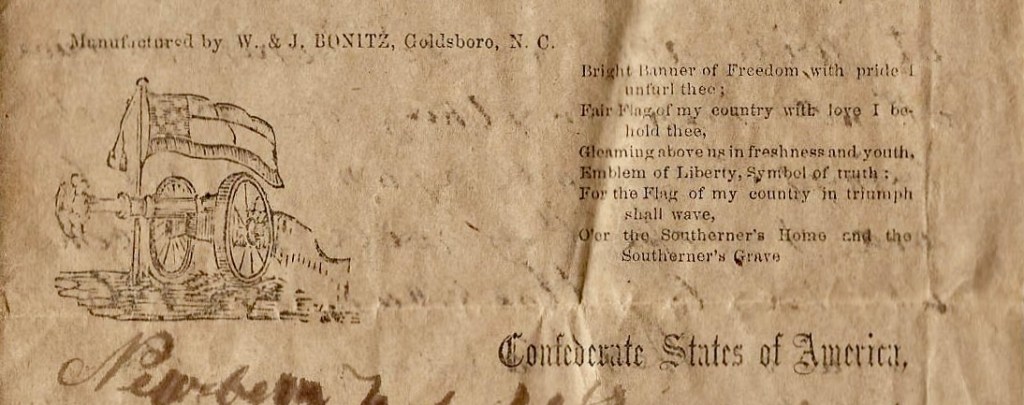
Patriotic Stationery on David’s letter of 21 February 1862

Camp Lee
New Bern, North Carolina
February 21st 1862

Dear Mother,

I take my pen in hand to let you know that I am well at present and hope these few lines will find you all enjoying the same blessing from the hand of Almighty God.

I have nothing of importance to write to you more than you all know. You have heard the news of the reverses our soldiers have had in the last few weeks but I hope and trust to God that it will not be so very long.

We have not seen anything of any of beings they call Yankees yet and I hope they will never come up here to attack us at this place. They talk like the Yankees would be here in a few days after we come here but I have seen nothing of them yet nor do I know whether they are any nearer to us than they were when we came down to this place.

I have written home several times and have got no answer yet. I have looked for a letter for three weeks and have looked in vain but still I have not lost all hopes of getting letters from home. I do not know whether Sarah gets my letters or not and if she writes to me, I never get them. I have thought that you might have wrote to me before this time but still I know you have a hard chance to get much time to write or do anything else while you have so much to do at home so I thought I would drop you a few lines this time and let Sarah wait until next week.

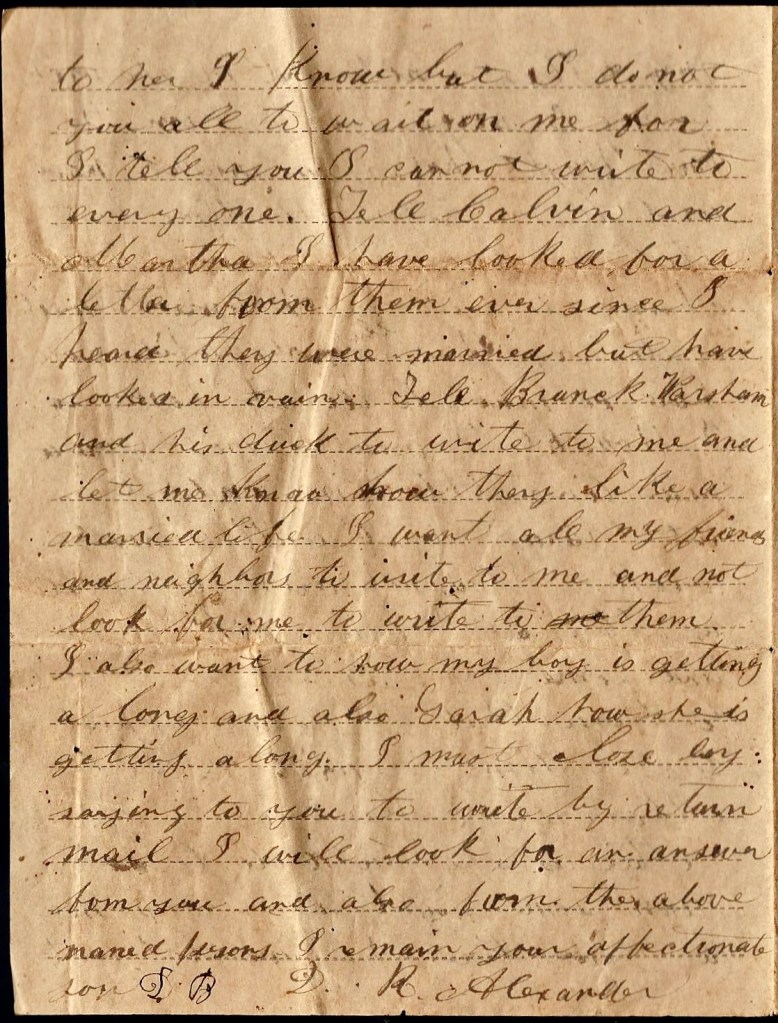
I cannot write to you all as often as I would like to do and some that asked me to write to them that I do not expect to get time to write to. Tell Margaret I think it is as little as she could do to sit down some night and drop me a few lines. I have not wrote to her I know but I do not [want] you all to wait on me for I tell you, I cannot write to every one.

Tell Calvin and Martha I have looked for a letter from them ever since I heard they were married but have looked in vain. Tell Branch Warsham and his duck to write to me and let me know how they like a married life. I want all my friends and neighbors to write to me and not look for me to write to them.

I also want to know hoe my boy is getting along and also Sarah, how she is getting along. I must close by saying to you to write by return mail. I will look for an answer from you and also from the above named persons. I remain your affectionate son, — D. R. Alexander


Letter 2

[After the Battle of Fredericksburg, the 37th North Carolina went into winter quarters at Moss Neck, about eight miles farther down the river, where it remained and did picket duty, with the other four (4) regiments of the brigade, for the remainder of the winter. David was not with his regiment, however. He was at home in Mecklenburg county, ]

[Home]
February 2, 1863

Dear Brother,

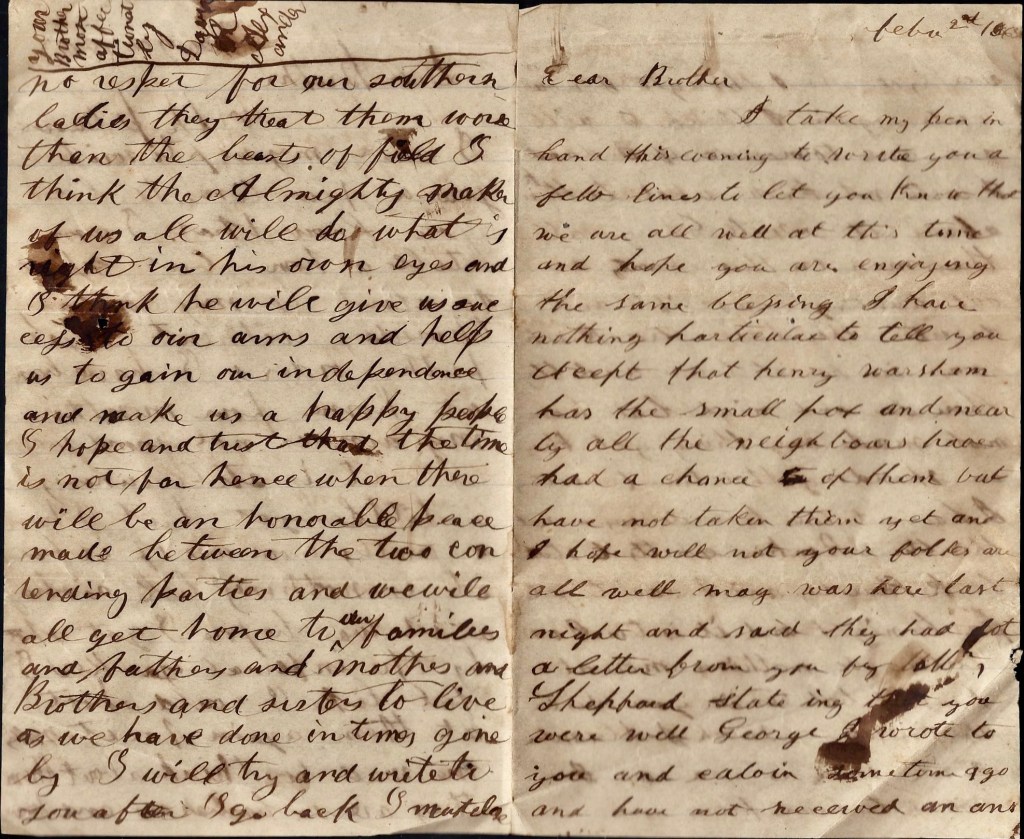
With pleasure I seat myself to write you a few lines to let you know that I am still a home but expect to start to my company Thursday without I get further orders. I have been at home for four months. My arm is not sound well yet. It is still running a little yet but I have a pretty good use of it. But it is nothing like it was before I got shot by the infernal Yankees. I feel like I could shoot at them again for it makes me mad to think about them. They are so barbarous and have no respect for our southern ladies. They treat them worse than the beasts of field. I think the Almighty, maker of us all, will do what is right in His own eyes and I think he will give us success in our arms and help us to gain our independence and make us a happy people. I hope and trust that the time is not far hence when there will be an honorable peace made between the two contending parties and we will all get home to our families and fathers and mothers and brothers and sisters to live as we have done in times gone by.

I will try and write to you after I go back. Your brother, most affectionately, — David Alexander

[In a different hand]

Dear Brother, I take my pen in hand this evening to write you a few lines to let you know that we are all well at this time and hope you are enjoying the same blessing. I have nothing particular to tell you except that Henry Warsham has the small pox and nearly all the neighborhood have had a chance of them but have not taken them yet and I hope will not. Your folks are all well. May was here last night and said they had got a letter from you by Mr. Sheppard stating that you were well. George wrote to you and Calvin sometime ago and have not received an answer yet so I thought I would write again. I think I shall get one tomorrow. If I do not, I will not know what to think about it.

Well, George, all the men in this county are out hunting conscripts and deserters. They have struck up camp in Ferret Town and stay there day and night. Yet they are spending their time for nothing. I have not time to write any more at this time. Rankin expects to start back Thursday and I want to go to Pa’s tonight and it is time I was starting. So nothing more at present but remain your sister affectionately, — Sarah [Dewese] Alexander.

Write soon as you can. I want to hear from you.


Letter 3

[Home]
February 3rd 1863

Dear Brother,

I will write you a few lines this morning again. We are all well and hope these few lines will find you well. I want you and Calvin to write to me after I get back to my company and I want you to write me all the news you can. I have got Mary Tye to stay with Sarah and she says for us to tell you howdy for her. We were all at father’s last night and have just got here through a snow nearly a knee deep this morning. It is beautiful overhead but is bad on the ground for poor soldiers in the army.

I think this will be a great day for those men to gather up the conscripts in Ferret town. Hope they will get the loot one of them. If they don’t, they may look out for to be disturbed some way or another. Wm. Stinson had all his bridles taken one night last week.

Nothing more at present but remain your brother affectionately, — D. R. Alexander


Letter 4

Camp Gregg, Virginia
March 10th 1863

Dear Sister,

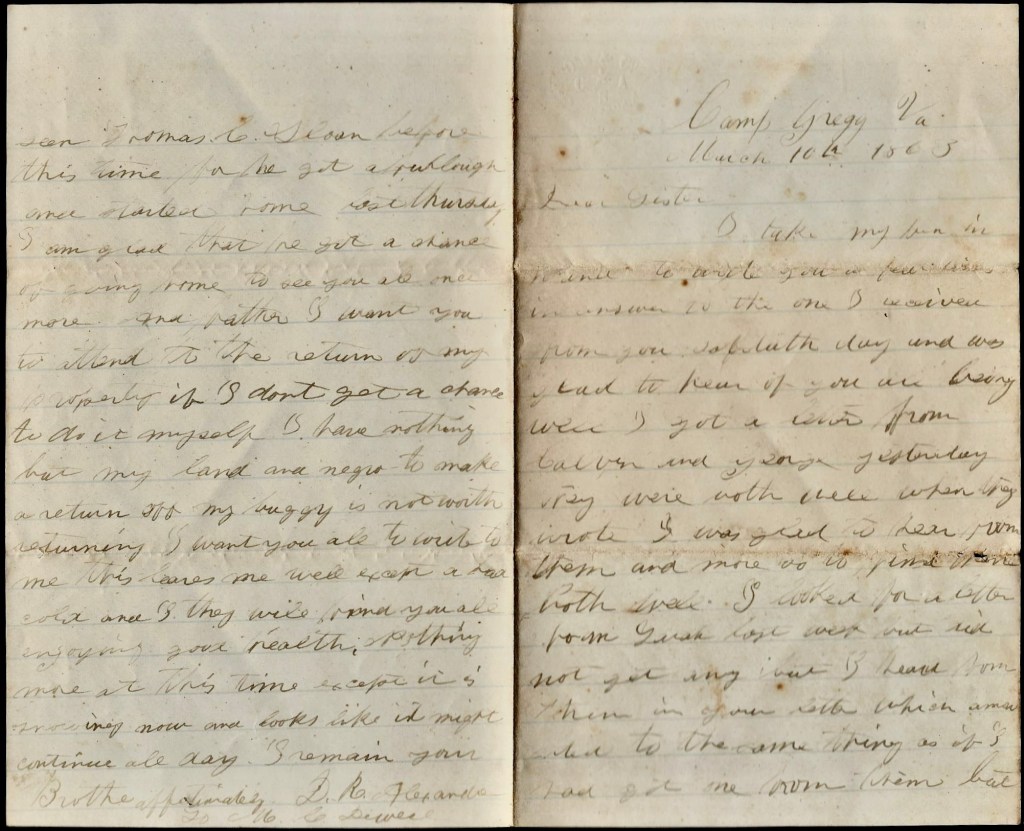
I take my pen in hand to write you a few lines in answer to the one I received from you Sabbath day and was glad to hear of you all being well. I got a letter from Calvin and George yesterday. They were both well when they wrote. I was glad to hear from them and more so to learn them both well. I looked for a letter from Gus last week but did not get any but I heard from them in your letter which amounted to the same thing as if I had got one from them but at the same time I would like to have read one from them. I have no reason to complain at all. I have nothing of interest to write to you at this time.

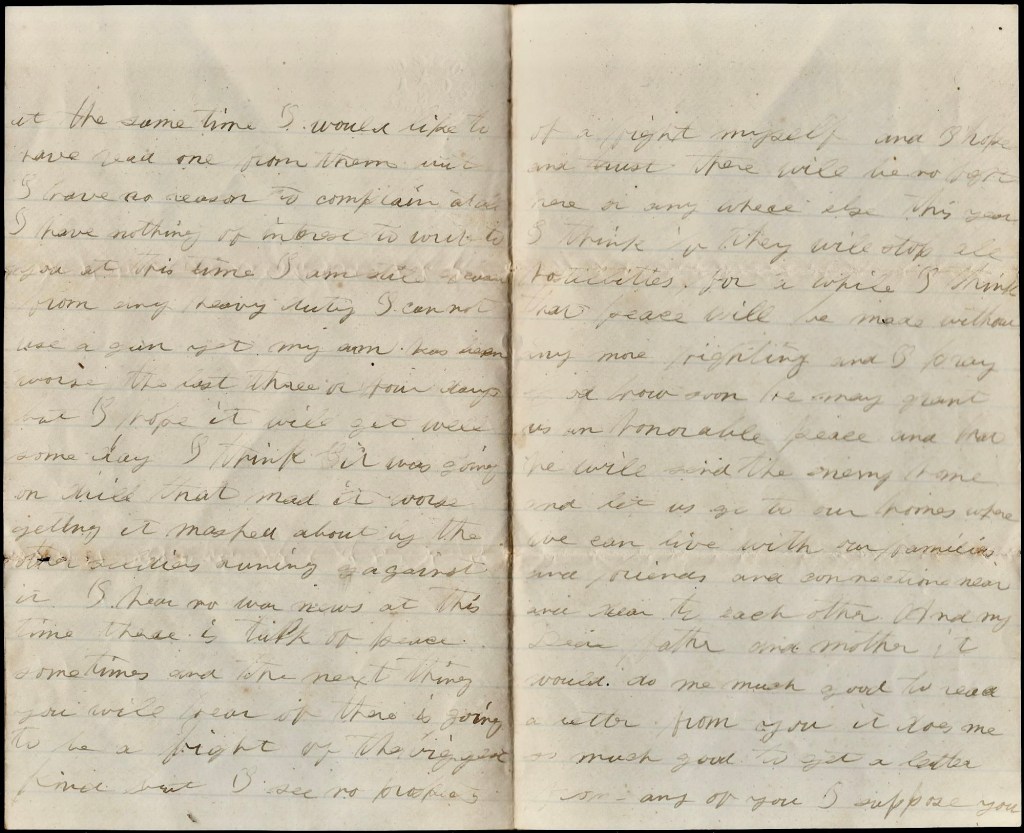
I am still excused from any heavy duty. I cannot use a gun yet. My arm has been worse the last three or four days but I hope it will get well some day. I think it was going on drill that made it worse, getting it mashed about by the other soldiers running against it.

I hear no war news at this time. There is talk of peace sometimes and the next thing you will hear of there is going to be a fight of the biggest kind but I see no prospect of a fight myself and I hope and trust there will be no fight here or anywhere else this year. I think if they will stop all hostilities for awhile, I think that peace will be made without any more fighting and I pray God now soon He may grant us an honorable peace and that He will send the enemy home and let us go to our homes where we can live with our families and friends and connections near and dear to each other. And my dear father and mother, it would do me much good to read a letter from you. It does me so much good to get a letter from any of you.

I suppose you have seen Thomas C. Sloan before this time for he got a furlough and started home last Thursday. I am glad that he got a chance of going home to see you all once more. And father, I want you to attend to the return of my property if I don’t get a chance to do it myself. I have nothing but my land and negro to make a return of. My buggy is not worth returning. I want you to write to me.

This leaves me well except a bad cold and I hope they will find you all enjoying good health. Nothing more at this time except it is snowing now and looks like it might continue all day. I remain your brother affectionately, — D. R. Alexander

to M. C. Dewese


Letter 5

[Home]
April 13th 1863

Dear Brother,

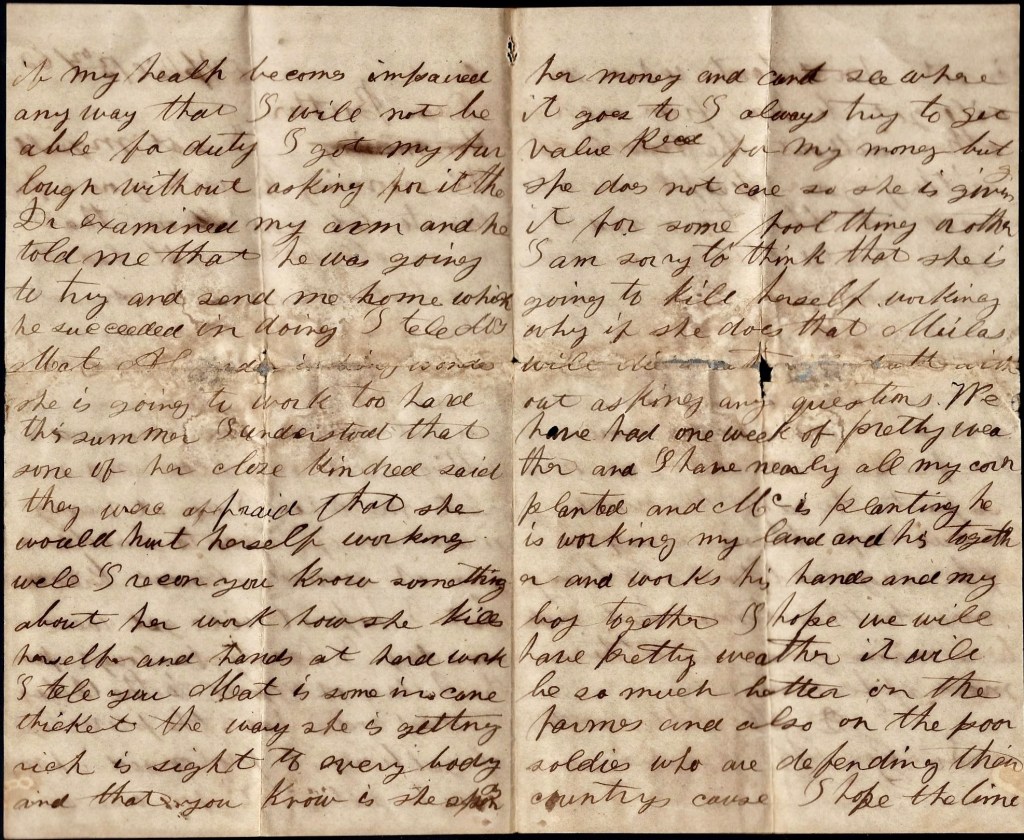
I seat myself this morning to write you a few lines to let you know that we are all well except bad colds and that is bad enough when it takes a deep hold on a person. I have had the worst one this winter I have had for many a year. I am at home at this time and am getting along very slow. My arm hurts me when I use it very much and if I was to handle a gun, it would almost kill me. Bu I hope it will get well someday. I have a furlough from the 2nd of April to the 12th day of May and I have the privilege of getting it prolonged if my arm is not fit for use or if my health becomes impaired any way that I will not be able for duty. I got my furlough without asking for it. The doctor examined my arm and he told me that he was going to try and send me home which he succeeded in doing.

I tell you Mat Alexander is doing [ ]. She is going to work too hard this summer. I understood that some of her close kindred said they were afraid that she would hurt herself working. Well I reckon you know something about her work—how she kills herself and hands at hard work. I tell you, May is some in cane thicket the way she is getting rich is sight to everybody and that you know is she spends her money and can’t see where it goes to, I always try to get value received for my money but she does not care so she is giving it for some fool thing or other. I am sorry to think she is going to kill herself working. Why if she does that, Milas will die [illegible] without asking any questions.

We have had one week of pretty weather and I have nearly all my corn planted and Mc is planting. He is working my land and his together and works his hands and my boy together. I hope we will have pretty weather. It will be so much better on the farms and also on the poor soldiers who are defending their country’s cause. I hope the time is not far distant when we will get to hear from each other without the trouble of writing,

Your people are all well at this time and I hope should these few lines reach you, they may find you enjoying good health. May the good Lord [ ] rest upon you and all the poor soldiers who are now in the field of service. Give my respects to all the company or such of them as inquire after my welfare.

Nothing more at this time but hope to remain your brother most affectionately, — D. R. Alexander

To G. B. Dewese


Letter 6

Camp near Liberty Mills, Virginia
October 6, 1863

Dear father and family,

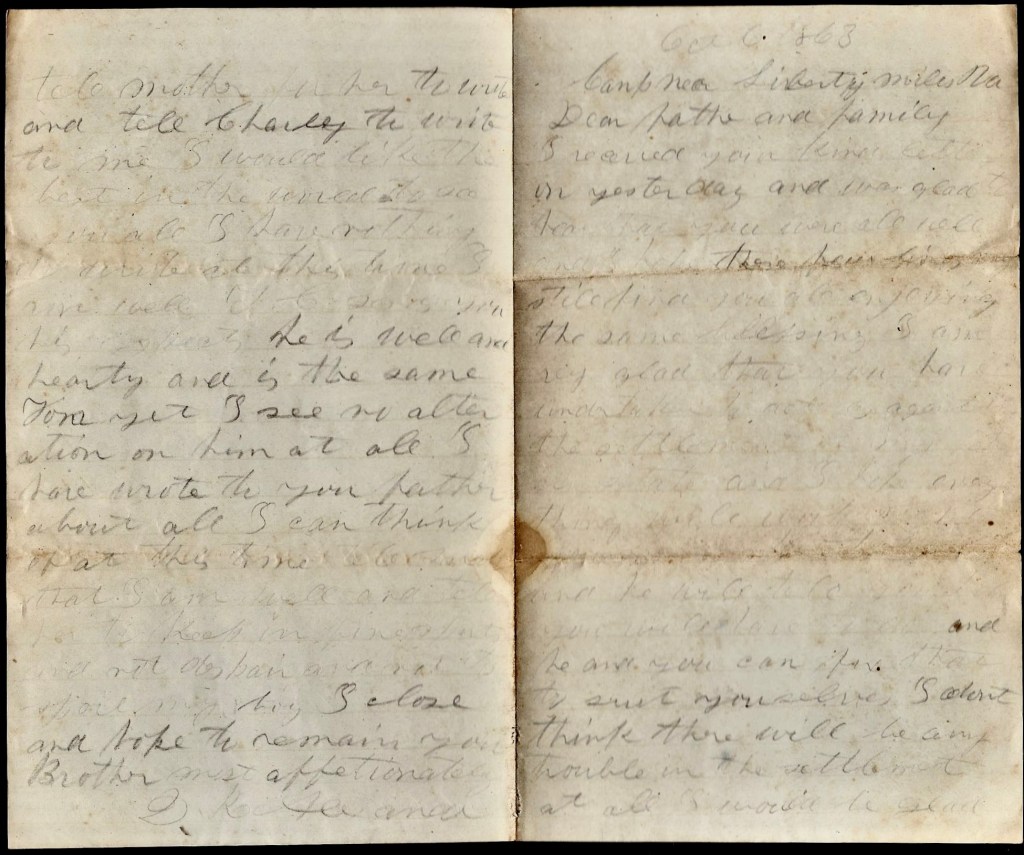
I received your kind letter on yesterday and was glad to hear that you were all well and I hope these few lines will still find you all enjoying the same blessing. I am very glad that you have undertaken to get a [ ] a settlement of my estate and I hope everything will work [illegible]. I don’t think there will be any trouble in the settlement at all. I would be glad if I could get home to attend to it myself but things are so ordered that I can’t at this time. I hope this war will soon come to a close and then I can get home to see to my own affairs. I have hoped that way so long that it looks like I might lose hope but still I live in hope if I die in despair—I want peace, but I want it honorably or not at all. It would do us no good unless we do get it in this way. I pray the time is not far distant when we will have peace and then what a time of rejoicing there will be in this Confederacy between man and wife, parents, children, friends, and our connections near and dear to us.

I have no news of interest to write at this time, only our army is in good health and fine spirits at this time. Our regiment never has been in better health and condition since I can mind than it is at the present time.

Nothing more. Write soon. Your son, — D. R. Alexander

Dear sister Margaret, I write you a few lines. You’re excused for not writing soon a letter. I hope you will do so no more. I want you all to write as often as you can. Tell mother for her to write and tell Charley to write to me. I would like the best in the world to see you all. I have nothing to write at this time. I am well. T. C. Sloan sends you his respects. He is well and hearty and is the same Tom yet. I see no alteration on him at all. I have wrote to your father about all I can think of at this time…Keep in fine spirits and do not despair…I close and hope to remain your brother most affectionately, — D. R. Alexander


Letter 7

Camp near Liberty Mills, Virginia
December 19th 1863

Dear Mother,

I take my pen in hand to write you a few lines to let you know that I am well at this time hoping should these few lines will find you all well and in good health. I have not much of interest to write at this time except we have cold wet weather out here and a heap of it and we have to go on picket every two days and we have guard duty to do every day and it makes no difference how bad the weather is—we have to stand guard.

I want more provision from home if I can get it and I want you and my neighbors to send me something every chance you have and I don’t want you to think that I am begging but anything from [home] takes so well. Give my love to all the children and tell Margaret that I think she might have written to me before this time but I will excuse her as she has so many young men to write to that she can’t have time to write to me very well. That is alright. I think among you I ought to get one letter every month. I have looked for a letter from some of you but have not got any from you for some time. I want you all to write to me and give me all the news in the neighborhood.

I would have liked to been at home to seen Calvin and George but I could not be there and here both, but I hope the time is not far distant when we will all get home to enjoy ourselves once more in this world. And if we should never meet on this earth anymore, my prayer is that we all may meet in heaven where peace will forever dwell in our hearts and men will learn war no more. Tell Martha Ann that I have not forgotten her yet. Tell her that I have so many to write to that I can’t write to all of my friends as often as I would like to do.

I would like to see you all and talk with you all. Tell the little boys all for me to be good boys and pray for me while I am out here fighting for them and pray not only for me, but for all of the poor soldiers. Tell them that I think of them every day. I have nothing more at this time but I hope to remain your son-in-law most affectionately, — D. R. Alexander

T. C. [Sloan] is well and hearty at this time. He says he has not forgotten you yet.


Letter 8

Camp near Liberty Mills
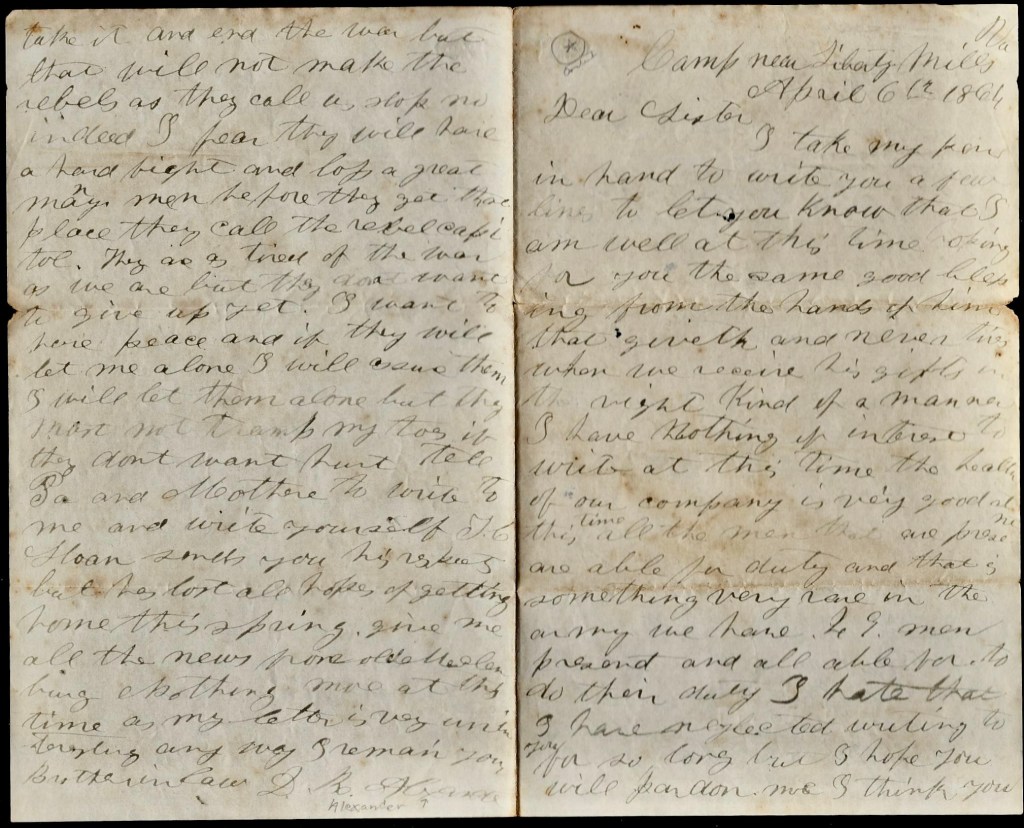
April 6th 1864

Dear Sister,

I take my pen in hand to write you a few lines to let you know that I am well at this time, hoping for you the same good blessing from the hands of Him that giveth and never tires when we receive His gifts in the right kind of a manner.

I have nothing of interest to write at this time. The health of our company is very good at this time. All the men that are present are able for duty and that is something very rare in the army. We have 49 men present and all able for to do their duty. I hate that I have neglected writing to you for so long but I hope you will pardon me. I think you are a reasonable being and will not think hard of me in my neglects. I was sorry to hear of John being so sick but was glad to hear of him being able to ride to my house. I hope he is well by this time and all the rest for you have had a serious bout of sickness this winter. I believe all have been sick from the oldest to the youngest.

I am not in the habit of writing tales on my fellow soldiers but I think I must relate one this time on my friend Robert Deaton. 1 As you know, I am a great friend of his. He tried to play off with pains in his legs and loin joints but they would not swell for him and the doctor could not see anything wrong with him and they preferred charges against him ad had him courtmartialed for trying to play off and his sentence is to dig stumps three hours every day for a month. He wants to put in another summer campaign at the hospital. He likes that place better than to be with the company and do his duty like a soldier. In short, he is no account nor never will be.

Tell all the family that I am well and want all that can write to write to me and give me all the news. Give my respects to all who may ask after me. I am in hopes this war will come to a close someday. If it don’t, it will be the first one. But I hope it will be soon. I see in the papers taken from a Northern paper that we can hold Richmond while we have fifty thousand men to fight. But still their great Gen. Grant says he intends to take it and end the war. But that will not make the rebels, as they call us, stop. No indeed. I fear they will have a hard fight and lose a great many men before they get that place they call the rebel capitol. They are as tired of the war as we are, but they don’t want to give up yet. I want to have peace and if they will let me alone, I will assure them I will let them alone. But they must not tramp [on] my toes if they don’t want hurt.

Tell Pa and Mother to write to me and write yourself. T. C. Sloan sends you his respects but he’s lost all hopes of getting home this spring. Give me all the news from Old Mecklenburg. Nothing more at this time as my letter is very uninteresting anyway. I remain your brother-in-law, — D. R. Alexander

1 James Robert Deaton (1840-19xx) was 20 years old when he enlisted on 16 September 1861 as a private in Co. C, 37th North Carolina Infantry. It appears he was captured and took the Oath of Allegiance in Washington D. C. in September 1862 but was exchanged and returned to his regiment. He was absent without leave for a while but returned in February 1863. He deserted to the enemy on 30 November 1864 and went to Bartholomew county, Maryland, to wait out the war.

1863: Richard Johnston Stough to George Dewese

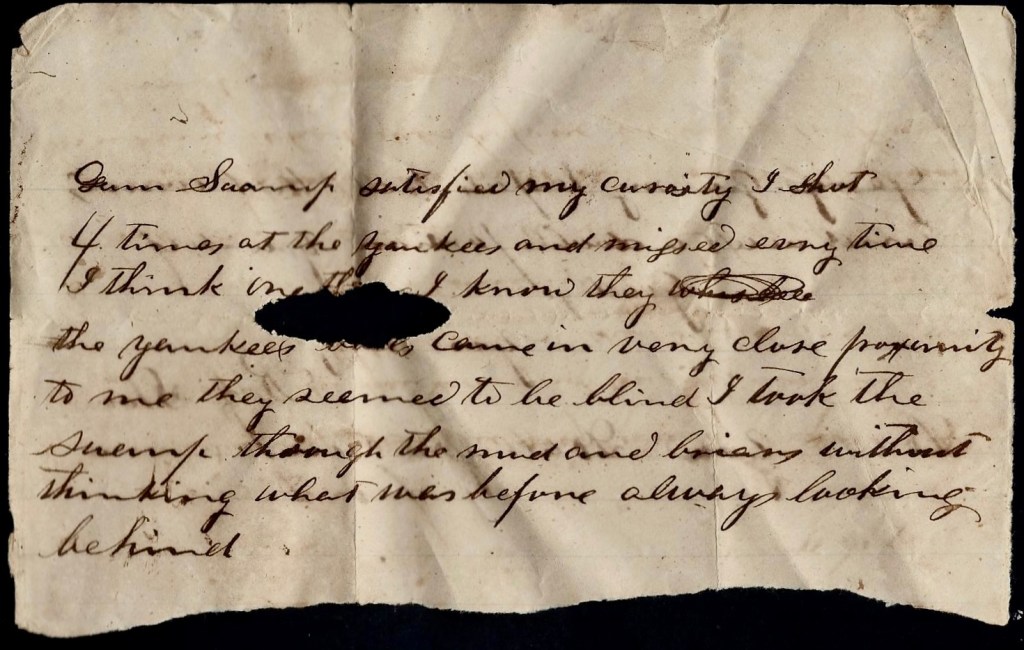
This letter was written by Richard Johnston Stough (1844-1926) who enlisted at the age of 18 on 28 July 1862 as a private in Co. K, 56th North Carolina Infantry. He was promoted to corporal in September 1863 and was with his regiment near New Bern when he participated in the 2nd Battle of Gum Swamp in May 1863. In this engagement, the 25th NC Regiment and the 56th NC Regiment were surprised and virtually surrounded by five Union regiments at Gum Swamp (Jones County); they were forced to fight their way out or flee into the swamp. More than 160 men of the 56th NC Regiment were captured but apparently Richard “took to the swamp through the mud and briars” and escaped.

Richard was taken prisoner of war on 25 March 1865 in the fight at Fort Stedman, Virginia, and was confined at Point Lookout, Maryland, until he took the Oath of Allegiance on 20 June 1865.

Richard wrote the letter to George B. Dewese (1843-1864), the son of John Allison Dewese (1811-1870) and Mary Ann Sloan (1819-1911) of Mecklenburg, North Carolina. George enlisted on 28 July 1862 at the age of 19 in Co. K, 56th North Carolina Infantry. He was absent sick from his company for two or three months in the spring of 1863 but was otherwise on duty until he was killed in the Battle of Globe Tavern (or 2nd Battle of Weldon Railroad) fought on 21 August 1864 south of Petersburg, Virginia.

Transcription

[Approximately 1 June 1863]

Gum Swamp satisfied my curiosity. I shot 4 times at the Yankees and missed every time I think. One thing I know, they—the Yankees—came in very close proximity to me. They seemed to be blind. I took the swamp through the mud and briars without thinking what was before, always looking behind.

George, give my respects to all that wants and accept a double portion yourself. Goodbye. Yours truly, — R. J. Stough

Do all you can for Dicie.

1864: Andrew Green Barnett to Margaret C. Dewese

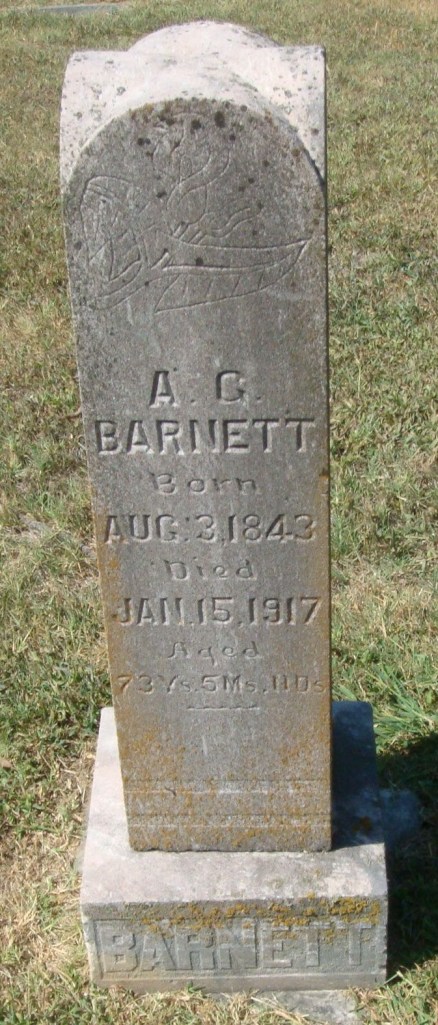
The following letter was written by Andrew (“Andy”) Green Barnett (1843-1917) of Mecklenburg county who enlisted as a private on 25 October 1862 in Co. K, 56th North Carolina Infantry. He was wounded on 30 May 1864 and hospitalized in Richmond, Virginia. He was furloughed in September and returned to service in January, 1865. In March of 1865 he was taken prisoner and held at Point Lookout, MD until the war’s end, taking the Oath of Allegiance on June 23, 1865. [His obituary published in the Charlotte Observer on 19 January 1917 says he was imprisoned on Hart’s Island in New York.]

After he returned home from the war, Andy married Martha McClure (1843-1916) and the couple had at least nine children. He died on 15 January 1917 and was buried in Davidson, Mecklenburg county, N. C.

Andy wrote the letter to Margaret C. Dewese (1841-1910) who also lived in Mecklenburg county. She was the daughter of John Allison Dewese (1811-1870) and Mary Ann Sloan (1819-1911).

Transcription

Randolph City, North Carolina
January 14th 1864

Miss M. Dewese,

Dear friend, I seat myself to write you a few lines to inform you that I am well and hope these few lines may reach you and find you in the same good blessing. I have been having a right fine Christmas here along of the Randolph girls but I would rather been in Old Mecklenburg to a taken Christmas with them that I know. I have been at two parties here, then dined at both places. We had a fine large time of it and I hope you had a fine time with the old men and boys for they ain’t any other sort there to take Christmas with but.

[It looks like] we will have to set in for a New Year. I think they had better all quit and go home and mind their own business. I hain’t got anything to do but write letters or read the ones I get from the girls—that is more satisfaction.

This is a fine, wet day and we are all sitting up indoors. The boys is well and hearty and we are cooking or eating pickled beef.

Well, Miss M., I have not got anything of interest to write that you will [have] seen by perusing the [ ] but I hope it will find you with some important news so you won’t be like me at a loss to know what to write. I am getting along fine here and I hope they will keep us at this business till the war comes to a close. Write soon and give me the news to a close, if you please, and I will try to think of more next time. Give my compliments to all the girls that think worthy of asking but don’t let no one see it. I have been looking for letters from the girls and I begin to think I wouldn’t get any and I thought I would write a few and see if you all had forgotten me. So I must close by asking you to write soon and give me the news in full.

Direct your letter to me as before. But you know all that. So I remain your esteemed friend while I am, — A. G. Barnett

1864: William Smith to Margaret C. Dewese

Believed to be Zachariah and William H. H. Holland of Co. E, 56th N. C. Infantry

The following letter was written by Pvt. William Smith (1836-1864) of Mecklenburg county who enlisted in April 1862 to serve in Co. K, 56th North Carolina Infantry. William was taken prisoner on 22 May 1863 in the 2nd Battle of Gum Swamp. In this engagement, the 25th NC Regiment and the 56th NC Regiment were surprised and virtually surrounded by five Union regiments at Gum Swamp (Jones County); they were forced to fight their way out or flee into the swamp. More than 160 men of the 56th NC Regiment were captured. William was held at New Bern until he was paroled and eventually returned to his regiment.

In late August, William was sent to a hospital suffering from an illness and he died on 3 October 1864.

William wrote this letter to Margaret C. Dewese (1841-1910) who also lived in Mecklenburg county. She was the daughter of John Allison Dewese (1811-1870) and Mary Ann Sloan (1819-1911).

Transcription

[Camp near Weldon Railroad]
April 3rd [1864]

Dear Miss,

I take my pen in hand to write you a line to let you know how I am getting along. I am well and in fine spirits and I hope these lines will find you enjoying the same great blessing. I thought when I promised to write to you that I would a written before this time. I just thought to write when I see Calvin [Dewese] a writing & thought I would write a line and put in his letter. 1

I have no news of importance to write at present. The company is generally well. John Sloan was taken to the hospital yesterday. I and several others had the same chance to catch them that he had. We may take them yet but I hope not. We have not fared well ever since we came back to the company in the way of rations. We have nothing to do but drill and I hope that we will never have any fighting to do more than we have had to do so far.

George [Dewese] has been on guard at the bridge ever since Wednesday and I hain’t seen nor heard from him since but he is well or he would a been back to the company. We have a good many April fools. It seems like Christmas to see the boys a carrying on a playing off on one another. Mr. Carrigan gets a letter a most every evening and don’t know where they come from and we have him a running to the quartermaster after a blanket or to draw a pair of shoes and he comes back without any. Then we have the laugh. They hain’t fooled me yet but I expect to ketch one in a letter this week. But if I do, someone will have to look out for a dismule [?].

I will bring my uninteresting letter to a close by requesting a line from your hand. The world is wide and the sea is deep, and I would like to be near a nuff to hear you cheep. Goodbye, — William T. Smith

to Miss Margaret Dewese


1 See Letter 14, dated 3 April 1864, by Calvin Dewese to Margaret C. Dewese.

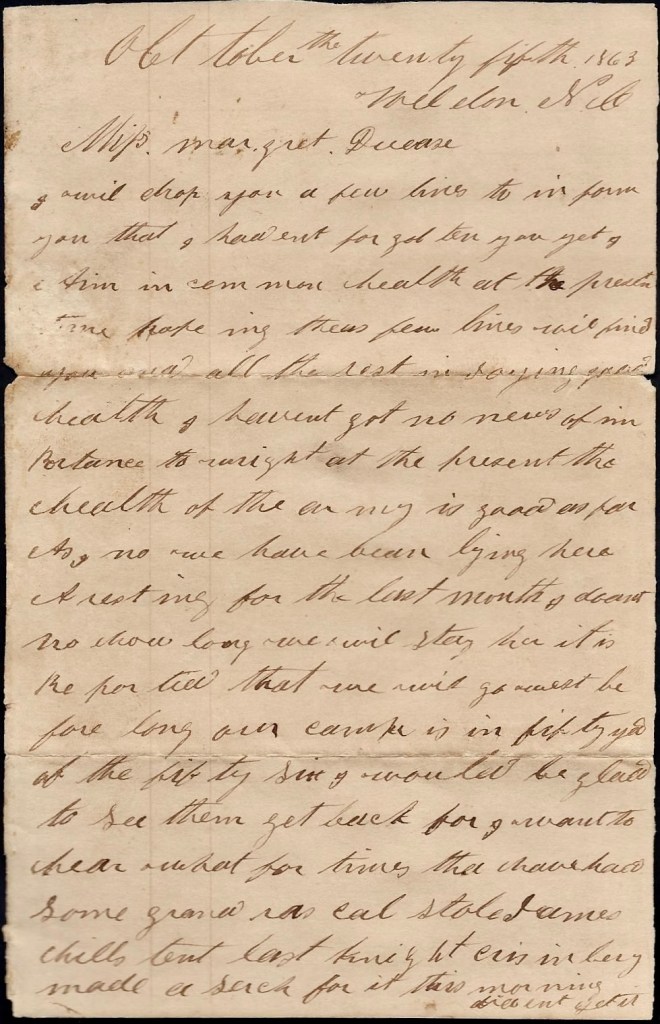
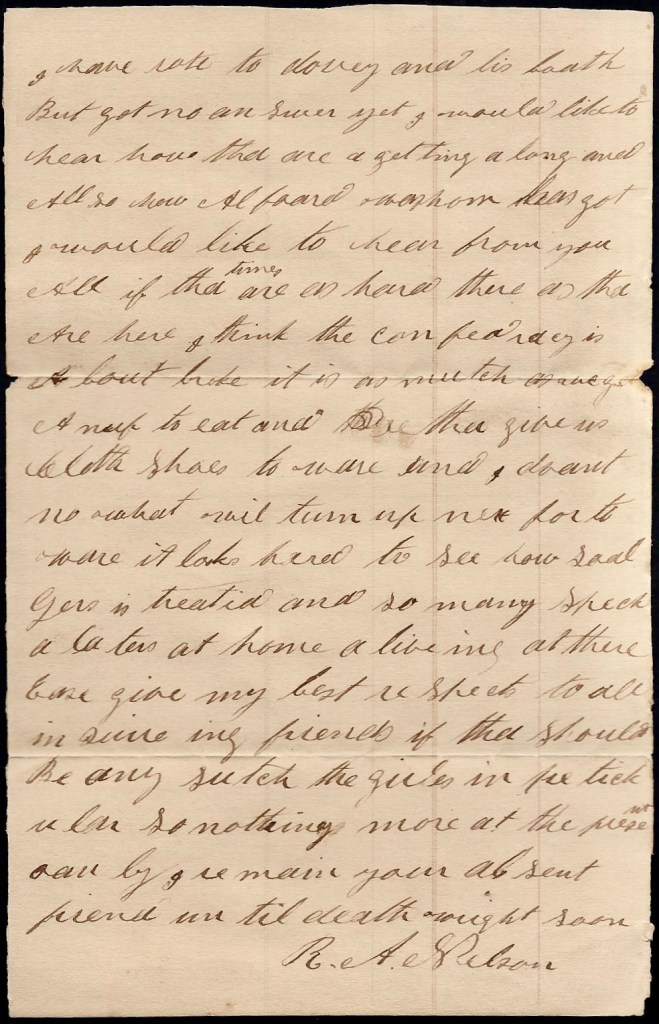
1863: Robert A. Nelson to Margaret Dewese

The following letter was written by Robert A. Nelson of Mecklenburg county who was a 31 year-old farmer when he enlisted in September 1861 to serve in Co. H, 35th North Carolina Infantry. He was discharged for disability in mid-June 1862 but apparently regained his health and reenlisted in the same company in late March 1863.

Muster rolls indicate that he was absent from the regiment in November 1864 for wounds.

Robert wrote this letter to Margaret C. Dewese (1841-1910) who also lived in Mecklenburg county. She was the daughter of John Allison Dewese (1811-1870) and Mary Ann Sloan (1819-1911).

I could not find an image of Robert but here’s one of Stanhope Washington Alexander who also served in Co. H, 35th North Carolina Infantry. He enlisted on 26 October 1864 in Mecklenburg County. He appears to be holding an Enfield Rifle and an 1861 sack coat style of Confederate uniform.

Transcription

Weldon, North Carolina
October 25, 1863

Miss Margaret Dewese,

I will rop you a few lines to inform you that I hadn’t forgotten you yet. I am in common health at the present time, hoping these few lines will find you and all the rest enjoying good health.

I haven’t got no news of importance to write at the present. The health of the army is good as far as I know. We have been lying here a resting for the last month. I don’t know how long we will stay here. It is reported that we will go west before long. Our camp is in fifty yards of the 56th [North Carolina]. I would be glad to see them get back for I want to hear what for times they have had.

Some grand rascal stole James Chill’s tent last night. Cousin Berry made a search for it this morning, Didn’t get it.

I have wrote to Davey and Liz both but got no answer yet. I would like to hear how they are getting along and also how Alford Markham has got [along]. I would like to hear from you all if the times are as hard as they are here. I think the Confederacy is about broke. It is as much as [broke for] we can’t get enough to eat and they give us cloth shoes to wear, and don’t know what will turn up next for to wear. It looks hard to see how soldiers is treated and so many speculators at home a living at their ease.

Give my best respects to all enquiring friends, if there should be any such—the girls in particular. So nothing more at the present. Only remain your absent friend until death. Write soon, — R. A. Nelson