My passion is studying American history leading up to & including the Civil War. I particularly enjoy reading, transcribing & researching primary sources such as letters and diaries.
This letter was written by Charles F. Dewese (1845-1864), the son of John Allison Dewese (1811-1870) and Mary Ann Sloan (1819-1911) of Mecklenburg, North Carolina. Charlie was carried on the muster rolls of Co. K, 56th North Carolina Infantry from 29 February 1864 until 26 June 1864 when he died of chronic diarrhea at Stuart Hospital in Richmond, Virginia. He was in the hospital approximately three weeks.
Charlie had two brothers who also served in Co. K, 56th North Carolina. They were George B. Dewese and Calvin T. Dewese whose letters I have also transcribed on Spared & Shared.
This is the only extant letter he wrote during his brief time in the service. I should note that Charlie’s writing was atrocious so I have significantly corrected the spelling and grammar to make it readable.
Transcription
Drewry’s Bluff, Virginia May 22, 1864
Dear Father,
I will write you a few lines to let you know where I am. I am in Virginia. I am not very well at this time. We left Gaston last Friday evening and we got to Weldon a little while before sundown and then we took the train and went to Petersburg about three o’clock in the morning and we lay down in the street and took a little nap and we got up in the morning and struck out and we marched about ten miles and we found about half of our company and we stopped there and stayed all night.
We lay down to take a nap and soon as we got to sleep, we got orders to fall in and we had to double quick about a mile to the breastworks and we lay in the line of battle till about ten o’clock [when] the Yankees commenced firing at us and they there bombs at us about an hour and we just lay low and there wasn’t any of us hurt. I am living here in the old breastworks yet and the shells is falling around us and bursting and flying every [which] way. I tell you, it is a dreadful sight. I am looking to be killed every minute [but] will trust to the Lord to save me.
They had a big fight here the day before we got here and there was several of our company was wounded. Alfred Washan and B[ranch] A. Washam and Lee Brown was wounded. 1 Tom Cashion and S. R. Andrews weren’t in the fight—they have got the measles. Smiley is in Goldsboro and Tom is in Petersburg.
All of our company is out on picket but two or there. They keep up a continual firing all the time. Old Butler is throwing his shells at them and us all the time. You must excuse this bad writing for I have a poor chance to write. I am lying here in the hot sun and I am about to melt.
The men here is talking about peace is going to be before long. I hope it may end before long but there will be some hard fighting before it is ended, I am afraid. Nothing more at present. I will close by requesting you to write soon and give me the news. Nothing more but remain your affectionate brother till death, — Charlie F. Dewese
1 Charlie is describing the fight on 20 May 1864 at Ware Bottom Church in which eight Confederate brigades under Gen. Pierre G.T. Beauregard attacked Butler’s advance picket lines near Ware Bottom Church. Nearly 10,000 soldiers from both sides clashed in the vicinity of the structure. At the end of the severe fight, over 1,400 men were left either dead or wounded. After the battle, the Confederates constructed the Howlett Line, a series of strong defensive works from the James to the Appomattox River, effectively trapping Butler’s army on the Bermuda Hundred peninsula.
This letter was penned by Thomas R. Smith (1828-1864), a private in Co. E of the 28th North Carolina Infantry. He and his two brothers—Reuben Smith and William D Smith—mustered into the “Montgomery Grays” when the regiment was first organized in June 1861 from their hometown of Troy, North Carolina. According to family oral history the three brothers promised each other that if any survived the war, they would take care of the other’s families. Reuben died of typhoid in September 1862 at a hospital in Lynchburg. Thomas was killed during the battle of Spotsylvania Court House on 12 May 1864 when the regiment lost 4 officers and 84 men.
William was the only brother to survive the fighting and surrender at Appomattox. According to the family history, he kept his promise to his brothers by helping to raise their surviving children. As far as is known, there are no surviving pictures of any of the brothers.
Thomas and his wife, Matilda G. Dallard were married on 9 February 1855 in Montgomery county, North Carolina. In the 1860 US Census, the couple were enumerated in Zion District of that same county where Thomas worked as a “hireling” or day laborer.
The following letter may very well have been the last one Thomas wrote to his wife a few weeks before he was killed.
[Note: This letter is in the possession of Paul Dixon, a descendant 3rd great grandson of Thomas Smith who offered it for transcription and publication on Spared & Shared.]
Transcription
April 17th 1864
My dear wife,
With pleasure I seat myself to inform you that I am well at this time, hoping these few lines may find you well or better. I have been looking for a letter but no letter yet. I do hope you will write as I can’t see you. It is not worth my while to say how nor try for I can’t express it to you but let it suffice to say that I want to see you the worst I ever did. I do hope you will write and give me all the news & tell me what is going on. I am entirely out of anything to write.
O thou who rulest the heavens & earth thou good & gracious God thou who to everything givst birth that walkest on the sod.
To whom we look for every good that upon our head to whom all creation looks for food of whom men asks his bread
Father of every living one of good as well as bad who giving they beloved son So many hearts made glad
We look to thee with upturned eyes Imploring thy great aid convert to smiles those heavy sighs Let all be pleasure made
O grant that while on earth we dwell our days be those of joy may all with us on earth as well with good our hearts employ
And when with earth we come to part fit us for heaven above O cleanse this sinful heart and fill my soul with love
The following letters were written by Calvin T. Dewese (1837-1916), the eldest son of John Allison Dewese (1811-1870) and Mary Ann Sloan (1819-1911) of Mecklenburg, North Carolina. Calvin enlisted on 8 July 1862 in Co. K, 56th North Carolina Infantry. He was with his regiment for most of the war, except for an illness in the fall of 1862. He was taken prisoner at Fort Stedman on 25 March 1865 and confined at Point Lookout, Maryland, until taking the Oath of Allegiance on 4 June 1865.
Calvin was married to Martha Ann Barnett (1840-1906) early in 1862. Together the couple had at least twelve children born between 1862 and 1889. After the war, Calvin returned to farming on Long Creek in Mecklenburg county.
I could not find an image of Calvin but here is one of Neill Beard who served in Co. B, 56th North Carolina Infantry.
Letter 1
Camp Badger Wilmington, North Carolina September 30, 1862
Dear father,
I received your letter last Friday that you wrote the 21st inst. and I was sorry to hear little Johnny was sick. I am very unwell at this time. I was excused from duty yesterday and today I am able to go about yet. I do hope that I will not get past going for I tell you, it is a hard place for sick to get along. It is hard enough for well people to get along let alone the sick. I do hope when these few lines come to hand they may find you all enjoying good health.
I suppose you will hear before you get this letter about the frolic we had with the Yankee bomb shells. We were out on drill when they commenced. They whizzed by us pretty strong for a while. I don’t think there was a shell came closer than a hundred yards. I tell you, they can boom us out of here whenever they get ready but I tell you they don’t want it for it is my belief that they keep up a regular trade at Wilmington as they did before the war commenced. There is a vessel comes in every few weeks. They call it the English steamer but it is nothing but a Yankee vessel. If you will go to Wilmington, you will find it too for every store is full of anything you call for. It is there new and fresh. They have fooled about until they have got the yellow fever in Wilmington about right. If it gets in the army, it will soon put an end to their fighting.
We have a great deal of sickness in camp at this time. It don’t matter what ales a man, he has to take the same medicine & it will be before long they will have nothing to give at all. The medicine they have got now is that old that it is of no account. When a man gets sick here, he just has to wear it off.
I must come to a close as I don’t feel able to write. Tell all the friends and neighbors howdy for me & tell them to write to me & let me know what they are all about. And tell Mother I think she might write to me some time. Tell Sarah & Mag to write to me soon. I would like to get a letter from home every day for I don’t expect to get home until the war is over—if I live—for they will keep a man here when he is of no service to them at all & so I have give up to stay & put up with it the best I can.
So nothing more at present but hope to remain your affectionate son until death. Yours truly, — Calvin T. Dewese
to John A. Dewese
Letter 2
Camp Clingman Goldsboro, North Carolina October 26, 1862
Miss Margaret C. Dewese,
Dear sister, I received a few lines from you that you sent in George’s letter and I was glad to hear from you one time more. I thought I would write you a few lines to let you know that I am well at this time. It is the first time you have ever wrote me a letter with anything yet. It appeared to me like you have forgot me or don’t care, I don’t know which, but I hope you will be better for the time to come. You must consider my condition & sympathize with me in my trouble. You have more chance to write than I have.
There was three of your troublesome conscripts got here at last. They fetched all our things safe. We got a fine mess—all our mess got something…it made a fine pile.
This is a very wet day. We are all huddled up in our tents [paper missing]…I am glad our boys came for this is my week to cook and it saved me doing so for two or three days.
Dear sister, I long for the time to come when we shall have war no more and [we can] return home once more to see our friends and connections. I am truly tired of seeing the way people has to be punished. They can’t get to go home. If a man does happen to get home & stays one minute over his time, he has to carry a log for a week. A private can’t do anything but take care for the officers. They can go home when they please & stay as long as they please. They have got about a dozen of men carrying logs now. There is a time coming, I hope, when we will get out of this place of bondage, when we can be free & do as we please as well as them.
I have not much to write so [I will] come to a close at this time by requesting you to write as soon and as often as you can. Nothing more at present but hope to remain your affectionate brother until death. — Calvin T. Dewese
Letter 3
Rocky Mount Edgecombe county, North Carolina January 7th 1863
Mrs. Mary A. Dewese,
Dear Mother, I now embrace this opportunity of writing you a few lines to let you know that I am well at this tie & hoping when these few lines reach you, the may find you enjoying the same blessing. The company is generally well. B. A. Wartham is gone to the hospital at Petersburg. We left him there as we come from Franklin and I have not heard from him since.
We are expecting an attack here or at Goldsboro. We were the first here. We have been reinforced with three other regiments since we came & expecting more yet. Several regiments has passed by here going to Goldsboro—infantry, artillery, and cavalry. One regiment of cavalry come today. I expect we will have a big fight or a big run, one or the two.
The Yanks is reinforcing at Kinston every day by the thousands. They are determined to take Weldon and Goldsboro. By doing that, they will cut off communication from Richmond. Then they will stick it to us about right. But I hope they may not get there ends accomplished. I long to see the war come to a close some way soon so that I may get home once more and enjoy the blessings of a family fireside. You don’t know how bad I want to see you all. It is awful to think how we have to be parted but I still live in hopes that the scale will turn some day. I shall be satisfied if I only can get home safe and sound so I can enjoy myself when I get there.
Nothing [more] at present. Write soon adn let me know how you are getting along. Give love to all the children. Yours truly, — Calvin T. Dewese
Letter 4
Rocky Mount Edgecombe county, North Carolina January 27th 1863
Mr. John A. Dewese,
Dear father, I take this opportunity of informing you that I am not very well at this time. I have been very unwell ever since the regiment left here. It will be two weeks day after tomorrow since it left here. I heard from them once since they left. They were at L___ville then and I have not heard from them since. I cannot tell where they are now or what they are doing. I suppose they have not got in any fight yet or I would have heard of it before this time. They have had a hard time of it. It has been raining nearly every day since they left here and been very cold too.
I took sick this day was two weeks ago and I was left behind and I am here yet. I been pretty bad off with headache and fever but I am a great deal better now, I have not heard from George. I don’t know whether he is well or not. I told [him] when he left to write to me and let me know how he was getting [on] but he never has done it yet. I can’t tell what is wrong. I expect they will come back before long.
They are looking for another big fight at Fredericksburg. The Yankees is advancing there strongly. I expect they [will] fool about till [they] get us in a fight yet. Paul [Fletcher] Faison wants to get into a fight more than a bull dog. He is our Colonel, if you did not know him by the name of Paul. I can tell [you] he is a particular sad case if you did not know it.
I sent a box of clothing to Charlotte by Express in [care] of John R. Alexander. I wrote him a letter and told him to take it up to his house and let you know so you could get it. Me and George, James Hill, M. D. Alexander, J. C. Bell, Allison Christenbury all has our clothes in it. I suppose it [will] go safe. If it don’t, I will get pay for it. I have got a receipt for it on the railroad company. Nothing more at present. Write soon and let me know how you all are getting along.
Yours truly, — Calvin T. Dewese
To John A. Dewese
Letter 5
Topsail Sound, New Hanover county, North Carolina March 8th 1863
Mr. John A. Dewese,
Dear father I now take the opportunity of writing you a few lines to let you know that I am well at this time & hoping when these few lines comes to hand, they may find you enjoying the same blessings of God. I have not received a letter from you for some time. I have wrote two or three letters to you & the rest of the family & have got no answer as yet. I don’t know what is the matter with the mail that I do not get any letters from none of you. I have not got a letter from none of you in six weeks except from Martha.
There is a large trade going on in Wilmington. I left Rocky Mount 24th of last month & landed in Wilmington 27th & stayed there until the 28th. There was eight steamers there said to be from England. The brought in a large supply of goods of various kinds—a lot of cotton, bacon, calico and many other things to tedious to mention. I know not where they came from but I have my own opinion about where they came from. I think they came from Yankeedom. They have been coming in there ever since the war commenced carrying off cotton by the wholesale. There is no danger of the Yankees taking Wilmington while they keep up trade with them.
Wilmington is made up with nothing but Jews and they keep as fresh stores I ever they did & [ ] while the poor [soldier] gets but $11 a month and living on half rations at that. And they say they are going to reduce our rations to quarter rations. If they do that, I guess, if they do, our [ ] will feel very lank. They say the provisions aren’t too good. If that be the case, I think the war will have to stop before long.
I must close. Nothing [more] at present but remain your affectionate son until death, — Calvin T. Dewese
To John A. Dewese
[in a different hand]
March the 9th, 1863
Dear Father, as Calvin was writing I thought I would write you a few lines as I have a little time this morning. I am well at this time and doing the best I can though it is a poor do. I have become so that I don’t care where I am so I get plenty to eat. I expect when the war ends that we will be used to it, that we can’t come home and we will have to join the regular army to get to stay away from home but they had better not end the war if they don’t want me to go home.
We get six biscuits a day. If we continue to get that much, we won’t starve. Besides that we get a small ration of bacon. We are faring better than we have done for some time though times are hard. I try to do the best I can and always try to look on the bright side of things. We have saw no hard times yet compared with the times that some have had since the war commenced.
I have no particulars to write at this time so I will have to close for this time. Direct to Wilmington, N. C., 56th Regt. N. C. T., Co. K, Gen. Ransom’s Brigade. Write soon. Nothing more.
— G. B. Dewese
Letter 6
Kinston, North Carolina April 17th [1863]
Dear Brother,
It is with pleasure that I seat myself this morning to drop you a few lines to let you know that I am well at this time & I hope when those few lines comes to hand they will find you enjoying the same blessing of good [health].
I have nothing of importance to write [paper torn]…for you that came here yesterday & I thought I would write a few lines & send it to you. We have been under marching orders since yesterday morning but we have not gone yet & I suppose we will not go at this time.
The enemy were advancing but they have gone back. I suppose we will await further orders. The 49th Regiment has gone over the river. William Black has come to the company. He brought me a letter from home. They are all well. I have nothing more to write this time. I want you to write. Get someone to write for you if you are not able & let me know how you are getting along. I hope how soon you may get well and return to the company.
Yours truly, — Calvin T. Dewese
Letter 7
Camp of the 56th N. C. Regiment Troops Ivor Station near Black Water [River] Southhampton county, N. C. June 19th 1863
Mr. D[avid] R[ankin] Alexander, 1
Dear brother [in-law], I take the opportunity of dropping you a few [lines] to inform [you] that I am well & as hearty as I ever was & I trust these lines may find you enjoying the same great blessing of God. I suppose you think that I have forgot to write to you but you need not think hard of me for not writing to you for I have not had time to write. We have been over about [ ] for the last month. I couldn’t get time to do anything.
I have seen some pretty rough times since I left home but nothing to compare with what you have seen though I thought once that I was obliged to be killed or wounded, one or the other. I went across the enemy’s fire [with]in fifty yards of them while they poured one volley after another. The balls flew thick all around me in every direction. I walked a while & run some & crawled som. Any way I would go, it seemed like they would hit me anyhow. But thanks be to Almighty [God], I come through safe & I hope & trust that I may never get into another such a scrape again. If I have to fight, I want them to stay in my front & then I can shoot at them all day if there ain’t but one place to watch. But I can tell you when they get to shooting at my face, and the other end too, both at the same time, I want to get away from there in quick time if there is any chance at all. 2
All is quiet on Black Water. Our brigade is strung along Black Water about 20 miles. we send scouts over the river between here and Suffolk. They gather a few once in a while, killing some & capturing some. There is nothing but scouts a pillaging the country and destroying everything they can. There is not a chicken to be found between here and Suffolk. Our boys that has been out say that the woods is lined with chicken feathers. The reports of today say that they are fighting at Petersburg. I don’t know whether it is true or not. I suppose that the Yanks are determined at two points—that is Fredericksburg and Vicksburg. They was still fighting at Vicksburg the last account I listened to hear of them. They are reinforcing heavily at each point and if they should get Vicksburg, it will sever us [and] I think the war would soon close some way or other.
Well, Rankin, your brother Milas is gone home. Him [and] Henry Starns started last Monday. I suppose they are home by this time. You will be apt to see him before we come back. You must let me know if you think he has changed any since you saw him. I suppose if nothing happens, I will get home in 4 or 6 weeks. There is 7 married men to go yet that came out with the company. I would be glad to get home while you are at home but I will have to go whenever I get the chance. I do wish the thing was settled so we all could go home to stay with our friends where our affection lies is my prayer.
Write soon. Give my love to sister & all my friends. I remain yours truly, — Calvin T. Dewese
To D. Rankin Alexander
1 David Rankin Alexander (1834-1864) was married to Sarah J. Dewese, Calvin’s sister. David served in Co. C, 37th North Carolina Infantry, until he was wounded in 1861 and was reported at home recuperating in the last four months of the year. After he was returned to the regiment he rose in rank to sergeant but was killed in action on 3 May 1864.
2 The fighting Calvin describes in this paragraph refers to the Second Battle of Gum Swamp near Kinston, North Carolina. It was during Maj. Gen. Daniel Hill’s campaign to recapture New Bern in the spring of 1863. It began in late March 1863 when Brig. Gen. Ransom’s brigade was ordered to Kinston to guard the town, and they arrived on April 2nd. The 24th NC Regiment was sent to guard the railroad bridge at Weldon. The 56th NC Regiment was sent to several locations in the vicinity of Trenton, Moseley Creek on the Neuse Road, and to Gum Swamp, where they had a sharp skirmish on April 28th, which was First Gum Swamp. On May 22nd, the 25th NC Regiment and the 56th NC Regiment were surprised and virtually surrounded by five Union regiments at Gum Swamp (Jones County); they were forced to fight their way out or flee into the swamp. More than 160 men of the 56th NC Regiment were captured. It was not a proud moment for the regiment.
Letter 8
[Note: The following letter is actually written to Calvin from his sister Sarah J. (Dewese) Alexander, the wife of David Rankin Alexander of the 37th North Carolina Infantry.]
[Mecklinberg county, North Carolina] August 28, 1863
Dear Brother,
I take my pen in hand this morning to write you a few lines to let you know that we are all well at this time and hope should these few lines reach you, they may find you enjoying the same blessing from Almighty God. I have nothing of importance to write to you. I received your letter last Tuesday and was glad to hear that you were well but sorry to hear that furloughs are stopped again. We have all been looking for you every day for some time but look in vain. I hope that you will get home before long now as you are the next to come. Live in hopes and never despair. I long to see the day when you will get home and the sound of war will cease, never to be heard any more.
Rankin is lying sick in the hospital in Lynchburg. It is nearly two weeks since I heard from him. I cannot tell you how he is now. He is thought to be better the last account. I long to hear from him. If he is sick much longer, I think I will try to go or get someone to go after him. It is hard for us to be separated from our friends in health and it is worse in sickness, but it is the Almighty will and we will have to submit to it. He knows what is best and if we look to Him and put our trust in Him, he will be with us in every time of trouble.
Father’s folks are all well. Martha A. was here a few minutes yesterday evening. She and Lizzy are well. The weather is very dry now but I think we will have rain before long. Our crop is looking very well and if you were here today, I could give you a mess of sweet potatoes but any day you come will do as well. I want you to write to me soon and often as you can and give me all the news. Nothing more but hope to remain your affectionate sister, — Sarah J. Alexander
to Calvin T. Dewese
Letter 9
Wilkes county, North Carolina October 6, 1863
Mr. John A. Dewese,
Dear father, I take the opportunity of informing you that I am well at this time and I hope these lines may find you enjoying the same blessing. I have scarcely had time to write to you since I came back to the company. I have been scouting nearly all the time over the mountains & lying around houses to catch the men when they would go in to draw rations and have caught a great many and killed and crippled some and a great many are coming in and giving up. But still there is a great many out yet and it is likely they will be out for a long time to come yet with a considerable change. It is pretty hard marching over the hills and rocks but I believe I would rather stay here as in the army. We get more to eat than we would if we were there.
We are 12 miles above Wilksboro at Covenant Church [with]in about 7 miles from the Blue Ridge. We caught a man today with a woman’s dress on. That’s the way they undertake to conceal themselves from being caught.
I must close. It is getting dark. Nothing more at present but hope to remain your affectionate son till death, — C. T. Dewese
To John A. Dewese
Letter 10
Covenant Church Wilkes county, North Carolina October 8th 1863
Dear Mother,
I will write a few lines to let you know that I am well & still in the land of the living. And I hope these lines may find you well.
I had a hard time to get to my company. I thought once that I would never get to the company or see any of my friends anymore. When the deserters caught me, I did not know but what they would kill me but they kept me there under guard & turned me over. It was two weeks from [when] I left home till I got to the company. We have pretty hard duty to do here but not much fighting to do. We get plenty to eat such as chickens, cabbage, beans, and honey & hardly ever pay anything for it. The people are very angry at us but it can’t be helped. We have to have something to eat & we can’t work for nothing & board ourselves. And if they don’t want us to eat up what they have, they will have to give up and let leave the country. If we have to stay here all winter, there will not be any left for the women and children to eat. I don’t see what they mean. Some of them say they will starve to death before they will ever come in and go to the army.
Nothing more at present but hope to remain yours affectionately, — Calvin T. Dewese
To Mary A. Dewese
Letter 11
[Note: In the following letter, Calvin is referring to Maj. Gen. George A. Picket’s attacked on New Bern at Batchelder’s Creek on February 1, 1864.]
Camp near Weldon, North Carolina February 12, 1864
Dear father,
It [is] with pleasure that I seat myself to write you a few lines to inform you that I am only tolerable well at this time. I was plagued with a severe diarrhea and sick stomach yesterday but I am better today except a bad cold & caufg but I hope it will wear off in a day or two. George received a letter from you today of the 9th inst. stating you were all getting better. I hope when this reaches you, it may find you well.
We have had pretty rough times since we left High Point. There was 10 days after we left there we were marching or riding on the cars where we could not sleep. We never got to sleep one whole night at a time on the whole route & some nights we did not get to sleep any at all lying in line of battle all the time when we were not advancing. I tell you, I thought it was [ ] times with [ ] the morning of the 1st inst. when the muskets began to rattle and the cannon roar. I was [chased?] for two days that bad I scarcely knew which end I was standing on but it so happened that we escaped unhurt. I am as nigh Newbern as I want to be unless it gets in better fix for visiting than it is at this time.
I have nothing of interest to write for the present. There is different reports in camp about the changes of the times but I look at them as I always have done to be lies & it is no use to waste time & paper with them. All I can say is of no use for me to trouble myself about anything. I have to stay in the war till it’s over if I live & will have to make myself easy. Your affectionate son till death, — C. T. Dewese
Letter 12
Camp near Weldon, N. C. March 18th 1864
Mr. C. F. Dewese,
Dear brother, it is with much pleasure that I seat myself this evening to write you a few lines to let you know that I am well at this time & I hope when these lines reach you, they may find you enjoying the same blessing. I think the time long to get a letter from you as you have nothing else to do. I think you might drop me a few lines [once in] awhile if only to let me know what you think of yourself in this time of war and trouble. I hear that you are having many diverse engagements and gaining many glorious victories without the loss of a man. I am glad to hear that you came out victorious. I will advise to stand your ground as long as you can for it is much better there [at home] than here.
I suppose you will have to come to the war before long or go somewhere else but if you can get into any work that will keep you out of this horrible place, I want you to do it—any place but to be in the ranks of an army. I would rather work for nothing and board myself if I could get to stay anywhere near home than to be here. I would like to see you and be with you and would be very glad of your company at any time, but I never want to see you in bondage as i am at this time. Two of us are enough and two too many to be starved, frozen or melted to death just as they please to have it fighting for that—that we have not got. And if we fight five years, we will never get. I think you will get clear if you will fool them a little while longer for I think it will surely wind up this spring or summer. I am in hopes it will anyhow, so we can all get home to live in peace once more.
I must close for this time. Write soon. Nothing more but remain your affectionate brother. — C. T. Dewese
Letter 13
Camp near Weldon, North Carolina March 28th 1864
Dear father,
It is with pleasure that I seat myself to inform you that I am well at this time & I hope these lines may find you well. I received your kind letter last Saturday night through the care of G. B_____ and also a fine box of provisions which was very acceptable in this unholy place of suffering & want. Our bread baskets were so empty that we have very well finished it already. I am thankful that I have friends somewhere [even] if they are a great distance from me that I can get a good bite from them once in a while [even] if it ain’t often. It makes me feel like I could live when I do get it. What we get is so rough that a person can almost share it. Digesting it makes such a fuss. If they [ ] on such as they have been doing lately on as rough diet, I think we will have to get new digesting machines or fetch the old one or we will see holes in a few weak ones. Our meat is very good but the quantity is not sufficient to satisfy the appetite that I have at this time. We are drawing the [ ] meat. I suppose they have no other to give us. The government meat, I think, is done and therefore the people at home have to board the army at their expense and it looks like the Confederacy might get rich when they so many hands working for nothing and boarding themselves.
I have nothing of interest to write. The army are quiet on both sides as far as I can learn but I dread the opening of the spring campaign. I fear there will be a good deal of fighting to do shortly but I hope this war may be settled without much more fighting although I don’t see any prospect of its stopping soon.
I will close for the present. Give mu love to the family and tell them to write. Nothing more but remain your affectionate son, — C. T. Dewese
to J. A. Dewese
Letter 14
Camp near Weldon Railroad April 3rd 1864
Miss Margaret C. Dewese,
Dear sister, with much pleasure I seat myself to drop you a few lines to let you know that I am well & hoping when these lines reach you they may find you well. The health of the company in general is good except one case of small pox. John Sloan was sent to the hospital yesterday. He was broke out pretty bad with them. He caught them from the Yankees while guarding them in South Carolina. I look for more of them to have them for they said there was plenty in every crowd that they had taken off. If they all take them, we will have a [ ] time among us but I hope they will not get spread any farther. We have bought enough times here without having the small pox to make it worse. I have had no chance to catch them as I have not been near John since he came back.
Well, Mag, our way of living seems to change fast. We still get our meal with the brand in it but our meal is very good. But the quantity is not sufficient to satisfy the appetite. We can get nothing to buy here at all. The country is gleaned for 10 miles around our camp of everything but that we would desire to eat if there was any to get. It would take a one horse wagon to haul out enough money to get one chicken. So we might as well be without it as to drive it for all the good it was. Sometimes I wish there was no money so these high headed fools couldn’t get their fists stuffed…then I think this cruel war would stop.
Brother George is guarding the bridge at Weldon. He will be there for several days. He has had a rough time since he went there. It has been rainy nearly every day for a weak & snowing together. It rained & snowed yesterday all day. The weather has moderated today a little but is still cloudy & very cool for the 3rd of April. It is cold enough to snow yet. I hope if another winter sets in that we may all be out of this cruel place of bondage & trouble & wickedness & be where we can converse with our friends & enjoy the blessings of peace as we once did. But Oh! when will that time come—we cannot tell. It may come soon and it may never come. But we can look forward for a better day…I can’t see no sign of peace now more than I did 12 months ago. The soldiers are in good spirits owing to the resumption of furloughs. There was several sent in today for the regiment. The men are flying around rapidly getting ready to go. I wish it was my time to go. I would fly around too.
— C. T. Dewese
Letter 15
Gaston, North Carolina May 4th 1864
Dear Father,
With pleasure I seat myself to write you a few lines to let you know that I am well at this time & I hope these may find you enjoying the same blessing. The health of the company is very good what is here. I have no news of our brigade more than you have heard. There is various reports about their movements. It is reported that Washington surrendered without the fire of a gun. The latest news we have, our troops are advancing on New Bern twelve thousand strong. They moved within four miles of the place Tuesday last. I suppose they are fighting by this time. I am glad that I am out of it although it may not be so long but I want to putt off as long as I can. Our boys have saw a hard time since we left them but they came out well to what I expected to hear.
James Sasseman passed here a few days ago going to Raleigh hospital wounded in the right arm. He went through all the fight safe and was wounded accidentally the day after the fight. There was only one man wounded in our company. That was John Strider from Randolph. He was wounded in the leg between the foot and knee. It was so badly mangled it had to be amputated.
I don’t care how long they keep us here while they are doing so much fighting. I suppose there will be no more furloughs signed until they get settled again. I hear no word on any prisoners coming in & I can’t say how long we will stay here. We may be ordered away in a few days & we may stay a good while. I don’t care how long we stay if it is till the war is over. We are on the bank of the Roanoke river where we can get as many fish as we want. If I had the salt to save them, I could send you a mess every day but I have not the salt to spare & I reckon you will have to do without the fish.
I suppose you are done planting. Come over tomorrow & spend the day with us & we will have a big mess. Bring mama and the children along too & we’ll all feast together. I must stop my foolishness & all so close my letter for I have got clear out of anything to write. Give my love to all the family and all of you write to me. Don’t wait for me to write for my chance is very slim to write to all my friends. It is two weeks today since I left home & not one letter have I got yet. I begin to feel like I was lost when I can’t hear from home. Nothing more but remain your affectionate son, C. T. Dewese
To F. A. Dewese
Direct to Weldon, North Carolina
Letter 16
Gaston, North Carolina May 14th 1864
Dear Sister,
I will write you a few lines to let you know where I am. I got here yesterday evening about sundown. They are looking for the Yankees here today. The pickets is firing at the Yankees now and everything that is here is fixing to run. There is about 300 soldiers here at this place. The Yankees could easily take this place if they would but I hope they won’t come yet a while. Part of my company is here and the balance of it is in Virginia. they have been fighting and they have drove the Yankees back and they have [been] reinforced and [are] coming again. I expect they will be here today. If they come today, they will take this place.
We had a big mess of fish for breakfast. We got them four apiece. I want to stay here. We could get plenty of fish to eat but if the Yankees gets near, we won’t get so many fish to eat. I hope they won’t get us.
I have nothing to write for I ain’t very full of news at this time. You must excuse this bad writing for it is the best I can do for these idle fellers, they are tearing about so they won’t let me sit still. You may tell William Cashion’s folks that W. T. C. was at Petersburg fighting the Yankees. They drove them back with heavy loss.
I will close by requesting you to write soon and give me the news. Nothing more at present but remain your affectionate brother till death. — C. F. Dewese
to M. C. Dewese
Letter 17
Camp of the 56th Regt Near Weldon, N. Carolina August 10, 1864
Miss Margaret C. Dewese,
Dear sister, it is with pleasure that I seat myself to drop you a few lines to let you know that I am well & I hope these lines may find you enjoying the same blessing. I thought I would of got to go home before I would write again but they have stopped the furloughs & I don’t know when I will get home but I am in hopes that it won’t be long till they will take pity on me and let [me] go. There is no use in the way they are doing—giving furloughs one day and stopping the next. I don’t know how long they will be stopped. I don’t know what they mean. We are lying about doing nothing—only drilling a little. No Yankees anywhere near and I don’t see what they are keeping us from going home for. If they were looking for a fight shortly, I would not think strange of it. They have guards around us every day like we were Yankees. You need not look for me home till you see me coming for I will not know when I am going till I get my furlough in my pocket & get on the cars & then if they get me off, they will have to be smarter than they are.
George is well & improving every day & following his old trade. Him and Andrew Barnette and Dicxk Hough is writing every day—writing their fool letters, first one and then another. They appear to enjoy themselves better than anyone in camp. They are now writing a letter to someone but they take care to not put their names to it.
Well it looks like I had not much to write when I am writing about their little tricks & so too for my mind is so bothered when I sit down to write I can’t do it. No tongue can express or pen describe the way I feel sometimes when I get to studying about the war I have to live. I do hope the time is speedily coming when I shall be released from this awful place of trouble & vexation. I will close for the present. Write soon and often for that is all the pleasure I have is reading letters from home.
Yours till death, — Calvin T. Dewese
Letter 18
Petersburg, Virginia October 21st 1864
Dear Father,
With pleasure I seat myself to drop you a few lines to let you know that I am well & hope these few lines may find you enjoying the same blessing.
I have been at the field hospital most of the time since I came back building chimneys to the hospital tents for the sick. I have not been in the ditches but four nights since I came back. I have not done anything since Tuesday. The doctors took a notion to move the hospital across the river about two miles from this place but they have not moved yet & it is uncertain when they will for they are scared half to death half their time so that they don’t know what to be at for fear the Yankees gets them. They are three miles in the rear now and when they move, they will be five miles away and when a man gets wounded, it will be a half a day before they get anything done for him.
All is quiet on the lines at this time and has been for some time except picket firing & they keep up the usual old sound with their bombs day and night. There is not much shelling on the part of the line that our brigade is on now. Our men and the Yankees get up on the works and talk to each other whenever they feel like a chat. I heard a heavy cannonading late yesterday evening in the direction of Richmond but I have not heard the result. It may of been an artillery duel & no fighting going on. They are looking for a heavy fight before many days. They think the election will bring on a big fight. I hope there is nothing of it. If there does be, I hope to miss it and be spared to meet you all once more.
Give my love to all. I remain your affectionate son, — C. T. Dewese
Letter 19
Petersburg, Virginia November 26th, 1864
Dear Sister,
I received yours of the 11th a few days ago. I was glad to hear you were well. I am enjoying tolerable health at this time. I am some better than I was a few days ago. I had a very bad cold & a misery in my breast & side. I have got better of that but I have a severe sore on the back of my neck which pains me very much. I have been at the field hospital since the 12th. The doctor has been burning my neck for the last three days with some hot stuff till it was black as a coal. It hurt me last night so I could not sleep but it feels a little better this morning. I think it will get better now in a few days.
We have had pretty rough times for the last week. It has been raining for nearly a week & that [so] cold that we could scarcely stand it for we had not much shelter or much wood to make fire with. Our wood is issued to us & that a very small ration at that. I am sitting over a little handful of wood now—not enough of fire to singe a chicken—and smoking my eyes out so I can scarcely write. Our wood has to be hauled six miles & if we have to stay here all winter, it will be to haul farther than that & I expect the longer we stay, the scarcer it will get. It is not like what we have been used to every winter since we have been out. We always could camp in the woods & build a large fire & be comfortable. It takes a lot of wood for so many men when they have to stay out & take the weather as it comes. There is 13 wagons hauling for our brigade. We get tolerable good rations if they would only give a little more. We get cured meat, and flour, bacon and beef, rice, coffee and sugar. I cannot see where all the provision comes from that it takes to feed the army. I thought it [would] of give out long ago but it looks like it was as plenty yet as ever it was. We get some bacon sometimes looks like it might be 6 years old.
As you are now acquainted with the market at Petersburg, I will give you a list of the prices of a few articles. Apples are fifty dollars per bushel, potatoes, d[itt]o., chickens half grown twelve dollars a head, meal one dollar a pound, flour two dollars a pound, pork $5 a pound, beef $4, eggs $10 per dozen, butter 12 a lb., molasses $32 per gallon, coffee $10 a lb., grown peas $70 dollars a bushel. It takes about 20 dollars to get what a man can eat. It takes as much as one can carry to get a day’s rations & I don’t see any prospect of it being any better soon.
They are conscripting the negroes to drive the wagons and sending the white men to the ditches. I look for the negroes to be put in the ranks with us before the war is over yet if it don’t stop soon. If they do, I shall begin to think about leaving the pen and let them go all out with their negro war. I can’t stand him, he smells too bad.
It is quiet at this time and has been since I came back. They still keep up the usual shelling and sharp shooting. Both armies appear to be lying perfectly quiet. I suppose the fighting is stopped for this winter but it will begin again in the spring as bad as ever of they don’t make peace. I do hope they will come to some kind of a compromise before that time & let us go home if we should be spared to live that long. I hope to be spared to see the end of it and get home to enjoy the blessings of a peaceful fireside.
I will close by requesting you to write soon and often. Give my love to all the family. I remain your loving brother, — C. T. Dewese
The following letters were written by John Walter Dewese (1844-1876), the son of William Alfred Dewese (1821-1873) and Martha Black McAulay (1824-1900) of Mecklenburg county, North Carolina.
The first two letters were written in 1864 while John was working as a civilian at the Mecklenburg Salt Company whose works were located at Mt. Pleasant near Charleston, South Carolina. The operation was managed by Professor Washington Caruthers Kerr, a native of Guilford county, N. C., a chemistry professor at Davidson College, who took a leave of absence to attend to the works—salt being a crucial resource of the Confederacy. He managed the works until April 1864 and then we learn that it was taken over by a Capt. Loftin.
John enlisted at the age of 20 as a private in Co. C, 37th North Carolina Infantry on 11 January 1865 and was present for duty with his company until he was taken prisoner on 4 April 1865 at Petersburg. He was released one week later. At the time of his release at Point Lookout, Maryland, he was described as standing 6’1″ tall, with “light yellow” hair and hazel eyes.
Note: Some time ago I transcribed a letter by another worker at the Mecklenburg Salt Works near Charleston, South Carolina, at about the same time as John W. Dewese. They were, in fact, first cousins. See 1864: Ephraim Alexander McAulay published on S&S 14.
Letter 1
December 1863 Map of Charleston Harbor showing Mt. Pleasant at top center.
Mecklenburg Salt Works near Charleston, S. C. [Mt. Pleasant, South Carolina] March 20, 1864
Dear Cousin,
I now seat myself to answer your very kind letter which I received about an hour ago. I was glad to hear from you once more. I have no news of importance to write at this time. I am well and doing as well as you might expect and hope when these few lines reaches you, [they] may find you enjoying the same great blessing from God.
There is no news here of any consequence. No fighting going on at present. There was a man killed himself on yesterday. He was a soldier. Some of our hands were down at the boat landing last night and saw him put on the bat taking him over to Charleston. What made him do it, I know not.
Well, Mag, I don’t want you and James to get married without letting me know it as I want to be one in the midst. I think James needs me to take him down a link or two. I can’t tell you what to do with him. You will have to do the best you can with him till the boys gets home. So I will quit my nonsense and draw this short and uninteresting letter to a close as I know you will think it is no letter at all.
If you see Miss Hetty Tye, give her my best respects. Tell her I am all right. Excuse this short letter for this time. [I’ll] try to do better next [time]. Write soon. Remaining yours truly, — J. M. Dewese
to M. C. Dewese at home.
Letter 2
Mecklenburg Salt Works near Charleston, S. C. [Mt. Pleasant, South Carolina] April 1st 1864
Dear Cousin [George B. Dewese],
I now seat myself to drop you a few lines in answer to your kind letter which I received on the 28th of March. I was glad to hear from you one more time. I am well at this time and hope when these few lines reaches you, may find you enjoying the same great blessing from God.
Well, George, I have no news of importance to write at this time but I will give you what I have. I am boiling salt at this time. I work 12 hours and rest 12, I like the business very well. The Works does not belong to Mr. Kerr now. He has sold them to a man by the name of Loftin. He is captain of a company which camped near here. He is a very fine man. He had 25 men when we were detailed [at] Richmond but we have come down to 12 only now.
A man that does not want to work need not be at the Salt Works. I had a great notion when at home last to go to the army or Mr. Kerr had sold the works to other men but no one would persuade me to go.
I received a letter from home last night which stated that they had took Ben Dewese & Bob Montieth and put them in jail t keep them there till Silas & Jonathan comes up, let it be long or short.
I do wish this cruel war would end so we all could get home to enjoy peace and harmony as we once have done. But I see no sign of the end yet—no more than I did a year ago. They have been more calm here at Charleston for the last month than they have been since the 9th of last July. Sometimes they let off steam from Morris Island like they were going to tear things all to smash, but they don’t get much done. A month back they did shell the city continually but they have most quit that now. I was in the city too when they were showering the bombs in there which made me feel sorter stricked.
We can see the flag on Morris Island from here. The soldiers say there is nothing to hinder them from taking Sullivan’s Island if they would just try. There’s not more than 1500 men on the island. I look for them to make a big break some of these days.
Write to me, George, when you think you will get home. I want to try and go there myself. The girls have all forsaken me. As it is getting late, I will close. Give J. H. Johnson my best respects. Tell him I am all right. Excuse bad writing and spelling & short letter. Try and do better next time. So goodbye. — J. W. Dewese
to G. B. Dewese
Write soon.
Letter 3
John’s letter informs us that deserting was becoming a nightly occurrence in front of Petersburg in 1865. Desertion among Tar Heel soldiers during the war was slightly over 23%.
Camp near Petersburg, Va. February 21, 1865
Miss M. C. Dewese,
Dear cousin, I now seat myself to write you a few lines in answer to your kind letter which I received on yesterday. I was glad to hear from you one more time in the troublesome time. This leaves me well. I hope it may find you all well.
I will now give you some items of the war. There is great confusion in this Army of Virginia at the present time. There is some goes to the Yankees every night. A good many has gone out of the regiment. There was four went away last night out of Co. E of this regiment. And night before last in the 33rd Regiment there was one whole company went off to the Yankees.
I was on picket last night. I had nothing to eat from yesterday morning till this morning but a little piece of cold cornbread. I stand picket [with]in about 200 yards of where [your] poor [brother] George was killed. I think of him every time I go to that place. The Yankees run their trains right along in sight of us [on the Weldon Railroad]. We can just see them flying. So I will stop that subject.
Uncle D[aniel] N[eal] McAulay [of our company] is not expected to live over this night. He has not been well since he had the measles. They have lost all hopes of him ever being up again. That is the way a many a poor fellow goes in this cruel war. I hope it will not be my misfortune but I am as liable as anyone.
You told me to your respects to all the pretty boys. J[ohn] D. Barnett told me to ask you if you called him one of them. If you did, let me know in the next letter. John D. is a first rate fellow. I hear that J. S. Barnett is at Sasseman’s every two weeks. I suppose all is right on that line.
Well cousin, I will draw to a close for this time. I want you to write and give me all the news. Give my respects to Miss H[arriet] C[ornelia] Tye and all enquiring friends. Tell Aunt Mary Loudy for me. Tell her I hope to get home to another quilting. So I will quit. Goodbye for this time. I hope to hear from you soon. Not only that, I hope to see you soon, But if I never see you again, I hope to meet you in heaven. Remains your affectionate cousin till death. — John W. Dewese
I could not find an image of Samuel but this long lanky soldier probably bore some resemblance to him. Samuel’s tall, slim figure and dark hair no doubt made him appear younger than his actual years.(Megan Kemble Collection)
This diary was kept by Samuel Brown Beatty (1818-1863) of Co. E, 57th Pennsylvania Infantry. Samuel was 44 years old when he enlisted as a private in October 1861. At the time of his enlistment, he was described as a 5 foot 11 inch tall shoemaker with dark eye color and black hair. When he joined his comrades in arms, he left a wife—Susan M. (Walker) Beatty (1823-1899) and at least eight children in Delaware Grove, Mercer county, Pennsylvania. Samuel’s parents were Francis G. Beatty (1789-1872) and Isabella Williamson (1792-1879).
Also serving in the war was Samuel’s oldest son, David “Walker” Beatty (1844-1863)—a member of Co. K, 63rd Pennsylvania Infantry. David’s letters to his mother may be found at the following URL—1861-62: David Walker Beatty to Susan (Walker) Beatty.
An extremely pious man, Samuel often urged his wife to pray for him such as the following passage: “Now I want you to always remember me in your prayers that I may not falter in well doing and that I may be preserved from evil and sin of every kind. That I may be prepared to stand my lot and always be found at my post let that be what it may.” Tragically, Samuel never returned home from the war. He died at the Union Hotel Hospital in Georgetown on 18 January 1863 from wounds that he received in action at the Battle of Fredericksburg on 13 December 1862. Likewise, Samuel’s son Walker died in a Georgetown hospital less than a month later on 7 February 1863 and was interred at the Soldier’s Home Cemetery (Grave 3344).
September 14th 1862—Sabbath. It is a fine morning. All is quiet. There is no stir. I am on guard and feel well. There was an order read on dress parade last evening that caused some murmuring from some of the men. It was about stragglers on the march. It seemed a little hard but I think it was all right.
September 15th—Monday. All is quiet in our locality. I am well. Came off guard, cleaned up in from our quarters and moved our tents. Had brigade drill. Got orders after dark to march. Marched five miles and bivouacked for the night. All well and in good spirits.
September 16th—Tuesday. On the march at four. I am well and feel in good spirits. Marched six miles without stopping. It went hard. We stopped at seven. Good news. Lay two hours at Tenleytown . On the march again and went through Rockville two miles. Camped for the night.
September 17th—Wednesday. Up at five. It rained last night. On the march, it is muddy and it is hard marching. Went through Poolesville two miles and camped for the night. Saw no Rebs yet. I am well and in good spirits.
Sample of Samuel’s handwriting—quite legible though the pencil is smudged a little in places.
September 18th—Thursday. Up and got breakfast for a march at seven. Did not march till near noon. Marched to the Potomac near Balls Bluff. Camped for the night.
September 19th—Friday. Still at the river doing nothing today. I am well and feel stiff and my feet and legs are very much swelled and I can hardly walk.
September 20th—Saturday. I am well and it is pleasant . Went on picket this afternoon. It is a pleasant place to do duty. There is no danger, My feet and legs are better.
September 21st—Sabbath morning. Still on picket. It does not seem much like the Sabbath. I am well and feel thankful.
September 22—Monday. All quiet. I am well and in good spirits. Company drill. In the evening regimental drill. Nothing else of interest.
September 23rd—Tuesday. It is a very pleasant [morning]. Rain in the afternoon. All is moving on in the same quiet way. We are doing nothing but picket and drill.
September 24th—Wednesday. It is fair and warm. Nothing of interest today. Moved our camp today. Nothing else.
September 25th—Thursday. The same monotony of camp life. Officer drill, the squad drill, the officer, then company drill. At three, regimental [drill].
September 26th—Friday. I am well and in good spirits. The same drill as yesterday. Nothing new or interesting.
September 27th—Saturday. Drill in the forenoon. No regimental drill this afternoon, I am well.
September 28th—Sabbath. Had inspection as usual, then preaching in the evening. Prayer meeting. We had a very nice time of it. I am well and feel thankful to God for His goodness and mercy to me thus far and I still am willing to trust Him.
September 29th—Monday. Still in the same camp. All quiet. The same drill as usual. I am well.
September 30th—Tuesday. We are all well in the same camp. Nothing new today.
October 1, 1862—Wednesday. It looks like rain this morning. Cleared about noon. The usual drill. Got orders to be ready to march at any time. Went to bed and slept all night.
October 2nd—Thursday. The usual morning drill at ten and a half o’clock. Started for Leesburg. Waded the Potomac for the first time and went on to Leesburg and saw no Rebs.
October 3rd—Friday. All is quiet. The usual drill. I am well. Feel nothing the worse of the wade.
October 4th—Saturday. It is still today. The usual morning drill. On guard this afternoon. Rain this evening. It has been very dry here this summer. The farmers say it has not rained any worth naming for four months.
October 5th—Sabbath morning. It is quite cool and fresh. I am well. We had preaching at ten. Had a very good sermon.
October 6th—Monday. I am not very well. Not on duty today. Not much going on.
October 7th—Tuesday. Got the ague. Feel bad. Not on duty. All is quiet. Nothing of interest.
For those unfamiliar with the word “ague,” it was the early-day name for what we now know as malaria. It is marked by paroxysms of chills, fever, and sweating that recur at regular intervals which were called “shakes.”
October 8th—Wednesday. Still sick. All is quiet. I had a shake today and feel bad.
October 9th—Thursday. All as usual. On drill. I am still off duty. Col. Campbell came back this evening.
October 10th—Friday. It rained some today. It is quite cold. Nothing of interest.
October 11th—Saturday. Drew soft bread today. I am some better. Got orders to march this evening. Marched out to Poolesville. Camped for the balance of the night.
October 12th—Sabbath morning. Up and got breakfast. Got orders to fall in on the march at ten. Marched out on pursuit of some Rebel cavalry. Tramped around all day but did not see any. Got back to Poolesville about 12 at night. It rains. We lie down without shelter for the night. It was a hard day for me.
October 13th—Monday. Fixed up our quarters today. It is still wet and cold. Nothing of interest. I am better.
October 14th—Tuesday. Still in the same place. I am well today. Drill as usual. Nothing of special interest.
October 15th—Wednesday. The same monotony of camp life. I am well, thanks to God for His mercies to me.
October 16th—Thursday. We are in the same camp yet and the usual drill. I am well. Nothing of interest.
October 17th—Friday. Got orders to be ready for a march at any minute. Did not go. I am well.
October 18th—Saturday. At 9 the assembly was sounded and ordered to pack up for a march. On the march. Marched about four miles and camped for the night.
October 19th—Sabbath. In the same place. Had preaching. It looks like rain. Had prayer meeting in the evening.
October 20th—Monday. Went on picket this morning along the Potomac. Nothing new but an invention to grind corn to make mush. We took old plates and pushed holes in the bottom and made first rate meal.
October 21st—Tuesday. Still on picket at the same place. Our men killed two hogs last night but I got none. Nothing of interest. All is quiet.
October 22nd—Wednesday. I went to camp this morning and fixed up our tents again. We can soon pitch tents now, we have done it so often.
October 23rd—Thursday. There is nothing worthy of note except Brigade drill.
October 24th—Friday. All is quiet along the line. We have the usual drill. I am on guard today.
October 25th—Saturday. Still at the same camp. There was one of our company went home to recruit. Nothing else of interest.
October 26th—Sabbath. This is the day the Lord has made. He calls the house His own but it does not seem much like it here. Eleven, raining this morning and we had no inspection nor preaching.
October 27th—Monday. We had orders to be ready to cross the Potomac this morning but it rained and stormed so the order was countermanded and we are still in the old camp yet.
October 28th—Tuesday. Got orders to be ready to move at daylight. All ready but no orders to move came. At nine, we are still in camp. Started on the march at 11 o’clock. Went down to the Potomac and waded it the second time. The water was very cold. We got across without any accident. Marched about one mile and camped for dinner. All is quiet yet. Stayed all night.
October 29th—Wednesday. Short of rations. Still in the same camp yet. The muster rolls came today. On guard today. Got rations today. Nothing else of note.
October 30th—Thursday. Still in the same place yet. All is quiet yet nothing new or of interest.
October 31st—Friday. Mustered for pay this morning at seven. Then packed up for a march. Lat round till twelve. Marched to Leesburg. Went on picket about three miles beyond. I was very tired. Lay down and sleep very well.
November 1, 1862—Saturday. All is quiet along the line. I am well. Still on picket. Got orders to be ready for a march. There is heavy firing to the southwest. Lay all day under arms this evening. Marched some twelve miles. Passed through Mt. Gilead about three miles and stopped for the night.
November 3rd—Monday. Moved about one mile and pitched tents. Got orders to move. Started about nine at night and marched about eight or ten miles, then bivouacked for the night.
November 4th—Tuesday. Moved on about three miles and stopped till the next morning. The Brigade foraged fresh meat and everything that they wanted.
November 5th—Wednesday. Started on the march at nine for Manassas Gap. Went through Middleborough and White Plains and on through Salem about one mile and camped fr the night. It is cold and disagreeable. Met no enemy yet but it is said that we [are] within five miles of them.
November 6th—Thursday morning. All is quiet. I am well but my feet and legs are sore marching. We are about one mile from Salem. Got orders to march towards Warrenton. Up one hill and down another. Nothing of interest.
November 7th—Friday. On the march at seven. Went about five miles and camped. It snowed for the first time this fall. It was pretty cold in our little tents.
November 8th—Saturday morning. It is still cold. Moved about one-quarter of a mile and camped for the night. It is a very rough country here. I am well and have reason to be thankful.
November 9th—Sabbath. It is still cold at night but pleasant today. We had inspection and preaching. All is quiet. I am well.
November 10th—Monday. Still in the same camp. Short of rations but we are in hopes of getting some before we get very hungry. The rations came at noon. Got orders to pack up for a move. Started, crossed a branch of the Rappahannock about two miles and camped for the night.
November 11th—Tuesday. It is clear and cold. All is quiet. I am well. [My son] Walker came to see me and gave me a shirt. Still in the same place yet but I do not think we will stay long. Have nothing of interest.
November 12th—Wednesday. There is a move on foot this morning. It looks like a backward movement. The cavalry is all going back and we are all ready for a move somewhere. Went back across the Rappahannock to our old camp.
Warrenton, Virginia
November 13th—Thursday. I am well. Went to Warrenton today with the teams to get forage but got none. It has been quite a nice town but it looks rather desolate now of everybody but soldiers and teams. It shows plainly the ravages of war.
November 14th—Friday. In camp today doing nothing. I am well as usual. There is nothing new or interesting.
November 15th—Saturday. Got orders to pack up for a move. Already. Moved about half a mile and camped for the night.
November 16th—Sabbath morning. It is rather cold but we are used to all kinds of weather. Got orders to be ready to march at half past eight. All ready and on the march. Went past Warrenton about two miles and camped for the night.
November 17th—Monday. On picket this morning. Ordered at five and a half o’clock to march. Lay around till eleven. It is raining this morning on this march. Went about six miles and camped for the night. We passed through Unionville.
November 18th—Tuesday. The bugle blew for roll call at three. Up and got breakfast at four. All ready for a march. Lay around till about nine, then started . It is raining and the roads are slippery. Went through Morrisville and camped for the night. Nothing of interest. No enemy.
November 19th—Wednesday. Up at three again but did not start till about nine. The road is some muddy. Marched about six miles. I am well. Nothing new. We are about twenty miles from Fredericksburg. It rained today. Camped for the night.
November 20th—Thursday. It is still wet. We did not move today. I am well. It is very disagreeable in camp. There is noting of interest.
November 21st—Friday. Still raining. We are in the same camp yet. Had inspection. There is nothing beyond the usual monotony of a wet day in camp.
“There is several of our regiments nearly barefooted and almost destitute of clothing of all kinds but still they are cheerful and willing to do their duty. The most of them have over drawn but are not able to carry them on the long and hard marches and they threw them away.”
— Samuel B. Beatty, 57th Pennsylvania Vols., 22 November 1862
November 22nd—Saturday. Got orders to be ready to march at seven. On the march at eight. There is several of our regiments nearly barefooted and almost destitute of clothing of all kinds but still they are cheerful and willing to do their duty. The most of them have over drawn but are not able to carry them on the long and hard marches and they threw them away. We went on the road towards Fredericksburg till within four miles of Falmouth, then turned to the left and went about nine miles and camped for the night.
November 23rd—Sabbath. We are still in the same place and no sign of moving. Fixed around all day to suit our officers. Got no time for thought or meditation.
November 24th—Monday. I am well. We are in the same camp and are short of rations. Some of our boys think it hard but we got them this evening.
November 25th—Tuesday. All is right at this time. I am in good health. Got no clothes yet. Some of our boys are barefooted and almost naked and no sign of clothing.
November 26th—Wednesday. Still in the same place doing nothing.
November 27th—Thursday. We have plenty of rations now. All in good spirits. Still in the old camp. Had General Review by General Stoneman. Nothing else of note.
November 28th—Friday. Regimental drill at 10. Brigade drill at 2. All is quiet. I am well.
November 29th—Saturday. The same drill as yesterday in the morning. In the afternoon. Nothing of interest. I am still in good health.
November 30th—Sabbath. Regimental inspection by Col. Campbell. Then preaching. I am in good health. Nothing else of interest.
December 1, 1862—Monday. The usual sameness of camp life.
December 2nd—Tuesday. Moved camp today. We have a very nice place now. We have inspection every day at 1 o’clock. Nothing else of interest till the eleventh [when] we broke our camp and marched towards Fredericksburg. At five we were woke up by the boom of the cannon. The bombardment has commenced. It continued at intervals all day. In the evening the town was surrendered to our army and General Sumner made his headquarters in it. Tonight our Division did not cross the [Rappahannock] river but camped in the woods near the railroad. I saw [my son] Walker. He is quite sick.
December 12th—Friday morning. Still in camp. All is quiet. At ten there was some cannonading but no general fight yet.
[no more entries]
The following is a description of the 57th Pennsylvania Volunteers at the Battle of Fredericksburg taken from the regimental history (Chapter VI):
At Warrenton the army encountered the first snowfall of the winter, the morning reveille waking the sleeping host covered with an extra blanket of purest whiteness. Our march to the Rappahannock was without further incident of note. On November 25th we arrived upon the heights overlooking the ancient city of Fredericksburg sleeping in the river valley, beyond which rose Marye’s heights and the range of wooded hills, on whose slopes was marshaled our old foe, interrupting our further advance upon the Confederate capital. Here the army pitched its winter camp. Many of the quarters were built quite substantial and comfortable. The messes of five and six, cut and split the soft pine indigenous to that region, constructing therewith log cabins roofed with their shelter tents. Many of these cabins were fitted up quite tastefully, having open fire places and bunks erected against the walls which were supplied with pillows and mattresses of the resinous pine needles covered with army blankets, making very comfortable beds, at least quite luxurious to men who had enjoyed nothing better than the ground, or the soft side of a plank, for a year past. But from this dream of peace and comfort we were soon to be rudely wakened. In the early twilight of the morning of December 11th, the guards that paced their lonely beats about the silent camps were startled by the sudden boom of a signal gun, its deep reverberations up and down the river valley giving warning to friend and foe that a strife for the possession of yonder steeps was soon to begin. For a moment silence followed this signal and then from the hundred brazen throats of the batteries that lined the crest of the hills on the north side flashed sheets of flame amid deafening roar and scream of shot and shell, that brought every sleeper to his feet. The deep notes of the heavier ordnance, mingled with the rifle crack of the lighter parrotts; the whizzing of shot and screaming shells, the path of the latter marked by burning fuse, presented a scene grand and awe-inspiring beyond description. It was war’s magnificent prelude to the fiercer music of the clash of a hundred thousand muskets to follow. By daylight, camps were broken, knapsacks packed, and marching columns were pouring forward toward the river where the batteries continued to play and pile their smoke in thick banks along the crest of the hills. All day long we sat about our campfires in our dismantled quarters waiting the order to move, but none came and darkness found us replacing our shelters for another night’s rest in our accustomed berths. During the afternoon of the 12th our corps, the 3d, marched to the extreme left of the line and bivouacked for the night in a piece of woodland overlooking the river. The next day, the 13th, we retraced our steps, halting just before noon at a point where we had a magnificent panoramic view of the river, town and field, and down into the valley, where could dimly be seen through the river mists the long lines of blue with flying colors waiting the command to storm the wooded heights beyond. Judged by the character of our movements it looked as though we were to be spectators of the struggle about to open. In the line of battle our place properly would be with Hooker’s grand division, which occupied the center, but instead we were on the extreme left in support of Franklin. In this, however, we were mistaken. About 12 o’clock the bugles sounded and the order to fall in passed along the line, and without further delay the long line of the 3d corps wound down the hill, crossed the river on the lower pontoon bridge and from thence marched directly out upon the plain to the front line of battle. That the hour to strike for the possession of yonder wooded slopes, occupied by the veterans of Jackson, had come was evident to all. From our right came the crash and long roll of musketry, telling us that Hooker was crowding the enemy in his front and we should not long be idle. Soon Randolph’s and other batteries in our front and on our flanks began to feel for the enemy in the woods to our front. As we stood intently watching the effect of the bursting shells a stream of smoke shot out from a clump of trees and brush to our left center, and an instant later a shell whizzed wickedly over our heads. The enemy’s cover was now revealed and on this piece of woodland the fire of every gun in our batteries were concentrated. For a time he replied with vigor, sending shot for shot. The voice of Colonel Campbell rang out above the din: “Lie down.” We waited not a second order, but quickly and closely embraced our mother earth. Soon explosion followed explosion in quick succession within the enemy’s lines. A shot from one of our guns had penetrated one of their caissons and now their own exploding ammunition was doing its deadly work, and silencing their only battery in position to do us immediate harm. Now is the time to charge the heights! The Pennsylvania Reserves are chosen for the hazardous task. In three lines, with arms at a right shoulder shift, they advanced at a quick step. What a magnificent spectacle! Not a man falters, but shoulder to shoulder they move across the plain in perfect alignment. At the railroad in the edge of the woods they encounter the enemy, who pour into their ranks a withering fire. With a cheer they spring forward and press back the foe. Soon they are lost to view amid the scrub pine, their location only known by the curling smoke from their pieces and their cheers as they ascend the hill. Over half way to the summit the second line of the enemy is encountered. Again a galling fire is poured into their faces, but still they cheer and press on. Down in the valley we stand anxiously, but idly watching the now desperate and unequal contest our comrades of the Old Keystone are waging. They are brothers, friends and neighbors to many, if not all of us. A half mile intervenes between them and us. We know we are not in supporting distance. Our impatience overcomes our discipline to wait the word to advance. Shouts are being heard all along the line: “Why are not the Reserves being supported?” We know too keenly that they must yield to the overpowering odds against them unless reinforced at once!
“Battalion, right face, forward, file left, march!” rings out clear from the colonel’s lips. The men are quick to obey, and we move more rapidly to the front. “By company, half wheel! Forward into line on first company!” The movement was executed with alacrity. “Forward, guide right.” We pressed forward with quick step toward the woods from which was now emerging the broken lines of the Reserves, not in panic, but resolutely disputing, as best they could, every step. A drainage ditch from three to four feet deep, grown up in many places with a tangle of briers, extended along our front and parallel with the railroad at the foot of the hills. Into this we were ordered in the hope that by its protection we could stay the enemy’s countercharge. The Reserves were still in our front and to deliver an effective fire was impossible. Orders to fall back were given, but in the din of battle were unheard or unheeded, and many who attempted the retreat were left dead or wounded on the field. The enemy swarmed out of the woods in our front without order or alignment, giving but little heed to the ditch, springing over the heads of its occupants in their mad rush for our batteries. There was not time for the gunners to debate the question of the safety of their comrades in their front if they would save their batteries, and possibly the day to our cause. They poured volley after volley of grape and cannister into the advancing enemy, each discharge mowing great swathes in their ranks. It was more than human flesh could bear and soon they were in full retreat for the cover of the woods, and thus ended, so far as the 57th was concerned, the battle of Fredericksburg. In this short encounter, possibly lasting ten minutes, the losses of the regiment were fearful, considering the number engaged. Out of 316 men in line, 21 were killed, 76 wounded and 78 missing, 54 of whom were prisoners, 55.38 per cent of the whole force engaged! Among the wounded was Colonel Campbell, who fell pierced with three balls; Captain Strohecker, and Surgeon Kennedy. During the 14th the remnant of the regiment acted as provost guard to gather up stragglers until evening, when we were again placed in the front line, where we remained until the night of the 15th. During the 15th a truce was declared for the burial of the dead, and removal of the wounded; the ghastly sequel of the battle that robs it of its glory and drowns the acclaims of the victors in the tears of the widowed and sobs of the orphans. During the night of the 15th our army withdrew to the north side of the river, leaving the Confederates the practical victors on the fiercely contested field. The 57th, with shattered ranks, reoccupied its old quarters, the empty tents and broken messes being sad reminders of the horrors of war, and the uncertainty of the soldier’s term of life. Thus closed the second year of the war, and the first of service of the 57th regiment for the preservation of the Union, amid scenes of discomfiture, defeat and gloom.
These two letters were written by Henry D. Dewese (1827-1881), the son of William Marchant Deweese (17891858) and Nancy Allison (1787-1865) of Mecklenburg county, North Carolina. Henry was married to Laura R. Sloan (1830-1910) in 1857.
I could not find an image of Henry but here is one of Alfred Newton Leatherwood of Co. E, 39th North Carolina Infantry
I believe Henry was a private in Co. C, 39th North Carolina Infantry. If this is the same soldier, he was with his regiment until late February 1863 when he was sent to a hospital by order of the regimental surgeon and then deserted in June 1863 from a hospital in Atlanta. There is no further record of him in the muster rolls of the 39th North Carolina.
These two letters, written in August and September 1864, inform us that he was returned to the army though we don’t know if he did so voluntarily or was rounded up by the Home Guard. Both letters are written from Camp Holmes near Raleigh, North Carolina.
Henry wrote the letters to his older brother, John Allison Dewese (1811-1870). In the second letter he attempts to comport his brother after hearing the news of the death of John’s son, George B. Dewese. George served in the 56th North Carolina, Co. K, and was killed in the Battle of Globe Tavern on 21 August 1864—the very fighting mentioned by Henry in his first letter.
Letter 1
[Camp Holmes near Raleigh, N. C.] August 23, 1864
My dear brother,
It is with pleasure that I seat myself to drop you a few lines to let you know that I am well at this time and hope these few lines may find you all enjoying that great blessing of health. I have no news to write at this time—only I am here at Camp Holmes yet. I do not know what they will do with me. The regiment I was assigned to is in Pennsylvania and the Yankees is got possession of the road between Weldon and Petersburg so they can’t get men off from here. They had a fight at Weldon yesterday. The report is that our men give the Yankees fits but the Yankees still hold the road. I don’t call that any gain at all. If they had run the Yankees back and took the road, that would been more like the thing, I think.
Well, I will close for this time by asking you to write soon and often. I will write to you again as soon as I find out what they do with me. Give my love to all the friends and leave share to yourself. Excuse this uninteresting letter. Nothing more but remain your brother till death. Goodbye for this time.
— H. D. Dewese
To J. A. Dewese
Direct your letter to Camp Holmes near Raleigh.
Letter 2
[Camp Holmes near Raleigh, N. C.] September 9, 1864
Dear Brother,
It is with pleasure I seat myself to drop you a few lines to let you know that I have not forgot you yet and to let you know that I have not been well since I have been here but I am better today than I have been for a week. I can knock around right smart today. I hope these lines may find you and family in good health.
I was very sorry to hear of [your son] George’s death but I hope he is gone to a world of peace and happiness. Dear brother, don’t grieve for him. Try to live prepared to meet him in heaven where parting shall be no more. I hope to meet all my friends in heaven if no more on earth. But I hope to get home to see you all once more.
I suppose you heard that the Yankees had Atlanta in Georgia.
Well, I have not much to write at this time. There is men coming in here every day and they send off every day so our crowd don’t increase very fast. They have sent about one hundred and fifty free negroes off since I come here.
Well, my friends, I think this war will soon end for they have deaf and dumb, and blind, and men with one arm and one leg, so there is no chance for me to get home. So I will close. Write soon and give me all the news.
Excuse this bad[ly] written letter. No more but remain your brother till death. Give my love to all the friends. Share it yourself. Goodbye for this time. — H. D. Dewese
I could not find an image of George but here is one of John Ransom Price who served in Co. I, 56th North Carolina Infantry (Ancestry)
The following letters were written by George B. Dewese (1843-1864), the son of John Allison Dewese (1811-1870) and Mary Ann Sloan (1819-1911) of Mecklenburg, North Carolina. George enlisted on 28 July 1862 at the age of 19 in Co. K, 56th North Carolina Infantry. He was absent sick from his company for two or three months in the spring of 1863 but was otherwise on duty until he was killed in the Battle of Globe Tavern (or 2nd Battle of Weldon Railroad) fought on 21 August 1864 south of Petersburg, Virginia.
Serving in the same company with George was his older brother, Calvin T. Dewese (1837-1916) who survived the war and also wrote many letters that will also be transcribed soon.
George wrote several of these letters to his father, a stonemason by trade who died in 1870 from “Phthisis Consumption” (tuberculosis) according to mortality records though it may actually have been due to silicosis based on his profession. The family owned no slaves.
George also wrote letters to two of his sisters—Sarah J. (Dewese) Alexander (1839-1885) and Margaret C. Dewese (1841-1910). Sarah was married in March 1861 to Robert D. Alexander. Robert died in 1862 and four years later, in December 1866, Sarah married Isaac Lowe McIntosh (1830-1905), a veteran of Co. B, 28th North Carolina Infantry though he was wounded and taken prisoner at Gettysburg.
As I learn more about George through my research and from the content of his and his brother’s letters, I will amend this biographical description. Note that the family surname is sometimes spelled Deweese.
In his book, “Across the Dark River: The Odyssey of the 56th N. C. Infantry in the American Civil War,” Ray Clyde informs us that at first, “the regiment was assigned to a ceaseless round of guard duty at different garrison posts around the state. When they did hear the sound of enemy guns, they were always in a rear area, adding support to other units at the front. But in 1863, the regiment at last saw action near Dover, North Carolina. The results were disastrous. In two battles just east of Kinston, the regiment was routed and it lost half of its men. It became a laughing stock among other units and its morale plummeted. The 56th was gradually built back up to strength, but it was kept far to the rear for the rest of 1863, assigned the duty of rounding up conscripts and impressing supplies from the civilian population. The worse elements in its ranks came to the fore during this dark period and the regiment was relieved from this duty when it became evident that it was exceeding its orders. Governor Vance, in fact, threatened to call out the militia to expel them from the state! But in 1864, things began to change. As the Confederacy weakened after Gettysburg and Vicksburg, it was no longer possible to keep unused manpower in the rear area. At the battle of Plymouth, North Carolina in April 1864, the 56th led a frontal assault on a heavily defended Union garrison and carried it—one of the few victories the South could celebrate in 1864. Within two weeks, the regiment was on its way to Virginia. The 56th was one of a few Confederate regiments that, in a three day and night battle, held Petersburg, Virginia against Grant’s Army of the Potomac at bay until Lee could rush the Army of Northern Virginia to its assistance. The regiment played an important part in all the battles in the Richmond-Petersburg area until the end of the war. These included The Crater, Globe Tavern, Fort Stedman, Five Forks, and Sailor’s Creek. And it was represented by a handful of men at Appomattox Court House.”
Previously I have transcribed letters by two other members of this regiment. They are: John Middleton Sweezy, Co. I, 56th North Carolina (1 Letter) John Calvin McAulay, Co. K, 56th North Carolina (2 Letters)
Letter 1
[Mecklenburg county, North Carolina] February 16th 1862
T. C. Sloan,
Dear sir, I am well except a continual coughing. Our folks are all got the cold so bad they can’t smell a pole cat [skunk]. I want you to kill all the Yankees for I am afraid you will have to send for me if you don’t get to doing better business. When I do volunteer, I will make the Yankees hate themselves. Write and tell me how you like camp life. I have nothing of importance to write but I remain your well wisher, — G. B. Dewese
February 16, 1862
Dear Uncle [T. C. Sloan],
I take this present opportunity of writing you a few lines to let you know that we are all well at present except bad colds. I heard the Yankees had taken prisoners of Elizabeth City and Roanoke Island and I am afraid the next news will be that they have taken Newbern, tadpoles and all. But I don’t want you to let them do that.
I want you to write and let me hear the news from that part of the world and tell me how you like the tadpole swamps. Give my respects to Rankin A. and tell him if he does not soon come home, his boy won’t know him. Tell him I would write to him but I am such a bad hand to write a letter that he will have to excuse me. I have nothing of importance to write so [goodbye]. Your most respectful [niece], — Margaret C. Dewese
Letter 2
Camp Magnum near Raleigh, N. C. July 27th 1862
Dear Sister,
I now take my pencil in hand to give you the particulars concerning myself. I had the headache about a week and a half after I came here but I got clear of it and now I have a bad cold so that I can scarcely write for blowing my nose. I have just been listening to a sermon preached by the Reverend Mr. Fitzgerald, an Episcopalian by profession. I like his preaching very well but don’t fancy the forms and ceremonies he goes through.
Calvin and the rest of the boys arrived here on Wednesday the 16th safe and sound. We have fine times here now but I am afraid that it won’t continue so long. The regiment is to be organized and the field officers to be elected some time this week and then I expect the [paper torn] … bread and coffee, bacon, rice, and sometimes a little sugar to put inner coffee and we can have blackberry pies if we will go and gather the berries. But they will soon be out.
John L. Shield has received a discharge but is not going home now. Camp life seems to agree with him. We are talking about hiring him to cook for us as he is a first rate cook. There is two Yankees in camp here now. They came here yesterday evening. They profess to have deserted from Newbern. They say they don’t intend to fight anymore against us. They say they want to go to Richmond to be paroled.
Sarah, I want you to write to me and let me know how you and your little one are getting along. I have got but one letter from home yet and I have been here nearly three weeks. Write and let me know whether you have heard anything from home.
The cars are crowded with soldiers nearly every time they pass here. If the soldiers keep going along for another week like they have been for the last two weeks, they won’t need us and we can get to stay here till the war is over.
Well. I have been to dinner and I have lost time and I must skip a line to catch up. I am getting very hoarse & I have to write a big hand or you can’t read it. I expect you are getting deaf anyhow. Tell Miss D. L. Archer that Wm. T. Smith sends his respects to her and all the rest of the pretty girls in that neighborhood. He also wants you to tell her to write to her soon as he was very much taken with her the evening that we left home. J. H. Johnson [paper torn] …sending her their respects. I believe I might as well send mine along too. I have nothing more of importance to write but this: that I never expect to get home anymore until the war is ended for they have quit giving furloughs. The order was read out the other day that no more furloughs should be granted to anyone—officers or privates. Well, I reckon I may as well quit for I don’t suppose you will be advanced very far in wisdom by this foolish writing.
I will close by giving you some instruction about how they carry on here at night. I can get out on a bench in the street and I can just hear anything I want such as singing and praying, fiddling and dancing, cursing and swearing. They carry on all sorts worship here. When you write, direct your letter to Camp Mangam near Raleigh, N. Carolina, 56th Regiment N. C. Troop, Captain Alexander’s Company.
Letter 3
Goldsboro August 13th 1862
Dear Sister
I take the present opportunity of informing you that I am well at this time and hope that these few lines may find you enjoying the same blessing. I have ben well ever since we came out here. I have not missed one hour’s drill from sickness yet. There is very few sick in our camp now. What is sick was caused by that terrible hot ride from Magnum to this place. We have a beautiful place here for a camp. They are digging [a] well now. They are going to have a well to every two companies and I reckon we will have plenty of good water after a while. We have tolerable good victuals to eat now. We have just got so we can cook about right.
I have been looking for a letter from home all day but the mail came without bringing me one letter. I write a letter every day and sometimes two and I think that I ought to get about six letters every week.
You asked me if I needed any more pants than I had. I can tell you that I do not need them [torn paper]
…the Northern States has rebelled and that Lincoln has made a call for 100,000 more men and that if they did not come forth they would be drafted. It is stated that there is a terrible state of affairs in the North. They say that in some of the states, that there are some men going through the country making stump speeches for peace but I have heard such talk as that before. But still they keep on fighting. There is no hope of peace yet as I see. Peace may be coming but it is not in sight yet. I want you to write to me and give me the war news for I expect that you can hear more about the war at home than I can in the army.
J[oseph] C. Bell received a letter today. The letter stated his mother had been sick but was better now. It also stated that A. Lee Starns is dead. I reckon they have it right this time.
I reckon I will have to quit writing so much for my paper is about give out. I don’t care if you send me some paper in every letter. You write and tell Sarah that I wrote to her a letter yesterday and that I want her to write as soon as possible. She said in her letter that little John Wilson was sitting alone. He must be getting along mighty fast. I believe that I have wrote all that I know to write now. Tell Martha A. Dewese that Calvin is well and tell her that I want her to write to me and let me know how she is standing the time.
It will soon be time for us to of out to drill and I have not time to write any more. Give my love to [torn paper] You said that Phil had been sick. I want you to let me know how he is. Write soon and give me the latest news. Well, I reckon I might as well tell you where to direct your letter to when you write. Direct your letter to Goldsboro, N. C., 56th Regt N. C. Volunteers, Capt. Alexander’s company. Nothing more at present but remain your affectionate brother, — G. B. Dewese
to M. C. D.
Letter 4
Wilmington, North Carolina August 24, 1862
Dear Father,
I now take my pencil in hand to let you know that I am well at this time and I hope that these few lines may find you enjoying the same blessing. The company is generally healthy at this time but there is one case of measles in the company now. The man’s name is [Zachariah] Morgan but I suppose he is no kin to the famous John H[unt] Morgan that there is so much fuss about.
We left Camp Clingman yesterday morning at about 9 o’clock and we arrived here in the evening. We had a very pleasant ride as it rained nearly the whole time we was coming. We are now quartered in houses that has been built for the soldiers winter quarters. They are very good houses—if we could just get to stay in them. But they say we have to leave tomorrow and go to where the 11th Regiment is stationed. I do not know how far it is. Some say it is 8 miles & some say 16 but I don’t know whether any of them knows or not.
The 51st Regiment is here at Wilmington now. Cantrell is the Colonel of it. We had the army regulations read out to us this morning. It prohibits all cursing and swearing and it allows a soldier a twenty day furlough every six months so you may look for me in about five months from now. It may be before that time.
I saw M. E. Caldwell yesterday morning and was surprised to see him. He came to Camp Clingman just as we were starting away. He had been down to Wilmington and was on his way home. We drawed our coats, blankets, and shoes day before yesterday and some of the boys are sending their blankets home. Branch [Washam] & Hayes sent a blanket apiece and Calvin sent his coat but I concluded I would keep mine a while longer. One of our men names [John J.] Stokes let his knapsack fall of the cars with all his clothing in it except what he had on.
I have nothing more to write but want you to write as soon as you hear where I am but you need not write before. I can’t tell you where to direct your letters but you will hear by the next mail. Nothing more at present but remain your affectionate son, — George B. Dewese
Letter 5
Wilmington, North Carolina August 28th 1862
Dear Sister,
I now take my pencil in hand to inform you that I am well at this time and I hope that these few lines will find you enjoying the same blessing. There is but three men sick in the company now. Branch Washam has got tolerable stout again. Calvin is well at this time. Me and J. C. Bell is getting as fat as hogs. Alexander & Walter Dearnier arrived here last night about 9 o’clock. J. C. Brown’s & [James A.] McGahey’s wives are here now. They came night before last. Stough was with them. They are going to start home in the morning and I thought that I could save ten cents by sending this letter with him. We have had a heap of visitors this week. That terrible Frank Dixon is here now.
We are going to move again now shortly. We are going to a camp about [10?] miles of this place. I reckon we will get settled after a while and then it may be that we will get some things to eat. We have got scarcely anything to eat since we came here but what we buy and we have to pay such high prices for what we buy that it won’t take long to take our money. We have hard times here and there is no need of it. It could be very easily avoided. I could tell you all about it if I was just at home a while.
Me and Calvin are going to send our blankets home with Stough. The blankets will be sent to Thomas G. Barnett’s & then you can get mine there. I concluded that I would have too much to carry. I would rather [have] sent my coat home that I got but they are going to make us keep them. The coats are nothing but cotton and they trail away down to our heels and the blankets are made of opossum hair. I expect we will trek down with what we have now.
I want you to write to me and let me know how the people all are. I want you to let me know whether it is so about all the men having to go to the army between the ages of 35 and 45 years. If that is so, it will about clean the country out of white men and give room to the negroes. The drum is beating for us to go to drill so I must close.
Tell Mat Calvin to write to me and tell her not to fret herself about Calvin for it will do no good and it might do much harm. Direct your letter to Wilmington, N. C. 56th Regt. Co. K
Nothing more at present but remain your affectionate brother, — G. B. Dewese
Letter 6
Camp Badger, N. C. September 2nd 1862
Dear Sister,
I now take my pencil in hand to let you know that I am well at this time and I hope that these few lines may find you enjoying the same blessing. We left Wilmington last Friday morning at seven o’clock and went to the river and got aboard the steamboat & came down to this place where we landed & encamped for the night and next morning we marched about two miles to where we are now. We had the camp ground to clear up Saturday. The location is a beautiful one. It is the best camp that we have ever been at yet. We have wood and water in abundance. The water is a little limestone & I think it will be a very healthy camp. It is the impression of the people that we will stay here for some time if the Yankees don’t take us all to New York.
The name of our camp is Badger instead of Wyatt which it has been called heretofore.
I received your letter last Thursday and was glad to hear that you was well & I beg to be excused for not answering you sooner for I have scarcely any time to do anything for clearing off camp grounds and moving. I tell you, we are well drilled—in the way of cooking rather than skirmishing. But the mosquitoes are still better drilled than we are for they drill us. They are our drill masters.
You said in your letter that your potatoes were looking fine and that I had better come home to get some of them to eat. I don’t want you to say anything ,ore about sweet potatoes & butter for it makes my jaws water to think about it. We have meat here to eat that is alive with skippers but all we have to do is to eat the meat skippers and all or do without which we please. We have had one mess of fish since we come here & I am in hopes that we will have a chance to get some more. If we could just get plenty of fish to eat, we could live here.
Harriet Warsham and R. P. Benson’s wife are here now. They came to us at Wilmington the night before we started from there. They will start home next Monday. They are going to take a good stay when they are here for they don’t know whether they will ever get back again or not. I heard that [ ] Johnson intended to have come out but had taken sick & did not come. I want you to tell him to come on for we would like to hear from home the old fashioned way of speech. If you hear of anybody else that wants to come, tell them to come on for we would be glad to see anybody from home at this time. Benson’s wife told us that one of the Dewese’s were coming on to here. She said she believed his name was Allison Dewese but he never said anything in his letter about coming. I got a letter from him the same day I got yours but he said nothing about coming. You can tell him to come on. I will have to quit writing so much. I have no stamps to put on this letter. You will have to pay the postage yourself. It is such a hard way of getting stamps & envelopes. I must close. Direct your letter to Wilmington, N. C., 56th Regt. Co. K, Camp Badger. Nothing more but remain your affectionate brother, — Geo. B. Dewese
To Sarah J. Alexander
Letter 7
Camp Badger, N. C. September 3rd 1862
Dear Father,
I now take my pen in hand to let you know that I am well at this time and I hope that these few lines may find you enjoying the same blessing.
We left Wilmington last Thursday and went to the Cape Fear River and got aboard the steamboat and came down to this place, or [with]in about 1.5 miles of this place. Where we landed, the location is a beautiful one. We have wood & water in abundance. There is three cases of measles in our company now—viz: J. Hill, J. H. Johnson, & J. R. [ ]. Hall is pretty bad off but Johnson’s is not so bad. The measles broke out on them all yesterday. There is several others sick but no bad. Harriet Warsham & R. P. Benson’s wife are here now. They came to Wilmington last Thursday night & we left the next morning & they came on with us. They are going to start back next Monday. Lieut. James Wilson is going to get a furlough & he will go home with them.
We have moved 6 times & we have not been out two months. We have done nothing scarcely since we left Magnum but move about and clear off camp grounds but I think we are at a place that we won’t move from soon. We are where we can’t go any farther. [There is no chance] of our ever going back towards home soon without the war ends sooner than I think it will.
I received your letter last Thursday & was glad to hear that you were all well & was also glad to hear that you were getting along so fast drying peaches for I am in hopes that I will get home in time [to] eat some of the pies. But you need not look for me for you might look in vain. I would like very well to be at home now a while. I have been away from home a little longer than I ever was before & I would like to see how home looks about now. To tell the truth of it, I believe home is a better place than the camp anyhow. But we get plenty of cornbread & bacon to eat & we have no room to grumble when we get such as that.
I don’t do here like I did when I was at home. I have got to so I can get up when the drum beats in the morning. The fact is, if I did not get up, I would be put on extra guard duty and I don’t fancy that myself. You said in your letter that you had received the money I sent you and that you had laid it away for me. You need not be saving it for me. You need it worse than I do. You had better take it & make use of it in the way you think most profitable for that money won’t be passable very long.
I have no stamps to send with my letters & you have to pay the postage yourself. I want you to write as often as you can. Nothing more at present but remain your affectionate son, — G. B. Dewese
Letter 8
Camp Badger. North Carolina September 9, 1862
I now take my pencil in hand to let you know that I am well at this time & I hope that these few lines may find you enjoying the same blessing. There has been a good deal of sickness in the company for the last week or two, mostly of measles, but I believe they are all getting well again. J. H. Johnson, J[ames] Hill, M[aurice] Hux, J. F. Sloan, R. W. Bramley, W. Ketchey, & R. James Olephant are the ones that have had the measles. They are all getting along very well. They are talking about sending them all home till they get well. I do not know whether they will get to go or not. Maurice Hux received a letter yesterday & it stated that John Hux was dead/ He died at Raleigh, N. C. I believe he had had the measles & had got better when he at one time drank too much water which killed him. His sister was staying with him when he died. I also heard that J. Stuart was dead. That is two men dead out of our company.
Harriet Warsham and Martha Benson left here yesterday morning. They started the day before & went down to Fort Fisher to take the boat but the boat had left before they got there so they came back & stayed all night & started again yesterday. Benson is very low in spirits since his wife left.
Nothing more of importance to write but I will let you know when I am coming home [illegible]. I think I will get to drink all the egg nog than them fellows talked about drinking that day they were after me to volunteer. There is nary one of them in this company. I have nothing more to write but want you to write to me as often as you can for I can’t get the material to write with her. Please send a blank sheet of paper every time you write. Nothing more but remain your affectionate brother, — G. B. Dewese
Letter 9
Wilmington, North Carolina September 12, 1862
Dear Sister,
I now take my pencil in hand to inform you that I am not exactly well at this time. Nothing the matter though but a slight toothache. I received your letter last night & was glad to hear that you were all well. We left Camp Badger yesterday evening. The sun was about two hours high when we started. We marched about 6 or 7 miles when we stopped and lay down and slept till one o’clock in the morning & then started again and marched to Wilmington. We had a hard time of it. We had to walk where the sand was shoe mouth deep & when we was not in the sand, we was in water half leg deep. We got to Wilmington a little after daylight this morning. We were nearly all give out when we got here.
We pitched our tents in an old field where there is no shade at all—only what our tents affords us. We are [with]in about three hundred yards of where we was encamped before we moved to Camp Badger. It is a bad place here. The water is bad and the wood—[well,] there is no use to talk about it for there is none at all. But I am in hopes that we won’t stay here a great while. There is some talk of us leaving tomorrow but I don’t know whether we will or not. We can’t stay here long no how. I reckon when we leave here we will go to Kinston. I have heard that the Yankees have evacuated Newbern but I don’t believe it. There is great talk of peace in the camp now. They all have began t think that the Yankees are bad off for peace on any terms. But I don’t know which side is the worst off. They both want to get out of this war honorable if they can.
James L. Johnson came to Wilmington this morning just as we did. Harriet Hill and Mat. Alexander came with him. If we had been one hour later, they would [have] went down to Camp Badger where they would [have] been by themselves and would spent about twenty dollars for nothing. They had very good luck indeed. You said that Any G. Barnett was at church Sunday & that he said he was home on a furlough. I want to know where he was from and whether he showed his furlough or not. I don’t know how he would get a furlough when nobody else can’t.
Calvin received a letter from Mat last night. He also got one from H. D. Dewese. They say they are all well about there. I am about to forget to tell you how our sick folks are getting along. They are all doing very well. R. P. Benson is taking the measles now. That is all the new cases of measles in our company now.
I want you to tell J. L. Johnson’s folks that him & the women got here safe without losing anything, but stop a little & give my respects to Dorcas Dewese and tell her that she need not be so particular/ I don’t care whether she writes to me or not. I am not wanting her correspondence and I only wrote to her because I had nothing else to do & I thought it would be a good way to pass away the time—not that I was caring anything about her. She need not be fretting herself about that. I have plenty of other correspondents that are more enticing than she is so I will not be hurt by her abstinence. Please show her this letter. If I had plenty of paper I would give her some more.
Continue to send your letters to Wilmington & name the regiment and company and if we move again, the letters will follow us up. Nothing more but remain your affectionate brother, — G. B. Dewese
To M. C. Dewese
Letter 10
Wilmington, North Carolina September 14th 1862
Rather & Mother, Brothers & Sisters,
I now take my pencil in hand to let you know that we are preparing to move again. We are going back to Camp Badger again but I don’t care how much they move us about [just] so we keep well and have plenty to eat. James L. Johnson has concluded to go back home from here. He had intended to have stayed a day or two longer but we have to move again so he thought he might as well go home. H. A. Hill & Mat. Alexander will go with him. They hate to leave very bad.
I have no time to write more as we are going to start now in a few minutes. I must close. I send this with J. L. Johnson. Goodbye, — G. B. Dewese
Letter 11
North East Station, North Carolina October 10th 1862
Dear Sister,
I now take my pencil in hand to inform you that I am well at this time and I hope these few lines may find you enjoying the same blessing. We have moved again. We left Badger Monday the 6th and marched for the North East Bridge which is 9 miles above Wilmington on the railroad. We left Badger in the evening about 4 o’clock & got to this place the next day about 12. We marched 35 miles in 11 hours. That was pretty good marching. We were nearly all gave out when we got here.
The boat came up yesterday evening bringing our baggage. We have been sleeping without tents since we came here but we have had very fine weather for sleeping out of doors. Our baggage is still at the river yet except the tents. We carried them yesterday evening. We got [with]in about a half mile of the North East Bridge 9 miles above Wilmington. The 59th Regiment is encamped [with]in about 200 yards of us and between us and the spring. It is half a mile to the springs. The water is very good adn this is a nice place but there is no drill ground so we have nothing to do but cook and eat. Our sick come up on the boat that we left at Badger. Capt. Alexander, Rufus Williams, and James Templeton were taken to the hospital at Goldsboro. The rest of the sick are doing very well. Calvin is doing very well now.
I do not know how long we will stay here. There is some talk of us going to Richmond. I do not know whether we will go there or not. We will be apt to go somewhere before long. This is a very good country about here. There is one of the biggest farms here I ever saw.
I saw Caleb Christenbury last Tuesday. He is in the 11th Regiment. He looks like he had very good health but they say he is just bloated up. He was going to Virginia, I believe. We have not got our mail since we left Badger. I don’t know what is the matter. I got only one letter in the last month. I don’t know what you are all about at home.
I have not heard much talk about peace lately. I suppose they have concluded to continue the war a while longer. We have not received our pay yet. They think they will get it now in a few days. I heard that they were gathering up the conscripts at home. I suppose that is all right. I heard that J. A. Pope was filling Peter Mallet’s place bringing the conscripts out. I heard that Jonathan Davis had set up shop in Concord. I suppose he is doing a cash business selling pipes perhaps. It is said that he does not like his situation at all. His business is such that he cannot leave home.
The yellow fever is still raging in Wilmington. There was 63 cars on Sunday and it was on the increase every day. I have nothing more to write—only I want you to write a little oftener than you have been in the habit of doing. You must mind that I want the daily news. I do not know where we will go when we leave this place. Nothing more at present but remain your affectionate brother. Give my respects to Sallie Sasseman. — George B. Dewese
to Mc. C. Dewese
Letter 12
Camp Clingman Goldsboro, North Carolina October 31, 1862
Dear Father,
I now take my pencil in hand to inform you that I am well at this time and I hope that these lines may find you enjoying the same blessing. I received a letter from Margaret yesterday and was glad to hear that you were all well. The health of the company are generally good. James L. Sloan is to start home tomorrow and I will try to send this letter with him. I will also send some money with him as that will be all the good chance I will have much for some time. I will send sixty dollars. That will be as much as I can spare at this time.
I want to try and get John A. Pope to make me a pair of shoes —No. 9. The shoes I drawed are very little account and they are nearly worn out now. I will write and tell you when I will need them. I will not need them for some time yet.
Margaret said she wanted to know whether I got the clothes she sent me. Tell her that I got them and a box of provisions too. I also got the letter that she wrote to me and Calvin. Margaret said she thought that I might get a furlough if I would try while I am at Goldsboro. You can tell her that the orders were read out the other day that no more furloughs were to be granted the soldiers hereafter so you need not look for me home until the war ends.
I have not time to write any more so you must excuse this unimportant letter for [illegible] hard to write. Write soon indirect to Goldsboro, 56th. Nothing more but remain you affectionate son, — G. B. Dewese
To Mr. J. A. Dewese
Letter 13
Beaver Dam Church near Magnolia, Dublin County, N. C. [Date missing but think it was fall of 1862]
Dear Sister,
I now take my pencil in hand to write a few lines to let you know that I am well at this time, I hope that these few lines may find you enjoying the same blessing but I am afraid that there is something wrong at home for I have not heard from home since last Friday night week when James Hill brought the news.
We have moved again. We are now at Beaver Dam Church near Magnolia, Dublin County. We started from Camp Clingman Monday morning at two o’clock after cooking all day Sunday to get our rations ready in time to start. We marched [ ] when we marched a mile to where we are now. We left everything at Clingman but what we had on. I brought my knapsack and one pair of pants, one pair of socks, and my gloves and that is all I brought with me and I don’t know whether we will ever get our clothes or not. Branch Washam was sick when we left and he did not come and I have since heard that he has been sent to the hospital at Goldsboro and if that is so, there is not much prospects of us getting our clothes.
Well, I reckon I had better tell you something about the fare we have here as I told you we cooked up our provision but we did not have enough to do us but one day so we came here and had to buy something to eat or starve which we pleased to [ ] we just as soon live as [ ] and me and Calvin bought four chicken pies which we ate with great pleasure. But we have now dragged one days rations. They consist of crackers and raw bacon. The crackers are so hard and dry that it takes regular eating to keep from getting hungry and we had a big mess this morning. We broiled the bacon on the coals and eat the ashes with it.
The regiment is all divided up now. There was two companies got off the train at Warsaw and one went on somewhere and the rest came on with us. We are here just now on the naked ground. We have no tents but ours have took up quarters in the church. But there was no room for us so we had to take the ground. We went down here expecting to meet the Yankees but when we got here they said that there was no Yankees [with]in less than 40 miles of this place. I reckon they heard that we were coming and they thought they had better not come.
I want you to write for I have not heard from home since Hill come. You can direct your letter to Goldsboro, 56th Regt. Co. K, and it will be forwarded from there to me. There talk of us going back to Clingman again but [ ] till the war is ended. Tell M. Dewese that Calvin is about as usual. I have nothing more to write but remain your affectionate brother, — G. B. Dewese
to M. C. Dewese
Letter 14
Rocky Mount Edgecombe county, N. C. January 7, 1863
I now take my pen in hand to let you know that I am well excepting cold like Bill Henderson. The rest are all well. Branch Washam is in the Petersburg Hospital. He left us at Weldon. We left Franklin, Va., Sunday morning at daybreak and arrived at this place the same night just as dark. We are about 44 miles from Goldsboro. They expect a fight soon at Kinston soon. They say that Gen. B. F. Butler is in command at Newbern and Kinston—the same Butler that commanded at New Orleans.
There is talk of us going on to Goldsboro soon but I will be satisfied to stay where we are if they don’t take us back to Virginia. We were very comfortably situated at Franklin with chimneys to our tents and wood and water handy but I was very willing to leave all them to get back to North Carolina. It appears like I am at home when I am in my own state.
I received a letter from Sarah last Saturday night and was glad to hear that you were all well. Calvin also got one from her and Mat. I have not got a letter from any of you at home in three weeks, I suppose you have written but the mails is so irregular that not more than half of the letters go that are written.
They say that the small pox are close about here. I have been vaccinated for the small pox. It had not taken effect yet. All the men in the regiment have been vaccinated. I suppose the letters that was wrote since we left Virginia still go on there. When you write, direct your letters to Rocky Mount. I reckon if we leave here, they will get to us some time. I am in hopes that we will go to Goldsboro.
I want you to send my shoes the first chance you have for my shoes are worn out nearly. I have nothing more to write. I want you to write soon and give me the news. Excuse me for not writing sooner. — G. B. Dewese
to M. C. Dewese
Letter 15
Kenansville, North Carolina January 29th 1863
Dear Mother,
I now take my pen in hand to inform you that I am well at this time and hope these few lines may find you enjoying the same blessing. There is no sickness in the company now except one case of mumps. This seems to be a healthy place here. Very little sickness in the regiment.
Branch Washam came to the company. He came yesterday. He is not very stout yet. He came to Rocky Mount. Calvin is still there yet. Branch said he did not see him but he saw Bill Osborne and he said they were getting along there very well. There is no doubt but what they have very fine times there.
We are now between Goldsboro and Wilmington close to a little town called Kenansville, the county seat of Duplin county. We fare tolerable rough now at the present time corn bread with the bran in it and very poor old beef and barely enough of salt to eat it with. I can tell that provision is running very short in the Confederacy.
James Hill got a letter from T. C. Sloan dated the 1st of January. He was well and hearty at that time. Thomas Alexander was also well. They are now about Richmond somewhere. They say that we know nothing about hard times. They talked about getting one ear of green corn each day and when that gave out, they had to take the hard corn. That was tolerable rough living but I am thinking that it was only for a short period that they had to do that way.
We have plenty of busy times now. When the weather is good, we have drill twice a day and dress parade and inspection twice a day so ew can scarcely get time to write a letter. We have not time to think what to write.
I received a letter from Margaret and Elizabeth Douglas a few days ago. Margaret wanted to know whether I got my clothes. You can tell her that I got them and am earring them out as fast as I can. I sent home a box of my clothes. Calvin and Will and Milas and J. C. Bell all sent some clothes in the box. I want you to let me know whether you got them or not.
— G. B. Dewese
Letter 16
This envelope accompanied the following letter but it was not the original envelope as it is dated August 5th 1863
Topsail Sound, New Hanover county, N. C. March 3rd 1863
Dear Sister,
I received your letter of the 22nd & 26th & was glad to hear that you were all well. I also received three letters from home a few days ago that had been lying at Goldsboro for three weeks. That is the reason that you have not been getting any letters. Calvin has come to the company. He is nearly well again, I believe.
Me and Calvin received a letter from D. R. Alexander today dated the 20th of February. He says he is just in moderate heath now—not able to do any duty. He says that T. C. Alan, T. R. Alexander, and J. C. Black are all well and the general health of the company is good.
You said that you heard that Calvin was going blind. He says his eyes was bad a while but they are all right again. Well, you said something about me washing my clothes. I generally wear clean clothes but when I have any clothes to send home, I always try to dirty them before I send them for it would not pay to wash clothes and send them home clean when I can get them washed for nothing at home, So if I have any more clothes to send home, I will try and send my dirty clothes so you need not speak anymore on the washing subject without you wish to.
Well, I suppose I will have to tell you something about where we are. Our company is on detached service about nine miles from the regiment and about 23 miles southeast of Wilmington. We are at the salt works on the Topsail Sound or Inlet. We are placed here to keep the enemy from landing or let it be known if they should make any attempt to land. We saw a boat pass the Inlet yesterday morning and steamers on towards Wilmington and a few hours after we heard the report of several cannon in the direction of Fort Fisher, supposed to be Col. Lamb firing on the blockaders.
This is a very pleasant place here. We get as many oysters and clams to eat as we want and take a ride on the boat when we feel like it. When the wind don’t blow too hard, we can sail in boat and the tide rolling high waiting for a pretty gal to come bime by [by and by].
Well, you said that they had caught some of the conscripts. There is two of them here—Andrew Christenbury and Samson Jordard. Samson is a great phrenologist. He has been feeling all the heads in the company and telling them their dispositions and characters. There is some things he knows and some he don’t, like every other man.
I saw a letter from Stanhept Barnett a few das ago. He describes the engagement with the conscripts as the most brilliant achievement of the war. He said they captured the church and made a commissary house out of it and took six prisoners and whaled a negro and made things perfect in general.
Well, I believe I have wrote you about all the news that I know of. You will please excuse me for not writing oftener for it is a hard matter to get time to write for moving about. I received a letter from Aunt Elisabeth a few days ago. They were all well when she wrote. I will have to close for this time by requesting you to write soon. Direct your letters to Wilmington N. C., 56th Regt. Co. K, Gen. Ransom’s Brigade. Nothing more but remain your brother affectionately, — G. B. Dewese
To M. C. Dewese
Letter 17
Goldsboro, North Carolina March 27, 1863
Dear Father,
I will now write you a few lines to let you know that I am well at this time but I am so sleepy that I can scarcely see the line as we were all last night on the road from Wilmington to this place and didn’t have the luxury of a bed or sofa but I had the pleasure of riding on the top of an old boxcar and the wind blew quite briskly and it was about cold enough to freeze the horns off of a mooly cow but I did not freeze as you have no doubt already discovered. The weather is fine today. It is cold and clear. It looks as if it might stay clear for some time.
Calvin and I got a letter from D. R. Alexander yesterday dated the 20th. He said he was not well when he wrote. His arm was still running. He said there had been some fighting going on between Sturt’s cavalry and a portion of the Yankees. He said there was considerable loss on both sides, The Yankees were defeated and driven back. Rankin said he was in hearing of their guns but they were not called on to help. He says he don’t think they can get along without more fighting yet. Ties appear very peaceable—no war news at all except what Rankin wrote. It seems as if the war had already ended and they were shifting soldiers about from place to place for the good of their heart. The become lousy and mangy by staying in one place a long time. So it is a good thing to move occasionally if there is no fighting to do.
I have heard that they have quit giving furloughs. I do not know whether it is so or not. If it is, they had as well never commenced it for it will do more harm than good. I don’t say this on my own account for I never expected to get a furlough or get home anyway until the war ended, let the time be long or short.
Well we are faring sumptuously every day. We get as many mouldy crackers as we [can] eat and the same amount of bacon. Speaking of mouldy crackers, I will say that they are better than those that are not damaged. They don’t require so much exertion of the strength of the jaws to crush them as the sound ones do and I believe they are about as good diet as any for the health of the company is better now than it has been for a long time. No one sick in the company now. A. Washam, James H. Williams, & W. H. Vance are in the hospital at Wilmington. It is not thought Vance will live any length of time. He was very low yesterday. Alf is pretty bad off with pains in his side and back. I question if he is ever stout again.
Everything is calm and pleasant today. It seems to me that I could put in my time to a better advantage at home making marks across the corn field than I am now making marks on this paper. Peach trees bloomed two or three weeks ago out here and there has been some pretty cold weather since and I would not be surprised if the peaches were all killed. I would like very well to be at home in fruit time if I can’t get there before to enjoy the luxury of eating a delicious watery cling Peach. It makes my jaws water to think of it.
Well, I believe I wrote about all I can think of at this time. Times are hard and it is to be reasonably supposed that they are getting worse every day. I think you might spare time enough to come and see us this spring before you commence planting corn if you would try. It wouldn’t take long and it wouldn’t cost much if you come while we are at Goldsboro. But you can do as you think best. I have nothing more to write. I will close by hoping that this may reach you and find you all well. Yours son, whilst I am, — G. B. Dewese
Letter 18
Undated, partial letter
…Goldsboro is as usual [ ] and we will leave this place [ ]day without further orders are issued from the Commanding General.
I thought I would let you know that we are going to leave so that if you should take a notion to send anything or come yourself, you would know that we have to leave. I don’t know where we are going and I won’t give a guess for I might ne mistaken. I have nothing of importance to write at this time though for something new I heard a fast day sermon preached last Friday [and] with the exception of one, it was the first sermon that I have heard since we left this place last fall. That is five months ago.
….is thought necessary and the officers of the 56th are noted for their swearing propensities and the privates are not at a low grade in this line. They are all remarkable for their profanity and blackguardism. There is no chance for the South while her people go on with their wild revelry and wickedness. I don’t think I would be far wrong when I would say this is the worst nation in the world.
Tel Harriet Hill that Jim is well and that we are going to leave Goldsboro. I have no time to write more at this time. Excuse this short letter. Nothing more but remain your son affectionately, — G. B. Dewese
To Mr. John A. Dewese
Letter 19
Camp of the 56th North Carolina Troops Wilmington, North Carolina March 31st 1863
Dear Sister,
I will now write you a few lines to let you know that I am well at this time and hope these few lines may find you enjoying good health. The health of the company is very good now—no sickness at all except what was caused by hard marching. Our company has come back to the regiment. Our regiment received orders to march and our company was on picket about 9 miles from the regiment and we had to march to the camp and then go on with the rest. We then started on the North East Station. We marched 7 miles and then turned around and came back to camp so after marching 23 miles we are just where we started. We marched this distance in 8 hours.
It rained the night before we started and put the road in good condition for traveling. I never saw anybody go deeper than the waist without it some few that fell down. I can tell you we had a nice time of it. It is still raining yet. The weather is cold and we have to stay about the fire so our eyes are nearly smoked out. I can scarcely write for the water dropping from my eyes on the paper.
I have nothing more to write at this time. I want you to write and let me know how you are all getting along these high times. I have not saw anything in two or three months that I could buy with five cents. There is no such small articles going now. Give my respects to all enquiring friends and tell them to write to me. I must close by hoping this may reach you and find you well. Your brother whilst “I am”, — G. B. Dewese
Letter 20
Garysburg, North Carolina August 1st 1863
Dear Father,
I will write you a few lines to let you know how I am getting along. I am well at this time but nearly run down from marching so much. We left Petersburg on last Tuesday and came on the train to this place (Garysburg) and left next morning and took a trip in an easterly direction for Jackson—a small village a few miles east of Garysburg, N. C. We lay about there a day or two and came back to this place without seeing any Yankees as that was the occasion of our visit down there. We are now again at Garyburg about two miles north of Weldon and it is rumored that we will start for Richmond tomorrow. I don’t know whether we will go for certain or not but there is not much doubt of us going as there is a great need od us in Virginia and they will have us wherever our services is the most required.
Times in camp are about the same as they were when I was here before, only we get a little more to eat than we did them. We get plenty of meat. Our bread consists of dry hard crackers. They taste tolerable well but my jaws are very sore caused by the powerful exertions made to crush them. We sometimes boil them but it takes three quarts of water to make two crackers soft and then they are too dry.
The health of the company is pretty good. We left John Hayes & Reuben Christenbury at Petersburg. Reuben had a fit the morning we left & as for John, he is in a sort of a bad way. I don’t know what is the matter with him. Johnsons were so keen to send clothes to John and after he got them he wanted to send some of them home and I believe did send some of them with W. H. Sassaman after dragging them all the way to Petersburg. They will know something about it when I take clothes for him again. I have done more than I ought to have done already but however I suppose it is best to return good for evil. It is the noblest revenge.
I have nothing more to write that would interest you so I will close by requesting you to write soon and tell the rest to write. I hope the war will soon end and we will get to see each other again. Nothing more. Your son, — George B. Dewese
To Mr. John A. Dewese
Letter 21
Camp near Garysburg August 22nd 1863
Dear Brother,
I will write you a few lines to let you know how I am getting along. I am well at this time and hope you are enjoying good health. We have been resting for three or four days. We are now near Garysburg, N. C., about three miles north of Weldon and at a first rate camp where we can get wood and water plenty & handy but it is uncertain that we will not stay here long for we have got in such a habit of moving that we can’t stay in one place long at a time.
We are having a fine time now. Yesterday was fast day and it suited the occasion very well for we had nothing to eat. We get four biscuits a day and bacon according. We won’t starve while we get that much but it is very evident that provision will be scarcer in a short time from the fact that there are hundreds of acres of land lying idle about here that used to be cultivated. The working hands have all been sent west where there is not room for them to work but I reckon the sooner we get out of provision the sooner the war will end.
Well, Charlie, I want you to write to me and let me know how you are getting along with the peaches, watermelons, and other good things of August. I would also like to know [how] you and Amanda are getting along about the corn and beans and other things, including apples—the apples that I stole. Tell her that I am alright on that question. Tell her that Mark has gone crazy. He has got so that he don’t know other people’s boxes of provisions from his own and opened a box of provision and eat a watermelon before he found out the mistake so I made a mistake when I stole the apples. I thought they were mine.
Write soon and let me know if corn crops are good. I have heard that the corn has been considerably damaged by a storm about home. I don’t think it is as bad as they make it out to be.
The soldiers still continues to take furloughs when they don’t give them. They always start at night. They are alright for that. I would start at night too if I was going without a furlough. I think from what I can learn from Jim Lee Sloan that he is all right. It is well enough to get discharge one of that kind. The South will not lack for soldiers if all the men go ahead like him.
I must close by requesting you to write soon and give me the news. Nothing more but remain your affectionate brother, — Geo. B. Dewese
to Charles F. Dewese
Letter 22
Statesville, North Carolina September 10th 1863
Dear Sister,
I will now write you a few lines to let you know that we have got nearly back here again to our utter astonishment. It is one of the most agreeable surprises. I am well.
We left Weldon Tuesday morning and came to Raleigh. We stayed there till next day when we started for the west. We arrived at Salisbury this morning at day break. We stayed there until most dinner time when we started for this place, Statesville. We are now alright—as near home as we want to be without going all the way.
We came up here for the purpose of fighting the deserters. They say they are in heavy force at Wilkesboro and are fortifying. They have two pieces of artillery and are commanded by Yankee officers, so said. I won’t vouch for the truth of the matter. 1
But I will close as my time is very limited for writing. Write soon or come yourself. You are a better scholar than me if you can read this letter. But still nothing more, — G. B. Dewese
I write in haste.
1 “Wilkes county was a troubled place during the war, and some have even argued it was one of the most Unionist counties in the state of North Carolina, even though both Yancey and Buncombe furnished more Federal soldiers. We really find events heating up in Wilkes County beginning in the summer of 1863. There are rumors of camps of deserters and dissidents in Wilkes with 500 to 1,200 men. On one occasion that summer, a group, supposedly of pro-Union militia, marched out of the Trap Hill area and to Wilkesboro, where they held a pro-Union rally and raised a United States flag at the courthouse. The militia company was soon out roaming the countryside, “harassing residents” and marching “under an old dirty United States rag.” Governor Vance asked Robert E. Lee to spare some troops for the area, and Lee sent Brig. Gen. Robert F. Hoke and two infantry regiments (21st and 56th NCTs), and a battalion of cavalry. Hoke spread his forces out in the surrounding counties, and by October, was reported to have captured 3,000.” [Source: Michael Hardy, Wilkes County]
Letter 23
Morganton, North Carolina November 5th 1863
Dear Brother,
I take my pen in hand to inform you that I am well at this time and hope that you may be enjoying the same blessing. I have nothing of importance to write you at this time. We left Wilkesboro last Monday and marched to this place Morganton. We got here yesterday evening. When we got here, we were informed that we might go back a piece anyhow. We are going back today as far as Lenoir, Caldwell county, and probably when we get there we will go on to Wilkesboro where we left.
Our Brigade is in splendid condition at the present time and in excellent health and spirits—especially Brandy Spirits—and we are ready any time to meet the enemy, let his force be ever so weak. Gen. Smoots’ army is in a very bad condition. His force is so scattered that there is not more than three men in a place, only what we have captured. I think if we had all together that we have taken up we would have more than a regiment of deserters and conscripts. I suppose that the deserters about Wilkesboro have had a fine time since we [left] but we will be apt to surprise them when we go back.
The 45th Regiment is pretty badly scattered now but it will soon be scattered worse. Our company is going to Wilkesboro county and two other companies are going to Ashe county and I don’t know where the others will go to. There is some of them gone to no-where now. We left no-where when we left Wilkes county and now we are going back.
There has been some talk of our company going to Mecklenburg but it has amounted to nothing but talk. They are afraid to let us go to Mecklenburg [where] they might all stay if they would get there.
Well, it is raining and I am out of doors and I reckon I had better quit writing. I want you to write soon and let me know if you are still going to school yet.
If there is anybody coming up to see us, you may tell them that they need not come to Morganton for we will not be there. I heard that Lee Sloan was coming with the wagon. I expect we will be at Wilkesboro or close about there for some time yet. There are still some deserters skulking about yet. Nothing more at present but remain your affectionate brother whilst I am, — G. B. Dewese
Letter 24
Randolph City, North Carolina December 13th 1863
Dear Father,
I take my pen in hand to inform you that I am well at this time and hope that you may be enjoying the same blessing.
J. A. Christenbury is about to start home and I will send this letter with him. I did not know that he was going until a few minutes ago and I will not have time to write a very long letter.
We had a pretty tough march from Salisbury. We left there on Friday morning and marched to this (Ashboro) yesterday evening—a distance of 56 miles. We marched it in two days. It rained on us all last night but this is a pretty day and we are about dried off. J. M. Alexander is not able to travel on account of the rheumatism in his ankle. The general health of the company is no sickness at all except what was caused by hard marching.
I have nothing interesting to write at this time—only I burnt the most of my coat tail off the other night. I became so used to no tail to my coat that I had forgotten about having a coat tail.
Well, I must tell you something about the prevailing fashions among our regimental officers at the present time. A small poke of tobacco hung to the coat buttons and a pipe stem protruding therefrom. The fashion also prevails greatly among the negroes. I have nothing more to write. I will close. — G. B. Dewese
Letter 25
Christian Union, Randolph county, N. C. December 15th 1863
Dear Father,
I will write you a few lines to let you know that I am well & hope these lines may find you well. The health of the company is very good at present. We are now camped at a place called Christian Union, Randolph county, about 16 miles from Ashboro in a southern direction. The country is tolerable thickly settled but it is very poor. I don’t think that we can subsist long near this place as provision is very scarce.
I am afraid we will not fare so well as we did in the mountains as they have annulled the impressment law and we will not have the privilege of taking everything we want. But it will be much better that if we were in Virginia. They may take me any other place but to Virginia and I will go willingly. Virginia has no charms for me. I have saw as much of that state as I wish to see. I don’t think that we will ever be sent to Virginia. Capt. Alexander has gone to Weldon for the purpose of hiring our baggage to us and I think that we will be very apt to stay in this state at least for some time to come.
It is said that there are a good many deserters in this community but we have not hunted any yet. We just got to this place yesterday evening and we have not done anything yet. We are going to start out in the morning to see what we can do. The deserters had an advertisement stuck up on the road at a certain place some time ago. It said that it was safe for the guard to come that far but no farther. They have not interrupted us yet and I don’t think they will as they don’t bear the name of being very chivalrous. I don’t care much for this sort of warfare as the fighting is all on one side and the danger on the other.
I have nothing more to write that would be worth your attention at present. Mac Alexander still has the rheumatism in his feet. He can’t walk to do much good. I must close by requesting you to write soon. Nothing more but remain your affectionate son, — G. B. Dewese
To Mr. John A. Dewese, Dec, 15, 1863
Letter 26
Christian Union, North Carolina January 8th 1864
Dear Sister,
I will write you a few lines to let you know that I am well at this time and hope that these lines may find you enjoying the same. The health of the company is very good at the present time. No complaint whatever—only of hard times. I suppose you will think that I am a long time writing this time but it is the first chance I have had for a week. The weather has been so cold that I could do nothing but what I was obliged to do. But it has been so long since I wrote that I thought that I would write once more.
I sent 30 dollars home with James Sassaman. I suppose you got it. You said in your last letter that you sent my shirt & jacket with Christenbury. He brought the shirt but did not bring the vest. He said you wanted to send it but he did not bring it. I don’t need the vest now as I have plenty of clothes without it.
I have nothing to write after waiting so long. My paper is so bad that I am afraid that you will not read it. You may burn the letter after perusing it once as it will not be worth the second perusal.
I heard that Leroy was sick. I want you to write soon and let me know how he is. I have nothing more to write so I will close by requesting you to write. So nothing more but remain your affectionate brother, — G. B. Dewese
Letter 27
Christian Union, North Carolina January 13, 1864
Dear Sister,
I received your letter this morning and was glad to hear from home as it was the first time in a good while and to hear that Leroy had got well again. I am sorry to hear that Uncle Alfred is so bad off. I have heard that Lee Barnett has the conscription disease and is pretty bad off with it. It appears that the Home Guard are playing Smash with the deserters when they catch five in one day. This is more than we catch in a week but I suppose that they are better up to it than we are. I wonder what John Pope thinks about harboring deserters. He will think he has been at it whether he has or not. I have heard that a great many of the secessionists and fighting men at home have refused to take Confederate money. It is a great pity they are not in the army where they would get eleven dollars per month. It may be then they would be willing to take all the money they could get. Them kind of men require us boys at home a while in order to rectify them. I think by the time we get home and distribute the property equally amongst us they will be willing to take hold of the plough handle for a support. It is my impression that the war will end soon and all will come right.
As concerning the deserters, I know but very little about them. I think the most of them have left this county. We don’t catch but about two a week. They are harder to catch than the mountain boys. Besides, the impressment law is not in force as it was in Wilkes County.
Wm. G. Christenbury & S. N. Tensance [?] & Geo. Edwards of this county are the ones that are going home on furlough. They will start today.
I received the cap you sent me and I am much obliged to the giver. The weather is very cold and it helps me wonderfully. I have some little tricks that I wanted to send home but there is nobody going that lives very close to you. I will send them the first chance.
You never said anything about getting that money that I sent with J. P. Sassaman. I sent thirty dollars with him.
I have nothing more to write at this time. Calvin started out day before yesterday on a scout and there are three letters for him here. Nothing more but remain yours, — G. B. Dewese
Letter 28
High Point, N. Carolina January 22, 1864
Dear Sister,
I received your letter last night & was glad to hear that you were all well. I am well at this time & hope for you the same. We are now camped in about two miles from High Point awaiting orders to go I don’t know where but it is generally surmised that we will go to Goldsboro. But I don’t think we will go anywhere for a few days at least. We left Asheboro on the morning of the 19th and came to this place. There are six companies of the regiment at this place; two others are in the mountains & two at Weldon. There has not been so many of us together in a long time as there is now.
They would satisfy me better if they would just let our company stay to itself. We have been drilling twice a day since we come up here. It is very hard work but I wouldn’t mind it if we could get enough to eat. But that is not so. We get about one-third what we ought to have. We could sorter get along if they would just let us lie up in camp & do nothing but when we have such hard duty to do, it nearly extinguishes life. There is no chance to get out of camp to get anything to eat—only when we run the blockade and [that] is sometimes dangerous. But I run it sometimes, let the danger be what it will.
Well, I suppose that I had as well quit that subject as talking will do no good. I will close by requesting you to write soon. If you have a good chance, you may send me something to eat. — Geo. B. Dewese
Letter 29
Weldon, North Carolina February 8, 1864
Dear Father,
I will write you a few lines to let you know that I am well. I received a letter yesterday from Margaret and was sorry to hear that you & Mother was so sick. I hope when these few lines come to hand, they may find you well. I will send some clothes home in a box. They will go to J. R. Alexander’s & William Sassaman will get the box from there. I will send this letter by mail.
We are going to Richmond. That is the news in camp & I suppose it is true. The health of the company is good at present & a general satisfaction prevails when we get plenty to [eat] but if not, they boys are pretty nasty. So you may guess that we are nasty all the time for hunger is as inseparable adjunct to the word Confederate soldier.
I have nothing more to write at this time. Please write soon and let me know how you are getting along. Nothing more but remain your affectionate son, — G. B. Dewese
Letter 30
Camp near Weldon, North Carolina February 9th 1864
Dear Sister,
I will write you a few lines to let you know that I am well & hope these lines may find you and all the rest of the family enjoying good health. I was sorry to hear that father and mother was so bad off. I hope that they are well by this tie. We are in camp near where we were last summer [with]in three miles of Weldon. We were at Weldon last evening and were under orders to go to Virginia and got aboard the train and went over the river three miles to Garysburg when the order was countermanded and we got off of the train and camped for the night so we are still in North Carolina yet & wishing to remain here till the end of the war.
The health f the company is very good at present. No complaint at all except on account of not getting enough to eat. But I don’t think we have any reason to complain but rather to rejoice that we are not in Virginia where the best of soldiers are and who have done all the service that is worth mentioning. I fell on a plan to get my wants supplied—at least for a short time if everything is going on right and we don’t go to Virginia. I have just written to Gibbs Stearne [?] for a box of provisions but I don’t know whether he will send it or not. If he does, he will confer a great favor on me & my mess mates. I reckon Dobbs will thing wicked when he gets my letter. Calvin is going to write to that Parks for a box & Calvin Brown has already written to Alice [ ].
J. A. Christenburg wrote some time ago to the Rev. W. S. Ph___ for a box of provisions and then several more of the boys are talking about writing to some more of the [ ] men at home for something to eat. I think brother will reply with the right sort of material. We will have plenty to eat for awhile but I am thinking that thy will not be apt to give the right sort of answer. They will hate to so it. I have nothing more to write that would be interesting to you—only that the company generally are exercizing their friends greatly this evening at writing. They all seem to be alive to their own interest by the way they are writing…
There are several of the neighbors that are going to send boxes of provisions. The boxes are to be sent to Charlotte the 18th. If you see anybody that wants to send anything to anybody, tell them that I am their mule for that.
I have nothing more to write. Please excuse me for all foolishness. Write soon and let me know how you are all getting along. I will close as I have nothing more to write. I remain your affectionate brother, — G. B. Dewese
To Miss M. C. Dewese
February 9th 1864
Letter 31
Camp near Weldon, North Carolina February 15th 1864
Dear Father,
I received your letter today and was glad to hear that you & mother were getting well again. I am well at this time. Several of the boys are complaining but none of them are seriously bad off. It seems that this is not a very healthy location as there are a good many sick when we were here last summer.
We are building winter quarters and signs indicate a considerable stay here but it may not be that we will leave about the time we get our quarters completed. Our regiment is still in Ransom’s Brigade but there has been considerable talk of being transferred to some other brigade. There are some Yankees prowling about near this place that escaped from the prison at Danville, Va. Our men caught four of them the other night and there are still a few more lurking about yet—it is thought trying to burn the bridge at Weldon. They keep a very strict guard at the bridge.
You said that I never said anything about that box of provisions. I received it and made myself sick eating. That was the reason, I reckon, that I forgot to tell you. I sent some clothes home in a box. I started them the 8th to be sent to John Alexander. My. Sassaman will get the box and you can get the clothes there. I have nothing more to write at this time.
Give my respects to the family and tell them to write to me. Nothing more but remain your affectionate son, — G. B. Dewese
Letter 32
Camp near Weldon, North Carolina February 20th 1864
Dear Sister,
I received your letter a day or two ago and was glad to hear that you were well and I cannot forbear praising you for your punctuality in answering my letter that I wrote to you the 18th of last month. I was only a month in getting an answer. I am well at present and I hope these lines may find you in good health. The health of the company is only tolerable good at present. There are several cases of sickness in the company. Ben. Brown they think is taking the measles and is pretty sick this morning. Calvin T. D. is not very well. Cold is the most that is the matter with him.
The weather is very cold & has been so for several days. We have built winter quarters and we are enjoying the pleasure of sitting by the fire all day and night too if we choose, but we generally sleep an hour or two every night. We have scarcely anything to so, This weather is too cold to drill and we have nothing much to eat so we have a very leisure time of it. We would have provision from home now if it had not been for Jim Sossiman and a few others impertinence. Him and some men were detailed to take prisoners to South Carolina & they telegraphed for their folks to meet them in Charlotte so our provisions did not come and they have been at Weldon ever since and I don’t suppose they have got to Charlotte yet so they missed getting to see their folks and I am glad for them. Tell Miss H that Will Black received her letter all right. Nothing more but remain your affectionate brother, — G. B. Dewese
Letter 33
Map of the route taken by Ransom’s Brigade on “Ransom’s Raid” in late April, early March 1864. This map was created by Hampton Newsome for his book, “The Fight for the Old North State” (page 173).
Camp near Weldon, North Carolina March 12th 1864
Dear Brother,
I can inform you that we have got back once more to our [winter] quarters after an expedition of 17 days after the Yankees. We left this place the 21st of last month and took at train to Garysburg and rode down to Murphy’s Station [with]in three miles of Franklin, Va. where we got off, crossed Blackwater River, and camped for the night (26th). The next day we marched 24 miles until we got 4 miles beyond Gatesville, North Carolina. The next day we marched 30 miles and camped [with]in six miles of South Mills N. C. and on the next day (the 29th) we reached South Mills pretty well worn out having marched over 55 miles in a little more than two days. We stayed there 5 days busying ourselves in gathering up provision of all best corn, bacon, hay, fodder, and everything that was necessary in sustaining the life of both man and beast. We had a light skirmish withe the Yankees and killed two and took 7 prisoners. We were on the further side of the Dismal Swamp Canal. This swamp is 5 miles wide and there is no possible way of passing through it except by a turnpike.
We left South Mills on the morning of the 5th at 2 o’clock and marched to Sandy Cross, a distance of twenty miles. Got there by twelve the next day. Pretty good traveling for foot cavalry. We remained there one day and started the next and marched 27 miles and camped within 6 miles of Black Water River where we stayed one day and started the next for Suffolk, Virginia, where it was reported there was a considerable number of negroes and some Yankees.
On the night of the 8th we camped [with]in 15 miles of Suffolk. The next day we marched into the town—or rather ran—for I think it was about 5 miles that we double quicked. There was a small force of negroes minor near the town who when they heard us coming, began making every preparation for leaving. Our artillery opened fire upon them which increased their speed. We were run down when we got through town but we still had to run on. Our regiment got [with]in about a half mile of them and run them a considerable distance but didn’t get in shooting distance. Some of our men got a few negroes hemmed up and killed 11 of the Black Arabs. One negro secreted himself under the house and succeeded in killing three of our men (artillerists) and wounding six. Then the house was finally set on fire and he was burned to death. The whole number of negroes killed, I believe, was 23. We took no prisoners thinking that we had done as much for them as we could. 1
We left there the 10th and marched 19 miles quick time without stopping. We then camped pretty well exhausted. We started the next morning for Franklin. We got there last night and this morning we took the train for [illegible]…Some of the blisters on my feet are more than an inch square. Yours truly, — G. B. Dewese
1 George is describing the sharp skirmish with Black soldiers from the 2nd U.S. Colored Cavalry at Suffolk, Virginia, that occurred in early March 1864—afterward known as Ransom’s Raid. “By their own admission, Ransom’s men murdered all their captives. However, the exact number of men killed is unclear, probably fewer than a dozen. ‘We did not take any prisoners,’ boasted one participant to a Charlotte newspaper. ‘Officers and men were perfectly enthusiastic in killing the ‘d—d rascals,’ as I heard many call them.’ John W. Graham, a member of the 56th North Carolina and son of prominent politician William A. Graham, informed his father that his regiment gave ‘no quarter’ to the black troops, for it was ‘understood amongst us that we take no negro prisoners.'” [Source: The Fight for the Old North State” by Hampton Newsome, pp 175-176.]
Letter 34
Bermuda Hundred, Virginia June 1st 1864
Dear Sister,
I suppose you are all uneasy to hear from me as it has been so long since I wrote. I think I am excusable for not writing as the nature of the case would not admit of me writing. I am well at this time and hope these lines may find you all well.
We left Gaston on the 20th of May and have been on the que vive [alert] ever since. Our present position is in the vicinity or not far from Drewry’s Bluff. The place is called Bermuda Hundred. The enemy was in heavy force when we came here but it is thought that they have taken a good part of their force away to reinforce Grant. I have been on picket four times in the last ten days and have been subject to more or less shelling every day from the Yankee gunboat on James River below Drewry’s Bluff.
We have a line of breastworks from the Appomattox to James River 5 miles long so we lie in line of battle all the time. We go through a regular course of cannons firing every day to let the Yankees know that we have not left yet.
The wounded of our company were doing very well the last we heard of them. Allison Christenbury had a finger shot off morning while doing picket duty by his gun firing accidentally. He is gone to the hospital.
We are having hard times but better I expect than some other soldiers are having. We received your letter yesterday of the 23rd. We are going to have another spree of shelling this evening. It is probable that we will have some fighting to do here, but we may not. You need not expect to hear from me often as I have a bad way of writing. Direct to Petersburg.
I remain your brother, &c. — G. B. Dewese
Letter 35
Petersburg, Virginia July 11th 1864
Dear Sister,
I will try to let you know how I am getting along. I have got well again and I am now enjoying as good health as ever. The health of the company is pretty good at present. None of our company has been wounded lately excepting a slight scratch that J. H. Johnson got on the top of the head last Friday evening while standing behind the breastworks. There has been no fighting along our lines for three weeks except skirmishing. All is quiet today. It is thought that the enemy is leaving our front. I hope they will do that. We will be relieved. We have been in the trenches more than two weeks.
Our company will go to the rear tomorrow to rest and wash our clothes. We have just received four month’s wages—the first I have had for about five months. A. H. Alexander came in the other night and brought me a letter from you. I have heard nothing from [brother] Charlie yet but I hope that he is all right. I have no news to write at this time. I can think of nothing that would interest you. We get no mail—only what comes through by private conveyance. The train runs from here to Weldon but the mail does not come.
Give my respects to the family. I will close by requesting you to write soon. Nothing more but remain your affectionate brother, — G. B. Dewese
Letter 36
Petersburg, Virginia July 21, 1864
Dear Sister,
I will write you a few lines to let you know that I am well and I hope that you all may be enjoying good health.
Our regiment came out of the ditch night before last, being relieved by the 55th Regiment. It rained all day on day before yesterday and the mud and water was knee deep in some places when we came out. We were relieved in good time to get clear of the mud but we will have to go back into the miserable place again tonight. Staying in the ditch, rain and shine, is no fun and them that don’t believe it, I want them to try it. The ditch has to be full of occupants if the water would come to our chins and no relief or remedy for us. I have become disgusted at the manner in which soldiers are treated and there is no sense nor judgement exercised in carrying on the war. It has already lasted three years and a half too long. In fact, it should never have begun. There was no reason for it at the commencement and I hope that those that were most instrumental in bringing on the war will have to suffer most for it yet. But they have escaped so far and while they remain out of the war in undisturbed leisure, the war will continue to go on. I have heard of war till I am sick of it and I want it to stop. They had as well stop it. They will have it to do some time and probably when times are worse than they are now. The Southern army’s supplies are very limited and what there is, is likely to be cut off. The Yankees are very energetic in their operations around Petersburg. They tear up the railroad when they please & destroy bridges as it suits them. We have such a small supply of surplus troops and hands that we can’t attend to foraging and raiding parties that the Yankees may send around and which they do send around when they choose.
Our army is severely pressed now at all points. Gen. Johnston’s army has undergone and is undergoing a series of retrograde movements which will make it famous in history and Lee has such a wide scope of country to guard to prevent a flank movement by Grant that his army is pulled and stretched till it is a mere skeleton in form and appearance compared to the Yankee army and it seems that we had as well quit while times are good.
A good many of the soldiers have been taking furloughs. They have become so disgusted at the war and tired of their desperate situation that they have determined to change their base of operations [by deserting] but that is a bad way of getting clear of the war. I don’t think I shall ever try that way. I suppose I have said enough about the war. I will quit it by saying that I hope it will end soon.
I would like to get a letter from home. I have got no letter since A. H. Alexander came back. That was written the 3rd. I want you to write as often as you can. It may be that some of your letters will get to me. Calvin got a letter yesterday from Matt dated the 13th. I don’t know why our letters fail to get home. I wrote Sarah a letter a few days ago. I write someone of the family every day or two and I would like to get an answer. I will close for this time hoping to hear from you soon. Nothing more but remain your affectionate brother which I am, — G. B. Dewese
Letter 37
Petersburg, Virginia August 11, 1864
Dear Sister,
I will write you a few lines to give you some information such as you will no doubt be glad to get. I received your letter this morning and also a very fine box of provision which I was not looking for, It was very acceptable indeed. Everything was all right except the pies. Some of them were spoiled but there was not that many with all of them. I am well and feel all right except a little inconvenience from eating so much. I had not tasted peaches this year till I got the box. They were very good. I got the apple that you marked to me.
Our company came out this morning to rest which suits us exactly. Everything has been unusually quiet for three or four days. It is thought that the Yankees are leaving our front but they may be making preparation for another blow up although I think they will discontinue their blowing operations as they lost more than they gained by their other operation. 1
It is said that our troops are again moving into Maryland and it seems that they are creating quite a consternation among the people at the North. They have begun to realize the inconvenience that the Southern people have been brought to feel by the Yankee invaders. I hope that the Yankee Nation will be repaid doubly for the damage they have done the Southern people.
Well, I believe I will close to you and try to tell Martha Ann a few things, Please write soon. Nothing more. — G. B. Dewese
Well, Martha, I received your dispatch which surprised me a good deal. I was glad to hear that you were all well. I am enjoying good health at present. I feel a little uneasy on account of eating so much. We will be all right in a few days as we will soon have our provision consumed and we will have the luxury of enjoying an unadulterated and [ ] met of cornbread and refused bacon—a very palatable and welcome diet. But very few seem to have a very great relish for it. The reason is that we don’t get anything else.
Well, you spoke of Mary Stuart. Please to tell her to keep cool. I was sorry to learn that it took fewer families to send one box of provision to us while Johnsons could send a whole box to Hayes, but in the long run, we have more in our mess than J. H. He was so unfortunate as to lose his box. It grieves him sorely but it can’t be helped. It failed to reach him so he is where he was before the box was taken. Well I suppose you are aware of the fact of peace going [smudged paper] …and then the war be done with. I hope that I will be permitted to assist in raising a crop at home next year. The idea of peace being made is a happy thought. I will close hoping to hear from you soon. Give my respects to the family.
I write you a few lines to let you know how I am getting along. I am very tolerable at present. My bowels have been out of order three or four days occasioned, I suppose, by the sudden change of diet, not being accustomed to eating anything good. It did more to injure than to improve my health though I reckon I will be all right in a day or two as our provision is nearly exhausted and we will be forced to fall back on our old resources for a living eating cornbread and refused bacon. There is a good many sick in our company. Calvin is very poorly and [ ] Hill is right bad off. Andy Barnett has been sick for some time and is no better yet and several others are unwell and have been for some time.
We are in a pretty plight this morning. A heavy rain fell yesterday evening and of course we were in it as usual. I never saw a bigger rainfall than fell yesterday evening. The trenches were flooded. We were completely soaked. After that rain was over our company had to go on picket. The rifle pits were filled with water but we had to get in the pits so in we went. We came in this evening well soaked with water and plastered with mud. It looks like it would be clear today and I think we will get dried off.
All is quiet today except the sharp shooting [illegible]… I think his blowing up business has played out…[smudged]
I could not find an image of Samuel but this long lanky soldier probably bore some resemblance to him. Samuel’s tall, slim figure and dark hair no doubt made him appear younger than his actual years. (Megan Kemble Collection)
This diary was kept by Samuel Brown Beatty (1818-1863) of Co. E, 57th Pennsylvania Infantry. Samuel was 44 years old when he enlisted as a private in October 1861. At the time of his enlistment, he was described as a 5 foot 11 inch tall shoemaker with dark eye color and black hair. When he joined his comrades in arms, he left a wife—Susan M. (Walker) Beatty (1823-1899) and at least eight children in Delaware Grove, Mercer county, Pennsylvania. Samuel’s parents were Francis G. Beatty (1789-1872) and Isabella Williamson (1792-1879).
Also serving in the war was Samuel’s oldest son, David “Walker” Beatty (1844-1863)—a member of Co. K, 63rd Pennsylvania Infantry. David’s letters to his mother may be found at the following URL—1861-62: David Walker Beatty to Susan (Walker) Beatty.
An extremely pious man, Samuel often urged his wife to pray for him such as the following passage: “Now I want you to always remember me in your prayers that I may not falter in well doing and that I may be preserved from evil and sin of every kind. That I may be prepared to stand my lot and always be found at my post let that be what it may.” Tragically, Samuel never returned home from the war. He died at the Union Hotel Hospital in Georgetown on 18 January 1863 from wounds that he received in action at the Battle of Fredericksburg on 13 December 1862. Likewise, Samuel’s son Walker died in a Georgetown hospital less than a month later on 7 February 1863 and was interred at the Soldier’s Home Cemetery (Grave 3344).
April 8, 1861—Left home at two o’clock intending to go to Georgetown. The roads were so bad I thought best to go to the Oil. Got to Brownsville at six o’clock. Stayed all night with Mr. Kitch. Next morning started for Franklin by way of Waterloo. Arrived at Franklin half past eleven. Took dinner at the Lamberton House, then started for the Oil. Went up the two mile run. Stayed over night. Next morning started for Oil Creek. Arrived there at ten and a half o’clock. Started up the creek to see what could be seen. Arrived at McClintocksville at twelve. Got dinner. Started up the creek to the mouth of Cherry Tree Run. Went up the run about eighty rods. Saw what was to be seen. There is land to be leased on that run for one hundred dollars per acre, the third of the oil. Started back for the mouth of the creek. Arrived there at five o’clock. Stopped at Mr. Thomas’s Hotel. Stayed there till next morning. Started up the creek again looking around awhile. Came back to the tavern, got dinner, and then started for Two Mile Run again. Arrived there at four. Stayed around till next morning. Went to work for Clark & Co. chopping wood Friday and Saturday.
April 14th—Sabbath morning. Contemplate going to preaching. The morning is rather dull and cloudy but God is ever good and kind to me notwithstanding my waywardness. Still His grace is sufficient for me. Went to preaching. Heard a sermon by a young man from Job 30:23, “For I know thou wilt bring me to death the house appointed for all living.” The sermon was a running discourse on the certainty of death and its consequences. It brought me to contemplate my later end and examine my prospect for a happy death and glory and immortality beyond. I feel like praising God for my hope of eternal life and blessedness beyond the grave.
Monday, April 15—Went and turned till eight o’clock, then went to chopping wood. Cut and racked three cords that day before sundown.
April 16, 1861—Went to work quarrying stone for Mr. Lundy till noon. Then went to Franklin and it snowed like everything and such roads I never did see. Got back about dark.
17th—Wednesday morning. Snowed five inches deep. Went to fixing up an [ ] to go to chopping but it is rather bad day for work but it is a first rate day for loafing. Went to work at nine and put up two cords and a half that day.
18th—Thursday. It still snows but not so bad as the day before. Cut wood all that day. Cut two cords and a half of engine wood and was pretty tired again night.
19th—Friday morning. It still snows. Wrote a letter to my wife and children and then went to see the burning well on the creek and it was the greatest sight that I have seen. In the first place, it burnt for two rods around at least and the smoke looks like a cloud. It can be seen for miles.
Editor’s Note: An oilfield tragedy occurred on 17 April 1861 when a highly pressurized well’s geyser of oil explodes in flames on the Buchanan Farm at Rouseville, killing the well’s owner and more than a dozen bystanders. Sometimes called “Oil Well Fire Near Titusville” but more accurately, Rouseville, the early oilfield tragedy was overshadowed by the greater tragedy of the firing on Fort Sumer. The well spouted furiously for many hours, and the column of flame extended often two and three hundred feet in height, the valley being shut in, as it were, by a dense and impenetrable canopy of overhanging smoke. Fifteen persons were instantly killed by the explosion of the gas, and thirteen others scarred for life.[Source: Rouseville 1861 Oil Well Fire]
20th—Saturday. Worked for Mr. Lundy at stone works and it wore my hands to the quick.
Sabbath morning, April 21st—This calm beautiful and serene [day], my thoughts are in unison with the morning. Contemplate going to preaching. Went to church and heard a sermon from a local preacher of the Methodist Church from first John 4: 1st verse. “Beloved, believe not every spirit but by the spirits whether they be of God.”
22nd—Monday. Went to work for Mr. Clark at chopping and picking brush. Nothing particular that day.
23rd—Went to work for Lundy & Co. at masoning and carpentering preparing for setting their engine. Think considerable of home.
“Nothing special beyond the usual events of labor and toil incident to oil life. Business is very dull on the run at present. The war absorbs the attention of almost every person.”
— Samuel Brown Beatty, 24 April 1861
24th—Wednesday morning. Went to work for Lundy but it is so wet that we did not work long. Cleared up soon. Went to work again the rest of the week for him. Nothing special beyond the usual events of labor and toil incident to oil life. Business is very dull on the run at present. The war absorbs the attention of almost every person.
The next week work for Clark again and the work sets pretty hard on me. My hands are sore and my arms are stiff but still enjoy pretty good health.
Sabbath, May 5th—This morning is beautiful but it seems that we have no sabbath here for while I write, I hear the sound of the harness and the noise of the men at work…
May 7th—Went to work for Mr. Hock at turning the drill. It is a new business to me and it goes rather awkward but it is not hard work. Think I can stand to work at it. Get a dollar a day and board myself. Get board for two dollars and a half a week.
Sabbath, May 12th—This morning I am at the house of an Irish Catholic. Taken boarding for a short time. Read some Catholic papers and periodicals. Saw some good pieces and some rather objectionable but the women are as most people. They are clean and good cooks so that I live very comfortable considering I’m not at home.
Sabbath, May 19th—This morning got up at seven and took breakfast. Feel very lonesome. Wish I was at home to spend the day with wife and children. It is hard to spend the day without good book or good people to converse with on God’s Holy Day but still I can examine with my own thoughts…
[Here the diary entries stop until after Samuel has enlisted in the 57th Pennsylvania Volunteers.]
Thursday, October 17, 1861—Left for Mercer to go to Camp Griffith to join the regiment for the war. I felt very sorry about it but I felt it to be my duty to go. I left Mercer on the 18th for Camp Curtin. Arrived there on the 19th. Pitched my tent on the same day. On the Sabbath, went to preaching. On Monday, fooled around and did not do much. On Tuesday, moved into tents and policed the grounds. Thought a good deal about home. Still I am content and do the best that I can and put my trust in God to guide me in the path of duty.
October 23—Nothing new but the drill which is not hard work. Had a little touch of the dysentery. It did not last long.
October 24th—I am well today and am able to drill thanks be to God for His goodness to me, unworthy though I am.
October 25th—This day wrote a letter to my neice Lou and then went to squad drill for an hour. Then into company drill for an hour and a half, then went to dinner. It rained and then we went to drill again in the afternoon. This morning, changed quarters. Slept very well.
October 26th—Saturday morning. This day on guard for the first time. I feel well in my mind this morning thanks to the goodness of God for keeping me staid on Him amidst temptations. I can still say that I will leave unto thee, my Savior and my King. This afternoon wrote a letter to my beloved wife and children. Then went on guard again/
October 27th—Sabbath morning. Came off guard at 5. Went to bed till breakfast. Got up and washed and eat, then went to my tent and had prayer with Mr. W____ from Jamestown. We had a very good time of it. We had the presence of the spirit of God to view in our hearts with love towards Him. At ten, went to preaching. Came back and got dinner and then wrote a letter to my Father. At three went to preaching again. At six went to prayer meeting and we had a very pleasant time of it. The gracious presence of God’s spirit was shone to warm our hearts.
October 28th—Monday morning. Arose at five. It is a beautiful morning. Got breakfast at six. Fell alright this morning. Roll call at half past seven. Nothing new this day but usual dress parade and drill. Roll call at eight; went to bed.
October 29th—Tuesday morning. Got up at five. it is clear and a little frost. It was pretty cold last night but it is pleasant today. Went on guard at nine. Nothing new till evening when some of the boys raised a row but it passed off and no harm done. There was a man shot on guard tonight.
October 30th—Wednesday. Feel sleepy. There is no drill this morning and we had no drill till evening when we had Dress Parade and then company drill. The new recruits came in about 7. Went to bed about nine. Slept very well.
October 31st—Thursday morning up at five. Considerable [ ] in them recruits. We attached ourselves to the [ ] Grey’s, Capt. [James B.] Moore.
November 1, 1861—This day went to Harrisburg and was mustered into the United States service and seen the town. Came back to camp and then we dragged our overcoats. On guard today. It rained the most of the night.
November 2nd—It is still wet and it is cold and disagreeable. I begin to taste the sweets of a soldier’s life and it’s not very pleasant. Today I think a good deal about how my wife and children is getting along but I can still resign all unto the hand of an all-wise God to take care of them.
November 3rd—Sabbath morning. It is more pleasant this day than it was yesterday. We had prayer in our tent this morning and enjoyed myself very well. It is pleasant to read the bible and join in worship with those that have God.
November 4th—Monday. This day on guard. There is nothing of importance going on in the camp today. We had some fun to keep the soldiers breaking guard.
November 5th—Tuesday. Came off guard this morning. Sleepy. This day got our uniforms—one coat, pants, 2 shirts, 2 pair of drawers, two pair of socks, one pair of shoes. Nothing new this day.
November 6th—Monday morning. Got up at five and went to the commissary and got our rations for the day. It is raining this morning and we have no wood in the camp today and cannot get any. Have to burn coal and it is very cold but it is not our Colonel’s fault for he has not the command of the camp.
November 7th—Thursday. This day on guard. It is pleasant but cold. We are better supplied with wood today. I feel well thanks be to God for his goodness and mercy to me.
November 8th—Friday. Came off guard this morning. Feel well and enjoy camp life very well. I would like to see Susan and the children but have not repented coming yet. Our captain is the officer of the day and no drill today.
November 9th—Saturday. Camp police today. Nothing new today.
November 10th—Sabbath. This is a beautiful day. Went to preaching at ten. Had an excellent sermon by a young man from Pittsburgh. I feel to enjoy the presence of God this day in my heart. I am on guard today.
November 11th—Monday. Came off guard this morning. It is raining this morning but it cleared up at noon and it is warm and clear. Nothing new today.
November 12th—Tuesday. It is clear this morning. Up at five o’clock. Got breakfast at six and then went to the commissary for our rations. I am well and feel to rejoice in God, my Savior. Some grumbling about the rations but I feel satisfied with mine.
November 13th—Wednesday. Up at five. Feel well this morning. It is a beautiful day. We are moving our tents and policing our grounds and I am guarding our stuff. It is noon and no sign of dinner yet. Got dinner and put up our tent. Felt tired. Mr. Forrest looks sick today.
November 14—Thursday. Got up at five. Roll call at six. Then breakfast. Mr. Forrest no better. Called the doctor to see him. On guard today. Nothing new today. 35 of our men on guard tomorrow.
November 15—Friday. It snowed some last night for the first this fall here and it was wet and cold all day. Mr. Forrest is no better.
November 16—Saturday. Cold and windy today. Mr. Forrest is no better. Took him to the hospital and I stayed with him all day and night. Think he is better.
November 17th—Sabbath. It is still cold and windy. I think Mr. Forrest is a little better this morning. There is about twenty-five in the hospital and some of them is very bad. Nothing new in camp this morning.
November 18th—Monday. This morning is clear and more calm. With Mr. Forrest in the hospital all day. Thanks be to God, I am well and can still say that my trust is in Him for his mercy endureth forever.
November 19th—Tuesday. Still clear and beautiful. The air is refreshing. I am well and in good spirits. On guard today and wrote two letters—one to my wife and one to D. M. Beaty. Nothing of interest today.
November 20th—Wednesday. Came off guard this morning and feel sleepy and tired.
November 21st—Thursday. This is a fine day and there is nothing new of interest.
November 22nd—Friday. Still pleasant and warm but looks like [we are in] for a change. Company and regimental drill today.
November 23rd—Saturday. This morning it is raining and it is cold and disagreeable. On guard today. Cleared up at noon and was a fine evening.
November 24th—Sunday. This morning it is snowing and cold. There is no preaching in camp and it is hard to spend the Sabbath without some exercise.
November 25th—Monday. Got up at five. Stood around till breakfast and then went out on drill for an hour and then came and took dinner. Then regimental [drill] and after that dress parade.
November 26th—Tuesday morning up at five. Feel well. Morning drill and then went on guard at one. Nothing new.
November 27th—Wednesday. Sent to hunt for a deserter. Marched to the city and scouted around all day and did not find him. Came back tired. Got a bad cold.
November 28th—Thursday. Thanksgiving Day. No drill. Had a sermon today. Nothing of interest.
November 29th—Friday. Up at five. It is raining this morning. On guard today. Feel and realize the goodness of God in sparing my life and health this far notwithstanding my sins and folly. There was a death in our regiment last night and the funeral today.
November 30th—Saturday. Came off guard and this morning it is still wet and cold. Have the headache a little but feel well. Wrote a letter to A. Walker. Dress parade.
December 1st—Sabbath morning. Feel well today and it is cold. At noon it snowed. Had a sermon today by the chaplain. Did not hear much of it so could not enjoy the service.
December 2nd—Monday. Up at five. It is cold and frosty. Got breakfast. Was ordered to go to the city for two of our men that broke guard. Did not find them. Had regimental drill.
December 3rd—Tuesday. On guard. Today has been the coldest day that has been this fall. It froze hard. One of our regiment died today, the second death of our men.
December 4th—Wednesday. This day is some warmer. Nothing of interest but regimental drill.
December 5th—Thursday. Up at five. Regimental drill in the morning, at two, company drill, at four Dress Parade. Felt tired.
December 6th—Friday. This is a fine day. Usual drill and then our Colonel marched us out and marched us down to the river and then we got our dinner. Company drill and dress parade.
December 7th—Saturday. This is a very foggy day and the usual regimental drill and then we got our position in the regiment. we have the right center.
December 8th—Sabbath. Up at sun. Roll call at seven. Got breakfast and then wrote a letter and then went to church and back and closed a letter to my wife. Nothing else of importance till evening prayers and then went to bed.
[One week’s entries are missing]
[December 14th—Saturday] ….ton was all night on the road.
December 15th–Sunday. Got to Baltimore after a long and rough ride. I think that the government ought to provide better transportation for her troops. We got dinner there and then started for Washington. We had a slow and cold time of it. Got there about half past nine. Stayed there all night.
December 16th—Monday morning. Got breakfast and then started for Camp Allegheny. Got there and pitched our tents and slept on the ground.
December 7th—Tuesday morning. Felt bad. Had the headache and some sore throat but not bad. Drill today.
[Editor’s note: Several days entries are skipped in Samuel’s diary at this point. The regiment set up its camp on the Bladensburg Pike, near the toll gate. Considerable sickness had prevailed before leaving Camp Curtin, and the exposure of the men on the journey, confined in box cars without fire, contributed to increase it. The new camp, unfavorably located on low wet ground, and the inclemency of the weather while there, caused a still further increase of the sick list, and several died.]
December 18th—Wednesday. Nothing new or of much interest in camp today. There was a report that there was one of our regiment shot last night.
December 19th—Thursday morning. On guard this day. Nothing of interest today but the nigger scrape which I know nothing about—only hearsay. But the Colonel had him drummed out of the camp and he pretended to be almost killed but he was not much hurt.
December 20th—Friday. We had no drill today and nothing of much interest. Feel some anxiety about the family at home but I am still resigned.
December 21st—Saturday. We spent this day in doing nothing but we spent the day somehow. I got a letter from S. Loveland today and was surprised to hear that I had written home that he had sold his men.
December 22nd—Sabbath. This morning up at six. Roll call, then review and inspection. Spent the rest of the day in our quarters reading in prayers before going to bed.
December 23rd—Monday. It is raining this morning and it is cold and spitting snow this evening. Cold and windy—it blew all night.
December 24th—Tuesday morning it is still cold and windy but it is clear. Lieutenant [William S.] Ebberman arrived from Camp Curtin with the sick and the Colonel left for home.
December 25th—Wednesday morning. This is Christmas Day. Up at five and got breakfast at seven. Guard today. Nothing new or of interest today. Wish I was at home to eat dinner with my wife and children.
December 26th—Thursday. Day after Christmas. It is wet and disagreeable. Got orders to move our camp today.
December 27th—Friday morning up at five and got breakfast. Moved our camp today.
December 28th—Saturday. The Colonel came back today and some of our sick. Got a letter from my wife today and it done more good than my dinner.
December 29th—Sabbath. Inspection today and then went to preaching and heard a good sermon by the chaplain. from Romans 6th Chapter and 23rd Verse; “The wages of sin is death” ad it was a very plain and practiced discourse—one that was calculated to touch the feelings of any sensible man.
December 30th—Monday. On guard today and it is only five days since I was on before but I will not complain but do my duty as a good soldier.
December 31st—Tuesday. Up and breakfast at six and we had a review and mustered for pay today by a United States officer and we expect to draw some pay soon. This is the last day of the year and it is a most delightful day, It is warm and pleasant and as clear as a summer’s day and we have had no snow here since we came.
1862
January 2nd—Thursday. This is a clear and cold day and I have a very bad cough but I am still able for duty, thanks be to God for his goodness and mercy to me.
January 3rd—Friday morning it is clear and cool but pleasant. We have not got our pay yet and we are all out of money and stationery and tobacco and such things as that.
January 4th—Saturday. This morning there is a little snow—the first that has been since we came here but it was but a shift.
January 5th—Sabbath. It is clear and beautiful this Holy day but we are under obligation yo desecrate the day by the order of our officers as we have review and inspection on the Sabbath only. But our Colonel says that it is an army regulation.
January 6th—Monday. Last night it snowed about two inches which was the first that we have had since we came here.
Assigned duty as Hospital Nurse
January 7th—Tuesday. It is still cold this morning but it is clear and it got pleasant about noon. Went to the hospital this afternoon as a nurse at twenty dollars a month but it is hard work to wait on the sick.
January 8th—Wednesday. In the hospital twelve hours and there was two discharged today and some are worse and some are improving. Nothing new.
January 9th—Thursday. This morning is wet and foggy but it cleared up at noon and was pleasant till night. In my ward till midnight.
January 10th—Friday. Up at eight and got breakfast at nine and then run down to the quarters. Came back and wrote a letter to my wife. Then went to the hospital till twelve at night. There is some sick boys there but the most of them are better.
January 11th—Saturday. Up at seven. Eat at eight. Then went over to the hospital and seen the boys. Then went to the quarters. We got new guns today. Nothing else of interest. Clear today.
January 12th—Sunday. This is the day the Lord has made but it is not kept here as if it was the Sabbath. There is 16 in this morning and they was doing pretty well but I have thought this day of the goodness of God in sparing me thus far.
January 13th—Monday. It is cold and windy this morning and there was four brought to the hospital today and four left—two discharged and two sent to the General Hospital.
January 14th—Tuesday. The snow is about two inches deep this morning and it still snows but it quit about ten. I am in the hospital at noon and the boys are all better but two.
January 15th—Wednesday. It sleeted last night and froze on the snow and it rained today and froze. All day in the hospital as nurse. Two went to the city hospital. I feel well and I thank God for it.
January 16th—Thursday. It has cleared up this morning and it looks pleasant. I sleep about five hours a day now since I came to the hospital but my health is good, thanks be to God for it.
January 17th—Friday. wrote a letter to my niece Lori this morning. In the hospital at twelve. There was three sent to the city and the boys are all better. I feel well and in good spirits.
January 18th—Saturday. This morning it rains and is very muddy. I am still in the hospital and my health is good, thanks be to God for his mercy and goodness to me. I can still put my trust in thee.
January 19th—Sabbath morning. It is still wet and muddy. Up at seven and then got breakfast. Went into the hospital to see the boys. Wrote a letter to my wife. Then took dinner and went to the hospital. Nothing of interest. The men are all better.
January 20th—Monday. It is still wet and muddy. I feel pretty well this morning and the boys are all doing as well as can be expected. Walker came to see me today and he looks well and hearty.
January 21st—Tuesday. This day do not feel very [well]. I have a sore neck and I am very chilly and cold but hope.
January 22nd—Wednesday. Not any better but worse. I rubbed it with volatile ligament & still it is sore and my head aches and I feel very drowsy. Took some pills and went to bed.
January 23rd—Thursday morning. I am some better and hope that I will not be sick. Able to take my turn in the hospital again this afternoon and got along very well.
January 24th—Friday. I am well this morning and able for duty and my neck is better and I hope now that I am not going to have a sick spell, thanks be to God for His loving kindness and tender mercy to me notwithstanding my sins and shortcomings.
January 25th—Saturday. It sleeted and froze all night. This morning the ice and snow is about two inches deep. I am well and in the hospital. It is a pretty good place now for the sick now is quite comfortable. I got a letter today from my wife and a present of small piece of tobacco in it. I think the cost overrun the profit.
January 26th—Sabbath. Still at the hospital and we have more quiet times than at the quarters but still it is bad enough and it is hard to spend God’s Hole Day in such a place but still God is here as well as at home.
January 27th—Monday. It is warm and pleasant this morning. Still in the hospital and the most of the boys are doing well. Our pay has not come yet but the payroll is here for us to sign.
January 28th—Tuesday morning. It is raining and it is warm, just about like our March in Mercer county. I signed the payroll this morning but we did not get our pay today. I am well. It is near twelve at night on duty in the hospital.
January 29th—Wednesday. It is foggy and a mist falls this morning but it is warm. I am well and at the hospital. We got our pay today. Mine was $32.50 and it was very acceptable. Nine o’clock at night. On duty in the hospital and I think a great deal about home and my wife and children. Wonder how they are getting along but do not repine.
January 30th—Thursday morning. It is raining and very muddy. Went down to the quarters and heard that Lieutenant Cummings had fifty dollars stolen last night. I am well and able for my duty. I feel thankful for mercies past and willing to trust the same hand for time to come.
January 31st—Friday. This morning is more pleasant and I am in good health and spirits. Yesterday bought a watch for ten dollars. I am in the hospital and the boys are all doing well and it’s a good place and it is the place I believe for me where I can do the most good and I have the good will of all concerned—the doctors as well as men. I praise God that He has kept me thus far without sickness or pain of any kind. I have slept in the hospital for some nights past. Ten at night and still on duty.
February 1st—Saturday. The snow is about two inches deep but it is raining and the snow is melting fast. I am well and able for my rations. There was one of our company died yesterday in the City Hospital. He was about 60 years of age. Eight at night [and still] on duty and I still have reason to be thankful.
February 2nd—Sabbath morning. It is clear and beautiful. I thank God for his goodness and mercy to me through the week that is past and for the health that I enjoy at this time. I am in the same place yet. There is some curious case in th hospital but it takes all kinds of people to make a world. I spend my Sabbaths somehow but I can hardly tell how. We are doing nothing yet and it is so muddy that we cannot move or drill or do anything else. The most of the boys that are in my ward have had the mumps and taken cold. Mr. J. C. Brown was here today and I sent fifty dollars home to be deposited with Achse and Wick till I want to lift it.
February 3rd—Monday. It is snowing and it looks like winter. It snowed all day but the snow is only about three inches deep at night. There is nothing new in camp today. I am still in good health. It makes me think of home to see the snow. It makes me think about how my wife and children are getting along. I am in the hospital yet and I am glad that I have so good a place.
February 4th—Tuesday morning. It is clear and cool. Went down to the quarters and seem the company. Came back and wrote a letter to Walker and then eat dinner. In my ward again on duty and the boys are doing well.
February 5th—Wednesday. This is a clear morning and is pleasant for the time of year and was warm and pleasant all day. Nothing new today. I am well and on duty at the same place. I think that I will stay here as long as I can be useful.
February 6th—Thursday. This morning it is rainy and the snow is going away as fast as it can. Nine at night. I have just wrote a letter to Nancy Walker and I am on duty in the hospital. I have got so used to it that I do not get sleepy till about twelve o’clock,
February 7th—Friday. A fair day and I was down to the quarters and the boys are all well. The boys in the hospital are all getting along first rate. I wrote a letter to D. E. W. tonight and one today to Nancy Walker. I am well. Nothing new.
February 8th—Saturday. I am in good health, thanks to the giver of every good for health and every blessing that I enjoy. I am still with the hospital doing all that I can for the comfort of the sick. There is nothing of much importance going on at present. It is clear and warm today. I would like to be at home and spend the Sabbath with my family and enjoy one sweet day of rest.
February 9th—Sabbath. It is clear and pleasant this morning. I am in my usual health and still at the hospital yet and there is one discharged every day and about as many come as go. Noon in the hospital on duty. We have prayer here everyday by the chaplain, Mr. McAdam. He is a good man, I believe, and he labors hard for him but there is no Sabbath here or at least it looks like it. Men are at work chopping wood and teams hauling and companies out in full uniform with knapsacks on their back and guns on their shoulders for inspection. But still we have some time to think of God and his goodness.
[Editor’s note: The following three paragraphs in bold font are the only entries in the diary written in ink and they are written on pages out of chronological order with the rest of the diary. They were clearly written on Sunday, 9 February 1862, however, and I have inserted them here. These paragraphs are intended for his wife and I believe he must have mailed this diary home to her for safekeeping in mid-February when the diary entries stop.]
Sabbath night at ten o’clock. I am well and in the hospital on duty as a nurse and I think that Providence has opened up this place for me and I shall never shrink from any duty that I am called to perform if it falls in my power to do it. Before I came to the hospital our boys thought that it was certain death to go there but I am glad to say that there has not one died there since I went and there has been about fifty in there since I went there. Everything depends on good nursing and we have got good nurses in there now and the surgeon says that he is going to keep them.
We have prayers in the hospital every day by the chaplain so that we have some religious exercises but you would think that we were not much better than [ ] of heathen if you saw all that transpires here but still if we wish we can have some enjoyment. As long as I tented with my company, we had prayers in our tent every night and it is still kept up. We have some good men in our regiment adn there is some bad ones. We have got along very well so far. We have the name of being the quietest regiment that has been quartered in the District since the war commenced.
I have been scribbling some here and if you can read it, you can do more than I can. And I suppose that you will be tired of it before you get it read but if you do not think it worth reading, you can turn over to something better if you can find it and it is all about alike. I can talk a great deal better than write. You must excuse me for I write on my knee and am sleepy and nursing at the same time. — S. B. Beaty
February 10th—Monday morning. It is clear and frosty. Up at six and eat breakfast and went down to the quarters. They are going to have regimental drill—the first for a month, it has been so muddy. But it has dried up and it looks like April . It looks as if the winter was over. I am well and able for duty. I sold my watch for eleven dollars. The men are all doing well.
February 11th—Tuesday. It is cloudy this morning. There is nothing of interest here—only the drill and we are going to draw our new knapsacks and clothes. I am still in the hospital. I am well and I got a letter from J. A. Beaty today and it is snowing tonight but it is waning. I got a letter from Walker last night and he was well. The boys here are doing fine.
February 12th—Wednesday. It is clear and warm today. Returned my old knapsack and got a new one. I am well and doing as well as I can. It looks like spring.
February 13th—Thursday. This morning got a letter from William Lundy. The spring birds are singing and everything looks like as if winter was over. I am still in the hospital. Our camp is quite dry today. I am losing all my drill by being in the hospital but it may be best.
February 14th—Friday. It rained a little this morning and was cloudy all day and got cold towards evening. It was clear tonight. I am in my usual health. I am still at the same place and the health of the regiment is improving. We have a woman here as a cook now but it is not much of an improvement for it is still bread and meat and coffee or meat and coffee and bread. I think I shall never want any more coffee after I get home for I am so tired of it. Nothing new in camp today.
February 15th—Tuesday. It is snowing this morning and it looks as if it was going to be quite a snow. I am well at this time. We are still lying idle as a regiment and I do not think ever will do much. Then at night. I heard sleigh bells for the first time this evening. At ten we got orders this evening to cross the Potomac and report to General [Samuel P.] Heintzelman’s Headquarters near Alexandria.
February 16th—Sabbath morning. It is clear and pleasant and the snow is melting fast. At noon it is quite soft. It is about like some of our March snows in Mercer county.
The following letters were penned by Daniel Osborn (1849-1864), the son of William T. Osborn (1812-1915) and Sarah Ann Underhill (1811-1905) of Newburgh, Orange county, New York. Daniel was only 15 years old when he was recruited into Co. C, 9th New York State Militia (a.k.a. 83rd New York Infantry) on 25 September 1863. At the time that Daniel joined the regiment, most of the original members had only 9 months left to serve on their three-year enlistment. Only seventeen officers and 78 enlisted men would muster out of the service on 11 June 1864. Prior to Daniel’s joining the ranks, the regiment had seen action at 2nd Bull Run, South Mountain, Antietam, Fredericksburg, Chancellorsville, and Gettysburg; they were soon to join in the Overland Campaign.
Daniel did not survive the war. He died at Belle Plain Hospital on 10 May 1864 of wounds he received in the fighting at Spottsylvania Court House.
Letter 1
Addressed to Mr. Wm. T. Osborn, Newburgh, Orange county, New York
Culpeper, Va. April 1st, 1864
Dear Father,
I now take my pen….
…the next morning we was in Culpeper. We laid in the street about a half day and then we marched out in the field and camped for the night. The next morning we got orders to pack up and we marched out about a mile and a half west of the town and have got orders to put up winter quarters. The teams is drawing logs for us. You say you would like to visit the army again if you was well but I would not advise you to come out here again right away for I don’t believe the Virginia climate agrees with you anymore… — Daniel Osborn
Letter 2
Culpeper, Va. April 5th 1864
Dear Father,
I now take my pen in hand to write you a few lines & hope that when they reach you they will find you the same. I received your kind letter last night and one from John Martin. It got a letter from Mr. Lawson that wrote to you for my directions. I worked with him last summer to John Allison. He told me that John had sold his place and all his stock and is a going to Newburgh the 1st of May. You say that Jimmie Osborn says that if I am not well when the regiment goes in battle,that if I am not well enough, they can’t force me to go. If my regiment goes in battle, I want to go with it but I don’t much expect it will ever go in battle. That fortune teller in Co. I says we will be out of the field before we get paid again. He says that he don’t say that the war is ended, nor he says he cannot tell, but he told my tent mate that we would be out of the field before we got paid again.
I wish you would send me a stick of indian ink about as long as your finger. I do not want it for myself. It is for another man. He said he had no friends to write to for it. He told me he would give me one dollar for to get it for him. And I want two boxes of anguinam small fotes. 1 You can send them all in a newspaper. I want one box for myself and one for another man.
It is very stormy here now. It storms every two or three days so there is no danger of moving.
If you will write to Capt. C[yrus] C. Hubbard and ask him, I think that he will have me detailed this spring for the old boys is a going home this spring and there will be a great many details but you know that there is no use for a private to say anything. I must close by sending you & all the rest of my friends my best love. So farewell, my dear Father, W. T. O.
Please direct to Daniel Osborn, 9th [New York] Regt. Co. C., Washington D. C.
1 I’m quite sure I have not transcribed this correctly though it’s clear that Daniel did not know how to spell the product he was requesting be sent to him from home. It appears to have been some type of cream or ointment that was used by soldiers to either kill body lice or stop the itching.
Letter 3
Culpeper, Virginia April 13, 1864
Dear Father,
I now take my pen in hand to let you know that I am well & hope that this will find you the same. I received your kind letter last night & was glad to hear from you & that you was well. I just got in from the Rapidan night before last & I had a rough time of it too. That work at Culpeper has stopped. Gen. Grant has just got a lot of big siege guns just come in Culpeper last night & it is the report that he is a going out to the Rapidan and shell them off the mountain and follow them up.
I received a pen in your letter and a poor one. I got that paper.
We went out yesterday a target shooting. Each man in the company fired ten shots but the target was so far off, the rifles kicked so that no one could hit it. We are to drill Shot Drill three times a week.
My pens are so poor that I can’t write. Give grandmother my best love. Also Aunt Sally & Uncle Dick. But I must close by sending you my best love. Wish you would send me some stamps.
I got a letter from R. E. Lawson. You speak of him a coming to see my likeness. He could not come there. He lives to Marlborough. So I must close by sending you my best love. Do farewell my dear Father W. T. Osborn
Direct to Daniel Osborn, 9th Regt. N. Y. S. M. , Co. C, Washington D. C.
Letter 4
Culpeper, Va. April 17, 1864
Dear Father,
I now take my pen in hand to let you know that I am well and hope this will find you the same. I received your kind letter yesterday and was glad to hear from you. There is no talk of moving here yet. The Inspector General was here day before yesterday and he said the plans was not made out yet. There is not any fear of moving for it is a raining about every othre day. I wish you would send me some writing paper and envelopes. You said that [ ] put that anguintum on my comb and then comb my head. I want it for to put in the seems of my pantaloons in warm weather. The lice does not trouble the head. There is nothing but body lice. You say that you will write to Lieutenant-Colonel about getting me detailed. I would not want to be cook for I don’t think I can cook for to suit the officrs but I would like to take care of the officers’ horses or to drive an ambulance wagon. You can tell him that I am a good horse man.
I got them eight stamps. The Lieut.-Col. got a letter from you last night and he called me down a little while ago to find out about that box & he is a going to write today and see if he can find out anything about it.
You say that David & Smith is a going to Albany to get a berth on the canal. That is the place where they will make money. I should think that they might write to me. Neither one of them has ever written to me since I have been here but once. David wrote to me when you was sick and could not I guess that they have so much other writing to do that it makes their hands so sore that they cannot write to me. I want you to tell me when you write if that quire of paper that you got them is all gone. I guess it must be.
You wanted to know what I get so fat on. It is nothing but pork with the hair on and rotten potatoes, wormy hardtack, and a little soft bread once and fresh meat & coffee and sugar. That is good. I will never complain if Uncle Sam gives me as much all the time I am in the service.
Dear father, this is the 18th & it is a beautiful day. I have just come in off of drill. I have been thinking of sending for a pair of light boots with heavy soles to march in for it does not pay to wear these shoes for I have to send for a pair of shoes every month & they cost $2.15 cents. But I will wait for to see if the Colonel hears anything about it. I received that ink and Arguinton last night so I must bid you farewell for this time. Capt. [Cyrus C.] Hubbard just got home last night from a furlough. So farewell, my dear father W. T. Osborn
From your true, affectionate son. Direct to D. Osborn, 9th Regt. Co. C, N. Y. S. M.
The following letter was written by Bateman Rittenhouse (1842-1886), the son of Daniel Rittenhouse (1761-1848) and Elizabeth Myers (1799-1857) of Hunterdon county, New Jersey. By 1860, John’s parents were both deceased and he was residing with an older brother in Cecil county, Maryland. Bateman enlisted on 20 August 1862 in Co. B, 6th Maryland Infantry and was with his regiment until 2 June 1864 when he was wounded in action at the Battle of Cold Harbor. He was sent to a hospital in York, Pennsylvania, where he remained until the end of the war. He was described as standing 5′ 9″ tall, with grey eyes and dark hair—a farmer by occupation.
A surgeon’s note informs us that Bateman’s wound was serious and disfiguring. It was caused by a “gunshot wound of the upper and lower jaw. The [minié] ball entered to the left and below the nose making its exit at inferior surface of lower jaw right side necessitating removal if portion of inferior maxillary bone” which was performed in the field. According to the first surgical volume of the Medical and Surgical History of the War of the Rebellion (MSHWR) published in 1870, there were only “twenty-nine surgical operations performed for deformities following gunshot injuries” while noting there were “nearly ten thousand in number” cases of gunshot injuries of the face during the war. (MSHWR Surg I, p. 379)
Bateman’s letter was written on 4 November 1863, just three days before the Second Battle of Rappahannock Station in which the North gained “a complete and glorious victory”—an engagement “as short as it was decisive” in routing Lee’s army and pushing them back across the Rappahannock river. In all, 1,670 Confederates were killed, wounded, or captured in the brief struggle, more than eighty percent of those engaged. Union casualty figures, by contrast, were small: 419 in all. [See Second Battle of Rappahannock Station]
Bateman wrote the letter to John Bellis of Hunterdon county, New Jersey, who was probably a childhood friend.
Transcription
Addressed to Mr. John Bellis, Locktown, Hunterdon county, New Jersey
In Front November 4, 1863
Mr. John Bellis
Dear sir, it is with much pleasure that I take this opportunity to write you a few lines to let you know that I am still among the living and hope that these few lines wil find you the same. There is nothing a going on among the two armies at present. We are laying [with]in seven miles of the Rebel army. The Rebels are all on this side of the Rappahannock but I don’t think that they intend to make a stand. I suppose that you have seen the account in the papers how the Rebels run us from Culpeper back to Bull Run. They wanted to get there before we did but they could not quite com that. They had three days start of Meade’s [army] but he beat them there for all and then we went into them and give them a devil of a lickin and run them back [with]in seven miles of the Rappahannock.
They are all on this side of the river throwing up breastworks as if they intend to make a stand so you mustn’t be surprised to hear of the hardest fight that ever has been fought yet. If they do make a stand, it is going to be a desperate fight. It was Lee’s intention to get back to Bull Run and give Meade’s [army] the greatest thrashing that ever was heard of and then he would go on into Maryland. Lee soon found out that would not work. He found out that he had not Hooker to fool with. I will tell you, that Meade is the best general that ever has been at the head of the Army of the Potomac and I believe that both officers and men in the army thinks more of Meade than any general ever hs been in command.
I want to know when you write whether you know anything of John Rittenhouse. I haven’t heart from him this summer. I would like to know where he was at and also how Danse and Frank are getting along. I have written to them both but never got no answer yet. I must close for this time for it is getting late. You must write soon and let me know how the times is going. Give my best respect to all and tell them that I am as happy as a lark. No more at present. Write soon. Yours truly, — Bateman Rittenhouse


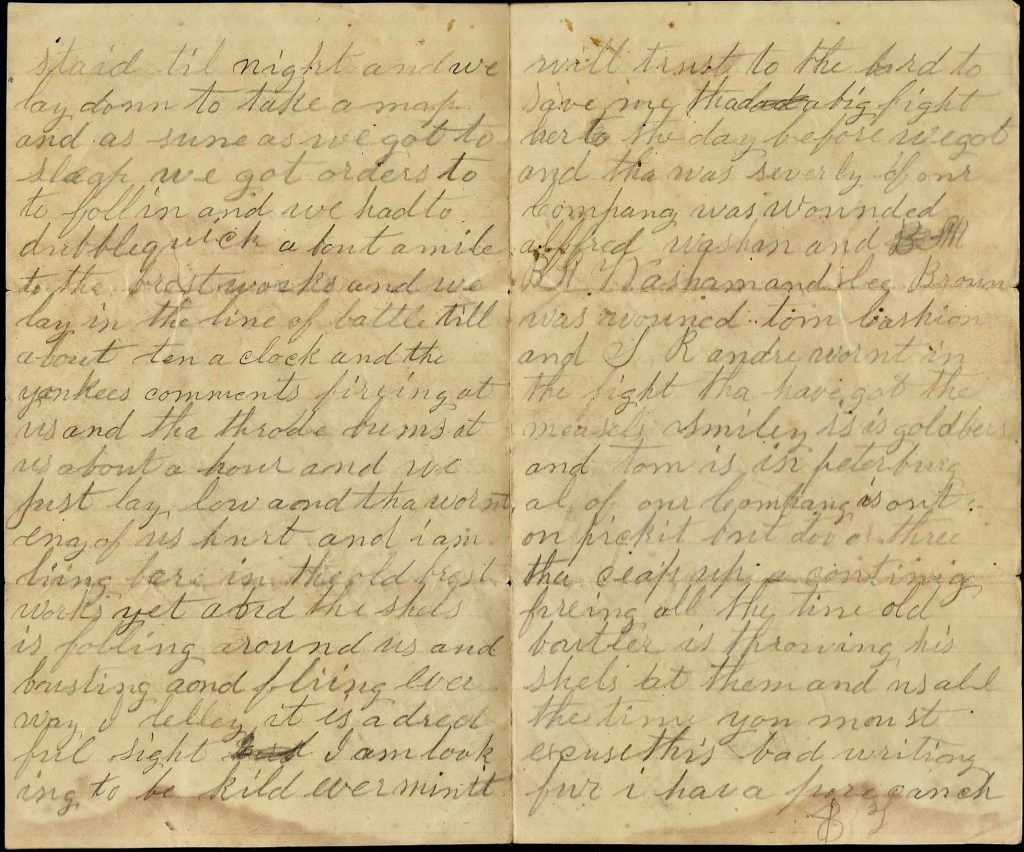
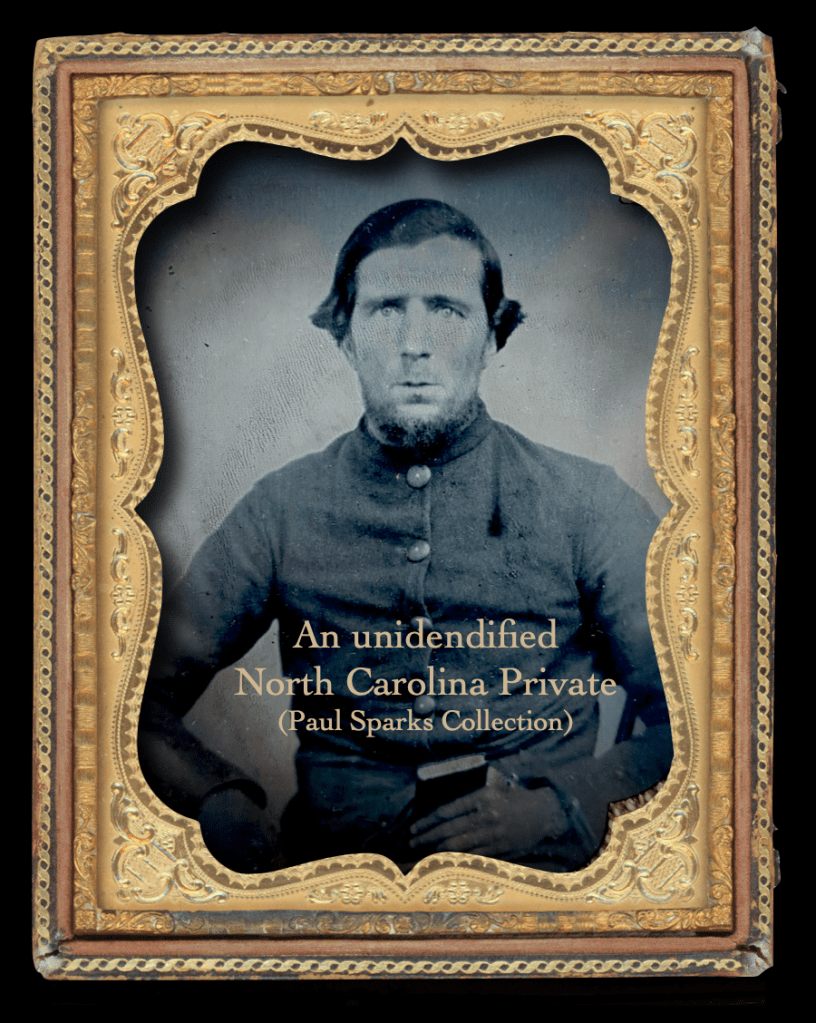


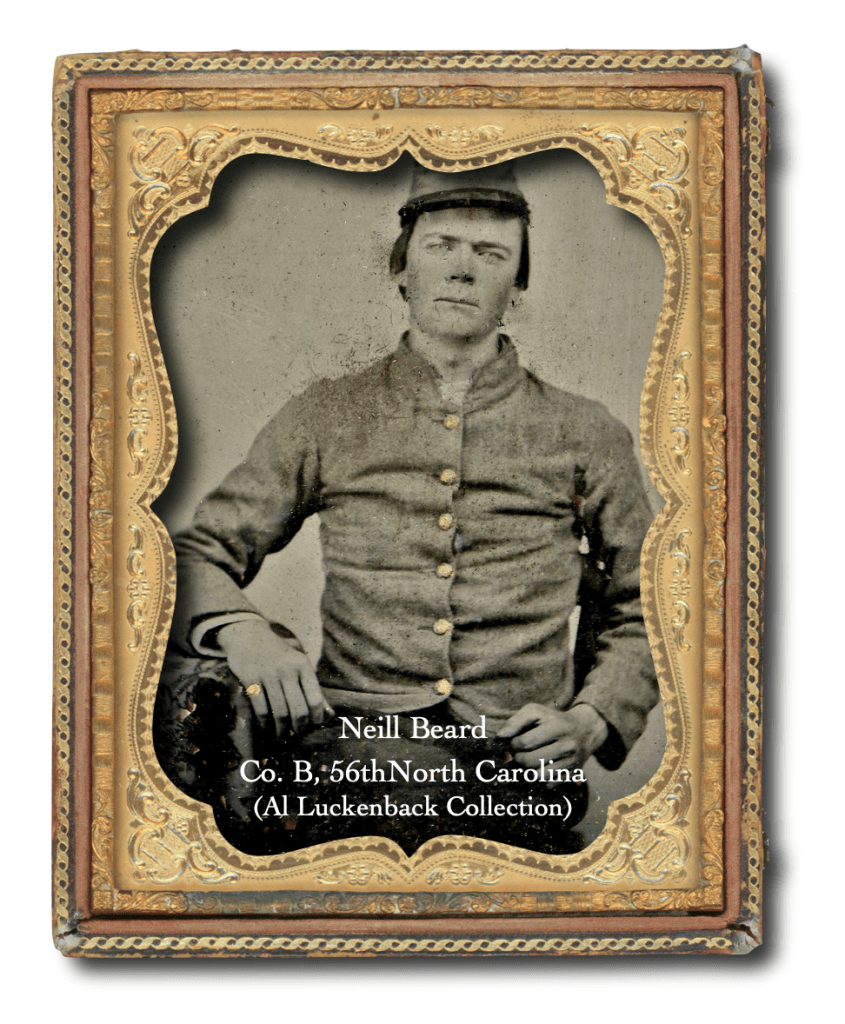


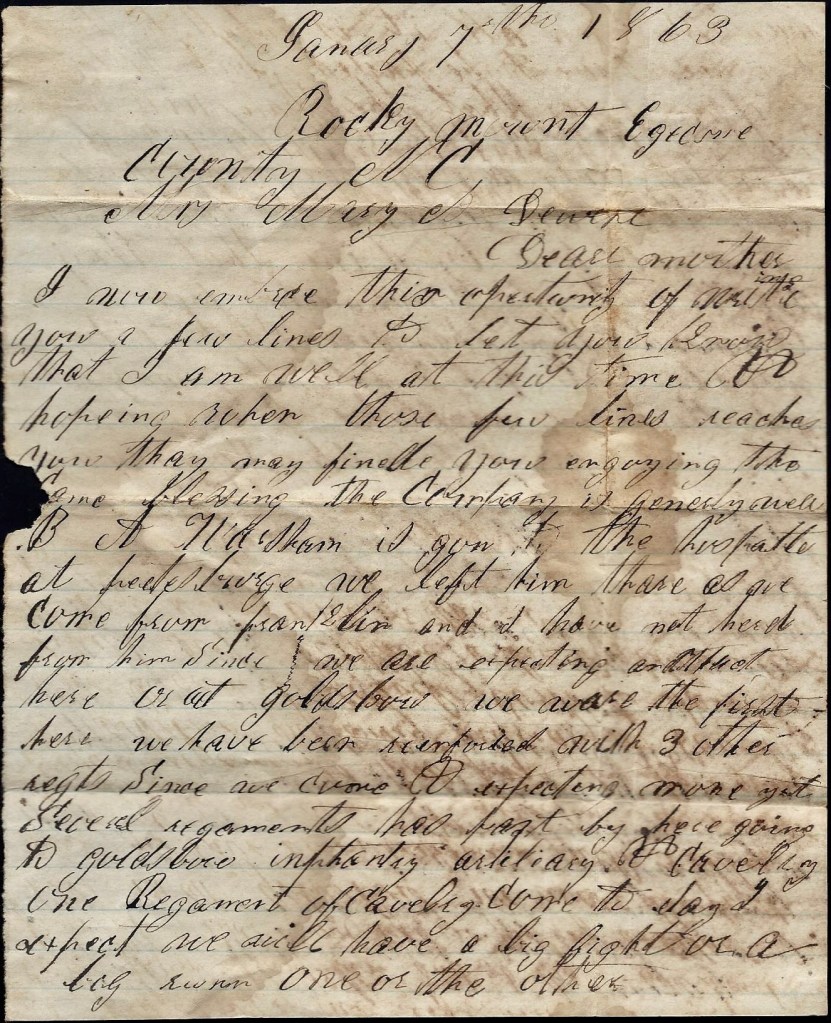

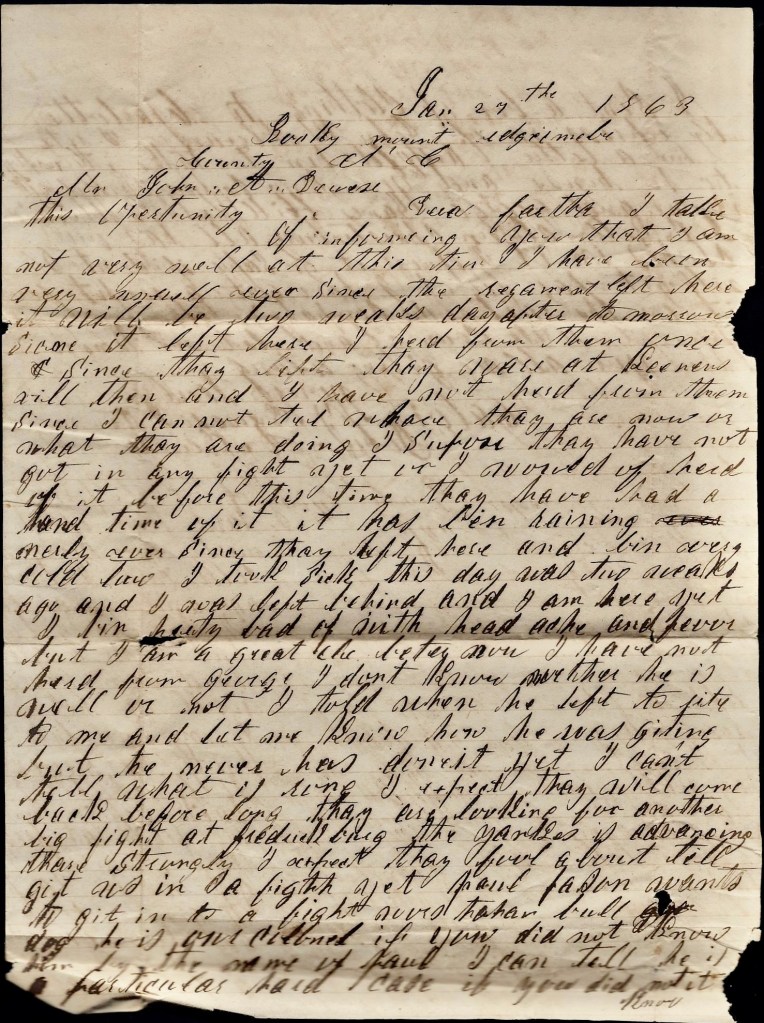
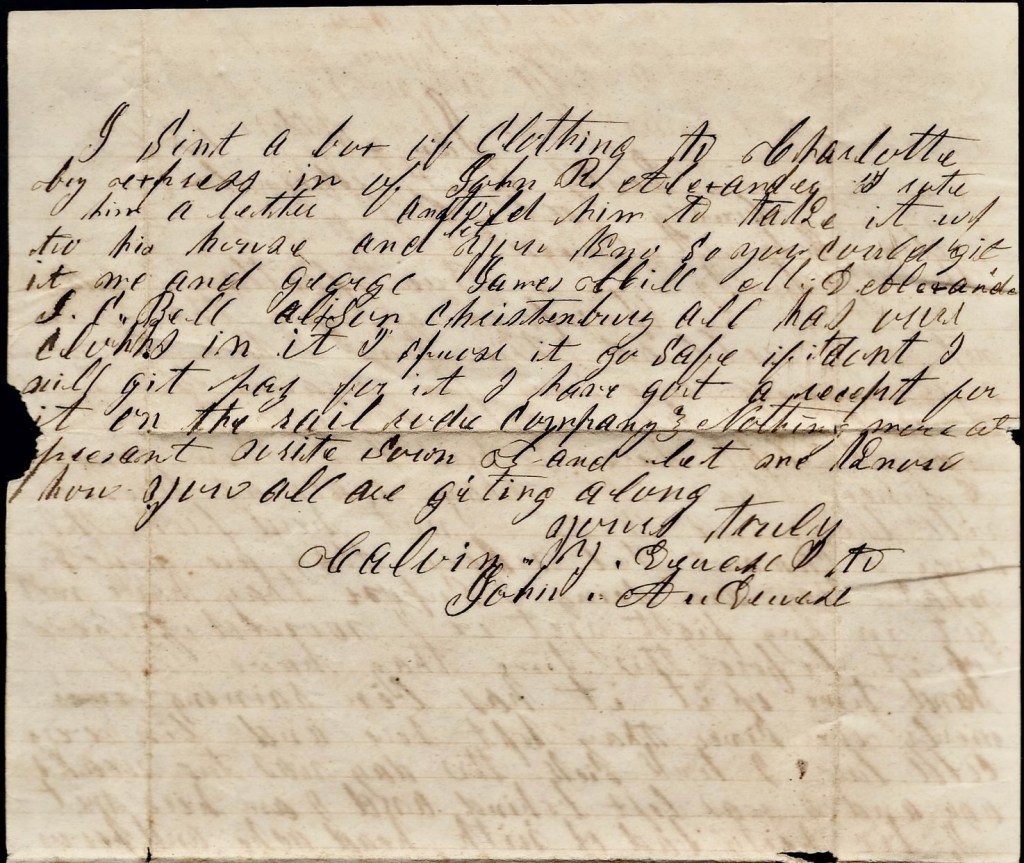
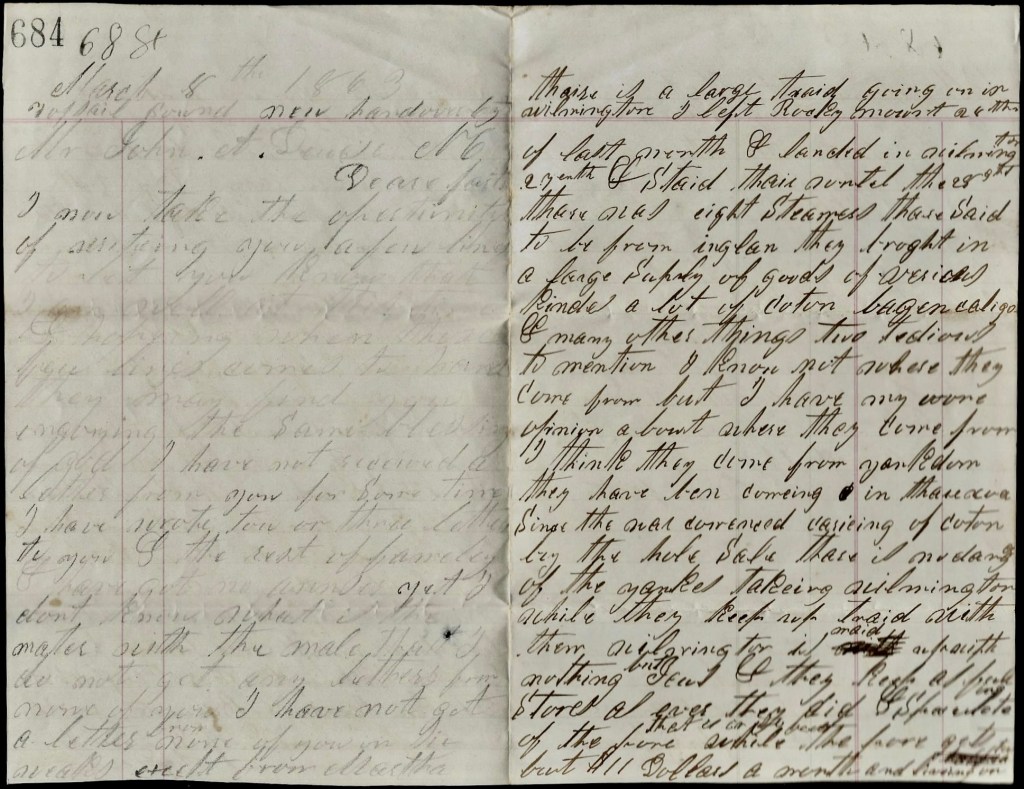

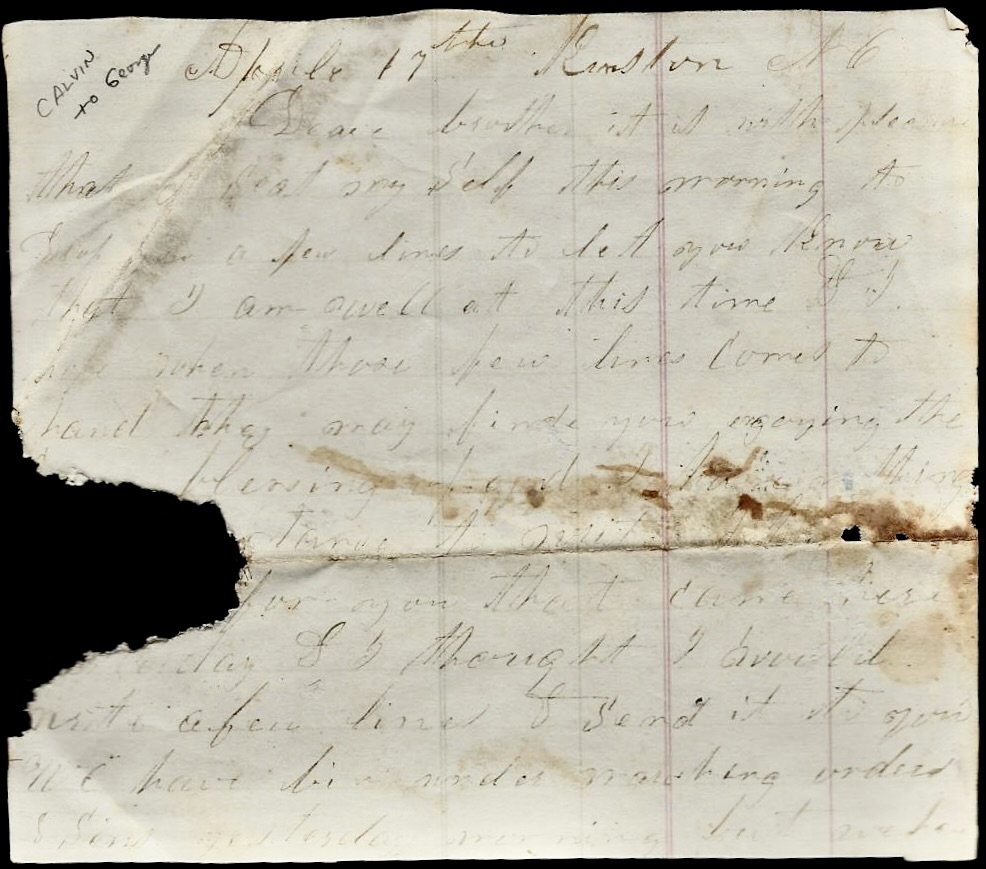


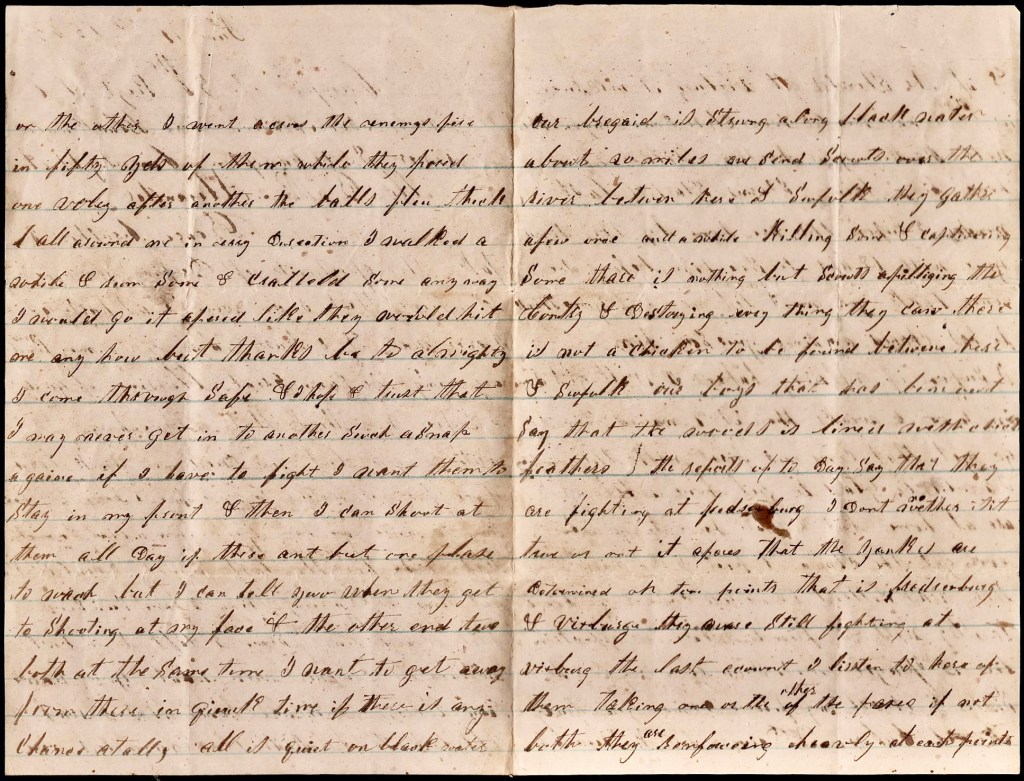
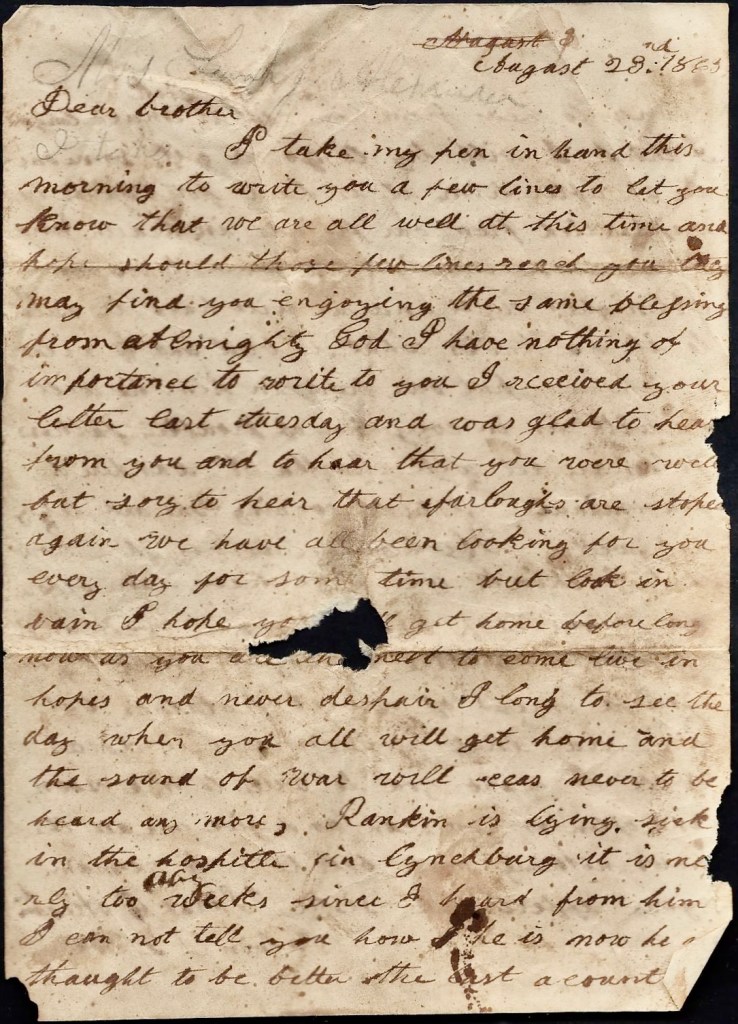

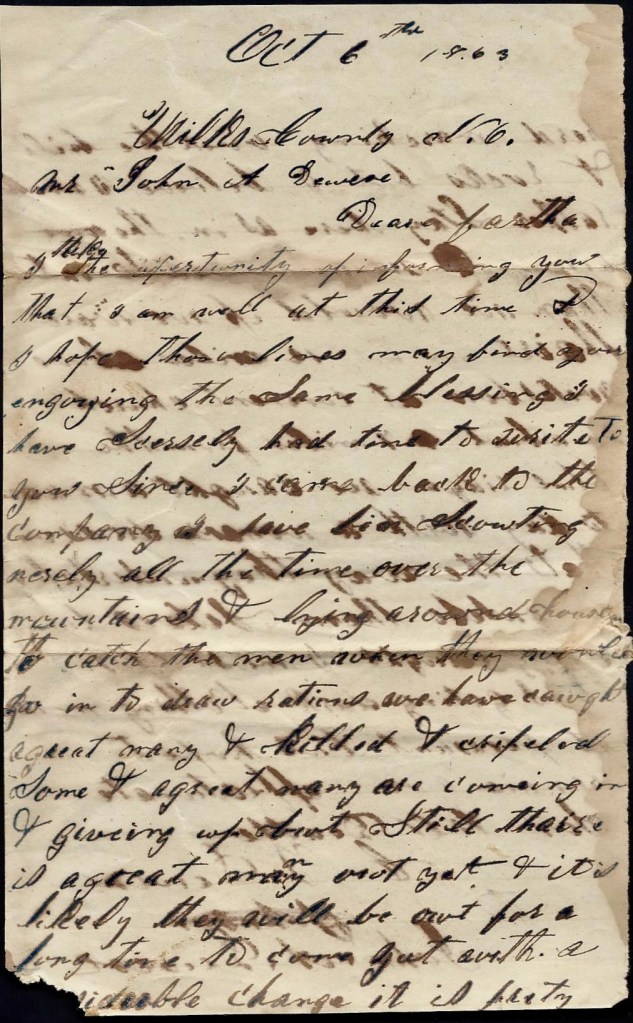
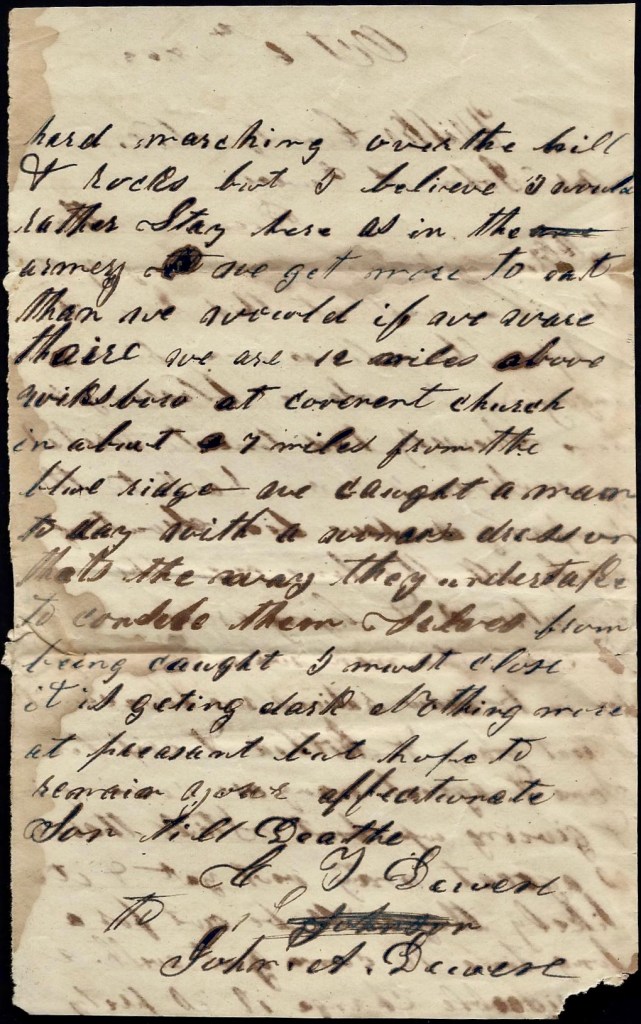


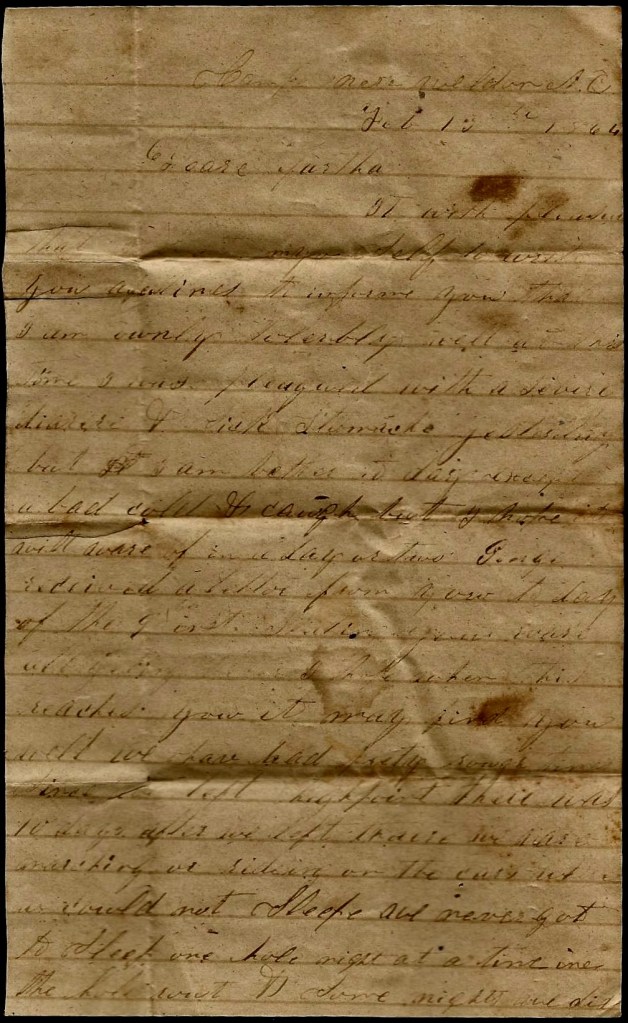

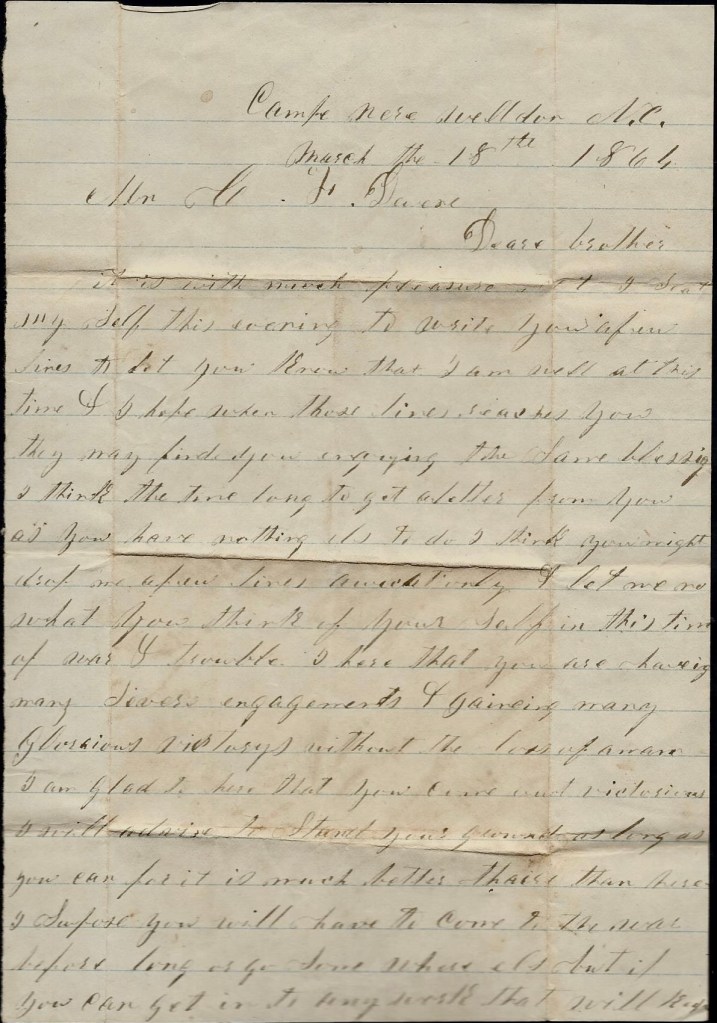


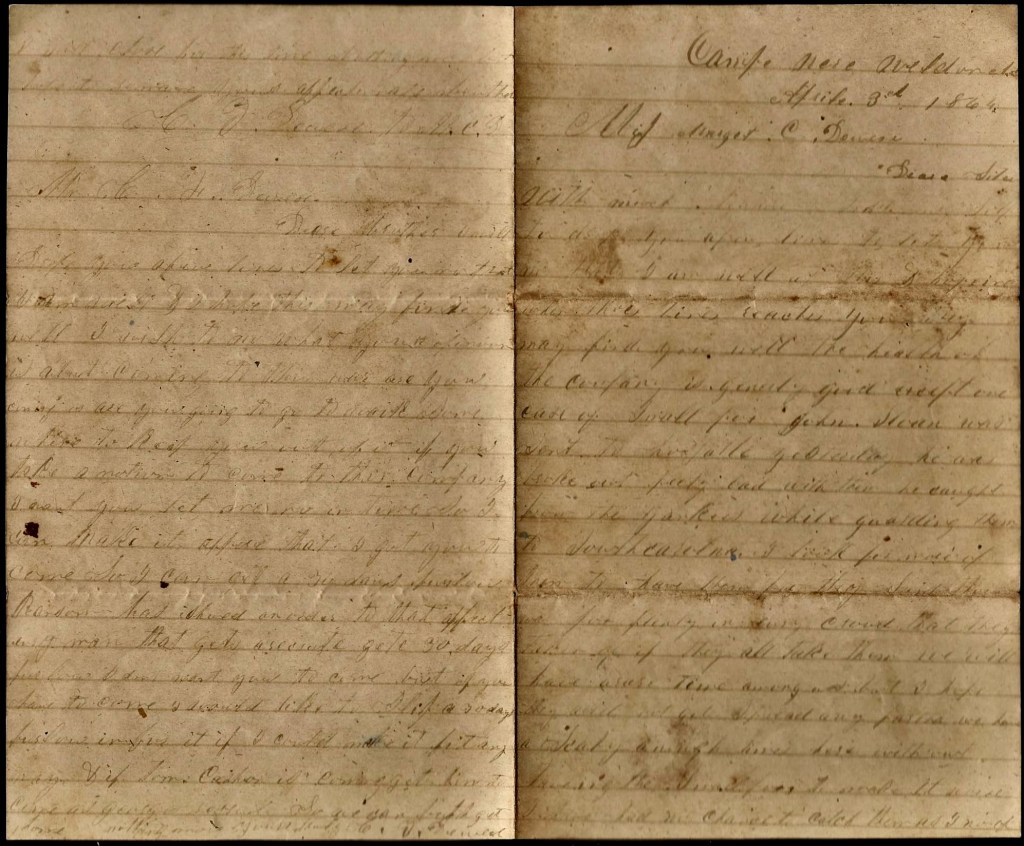
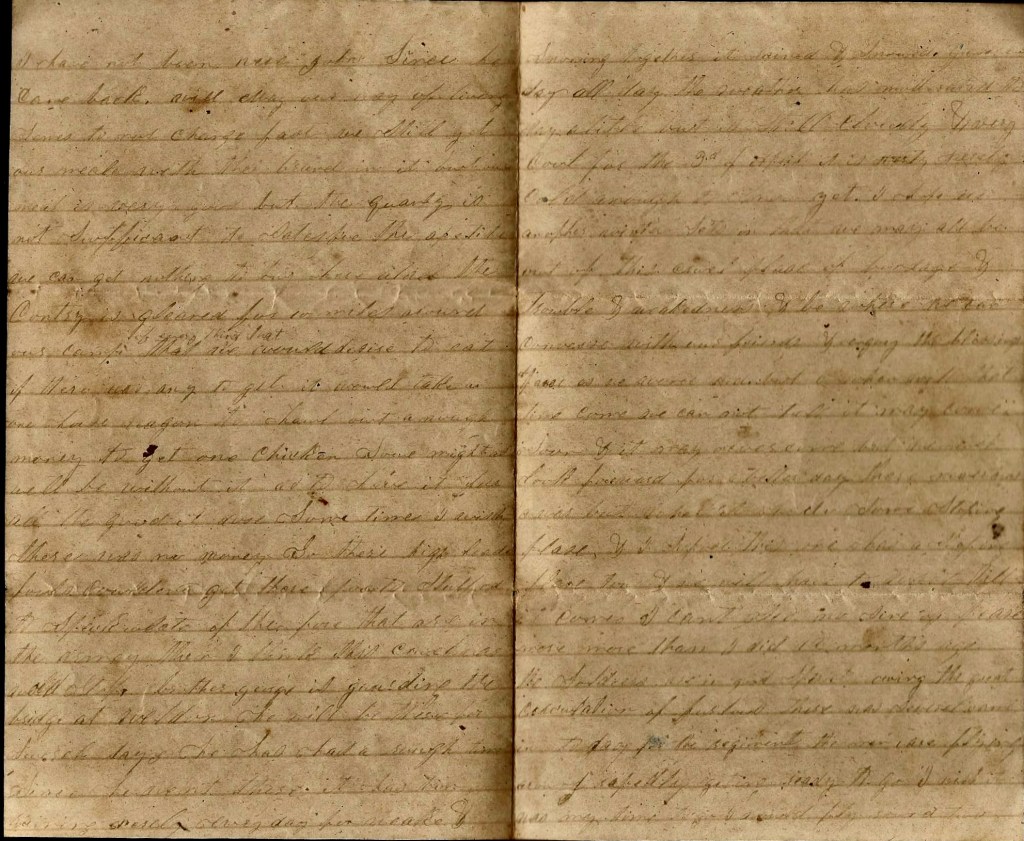

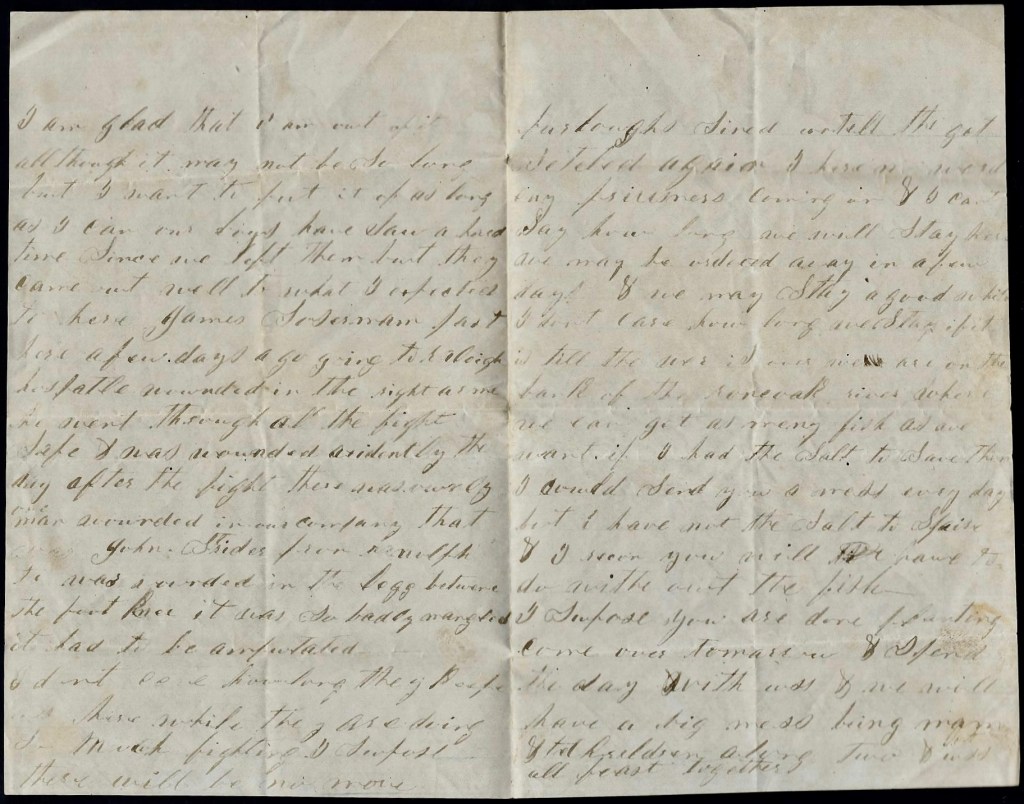
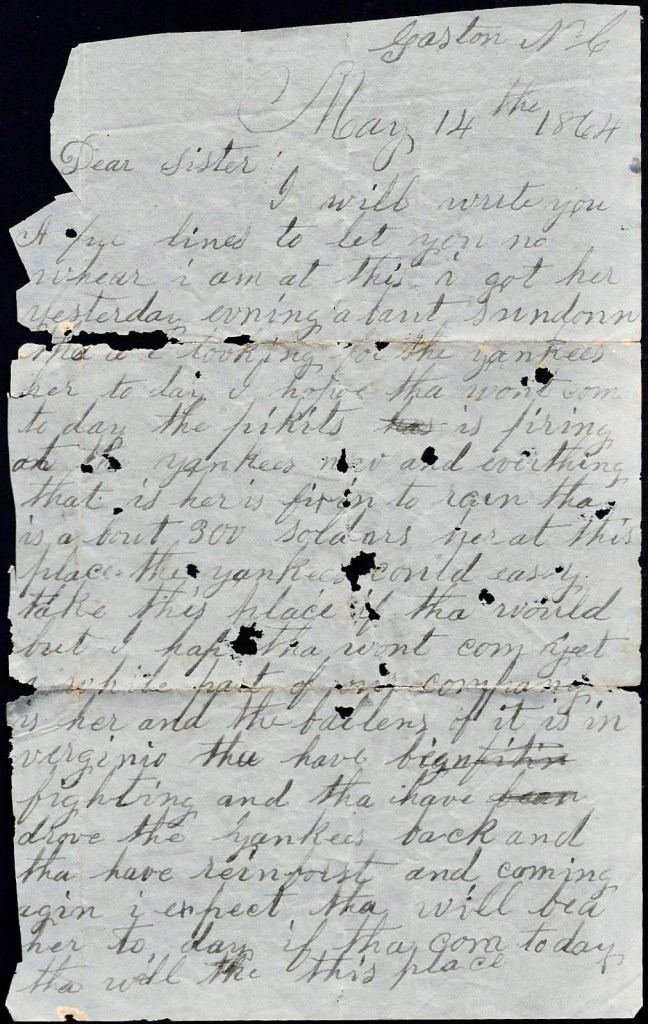


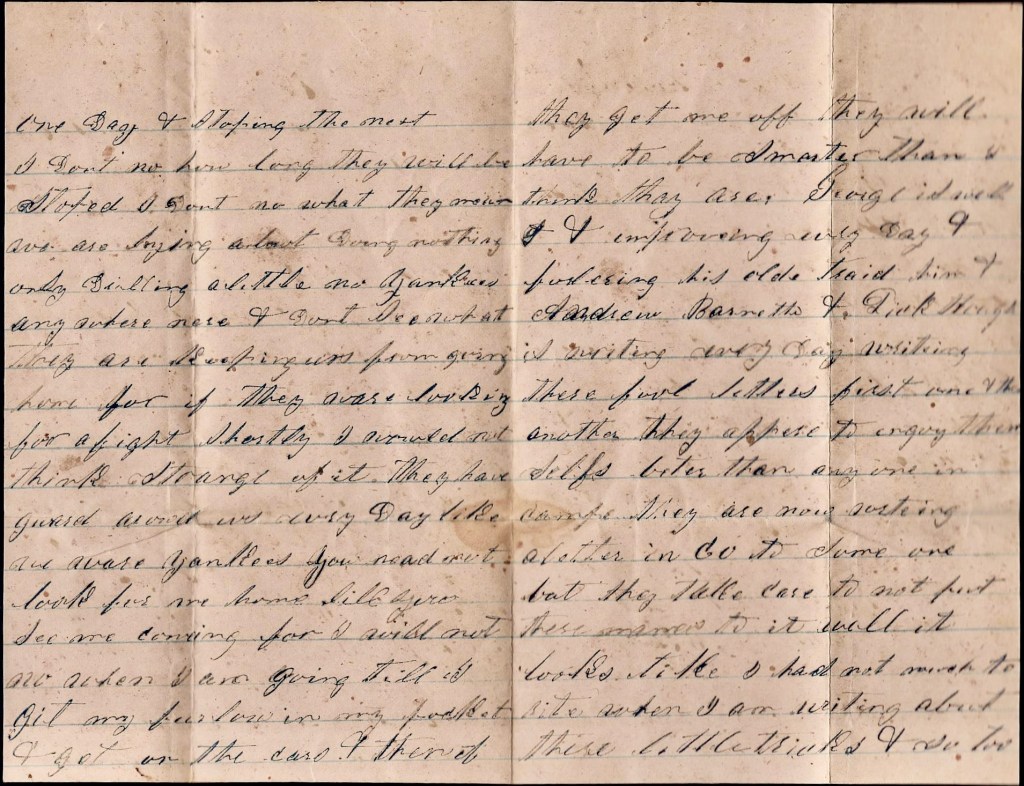

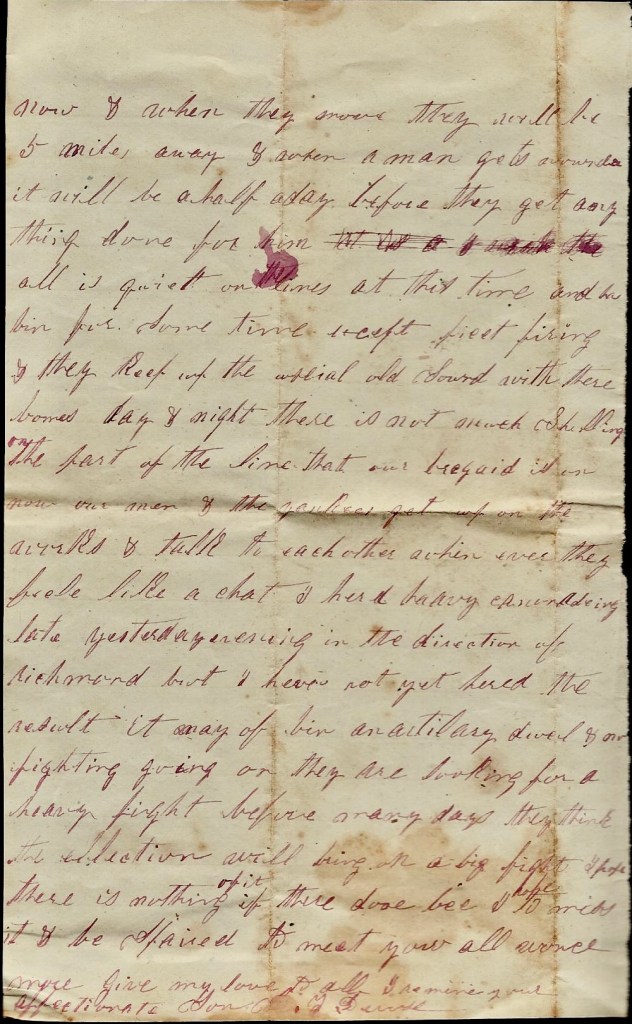


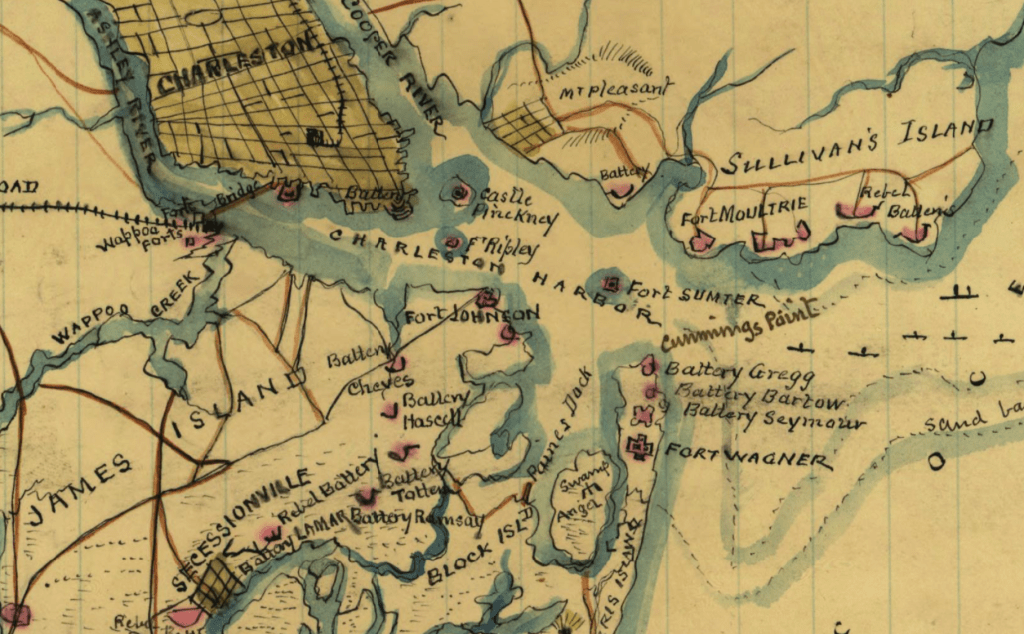
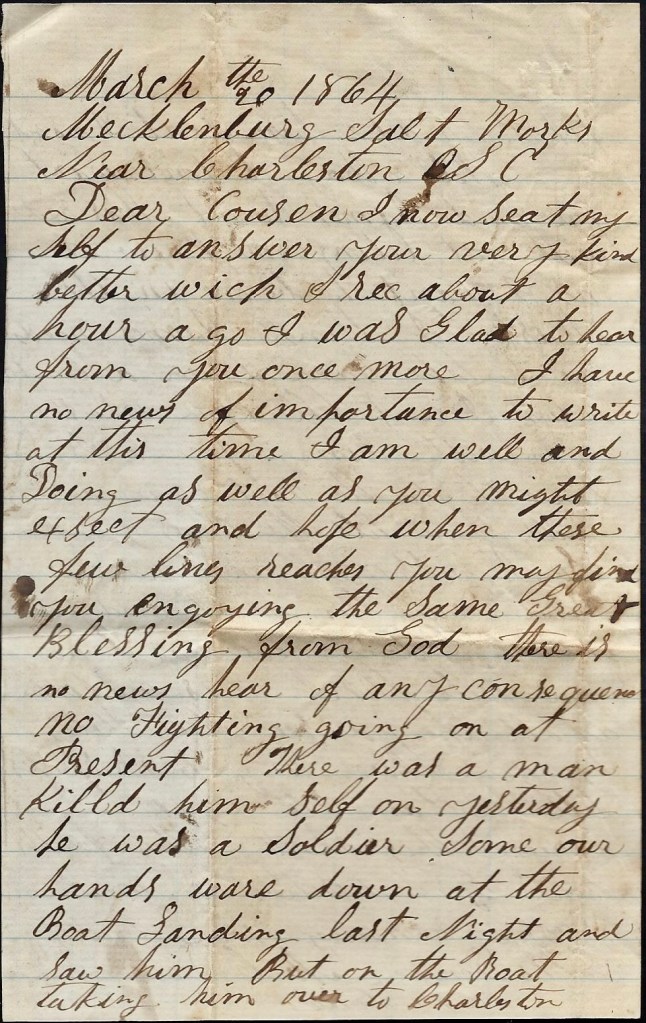


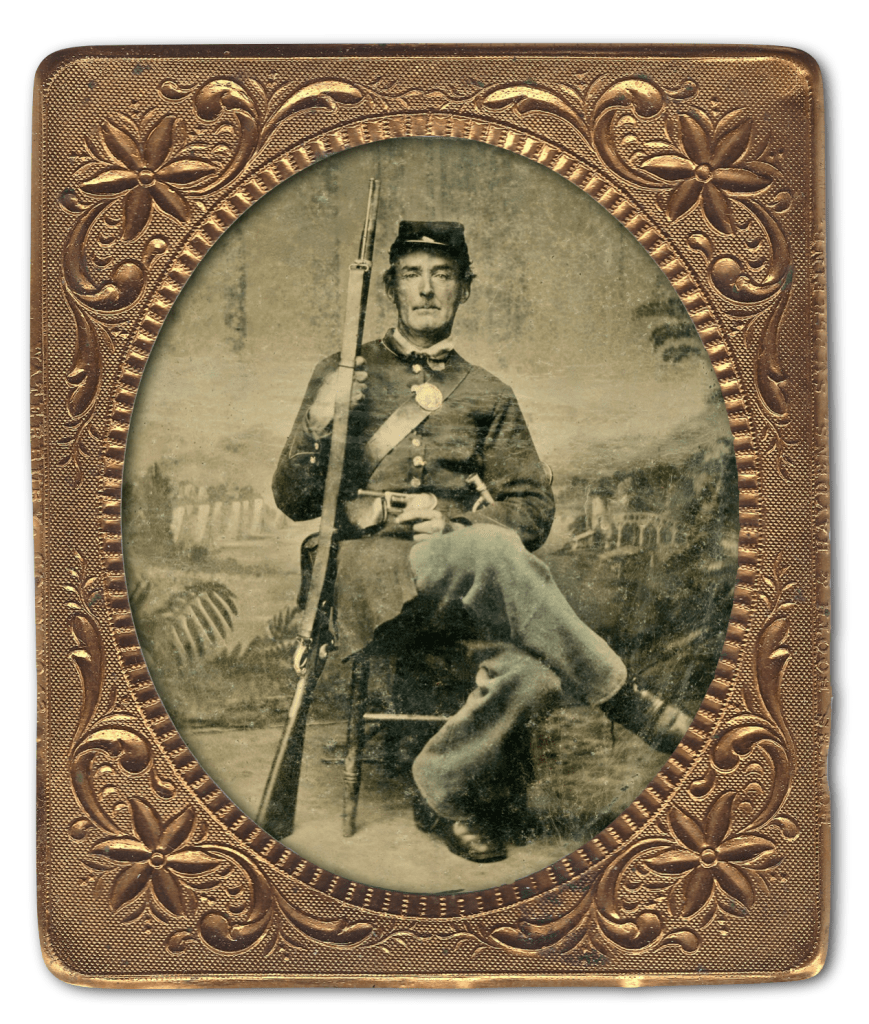

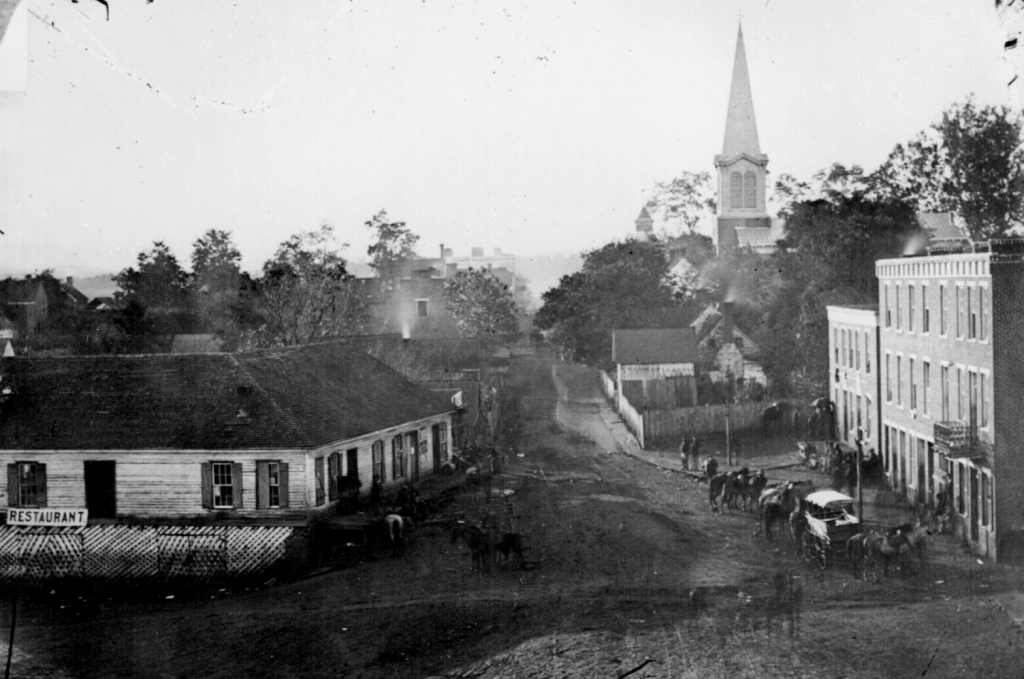


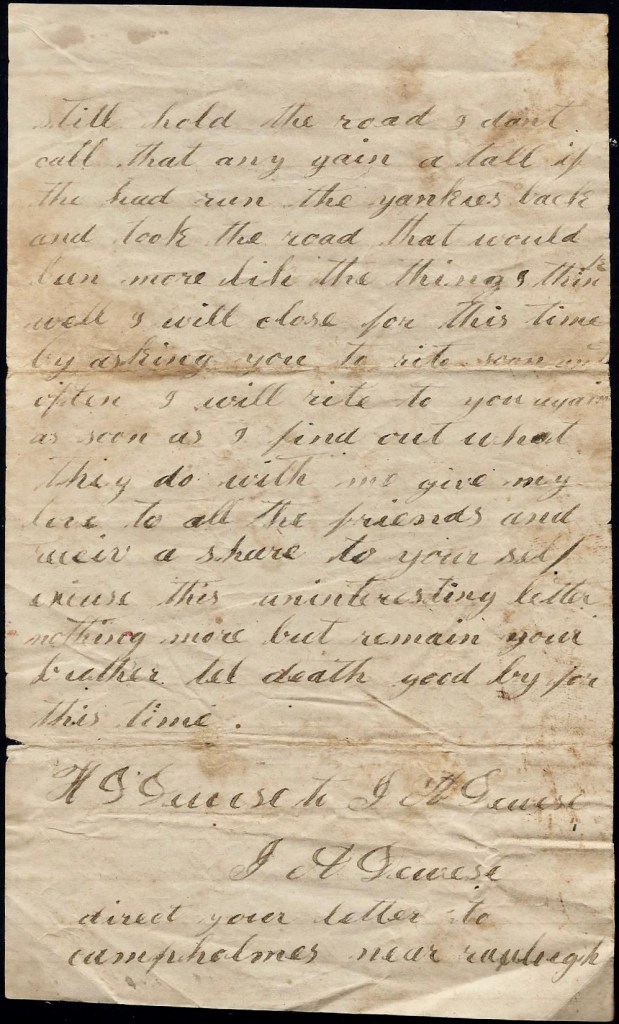
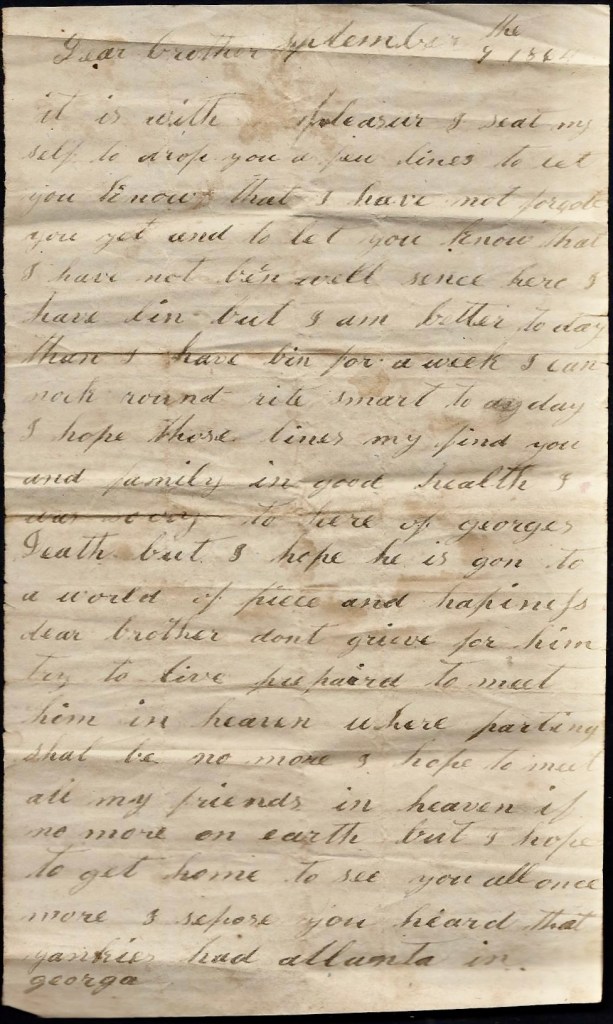


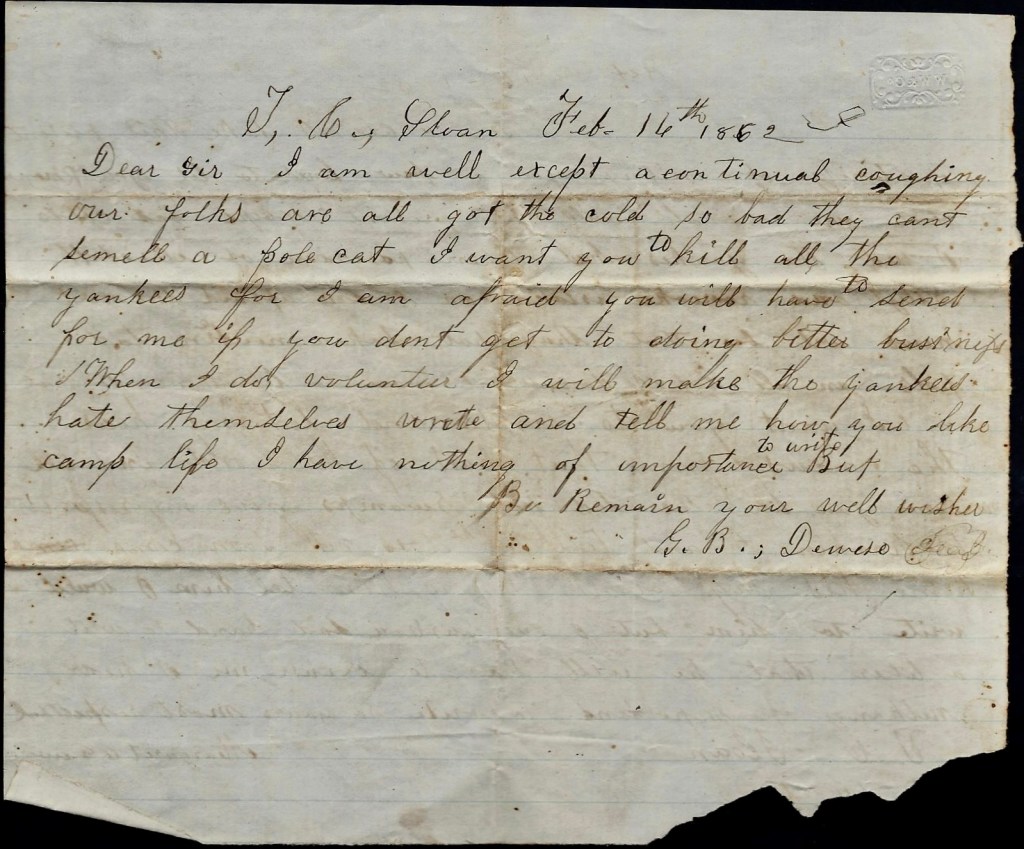


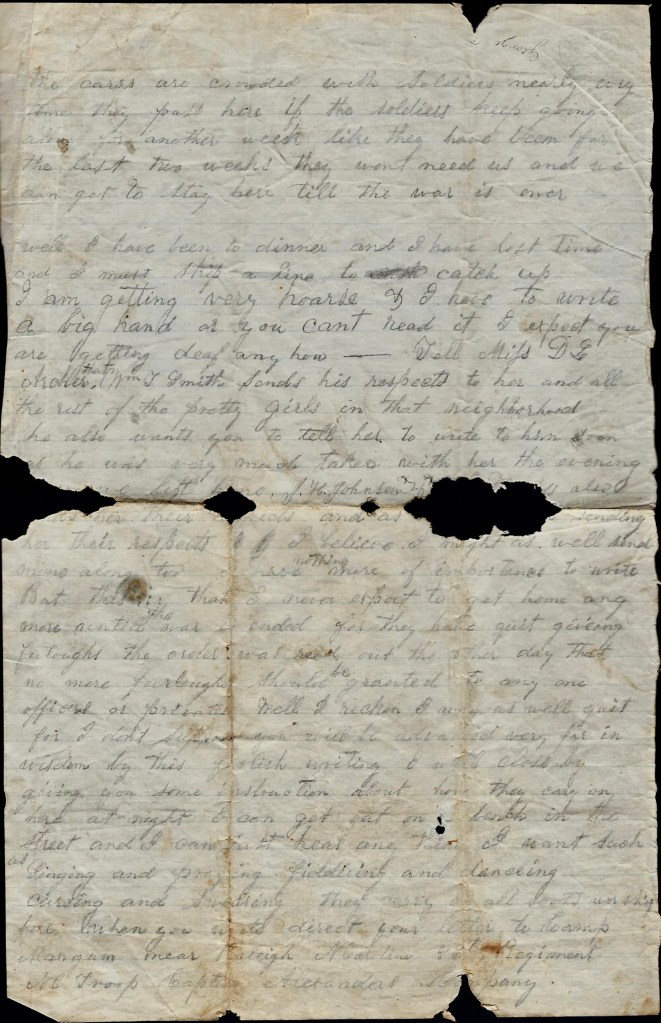





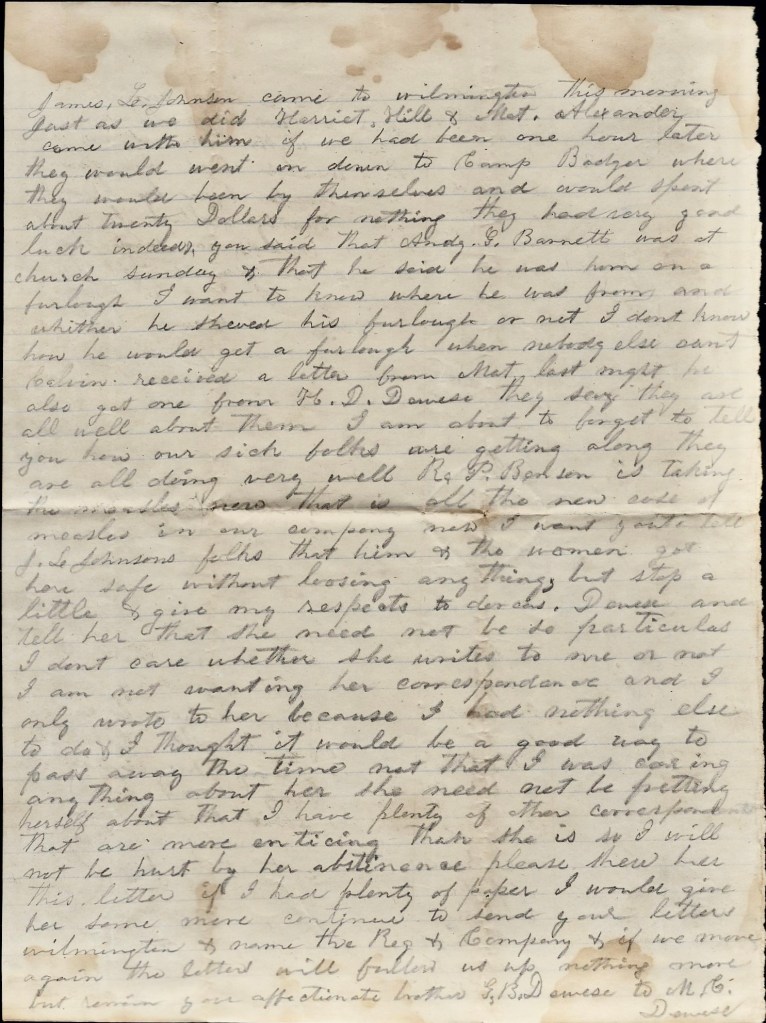


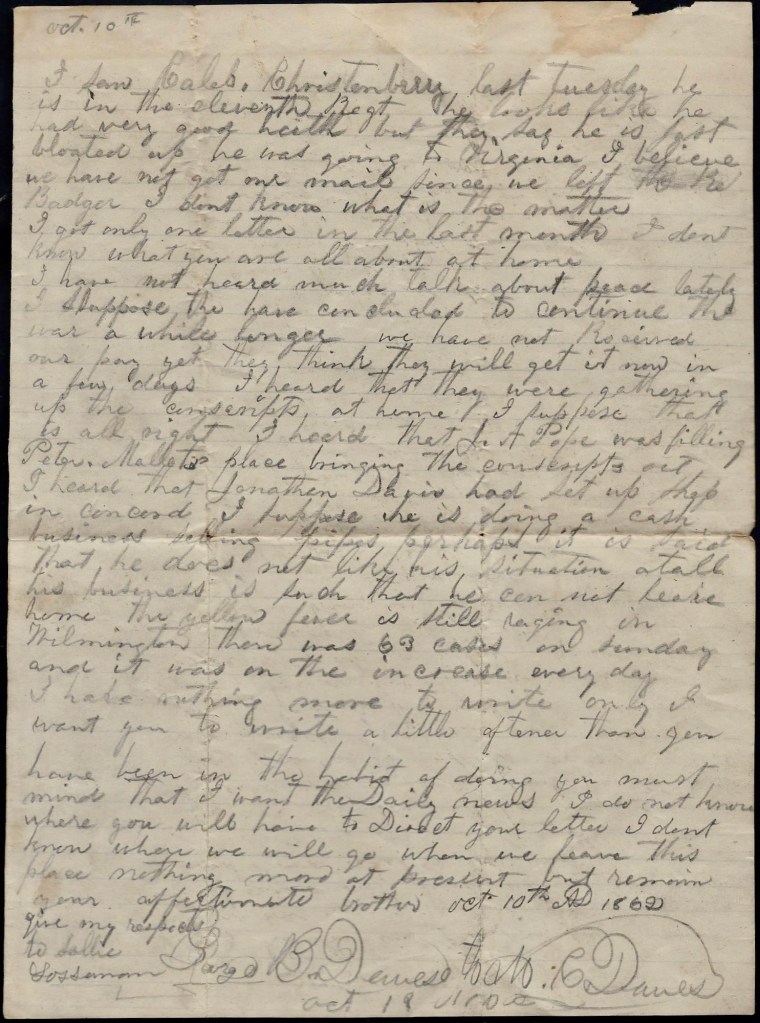
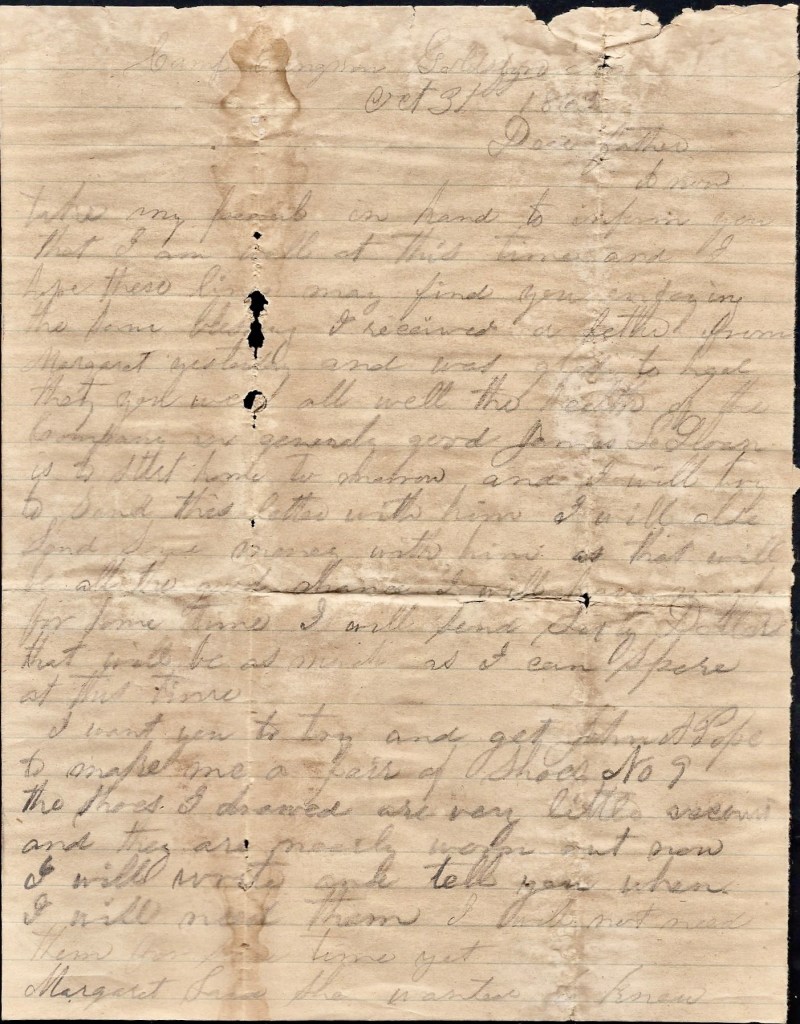

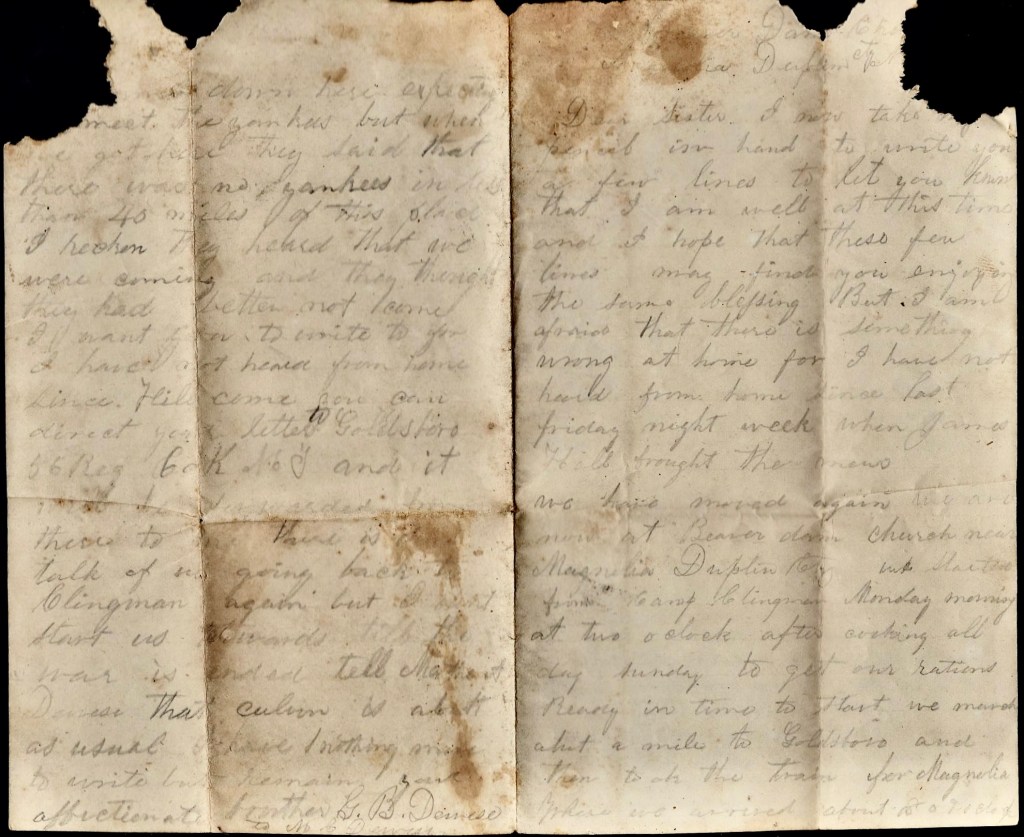
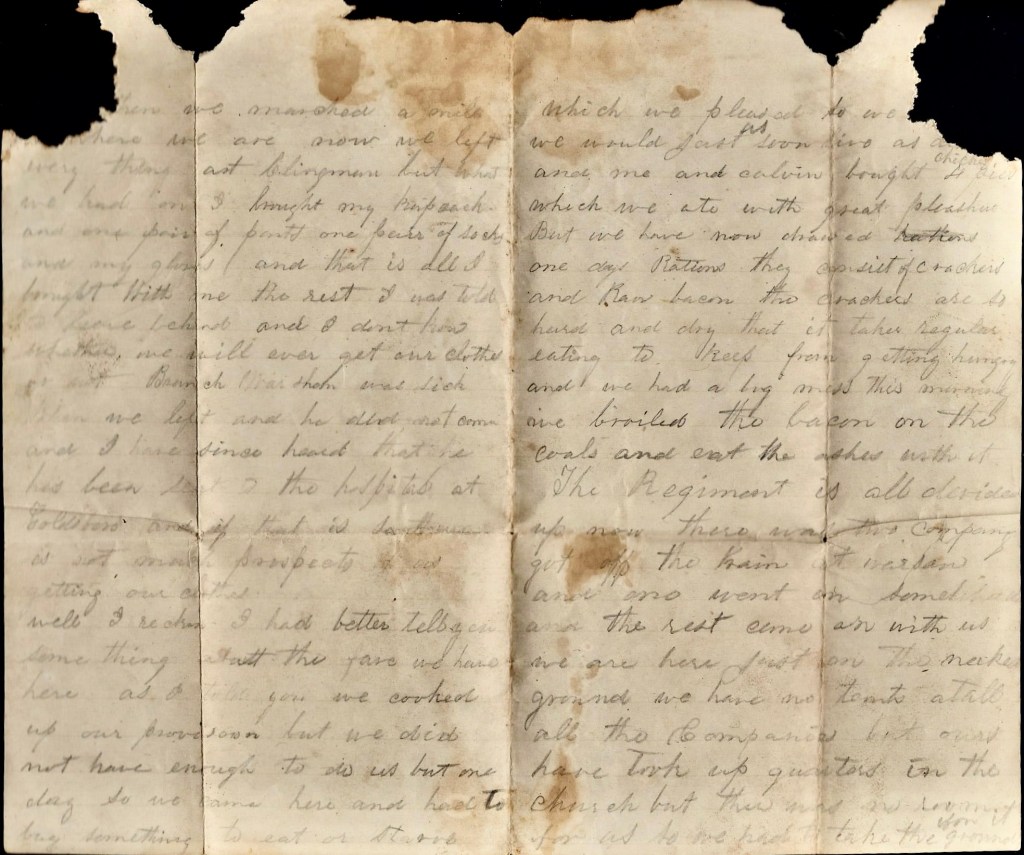
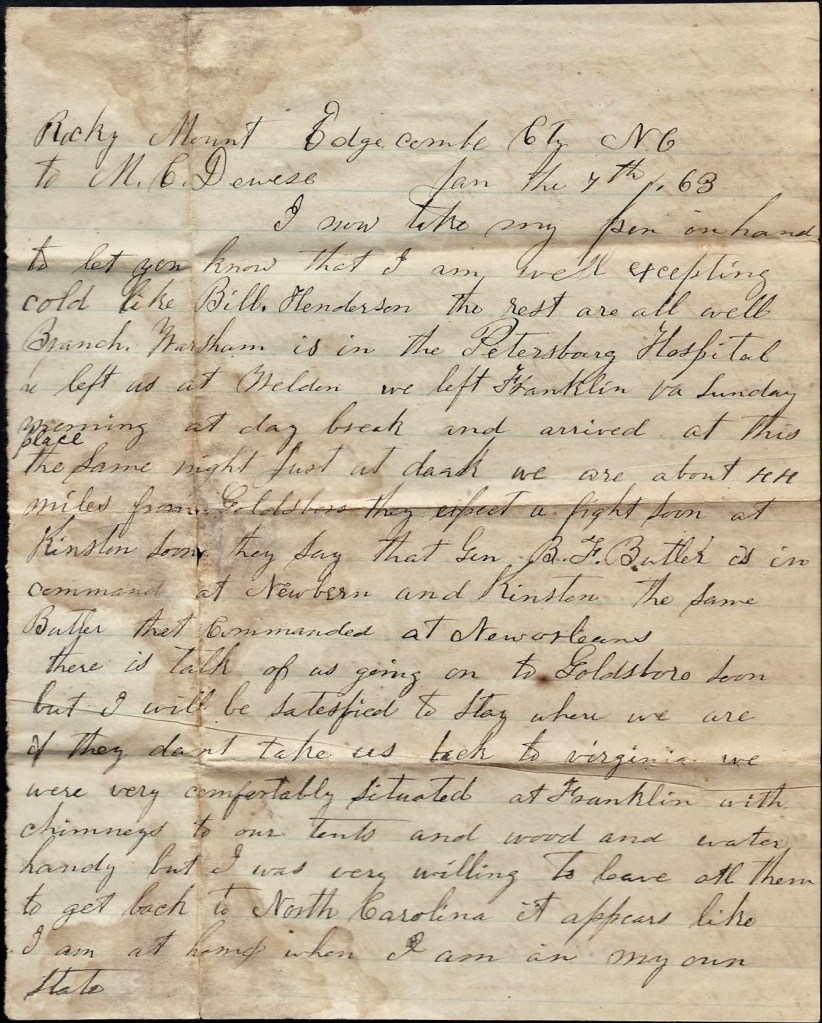
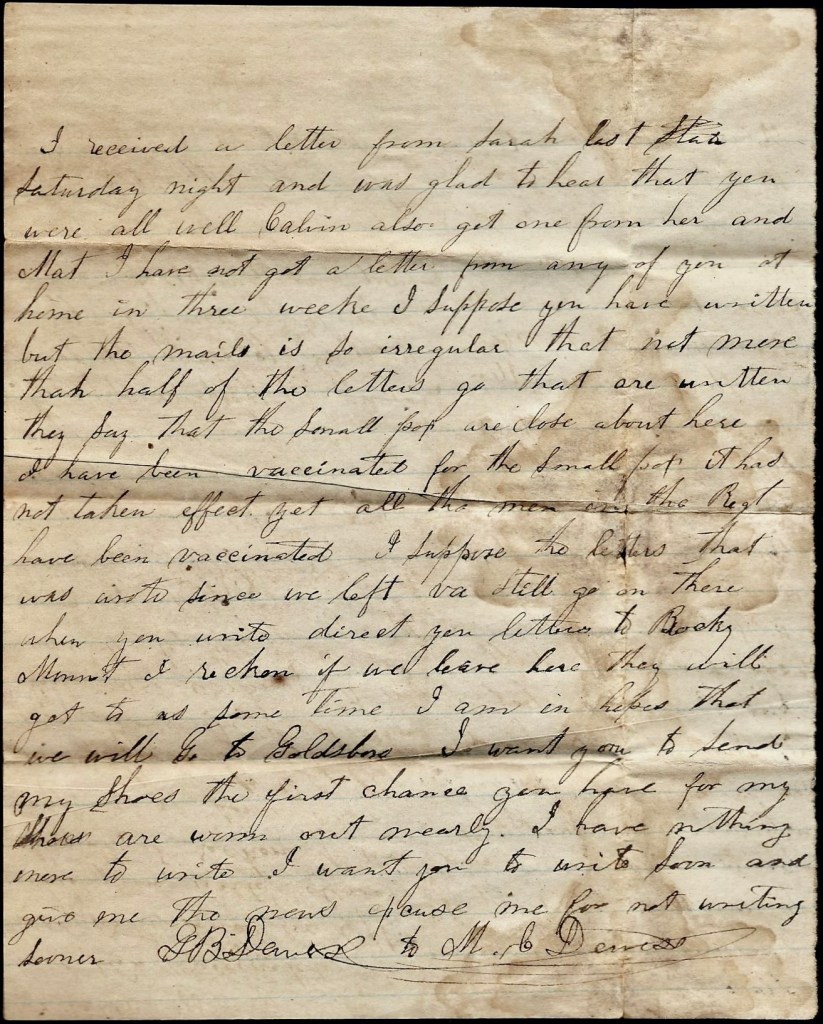

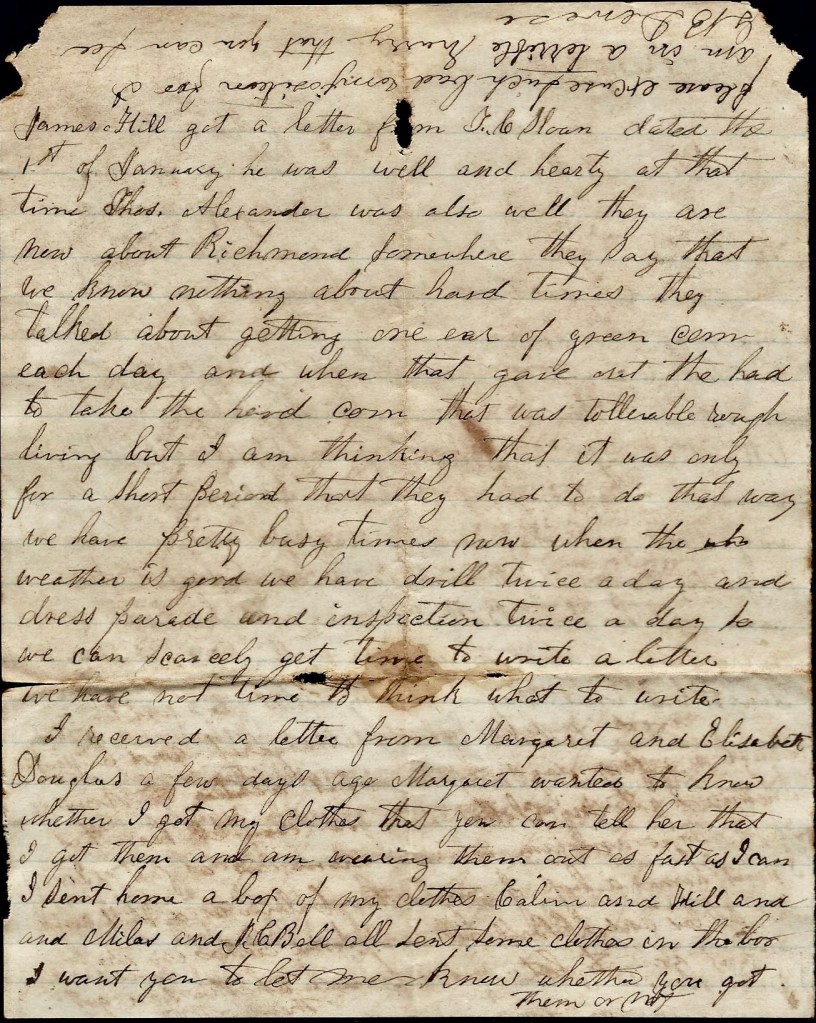


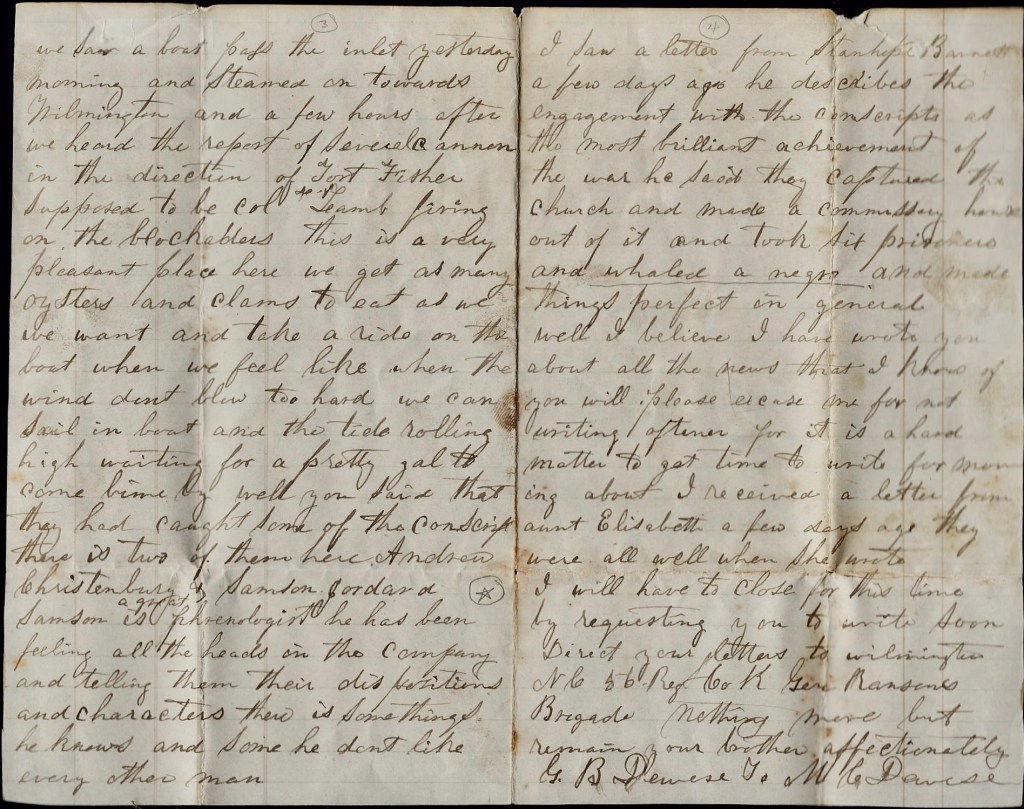

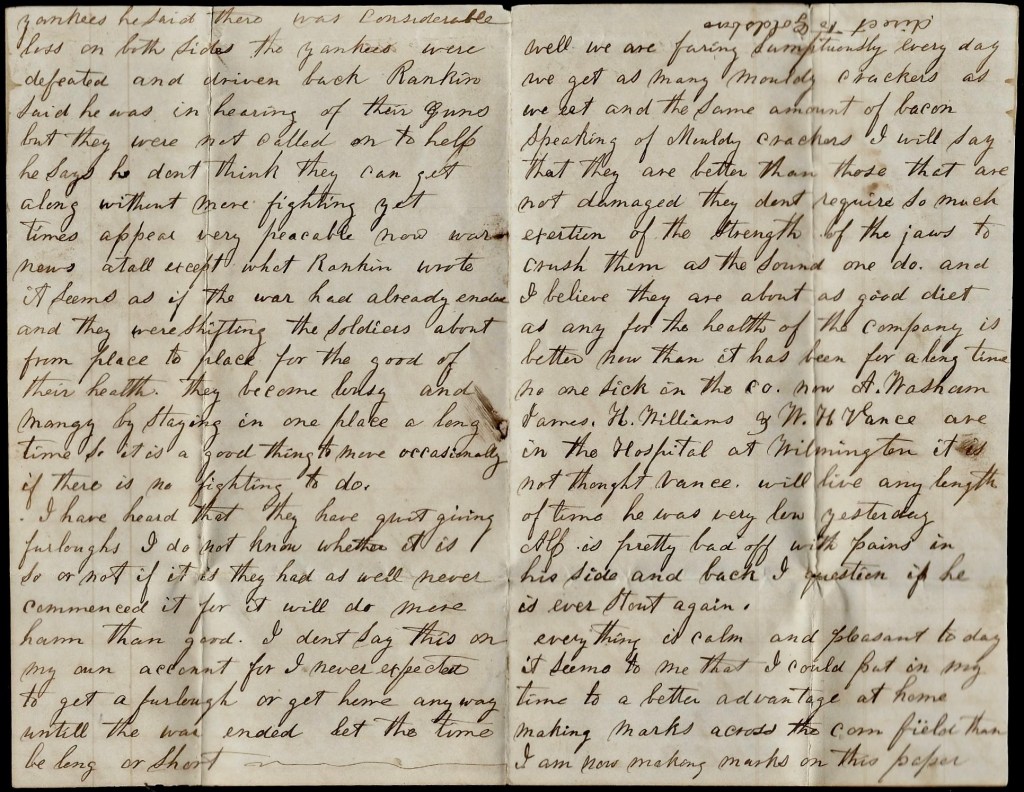
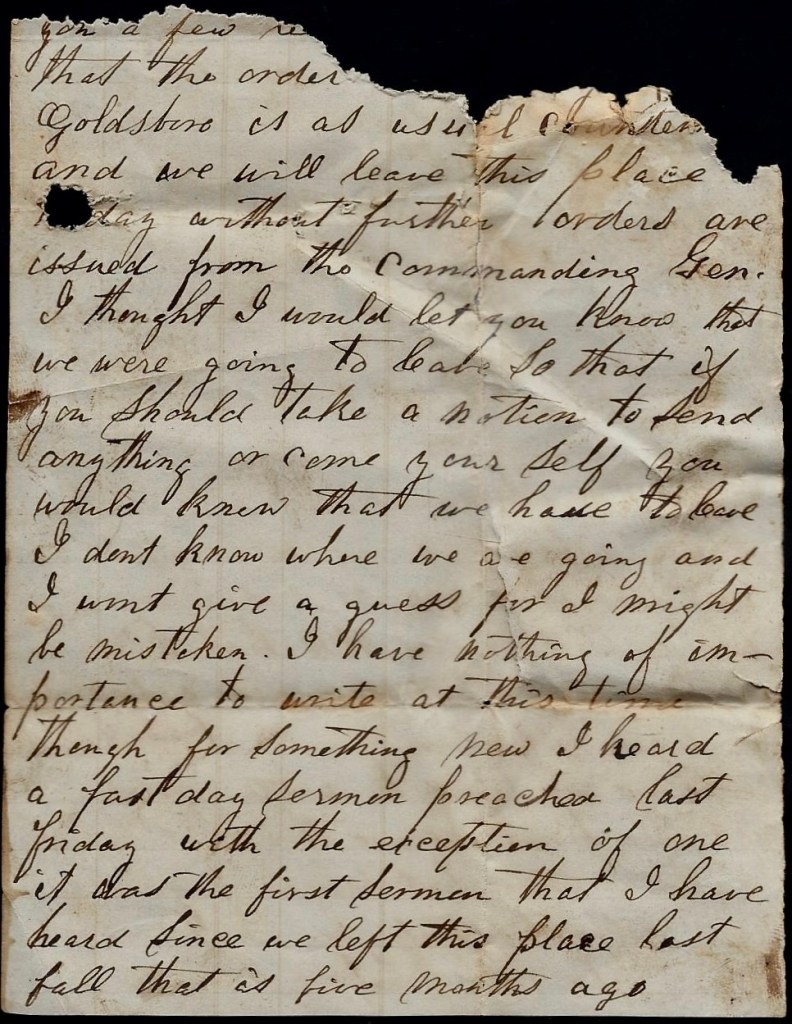
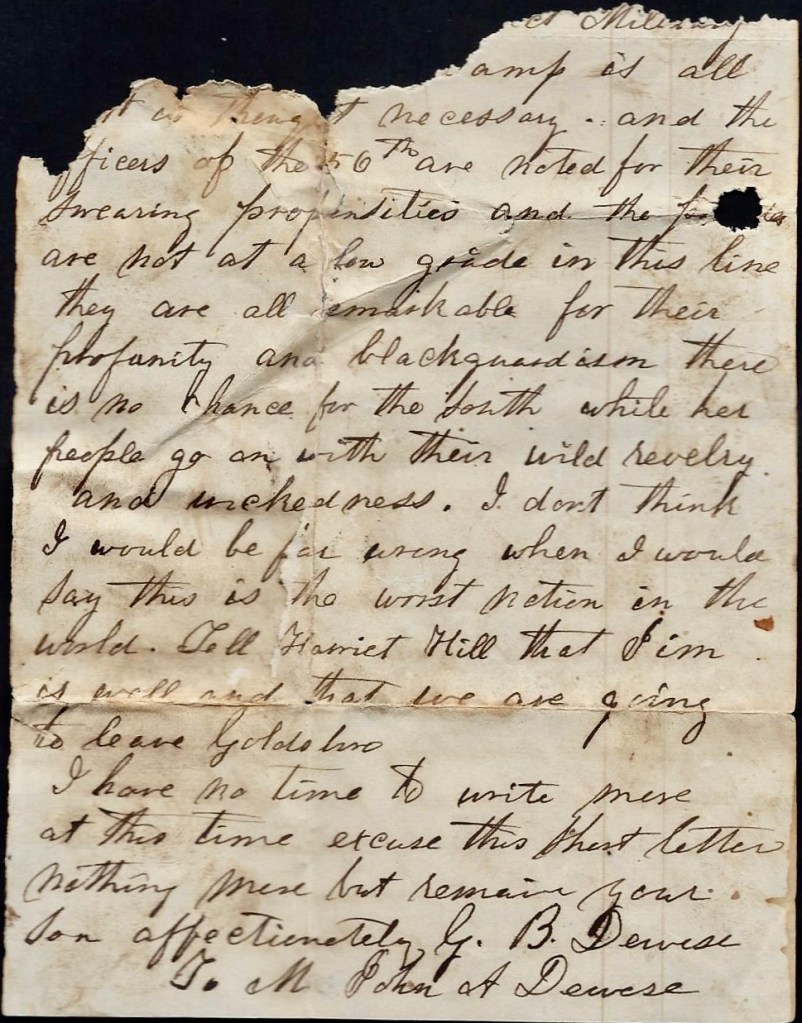
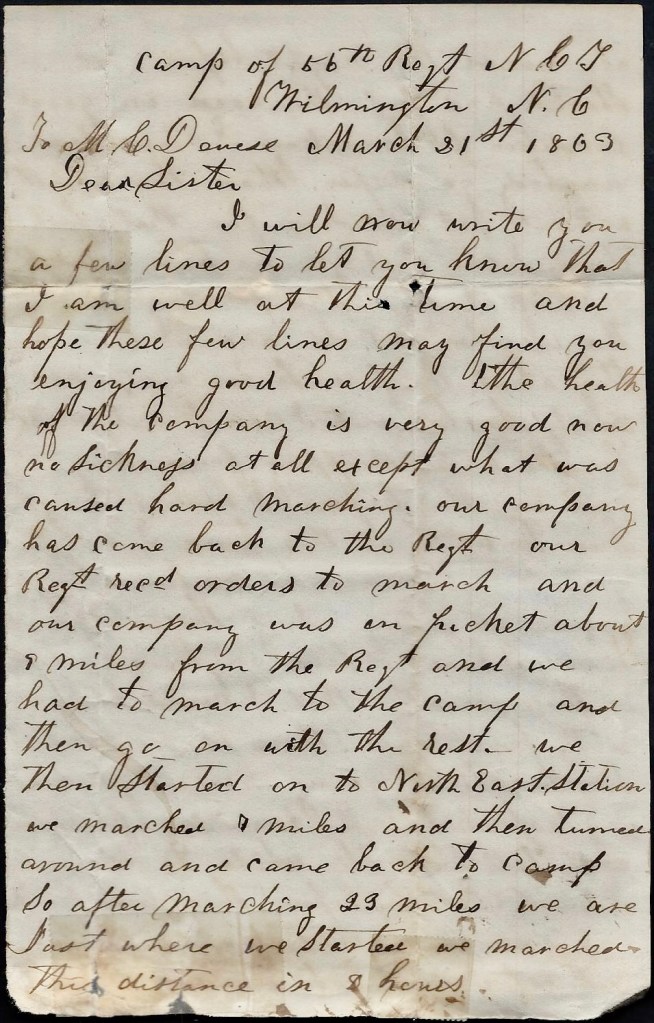


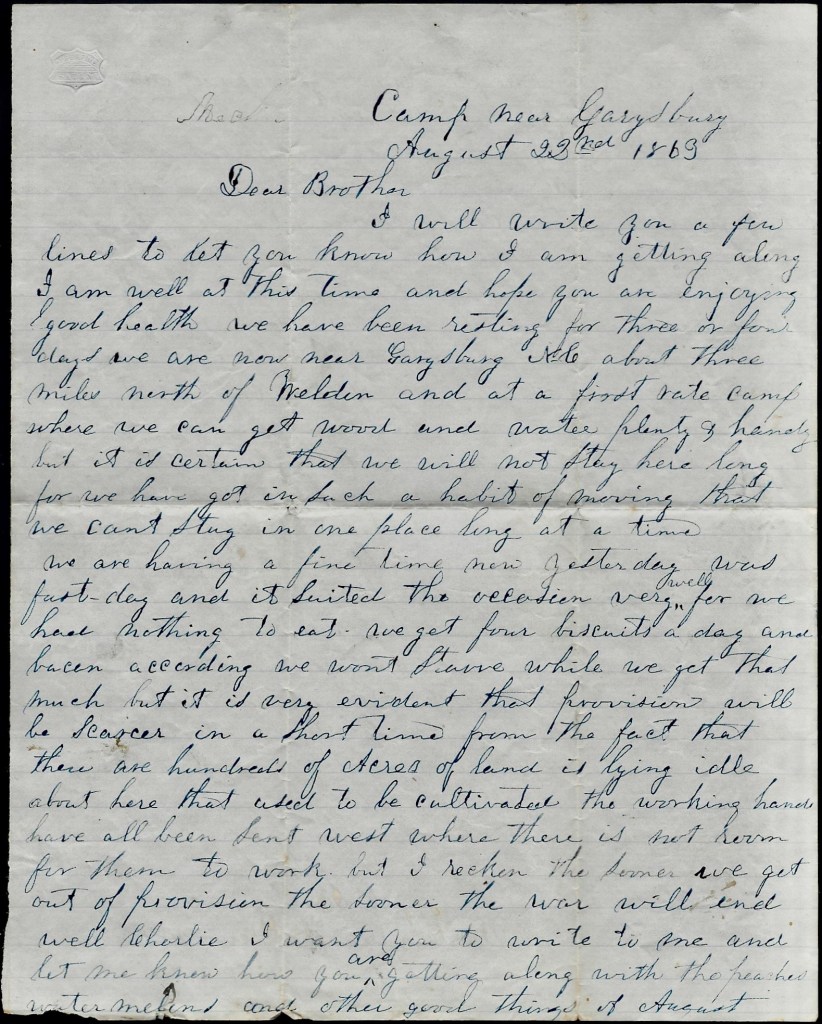

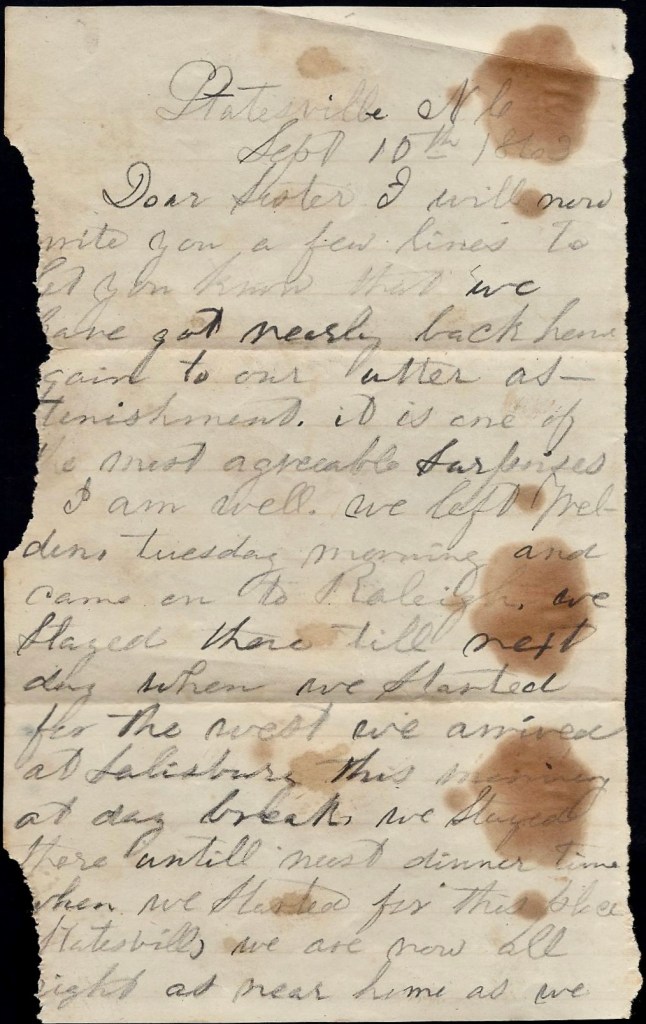


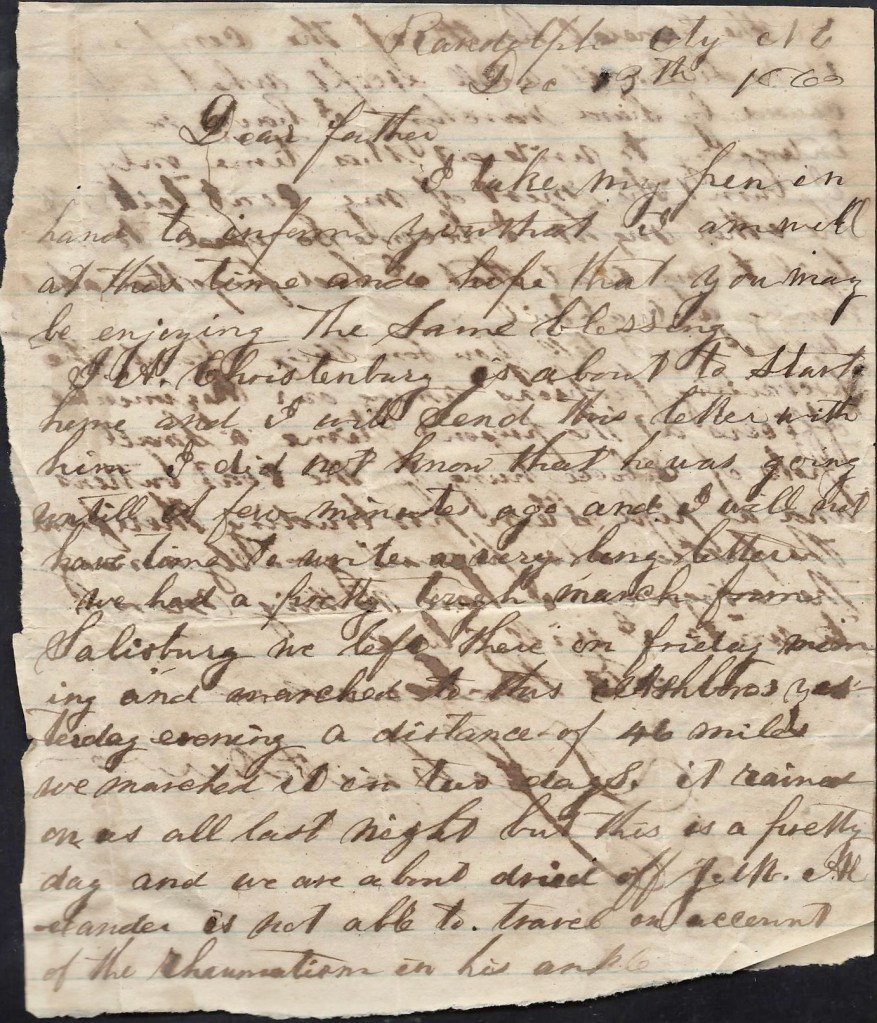
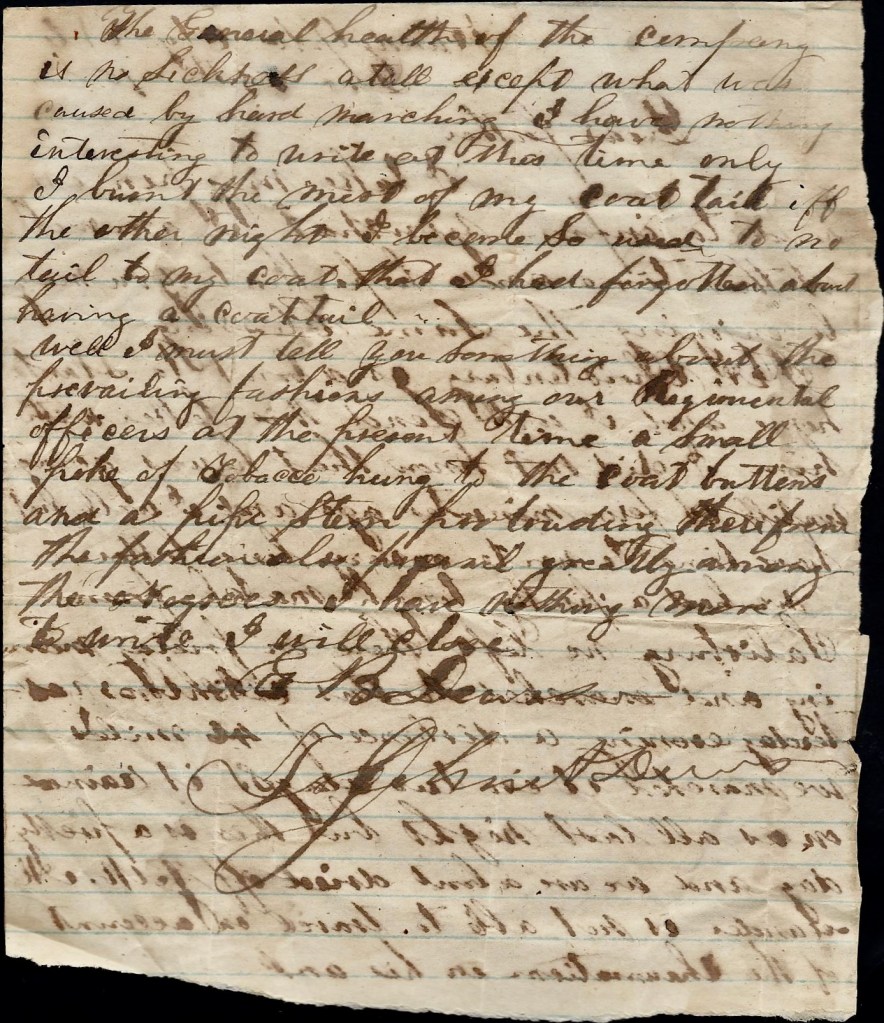

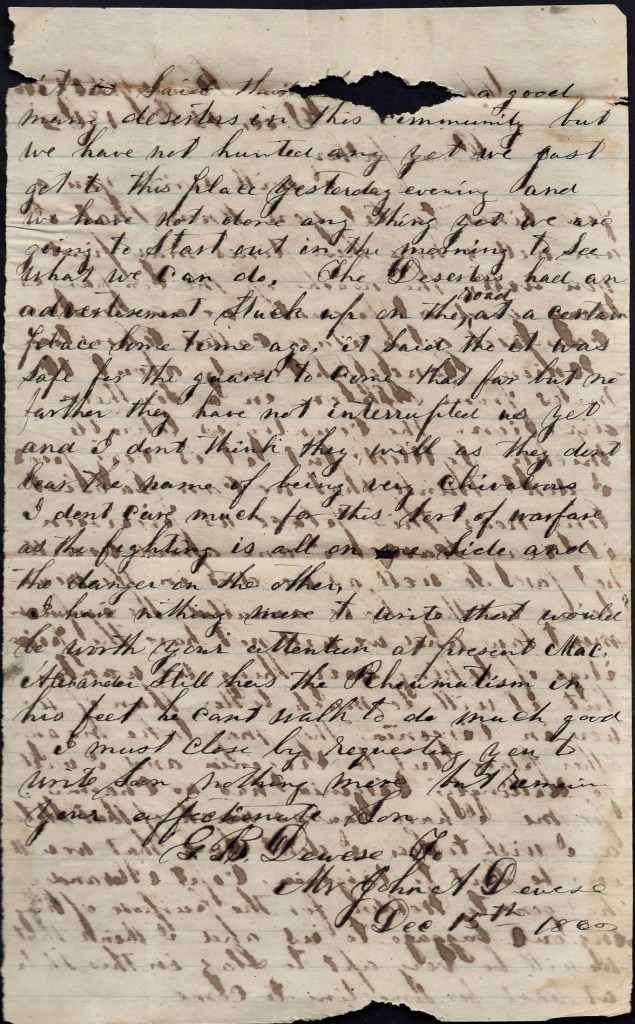

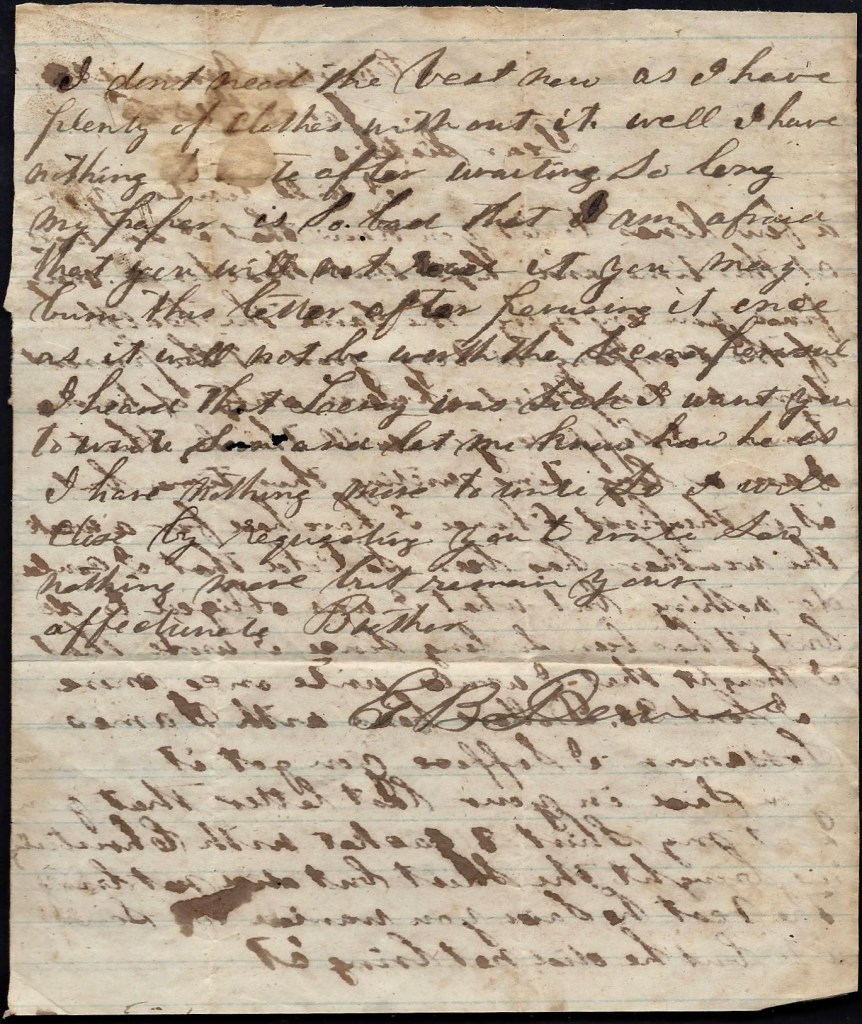

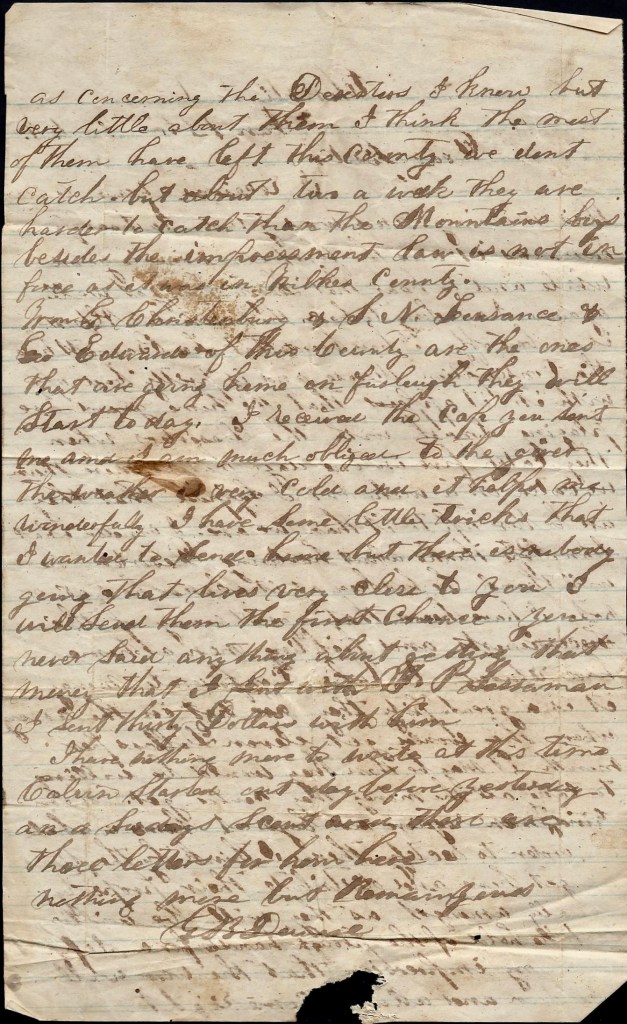

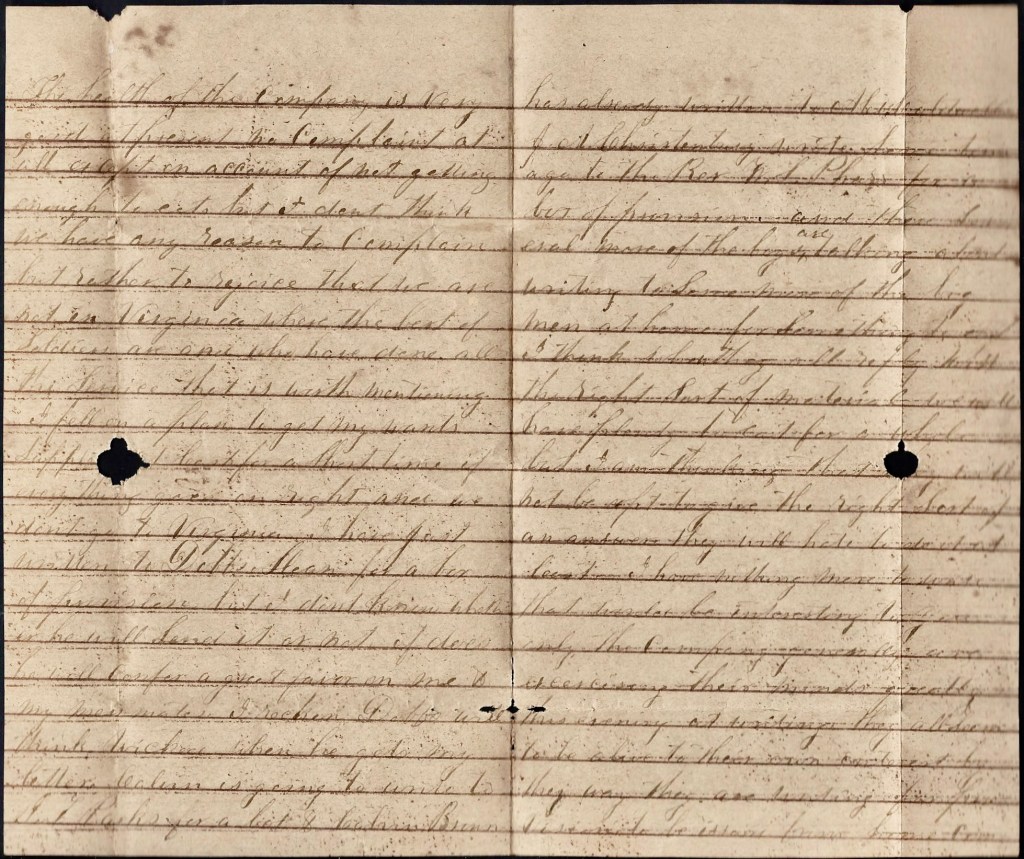

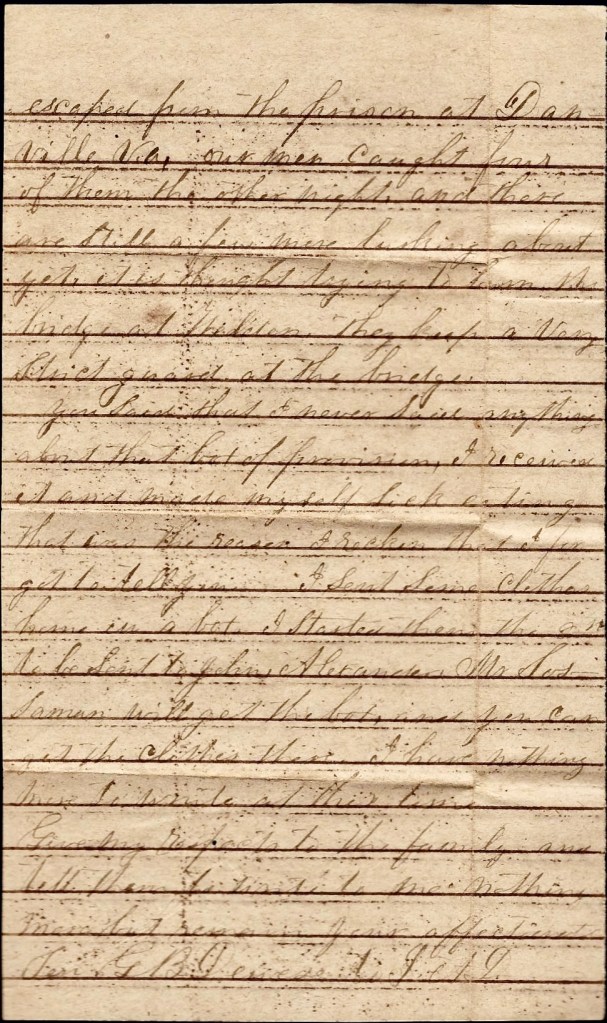


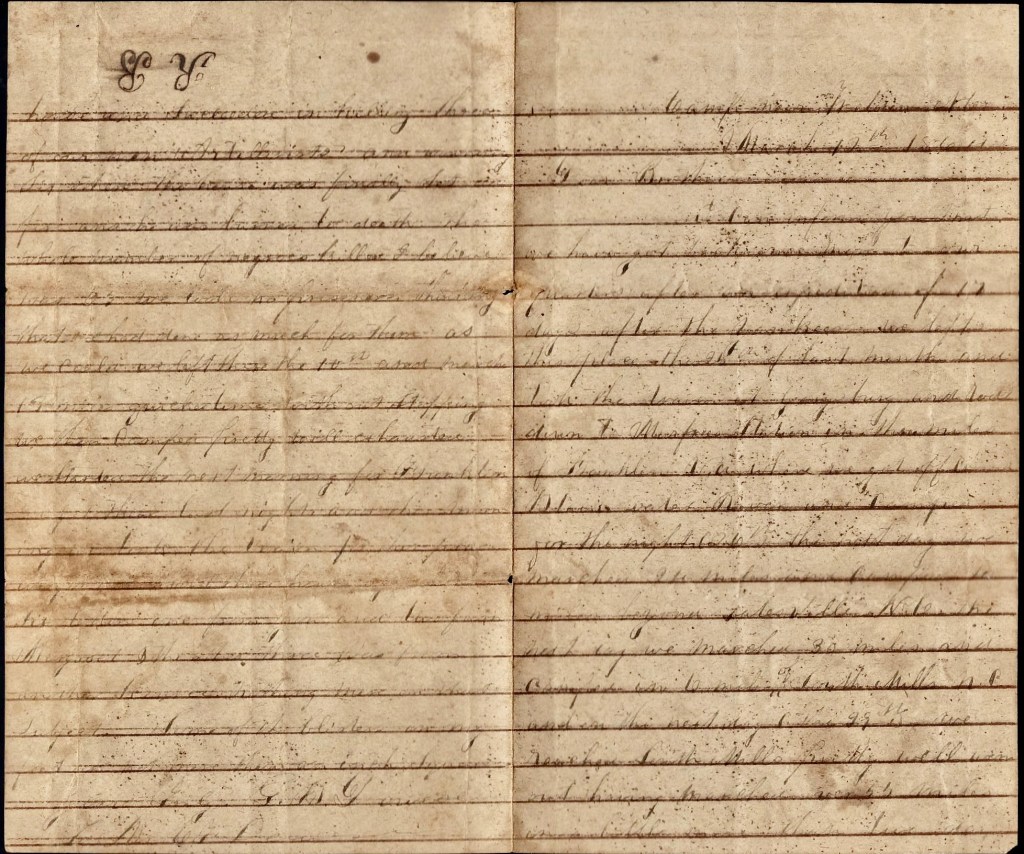
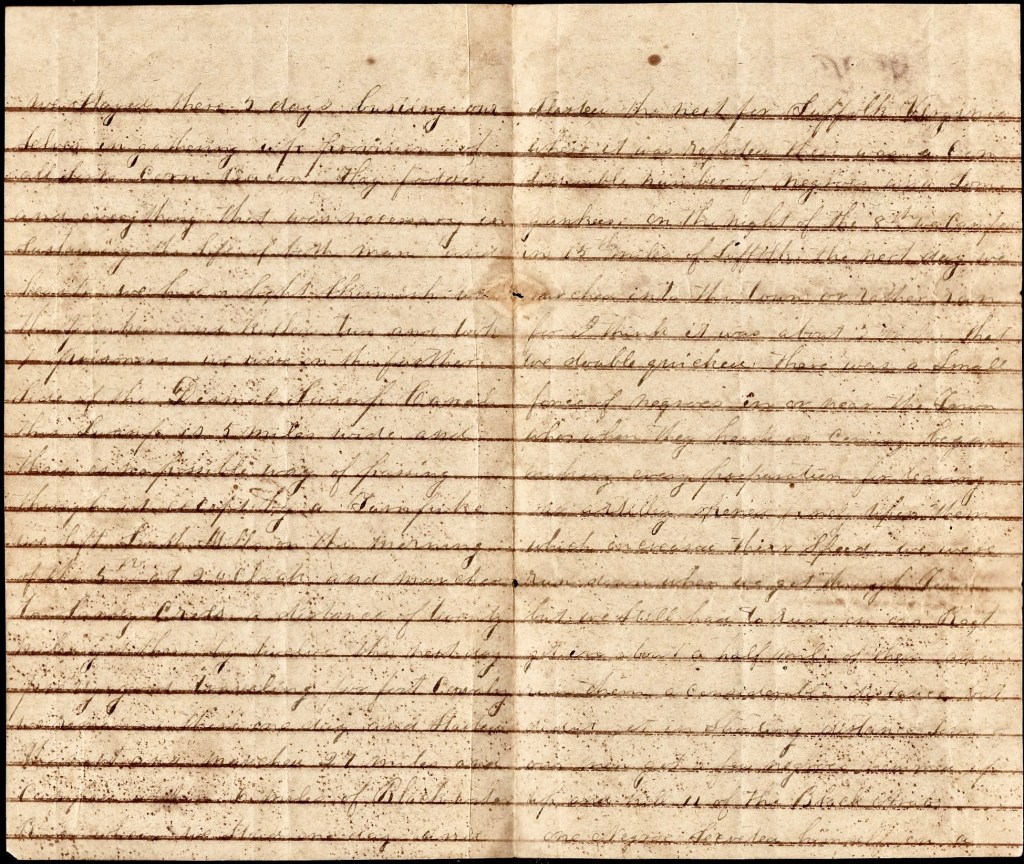
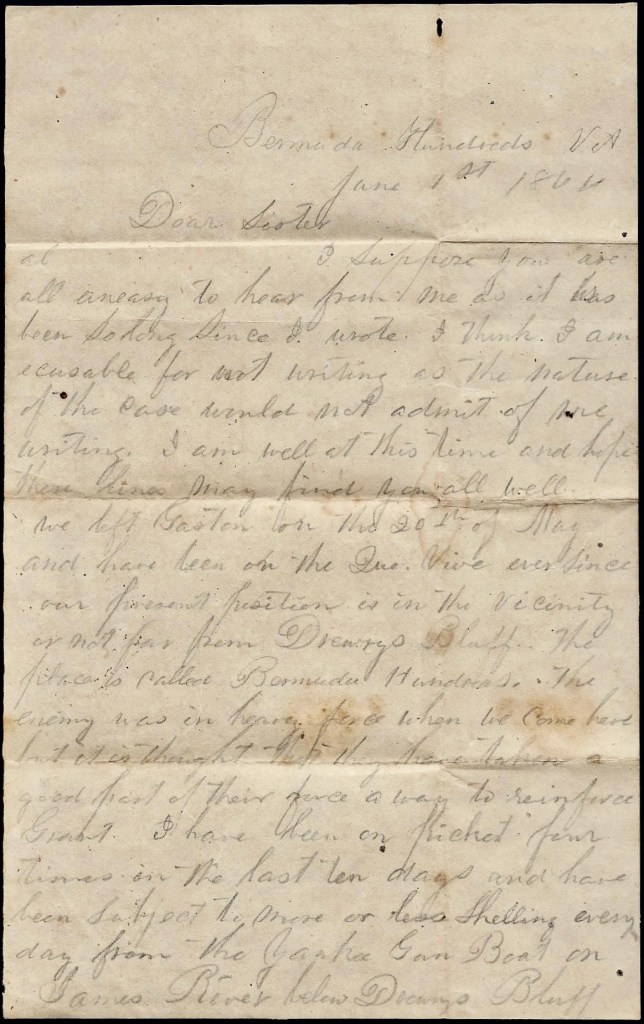
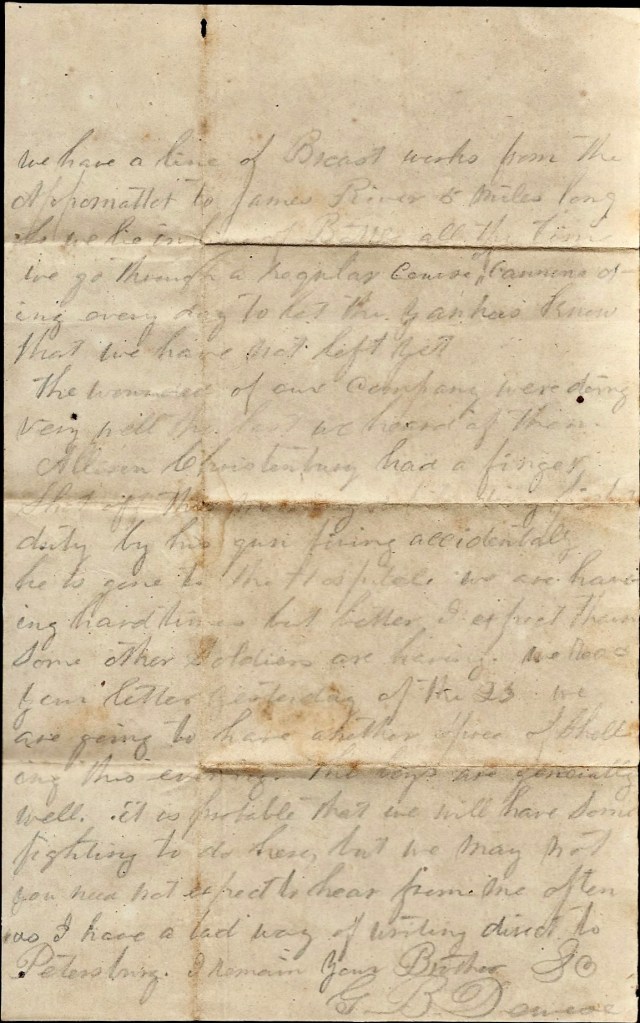


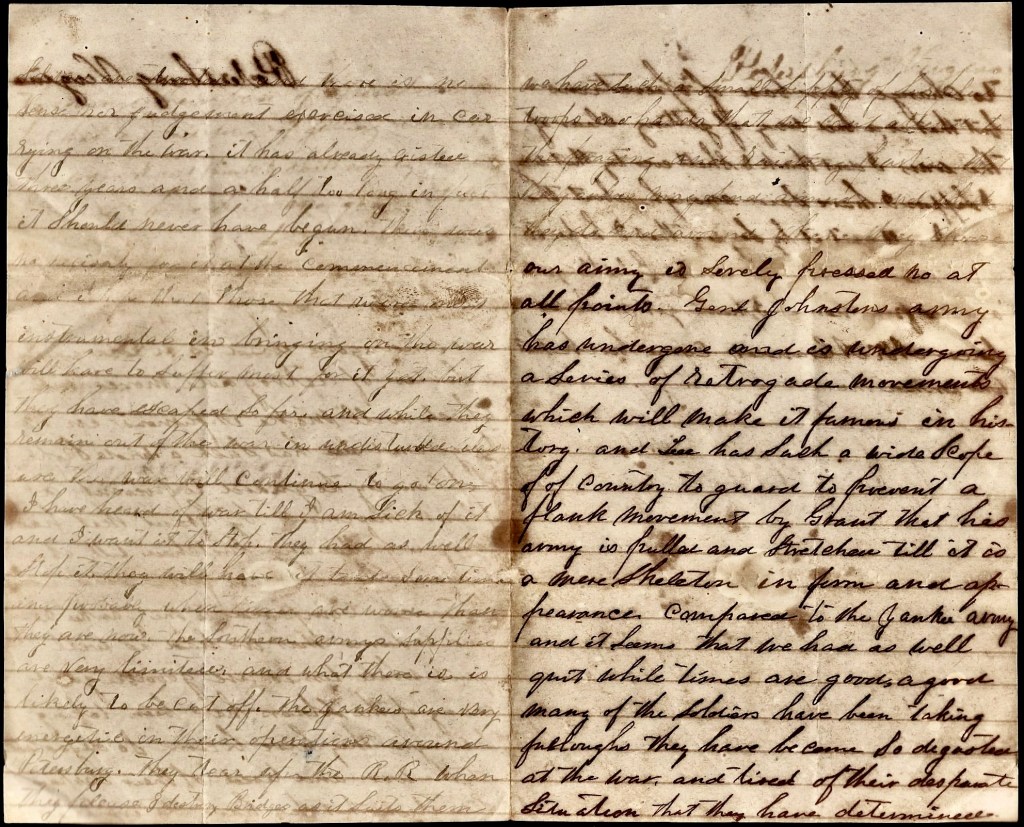
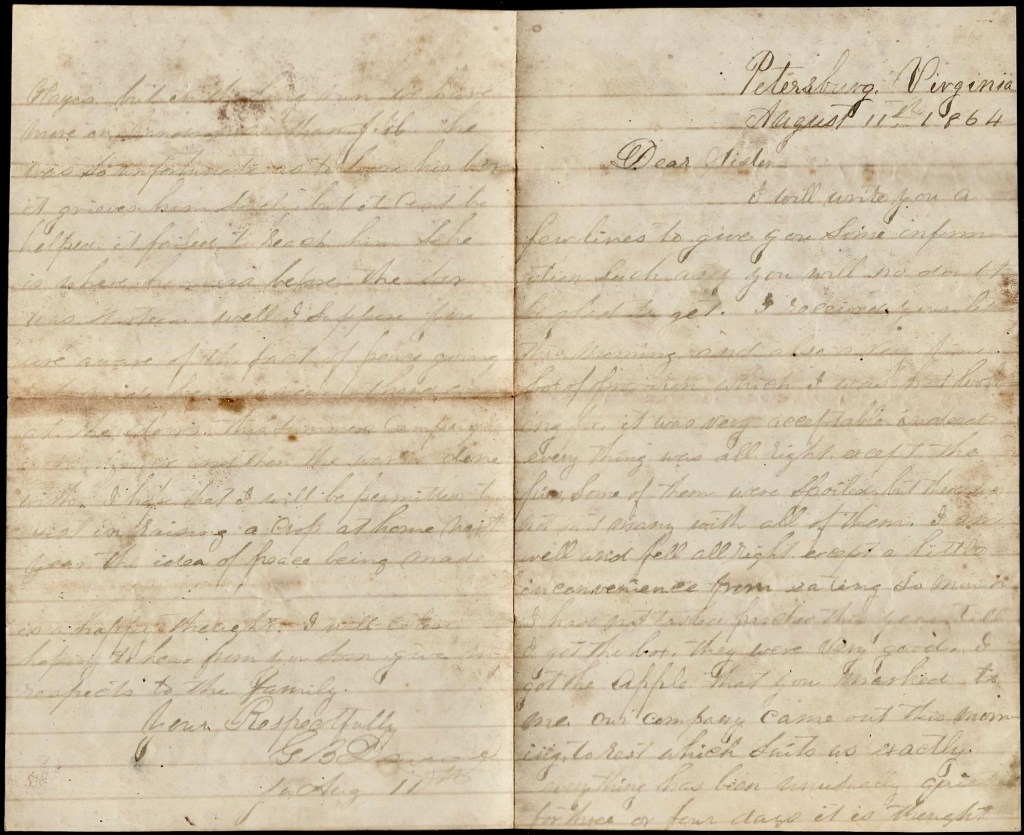
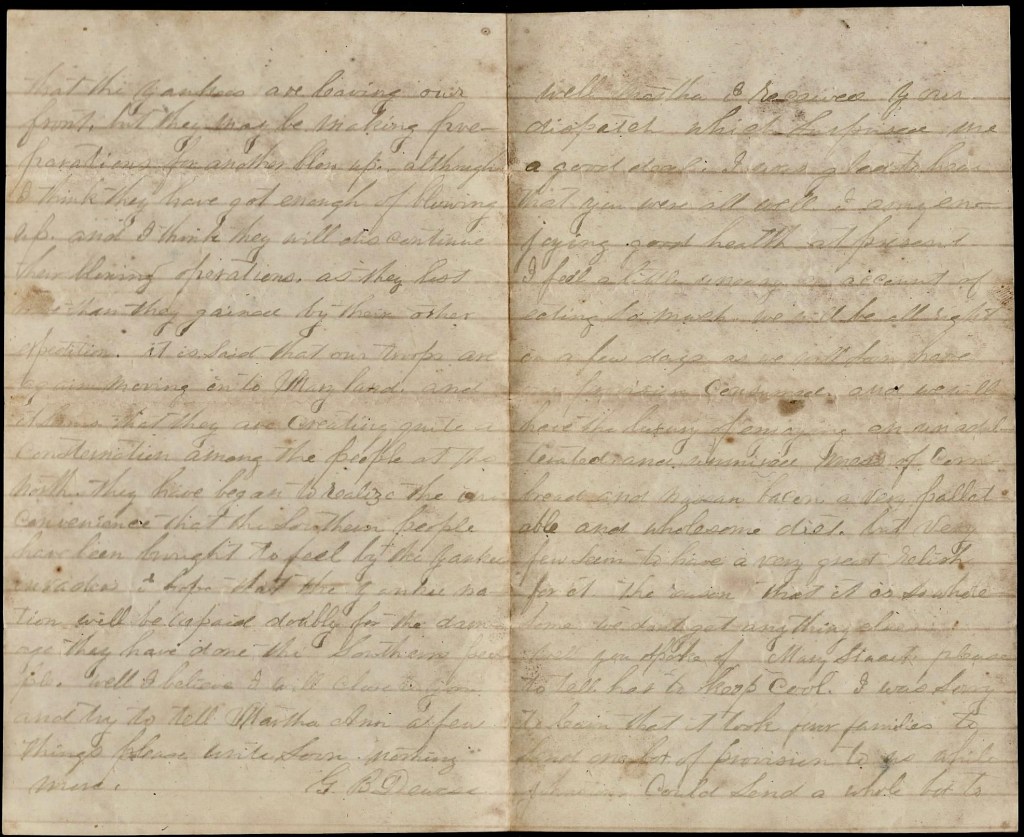
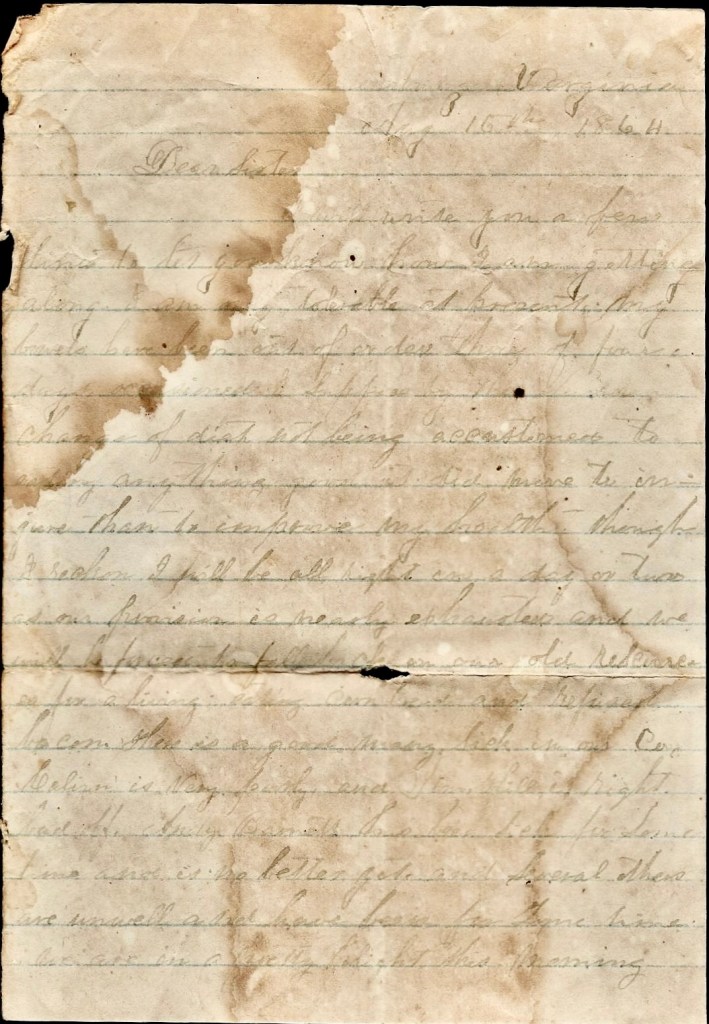
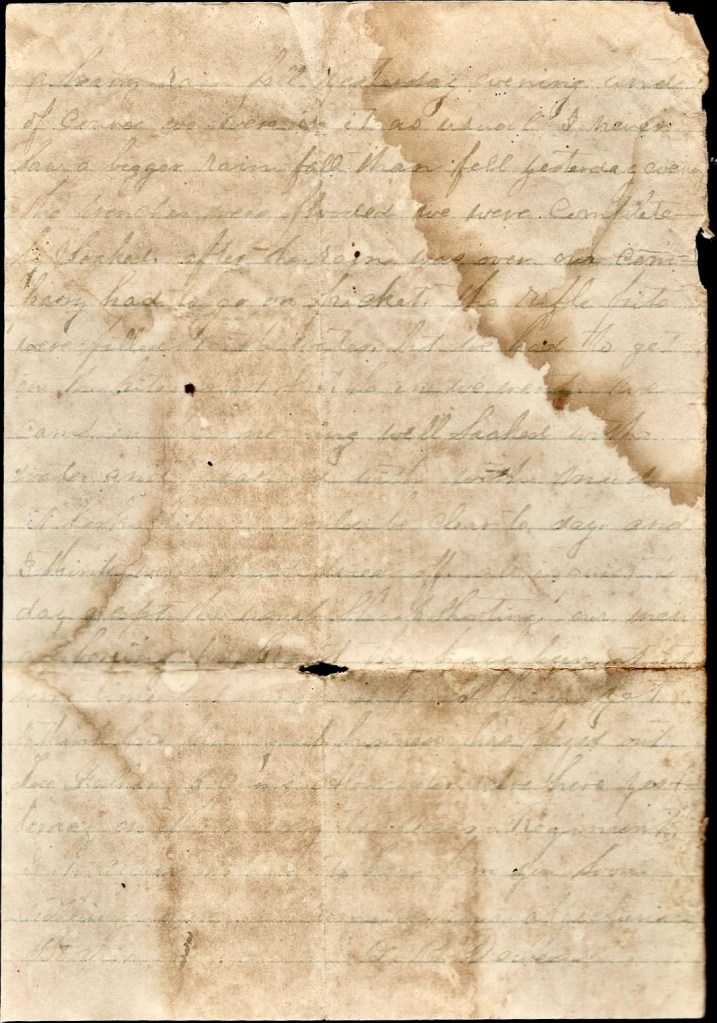
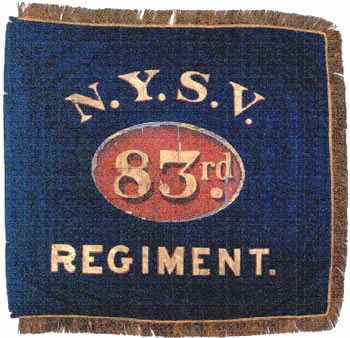





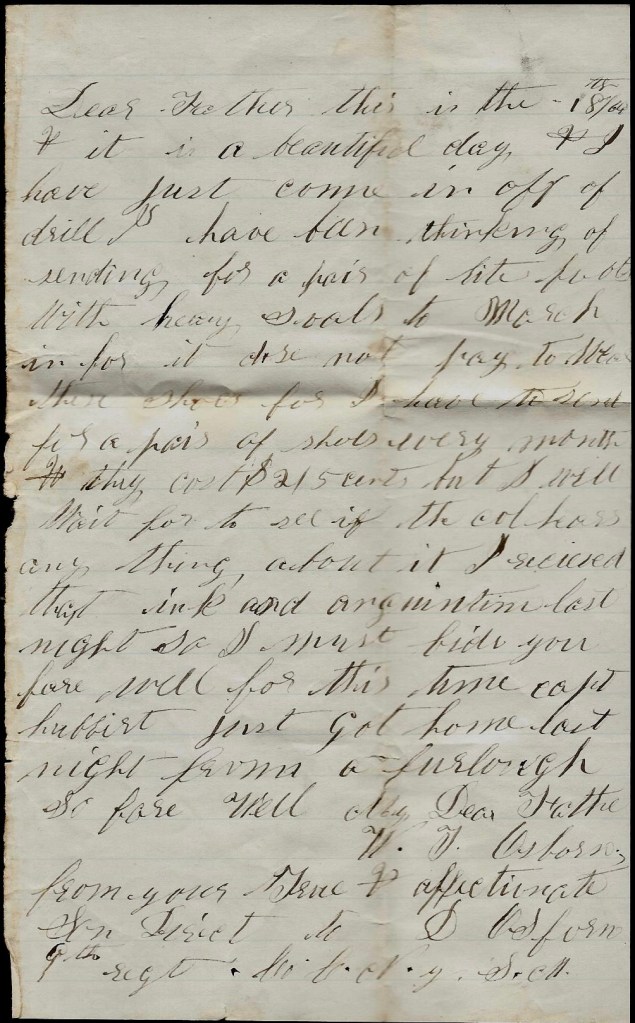
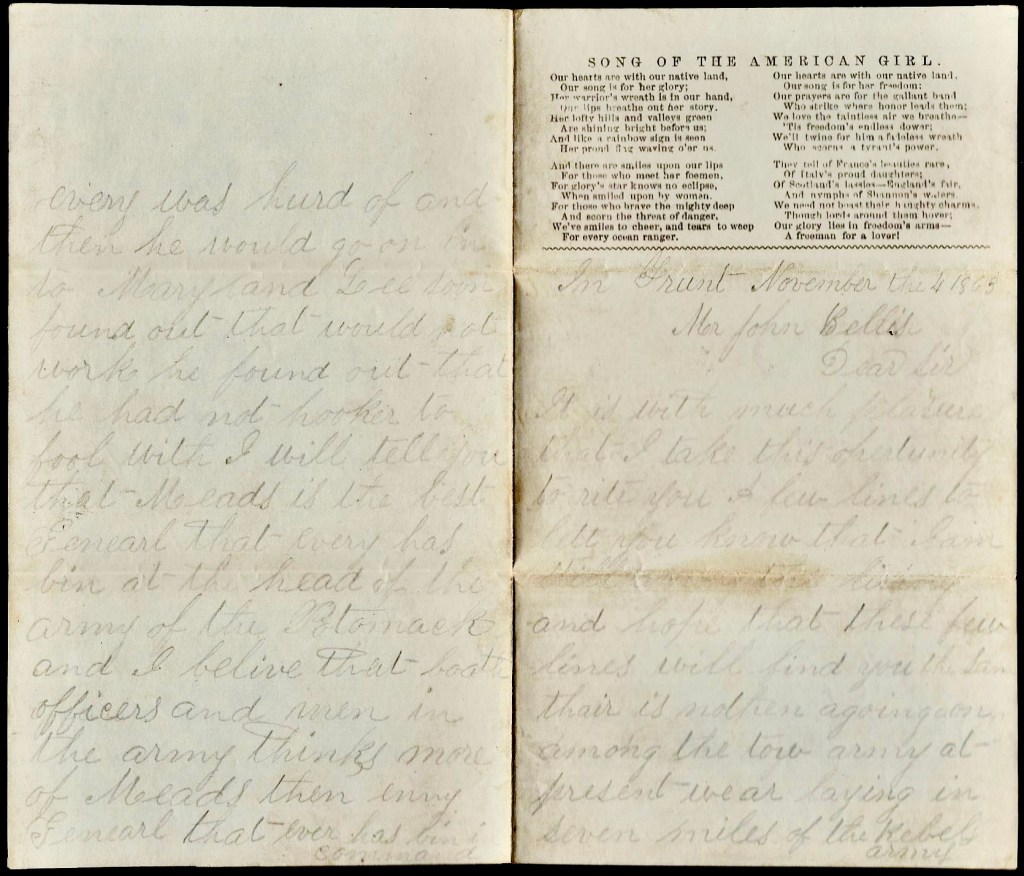
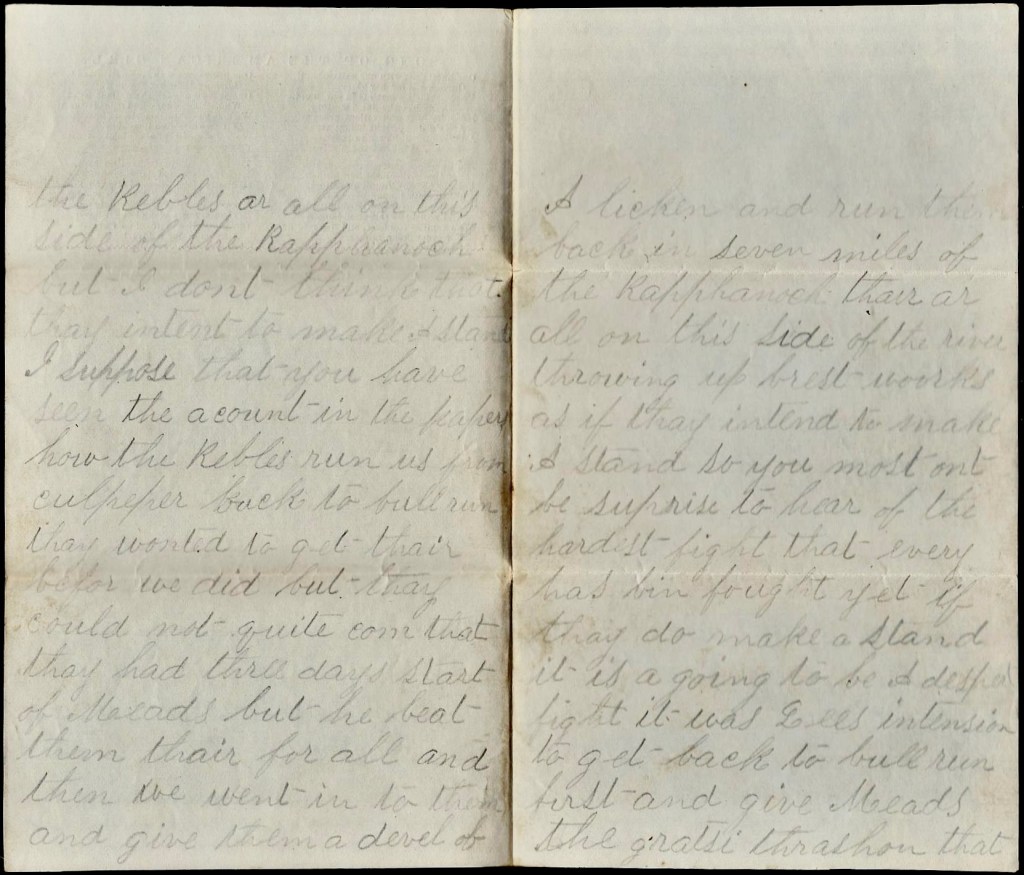

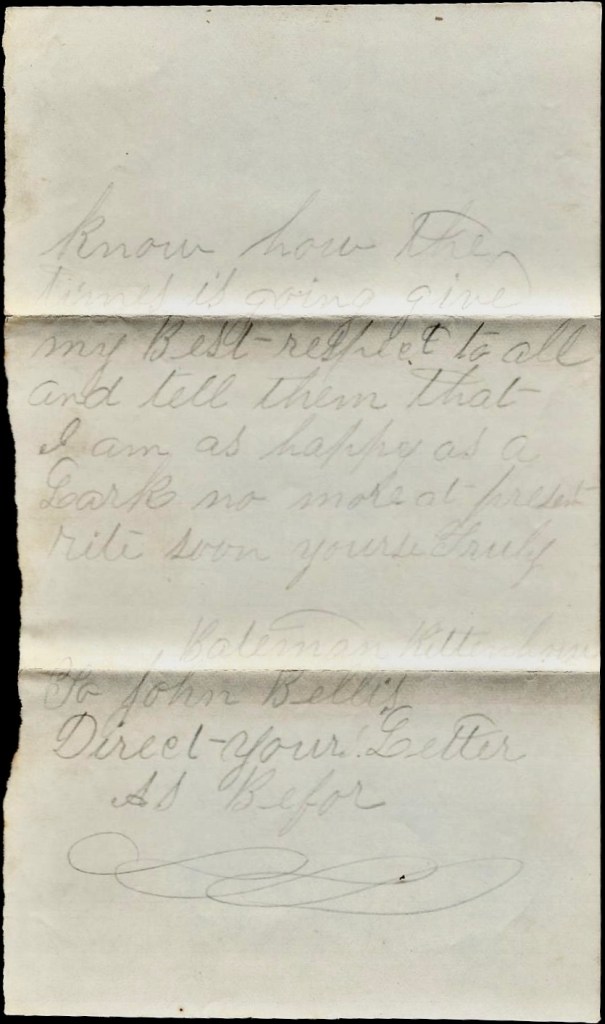
 Spared & Shared 23