My passion is studying American history leading up to & including the Civil War. I particularly enjoy reading, transcribing & researching primary sources such as letters and diaries.
The following letter was written by German emigrant Pvt. Jacob W. Rush (1845-1902) of Co. L, 3rd Ohio Cavalry. His pension records inform us that Jacob was wounded twice and spent 8 months in prison at Cahaba, Alabama. He was exchanged from prison on 27 April 1865 and survived the explosion aboard the steamboat Sultana on his return home. He married Sarah Kelley Webb (1846-1915) in 1868.
Jacob’s father was Thomas Rush, born in Bavaria in 1813, and in 1860 enumerated as a farmer in Kelleys Island, Erie county, Ohio. We learn from the letter that 16 year old Jacob did not have his father’s permission to enlist so he probably lied about his age in order to be accepted into the regiment.
A post war image of Jacob W. Rush
An obituary posted on Find-A-Grave states that “Jacob W. Rush was one of the most conspicuous characters in the affairs of Pawnee county and western Kansas for many years. He came to Larned from Kelly’s Island, Ohio, in the later seventies, and engaged in the banking business and for many years was president of the First National Bank, which closed its doors in 1896 under circumstances well known to all our readers. He took a prominent part in politics for a number of years, being state senator from this district from 1882 until 1890. He was financier of remarkable ability and was closely connected with all the trouble that disturbed this community since the early nineties. His life was one of many ups and downs but he met all reverses resolutely and never failed to retrieve himself from them. There is no doubt that had death not overtaken him he would have soon repaired in his new home at Lawton, where he was in the brokerage business, the fortune which it is believed was seriously crippled towards the end of his career in Larned and during his short experience in business in Kansas City. He was a man of decided character and made equally strong enemies and friends wherever he was. His death is the concluding chapter to one of most remarkable and notorious conditions of business and social affairs that ever existed in any community in the state. He leaves three daughters, one son and a widow to mourn his untimely death. The sympathy of the entire community is extended to Mrs. Rush, who during the past few months has lost her father and mother, and now her husband.”
[Note: This letter is from the personal collection of Evan Iannone and was made available for transcription and publication on Spared & Shared by express consent.]
A couple of unidentified troopers from Co. H, 3rd Ohio Cavalry. Taken at Camp Worcester in 1861. (LOC)
T R A N S C R I P T I O N
Addressed to Mr. Daniel Huntington, Kelley’s Island, Erie county, Ohio
Camp Worcester [Monroeville, Ohio] December 4, 1861
Dan Huntington,
Dear friend, I see that you have heard all about my enlisting and I was glad to hear from you. We have a good time out here and live fat. We have coffee and bread and I do not know what all. I’d like to come home for a few days but I am afraid my father [would] make me stay home so I think I will stay here. I wrote to John Ward last week.
We drill once a day and that is dress parade and that is in the afternoon at 3 o’clock until 4 o’clock. And [then] we water our horses. I enlisted Sunday, November the 24th. I went back to Sandusky the same day and came back Monday. My Mother was over here last Saturday and tried to get me home but I enlisted to stay and I will do so if I can.
Mary wrote to me last week. I was in Sandusky last Monday to see my Mother but I did not see her for she had left. I went back to Monroeville the same day for we cannot stay over night with a pass. We will leave here inside of 10 or 12 days. We are going to Cincinnati we think. We made our tent as big again as it was and got a stove for it.
I must close my letter for I was on huard last night from 12 o’clock till 7 o’clock this morning and I am sleepy. Give my best respects to all the boys and girls and all them that inquire of me. Write soon to your friend, — Jacob Rush
The 1864 captivity of Andrew Clark McCoy, 9th Minnesota Infantry, at Andersonville.
Andrew Clark McCoy (1842-1913) was born in Crete, Will County, Illinois, on December 26, 1842, and with his father’s family settled upon a farm in Salem township, Olmstead County, Minnesota in 1856. He received his education in the district school and later at Hamline University which was then located at Red Wing. While there, he enlisted in 1862 in the 9th Minnesota Infantry—a regiment that had the misfortune of earning the sobriquet, the “hard luck” regiment. This regiment was trained and used as companies on the frontier in its first year of service, scattered at various posts in Minnesota and later Missouri. In September 1863 the Ninth received a short furlough, and in October the companies departed Minnesota in groups for Missouri. Here, as part of the Department of the Missouri, the regiment spent the next seven months guarding railroads from near St. Louis westward to the Kansas state line. In May 1864 the Ninth concentrated at St. Louis. At dress parade on the evening of May 26 the entire regiment came together with all ten companies present for the first time in the Ninth’s history.
Andrew Clark McCoy, Co. F, 9th Minnesota Infantry (courtesy of Ryan Martin)
From St. Louis the Ninth Minnesota moved to Memphis, where they joined an expedition led by General Samuel Sturgis. They were tasked with protecting Union railroad supply lines from Confederate raiders while Sherman’s army campaigned toward Atlanta. On June 10 1864, Sturgis’s force clashed with Confederate General Nathan Bedford Forrest in the Battle of Brice’s Crossroads (Guntown), Mississippi. Sturgis’ units joined the battle piecemeal and were defeated by Forrest. Throughout the night and into the next morning Forrest pursued the federals for more than twenty miles. The Southerners captured many cannon and wagons, as well as some 1600 prisoners. 235 men from the Ninth Minnesota were sent to prison camps.”
The following speech was written sometime after the war by McCoy chronicling his experience at Andersonville, the notorious Confederate prison located in Sumter, Georgia, where he was held in captivity for about six months in 1864. Following is exchange from prison, McCoy returned to his regiment and served until August 1865. Following his discharge, he returned to Olmstead county where he became a prominent farmer and leading citizen, serving as a town supervisor, as county commissioner, and as a member of the school board. He took an active part in Grand Army affairs and my hunch is that this speech may have been prepared for one such meeting. A copy of the speech was made available to the Rochester Public Library in 1908. How much earlier it was written is unknown. I have published it here because I could not find any evidence that it had ever been published. My thanks to Ryan Martin for sharing the speech.
T R A N S C R I P T I O N
“I was a member of Company F, 9th Reg, Infantry, Minnesota. I was captured at Ripley, Mississippi on the 11th day of June 1864, the very day after the Guntown disaster. Was conveyed through Selma, Demopolis, Montgomery, and Macon to Andersonville. Andersonville is about 60 miles south of Macon and ½ mile east of Anderson, a little railroad station. The prison was simply a stockade built of logs cut 18 feet long hewn flat set in the ground 4 feet and stood 14 feet above it, the enclosure contained 13 acres, 20 feet inside of the stockade were stakes about 2 feet long driven in the ground 12 feet apart. Narrow strips of boards were nailed on tops of the stakes and this was the “dead line.” There were 33 perches around the stockade in each of which stood one guard. The prison was first occupied by federal soldiers held as prisoners of was on March 12, 1864. They were from Bell Island and Libby prisons. This prison was used about one year.” — Account written by A. C. McCoy.
A SPEECH MADE BY A. C. McCOY ABOUT PERSONAL EXPERIENCES AS A CAPTURED UNION SOLDIER HELD AS A PRISONER OF WAR BY THE ARMY OF THE CONFEDERACY
On the 19 day of June 1864 between sundown and dark, 700 of us Guntown victims stood in line in front of the South gate at Andersonville prison—and were counted off into squads of 90 men each. Three of these squads or 270 men made a detachment. The squads were numbered from one to three. The detachments were numbered in order from one side to the other of the Stockade. At the conclusion of the counting the large plank gate opened, and after passing into a sort of ante yard the prison gate proper was opened and we were ordered to go inside. While the counting was going on, Capt. Wirtz and other officers and men mounted apparently ready for any emergency.
Oh! What a sight met our eyes as we entered the prison and the terrible stench that greeted our nostrils—men half naked—complexion colored by sun and pitch pine, smoke-haggard countenances, flesh shriveled and drawn tight to the bone, eye sunken and glassy—it was difficult to believe that they belonged to the same race of beings as ourselves. The great question which presented itself to us at that time was where we could find a place to stand or sit down, to say nothing about unoccupied ground to lie down on at this end of the prison. Every inch of space seemed to be taken, but after a while we separated and found places to lie down in the narrow spaces left for the men to walk in. Our sleep was not one of rest for body or mind—and to add to our discomfiture, we were trampled on by men going back and forth from the creek and slough and the terrible tongue lashing we received for being in their way.
We got through the night without any broken bones or serious scars however, but morning found us possessed with an awful gnawing for something to eat; it being 48 hours since we had tasted food. About 8 o’clock we reported in the drive way near the South gate, according to orders received the night before, where a rebel sergeant met us and escorted us north over the creek and slough to a point northeast of the north gate where our detachment from the “dead line” and on the Second street East from it. These streets were about 3 feet wide and usually ran from the north end to the slough, there being no cross walks excepting the wide driveway at the north gate which was left for and used by the mule team and wagon that brought in our rations. This gate was only used for this purpose.
Sketch of Andersonville Prison by Barbara McCoy
Here we remained without any shelter of any kind until the stockade was enlarged by an addition of 5 acres on the north end which when completed the north wall of the old enclosure was left standing excepting here and there two of the timbers were taken out to give access between the old enclosure and the new one. Eight of us managed to get out one of those pine timbers by considerable digging with the tools nature had given us—our fingers took it to where we had dug a hole about 16 inches deep and wide enough to permit eight of us to lie down spoon fashion, and by the use of an old hatchet we got out six stakes and material in shape and strong enough to hold up 8 inches of dirt above this hole when completed. This afforded a good shelter from the hot rays of the sun by day and dew at night—but in hard rainstorms the roof would wash off and we were obliged to pull out and stand and take it. The hole filled up with water and mud—but usually in a few hours the water soaked into the ground—the soil being a mixture of clay and sand. After the storm had passed over, we re-covered the roof. In July and August we had quite a number of hard rainstorms which was a Godsend for those confined there as it washed away many tons of filth and cleansed the enclosure generally.
Through nearly midway between the North and South gate east and west was a soft slough or quagmire. Through the center of this ran a small creek of water running from west to east. The ground sloped on either side toward this slough. On this creek above the stockade was the cook house and above that was located the camp of the guards. The wash from this camp and the refuse from the cook house entered the creek before it reached the stockade. All the water we used came from this creek. The slough was used for the offal of the prison or dumping place for all who could get there.
In order to get as good water as possible the whole camp were obliged to get it on the west side within a few feet of the “dead line.” It was here that so many of the boys were shot and killed by the guards. At this place there was always a crowd, especially so in the forenoon, of 500 persons or more, each waiting his turn at the water and in the jam and crowding some one or more would reach too far up the stream and under the “dead line.” The guards who seemed to be always alert as to the Yanks violating prison rules without using any discretion or reason whatsoever would fire from their perches on either side of the stream right into the crowd nearest the “dead line.” The offer held out furlough to any and every guard who shot a federal prisoner for crossing the “dead line.” The guards made no bones in telling us so.
In the hands of the water brigade you could see all kinds of ingenious contrivances imaginable for carrying water, some with shoes, old boot tops, bags made from rubber blankets. I saw small buckets made from material got inside of staves with hoops, spliced the ends of which were riveted together with zinc nails taken from the heel of an old boot or shoe. Our outfit for cooking usually consisted of one or more half canteen, a tin cup and a case knife which someone of the mess brought into the enclosure or was lucky enough to find strolling from its rightful owner. We were furnished absolutely nothing inside the prison, aside rations. Lucky was the man who when captured was suffered to retain his haversack and his individual kit of field cooking utensils. Nearly all who were captured by Forrest’s men were robbed of their money, watches, pocket knives, hats and the whole private cooking outfit that was of any consequence. When our rations were issued to us uncooked, each one cooked his own, the dishes being too small for more. The outfit heretofore mentioned was the common property of the mess and in the use of which each took his turn. Arches were constructed of clay for cup and half canteen to sit on underneath of which was a fire made from a few splints of pitch pine.
Wood was a scarce article inside of the stockade and it was necessary for us to economize in its use—while not more than 80 rods from where we were we could see hundreds of cords standing in the tree. Every morning at 8 o’clock a rebel sergeant came inside, called us in line 2 deep to answer our names as he called them and as we answered he would check us off on his book—and from these checks the number of rations were issued or each check on his book represented a ration for that day. There was a sergeant for each detachment. One man of our number was appointed by the rebel sergeant to draw rations for the detachment of 270 men. Then there was a man chosen from each of the squads to draw its share of 270 rations. The detachment sergeant would divide the amount he received into three equal parts and one of those parts represented one man’s ration for a day of 24 hours. In the course of the forenoon the wagon containing our rations was driven in. For a time our ration was corn bread with a couple ounces of raw beef and at other times in lieu of corn bread would be corn meal. At other times it would be corn meal mush with no meat or salt. When mush was issued to us, it came in steaming hot and was measured out to the detachment sergeant from the wagon with a common shovel. The corn meal in whatever way it was dished up to us—whether cooked or raw—was coarsely ground and unbolted. No salt was used in the cooked food or issued to us except on two occasions and the allowance then was so small that it was of little value. Sometimes our ration would be a pint of half cooked peas or red beans which were full of black bugs. Our digestive organs could do nothing with them. On one occasion we received each a tablespoonful of vinegar and on two occasions the same quantity of sour molasses. A ration of corn bread was a piece about the size of my hand, of raw meal 1 pint, of mush 3/4 of a quart. The mush we could not keep as it would sour inside of two hours. We ate it up right away. Most of the corn bread was hardly baked through. The meat when we got any was given with one or the other named ration. The last two months no meat was issued. The raw meal we wet up with water and cooked it on the ever handy half canteen. The beef we stewed in the same dish. Our corn bread ration we tried to make last as long as possible for us to restrain our knawing stomachs. When other kinds of cooked foods were issued, we were obliged to eat it up right away to keep it from spoiling.
You understand that we were destitute of any utensils for receiving or keeping of the rations and the men who drew the food for detachments and squads had only a blanket or rubber pouch to carry the stuff from the wagon to the place of division. In my own case, I tore out the sleeve lining from my blouse to hold the rations of my mess. We had been there less than a month when our boys commenced to die of dysentery and bowel troubles caused by the quality of food received, from exposure and impure water. Nearly all were reduced to walking skeletons. The prison was a breeder of disease. The slough a bed of squirming maggots, and air impregnated with foul odors from the cesspool—and for some distance back from it the air was filled with flies bred there. The death rate was greater among those who were unfortunate enough to be located on its borders. Many died later of starvation and of that loathsome disease, scurvy, and gangrene and of other diseases bred by the scanty allowance and unwholesome nature of food received, and the want of proper sanitary regulations. The pangs of hunger were at times terrible to endure. At night would dream of home and its surroundings, of being about ready to sit up at a table spread with the most palatable layout imaginable, only to wake up and hear the groans of the sick and dying all around us, the guards cry the number of their posts and the hour of night ending with “all is well,” and then realize our dreadful situation—that we were in the hands of men who were not possessed with such a thing as pity, mercy, reason or manly consideration. Our stomachs many times would not retain the food and at other times the sight of it would sicken us. Many times in my own case while standing in the ranks for roll call, I became dizzy from weakness and could not see an object 20 rods in front of me and had to sit down to keep from falling. But this feeling wore off as the day advanced and would be able to take considerable exercise and feel quite well considering.
Our time at first was spent in studying our surroundings, playing games with devices of our own manufacture, talking, relating our boyhood experiences, &c. But the uppermost thought always to be considered was the opinion of each one as to the length of time he thought our stay would be there. This opinion was asked for many times a day—anxious to know of home, of the outside world and what our armies were doing. The want of suitable and sufficient food turned our minds in that direction, would tell of the good meals we had helped to stow away, of what they consisted and how cooked. Would even remember of the crusts of bread we had seen floating round in our folk’s swill barrel and think what a feast we would have if we could get at it. Would wonder if General Stoneman or someone else would not come down on the guards and relieve us—and a thousand and one thought of like nature suggested by one and another. Little did we think or dream that we lived under the following order which if carried out meant certain death to all of us:
Headquarters Military Prison, Andersonville, Ga. July 27, 1864
The officers on duty and in charge of the battery of the Florida Artillery at the time will, upon receiving notice that the enemy has approached within seven miles of this post, open upon the Stockade with grapeshot, without reference to the situation beyond these lines of defense.
John H. Winder, Brigadier-General Commanding
[Original clipped from newspaper taken from the Confederacy records]
Our daily routine was about this—1st, in line for roll call—2nd, draw rations—3rd, cook and eat same—4th, if any of our friends were sick to help or carry them over to the south gate and there wait with them their turn to be taken before the doctor—5th, if any of our number had died during the last 24 hours to carry him out through the south gate and leave his body there to be picked by the burial party and while out there to pick up some wood and bring back with us—6th, would skirmish for vermin, first take the shirt and then the pants and go over each article carefully—usually twice a day—and if there were any in our mess who were unable to look over their own clothes someone would do it for him. These little demons increased in number and size most rapidly and throve the best of anything I ever saw or heard of in all of God’s creation. I know they sapped the life’s blood from many a poor fellow’s veins. As a matter of fact, all those who had been confined there any length of time were reduced in flesh and strength and had but little blood left in their body. The ground was alive with the vermin. It was no unusual thing to have the outside of our clothes covered in the morning so thick that we could scrape off these pests with a knife or rather a stick with the edges sharpened. We had no chance to wash our clothes and they were worn until they literally dropped off us, which were replaced by stripping the dead who were taken out nearly naked. Usually a shirt or a part of a blouse was left on them. The dead were laid out with hands crossed below the breast, wrists tied together as was also the feet. The name, regiment, and state to which he belonged was written on a piece of paper and fastened to the breast of the garment left on him.
The sick were often compelled to wait 3 or 4 hours in the hot sun before their turn came to see doctors. Many died there while waiting. It became useless to go to the gate for medical aid from the fact that the doctors had no medicine to give excepting the steepings of weeds and herbs said to have medicinal properties. The hospital on the outside was always full and it was generally known that to go there in nearly every case was but so many steps nearer the trench. Many times when our young Johnnie came inside to call the roll, he would report to us the death of this and that one of our detachment who had left for the hospital but the day before. During the months of July and August there was about 35,000 persons confined in the stockade and the average daily death rate for those two months was 200. The number of inmates was kept up by new arrivals from Grant’s and Sherman’s armies. From these arrivals we learned what our armies were doing. The Johnnies only let us know of federal reverses. During the long time confined there I never saw a newspaper of any kind.
When the new arrivals came inside, the boys in their eagerness to gain news would gather and stand around them in great immense crowds which the rebels in their fear, or otherwise, construed to be a gathering to plan an outbreak. So one day some of the guards came inside and stuck stakes with white stripes of cloth fastened to them through the center of the stockade north and south and orders were given that if we congregated on the west side of this line of stakes—that is, on the side next to the gates—they would open on us with shell and canister. They did one afternoon by firing two guns. One shot went clear over the stockade. The other struck between the dead line and the wall of the north end.
During the last week in September, they took the first trainload of men out. It was supposed for exchange—in fact, they told us it was. But after the second trainload was taken out, all such hopes were dispelled. Our show began to look blue and no wonder that some became discouraged and gave up and in their delirium crossed the “dead line” that the guards might put an end to their miserable existence. It looked as if our only show to escape from death was by taking the Oath of Allegiance and enter the Confederate service. This inducement was constantly held out to us. They called for men to go out on parole to make shoes and for men who were acquainted with machinery who could run and keep the same in repair, offered great inducements to such, but few expressed a desire to go and those who did were reasoned with by their fellows and most cases were persuaded to remain inside. Those who did go outside on parole did it thinking their show for escape would be better and with the intentions to do so at the first opportunity offered. A fixed determination generally prevailed that no one, let come what may, would do anything to aid or help the rebels—or in short, “Death before Dishonor.”
Some of their modes of punishments aside from cutting off rations were: They tied men up by their thumbs to limbs of trees so high that their toes would just touch the ground and kept them there in that position from 8 to 10 hours at a time, or until the victim fainted. One day out by the south gate, I saw men laying on their backs with the hot southern sun beating down on them, their feet fastened to stocks, arms stretched out full length, their wrists tied to stakes driven in the ground in such a position that it was impossible for them to shift their position in any way. One of our boys who had helped to carry a dead person out borrowed an ax of a negro to cut up some limbs of a tree to carry inside, he concealed the ax in such a way as to elude detection of the two guards at the gate and brought it inside and when the ax was missed they compelled the negro with a guard to go inside and pick out the man who had the ax, which he did, and he was taken out with the negro and they were both ordered to bare their backs. The negro’s hands were tied to a short post and a rawhide whip of 3 strands was given to the white man and he was ordered to give the negro 30 hard lashes. He remonstrated but was told he must do so, or he would received a double dose. After he had whipped the negro, they changed positions from active to receptive—vice versa. There were kept on the outside of the stockade at the southeast corner in a covered shed, a dozen bloodhounds in charge of their master. They were kept and used to capture escaped prisoners and paroled men who attempted to run away. Quite a number of tunnels were dug from the inside under the stockade well and those who escaped through them were scented by the hounds, and run down or treed in a few hours after their escape had been discovered (of course these escapes were made at night). The poor runaways were obliged to climb a tree in order to keep the hounds from tearing them to pieces before their mounted master came up to call them off.
Three weeks before I was paroled for exchange, I was removed to Savannah, Ga. I was there one week at the end of which was taken to Milan or Camp Lawton—both prisons were stockades. The enclosures were constructed of the same material and in the same way as Andersonville. At Savannah the dead lines were lit up at night by lamps but we were crowded in there to almost suffocation. Rations were better, however, both in quantity and quantity. At Milan the stockade enclosed 60 acres and there were not over 8,000 of us there. The prison was new and had not been occupied more than a week before our arrival. The treetops of timbers cut for the enclosure were mostly there so wood was plenty. We needed it badly for it was getting to be pretty cold and frosty at night. Quite a stream of water ran through the stockade and no slough. By the use of this stream and some fixing up which was done before it was occupied made it more healthy and in accordance with true sanitary rules. Was there two weeks when on one afternoon in the first week of December 1864, a rebel sergeant and surgeon came in and called for all the sick to fall in line. The boys were a little slow about it, had been fooled so many times that they thought there was some game in it, but I said to my mess, “I’m going to see what’s in it anyway.” I had no more idea I would pass or that it meant exchange than I have of owning this hall. I took a place in line and when the surgeon came to me, he looked me squarely in the eye and said gruffly, ‘What’s the trouble with you?” I answered, “Bone scurvy.” He pinched my right arm midway between the shoulder and elbow joint, turned to the sergeant and said, “Put his name down.” As fast as our names were written down, we were separated from the rest and were formed in a separate line and as soon as there was a train load of us, we were marched to a vacant corner of the stockade where we stayed that night under a special guard. The next morning we went through the gate en route to the station 3/4 of a mile away, walked along the road between the files of guards. It took me ½ day to walk that distance and I did my best!
We boarded a flat car and rode all night in an awful cold rainstorm. Arriving at Savannah in the morning, we found men with tables and blank paroles for us to sign. While waiting my turn I noticed that there were some dead bodies carried from the cars, this was no unusual occurrence in the transporting of men from the rebel prisons. After all the men had signed their paroles we were marched to the river past Fort McCallister and to our fleet of transports. Steamed alongside on the them, a gangplank was laid down between the two boats a Federal stood on one edge, a Butternut on the other of the plank, and counted us as we passed from one boat to the other. It was not long before we were treated to “Yankee food,” after which we washed and scrubbed ourselves, hair and beard trimmed, after which we donned decent clothing. In a few days we were examined and those who were thought to be able to stand the trip were put on board an ocean steamer for Annapolis, Maryland. The others were left on hospital boats we passed. And after three days passage, arrived at Annapolis and had the joyous satisfaction of planting our feet once more in “God’s country, and standing beneath “Old Glory ‘Free’.”
There were 184 of the 9th Minnesota volunteers in Andersonville. 128 died there; 56 came out alive. Of my Co. F, 19 were captured; 13 died in prison. Only 6 came out alive.
Two privates who served with McCoy in Co. F, 9th Minnesota Infantry. Both were from Crete, Illinois, but served in the Minnesota regiment. At left is John H. Dodge who survived the war. At right is Edwin Horace Adams who died of starvation in the Florence Stockade on February 19, 1865 two days before prisoners were exchanged. His cenotaph in Crete has an unreadable epitaph except for the last few words “…that awful Florence Hell.” Both images were taken in the same studio; Dodge wears his sack coat and Adams wears his dress coat. [Images courtesy of Ryan Martin]
No artistry conveys the miserable conditions of Andersonville than this actual photograph. (LOC)
Readers wanting to know more about the 113th Illinois may want to dig into this 561 page book published in 2009. I have it in my library and found it quite comprehensive.
The following letters were written by George Cook (b. 1841) of Crete, Will county, Illinois, who enlisted 1 October 1862 as a private in Co. A, 113th Regiment Illinois Volunteers. He mustered out of the regiment in June 1865.
George wrote most of his letters to his older brother, Thomas Cook (b. 1838) of Crete. They were the children of William Cook (1810-1890) and Elizabeth Atkinson (1803-1863).
These letters are from the personal collection of Ryan Martin and were offered for transcription and publication on Spared & Shared by express consent.
[Editor’s Note: the header image is a picture of the 113th Illinois taken in Memphis.]
Letter 1
Memphis, Tennessee December 15, 1862
Thomas Cook,
Dear brother, I now take my seat to pen you a few lines to inform you that I am well, hoping these few lines will find you the same, and Father and Mother I hope are well and getting along with your fall work well. I should have wrote to you before but I have not had time.
We left Memphis on the 26th of November on a march and we have been marching ever since. Well, in the first place I will say that the roads are very muddy and it has been hard traveling. It never snows here in winter but it rains most awful sometime. I know December is their winter month so it is in the middle of winter here and about two feet of mud to sleep in. But that’s nothing.
In the second place I will say that in addition to the mud, we have some awful hills to climb which is good work for the mules and makes very slow traveling. Six miles a day is a hard day’s march and take till ten o’clock at night to do it at that.
We went from Memphis to Germantown—a very pleasant town—but we left it mostly in the shape of ashes. Then we left and went down into Mississippi after Price and his army. Price was encamped on the Tallahatchie River but when we got there, the bird had flown and burned the bridge so we could not follow him. But we went to work and built a bridge in three days so as to cross the river. Then our men had a little brush with him and we took three hundred prisoners. Now Price has gone to Vicksburg and we did not follow him any further.
We went from the [Talla]hatchie River to Holly Springs, the hilliest road ever you see, but Holly Springs is a very handsome place when you get there. But everything is going to rack [and ruin]. The soldiers destroy everything—they burn houses and fences and crops and all—everything. There is not 80 rods of good fence in the whole country.
We went from Holly Springs back again to Memphis, but how long we shall stay here I cannot say. I think not long. I think we shall go down the river to Vicksburg in a few days. We came back yesterday, the 14th of December, making a trip of 18 days. As for me, I stand the marching very well but there was about half of the regiment that give out. The hardest part is after marching all day in a heavy rain with your supper of crackers in your pocket to have them all spoilt with the wet and have to lay down in the mud without any supper. But mud makes a soft bed to sleep on.
The country out here is all timber and very heavy timber too, from one end to the other. Wherever I have been, it is one vast forest—no openings at all—nothing but trees and stumps. All the large plantations have been cleaned up by the colored people. Some of the large farmers have as many as two or three hundred slaves on their plantations. There was one day 140 slaves left one man and came into our regiment and came with us to Memphis—quite a loss for the man. But then it could not be helped.
Levi [James] and Darton [?] are well and stand soldiering very well. [Sgt.] Henry Case has been sick ever since we came here but he is getting better now. He did not go with is on our march. He stayed in the hospital in Memphis. He is getting better fast.
When you get this, please write. Direct your letters to George Cook, in care of Capt. George R. Clark, Co. A, 113th Regt. Ills. Vol. , Memphis, Tennessee.
If you put these directions on your letters, I will get them. Now I want you to be sure to write and write soon and tell me how you all get along with your work. How near you have got through husking corn and how you get along with plowing and how George Hill gets along with his work and tell me if you have thrashed and how your grain turned out and how you get along with shelling corn and how all the folks get along. I want to hear some news. I am so lonesome here. Tell George Hill to send me a few lines too and let me know how he makes it go. Tell me if you have had any snow yet. I get along very well. Money is no good here for you cannot buy anything with it—not even postage stamps. I have offered ten cents for a postage tamp to put on this letter but could not so I have to send it without and you will have to pay it yourself. Tell me how Mother gets along with her work and if her health is good. Tell Mother that I should like to have her mince pie to eat. Tell her that I think I shall be home in time to have some of the strawberries next summer. Give my respects to George Hill and my love o Father and Mother and keep some for yourself. Please write, — George Cook
To Thomas Cook
Letter 2
In front of Vicksburg State of Louisiana January 25, 1863
Dear Brother,
I now seat myself to write you a few lines to let you know that I am still able to eat my allowance, hoping you are the same. When I wrote to Father last, I was at Napoleon, State of Arkansas. Now I am in Louisiana in front of Vicksburg. We landed here on the 22nd. The weather is very rainy and muddy. We are at present engaged in digging a canal to as to get out gunboats below Vicksburg. We have thrown up breastworks and planted our cannons so as to defend ourselves for we are in reach of the enemy’s guns. They throw two or three shells everyday but have done no damage yet though they come very close to us. We have a good view of the City and we can see their boats as they run up and down the river. Our guns put a hole through one of them yesterday. Then the enemy gave us a few shell but done no damage.
We are getting new troops everyday. The officers say that it will take about three weeks to dig this canal. I am gaining strength every day since we left the boat. I received your letter on the 24th with the stamps in it. All was safe.
When we was in Vicksburg before, I came across Orin Alford. [Orrin T. Alfred, Co. I, 13th Ill.] He is [in] the 13th Illinois Regiment. This is the first fight he was in. He is 3rd Sergeant of his company. Also Anson Tuttle [Tuthill] is in the same company with Orrin. He ia a large stout fellow. I had a long talk with him yesterday.
We have to work night and day almost, Sundays and week days all the same. No difference. I tell you, there is not much fun in it as some folks think there is. I wish that Dan Hewes [Hughs?] was in my place about two weeks and see how he would like it. I think he would have a belly full of it. I know that if I was home again, I would wait for a draft before I would go a step. This is all I have time to write at present. Write soon and tell me all the news and what kind of times you have. Write long letters for they are the only comfort I get here. I send my love to Father and Mother and you give my respects to George Hill and tell him to write a few lines to me. I think Father done well with his horse. — George Cook
We have no snow here yet. It is muddy all winter long. The ground never freezes at all. We are ten hundred miles below Cairo—pretty well down in Rebeldom. I think when we take Vicksburg, that our fighting will be done in the West. What they are doing in the East, I do not know for we cannot get hold of a paper to read. We just have been ordered out to go to digging in that old ditch again and I must hurry up and eat my dinner which is a plate of beans with nothing to it.
Write as often as you can for we can get your letters better than you can get ours. I shall write as often as I have a chance if I live and if I die. May God bless you all. Goodbye.
Letter 3
[Expedition to Rolling Fork, Mississippi, via Muddy, Steele’s and Black Bayous and Deer Creek]
Headquarters 113th Regt. Illinois Vols. Young’s Point, Louisiana March 28, 1863
Thomas Cook,
Dear brother, I received your letter last night and was very glad to hear from you but was very sorry to hear that Mother is sick. I am glad to hear that the rest are all well. I am well at present though I have had some hard times since I last wrote to you. I should have wrote home before this for I should have got your letter had I been in camp but we have been on a march for 11 days. We was ordered up on the morning of the 17th of March at about 4 o’clock in the morning with one day’s rations in our knapsacks and our blankets on our shoulders and [told] to leave all the rest of our things in camp. So with out guns and 40 rounds of cartridges in our cartridge boxes, we started under cover of a heavy fog.
We marched four miles when we got on board of the steamboats and started up the river. The swift-footed steamers soon brought us to land 15 miles up the river. Everybody was wondering where we was going to and what we was going to do up here with only one day’s rations along with us. Gen. Stuart went on shore, looked around a spell, and then ordered the boats to lay to for the night.
Well in the morning our grub had run out. Gen. Stuart ordered us to go on up the river to see if we could get anything to eat. We run up the river about 15 miles and landed at a handsome plantation. Here our company was ordered to go ashore to kill some beef. We killed one cow and a lot of sheep and started back to the rest of the boats. We got there about 5 o’clock, having been all day with[out] a mouthful of anything to eat. We got there about dark. [Received but] a chunk of beef with[out] anything to [go with] it—no salt, no pepper, no bread.
The next morning after making our breakfast out of beef again, we started to march through the woods. We went about one mile when we came to some more boats in the woods—a funny place for steamboats to be—but the water was high and had run through a ravine about like that seventy. Here we stayed all night with nothing for supper. In the morning we got another day’s rations of crackers. These all went up for breakfast. We went on board the boats and run up the Black river about twenty miles. This is the finniest river you ever saw. The water looks like ink—black as a nigger’s face. Well we landed a little before dark and marched about two miles to where we camped.
There was a large plantation. Corn was up about a foot. The Negroes never thought of us coming out there. Here we had to lay down without any supper but I was about starved out and so I went into a nigger hut here. They was roasting a chicken which I confiscated with a large Johnny Cake and made out a good supper.
The next morning we got another day’s rations of crackers and started on a march. We marched on quick step all day till about 4 o’clock in the afternoon when we troops was attacked by the Rebels. We was thrown into line of battle and ordered to advance. The you ought to have seen the coats and blankets go scattered in every direction. Here I lost my blanket. We soon put them to flight and after running through the woods after them for about two hours, we brought up in the road again. Here we soon learned that the rebels was about ten thousand strong [and] about 5 miles in our advance. This was a stunner and we made up our minds that we had better retreat.
Here we was without anything to eat and within five miles of a large force so off we started on a quick retreat, We went till ten o’clock when we lay down to rest. Here is commenced to rain and it rained good and strong. We have no such rains up North. We killed a hog and roasted it over the fire in the morning for breakfast when we started on in the mud and water and rain. Here my boots failed to keep me dry for every step I went in over the tops. In this style, we paddled all day lay down in the mud at night and slept sound as a brick, the rain falling all night.
The next day we got about near to where we could get some more hard crackers which was grabbed at and no grumbling. In the afternoon, the sun came out fine and we partly got our clothes dry. At night we made our beds and expected to get a good night’s sleep but our pickets were drove in and we was ordered to fall into line of battle. In this way, we stood all night. The next morning we marched on board of the boat again. Here I lay down and liied to slept myself to death. Here we got some pies and some butter and after running round two days, we got back to Young’s Point on the night of the 27th and here I got your letter. What we will do next, I do not know.
Vicksburg is not taken yet nor is it likely to be taken yet awhile. The Rebels have shelled us out of the canal so it is a failure as I always thought it would [be] after so much labor and so many lives been lost by sickness by being down in this swamp. They talk about starving out the Rebels. If some of these big bugs would come down here and see some of the plantations on the Black river and all through the South stocked with cattle and hogs and chickens, geese and turkeys—every plantation is stocked with poultry, and the woods and fields are [ ] with cattle and hogs. They talk about living off of the enemy and eating them out of house and home. They have not see the corn cribs that line the roads wherever you go. We may feed our army horses at their corn cribs and feed our soldiers on their stock, and still there is stock enough in the South to feed both armies and keep them a going for years yet. They have got corn enough to make corn bread and they have got meat enough to eat. The Southern army lives better today than the Northern army. Every place we go to, every plantation has ten or twelve nigger huts on it and in every hut on the plantation, you will find from one to two barrels of molasses and sugar. Why the other day I went into an old log hut. It looked some like John Cole’s blacksmith ship. In this I found one barrel of salt, three barrels of the best salted ham, one barrel of molasses, and one of sugar and a barrel of sides ad a bout 15 bushels of potatoes. The old reb himself was in his nice house with about a hundred slaves around him. I got a canteen of sides and a handful of salt. This was all that we must touch. A litle while after this, we was attacked by the enemy and then our Generals say, “Well Boys, we will soon starve them out.”
Capt. [George] Clark has come back. He has been promoted to Major. He did not bring the other companies with him adn he says that he thinks that we will all go to Springfield in a little while. If we do, I shall come home as soon as we get there.
You said in your letter that George Shipley was going to get married. Write and tell me if she is good looking or not. Tell him when you see him that I wish him a happy life and if I was home, I would dance at his wedding. He had better wait till I come home but it is getting dark and I must close. Write soon. Tell George Hill to write. Give my respects to all. Much love to all—to Mother, to Father, and to yourself. I trust Mother will be [better] when you get this. I think Father is going in on trading horses.
Letter 4
On the Field in the Rear of Vicksburg Headquarters 113th Regt. Ill. Vols. June 14, 1863
Thomas Cook,
Dear brother, I once more take the opportunity of writing you a few lines to let you know that I am well at present. Hoping these few lines will find you the same.
We are now laying on the field in the rear of Vicksburg digging rifle pits waiting for the rebs to give up their arms and come with us to Chicago. But they do not like the plan very well. How long they will hold out, no one can tell. It can’t be very long though. I think we will be in Vicksburg by the 4th of July at the furthest calculation. Gen. Grant says that he can take the place in three hours but he does not want to lose so many men and Grant knows what he is doing. We have lost men enough now. There is one or two gets killed every day while on duty.
The young man that I slept with all winter was killed yesterday. 1 He was a corporal and we had just gone upon the works to help to move a gun. I was standing close by his side and we was looking across through a hollow at the Rebel’s stockade when the bullet came, hitting him in the left side, cutting his inwards and lodged inside. When the ball hit him, he staggered forward onto his face and rolled over on his back. [That’s] when he said, “Boys, I am killed.” He lived about half an hour after he was shot. So they are getting picked off one at a time through the lines.
I wrote you the other day a few lines with a lead pencil. I do not know whether you would get it or not and if you did, maybe you could not read it. Levi James 2 was wounded in the fight. He has gone to Memphis to the hospital. The other Thornton boys are all well.
Write as soon as you get this and tell me all the news—how you get along with your farming. Tell me where Father is. You said nothing about him in your last letter and what he is doing, Tell him to write a few lines too. And George Hill—how he gets along with his work. I wish I was there to help you with your work. Tell me all about Mother and where she is buried and what was the matter with her. Forgive me if I do soil this sheet with a few tears for I can’t help it. I will say no more. Tell me if you have heard from Uncle Oats lately and if you know where John Oats is. There is a great many Ohio troops came down here lately and if I knew what regiment he was in, I might find him.
Much love to all. — George Cook
To Thomas Cook
1 Possibly William Ferrell of Chicago who served in Co. A with George. The roster states that he was killed on 14 June 1863 at Vicksburg, Mississippi.
2 Levi H. James (1844-1912) was the son of George B. James.
Letter 5
Corinth, Tennessee [Mississippi] August 12, 1863
Thomas Cook.
Dear brother, I once more take the pleasure of writing you a few lines to let you know that I am well as this leaves me, hoping this letter will find you the same.
Our regiment has gone to Corinth to recruit up a little, There is out of our five companies, 164 sick in the hospital. I am in the hospital as nurse for the sick. There is two men in our company fit for duty. The rest are all sick. This is a good healthy place and a handsome country. Apples are 5 cents a dozen, and peaches all you want for nothing. Milk and butter scarce. Plenty of watermelons as large as you can lift.
We got our last pay before we left Vicksburg. Did you or Father ever get the money I allotted home? When you wrote, you never said anything about it and I never heard whether you got ot or not. When you write, let me know and how much you have received. Write and tell me how you get along with your harvesting. I suppose you have got all through with [it] long ago.
This is a great country for potatoes. They grow very large and they raise a great deal of corn in the South. Out at Jackson in Mississippi, I rode through one field of corn in one plantation [where] there was ten thousand acres in it—quite a small field.
There is some talk of making cavalry out of us and if we stay down here, I hope they will. But there is a good show for our coming up North before long.
How do you get along with the draft up North? I suppose the boys are getting a little scared again. I do not think they will draft much in Illinois. Every regiment in the field now is almost from Illinois. Write and tell me what kind of teams you have got. I suppose that Father has got through going with the horse and is at home now. If we come up North, why of course I will come home. I can get a furlough here and come home if we do not go North but it will cost a little too much for me.
This is all I have got to write this time. Write soon. Write all the news. Give my love to Father and keep a share for yourself. Tell Father to write a few lines in your next. Levi James has got his discharge. I think he will lose his arm. I saw him at Milliken’s Bend as we came up the river. Martin Pierson is in the hospital and so is all the Thornton boys.
— George Cook
Direct your letters as before to Memphis to follow the regiment. — George Cook
Letter 6
Corinth, Mississippi September 16th [1863]
Thomas Cook,
Dear brother, it is with pleasure that I take my pen in hand to write you a few lines to inform you that I am well as this leave me hoping it will find you the same. I had a hard sick spell which took some of the flesh off of me but I am coming up again. I received your kind letter this morning and was glad to hear from you and that you was well and getting along with your farming so well. You say that oats and wheat are good. I am glad to hear it. I have not seen a good crop of wheat or oats since I left home. The South is the place to raise corn. I rode through one field that had two thousand acres in it—a good patch for our troops to take care of this fall to feed their teams over this winter.
You said that potatoes are small this year. There is plenty out here and large ones at that. I should like to have been at the show at Thornton with you but I am many miles away. I think I could have rode the mule. I have rode a good many since I have ben in the South and never got throwed yet.
I heard that Miss Young is married. She wrote me a letter in June that she was going to be married and wanted me to tell Levi of it and to talk with him and not think it strange. I wish I could have a good talk with you. I could tell you a good deal about them. I don’t blame her for marriage though I think she might have got a young man. She married just to spite Levi. Levi showed me all her letters she sent to him and she sent him her picture and he broke it as soon as he got it. He was glad she was married. I think that her and Levi was promised to each other. Please say nothing about this to anyone for Levi told all about her and showed me her letters as a secret and would not have it known for anything that I had said a word. I could tell more about them but I guess I will not at present for he never told [Martin] Pierson a thing or showed him a thing. Levi gave me her picture. I have had it ever since last winter. I saw Levi as we came up the river to Memphis. He was at Milliken’s Bend in the hospital. His arm was very bad.
You say that Orrin Alfred is at home. I saw Orrin at Jackson about two months ago. He looked well. He married a girl in Missouri at Rolla. Alvey Parks was at Vicksburg also but I did not see him. Charley Wilder from Thornton saw him out there. You say that Clark Holbrook knocked old man Gray down. Clark is getting smart in his old age. I should think that if he feels so much like fighting, that he would come to the war and knock a little. It would do him good. A few such men and we would whip the South. I think Clark is married, ain’t he? You said that Father was in Chicago and got 20 dollars from me. We have ben paid up to the 1st of July and they say that we will get no more pay till the 1st of January. You talk as thougfh you was a going to housekeeping this fall. I hope you will send me a piece of the wedding cake. I wish I was out there to shivaree you a little. I would make you think the South was coming. But pray, where is the bride going to be?
I should like to have you send me yours and her picture so I can see what she looked like/ I got a letter from Father the other day and answered it Write as soon as you get this and tell me the news and please send me some postage stamps. Give my best respects to all who may enquire after me and tell them that I am all right yet. Write and tell me how the draft is getting along in your part and what they think about the war and when it will close. There is a great many of the South coming over and joining our side. There is two or three regiments at Corinth.
Give my love to Father and keep a share for yourself. Direct your letters to Corinth, Mississippi. Co. A, 113th Regt. Illinois. — George Cook
Letter 7
Corinth, Mississippi October 4, 1863
Thomas Cook,
Dear brother, I received the letter from Uncle and Aunt that you sent to me and was very glad to hear from them and that they were all well and was glad to hear from you. I had been looking for a letter some time from you and one from Father. I see that John Oats has got to be Lieutenant. I received a paper from you on Thursday last and was very glad to get it as papers here are very scarce, the Union soldiers having pulled down all printing establishments that had Southern principles. Our Colonel has returned from the North. He looks as if the North agreed with him and I have no doubt but what it would agree with some of the rest of us if we could only get up there. The Colonel has got command of the post at Corinth. He took command on the first of October. So you see that there is a good chance for us to stay here a spell yet. I expect that the regiment will move into town and do Provist Guard duty this winter.
I am still in the hospital doing duty [as nurse]. I am well and able to eat my allowance at present. We have plenty to eat and of that, what is good we have good bread and plenty of potatoes though they are rather small, plenty of ham and beans without end. Onions by the bushel. We have pie for supper, tea and coffee. We have been very scarce of water. Yesterday it rained all day and filled the cistern up so we have plenty at present to use. The hospital is close to the regiment so that I can see the boys every day. The boys from Thornton are well. They have good frame barracks to live in this winter if they do not have to leave them and tramp round again as we did last winter. We have plenty of clothes to wear. I just have drawn a new suit throughout. There is a good deal of stir here just now about the pending battle. They are sending out all the troops that have been lying here through the summer to reinforce Rosecrans at Chattanooga and troops from Vicksburg are passing through here every day [and on] every train of cars from Memphis. There is going to be a hard fought battle somewhere near Chattanooga this fall.
Our old Army Corps is coming here to Corinth to garrison the place and let the Eastern army catch up with us. They have got a long way behind in their fighting. I guess that we will have to and take Charleston for there has not been any battles here of late. All that is done in the East at Charleston, Fort Wagner, and Morris Island, Fort Sumter, and those places that they have been cracking away at ever since the war has begun. I hope that this fall will finish up all the fighting so that the soldiers can get home in time to help to do the spring work. But I am afraid it will not.
Rosecrans is falling back into Tennessee again. He had a fight with Bragg [at Chickamauga] and got flaxed out and had to fall back with heavy losses. This is discouraging. I believe that there is one thing sure. and that is this—that this war would close in 30 days if a Brigadier General did not get anymore pay than a private. It is the pay our head generals is getting that is keeping this war up so long. Stop their pay and then the war will stop—and in a hurry too. THe war would play out quick. But as long as men are getting $25 or 30 dollars a day for doing nothing and all the whiskey they can drink, they are not in any hurry to close the war. They are making too much money out of the government. They say that it takes a long while to settle a national affair, and so it does. But what is the use of 75,000 able bodied men sitting on their marrow bones for twelve large months and not do a stroke of anything? I know that the South could have been whipped long ago if they had only gone ahead instead of standing still and drilling and digging ditches that never did nor never will do them a cent’s worth of good—just killing the men off and that all the good it does.
A man with a strap on each shoulder and a bar across it can get a furlough home but a private can’t come it. Yet they must wait another year first and then they will see about it. I suppose that you have made a great improvement since I was at home and taken yourself a wife. I wonder if you heard any tin pans and cow bells and leg chains jingle round the house about that time when you was spliced [married]. Write and tell me when you was married and who married you.
They are raising negro regiments as fast as they can. They have got four or five here in Corinth. They will do guard duty and take a good deal of work off of the soldiers’ hands.
Write as soon as you get this and tell me if you have thrashed yet and if you have, how much grain you had. I expect that you are busy plowing now and it will soon be cornhusking time. It wil soon be winter. We had a frost last night. They days are very warm and fine but the nights are getting chilly and cold. The Rebs made a raid last night and burnt a railroad bridge between here and Memphis. This may stop the mail a few days but not long. There are some rumors that the Rebs are laying back in the woods thinking of making an attack on this place but I guess that there is not much danger at present. We are prepared for them. Let them come.
Our regiment drew new guns last week. They are good ones so the Reb had better look out how close he comes to one of us. We had good meetings out here—preaching every night, and there is some good preachers too. I heard one old man—a Johnny Rebel—preach one Sunday. He was as good a preacher as I ever heard. I dread the coming of winter more than I think I would up North. Up there it freezes up and you have sleighing. Here it never freezes up hard enough to hold a man up and it is rain instead of snow and knee deep in mud all winter. A person is all the time wet and has wet feet and is all the time chilly when he is out.
I heard that Jane Hughs was married. Tell me whether it is so or not. If so, who she married. I have not heard a word from Levi James for two months. I wish you would tell me if he has got home yet. I expect that John Hood is about as good as married. I understand that he runs that old buggy upon the ridge very often to see you know who—I mean the girl that lived with brother Smith’s last winter and in the spring when she went home. She wrote Levi a letter which I had the honor of reading. She said that Crete was a very hard place and that she was glad to say that there was one good family living in Crete and that was Dr. [Samuel] Hood’s. She said that they always showed her the kindest attention and always tried to make her feel at home and she said that John was a fine man and that John wanted to enlist and go to fight for his country so bad but his Father could not spare him. He had such a large farm to work and John had to tend to that and he felt very bad over it.
Levi was sick at the time he got this letter and it made him a little made and he asked me to answer it for him which I done to the best of my ability. And it is the last letter ever I wrote to her and the last one I shall write though I got one the other day from her and Lydia. Well Levi furnished pen and ink and a sheet of paper somewhat larger than this and at work I went filling the sheet full and more too. I told her my experience from the earliest period of my existence up to the present moment. I gave her my views on politics and on the present war and a man’s duty to his country in her hour of danger. What if Dr. Hood has got a large farm? He has got Tom and Sam, two of the best men in the town. I told her that Mr. Hood when the draft was talked of so strong, found time to spare John to let him go into Chicago and draw out rotten sausages into the flat and then go home and tell round the lie that his Johnny had got to be clerk in a hardware store and as soon as the danger of the draft was over, Johnny found time to go home again. She didn’t like the way I talked about my politics and I guess she didn’t like the way I talked about John. And in the next place, there was too much for her. And what kind of an answer do you think I got? Well, sir, she went to work and got a Chicago Times paper and clipped it in two, sent me the one half and Levi the other with a note complimenting me on being such a good politician and that if I had a mind to write her a sheet all about the war, that she would het it printed in the Chicago Times. Well, as I did not wish to disgrace myself by having a piece of my writing come out in a Copperhead paper, I concluded that I would not write any more letters to young girls so that put an end to my writing there. Now if John wants to enlist so bad and his father had got such a large farm that he can’t spare him, I will exchange places with him. He may com out here and soldier and I will come home and take care of the place. I know that I should feel very bad if I was at home and couldn’t enlist and I suppose he does the same. You can tell the Dr. that if John wants to enlist, send him down here and I will make the change with him for one year. I could take care of the girls if nothing more. 1
This is about all that I can find time to write and my sheet of paper is very nigh full. I trust that the neighbors are all well. Crete has made quite a change since I left. Everybody is getting married very fast. Has Harvey Myrick got married to the Allen gurl yet? It is about time.
Give my best respects to all you may enquirer after me. Tell them that I am all right. Tell Father to write. He has not answered my last letter yet. Maybe he did not get it. Write soon. Wrote long letters. Write often. Much love to all and a good share for yourself. Tell Father to write. From your brother, — George Cook
Write soon.
1 This long paragraph refers to Dr. Samuel Hood (1815-1908) and his son, John James Hood (1840-1926) of Crete, Will county, Illinois. Public records show that John Hood never served in the Civil War. Dr. Hood’s other sons were Thomas Hood (b. 1852) and Samuel Hood (b. 1853).
Letter 8
Chewalla, Tennessee November 4, 1863
Dear Father,
I take my pen in hand to pen you a few rough lines in an awful hurry in answer to your welcome letter which came to hand on the 3rd. I was glad to hear from home and to hear that you are all well. I am well of course. So are all the Thornton boys.
We are at present at Chewalla doing picket duty on the outside post, and I had a great time with two guerrillas. They came to my post and wanted me to pass them through the lines. They said that they had deserted the Rebel army. I would not let them in and then they wanted to sneak back into the woods. Then I told them that they could not go. Then they was going anyhow so I cocked my old gun on them and made them stand in the middle of the road till the Sergeant of the Guard came. Then we marched them into camp and turned them over to the commander of the post. He sent them to Corinth for winter quarters.
This is a lonesome place. Not much of anything going on. Our barracks are half a mile from the Memphis & Charleston Railroad. There is no trading to be done—only with the few citizens that come to our lines. The women folk come to the lines two days in every week—Tuesdays and Saturdays. These two are trading days. Their produce is a few chickens which look as if the war had some effect upon them. They in general are more bones than meat. They fetch in some butter and a good deal of butter milk worth 30 cents a pound. And they fetch in some potatoes which is worth one dollar and a half a bushel. And they sometimes fetch in a few eggs. Some of the eggs are fresh and some have chickens in them. We get the one with chickens in as cheap as those without. We trade them salt and pork sowbelly, rice, flour, coffee, and such things as these which we have left of our rations. Yesterday I traded 30 pounds of flour for two bushels of potatoes. I made a good trade. I have got the pot on boiling and I am going to have a good dinner out of potatoes, pepper, salt, [and] a piece of corn bread that I paid a dime for. But last night the mice eat about half of it up so the corn bread part will be scarce. A piece of sow belly, a cup of water, will make my dinner and it is a meal good enough for a king or old Abe Lincoln himself.
This is about all that I have to write unless it is something on the war. I think that the war must soon close or there will be a great suffering in the South amongst the poor folks. There is a great many already suffering. Very few raised anything this summer and the few that did raise any have had them most all destroyed so that they are dependent upon our lines for their support. They have hardly any clothes to wear. Most all go bare footed. They have poor houses to live in. All the good ones have been burnt to the ground in the beginning of the war and the folks had to move into the nigger shanties. Things in the South look rather scanty at present and Jeff Davis thinks so too, I guess. He is already hunting a mouse hole to crawl out of and I think he had better for there is hundreds of his own men that would shoot him if they had a good chance.
Letter 9
Memphis, Tennessee May 20, 1864
Thomas Cook,
Dear brother, I take great pleasure in again penning you a few lines in answer to your welcome letter which came to hand this morning by the due course of mail. I am glad to hear that you are all well. I am well and cheerful and am constantly thinking of the good time coming when this cruel war is over when I can come home again and see all my old friends. That time, I trust, is not far distant for I believe that Grant will be successful in taking Richmond. And when we get Richmond, I think that it will about close up the war.
We are having good times now in camp. But that will soon be over for we are under marching orders. How soon we will move or where we do not know. The weather here is very warm.
Well Thomas, one year ago yesterday we was fighting at Vicksburg and yesterday we was fighting over a keg of beer. Thomas, tell me in your next letter how far you live from Peotone.
I think that the fall that Mary had must have of been a fall from grace. But you have not told me who the father of the child is. Give my respects to George Hill and tell him to write to me. Give my well wishes to all who may enquire after me. My pen is very poor so you will excuse me from writing anymore at present. The boys from Thornton are all well. Write soon and direct as before, — George Cook
An archive comprising 10 letters, including 4 authored by Sidney Humphrey Hayden (1813-1890), spanning 2 October 1864 – 3 March 1865, written from Alexandria, VA at the US Military Railroad station and Harper’s Ferry, Virginia. His son, Albert “Bert” Hayden (1844-1918) authors the other 6 letters in the archive, each of which are written from the same railroad depot in Alexandria, where he was employed, spanning 21 February 1865 to 11 April 1865. Most letters in the archive bear a cancel stamp from the US Military Railroad, which was created after the federal government captured and occupied the Orange & Alexandria Railroad depot in 1861. It acted as the main Union Army supply depot during the first half of the Civil War.
Sidney and Bert’s letters, most written to (Sidney’s) wife and (Bert’s) mother, Florilla E. Miller (1814-1868), contain many details about the goings-on at the railroad station, thoughts on politics, and war updates.
The archive’s earliest letter is authored by Sidney, Sr., dated 2 October 1864, and addressed to his youngest son, Sidney (“Sid”) Hayden (1857-1907). He offers a trove of details about the depot and soldiers traveling nearby. He describes the stockade surrounding the railroad depot and offices, purposed to protect the building and their inhabitants from Confederate soldiers. He seems disturbed by the idea of being “shut up in such a pen,” therefore he and an acquaintance rent a room in a private house a short distance away to sleep in.
He then describes the young African Americans that pass by the office door every day with pails of water and baskets they carry on their heads “without touching them with their hands. They seem to stick to the wool.” He also describes the way both black and white soldiers are outfitted, each with a knapsack, blanket, canteen, and “a big ugly gun and bayonet on their shoulder.” Many of them look rough even with blue clothes and brass buttons.”
Hayden’s observations continue, as he describes the mule teams that pull wagons for the soldiers as they travel: “Then again we see long lines of army wagons each with about 6 mules driving it, and a nigger riding one of the hind mules and driving the others with but a single line. These wagons carry things that the soldiers cannot carry on their backs. Soldiers and mules have to do most of the hard work in the army.”
We get a glimpse into Hayden and his family’s politics as he uses a reference to a satirical political pamphlet produced by Copperheads depicting Abraham Lincoln as Abraham Africanus, a character who makes a pact with the devil to secure monarchical rule over the United States, in another letter to his wife. The letter is dated 9 November, the day after the presidential election. He writes, “Well the 8th has passed and this morning the streets of our city are full of rumors as to the results. The general opinion is that the dynasty of A.A. – (Abrahamus Africanus) is to be perpetuated. If it be the will of heaven, we must submit…”
In his only letter written from Harper’s Ferry, 3 March 1865, Sidney writes of having visited the “the termination of our road,” and of a trip to see Sheridan’s headquarters at Winchester, “before he [Sheridan] started on his late raid.” He was taken to the headquarters by an ambulance and military guard, as “The whole of that section is one infested with guerrillas that it was thought unsafe to send one ambulance alone.” When he reached Winchester, he found a Masonic Lodge, and was invited to address its members as a Mason himself. Reviewing his trip, he writes, “I should not fancy a life on the borders. It is rough and dangerous. Neither would I like to be stationed here. Alexandria is a paradise to this place.”
Also from Harper’s Ferry, Sidney writes of a military execution of a “young man shot for desertion. I did not go out to see it for I am sick of the thought of bloodshed.”
Albert Hayden’s first letter featured in this archive is addressed to his younger brother Sidney (“Sid”) Hayden (1857-1907), dated 21 February 1865. He reports that the “long bridge between here [Alexandria, VA] and the little town over the river where Mr. Lincoln abides, broke down last Saturday evening and let an engine and two cars drop into the river.”
In a letter to his mother dated 4 April 1865, Bert reports felicitations over the capture of Richmond, with astonishment at the way some white folks were interacting with Black people. “There were great times here and in Washington over the capture of Richmond; and some of the people made cursed fools of themselves, for over on the steps of the Metropolitan Hotel in Washington they would stand and hug some great black beastly niggers; but everyone to their liking.”
In his next letter to his mother, dated 2 days later on 6 April, Bert notes that he “was over to see the illumination a few nights ago, and I never saw such crowds of niggers as there were in the streets.” In this racist remark, he refers to the illumination of the capital city to celebrate the news of the fall of Richmond and Robert E. Lee’s surrender. The public buildings along with participating businesses and homes were lit up in a unified display of elation.
Bert’s remaining letters include a few scattered details about soldiers, including the unloading of wounded soldiers at the wharves, including a soldier who “had both arms and legs shot off.”
Sidney Humphrey Hayden was a prominent Mason, businessman, and family man, who was remembered in an obituary in the Athens, Pennsylvania Daily News as “one of the most conspicuous figures in Northern Pennsylvania.” His surviving sons are listed in the article, including Bert, who is a “freight agent of this division of the Lehigh Valley road…” Sidney served as a master mason at the Rural Amity Lodge of Free and Accepted Masons, being very involved in the affairs of the lodge, attending encampments, contributing to masonic publications, and even producing his own work in 1866, George Washington and his Masonic Compeers.
Bird’s eye view of machine shops, with east yard of Orange & Alexandria Railroad Summary: Photograph shows a railroad yard of the Orange & Alexandria Railroad in Alexandria, Virginia. Photograph taken from the top of the roundhouse.(LOC)
The Federally-controlled roundhouse and depot of the Orange & Alexandria Railway in Alexandria, with U.S. Military Railroad cars. (LOC)
Letter 1
Alexandria, Virginia [2 October 1864]
Dear Sidney,
You can see that my letter is written on the 2nd of October without my dating if you are right smart. You can also see that it is written from the ticket of the United States Military Railroads if you look sharp.
Well how do you think it looks about here? I can hardly tell you, I fear, so that you will understand it. Our depot is at the west end of the city about three quarters of a mile back from the river. The cars from Washington come and go four times in a day and pass right by the door of the office. All round the railroad ground and railroad offices and buildings, is a high, straight fence about ten feet high called a stockade. It is made by first digging a deep, narrow ditch, and then cutting trees 6 or 8 inches through and 14 or 15 feet long and setting them in rows on end in the ditch, and then filling up the ditch with dirt pounded down. This makes what is called a stockade fort. It is made to keep out the rebs and has holes made to shoot rifles through. There are large gates to go out and in at. How would you like to be shut up in such a pen as this? Well as big a piece of land as John Mills brought of Spring is here surrounded with such a stockade and our office is in it. Jule and I do not sleep in it nights though many do, but we go to a private house a short distance out and have a good room and bed there.
You would laugh to see the little nigger cubs we see here. They pass by the office door every day with pails of water and baskets of truck on their heads which they carry without touching them with their hands. They seem to stick to the wool.
Another thing we see is soldiers—both black and white—with a knapsack and blanket strapped on their backs and a canteen of water by their side, and a big ugly gun and bayonet on their shoulder. Many of them look rough even with blue clothes and brass buttons.
Then again we see long lines of army wagons each with about 6 mules driving it, and a nigger riding one of the hind mules and driving the others with but a single line. These wagons carry things that the soldiers cannot carry on their backs. Soldiers and mules have to do most of the hard work in the army.
We see also here three times a day a long room with two rows of pine tables it whole length and a row of pine benches on sides of them. This is called our mess room. We all sit on these pine benches and eat from these pine tables on which you never see table cloths, nor do we get silver spoons or forks or knives, nor dining cups. but still we get pretty good fare of substantial food and I get along with it pretty well.
I have been about sick for a few days but am pretty well again. I am going to stay in this office for a while and you must all be very good to me there and to each other. I like home best of all plans but I am willing to stay here for the pay it gives, as we all need it so much at home. I want you to eat some good apples every day for me, and I hope before they are all gone to come home and eat some with you.
This is the second letter I have written to you since I left home and I hope you will get Ruth to help you write one to me. With much love to you all, I am your father, — S. Hayden, Sr.
Letter 2
Mrs. S. Hayden, Waverly, Tioga county, New York
Alexandria, Virginia November 9th 1864
My dear Wife,
While many Northerners supported the war against the Confederacy and opposed the enslavement of African Americans, there was a vocal minority popularly known as “Copperheads,” who opposed the war and, especially, the suspension of habeas corpus and the Emancipation Proclamation. Copperheads believed that Lincoln was acting like a dictator by ignoring the Constitution when he issued these edicts. Opponents flooded the north with handbills about “race mixing.” One such attack was Abraham Africanus I, which depicted Lincoln making a pact with the devil to become the monarchical ruler of the United States.
Well the 8th has passed and this morning the streets of our city are full of rumors as to the results [of the election]. The general opinion is that the dynasty of A. A. (Abrahamus Africanus) is to be perpetuated. If so be the will of heaven, we must submit.
I went over to Washington in the afternoon yesterday and came back at 5 o’clock p.m. All was very quiet there in the afternoon and I went to my room to bed at 8 o’clock. It was a very quiet day here. Our morning papers are full of trashy reports but I still think the Lincoln ticket is elected.
We are having another wet day and I shall keep in most of the time. I shall look for letters when the mail comes in and will then conclude this letter. I hope I may have [one] from both you and Jule.
10.30 o’clock a.m. Well, my dear wife, your letter of Sunday evening has come in and also one from Julius dated at Chattanooga, November 1st. Jule was well but did not know when he should start back. The money matters you wrote about let me say give me no trouble so long as I know you are not in want of means to keep up the expenses of the family in these times of high prices. Use at your own discretion any money I send you. I do not wish you to feel that I think you use more than needed. I know you do not. I shall be able to send you more by the time that is gone without fail, I think, so you need not sell produce at a sacrifice to get money to use.
Nothing, my dear wife, that has occurred to my family for years has given me so deep pain as the information you give me respecting Elise [?]. Foolish and ungrateful girl! How could she do so? I feel too sad about it to write another word on the subject. You, and my own dear children I wish much to see. I have ever called her my own. I still wish her well, but do not wish to see her when I come home.
With a sad heart, full of love for you and our own dear children, I am your affectionate husband, — S. Hayden
P. S. I am glad to hear that Ruth is better, very glad. — S. H.
Letter 3
Alexandria, Virginia January 21, 1865
My dear Wife,
Your good letter of the 18th was received this morn and I am glad you all enjoy yourselves so well at home. I feel more happy and contented when I know that it is so. You need not give a single thought more on the subject of leaving the house in Athens for the present as long as I know you are contented and happy there, and our boys safe from the army. I think it your best place there. So be as happy and contented as you can be at home and we who are absent will do the best we can for us all.
Tell Sid he was right as to who first invented steamboats. It was John Fitch and not Robert Fulton. Fitch did not succeed very well with his boat for it was a new thing, and Fulton afterwards built one that succeeded better and stole the credit with some of building the first steamboat. We have the Life of John Fitch in the library which I bought in New York last summer after I wrote my sketch. Sid may have it if he will sometimes loan it to me to use.
We had as fine a day yesterday as we have had for a long time, and Bert went as usual by the 3 o’clock p.m. train to Washington to the Smithsonian. Do you not think he is getting unsteady? Not bad. This morning it had clouded over and looked like snow, but it has begun to rain and [ ] and I think we are to have a Virginia snowstorm of rain.
I am glad to hear that Charles & Ruth are enjoying themselves so well this winter. I have felt that they would be sometimes lonesome without Bert but I guess they will still find diversions for themselves.
You cannot be more highly gratified than I am at the change in Julien. We feel more gratified to Maj. [Erasmus Livingston] Wentz. It did Jule good to come here and it did him still more good to have me come down here last fall. I then talked much with him and also with Maj. Wentz about him, and circumstances turned up for his benefit. I hope and believe he will continue to improve his position till he has [ ] all the efforts of a few of his last years in Athens, and be as useful ad distinguished in life as Nature has given him ability to be. Our children, I believe, have not inherited from you or me any infirmities of body or mind, and if we have no wealth to give them, they may still succeed by their own efforts as well as them who have.
Do you know that I have often thought that your example and their love for you was one of the best safeguards to them in starting out in life. It is even so, and the more confiding they are in you, the safer will be their situation, whatever may surround them. They have all equally my love and best wishes, and I have confidence in them all. I hope they and you will keep up the most unreserved correspondence & intercourse both at home and abroad, and that we may both live to see them all in prosperity and usefulness in life.
With love to you all, I am your loving husband, — S. Hayden
Letter 4
Alexandria, Virginia February 21, 1865
Dear Sid,
As father has gone to the “Lodge” this evening and left me here alone without anything to occupy my time, I thought I would drop you a few lines to let you know how the world uses a fellow about the size of the undersigned.
I suppose you are aware that the Long Bridge between here and the little town over the river where Mr. Lincoln abides broke down last Saturday evening and let an engine and two cars “drop” into the river. Well since the bridge broke, I have had very little to do but I think we will run the road tomorrow or next day.
This scene of March, 1864, suggests some of the difficulties which confronted the superintendent of military railroads during the war. Long Bridge, from the railroad-man’s viewpoint, was not a very substantial structure. J. J. Moore, chief engineer and general superintendent of military railroads of Virginia, reported to Brigadier-General D. C. McCallum, under the date of July 1, 1865, that he experienced great difficulty in keeping it secure for the passage of trains. On August 22, 1864, the draw at the south end of the bridge was nearly destroyed by a tug, with a schooner in tow, running into it, and February 18, 1865, an engine broke through the south span of the bridge, the entire span being wrecked. The rescue of the “Vibbard,” which weighed 59,000 pounds and cost $11,845, was apparently effectual; the same report states that it ran 5,709 miles at a total cost of $4,318.78 in the fiscal year ending June, 1865. (The Photographic History of the Civil War in Ten Volumes, 1911)
I have been down to the river this afternoon to see the steamships and other vessels. I saw one that was loaded with soldiers and the main street of the city was so full of soldiers waiting to embark that it was almost impossible for one to pass.
Mr. Wherry, did you get the package of stamps and the song &c. that I sent you? Seems to me that you must trap some this winter, don’t you? you used to set so many for hens and mice that you must be pretty expert in that line of business. I should like to be three myself and help you and Charlie catch a few muskrats, but I had rather let Charlie skin them. I reckon you draw Mary Mills to and from school every day on your sled, don’t you?
Now Mr. Sppok when you write, I want you should tell me how many lambs & turkeys and pigs and girls you have on hand. By the way, Sid, I believe that Fred and Luther are visiting you now, so I suppose you all have some gay times. I want you to tell Luther to have Charlie lift him and see how much he has grown since he went to Candor and if Charlie tries to plague him (as he used to) to just write to me & I will give him (Charlie) one of the goll beastedest slaruxings that he ever heard of when I get home.
Jackson, you and Fred spend some of these long evenings in company with Miss Mary Mills or Miss Ruth Knapp or some other young lady of your acquaintance but I know that Luther would not do any such thing as that for he and I don’t care anything about the girls.
I guess that Protagorous must have quite a nice lot of kittens by this time, hasn’t he? You must keep good watch and not let Charlie get hold of them for if he does, he will cut their tails off surer than thunder.
Sid, I want you should remember me when you have any apples and eat about one peck a day for me. Please give my love to Mother, Ruth, Charlie, Aunt Martha, Fred, Luther, and to remember me to Miss Mary & Mr. Lew Mills. You must excuse all mistakes in this poor epistle and answer it as soon as your business will admit. Yours affectionately, — Bert Hayden
Letter 5
Harper’s Ferry, Virginia March 3d 1865
My dear wife,
I am I hope writing my last letter to you from Harper’s Ferry for the present. I shall leave here tomorrow morning and return to Alexandria. I went yesterday up to Stevenson 28 miles to the termination of our road and got there just at night. A Mr. Barstow from Owego is our head railroad man there under Mr. Devereux. I found him very glad to see me and as I desired to visit Winchester which was 4.5 miles beyond, and the headquarters of Sheridan’s Army before he started on his late raid, Mr. Barstow introduced me to Capt. Way, the Chief Quartermaster in Stevenson who sent an ambulance with a military guard to take me there. The whole of that section is one infested with guerrillas that it was thought unsafe to send one ambulance alone. The whole country was one bed of mud and the fields—or what used to be (for there are no fences there now)—are about as much traveled as the roads. About one half of the houses between Stevenson and Winchester on our route were burned.
We got into Winchester just after dark and I got my supper at a Hotel and then went out to find a Mr. [John Bell Tildon] Reed who is master of the [Mason’s] Lodge there and former Mayor of the city to whom I had a letter of introduction. I found him at his residence and that his Lodge was to meet last evening and we at once went to the Lodge. I found there a large company of Masons, mostly military officers but a few of them old citizens. As soon as it was known who I was, I was treated with much attention, as many knew of me. I was called on to address the Lodge which I did for about half an hour in my best manner.
James J. Moore, engineer and superintendent of military railroads in Virginia.(LOC)
The Lodge was closed about 10 o’clock and I was invited with some others by the Chief of the Hospital Department there to go to his quarters which we did and spent a couple of hours. As accommodations were better there than at the Hotel, I stayed all night and to breakfast this morning. The Dr. there sent at 10 o’clock his ambulance with a mounted guard with me back to Stevenson in time to take the cars for this place. I should not fancy a life on the borders. It is rough and dangerous. Neither would I like to be stationed here. Alexandria is a paradise to this place. When I get back there, I shall be content to stay in quietness if Mr. [James J.] Moore so wishes. But I shall do anything he orders if I am able.
Mr. Devereaux is not going to be ready for a few days to have the office in Stevenson opened so I shall report to Mr. More in Alexandria tomorrow.
I got letters from Bert, Jule, and Frank’s wife today. All were well except Jule whose eyes were troubling him, but he said they were he thought getting better. Bert writes he was getting along well. I shall be glad to see him tomorrow. Frank’s wife wrote a good long letter. I will send it to you when I have answered it. Bert had not heard from you for three days. I hope none of you are sick.
There has been a military execution here this afternoon. A young man shot for desertion. I did not go out to see it for I am sick of the thought of bloodshed.
We scarce get a pleasant day of late but I see the birds are swelling forth in the trees and it will soon be summer again. I hope when I get to Alexandria I shall find letters from you telling me you are all well. With much love to you all, I am your affectionate husband, — S. Hayden
Letter 6
Alexandria March 18, 1865
Dear Mother,
Your welcome letter of the 13th was received yesterday and I was right glad to hear from you. Those flowers that you sent looked as if they had been poorly used on their way here, but they were nonetheless welcome for all that. I reckon the reason is a little farther advanced here than it is in Athens for many of the people here have made garden and in some of the yards the flowers are in full bloom and they were not raised in a hot house either.
I believe Father wrote to you yesterday what time he thought it best for you to come on here. I hope nothing will occur between now and then that will hinder your coming at the appointed time.
I think Charlie did first rate of he gets twenty shillings for the beans, but i would hurry and get shut of them and the potatoes if I could get any kind of a price for them for I think all such things will be very cheap before they bring more.
Charlie Hull is stationed in Alexandria now and he has been in our office and I have been up to see him. I tell you, he looks rather sickly but he says that he is better now than he has been for a long time.
I reckon George Edminster is not coming down here; if he had, or does come, I think we could get him in as a carpenter at $2.40 per day, but there are a few tools that he would need that he could get here. But I don’t think I will write anything to him about it for perhaps he could not get the place after all. But I have been told that he could have it.
I went to the theatre the other night with Hen Parks and had a jolly good time.
My health has been splendid since I came here. I haven’t been troubled with those beastly sore throats that I used to have at home. Tell Father he must keep watch of Fred and Sid and not let them go over to see Miss Mary Mills nor than 10000000001 times a day as they used to. I don’t think I will try to go home with you this spring but will send my clerk for my business is such that I don’t think I can leave. But my clerk is not of much use to me anyway and I can spare him just as well as not.
Ask Charlie if Miss Mary Turner could not spare him just long enough to write a few lines to me. I don’t want to ask anything of her that is unreasonable but I think she requires more of his attention than is for his health. I wonder if she didn’t go up to Owego with him to sell his beans.
With much love to all at home, I remain ever your affectionate son, — Bert Hayden
Letter 7
Alexandria [Virginia] April 4, 1865
Dear Mother,
I believe that I have received a letter from you which I have never answered but I have written so many letters lately that I can’t hardly tell which I have answered and which I have not. There were great times here and in Washington over the capture of Richmond and some of the people made cursed fools of themselves for over on the steps of the Metropolitan Hotel in Washington they would stand and hug some great black beastly niggers—but everyone to their liking.
I think I shall be able to send home some money when I get my next month’s pay and if I do, you may take it and anymore I send home afterward to buy a horse and such other things as you like. I don’t think it was a very great loss when Old Jim died for he was not fit to drive in the streets. Neither was he able to do the work of the farm. If I were in your place, I would not buy Lozer’s Old Fan for although she has been a first rate horse, I don’t think she is worth over 75 dollars now and I should buy a better and a younger horse.
I am very healthy indeed this Spring and think I can stand the heat of the summer first rate. I suppose Jule will be here sometime this month and I presume Father will go North with him when he goes. Our duties are very light here now and we can leave anytime after 3.05 p.m. which we would think was pretty early to quit work at the North. I generally get on the evening train and go over to Washington and get back at five o’clock which is just half an hour before supper time.
One of the laboring men was run over and killed yesterday morning. It seems they were moving some cars and he went to jump on while they were in motion but fell in front of them and they run over him, killing him instantly. J[ames] J. More has gone to City Point so I reckon our places will not be changed for a while to come.
Well, Mother, I am about run out of news so I will close with love to all and hoping to hear from you often. Yours affectionately, — Bert Harden
Letter 8
Alexandria [Virginia] April 6th 1865
Dear Mother,
Your welcome letter of the 2nd has just been received and I was glas (as I always am) to hear from you. I am sorry to learn that you are having trouble about that lane fence and I hope she will see that she is in the wrong and that you will settle it peaceably. I presume that Father will go home the latter part of this month or the first of the next, but I don’t think I will leave until sometime next summer when it is hot and disagreeable here and pleasant in the country. I should like very much to be home when they have their public and examination at the Institute.
Charlie Hull is stationed in the City and I see him every few days. I have not seen Ben Eglin since I came here. Don’t you think it queer?
I reckon there is a fellow in Washington by the name of Jessie Turner but I have never been to see him yet. The weather is perfectly splendid here now and I hope it will continue so for some time. I should like to get some of your apples for they cost five cents apiece here and are poor at that.
I was over to see the illumination a few nights ago and I never saw such crowds of niggers as there were in the streets. In this city, they had a big time also. There were government wagons with six mules hitched on filled with niggers that drove all about the city, but I saw some soldiers get at some in Washington and they had to “skedaddle.” I go over to Washington every afternoon at five minutes past three and return at five.
I am very glad indeed that you are going to have a new horse for we have needed one for a long time. I hear from Jule often and I think he is doing splendidly there for everyone that comes from there says his department is the best organized of any.
Mr. [James J.] Moore is still at City Point and I reckon he has his hands full about this time.
Do you think George Edminster will come down here this spring or is he at work for John Mills? I wish you could be here to get some of the fresh shad for you used to be so fond of them. But I don’t care about them very well.
Tell Charlie not to let the old widow whip him when they have their battle. By the bye, why don’t Charlie ever answer any of my letters nowadays? I think Miss Cuyler must occupy a great deal of his time.
I was up in the Capitol yesterday but didn’t see anything new except that the grounds are covered with violets.
I reckon Sid must be a pretty big boy by this time and I wish he could be here about a week or so. Tell him that I took a little boy over to Washington with me the other day by the name of Mr. Pendleton Bruin, 1 Esq., but I think Sid could handle him.
Well, I have written about enough of my nonsense for one day. Please remember me to all at home and write soon. Direct to Bert Hayden, Alexandria, Va., Box 130.
Ever your affectionate son, — Bert Hayden
1 Ryland Pendleton Bruin (1859-1925) would have been almost six years old when Bert accompanied him to Washington City. Pendleton was the son of the widow Sallie Rebecca Rose (1838-1922). Sallie’s husband, Cola Bruin, died in Alexandria in 1860. He was most likely a relative of Joseph Bruin, the slave trader and keeper of the notorious slave pen on Duke Street in Alexandria. The building was the inspiration for Harriet Beecher’s Stowe’s Uncle Tom’s Cabin.
Letter 9
Alexandria [Virginia] April 8th 1865
Dear Sid,
I will be “teetotally telunktified” if I can see why you never write to me. Now old fellow, if you don’t make haste and answer this short epistle, I shall just stand right up and yell for about half an hour, for I shall be forced to believe that you are paying more attention to Miss Mary Mills than you are to the feelings of the undersigned—but such is human nature, alas!
I reckon you must have rode out considerable with the young ladies of your extended acquaintance this winter, to use up as good and strong a horse as Jim was. I presume you will try to lay his death to the other boys, and I think likely that Charlie and Fred did use him for the same purpose sometimes. But I know you can’t coax Luther into any of your mischief for he (like myself) isn’t talking about the girls all the time like the rest of you.
I wish you could be here this summer to help me sell tick; though to tel you the truth, I am not over worked just at present. Of course you went to the Public last Friday night, but I am in hopes that the music did not give you a pain under the jacket as it did once.
When you write, I want you to tell me how many lambs you have got now, and how much hay you have got left this Spring, and all the rest of the news about the farm. And also give me your opinion of the peach and cherry crops this summer. We did not get any letters from home his morning, but yesterday Father received a letter from Mother and I got an “Advocate” from Charlie of which I was very glad, and hope he will do so some more.
I was down at one of the wharves the other day when they were unloading wounded soldiers. They had brought up about eight hundred then and were going to bring about fifteen thousand in all. One of the soldiers that they brought up had both arms and legs shot off.
I suppose it is so warm that you and Fred have got the boat in the pond by this time, haven’t you? By the way, Sid, do you ever shoot any ducks this Spring? How does Lew Mill florish? Tell George Edminster if he don’t answer my letter, thast I will have to report him to Becky and she won’t let him go to Waverly for a month.
If you were here, you would like to see the ships that are in the river and ride on the steamboats. But I think it is not half so pleasant as the cars.
Sid, you must give mt regards to Mr. Mills’ family and tell John not to let Charlie & George run off with anyone’s plow and lose the clevis in a horn.
Tell Luther that I have got a song book that I will send him. You must give my love to all at home and not run over to see Mary more than 10000000 times a day. Hoping to hear from you soon. I have the honor to be, sir, your most obedient servant, — Bert Hayden
Letter 10
Alexandria [Virginia] April 11, 1865
Dear Mother,
Your letter of the 6th reached me yesterday but as Father wrote home, I thought that would do for one day. Canfield came here last night with his “gang” but I do not know where they will be sent, though I think likely iy will be to City Point. He is looking first rate, but says he has been a little under the weather for a day or two.
I don’t know whether I know the horse you bought or not. Is it the one they called Guys Rocker? I hope it is a good one, and will not jump fences or run away.
Yesterday was a drizzly wet day and in the evening meetings were held all over the city to celebrate the capture of Gen. Lee and his army. Such abolitionists as Charlie Warner are cursing Grant for giving them such privileges but most of the best men think Grant did all right and showed more than ever that he was fit to command an army.
I think the late battles must make some changes in railroad matters but what they will be, no one knows.
Why don’t Charlie ever write to me anymore?
Our soldiers had a little brush with the “rebs” yesterday about six miles from here and killed one and captured another.
I suppose Charlie has commenced his spring work by this time, but does he know where we can get another horse to do the plowing? I will send my clerk home some time this spring with some pens for you, but I want you should use him well and not let old widow Miller get hold of him. Did you tell George Edminster that he could get $240 down here? Father got a letter from Jule this morning. He thinks it too bad to have Jim die when Father was trying to get him fat so as to sell him and have him to do the spring work.
With much love to you all, I remain your affectionate son, — Bert Hayden
I could not find an image of George but here is one of Amos Rogers Tunison of the 8th Illinois Cavalry (Ancestry.com)
The following letters were written by 16 year-old George W. Fellows (1847-1890) who was recruited into Co. K of the 8th Illinois Cavalry on 29 February 1864. He remained with the regiment until 17 July 1865 when they were mustered out of the service at Benton Barracks, Missouri. George hailed from Plainfield, Illinois, where his parents, George Warren Fellows (1811-1901) and Phoebe Morenus (1818-1904) farmed the rich prairie of Will county. When he enlisted, George claimed to be 18 years old. He stood but 5′ 4″ tall and had sandy hair and blue eyes.
Both letters were sent to George’s older sister, Margaret (“Mag”) Elizabeth (Fellows) Cook who was married to Thomas Cook (1838-1917) in August 1863. In 1864, I believe the Cooks were residing in Will county but by 1870, Thomas was farming in Pilot township, Kankakee county, Illinois. They took their mail at Chebanse.
[Note: These letters are from the personal collection of Ryan Martin and were made available for transcription and publication on Spared & Shared by express consent.]
Letter 1
Washington D. C. April 8, 1864
Dear friend,
I take my pen in my hand to write you a few [lines] to let you know that I am well and happy. I hope this will [find] you the same. I received your letter. I was glad to hear from you. It is fine weather here now.
I was in Washington the other day. It is a nice city. I was in the Capitol. This part of the country is hilly and woods.
I am on guard now but I am a guarding the horses and they are in the stalls so I thought I would answer your letter. You said that you went home on the cars. I wish that I could have been there so that I could have went home with you. We had a [hard] time [coming] here. We had a first class hog car to ride on.
We are a going to stay here this summer. I can’t think of anything more to write now. It is about time for [them] to relieve me so I will close for this time. So goodbye. — George W. Fellows
[to] Mr. [Thomas] Cook
Letter 2
The 8th Illinois Cavalry, Co. K Washington D. C. July 20, 1864
I now take my pen in my hand to write a few lines. I am well and hope you are the same.
I was in the fight and come out all right. Me and some of the rest of the Boys was out from the company and we rode in the rear of the rebels for 40 miles as fast as our horses could go and if we had been 15 minutes later, we would all [be] marching South.
Mag, I want you to [write] to me. I hain’t heard from home for a month. Tell Tom to write to me. Mag, I want you to send me your likeness and tell [Tom] to send his to me. I must fetch my letter to a close so goodbye. I give my respects to all. — George W. Fellows
I could not find a war-time image of Jacob Fellows but here is one of William Stonerock of the 100th Illinois Infantry (Bobby Green Collection)
The following letters were written by Jacob H. Fellows (1834-1863) of Co. D, 100th Illinois Infantry. He enlisted in the regiment on 30 August 1862 and died of disease (small pox) at Louisville, Kentucky on 13 December 1863. His brother John Fellows (1838-1906) also served in the same company and was wounded in the Battle of Stones River and later discharged for disability. The letter was written to Jacob’s sister, Margaret Elizabeth Fellows (1840-1905) of Plainfield, Will county, Illinois.
Jacob Fellows was described in the muster rolls as a 27 year-old farmer with light hair and blue eyes when he enlisted in 1862. He was married just one week prior to his enlistment to Esther Phillips.
[Note: These letters are from the personal collection of Ryan Martin and were made available for transcription ad publication on Spared & Shared by express consent.]
Letter 1
18 miles east of Nashville, Tennessee November 15, 1862
Dear Sister,
I take this opportunity to write a few lines to you to let you know how we are. [Brother] John and I are well at the present and hope that this will find you all the same. We are now in camp and have been for five days and we cannot tell when we will leave. We have not been in a fight yet but there is some talk of one now. The army are all marched off to a place where the report is that Morgan has his headquarters. Perhaps they will rout him. I did not go with the boys this time but stayed inn camp.
As to the health of the boys, there is a great many sick in camp. I received your letter and was glad to hear from you. As to our mail being taken, it was, but the sutler had it and there was not one of our boys taken. The mail does not run very steady. It is liable to be taken anytime for the country is full of the guerrilla parties. There is a great many reports of such things that there is no truth in them.
There is a great report in camp about peace being declared but we can’t tell how true it is. If you see any such thing in the papers, write and let us know so we can see what is a going on. We have rather hard times some of the time. We expect to go into winter quarters at Nashville. That is the report.
I have sent several letters and have had no answers from them. I must close for the present. Give my respects to all. Write as soon as you get this and I will answer it. No more. This from your brother till death. Goodbye from J. Fellows
to M. Fellows
Letter 2
Hospital Number 8, Ward No. 4 Nashville, Tennessee January 28, 1863
Dear sister,
I got your letter today and was glad to hear from you and that you was well. I have got a very bad earache tonight or I would feel good. [Brother] John is a getting well very fast. He was shot in the thigh. Ed F. Hyland was shot in the left breast. Him and John is together. I was up there today and showed him your letter. John is a coming down to my house tomorrow. He said you must direct his letter to me and then I will carry them to him.
Maybe you want me to write all about the Battle [of Stones river] but I can’t. It is too bad to write about. I want you to write all about the folks and what they are a doing.
Peter Countryman is here. He was down here the other day. I have no news to write to you tonight. It is twelve o’clock and I must stop. So good night. Write as soon as you get this. — Jacob Fellows
To Margaret Fellows
Direct your letters to Nashville, Hospital Number 8, Ward Number 4.
No war time photo of Louis Shiffer but here is one of Ferdinand Fox who also served in Co. I, 46th Illinois.
The following letter was written by Louis W. Shiffer (1835-1911), the son of William Shiffer (1810-1889) and Catherine E. Near (1812-1892) of Plainfield, Will county, Illinois. Louis enlisted as a corporal in Co. I, 46th Illinois Infantry on 1 December 1861. He mustered out of the regiment on 30 November 1864. His brother Solomon Andrew Shiffer (1841-1929) served in the same regiment and rose in rank to 1st Sergeant of Co. I before mustering out on 20 January 1866. Solomon was wounded during the siege at Corinth. Another brother, Robert Wray Shiffer (1843-1919) also served in the same company and was wounded at Shiloh.
[Note: This letter is from the collection of Ryan Martin and was made available for transcription and publication on Spared & Shared by express consent.]
T R A N S C R I P T I O N
April 18, 1863
Memphis, Tennessee
It is with pleasure that I take the present opportunity to answer your kind letter which I received last evening. It found me in [ ] good health. I hope these few lines will find you enjoying good health. Maggie, I wish I were sitting by your side in the parlor. I could talk to you much better than I can write and tell you how I have suffered since I have been in the service. But I enlisted to fight for my country and I have seen many of my fellow soldiers lie on the bloody field of battle and I thank the good Lord that he has spared my life for I have two brothers in the same company with me and they have both been wounded. The youngest one was wounded at Shiloh April 6, 1862. I have not seen him since. He is in Kentucky. He is sick. And one brother is in Virginia.
I do not feel at any discouraged but I do not like the idea of fighting for the negro and did not enlist for that. But it has come to that and I will not be called a coward.
— Louis W. Shiffer, Co. I, 46th Illinois, 18 April 1863
I do not feel at any discouraged but I do not like the idea of fighting for the negro and did not enlist for that. But it has come to that and I will not be called a coward. I have stood where the balls have passed me as thick as hail but I was none of the number that was to fall. There was 33 wounded and two killed in the last battle in a very few minutes and one Colonel was killed.
I was sorry to hear that your brother was sick and the other wounded. So Mary J. Folston wanted to know where I was. You can tell her that I am in Dixie land doing what little I can do to save our glorious Union and liberty which our forefathers bought with their precious blood. I should like to see some of them Rebel sympathizers—or Copperheads as they are called—down here. I should like to get behind them with my old gun and make them fight or shoot them down like Rebels. If they would hold their tongues, the secesh would not say that the North was dividing and they would soon gain their Confederacy.
Maggie, I should like to help you wash the dishes once more. I know you are willing to do good duty but don’t work too hard. I have often thought of you and the pleasant times we have had in this country where I have to suffer for this country does not agree with me for my health has been very poor ever since I am down here. I must close for this time. I am yours truly, — Louis Shiffer
to Miss Margaret E. Fellows. Write soon. Direct to Adams Hospital No. 3, Ward 4, Room H
The following letter was written by Edward Gookin Parker (1841-1864) of Kittery, York county, Maine who enlisted when he was 21 years old in Co. K, 17th Maine Infantry on 18 August 1862 as a private. He was killed in action on 12 May 1864 at Spotsylvania Court House during the Overland Campaign after having risen to the rank of sergeant.
Edward was the son of William G. Parker (1798-1882) and Lydia Hall (1808-1857). He wrote the letter to Samuel Badger Neal (1842-1901), the son of John Robert and Anna Maria (Badger ) Neal. He was born in Portsmouth, New Hampshire, on 29 April 1842 and fitted for college at Phillips Exeter Academy. He graduated from Harvard College in 1864 and the following year entered the NH National Bank of Portsmouth as a cashier. He then went to New York as a salesman in the coal business, to Boston as a bookkeeper, and then as a coal salesman. He suffered from ill health and lived with his parents in Kittery for a while, managing his father’s coal business. He lived until 1901. He was found dead in his stable, having been knocked down and trampled by his horse.
I was very happy to received your letter of late date and to hear that health was so far recovered as to permit you to resume your studies again at Old Harvard. Hope you may be permitted to finish your course of study and graduate with the highest honors. I often think over the many pleasant times we had at Exeter and I sometimes long for this cruel war to end so that I may again take my place among you as a student at Harvard. My health is very good and I am living easy and growing fat. I enjoy a soldier’s life as well as a fellow can and must set the past winter down as one of the happiest of my life. We have a very pleasant camp and is it very pleasantly situated.
The weather is beautiful—much different from what was one year ago. While I am writing, our band is playing some of its prettiest pieces. I wish you could be a soldier here with me for a week or two. You would enjoy it so much. But this state of things will not last long and already I see signs of an early move which will be as soon as the roads get hard and the weather settled.
Thousands of troops are joining the army every day. The Boys all say if we have got to fight, let us commence early and that too in earnest. Lt. Gen. Grant was here in the army a few days ago, but has returned to the West. There was a report that he was to take command of this army but I think it false. Gen. Meade is a good commander and the soldiers have a great deal of confidence in him as a leader.
Horace is not with the regiment now. He was detailed to go with the ambulance corps whose camp is a few miles from this camp. He comes up to see us once or twice a week. He sends his regards to you and George.
I am glad that Old Kittery was at last aroused and that it filled its quota from its own townsmen. A great many of the troops whose time is out this spring have reenlisted. Are many of the Exeter Boys who entered Harvard with you and me there now? My regards to them. Hope they will be able to finish their course of study but if it becomes necessary for them to shoulder musket, I hope they will act the part of men.
Am sorry to hear that Mr. Lamphear has left Exeter for I fear that I shall not hear from him again. Who are the teachers at Exeter now? Is Snow at Cambridge now? I see by the papers that New Hampshire did well at the last election. Have they begun to talk much about the next Presidential election yet? It is the desire of the soldiers that Lincoln may be reelected. They regard him as the man to settle the war.
My regards to George and Bob Otis. Would be very happy to hear from them. I suppose your time will be well occupied now. But if you have a few moments to spare, I would be happy to hear from you. From your friend, — Edward G. Parker
The following letter was written by 45 year-old Nathaniel Peyton Young (1816-1896) of Smithfield who was the county clerk of Isle of Wight county, Virginia, at the time of the 1860 US Census. The letter was penned on 17 July 1861 just prior to the battle of Bull Run and at a time when Virginian’s lived in fear of a Yankee invasion. To protect the record books of the Isle of Wight county from theft or destruction during the Civil War, Young had his manservant, Randall Booth, transport the books to the western part of the state for safekeeping.
Nathaniel was married to Sarah Virginia Carroll (1822-1875) and when the war began, they were the parents of four daughters, born between 1845 and 1852. Sarah was the daughter of Gray Carroll (1773-1843) and Polly Wheadon (1785-1840). He wrote the letter to his brother-in-law, Thomas Carroll (1805-1888), a farmer in Ridgeway, North Carolina, who cultivated his plantation with 24 slaves ranging in age from 21 to 72 in 1860.
T R A N S C R I P T I O N
Addressed to Thomas Carroll, Esq., Ridgeway, North Carolina
Isle of Wight Court House, Virginia July 17, 1861
My dear sir,
Your letter of the 13th inst. is just received. You must excuse my negligence in not answering yours of the 15th ulto. enclosing vouchers form Graves. They leave here attended to.
We are under many obligations to you for your kind invitation to go out to your house in case of our invasion on this side of the river. If such a thing shall take place we will avail ourselves of your kindness and at least take out the ladies & childrren. I hope, however, that we are not now in much danger as we leave a very fine battery of large guns erected at the rocks which is supported by Pryor’s Regiment with field pieces &c. and Col. Pender’s Regiment of North Carolina is stationed between the mouth of Pagan Creek 1 & the ragged Islands, and if they (the vandals) attempt to land at either place they will meet with a warm reception. It is thought by the officers in command that the battery at the rocks will effectually prevent a landing either at that place or the Bay.
If nothing turns up to prevent it, we will try and pay you a visit during the summer. I am pleased to learn that your crops are good. Our wheat & corn crops are good, but owing to the want of rain, the oat crop was indifferent.
I am sorry to inform you that George Carroll’s health is fast declining. He is now quite feeble & suffers excessively from his cough. He is barely able to ride a mile or two in the morning & shuffle about the house. Poor fellow. It grieves me very much to see his condition but we have the consolation to know that he is prepared to die. I have never seen a man in his condition talk with so much coolness & self control as he does. He is perfectly aware of his condition & knows that there is no hope for him. The balance of us are quite well with the exception of Caroline Holleman who we learn has been quite sick, but on last accounts, was improving.
We have just learned this morning that one of the Yankee steamers came up in the region of the Rocks battery last night and was fired into & driven off. 2 I forgot to say that we have also a fine battery of four 32-pounders at Mr. Jack Todd’s which precludes the possibility of scamps getting up the creek.
Excuse the hurried manner of this as I am beset by several in my office who are troubling me very much. Our immediate family are all quite well and write in the best regards for yourself. Your esteemed lady & the children.
Very truly yours, — N. P. Young
Mr. Thomas Carroll
1 Pagan Creek is a tributary of the James River in Isle of Wight county, Virginia.
2 The Yankee steamer may have been the USS Harriet Lane. The Pagan River enters the James River at the location of the town of Smithfield, Virginia. In the early stages of the Civil War, Union naval forces based at Fort Monroe maintained a blockade of the James River and conducted reconnaissance missions and skirmishes against Confederate shore batteries. The Harriet Lane was an active participant in these early actions.
I could not find an image of David but here is one of George Higgins of Co. K, 6th New York Heavy Artillery
The following letters were written by David H. Barber who enlisted in December 1863 as a private in the 14th New York Heavy Artillery and was transferred to Co. L, 6th New York Heavy Artillery on May 10, 1864. He was transferred to Co. C on June 27, 1865 and mustered out with company, August 24, 1865, at Washington, D. C.
David was born in Onondaga county, New York in 1841. On the muster rolls, at the time of his enlistment, he was described as a 5′ 3″ farmer with black eyes and black hair.
Letter 1
Fort Richmond Monday, April 11th 1864
Mr. Branch,
Dear sir, as I have nothing else to do this afternoon, I will try and pass away a short time of it in writing a few lines to you as it was your request that I should the last time I saw you. And when I do, I should be pleased to have you return the compliment, if convenient.
I am well at present & enjoy myself as well as I expected. And hope this will find yourself and family enjoying the same blessing as to health. But you need not take it that I wish you was in the army. Us fellows that left Elmira together are having a great time a soldiering for we have not been assigned to any company nor have not been organized into any either, and I don’t see any prospects of it yet although it may not be three days and may be a month.
We were sent here from Fort Schuyler a week ago last Friday. This fort that we are at now is on Staten Island on the southeast corner of it, about 7 or 8 miles from the City. My wife does not think so much of the honor of soldiering I guess as she did before she was down here to see me when we were at Schuyler. We get used a great deal better by the officers & organized part of the regiment that are here than we got at the hands of the two companies of it that were doing duty at Schuyler. There is six companies of the regiment here at this post and two at the place we were at before coming here. And [there are] two more across the Harbor from us at Fort Hamilton and two more at Sandy Hook.
The old cage that holds so many Copperheads stands between here and Fort Hamilton, almost in the middle of the channel. That is Fort Lafayette.
This fort is not finished, nor it won’t be in a long time, I presume. But when it is all done, it will be a strong place. They are at work on it now with a good many men. They have one gun here laying at the dock that is not mounted yet on a carriage that weighs only eighty thousand and eighty lbs. It is a little bit of a thing. I should think the government would get guns made while they were about it that would amount to something, shouldn’t you?
I have had a pass a short time to go out of camp since we been here twice and you can bet this is a rough old town just above us on the harbor. The name of it is Stapleton. You must excuse me for this time and give my respects to all—old Maria especially. Tell Mrs. Branch to give them to her if you are bashful about it. Yours, &c. — D. H. Barber, 14th H. Artillery, Co. B, Fort Richmond, Staten Island
N. B. Please direct to Co. B because I will be apt to get mail sooner by it.
Letter 2
Camp near Petersburg on or near the James River, Va. Monday, June 20th 1864
Mr. Branch,
Dear friend, as I now have an opportunity, I will try to write you a few lines and let you know where I am and what I am doing. But first I must beg your pardon for not writing to you as I agreed when I saw you last, And now I will tell you the reason.
When we left New York Harbor, I was put into the 6th New York Heavy Artillery and sent right into the field and have had to march and fight ever since, night and day, so you see that I could not even get a chance to write to my own home as often as would have done. But for the past two weeks, I have been detailed to help drive cattle & butcher so I can have a little better chance to write once in a while.
After I got to this regiment, we started right out on the march from a place called Brandy Station and marched 3 days and 2 nights when we got out to where the Battle of the Wilderness was, in time to get into that the second day of the fight. And we have been right in the front line of battle about all the time up to this place where we now are. If not in one battle that was going on, it was on the skirmish line in another. So you can judge for yourselves whether I have seen and realized any of the hardships of this summer’s campaign.
And now, while I am writing this morning, our batteries are shelling the City of Petersburg in sight of where I am. But I am in the rear with a herd of cattle and close by the ammunition train of the 5th Army Corps. That is what we are in. So you see that I am not in a very dangerous position just at present. This is the 4th day they have been fighting at this place and all around where I am now I can go in the field and pick up a musket or cannon ball at any place almost.
Our regiment was out on the extreme skirmish line all day yesterday and day before yesterday our Corps made a charge on the Johnnies and drove them from their breast works and drove them away from the railroad that runs into Petersburg. And we hold it yet.
I was in the Battle of Bethesda Church and all through where we happened to be along the line of Lee’s army up to this place. We crossed the James river last Thursday about noon so we are now nearly south as near as I can judge from Richmond.
I have seen Charlie Beers once since we have been down here. Andrew, you people at home can form no kind of an idea of this war by what you read at home. It is awful to look upon. It is far different from what I thought it was before I had had the experience myself—to see men all shot and mangled to pieces in every way you can think of. But thank God I have been spared so far. The other day I witnessed the explosion of one of the enemy’s shells that was sent at us in the Battle of Bethesda Church. We were in the first line of battle at the time and our Brigade—that is, our Regiment and the 15th New York Heavy Artillery that constitutes it—were in a little piece of woods and it burst in the 15th and tore both legs and one arm off a poor fellow and a great many others just about as bad I have seen with my own eyes.
But if I was sure of staying where I am now in this business, I should feel quite contented. But I am here and it’s no use for a man to flinch from his duty or what is called by some shoulder strapped men. They—some of them—know other men’s duty as a soldier but they don’t know their own. But dear friend Branch and family, one and all, enough of this for the present. I should like to hear from you all as soon as you get this and tell me all the news for it is the only consolation a poor soldier gets here in his letters from his home or some friends of his for we can’t get any papers to read or anything of the kind here unless it is sent to us. I have lately got a letter from my wife about every time.
[no signature]
Letter 3
Camp near Petersburg, Va. Monday, July 18th 1864
Mr. Branch,
Dear sir, I received your letter a week ago yesterday & have neglected to write again until now. But an old saying is you know, better late than never.
I am now about a mile or a little over perhaps from where we were camped when I wrote to you last. We are camped now about a mile from the Norfolk & Petersburg Railroad. This road is not used any now at this end of it nor it has not been since we came up to this place. We had our camp right alongside of it for a couple of weeks back until one day last week we were ordered to move back a little farther to keep out of the way of the Johnnies’ shells which they throwed once in a while pretty close to our ammunition & commissary trains and cattle herds.
I am with our Brigade herd yet but how long I will be kept on this duty, I can’t say, but hope it will be the remainder of this campaign. I have to go out to the front and help to butcher every other day. That is about as often as I care about unless I go up one in a while to my company and get my letters for they shoot right at our fellers, you know, with their cannons.
Our regiment has been in the front line of battle all the while since we came to this place with the exceptions of two days [when] they were relieved by another Brigade. They are laying behind breastworks and our line of works is not more than 80 or 100 rods from the rebel breastworks at this place. I have been outside of the works once to see a man that was on picket. The pickets do not fire at each other here where our Brigade lays at all. They are within a stone’s throw of each other and sometimes go to a spring about halfway between them to get water at the same time.
But they get to playing ball once in a while about every day with their batteries and that makes the men keep their heads below the top of the breastworks when they get at that. There has not been very many killed out of our regiment since we got into the breastworks. There was one struck last week one day with a solid shot and tore all to pieces, but he was a man that I was not acquainted with. He did not belong to our company. We have not had any killed here out of Co. L since we have been in these works or had not the last time I was up to them which was last Saturday afternoon. But there has been a good many wounded with pieces of shells.
The Butcher has just got orders to go out and butcher now but we won’t go till just before sundown. I saw Frank Sparks & Abe Decker yesterday. They are camped near us now. They are at work in the woods near us now for a few days. Frank says tell the folks when I write that he is well. They look tough and healthy. I was in this camp an hour or so yesterday. I saw Delos Green too. He is in the same company with them.
You will have to excuse me for this time so I will bid you goodbye for the present. This leaves me in good health and I hope it will find you and family enjoying the same blessing. Yours truly, — D. H. Barber, 6th New York Heavy Artillery, Co. L, Washington D. C.

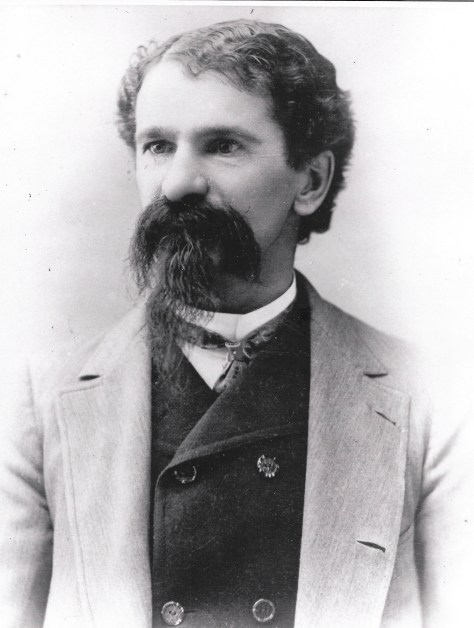
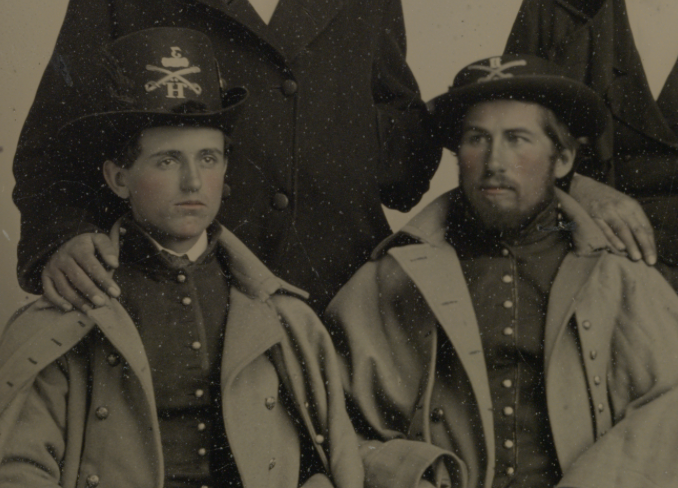
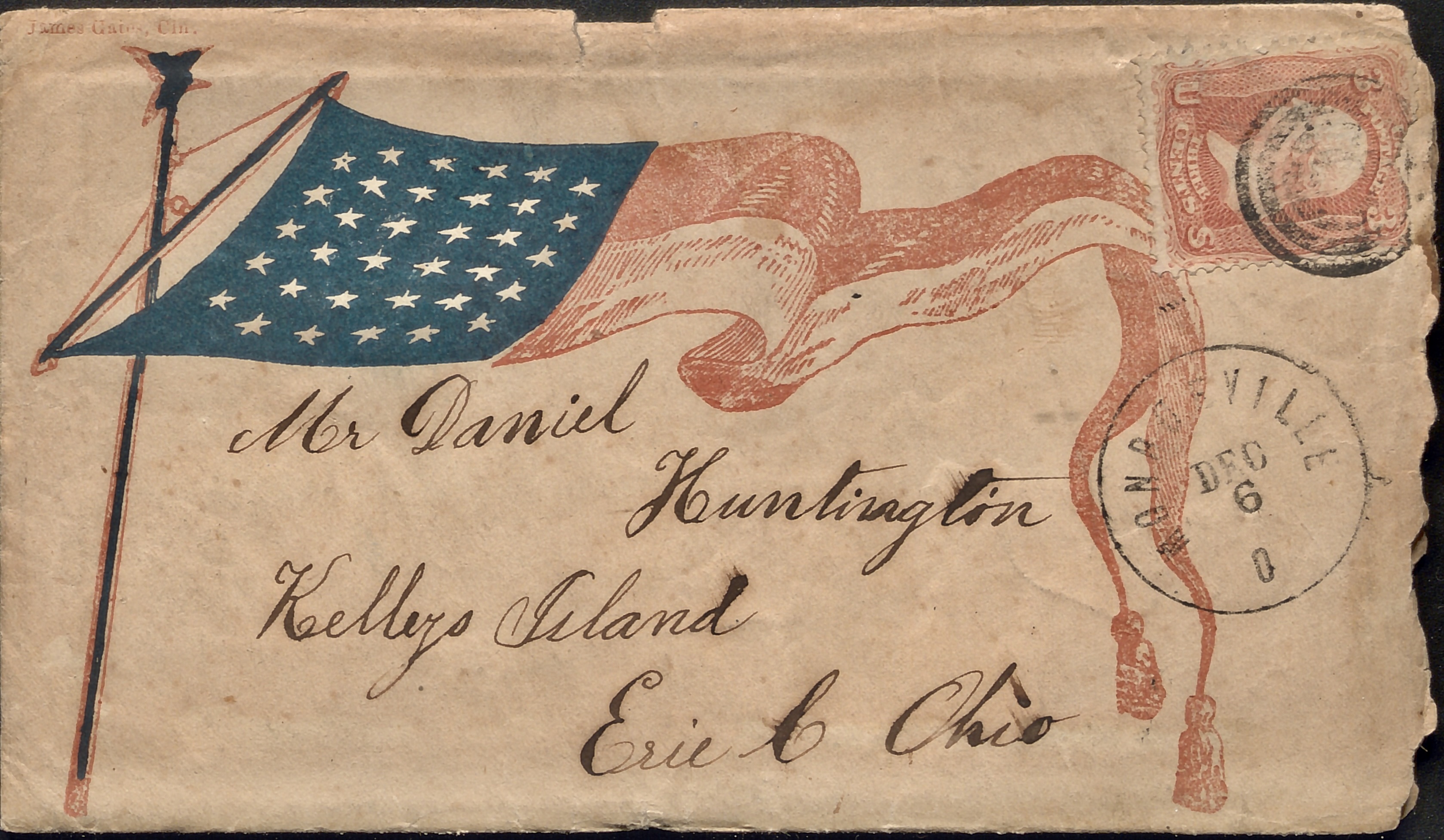
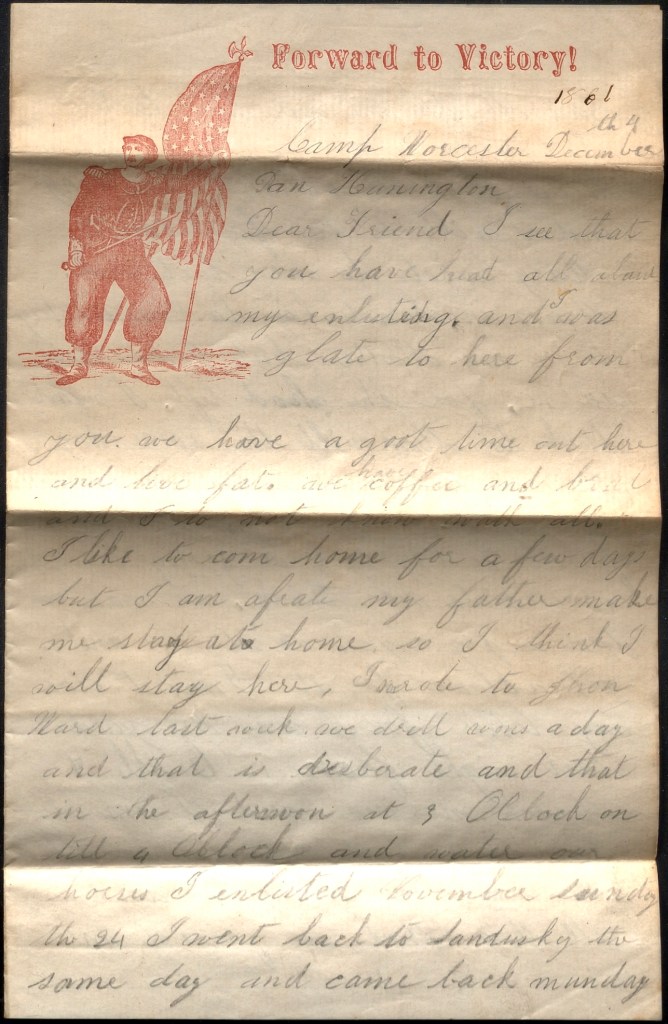
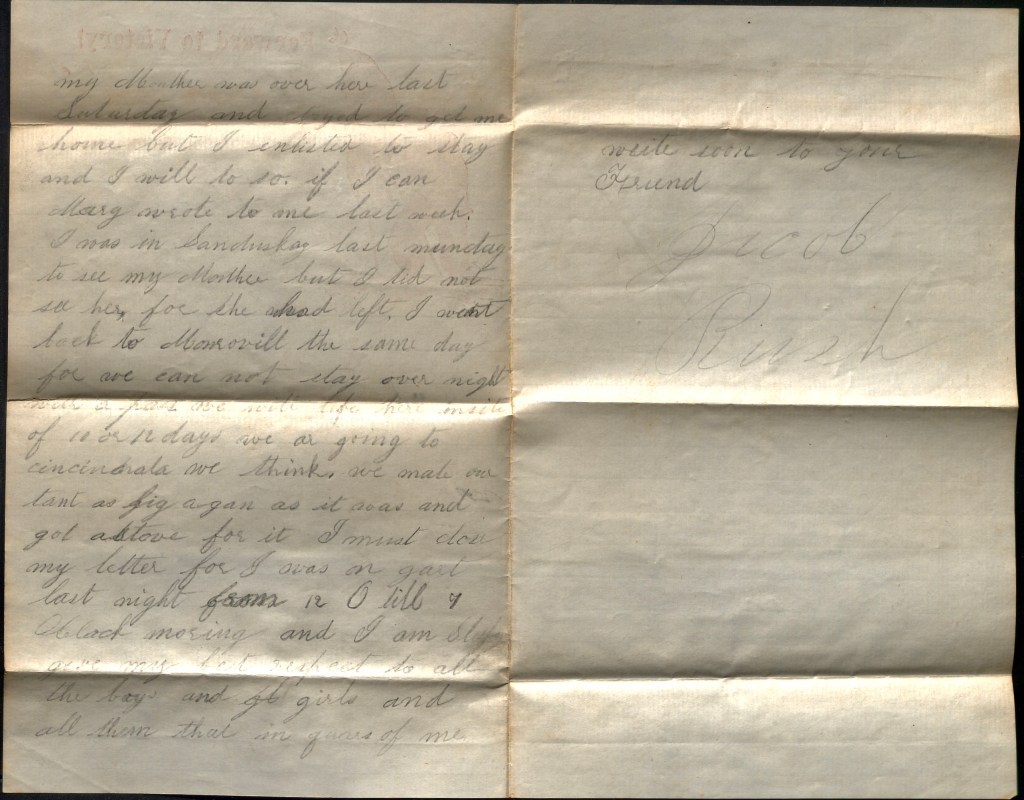
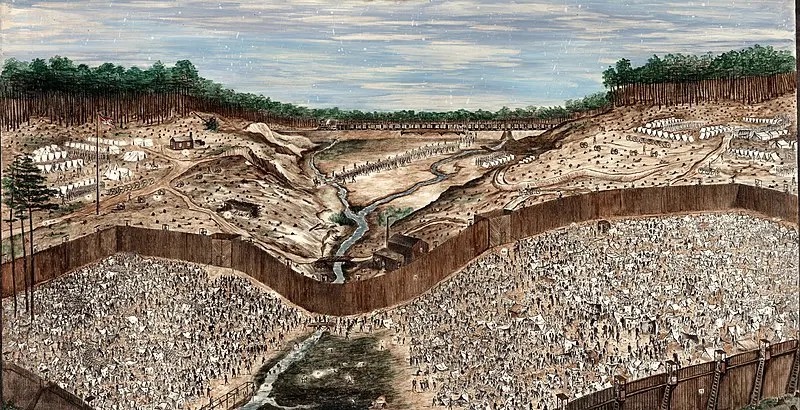

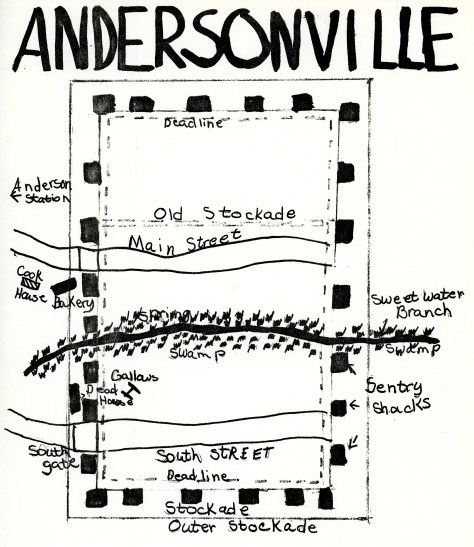
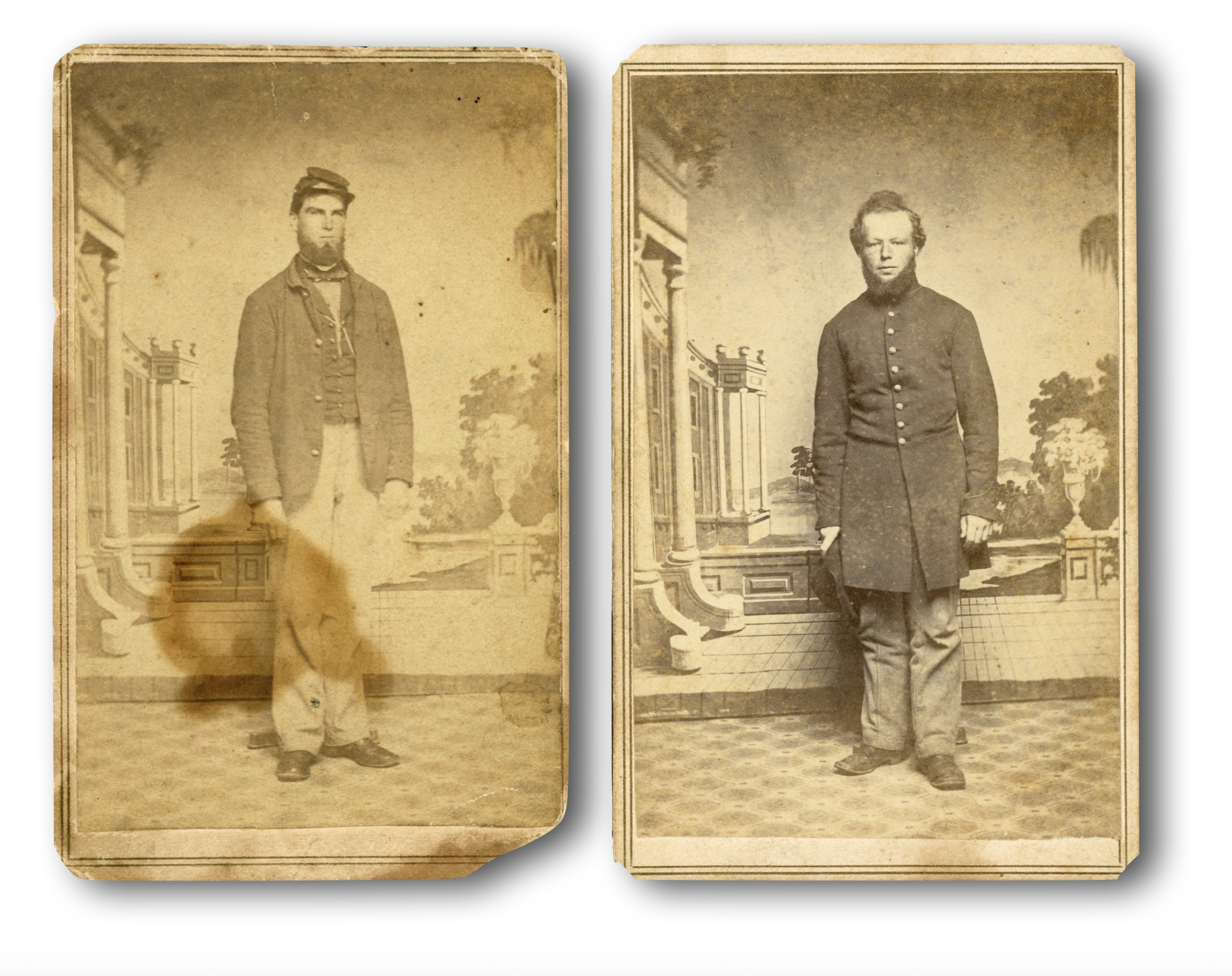


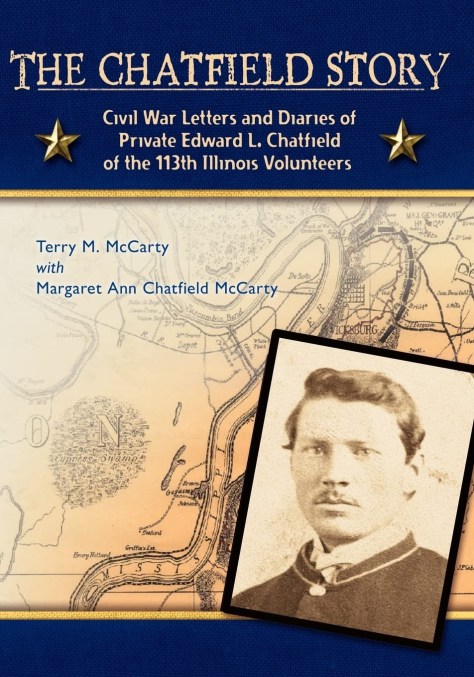
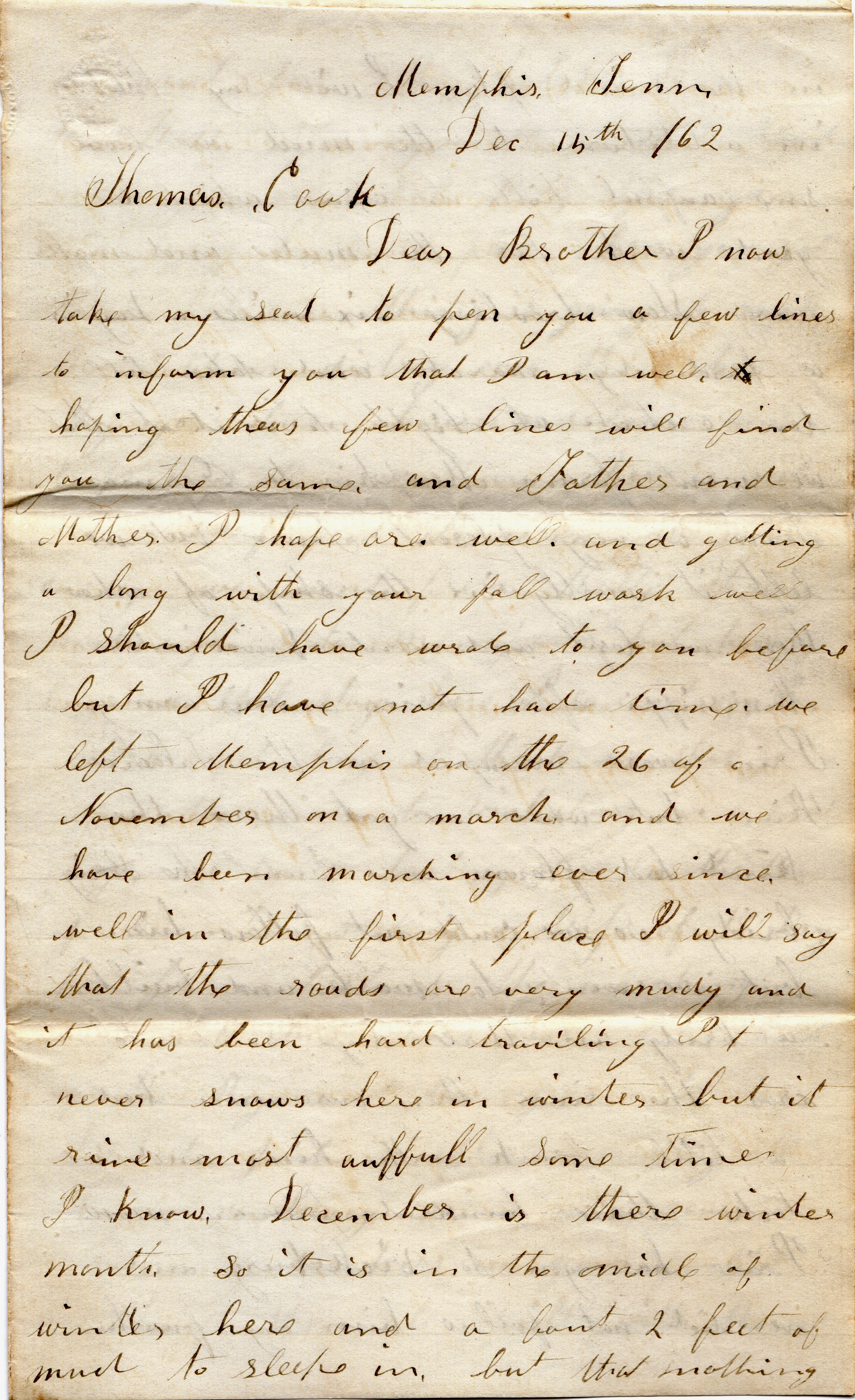


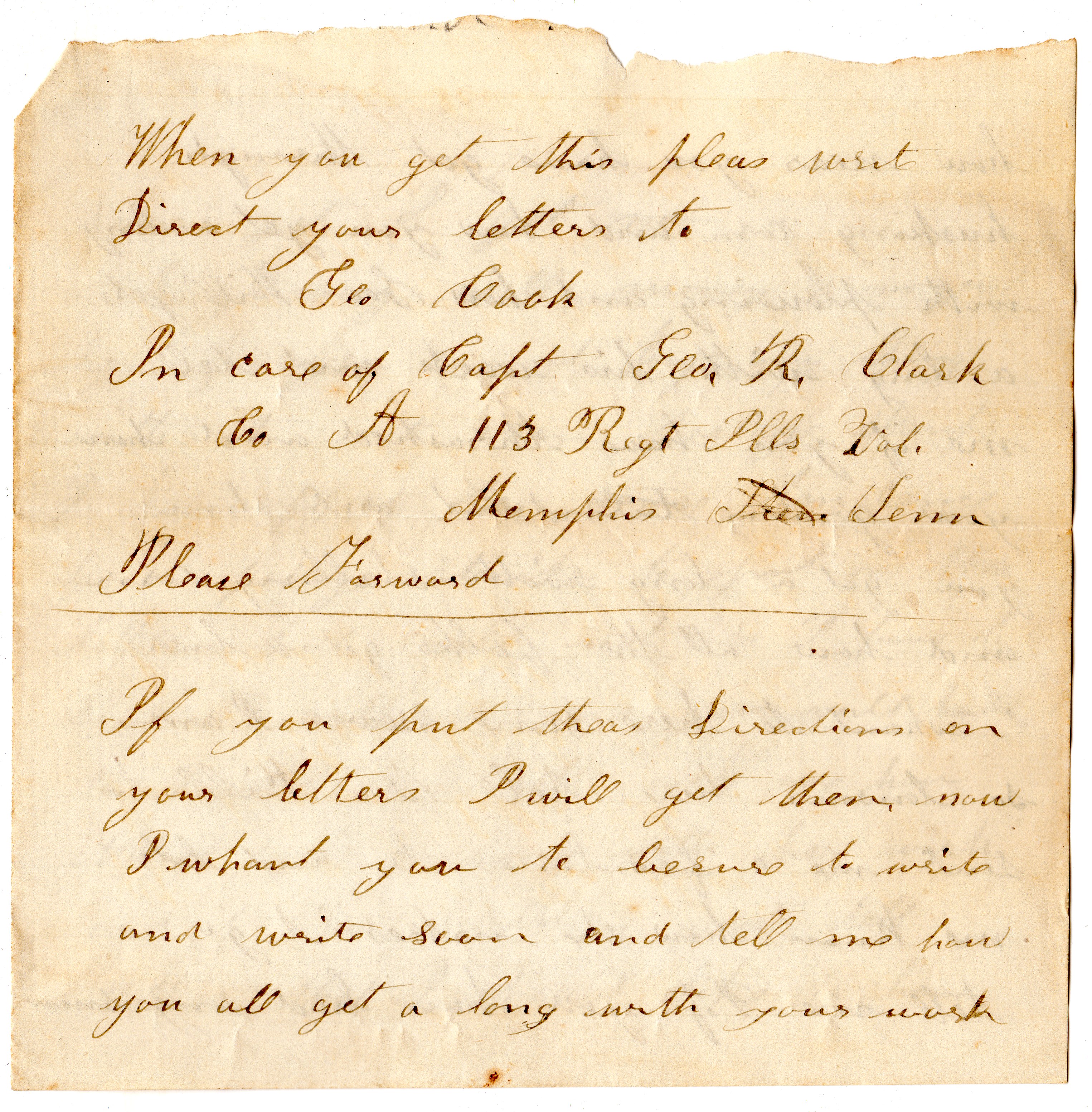
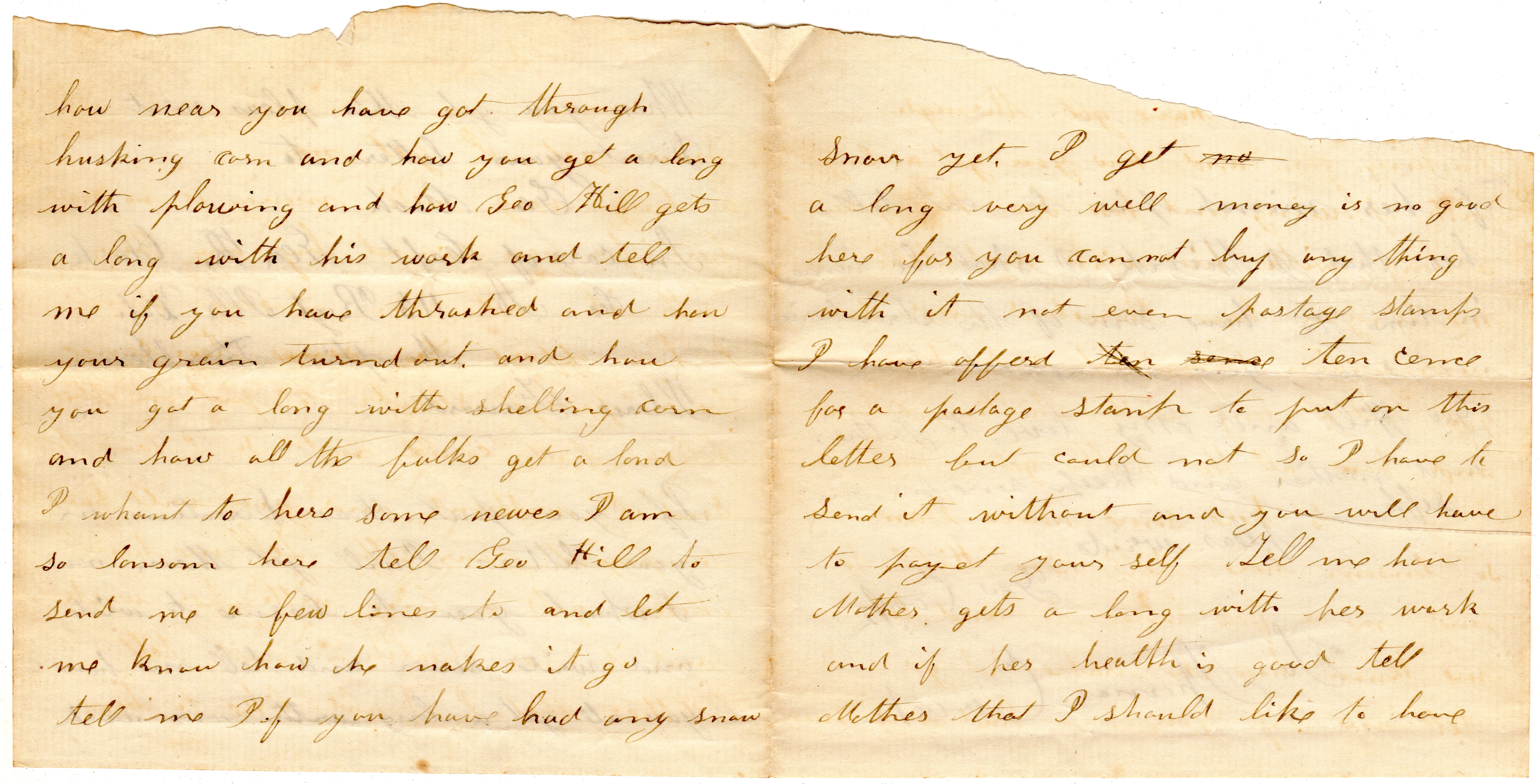
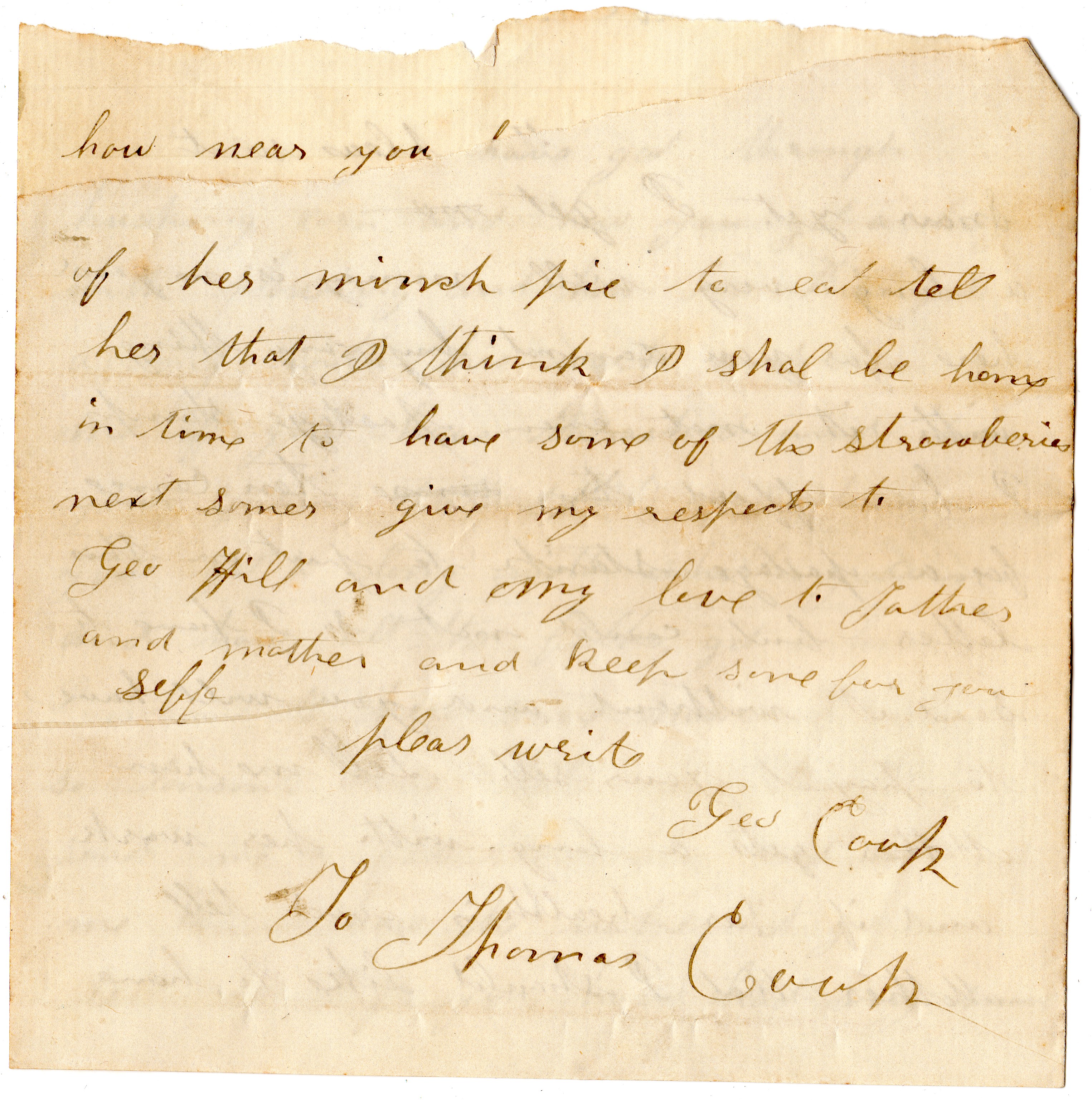
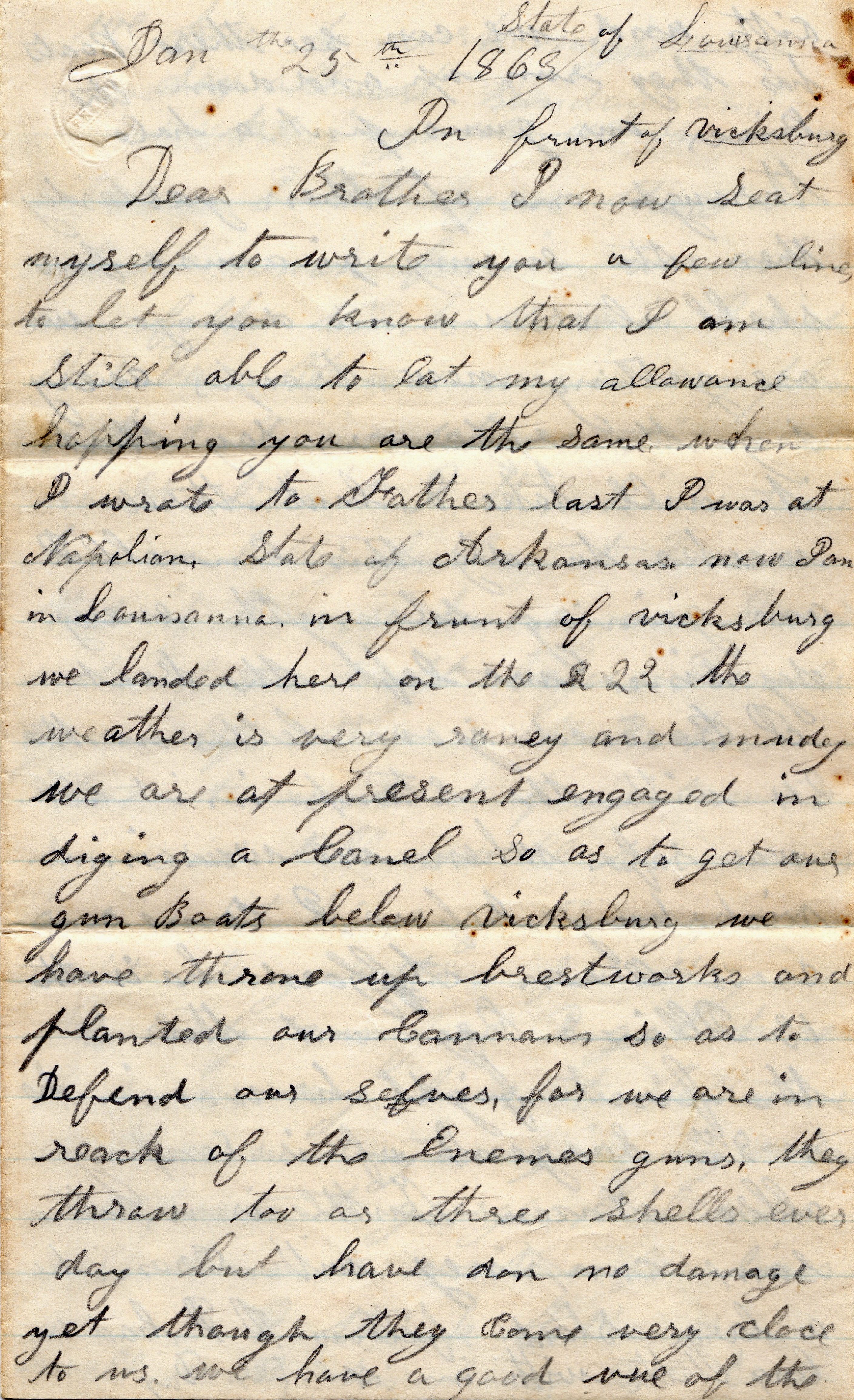
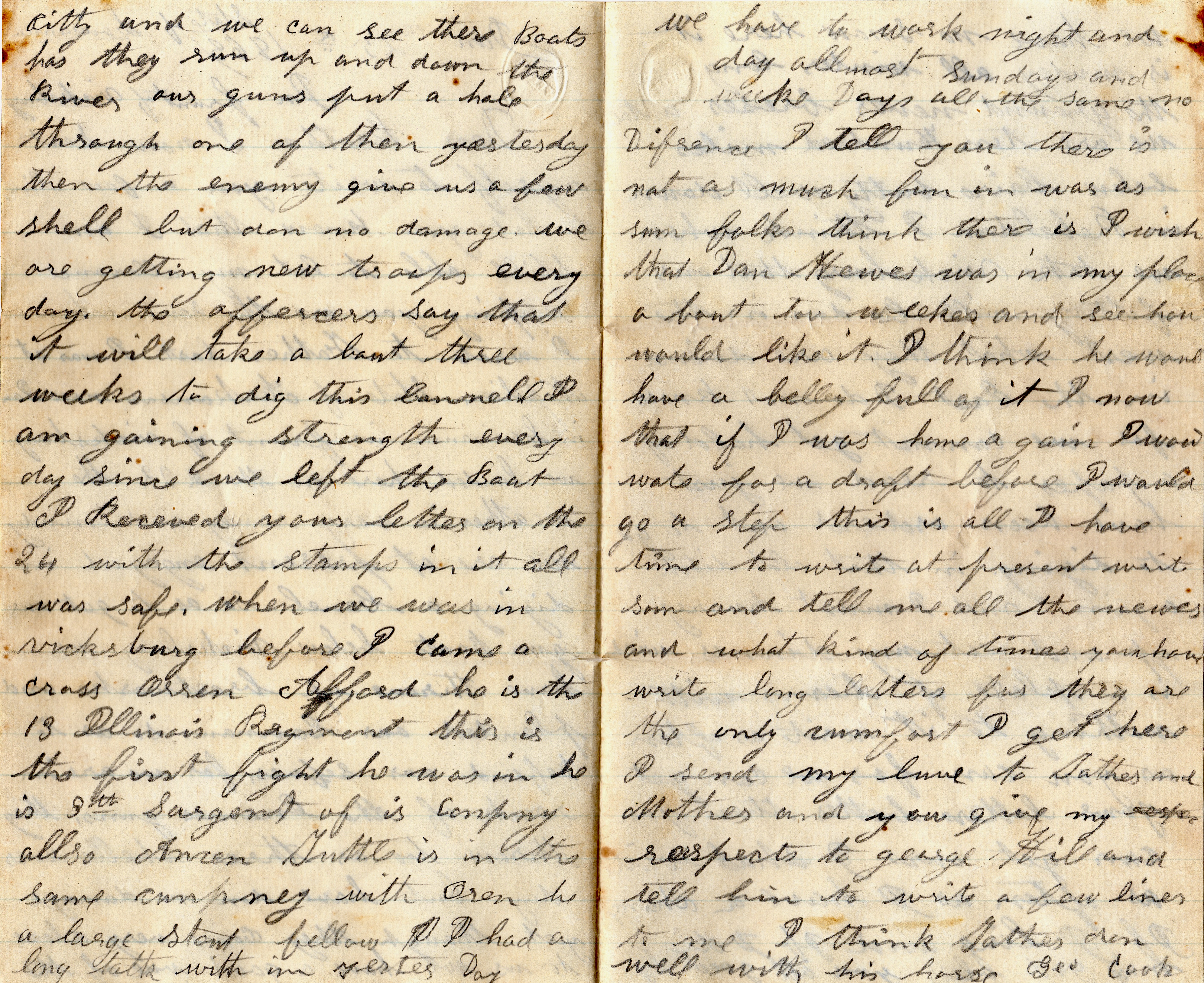



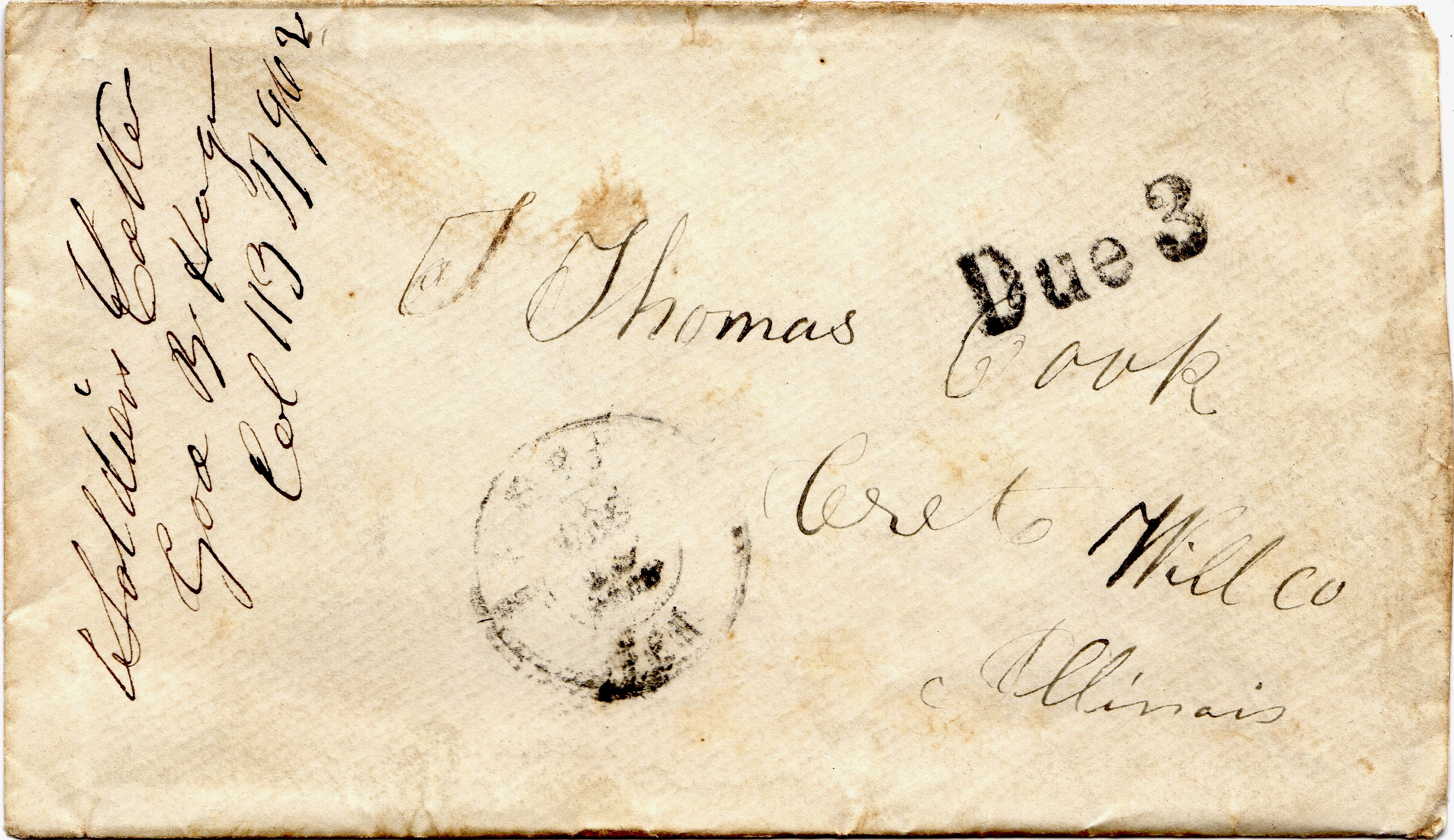
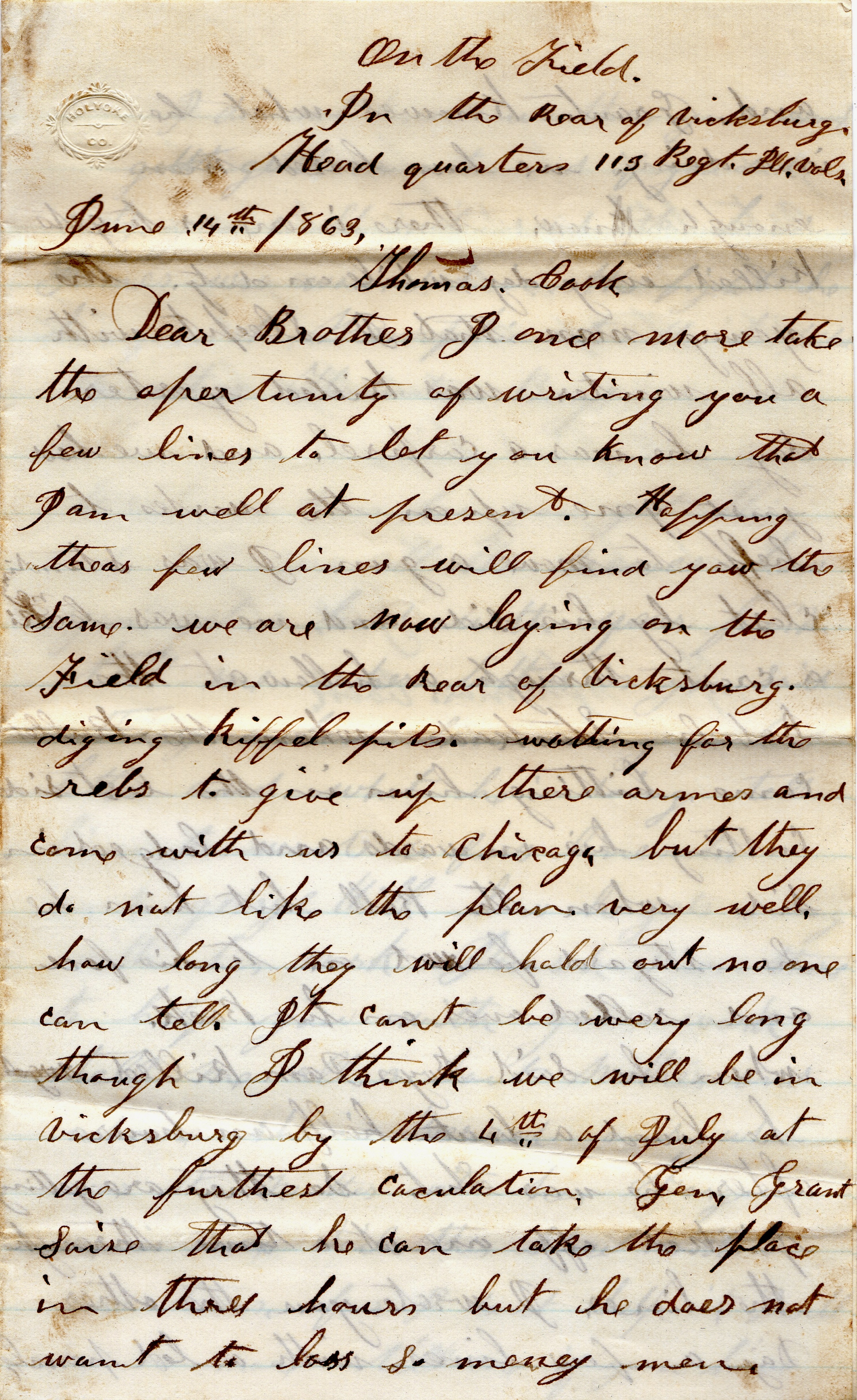
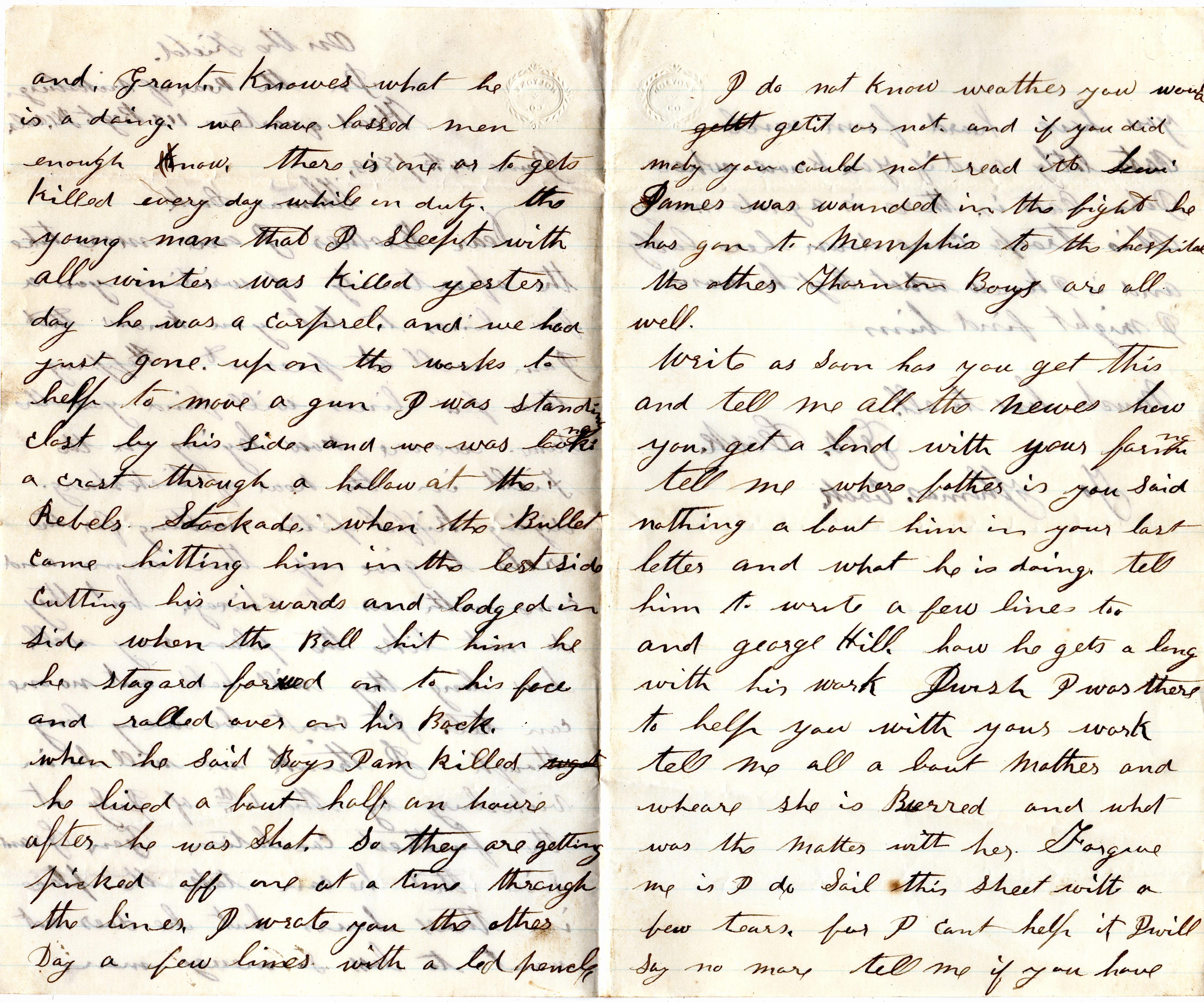
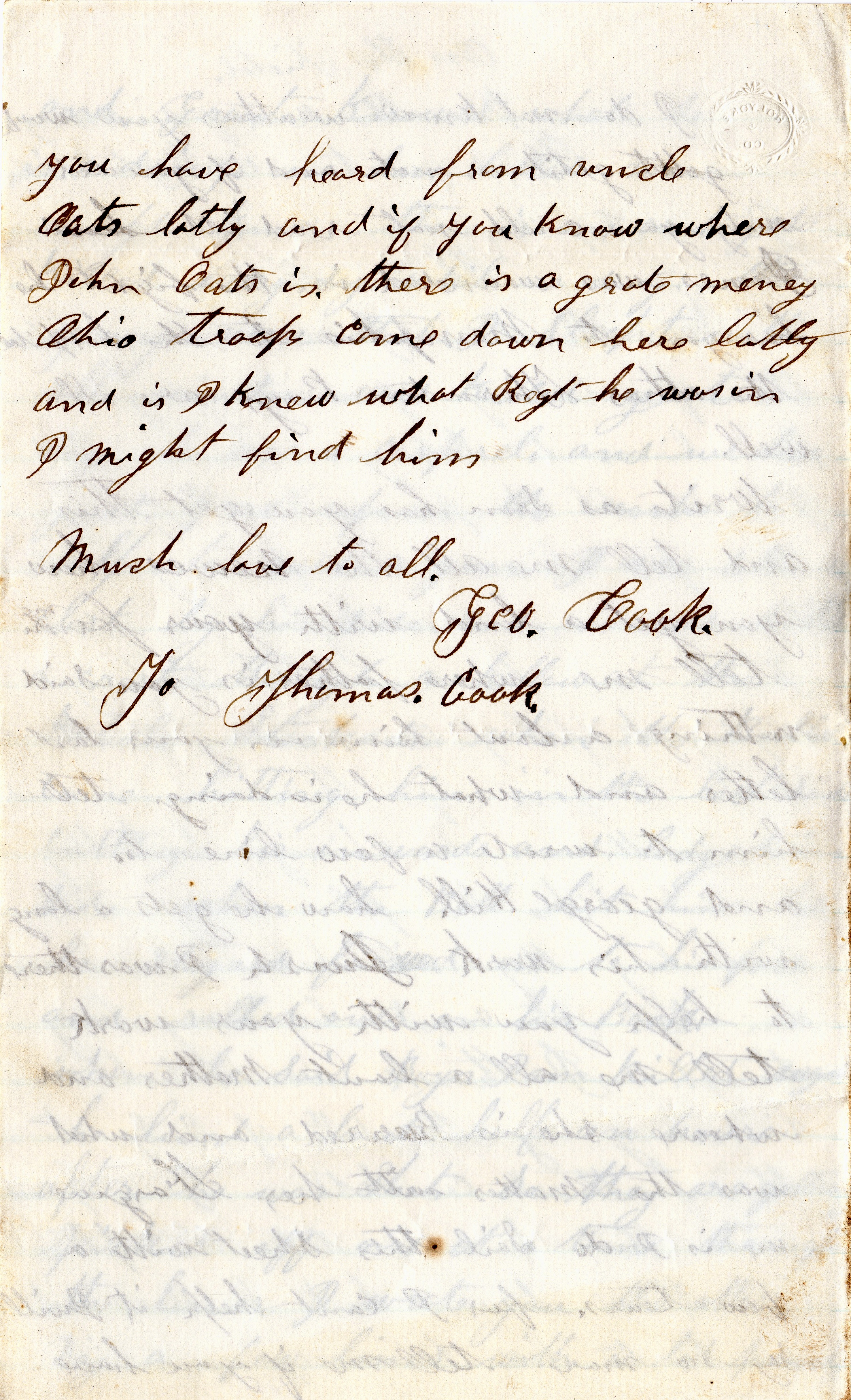


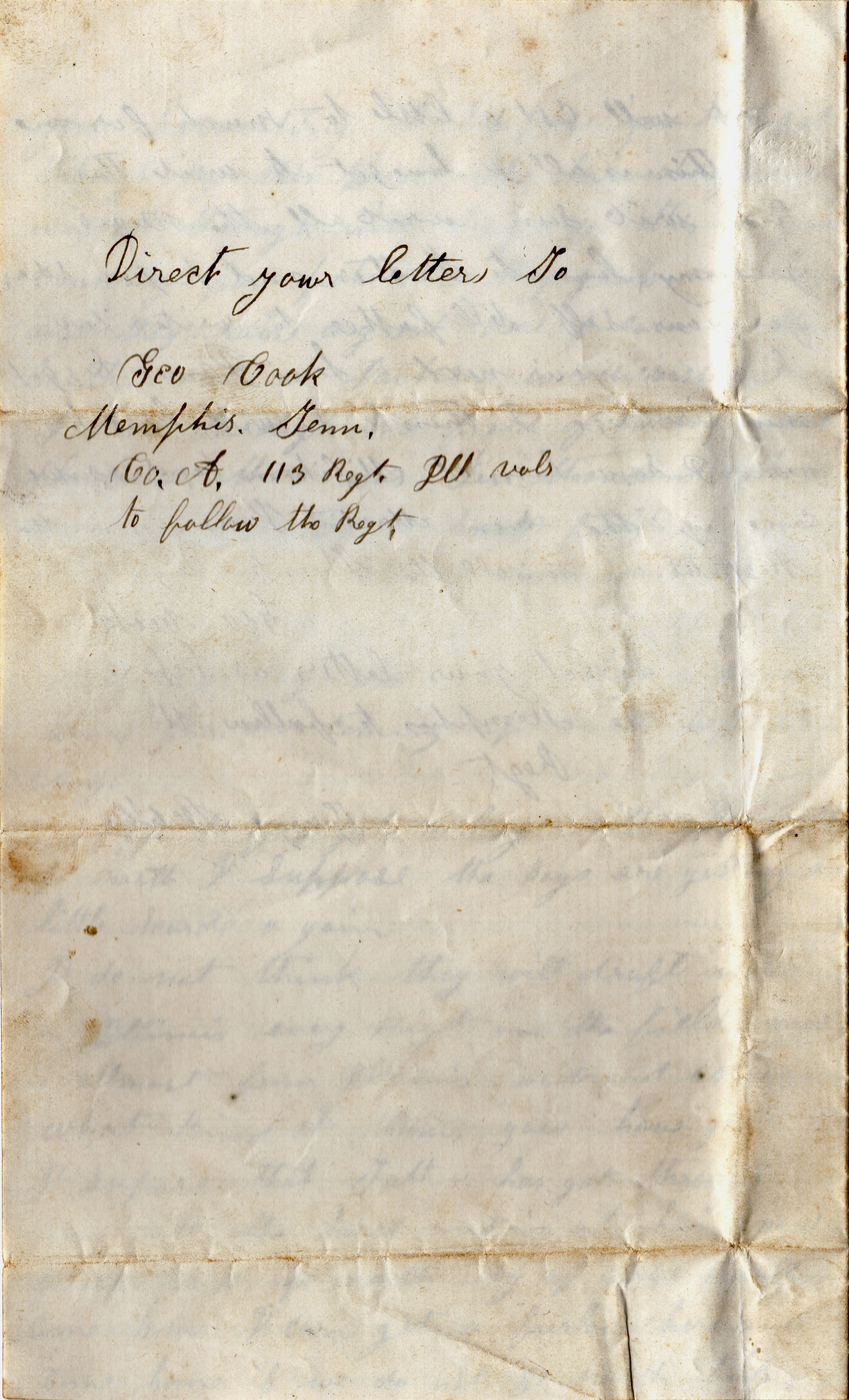

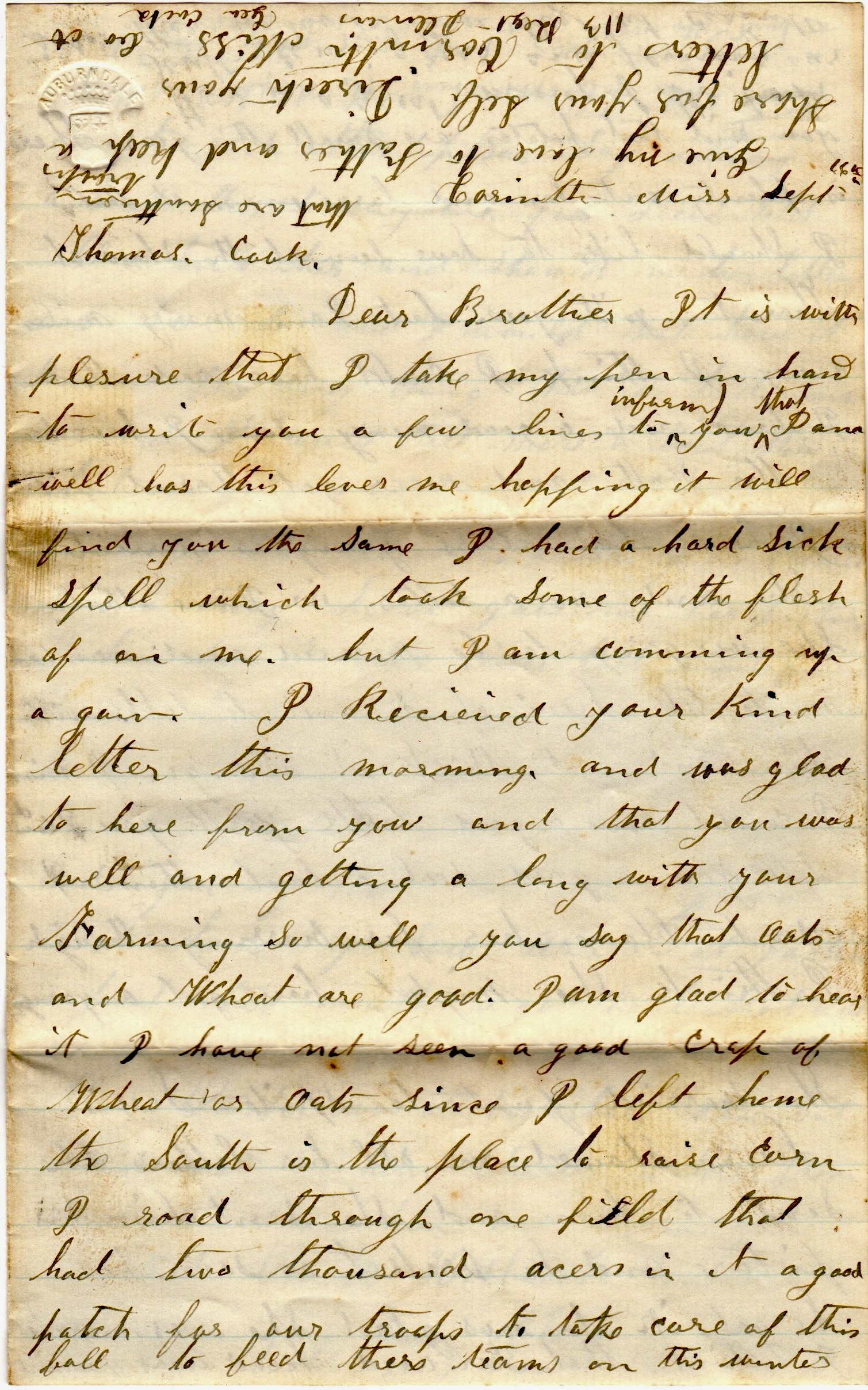

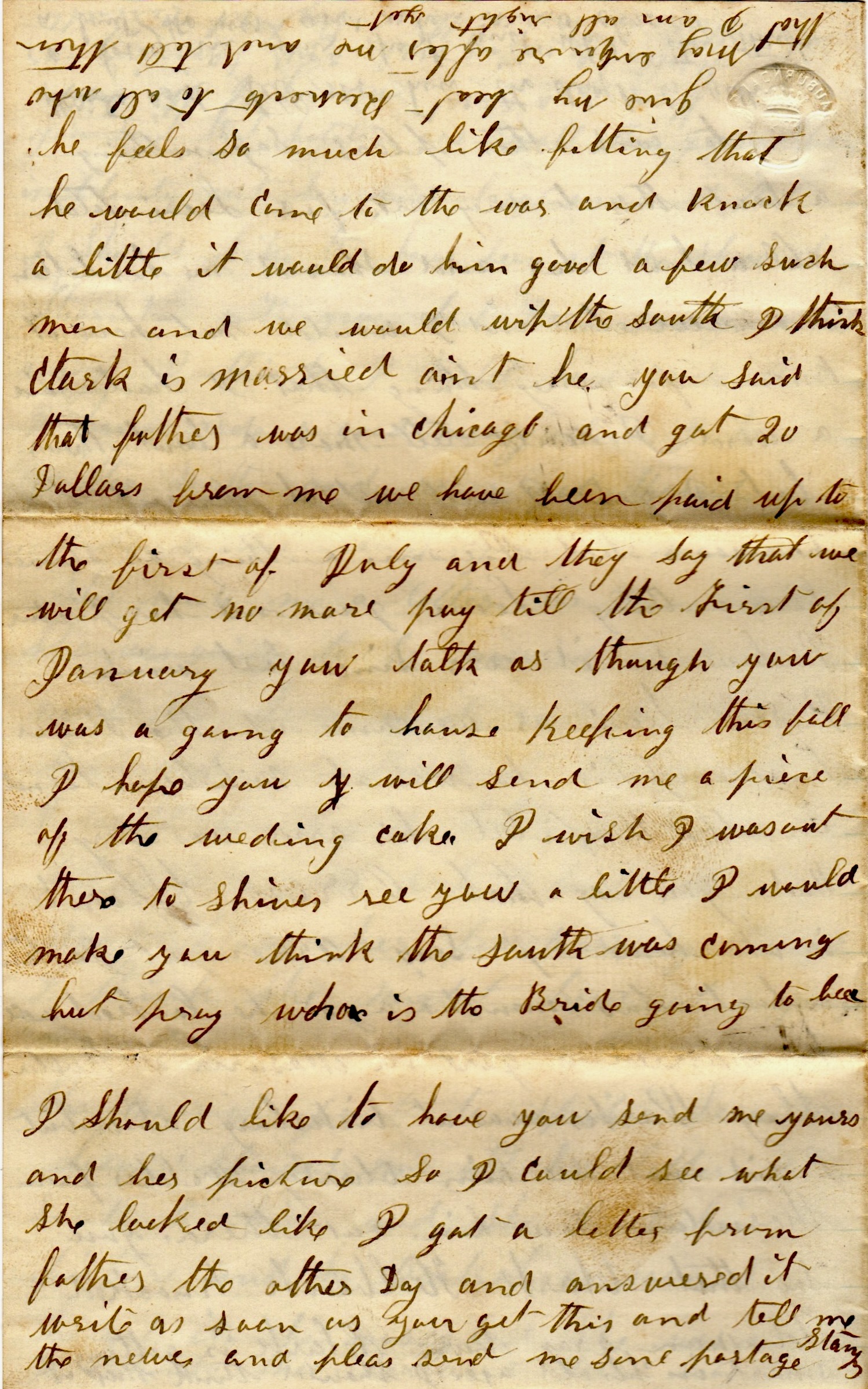

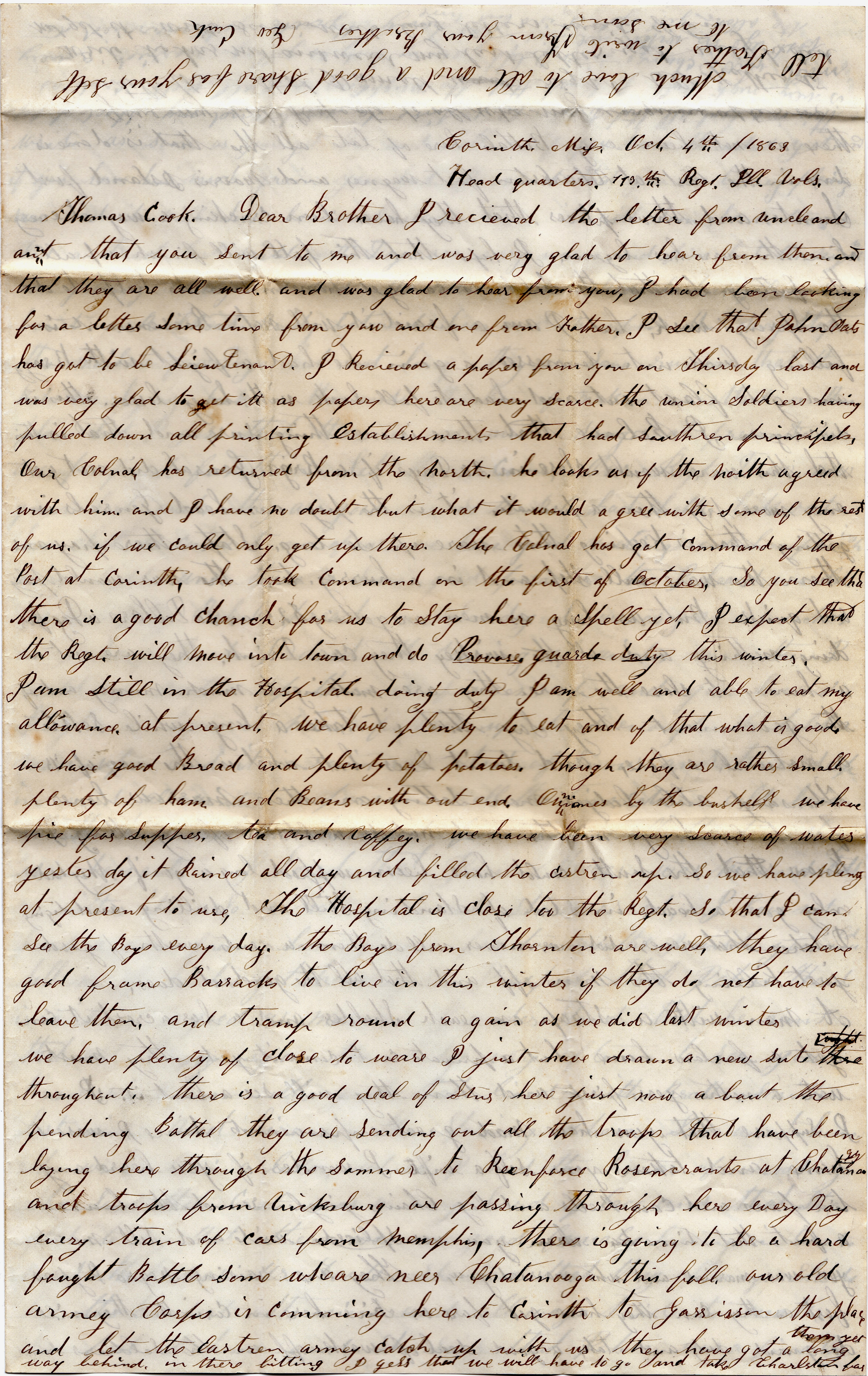





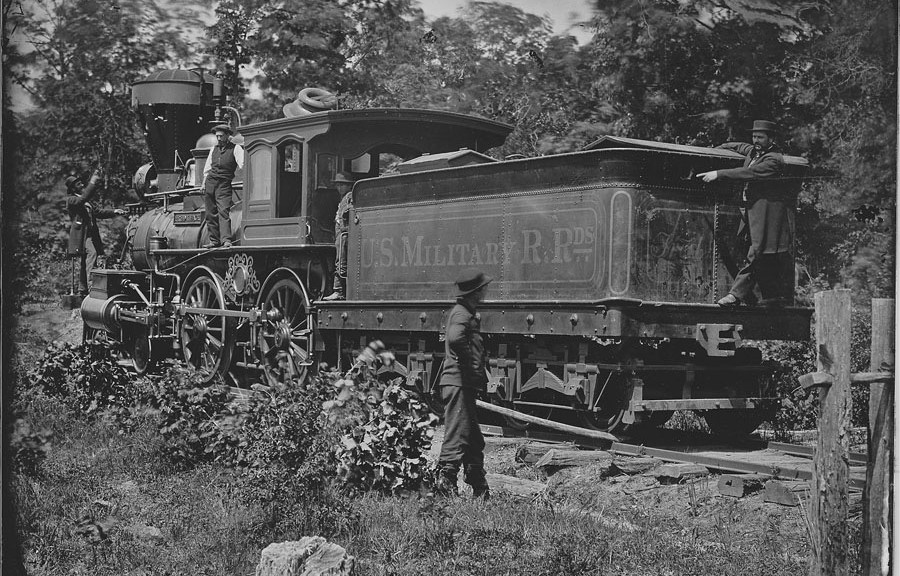
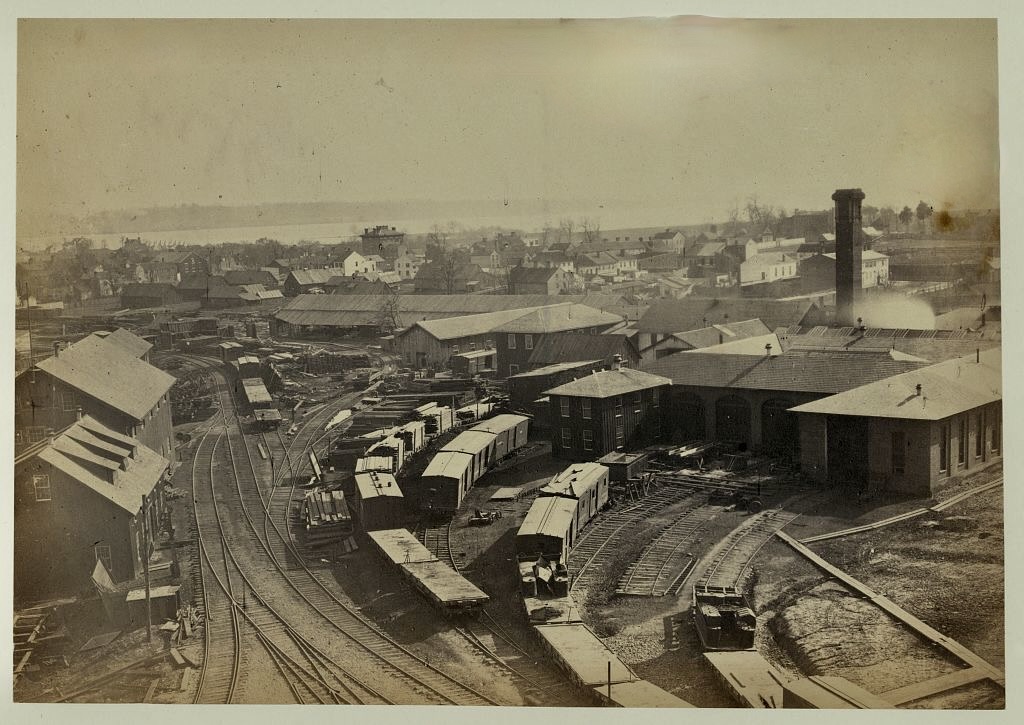
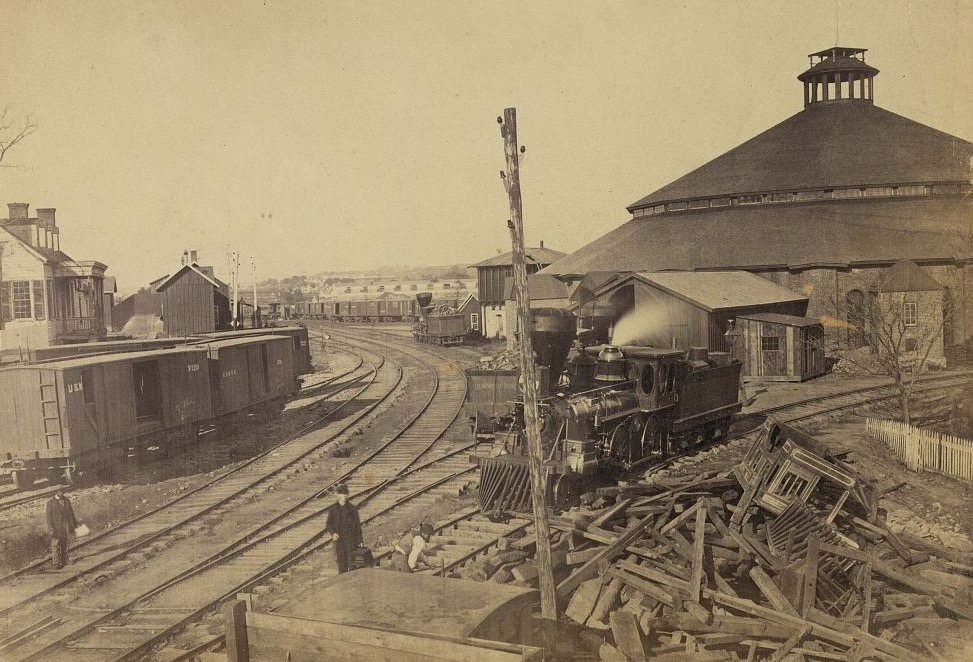


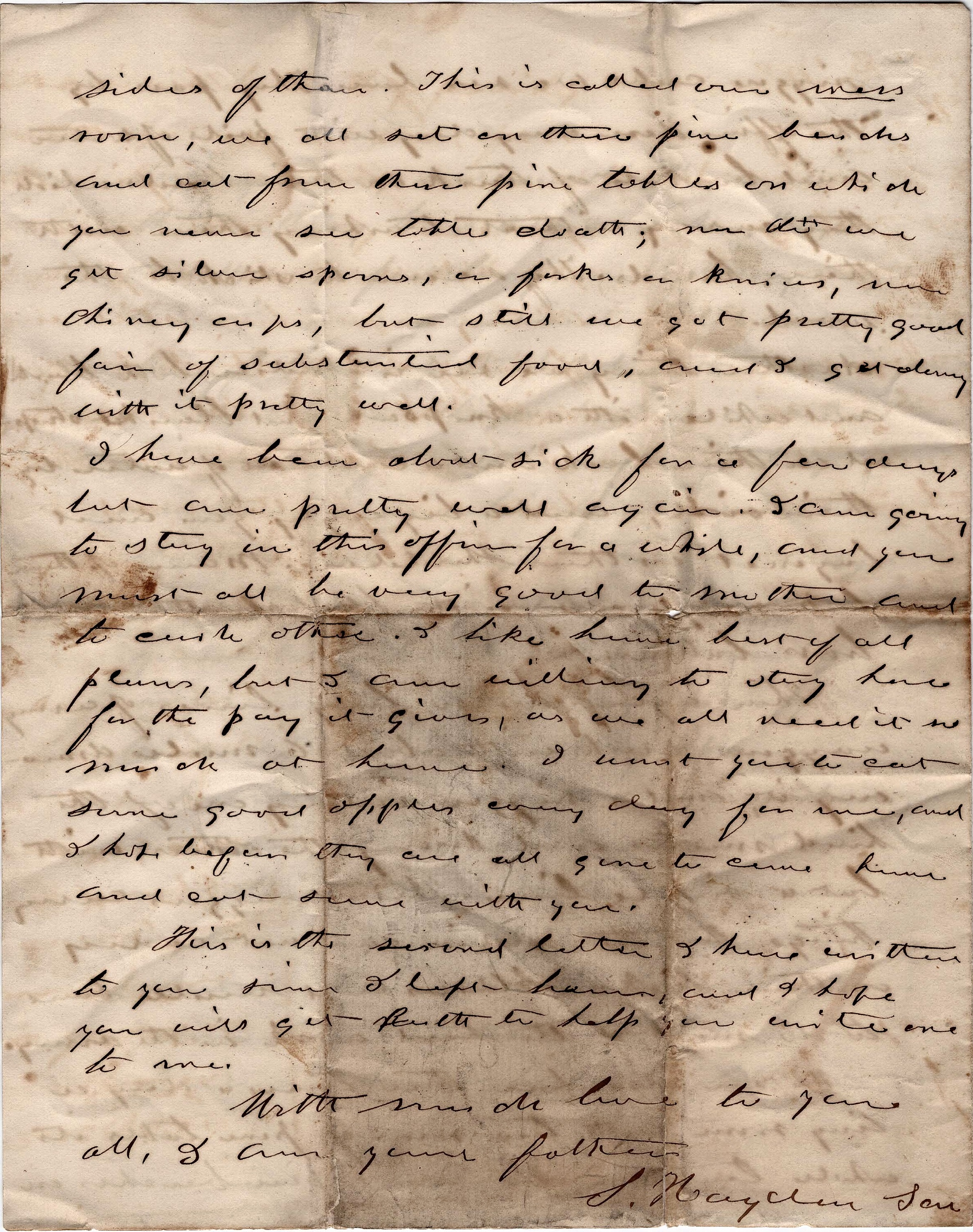
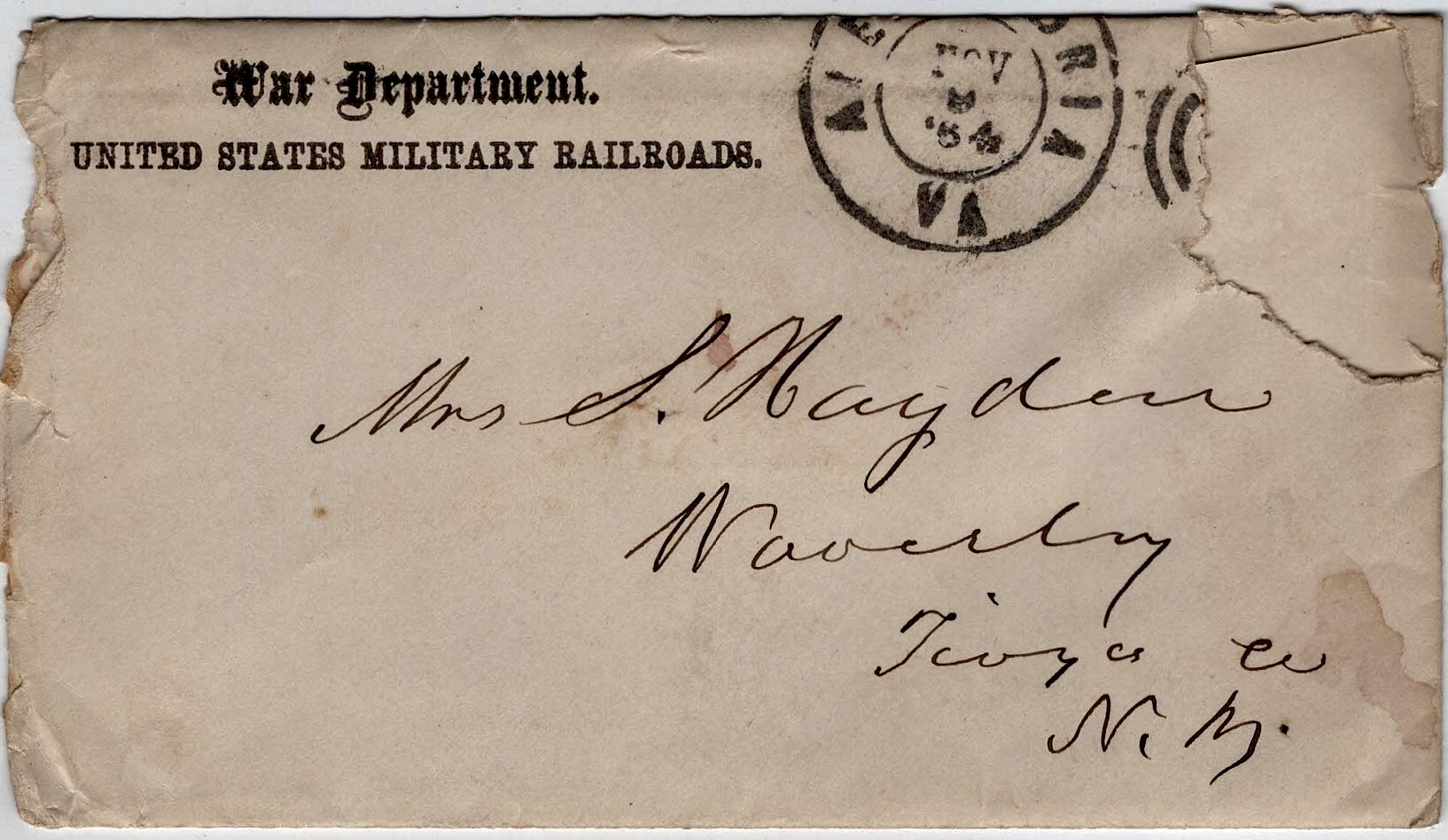

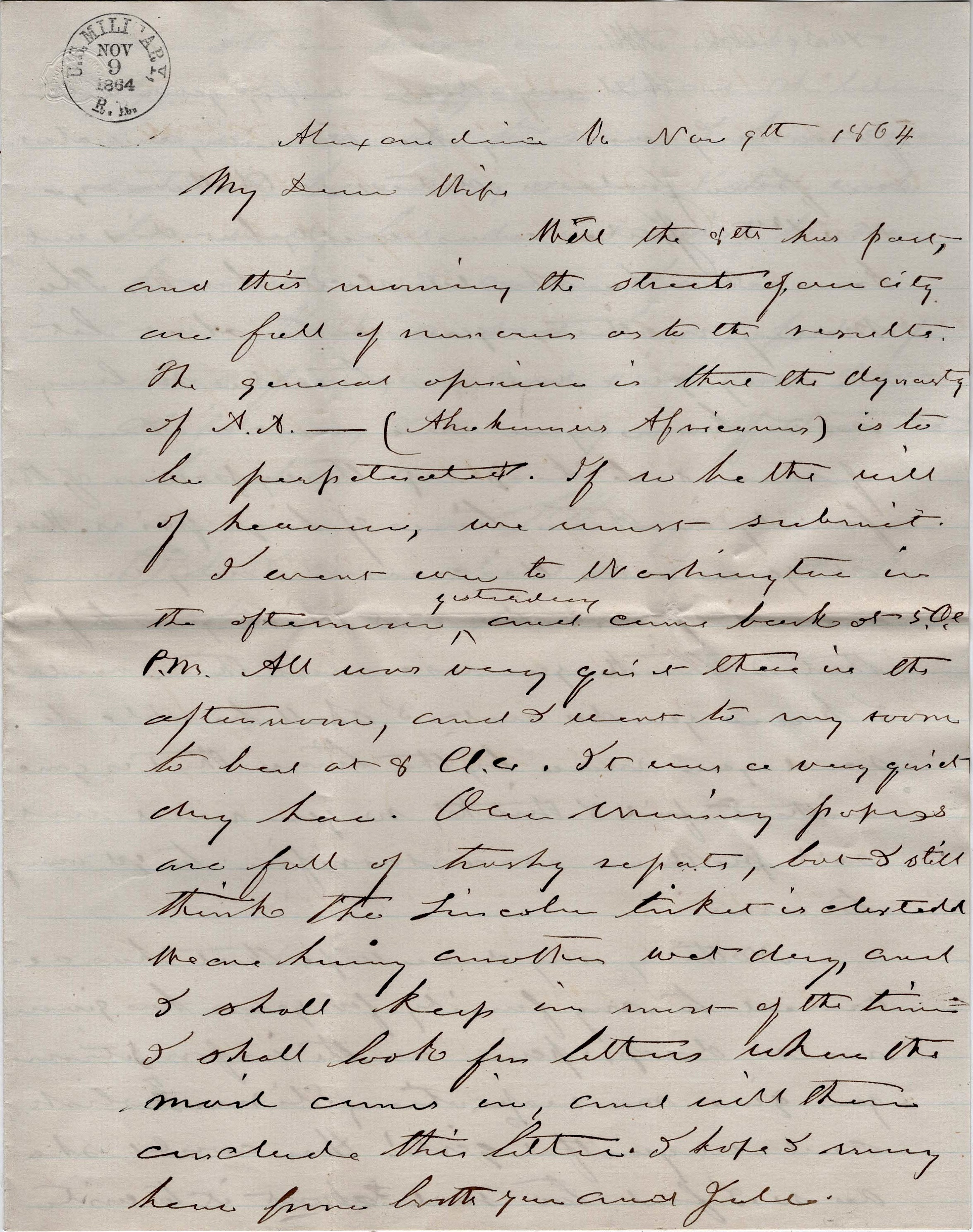
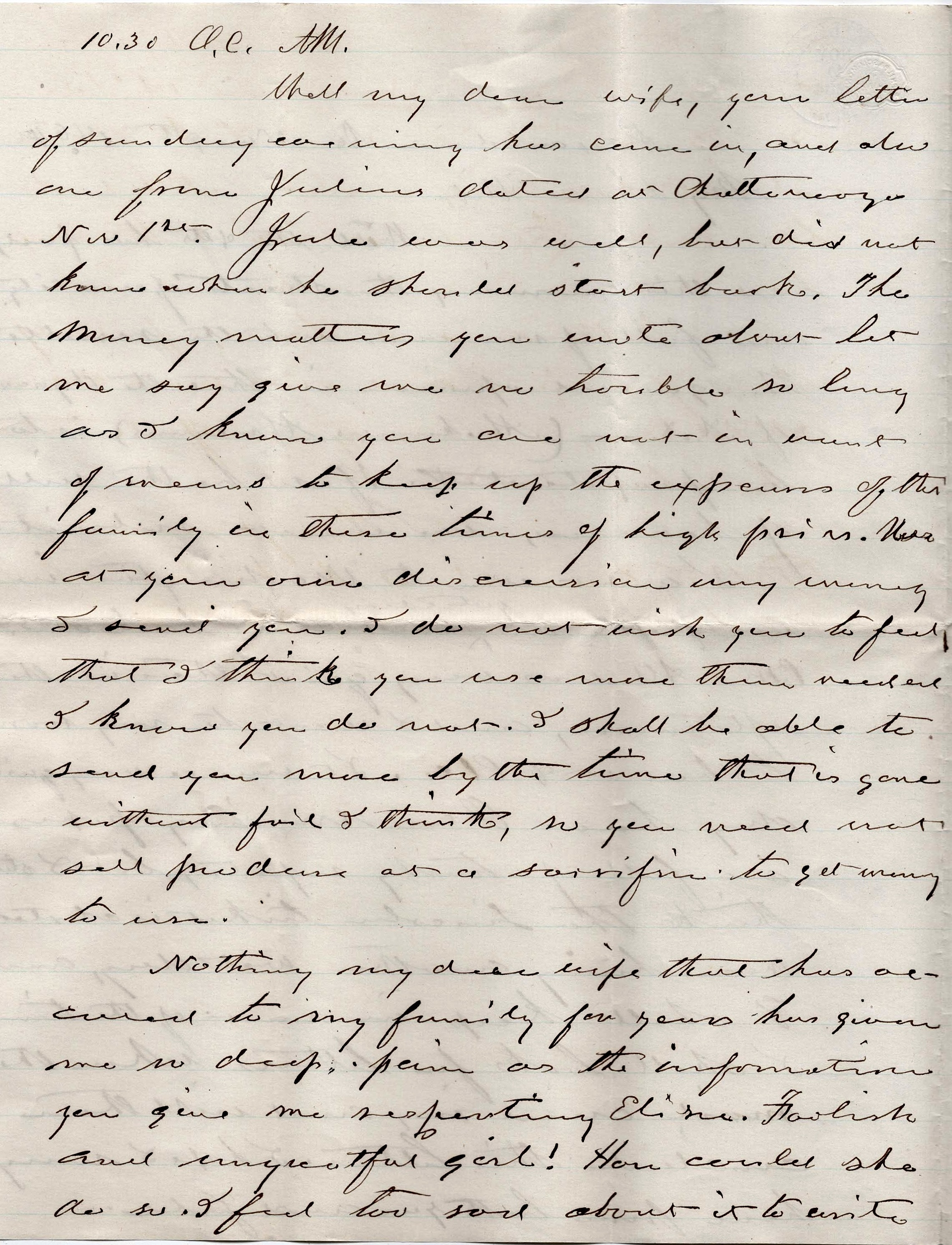
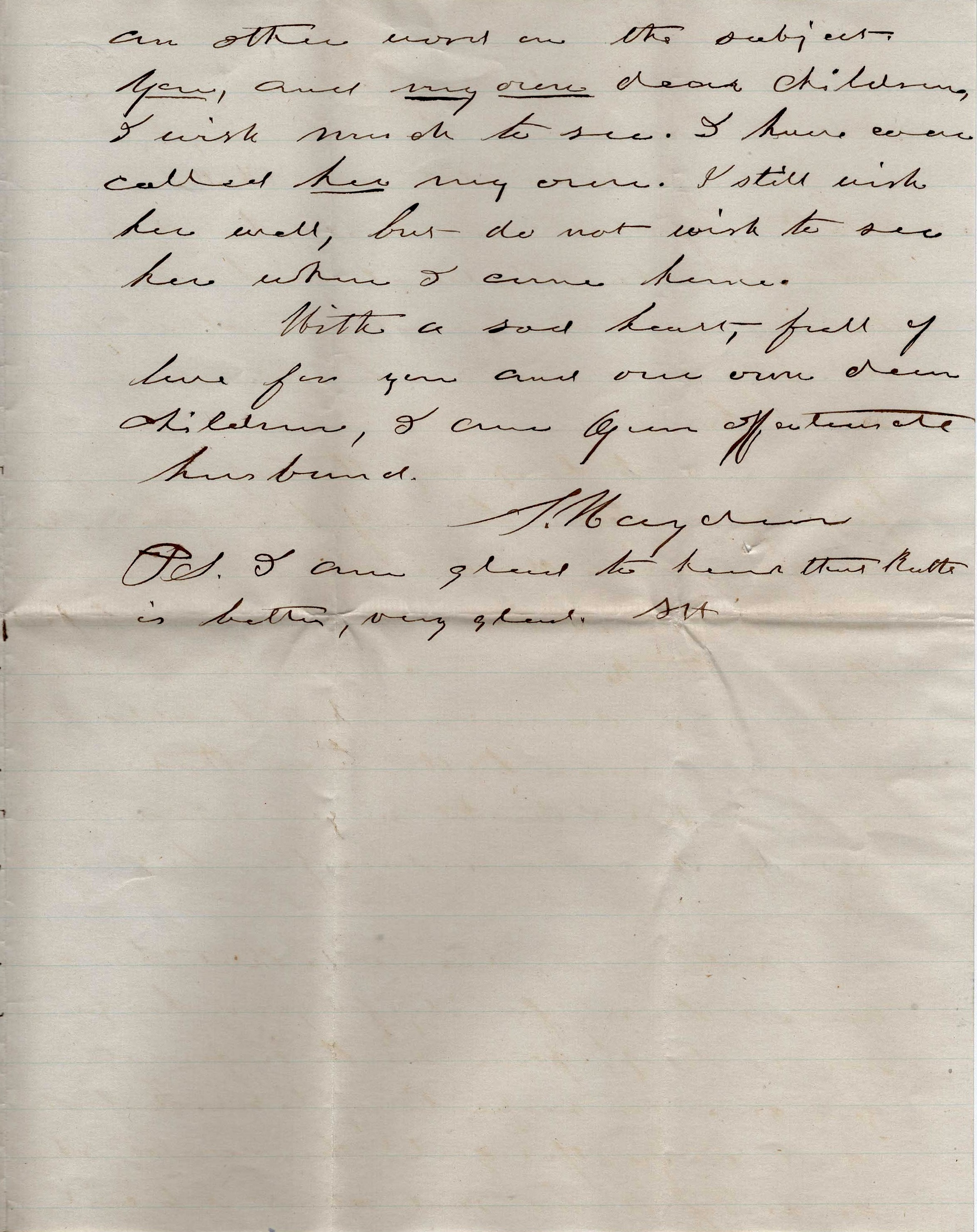
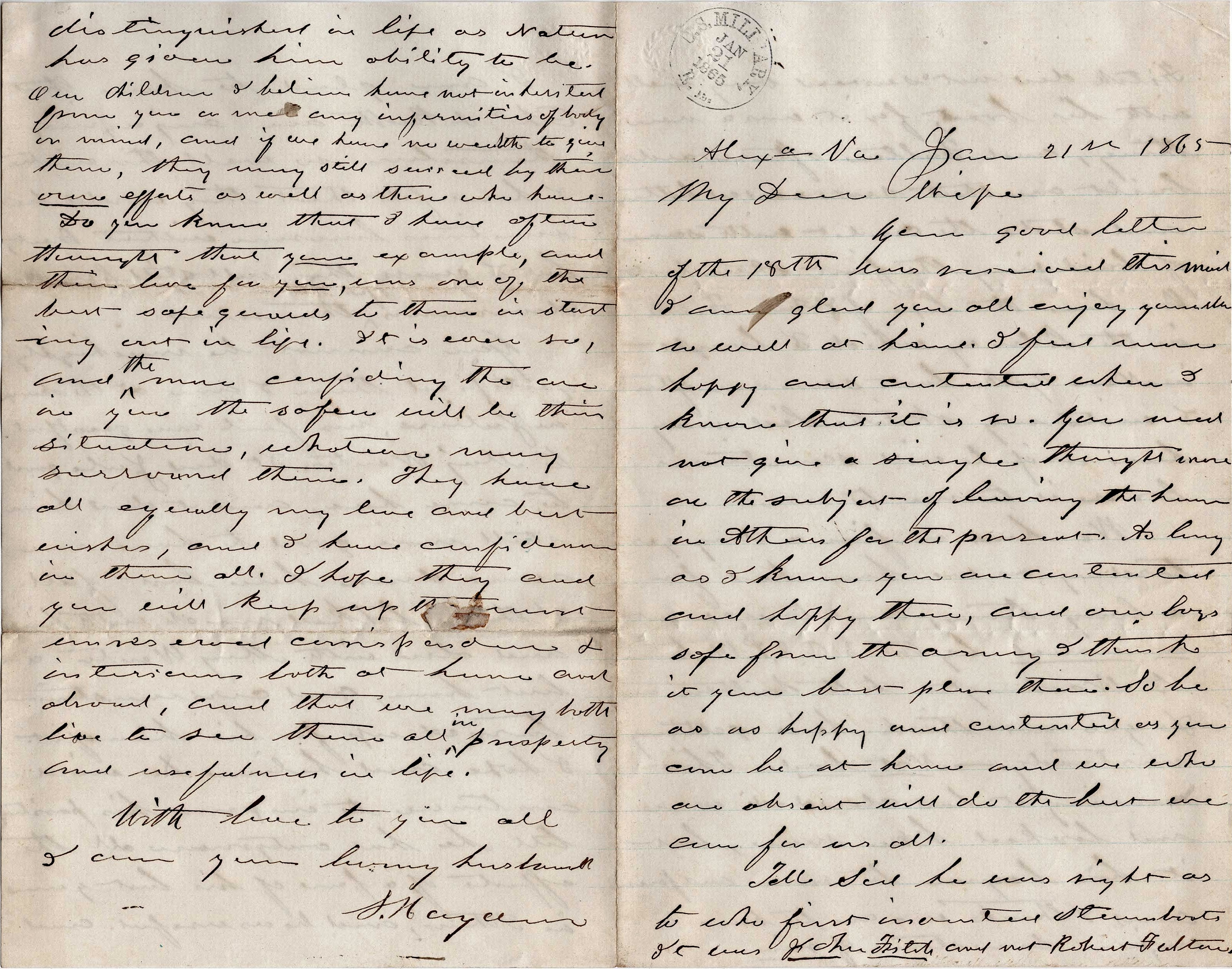


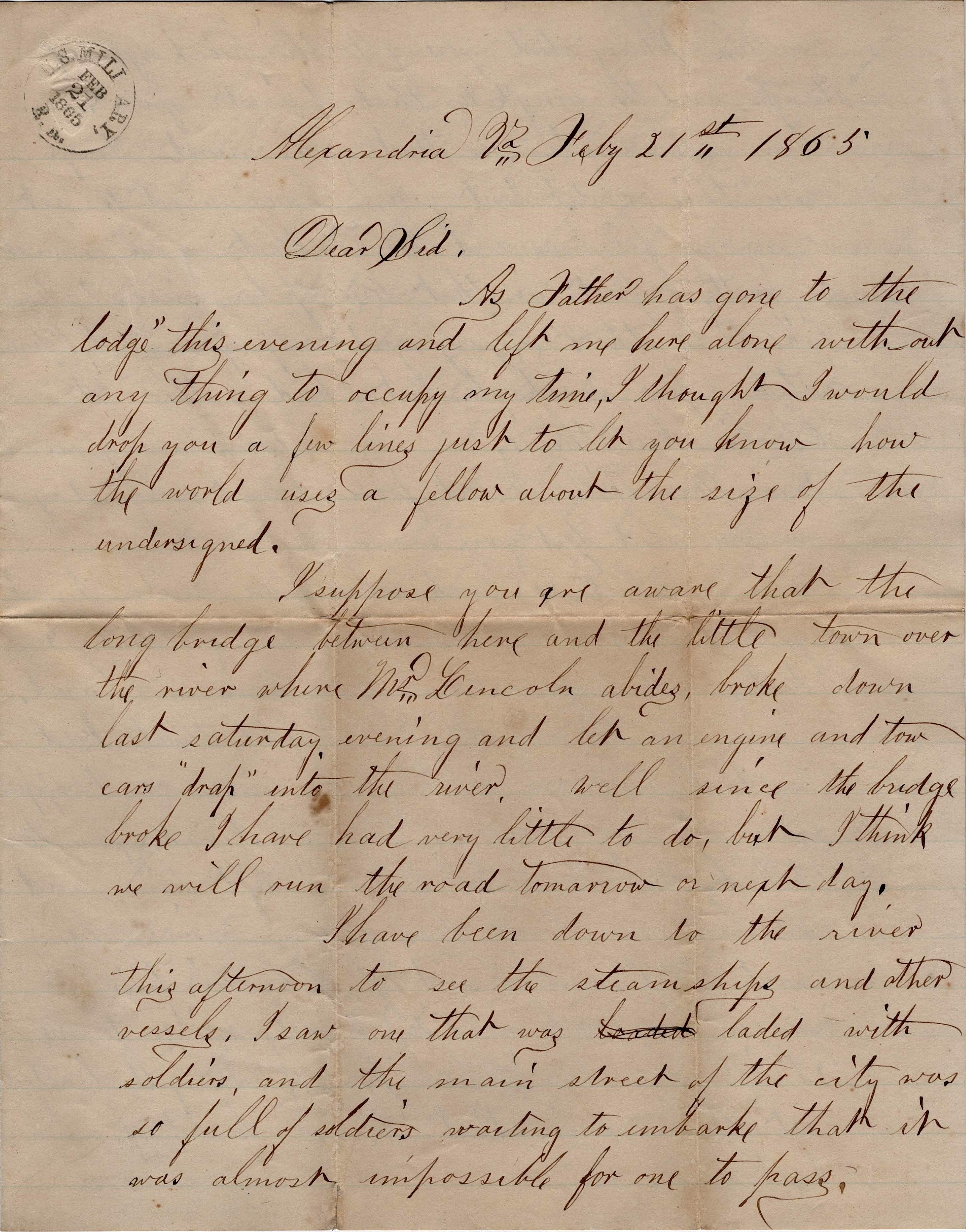


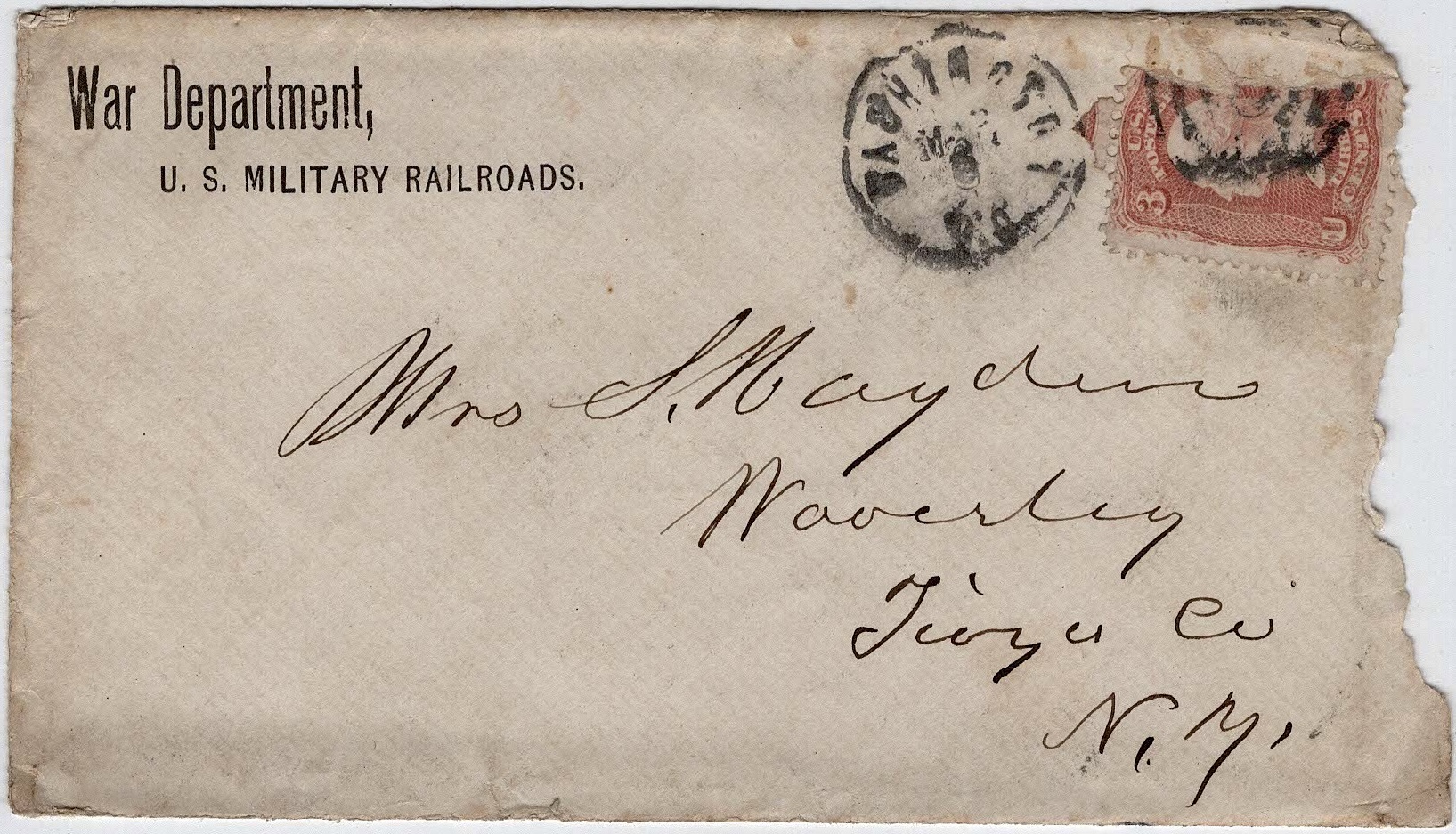
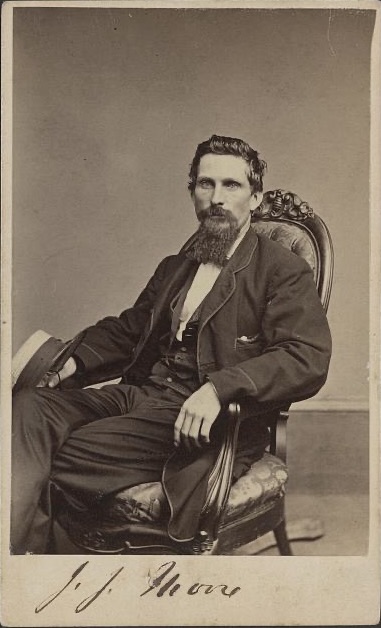

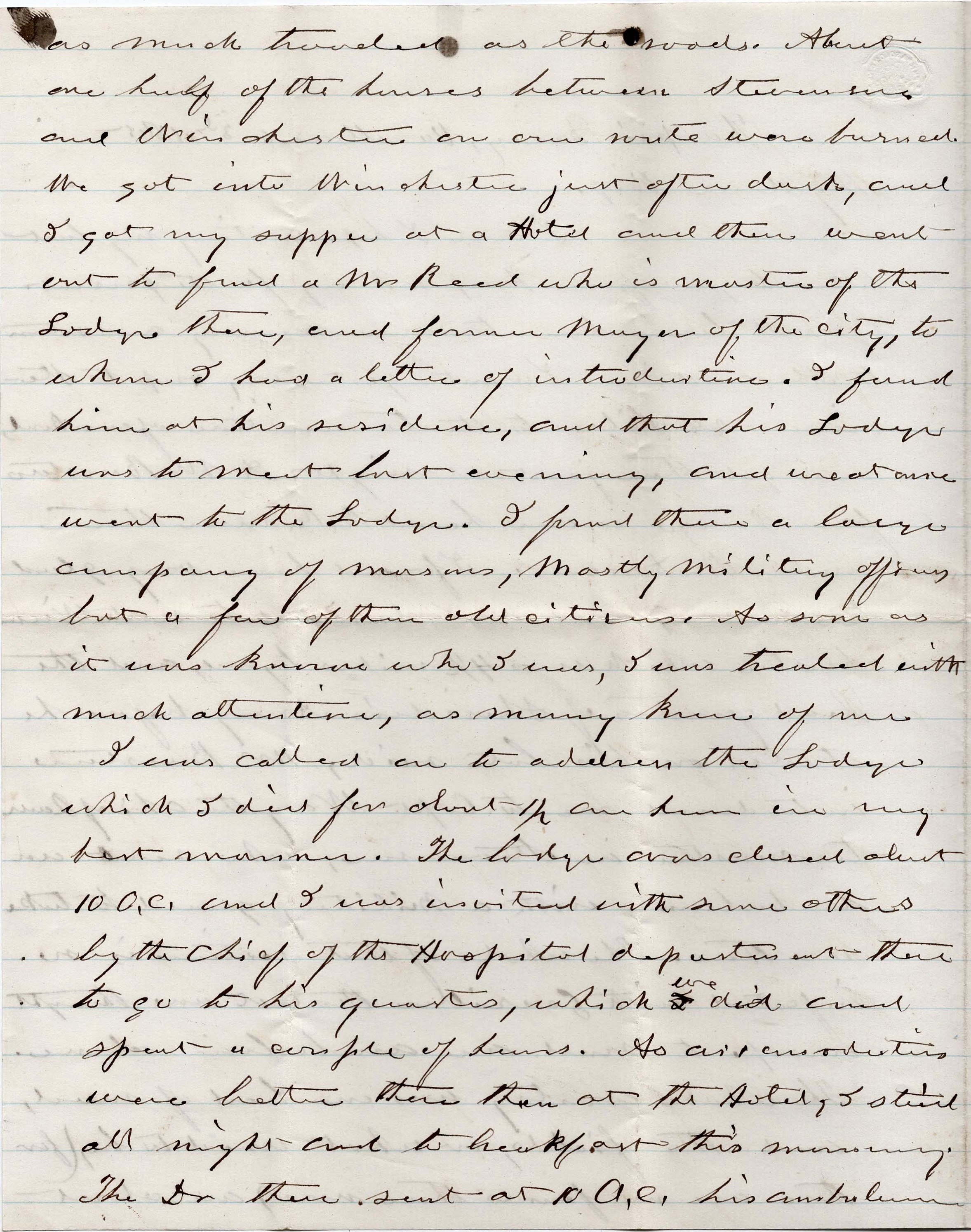
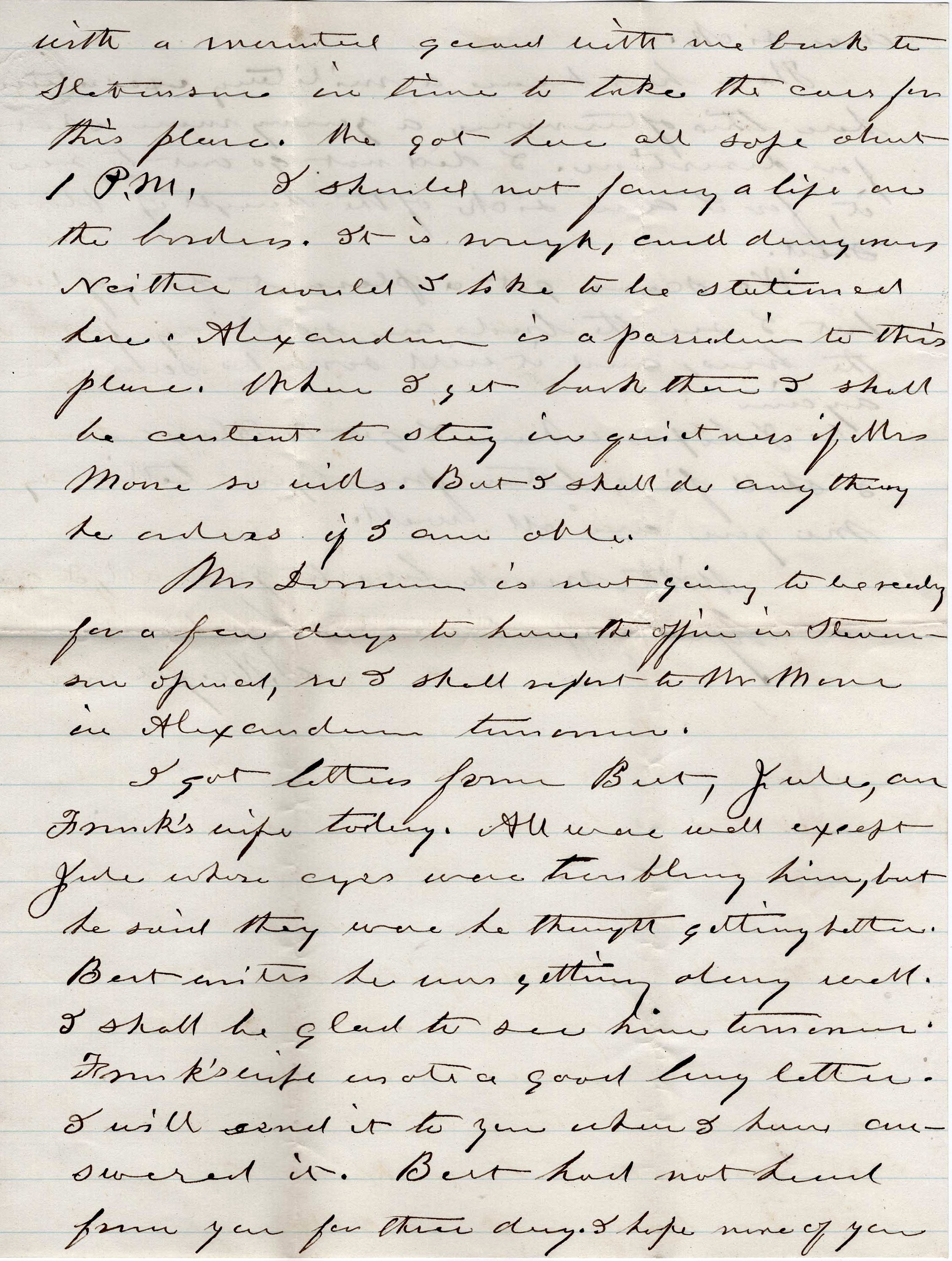


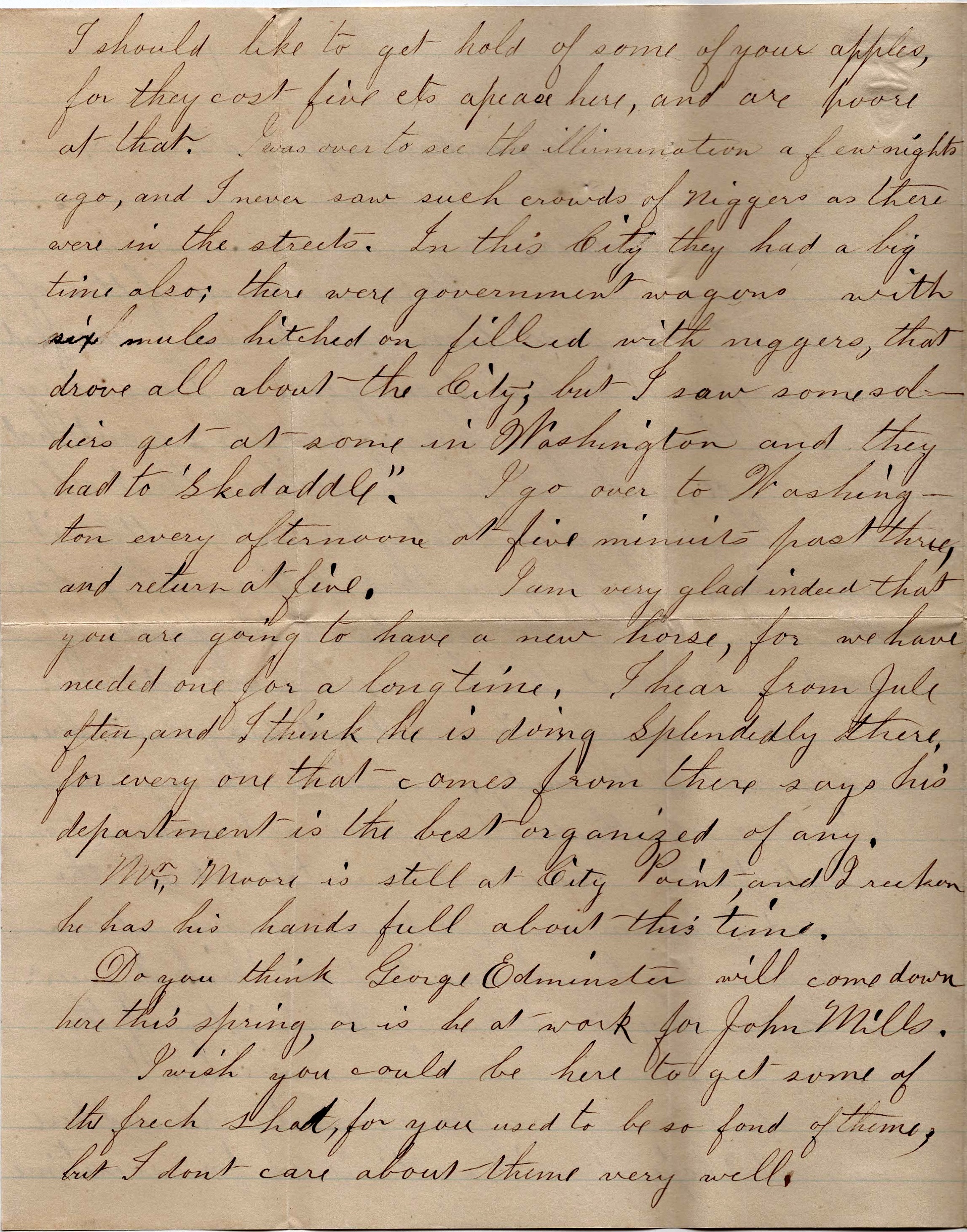

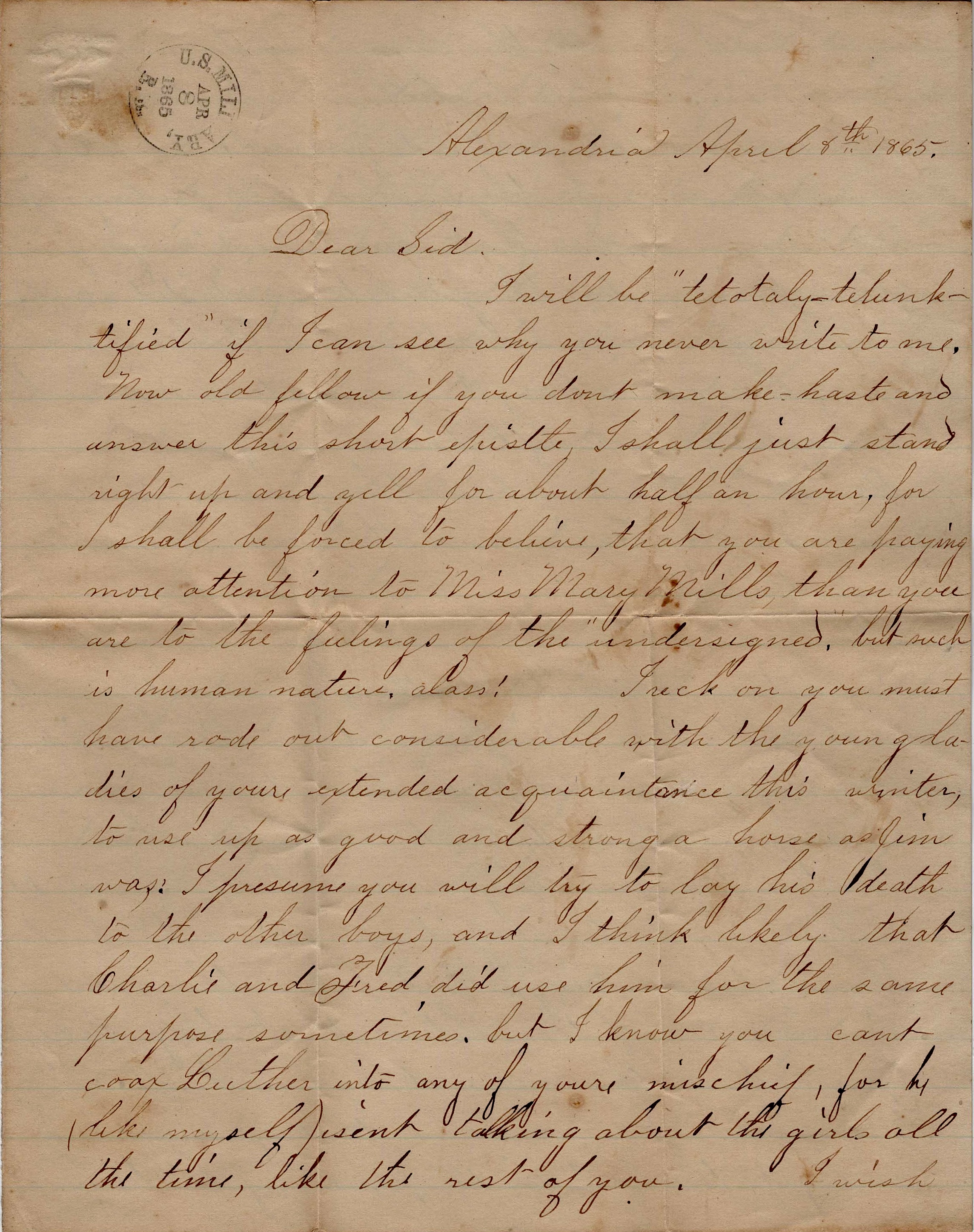
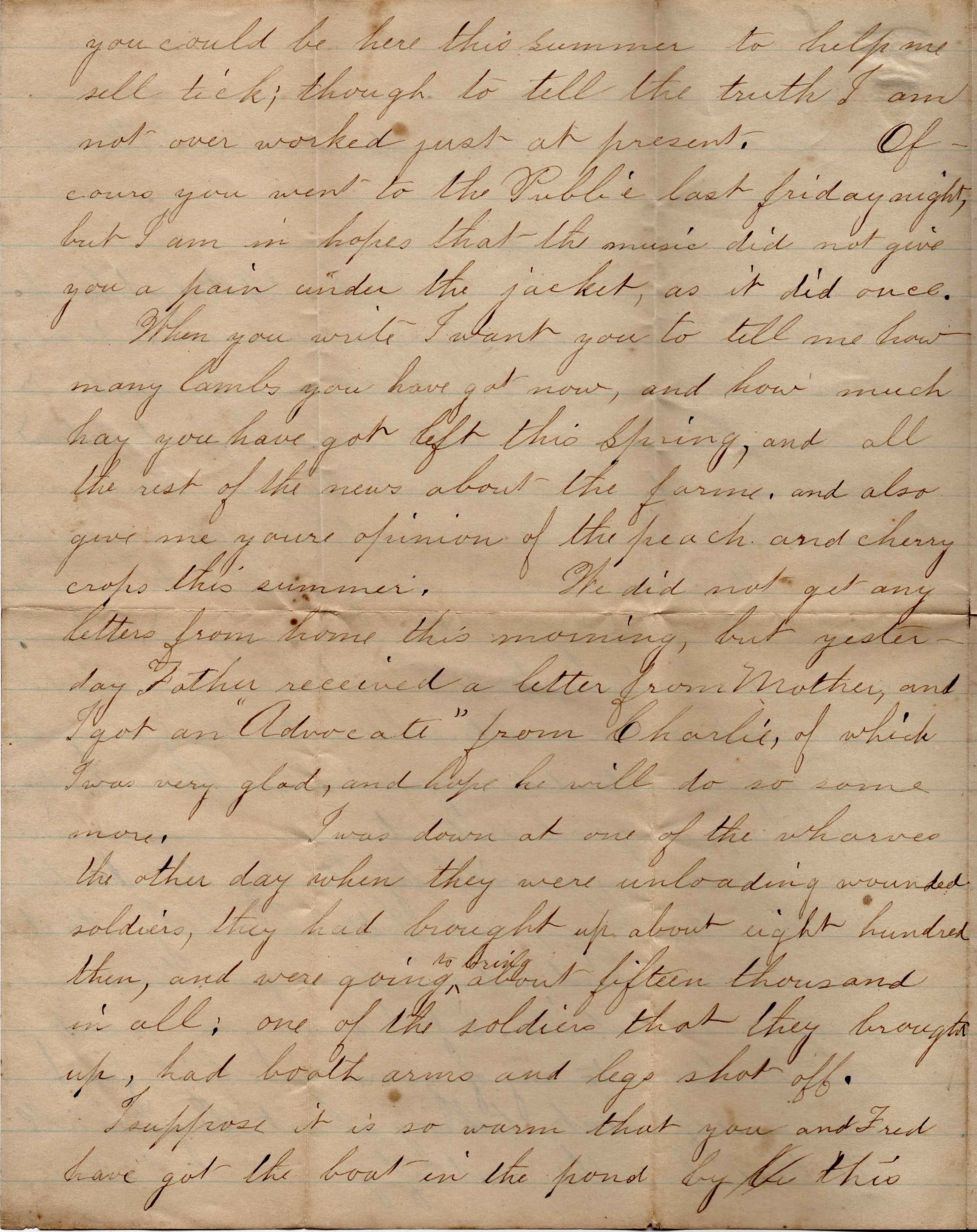
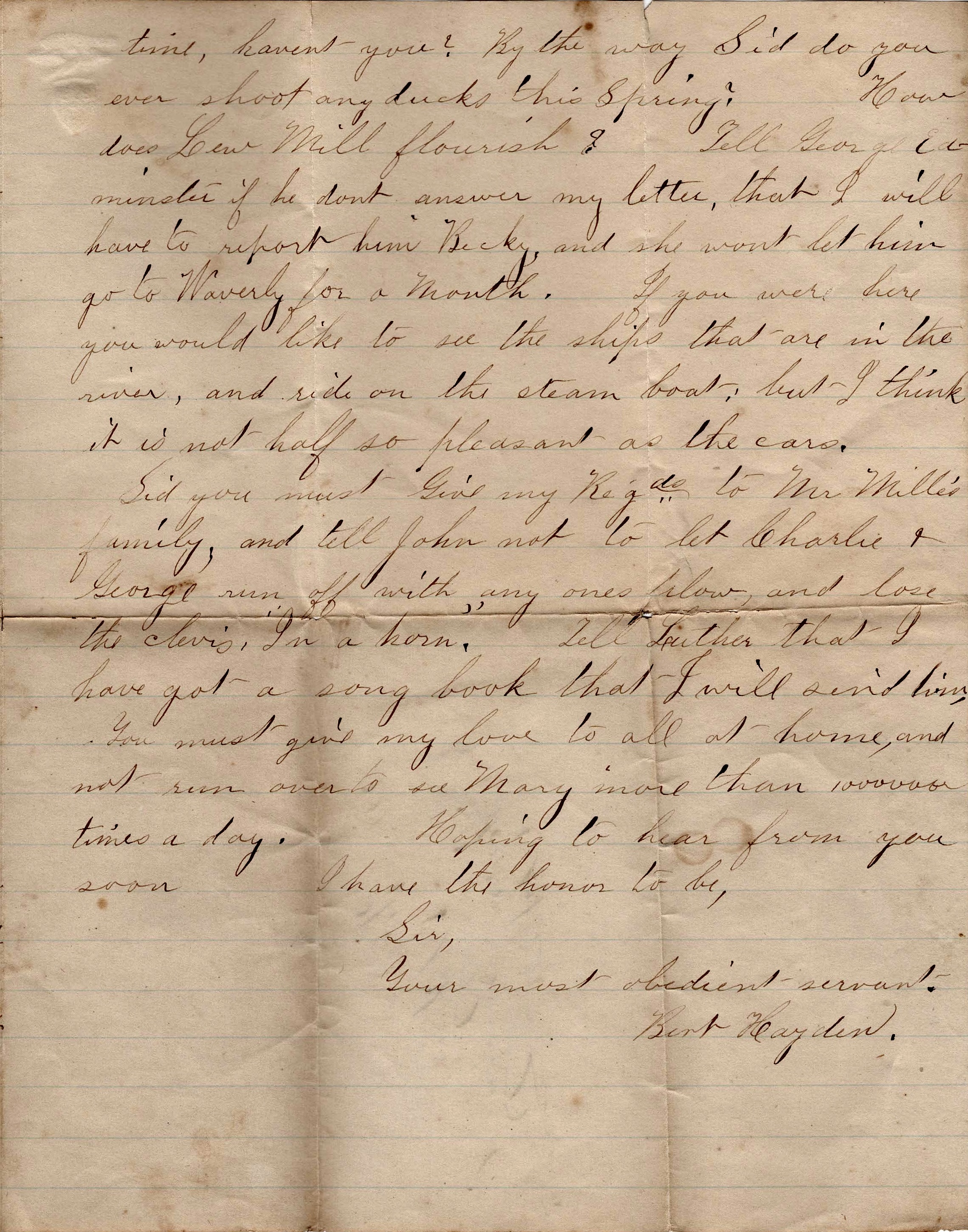
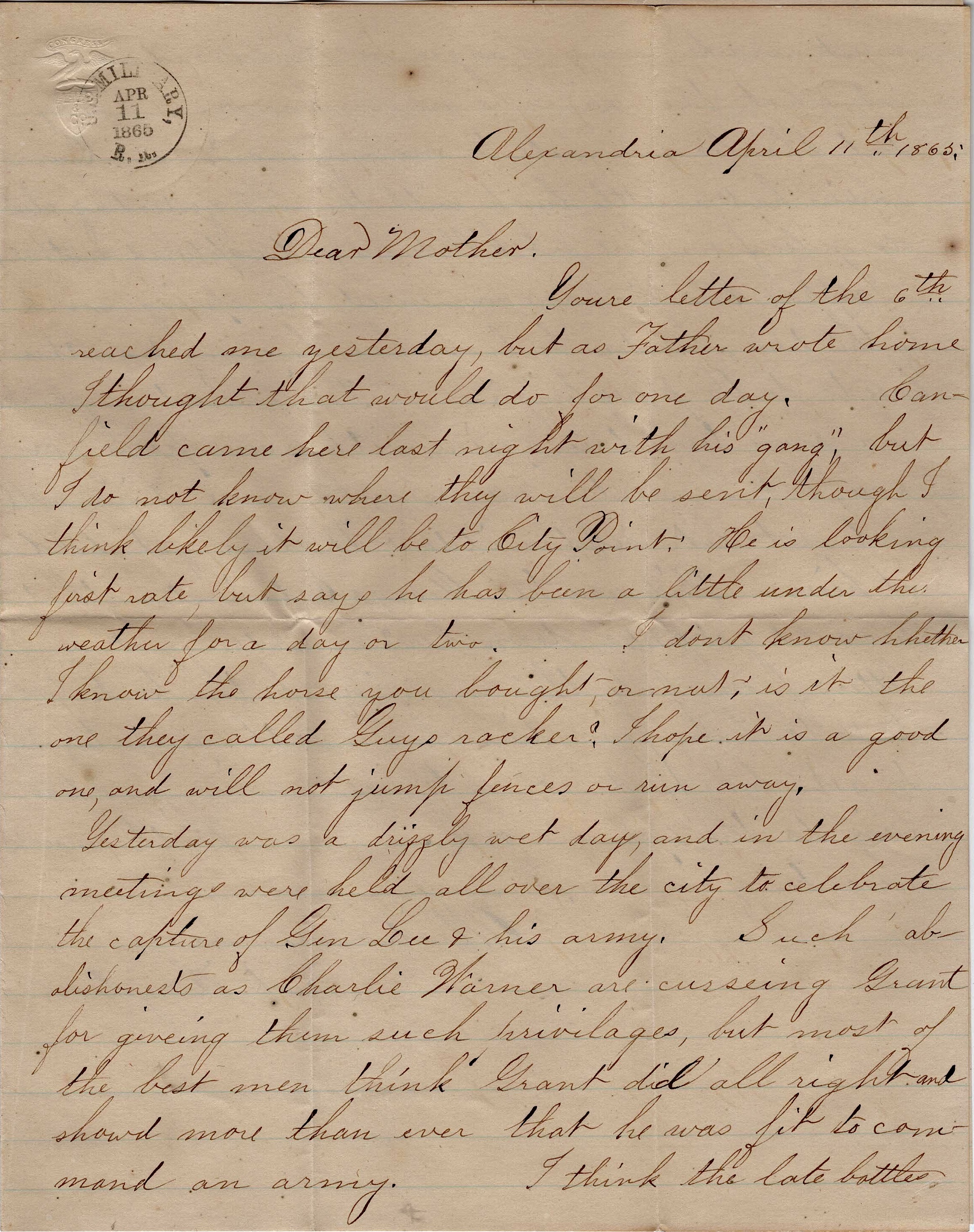

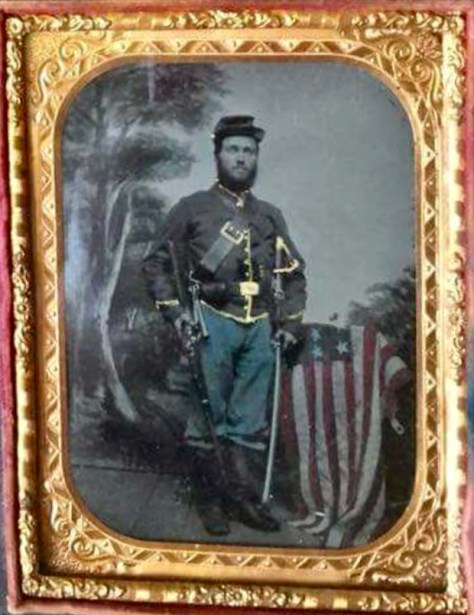


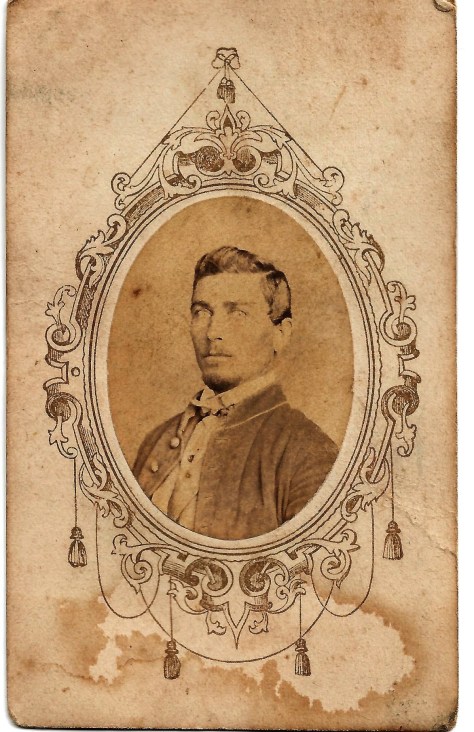
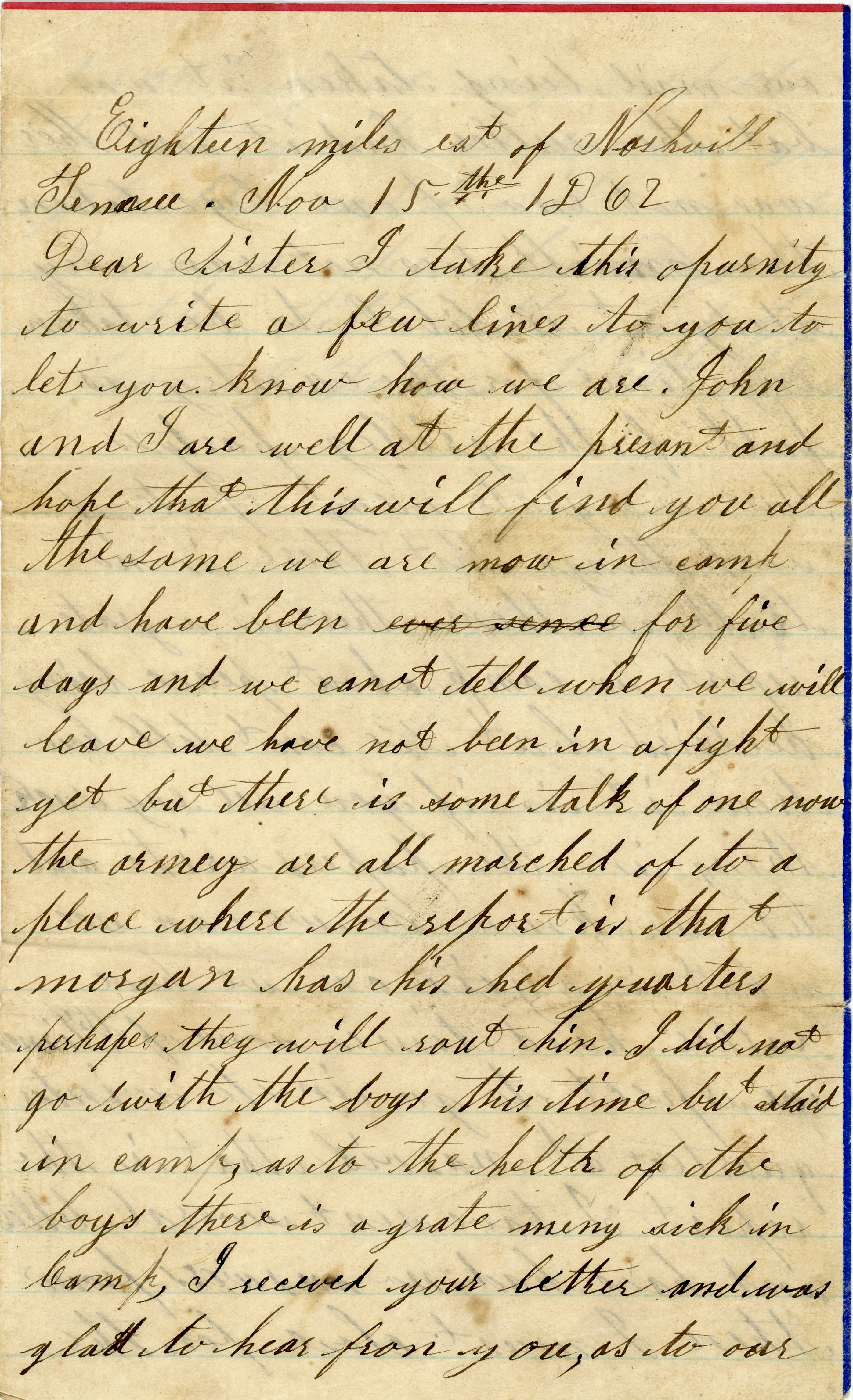
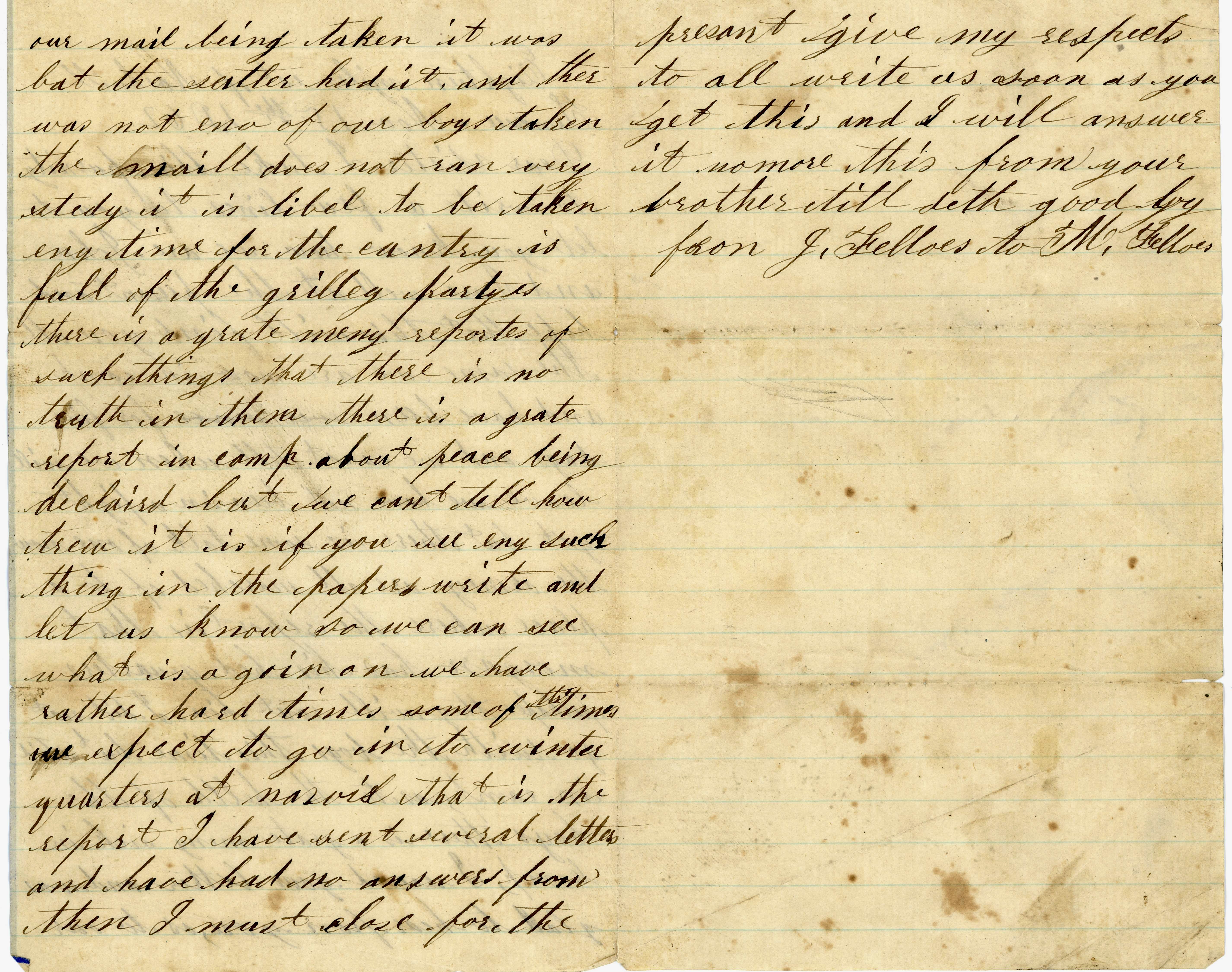
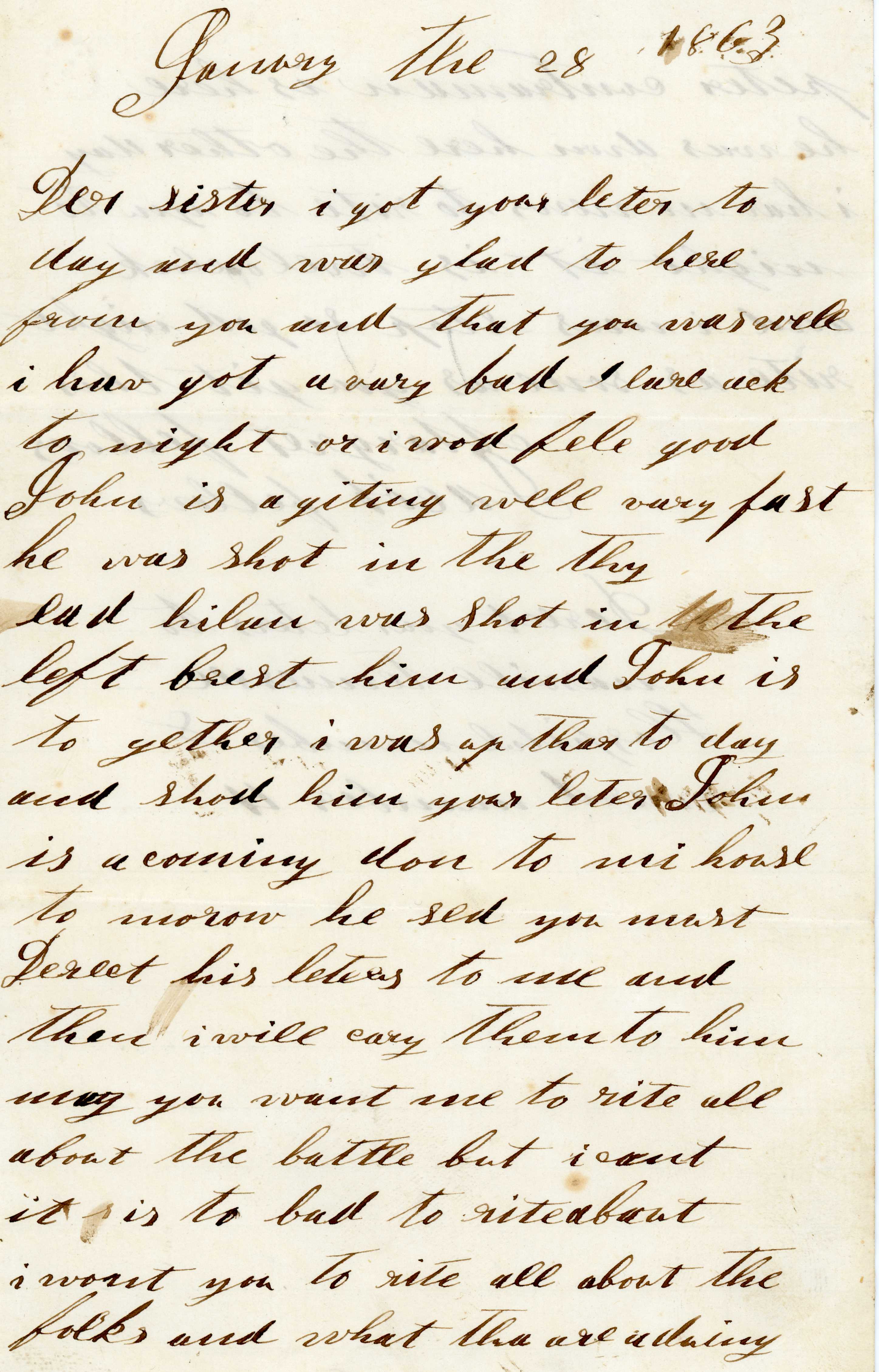
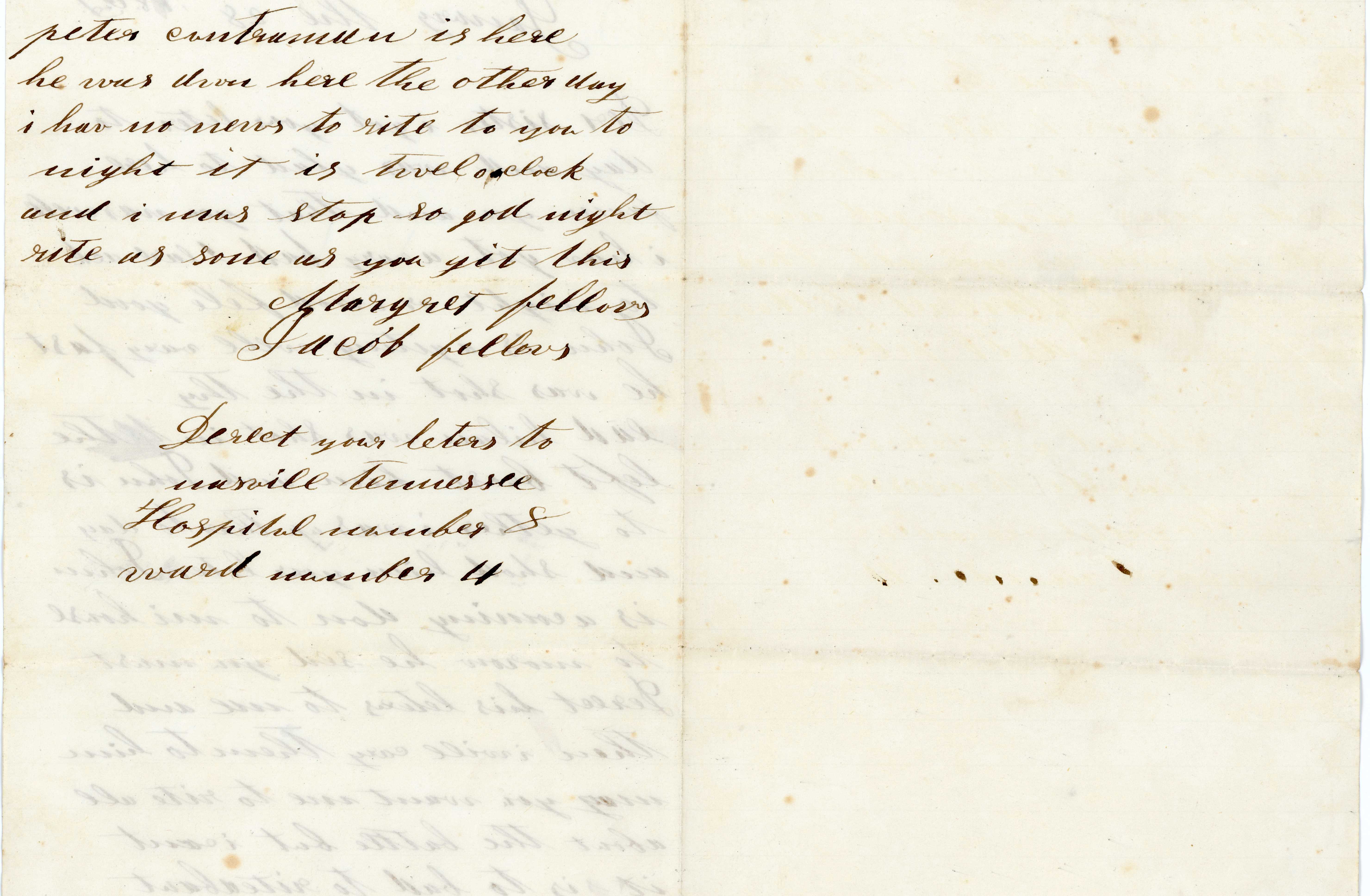
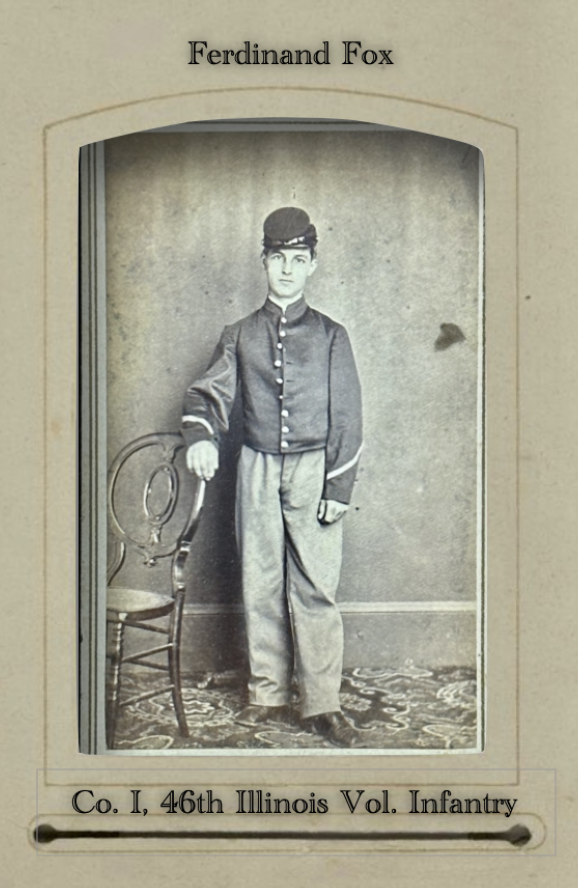


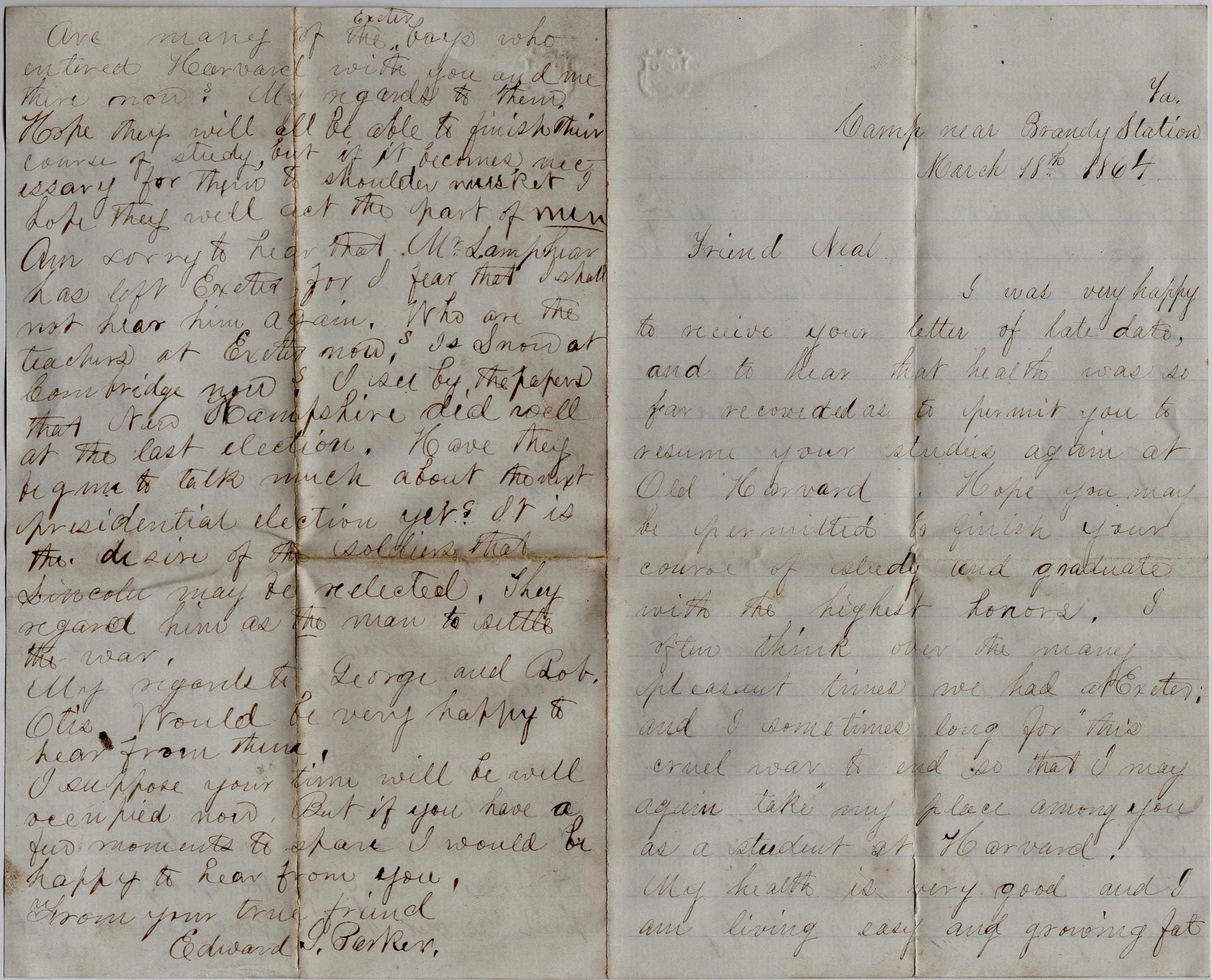
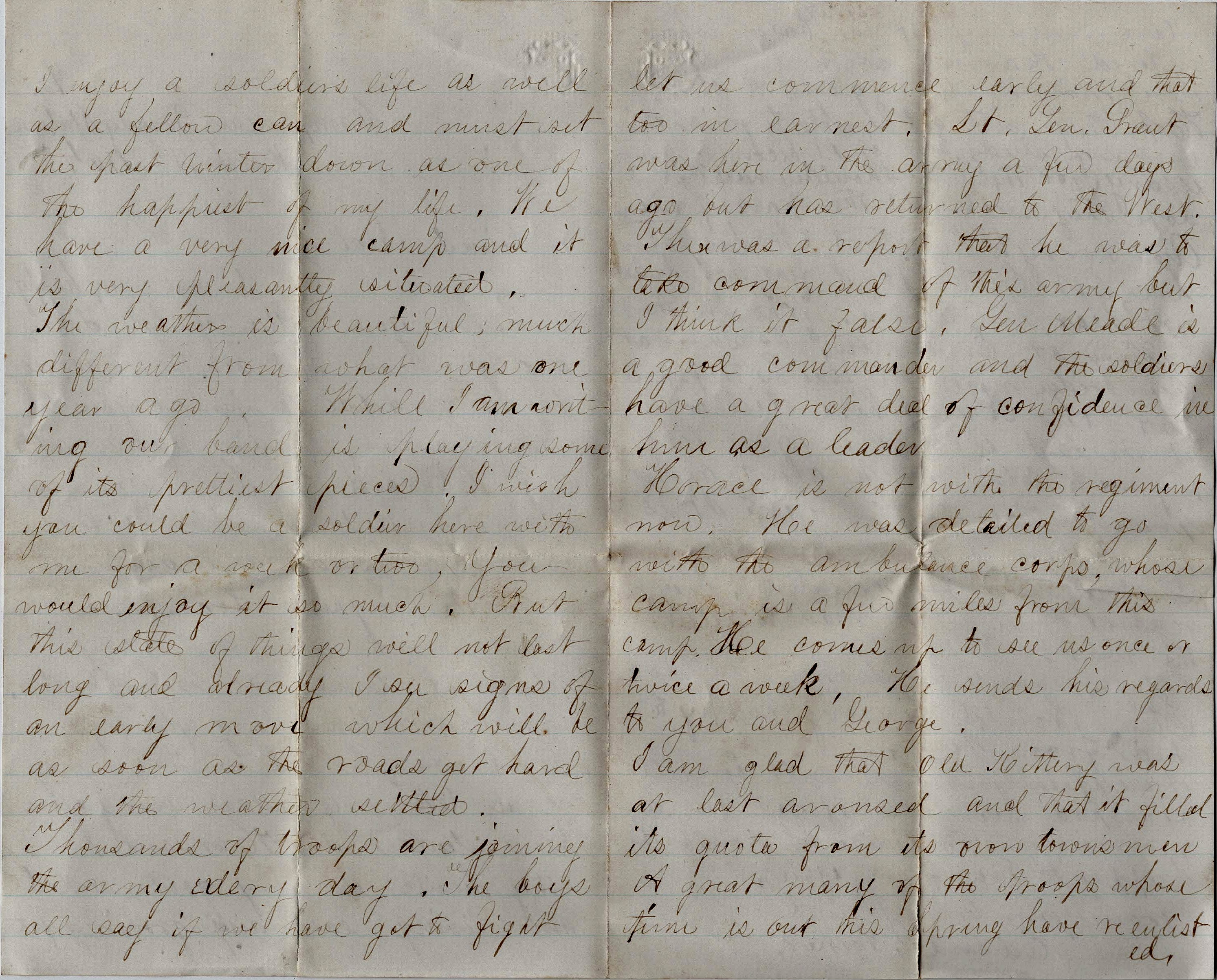
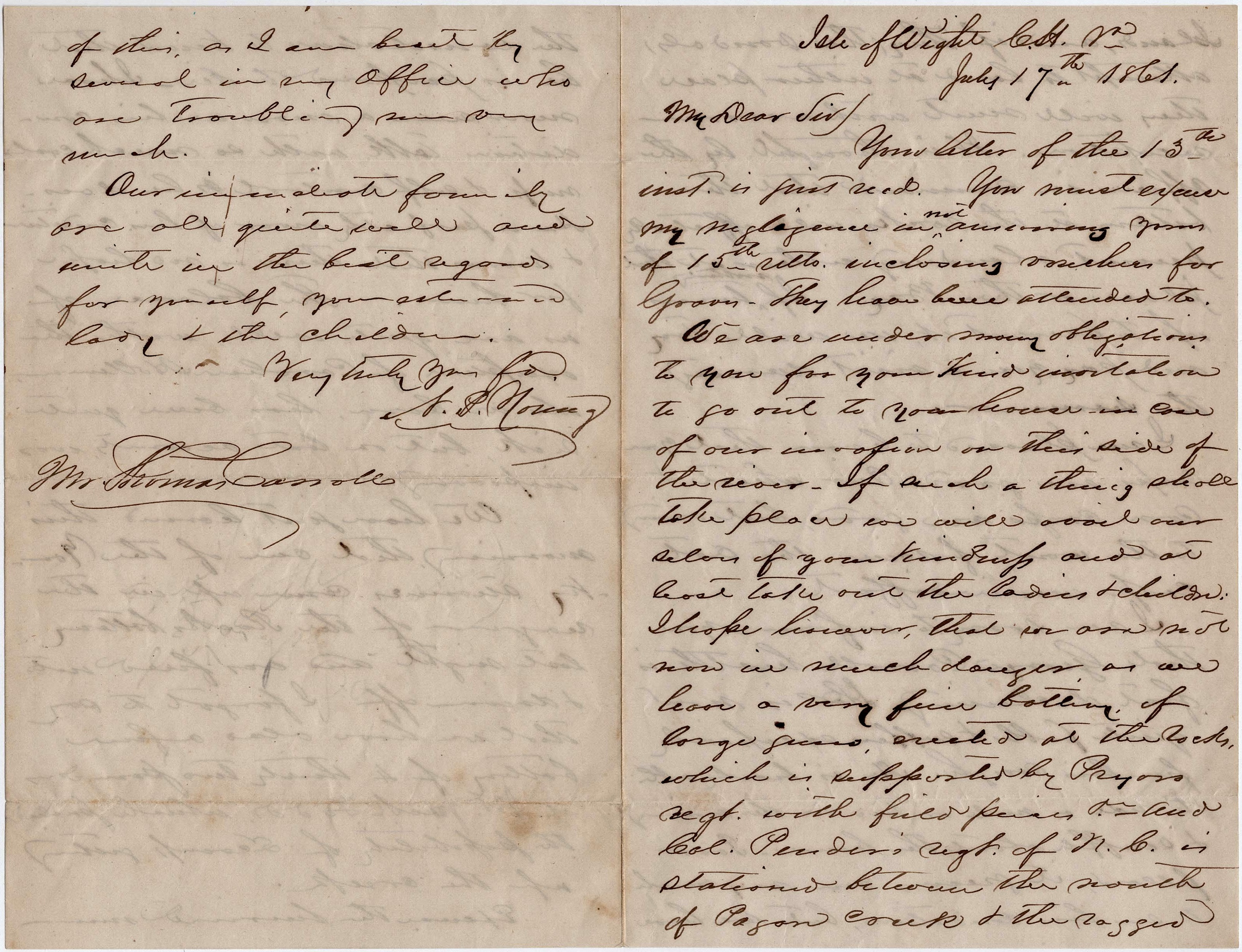
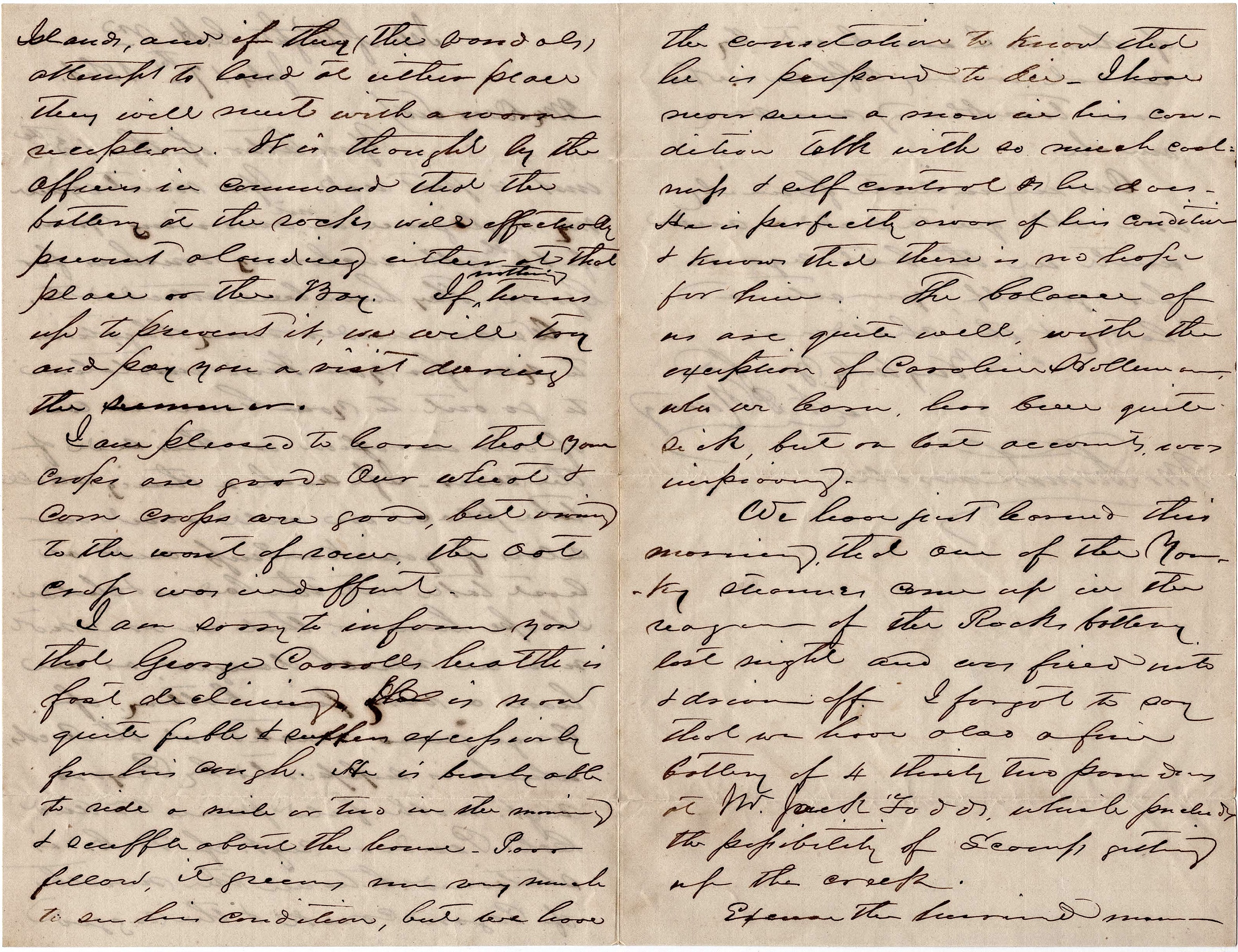
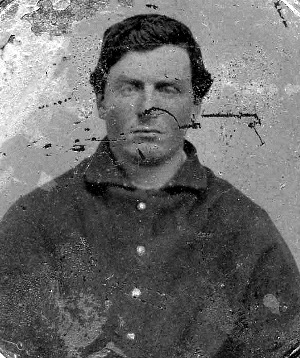
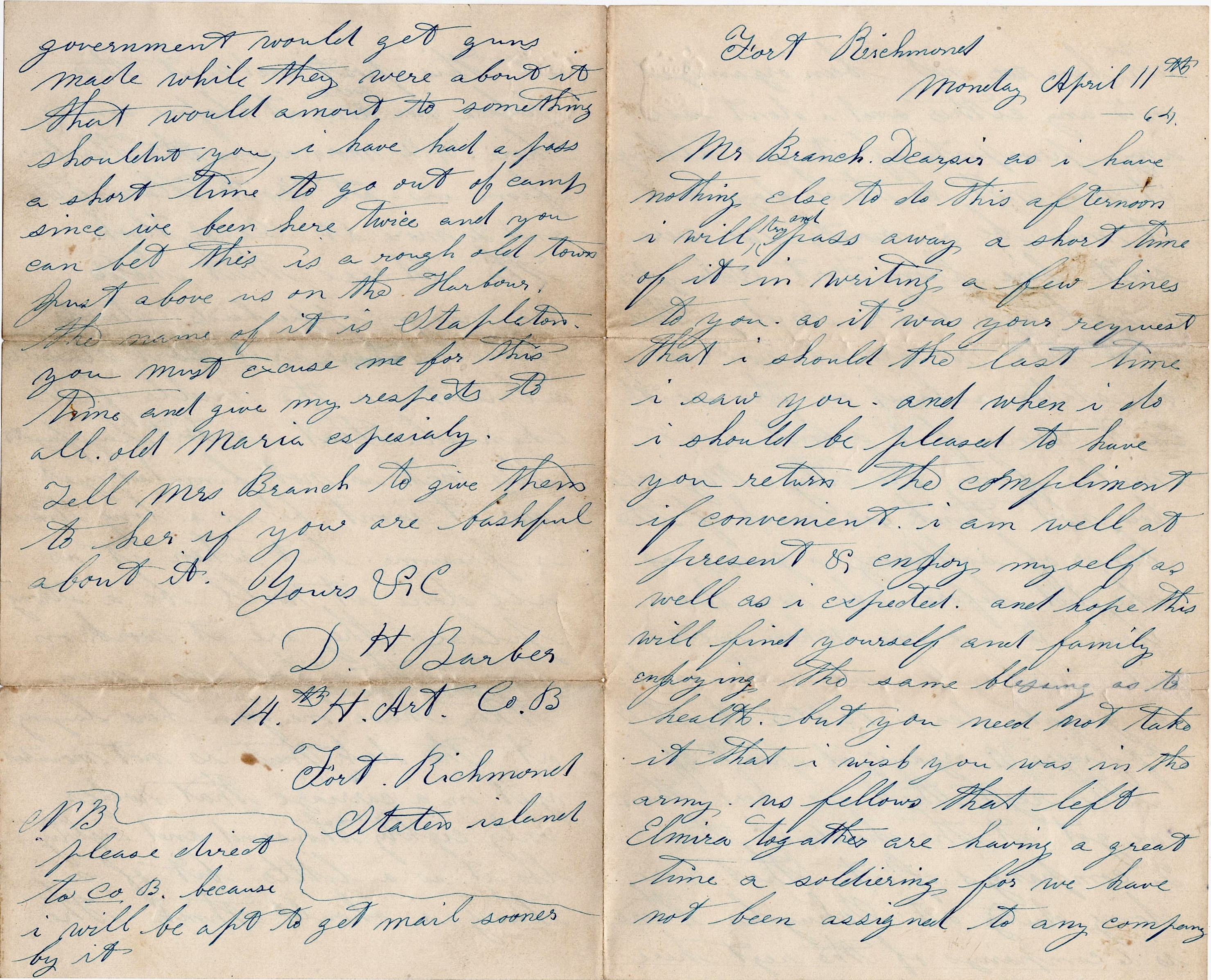
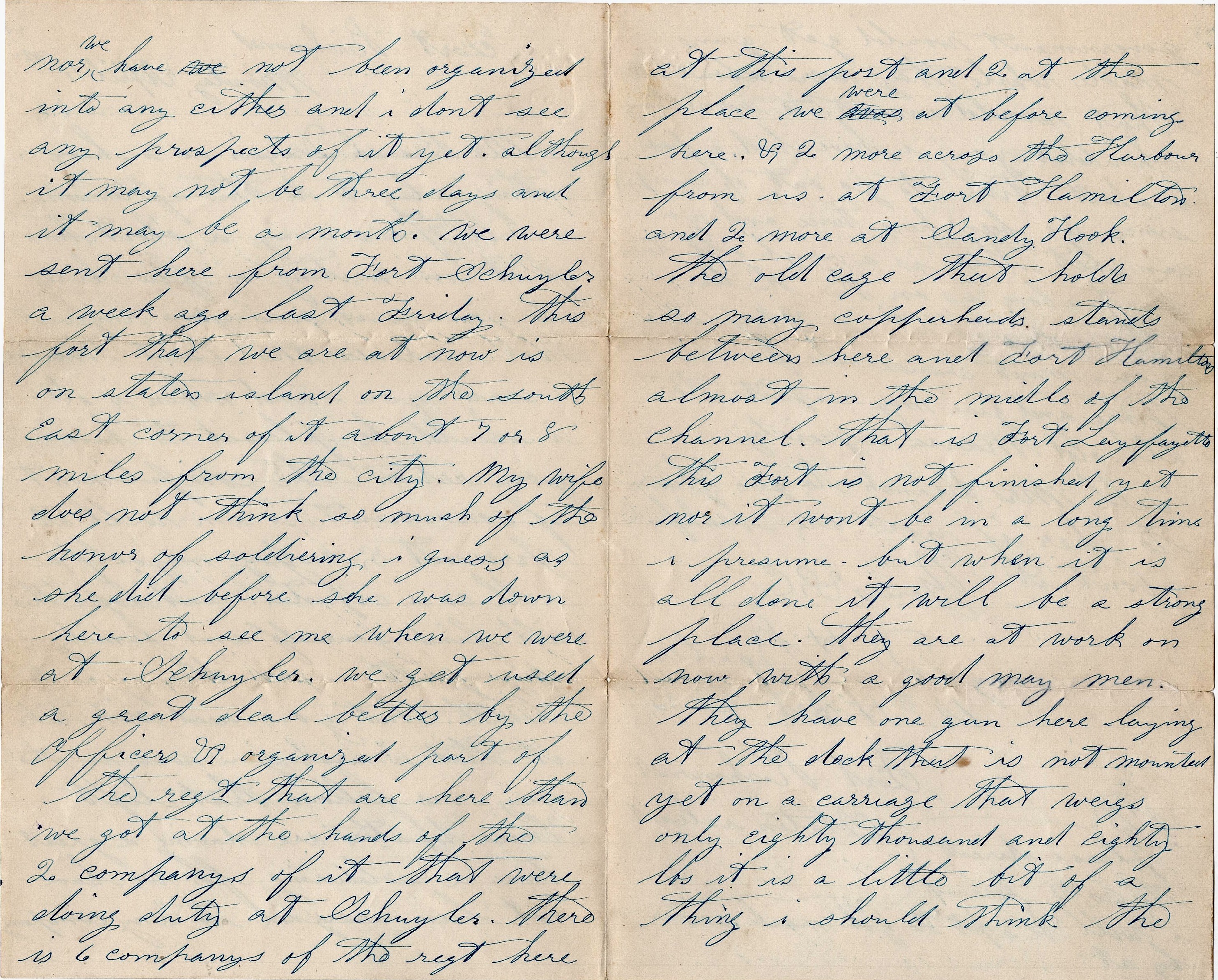


 Spared & Shared 23