My passion is studying American history leading up to & including the Civil War. I particularly enjoy reading, transcribing & researching primary sources such as letters and diaries.
The following letter was written by Rev. Elmore Yocum Warner (1833-1886), the son of Jesse Warner (180201872) and Jane Goodfellow (1811-1843) of Wooster, Wayne county, Ohio. Elmore was married to Alice Maria Lee (1843-1915) in 1859 at North Fairfield, Huron county, Ohio.
Elmore accepted a commission as Chaplain of the 3rd Ohio Volunteer Cavalry on 11 December 1861 and remained with the regiment until 1 August 1862 when he resigned and returned to his home in North Fairfield, Huron county, Ohio. [Note: the regimental roster erroneously recorded his name as “Edward” rather than “Elmore.”]
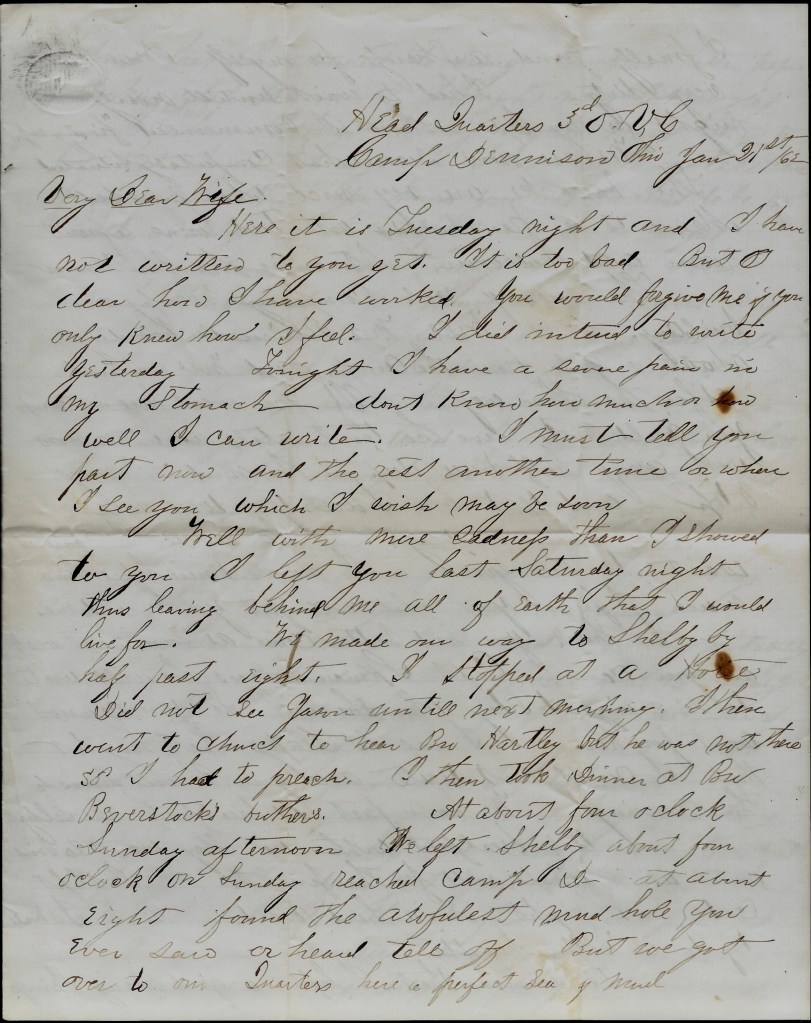
Here it is Tuesday night and I have not written to you get. It is too bad. But O dear, how I have worked. You would forgive me if you only knew how I feel. I did intend to write yesterday. Tonight I have a severe pain in my stomach. Don’t know how much or how well I can write. I must tell you part now and the rest another time or when I see you which I wish may be soon.
Well with more sadness than I showed to you, I left you last Saturday night, thus leaving behind me all of earth that I would live for. We made your way to Shelby by half past eight. I stopped at a Hotel. Did not see Jason until next morning. I then went to church to hear Bro. Hartley but he was not there so I had to preach. I then took dinner at Beverstock’s brothers. At about four o’clock Sunday afternoon, we left Shelby [and] reached Camp D[ennison] at about eight. Found the awfullest mud hole you ever saw or heard tell of. But we got over to our quarters here a perfect sea of mud. I finally found a shanty for myself—new, but very dirty. I had to wait until nearly night for my boxes when I commenced “fixing up.”
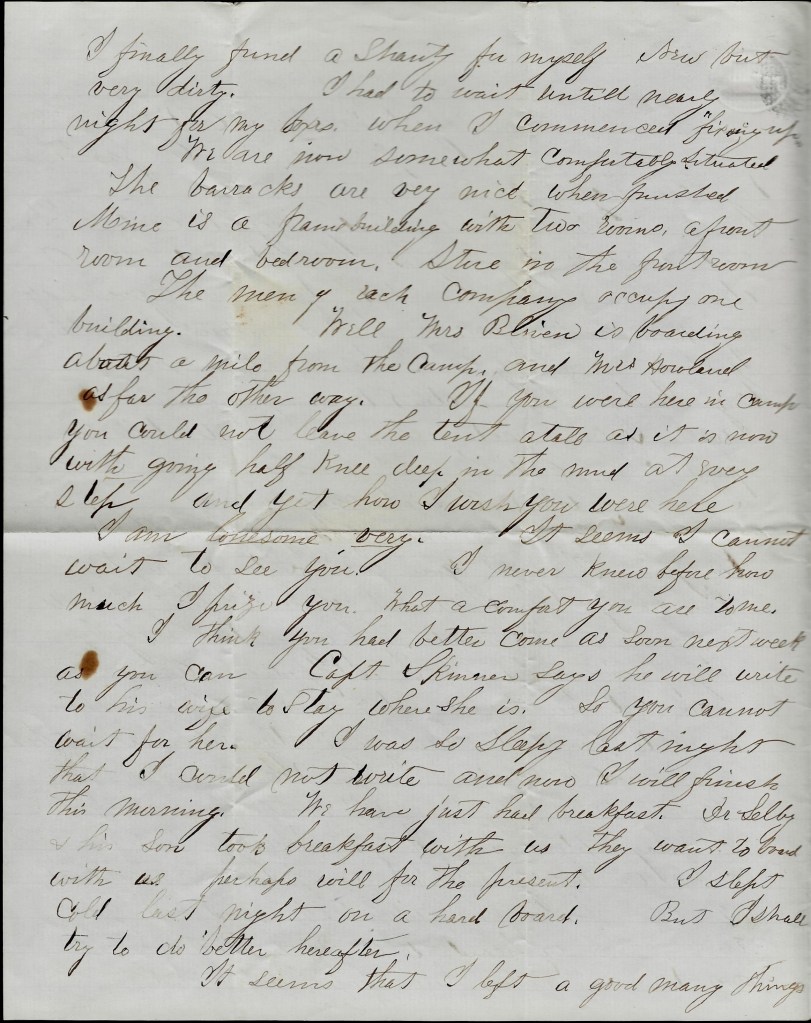
We are now somewhat comfortably situated. The barracks are very nice when finished. Mine is a frame building with two rooms—a front room and bedroom. The men of each company occupy one building. Well, Mrs. Bliven is boarding about a mile from the camp and Mrs. Howland as far the other way. If you were here in camp, you could not leave the tent at all as it is now with[out] going half knee deep in the mud at every step, and yet how I wish you were here.
I am lonesome—very. It seems I cannot wait to see you. I never knew before how much I prize you What a comfort you are to me. I think you had better come as soon next week as you can. Capt. Skinner says he will write to his wife to stay where she is so you cannot wait for her. I was so sleepy last night that I could not write and now I will finish this morning.
We have just had breakfast. Dr. Selby & his son took breakfast with us. They want to board with us—perhaps will for the present. I slept cold last night on a hard board. But I shall try to do better hereafter. It seems that I left a good many things behind that I intended to bring such as letter paper, looking glass, saw, &c. I bought me a looking glass.
Then I forgot to say a great many things to you that I did not say. I wanted to say take care of your health. you know you are inclined to be a little careless in that respect. Do be careful. I wish you would put away my coats & vests that I left behind. Get things in the drawers and put away in various places all snug and safe so that they will not be scattered nor lost that we may have them when we want to go to housekeeping again. And I pledge you now that when I get through with this, I will never—unless in the strictest sense of duty—take a position that will separate us or tear us up in the world as we now are. You may write this down in your memorandum.
There is much talk and a strong probability of our being disbanded. Our officers fear it greatly—some of them, and some I guess don’t care much. I don’t, for one. If the regiment is not needed in war, I hope it will be disbanded. Keep for the present the money you have. Bring with you when you come one or two felt comforts after you get your trunk filled. Then have Hosford tie the comforts on the top. Bring your coarsest clothing and warmest, perhaps one nice dress, plenty of calico, and such as will bear the dirt and rub. Better get you a new calico frock. Get your shoes fixed, &c. &c. And come on.
You had better start from Monroeville on the morning train at 7 o’clock. Get you a ticket and get your baggage checked to Shelby Junction, not Shelby town. When at the junction, buy your ticket and get baggage checked to Camp Dennison. You will then come through safe without changing cars and I will meet you at the Depot here. By starting in the morning, you save the night travel and can see the country as you come.
You will have to wait a while at Shelby. Be sure and tell me what day you will come so that I can meet you. If I should not meet you, you would not know where to go. The Railroad runs directly through the camp. I have just been to see Capt. Skinner. He says he will send for his wife probably next week so that she can come the last of the week. Perhaps you had better wait until the last of the week. He is waiting for pay day. You had better come as soon as Friday of next week.
Well, you see my sheet is full and I must close. Keep good spirits and hope to meet soon. Sarah lives some 8 or 9 miles from Jason. Says tell you he is well and likes it first rate. I think though that he will get tired. Give my love to Mother and write soon as you receive this. Let us meet at the throne of grace often.
The following letter was written by Sergeant Plympton A. Mead (1835-1910) whose signature is barely legible at the end of the letter. Plympton mustered into Co. K, 111th Pennsylvania Infantry in late December 1861. He was commissioned a 2nd Lieutenant in January 1863 and a 1st Lieutenant in October 1864. On 5 June 1865, he was promoted to Captain of the company. He was wounded at Lookout Mountain and at Ringgold, Georgia.
Plympton was the son of Charles Mead (1806-1883) and Rebecca Legett (1810-1869) of Elk county, Pennsylvania.
Transcription
Co. K, 111th Pennsylvania Vol., Capt. Jonas J. Pierce Camp Sigel, Cedar Creek July 4th 1862
Dear Father and Mother,
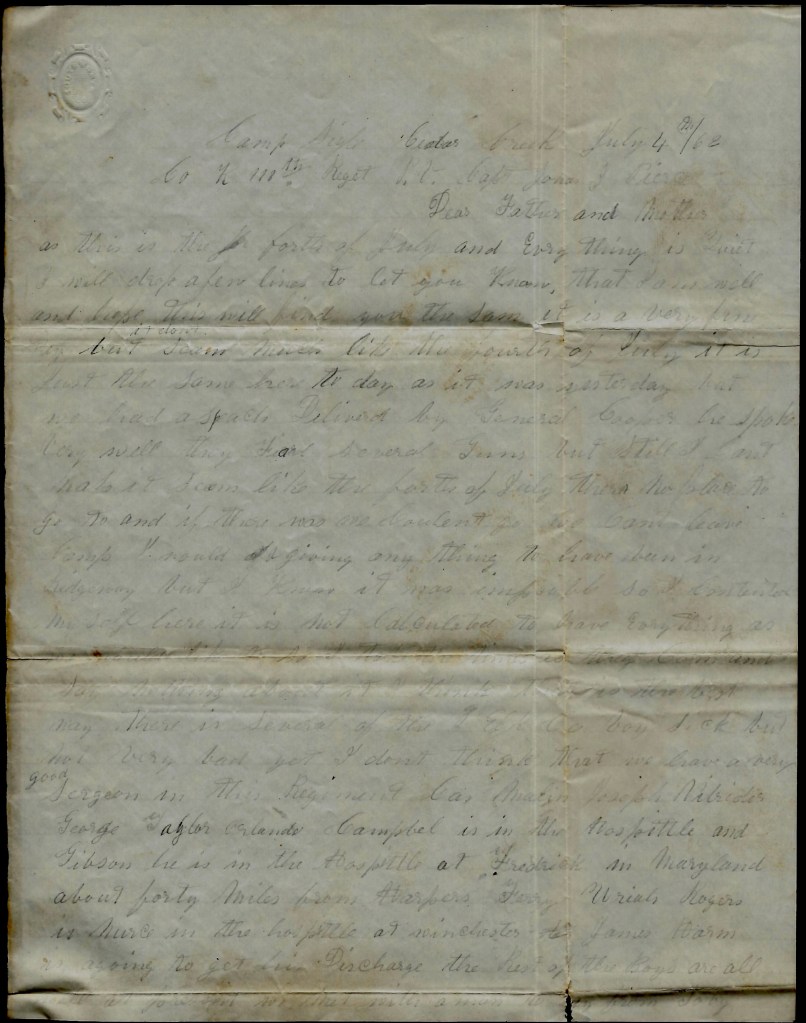
As this is the Fourth of July and everything is quiet, I will drop a few lines to let you know that I am well and hope this will find you the same. It is a very fine day but it don’t seem much like the Fourth of July. It is just the same here today as it was yesterday. But we had a speech delivered by General Cooper. He spoke very well. They fired several guns but still I can’t have it seem like the Fourth of July. There is no place to go to and if there was, we couldn’t go. We cant leave camp. I would a given anything to have been in Ridgeway but I know it was impossible so I contented myself here. It is not calculated to have everything as we would like to so I take the time as they come and say nothing about it. I think this is the best way.
There is several of the Elk Co. boys sick but not very bad yet. I don’t think we have a very good surgeon in this regiment. Cas[tor] Maylin, Joseph Neiteriter, George Taylor, Orlando Campbell is in the hospital and [Israel] Gibson he is in the hospital at Frederick in Maryland, about forty miles from Harpers Ferry. Uriah Rodgers is nurse in the hospital at Winchester. James Harm is a going to get his discharge. The rest of the boys is all well at present.
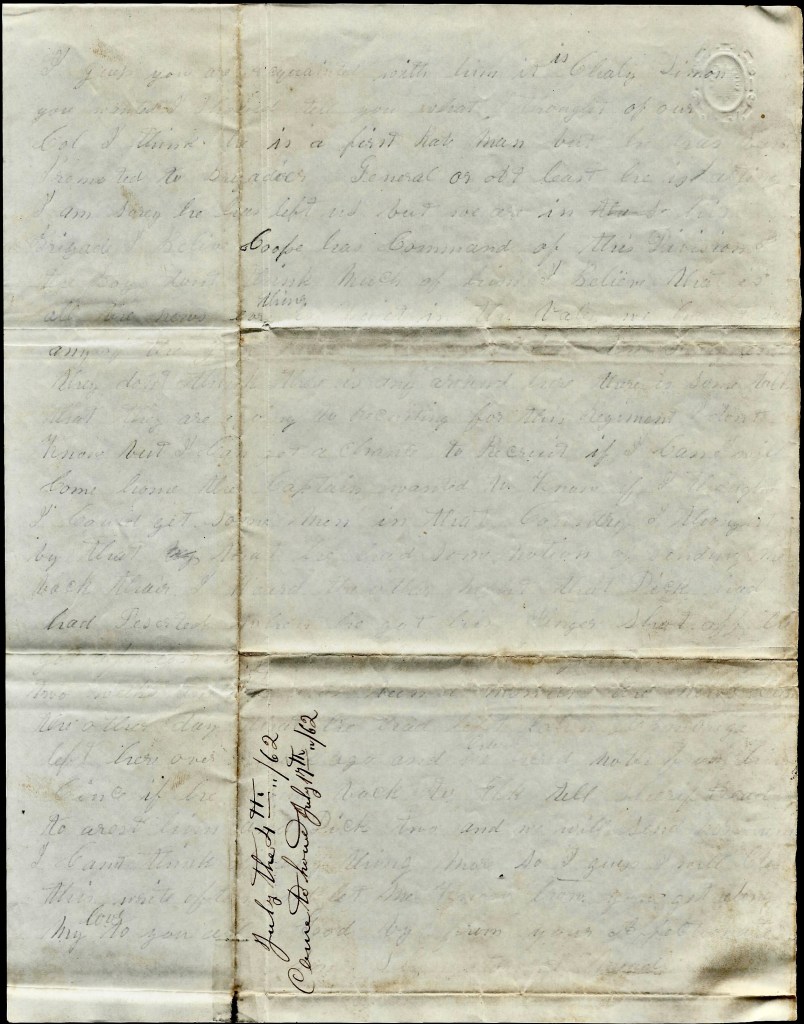
We met with a man to day from Toby. I guess you are acquainted with him. It is Charley Simon.
You wanted I should tell you what I thought of our colonel. I think he is a first rate man but he has been promoted to Brigadier General—or at least he is acting. I am sorry he has left us but we are in his Brigade I believe Coope has command of this Division. The Boys don’t think much of him. I believe that is all the news for things are quiet in this valley. We haven’t seen any of the Johnnys here. [paper crease] They don’t think there is any around here. There is some talk that they are a going to recruiting for this regiment. I don’t know but that I can get a chance to recruit. If I can, I will come home. The captain wanted to know if I thought I could get some men in that country. I thought by that he had some notion of sending me back there. I heard the other night that Dick had deserted when he got his finger shot off. [paper crease] the other day that he had left….
I can’t think of anything more so I guess I will close this. Write often and let me know how you get along. My love to you all. Goodbye from your affectionate son, — Plympton A. Mead
The following letters were written by Edward Brierly (1831-Bef1884) of Newburgh, Orange county, New York, who enlisted at age 30 as a private in Co. C, 72nd New York Infantry, the 3rd Regiment of the Excelsior Brigade. The regiment was mustered into service at Camp Scott, Staten island, from June to Oct., 1861, for three years. It left there on July 24, 1861, for Washington, where it was joined by two of its companies late in October. After serving for a few months in the vicinity of Washington the regiment was assigned to Sickles’ Excelsior brigade, Hooker’s division, served along the Potomac in Maryland, near Stafford Court House, Va.
He was discharged for disability on 17 March 1862 at Camp Wool, Maryland.
Letter 1
Camp Marsh Washington D. C. August 4, 1861
My dear and loving wife,
I write these few lines to you for to let you know where I am and how I am stationed at present. I am in good health at present hoping that you and Margaret is in good health also. Thank God for it. We are within 1.5 miles of Washington but unless to see it from our camp, that is all. we can say or tell about as neither men nor officers can leave the camp.
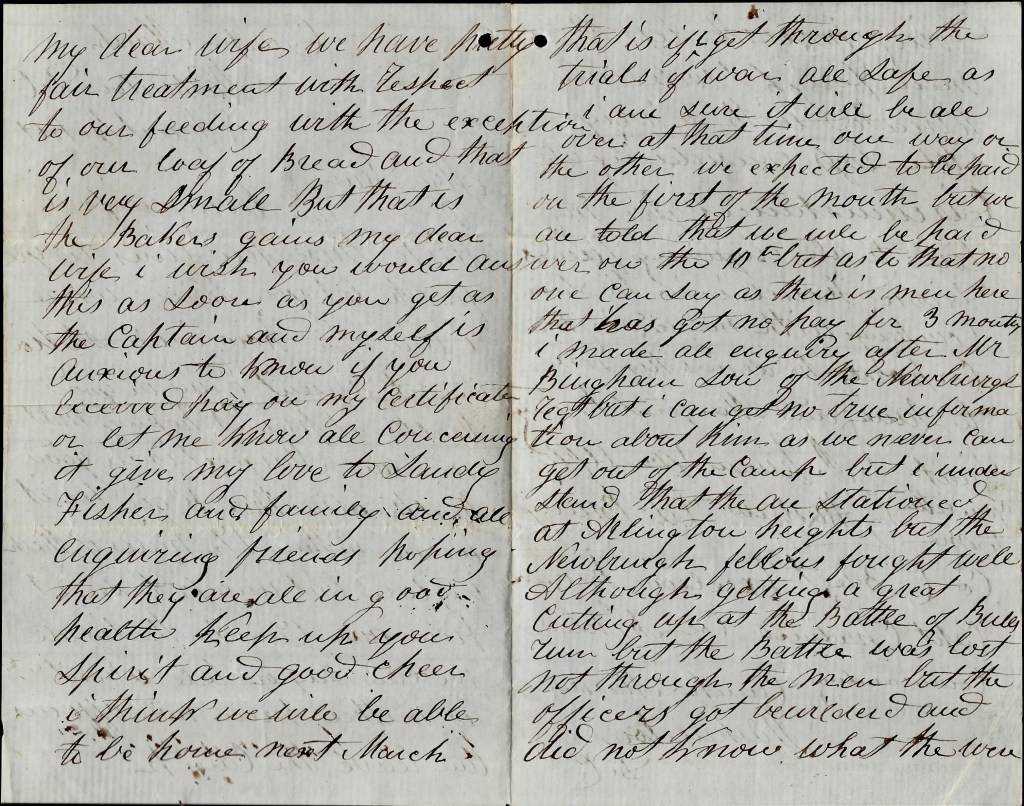
My dear wife, we have pretty fair treatment with respect to our feeding with the exception of our loaf of bread and that is very small. But that is the Baker’s gains. My dear wife, I wish you would answer this as soon as you get it as the Captain and myself is anxious to know if you received pay on my certificate or let me know all concerning it. Give my love to Sandy Fisher and family an all enquiring friends hoping that they are all in good health. Keep up your spirit and good cheer.
I think we will be able to be home next March—that is, if I get through the trials of war all safe as I am sure it will be all over at that time one way or the other. We expect to be paid on the first of the month but we are told that we will be paid on the 10th but as to that, no one can say as there is men here that has got no pay for three months.
I made an enquiry after Mr. Bingham son of the Newburgh’s regt. but I can get no true information about him as we never can get out of the camp. But I. understand that they are stationed at Arlington Heights. But the Newburgh fellows fought well although getting a great cutting up at the Battle of Bulls Run. But the battle was lost not through the men but the officers got bewildered and did not know what they were doing. Nevertheless the men fought well and retreated with a very little loss considering all circumstances.
Give my love to all enquiring friends. David Farrell is in the same company with me and is made corporal. He sends his love to Jane and Margaret Brierly. I remain your affectionate husband, — Ed Brierly
Direct your letter to me, Co. C, 3rd Regt. Excelsior Brigade, Capt. Chadwick, Col. Nelson [Taylor], Commanding, Camp Marsh, Washington D. C.
Letter 2
Headquarters 3rd Regiment, Co. C Camp Caldwell August 28, 1861
My dear wife,
I take this opportunity of writing to you hoping that yourself and Margaret is in good health as this leaves me at present. Thank you for it. My dear wife, I have written a letter to you on the 15th of this month and I have received no answers which makes me very uneasy so answer this as soon as you can as we are under marching orders and cannot tell the moment that we will leave here.
My dear wife, we have received no pay as yet but we expect it on the first of next week and then I will be able for to send you some money. You have better let me know in your letter to me if you ever got my certificate of enlistment and if so, if you got any relief on it and all particulars about it as the Captain is returned from New York and I will see to it here for there is several men in the Company that lives in the country—some in Newark and others in Patterson—and their families gets the relief money. So send me all particulars about it and I shall see to it here.
Our treatment here is fair considering all circumstances but we will not be much longer until we will have a brush with the enemy. We are at present within 6 miles of some of their camps so we never can tell how soon we may meet. But if it is the will of God to guide me through, I am almost sure that I will be home next spring as the war can not hold longer nor that time for the South is really starving at this present time.
Give my love to Sandy Fisher, wife and family, and all inquiring friends. Write as soon as you get this as I am anxious for to hear from you and my next letter shall be a long one. Remember me to Ed Darcey and all the boys in the gass house and old Mrs. Murphy, God bless her. I will say no more at present but remain with sincere love to yourself and Margaret.
Your affect husband, — Edw. Brierly
P. S. Direct your letters to Edward Brierly, Camp Caldwell, 3 Regt. Co C, Colonel Taylor commanding
1000 kisses to yourself and Margaret. God bless and protect you until I shall see you again.
Letter 3
Camp Caldwell [Washington] D. C. September 16, 1861
Dear wife,
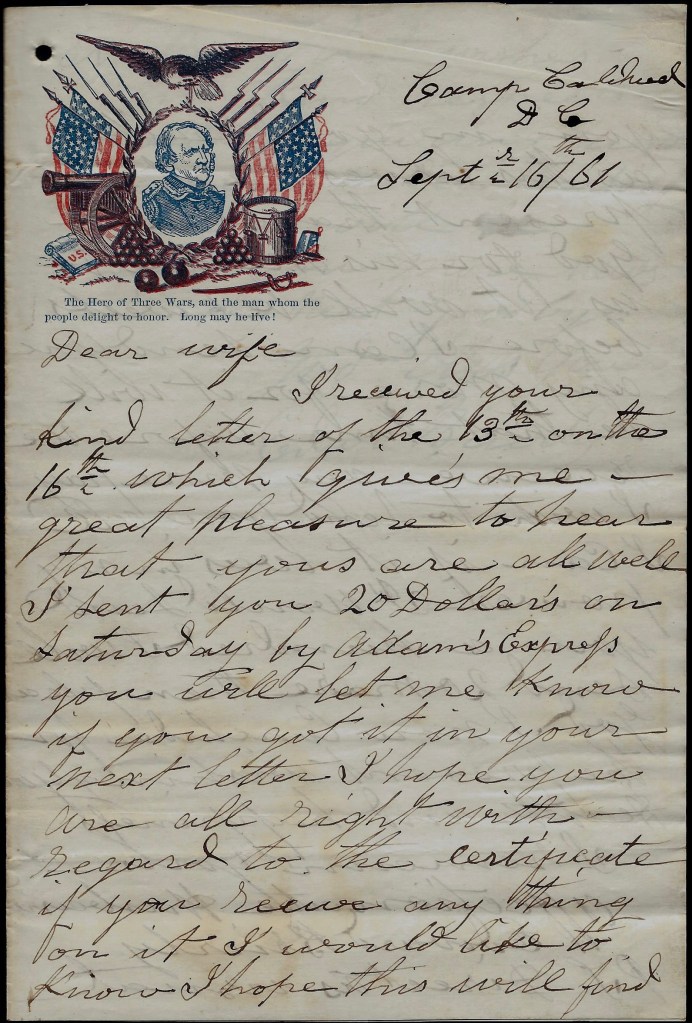
I received your kind letter of the 13th on the 16th which gives me great pleasure to hear that you are all well. I sent you 20 dollars on Saturday by Adam’s Express. You will let me know if you got it in your next letter. I hope you are all right with regard to the certificate. If you receive anything on it, I would like to know. I hope this will find you in good health as this leaves me at present, thanks be to God for His mercies to us.
It will be 6 weeks before I can send you any more for it will be that time before we receive any more pay. I wish to send you all I can. If it was in my power, I would send you a hundred. I will send 20 more then, please God. I now conclude for the present wishing you health and happiness. I remain your affectionate husband, — Edward Brierly
P. S. Direct as usual.
N. B. My best wishes and kind respect to all enquiring friends. We are under marching orders. I will send you more news in my next. Goodbye. God bless you, — Edward Brierly
Letter 4
Camp Caldwell October 10, 1861
My dear wife,
I write these few lines to you hoping that yourself and Margaret are in good health as this leaves me at present, thank God, for it my dear wife.
We are still here waiting for fresh orders nor is there any sign of any battle—no more than when we came here.
I am very glad to hear Mag likes her trade and let her be as good and attentive as she possibly can be and when I return with the blessing of God, I will be able to help Margaret for to get in business for herself.
The weather here is very changeable. Sometimes it is very cold considering it to be in a southern clime, but we have plenty of good clothes and our feeding is very fair considering camp life.
My dear wife, if you will send me a small box with a few pocket handkerchiefs and a few towels and I had a turn of the summer complaint [diarrhea] for two weeks and if you will send me a bottle of good brandy and a small bottle of laudanum as it is so hard for to get anything of the sort here. You cannot form any idea of camp life. In some cases it is very hard. You can direct it to me the same as my letters and send it by Adams Express.
Give my love to old Mr. Murphy and Edward Darcy and all enquiring friends and I hope as I said from the first letter I wrote to you that with the blessing of God, I will be home with you all again as this war cannot last long—about next spring. I will enclose this letter to you with my sincere love to yourself and Margaret. From your affectionate husband, — Edward Brierly
Direct your letter to me, Co. C, [ ] Colonel Taylor Commanding, Camp Caldwell, Washington, D. C.
Direct the box the same.
Letter 5
Camp Caldwell October 17th, 1861
Dear wife,
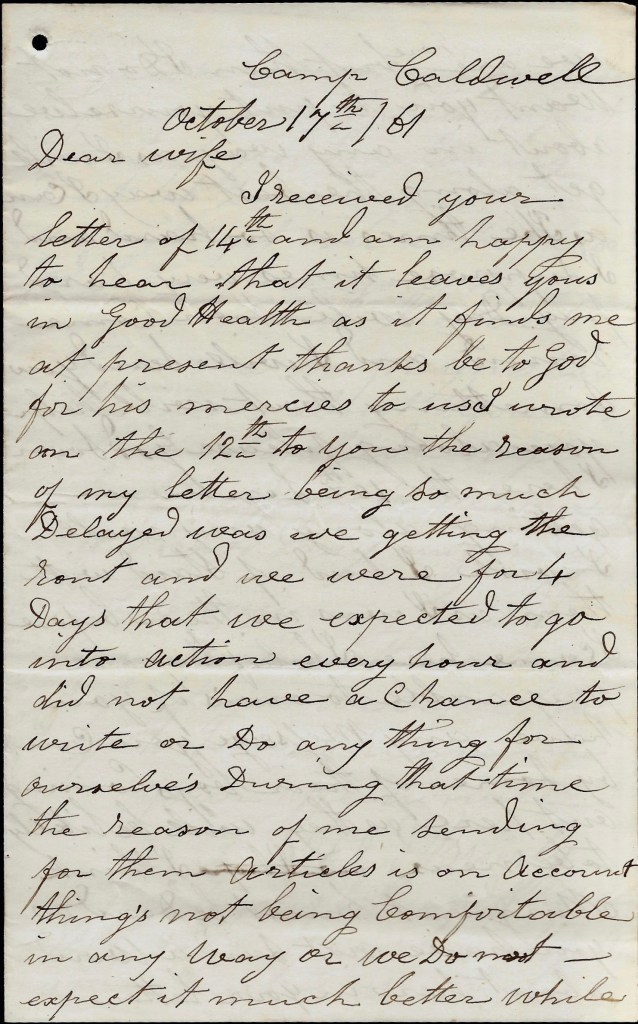
I received your letter of 14th and I am happy to hear that it leaves you in good health as it finds me at present, thanks be to God for His mercies to us.
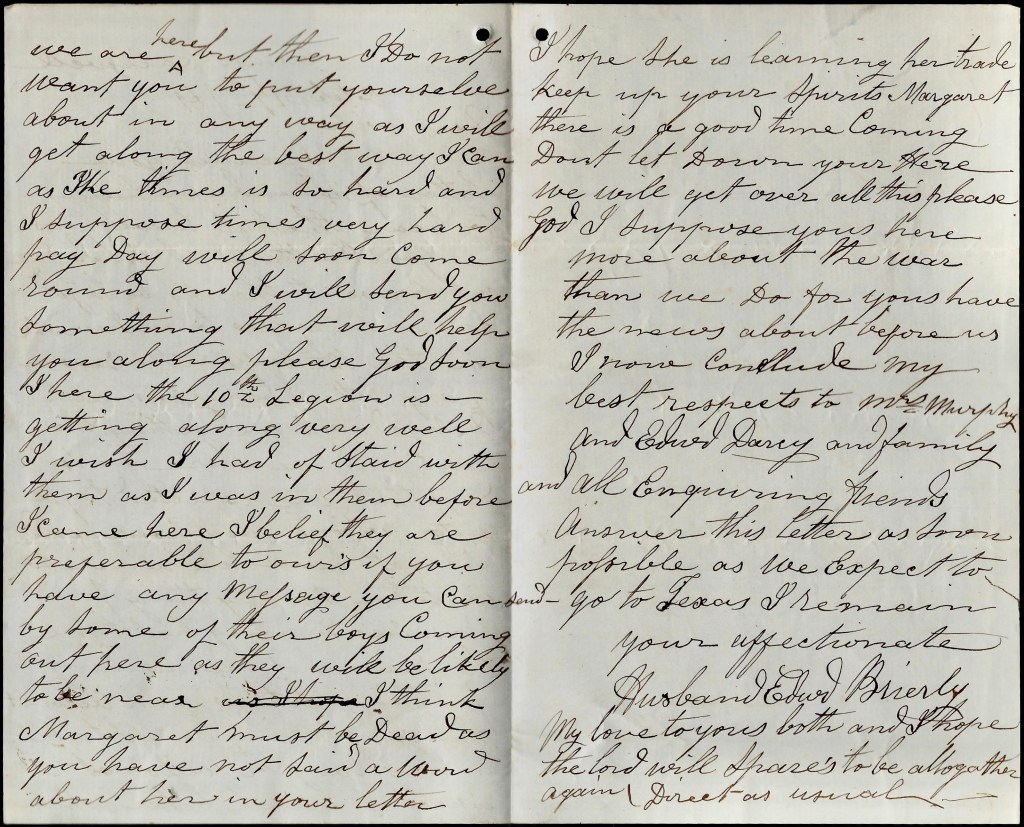
I wrote on the 12th to you. The reason of my letter being so much delayed was we getting the [ ] and we were for four days that we expected to go into action every hour and did not have a chance to write or do anything for ourselves during that time. The reason of me sending for them articles is on account things not being comfortable in any way or we do not expect it much better while we are here. But then I do not want you to put yourself about in any way as I will get along the best I can as the times is so hard and I suppose times very hard. Pay day will soon come round and I will send you something that will help you along, please God soon.
I hear the 10th Legion is getting along very well. I wish I had of stayed with them as I was in them before I came here. I believe they are preferable to ours. If you have any message, you can send by some of their boys coming out here as they will likely to be near.
I think Margaret must be dead as you have not said a word about her in your letter. I hope she is learning her trade. Keep up your spirits, Margaret. There is a good time coming. Don’t let down your hair. We will get over all this, please God. I duppose you hear more about the war than we do for you have the news about before us.
I now conclude, My best respects to Mrs. Murphy and Edward Darcy and family and all enquiring friends. Answer this letter as soon as possible as we expect to go to Texas.
I remain your affectionate husband, — Edward Brierly
My love to you both and I hope the Lord will spare [us all] to be together again. Direct as usual.
Letter 6
Camp Baker Charles county, Maryland November 7th 1861
My dear wife,
It is now three weeks since I have had any letter from you. I have been expecting a letter by every post since we came here but have been invariably disappointed. I fear there must be something wrong with you or you would write. I have written twice since the receipt of yours, but have got no answer to either. I wish you would write immediately in receipt of this and let me know the street and number where you live as I expect to get paid in a few days and as the Government undertakes to forward the money I wish to send, it will be necessary for me to know where to direct it to.
We are at present encamped on the Lower Potomac about 35 miles from Washington. We have been in the vicinity of this place for the past three weeks. The enemy are strongly posted directly opposite to us and sometimes amuse themselves by throwing shot & shell over to our side and at vessels passing up and down the river, generally without effet. Sometimes our batteries on this side responds with better success as they knocked the wheelhouse of the rebel steamer George Page and forced her to run aground on the other side.
We have done no fighting yet but I do not know how soon we may be called on. We have plenty of men and materiel, and are ready to show them our front as soon as it is required.
Give my love to Mr. & Mrs. Darcy, Mrs. Murphy, and all enquiring friends. Hoping this will find you enjoying good health as it leaves me at present. I remain as ever your affectionate husband. My love to yourself & margaret. No more at present. From yours, — Edward Bryerly
When you write, direct this:
Edward Bryerly, Co. C, 3rd Regt. Excelsior Brigade, Washington D. C., Camp Baker, Maryland
Letter 7
Camp Wool Charles county, Maryland December 4, 1862
Dear Wife,
I write these few lines hoping to find you and Maggie enjoying good health as I do at present, thank God for his blessings to us. I received the box and everything was correct. Me and my comrade had quite a good night. We got a goose and with you your present we enjoyed ourselves first rate. Only we felt lonesome when we thought ourselves lonesome we were far away from you and Maggie. I wish to let you know that I have been made a mess cook of. Me and my comrade has to cook for 100 men so we do not have much time to spare. I am Company Cook and we have quite a busy time of it but it is very good to have it this cold weather.
We hear that we are going to become New York State Volunteers. If so, it will be good for us as we will have extra pay from the state. I hope it is true for if it is, I will be able to send you and Maggie a nice New Year’s present. We expect the pay master round next week. As soon as ever I can I will forward the money to you. Everything appears quiet here. We can hear very little about the war here—only the roar of the big guns. We can hear them every day.
There is a rumor going round the camp that we will be home again March or April. I hope and trust in God it may be true as I would wish it from my heart.
I now conclude for the present. I send you and Maggie my love and my blessing. May God protect you both. I send my best respects to Mr. and Mrs. Darey and family. Also Sandy Fisher and wife and family and Old Mrs. Murphy. I remain your affectionate husband, — Edward Brierly
Letter 8
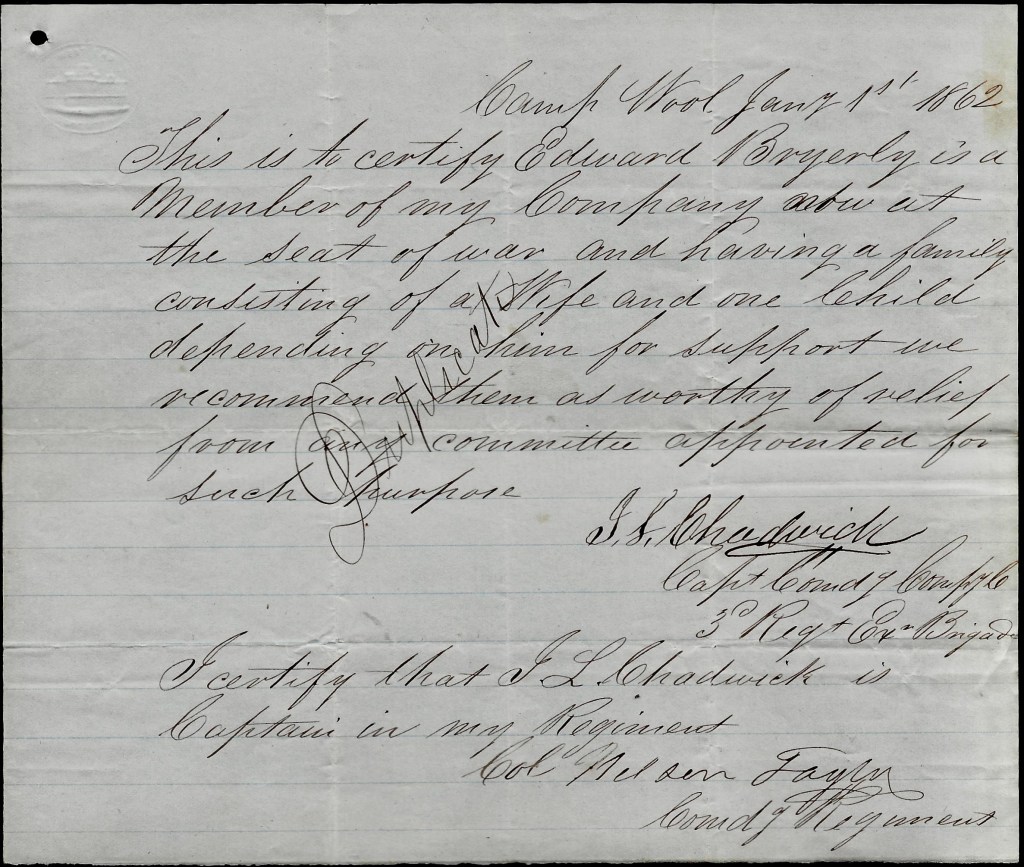
Camp Wool January 1st 1862
This is to certify Edward Bryerly is a member of my company now at the seat of war and having a family consisting of a wife and one child depending on him for support we recommend them as worthy of relief from any committee appointed for such purpose.
— I[saac] L[ynden] Chadwick, Capt. Commanding Company C 3rd Regiment Excelsior Brigade
I certify that I. L. Chadwick is Captain in my regiment. — Col. Nelson Taylor, Commanding Regiment
Letter 9
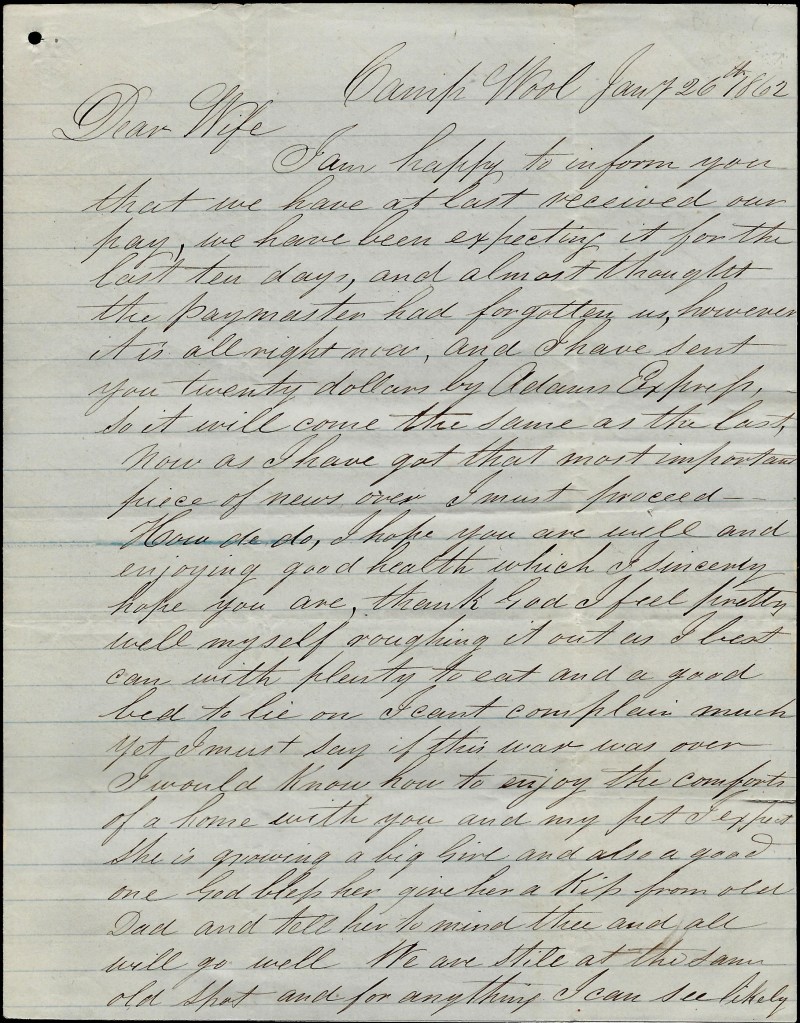
Camp Wool January 26th 1862
Dear Wife,
I am happy to inform you that we have at last received our pay. We have been expecting it for the last ten days and almost thought the paymaster had forgotten us. However, it is alright now and I have sent you twenty dollars by Adams Express so it will come the same as the last.
Now as I have got that most important piece of news over, I must proceed. How de do. I hope you are well and enjoying good health which I sincerely hope you are. Thank God I feel pretty well myself roughing it out as I best can with plenty to eat and a good bed to lie on. I can’t complain much. Yet I must say if this war was over I would know how to enjoy the comforts of a home with you and my pet. I expect she is growing a big girl and also a good one, God bless her. Give her a kiss from old dad and tell her to mind thee and all will go well.
We are still at the same old spot and for anything I can see likely to remain here for some time. We are settled down in winter quarters and have very good huts built to keep us dry and warm.
The Rebels have batteries right opposite but too far off to do us any harm with their big guns. They amuse themselves every day by firing at the sloops sailing up and down the Potomac but I have never [seen] of them touching them with their shot yet. We are stationed here to keep them out of Maryland but they dare not cross as we are 10 to 15 thousand strong. they would get a pretty war reception.
I have nothing more to add but be sure and write me as soon as you receive the money so that my mind may be easy on that score. I enclose another certificate but if the other answers as well, you can keep it as it will do no harm if it does no good. Write me soon and God bless you all from your affectionate husband, — Edward Bryerly
P. S. Remember me to all my friends. You know what to say. — E. B.
Letter 10
Camp Wool February 5, 1862
Dear wife,
It is now over a week since I sent you home twenty dollars and have received no answer yet. If you have received it and sent an answer to me, all well. But if not, write me immediately for I am anxious to know whether it has gone all right or not.
I have but little news to send you. I am quite well working away as usual but there is not much drilling now on account of the muddy state of the country. You could scarcely walk a dozen yards out of camp without getting stuck in mud knee deep. Consequently we have to remain indoors and amuse ourselves as we best can.
Remember me kindly to all my old friends and when I get an answer from you I will write you more particularly. My love to Meg and self and believe me ever your loving husband, — Edward Bryerly
Letter 11
Philadelphia [Pennsylvania] July 27th 1862
Dear Wife,
I now take my pen in hand to address you these few lines hoping they may have the pleasure of finding you in the enjoyment of goos health as this leaves me the same at present. But I am indeed really sorry to inform you that if you want to see me, you will have to come to Philadelphia at the Green Tree Hotel, Front Street above Dock, and if you want any money, you will have to come for it as I don’t intend to ever come that road any more. And if you don’t wish to come, please to have the kindness to send me my discharge as I want it very much. But as for me going for soldier, I never will.
No more at present but remain yours, &c.
P. S. Answer this and direct to me care of I. Bradley, Green Tree Hotel, South Front Street, Philadelphia, PA.
From yours, — Edward Briley
Washington D. C. June 14, 1884
Sir,
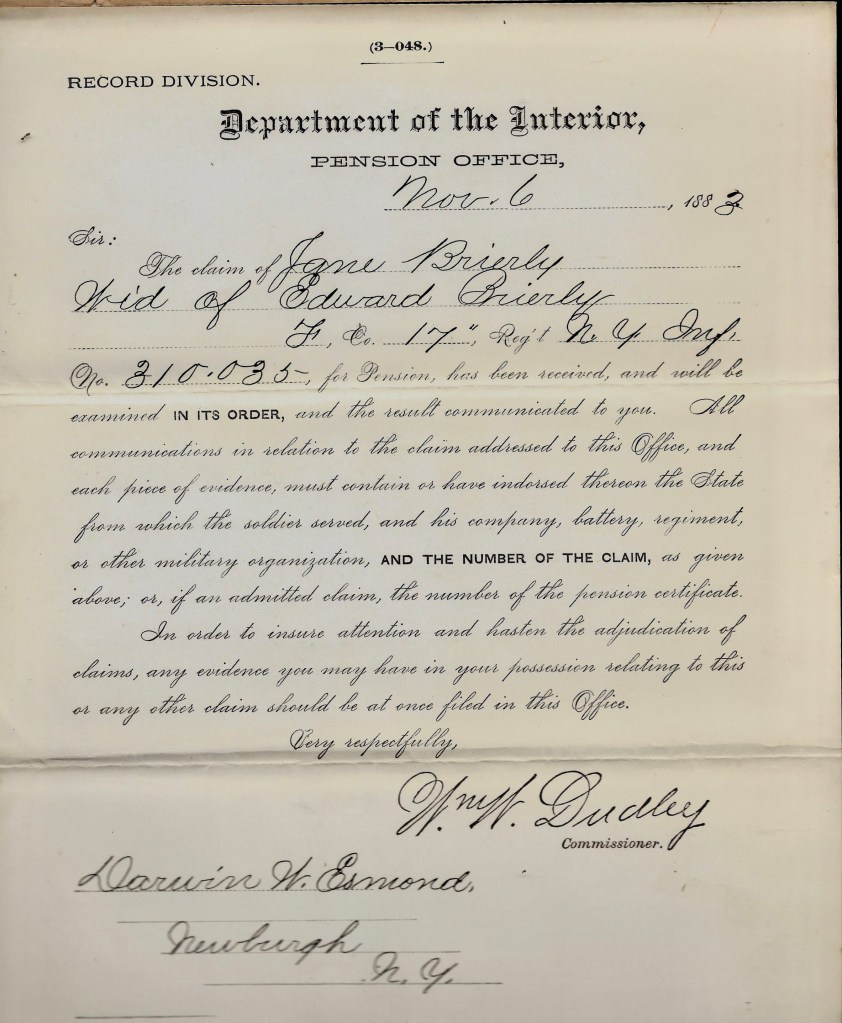
In the claim No. 310035 of Jane Brierly, as widow of Edward Brierly, late of Co, F, 17th New York Vols., the records of the War Department show that the soldier deserted October 1863 and fail to show that he he has been discharged. No further action can be taken in this claim until the records of that Department are so amended as to show the fact of the soldier’s discharge from, or death in the service, for which purpose all communications should be addressed to the Adjutant General US Army. Very Respectfully, — W. W. Dudley, Commissioner
This Michigan home front letter was probably written by 18 year-old Matilda L. Brott who was the only “Matilda B.” in the 1860 US Census in Grattan, Kent county, Michigan, where she was employed as a “domestic” in the Joshua Howell household. She was married in May 1869 to George W. Fralick (1847-1876) who served in Co. B, 10th Michigan Cavalry during the Civil War.
Matilda wrote the letter to her former school teacher, Lt. Asa Walker Slayton (1830-1907), the son of Russell Slayton (1798-1863) and Bethena Clark (1803-1877) of Grattan. Asa served as a 2nd Lieutenant in Co. B, 25th Michigan Infantry.
Transcription
Addressed to Lieutenant Asa W. Slayton, Co. B, 25th Regt. Michigan Infantry, Camp Moore, Louisville[KY]
Grattan, [Michigan] October 22nd 1862
Far Distant though well remembered friend Asa,
With much pleasure I take this opportunity of intruding, if intrusion you would call it, upon the peace & quietude that you may be enjoying when you receive this, to let you know that I still remember those who have gone forth in that noble cause—the defense of our just & righteous government. And as you are far from home, I thought perhaps you might welcome this little message in friendship from a scholar. For that title I should prefer to all others. Although properly speaking I am not. But shall ever regard you as a Teacher and shall ever thank you for the instruction that I have received from you. And with this introduction, I will proceed.
We are all well at present and I sincerely hope that these few imperfect lines may find you enjoying the same blessing of health. I pity the poor soldier, far away from home who does not enjoy that blessing.
There is a great deal of excitement about the war around here at present. But not many enlisting now. Drafting commences in two weeks from today. I am afraid we shall see harder times when it comes to drafting than we have yet. But our country’s call must be obliged or it will not be long that we can call her Our Country. And I am glad that she has so many noble sons to send to its rescue. And I feel it an honor to call those my friends who have gone in her defense. And hope to be regarded as a friend by them.
Sometimes we hear news that encourages us & gives us some hope. And then again we hear very discouraging news. It seems very lonely in Grattan now. But the less there is left, the greater sacrifice we feel that we have made and feel proud of the representatives that she has sent forth to help quell this awful rebellion. And trusting in God, we believe that e’er long, we shall welcome them home again to our now lonely firesides and the dear homes they have left far behind with the many sacrifices they have made to obey their county’s loud call.
We know that it is hard to part with friends that we have spent the youthful part of our lives in our own quiet and peaceful homes with nothing to molest our happiness. But if our Government goes down, what is there that is not lost and gone with it? What more have we to hope for seeing all is gone? Our homes would be ours no longer to welcome you back to. I have often wished I might never live to see the agonies of my country begin. But now I only wish I were of more service to my country. And if my words of encouragement were any good, freely would I give them.
I feel that we all have an interest in the cause of Liberty. And who cannot feel interested in it. I think of you all very often. Those with whom I have passed many happy hours, yes and years of my girlhood. For we have been schoolmates together. But there is no choice. All must go. We cannot reserve those who we rather would stay. All must be separated for a while, perhaps forever. God only knows. And He that knoweth will preserve you all. The right must prosper and be victorious, and with this hope. I feel that we shall soon welcome you all back to our homes. I hope that this same feeling may encourage the soldier to persevere till the end may come.
I suppose I must say a few words about our schools around here and the scholars in general. John Goss is going to teach the school in Mr. Holmes’s district. Jenny B. is going to teach our school. I expect to teach the school in Bickford district if I get a certificate. I dread inspection day. But all our inspectors have gone to Dixie. I don’t now but we shall have to go without inspection this fall. I wish we had.
Clara & Frank are going to school this winter. Lodeska lives at Mr. Watkins. Will go to school north this winter. Rilla is going to school & Mary Gillitt is going home to the south part of the state. Our schools will be small around here this winter.
But as it is getting late and is the night previous to the departure of the mail and I shall have the letters all to mail yet, I will close with the few imperfect lines and not intrude upon the quietude you may be enjoying when you receive this. Think of us scholars often. So goodbye. Write soon and remember me at your writing desk. I remain as ever a friend. From a far distant but not unmindful although unworthy friend and well wisher, — Matilda B.
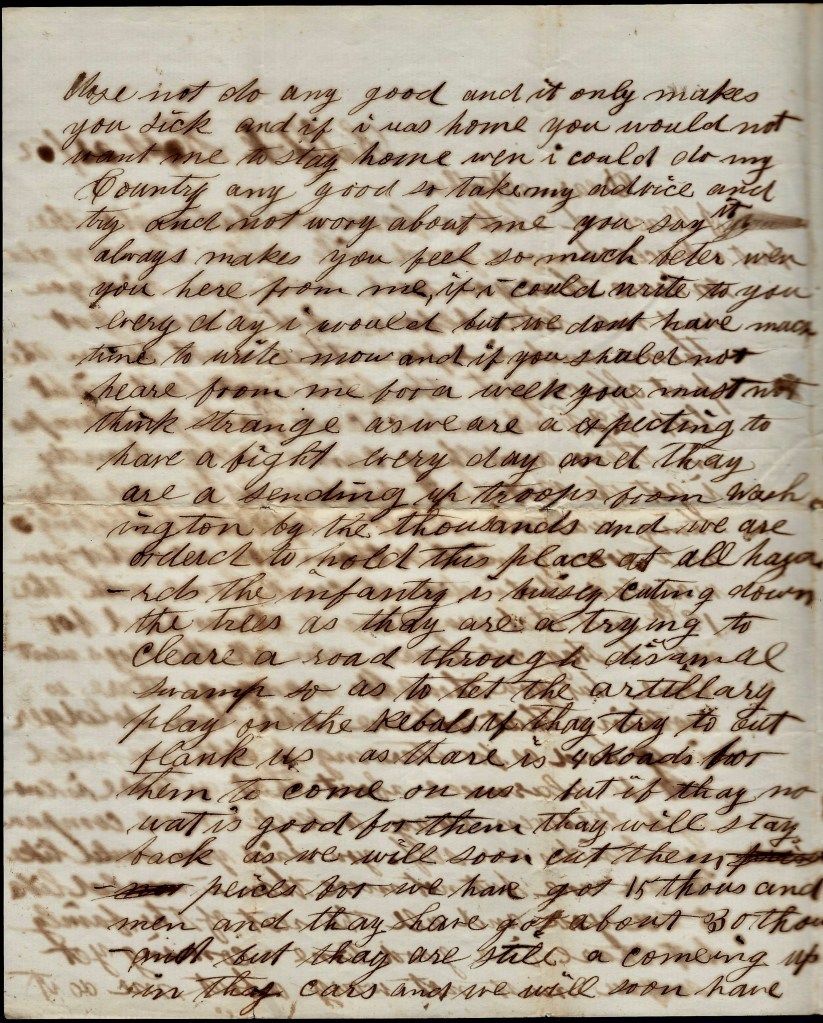
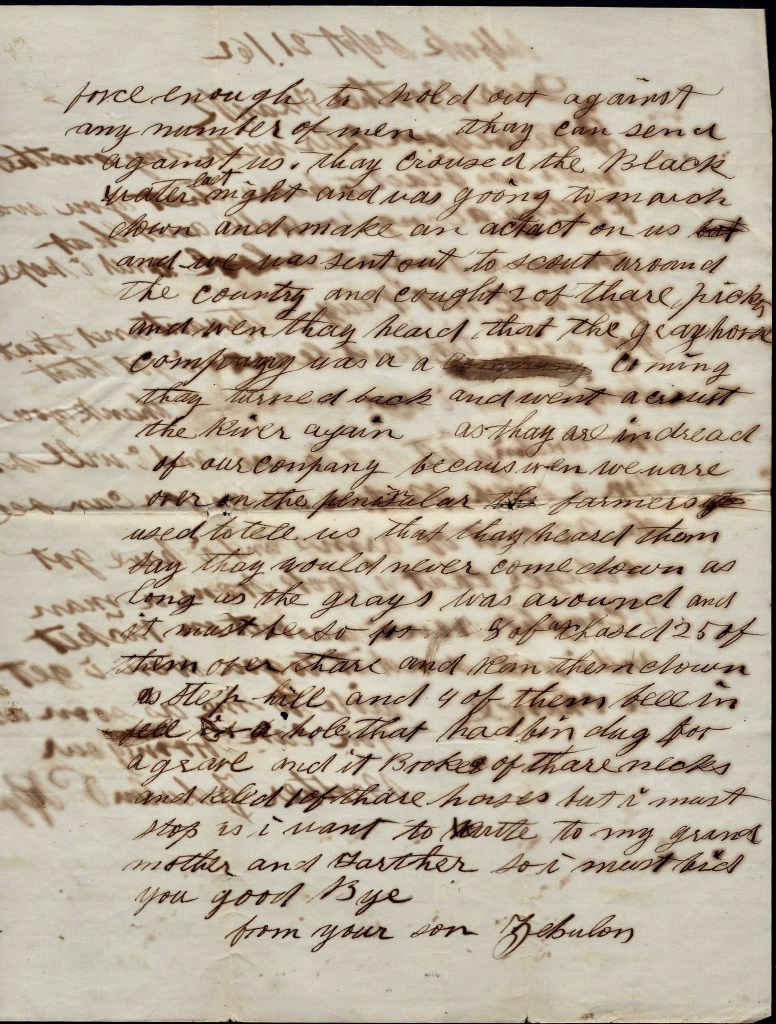
The following letter was written by Brooklyn born 18 year-old Zebulon P. Ryder (1841-1909) who enlisted in April 1861 as a private in Co. I of the 11th Pennsylvania Cavalry. He was the son of Christopher and Adeline Ryder. Zeb’s father worked as a Butcher in Brooklyn. Zeb must have lied about his age when he enlisted as he claimed to be 20 but census records tell us he was born in 1844-45. His younger brother Frank was born in 1848-49. Zeb survived the war and mustered out of the service on 16 May 1865.
Zeb’s letter was written from Suffolk, Virginia, in September 1862. He informs his mother that they were preparing for an attack at any time by a force with superior numbers but boasts that their Gray Horse Company—Company I—was dreaded so much by the Confederates that he didn’t think they’d come.
I received two letters from you last night—the first I received in a good while—and I was very glad to hear that you were well. You said you sent me letters before but I never got them and I suppose thy must be in the post office yet, The letters I got last night had 8.3 cent and 2.5 cents postage stamps in them and they came very handy. I got the box last Tuesday night and everything was all right—especially the bologna as I soon finished them. You said that you was glad that you thought it was hard for me to stay out here when all the boys went home but you thought wrong as there is nothing that suits me better than soldiering. And as for starving to death, you need not be alarmed about that as there is enough thrown away to keep two more companies besides ourself.
You said you would like to see me but not more than I would like to see you and all the rest of the family but there is a good time a coming yet so you must not worry about me. It would not do any good and it only makes you sick. And if I was home, you would not want me to stay home when I could do my country any good so take my advice and try and not worry about me. You say it always makes you feel so much better when you. hear from me. If I could write to you every day I would, but we don’t have much time to write now and if you should not hear from me for a week, you must not think strange as we are expecting to have a fight every day and they are a sending up troops from Washington by the thousands and we are ordered to hold the place at all hazards.
The infantry is busy cutting down the trees as they are a trying to clear a road through Dismal Swamp so as to let the artillery play on the Rebels if they try to out flank us as there is four roads for them to come on us. But if they know what is good for them, they will stay back as we will soon cut them to pieces. But we have got 15 thousand men and they have got about 30 thousand, but they are still coming up in the cars and we will soon have force enough to hold out against any number of men they can send against us.
They crossed the Black Water last night and was going to march down and make an attack on us and we was sent out to scout around the country and caught two of their pickets and when they heard that the Grey Horse Company was a coming, they turned back and went across the river again as they are in dread of our company because when we were over on the Peninsula, the farmers used to tell us that they heard them say they would never come down as long as the Grays was around and it must be so for 8 of us chased 25 of them over there and ran them down a steep hill and 4 of them fell into a hole that had been dug for a grave and it broke their necks and killed their horses.
But I must stop as I want to write to my grandmother 1 and Father so I must bid you goodbye. From your son, — Zebulon
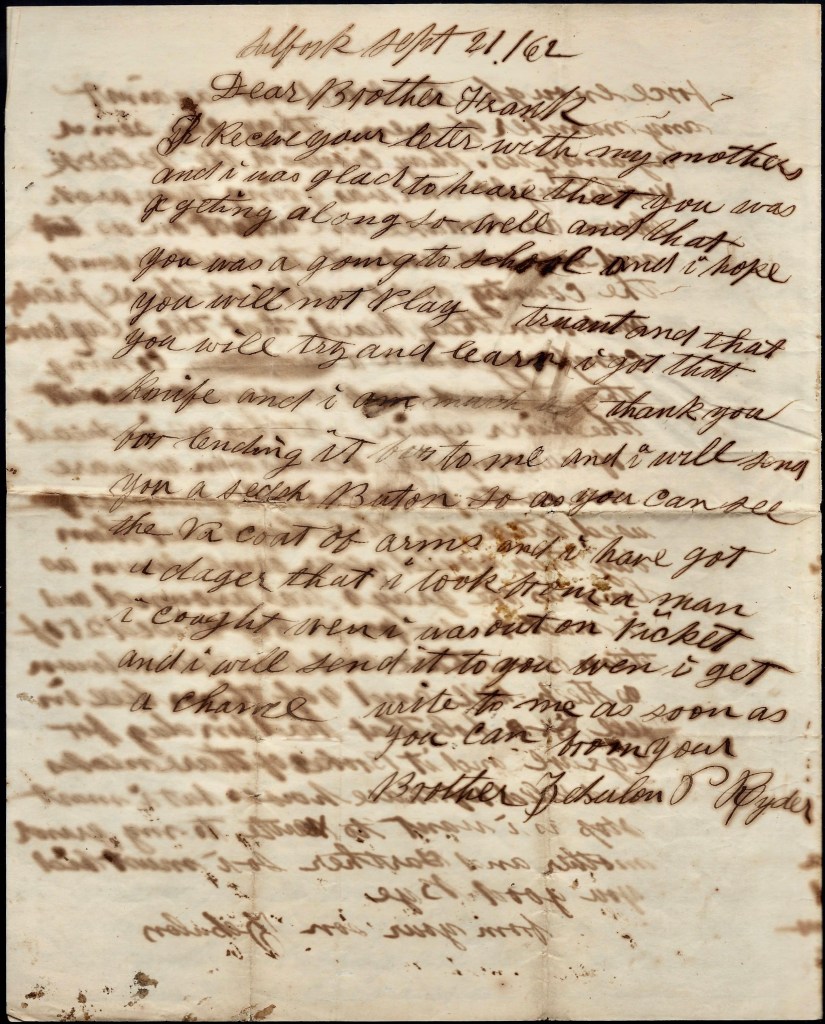
Suffolk, September 21st 1862
Dear Brother Frank, I received your letter with my mothers and I was glad to hear that you was a getting along so well and that you was a going to school and I hope you will not play truant and that you will try and learn.
I got that knife and I thank you for sending it to me and I will send you a secesh button so as you can see the Virginia coat of arms. And I have got a dagger that I took from a man I caught when I was out on picket and I will send it to you when I get a chance. Write to me as soon as you can. From your brother, — Zebulon P. Ryder
1 The letter that Zebulon Ryder sent to his Grandmother on 21 September 1862 can be found in the digital archives of the Pamplin Historical Park. See 2015.002.081a.
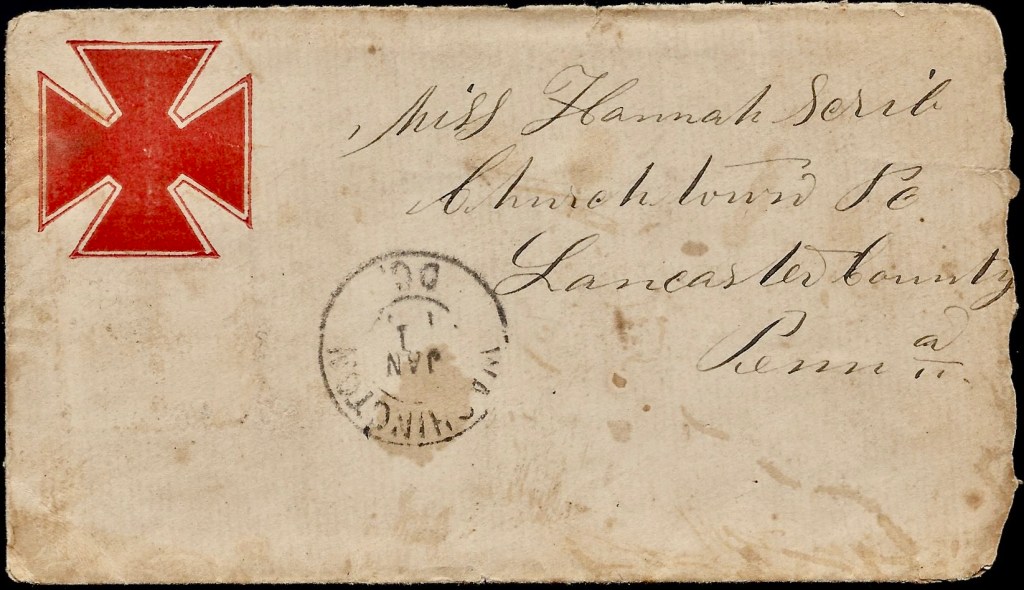
The following letter was written by Joseph L. Gordon (1846-1904), the son of Ephraim Gordon (1805-1873) and Margaret Sheeler (1802-1896). He wrote the letter to Hannah Scrib [Squibb] whom he would marry after the Civil War.
Joseph wrote the letter while serving in Co. M, 198th Pennsylvania Infantry—a regiment that was not organized until the summer of 1864. They were sent to Petersburg battle front in September and assigned to 1st Brigade, 1st Division, 5th Army Corps commanded by Gen. Warren. The Battle of Peeble’s Farm was their first engagement. This letter describes the December 1864 expedition by the 5th Army Corps to destroy the Weldon Railroad. It began on 6 December and until the evening of the 9th, the work went on vigorously as planned—the ties being burned and the rails twisted—to a point beyond Bellefield, Virginia.
Joseph’s letter was mailed in an envelope ornamented with a red iron cross—the badge of the 1st Division, 5th Army Corps.
Transcription
Addressed to Miss Hannah Scrib, Churchtown P. O., Lancaster county, Pennsylvania
Camp in front of Petersburg, Virginia December 28th 1864
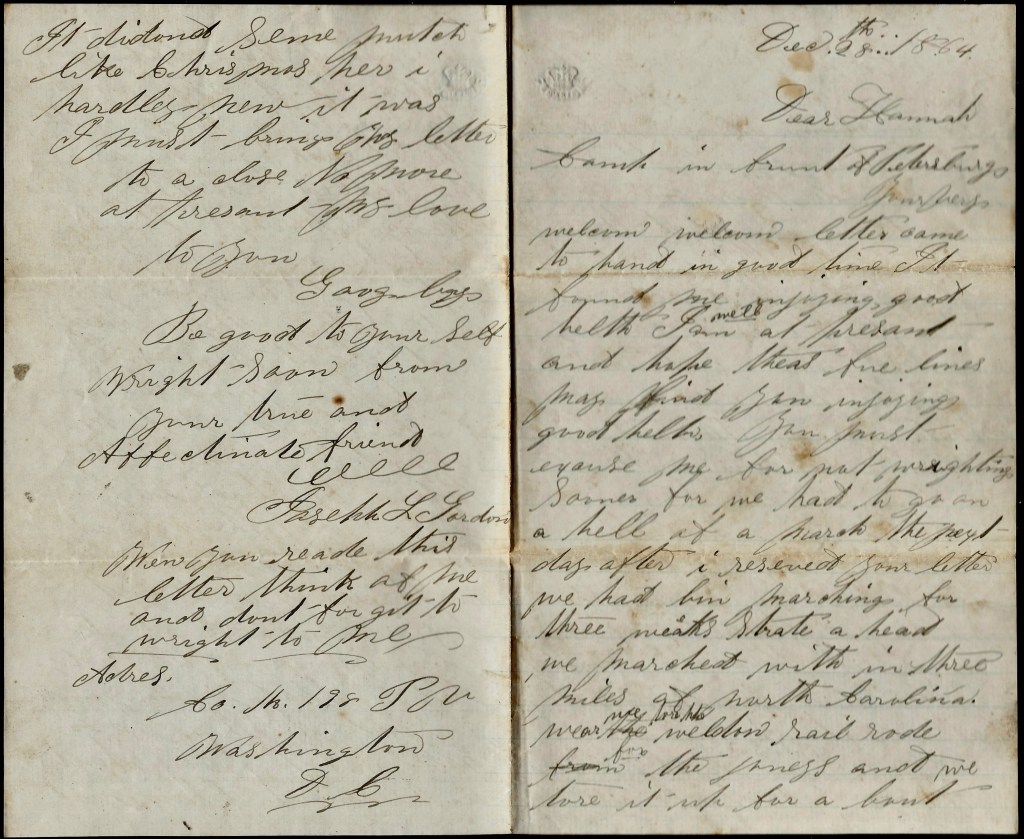
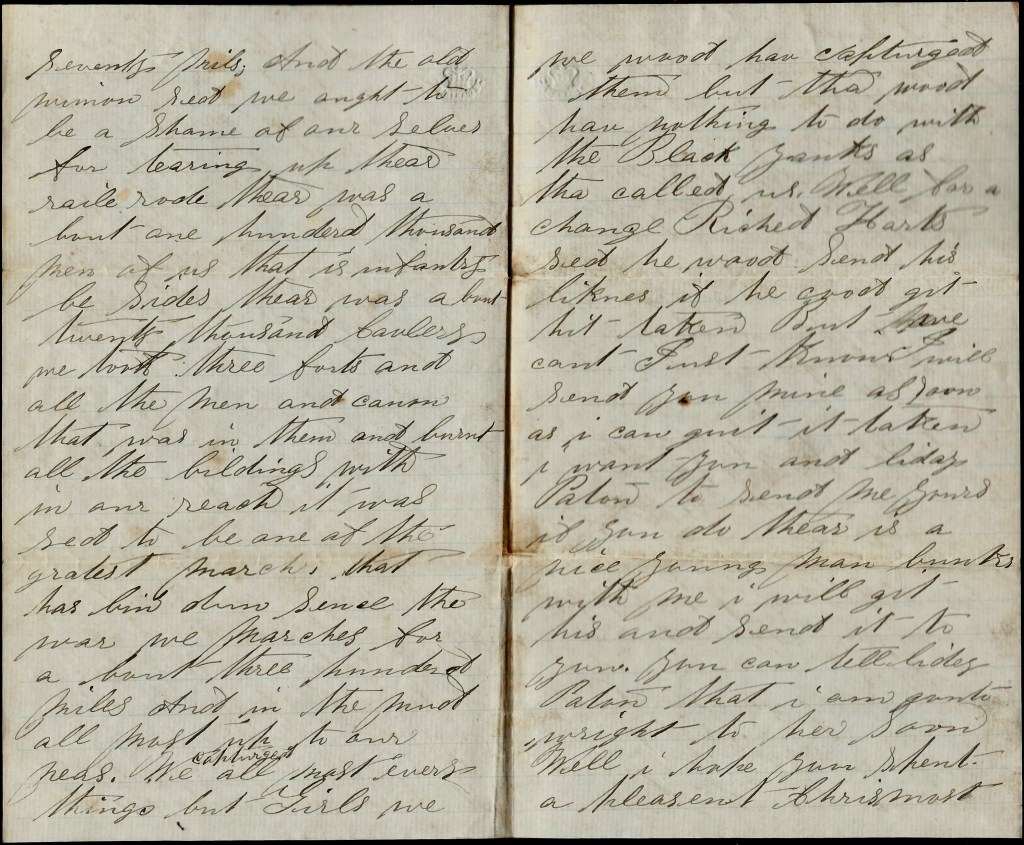
Your very welcome, welcome letter came to hand in good time. It found me enjoying good health. I am well at present and hope these few lines may find you enjoying good health. You must excuse me for not writing sooner for we had to go on a hell of a march the next day after I received your letter. We had been marching for three weeks straight ahead.
We marched within three miles of North Carolina where we tore up the Weldon Railroad for the Johnnies. We tore it up for about seventy miles and the old women said we ought to be ashamed of ourselves for tearing up that railroad. There was about one hundred thousand men of us—that is, infantry. Besides [that] there was about twenty thousand cavalry. We took three forts and all the men and cannon that was in them and burnt all the buildings within our reach. It was said to be one of the greatest marches that has been done since the war [began].
We marched for about three hundred miles and in the mud almost up to our knees. We captured almost everything but girls. We would have captured them but they would have nothing to do with the Black Yanks as they called us.
Well, for a change, Richard Harts said he would sent his likeness if he could get it taken but we can’t just now. I will send you mine as soon as I can get it taken. I want you and Lide Patton to send me yours. If you do, there is a nice young man bunks with me. I will get his and send it to you. You can tell Lide Patton that I am going to write to her soon.
Well, hope you spent a pleasant Christmas. It didn’t seem much like Christmas here. I hardly knew it was. I must bring this letter to a close. No more at present. My love to you. Goodbye. Be good to yourself. Write soon. From your true and affectionate friend, — Joseph L. Gordon
When you read this letter, think of me an don’t forget to write to me. Address: Co. M, 198th P. V., Washington D. C.
The following letter was written by Thomas E. Bispham (1835-1865), the son of Thomas Bispham (1797-1879) and Elizabeth Jennings (1795-1878) of Wayne township, Warren county, Ohio. Thomas was married to Sarah Frances Likins (1840-1902) in March 1857 and the couple had two children at the time that Thomas enlisted as a private in Co. H, 79th Ohio Volunteer Infantry (OVI) in August 1862.
Thomas was promoted to a corporal in February 1863 and made it through the Atlanta campaign without injury but was wounded at Averysboro, North Carolina on 16 March 1865. He died of his wounds at David’s Island (N.Y. harbor) hospital on 25 May 1865.
In this letter, Thomas describes the Battle of 20 July 1864 at Peachtree Creek in the Atlanta Campaign.
There is a striking similarity in Thomas’s handwriting with that of a diary fragment that I transcribed back in January 2021 which I was able to attribute to the 79th OVI but not to any particular soldier. I suspect, however, the mystery soldier served in Co. I.
Transcription
Addressed to Thomas Bispham, Esq., Waynesville, Warren county, Ohio
Camp 79th OVI Sunday, July 24th 1863
My Dear Father & Mother,
I thought as Sallie was from home, maybe you would not hear from me, and perhaps you might wish to. Therefore, I will write.
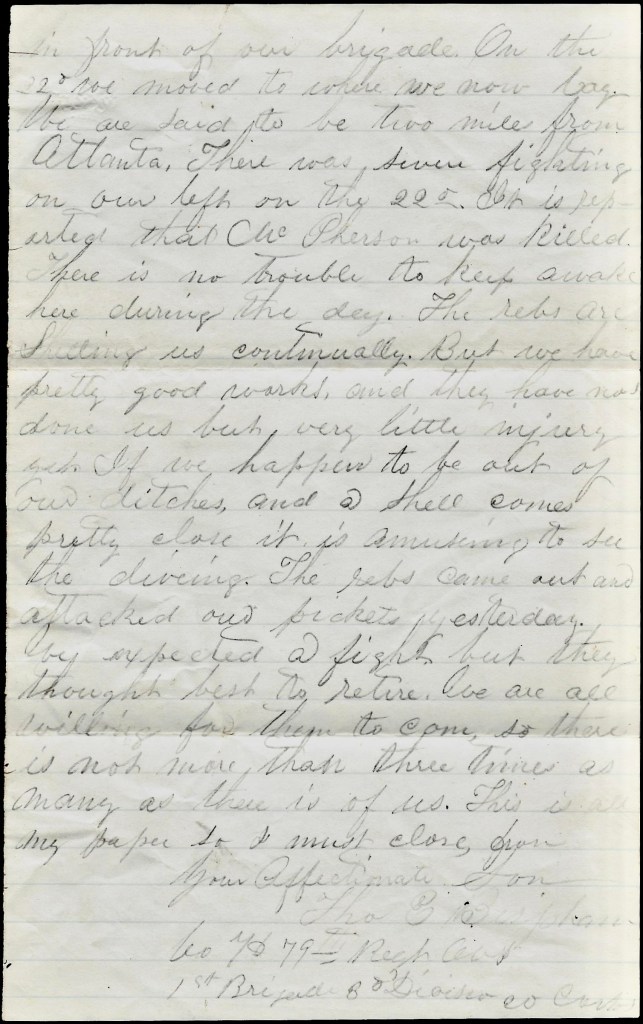
On the 20th we got into quite a battle. The rebs attacked our lines. We (our brigade) was laying in the rear of a gap, and when the attack was made we had to move up to get on the line. We had a fair, open fight and defeated them. I had some very fine shots. Our regiment lost 58—ten killed and forty-eight wounded. Co. H had George Brinker & Corp. I[saac] F. Stump killed. Joseph H. Wolfe, Asa Chandler, John Prater, Wm. Watkinson and Martin Lansey wounded. I have heard they are all doing very well but Wolfe. It is estimated from the number we have in our possession that the Rebels lost from ten to fifteen hundred in front of our brigade.
On the 22d, we moved to where we now lay. We are said to be two miles from Atlanta. There was severe fighting on our left on the 22d. It is reported that [James B.] McPherson was killed. There is no trouble to keep awake here during the day. The rebs are shelling us continually. But we have pretty good works and they have not done us but very little injury yet. If we happen to be out of our ditches, and a shell comes pretty close, it is amusing to see the diving. The rebs came out and attacked our pickets yesterday. We expected a fight but they thought best to retire. We are all willing for them to come, so there is not more than three times as many as there is of us. This is all my paper so I must close.
From your Affectionate Son — Thos. E. Bispham
Co. H, 79th OVI, 1st Brigade, 3d Division, 20 [Army] Corps
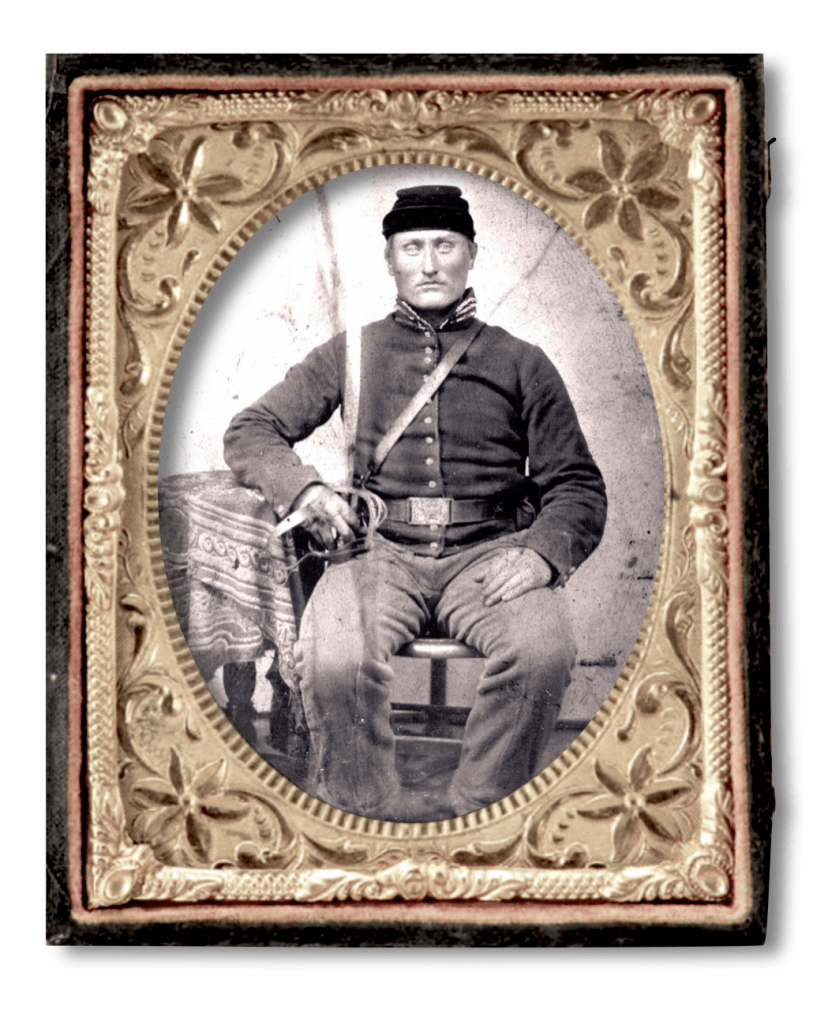
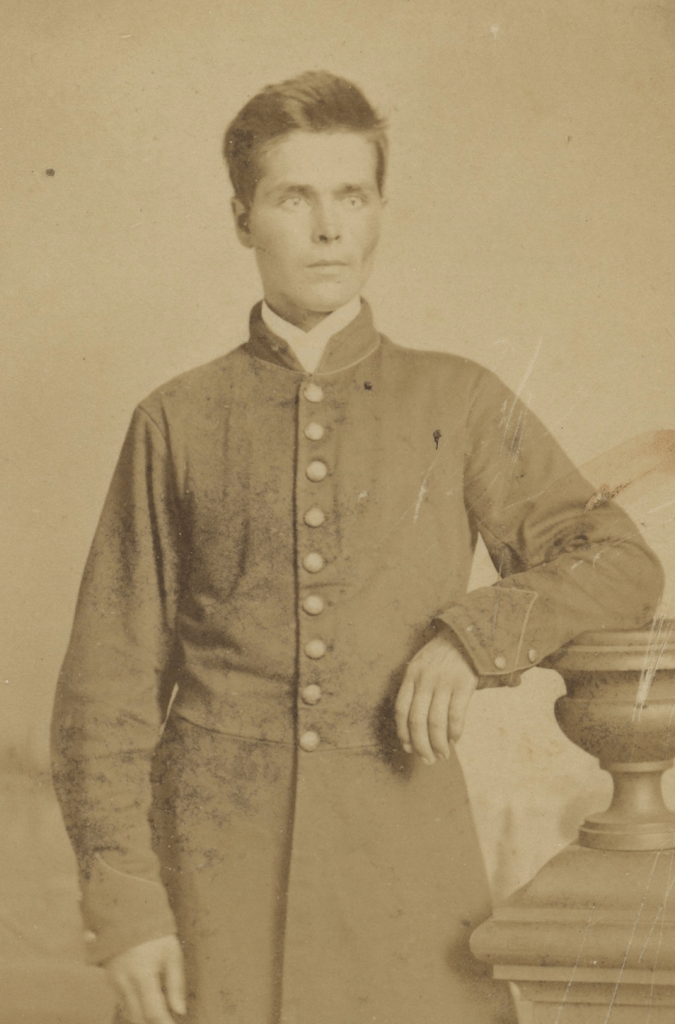
I could not find an image of Edward but here is a tintype of Jacob Kunckle who served in Co. M, 14th Pennsylvania Cavalry (Ancestry)
The following letter was written by Edward F. Tubbs (1841-1864) who enlisted September 11, 1862 and mustered into Co. I, 14th Pennsylvania Cavalry on 27 October 1862 at Erie, Pennsylvania. Edward mustered in as a corporal and was promoted to sergeant. Although one source erroneously states that Edward died of disease at Winchester, Virginia, in 17 December 1864, the truth is that he was among the 100 troopers led by Capt. William Miles of Co. I on a scouting expedition toward Ashby’s Gap on 17 December 1864. Mosby and his guerrillas ambushed this scouting party from a woods near Millwood, Virginia, killing Miles and about a dozen others, including Sergt. Tubbs. About 20 others were wounded, and nearly everybody else was captured. Mosby set one man free after slashing his face with a saber, allowing him to return to camp to tell the story of the ambush. The wounded and dead were recovered on the next day. Mosby sent his prisoners to Libby Prison.
Edward was the son of Irene Tubbs (1812-Aft1870) of Conneaut township, Erie county, Pennsylvania. Irene’s husband, Frederick Tubbs, died on 19 November 1842 after 9 years of marriage, leaving her to raise her children on the family 40-acre farm. Frederick, it seems, died a tragic death, have been shipwrecked and drowned in Lake Erie.
Many of Edwards letter were sold at auction in 2018. They were summarized as follows:
“Exceptional archive of 18 handwritten letters related to Edward F. Tubbs, a soldier in Company I of the 14th Pennsylvania Cavalry (159th Volunteers), dated between July 2, 1863 and December 13, 1864. The collection totals to 46 pages, with 16 of the letters written by Tubbs and addressed to his mother Irene Tubbs of Albion, Erie County, Pennsylvania. The content of the archive consists of Tubbs’s plans to visit home, new clothes and items he purchased, reports on his health, hospital stays, and camp life, his disdain for the war and his desire to see it through to the end. Highlighted sections from Tubbs’s letters are as follows:
July 2, 1863, from Frederick City, Maryland: “I thought I would write a line to let you know where I was Harpers Ferry is Evacuated and we are on the march I suppose to reinforce Gen’l Mead I expect we will annihilate the whole Rebel army…they say our army is marching on to Richmond we have about 20 thousand men here it makes quite a show there is cavalry artillery & infantry all together.”
September 25, 1863, from Beverly, West Virginia: “It is now over one year since I left home you know I said when I left home I did not think the war would last a year if I had had known that the war was going to last so long as it has I would never have enlisted I would have waited for the draft & stood my chance with the rest I never enlisted to stay over a year.”
October 16, 1863, also from Beverly, WV: “I have plenty to eat drink & wear but yet I am not at home there is talk of the rebels coming but we have got so used to hearing it that we do not believe anything until we see it with our own eyes I have not much news our men have had a little skirmishing with the rebels at a place called Bulltown about 50 miles from here…patience and perseverance a strong heart & a strong mind are all that keeps the soldier alive.”
October 31, 1863, from Camp Montgomery in Pittsburgh: “We left Erie on Wednesday and got into Pittsburgh the next morning…then we marched two miles to Camp Montgomery…When I got to Cleveland I saw a lot of squaws and almost all kinds of animals…I have seen the wonderful city of Pittsburgh…it is a large place but most dreadfully nasty it is the smokiest place I ever saw.” Includes an undated letter from Tubbs, presumably to his mother and written on the same day as the above letter, noting that he sent his clothes home and requesting that she forward all news to his friends.
March 20, 1864, from Martinsburg, WV: “I found a rebel officer who had just come into our lines a deserter from Lee’s army he says he thinks the rebels are going to fight as long as they can but does not think that will be a great while longer he is going to take the Oath of Allegiance and live under the Old flag again…they say we are going to have a chance to reenlist this month or next but I guess I will wait until Old Abe reenlists before I do.”
June 9, 1864, from Staunton, Virginia, relaying news of the Union’s victory at Piedmont, in part: “We had our fight on Sunday of June 5th we whipped the rebels and captured about 1000 of them, 52 rebel officers besides. I captured a rebel captain in our first charge. I could tell a big story but stories don’t fight Battles. Stanton has fallen & is holding a great many Yanks.”
The archive features seven letters written by Tubbs during his stay at the state hospital in Gallipolis, Ohio, dating between July and September, 1864. Highlighted sections include:
July 18, 1864: “I was at Charleston & in very good health but I was taken sick at that place and was brought down here so you see I’m in Ohio…there is about 100 sick & wounded soldiers here my disease is the fever.”
July 30, 1864: “I am gaining quite fast I am in hopes to be able to join the Reg’t in a couple of weeks I do not know where our Regiment is but I expect they are in the vicinity of Martinsburg we had reports that Gen’l Averill was killed but the papers today say it is not so.”
A particularly fiery letter from Gallipolis, dated August 9, 1864: “I walked down to the City of Gallipolis today…there is 3 [racial epithet] to one white person…if I had known that this [racial epithet] war was going to continue so long I never would have left home…I see this war as it is now it is nothing but a curse to be a United States Soldier men are less thought of than the black [racial epithet] this war is a speculation the way it is going on now but if God spares my life a short time I shall be out of it I will do my duty as long as my time lasts which I have sworn to do and then I shall bid them goodbye…I will own that I prefer peace to war but we want it right but I don’t fear them I have fought them in close contact when we were not over 20 feet apart the rebel lead whistled close but yankey lead and yankey steel makes them run…I have lain in front of their fortifications in plain open field when they had all man could wish to protect them while we had nothing to protect us but the great God of Battle.”
September 13, 1864: “I now take my pen to inform you that the time has arrived for me to quit this bed of sickness which I have been impatiently waiting for I shall probably leave here soon.”
On October 9, 1864, not long after his release, Tubbs writes from Martinsburg, WV: “I was very much disappointed in coming back I wanted to go to my company but I shall try and content myself here for a while…I see you have heard of Genl. Averill’s removal from this Command and it is very much regretted by all under his Command I don’t know who will command our Division after this the men say they won’t fight under any other General…I have no news today everything is progressing finely in the Valley & around Richmond.”
Tubbs’s final letter, written from a “Camp Near Winchester Va” on December 12 and 13th, 1864, in part: “I am not I sorry to say well at present the weather is very cold at present about 6 inches of Snow on the ground and it is getting dark & w ill have to stop writing as I have no candle.” The following day: “After a hard ride of 25 miles in a very cold day & in about 5 hours time I will try to finish my letter we went on a Scout this morning but saw nothing the weather is very cold we are on about half rations now I had a cracker for my breakfast with coffee yesterday I had 2 now.” Tubbs passed only four days later on December 17, 1864, a little over two years after mustering into service; although the manner of Tubbs’s death remains unknown, the grim atmosphere of the above letter suggests that he likely succumbed to sickness, starvation, or the elements.
The archive also includes two letters written by officers and addressed to Irene Tubbs: the first, written from Camp Blakely, a letter from W. W. Miles, Company I captain of the 14th Pa. Cav., dated April 14, 1863, who notes that her son, once “very sick with Typhoid fever,” has “very much improved [and]…in a very few days be able to report for duty”; and the second, written from Grafton, addressed by an officer named Edgar Peirce, dated November 25, 1863, affirming that “Edward is safe and sound, the regt are at New Creek about 100 miles from here on the R Road towards Harpers Ferry.” In overall very good to fine condition. Accompanied by several original mailing envelopes.”
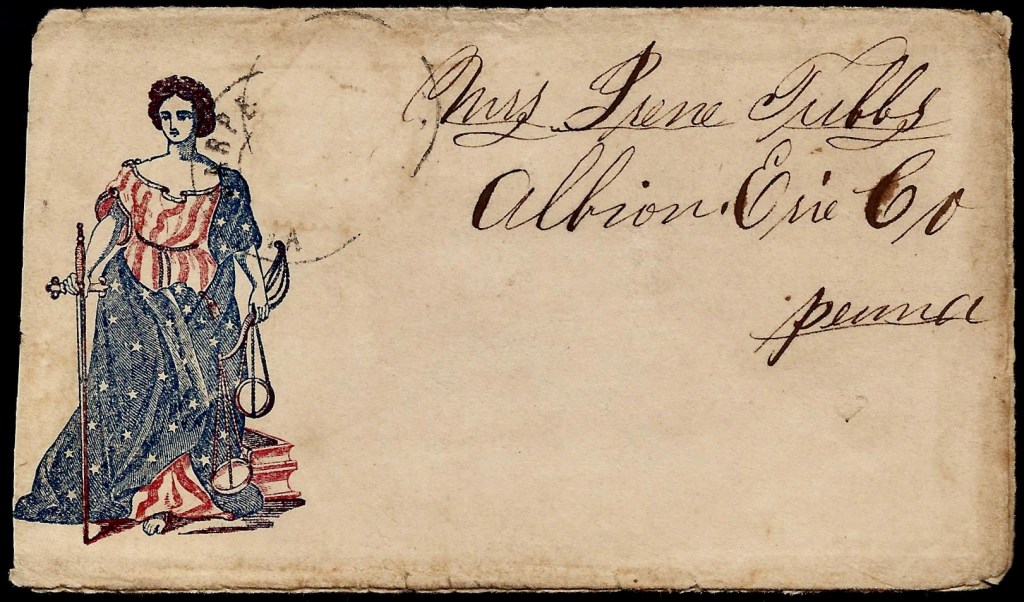
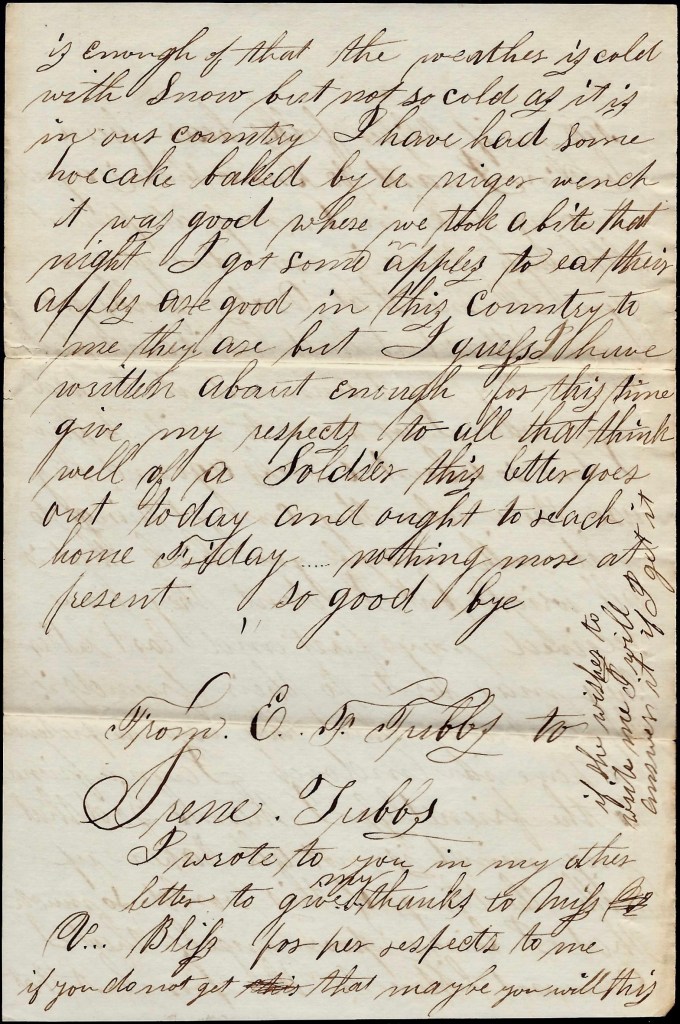
Addressed to Miss Irene Tubbs, Albion, Erie county, Pennsylvania
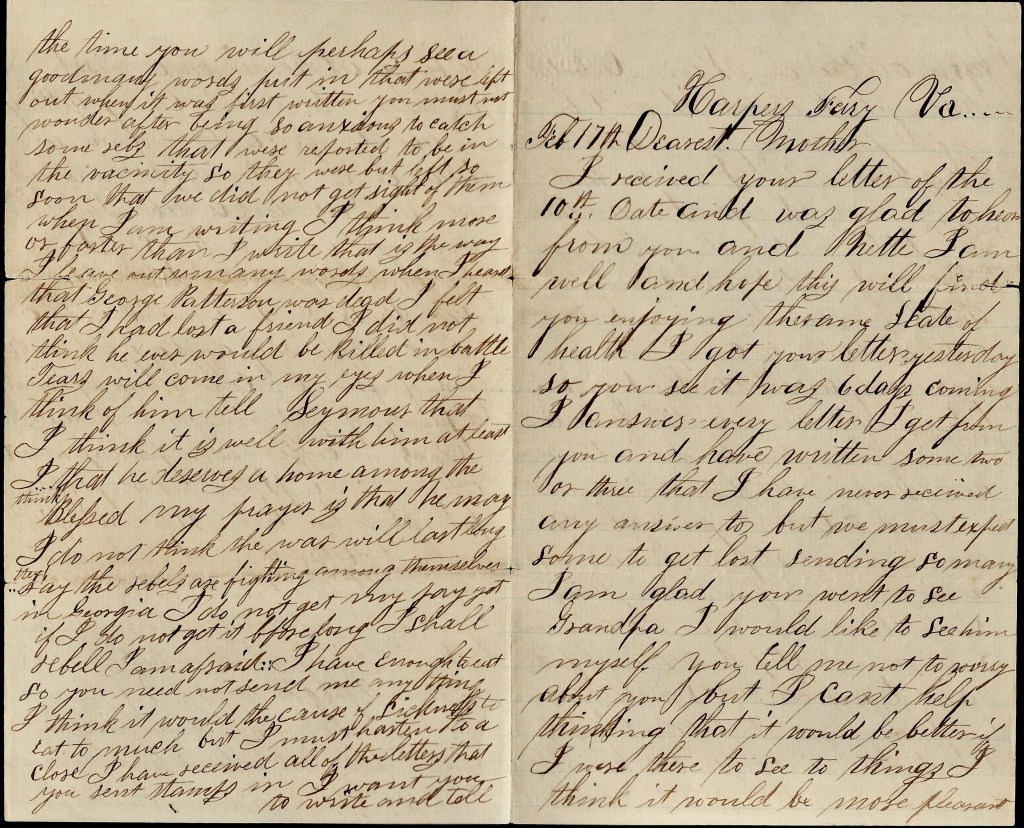
Harpers Ferry, Virginia February 17th [1863]
Dearest Mother,
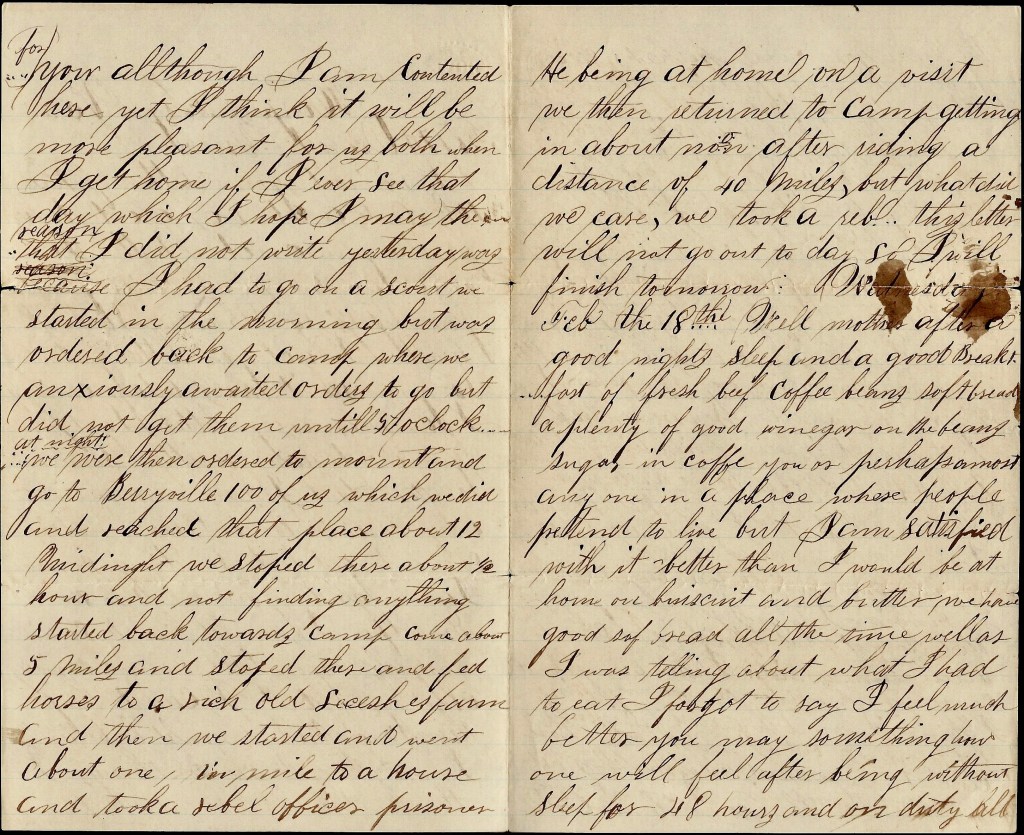
I received your letter of the 10th date and was glad to hear from you and Nette. I am well and hope this will find you enjoying the same state of health. I got your letter yesterday so you will see it was 6 days coming. I answer every letter I get from you and have written some two or three that I have never received any answer to but we must expect some to get lost sending so many. I am glad you went to see Grandpa. I would like to see him myself. You tell me not to worry about you but I can’t help thinking that it would be better if I were there to see to things. I think it would be more pleasant for you although I am contented here, yet I think it will be more pleasant for us both when I get home—if I ever see that day which I hope I may.
The reason I did not write yesterday was because I had to go on a scout. We started in the morning but was ordered back to camp where we anxiously awaited orders to go but did not get them until 5:00 o’clock at night. We were then ordered to mount and go to Berryville—100 of us—which we did and reach that place about 12:00 midnight. We stopped there about ½ hour and, not finding anything, started back towards camp. Came about 5 miles and stopped and fed horses to a rich Secesh’s farm and then we started and went about one mile to a house and took a Rebel officer prisoner—he being at home on a visit. We then returned to camp, getting in about noon after riding a distance of 40 miles. But what did we care, we took a Reb. This letter will not go out today so I will finish tomorrow.
Wednesday, February 18th. Well Mother, after a good night’s sleep and a good breakfast of fresh beef, coffee, beans, soft bread, and plenty of good vinegar on the beans, sugar in coffee, you or perhaps amost anyone in a place where people pretend to live but I am satisfied with it better than I would be at home on biscuit and butter. We have good soft bread all the time.
Well, as I was telling about what I had to eat, I forgot to say I feel much better. You may [know] something how one will feel after being without sleep for 48 hours and on duty all the time. You will perhaps see a good many words put in that were left out when it was first written. You must not wonder after being so anxious to catch some rebs that were reported to be in the vicinity. So they were but left so soon that we did not get sight of them. When I am writing, I think more or faster than I write. That is the way I leave out so many words.
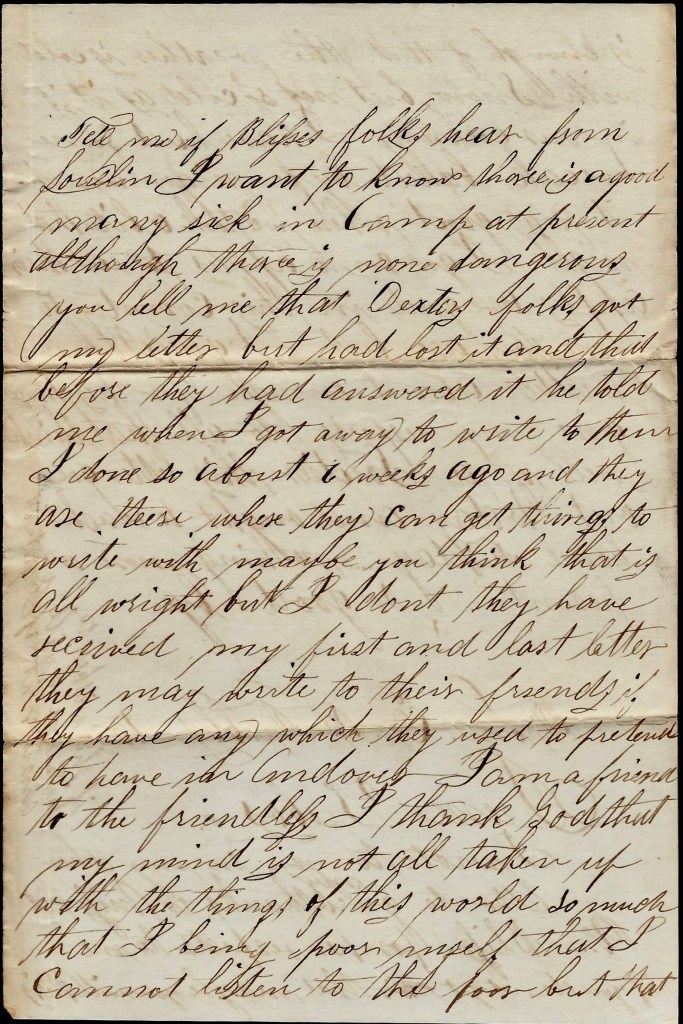
When I heard that George Patterson was dead, I felt that I had lost a friend. I did not think he would be killed in battle. Tears will come in my eyes when I think of him. Tell Seymour that I think it is well with him. At least I thought he deserves a home among the blessed. My prayer is that he may.
I do not think the war will last long. They say the Rebels are fighting amongst themselves in Georgia. I do not get my pay yet. If I do not get it before long, I shall rebel I am afraid. I have enough to eat so you so you need not send me anything. I think it would cause the sickness to eat too much. But I must hasten to a close. I received all the letters that you sent stamps in. I want to you to write and tell me if Bliss’s folks hear from Soutlin. I want to know. There is a good many sick in camp at present although there is none dangerous. You tell me that Dexter’s folks got my letter but had lost it and that before. they had answered it he told me when I got away to write to them. I done so about 6 weeks ago and they are these where they can get things to write with. Maybe you think that is alright but I don’t. They have received my first and last letter. They may write to their friends if they have any which they used to pretend to have in Andover. I am a friend to the friendless. I thank God that my mind is not all taken up with the things of this world so much that I, being poor myself, that I cannot listen to the poor. But that is enough of that.
The weather is cold with snow but not so cold as it is in our country. I have had some hoecake baked by a nigger wench. It was good. Where we took a bite that night, I got some apples to eat. Their apples are good in this country. To me they are but I guess I have written about enough for this time. Give my respects to all that think well of a soldier. This letter goes out today and ought to reach home Friday. Nothing more at present so good bye.
From E. F. Tubbs to Irene Tubbs
P. S. I wrote to you in my other letter to give thanks to Miss V. Bliss for her respects to me. If you do not get that maybe you will her if she wishes to write to me I will answer it if I get it.
The following home front letter was written by 18 year-old Elizabeth (“Eliza”) Jane Cobb (1845-1892), the daughter of John Cobb (1803-1871) and Roseanna Wagner (1809-1881) of McLeansville, Guilford county, North Carolina.
Eliza wrote the letter to her 26 year-old brother, John A. Cobb, who enlisted at age 25 in June 1861 as a private in Co. M (Guilford Dixie Boys”), 11th (later 21st) North Carolina Infantry. He was promoted to a 2nd Lieutenant in January 1863 and was with his regiment in Hoke’s Brigade, Early’s Division of Ewell’s Corps at Gettysburg where he was wounded by grapeshot, most likely in the assault at dusk on East Cemetery Hill on 2 July. He was taken prisoner on the field and treated at the Letterman General Hospital near Gettysburg where his left hand was amputated. He remained in captivity until he finally died of small pox at the Marine Hospital in Baltimore, Maryland in May 1864. [See his treatment record in footnotes.]
At the time that Eliza wrote his letter to her brother, the regiment would have been in winter camp near Fredericksburg, Virginia, where one member of the 21st North Carolina wrote his friend at the time, “We are all well and fat and sassy, and black and dirty and lousey.” [William Sprinkle to Thomas Poindexter, 7 April 1863]
Transcription
McLeansville, North Carolina March 16, [1863]
Dear Brother,
I seat myself to answer your most kind letter come to hand the 14th inst. It wasn’t dated. It found us all well and leaves us the same. John, I have been to three burryings since I wrote to you—Uncle Joshey Boon’s 1 youngest son Boston, and Cabsil’s oldest daughter. Them two was buried at Shoemaker’s Church in one day. And Calvin Hubbard [was buried] last Saturday at Mount Pleasant. 2 He belonged to D. R. Mac’s company. There is a great many deaths in the country now.
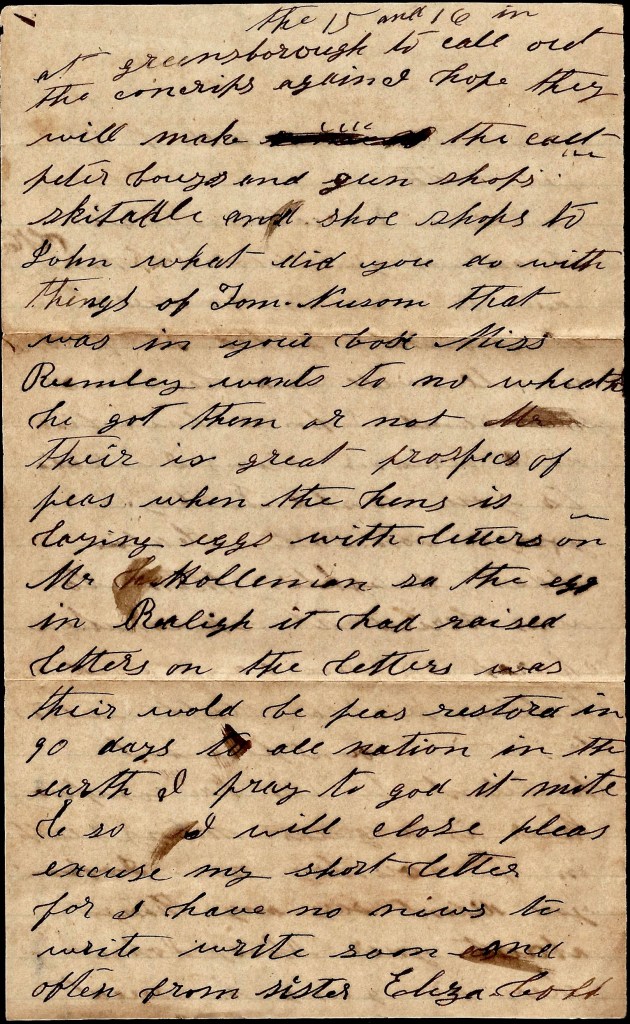
John, you didn’t say anything about your shoes. John, they are going to meet at Greensboro to call out the conscripts again. Hope they will make all the saltpetre and gun shops skedaddle—and shoe shops too. 3
John, what did you do with things of Tom Newsom that was in your Company. Miss Rumley wants to know whether he got them or not.
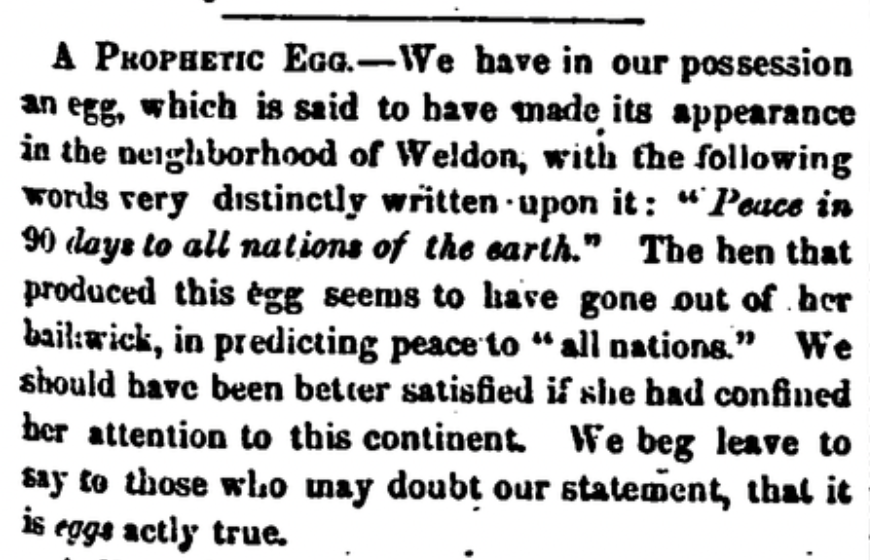
Semi-weekly Standard, Raleigh, 6 March 1863
There is great prospect of peace when hens is laying eggs with letters on. Mr. Hollenian saw the egg in Raleigh. It had raised letters on [it]. The letters was there would be peace restored in 90 days to all nation in the earth. I pray to God it might be so.
I will close, Please excuse my short letter for I have no news to write. Write and often. From sister—Eliza Cobb
1 Joshua Riley Boon (1822-1884) of Guilford county, N. C., was married to Matilda Ingle (1832-1907).At age 42, he was drafted into Co. A, 53rd North Carolina Infantry in December 1864.
2 William Calvin Hubbard (1831-1863) was the son of Solomon Hubbard (1787-1835) and Sarah Jane Matthews (1806-1860) of Mount Pleasant, Guilford, North Carolina. He was married to Emily Donnell (1831-1878) in 1859 and had two young sons when he volunteered in 1862 to serve as a private in Co. A, 53rd North Carolina Infantry. He died of disease at Kinston, North Carolina, on 3 March 1863.
3 I believe Eliza is hoping that the drafting of conscripts to serve in the Confederate army would not longer exempt those who worked in the saltpetre, gun or shoe making industries which it had previously done. Many volunteers resented that otherwise eligible young men hid behind these exemptions to avoid service.
I could not find an image of Marcus but here is one of Dewitt Holmes who also served as a private in Co. D, 24th Iowa Infantry (Mike Huston Collection)
The following letters were written by Israel Marcus Ritter (1841-1864), the son of Benjamin Franklin Ritter (1814-1904) and Mary Stover (1818-1915) of Iowa City, Iowa. Marcus enlisted at the age of 21 in Co. D, 24th Iowa Infantry on 20 August 1862. He survived the Battle of Champion Hill and the siege of Vicksburg but was severely wounded by gunshot in the left arm at the 3rd Battle of Winchester, Virginia, on 19 September 1864 and died at a Winchester hospital on 4 October 1864. According to the Office of Veterans Affairs in Johnson county, Iowa, Marcus was orginally buried on the battlefield at Woods Farm but was later reburied with a military headstone at the Winchester National Cemetery, Section 76, Grave 3557.
Marcus was married to Julia A. Barnes while in the service. The marriage ceremony took place in Johnson county, Iowa, and was performed by his captain, Jacob Casebeer, who also happened to be a Minister of the Gospel. The wedding took place on 23 February 1864.
Letter 1
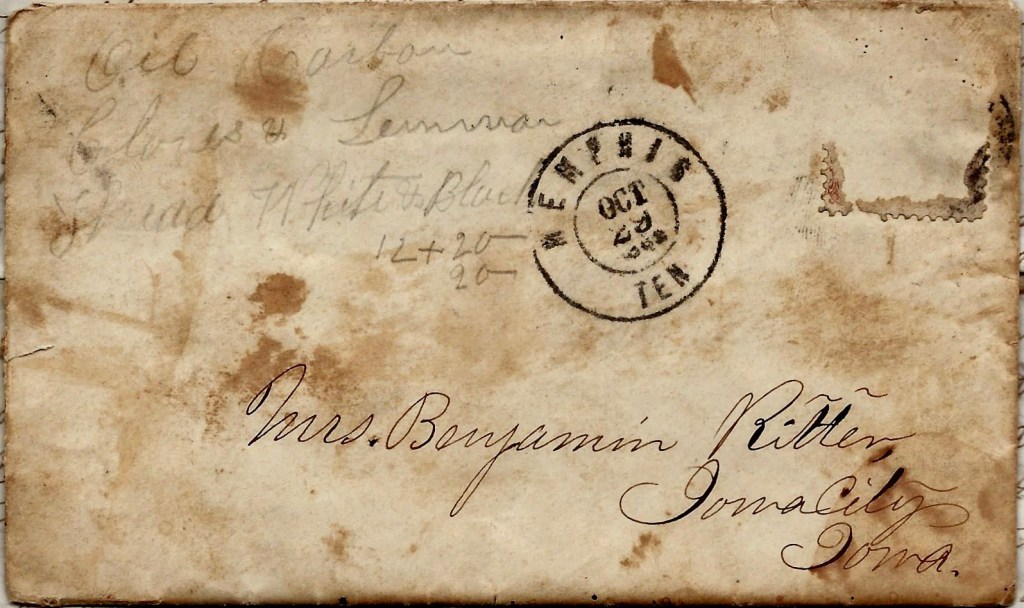
Addressed to Mrs. Benjamin Ritter, Iowa City, Iowa
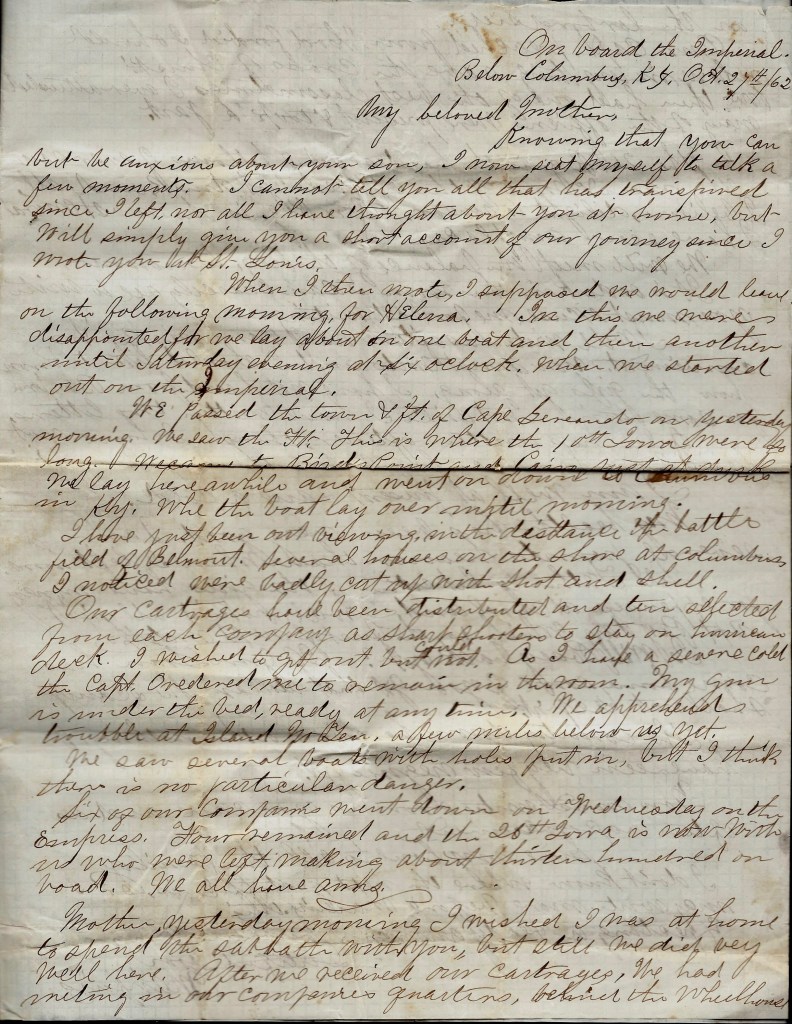
On board the Imperial Below Columbus, Kentucky October 27, 1862
My beloved Mother,
Knowing that you can but be anxious about your son, I now seat myself to talk a few moments. I cannot tell you all that has transpired since I left, nor all I have thought about you at home, but will simply give you a short account of our journey since I wrote you at St. Louis. When I then wrote, I supposed we would leave on the following morning for Helena. In this we were disappointed for we lay about on one boat and then another until Saturday evening at six o’clock when we started out on the Imperial.
We passed the town of Cape Gerardo on yesterday morning. We saw the fort. This is where the 1st Iowa were so long. We came to Bird’s Point and Cairo just at dark. We lay here awhile and went on down to Columbus in Kentucky where the boat lay over until morning. I have just been out viewing in the distance the battlefield of Belmont. Several houses on the shore at Columbus I noticed were badly cut up with shot and shell.
Our cartridges have been distributed and ten selected from each company as sharp shooters to stay on hurricane deck. I wished to get out but could not. As I have a severe cold, the Capt. ordered me to remain in the room. My gun is under the bed, ready at any time. We apprehend trouble at Island No. 10, a few miles below us yet. We saw several boats with holes put in but I think there is no particular danger. Six of our companies went down on Wednesday on the Empress. Four remained and the 26th Iowa is now with us who were left making about thirteen hundred on board. We all have arms.
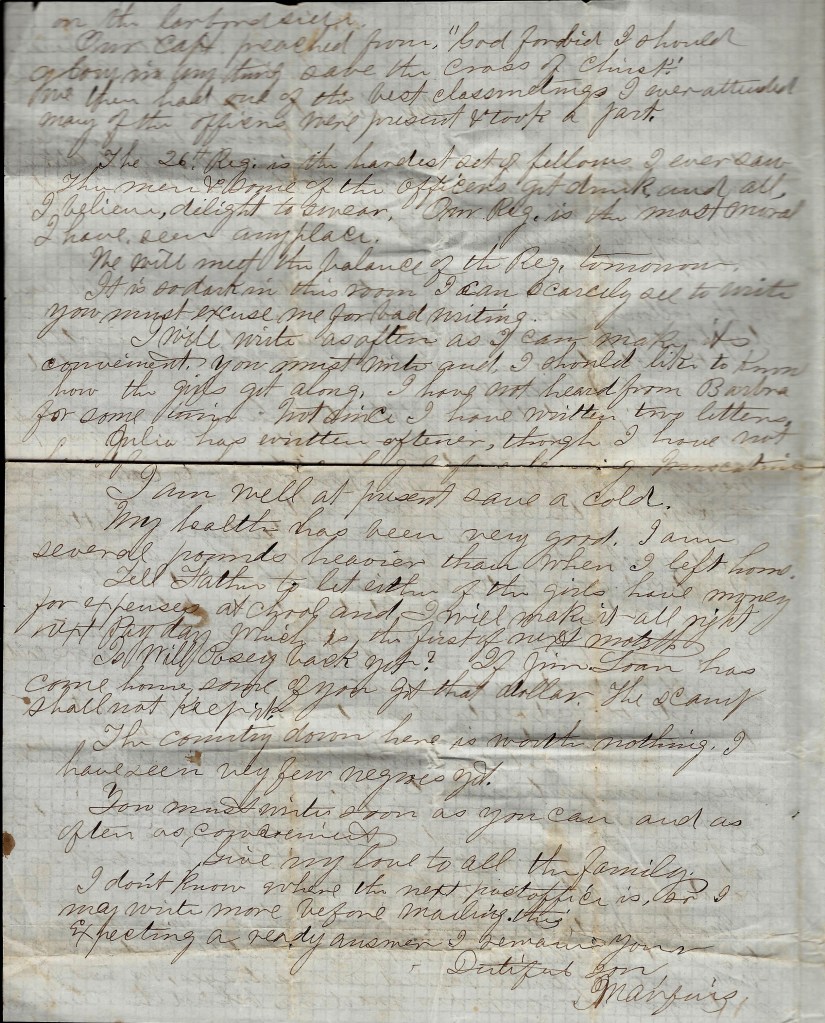
Mother, yesterday morning I wished I was at home to spend the Sabbath with you but still we did very well here. After we received our cartridges, we had meeting in our company’s quarters behind the wheelhouse on the larboard side. Our Capt. preached from, “God forbid I should glory in anything save the cross of Christ.” We then had one of the best class meetings I ever attended. Many of the officers were present & took a part.
The 26th Regiment is the hardest set of fellows I ever saw. Them men & some of the officers get drunk and all, I believe, delight to swear. Our regiment is the most moral I have seen anyplace.
We will meet the balance of the regiment tomorrow. It is so dark in this room I can scarcely see to write. You must excuse me for bad writing. I will write as often as I can make it convenient. You must write and I should like to know how the girls get along. I have not heard from Barbara for some time—not since I have written two letters. Julia has written oftener though I have not [paper creased].
I am well at present save a cold. My health has been very good. I am several pounds heavier than when I left home. Tell Father to let either of the girls have money for expenses at school and I will make it all right next payday which is the first of next month.
Is Will Posey back yet? If Jim Loan has come home, some of you got that dollar. The scamp shall not keep it.
The country down here is worth nothing. I have seen very few negroes yet. You must write soon as you can and as often as convenient. Give my love to all the family. I don’t know where the next Post Office is so I may write more before mailing this. Expecting a ready answer, I remain your dutiful son, — Marcus
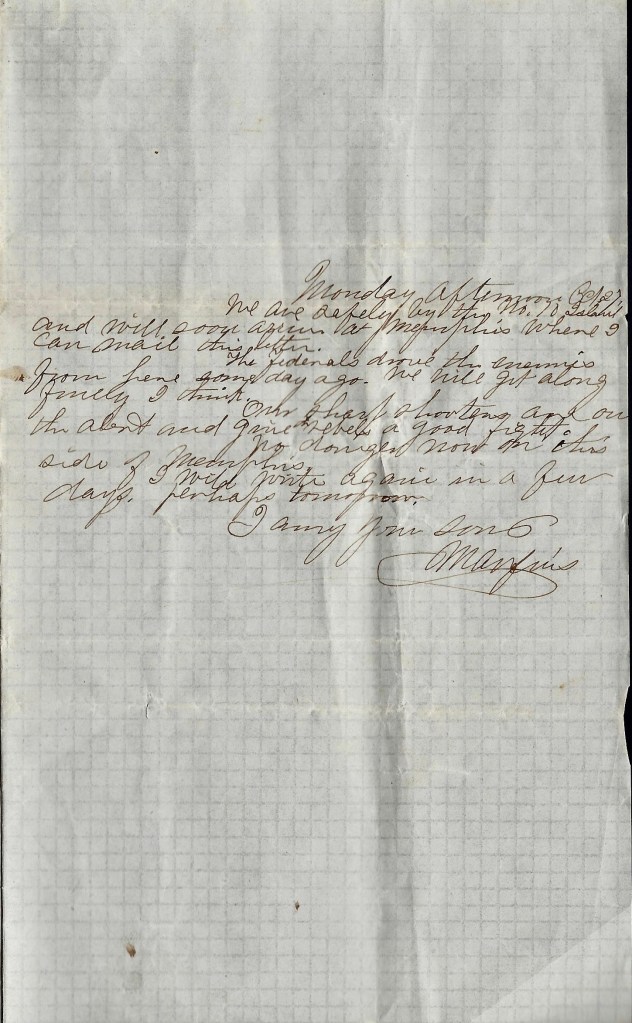
Monday afternoon, Oct. 27. We are safely by No. 10 Island and will soon arrive at Memphis where I can mail this letter. The Federals drove the enemies from here some days ago. We will get along finely I think. Our sharp shooters are on the alert and five rebels a good fight. No danger now on this side of Memphis. I will write again in a few days—perhaps tomorrow. I am you son, — Marcus
Letter 2
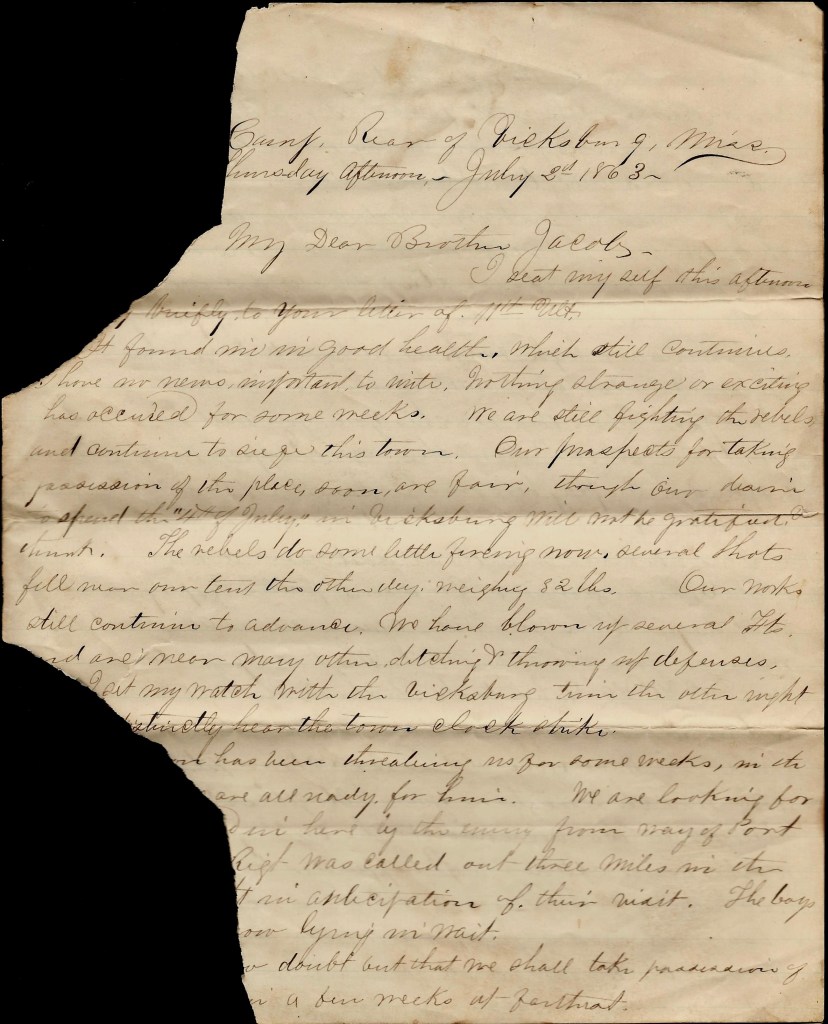
In Camp, Rear of Vicksburg, Mississippi Thursday afternoon, July 2, 1863
My dear Brother Jacob,
I seat myself this afternoon to respond briefly to your letter of 11th ult. It found me in good health which still continues. I have no news important to write, Nothing strange or exciting has occurred for some weeks. We are still fighting the rebels and continue to siege this town. Our prospects for taking possession of the place soon are fair, though our desire to spend the “4th of July” in Vicksburg will not be gratified, I think. The rebels do some little firing now. Several shots fell near our tent the other day weighing 32 pounds. our works still continue to advance. We have blown up several forts and are near many others, ditching and throwing up defenses. I set my watch with the Vicksburg time the other night. We could distinctly hear the town clock strike.
Gen. Johnston has been threatening us for some weeks in the rear [of us but we] are all ready for him. We are looking for [paper missing] in here by the enemy from way of Port [Hudson] [paper missing] Regt. was called out three miles in the [paper missing] in anticipation of their visit. The boys [paper missing] now lying in wait. [There seems to be] no doubt but that we shall take possession of [paper missing] a few weeks at farthest.
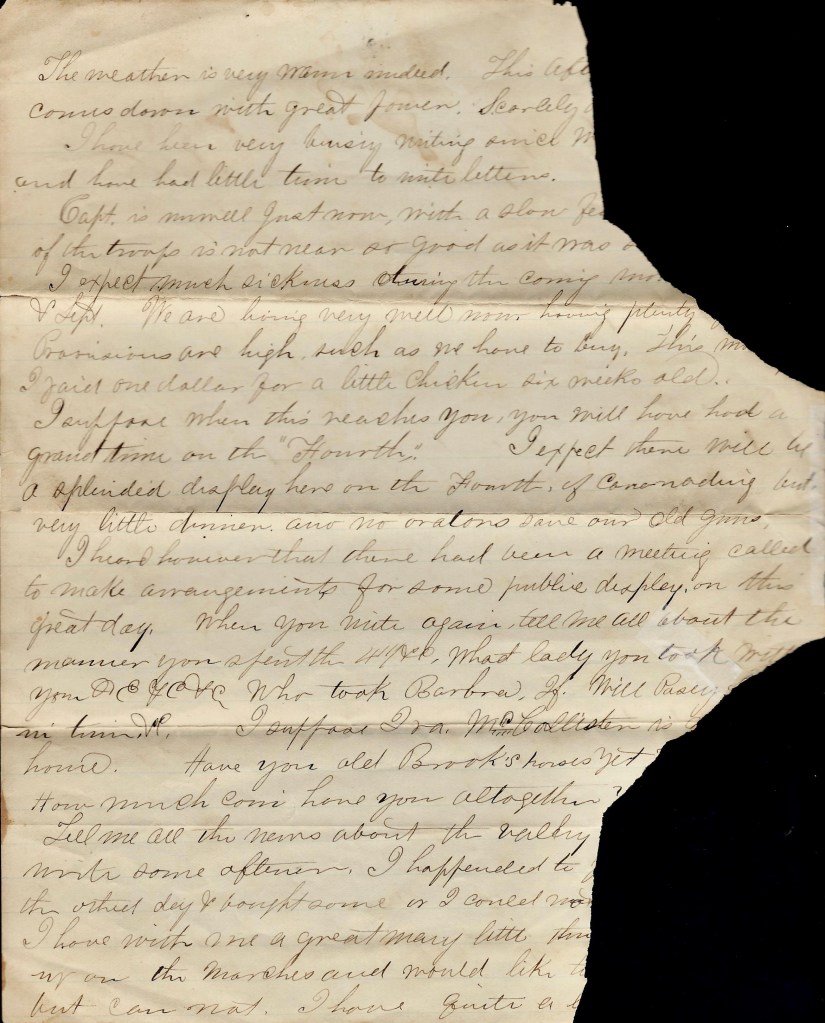
The weather is very warm indeed. This afternoon the sun comes down with great power. Scarcely [paper missing]. I have been very busy writing since we have been here and have had little time to write letters.
Capt. [Casebeer] is unwell just now with a slow fever. Some of the troops is not near so good as it was so [paper missing]. I expect much sickness during the coming months of August and September. We are living very well now, having plenty [paper missing]. Provisions are high, such as we have to buy. This morning I paid one dollar for a little chicken six weeks old. I suppose when this reaches you, you will have had a grand time on the “Fourth.” I expect there will be a splendid display here on the Fourth, of cannonading, but very little dinner and no orations save our old guns.
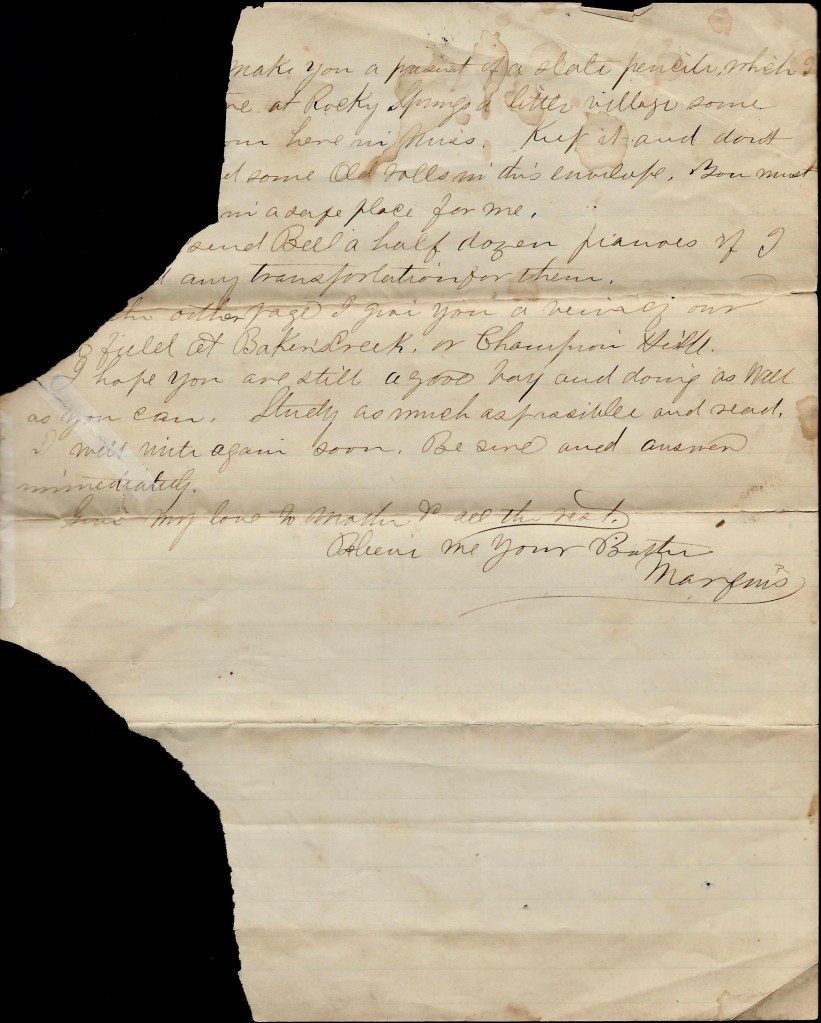
I heard however that there had been a meeting called to make arrangements for some public display on the great day. When you write again, tell me all about the manner you spent the 4th, &c. What lady you took with you, &c. &c. Who took Barbara? If Will Posey [paper missing] in turn, &c. I suppose Ira McCollister is at home. Have you old Brooks’ horses yet? How much corn have you altogether? Tell me all the news about the valley. Write some oftener. I happened to [paper missing] the other day & bought some or I could [paper missing]. I have me a great many little [paper missing] up on the marches and would like to [paper missing] but can not. I have quite a [paper missing]…make you a present of a slate pencil which I [paper missing] at Rocky Springs—a little village some [paper missing] from here in Mississippi. Keep it and don’t [paper missing] sole Old rolls in this envelope. You must keep it in a safe place for me…
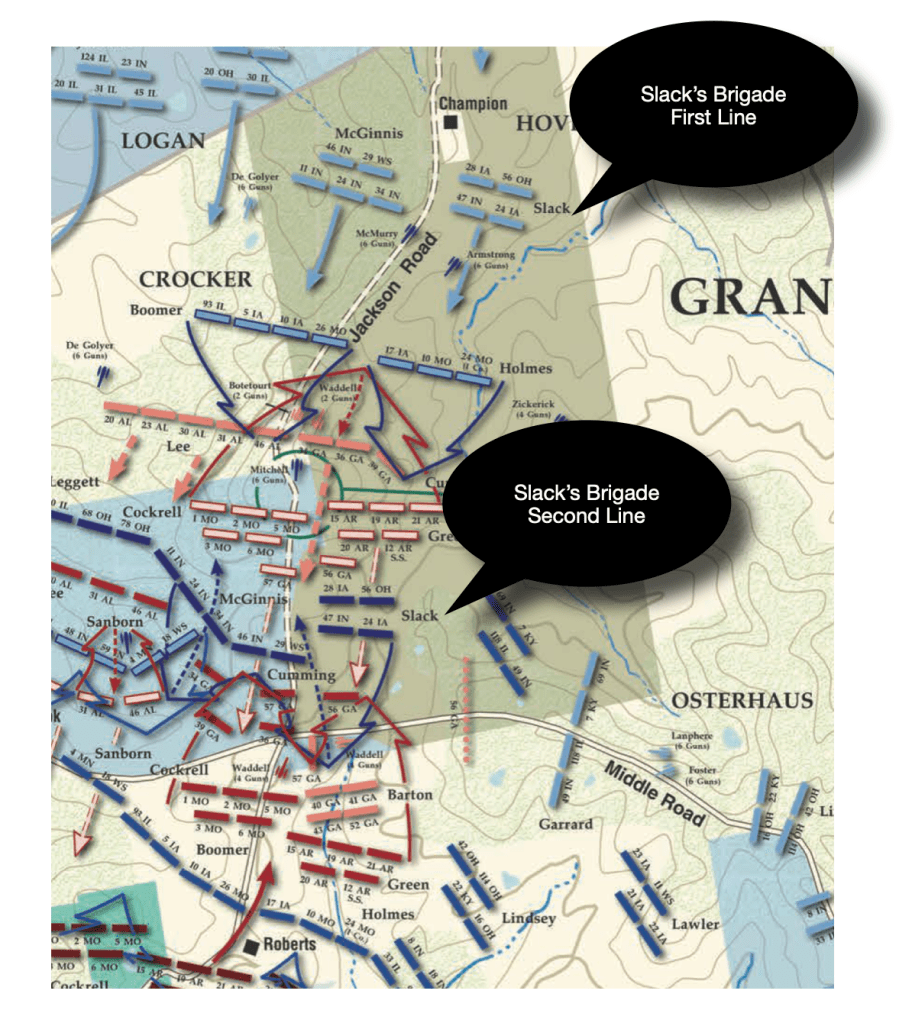
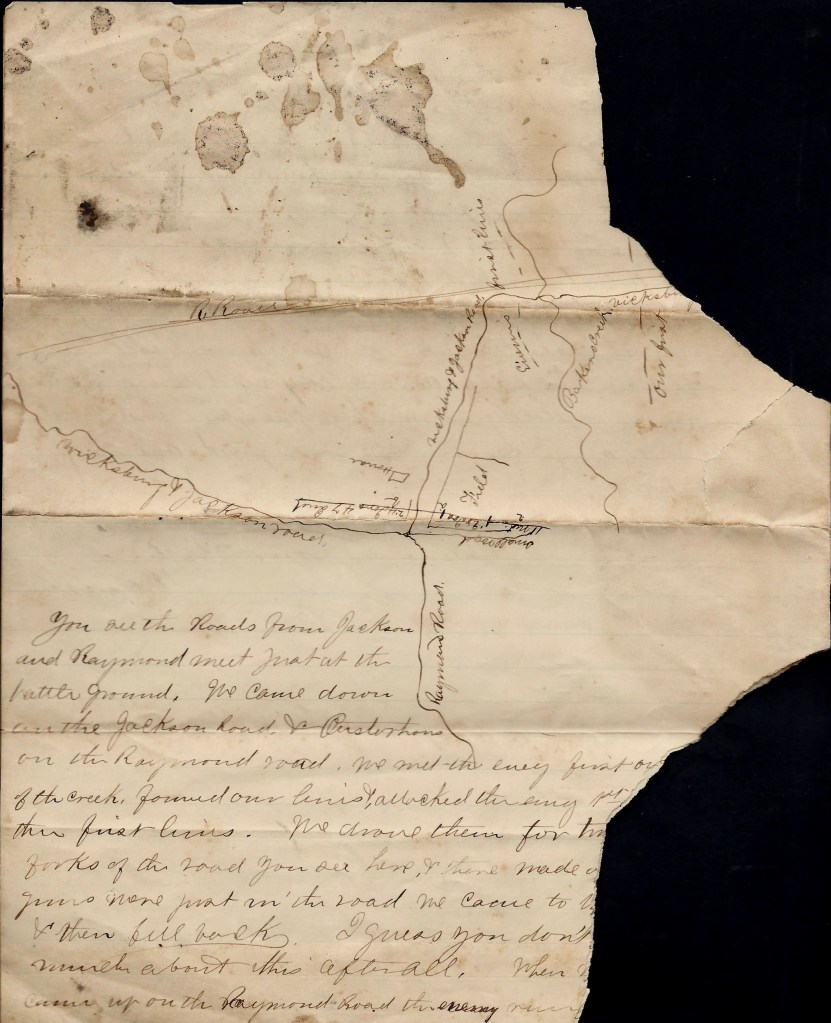
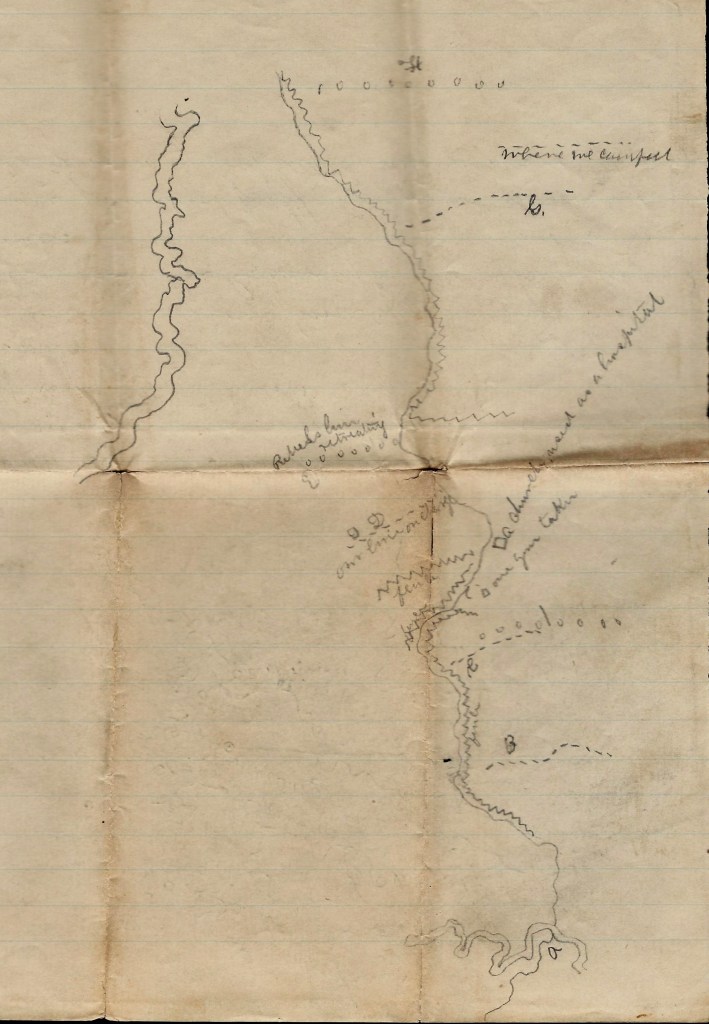
Marcus’ sketch of the Battlefield at Champion Hill, showing the first and second battle lines at Bakers’s Creek and the junction of the Raymond and Jackson Roads. The sketch shows the 28th Iowa on one side of the Vicksburg-Jackson Road and the 24th Iowa on the other.The American Battlefield Trust Map below informs that the Iowans were fighting Arkansans and Georgians on 16 May 1863.
You see the roads from Jackson and Raymond meet just at the battleground. We came down on the Jackson Road & Osterhaus on the Raymond Road. We met the enemy first on [paper missing] of the creek, formed our lines, and attacked the enemy 1st [paper missing] their first lines. We drove them for two [paper missing] forks of the road you see here & there made [paper missing] guns were just in the road we came to [paper missing] and then fell back. I guess you don’t [paper missing] much about this after all. When [paper missing] came up on the Raymond Road, the enemy run [paper missing].
On the other page I gave you a view of our battlefield at Baker’s Creek, or Champion Hill. I hope you are still a good boy and doing as well as you can. Study as much as possible and read. I will write again soon. Be sure and answer immediately. Give my love to Mother and all the rest. Believe me your brother, — Marcus
American Battlefields Trust Map
Map drawn by Israel Marcus Ritter, Co. D, 24th Iowa Infantry, Vicksburg Campaign