My passion is studying American history leading up to & including the Civil War. I particularly enjoy reading, transcribing & researching primary sources such as letters and diaries.
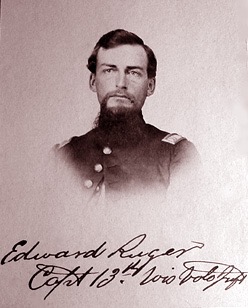
This letter was written by Edward Ruger, a twenty-five year old surveyor living in Rock, Wisconsin in 1860. Ruger was the son Rev. Thomas Jefferson Ruger and Maria Hutchins of Janesville, Rock county, Wisconsin. Rev. Thomas Ruger was not only an Episcopal Clergyman, he was the Principal of the Janesville Academy which opened in 1844.
Ruger joined the 13th Wisconsin Infantry in October 1861 and was elected Captain of Company A. He was assigned to the General’s staff shortly thereafter at which time he was appointed an engineer. He was discharged from the service on November 19, 1864. Although his military records don’t support it, Ruger may have stayed on government payroll as the superintendent of the topographical engineers for the Army of the Cumberland for as late as October 1867. He had returned to to Rock, Wisconsin before 1870 and went back to civilian surveying. His affiliation with the military and government were terminated at that point.
Aside from describing his map-making activities in and around Fort Donelson in the summer of 1863, Ruger informs his father that he is sending two—maybe three—male runaway slaves to Wisconsin along with one female. He explains further that he is sending them as indentured servants, expecting them to pay back their traveling expenses, at which time his father was expected to give it back to them and offer them employment if they wanted to stay on for $5 to $8 per month plus board.
Transcription
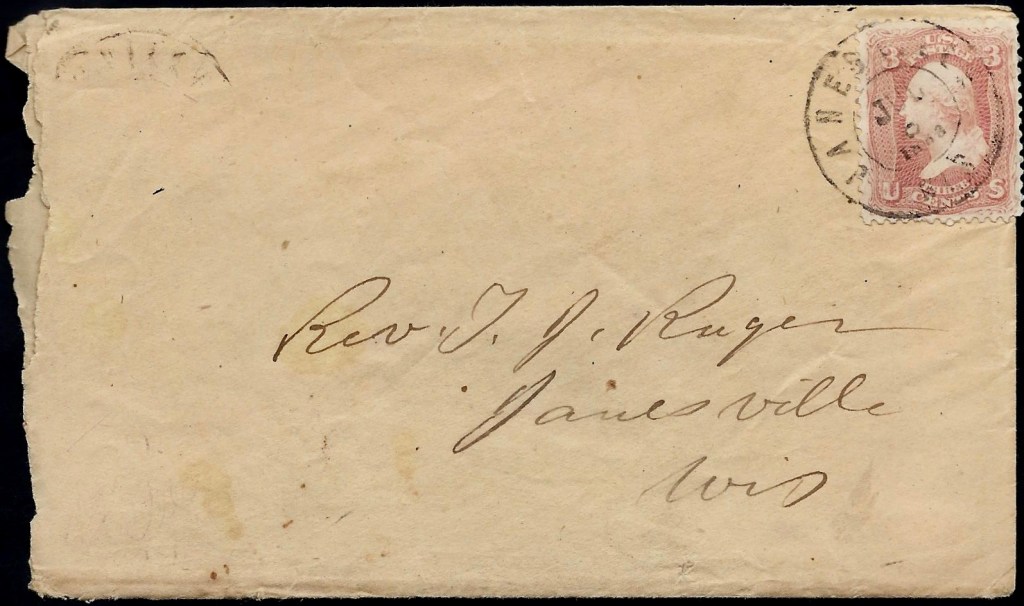
Addressed to Rev. T. J. Ruger, Janesville, Wisconsin
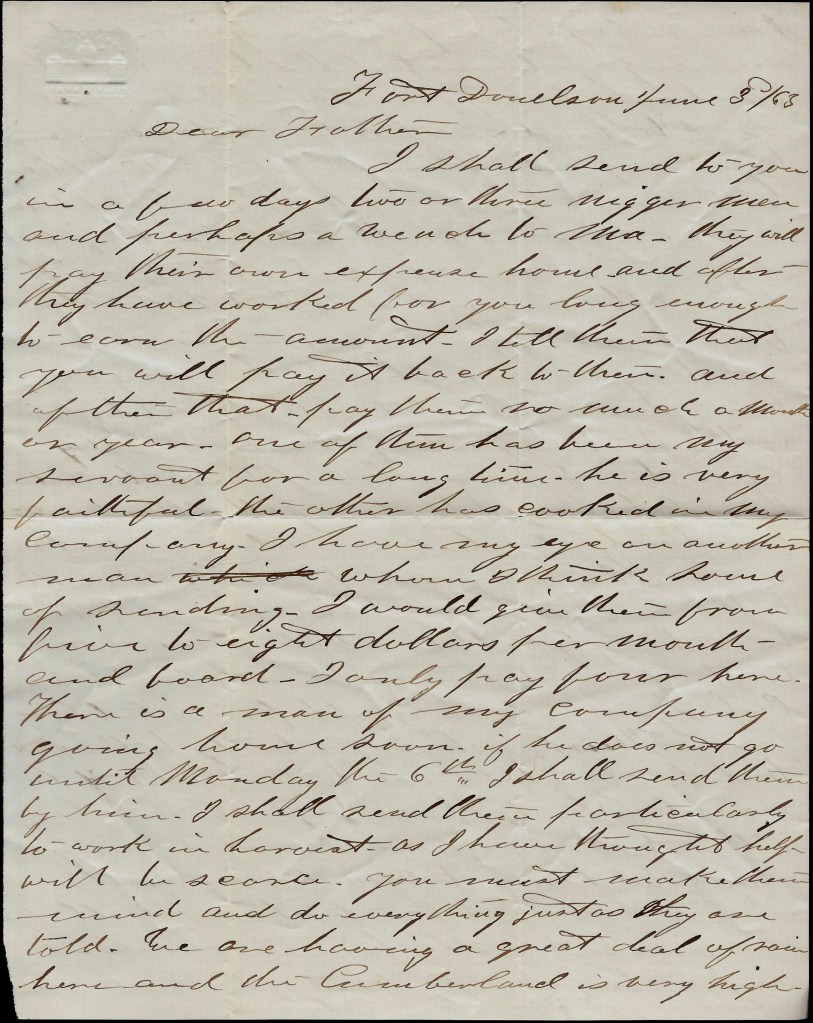
Fort Donelson June 3rd 1863
Dear Father,
I shall send to you in a few days two or three nigger men and perhaps a wench to Ma. They will pay their own expense home and after they have worked for you long enough to earn the amount, I tell them that you will pay it back to them, and after that, pay them so much a month or year. One of them has been my servant for a long time. He is very faithful. The other has cooked in my company. I have my eye on another man whom I think some of sending. I would give them from five to eight dollars per month and board. I only pay four here. There is a man of my company going home soon. If he does not go until Monday the 6th, I shall send them by him. I shall send them particularly to work in harvest as I have thought help will be scarce. You must make them mind and do everything just as they are told.
We are having a great deal of rain here and the Cumberland is very high. I am acting topographical engineer and am engaged most of the time in work pertaining to my profession. I have just sent to headquarters two plots accompanied by a report showing the obstructions placed in the river by the rebels. They consist of sunken stone barges. I shall not take the job of removing them if I can help it for I have all on my hands that I can do for four or five months. I am making a map showing the range of the guns mounted in the fort, together with the topography of the surrounding country. I have three of these to make. Then I have got to survey all of this country for thirty miles around and make a military map of it. This will take me a long time. I am in hopes to get through by fall for I don’t want much to do if Sarah comes down this winter.
Col. Lyon had a telegraph from Col. Lowe from Murfreesboro yesterday to the effect that he could come to the front if he would like to. I am in hopes that he will not say go for we are so nicely situated here. Bill and I are well. He is down at the fort most all of the time but I see him at meals. I expect to go out the first of the week on a a surveying trip.
The following letter was written by Albert Gallatin Patten (1831-1893), the son of Johnson Patten (1782-1848) and Lucy Towne (1790-1862) of Kennebunkport, Maine. He was married in Mary 1868 to Martha Elizabeth Hunt in Hennepin, Minnesota.
Prior to his enlistment in the US Army in July 1854, Albert was a 23 year-old carriage-maker in Kennebunk. Albert’s pension files inform us that he served in the military from 1854 to 1859 in Co. K, 2nd Infantry. When he wrote this letter in May 1858, he was a sergeant working on detail in the Quartermaster Department of Fort Ripley in Minnesota Territory. Following his discharge from the army, he may have been the same Albert G. Patten who enlisted as crewman aboard the whaling ship Parachute which departed New Bedford in 1859. He served in the Civil War in Co. C, 1st New Jersey Infantry.
Fort Ripley was located on the west bank of the Mississippi about 20 miles above the mouth of Swan river, and 7 miles south of Crow Wing, at a point where the channel runs southwest. The distance by wagon road from St. Paul was 150 miles. The road lay along the east bank of the Mississippi, with no approach to the fort except by ferry. The Post Reserve was a mile square and was surrounded by a dense forest. The fort was situated on a plateau elevated a little above the river, and consisted of several story and a half buildings constructed of wood, forming three sides of a square, with the open side facing the stream. On the right, looking towards the quadrangle, were the quarters of the officers, the chaplain’s residence, and the sutler’s store; on the left, also quarters for officers, a room set apart for a chapel, and a hospital; while the third side was filled by the barracks for the soldiers. The northwest and southwest corners were flanked by blockhouses of logs, with port-holes commanding the sides of the fort. The houses stood some fifteen to twenty feet apart, so that there was a free entrance between, excepting on the east side where there was a stockade built of logs set on end.
Watercolor painted in 1989 of Ft. Ripley by Minnesota artist Paul S. Kramer (1919-2012). This painting hangs in the Minnesota Military Museum. A larger oil painting of the same scene hangs in Camp Ripley’s post headquarters.
Transcription
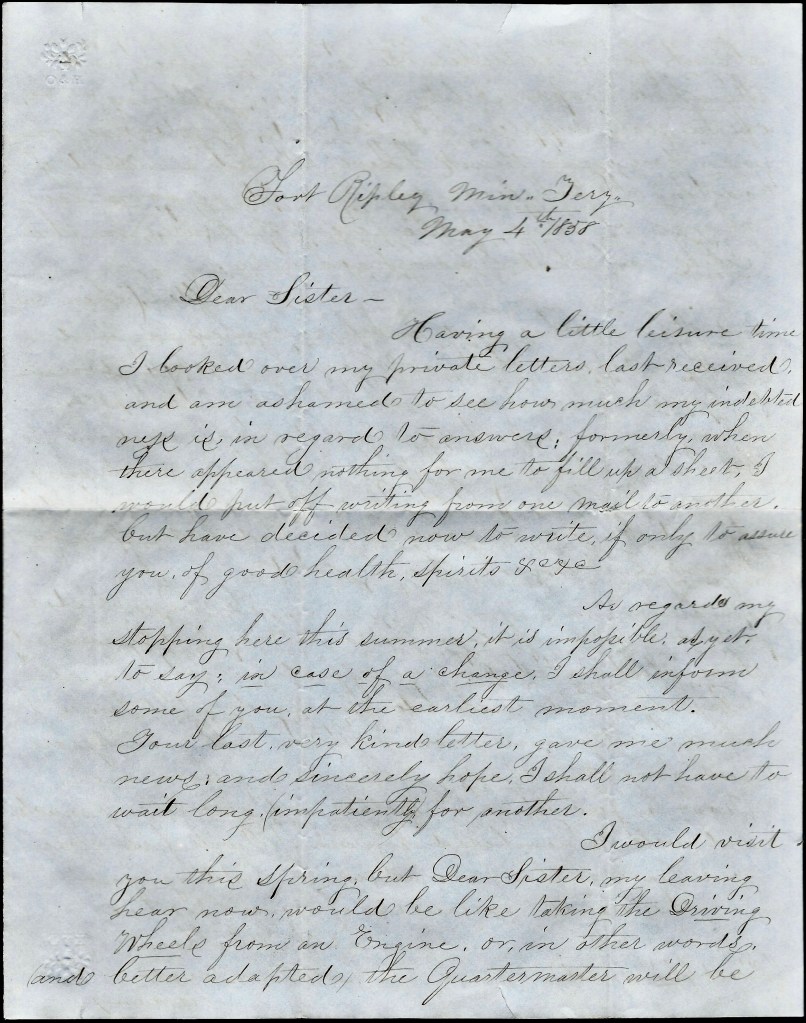
Fort Ripley, Minnesota Territory May 4th 1858
Dear Sister,
Having a little leisure time, I looked over my private letters last received and am ashamed to see how much my indebtedness is in regard to answers. Formerly, when there appeared nothing for me to fill up a sheet, I would put off writing from one mail to another—but have decided now to write if only to assure you of god health, spirits, &c. &c.
As regards my stopping here this summer, it is impossible, as yet, to say. In case of a change, I shall inform some of you at the earliest moment. Your last very kind letter gave me much news and sincerely hope I shall not have to wait long (impatiently) for another. I would visit you this. Spring, but dear sister, my leaving here now would be like taking the driving wheels from an engine, or, in other words, and better adapted, the quartermaster will be absent for a considerable length of time, and the whole responsibility of receiving, storing, &c. &c. of the year’s supplies will, consequently, devolve on me. You may think I have adopted a method of boasting but believe me, I would as soon have charge of some of the larger warehouses in the cities as what I now have here.
Often, (when one and then another, and another comes in and makes a report that a wagon has broken down—a horse lame—an animal of some description is missing—or, perhaps, an order for provisions to be filled up immediately, all these are trying to ones patience) I think of the advice so kindly offered by you in your letter, and hope I may treasure it more than gold.
This, dear sister, is but a poor apology for a letter but be assured there still exists warm affection for you all. Pay my kind wishes to Mr. Hardy, Tell James I shall write him soon. John and family are not forgotten though I think they have me. Now a few lines to Mother and also to my much and well remembered Emma. I will first close your part of this poor sheet by bidding you the usual farewell of your brother, — A. G. Patten
Jr. Master Sergeant, US Army
(Direct plain as usual.)
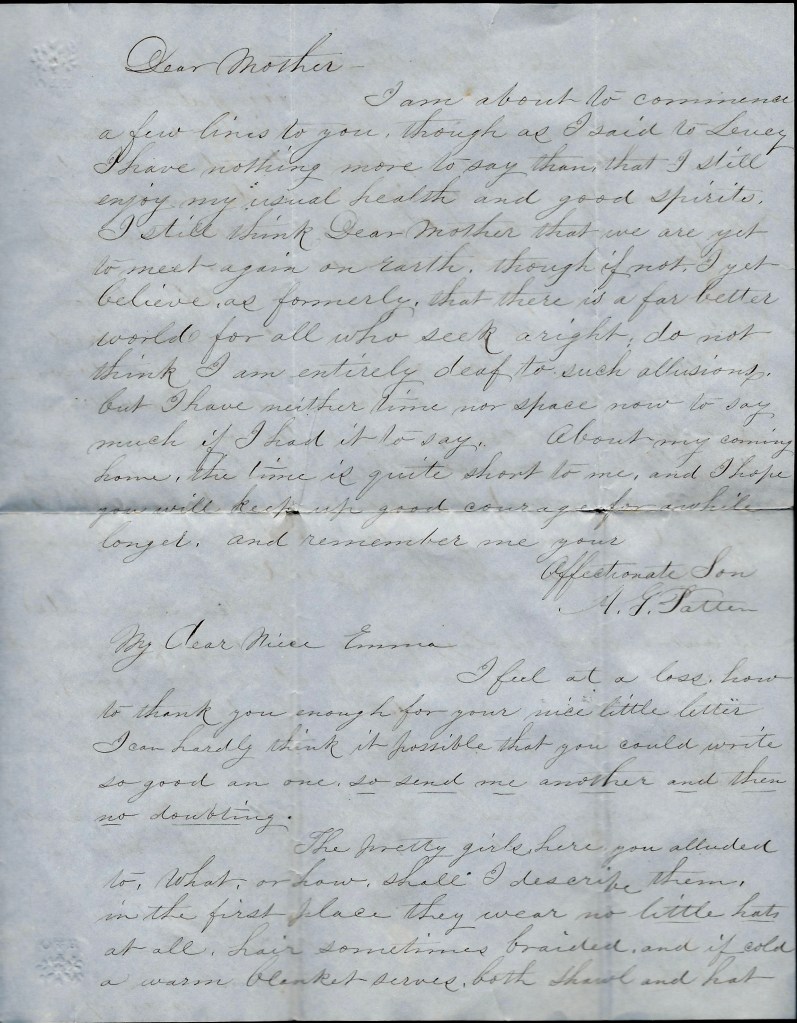
Dear Mother,
I am am about to commence a few lines to you, though as I said to Lucy, I have nothing more to say than that I still enjoy my usual health and good spirits. I still think, dear Mother, that we are yet to meet again on earth, though if not, I yet believe, as formerly, that there is a far better world for all who seek a right. Do not think I am entirely deaf to such allusions, but I have neither time nor space now to say much if I had it say. About my coming home, the time is quite short to me, and I hope you will keep up good courage for awhile longer and remember me your affectionate son, — A. G. Patten
My dear niece Emma,
I feel at a loss how to thank you enough for your nice little letter. I can hardly think it possible that you could write so good an one, so send me another and then no doubting.
The pretty girls here you alluded to, what, or how, shall I describe them. In the first place they wear no little hats at all, hair sometimes braided, and if cold a warm blanket serves both shawl and hat. Their other wearing apparel it is not best for me to enter into a minute detail until I can see you. I might ass without fear, that their complexion is such tat you would not desire to call one Aunt (being much too dark). I am now getting quite out of the notion of young ladies (except [our] own folks) probably shall settle down somewhere, at sometime, an old squizzled up “Bach.”
Do not forget to give me another trial on letters. I may do better than nonsense in returning you an answer. Be pleased to still remember me as your very affectionate Uncle. — A. G. Patten, Fort Ripley, M. T.
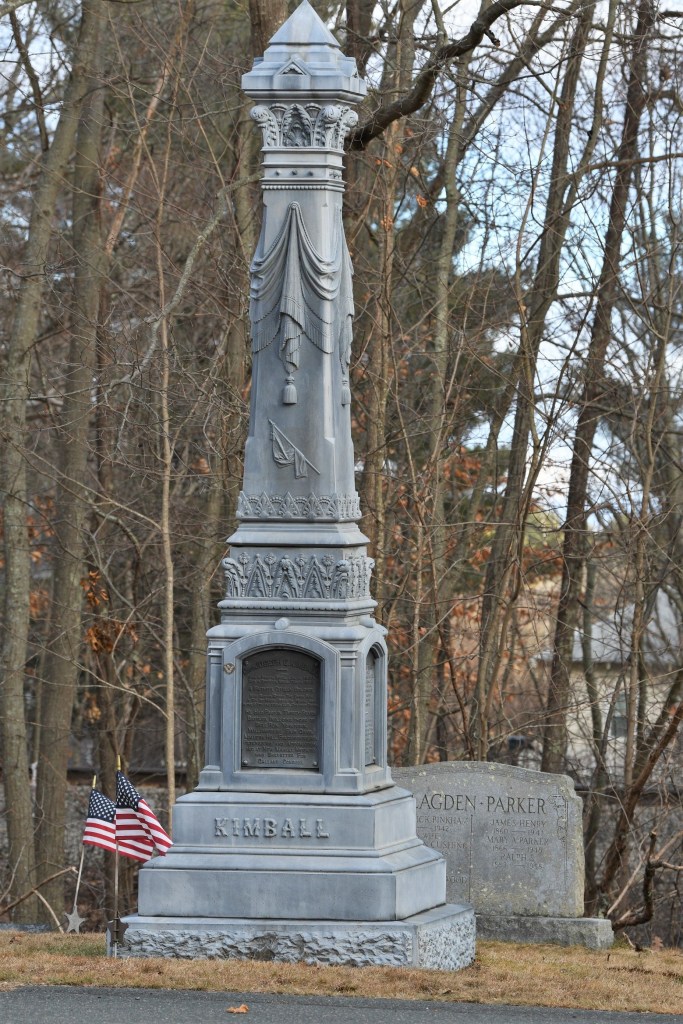
Kimball’s Gravestone, Mount Vernon Cemetery, Abington, Plymouth County, Massachusetts
The following letters were written by Joseph Edward Kimball (1839-1896)—a machinist in Ipswich, Massachusetts, who enlisted at the age of 21 in Co. B, 1st Massachusetts Infantry on 23 May 1861. He was discharged on 10 January 1864 to accept a commission in the 3rd North Carolina Colored Volunteers (37th USCT) and also in the 116th USCT.
Joseph was the son of John Kimball (1800-1876) and Rebecca Gould (1804-1888). He had three older brothers and I can’t be certain to whom he wrote this letter.
Joseph’s tombstone inscription reads:
He Fought For Love Of County Not Of Arms; And, With The Country Saved, He Left The Arts Of War For Those Of Peace And To His Record As A Good Soldier Added That Of A Good Citizen
One Who Never Turned His Back, But Marched Breast Forward; Never Doubted Clouds Would Break; Never Dreamed, Tho’ Right Were Worsted, Wrong Would Triumph… Held We fall To Rise, Are Baffled To Fight Better, Sleep To Wake.
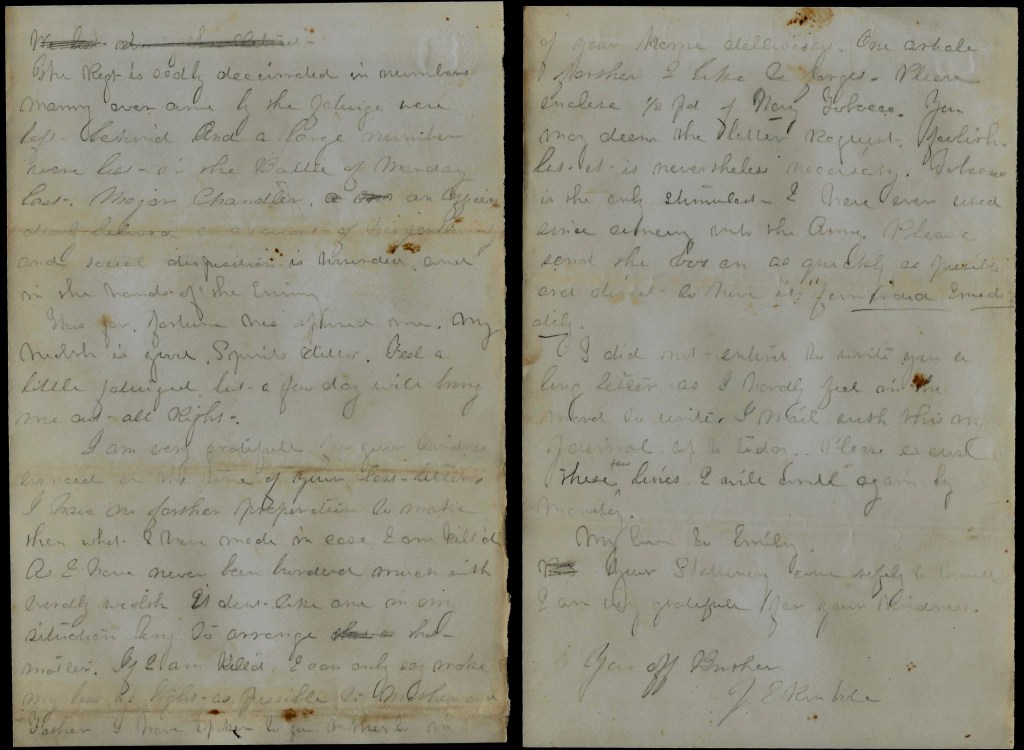
1st Regt. Massachusetts Vol. Near City Point, Virginia July 6th 1862
Mt dear Brother,
I received your last letter while encamped before Richmond. Ere I had time to forward you an answer, the mails were stopped and the subsequent train of events have left me no time previous to today to tae up a pencil. As I have kept an account from day to day in my memorandum book of all that has transpired which I send with this, I will not attempt to go over again a recital of the fatigue, fighting, and losses which have befallen us during the last week.
Major Charles P. Chandler was killed in the Battle of Glendale
We are now encamped on a plain near the James river. Probably we shall remain here for a week or two. The regiment is sadly decimated in numbers. Many overcome by the Johnnys were left behind and a large number were lost in the battle of Monday last. Major [Charles P.] Chandler, an officer dearly beloved on account of his gentlemanly and social disposition is wounded and in the hands of the enemy. This for fortune has spared me. My health is good. Spirits dull. Feel a little fatigued but a few days will bring me out all right.
I am very gratified for your kindness evinced in the tone of your last letter. I have no farther preparation to make then what I have made in case I am killed. As I have never been burdened much with worldly wealth, it’s not like one in my situation to arrange the matters. If I am killed, I can only say make my loss as light as possible to Mother and Father. I have spoken to you and Reg___ & Olivia. If I am wounded and not fatally so, I would wish that some means might be used to take me home to Massachusetts. The wounded are so poorly cared for here that a wound is more to be dreaded than immediate death. This is all I have to say on the subject.
I have one more favor to ask. I am informed by the Colonel that we are to be stopped here for a fortnight or more. The Express line is perfect to this point. I now have to ask that you will immediately forward me a box containing some tea, sugar, coffee, preserves, and a few other articles which you may think of. The fact is brother, we are all tired out, what with fasting, fighting, and fatigue. The coffee used in the Army is more injurious than beneficial. I kind of crave some of the home delicacies. One article further I would like—please enclose half pound of Navy tobacco. You may deem the latter request foolish, but it is nevertheless necessary. Tobacco is the only stimulant I ever used since coming into the Army. Please send the box on as quickly as possible and direct to here as “forwarded immediately.”
I did not intend to write you a long letter as I hardly feel in the mood to write. I mail with this my journal up to today, Please excuse these few lines. I will write again by Monday. My love to Emily. Your stationery came safely to hand, I am very grateful for your kindness. Your affectionate brother, — J. E. Kimball
Letter 2
[Note: This letter is from the personal collection of Don Andrew and was made available for transcription and publication on Spared & Shared by express consent.]
1st Regiment Massachusetts Volunteers Camp Lincoln
July 9th 1862
My dear brother,
Since I wrote you last, I have been rendered unfit for duty by illness. The fatigue and exposure of the retreat got the best of me and I am laboring now under a kind of sickness which though not serious, will doubtless keep me from duty for a few days. My principal trouble is diarrhea with a soreness through the groin and back. You must not be alarmed because my trouble is not of a serious nature. The doctor is tending [to] me and I meet with the kindest treatment from my comrades. You shall hear from me again in a few days. I write now because I thought from my last letter you would expect another by this time.
Received a paper from you last night. Write soon. Please enclose in that put some lemons. The Express (Adams) comes way up the river. you had better direct to Hooker’s Division.
I am too weak to write much now. Am in good spirits and shall be all right in a few days. Affectionately your brother, — J. E. Kimball
P. S. We are encamped presently in a nice pine wood. My regards to Emily. Don’t let the folks know I am unwell.
The following letters were written by Milton Richardson Billings (1832-1910), the son of Samuel Billings (1789-1854) and Abigail Adams (1799-1872) of Worcester county, Massachusetts. Milton was married to Mary Jane Colvin (1837-1910) in 1858 and had two children, Samuel (b. 1859) and Henry (b. 1861) when he was drafted at Blackstone, Massachusetts in July 1863 to serve as a private in Co. G, 18th Massachusetts Infantry for three years service.
Billings was engaged with the regiment in the campaign against Richmond from May 1, 1864 until June 1, 1864, when he was reported absent without leave. Billings was, in fact, in the hospital due to a back injury and subsequently returned to the regiment. He was transferred with the remnants of the regiment on Oct. 21, 1864 to the 32nd Massachusetts Infantry and assigned to Co. B. On Feb. 8, 1865 he was reported wounded and missing during the battle of Hatchers Run. He returned to the 32nd Massachusetts and was mustered out with that regiment on June 29, 1865.
[Note: The following letters are from the collection of Greg Herr and were transcribed and published on Spared & Shared by express consent.]
Billings spent his golden years on his farm in Bellingham, Massachusetts
Letter 1
Addressed to Mrs. Mary J. Billings, North Blackstone, Massachusetts
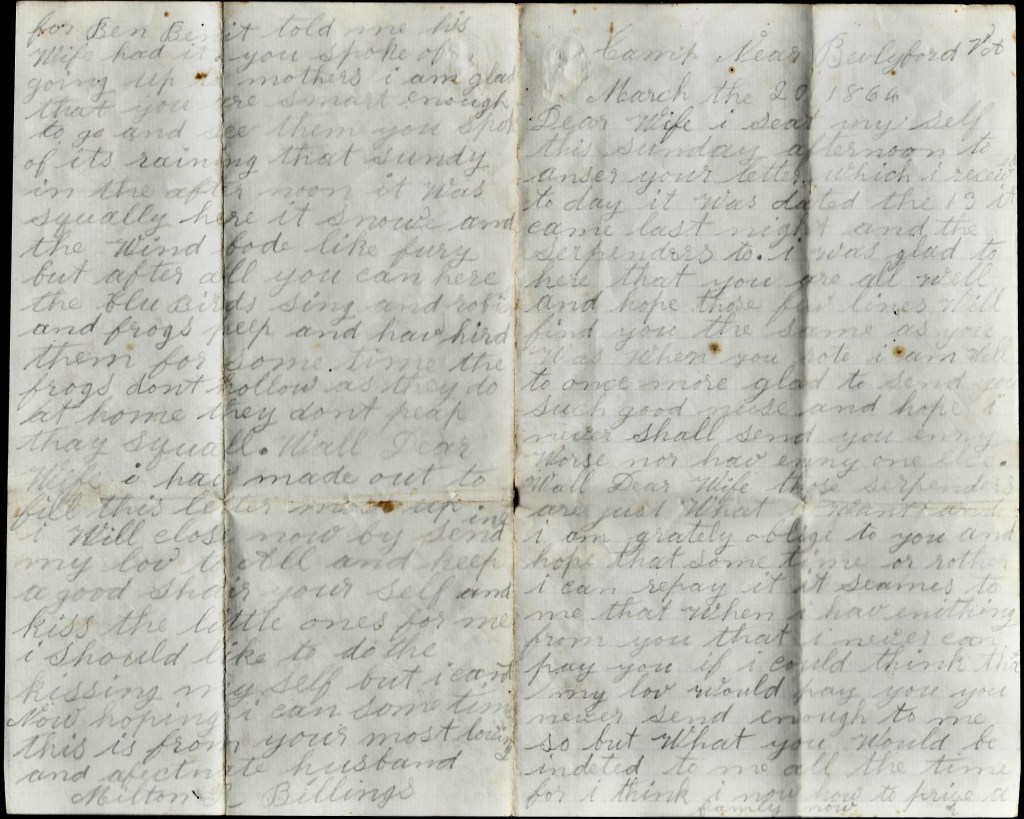
Camp near Beverly Ford, Va. March 20, 1864
Dear Wife,
I seat myself this Sunday afternoon to answer your letter which I received today. It was dated the 13th. It came last night and the suspenders too. I was glad to hear that you are all well and hope those few lines will find you the same as you was when you wrote. I am well too once more [and] glad to send you such good news and hope I never shall send you any worse not have anyone else.
Well, dear wife, those suspenders are just what I want and I am greatly obliged to you and hope that sometime or other I can repay it. It seems to me that when I have anything from you, that I never can repay you. If I could think that my love would repay you, you never send enough to me so but what you would be indebted to me all the time for I think I know how to prize a family now.
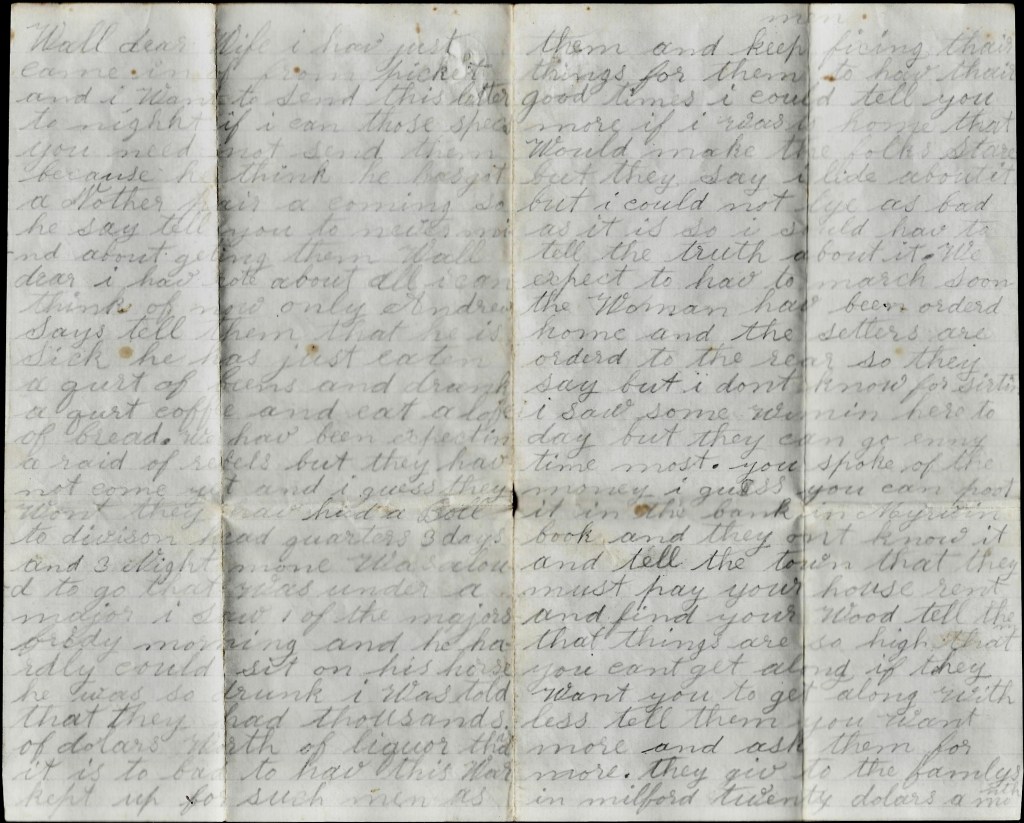
Well, dear wife, I have just come in off from picket and I want to send this letter tonight if I can. Those specs—you need not send them because he thinks he has got another pair a coming so he say tell you to never mind about getting them. Well, dear, I have wrote about all I can think of now, only Andrew says tell them that he is sick. He has just eaten a quart of beans and drunk a quart of coffee and eat a loaf of bread.
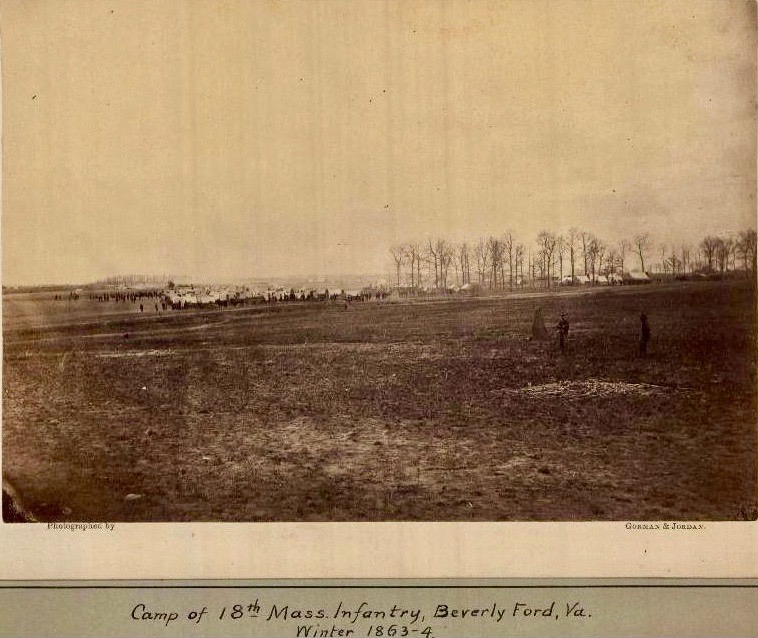
Camp of the 18th Massachusetts at Beverly ‘s Ford, Va. The view here is southeast and the Rappahannock River (and Beverly’s Ford) is situated over, and behind, the huts on the far right. (Courtesy of Clark Hall)
We have been expecting a raid of rebels but they have not come yet and I guess they won’t. They have had a Ball to Division Headquarters, 3 days and 3 nights. None was allowed to go that was under [the rank of] Major. I saw one of the Majors Friday morning and he hardly could sit on his horse he was so drunk. I was told that they had thousands of dollars worth of liquor their. It is too bad to have this war kept up for such men as them, and men keep fixing their things for them to have their good times. I could tell you more if I was to home that would make the folks stare, but they’d say I led about it. But I could not lie as bad as it is so I should have to tell the truth about it.
The Ball was held at General Joseph Bartlett’s divisional HQ, that was located in the “John B. Downman House” (pictured above). This image courtesy of Clark Hall.
We expect to have to march soon. The women have been ordered home and the sutlers are ordered to the rear so they say, but I don’t know for certain. I saw some women here today but they can go anytime most.
You spoke of the money. I guess you can put it in the bank in Marion Bank and they won’t know it. And tell the town that they must pay your house rent and find your wood. Tell them that things are so high that you can’t get along. If they want you to get along with less, tell them you want more and ask them for more. They give to the families in Milford twenty dollars a month for Ben Bennett told me his wife had it. You spoke of going up to Mother’s. I am glad that you are smart [healthy] enough to go and see them. You spoke of its raining that Sunday in the afternoon. It was squally here. It snowed and the wind blowed like fury. But after all, you can hear the blue birds sing and robins and frogs peep and have heard them for some time. The frogs down hollow as they do at home. They don’t peep—they squall.
Well dear wife, I have made out to fill this letter most up. I will close now by sending my love to all and keep a good share yourself and kiss the little ones for me. I should like to do the kissing myself but I can’t how. Hoping I can sometime, this is from your most loving and affectionate husband, — Milton R. Billings
Letter 2
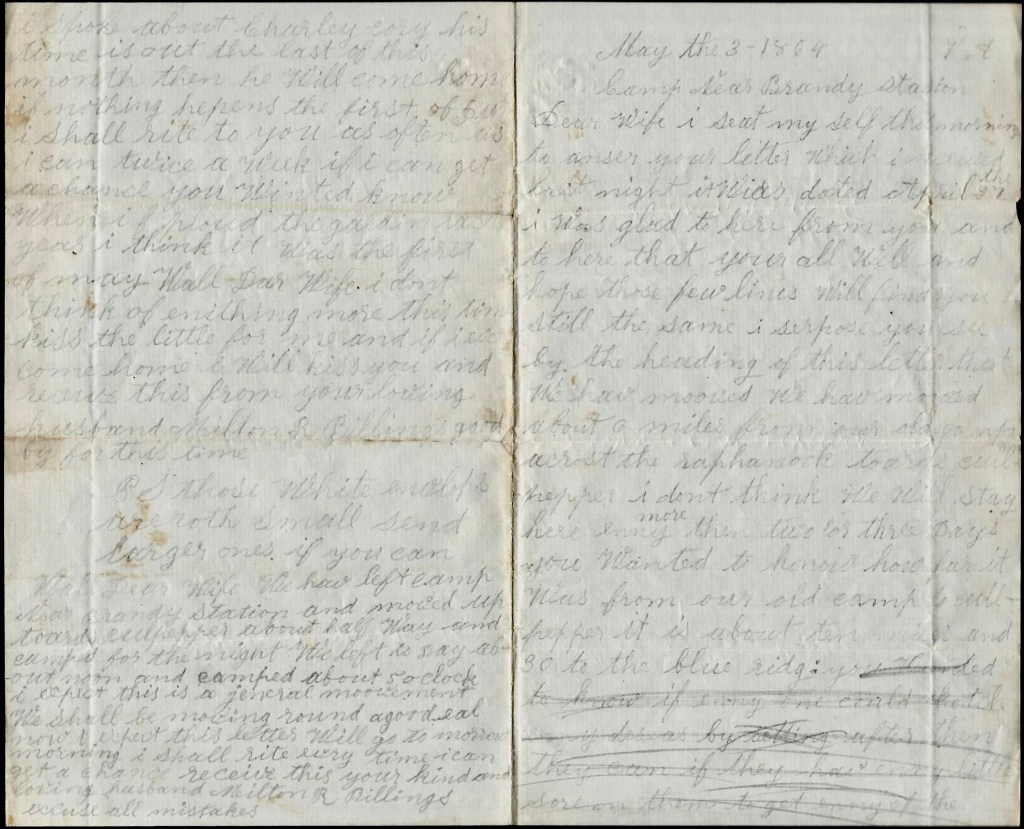
Camp near Brandy Station May 3, 1864
Dear Wife,
I seat myself this morning to answer your letter which I received last night. It was dated April the 27th. I was glad to hear from you and to hear that you’re all well and hope those few lines will find you still the same. I suppose you see by the heading of this letter that we have moved. We have moved about 6 miles from our old camp across the Rappahannock toward Culpeper. I don’t think we will stay here any more than two or three days.
You wanted to know how far it was from our old camp to Culpeper. It is about ten miles and 30 to the Blue Ridge.
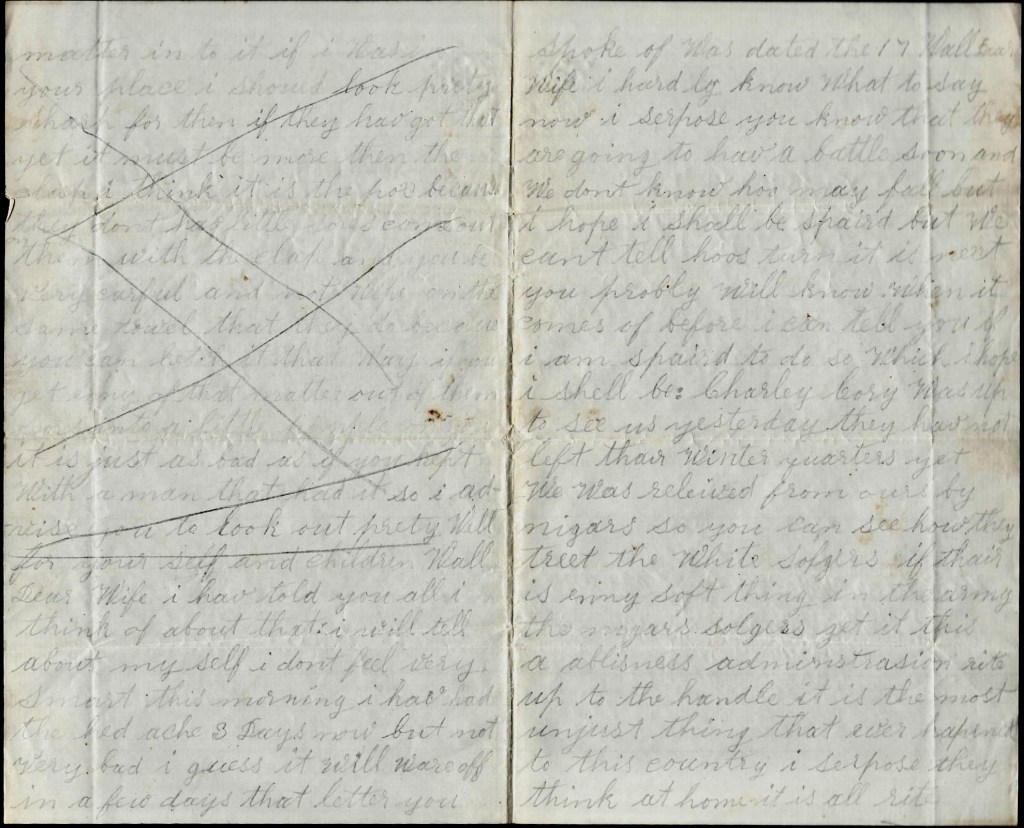
You wanted to know if anyone could catch any disease by sitting after them They can if they have any little sore on them to get any of the matter into it. If I was in your place, I should look pretty sharp for them. If they have got that yet, it must be more than clap. I think it is the pox because they don’t have little sores come out than with the clap and you be very careful and not wipe on the same towel that they do because you can catch it that way. If you get any of that matter out of them, put into a little pimple on you. It is just as bad as if you kept with a man that had it so I advise you to look out pretty well for yourself and children.
Well, dear wife, I have told you all I think of about that. I will tell about myself. I don’t feel very smart this morning. I have had the headache three days now but not very bad. I guess it will wear off in a few days. That letter you spoke of was dated the 17th.
Well dear wife, I hardly know what to say now. I suppose you know that they are going to have a battle soon and we don’t know who may fall but I hope I shall be spared. But we can’t tell whose turn it is next. You probably will know when it comes off before I can tell you if I am spared to do so which I hope I shall be. Charley Cory was up to see us yesterday. They have not left their winter quarters yet. We was relieved from ours by niggers so you can see how they treat the white soldiers. If there is any soft thing in the army, the nigger soldiers get it. This is a abolitionist administration right up to the handle. It is the most unjust thing that ever happened to this country. I suppose they think at home it is all right.
I spoke about Charley Cory. His time is out the last of this month. Then he will come home if nothing happens the first of June. I shall write to you as often as I can—twice a week if I can get a chance. You wanted to know when I plowed the garden last year. I think it was the first of May. Well dear wife, I don’t think of anything more this time. Kiss the little ones for me and if I ever come home, I will kiss you and receive this from your loving husband, — Milton R. Billings.
Goodbye for this time.
P. S. Those white envelopes are rather small. Send larger ones if you can. My dear wife, we have left camp near Brandy Station and moved up toward Culpeper about half way and camped for the night. We left today about noon and camped about 5 o’clock. I expect this is a general movement. We shall be moving round a good deal now. I expect this letter will to tomorrow morning. I shall write every time I can get a chance. Receive this your kind and loving husband, — Milton R. Billings. Excuse all mistakes.
Letter 3
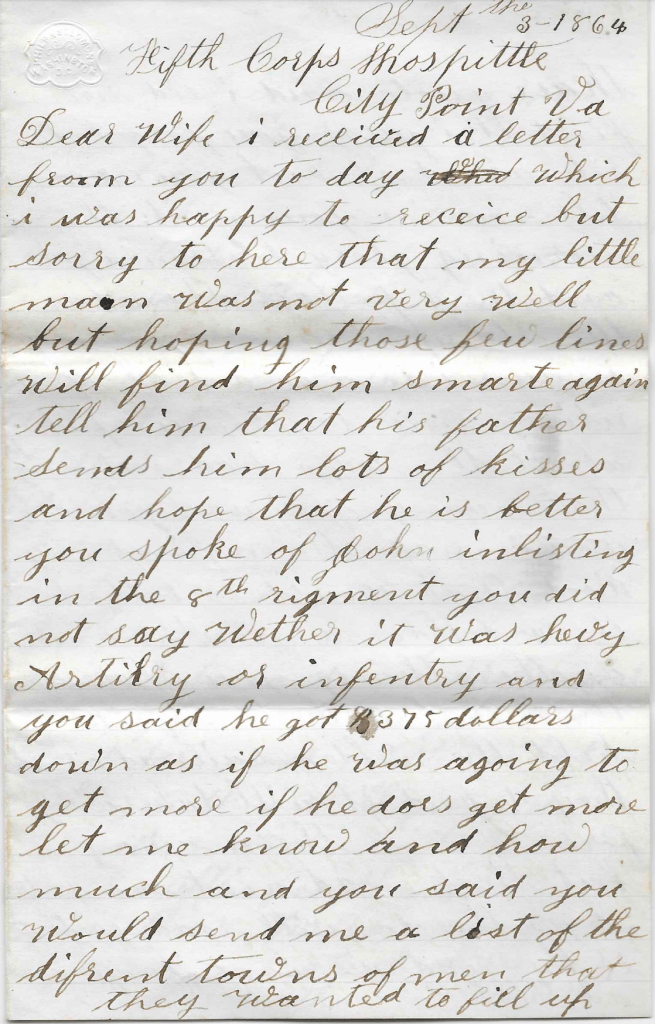
Fifth Corps Hospital City Point, Virginia September 3rd 1864
Dear Wife,
I received a letter from you today which I was happy to receive but sorry to hear that my little man ws not very well, but hoping those few lines will find him smart again. Tell him that his father sends him lots of kisses and hope that he is better.
You spoke of John enlisting in the 8th Regiment. You did not say whether it was Heavy Artillery or Infantry and you said he got $375 dollars down as if he was a going to get more. If he does get more, let me know and how much. And you said you would send me a list of the different towns of men that they wanted to fill up their quotas and I did not find it. I guess you forgot to write about it. But you can tell me in your next.
The morning glory blossom I got and the four postage stamps. The stamps come very handy because I do a good deal of writing now days. You spoke about the town had not brought that money. If I was you, I would make them find my wood. That would be better than the 4 dollars a month.
And another thing you spoke of, that was whether our folks held the Weldon Railroad or not. They do and it will take a big force to drive them away. But that road ain’t so important as the Danville Road is. That is the road we want if we can get it. But that is the thing of it—is to get it and hold it. We have had it once but could not hold it.
You said that they had got their quota in Bellingham. I am glad of that so Elias won’t have to go. You spoke of Sam and Cate being to Mother’s but you did not know what they were going to do. I know what they will do if they can—they[will] stay and help eat up that $375 that John sent home. It is too bad but they have got cheek enough to do it.
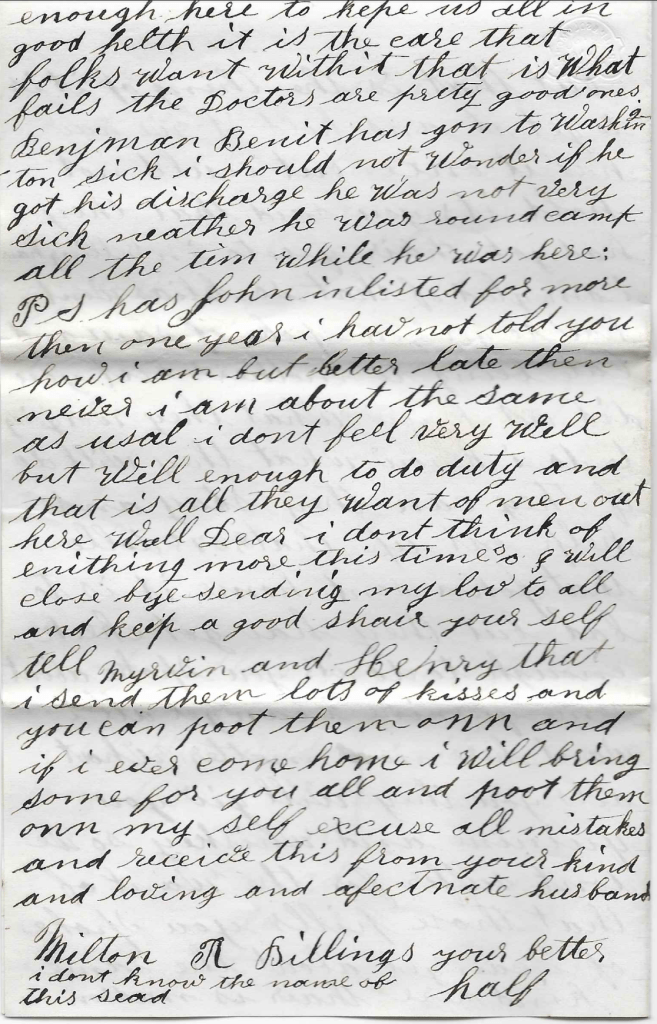
You spoke about some quinine. I can get all I want here. No matter what ails you, they will give you quinine and whiskey so we don’t suffer for the want of that. Those pills you spoke of I can get about the same kind here. There is medicine enough here to keep us all in good health. It is the care that folks want with it. That is what fails. The doctors are pretty good ones. Benjamin Bennett has gone to Washington sick. I should not wonder if he got his discharge. He was not very sick neither. He was round camp all the time while he was here.
Has John enlisted for more than one year? I have not told you how I am, but better late than never. I am about the same as usual. I don’t feel very well but well enough to do duty and that is all they want of me out here.
Well, dear, I don’t think of anything more this time so I will close by sending my love to all and keep a good share yourself. Tell Mervin and Henry that I send them lots of kisses and you can put them on and if I ever come home, I will bring some for you all and put them on myself. Excuse all mistakes and receive this from your kind and loving and affectionate husband, — Milton R. Billings, your better half
I don’ know the name of this seed.
Letter 4
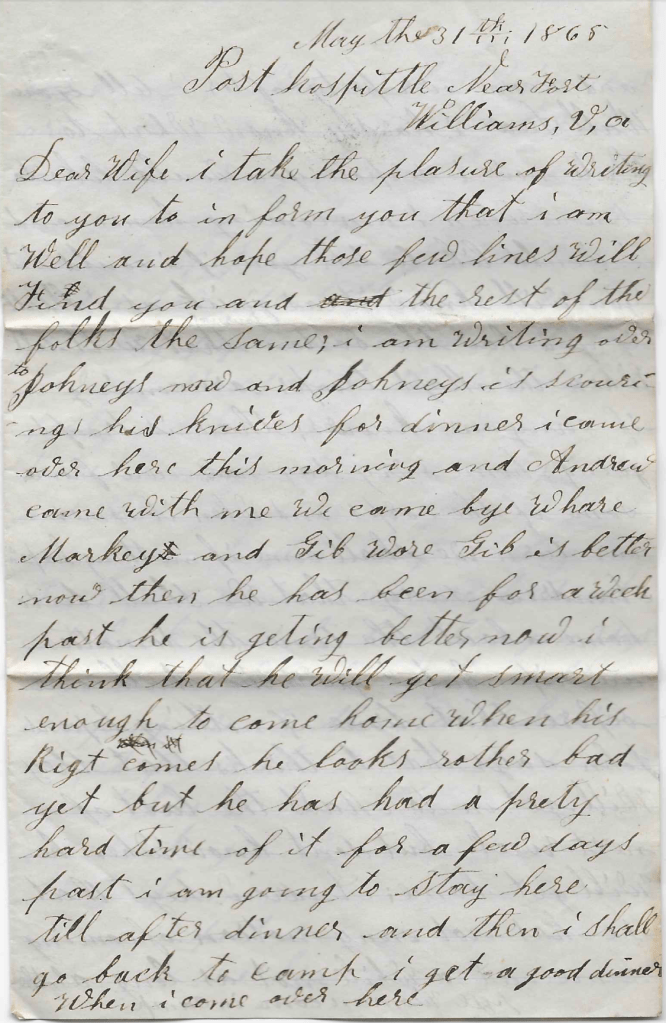
Post Hospital near Fort Williams, Va. May 31st 1865
Dear Wife,
I take the pleasure of writing to you to inform you that I am well and hope that those few lines will find you and the rest of the folks the same. I am writing over to Johnnies now and Johnnie is scouring his knives for dinner. I came over here this morning and Andrew came with me. We came by where Markey and Gib were. Gib is better now than he has been for a week past. He is getting better now. I think that he will get smart enough to come home when his regiment comes. He looks rather bad yet but he has had a pretty hard time of it for a few days past. i am going to stay here till after dinner and then I shall go back to camp. I get a good dinner when I come over here and I come over pretty often, I tell you.
Well, dear, I hardly know what to write now. I suppose you would like to know when I am coming home and I would like to tell you if I could but you will know it as quick as I shall if you have the Boston Journal. That will tell when the Massachusetts troops are coming if anyone knows. There is troops going home every day now from some of the Corps and when it comes our turn, we shall come if nothing happens.
Andrew says that we shall be to home about the time the tomatoes are ripe but i guess we shall come before that time if nothing happens. John says that he thinks that they will get in to Massachusetts the last of next week but don’t know when he will get home. Andrew says that he has not any notion of coming home yet awhile—not as long as the pie women come into camp. Our camp is lined with women that are peddling pies and cakes but we don’t buy many for we have not got any money to buy with. I have had $2.50 of John since I came here and I had spent that so I don’t get any pies now.
Some of the boys had gay times with the women that peddle. I was down to Camp Distribution the other day to see James and they told me that he went over to Washington the first day that the review commenced and had not got back and he had been gone three days then and I had heard from his company since then and he is dropped from the rolls as a deserter. And I hear today that he has not got back yet. The order is now that if a man is absent three roll calls, he is put down as a deserter. I went to see him to tell him where George was for he told me that he should go down to New Berne as soon as he got out of the service to see if he could help George out and so I went down to tell him where he was and I got wet through to my hide and never see him after all. It rained all that day!
Edy Cory has been to see me and Johnny Ditson. They look tough and hearty. They said that all was well and tough.
Well, I don’t think of anything more this time so I will close by sending love to all and keep a good share yourself and kiss the little ones for me and receive this from your affectionate husband, — Milton R. Billings
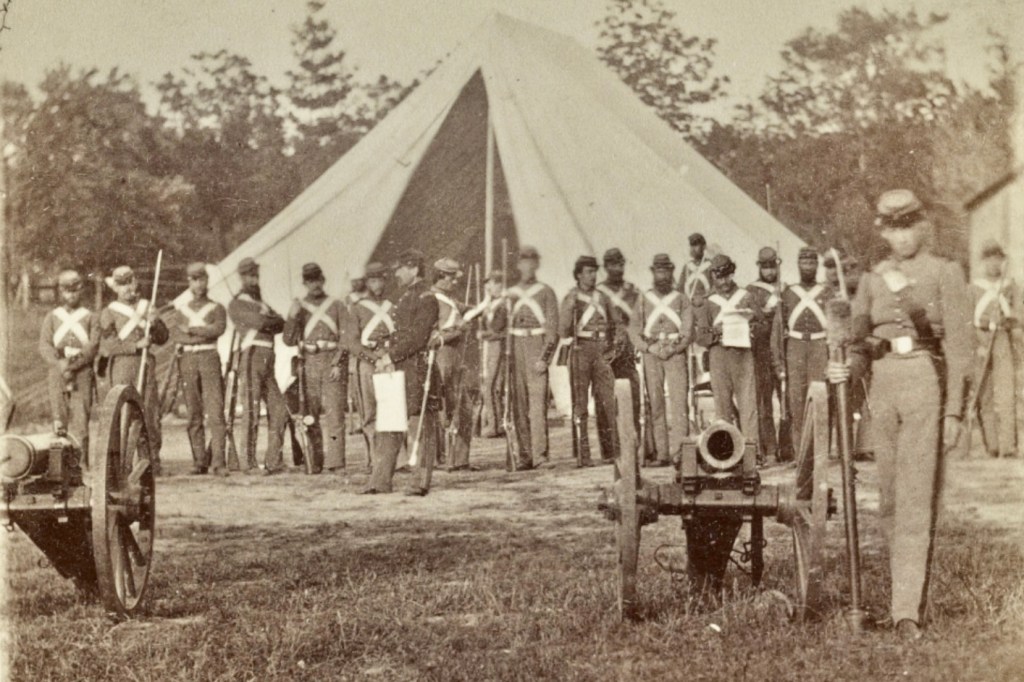
An unidentified member of the 7th New York State Militia, Library of Congress
The following incredible letter was written by 21 year-old Albert Victor Meeks (1839-1889), the son of Joseph William Meeks (1805-1878), a master craftsman of furniture who had a store at 18 Vesey Street in Manhattan in partnership with his father. Albert’s mother was Sophia T. Vidal (1809-1895).
When Albert applied for a passport in 1859, he was described with specificity as standing slighter above 5 feet 5 inches with a high forehead, brown eyes, prominent nose, large mouth, auburn hair, thin a florid complexion. He graduated from the City of New York’s Law School in 1860 and was a private in the 7th New York National Guard at the time of the firing on Fort Sumter.
Frantic to protect the Nation’s Capitol, the President called upon all available militia units to come to its defense. The 7th New York State Militia was one of the first to respond. Albert served in the first activation of the 7th Regiment from April 18th to 3 June 1861. He then reenlisted at New York City on 4 June 1861 and was commissioned the Captain of Co. G, 62nd New York Infantry on 30 June. He led his company at the Battle of Williamsburg and at Fair Oaks where he was wounded. He resigned his commission and was discharged on 11 August 1862.
Albert’s letter describes the remarkable march made by the 7th Regiment from Annapolis to the Capitol where it was greeted with unbounded enthusiasm by the citizenry and government officials, and quickly mustered into active service for thirty days.
The 7th New York State Militia after their arrival in Washington D. C. in April 1861. They were the first New York State militia to reach Washington after the President’s call for troops.After being initially housed in the US Capitol, they were moved to a camp on Meridian Hill, May 2d to 23d. They took part in the occupation of Arlington Heights, Virginia, May 24th to May 26th, and assisted in building Fort Runyon. They returned to Camp Cameron on the latter date, and were mustered out at New York City, June 3, 1861
Transcription
Washington City April 27th 1861
Dear Mother,
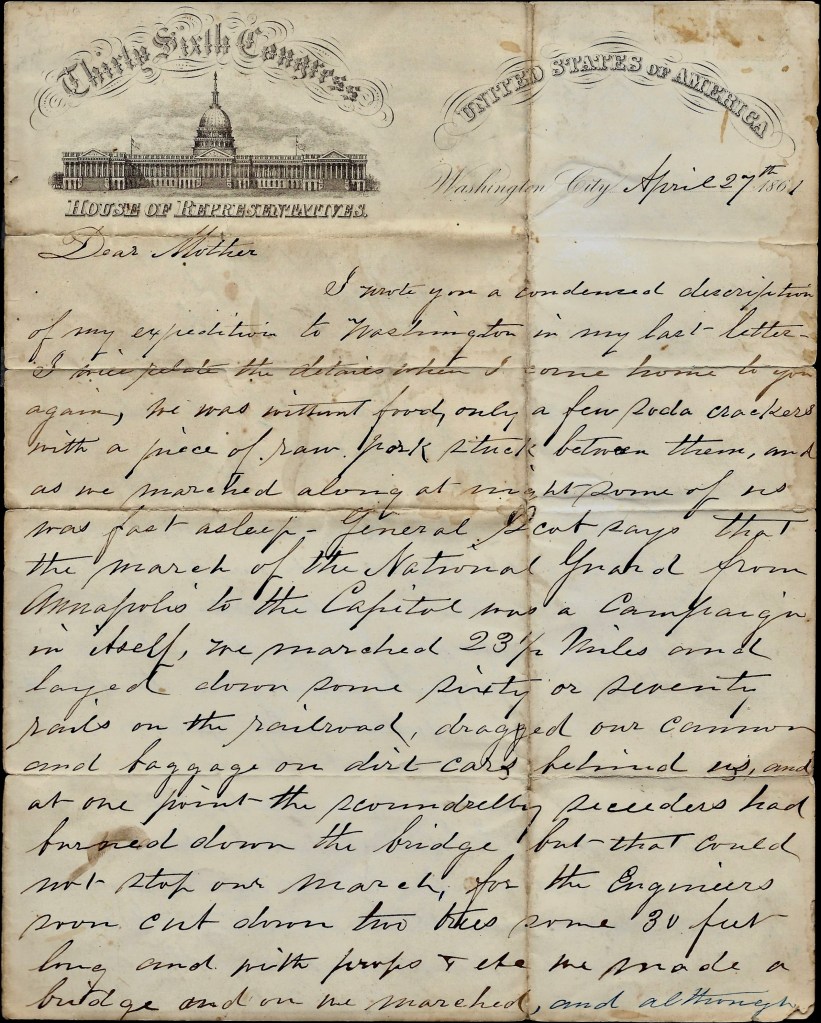
I wrote you a condensed description of my expedition to Washington in my last letter. I will relate the details when I come home to you again. We was without food—only a few soda crackers with a piece of raw pork stuck between them—and as we marched along at night some of us was fast asleep. General Scott says that the march of the National Guard from Annapolis 1 to the Capitol was a campaign in itself. We marched 23½ miles and layed down some sixty or seventy rails on the railroad, dragged our cannon and baggage on dirt cars behind us. At one point the scoundrelly seceeders had burned down the bridge 2 but that could not stop our march, for the Engineers soon cut down two trees some 30 feet long and with props & etc. we made a bridge and on we marched, and although we had so many obstacles to contend against, we in twenty-two hours marched 23½ miles, built a bridge, repaired the railroad, & carried our baggage. I call that wonderful.
“The March to Washington, April 1861”
It was about dawn of day that we reached a place called the junction after a tramp all night long expecting an attack from the villains of seceeders. We then took down a rail fence and built about a dozen large campfires and sat down almost exhausted. I got near to a fire, pulled off my boots, rolled myself up in my blanket, and was soon sound asleep. I was awakened by the drum roll to march on to a place a mile further on where we met the cars coming to meet us from Washington with a company of Washington troops to escort us. We were wild with joy and cheer upon cheer greeted the train. Tears came in the eyes of some when they felt that they were to be allowed soon to rest their tired limbs. You don’t know what it is to see men thus affected. I was determined to keep up with the main body and I did to the last.
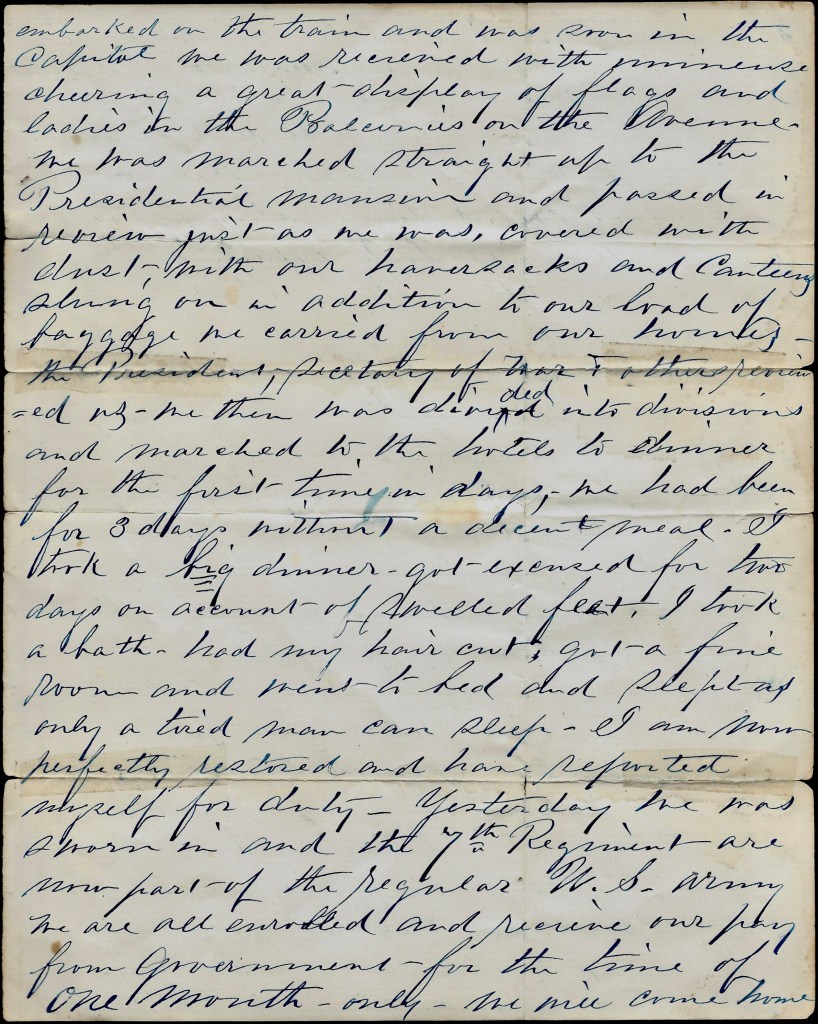
We then embarked on the train and was soon in the Capitol. We was received with immense cheering, a great display of flags and ladies in the balconies on the Avenue. We was marched straight up to the Presidential Mansion and passed in review, just as we was—covered with dust, with our haversacks and canteens slung on, in addition to our load of baggage we carried from our homes. The President, Secretary of War, & others reviewed us. We then was divided into divisions and marched to the hotels to dinner for the first time in days. We had been for three days without a decent meal. I took a big dinner, got excused for two days on account of swelled feet. I took a bath, had my hair cut, got a fine room and went to bed and slept as only a tired man can sleep. I am now perfectly restored and have reported myself for duty.
“I am in splendid quarters in the Capitol. We are here at the request of the President. We were reviewed by Uncle Abe yesterday and he was so much pleased that he clapped his hands.”
— Albert V. Meeks, 7th New York State Militia, 27 April 1861
Yesterday we was sworn in and the 7th Regiment [New York State Militia] are now part of the regular U.S. Army. We are all enrolled and receive our pay from Government for the time of one month only. We will come home then most likely. I am in splendid quarters in the Capitol. We are here at the request of the President. We were reviewed by Uncle Abe yesterday and he was so much pleased that he clapped his hands.
We have no work to do but keep our belts well whitened and parade about Washington. I have received many courtesies from the ladies—they are partial to the Glorious Old Seventh. I am well and comfortable and am pleased with my situation. I will wait until I come home and then tell a good long story of truth and experience such as I never expected to realize. I am writing to you here in the Hall of Representatives in the National Capitol. 3 Give my love to all of the family and please write to me. Direct the letters to me (8th Company, 7th Regiment National Guard, Washington, U. S. A.) I belong to the Army now. I like the fun. I will write very soon again. God bless you all. — Albert V. Meeks, U. S. A.
1 The 7th New York State Militia was in Annapolis because the railroad route to Washington D. C. had been blocked. In Philadelphia, Col. Lefferts, commanding the 7th, was informed that the bridges between Havre de Grace and Baltimore were destroyed by a mob and the road rendered impassable. It was decided to take a steamer to Annapolis and then proceed to Washington overland.
2 This was the railroad bridge near Millersville which was 20 feet high and 16 feet long, which had recently been destroyed by Secessionists. It took a full day to reconstruct a temporary bridge sufficiently strong to carry the train.
3 Not only did Albert write his letter from the Hall of Representatives in the US Capitol, he penned it on official Stationery of the 36th Congress.
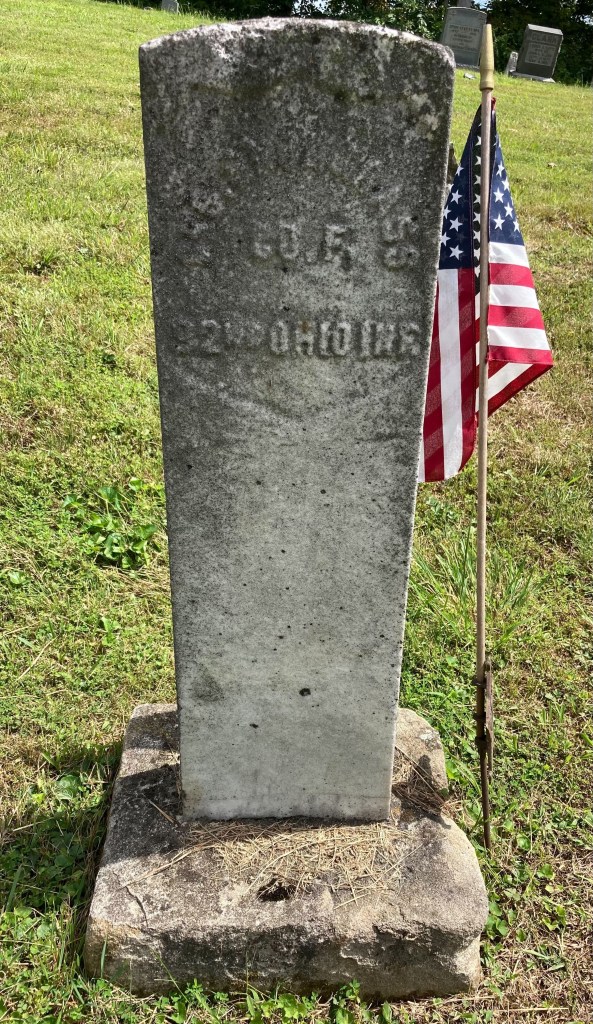
George’s headstone in Rake Cemetery, Washington County, Ohio
The following letter comes from the Widow’s Pension file at the National Archives. It was written by George Washington Snodgrass (1832-1868), a private in Capt. Hamilton F. Middleswarts’ Co. F, 92nd Ohio Volunteer Infantry. George served from 6 August 1862 and was discharged on 10 June 1865. He was born in Washington county, Ohio, and was 30 years old when he enlisted, according to his discharge papers. His papers also inform us that he stood 5 feet 10 inches tall, had a fair complexion, blue eyes, and light hair. He claimed to be a farmer.
A family tree in Ancestry.com reveals that George was the son of Hiram Snodgrass (1798-1879) and Druscilla Oliver (1801-1885). He was married in April 1852 to Mary Jane Evilsizer (1836-1913) and the couple had several children when George went to war. hey include Robert (b. 1851), John (b. 1853), William (b. 1858), and Isabella (b. 1861). In 1861, the were living in Lawrence, Washington county, Ohio.
Transcription
[Camp at the Mouth of Lake Creek, Va.] November 30th 1862
My dear wife,
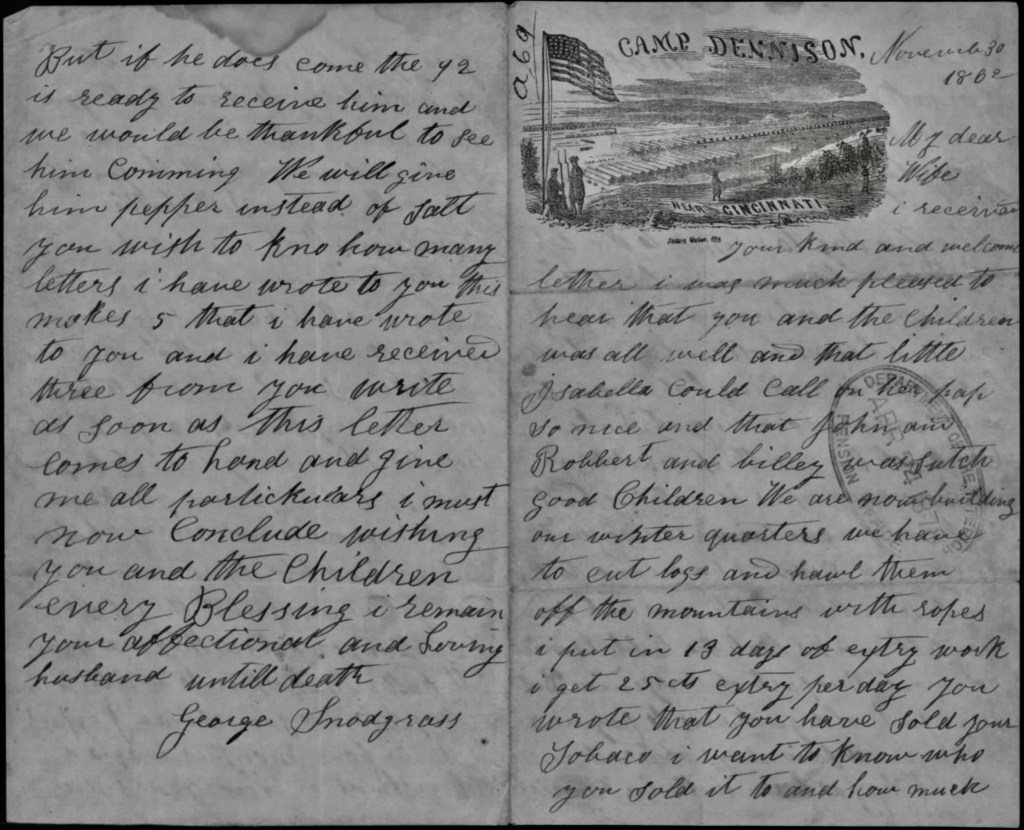
I received your kind and welcome letter. I was much pleased to hear that you and the children was all well and that little Isabella could call on her Pap so nice and that John and Robert and Billy was such good children.
We are now building our winter quarters. We have to cut logs and haul them off the mountains with ropes. I put in 13 days of extra work. I get 25 cents extra per day.
You wrote that you have sold your tobacco. I want to know who you sold it to and how much you got paid down on it.
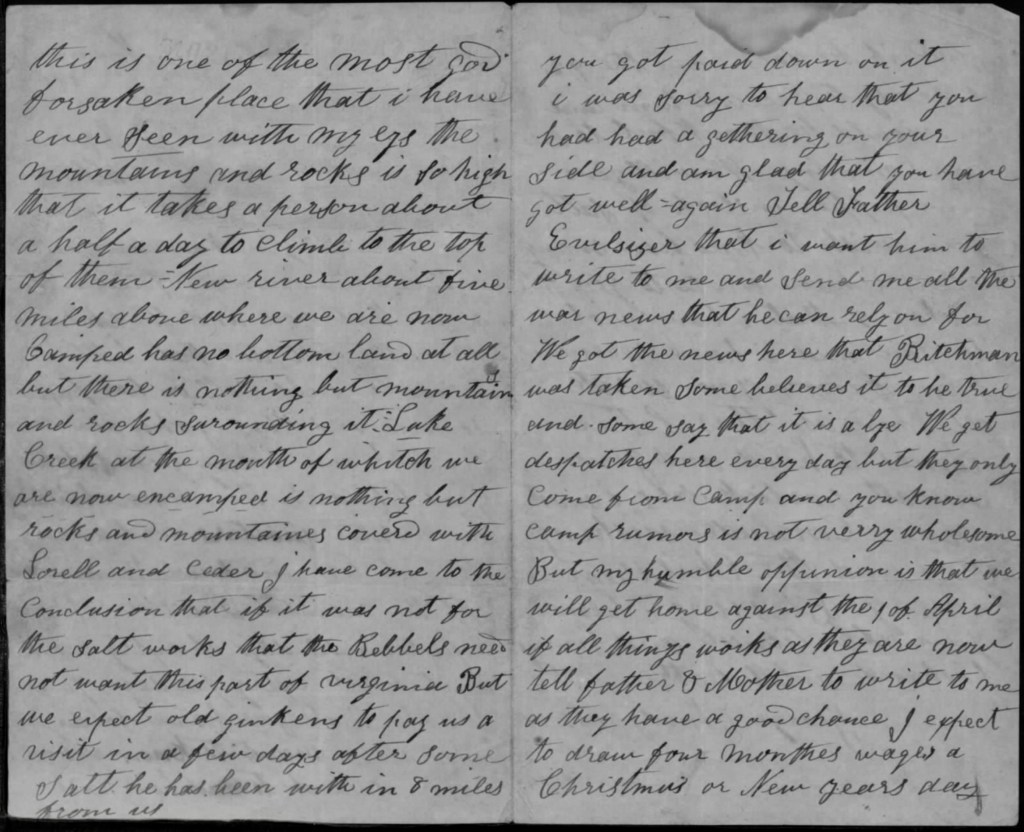
I was sorry to hear that you had had a gathering on your side and am glad that you have got well again. Tell Father Evilsizer that I want him to write to me and send me all the war news that he can rely on for we got the news here that Richmond was taken. Some believe it to be true and some say that it is a lie. We get dispatches here every day but they only come from camp and you know camp rumors is not very wholesome. But my humble opinion is that we will get home against the 1st of April if all things works as they are now.
Tell father & mother to write to me as they have a good chance. I expect to draw four months wages a Christmas or New Year’s Day.
This is one of the most God forsaken places that I have ever seen with my eyes. The mountains and rocks is so high that it takes a person about a half day to climb to the top of them. New River, about five miles above where we are now camped, has no bottom land at all. There is nothing but mountain and rocks surrounding it. Lake Creek at the mouth of which we are now encamped is nothing but rocks and mountains covered with laurel and cedar. I have come to the conclusion that if it was not for the salt works, that the rebels need not want this part of Virginia. But we expect Old [Albert Gallatin] Jenkins to pay us a visit in a few days after some salt. He has been within 8 miles from us. But if he does come, the 92nd is ready to receive him and we would be thankful to see him coming. We will give him pepper instead of salt.
You wish to know how many letters I have wrote to you. This makes 5 that I have wrote to you and I have received three from you. Write as soon as this letter comes to hand and give me all particulars. I must now conclude, wishing you and the children every blessing. I remain your affectionate and loving husband until death, — George Snodgrass
The following letter was written by Patrick John Quigley (b. 1842), a farmer from Orange, Connecticut who served in Co. E, 15th Connecticut Infantry. This regiment first saw action in the Battle of Fredericksburg and afterwards were sent to Suffolk in February where they remained for some time. In this late May 1863 letter John describes the hard work of digging entrenchments and mounting guns in the forts surrounding Suffolk.
Transcription
Addressed to Levertt Clark, Orange, Connecticut
May the 31st 1863
Dear Friend,
I take the opportunity to write these few lines to you hoping this will find you in good health as this leaves me in good health at present. Thank God for His goodness to us all. I have been sick for three weeks but I am better now.
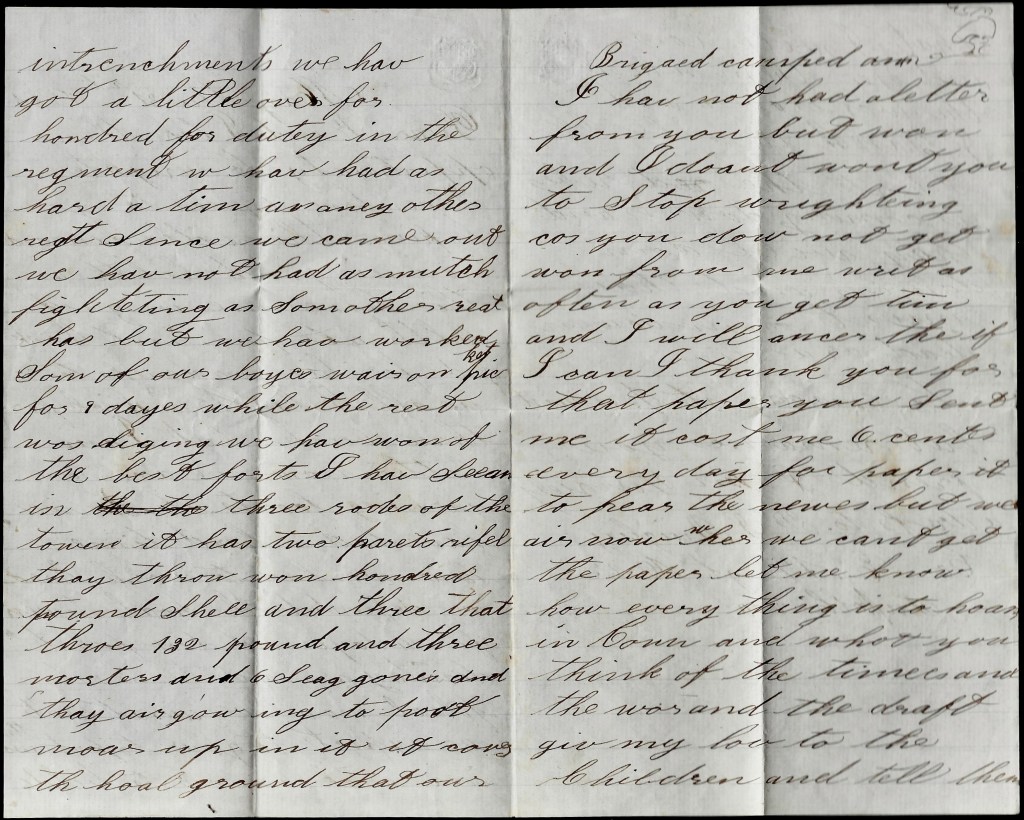
We are now garrisoning forts at [Suffolk]. We have had a hard time here. We had to work hard. We defended the whole town for 14 days and done picket duty around the whole place. Now we are are at rest. We expect to go to Portsmouth in a week or more to build entrenchments. We have got a little over four hundred for duty in the regiment. We have had as hard a time as any other regiment since we came out. We have not had as much fighting as some other regiments has but we have worked.
Some of our boys were on picket for 9 days while the rest was digging. We have one of the best forts I have seen in three rods of the town. It has two Parrott Rifles. They throw one hundred pound shells and three that throw 132 pound, and three mortars and six Siege guns and they are going to put more up in it. It covers the whole ground that our Brigade camped on.
I have not had a letter from you but one and I don’t want you to stop writing cause you do not get one from me. Write as often as you get time and I will answer if I can. I thank you for that paper you sent me. It cost me 6 cents every day for paper to hear the news but now we are here, we can’t get the paper. Let me know how everything is to home in Connecticut and what you think of the times and the war and the draft. Give my love to the children and tell them that I will come and see them when the war is over and I think it will be short. The rebs is coming down and they will come down and they must come down, dead or alive.
No more at present, but remain your friend, — John Quigley
Address to P. J. Quigley, Co. E, 15th Regt. Conn. Vols., Suffolk, Va.
The following letter was written by Albert Everett (1840-1937), the son of Leonard Fessenden and Freelove Darling of Worcester county, Massachusetts. When Albert was 14, his widowed father took Hannah Hopkins as his second wife, she being the widow of George Mann. When Albert was 21 years old, he gave up his shoe cobbler’s hammer for a rifle and stepped into the ranks of Co. H, 15th Massachusetts Infantry as a private. Joining him in the same company was his 19 year-old step-brother William Maxy Burlingame Mann (1842-1861) with a name longer than his time in service; he was killed on the field of the regiment’s first fight, the Battle of Ball’s Bluff, on 21 October 1861
Albert was promoted to Corporal in 1 May 1863 and barely had his stripes sewed on when he was wounded in action in the fight near the Codori Barn on the 2nd day of Gettysburg. He was not alone. During the 3-day battle, the 15th Massachusetts lost 22 killed, 93 wounded, and 28 missing or captured—a casualty rate of 60%. Albert survived his wounds, however, and finished out his term of service, mustering out on 15 July 1864. Afterwards he volunteered as a teacher in the Freedman’s Bureau in South Carolina. [Historical Digression by Patrick Browne]
This letter was written while the regiment remained a part of the Corps of Observation stationed at Poolesville, Maryland–about halfway along the Potomac between Washington and Harpers Ferry. While in this assignment, they were called upon to play a significant role in the disastrous Battle of Ball’s Bluff on October 21, 1861, and a large number of the regiment was taken prisoner during the rout. They then spent the winter of 1861-1862 in camp along the Potomac and were not transferred to the Army of the Potomac until late March, just in time for the Peninsular Campaign.
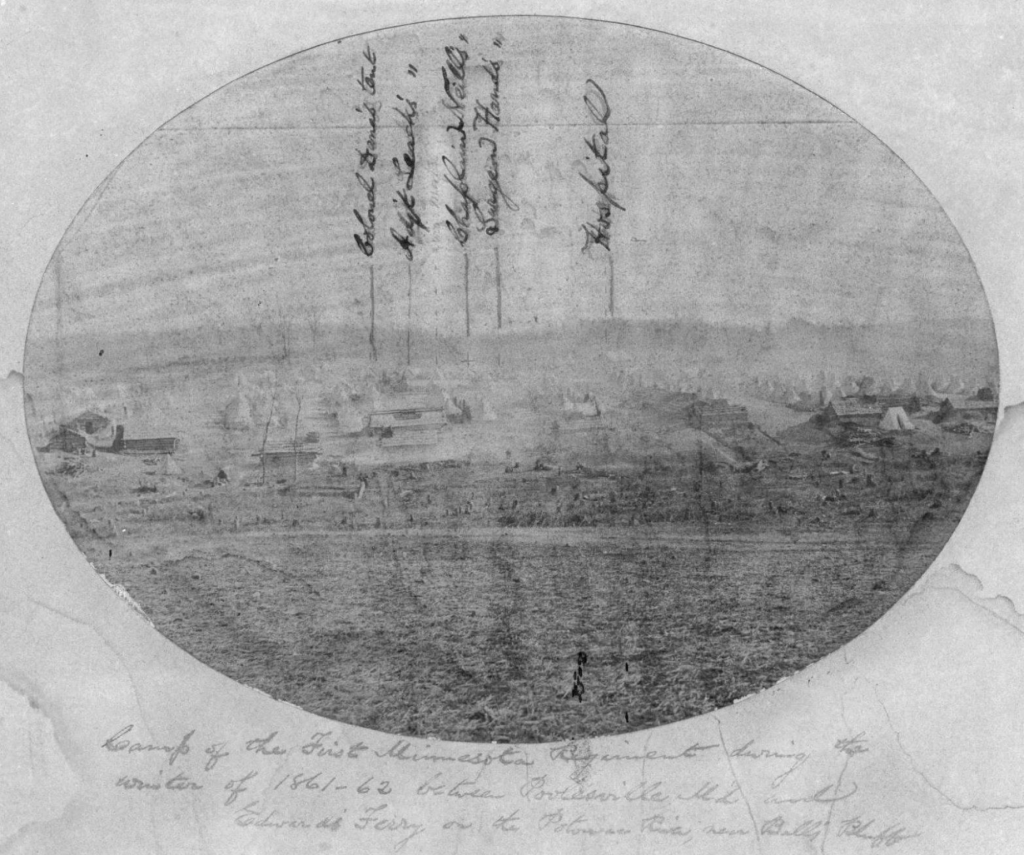
Camp of the 1st Minnesota near Poolesville, Maryland in the winter of 1861-62. The 1st Minnesota were in the same brigade as the 15th Massachusetts. If you look closely you can see that they were using large Sibley tents as well.
Transcription
Addressed to L. F. Everett, Esq., Whitinsville, Massachusetts
Camp Foster Poolesville, Maryland February 24, 1862
Dear Father & Mother,
I sit down to write you a few lines today that probably will be the last that I shall date from this camp as we expect to move in a day or two. Nothing certain is known by us as to our place of destination. Last night after the Captain had inspected the company, he read an order that we should pack all our things that we did not want to carry in our knapsacks into boxes and have them all ready marked so when we moved, we should have only to nail them up and leave them in the Commissary’s care. The story is going round that we are going to join General Gorman’s Brigade and go to Washington and then go to join General Burnside. Gorman’s Brigade consists of our 20th, the N. Y. 34th and Minnesota 1st, I believe, and will be accompanied by another brigade—whose, I don’t know. All the regimental teams and camp furniture will be left, but what we can take on our backs. These large Sibley tents that hold 20 men are to be left and we are to carry little rubber ones that will hold 4 men, can be taken into four pieces, and can be pitched with our guns.
Whew, what a wind. Since writing the above, there has been no little commotion in camp. I have just come in from a sight of a very lively scene. Half or more of the tents in camp are flat as can be. Every tent in the Grafton quarters but one is down. Two of our tents are down and another is halfway and beneath its heavy folds, fifteen or twenty boys are struggling to get out like so many rats fastened up in a meal bag. The Clinton boys on the other side of us are no better off and we see part of them swarming round the ruins of their houses and the others are holding on to theirs with all their might hoping to keep them up if possible. Most of those who are not in such predicaments are indulging in the most hearty laughter at the ill luck of the rest.
When the blow first broke upon us, the boys all swarmed out and each catching an axe or club of wood, soon tightened the pins so we have not been rendered shelterless yet, though if the wind continues to blow such a hurricane, we shall have to “keep warm by traveling” before long. Rufus Belding has just come in bareheaded. He was down at the guard tents and standing beside one when over it came, knocked him flat, and held him there a minute or two. When he managed to get out from beneath the canvas, he found his hat had disappeared—on the “double quick” probably. This field is like Lawson Taylor’s plains—only it is up higher and as much exposed as the land up on Sutton Hills. 1
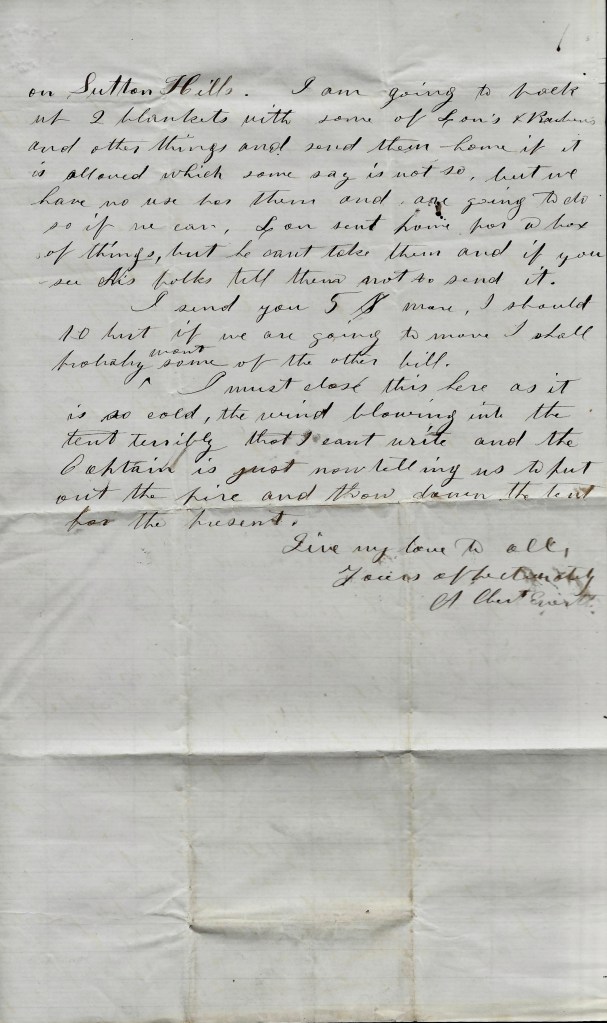
I am going to pack up 2 blankets with some of Lon’s & Reuben’s and other things and send them home if it is allowed, which some say is not so. But we have no use for them and are going to do so if we can. Lon sent home for a box of things, but he cant take them and if you see his folks, tell them not to send it.
I send you $5 more. I should 10 but if we are going to move, I shall probably want some of the other bill. I must close this here as it is so cold, the wind blowing into the tent terribly that I can’t write and the Captain is just now telling us to put out the fire and throw down the tent for the present. Give my love to all. Yours affectionately, — Albert Everett
1 This same wind storm was described by George W. Fernald of Co. C, 82nd New York Infantry who wrote to his cousin George on the same day from Camp Gorman (at Poolesville). “It is raining here now & the wind is a blowing a gale here. But I close now for our tent is blowing down.”
I can’t be certain of the author of this letter signed (I think) “E. Dana.” The Dana family had a long history in Boston and my hunch is that it was written by Edmund Trowbridge Dana (1818-1869), the son of Richard H. Dana, Sr. and Ruth Charlotte Smith. His more famous brother, Richard Henry Dana, Jr., served in the US Senate in 1859 and during the Civil War was a United States Attorney for Massachusetts.
Hon. Sherrard Clemens of Virginia
The letter opens with a reference to Virginia congressman Sherrard Clemen’s speech delivered in Congress on 22 January 1861 which was a warning to fellow Southern congressmen that a breakup of the Union would certainly mean the death of slavery—the key sentences in a long speech stating, “Before God, and in my utmost conscience, I believe that slavery will be crucified, if this unhappy controversy ends in a dismemberment of the Union. Sir, if not crucified, it will carry the death rattle in its throat. I may be a timid man; I may not know what it is to take up arms in my own defense. It remains to be seen, however, whether treason can be carried out with the same facility it can be plotted and arranged.” Referring to any fellow statesmen in Congress who advocated secession, he said, “He can take an oath to support the Constitution of the United States, but he can enter with honor into a conspiracy to overthrow it. He can, under the sanctity of the same oath advise the seizure of forts and arsenals, dockyards and ships, and money, belonging to the Union, whose officer he is, and find a most loyal and convenient retreat in State authority and State allegiance.”
The letter ends with a condemnation of the Massachusetts Senators in Congress (outspoken abolitionists) for not having been more outraged and vocal about the perceived treasonous acts of their fellow Congressmen and not trying harder enough to hold the Union together. The Union Meeting held at Faneuil Hall in early February 1861 emerged with a series of resolutions that essentially endorsed the “Crittenden Compromise” as an unsavory, but temporary solution to the secession crisis.
Transcription
Boston, [Massachusetts] 8 February 1861
My dear friend,
I am much obliged for [Sherrard] Clemens’ speech. I have read it with much pleasure— and wish it could be sent all over the South. Perhaps nothing will do them any good—but this must if anything will.
I see that [Henry Winter] Davis of Maryland made a ringing speech yesterday. 1 Is it to be published? if so, as we get only poorly printed copy in our papers—a partial even, I shall be glad if you will send me a copy. I don’t believe you can do a better thing than to send Capt. Holmes one—or indeed any speech that has real back bone in it. The Capt. sets at the Table and in the reading room and fights the Northern secessionists (of which white-livered bread Boston abounds) and Northern disunionists with real old Teutonic grit. It would have done you good to have heard him come down on the last Union meeting at Faneuil Hall.
The Hon. G. L. now gives him the go by—because the Capt. dares to go in for “the Union, the Constitution, and the enforcement of the Laws”—and he throws it in the face of the Bell Weathers to their great discomfort. Was there ever a more pitiable back down than that party North exhibits in their practically annulling all they pretended to fight for in the last canvass—and now refusing sympathy and support to their political friends South in the late campaign.
Here—this party deride Massachusetts & it seems as though they could not say enough of her—and to anything like argument, their reply is—Mass. delegation in the House. Charles Sumner, Henry Wilson, and the inevitable Nigger. Beyond this, their vision does not extend. The fabric of Massachusetts history would be ruined and suffer a total eclipse if left alone to their guardianship and patriotism.
The Capt.’s address is P. Holmes, Tremont House.
As I said before, I think he would be pleased to receive any speech that has back bone in it—like [Henry Winter] Davis, Millen [?], or [Charles F.] Adams—which [ ] he endorses very heartily.
Yours, E. Davis
The temp a.m. from 13o believe in the city. Is 22 in suburbs
1 The gist of Hon. Henry Winter Davis’ speech echoes that of Clemens’ speech. It also addresses the slavery argument thus: “As to slavery, the slavery question represents no interest which now requires to be touched by any department of the government. The mischief that has been done was done at home or South. The great cause of the excitement was the mode in which the recent political canvass had been conducted in the South. It had been by blackening and misrepresenting the true character and designs of the great mass of Northern people…If Southern gentlemen would go home and tell. truth about the North as they know it to be, there would be peace in all the country in a very short time.”
Rogena’s brother, Don Eugene Scott, 9th New Hampshire Infantry
The following letter was written by Rogena Almira Scott (1840-1869), the daughter of Madison Scott (1813-1851) and Hanna Landress Beach (1817-1872) of Franklin, Vermont. Genie and Rev. John G. Bailey were married on 17 February 1863 in Warner, New Hampshire, but she only lived until 1869. The Scott Family Record states that Rogena “finished her education at Ohnson Academy, Vermont, and devoted several years to teaching in the South. She was a lady of fine accomplishments.” Genie’s younger brother, Don Eugene Scott (1844-1923) served in the Civil War as a private in Co. E, 9th New Hampshire Infantry; later in Co. D, 11th New Hampshire Infantry.
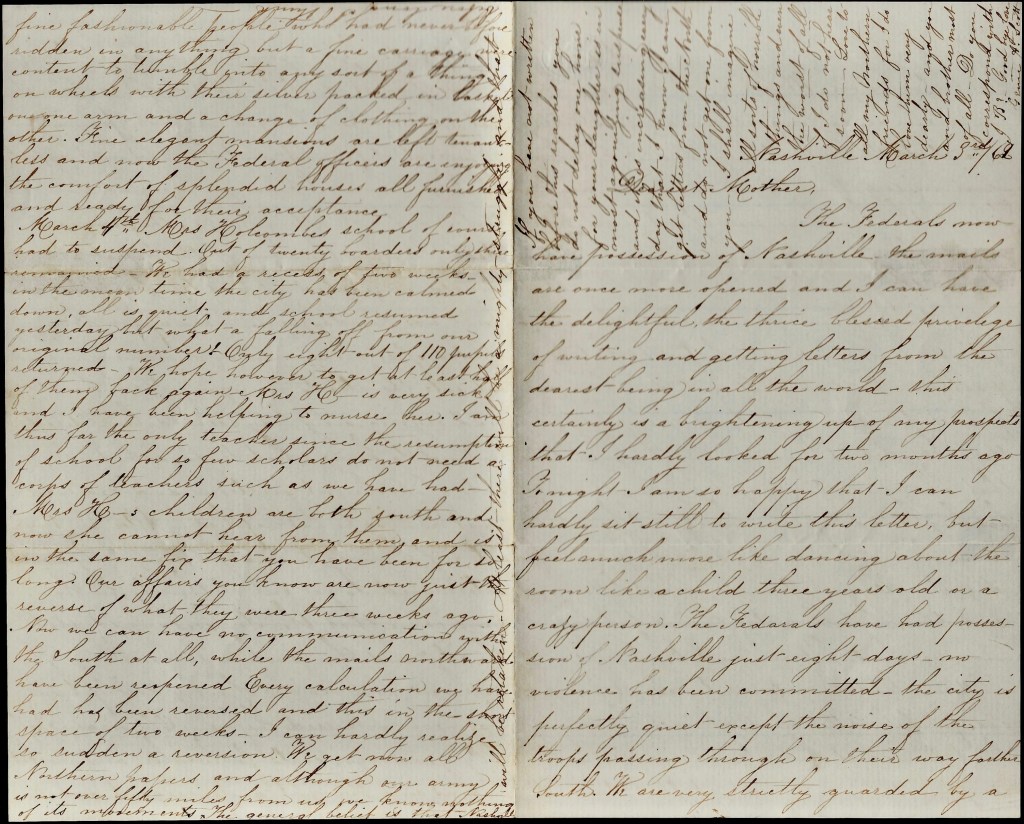
We learn from this letter that 21 year-old Genie was teaching at the Southside Institute—a school for girls—in Nashville, Tennessee, when the Civil War erupted in 1861. The principal of the school was 41 year-old Mrs. Emma Holcombe. The school was operated in the 24-room mansion of Col. A. W. Putnam opposite the Capitol Building. The letter was addressed to her mother in Warner, New Hampshire, now married to her second husband, Rev. Daniel Warner—a Congregational clergyman. She writes of the recent fall of Nashville to the Union army. “I can hardly sit still to write this letter, but feel much more like dancing about the room like a child three years old or a crazy person,” she confessed to her mother, with whom all correspondence had been cut off six months previously.
She also gives us a stirring description of the panic by the citizens of Nashville following the receipt of news that Fort Donaldson had been taken by Grant’s army. “Men and women rushed out into the streets wringing their hands and crying, everybody seemed bewildered and not to know what to do, asked all sorts of incoherent questions and received just as incoherent replies.”
In researching the Southside Institute, I discovered that it was the 1861 graduating class of young women who made and presented the Confederate flag that flew over the State Capitol—perhaps the same flag that was lowered when Union troops took possession of the town.
Transcription
Addressed to Mrs. Hannah L. Warren, Warner, New Hampshire
Nashville [Tennessee] March 3rd, 1862
Dearest Mother,
The Federals now have possession of Nashville. The mails are once more opened and I can have the delightful, the thrice blessed privilege of writing and getting letters from the dearest being in all the world—this certainly is a brightening up of my prospects that I hardly looked for two months ago. Tonight I am so happy that I can hardly sit still to write this letter, but feel much more like dancing about the room like a child three years old or a crazy person.
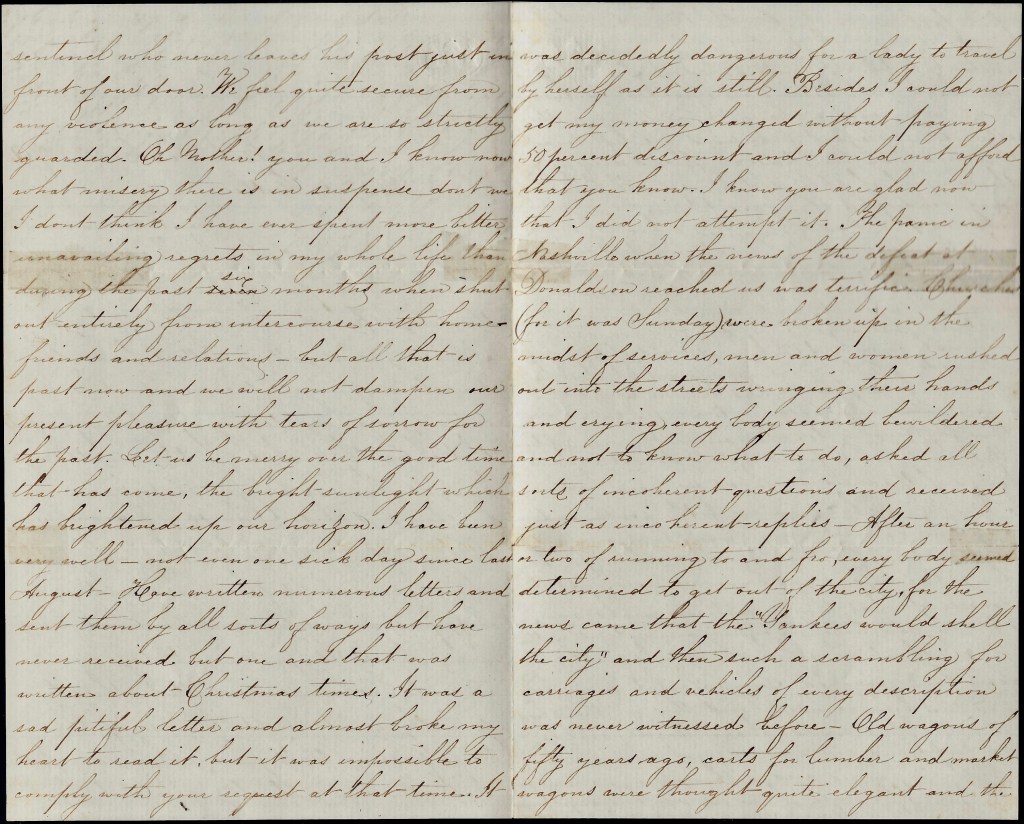
The Federals have had possession of Nashville just eight days. No violence has been committed. The city is perfectly quiet except the noise of the troops passing through on their way farther South. We are very strictly guarded by a sentinel who never leaves his post just in front of our door. We feel quite secure from any violence as long as we are so strictly guarded. Oh Mother! you and I know now what misery there is in suspense, don’t we. I don’t think I have ever spent more bitter unavailing regrets in my whole life than during the past six months when shut out entirely from intercourse with home, friends, and relations. But all that is past now and we will not dampen our present pleasure with tears of sorrow for the past. Let us be merry over the good time that has come—the bright sunlight which has brightened up our horizon.
I have been very well—not even one sick day since last August. Have written numerous letters and sent them by all sorts of ways but have never received but one and that was written about Christmas times. It was a sad pitiful letter and almost broke my heart to read it, but it was impossible to comply with your request at that time. It was decidedly dangerous for a lady to travel by herself as it is still. Besides, I could not get my money changed without paying 50 percent discount and I could not afford that you know. I know you are glad now that I did not attempt it.
The panic in Nashville when the news of the defeat at [Fort] Donaldson reached us was terrific. Churches (for it was Sunday) were broken up in the midst of services, men and women rushed out into the streets wringing their hands and crying, everybody seemed bewildered and not to know what to do, asked all sorts of incoherent questions and received just as incoherent replies. After an hour or two or running to and fro, everybody seemed determined to get out of the city for the news came that the “Yankees would shell the city” and then such a scrambling for carriages and vehicles of every description was never witnessed before. Old wagons of fifty years ago, carts for lumber and market wagons were thought quite elegant and the fine fashionable people who had never before ridden in anything but a fine carriage were content to tumble into any sort of a thing on wheels with their silver packed in baskets on one arm and a change of clothing on the other. Fine elegant mansions are left tenantless and now the Federal officers are enjoying the comfort of splendid houses all furnished and ready for their acceptance.
Advertisement for Mrs. Holcombe’s School in the Daily Union & America, 6 February 1861
March 4th. Mrs. [Emma] Holcombe’s school of course had to suspend. Out of twenty boarders, only three remained. We had a recess of two weeks. In the meantime, the city has been calmed down. All is quiet, and the school resumed yesterday. But what a falling off from our original numbers! Only eight out of 110 pupils returned. We hope however to get at least half of them back again. Mrs. H. is very sick and I have been helping to nurse her. I am thus far the only teacher since the resumption of school for so few scholars do not need a corps of teachers such as we have had. Mrs. H.’s children are both south and now she cannot hear from them, and is in the same fix that you have been for so long. Our affairs you know are now just the reverse of what they were three weeks ago. Now we can have no communication with the South at all, while the mails northward have been reopened. Ever calculation we have had has been reversed and this in the short space of two weeks. I can hardly realize so sudden a reversion.
We get now all Northern papers and although our army is not over fifty miles from us, we know nothing of its movements. The general belief is that Nashville will be retaken. At least there will be a mighty struggle and that before long I think. If you have not written before this reaches you, do not delay one hour for your daughter is in most agonizing suspense and it is increasing everyday that I know I can get letters from the North and do not get one from you. I shall imagine all sorts of horrible things and even the worst of all if I do not hear soon. Love to all my Northern friends for I do love them very dearly and you and brother most of all. Goodbye. Love, Genie A. Scott