My passion is studying American history leading up to & including the Civil War. I particularly enjoy reading, transcribing & researching primary sources such as letters and diaries.
The following letters were written by 34 year-old James Milton Miller (1828-1892) to his wife, Mary Frances Milam (1838-1909). James was the son of Samuel Miller (1792-1873) and Jane Hamilton (1794-1865) of Itawamba, Mississippi. James and Mary were married in January 1857 and living in Pontotoc, Mississippi, when the Civil War began.
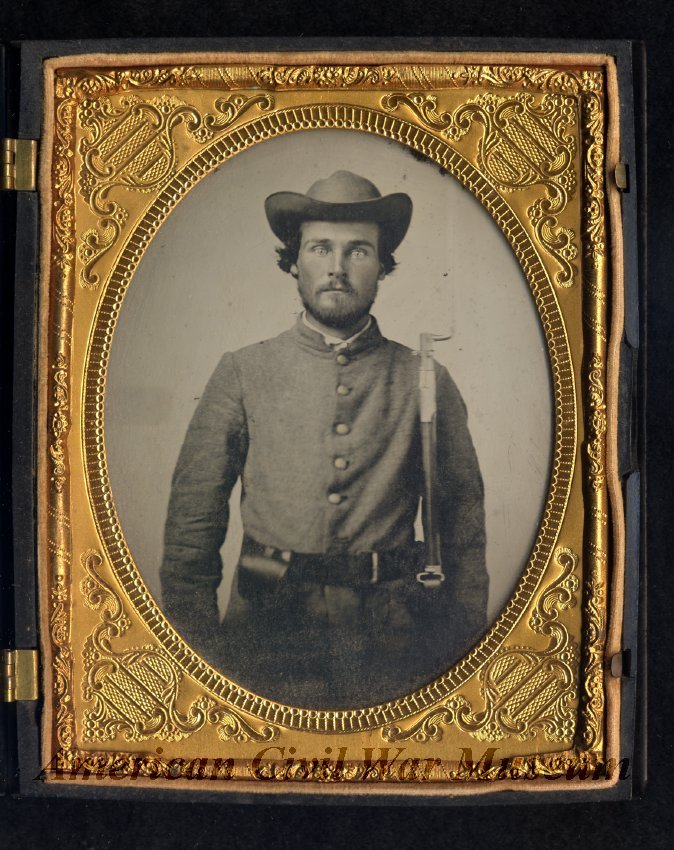
An unidentified Mississippian (Civil War Museum)
Both letters were written while James served as a private in Co. G (the “Orr Guards”), 31st Mississippi Infantry. He enlisted in March 1862 and seems to have been with his regiment or on detail through at least the spring of 1863 except for a time in the Durant Hospital in December 1862.
After the war, in 1869, James loaded all of his family and their possessions in wagons and relocated to Freestone county, Texas, in an area four miles south of Brewer Prairie, where he lived out his days. After his death, his widow filed for a Confederate Widow’s Pension which is where the following two letters were found and brought to my attention by Billy Mercer, his ggggreat-grandson.
The events taking place at the time of these two letters, copied from the regimental history, included: “When General Grant advanced from Memphis down the Central Railroad, Rust’s brigade (which included the 31st Mississippi) fell back from Holly Springs to the Tallahatchie River and thence in December to Coffeville, where they participated in the battle of December 5. Colonel Orr commanding the brigade and Stephens the regiment. The brigade pursued the Federal advance back to the main army at Water Valley, and then retired to Grenada. VanDorn’s raid to Holly Springs followed and Grant retreated to Memphis. The regiment was then sent to the support of S. D. Lee at Chickasaw Bayou. The brigade was met at Edwards as it moved to Vicksburg by General Featherston, who took command, the brigade then including the Fifteenth, Twenty-second, Thirty-first and Thirty-third Regiment and Rayburn’s Battalion. Featherston’s Brigade was ordered to Snyder’s Bluff March 19 on account of the Federal reconnaissance by General Sherman and Admiral Porter on Rolling Fork and Deer Creek, and toward the close of the ten days’ operation the Thirty-first joined the Twenty-second and Thirty-third at the scene of action. Colonel Orr then taking command of the Confederate forces with Featherston. After an unique campaign in the flooded swamps with the Federal gunboats that were crowding their way through the bayou, the gunboats escaped into Black Bayou, and the regiment took steamer for Fort Pemberton, confronted by a Federal fleet. Late in April they moved to Grenada, whence the regiment was ordered again to Edwards. May 3 Colonel Orr at Edwards was ordered, “on the arrival of Featherston, with his brigade, your regiment and Snodgrass’ Alabama Regiment will go to the Big Black bridge.”
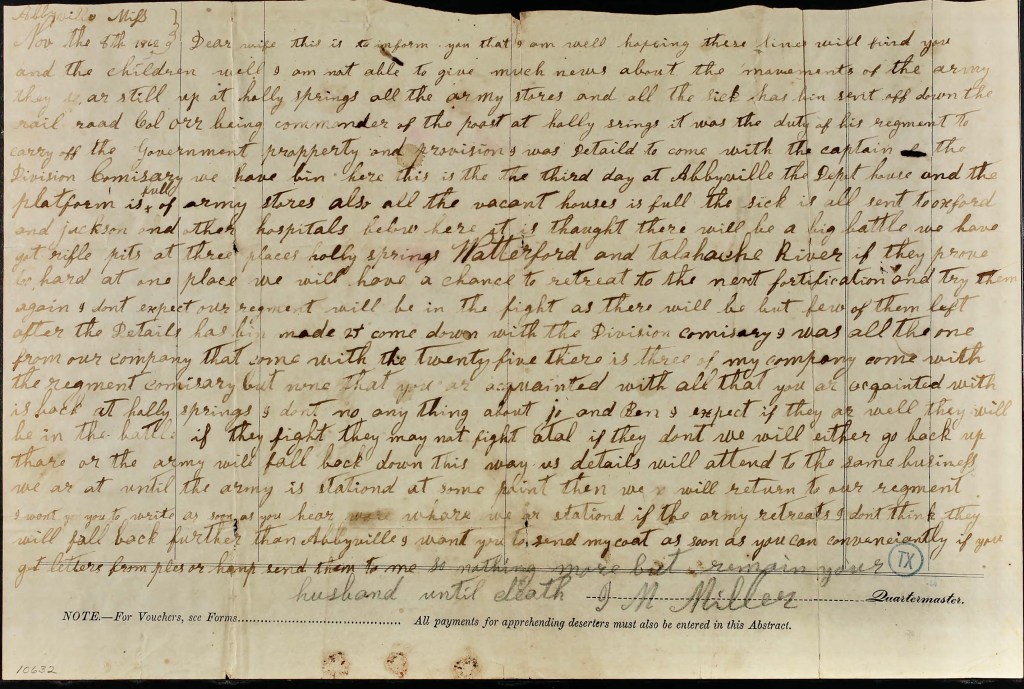
This is to inform you that I am well, hoping these lines will find you and the children well. I am not able to give much news about the movements of the army. They are still up at Holly Springs. All the army stores and all the sick has been sent off down the railroad. Col. [Jehu A.] Orr being commander of the post at Holly Springs, it was the duty of his regiment to carry off the government property and provisions. I was detailed to come with the captain of the Division Commissary. We have been here this is the third day at Abbeville. The depot house and the platform is full of army stores. Also all the vacant houses is full. The sick is all sent to Oxford and Jackson and other hospitals below here.
It is thought there will be a big battle. We have got rifle pits at three places—Holly Springs, Waterford, and Tallahatchie River. If they prove too hard at one place, we will have a chance to retreat to the next fortification and try them again. I don’t expect our regiment will be in the fight as there will be but few of them left after the details has been made. It come down with the Division Commissary. I was the [only] one from our company that come with the twenty-five. There is three of my company come with the regiment commissary but none that you are acquainted with. All that you are acquainted with is back at Holly Springs. I don’t know anything about Joe and Ben. I expect if they are well, they will be in the battle if they fight, [but] they may not fight at all. If they don’t, we will either go back up there or the army will fall back down this way. Us details will attend to the same business we are at until the army is stationed at some point. Then we will return to our regiment.
I want you to write as soon as you hear where we are stationed. If the army retreats, I don’t think they will fall back further than Abbeville. I want you to send my coat as soon as you can conveniently. If you get letters from Ples [Pleasant] or Hanp, send them to me. So nothing more but remain your husband until death, — J. M. Miller
Letter 2
Milldale, Mississippi February 25th 1863
Dear Wife,
This leaves me well except a bad cold. Hoping these lines will find you and the children well. I have got three letters from you since I came from the hospital. I have wrote you two but it appears that you have not got them. Lish Bowen 1 come in yesterday. He said you was at his house the day before he started and you had never had a letter from me since I went to the hospital. I believe all the chance to get getters through is to send then by hand.
I did not see Bill Ausbon [Osborn?]but I have got my socks and gloves. I have not saw Ben and Jo since we was at Jackson. I understand they have went up to Grenada.
We are camped in two miles of the Yazoo River among the biggest hills I ever saw. There is large cane growing on the top of the highest hills. We can see the smoke of the Yank’s gunboats on the Mississippi river 12 or 15 miles off. The cannons is firing every day and every night down in the direction of Vicksburg but I don’t think they do much damage. It is thought the Yanks is going up the river. If they are, we will not have them to fight here. If they go up the river, we will go to Granada or Holly Springs or to the mouth of Cold Water.
Our provisions is short. We get meal that is nearly all bran. Our beef cattle is so poor they can hardly stand up. They have got the hollow horn and hollow tail and hollow belly. They frequently get down on the lift. As bad as the beef and meal is, we don’t get enough of that. We sometimes have to live a day or two on parched corn.
I have not got time to write any more. So nothing more but remain your husband until death, — J. A. Miller
[In another hand; possibly a nephew of J. A. Miller who enlisted underage?]
Dear Father,
I embrace the present opportunity of writing you a few lines. I haven’t nothing new to write. I received a letter from Mother by [Elisha] Bowen yesterday. I was glad to hear from you all. My leg is about as it was when I left home. We are here at a place called Milldale [Snyder’s Bluff] 12 miles east of Vicksburg, a little north of east. I can’t say how long we will stay here. I think not long. There is some talk of us going north, maybe to Jackson, then to Grenada. We was ordered to the mouth of Cold Water [but] that order was countermanded. We have stopped here waiting for orders now.
Father, I went to the colonel yesterday and talked to him about being discharged. The colonel says that you must go before the justice of the peace and make out an affidavit of my age to the day and date of my birth and send it to the colonel, J. A. Orr. You can send it by D. Rodgers and maybe by Z. H. Fulton. Sam says that his pa is a coming to this regiment to see him before long. Sam Fulton wants you to tell his wife she can send a letter by D. Rodgers. I say no more at this time. I remain your son until death, — W. A. Miller
1 William Elisha Bowen (1834-1879) was from Itawamba county, Mississippi.Elisha served in Co. C, 1st Mississippi Infantry.
An image of an unidentified Yank (Griffing Collection)
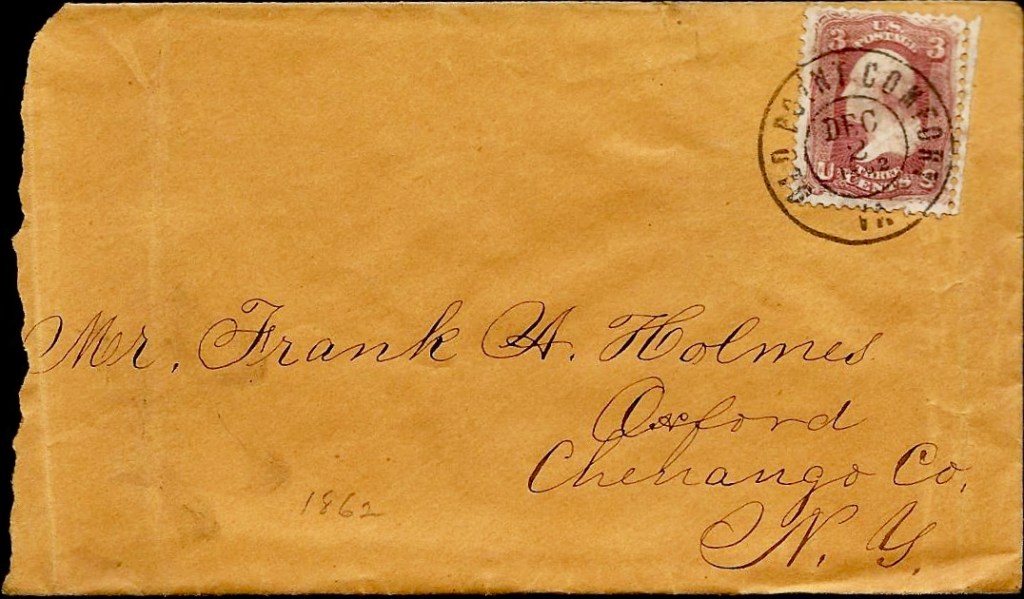
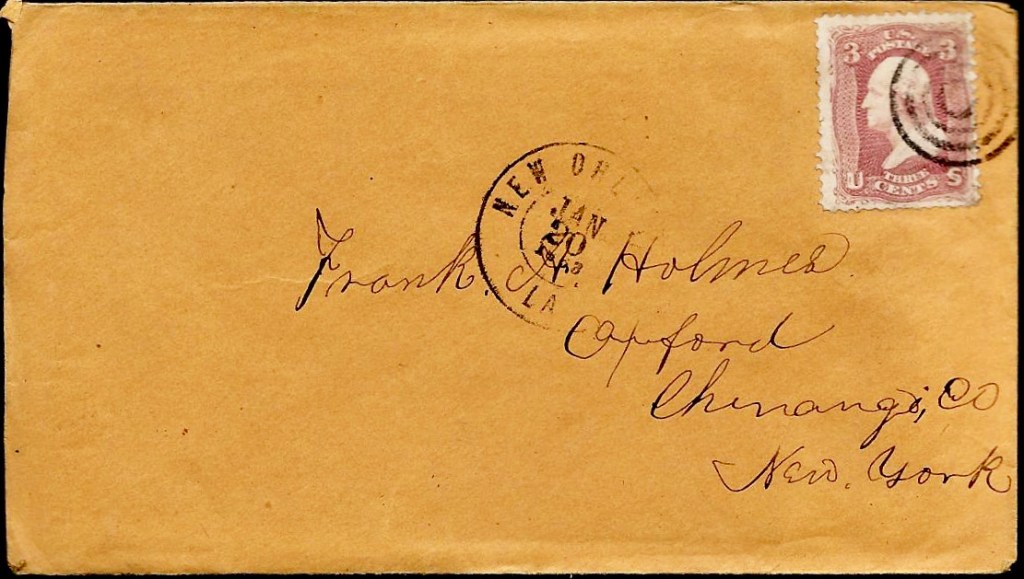
These letters were written by Pvt. Asa Holmes (1816-1863) who was was 46 years-old when he enlisted in Co. A, 114th New York Infantry on 1 August 1862 at Oxford, Chenango County, New York, to serve three years. He died of chronic diarrhea on 1 (or 2) November 1863 at Barracks Hospital at New Orleans.
Asa was the son of John Holmes (1760-1849) and Esther Wilcox Ensworth (1776-1863) of Oxford, Chenango County, New York. Asa wrote the letter home to Oxford where his wife, Eliza Ann (Odell) Holmes (1817-18xx) and their two children—Mary A. (b. 1842) and Frank (b. 1850)—were residing. By 1863, his son Frank was 13 years old and his daughter Mary was 18, married, and the mother of a child.
Seven companies of this regiment were recruited in Chenango County, and three in Madison. They rendezvoused at Norwich, where the regiment was organized and mustered into the U.S. service for three years on September 3, 1862. Three days later, it started for the front, moving to Binghamton by canal boats and proceeding from there to Baltimore. In November, it sailed for New Orleans as part of Banks’ expedition, and upon its arrival there, it was assigned to Weitzel’s (2nd) brigade, Augur’s (1st) division, 19th corps. It was stationed for a time at Brashear City and neighboring points, and it was first engaged at Fort Bisland, where it had 11 men wounded, 3 mortally. It did not participate in the Bayou Teche campaign, but joined its corps before Port Hudson on May 30, 1863, where it was actively engaged for 40 days in the siege and suffered severely in the grand assault of June 14. The loss of the regiment during the siege was 73 killed, wounded, and missing.
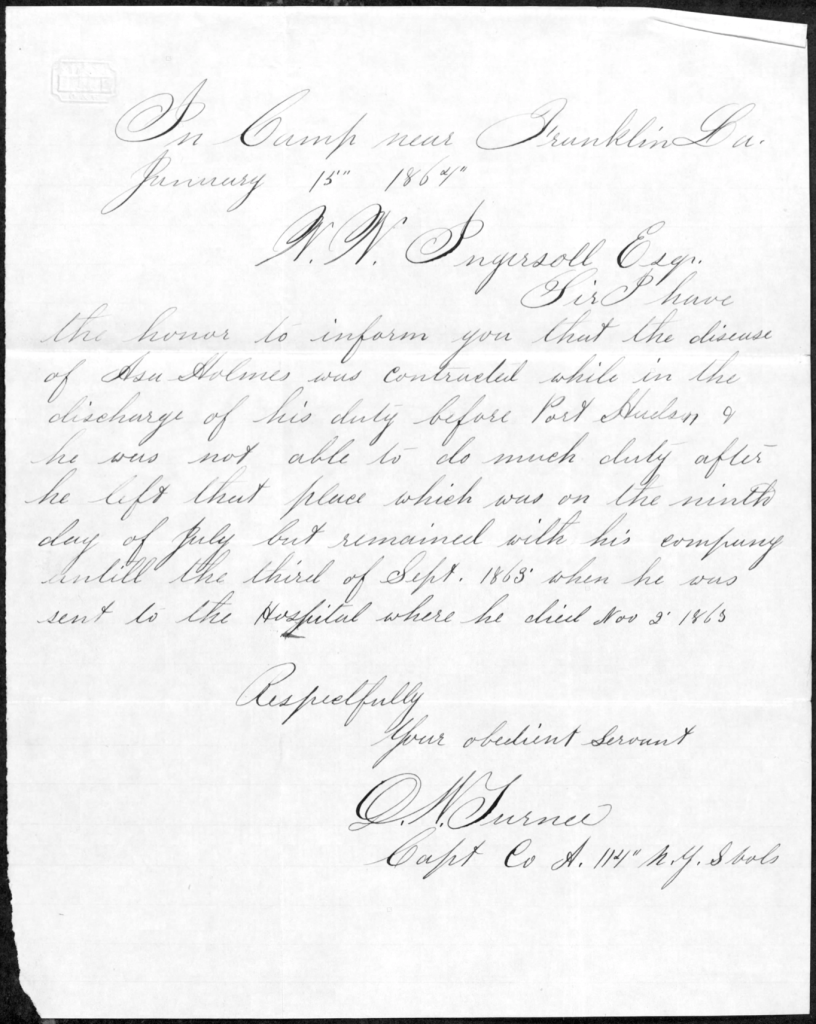
A letter from Asa’s captain states that Asa contracted the illness that killed him about the 9th of July but he remained with his regiment until 3 September 1863 when he was sent to the hospital. Asa was among the 192 men in the regiment who died of disease and other causes during the war.
[Note: see also Holmes, Asa. Civil War letters, 1863 June 16-17. 2 items. Located at Pearce Civil War Collection, Navarro College, Corsicana, Texas.]
Letter 1
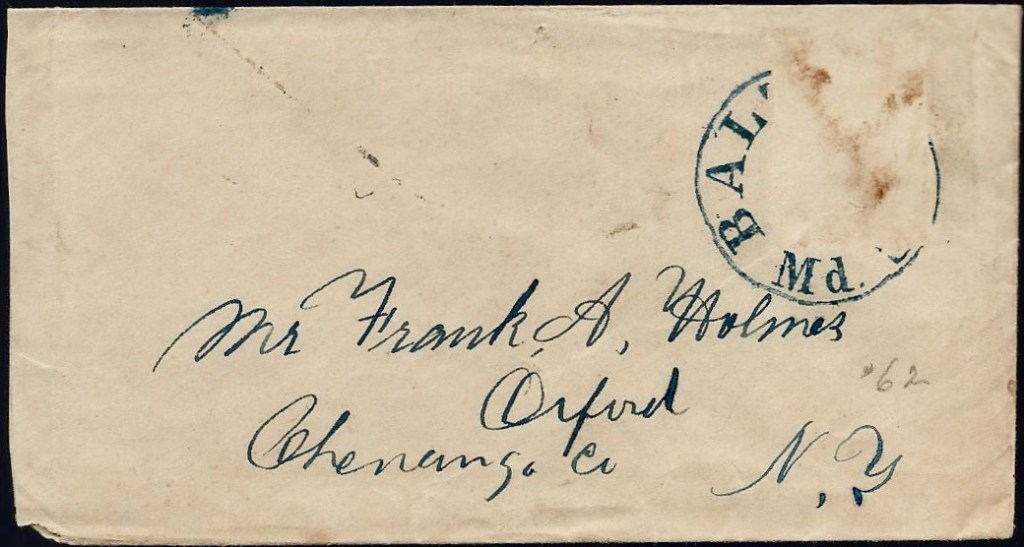
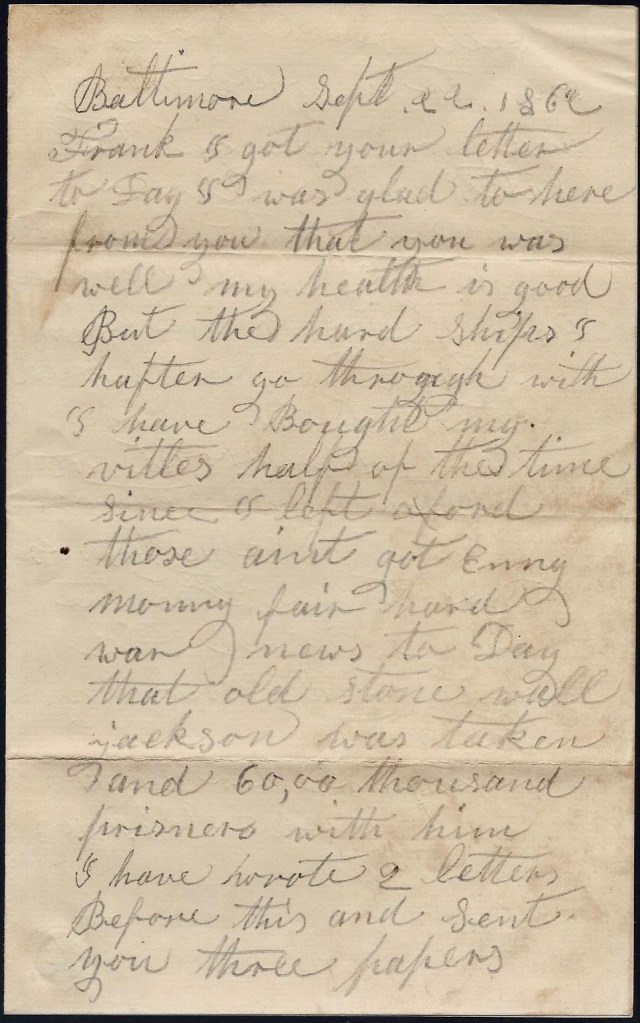
Baltimore[Maryland] September 22, 1862
Frank, I got your letter today. I was glad to hear from you that you was well. My health is good but the hardships I have to go through with. I have bought my vittles half of the time since I left Oxford. Those [that] ain’t got any money fair hard.
The war news today [is] that Old Stonewall Jackson was taken and 6 thousand prisoners with him. I have wrote two letters before this and sent you three papers. I will send you one tomorrow morning and you will get the latest news of war.
Thy bring into Baltimore from 100 to 150 every day or to prison. I want you should write when you leave all about it.
From your father, — Asa Holmes
Direct your letter as the same you did, Get what money you want. Enquire for paper. — Asa Holmes
Letter 2
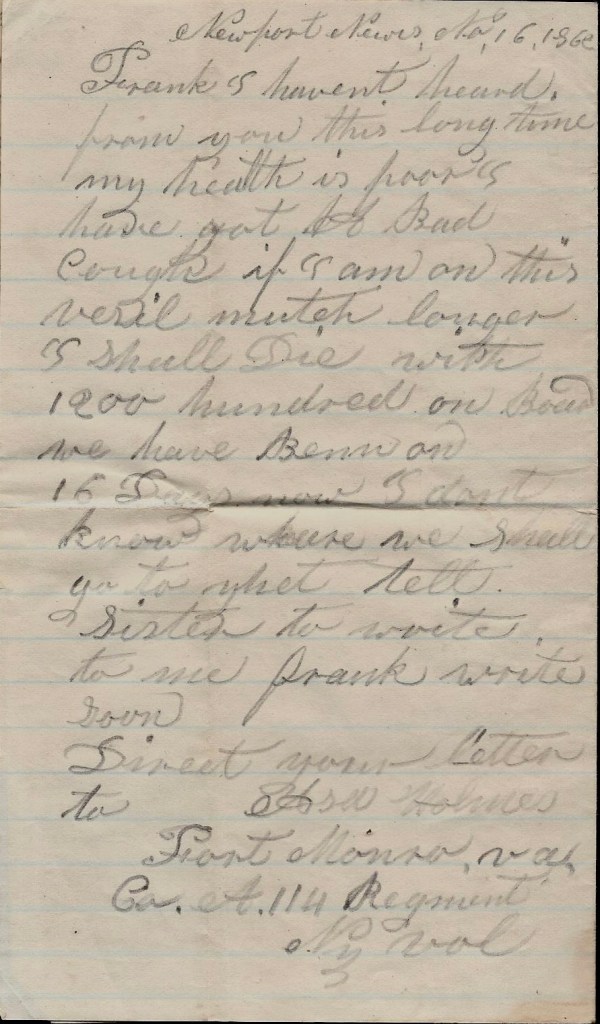
Newport News, Va. November 16, 1862
Frank, I haven’t heard from you this long time. My health is poor. Have got a bad cough. If I am on this vessel much longer, I shall die with 1200 on board. We have been on 16 days now. I don’t know where we shall go to yet. Tell sister to write to me Frank. Write soon.
Direct your letter to Asa Holmes, Fort Monroe, Va., Co. A, 114th Regiment New York Volunteers.
December 2nd, 1862
Frank, I wrote to you last night. Now I write to inform you that we was called up at midnight to go on board the vessel. The whole brigade numbers about 7,000 men, to be ready any minute to go. Don’t know where. Don’t make much difference now. I lay in my bunk to write this.
I sent fifty cents in the other letter to you. Also fifty in this. Ask Mr. Lewis if he has received my check and the money I sent.
My health is better but not good yet. I shall come around yet safe, I suppose. There is some hope I shan’t. Do the best you can till I come. Then I can tell you more than I can write about the war. — Asa Holmes
Elisa, take good care of Frank and not have him a nigger to no one. There is money enough to do it. — Asa Holmes
Letter 3
Quarantine Station Sixty Miles Below New Orleans On Mississippi [River] December 18, 1862
We have to lay here ten days. No vessel can pass here that have any sick on board. Every vessel has to be examined by the government doctor which comes on board, We had 200 sick—some with the ship fever, measles and typhoid fever and small pox and body lice by the bushel, and the itch and ship rash too.
Frank, I don’t know whether I put that money in the other letter or not, I was in such a hurry. I put some in this.
There is not but four houses here and them belong to the government for sick hospital. Frank, [I wish] you was here to see the orchards of oranges and lemons. Some as as big as pumpkins. We are on shore today. Snakes and alligators too numerous to mention. We can’t hear a word about the war here.
Keep up good courage. I shall be home by and bye. I am exposed to all kind of sickness. Hope you are well and all the rest. When I come to a stopping place, then I’ll tell you where to direct your letters. Then you must write a long letter to me.
I have seen the elephant all lover. I have took the first lesson with the rest of them.
To Frank A. Holmes, [from] Asa Holmes
Letter 4
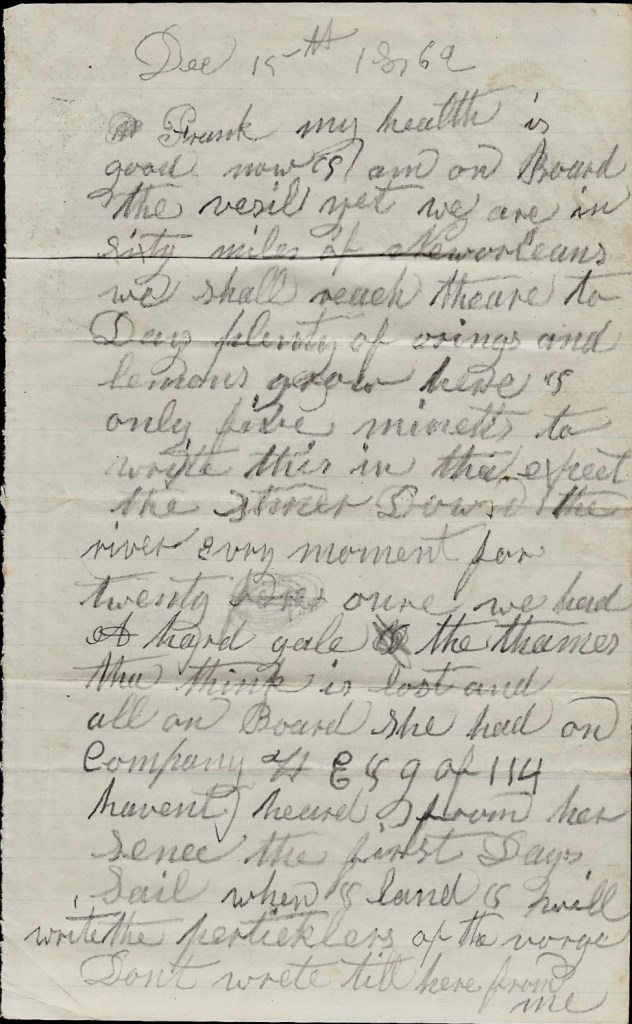
December 15th 1862
Frank, my health is good now. I am on board the vessel yet. We are [with]in sixty miles of New Orleans. We shall reach there today. Plenty of oranges and lemons grow here. I only have five minutes to write this as we expect the steamer down the river every moment for twenty one.
We had a hard gale. The steamer they think is lost and all on board. She had on Company H, E, F, and G of 114th. Haven’t hear from her since the first days sail. When I land, I will write the particulars of the voyage. Don’t write till you hear from me.
Keep up good courage. Our fare is hard but I think I shall live through it. Don’t you suffer any for money. I send fifty cents in this to you. — Asa Holmes
Letter 5
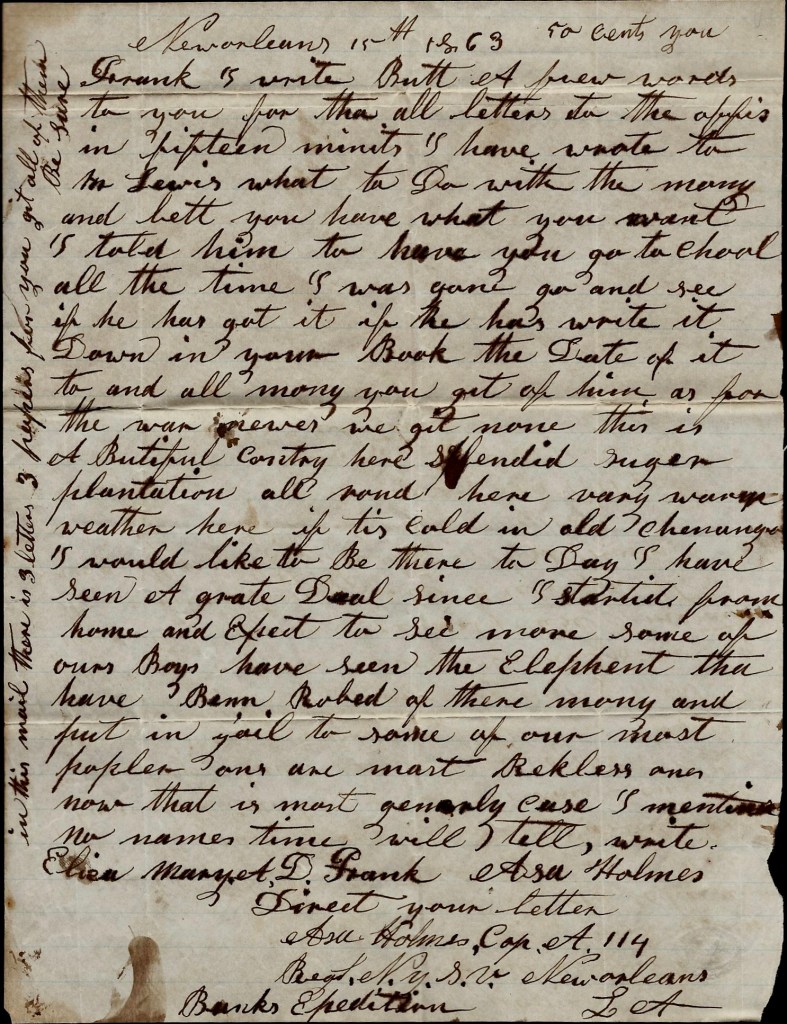
New Orleans [Louisiana] [January] 15th, 1863
Frank, I write but a few words to you for all letters [must be] to the office in fifteen minutes. i have wrote to Mr. Lewis what to do wit hthe money and let you have what you want. I told him to have you go to school all the time was gone. Go and see if he has got it. If he has, write it down in your book, the date of it too, and all money you get of him.
As for the war news, we get none. This is a beautiful country here. Splendid sugar plantations all around here. Very warm weather here. If tis cold in Old Chenango, I would like to be there today. I have seen a great deal since I started from home and expect to see more. Some of our boys have seen the elephant. They have been robbed of their money and put in jail too. Some of our most popular ones are most reckless ones. Now that is most generally the case. I mention no names. Time will tell.
Write Eliza, Mary A., D. Frank. Direct your letter to Asa Holmes, Co. A, 114 the Regt. N. Y. S. V., New Orleans, La. Banks Expedition
Letter 6
Brashear City [present day Morgan City, Louisiana] February 10, 1863
Frank, I feel very uneasy to think I don’t get a letter from you. This is the last one I shall write to you or sister till I get one. This is the sixteenth I have wrote to you and got no answer and I think it’s time to stop now till one is [received]. Sister I think don’t think enough of me to write. I don’t feel good tonight. Amen
— Asa Holmes
Letter 7
Bayou Boeuf Camp Mansfield March 9, 1863
Rather bad news, Frank, I write. Yesterday one of the gunboats left Brashier City to go up the river with one company [Co. F] of the 160th Regiment on board and one of the General’s staff on board to see what they could discover. They got about two miles from the city where the rebels had fixed a battery with sixteen guns around a bend in the river. They got close on to it before they see it and they destroyed our boat and killed all on board but two. 1 The pilot jumped overboard and ran ashore. The General’s staff got shot through the face. The gunboat Calhoun started as soon as she heard the firing with Co. C of the 114th Regiment but she run on[to] a sand bar before she got there to help them. If they could of got there, both boats would [have] drove them back.
I don’t know what will be the next move. There is a great stir with the big officers today. It may be that we shall have to follow them up and whip them out. There has one gunboat gone down to the gulf to pilot two large gunboats up here. They say, “I hope so.” I think we shall have a big battle before long the way things shape—it is brewing pretty fast.
My health is good now. My cough has most left me—only when I have been out all night on guard or picket in the rain. It is very sickly in the regiment now. It is reported that there ain’t about two hundred and fifty for hard duty now. That is pretty small number from a large regiment.
Write how Hiram Lewis gets along. I wonder if Stephen Lewis feels as savage as ever about the war. I can tell him something about it he never thought of yet, nor I before I left home. Write how Elizabeth gets along since W. was married. I should think Mary A. Deila would write to me and let me know how she gets along this spring. I write two letters every week to you. You must go to school every day this summer without fail. Don’t think of working for no one this summer. Learning is better than money to you and get it while you can and improve it expressly in writing. You can write better, I think, than the last you wrote to me. I could not hardly read it. But I am glad to have a letter from you if it is only a straight mark on paper. It looks though you had some respects for me. I hope Mary A. Delia will send Elroy’s likeness to me. I know it is hard for her to write. It used to be for me but I can write a sheet of paper over in ten minutes now. Don’t think nothing of it. I know I don’t spell every word right, but I think you can make it out.
No more at present. — Asa Holmes
I have no letter tonight from you nor nobody else but most of the boys have got one and reading it. Never mind. I can be contented till I get one from Oxford. Frank, don’t you be kicked around by no one. — Asa Holmes
1 Asa is referring to the engagement at Pattersonville on 8 March 1863, where Co. F, Capt. Josiah P. Jewett, was on board the gunboat Diana during the action with the Confederate batteries. Co. F lost 6 killed and 16 wounded, Capt. Jewett being mortally wounded.
Letter 8
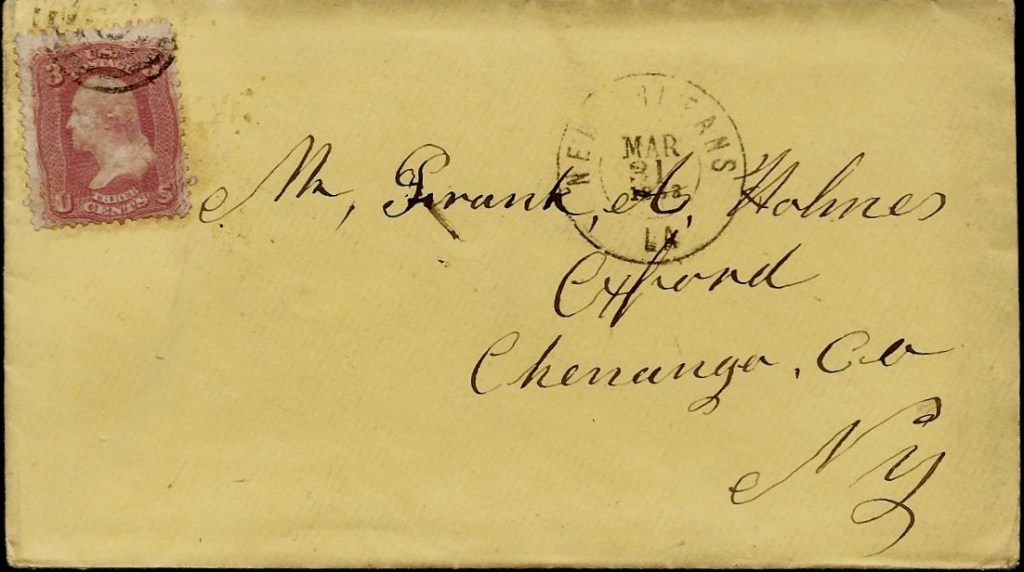
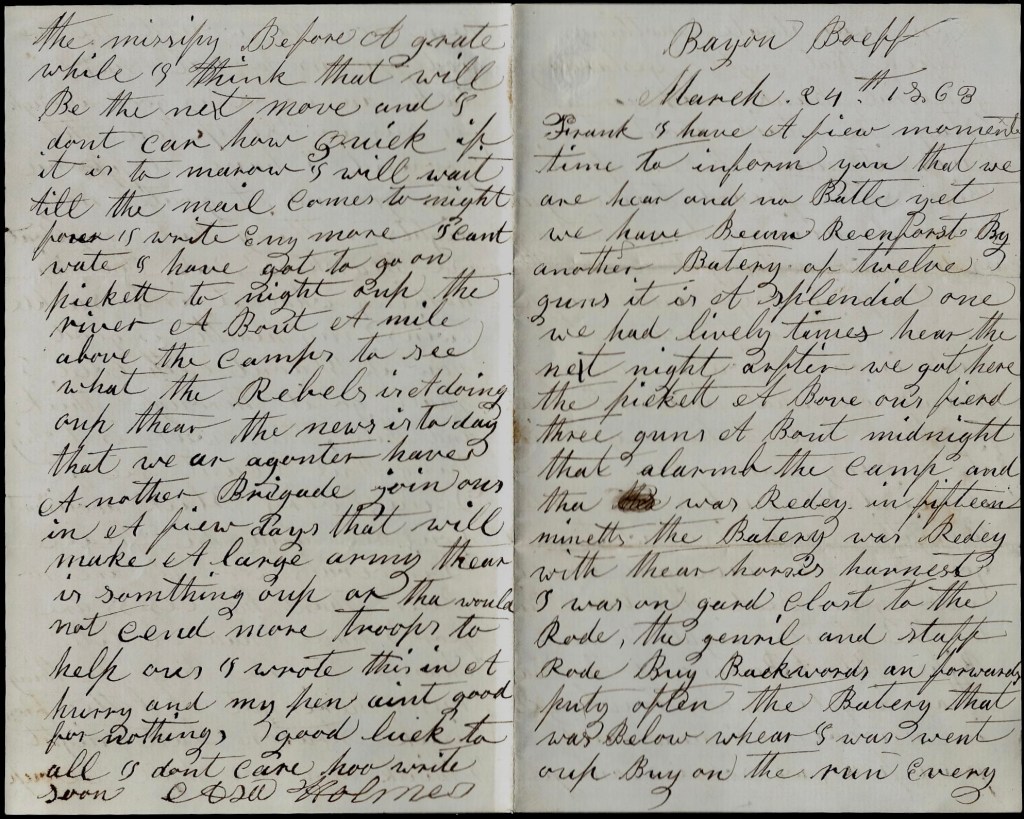
Bayou Boeuf March 24th 1863
Frank, I have a few moments time to inform you that we are here and no battle yet. We have been reinforced by another battery of twelve guns. It is a splendid one. We had lively times here the next night after we got here. The picket above ours fired three guns about midnight that alarmed the camp and they was ready in fifteen minutes. The battery was ready with their horses harnessed. I was on guard closest to the road. The general and his staff rode by backwards and forwards pretty often. The battery that was below where I was went up by [me] on the run. Every horse was straight. Nothing happened that night.
Yesterday General Banks was here and staff. He stayed about three hours. It must be on special business. They fired twelve guns when he arrived here. The soldiers don’t know nothing till they tell us to pick up and march. We are in camp where the mud is over shoe. We are on a sugar plantation. What makes the mud? We have had a heavy rain. It is very warm here now. [There are] all kinds of snakes here and descriptions and sizes. What would you think to have one crawl into your bed? They crawl into the tents nights.
I saw ripe blackberries and they say there is plenty of strawberries in New Orleans now and green peas. We soldiers can’t get them for they would be too good for us to eat. Hard tack and coffee is good enough for us, and to sleep on the ground. I have slept on the ground a great many nights [with] nothing but my coat and blankets. But that is nothing [compared to] what it is to suckle twins.
My health is good now. If I don’t catch cold, I shall go it through thick and thin. This war is a big thing but I can’t see it. Damn every Black abolitionist you see and the Peace Democrats [too] for they are no better than the secesh are for I have had a little chance to see how the thing runs here.
Got a letter from Isaac Stratton last night. I think now we shall be up the Mississippi before a great while. I think that will be the next move and I don’t care how quick if it is tomorrow. I will wait till the mail comes tonight before I write anymore. I can’t wait. I have got to go on picket tonight up the river about a mile above the camp to see what the rebels are doing up there.
The news today is that we are a going to have another Brigade join ours in a few days. That will make a large army. There is something up or they would not send more troops to help us. I wrote this in a hurry and my pen ain’t good for nothing. Good luck to all. I don’t care how. Write soon. — Asa Holmes
Letter 9
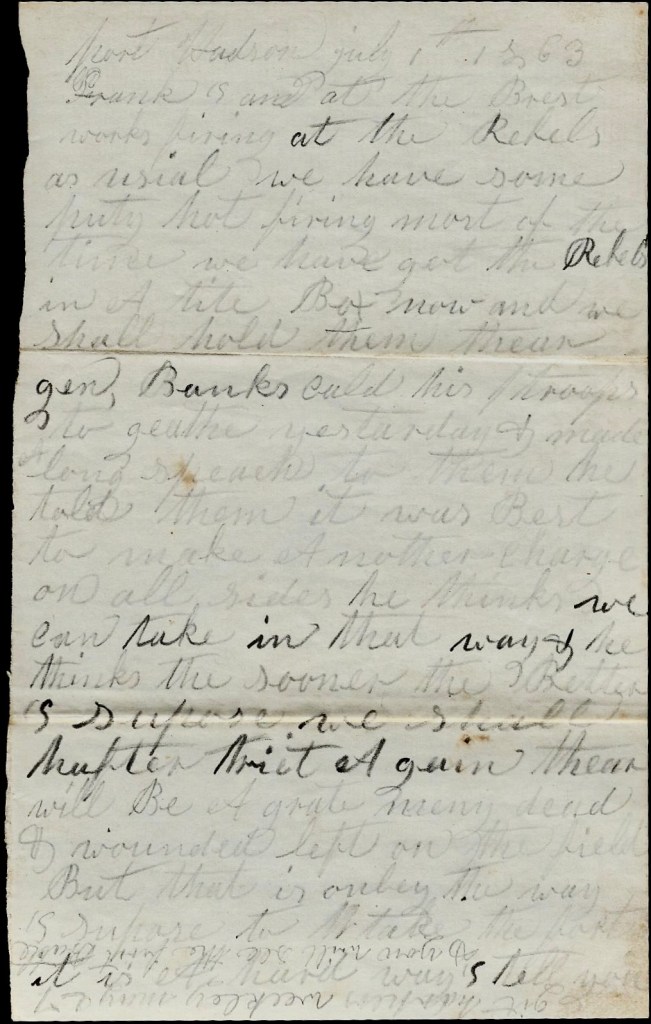
Port Hudson July 1, 1863
Frank, I am at the breastworks firing at the rebels as usual. We have some pretty hot firing most of the time. We have got the rebels in a tight box now and we shall hold them there.
Gen. Banks called his troops together yesterday and made a long speech to them. He told them it was best to make another charge on all sides. He thinks we can take [Port Hudson] in that way & he thinks the sooner the better. I suppose we shall have to try it again [but] there will be a great many dead and wounded left on the field. But that the only way, I suppose, to take the fortress. It is a hard way, I tell you.
I told you in my other letters I should not write who was killed and wounded till we got through fighting. Then I will write the particulars—if I am alive. I have got to stand my chance with the rest of the soldiers.
July 2nd. Good morning to all of you. I have been to the breastworks facing the rebel balls for twenty-four hours and I am alive yet. I thank God. I have just got your letter dated June the 12th. I was sorry to hear you was so unwell but you and Frank must not feel bad about me. I shall come out alright. If I don’t, I am nothing but a poor cuss. We are a going to hold the 4th of July in the fort if we get into it. It will take a great many lives to get there. I shan’t worry about it. Farewell to all. — Asa Holmes
Get Harper’s Weekly May 27th and you will see the first battle.
Letter 10
Donaldsonville, La. July 21st 1863
Well Frank, I am here yet. I have just come in off from picket. I have been out for twenty-four hours. We suffer from the heat amazingly. You think it is hot in old Chenango of the Fourth day of July? What do you think of it here now?
It is very peaceable here now for a few days. The soldiers are a resting & appear to enjoy themselves very much. I think this state will come back into the Union before a great while. I think there won’t be much more hard fighting in this state. The Rebels is getting pretty tired of it. There will be some guerrilla fights, of course, but no more big battles, I think. We may have a pretty hard battle with the Rebel army that we have got surrounded here but I think they will surrender before fighting very hard. Our army has taken a great many prisoners already from it & they say the Rebel soldiers are deserting very fast. There is from ten to twenty comes into our lines every day. They say they have got tired of this war & won’t fight anymore.
I was pleased to hear from Mr. Williams that he was so strong a Union man. You take such a man & if he is drafted, he won’t whine, but he will go like a brave soldier and fight to protect the Union forever.
Well I feel very well now except my eyes. They are very weak since I got over the fever & jaundice. It colored my shirts very yellow. There is such a blur over my eyes that I can’t hardly see to write or read. I hope they will get over it as I grow stronger. They are very much as they was when I had the measles. That bothered me very much. I sweat so much it runs into my eyes and makes them smart so.
Well, Mary A. Dealia, how do you get along — and Marting too? & the boy — is he well? If he is, I would like to see him. I will pay for his likeness if you will take the pains to send it to me. This is the last time I shall write about it. You can send it or not. I will pay all expenses. I shall have money by and by & if I die, you will have part of it — or your boy — so it makes no difference. Eliza, write to me whether you got my two letters I wrote before this. I don’t want none of you worrying about me. I am here & you are there — all of you — & I am but one alone by myself. Is Ma fetch round alright yet? I don’t let nothing trouble me.
I sit here a writing while there is a regiment getting onto a transport for some place, I don’t know where. They are the Twelfth [12th] Connecticut that belong to our brigade. They have been with us ever since we have been in Louisiana. The 8th Vermont has got marching orders today for someplace too. They belong to Weitzel’s [2nd] Brigade too. It may be our [turn] next. We can’t tell.
Well, Frank, I have got a good silver-plated knife I am going to fetch you when I come home. It is a dirk knife with a spring in the back of it.
Farewell to all, — Asa Holmes
Write soon. Direct your letters as you always have. They will follow the regiment.
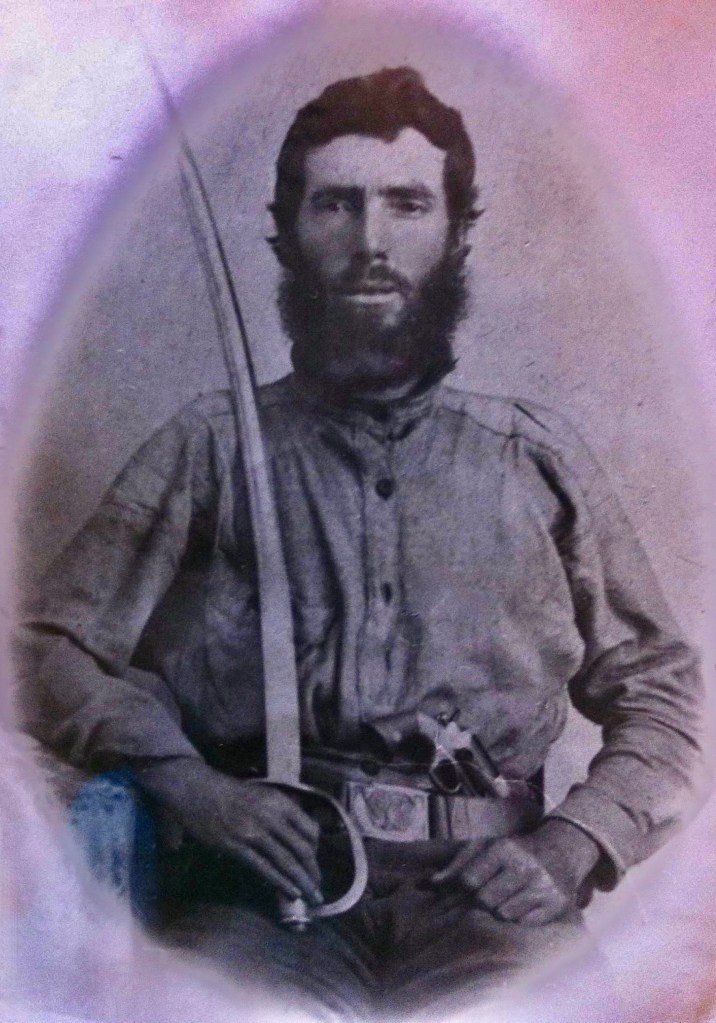
I could not find an image of Lemuel but here is one of Capt. James Q. Baird who served in Co. G, 66th OVI (Ancestry)
The following letter was written by Lemuel Wilmer Smith (1829-1922) who enlisted at the age of 32 as a private in the 66th Ohio Infantry on 17 October 1861. He mustered into Co. F on 26 December 1861 and worked his way up to Captain of the company a year later. He was mustered out of the regiment at Savannah, Georgia, on 29 December 1864.
An obituary for Lemuel informs us that he was born in May 1829 at Leesburg, Ohio and died in March 1922 at the age of 92 and 10 months. He moved with his parents to Union county, Ohio, in 1834 where he made his home until 1881 when he moved to Holliday, Illinois. When he was 20 years old he joined in the gold rush to California. When he returned, he walked across the Isthmus of Panama and barely escaped capture by Indians. He married Minerva Twiford in 1852. After her death in 1867, he remarried to Sarah Crawford. In the 1870 US Census, Lemuel was enumerated in York, Ohio, where he made a living as a dry goods merchant and served as the local postmaster. I should note that Lemuel’s spelling was very poor suggesting a limited education.
Lemuel wrote the letter to John N. Rathburn who served in Co. F of the regiment until promoted to Captain of Co. C on 3 March 1864. He was wounded on 9 June 1864 at Port Republic. [Many of the letters exchanged between John and his wife are housed in the US Army Heritage and Education Center at Carlisle Barracks]
Lemuel’s letter was written from Atlanta which the regiment occupied just prior to Sherman’s March to the Sea.
Transcription
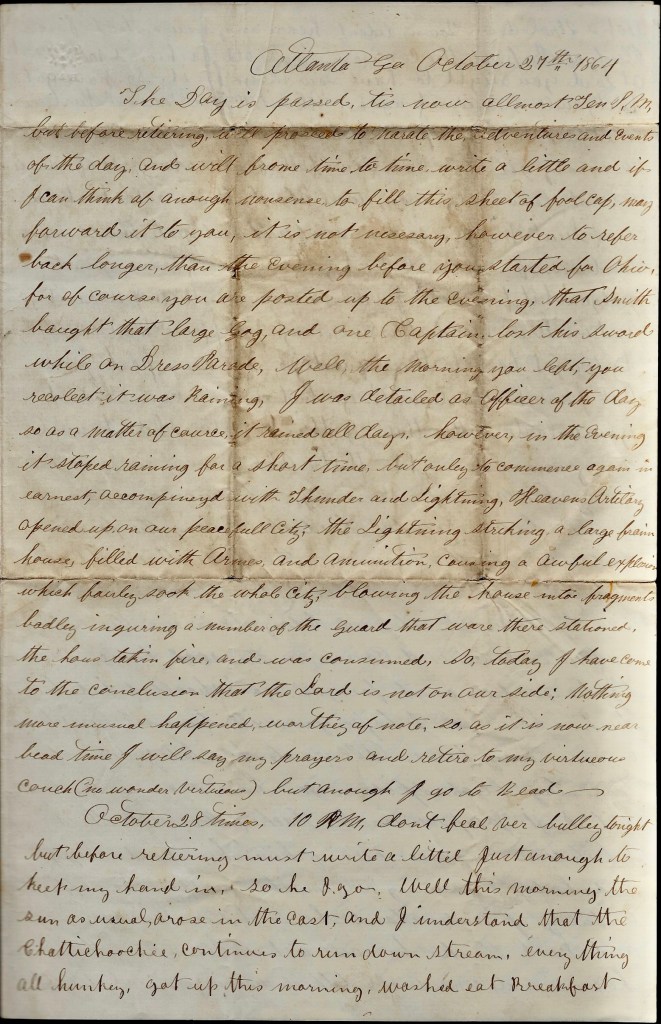
Atlanta, Georgia October 27th 1864
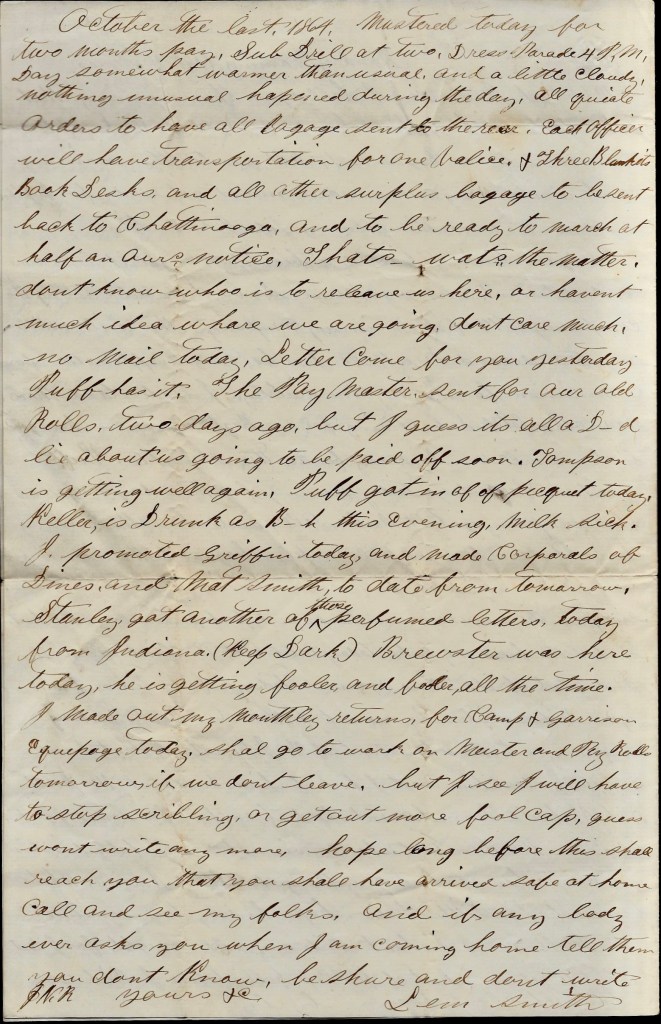
The day is passed, tis now almost ten p.m. but before retiring will proceed to narrate the adventures and events of the day and will from time to time write a little and if I can think of enough nonsense to fill this sheet of fools cap, may forward it to you. It is not necessary, however, to refer back longer than the evening before you started for Ohio, for of course you are posted up to the evening that Smith bought that large hog and one Captain lost his sword while on Dress Parade.
Well, the morning you left, you recollect it was raining. I was detailed as officer of the day so as a matter of course, it rained all day. However, in the evening it stopped raining for a short time but only to commence again in earnest, accompanied with thunder and lightning. Heaven’s artillery opened up on our peaceful city, the lightning striking a large frame house filled with arms and ammunition, causing an awful explosion which fairly shook the whole city, blowing the house into fragments, badly injuring a number of the guard that were there stationed. The house was taken fire and was consumed so today I have come to the conclusion that the Lord is not on our side. Nothing more unusual happened worthy of note so as it is now near bed time, I will say my prayers and retire to my virtuous couch (no wonder virtuous) but enough. I go to bed.
October 28 10 p.m. Don’t feel very bully tonight but before retiring must write a little just enough to keep my hand in. So here I go. Well, this morning the sun as usual arose in the east and I understand that the Chattahoochie continues to run down stream. Everything all hunkey. Got up this morning, washed, eat breakfast. took a stroll down town, didn’t hear any news, but found plenty of pork at the commissary—real old fashioned mess pork. Oh Lord, you ought to have saw me go for it. So have got pretty well greased up again. About 10 a.m., Lawrence Porter called in, do I jumps on to Doc’s pony, goes out to the commissary, gets two canteens full of whiskey, so of course didn’t leave very soon. Well, about three o’clock, here come Lieut. Wells, so we sent out and got three more canteens of infernal rotgut and so I leave you to judge what followed. I will say, however, that I didn’t go out on Dress Parade this evening. I suppose Wells and Porter got back to their quarters. For my part, I know that I am here and writing, but if you can read it, you will do better than I think. So shan’t write anymore tonight. That’s all.
October 29. Evening. From some cause or other, had an awful headache during the forenoon but alright this evening. The first thru train come down this evening. Plenty to eat now. Some of our train guard returned today. Tells me the Rebs got after you and [W. A.] Cavis on the road home. Well that’s good enough for you. You should of had better luck, however. I hope you will have no more trouble on your way home. All quiet here today. One of those big black spiders you have seen in this country but Sergt. Thompson on the back of the neck this morning which come very near killing him. His head, legs and body becoming very much swollen. He suffers awfully. I understand he is better this evening and Doc thinks he will get well. Everything here as usual. Considerable talk of moving. Good night.
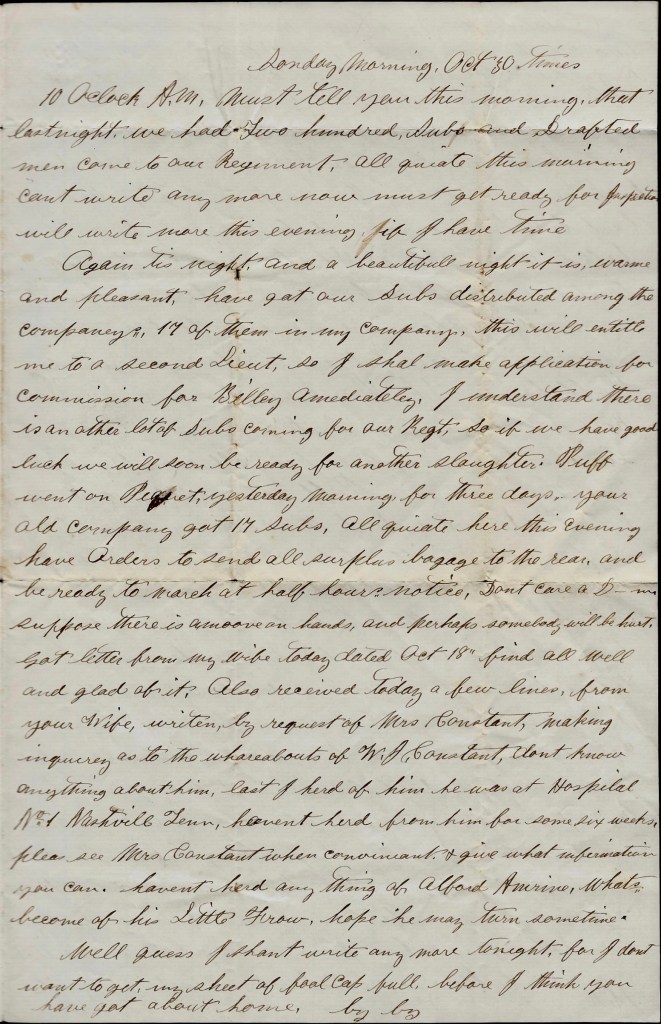
Sunday morning, October 30th, 10 o’clock. Must tell you this morning that last night we had two hundred subs [substitutes] and drafted men come to our regiment. All quiet this morning. Can’t write any more now. Must get ready for inspection. Will write more this evening if I have time.
Again tis night and a beautiful night it is—warm and pleasant. Have got our subs distributed among the companies. 17 of them in my company. This will entitle me to a Second Lieutenant so I shall make application for commission for Billy immediately. I understand there is another lot of subs coming for our regiment so if we have good luck, we will soon be ready for another slaughter.
Puff went picket yesterday morning for three days. Your old company got 17 subs. All quiet here this evening. Have orders to send all surplus baggage to the rear and be ready to march at half hour’s notice. Don’t care a damn. Suppose there is a move on hand and perhaps somebody will get hurt. Got letter from my wife today dated October 18th. Find all well and glad of it. Also received today a few lines from your wife written by request of Mts. Constant, making enquiry as to the whereabouts of W[illiam] J. Constant. Don’t know anything about him. Last I heard of him, he was at hospital No. 1, Nashville, Tenn. Haven’t heard from him for some six weeks. Please see Mrs. Constant when convenient & give what information you can. Haen’t heard anything of Alfred Amrine. What’s become of his Little Frow? Hope he may turn sometime.
Well, guess I shan’t write anymore tonight for I don’t want to get my sheet of fools cap full before I think you have got about home. Bye bye.
October the last 1864. Mustered today for two months pay. Sub drill at two. Dress parade 4 p.m. Day somewhat warmer than usual and a little cloudy. Nothing unusual happened during the day. All quiet. Orders to have all baggage sent to the rear. Each officer will have transportation for one valise & three blankets. Book desks, and all other surplus baggage to be sent back to Chattanooga and to be ready to march at am hour’s notice. That’s what the matter. Don’t know who is to relieve us here or haven’t much idea where we are going. Don’t care much. No mail today.
Letter came for you yesterday. Puff has it. The paymaster sent for our old rolls two days ago but I guess it’s all a damned lie about us going to be paid off soon. Thompson is getting well again. Puff got in off of picket today. Keller is drunk as B___h this evening. Milk sick. I promoted Griffin today and made corporals of Dines and Mat[thias] Smith, to date from tomorrow. Stanley got another of those perfumed letters today from Indiana (Keep dark). Brewster was here today. He is getting fuller and broader all the time. I made out my monthly returns for camp and garrison equippage today. Shall go to work on muster and regimental rolls tomorrow is we don’t leave.
But I see I will have to stop scribbling or get more fools cap. Guess won’t write anymore. Hope long before this shall reach you that you shall have arrived safely at home. Call and see my folks and if anybody asks you when I am coming home, tell them you don’t know. Be sure and don’t write.
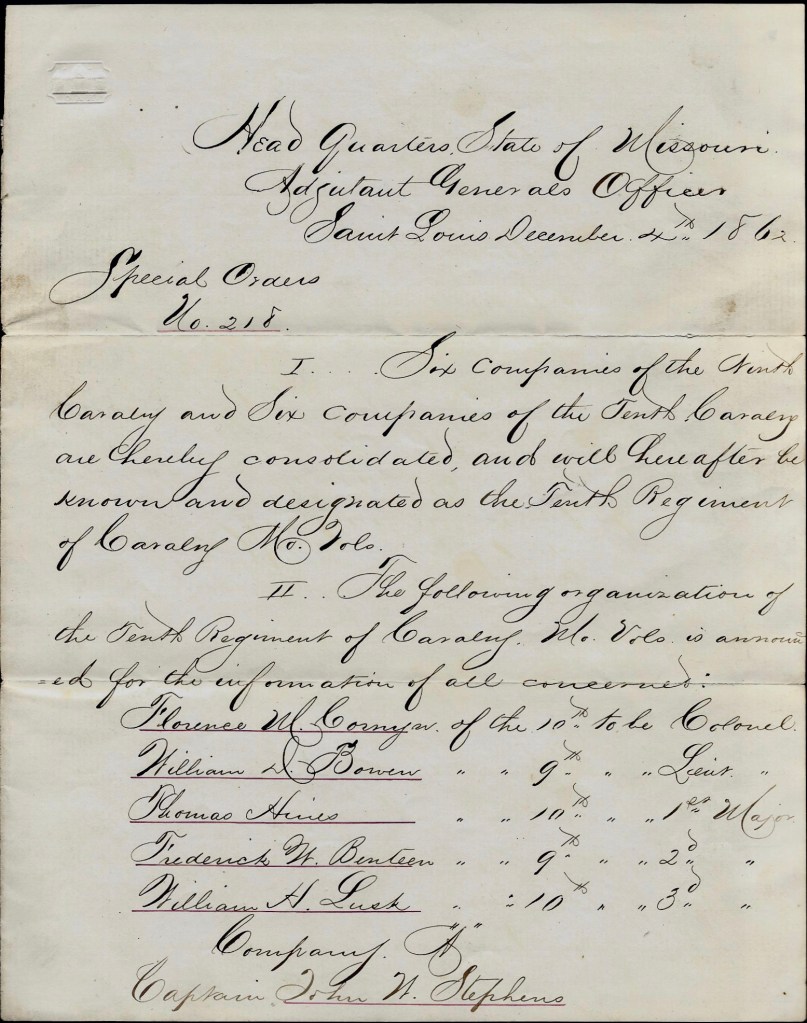
The following was penned by Mortimer Riley Flint (1836-1931) while serving as the 1st Lieutenant of Co. D, 10th Missouri (Union) Cavalry. The document is a copy of the report Flint submitted in late August 1863 in response to questions pertaining to the formation and history of the company.
Flint sent his report to Jeremiah F. Young, the adjutant of the 10th Missouri Cavalry.
Transcription
Headquarters 10th Missouri Cavalry Camp Sweeny August 31st 1863
J. F. Young 1st Lt. & Adjt. 10th Missouri Cavalry
Sir, to reply to questions contained in “circular,” I would respectfully submit the following.
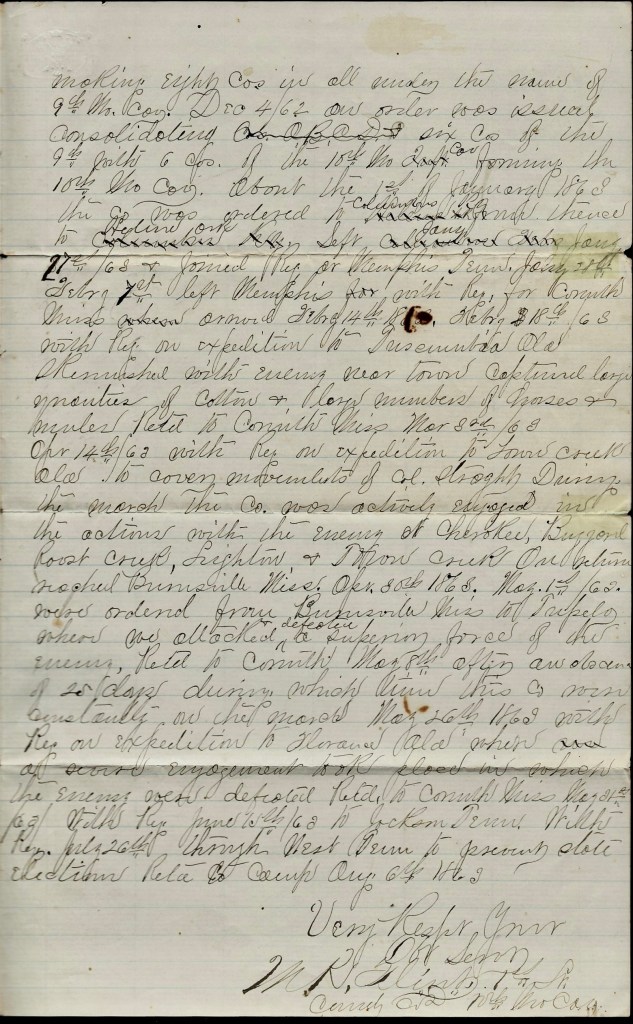
First. Name or number? Co. D, 10th Mo. Cav. Second. How & where organized, recruited under what auspices or authority, &c.? Organized as Co. D, Bowen’s Batt. Cav. Mo. Vols. and attached to 13th Regt. Infantry Vols. Illinois Volunteers under authority from the Governor of the State of Missouri in Rolla, Mo. Third. Mustered into service when & for what term? October 6th 1861 for three years. Fourth. Original strength in officers and men? 59 men , 3 officers. No. of recruits added in the field? 57 men Added by transfer and from what? 2 men 1 man from Co. C, 10th Mo. Cav., 1 from Co. A, 10th Mo. Cav. No. of officers & men killed in battle? 1 man. No. died of disease and wounds? 24 men. No. discharged? 13 men No. deserted? 18 men No. transfered & to what? 2 men & 2 officers. 1 man to Co. C, 10th Mo. Cav., 1 man to non com. staff 18th Mo. Cav, 1 officer to Co. H, 3rd Mo. Cav., 1 officer to staff 11th Mo. Cav. Fifth. When reported for service? Rolla, Mo. September 25, 1861 Sixth. History?
This company was on duty at Rolla, Mo., from the date of organization until the last of October ’61 when it was ordered to form part of the escort to a train of supplies for Gen. Fremont’s Army. Joined the Battalion at Bolivar, Mo., and marched to Springfield, Mo. Returned to Rolla, Mo. the last of November, ’61 and was then ordered to Salem, Mo., with the Battalion to establish a post.
On the morning of December 3rd about daylight, was attacked by a superior force of the enemy under command of Col. Freeman. The enemy was repulsed with severe loss. This company taking a prominent part in the action. Lost nine horses killed and three men wounded.
Joseph Asher of Co. B, 10th Missouri Cavalry
January 3rd ’62, left Rolla, Mo., with Battalion as escort to Gen. Curtis. On the 12th of February skirmished with rebel picket near Springfield, Mo. On the 16th of February, took active part in the battle of Sugar Creek & on the 7th, 8th, and 9th of March in the Battle of Pea Ridge. Marched to Batesville with Battalion. Arrived May 3rd ’62. On 28th of May ’62, the company moved to Sylomore on White River & attacked the enemy in their camp capturing 44 horses, 22 prisoners, and a quantity of 2.M. property & C.C. & G. E. Left Batesville June 23rd ’62 & marched to Helena, Ark. where it arrived July 13th ’62. August 15th went with Battalion down Mississippi river. While gone had several skirmishes with the enemy at Miliken’s Bend July 22nd ’62, Greenville July 23rd ’62, Bolivar July 25th ’62. October 3rd ’62 left Helena and arrived at St. Louis, Mo. October 7th ’62.
The Battalion was ordered to be filled to a full regiment. Raised four new companies making eight companies in all under the name of 9th Missouri Cavalry. December 4, ’62 an order was issued consolidating six companies of the 9th with six companies of the 10th Missouri Cavalry forming the 10th Missouri Cavalry. About the 1st of January 1863, the company was ordered to Columbus, Kentucky. thence to Helena, Arkansas. Left January 27th ’63 & joined regiment at Memphis, Tennessee January 28th. February 1st, left Memphis with regiment for Corinth, Miss. Arrived February 14th, 1863. February 18th, ’63, with regiment on expedition to Tuscumbia, Alabama. Skirmished with enemy near town. Captured large quantities of cotton & large numbers of horses & mules. Returned to Corinth, Miss. on March 3rd, ’63.
April 14, 1863 with regiment in expedition to Town Creek, Alabama to cover movement of Col. Streight. During the march the company was actively engaged in the actions with the enemy at Cherokee, Burgoyne, Roost Creek, Leighton, and Town Creek. On return reached Burnsville, Mississippi April 30th 1863. May 1st 1863 were ordered from Burnsville, Miss. to Tupelo where we attacked & defeated a superior force of the enemy. Returned to Corinth May 8th after an absence of 25 days during which time this company were constantly on the march/ May 26th 1863 with regiment on expedition to Florence, Alabama, where a severe engagement took place in which the enemy were defeated. Returned to Corinth, Miss., May 31st ’63.
With regiment June 15th ’63 to Jackson, Tennessee. With regiment July 26th through West Tenn. to prevent state election. Returned to camp August 6th 1863
Very respectfully your obedient servant, — M. R. Flint, 1st Lt., Company D, 10th Mo. Cavalry
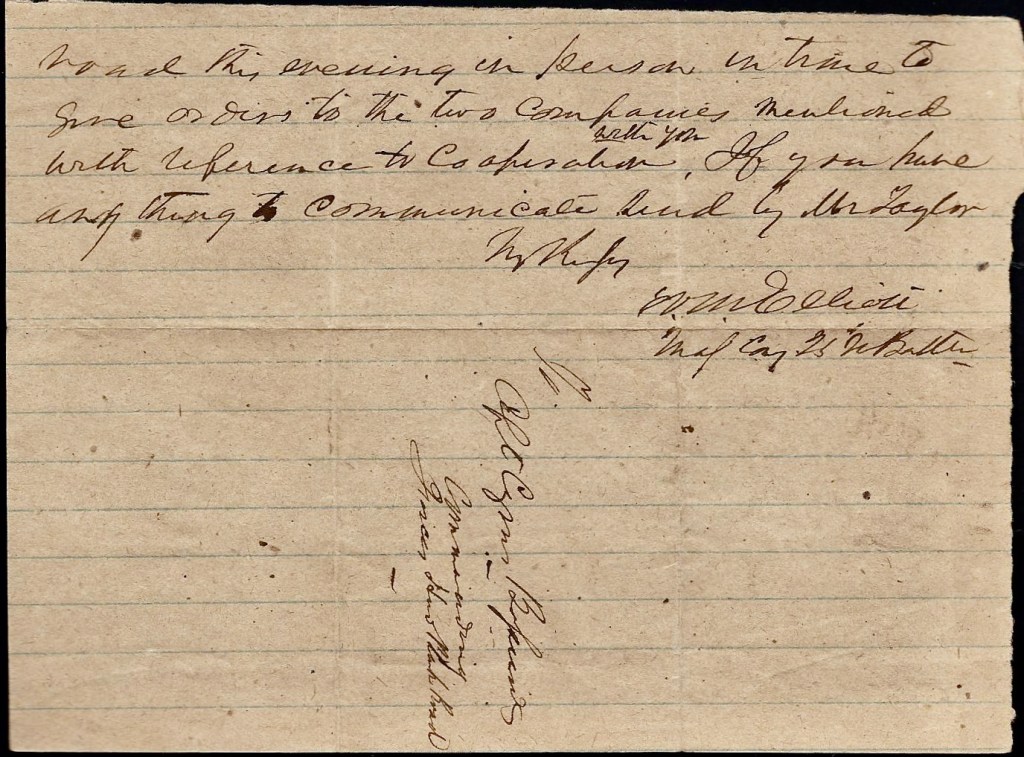
The following note was written by Maj. Wyatt Moseley Elliott (1823-1897), an 1842 graduate of the Virginia Military Institute, who commanded the 25th Virginia Battalion, otherwise known as the “Richmond City Battalion.” This battalion was organized on 15 August 1862 for service in and around Richmond by the authority of the Confederate Secretary of War, George W. Randolph. Their anticipated term of service was six months but as the war dragged on, their term was extended and they were still on duty in May 1864 when the Richmond Daily Dispatch wrote of them: “The 25th Virginia battalion, better known as the City Battalion, Col. Wyatt M. Elliott, who, since their organization, have been on duty in this city, yesterday morning moved to Chaffin’s Bluff, their place in this city being supplied by the 28th Va. battalion, Hunton’s brigade. As the City battalion passed down Main street the troops presented a really splendid appearance, and were loudly cheered by the citizens. The men are delighted with the change. The constant guard duty they had to perform here was excessively wearisome.”
Wyatt wrote the letter to Capt. Cyrus Bossieux (1835-1906) of Richmond who commanded Co. F of the battalion. He first entered the war as an enlisted man in Co. A, 1st Virginia Infantry. He also served as Capt. of Co. H in the 3rd Virginia Artillery. Reference is also made to Co.’s A & C which were commanded by Capt. John H. Greaner and Capt. W. W. Harrison, respectively.
The significance of this note is that it was written during the Battle of Chancellorsville just as the tide was turning against Hooker’s Army of the Potomac who were being pressed by McLaws and Early to push Sedgwick’s men back across the Rappahannock. Major Elliott’s placement of troops north of Richmond on the Hanover Plank Road was precautionary, not knowing the direction Sedgwick’s army intended to take after crossing the Rappahannock and overrunning the Confederate defenses at Fredericksburg the previous day.
Transcription
Richmond [Virginia] May 4th 1863 1 1/4 o’clock p.m.
Capt. C. Bossieux,
Sir, I send this note by the hand of Mr. W. O. Taylor. I have received no message from you. You will retain the position you now hold. I have ordered two companies placed at my disposal in aid of your force on the plank road to take position at the point at which you yesterday left companies A & C whose duty will be to dispute the passage of the plank road and also to be summoned to your aid in case of necessity. I will be out on the road this evening in person in time to give orders to the two companies mentioned with reference to cooperation with you. If you have anything to communicate, send by Mr. Taylor in reply.
— W. M. Elliott, Maj. Commanding 25th Va. Battalion
To Capt. Cyrus Bossieux, Commanding forces [on the] Hanover Plank Road
I could not find an image of either Ed or Dan Roberts in uniform but here is William H. Oury who served in Co. E, 20th OVI(Ancestry)
The following letter was written by 20 year-old Edward H. Roberts and his brother, 25 year-old Daniel Roberts, both privates in Co. D, 20th Ohio Volunteer Infantry (OVI). The brothers enlisted together on 3 October 1861 to serve three years. Daniel mustered out at the end of his term of service; Edward mustered out as a corporal in July 1865. They wrote the letter to their older brother, George W. Roberts (1829-1900).
The Roberts boys were the children of Morehouse Roberts (1790-1847) and Susannah Newman (1806-1898) of Delaware county, Ohio. I previously transcribed an 1863 letter by Daniel Roberts which can be found at—1863: Dan Roberts to George W. Roberts.
The 20th OVI was organized at Columbus, from Aug. 19 to Sept. 21, 1861, to serve for three years. During the winter it was employed in guarding several batteries in the rear of Covington and Newport, Ky. In February 1862, a month after this letter was written, it participated in the battle of Fort Donelson, Tenn., “with no little credit to every man. It also participated in the battle of Shiloh, with considerable loss, and it is fully entitled to a share in the glory of that victory.”
Transcription
City Barracks Cincinnati, Ohio January 21, 1862
Dear Brother,
I now will take up my pen and try to write you a few lines to let you know we are all well. I hope these lines will find you and family the same. Well George, I am almost ashamed to try to write to you. it has ben so long since I have written to you. I wrote you a letter before I went to Illinois. I did not get no answer from it. It was not the reason which I did not write. It was that I was such a poor writer and I would hear from you every little while from home so I thought if you wanted to hear from me, you would write to me. You must excuse me this time and I will do better next time.
Our regiment has come back to the City Barracks. I expect we will stay here awhile. It may be that we will stay here till spring. We came here last week. We did not do any fighting when we was in Kentucky.
I would druther be in our tents than here. We are kept in like prisoners here. Ed and Tip is well and hearty. Ed is as fat as he can hardly be. Well, George, he eats a nuff, if that will make anybody fat. We have plenty to eat such as it is.
We hear from home every week. They was well last week. George, you orty [ought to] see Giles. You would not know him. He is about as tall as Old Calwell . I don’t think I ever saw a boy grow as fast in my life as he did while I was gone to Illinois. Well, George, if he is tall, he is awful good boy. He is very hard working boy.
I was home two weeks last fall. He worked hard all the time while I was home. He is very good to Mother. I am going home as soon as I can get a furlough. Ed was home while we was in Kentucky.
I got a letter from our neighborhood last week. They say that Melissa Clark is getting very fat. I can’t hardly believe it. We have not heard from Benjamin and John for about a month. They was at Cairo then. They was both doing duty then. We wrote to them about three weeks ago and have not heard from them yet.
Well, George, I guess Jim Herron 1 has got dinner ready and I must go and help him get rid of some of it. No more at present. Please write soon.
Dan wanted me to write a few lines but he has written all the news so I will not write anymore. Please write soon and direct to City Barracks, Cincinnati, Ohio, Co. D, 20th Regt. Ohio Vol. [Infantry], USA
Your brothers, — Ed and Dan
1 James J. Herron was killed in the Battle of Bolivar, Tennessee, in August 1862.
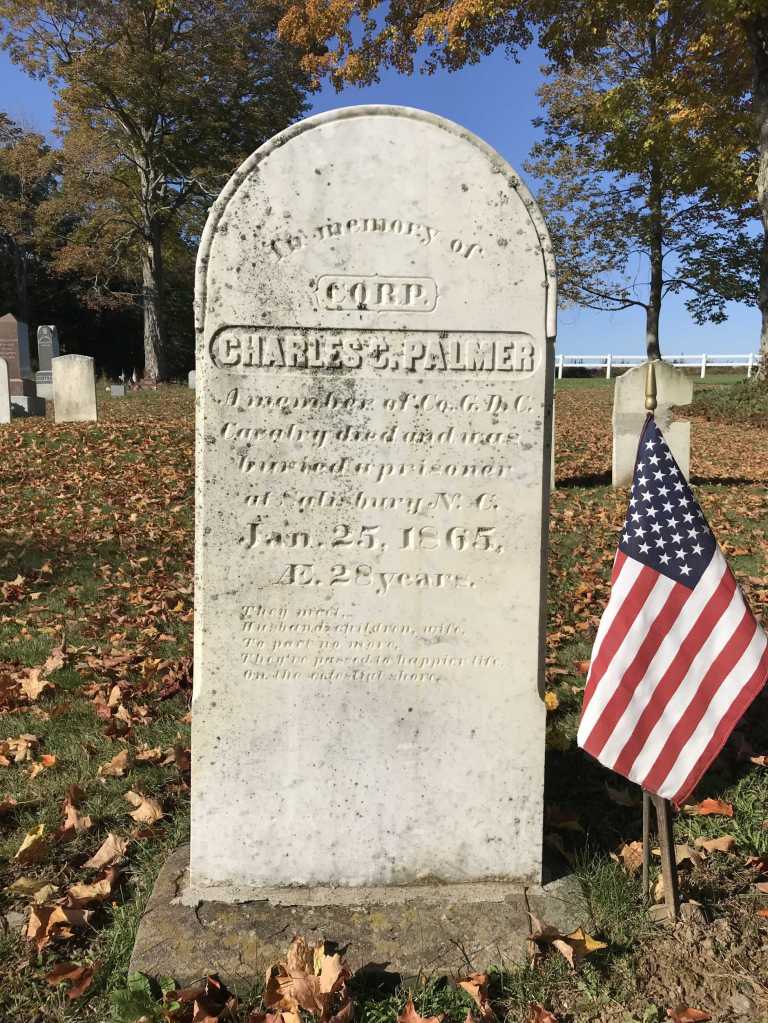
“I have letters of Civil War soldier Charles C. Palmer of Exeter Maine to his sisters. Charlie served in the 1st Maine Cavalry in Washington DC and then in Virginia. He was captured in late 1864 and died at Salisbury prison in January 1865. Would you like to take a look at his letters from Camp Butler and Fredericksburg?” So wrote Kathleen Mikaelian to me recently after discovering the box of letters among her husband’s family heirlooms. She later told me that she hoped to keep Charley’s history alive by showcasing his letters on Spared & Shared.
Charles C. Palmer, 1st D. C. Cavalry
Charles C. Palmer (1837-1865) was the son of William Palmer (1789-1865) and Susanna Treadwell (1793-1864) of Exeter, Penobscot county, Maine. He was married in October 1858 to Nancy Jane (“Jennie”) Neal (1838-1863), was childless and working as a miller in Exeter when he enlisted as a corporal in Co. L, 1st Maine Cavalry early in the war. After this initial stint in the service, Charlie returned to Exeter where tragedy greeted him. In October 1863, Charlie’s wife delivered stillborn twins and suffered so much physically and emotionally that she died two months later, leaving a grieving husband to mourn the loss of his entire family. With nothing to hold him in Exeter any longer, Charlie left his teaching job and re-entered the service, this time in Co. G, 1st District of Columbia Cavalry. His muster date was given as 19 February 1864 at which time he was described as 24 years old, standing 5 foot 11 inches tall, with hazel eyes and brown hair.
Charlie was no long with the D. C. Cavalry when he was promoted to corporal. Except for a period of time when he was hospitalized at the Point of Rocks in mid-summer, Charlie appears to have been with his regiment though he may have found it dull at times. So much so that on 25 May 1864 he was known to have sent a letter to General George F. Shepley requesting special duty. His letter was found in military records and reads as follows:
Camp Conger, 20 May 1864 General Shepley, Sir, I trust you will pardon me for intruding upon your much valued time. But my object in so doing is to see if through you or your influence I can obtain a position on one of the many confiscated plantations under your jurisdiction, and if not, some other position which may be of better advantage to me and also serve my country truly for I would scorn the thought of trying to obtain any position where I could not serve my country in this her hour of peril. I am a native of Exeter, Maine, and for the few years past have been engaged in teaching. But in my younger years was a farmer’s boy. If you wish for any recommendations, I can get them and good too in my own regiment—and also from many influential men in Maine, among them Adjt. General Hodson. But if I get anything, I had rather my own merit would claim it as rightly its own. I came into my company after it was organized and am now corporal.
I trust you will give this note due consideration and shall hope soon to hear from [you]. But yet I know that your time must well nigh be occupied and labors hard. Yours respectfully, — Charles C. Palmer, 1st D. C. Cavalry.
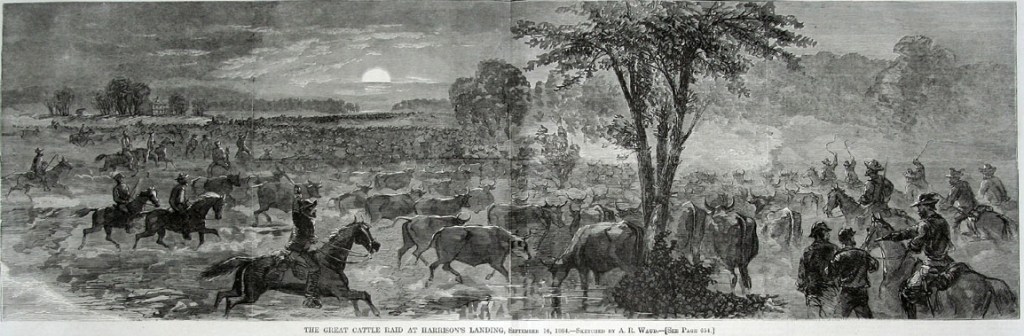
The position Charley sought was to oversee the work on one of the many plantations in Virginia that were being operated by the Federal government to employ the slaves who had come under federal protection. School for the freedmen were also being set up on or near these plantations. It does not appear that Charlie was ever offered such a position and his aspiration for such an assignment may have waned when he became ill later in the summer. It seems he remained with his regiment until 16 September 1864 when he was taken prisoner at Sycamore Church, six miles below City Point on the James River, along with other members of the 1st D. C. Cavalry who were caught by surprise in their beds by Confederate Major General Wade Hampton in what has come to be known as the Great Beefstake Raid. In 30 minutes, the Confederates killed, wounded, or captured 219 startled troopers. Charlie was initially confined in Richmond but then sent to Danville on 24 September and admitted to the hospital at Salisbury, North Carolina, on 31 December 1864 suffering from chronic diarrhea. He died on 26 January 1865.
Waud’s sketch of the Great Beefstake Raid, 16 September 1864
Letter 1
Camp Butler, Virginia May 3rd 1864
Beloved sisters,
Your kind and welcome letters came to hand this morning and was glad to hear from you both again. I did not receive any mail from the time I left Washington until today and then I get 11 letters and this is the last I have to answer. We have not been here but a few days yet our work has been very hard, there being but a few troops here and the Rebs have been trying to break our center but in vain. We have lost but a few men and only one from our regiment.
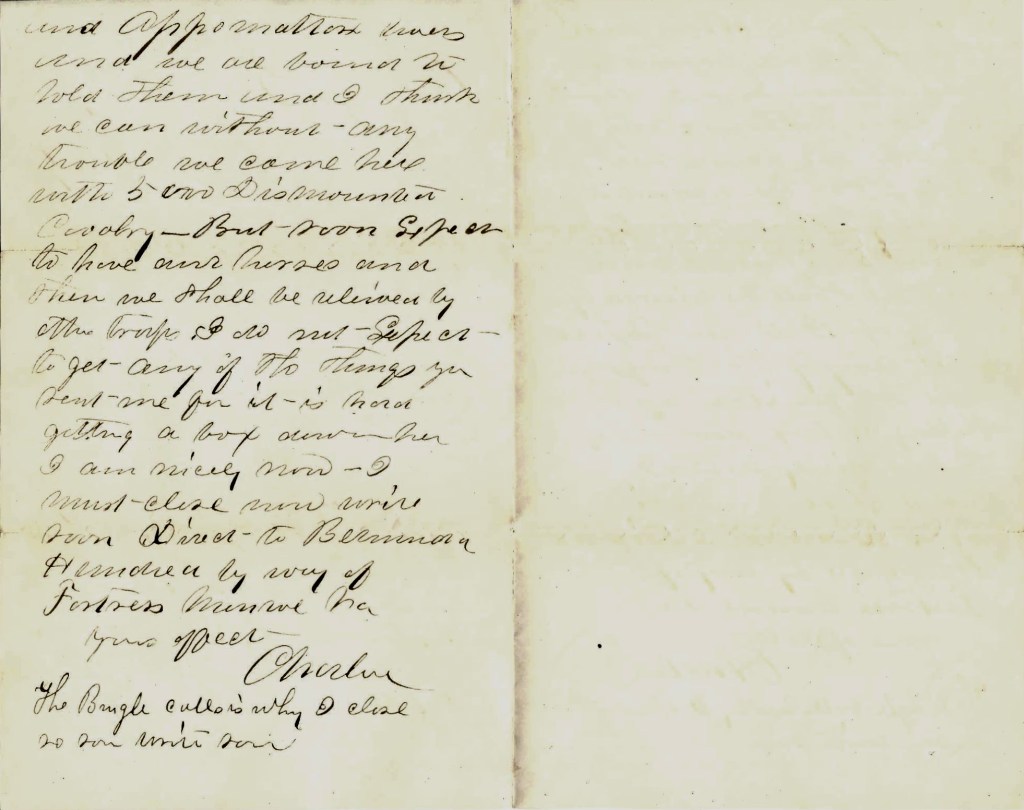
I like it much and am glad that I am here. We have a line of defenses on the James and Appomattox rivers and we are bound to hold them and I think we can without any trouble. We came here with 5,000 dismounted cavalry but soon expect to have our horses and then we shall be relieved by other troops. I do not expect to get any of the things you sent me for it is hard getting a box down here.
I am nicely [situated] now. I must close now. Write soon. Direct to Bermuda Hundred by way of Fortress Monroe, Va.
Yours affectionately, — Charley
The bugle’s call is why I close so soon. Write soon.
A cenotaph in Exeter Maine to the memory of Charles C. Palmer
The following letter was written by William Duffield McIlvaine (1839-1916), the son of George D. McIlvaine (1805-1849) and Sarah Stauffer (1810-1901) of Gap, Lancaster county, Pennsylvania. After the war, in 1870, William married Mary Elizabeth Warren (1840-1917) in Milwaukee, Wisconsin, while working as a salesman. By 1880 he was living in Chicago employed as a clerk in a shot manufacturer’s establishment. He died in Oak Park, Illinois.
William wrote the letter to his sister, Sarah Jane McIlvaine (1837-1921) who was about to marry Charles Blanchard Seely (1824-1901), a real estate broker of East Liberty, Pittsburg.
In the 1860 US Census, William was enumerated in his mother’s household in Salisbury (Gap Post Office) in Lancaster county, Pennsylvania. His occupation was given as “machinist.” The first notice I can find of him serving in the US Navy was in March 1862 when he was assigned to the steam sloop Oneida. He served aboard this vessel until some time in 1864. Five of his letters were transcribed and published on Spared & Shared in May 2022. See—1862-64: William Duffield McIlvaine to Sarah Jane Duffield.
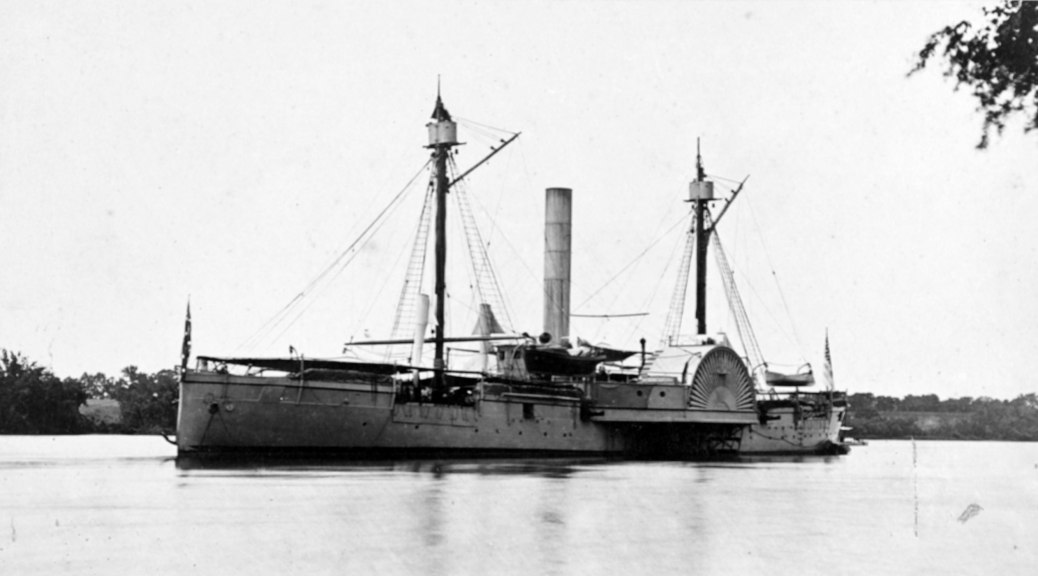
The only record I can find on Fold 3 is a letter William addressed to Secretary of the Navy Gideon Wells on 16 January 1865 (see below) in which he acknowledges the receipt of orders assigning him to duty aboard the USS Agawam as a 2nd Assistant Engineer.
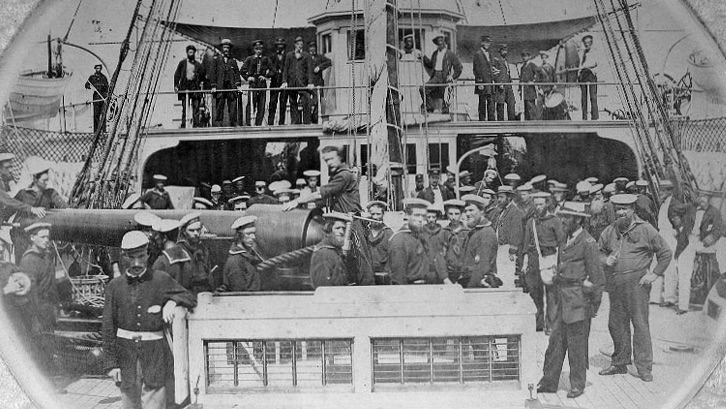
Ship’s officers and crewmen pose onboard the deck of the USS Agawam in August 1864 in the James River. Commander Alexander C. Rhind, ship’s Commanding Officer, is at the extreme right with his foot on the ladder. Standing next to him is Assistant Surgeon Herman P. Babcock. Lieutenant George Dewey is in the right center, wearing a straw hat, directly below the end of the davit. The pivot gun is one of the ship’s two 100-pounder Parrot rifles. Note Marine in the left foreground. Collection of Surgeon Herman P. Babcock, USN. Donated by his son, George R. Babcock, 1939. U.S. Naval Historical Center Photograph.
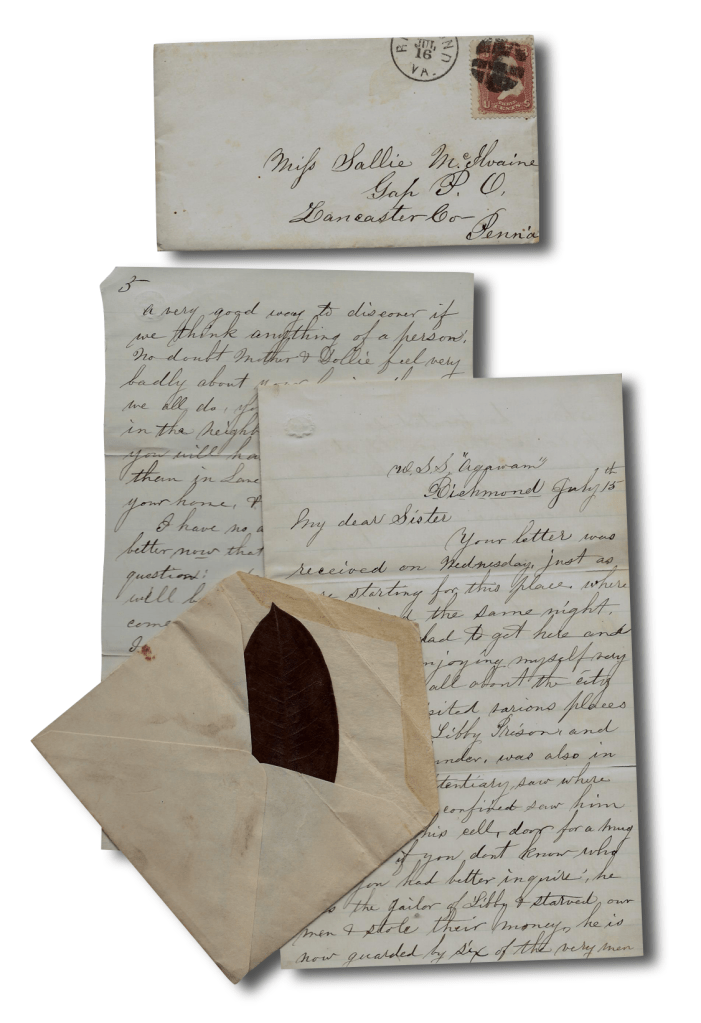
Transcription
USS Agawam Richmond, [Virginia] July 15 [1865]
My dear sister,
Your letter was received on Wednesday, just as we were starting for this place where we arrived the same night. I am very glad to get here and have been enjoying myself very much. Rode all about the city yesterday, visited various places, was through Libby Prison and at Castle Thunder. Was also in the State Penitentiary [and ] saw where Dick Turner is confined. Saw him reach above his cell door for a mug of water. If you don’t know who he is, you had better enquire. He was the jailor of Libby & starved our men & stole their money. He is now guarded by six of the very men whom he treated so badly as prisoners. They would starve him if let alone. He is getting well paid for all his crimes I am convinced and will probably swing one of these days. 1
I had not been ashore long before I found my old friend and schoolmate Jere Horton who is on duty with the army here. He has lots of horses and wagons at his service so I can ride when or where I please. I had a very good time yesterday and expect to have some more next week. Was at Jeff Davis’s home, saw Gen. Lee’s house, was in the State House, and in fact almost everywhere. Coming up the river, saw all the fortifications and Dutch Gap Canal, which is a very small affair—contemptible. We had to run very slowly to keep off of piles, old vessels, rams, &c. sunk in the river all the way up here from City Point. On both sides of the river the banks are covered with earthworks and heavy forts. The ground seems to have been dug all over. I can truly appreciate the great work an army had to overcome to get to Richmond. Don’t think they could ever get in any other way than by cutting off the enemy’s supplies.
Jeff Davis Home in Richmond as it appeared in 1865
I am very much pleased with Richmond. It is, or has been a fine place situated on a hill in a very pretty country—scenery almost equal to Lanc. county. One can see many miles any direction from the Capitol. The river is much lower than the city and is small and narrow. There are a great many fine residences here and much shrubbery, trees, &c. A very pretty public square and I could give you no idea of all there is to be seen. One cannot look any way without seeing some house or object he has not read of during the past four years. I got some leaves from Jeff Davis’s yard and and some small stones from out of Libby Prison. I got a nice piece of grey cloth such as rebel uniforms were made of in the penitentiary where it was woven. I thought it might do to work something out of—tis only a few inches squarre. We will be here a week yet, I guess. 2
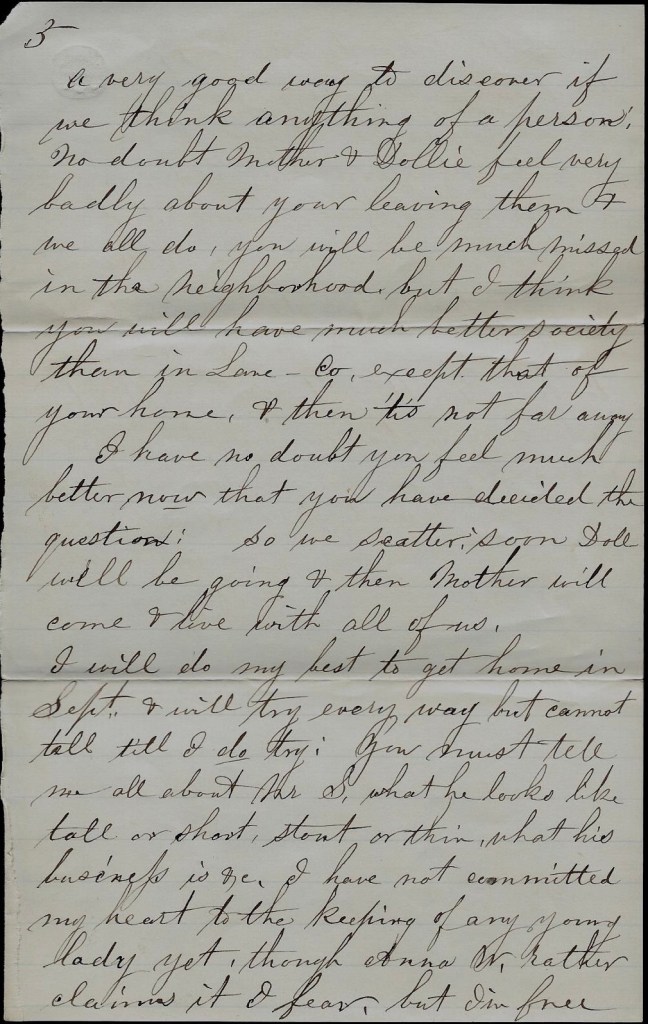
What must I say about the great news you wrote me. One naturally feels sad, at first thought, of a member of the family taking a new name and leaving home. One is apt to think she will be less to them than before. It is a new experience for our family & we rather shrink from it. On the other hand, I am happy at the prospect of your entering into this new relation and of your having a home and someone to love, for it is the natural way of living. And I pray and believe you will be happy. Of course you love the man and perhaps found it out when you got home & saw no more of him, which is a very good way to discover if we think anything of a person. No doubt Mother and Dollie feel very badly about your leaving them & we all do. You will be much missed in the neighborhood, but I think you will have much better society than in Lanc. County, except that of your home, & then ’tis not far away.
I have no doubt you feel much better now that you have decided the question. So we scatter. Soon Doll will be going & then Mother will come & live with all of us.
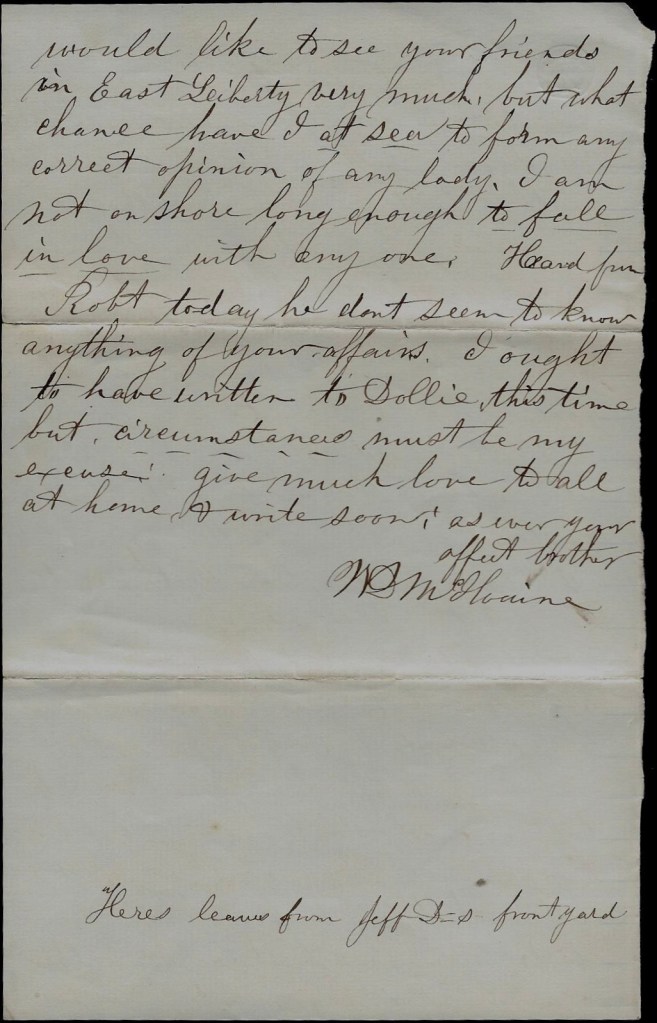
I will do my best to get home in September and will try every way but cannot tell till I do try. You must tell me all about Mr. S[eelly]. What he looks like—tall or short, stout or thin? What his business is, &c. I have not committed my heart to the keeping of any young lady yet, though Anna W. rather claims it I fear. But I’m free. Would like to see your friends in East Liberty very much but what chance have I at sea to form any correct opinion of any lady. I am not ashore long enough to fall in love with anyone.
Heard from Robert today. He don’t seem to know anything of your affairs. I ought to have written to Dollie this time but circumstances must be my excuse. Give much love to all at home & write soon. As ever, your affectionate brother, — W. McIlvaine
Here’s leaves from Jeff Davis’s front yard.
1 The Encyclopedia Virginia informs us that, “Libby Prison’s commandant, Major Thomas Pratt Turner, had been a student at the Virginia Military Institute in Lexington and then at the United States Military Academy at West Point. He left West Point in 1860, refusing to “swear allegiance to, a Government I despise and abhor.” He was described by one inmate as a man whose “utter depravity seems to have gained a full and complete expression in every lineament of his countenance.” Inmates, however, often confused Turner with another Libby official, Richard Randolph “Dick” Turner, no relation [another source says they were cousins], who was universally despised and singled out by U.S. secretary of war Edwin M. Stanton, in November 1865, for investigation into the criminal treatment of prisoners.“ It appears that Dick Turner was commissary at the prison and referred to as the “jailor.” Though Thomas Turner escaped when Richmond fell, Dick Turner was captured and held in Libby Prison for a few days until he escaped. He was caught again later and held at the State penitentiary where McIlvaine wrote that he saw him in Richmond, but he was paroled in June 1866.
This view of Libby prison was taken by [Charles R.] Rees in August of 1863. It is one of only two wartime images of the prison known to exist. The four men in the foreground are William D. Turner, Erasmus Ross, prison clerk, Richard Turner, jailor and Thomas Turner, Commandant.
2 Curiously McIlvaine makes no mention of the destruction in much of the business district in the city caused by the fires set by Lee’s retreating army. The Union army is often mistakenly accused of burning Richmond but the fires were actually set by Lt. Gen. Richard S. Ewell, Richmond’s military commander, who was ordered to destroy all of the liquor in the city and also all of the government stores. The fires were so extensive that they got out of control and burned much of the business district. Union soldiers arriving in the city attempted to put the fires out but a sudden change in the wind direction was the only thing that really saved the destruction of the entire city.
The following letter was written by 33 year-old Elisha Bell (1806-Aft1860), a native of Mississippi, who appears to have been the overseer of a Mississippi sugar cane plantation at Honey Island on the Yazoo River some 75 miles northeast of Vicksburg. Elisha was the son of John Purver Bell, Jr. (1761-1824) and Elizabeth Hunter (1775-1828) of Wilkinson county, Mississippi. By 1850, Elisha had his own plantation in Tchula, Holmes county, Mississippi, and owned as many as 47 slaves. By 1860, his slave count had dropped to 27.
Elisha addressed the letter to Dr. Lloyd Warfield (1799-1872) who was either his employer or his partner in the Honey Island plantation. Lloyd was the son of Elisha Warfield (1744-1818) and Ruth Burgess (1763-1835). Lloyd was a physician in Lexington, Kentucky. By 1850, his estate in Fayette county, was valued at $23,500 which included as many as 10 slaves. By 1860, it was valued at $60,000 (over $2 million dollars today). Dr. Warfield was married to Mary Barr and they had several children. Three of their sons served in the Confederate army. Lloyd and Edward ride with General Forrest, and Henry with General John H. Morgan.
Elisha’s letter speaks of the hard times in Mississippi in 1839, as it was across the whole of the United States following the Panic of 1837. He discusses the need to purchase more slaves for the work on the plantation that appears to have been the raising and milling of sugar cane, along with the auxiliary business of making rope from the baggasse. Elisha’s spelling is typical of a limited opportunity education.
Transcription
Stampless cover addressed to Dr. Lloyd Warfield, Lexington, Kentucky Postmarked Tchula, Mississippi
Honey Island April 2nd, 1839
Dear Sir,
Yours of the 15th of March was received a few days ago. We are all well at this time and getting on finely. Our corn is all up and growing finely. We have our cotton land all ready for planting and will commence planting cotton the 4th of this month. I have had our woman spinning for some time and have got a good deal of spinning done. I endeavor to make all of our summer clothing next year and also raise all of our pork. Our stock is in [ ] finally.
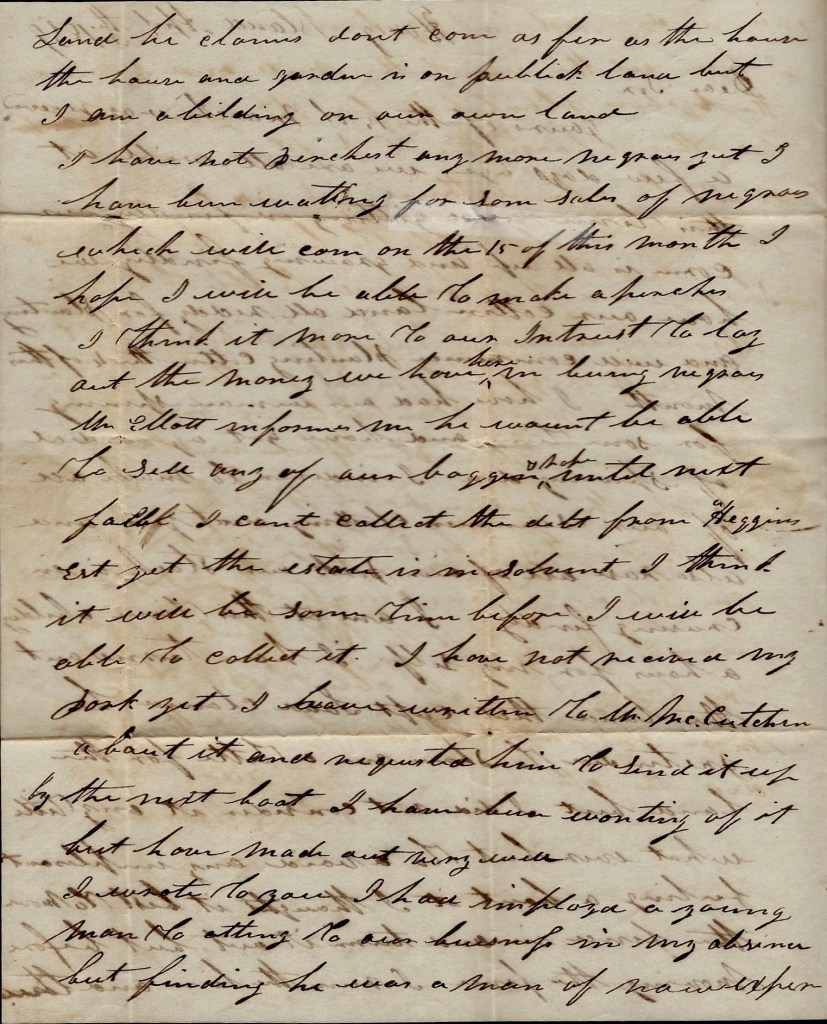
I am at this time a building a house for myself. I have turned out the land that Capt. Lord claimed. He pretended to shave me a little for the land but I did not consider it any little whatever but to avoid any unpleasant feeling about it, I thought it best to move the fence in and turn it out but before moving the fence, I run the line and their land, he claims, don’t come as far as the house. The house and garden is on public land but I am a building on our own land.
I have not purchased any more negroes but I have been waiting for sales of negroes which will come on the 15th of this month. I hope I will be able to make a purchase. I think it more to your interest to lay out the money we have here in buying negroes. Mr. Elliott informs me he won’t be able to sell any of our baggasse & rope until next fall. I can’t collect the debt from Heggins jest yet—the estate is insolvent. I think it will be some time before I will be able to collect it. I have not received my pork yet. I have written to Mr. McCutchen about it and requested him to send it up by the next boat. I have been wanting of it but have made out very well.
I wrote to you I had employed a young man to attend to our business in my absence by finding he was a man of no experience, I did not employ him.
I have got the use of the mill and gin on the Archer’s Plantation for this year. No other charge than to keep it in order. It will be a fine thing for us this year as we would not be able to build before next spring and then we will be able to build.
It is very distressing times in Mississippi at this time with regard to money matters. I heard of a great many planters being broke up after having their plantations in order for a crop. The negroes drove off by the sheriff and sold. They was some very cheap sales on yesterday in our county but I did not hear of them until too late. But I am in hopes I will be able to purchase two or three more on much better terms than we did the others.
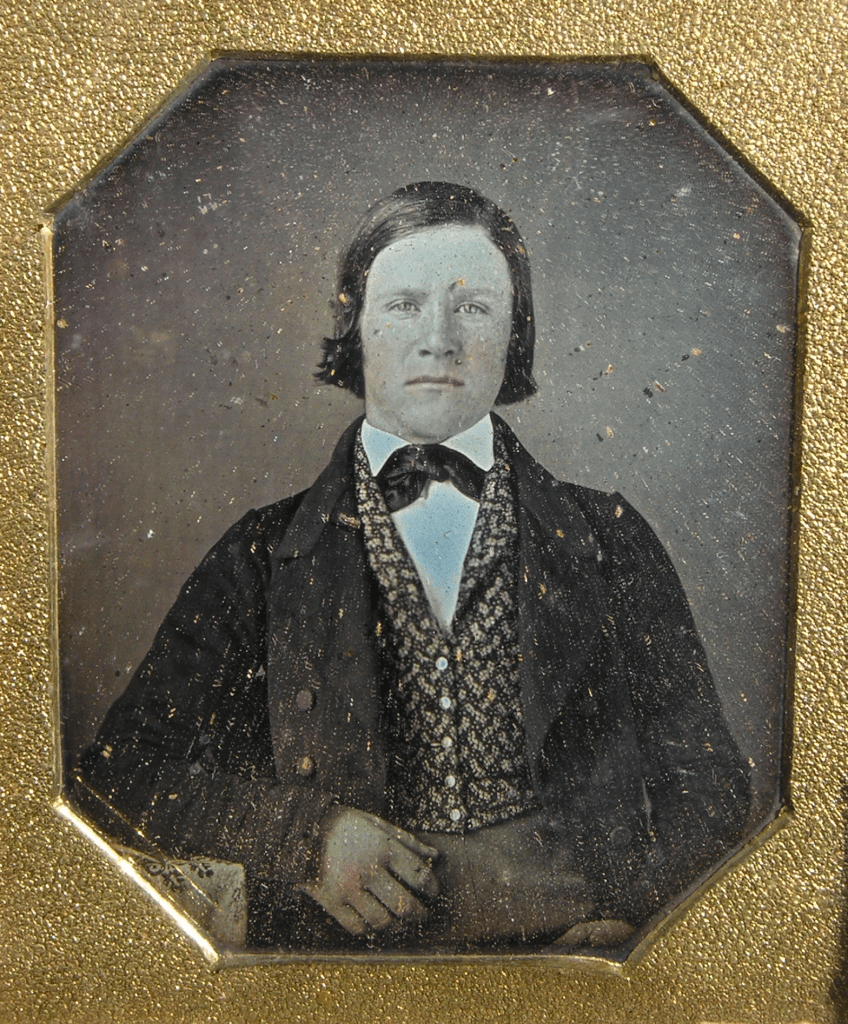
The following letter was written by 19 year-old H. C. Mead of Warren county, New York. Unfortunately I have not been able to establish his identity further though I suspect he was the same H. C. Mead who booked passage to California in 1855 and returned to New York City in July 1863. My hunch is that his father was Joseph E. Mead (1804-1878) but I have not yet found any record to prove it.
The letter was written in late October 1846 from the residence of Mead’s uncle, Erastus Lake (1794-1889), the husband of Erna Mead (1801-1870) in Allen, Hillsdale county, Michigan. Erastus and Erma were married in 1823 in Warren county, New York, lived for a time in Erie county, New York, and then settled in Michigan in 1837. Erastus’s father was William Lake (1759-1848) and his mother was Mary Perkins (1767-1859). Erastus’ & Erna’s oldest daughter, Laura A. Lake (1825-1857) was married to Lorenzo D. Halsted (1821-1906) and resided in Coldwater, Michigan. She is mentioned in the letter, as well as Hancie Leggett Lake (1827-1870) and their two younger boys, William Fitzgerald Lake (1829-1924) and Charles W. Lake (1832-1915).
Mead’s letter contains a good description of traveling from New York to Michigan, by way of a steamer on Lake Erie from Buffalo to Toledo, and by railroad from Toledo to Hillsdale.
Transcription
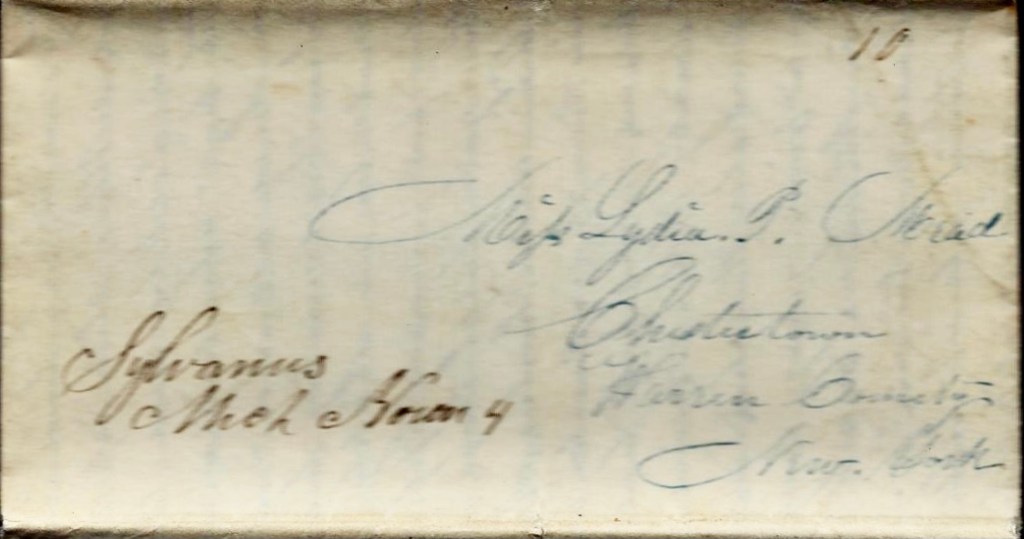
Stampless cover of 1846 letter addressed to Miss Lydia Mead, Chestertown, Warren county, New York
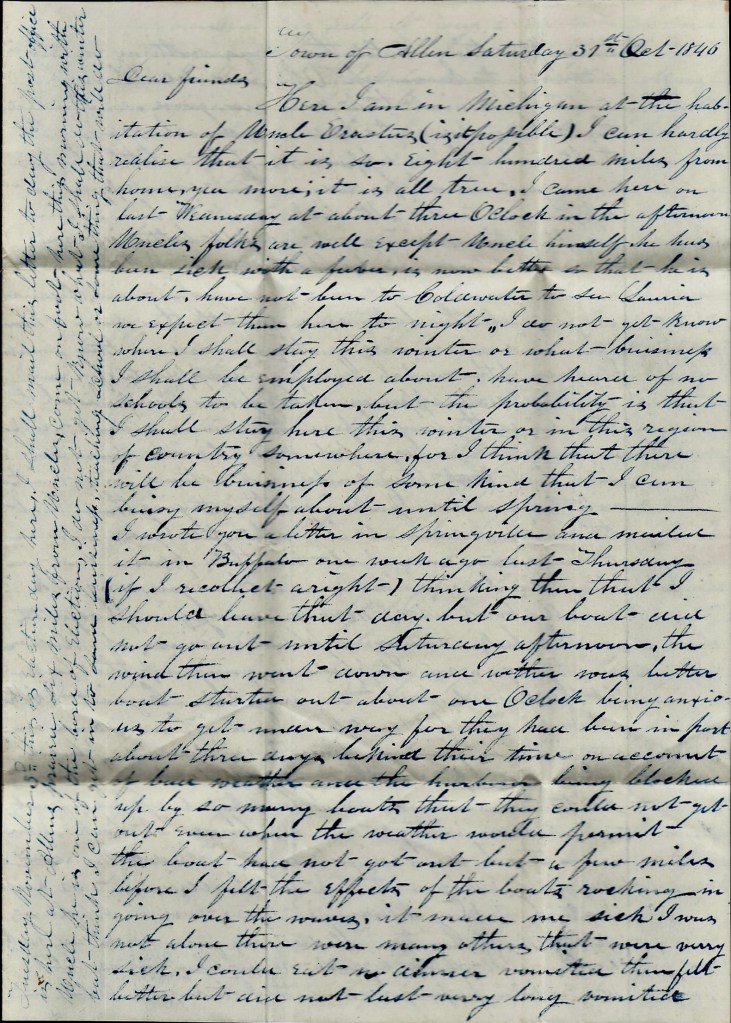
Town of Allen Saturday 31st October 1846
Dear friends,
Here I am in Michigan at the habitation of Uncle Erastus (is it possible?). I can hardly realize that it is so. Eight hundred miles from home, yea more; it is all true. I came here on last Wednesday at about three o’clock in the afternoon. Uncle’s folks are well except Uncle himself. He has been sick with a fever, is now better so that he is about. Have not been to Coldwater to see [cousin] Laura. We expect them here tonight. I do not yet know where I shall stay this winter or what business I shall be employed about. Have heard of no schools to be taken, but the probability is that I shall stay here this winter or in this region of country somewhere for I think that there will be business of some kind that I can busy myself about until spring.
I wrote you a letter in Springville and mailed it in Buffalo one week ago last Thursday (if I recollect aright) thinking then that I should leave that day but our boat did not go out until Saturday afternoon. The wind then went down and weather was better. The boat started out about one o’clock, being anxious to get under way for they had been in port about three days behind their time on account of bad weather and the harbor being blocked up by so many boats that they could not get out even when the weather would permit.
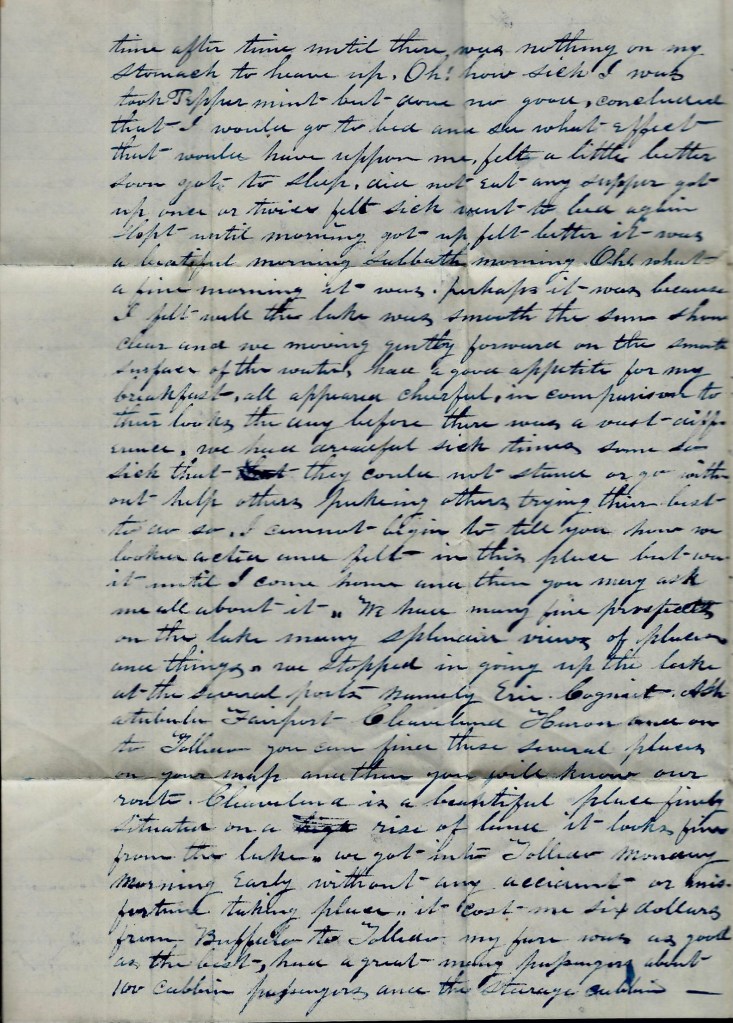
The boat had not got out but a few miles before I felt the effects of the boats rocking in going over the waves. It made me sick. I was not alone. There were many others that were very sick. I could eat no dinner. Vomited, then felt better but did not last very long. Vomited time after time until there was nothing on my stomach to heave up. Oh! how sick I was. Took peppermint but done no good. Concluded that I would go to bed and see what effect that would have upon me. Felt a little better [and] soon got to sleep. Did not eat any supper. Got up once or twice, felt sick [and] went to bed again. Slept until morning. Got up, felt better.
It was a beautiful morning—Sabbath morning. Oh! what a fine morning it was. Perhaps it was because I felt well. The lake was smooth, the sun shone clear, and we moving gently forward on the smooth surface of the water. Had a good appetite for my breakfast, all appeared cheerful. In comparison to their looks the day before, there was a vast difference. We had dreadful sick times—some so sick that they could not stand or go without help. Others puking, others trying their best to do so. I cannot begin to tell you how we looked, acted, and felt in this place but wait until I come home and then you may ask me all about it.
We had many fine prospects on the lake—many splendid views of places and things. We stopped in going up the lake at the several ports, namely Erie, Conneaut, Ashtabula, Fairport, Cleveland, Huron, and on to Toledo. You can find these several places on your map and then you will know our route.
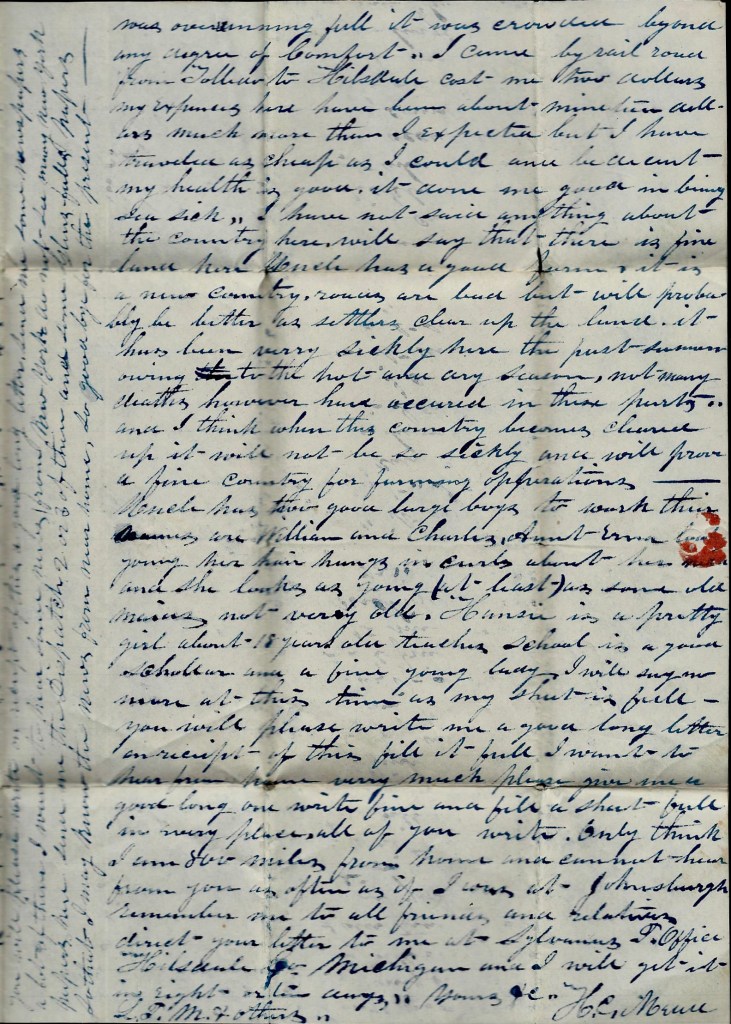
Cleveland is a beautiful place finely situated on a rise of land. It looks fine from the lake. We got into Toledo Monday morning early without any accident or misfortune taking place. It cost me six dollars from Buffalo to Toledo. My fare was as good as the nest. Had a great many passengers—about 100 cabin passengers and the steerage cabin was overrunning full. It was crowded beyond any degree of comfort.
I came by railroad from Toledo to Hillsdale. Cost me two dollars. My expenses here have been about nineteen dollars—much more than I expected, but I have travelled as cheap as I could and better and my health is good. It done me good in being sea sick.
I have not said anything about the country here. Will say that there is fine land here. Uncle has a good farm. It is a new country [and] roads are bad but will probably be better as settlers clear up the land. It has been very sickly here the past summer owing to the hot and dry season. Not many deaths, however, have occurred in these parts, and I think when this country becomes cleared up, it will not be so sickly and will prove a fine country for farming operations.
Uncle has two good, large boys to work. Their names are William and Charles. Aunt Erna looks young—her hair hangs in curls about her neck and she looks as young (at least) as some old maids not very old. Hansie is a pretty girl about 18 years old, teaches school, is a good scholar, and a fine young lady. I will say no more at this time as my sheet is full.
You will please write me a good long letter on receipt of this. Fill it full. I want to hear from home very much. Please give me a good long one. Write fine and fill a sheet full in every place. All of you write. Only think, I am 800 miles from home and cannot hear from you as often as if I was at Johnsburgh. Remember me to all friends and relatives. Direct your letter to me at Sylvanus Post Office, Hillsdale County, Michigan and I will get it in eight or ten days. Yours &c., — H. C. Mead
You will please write on receipt of this a good long letter. Send me some newspapers—a lot of them. I want to hear some news from New York. I do not see many New York papers here. Send me the Dispatch, 2 or 3 of them, and some Glens Falls papers so that I may know the news from near home. So goodbye for the present.
Tuesday, November 3rd. This is election day here. I shall mail this letter today. The post office is here at Allen’s Prairie six miles from Uncle’s. Come on foot here this morning with Uncle. He is on the Board of Elections. I do not yet know what I shall do this winter but think I can get into some business, teaching school, or something that will do.






























 Spared & Shared 23