My passion is studying American history leading up to & including the Civil War. I particularly enjoy reading, transcribing & researching primary sources such as letters and diaries.
The following letter was only signed “Elisha” but clues in the letter enabled me to confidently conclude that it was written by Elisha Oaks Drake (1821-1901), a former shoemaker residing in Livermore, Maine. Elisha was married to Zibeah Cary (1812-1892) in August 1845. Their 16 year-old son, William “Henry” Drake (1848-1930) is mentioned in this letter.
When he was 41 years old, Elisha enlisted on 29 August 1862 to serve as a private in Co. C, 20th Maine Infantry. One source gives his discharge date as 15 June 1864 but this must be an error because this and other letters I’ve found on-line written by Elisha were written after that date. The 1890 Veterans Schedule gives his discharge date as June 1865 indicating that he served two years and ten months.
Historians will recall that the 20th Maine was most famous for its defense of Little Round Top at the Battle of Gettysburg on 2 July 1863. Records indicate that Elisha was with his company that day and was not wounded.
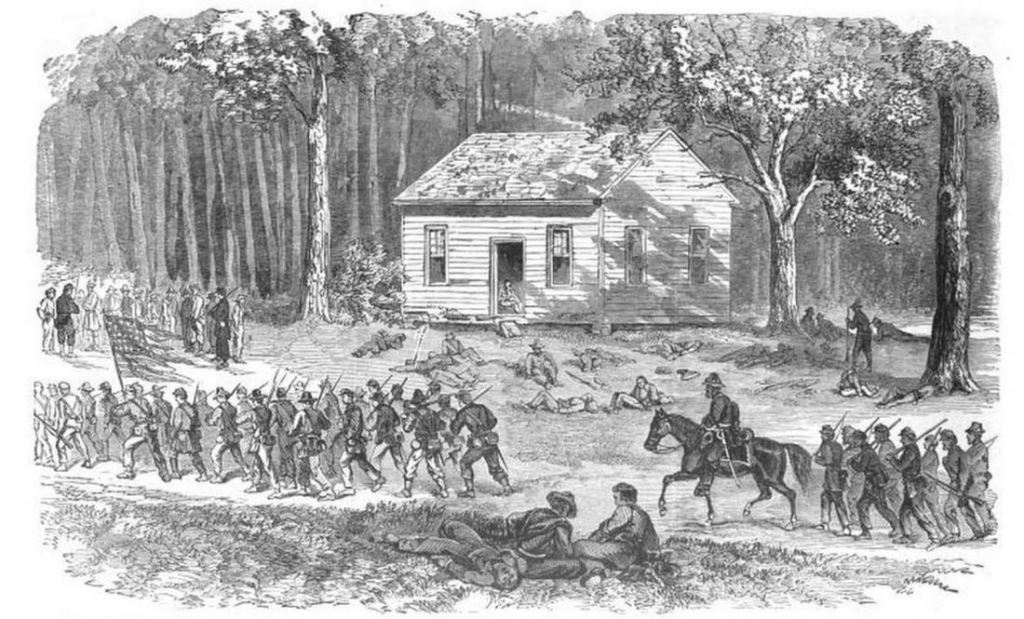
We learn from Elisha’s letter that the 20th Maine had just entered camp near the Poplar Grove Church (sometimes referred to as the Poplar Springs Church.
Poplar Springs Church, a Woodcut in Frank Leslie’s Oct 22, 1864 issue
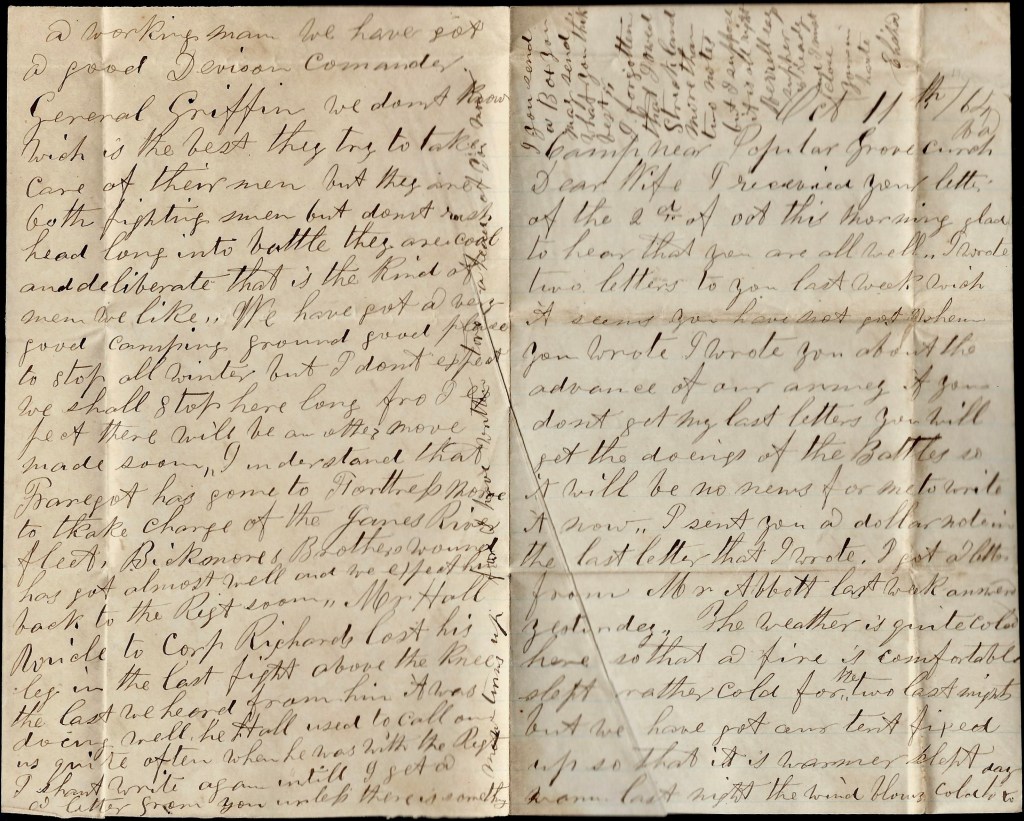
Transcription
Camp near Poplar Grove Church, Va. October 11th 1864
Dear Wife,
I received your letter of the 2nd of October this morning. Glad to hear that you are all well. I wrote two letters to you last week which it seems you have not got when you wrote. I wrote you about the advance of our army. If you don’t get my last letters you will get the doings of the battles so it will be no news for me to write it now. I sent you a dollar note in the last letter that I wrote. I got a letter from Mr. Abbott last week. Answered yesterday.
The weather is quite cold here so that a fire is comfortable. Slept rather cold for the two last nights but we have got our tent fixed up so that it is warmer. Slept very warm last night. The wind blows cold. Frost last night. Will be tonight if the wind goes down.
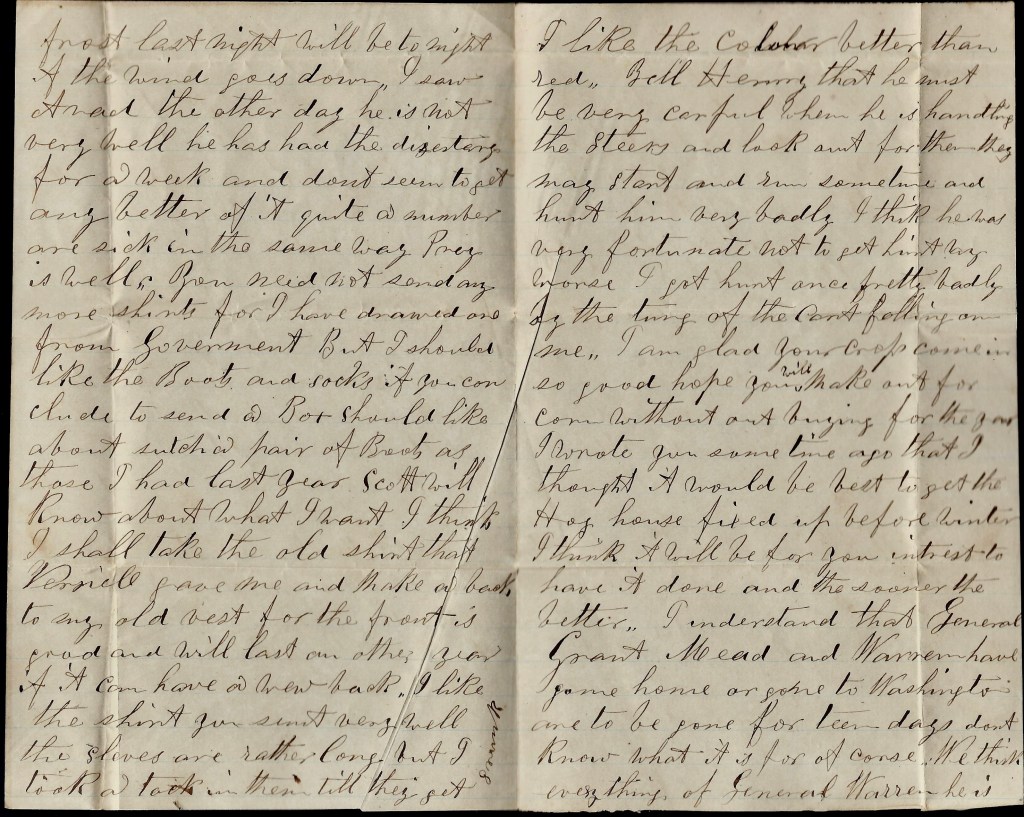
I saw Arad [Thompson] the other day. He is not very well. He has had the dysentery for a week and don’t seem to get any better of it. Quite a number are sick in the same way. Prez is well. You need not send any more shirts for I have drawed one from government. But I should like the boots and socks if you conclude to send a box. Should like about such a pair of boots as those I had last year. Scott will know about what I want. I think I shall take the old short that [Moses F.] Vernell gave me and make a back to my old vest for the front is good and will last another year if it can have a new back. I like the shirt you sent very well. The sleeves are rather long but I took a tack in them till they get shrunk. I like the color better than red.
Tell [our son] Henry that he must be careful when he is handling the steers and look out for them. They may start and run sometime and hurt him very badly. I think he was very fortunate not to get hurt any worse. I got hurt once pretty badly by the tung of the cart falling on me. I am glad your crop come in so good. Hope you will make out for corn without buying for the year. I wrote some time ago that I thought it would be best to get the hog house fixed up before winter. I think it will be for your interest to have it done and the sooner the better.
I understand that General Grant, Meade, and Warren have gone home or gone to Washington, Are to be gone for ten days. Don’t know what it is for of course. We think everything of General Warren. He is a working man, We have got a good Division Commander—General Griffin. We don’t know which is the best. They try to take care of their men but they are both fighting men but don’t rush head long into battle. They are cool and deliberate. That is the kind of men we like.
We have got a very good camping ground. Good place to stop all winter but I don’t expect we shall stop here long for I expect there will be a move made soon. I understand that Farragut has gone to Fortress Monroe to take charge of the James River fleet.
Bickmore’s brother’s wound 1 has got almost well and we expect him back to the regiment soon. Mr. Hall, uncle to Corp. Richards lost his leg in the last fight above the knee. The last we heard from him it was doing well. He (Hall) used to call on us quite often when he was with the regiment. I shan’t write again until I get a letter from you unless there is something more turns up for I have written two ahead of you now. If you send a box, you may send what you think best. I’ve forgotten that I owed Strickland more than two notes but I suppose it is all right. Derrell says supper is ready and I must close. Yours in haste, — Elisha
1 Most likely referring to Corp. Eli Bickmore of Co. I who was wounded at Cold Harbor on 3 June 1864.
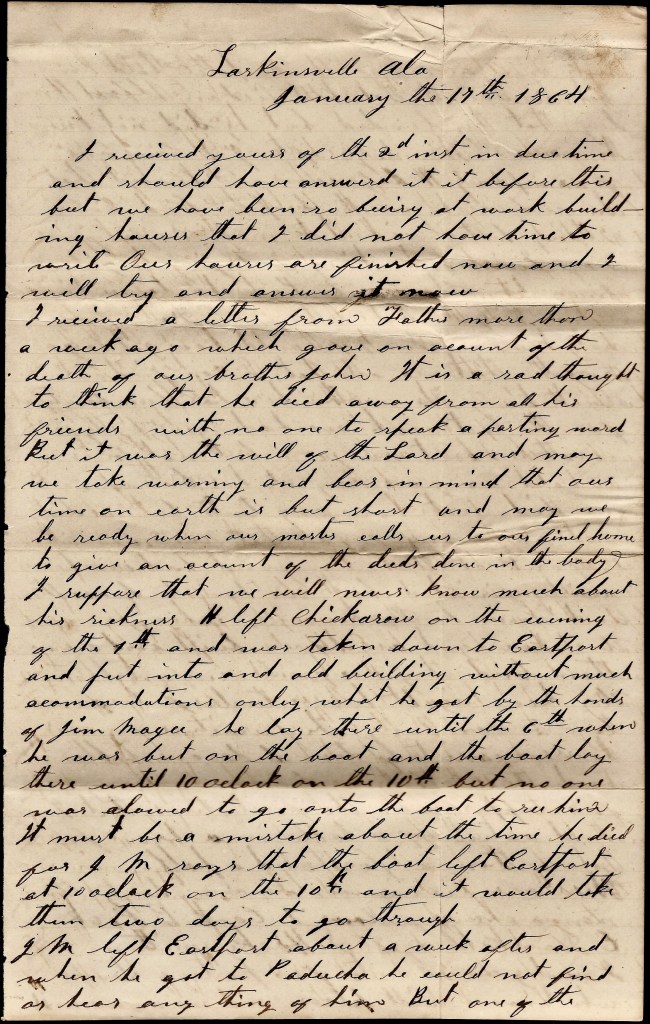
The following letters were written byJoseph Steele Ramsey (1838-1913) who, at age 22, enlisted on 16 July 1861 to serve three years in Co. D, 47th Ohio Volunteer Infantry (OVI). He reenlisted as a veteran in the regiment and mustered out on 11 August 1865. Serving in the same company with Joseph was his younger brother John Knox Ramsey (1841-1863) who died of illness at Paducah on 10 November 1863.
Joseph was the son of Thomas Lackey Ramsey (1812-1881) and Jane Steele (1808-1851). He wrote two of the following letters to his older sister, Rebecca Jane Ramsey (1836-1891) and one to Sarah (“Sallie”) Rachel McQuiston (1843-1926) with whom he would marry on Christmas Day 1866. Sallie was the daughter of David McQuiston and Margaret Hamilton of Preble county, Ohio.
Letter 1
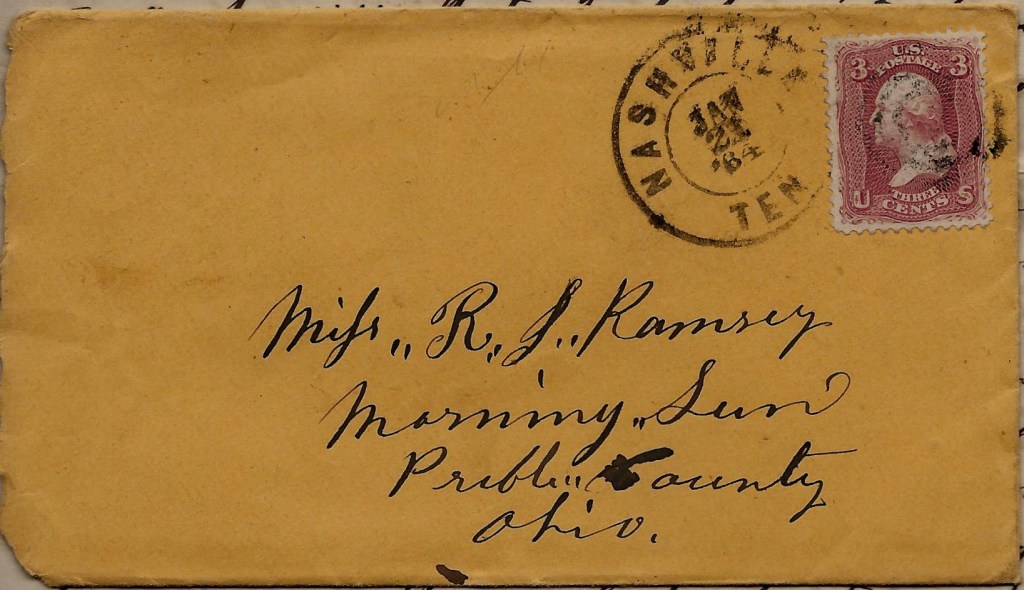
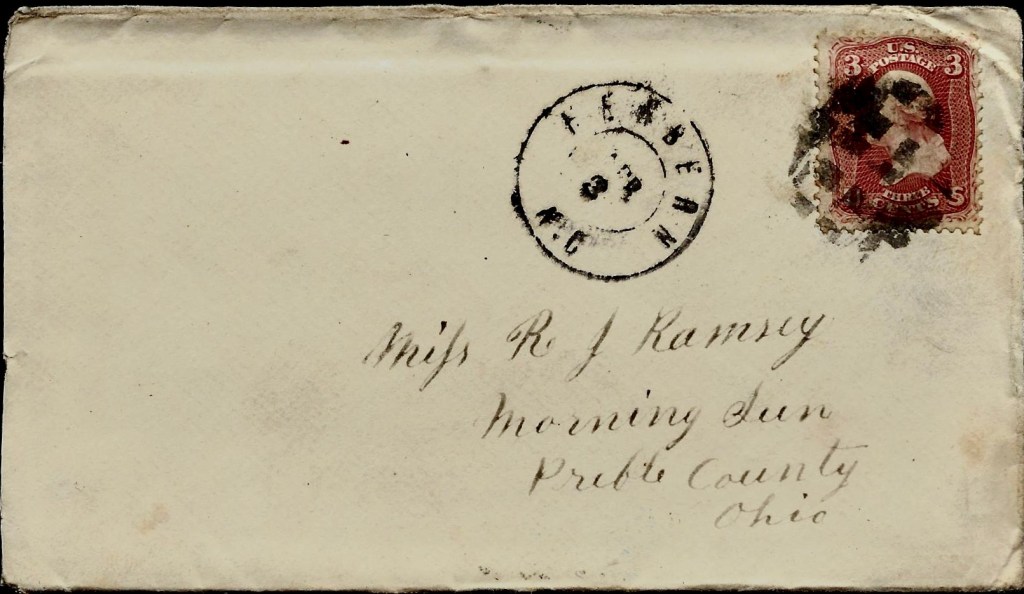
Addressed to Miss R. J. Ramsey, Morning Sun, Preble county, Ohio
Larkinspur, Alabama January 17th, 1864
I received yours of the 2nd inst. in due time and should have answered it before this but we have been so busy at work building houses that I did not have time to write, Our houses are finished now and I will try and answer it now.
I received a letter from Father more than a week ago which gave an account of the death of our brother John. It is a sad thought to think that he died away from all his friends with no one to speak a parting word. But it was the will of the Lord and may we take warning and bear in mind that our time on earth is but short and may we be ready when our Master calls us to our final home to give an account of the deeds done in the body. I suppose we will never know much about his sickness. He left Chickasaw on the evening of the 4th and was taken down to Eastport and put into an old building without much accommodations—only what he got by the hands of [Sgt.] Jim Magee. He lay there until the 6th when he was put on the boat and the boat lay there until 10 o’clock on the 10th but no one was allowed to go onto the boat to see him. It must be a mistake about the time he died for J. M. says that the boat left Eastport at 10 o’clock on the 10th and it would take them two days to go through.
J. M. left Eastport about a week after and when he got to Paducah, he could not find or hear anything of him. But one of the sick men in one of the hospitals told him that he thought that [John] had died on the boat the day they landed but he did not know the name. Three days after J. M came, one of Company A boys come and he said that he was sick in the hospital and was getting better and that made me feel more easy. I was thinking of trying to get permission to go to Paducah to see him when I got that letter from Father. I do not know whether I would have got to go or not. That is all that I can find out about him.
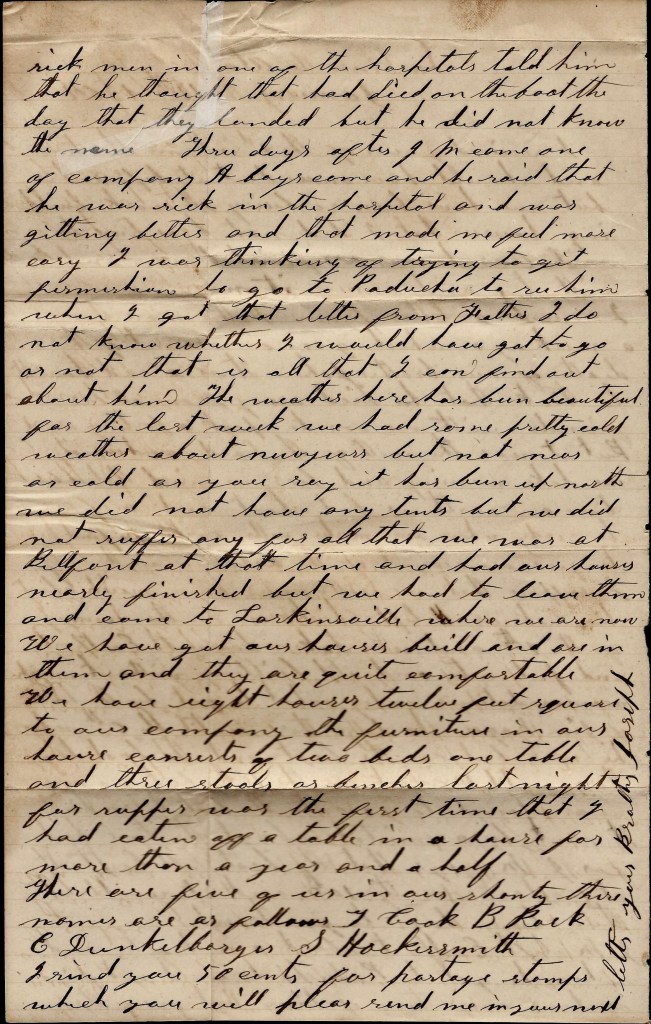
The weather here has been beautiful for the last week. We had some pretty cold weather about New Years but not near as cold as you say it has been up north. We did not have any tents but we did not suffer any for all that. We was at Bellfont at that time and had our houses nearly finished but we had to leave them and come to Larkinsville where we are now.
We have got our houses built and are in them and they are quite comfortable. We have eight houses twelve feet square to our company. The furniture in our house consists of two beds, one table, and three stools or benches. Last night for supper was the first tie that I had eaten off a table in a house for more than a year and a half.
There are five of us in our shanty. Their names are as follows: J[ohn] Cook, [Andrew] B. Rock, E[lias] Dunkelberger, S[amuel] Hockersmith. I send you 50 cents for postage stamps which you will please send me in your next letter.
From your brother, — Joseph
Letter 2
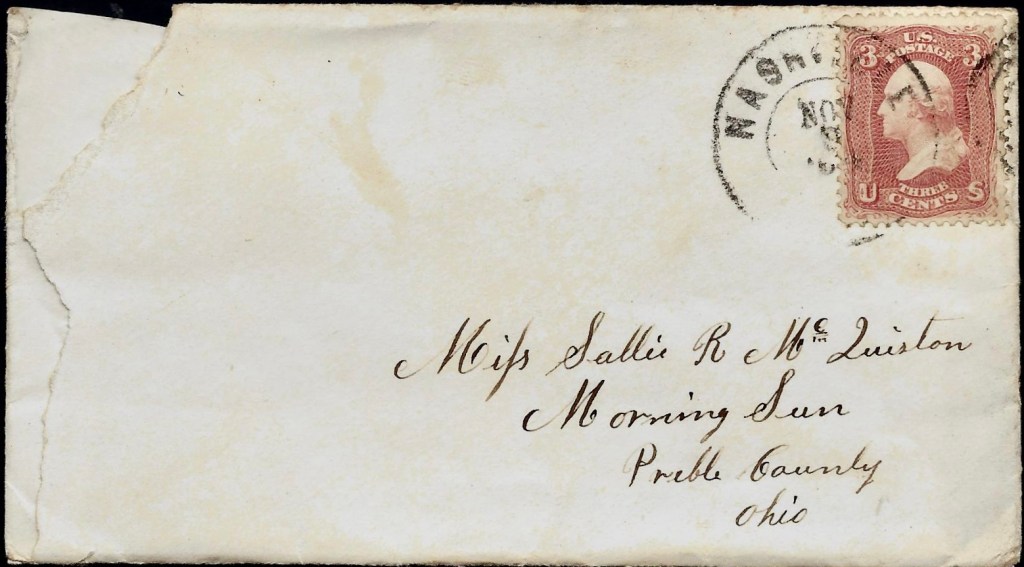
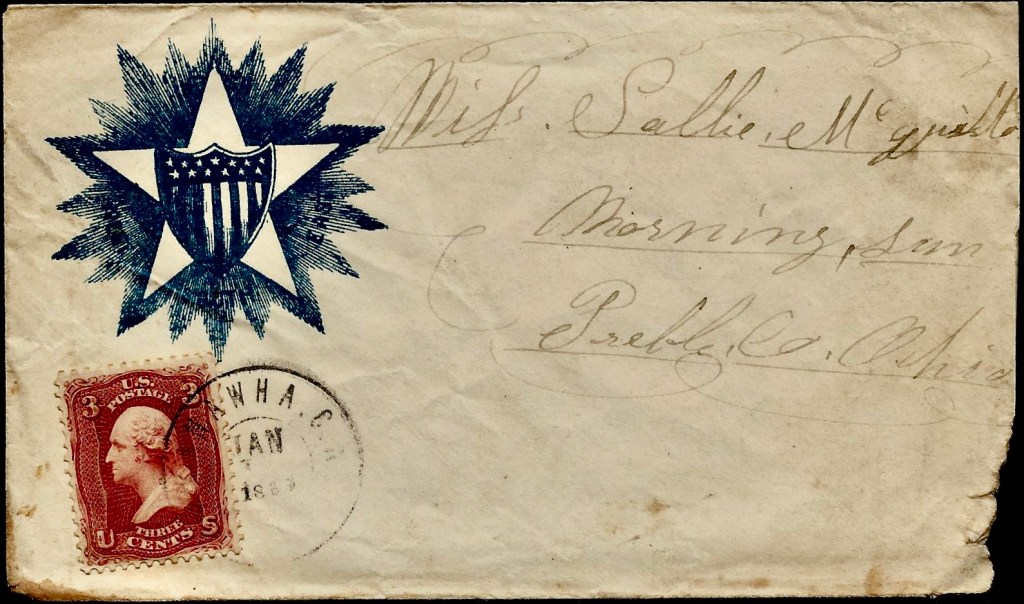
Addressed to Miss Sallie R. McQuiston, Morning Sun, Preble county, Ohio
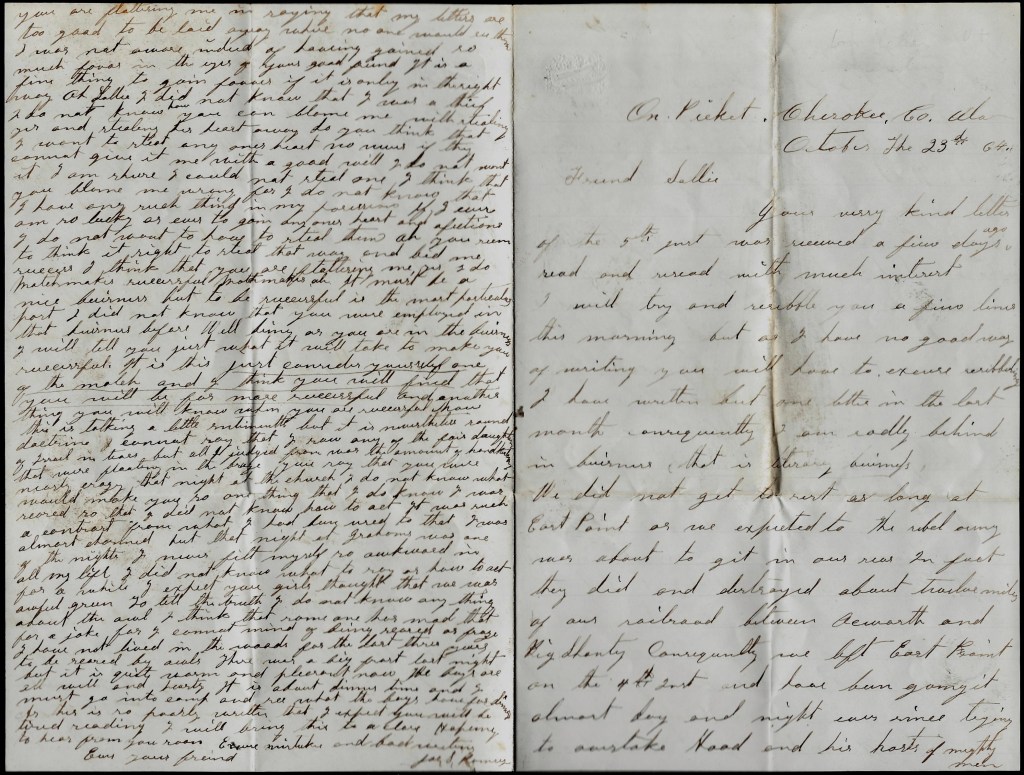
On picket, Cherokee County, Alabama October 23rd 1864
Friend Sallie,
Your very kind letter of the 5th just was received a few days ago, read and reread with much interest. I will try and scribble you a few lines this morning but as I have no good way of writing, you will have to excuse scribbling. I have written but one letter in the last month, consequently I am sadly behind in business—that is, literary business.
We did not get to rest as long at Eastport as we expected to. The rebel army was about to get in our rear. In fact, they did, and destroyed about twelve miles of our railroad between Ackworth and Big Shanty. Consequently we left Eastport on the 4th last and have been going it almost day and night ever since, trying to overtake Hood and his hoards of mighty men but we have not found many of them yet. We had a little skirmish with their rear guard at Snake Creek Gap but it did not amount to anything worth speaking about. We have been roaming all over the State of Georgia and are now in Cherokee county, six miles west of Gaylesville. We arrived here day before yesterday. How long we will remain here, I cannot say. Neither do I know where we will go to.
While you have been having so much wet weather up North, we have been having nice dry weather—beautiful weather for marching—rather cool at night, but we make up for that by burning fence rails which are very plenty in this part of the country. We are having a gay time on this march, plenty of everything good to eat, but the citizens have to suffer for it. But you know that we cannot go hungry where there is so many hogs and potatoes. For my breakfast this morning, I had sweet potatoes, beef, slapjacks, and coffee—not as good as we have sometimes. We often have chicken, molasses, and various other things that the country affords. It looks hard to take things away from the people that way but it is the only way that we have to live as Uncle Sam does not give us full rations but slows us to gather it from the country.
Capt. [Joseph L.] Pinkerton started home yesterday but did not get farther than Dawson Headquarters before he was ordered back. He will go home as soon as there is an officer appointed in his place. He is a good officer—I think a little the best one that our company has ever had. He is well liked by all the boys and will be missed very much in the regiment.
I do not think that there is anything wrong is showing good, well written letters to ones best friends but my letters are so very poor that I am almost ashamed to let anyone see them. As you have told the whole truth, I do not think that you have done anything to be forgiven for but I had rather beg pardon myself. You’re wrong in thinking that i thought you were that kind as to be showing my letters to everyone. I think you are flattering me in saying that my letters are too good to be laid away where no one would see them. I was not aware indeed of having gained so much favor in the eyes of your good friend, It is a fine thing to gain favor if it is only in the right way. Oh Sallie, I did not know that I was a thief. I do not know how you can blame me with stealing her heart away. Do you think that I want to steal anyone’s heart. No, never. If they cannot give it me with a good will, I do not want it. I am sure I could not steal one. I think that you blame me wrong for I do not know that I have any such thing in my possession. If I ever am so lucky as ever to gain anyone’s heart and affections, I do not want to have to steal them….
There was a big frost last night but it is quite warm and pleasant now. The boys are all well and hearty. It is almost dinner time and I must go into camp and see what the boys have for dinner. As this is so poorly written that I expect you will be tired reading, I will bring this to a close hoping to hear from you soon. Excuse mistakes and bad writing. Every your friend, — Jos. S. Ramsey
Letter 3
Addressed to Miss J. R. Ramsey, Morning Sun, Preble county, Ohio
Camp Near Goldsboro, North Carolina March 1st, 1865
Dear Sister,
As it seems your tirn for a note and I have received three from you since I come here, I will try and scratch you a few lines that you may know what we are doing and how we are getting along. It will not be necessary for me to go back and give a history of our late trip through South and North Carolina as I wrote to brother Sam the other day and told him about all that I knowed about it. I have kept a kind of a diary that I intend to send home that will give you some idea of the route that we went, how we fared, and what we were doing each day. I sent the first two weeks of it in Sam’s letter and I will send two more in this and so on until I have it all sent. I have kept it from the first of the year and I want you to take it all and put it together so that it will not get tossed.
We are encamped two miles east of Goldsboro. It is a very nice place to camp. We have got out little tents fixed up and things arranged so that we can live very well. The only objection that I have to this camp is the soil is very sandy and the high winds that we have here is continually blowing sand into everything—into our eyes, into our victuals, and everything else. But we have got so used to having sand in our victuals that we do not mind it much. Don’t you think that we ought to be getting gritty? They say sand makes things gritty. If that be so, we will be sure.
The weather is very warm and pleasant. We had some rain yesterday but today is clear, warm and windy—sand flying as usual. the peach trees have been out in full bloom for two weeks. The prospects for a large peach [harvest] is good. I think if we stay down here until they are ripe, I will have some of them. Apple trees are very scarce here. It is only once in a while that we see one and very shabby at that. We have plenty to eat at this place and had on the whole trip excepting three days that we subsisted mostly on parched corn. That was the time that Johnston thought to stop us near Bentonville, 20 miles from this place. The cars commenced running to this place the same night that we did and trains are arriving now almost hourly ladened with rations and clothing. We have not got our clothing yet and are in a very bad need of it. I tell you that we are a ragged looking set of boys. Would not look well promenading around in [ ] in our present state of existence as we were doing this time one year ago.
Our clothes are at the Division coming and we will get them as soon as they can distribute them out which will be tonight or in the morning. Col. Parry has been promoted to rank as Brevet Brigadier General. I suppose he will leave us in a few days and then Captain Pinkerton will have command of the regiment as soon as he comes back, We are looking for him every day. Lt. [James H.] Bullock is commanding our company. He was only promoted about two months ago from sergeant. We have not had anything to do since we came here except one day we went out with the wagon train a foraging. I think that we will have to drill before long.
There is a great talk about peace in camp today. Rumor says that Gen. Lee has gone to Washington to make peace and that Jeff Davis has run off out of the country. I hope it is so but can’t believe it. I look for peace before long but I think that there will be some fighting yet before this affair is ended yet. It is also said that Grant has taken Richmond with the loss of 20,000 men and taken 40,000 prisoners. That we do not believe although it may be so, We hear so much now days that we do not believe anything until we know it to be so.
From the letters that I have received from the North, I think that you must have had a gay time sleigh riding this winter. I would like to have been there to have enjoyed some of it but duty must go before pleasure in these war times. I have not saw a speck of snow this winter. The hardest freeze that we had did not make ice more than an inch thick. I like the climate of this country very well but the land is too poor to suit me. I do not like black-eyed peas well enough and that is about the only thing that will make more than half a crop in this country.
I received that housewife [sewing kit] that you sent me day before yesterday. I am very well pleased with it and think it a very nice one and for it you have my many thanks well wishes…
The following letter was written by Thomas Ebenezer Turner (1843-1927), the son of Moses Turner (1821-1904) and Rebecca T. Pressley (1823-1903) of Lebanon, Boone county, Indiana. Thomas married Elizabeth Malcenia Stephenson (1845-1905) in August 1867. During the summer of 1864, Thomas served 100 days in Co. K, 132nd Indiana Infantry. He later became a Presbyterian clergyman.
From Thomas’s letter we learn that he was attending school at Indiana University in Bloomington, Indiana. According to their school archivist, Stephen E. Towne, in June 1863, just prior to the date of this letter, “amid a wave of organized and murderous draft enrollment resistance throughout Indiana and neighboring states, a large body of armed men accosted a draft enrollment officer in Indian Creek Township, in the southwest corner of Monroe County, and seized his enrollment lists. Military authorities sent a force of over one thousand troops—infantry, cavalry, and artillery—to Bloomington to arrest the perpetrators. The troops billeted in the town among welcoming pro-war Republicans (town Democrats, many of whom had soured on the war effort, later complained that the troops had been drunk and disorderly) for several days and arrested more than a dozen men for draft resistance before marching into Greene and Sullivan counties to enforce the draft law. The violence of the war reached into every Indiana community.”
Thomas’s letter also speaks of Morgan’s raid through Southern Indiana and of the volunteers from Boone county who rode out after him but came home disappointed. “The boys were pretty smartly outed because they did not get a chance at him,” he wrote his friend.
Indiana University before the Civil War
Transcription
Addressed to Sallie McQuiston, Morning Sun, Preble county, Ohio
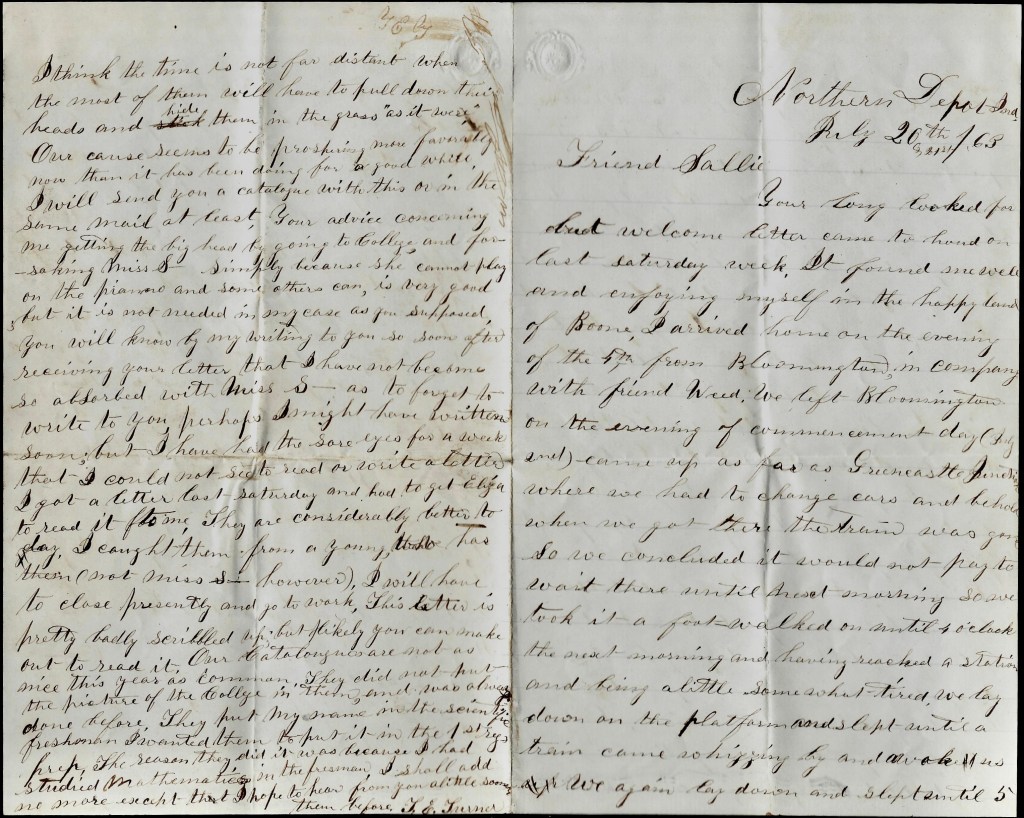
Northern Depot, Indiana July 20th 1863
Friend Sally,
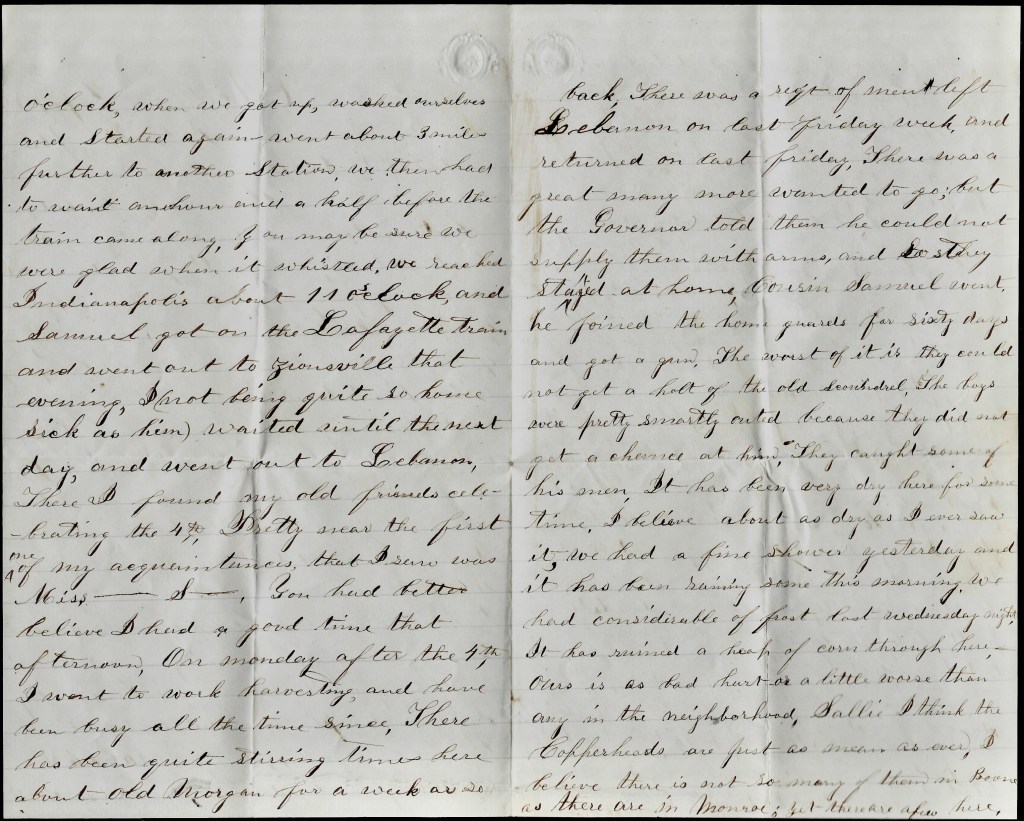
Your long looked for but welcome letter came to hand on last Saturday week. It found me well and enjoying myself in the happy land of Boone. I arrived home on the evening of the 4th from Bloomington in company with friend Weed. We left Bloomington on the evening of commencement day (July 2nd), came up as far as Greencastle Junction where we had to change cars, and behold! when we got there the train was gone. So we concluded it would not pay to wait there until next morning so we took it a foot, walked on till 4 o’clock the next morning, and having reached a station and being a little somewhat tired, we lay down on the platform and slept until a train came wizzing by and woke us. We again lay down and slept till 5 o’clock, when we got up, washed ourselves and started again. Went about three miles further to another station. We then had to wait an hour and a half before the train came along. You may be sure we were glad when it whistled. We reached Indianapolis about 11 o’clock and Samuel got on the Lafayette train and went out to Zionsville that evening. I (not being quite so homesick as him), waited until the next day, and went out to Lebanon.
There I found my old friends celebrating the fourth. Pretty near the first one of my acquaintances that I saw was Miss —— S——-. You had better believe I had a good time that afternoon. One Monday after the 4th, I went to work harvesting and have been busy all the time since.
There has been pretty stirring times here about old Morgan for a week or so back. There was a regiment of men left Lebanon on last Friday week, and returned on last Friday. There was a great many more wanted to go but the governor told them he could not supply them with arms, and so they stayed at home. Cousin Samuel went. He joined the home guards for sixty days and got a gun. The worst of it is they could not get a hold of the old scoundrel. The boys were pretty smartly outed because they did not get a chance at him. They caught some of his men.
It has been very dry here for some time. I believe about as dry as I ever saw it. We had a fine shower yesterday and it has been raining some this morning. We had considerable of frost last Wednesday night. It has ruined a heap of corn through here. Ours is as bad hurt or a little worse than any in the neighborhood.
Sallie, I think the Copperheads are just as mean as ever. I believe there is not so many of them in Boone as there are in Monroe, yet there are a few her. I think the time is not far distant when the most of them will have to pull down their heads and hide them in the grass “as it were.” Our cause seems to be prospering more favorably now than it has been doing for a good while.
I will send you a [School] Catalogue with this or in the same mail at least. Your advice concerning me getting the big head by going to College and forsaking Miss S—- simply because she cannot play on the piano and some others can, is very good but it is not needed in my case sa you supposed. You will know by my writing to you so soon after receiving your letter that I have not become so absorbed with Miss S—- as to forget to write to you. Perhaps I might have written sooner but I have had the sore eyes for a week that I could not see to read or write a letter. I got a letter last Saturday and had to get Eliza to read it to me. They are considerably better today.
I will have to close presently and go to work. This letter is pretty badly scribbled up but likely you can make out to read it. Our Catalogues are not as nice this year as common. They did not put the picture of the College in them and was always done before. They put my name in the 1st Year Prep. they reason they did it was because I had studied mathematics in the Freshman. I shall add no more except that I hope to hear from you a little sooner than before. — T. E. Turner
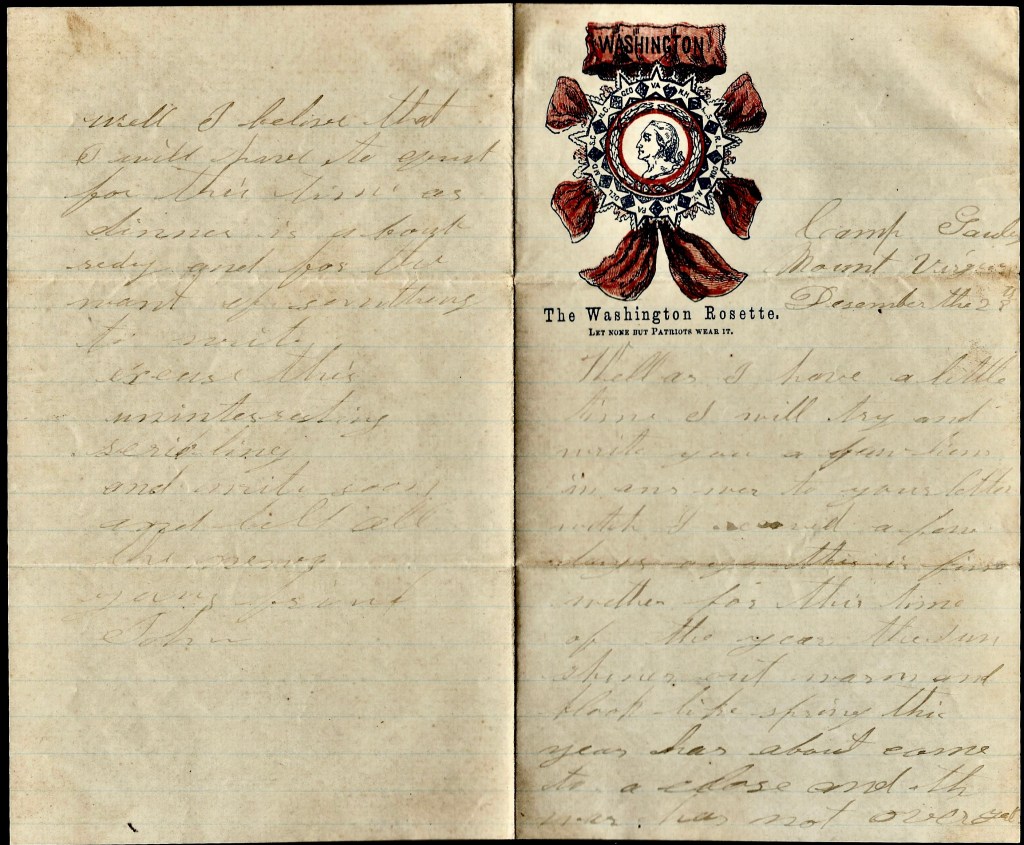
The following letter was written by a Union soldier named “John” who undoubtedly served in Co. D, 47th Ohio Volunteer Infantry and was most likely a resident of Morning Sun (or vicinity) in Preble county, Ohio. Unfortunately there are too many soldiers with that name to say with certainly who wrote it though it’s clear that he was barely literate.
John wrote the letter to his “friend” Sally McQuiston who lived in Morning Sun, Ohio.
Transcription
Camp Gauly Mount., Virginia December 28 [1862]
Well, as I have a little time I will try and write you a few lines in answer to your letter which I received a few days ago, This is fine weather for this time of the year. The sun shines out warm and looks like spring this year has about come to a close and the war has not over yet.
I suppose that you have good times on Christmas and New Years. Well, I will tell you how that we spent Christmas. There was some Gray Backs came into camp and said that there were some secesh that had come home on furlough and our company went out to see if they could find them. We went out past Hawk’s Nest and Lover’s Leap and Mountain Cave, and came back without finding any of them and that was our Christmas.
Furloughs have been granted at last and there is seven gone home of this company. I[sreal] Brown is one of the number and I suppose that he will have a good time when he gets home.
I want you to tell me what kind of a time he has. Will Magaw 1 has had a hard time of it since he went to the war and the poor fellow’s troubles are at an end at last.
Well, I believe that I will have to quit for this time as dinner is about ready and for the want of something to write. Excuse this uninteresting scribbling and write soon and tell all the news. Your friend, — John
1 William G. Magaw (1836-1862) was from Preble county, Ohio, the son of William and Rachel (Paxton) Magaw. He served in Co. A, 30th Illinois Volunteers. He died on 19 December 1862. He had a couple of brothers who served in Co. D, 47th OVI..
These letters were written by Philander (“Phil”) Boyd McQuiston (1830-1915), the son of William M. McQuiston (1797-1878) and Nancy Boyd (1803-1886) of Preble county, Ohio.
Philander served in Co. D, 47th Ohio Volunteer Infantry (OVI), from 16 July 1861 until 20 August 1864. After the war he returned to Preble county where he resumed farming and never married.
I could not find an image of Phil but here is one of Pvt. Robert M. Burnard of Co. A, 47th OVI
Letter 1
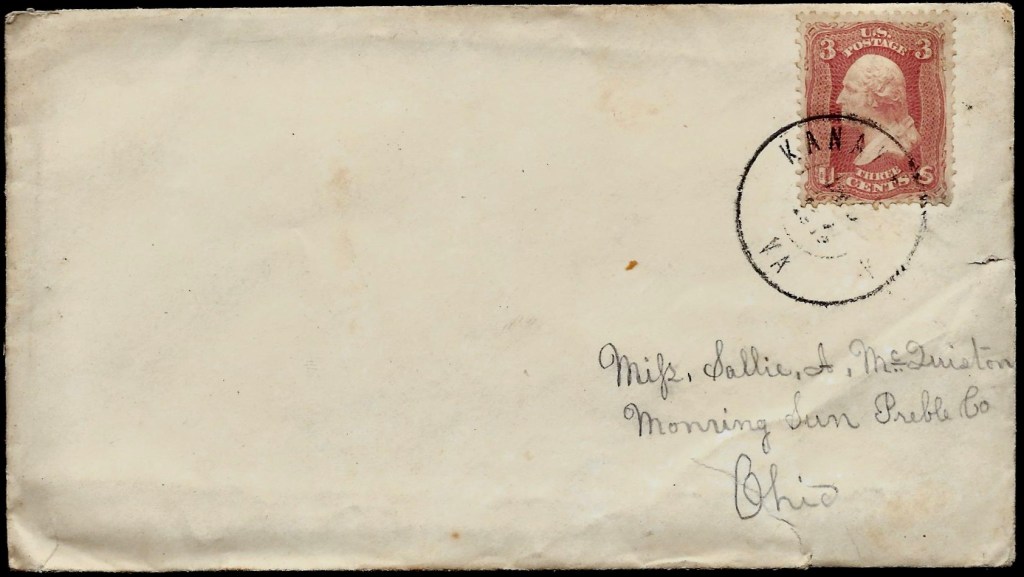
Addressed to Miss Sallie A. McQuiston, Morning Sun, Preble county, Ohio
Camp Gauley Mount. December 23, 1862
Cousin Sallie,
I now take my pencil in hand to write you a few lines to let you know that I am well at present, hoping these few lines will find you enjoying the same blessing and also to let you know that I have been sick for nearly two weeks. This will account for your letter remaining so long unanswered.
I am very punctual in answering letters; generally answer the same or the next day. But owing to the inferior state of my health for some time past, I am somewhat behind at present. I suppose [Samuel L.] Hockersmith (or Punchy as he is called here) answered yours some time ago.
We have travelled over the greater part of the sacred soil contained in the Kanawha Valley since we wrote to you. We were then at the head of the Kanawha. Soon after we moved to camp Piatt more than half way down. it to go into winter quarters as we supposed. We commenced fixing up immediately after. After remaining there about 24 hours, we crossed the river to go into winter quarters again, We were very sure of staying there and commenced making extensive preparations. we stayed there nearly a week and then got orders to move back to Gauly Mount where we are now and I think will remain until we go away unless something happens that we don’t know of now.
It is a great place for pies in the neighborhood of Camp Piatt. I made several trips unto the country after them, I suppose you have often heard of the kind the boys got here last winter. These were just the reverse. The greatest objection was they were made according to the strictest rules of economy. One afternoon two of us were coming into camp each with an armful. We met Gen. [Jacob Dolson] Cox and staff. He touched his hat very gracefully to us and looked as though he thought provisions were scarce in camp. Since then I have been thinking some of an appointment as Commissary General of this Department for if he judged from the load which I was carrying he would certainly think that I was abundantly qualified for this office.
Our mess has been putting up a kitchen today. It is a log tenement of quite an ancient style of architecture but I expect we think as much of it as any person ever did of a fine house.
Gen. [George] Crook is expected here this week to inspect the regiment and if it is well enough drilled, furloughs are to be given.
One of the boxes sent in Pierson’s care arrived yesterday. None that were sent by the “Aid Society” have arrived yet. He left more than a week ago to hunt for them and has not been heard from since. Give my best wishes to all the friends—girls in particular. Write soon. Goodbye. Your cousin, — Mc
P. S. Mr. A[ugustus S. Troth 1 is well.
1 Augustus S. Troth served initially in Co. D, 47th Ohio Infantry. He was transferred to the US Signal Corps on 7 September 1863.
An elevated view of Tompkin’s Farm (Camp Gauley Mount.) in West Virginia used as a military camp during the American Civil War; tents are visible spread out over fields on either side of a central roadway; farmhouse and other buildings also visible on the property; 1862. (The Huntington Library)
Letter 2
Camp Sherman August 7th 1863
Cousin Sallie,
It is a long time since I heard from you—nearly six months now I believe, and as I feel like conversing with some of my old friends this afternoon, I will scribble a few lines to you expecting to receive better than I send. But firstly I believe I ought to scold some for your not writing to me while I was sick and not able to write. But I guess I will let it pass this time hoping that if I am so unfortunate as to get sick again, you will perform your duty in respect to writing more faithfully.
Well, I suppose you have heard how we took Vicksburg and ran Johnston out of Jackson and cleared the country generally of rebels. As I was not with the regiment while these deeds were being performed, I will not go into detail concerning them but will confine myself to personal matters.
When the regiment started for the rear of Vicksburg, those of us that were not able to go were left in what was called a convalescent camp. Previous to this, I thought a convalescent camp was one in which sick persons received good medical treatment, suitable food, and in short, were treated as sick should be. But I soon found as I had often heard that this was all a mistake for more than a week after we were sent there, no doctor could be found anywhere in camp. One of our company, Joseph [H.] Arthurs died, I believe, just for the want of medical treatment. After a while an excuse of a doctor came, but I would be slow in saying that he did any good.
We were in this camp when the rebs came so near capturing us at the time they attacked our troops at Milliken’s Bend. I expect there was as much excitement and fun in our camp then as there was in Morning Sun and vicinity when Morgan passed through Ohio. It had been reported for several days that we would be attacked and the maimed and all that were able to hold a gun were frequently called into line. This had ben repeated so often that we had no faith in the reports. But one morning about ten o’clock, a force numbering about 1500 made their appearance about two miles from and in plain view of the camp. Then there was hurrying to and fro—And gathering knapsacks—And trembling in their shoes—Those who but an hour before—Had put their dinner on. But they didn’t come any nearer and after cooking their dinner and supper and resting until eleven o’clock at night, they quietly took their departure.
During the excitement, your humble servant according to orders took refuge behind the levee, but not liking the position, returned to camp where I had things all my own way until the next morning when my companions in arms being convinced that there was no danger, one by one came slowly dropping in.
Soon after this we were sent up the Yazoo to the landing at the mouth of Chickasaw Bayou. The Yazoo is a beautiful river and judging from its appearance, I think no one would give it the name that it bears. There is splendid scenery along its banks. The trees grow close to the water’s edge and the branches hang out over the water. It is such a stream as artists usually have in their pictures. But it is the greatest place for mosquitoes ever was. I won’t undertake to say anything about them for I couldn’t do them justice.
Soon after the surrender of Vicksburg, we were ordered there and of all the miserable places I ever saw, that is the miserablest I took the ague the day we went and had it more or less all the time we stayed. There was fifteen of our squad [and] everyone had it. The city is so miserably filthy. I think it is the principal cause of its unhealthiness. This camp reminds me more of Ohio that any place I have seen in the South yet. The timber is nearly the same as that of Preble county.
Col’s [Augustus C.] Parry, [John] Wallace, Capt. [Joseph E.] Pinkerton and four or five other captains and lieutenants started home on furlough today. Col. Wallace is to report at Camp Dennison to bring out some drafted men. I suppose I am staying in Col. Wallace’s tent while he is gone. I have everything my own way. All of Co. D are well They stood the march to Jackson remarkably well. [Samuel L.] Hockersmith is fattening up again. He was not very well during the siege.
Mr. [Augustus] Troth is in the signal corps now. They are quartered in Vicksburg now. I don’t want to make you uneasy but if he can stay there without getting sick, he will do more than anyone I know of yet. But my sheet is nearly full so that I have scarcely room to say that hoping to hear from you soon, I remain as ever your cousin, Mc
The following letter was written by Jervis McEntee (1828-1891), the son of James Smith McEntee (1800-1887) and Sarah Jane Goetchius (1805-1883) of Rondout, Ulster county, New York. Jervis had two younger brothers, both of who are also mentioned in this letter; Maurice (“Mory”) W. McEntee (1835-1883) and Girard (“Geddy”) Lindsley McEntee (1847-1913). Jervis was married Anna Gertrude Sawyer (1834-1878) in 1854. She was the daughter of a well-known Universalist minister, Rev. Thomas Jefferson Sawyer and his wife Caroline Fisher.
Jervis McEntee, 1860s. Artist Austin Augustus Turner. (Photo by Heritage Art/Heritage Images via Getty Images)
The following biographical sketch was written by David Levine in June 2023: “McEntee was born in Rondout in 1828, which later became part of Kingston. His father, James, moved there to work on the D&H Canal, and became an engineer. Jervis was named after his father’s mentor, civil engineer John B. Jervis, known for his work on the Erie and Delaware & Hudson Canals and designing the Croton Aqueduct.
McEntee was educated at the Clinton Liberal Institute in Clinton, near Utica, where he began his journaling. He was interested in art, too—in 1848, he asked Durand, unsuccessfully, to be his tutor. But by 1850, McEntee had become successful. He sold four paintings to the American Art-Union and had a painting accepted by the National Academy of Design. That winter, Church agreed to take him on as a student.
In 1851, he returned to his parents’ new home, the first on what would become West Chestnut Street in Kingston. He built an art studio on the property in 1854, which was designed by the esteemed architect Calvert Vaux, who shortly thereafter married his sister, Mary McEntee. (Soon after that, Vaux designed Church’s majestic Olana, Central Park in New York, and more noteworthy commissions.) McEntee married Gertrude Sawyer in 1854, and, gradually, they expanded the studio into a home. In 1855, he became a full-time artist, placing an ad in the Kingston newspaper announcing, “J. McEntee… Landscape Painter…Studio at his Residence on the Hill… Rondout N.Y.” He kept a second studio at the famed Tenth Street Studio Building in New York, where he and Gertrude became close friends with many of the other artists there.
McEntee’s other claim to fame—journaling—began in the early 1870s. He wrote about his creative friends and their daily lives, successes, failures, and challenges. He covered the social, political, and economic realities of the art world, including his own struggles with money, fame, and status. And he wrote about the decline of the Hudson River School’s popularity in the face of Impressionism.
The McEntees lived a happy life until Gertrude died unexpectedly in 1878, when she was just 44. Jervis continued painting and traveling, to Mexico and the American West, through the 1880s. In 1890, he grew ill, most likely from kidney disease, and died on January 27, 1891. He is buried in the family plot in Montrepose Cemetery in Kingston.”
This letter was written while Jervis served as a Lieutenant in Co. H (the “Ulster Guard”), 20th New York State Militia. This unit was ordered, April 23, 1861, to proceed to Washington, D. C. May 3, 1861, this order was revoked, the regiment being already at New York city en route. It was finally permitted to leave and left the State, May 7, 1861 (nine companies), commanded by Col. Geo. W. Pratt. It was mustered in the United States service May 11, 1861, to date April 23, 1861, at Annapolis, Md., to serve three months. It served at Annapolis, and at Baltimore, Md., and was mustered out at Kingston, August 2, 1861.
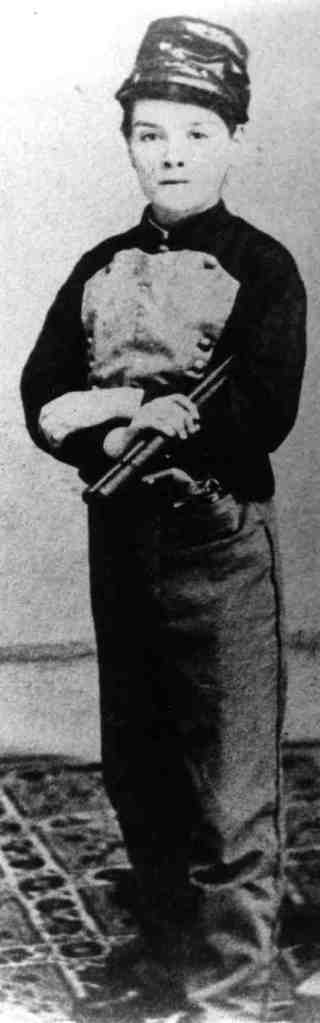
Both Maurice and Geddy served with Jervis in the Ulster Guard. Maurice became the Adjutant of the regiment and then in November, 1861, he was appointed Assistant Instructor in gunnery in the Washington Navy Yard with the rank of Master. Getty was only 15 when he served as a drummer boy in the regiment.
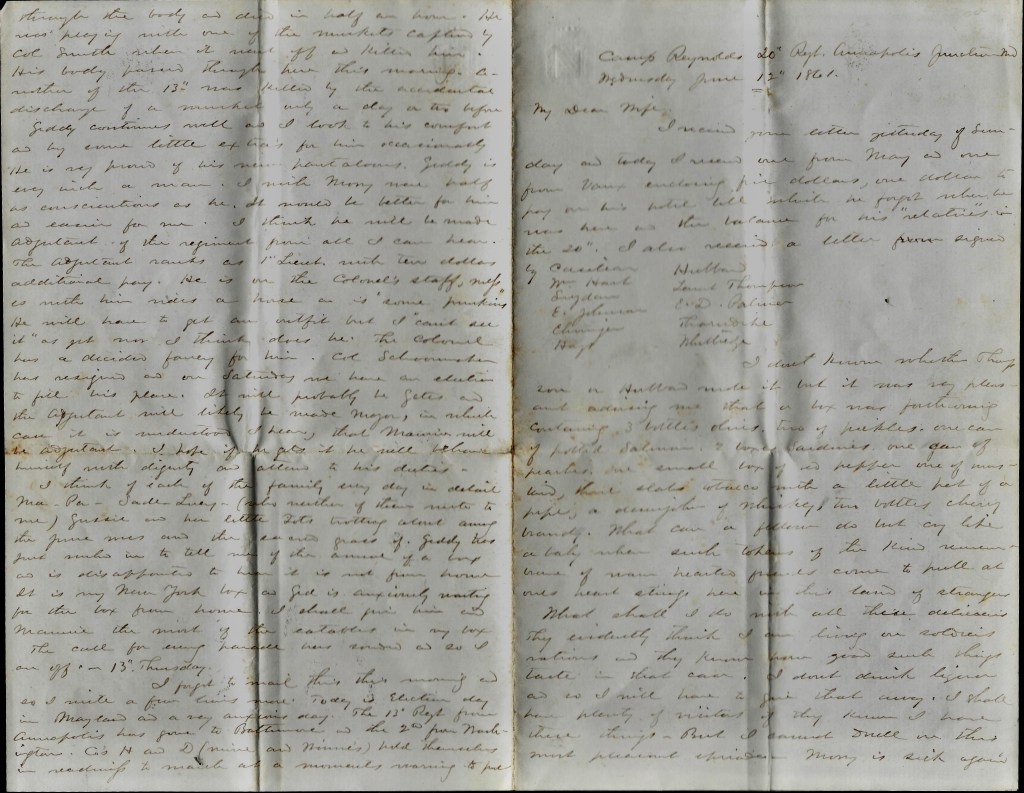
Transcription
Addressed to Mrs. Jervis McEntee, Rondout, Ulster county, NY
Camp Reynolds 20th Regiment [New York State Militia (100 days) Annapolis Junction, Maryland Wednesday, June 12th 1861
I don’t know whether Thompson or Hubbard made it but it was very pleasant advising me that a box was forthcoming containing three bottles olives, two of pickles, one can of salted salmon, 2 boxes sardines, one can of peaches, one small box of red pepper, one of mustard, three [ ] tobacco with a little bit of a pipe, a demijohn of whiskey, two bottles cherry brandy. What can a fellow do but cry like a baby when such tokens of the kind remembrance of warm-hearted friends come to pull at ones heart strings here in this land of strangers. What shall I do with all these delicacies. They evidently think I am living on soldier’s rations and they know how good such things taste in that case. I don’t drink liquor so I will have to give that away. I shall have plenty of visitors if they knew I have these things but I cannot dwell in this most pleasant epistle.
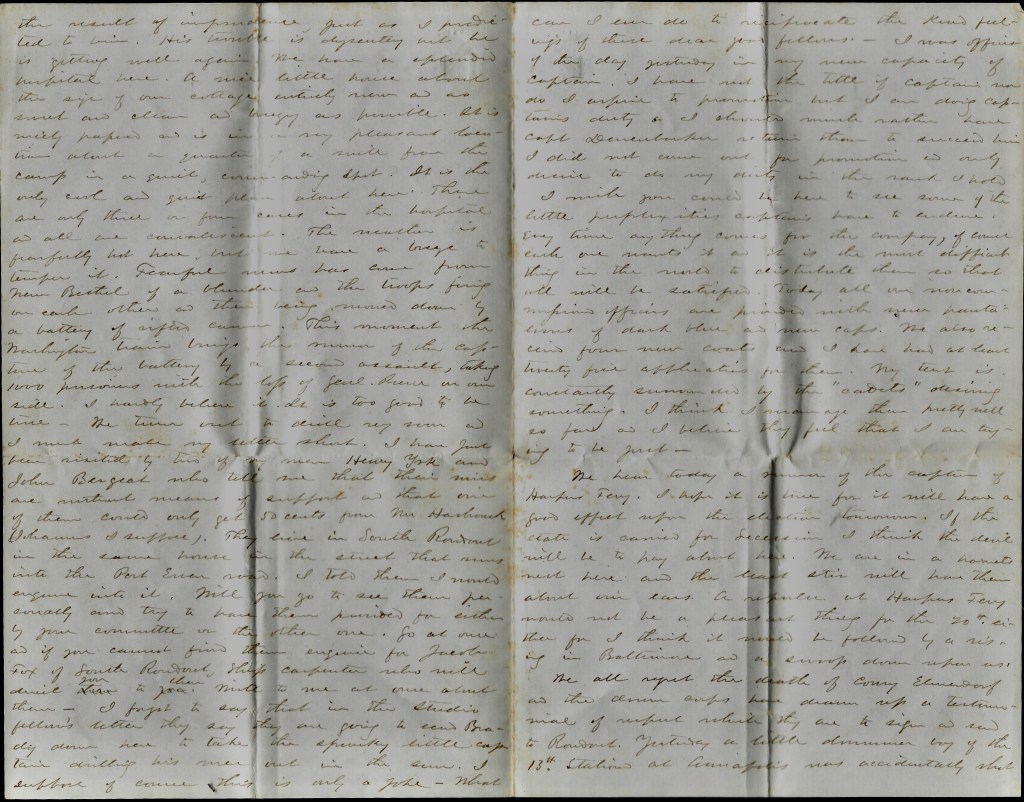
Mory is sick again, the result of imprudence, just as I predicted to him. His trouble is dysentery but he is getting well again. We have a splendid hospital here. A nice little house about the size of our cottage, entirely new and as sweet and clean and breezy as possible. It is nicely papered and is in a very pleasant location about a quarter of a mile from the camp in a quiet, commanding spot. It is the only cool and quiet place about here. There are only three or four cases in the hospital and all are convalescent.
The weather is fearfully hot here but we have a breeze to temper it. Fearful news has come from New Bethel of a blunder and the troops firing on each other and their being mowed down by a battery of rifled cannon. This moment the Washington train brings the rumor of the captain of the battery by a second assault, taking 1,000 prisoners with the loss of Gen. [Ebenezer W.] Peirce on our side. I hardly believe it. It is too good to be true.
We turn out to drill very soon and I must make my letter short. I have just been visited by two of my men, Henry York and John Bergeal who tell me that their wives are without means of support and that one of them could only get 50 cents from Mr. Harbouch (Johannes I suppose). They live in South Rondout in the same house on the street that runs into the Port Ewen road. I told them I would enquire into it. Will you go to see them personally and try to have them provided for either by your committee or the other one. Go at once and if you cannot find them, enquire for Jacob Fox of South Rondout, ship carpenter, who will direct you to them. Write to me at once about them.
I forgot to say that in the studio fellow’s letter, they say they are going to send Brady down here to take the spunkey little captain drilling his men out in the sun. I suppose of course this is only a joke. What can I ever do to reciprocate the kind feelings of these dear good fellows.
I was Officer of the Day yesterday in my new capacity of captain. I have had the title of captain nor do I aspire to promotion but I am doing captain’s duty and I should much rather have Capt. [John] Derrenbacher return than to succeed him. I did not come out for promotion and only desire to do my duty in the rank I hold. I wish you could be here to see some of the little perplexities captains. have to endure. Every time anything comes for the company, of course each one wants it and it is the most difficult thing in the world to distribute them so that all will be satisfied. Today all our non-commissioned officers are provided with new pantaloons of dark blue and new caps. We also received four new coats and I have had at least twenty-five applications for them. My tent is constantly surrounded by the “cadets” desiring something. I think I manage them pretty well as far as I believe—they feel that I am trying to be just.
“We hear today a rumor of the capture of Harper’s Ferry. I hope it is true for it will have a good effect upon the election tomorrow. If the state is carried for Secession, I think the devil will be to pay about here. We are in a hornet’s nest here and the least stir will have them about our ears.”
Lt. Jervis McEntee, Co. H, 20th NYSM, 12 June 1861
We hear today a rumor of the capture of Harper’s Ferry. I hope it is true for it will have a good effect upon the election tomorrow. If the state is carried for Secession, I think the devil will be to pay about here. We are in a hornet’s nest here and the least stir will have them about our ears. A repulse at Harper’s Ferry would not be a pleasant thing for the 20th either for I think it would be followed by a rising in Baltimore and a swoop down upon us.
We all regret the death of Conrad Elmendorf as the drum corps have drawn up a testimonial of respect which they are to sign and send to Rondout. Yesterday a little drummer boy [named Clarence D. McKenzie] of the 13th stationed at Annapolis was accidentally shot through the body and died in half an hour. He was playing with one of the muskets captured by Col. [Abel] Smith when it went off and killed him. His body passed through here this morning. Another of the 13th was killed by the accidental discharge of a musket only a day or two before.
Columbian Register, June 22, 1861
Geddy McEntee enlisted at age 14 to serve as drummer boy in Co. F, 20th NYSM
Geddy continues well as I look to his comfort and buy some little extras for him occasionally. He is very proud of his new pantaloons. Geddy is every inch a man. I wish Mory were half as conscientious as he. It would be better for him and easier for me. I think he will be made adjutant of the regiment from all I can hear. The Adjutant ranks as 1st Lieutenant with ten dollars additional pay. He is on the Colonel’s staff, messes with him, rides a horse and is “some punkins.” He will have to get an outfit but I “can’t see it” as yet nor I think does he. The Colonel has a decided fancy for him. Col. [Hiram] Schoonmaker has resigned and on Saturday we have an election to fill his place. It will probably be [Theodore Burr] Gates and the Adjutant will likely be made Major, in which case it is understood, I hear, that Maurice will be the adjutant. I hope if he gets it, he will behave himself with dignity and attend to his duties.
I think of each of the family every day in detail—Ma, Pa, Sade, Lucy—(who neither of them write to me)…Geddy has just been in to tell me of the arrival of a box and is disappointed to hear it is not from home. It is my New York box and Ged is anxiously waiting for the box from home. I shall give him and Maurice the most of the eatables in my box. The call for evening parade has sounded and so. I am off.
13th Thursday. I forgot to mail this this morning and so I write a few lines more. Today is election day in Maryland and a very anxious day. The 13th Regiment from Annapolis has gone to Baltimore and the 20th from Washington. Companies H and D (mine and [Davis] Winne’s) hold themselves in readiness to march at a moment’s warning to put down any riotous proceedings hereabouts.
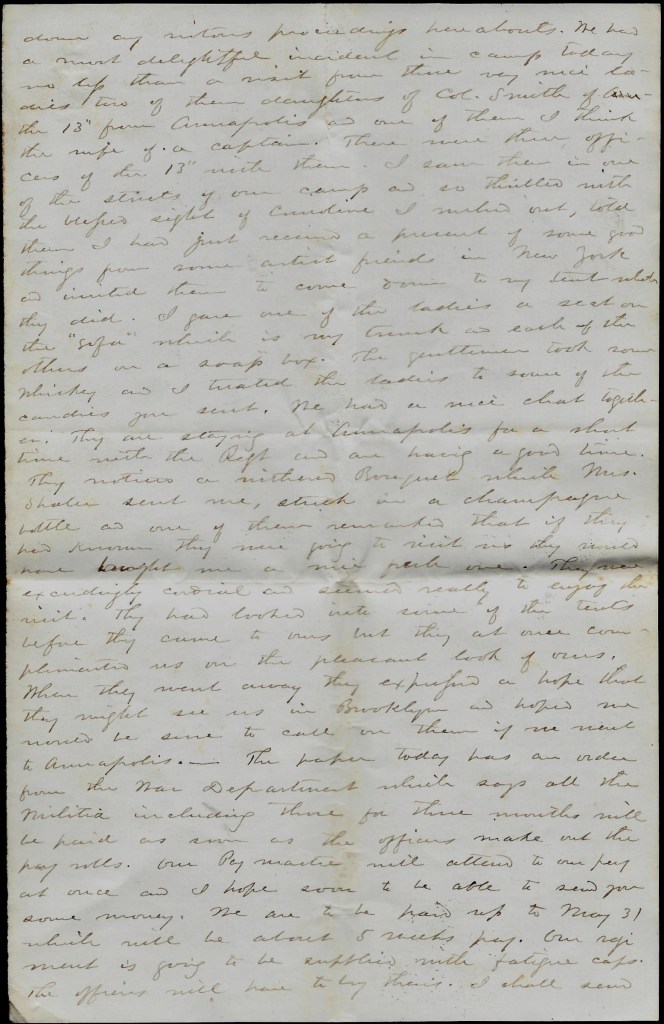
We had a most delightful incident in camp today. No less than a visit from three very nice ladies, two of them daughters of Col. [Abel] Smith 3 of the 13th from Annapolis and one one of them I think the wife of a captain. There were three officers of the 13th with them. I saw them in one of the streets of our camp and so thrilled with the blessed sight of crinoline I rushed out, told them I had just received a present of some good things from some artist friends in New York and invited them to come down to my tent which they did. I gave one of the ladies a seat on the “sofa” which is my trunk and each of the others on a soap box. The gentlemen took some whiskey and I treated the ladies to some of the candies you sent. We had a nice chat together. They are staying at Annapolis for a short time with the regiment and are having a good time. They noticed a withered bouquet which Mrs. Shaler sent me stuck in a champaign bottle and one of them remarked that if they had known they were going to visit us they would have brought me a nice fresh one. They were exceedingly cordial and seemed really to enjoy the visit. They had looked into. some of the tents before they came to ours but they at once complimented us on the pleasant look of ours. When they went away, they expressed a hope that they might see us in Brooklyn and hoped we would be sure to call on them if we went to Annapolis.
The paper today has an order from the War Department which says all the militia including those for three months will be paid as soon as the officers make out the pay rolls. Our pay master will attend to our pay at once and I hope soon to be able to send you some money. We are to be paid up to May 31 which will be about 5 weeks pay. Our regiment is going to be supplied with fatigue caps. The officers will have to buy theirs. I shall send to New York for mine.
Now see about those names at once and write me. Give my love to all at home. The result of this days proceedings in Maryland will be of vast importance in deciding the fate of the country. If it goes for Secession, the look out for trouble. If for the Union, then fresh courage will be given to the whole loyal part of the Nation. God bless you all at home and keep you, my dear wife, safe until my return. Your loving husband, — Jervis McEntee
1 I’ve been able to identify most of these artists—a virtual who’s who of the Hudson River School of landscape artists and friends of Jervis.
2 Jervis is referring to the Battle of Big Bethel which took place on 10 June 1861 near Newport News in Virginia. Union forces were led by Gen. Ebenezer Peirce. It was a total fiasco. Peirce survived but friendly fire cut down several Union soldiers.
3 Col. Abel Smith (1814-1861) of the 13th New York State Militia. He was accidentally killed on 18 October 1861 while attempting to step into a railroad car of a moving train. His residence was in Williamsburgh, New York. In the 1870 US Census, Abel had two teenage daughters living with him ih his home: Elizabeth (“Lizzie”), age 18, and Frances (“Fanny”), age 16.
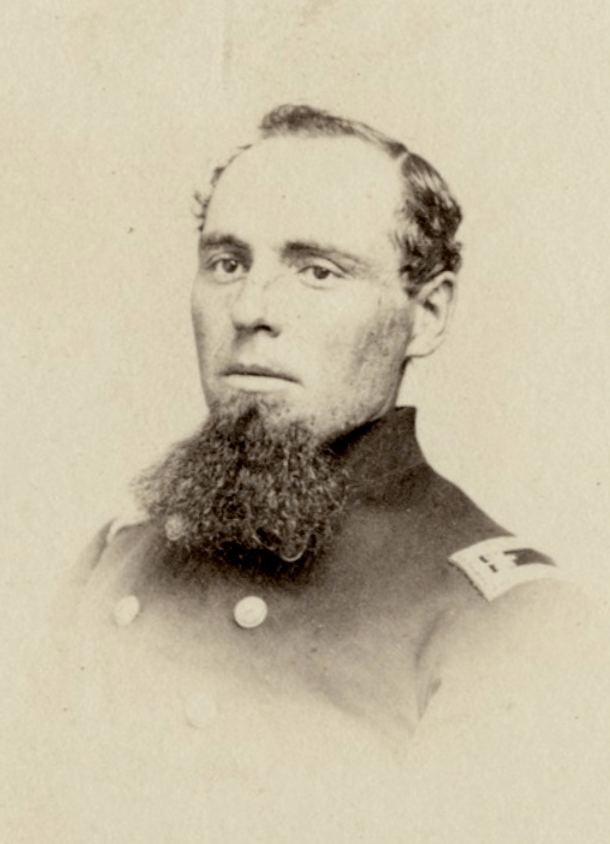
I could not find an image of Edwin but here is one of William Sawin who also served as an Asst. Surgeon in the 2nd Vermont Infantry (Photo Sleuth)
The following letters were written by Edwin R. Brush (1836-1908) who was drafted into the service on 17 July 1863 as a private in Co. H, 2nd Vermont Infantry and three months later was promoted to Assistant Surgeon of the regiment.
Brush graduated from the University of Vermont at Burlington in 1858 and took over the medical practice of his father, Dr. Salmon Brush (1804-1887) in Cambridge, Lamoille county, Vermont. Edwin wrote the letters to his wife, Amy R. Brush (1836-1915).
Edwin was with the regiment from the time they fought at Rappahannock Station in November 1863 through the Battle of Sailor’s Creek in April 1865. In one letter, he describes the mood of the army following the assassination of President Lincoln and shares portions of conversations he’s had with rebel soldiers going home following Lee’s surrender.
Letter 1
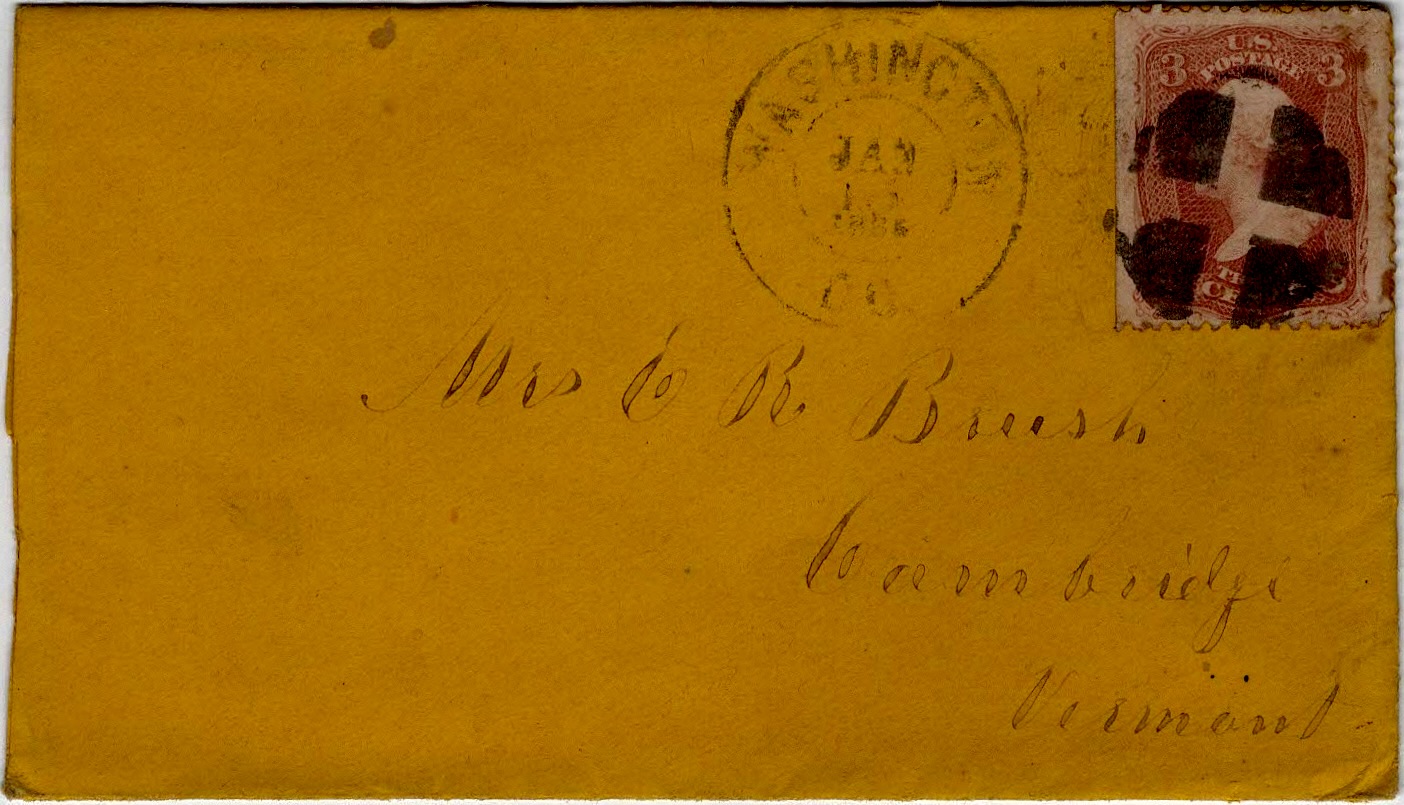
Addressed to Mrs. E. R. Brush, Cambridge, Vermont
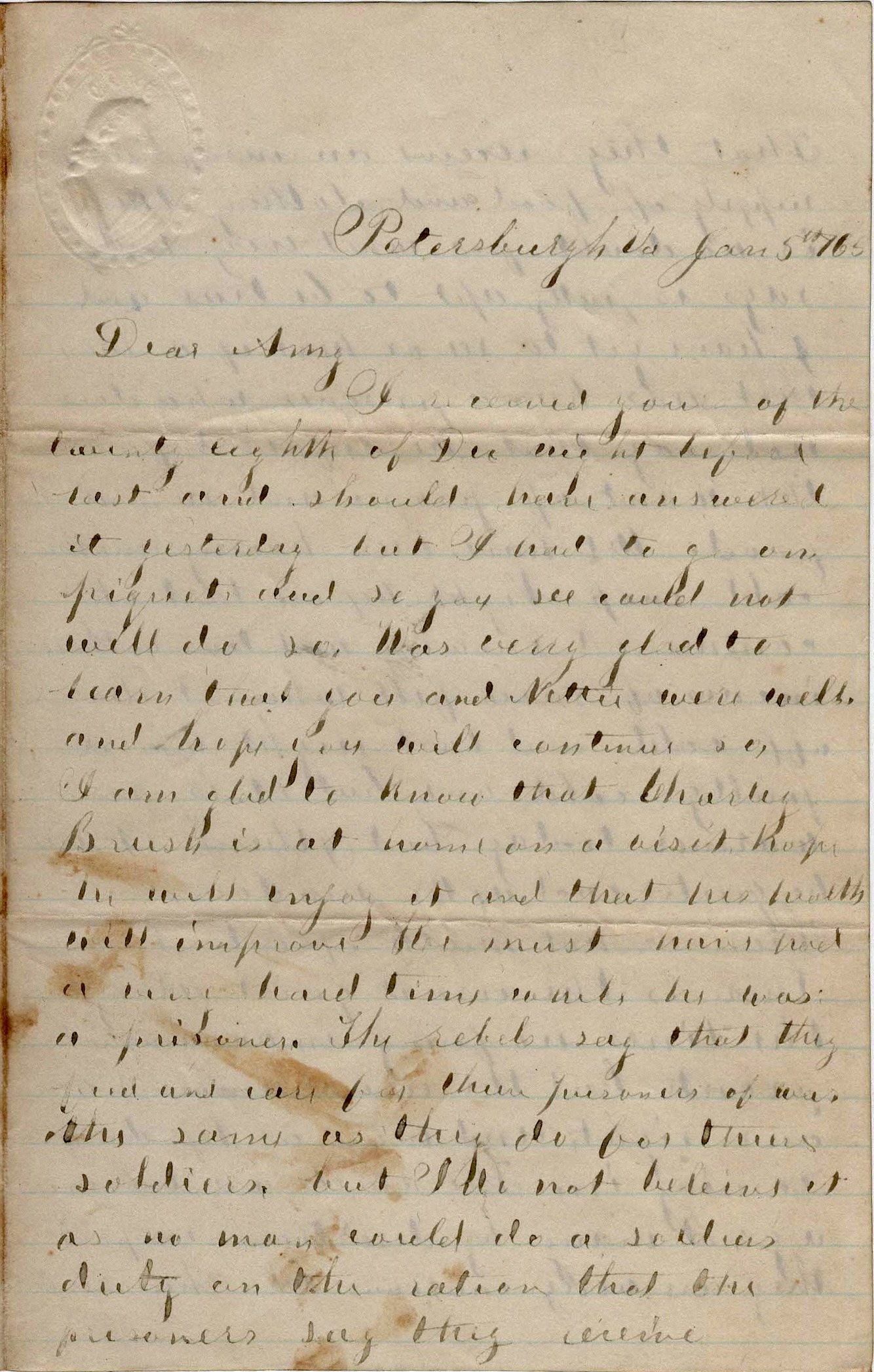
Petersburg, Va. January 5th 1865
Dear Amy,
I received yours of the 28th of December night before last and should have answered it yesterday but I had to go on picket and so you see could not do so. Was very glad to learn that you and Nettie were well and hope you will continue so.
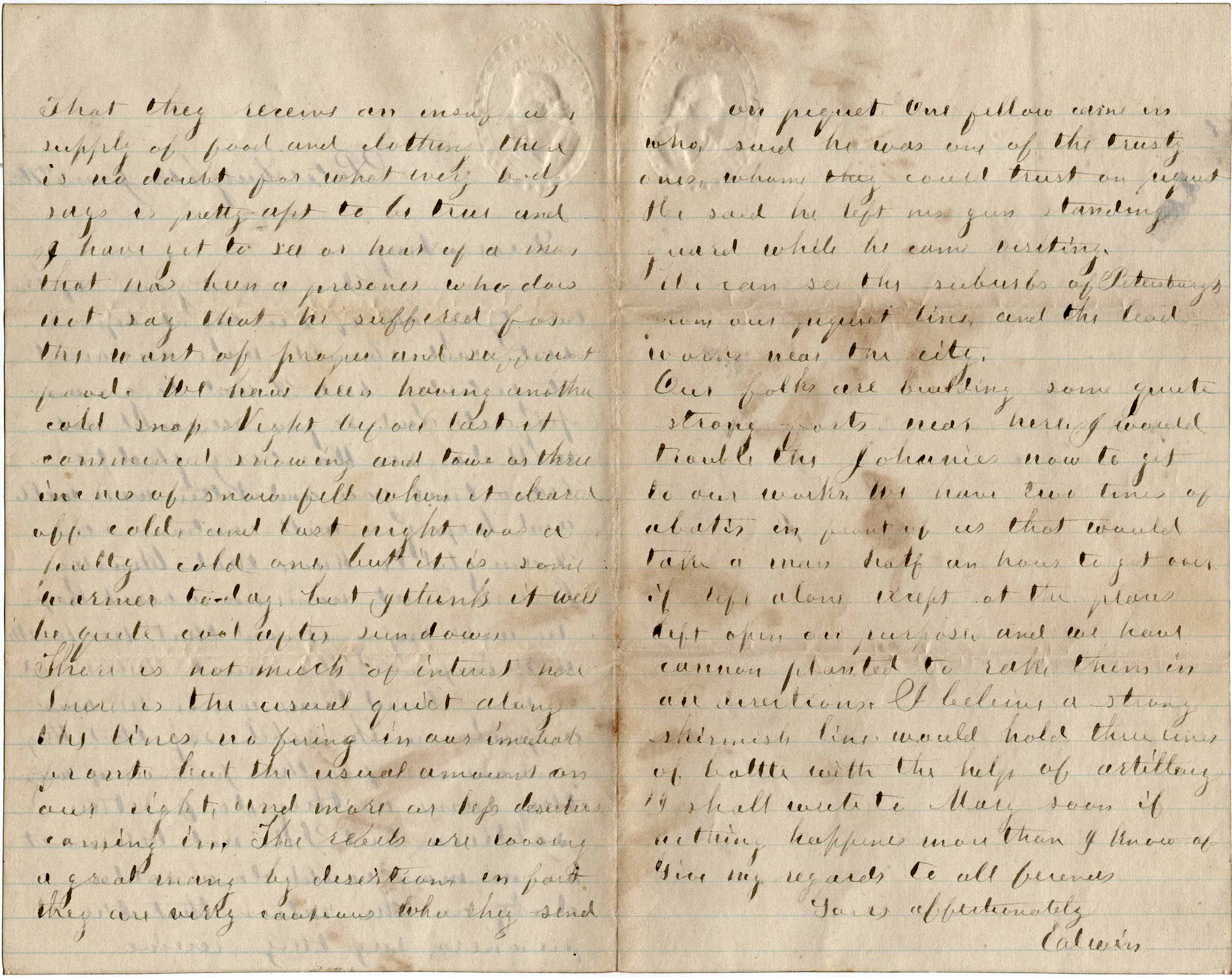
I am glad to know that Charley Brush is at home on a visit, Hope he will enjoy it and that his health will improve, He must have had a very hard time while he was a prisoner. The rebels say that they feed and care for their prisoners of war the same as they do for their soldiers but I do not believe it as no man could do a soldier’s duty on the ration that they prisoners say their receive. That they receive an insufficient supply of food and clothing, there is no doubt for what everybody says is pretty apt to be true and I have yet to see or hear of a man that has been a prisoner who does not say that he suffered for the want of proper and sufficient food.
We have been having another cold snap. Night before last it commenced snowing and two or three inches of snow fell when it cleared off cold. And last night was a pretty cold one but it is some warmer today. But I think it will be quite cool after sundown.
There is not much of interest here. There is the usual quiet along the lines. No firing in our immediate front but the usual amount on our right and more or less deserters coming in. The rebels are losing a great many by desertion. In fact, they are very cautious who they send on picket. One fellow came in who said he was one of the trusty ones whom they could trust on picket. He said he left his gun standing guard while he came visiting.
We can see the suburbs of Petersburg from our picket lines and the lead works near the city.
Our folks are building some quite strong forts near here. It would trouble the Johnnies now to get to our works. We have two lines of abatis in front of us that would take a man half an hour to get over if left alone except at the places left open on purpose and we have cannon planted to rake them in all directions. I believe a strong skirmish line would hold three lines of battle with the help of artillery.
I shall write to Mary soon if nothing happens more than I know of. Gove my regards to all friends. Yours affectionately, — Edwin
Letter 2
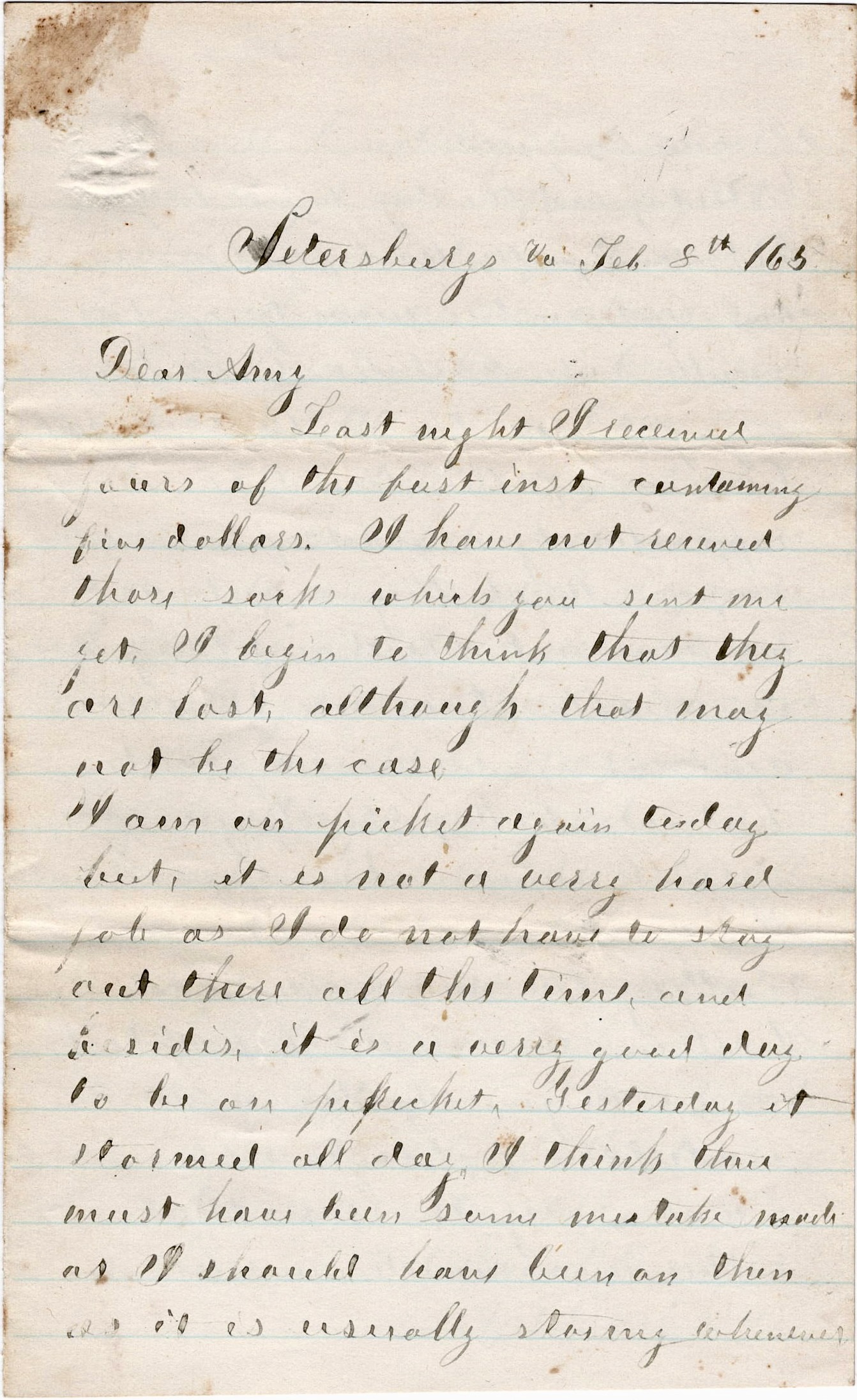
Petersburg, Va. February 8, 1865
Dear Amy,
Last night I received yours of the first inst. containing five dollars. I have not received those socks which you sent me yet. I begin to think that they are lost, although that may not be the case.
I am on picket again today but it is not a very hard job as i do not have to stay out there all the time and beside, it is a very good day to be on picket. Yesterday it stormed all day. I think there must have been some mistake made as I should have been on then as it is usually stormy whenever I am on picket.
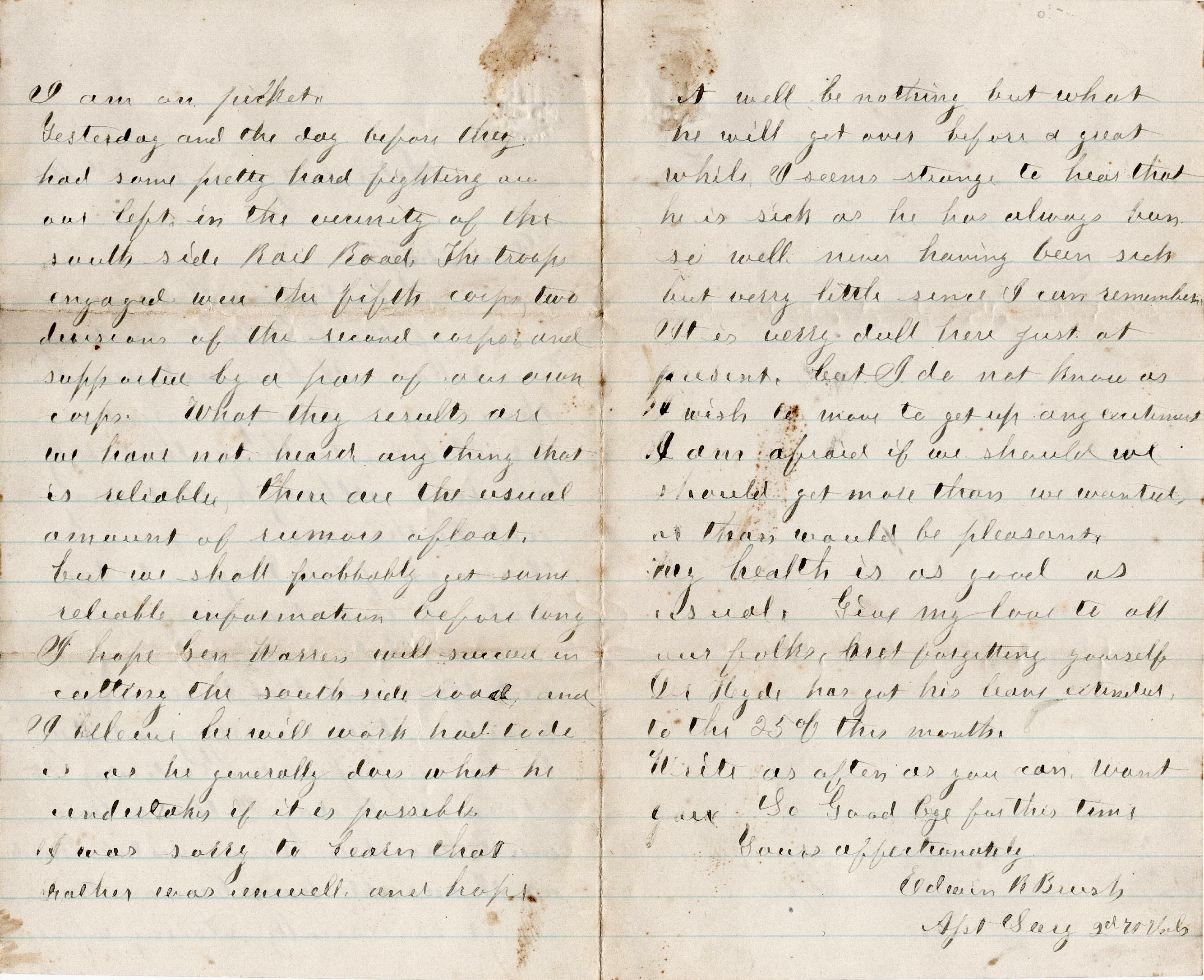
Yesterday and the day before they had some pretty hard fighting on our left in the vicinity of the South Side Railroad. The troops engaged were the 5th Corps, two Divisions of the 2nd Corps, and supported by a part of our own corps. What the results are, we have not heard anything that is reliable. There are the usual amount of rumors afloat, but we shall probably get some reliable information before long. I hope Gen. Warren will succeed in cutting the South Side Railroad and I believe he will work hard to do it as he generally does what he undertakes if it is possible.
I was really sorry to learn that Father was unwell and hope it will be nothing but what he will get over before a great while. It seems strange to hear that he is sick as he has always been so well—never having been sick but very little since I can remember.
It is very dull here just at present, but I do not know as I wish to move to get up any excitement. I am afraid if we should, we should get more than we wanted or than would be pleasant. My health is as good as usual. Give my love to all our folks, not forgetting yourself. Dr. Hyde has got his leave extended to the 25th of this month. Write as often as you can, won’t you? So goodbye for this time. Yours affectionately, — Edwin R. Brush, Asst. Surgeon 2nd Vermont Vols.
Letter 3
Near Petersburg, Virginia March 4th 1865
Dear Amy,
Today I received yours of the 26th. I am on picket today. I have to go on only once in about four weeks. There are two very important things transpiring today. One is the inauguration of Old Abe [but] however important that event may be to the country, there is another that is full as important to the members of the regiment individually and that is that we are receiving four months pay. And for one, I can say that it comes in time of need.
News is very scarce here just at present. The rebels are not deserting quite as fast as they were a few days ago. It is said that there are a different set of men doing picket duty in our front from what there were a few days ago. It is either that or else the rebels are more particular about the men they send on picket. I am still doing duty at the 6th Regiment. How long I shall have to remain there, I do not know. I am glad that you had so good a visit with Lieut. Buck.
About my horse not carrying double, it is true. He did not propose to carry anything that was secesh and I do not blame him much either, do you? But that time I went two or three miles beyond our picket lines to dress a wounded rebel.
I have just been paid off and shall send a check for a hundred and fifty dollars which I hope will be acceptable to you. I hope you have not suffered for the want of it. I should liked to have sent more but I had to borrow some money to live on and shall have that to pay. I have two months pay now due me but we shall not get that now.
It has been very stormy here for the last week, it having rained almost every day. So I do not think we shall have to move just yet. My health continues good yet, and I hope yours is good also.
I have not heard from Mortimer since I left the Valley. I do not know why he does not write as I wrote him very soon after we got here. I should think he would answer it but perhaps he did not receive it. Give my regards to all enquiring friends. Yours affectionately, — Edwin R. Brush, Asst. Surgeon, 2d Vermont Vols. Washington D. C.
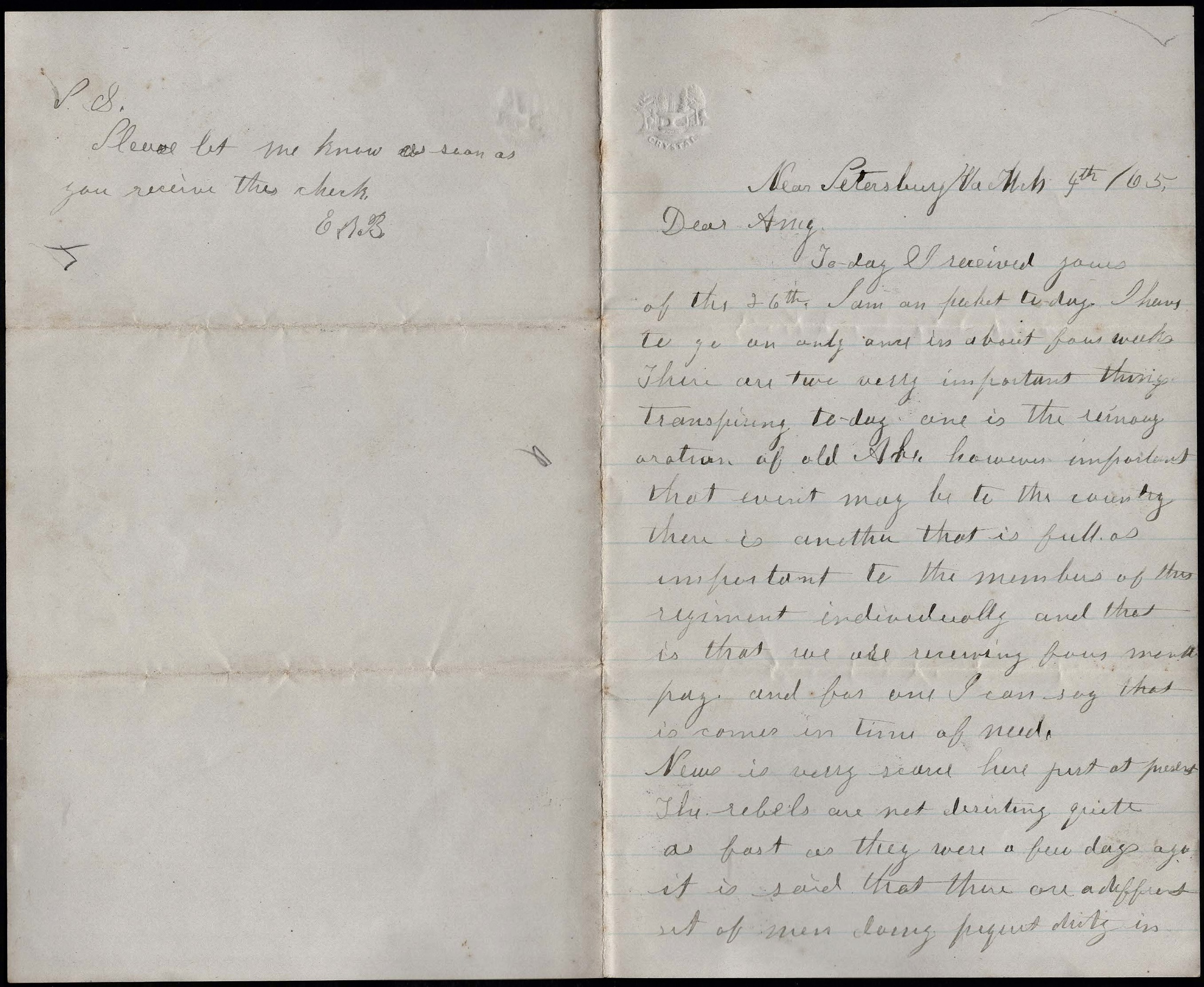
P. S. Please let me know as soon as you receive the check. — E. R. B.
Letter 4
[Note: This letter is from the private collection of Greg Herr and was transcribed and published on Spared & Shared by express consent.]
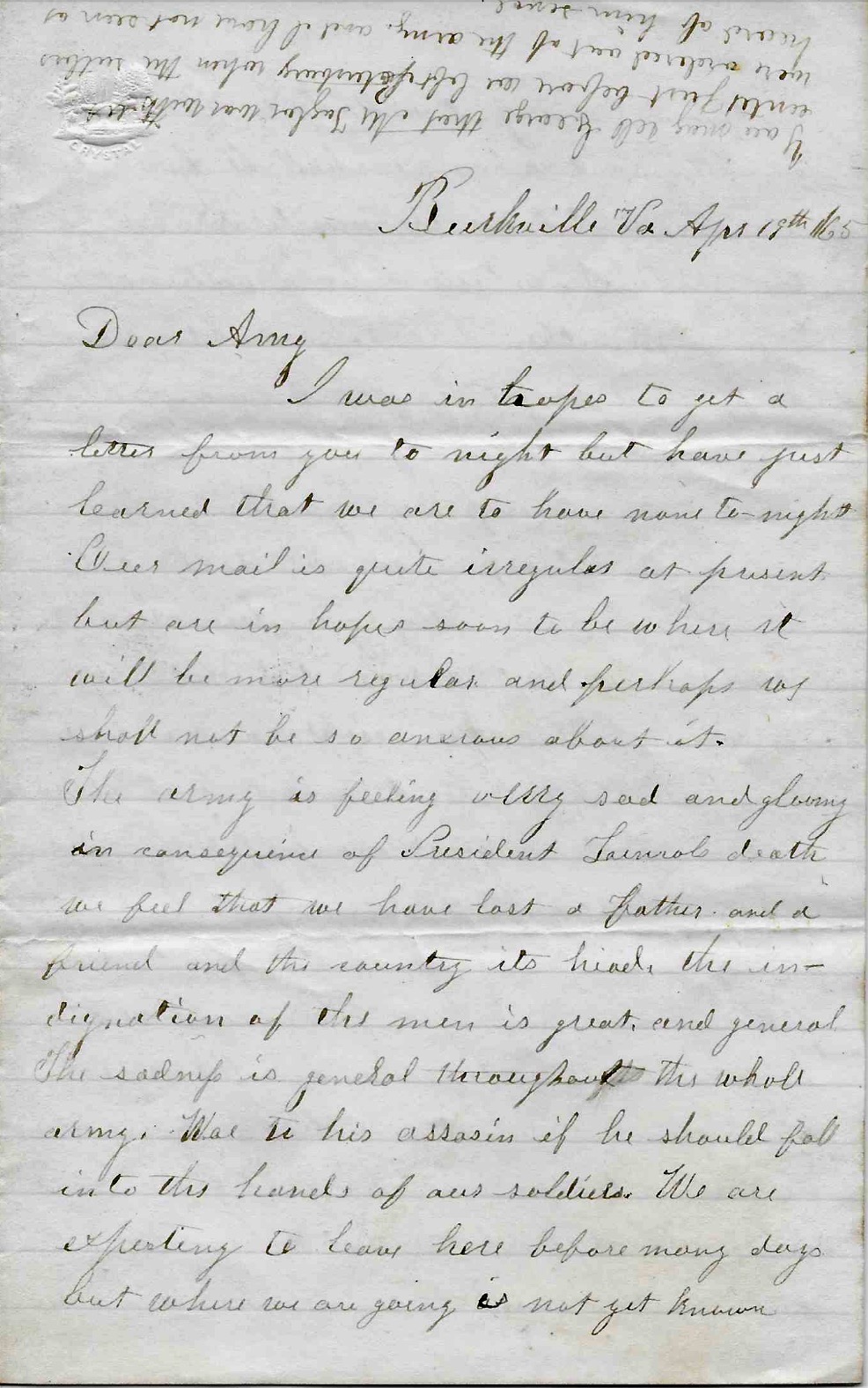
Burkville, Virginia April 19th 1865
Dear Amy,
I was in hopes to get a letter from you tonight but have just learned that we are to have none tonight. Our mail is quite irregular at present but are in hopes soon to be where it will be more regular and perhaps we shall not be so anxious about it.
The army is feeling very sad and gloomy in consequence of President Lincoln’s death. We feel that we have lost a father and a friend and the country its head. The indignation of the men is great and general. The sadness is general throughout the whole army. Woe to his assassin if he should fall into the hands of our soldiers.
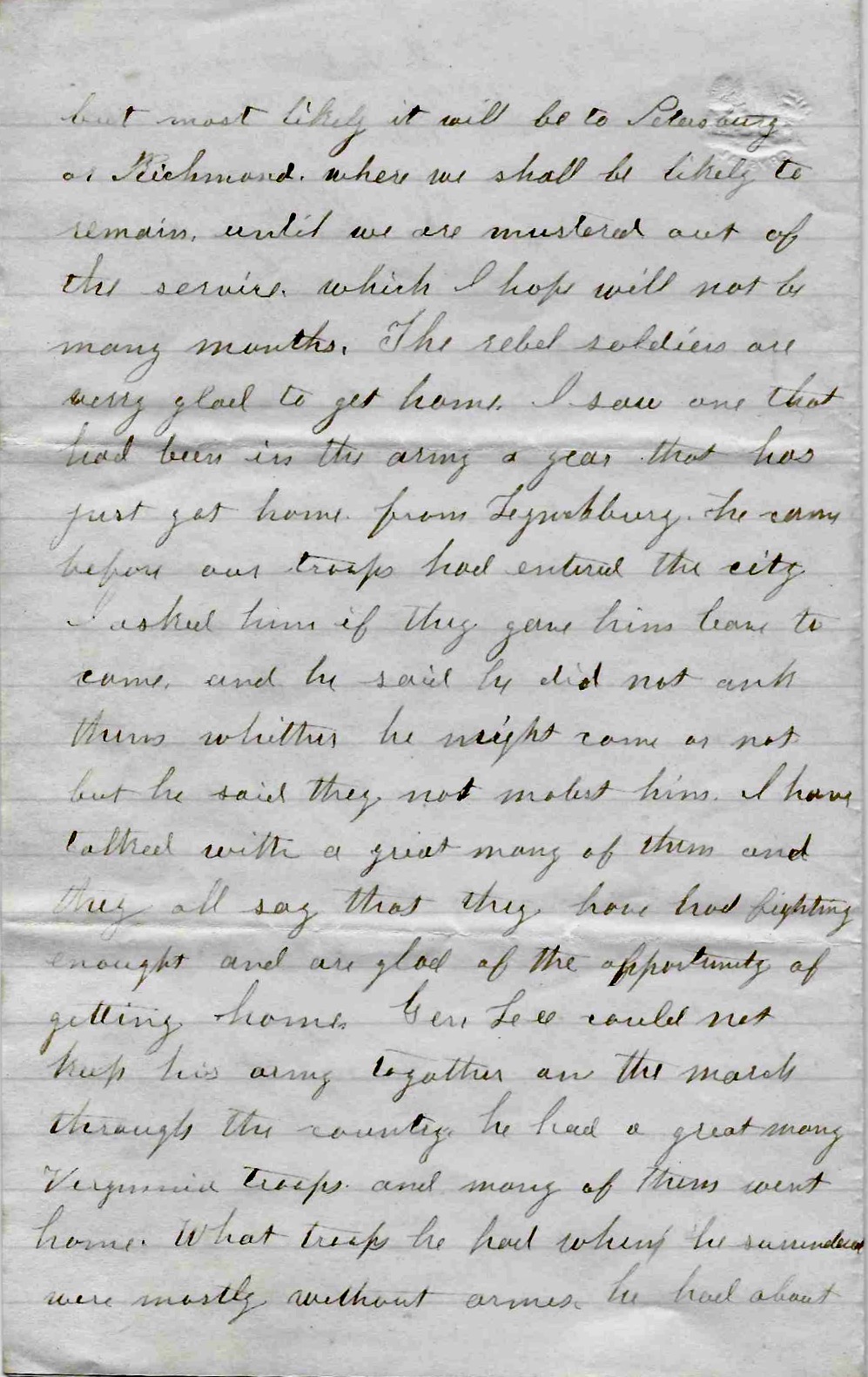
We are expecting to leave here before many days but where we are going is not yet known but most likely it will be to Petersburg or Richmond where we shall be likely to remain until we are mustered out of the service which I hope will not be many months. The rebel soldiers are very glad to get home. I saw one that had been in the army a year that has just got home from Lynchburg. He came before our troops had entered the city. I asked him if they gave him leave to come and he said he did not ask them whether he might come or not but he said they [did] not molest him. I have talked with a great many of them and they all say that they have had fighting enough and are glad of the opportunity of getting home.
“He [Lee] had about thirty thousand men with him when he surrendered and there were only ten thousand of them that were armed.”
Edwin R. Brush, Asst. Surgeon, 2nd Vermont Infantry
Gen. Lee could not keep his army together on the march through the country. He had a great many Virginia troops and many of them went home. What troops he had when he surrendered were mostly without arms. He had about thirty thousand men with him when he surrendered and there were only ten thousand of them that were armed. There were probably many that did not have arms when they left Richmond and Petersburg such as hospital attendants, teamsters, and &c. But taking those out and there must have been many that threw their arms away.
We have been amusing ourselves today in reading Jeff Davis’s last message written at Danville. I think his next will be of a different tune. I have been to the station today to look at some of the captured artillery. I do not know just how many pieces there were there today but yesterday there were one hundred and one and there were more to come. They are sending them North as fast as possible and I hope they will be sent so far that the South will never see them.
I am as well as usual. Affectionately, your husband, — Ed Brush, Asst. Surgeon, 2nd Vermont Vols.
You may tell George that Mr. Taylor was with us until just before we left Petersburg when the sutlers were ordered out of the army and I have not seen or heard of him since.
The following letter was written by Noble Lovely Prentis (1839-1900) who was born three miles from Mount Sterling, Illinois. His parents died at Warsaw, Illinois of cholera during the epidemic of 1849, leaving him an orphan at the age of ten. He then went to live with an uncle in Vermont and remained there until he was 18 when he moved to Connecticut and served an apprenticeship in the printer’s trade. He then came west and worked for a time in a newspaper office at Carthage, Illinois.
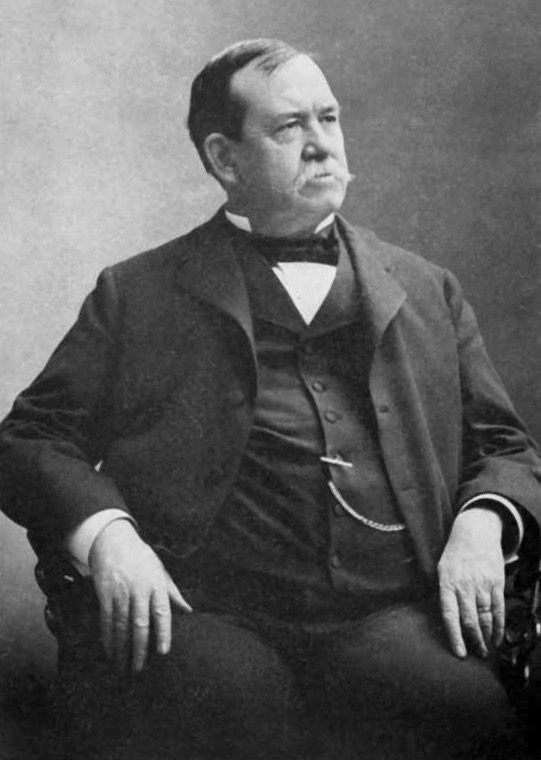
Noble L. Prentis in later years
At the opening of the Civil War, he enlisted as a private in Co. D, 16th Illinois Infantry and served four years when he was honorably discharged. Prentis married Maria C. Strong on May 13, 1866. He published a paper at Alexandria, Missouri until Captain Henry King of the St. Louis Globe-Democrat induced him to come to Topeka, Kansas in 1869 and assist him on the Record. He next worked on the Commonwealth and then on the Lawrence Journal. From 1873 to 1875, Prentis edited the Junction City Union, then returned to the Topeka Commonwealth, and in about 1877, he began to work on the Atchison Champion. He remained with that paper during Colonel Martin’s term as governor and in 1888, took charge of the Newton Republican.
In 1890, he accepted a position on the editorial staff of the Kansas City Star, which he held until his death. In 1877 he went to Europe. His observations during the trip were published in book form, entitled A Kansan Abroad, which ran through two editions. He also wrote Southern Letters, Southwestern Letters, Kansas Miscellanies, and in the last year of his life, wrote A History of Kansas, which became his best-known work.
Noble wrote the letter to his friend, Francis (“Frank”) James Russell (1836-1900), the son of John Russell, Jr. (1793-1863) and Laura Ann Spencer (1797-1890) of Bluffdale, Greene county, Illinois. See also—1863-65: Francis James Russell to Sarah Ann (Burkholder) Russell on Spared & Shared 17.
[Note: This letter is from the private collection of Greg Herr and was transcribed and published on Spared & Shared by express consent.]
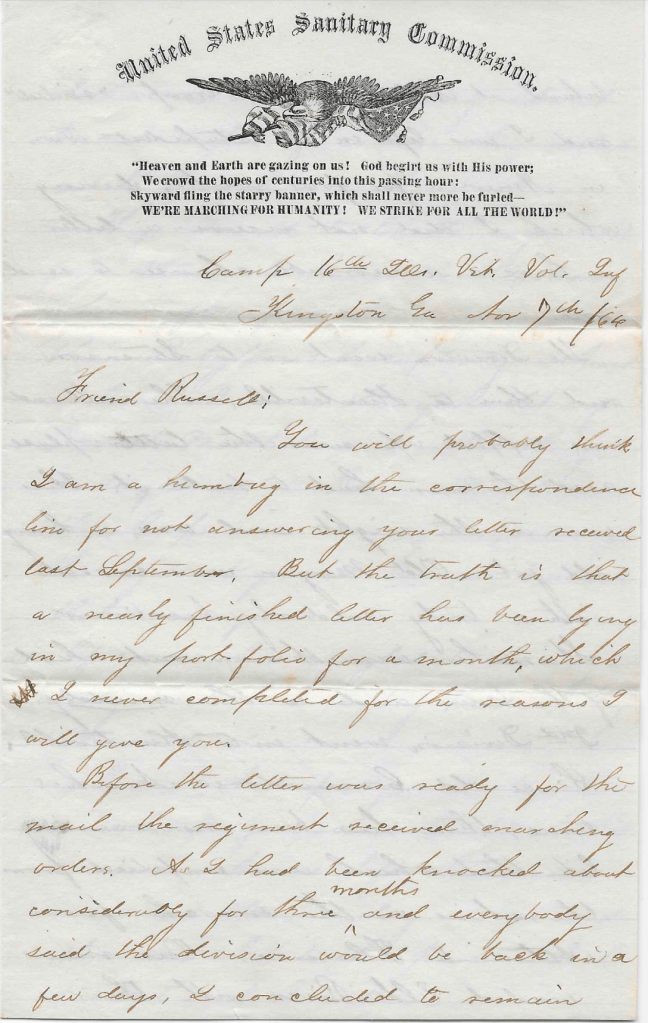
You will probably think I am a humbug in the correspondence line for not answering your letter received last September. But the truth is that a nearly finished letter has been lying in my portfolio for a month, which I never completed for the reasons I will give you.
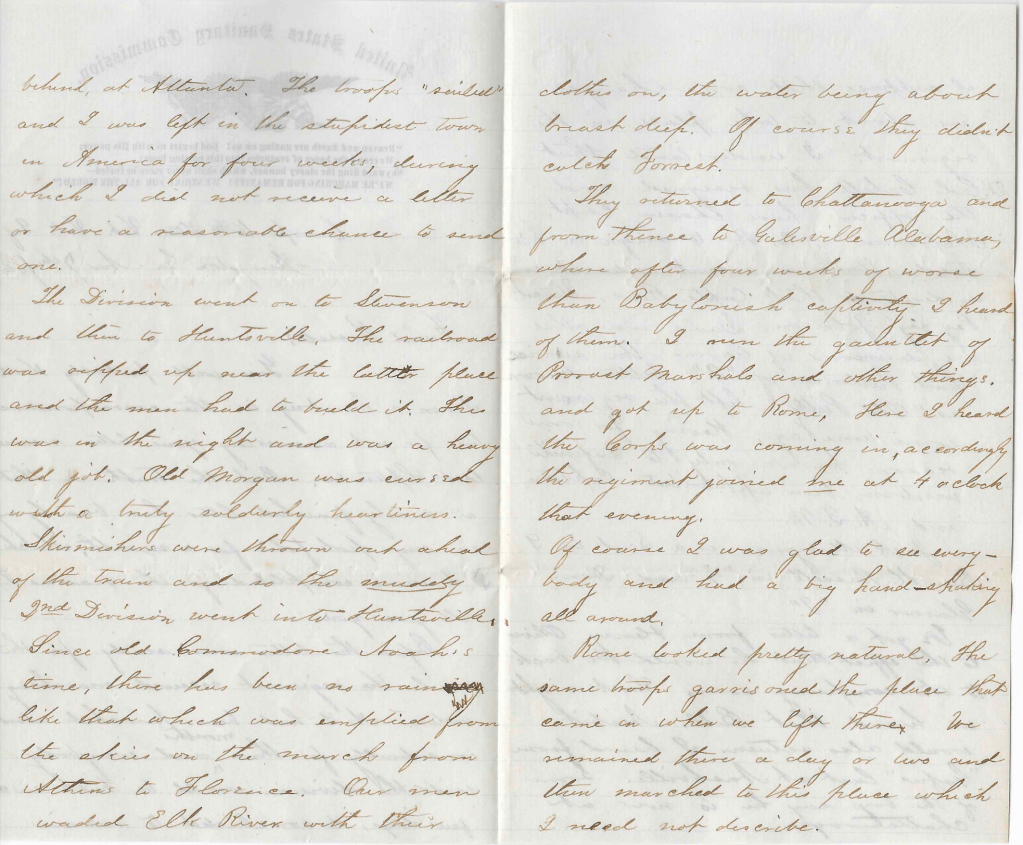
Before the letter was ready for the mail the regiment received marching orders. As I had been knocked about considerably for three months and everybody said the division would be back in a few days, I concluded to remain behind at Atlanta. The troops “sailed” and I was left in the stupidest town in America for four weeks, during which I did not receive a letter or have a reasonable chance to send one.
The Division went on to Stevenson and then to Huntsville. The railroad was ripped up near the latter place and the men had to build it. This was in the night and was a heavy old job. Old Morgan was cursed with a truly soldierly heartiness. Skirmishers were thrown out ahead of the train and so the muddy 2nd Division went into Huntsville.
Since Old Commodore Noah’s time, there has been no rain like that which was emptied from the skies on the march from Athens to Florence. Our men waded Elk River with their clothes on, the water being about breast deep. Of course they didn’t catch Forrest.
They returned to Chattanooga and from thence to Galesville, Alabama, where after four weeks of worse than Babylonish captivity, I heard of them. I run the gauntlet of Provost Marshal and other things and got up to Rome. Here I heard the Corps was coming in. Accordingly the regiment joined me at 4 o’clock that evening. Of course I was glad to see everybody and had a big hand-shaking all around.
Rome looked pretty natural. The same troops garrisoned the place that came in when we left there. We remained there a day or two and then marched to this place which I need not describe.
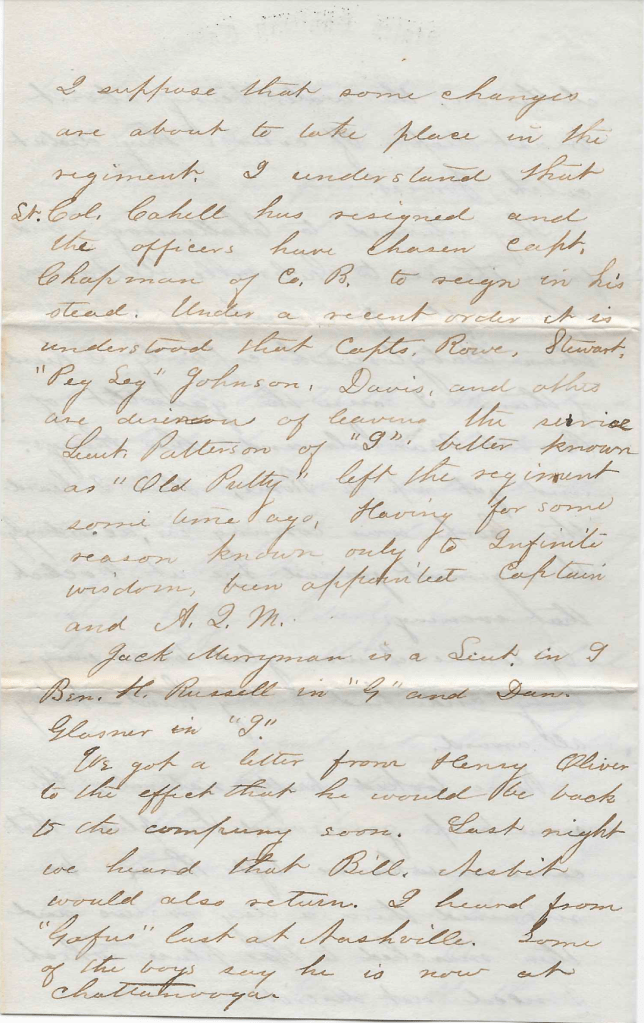
I suppose that some changes are about to take place in the regiment. I understand that Lt. Col. [James B.] Cahill has resigned and the officers have chosen Capt. [James A.] Chapman of Co. B to reign in his stead. Under a recent order, it is understood that Capts. [Abram] Rowe, [George D.] Stewart, “Peg Leg” [Smith] Johnson, [Isaac] Davis and others are desirous of leaving the service. Lieut. Patterson of “I” better known as “Old Putty” left the regiment some time ago, having for some reason known only to infinite wisdom been appointed captain and Asst. Quartermaster. Jack Merriman is a lieutenant in “I”, Ben H. Russell in “G” and Dan Glasner in “I.”
We got a letter from Henry Oliver to the effect that he would be back to the company soon. Last night we heard that Bill Nesbit would also return. I heard from “Gafus” last at Nashville. Some of the boys say he is not at Chattanooga.
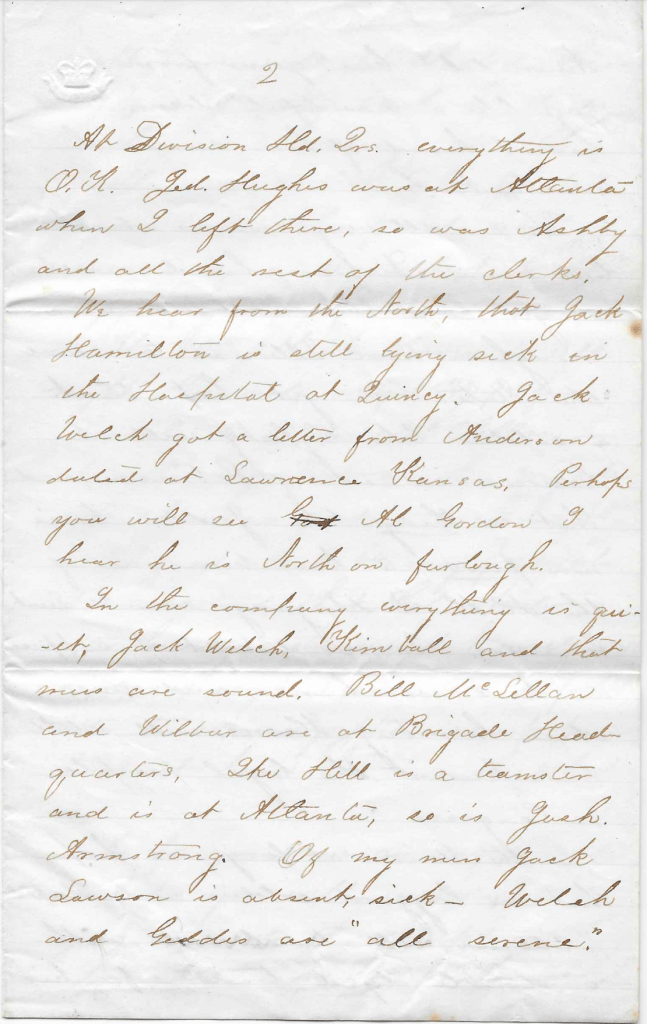
At Division Headquarters everything is O. K. Jed Hughes was at Atlanta when I left there. So was [Martin Van Buren] Ashby and all the rest of the clerks.
We hear from the North that Jack Hamilton is still lying sick in the hospital at Quincy. Jack Welch got a letter from Anderson dated at Lawrence, Kansas. Perhaps you will see Al Gordon. I hear he is North on furlough.
In the company everything is quiet. Jack Welch, [Thomas C.] Kimball, and that mess are sound. Bill McLellan and [William S.] Wilbur are at Brigade Headquarters. [Isaac] Ike Hill is a teamster and is at Atlanta. So is Josh Armstrong. Of my men, Jack Lawson is absent sick. Welch and Geddes are “all serene.” “Aminadah” has gone from our gaze like a beautiful dream. I haven’t heard of him since he went North.
We are all very anxious about tomorrow. Disfranchised ourselves, we yet hope there are true men enough in brave Illinois to save the State. We yet hope that a soldier like [Richard J.] Oglesby will be Governor instead of [James Carroll] Robinson, and that no thing like [Norman B.] Judd who is now proven to have been one of the H. H. Dodd gang, 1 can be Lieut. Governor. In our district I suppose we have no chance and the obese humbug Harris will still misrepresent the loyal people in Congress.
In the Union at large, we hope that no laggard soldier and stupid politician with a double dyed traitor for his right bower will be elected President and bring back to the army (if there is an army) all the Buells and Porters who for two years wasted the blood and treasure of a brave but long-suffering people.
The 16th, thank Heaven, is all right. Our vote stood 379 for Lincoln to 13 for McClellan. No other regiment in this brigade can show so good a record. The “60th” gave about 60 majority for Lincoln. I understand that Col. Anderson after having distinguished himself on the campaign has written a foolish letter to some Egyptian 2 newspaper. I don’t know how true the report is.
As for you, mine ancient comrade, I hope you will, indeed I know you will, do the complete thing. You will now be a “household” and in due time one of the solid men of Greene [county]. You will no doubt take some part in politics and I hope you will let me know what part that is. Let me hear from you and do not imitate my dilatoriness but write soon.
My health is excellent and as it is rumored that we are soon to start on another campaign, I am particularly glad it is so. My regards to Mrs. Russell and best wishes for yourself. Yours truly, — Noble L. Prentis
1 Harrison Horton Dodd (1824-1906) was an Indianapolis businessman and one of the leaders of secret organizations in Indiana that plotted violent uprisings against the authority of the United States government during the Civil War. By 1862 Dodd was speaking frequently all over Indiana to Democratic audiences urging opposition to the war. In his public speeches, he espoused state sovereignty views, asserting that the federal government had no authority over the states. States were sovereign and had the right to secede from the national union. No one owed loyalty to the federal government, he argued. Believing that abolitionists and anti-slavery Yankees had driven the southern states to rebel, he stated that the U.S. Constitution gave no authority to the federal government to coerce the seceded states back into the Union. In public speeches, Dodd alluded cryptically to the existence of an organization called the Knights of the Golden Circle (KGC), a secret oath-bound society formed in the 1850s originally to spread southern slavery into Central and South America. During the rebellion, its northern members supported the Confederate rebels. Members of the KGC and its successors held state sovereignty, pro-slavery views. [Encyclopedia of Indianapolis]
2 “Egyptian” is a reference to the region in Southern Illinois that was called “Little Egypt” sandwiched between the Mississippi and Ohio Rivers.
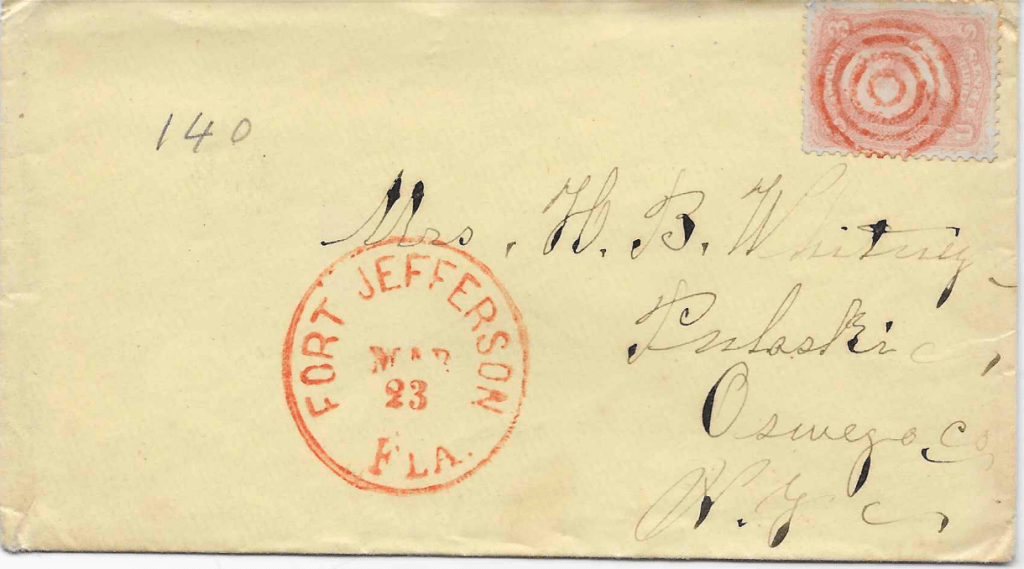
The following letter was written by Henry B. Whitney (1838-1920) who enlisted on 25 August 1862 to serve three years in Co. B, 110th New York Infantry. At the time of his enlistment 24 year-old Henry gave Albion, New York, as his birthplace, and he was described as a 5′ 9″ grey-eyed, brown-haired carriage maker. For a time in the fall of 1863, Henry was hospitalized in Baton Rouge but recovered and returned to his regiment, mustering out with his company at Albany in August 1865.
Henry wrote the letter to his wife, Martha H. (Smith) Whitney (1840-1921). After the war, Henry returned to his old occupation and his residence in Pulaski, Oswego county, New York.
The 110th New York Regiment left the state on the 29th, proceeding to Baltimore, where it was stationed until Nov., 1862, when it was ordered to New Orleans, and early in 1863 was assigned to Emory’s division of the 19th corps. Its first experience under fire was at Fort Bisland, and at Franklin it had 12 killed and wounded. It took part in the long siege of Port Hudson and shared in the grand assault of June 14. The total loss of the regiment during the siege was 37 killed, wounded and missing. Its last battle was at Vermillion bayou, La., in Nov. 1863, where it lost 6 killed and wounded. In Feb., 1864, it was ordered to Fort Jefferson, Fla. The regiment was mustered out at Albany, under Col. Hamilton, Aug. 28, 1865. It lost during service 2 officers and 14 men killed and mortally wounded; 3 officers and 192 men died of disease and other causes—total deaths, 211. The high percentage of loss by disease was due to the long service of the regiment in the extreme South.
[Note: This letter is from the private collection of Greg Herr and was transcribed and published on Spared & Shared by express consent.]
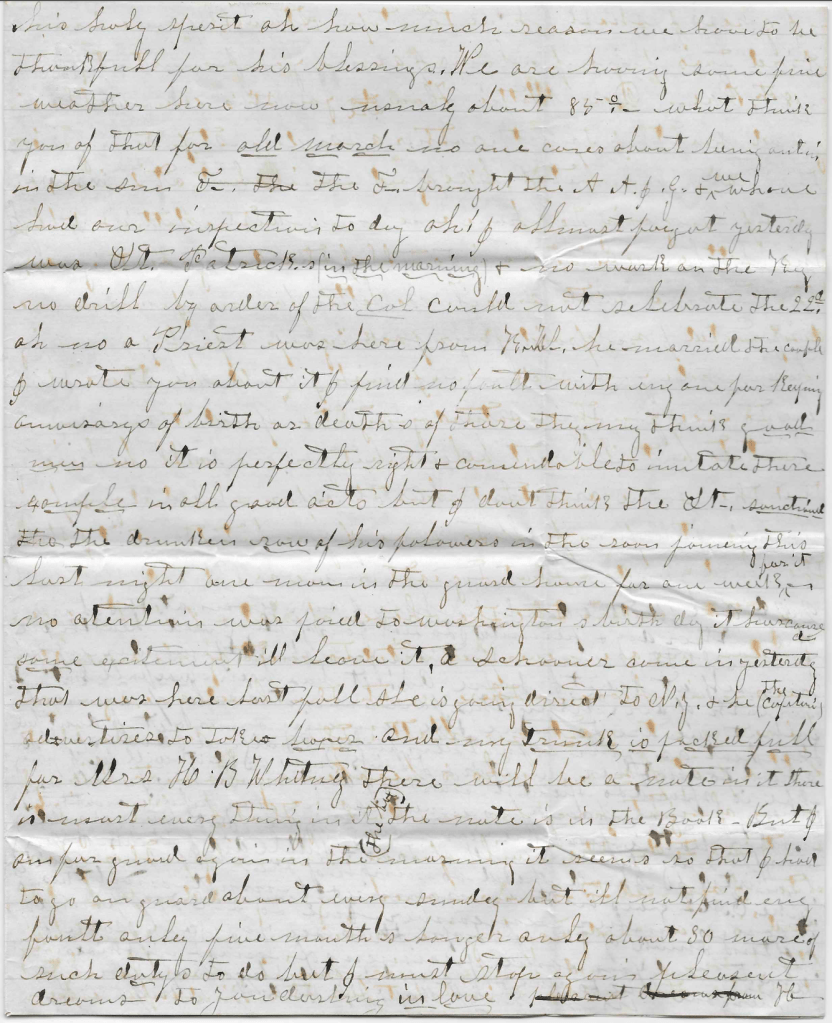
Transcription
Fort Jefferson [Florida] March 13th 1864
Dear Wife,
For a long time I have tried to write a little evenings before going on guard and as another is here I will improve the time in a social chat with my little wife, precious as ever you are to me this eve. Oh, I wish I knew you were well. I am feeling quite well this eve but I will believe you trusting in the same power that has ever watched over you. Even the hairs of our heads are numbered. How very good our heavenly Father is to us when we are so unworthy of His blessings, so heartless and careless. How much strength & grace we need to not entirely forget the Lord. Remember me in your prayers, darling, that I may ever have an eye single for the glory of the Lord & in all things I may exemplify His holy religion & not be a stumbling block & have my lamp trimmed and burning so that when the summons comes, it may find me ready.
How I do miss the prayers & class meetings. Yes, I long for the society of Christian friends. Still I am living in the hopes of one day not long hence enjoying such privileges again. Don’t forget me.
I guess I shall have to stop. Stowell came in & now aird two fine f___s, I assure you. I must stop.
[March] 18th. Dear Matte. How are you this eve? Well and in good health, I trust. Rather a sudden stop to my writing the other eve, but I like a good social chat at times, even so & I am going to have one now with Mattie & tell you the little news there is to tell of the doings on this garden Key. The F. came with a mail [but] no letter for me. I was some disappointed and am afraid your packing up and perhaps moving has made you sick. How I wish I could be there this eve to see you this Saturday night & spend it as we were wont to, but I’ll not believe but you are well, believing that the same arms that has thus far shielded you from harm is still powerful to save if you but trust it. I thank the Lord you do & that together we are treading the narrow way that leads to the haven of rest & if in His infinite wisdom we are never permitted to meet again on earth, we can in heaven & there with the loved ones gone on before, be at rest. Yes, Mattie, then we can see that little pet of ours who is beckoning us on to HIs bright home of light. Pray for me, darling, that I live right and strive to do the will of my heavenly father. How often I am led to worry over my waywardness but the Lord us ever ready to forgive when we ask in faith…
We are having some fine weather here now—usually about 85 degrees. What think you of that for old March? No one cares about being outside in the sun. The F. brought the A. A. J. G. & we have had our inspections today. Oh! I almost forgot. Yesterday was St. Patrick’s 9in the morning) and no work on the Key. No drill by order of the Colonel. Could not celebrate the 22nd. Oh no. A Priest was here from Key West. He married the couple—I wrote you about it. I find no fault with anyone for keeping anniversaries of birth or deaths of those they may think good men. No, it is perfectly right & commendable to imitate their example in all good acts. But I don’t think the Saint sanctioned the drunken row of his followers in the room joining his last night. One man in the guard house for one week for it. No attention was paid to Washington’s Birthday. It has caused some excitement. I’ll leave it.
A schooner come yesterday that was here last fall. She is going direct to New York & he (the captain) advertises to take [ ] and my trunk is packed full for Mrs. H. B. Whiting. There will be a note on it, There is most everything in it. The note is in the book.
But I am for guard again in the morning it seems so. I have to go in guard about every Sunday but I’ll not find any fault. Only five month’s longer. Only about 30 more of such duties to do. But I must stop again. Pleasant dreams to you darling. In love, — H
March 21st. Eve. Dearest wife. How do you do this warm, sultry eve? Well, I trust. I wish I knew you were as well as I am but it will be some time ere I shall know where you are and how you are enjoying yourself these times. I was in hope I should get a letter tonight for the E. M. came in. Only a few letters for Co. K. Nothing for me. Still hoping. Still trusting the Lord. What comfort and consolation there is, ain’t there darling?
That box is aboard the schooner Narria. She goes in the morning. I did not have time to write have I wanted to on the note that is in the book. There is some pressed moss in it too. There is in the paper box quite a variety of shells—perhaps you know the names of them. I’ll not try to tell you. I’ll send some more moss as soon as I get it pressed.
Did you ever get a receipt for the barrel of carrol? What was the charges on it? I hope the box will go through safe for there is many an hours hard work in the hot sun. Never a handful did I put in my pocket but I thought of her I was gathering them for & if they reach you I shall at least feel that I have in part repaid you for the many acts of kindness you have bestowed upon me. If I can never pay them, I can at least acknowledge the debt. There is some satisfaction in that.
But there is the drum & I must stop. Good night Mattie. In love, — H
22nd Eve. Mattie darling, here I am a going at the chore of another day and permitted to tell you of my good health. Are you well this eve? What are you about, I wonder? Enjoying yourself at least, I hope. Oh! it has been woeful hot—not a breath of air stirring this forenoon. It is only a forerunner of what we are to have the coming summer yet. I. don’t feel the heat as you Northern folks think we do & as I look ahead to another winter & think how cold it will be if my life is spared to spend ir North, I don’t know how I shall manage to keep warm, can you? Invent some way before another winter, Mattie, for one year now I have not seen it cold enough to bring the mercury down to 55 degrees. Little did I think when I enlisted I should spend so much of the time here [but] so it is.
The E. M. goes in the morning & I must mail this so it can go on her [way]. Remember me to all the friends. I often think of them and hope to see you all soon. I am going to send you some specimens of moss in this…Keep you ever in His holy keeping is the daily prayer of your, — Henry
Allie’s Headstone at the Oak Hill Cemetery in WDC.
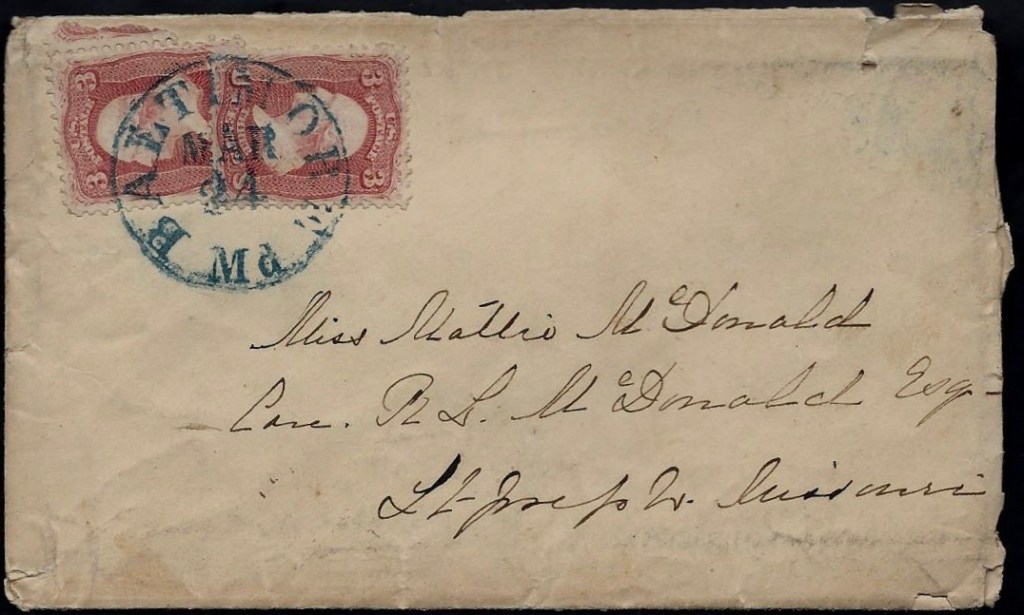
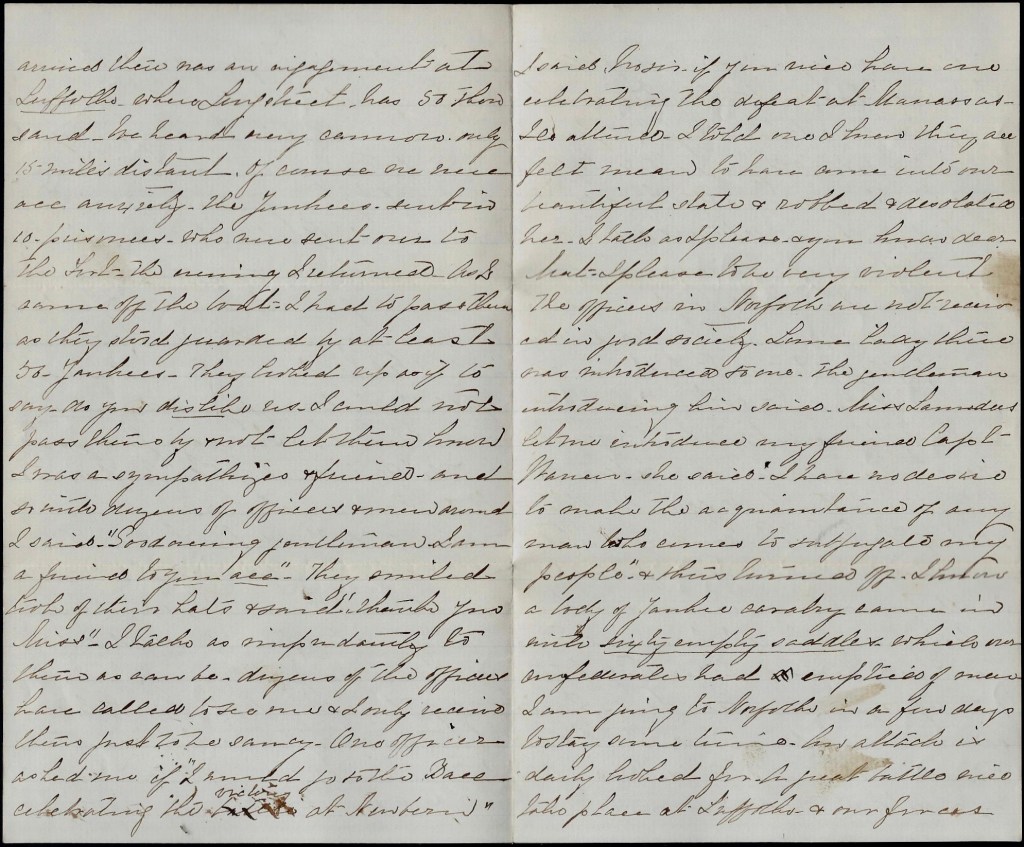
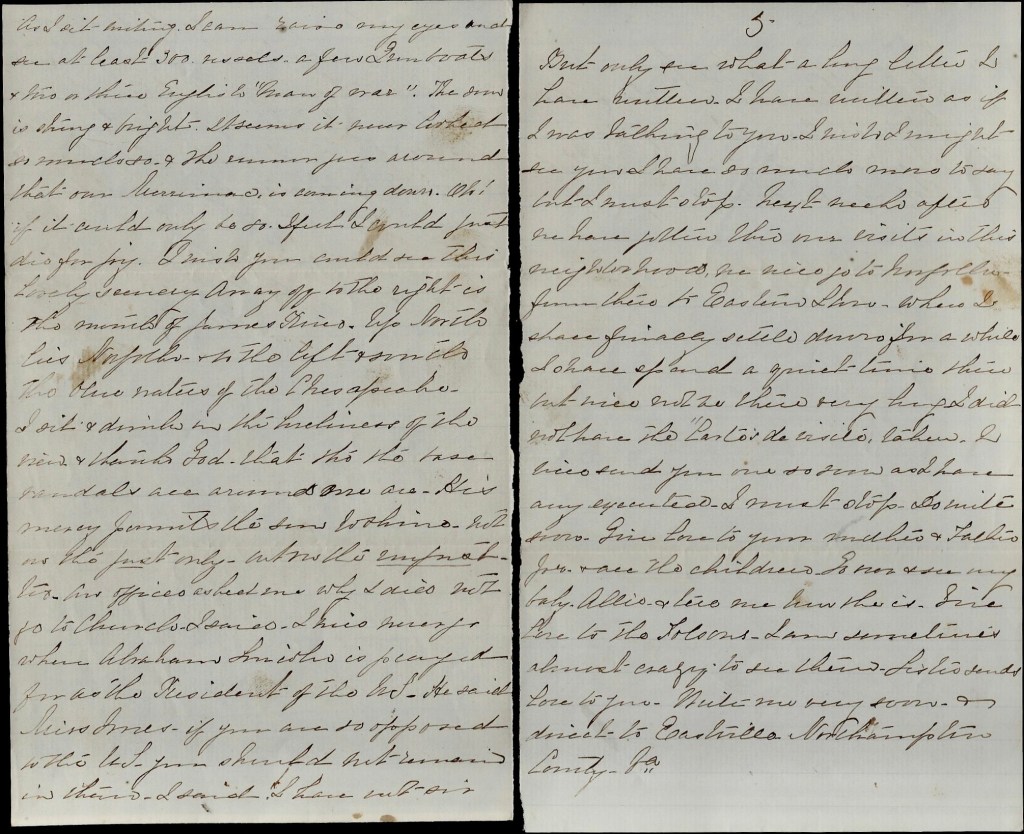
This incredible and lengthy letter provides us with a vivid account of Fort Monroe, Yorktown, and Williamsburg from the perspective of a female civilian who was a native of Virginia and held strong secessionist views. Her name was Allie Catesby Jones (1836-1874) and I feel confident she was the same woman by that name who would later become the wife of Caleb Clapp Willard (1834-1905), possibly her cousin. Caleb, the son of Joseph and Susan (Dorr) Willard, was born in Vermont but came with his family to Washington D. C. about 1850. His older brothers, Henry and Joseph C. Willard, were then the proprietors of the Willard Hotel. After attending Washington Seminary, Caleb was schooled in the hotel business and sent, for his first assignment, when he was but 19 years old, to take charge of the Hygeia Hotel at Old Point Comfort which had a capacity of 1,000 guests and was the only summer hotel south of New York.
A yellow fever epidemic closed the hotel in the 1850s for a time but Caleb returned to partner with John Segar to purchase it and he had the exclusive management of the hotel until 1862 when the government ordered the hotel to be torn down because it interfered with military and naval operations. According to his obituary, Caleb was offered the privilege of superintending the destruction of the building which took two weeks. He then stayed on as a commissary storekeeper until 1864 when he went back to Washington, purchased the Ebbitts House, and became one of the wealthiest men in the District of Columbia.
I’m not certain of Allie’s parents but I believe she was the 13 year-old child named “Alice Jones” residing with Joseph and Catharine Weisiger in Hampton, Virginia, in the 1850 US Census. From her letter we learn that just prior to making the trip to Fort Monroe where this letter was datelined, she was living in St. Joseph, Missouri. She was married to Caleb on 8 September 1863 and the couple had two children, Katherine Dorr Willard who was born on 19 November 1864, and Walter Jones Willard born 1 December 1868.
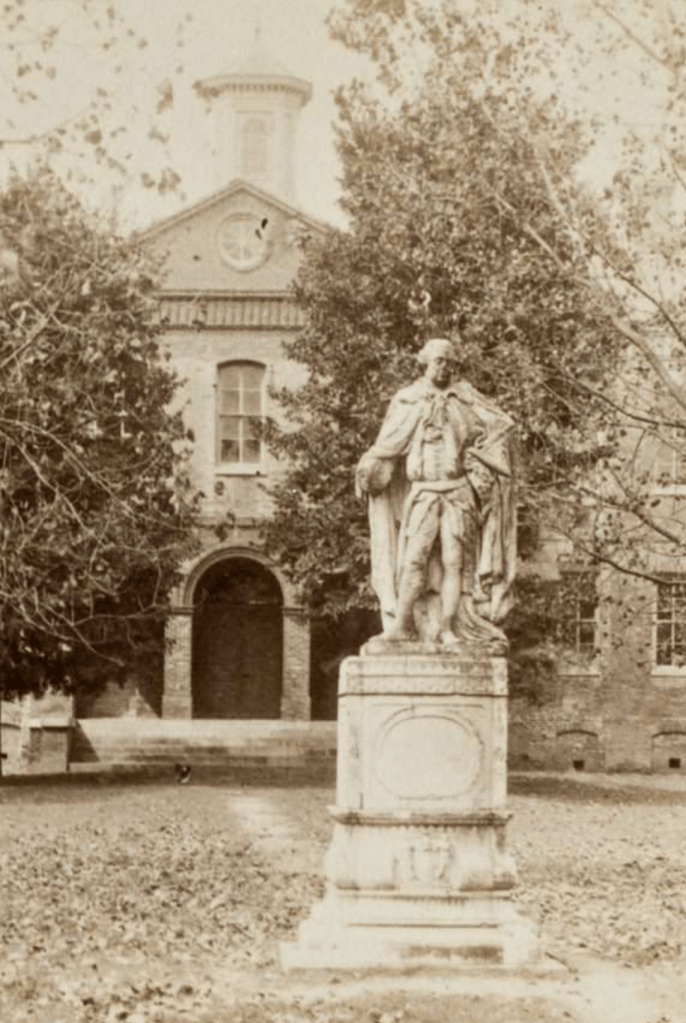
Fortress Monroe, Old Point Comfort, & Hygeia Hotel in 1861-62
Transcription
Addressed to Mattie McDonald, Care of R. S. McDonald, Esq., St. Joseph, Missouri
Near Fort Monroe March 22nd 1863
My dear friend,
There has not been an hour since I left you but my promise to write you has come up before me & I have not intended or wished to defer it so long. I have though been in one constant whirl of excitement & confusion & I did not think I could bring order out of such confusion & write such a letter as i should desire or you deserve. I am very far from being settled here now but my anxiety to hear from you all prompts me to write at all hazards. I need not tell you of our journey homeward—it consisted of the usual (no, I think ours was very unusual) amount of railroading, omnibus, shaking steam boating, & hotel stopping, of sight-seeing & shopping. So it was after being through all, after many tears and much sorrowing at leaving all all in dear St. Joe. we arrived in Baltimore on the Thursday following.
After we left Missouri, I sent a card to one very dear friend & she came at once to see me. We went shopping & such a world of lavishly beautiful goods—enough to make ones mouth water. Silks of the loveliest hues, laces fine as webs, & delicate as frost [ ] flowers which look as if they did have an odor—everything so tempting & such fabulous prices. I purchased a handsome black silk only and took to my friend Miss Fall’s, dressmaker. She only took a few measures and came out with the dress lining, fitting to perfection. I left the dress with her. I will give you an idea how fashionable dresses are made. It has four quillings, not flounces, on the shirt confined with velvet. The waist is plain. Two [ ] in front a deep point behind….Silks are very high $4.50 & 5.00 per yard.
After doing my shopping and seeing the secesh—and by the way, one of my purchases was a tiny gold microscopic view of Mr. Davis, Jackson, Bragg, Price, Lee, Morgan, Semmes & Beauregard—I left on Saturday evening and then was on the lovely Chesapeake, one side of whose waters have the shores of “My Maryland,” the other my own Virginia. We came down the bay in the lovely steamer Adelaide whose facsimile you have seen in my picture of Fort Monroe & we arrived at the fort on Sunday morning, three weeks ago today. Mr. Willard’s carriage was there for us & we came over to the Hotel—one of the loveliest places you can imagine.
This morning I just wish I had you here to examine the scenery. Fort Monroe is just a few hundred yards distant with its high stone walls & grim war dogs with the mouths pointed inland. The blue waters sparkle & dance in the sunlight. The first harbingers of spring are singing—the trees in foliage—a few flowers blooming, and everything looks bright & cheerful. But then I turn & look from another window into the country. Here lie fertile fields a waste, trodden hard by the vandals instead of growing crops, dotted all over with pitched tents, negro huts, no enclosure of any kind, lovely homes desecrated & occupied by the vandals. Many the tears I’ve shed over the desolations of my home. I find some friends here who being unable to leave have taken houses in the country. Everyone is glad to see me & this somewhat compensates for the regrets I had at leaving you all.
I have not been idle since coming here. Sister and myself & our Coz [cousin] procured a Pass from our “Old Massa”—Gen. Dix—and started to Williamsburg to see our old Aunt & her family. Coz Williard went so far as Yorktown with us. We went on a splendid steamer & arrived at Yorktown—the famous Yorktown—in the afternoon. There we procured another pass and walked around the fortifications—the same our brave Southerners had created. These were the same battlements over which the flags of our Young Confederacy had waved—the same paths where their feet had trodden—the same bold road which they had jogged upon. I must confess a thrill of joy shot through me as I remembered our Davis was here & his brave followers. I went to the house in which the “war council” was held when Davis and Lee said, “We can’t fight here, Magruder.” & he replied, “If I can’t whip them here, I can’t anywhere.” I took a piece off a tree from the yard, a piece at the gate through which they passed, and as bush overhung the gate, no doubt it has been touched by the sacred garments of our generals. We surveyed the place & after getting a few relics, returned to the boat where we remained all night.
Early next morning we took an ambulance kindly loaned by one of Gen. Keyes’ staff officers, & bidding Mr. Willard adieu, we started for Williamsburg—12 miles distant by the same road over which McClellan’s grand army pursued. I can’t describe my feelings as we passed through forests which I knew had echoed the tread of my friends over bridges which I knew had borne them. All along the road were entrenchments which my friends had thrown up—some only to mount one cannon & that to command the road.
After riding 10 miles we came to the battle ground, to “Fort Magruder”—only 3 miles from Williamsburg. Here stood the same fort but also how changed—not in outer appearance but in occupants. There lay the battlefield stretched out before me—trees shattered by cannon ball & everything quiet, as if no shrieks of dying men had risen from the earth. There is no vestige of the bloody conflict left—only a few large mounds beneath which lie some of our best men. We passed near enough to Fort Magruder to get some leaves from a tree on the parapet. We rode on and soon came in sight of the antique town, the first Capitol of Virginia. I did breathe freer to feel I was only a few miles from our capitol. Williamsburg is only about 80 miles distant.
As we passed through the streets, everything was familiar & here we see the splendid old Manor Houses built of imported brick, with high gable roofs, small windows, circular stone steps and mahogany stairways, large halls and [ ] so ancient and aristocratic one almost looks [ ]. Ladies in stiff, rustling brocades & gentlemen in shorts & powdered hair, descending the steps and promenading the halls.
We found our dear old Aunty’s family well—herself and two daughters. Our boy Jim to the wars. They have a fine large comfortable & well furnished house & plenty to eat, but everything so high. In them we saw secessionists indeed. I can’t hold a light to them & I cannot wonder when they tell us the outrages. They were in Williamsburg the day of the battle. Our army was retiring towards Richmond & the rear guard fights the battle. They tell me how our poor wounded were brought injured to the Ladies to care for. My two cousins went out & took two poor fellows to their home—almost every house had someone wounded in it. The churches were filled.
Our army left their wounded in Williamsburg & of course the Yankees coming in & taking possession found them. The Ladies of the place took linen sheets and pillow cases, fine bandages & everything for their comforts to them and carried everything for them to eat. Our wounded were badly treated by the Yankees. In the old church yard are about 60 graves, each one labeled. On each one is grown over with flowers and evergreens & hung with fresh wreaths everyday which tells the vandals who now possess the soil that they can never quench the spirit of the woman.
The Statue of Sir Norborne Berkeley at William & Mary College
We went out to see the town. There stands, fast falling to ruin, our “William & Mary College” where some of our bravest officers & men have received teachings. The college was burned by the Yankees 1 —now the blackened walls alone are there—no professors, no pupils. I took a piece of slate from the roof. In front of the college on the green is a splendid statue of Sir Norborne Berkeley, Gov. of the colony. This statue which has stood for years & never been defaced by her sons, is now shattered by her invaders, the hands broken off, the form defaced. 2
We go then to the “Lunatic Asylum” and here I saw the first genuine Confederate persons I’d ever seen. A Capt. Jeffreys, CSA. The lunatics are still there & though our people wish to take care of them, the Yankees won’t allow it. Capt. Jeffries was wounded in the Williamsburg battle & has never been well enough to move. He is so handsome and so warm-hearted. All of the old families are in the town & are very bitter against the Yankees. There are the Tuckers, the Southalls, the Douglasses, Wallers, Byrds & other of the FFV [First Families of Virginia]. There are no men in the town—only a few lazy villains who want to stay at home & enjoy after awhile the liberty our brave men are periling all for. The young ladies scorn them and call them Jeff’s girls, send them tiny articles of ladies wearing apparel. nibs, napkins, &c.
The Yankees say “the women of Williamsburg ain’t afraid of the Devil himself.” They tell me when the Confederates retreated through Williamsburg, the air was rent with sobs and cries of the ladies. As they would pass, they’d take off hats and say, “Goodbye ladies. God bless you. We hate to leave you.” and the girls cried themselves sick in bed. Sad the day, all tell me, to have them go & then have the despicable wretched come in. One yankee rode up to my cousin’s front window where she stood & pointed a pistol at her head. She ran from him & he followed on horseback [as she went from ] the house into the garden. She ran and he pursued until finally she dropped from fear and exhaustion and he then went off. Everyone has tales of horror to tell. We remained one week, visited all the noted places and came home laden with relics.
I must tell you of the late Confederate raid. Three weeks since one morning a body of rebels came in town. The Yankees fled as they came through. All the doors and windows long closed were opened & the ladies, old & young, welcomed them. The men said, “Good morning, ladies, how are you? You are looking very well considering the bad company you’ve been in.” Ladies asked, “Where are the Yankees? We are looking for them. Tell us where they are?” And all such fun. Tis said the Yankees ran away so fast, they did not ever mount their horses. We had a delightful visit & enjoyed the secesh talk. I heard on Sunday prayers for the “President of the Confederate States” & a southern sermon at the house of the Reverend Mr. [Thomas M.] Ambler, his church having been closed. 3
Since our return, I have been up to Norfolk to see my Mother’s family—such delight you never saw. They complain bitterly of the evacuation. I saw the obstructions in the harbor & all the forts around. Everything is quiet on the city but on the day after I arrived, there was an engagement at Suffolk where Longstreet has 50 thousand. We heard heavy cannon only fifteen miles distant. Of course we were all anxiety. The Yankees sent in 10 prisoners who were sent over to the Fort the evening I returned. As I came off the boat, I had to pass them as they stood guarded by at least 50 Yankees. They looked as if to say, do you dislike us? I could not pass them by and not let them know I was a sympathizer & friend and so with dozens of officers and men around I said, “Good evening gentlemen, I am a friend to you all.” They smiled, took of their hats, and said, “Thank you Miss.” I talk so impudently to them as can be—dozens of the officers have called to see me & I only receive them just to be saucy. One officer asked me if I would go to the Ball celebrating the victory at Newbern. I said, “No sir. If you will have one celebrating the defeat at Manassas, I’ll attend.”
I told one I knew they all felt mean to have come into our beautiful state and robbed & desolated her. I talk as I please & you know, dear Mat, I please to be very violent. The officers in Norfolk are not received in good society. Some lady there was introduced to one. The gentleman introducing him said, “Miss Saunders, let me introduce my friend, Capt. Warner.” She said, “I have no desire to make the acquaintance of any man who comes to subjugate my people!” and thus turned off. I know a body of Yankee cavalry came in with sixty empty saddles which our Confederates had emptied of men. I am going to Norfolk in a few days to stay some time. An attack is daily looked for. A great battle will take place at Suffolk & our forces victories will push on to Norfolk. Semmes has sent to the President today. He must have a port opened to take his valuable prizes to and Norfolk must be the one. An attack is daily looked for here. Batteries are moved. Gunboats in readiness & our Merrimack is dreaded. I hope to see the fight. I have seen some 50 prisoners sent by flag of truce to Richmond.
Your letter is too voluminous. It can’t fly twice but my brother in Norfolk tells me he can send a letter to Greensboro without difficulty. They talk of the USRR “underground railroad as if it was a fixed institution. I have seen several letters from the rebel army since I arrived. We are not ready yet to give up & prisoners tell me Davis scorns a compromise. Don’t believe newspaper stories. We are well off and determined as ever. But only see what a long letter I have written. I have written as if I was talking to you. I wish I might see you—I have so much more to say but I must stop.
Next week after we have gotten this our visits in this neighborhood, we will go to Norfolk [and] from there to Eastern Shore where I shall finally settle down for awhile. I shall spend a quiet time there but will not be there very long. I did not have the “carte-de-visite” taken. I will will send you one as soon as I have any executed. I must stop. Do write soon. Give love to the Folson’s. I am sometimes almost crazy to see them. Sister sends love to you. Write me very soon and direct to Eastvilla, Northampton county, Virginia.
As I sit writing I can raise my eyes and see at least 300 vessels, a few gunboats, and two or three English “Man of War.” The sun is shiny and bright. It seems it never looked so much so & the rumor goes around that our Merrimack is coming down. Oh! if it could only be so. I feel I could just die for joy. I wish you could see this lovely scenery. Away off to the right is the mouth of James river. Up north lies Norfolk. To the left & south the blue waters of the Chesapeake. I sit and drink in the loveliness of the view & thank God that though the base vandals are all around me, His mercy permits the sun to shine, not on the just only, but on the unjust too.
Two officers asked me why I did not go to church. I said, “I will never go where Abraham Lincoln is prayed for as the President of the U. S.” He said. “Miss Jones, if you are so opposed to the U. S., you should not remain in them.” “I have not, sir, I am in the Confederate States. Virginia is one of them & I think it best for invaders to leave & let those [alone] who will build her up.” I am going out for a ride this afternoon along the whitest and loveliest of shores. Again let me beg you to write soon. I am with all love and a kiss in my heart for you. Your affectionate friend, — Allie
I send you a piece of lox from the yard of the Nelson house where the Council of War was held & a piece from Fort Magruder. The first one at Yorktown. The last at Williamsburg.
1 The Wren (or Main) Building of the College of William & Mary was burned in September 1862, the fire started by Union soldiers from the 5th Pennsylvania Cavalry in retaliation for the surprise raid and capture of the provost marshal.
2 In 1797 the President and Professors of the College of William & Mary purchased the statue for $100. It was removed to the College in 1801, partially repaired, and placed in front of the Sir Christopher Wren Building in the College Yard, where, as a student of the day commented, “it cut a very handsome figure indeed.” There it remained for 157 years except for a brief period during the Civil War when it was placed for safekeeping on the grounds of Eastern State Hospital. [William & Mary Special Collections]
3 Rev. Thomas M. Ambler served the pulpit in the Bruton Parish Church in Williamsburg. His church was ordered closed in February 1863 by the provost marshal when Ambler refused to pray for the President of the United States.