My passion is studying American history leading up to & including the Civil War. I particularly enjoy reading, transcribing & researching primary sources such as letters and diaries.
This letter was written by Sereno Bridge (1820-1888), a native of Wilmington, Vermont, who lived there until 1848 when he came to Bureau county, Illinois, with his wife, the former Alice S. Winchester. The letter is only signed, “S. B.” but it came from a collection of his letters.
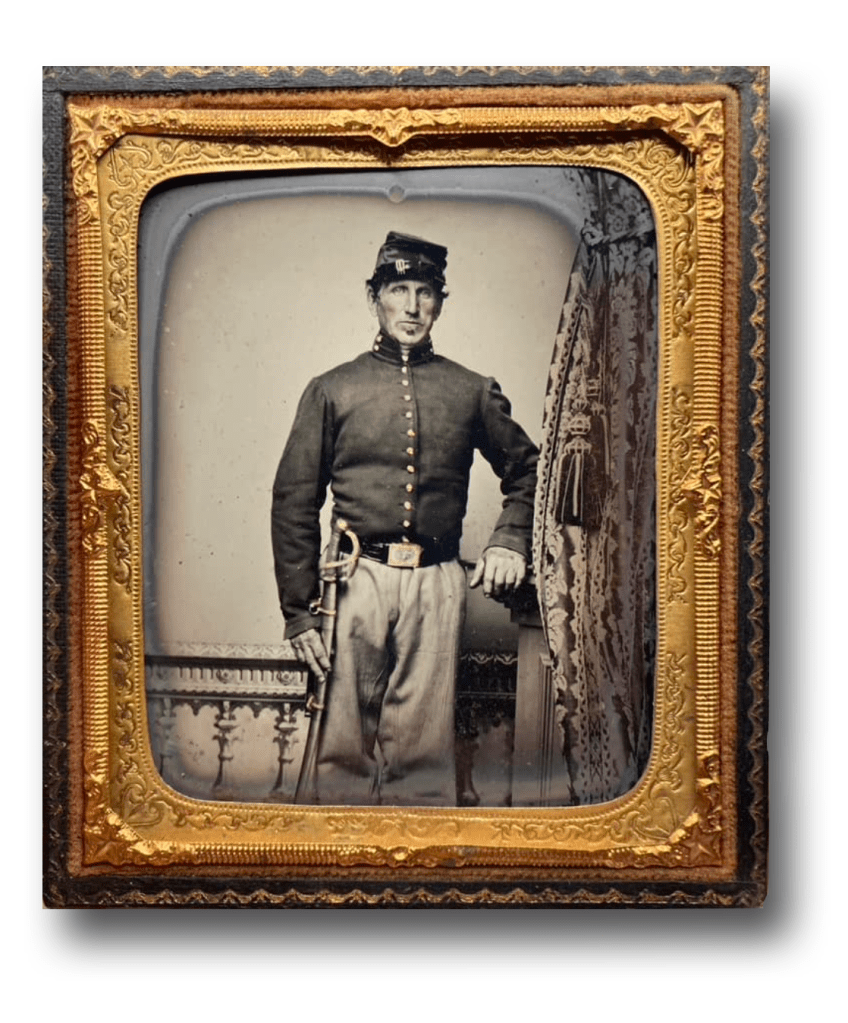
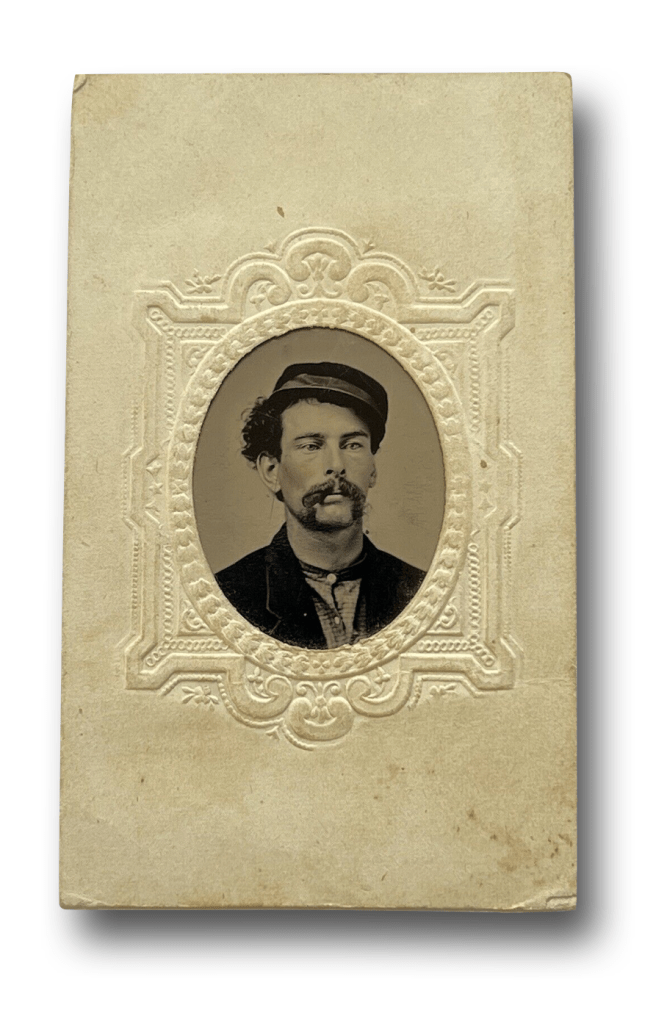
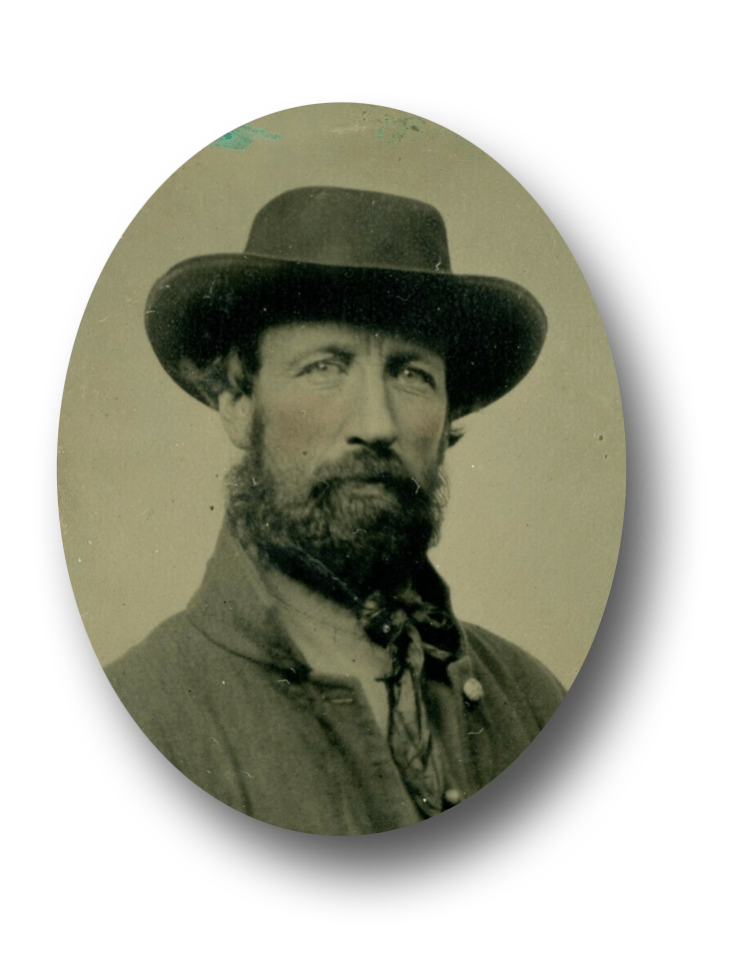
I could not find an image of Sereno but here is an unidentified Union trooper about the same age (Kolt Massie Collection)
In September 1861, he enlisted in Co. B, 52nd Illinois Infantry, his muster records describing him as a 5 foot 9 inch tall, black-haired, blue-eyed farmer. Shortly after he must have transferred into Gilbert’s Independent Cavalry. In February he was transferred again into Co. H of the 12th Illinois Cavalry, and then transferred one more time in December 1862 into Co. G of the 15th Illinois Cavalry when that unit was formed. He remained with the 15th Illinois Cavalry until late October 1864 when his three year enlistment expired. This letter was written during the period he was in the 15th Illinois Cavalry which was attached to the 1st Cavalry Division, 16 Corps, Dept. of the Tennessee, though it appears to have been detached and assigned duty in hunting down Confederate guerrillas in eastern Arkansas along the Mississippi River.
The letter was written in diary form and relates his past week’s activities. Chasing Confederate guerrillas (many of whom were local inhabitants) though the swamps, forests, and plantations of rural Arkansas, Bridge is exposed to the ‘human’ side of war as he comes into contact with the families of captured guerrilla soldiers. Digressing from his story of the scout he was on, Sereno wrote his wife: “You at the North can hardly realize what an amount of suffering this war is causing.”
[This letter is from the personal collection of Richard Weiner and was transcribed and published on Spared & Shared by express consent.]
Transcription
Helena, Arkansas November 9, 1863
Dear Wife,
Another week has passed since I wrote you and now I will record some of the events that have transpired during the time. On Sunday, the 1st day of the present month, I had to help load hay for the horse. On Monday, we had review of the regiment in the forenoon. In the afternoon, we chased three guerrillas about five miles. They came in among the darkey wood choppers. On Tuesday and Wednesday, was on picket.
On Thursday, started on a scout. Went down the river [and] got on the track of about thirty guerrillas. Rode till night, camped on a deserted plantation, stood picket that night by the side of a big swamp and by the noises that the owls, coons, cranes, geese, ducks, and other wild vermin made, reminded me of what I have read about the dismal swamps.
On Friday morning, we started on the trail again. Rode about six miles when the advance came up with some of the guerrillas. They fired some shots at them, then we all gave chase. Run them two or three miles but did not get any of them. They went in amongst the cane brakes and hid. Then we rode on for about four hours through the most dismal looking place that I ever saw. The mud was ankle deep a good part of the way and cane brakes so thick that a bird could not fly through it and so high that we could not see a man on his horse unless we was close on to him.
About noon we came to a crick where the rebels had camped the night before. We followed them so close that they had to leave their wagon, camp kettles, corn meal and some ammunition. We kept after them till we came to a large plantation that stood on the bend of the river. They broke up there and we lost track of them. We had now got forty-five miles from Helena. We camped there for the night. The planter was a strong secesh and had a plenty of corn, cattle, hogs, hens, ducks, geese, honey, &c., so the boys just went in on their nerve and you better believe the feathers flew, hogs squealed, the geese and ducks fluttered, the bee hives disappeared, butter milk was in demand. The women and children cried and I think the old man would have sworn if he had dared to. But let that be as it would, we lived high and slept on corn fodder that night.
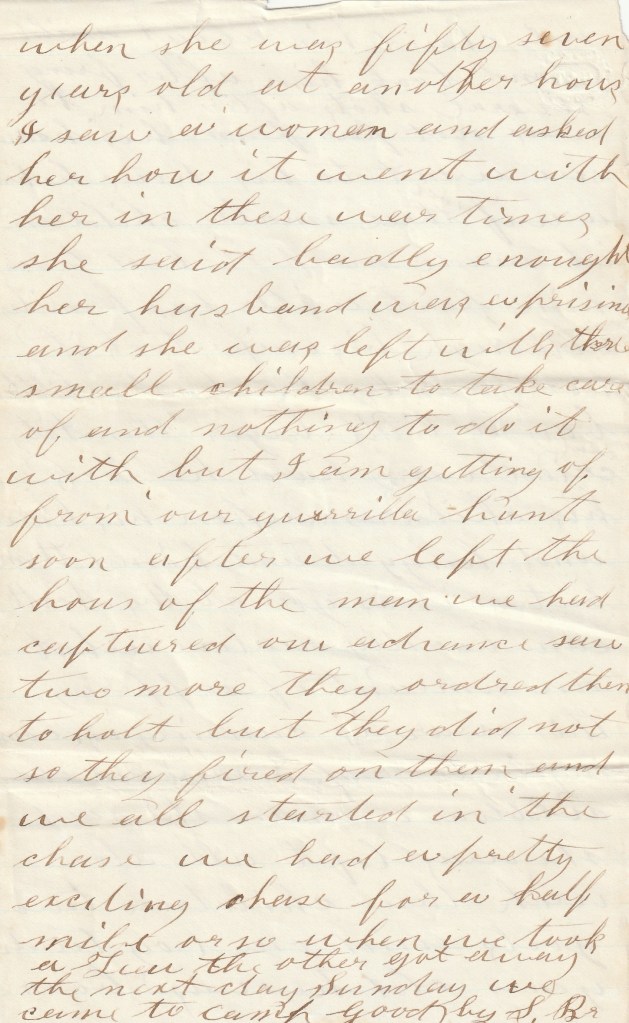
Saturday, we came back twenty miles to another plantation that was owned by one of the guerrillas. There was none but blacks on the place but there was what was better for us that was corn, hogs, sweet potatoes, molasses, &c. We camped about noon. In the afternoon, about thirty of us was sent out to reconnoiter. We had not gone far when we came in sight of a guerrilla. We chased him about a mile and took him after firing several shots after him. He was not far from his home. We went to his house. He had a wife and three small children. It made me feel bad to see him part with his family although his wife took it very calmly. He had a little boy a little bigger than Arty 1 that cried very hard. He took his children upon his horse and hugged and kissed them—but so it is. You at the North can hardly realize what an amount of suffering this war is causing.
In coming into camp, I saw an old widow woman. She said she was left all alone with three children, two girls and one boy twelve years old. He was born when she was fifty-seven years old. At another house I saw a woman and asked her how it went with her in these war times. She said badly enough—her husband was in prison and she was left with three small children to take care of and nothing to do it with. But I am getting off from our guerrilla hunt.
Soon after we left the house of the man we had captured, our advance saw two more. They ordered them to halt but they did not so they fired on them and we all started in the chase. We had a pretty exciting chase for half mile or so when we took a lieutenant. The other got away. The next day Sunday we came to camp.
Goodbye, — S. B.
1 Sereno’s son, Arthur (“Arty”) M. Bridge, was born on 14 February 1860.
The following letter was written by a Confederate deserter named William W. Rhoden (1840-1864) who enlisted on 12 September 1862 in Co. G, 16th Georgia Infantry. He wrote the letter while under guard at Richmond’s Castle Lightning, addressing it, and most likely hand delivering it to “Sergt. Philips.” The recipient is speculated to be Sgt. John R. Phillips of the 25th Bn. VA infantry. Though the author’s calligraphy appears crude, the composition and spelling in the letter suggests he had an above-normal education.
No record could be found showing the date of William’s release but he clearly was permitted to return to his regiment where he served until 25 May 1864 at which time he was taken prisoner and transferred to the prison at Elmira, New York. He died “in the hands of the enemy” at Elmira on 8 September 1864 of chronic diarrhea.
In his letter, William infers that he deserted in a weak moment to see his “two darling infants” at home in Lowndes county, Georgia. William was married to Keziah Drawdy (1834-1900), the daughter of Levi Drawdy and Rebecca Carter. Their children were Emanuel (b. 1860), Sarah Jane (b. 1861) and William (b. 1863).
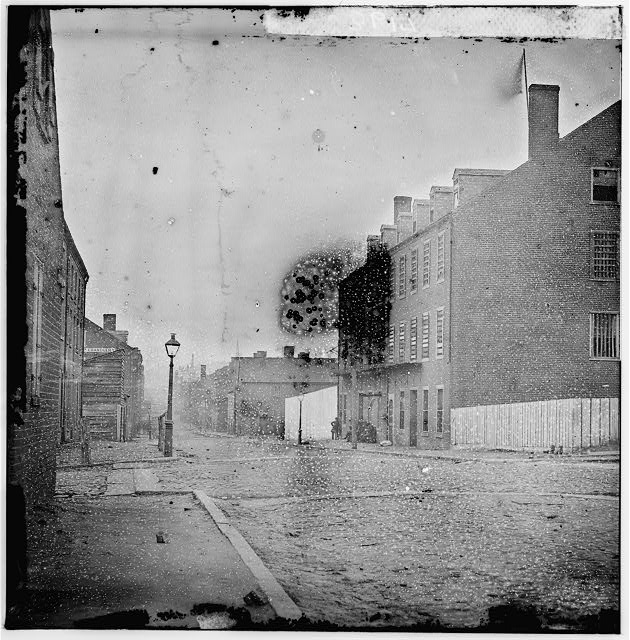
Castle Lightning Prison was located on the corner 6th and Cary street. At various times, it was known as Western District Military Prison, Castle Booker, Castle Griswold, and Castle Lightning. It stood across the street from Castle Thunder and was established to hold criminally accused Confederate soldiers and civilians. This prison primarily housed deserters from the Confederate Army as well as overflow prisoners from Castle Thunder. Castle Lightning appears to have closed in 1863 and was converted into barracks for the accommodation of several companies engaged in guard duty within the city. The prisoners confined here were removed and most likely placed in Castle Thunder.
Castle Thunder (at right) and Castle Lighting (at left near lamp post) stood opposite each other at the corner of 6th and Cary in Richmond.
[Note: This letter is from the personal collection of Richard Weiner and was transcribed and published in Spared & Shared by express consent.]
Transcription
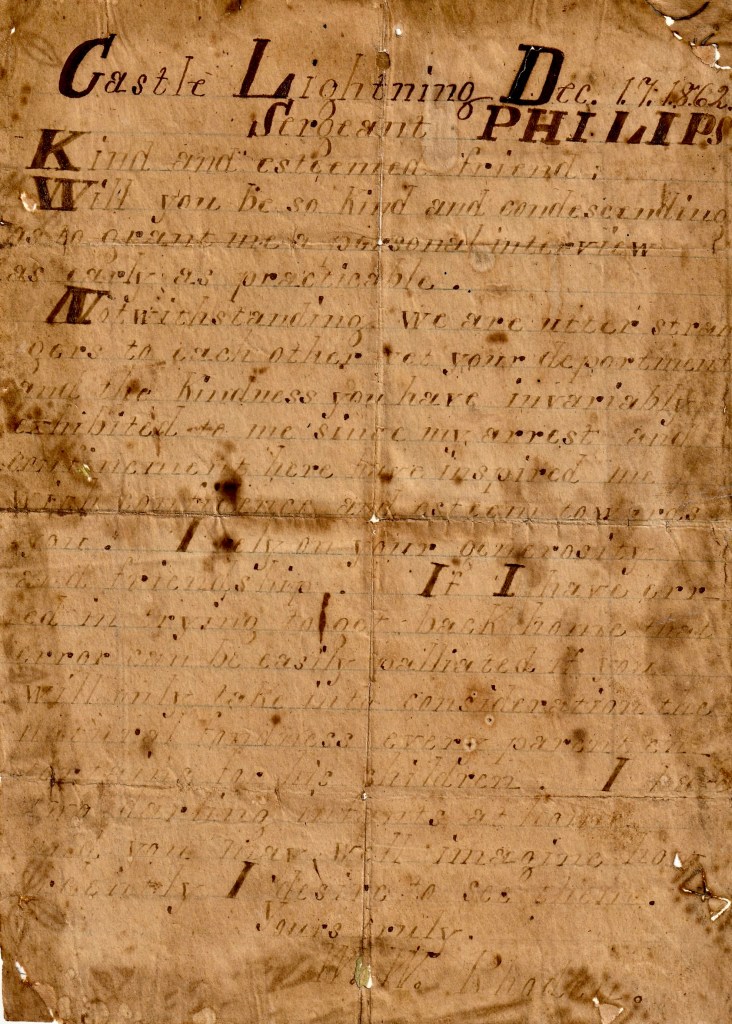
Castle Lightning December 17, 1862
Sergeant Philips, Kind and esteemed friend;
Will you be so kind and condescending as to grant me a personal interview as early as practicable?
Notwithstanding we are utter strangers to each other, yet your deportment and the kindness you have invariably exhibited to me since my arrest and confinement here have inspired me with confidence and esteem towards you. I rely on your generosity and friendship. If I have erred in trying to get back home, that error can be easily palliated if you will only take into consideration the natural fondness every parent entertains for his children. I have two darling infants at home and you may well imagine how dearly I desire to see them.
The following letters were written by Calvin Thomas Crane (1839-1905), the son of John Calvin Crane (1807-1895) and Emiline D. Burt (1809-1893) of Berkley, Bristol county, Massachusetts. He wrote the letters to his sister, Sarah (“Sallie”) E. Crane (1844-1920). A younger brother, Levi Lankton Crane (1842-1928) is mentioned in the letters. Levi later served in Co. C, 22nd Massachusetts Infantry until he received a leg wound at Fredericksburg which led to his discharge for disability.
According to military records, Calvin enlisted as an ordinary seaman at New Bedford on 20 May 1861 and he was mustered out of the Navy on 15 March 1862. He served first on the receiving ship USS Ohio and then was assigned to the USS Massachusetts. He was described as standing 5’11” tall, with blue eyes, chestnut hair, and a ruddy complexion.
According to Calvin’s headstone inscription, he only served in the US Navy in 1861-62 but he remained a mariner. He eventually became a ship’s master and was captain of various vessels, including the schooner M. M. Merrimon of Taunton, Massachusetts. He was married to Charlotte M. Burt of Berkley in 1870.
The 1864 letters included in this post reveal that Calvin served for a few months during the summer of 1864 as an assistant to the sutler of the 104th Pennsylvania Infantry while they were on Morris Island in Charleston Harbor. It appears that he would have stayed longer but became so ill that he decided to return to Massachusetts.
Letter 1
Off Brooklyn Navy Yard February 23, 1862
Dear Sister,
Have been within two hundred miles from you and have not heard a word from Berkley yet and have laid here 9 days now and possibly may as much longer and if possible, please write a few lines. Luther got a word or note from John last week that if we were to be paid off, I should be at home by the latter part of the week and you ought to have wrote for father wrote to me that we would not be discharged. But we shall. But how soon I do not know. It may be this week. All that is wanted is the money.
There is plenty of rows on board caused by liquor and 6 men are in irons for drunkenness. The officers do not do the first thing for our good with the exception of Capt. Godfrey who is ridiculed by the rest for his interest in the “Boys.” We have not had a bit of fresh meat or vegetables since we have been here. Wormy rice and flour are served out to us twice a week. I will [not] write anymore about our troubles—they are too numerous to mention. But the end is ahead.
Last Friday they got a stove which is very comfortable to what it was. I am very anxious to hear from home and hope you will write so that I can get a letter this week. Direct as heretofore to Naval Lyceum. I have sent two letters to Levi. The answers will come to Berkley. Please keep them.
I have nothing more to write but hope you will write soon. From your brother, — Calvin T. Crane
to Sallie E. Crain
P. S. Excuse this pencil writing.
Letter 2
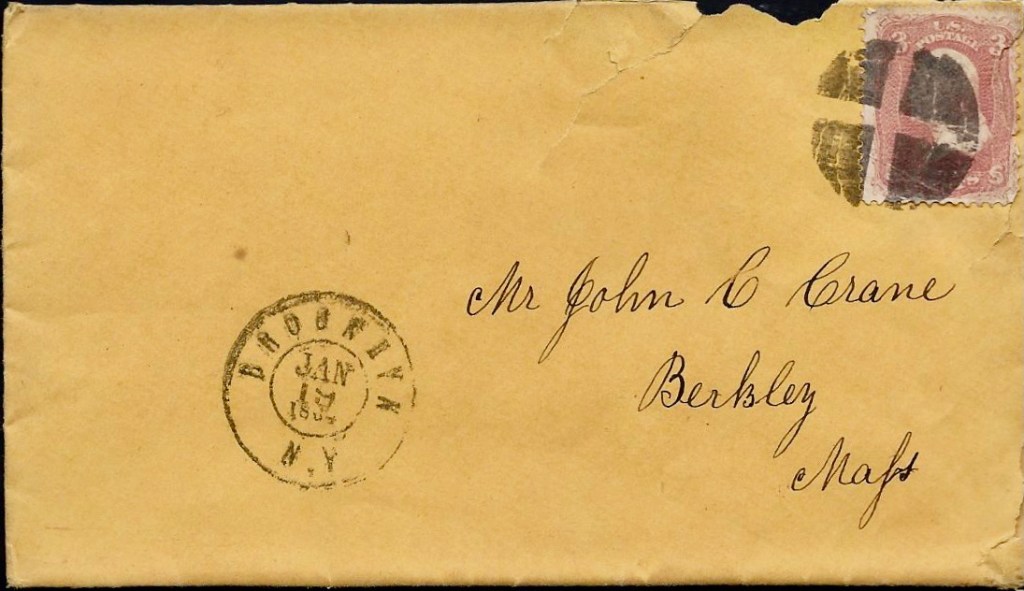
Addressed to John C. Crane, Berkley, Mass.
New York Sailor’s Home February 27, 1862
Dear Mother,
I am agoing to write this letter to you as I have written to Father & Sarah without getting an answer although in the first place I did not ask them to write. We got released from the ship yesterday about noon after striping ger to a “gauntling.” We got in a fret before we left on account of a story that we were to be put on board the North Carolina to wait until pay day as there was not a man that wanted to go there. After we left the ship at the earnest request of the officers, we gave three cheers for the ship and then three for Capt. Godfrey with a good heart.
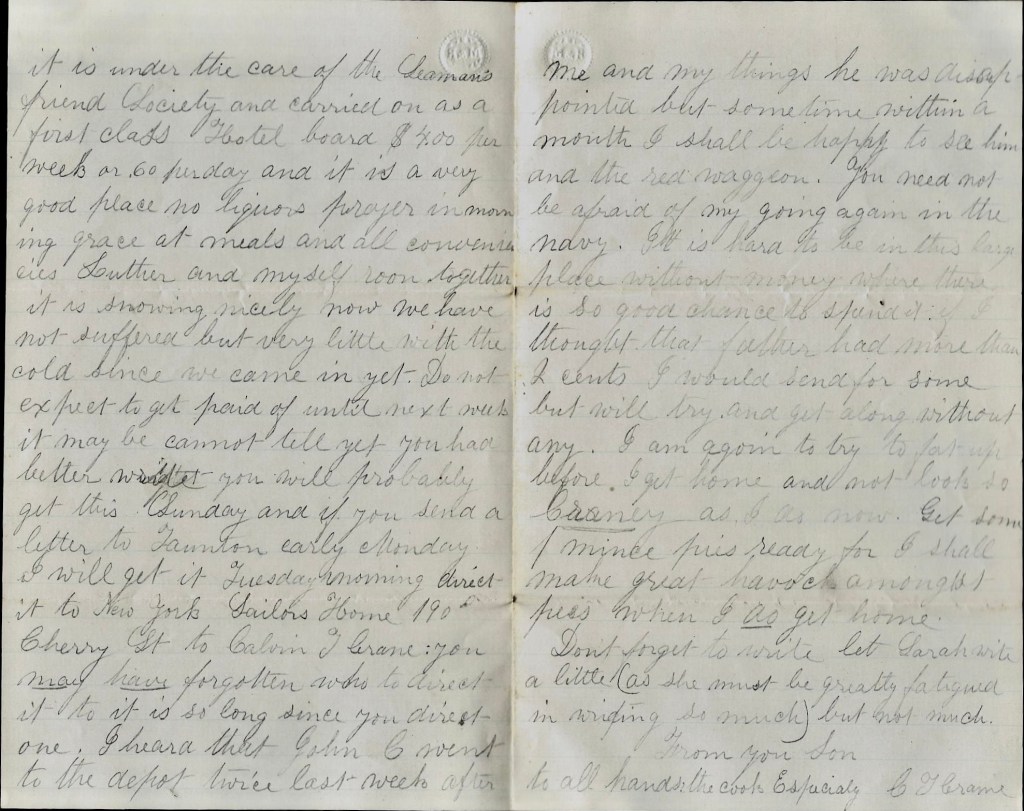
Most of the Taunton boys came to this place. It is under the care of the Seaman’s Friend Society and carried on as a first class hotel. Board [is] $4 per week or 60 cents per day and it is a very good place—no liquors—prayer in morning—grace at meals—and all conveniences. Luther and myself room together.
It is snowing nicely now. We have not suffered but very little with the cold since we came in yet. Do not expect to get paid off until next week. It may be—cannot tell yet. You had better write. You will probably get this Sunday and if you send a letter to Taunton early Monday, I will get it Tuesday morning. Direct it to New York, Sailor’s Home, 190 Cherry Street to Calvin T. Crane. You may have forgotten who to direct one.
I heard that John G. went to the depot twice last week after me and my things. He was disappointed but some time within a month I shall be happy to see him and the red wagon. You need not be afraid of my going in the Navy. It is hard to be in this large place without money where there is so good chance to spend it. If I thought that Father had more than two cents, I would send for some but will try and get along without any. I am going to try to fat up before I get home and not look so craney as I am now.
Get some mince pies ready for I shall make great havoc amongst pies when I do get home. Don’t forget to write. Let Sarah write a little (as she must be greatly fatigued in writing so much) but not much.
From your son, — C. T. Crane
To all hands—the cook especially.
Letter 3
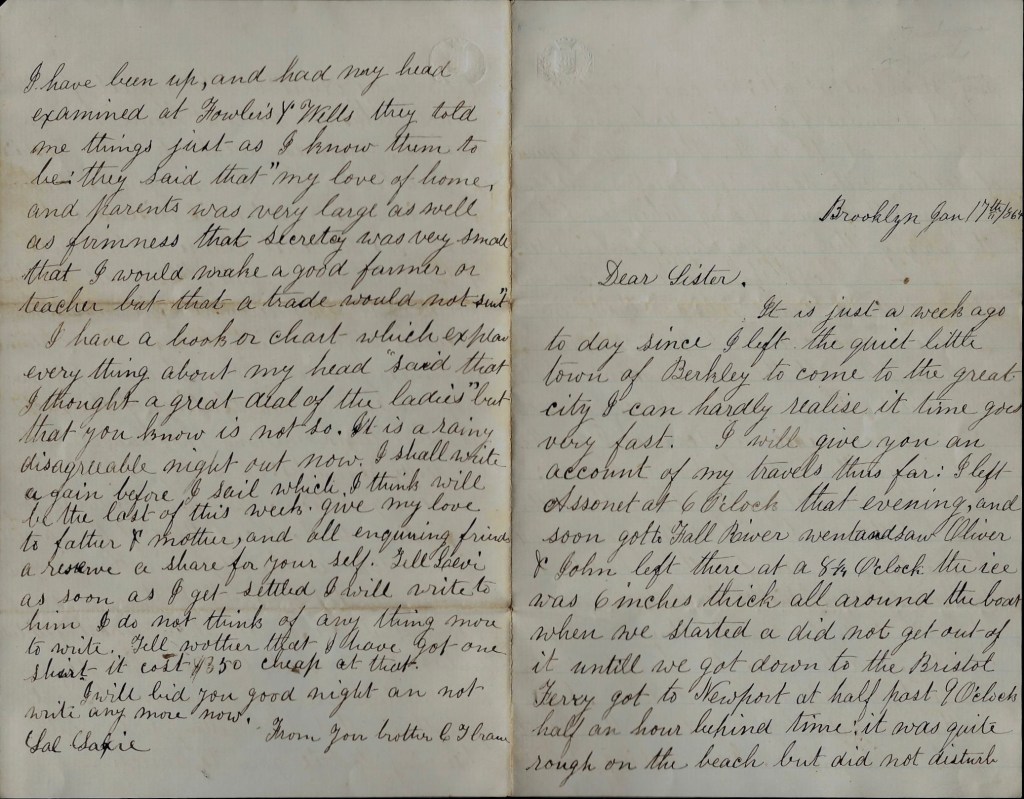
Brooklyn January 17, 1864
Dear Sister,
It is just a week ago today since I left the quiet little town of Berkley to come to the great city. I can hardly realize it—times goes very fast. I will give you an account of my travels thus far.
l left Assonet at 6 o’clock that evening and soon got to Fall River. Went and saw Oliver and John. Left there at 815 o’clock. The ice was 6 inches thick all around the boat when we started and did not get out of it until we got down to the Bristol Ferry. Got to Newport at half past 9 o’clock, half an hour behind time. It was quite rough on the beach but did not disturb my slumbers at all. We cane into ice about 35 miles from New York and arrived there at 11 a.m. There was a guard of soldiers with some 36 deserters and bounty jumpers that were being taken back to the army. They were a hard-looking set.
As soon as I got here, went up and found Capt. White without any trouble. Went over and saw my men and made all arrangements that we could. I am to have $40 per month, time to commence as soon as I get there, and to get there the best way I can. There is a vessel going down there the last of this week with sutler’s goods and I am to go in her if nothing happens to the contrary. This $40 is for 4 months and then it is it be raised. They want me to try and be able to “run the 52 Penn. Regt.” by myself after that time. I am rather impatient to get down there and make a beginning. I am stopping aboard of the “Oaks Ames” at the request of Capt. French although he is at home now on business.
Yesterday went up to Dr. [Henry Ward] Beecher’s Church to hear him. I wish you could have gone. It was a splendid discourse. The text was the last clause of the 9th Verse of the 6th Chapter of Matthew: “Hallowed be thy name.” It was delivered in his own peculiar style which I cannot explain. At times you could have heard a pin drop so intense was the feelings of the people. At other times bursting into laughter at his witty remarks. He is very poetic in his imagination.
You must collapse your crinoline to about one-third of the largest size as that is the style in the city. You would hardly know that there was any hoops at all on, to look at the most gented ladies. Dark velvet bonnets with some dark blue ones are worn most. Don’t you think that I am getting to be quite observing to tell you so much.
I have been up and had my head examined at Fowler & Wells. They told me things just as I know them to be. They said that “my love of home and parents was very large as well as firmness that secrecy was very small—that I would make a good farmer or teacher, but that a trade would not suit.” I have a book, or chart, which explains everything about my head. Said that I though a great deal of the ladies but that you know is not so.
It is a rainy, disagreeable night out now. I shall write again before I sail which I think will be the last of this week. Give my love to father and mother and all enquiring friends and reserve a share for yourself. Tell Levi as soon as I get settled I will write to him. I do not think of anything more to write. Tell mother that I have got one shirt. It cost $3.50—cheap at that.
I will bid you good night and not write any more now. From your brother, — C. T. Crane
Letter 4
Morris Island Feb 3d 1864
Dear friends at home,
As I must write before i get a letter, I commence one tonight which will be some time before it can go.
I left New York at half past one o’ clock p.m. in tow of the Steamer Atlantic on the Schooner E. R. Bennett the 24th with the wind to the southward, and cloudy but not very rough. But the next day it breezed up some and made it quite rough. And Thursday morning at two o’clock a.m., we got off the light boat off Port Royal all right with a smooth passage for the season. You would laughed to have seen me feeding the cattle as I worked my passage down as cattleman. It would have been almost impossible for me to have got down any other way. But Mr. Eager gave me a letter to the man that shipped the cattle to give me a chance to work my way down and although they had men engaged, he put me in as extra man. The captain tried to make some objections, but he—that is, Mr. Starr—made it all right, so along I came, ate my meals in the cabin, and slept in the hold with the rats which were as thick as you can imagine. I slept one night with my boot in my hand and thrash that awhile, then go to sleep and rest until they waked me up, then thrash again, and so on, but lived through it.
Thursday about 9 o’clock, cast anchor off Port Royal harbor and went ashore and was disappointed in the look of the place. The sand is just like a deep snow all around. It is mostly built up by the war but a few houses of the old planters are there. Sutlers and storekeepers make the most show. Got my pass and transportation and then had to look up a chance to go up to Morris Island. Got aboard of the Steamer Mary Benton about 10 p.m., slept on some logs until morning, and got to see who were my fellow passengers. Found there were some 52 Darkies [coming] to join the 54 Mass. Regt from Vermont. Got up to the island about 10 a.m. at high water so as to cross the bar, went down to see Mr. Webb—the one I was to report to. Found him without any trouble and went to work that afternoon.
The island is like all southern coast—low and sandy, but it is quite lively now. They are firing at the rebels all the time, night and day. Tuesday night a blockade runner ran in and got in as far as Fort Moultrie and got aground, and the next morning as soon as the fog lifted, three moniters and Wagner, Gregg, and other batteries opened on her and kept up a fire all day—and the rebels firing too. They have knocked the steamer into a “cocked hat.” They think no more of that here than we would of going to Taunton although there was one killed, and several wounded on our side.
The weather has been quite warm. In fact, as warm as summer with us. But today it is very much cooler with the wind to the westward. The work is not hard that I have to do—the same as any shopkeeper has to do. We board with the Quartermaster and a Capt. & Lieut. of the 104 Regt. Penn. Vol. and the living is par excellent with milk and the best of coffee and all kinds of preserves, fresh meat, soft hack, and everything that is good.
I got one meal down to Port Royal. It was a cup of tea and two biscuits and they charged me 25 cents. Got a very good breakfast on the Mary Benton for 50 cents but everything is dear out here. Butter 45, potatoes 4 cents per pound, and everything in proportion.
You will please direct letters to me in care of H. M. Webb, Sutler to the 104 Regt. Penn. Vol. Morris Island, S. C. and as soon as you can conveniently. I wish, Sallie, you could come down here this evening and go up on the sand hill just back of our tent and see how splendid it looks to see the tents all lighted up and to hear the band playing and to look off in the harbor, and see the calcium light that is on the Ironsides. It is a pleasant position. I do not know of anything more to write tonight, but will close and retire to my bed which is a mattress such as I lost in the “Ames” and two boxes under it and sleep like a major. Write all the news and oblige your brother and son, — C. T. Crane
Camp of the 104th Pennsylvania Infantry on Morris Island (1864)
Letter 5
Morris Island April 17, 1864
Dear Sister,
I received your long letter a week ago yesterday but not in time to answer it by that steamer and have been too busy until now to write an answer. I will give you a description of my writing desk. It is a barrel with a board across the head and Frank Leslie’s [newspaper] on that. Then for a seat, I have a camp stool with a board across that to make it high enough and you will have a complete writing desk for this country.
You may think that “Order addressed to this office” dies not receive as prompt attention as yours but the fact is that I have been full of business for the last week. We have been moving camp which was hard work for us to pack up everything, then to move our tent. We have a large, splendid (for this country) building 24 by 16 and 8 feet high fitted up in store style. We moved our camp about a mile to a healthier location and shall probably move down to Beaufort within a short time as all the white troops are to leave the department with the exception of some 6 regiments and the rest to be Colored regiments. The regiments that leave here go to Yorktown and “On to Richmond” by way of James River. It looks as if it was going to be dull this summer in this department. But if we go to Beaufort, it will be pleasanter than here. You may tell my maternal not to worry about me. I am only a little spleen and am not afflicted with none of those aches that you mentioned.
I can congratulate you on your school’s being out now. You have had a tedious time of it. I know you can look back after it is all past and it does not look half so hard, and will wonder why you was so perplexed about such little things. That little item, I presume, is gone with the accustomed velocity as all items do with you but never mind. There is plenty of greenbacks in the country.
I think that Berkley is about played out to put such men or lunatics as Oliver French in as school committee—a man that is afraid of his own shadow. I have not found out who the veterans are in Berkley yet. Is Bradford Hathaway in Berkley yet or is he gone back to the 7th? He went away with Capt. Williams into New Orleans. From there he got to Providence and was there when I came south. I should think William Warren was spreading himself considerable in buying a horse. There must be plenty of horses in the neighborhood now. Everything must be very high at home now. They are almost as cheap here as there now. Butter is 55 cent, cheese 25, raisins 35 cents, other things in proportion.
I may possibly see Drises White when we go down to Beaufort. I will try to see him. The draft may have taken place but I do not think that there will be any.
Levi is very tardy about writing. He is my debtor for a letter which is due some time. Am very obliged to Bessie for her kind regards. Send mine in return. “But do not see the point” that you spoke of as it is very uncertain that we shall stay in any place long. I would like to see William Henry. Could set him agoing into a fighting mood in a short time by stating facts. Give my respects to all the girls. And you will oblige your friend and brother, — C. T. Crane
Dear parents. As I am writing to Sarah and have some blank room, will write a few lines to you. The weather is very cool down here for the season of the year. Today is a fine day but the sand is blowing like a snow storm. You have probably planted your potatoes by this time. You had better plant all you can and more too as things will be very high indeed if the war goes on another year. Plant all you can of corn as it will be high. If you want some money, send me word. Will send you some. Yours in haste, — Calvin
Hope you are all well.
Letter 6
Hilton Head May 12th 1864
Dear Sister,
I received your two ladened epistle of the 19th April & another of May 4th last night. Was truly of the impression that you was leaving “the earth and climb a tree” from the tone of your first letter but the second one was more cheerful. You seem to think that you were a gone goose but never give up. There is more than one person in the world by the name of Charles too. I would have nothing more to do with him if I could help it more than as an acquaintance. His disposition must be very singular if he has no more provocation than you speak of and would not be very likely to improve with age and if nothing has passed between you that is binding, I would let him flirt as much as he chose. You will feel better as times passes away. Time cures a great many such diseases but not all.
You will have to be smart if you want that school in the district and speak in time as schoolmarms will be plenty. I am very sorry to hear that Mr. Davis is to leave our church as he was worth all the Baptist & Methodist preachers around. I think that if some were to be truly reconverted that it would make a better state of affairs in that society. It seems as if they were making religion to suit themselves and discarding the original pattern altogether. The church is in a poor state and no pastor will please them. True religion is the best of all things but all other kinds are worse than none.
You must have written a letter that I have not received yet as I did not know that Levi was sick until your last but we have not got all of our mail as yet, it may come. Levi will not reenlist I hope as it is a slave’s life. I would not be a common soldier for nothing that I can think of yet. It is a degrading slavish life. A man that is a half fool would make a good soldier.
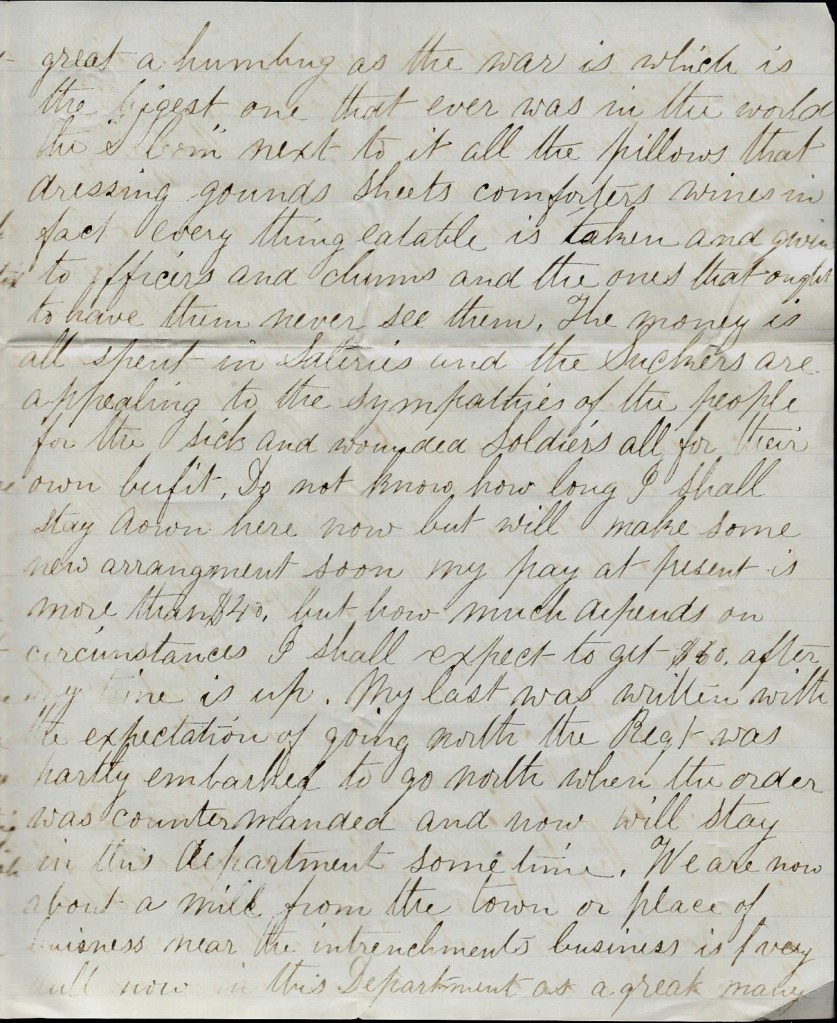
The noble Sanitary Commission that is talked so much about is almost as great a humbug as the war is which is the biggest one that ever was in the world. The Sanitary Commission next to it. All the pillows, dressing gowns, sheets, comforters, wines, in fact everything eatable, is taken and given to officers and chums and the ones that ought to have them never see them. The money is all spent in salaries and the suckers are appealing to the sympathies of the people for the sick and wounded soldiers all for their own benefit.
Do not know how long I shall stay down here now but will make some arrangement soon. My pay at present is more than $40 but how much depends on circumstances. I shall expect to get $60 after my time is up. My last was written with the expectation of going North. The regiment was hastily embarked to go North when the order was countermanded and now will stay in this department some time. We are now about a milt from town or place of business near the entrenchments. Business is very dull now in this department as a great many of the troops have gone North to the Army of the Potomac.
The weather has been very warm down here but today it is quite cool. The mail got here Tuesday and is not all distributed yet. It was a very large mail. Indeed, it was three weeks gathering in New York. About that money, let father have it until you hear from me again. Tell him not to spend it as I may want it down here.
Has Capt. White paid father that $20 that I gave him in New York. If not, he may have paid Capt. French as I owe him $30, thinking that I should be short. Who goes with Andrew Pierce as mate this summer? Get your picture and letters from Saxie and tell him plainly what you mean. Nothing like the truth is such matters.
May 13th. The mail closes today. There is nothing new today. Enclosed you will find a leaf from Morris Island and a picture of a friend of mine that was in the [USS] Massachusetts—Robert Morrison, an assistant engineer in the Navy. Write soon. Be of good cheer, Sal. Yours in haste. — Calvin T. Crane
Letter 7
Provost Hospital Hilton Head August 8, 1864
Dear Friends at home,
It is after 9 weeks sickness that I am able to scribble a little. I was taken sick first by my stomach getting out of order, then with a slight fever in the head and loss of appetite which grew worse until the regiment moved. Did not follow it for a week. Stayed at the 104th [Penn.] Regiment. Went and saw the doctor. Said better go in hospital. Did so. Grew worse. Lost all sense. Do not remember anything for some days.
A week ago the regiment had to move and this was the only place that I could find where I could get in. I was very sick. They thought that I would not be any better when I was the sickest but now I have got quite well. Now can get all around without help. I shall try to get North as soon as I can. U have but $15 now and when taken sick had about $90 which someone has borrowed. But my wits must get me home. Shall try to find Capt. French as I have [either] dreamed or someone told me that he is here.
It is a rainy day or I would go down to the dock to see if I could find a vessel bound North of if I can raise $50, I would come on a steamer. But if nothing happens, will be at home sometime or other. Would like to be there now.
Father, wish you would raise $50 and send it by express to W. D. Mangam’s, 92 Broad Street, New York so that it will be there when I arrive there as I may want to pay my passage after getting there. Yours in haste, — Calvin T. Crane
The following War Department memo written and signed by Secretary of War Edwin M. Stanton pertains to the confinement of James Washington and Herbert Alexander, Prisoners of War (POW), at Ft. McHenry in Baltimore.
Edwin M. Stanton
Herbert Lee Alexander (1846-1866) was the son of William Pearson Alexander (1801-1863) and Hannah Lee Washington (1811-1881) of Claymont (name of farm), just west of Charlestown, Jefferson county, [West] Virginia. According to a letter by Col. John Peter Shindel Gobin, 47th Pennsylvania Infantry, Herbert was arrested in his own home when a note was found in his pocketbook identifying him as a conscript and with instructions to report to the 12th Virginia Cavalry. He was unarmed and apparently frail in constitution. “His mother, an estimable lady [with ancestral ties to George Washington], is exceedingly fearful a rigorous confinement will completely prostrate her son, his health being naturally precarious.”
Muster roll records for Co. A, 12th Va. Cavalry, state that Herbert was captured on 31, 1865 and confined at Fort McHenry on 8 February 1865. In the remarks, he is identified as a “Guerrilla: not to be exchanged during the war. By order of Maj. Gen. Sheridan, commanding Middle Military Division.” While at POW at Ft. McHenry, Herbert was sent to the post hospital suffering from anemia. He was eventually released from Ft. McHenry on 27 April 1865 and he died at home on 3 October 1866, probably from tuberculosis.
The other prisoner identified in the memo only as “James” was Pvt. James Cunningham Washington (1847-1865). Though James and Herbert were relatives, they were not brothers as might have been presumed by Edwin Stanton. James was a member of Co. B, 12th Virginia Cavalry and he was taken prisoner with Herbert at the Claymont Farm near Charlestown, also labeled a “Guerrilla, not to be exchanged during the war.” According to family legend, 17 year-old James was starved and inhumanely treated by his Yankee captors and he died in the post hospital on 24 February 1865, less than four weeks after he was taken prisoner. Curiously, the National Park Service website for Fort McHenry claims that, “in contrast to the high death tolls at other prisons, the death toll at Fort McHenry was only 15.” Color me skeptical of that number.
Mrs. Lyle, mentioned in the memo, was Herbert Alexander’s aunt.
Transcription
Memo kept in an envelope with the annotation: “Letters referring to the most heart-rending grief of my life, March 1865.”
War Department, February 20, 1865
Case of James [Washington] & Herbert Alexander, Prisoner of War in Ft. McHenry
Referred to General [William Walton] Morris to permit Mrs. Lyle to have an interview with them under usual regulation. — Edwin M. Stanton, Secretary of War
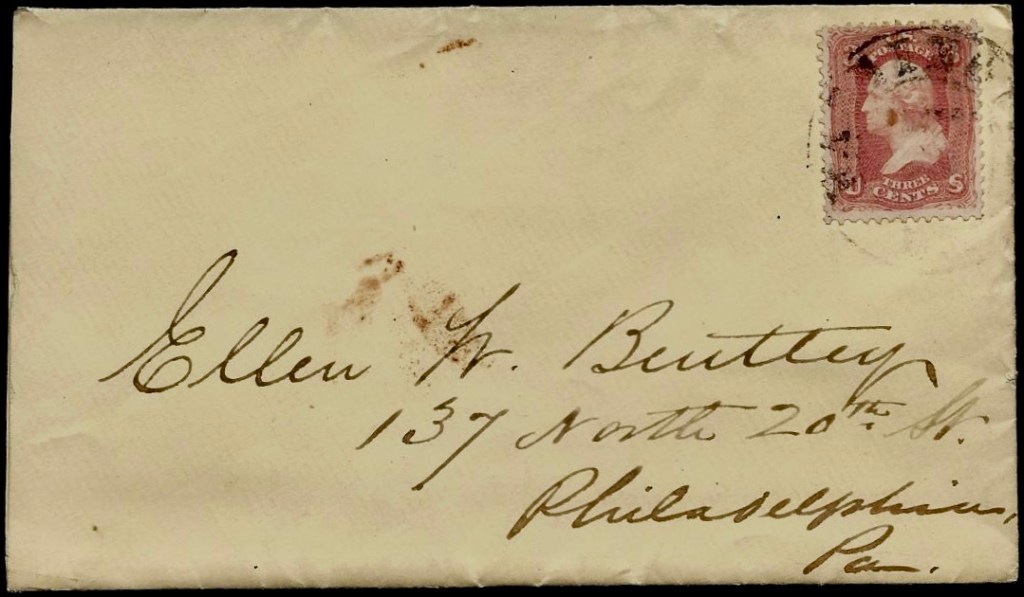
The following letter was written by Henry Hirst Bentley (1832-1895), the son of Hiram Bentley (1802-1896) and Hannah Swartwout (1803-1863) of Pine Plains, Dutchess couty, New York. Without any money, Henry left his parents home and went to New York City in 1852 when he was twenty years old, landing a job as a reporter for the New York Tribune. He subsequently helped to organize a company to promote the use of printing telegraph machines known as the New York City and Suburban Printing Telegraph Company. When that undertaking failed, he organized a system of depositories for telegraph messages and then established the Madison Square office known as Bentley’s Dispatch.
When his health failed, he took some time off to regain it and then settled in Philadelphia where he joined the staff of the Philadelphia Inquirer and was assigned duty as a war correspondent in 1861—a paper that would earn a well-deserved reputation for reporting military action in an objective manner (unlike other papers). Bentley joined a stable of correspondents that were seasoned and knowledgeable. A good team—so good that a correspondent from a rival newspaper complained to his boss that the “the Inquirer people knew more about the war than did most of the generals.” Henry may have been a bit more haughty than his colleagues, however, as they sometimes referred to him as “The Water Spout Man”—always bragging and babbling.
It was while working as a war correspondent that Henry wrote this letter to his wife, Ellen Widdifield (Penrose) Bentley (1833-1915)—the daughter of a Quaker family—with whom he married in 1860. The date of the letter is unknown. I have suggested 1861 while Henry was much of the time in Washington D. C. though he mentions something about the “Court Journal” which might suggest a later date. I found a reference to the Washington Star being considered Mr. Lincoln’s “court journal” but I don’t know if Henry changed to that newspaper during the war.
Henry’s name appears in the papers throughout the war. In the 19 February 1862 edition of the Philadelphia Inquirer, it was alleged that he and Mr. Schell of Leslie’s Illustrated Newspaper, “entered Fort Huger [on Roanoke Island], after its abandonment by the Rebels, in advance of the army, and hauled down the Rebel flag.” In another issue of the same paper published on 15 April 1862, he was reported as having been taken prisoner at the Battle of Shiloh but subsequently escaped after having been robbed of everything but his “pantaloons and boots.” Legend has it that Bentley hadn’t really escaped so much as the Confederates let him go because “they had grown weary of listening to him talk.”
After the war, Henry organized the Philadelphia Local Telegraph Company and also became head of the Gold and Stock Reporting Telegraph Company and President of the Bell Telephone Company of Philadelphia. He was a close friend of Thomas A. Edison.
Transcription
Washington [D. C.] 21st, 8 p.m. [1861]
My Dear Baby,
Thy sweet little missive arrived this morning and I read it over several times before I could become satiated in the least degree.
There seems but little that is new and that is more suitable for newspaper reading than for a letter to a wife. I am still enjoying excellent health and spirits considering the clouds of dust that once more assail us. Mud or dust is peculiar to Washington’ there is no medium.
I presume thee saw my dispatch yesterday announcing that Mrs. Lincoln would pass through Philadelphia for the East. That was my first “Court” announcement, in advance. Some of them laugh at the Inquirer having suddenly become Court Journal. Well, it merely happened so, she having told me that she intended going to Cambridge 1 in a few days. I asked her to please let me know when she was going as it would be a favor. So the evening before she started, she sent word down to me with her compliments, stating that she would probably be gone 2 or 3 weeks, and that when she returned, they would be pleased to see me at the White House, whenever I chose to call. She told Friend Newton that there was “some difference between the Chevalier Wikoff 2 and Mr. Bentley,” and, that she was “very much pleased wiith Mr. Bentley’s manner.”
As to the depreciation of paper money, of course all bank notes are depreciated the same as Treasury Notes. Gold is the stand point, so for instance, gold is worth today about 130 cents on a dollar—that is, a gold dollar is worth 30 cents more than a one dollar paper note of the best kind. My sweet wife thinks she can see the way clear, therefore I am perfectly willing she shall do just what she proposed about the cloak and dress. I thought it best to call her attention to the matters that appeared before me at that time and now I leave it to you own good judgment.
Should I not come up 7th Day, I will send thee some more funds. My coming, baby knows, depends upon what word I get from her, as however much I might desire to see my sweet child, and hold communion with her in every ordinary social way, she knows her husband’s little failings and he could never bear the comments which his baby might be obliged to impose upon him. Dear me! When shall I have my little wife to fondle on and caress again? Hasten the day—or night.
It affords me some poor consolation that my darling baby dreams of me if she is not permitted to go beyond that. My sleep is sweet and I sink into it with sweet thoughts of my own dear one far away in her couch, snugly stowed away.
By the way, in the course of conversation the other day, Mrs. Lincoln in talking about various people with whom she was perpetually bothered, mentioned one Sweeney of Philadelphia—rather a beau looking gent. I didn’t enter into any particulars but it appears among many others who have axes to grind and wants to get on intimate terms must be the gent I have heard them mention as Beau Sweeney. I was asked if I knew him but I said I had heard of such a person but did not know him. He pesters the life out of them and she says she cannot give audience to everybody, however much she desires to please their constituents.
I am glad Willie gets along well with his recruiting. Give my love to all the family and tell them I am extremely well. I forgot to say before that the Dr. had a slight hemorrhage of the lung last night. He looks very bad. Rachel is quite smart. And now I will close by sending my wife’s untold love and hope I shall hear from her soon and satisfactorily. Thy husband, — Henry
1 Mrs. Mary Lincoln would have wanted to visit Cambridge because her son Robert was attending school there. Robert left for college in 1860, but during the next four-and-a-half years, he became his mother’s traveling companion. Mother and son both loved traveling, and whenever Robert had a break from college (at Harvard) he and Mary were usually on the road somewhere together. Robert met his mother during many of her trips to New York, Philadelphia, and Boston, where the two would not only spend hours together shopping in the most fashionable stores, but also entertaining with social, political, and military leaders. Mary also visited Robert at Cambridge when she could, at least once a year. Every summer mother and son spent one to two weeks traveling around New England on vacation: in August 1861 to Long Branch, N.J. for two weeks; in 1862 to New York City for one week; in 1863 to the White Mountains of New Hampshire for one week; and in 1864 from Boston to New York City to Manchester, Vermont for a total trip of about ten days. [See Lincoln Lore]
2 Chevalier Henry Wikoff (1813-1884) was a charlatan who managed who managed to flatter his way into Mrs. Lincoln’s inner circle. “In almost all things, he was disreputable if frequently charming,” He used his access to the White House to leak information anonymously to a New York newspaper. [See Mr. Lincoln’s White House]
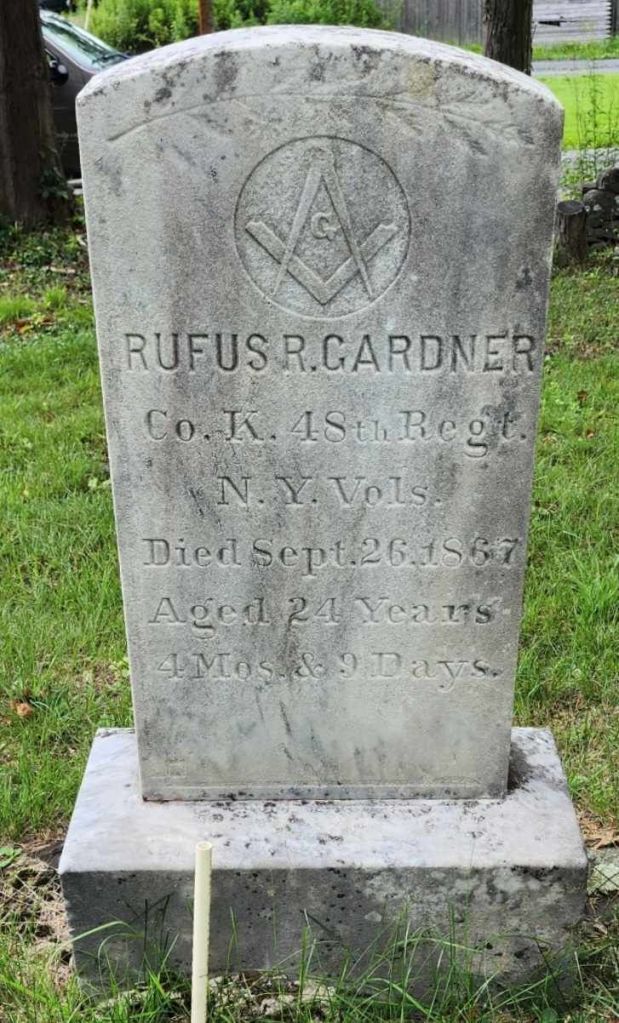
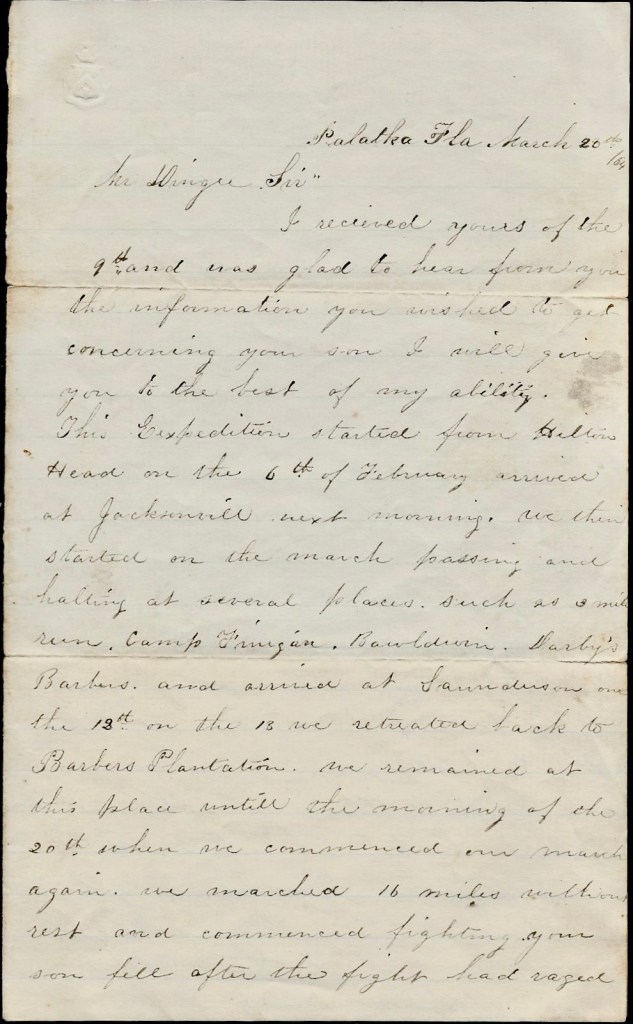
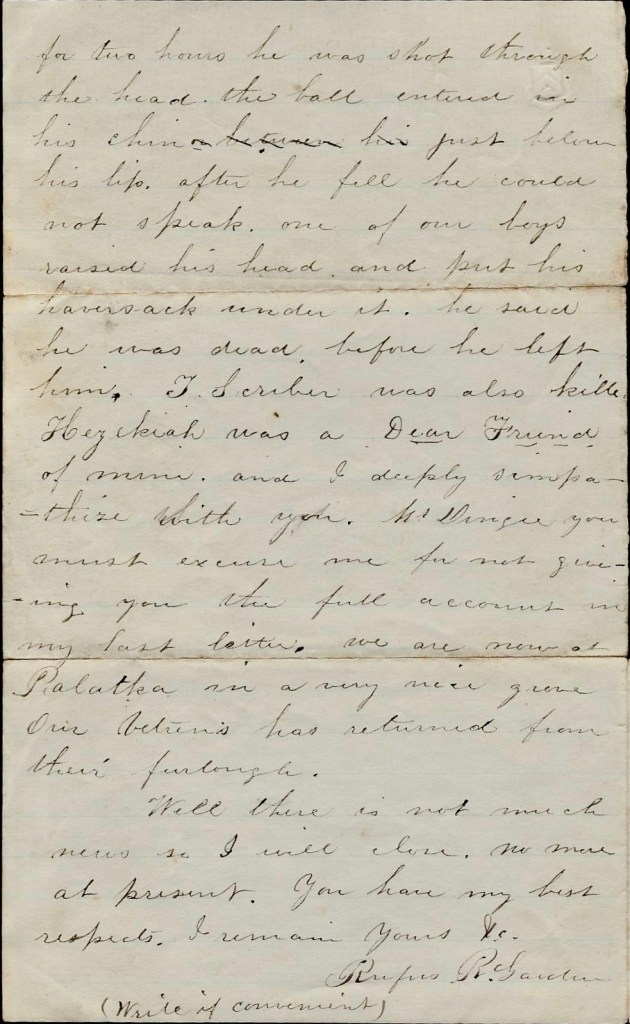
The following letter was written by Rufus R. Gardner who served as a private in Co. D, (later Co. K) in the 48th New York Infantry. Rufus was the son of Aaron B. Gardner (1812-1886) and Mary C. Belknap (1814-1846) of Newburgh, Orange county, New York. Though the regimental records indicate that Rufus was discharged for disability in July 1862, this letter proves otherwise. In all probability he was discharged in August 1864 after three years service (not having reenlisted as a veteran). He died three years later in September 1867 at the age of 24.
In his letter, Rufus provides 50 year-old Enoch Dingee (1814-1872) more details of his son’s death—killed on the field at the Battle of Olustee in Florida in February 1864. Enoch’s son was Hezekiah Dingee (1843-1864) who enlisted in September 1861 as a private in Co. C, 48th New York Infantry (he later transferred to Co. K). Both Rufus and Hezekiah joined and served together from the same community.
Transcription
Palatka, Florida March 20th 1864
Mr. Dingee, Sir,
I received yours of the 9th and was glad to hear from you. The information you wished to get concerning your son, I will give you to the best of my ability.
This expedition started from Hilton Head on the 6th of February, arrived at Jacksonville next morning. We then started on the march, passing and halting at several places such as Three Mile Run [or McCoy’s Creek], Camp Finegan, Baldwin, Darby’s, Barbus, and arrived at Saunderson on the 12th. On the 13th, we retreated back to Barber’s plantation. We remained at this place until the morning of the 20th when we commenced our march again. We marched 16 miles without rest and commenced fighting.
Your son fell after the fight had raged for two hours. He was shot through the head—the ball entered in his chin just below his lip. After he fell, he could not speak. One of our boys raised his head and put his haversack under it. He said he was dead before he left him. T. Scriber was also killed.
Hezekiah was a dear friend of mine and I deeply sympathize with you. Mr. Dingee, you must excuse me for not giving you the full account in my last letter. We are now at Palatka in a very nice grove. Our veterans has returned from their furlough.
Well, there is not much news so I will close. No more at present. You have my best respects. I remain yours, &c. — Rufus R. Gardner
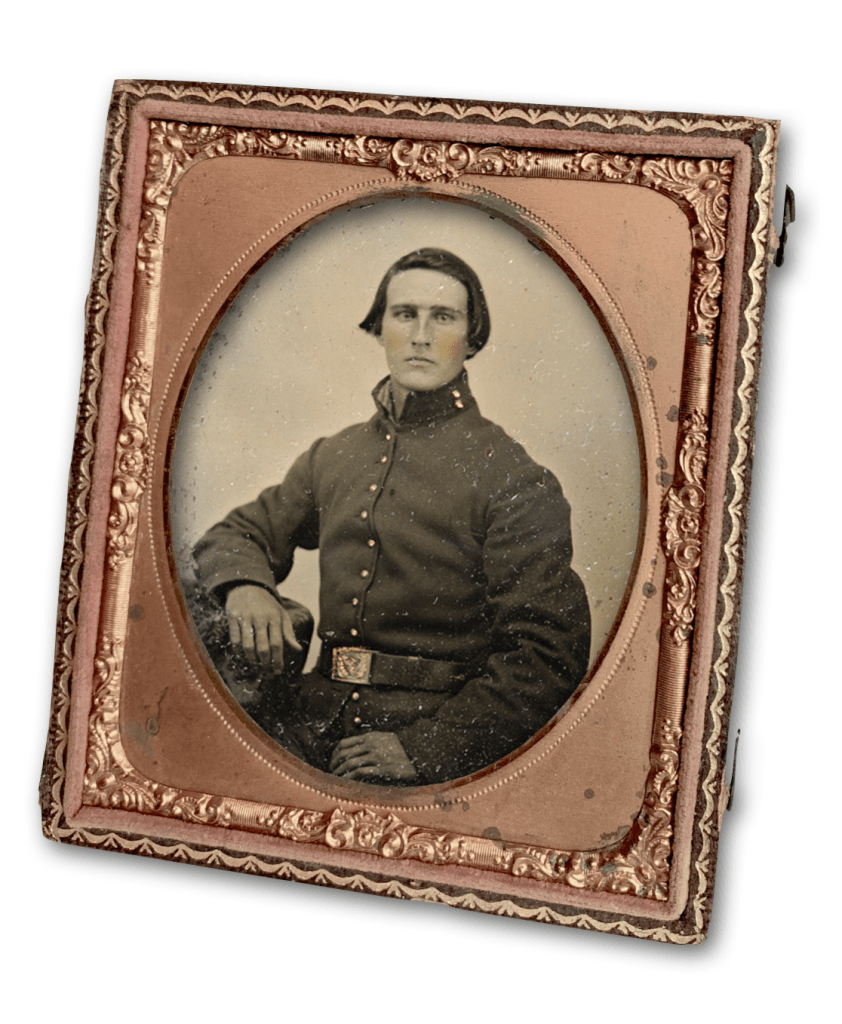
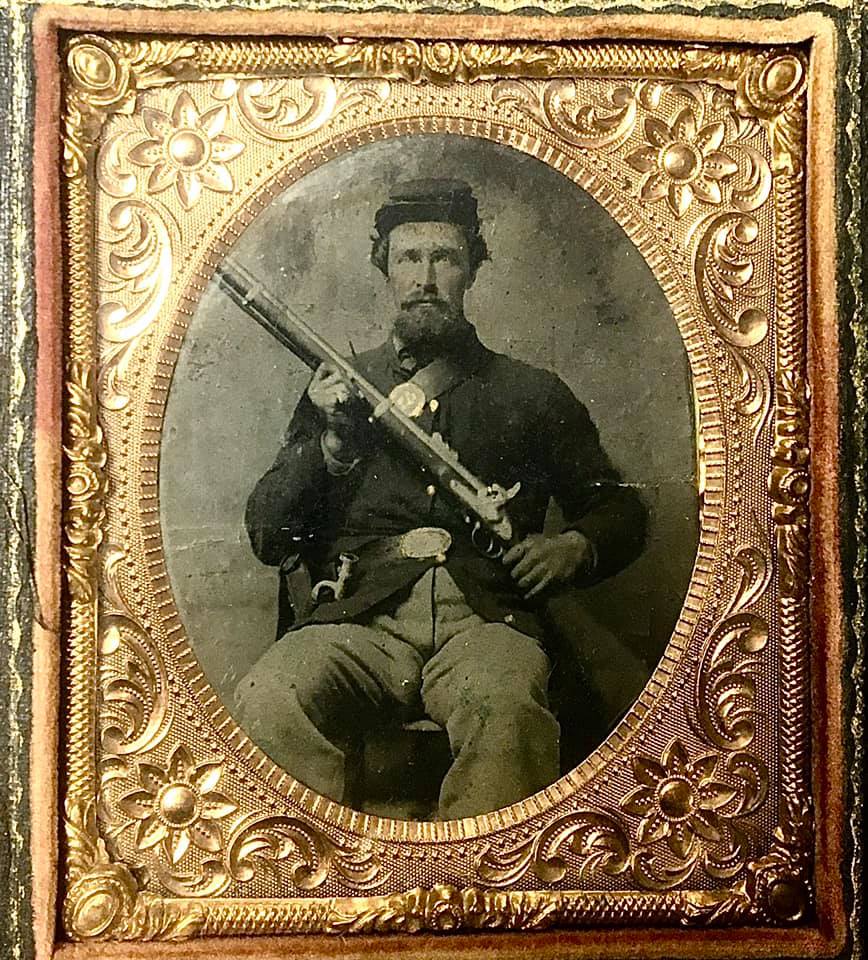
An early war image of Joseph Edward Parker (provided by Tim Parker)
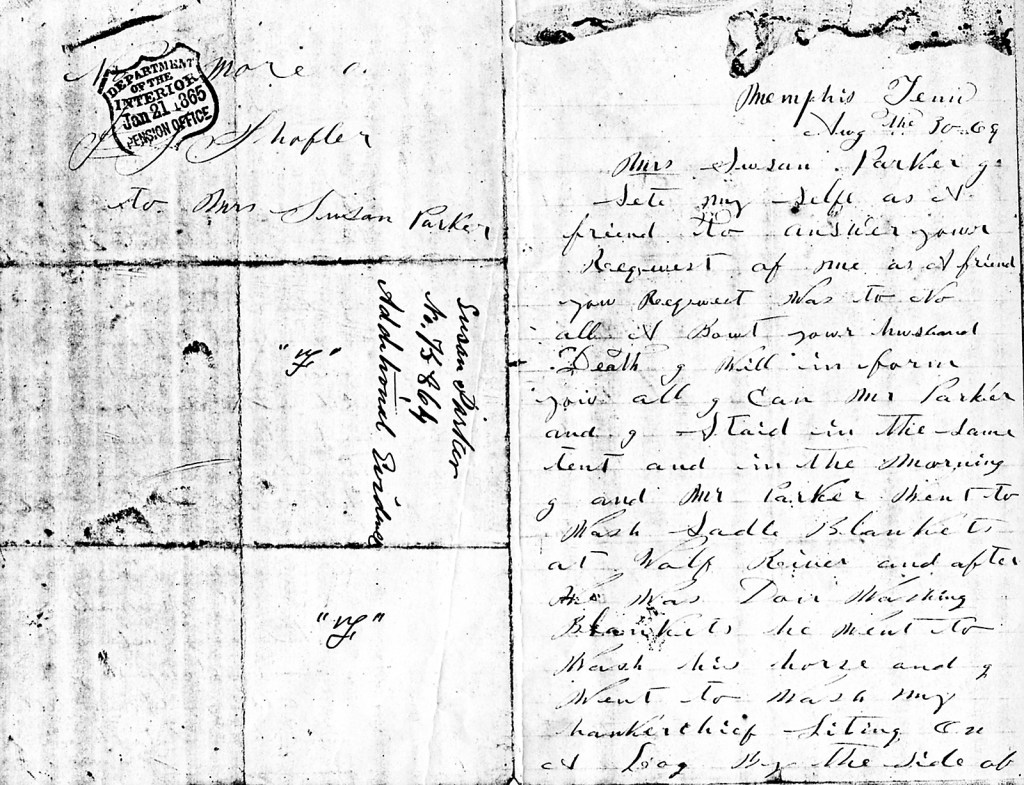
When looking for information about your Civil War ancestor, do not overlook Pension Records. Not only can they often provide vital information such as marriage records, names of children and their birth dates, death records, &c., but if you’re lucky, they might even include letters that were written by the soldier himself or by members of his company who wrote of his death. But why would a grieving mother or spouse part with original letters (in the days before copying machines)? Sometimes they were necessary to prove a marriage to the Pension Bureau, or that the death occurred while in the performance of official duties in the service, or that the family relied upon the soldiers wages.
Little was known about the death of Sergeant Joseph Edward Parker of Co. D, 10th Missouri (Union) Calvary when his descendant, Tim Parker, went searching in the Pension Records of his ancestor. But what he found more than answered his questions.
Born about 1830 in White County, Tennessee, Joseph was the son of Thomas Parker and Lucinda Satterfield. He came with his parents to what is now Reynolds County, Missouri, by 1832 and the family settled near present day Bunker. He was married to Susan Reese on 8 March 1849 and by the time of the Civil War, the couple had several children.
Joseph served throughout the war and reenlisted as veteran in January 1864, serving most of his time in Tennessee and Mississippi. He was known to have been killed by a rebel guerrilla on 4 August 1864 by the Wolf River near Memphis, Tennessee, but the particulars of his death were not revealed until the pension records were searched and the following two letters were found—one written by Sgt. Dennis Beale, and the other by his tent mate Sgt. Jacob Shofler.
Dennis Beale (1838-1928) was a native of Pennsylvania. He enlisted originally at Chicago to serve in Bowen’s Battalion of Cavalry and was attached to the 13th Illinois Infantry. He later transferred to the 10th Missouri Cavalry and mustered out on 11 October 1864 at St. Louis.
Jacob Shofler (1839-1917)—(or “Jake”) was a native of Ohio who served as a sergeant in Co. D, 10th Missouri Cavalry.
Letter 1
Camp of 10th Missouri Cavalry August 6th 1864
Mrs. Joseph Parker,
Madam, it grieves me to inform you of your husband’s death. Day before yesterday morning, he with several more of the company went to the river to water horses and while watering, a Rebel who had evidently been in ambush shot him in the right side, killing him almost instantly. It surly is a sad occurrence and the company mourns his loss. He was a good and brave soldier, ever ready and willing, and in him [we] lose one of the best soldiers. His final Statement will be forwarded to Washington D. C. as soon as the captain returns from the scout. His effects here also will be sent to you upon his return to camp. You will have to apply to the 2nd Auditor at Washington D. C. to obtain his arrears. Any information you may want in the future in regard to his effects, etc., will be cheerfully given at anytime.
Respectfully your obedient servant, — Dennis Beale, Sergt. Commanding Detachment Co. D, 10th Missouri Cavalry
Letter 2
Memphis, Tennessee August 30, 1864
Mrs Susan Parker,
I seat myself to answer your request of me as a friend. Your request was to know all about your husband’s death. I will inform you all I can.
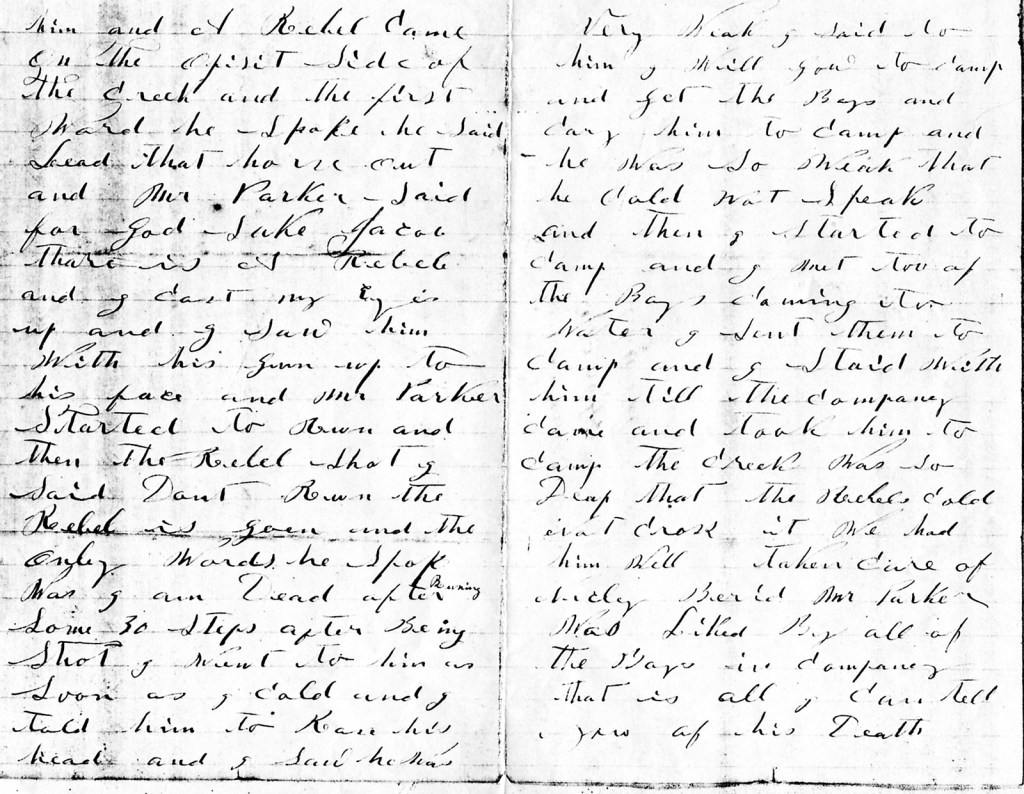
Mr. Parker and I staid in the same tent and in the morning, I and Mr. Parker went to wash saddle blankets at Wolf River. And after he was done washing blankets, he went to wash his horse and I went to wash my handkerchief. [I was] sitting on a log by the side of him and a Rebel came on the opposite side of the creek and the first word he spoke, he said lead that horse out, and Mr. Parker said, “For God sake, Jacob, there is a Rebel,” and I cast my eyes up and I saw him with his gun up to his face. And [when] Mr. Parker started to run and the Rebel shot, I said, “Don’t run, the Rebel is gone,” and the only words he spoke was, “I am dead.” After running some 30 steps after being shot, I went to him as soon as I could and I told him to raise his head, and I saw he was very weak. I said to him. “I will go to camp and get the boys,” [so we could] carry him to camp and he was so weak that he could not speak. And then I started to camp and I met two of the boys coming to water. I sent them to camp and I staid with him till the company came and took him to camp. The creek was so deep that the Rebel could not cross it. We had him well taken care of and nicely buried. Mr. Parker was liked by all of the boys in [the] company. That is all I can tell you of his death.
The following letter was written by Levi (“Lee”) Edmund Chenoweth (1840-1923), the son of Thomas Foster Chenoweth (1808-1886) and Christena Thomas (1810-1886). At the time of the 1860 US Census, 19 year-old Lee was enumerated in his parents household where he was employed farming with his father in Washington township, Darke county, Ohio.
I could not find an image of Lee in his uniform but here is one of Abraham Mosier who served in Co. D of the 69th OVI (Paul Loane Collection)
On the 13th of May, 1861, Lee enlisted as a private in Co. K, 11th Ohio Volunteer Infantry (OVI) for three months’ service, and was honorably discharged 17 August 1861. He re-enlisted on 25 October 1861 in Co. E, 69th OVI and was appointed Commissary Sergeant of the regiment on 1 February 1863, at Murfreesboro, Tennessee, and soon after appointed Quartermaster Sergeant for the entire regiment. He re-enlisted as veteran on 26 February 1864 at Chattanooga, Tennessee and was discharged from service as Quartermaster 1st Lieutenant of Co. H, 69th OVI and, on same day, was appointed Quartermaster of the regiment. He was then appointed Brigade Quartermaster on the staff of Gen. Buell commanding 2d Brigade, 1st Division, 14th Army Corp, Goldsboro, N.C., March 27, 1865. He mustered out as the Captain of Co. I, 69th OVI. He was present at the following battles: Stone River Chickamauga, Lookout Mountain, Mission Ridge – Ringgold, Snake Creek Gap, Buzzard’s Roost, Resaca, New Hope Church, Kennesaw Mountain, Marietta, Chattahoochie River, Peach Tree Creek, siege of Atlanta, Jonesboro and Savannah and Goldsboro N.C.
Since the war, has been engaged in the grocery business, miller, engineer, merchant tailoring boot and shoe store, foundry and machine shop and a traveling salesman, handling school furniture and supplies, in Ohio, Indiana, Illinois, Michigan, Pennsylvania, West Virginia and Canada. On the 5th day of December 1875, in the Supreme Court of Ohio, he was duly admitted to practice the law since which time he has been engaged in the business of his profession. He married, on the 3d of July, 1867, Effie A. Arnold, daughter of Noah Arnold, Esq., of Jasville, Darke Co.
Lee wrote the letter to his friend, Joshua Jefferis (1837-1918), the son of Darlington Jefferis (1796-1880) and Mary Potter (1801-1865) of Darke county, Ohio.
Transcription
Addressed to Joshua Jefferis, Esqr., German P. O., Darke county, Ohio
Murfreesboro, Tennessee March 3rd 1863
Friend Joshua, dear sir,
Having a few idle moments this afternoon, I will improve them by writing you a brief letter and to begin I will just state that we are all well & able for our rations. The weather is fine & roads are drying up fast. Vegetation begins to make its appearance, meadows are getting green, and the forest is brightening & everything gives evidence of an early spring. The boys have just been paid off & are very light-hearted & cheerful. We are not half so sick of the war as we were one year ago from this date. We have stood up to the toils, privations and sufferings of the war this long & we are bound to stick to the willows till the last horn is blowed—till the last enemy is killed or subjugated—till the Stars & Stripes wave triumphantly over the last state, county, or district in the Southern Confederacy. It can be done & I would wager my interest in the future world that it will be done.
Rosecrans can soon do his portion of the work if Grant & Hooker will do theirs & it is my candid conviction that ere 12 months more shall have rolled round, peace and tranquility will reign in the United States. We can stand it another year & if needs be, the fall term. I would like to come home & see all my friends as much as any man living, but I have not the remotest idea of so doing until the close of the war. You might as well try to get brains out of a cannon ball or farts out of a dead man as to try to get a furlough for 10 or 15 days.
I presume our stay at this place will be but brief as I am told by a reliable man that General Rosecrans is only waiting for the roads to get in condition.
I have not seen or heard from William Jefferis for some time but think he is yet in hospital at Nashville. Abner Haines died here yesterday morning from erysipelas & was buried today.
Our forage train was attacked about eight miles out yesterday. Our boys went into them vigorously & killed and captured nearly the entire rebel force amounting to near 300 men. The Rebels are deserting and coming to our forces daily. There is seldom a day passes without a squad of from 15 to 30 comes over. 28 came in yesterday morning and some in the evening. I have seen none today.
As there is nothing of any particular importance transpiring just now, I will close hoping that you will respect my missive & reply soon. Give my respects to Milton & Louisa. Also to Mr. Jefferis & family. Yours &c., — Levi E. Chenoweth, Com. Sergeant, 69th Ohio
Address 2nd Brigade, 2nd Division, 14th Army Corps, Murfreesboro, Tenn.
I could not find an image of George but here is a CDV of Edward C. Morehouse who also served in the 2nd New York Cavalry (Co. C) (Photo Sleuth)
The following letter was written by George M. Warner (1843-1864) who enlisted at age 18 on 21 August 1861 at Fairhaven, Vermont, to serve three years in Co. F, 2nd New York Cavalry—a.k.a. Harris Light Cavalry. He was captured on 3 November 1863 at Stevensville and eventually taken to Andersonville Prison in Georgia where he died on 27 July 1864.
The Harris Light Cavalry suffered heavy casualties at Beverly Ford and Aldie, Virginia, in the early phase of the Gettysburg campaign while the Army of the Potomac was en route to Pennsylvania. It was not engaged at Gettysburg, being stationed at Westminster, Maryland, instead, so one has to wonder as to the validity of George’s letter which describes his having been momentarily taken a prisoner in the cavalry fight on 3 July 1863 at Gettysburg when his horse was shot out from under him as Kilpatrick’s 2nd New York Cavalry attacked the rear of Lee’s infantry. It was in this attack, where Kilpatrick continuously charged the heavily fortified Confederate right flank, suffering heavy losses, that he earned the nickname “Kill-cavalry.”
Transcription
Headquarters Harris Light Cavalry Camp at Warrington Junction August 3, 1863
Dear Cousin,
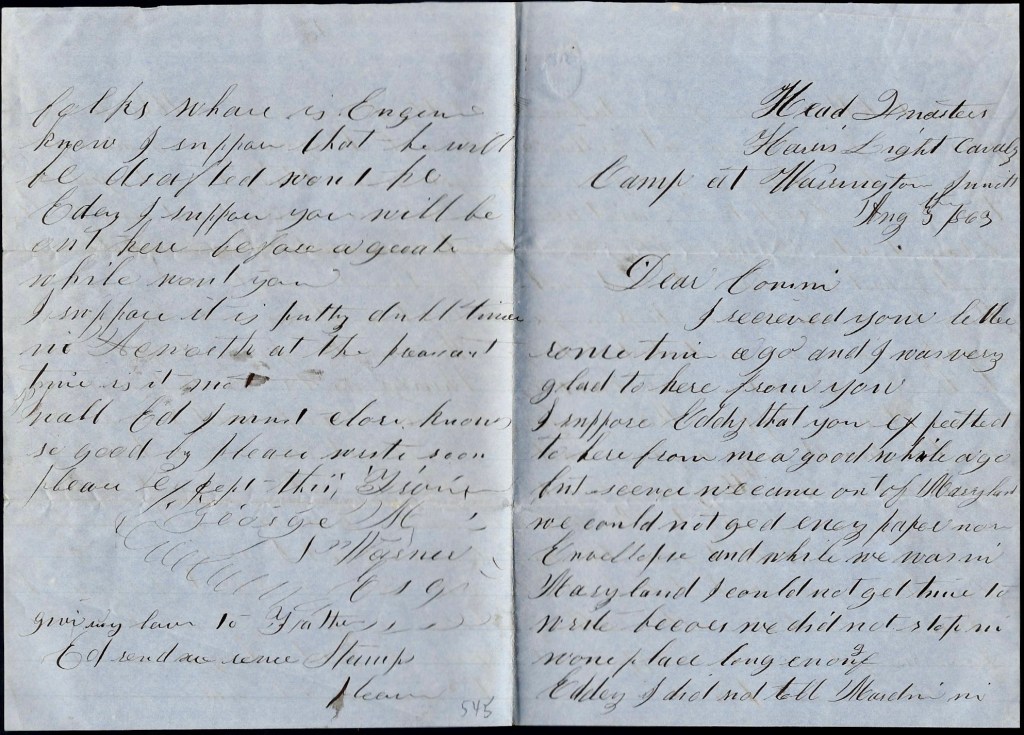
I received your letter some time ago and I was very glad to hear from you. I suppose, Eddy, that you expected to hear from me a good while ago but since we came out of Maryland, we could not get any paper nor envelopes and while we was in Maryland, I could not get time to write because we did not stop in one place long enough.
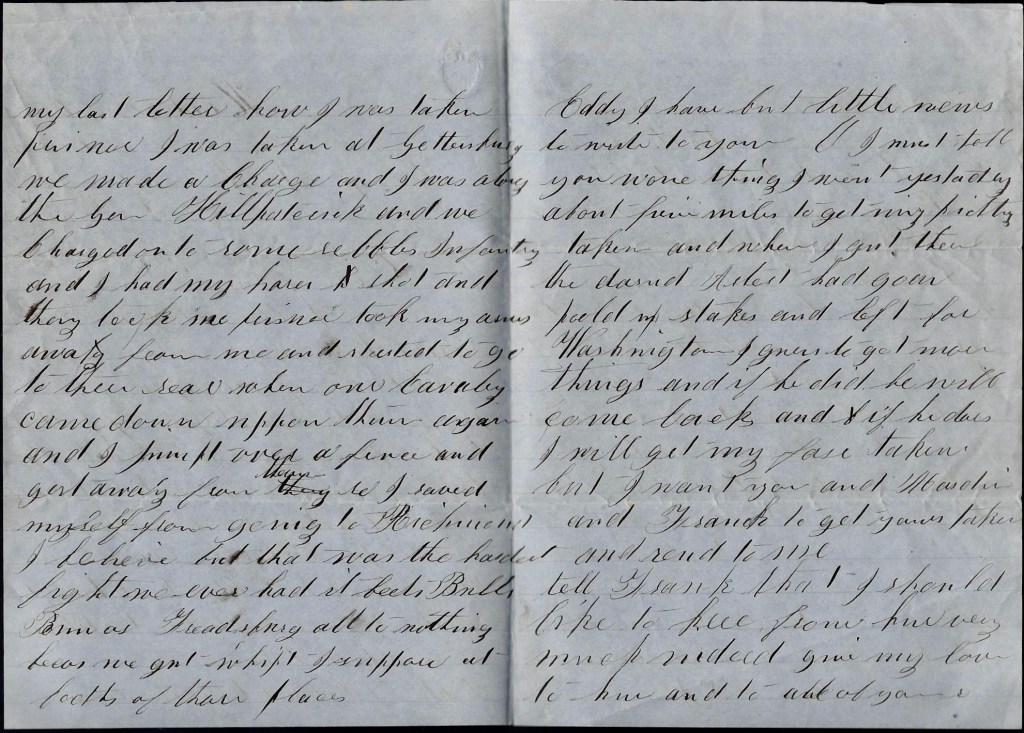
Eddy, I did not tell Mardin in my last letter how I was taken prisoner. I was taken at Gettysburg. We made a charge and I was along Gen. Kilpatrick and we charged onto some rebel infantry and I had my horse shot and they took me prisoner, took my arms away from me, and started to go to their rear when our cavalry came down upon them again and I jumped over a fence and got away from them so I saved myself from going to Richmond, I believe, but that was the hardest fight we ever had. It beats Bulls Run and Fredericksburg all to nothing because we got whipped, I suppose, at both of those places.
Eddy, I have but little news to write to you. Oh, I must tell you one thing. I went yesterday about five miles to get my picture taken and I when I got there, the darned artist had gone and pulled up stakes and left for Washington, I guess, to get more things, and if he did, he will be back and if he does, I will get my face taken. But I want you and Mardin and Frank to get yours taken and send to me.
Tell Frank that I should like to hear from her very much indeed. Give my love to her and to all of your folks. Where is Eugene now? I suppose that he will be drafted, won’t he? Eddy, I suppose you will be out here before a great while, won’t you? I suppose it is pretty dull times in __worth at the present time, is it not?
Well, Ed, I must close now so goodbye. Please write soon. Please accept this from, — George M. Warner, Esq.
Give my love to Father. Ed, send me some stamps please.
This letter was written by Clarissa (“Clara”) Dwight Marsh (1834-1899), the daughter of Henry Marsh, Jr. (1797-1852) and Sarah Whitney (1796-1883). Clara’s father was an 1815 graduate of Williams College and lived in Dalton, Massachusetts from 1821 to 1840 where he was a lawyer, a merchant, a farmer and wool grower, and a wool dealer and manufacturer. In 1840 he moved with his family to Pittsfield, Massachusetts, where he lost his savings with the failure of the Ashuelot Manufacturing Company. In 1843 he went to Racine, Wisconsin, in 1846 to Sandusky City, Ohio, and in 1850 to St. Louis, Missouri, engaging in the mercantile and produce business. He died of cholera in June 1852 but had managed to put three sons through Williams College and afforded his daughters, Clara, and Elizabeth (“Lizzie”) Willard Marsh (1829-1882), some outstanding educational advantages as well.
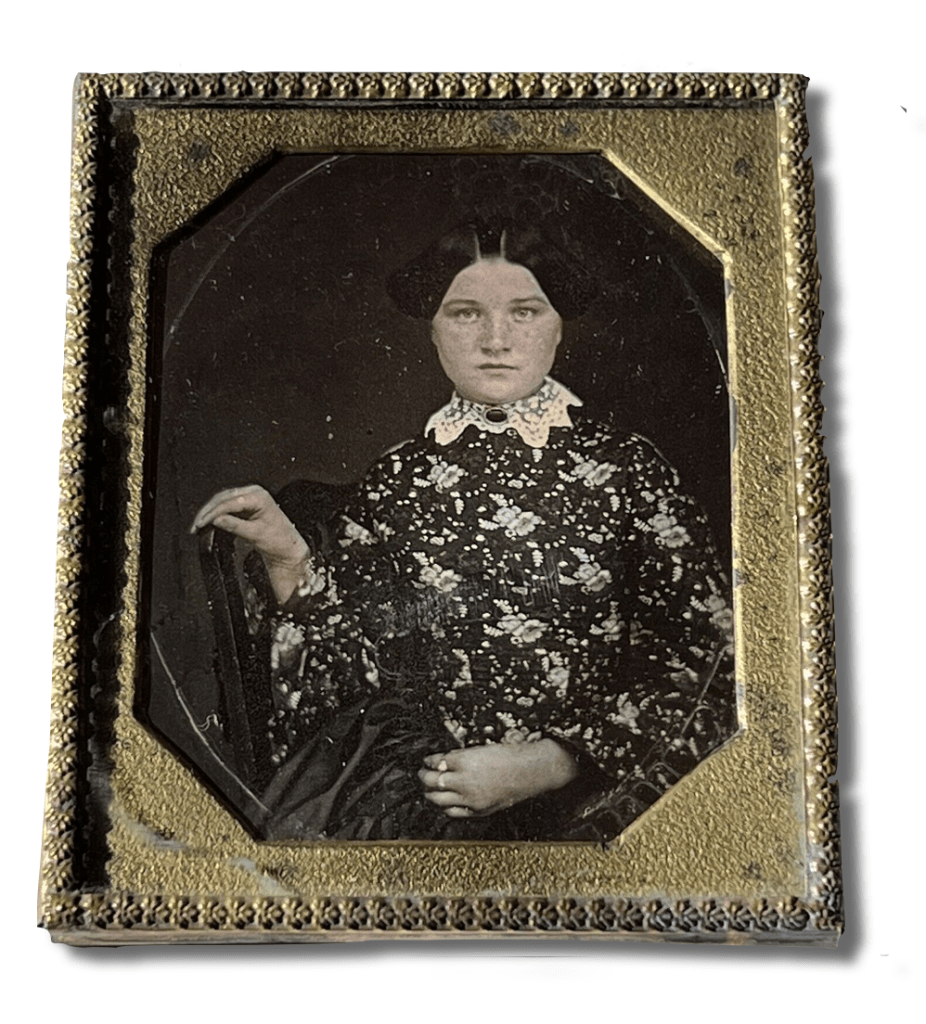
How Clara might have looked
Lizzie “was educated at Maplewood, Pittsfield, Mt. Holyoke and Bradford Seminaries, and spent her life in teaching. She had a school in St. Louis and at Batavia, Illinois, and afterwards taught in private families in Pittsfield, Mass., Batavia, N. Y., and Hudson, Wisconsin. At the latter place on Lake St. Croix she made her home with her life-long friend, Susan (“Sue”) Ellen Lockwood (1830-1915), the wife Charles Wendell Porter and the daughter of Judge [Samuel Drake] Lockwood of Batavia, Illinois. She died at Hudson, Wisconsin, on 23 April 1882.”
Clara attended the Cooper Female Academy in Dayton, Ohio, in the early 1850s. She married Samuel Watkins Eager, Jr. of St. Louis, Missouri, in May 1857.
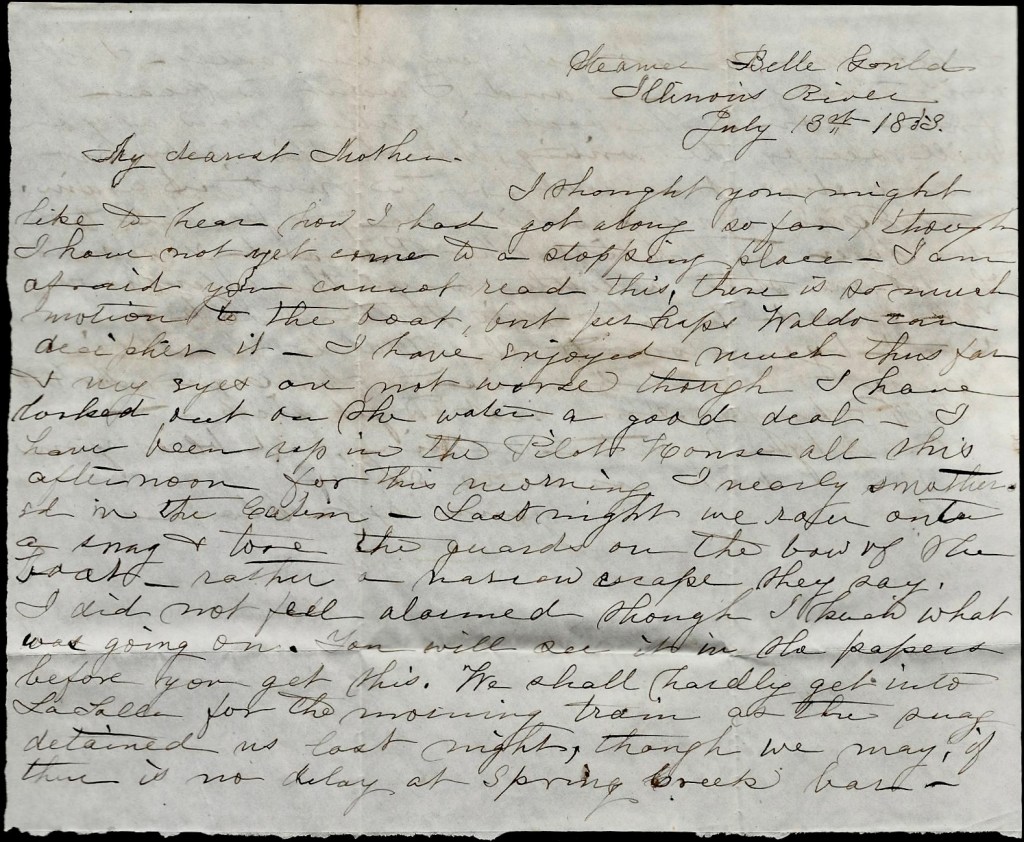
Clara does not state her destination in this letter but she was clearly heading east—or up-river—on the Illinois river on her way from St. Louis to LaSalle, Illinois, where we learn she expected to catch the Illinois Central railroad to Chicago and from there to points East. Most likely she was going east to the Cooper Female Academy in Dayton, Ohio. In those days, young ladies did not travel alone so she was probably being escorted by the “Mr. Rice” who is mentioned in the letter.
Transcription
Steamer Belle Gould 1 Illinois River July 13th 1853
My dearest Mother,
I thought you might like to hear how I had got along so far though I have not yet come to a stopping place. I am afraid you cannot read this, there is so much motion to the boat, but perhaps [brother] Waldo can decipher it. I have enjoyed much thus far & my eyes are not worse though I have looked out on the water a good deal. I have been up in the pilot house all this afternoon for this morning I nearly smothered in the cabin.
Last night we ran onto a snag & tore the guards on the bow of the boat—rather a narrow escape they say. I did not feel alarmed though I knew what was going on. You will see it in the papers before you get this. We shall hardly get into LaSalle for the morning train as the snag detained us last night, though we may if there is no delay at Spring Creek bar.
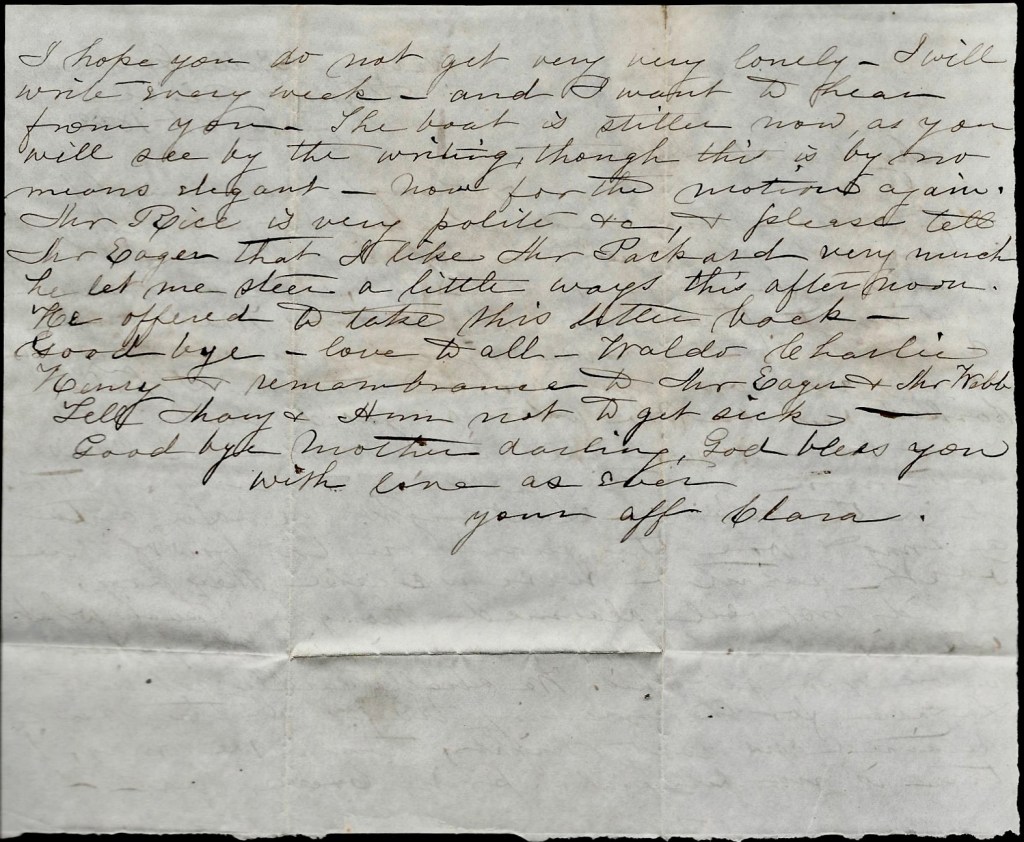
I hope you do not get very very lonely. I will write every week and I want to hear from you. The boat is stiller now, as you will see by the writing though this is by no means elegant. Now for the motion again.
Mr. Rice is very polite &c., and please tell Mr. Eager that I like Mr. Packard 2 very much. He let me steer a little ways this afternoon. He offered to take this letter back. Goodbye. Love to all—Waldo, Charlie, Henry, & remembrance to Mr. Eager and Mr. Webb. Tell Mary and Ann not to get sick. Goodbye Mother darling. God bless you. With lover as ever, your affectionate Clara
1 The Belle Gould was a side-wheel steamboat built in New Albany, Indiana, in 1852 for the St. Louis-Keokuk trade. She ran the Illinois River in 1853 and was the first steamboat to arrive in Peoria. She was snagged and sank at Island 25 below Cairo, Illinois on 3 March 1854.
2 I believe “Mr. Packard” may have been Capt. Bryant Rogers Packard (1821-1869) who was a steamboat captain residing at 1409 Papin Street in St. Louis, Missouri.He named his daughter “Belle Gertrude Packard (1858-1864).”














 Spared & Shared 23