All posts by Griff

My passion is studying American history leading up to & including the Civil War. I particularly enjoy reading, transcribing & researching primary sources such as letters and diaries.
1862-64: David Rankin Alexander to his Family

The following letters were written by David “Rankin” Alexander (1834-1864), the son of James Wilson Alexander (1796-1857) and Jane Johnston (1796-1862). Rankin was married to Sarah J. Dewese.

David enlisted at the age of 27 on 16 September 1861 as a private in Co. C, 37th North Carolina Infantry until he was wounded at the 2nd Battle of Manassas on 29 August 1863 and spent the next several months recuperating at home. “The 37th NC Regiment was one of the regiments that kept pace with the ‘Foot Cavalry,’ covering more than fifty miles in two days, its fare being principally green corn gathered by the wayside. At Manassas Junction it was one of the regiments that charged Brig. Gen. George W. Taylor’s New Jersey Brigade across Bull Run Creek on August 27th, completely annihilating it. Moving back to the Junction it feasted sumptuously for several hours upon the captured stores, then took its position with Maj. Gen. Jackson’s forces behind the unfinished railroad cut to await the coming of Maj. Gen. Pope’s army. On August 28th it made its appearance and formed in three lines of battle—came on like the waves of the ocean; several well directed volleys hurled them back, but quickly reforming, they came again and again until night put an end to the terrible slaughter. This was kept up upon on August 29th and 30th; the 37th NC Regiment manfully held its position, although at times it would scarcely have a round of ammunition left to the man. Maj. Gen. A.P. Hill (VA) and Brig. Gen. Lawrence O. Branch (NC) could often be seen dismounted urging their men to hold their ground at the point of the bayonet. The loss of the 37th NC Regiment in the three (3) days’ fighting was 13 killed and 67 wounded.”

After Rankin returned to the regiment he was promoted in rank to sergeant but was killed in action on 3 May 1864 in the Wilderness.

Letter 1

[On the completion of its organization it was moved to New Bern, NC, where it received its baptism of fire on March 14, 1862, in battle at that place. Lt. Col. William M. Barbour commanded it, Col. Charles C. Lee being assigned to the command of the left wing of Brig. Gen. Lawrence O. Branch’s (NC) army. Although fighting under great disadvantage, the regiment behaved with great credit to itself and showed plainly of what material it was composed, reinforcing most beautifully Col. Reuben P. Campbell, of the 7th NC Regiment, whose lines were first broken. It is well to state in the beginning that the greater part of the regiment was composed of hardy mountaineers, as fine a looking body of men as ever marched to the tap of a drum. Outnumbered at every point, the small army of Brig. Gen. Branch was compelled to fall back to Kinston and after a short rest the 37th NC Regiment was taken to Falling Creek.]

Patriotic Stationery on David’s letter of 21 February 1862

Camp Lee
New Bern, North Carolina
February 21st 1862

Dear Mother,

I take my pen in hand to let you know that I am well at present and hope these few lines will find you all enjoying the same blessing from the hand of Almighty God.

I have nothing of importance to write to you more than you all know. You have heard the news of the reverses our soldiers have had in the last few weeks but I hope and trust to God that it will not be so very long.

We have not seen anything of any of beings they call Yankees yet and I hope they will never come up here to attack us at this place. They talk like the Yankees would be here in a few days after we come here but I have seen nothing of them yet nor do I know whether they are any nearer to us than they were when we came down to this place.

I have written home several times and have got no answer yet. I have looked for a letter for three weeks and have looked in vain but still I have not lost all hopes of getting letters from home. I do not know whether Sarah gets my letters or not and if she writes to me, I never get them. I have thought that you might have wrote to me before this time but still I know you have a hard chance to get much time to write or do anything else while you have so much to do at home so I thought I would drop you a few lines this time and let Sarah wait until next week.

I cannot write to you all as often as I would like to do and some that asked me to write to them that I do not expect to get time to write to. Tell Margaret I think it is as little as she could do to sit down some night and drop me a few lines. I have not wrote to her I know but I do not [want] you all to wait on me for I tell you, I cannot write to every one.

Tell Calvin and Martha I have looked for a letter from them ever since I heard they were married but have looked in vain. Tell Branch Warsham and his duck to write to me and let me know how they like a married life. I want all my friends and neighbors to write to me and not look for me to write to them.

I also want to know hoe my boy is getting along and also Sarah, how she is getting along. I must close by saying to you to write by return mail. I will look for an answer from you and also from the above named persons. I remain your affectionate son, — D. R. Alexander


Letter 2

[After the Battle of Fredericksburg, the 37th North Carolina went into winter quarters at Moss Neck, about eight miles farther down the river, where it remained and did picket duty, with the other four (4) regiments of the brigade, for the remainder of the winter. David was not with his regiment, however. He was at home in Mecklenburg county, ]

[Home]
February 2, 1863

Dear Brother,

With pleasure I seat myself to write you a few lines to let you know that I am still a home but expect to start to my company Thursday without I get further orders. I have been at home for four months. My arm is not sound well yet. It is still running a little yet but I have a pretty good use of it. But it is nothing like it was before I got shot by the infernal Yankees. I feel like I could shoot at them again for it makes me mad to think about them. They are so barbarous and have no respect for our southern ladies. They treat them worse than the beasts of field. I think the Almighty, maker of us all, will do what is right in His own eyes and I think he will give us success in our arms and help us to gain our independence and make us a happy people. I hope and trust that the time is not far hence when there will be an honorable peace made between the two contending parties and we will all get home to our families and fathers and mothers and brothers and sisters to live as we have done in times gone by.

I will try and write to you after I go back. Your brother, most affectionately, — David Alexander

[In a different hand]

Dear Brother, I take my pen in hand this evening to write you a few lines to let you know that we are all well at this time and hope you are enjoying the same blessing. I have nothing particular to tell you except that Henry Warsham has the small pox and nearly all the neighborhood have had a chance of them but have not taken them yet and I hope will not. Your folks are all well. May was here last night and said they had got a letter from you by Mr. Sheppard stating that you were well. George wrote to you and Calvin sometime ago and have not received an answer yet so I thought I would write again. I think I shall get one tomorrow. If I do not, I will not know what to think about it.

Well, George, all the men in this county are out hunting conscripts and deserters. They have struck up camp in Ferret Town and stay there day and night. Yet they are spending their time for nothing. I have not time to write any more at this time. Rankin expects to start back Thursday and I want to go to Pa’s tonight and it is time I was starting. So nothing more at present but remain your sister affectionately, — Sarah [Dewese] Alexander.

Write soon as you can. I want to hear from you.


Letter 3

[Home]
February 3rd 1863

Dear Brother,

I will write you a few lines this morning again. We are all well and hope these few lines will find you well. I want you and Calvin to write to me after I get back to my company and I want you to write me all the news you can. I have got Mary Tye to stay with Sarah and she says for us to tell you howdy for her. We were all at father’s last night and have just got here through a snow nearly a knee deep this morning. It is beautiful overhead but is bad on the ground for poor soldiers in the army.

I think this will be a great day for those men to gather up the conscripts in Ferret town. Hope they will get the loot one of them. If they don’t, they may look out for to be disturbed some way or another. Wm. Stinson had all his bridles taken one night last week.

Nothing more at present but remain your brother affectionately, — D. R. Alexander


Letter 4

Camp Gregg, Virginia
March 10th 1863

Dear Sister,

I take my pen in hand to write you a few lines in answer to the one I received from you Sabbath day and was glad to hear of you all being well. I got a letter from Calvin and George yesterday. They were both well when they wrote. I was glad to hear from them and more so to learn them both well. I looked for a letter from Gus last week but did not get any but I heard from them in your letter which amounted to the same thing as if I had got one from them but at the same time I would like to have read one from them. I have no reason to complain at all. I have nothing of interest to write to you at this time.

I am still excused from any heavy duty. I cannot use a gun yet. My arm has been worse the last three or four days but I hope it will get well some day. I think it was going on drill that made it worse, getting it mashed about by the other soldiers running against it.

I hear no war news at this time. There is talk of peace sometimes and the next thing you will hear of there is going to be a fight of the biggest kind but I see no prospect of a fight myself and I hope and trust there will be no fight here or anywhere else this year. I think if they will stop all hostilities for awhile, I think that peace will be made without any more fighting and I pray God now soon He may grant us an honorable peace and that He will send the enemy home and let us go to our homes where we can live with our families and friends and connections near and dear to each other. And my dear father and mother, it would do me much good to read a letter from you. It does me so much good to get a letter from any of you.

I suppose you have seen Thomas C. Sloan before this time for he got a furlough and started home last Thursday. I am glad that he got a chance of going home to see you all once more. And father, I want you to attend to the return of my property if I don’t get a chance to do it myself. I have nothing but my land and negro to make a return of. My buggy is not worth returning. I want you to write to me.

This leaves me well except a bad cold and I hope they will find you all enjoying good health. Nothing more at this time except it is snowing now and looks like it might continue all day. I remain your brother affectionately, — D. R. Alexander

to M. C. Dewese


Letter 5

[Home]
April 13th 1863

Dear Brother,

I seat myself this morning to write you a few lines to let you know that we are all well except bad colds and that is bad enough when it takes a deep hold on a person. I have had the worst one this winter I have had for many a year. I am at home at this time and am getting along very slow. My arm hurts me when I use it very much and if I was to handle a gun, it would almost kill me. Bu I hope it will get well someday. I have a furlough from the 2nd of April to the 12th day of May and I have the privilege of getting it prolonged if my arm is not fit for use or if my health becomes impaired any way that I will not be able for duty. I got my furlough without asking for it. The doctor examined my arm and he told me that he was going to try and send me home which he succeeded in doing.

I tell you Mat Alexander is doing [ ]. She is going to work too hard this summer. I understood that some of her close kindred said they were afraid that she would hurt herself working. Well I reckon you know something about her work—how she kills herself and hands at hard work. I tell you, May is some in cane thicket the way she is getting rich is sight to everybody and that you know is she spends her money and can’t see where it goes to, I always try to get value received for my money but she does not care so she is giving it for some fool thing or other. I am sorry to think she is going to kill herself working. Why if she does that, Milas will die [illegible] without asking any questions.

We have had one week of pretty weather and I have nearly all my corn planted and Mc is planting. He is working my land and his together and works his hands and my boy together. I hope we will have pretty weather. It will be so much better on the farms and also on the poor soldiers who are defending their country’s cause. I hope the time is not far distant when we will get to hear from each other without the trouble of writing,

Your people are all well at this time and I hope should these few lines reach you, they may find you enjoying good health. May the good Lord [ ] rest upon you and all the poor soldiers who are now in the field of service. Give my respects to all the company or such of them as inquire after my welfare.

Nothing more at this time but hope to remain your brother most affectionately, — D. R. Alexander

To G. B. Dewese


Letter 6

Camp near Liberty Mills, Virginia
October 6, 1863

Dear father and family,

I received your kind letter on yesterday and was glad to hear that you were all well and I hope these few lines will still find you all enjoying the same blessing. I am very glad that you have undertaken to get a [ ] a settlement of my estate and I hope everything will work [illegible]. I don’t think there will be any trouble in the settlement at all. I would be glad if I could get home to attend to it myself but things are so ordered that I can’t at this time. I hope this war will soon come to a close and then I can get home to see to my own affairs. I have hoped that way so long that it looks like I might lose hope but still I live in hope if I die in despair—I want peace, but I want it honorably or not at all. It would do us no good unless we do get it in this way. I pray the time is not far distant when we will have peace and then what a time of rejoicing there will be in this Confederacy between man and wife, parents, children, friends, and our connections near and dear to us.

I have no news of interest to write at this time, only our army is in good health and fine spirits at this time. Our regiment never has been in better health and condition since I can mind than it is at the present time.

Nothing more. Write soon. Your son, — D. R. Alexander

Dear sister Margaret, I write you a few lines. You’re excused for not writing soon a letter. I hope you will do so no more. I want you all to write as often as you can. Tell mother for her to write and tell Charley to write to me. I would like the best in the world to see you all. I have nothing to write at this time. I am well. T. C. Sloan sends you his respects. He is well and hearty and is the same Tom yet. I see no alteration on him at all. I have wrote to your father about all I can think of at this time…Keep in fine spirits and do not despair…I close and hope to remain your brother most affectionately, — D. R. Alexander


Letter 7

Camp near Liberty Mills, Virginia
December 19th 1863

Dear Mother,

I take my pen in hand to write you a few lines to let you know that I am well at this time hoping should these few lines will find you all well and in good health. I have not much of interest to write at this time except we have cold wet weather out here and a heap of it and we have to go on picket every two days and we have guard duty to do every day and it makes no difference how bad the weather is—we have to stand guard.

I want more provision from home if I can get it and I want you and my neighbors to send me something every chance you have and I don’t want you to think that I am begging but anything from [home] takes so well. Give my love to all the children and tell Margaret that I think she might have written to me before this time but I will excuse her as she has so many young men to write to that she can’t have time to write to me very well. That is alright. I think among you I ought to get one letter every month. I have looked for a letter from some of you but have not got any from you for some time. I want you all to write to me and give me all the news in the neighborhood.

I would have liked to been at home to seen Calvin and George but I could not be there and here both, but I hope the time is not far distant when we will all get home to enjoy ourselves once more in this world. And if we should never meet on this earth anymore, my prayer is that we all may meet in heaven where peace will forever dwell in our hearts and men will learn war no more. Tell Martha Ann that I have not forgotten her yet. Tell her that I have so many to write to that I can’t write to all of my friends as often as I would like to do.

I would like to see you all and talk with you all. Tell the little boys all for me to be good boys and pray for me while I am out here fighting for them and pray not only for me, but for all of the poor soldiers. Tell them that I think of them every day. I have nothing more at this time but I hope to remain your son-in-law most affectionately, — D. R. Alexander

T. C. [Sloan] is well and hearty at this time. He says he has not forgotten you yet.


Letter 8

Camp near Liberty Mills
April 6th 1864

Dear Sister,

I take my pen in hand to write you a few lines to let you know that I am well at this time, hoping for you the same good blessing from the hands of Him that giveth and never tires when we receive His gifts in the right kind of a manner.

I have nothing of interest to write at this time. The health of our company is very good at this time. All the men that are present are able for duty and that is something very rare in the army. We have 49 men present and all able for to do their duty. I hate that I have neglected writing to you for so long but I hope you will pardon me. I think you are a reasonable being and will not think hard of me in my neglects. I was sorry to hear of John being so sick but was glad to hear of him being able to ride to my house. I hope he is well by this time and all the rest for you have had a serious bout of sickness this winter. I believe all have been sick from the oldest to the youngest.

I am not in the habit of writing tales on my fellow soldiers but I think I must relate one this time on my friend Robert Deaton. 1 As you know, I am a great friend of his. He tried to play off with pains in his legs and loin joints but they would not swell for him and the doctor could not see anything wrong with him and they preferred charges against him ad had him courtmartialed for trying to play off and his sentence is to dig stumps three hours every day for a month. He wants to put in another summer campaign at the hospital. He likes that place better than to be with the company and do his duty like a soldier. In short, he is no account nor never will be.

Tell all the family that I am well and want all that can write to write to me and give me all the news. Give my respects to all who may ask after me. I am in hopes this war will come to a close someday. If it don’t, it will be the first one. But I hope it will be soon. I see in the papers taken from a Northern paper that we can hold Richmond while we have fifty thousand men to fight. But still their great Gen. Grant says he intends to take it and end the war. But that will not make the rebels, as they call us, stop. No indeed. I fear they will have a hard fight and lose a great many men before they get that place they call the rebel capitol. They are as tired of the war as we are, but they don’t want to give up yet. I want to have peace and if they will let me alone, I will assure them I will let them alone. But they must not tramp [on] my toes if they don’t want hurt.

Tell Pa and Mother to write to me and write yourself. T. C. Sloan sends you his respects but he’s lost all hopes of getting home this spring. Give me all the news from Old Mecklenburg. Nothing more at this time as my letter is very uninteresting anyway. I remain your brother-in-law, — D. R. Alexander

1 James Robert Deaton (1840-19xx) was 20 years old when he enlisted on 16 September 1861 as a private in Co. C, 37th North Carolina Infantry. It appears he was captured and took the Oath of Allegiance in Washington D. C. in September 1862 but was exchanged and returned to his regiment. He was absent without leave for a while but returned in February 1863. He deserted to the enemy on 30 November 1864 and went to Bartholomew county, Maryland, to wait out the war.

1863: Richard Johnston Stough to George Dewese

This letter was written by Richard Johnston Stough (1844-1926) who enlisted at the age of 18 on 28 July 1862 as a private in Co. K, 56th North Carolina Infantry. He was promoted to corporal in September 1863 and was with his regiment near New Bern when he participated in the 2nd Battle of Gum Swamp in May 1863. In this engagement, the 25th NC Regiment and the 56th NC Regiment were surprised and virtually surrounded by five Union regiments at Gum Swamp (Jones County); they were forced to fight their way out or flee into the swamp. More than 160 men of the 56th NC Regiment were captured but apparently Richard “took to the swamp through the mud and briars” and escaped.

Richard was taken prisoner of war on 25 March 1865 in the fight at Fort Stedman, Virginia, and was confined at Point Lookout, Maryland, until he took the Oath of Allegiance on 20 June 1865.

Richard wrote the letter to George B. Dewese (1843-1864), the son of John Allison Dewese (1811-1870) and Mary Ann Sloan (1819-1911) of Mecklenburg, North Carolina. George enlisted on 28 July 1862 at the age of 19 in Co. K, 56th North Carolina Infantry. He was absent sick from his company for two or three months in the spring of 1863 but was otherwise on duty until he was killed in the Battle of Globe Tavern (or 2nd Battle of Weldon Railroad) fought on 21 August 1864 south of Petersburg, Virginia.

Transcription

[Approximately 1 June 1863]

Gum Swamp satisfied my curiosity. I shot 4 times at the Yankees and missed every time I think. One thing I know, they—the Yankees—came in very close proximity to me. They seemed to be blind. I took the swamp through the mud and briars without thinking what was before, always looking behind.

George, give my respects to all that wants and accept a double portion yourself. Goodbye. Yours truly, — R. J. Stough

Do all you can for Dicie.

1864: Andrew Green Barnett to Margaret C. Dewese

The following letter was written by Andrew (“Andy”) Green Barnett (1843-1917) of Mecklenburg county who enlisted as a private on 25 October 1862 in Co. K, 56th North Carolina Infantry. He was wounded on 30 May 1864 and hospitalized in Richmond, Virginia. He was furloughed in September and returned to service in January, 1865. In March of 1865 he was taken prisoner and held at Point Lookout, MD until the war’s end, taking the Oath of Allegiance on June 23, 1865. [His obituary published in the Charlotte Observer on 19 January 1917 says he was imprisoned on Hart’s Island in New York.]

After he returned home from the war, Andy married Martha McClure (1843-1916) and the couple had at least nine children. He died on 15 January 1917 and was buried in Davidson, Mecklenburg county, N. C.

Andy wrote the letter to Margaret C. Dewese (1841-1910) who also lived in Mecklenburg county. She was the daughter of John Allison Dewese (1811-1870) and Mary Ann Sloan (1819-1911).

Transcription

Randolph City, North Carolina
January 14th 1864

Miss M. Dewese,

Dear friend, I seat myself to write you a few lines to inform you that I am well and hope these few lines may reach you and find you in the same good blessing. I have been having a right fine Christmas here along of the Randolph girls but I would rather been in Old Mecklenburg to a taken Christmas with them that I know. I have been at two parties here, then dined at both places. We had a fine large time of it and I hope you had a fine time with the old men and boys for they ain’t any other sort there to take Christmas with but.

[It looks like] we will have to set in for a New Year. I think they had better all quit and go home and mind their own business. I hain’t got anything to do but write letters or read the ones I get from the girls—that is more satisfaction.

This is a fine, wet day and we are all sitting up indoors. The boys is well and hearty and we are cooking or eating pickled beef.

Well, Miss M., I have not got anything of interest to write that you will [have] seen by perusing the [ ] but I hope it will find you with some important news so you won’t be like me at a loss to know what to write. I am getting along fine here and I hope they will keep us at this business till the war comes to a close. Write soon and give me the news to a close, if you please, and I will try to think of more next time. Give my compliments to all the girls that think worthy of asking but don’t let no one see it. I have been looking for letters from the girls and I begin to think I wouldn’t get any and I thought I would write a few and see if you all had forgotten me. So I must close by asking you to write soon and give me the news in full.

Direct your letter to me as before. But you know all that. So I remain your esteemed friend while I am, — A. G. Barnett

1864: William Smith to Margaret C. Dewese

Believed to be Zachariah and William H. H. Holland of Co. E, 56th N. C. Infantry

The following letter was written by Pvt. William Smith (1836-1864) of Mecklenburg county who enlisted in April 1862 to serve in Co. K, 56th North Carolina Infantry. William was taken prisoner on 22 May 1863 in the 2nd Battle of Gum Swamp. In this engagement, the 25th NC Regiment and the 56th NC Regiment were surprised and virtually surrounded by five Union regiments at Gum Swamp (Jones County); they were forced to fight their way out or flee into the swamp. More than 160 men of the 56th NC Regiment were captured. William was held at New Bern until he was paroled and eventually returned to his regiment.

In late August, William was sent to a hospital suffering from an illness and he died on 3 October 1864.

William wrote this letter to Margaret C. Dewese (1841-1910) who also lived in Mecklenburg county. She was the daughter of John Allison Dewese (1811-1870) and Mary Ann Sloan (1819-1911).

Transcription

[Camp near Weldon Railroad]
April 3rd [1864]

Dear Miss,

I take my pen in hand to write you a line to let you know how I am getting along. I am well and in fine spirits and I hope these lines will find you enjoying the same great blessing. I thought when I promised to write to you that I would a written before this time. I just thought to write when I see Calvin [Dewese] a writing & thought I would write a line and put in his letter. 1

I have no news of importance to write at present. The company is generally well. John Sloan was taken to the hospital yesterday. I and several others had the same chance to catch them that he had. We may take them yet but I hope not. We have not fared well ever since we came back to the company in the way of rations. We have nothing to do but drill and I hope that we will never have any fighting to do more than we have had to do so far.

George [Dewese] has been on guard at the bridge ever since Wednesday and I hain’t seen nor heard from him since but he is well or he would a been back to the company. We have a good many April fools. It seems like Christmas to see the boys a carrying on a playing off on one another. Mr. Carrigan gets a letter a most every evening and don’t know where they come from and we have him a running to the quartermaster after a blanket or to draw a pair of shoes and he comes back without any. Then we have the laugh. They hain’t fooled me yet but I expect to ketch one in a letter this week. But if I do, someone will have to look out for a dismule [?].

I will bring my uninteresting letter to a close by requesting a line from your hand. The world is wide and the sea is deep, and I would like to be near a nuff to hear you cheep. Goodbye, — William T. Smith

to Miss Margaret Dewese


1 See Letter 14, dated 3 April 1864, by Calvin Dewese to Margaret C. Dewese.

1863: Robert A. Nelson to Margaret Dewese

The following letter was written by Robert A. Nelson of Mecklenburg county who was a 31 year-old farmer when he enlisted in September 1861 to serve in Co. H, 35th North Carolina Infantry. He was discharged for disability in mid-June 1862 but apparently regained his health and reenlisted in the same company in late March 1863.

Muster rolls indicate that he was absent from the regiment in November 1864 for wounds.

Robert wrote this letter to Margaret C. Dewese (1841-1910) who also lived in Mecklenburg county. She was the daughter of John Allison Dewese (1811-1870) and Mary Ann Sloan (1819-1911).

I could not find an image of Robert but here’s one of Stanhope Washington Alexander who also served in Co. H, 35th North Carolina Infantry. He enlisted on 26 October 1864 in Mecklenburg County. He appears to be holding an Enfield Rifle and an 1861 sack coat style of Confederate uniform.

Transcription

Weldon, North Carolina
October 25, 1863

Miss Margaret Dewese,

I will rop you a few lines to inform you that I hadn’t forgotten you yet. I am in common health at the present time, hoping these few lines will find you and all the rest enjoying good health.

I haven’t got no news of importance to write at the present. The health of the army is good as far as I know. We have been lying here a resting for the last month. I don’t know how long we will stay here. It is reported that we will go west before long. Our camp is in fifty yards of the 56th [North Carolina]. I would be glad to see them get back for I want to hear what for times they have had.

Some grand rascal stole James Chill’s tent last night. Cousin Berry made a search for it this morning, Didn’t get it.

I have wrote to Davey and Liz both but got no answer yet. I would like to hear how they are getting along and also how Alford Markham has got [along]. I would like to hear from you all if the times are as hard as they are here. I think the Confederacy is about broke. It is as much as [broke for] we can’t get enough to eat and they give us cloth shoes to wear, and don’t know what will turn up next for to wear. It looks hard to see how soldiers is treated and so many speculators at home a living at their ease.

Give my best respects to all enquiring friends, if there should be any such—the girls in particular. So nothing more at the present. Only remain your absent friend until death. Write soon, — R. A. Nelson

1863: Isabella A. Nassau to Robert Hamill Nassau

Isabella and her brother Hamill holding one of his daughters, Africa

The following letter was written by Isabella (“Bella”) A. Nassau (1829-1906), the daughter of Rev. Charles William Nassau (1804-1878) and Hannah McClintock Hamill (1807-1878) of Philadelphia, Pennsylvania. Bella wrote the letter to her younger brother, Rev. Robert Hamill Nassau (1835-1921), an American presbyterian missionary who spent forty years in Africa. Bella eventually joined her brother as a missionary in Africa.

Born in Newtown Square, Pennsylvania, Nassau was an ordained minister and a medical doctor. Appointed in 1861 to Presbyterian mission on Corisco Island off the coast of present day at Equatorial Guinea, he and his wife, Mary Cloyd Latta served there and at Benita until her death on Corisco in 1870. They had three sons William Latta, George Paull and Charles Francis His second wife was Mary Brunette Foster (died 1884), with whom he had a daughter Mary Brunette Foster.

Transcription

Home
July 28, 1863

My dear, dear Hamill & Mary,

You would be surprised to hear how naturally & familiarly these two names are linked to our home circle. Your letter dated May 25th was received July 24th. It found us all well, though at this sitting our sweet Tillie is slightly indisposed; a bilious attack incident to the season; she will be well in a few days we expect.

Today I have been in Trenton with sister, Charlie, & Mrs. Gasman. The chief object of their going was to see Mr. Gasman [ ] so they were passing down to Bridgton in company with Mr. John Gasman who still enjoys his celibacy; in a few weeks they hope to visit Mr. Gasman & see their little “Jennie;” who is a little fair thing, a gentle little girl 7 months old.

But I must condense more in my letter, I presume, and we will go back to your letter received in June, dated April 17th. As is often the case (this month is no exception), your letter came the day after ours to you was mailed. You are indeed a kind dear brother to give so much of your time to writing to me—always so much gratified and interested; but does it task you too much? Surely there has meaning in the advice that your friend Mr. Pierce gave you on the subject; Still I do not believe it is anything but recreation for you; to write these interesting letters to home friends. Month after month we go treading with you over the house and grounds & the last letter with the accompanying diagram makes it so, all so vivid. There is one part of your good kind letter that I anticipated & almost dreaded; you would send me a welcome to the missionary house perhaps thinking me on my way thither; while stranger to tell, it seems I may not go. I cannot give up hope as I intimated in my last letter; the Board have no opportunities of sending such as me now, even if I were ready to go. So I fondly hope that Pa’s judgment on my health may accord with the physician’s and I be pronounced able to go when an opportunity offers of going.

My health is so good generally that I had not thought it needful to ask medical advise on that subject relative to my going; but as Pa especially is more & more decided that I could not bear a life in Africa, it seems my duty to forbear any further preparations. Sister Mary need not fear that I would allow myself to be long detained in making preparations; I had commenced doing so & Mrs. Ogden kindly gave me the benefit of her experience, and many thanks to you, my dear Brother, for your letter of advice on the subject of “what to bring.” I felt sadly the need of some advice on the subject & may yet avail myself of it.

We feel sadly to think how few is your number now. Now while the [ ] is growing in interest & the blessed cause is expanding. Oh! my heart is deeply moved at the fear & doubts & misgivings of many of God’s people. Who see signs of decline in the work of missions; I wish I had tongue or pen that could convince them of the truth, & [ ] them in their work. I cannot, ought not be silent.

My own dear Brother, how kind in you to collect so many interesting & beautiful shells & preparations for us! It has been a task of so much pleasure to unpack, to cleanse and arrange on our cabinets the various articles; the arrangement is not yet completed. We have his cabinet in the Reading room off from the back parlor. It is light colored, uniform, with the bookcases of the Sapphie Union & looks very nicely. I must acknowledge that the shells & [ ] are more interesting than the Iguanas to look at. Still we prize the “Lizards.” How perfectly beautiful some of the shells are! And so many of them! We were thankful that they all carried so well. Sister Lusie says that some of these articles were broken; nothing in our box or barrel was broken though the bottle of Pitanga did leak out and cause the writing on this paper to become somewhat illegible & we cannot tell for whom it was intended though the name & that of Mrs. McQueens, who preserved them, are legible. We think ourselves quite fortunate that things carried so well. We have not eaten many of the preserves yet.

Your memoranda of articles for household also must be noticed next, I am glad to do anything of the kind for you; and on the 20th of this month we (. e.) Letitia, Mrs. Gasman, & I went to the City & made our purchases. I must particularize. [list of purchases follows]

I think you were will not fail to like the “Monitor,” it is called; resembling the “Eagle” pattern which the man remembered perfectly, having sent it rather packed for Mrs. Mackey. He said he had so many things for them. Amongst them a photograph of a young gentleman who was in the army; it must have been Mary’s brother. We have had the store packed & sent to New York yet, as it is not desirable to have it lying so long, & Mr. Rankin promises to take it in time. We could go to the City in the early line, and the box could be packed & sent on in the evening. We will try to think of everything belonging to a store which you would deem desirable.

Sister Mrs. Wells has left in our care to be packed two chairs of the camp that fold up very conveniently. Mrs. Gasman an arm chair; also camp style. We have the [ ] which you ordered some time ago, but which there has been no opportunity to send. Will enclose it with other valuables in the box…

There has been some dark days as well as cheering news in regard to our country since I wrote. Little had we ever thought that Gettysburg would become the marked town that History will make it. The demand for hospital supplies was so very great & so immediate after the battle that many places furnished boxes within a few hours notice. One day the High School made up two and Letitia & ourselves one large box which was presented to Baltimore, whither the sick & wounded of Gettysburg were carried. The Monday following the Battle of Gettysburg was a dark day in the history of Philadelphia & adjoining towns. People yielded to fear, but an Almighty hand was outstretched for our relief & now we see more clearly than ever through the [ ] clouds; see that God is moving in His own mysterious way.

I suppose you will see in papers the death of our friend Dr. Tremans during this month. Do you remember Mrs. Sampson, Lydia Green, the doctor’s daughter? She died very unexpectedly while in Washington, leaving one child. Tillie Green is failing rapidly. All her friends see it but she will not permit any remarks to be made on the subject. It is very sad…

From your sister Bella

Pray for me dear ones! that I may know & do the will of God! I know He is guiding me.

1863: Henry Heber Woodruff to Benjamin Hall

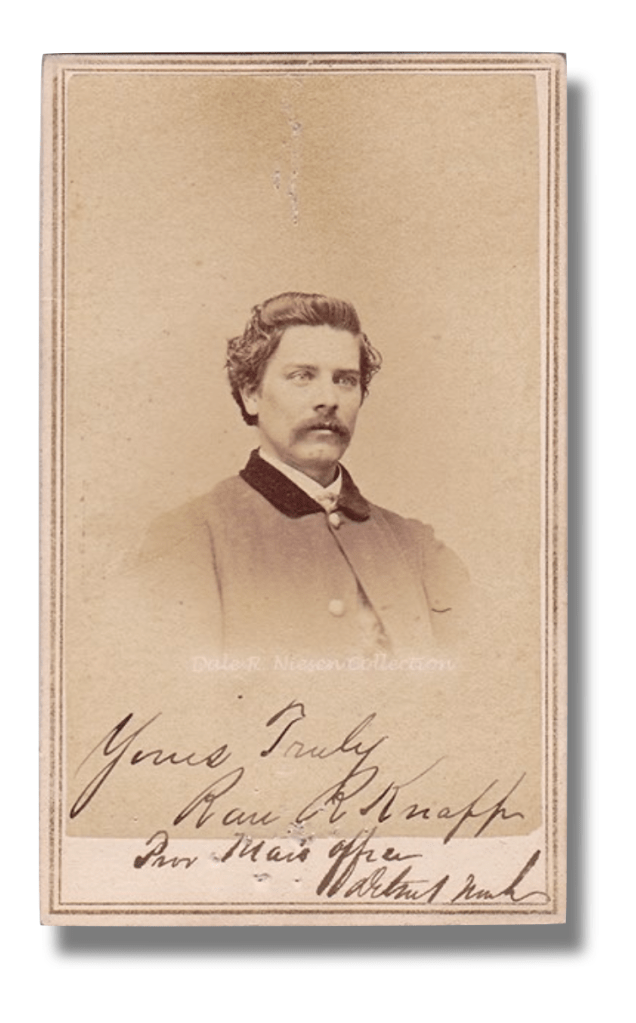
2nd Lt. H. Heber Woodruff, 16th Michigan. CDV by Raymond & Allen, Detroit, Michigan (Dale Niesen Collection)

The following letter was written by 2nd Lieutenant Henry Heber Woodruff (1841-1916) of Co. D, 16th Michigan Infantry to his Uncle Benjamin Hall of Gibraltar, Michigan. Part of the Woodruff family had moved north to East Saginaw, Michigan sometime before the war. The letter talks of life in Gibraltar and the surrounding communities of Brownstown Township, Michigan. Heber goes on to detail his experiences during the Battle of Fredericksburg and camp life, etc. He also mentions another famous local soldier, Michael Vreeland of the 4th Michigan Infantry, who was wounded four times and left for dead in the Wheatfield, during the Battle of Gettysburg. Other soldiers are mentioned as well, in particular is his father, Captain Henry Woodruff, 23rd Michigan Infantry. 

Heber was the son of Henry Heber Woodruff (1813-1897) and Abigail Hall (1815-1892).

[This letter and image of Woodruff are from the collection of Dale Niesen and were made available for transcription and publication on Spared & Shared by express consent.]

Camp of the 16th Michigan near Fredericksburg, Virginia (Archives of Michigan)

Transcription

Camp Near Potomac Creek, Va
February 20th 1863

Dear Uncle & Aunt,

You have doubtless concluded that I have forgotten you entirely on account of my never having written to you but I can assure you, it is not so. I have thought of you often, but being rather careless have neglected to do as I should for which I beg pardon. Of course you have heard of my welfare through uncle Edmund Wesley and others so that anything I will be likely to tell you will be but stale news. Still, by writing, I am in hopes to hear from you by way of return.

I am ashamed to say that I know nothing of you and the family, never hearing but once since I enlisted of you, and then only a word in one of Wesley’s letters. I suppose though you are at the same old trade, farming it in your old dilapidated town. I suppose nothing has been changed and nothing changes except what has been caused by “Death” & “Marriage.” The same old houses stand in the same condition. Old Gentleman Alfred lounges about as usual telling his yarns. John Gori will still find things where they are not lost. “Darkey” Green 1 still cracks his whips over 4 yoke of oxen. John Van Riper is still an old “Bach.” And lastly, John Miller owns “Whip Tiger”—or is it all changed? Who is married? Who is dead? I can hardly realize that I ever lived there. It seems a dream. I almost think I am in a dream and will wake up sometime and find myself back in the old “Kimble House.” Ugh! I guess not—[I’d] rather be a soldier all my life.

Perhaps you wonder how I like a soldiers life. How I stand it, &c. Well, it agrees with me. My health never was better, notwithstanding “rheumatism and cramps” attendants to exposure. Do I like it? Yes. while the war lasts. No, in time of peace. Very little comfort and pleasure is there in it but any amount of privations. Hunger, thirst, weariness, exposure to wet, cold, and bullets, lack of society of the right kind, no females to refine, no one to nurse you, to speak a kind word if you are sick, nothing but military law which obliges an inferior to be an absolute slave to a superior, no one but rough men—who you must hold with a tight rein or lose your discipline—to associate with, which makes you as rough as they. What are the deductions to be drawn? Simply old men or men with families stay at home. Oblige every young man to come. Young men can stand it—old ones ought not [come] if they can [avoid it].

What do you think of lying 36 hours on your back on the ground, not a thing under you, and the ground as wet as water can make it? The weather next thing to freezing? Our Brigade had to do it at the Battle of Fredericksburg. All a man had to do if he wanted a bullet was to raise up, He got it quick enough. Well, we were relieved and had a rest of twelve hours sleeping on a brick pavement with nothing but an overcoat to cover me.

What then? Why our Brigade “had the honor” to be chosen, tired as we were, to cover the retreat from the town. So under cover of the darkness, we silently moved out to the front where the famous Irish Brigade had been driven in and more than slaughtered to reconnoiter. Whenever the moon came out from the clouds, we would lie down so as not to be seen and when some unfortunate fellow would rattle his tin pail, curses not loud but deep would go up. Well, there we lay half the night watching the dead so think we could hardly tell the living from the dead.

At three o’clock we silently withdrew to the edge of the town. By this time the rain had begun to pour down. Then we stood three hours as motionless as statues [at the] ready, a line of skirmishers just in advance to give us warning. We stood until broad daylight until the last man was over and then we turned and took a double quick and crossed the [one] remaining pontoon bridge, taking it up as we crossed. You may think this fun but it is terrible on the constitution. I do not tell you this intending to make great pretensions of my endurance for I could tell of greater hardships than these, but to give you some little idea of a solder’s life.

Hooker is working hard to make the army efficient. I hope he will succeed but one thing is certain, we cannot move in a month—the mud is horrible. It rains and snows all the time. We can move in March [but] not before. I see Michael Vreeland almost every day. He is in the same division. He is a good soldier and a good officer. Cyrus I have never seen. He is with Sigel somewhere near Stafford Court House. Father is still at Bowling Green. I hope they will stay there.

Give my respects to all friends and remember me as your affectionate nephew, — H. Heber Woodruff

to Benjamin Hall, Gibralter, Wayne county, Michigan

These images were found on Ancestry.com and were identified as Abigail (Hall) Woodruff (1815-1892) and Henry Heber Woodruff (1841-1916).

1 “Darkey” Green was probably Dennis Green (1799-Aft1870), a Black farmer born in Maryland. He married his wife Tabitha Cyrus in 1831 in Columbiana, Ohio. She was born in Virginia. Their children in 1860 ranged from age 10 to 28, all born in Ohio or Michigan.

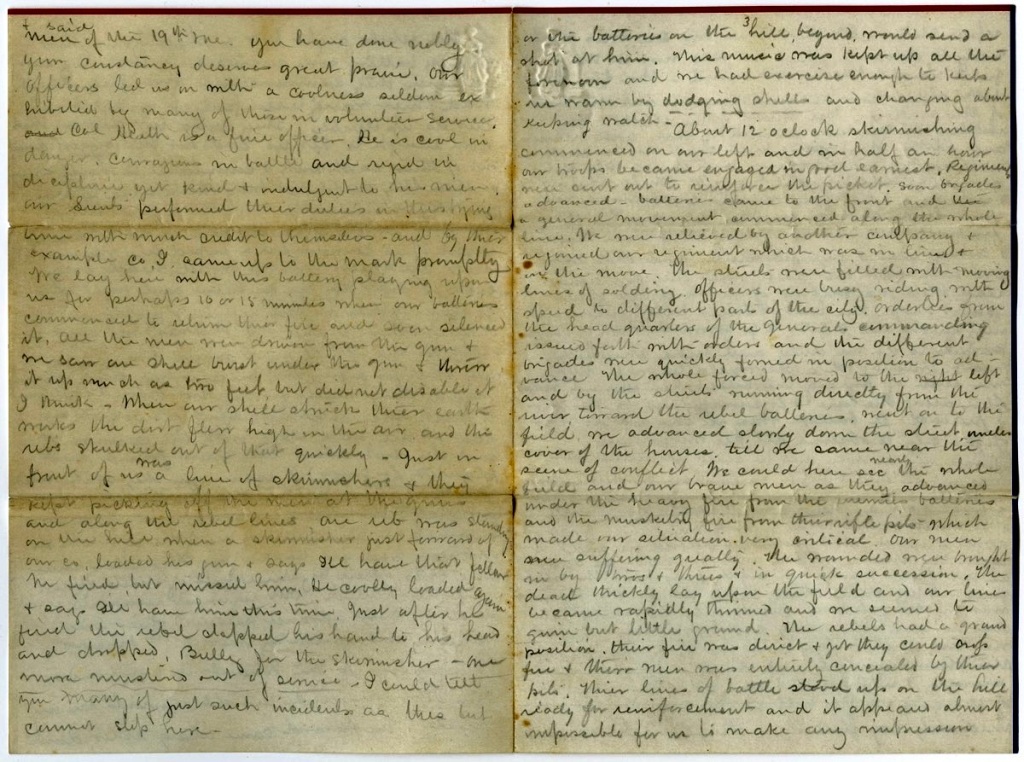
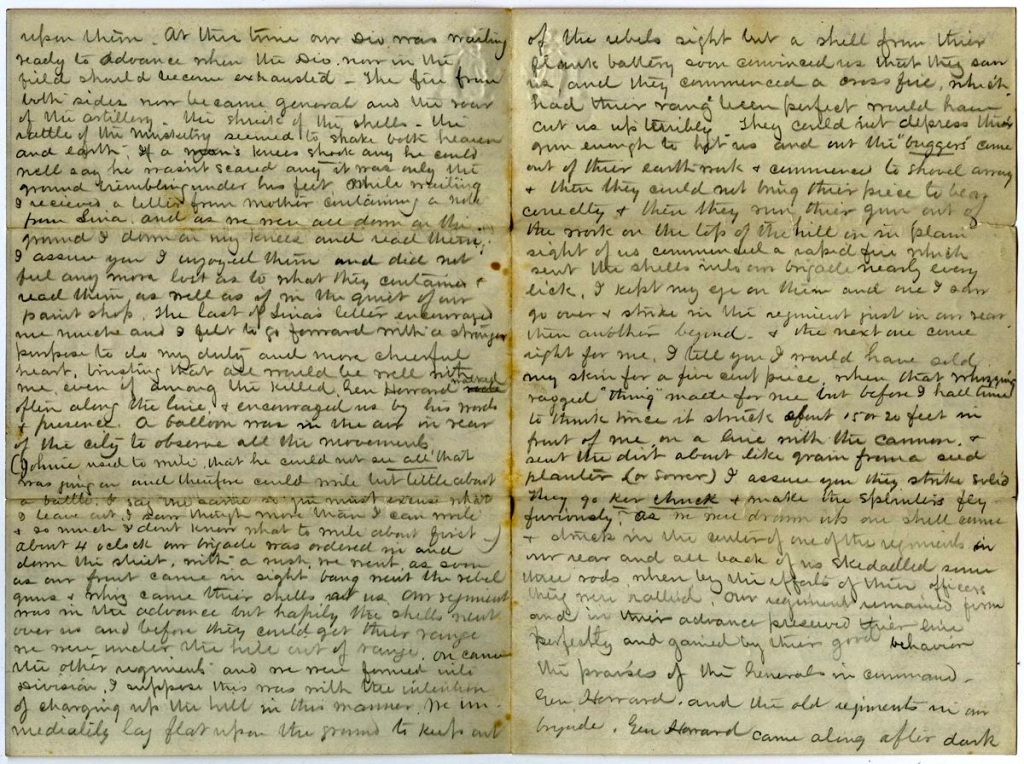
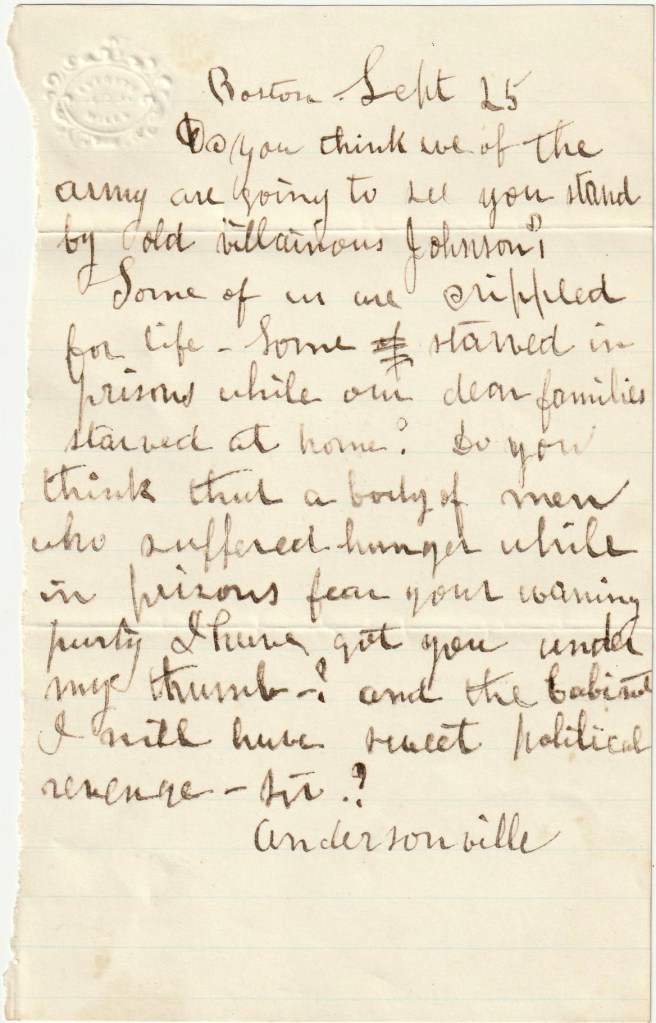
Lt. John M. Cavanaugh’s battles did not end in 1865

The following was written by Dr. William John Cavanaugh (1874-1949), the son of John M. Cavanaugh (1840-1895) and Anna Fryer (1843-1907). William’s father, John, was a veteran of the Civil War, having enlisted in September 1861 as a private in Co. F, 43rd New York Volunteers. John was promoted to 1st Sergeant of Co, B in July 1862 and commissioned a 1st Lieutenant on 2 June 1863. He was with his regiment until he was severely wounded in the fighting at the Wilderness on 4 May 1864 and underwent a leg amputation to save his life.

What is most revealing in William’s letter is the considerable pain and suffering that his father endured for thirty years after the Civil War ended. The amputation of his leg certainly saved his life but it condemned him to a life that scarred him deeply—physically, socially, and emotionally.

Lt. John M. Cavanaugh; the cdv at left was taken in Albany while he was home on furlough before the start of the Spring Campaign in 1864. The cdv at right was taken in Albany a year or two later. (Kevin Canberg Collection)

After his discharge, John married the younger sister of another officer in the 43rd NYVI named John Fryer; Fryer and Cavanaugh were friends who worked together on the railroad prior to the Civil War. Fryer himself was killed shortly before Cavanaugh was seriously wounded. They are all buried together in the same grave at a cemetery in the Albany area.

It isn’t clear who the document was addressed to. It was part of a massive grouping Kevin Canberg acquired several years ago related to Fryer, Cavanaugh, and the 43rd New York. The statement that he was “temperate” with no bad habits” suggests to me that it was intended for a Widow’s Pension application but I could not find one in the National Archives.

Transcription

Meigs Case, the surgeon who performed the amputation of Cavanaugh’s leg.

The amputation of the leg was not the cause of death. The result of the amputation on the nervous system after a few years of dragging an artificial leg about, the shock of the severed nerves and arteries, seem to be [the cause]. For several years the abrasions of the skin and flesh with resulting boils and ulcers: Then paroxysms of stinging pain where the scars of the stitches were would throw the man in a fever and would last from one to five minutes, with about the same time of relief. During the time these pains lasted he could not sleep only when after a while he became exhausted he would drop asleep a minute sometimes. The doctors said they could give something to deaden the pain but under the conditions, were afraid it would form a habit and could not cure.

In ’86, he had a serious abscess on the stump which extended almost into his bowels. Was confined to his bed for six weeks suffering terribly. He became greatly emaciated and for the greater portion of his time his life was despaired of. But his good constitution brought him through. After this sickness he never regained his former health. His nerves were very bad and he was excitable. His heart troubled him. He did not get out very much and his stump troubled him more than ever. The kidney trouble was quite advanced when it was first diagnosed and his face bloated some. It was said by the doctors that the kidney disease was brought on by the state of his system and the nervous condition he was in from the access which was the result of the amputation of leg. He was temperate, with no bad habits.

1863: Lucius E. Bidwell to Mary M. Bidwell

A pre-war image of Lucius E. Bidwell

The following letters were written by Lucius E. Bidwell, Jr., (1833-1864), the son of Lucius E. Bidwell, Sr. (1806-1852) and Mary M. Barnes (1808-Aft1865) of Middletown, Middlesex county, Connecticut.

He lived in Middletown, and worked as a painter until he enlisted in Captain Elijah W. Gibbons’ famous Co. B of the 14th Connecticut Volunteers (the “Nutmeg Regiment”) in July of 1862. He was wounded at the Battle of Fredericksburg and survived, but died late in the war, in the Wilderness of northern Virginia May 5, 1864. His burial place is unknown, but a Cenotaph was erected in his name at Indian Hill cemetery in Middletown. On February 17, 1864, the local Middletown newspaper The Constitution published a letter from Bidwell that details his experiences fighting Confederate soldiers.

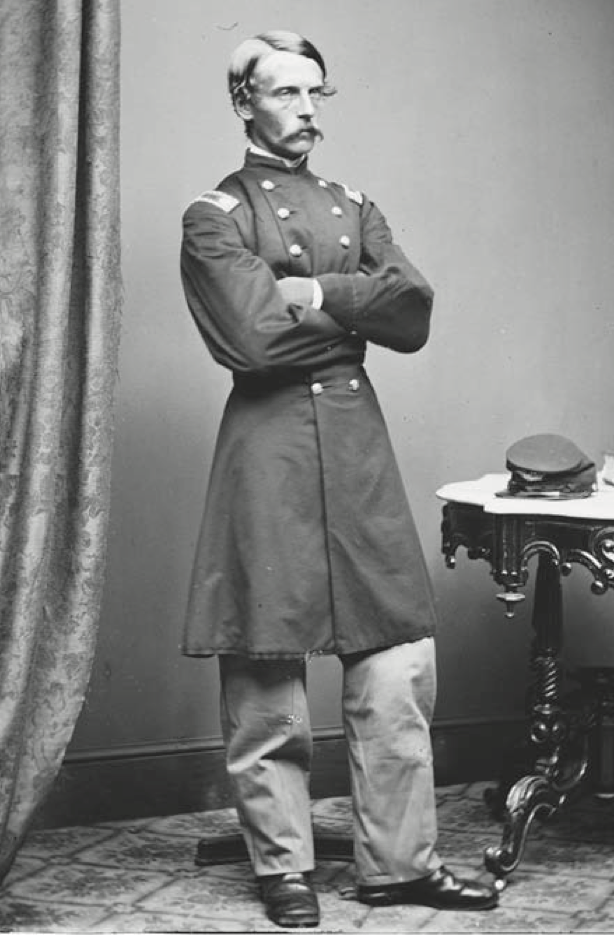
The first letter in this small collection provides details of the Battle of Chancellorsville. The regiment was held in reserve for the most part until Sunday, May 3rd, when they went into action and suffered several casualties, though no one was killed.

Two of Bidwell’s letters are housed at the Gilder Lehrman Institute of American History.

[Most of these letters were provided from the collection of the Senft Family for the express purpose of being transcribed and published on Spared & Shared.]

Letter 1

Camp near Falmouth, Virginia
May 8th 1863

Dear Brother,

I suppose you have heard of the battle long before this and that your brother Lucien has come out all right again which I suppose is goo news to you all but I tell you what it is, I barely escaped with my life each battle. I have had the leaden pills whistle about my head like hail stones in fly time. I have had them come so close as to blow my hair and make me wink and blink considerable and I have had shells burst at my feet, over my head, and had pieces of them graze my clothes. We call them soap blubbers out here. I had rather have a million bullets rattle about my head than one shell to burst over my head. They make quite a little noise, I tell you.

But I am one of the favored ones, I guess. The bullet is not cast yet for me. I hope not at least for it is not very pleasant to have one of them hit a fellow. I don’t see how I have escaped without a scratch three times and was in such a shower of shells and bullets too each time, and all three battles I have had comrades shot by my side. There was two wounded, one each side of me, and so it was at Antietam 1 and Fredericksburg 2 and this last battle, and I have escaped without a scratch.

It was about as bloody a battle as Fredericksburg. It was a five days fight. We were in a line of battle with our rifles loaded and kept ready for them four days and nights. Some nights we were on our feet with our pieces half cocked with the expectation of being called to the rifle pits to relieve the poor fellows who had been in them fighting hard for two or three days. But we were finally obliged to fall back across the [Rappahannock] river again. We went into the fight last Saturday night about 6 o’clock right under one of our batteries of half a dozen guns which kept firing all night. The night was a very dark night and the flash from the big guns kept the woods we were in illuminated about all night. If it was not in battle, it would have been a glorious sight to look upon and the roar of the [guns] was deafening I tell [you].

But about five o’clock in the morning the rebels broke through our lines and caused great confusion. Most of the whole army scattered and fled like sheep for a mile or so and made another stand and threw up earthworks at the entrance of a piece of woods and there we made out to keep them at bay until Thursday night about midnight [when] we packed up and got ready to start about three o’clock in the morning. It was very dark and rained quite hard all the day before and all night and oh! I tell you what, it was a little muddy about that time. We had to wade through mud up to our knees most of the way.

I never shall forget that night. It was awful dark and we had to march through a thick wood for about three miles to the river. It was awfully muddy. We were obliged to whisper to one another and the officers gave out their orders in whispers. If the rebs had known of our movement at the time, we would have had quite a hard time getting away. I tell you, they would have hurried us all the way, but we were so still about it that they knew nothing of it until we were about a;; across the river in safety. But as soon as thy found it out, they sent a few shells after us but done no harm. If we had reinforcements that night we would have been alright but the rebs were too strong for us. Our Brigadier General [William] Hays was wounded I believe very bad. He is now at Washington, they say.

We are now at our old camp again once more but I don’t think we shall stay here a great while. I think by what I can learn that we shall soon march towards Washington to recruit for we are of no use here now for most half of this army’s time are out. Some of them who enlisted for two years are up and some—and a great many for 9 months—are up, so it will make the army quite small. I hope they will get out of this hole anyhow for I think the Army of the Potomac have the most [Rebel] force to contend with and the most difficulties to surmount than any other army of the Union. We are trying to fight our way to Richmond and the rebel army that we are opposing are endeavoring to push their way towards Washington so that makes it the most desperate. I had rather be in any other army than the Army of the Potomac at the present time.

I believe I will close this letter for I guess it is long enough you will [be tired] read[ing] if you have not already, all about the battle and our retreat. It is a glorious day today. The whole regiment has gone out on picket duty yesterday adn have not arrived yet. I went with them but I had a very bad cold and did not feel like laying out all night for it was stormy and so I loitered behind until the regiment passed by and then went back to camp.

We call Mr. [Robert] Russell old Gob’s eye. I will tell you one of his mean tricks and then you can judge for yourself what sort of an animal he is. Day before yesterday (I mean yesterday morn), we had fresh meat dealt out to us and Gob’s eye cut it up and dealt it out to the company. I was still under my blanket and had my shoes off ( I had a bad cold) and so I asked one of my tent mates by the name of Joe Slater—A Dutchman, a good fellow too—if he would not get my ration with his. He said he would because we had often done so before but Russell was very cross that morning and told Joe that I must come and get myself if I wanted it. But Joe told him that I was not very well and wanted him to get it for me. But old Job’s eye told him that if I [was] too sick to come after it, I was too sick to eat it. I heard every word of it myself and I sung out to stick my ration of meat into his own guts and go to the Devil with it. So I went without. That is the way he accommodates his companions. He has got to be a complete hog and if ever we both get home together, I will treat [him] as I would a hog. I never had so much hatred for a human being in my life as I have for that man. Every time I lay my eyes on him, I can [hardly] keep from laying my hands on him.

Mother said in her letter which I received last night that our captain was at Mrs. Broatch’s but Mrs. Broatch was not at home and that Mrs. Russell did not tell him that you lived in the next house. Capt. Townsend said if he had known it, he would have called and seen you and Mother says that Mrs. Russell said that the Capt, said he hoped he should see Robert Russell with stripes on soon. I think he does but not to wear them in our company. If the Capt. gets him promoted, it will be to get him out of this company. The Capt. don’t like him any better than we do.

I meant to have stopped some time ago but I shall have to now for want of paper. I send you and all my best love. Your brother, — L. E. Bidwell

Dwight Davis send his respects and Johnny is all right and sends his best regards to you. Priest was hit in the shoulder. George Hubbard is well and safe.

1 On September 17, 1862, the regiment’s first action was at the Battle of Antietam. The regiment traveled along the flank and entered the East Woods, passing through Mumma’s orchard and cornfield toward the confederate line. The green troops performed well, but casualties came from confederate fire and accident; including a case of an exploding shell of Company D which killed 3 and wounded 4. In total, 21 men were killed and 88 wounded and 28 missing.

2 In the course of Battle of Fredericksburg, 10 men were killed, 92 were wounded and 20 were listed as missing, among the dead was Lieutenant Canfield and Captain Gibbons of Company B and the Lieutenant-Colonel Perkins was wounded.

Letter 2

Camp near Falmouth, Va.
May 23, 1863

Dear Mother,

I have just seated myself under beautiful shade a few yards from our log huts and the band is playing a few yards off [from] where I am seated writing and it sounds beautifully echoing through the woods. Oh, it is such a lovely day that I cannot help enjoying it as much as I possibly can. But Mother, the thought that this cruel war is still going on almost makes it impossible for me to enjoy myself even here in this beautiful grove of pines and a plenty to eat and good spring water to drink right in our camp and a splendid band of music to enliven us.

There is another band in our brigade—the 12th New Jersey Regt.—has got a very good band too. It is camped next to our regiment. They left their homes about the same time we did but never was in any engagement till the Battle of Fredericksburg last fall. They were a full regiment them and they number most three to our one now. We number about 350 men in our regiment but they are not all on duty. A good many are sick but not very sick. It is not very sickly here. It seems to be the dysentery that troubles the men more than anything else. I have it a great deal but not very bad as to keep me from duty.

A great many play off and go to the doctor and get excused so they won’t have anything to do all day but to sit around and eat their rations all day because they are so lazy. But that is a thing I never done yet and never mean to. I am willing to do my duty and my whole duty if I suffer by the means. And Mother, I can say—and speak the truth too—that I never had to be punished the least at all since I have been out in the service of my country and have always been on good terms with the commanders of the company of which I have the honor to be a member.

I thought a great deal of our noble Capt. E[lijah] W. Gibbons, our first captain. 1 And we have got an excellent one who has filled his place—Capt. [James L.] Townsend, a very young men about twenty-one or two years old, but he is a very fine young man and we all like him very much indeed. He belongs in Cromwell, I believe. He was very sorry that he did not know that my home was so near when he called to Mrs. Broatches. He said he would have been happy to have called on you if he had known of it. He is a very handsome young man. He makes a fine appearance out on drill. He is beardless.

I received a letter from you Thursday night and one from Augustus Friday night last night. He said that Cyrus Priest’s 2 mother wanted him to write to me to know where he is that she had not heard from him lately. I asked the captain if he knew where he was and he said that he is at Potomac Creek at a hospital there and that he was down there day before yesterday and seen him and that he was doing very well, as well as circumstances would admit. He says that the ball is still lodged in his shoulder. I forgot which shoulder it is but the ball has not been extracted yet it is under his shoulder blade somewhere. I intend to go down to see some of the boys myself in a day or two, if can get a pass to do so. It is about five miles down there.

If I do go down, I will write and let you know how they are getting along so that you can send word to his Mother. The Captain says it is a very bad wound. It being almost time for dress parade, I shall be under the obligation of bringing this letter to a close by sending my best love to you and all the rest of my friends and hope and pray that this will find you enjoying good health.

I subscribe myself your affectionate son who lives in hopes of soon seeing his Mother and all the rest of his dear friends again before long, — Lucius E. Bidwell

P. S. I received your picture in your last letter and was very much pleased with it. I think it looks very much like you but I don’t think it looks so much like you as one you had taken some time ago. I was a going to send mine home but the man that took them has gone away now after the battle. There is one at Falmouth but I will have to wait until I get some money now before I have it taken.

1 Capt. Elijah W. Gibbons was mortally wounded in the Battle of Fredericksburg.

2 Cyrus S. Priest (1840-1891) was wounded in the Battle Chancellorsville on 3 May 1863. He was transferred to the 159th Co., 2nd Battalion Veteran Reserve Corps on 14 September 1864 and discharge 5 July 1865.


Letter 3

Camp near Falmouth, Virginia
May 28th 1863

Dear Brother,

I again take my pen in hand to answer your last letter which I received a few days ago. William Murdock has arrived here in camp last night. I was very much disappointed when I found that he had not got the letter paper which I sent for. I should think he might have brought it for he brought a valise full of things for the boys. I received a letter from Mother by him enclosed in which was two or three sheet letter paper and envelopes, and a postage stamp. Mother says he told her that he had nothing to carry everything in but it seems he did have something to put the paper in.

Did he tell you all about our hardships or didn’t he have time to say much. I should like to have some letter paper sent out to me by the mail if it did not cost too much to send it. In that way we can get plenty of paper out here but it is very bad paper, It is so thin that the pen cuts through.

I wrote to Mother last week that we were packing up but it was a mistake of mine. The Major who is now in charge of the regiment gave orders to have the boys take off the roofs of their huts which were of tent cloth so as to let the air circulate through the huts. That was all.

But while writing this before I could not finish it. We have had real orders to pack up everything. What is it for? I don’t know but we are all packed up ready for a march and when we had got all through packing up, we were ordered to fall in for drill so we are out near French’s Headquarters resting in the shade until Major comes who has been sent for by Gen. French for him to come to his presence. I put the bottle of ink into my pocket and my paper in my cartridge box and I did not know how long we must remain before we began to drill so I thought that I would try and finish this letter so I can send it tomorrow. I expect a letter from you tonight and a trumpet. I have asked you to send me the Hartford Times instead of the Sentinel and Witness. I believe I must close this letter for I guess that we will fall in very soon for drill. So goodbye for the present

From your brother, — Lucous

To his brother Augustus

P. S. Since writing the above, we have unpacked our things but we are under marching orders yet. We are liable to be ordered to march at any moment. I think as near as I can learn, that we intend to fall back. The commissary stores have all been removed but where, I do not know. I guess the rebs mean to cross the river to attack us. I will write more soon.


Letter 4

Camp near Falmouth, Va.
May 31st 1863

Dear Brother,

I am now on picket and as I have plenty of time to myself, I thought I would spend it in writing to my friends in Middletown. I sent a letter to Mother yesterday and I told her about our being called out under orders. We were under arms most all day and they called the roll every hour but nothing has transpired to disturb using more than that. What it was for, I cannot tell but I suppose the Rebs were moving about rather more than common and that they thought they might so well to be on the safe side and keep one eye open. The Rebel Gen. Lee has made a proclamation or something of the kind that he intends to make a raid into Maryland again so we hear, but I guess the rebels know best what they intend to do, but the pickets that we have just relieved say that they should think by the appearance of things that the rebs were moving or getting ready to evacuate. We have stricter orders now than we have had before. It seems that Gen. Lee has given out orders to his men not to fish anymore in the river and we have received orders to that effect too. So it has knocked our fishing all in the head. A good many of the pickets used to catch a good many fish while on picket, but there is a small brook running close by our camp which has got some eels and rough in it so that we can catch a few once in awhile if we have small hooks and lines. You said you would send me some if I wished for any. I should like to have you send me some very much. I would like to have you send very small hooks—the smallest you can find—and a very fine line. I suppose you can send them in a letter.

The rebel pickets seem to be very shy for we cannot see any of them only now and then, one in the bushes on the other side of the river. It is something uncommon for we have always seen plenty of them before. I should not be surprised if they were leaving this part of the state in order to make a dash somewhere. Gen. Lee would like to crush this Army of the Potomac if he could but he has not done it yet. We still hold our old position. They don’t seem to like the idea of attempting to drive us from here. We have just as good a position to defend ourselves as they have on their side of the river and that is not all. We would like to have them try it on for we could have a better advantage and stand a better chance if they should attack us than we would by crossing the river and attack them. I am afraid that we will not have so good luck as to have them so that, but we will probably know what is going to be done in a few days. It cannot be possible that we will remain idle much longer. I wish to thunder we could make a dive right straight through to Richmond and make a clean thing of it.

You seem to have been disappointed in the news from Vicksburg. It seems that the New York papers still tread in their old line of story telling. I tell you what, Gus, I don’t place much confidence in what the papers say. But still I think that Grant will finally capture the place. I am in hopes of hearing of its capture now every day. I believe I must close this for it will be my turn to go on post in a few moments and watch the gray backs on the other side. Hoping this cruel war will soon be over, I subscribe myself your affectionate brother, — L. E. Bidwell


Letter 5

[This letter by Lucius was found on the internet transcribed by someone else and I add it here for information purposes only.]

In camp on north side of Rapidan
Feb. 7, 1864 

My Dear Mother—

Our Heavenly Father has again saved your son Lucius safely through another battle and one of the worst kinds of a battle too. It was a night fight. Yesterday morning about 5 o’clock we were routed out of our beds with the orders to pack up and fall in. We took up our line of march for the River Rapidan at about nine o’clock in the morning and reached the river about an hour after. We crossed the Rapidan by fording it about noon. We had to ford it, it was up to our breasts and it was a very rapid stream, so much so that if we had accidentally slipped, we would have been carried down stream, and stood a very good chance of finding our graves at the bottom thereof. But as far as I know there was no accident of the kind happened, only now and then one would slip as he was crawling up the opposite bank, which was very steep, but no serious harm was done to my knowledge, but givng them a good dunking, and wetting their cartridges. 

The water was very cold—it makes a fellow’s feet and legs ache, I tell you! But go it, we must follow our leader through fire and water. The regiment known as the Garbaldi’s Guards, a New York Regiment composed of Dutch, Irish, and Italians refused to wade because they said it was too deep. But General Hays, knowing of it, jumped from his horse without saying a word, and left his horse this side of the river and waded across to the other side, picking out good footing, and then waded back after his horse. They saw that he got over safe, so they finally plunged in, and arrived safely on the other side. I tell you what he is – a regular tiger! I suppose you have heard of him before. He is in command of our Division, and goes by the name of ‘Fighting Ellick’. He rides along the line of skirmishers with his hat in his hand, cheering the men on, crying, ‘Give them hell boys give them hell.’ He is an old tiger, he is most always a little tight when there is fighting going on and then he is in his glory. 

He thinks the Old 14th is about right he is always pressing us up. He was with us in the thickest of the fight crying out ‘give ‘em hell, 14th–Bully for you! Bully for you, go in, boys, go in 14th!’ and so on–the balls flying around his head like hailstones without flinching in the least. He is a regular dare devil! 

We marched to a hollow facing the rebels breast works, and remained there until about 5 o’clock within rifle shot of their rifle-pits. They sent a few shells over to us, but most of them passed over harmless. But two or three took effect, killing three or four and wounding several. They had only fired several shots when it was ascertained that the Rebs had …a solid line of battle advancing on us. We were ordered to advance. The bully 14th taking the load, and charged at the double quick time. They met us half way and poured an everlasting fire into us which caused us to waiver for a moment, and with a deafening yell we made a rush, pouring a volley of blue pills into them which they won’t soon forget and put them to flight, and drove them to their rifle pits. 

By this time it was dark as pitch, we could not see our foes until we met them face to face, some shot at one another and knocked each others brains out with the butt of the musket. We were fighting in squads most of the night, each man for himself. 

Company B and G were on the left and met a stronger party of Reb skirmishers but we charged on them with our little rifles and with deafening yells, we loaded and fired and drove them back to their rifle pits. We then sculked under the cover of darkness to within a few rods of their rifle pits and then popped away at them until we were sent for to go and support our boys on the right, for the Rebs were trying to flank us. 

We went it on the double quick over fences and ditches, we charged on a cluster of two or three houses which were full of Rebels. They swarmed in great numbers around the building, firing from the windows and around the corners and out houses, but we made a rush on them, driving them like sheep dragging their wounded along with them. The houses were full of them. We, and some of the others smashed in the doors, which were closed and fastened, and rushed in and some of the rebels grappled with us. We soon overpowered, but strange to say we took only one prisoner. They made their escape out the windows before we were aware of it. They then retired behind their breastworks, and we stretched out a long line of pickets, and remained so until we were relieved about one o’clock in the morning by the 1st Division and recrossed the Rapidan on a sort of bridge which was built. The rest of the troops recrossed the river again soon after. 

The Rebs never molested them after we left. It was a daring undertaking in leading this dividsion over there into such a nest. I don’t know why we were not all captured, for we numbered only three thousand men. It must be the Rebs did not know how strong we were after dark or they would have come down on us in a strong body and showed us into the river and cut us all to pieces, but we got off very well after all. 

I think the Rebs felt the weight of our bullets before we parted with them. We had no artillery to support us on that side of the river. We, all alone, with only our rifles. I don’t know the exact number of killed and wounded yet. They say we might have lost over one hundred. Our Color Sergeant Cody, was brought into camp and buried by the Regt. with the band. He was a noble fellow and fell doing his duty. One of my tent mates, a fine young man, was shot through the breast. He is a sailor and a native of Germany. I thought a great deal of him. His name is Harrison. 

James Ingles was hit on the leg, and a man named Winks in our camp, and another German, was shot through the head (named Stinall) and another tent-mate of mine was hurt in the ankle. Our Major was slightly wounded in the leg. Capt. John Broaht, I hear, had his finger shot off, but I have not seen him yet. I hear he is detailed to go after the recruits but I don’t know how true it is. I must stop for room. Lieut. Russell is all right; he was very brave during the fight. I will write more soon.

So I will bid you good bye for the present and subscribe myself your affectionate son—Lucius Bidwell. 

P.S. Since I began this , we have returned to our old camp. After being on picket 24 hours. After we arrived from the fight. McCluskey is unhurt and very well and sends his respects to you and all. Tell Mrs. Rogers that I guess she will have the pleasure of beholding us again after all. Give all the neighbors our love….

1864: William Clark Workman to Louisa Jane Ballew

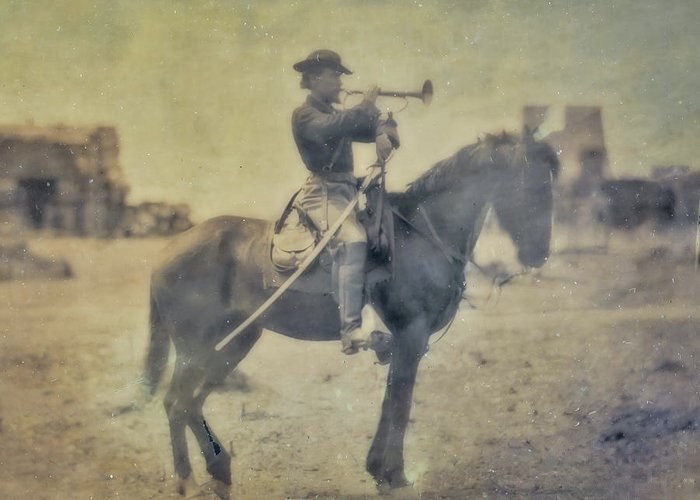
An unidentified trooper in the South Carolina Cavalry (R. J. Ferry Collection)

This letter was written by William (“Willie”) Clark Workman, Jr. (1846-1899) who enlisted in February 1864 to served in Co. K, 7th South Carolina Cavalry. During a portion of the summer 1864, Willie was being treated for syphilis in Jackson Hospital in Richmond, Virginia. In this letter, datelined from a hospital in Kershaw county, South Carolina, we learn that Willie was recovering from typhoid fever.

Willie was the son of William C. Workman (1803-1861) and Sarah Young Jenkins (1812-1863) of Camden. Willie’s gravestone in the prestigious Quaker Cemetery in Camden, South Carolina, is etched with the words, “Served with distinction, 1862-4, Co. K, 7th S. C. Cavalry, Gary’s Brigade.” His military records, including the “Confederate Home Records” prove that he did not enlist until 2 February 1864. He was married to Mary M. German (1860-1900) after the war.

Willie wrote this letter to Louisa Jane (“Janie”) Ballew (1843-1915), the daughter of Rev. David Lester Ballew (1802-1855) and Elisa Louisa James (1801-1873). Mention is made in the letter of Janie’s brother, “Ben.” This was Benjamin Franklin Ballew (1845-1913) who served in Co. I, 3rd South Carolina Infantry.

Transcription

Red Oak Camp, Lynches Creek
August 6th 1864

Dear Miss Janie,

Your letter of the 19th of last month reached me this morning quite unexpectedly but I assure you, I never had a more agreeable surprise in my life. You observe from the caption of this that I am once more in the limits of “home, sweet, home.” After passing through the most arduous portion of the present campaign in the “Old Domain,” I was taken quite suddenly with a severe attack of Typhoid Fever, prostrating me in the “walls” of the most detestable of all places in creation—a hospital. I am spending a part of my “thirty days” out on Lynches Creek in the country, about 25 miles from Camden. I have been very lucky or unlucky (as you may decree it) in getting home on sick furloughs. I have been home now about two weeks; almost half of my furlough. I am recruiting my health and strength very fast but on account of the excessive state of weakness which the disease left me in, I think it will be necessary for me to apply for an extension. But since I am here enjoying the sweets of home now, I do not regret my illness much.

We have had a very severe [time] of it in Virginia this summer; continually in the saddle and on the move, with no little fighting to do. I have been quite fortunate myself for in all the “tight” places that I have been in yet, I have not been scathed. I hope it will be so in all my future career.

Our company has lost many valuable men and officers since our reparation to Virginia Some of my best friends have been killed and wounded. But I could not expect anything to the opposite as this is one of the inevitable fatalities of the carnage of battle. Satis about war, and let us [move] on [to] other topics.

Our correspondence has been broken off for some time, and I assure you, Miss Janie, I missed those sweet missives of yours, which I have been receiving from you not a little. I have just been waiting for a convenient opportunity to send a letter to town so that I could write to you. But I trust that our correspondence which has hitherto been so regular and interesting (to me) may not be interrupted again. You write me that you fear your “thoughts” will be very “dull” and “uninteresting;” let me assure you that they are decidedly just the opposite. If you had only seen how eagerly I devoured the contents of your letter this morning, you would not write thus.

Tell Jimmie I think he ought to be ashamed of himself in not coming round to see you oftener. I suppose now since he is enjoying the sweets of a married life, he has forgotten his old friends. I wish you could have gotten acquainted with his lady. I think you would have liked her so much for she has such a sweet disposition. I wish it was so that I could make it convenient to take a little tour up in Laurens and Greenville while I am home. But I am afraid that delightful pleasure will be denied me. I would like very much to pass through Laurens and see you and the rest, but as I have such a short while to remain at home, I do not think that I can possibly do it and will have to postpone it until “this cruel war is over.”

“Do not despond…about our final success for as certain as there is a just God in heaven, we, who survive, will come out in this great contest gloriously and with victory perched on our banners.”

–Willie Workman, 7th South Carolina Cavalry. 6 August 1864

Camden as well as Laurens has had the veil of mourning stretched over her peaceful horizon. Several of her brave boys have lately sealed their devotion to their country’s welfare, with their life’s blood. But Laurens has suffered severely indeed for in nearly every engagement, some poor fellow from there falls a victim to the carnage of the battlefield. I am very sorry to hear of young J. M. Cluney’s death. I was acquainted with him and I think he was a nice fellow. Do not despond Miss Janie, about our final success for as certain as there is a just God in heaven, we, who survive, will come out in this great contest gloriously and with victory perched on our banners. And as to their getting here in our beloved state, they would have to find superhuman fighting, for where is the coward whose soul would not be nerved up to fight and die when he thought for an instant that he was striking for the fair women of South Carolina. But this, suffice to say, will never happen.

I can sympathize deeply with your brother for I know what it is to be cast in a miserable hospital with no one to feel or care for you. I hope he may get home soon where he can recover much faster. I would like very much to have seen the commencement. I know I would have enjoyed myself splendidly. The concert must have been worth going to see. You must think something of your correspondent to be writing to me, while you could be enjoying yourself much more pleasantly with the company that were downstairs awaiting you. I have scarcely finished perusing your letter before I am replying in return to you. You ought not to slight your company, Miss Janie, in writing to me, although I am doing the same act now, as there is somebody down below.

Tell Ben I think he might [write] to me sometimes. Pray excuse this, Miss Janie, for since I have been in Virginia, I have almost forgotten how to write a letter. Write early and direct to Camden, South Carolina. Give my love to Aunt Ballew, Miss Celia, and Miss Nannie, Ben and all my friends in Laurens. So adieu. Your dear friend, — Willie Workman