My passion is studying American history leading up to & including the Civil War. I particularly enjoy reading, transcribing & researching primary sources such as letters and diaries.
I could not find an image of Milo but here is one of Ira Woodman who served in Co. A, 52nd Illinois Infantry (Ancestry.com)
This letter was written by Milo Lewis Sherman (1839-1916) of Dundee, Kane County, Illinois, who enlisted on 11 September 1861 as a private and was mustered into Co. I, 52nd Illinois Infantry on 25 October 1861. He reenlisted on 8 January 1864 and was discharged for disability on 23 May 1865.
Milo was the son of Marshall Alonzo Sherman (1799-1879) and Sarah Wanzer (1806-1867). He wrote the letter to his older brother Buel Sherman (1825-1893) and his sister-in-law Celia Louisa Page (1830-1917) Chickasaw county, Iowa.
Transcription
[Dundee, Kane county, Illinois] Monday evening, September 16, 1861
Dear Sister and Brother,
I take this opportunity to write you a few lines that you may know what I have done. I now belong to the U. S. Army. Was sworn into service last Thursday at Geneva and came home Saturday evening “on furlough.” Our company is called “Dundee Freemen” and there is not, as yet, so fine a looking company in the camp of the “Lincoln Regiment.” Capt. Joseph T. Brown, 1st Lieut. Joseph E. Ewell, 2nd Lieut. [Henry G.] Wilmarth. Remaining officers not yet appointed. Samuel Anderson [of Elgin] will no doubt be 1st Sergeant. We have some fine young men in our company, among whom I may mention the names of Jno. W. Sharp, C[yrus] P. Bailey, Henry C. Edwards, J[erome] D. Davis, Wm. J. and Jno. A. Dempster, &c. &c. &c.
Now do not censure me hastily for I have thought of this thing a long time and I think it is the duty of all able to go, or at least all who possibly can. With regard to getting a situation as drummer, it is rather uncertain, but if I don’t get it, I presume I can easily get a place in the ranks and that is the post of honor in this war sure.
If you can come home to Illinois this fall, I wish you would come soon and be sure to come to the camp at Geneva. I cannot tell when we may receive marching orders but I am sure you will have time to come before we leave camp, Come if possible. Probably we shall remain at Geneva several weeks drilling, &c. If you cannot come, please try to send the deeds, dulcimer &c. before long, and perhaps I may come home again before we go South. I should like to have the deeds before I go. I will make arrangements with Pa to settle with you for my taxes on land. If you cannot come, write immediately, and if we never meet again on earth, God grant we may in Heaven. With tearful eyes, I bid you farewell. Heaven reward you for the many acts of kindness on me bestowed and in your prayers, remember your erring, absent brother and all who go to battle under the Stars and Stripes.
Arthur, Ida, and Minnie, and all who love the Union. There is much vice and temptations innumerable in camp life but I hope I may be enabled to withstand them, and my wish is that I may return to my friends. But so far as coming back is concerned, it rests in His hands “who doeth all things well.” Goodbye. Your brother, — Milo L. Sherman
Small image of the author discovered pasted on inside cover of Fred’s Vol 4 Diary
[Insert bio (yet to be written)] of J. Frederick Hammerly, born 1834 in Koenigreich, Wirtemberg, Germany. Came to America on 3 October 1852.
This is the third diary of J. F. H. I have transcribed. It is identified as “Vol. 4” but Vol. 2 is missing. The first two transcribed diaries may be found here:
Frederick’s brother, Jacob Hammerly, enlisted on 25 August 1861 in Co. B, 12th Illinois Infantry. He drowned on 15 September 1861. Residence place give: Amboy, Illinois.
[Note: The Hammerly Diaries are from the collection of Greg Herr and are published on Spared & Shared by express consent.]
First page of Fred’s Diary. Bought at Amboy, Lee County, Illinois, April 6, 1863, Vol. 4
Amboy, April 8th 1863. I am home on a short furlough. Have to leave tomorrow night. The following are short sketches of the 12th Regiment and myself from the time I joined it until this present day.
The 12th Regiment was organized August 1, 1861. Jacob, Martin & myself joined the regiment August 28th at Birds Point. Went to Belmont August the 31st. Came back to Birds Point September 2nd. Arrived at Paducah (Ky) September 7th 1861. Left the 15th of January 1862 for the 11 days’s expedition. Came back January 25th.
Left for Fort Henry February 5th 1862. The fort was bombarded and taken the 6th. We left Camp Heiman (opposite Fort Henry) February 12th and arrived at or near Fort Donelson on the 13th. The bombardment of the Fort commenced early in the morning of the 13th. It lasted until the 15th. The 16th they surrendered. Left Fort Donelson February 22nd. Arrived at Clarksville (Tenn.) in the night on board the [steamer] Memphis. Arrived at Nashville February 27th 1862 on board the [steamer] Woodford. Got back to Clarksville March 1, 1862.
Arrived at Paducah (on the Savannah Expedition) March 7th. Stayed a few hours and arrived at Savannah March 11th 1862. Landed and camped at Pittsburg Landing. March 17th and 18th. The battle of that place was fought April 6th & 7th, 1862. General C. Smith died at Savannah of a fever April 20th, 1862. Left Pittsburg Landing April 29th. Corinth was evacuated May 30th. Battle of Iuka September 19th. Battle of Corinth October 3rd-4th 1862.
April 1863
On board the Mary Forsyth on the way to Alton, April 1st 1863. Wednesday. Weather nice and clear today. Arrived at St. Louis at 3:30 o’clock p.m. Donely and myself arrested three passengers who were suspected of having some stolen money and property on their persons; nevertheless nothing was found. Stayed over at the Scofield Barracks. Pretty hard place.
Friday, April 3rd 1863. Arrived here at Alton, Illinois, after dark. The 77th Ohio is doing Provost Duty here. The prisoners we brought up (deserters) were made secure.
Saturday, April 4th, 1863. Arrived here to George’s. Amboy, Lee county, Illinois, this morning early—before sunrise. Left Alton yesterday at 8 a.m. Stayed at Bloomington from 5 p.m. until 10 p.m., then took the Illinois Central to Amboy. Had to pay full fare from Alton to Amboy.
April 10th, 1863. Amboy, Lee county, Illinois. I had started last night but made up my mind to wait for the next train. Left today about noon. Arrived at Bloomington an hour before dark. Stayed over until 4 o’clock the next morning. Had a rather short but a good visit. Wished to stay a few weeks longer.
April 11, 1863. Alton. Saturday. Weather windy and chilly. Left Bloomington at 4 a.m., arrived here about noon. Got through on a soldier ticket. Left Amboy yesterday the 10th about noon. arrived at Bloomington before supper. Stayed at the American House. Saw Mary Carl there as waiter.
Sunday, April 12th 1863. Rather windy and chilly. Have hardly enough clothes with me. We have to wait for a boat until tomorrow. The 77th Ohio Volunteers tell us that three of the prisoners got out one night. Two of them were caught 15 miles out. The other escaped. A rebel female spy is there imprisoned. 1
1 “There are also accounts of Confederate spies in Middle Tennessee. One of the most infamous female spies associated with Nashville was Clara Judd. The Annals reported that she traveled from Nashville to Louisville with the purpose of acquiring quinine and other medicines for the Confederacy, but her true intent was to pass Union Army information to Confederate raider John Hunt Morgan. Judd’s information on Union troop strengths and locations along the Louisville and Nashville Railroad helped Morgan lead successful raids. When the Union Army learned of Judd’s involvement, she was arrested and sent to a military prison in Alton, Illinois.”[See Spying & Smuggling…” by Rob DeHart]
April 13th, Monday. St. Louis. Weather damp and cloudy but changed to a misty warm day. Arrived here at 11 a.m. Took dinner at a saloon. Found Herman Schuh, an old schoolmate, at the drugstore, corner of Chambers and Broadway in St. Louis. Had a short and good visit. He informed me of his two brothers and Jacob Hall’s whereabouts. Left St. Louis at 6 o’clock p.m. on board the Mary Forsyth—the same boat we came up on from Memphis.
April 14th, Tuesday. On board the Mary Forsyth. Weather cold and rainy. Laid over most all last night. This morning the boat run aground past some island. I thought it would wreck. However, no damage was done. Co. D of the 4th Missouri Cavalry which are on board this boat. their captain arrested three sergeants, one corporal, and one private. They were left under guard at Cape Girardeau.
April 15th 1863. On board Mary Forsyth. Laid over last night at Price’s Landing. Rained a considerable last night. About daylight just as they were getting up steam, one of the steam pipes bursted and created quite a scare. No one was hurt. Had the accident occurred when all the steam was up, many lives might have been lost. Arrived at Cairo at 11:30 a.m. Found Paul G. Shuh. Had ta two hours good stay with him. Weather cloudy and clear, chilly and warm. Arrived at Columbus [Ky] just dark. Like to see Mr. Plummer but have no time. The 128th Illinois and some Marines are doing Provost Duty here.
April 16th 1863. Thursday. On board the Mary Forsyth. Weather more fair than yesterday. Must have went quite a distance last night. Unloaded and loaded lots of freight at Perrickville below New Madrid. The 28th Iowa [Infantry] is at that place. 3:30 o’clock p.m. passed the steamer Hope. She was aground. Later, we are passing an immense sight of boxes, barrels, sacks, &c. They say it is the cargo of the steamer Hope (and so it was).
April 17, 1863. Memphis. Arrived here before daybreak. Were too late for the train to Corinth. Our transportation was not made out in time. It is growing very warm. Went out to see the boys of the 46th Illinois Volunteers. Found them all well. Had a few hours visit with them. Weather is very warm today. Went to the theatre this evening but did not get the worth of my money. Mosquitoes are rather bad this time in the year.
April 18th 1863. Saturday. Corinth, Mississippi. Left Memphis at 7:30 a.m. and arrived at Jackson about 2 o’clock p.m. At Corinth after dark. It is quite warm today. Considerable anxiety is felt in regard to the expedition that left this place a few days ago. The 12th [Illinois] too had been out to reinforce the Glendale troops last Thursday. A few guerrillas made a dash at that place. They however were driven back to their main whole beyond Iuka where quite a number of our men are busying them. Martin had three letters for me—two from Christian, one from Mother, received one from John M., Rushville, [Pa.].
April 19th 1863. Sunday. Corinth, Miss. It is very warm today. We are receiving a variety of news (mostly bad) about our expedition at Bear Creek. Our men have lost heavy and are on retreat to this place. A company of the 9th Illinois [was] taken, several killed including a Captain, and more wounded. The 10th Missouri Cavalry badly cut up and two pieces of artillery taken. 2 Such and other news is current.
2 The 9th Illinois Infantry was ordered to be mounted in March 1863. “They were mounted on mules by 20 March 1863 and by mid April, they were pressed into service as scouts throughout northern Alabama and southern Tennessee. In one of their first cavalry operations, the “Bloody Ninth” of Illinois found themselves in a definite pickle near Chattanooga, as Company D was captured, on 17 April 1863. The regiment suffered 5 wounded and 59 captured; during the skirmish at Lundy’s Lane, Alabama. The Ninth reengaged the enemy near their previous position on 19 April; and within fifteen minutes of skirmishing, they had driven the enemy off their position.“
April 20th 1863, Monday. Corinth, Miss. I am on picket today. The most of the troops are out on an expedition beyond Iuka. Reinforcements were sent out from here and other stations (between here and Jackson) last night and this morning. Troops are coming in constantly. Numerous rumors are afloat in regard to the eminent contest beyond Iuka. Several trains loaded with troops went out to reinforce our men. 4 o’clock p.m. were relieved by the 27th Ioa from Picket Guard. Soon after I was detailed as Provost Guard. Weather warm and comfortable. Two more trains with troops come in this evening.
April 21, 1863. Tuesday. Corinth, Miss. It is warm this morning but is clouding up. Later, it thunders and rains hard. Afternoon, it is raining yet. Today we hear better news from the Bear Creek Expedition. Not much has been done excepting some skirmishing. Capt. Cameron of the 9th [Illinois] was killed and only a few wounded. Our men are checking the rebels at every point. This news needs to be confirmed.
April 22, 1863. Wednesday, Corinth, Miss. Weather warm. Am on fatigue [duty]. Nothing reliable yet from the expedition that left this place. It is rumored and believed that Vicksburg is taken.
[April 23, 1863] Thursday. Weather fair, nice & warm. Nothing more about Vicksburg. Sent a letter to Mother [and] one to George. Martin to Katie Conder.
April 24th 1863. Friday. Today it is nice warm weather. I am on Provost Guard. Can’t hear nothing from Dodge’s forces nor from elsewhere. Am very anxious to hear from Vicksburg.
April 25, 1863. Saturday, Corinth, Miss. Had been warm all day but cloudy this evening. It thunders and will soon rain.
April 26, 1863. Sunday. Got some rain last night. This morning it thunders and rains very hard. Am on Provost Guard. Sent a letter to Mr. Bear Received a letter from Philadelphia.
April 27, 1863. Monday. Had several severe thunder and rain showers last night. Today it is cloudy and raining at intervals.
April 28, 1863. Tuesday. Corinth, Miss. Weather cloudy. Afternoon, clear. Sent a letter to Michigan.
April 29, 1863. Wednesday. Weather comfortable and warm. Am on Provost Guard. About 200 negro women and children arrived here and marched out to the corral. 3
3 The contraband camp (also referred to as the “contraband retreat” and “contraband corral”) was a tent city that was first established in the fall of 1862 on the Philips farm and placed under the supervision of Chaplain James M. Alexander of the 66th Illinois Infantry. by mid-1863, it resembled a small town, complete with a church, commissary, hospital, frame and log houses and gridded streets. [See Contraband Camp at Corinth by National Park Service]
April 30, 1863. Thursday. Weather fair. Had been chilly this morning. The moon shone as bright as day last night. Had monthly inspection (muster for pay) today. Sent a letter to Philadelphia.
May 1863
May 1, 1863. Friday. Corinth, Miss. Am on Camp Guard. Received a letter from Charles Dykeman. It is rumored that a detachment from Grant’s army has been successful in tearing up the railroad below Jackson, Mississippi. Also burning the Iron Works at Jackson.
May 2, 1863. Saturday. Weather warm and fine. Are working hard to get our barracks finished. Afternoon. The Dodge’s Expedition is coming in. The 9th Illinois, Co. D (40 men) taken [prisoners]. Only two or three killed and wounded as far as known, lost one cannon. Scattered the rebels. Had been at Florence.
May 3, 1863. Sunday. Corinth, Miss. Had rained last night but has cleared off again and is comfortable today. Sent a letter to Alfred. On Provost Guard in morning.
May 4, 1863. Monday. Weather hot. The moon shone very bright all last night. Washed off in a creek. Sent a letter to Ch. Dykeman. Another to Mass. A third M. N.
May 5, 1863. Tuesday. Another cloudy and cool this morning. Had a small shower last night. Am on Camp Guard. Sent a letter to Rushville, Pa. One to Clark P. Roff, Marine Hospital, Chicago.
May 6, 1863. Wednesday. Corinth, Miss. It is cold today. Our butter is getting hard. The barracks are going up one after another. Charles Peterson left for home this morning. I sent with him [money] Martin sent 30 dollars. Ten dollars to Mr. Mingle for shoes.
May 7th 1863. Thursday. Weather real cold. A fire feels good.
May 8th 1863. Friday. Cold this morning. Went on Headquarters Guard. Is growing warmer. Afternoon. The rest of the 9th [Illinois] came in with a lot of prisoners belonging to [Brig. Gen. Philip D.] Roddey. Good news from Hooker’s Army. No mail tonight owing to the burning of a mail packet at Island No. 8. Several passengers perished in the flames. Others badly burned. Among them were several on their way to visit their sick and wounded children at Memphis.
May 9th 1863. Saturday. Was quite chilly this morning but turned [out] to be quite a warm day. A few more prisoners arrived this day with some of the 10th Missouri Cavalry. Continued good news arrived here from Hooker’s Army. The same from Vicksburg.
May 10, 1863. Sunday. Weather fair and comfortable. Had weekly inspection and dress parade this evening. There must be good news. The troops are cheering all around here. The Ohio Brigade left for Memphis, perhaps to Vicksburg. A dispatch was read on the color line of Stoneman’s taken Richmond. 75 men from the 12th [Illinois] are detailed after lumber to a mill at Red Sulfa Springs. After reveille. The 70th Illinois are having another great cheering and playing by Gen. Dodge’s Brass Band. An officer read a second dispatch (telegraphic) to the 9th [Illinois] stating and confirming of Stoneman’s entering Richmond [and] also the capture of Lee’s train and a large portion of his army by Gen. Hooker. This news is most too good to believe and as we had such news once or twice before, it is doubted by many. I feel rejoiced. I think it true. We shall son have this rebellion crushed and be on our way to the Prairie State and again in peace. The 7th Illinois is having a great time, They have a splendid fire. It is after ten o’clock p.m. I understand they have marching orders.
May 11th 1863. Monday. Weather warm. Got up this morning at 4 a.m. Got breakfast. Left a little after sunrise. Arrived at the sawmill at 4 p.m., loaded (had about 25 teams) and went back about 3 miles. Then camped on a plantation. Could not sleep on account of flies and wood ticks on some other animals.
May 12, 1863. Tuesday. Had been warm all day. Got up and had breakfast early and left before sunup. Arrived at Corinth about noon. The capture of Richmond is as yet confirmed (must be true). Also the taking of Vicksburg is reported again but the night papers say nothing about it. The boys say the town was illuminated last night. The 7th [Illinois] left. Received a package from Philadelphia.
May 13th 1863. Wednesday, Corinth, Miss. Weather warm. Worked hard cutting timber for another shanty for myself and two or three more. the papers this evening are not saying a word f the capture of Richmond. It is doubted by most everybody now. From Vicksburg we have no reliable news as yet.
May 14th 1863. Thursday. weather warm—yes, hot part of the day. It looks a little like rain this eve. The taking of Richmond has turned out to be a hoax. Nevertheless some important move has been made.
May 1863 – “A Camp Meeting with a Purpose”: At the moment this photograph was taken in the yard of the Verandah House, General Lorenzo Thomas was addressing Corinth’s Union garrison. With arms stacked, the soldiers gathered about an improvised stand sheltered with canvas, listening to a speech “upon a burning question of the hour – the employment of colored troops in the field.” [Page 155, Volume II, Miller’s Photographic History of the Civil War.]
May 15, 1863. Friday. Corinth, Miss. Weather warm. Is very dusty. Adjutant General [Lorenzo] Thomas arrived here yesterday and today he made a speech in front of Gen. Dodge’s Headquarters to all the troops of this place. Afterward he reviewed us. He said in his address that his main object of his coming here was to organize and encourage everyone to sustain the organization of the negro into regiments for the U. S. service for it was the wish of the President and Congress to do so and all loyal men will undoubtedly be in favor of all this. He stated that he oganized ten regiments of this class on the Mississippi and that they make good soldiers—that they are vigilant and ready to apply to every call of their duty; that he had been an eyewitness of it in an engagement on one of the gunboats on the Mississippi. He expressed himself with heart full of wisdom and a man of feeling could not help but say that he spoke in favor of the welfare of this nation, the love of the Constitution, and the establishment of peace and Union forever.
Dr. Florence Cornyn entered the service as a surgeon but preferred fighting and was given command of the 10th Missouri Cavalry to the disappointment of his Lt. Col. William Bowen who thought he should have had the command. Bowen later killed Cornyn.See entry for 11 August 1863.
After he took his seat, Gen. [“Uncle Dick”] Oglesby was called upon. He arose and made a very interesting and important speech. He said he was in for arming the blacks and to use every instrument to hurt the rebels no matter whatever. A year ago he was against the arming of the blacks but now, said he, “I am in favor of not only of the arming them, but of the President’s emancipation proclamation to cripple slavery forever. After this, Gen. [Grenville M.] Dodge and Col. [Florence] Cornyn of the 10th Missouri Cavalry made some short remarks. After they had finished, the band struck up a few patriotic tunes and we were ordered to fall in for review. It was most awful dusty. It looked as like the chariots had come down in a mass of clouds. There [were] quite a few of the soldiers grumbling about the negro organizations. They can not shake off prejudice against the unfortunate blacks which have so long been oppressed by the unfeeling and inhuman whites.
May 16th 1863. Saturday. Felt quite chilly last night on Patrol but is warm again today.
May 17, 1863. Sunday. Corinth, Miss. Weather fair and warm. Sent a letter to cousin Fred. Gen. Grant has no doubt possession of Jackson, Miss. Took it today.
Monday the 18th and Tuesday the 19th, we moved into our new barracks made of our own hands. We have our hands full doing guard, fatigue, and duty and building houses for ourself. Martin and myself have moved into our house 12-12. This evening we have to put in a door and window yet and do some patch work. Then we shall be ready (after we have a table and a few chairs or stools) to receive company. Received a letter from M. North, a paper from cousin Fred. Martin from Katie Conder. Vicksburg is not taken yet but Jackson, Miss is. War news is not very encouraging. Would like to hear from Brother Alfred. A member of our company who was wounded at Fort Donelson and since once or twice been reported dead, arrived here last night.
May 22, 1863. Friday. Weather warm and streets dusty. Yesterday we had a small shower and more water would be acceptable. This night it looks some like rain. Yesterday morning I was relieved from Provost Guard.
May 23, 1863. Saturday. It is most awful warm. It may rain before night. Am on patrol. Ha a small shower. Did not do much good. Received a letter Mass. Another from Maine.
May 24th 1863. Sunday. Weather very warm. Rain is wanted very much. It looked like rain this morning but has cleared off again. Had dress parade. had the new colors (flags) out. Cheering news came in from Vicksburg. Perhaps Grant has possession of it by this time. Received a letter from cousin Lucie. States that Brother Ch. Alfred reported among the missing. In a letter to C. Camp the same is stated. Received another from Brother George. A third from Ch. W. Peterson. A price list from Mingle.
May 25, 1863. Monday. Weather as yesterday. Vicksburg reported again to be ours. Hope so at least. If not taken yet, it soon must fall. Martin sent a letter to Mr. Church.
May 26th 1863. Tuesday. Weather warm, hot and dusty. I am on Camp Guard. An expedition left here today noon consisting of mounted infantry, cavalry, and one battery of artillery—a force maybe some three thousand strong. Their destination is unknown as yet. Received a letter from Brother John. Another from Alfred on his way from Richmond paroled.
May 27, 1863. Wednesday. Corinth, Miss. It is cooler today. It sprinkles some this evening. Received a box of boots and shoes from Amboy. Sent a letter to N.
May 28th 1863. Thursday. Weather warm and cloudy. I am on Headquarters Guard. Received a letter from Mingle. Sent one to Rushville. Enclosed one to Alfred. Nothing reliable has been heard from the expedition that left here the 26th inst.
May 29th 1863. Friday. Weather cool and cloudy. Fixing for rain. 5 o’clock p.m., had quite a storm here. The dust has disappeared. More rain we want. Sent a letter to Michigan. Another to Dubuque. A third to Paul S. A fourth to Herman S.
May 30th 1863. Saturday. Weather comfortable. Some cloudy and airy. I am on Camp Fatigue grubbing and clearing the color line. Today it is a year when this place (Corinth) was evacuated. I remember the mysterious movement we made.
May 31st 1863. Sunday. Weather clear and cloudy, quite warm but airy. The expedition that left this place the 26th inst. has come in with 60-70 prisoners 3-400 mules and horses and maybe one hundred negroes. The rebels followed our men up to the Tennessee River opposite Hamburg Landing. The gunboats shelled the rebels this morning after our men had left Hamburg Landing. Some think they will attempt to cross the river. Our men burned a large amount of property at and around Florence, Alabama. There were about 8 to 10 of our men wounded and killed.
June 1863
June 1, 1863. Monday. Weather cloudy but warm. I am on Forage Guard. It looks some like rain this eve. Received a letter from Michigan. Received Amboy Times.
June 2, 1863. Tuesday. Had quite a rain shower this morning. There is considerable stir here this morning. Some of the forts (Batteries) have been taken up by fresh artillery who arrived here last night and this morning. Some are looking and talking about an attack on this place. Jackson, Tennessee, is being evacuated. This artillery speaking of above is said to be from there. Letters from the North state the firing of cannons all over saluting the taking of Vicksburg on May 28th or 29th. Many refugees came in from Jackson last night. More are expected.
June 3rd 1863. Wednesday. Weather warm and clear. Went on Provost Guard. Two trains arrived from Jackson.
June 4th 1863. Thursday. Weather cool and cloudy. Commenced getting cold early this morning about the same time clouding up. It is now raining hard three o’clock. Quite chilly too. Buel’s Batteries left this morning, destination unknown. It is rumored that our brigade with exception of this regiment is under marching orders. We don’t care and if we had to go. 4 o’clock pm. We are having a very hard shower. Many trees are blowing down, It is very cool.
June 5th, 1863. Friday. Weather cold and overcoat feels comfortable this morning. It is windy and cloudy. Went on Provost Guard. Afternoon. It is now again real warm. The 9th Illinois, 81st Ohio, and Buel’s Battery—also they say the 122nd Illinois—has left for Pocahontas and other stations (between here and Grand Junction). Many think that we soon will follow them. This eve it is real warm. Went to the Corinth Theatre as guard.
June 6th, 1863. Saturday. Weather cloudy but comfortable. Received marching orders. Expect to leave tomorrow morning. It is believed we are going to Grand Junction. We hate to leave our new quarters (shanties) on which we laid out so much work. Afternoon. The 50th Illinois relieved our regiment from Provost Duty. The boys have all come up and we are getting ready for a move tomorrow. Sent a letter to cousin Cinda.
June 7, 1863. Sunday. Got up pretty early this morning. Had roll call. Packed up. Breakfasted and are ready to march. At 8 o’clock a.m. we all fell in and marched down to the depot. About ten we left on board a train and went as far as the Tuscumbia Bridge to where the road was finished. we unloaded and stayed until 4 p.m. when Companies A, B, C, E, & F marched up to Pocahontas on the railroad track, a distance of 2.5 miles. Companies D, H, I, and K were left to guard the Tuscumbia Bridge. A few companies of the 57th Illinois and two pieces of artillery were relieved and went back on the train to Corinth. Our quarters are on a side hill east of the town of Pocahontas near the railroad. A fort on the opposite side is commenced and will within a week be finished.
Bissell’s Engineer Regiment of the West
Six companies of [Josiah] Bissell’s Engineer Corp is encamped here also. The 9th Illinois Infantry (mounted now), the 81st Ohio, and Buel’s Battery, a company of Home Guards (Tennesseans) and some of the 18th Missouri Infantry (now mounted). This place is noted for their loyalty. I went on Camp Guard this evening. It looks some like rain.
June 8th 1863. Monday. It cleared off last night but this morning it is again getting cloudy. Later. We had several small showers all through today. I was relieved at 6 p.m. All the tents we had were pitched yet a number of the boys are sleeping in the open air. Received an Amboy Times.
June 9th 1863. Tuesday. Prospects for much rain. I with a number of others guarded our company trains to get our camp equipments from the Tuscumbia Bridge. Five miles by the wagon road. Commenced to rain at 8 o’clock a.m. and rained nearly all day and came down in great river through the night.
June 10th 1863. Wednesday. Pocahontas, Tennessee. One shower follows another nearly all through the day at intervals. The sun comes out very warm. Our teams made two trips and got mostly all of the equipment. Received a letter from Charles Dykeman.
June 11th 1863. Thursday. Weather cloudy and windy. Had several small showers. I went on picket this morning. A small scouting party went out ad came in again this eve reporting a small force of guerrillas towards Ripley.
June 12th 1863. Friday. Pocahontas, Tenn. It cleared off last night and is very warm this morning. I bound a few bundles of wheat in a field near the picket line belonging to a loyal citizen, Had some dew berries. Got relieved by the 81st Ohio at 9 o’clock a.m. Bathed in the Hatchie River (creek). Afternoon. Three of us went out to help bind wheat in the above mentioned field. A large scouting party with two pieces carried a message for us to come to camp. Companies A and B had marching orders. Packed up and waited at the depot nearly two hours. Went back to camp again with orders to keep myself in readiness until further orders.
June 13th 1863. Saturday. Pocahontas, Tenn. Weather fair and quite warm. Our train from the Memphis yesterday a rebel raid between Memphis and Germantown is reported. Both today’s and yesterday’s train arrived and went through to Corinth for the first time since the evacuation of Corinth. I. W. Camp arrived. Also Corp. Hawk. The Quartermaster’s negro drowned. A negro less and gone to h_ll is the tune of several of Co. C’s and B’s brutes.
June 14th 1863. Sunday. Weather hot. Went on Fatigue to help build an oven. Worked until p.m. when I was ordered to report to my company. They were just falling in. Had no trouble to pack up. Arrived at headquarters. Instructions were given, viz. to Companies A, B. & C to post and guard the Hatchie Bridge 1.5 miles from town. Yesterday’s raid between Memphis and Germantown is counterdicted. Yesterday’s scouting party came in late this evening with 12 prisoners, some contraband and refugees.
June 15th 1863. Monday. Pocahontas, Tenn. Weather fair. Had been quite chilly last night on picket. I relieved at 8 this a.m. Cos. A’s and B’s camp equipments were brought out here. Are fixing up quarters upon a steep hill called Ray’s Hill [Ray’s Bluff]. A fort [see Big Hill Pond Fortification] is laid out and we soon will have our hands full of guard and fatigue duty. More trains than common are running back and forth. Our rations are short right after we left Corinth, Miss.
June 16th, 1863. Tuesday. It is very hot today although an overcoat felt comfortable last night on picket. The fort here is progressing slowly. The ironclad car and engine attached went through a small bridge between Grand Junction and Jackson (on a road lately evacuated) killing two men and wounding one. The latter died this morning. This happened yesterday. Set a letter to Clark C. Puff.
June 17th 1863. Wednesday. Pocahontas. Weather very hot this forenoon. This afternoon it rains much. This evening it rains hard. A prospect to rain all night. Went to work on the fort. Sent a book and letter to Mother.
June 18th 1863. Thursday. Weather hot, clear and cloudy. I went on picket again.
June 19th 1863. Friday. Weather hot. I was relieved at 7 this morning. Six of us went scouting through the country. Went as far as the [Stephen A.] Hurlbut’s Hatchie fight [of last October]. Saw many marks of shell and shot. Had some plums and many dewberries. Blackberries are abundant and soon will be ripe. Received a letter from cousin Fred.
June 20th 1863. Saturday. Weather cloudy and I am on fatigue [duty]. Sent a letter to Ch. W. Peterson.
June 21st 1863. Sunday. Weather fair. Rather hot this afternoon. I went on picket this morning. Received a letter from George Hammerly’s wife and Amboy Times.
June 22, 1863. Monday. Had been real cold last night. My toes were cold. Is cool and airy all day. The 9th Illinois had been out again and came back with a loss of some thirty killed, wounded and taken [prisoner]. They also lost their baggage. Nevertheless they brought in 26 prisoners, among them are three officers. Sent a letter to cousin Fred, another to Jacob Holly, Received one from Joe Kelley.
June 23rd 1863. Tuesday. Ray’s Hill near Pocahontas, Tenn. Weather fair and comfortable. I am on picket (bridge guard).
June 24, 1863. Wednesday. Commenced raining early this morning. It rains hard yet. I think it will rain all day. Later. Such violent rain I hardly ever saw, It continues to rain tonight. All of the boys out were sent to camp. Sent a letter to Michigan. Another to George. A third to Charles Dykeman.
June 25, 1863. Thursday. Weather cloudy. Sprinkles at intervals. The Tuscumbia [river] has risen 8 foot and continues to rise. Our cooks will have to move before the water washes them out. I am on picket.
June 26, 1863. Friday. Rained some last night. Is cloudy and hot this forenoon. Nothing has been done on the fort since Tuesday on account of the weather. Our cooks moved this morning. The water is over their fireplaces.
June 27, 1863. Saturday. Ray’s Hill near Pocahontas, Tenn. Weather hot, warm and cloudy. Had some rain.
June 28, 1863. Sunday. Weather very hot and cloudy. It may rain again. This evening and tonight it is raining considerable. I went on picket again. Tonight it rains like the blazes.
June 29, 1863. Monday. Weather windy but warm. Drawed soft bread—the first since we left Corinth.
June 30th 1863. Tuesday. Weather hot. This is the first day it did not rain any since the 23rd. Received a letter from S. Vorthway and an Amboy Times. I am on picket (bridge guard). We done picket duty for the engineers. Had muster for pay.
July 1863
July 1, 1863. Wednesday. Ray’s Hill, Pocahontas, Tenn. Weather very hot. Had some rain and thunder this evening. Martin received a letter from S. C.
July 2, 1863. Thursday. Weather very hot. I went to work on Fort Flood (the fort here). Sweat like a teamster. Had a sunshine shower this afternoon. This evening it is raining again. Stirring news arrived here in the Memphis Bulletin. Rosecrans is pressing the rebs. the siege of Vicksburg progressing. The rebs under Lee advancing on Harrisburg, Pa.
July 3d 1863. Friday. Weather not. Sweat runs freely. Rained much this afternoon and is much cooler. I am on picket. The mosquitoes are thick and are much annoying us. The boys not on duty were all summoned and sent with a sergeant of the 18th Missouri to the other side of the river where the said sergeant saw (as he reported ) 15 to 20 rebs surround a house where there were some of our boys. They turned out to be three or four from our boys and a few citizens after pork. The 4 companies below under Maj. [James R.] Hugunin’s command too were arr____ by the rumor. Received a letter from Ch. Dykeman.
July 4, 1863. Saturday. Ray’s Hill, Pocahontas, Tenn. Weather very hot all day. Salutes of big guns were fired at Pocahontas and Corinth. I have a severe headache nearly all day. Tonight it seems to be increasing. Hear of Rosecrans’ success. Glad of it.
July 5th 1863. Sunday. Weather hot this forenoon. This afternoon rained some and turned cool and windy. Hear of Gen. Foster (the S. C. forces) taking Richmond, Virginia. The rebel Gen. Smith—his forces is rumored to be driven back by the militia. I am on picket (bridge guard).
July 6th, 1863. Monday. Weather hot. Some air is astir though. Considerable rain fell this afternoon and tonight. The river has fell to its almost normal depth. Sent a letter to Mother and Alfred’s mother, to Brother John. Received one from the former.
July 7th, 1863. Tuesday. Weather wet, warm and cloudy. Mosquitoes are driving us out of our tents. I never saw them so thick. I am about half eat up by the barbarians. At 12 o’clock M. a salute was fired of 13 guns in honor of the taking of Vicksburg on the 4th inst. with 25,000 prisoners and a large amount of arms. Sent a letter to Luther D. Wolf.
July 8, 1863. Wednesday. Fort Flood, Pocahontas, Tenn. Weather hot. Mosquitoes awful. Had some rain. I am on picket guard. Richmond is invested by Gen. Foster too but not taken as reported. We pray it may soon be.
July 9th 1863. Thursday. Weather very hot. Had only a slight rain today. Helped bury Ed[ward F.] O’Neill [of Dwight, Illinois]—a member of our company. My heart was much suppressed. Had artillery drill for the first time this eve. The surrender of Vicksburg with 31,000 prisoners and any amount of arms is no longer a doubt. Good and encouraging news is received from all quarters. A letter to New York.
July 10th 1863. Friday. Weather exceedingly hot. Was detailed on picket (bridge guard). Done picketing duty for the engineers. They are cutting and hauling timber back of our camp for the [Memphis & Charleston] railroad. Had a small shower. Fighting mosquitoes is all we can do.
July 11th 1863. Saturday. Weather very warm but misty sky. Several of us got a pail-full of blackberries some distance from this camp. Gen. Meade’s forces (late Hooker’s) took—according to rumors—nearly a full 30,000 prisoners. great anxiety is felt in regard to that army. Great and hard fighting was to take place there (in Penn.) yesterday or today. Mosquitoes are playing all night and day.
July 12th 1863. Sunday. Fort Flod [Flood], Ray’s Hill, Pocahontas, Tenn. Weather misty. Rather warm. Good news is continuing. We are much rejoiced of it. The news of the capture of Port Hudson is awaited daily. Mosquitoes so thick and bothersome that I am hardly able to write these lines. Martin sent a letter to Ch. Church. Am on guard in the fort.
July 14th 1863. Tuesday. Weather cool. Sky misty. Nevertheless the mosquitoes are as thick as usual. I am on picket.
July 15th 1863. Wednesday. Weather comfortable. Some cloudy. The news of port Hudson’s surrender today is confirmed with 5,000 prisoners. Received a miscarried letter from Mother.
July 16th 1863. Thursday. Weather cool and cloudy. Afternoon warmer. I am on picket. The 9th Illinois arrived with about 40 or more prisoners from Jackson, Tennessee.
July 17, 1863. Friday. Weather cloudy. Rather warm. Had been chilly last night. Sent a letter to Mass. to L. Northway. Received one from Mich.
July 18, 1863. Saturday. Fort Flodd [Flood] Ray’s Hill near Pocahontas, Tenn. Weather warm. Some cloudy. The papers today being the news of a desperate riot in New York City, Boston, and one or more other northern cities. In New York over 100 rioters are reported killed and many wounded. Gen. Lee crossed the Potomac and escaped Gen. Meade. We thought so. Am on picket (bridge guard).
July 19, 1863. Sunday. Weather cloudy. Hot and airy. Attended weekly inspection.
July 20, 1863. Monday. Weather clear and cloudy, hot. Some guerrillas burned the Big Muddy Bridge last night. The 9th Illinois went after them. The trains were delayed a few hours. Fort Flodd [Flood] is finished.
July 21, 1863. Tuesday. Weather cloudy. Clear this afternoon. Had a heavy rain early this morning. The news in the paper is that Charleston, S. C. is ours. Received an Amboy Times.
July 22, 1863. Wednesday. Fort Flodd [Flood], Ray’s Hill, Pocahontas, Tenn. Weather hot. Partial cloudy. The Memphis Bulletin of today reports Morgan’s forces partly taken. The rest scattered and demoralized. It too gives an estimate of rebel losses during the first week of July thus: Prisoners at Gettysburg 25,000; at Vicksburg 32,000; at Helena 2,000; at Port Hudson 7,000; total 66,000. Artillery pieces 250; small arms 75,000. I inscribed a head board over [Edward] O’Neill’s grave. Received a letter from Rushville.
July 23, 1863. Thursday. Weather warm. Yesterday Co. F came here to assist us; only 10 men instead 16 are drilling artillery. They don’t have any other duty but artillery.
July 24, 1863. Friday. Weather very warm. I am on picket guard (timber g.). An attack on Columbus, Kentucky is talked of. Pitched new tents. Turned the old ones over. Martin and I have one to ourselves. We made a floor, writing desk, stool, and bench.
July 25th 1863. Saturday. Weather clear and cloudy. Sunshine and rain. This evening one of our company who lives in Corinth came here. He told us that last Thursday one of the 1st Tennessee Cavalry (Scouts) 4 was shot by order of the court martial. He had deserted there and was caught lately (acting as spy to the rebel army) near Pocahontas.
Execution of Civil War deserter Alex J. Johnson, soldier in Company D of the 1st Alabama Cavalry in Corinth, Mississippi, circa 1863. (Chicago History Museum)
4 This should be the 1st Alabama Cavalry (not Tennessee). The deserter was Alex J. Johnson who enlisted as a private in the 1st Alabama Cavalry, Co. D on 1 June 1863 at Glendale, Mississippi. Eighteen day later, he deserted while on picket duty.
July 26th 1863. Sunday. Fort Flodd [Flood], Ray’s Hill, Pocahontas, Tenn. Weather cloudy. We had a few showers this afternoon. The state of New York threatens disobedience to the government. What will come next? The forces from here went out again. The Corinth and Grand Junction forces are to join them. Their destination is Ripley where there is a rebel brigade whole.
July 27th 1863. Monday. Weather warm. I am on bridge guard. [John] Cook and [William] Fox went home on a furlough. Received a letter from George’s wife.
July 28th 1863. Tuesday. Weather fair. Had been chilly last night. Martin and I started to Corinth but Col. [Augustus L.] Chetlain disapproved our pass. Bad luck to him. Received a delayed letter from George’s wife. One from P. G. Schuh.
July 29th 1863. Wednesday. Weather cloudy and windy. Very comfortable. Thunder p.m. Sent a letter to Michigan. One to P. G. Schuh. Another to Ch. Dykeman.
July 30th 1863. Thursday. Weather warm. Some cloudy. Went on Timber [guard] at bridge. The noon train today was fired on (from Memphis) by some ambush assassins. One soldier was killed, three wounded. The murderers fled after the first volley. The New Orleans Era states the rejoicing of that city over the reopening of the Mississippi. The arrival of the Imperial from St. Louis marks an epoch in the history of our country and is the first fruit of those great victories which have given back to the Nation its most magnificent highway of commerce. Let it be written down not alone on paper, but in the hearts of a grateful people, and let it be told to posterity as one of the memorable events of these memorable weeks that on the 16th day of July 1863, the steamboat Imperial, having without obstructions or annoyance, passed down the Mississippi River and steamed up to the levee at New Orleans.
From the Memphis Bulletin, July 30th, Military execution yesterday. A. H. Johnson paid the dreadful penalty of his crimes. He was the second one of the family who paid this debt during the short space of one week. Last Thursday his brother was executed at Corinth for desertion and yesterday Johnston met his doom for the same offense. He was a citizen of Tippah county, Miss. and had deserted from one side to the other two or three times.
July 31st 1863. Friday. Fort Flodd [Flood], Ray’s Hill near Pocahontas, Tenn. Weather cool and comfortable. This p.m. we had a very hard shower mixed with hail and heavy winds. Attended monthly inspection. Yesterday’s and today’s papers conforms the capture of Morgan and his whole force on Sunday last by Gen. Shackleford.
August 1863
August 1, 1863. Saturday. Weather cool and cloudy. Rain this afternoon. The canons we heart about noon at Pocahontas were fired to raise a body drowned in the Hatchie. He was a member of Buel’s [Battery I, 1st Missouri Light Artillery] Battery. Today it is just two years since this regiment was organized. The 1st of next August, Uncle Sam will have to discharge us. I received a letter from D. Wolf.
August 2, 1863. Sunday. Fort Flood near Pocahontas, Tenn. Cloudy and warm. I am on picket. Our foraging party from this place was fired into by 9 or 10 guerrillas five miles from here while on their way home. No one was injured. This happened yesterday. Send a letter to Rushville, Pa.
August 3, 1863. Monday. Weather hot and some cloudy. Ten of us went out scouting through the country where they were fired into last Saturday. Stopped in many houses. Found them rather poor. Got dinner in one. Found some loyal, some lukewarm, and some hard secesh. The women all use tobacco. We heard three guns and afterwards understood it was the salute over the drowned man’s grave. He was the only child of the nurserer, Mr. Adwards from Lee, Lasalle county, Illinois.
August 4th 1863. Tuesday. Weather hot and cloudy. Rains at intervals. I am on guard (Viadet.)
August 5th 1863. Weather cloudy and warm. Thunders much. The forces have come back with few prisoners.
August 6th 1863. Weather cool, cloudy and rainy. Much wind. Sent a letter to George. One enclosed to Chicago, on to brother Ch. Alfred.
August 7th 1863. Friday. Fort Flood, Ray’s Hill near Pocahontas, Tenn. Weather cool and windy. Cloud. Some rain. The Memphis Bulletin of today has it (through some sources) that Rosecrans was within fifteen miles of Savannah (Georgia). Received a letter from Ch. Dykeman. Martin one from Charles Church. Signed the pay rolls. The steamer Ruth burned to the water. Over two millions of greenbacks was burned.
August 8th 1863. Saturday. Weather clear and cloudy and comfortable. I am on picket. Tonight about 10 o’clock the pickets at Pocahontas fired 8 to ten shots. Nothing more is heard—a false alarm!
August 9th 1863. Sunday, Weather very warm and sultry. I read two chapters of Life of J. C. Fremont’s [biography]. Mosquitoes are not quite as thick as they have been. Them little gnats are bad in the morning.
August 10th 1863. Monday. Weather clear and cloudy. Calm and breezy. Hear distant thunder. I am on fatigue. This afternoon I finished the Life of J. C. Fremont. It is quite an interesting work—more so that I first anticipated.
August 11th 1863. Tuesday. Fort Flood near Pocahontas, Tenn. Weather very warm—hot but breezy. Much thunder. This afternoon it sprinkled some. It rains hard this evening. Lightening and thunders hard. The body of Col. Cornyn arrived at Pocahontas this p.m. from Corinth on its way home. He has been shot yesterday by the Lieut. Col. [Wm. Bowen] of his own regiment (the 10th Missouri Cavalry) at the court martial office while said Lieut. Colonel was having his trial. We hear that a large portion of his regiment attempted to hang the Lt. Col. but an additional detail of patrols and guards quieted the place. Cornyn had been a very active Colonel. He is much blamed for insulting his Lt. Colonel. He struck him in the face several times when the other shot him thee times. Died soon after. Received a letter from Mother and an Amboy Times.
August 12th 1863. Wednesday. It rained much last night. This morning it is foggy and cool but now it is hot and cloudy. I have a fever today. A small foraging party of the Engineer Corps were fired into yesterday by Salstreet’s Guerrillas. It resulted in the killing of two of Salstreet’s men. None was hurt of the Engineers. Today thy found in going over the grounds another dead rebel. I am on the sick list.
August 13th 1863. Thursday. Weather fair. I had a very restless night last night. This afternoon I feel much better. The doctor gave me some powders.
August 14th 1863. Friday. Weather hot. I had several attacks of fever this afternoon. I could not write this evening. I am not much better. We had general inspection today. Received a letter from Ch. W. Peterson.
August 15th 1863. Saturday. Weather comfortable in the forenoon. Rather hot at p.m. Rained towards evening.
August 16th 1863. Sunday. Weather very hot. I am much better. News is very scarce. Sent a letter to Mother.
August 17th 1863. Monday. Weather very hot. I am almost well. I did not hear of any news at all. Sent a letter to Michigan.
August 18th 1863. Tuesday. Weather very hot. The news is that the 9th Illinois and Inf. A who went out a few days ago with 6 days rations had a fight with a force below Ripley. They have sent in a few prisoners today.
August 19th 1863. Wednesday. Weather cool and comfortable. I am on picket again. Three trains of troops passed by here from Corinth, probably to reinforce the 9th [Illinois] below Ripley. Buel’s Battery practiced target shooting.
August 20, 1863. Thursday. Fort Flood near Pocahontas, Tenn. Weather cool this a.m. Warm and sultry this p.m. Rained at intervals.
August 21, 1863. Friday. Weather warm and sultry. Rained much this evening. The 9th Illinois Infantry and other forces under Lieut. Col. Phillips destroyed an immense quantity of railroad stock at Grenada, Mississippi. Co. A of the 90th came in today. I went after medicine for Martin late this evening. He has the bilious colic.
August 22, 1863. Saturday. Weather cool this a.m. Rather hot this p.m. The Chicago Tribune states an engagement of the eastern armies but without result. The news though seems to be encouraging.
August 23, 1863. Sunday. Weather hot. Sweat flows freely.
August 24, 1863, Monday. Weather very hot. It thunders hard this evening and looks like rain. The 90th Illinois came in this morning from their Grenada trip They brought about 40 prisoners and 400-500 negroes. The latter are to be sent to Grand Junction to fill up the negro regiment there.
August 25, 1863. Tuesday. Fort Flood near Pocahontas, Tenn. It rained some last night and soon after turned real cold. I was on picket and got cold ties. We were instructed to keep a good look out for something is expected between Corinth and Grand Junction. It was quite cool all day. Aday or two ago the negro vedettes between Farmington and Corinth were attacked but they reported the guerrillas with considerable haste. Sent a letter to cousin Cinda. Another to Philadelphia, Received one from P. G. Schuh.
August 26th 1863. Wednesday. It has been quite cold last night. Under two blankets. I slept rather cold. This forenoon was cool. Afternoon quite warm. Martin and I went to Pocahontas. Got a picture and sent it to P. G. Schuh to have him take it to Germany. He calculated to start before the 5th of September. We went to see Sorall of the 9th Illinois. The 3rd Michigan Cavalry passed through Pocahontas on their way to Corinth. The paymaster is there. The engineers left on two trains for Vicksburg or Natchez. Sent a letter to Ch. Peterson.
August 27th 1863. Thursday. Pocahontas, Tenn. Weather cool. I slept cold last night. I am on picket (bridge guard). We had artillery practice at our fort.
August 28th 1863. Friday. It had been chilly but moonlight last night. This a.m. we had a very chilly and uncomfortable rain. It is quite pleasant this evening. A battery of negroes passed here from Corinth on their way to Memphis or elsewhere. Received 52 dollars—4 months pay. Received a letter from Michigan.
August 29th 1863. For Flood near Pocahontas, Tenn. Weather cool. Nine of us went out into the country to get our haversacks filled with apples. They are getting scarce. We went over the battlefield. I saw 17 or 18 graves in one line—headboards over all of them. One of Co. C by the name of [Jacob] Spies of the 46th Illinois Infantry lies buried there. 5 I am on bridge guard tonight in a sick one’s place. Mosquitoes are nearly played out.
5 Pvt. Jacob Spies (1843-1862) , a native of Germany and residing in Freeport, Illinois, when he enlisted on 29 October 1861. He was killed in action near Hatchie, Tennessee on 5 October 1862.
August 30th 1863. Sunday. It had been cold but nice moonlight last night. My toes get very cold. It is chilly all day although the sky is clear. Had weekly inspection. After retreat, orders were given to all in the company to be ready for any emergency at any moment’s warning. Rebel news have Charleston in our possession. Sent a letter to Ch. Dykeman.
August 31st 1863. Monday. Weather warmer but had been chilly again last night. I am on picket. Our chaplain visited us yesterday and gave us quite a good sermon. He has I understand to oversee the cultivation of about 1,500 acres near Grand Junction and has charge of many contraband. We were mustered for two months pay. Sent a letter to Mr. Tickner and another to Mr. Brigham. The engineers got back. They got as far as Memphis. [See The Contraband Camp at Grand Junction, Tennessee]
September 1863
September 1, 1863. Tuesday. Weather has been comfortable. Last night was not as cold as it has been. One of our boys from Corinth has been with us yesterday. He confirms the finding of the Iowa soldiers hanging to trees near Corinth to have been hung by citizens in retaliation for the deserter [Alex. J.] Johnson who has been executed there.
September 2, 1863. Wednesday. Weather comfortable. Last night after 11 o’clock a musket was heard nearby at Pocahontas. The alarm bugle sounded & the discharge of a cannon followed. Not taking time, everyone made a jump into the street to see what’s up. Another big gun and another. Get ready boys! It was all still nothing but the fire of some building. We all retired. This morn. we heard that someone set the negro quarters on fire back of Turner Hotel. Set a letter to George and another to Mr. Brigham. Received one from brother John and another from Emma Way.
September 3, 1863. Thursday. Weather comfortable. I went to town, heard that 200 guerrillas effected an entrance into Corinth and killed 5 soldiers in the Seminary Hospital. How they got in or out, I did not learn. The story is reliable. Sent a letter to Luther D. Wolf. Received one from Schuh.
September 4, 1863. Friday. Weather comfortable. I am on guard. The rebel raid into Corinth is untrue. Only some of the pickets were fired on. Sent a letter to Michigan. Another to New York.
September 5th 1863. Saturday. Weather comfortable through the day. I felt the cold considerably last night. A fleet of ironclads from England for the C. S. A. is reported in the papers on the way. Sent a letter to N. Y. Answered.
September 6th 1863. Sunday. Weather comfortable. Rather hot part of this afternoon. I went to Pocahontas with the company books.
September 7th 1863. Monday. Fort Flood, Pocahontas, Tenn. I am on guard. Two young fellows—residents of this vicinity—enlisted in our company today. Received a letter from Chicago. 6
6 The Company roster indicates the two “young fellows” were probably John and Joseph Kennedy of Pocahontas, Tennessee.
September 8th 1863. Tuesday. It has been warm all day. Last night was warmer than common. Received a letter from Rushville; another from Vicksburg and an Amboy Times. Alva Griswold [of Lee county, Illinois] went home on a furlough. I sent 71 dollars.
September 9th 1863. Wednesday. Weather comfortable. Pawpaws are plenty. I found them good to my taste for the first time. Sent a letter to brother John, Amboy.
September 10, 1863. Thursday. Weather hot. I am on bridge guard. Had a pleasant night.
September 11, 1863. Friday. Weather hot and dry. The papers are containing but little news. Oh how anxious we are to hear the fate of Charleston. Burnside is reported to have taken Knoxville. Two more boys have enlisted in our company. There is much talk here that McArthur is going to have our regiment in his Division. The general belief is that we will leave for Natchez within two weeks. Co. E with our Captain left here after supper on an expedition or scouting. I sent a letter to Tarolott, Amboy.
September 12th 1863, Saturday. Ray’s Hill near Pocahontas, Tenn. Weather warm. It looked like rain this p.m. It thundered much. Yesterday’s scouting party came in safe this afternoon not losing or receiving many injuries. Had quarters and ordnance inspection. Received a letter from cousin Fred. Sent to New York.
September 13th 1863. Sunday. Weather hot. I am on bridge guard today. Not a pass is allowed to be issued. They are looking for an attack on Middletown some distance to west of Pocahontas. The 122nd Illinois is there.
September 14, 1863. Monday. Weather hot. I went to Pocahontas. Three companies of the 9th Illinois are out. A dash from Johnston’s cavalry is expected. The trains are running regular. Sent a letter to Philadelphia.
September 15, 1863. Tuesday. Weather very hot. All is quiet. It looks like rain this eve. Received a letter from Mr. Brigham. Another from Philadelphia.
September 16, 1863. Wednesday. Weather rather warm but windy. This afternoon it sprinkled some. This evening it rained. Col. Hess’s men took about 40 of Roddey’s rowdies prisoners yesterday near Dicinto [Desoto, MS?] . Sent a letter to Emma N. W. Another to John W., A third to Chicago.
September 17, 1863, Thursday. Fort Flood near Pocahontas, Tenn. Weather cool and breezy. Sprinkled several times. Had general inspection.
September 18, 1863. Friday. It rained after dark. Soon after it changed to a dark, windy and cold night. It has been cold and wind, partial cloudy all day. Had a slight frost this morn. I am on guard. Some of the boys are building fire places already. A large train of negro troops passed here this evening on their way to Corinth.
September 19th 1863. Saturday. It has been cold. Last night we had a fire for the first time this season. The sky is clear but cold. Overcoats are worn all day. Today is a year since the Battle of Iuka.
September 20th 1863. Sunday. Weather cool and clear. This morning the ground was white with frost. The cotton crop is a failure. Much hurt. I sent a letter to Ch. Alfred to Annapolis, Maryland.
September 21, 1863. Monday. Fort Flood near Pocahontas, Tenn. Weather hot and dusty and clear. I sweat much today. Last night I froze nearly. Give companies of the 1st Alabama Colored Regiment passed here on their way to relieve four companies of our regiment at the Tuscumbia Bridge 1.5 miles below ere. This evening they came up on the cars and are going to camp at Pocahontas. We received orders this evening to move up there by tomorrow. I heard a company of negroes are going to relieve Companies A, B, and F. We hate to leave only for such a short distance but a move on a large scale is expected to follow soon.
September 22, 1863. Tuesday. Right after breakfast we packed up, struck tents and an hour afterwards had everything ready for shipment but not until three o’clock p.m. when a train came and relieved us from our anxious waiting. Arrived at Pocahontas at our old camping place. we had but just time before night set in to pitch tents and get supper. Weather had been comfortable. Also nights are some warmer that they have been.
September 23, 1863. Wednesday. Weather clear and comfortable. I am on fatigue [duty and] part of the time helping Martin fixing up in the tent. Received a letter from Philadelphia.
September 24, 1863. Thursday. Pocahontas, Tennessee. Weather clear and warm. The 9th [Illinois] scouts brought in two armed guerrillas. The papers state that Rosecrans is whipped [at Chickamauga].
September 25, 1863. Friday. Weather smoky but cleared nice. Moonshine this evening. I went on Show guard. Had much trouble to keep the rowdies out notwithstanding the 12 guard. Several S___ came in under the tent. The negro guards were fired on last evening at the Tuscumbia [bridge] where four companies of our regiment were relieved last Monday. Rosecrans had a hard fight in George the 19th inst. but is not whipped.
September 26th 1863. Saturday. Weather warm and comfortable. What a nice moonlight night.
September 27, 1863. Sunday. Weather warm—yes, hot and dry. Considerable talk about our leaving here is in progress. Everything indicates a move southeast of here. Three large train with wagons, mules, beef cattle &c. passed by here to Corinth. Everyone talk about the marching orders this evening and many are preparing to go this week. Today we drawed the Springfield rifled musket (brand new). They are a splendid gun but I preferred my old Enfield.
September 28, 1863. Monday. Pocahontas, Tenn. Weather warm and dry. I am on picket. Found many muscatine’s, pawpaws and some grapes. A negro got run over at the station. He died soon after.
September 29th 1863. Tuesday. Weather some cloudy but warm and very dusty. Three trains with troops, covered wagons, and camp equipage passed by our line last night. This morning we hear the 13th Illinois passed by here. Several extra trains passed by during today loaded with troops, wagons, mules, &c. Some of our sick were sent to Corinth. Received a letter from Chicago and New York. Martin from Katie C.
September 30th 1863, Wednesday. It rained nearly all day and tonight looks much like it.
October 1863
October 1, 1863. Thursday. It rained much last night and the biggest portion of today. Cleared off late this p.m. I am on picket at the railroad. Saw the 13th [Illinois] pass by but did not recognize any on I knew—the train went too swift. Four trains with troops passed during the day and one at night. Gen. [Peter Joseph] Osterhaus was on one of them, It is thought all of Sherman’s forces are to be concentrated at Corinth. The 11th Army Corps is reported to be marching from Louisville to Chattanooga. Another Shiloh is expected there. Received a letter from Philadelphia.
October 2, 1863. Friday. Pocahontas, Tenn. Weather clear and warm. Large trains of troops passing continually. Four companies of the Engineers are to leave tomorrow eastward.
October 3rd 1863. Saturday. Weather clear and warm but how cold I slept last night. The train from Corinth was four hours behind on account of a bridge being burned (by guerrillas) between here and Corinth. Also the telegraph wire was cut in several places between Grand Junction and Corinth. Three trains passed here from Corinth—the 57th Illinois on one and a Missouri Battery on the other. The first was empty. An orderly from the 57th fell off, got run over and expired on the spot. He belonged to Co. F. 7 We hear 4 more killed of the same regiment between here and LaGrange. Sent a letter to Mr. Brigham.
7 The Orderly who was killed when he fell off and was run over by the train was George W. Tyner (1833-1863) of Tiskilwa, Bureau county, Illinois. The company roster says of him, “1st Sergt. Died from injuries received while in line of duty.”He was a mechanic by trade and mustered into the regiment on 26 December 1861. The details of his death are not stated in the pension records; his wife Mary received $8 per month commencing from the date of his death on 3 October 1863.
October 4, 1863. Sunday. Rather windy and cool, clear and cloudy. I am on Provost Guard (supernumerary). The 9th Illinois came in today with two prisoners. They had a fight yesterday losing one man who belonged to the 109th Illinois. Was much thought of by all who knew him. They threatened to shoot one of the prisoners in retaliation but the guards were informed to keep outsiders away. Three trains with troops went to Corinth. Received a letter from George. Sent a letter to Upham.
October 5th 1863. Monday. Pocahontas, Tenn. Weather clear and cool. Had a gig frost last night. No person is allowed to go outside of the lines. From 3 to 4 trains of troops passed to Corinth. The 59th Indiana and 18th Wisconsin were some of them. Gen. Blair passed by here on his way to Corinth. Received a letter from Mother.
October 6th 1863. Tuesday. Weather cool and rain at intervals. Is warmer this evening. I am on provost guard. Two trains with troops passed by this eve. The 9th Illinois went out.
October 7th, 1863. Wednesday. Weather cool and partial cloudy. Two trains passed with troops this p.m.
October 8th, 1863. Thursday. Weather warm and fair but real cold last night. I am on provost guard. Sent a letter to cousin Fred. Martin to H. C.
October 9th 1863. Friday. Weather clear and warm. I am not well. Took a dose of oil. The train from the West is 4 hours behind owing to the retreat of the 9th [Illinois] They have twenty killed and wounded. 9 wounded came in on the train. Our arms stood on the color line all day. Tonight we expect to fall out. Alva Griswold has come back from a furlough. Brought me two watch and chains.
October 10, 1863. Saturday. Pocahontas, Tenn. Weather fair. This morning before daylight we fell in. Our arms were stacked all day. The 9th [Illinois] are fighting yet and falling back. Troops from LaGrange are reinforcing them. Four trains with troops went to Corinth today. Went on the sick report and sent a letter to R. R. Landon.
October 11th 1863. Sunday. Another partial cloudy day. I went to the hospital. The trains are behind time but arrived safe. the fight at Salem (on the east of LaGrange) is reported as a sharp one. Cannons and small arms could be heard at LaGrange. Gen. Sherman and the train he was on is reported captured. Late this evening our regiment received marching orders to be ready in a half hour. Over two hundred teams (wagons) belonging to Sherman’s Corps arrived here this eve. Also a brigade to guard them. They camp opposite our hospital. Our regiment is not to march until tomorrow morning at 6 o’clock.
October 12th 1863. Monday. Weather cool, cloudy and windy. Rains at intervals. The regiment will not go at all. Gn. Sherman is not a prisoner but come very near to it. The 13th Regulars with the aid of a few volunteer companies in the 60th Indiana whipped and drove the rebels about 8,000 strong. Sherman took advantage of the Fort at Collierville. Col. [Jesse L.] Phillips [9th Illinois Cavalry] is reported killed in a fight at LaGrange. The new brigade are doing picket today.
October 13th 1863. Tuesday. Weather rather damp, cloudy and rainy. I am getting better. Sherman passed by on his way to Corinth. The news near Collierville is contraband.
October 14, 1863. Wednesday. Weather cold and chilly. Rains much. I shall be able to leave the hospital tomorrow. Col. Phillips is not killed but had many close calls. Received a letter from Mr. Tichner. Tells of cousin Fred’s being drafted.
October 15th 1863. Thursday. Weather cool this a.m. Rained some. This p.m. it cleared off. It is warm.Nearly a whole division came in this eve. Chicago Battery is in camp close to our hospital. Lieut. Whaley and Sergt. Parker came to see me. They look hearty.
October 16, 1863. Friday. Weather clear and warm. I left the hospital this morning.
October 17, 1863. Saturday. Weather misty and cloudy but warm. The 9th [Illinois] sent in a few more of their wounded. They have been fighting last near Tallahatchie. [John] Brough is elected Governor of Ohio. Has over one hundred thousand majority over Vallandigham (the arch traitor). Three trains with troops passed to Corinth. Sent a letter to George and to Clark Roff.
October 18, 1863. Sunday. Pocahontas, Tenn. Weather fresh clear and cloudy. The 9th Illinois came in today with a few prisoners. Sent a letter to Mother. Gov. Curtin is again elected by 20-30,000 majority [in Pennsylvania].
October 19, 1863. Monday. Weather warm and clear but had been awful cold last night. I am on the sick report yet. Took emolsion three times today. Guerrillas have again disappeared on the road—for awhile at any rate. Received a letter from Michigan.
October 20th 1863. Tuesday. Weather cloudy and windy. The moon shines nice tonight. Sent a letter to Cal.
October 21st 1863. Wednesday. It rained hard last night after bed time. Damp and rainy all day. Sent a letter to Emma N. W.
October 22, 1863. Thursday. Weather cloudy and windy. Partly warm. Received two months pay. Clothing bill settled. 23 dollars were coming to me. The Ohio Brigade came in foot. Sent a letter to Philadelphia. To New York. To J. L.
October 23rd 1863. Friday. Pocahontas, Tenn. Weather cold and uncomfortable. I feel miserable today. The Ohio Brigade left for Corinth on the noon train. Sent (bilder) Mich. Received one from Chicago.
October 24th 1863. Saturday. Weather cold. Had a very cold night. Froze ice and my toes. Is some warmer this eve. and moon shines brighter. Sent a letter to Nashville.
October 25th 1863. Sunday. Clear and fair this p.m. Cloudy and growing cold. Warm again towards night. The moon shines bright.
October 26th 1863. Monday. Rather cold this morning. This p.m it is clear and warm. I am on picket. Received the unexpected news of Rosecrans’ removal.
October 27th 1863. Tuesday. Rather warm. Had battalion drill. Received marching orders this evening. Expect to leave within two days. Commenced making a chimney but quit it.
October 28, 1863. Wednesday. Pocahontas, Tenn. Weather fair. It is quite still about the marching orders. This eve the 9th [Illinois] got orders to beard at 10 o’clock tomorrow.
October 29, 1863. Thursday. Rather windy. Rained some this evening. I am on provost guard. Received orders to be ready early this morning. Sent home $50. martin $40. For express $1.50.
October 30, 1863. Friday, Rained much last night and blowed big guns. Is growing colder. We are getting ready. Expect to leave every minute. The regiment started about 1 o’clock p.m. amidst a heavy and cold rain. It rained hard all day. I with many of the guards left for Corinth on the freight train. Helped water the train and wood up. We arrived at Corinth about 5 o’clock whilst raining. This evening it’s growing colder.
October 31st 1863. Saturday. I and two more of the company stayed overnight with Will Doan. Slept with them or Co. C. I was a very cold night. I most awfully hate this cold weather. How I longed and wished for termination. Groswold and I went out to our old quarters. They are in some places worse and in some better.as we left them. I am now seated in the Engineer’s Quarters writing these lines. it is cold and the fireplace feels good. Our regiment and the 81st are camped outside the picket line. The passenger train did not leave for Iuka. They say that a battle is in progress. My watches have not come yet.
November 1863
November 1, 1863. Sunday. Weather some cold. Grew warmer this evening. The regiment is outside the picket yet. The Engineers have marching orders too. Bissell’s Engineers came in from Iuka last night and think to stay at Corinth. They will be the only white troops there. The rest are colored. Stevens’ Division is expected there today.
November 2nd 1863. Monday. Near Burnsville. I and two others stayed in our old barracks last night. Kept a large fire in one of the fireplaces. The regiment came in this morning. Had no time for breakfast before we joined it. Marched on the east side of Corinth where we halted about two hours. Started about ten and marched by Glendale about 4 p.m., halted nearly an hour, got some coffee, when we marched within 2.5 miles of Burnsville. I went on picket. Had been a comfortable day to march. Rather warm though.
November 3rd 1863. Weather cloudy but warm. Had been warm last night. It looks some like rain. Co. B and two other companies went as rear guard. Stopped every few minutes of account of the teams. Our knapsacks were hauled. Arrived at Iuka before dark. Saw the front of a store inscribed J. G. Hammerly, brother. I do not know why I do not get more letters.
November 4th 1863. Wednesday. Weather warm. Stayed at Iuka all day. Washed some clothes and bathed. Iuka is a much prettier place than I thought last year. Has great water privileges.
November 5th 1863. Thursday. This morning it commenced to rain after breakfast. Last night when we went to rest, it was clear. It rained all day and part of the night at intervals. We left Iuka about 8, marched outside and laid over until noon. Arrived as tired mud hens at Eastport before dark and camped in the valley leading to Iuka. Gen. Dodge’s whole Division is coming. He and his staff already arrived. This evening late we received orders to keep in readiness for a march at any moment’s warning. A heavy detail of fatigue went to the landing. Left a shirt and a vest at Iuka and yet my knapsack is heavy.
November 6th 1863. Friday. Eastport, Alabama. We crossed the Tennessee this morning and are now rested on a plantation a few rods from the river. Camped about three miles out. The 111th Illinois put in our brigade. The 122nd [Illinois] stayed at Eastport. ([William] Calwell shot himself).
November 7th 1863. Saturday. Weather warm. The roads are getting nice. Guerrillas captured some of our advance teams. We marched about 15 miles today, keeping the river valley. I am on picket this evening. The 9th Illinois mounted infantry came though our lines with 15 mules and horses. The 66th Illinois Birge’s [Western] Sharpshooters joined us at Burnsville marched through Waterloo.
November 8th 1863. Sunday. Marched about 15 miles today. Roads are middling good. My knapsack was nearly bushing me. Was a rather warm day. Camped on a large plantation. The planter has three sons in our army. His name is Townsley. Have plenty to eat.
November 9th 1863. Monday. Camp Comfort, Alabama. Weather fair. The night was colder than common. Marched from seven to eight miles. Went through Lauderdale—a town with a large cotton factory on Shoal Creek. The bridge was burned, Crossed on footboards. Have plenty of everything. There is plenty of forage. Our brigade marched in the rear of the division.
November 10, 1863. Tuesday. Camp near Lexington, Alabama. The ground and the water in our canteens was frozen. We burned many rails. Marched about 18 miles. Had splendid roads. Good and plenty of water. Passed some nice farms. Saw the cotton factory or fire at Lauderdale before we left.
November 11th 1863. Wednesday. Camp in the woods (Tenn.) Weather fair today, The ground was heavy frost. Today we went about 20 miles, passed a town on Sugar Creek named Tin hook, marched left in front, expected an attack from Roddey. We have a big fire of logs and sticks. My bed consists of two rubbers, an overcoat, and all my wearing apparel.
November 12th 1863. Thursday. Camp at Pulaski [Tenn.] It is warm. The roads are in splendid traveling condition. Marched through a splendid valley. Passed many nice plantations. Arrived at Pulaski, Tenn. this a.m. at 11 o’clock. Marched through town in style. Is a very nice and large town. It resembles Clarksville much. Maybe as large or larger. Marched 6 miles. Our brigade talks of staying here. A rumor has Corinth taken. This evening we hear of starting with a wagon train to Columbia to get provision for this place.
November 13th 1863. Friday. Weather fair and warm. Our regiment, the 2nd Iowa, and some mounted guards left for Columbia in about 200 wagons from 4 to 6 men in each wagon. Many a hog, goose, and chicken were slain on the road. We are passing through a beautiful country—the heart of the South. Passed through Lynnville. The 50th Illinois is there camped on a rich plantation. The rails, hay and fodder of all kind suffered much. The people are mostly rank sesesh. Have six miles to Columbia yet. Our front was fired on but no damage done.
November 14th 1863. Saturday. Commenced raining before daylight. I am on picket. Our breakfast was soaked with rain. Passed through Columbia—a fine Southern city. The road is macadamized all along from Pulaski to as far as we went (as far as Nashville). The citizens are losing turkeys general all kinds of eatables yet. We are now camped 2.5 miles from Smith’s Station where we are to wait for supplies from Nashville. It is cloudy yet but warm. We got a mail tonight. I got two letters. One from R. M. Brigham, one from New York, Got news of Meade hipping the rebs on the Rappahannock.
November 15th 1863. Sunday. Weather cloudy, clear and warm. Commenced loading teams today. Have plenty of fresh meat, potatoes—sweet and Irish. Received a letter from Mother. Another from George. A third from M. N. Way.
November 16th, 1863. Monday. Camp near Columbia. Weather cloudy but warm. I am on fatigue. The wagons are all loaded and tomorrow we will leave for Pulaski. This is the third night we are here. Our camp is within a few rods of the Weatherford Creek. Columbia is on the Duck River. The news of the last fight in Virginia is encouraging.
November 17, 1863. Tuesday. Left our boys early this morning. The teams had all forded the Duck River before 11 o’clock. Camped about 12 miles from Columbia and 18 to 20 miles from Pulaski.
November 18th 1863. Wednesday. Camp between Columbia and Pulaski. Weather clear and warm. Left camp early and arrived at Pulaski before sundown. I am foot sore and tired. Got three more letters. One from Johnny. Clark Roff, Katie C.
November 19th 1863. Thursday. Camp this morning on a hill overlooking Pulaski from the east. Have no tents and are not allowed to take but a few rails. We will wish ourself away from here.
November 20th 1863. Friday. It commenced raining early this morning. Our stall containing 7 of us has 9 rubber on its roof. It does shed water but the whole front is open. Sent a letter to George and to Mother.
November 21st 1863. Saturday. Weather foggy. Rain at intervals this a.m. Cloudy this p.m.
November 22nd, 1863. Sunday. Weather fair. Some windy. I am on picket northwest of the town. Got instructions not to go in any house now. Not allowing privates to enter any residences. Sent a letter to Parker. Express Pocahontas to Adams.
November 23rd 1863. Weather windy and cloudy. Got relieved at guard this morning. The 9th Illinois brought in some fifteen rebs yesterday and today 15-20 more arrived. Received marching orders this pm. to be ready to go to Richland, 7 miles from here.
November 24th 1863. Tuesday, Pulaski, Tenn. It commenced raining last night. Left camp this a.m. about 9 o’clock. Marched 6 to 7 miles. Rained hard all the time. Every time we pull up sticks, i rains. How sick I am if such living (and more of having two pair of pants soiled in the mud and I am in it. A fight with the bullies, ha.ha.
November 25th 1863. Wednesday. It cleared off yesterday afternoon and today it is nice and clear weather. Saw the eclipse of the moon las night. Pulled up sticks and are now viz. Company’s A, B, C, & F, 11 miles south of Pulaski guarding both a bridge and a tunnel. Our houses are as at Pulaski, [made] of rails.
November 26, 1863. Thursday. Tunnel bridge 13 miles south of Pulaski. Weather fair. Had been very cold last night on picket. Expect to be relieved at 3 this p.m. Later. I am relieved and this evening we are to work by candlelight at our board shanty.
November 27th 1863. Friday. Weather fair. Slept warm and sound in our half-finished shanty last night. Had much straw. The news from Gen. Dodge’s headquarters is that Bragg’s army is defeated by Sherman, Hooker and Grant [at Chattanooga].
November 28th 1863. Saturday. It thundered and lightened and rained hard last night and rained nearly all day. I am on fatigue. Our shanty is waterproof. Slept with my clothes off—the first time since we left Pocahontas (Tenn) and a sound sleep it was. Sherman’s dispatch to Dodge dated November 26th is: “We defeated Bragg completely on the Missionary Ridge. Our troops are pressing closely.” A Rebel spy has been hung by Gen.Dodge at Pulaski a day or two ago.
November 29th 1863. Sunday. Camp 9 miles south of Pulaski. It rained at intervals last night and grew cold. Slept very cold and uncomfortably. This morning early it snowed a little and afterwards cleared off. Cold and chilly all day. Our mess got a load of brick and built a chimney. Passed by Brown’s place. the out houses are all torn up and some destroyed. have commenced at the dwelling. Two sewing machines and any amount of fine furniture are laying around in pieces. Brown 8 is said to be in the C. S. A. His overseer and family with a few tenants are yet living there. How I hate to see property destroyed. Our officers have forbidden to pass any more lumber through the lines. Our chimney is done. I am on picket, detailed at 3 p.m.
8 This was probably the plantation of Thomas Brown on the west side of Richland Creek, about two miles southwest of Midbridge and near where Sanders Road us today. The Tunnel Hill contraband camp was sited on the Thomas Brown plantation less than a mile east of Tunnel Hill.
November 30th 1863. Monday. Weather clear but cold. Last night was a severe one. Had a large fire on the reserve. Laid down to sleep. Woke up half frozen. We only get mail twice a week. Grant took 10,000 prisoners, 40 pieces of artillery, and a large amount of small arms at Chattanooga.
December 1863
December 1st 1863. Tuesday. Tunnel bridge 9 miles south of Pulaski. Weather clear and cold. Brown’s houses are now fast growing into shanties at this and two or three other detachments, His dwelling will be out of sight within a few more days. Brown is according to what citizens say, a son-in-law to Gen. Pillow.
December 2nd 1863. Weather clear, cool and dry. ([James B.] Nesbitt left the company on a detail). I am on picket at three p.m. Sent a letter to R. M. Brigham.
December 3rd 1863. Thursday. Weather fair and warm. Had been a moderate night on picket. Three o’clock p.m. I am relieved. Weather warm. A detail from this place who went out this morning come in with negroes and horses to work on the bridge. The 9th Illinois stopped here with a Major and 41 other secesh prisoners which they took west of here. The major was on his way to inspect Roddey’s men.
December 4th 1863. Friday. Camp Tunnel bridge. Weather fair and warm. Three o’clock p.m. I am on picket again. Sent a letter to E. N. Way.
December 5th 1863. Saturday. Had a pleasant post. The night was cold. The sun rose with the clouds. Rained some this a.m. Is clear this p.m. Not enough men in camp for all the picket posts. A detail went after more horses. They took 2 days rations with them and then went out foraging. Some are helping the engineers. Heard of John Morgan’s escape.
December 6th 1863. Sunday. Weather springlike. A mail come in. Nothing for me. No news at all.
December 7th 1863. Monday. Weather fair and warm. Air damp this p.m. Hear of Gen. Burnside capturing Gen. Wheeler with eight thousand prisoners and 40 pieces of artillery. At 3 o’clock p.m. I am on picket. The boys who left Saturday came in with a number of horses, mules and negroes.
December 8th 1863. Camp Tunnel Hill. Tuesday. Weather wet and damp. Commenced raining before daybreak and rained all day. Was relieved at 3 p.m. Received a letter from Michigan.
Wednesday 9th 1863. Weather cloudy and damp.
December 10th 1863. Thursday. Weather clear and cloudy. Was detailed to go mule back scouting. A false report of some 4-500 rebs within 4 miles of here caused the whole camp to stay up last night. This morning, nothing can be heard. All is quiet. Gen. Dodge with staff and body guard passed here going to Athens.
December 11th 1863. Friday Tunnel Hill. Weather cloudy but warm. Cleaned up in front of our quarters. Graveled our doorsteps.
December 12th 1863. Saturday. Cloudy and rain at intervals.
December 13th 1863. Sunday. Rained all day. Thundered much—a sign for cold weather. The mule squad came in tonight.
December 14th 1863. Monday. Weather wet, camp and rainy. Growing cold. Received 2 months pay late this p.m. A Company d’ Afrique was mustered in at Camp Richland. Sergeant [Norton W.] Campbell of Co. G is Captain.
December 15th 1863. Tuesday. Weather warm. Partial cloudy. I went to Richland (Camp Chetlain). Went on picket.
December 16th 1863. Wednesday. Weather rainy.
December 17th 1863. Thursday. Weather wet and damp.
December 18th 1863. Friday. Weather cold and clear. Froze hard. Sent a letter to Syracuse to Rice & Co., Received one from Alfred. The engineers commenced putting up [ ] for the bridge.
December 19th 1863. Saturday. Tunnel Hill. Weather cold and clear. The ground is froze hard. I am on picket this p.m. Co. F drawed mules to be mounted. Hope they won’t mount us. Sent a letter to Alfred, Philadelphia, Pa.
December 20th 1863. Sunday. Weather clear but very cold. Thaws some this p.m. Was relieved at 3 p.m.
December 21st 1863. Monday. Weather clear and cold. Sent a letter to cousin Fred. Another to Michigan. A large ring around the moon tonight.
December 22nd 1863. Tuesday. Today it is warm like summer. Went on picket at 3 p.m.
December 23rd 1863. Wednesday. Tunnel Hill. Had been warm all night until 4 a.m. when in a moment the heavens were covered with clouds. Looks like snow this p.m. [Martin] Clink is going to start for home in the morning. Received a letter from Pocahontas and Amboy Times.
December 24th 1863. Thursday. Weather fair, warm and nice. Much talk about reorganizing this regiment. Clink left for home. so did [Joseph] Cullison. I sent $20. Martin [sent] $50.
December 25th 1863. Friday. Today it is Christmas. Biscuits and pies are plenty. Many went to hear Col. Chetlain’s speech at Richland. Tomorrow he will address us and tell all about the reenlistment. I am on picket this p.m. Weather cloudy.
December 26th 1863. Saturday. Tunnel Hill. It commenced to rain early this morn. Rained nearly all day.
December 27th 1863. Sunday. Weather wet, muddy and rainy. Captain [Henry] Van Seller is appointed recruiting officer of veteran troops. Is scouting now and made a short address here in regard to it. No doubt those that reenlist will go to Springfield next week.
December 28th 1863. Monday. Weather rainy, damp and muddy. Was out to help hunt a rebel mail but did not find it. Col. Chetlain was here and explained the reenlistment, &c. to us.
December 29th 1863. Tuesday. Tunnel Hill. Weather clear. Freezing cold. Received a letter from Emma.
December 30th 1863. Wednesday. Weather clear this a.m. Cloudy this p.m. Went on picket this p.m. Drawed clothing.
December 31st 1863. Thursday. Rained considerable last night. Had a good fire. Rained nearly all day. This evening it snows and blows big guns. Is growing awful cold. Col. Chetlain had been here explaining the reenlisting again. He thinks the regiment will get ready to go to Springfield next Sunday or Monday.
January 1864
New Years Day. Tunnel Hill, Tennessee. Weather cold all day. Captain [Henry] Van Sellar swore a number of Veterans into the service. Snows.
January 2nd 1864. Saturday. Weather cold and windy.
[January 3rd] Sunday. Weather very cold. Rains and snows at intervals. Col. Chetlain’s farewell address was read here by Lieut. Vanhorn. I went on picket. Promised to join the veterans. A portion of Sherman’s troops passed by here (92nd Illinois Regiment mounted).
January 4th 1864. Monday. Tunnel Hill. It rains much. Is cold. Muddy too.
January 5th 1864. Tuesday. Weather cold. Snows some. Freezes hard. My enlisting papers were brought in. Took a notion not to sign them. Received a letter from George.
January 6th 1864. Wednesday. Weather very cold. Roads rough and hard. I am on picket.
January 7th 1864. Thursday. Weather severe. Sows much. The ground is covered with snow. Snows hard this eve. Had a hard night on picket.
January 8th 1864. Friday. Weather cold. Received a letter from R. M. Brigham. Syracuse. Three from Mother. Sent one to George to Nashville.
This letter was written by Francis (“Frank”) James Stenger (1840-1903), the eldest son of gunsmith Thomas Jefferson Stenger (1812-1888) and Joanna Potter (1817-1850) of Lycoming, Pennsylvania.
I could not find an image of Frank in uniform but here is an unidentified trooper from the 5th Pennsylvania Cavalry. He is holding a Model 1860 saber, possibly a fluted cylinder Colt .44 Army, and private-purchase slouch hat with personalized hat brass (upside down sabers and 5 P. V.) (Rick Carlile Collection)
Frank enlisted as a private in August 1861 to serve three years in Co. K, 5th Pennsylvania Cavalry. He mustered out of the service in August 1864. After the war Frank married Emma J. Bostwick (1844-1932) and settled in Sheffield, Warren county, Pennsylvania where he earned his living as a carpenter.
The 5th Pennsylvania Cavalry was at first known as the Cameron Dragoons. It was among the first of the three years’ regiments raised. The regiment actively employed in scouting in and along the enemy’s line, bringing in prisoners almost daily and gathering much useful information, frequently meeting and skirmishing with the enemy, often resulting in severe encounters while at Fort Magruder, about a mile below Williamsburg, the command was attacked by superior numbers, and driven with the loss of six killed and fifteen wounded and thirty-two men were taken prisoners. The regiment lost a total of 293 men during service; 1 officer and 76 enlisted men killed or mortally wounded, 6 officers and 210 enlisted men died of disease. The 5th Pennsylvania Cavalry mustered out August 7, 1865 and was discharged August 16, 1865 at Philadelphia. Engagements: Seven Days Battles, First Battle of Petersburg, First Battle of Deep Bottom, Appomattox Campaign, Battle of Five Forks, Battle of Sailor’s Creek, Battle of Appomattox Court House.
Transcription
Frank’s letter includes a sketch of The New York Herald newspaper with a headline that reads, “The latest news. Total defeat of the rebbels. Charleston closely besieged.”
Camp near Williamsburg, Virginia August 12, 1863
Dear Friend,
Yours of the 2nd was joyfully received by me last evening. It is today two years since I left home. It is a well remembered day to me. Although I left home quite unconcerned, I have often thought of home since I left—but never wanting to go home to stay until my time is expired. But then I shall be glad to get home & stay. But this year will soon pass. It does not seem long since last year this time. We can now begin to count the months until count eleven and then we can count the days although it is a big way off yet.
News? I have none to write of any importance but I wish I could have the good luck you have had. I have not seen any since last winter, or not enough to soak me but there’s little difference, But would like to see some with you in some of the old ports. But if I live to get home, there will be time enough then. I suppose working will go hard if I should have to do it although I do not know what I shall do yet.
But I have not much to write for the present & therefore you must excuse my short letter. I had a letter from Ellen three or four days ago & in it she stated that Elizabeth Morhart fell on the spot the morning she wrote. She also stated mutton Jake Sunderland and Adam Hainee had a severe fight. Perhaps you heard of it before this. But I must soon close. This leaves me well hoping it to find you the same. Write soon and give me all the particulars.
No more at present but remain as ever your affectionate friend, — Francis J. Stenger
Address as before.
There are plenty of wenches in the town of Williamsburg but I should not want none of them. They are too skunkish.
This letter was written by Jonathan Beatty (1821-1900) of Massillon, Stark county, Ohio, who enlisted 18 August 1862 in Co. H, 13th Ohio Infantry and later transferred to Co. D. He was wounded at the Battle of Chickamauga—receiving a gunshot in his lower jaw—and was discharged on 20 May 1865 after 2 years and 9 months service.
Jonathan was married to Caroline Shoup (1836-1910) in 1858. At the time of this 1865 letter, the couple had one child—James B. Beatty (1860-1929) born in May 1860. After Jonathan returned home from the war, the couple had another child named Myron Jonathan Beatty (1866-1926).
The 13th Ohio Infantry marker on the Chickamauga Battlefield
Transcription
Nashville, Tennessee February 12th 1865
Dear wife and child,
I have a few moments to spare so I will inform you that I received your most kind and welcome letter on the 31st of January and I was glad to hear from you once more. I had partly given up looking for a letter for it was so long that I didn’t get any.
Caroline, we are back on the old battle ground at Nashville but we don’t think to stay here longer than we can get transportation. But there is none of us know where we will go. The most of us thinks that we are going to reinforce Sherman and some says that we are going to Eastpoint and the way that we have to go it will be about five hundred miles. I ain’t found out where they are going along or not. General [Samuel] Beatty says that I shouldn’t go along for my time is so near out to go in the Invalid Corps. I ain’t done any duty for some time but it appears they will drag me along.
Caroline, I wrote to you that General Beatty had got my papers approved but I seen him yesterday and I think that I got examined before the Medical Board after he seen the doctor. So I look for them to put me in the Invalid Corps. I hope that they won’t till we get to Louisville and if I get there, I think that I can get to my own state or to Indiana. I will try and get as far North as I can. I have tried all I am going to to get discharged. I will serve my time out, then I won’t need to be under any obligation to any of them them. There will be one day that I think that they won’t be more than I am.
Caroline, I have gave up looking for my papers only for them to come back disapproved. And then I think that they will transfer me to the Invalid Corps so I will stop writing to you about it for I have wrote enough of lies about it but I didn’t do it willfully.
Caroline, your letter found me well and I hope these few lines will find you and James enjoying good health and all the rest of the friends. Caroline, I was glad to hear that you are getting along so well now that mother is contented. Caroline, you said you wanted to know how my head pained me. It does by times and I find that every time that it pains so much that the matter is mixed well [ ]. Caroline, it appears that there is a cord or something leads from my jaw to my brains. When it gets to paining hard, then it hurts my head a good deal and my eye waters a good deal. If I succeed getting any of your [ ] for my [ ] , I wouldn’t mind it too much for I will suffer a good deal for my country. But the idea of being strung around just to please some men I don’t like.
Dear wife, I hope that I will stand it and get home again and then if they ever get me in again, it will do them good. Caroline, you thought my letters were short for I had not time to write long letters since we left Pulaski…So dear wife, as for me to write long letters, I couldn’t. But dear, I will write you long letters as soon as I get to a place where I can and I will write often….I pray for you and James when we are marching along to spare us to meet again and to meet in love and peace, and Caroline, I don’t think hard of you for thinking I drink but I want you to settle your mind on what I write for I will write the truth. I did taste it twice but little James could drink more than I did. I don’t drink more than I did. I don’t drink the liquor that they draw for me. I let my partner drink it. Dear wife, you needn’t bother yourself about that even if anyone should write to that effect. Don’t believe them.
Caroline, I got that dollar you sent me and three stamps and one two-cent stamp. I can’t write near all I want to for it is late and getting dark and they think of starting in the morning. But if we don’t leave tomorrow, I will write you more. Dear wife, I will enclose two rings in this letter for you and one for our dear little boy…
Give my respects to all the friends. Truly your husband, — Jonathan Beaty
I could not find an image of Isaac but here is a CDV of Pvt. John G. Weckel of Co. A, 93rd Ohio Infantry
This letter was written by Isaac W. Newton (1841-1863), the son of Asa Newton (1812-1880) and Lydia Cook (1812-1908) of Camden, Preble county, Ohio.
21 year-old Isaac enlisted on 9 August 1862 to serve three years in Co. G, 93rd Ohio Volunteer Infantry (OVI). The regiment was organized at Dayton, Ohio, and sent to Lexington, Kentucky, just in time to join the Union retreat back to Louisville due to the advance of Gen. Bragg’s army. The regiment remained at Lexington for a time and then marched to Frankfort, Kentucky. After manning the fortifications there for a few weeks, they were sent to Tennessee in time to participate in the Battle of Stones River where they were in the thickest of the fight.
Newton remained with his regiment until he was taken prisoner during the Battle of Chickamauga in September 1863. He died a couple of months later while a POW at Danville Prison. He is buried in the Danville National Cemetery in Plot E, grave 747.
Transcription
Addressed to Miss Sallie McQuiston, Morning Sun, Preble county, Ohio
Tullahoma, Tennessee August 15, 1863
Friend Sallie,
I received your kind and welcomed letter of the 4th [on] the 13th and was glad to hear the news. Since my last letter to you I have moved my position somewhat. On the 4th, I resolved to go to my regiment. I got transportation and by 8 o’clock a.m. the next morning, I was aboard the cars going to Nashville. By 6:30 p.m. we arrived there to this place. We had a very pleasant trip. The next morning by 3 a.m. we were hurried up to get ready to go on.
We were marched down to the cars. Soon we moved off and had proceeded about 10 miles on the way when the train which we were on stalled as it was turning a curve. There was another train coming up in the rear and it did not see us in time to stop. It run into us demolishing five or six cars killing three guards that were guarding the train and wounding a number of others. There was several that was on the car that I was on jumped off and got seriously injured. For my part I thought it was as safe to remain on the car as to jump off.
After considerable delay we started on the way. Our trip lay through the Stone River battleground and the awful carnage is still visible. By dusk in the evening, I got to my company, found the boys with the exception of two or three getting along finely. Smith Hamilton was in the hospital at Tullahoma and was very low. Since then he has been sent to Nashville. At present John Whiteside is down here trying to get him home. I don’t know how he will succeed in the undertaking.
We have a good camp with plenty of water. Our duty is very light. I think we will move on before long. There is talk of us going down to Stevenson but this is only a rumor. Well as it is about time for taps for lights to be blown out, I will close promising to write more in the future. So no more but as ever remain your friend. Yours truly, — Isaac Newton
P. S. Direct your letter to Co. G, 93rd Ohio, Tullahoma, Tennessee. No more. — I. Newton
I could not find an image of Alfred but here is a tintype of Sullivan Gilpin of Co. D, 63rd OVI(Ohio History Connection)
This letter was written by Alfred A. Laughlin (1844-1862) who lived in Germantown in southwestern Ohio. The letter came from a collection of letters that were sold by the Swann Auction Galleries. Laughlin joined the 112th Ohio Volunteer Infantry (OVI), which never reached full strength and was merged into the 63rd Ohio Infantry. The lot included several letters he wrote to his parents David and Susan in Germantown from September to December 1862. This is the last letter in that collection, dated 7 December 1862, written from Mississippi where his regiment expected to face off soon against Confederate general Sterling Price: “Sunday we could hear the cannon roar all day. There are troops enough around here to eat old Price and all his men. A deserter from Price’s army came in here yesterday. He says that the most of the soldiers’ time is up, and they won’t fight any more.”
Laughlin died of dysentery in camp later that month (19 December 1862). The lot included two letters from men in his regiment to his grieving parents. Francis Emley tries to give his best account of Laughlin’s final days: “He did not appear to suffer much pain and he died very easy. . . . Thank God he died in a glorious cause, that cause was for the old flag, that ower forefathers fought for. . . . Alford was buried very nice, for I helped to dig his grave, and I know that it was don right.” The company captain George Wightman followed up in September with advice on securing Laughlin’s effects and final pay.
Transcription
[Near Holly Springs, Mississippi] December 7, 1862
Dear Father and Mother,
I take my pen in hand to let you know that I am well and in good heart and hoping you [are] the same. We had a fine time on Thanksgiving Day. The officers had a dinner for the whole regiment and treated us with a snort of punch. The next morning we left camp and marched all day. The next days march we passed through Holly Springs. It is a nice town. The people were sticking their heads out of the windows in every direction. We encamped here last Sunday and have been here ever since.
Last Sunday we could hear the cannon roar all day. There are troops enough around here to eat Old Price and all his men. A deserter from Price’s army came in here yesterday. He says that the most of the soldiers time is up and they won’t fight anymore.
We have plenty to eat. We get beef every day and have good water. We could get plenty hogs and chickens if we would darst take them [but] if a fellow takes anything, he is put under arrest. There was fifty-two prisoners passed here the other day. If you get this letter before Ed Hoffman leaves home, if you can get a pair of gloves and send them along with him. If you have not got my dress coat yet, go to Coblent’s. We boxed them up and was going to the quartermaster to be started away and we thought we had better send them home. It is tied with a twine string and has my name on a piece of paper,
I will send you a few cotton seeds and you can plant them and see if it will grow up there. Nothing more. Write soon. — A. A. Laughlin
Attorney David Wills of Gettysburg & his letter of 24 July 1863
The following remarkable letter was penned by Gettysburg Attorney David Wills on 26 July 1863 to Rev. Robert Fleming Wilson (1825-1905), a Presbyterian Minister of McKeesport, Pennsylvania, responding to Wilson’s request for information on how to recover some of the dead of the New York Excelsior Brigade, and informing him of plans to establish a soldier’s cemetery at Gettysburg. Composed just three weeks after the battle, this rare previously unpublished letter was written by Wills on the same day that he wrote to Pennsylvania Governor Andrew Gregg Curtin outlining his proposal for a Soldiers’ Cemetery—a proposal that Wills soon implemented with the Governor’s approval.
This letter is from the personal archives of Charles T. Joyce who authorized me to publish it on Spared & Shared. He also shared with me his belief that Rev. Wilson must have been enquiring about the following members of the Excelsior Brigade. Co. E of the 70th New York Infantry (1st Excelsior Regiment) was recruited largely in Pittsburgh. According to Travis W. Busey & John W. Busey (B&B), Union Casualties at Gettysburg, there were four killed in action in Co. E that hailed from there (also, one mortally wounded, but he didn’t die until August 18, at the Newton Hospital in Baltimore). The four were: 1st Sgt. Samuel Croft, Corporal Matthew McGraw, and Privates William Brookmeyer and James Montgomery. Of these, there’s no information as to where Croft is buried (Charles suspects he was disinterred and buried somewhere at home). McGraw was buried first in the Catholic Cemetery in Gettysburg, and then re-interred at Evergreen. Brookmeyer was listed as wounded and missing, with no record of what happened to him thereafter; B&B states he was “probably killed.” Only James Montgomery definitively made it into the Soldiers’ National Cemetery at Gettysburg. He’s buried in Row B, Plot 128 of the New York Section.
Transcription
Gettysburg [Pennsylvania] July 24th 1863
Rev. R. F. Wilson Dear Sir,
Your favor of the 21st inst. is at hand. The Excelsior Brigade was raised as a New York Brigade. It is only a list of the Penna. Vol. Regiments, dead & wounded, that I have made by order of the Governor. The Act of Assembly only applies to the Penna. Volunteers. Those enlisting in regiments of other states do not come within the provisions of the law furnishing transportation, &c. However, if I knew of the locality of the graves of your friends, I would give you the desired information. Dr. Dimond 1 is here preparing a map of the locality of the graves of New York Regiments & I presume he could in a few days give you the locality. I presume there will be no trouble in finding the graves. I think, however, that you had better advise allowing the bodies to remain undisturbed for a month or two. There will be an arrangement made for a general cemetery for the burial of all the dead now on the fields with appropriate head markers, &c. Yours &c. — David Wills
1 Dr. Theodore Dimon was the youngest member of the Yale graduating class of 1835. Receiving his medical degree from the University of Pennsylvania in 1838, he then set up practices first in Berkshire County, Massachusetts, and later in Utica, New York. In 1841 he married Sarah Watson Williams, daughter of a Utica magistrate. Two of three sons were born in that city before Dr. Dimon moved to Auburn, New York, to become resident physician at the Auburn State Prison, where, with the exception of three years spent in the California gold fields, he remained until the outbreak of war. In April 1861, the 45 year-old doctor volunteered as surgeon in the 19th New York Infantry (which later became the 3rd New York Artillery). He served with the unit in North Carolina through June 1862, when he was transferred to the 2nd Maryland, where he served through the campaigns of Second Manassas, Chantilly, South Mountain, and Sharpsburg. In October 1862, he rejoined his New York battery. He was mustered out of service shortly before the Battle of Gettysburg, yet he answered the call for physicians and spent weeks caring for the human debris of that three-day engagement. A lack of suitable burial places for the dead moved Dr. Dimon to suggest a soldiers’ cemetery for New York troops at Gettysburg; with the aid of several officers and government officials, he obtained approval of the undertaking from Governors Andrew G. Curtin of Pennsylvania and Horatio Seymour of New York. He then acted as volunteer agent in the Relief Service until the end of the war.[see A Federal Surgeon at Sharpsburg, by James I. Robertson, Jr., The Kent Sate University Press]
This letter was written by Gustavis (“Gus”) A. Cate (1844-1910), the son of William Wiley Cate (1814-1892) and Ann Glaze (1813-1887) of Cleveland, Tennessee. Gus’s father, a farmer in Bradley county, Tennessee, voted against the ratification of the ordinance of secession and was a Union sympathizer throughout the war. He was known to provide food and aid to Union troops passing through Bradley county.
I could not find an image of Gus but here is one of William D. McCulloch of Co. F, 2nd Tennessee Cavalry wearing a typical Union trooper’s uniform.
Gus had an older brother named Henry Glaze Cate (1836-1907) who also was in the army but Henry wore gray while his brother Gus wore blue. Henry served as a private in Co. C, 36th Tennessee (Confederate) Infantry. In November 1863, Gus enlisted as a sergeant in Co. D, 12th Tennessee (Union) Cavalry. After its organization, the 12th Tennessee Cavalry was assigned to Gen. Gillem’s division and was placed on guard duty on the Nashville & Northwestern railroad, where it remained until April, 1864. During the remainder of the year the regiment was in active service almost continuously. It was one of the most efficient regiments in opposing Wheeler on his raid through Middle Tennessee and had several severe engagements with portions of his command. In the latter part of September it marched to contest the approach of Gen. Forrest, with whom it was several times engaged with considerable loss.
The regiment was also active in the campaign against Hood, participating in the battles at Lawrenceburg, Campbellsville, Spring Hill, Franklin and Nashville. From Nashville the regiment was in the advance in pursuit of Hood and fired the last shot at the enemy as he crossed the Tennessee River at Bainbridge. On Feb. 8, 1865, the regiment went into camp at Eastport, Miss., where it remained until May 11. It was then transferred from the 2nd to the 1st brigade under the command of Bvt. Brig-Gen. George Spalding, who had been commissioned colonel upon the completion of the regiment Aug. 16, 1864, and ordered to St. Louis.
Gus wrote this letter to his younger sister Malcena Cate who was born about 1847. She was still enumerated in her parents household at the time of the 1870 US Census.
Your kind letter of the 3rd came to hand in due time and found me in good health. I was glad to hear from you, it being the second letter that I have received from home since I left home. I have been stationed at Nashville for the last three months until the last few days. We moved down to station 51 on the Nashville & Northwestern Railroad leading from Nashville to Memphis. We have nothing to do here but drill. We have to scout a little occasionally. There is some few bushwhackers back here though not a great many.
I received a letter from sister Mary dated April 23rd. She wrote that she was well and that she had a very good school. I am glad to hear that you have come off so well. I am sorry to hear of Father’s having to go to work though the time has come when every man must do something. When I left home, I did not expect to be gone but a very short time though I have had a right smart wild goose chase of it. I travelled a right smart while before I concluded to join the army. I was exposed a right smart to the weather and [with] the danger crossing the mountains, I did not know when I would get home. I thought that I would be about as safe in the army as out of it.
I expect you would rather I had not joined the army. Though taking everything in consideration, I don’t know as I could have done much better. We see some very jolly times here and some very hard ones though I think I can stand it. I have not had one days sickness since I left home. I slept with the smallpox last winter but did not take it. Sam Keebler has had it. I slept with him when he was broke out with them. We lost eight men last winter with them. The health of our regiment is very good at present—better than it has been since I have been with it.
I have made some money since I have been here, I have made $300 dollars clear of expenses since I have been here. Besides, I have got a good horse of my own.
I would like to see you all very much though don’t know when I will be in that country. I have never made application for a furlough yet though I think I will be at home sometime this fall though if I do not, you need not be uneasy about me. I am going to try to take care of number one while I stay in the army. I have no one to depend on here but myself.
Uncle Thomas Cate is over here. He belongs to the 4th Kentucky Battery. I have seen him several times but have never spoke to him, When I was at Nashville, I could hear from home every day or so but since I have been here, I do not hear from you very often. I shall close by asking you to write often to me. There is nothing that gives me so much pleasure as to receive a letter from home. Tell Richard to take good care of my mare and colt until I return and I will make it all right with him. Tell Mother not to be uneasy about me. I shall try to take her advice.
This letter was written by Doke Young (1804-1874), a farmer of Cherry Valley, Wilson county, Tennessee. He wrote the letter to his friend, Capt. Archibald Doak Norris of Co. K, 7th Tennessee Infantry.
Doke was the son of David Young (1774-1856) and Sarah Phillips (1776-1845). He was married to Sarah (“Sally”) Reeder (1806-1878). Four of his children are mentioned in the letter; two at home—Mary or “Polly” (b. 1838) and Jacob or “Jake” (b. 1845), and two in the Confederate service—John Bell Young (1840-1913) and Alexander Young (1844-1921) at Russellville.
In the 1860 Slave schedules, Doke owned five slaves. The value of his real estate in 1860 was $28,350 and the value of his personal property was $12,845. From the content of the letter, it appears that Archibald may have boarded with the family at one time.
In his letter Doke informs Archibald of the apparent Union movement against Forts Henry and Donelson. He also provides some particulars of the battle of Mill Springs (or Fishing Creek) in which Union forces under the leadership of Gen. George Thomas defeated those of General George Crittenden and General Felix Zollicoffer was killed.
Transcription
Cherry Valley February 7, 1862
Mr. A. D. Norris,
Your letter from camp near Romney came to hand the 1st inst. I assure you it was received with much pleasure not only by me but by the whole of our small family. I landed home from Russellville the 1st inst. Have been on a visit there to see the boys, friends, and acquaintances. I found Jno & Alek with bad colds but mending. Met Toby coming home for the first time since he left. He is well and weighs 167 pounds. He started back to camp this morning. I found Mr. Rosser very low with fever. He says he is some better. Mrs. Rosser is there with him.
Russellville was a very handsome place before the soldiers were posted there. Now it is the muddiest place I ever saw. The forces there is estimated at 20,000 & more coming. The prospect of a fight at Bowling Green. I think, is blasted for the present & Russellville is threatened. About 8,000 Lincolnites came across Green river at Carrolton & was fortifying for 15 or 20 days but Jno writes me since I got home that they are gone from there but does not know where. The newspapers say they are coming up Cumberland & Tennessee rivers as far as Fort Donelson on the Cumberland and Fort Henry on the Tennessee. Rumor has it that they were fighting at the latter place day before yesterday. I think we will hear tonight. The danger lies in that direction now, I think. They are aiming for our railroads. If they destroy the bridges, they cut off our supplies from Bowling Green to Russellville.
I suppose you have heard of our defeat at Fishing Creek under General Crittenden. It was not near as bad as it was at first reported, but was bad enough. The best information is we lost about 200 killed & 300 prisoners. Among the killed, General [Felix] Zollicoffer, Col. [George] Raines, and Col. Bailey Peyton. The Lincolnites call it Bull Run, Jr. Crittenden is called everything but a patriot by some. I suppose our generals were deceived as to the strength of the enemy. They were in 2 divisions on either side of Fishing Creek—the creek very much swollen [and] supposed to be impassible. Our generals concluded to attack the division in between the river & creek, made a forced march of 20 miles in the night and joined the other division in the fork which made their forces double as strong as was expected. Zollicoffer was decoyed up to a Indiana Regiment by a Confederate flag hoisted by them and was shot in the early part of the engagement (Tennessee is in mourning at his loss). The remains of Zollicoffer & Raines was interred at Nashville last Saturday; that of Peyton at Gallatin the same day with military honor. All the good wagons & teams have been pressed to supply the loss at Fishing Creek. Yankees state their loss as great as ours in men.
While at Russellville, I came across a young man—a native Kentuckian—who went to Virginia last spring, was in the hospital when the battle was fought at Manassas, has never been well since, was discharged, went to Bowling Green on his way home, [and] could get no farther. He came home with me.
Our boys have had a hard time of it ever since they went to Russelville. They have been scouring the Green & Mud river country ever since they went up there. Jno. A. Bass’s hand has cured up but cannot use it yet. Captain Phillips is well and is very popular in his company. He lost a fine horse while I was up there worth $200. I understand that General Anderson is at Nashville trying to get his brigade orders to Tennessee or Kentucky. If you come, let us hear from you as you pass. When your letters comes to hand, there is a scramble between Polly & Jake who will read it first.
Pardon my scribbling and I will not intrude on you patience longer. Write soon and often and remember your friend, —Doke Young
N. B. My wife says she wonders if she will ever see you walking into the dining toom to your meals as formerly. Give my respects to al of my acquaintances. Tell them I have never received a line from one of them. — D. Y.
I could not find an image of Fassett but here is Capt. Jonathan Prince Cilley of Co. B, 1st Maine Cavalry, who was seriously wounded at Middleton, Va., on 24 May 1862. (Andrew German Collection)
This letter was written by George Llewellyn Fassett (1844-1915) of Abbott, Maine, who enlisted on 31 October 1861 to serve in Co. M, 1st Maine Cavalry. He enlisted as a private and rose in rank to at least a corporal in 1863. George was taken prisoner on 24 May 1862 at Middletown, Virginia, and was presumably exchanged shortly after this letter was penned in late October 1862. He mustered out of the regiment on 20 June 1865 with the rank of sergeant. After his discharge, he returned to Piscataquis county where he earned his living as a carriage maker.
As stated previously, George was taken prisoner on 24 May 1862 in what has come to be known as the “Middletown Disaster.” The loss to Companies A, E, and M was severe, a large number of men being wounded or taken prisoner. The events of the battle are best summarized by the National Park Service in an article entitled, “The Running Fight/The Battle of Middletown—May 24, 1862.”
Transcription
Camp of Paroled Prisoners Camp Banks Alexandria, Virginia October 19, [1862] Sabbath morn.
Dear Brother,
I was very glad to learn yesterday where you was and should be happier still if I could only see you.
I was at Washington a few days ago but I could not find where you was. H. T. Whitaker and myself went over to get our ration money. It took us three days to find where things were, &c., but we at last got it.
We received 18 cents per day and we were prisoners 112 days which amounted to $20.16 and I am sorry that it is all gone. Ha ha. Why it is so? I owed a good deal to the boys and I paid them and bought me a nice pair of boots which I paid a $5 bill for.
I have not received a single line from home since I was released nor from any one else, save one from Susan and one from John. He was at home then but expected to go to his regiment in a few days and I have wrote as much as three times a week. I’ll bet I have wrote more than 50 letters since I was released and have not got but two letters and there was no answer for any that I had wrote.
We were all mustered for pay a few days ago and expect to get paid off in a few days. If we are paid off before we are exchanged, I shall try my best to go home—take a French furlough. There is nine out of ten that has gone home since we came to Alexandria. I would like to go home and see the folks once more.
I suppose you have heard the death of little Freddie. Poor little fellow is no more. He died quite a spell ago. “May he rest with [ ].” And I heard by Sull Hall that Alton was very sick with the fever. I should like awful well to hear from home.
I will not write any more this time but look with anxious eye for an answer. I remain your dear brother, — George L. Fassett
Camp of Paroled Prisoners, Camp Banks, Alexandria, Va.

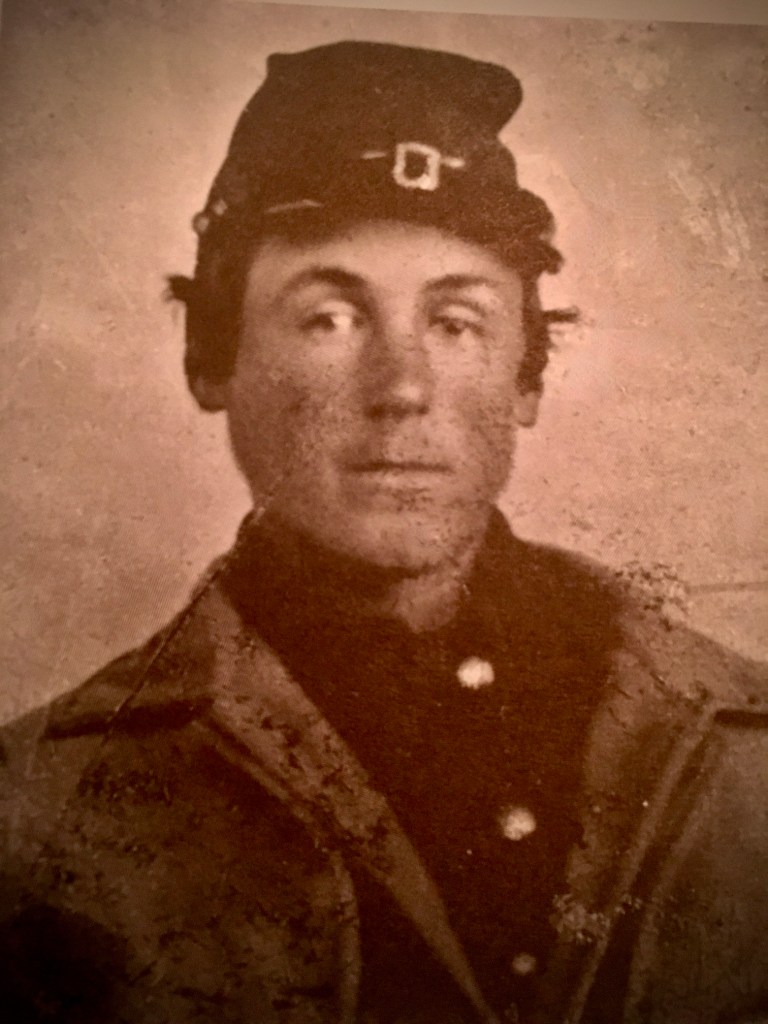
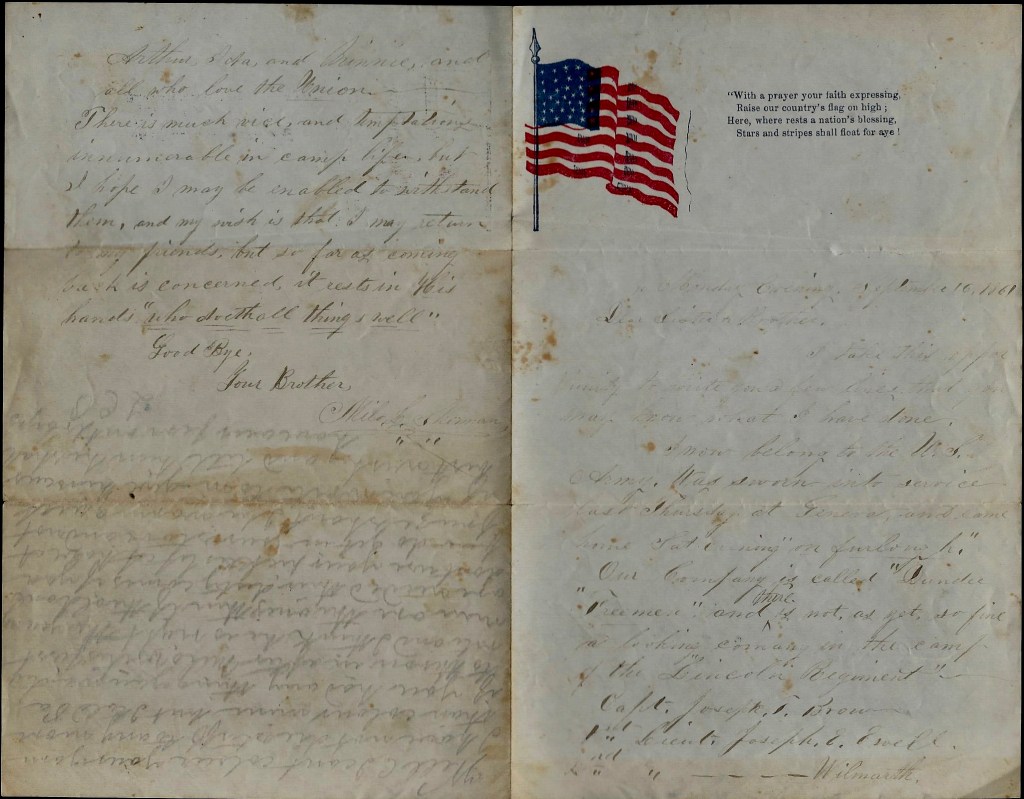
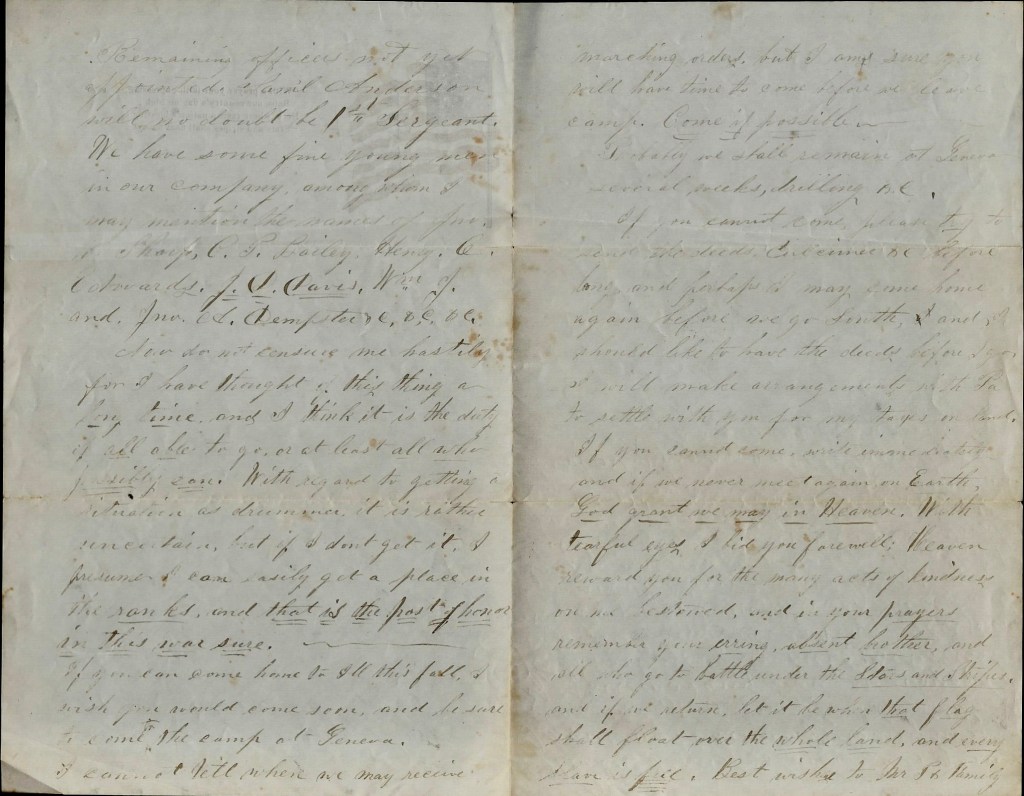
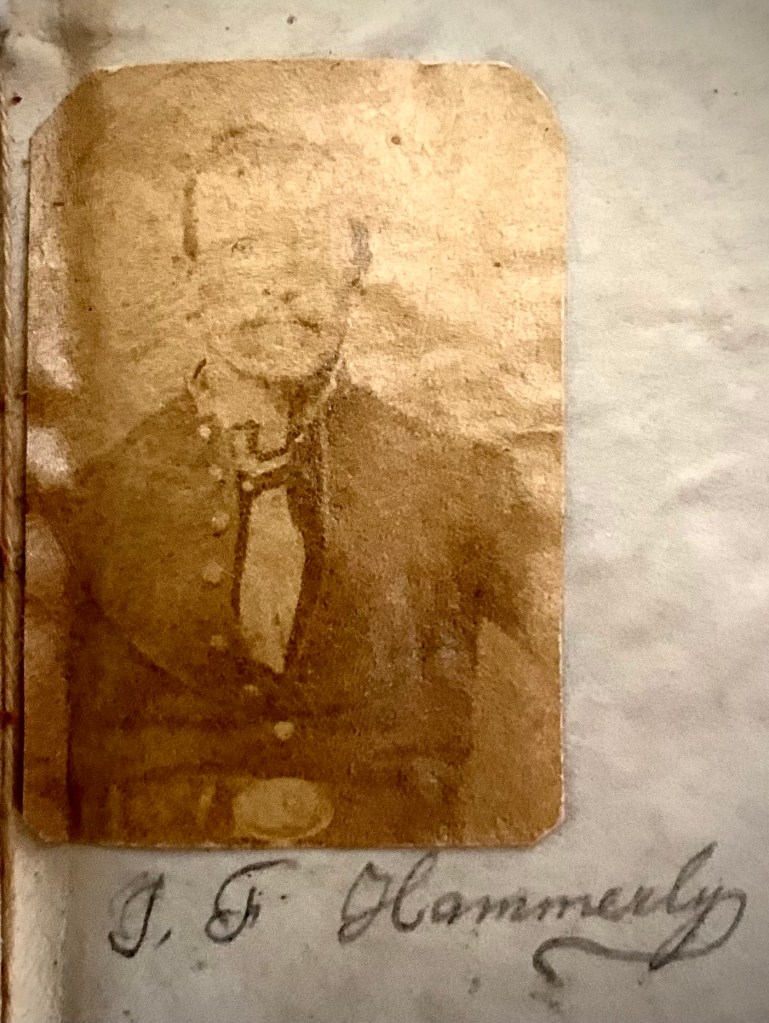


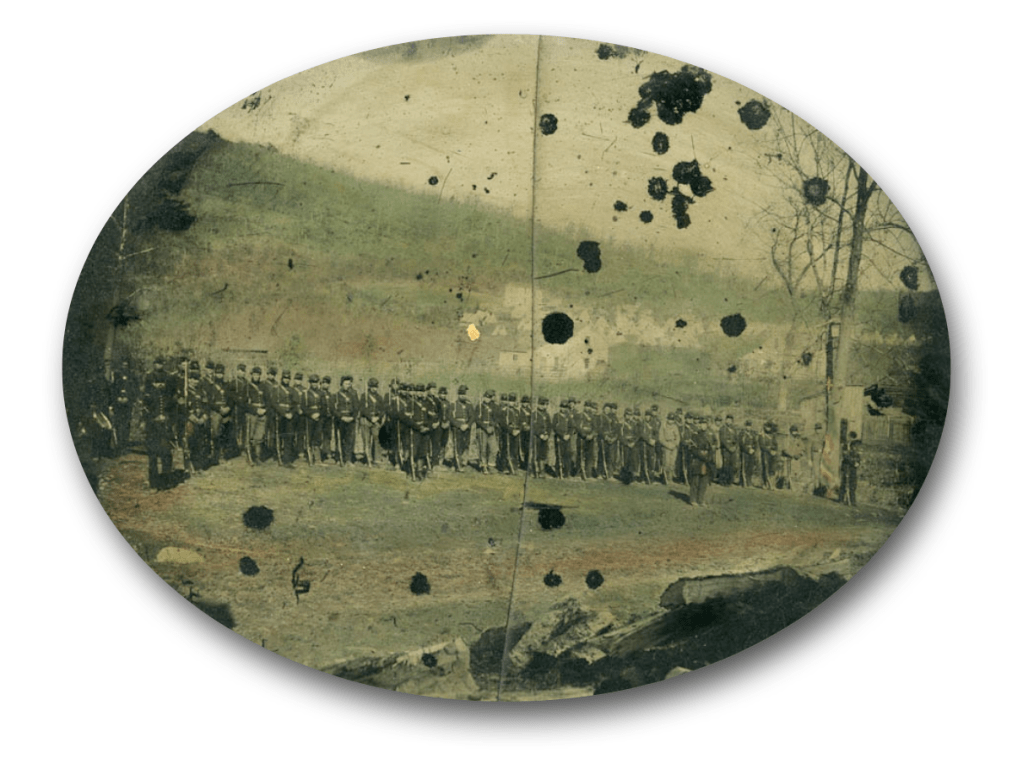


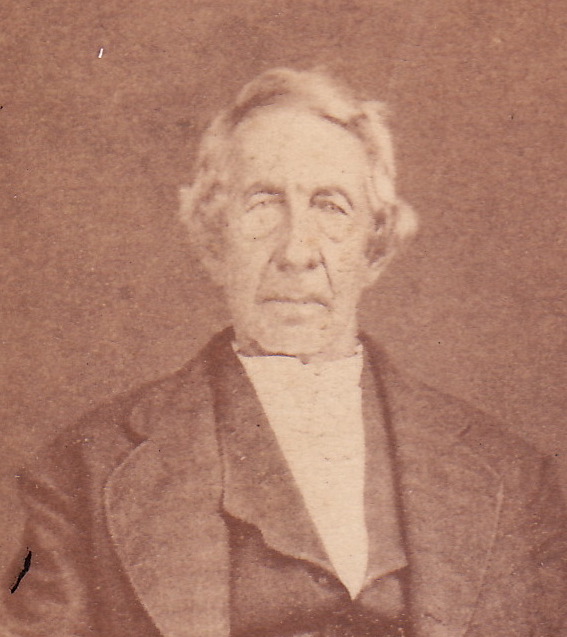
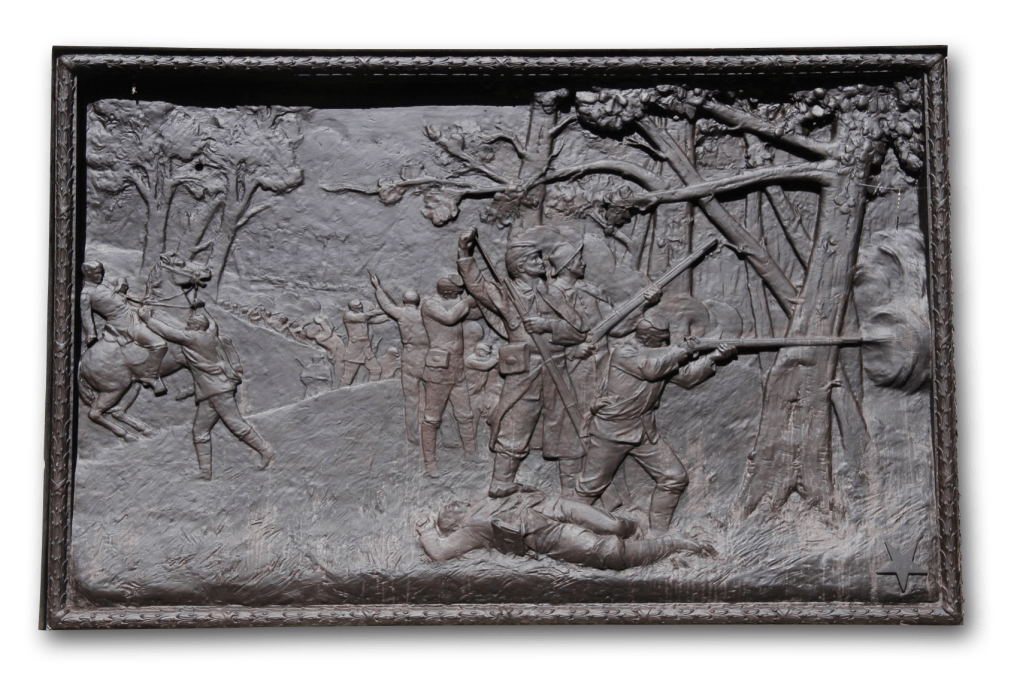
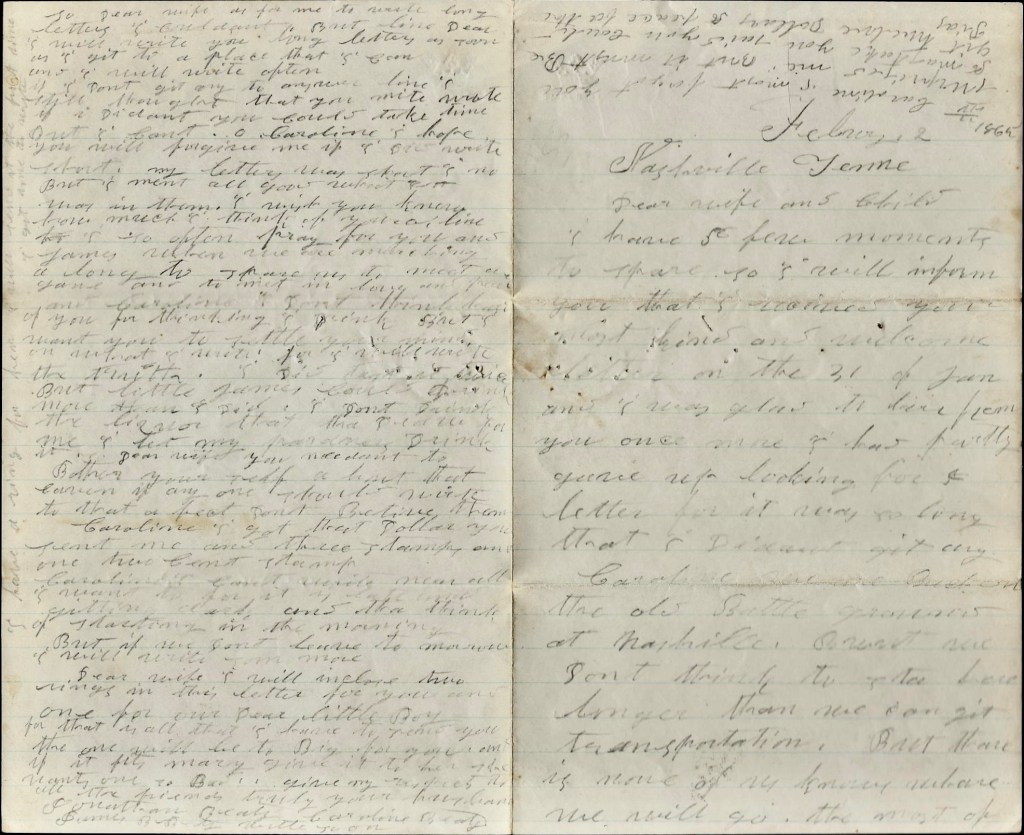
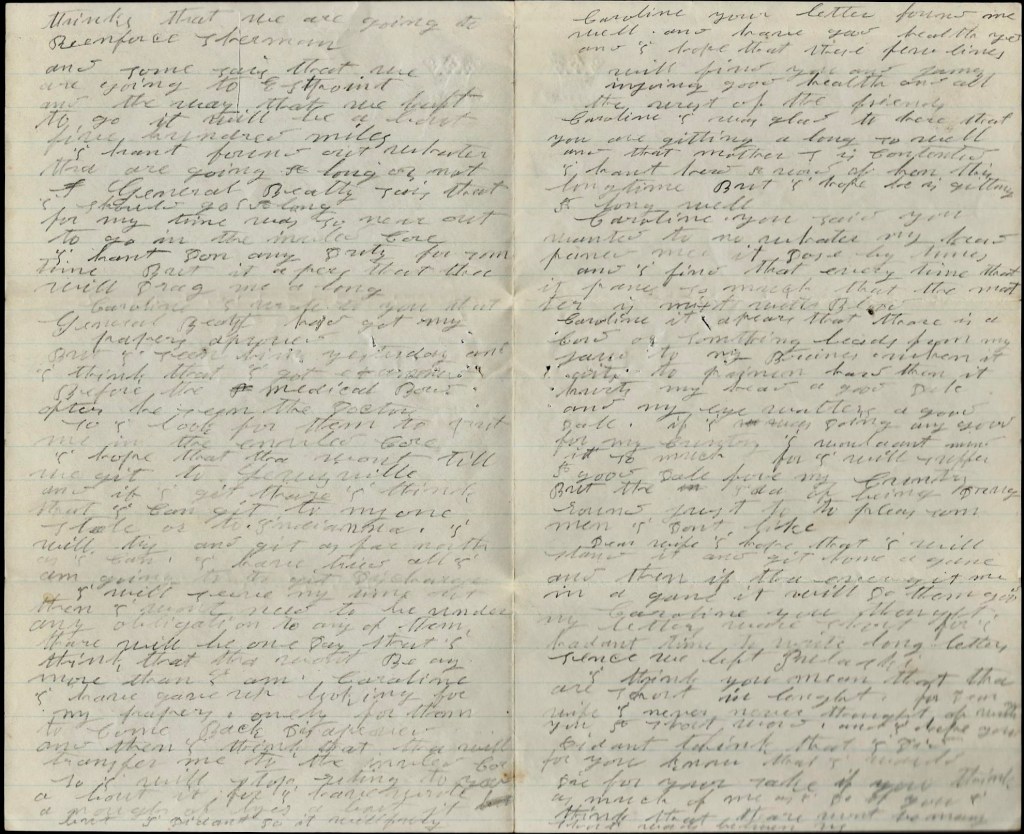



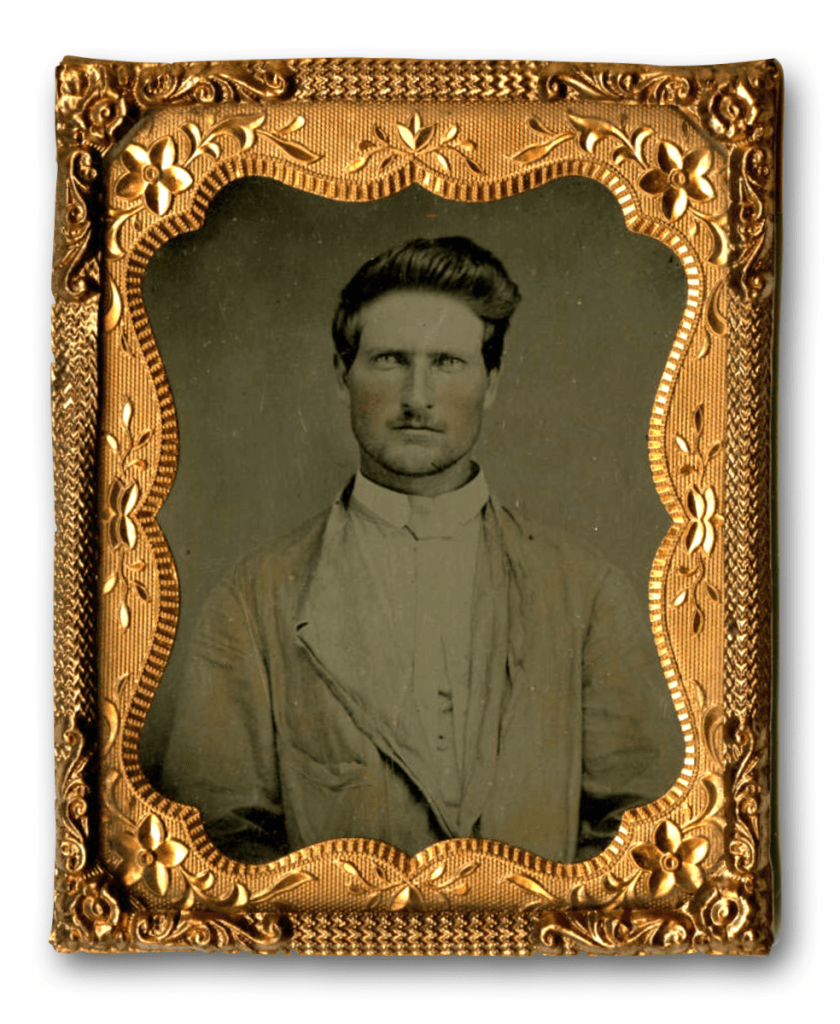
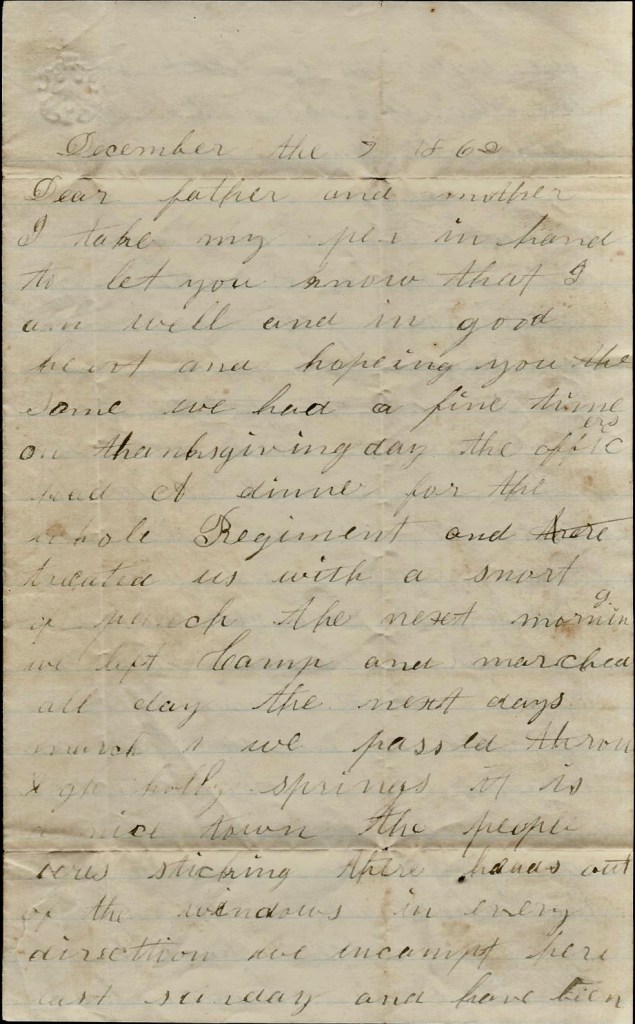

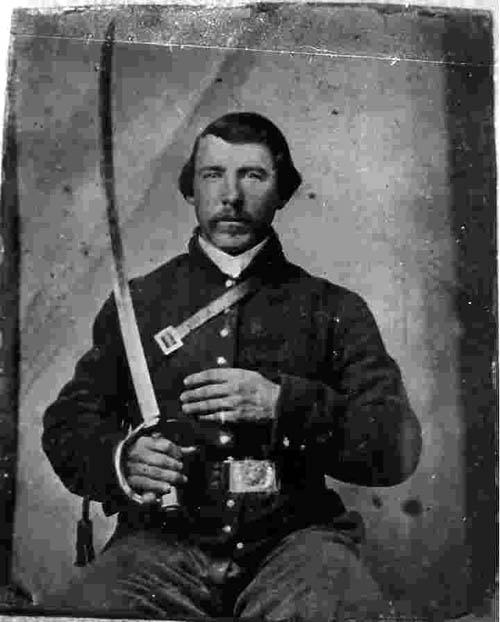
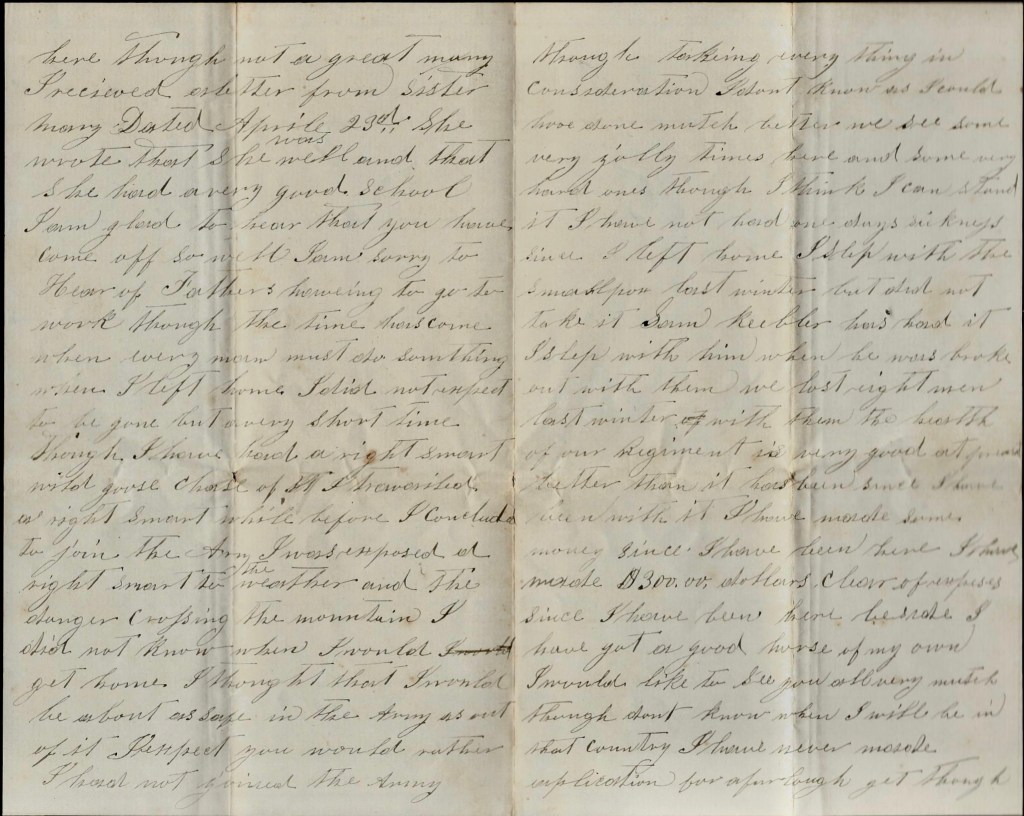


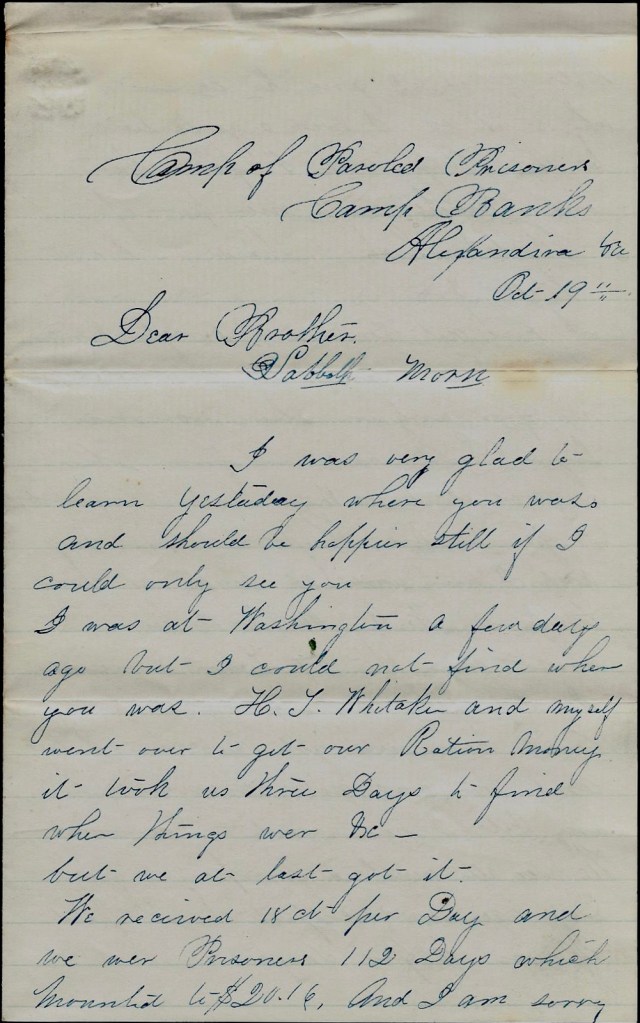

 Spared & Shared 23