All posts by Griff

My passion is studying American history leading up to & including the Civil War. I particularly enjoy reading, transcribing & researching primary sources such as letters and diaries.

1863-65: Sam Green to his Cousins

Unidentified Confederate (LOC)

The following letters were written by Samuel Green who served as a private in Co. E, 1st Confederate Battalion (Forney’s). The seven companies that made up this regiment were drawn from Alabama, Florida, Georgia, and Tennessee. Their service started at Port Hudson but their first engagement was at Corinth. They were then assigned to Loring’s Division and fought at Grand Gulf and Vicksburg. They were then assigned to the Army of Mobile and fought at Port Hudson, Champions Hill, Jackson, and Fort Pillow. In June 1863, they were assigned to Gen. Johnston’s Army of Relief, Department of the West. They were ordered to Virginia in March 1864 where they joined Heth’s Division of Hill’s Corps, Army of Northern Virginia, and participated in the fighting at Petersburg and Appomattox.

According to his muster records, Samuel enlisted at Fort Morgan, Alabama, in January 1862. He appears to have been with the regiment most of the time until he became ill in the fall of 1864 and was a Richmond hospital for several weeks until 1 November 1864.

He wrote the letter to his cousins in Jackson, Mississippi—the children of Rt. Reverend William Mercer Green (1798-1887), the Bishop of the Episcopal Church in Mississippi.

Letter 1

Camp near Canton [Mississippi]
November 15th 1863

My dear cousins,

I have just returned from town where I heard a most excellent sermon from the Rev. Mr. —– that married a Miss Johnston near Madison—the little cottage church was full to overflowing, numbers had to stand during service. The ladies found it rather difficult procuring seats. General [William W.] Loring and his men monopolized the greater part and seemed to be very much pleased with the services though the greater portion had never attended the Episcopal Church before. Yours and Lilly’s presents were handed to me by cousin James a few days ago and I can assure my dear cousins, that they were most acceptable. And could I have had my wish, would have selected those things. They came in the very nick of time as the weather was [ ing]. How can I repay you for all your kindness extended to me since we became acquainted.

We are camped within two miles of town and from all appearances will remain the winter unless the Yankees come in a larger force than we would be able to cope with. At one time we thought Brandon would be the Headquarters of this portion of the army, but the Yankees attempting their raids again upon this section of country, it was necessary that the troops should be moved in a more central position so as to command the whole of the railroad now in operation. We have gone into winter quarters though we have no tents. We have very comfortable log huts built by ourselves and covered with boards, then thatched with straw or hay. You have no idea how much more comfortable it is than tents. In some they have fireplaces which add still more to their comfort.

The troops at this time are better situated than they have been for two years. You rarely hear of any hardship in camp; all appear to be satisfied and in fine spirits. They drill us just hard enough to give us an appetite for our beef and cornbread.

I have just completed my tour of ten days cooking for my mess which was accomplished with as much dexterity as an experienced cook who had been at it his life time. Some days I gave them boiled, yet another stewed and when the beef had any fat upon it, would bake. Corn bread plain was a standing dish. Now we are receiving sweet potatoes which adds to our bill of fare. The cook is now calling for Mess No. 2 and if not there in time, will have a slim showing for my full ration.

20th.

You will perceive have laid this aside for several days owing to our battalion having to go out on picket—duty which comes about once a week. On Wednesday next there will be a drill between the 15th Mississippi Regiment of our brigade and the 3rd Kentucky of Buford’s for a handsome regimental color. The competitors are drilling daily and no doubt it will be an exciting time between the two brigades. The latter regiment has already taken two prizes in Bragg’s Army for their superior drilling.

Cousin Sarah [Green] Cotten passed through this place several days ago on her way to Big Black to see Lew. I did not see her myself but my friend Dudley Cowan did. She was very much disappointed at not seeing me as she wished me to go down with her. I am looking for her return every day. No doubt it is her intention to visit cousin Rob and perhaps you all before she returns. I hope she will not pass through without my seeing her for I love her much and more than that, you find few such women.

If tomorrow is a good day, I am going down to Madison to spend the day with cousin James. I started last Saturday but when I was within 200 yards of the depot, the train left so cousin Sam had to return his steps back to camp a distance of two miles. So to make sure this time, I will sleep in town tonight and be ready in the morning.

No news from home yet. Till Lilly, I wrote her a long letter in October while at Brandon directed to the care of Major Mhoon, Libbie Station. She blotted the name so much that it was guess work with me. However, I made it out as Mhoon. Col. [George H.] Forney is still [ ] looking for him daily. He has been away from us for nearly three months and we all look for his return with much pleasure.

Give my love to Uncle and say to him I was sorry he did not extend his trip up here for we would have been pleased to have heard him preach. Tell Lilly I will write to her soon. Give my love to all. Direct care of Mr. E. D. Cowan, Canton. Remember me to the boys when you write. Just before closing we have news of the Colonel being at Brandon and will be here tonight or in the morning. Goodbye dear cousin. Write soon and accept a full share of love from one who loves you dearly, — Sam


Letter 2

Camp near Petersburg
March 29th 1865

My darling cousin,

Though but a few days has elapsed since my last letter to you. I could not let a good opportunity slip by without letting you know how and where I am, and also, that I think of you frequently. Having no communication with Wilmington or Fayetteville, I am afraid you will be troubled a good deal with letters of nonsense from your cousin Sam, whenever an opportunity offers. No news from any of my relatives since the occupation of either of the above named places. One of our officers left a few days ago for Mobile. By him I sent my letter, he promising to mail at Montgomery. I had been carrying it in my hat for a week or more waiting for someone going in that section of country.

On Saturday 26th our division had quite a sharp little fight resulting in no advantage to either side. Yankee officers captured say that Grant was under the impression that General Lee had massed his troops in front of Petersburg, leaving only a small force in the works on the right and there would be no difficulty in taking our works and proceed to Petersburg, attacking our troops in the rear, while they would do the same in front, capturing most of Lee’s army. But Corporal Robert E.—as most of the troops call him—was on the alert. Therefore, Grant was foiled in his undertaking. Our loss in the Division, killed, wounded, and captured, did not exceed 150. Our Battalion had one officer and five men captured, and two killed. Everything is perfectly quiet just now. It is no telling how long it will remain so.

“Gen. Lee has been riding up and down the works for some days, and yesterday had all the troops placed in their proper position for the coming campaign.”

—Samuel Green, Co. E, 1st Confederate Brigade, 29 March 1865

Gen. Lee has been riding up and down the works for some days, and yesterday had all the troops placed in their proper position for the coming campaign. By this move, our brigade have been thrown out of their comfortable quarters into the cold open air to protect ourselves the best we can. It will go pretty hard for awhile. But as the saying is, we will soon get use to it.

Col. [Reuben O.] Reynolds 1 of the 11th Mississippi in our brigade was wounded in his arm on the 26th. Since then, has had it amputated and doing very well. After it was taken off, he remarked he would be ready for the Yankees again soon. The colonel formerly lived in Aberdeen [Mississippi] practicing law. Since then I believe his family have moved to Columbus {Mississippi].

I have given up all idea of seeing you soon and perhaps never for as soon as the consolidation of regiments and battalions take place, my position will be with a gun in ranks, taking the chances of war, endeavoring to do my duty to my country.

Give my love to the family. Write soon and every opportunity that offers. Uncle’s family are the only relatives that I know of who are out of the enemy’s line. Do remember me to Miss Laura. At what point on the Mobile & Ohio Railroad is she living? I am very well acquainted along the route from Mobile to Okalona. Have you become acquainted with Miss Lowry who lives at Columbus or Crawfordsville? She was a sweetheart of our cousin Willie Lord 2 who was killed upon that road in 1862. I am not acquainted; still I have seen her often. This will be mailed by a gentleman from Mississippi who is out here getting up a Record of State troops. Our mails are not going through yet and it is only by hand a letter is safe.

Goodbye dear cousin, — Sam Greene

1 Reuben Oscar Reynolds began his service as a Captain of Co. I in the 11th Mississippi Infantry. He was wounded at the Battle of Gaines’s Mill (27 June 1862). He was promoted to Major on 3 October 1862. At Gettysburg, Major Reynolds was wounded a second time in Picket’s Charge while commanding the regiment. When Col. Green was mortally wounded on 12 May 1864 at Spotsylvania Court House, Reynolds was promoted to Colonel. In the skirmish at Hawk’s Farm, Reynolds was wounded a third time, losing his right arm. He was a graduate of the University of Georgia and University of Virginia (law school). After law school he set up his practice in Aberdeen, Mississippi. He married Mary (Mollie) Branch English on February 20, 1855.

2 William Ancrum Lord (1837-1862) was killed on 19 March 1862 at or near Okolona in a train wreck on the Mobile & Ohio Railroad. He was the son of William Campbell Lord (1793-1847) and Eliza Jane Hill (1794-1875) of North Carolina. In the 1860 US Census, he was enumerated as a “conductor” living in Mobile.

1862: G. Berkeley Green to Sallie S. Green

G. Berkeley Green
(University of Mississippi Archives)

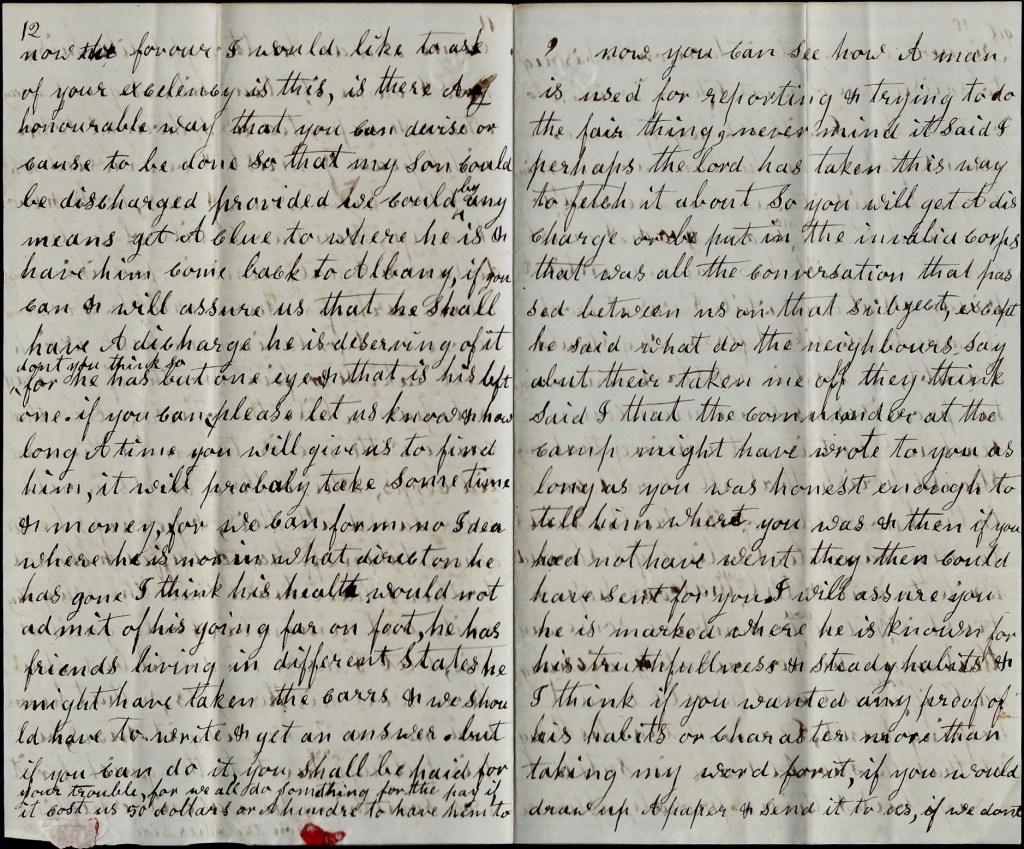
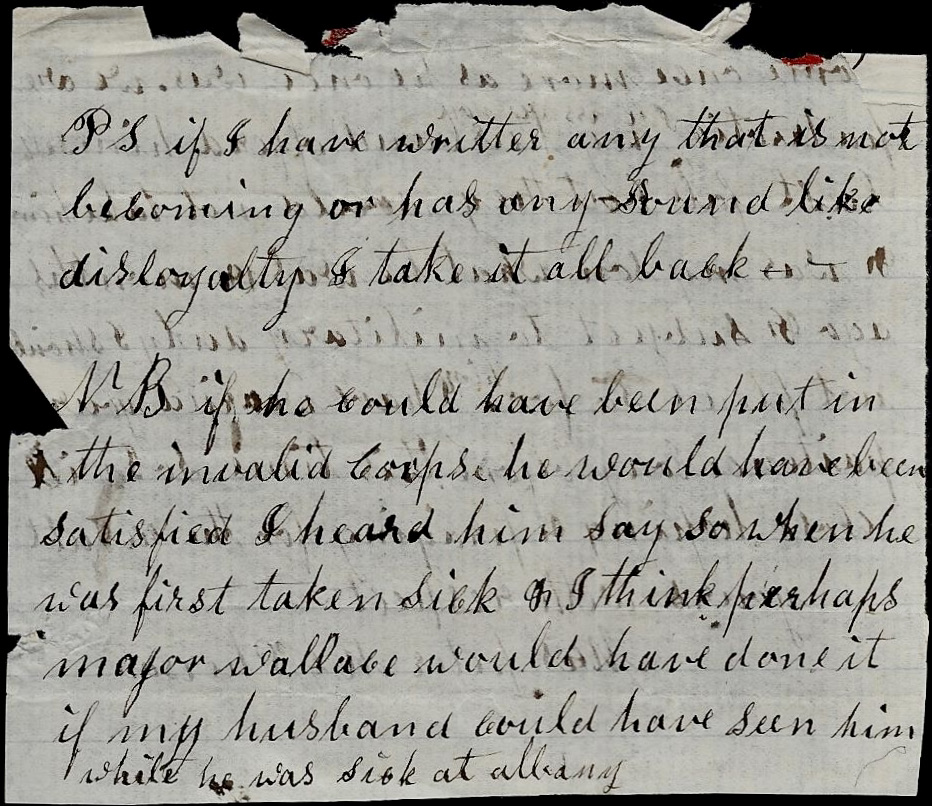
The following letter was written by G. Berkeley Green (1841-1893), the son of Bishop William Mercer Green (1798-1887) and Charlotte Isabella Fleming (1810-1860) of Jackson, Hinds county, Mississippi. Berkeley was attending the University of Mississippi at Jackson when the State of Mississippi seceded from the Union on January 9, 1861. On 4 May, nearly the entire student body (most of them sons of large slave-holding families) and many of the professors at the University formed ranks, left, school and enlisted in the Confederate Army. Only four students reported for classes in the fall so the university closed temporarily. The “University Grays” became Co. A, of the 11th Mississippi Infantry. When the company was ordered to leave, his father attempted to have Berkeley discharged so that he could finish his studies and graduate in May 1861. It was an unusual request but successful no doubt because of his father’s station as Bishop of the Episcopal Church in Mississippi. Within days of his graduation in late May 1861, Berkeley enlisted again, this time in the “Burt Rifles” or Co. K, 18th Mississippi Infantry.

Burt Rifles—Co. K, 18th Mississippi

During the next four years of service, Berkeley saw plenty of action. He was captured at Fredericksburg, Virginia, on May 3, 1863, and exchanged just in time to rejoin his unit and fight at Gettysburg. In that battle he was again captured, and sent to Fort Delaware prisoner of war camp. He was released on May 22, 1865, after taking the Oath of Allegiance to the United States.

Berkeley Green later married Sarah Joanna Hillyer of Natchez, Mississippi. In 1880, Berkeley and his family resided in Vicksburg where he worked as a clerk.

In his letter, Berkeley mentions his brother “Rave” several times. This was John Ravenscroft Green (1830-1890), sometimes referred to to as “J. R.” and named after Bishop John Ravenscroft. He married 1st to DeLainey VanDusen McGahey, and 2nd to Hannah Lavina Lee. He became a physician after the Civil War and lived in southern Indiana for a time.

The letter was addressed to Sallie S. Green (1845-1917) who would later marry John Mercer Cotten (1842-1915), a veteran of Co. G, 7th Tennessee Infantry and Co. K, 7th Tennessee Cavalry.

Transcription

Miss Sallie S. Greene, Care of Right Rev. Bishop Greene, D. D., Jackson, Mississippi

Headquarters 18th Mississippi Regiment
December 23rd 1862

My dear sister Sallie,

I received your letter of the 1st inst. a few days ago & was truly grieved at the perusal of its contents. You said truly when in commencing your letter to wrote that you all at home had not written quite as often as I might have a right to expect for it was the first letter that I had received from home for two months. But I did not much wonder at the fact when I saw in how much trouble you had been from sickness & other causes. I have felt very sad since the receipt of your letter & the news of father’s terrible illness. I am looking most anxiously for another letter from you telling me of his health & your general welfare. I have rather delayed writing I hopes of receiving another one before I wrote again.

This bids fair to be the dullest, hardest Christmas that I have ever spent—one of the dreariest spots on memory’s record. My Christmas dinner bids fair to be nothing further than beef & biscuits & no eggnog or anything of a spiritous character. I have been very anxious to go to spend Christas at the place where I was sick after the battle of Malvern Hill 1 last summer but there is not the slightest chance of my accomplishing anything of the kind. We suffer considerably from the cold at times. The weather, however, for the last three days has been uncommonly mild for this winter which has been much more severe than the last one.

“I cannot tell when it may be my good fortune to see home again. I am afraid I shall never get there until the war ends unless I get a pretty bad wound in some battle. That is paying rather too dearly for my whistle.”

—G. Berkeley Greene, Co. K, 18th Mississippi Infantry, 23 Dec. 1862

I had looked forward also some months ago to the granting of furloughs about this time but it seems that that is completely played out & I cannot tell when it may be my good fortune to see home again. I am afraid I shall never get there until the war ends unless I get a pretty bad wound in some battle. That is paying rather too dearly for my whistle.

Speaking of wounds, I suppose you. have heard ere this of cousin Robert Greene’s wound. Brother Rave was in Richmond nursing him when I last heard from him but his life was in great danger & one eye was entirely gone, although the doctor thought that if he could save his life, he might be able to save him one eye. I am quite anxious to hear from him. Brother Rave is trying to get a furlough himself but with poor success, I believe.

When you next write, tell me all about my friends at home—particularly of Mollie D. for I have not heard from her for months. Tell [brother] Dunc[an] he is treating me very badly about writing as he has not written to me since I left home at Wilmington six or seven months ago. Tell Lilly I am glad to hear that one of the family at least keeps gay and happy all the time for I have been having the blues myself for some time. And Rave is not much better. There is nothing to write about so I will bid you goodbye hoping to hear from you soon.

Your affectionate brother, — G. Berkeley Greene

1 The 18th Mississippi Infantry participated in the Battle of Malvern Hill on 1 July 1862. They were part of the evening attack and lost 16 killed and 126 wounded.

1863: Nelson L. Bullis to Merritt Pierce

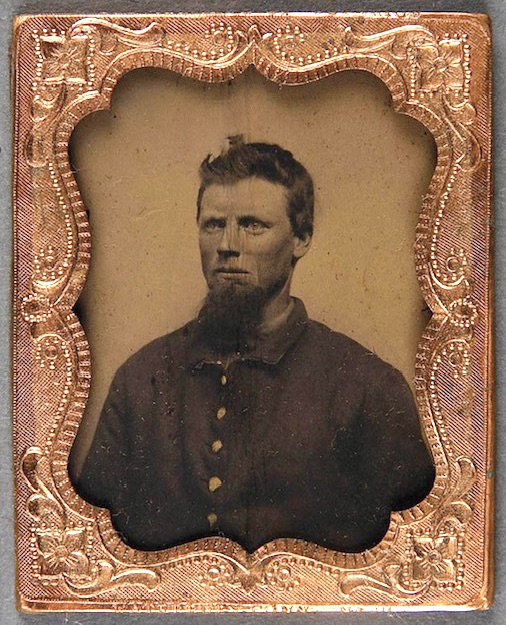
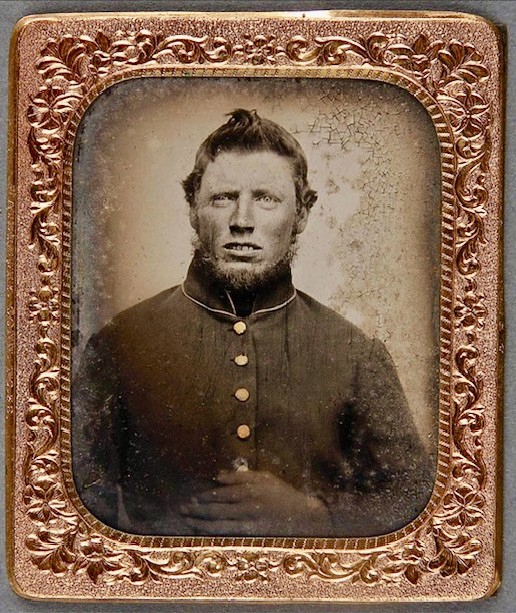
I could not find an image of Nelson but here is one of Harrison Clark who also served in the 125th New York Infantry. Clark’s image is actually a CDV but I have shown it matted. (Al Niemiec Collection)

The following seven letters were written by Nelson L. Bullis (1835-1864), the son of John Hiram Bullis (1783-1861) and Sally Parish (1790-1873) of Schuyler Falls, New York. “Nell” enlisted on 15 August 1862 at Troy to serve three years in Co. G, 125th New York Infantry. At the time of his enlistment, he was described as a 26 year-old, grey-eyed, black-haired farmer who stood 5 feet 5 inches tall.

Nelson was among the Union troops who were surrendered at Harpers Ferry to Stonewall Jackson’s men on 15 September 1862 and was paroled later that year. Some six weeks before Grant’s Overland Campaign in the spring of 1864, Nelson wrote, “I hope in one year & 5 months more to be so I can go where I choose—that is, providing a rebel bullet does not find me.” Sadly he was killed in action on 16 June 1864 in front of Petersburg.

Nelson’s brother, Mefflin Smith Bullis, served in Co. G, 26th New York Cavalry.

Nelson wrote the letters to his friend, Merritt L. Pierce (1842-1869) of Schuyler Falls, New York.

Nelson Bullis is listed among the killed of the 125th NY Infantry in the fighting at Petersburg on 16 June 1864. (Troy Daily Times, 22 June 1864)

[Note: These letters are from the personal collection of Carolyn Cockrell and were transcribed and published on Spared & Shared by express consent.]


Letter 1

Annapolis, Maryland
September 26th, 1863

Friend Merritt,

George Parson Farnsworth (1842-1902), seated next to his brother Charles H. Farnsworth. (Find-A-Grave)

Yours of the 21st was received today. It surprised me some though. I heard from Saff[ord Taylor] you were intending a western tour, but how happens it, old fellow, that Miranda was entrusted to your care? Where was George Farnsworth? 1 How would he have once felt & talked & still later that schoolteacher who is now in the 9th Vermont or was when I was in Chicago. They would have objected perhaps had they been near. But being in the army is a certain method of being forgotten of the girls. Take care Merritt that going West does not have the same effect.

I no longer belong to Cousin Jeff. I am exchanged & have allegiance only to Uncle Sam & my correspondents. I will not give in yet that I had the blues that time but I may be too much like Charlie, not willing to own any displeasure. But receiving letters from or writing to you has an effect of rendering me silent & sad or perhaps homesick would be a better term.

But if you could enter our reading room you would not wonder. To see a couple play chess or checkers for hours without as much as a smile & to think of the way we used to enjoy it. Then the readers, such faces, some emaciated, others lame or lost a limb, some showing marks of wounds & all wearing a look of such sadness. I never saw it equaled. They act more like prisoners for life & are undergoing repentance for crimes committed. Then the knowledge that your own face wears the same woe begotten look–is it not enough to make a fellow have the blues.

I shall be glad to get back to the regiment & still dread to join it so late in the season. I have had no opportunity to have my likeness taken but if I can get a pass next week, I shall have it all right. I did not suppose you intended staying west but I hope you will be home when I get there if I ever do make out to get home.  I am glad to hear from Mark. I did not know but he like many another had gone to the wars.

So you are in the land of Hoosiers. By the time you answer this you will have had a better opportunity of judging of the society. I think one always on his first appearance in a place thinks it worse than it is. I hope you will find it so.

I am gaining rapidly. I shall be able to leave if the powers-that-be see fit to send me off, but still I do not expect to be sent away for 2 weeks unless there is a rush of sick into this hospital.

I hope you will have good success in your western trip & will not be homesick. The other boys made a mighty short stay not [as long?] as I did.  You will think my letter rather unconnected. I am talking and reading, have been playing cards and two of the boys are now playing. If it were not for cards, soldiers would find some long hours. I will wait a while to finish this.

1 George Parsons Farnsworth in Beekmantown in 1860 census, served in Co. A, 2nd Wisconsin Infantry Regiment.  Married Emily Miranda Moore of Schuyler Falls. 


Letter 2

Annapolis, Maryland
October 3rd 1863

Friend Merritt,

Yours was received in due time with a little astonishment for the address though that was somewhat lessened by Saff[ord Taylor]’s writing me of your intentions of taking a western trip so I was looking for some account of your departure to the land of Hoosiers & prairie chickens. So, you expect to stay until you get homesick. My hope is that you will get homesick before you get the ague. My thoughts of the West may be erroneous, but I think 5 out of 6 who go from [New] York State to Indiana or Illinois have the ague before they have been there 2 years in spite of what the acclimated say.

You do not seem to wholly like the society. Did you ever visit a strange church & notice how homely the women were & by often going & becoming acquainted finding them as good looking as the generality of people? It is the same in judging of the society. We are apt to see & hear of the worst part first. There are few who do not in giving a description of persons or places or societies who do not give evil side the greatest notice & do not qualify it be telling of good acts or feelings or beauties. But when they speak of praiseworthy things, qualify them by their ifs & buts & evil actions so as entirely to overcome the effects of their praises. So you see I think in my extreme wisdom you will change somewhat your opinion of the society & find many worthy associates if not friends.  

I wrote one letter a number of days ago but delayed sending it [un]til I could send my picture but I was refused pass & have tried every day since but the paymaster has been here & payed off those who had been here over 2 months & as soldiers will get drunk when they have money & drunkenness is against the law so our doctor means to stop it by stopping all passes for a few days. I hardly think it will do more than delay the evil & I am afraid it will like waters rage the worse for being confined.

You think I had the blues. It might have [been] so. I own I am thinking of home & its friends more when I write to you or receive a letter from you than any other time. This might have given a coloring or tone to my letter, but I assure you I was not troubled with what I should call the blues. Today I have been somewhat lonesome but no wonder—nothing to do but read & gaming. It is enough to ennui anyone. I always believed myself lazy & no friend of working but here I have often wished to be working on the farm or at the least working so as to take of[f] that sense of feeling that I am a deadbeat to the government & myself as well.

I dread the consequences of exposure on my return to the regiment before my system has recovered its natural tone & may not have to, but I am in a hurry to be of some use to somebody or something. There is no use denying it the exposures. Scant food or something else have had a great effect on my body. It does not recover its strength & tone after being sick as it used to. I feel but a very little stronger that when I came but still am around on the move most of the time. I will send my likeness in the next if not in this. I shall try again tomorrow for a pass.

So, Miranda accompanied you a part of the way—bully for you that George Farnsworth & that schoolmaster who is in the 9th Vermont were not at Morrisonville. They would have given Merritt a severe talking about. Did you talk to her as you used to when we used to spend some of evenings there and more of them kicking dirt. I wish we could do it tonight if it did not rain. And Mark is not.

I could not get to town so will send this & the first one & have a mind to write a 3rd & send it.


Letter 3

Camp Stevensburg
January 31, 1864

Safford [Taylor],

At last you have mustered up enough courage and spunk to write to my dull P.O. address. It must have been a mighty risk to run. A person in the army changes his address so often & then letters are never forwarded. Old fellow, don’t let me hear you make such an excuse again & you had better stop insinuating about Merritt [Pierce]. I was all the time advising him not to enlist & you–you scoundrel–trying to coax him off. Will [Beckwith] ought to have come but Merritt nary time.

It seems the notion to enlist must have took you sudden. You didn’t speak of it while I was at home. Why did you not for my sake come into the 125th, but for yours I am glad you did not. We are bound to be in the hottest of the fighting & bullets fly mighty careless. Your regiment will not be apt to see man or very hot fighting. You had better remain where you are as long as you can. You have you a soft thing but as for me, give me my regiment as long as they are as friendly as now. There is a feeling as deep as among one family & we feel lonely to be separated as to leave home. But you have not that feeling & camp life will be hard for you to endure.

I understand we have some recruits there [Elmira] for our regiment. I hope you will have them well drilled before you send them along for if the regiment has any recruits the whole of us will be obliged to drill.

I have not played chess in quite a while. There is but one to play with & he is on duty most of the time. If I were there, I believe I could beat you—what do you say?

I expect a letter from Merritt this week. I’ll tell him how you talk. You were casting insinuations when you said there were two chaps who took strange freaks. You did not mean me for I always told everybody what I was going to do & then done as I had a mind to. I think Mart will teach a good school, but it will be his last one. He will not like it. I am not in very good humor for writing & so shall quit.  Write soon & oblige, — Nelson Bullis

Company G, 125th New York Infantry Vagabonds, 3rd Brigade, 3rd Division, 2nd Corps, Washington, D.C.


Letter 4

Camp near Stevensburg, Virginia
February 10th, 1864

Friend Safford,

Yours was received in due time & I will try & answer it. We are about 40 miles from Washington, 2 miles from Brandy Station on the Orange & Alexandria Railroad. Perhaps you can get a pass from the Provost Marshal at Washington in Alexandria. The last I knew of [unreadable] he was head clerk in the office at Alexandria. He could furnish you with a pass if he is still there. If my advice can influence you any, you will stay where you are as long as you can. There is not much of fun in that, but too much of severe earnest, you could not content yourself in the army at all. 

I can adapt myself to circumstance as well as anybody I ever saw & still there are times it seems as though I must go crazy or get away from the monotony of camp life; when the boys are all in it is well enough but sometimes all but one or two are out on detail, then it is terrible. Yesterday every able man not on other duty were out digging rifle pits. They seem to expect an attack from Lee in return for us going to visit him.

I believe 126th New York Regiment recruited there. If so, you must have heard great stories about their bravery. I think so by the colored accounts I have seen and heard. When the Corps got to the Rapidan, our Regiment—the 125th— was in the advance. 100 of our boys, including Co. G of course, were taken from the left of the regiment and told to cross. They forded the river, took 25 prisoners and were the first to form a skirmish line & the last to recross the river & we were not driven over by the bayonets of the 126th. I don’t think it would be very healthy for that regiment to try force with us either. It is true that there was not one of our men hit but the Rebs fired at them enough. It makes us swear some to see the accounts in the papers giving the praise of crossing the river first to the 126th.  [See the Battle of Morton’s Ford]

We were ordered to have an inspection today, but the rain & wind has stopped it so far & I think it will for the rest of the day. I don’t believe you can read this, but I am sitting or lounging on the bunk & cannot write any better. I guess I shall not scold you again–you answered so promptly that time.  

I understand that 18 men have got to come from Schuyler Falls for the last quota. Smith is recruiting officer. I don’t how they can raise the men.  I think Merritt & the Beckwith boys will yet have to come. I hope it will never take Merritt. If he is obliged to come, I wish he would join Co. G. I supposed Orville [Stickle] and Steve [Stickle] were in the regiment with Israel [Stickle]. He is out in the Potomac Army. If you hear where Orville is, give me his Corps, Division, Brigade, & Regiment. We can then find each other sometime. I will close hoping to hear from you again.

— Nel[son] Bullis

3rd Brigade, 3rd Division, 2nd Corps, Company G, 125th New York Volunteer Infantry, Washington, D.C.


Letter 5

Camp near Stevensburg, Virginia
March 14, 1864

Friend Safford [Taylor],

Yours was received in due time & I cannot tell whether it is answered or not. If not, here goes for what it is worth. If yes, why the loss is small for Amelia sent me the paper & envelope and [my brother] Levi the stamp. It only cost me the time & that is a drug. Besides it rains & I have nothing to read. I got a letter from Merritt the other day. He will run the South school this summer. Fannie is to teach it.  

I wish Tim Newcomb was with his regiment. They lay about 80 rods from here. Never mind the grammar but the Johnnies hold him fast. We would have some sport I’ll bet. Well, do you still stick to your resolution of going to your regiment. I believe I have answered yours, but I shan’t back out. The boys I heard of enlisting in our regiment did not go to Elmira. They went to Fort Schuyler, New York Harbor. Elvin was still teaching at Plattstown. I thought he would be disowned before the first month was past but he seems to stick to it. I wish you could be in our regiment for 3 months now & then if you chose could go back to Elmira. You would be contented to remain there, I think.

The summer campaign will commence soon if the weather remains as fair as the past month. Then for a tramp—a long tramp—& we will some of us tramp never to return ary once.  Well, never mind. There will be enough left for the good of community as long as I remain in the rear, & I think a good ways in the rear will be the best.

Well, old fellow, how do you look dressed up in soldier’s toggery or do you wear citizens clothes yet? I motion (excuse my boldness & lack of maidenly reserve) that in course of the ensuing ages we exchange photo-, daguerreo-, ambro-, ferro-, basso relievo printing or some other kind of types in which we can cogitate on the innumerable changes caused by the fingering of old Time’s own self & Uncle Sam’s hard tack—which by the way you know but little about. I sent mine home—that’s a lie for it is not mailed yet but it is ready to send. I look as “sojerfied” as Polly Cresset. We do not belong to the dignified division now.

Oh, by the way (in secret you know), do you correspond yet [with] Delia Annie? She has somehow forgotten or purposely refrained from writing to me. I did not know but the charms of yourself of letters or something had changed the direction of the current of her affections. Now I don’t want to scare you into a lie but just tell me, won’t you? If you don’t, I will tell Merritt. He says you want my address. I am glad Add has got more than one. As for mine, they are lousy & you don’t want to mix the Potomac & conscript lice together. They would not agree as well as veterans & bounty jumpers. Don’t forget to tell me Orville [Stickle]’s regiment & where stationed if you know.

Say Saff, I am sleepy & it is now noon. What shall I do? Can you read this? I can’t near do as I want to. Is that the way with you? I heard a fellow make that remark about a letter he received. He did not like to get long letters. It was too much work to read them. Are you corresponding with C. Bidwell now?  I wrote to him. He did not answer in 2 months. I wrote again & got a letter the same night & answered it. He has not written again. — Nel[son Bullis]


Letter 6

Camp 125th [New York] Regiment near Stevensburg
Culpeper Court House
March 20th, 1864

Friend Merritt [Pierce],

Yours was received in due time but laziness had too strong a hold of me. I could not, or rather did not, shake it off. I am enjoying life gay. Our lieutenant has resigned & we have the [Lt. Elam S. P.] Clapp to boss us now as lieutenant. He will keep me for a while in my position. I am glad of it for I do not have to go on guard & get rid of many an inspection.

I do not have the blues much now days, but I do want some maple sugar. I hope your party had a good time. I am sorry I could not accept your invitation. I hope in one year & 5 months more to be so I can go where I choose—that is, providing a rebel bullet does not find me. By the way, report says we are going to move again soon. There was an alarm the other day. Wasn’t we thankful that it was in the daytime. We stayed in line near an hour. We at first thought it meant fight as our cavalry had not got back, but it was a false alarm.  

I sent a likeness home the other day. It shows that I am not very sick. I got a letter from Saff[ord Taylor] last night. He is well & for a wonder, Jabe wrote to me. If you see Lewis Spalding, tell him I want him to write to me for it has been 2 months since I wrote to him & he has not answered it. I suppose George [Pierce] will soon move. It will seem strange for him & Emma to keep house. She will be a little lonesome I am thinking.

Write me all about all the folks, how the new schoolmarms get along, & how often you carry Fannie home. For her sake, be careful about going to the school house very often for she has the greatest set of hectors I ever knew & I ought to know them well. Perhaps you are laughing & thank Nell for unasked advice. Well, never mind. It don’t hurt me much & perhaps you enjoy it. I want to know how the town meeting went & all about it. I have a faint recollection that I have answered it before & I will let it run & close by hoping you will answer soon & oblige, — Nel[son Bullis]


Letter 7

Camp 125th Regiment New York Volunteers
April 6th, 1864

Friend Merritt [Pierce]

Yours was received in due time. Then I knew I had answered yours twice though while writing the 2nd there was a remembrance of an answer made, but it is as well. I received a paper from you. It was like a stranger or an old friend in a strange country to see a [Plattsburgh] Sentinel in Virginia. We [get] a great many of them, but they are not printed. Your mother [Huldah Ann Reed Pierce] enclosed a piece. Tell her it was first rate & I wish that all York State felt the same.

I am glad to find myself so kindly remembered. When I received it, I was enjoying a headache. I wished for you to do as I once did to you even to sitting me on the floor but that would have been hard work while I was lying on my bunk. It is well now. It was the only bad spell I ever had with the regiment when in the field.

So, Mary Jane is married? How did that suit the old folks of the Weaver family? What are our folks doing? I sent a picture a long time ago & have heard nothing since. I mean to wait this week out & see if they write. I guess they are waiting to send me some photographs I wrote for.

We are having wet weather this month. It is paying us up for the fine weather of the winter. So far this month we have had more rain than since last November [un]til April & it still looks like raining. The boys are getting ready for 3 days picket. It is tough in wet weather. I get rid of all such work. I am a man of business. I sometimes write 15 minutes in a day & then for two weeks not at all. At the end of each month there is a little more to do but not much. I think I can retain it as long as I please—especially as we have no officers of our own in command of us he is willing to keep me. I will not resign as long as wet weather holds unless they drill us too much.

I see by yours that there will be no draft in York State. I am glad of that. It will fill up our army which needed it sadly. Then General Grant is clearing out the heavy artillery [soldiers] around Washington. Some have been there over 2 years & reenlisted as veterans expecting to remain there the rest of the time. I am glad they are sent out. One regiment is now here—the 4th New York [Heavy Artillery—numbering over 2300 present; nearly twice as large as our old brigade. They received recruits who looked for an easy time. I am glad they have to act as infantry. They came in a bad time. The mud is very deep & [it is] raining all the time. They cannot get stockades & have to put their shelter tents on the ground & lie in the mud. Their tents cannot be made high enough to stand up in. I presume Fannie will soon commence her school. Remember me to your mother. Write soon & oblige. — Nel[son Bullis]

1864: Andrew Russell Barrows to Warren Snow Barrows

The following letter was written by Andrew Russell Barrows (1832-1871) of Philadelphia, Pennsylvania. He was the son of Warren Barrows (1800-1868) and Philinda Smith (1800-1838) of Cheshire county, New Hampshire. He wrote the letter to his older brother, Warren Snow Barrows (1824-1888) of Hinsdale, Cheshire county, New Hampshire.

The subject of the letter pertains to the purchasing of substitutes to meet State enlistment quotas or face a draft. From the letter we learn that the “going rate” for substitutes was rising dramatically by this final year of the Civil War and the urgency was heightened by Gen. Early’s raid into Maryland in the summer of 1864. The letter is datelined from Philadelphia on 28 July 1864—two weeks after the Battle of Fort Stevens on the outskirts of the Nation’s Capitol so it is somewhat surprising that he did not seem to be aware that Early had already been defeated and had withdrawn to the Valley.

A Wartime Sheet Music Cover (LOC)

Transcription

Philadelphia [Pennsylvania]
July 28, 1864

Warren,

Yours of the 25th was received this noon. I suppose you have received my letter I wrote the 25th by this time though I have not received every dispatch yet. I wrote [you] to telegraph me as soon as you received the letter and let me know what you thought of taking five men at $700 if I could get them to enlist at Lebanon but 715 is the lowest figure he would agree to deliver them for and take all the risk of their passing [physical] examinations and running away so I thought that the cheapest and best way of getting subs and certainly the safest way. So I thought I would telegraph to you Tuesday so I could get an answer before this man would have a chance to back out or subs bring higher prices so I telegraphed to you Tuesday but I have not received any answer yet. Perhaps you did not get the dispatch. I expected I would get an answer yesterday sure.

I have been to see the man this afternoon. He says he will wait till I get the answer though he would like to know soon. I thought it would be a good chance. I don’t believe subs will be any less while this war lasts. By the way, things look, people are getting alarmed here again about the big raid that are coming again into Maryland and Pennsylvania. That is the news today—that 80,000 strong are marching down the Valley again and crossing over the Potomac. I guess it is true. If so, there will be another great raise of every man called to arms.

I see you have given up the idea of getting subs at present by your letter today. I do not want to criticize you but I think subs will bring $1,000 before winter and more though you must do as you think best about it. Perhaps you would not be drafted anyway. Then you would lose it all—your pay and the bounty, though if you get $300 from the State, $300 more from the town, and $300 from the government, it would not cost you anything at all. That would make $900. The government does pay $300 to three-year’s men here, of course they do. In all other States they pay it to representative subs or enlisted men either. So you could make money in the operation in the end but it would take you the three years before you got all your bounty money.

If you conclude to take these 5 subs, we could not start with them till the middle of next week. Please write soon. Your truly, — Andrew

1850-68: Franklin Farr to Osgood Parkhurst

An unidentified California Gold Seeker
(Doug York Collection)

The following letters were written by Franklin Farr (1822-Aft1880), the son of Josiah Farr (1781-1849) and Laura Allen (1786-1846) of Cavendish, Vermont. The first letter was written by Franklin enroute to San Francisco, California, in March 1850. The letter was apparently mailed from Calleo, Peru, where the ship he was on stopped after rounding the horn of South America.

The second letter was written from Calaveras county, California, where Franklin had been residing for some time. In this letter he describes the state of mining affairs in Calaveras county, transitioning to Quartz mining. He also speaks of the dangers to human life in the county which prompted San Francisco’s Daily Evening Bulletin on 7 September 1868 to report that Calaveras county was “infested with a gang of robbers and murderers who render it unsafe for anyone to travel to that locality.”

Franklin wrote the letters to Osgood Parkhurst (1808-1867) of Cavendish, Windsor county, Vermont. Osgood was married to Harriet Louisa Farr (1808-1867), an older sister of Franklin’s. The second letter was not written until 1868, a year after Franklin’s sister (Osgood’s wife) had died. Osgood was still residing in Cavendish with his daughter, Mary Parkhurst (b. 1838), however.

Curiously, from the Bellow Falls Times of 23 December 1859, we learn that the Parkhurst family had been the victims of a burglary. Awakened in the night by an intruder in the home, the burglar escaped with $23 from Osgood’s wallet.

[Note: These letters are from the private collection of Richard Weiner and were transcribed and published on Spared & Shared by express consent.]

Letter 1

March 11, 1850

I now take my pen in hand to let you know that I am well at this time and I hope these few lines will find you enjoying the same. I have not got any news to write to you now. I have enjoyed myself very well. We are in Calleo [Peru] now. We shall stop there two days and then we shall start for San Francisco. I have not got time to write but when I get there I will write more.

We have had a very pleasant passage. We can’t get there before the first of May. I don’t want you should think anything about me and if you go out West, tell them that I will come out when I come back. You will want to go out again then you may think that I don’t write much but I will write more next time. There is thirty passengers aboard and we are a going up to [ ] now and then we came back and start. We have not stopped before and shan’t stop again. That is all that I can write here to you.

This is from Franklin Farr


Letter 2

Addressed to Mr. Osgood Parkhurst, Cavendish, Vermont, United States of America

Mountain Ranch
October 18, 1868

Mary,

I received your letter and was glad to hear from you and that you and family are all well. My health is good at present. There is no news that I can write you It is very dead here now and will be till water comes again. That will be in about two months. Provisions is cheap now. There is not any mining now but quartz here now and it is hard to make that pay unless a man has plenty of money to spend. It has cost me a good deal and I Han’t got any that. I think much of yet. I am prospecting some now but I don’t think it of much account.

You wrote not to let them break in my house and kill me. They hain’t yet but they have stole 500 hundred dollars. That is about as bad for what is a man good for without money or wife now days.

I have not seen Mr. Fish but I heard from him. He is not doing what he will and doing what he will do…this fall here. There is a good deal of robbing and stealing here now. There has been three men killed close by me in about a month.

I will send a paper with this. There will be one every week if you like them. That is all I think of now.

Yours truly, — Franklin Farr

1862: Samuel Bowman Swats to Dr. Alfred C. Hughes

The following letter was written by 29 year-old Samuel Bowman Swats (1833-1908) of Augusta county, Virginia. He was the son of John Swats and Anna W. Hensley. Just prior to the Civil War, Samuel was enumerated at Burkes Mill, Augusta county, Virginia, where he worked as a carpenter. He was married to Virginia Cross (1839-1915) in 1858.

Samuel served the Confederacy originally as a private in 1st Battalion Virginia Cavalry. This company was later consolidated with other companies to form the 11th Virginia Cavalry and Samuel was in Co. F. According to his obituary, Swats was twice captured and imprisoned, once in Camp Chase and again at Point Lookout where he remained a prisoner until after the close of the war. He was described on muster roll records as standing 5 feet 9 inches tall, with blue eyes, and black hair.

According to Samuel’s military record, he was taken prisoner on 7 September 1862 at Darksville, Virginia, and confined first in the Atheneum Military Prison in Wheeling, then at Camp Chase, and finally at Camp Douglas. He was officially exchanged at Vicksburg on 1 November 1862, some two weeks after this letter.

Samuel wrote the letter to Dr. Alfred C. Hughes (1824-1880), a Wheeling physician who was at the time a political prisoner at Camp Chase. Presumably Samuel and Alfred became acquainted when Samuel was imprisoned either at Wheeling, Virginia, or at Columbus, Ohio, or both.

Transcription

Addressed to Dr. Alford Hughes, Camp Chase, Ohio, Prison 2, Mess 14

Cairo, Illinois
October 17th 1862

Doctor Hughes, dear sir,

I embrace the present opportunity for letting you know how we are progressing on our trip south. We got here on Wednesday after we left there on Monday & have been in occupation of a horse stable and lot of about 1.25 acres ever since. I have not been outside since I came in. Some of the Boys have been on parole in town, Mrs. Shipley Myers & one or two others of our crowd was out among the rest. Our prison is nothing like so pleasant as it was at Camp Chase. Our provision is not so plenty or so good nor the water. We use the water from the Ohio River. There is a good many of our boys sick and nearly all of them complaining. The gripe was yesterday that we were to leave today but there is no news of it. This morning our progress is very slow. We found one hundred and forty prisoners here from Camp Douglas & the last squad from Camp Chase got in here two days ago. We know nothing about why we are detained here. Some of the officers say it is for want of transportation. Others say we are waiting for other prisoners to come in.

I wish you to see John Allen of Mess 8 and ask him about young Wallace whom we left in the hospital & let me know certainly whether he is dead or not. Lieut. Acres told me he was dead. Write me a note and let me know if you please.

Tell all the boys that we are getting on as well as can be expected under the circumstances. Tender my regards to Messrs. Marting, Cox, Strum, & all other friends of Prison 2. Very respectfully yours, — Samuel B. Swats

P. S. I will write again before crossing the lines if it is possible. We may start from here in a day or two but it is uncertain. It may be a week or two. Write anyhow. I would like to hear from you all. There has some 8 or 10 taken the oath here. — S. B. S.

I forgot to say to you that I wish you to see the commandant of the post about my telescope. It was marked to me when it was taken & I was told that I would get it again. If you can get it, send it to Virginia by the first chance. You have my address. I would not prize it so highly but it was a present. It can be sent by express after it gets through the lines. This is your order for it. — S. B. S.

1863: Jonathan W. Larabee to Lois King

I could not find an image of Jonathan but here is a CDV of Henry Carrier who served as a private in Co. F, 5th Vermont Infantry (Photo Sleuth)

The following bitter and heartrending letter was penned by Jonathan W. Larabee (1837-1914) about four weeks after the Battle of Fredericksburg to his aunt back home in Vermont. Jonathan was the son of Alexander Larabee and Sarah F. Williams of Addison county, Vermont. He was employed as a miller and farmer when he married Nellie Fogerty (1841-1909) sometime prior to his enlistment on 7 September 1861 as a private in Co. H, 5th Vermont Infantry. This Regiment was part of the Vermont Brigade, veterans of many battles and noted for its losses as well as for its heroism. In the Battle of Savage’s Station on 29 June 1862 (part of the Peninsular Campaign), the 5th Vermont lost 188 out of 400 troops in just one-half hour of fighting. Their most costly battle, in terms of overall losses, prior to when this letter was written, was Fredericksburg in mid-December 1862. This battle—in which Union casualties exceeded 12,000—was a humiliating defeat and further eroded the patriotic sensibilities and fighting spirit of the Union troops. In a letter written ten days after the Battle of Fredericksburg, one of Jonathan’s comrades in Co. H by the name of Robert Pratt captured the sentiments of the dispirited troops when he wrote, “Thousands after thousands of men being killed and made crippled for life —all for what? God only knows… This is not only what I think, but most every other soldier…A lot of them are deserting. Who knows who will be next.” 

Larrabee, responding to a letter from his aunt which may have disparaged his lack of patriotism, rales against the purpose and the carnage of “such an unjust and unholy” war, singling out emancipation as a cause not worth fighting for. He goes on to state that if he is not discharged, he will for sure desert to Canada, and that he doesn’t care what his Aunt or any other family member thinks, or, for that matter, whether he even lives or dies. We learn that his aunt has talked his wife Nell from sending him civilian clothes to make good his thoughts of desertion. There is also a statement of his “playing off” (feigning illness) to avoid caring out his duties as a soldier—particularly going into battle. This is a poignant story of an angry and alienated man who just doesn’t want to fight anymore and, in the process, seems to be about to turn his back on his fellow troops, his family, and his country. 

Despite their travail, neither Larabee nor Pratt deserted (though over a hundred others in the regiment did before the war ended). Larabee remained a member of Co. H and went on to fight many more battles as a Union soldier, being wounded on 19 September 1864 in the Battle of Opequan in Virginia. He was discharged as a veteran on 29 June 1865 after nearly 4 years of service. He lived many more years thereafter before dying in approximately 1890 in Rutland, VT.

[Note: This letter is from the private collection of Richard Weiner and was transcribed and published on Spared & Shared by express consent.]

Transcription
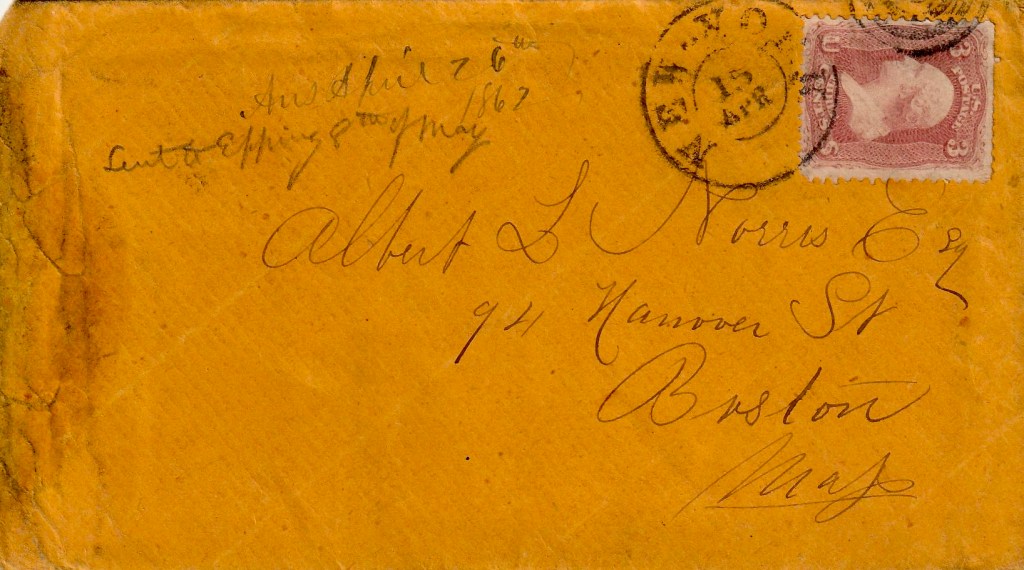
Mrs. W. W. King, Orwell, Addison county, Vermont

Camp in the field
January 11, 1863

Aunt Lois—if I may once more call you so, I seat myself to answer your letter received today. It found me not well but so as to be around and hope this may find you enjoying yourself better than I am.

Now Lois, I am agoing to talk plain with you. I am agoing to tell you just as I think speak my mind on the subject to a letter and if you don’t like it, why it is all just as well. Not that I wish to hurt the feelings of you or any other friends—if I may so call them—but that I wish to have you understand that there is not the least bit of honor in this unjust war. And more than that, it is a disgrace to the soldier that will fight in such an unjust and unholy cause. And there is no more signs of its being settled than there was a year ago. The thing of it is just here—there are men cooped up in cities perfectly out of danger that are making money. They are doing well. They cry, “Push on!” Well, we do and lose fifteen or twenty thousand men. [When] a dispatch is sent to Washington of our loss, it is looked over with a critic’s eye and then what do they say? “Why what is that? Twenty thousand men? That is nothing out of six or eight hundred thousand men. Oh, that is nothing.”
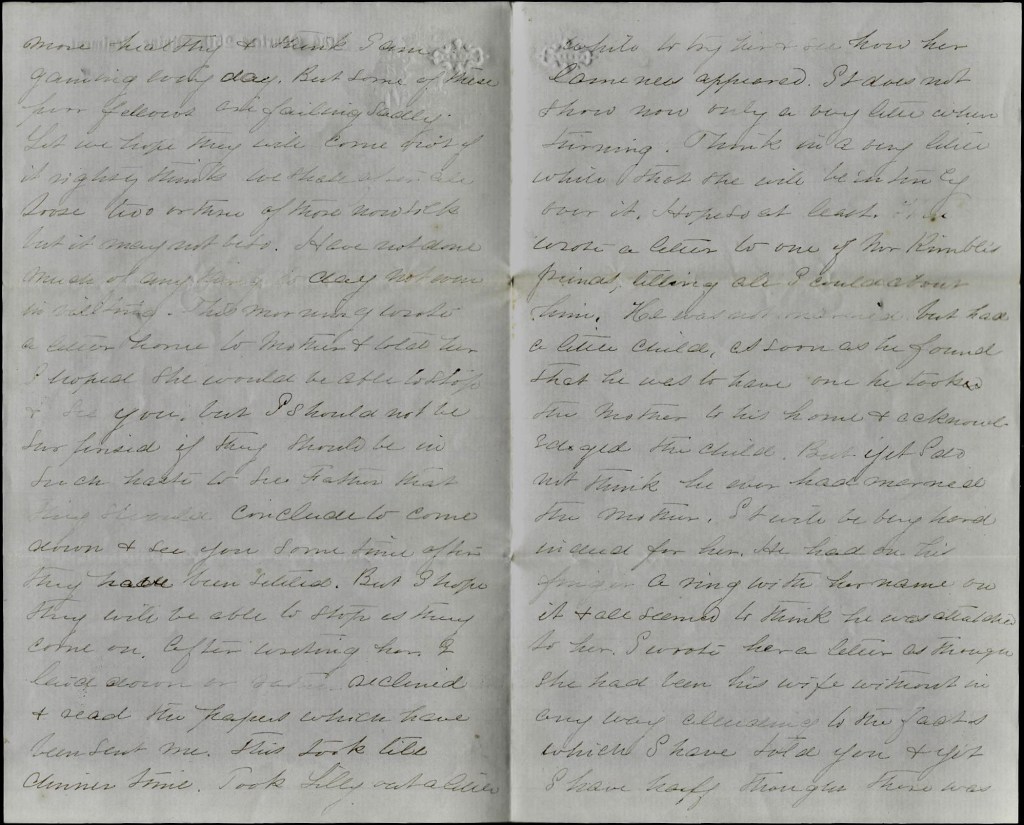
I suppose you had rather I would be murdered and cut up into pieces than see me get out of it any way only honorable. You don’t have to suffer the pain. You are alright. Go it down there in Virginia and you might as well say we are doing well enough here in Vermont. But I will ask you one question, what are we fighting for? It is impossible for you to answer that question unless you say to free niggers? That is all. There is no Union freed by it—no country saved. But there is an enormous amount of lives lost. But [that] is [apparently] of no account. That is what they enlisted for—to be shot. But never mind the soldiers. Save them cursed niggers, let it cost what it may in blood or treasure.

But there is one thing very certain—that is that it will not cost me much blood unless they catch me for I am bound to never go with them again near enough to the enemy to get shot. I had as leave they would catch me too as not. I don’t know as I have much to live for more than a wife. The rest seem to take up against me—some in one way and some in another. But it is all well enough. I can take care of myself without depending on Vermont. There is just as good people in Canada as there is in Vermont and they get as good living there as they do in the United States.

Nell said Mr. Catlin said he thought the war would be settled in three months. He made a sad mistake. He meant three years or longer perhaps. You may think I am rather hard on you but if I should write my mind, you would think this a very pliable letter. I am a full-blood Democrat myself and that is a rare thing in Vermont and it is not only me but all of the blue coat soldiers as you may call them (for you can’t call them Union—no, far from that, and every day on the decline).

“This murdering men for the fun of the thing don’t set on my stomach at all. But don’t never say any more about a man gaining any honor here I this unholy and unjust cause for there is none to be gained.”

–Jonathan W. Larabee, Co. H, 5th Vermont Infantry, 11 January 1863

Now you may take this letter as you will for I mean every word of it and more too. If I can’t play off and get my discharge, I shall go to Canada or start for there at least for I never can endure this long. This murdering men for the fun of the thing don’t set on my stomach at all. But don’t never say any more about a man gaining any honor here in this unholy and unjust cause for there is none to be gained. I can see it here but you only get the hearsay of the thing which probably sounds very well to you up there but here is where you can see it one day after another. If a man is sick and can’t go and falls out of the ranks, he is cashiered, his pay stopped, sent to Harper’s Ferry to perform so many weeks hard labor with ball and chain.

Well, I must close. Give my love to all the friends. This from, — J. W. Larabee

You have talked Nell out of sending clothes and it’s all right but I believe I can raise money enough to buy a suit of clothes when I get to some little town where they keep them.

1865: William Darwin Beckwith to Safford Silas Taylor

The following letter was written by William (“Will”) Darwin Beckwith (1841-1922), the son of Daniel Beckwith (1791-1851) and Sylvia Soules of Schuyler Falls, New York. Receiving an $800 bounty from his town for volunteering, Will enlisted on 31 August 1864 with Merritt Pierce at Troy as a private in Co. L, 1st New York Engineers to serve 1 year. At the time of his enlistment, he was described as a blue-eyed, black-haired farmer who stood approximately 5 feet 9 inches tall. He was appointed artificer on 1 May 1865. He mustered out of the regiment on 30 June 1865 at Richmond, Virginia.

After the war, Will married Josephine M. Norris (1847-1910) in 1867 and in 1871 moved with his family to Wisconsin. Shortly afterwards they moved on to Kansas. In 1901, the family moved to Fresno, California.

Will wrote the letter to his friend, Safford (“Saff”) Silas Taylor (1840-1895), the son of Silas Maxon Taylor (1799-1880) and Rebecca Perry (1801-1844) of Schuyler Falls, New York. Safford enlisted on 19 December 1863 at Schuyler Falls: mustered in as a private, 1st New York Engineers, Co. I on 19 December 1863 to serve 3 years. He was appointed artificer on 1 July 1864 and was mustered out of the regiment on 19 July 1865 at Hilton Head, South Carolina. He died in Schuyler Falls on 23 Jan 1895.

[Note: This letter is from the personal collection of Carolyn Cockrell and was transcribed and published on Spared & Shared by express consent.]

Transcription

Manchester [Virginia]
May 2, 1865

Friend Saff[ord Taylor],

Your most obedient servant has seated himself this fine afternoon (after a pleasant walk through Manchester) for the purpose of answering your last, which I received Sunday. Right glad I was to hear from you for it has been a long time that I have not had an opportunity to get letters for we have been on the march almost every day since the 24th of March. Finally, we brought up in Richmond a few day[s] ago feeling somewhat worn out but in good spirits. I will give you a short history of our journey.

March the 24th we started with our pontoon train from Broadway Landing direction northeast, bound for the Chickahominy River which we reached the second day about noon and laid a bridge over it before dinner for Sheridan to cross over with his cavalry. But we learned that night that he had crossed the day previous three miles below us so we dismantled our bridge and started back following Sheridan to the extreme left, south of Petersburg. We built a bridge over Hatcher’s Run with logs about fifty rods from where they were fighting [but] they could not see us—we were in the woods. We worked most all night on it.  

The next morning the Rebs had to leave [as] our troops [were] in hot pursuit and Co. L with, our pontoon train (consisting of forty wagons, eight mules to a wagon), bringing up the rear. You may guess there was some excitement along the road. We would march all day—sometimes all night—no one thinking of being tired as long as we were after Lee. Our troops drove the Rebs through Farmville about April 7th noon & they burned the bridge after them. They were just over a hill making preparations to shell the village which is nearly as large as Plattsburgh. We came on with our train a little after dark and throwed a bridge over to let the artillery cross and the Potomac Army. Their pontoon train got stuck in the mud but came on the next morning and relieved us.

On we went through the mud and rain towards Lynchburg. Lee was captured at Clover Hill, 1 some eighteen or twenty miles from Lynchburg. I have been within a mile of where he was captured.

April the 10th we started back, bound for Richmond. Our mules were so tried and worn out we could not march but 10 miles a day. The roads were getting worse every day. Sixteen of our mules fell in the traces [and] we were obliged to shoot them. At Burkeville, some 82 miles from Petersburg, we put our train on board the cars [and] went to Petersburg, spent one night there, then on to Richmond. Our flag now gleams in the morning beams from many a spire in Richmond. We have got through marching on. Next, we will go home from Richmond.

We are now quartered on the south side of the river a little below Manchester. Just across the river stands Libby Prison and Castle Thunder. We have a fine view of them from our camp. I have been into Libby. It is a hard looking place. I have not room to describe it. I have been all over the city. The upper part is splendid. The business part is nearly all burned down.

The two pontoon bridges laid across the James River between Richmond and Manchester in April 1865 (Library of Congress)

We have two pontoon bridges over the river. We have got thirty new recruits for our company—a pretty large company.  A part of the company started last Thursday on another expedition, not knowing where. The rest of the company and Co. M and H are to build a bridge here. We are at work getting timber there now. Merritt [Pierce] is all right. He says you owe him a letter. [Napoleon] Flanders has gone on that expedition.

No appearance of war here. I think the fighting is over. We will have a good time yet playing with the girls when we get home. That time I think is not far distant. We will probably meet before we are discharged. Yours, if you can read it. — Will


1 Originally the village of Appomattox Court House was known as Clover Hill. It was a small settlement with a few houses around the tavern, a stopping-off point on the main Richmond-Lynchburg Stage Road. When the county of Appomattox was formed in 1845, Clover Hill was chosen as the county seat and renamed Appomattox Court House. The next year the county courthouse was built. Slowly the settlement grew into a village of homes, stores, and lawyers’ offices. Among the original structures still standing from 1865 are the Clover Hill Tavern, Meeks Store, Woodson Law Office, Peers House, Mariah Wright House, and Jones Law Office. (National Historic Park)

1864-65: Safford Silas Taylor to Merritt Pierce

Safford S. Taylor (Ancestry)

The following letters were written by Safford Silas Taylor (1840-1895), the son of Silas Maxon Taylor (1799-1880) and Rebecca Perry (1801-1844) of Schuyler Falls, New York. Based on letters, he was probably a member of West Plattsburgh Baptist Church with Merritt Pierce prior to enlistment.

Safford enlisted on 19 December 1863 at Schuyler Falls: mustered in as a private, 1st New York Engineers, Co. I on 19 December 1863 to serve 3 years. He was appointed artificer on 1 July 1864 and was mustered out of the regiment on 19 July 1865 at Hilton Head, South Carolina. He died in Schuyler Falls on 23 Jan 1895.

Safford wrote all three letters to his friend, Merritt L. Pierce of Morrisonville, Schuyler Falls, Clinton county, New York. Merritt was 22 years old when he enlisted on 31 August 1864 at Troy as a private in Co. L, 1st New York Engineers. 

[Note: These letters are from the private collection of Carolyn Cockrell and were transcribed and posted on Spared & Shared by express consent.]

Letter 1

Elmira, [New York]
January 18, 1864

Friend Merritt,

I have a few moments to spare and so I will pass the time in talking with you. Talking! I wish I was where I could have a little talk with you, but never mind. I got here all safe three weeks ago last Thursday night and early the next morning they detailed me to act as clerk in Headquarters at Barracks No. 3. 1 Well, I stayed there in those cold barracks nights and worked in the office daytimes until one week ago today. One week ago last Friday, the officer who has the charge of receiving recruits moved his quarters down here into the city and last Monday the adjutant in command of the barracks sent me down to his office where I am now. I don’t know how long I shall have to remain here—probably till spring and perhaps longer as they have taken my name from the list of those to be sent off.

I have got a grand, good place as far as that is concerned and am having first rate times. There are 4 clerks in this office and two more in the office overhead. They are all good fellows. One of them is the son of Elder Waldron’s that preached at Morrisonville last summer. We sleep in a little room that opens into our office. We have a cook detailed to cook for us in the back room of the office and live first rate. I have a pass and am allowed to go where I am a mind to. We don’t have to write more than four hours a day on an average. The rest of the time we have to ourselves. Young Waldron is a good chess player. He has bought a set of chess men and we have some good games. I have played some with our lieutenant too.

Yesterday I went to meeting for the first time. I had the pleasure of hearing the Rev. Thomas Beecher who preaches in this city. He is a half-brother of Henry Ward Beecher. So now you see I am pretty comfortably situated.

I suppose you have given up all idea of enlisting before this. I wish I could be there a week or so with you, but I should want to come back again. I saw R. W. Caster here the other day. He said that you and Will [Beckwith] had both enlisted but I thought he must be mistaken. The other boys that came have not left yet and will not for some time probably. Steve is in the cook house at Barracks No. 3. He will probably be left there.

We have all kinds of men here in camp and the most wickedness I ever saw in my life. The night before I left Barracks No. 3, there were three men in the barracks I stayed in [who] had delirium tremens….One man in the barracks cut his throat the other night. He was scared because some of the boys cried out that the rebels were coming.

Safford S. Taylor, Co. I, 1st N. Y. Engineers, 18 January 1864

We have all kinds of men here in camp and the most wickedness I ever saw in my life. The night before I left Barracks No. 3, there were three men in the barracks I stayed in [who] had delirium tremens. But it is all still and nice here. One man in the barracks cut his throat the other night. He was scared because some of the boys cried out that the rebels were coming.

Have you heard from Nel[son Bullis] since I came away? When you write, give me his P. O. address. Give my respects to all of the young folks, old folks, and little folks. Now write as soon as you get this and give me all the news. Direct to Elmira, Chemung County, New York.

Yours Truly, — Safford

1 Elmira Prison was originally a barracks for “Camp Rathbun” or “Camp Chemung”—a key muster and training point for the Union Army. The 30-acre site was selected partially due to its proximity to the Erie Railroad and the Northern Central Railway, which crisscrossed in the midst of the city. The Camp fell into disuse as the war progressed, but its “Barracks No. 3” was converted into a military prison in the summer of 1864. It was the prison holding the largest number of Confederate POWs. Its capacity was 4,000, but it held 12,000 within one month of opening. A different source says that Camp Rathbun had a capacity of 6,000 recruits, but that it was turned into a prison for 10,000 and the Union Commissary General was given just 10 days to make it happen. [Wikipedia]


Letter 2

Hilton Head
July 16, 1864

Friend Merritt,

Yours of the third inst. was received yesterday and I will now answer it so as to send it by the return mail. I was glad to hear from you. You sent me a good long letter and gave me lots of news. I want you to do just so again. You have probably received my other letter which I wrote to you in answer to the one you sent me at Elmira before this.

Since I wrote last, I have been quite sick—not so but I was up and around but so that I couldn’t do any duty. I was sick over two weeks with the fever, but the doctor broke it up at last.

Since I wrote, there has been some fighting down here. General Foster left here with a lot of troops the 1st of July bound on an expedition. He went up on James Island and gave the Rebs a big scare. His object probably was to draw troops from the army under Johnson and to let the Rebs know that we were alive down here. There were some of our men went. I wanted to go with them but was sick and the doctor wouldn’t let me go. There were but few of our men killed—none of our regiment. I think there will be another expedition before long. General Foster is not a man that remains idle lone when there is a chance of making raids.

Much obliged for that picture. I think it is a very good one. When you get a good chance, borrow some (when they don’t see you) of those girls and send me. I will take good care of them and send them back to you if they make any fuss, but I guess they won’t. Oh! Who do you think I came across here last night, downtown. Why Harv Dodge. 1 If I wasn’t rather surprised to see him here. I supposed he was in Sherman’s army in Georgia, but it seems he was discharged there. He is clerk for the Chief Paymaster of the Department and I guess is doing pretty well. We had quite a talk about old times and about the folks at home.

I wish you could be here a week or two. I would like to go around with you and show you something of Southern life. The longer I stay here the more I feel contented.

Well, Merritt, I had to stop writing and draw rations. I have got through with that, and also the issuing of the rations to the companies, and having just finished eating a piece of large watermelon, I feel first rate. I wish you could see some of the watermelons that the darkies bring in here to sell. It would make your mouth water. They bring in some of the largest melons I ever saw.  We get some extras now days. For instance, a man came along today and gave the regiment a lot of turnips, beets, and pickles. He said they were furnished by New York State. Each company of the regiment is furnished with ice every morning by the Sanitary Commission, so we get all the ice water we want to drink.

I expect a box today from home and won’t I have a feast if it comes. Won’t you come and have supper with us? We are going to have potatoes, beef steak, green corn. Mind, we don’t always live as well but some of our boys went huckleberrying today and as they didn’t find any berries, they hooked some corn. 

I should [have] liked to have been with you a fishing up at the lakes. Our boys go fishing with a seine every few nights close by here. We have nice times bathing here in salt water. It is a nice place—a sandy beach. We don’t go out far for fear of sharks. I saw a dead one on the shore the other day, nearly six feet long.

I want you to take care of yourself and as more as you can get time to do. I hear that you and Carrie Finn are getting pretty thick (the idea!). I’ll tend to you, old fellow, if that is your play. I am sorry to hear about Nel[son Bullis]. I hope it may prove to be a false report. But I must close. Write me a good long letter soon and tell me about everybody. My best respects to all the old friends. I am, yours truly, — Safford

Sunday morning,

Well, Merritt, how are you this morning? I am well–wish I were there to go to meeting with you this morning. I have just been down on the beach and had my picture taken with the rest of the company. The three companies all had their pictures taken by companies this morning. Our box came last night. Cyrene and Steve are down from Beaufort today. Cyrene sends his respects to you. I am going to write to Will this forenoon, but I am afraid I shan’t be able to get it in before the mail closes.  Write soon, — Saff

1 Harvey K. Dodge, b. 1839, was a sergeant in Co. G, 1st Wisconsin Infantry. He enlisted in August 1861. He was the son of Rev. Harvey B. Dodge and Eliza Ann Beckwith, a sister of Edgar’s mother.


Letter 3

Camp 1st New York Volunteer Engineers
Savannah [Georgia]
May 29, 1865

Friend Merritt,

Your letter, long looked for, has arrived at length. Something is the matter with the mail for letters of last March are just arriving, but never mind. I hope the time is not far away when we will be so situated that we will not have to wait two months after asking a question to get an answer to it.

Well Merritt, we have all been anxious to hear from you fellows up there to know when you are going home, for I suppose we will go out together. I don’t know where to direct this letter to but will direct to Washington as I think it will be sent to you from there. The last northern papers contain an account of the Great Review at Washington. I wish I could have been there with them.

We still remain at Savannah. The company has but a very little to do—only work 4 hours a day. It is fine weather here now. Some hot days but they don’t trouble me much as I don’t have to work in the sun. I wish you could be here to go blackberrying with me. I have been a number of times. You spoke of going fishing. I hope we may live to have a good many more days of piscatorial sport in the wilds of Hardscrabble and Rand Hill.

There has been a great many changes as you say and many of our companions and friends have gone never to return. You have heard me speak of Elder Waldron’s son that was with me at Elmira.  I received a letter last week stating that he had died in a Rebel Prison is this state. He was a fine boy. 1 Two of our company have lately died—James Leonard and Horace Van Aranam. The latter was from Ellenburg and was a tent mate of mine. Steve Stickle is at home on furlough. We expect him back this week.

All kinds of vegetables are to be had in the market for the money but “that’s what’s the matter” for we haven’t been paid for 8 months. Apples and plums are ripe, and peaches soon will be.

You have had a chance to see something of war lately I suppose. I wish we would be ordered to join you in Virginia, but I don’t know what they intend doing with us. When you write I want you to tell me what the prospect is of going out and whether we will have to join you and what the regiment are all doing and all about it.  I haven’t had any news from home for a long time. I expect Steve [Stickle] will bring some. Jeff Davis passed through here the other day.

But I must close. Tell me where to direct in your next. Write soon and direct to Hilton Head, South Caroline and much oblige.

Yours truly, — S. S. Taylor

1 John O. Waldron served in the 14th New York Heavy Artillery. He died at Andersonville in 1864.

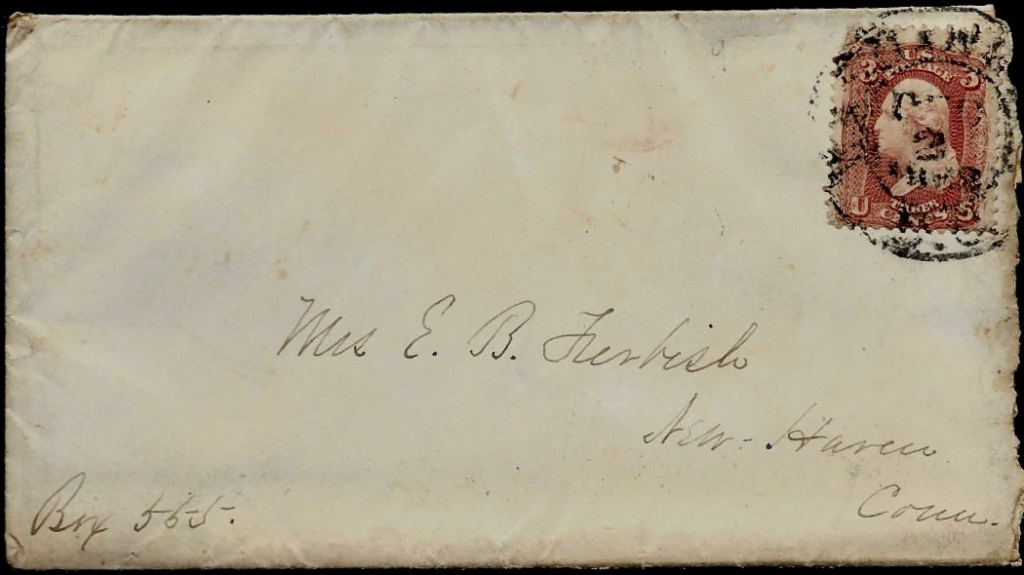
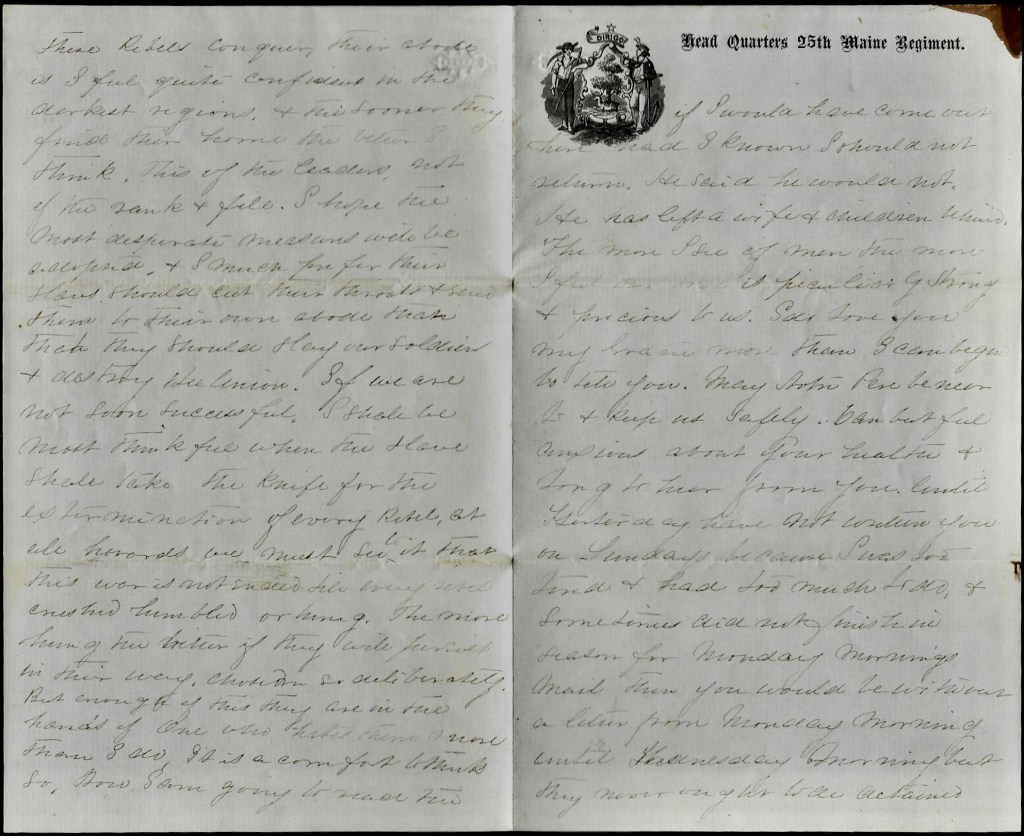
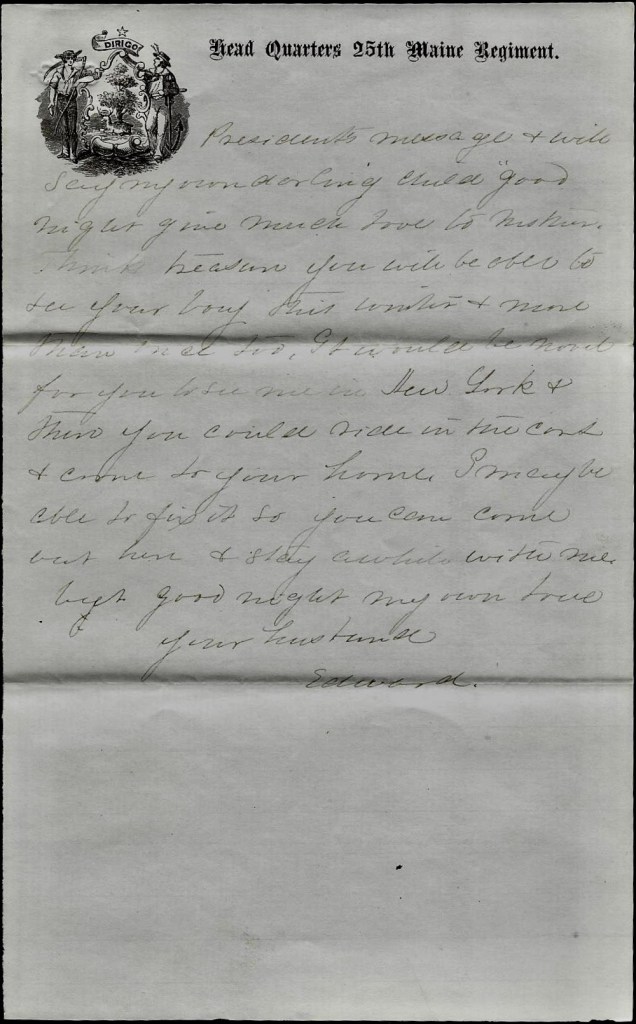
1865: Edd to Friend Mary E. M.

There is insufficient personal detail in the following letter to attribute it to any particular regiment, let alone any particular soldier. Numerous Union regiments were dug in near Petersburg where the city had been under siege for more than half a year by this point in late February 1865. The letter was written by a Union soldier named Edd (Edward) to his lady friend Mary who had the initials “M. E. M.” Edd speaks of the Union troops firing a salute on 24 February 1865 to celebrate the fall of Wilmington, North Carolina—the last remaining supply port for the Confederacy. In response, the Rebels in Petersburg unleashed a barrage of shells into the Union lines “quite hard.” Edd also speaks of deserters and a Peace Commission in Richmond.

Bomb-proof quarters in Fort Sedgewick in front of Petersburg (LOC)

Transcription

Before Petersburg, Virginia
February 25th 1865

My dear Mary,

The times still passes off slowly yet but is on account of its being so unpleasant for it has rained nearly all the time since I got back.

We fired a salute last night for the capture of Wilmington and its surroundings. Oh, there is another peace Commission gone to Richmond but for what purpose, we have not yet heard. I hope they will do something so as to settle the war for I don’t think I should cry if it should end—not bad at any rate. The Rebs after we fired the salute last night opened on us quite hard but we would not reply to them. But I guess we didn’t get ourselves under cover anywhere. I reckon I did not for I got to the magazine and stayed until it was over. I’ll bet I didn’t wish myself at home any, Oh no!, where I was the week before. Although we all enjoyed the shelling very much, they done but little damage. Some of the shells went through some of the bomb proofs and some striking the ground and bursted which reminded me of the track we made the time we got out of the road coming home from Jane’s.

There is no news except a lot of the Rebs are deserting every night when it is dark. There was 560 came in night before last on the lines. As there is nothing more, I will close by sending my best wishes to all.

My truest love and a kiss to you. I remain your kind, true friend, — Edd

[to] M. E. M.

Please write again.