My passion is studying American history leading up to & including the Civil War. I particularly enjoy reading, transcribing & researching primary sources such as letters and diaries.
I could not find an image of George but here is one of Ira H. Felch who also served in the 39th Massachusetts Infantry (Excelsior Brigade Store)
This letter was written by George R. Harlow (1838-1908) who enlisted as a private in Co. E, 39th Massachusetts on 12 August 1862. In this letter, datelined from the regiment’s encampment near Cedar Mountain in January 1864, George imagined that the fighting might soon be over. Little could he have realized the fight left in the Confederate army. Just after his promotion to corporal, he was wounded slightly in the fighting at Laurel Hill, Virginia, at the beginning of Grant’s Overland Campaign and then again quite severely on 18 August 1864 in the fight for control of the Weldon Railroad near Petersburg. Following the amputation of his right arm, George was sent to a hospital in Washington D. C. where he was mustered out of the regiment for disability on 17 March 1865.
George was the son of Eldad Hitchcock Harlow (1803-1883) and Almira Clark (1807-1890) of Westminster, Vermont. He wrote the letter to his sister, Julia Elizabeth Harlow (1840-1869), who married Edward R. Taplin (1843-1872) in 1867. George died in Chattanooga, Tennessee.
To read other letters by member of the 39th Massachusetts I have transcribed and posted on Spared & Shared, see: Julius Marshall Swain, Co. B, 39th Massachusetts (3 Letters) Joseph John Cooper, Co. F, 39th Massachusetts (1 Letter) Benjamin Curtis Lincoln, Co. G, 39th Massachusetts (20 Letters)
Transcription
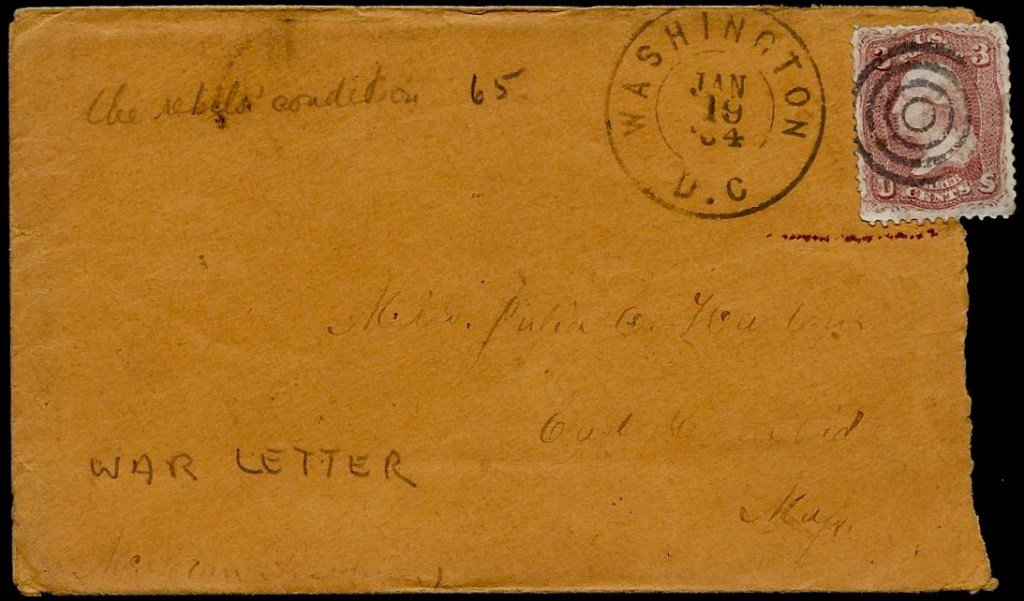
Addressed to Miss Julia E. Harlow. East _____, Mass. Postmarked January 19, 1864
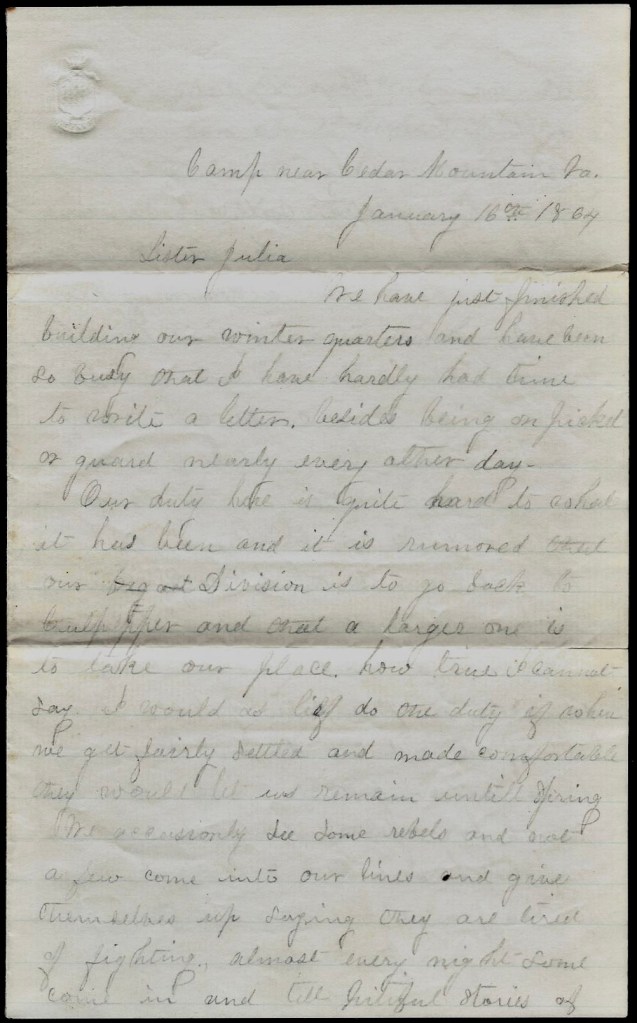
Camp near Cedar Mountain, Va. January 16, 1864
Sister Julia,
We have just finished building our winter quarters and have been so busy that I have hardly had time to write a letter besides being on picket or guard nearly every other day. Our duty here is quite hard to what it has been and it is rumored that our Division is to go back to Culpeper and that a larger one is to take our place. How true, I cannot say. I would as leave do the duty [here] if when we get settled and made comfortable, they would let us remain until spring.
We occasionally see some rebels and not a few come into our lines and give themselves up saying they are tired of fighting. Almost every night some come in and tell pitiful stories of their army. They all seem to tell one story and they are not half fed or clothed. Some of those that come in are barefooted without overcoats or blankets to make themselves comfortable. The other night a captain come in and said his whole company wanted to come in and would as fast as they could get away. Surely if such is the state of their army as represented by them, may we not look for brighter days to come? They all seem to think the fighting is over or will be before spring.
We have a most beautiful camp situated in fine view of Cedar Mountain battlefield and the distant Blue Ridge, have very comfortable houses large enough for eight persons only. We have had a little snow but is nearly all disappeared and now are having fine weather for a few days.
Dr. Tyler did not write anything particular about Kirk stopping there this winter. He thought as a general rule outdoor life was the best for persons afflicted as he was. Henry wrote me that Charles had hired the house where Frank Clark lived and was to take Mr. Ranney’s farm to carry on this summer.
Will you please copy those lines in that book of poetry I let you have. The title, I believe, is “Thoughts at the Lord’s Table” and send me when you have an opportunity. If not all of them, a part.
Have you had your winter’s sleigh ride yet? We have had a little snow but has all disappeared and is quite muddy in the middle of the day. Last night I was on duty and do not feel much like writing but must write Henry a few lines.
I could not find an image of George but here’s an unidentified Rebel believed to have been a cavalryman (Larry Lingle Collection)
This letter was written by Pvt. George R. Adderton (1830-1893) of Hills Store, Randolph county, North Carolina. He enlisted on 23 March 1863 and mustered into Co. K, 5th North Carolina Cavalry. George experienced periods of time when he was not able to do duty due to sickness and others when he was without a horse. As far as we can learn, George was otherwise with his regiment during their very active campaigns in 18663-65.
Though he could not know it at the time, war’s end was just around the corner even though he yet held out hope for a Southern Independence. For George, any prospect for peace was “knocked in the head” when the Yanks made it clear that slavery would be abolished. Presumably George was with his regiment in their last few battles at Five Forks, Scott’s Crossroads and Battle of Namozine Church. Only 5 of the enlisted men actually surrendered at Appomattox; most of the cavalry cut their way out and escaped surrender.
[Note: This letter is from the personal collection of Richard Weiner and is published by express consent on Spared & Shared.]
Transcription
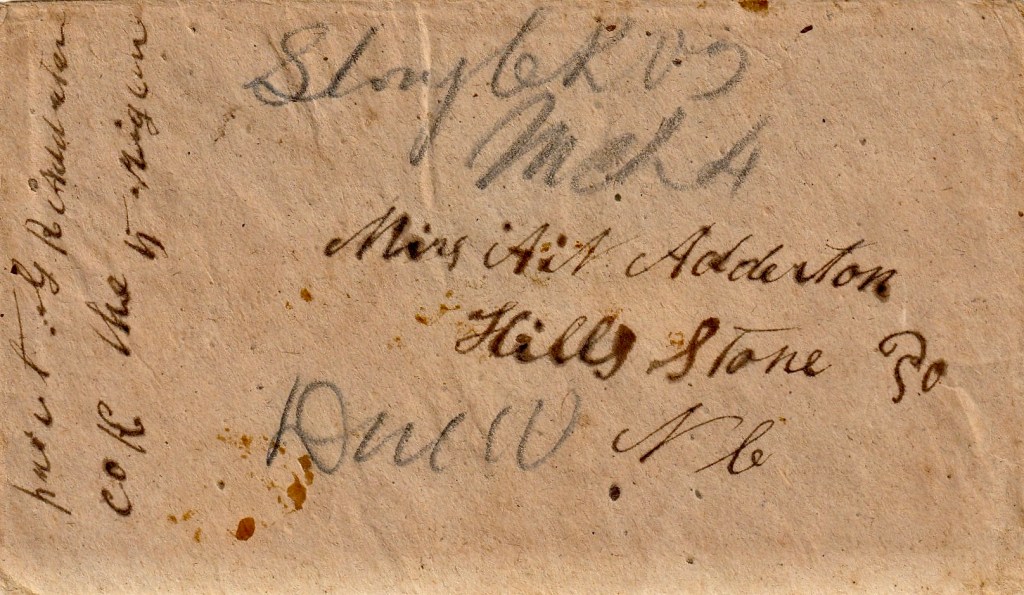
Camp near Stoney Creek, Virginia March 2nd 1865
Dear wife, It is through the kind Providence of God that I am permitted this evening to drop you a few lines to let you all know that I am well at present. I hope when these few lines come to hand, they may find you all well at home.
I hant got any news to write. P. T. Kearns is well and hearty. I hant had a letter from home this week. I want to hear from you all. I hear that all you in North Carolina are all scared to death about the Yankees. I don’t think there is much danger. I recon the home guard is scared to death but I think they will hear the elephant bellow before before this war comes to a close.
I hear there is a good many desertions in Randolph county but I think they will be caught and punished. The times look gloomy but I think we will gain our independence yet. You wrote something about the slaves. They have knocked that in the head. They aren’t going to take out.
I have drawn a very good overcoat. In closing, write soon.
Frederick K. Ployer, Co. D, 187th Pennsylvania (History of First Battalion Pennsylvania six months volunteers and the 187th regiment Pennsylvania Volunteers, page 190)
This letter was written by 19 year-old Frederick Kissel Ployer (1844-1920), the son of Jacob Ployer (1820-1897) and Sophia Kissel (1822-1896). Prior to his enlistment, Frederick was teaching school in Frankford township, Cumberland county, Pennsylvania. When he enlisted at Chambersburg on 4 February 1864 in Co. D, 187th Pennsylvania Infantry, he was described as standing 5 foot 9 inches tall. served in the field from May, 1864, to October of the same year, in this period participating in the Battle of Cold Harbor, and all of the engagements of the 5th Army Corps during the siege of Petersburg. His regiment was very active in the operations carried on at the Petersburg & Norfolk railroad, June 18 and 19; Jerusalem Plank Road, June 20; Weldon railroad, Aug. 18, 19 and 20. When his regiment was ordered to Philadelphia, he was detailed for special duty at headquarters. Department of the Susquehanna, and was ordered to report to Capt. Francis H. Wessels, Judge Advocate of this department, at Harrisburg. There Mr. Ployer was engaged in clerical work with the military commission in the trial of the Columbia County Conspirators. From the conclusion of this work until the muster out of his regiment, at the close of the war, he continued as record clerk in the Judge Advocate’s Office. He was honorably discharged August 3, 1865.
He married Sarah A. Lloyd January 18, 1870, and fathered Eleanor I. (b. 12/12/72). He also worked for the Internal Revenue Service and for a time was a clerk in an Altoona machine shop before becoming a bank cashier and financier. He served as one time commander of Mechanicsburg’s Zinn Post No. 415, G.A.R., and died in Carlisle Hospital from “hypostatic pneumonia with myocarditis” with “fractures of leg, clavicle & ribs” from an “accident” when he was “struck by an automobile.”
Transcription
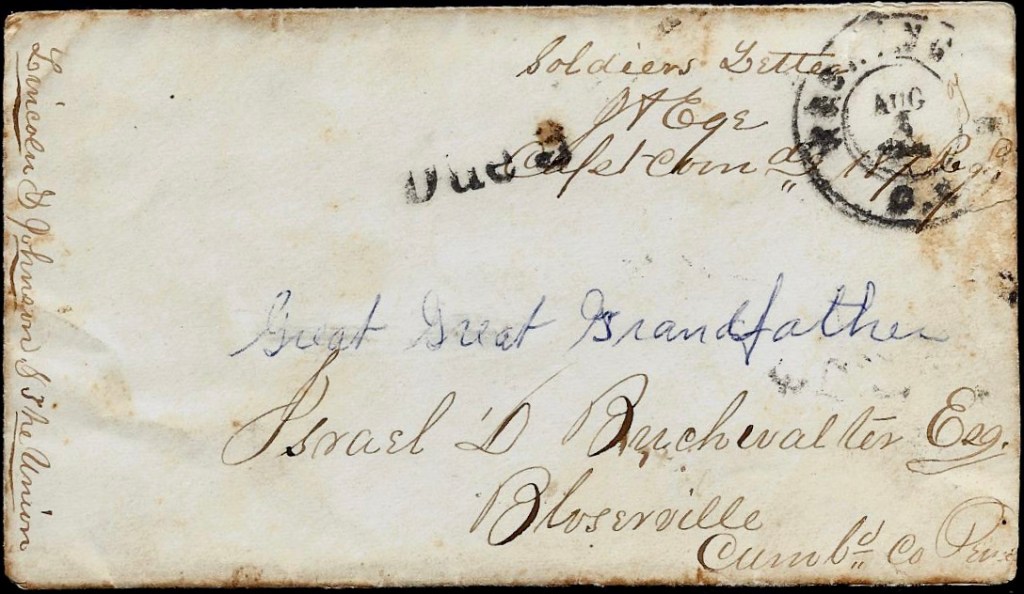
Addressed to Israel D. Buchwalter, Esq., Bloserville, Cumberland county, Penn. “Lincoln & Johnson & the Union” [Not sure if envelope goes with letter.]
Line of battle near Petersburg, Va. July 5th 1864
Friend Daelhouser,
It is with the greatest of pleasure that I embrace the present opportunity of addressing you a few lines, notwithstanding the difficulties under which I write, tho facilities for writing are very poor and the writing no doubt will be accordingly. I am well and enjoying good health and I sincerely hope these lines may find you and family enjoying the same kind blessing.
The weather here still continues hot and dry. Look where you will and you see nothing but dust, dust, dust. But still it is not near so warm as it was last week as there is a good cool breeze blowing.
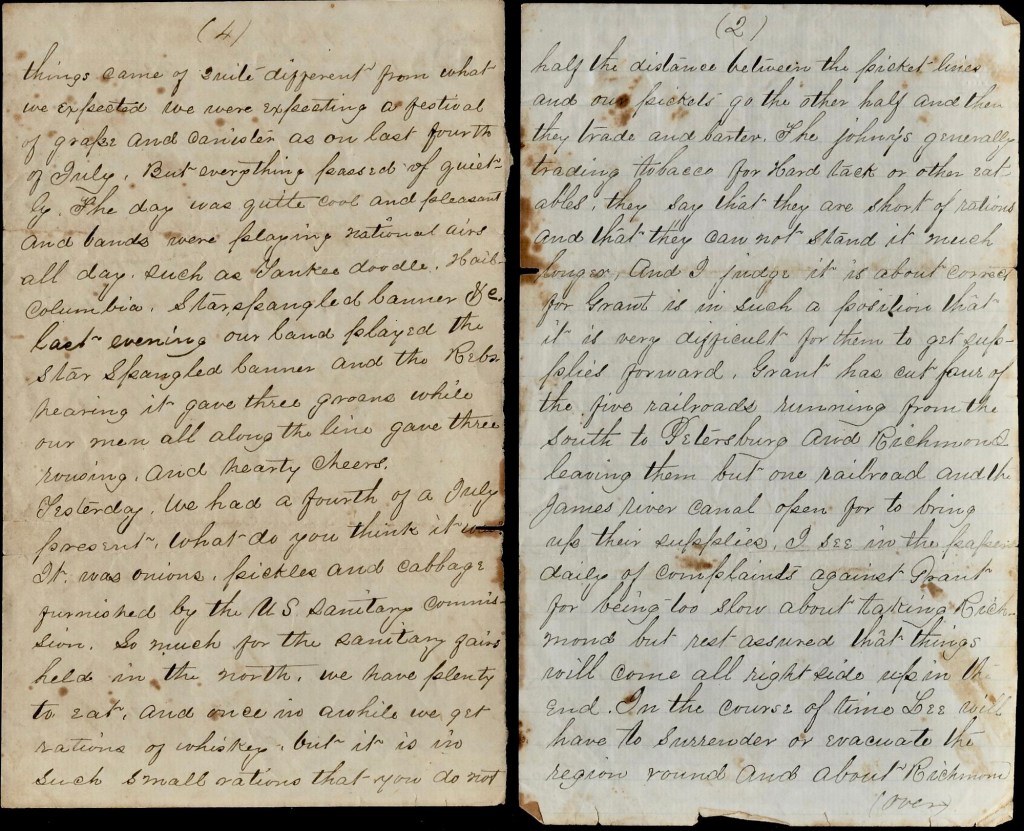
For the last week things have been very quiet in our front. The pickets of both sides seem to be taking a good rest. The pickets are very sociable with one another. The Rebs come half the distance between the picket lines and our pickets go the other half and then they trade and barter—the Johnnies generally trading tobacco for hard tack or other eatables. They say that they are short of rations and that they can not stand it much longer. And I judge it is about correct for Grant is in such a position that it is very difficult for them to get supplies forward. Grant has cut four of the five railroads running from the south to Petersburg and Richmond leaving them but one railroad and the James River canal open for to bring up their supplies. I see in the papers daily of complaints against Grant for being too slow about taking Richmond but rest assured that things will come out all right side up in the end. In the course of time, Lee will have to surrender or evacuate the region round and about Richmond and go farther south, and if he gets started once, we will take him much faster than he will like to go.
All is wanted is for the people to stand steadfast and uphold the government and be of good cheer and in my estimation matters will soon come to a successful issue. I suppose the “Copperheads” about your neighborhood are quite indignant at the nomination of Lincoln and Johnson. I saw a copy of the American Volunteer printed by the arch-traitor Bratton. He kind of goes it pretty strong. I suppose he would like to have his office destroyed again by some of Uncle Sam’s bluecoats. Just let him go on. He will rage and fume worse next November when he hears that Lincoln and Johnson has been elected by an overwhelming majority.
I will now tell you about the the 4th of July in the army. Things came off quite different from what we expected. We were expecting a festival of grape and canister as on last 4th of July, but everything passed off quietly. The day was quite cool and pleasant and bands were playing national airs all day such as Yankee Doodle, Hail Columbia, Star Spangled Banner, &c. Last evening our band played the Star Spangled Banner and the Rebs, hearing it, gave three groans while our men all along the line gave three rousing and hearty cheers.
Yesterday we had a Fourth of July present. What do you think it was. It was onions, pickles, and cabbage furnished by the U. S. Sanitary Commission. So much for the sanitary fairs held in the North. We have plenty to eat an once in awhile we get rations of whiskey, but it is in such small rations that you do not get enough to wet your eye. We get about half a gill at a time.
Our loss in the regiment so far will not exceed 200 men killed, wounded, and missing. A great many are sick and the regiment has been greatly decimated by disease. Out of 1100 men, we have about 550 men for duty. The old troops do not suffer so much from sickness as they have become used to it.
Alex Kennedy, Abraham Waggoner, and Joseph Heffelfinger are well. This morning I saw Edw. Wilders.
I will now bring my letter to a close hoping to hear from you soon. Give my love and respects to all friends but reserve a due portion for yourselves.
A paper once in awhile would be gratefully received if you can send me one—that is, one of our home papers, as we can buy the dailies here every day. Write soon.
Yours truly, &c. — F. K. Ployer
Direct to F. K. Ployer, Co. D, 187th Regt. P. V., 1st Brigade, 1st Division, 5th Army Corps, Washington D. C.
Tell Father to send me some letter paper as I am entirely out.
This incredible letter was written by 2nd Lt. John Hawthorn (1817-1882) of Fayette county, Iowa, who enlisted on 5 September 1861 as a sergeant in Co. F, 9th Iowa Infantry. He was promoted to 1st Sergeant on 11 March 1862, and finally to 2nd Lieutenant on 6 February 1863. He survived the war and mustered out on 31 December 1864 after making the march to Savannah, Georgia—a proud veteran of the Bloody 9th whose record of service was arguably unmatched by that of any other regiment in the state.
I could not find an image of John Hawthorn but here is one of John W. Niles who served with him in the 9th Iowa, first as a sergeant and then as captain of Co. B. (Photo Sleuth)
John was married to Hannah White (1825-1880) in Wiscassett, Maine, on 9 May 1848. In the 1850 US Census, he was enumerated as a farmer in Bloomingdale, Dupage county, Illinois. In 1860, John & Hannah had relocated to Westfield township, Fayette county, Iowa. In 1870, John and Hannah were living in Lodi (Maple Park), Kane county, Illinois, where he was employed as agent for the gas works. They were enumerated in the household of his father-in-law, Solomon White (1801-1879), a local merchant.
Hannah died in 1880 and John died in 1882; both are buried in Springfield Cemetery, Garnet, Kansas. Her grave marker bears the name, “Hawthorne” though the name has been found in records as Hawthorn, Hathorn, and Hawthorne.
Transcription
Camp 9th Iowa East Point, Georgia September 26th 1864
Dear Niece Susie,
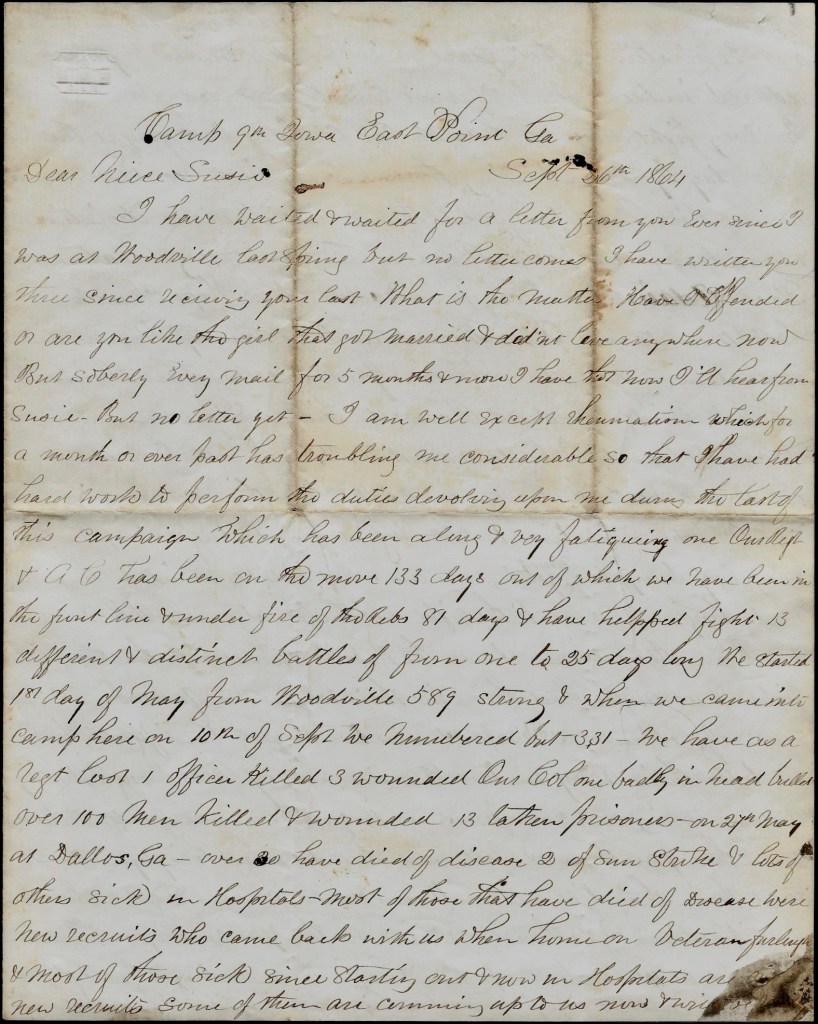
I have waited & waited for a letter from you ever since I was at Woodville [Alabama] last spring but no letter comes. I have written you three since receiving your last. What is the matter? Have I offended or are you like the girl that got married & didn’t live anywhere now? But soberly, every mail for five months & now I have thought now I’ll hear from Susie—but no letter yet.
I am well except rheumatism which for a month or over past has [been] troubling me considerable so that I have had hard work to perform the duties devolving upon me during the last of this campaign which has been a long and fatiguing one. Our regiment & Army Corps has been on the move 133 days out of which we have been in the front line & under fire of the Rebs 81 days and have helped fight 13 different and distinct battles from one to 25 days long.
We started the first of May from Woodville 589 strong and when we came into camp here on 10th of September, we numbered but 331. We have as a regiment lost 1 officer killed, 3 wounded—our Colonel [being] one, badly [wounded] in head [by a] bullet; over 100 men killed and wounded, 13 taken prisoners on 27th May at Dallas, Georgia. Over 30 have died of disease—2 of sun stroke, and lots of others sick in hospitals. Most of those that have died of disease were new recruits who came back with us when home on Veteran’s furlough & most of those sick since starting out & now in hospitals are all new recruits. Some of them are coming up to us now & will be ready for the fall campaign. Yesterday, 112 non-veterans mustered out—expiration of three years on 23rd—so now we are very much reduced indeed. But what we have left are good grit.
An unidentified member of Co. E, 9th Iowa Infantry—a regiment much reduced after the Atlanta Campaign but those left were of “good grit.” (Dale Niesen Collection)
In every fight, siege, &c. have we—the [9th]—come off best, fought the Rebs day by day, driving them inch by inch as it were from Tunnel Hill near Ringgold, through all their various deviations & wanderings to Dalton, Resaca, Calhoun Ferry, Allatoona Pass, Adairsville, Kingston, Dallas, New Hope Church, Lost Mountain, Pine Mountain, Big Shanty, Kennesaw Mountain, Marietta, Nick-A-Jack Creek, Chattahoochie River at RR Bridge, and at Roswell. Then at Stone Mountain, Decatur & towards Atlanta on east 20, 21, 22 Peach Orchard & Creek, on west and north by Hooker on 20 & 21st too, then at Eutaw Church on 28th July from which time to 26th August we fought, dug, and sharpshot with [the Rebels] every day, every day almost getting someone in [our] regiment killed or wounded.
Then we made the flank move to the right, cut the Montgomery Railroad near Fairburn, then on 30th drove the Rebs 6 miles with three sharp little fights & at night had them in their works near Jonesboro 22 miles south of Atlanta 31st & September 1st were two days of hard fighting but we broke their army in two, 8 miles above Jonesboro near Rough & Ready Station, taking over 2,000 prisoners, 14 guns, and on the eve of September 1st, drove them through Jonesboro. [On the] 2nd, [we] followed them to near Lovejoy Station & held them there till all our teams could collect & get within the fortifications of Atlanta when on the 7th we began to fall back slowly & on the 10th, we brought up here and have been resting & fortifying &c. as best we could & enjoying ourselves hugely on hard tack and bacon. No fresh beef.
We have given the Rebs several good killings & they say that one more good large killing, or two small ones, would be all they could stand. Sheridan in the Shenandoah Valley is doing glorious work too. Old Farragut has acted well his part. Grant has fought some heavy and bloody battles though not with that success we had hoped for but we do not despair for him. He will hoe his row out yet, we believe, and compel Lee to cut bait or fish.
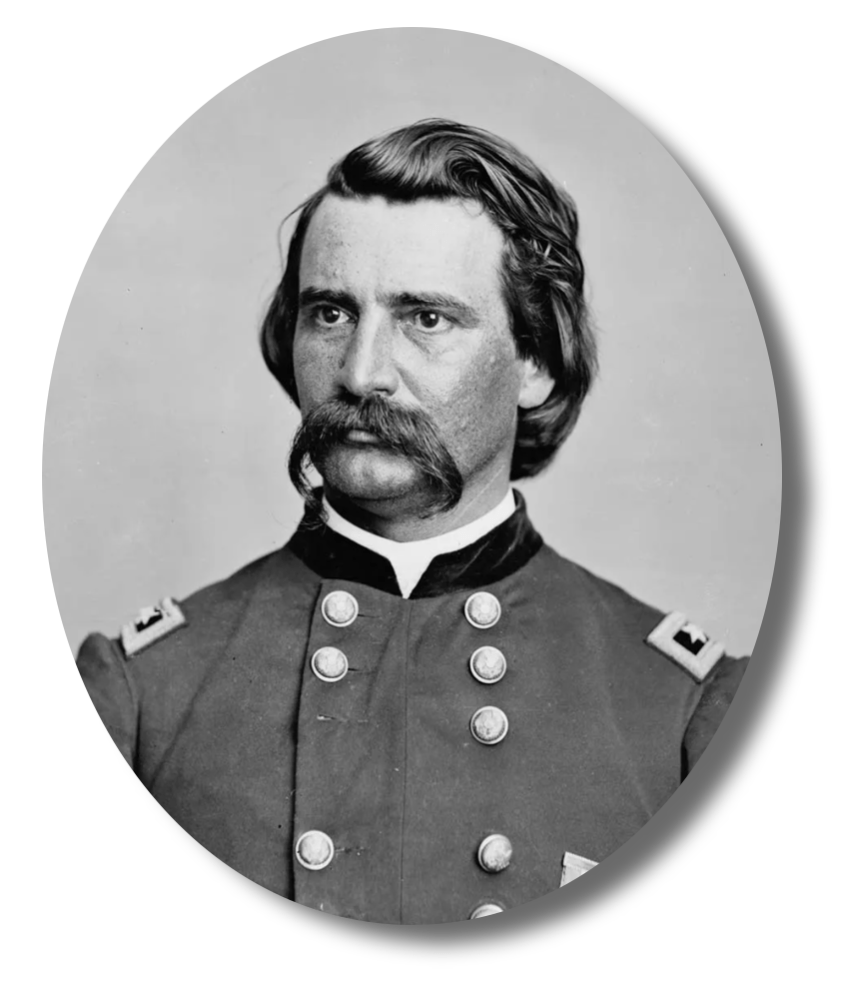
Gen. John “Black Jack” Logan, “Hold your fire till they come up snug & then kill them all, damn them!”
We got a report last night that Grant had had a blood fight & taken Petersburg but we hardly credit it as Grant was, the last we heard of him, looking after matters about Harpers Ferry. But we hope he may have [taken] Petersburg though we hope the loss as reported on our side may not be true of 30,000 killed, wounded, & missing & that Grant himself was mortally wounded. That would be an awful blow to the army. We would in that case fear you would be for taking our general away from us. We could illy afford to lose Grant, but to lose Sherman would cut us up bad, though we have a Thomas, a Howard, & then our Gen. John A. Logan who is a trump & loves to tread on secesh snakes of all varieties & says the best way to end the rebellion is to kill every Reb—North or South— we can get at as on the 28th July when the Rebs were charging our lines, charge after charge, & riding along our lines he [Logan] said, “They come, hold your fire till they get up snug & then kill them all, damn them! Kill every mother’s son of them! That’s the way to end the rebellion & take you home.
Now Sis, you have our moves &c. in a nut shell & soon we hope to crack the secesh shell & if extermination or the acknowledgement of their independence alone will secure peace, we hope to enrich their soil with their carcasses as at Decatur & Eutaw Church where we buried ourselves in front of our own Army Corps over 2400. In front of the 55th Illinois they buried 209 in two trenches—98 and 111. In our front we buried 97—one colonel, one major, 6 captains, and 11 lieutenants. They seemed determined on death or whipping us as Hood told them the 15th Army Corps was never whipped & it remained for them to do it or all was lost. But the 15th Army Corps still remains unwhipped & long may it remain.
We are having fine weather. All is cheerful and bright. Everything is being done that can be to put the army in fighting trim for a speedy campaign & vigorous one. The Rebs are playing hob with our hard tack line. Night before last they entered Marietta, tore up track, burned lots of supplies &c. carrying off report says quite a lot of our sick boys in hospital there & some few guards. They have been doing that kind of business for some time & this morning one division of our Corps & one battery have gone out there to attend to their cases.
I expect by & by to go home. Business calls for me loudly & I feel that I must go and I shall resign if I cannot get a furlough or leave of absence. So when you write me again, direct to Fayette, Fayette county, Iowa. I would I could go East this fall & see you all & father and mother J. but I will have to content myself with matters at home for awhile. Write me a long letter & tell me if you have been down to see the Dresden folks & how you are all going for President. I see you did nobly for Governor. May the whole Union follow your lead & put Lincoln & Johnson in the Chairs of State, that Rebels may howl & gnash their teeth for the tightening of Union measures & the downfall of their arrogant pride that “Lincoln should never rule over them, &c.”
Where is John &c. now all your good friends in your neighborhood. My love & regards to all who inquire after me so deal it as will suit best saving a good share of the first for yourself & tell Uncle G & Aunt I never got any letter from them yet & I would be right glad of a letter from your Aunt Elizabeth & will answer. Love to Aunt Baily & girls. Where is Uncle B. now? Are the Richmond folks & Aunt Polly? Do you go and see her often? I got a letter from Han & Sallie on inst. date, were well and very urgent for me to come now and stay there this winter and then I might come back but I feel that I am getting [too] old to sleep in mud and wet and cold, though I have stood it for over three years now & have not seen a day for the whole time but what I could do my duty though I have several times been somewhat under the weather.
Now dear Susie, if you wish to keep up correspondence all right & I’ll try to act my part & when I get home, I’ll get help now and then, but if other engagements take up your time & cannot afford your Old Uncle a little time to keep youth bright & life cheerful, all right. So do your best for self & I’ll try & live as long as I can see anybody & when we go under, may Jordan be crossed safely & by and by all meet where there is fullness of joy & pleasures forever more. And now goodbye. Ever be true to yourself, your country, and your God. Your uncle, — John
This letter was written by English emigrant Josiah Coombs (1832-1896), of Cass county, who enlisted as a private in Co. B, 4th Iowa Infantry on 10 July 1861. He survived the war and mustered out with his regiment at Louisville as a private on 24 July 1865 [see Josiah Combs]. After the war, Josiah returned to Cass county where he married and worked as a plasterer. Josiah addressed his letter to Nathaniel Bradley Baker who Governor Kirkwood appointed as adjutant-general of Iowa to coordinate Iowa’s response to the Civil War.
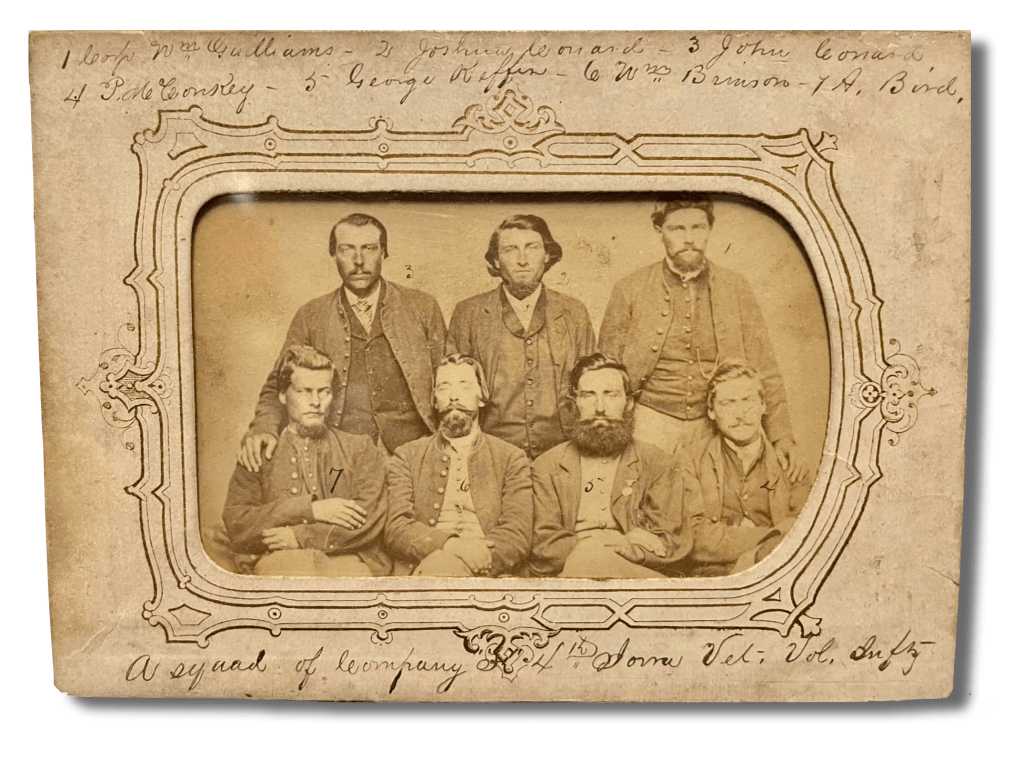
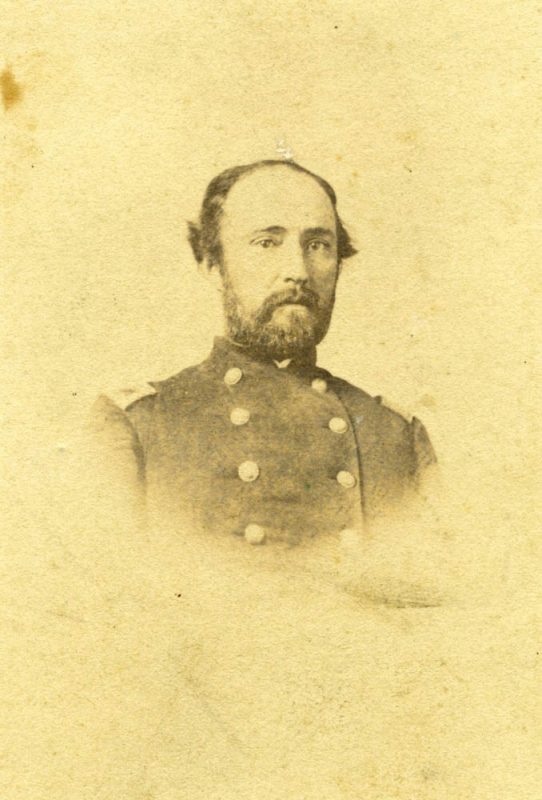
I could not find an image of Josiah but here are seven members of Co. F, 4th Iowa Infantry (Roger Davis Collection)
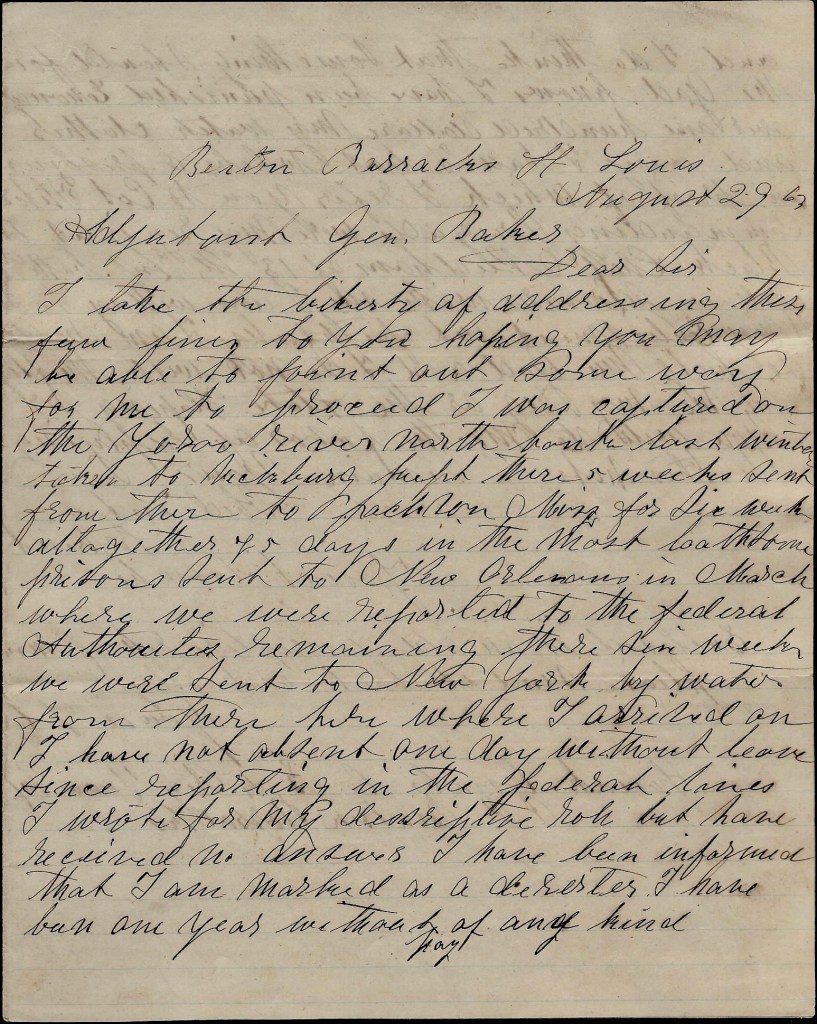
In his letter, Josiah emphatically denies that he was a deserter when he disappeared from the regiment during the Battle of Chickasaw Bluffs in December 1862. Rather, he informs us of his captivity and passage from one “loathsome” Confederate prison to the next until he was finally paroled and returned from New Orleans back to St. Louis by way of the New York. As witness to his remarkable ordeal, Josiah was fortunate to be able to use a high-ranking colonel and a chaplain. I could not find any evidence that either Josiah Coombs or Rev. Arnold Needham wrote any memoirs of their captivity, but Col. Thomas C. Fletcher did.
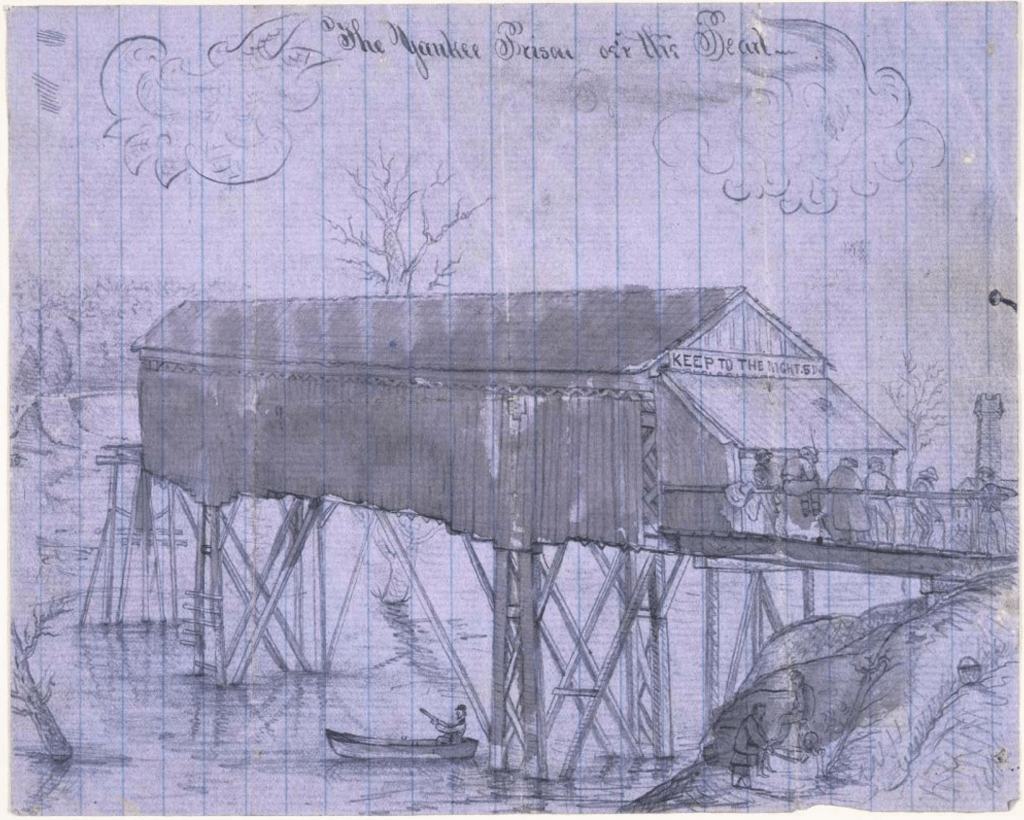
Fletcher was in command of the Missouri Wide Awake Zouaves (31st Missouri Infantry) when he was wounded and captured at Chickasaw Bluffs near Vicksburg. His tale of captivity was published in Harper’s Weekly and states that they “were kept in the loathsome cells [at the Vicksburg jail] and fed upon the worst fare ever meted out to the vilest criminals for one month. They were then removed to Jackson, Mississippi, and thrust into the old rickety ruin of the bridge that was yet standing above water, the remaining part having fallen down. Here they were kept for another month in the coldest season of the year, without beds or bedding; no fires or lights were allowed them. Three hundred and eighty privates, also prisoners, were put into the bridge with them. Almost every day, two or three were carried out dead, and sometimes the dead lay at the entrance of the bridge unburied for four days.” [See “The Prison over the Pearl River at Jackson, Mississippi, where Union prisoners have been confined,” by Chris Mackowski]
The Prison over the Pearl River—a partial former covered bridge—used by Confederates to hold Yankee Prisoners. Drawn by Col. Thomas C. Fletcher who was confined there in February 1863. It was reproduced in Harper’s weekly on 6 June 1863. (Museum of Fine Arts)
Transcription
Benton Barracks St. Louis, [Missouri] August 29th 1863
Adjutant-General Baker, Dear Sir,
I take the liberty of addressing these few lines to you hoping you may be able to point out some way for me to proceed.
I was captured on the Yazoo River north bank last winter, taken to Vicksburg, kept there 5 weeks, sent there to Jackson, Mississippi, for six weeks—altogether 75 days in the most loathsome prisons, sent to New Orleans in March where we were reported to the Federal Authorities remaining there six weeks. We were then sent to New York by water, from there here, where I arrived on [ ]. I have not [been] absent one day without leave since reporting in the Federal lines.
Col. Thomas C. Fletcher, (Wilson Creek National Battlefield)
I wrote for my descriptive roll but have received no answers. I have been informed that I am marked as a deserter. I have been one year without pay of any kind and I do think that [I’m owed] something for my God knows I have been punished enough over one hundred dollars—my watch, clothes, and everything I had I lost while a prisoner in proof of which I refer you to Col. [Thomas Clement] Fletcher, commanding Brigade where my regiment is at Big Black, [and] Chap[lain Arnold T.] Needham of 13th Illinois Infantry, both fellow prisoners with me.
I am willing to serve my enlistment out faithfully. I am no deserter so help me God and I do not wish the stigma on me, my regiment, or the state. Hoping, sir, you will do me the favor of replying to this note, I remain your obedient servant, — Josiah Coombs
Enclosed is an old descriptive roll of mine. Please send it back and oblige. Yours, — J. C.
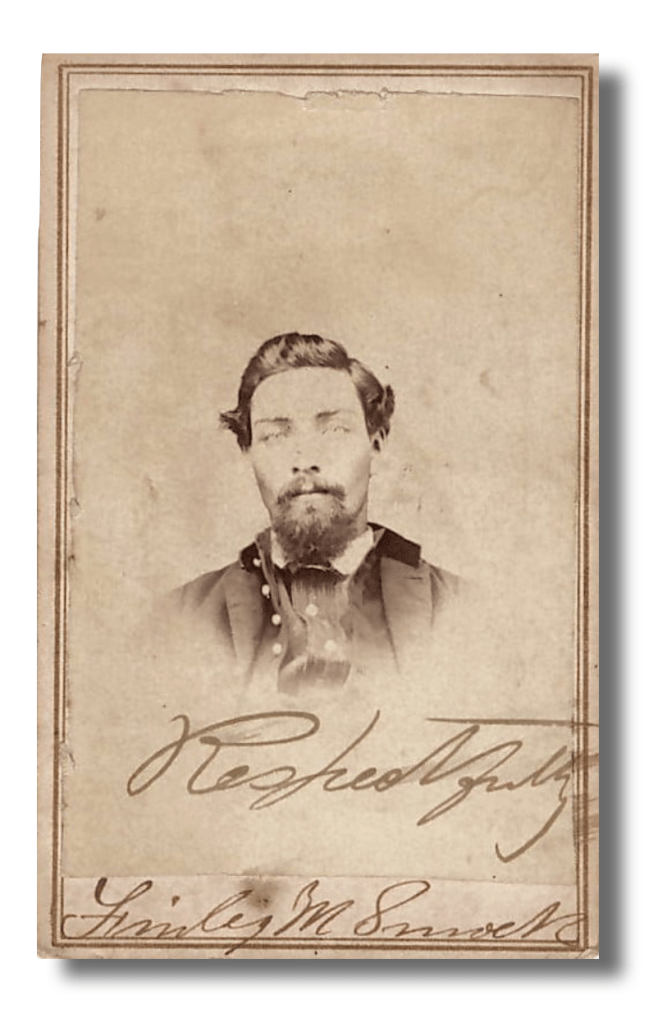
I could not find an image of Sanford but here is one of Sergt. Finley M. Smock of the 5th Iowa Cavalry(Michael Huston Collection)
This letter was written by Sanford Tuttle Bliss (1839-1897) of Dubuque, Iowa. Sanford enlisted on 6 September as a private in Co. E, 5th Iowa Cavalry, and was promoted quickly to sergeant. He reenlisted as a veteran in January 1864 and mustered out with the regiment at Nashville on 11 August 1865.
Sanford was born in Hartwick, Otsego county, New York, the son of Jesse and Fanny (Tuttle) Bliss. Sanford’s older brother, Norman Ingles Bliss (1814-1882) became a mormon, lived at Navoo, Illinois, for a time and traveled with Brigham Young’s party to Utah in 1848.
Prior to the Civil War, Sanford had been a student at the Hartwick Theological and Classical Seminary.
Transcription
Camp near Nashville [Tennessee] January 4th 1865
Dear Nephew,
Your last very interesting epistle has remained some time unanswered for the simple reason that I haven’t had time to write. Old Hood wished to take his Christmas dinner in Nashville but Thomas very unreasonably objected and to settle the difficulty many valuable lives were lost and much property destroyed in Tennessee. Three weeks ago our army moved out and gave the Rebs battle. Whipped them bad & have had a running fight of it ever since, Old Hood is glad to get across the Tennessee [River], I guess as he has from the last account from the front, with part of his army having lost nearly all his artillery & wagon train and many of his men although he had the largest & best part of the reel army in the West.
We were on the right wing & fought their cavalry & artillery for a week when I had an attack of fever & ague & had to go to the hospital. The weather was perfectly awful—raining continually & cold some of the time. Our clothes and blankets would get wet through and then freeze on us.
I went to the hospital at Spring Hill, staid a short time till I got a little better, and then went to a Lady’s house as safe guard to keep the soldiers from ribbing and insulting her and her two lovely daughters. I saved considerable of their property and consequently walked into the affections of the whole family and had a most agreeable time for two weeks. On leaving, received a pressing invitation to make my home there if I ever got sick or wanted a furlough.
I am staying with the dismounted part of the regiment. As soon as we get horses, shall join the regiment near Pulaski.
You seem to be having pleasant times at the old sem[inary] this winter but you must not neglect your studies too much for pleasure, if there are ever so many pretty girls there.
How did you spend the holidays? Sleigh riding with the Miss Davidson any? She used to be a nice little girl. I would liked to have been in Old Otsego about that time to [have] got a good Christmas dinner of roast turkey, mince pies, &c. &c. I didn’t enjoy my furlough last winter much for I was sick all the time. But if I was there now, I think I could do a little better.
Dinner is ready and I must close. Write soon. You have plenty of time. Yours &c. — S. T. Bliss
Addressed to Kent Jarvis, Esq., Hartwick Sem., Otsego, New York
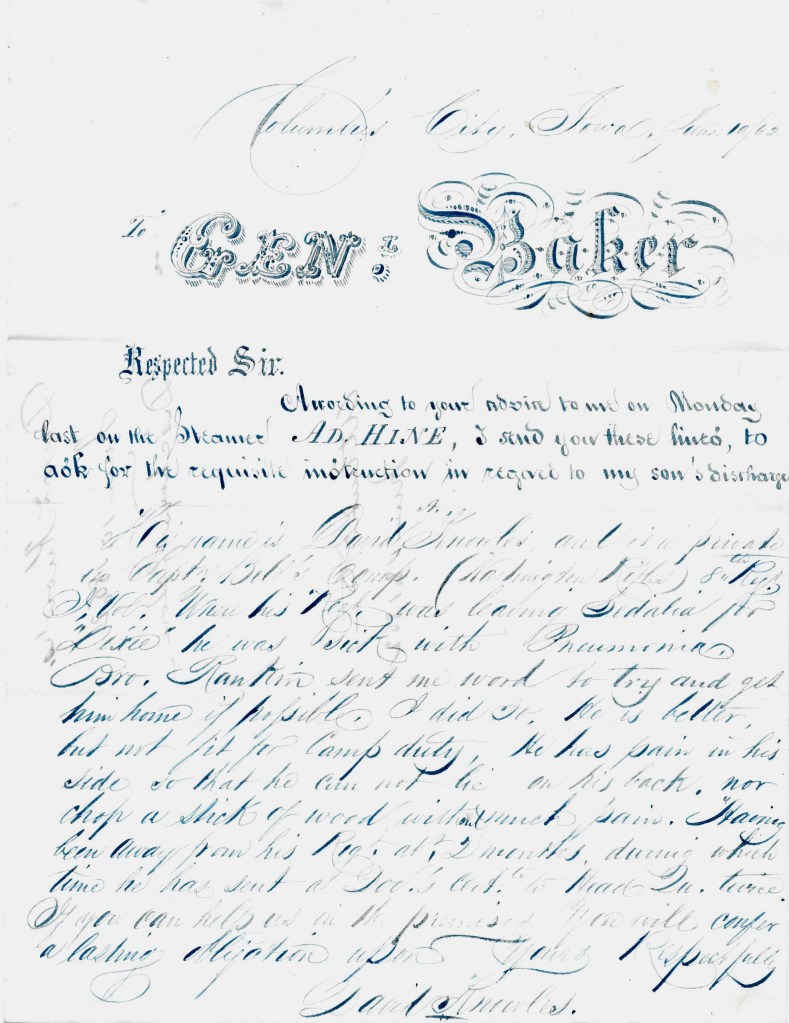
This letter was written by Rev. David Knowles (1811-1899) of Columbus City, Iowa, in June 1862. In his letter, David requests the assistance of “Gen. Baker” in securing a discharge for his son serving in Co. C, 8th Iowa Infantry. His son was David A. Knowles (1843-1863) enlisted on 10 August 1861. He died at Jefferson Barracks in St. Louis on 6 August 1863.
I believe the General Baker that David addressed his letter to was Nathaniel Bradley Baker who Governor Kirkwood appointed as adjutant-general of Iowa to coordinate Iowa’s response to the Civil War.
[Note: This letter is from the private collection of Jim Petersen and is published on Spared & Shared by express consent.]
Transcription
Columbus City, Iowa June 10, 1862
To Gen. Baker Respected Sir,
According to your advice to me on Monday last on the steamer Admiral Hine, I send you these lines to ask for the requisite instruction in regard to my son’s discharge.
His name is David A. Knowles and is a private in Capt. Bell’s Company (Washington Rifles) 8th Regt. Iowa Colunteers. When his regiment was leaving Sedalia for “Dixie,” he was sick with pneumonia. Bro. Rankin sent me word to try and get him home if possible. I did do. He is better but not fit for camp duty. He has pain in his side so that he can not be on his back nor chop a stick of wood without much pain. Having been away from his regiment at 2 months, during which time he has sent a Doctor’s Certificate to Headquarters twice, if you can help us in the premises, you will confer a lasting obligation upon yours respectfully. — David Knowles
Alfred C. Belcher’s portrait in the Regimental History
This letter was written by Alfred Calhoun Belcher (1844-1911), the son of Alfred Belcher (1814-1891) and Julia Ann Stetson (1821-18xx) of Wemouth, Norfolk county, Massachusetts.
Lying about his age, Alfred was only 17 years old when he enlisted as a private on 19 September 1861 to serve in Co. K, 1st Massachusetts Cavalry. He remained in the service for three full years, mustering out in September 1864. Alfred served in Co. K which was one of four companies in the regiment that were left at Beaufort, S. C. in a “detached” battalion. In August 1863, they were permanently detached and made an Independent Battalion, Mass. Cavalry. Things were relatively dull for this battalion but this apparently suited Alfred as he remarked in this letter, “I don’t like the notion of fighting if I can help it.”
Alfred’s letter includes a story of a runaway who escaped Rebel hunting him down.
After the war, Alfred returned to Massachusetts where he found employment as a painter and as a letter carrier.
Transcription
Beaufort, South Carolina October 21st, 1863
Dear Uncle,
For the want of something to do, not because it is my turn, I sit down to pen you a few lines just to let you know that I am as well as usual and having good times [even] if I am a snoger [soldier].
There is not the least bit of news here so you must expect none in the letter; there has not been one bit of news here since I can remember—only what we have got by the way of New York, so you may imagine how dull it must be here as far as that is concerned. Almost all the excitement we have here is the now and then taking of a Rebel spy or by the advance pickets, of something of that kind, and we are all getting sick of doing nothing, I tell you. All but me, I should have said for I don’t like the notion of fighting if I can help it and most of the men want to go to Morris Island (where they are doing nothing).
I took a ride again last night with Mena Hale and Mrs. Slattery (a Southern Lady) and we went out in the country and had a fine time on one of the plantations. I wish you could have been there for we had any quantity of fun and funny folks too, I tell you.
I was out to our advance pickets last week and while I was there, there was a nigger come in that had just got away from the Rebs. They chased him and a little boy he had with him six night and five days with dogs (blood hounds) and he hid the last night in house and the dogs followed him there and they searched the house all over for them but could not find him. He was hid under some covert in the attic of the house and after they left he come out and came across the river to our side. And when he was about half way across, we saw the rebs trying to make the dogs follow the boat but they would not so they tried to shoot them but could not—they were so far off. When they got to us, they were so much exhausted that they could not stand and their feet were swollen so that they were as large as two common feet and the boy was so bad that they do not think he will live. He was about 10 years old. The man was taken while he was out fishing about eight months ago. He used to take care of my horse when I did picket duty at Barnwell’s Plantation. He said that he was kept in the same jail with one of our boys that was taken while on picket about a fortnight ago. I believe I told you about that before.
I don’t think of any more to write now so I will close. Yours truly, — Alfred C. Belcher
These incredible War of 1812 letters pertain to Thomas Flint, Jr. (1793-1813) of Farmington, Franklin county, Maine, who enlisted on 11 May 1813 in the 33rd U. S. Infantry as a musician. He was described as standing a little over 5 and half foot tall at the time of his enlistment. He died of illness and exposure on 5 November 1813 after participating in the Battle of Châteauguay that was fought on 26 October 1813 between a combined force of British/Canadian forces and Mohawk warriors and an American force of 2600 regulars—there were 321 officers and men of the 33rd US Infantry in the fight. The battle was pretty much a draw but resulted in the British troops (most French Canadians) turning back the Americans preventing the capture of Montreal. Few men were actually killed or wounded in this encounter which historians now consider little more than a skirmish.
In the first letter, Thomas writes his parents in June 1813 of his arrival at the encampment in Saco, Maine, as the regiment is being formed. In the second letter, written from Chateaugay, Franklin county, New York, details of the Battle of Châteauguay in Canada are revealed as well as the death of musician Flint. The details are provided by John Tilton Luce (1793-1877) who grew up with Thomas Flint, Jr., in Farmington, Maine. Thomas’s remains were reported to have been buried at “Four Corners” which was the location of the American camp at Chateaugay, New York.
Thomas’s parents were Dr. Thomas Flint (1767-1854) and Sarah Bassett Norton (1767-1833).
Letter 1
Saco [Maine] June 4th 1813
Dear Parents,
I take this opportunity to inform you that I have arrived here and have been exceeding well ever since I left home. We reached here on Sunday, the 30th day of May, all in good spirits and so we have remained until this moment. We have very good accommodations and victuals accordingly. We belong to the first company in the regiment and have the finest officers that ever you saw. Our captain’s name is [Noah] Haley. Our colonel visits us every day. Our surgeon is a very fine, accommodating man by the name of Groves and finally we flatter ourselves up with the notion that we have gained the good will of our officers and companions.
We started from home on Tuesday the 25th of May and came as far as Uncle Jerry’s where we stayed that night, and Wednesday morning we started and came down to Uncle Russ’s and took breakfast. From then we proceeded to Baker’s Mills where we found that our company had left us and likewise had 1 hour the start of us. However, we made the best of our way to Augusta where we were entertained that night on the expense of the officers and on Thursday about noon we started for this place and proceeded on through Hollowell and Gardner and stopped in Litchfield at Mr. Stevens—a tavern keeper.
We started on Friday morning and passed through Bowdoin and Topsham and stopped in Brunswick near the college and from thence we started on Saturday morning and passed through Freeport, North Yarmouth, and Falmmouth and stopped at the rendezvous in Portland where John and myself were provided for at Bosson’s Tavern. And on Sunday afternoon we started from Portland and passed through Scraborough and arrived at Sac at five o’clock. We were accompanied by the colonel to the meeting house where it has been our place of abode ever since. So since we came from home we have passed through 18 towns, viz: Farmington, New Sharon, Rome, Belgrave, Sidney, Augusta, Hollowell, Gardner, Litchfield, Bowdoin, Topsham, Brunswick, Freeport, North Yarmouth, Falmouth, Portland, Scarborough, and Saco.
All of the soldiers, which is about five hundred, are completely uniformed but the uncommissioned officers and musicians clothing has not come on yet, but is expected this morning. I have the opportunity to send a letter by Mr. Gotham Sewel who I saw pass this morning forty or fifty rods off and very well knew him. We have not received our money yet but expect it from Boston within a few days. I have but a little todo and am very well contented. I have likewise met with some bitter Federalists who wish for an insurrection among ourselves. Mr. Sewel is now waiting for this letter so I remain your affectionate son, — Thos. Flint
Letter 2
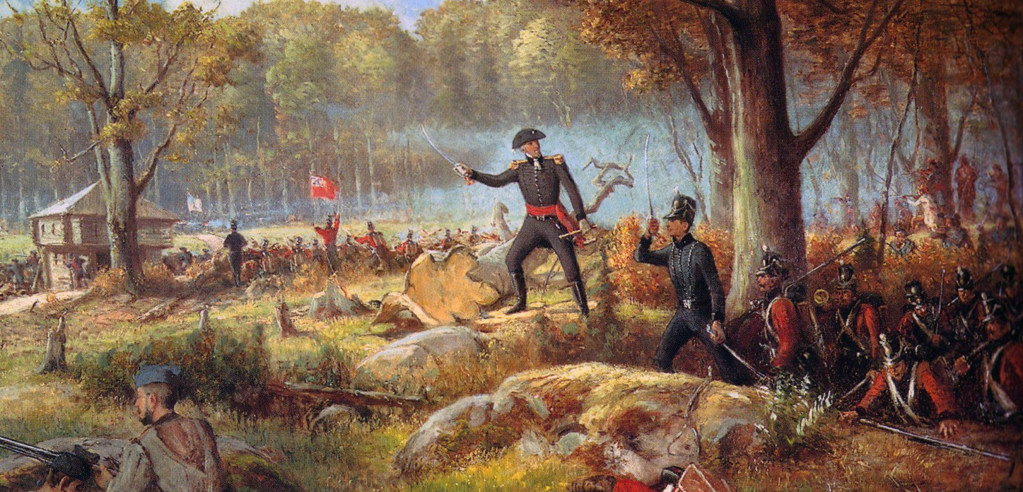
A painting depicting the Battle of Châteauguay on 26 October 1813
Chateaugay [Franklin county, New York] November 7, 1813
Dear Friend,
With deep regret and sore of heart I take up my pen to inform you of the most direful accident that ever befell your amiable family which is the death of your amiable family which is the death of your beloved son, Thomas who has left us and gone we hope to a better world where there shall be no more death nor separation of friends, where sorrow and sighing shall flee away. The task to write the melancholy scene, sickness and death of your son is more than I can bear and am greatly [indebted] to Sergeant Harding—an intimate friend of your sons—for his assistance in the same.
The first of your son’s sickness was at Burlington where he and myself were taken with the [ ] was followed by the jaundice. As to your son, we recovered a little from our indisposition as he mentioned in his last letter dated at Burlington when ordered to march to this place which we soon obeyed. We arrived at Chateaugay [New York] on the 16th of October where we stayed about 12 days during which time your son was rather unwell and not capable of doing much duty, yet he kept up a good heart and never shrunk from his duty when called to do it.
On the 21st of October we marched for Canada and had a very tedious and tiresome march. We had to ford the river Châteauguay on the 22nd of October. the water was very cold, being some ice in the river. We then passed on to the town of Caughnawaga where we stopped all night and there we had to lay on the cold ground without any tents or anything but our blankets. The next day we marched on through the woods and came to the First British settlement which they had abandoned and the guards were given off by the Light [Chairs?] who killed five Indians and taken one prisoner.
We stayed in this place three days constantly alarmed by the firing of the pickets and then orders came for us to march accordingly on the 25th inst. At about five o’clock p.m., we marched out of the encampment and crossed the river Châteauguay which we had again to wade. After we had crosse the river, we reached onto a plane where we received orders that no man should make any noise or even speak a loud word on pain of being punished. We then went softly on the way. This journey I have never been so much fatigued. We had several streams to cross during the night. We marched about 5 miles and in the morning we proceeded on our way and passed the British encampment which was on the opposite side of the river. We continued our march on through the woods about two miles further when the A Brigade and artillery [ ] which had marched on that side of the river with a part of the Light [Chairs?] began the attack on the guards. We fired and then ran. The Tenth Regiment marched on about a mile further and then they began a brisk fire and at the same time we were about abreast of them and were surrounded by the savages who kept continually firing at us and picking us off. Likewise the fire from the other side of the river of the British and Indians were directed at us and the balls flew very thick—the air being continually filled with the noise of these engines of death.
But your son still kept his firmness of mind and appeared to be quite undaunted. The action on the other side of the river continued about half an hour when the British and Indian force took to flight and loud huzzahs from the Tenth which was followed by the whole army took place. The Tenth Regiment had one man killed and five wounded. In our regiment there was sixteen killed and missing and a great many from the other regiments.
After the action was over, we were marched into the woods and a part of the army crossed the river and returned to the old British encampment. But your son remained with the company on the same side of the river as in the action and in the night the British and Indians made a desperate attack on us in which many were slain but we hope and still believe by the most correct reports that we double paid them. In the morning the whole of the army crossed the river that had not crossed the night before and your son returned free from wounds and in good spirits. We had orders immediately to march to Chateaugay [New York] where we arrived on the 2d day of November and went into the woods and built us some huts of logs and covered with hemlock boughs.
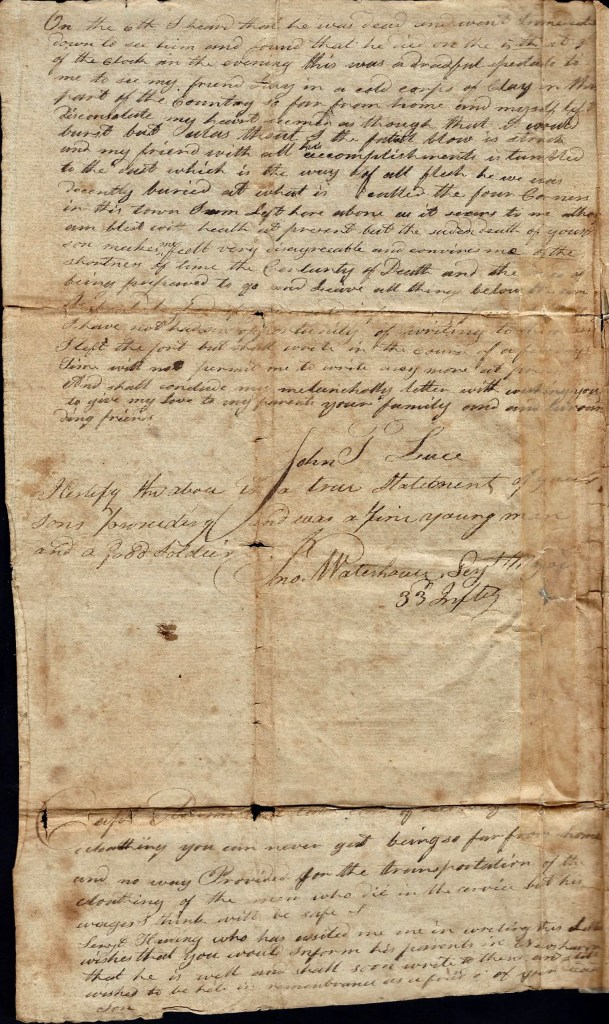
On the 2nd of November your son was taken unwell but not as but that he kept about the encampment. On the 3rd he grew rather more unwell and looked very yellow and pale. On the fourth day month he took a puke which operated very hard. In the afternoon of the same day I was called upon to do the duty of an orderly to the Brigade Major. He observed that I was going away, called to me, and said, “Luce, I think that I shall never see you again,” and observing at that time that he wished me to take care of his paper, which I promised to do but you must guess the situation of my mind on such an expression from my friend [paper creased—illegible]…obliged to give him to the care of the rest of the musicians. The next morning I heard that he was carried out of his tent in his blanket and at about nine of he clock a.m. I went to see him and found him quite bereft of his senses. My duty being such as compelled me to leave him to his nurses until about three of the clock when I returned to see him again. I spoke to him but he made me no answer and did not know me at all and appeared to be quite deranged laying in a dull or drowsy position.
On the sixth I heard that he was dead and went immediately down to see him and found that he died on the 5th at 9 o’clock in the evening. This was a dreadful spectate to me—to see my friend lay in a cold corpse of clay in this part of he country so far from home and myself left disconsolate. My heart seemed as though that it would burst but alas thought I, the fatal blow is struck and my friend with all his accomplishments is tumbled to the dust which is the way of all flesh.
He was decently buried at what is called the four corners in this town. I am left here alone as it seems to me although am blessed with health at present but the sudden death of your son makes me feel very disagreeable and convinces me of the shortness of time, the certainty of death, and the ned of being prepared to go and leave all things below to [illegible].
I have not had an opportunity of writing to home since I left the fort but shall write in the course of a few days. Time will not permit me to write any more at present and shall conclude my melancholy letter wit wishing you to give my love to my parents, your family, and [ ] friends.
— John T. Luce
I certify the above is a true statement of your son’s passing and was a fine young man and a good soldier. — Jno. Waterhouse, Sergt. Major, 33rd Infantry
I could not find an image of John but here’s a cdv of Major Savage who served with him in the 25th New York Infantry (Photo Sleuth)
This letter was written by 1st Lt. John G. Vanderzee (1827-1884) Co. G, 25th New York Infantry. John began his service as a lowly private in Co. F, 44th New York Infantry but was transferred out of that regiment when he was offered a commission in the 25th New York as the 2nd Lieutenant of Co. C on 10 January 1862. He was promoted to 1st Lieutenant of Co. G on 27 May 1862 and to Captain of Co. G in August 1862.
In the following letter, written from the Union lines before Yorktown, John speaks of death and dying, attempting to reassure his friend Maria that his chances of dying were low, and pragmatically speaking, it was “only borrowing grief before hand. It is time enough for that when it comes.”
John G. Vanderzee was the son of John Becker Vanderzee (1798-1880) and Elizabeth Rowe (1798-18xx) of Bethlehem township, Albany county, New York. He married Elizabeth Briggs—not Maria Becker—in September 1864.
Transcription
Army of the Potomac Near Yorktown [Virginia] Sunday, April 27th 1862
My Maria Dearest Friend,
I was overjoyed last night as the mail brought me two letters from you—one of 17th date and that of 22nd also. I had many days looked for a note from your pen as I thought one person in Bethlehem at least would write to me of others could not find the time. The mail of last night brought me a note from home also which was written the 17th. I am sorry my folks fret about me as it is only borrowing grief before hand. It is time enough for that when it comes. I don’t feel alarmed about my friends at home at all unless ill health visits them, &c.
Maria, if you will accept the best advice of a soldier I would say unto you, don’t never borrow any fears about the safety of any person. This world at best makes our whole life a season of great trouble and trials, and to most of mankind a life not worth living for. I take up affairs along the path of life as duty requires and strive to be ready for all demands as time runs along.
I am under the impression that you often worry in mind and imagine that all who go to war will be shot (I mean your friends in the army & not all the soldiers in service). I want no one to imagine such a thing at all. I am only one of the army and my chances are equal to all the rest. I may fall, or may not.
I have many things of news to tell you about the work going on here but cannot in letter correspondence of a friendship nature. Since my change of positions in the army, a great increase of labor has fallen to me and I cannot write a full history of events that occur to me daily. And time will not even permit me to write to many persons. I have marked off of my list of correspondents all but four, two at home and next my Maria and Chum Sanford, and now and then to acquaintances. I may not at all times write to you frequently but rest assured my love towards you will never diminish any if the same finds a response in your heart. The people may be anxious at Chippian Hook to know how often I write to you &c. They can soon find out that fact by attending to report of “Madam Rumor.”
Maria, I feel as though this note is the most unfinished one I ever wrote to you. I write to you this afternoon because time may not afford me the pleasure of so doing for several days after this as we are diligently working day and night at our forrtifications. I will write to you again in a few days.
I visited the 44th on Friday night and found them in good spirits. Remember my best wishes to your Pa and Ma. Write to me soon. I must close bidding you a good night and happy dreams. While the warmest regards of a soldier are ever around your path and following you through silent though. From your army correspondent, — Lt. Van
Direct hereafter to 25th Regt. N. Y. S. V., Washington D. C.
The army has a man there who sends all notes directly by express.
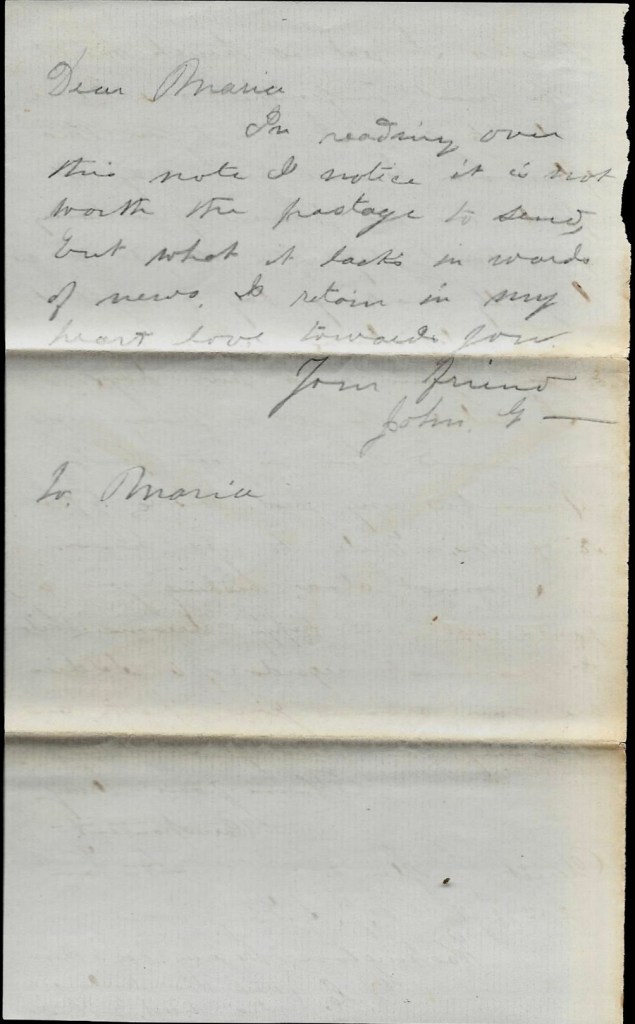
Dear Maria,
In reading over this note, I notice it is not worth the postage to send, but what it lacks in words of news, I retain in my heart love towards you. Your friend, — John G.






















 Spared & Shared 23