My passion is studying American history leading up to & including the Civil War. I particularly enjoy reading, transcribing & researching primary sources such as letters and diaries.
This letter was written by James E. Cox (b. 1843) whom I believe was the son of Amos H. Cox (b. 1813) and Mary Sterling (b. 1814) who were married in Tuscarawas county, Ohio in 1830. In the 1860’s the family lived in Franklin, Harrison county, Ohio.
During the Civil War, attitudes toward Black people in Harrison County, Ohio, were progressive for the time, largely shaped by the influence of abolitionist-leaning Quakers and Presbyterians. However, this local abolitionist sentiment existed within the context of Ohio’s statewide discriminatory “Black Laws,” which restricted the rights of African Americans.
T R A N S C R I P T I O N
Station 15 [Harrison county, Ohio] May 2, 1864
Esteemed cousin,
I take my pen in hand to let you know how my health is. My health ain’t as good as it was when I left and I don’t expect to have [it] again for I am getting weaker every day. I arrived at home on Friday and I landed in a sorrowful place for the Boys has to go to the army. J. T. Cox was gone when I came home and we got a letter from him today and he is in Camp Chase and the rest of the Boys has to leave in the morning. 1
I think if the head leaders on both sides had the hearts cut out of them and fried, this war would stop. And I don’t think it will till that is done for the negroes is taken the white man’s place. And the men around here that is negro lovers, they won’t go, but they will send a boy in his place. But them that ain’t for the negroes, they have to go, and I think that ain’t right. But we have to live up to it. I have made up my mind never to go till they take me. I don’t give my life for the negroes. You may know I don’t intend to go to the war.
You can tell Mag if she wants that watch, she can send me eight dollars and she can have it. I must bring my letter to a close for this time for I am getting nervous. I hope these feelings will find you all well. The rest of the family is well as common.
Write soon if you please and send me all of the news. Excuse my bad writing. — James E. Cox to Mary J. Sterling
Goodbye
1 Probably John T. Cox who served in the 162nd Ohio (National Guard). This regiment was mustered into service on 20 May 1864 at Camp Chase, Ohio.
The following letter was written by John Tolles Phillips (1838-1905) who enlisted at the age of 23 on September 20, 1861, at Warsaw. He mustered in as private in Co. A, October 5, 1861, to serve three years. As noticed in this letter, the regiment was not fitted out as a cavalry unit until June 1862. Prior to that they were detached as reserve artillery or as train guards in the Army of the Potomac. John was wounded at Berryville, Va., on December 1, 1862 and later transferred on March 31, 1864, to the 49th Company, Second Battalion, Veteran Reserve Corps.
John wrote the letter to his cousin, Kate N. Tolles of Attica, Wyoming county, New York. According to find-a-grave, John was born in Orangeville and while an infant his parents moved to Attica where he lived for 66 years.
T R A N S C R I P T I O N
Headquarters Camp Fenton, Washington D. C. 9th Regt. N. Y. Volunteers, Co. A February 9, 1862
Dear Cousin,
Your Father’s [letter] of the 30th came to hand the 6th and I assure you I was glad to hear from him. I have regained my health so that I think I can stand it. We have not moved from where we first went into camp and I do not see much prospect of it. Some of our boys are getting homesick and trying to get discharged but it is more work to get a discharge than it is worth. If I could be certain that I should have my health, I do not want to come home till this war is closed. We have not got any of our arms yet but our sabers and I do not know as we ever shall. The orders has come here that the cavalry is going to be reduced to fifty regiments. There is talk here that the remainder are going to be mustered into infantry. If our captain and company goes, I am going to go with them and if they come home, I shall come too.
We have got our Sibley tents. Our company bought lumber and made a floor to these. There has to be twelve in a tent. We have a circle stove but we have two small sheet iron stoves and we do our own cooking on them. Most of the boys do their washing. We can get it done for four cents apiece. I do my own.
Has Mrs. Hubbard consented to let her sons go yet? There is a man in our company that looks like Clark and if he had come from Bennington, I should have thought it was him. hardly a day passes but what the ambulance passes here carrying the soldiers to their long home. There was eight or ten died in our regiment since we come here.
Where is Ralph now? Has he been home since he went away, or has Ed been back yet? How do they get along? Are they satisfied? Where is George this winter? Does he peddle milk? We can get milk here by paying five cents a pint and half water.
It rains here most of the time. The mud is getting so deep it is most impossible to get around. I do not believe that you can read what I have wrote so I guess I will stop. Write soon. — J. T. Phillips
The identity of this soldier may be lost to history, but the essence of their message resonates powerfully among countless Union soldiers witnessing the war’s end—an end that promises the restoration of the Union, yet carries a seismic shift: the abolishment of slavery on a national scale.
T R A N S CR I P T I O N
Mother, I want you be patient with me a few moments longer. There are some events taking place at the Capitol that proves that our bleeding has not been in vain. On Tuesday, the last day of January, Congress did at the City of Washington then and there sitting, by a two-third vote of both houses, pass a resolution amending the Constitution, so as to abolish the institution Slavery that has come so near to destroy us as a nation. It is wiped off we hope forever. Since this war commenced Maryland [and] Missouri have by the volunteer act of their own legislatures become free states. Washington, the National Capitol, instead of being a mart for the sale of human chattel has become free & now forever our dear old flag floats to the wind. It floats over freeman. It has cost oceans of blood to wash out the stain from our nation’s character, but mother, we will be thankful that it is done at last. It is worth something to have lived and acted in this great revolution. It is worth more to have been on the right side. The consciousness that in this life struggle we wrestle for our country, not against her. It is worth something to remember that when our country was fighting for existence, we were not “copperheads.” We have given dear loved ones in our country’s cause. They have fallen with their harness on; although we may mourn their loss, we are not ashamed of their memory.
Mother, don’t think me altogether a coward when I say that I wish that the efforts now being made may end in peace. I don’t want the government to abate any just demands nor stop until the old sore is cut completely out by the roots and the Johnnie’s acknowledge that Uncle Samuel is the only Boss that can be tolerated in this country, but I would be glad if peace came soon.
I learn that you have been very sick ever since I came away. Hope that this may find you on the gain. I want you to make up your mind to live until I come home again. One can’t always live as long as they are a mind to, but the will has a good deal to do with it. I think if I live to come home again, that my duty will be at home the rest of my days. Don’t think that they will get me in the army again. Think that I can afford to stay home.
If you get well enough to write, won’t you write me a letter. If not, have Mary write for you. I think Dad might write if he is a mind to. Tell me if any of you have heard from Bud since the Battle of Nashville. I wrote a letter to Tinan [?] some 3 or 4 weeks ago. Got no answer. Wrote our brother Cyrus some 1 week ago. Got no answer. How bad I feel.
I must close this. Remember me in your prayers. Pray that I may do my duty. If I ever come back, no one can say that we run away from the foe. Goodbye. God grant we may see each other in peace. Five my love to dad, Mary, and the little folks, — Con
Alexander Samuel Diven (February 10, 1809 – June 11, 1896) was an American politician from New York and an officer in the Union Army during the American Civil War.
Born in Catharine, New York, Diven attended the common schools and the academies in Penn Yan and Ovid, New York, and then studied law. He was admitted to the bar in 1831, and commenced practice in Elmira. He was member of the New York State Senate (27th District) in 1858 and 1859.
Diven was elected as a Republican to the 37th United States Congress, holding office from March 4, 1861, to March 3, 1863. Though opposed to slavery, he was hardly an abolitionist and he did not consider Blacks his equal. He gave up his seat in Congress to fight for the preservation of the Union, but not to liberate the slave nor to make them free and equal citizens. Rather, he hoped they might be settled elsewhere, even deported if need be. This was not uncommon. Even President Abraham Lincoln held this same policy.
Diven entered the Army on August 13, 1862, as lieutenant colonel of the 107th New York Infantry Regiment. He was promoted to colonel on October 21, 1862. He was granted leave of absence from the Army for ninety days to take his seat in Congress. He was honorably discharged as colonel May 11, 1863, and later brevetted brigadier general of Volunteers April 30, 1864. He spoke at the dedication of the monument honoring the 107th New York in 1869. He engaged in railroad building and operation from 1865 to 1875, and was prominently identified with the Erie Railroad.
In the 1870s Pennsylvania native Truckson LaFrance obtained several patents on improvements he developed in the rotary steam engine. John Vischer, head of the Elmira Union Iron Works, became interested and was convinced by LaFrance to back him in the manufacture of a steam fire engine. They subsequently formed a business partnership to manufacture fire apparatus. Their success attracted the attention of Diven and his four sons, who bought the company in April 1873. They renamed LaFrance Manufacturing Company and appointed John Vischer as a Director and Truckson LaFrance as the company’s Mechanical Engineer. Within three months, the new company bought 10 acres of land and built a plant to manufacture steam engines and related equipment, including railroad locomotives.
General Diven was married, in 1835, to Miss Amanda Beers, of Elmira, and had four sons and four daughters. He died in Elmira, New York, on June 11, 1896, and was buried at Woodlawn Cemetery.
One of Diven’s sons, his eldest, George Miles Diven (1835-1909), wrote or added notes to some of these letters. George was born in Angelica on 28 August 1835. He was educated at the old Elmira Academy, at a private school in Geneva, and was graduated from Hamilton College in the class of 1857. He studied law in his father’s office and was admitted to the bar in Binghamton in 1862.
[Note: This is the earliest piece in the “Diven Collection” and it was not a letter but most likely a draft or copy of a set of resolutions written by Alexander S. Diven in 1854 after the passage of the Kansas-Nebraska Act. Alexander was not yet in the State Legislature so it isn’t clear what organization he represented when he wrote this. It may have been a political party organization.]
19 August 1854
Resolved. That we disapprove of the late law of Congress organizing the territories of Kansas and Nebraska by which slavery is admitted into territory heretofore dedicated to freedom and by which the Missouri Compromise (so called) was abrogated and annulled and that we are in favor of the repeal of said law so far as it respects said compromise.
Resolved. That we hold that our Republican institution rest upon the great doctrine of the equality of man in their political, civil, and religious rights, and that the stability of our free institutions depends upon our faithful adherence to these principles.
Resolved. That we consider the institution of slavery inconsistent with the Republican form of government insomuch as it denies to a portion of mankind that equality of right which constitutes the foundation of a republic. That this anomaly in our state governments was seen and regretted by the framers of our national constitution and that in the constitution they have recognized slavery only as a state institution—studiously avoiding in our national charter the right of a man to hold another as property.
Resolved. That the Administration has recognized slavery as national & is so doing has opened the territories, &c.
Resolved. That we believe the people of this state are ready to respond to the call irrespective of past political differences. To declare in thunder tones that slavery aggression shall go no further. That there shall be no more slave states, no slave territories, and that the people will make their will supreme and effective by driving from power & place our public [rest of document missing]
Letter 1
Jefferson City, [Missouri] November 8, [1855]
My ever dear wife,
I am just within the range of post offices having been the last 18 days over wild prairies & wilder woods. You doubtless heard of the dreadful disaster on the Pacific road 1 and had you fears lest I was on the train. But a kind Providence had kept me from getting in in time to join the excursion which I contemplated, and would in all probability have been near my friend poor [Thomas] O’Sullivan.
He perished unhappily & yet had I been he, I had rather have perished than to have survived. Now sympathy is with him. Responsible as he was for the accident, he would only have lived to share the public execration. There are circumstances that cannot excuse his rashness. An engine had passed the bridge and after passing said he would not cross it again for five thousand dollars. O’Sullivan discharged him. The engineer of this train objected to cross. O’Sullivan, to encourage him, went upon the locomotive with the President of the road and told the engine man to put on steam. He did so and the consequence you know. 2
The death of O’Sullivan & the general result of the disaster may keep me here longer but I hope not. I am now waiting a steamer to go down to St. Louis where I expect a letter from you. I was never so anxious to hear from home. I have all kinds of fears and apprehension.
I wish I was out of this miserable contract—and all others. I want peace—peace & home. My dear wife, goodbye. Your husband, — A. S. Diven
1 “The Pacific Railroad was chartered in Missouri in 1849 to build a railroad from St. Louis to the Pacific Ocean. Due to financing problems and outbreaks of cholera, construction did not begin until 1851 with a groundbreaking at which prominent citizens of St. Louis turned out to celebrate the start of construction of the line. It included speeches, a national salute, and the reading of a poem written for the moment in history. Due to the time required to make tunnels and build bridges, the line did not reach the nearby city of Pacific until 1853. Much of the line between a point just east of Washington and Jefferson City was along the Missouri River. Over the next two years, it would reach the capital city of Jefferson City with a planned grand entry on November 1, 1855. All of their bridges were of wood with the largest one being across the Gasconade River, a tributary of the Missouri River.” [See Gasconade Bridge Failure 1855]
I have been waiting all day for it to get a little cooler before writing but it has run the degrees of comparison, hot, hotter, hottest. I have been twice to church. The minister was just as ardent as the sun. Everything is ardent here—even the climate of the people is ardent. I don’t object to ardor but somehow here they don’t seem to get it in the right place.
It is near election. Night before last at St. Louis I went out to try and get cool & a crowd was at the first corner listening to a ranting brawlee to what was intended for a political speech but which was indeed very stale abuse of Yankee Abolitionists & Christians. A little further and a candidate for Congress was proving himself to be the very man for the support of his fellow citizens. At all the beer shops 9and they are legion), it was politics. All their quarrels are political. Indeed, it appears that the election affords a good opportunity to the fiery Missourians to let off their excessive calories.
Tomorrow we are to open the Pacific Railroad to Round Hill 45 miles west of this. I hope now to be ready to start home on Monday, a week from tomorrow, but will keep you advised of the prospect.
Porter, Brayton, and Tomy are here. Mr. Brayton, his two girls, and Mrs. Porter are at Clifton.
I hope you have it a little cooler. Don’t forget those Niggers. I shall expect to see the house black with them on my return.
Tell George about my letters. Those relating to Yates County Bank are to be sent to Petter Oliver. Political ones to be given to Thurston—Doctor Buell. First to Stonecliff for him to show to such parties as he thinks best. It is absolutely too hot to think, much less to write. So my dear wife, accept a melting adieu from your husband, — A. S. Diven
Letter 3
Jefferson City [Missouri] August 1858
My dear wife,
You will see by the way my letters are dated that I am alternating between this & St. Louis rather rapidly. I am getting rather tired of the scenery of bluffs and flats. There is but one thing in the picture that continues to please me. That is the way the green ivy clings to the stems of great trees perfectly enveloping them in a casing of bright green. Occasionally the tree is dry with its great limbs stretching out like the branching of coral rocks, and the whole closely enveloped in the “ivy green.”
This is election day and I have to be idle as my partner, Gen. Price 1 is clearly interested in politics. I shall be glad when it is all over for I have heard more spread eagle speeches than I can well endure with the heated atmosphere. My great anxiety just now is to get away this week and I have not given it up yet. You can ewll imagine how irksome it is to lose an entire day under such anxiety.
I am getting very impatient to be home. If I could only hear from you & know that the children and all were well, I could wait while longer contented. Hoping very soon to see you my dear wife. I remain your husband, — A. S. Diven
1 After the expiration of his term as Governor of Missouri in 1857, Gen. Sterling Price (former General in Mexican War) became the state’s Bank Commissioner from 1857 to 1861. He also secured construction of a railroad through his home county, which now forms part of the Norfolk and Western Railway.
Letter 4
Jefferson City, [Missouri] August 3d [1858]
My dear wife,
A mid-19th century Congress & Empire Water Bottle from Saratoga, New York
I would not write this but for my promise. I am not well today. This terrible hot weather compels me to drink too much water. I went to bed last night with headache & feverish and dreamed that one of the children was dead and had a bad night of it between broken slumber and troubled dreams. I am in a free perspiration now and will be all right by a day or two. Tomorrow I go to St. Louis where I can get Congress water. 1 I have been drinking some that was stale & though very insipid, its effect is good. They have a light, sour wine which agrees with me & which I drank for a good while but it is too expensive to quench thirst with that alone in this hot weather. However, I am resolved to take care of myself so don’t be uneasy.
I am now satisfied that I shall not be home this week but feel quite content that I can get off on Monday. Will write, however, when I get to St. Louis. I think I forgot about charging you to get those “niggers” in my last so I renew my directions here. You may think I am getting beniggered by my stay in a slave state. Nothing of the kind for here nigger & dirt go together & from my heart I wish Africa had them all.
Goodbye my dear wife, — A. S. D.
1 “Congress water” referred to a popular, bottled mineral water sourced from Congress Spring in Saratoga Springs, New York. It was sold nationwide and prized for its supposed health benefits.
Letter 5
Statehouse overlooking the Missouri River at Jefferson City, Missouri (ca. 1860)
Jefferson City [Missouri] New Years Day 1860
Dear Johnny,
I was very glad to receive your letter. I don’t think Caper’s bite will hurt you though sometimes the bite of a dog does cause hydraphobia & then the party bitten does a most terrible death. It is too dreadful to joke about such a disease.
You want to know what kind of a place this is. Well it is built on a great many steep hills. A river as far across as from our house to Mr. Hall’s is at the foot of the hills & across the river is a great flat and broad as from our house to the village. This is nearly all covered with corn. They don’t cut up their corn here as we do but let it stand in the field and husk it where it stands during the winter.
Then across this river & this flat are hills, not very high, but very steep and a great many of them on the side next us are white rock. And looking across from Jefferson [City] They look like houses as though there were a villages on those hills. The view is now all frozen over hard and boys skate on the ice.
It is not a lot like our Jefferson—not near so pretty, and I want very much to get away from it and go home & see Johnny. Your father, — A. S. Diven
Letter 6
[Note: This letter refers to the Battle of Bull Run, fought one week earlier on 21 Sunday 1861.]
Washington Sunday, [July] 28, 1861
My dear,
I am in receipt of yours & Ella’s letter of Friday. You can scarcely imagine how these letters from home come like bread to the hungry or water to the thirsty. Don’t fear for my safety. I was never in better health & never more free from danger. When you read my last, will see how exactly like yourself I am affected by the departure of Alen. It does seems as though a link was broken in a cherished chain. But no matter now about these sad [ ].
Our country is still in a condition to retrieve the one disaster we have experienced. It is only a lessen to teach us the true magnitude of our difficulties. If the fault finders would only cease their croaking, we would lose all traces of the disaster save in the vacant places of those who fell & in the scears of the wounded and in the disgrace of the cowardly.
I hope your next letter will be more cheerful—that your philosophy will prevail over your melancholy. Above all, do take care of your health and don’t [ ]. It seems as though this year has been one in which your cares were piled up. Eugene prepared first for the Army, then for West Point…
I have been to a camp and heard the service of a most zealous and I think patriotic Christian. It was the [14th] Brooklyn Fire Zouaves, I think. Col. [Alfred M.] Wood’s regiment. They stood as much of the fight & suffered as much or more than an regiment in the action. Col. Wood was left on the field wounded & his regiment & friends are anxious to hear from him. These troops are at Arlington House and the service was in the pine woods that surround the house. I never witnessed anything more impressive. I , of course, cried all the time. No, don’t laugh at me. I think you would have done the same. I had at least the countenance of the brave soldiers whose bronzed cheeks were wet with the feeling tears.
Tell Ella that young Harris is well. Col. [Henry Warner] Slocum fast recovering. Mrs. Merrill is back to see her son, &c. &c. Yours ever, — A. S. Diven
P. S. Col. Slocum’s Regiment [27th N. Y. Infantry] doubtless desire as much praise as any troops in the fight. Tell Amanda & Ella to see to it that the papers do them justice.
Letter 7
Addressed to Hon. A. S. Diven, M. C. [Member of Congress], Washington D. C.
U. S. C. C. West Point Sunday, March 2, 1862
Dear Mother,
You complain in your last letter of not having received a letter from me the week before last. It must be the fault of the mails as I have mailed a letter to you ever Monday morning since I came to West Point. I think I promised you on leaving home that I would write you once a week while I remained at West Point. This promise, at least, I have kept faithfully do far, and I mean to stick to it for it gives you half as much pleasure to receive my letters as it does me to receive yours. I shall consider myself well paid for the trouble of writing.
Yesterday morning I received a letter from Ella to you that Maud sent me. I was surprised to hear that the folks at home liked my photographs so much. I thought they were not very well taken and I shouldn’t have taken them but the poor fellow 9artist he called himself) who took them looked as though he needed the money and he took them very cheap—only 50 cents apiece. I think that Ella was rather profuse in her compliments to my picture. She “laid it on pretty thick”, “cut it fat,” to use a slang phrase. But it is so long since she has seen me that she has probably forgotten how I do look.
Did Maud attend the ball at the White House and was she attired in a head dress and “no. 4” gaiters and a complete set of ear rings?
Last night we had another concert. Those who went said that it was a splendid affair. Unfortunately I was on guard and couldn’t go. This makes the fifth that we have had and I have been unable to go to but one.
How do things look in Washington now? Was it “All quiet on the Potomac up to 12 o’clock last night?”
Excuse this short letter. your son, — Eugene
Boston Post, 10 July 1862.
Letter 8
Camp Seward August 22, 1862
My dear,
I have just received your letter. You must have received a letter from me soon after writing. We are now packing up. Have our orders to move at six in the morning. Go to Fort Lyon about a mile and a half back from Alexandria. As soon as we are settled, then will write again. We are very anxious for our army [to advance on] the enemy. As I expected, don’t intend to wait for the reinforcement of our army. They are at it now.
I have a promise from Secretary [Gideon] Wells that Eugene shall have the first vacancy of a lieutenant in th Marine Corps. God bless you all, — your husband.
Address “Lt. Col. A. S. Diven, Fort Lyon, Alexandria, Va.”
Letter 9
Camp Seward Near Fort Craig, Virginia August 31, 1862
My dear,
I wrote George yesterday about noon saying that the fight was raging. It had not then reached its fury by a great degree. It slackened a little about one and then opened with terrible fury, raging until dark. I am now writing to hear the commencement this morning. I rode out about five miles toward the battle last evening. Met a Colonel with a broken arm. I thought him too badly frightened or hurt to give much information. I afterward met a young Lieutenant from the Maine Cavalry who was more intelligent or communicative. He said he was in all the fight of the day before. That that was with Jackson’s forces. That Sigel was in his rear and he had made three attempts to force his way through Sigel’s lines. That McDowell was pressing him from the front and the fight had been very obstinate on both sides. Both armies sleeping on the battlefield. that when he left the next morning (yesterday), the battle was raging on the old Bull Run battlefield. That the main army under Lee was held in check by Banks and that the probability was that the fight would become general taking in the whole army.
From the fury of the firing the last three hours before dark, I think there must have been a general fight without any decisive result as night evidently put an end to the firing. From there being no renewal of it this morning, one party may have retreated during the night. Sumner’s Division passed here towards the battle about three o’clock yesterday and another Corps de army soon after. The whole of our old army will be engaged if the fight is renewed today. Of one thing be assured, our troops are not routed as we are directly on the road where the stragglers would retreat and not a frightened sutler or camp follower has been seen.
We have a picket along the road stopping everyone that cannot show his tight to pass. We too up four soldiers without their arms yesterday from Maine regiments as they said and a few of a Pennsylvania Cavalry regiment that disgraced itself the other day. There go the guns! God speed us today.
Since writing the above I have received the Chronicle which I send you. This shows that Friday’s fight cost us 8,000 men. Yesterday must have cost us twice that number. Think of on both sides not less than 50,000 killed and wounded and I have no idea that the fight is yet ended.
No more today. Tomorrow I will write again. Yours ever.
Letter 10
Camp Seward, Virginia September 1, 1862
My dear wife,
Nothing has transpired of interest. Our army still rests at Centreville, I think, though there is a rumor this morning that it has retreated to Fairfax Court House. This I don’t credit as Centreville is a very strong position. I now fear the enemy will turn upon Harpers Ferry and surprise them. Our new [ ] will soon be aailable when we can rely on aggressive measures.
I am now commanding our regiment as the Col. is temporarily commanding a Brigade. I am extremely hard at work. I don’t get out of camp at all. The wind came near blowing our tent down last night. First it rained furiously, deluging our tents with water and then came the rain [wind] blowing half the tents in the camp down. I have received no letter from home this long time. All our folks receive letters but me. I must stop. Goodbye my loving wife, — your husband, — A. S. D.
[In a different hand]
Dear sisters, I know you think strange that you don’t hear from us but we have been so excited here for a week that we could think of nothing but this dreadful war. Your brother is back to his old quarters near Washington. I have been packed and ready to go since Monday. Started Monday night but was over persuaded not to start as the road from Baltimore to Washington is so crowded wit troops moving on to Washington & the scene of action. All sorts of rumors are afloat this morning again but nothing definite in known.
We are sending on lint & supplies as fast as they are brought in. If your folks want to send to Washington instead of New York, you can send boxes here to J. M. Robinson. Eugene has gone o Chicago to take Lech’s place temporarily. I wish one of you could come out with Marg tomorrow. Do you hear from Weston? Write and let us know if you are well. Ella is quite well again & Mand has got home. In haste. — Amanda
Letter 11
Camp Seward, Virginia September 6, 1862
My dear wife,
We have had a quiet day and night. Nothing but the routine of camp life. We have had all kinds of rumors about the enemy falling upon Maryland and we heard last night that they had crossed in force near Harpers Ferry. I doubt it. We have now an immense army about Washington. What we are to do with it is quite a puzzling question with me.
I was never in my life more at a loss to form an opinion as to what should be done. I am quite at a loss for anything to write about this morning but don’t let the want of interest in this letter prevent you writing to me.
Excuse this. Your husband, — A. S. D.
One hour later. The chaplain went off to the city without this letter so you will miss a letter for one day but it enable me to add that I have just received an order attaching us to Gen. Banks’ Corps & orders us without delay to Rockville, Maryland, to march without tents and with 4 days cooked rations.
I can no more tell for why than you can. Yours ever, — A. S. D.
Letter 12
Camp Seward near Rockville, Md. September 9, 1862
My dear,
My letters since leaving Virginia have been written amid much confusion. I am for once alone in my tent and hope I ay be left to finish this letter. Our march from Virginia was one of the loveliest moonlights imaginable and but for the falling out of men under pretense of fatigue and sickness and the difficulty of keeping order, I should have enjoyed it vastly for the first part of the march our men sang cheerily. But as they became sleepy and fatigued, their songs changed to murmurs. I wrote about our laying down to camp for the night and how we were aroused and hurried forward.
The country from Georgetown to this place is beautiful—rich in agriculture and the dwellings often elegant. We camped at Rockville in the county fairgrounds—a beautiful enclosure shaded with fine trees, a fine grass plot in the centre, large enough for parade, a row of stalls, a fine spring of water and in every way a spot to be desired for a camp and well did our weary men improve it. For my part, I slept and slept. The sinking sun passed below the tree that shaded me and I awakened, made my meal from the haversack that Tom’s thoughtfulness had provided and then we all went at it to fix our tents for the night.
Our tent on these marches are what is called shelter tents—a square piece of cotton drill about 7 feet square with buttons & button holes in one side so that by setting two upright sticks 3 feet high and buttoning the two together placing the buttoned edges over a pole passed from one of the upper sticks to the other as a ridge pole and then stretching the edges to the ground and pegging them down, you have a shelter under which two men can lay protected from the sun and rain. Well we had ourselves fixed for a comfortable camp when up came an orderly with an order requiring the camp cleared by six in the morning. Away went all the anticipation & enjoyment in the rural fairgrounds and we only thought of making the most of the little time left us.
On our first arrival at this camp I was sent forward to report at headquarters of Gen. Banks according to the order under which we left Virginia. I found the line of battle about two miles north of Rockville but had great difficulty in finding headquarters. It is surprising how little is known in our part of such a line of the situation of the remainder. I at length found the headquarters of Gen. Williams who was in command of the Corps, Gen. Banks not having arrived from Washington. He is suffering much from the collision at Cedar Mountain I believe it was. Gen. Williams attached us to Gen. Gordon’s Brigade and we remain & I hope may under him. I think him a fine officer.
We have a little surprise while sleeping in our fairground camp. About 11 o’clock a number of Gen. McClellan’s staff rode up and wanted us to detail a company as guard for his quarters. He had just arrived without his suit or escort. Capt. Wilkerson had the honor with his company of guarding the house of the little General, though it cost them a night’s sleep. Early in the morning, we broke camp in the fairground and are now beautifully encamped on a fine old estate. A beautiful brook passes by us in which yesterday I had a bath—the second one since I have been in camp.
We do not expect long to remain here but what is to be done with us we have no guess. The enemy seems to be having it all their own way, are replenishing their exhausted stores from the rich fields of western Maryland. There is an immense army assembled here [rest of letter missing]
Letter 13
Baltimore [Maryland] 18 September 1862
Dear Mother,
I had a slow time of it coming here. Only reached here at eleven this morning & must stay over till half past eight tomorrow morning before I can go in. There is but one train a day on th Baltimore & Ohio and that only runs to the Monacacy about five miles this side of Frederick City. I understand there is a line of stages running to Harpers Ferry. I shall got o Frederick & then probably to Boonsboro. I have been able to trace Banks Corps up to Tuesday. It was not in any of the previous fights but was on the right of the army in Tuesday’s battle. That wing was not very hotly engaged. the brunt of the battle being done by the center and left wing.
Yesterday’s fight was the fiercest probably of the war. It’s final result has not yet transpired in this vicinity. Baltimore is about like Washington for getting news. The N. Y. papers for this morning are just in & perhaps I can learn something from them. I shall take good care of myself & let you hear from me as often as possible. In the meantime consider no news as good news. The N. Y. Times has the most reliable & intelligible reports from the battlefield. You might have Towner save it for you & give it to Turner so that you can get it at the office.
I had very little sleep last night & am rather “shakey” & can’t write very smoothly as you perceive. Yours on, — G. M. Diven
Letter 14
Sandy Hook near Harpers Ferry September 21, 1862
My dear,
I wrote George the morning of the 18th after the great battle of the 17th [Antietam]. When I wrote, we were drawn up in support of a battery expecting each minute the battle to be renewed. I think it should have been but I suppose there are good reasons why we did not. You know I believe in our commander and if someone does not know better what should be done than I do, we are in a bad way. Still I could not help all day Friday feeling anxious to have the fire open and as the sun went down my impatience was rather uncomfortable. And when the next morning disclosed the fact that the enemy had used the night to retreat, I could not but think I was right. This desire to have the fight renewed arose from no personal bravery of mine for God knows I have no wish ever to see another battle, but above all things I want to see the end of this war and it does seem to me that it can only be ended by the capture of the principal army of the enemy.
We waited all the forenoon of the second day when we were out under motion and marched all the afternoon and nearly all night, halting about four hours, when we marched on, climbing a mountain and passing its summit until we reached the point overlooking Harpers Ferry known as Maryland Heights. From this point we could see an artillery fight on the Virginia side but what the forces were or what the result we have not yet heard. We remained upon the heights until near night when we came down in to the plain at the its foot where we are now resting.
[In George Diven’s hand]
I’ve been glancing over the fore part of this letter and see that father has not told you of my arrival. I took him by surprise this morning. He was glad enough to see me. Found him & Tom & and the horses all well. All our Elmira boys are safe. Wilkinson was left back on the road quite sick but well cared for. Maj. Hall, Stanley & McWilliams behaved like heroes in the late battle & are all well. Tell Truman’s man John that his brother went through the fight safely. He wants John to write to his mother & tell her that he is safe. I had a hard time of it yesterday. Walked most of the way from Boonsboro here, between 20 and 30 miles. Passed through the great battlefield. Found Blossom and Isaac Reynold on the way to the regiment with their sutler’s stores & came on with them. Had to stop over night about four miles from here. Slept on a stoop with my clothes on, a bag of hostler’s tools for a pillow & my overcoat for a cover. Pretty hard sleeping arrangements. I am feeling well now. Am going to send this letter by the sutlers & they are about starting so I can’t write more now. Your son, — G. M. Diven
Letter 15
Washington 30 December 1862
Mrs. A. S. Diven
Dear madam, Col. Diven came in this morning and has gone on to the regiment which last evening returned to its camping ground near Fairfax Station.
On Sunday the rebels came in 4 miles this side of Fairfax Station and burned Accotinick bridge and carried off our telegraph operator there but the bridge is now repaired and the Colonel had gone to the regiment up the road. He desired I should write to you of these facts so that you may know his whereabouts. Very respectfully yours, — G. L. Smith
Letter 16
Fairfax Station, Va. December 31, 1862
My dear,
I was relieved from my anxiety on reaching Washington. I learned that the regiment was back in camp and had encountered nothing worse than a very big scare.
I am not sorry however at having returned. I was in time to attend to the muster for pay and cheer up the men. They are singing merrily tonight though but few of them have their shanties built. The saddest thing is that they have torn down an old brick church built before the [American] Revolution well kept by the church to which it belongs. Our men say they did not begin it—that it was nearly torn down before they took any of the material but it will remain a lasting disgrace to our army and had I have been here I would have placed a guard around it to protect it against any depredation. 1
A worse sacrilege if possible was committed a little way from here by some of our troops. A vault was torn down for the brick in which was deposited the remains of an ancient family. We must lose self respect by such practice. There is the smallest possible inducement to this crime. The stone here is perfectly fire proof and easily gathered in any field and makes just as good a fire place as brick.
I think we will not get further from Washington than we now are and that you may bring my trunk and clothes to Washington as soon as you can get the boys ready to come. I am building a log house so you can stay with me either in camp or in the city. Love to all. Your husband, — A. S. Diven
1 Diven is most likely referring to the 2nd Pohick Church which was built between 1769 and 1774. The church was located in Fairfax county in the general vicinity of Fairfax Station. It was a parish church for prominent colonial figures including George Washington. Union troops that wintered in the vicinity in 1862-63 dismantled the church for its brick to make fire places.
Letter 17
Fairfax Station Friday, January 9, 1863
Dear Mother,
I suppose you think it it about time that I was writing to you to let you know how I like soldiering. There goes the ever welcome supper bell so I must stop before I have fairly begun and finish this after that important duty is performed.
Have just returned from a supper of beef steak, fried liver, fried potatoes, cold tongue, toast and coffee. Very good fare considering the place that we are in. The general [Jackson] and his staff all mess together and we don’t starve either.
I like General Jackson very much. He is a very sociable and agreeable and a perfect gentleman. He is a great smoker and the first day I came he made the discovery that I had some good tobacco and since that, he comes every night after supper with his pipe to my tent and spends about half an hour with me smoking and talking.
I thought when I came out here that as long as there was no one around to see how I looked, I need not pay any attention to my personal appearance. But I find that the General, though a very plain dressed man himself, likes to have his staff—especially his Aides—dress up in style. I got me a riding jacket in Washington & as soon as he saw it, he said I must send it back and have my rank designated on the sleeves. So I had to send it back to Washington to have two or three yards of gold lace put on the sleeves.
The day after I arrived here we went through the pleasant operation of moving our camp. We are now camped in the woods about a mile from Father’s regiment. This a.m. I rode over and saw Father. He is busy putting up a log hut for his winter quarters.
Lowe, I suppose, is now home. Jim Flynn tells me that Towner is coming back with him. I hope he will. The more Elmira faces I see around, the more like home it will seem. I never felt better than I have since I came here. The weather is cold but I have a good tent with a stove, a contraband to keep it supplied with wood. I guess I will manage to live this winter. Let me hear from you soon. your affectionate son, — Eugene [Diven]
Lt. Eugene Diven, A. D. C., 2nd Brigade, 2nd Division, 12th A. C. Fairfax Station.
Letter 18
Washington January 11, 1863
My dear wife,
I came down from camp this morning and had just a little hope of finding you here. I have now but a little more than a month and a half of freedom from the discipline of the army. After the 4th of March, it may and probably will be impossible for us to meet. Had we not then better improve the little liberty let us? May I not expect to find you here next Sunday? I have a nice place in camp. Have built it with Tom and my plan is to stay in Congress during the week, go to camp Friday night, and return Monday morning. You can go with me. bring my cravat. Love to all. Good night, your husband.
Letter 19
Headquarters 107th Regt. N. Y. V. March 13, 1863
My Dear,
I am again in camp. I found my men much more comfortable than I expected. THey have never had a better camp except kitchen. We are as well off as at Antietam. Great injustice was done in the regiment by inspecting it when the men were all detailed to fatigue duty. The men were taken right out of the mud and inspected without any chance to change or clean their clothes. I have little doubt but that injustice done us will be committed.
I was sorry to hear that Truman was going to leave the farm. I think he had better stay. Produce is going to be very high and he can do well. But if he don’t get another farmer, don’t attempt to carry on the farm yourself. I don’t want George to be kept from his business & I don’t want you perplexed with it. You will have quite enough to do about the house and garden.
It is terribly cold here today. We have an old ragged tent and last night I could not kep warm but the cold weather cannot last. Tom came in good condition. The horses are fat and frisky.
Major Dickenson made us a good visit. There is sense in having a visit from such a man. It does the men good but no visit from men who promote discontent.
Eugene is looking well and getting fat.
We have plenty of good rations and I fall right into camp life with a good will.
We are putting ourselves in condition to open the campaign and I think it will be a very active one. Love to all. Your husband, — A. S. D.
Letter 20
Aquia Creek March 16, 1863
My dear,
The chaplain goes to Washington in the morning and it expedites a letter one day to send by him instead of sending to Headquarters so I write a line without having anything to write about.
Yesterday was a terrible day. It thundered and lightnied terrifically and today the hail lay on the ground so deep that we had no drill. So I have been shut up studying tactics a little, having the blues a little, thinking of home a great deal. I have a miserable old ragged tent 9 feet square and the Major and I have to occupy it together but we get on very well.
[Our son] Eugene looks well. Is getting quite fat.
We look for marching orders now every hour. The roads are still bad but I think the intention is to try and brave them. Indeed, the enemy begin to show signs of opening the campaign if we do not. They are showing themselves in large force in front of our lines at Stafford Court House and manifest some disposition to get on our right wing. My policy would be if they attempt it to let them turn our right and advance to our rear as much as they dare and then move our army up to the Rappahannock and cut off their return. But I am not general, and they might not give me a chance to try this plan if I were. So we must wait and let events develop themselves.
In the meantime, let us hope and pray that all may be well. Your loving husband, — A. S. Diven
Letter 21
Headquarters 107th Regt. N. Y. V. Aquia Creek March 16, 1863
Dear Alice,
I have just received your kind letter. Be sure it is grateful to me at all times to hear from my dear little daughter. It is especially so on a cold, snowy day, shut up as I am in an old ragged tent, the wind blowing my paper about and making me shiver with the cold. It has been very cold ever since I have returned to camp. Rain, snow, or sleet everyday. But it will soon be spring. It is about time for making gardens in this region. We have a had fishery close by and we expect a man tomorrow with a seine. Then we will have plenty of fish. As it is, we have plenty to eat. Then, notwithstanding the cold, the birds do all they can to make spring of it and every morning they sing all around my tent, filling the air with their glad notes. There is one beautiful red bird—the red mocking bird of Virginia—that mimics all the others besides having some beautiful notes of its own. If all mimics were as pleasant as this fair songster, I would not complain of them. Generally however, they are malicious or at best heartless characters who find amusement in making other people appear ridiculous those these people are often greatly their superiors.
I see you complain that one of yout school mates is mad at you. I hope you have given her no reason. If not, the very best thing you can do is to be so kind to her as that she will [be] ashamed of her ill nature toward you. There is no way you can so nobly triumph over an enemy as to return good for evil. I should be very proud to hear that my dear little daughter had thus overcome a foe.
Eugene was over to see me yesterday. He was looking very well—much better than when he first came into the field though i think he has to work very hard. Whether he goes home or not, I think will depend upon when the army moves. We expect now to be put into active service as soon as the weather is a little more favorable. We all expect the campaign to open with great activity. Eugene and I will both be exposed to great danger. You will pray, won’t you, for our deliverance and that this bloody war may be ended and all the poor soldiers returned to their homes.
You will give my respects to Mrs. Thurston, Tell her I shall always be grateful for the instruction and faithful training she has given my dear girls.
Write me often. It will be a good exercise for you as will be a great pleasure to me. Be careful about your spelling. When you are in doubt, always consult your dictionary and you will soon learn to avoid mistakes. Your loving father, — A. S. Diven
Letter 22
[Note: The following letter was written by Thomas Grady who was, to my knowledge, not a member of the 107th New York Infantry, but employed by Col. Diven to care for his horses and to cook for him. There was an Irish emigrant named Thomas Grady (b. 1810) who lived in Elmira or Horseheads of Chemung county who appears to match this description.]
Camp of the 107th Regt. Hope Landing March 18th 1863
Mrs. A. S. Diven
Dear madam, I now will as an opportunity offers itself write you as I promised you I would. I arrived here safe and sound and was greeted by many a warm friend. Ues, I was glad to get home as this is all the one I have at the present time but I hope that the time is not far distant when we can all go to our homes & enjoy the society of the many friends that we all have in a land of peace and gratitude. I am also happy to inform you that the Colonel is feeling as well as I ever knew of his feeling in all of the time. He has two wall tents, one directly behind the other. Everything is as cozy as one can wish for I was over to see Eugene & took him over that roast & also 25 of the best quality of Spanish cigars & he was over here yesterday and stayed to dinner.
Now I will give you a bill of fare that was given at our house. First a nice platter of pickerel, mashed potatoes, broiled ham, a fine plate of wheat cakes well buttered, stewed peaches, as fine a dish of coffee as you ever saw. Now I will speak of our coffee pot. It is none of those with a rectifier in it & I tell you it makes the best of coffee—clear and good. I am going to fetch it home when I come. Eugene said our dinner was the best he had since he had been in the service and we would of had chicken if it had of been after dark but we could not very well reach after them in the day time. Tell Bridget I am as good a chicken reacher as I ever was. I would like to have you to tell Mr. George to write to me & tell me how Topsey is getting along. Tell him I miss that good stable and plenty of good straw for bedding for my horses are better cared for than they were when I first got back for I have since my return built a good log stable & have got it well covered with good new tent cloth & they seem to enjoy it & I am sure I am better satisfied to have them in a good stable than to have them out through all of the storms.
The Colonel has returned this evening from a visit to the 23rd Regiment & Major Greg come home with him. He was quite disappointed to learn that neither him or I had not yet got a letter yet. You will please answer this as soon as you receive this. No more at present. From your friend & coachman, — Thomas Grady
Letter 23
Camp 107th Regiment N. Y. V. Hope Landing, Virginia April 1863
My dear, dear wife,
I had such a food letter from Ella day before yesterday and from Amanda yesterday. And then that dear one from you with the image that never leaves me. For all this, I certainly owe you one.
George’s presence with Eugene was a surprise. Yours would not have been. Somehow I had it fixed in my mind that you would come with him and I kept Tom at the landing on the watch for you. I had without saying anything to anyone made some little preparation about my tent to accommodate. But all these cherished hopes vanished when I saw George and I would not wonder if he thought I did not care to see him though I was glad. He will be telling you of promises that I am to be transferred or something. Don’t put too much trust in these promises, not but that I think Seward entirely sincerely in making them, but he has so many cares more important than my affairs that he will hardly think of me again. It was very kind though in Langden to intercede for me at so much trouble and expense and Mr. Kimber too. I wish you would write and thank them both. They are just as much entitled to my thanks as though they had succeeded.
Day before yesterday Gen. [Henry W.] Slocum, Gen. [Alpheus S.] Williams, Gen. [Thomas] Ruger, Gen. [Nathaniel J.] Jackson, and Gen. [Joseph] Knipe all made me a visit. We had rather a fine time of it. Our camp was in splendid style, our men looking and behaving well. Tom cooked the shad to perfection. They all declared they had tasted no such coffee in camp. Then I rowed them across the bay where they were drawing stores and I am satisfied they had a good day of it. Just as they were about to leave for home, word came that the President was to review the 12th Army Corps today. So today we have had a Grand Review. We had to march three miles to attend it and then after being there all day without our dinner, had to march back. But the day was glorious & we all enjoyed ourselves. 1
Location of the various Corps winter encampments between Aquia Landing and Fredericksburg
The mud is drying up fast. The army is in tip top condition and if it is intended to fight, it seems to me it must be very soon. Today we were ordered to draw forage of grain ten days and hay six days. The inference is that six days of hay will last us while in camp and leave us four days of grain to take on march. We never carry hay on march. I think we will start about Friday of next week.
[Newton T.] Colby is going home. My Major is inexperienced. [Hull] Fanton is going and I will be pretty much alone. That is my usual luck.
Be sure and write me. Tell Ella and Amanda that I will soon find time to write to them. Kiss all the dear ones for me. I am your fond husband, — A. S. D.
1 President’s Lincoln’s review of the 11th and 12th Corps took place on 9 April 1863 at Stafford Court House. Diven places the distance from their encampment to the parade ground at Stafford Court house at approximately three miles.
Letter 24
Headquarters 107th N, Y. V. Camp Hope’s Landing April 14, 1863
General, what shall I do with the fatigue party. See letter of Capt. Steiner. What shall I say to that? If I furnish four companies, it leaves me a poor command. — A. S. Diven, Col. commanding.
[to] Gen. Ruger Commanding Brigade
[response from Gen. Thomas Howard Ruger in his own hand]
Brig. Gen. Thomas Howard Ruger
From the orders which you have received, you will no doubt infer that you will remain but a short time at your present post. You will furnish the necessary details to Capt. Steiner. As to the number of your companies, that is a matter for your own decision. The number of men required is all that you need furnish, whether it takes one company or more. You better see how many men are necessary and then you can decide whether it will require four companies. So far as Capt. Steiner is concerned, his only interest officially is to have the work done. If the number of men at present there are overworked, of course you will increase the detail. Very respectfully, Thos. H. Ruger, Brig. Gen. Commanding
[to] Col. Devin, Commanding at Hope’s Landing
Letter 25
On the march April 28, 1863
Dear wife,
We are halted to let the wagons pass. Last night 3 Grand Army Corps bivouacked at Harewood Church, 23 miles from Rappahannock Station. We expect to make 19 miles today leaving us 4 miles to march in the morning tomorrow. I think the enemy will fight us at the crossing. They are moving up on the south side as we are on the north. I think our army as large as at Antietam and twice as efficient. Though our men seem to know what is before them, they march to it as to a feast.
The weather has been beautiful but threatens rain today. If it rains, it may delay the fight a few days, I thin to our disadvantage. Be of good cheer. Be sure I will write each day.
Eugene is acting quartermaster of his brigade—not a post of danger. Then remember this movement over [?] Yours, — A. S. D.
Kelly’s Ford, 5.30 p.m.
Well here we are. We have made 19 miles today with 8 days rations and 60 rounds of cartridges—a very heavy marching load. I think the fight will begin tonight and you may have another post script in the morning.
Oh how happy your dear letter has made me. I have just received it and read it right here in camp. If the chaplain goes off with our letters before the fight, you may have to wait a few days before hearing from me. Tell George that that small note of Brayton & Co., is for Philip Church to pay. Have him see Phil about it. Tell him to go to Albany and see about that other matter. We sent a deed for 700 that should at least have been paid…
29th. 7 o’clock a.m. My horse is g—there he jerked my arm—grazing. Boy take my horse. Thank you—on the south bank of the Rappahannock. Three Army Cops. Slocum in command. Hooker came up last night and gave him command. Here we are 60,000 in good troops as ever strapped on knapsack.
Letter 26
April 30th 1863
I was interrupted yesterday by order to fall in. The chaplain cannot get back so I may as well continue my letter. Soon after I closed yesterday we heard a few guns up the river. We marched on the Culpeper Road about three miles having a little skirmishing and killing a few men and taking a few prisoners—five or six prisoners. We turned off from the Culpeper road and took a ridge road direct for Fredericksburg. This you see makes it necessary for us to cross the Rapidan.
A little after one, our scouts discovered secesh building a bridge (with they had finished it). They opened upon our men and we had a little fight. They were perfectly surprised. We took some 70 prisoners and crossed the river, wading to our waists, and encamped on ground never before occupied by our troops. We are now fairly in for it. We must ship or be whipped before our eight days rations are out.
Yesterday was a great days work. We crossed with a great army n=both the formidable obstacles on this route to Richmond.
May 1, bivouac 7 miles from Frederick[sburg]
We came upon the enemy here about 3 p.m. yesterday where they were throwing up entrenchments. We surprised and captured from 10 to 1500 without any fighting. We have had a quiet night. Our cattle got up and were butchered and we are this morning luxuriating on fresh beef. Have been enveloped in a dense fog all the morning but now, 8 o’clock, the sun is out bright and warm and we are waiting for the ball to open. If it don’t begin soon, I shall think the enemy has fallen back. If Hooker lets them slip through his fingers after the admirable strategy he has thus far shown, I shall be greatly disappointed.
Eugene is now serving as a volunteer and on Slocum’s staff. He might have gone home but preferred to stay. Indeed, I could not get him away. We lay now in line of battle. Our coups on the right. Gen. Williams in command of corps, Ruger of division, & Col. Colgrove of brigade.
We, as at Antietam, support a battery—the same battery too, rather more skillfully arranged for a support I think than before. The chaplain is leaving. The telegraph will give you more glorious news before this reaches you. Your husband, — A. S. Diven
The following letter from a soldier in the 107th New York Regiment was printed in a period paper:
LETTER FROM 107th REGIMENT. Camp 107th Regiment N. Y. Vols. near Falmouth, Va., May 12, ’63.
“Since our arrival at this place, several resignations have been tendered by our Officers, and two of them, Col. ALEXANDER S. DIVEN, and Adj’t HULL FANTON, have received honorable discharges from the Service. Of Col. DIVEN, I cannot speak in language too warm, of his connection with our Regiment. He assumed the command on Maryland Heights, at the time, the darkest in its history, when disease and death was everywhere in the camp, and by his untiring energy and zeal in behalf of our suffering Regiment, we owe our present welfare and position. Strictly speaking, Col. DIVEN never made pretensions as a strict military tactician, and, yet, such a person as he proved himself to be, is needed in every regiment. To the 107th, he was emphatically “the “Father of the Regiment,” always looking to its welfare, always ministering to its wants, always attentive to its requirements. At the battle of Chancellorsville, Col. DIVEN proved himself to be a brave man, and in the thickest of the fight he did not leave his Regiment, but encouraged and animated the men by his example. Unaided by his field and staff, and assisted by Col. COLGROVE, of the 27th Indiana, his Regiment stood manfully by him, and would have followed these brave Commanders even to the jaws of death. Col. DIVEN leaves us with the respect, and heartfelt wishes of the Reg’t for his future happiness and welfare, and he will ever have a place in the hearts of his old command.”
The following letter was written by Eli Clemens Williams (1841-1921), the son of Aaron Williams (1800-1883) and Alcia L. Lane of Hiram, Oxford county, Maine. Muster roll records indicate that Eli enlisted in the 9th Maine Infantry as early as 17 July 1863 but this letter suggests that he did not get assigned to his company until he arrived in South Carolina several months later. He remained in the regiment until 13 July 1865 when he was mustered out of the service.
Eli’s letter provides us with a good description of the scenes and activity in Charleston Harbor in March 1864, including the rebels’ use of a 300-pounder gun called “The Bull of the Woods.”
T R A N S C R I P T I O N
Addressed to Mr. Simeon P. Lane, Brownfield, Maine
Morris Island [South Carolina] March 20, 1864
Dear Cousin,
I will take my pen in hand to remind you that I have not forgotten you and to let you [know] how I like soldiering. If I could have my heath, I should like it quite well now I am here but I do not admire the job of moving much. When we left Portland, we stopped four days on Long Island and there we almost froze and when we left we had a bad storm. we sailed 3 days and the captain told us that if he was back to Long Island again, he could get to Fortress Monroe as quick as from where he was. One day we blew 100 miles and only gained one mile ahead. Our little boat rocked very bad. The bunks all broke down and the water came in the gangway. Sometimes it would take a man off the stairs and duck him good. We was all seasick and our cabin was as neat as father’s pig pen. We got here in 9 days, 115 of us, and only lost one man. He was crazy and jumped overboard by night.
We called to Fort Monroe. That is a pretty place. It was a good sight to see the guns mounted on the fort but after one night’s stop, we had to leave Old Virginia’s shore. We joined the 9th Maine Regiment and I got into the company that E. Wedgwood enlisted. I found a good many that I knew. I suppose you have seen some of the veterans of this regiment. We are in sight of Charleston now and I can see the rebel flag on the ruins of Sumter. That fort is made of brick 60 feet high, covers 5 acres, but it is not more than half so high now. It looks like a mass of sand, but the rebs have bomb proofs inside so it is as strong as ever.
We are two miles from the rebs campground on James and Sullivan’s Island and can see them plain. Since I have been writing this letter, I have heard 8 guns and by looking, can see the smoke and hear the shells burst over Fort Wagner half mile from me on this island. The rebs fired them from James Island from a 300 pounder called the “Bull of the Woods” but our folks send as many as they do and have kindled a good [many] fires in the city since I have been here but they put them out. There is a good many blockade vessels and gunboats in sight. There is one gunboat here called the Ironside. She is the heaviest boat Uncle Sam owns. We was on Black Island two months but now we are on Morris Island. This is nothing but sand. The wind drifts it like snow but I cannot tell you anymore about our situation now.
I have been in the hospital six weeks. I had the chronic rheumatism and catched a fall that lamed me quite bad, but that is well now. I am in hopes to be well enough for duty in a few days. I suppose you have good times skating and to speces [?] this winter but I enjoy myself well. There is enough to see to amuse anyone in this place. The big guns, shells, and mortars and the solid shot stacked. But I must now close. Write soon as you can and write all the news and direct to Eli C. Williams, Co. E, 9th Maine Vols., Morris Island, S. C.
The following letter was written by Ira Mann Warriner (1837-1919) of Co. G, 7th Pennsylvania Cavalry (80th Volunteers). Ira was born in Roxbury, Vermont, the son of Benjamin Howard Warriner (1794-1843). He came to Tioga county, Pennsylvania, with his parents when he was about four years of age and grew to manhood in Delmar. When a young man he went to Wisconsin where he remained two or three years and then returned to Pennsylvania, making the journey most of the way on foot. When the Civil War began, he enlisted in the 7th Pennsylvania Cavalry at Wellsboro on 20 September 1861 and was honorably discharged at Macon, Georgia, in June 1865.
“After the war he returned to Delmar and on March 26 he married Hepsie Elizabeth Carvey, in Wellsboro, and soon after his marriage he went to Addison, N.Y., where he engaged in the jewelry business for a short time and then came to Wellsboro and entered into a partnership with the late Samuel Warriner in the same business. In a year or two he sold out to his partner and moved his family to Liberty, where he resided until 1897, when he came back to Delmar and purchased the lot on which the old log school-house stood where he first attended school, and there built the house in which he had since resided. Mr. Warriner had an interesting collection of old relics of the war; among them, the old carbine which he carried while in the service; his saber; a leather knapsack which he made from leather captured from the Rebels while he was with Gen. Wilson on that memorable exploit known as Wilson’s raid, and many other articles that are interesting. He was fond of telling of his experiences while in the army and had a diary which he kept while in the service. Mr. Warriner was an Odd Fellow for over forty-five years, being a member of Block House Lodge No. 398.”
T R A N S C R I P T I O N
Addressed to Mr. Albert Osborn, Stoney Fork, Tioga county, Pa.
Murfreesboro [Tennessee] June 8th ’63
Dear Friend,
I am seated to write you a few lines. I am in the Hospital not to wait the long painful workings of my disease but to await for my great toe to grow & unite itself to its parent foot from which I took it the other morning with the hatchet. The bone was cut entirely off but the flesh & hide on one side is left so I think it will grow on again.
Albert, I have a yarn &c but I am afraid I haint got room for it here. You may think it ain’t worth bothering with. The First Stain. Were some of our friends at home to see with how much pleasure a soldier shows his saber with the first stain of blood upon it, it would almost startle them. They would think that their once quiet & tender hearted friends had become barbarous & their hearts hardened against the human race. Do not harbor such ideas, for no sooner does he see his foe fall, than his heart has sympathy for the fellow sufferer & he would do his utmost to comfort him. What gives so much pride is this? The weapon shows for itself that he has had a chance to try his courage & bravery & has come off victorious.
My trusty blade done its first bloody work the other day while I was on picket by striking a death blow to a Grayback. I was on the outpost & in a piece of woods. I had stood all day until near sundown. My horse was standing by a large tree & I, to take things easy, was leaning my back against the tree. I had not sat in this position long before I heard a noise the other side of the tree. I looked as close as I could without moving & could see nor hear nothing so I came to the conclusion that It was more imagination than reality. But I soon changed my mind for I heard it again & so plain that I was satisfied that there was something there that had no business to be, so I moved my horse to where I could see what was up & there, & ascending the tree, was the object of my hatred.
I was startled. Not that I was afraid, but because I had been so heedless as to allow anything to approach so near without seeing it there. One thing that was strange to me was to see him going up the tree & what could be his object? It is a mystery that I will leave for you to solve. In less time than I have been in writing this verse, I had drew my saber & struck the death blow (for I dare not allow him to get out of my reach). The body fell heavily to the ground. A convulsive shake ran through it & life was extinct.
As I looked upon his lifeless form, a shudder passed over me. I could not but think how much he had me in his power had he chose to made the first attack. Instead of writing this mixed up yarn, I would now be beneath the sod. This daring fellow was stout built & a few inches shorter than I am (6 ft), but I now rejoiced over his lifeless form for his snakeship had no more power to climb trees & scare soldiers. I had severed his head from the body at one blow. It was a new idea to me to see a snake climb a tree & one of the size of that for it was a large smooth-barked white oak & he was going straight up without coiling around it. His body was as perpendicular as a plumb line could hang. He was five feet 6 inches long & was of a grayish color. His name I did not ask; perhaps he would not have told it. Thus you see how I first stained my saber.
I told you at the start how I stained my hatchet, & now I will wait until after diner.
Dinner is over & now I must finish this letter which will be done in a short order. I want you to know that I enjoy myself some [even] if I am in the hospital. I am on high ground & with my glass, I can see for miles around. I think if I have good luck, I shall be with the company by the time you answer this. I must close for you will need the time more to read the two first pages of this letter. So goodbye for now. — I. M. Warriner
General Field Hospital, Ward E, Tent 15, Murfreesboro, Tenn.
The following letter was written by Sarah Josephine (“Josie”) Harp (1845-1929), the daughter of Samuel Harvey Harp (1803-1890) and Jane P. Butler (1809-1881) of Chili, Miami county, Indiana. Though Sarah had several older siblings, the only other one mentioned in the letter was her younger sister Mary Jane (“Mollie”) Harp (1849-1893).
We learn from the letter that this was the first letter Josie ever wrote to Lt. George Platts of Co. H, 28th Michigan (1841-Aft1930) whom she referred to as “an entire stranger.” On-line family records inform us, however, that Josie and George ‘s awkward first exchange of letters blossomed into a relationship that resulted in their marriage on 5 November 1867. George was born and raised in New Hampshire but served in a Michigan regiment and after the couple were married, they eventually moved to Iowa where George became a general store keeper.
Josie Harp (left) and her younger sister Mollie. Both are cdv’s that date to about 1865.
T R A N S C R I P T I O N
Addressed to Mr. George Platts, 2nd Lieutenant, Colonel. H, 28th Regt. Michigan Volunteer Infantry, Washington D. C.
Chili, Miami county, Indiana November 10th 1865
Mr. Platts,
Sir, I take pleasure of acknowledging the kind receipt of a kind & welcome letter dated October 20th which was read with interest and highly appreciated. Though from an entire stranger yet not less welcome for that, for a soldier is worthy a kind friend & I am one to those good boys who have gone from home to put this rebellion down which they have done with much suffering many brave boys have fallen never to return. I have one dear brother laying in his silent grave at the fort of Morganza, Louisiana. Only served 4 months. Died in hospital of typhoid fever.
You thought perhaps I might take you for a Johnny Reb. I don’t think you are or I would not disfigure paper writing to you. This is the first I ever wrote to a stranger. I hope you will pardon all mistakes whatever. I have written a great deal to soldiers but not to strangers although I think I can learn by corresponding awhile. I wish to know how you learned my address & all the particulars.
You are partly mistaken in the name. Mine is Sarah Josephine, principally called Josie. My sister’s name is Mollie. You tell me how you learned of us & I can give you all the news. I am living in a town called Wooleytown which is a pleasant place. Quite a number of good looking & respectable young ladies reside near & a few gentlemen of the books. We have parties, singings and amusements & we enjoy it. I hope when you get out of the service you may enjoy the pleasures of a happy life if there be any. A great many return home and are not satisfied, are lonely, and heart broken & must travail everywhere.
Well, you will think I don’t know what to write about. I hardly do for there is so much going on in the street, my mind is on that. But one thing I forgot to tell you, we just moved here last week. We rented our farm & bought this lot in town. Would like to have someone to keep store. We own the store house & talk some of being clerk myself.
I was at my eldest niece’s wedding yesterday. Perhaps you have heard of her—Miss Olivia Beckner (quite young). Mr. Platts, please give me the name of your cousin you spoke of. I was slightly acquainted with a young man which said he lived in Rindge, N. H. His name was Cobern. If he be your cousin, give him my regards and I hope he is enjoying a happy life.
Mr. Platts, I am truly sorry you had the misfortune of receiving a wound which I know must [have] been very painful. So many have endured the painful wound but you thought you would try it again, did you? I think once would be enough for me. I suppose a soldier thinks little of his life.
You wanted me to answer your letter. I always love to write the soldiers & will do the best I know how but I think I could do better that this in future for my mind was on something else at this time. Therefore, I hope you will excuse the composer and printer. If you think this worth an answer I would love to hear from you often and all the news going & if not asking too much, would love to have your photo as I have a great many soldiers & would like to see you one among the number.
I will bring this miscellaneous letter to a close wishing to hear from you at your earliest convenience & oblige your friend & well wisher. — Josie Harp
N. B. You can write my name in full if you wish—Sarah Josephine Harp, or I will get it if tis only Harp, Chili, Miami county, Indiana
The following letter was written by Abner Coburn (1803-1885), the 30th Maine Governor. He wrote the letter at the behest of a Vassalboro constituent, Rev. James Evelyn Mills—a Baptist preacher—who had a son serving in the the 11th Maine Infantry but hospitalized in Beaufort, North Carolina, in February 1863. The letter was addressed to Dr. Nathan F. Blunt who left his practice in Bingham, Maine, to volunteer as an Army surgeon. The sick soldier was Horace Stanton Mills (1843-1923), a sergeant in Co. G, 11th Maine Infantry. Horace survived his illness and was later taken prisoner at Fort Gregg, Virginia, in April 1865 but released soon after. Some of Horace’s Civil War artifacts are on display at the North Berwick Historical Society.
Also transcribed and posted with this letter is one written by Horace’s father directly to Surgeon Nathan F. Blunt. See Letter 2. We learn from that letter that Rev. Mills had another son die of disease in January 1863 which no doubt heightened his concern for Horace lest he suffer the same fate. A study of the Mills family tree reveals that the family had yet another son, not mentioned in the letter, named Albion B. Mills (1846-1863) who enlisted in Co. E, 16th Maine Infantry, in August 1862, and was mortally wounded at the Battle of Gettysburg.
Left: Abner Coburn, 30th Governor of Maine.; Right: Nathan F. Blunt, Surgeon of the 11th Maine Volunteer Infantry [Maine State Archives]
Letter 1
Addressed to N. F Blunt, Surgeon 11th Regt. Maine Vols., Hilton Head, S. C.
Augusta [Maine] February 17, 1863
To the Surgeon of 11th Maine Vol.
Dear sir, I learn that the Reverend Mr. Mills of this state has a son in your regiment, Horace S. Mills, who is sick. His father is very anxious about him and is very desirous he should have a furlough for such time as he recovered from his illness, if ever.
Any assistance you can give him consistent with your duty would much oblige him and your obedient, — A. Coburn, Gov. of Maine
Letter 2
Vassalboro, Maine February 19, [1863]
To the Surgeon of the 11th Me. Vols.
Dear sir, I visited Yorktown, Virginia, the first part of last December where I found my son very feeble, having been in hospital much of the time for nearly 6 months. He had got some better. Seemed to be gaining & having another son sick at Point Lookout, I left Yorktown to visit him. After many vexatious delays, I succeeded in procuring his discharge & left for home where I arrived the 12th of January. My poor boy lived just two weeks after his arrival. Could he have been sent home a few weeks earlier, he might have lived. But it was too late. He belonged to the 3rd Maine. 1
My son Horace, now at Beaufort, writes me that since his regiment removed to North Carolina, his disease is worse (chronic diarrhea) & I am quite sure that the only hope of his recovery is in his being allowed to come home for a while. If, dear sir, you will examine his case & if the prospect is that he cannot longer be serviceable in the field at present & you will exert your influence to procure for him even a few weeks furlough, I shall be under infinite obligations to you.
I learn from his letter that he is at the hospital at Beaufort. I am therefore uncertain to whom to address this note & the enclosed not from Gov. Coburn. But will you do me the favor to send it back to the proper authority & you will confer the greatest obligation upon your most obedient servant, — J. E. Mills
1 The son’s name was Allen Winslow Mills (1843-1863) who served in Co. B, 3rd Maine Infantry. He was discharged from the regiment on disability on 22 December 1862.
The following letter was written by Archibald (“Arch”) F. Jones (1825-1879) who served as Captain of Co. G, 53rd Pennsylvania Infantry in the Civil War. He wrote the letter to his wife, Mary Ann (Ross) Jones (1830-1920) with whom he married in 1848. Arch served nearly three years and was discharged on 24 July 1864. He was a farmer in Potter county, Pennsylvania, before the war but afterwards, returned to Coudersport where he went into the dry good business.
Archibald’s letter was written in November 1862, just after the regiment’s arrival at Falmouth where they were assigned Provost Duty. In the Battle of Fredericksburg that would take place some three weeks later, the 53rd was part of the 2nd Corps crossing of the Rappahannock at dawn on the 13th with 283 officers and men. They suffered heavy casualties with 158 men lost (21 killed and 133 wounded).
To read other letters or a diary by members of the 53rd Pennsylvania that I have been transcribed and published on Spared & Shared, see:
I take this opportunity to write a few lines to you without any hopes of sending it at present for we have no communication open at present. This is a small town on the north side of the Rappahannock opposite Fredericksburg. Our regiment is doing provost duty in the town. When I last wrote you it was from Warrenton. We took up the line of march from that place on last Saturday [15 November] and moved through the town on the Fredericksburg Pike. Although I had spent 3 days in sight of the town, I had not been in the town before. I was very much [ ] in the town. It was much larger than I expected it to be. It is the finest town that I have seen in Virginia. There was nothing on our march worth mentioning.
We arrived here in 3 light days march—a distance of 40 miles. On the last day our regiment and Pettit’s Battery [1st N. Y. Light Artillery] had the advance. As we arrived in sight of the town, it was ascertained that the Rebs had crossed into Fredericksburg and planted a battery to rake the road on our advance and we halted for a short time for a reconnoissance and then moved around on the left under cover of woods until we got position right in front of the battery. Pettit’s [Battery] opened fire on the which was soon answered to no effect. His shots was so close and quick that they ran off and left the guns. They made several efforts to get them with the teams but was repulsed every time. At last they crept up and got hold of the drag rope and drew them off. Report says that we killed 6 and wounded several and killed two horses.
We then [posted] our pickets on the bank of the river and rested for the night. Two days has passed off without any demonstration excepting our forces be all around here. There is 8 guns distinctly to be seen on the heights beyond the city commanding the fords. We have about fifty guns in posish [position] all ranged on the city so if they resist our crossing, we will scatter the brick for them. Their pickets are on the one side of the river and ours on the other side—a distance of about fifty rods. They have been talking across the river all day. Yesterday our men was inviting them to come over and get a drink of coffee and some salt. They inquired of our men where Commissary Banks was. While I was writing the last sentence, there has been two guns fired, both down the river. Perhaps the ball will soon open. I don’t understand the plan—whether we are to ford or wait for a pontoon bridge. I can gain no opinion of the amount of forces on the other side. There is as much signs of forces as there was at Antietam. Still I don’t expect a hard battle here. I had rather it would come off here than farther back for we are near railroad connection and of wounded, could be moved much sooner.
This is a secession town. The women are very bitter. Four pounds of coffee here is as good as a five dollar bill for purpose of trades. Salt is worth one dollar per pound. I will go out and see what this firing means and what party is firing.
The firing is from a battery of 32-pounders that our men have got on a hill a mile below the town. It has got no answer. Probably is feeling for something. The batteries in front of ours are quiet but the men seem to be [ ] rounds rather lively/ It has been raining all night. If we are to ford the stream, it will probably be done today for the stream must rise some. The wind is blowing up cold and a prospect of clearing up.
The health of our company is good. But four sick and they are fit for a month by having the load covered. My health was never better than at the present time. If there is such a thing as a man being in good rig for a fight, it is me. Col. [Richard] McMichael is sick [and ] has got a sick leave. Major [Octavius S.] Bull is also sick but still does duty. There is but three companies that has more than one officer for duty. Some time since I wrote for a pair of under shirts. If they are not sent, don’t send them for I have bought some here.
The firing still continues. I have no more to write at present. If I don’t send this today. I will write more tomorrow. I have received no mail but once since we left Harper’s Ferry. That was answer to the letter than I wrote to Baker. Give my love to all, yours truly, — Arch
Morning of the 21st. All quiet along the line. The firing alluded to was our men had a battery that commanded the Richmond Railroad. As a train was leaving [ ], they fired on it. Report says that they wrecked it on the track.
It has ben rainy all night very hard. I had quite a time. The wet softened the ground and lost the pins and the wind came up and blew the tent in [ ] of me. During a heavy rain I called two brave men to my assistance and suceeded in restoring order [ ] and to hold away the night with wet blankets. All well. — Arch
This battered tintype was sold with the collection of letters and may have been Sheldon’s wife, Annie (Harford) Morrison who was 16 or 17 years old when they married in July 1861.
Sheldon C. Morrison (1837-1864) wrote the following letters while serving in Co. F, 10th West Virginia Infantry in 1863-64. He was the son of James Wesley Morrison (1806-1886) and Nancy Logan Grimes (1813-1899) of Braxton county, West Virginia. Muster rolls indicate that he enlisted as a corporal and was promoted to sergeant in September 1862. He was taken prisoner in Braxton county, Virginia, on 6 October 1862 and confined at Richmond, Virginia, until 23 October 1862 when he was paroled at Aikens Landing. Muster rolls also indicate he returned from missing in action (since 24 July) on 5 September 1864 but was killed in action two weeks later at Opequan Creek near Winchester, Virginia—“a musket ball fracturing skull.”
Sheldon’s enlistment records inform us that he was mustered into the service on 3 May 1862 at which time he was described as 23 years old, a farmer with grey eyes and fair hair, who stood nearly 5 foot 8 inches tall.
Sheldon was married to Ann E. Harford (b. 1844) on 18 July 1861 in Braxton county, Virginia. Their daughter, Elizabeth (“Lizzie”) Sheldon Morrison, was born on 23 June 1862—a few weeks after Sheldon entered the service. Letter 4 is Sheldon’s last letter to his wife, written the day before the Battle of Third Winchester (Opequan) in which he was killed. Letter 5 was written by Sheldon’s brother, Wellington Fletcher Morrison (1845-1940) who also served in Co. F, 10th West Virginia Infantry, and was with his brother when he died in his arms.
Letter 1
An AI generated image of what Sheldon’s wife may have looked like based upon battered image in introduction.
Camp Beverly, West Va. December 10, 1863
Dear and beloved wife,
Once more I am permitted to take my pen in hand to inform you that I am still alive and in the very best of health at present, hoping when these few lines comes to hand, the will find you enjoying the same blessing of God. It has been some time since I got a letter from you but expect to get one this evening.
Well, in the first place, let me say in commencement that our regiment is gone ot to Greenbrier on a scout at this time—all but Co. F and Co. C. Those two companies was on a scout at the time they started and when we came in, we would not go. The balance are gone 15 days scout and our two companies are guarding the town of Beverly. The 28th Ohio went also on the raid.
Well the next thing you want to know something about our scout and where we was and what we done. Well we took 6 days rations but was gone but 5 days. Well we [ ] through the mountains towards the head of Greenbrier River. The first day we got on to the head of one of the prongs of Cheat River and camped in a pine thicket. But before I go any further, let [me] tell you what we was going after. There had two companies of General Imboden’s men went into some of our back country to steal horses and we found it out and went to watch for them and we went in the mountains. Well now I will proceed.
The second day we started bright and early. We traveled all day and yet saw no farm yet nor nary one the day before and the like of dear and bear you never heard of in your life. We killed no bear but killed plenty of deer and done fine. We went a way that no man ever was in the world. But the second night we got on a road where there was about one hundred acres of land cleared and three families living on it there. We put up that night at those houses. Next morning we started again taking with us 12 rebels’ horses and one rebel soldier that we found at those houses which was on the divide between Greenbrier and Cheat in one corner of Pocahontas County. We started down the waters of Cheat and we divided and one squad would go down one prong and one another. That day we lay on the road and was to meet next morning. Well me and Lieut. [Henry] Bender and Sergeant [Norman B.] Squires went with a squad of 15 men of us all together and we lay all day on the road until about 4 o’clock in the evening when we went back about a half a mile to get our suppers and Lieutenant stayed there with two of the boys—Fletcher and one of the Berry boys—and if the rebs came, they were to fire on them and we was to run to their relief.
While we was making coffee, the boys fired and Lord God if ever I run in my life, I run then. Lieutenant and the other boys with him had let six men pass them which was the advance guard of the rebs. The boys halted them and they turned to fight and the boys killed their captain the first fire and then the rebs broke to run but by this time me and Sergt. Squires came in front of them and we halted them. They surrendered to us and the other boys came up and we took all but 4 men that was along. We brought in 7 prisoners and killed one and wounded one and Sergt. Squires got shot twice in one leg but will get over it. We brought him in with us but the man that shot him, I shot in one second afterwards so he is in hell unless he was prepared for some better place.
I am still at Beverly and will stay here this winter I expect. So I will bring my letter to a close. Write soon. Goodbye. — S. C. Morrison
Home to his wife.
Letter 2
Petersville, Maryland July 4, 1864
Dear wife,
Once more I take my pen in hand to inform you I am well and in fine spirits. It has been a long time since I have had a letter from you—something over a month—and it may be a long time before I will get one for we are still moving and if you write, your letters can’t get up with me. Our regiment left Beverly while I was in Braxton and when I overtook it, it was in Leetown, Va. I wrote you a letter from there. On the next morning after I wrote, we commenced fighting and have been under fire most ever since. We have had hard times for awhile but we have got the rebs run out and we are resting a few days. I can’t say where we will go to when we start again.
There has been some of our regiment killed but none of our company. Lewis A. Dawson shot himself through he hand the first day of the fight but he done it himself. There has not been a man hurt in our company in battle yet. Our Lieutenant Colonel [Moses S. Hall] was wounded in the left arm. 1 His arm was broke between the elbow and hand by a Minié ball & one of our lieutenants that was an A. A. General was mortally wounded by a shell and our Colonel was knocked off his horse and his horse killed.
Most all of us has been in hot places. I had a ball to pass so close to my head that it knocked me deaf in one of my ears for two days but I am still sound as a dollar yet. When I will get to come home, I can’t tell. I may get to come home after a while and may not get to come before my time is out. If not, all right of course, but you won’t think so of course. But you will have to do the best you can for yourself. You see fine times to what I do, I know, but when I get out I am going to stay out awhile if you will believe me.
I have nothing more to write of importance. I believe I could say a great deal but it would be of no use to you. I would be glad to be at home awhile with you but if I was to come home, I hate to leave and therefore I think it just as well where I am for a while yet still. Let me know how you are getting along. Direct your letter to Harpers Ferry, Va., and to follow the regiment. When we take up camp, I will let you know where I am. So no more. I remain ever yours, — S. C. Morrison
1 Moses S. Hall was made the Lieutenant Colonel of the 10th West Virginia Infantry in May 1862. In every capacity in which he served, whether as line or field officer he distinguished himself for a loyal, intelligent, courageous and faithful discharge of duty. In every action in which his command was engaged, he won honorable mention. He was twice wounded near Duffield’s Station; whilst engaged in resisting Early’s advance to enable General Sigel’s wagon train to cross the Potomac at Shepherdstown, he was struck by a Minié ball which broke the small bone of the forearm; and at Cedar Creek, on the 19th of October, he was again struck by a Minié ball which wold have passed through the liver had its course not been deflected by the yielding of a rib causing it to follow the rib in its course and emerge from the opposite side, thus being guided in its course and prevented from entering the cavity of the body.
Letter 3
Cumberland, Maryland August 7th 1864
Dear Brother,
Once more I take up my pen to let you hear from me. I am in tolerable health at the present time. I am away from my regiment at this time. This is Sunday and on this day two weeks ago I fought all day and fought hard and on Monday morning following I was captured—myself and Newlon Squires. We was the only two that was captured in our company. Thirteen out of our regiment was captured. We had our fight at Winchester. We only had some 15 or 20,000 and the rebs had 30,000 and we fought them all day. It was the 4th Sunday I was in the raid and fought every Sunday and after retreating all night in the direction of Martinsburg, I was captured by the rebs just as the break of day on Monday morning, myself and Newlon Squires.
In the evening of the fight on Sunday, I was struck in the breast with a ball but did no damage. It was so near spent that it done no more than knock the breath out of me for some little time but the Lieutenant wouyld have me go back and sent Squires along for he was sick, and on retreating, our regiment flanked round us and we got too far off from our forces and their cavalry caught us. They took us back to Winchester and kept us there four days and on the 4th day, or rather in the night for it was just dusk, we just concluded we would go out or be killed for they was starving us where we was. They had us in a garden in Winchester. There was 40o and 40 of our men in the same place and I told Squires to follow me and we would go out of that place or kill one of their guards. There was a stone fence round us and hedges and I took my pen knife and cut off some of the lime and then laid off some of the rocks and just as it was getting dark, I clum out and one of the guards was [with]in one rod [< 6 yards] of us at the time.
We was 8 days getting to this place but got here at last. We found some of our regiment that got cut off in the fight. Our regiment is at Harpers Ferry and I will go to it soon. We lost some of our company but none that you know anything about I guess unless it was John Conley. If you see James M., tell him his pap and Hanson and Silas is all well. As far as I know, Hanson and his pap was not in the fight. Silas was and is with me here at this time and send his love to James and family.
Give my love to all enquiring friends and tell them I will write to them when I have time. I am without money and can’t get any paper. The rebs took my money and a good Hunting cased watch from me. So I will let you know more about who was wounded in my next letter. Robert, let Ann hear from me when you get this. I wrote to her but she may not get the letter and I wrote her one while I was in prison and she might get it. So I will close. I saw all my old Braxton rebs and Harvey Math. Write, — S. C. Morrison
Letter 4
Camp near Summit Point September 18, 1864
Dear Wife,
Once more I am permitted to drop you a few lines to let you know I am still alive and well. I might have wrote sooner but I could not get paper. I have got back to the company and got some 6 or 7 letters from you. I was glad to hear from you for I had not heard from you for so long. I am glad to hear you are still in good health. You must do the best you can for yourself. I can’t say when I will be at home. We still have some fighting in front but it is supposed that the rebs is leaving the Valley and if they are, we will go back to West Virginia.
General Grant is with us today. For what, I know not. I suppose he is just round inspecting the army. I would like to be at home at this time and then I could tell you all about my hardships better than I can write. You wrote to me about that likeness. You need not say anything about that for I did not mean that anyone would see the letter but you and it only made me mad for a minute and was not in a good humor when I wrote the likenesses is both destroyed now. But you need not mind that. Do the best you can for yourself and when I am discharged I will go immediately where this war will not bother us any more.
So you must give my love to all that enquirer after me. Let me hear from you. You may think it lonesome where you are but how do you think it is where I am? So no more. Direct as before. — S. C. Morrison
Letter 5
Camp near Strasburg, Virginia September 21, 1864
Mrs. Amm E. Morrison, dear sister,
With feigned heart I seat myself to try to write you a few lines. I will have to inform you that my dear brother and your dear husband was killed on the 19th of the month [in the Battle of 3rd Winchester]. He was struck on the top of the head with a musket ball. He called to his comrades to take him off the field. There was two or three of the boys went to him and gave him water and asked him if he had any word to send to his wife or mother and made no answer—only said to take him back. Some of the boys called to me and I went to him but he was too near gone to speak. He lived about 15 minutes and passed away.
I got some of the boys to help me and we took him back to a place called Morgan’s Mills on the bank of the Opequan River. We dug a grave and some some plank and laid one in the bottom of the grave and set one on each side of him, one at his head, and one at his feet, and one over the top. We wrapped a shelter tent and two oil blankets around him and got a board and cut his name on it and set at his head. Under the existing circumstances he was buried the best that could be done. It is hard to bear but live in hopes to meet him in a better world than this.
As I haven’t time to write much, I will close and will write again when I can get a chance. I remain your brother till death, — Wellington F. Morrison

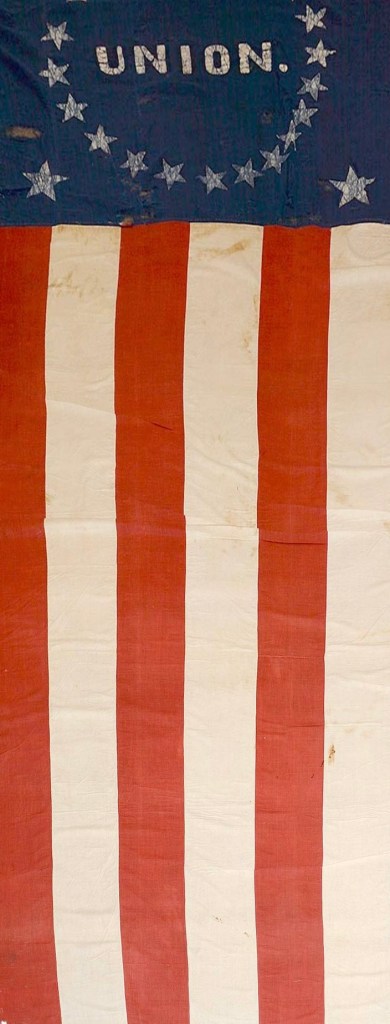
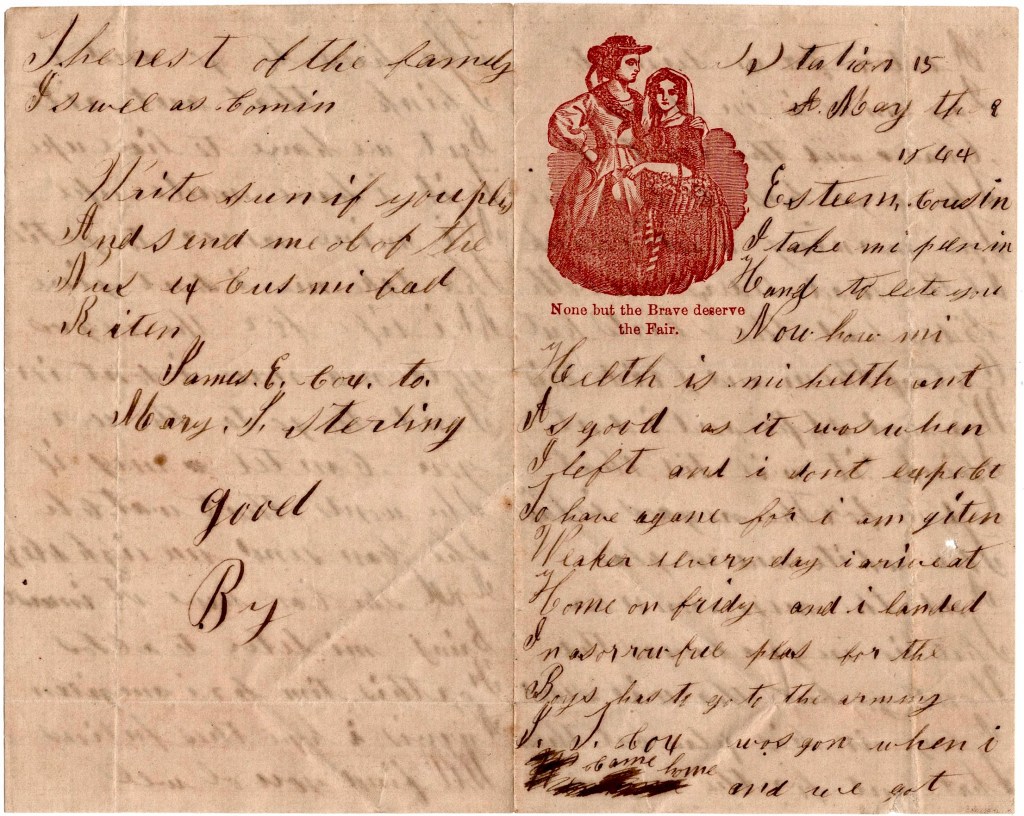
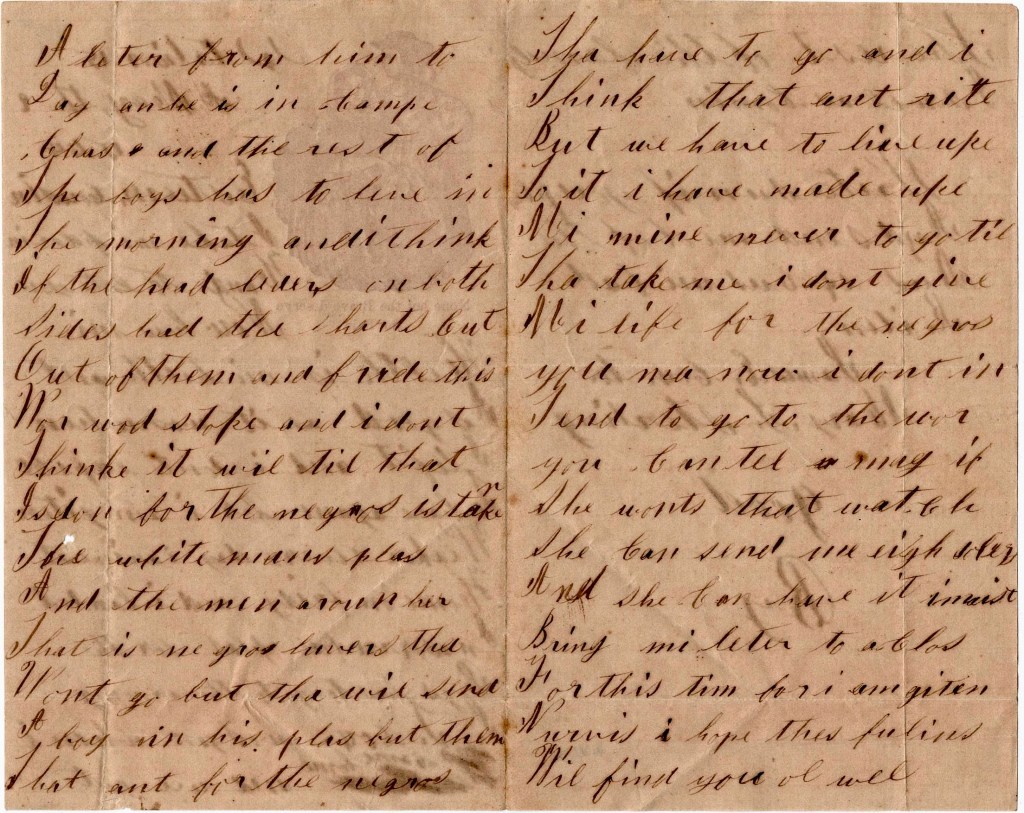


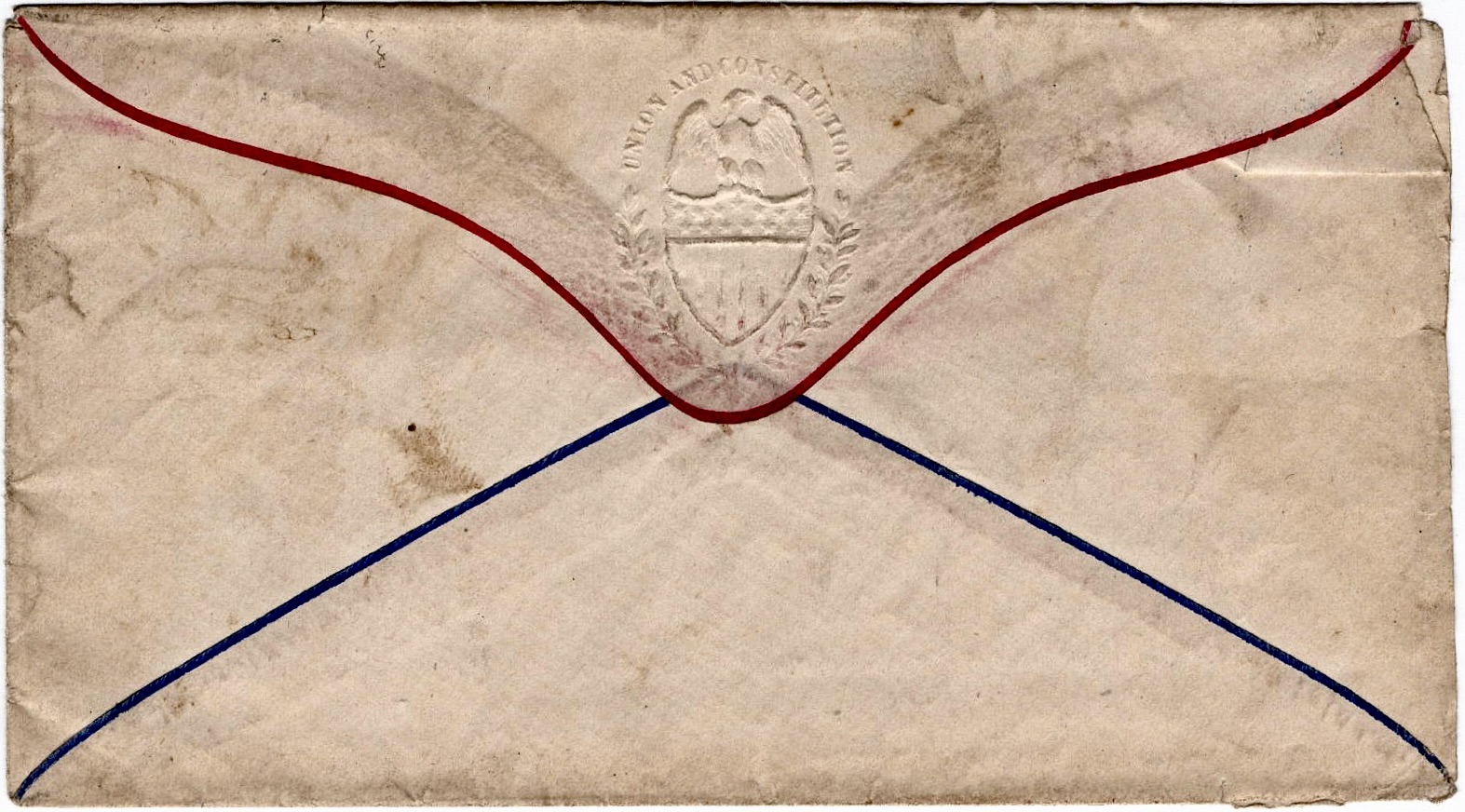


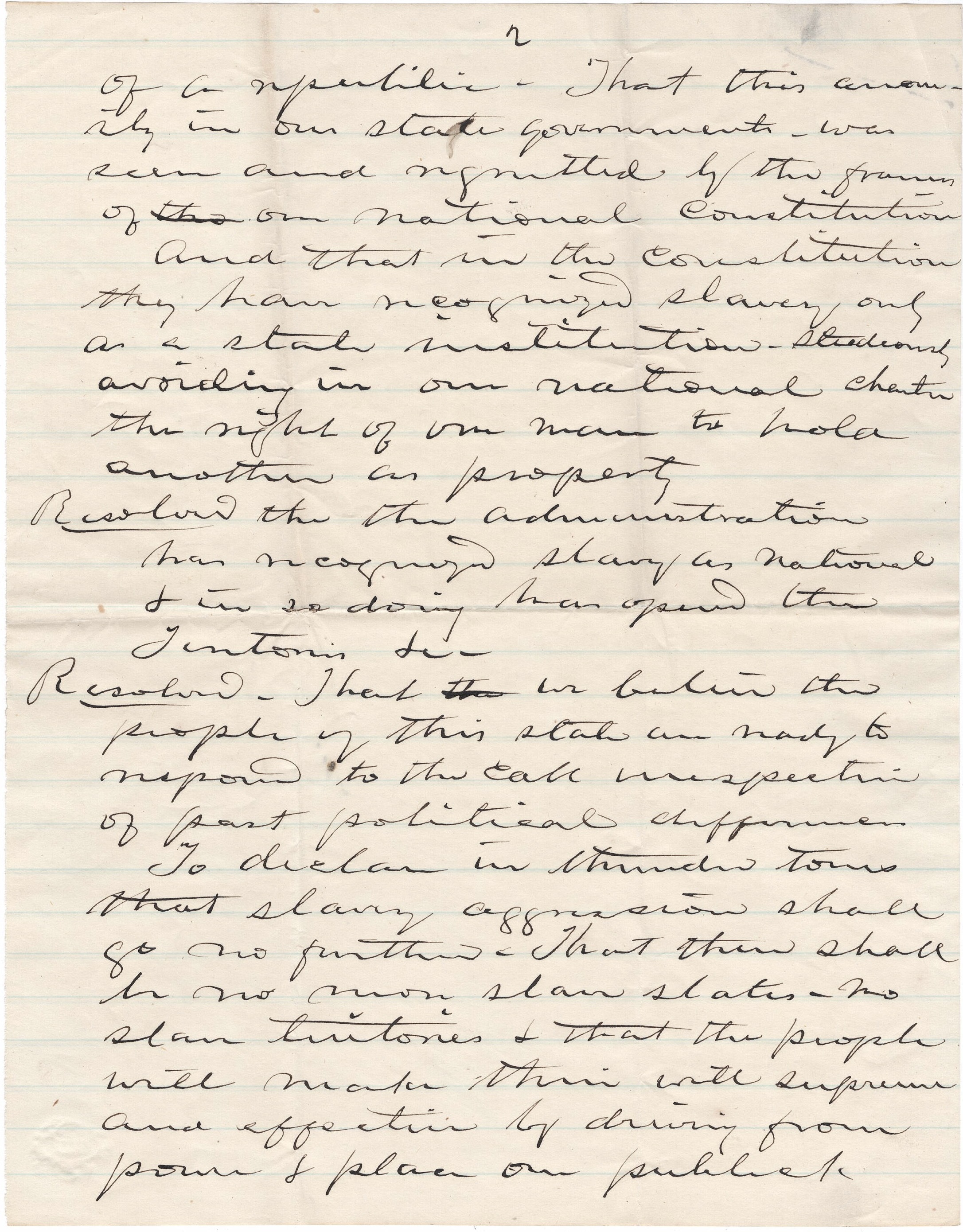


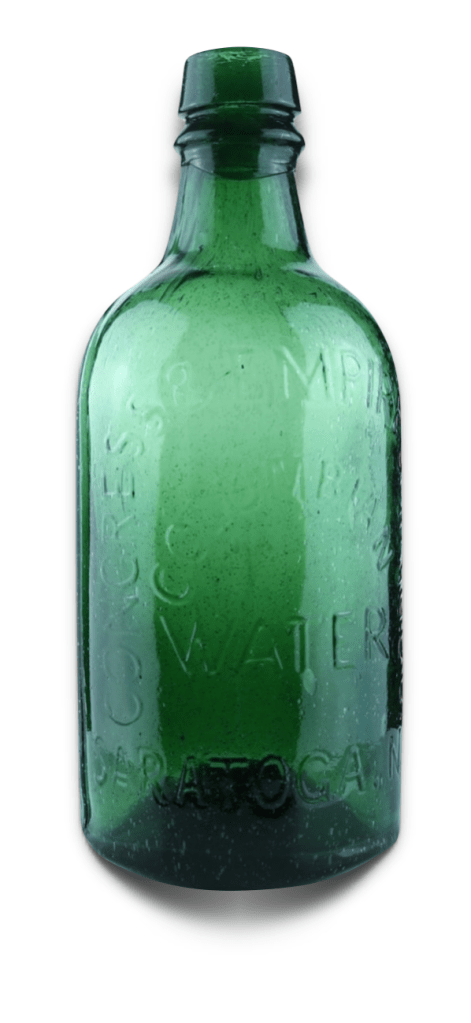
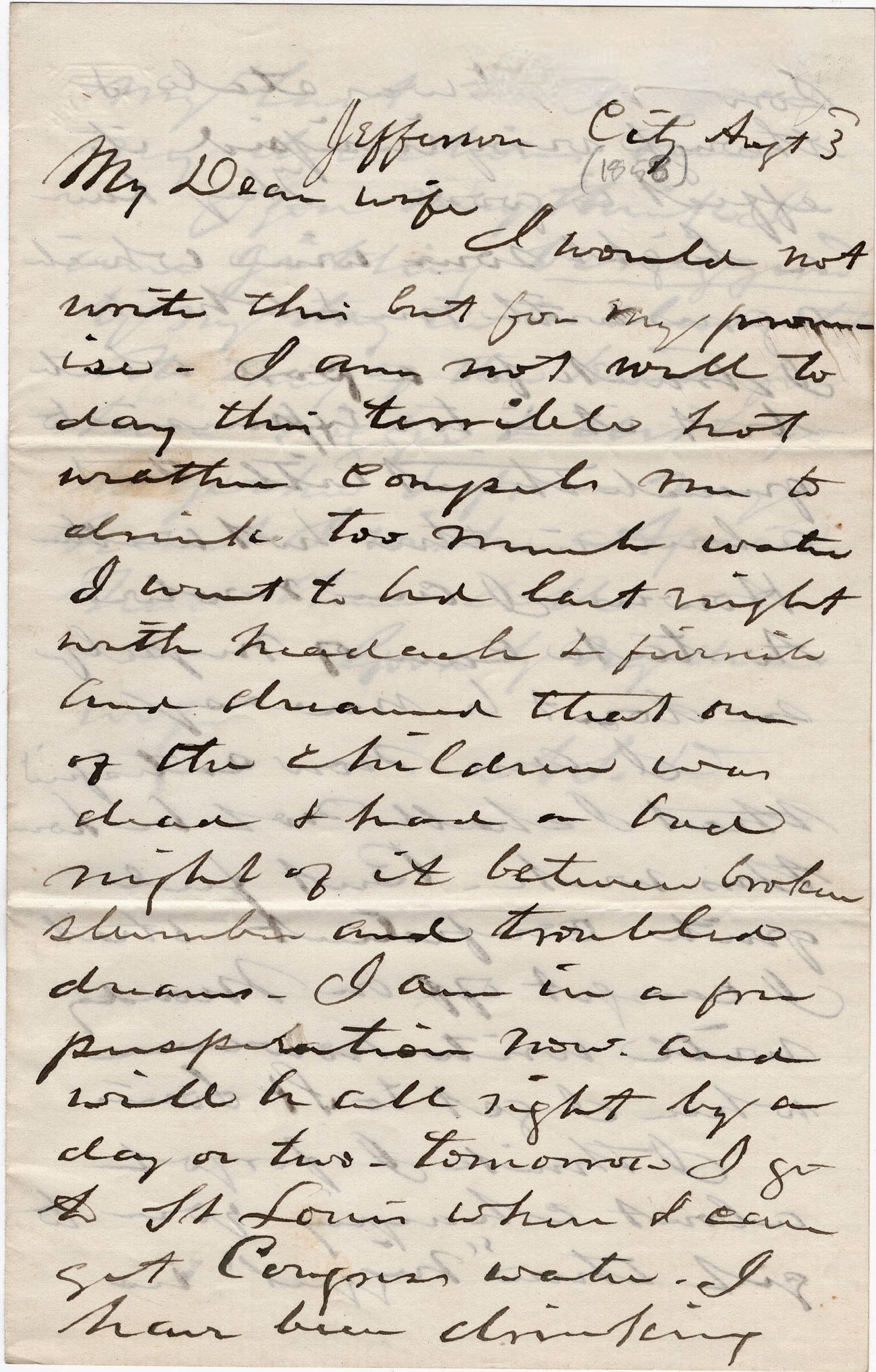


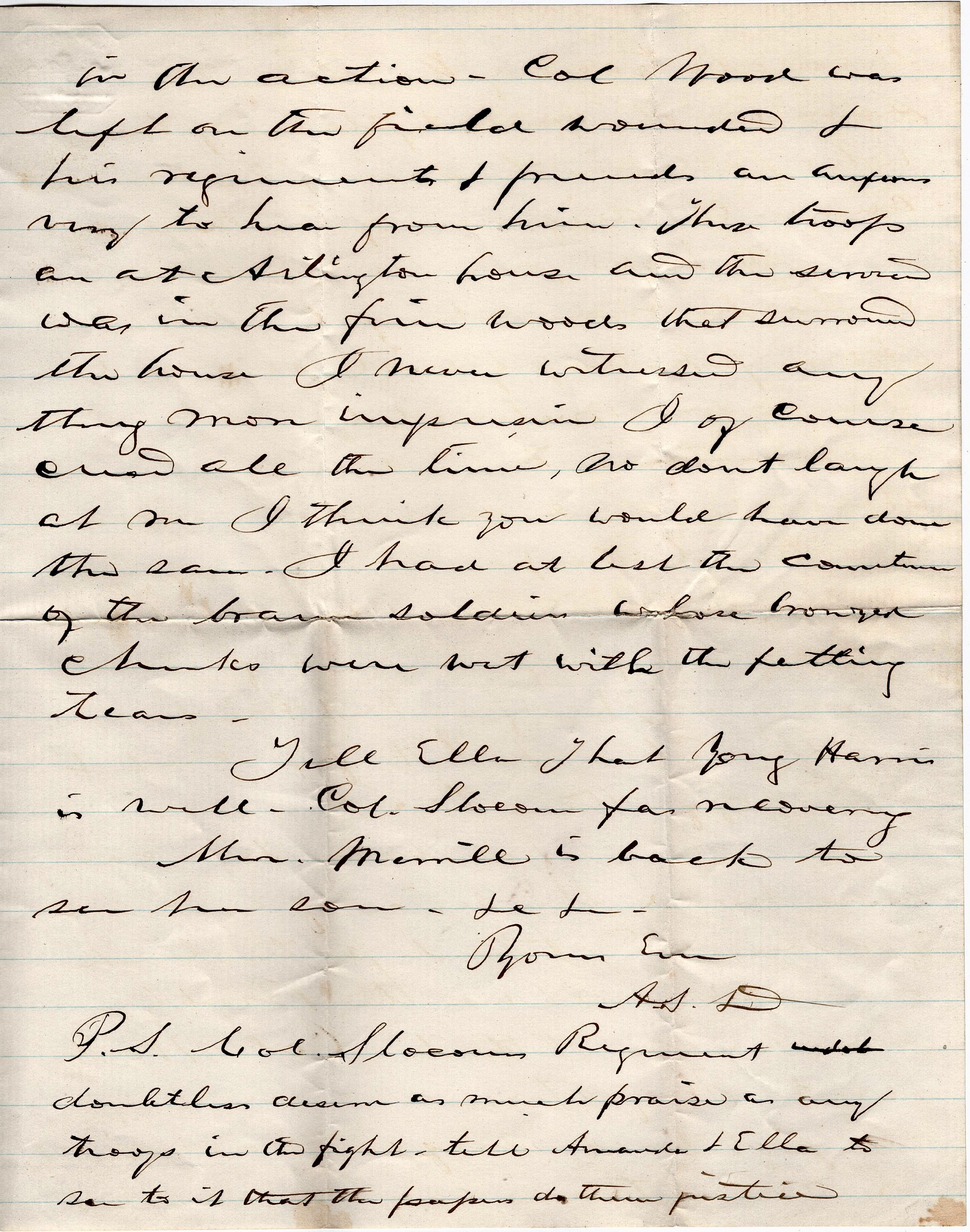


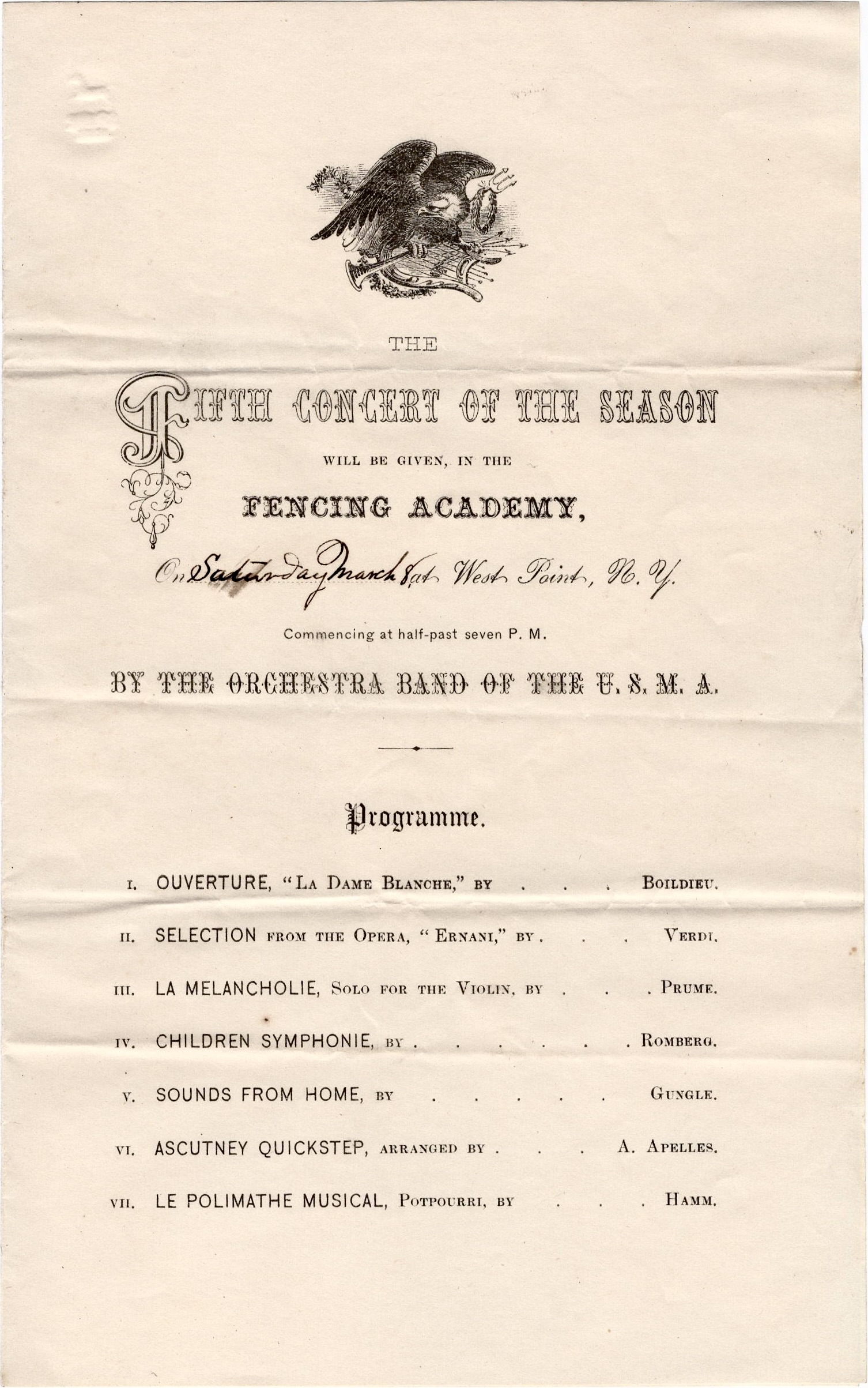
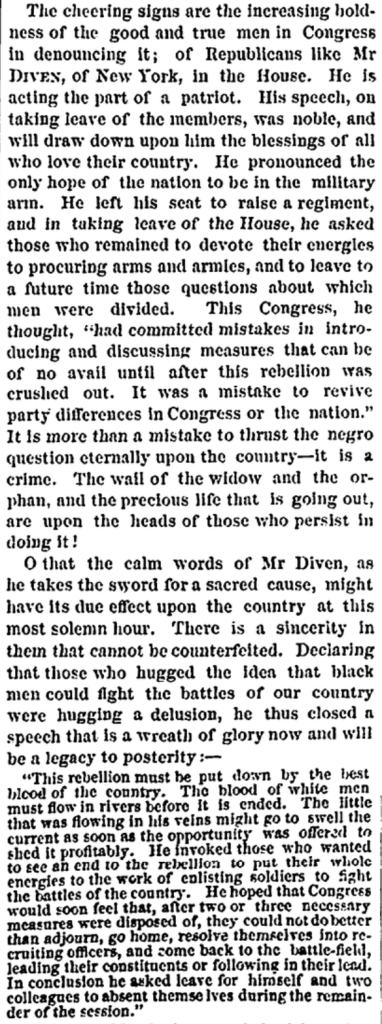


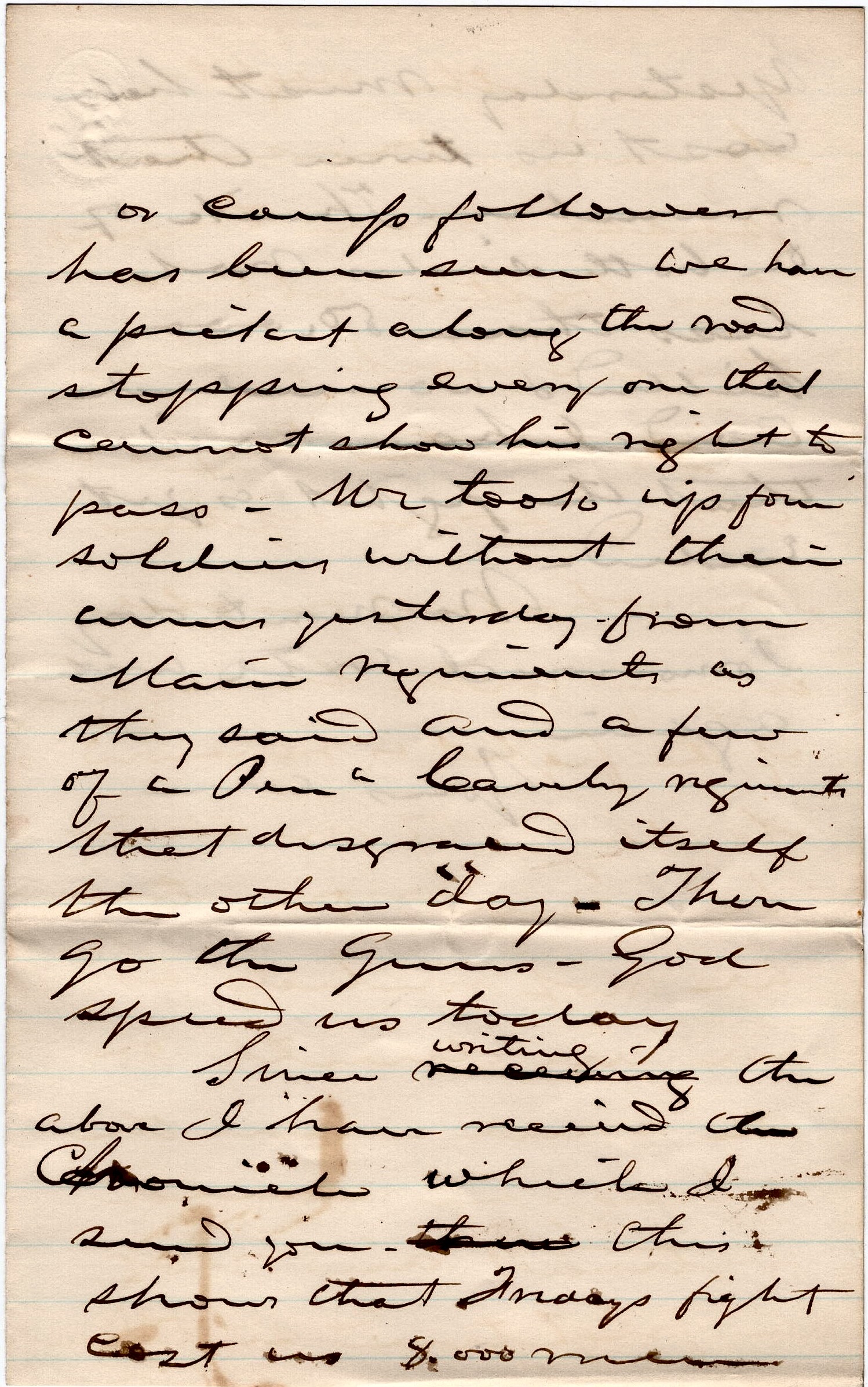

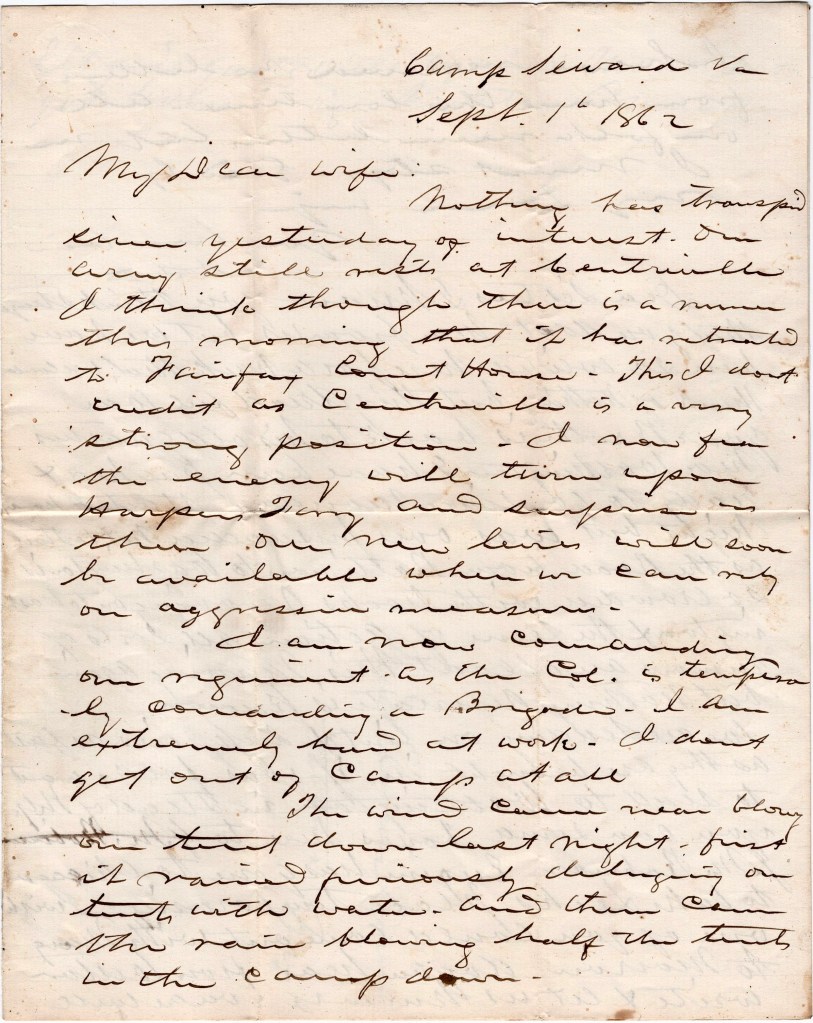
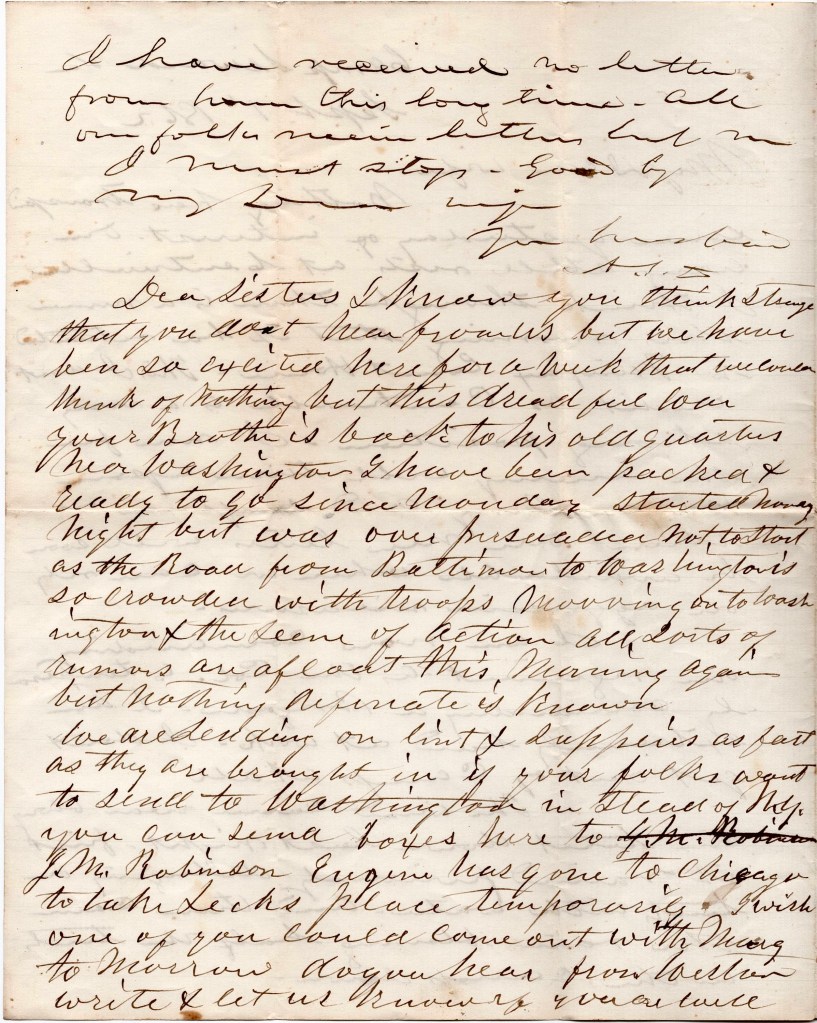
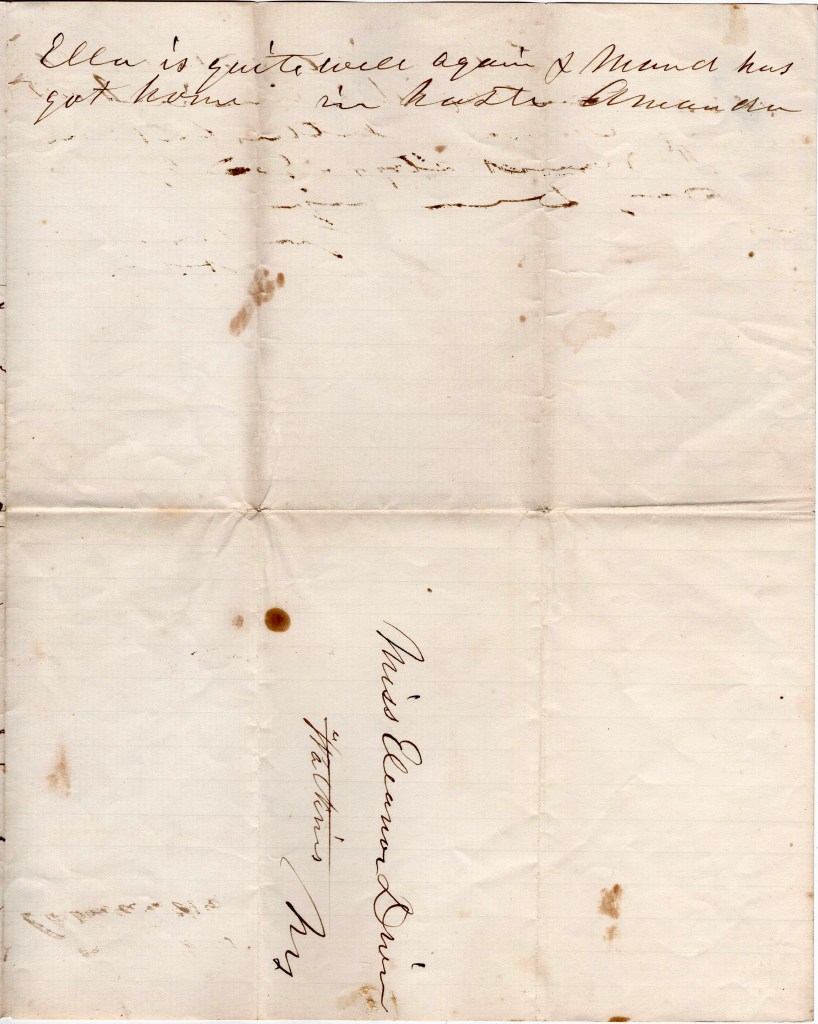

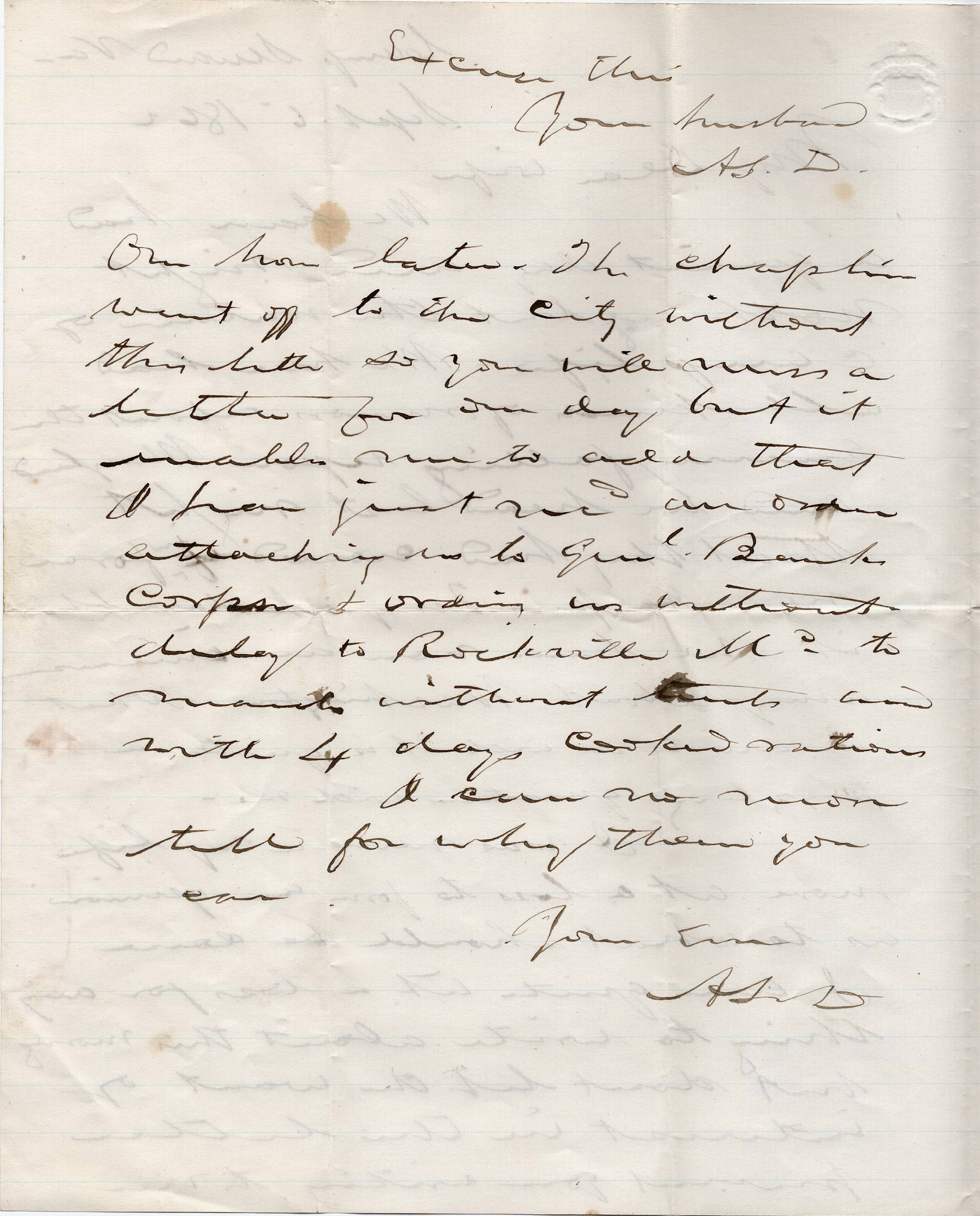
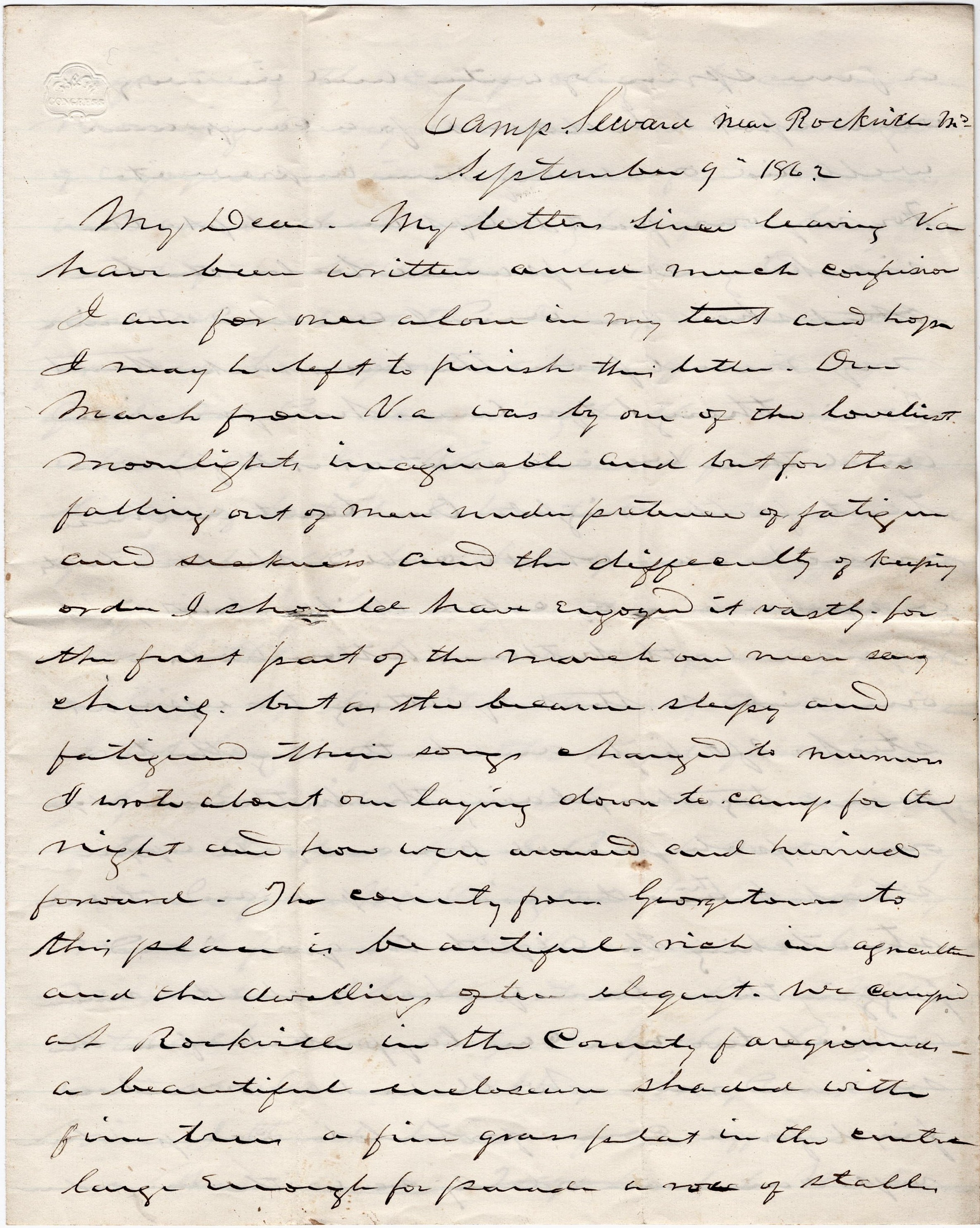




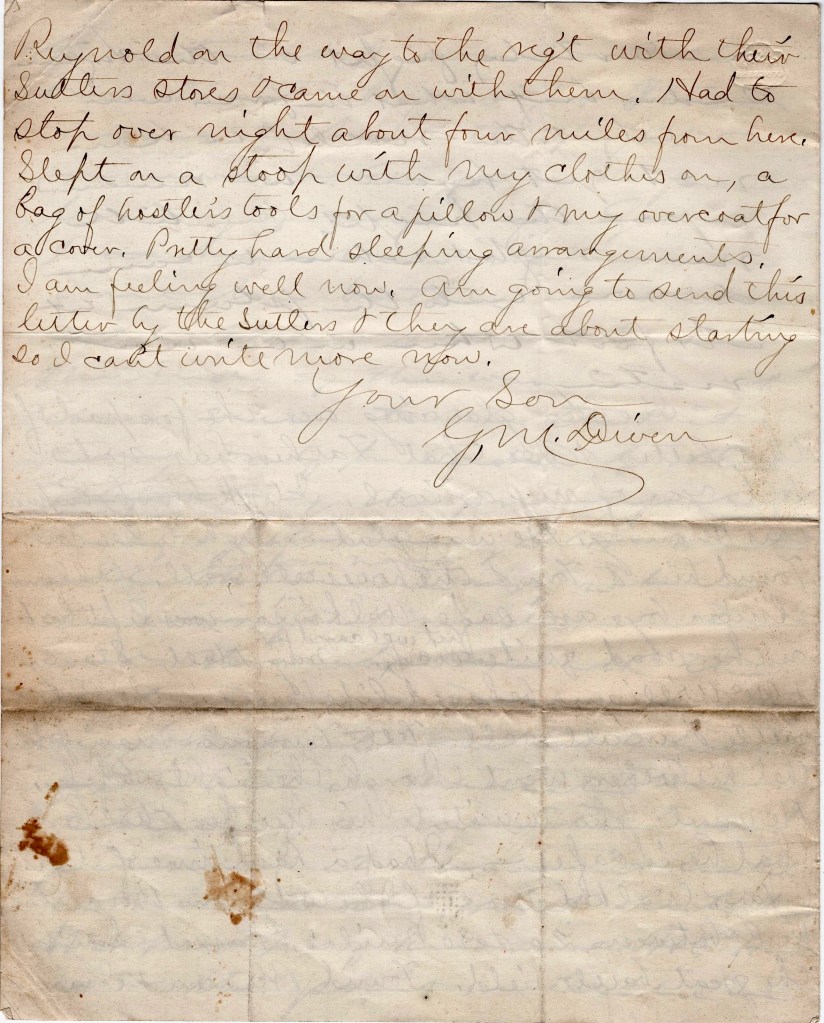

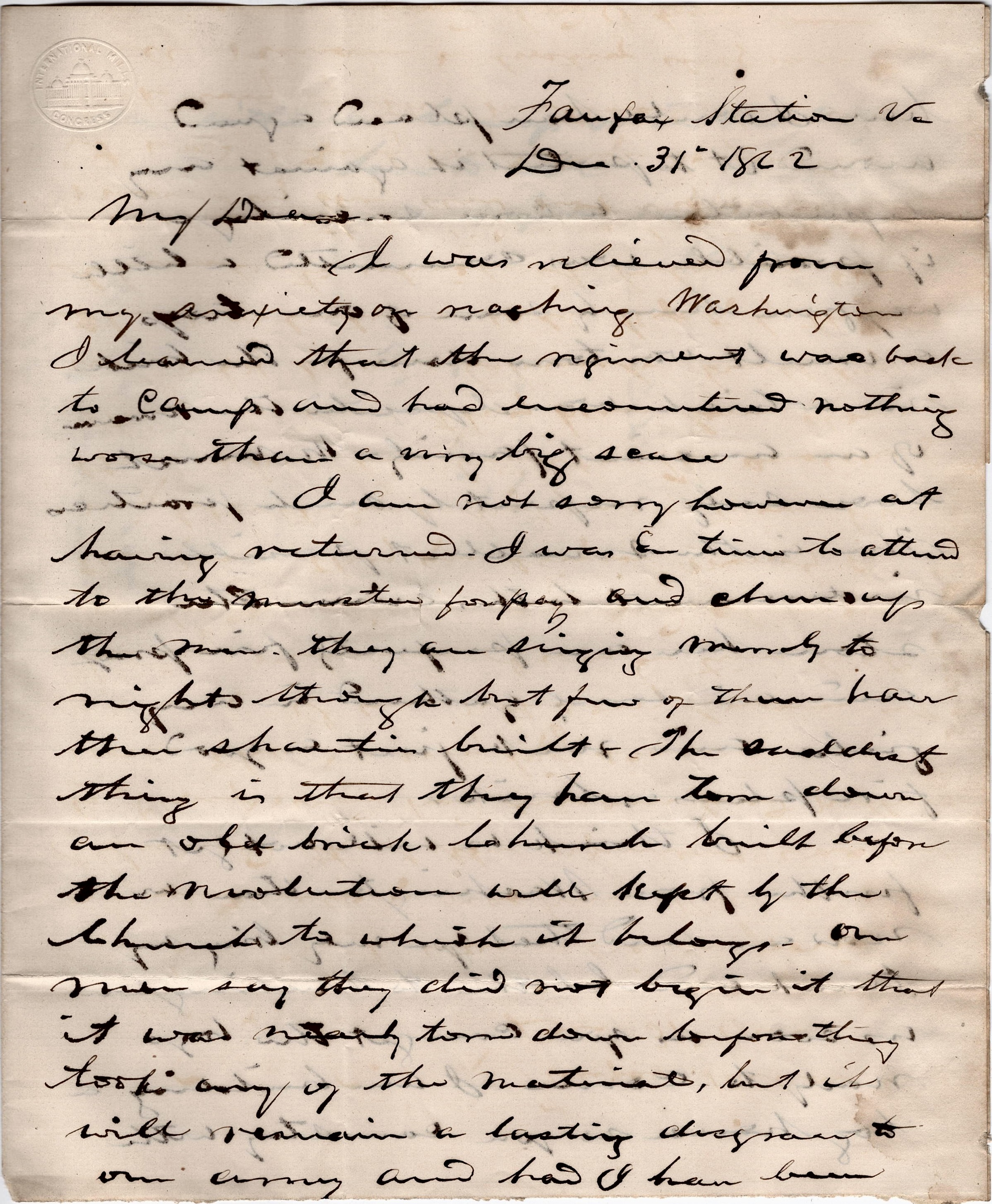


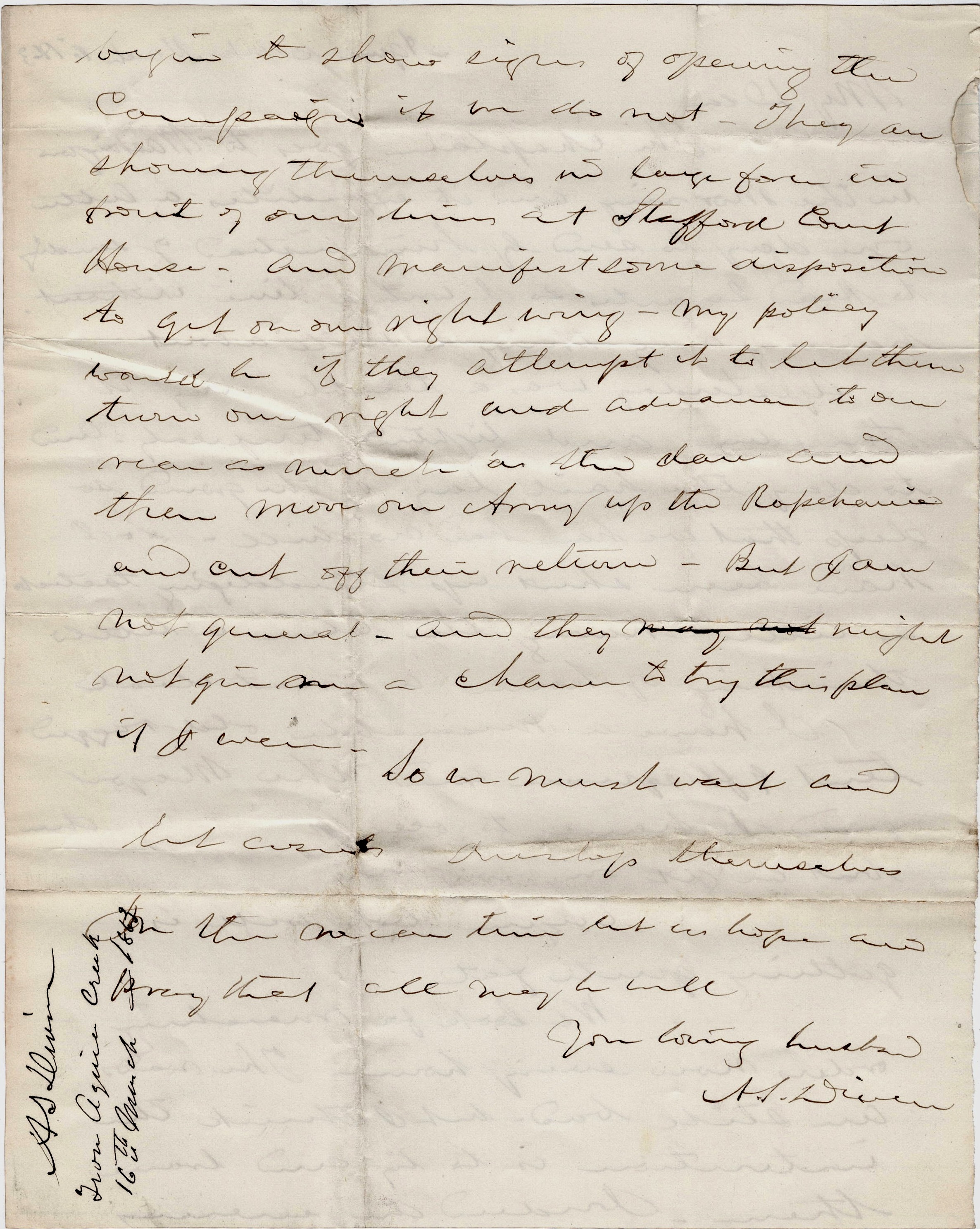
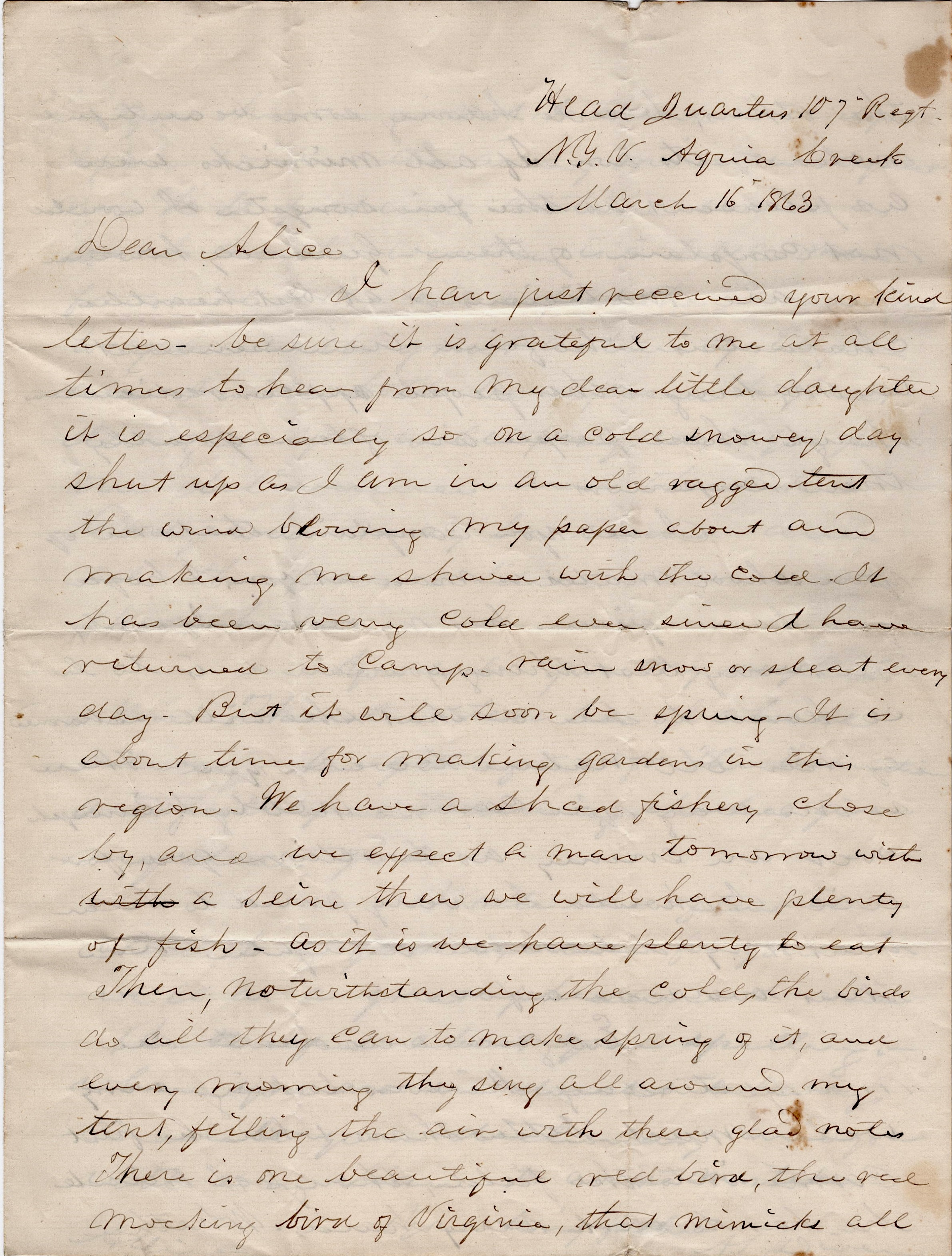


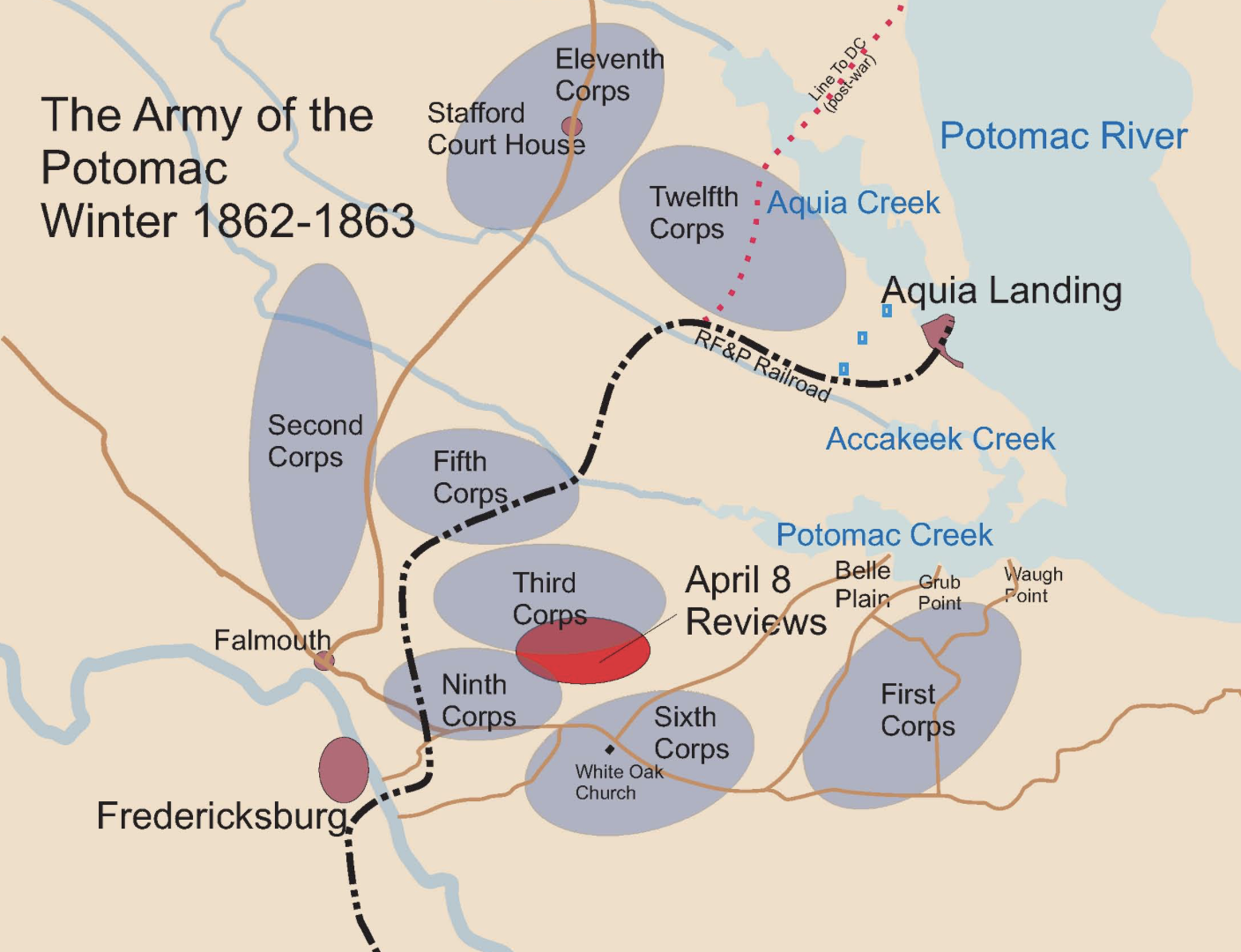
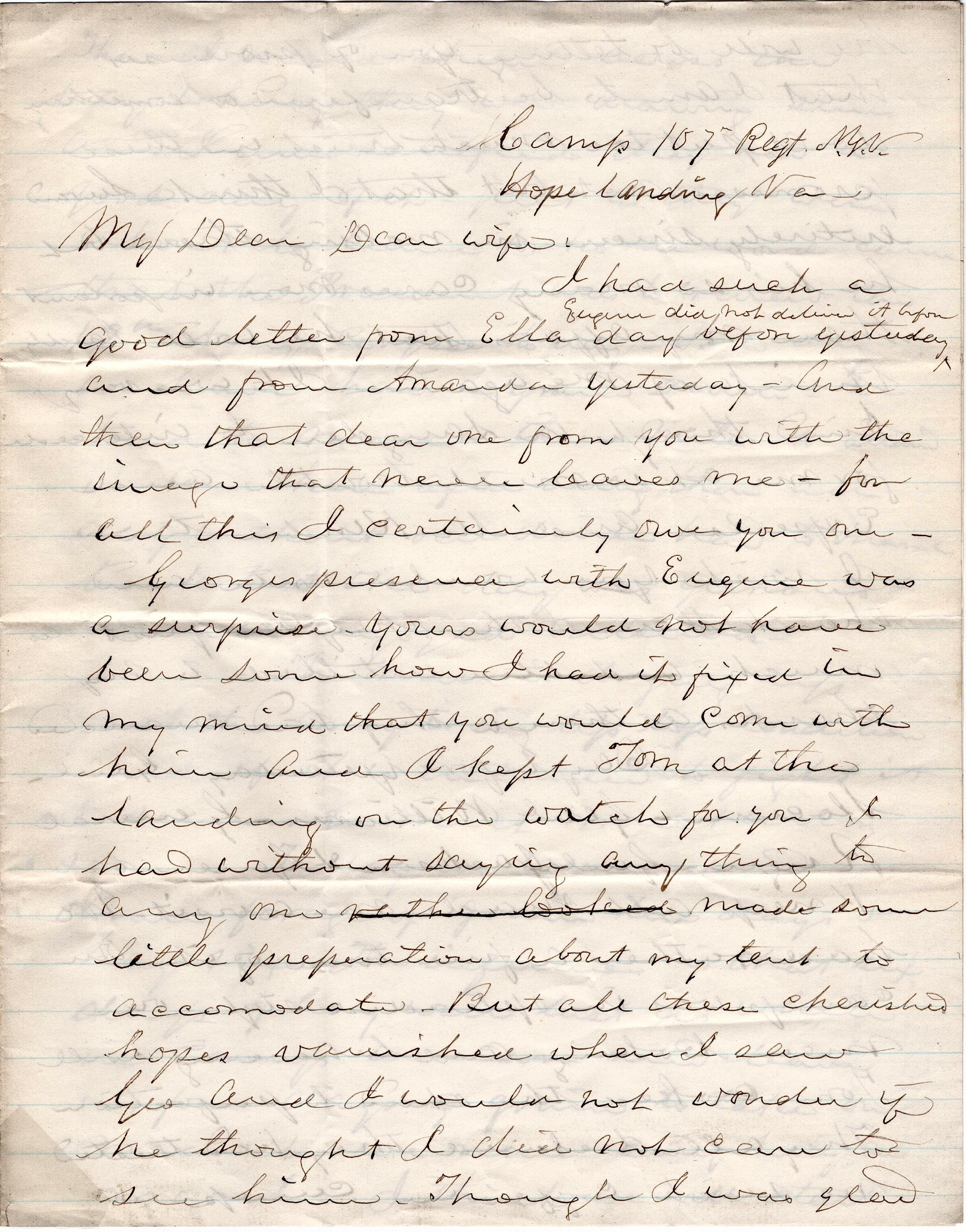

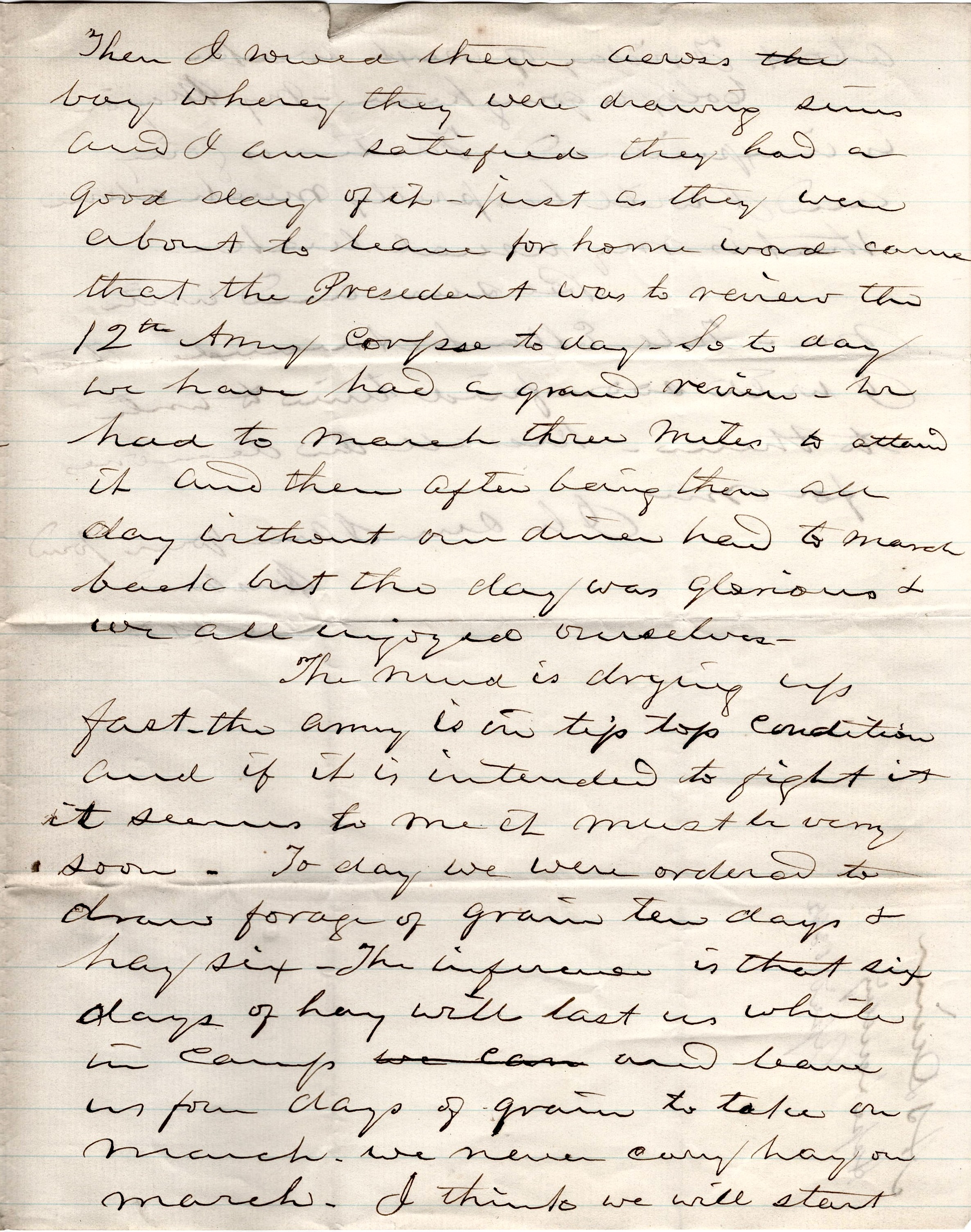
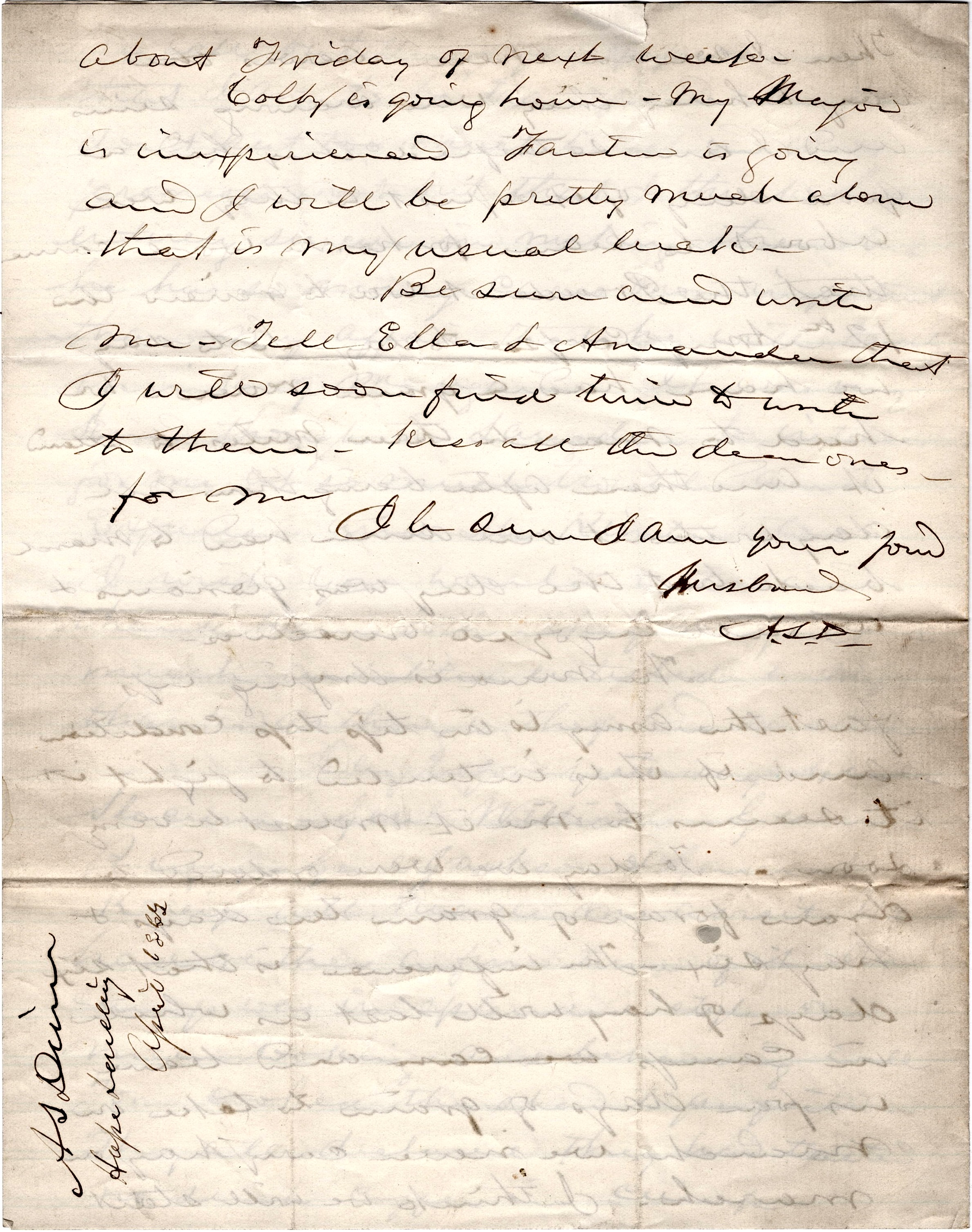

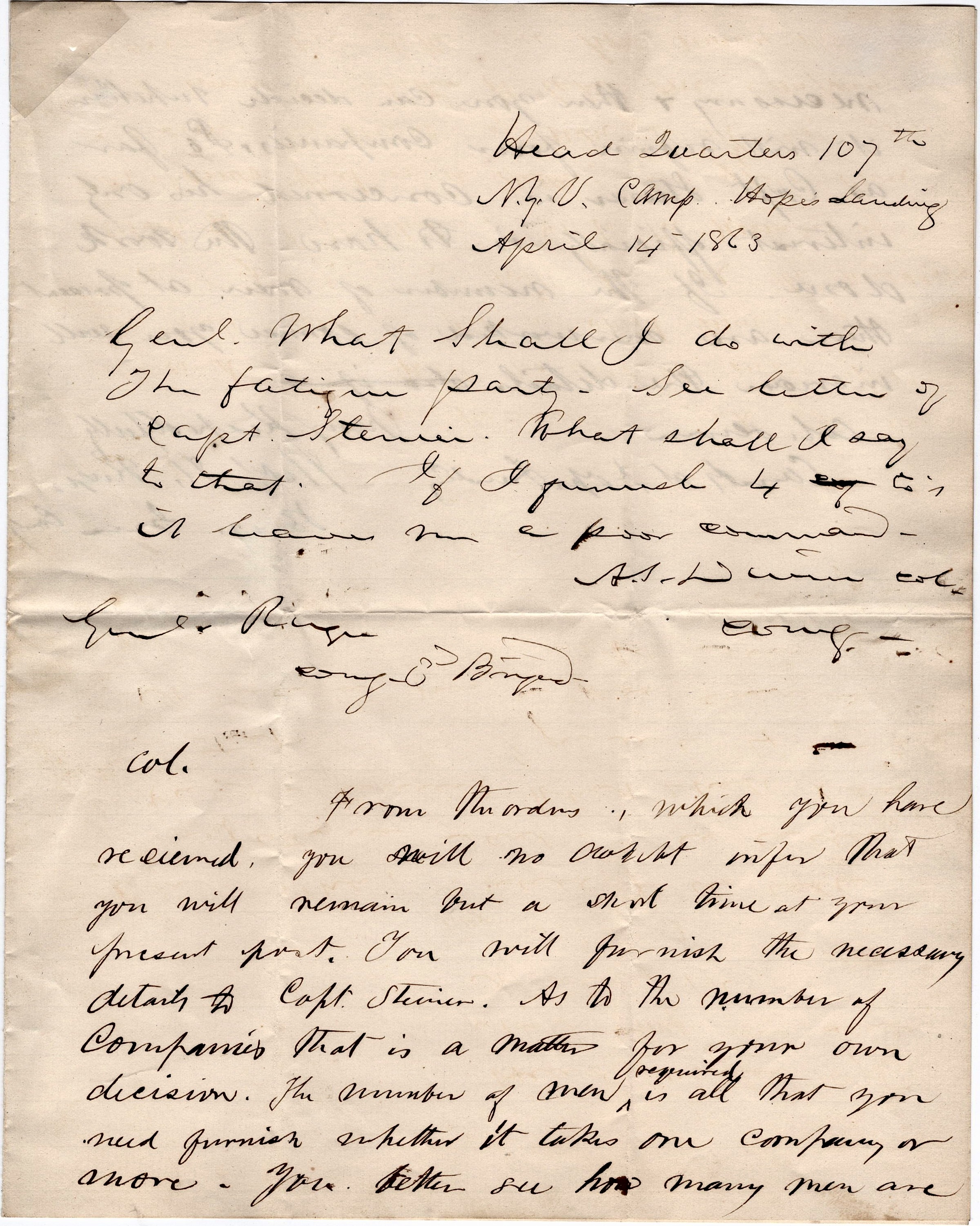
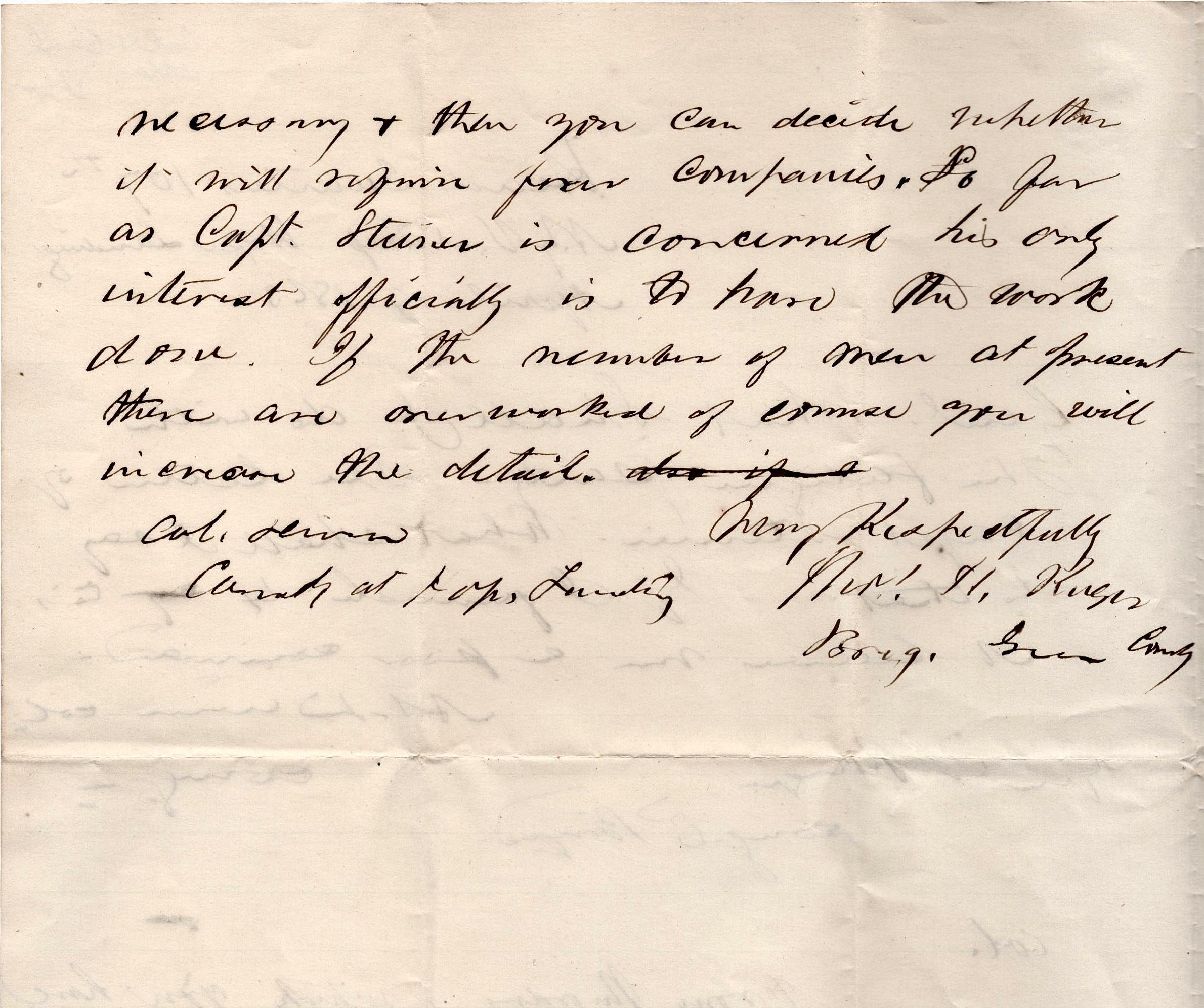


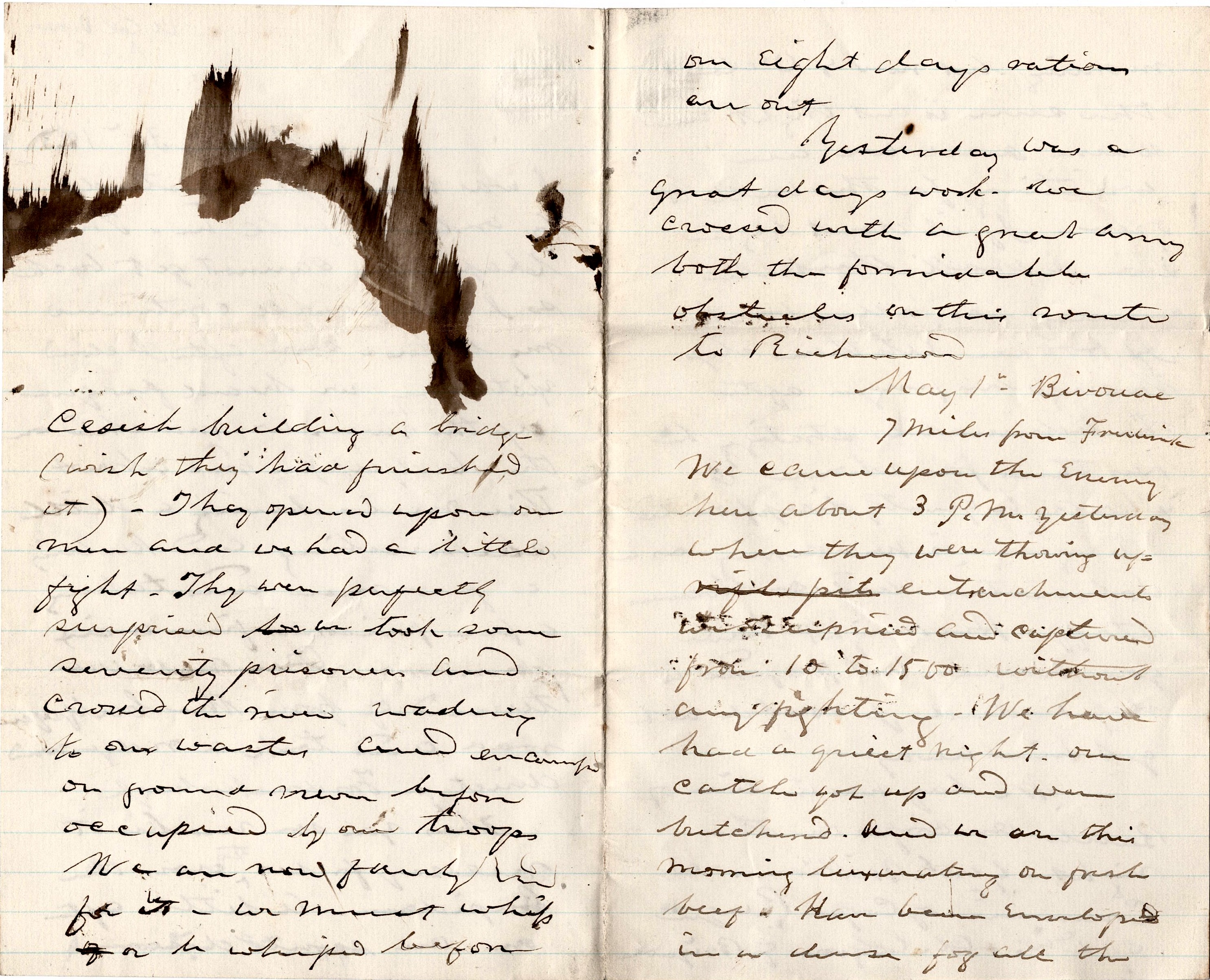


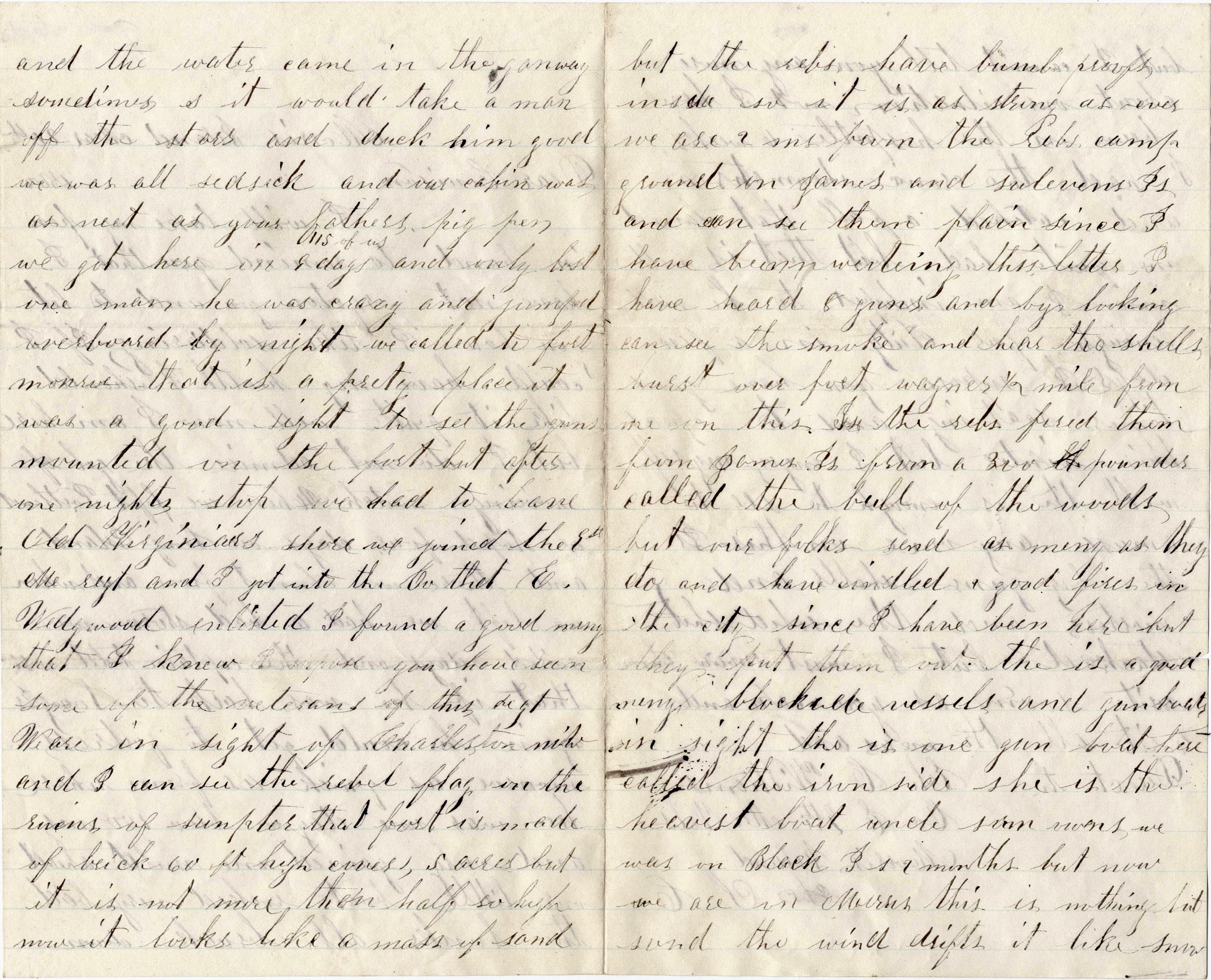
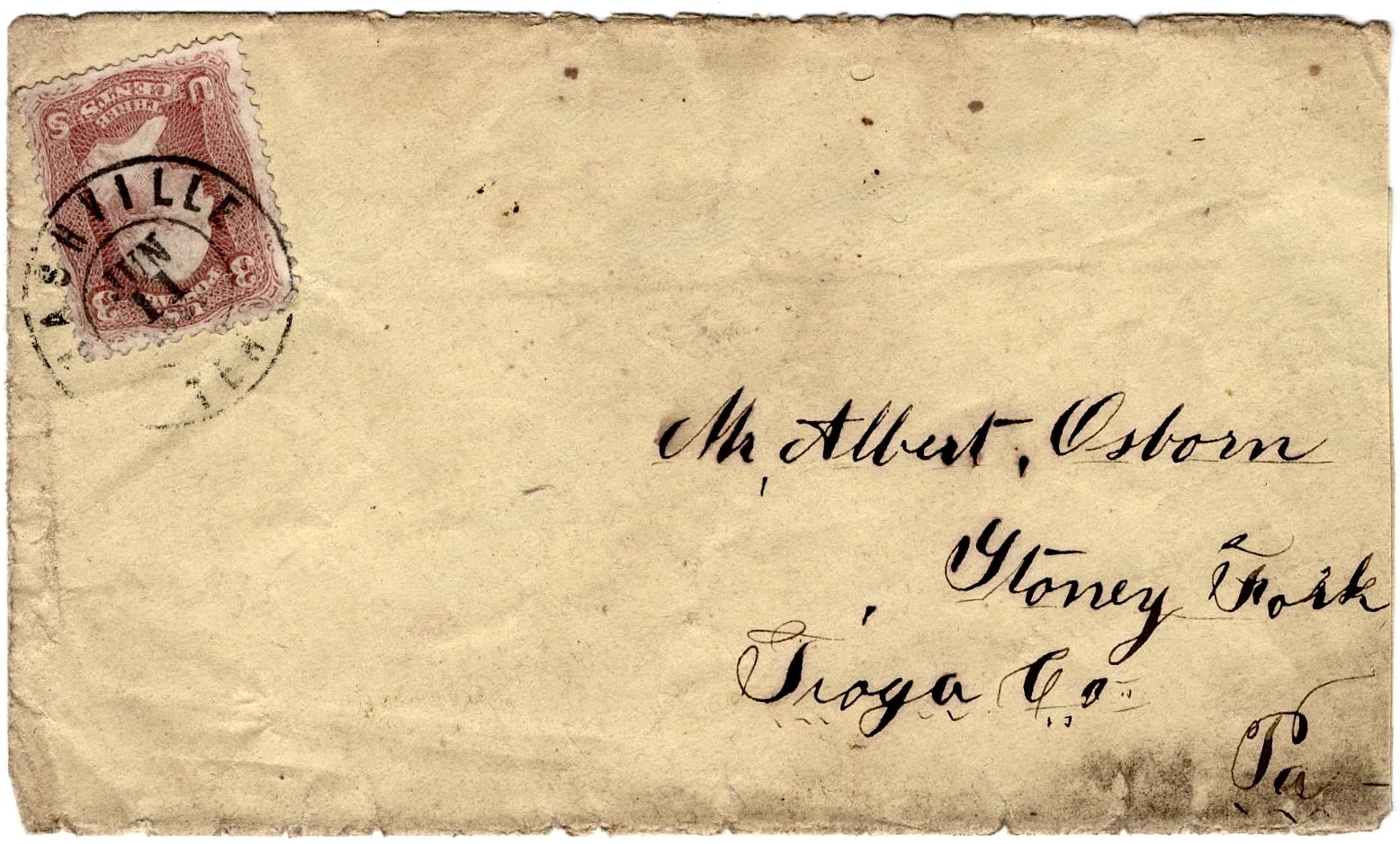


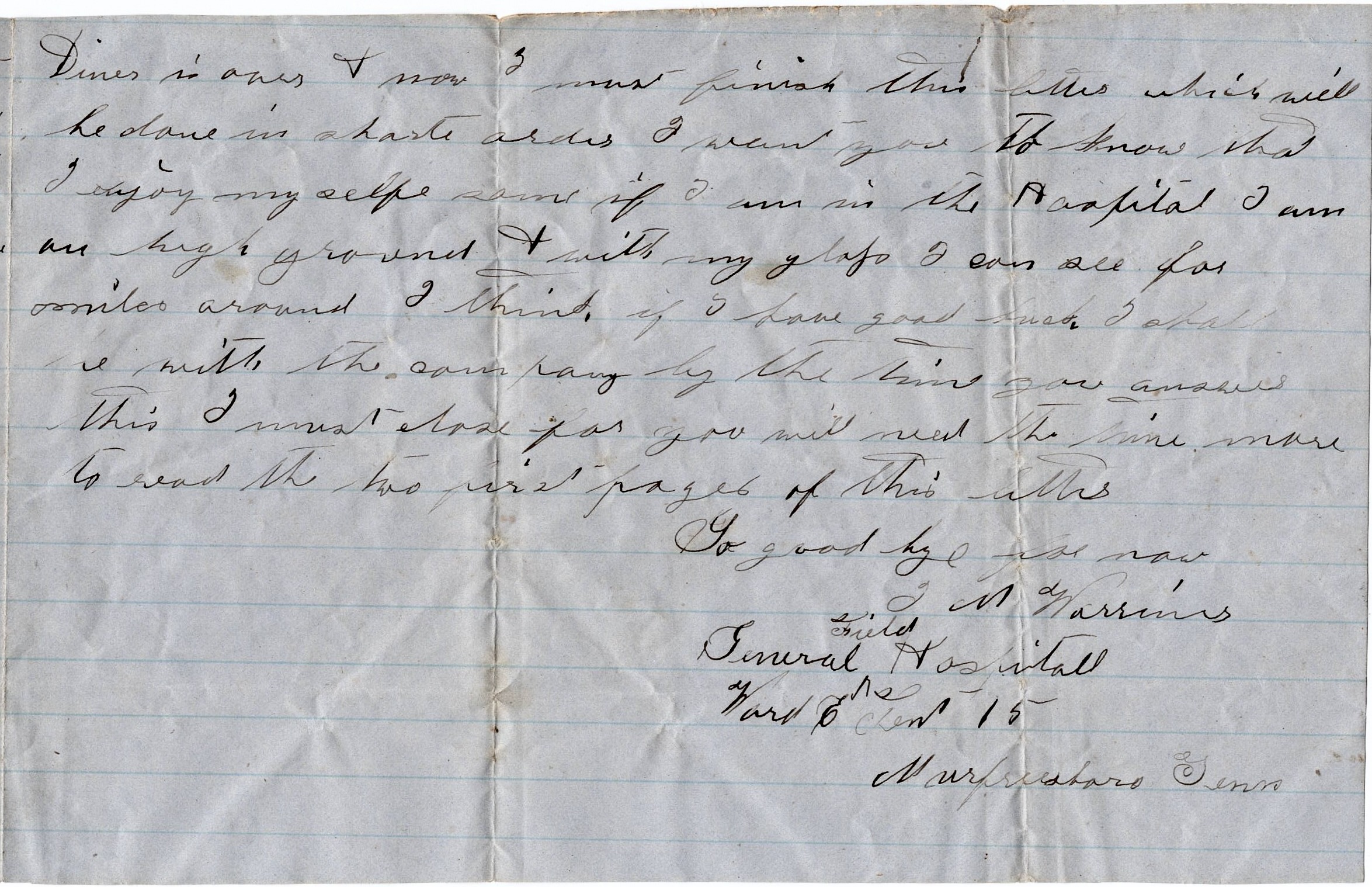
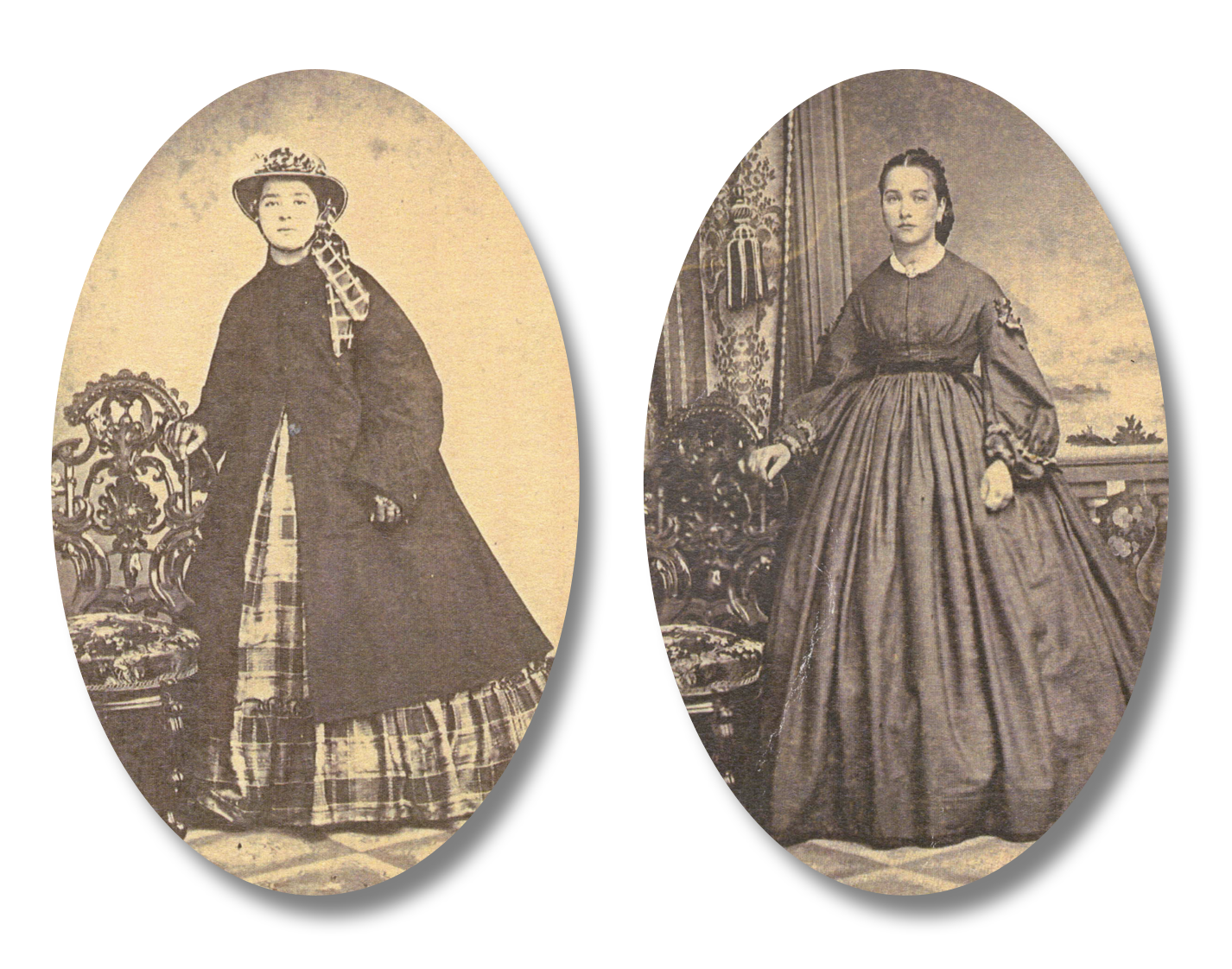
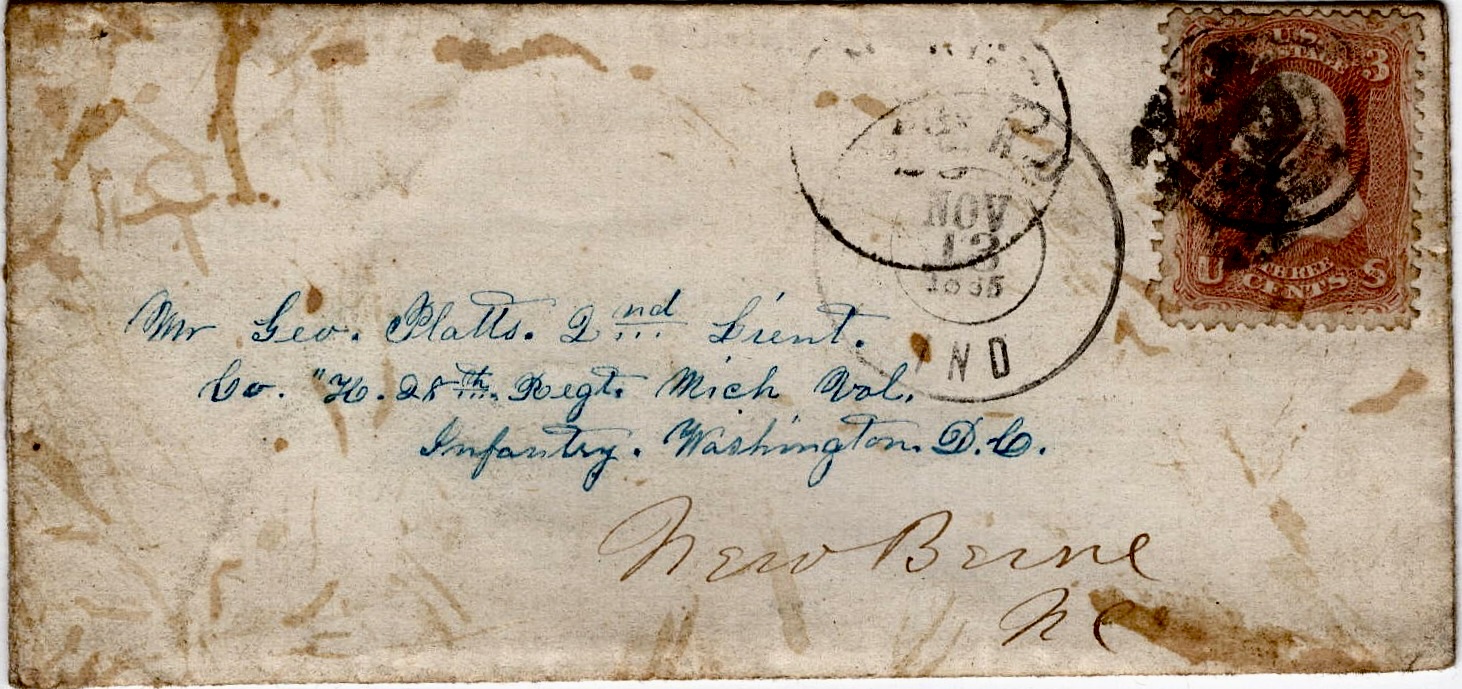

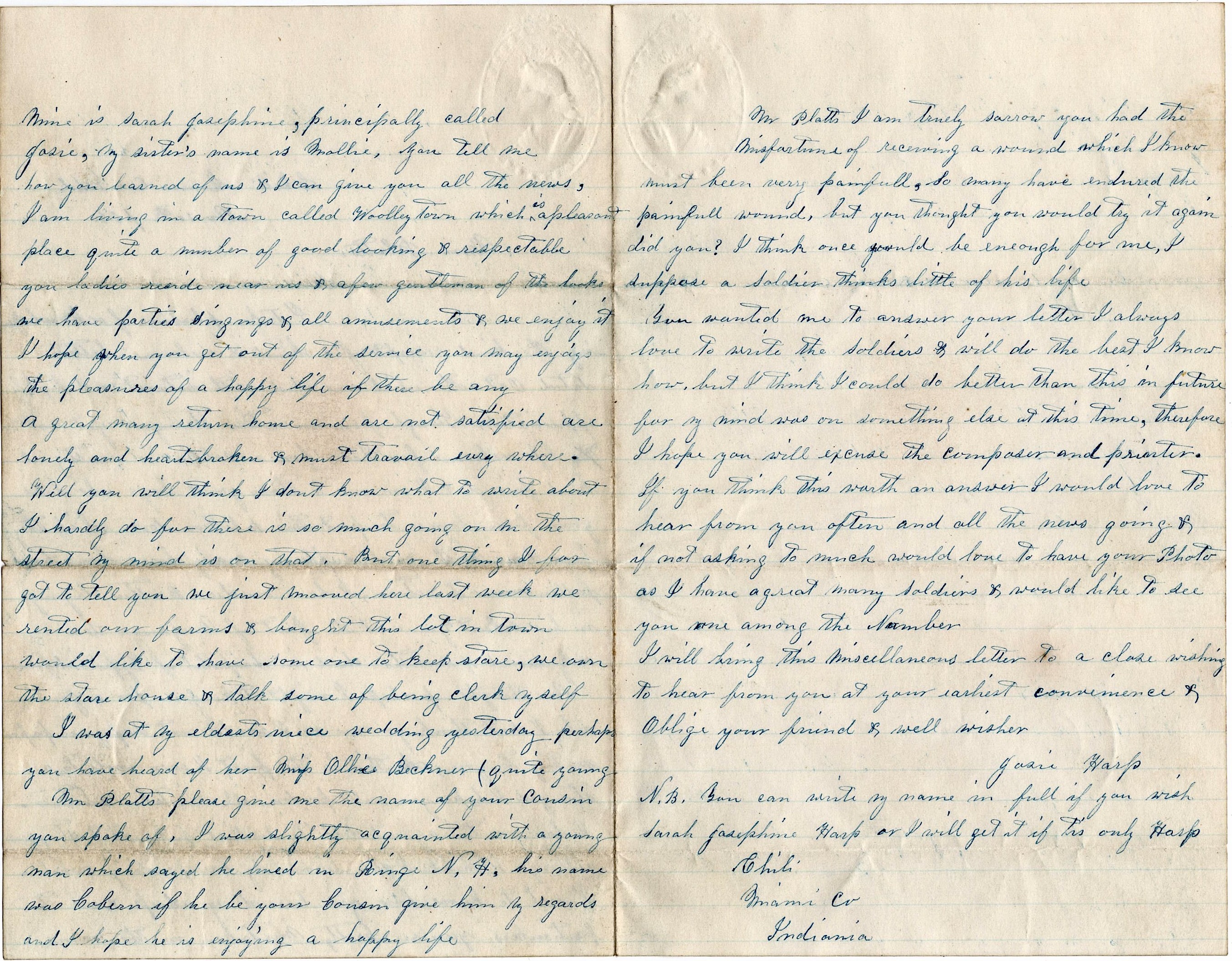
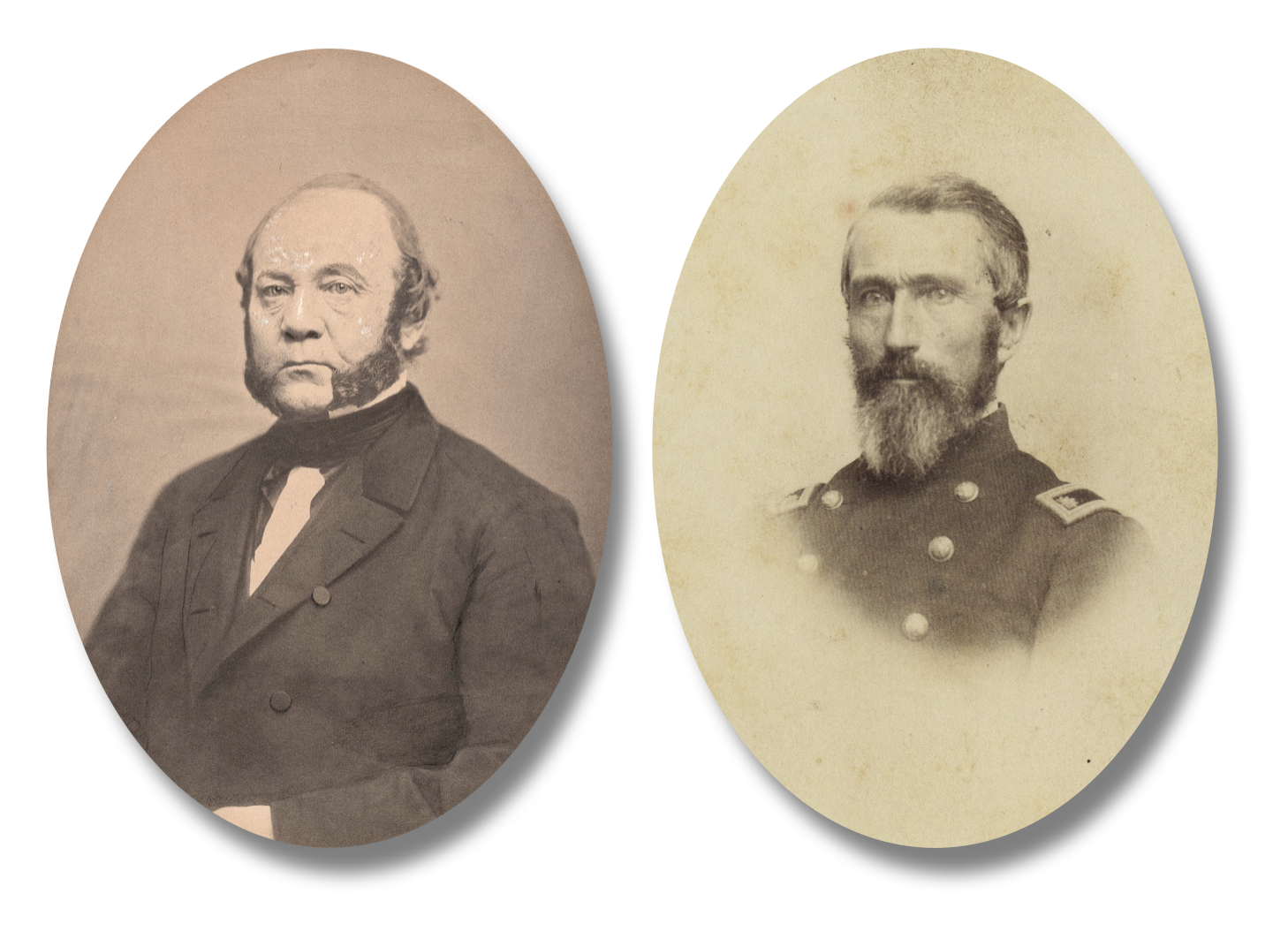
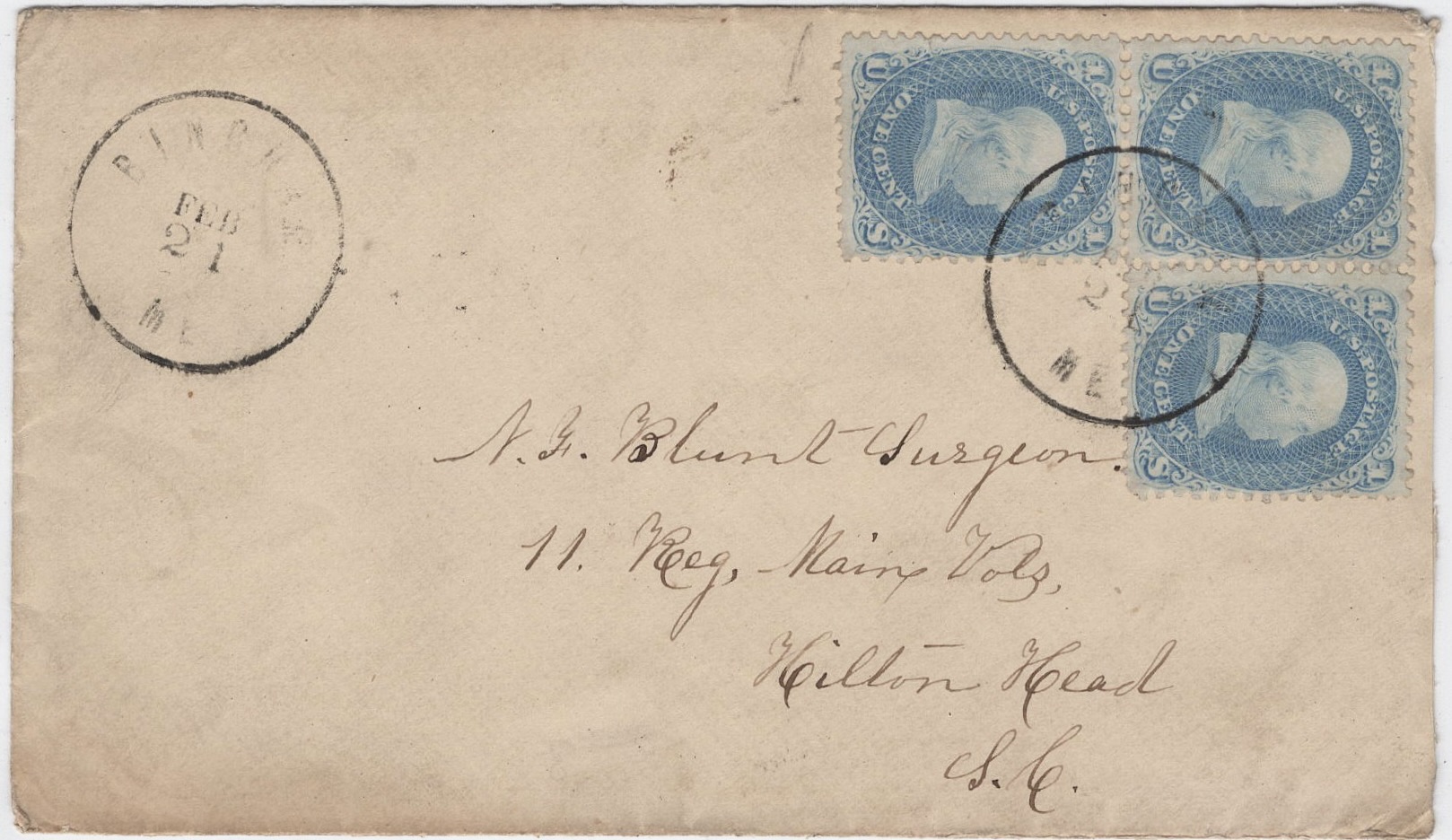


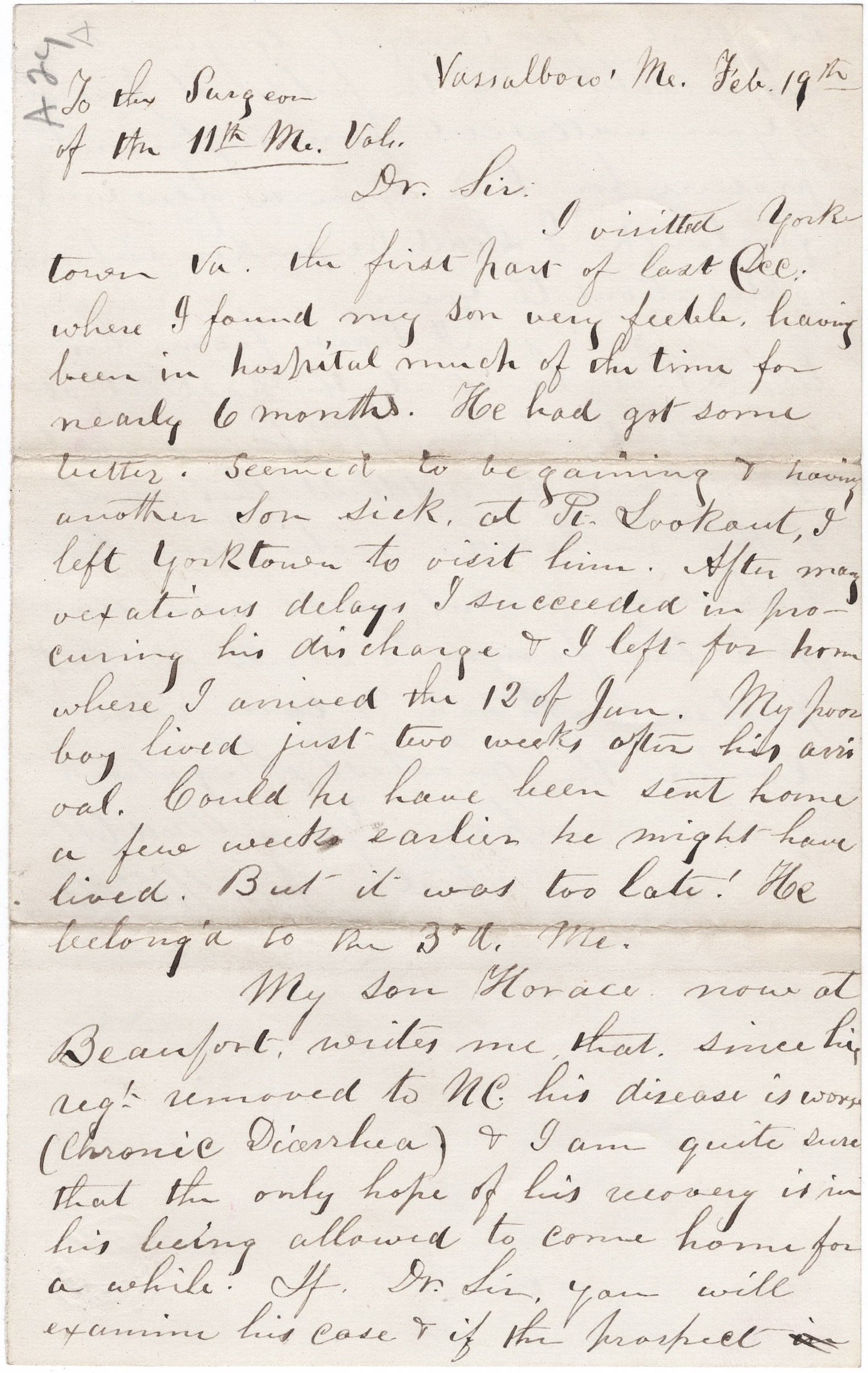
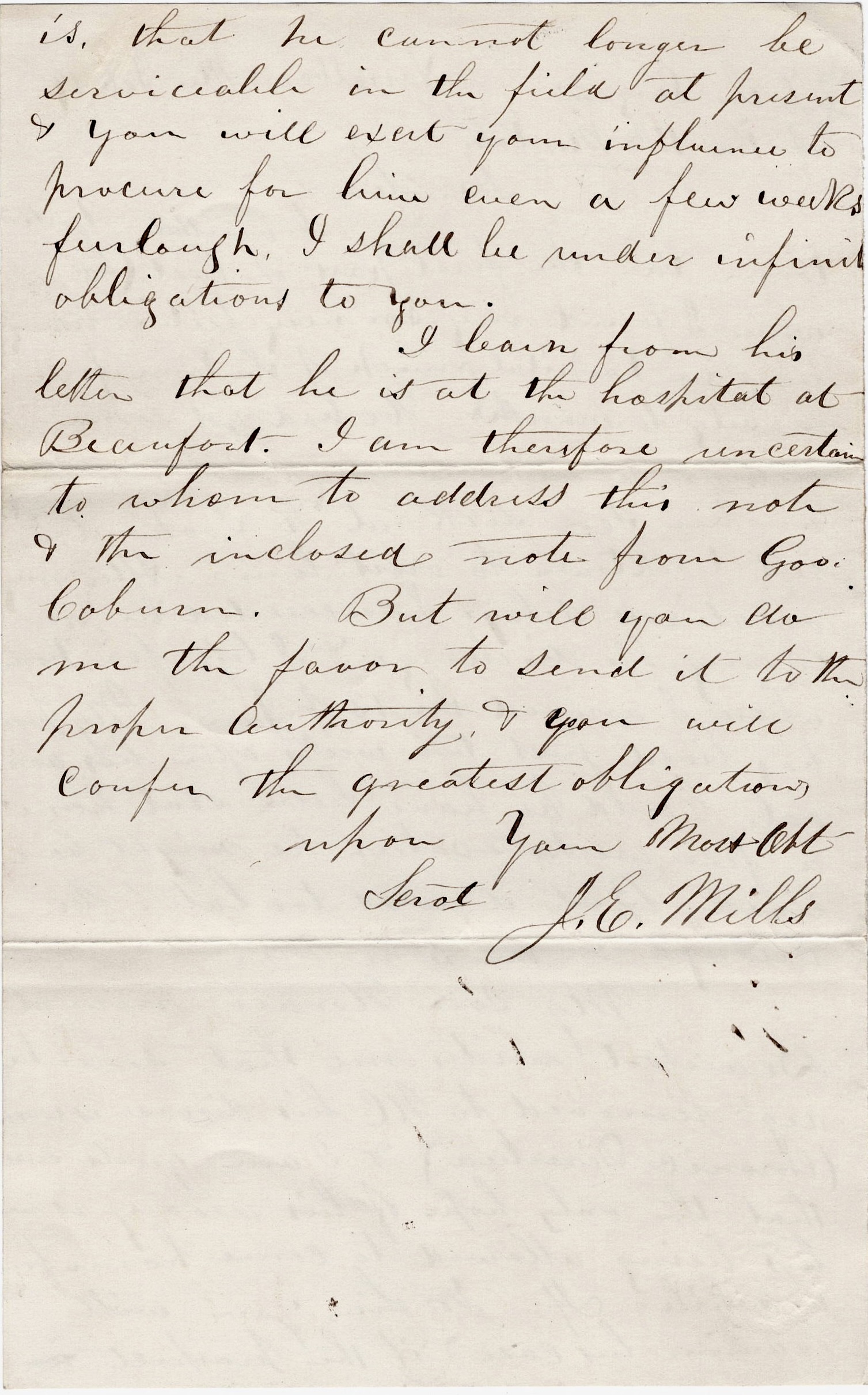
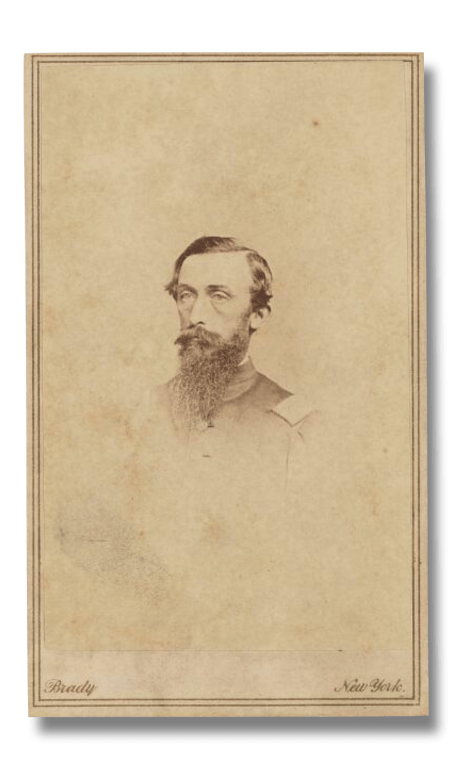
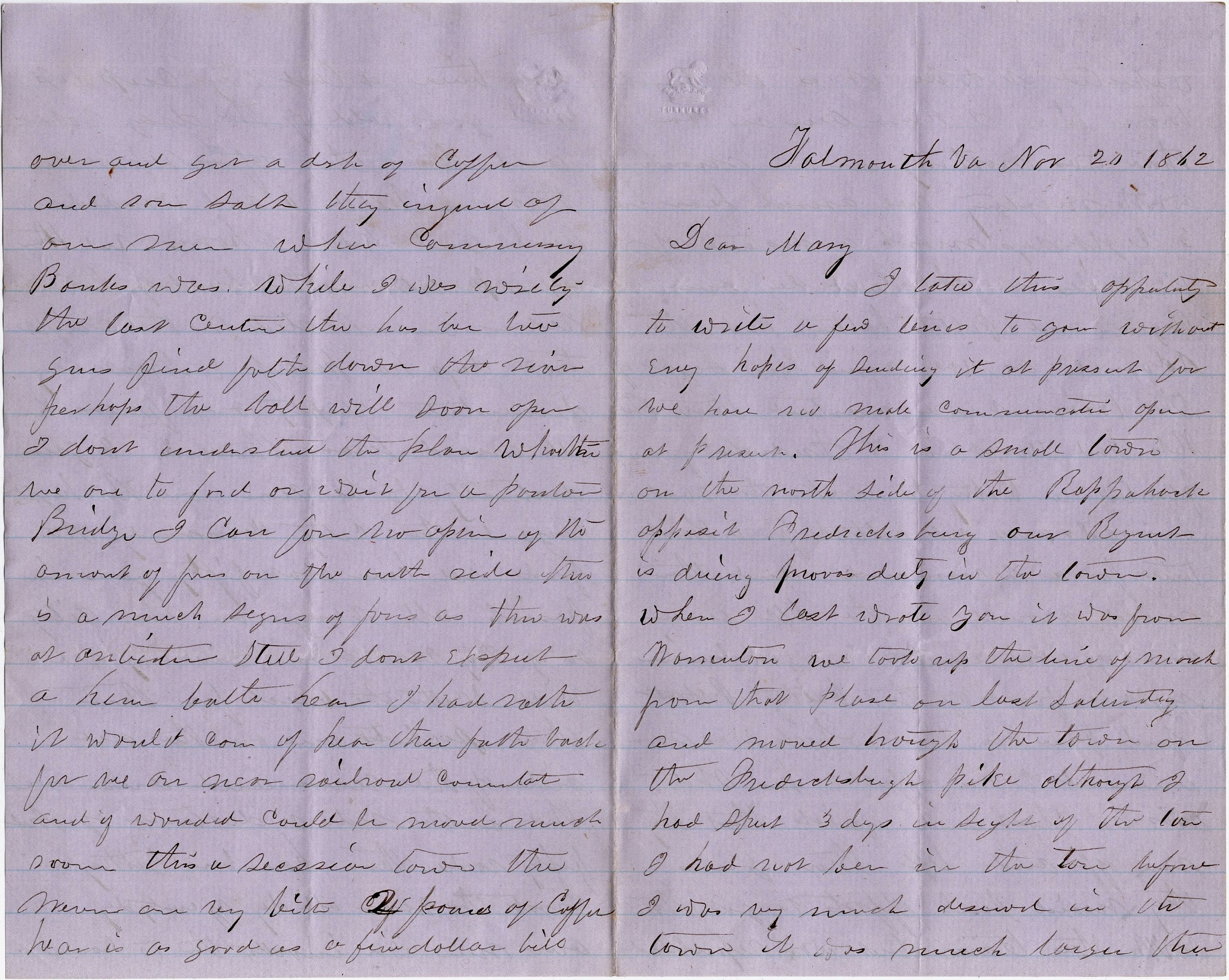
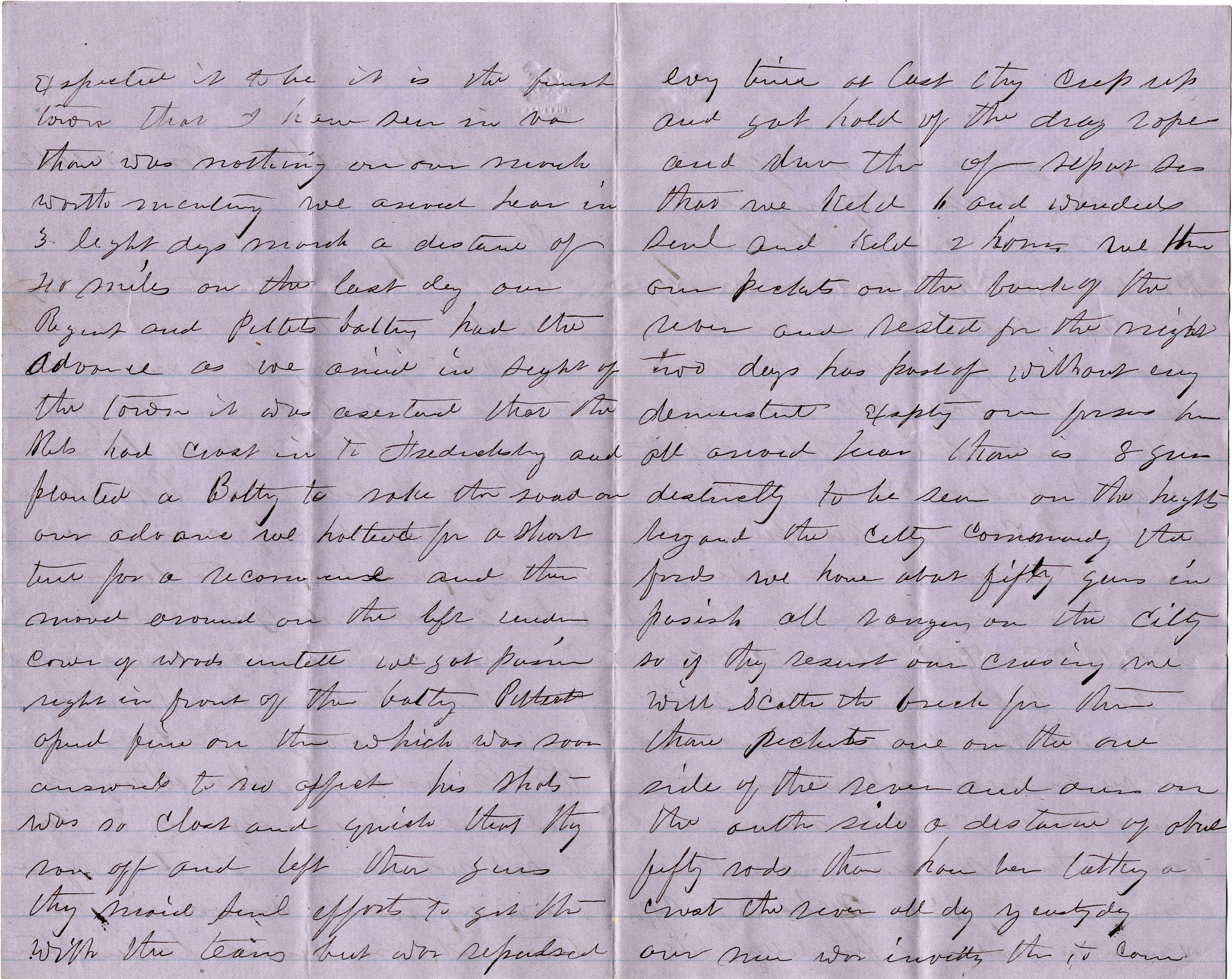


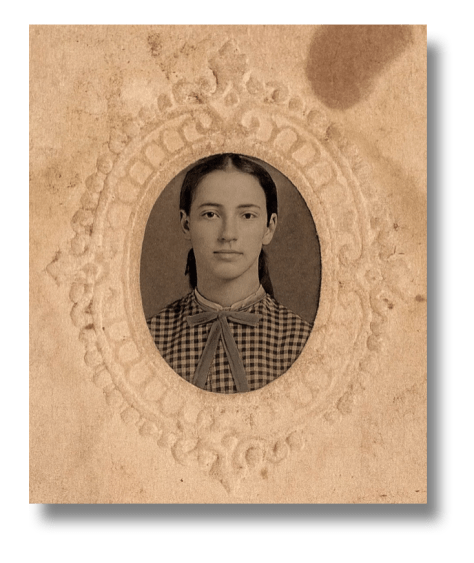






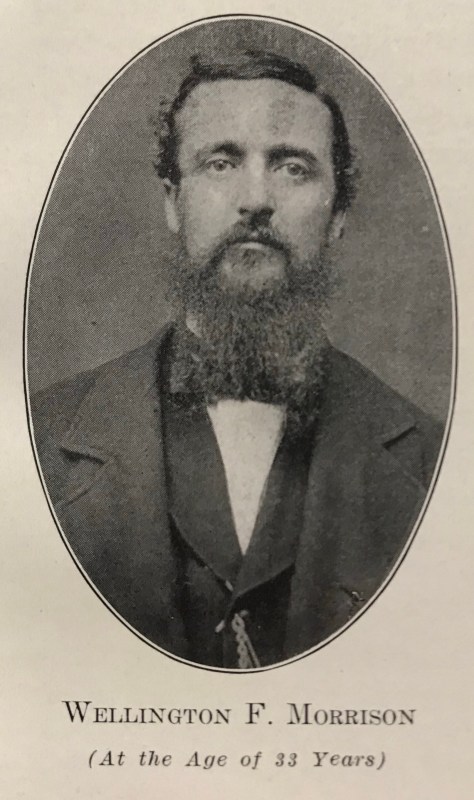
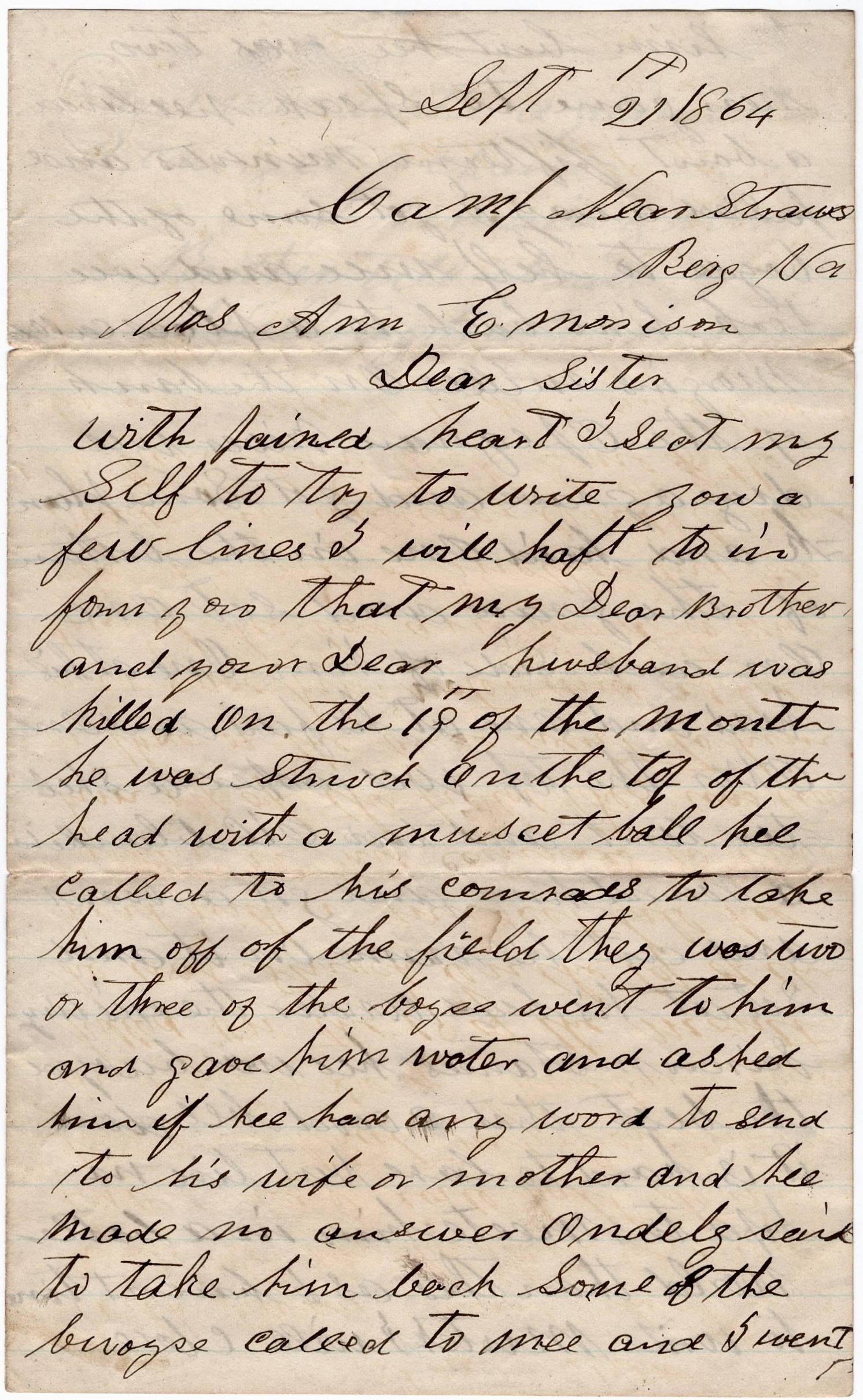

 Spared & Shared 23