My passion is studying American history leading up to & including the Civil War. I particularly enjoy reading, transcribing & researching primary sources such as letters and diaries.
I could not find an image of Harrison but here is a cdv of Horatio M. Smith who began also began as a private in Co. K, 105th OVI (Photo Sleuth)
This letter was written by Henry “Harrison” Fobes (1832-1862) who enlisted on 9 August 1862 to serve 3 years in Co. K, 105th Ohio Volunteer Infantry (OVI). The letter was written just six weeks after his enlistment and less than two weeks before he was killed in action (8 October) at the Battle of Perryville.
For a large number of the boys in the 105th OVI, the Battle of Perryville was not only their first but their last battle. The regiment lost roughly a third of the 600 men who went into action. In one of my friend Dan Master’s Civil War Chronicles‘ articles published in September 2020, he wrote a piece entitled, “A Sad Commentary Upon Glorious War: The Horrors of Perryville,“ from which I quote the following:
“Identifying the dead proved an awful and sobering experience, and for Second Lieutenant John A. Osborne of Co. E of the 105th, one of personal tragedy. ‘We buried 42 men, many of whom I had known,’ he wrote after the battle. ‘I approached one who had been struck in the face by a shell, blowing away his head and right hand. His left arm was mostly blown away and the hand just hanging by one or two tendons. I examined his pockets in order to recognize him and there found some letters whose address told the terrible truth. It was my own brother! David was in my company and had been missing since the fight. Here he lay without any mistake. A terrible sensation passed over me. I clipped a lock of his hair as a parting token then with my own hands helped to dig his grave. I wrapped him in a blanket, carved his name upon an oak board, and holding it up as a tombstone, I saw him buried with a host of the dead.'”
Harrison Fobes was the son of Justus Fobes (1788-1868) and his second wife, Amoret Trunkey (1806-1868) of Plymouth, Ashtabula county, Ohio. He wrote the letter to his younger brother Charles Trunkey Fobes (1834-1902).
Transcription
Addressed to Mr. Charles T. Fobes, Ashtabula, Ashtabula county, Ohio
Louisville [Kentucky] September 26 [1862]
Brother Charley,
It has been two weeks since I have received news from home but I suppose the folks have as much as they can do without writing. But as you have been discharged from the service, you can get time to write.
We have been expecting a battle here for some time but think now we shall be disappointed as Gen. Bragg is retreating towards Frankfort and I suppose we shall follow. If we get there, I hope we shall burn the city. It is the greatest secesh hole I have seen.
Last Monday and Tuesday I was sent to the river to cut away the timber and brush that grows on the bank to give the gunboats a better chance. There was 160 men there on Monday and 100 on Tuesday. On Tuesday night the 105th [Ohio] Regiment was out on picket and there was 17 men from Scotts Louisiana Cavalry made prisoners and one of them is in camp this morning. He has been in the service over one year and says he is as determined as ever. The boys are most of them well and some are playing sick but none from Plymouth. Charles Rasey got a pick stuck in his hand so he is unable for duty. It is reported that Gen. Buell us in the city.
Tell our folks to send some stamps. I have written about it in every letter and every letter from home I want to have one stamp in it as it is the lucky man who can buy one. I found two this morning. You would excuse all mistakes if you could hear the noise in the tent. But enough of this.
— Harrison
Direct your letters to 105th Regt. O. V. I., Louisville, Kentucky, Care of Capt. Bowers [Co. K]
Some also put on “To follow the Regiment” when it is on the march but I think it is unnecessary.
Lt. Peter Marchant. Image taken at Petersburg, Va., after his prisoner exchange in late April 1863
This letter was written by Peter Marchant (1831-1865), a farmer from Gibson County, Tennessee, who mustered into Co. C of the 47th Tennessee (Confederate) Infantry on 16 December 1861 and was immediately elected 2nd Lieutenant. He was with his regiment until 31 December 1862 when he was taken prisoner at the Battle of Stones River at Murfreesboro. Following his capture he was transported to the prison at Camp Chase in Ohio by way of Evansville, Indiana. At that time, his description as a POW stated that he stood 5’5″ tall, had brown eyes, light-colored hair, and that he was 32 years of age. On 10 April 1863, he was transported to the prison at Fort Delaware whereupon he was paroled on 25 April and sent to City Point to be exchanged on 29 April, 1863.
After returning to his regiment, Peter was promoted to Captain of his company on 22 October 1863 and was with them all through the Atlanta Campaign and with Hood’s army on his march back into Tennessee until 16 December 1864 when he was taken prisoner again in the fighting near Nashville. This time Peter was held prisoner at the military prison in Louisville, Kentucky, for several days before being sent again to Fort Delaware where he expired on 25 January 1865—his cause of death attributed to pneumonia.
Peter wrote this letter to his wife, Susan Thompson (1838-1910) with whom he married in 1855 and had three children before enlisting. The letter was written in late February 1862 and remains optimistic in tone despite the rebel army reverses in Tennessee that resulted in the surrender of Forts Henry and Donelson and the surrender of the State Capitol at Nashville.
Some of Marchant’s letters are archived and digitized at Georgia’s Virtual Library in Fulton County, Atlanta, under the heading Peter Marchant Civil War Correspondence, 1863-1864. That collection contains three letters pertaining to the Atlanta Campaign: “The letters in this collection were written to Peter Marchant’s wife Susan and all contain much of the same information due to his fear that the letters were not being received. The letters dated July 15 and 16, 1864, were written from the battle lines at the Chattahoochee River near Atlanta. Peter notes the confidence the soldiers have in Confederate General Johnston despite the harsh conditions of sixty consecutive days spent marching or in battle. The letter dated August 2, 1864, describes the necessity of many Confederate retreats from the Battle of Atlanta under the cover of night due to heavy losses. In this letter he also notes that the Union and Confederate armies were both destroying the land beyond hope of redemption. Each letter contains news about the religious life and newly professed Christians in Marchant’s camp.”
Addressed to Mrs. Susan Marchant, Dyersburg, Tennessee (No postal markings—hand-carried mail)
Camp Trenton [Gibson county, Tennessee] February 26, 1862
Dear companion,
I was glad to receive your letter this evening and to hear that you were all well. I am truly thankful that I can inform you that I am in the enjoyment of good health. This blessing I crave for you and myself for if we can enjoy good health, the time will pass off much more pleasant.
I have nothing of interest to write. The news here is as uncertain as anywhere else. Our loss at Fort Donaldson was great but not to compare with that of our enemy’s. Ours is estimated at twelve thousand but most of them was taken prisoners. I have not seen any account of our loss in killed, but we whipped them four times, killing about four to one. But they reinforced everyday and our men was at last out done with fatigue and had to surrender.
The surrender of Nashville produced great excitement but the Yankees seem to be at a loss to know what to do with it. They had not taken possession of it [yet as of] three days ago. They seem to feel that they are on dangerous ground and move very careful. I am not at all discouraged at the misfortune for I believe it will turn out to our advantage. We are not as well-prepared for a border war as they are but if they come in our country, I believe we will whip them.
When I wrote before I thought that our regiment would be armed in a short time, but from the best information that I can get, it will be four or five weeks. 1 I expect to come home again before we leave here but I have learned that a soldier’s life is a very uncertain one. Therefore, I make but little calculations on anything. I find myself to be a creature of circumstances. I never thought that I could be satisfied away from home, but now my greatest desire is to do my duty as a soldier and at the same time to live a Christian. I have become somewhat familiar with my duties and I feel the same interest in it as I would any other avocation. I was at meeting tonight and heard old Bro. Wagster 2 preach a very good sermon. This is the third night in succession that I have been to preaching and notwithstanding it was out of doors and had to stand up or sit on a chunk, I felt that indeed it was good to be there. I am more and more convinced that religion is adapted to our wants in any and every condition in this world. In Matthew, the 21st chapter and 22d verse, you will find these words, “and all things whatsoever ye shall ask in prayer believing ye shall receive,” then let not fail to ask supporting grace for every trial which we may meet and a heart resigned to His holy will. If we faithfully do this, I believe that all things shall work together for our good.
Give my love especially to papy and mother mother tell them to write to me. It is getting late and I must close give my love to all inquiring friends. Very affectionately yours, — Peter Marchant
1 Peter’s letter informs us that the men recruited into the 47th Tennessee Infantry had not yet been armed. They were still in Camp Trenton (Gibson County) where they were being organized and drilled. Company records later show that many of the men carried 57 caliber Enfield Rifles but some also carried 54 caliber Austrian Rifles.
2 I believe “Bro. Wagster” was William (“Billy”) Culpepper Wagster (1837-1912) of Dyersburg. His name appears from time to time on the rolls of the 47th Tennessee Infantry.
I could not find an image of George but here is an unidentified member from the same unit—Co. K, 44th New York (“People’s Ellsworth Zouaves”). He wears a large 1839-Pattern SNY waist belt plate. (Dan Binder Collection)
This letter was written by George W. Arnold who enlisted at the age of 22 as a private on 8 August 1861 in Co. K, 44th New York Infantry. He was promoted to wagoner shortly after his enlistment and remained with the regiment until 11 October 1864 when he was discharged after three years service. At the time of his enlistment, George was described as standing 5′ 11″ tall, with blue eyes and brown hair. He was a painter when he enlisted.
George was the son of Benjamin Franklin Arnold (1806-1874) and Emma J. Slocum (1807-1908) of Pawling, Dutchess county, New York. After the war, George married Charlotte B. Hubbell (1840-1896).
Headquarters 44th Regiment N. Y. S. V. Virginia March 31, 1862
Friend Jed Dear Sir,
I received yours of the 27th. I was quite pleased to hear from you as you will readily see. I agree with you at once relative to Mc[Clellan] as a general in the field. I received yours this morning. I have entirely forgotten when I last wrote you but I am thinking that I wrote you when at Alexandria bu I will give you a little detail of our march. We with the whole Army of the Potomac left Hall’s Hill March 10th, went to Fairfax, from thence to Centreville, stayed there the night of the 10th. The rebels left 12 hours before our arrival. The had noble works there but no guns mounted.
The 11th we returned to Fairfax where we stayed several days, then went to Alexandria where we stayed several days and embarked on board of boats the 21st. Arrived at Fortress Monroe the 24th all safe and sound. We sailed within 50 feet of the “Monitor.” I had a fair view of her. She looks like a large iron platform with a hogs head at one end. That is the most I or any man can say relative to her. Even when he goes aboard of her. I could see the marks on her quite plainly where the Merrimack hit the cheese box. It looked like the marks on an old piece of iron after being hit with a hammer merely started to rust a little.
“I could see the marks on her quite plainly where the Merrimack hit the cheese box.”
Well the night of the 24th we encamped near Hampton—or where Hampton was. This was quite a pretty little place, originally claimed 25,000 inhabitance. The 26th we came up near “Little Bethel.” We stated quietly here until the 27th. Then we started for “Big Bethel.” I think there were 15,000 troops were out that day. We went on the same road where our forces marched last spring under Gen. [Ebenezer] Pierce. I took a good view of the old battle ground. I could see the marks of the cannon balls against the trees and where they took the limbs off the trees &c.
Well we marched up to the said Bethel and found quite good earthworks there but no enemy. They had a few days before taken their cannon away. Just beyond “Big Bethel” we found a squad of rebel cavalry. One of Berdens’s Sharpshooters fetched one of them. We returned to camp that night fetching plenty of chicken, pigs, &c. with us. That is the simple [ ] of the matter. The papers say the rebels were 1500 strong and that we did not occupy Big Bethel. Neither is true. The troops have nearly all got here now. We expect Mc[Clellan] every day and so soon as he comes, we shall march on Yorktown on the York River. I was in the Fortress yesterday. It is a noble work. The season is quite forward. The peach trees are all in blossom. The woods, flowers in blossom, swallows plenty, warm and dusty.
Give my respects to all. Tell our people that I am in good health. Never better. I feast on sweet potatoes, chickens &c. They cannot beat your pappy at all. I will write you again so soon as convenient and you must write me immediately.
Yours truly, — Geo. W. Arnold, high private in the rear rank.
I could not find an image of William but here is James A. Barton wearing the uniform of a Third Assistant Engineer (January 1863)
These letters were written by William Duffield McIlvaine (1838-1916), the son of George Duffield McIlvaine (1805-1849) and Sarah Stauffer (1810-1901) of Salisbury township, Lancaster county, Pennsylvania. In the 1860 US Census, William was enumerated in his widowed mother’s household near the Gap Post Office, making his living as a machinist.
I have not yet learned the date of William’s enlistment in the U. S. Navy but suspect it was very early in 1862. The first letter in the collection was written from onboard the US Sloop Oneida in late March 1862 just a month before the Battle of New Orleans in which Admiral David Farragut captures the city. William was identified as the Third Assistant Engineer on the vessel at that time.
[Note: There are more letters in this collection that I will add as I get time. It appears that after the war, McIlvane relocated to Chicago where he went into a partnership with S. L. Hart in a firm at No. 10 South Clinton Street manufacturing light machinery. The firm was known as “Hart & McIlvaine.”]
Letter 1
Addressed to Miss Sallie McIlvaine, Gap P. O., Lancaster county, Penna.
Southwest Pass, Mississippi Sloop Oneida March 31, 1862
Dear Sister,
I have just learned that vessel leaves this tomorrow for the north and as I have a little leisure tonight, although I am “on watch,” I’ll write to you also, having written Robert by the same mail. It is eight or nine o’clock p.m. My watch is from 8 to 12 tonight and as we are lying still with heavy banked fires in our furnaces (that is, fires that make but little steam but can soon be made very good, if required), it requires only an occasional walk around to keep things in order. I have it very easy now about four hours on & 12 off as it only requires one Engineer on watch at a time. But you may want to know what we are doing here and as I promised to give a truthful account of affairs, I’ll tell you. But lest I might write something which would be contraband, you must not tell everyone what we are doing or expect to do.
We are lying here with about 40 other vessels of all character waiting until things are perfected for the expedition which may not sail yet for a month almost. Vessels are coming in daily to join the fleet and soon it will be as a larger, or a larger fleet than was ever afloat.
The weather is very mild and at midday, quite war, but since here I have not suffered any from the heat, being dressed as cool as I can with straw hat and no underclothing. I wish all the underclothes were at home. It is continually misty here while the wind is south as the cold water of the Mississippi meet the warm waters of the ocean two miles below this and the wind blows back the fog so caused so that we can see only about a hundred yards from us. Sometimes the fog rises and we see all the neighboring vessels, several of which are “aground”—a situation which we enjoyed for 24 hours but by good luck got off before the mud had accumulated much around us. The current is very swift just here on the bar and large vessels drawing 16 or 18 feet of water have much difficulty getting over. We draw 12 & 13 feet of water. While getting off the mud yesterday, we lost an anchor and all the cable in the mud and today a lighter draught vessel has been picking it up and returning it to us.
Tomorrow if clear enough, we go up the river four miles to place called Pilotstown where the Porter mortar schooners are lying. Also several large sloops of war. I hope we will have some nearer neighbors there. There is no mist there they say.
Yesterday (Sunday) a row boat came down the river with a load of oysters and two men—very ignorant looking fellows. They are poor fishermen from the neighboring shores who know but little and care less about the war so long as they can sell their oysters. We bought a good many and paid for them in silver which was very acceptable indeed. Of course we thought of poisoned oysters but there was but little danger of it being so. They are very large but not so good as northern oysters.
Lieut. [William B.] Renshaw, commanding the Westfield is alongside of the Oneida and has gone up the river today to reconnoitre. I think he is a relation of Mr. Renshaw of Philadelphia. I wish you could see Key West, Sallie. It’s a very pretty place, so different from anything north and such a delight climate. I trolled around over the town one day and had a fine time eating oranges and drinking cool drinks.
I spend my leisure time on deck and reading or writing. Do not study much yet as it is too soon. I have one or two congenial friends among the officers who think about as I do on matters and things. One of my best friends is the Paymaster Mr. [C. W.] Hassler—a nice young man just a week older than myself. I don’t care much for the Third Asst. Engineers as they are envious of my superior position. The junior third is a regular prick. The oters are smart and have good (school) educations but their moral training was not a religious one, I suspect. Mr. [Horace] McMurtrie is pleasant and naturally smart. Can do almost anything. Is very lively and carries on high sometimes. Mr. [R. H.] Fitch, junior second asst. is rather a sedate little fellow, very precise, and a disciplinarian (that is), goes in for strict discipline, but when we stir him and tease him, he can fight his way. He is a Nantucket boy & has been to sea most of his life.
I can hardly realize that I am a hundred & twenty-five miles below New Orleans. Wonder what kind of a reception J. H. L. would give should I ever get to the city. I suspect a good one providing the Stars & Stripes were flying over the city. Otherwise, not so cordial. Well, I’ve been standing here at the “Log” desk in the engine room two hours. The Firemen at the furnaces have been sitting, talking, until now when I have made them clean the fires and renew them, and as the steam keeps down pretty well, I’ll keep scribbling away and thus wile away the silent hours of the night.
We don’t much fear any battering ram down here as there are too many vessels above us. I see no fish here. The current is very rapid and the water looks very muddy. But it is very good to drink and we use it altogether.
You may want to know how I like the Navy by this time. Some things I like very much & some things not so well. I am becoming used to the discipline and do not make any mistakes now. I miss the church and other religious privileges much and this is a serious objection to the service. We have prayers and a chapter read on Sunday but it don’t suit me very well. I take it for granted that you have returned from Philadelphia. Well, stay at home and take good care of your mother. You must write me often and then when a mail reaches us, I shan’t be disappointed by not receiving a letter. I wonder when you’ll get this—not for two weeks, if then—about the time you begin to make garden. Letters and papers will be very welcome as we get no news here. The last had was up to the 12th of March at which time the enemy had evacuated Manassas and committed some depredations in Hampton Roads, &c.
I suppose Dollie will soon be home. I have never given her my note for the $150 I owe her, but will try and do so yet. I owe Thacker & Co. some money which can be paid out of what I sent home. I will speak of this in Robert’s letter unless i forget it. Well, my watch is nearly up and my paper about full. I hope you will know by this letter that I have a comfortable time and that it may allay any uneasiness about me. I enjoy good health and spirits, have plenty to eat and drink. I do not trouble myself any about the future as far as this world is concerned. As the Lord hath ordained, so all things shall be & that is enough. Give my love to all the folks at home. I hope to be with you all in a few months again. I must now stop and prepare for the relief watch. Good night. Appreciate your quiet peaceful home. Be as good as you always have been and write often to your affectionate brother, — W. D. McIlvaine
P. S. I’ll write to Mollie & Josie next time.
Letter 2
Addressed to Miss Sallie J. McIlvaine, Gap P. O., Lancaster County, Penna.
Pensacola [Florida] January 8, 1863
My dear sister,
Your welcome letter came duly to hand and I will endeavor to write you a few lines this eve as there is a prospect of a mail north soon as well a a probability of our going to Mobile Bay soon. I have a little more bad news to communicate in addition to what you have from the battlefields of Fredericksburg. The rebels have retaken Galveston and captured the Harriet Lane and blown up the Westfield, two of our side-wheel gunboats, and have gone to sea with the former of them as a privateer. So you see troubles are thickening around us. I must say I am very much disquieted with our commanders in the Northern Army and am much discouraged with the state of affairs. Some of our late moves are decidedly stupid and I despair of the success of our arms in this contest. Whenever the Government stop fighting about the nigger and over their generals, there may be hopes of success but I don’t look for any now.
“Some of our late moves are decidedly stupid and I despair of the success of our arms in this contest. Whenever the Government stop fighting about the nigger and over their generals, there may be hopes of success but I don’t look for any now.”
—W. D. McIlvaine, US Sloop Oneida, 8 January 1863
We felt very badly over Burnside’s reverses and think it a very bad move to attempt what he did. I fear to hear of our losses for I expect some of our friends fell there. I despair of the Union very much indeed and will never feel like going away from home again if we are whipped. But I say if we are going to make such poor miserable fighting as we have made of late, we’d better stop and save the lives of our noble young men who are being sacrificed to the ambition of politicians and money worshippers who are growing rich upon the very vitals of our beloved land.
Perhaps some government official may get hold of this and read it and have me jerked up but I have seen so much to make me vexed and so many inconsistencies that I cannot help express it to some one.
Well!! I wonder how our turn will come. The Almighty who reigns over the destinies of Nations has ours in His hands and to Him I confide our good ship and crew. May brighter days dawn on us soon.
Well, we’ve missed another prize by being here. A large steamer was taken at Mobile the other day and another one got in. The rebels made a big show of Forts Morgan & Gaines. They had about six gunboats out to help their steamers in but they don’t come out very far.
Well, tis Saturday morning & we are about starting off for Mobile. They want us there. Our Jun. Third Asst. [Engineer] is just leaving the ship to remain here and go home on the Circassian when she returns from New Orleans, so I’ll send this by him, I think. I alone am left of all our Thirds. I’m so unfortunate as to be very healthy now. Never was fatter.
We get a great many reports here. I have heard that the Harriet Lane did not get out but is blockaded and one of our sloops (the Brooklyn) has gone down there to attend to her case. They had a desperate fight on her and killed everybody but an Acting Master. The rebels ran two steamers alongside of her and boarded her but they fought bravely until the last, the commander [Jonathan Mayhew Wainwright] being almost cut in two, and then his brains blown out. The Westield got aground while coming to her relief and when the rebs got possession of the Harriet Lane, they were going to take the Westfield, so the captain got ready to blow her up but she went off too soon and killed nearly all of her crew. The commander of the Westfield is named Renshaw and may be some relation to those in Philadelphia. 1
Line engraving from “Harper’s Weekly.” The USS Harriet Lane is shown in the left distance, under attack by the Confederate gunboats Neptune and Bayou City. The grounded USS Westfield is at right, being blown up to prevent capture. USS Owasco is in the center of the view.
We have another month’s blockading to do, I suppose, unless something turns up. You must write soon to me and often. I enclose a X for you and Dollie and don’t say anything about it in your next. I had hoped to be able to send some money home but our mess bill has been so enormous that I can’t well just now, bu I am most happy to give you a small lift and when ou need more and can find any belonging to me, just help yourself. All I wish is enough to eat and wear and to bring me home, if tis God’s will that I shall ever get there. It makes me feel sad to see anyone leave for the North but we’ll endure hoping that peace may dawn on us soon and then I can come home in better shape.
Give my love to all at home & all enquiring friends. I was very sorry to hear of your sickness and hope you are fully restored. You must be very careful this winter & receive the Presbyterian generally. I must close now as we are about ready to start. Goodbye. May the Lord provide for and protect you all is the prayer of your affectionate brother, — W. D. McIlvaine
U. S. Sloop Oneida Blockading Mobile Bay (via New Orleans)
1 Actually some of the crew of the Westfield survived. The crew was transferred to transports and Renshaw, fearing she would fall into the hands of the rebels, blew her up. By some mismanagement or accident, the explosion occurred before the boat containing Com. Renshaw, Lieut. Zimmerman, and the boat’s crew, got away, and they were consequently blown up with the ship. The crew of the Westfield arrived at New Orleans on transports.
Letter 3
Addressed to Miss Sallie McIlvaine, Gap Post Office, Lancaster county, Penna.
U. S. S. Oneida Off Mobile Bay March 6, 1863
My dear sister,
your kind letter of February 13th was received yesterday. I had made up my mind not to write any more until I heard from someone at home, but guess I may as well overlook the resolution now and send you a note—this week some day. Glad to hear you are all getting on so well & passing the winter pleasantly away. Tis quite a comfort to know that you are all comfortable and to tell you of my similar condition. This with one other little item constitutes about all I have to say at present. The other item is that I have at length had my examination and passed very creditably. The “Board” said, for all of which I am feeling quite lightened in mind, as I have been studying pretty hard for two weeks, and felt rather uneasy at being taken up so suddenly, but our Chief [F. C. Dade] who was President of the “Board of Examiners” told our Captain that he was “never more surprised than he was at my examination,” as I had seemed so fearful of not going through, but that I had “passed an excellent examination.” But it did not suit me so well as that. It may be satisfactory, however, for you at home to know these things. So I suppose I am no longer a Third Asst., but a 2nd. However, I do not expect to get my “warrant” for a mont or so, and of course keep the (3rd) before my name until after that time.
You cannot imagine how much anxiety I felt for a week previous—more by far than at entering the service for the disgrace of a failure would have been very severe on me. I am open for the congratulations of my friends.
I am very glad to hear of John’s success in getting into a good situation and hope nothing will now disturb him soon for he has had enough of trouble for two or three years past. Twas very kind in those gentlemen to assist him in getting the place.
7th March. I would not mind having a good position in Philadelphia myself but I don’t think anyone would value my services enough on shore to give me $1100.00 but maybe in a few years I’ll be able to get along ashore.
They are drilling with small arms today & firing at target on deck. It don’t appear just so pleasant to me for its nothing but bang, bang, bang all morning over my head but that’s the way on a man-of-war—always some kind of drilling going on.
The Admiral attacked a rebel battery at the entrance of Grant’s Pass two weeks ago but did not take it. The probable design was to make the enemy show all their gunboats. They brought down two ironclad rams and three gunboats which is about all they have here I guess.
I haven’t heard nothing from T. H. S. since returning from New Orleans. He promised to give me pictures of the children but has never done so. I don’t believe he will soon either unless I go after them. The mail leaves in the morning so I will not be able to write very much of a letter. If you can get any photographs (cards) of friends, I wish you would do so to fill up my album. I have about 25 now—some very handsome officers too. I’m badly off for ladies though. Try and assist me in that line, can’t you? Good-looking ones, you know. I’m always ready for an exchange. I’m thinking now of advertising for a situation as son-in-law in some highly respectable family. Negotiations to be opened any time and the situation accepted on returning home. Terms—good looking, good health, good disposition, intelligence & piety. Anyone possessing these qualifications will please address at this station. Good disposition not absolutely requisite as when she gets ill-tempered, I’ll go to sea.
I did not expect to continue on another sheet but couldn’t quite get through on one. I am very sorry to hear what you said of my former associate, but tis not at all unexpected as that trait of character always would show itself in him and sometimes gave me much trouble. I mean the want of due self respect. I do not believe it would ever have been so if I could have been with him but hope he will see his danger and retrace his steps soon. You must not allow this to be seen away from the family.
I think when I get home, we’ll have to make a short trip either to Pittsburg or on east, what do you think? I don’t know how soon we shall attack this place but probably inside of two months or at least three months. I think the Admiral is waiting for some ironclads as these rams would be rather too much for wooden vessels. I’ll try to get leave of absence late in the spring. Whether I shall succeed or not remains to be seen, when one is not his own “boss,” his movements are somewhat doubtful.
Well I’ve got the middle watch and am getting rather dull so I guess I’ll close. I’m very glad to hear of George’s strict adherence to the good principles taught him at home, if he only sticks to them wherever he goes, he will have no trouble. They allow no card playing on board ship. With much love to all & hoping to hear from you soon, I am as ever your affectionate brother, – W. D. McIlvaine, 3rd Asst. Engineer, USN
If you can exchange one of my pictures for one of the young ladies who asked for one, do so.
Letter 4
Addressed to Miss Sallie J. McIlvaine, Gap P. O. , Lancaster county, Penna.
Off Mobile Bay U. S. S. Oneida October 18, [1863]
My dear sister,
Your letter of the 26th September was received last evening. Also one from Robert of earlier date. The only two received for a month, nearly. Very glad therefore to get them and thankful to hear of the good health of the family in general. Of trouble and hard times we all expect to hear while we have health & protection let us be content with little until peace smiles on the land. I don’t see much prospect of that soon though for Charleston remains almost as strong as ever and the rebel army is becoming accustomed to being “annihilated” and don’t appear to mind it any more. I think it about time for the Pet Army of the Potomac to make another “move” and thus help the brave Rosecrans and his active army who seldom rest. However, I presume that will suffice on that topic. I often wish I didn’t know so much of the blunder and inactivity of the army and navy.
I am very well and growing fatter. We have two new thirds now and I am much relieved having much easier times. They appear to make engineers out of some rather poor specimens now-a-days. I wonder whether I was ever so green as some of them appear, Maybe I was. We are having comfortable tines now. Do not get underway often or run far. Our captain [Samuel F. Hazard] does not believe in running up to the flagship every day or two so we lay day after day at our station. We still like our Captain very much. He is very fond of having some of the officers dine with him. I expect to be asked in one of these days.
The [Yellow] fever at Pensacola is much abated and will soon disappear, I think. The quarantine rules are so strict at New Orleans that we have difficulty getting even our mails. No fever of any great account there and none on this station. Not much prospect of the Oneida coming home. What repairs she requires can easily be done in New Orleans & nothing else would be likely to take her north. I hope and expect to be home before the vessel is though. Being entitled to examination, I may be ordered home anytime during the next two months and if not, I may suggest the propriety of such a course to the department. I want to try and make some preparation for it first though for a good many are failing to pass who I think better prepared than myself. I should not fret much over the result, however, decide it as they might.
Mr. McMurtrie, you know, didn’t get his examination. Was badly fooled. He is at New Orleans on a used up gunboat. I never expect to get the $10 he owes me. He spends all he can get or make by boarding at big hotels and paying for smashed up buggies. I never saw one who could tell you all he knows to a better advantage than McM.
I’m glad to hear of Mollie’s return and will write to her now soon. I would love to step in and complete the family circle some evening. You must remember that this is one of the many privileges I do not enjoy which some of you perhaps without my comforts do, and I hope you can appreciate them. You have home society, friends, religious influence in all its forms, security, peace, and a good share of comforts. You have also a beautiful country to look upon and enjoy whilst I have but the unbroken sea spread out before me except a long low sand bar on which stands the enemy’s fortifications. How one learns to appreciate blessings he never knew he enjoyed by being deprived of them. But I have health, strength, ease, and enough to eat and wear and am therefore willing to be content, trusting to God for protection and a safe return.
The winter is fully as comfortable down here as at the North and to come home in cold weather would set rather hard on me, I suspect, and thus prevent me from going out much.
The other morning after a very dark night, the dawn of light revealed a steamer ashore near Ft. Morgan and a rebel steamer pulling her off. She probably tried to run in and got aground but it was too far for us and at noon they succeeded in getting her off and took her inside the fort while our gunboat was beginning to drop shells very close to her, But we lost her and can only wait until she tries to run out. We hear that the prize money for the steamers &c. that our flat captured at New Orleans is ready for distribution, being something over half a million. It won’t amount to anything among so many and two hundred dollars would be as much as I should expect if I ever get any. They also talk of awarding the prize money for the gunboats sunk and captured above Ft. Jackson on the morning of the battle but when twill be, I do not know.
I’m completely astonished at the rush of beaux to our house—not but what there is attraction enough, but I thought they were all afraid to come. I know they used to be when your brothers were to home, but I presume our absence and their being soldiers has made them bold. Tis about time for me to come home and disperse them. Well, tis evident that I’m about out of writing topics so I’ll close hoping soon to have later dates from you as you must have from me by this time. Hope Mollie will write without waiting for me. With much love, as ever, your affectionate brother, — W. D. McIlvaine
Letter 5
U. S. S. Oneida Off Mobile Bay May 5, 1864
My Dear Sister,
I think I owe you a letter though not quite certain but I’ll just scribble a little tonight even though I don’t feel in any too good a humor at present. We have just returned from Pensacola after a ten days stay there, painting ship and doing a little repairing. The stormy spring weather appears to be all over and summer almost upon us so we have got our straw hats and got our white clothes starched up ready for a warm spell. Things are quiet as usual here except that blockade running has been on the increase of late, but it’s a matter of o great interest to us as we do not expect to catch any. Indeed, our captain seems to care very little about taking any for he is tired of his ship and thinks he has a poor crew & inefficient officers, The fact is, he thinks he ought to have a larger vessel. Well i wish he had and we had some young captain with enterprise who would help us take a prize to cheer us up.
i had a letter from John Bitzer last week & have written him; was very much pleased to hear from him. He seems to take times very easy. I don’t see how he can but it won’t pay very well. I think, however, so long as he is happy & contented, it don’t matter much about the money part. The enjoyment of one’s youth without money is better than old age with it. That is, I think it is better to enjoy our youth than to weal it away in hard work laying by money for old age.
I must now speak a little about the coming home business. I’m sorry not to be able to say when I can come and almost wish I had not spoken so confidently to you at home of coming, for I now believe that it all rests with the Admiral who is not good at granting leave of absence and if he says I can’t come, why I can’t come and that is all. He is “the Admiral,” you know and if he sees fit to retain me here, he can do so, and I must submit for although this is a Republican Government, yet in war times we can’t do as we please. I had thought of asking Himes P. to assist me in getting home but have almost come to the conclusion not to for an instance has just occurred where an Engineer got ordered home without making application through the Admiral and the Admiral would not give him his orders when they came, saying that “when an officer left the fleet, he wanted to know of it first.” So I conclude that it is policy to apply direct to him & run the risk of being refused which I think is a pretty great one. But I will try him at any rate. So you see just how the matter stands. There is no use in my turning aside from the case but better to look the matter straight in the face and do the best I can. Our chief is willing I should go & said he thought I would be ordered home before long, but I “can’t see it.”
I hope you will not feel badly about it at least until I find out for sure. I’m going to “turn in” now. Good night.
I wish I had something interesting to write you but how can I have here. All the news we get from our forces in Louisiana [on the Red River Campaign] is unfavorable. Banks seems to have had bad luck. I begin to lose faith in him as a general. I hope Grant may be successful but the North is expecting too much of him I fear.
I have not received my promotion yet—about time I think. I don’t believe J. H. S. will send me pictures of the children. I think you ought to get some good “vignettes” taken. I have run out of copies of mine almost. Send on any you can collect of Lady friends. I have received Josie’s picture which is a very excellent one I think.
I see but little signs of attacking this place for a couple of months, till the ironclads arrive, after which the “Admiral” will not delay long, probably. I would like to get away from here during the warm weather of July and August. I don’t know whether Himes P. has influence such as could get me relieved or not but i think probably in I were relieved, without being instrumental in procuring that relief, I would not be detained then; for the admiral could not suspect that I had been trying to get home and at the same time my place would be taken by my relief and therefore the number of officers not diminished which is the great question with him. I’m sure I have no objections to any of my friends getting me relieved if they can; on the contrary I should be very much obliged to them. I believe the matter rests about as much with them or more than it does with me. So if H. P. can get me relieved, I only wish he would, though I will not request it of him myself for that would spoil the matter. These discussions on coming home are not for any one out of the family.
We are senior officer now and all mails and everything else comes through us which makes it a little more lively, and gives us the news often. I wish George would write me. He ought to begin to correspond regularly with someone. It will help him when he comes to write to his “jularky.” I’ll close now with much love to all and hoping to hear from you soon. Also from Mother who I hope is well. I am in very good health, as ever your affectionate brother, — Wm. McIlvaine
Please send me $1 worth of postage stamps & oblige. Rather a small amount to send so far but there are so many thieves on the way.
Kidder Randolph Breese in his midshipman’s uniform (1850s)
This letter was written by the commander of USS Black Hawk, Commander Kidder Randolph Breese (1831-1881). Breese began his naval career as a midshipman in 1846 aboard the US Sloop of War Saratoga during the War with Mexico. He participated in Admiral Perry’s expedition to Japan and then several trips to other foreign ports. When the Civil War began, he was serving aboard the San Jacinto, the ship that stopped the British steamship carrying Mason and Slidell (see Trent Affair). He then helped capture New Orleans and served with Rear Admiral David Porter on the Mississippi River and the Atlantic Coast.
Commander Breese wrote this letter from Alexandria, Louisiana, while on the Red River Expedition. That expedition was a failure as the annual rise in the Red River failed to materialize that year making it impossible for the Union’s heavy gunboats to pass over the rapids in the river. Breese’s letter refers to the battles of Sabine Crossroads and Pleasant Hill which were fought on 8 and 9 April 1864. The battles convinced Banks that his campaign against Shreveport should be abandoned. Though the battle of Pleasant Hill may have been a Northern victory, the retreat to Grand Ecore was a strategic defeat. In less than a week, the USS Black Hawk would be ordered to “Get out of the [Red] River whilst there is a chance.”
Transcription
Mississippi Squadron U. S. Ship Black Hawk Alexandria, Louisiana April 10, 1864
Dear Sir,
General [Carvier] Grover has received instructions tonight to take his whole force to Loggy Bayou leaving here only enough force for police but as he is to move by transports and they now are not to be had, I can’t tell when he will start. Phelps gave me the news of the defeat of the Army. General Stone’s two dispatches to General Grover say 1st, the enemy attacked us at Pleasant Hill and were signally repulsed with loss of many killed and prisoners. This is all he knows about it. 2nd. Bring up immediately all your force to Loggy Bayou. I told him all the rumors &c. and I judge he is about of the same opinion of General Banks as the rest of us.
Nothing new here. No signs of the [pump-boat] Champion yet. River falling slowly. The Mississippi has fallen eight feet but is now rising again which I hope will check the fall in this. I shall send up the Champion immediately on her arrival; if you do not want her, please inform me as Mr. Tennyson thinks there is no doubt but what she can raise the Woodford in a very short time. Shall I keep a barge of coal here all the time—that is, when the one here is gone? Shall I send the Price for another? I wrote to [ ] that he must hurry coal down here—that there were but six barges at the mouth and if the river should rise suddenly that won’t last long. I also told him that he wouldn’t see any of the town boats except the Ike Hammett & Wilson and that he might make his arrangements accordingly and also begged him not to send any more provisions down for at least a month.
Give my kindest regards to all with you and believe me respectfully yours, — K. R. Breese, In command.
How Orlando looked just before entering the 16th Indiana Infantry
These letters were written by Orlando Jay Smith (1842-1908), the son of Hiram Smith (1799-1866) and Sarah Jacobs (1804-1890) of Terre Haute, Vigo county, Indiana. Orlando first entered the service as a sergeant in Co. K, 16th Indiana Infantry on 23 April 1861. He mustered out of that regiment on 23 May 1862 at Washington D. C. He was commissioned a Lieutenant in Co. B, 71st Indiana Infantry in August 1862. The regiment was changed into a cavalry organization in February 1863 became Co. B, 6th Indiana Cavalry. He was discharged on 15 September 1865.
He was wounded and taken prisoner on 3 August 1864 at Athens, Georgia and confined at Macon, Georgia, and Columbia, South Carolina. He was promoted a Captain on 2 November 1862 and a Major on 16 October 1863.
After he was discharged from the service, Orlando returned to Asbury College (now De Pauw University) and completed his college course. He then entered journalism was was editor of the Terre Haute Mail, the Terre Haute Express, the Chicago Express and was the Founder of the American Press Association in 1882, whose General Office in 1910 was at 225, West 39th Street, New York. He lived at Bonneview, his estate in Dobbs Ferry, New York.
Among works by Smith were A Short View of Great Quests (1899), The Coming Democracy, Balance the Fundamental Variety (1904), The Agreement Between Science and Religion (1906) and Eternalism: A Theory Of Infinite Justice (1902).
[Note: These letters are from the personal collection of Jim Doncaster and are published on Spared & Shared by express consent.]
Letter 1
Camp Wayne [near Richmond, Indiana] June 27, 1861
My Dear Uncle,
I enclose to you a Watson bill which you will oblige me by changing into something more current in this portion of the state, if you can do so.
I am prospering as well as I could wish to. I like camp life, at least that portion which I have seen. Nothing would mar the content with which I have settled down to it but for the fact that we will never see service unless we go in for three years. I have made up my mind to go in for that term at the first favorable opportunity. I know the advice you gave me concerning enlisting for a longer period than one year was excellent, but I feel that I can never in the future feel satisfied with myself in looking back at this contest unless I was an active participant in it. I shall therefore got into it and shall make no calculation to leave the service until the battle cry of “The Union!” shall be heard upon Sumter’s torn battlements and be echoed by freemen’s voices along the Gulf to the mouth of the Rio Grande.
I may not be able to retain the position that I have obtained in my own company (2nd Sergeant) if I go into another one, or I may get some higher one. I don’t know how it will be. of course I would like to have some position but I shall go fully as cheerfully, if I do not. Please attend to changing the bill immediately. Give my love to Aunt and the little girls.
Your nephew, — O. J. Smith
Letter 2
Camp near Seneca Mills Upper Potomac November 7, 1861
Dear Uncle,
I have neglected writing to you for a long time and I cannot improve a little leisure time in a better manner than by writing you a letter. When I wrote you last, I was sweltering under the heat of an August sun in the valley at the foot of the Blue Ridge near Harpers Ferry. Since that time we have done a considerable of marching around about in this region of the Upper Potomac though we haven’t been called on to do much fighting as yet. Gen. Banks has an army of fifty thousand scattered from Harpers Ferry to Chain Bridge. We have a number of splendid regiments in our division—such as the New York 9th, Minnesota 1st, Wisconsin 3rd, Geary’s Pennsylvania 28th, Massachusetts 2nd, 13th, and Webster’s 12th, and a host of others, but I have noticed that the General always keeps the 16th Indiana near himself and when he moves, it moves. His headquarters have been close to us in every camp yet, and when we went over into Virginia, he pitched his tent right in with us though we had the muddiest hole in the whole field. From all this and various complimentary things he has said of us, I judge he has confidence in our prowess should we be called on to exercise it.
I suppose you have heard that we were over in Virginia. At the time, we didn’t know that we were doing anything much but we learn since that the correspondent of the Associated Press reports our regiment as acting very gallantly, &c. &c. and only murmuring when the order was given to retreat instead of contesting our way inch by inch with our enemies. The Baltimore Clipper too says the advanced pickets of the 16th Indiana were rescued from the very jaws of destruction and death. So, I conclude as the papers say so, that we did gallant things over there. It is true that we marched twenty miles in six hours one very dark night to rescue the troops of the lamented Baker, that we crossed the river in the rain on Tuesday morning and took position on the bank where the mud was in no place less than half knee deep, that we participated in the skirmish in the afternoon in which Gen. [Frederick W.] Lander was wounded and in which we lost one man.
You should have seen our gallant old Colonel [Pleasant Adam Hackleman] during the time that we were expecting about ten thousand Secesh devils down upon us. He sat on his big black horse and as our batteries commenced throwing the shells thicj and fast, he lit a cigar cooly and remarked, “Well boys, this looks like business.” It rained all that day of Tuesday and all night. We had no tents and nothing to eat but sea biscuit but really we were tolerably comfortable by the fires.
Wednesday morning it still rained. At noon one half of our regiment was detailed on picket guard, our own company included. We went out on Goose Creek towards the enemy’s advance. It so happened that our company relieved the pickets which had occupied the very farthest outposts next to the rebel pickets. I had command of the relief from five o’clock till eleven. It was a bitter cold night and we dared not stir about for fear of the rebel pickets who were in the woods next to us. At 2 o’clock we commenced the retreat to the river, distant a mile and a half. we landed on the Maryland shore at daylight. I for one was not sorry to get back as I am now confident that the next day would have witnessed a repetition of the Ball’s Bluff horrors. I saw whole boatloads of wounded and dead from that action and I never want to see such a sight again unless I am confident that the enemy have suffered at least equally. It seems as though we have nothing but bad generalship here on the Potomac. A few more Bull Runs and Ball’s Bluffs and this Grand Army of the Potomac will be completely demoralized. Their influence is already too plainly felt in the general tone of discouragement with which the soldiers here talk of the result of the war. The rebels have gained such a reputation for pluck that our men have lost confidence in themselves as well as in their leaders.
It seems as though we have nothing but bad generalship here on the Potomac. A few more Bull Runs and Ball’s Bluffs and this Grand Army of the Potomac will be completely demoralized.
—Sgt. Orland Jay Smith, 16th Indiana Infantry, 7 November 1861
We are all awaiting with an anxiety too deep for utterance the result of the Great [Port Royal] Expedition. How much depends on it, no one perhaps can realize. I still have hopes that the war may be brought so near to a successful termination by the time my term of service is ended that there will be no necessity of enlisting again. I see that most everybody out in Indiana is Colonel of a regiment and I suppose only the most common people will accept captaincies and lieutenancy’s. I wish I could have the privilege of going in one of the latter positions as everyday the difference between going as officer and [enlisted] man is more plainly visible. I am now acting as Orderly Sergeant and I suppose I can retain the position if I choose but it is very hard work and poor pay. If it were not that I learn much more as Orderly, I would rather be 2nd Sergeant.
What sort of a regiment has Col. [George K.] Steel [of Rockville] got at Camp Vigo? I suppose he makes a fine officer. If I were only a Lieutenant or Adjutant in his regiment or any other regiment, I wouldn’t mind being in for three years or for ten as for that matter.
We have had extraordinary health in our regiment until of late but within the past week there has been four deaths. One of our company died yesterday in the hospital. A poor fellow was shot only an hour ago accidentally and died immediately. I am under many, many obligations to you for papers sent me. Give my love to Aunt and the little girls. I hope you will write to me soon.
Your nephew, — O. J. Smith
Letter 3
Camp Dick Thompson [Terre Haute, Indiana] December 11, 1862
My Dear Uncle,
I have read with emotions of the deepest interest your letter containing your opinions as regards my course of conduct upon the question of marriage. They most fully agree with my own. I have not engaged myself to anyone and shall not, at least until I have dissolved connection with the army and when I do, suitability of age shall be regarded.
My intimate association with a lady of Terre Haute has perhaps given rise to the fear in your mind, and in that of others of my family, that I would be rash enough to hasten myself into a matrimonial engagement in which the balance of years is decidedly on the side of the lady. Such is not the case, and she herself has been fully aware of it since the intimacy commenced.
Declaring most emphatically that I have entered into but one engagement and that is with my country, and hoping that she will never have cause to instigate a breach of promise suit, I am your nephew, — O. J. Smith
Letter 4
The following letter was written from Burnside Barracks near Indianapolis, Indiana where the paroled prisoners of the 71st Indiana Infantry were quartered and kept until they were exchanged in August 1863. The “misfortune” Smith speaks of is the being taken captive for a second time. 347 men in the 71st Indiana were taken prisoners in the Battle of Richmond, where its Lieut.-Col. Topping and Maj. Conkling were among the killed. Only 225 escaped capture. The captured were paroled, returned to Terre Haute, and were exchanged late in the fall. They returned to the field on Dec. 27, when 400 of the regiment were sent to Muldraugh’s hill to guard trestle work and the following day they were surrounded by 4,000 of Morgan’s cavalry and captured a second time.
Burnside Barracks 1 Indianapolis, Indiana December 30, 1862
Dear Uncle,
Lt. (or Major) Orlando Jay Smith
Our regiment has met with another disaster as you probably will know. We are back safely here. It seems as though misfortune has marked the 71st out for its own. If anything tends to alleviate the intense mortification which I feel, it is the fact that my own company conducted themselves most gallantly and that there was no duty which they were not ready and eager to perform. In fact, I know that the officers commanding relied more fully upon my company than upon any other.
I was placed by Col. [Courtland C.] Matson on the morning of Sunday in command of three companies—B of our own regiment, and B & C of the 78th Illinois, and occupied heights on the right of our position, but had to move by order to within the breastworks after the action began. The fight was nothing much but a surrender though I have a shell with me that passed within a few inches of my head. John Cheek of my company was knocked down by a cannon ball and bruised a little was the only casualty among my own men.
Morgan took our side arms and the men’s blankets and overcoats which tends to keep up well his reputation as a horse thief. I sent my luggage to Louisville on Saturday so my loss is my sword.
My men brought away some twenty guns of various descriptions which we picked up as we passed by our position after being paroled and which we managed to smuggle through their lines. Morgan has ten thousand men all mounted—“Hoss infantry” they call themselves—and several pieces of artillery. I was without sleep almost entirely from Tuesday night before Christmas till Monday night in Louisville. We are at Indianapolis now but will probably move to Terre Haute.
The men are in good spirits notwithstanding the fact that we have been meanly, badly, shamefully, and outrageously treated. I am undecided what to do but presume the only line of conduct proper is to stick to the men though I feel mortified and almost entirely discouraged. I suppose my folks have not got back yet from St. Louis.
Your nephew, — O. J. Smith
1 Camp Burnside was located on Tinker (now 16th) Street south of Camp Morton.
Letter 5
Burnside Barracks [Indianapolis, Indiana] January 15, 1863
Dear Uncle,
We are getting along tolerably smoothly now. Our are surely an extraordinary set of men, else they would be entirely demoralized. We will probably not be exchanged before the 1st of March as the last General Exchange does not include us.
Indianapolis is full of Butternuts and corruption. Terre Haute is well represented in the lobby. Claypool. Bailey, and Risley and their various compatriots are on hands and apparently feel jolly. So mote it be. Perhaps the Almighty will allow treason to triumph now to work out some great good, but the Right must conquer, though it be long after the grass has grown green over our graves.
Col. [James] Biddle is still idolized by his men. He has appointed a Board of Examination of which I am a contingent member to examine the officers of the regiment upon military qualifications on the 1st of next month and all who do not pass will be requested to resign. Privates and non-commissioned officers who aspire to positions go before the board. No one is to be promoted on account of rank, but merit.
Captains [John J.] Starnes [of Co. H] and [Andrew J.] Rockwell have resigned on account of health. Also Lt. [Thomas] Cullen of Co. D. Lt. E[lijah] W. Peck is promoted Captain of Co. H, vice Starnes. A good promotion. The Colonel says he thinks I have the best company now in the regiment and I think so too. Pay day comes soon and after that interesting ordeal has been passed through, I shall get a furlough to go home.
Your nephew, — O. J. Smith
Letter 6
Burnside Barracks [Indianapolis, Indiana] March 27, 1863
Dear Uncle,
Your letter has come to hand and I hasten to reply. I have concluded not to borrow money to make advance to recruits on Bounty.
If you think it would be best, I am willing that you should circulate a recommendation for me for the Majorship in the new organization. Yesterday I would not have consented to make an application as I would have thought it better to wait for promotion in one of my years than to hurry it up, but I have good reason to believe that if I don’t get it, Adjutant [William A.] Brown and an outside will succeed, and I would consider it an infernal outrage for Brown to be appointed over men who rank higher than he does and who are better qualified.
I speak the entire truth when I say that I would prefer to remain in the company, now much the largest one in the regiment than to be Major if competent and efficient men would probably be appointed, but having shared the fortunes of the army of the Union as enlisted man and officer since the fall of Sumter, I would feel sore to have men appointed over me who were counter hoppers and 4th rate lawyers during the first thirteen months while I was trudging with my knapsack over the mountains and valleys of Virginia.
If you can get a strong recommendation from Hon. Jno. P[almer] Usher, it would have great weight with the Governor, also Gen. [Charles] Cruft. But you understand that better than I.
My company numbers now 97 men having recruited 22 since we commenced being nearly as many as all the rest of the companies have taken in.
Your nephew, — O. J. Smith
Letter 7
Burnside Barracks [Indianapolis, Indiana] April 4, 1863
My Dear Uncle,
I have received your letter enclosing the recommendation. I am very thankful to you for the interest you have taken, not only in this case but ever heretofore in my welfare. I trust to be able some day to repay you if in no other way than in making of myself a useful man. I will show the recommendation to Col. Biddle and shall do nothing without his sanction. I shall not push matters too much as I hardly take the interest in the promotion which I should take. I feel so well satisfied as I am in command of a full company every man of whom it is, I hope no undue self praise to say are devoted to me. If Col. Biddle objects my application for the Majorship, it will be on account of my age and nothing else.
I would like to send down some men to vote Monday but cannot. I wish though that you would ascertain whether or not some arrangement cannot be made by which the fare of soldiers of our regiment cannot be reduced or paid if they attend the City election in May. I can send 25 legal voters from my company and Co. E probably as many more.
Gen. [Henry Beebee] Carrington has issued a Special Order stating the fact of our exchange and complimenting the 71st in the highest terms. we will be reviewed on Wednesday of next week. Couldn’t you spare time to come over and see us?
Your nephew, — O. J. Smith
Letter 8
Camp near Nicholasville, Kentucky April 26, 1864
My Dear Uncle,
I often feel very much displeased with myself for not writing to you often since I have been away from home this time. I propose to make partial amends by writing you a short letter this evening.
The Battalion to which I was attached and to the command of which I succeeded when I got my commission as Major was ordered from Knoxville the last day of March to proceed to Paris, Kentucky, to join the balance of the regiment with the cavalry corps of the Army of the Ohio which was at the latter place re-equipping for the Spring Campaign. We came via Chattanooga and Nashville by rail and had a tedious trip of it. I felt much relieved when we joined the balance of the regiment under Col. Biddle and I changed my independent for a subordinate command. I brought the Battalion through in quicker time and better order than any of the other detachments which came through but I very much prefer for awhile at least to act in a subordinate position.
Gen. Stoneman commands us and has a very fine body of cavalry under him. Our Col. Biddle commands the 2nd Division, Matson commands the Regiment, and I the 3rd Battalion consisting of companies B, F, G. and L. I am happily situated in having officers under me who are my personal friends and who are efficient also.
We are getting ready as fast as possible to go to the front, at what point I know not. We have pack mule transportation entirely—not a wheeled vehicle will be taken with the command.
My health has not been very good since I have been in Kentucky. I feel pretty well this evening though and I think will be entirely well in a few days. I applied for ten day’s furlough some time since but have heard nothing from it. suppose I will not get to go.
We are in hopes that the Indiana regiments will be allowed to veteranize in October if the war continues so we can be on hand to vote. A movement is on foot by prominent men of Putnam, Clay, and Owen [counties] and some in other portions of the district to make Major W[illiam] W. Carter of our [6th Indiana Cavalry] regiment the candidate for Congress this fall against [Daniel Wolsey] Voorhees. I would be much pleased if you are not already pledged to any candidate if you would give him your support. He is a man all over and I think would be well able to cope with Voorhees on the stump. You recollect his conduct in enlisting our regiment as a private after having been offered positions. If you can carry Vigo wholly or partially for him, I think he will be nominated. He has strong friends in the district—Hanna and Williamson of Putnam for instance. I wish you would write to me and let me know what you can do. Also who will probably be candidates for nomination. I urge it as we are likely to leave soon.
We are having tolerably gay times here in the Bluegrass region, preparatory to rough times this spring and summer. Give my love to Aunt and the little girls. I expect they are nearly big girls now though.
The only thing I know for certain is that this letter was written by John McLaughlin. There were numerous Union soldiers by that name and several alone from the state of Pennsylvania where I believe this soldier was from. Since the author wrote the letter to an aunt who seems to have been on the cusp of moving from “Old Mifflin” [Mifflin County, Pa.] to Indiana, I looked for McLaughlins in that county and found a McLaughlin family residing in McVeytown. This was the family of Daniel M. McLaughlin (died 22 April 1857) and his wife Mary Catherine (Hedler) McLaughlin (1802-1881). In the 1860 US Census. Catherine was enumerated as the head of household with two sons, John (b. 1838) and Daniel (b. 1841).
I was able to confirm that Daniel enlisted in Co. K, 49th Pennsylvania Infantry who became ill during the Peninsula Campaign in June 1862 and was in the hospital at Savage Station when he was taken a prisoner of war on 29 June. Before he could be returned to his regiment, he died at Richmond on 27 November 1862. It isn’t clear where Catherine’s other son, John, was at the time—whether he was serving in the army or not. In any event, I don’t believe he was the author of this letter. My hunch is that Catherine was the recipient of the letter. [David’s pension record informs us that his father and mother were married on 18 December 1823 in Waynesboro, Franklin county, Pennsylvania.]
At first I thought the author might be the John McLaughlin of Pottsville, Schuylkill county, Pennsylvania who enlisted on 23 September 1861 at the age of 20 in Co. G, 95th Pennsylvania Infantry (Gosline’s Zouaves) to serve three years. This soldier was a miner before the war. But in the third paragraph of the letter, he mentions receiving new uniforms that were not Zouave uniforms and though Gosline’s Zouaves replaced their baggy pants with trousers, they maintained their Zouave jackets throughout the war.
Though I cannot confirm it, I’m inclined to believe this letter was written by the John McLaughlin who served in Co. C, 53rd Pennsylvania. Following the Battle of Antietam, this regiment drew new shoes and clothing to replace the faded blouses, coats and trousers worn by most since the previous winter. While it may have been rumored they would be given Zouave uniforms, they were not. Unfortunately I cannot find any evidence that this regiment was encamped near Alexandria in early October 1862, however. The regimental history implies they were still in Maryland.
[Transcribed by Stacy Cookenour/edited and researched by Griff]
Transcription
Camp near Alexandria, VA October 4, 1862
Dear Aunt,
I now take the opportunity to pen you a few lines to let you [know] that I have not forgotten you yet. Well, Aunt, since I last saw you I have seen some ups and downs in this mundane sphere but then I’ll not complain. This folly talks of cloudless skies. I should feel thankful that I have got along as well as I have. I have. I have went through nine hard fought battles and never had blood drawn but once and that was by a shell hitting the ground in front of me and scattering the dust and pebbles among us, knocking a piece of skin off my thumb. I have had some bullets through my clothes. May they always take the clothes in preference to the flesh. Both Abraham and George McLaughlin 1 have fell victim in this war. I have heard nothing about them since I heard that they was dead. If you knew what regiment Uncle David’s Joseph is in, and what company, let me know.
Aunt, I think you had better stay in Old Mifflin this winter where there is plenty of coal to keep you from freezing and not go to Illinois where they have to depend on corn cobs for fire till next spring when I may go along if this war is over, for you know I’ll be going out West to look at my 160 acres. But without joking, if I am spared through this war, I am going to take a trip through the West.
There is nothing of importance going on here. We have to go on picket every fifth day and on working duty the same and some camp duty to perform, such is about the routine of our life at the present time. We have got a new suit of clothes but not a Zouave one as stated, but we may have to take the Zouave dress yet. The brigade in general, I believe, do not want it. I was at Alexandria yesterday. Matters and things are very dull there but then tis Autumn—the season of rapid decay, which may account for it. People never seem to me to be so genial when old winter is coming on as in the month of May. Why it is, I know not.
But I must close for the present. I want you to write and let me know all about Illinois—its soil, its stock, its birds and last though not least, its pretty girls.
Your nephew, — John McLaughlin
1 I believe that George and Abraham McLaughlin are the same two by that name who both served in Co. C, 105th Pennsylvania—a company that was recruited in Clearfield and Clarion Counties, Pennsylvania. George McLaughlin (1826-1862) died on 11 July 1862 of wounds he received at Fair Oaks, Virginia, on 31 May 1862. Abraham died at Philadelphia on 25 June 1862.
Two unidentified brothers wearing the Federal uniform
This letter was written in two parts—one part by Benjamin Franklin (Frank) Shorey (1834-1864) and the other by his older brother, John Shorey (1830-1877). They were sons of Lot Shorey (1804-1882) and Eliza A. Ayer (1805-1868) of Somerset county, Maine. John’s mother Eliza was an older sister of Sarah Ayer (1812-1882) who was married to Zebedee Rowell (1808-1879)—the recipient of this letter and the boys’ Uncle.
The brothers were conscripted into Co. D, 3rd Maine Infantry in late July 1863 and were serving in this regiment when they wrote this letter together in November 1863, after the Bristoe Campaign and during the advance on the line of the Rappahannock, describing the fight at Kelley’s Ford on 7 November 1863.
They were both transferred to Co. F, 17th Maine Infantry on 28 June 1864, the same day that Frank died from a severe wound in the right leg that he received on 10 May 1864 while fighting at Spotsylvania Court House. He was buried in Arlington (Section 13, Site 6522). John survived the war, finishing his term of service in Co. F, 1st Maine Heavy Artillery to which he was transferred in December 1864.
[This letter was transcribed by Alan Thompson/further edited & researched by Griff]
Transcription
Addressed to Mr. Zebedee Rowell, South Solon, Maine
Camp near Germantown, Virginia November 2, 1863
Dear Uncle and Aunt Rowell,
I take this opportunity to inform you of my health which is good and never better. I hope you will excuse all bad writing and spelling and dirty paper.
Last night I had a letter from home. They was all well the 27 of October. Well, I suppose you want to know how we like [the service]. We live better than we expected to. The last time I was weighed I had gained 4 pounds. Then for the last 10 days I have been to work on the railroad that the Johnnies tore up for us 40 miles. It is going down again fast. I have enough to say if I could write. I am going to fill this [sheet] before we send it. If you could see how I have to write, you won’t think it bad writing laying down on my knapsack.
I have seen something of the world since I left home. I am satisfied with my lot for I have got good officers. They are all from Bath and Augusta. Captain [Alfred S.] Merrill [is] from Bath. And as for living, I lived the poorest at Augusta that I have since I left home. I will tell you the prices of the sutlers: potatoes 10 cents a pound, cheese 60 cts, butter 60, raisons 50 cts, eggs 60 cts a doz[en]. But last night I had a letter from home. Lydid says Joel Huntress has sent a box to Henry [Huntress] and she has sent some butter in it for me.
Henry tents with John [Shorey] & I and we have heard some fighting and have been in sight of some of it and expected to be into it, but did not get a chance for the Johnnies, as they are called, did [not] stand. They left. I saw them run. I was close enough to see it one night on picket. We was ordered to put out our fire from 9 o’clock till morning. We was ordered to hold the road at all hazard but they did not come then. We don’t pretend to know so much here as we would at home for all we know is what we see and hear, but we can’t tell anything about it till we are ordered to start. We don’t know where till we get there. Our captain says he don’t know any more about it than we do.
The time goes very fast with us here. I can’t think of much to write now. Last month at Fairfax Station we saw a man shot for desertion from a Michigan regiment the second time. He was a large, stout fellow. 1 There has [been] a great many of the recruits that come out when I did has run away. Some of them has got caught. Some of them has got to be shot. One to be court martialed soon. One to be for stealing whisky and selling it when he was on guard over it. When we was on detail work on the road part of time we [got] it twice a day dealt out to us.
We find all kinds of people and colors and it [is] a hard-looking sight to see how things have gone to ruin. The 22nd of last month there was 4 of us stood guard to a house about a half mile from the detail. The men steal all they can get ahold of. At 12 o’clock in the night I was on post while my relief stood with me. The 4 men come to steal some pigs. There were 7 in the pen but they got halted and left and while the corporal stood his trick between 3 and 5 in the morning they come and got two—the best hogs he had—and got off with them. I think it was a contrived plan with the corporal and the thieves did not belong to my company. My captain gave me orders that if a man disobeyed my order and did not leave when I told him to take a[n] arm or a leg from him. I think if I had been on post at the time between 3 and 5, the pigs would not [have] went. They take anything they want if it [is] not guarded. Then they will get it if they can.
I can’t think of much to write now though. We shall have a soup for dinner today. We shall fill this up with something before we send it. I would like to have you to go over and see Lydia [Robbins] as often as you can and let Harlow [Kilgore Rowell] & Antoinette [A. Rowell] go over and make a visit and write to us as often as you can for we like to hear from you or any one that will write to us.
It is now about 4 o’clock. They has just come 240 to our regiment, twenty-two to our company. We are under marching orders with 8 days rations of hard bread and pork, coffee and sugar. They is some hard looking men and as green as the cook. The regiment will muster about 600 now. We are in a very good ground to drill on. It is a large field, smooth, no stone nor bushes, nothing but tents as far as I can see on all sides. I expect a move soon but don’t know where. I hear that the pontoon bridges have come to Warrenton Junction [Virginia]. It looks to me though they would [not] bring them if they did not think of using them this fall. We crossed the Rappahannock on the pontoons once this fall about 9 o’clock in the evening and took the bridge up along with us that afternoon. We was brought into line [of battle] three times before dark, then we marched till 3 o’clock in the morning before we stopped. It was Sunday. Monday we laid by. Tuesday morning at 12 o’clock we fell into line about a mile off and staid till light. Then we traveled. The night we crossed the river, the men set fire to two straw stacks. It made a large light. The General [John Henry Hobart] Ward had a order read to the men about setting fires for it exposed the army too much to the Rebs by the light. Ward led us all the time.
Nov. 4 – It is very pleasant this morning. Now there has got to be some drilling done now. Some is off washing their shirts and stockings. The water is very poor here and some ways off. There has [been] one or two gone to Washington [to]day.
Nov. the 8 – I take my pen in hand to let you know that we are well and hope the few lines will find you the same. The 6th day of this month we broke camp and advanced. About two o’clock we found them in rifle pits on the other side of the river. Shooting for about 3 hours, not but a few wounded. We took 200 out of the pits. They say that we have army enough to eat them. That night I was on picket where I could hear them talk and cough on their post. In the morning at 4 o’clock we separated about 3 rods apart and advanced to the woods about 150 yards and stopped till light. There was five Rebels come into our lines and gave themselves up. Yesterday we expected a battle but we got out of it. I hear that our people took 5 pieces of artillery & 1500 prisoners. I saw over 200 myself that we took. One said he had been 10 days from home. They seem to feel well about it. One says we are going to Washington where we can get something to eat. One says give my respects to General [Robert Edward] Lee when you see him. Some of them are ragged looking fellows and others look hard. [See Battle of Kelly’s Ford]
Yesterday morning before daylight I came across one dead, lay[ing] on the field covered up with his blanket. He was one of our regiment, got wounded in the shoulder. Some came close. One went into a knapsack in our regiment; one got his hair cut a bit. I think this [war] will be closed soon. Where I stood on picket I could hear them drive their teams very plain. In the morning we went thru the woods to where they left in the night. They had their winter camps all built in good shape. We are in the woods now. I am laying on the ground now writing. John will finish this so good day.
Germantown, Virginia November 2, 1863
Dear Aunt & Uncle,
I thought as Frank was going to write I would put in a few lines to let you know that we had not forgotten you. We are well and hope that these few lines will find you the same. My health is better than when I was painting but my camp life is a lazy one I tell you.
We had baked beans this morning. They was first rate. The poorest living we have had was at Augusta but since we got into army we have better living. I wish you could step in and see us eating our grub. We cook for ourselves when on the move as we have been since we came here, but we have a good cook now. He is from Bath. So is our captain. He is a good fellow. All of our regiment or the most of it from Maine. I like it much better than I expected to. I won’t find fault if they keep me as well all the time as they do now.
I tell you this war makes desolation everywhere it goes. They use all they can get to use buildings and fences and wood lots. It makes it look deserted in all the places that I have been yet. We have marched about 150 miles in all and expect to march as much more, then go into winter quarters to den up till spring.
We are under marching orders now. We don’t know when nor where we shall go. The captain don’t know any more than we do but the most of them think we shall cross the Rapidan and give the Johnny’s a brush if they will accept of it, then go into camp till spring. When it begins to rain they will have to for they can’t move in this mud anyway. It is a great thing to move all the army I tell you in the mud.
November 5th – I will scribble some more to fill up. Frank is on guard today. [He] has just come to his dinner. I had it all ready for him. It is a pleasant day here and we enjoy ourselves well as we can for the times.
We expect to go somewhere but don’t know where but would like to go into winter quarters. We shall before long. All the folks think so anyway.
At 3 o’clock we have got to go on battalion drill. We don’t have to go a great way for it is close by. It will take 2 hours, then we don’t go on duty till tomorrow morning.
I can’t think of much to write now. When we get in camp we will write again. We would like to hear from all of you.
Brandy Station [Virginia], November 9, 1863 – [I] will try to finish as we are not moving. Saturday we moved on to this place and our division had a brush with the Rebs. We took some 200 prisoners, and the bullets flew lively some time over our heads till dark, then they retreated.
Sunday we put after them and had another brush with them. We took 5 pieces of artillery & 1500 prisoners. They look ragged and dirty, I tell you, and some was glad to get into our lines. Some said they had been 10 days from home. They left last night. What could they keep coming in today. Some of the prisoners say we have got army enough to eat them up. Frank has wrote all the news. It snows now but it is but a squall. It is cold now.
November 10 – You will think that it takes a great while to write a letter but we have to do it by piecemeal now till we get settled.
Last night we moved about 2 ½ miles and camped. Today we moved about 50 rods and pitched tents. The Rebs have got some nice shanties built for winter but had to leave them. I am on guard today sitting under an oak tree. The wind blows hard so I can’t write much more. I will write to Chena a few words, and you may give my love to all that enquire after me and expect a large share to yourself. Write and tell Nett to write all the war news and all that is going on in Solon [Maine]. This is from your nephew – John Shorey
November 10 – Well, Chena, I will write you a few lines to let you know that I am well and hope that these few lines will find you the same. I have not been so well for 10 years as I am now. It agrees with me first rate to lug knapsack and lay in camp. I have gained in health and strength since I have been here. I have marched some 170 miles since I have been here. I think that I can lug as well as the most of them. We have to carry our bed and (bread or board) with us on a march. Sometimes I wish you was here to camp [us]. We would have a good time I tell you but when the bullets fly and whistle, it ain’t so pleasant. But we have not had much yet but don’t know how soon we may but I don’t think we will have much this fall. They don’t like to stand it much, I tell you.
Tell David R. that I would like to see him out here. We would kill a pig. We did this morning and had some liver and fresh pork for dinner. It was good as ever I eat. The grey squirrel have to take up. We killed a lot of them yesterday. We are in oak growth. The acorns are thick and hogs and squirrels get fat on them. I have not seen anyplace yet that suits me as well as Maine. Everything is destroyed where the army has been. It looks deserted. All the fences gone and all that makes a country look pleasant is gone, all but the yellow girls and black ones. Where we had a brush Saturday with the Rebs, there was 3 black ones. A cannon shot went through the chimney and roof of a brick house and through the adjoining house. It made quite a hole in it.
The Rebs put some shells in the fire place and chimney to blow up our folks if they built fire in it but there was one that burst but did not do any hurt so they found them. There is some fun as well as sorrow in the army. When in camp we enjoy ourselves well but if you are sick, it is a poor place for anyone. I can’t think of much to write now but I want you to write me all that you can think of and more to us when you can and when I see you, I will tell you more than I can write. My hands is cold. I am sitting on the ground under a tree. It is a cold day out of the woods I think for the wind blows hard. We had a snow squall yesterday and last night. When I went to bed I layed on the ground with 3 blankets over me. I layed warm. Tonight I will lay in tent when I lay at all for I am on guard. Frank and Huntress will be in tent all night, but I will be out 4 hours. Then I will go in. Now I must close by sending my love to all the girls in Solon that enquire after me. Write soon and tell all that is going on. This is from your friend — John Shorey
1 The soldier shot for desertion was Henry C. Beardsley of the 5th Michigan Infantry. He was executed by firing squad on 17 October 1863 at Fairfax Station, Virginia.
I could not find an image of Garrett but here’s one of John Citheart who served as a private in Co. I of the 4th New Jersey (Photo Sleuth)
This letter was written by Garrett F. Speer (1838-1894), the son of Garrett T. Speer (1794-1842) and Jane Sigler (1796-1860). He wrote the letter to his brother Walter Speer (1830-1887) who resided in Newark, New Jersey, with his wife, Sarah Ann (Cummings) Speer and their seven children. Walter was a carpenter/house builder by trade.
Garrett was a private in Co. F, 4th New Jersey Infantry. He later (January 1864) enlisted again in Co. K, 1st New Jersey Infantry Veterans and was wounded in May 1864 and taken to the Fairfax Seminary Hospital near Alexandria. He mustered out of the regiment on 29 June 1865.
In this letter, Garrett informs his brother that he has just returned to Alexandria after having spent the last three weeks in Pennsylvania. The 4th New Jersey did not take part in the Battle of Gettysburg. Rather, three of the companies were detached as Provost Guard and the remaining companies, including the one in which Garrett belonged, were detailed to guard the Reserve Artillery train. The majority of the letter is devoted to advising his brother to refrain from offering any support to the Copperhead Party.
Transcription
Alexandria [Virginia] July 18, 1863
Dear Brother,
I am once more at leisure and will improve my leisure moments by writing you a few lines. I have just returned from Chambersburg, Pa. Since the first of July I have been very busy night and day until I am nearly worn out with fatigue. I received your letter of the 11th this morning. Was very glad to hear from you but would be much gladder to hear from you since the great Copperhead riot in New York City. I hope that will convince you that that party really mean.
You may think that I am somewhat abolitionized. That is not the case. I am neither a Copperhead nor an Abolitionist. God forbid that I should be either.
—Garrett Speer, 4th New Jersey Infantry, 18 July 1863
Walter, let me implore of you to spurn them more than the vilest Rebel that pollutes the soil of America. Walter, as a brother, I want to give you a good advice. Don’t cast your destinies with a party so vile and corrupted that will place an eternal disgrace on you and your family that you can never wash out. You may think that I am somewhat abolitionized. That is not the case. I am neither a Copperhead nor an Abolitionist. God forbid that I should be either. The Rebel advance in Pennsylvania is enough to convince any good man the necessity of sustaining the government of the United States and the Administration until every Rebel North or South is subdued.
Walter, I consider a Copperhead of the Vallandigham stripe a worse enemy than the bold Rebel that comes right out and fights for the government that he wishes to sustain. Oh, I could mention so many instances of Copperhead imbecility in my travels in Pennsylvania that it has sickened me so much against that gang of traitors there. I have not language enough to express my disgust toward them. For God sakes, Walter, never allow yourself to be deceived by this hoard of traitors. They once partially deceived me until I saw for myself that they were the worst enemy the government had to contend against, and then I despised them as I would any traitor.
My motto is Stand by the Union until our glorious Old Flag waves in triumph over every street and every city in these once United States of America. And I know that there is loyal hearts enough yet left to accomplish that glorious end. Do not think that this is mere prejudice on my part as to the loyalty of this party that I am hostile to—not by any means. What I say to you about them is [true] and I know them to be what I represent them to be. And remember that the advice comes from a brother that would sooner have his right arm severed from his body than to allow the same to write you a bad advice. — G. F. Speer
Give my love to all of those friends that you speak of in your last letter. Tell them that I often think of them when I am in camp and think of the contrast between camp life and enjoying their agreeable company in a city like Newark. However, I expect to see them all again when this cruel war is over. When the Rebs are all disarmed of course, &c. &c. — G. F. Speer
A frock coat worn by Edward F. Hamlin who served with Calvin in Co. I, 52nd Massachusetts Infantry. Edward wore this coat as a sergeant in the 52nd Mass. and then later removed the chevrons and added the shoulder straps of a lieutenant in 1867.
This letter was written by Calvin Bryant (1839-1914) who enlisted on 15 September 1862 at the age of 23 as a musician in Co. I, 52nd Massachusetts Infantry. Calvin mustered out of the regiment on 14 August 1863 after 9 months service. The regiment spent their time in the service in the Department of the Gulf under Major General Nathaniel P. Banks. The regiment participated in the Bayou Teche campaign in western Louisiana during April and May 1863 and then saw combat during the Siege of Port Hudson. The 52nd Massachusetts remained on picket duty in an advanced location under the fortifications within rifle shot range of the Confederates on the ramparts. They remained on this duty for roughly three weeks until the Confederate at Port Hudson surrendered on July 9. During their time in this dangerous position, the regiment suffered casualties of nine men killed, twelve wounded, and two captured.
Calvin was the son of Patrick Bryant (806-1884) and Bricea Dumbolton (1807-1867) of Chesterfield, Hampshire county, Massachusetts. He wrote this letter to Laura Susan Nichols (1840-1901) with whom he would later marry.
After he was discharged from the service, Calvin went into the business of manufacturing washing machines in Keene, New Hampshire.
[Transcribed by Ann Melichar/edited and researched by Griff.]
Transcription
Addressed to Miss Laurie S. Nichols, Chesterfield, Hampshire County, Massachusetts
Headquarters 52nd Regiment Donaldsonville, Louisiana 60 miles below Baton Rouge March 28, 1863
My dear Friend,
You see by this letter that we are again on the move and as a matter of course I have taken to penciling, it being the best our traveling facilities afford, yet I do not exactly like the style for I have not forgotten how some of our letters were soiled and the writing near effaced, but most of our letters have come all safe when written with pencil. Even letters directed with pencil come all safe. There is no danger unless some accident happens to the boat and as I have no facilities for writing with ink, pencil marks will be acceptable, will they not?
We struck tents at Baton Rouge last night at sun down and after having a large bonfire of the old rubbish in camp, we took the boat for this place at about 10 o’clock. Arrived here some time before morning. Remained on the boat until morning when we came ashore and here we are in camp in a very pleasant place on the green grass. Probably shall stop here several days. Our camp ground is a very large level field close by the river and a large bayou runs past the camp back into the country so that large vessels run back several miles from the river. The water is now several feet higher than the camp ground [and] is kept in place by the levee which we used to read about in the old geography [class]. I used to think that was a curious arrangement and little did I think of ever seeing it under such circumstances. It is a very warm pleasant day and this is a very pleasant place but we can’t get any boards to make floors with but shall probably not stop long. Don’t know what the next move will be.
Billie Wilson’s famous New York 6th [Zouaves] are here under arrest. They left Baton Rouge the other day as they supposed for home thinking their time was out, but there was some misunderstanding about the matter and when they found they were to be landed here, they rebelled and raised mutiny, attempted to throw some of the officers overboard. They were immediately arrested and placed under guard without arms. What will be done with them I don’t know. Perhaps they will make a visit to Ship Island. They may not get home quite so soon as they expected. I tell you they are the roughest set of men I ever saw without exception.
Colonel Wilson and some of his 6th New York Zouaves
We received an old mail yesterday morning. I received two old letters but not one from thee. I don’t see what it means. I know they have been written and if they don’t come along why I shall make no fuss about it but would rather read them myself than to have the Rebels read them or have them sunk in the briney ocean, don’t you think so?
Evening. Well, Laurie, here we are in the old tent on the grass with all our blankets, cups, plates and all our furniture, drums, &c. in a promiscuous pile. Guess you would think it a small place to keep house. We are all piled up together. Have a crutch stuck in the ground with a bit of a candle on it which I brought from Baton Rouge. I am lounging on my knapsack and it is rather hard for some to write in such a position so I will close for the night and retire. Good night. Good night. Pleasant dreams.
Sunday sermon and a beautiful morn too. Would that I could know where you are and what doing just at this moment. O, how I wish I could have it seem like Sunday. We have no Sunday in the army particularly when moving about as we are now. The days are all the same. There are many in the army who would not know when it came only by special inquiry. I had a good sleep last night and am now feeling quite bright for me, just as though I would like to change my clothes, comb my whiskers, take the black pony and drive up to church and after that——-there comes the drummer’s call and I must go for guard-mounting.
Well, the ceremony of guard mounting is through with, Next, cap regimental inspection at 10, o’clock ….. which is the style nowadays but we are good for it yet and let it come. But judging from what I hear, it will be well for us to get accustomed to it before coming home. By the way, I am older than I was once and am not to be frightened by any of their color. As I have said, “if folks didn’t talk, they wouldn’t say anything.” So let them go on. It rather affords me pleasure than pain to have them speculate and conjecture about our affairs, yet I don’t want so much fun at their expense and hate to have them spend their energies so foolishly. To sum up the whole matter, I have perfect confidence in our ability to manage our own affairs and I trust we shall do it. When we cannot, we will call for help. Is that not the true way? “Yes, yes, O, yes.” Don’t be afraid to tell me how our affairs move in the eyes of the public. The boys are seeing the mail has come and I must go and see whether it is one of our noted humbugs in camp or whether it is really a truth. It is “hurrah for the mail” all over camp.
The rumor is that we are going to help Gen. Weitzel out of “a tight place.” He is said to be in a position where he cannot get away without help not many miles from this place. I don’t know how far…….field will come to by what we hear. Should judge that they are not in a way of immediate reform in morals. It seems as though they are bound to kick up some kind of a breeze in town to keep the standard of morals below an average temperature and one thing more, I think, they are doing about the same—or a little more—“minding other folks business to the neglect of their own” as usual. If I should believe all I hear I might think that our business will all be strictly attended to without any of our assistance. Don’t you think the people are very kind in offering so much assistance even when we could get along so well without it. I tell the boys when I get home I am going to take a wagon load of brimstone on fire and go through the town and see if it won’t clear up the scented atmosphere. We have some very impure air in camp.
Well, Laurie, I have just this bit of paper to cover with my nonsense and then I must stop. You know my pencil does not move so easily as it would if I had not been disappointed at sums just as though something is the matter —“that’s what’s the matter”.
I have just taken my dinner coffee and hard tack but we had a good breakfast of potatoes and meat and grass. We shall not starve before supper. We know nothing where we shall take our supper. We expect every moment to hear the order “fall in” but we have become accustomed to it. We are always ready. I will try to get this into the box before we go. Guess I will fill my haversack with ginger crackers and my canteen at the old well before I start. If I get round in season I will call tonight at 6. Does “the old lounge” stand there under the window waiting for us? But I had forgotten that you are not at the old homestead now. Strange. You must be there if I call tonight or I shouldn’t stay around. I hope somebody will change the front door before I get home.
Hope you are enjoying your visit to Boston and [ ]. I hope I shall hear from you soon. Many kind wishes and all those sort of things. From your sincere friend, — C. Bryant



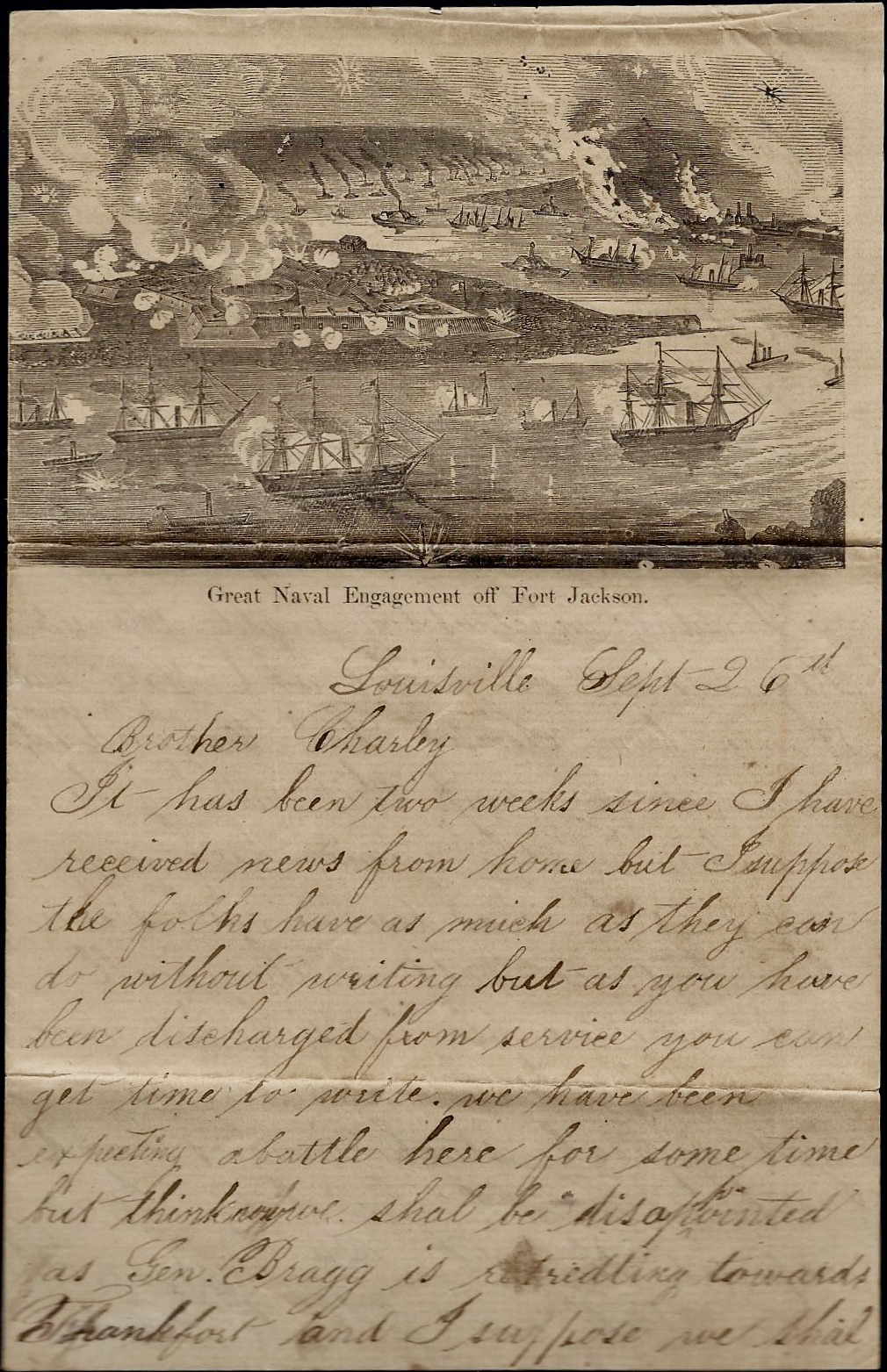


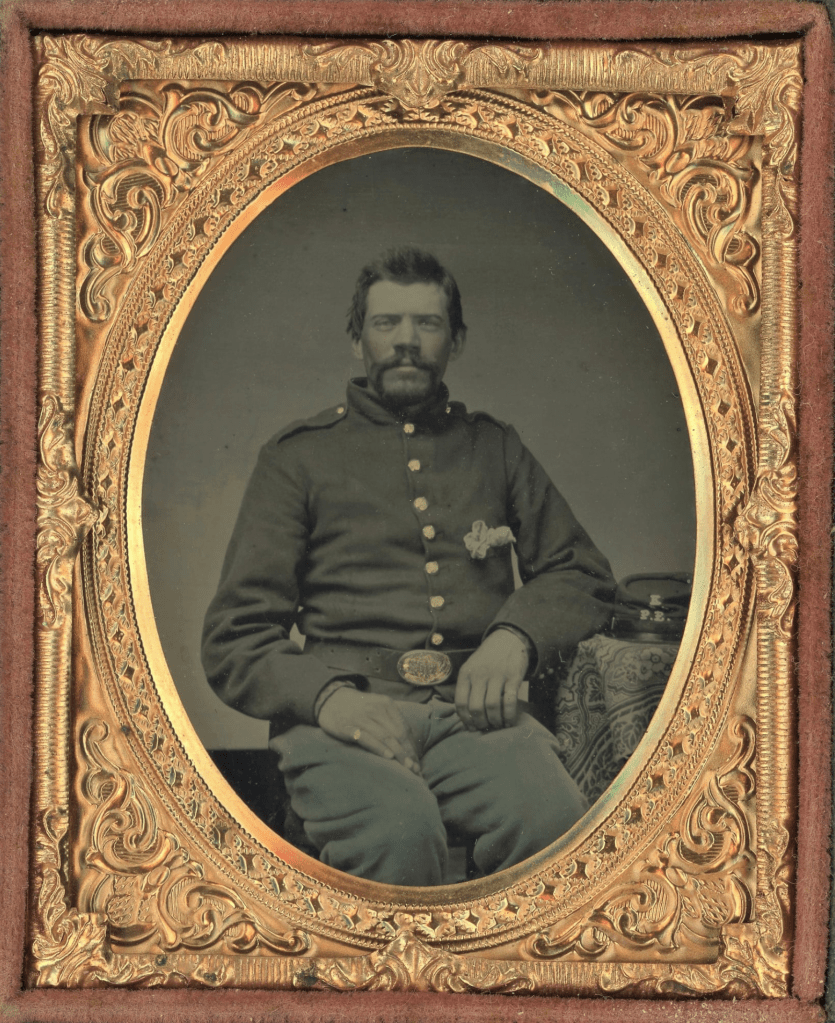


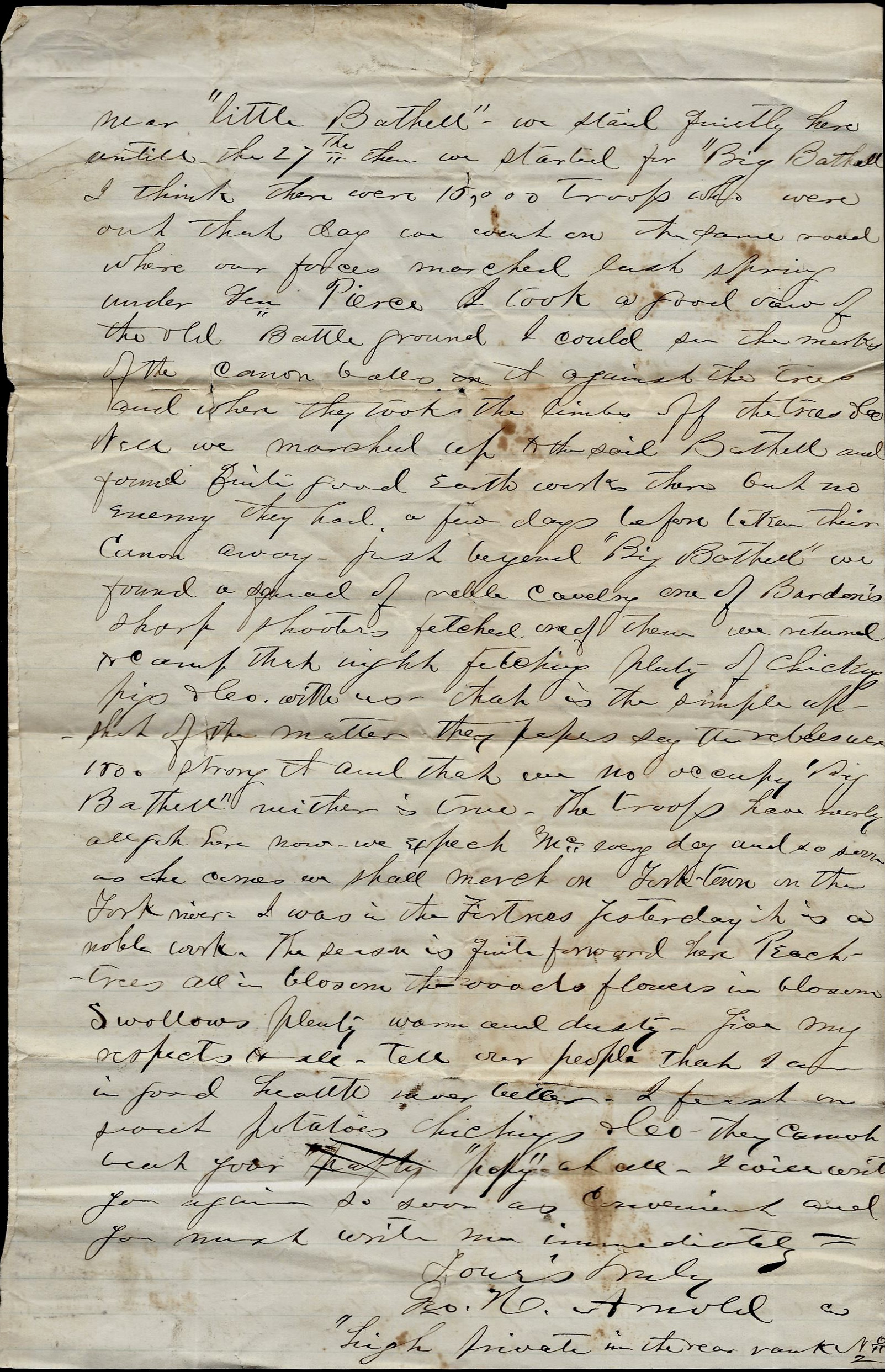

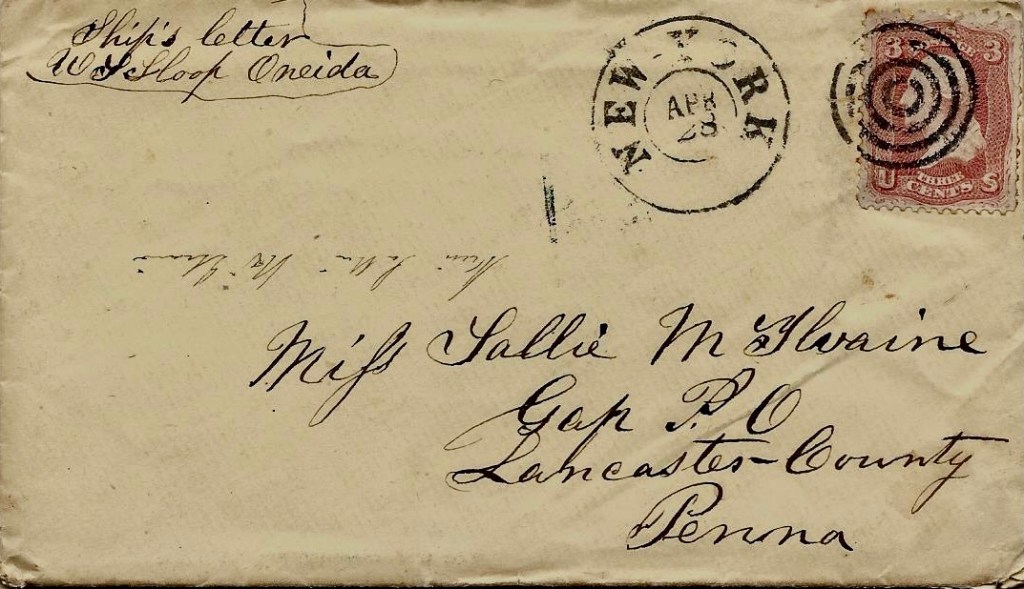
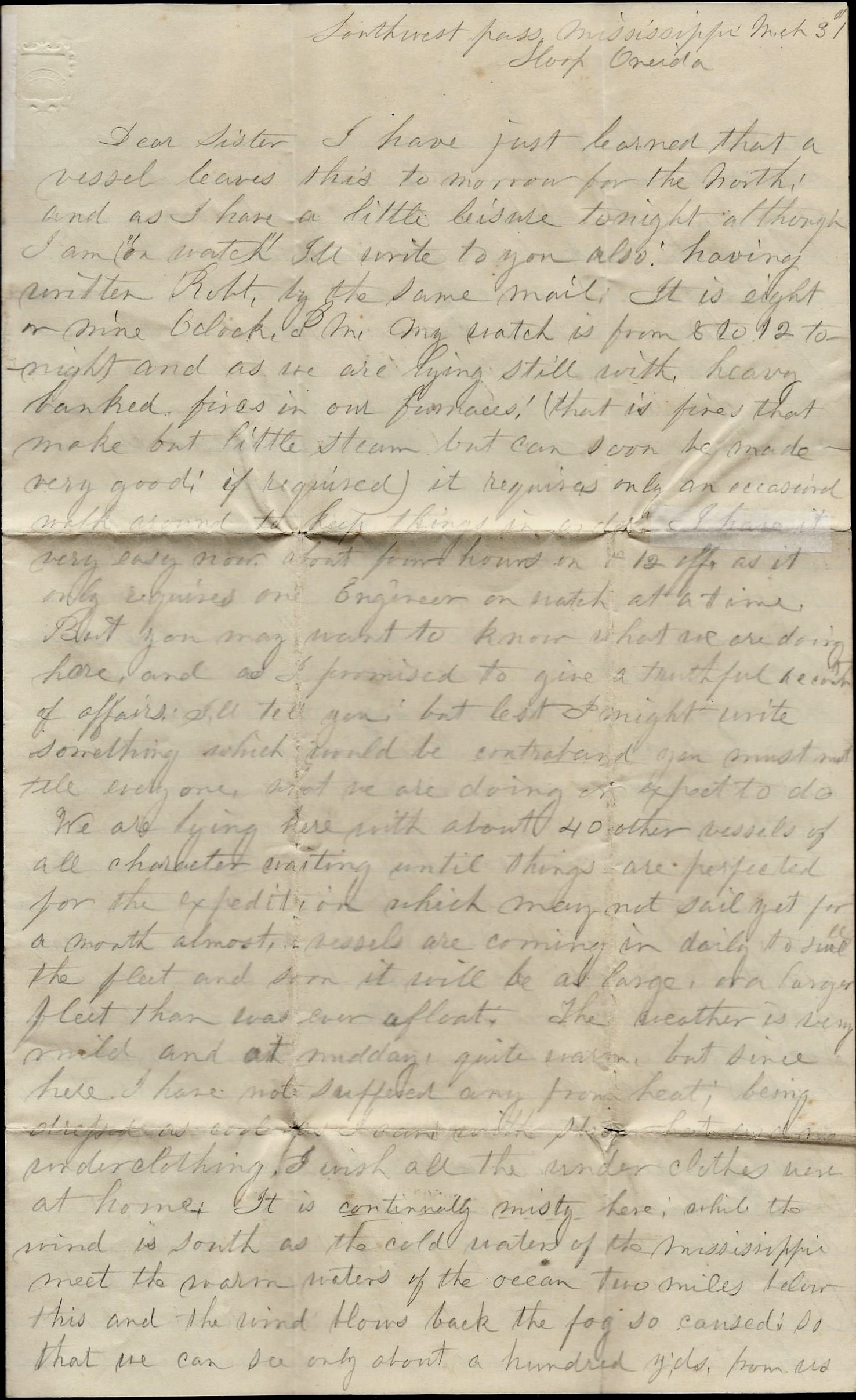


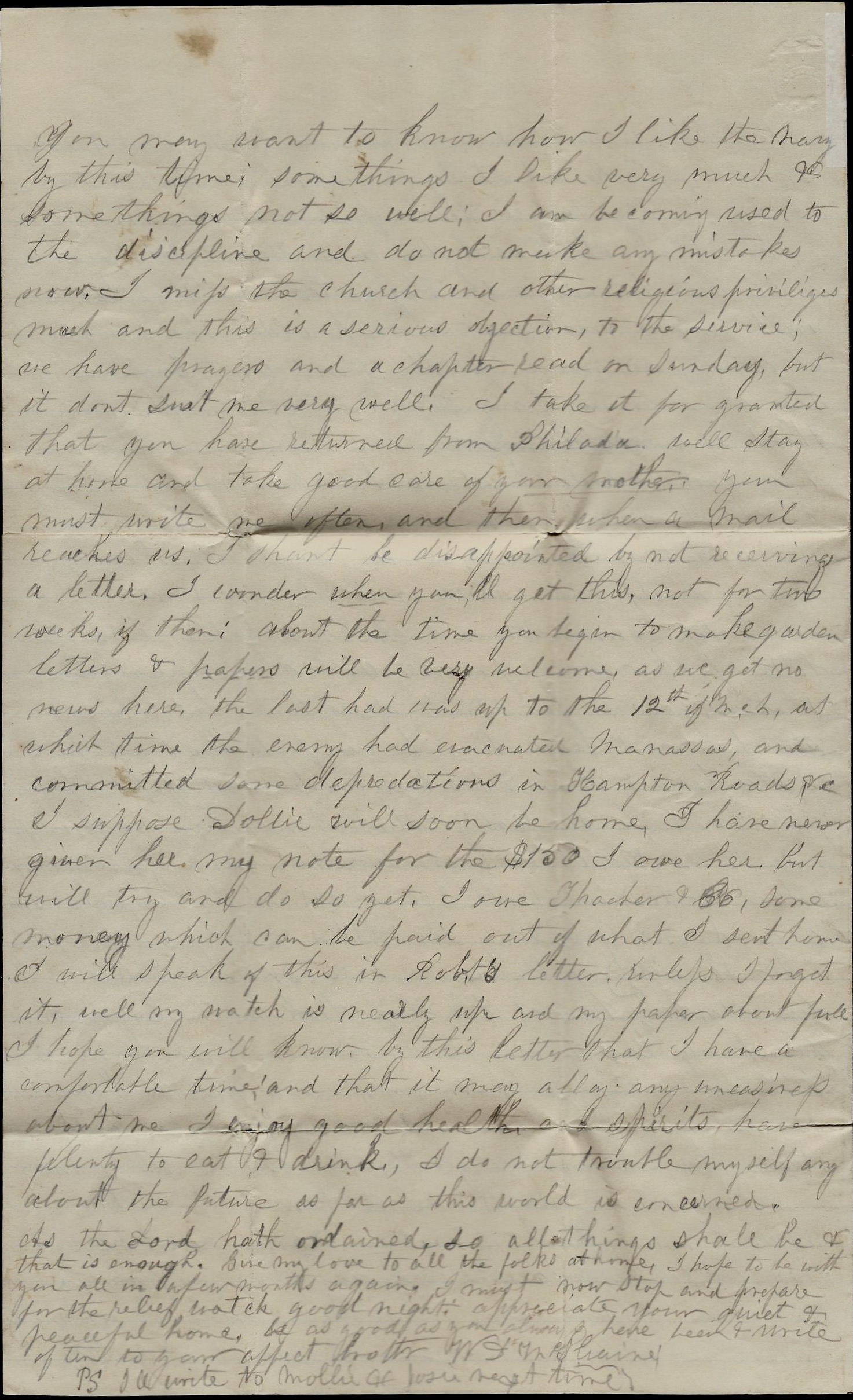
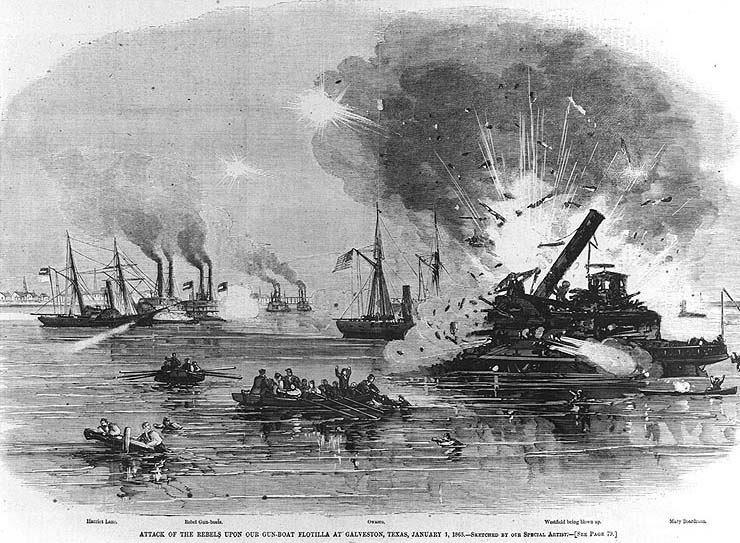
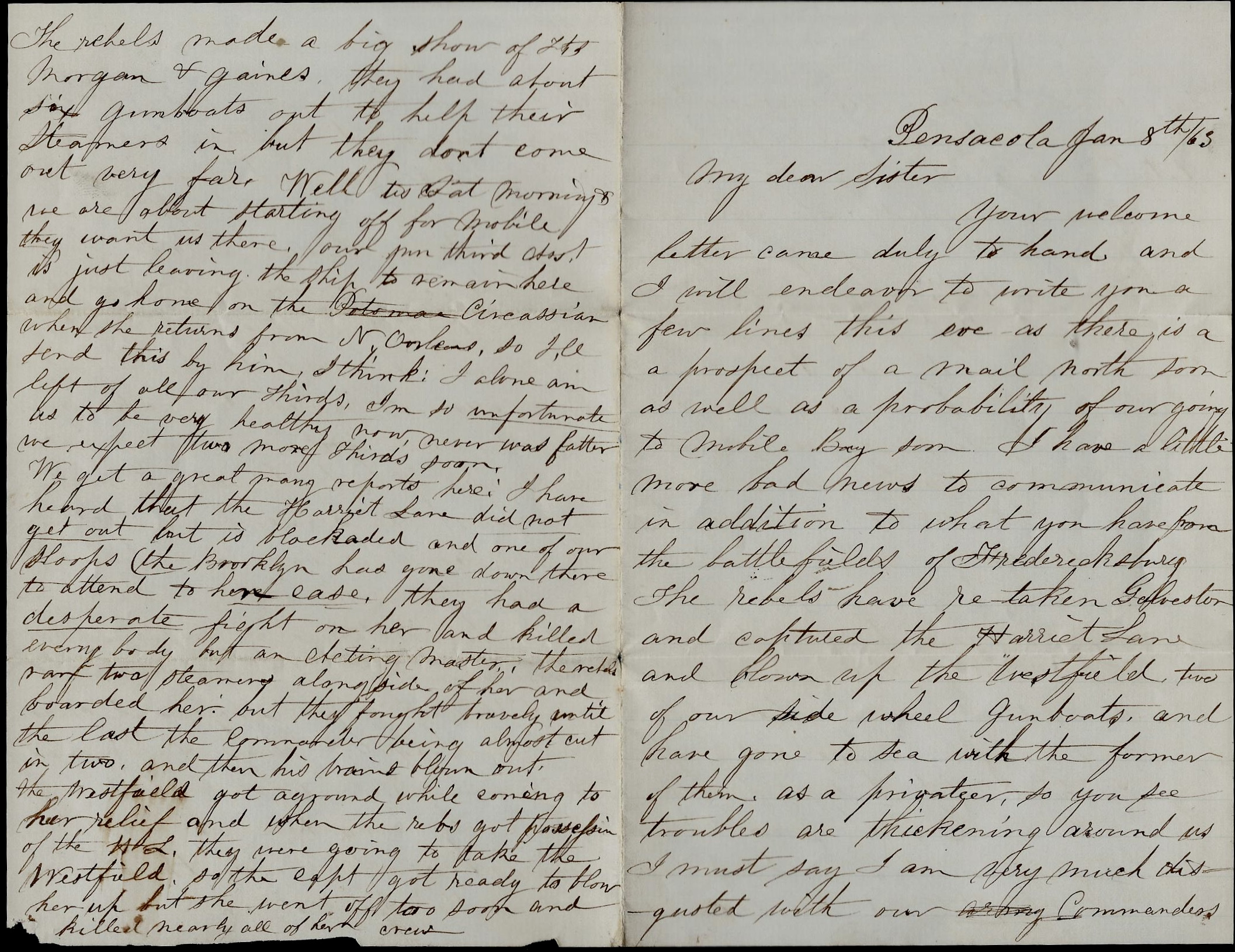

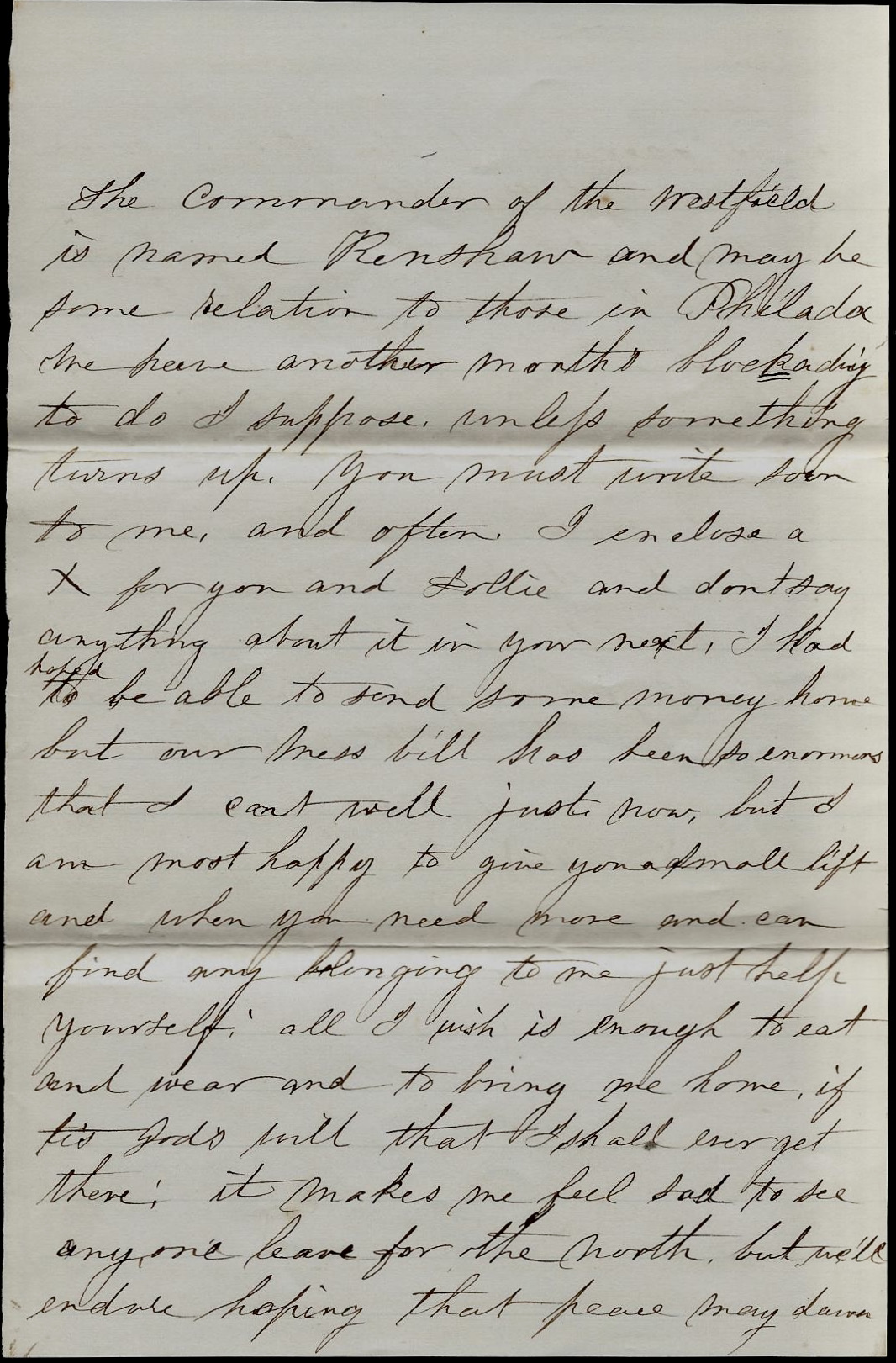
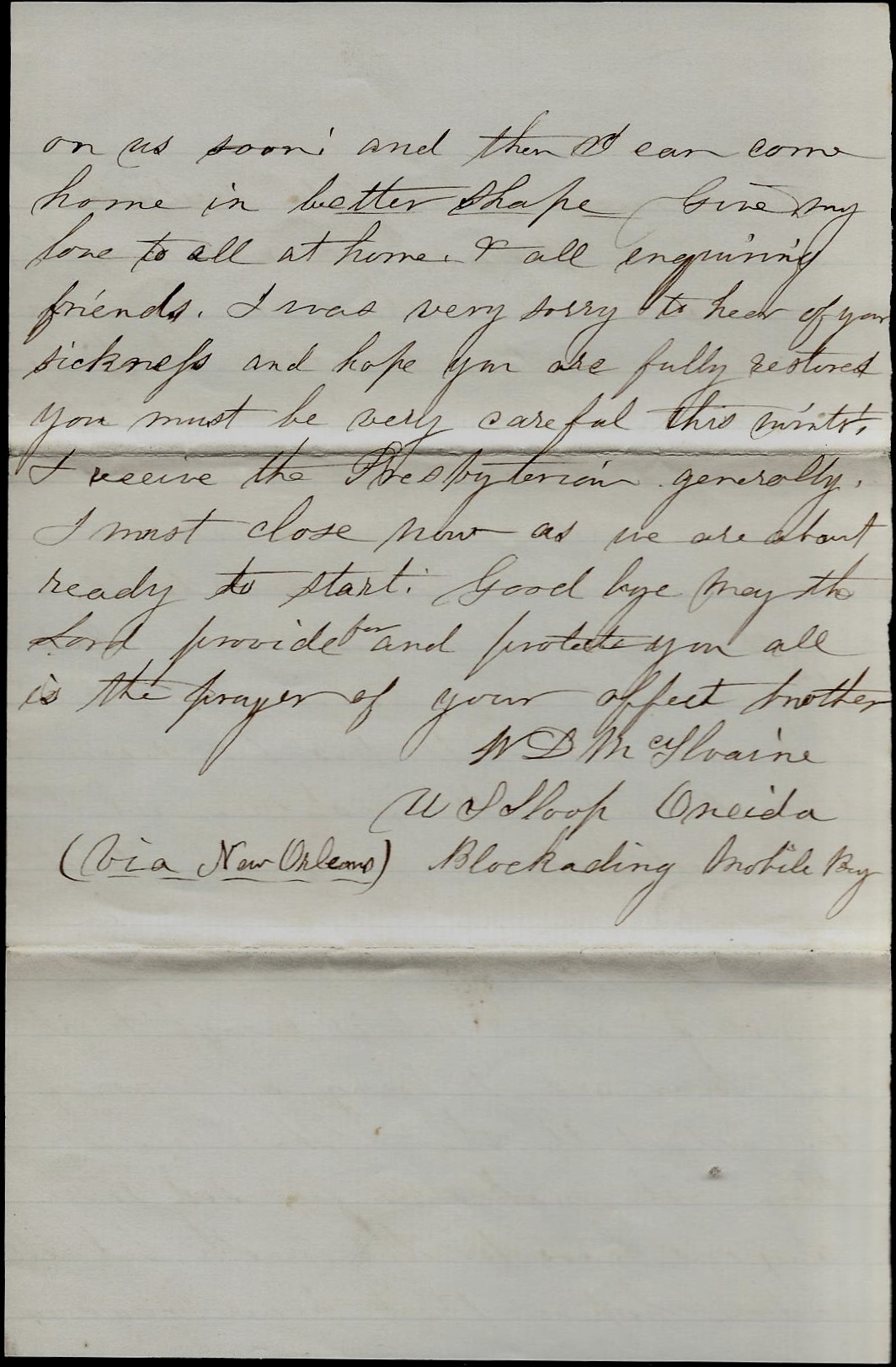
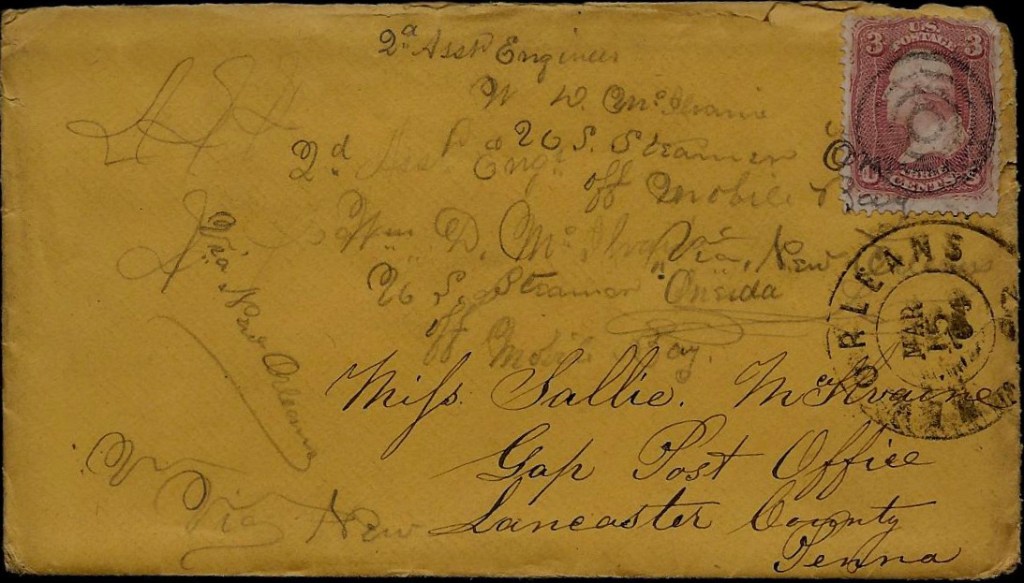
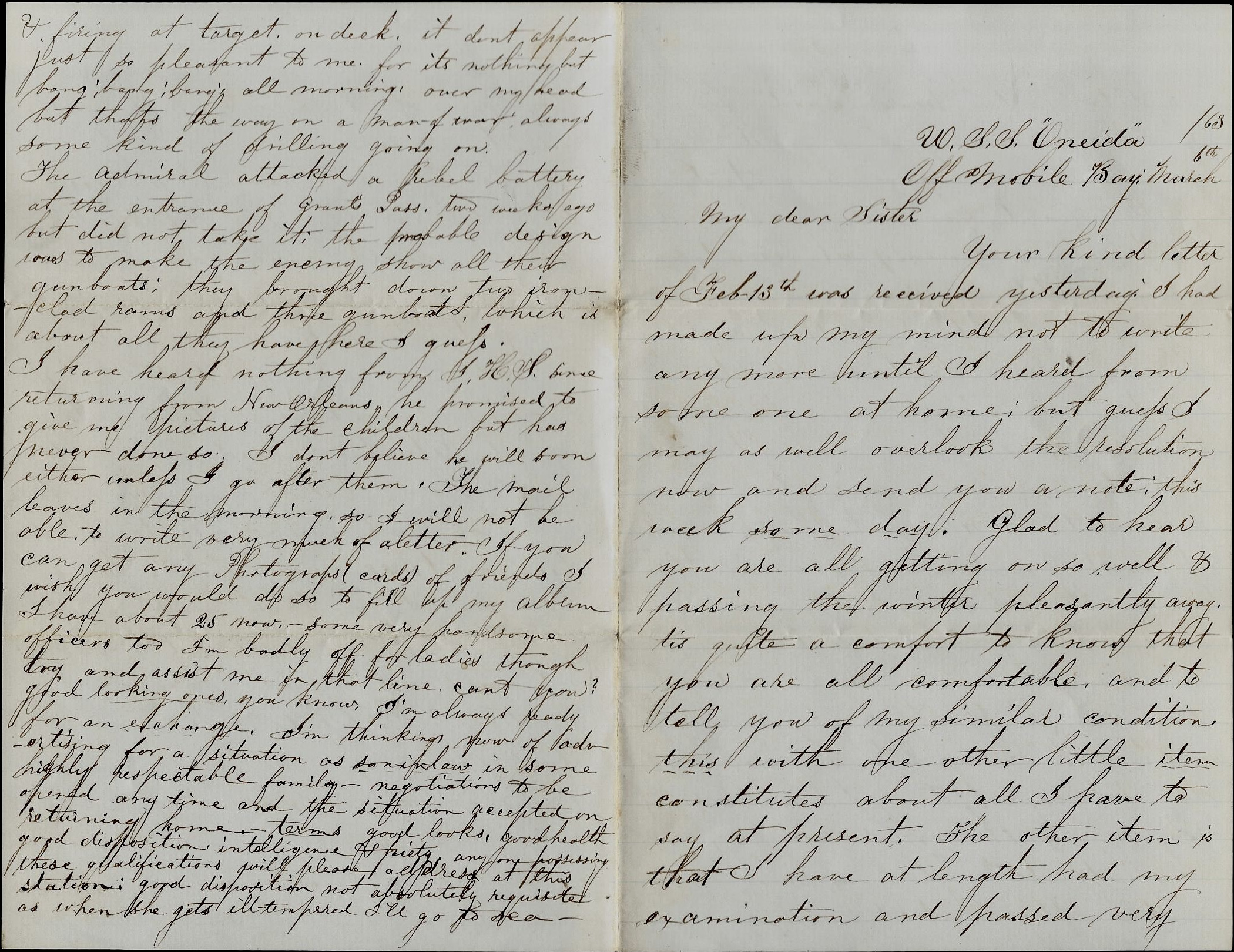
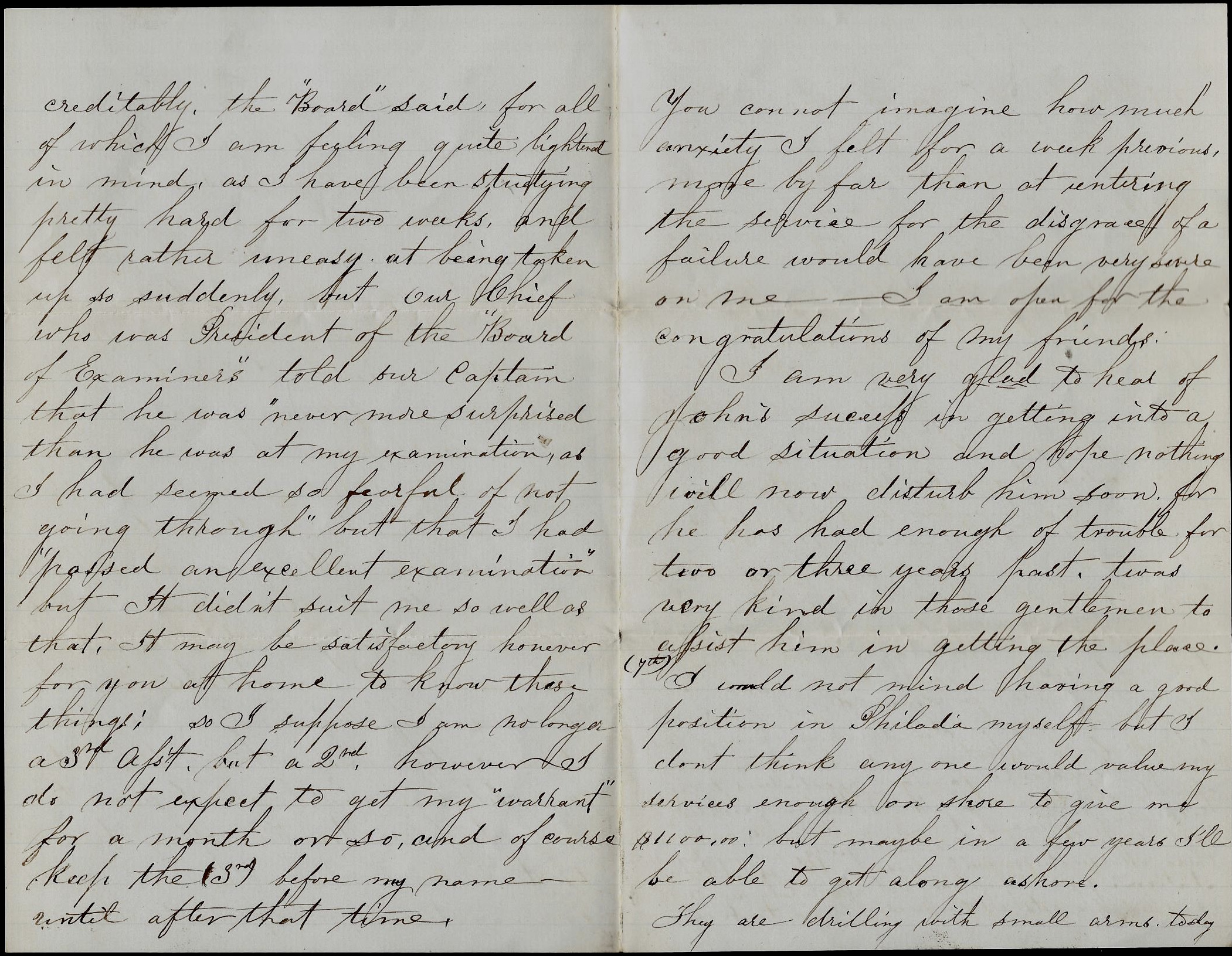

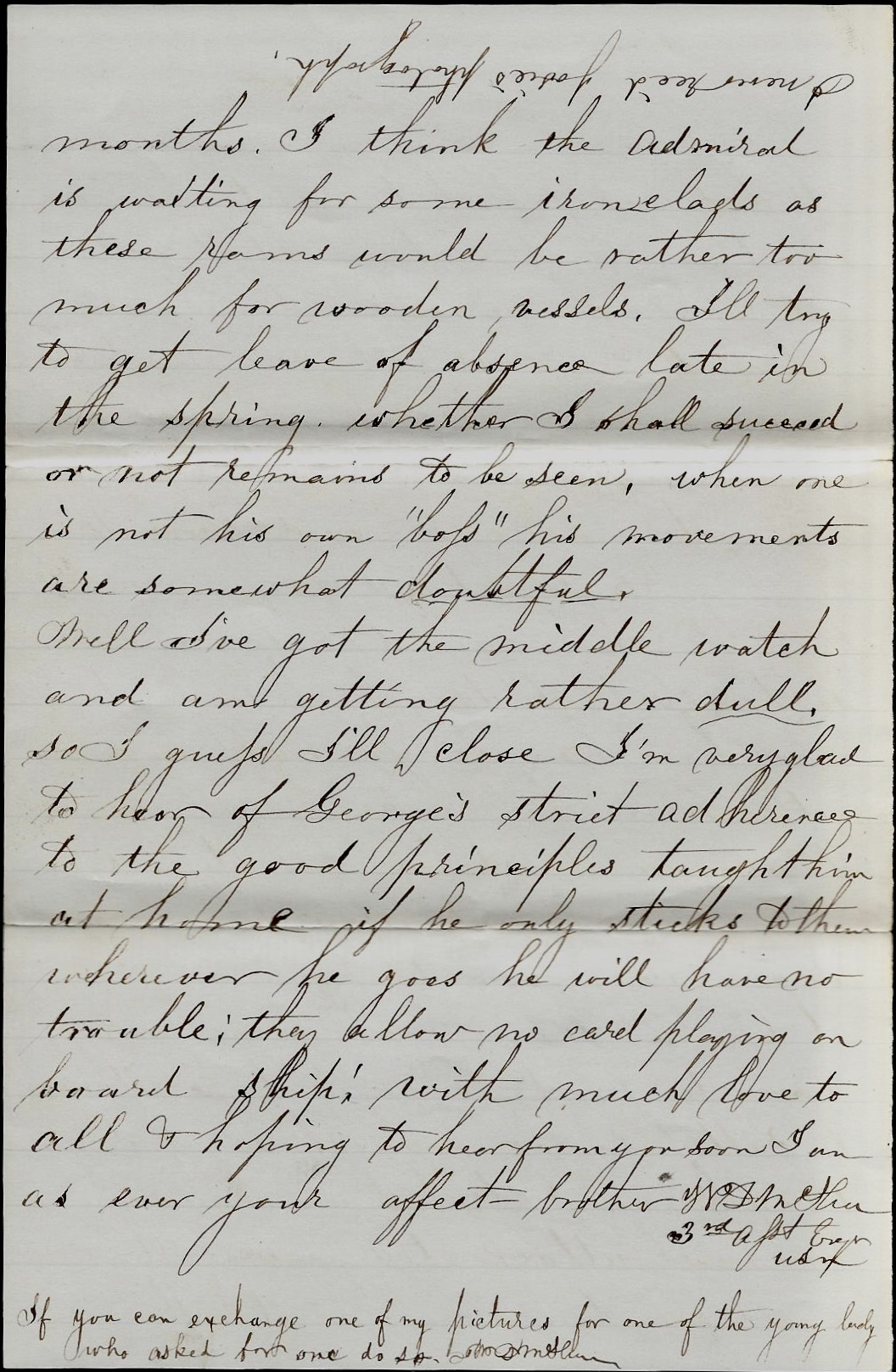
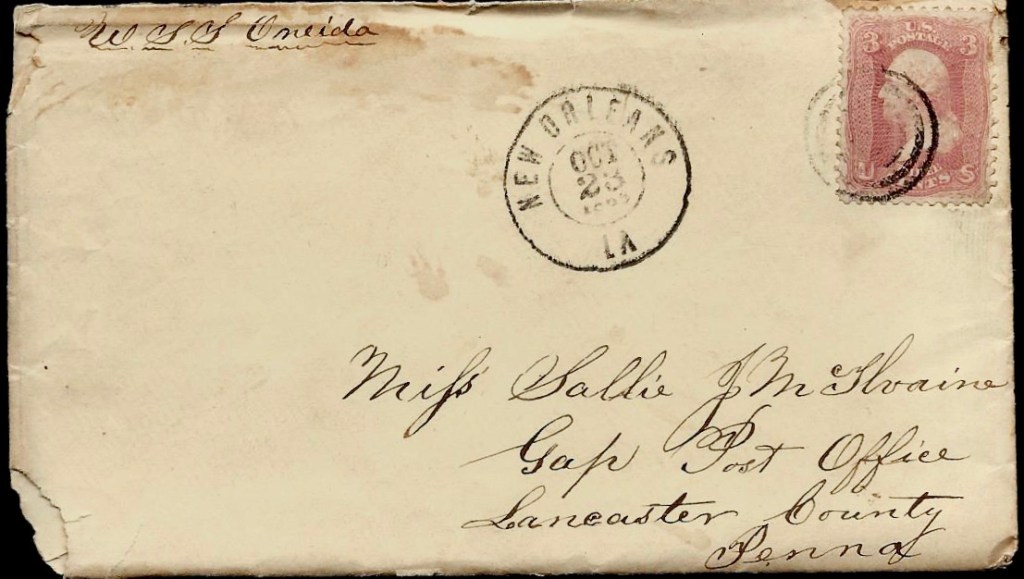
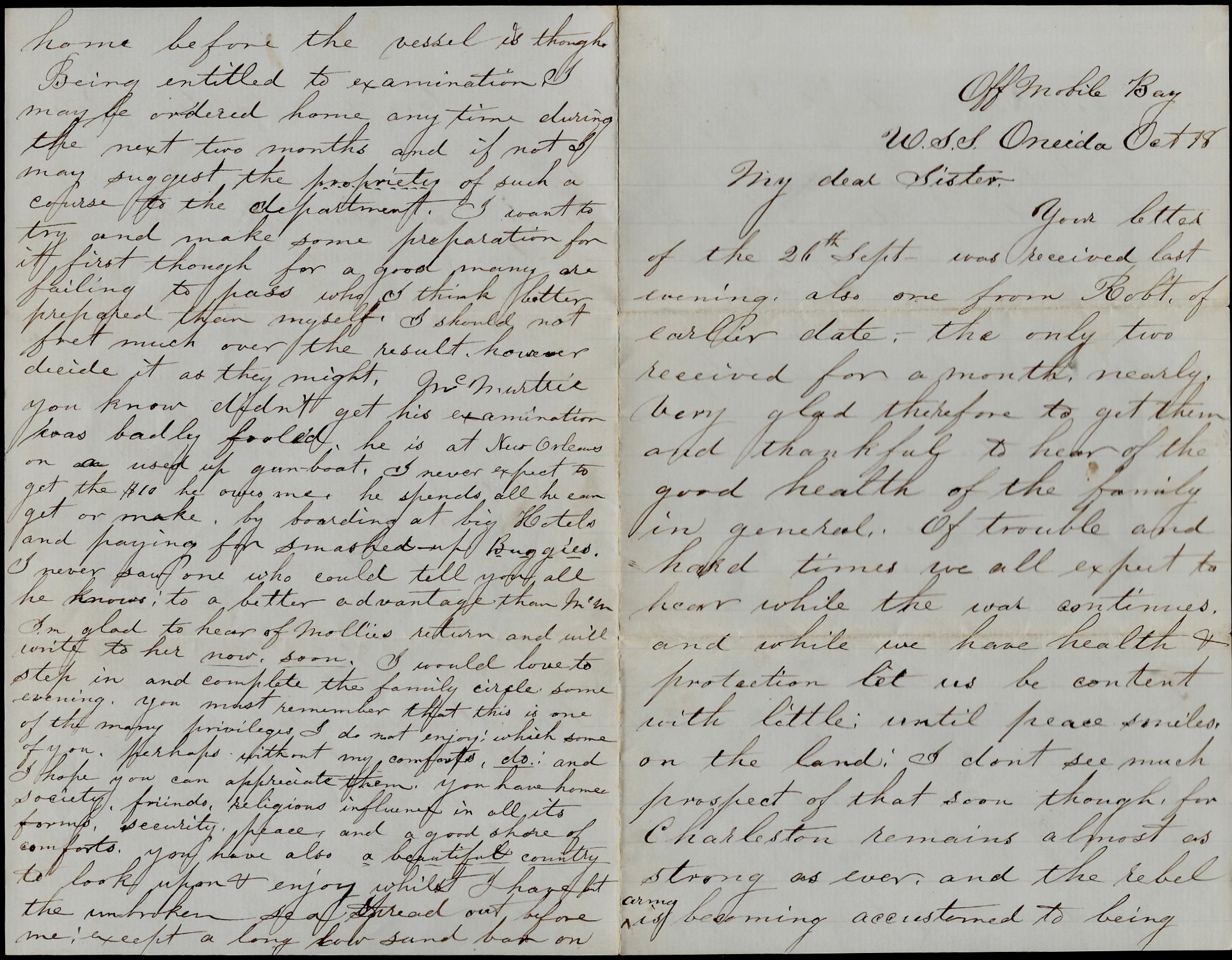
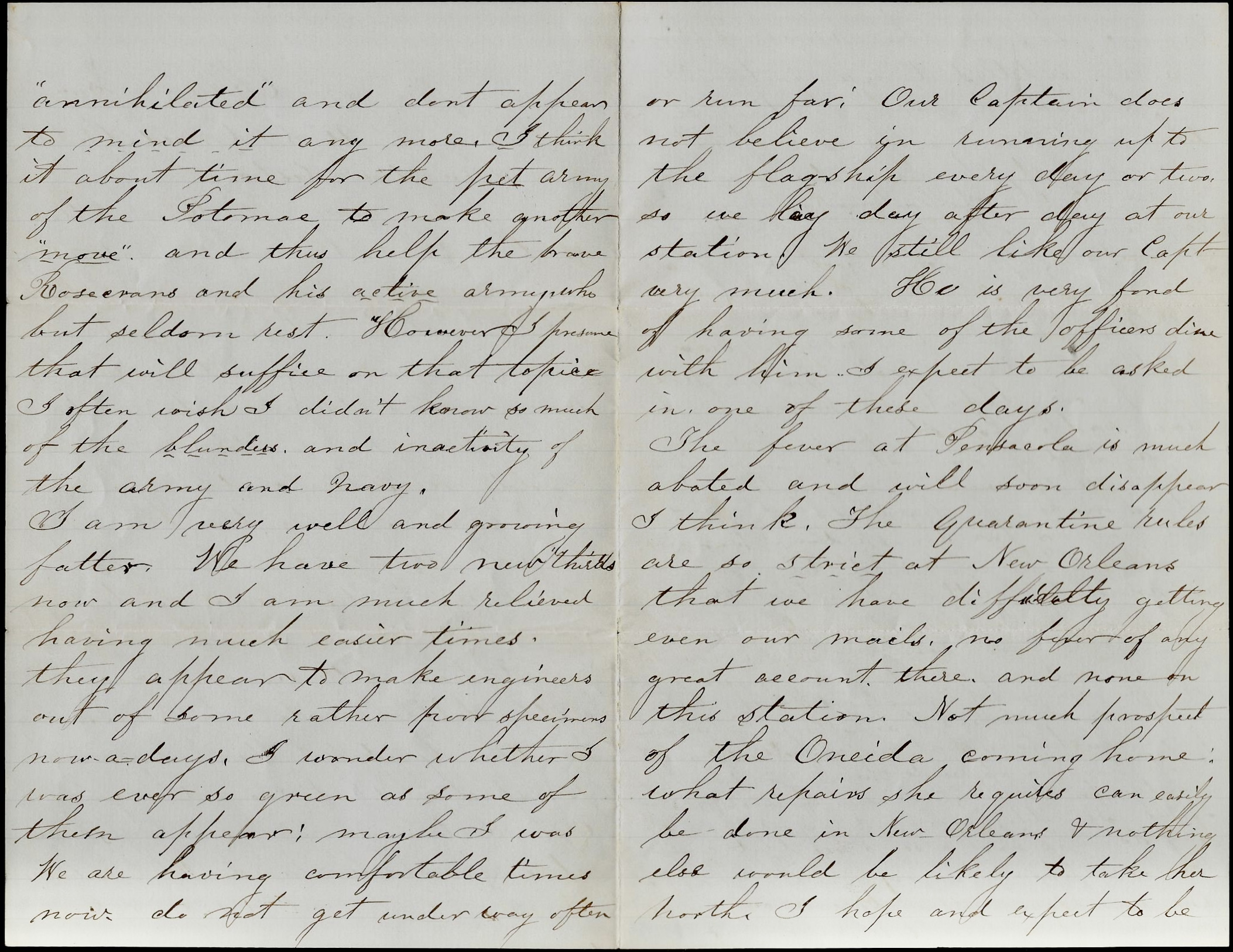
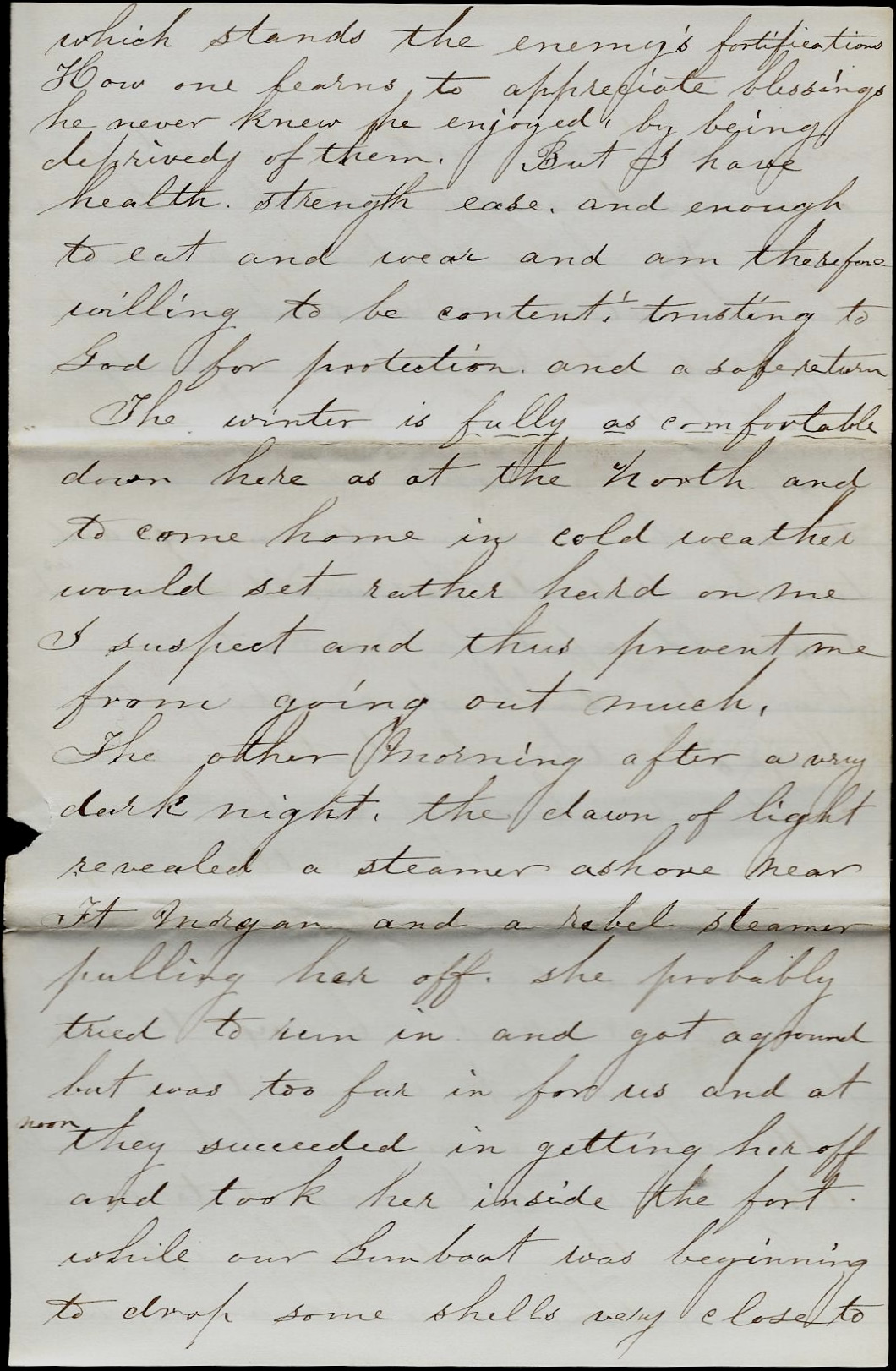

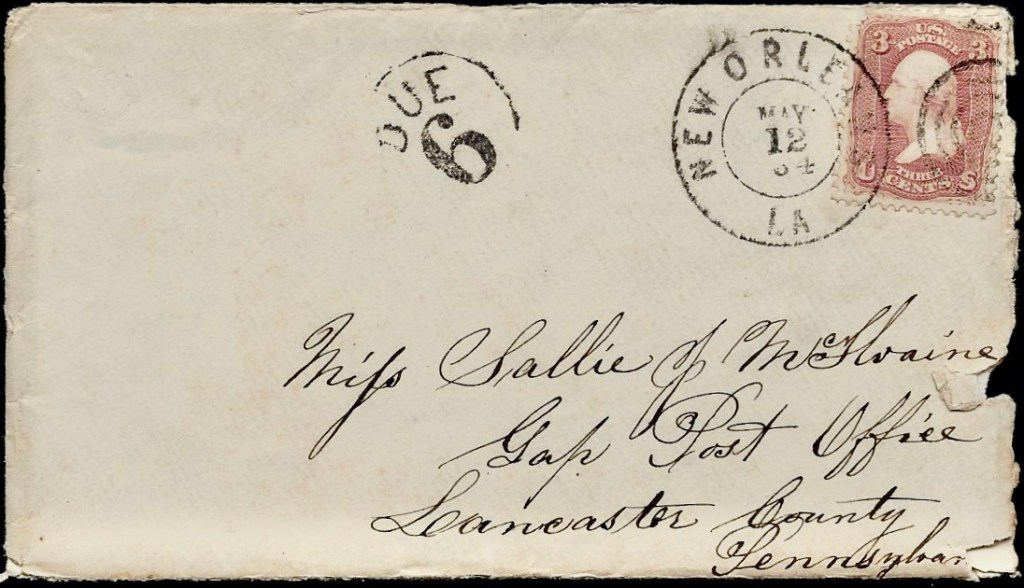


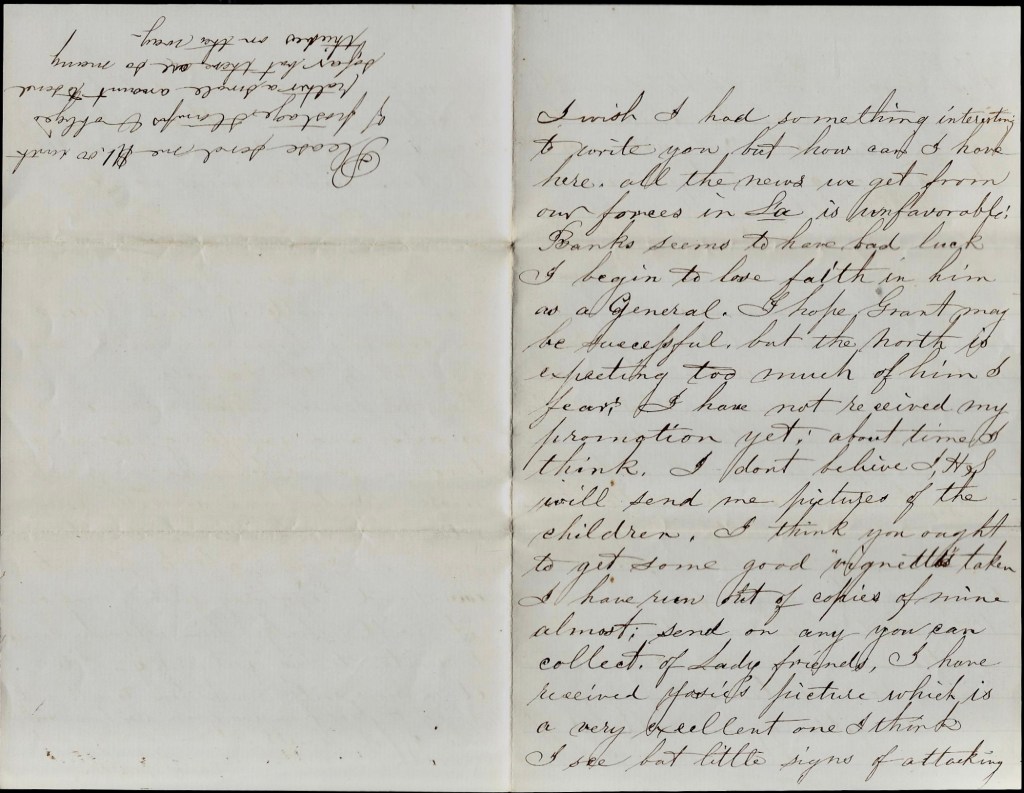
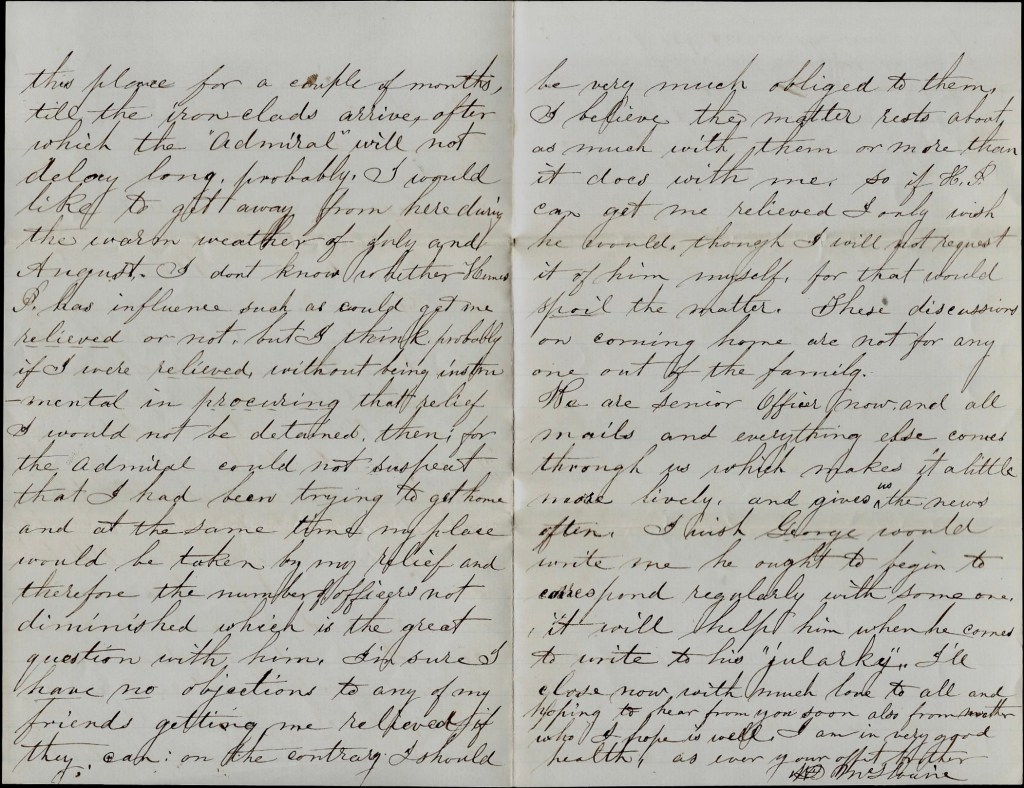


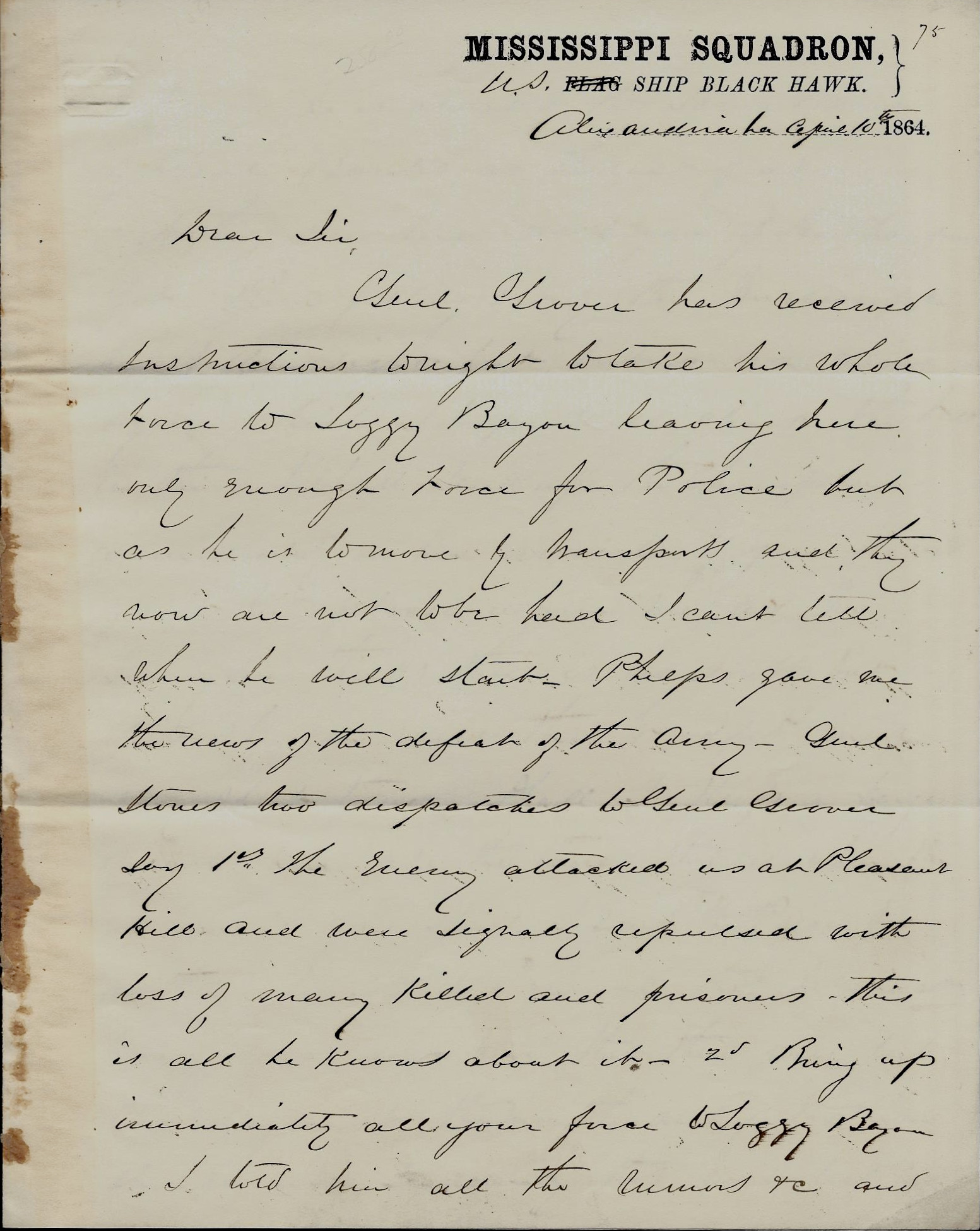


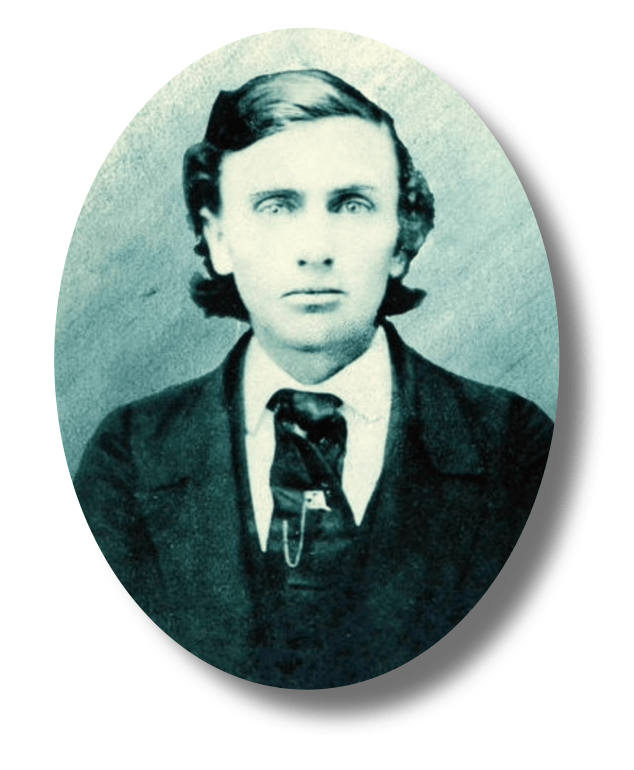
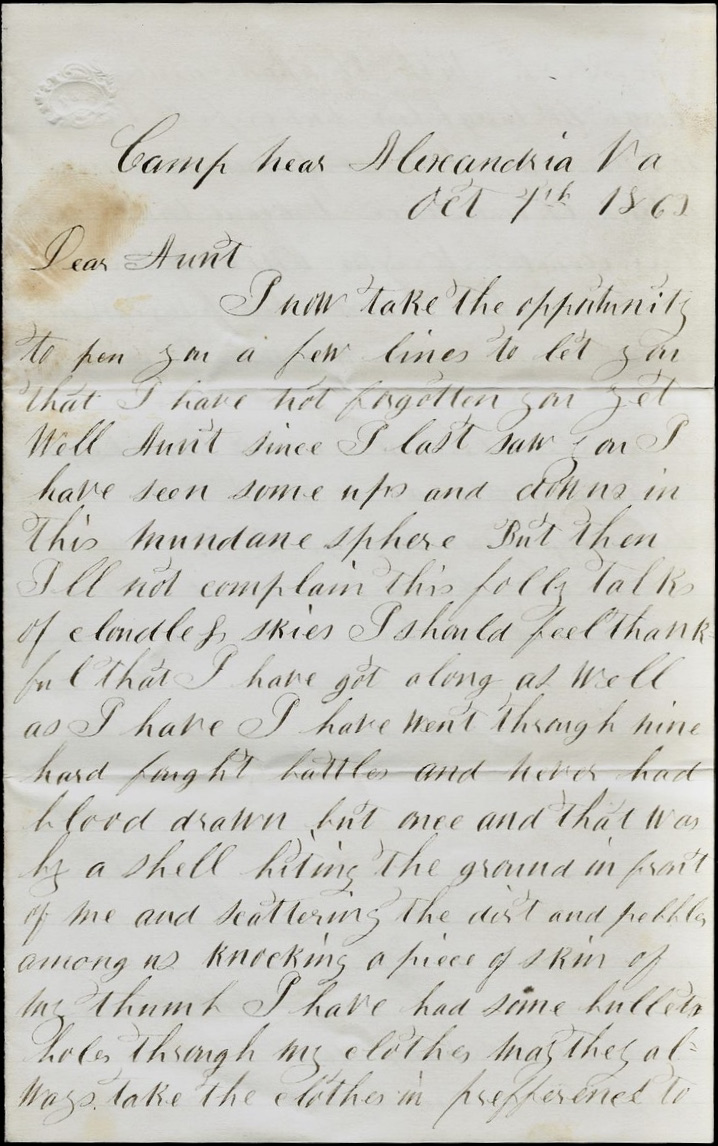

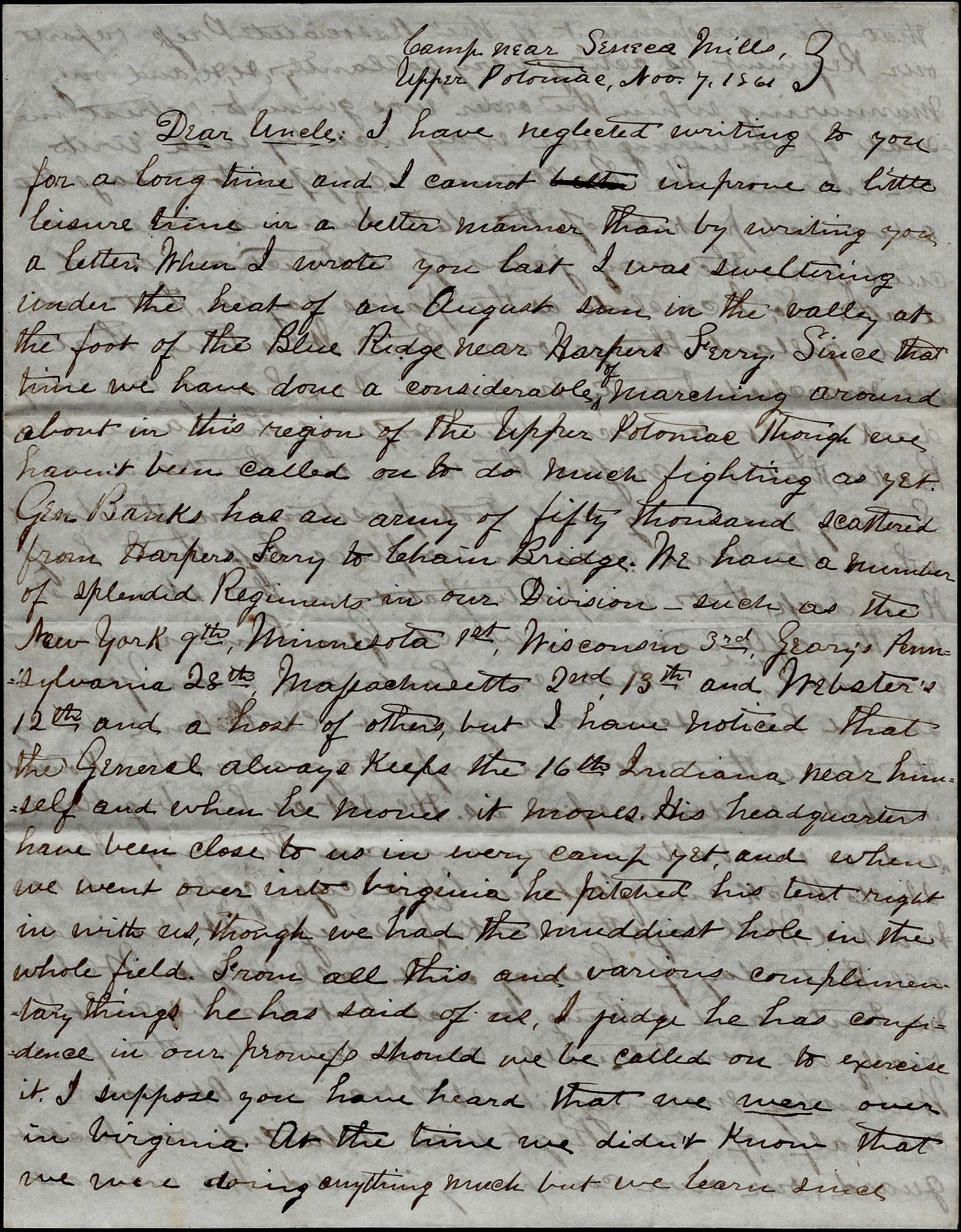

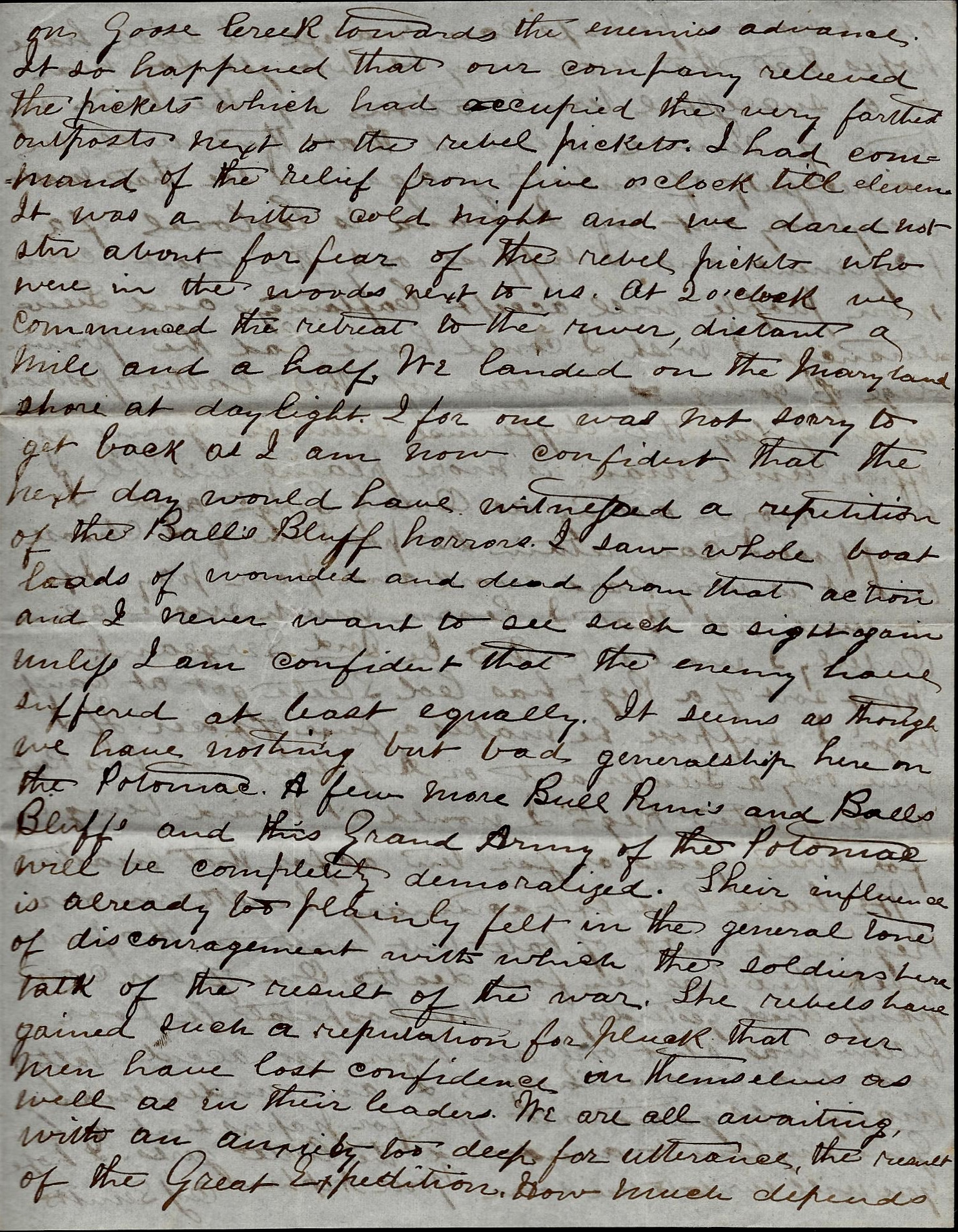

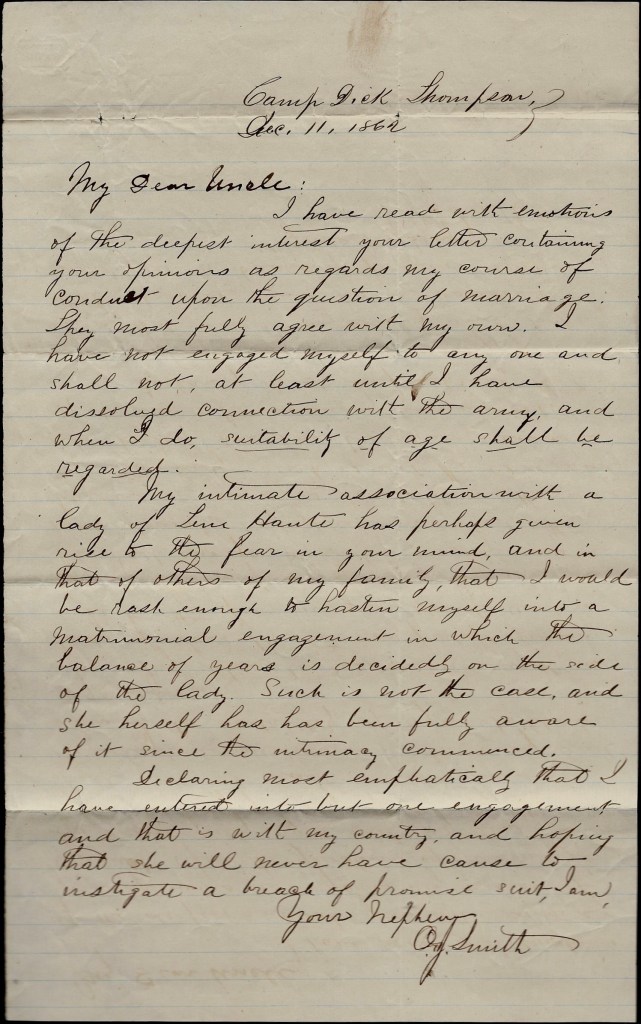
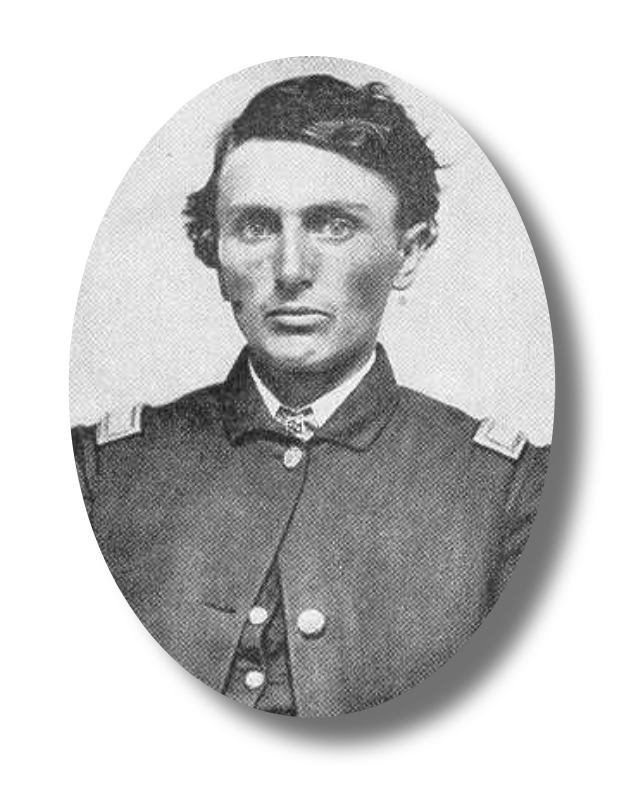
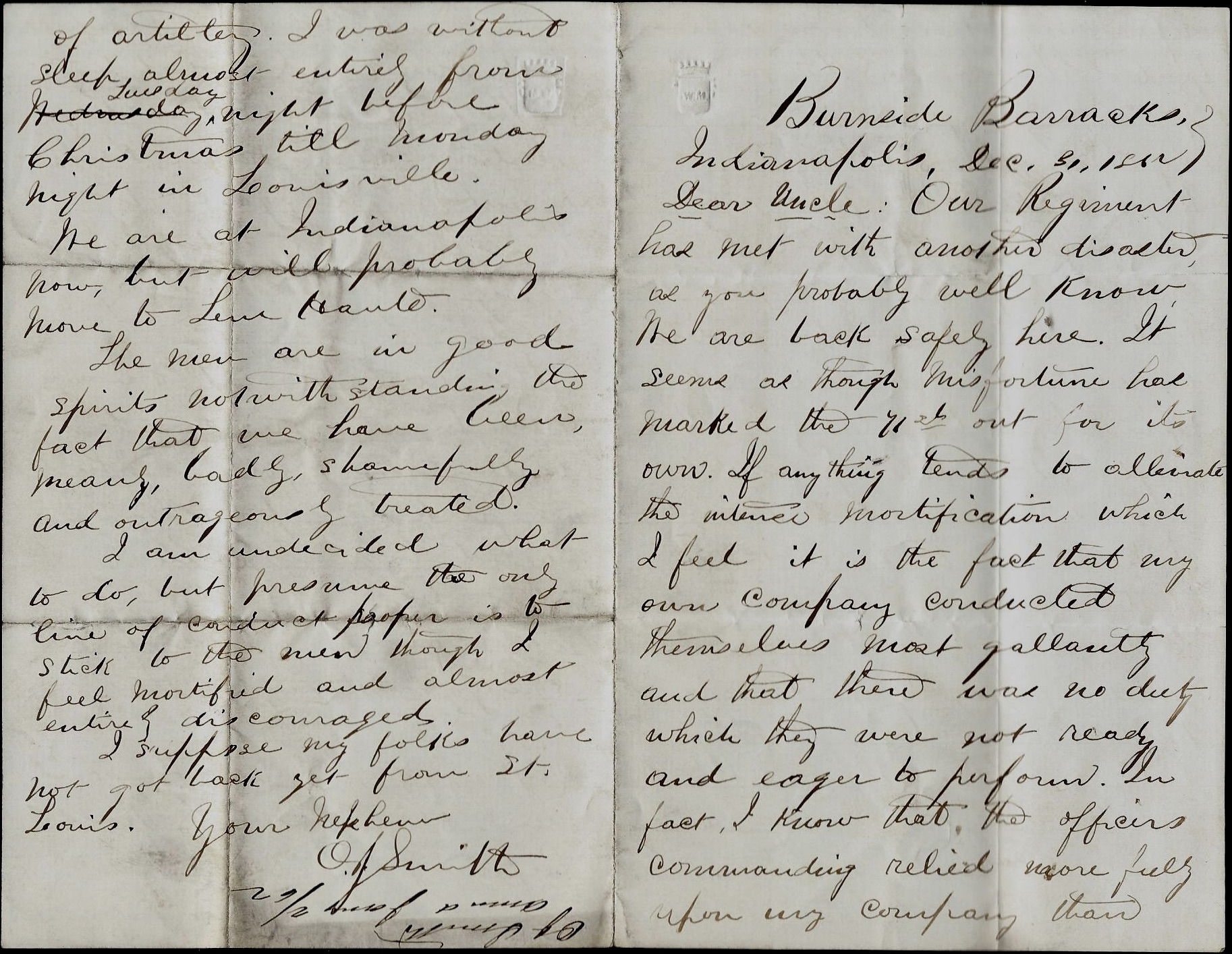
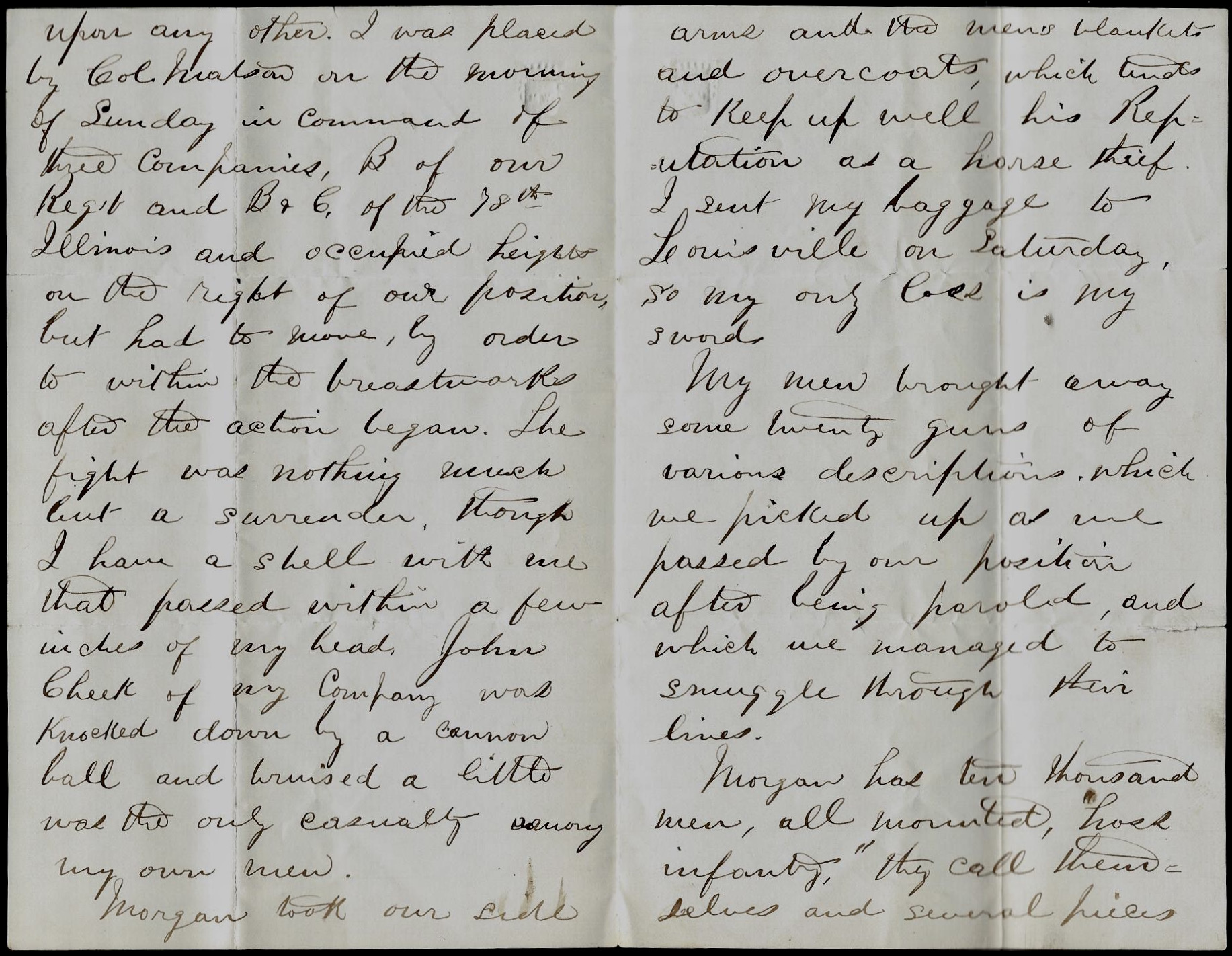

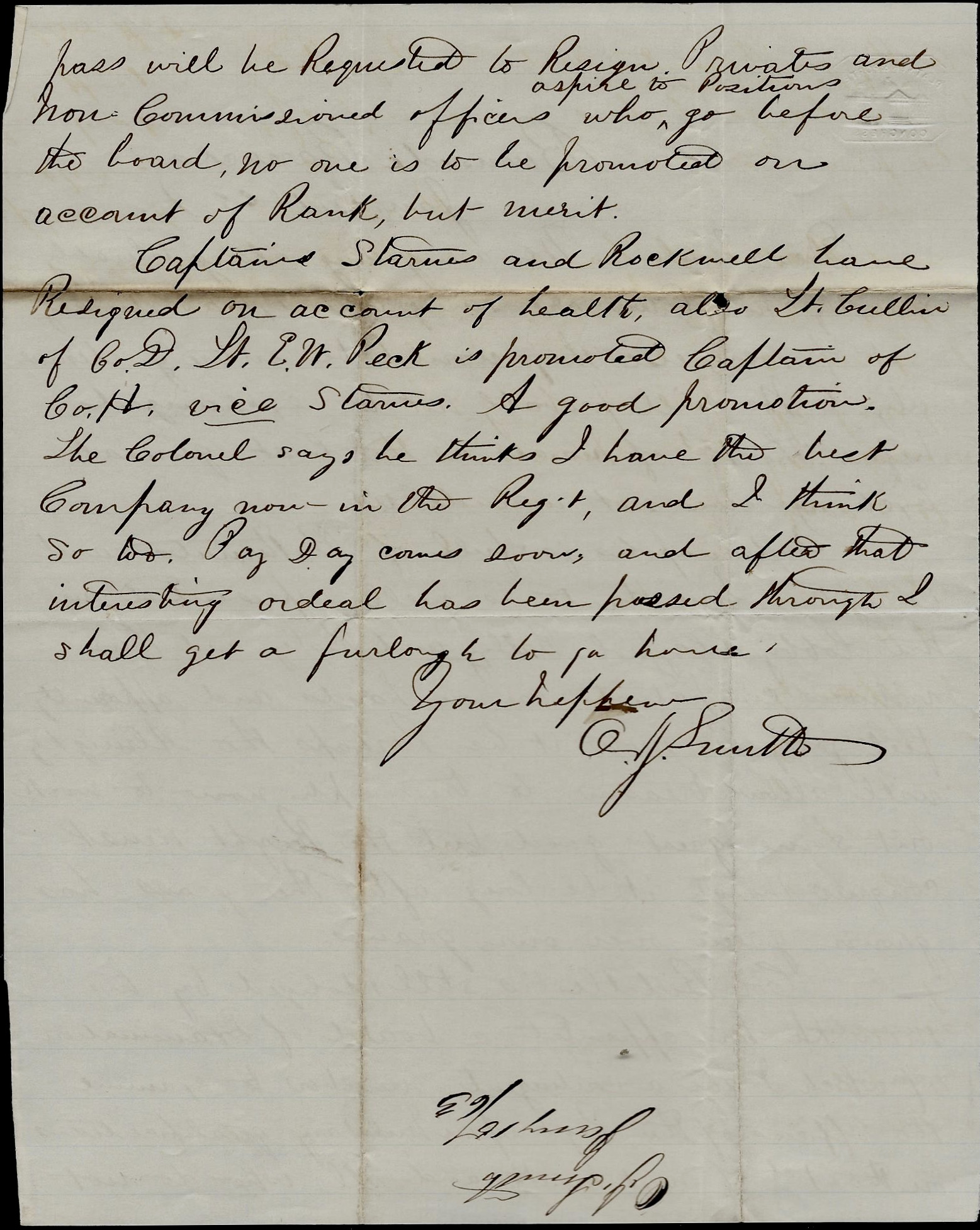
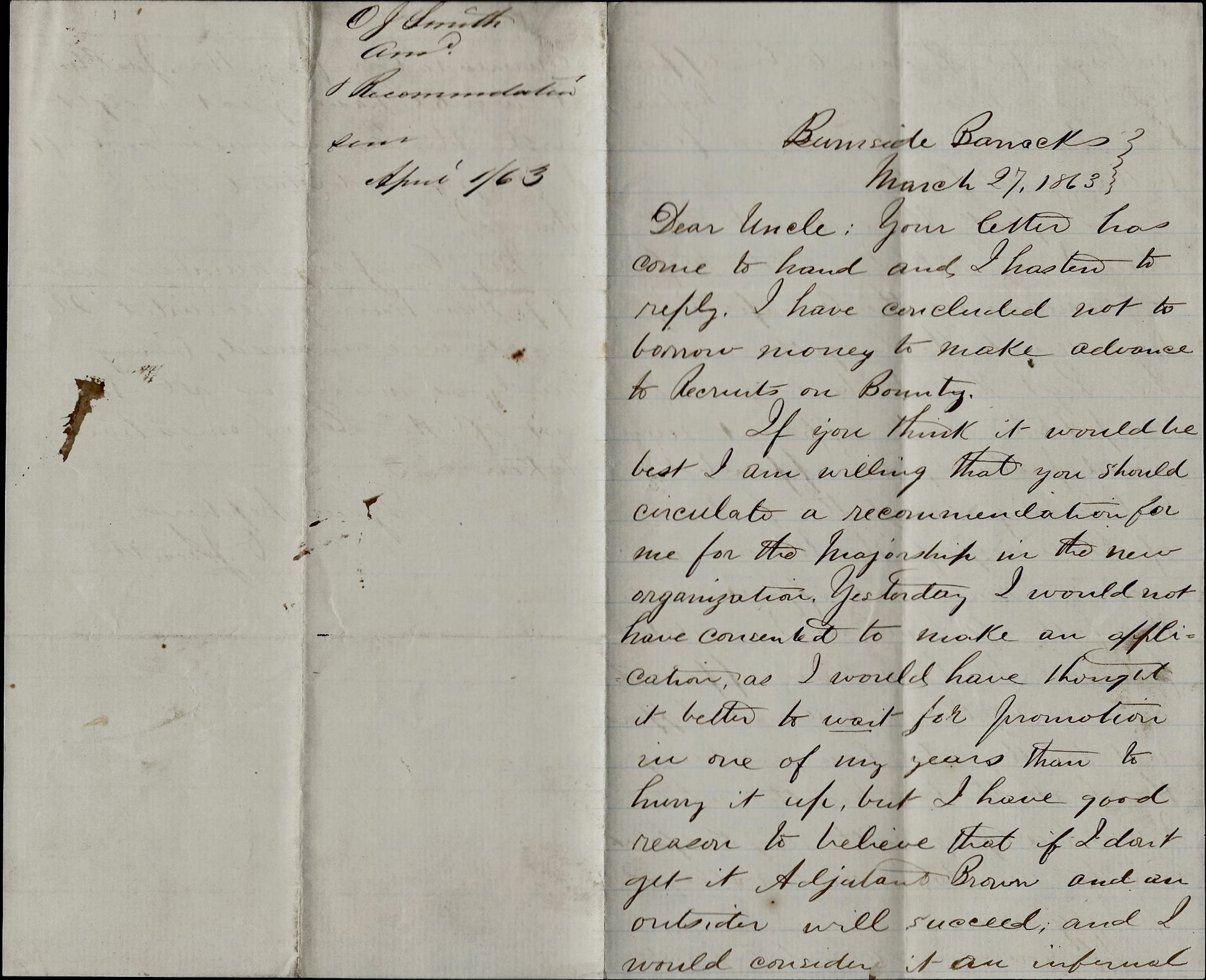
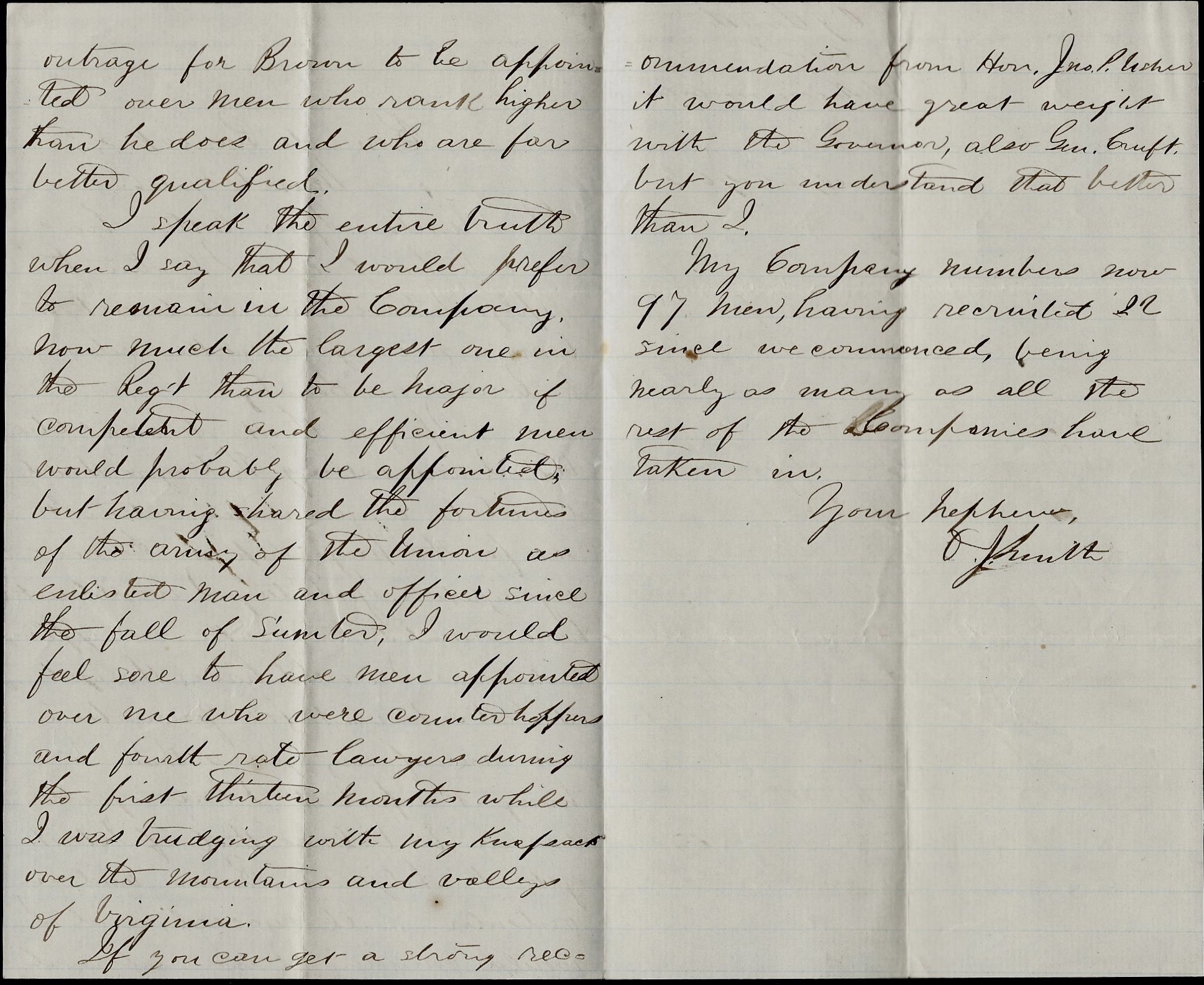
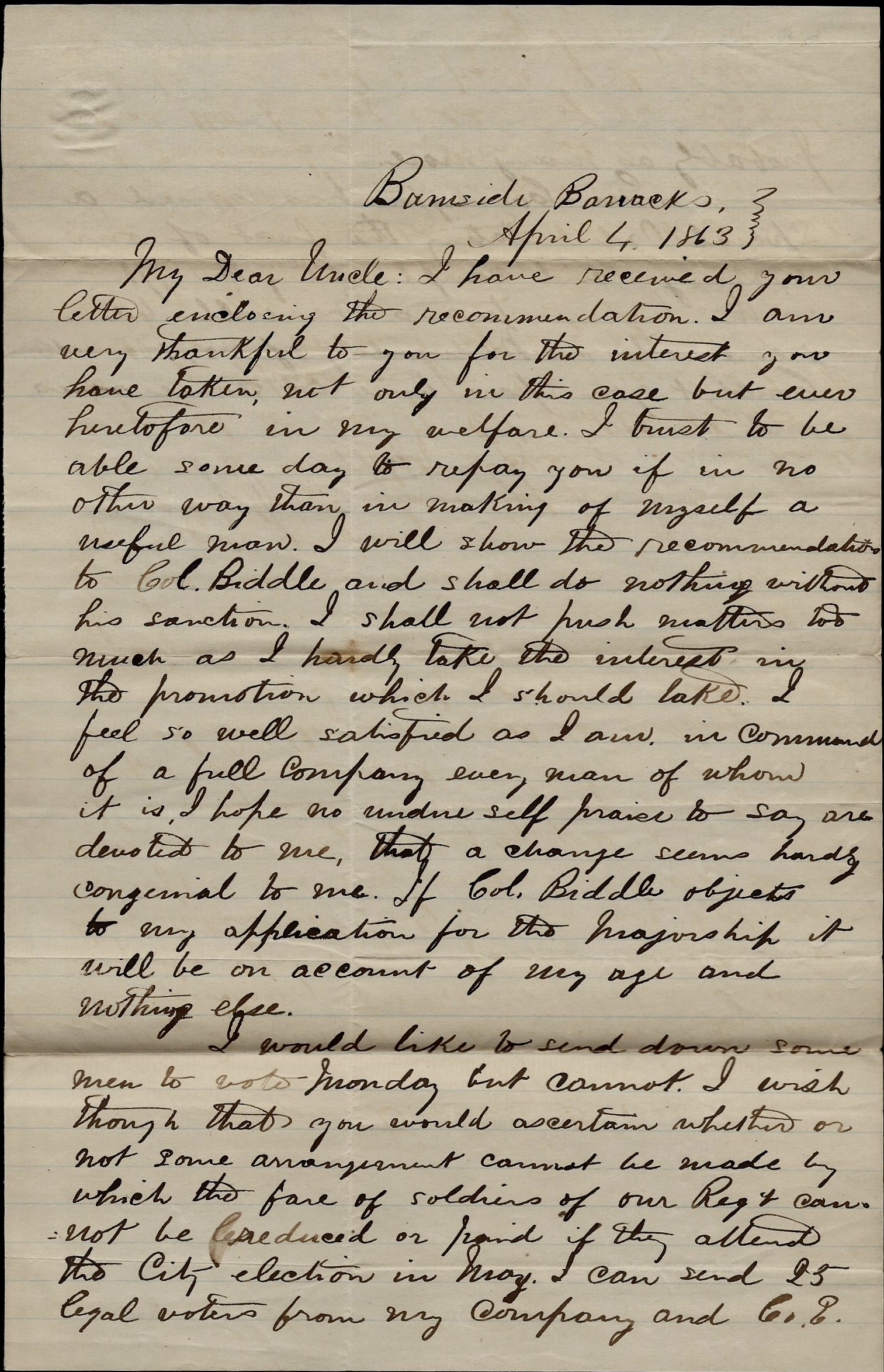
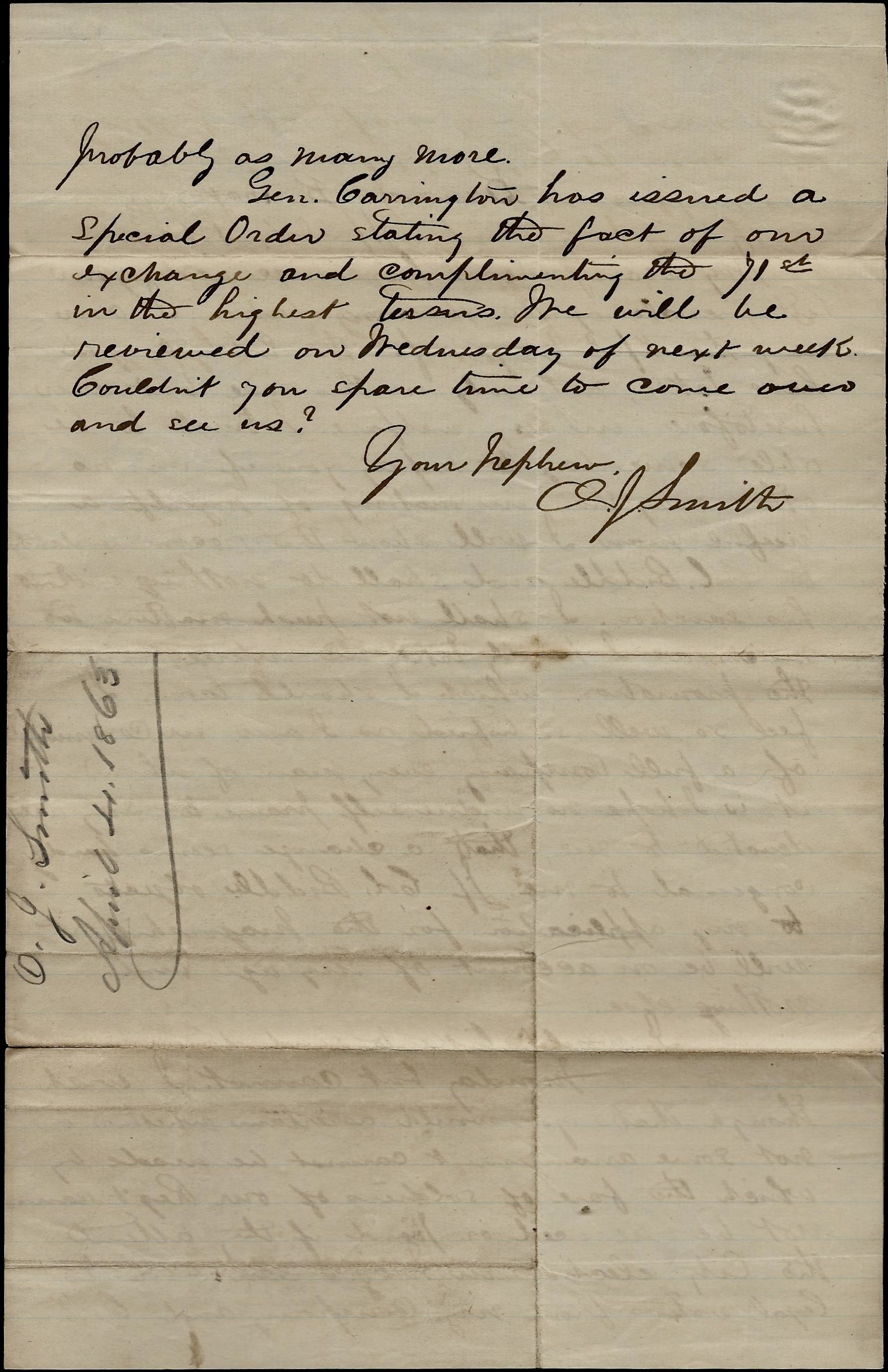
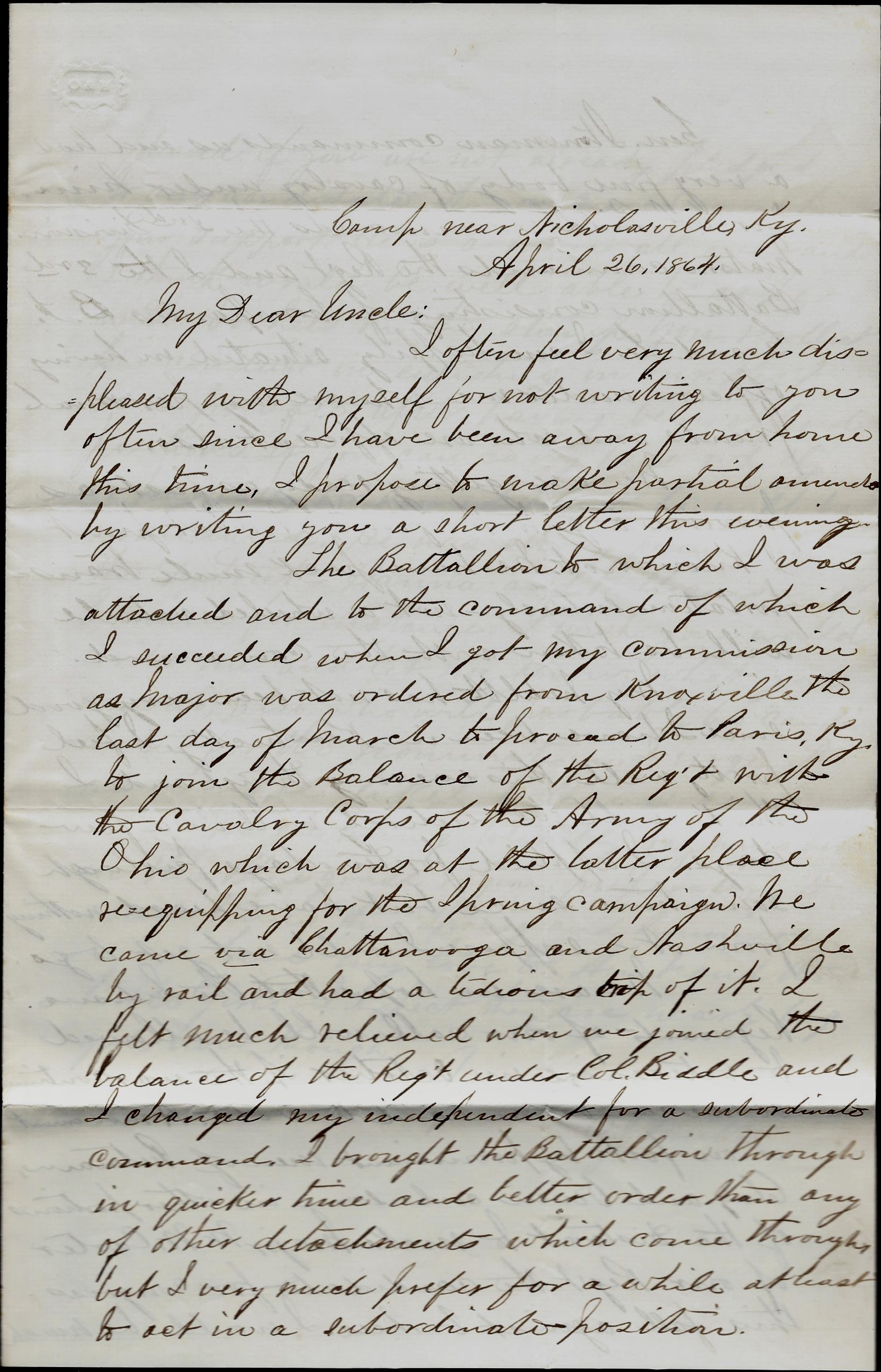
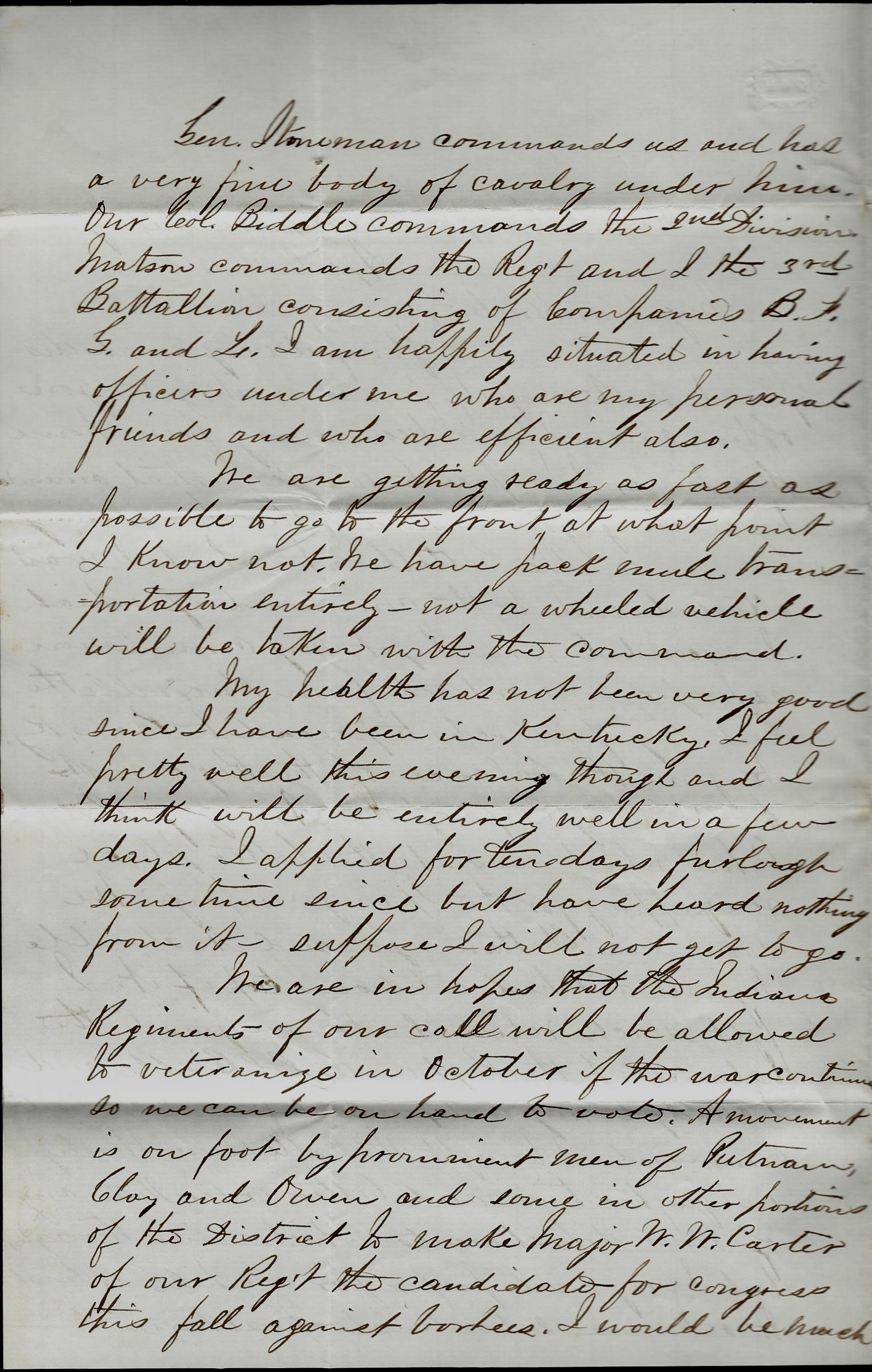

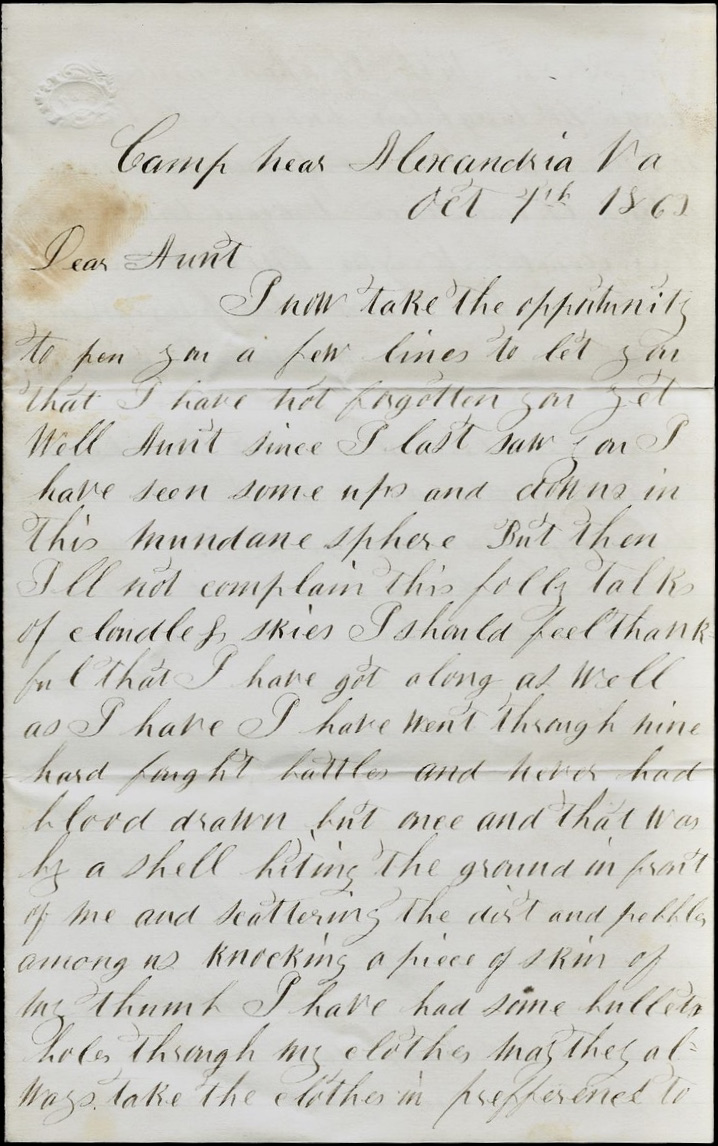
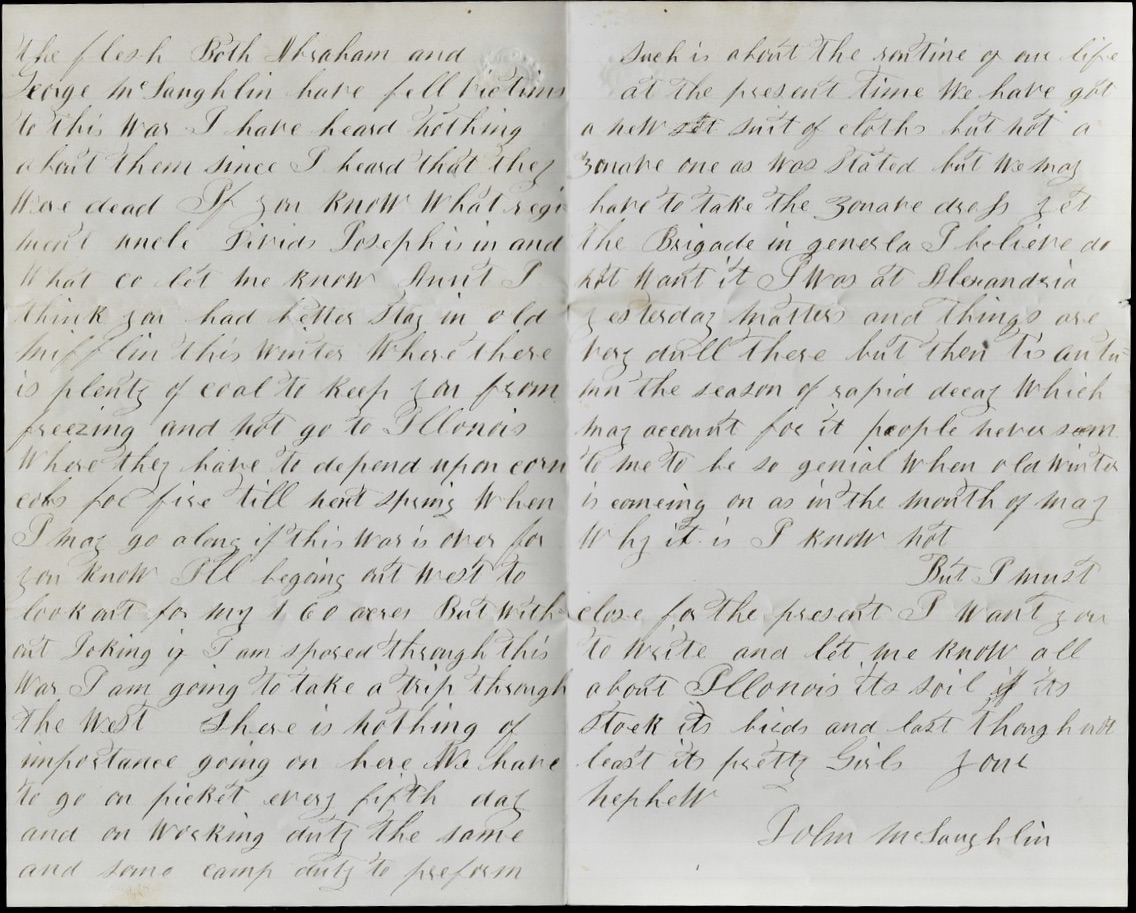

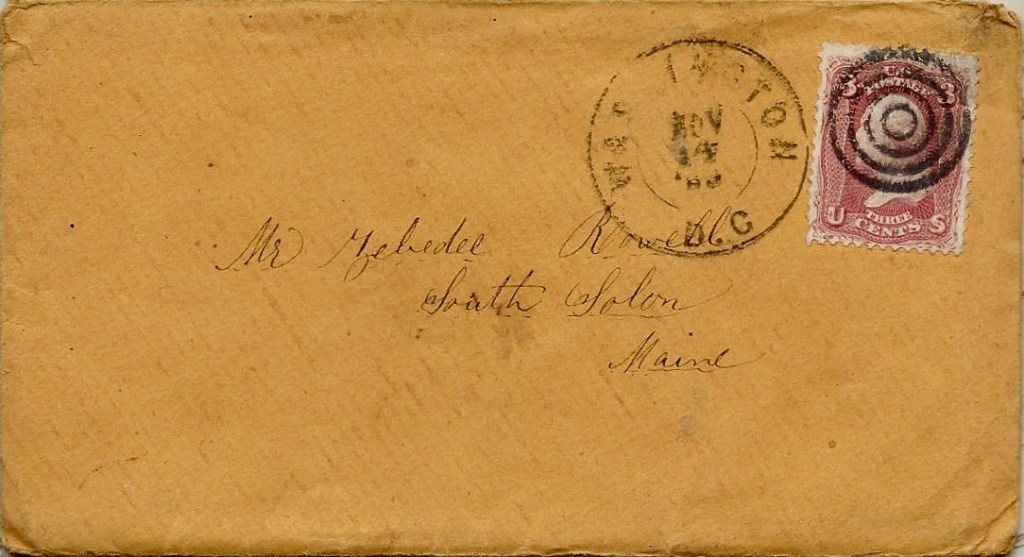


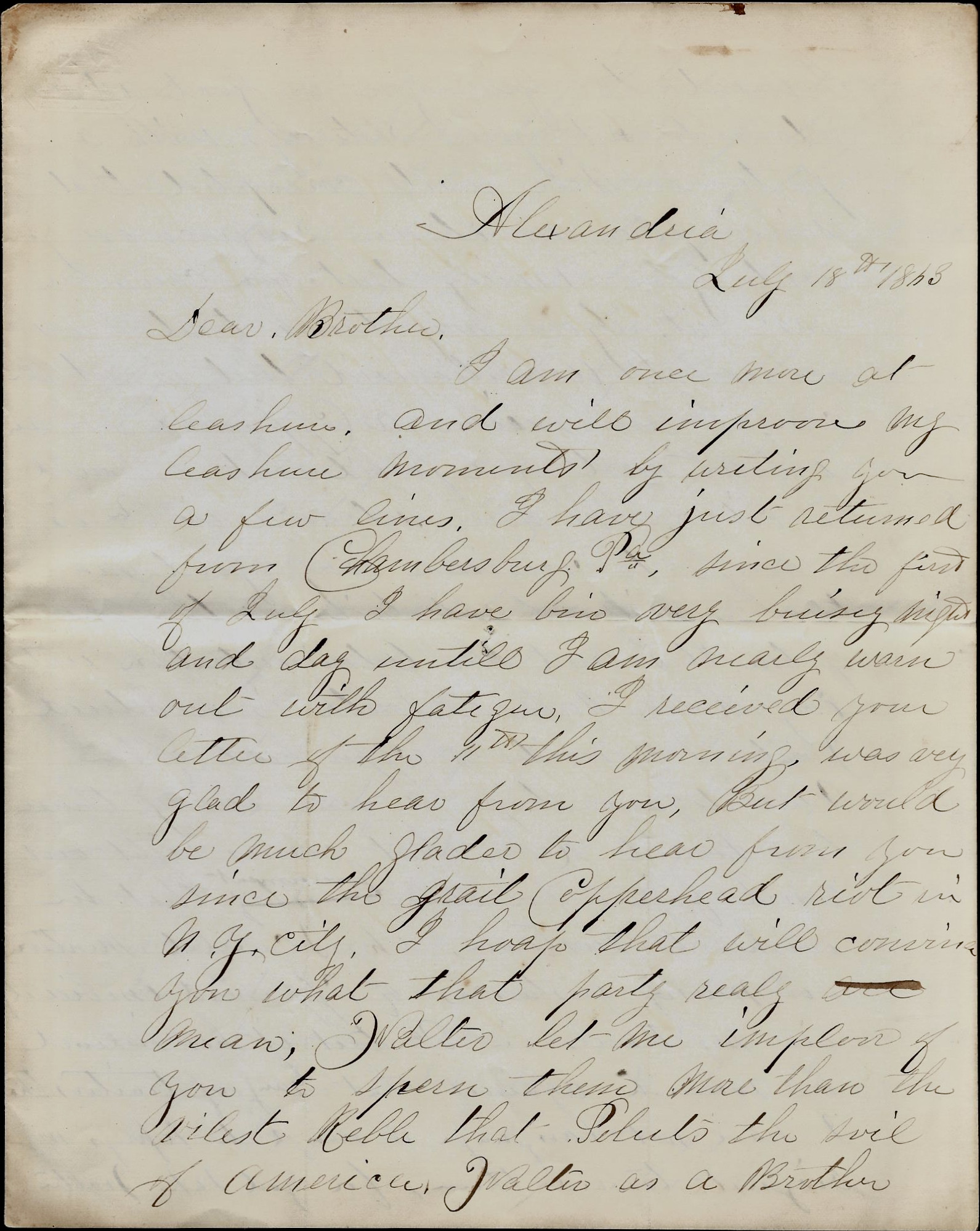
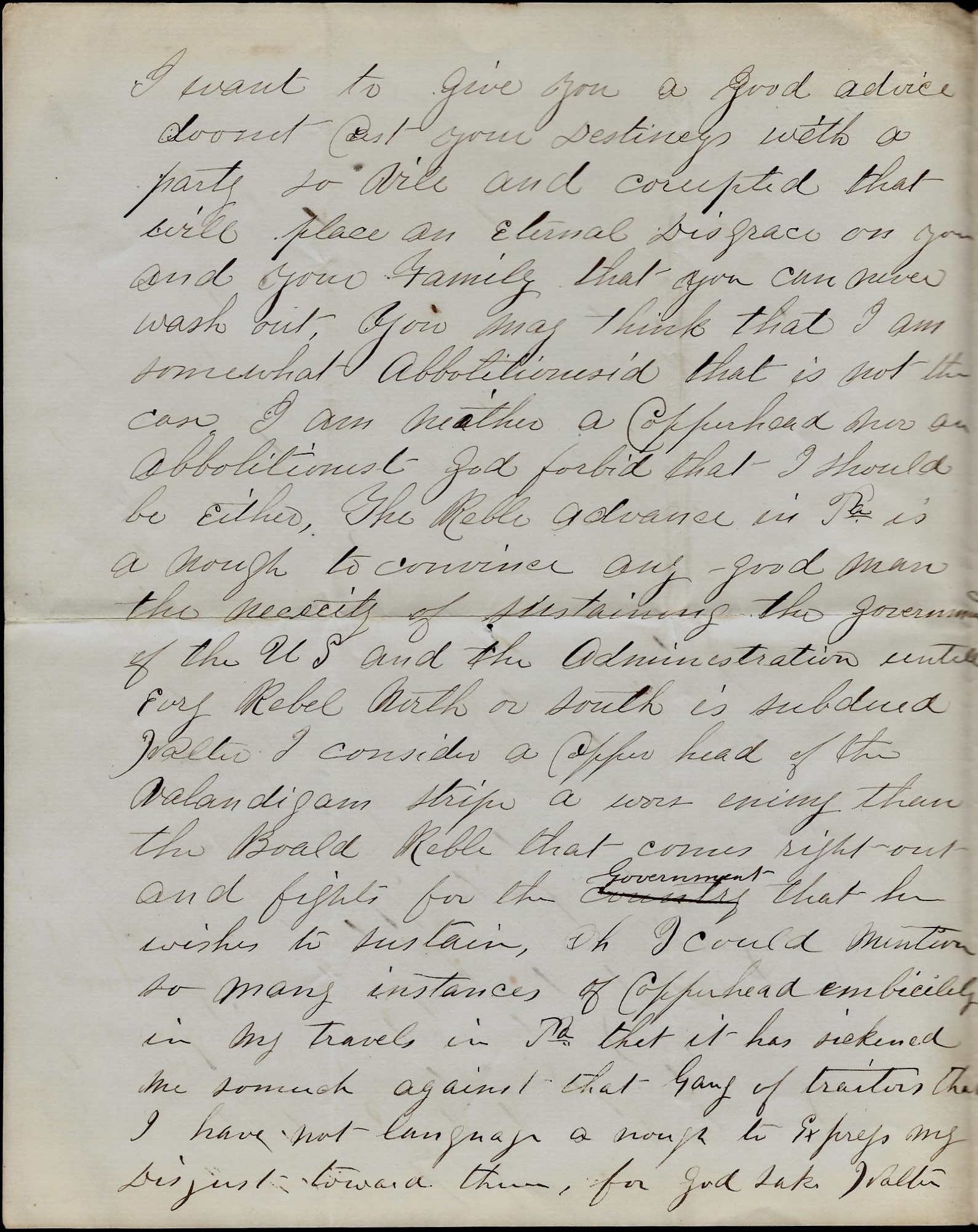
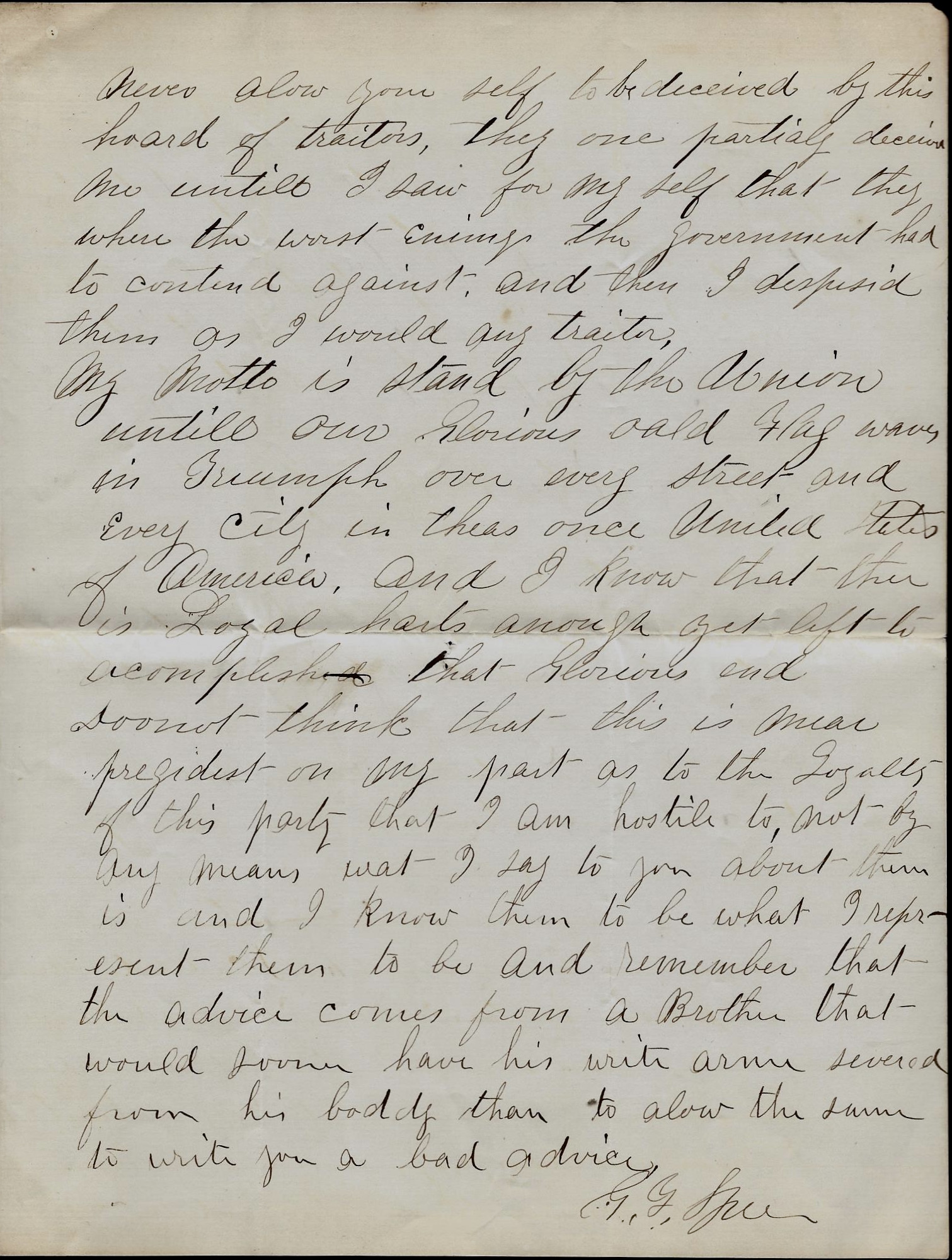
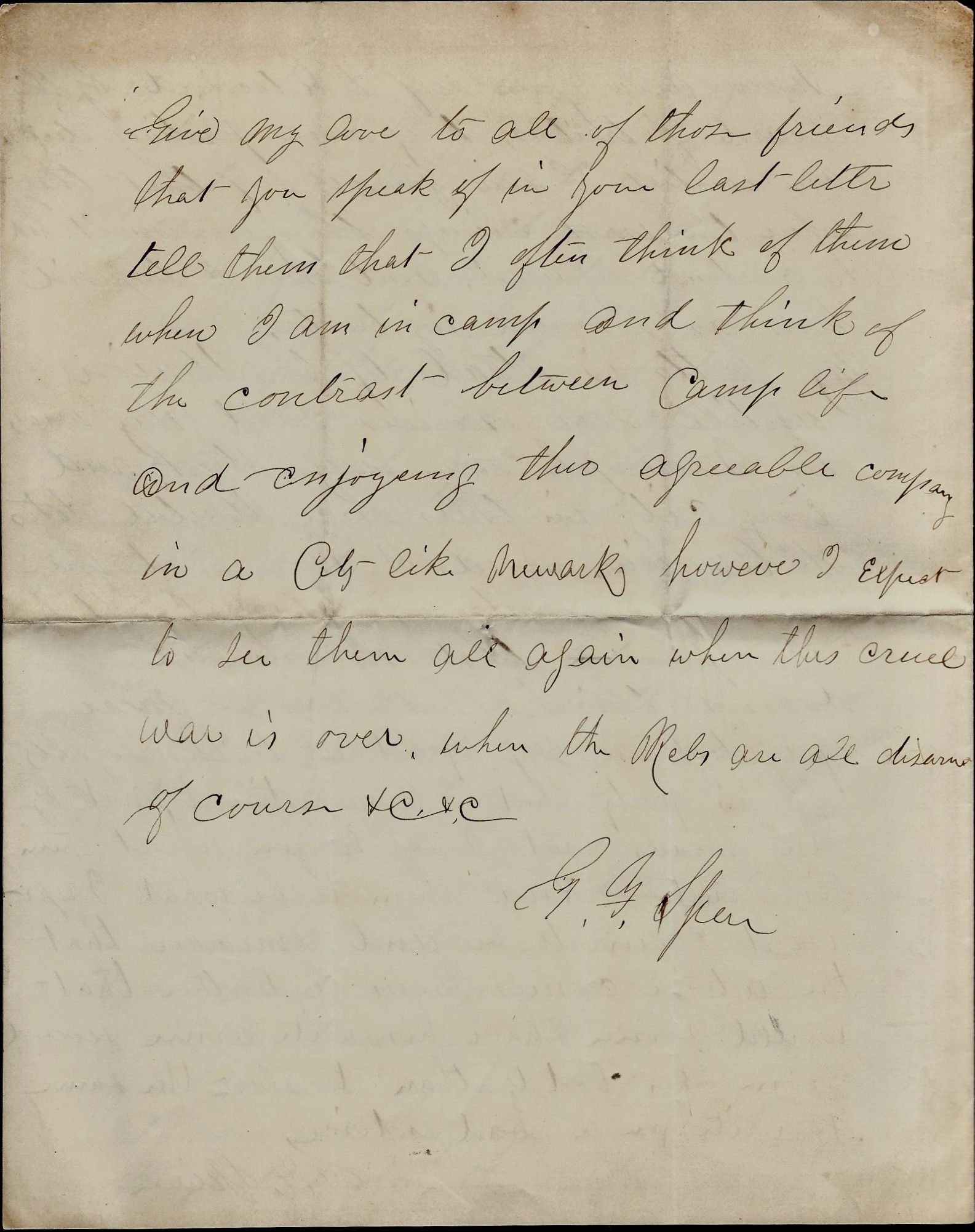


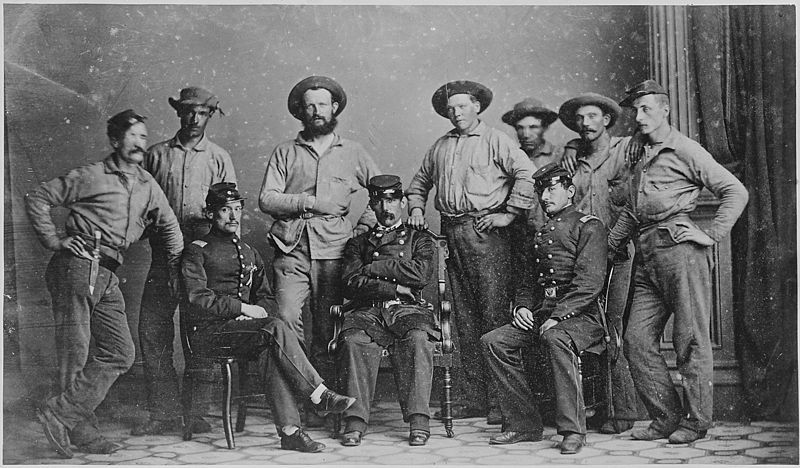
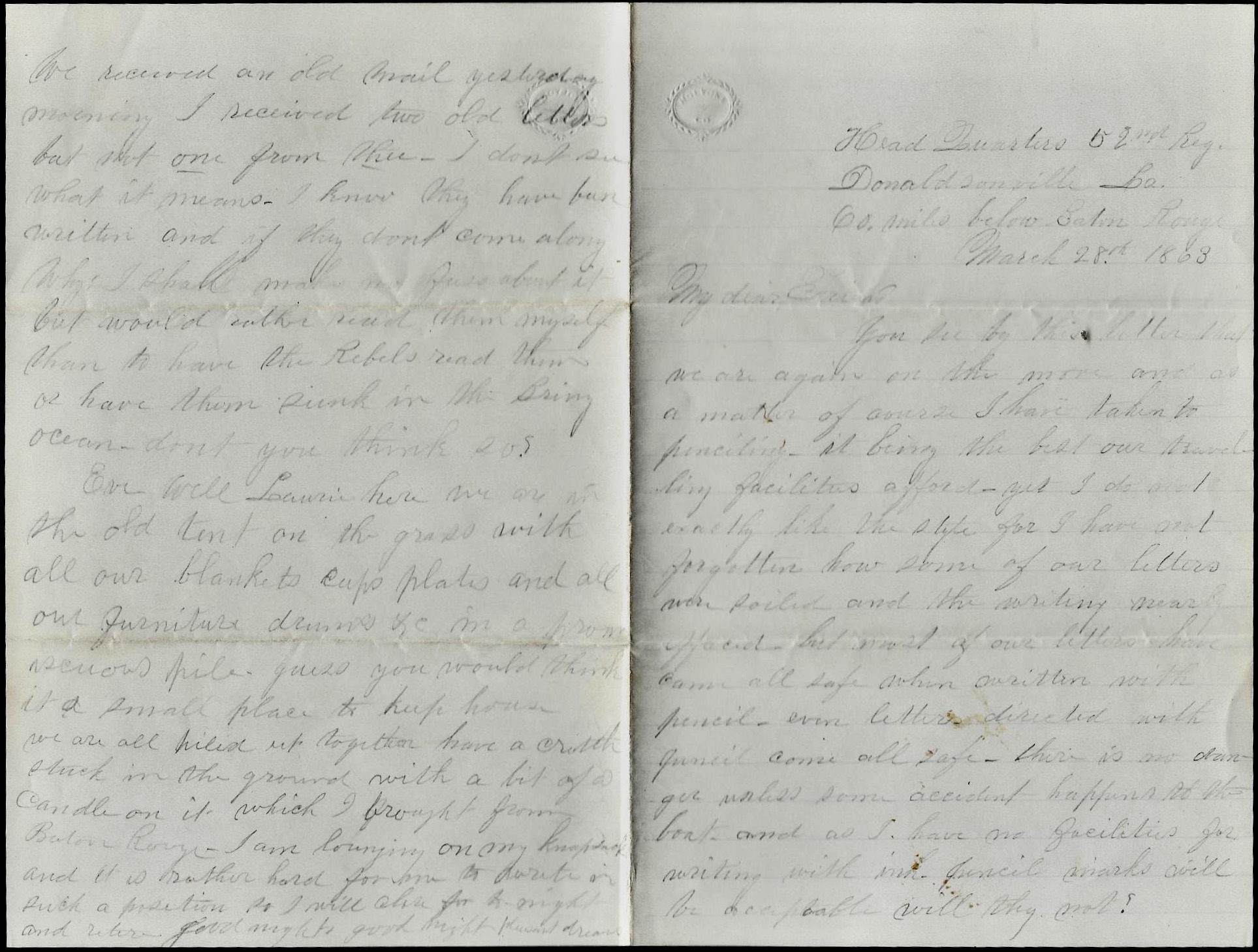

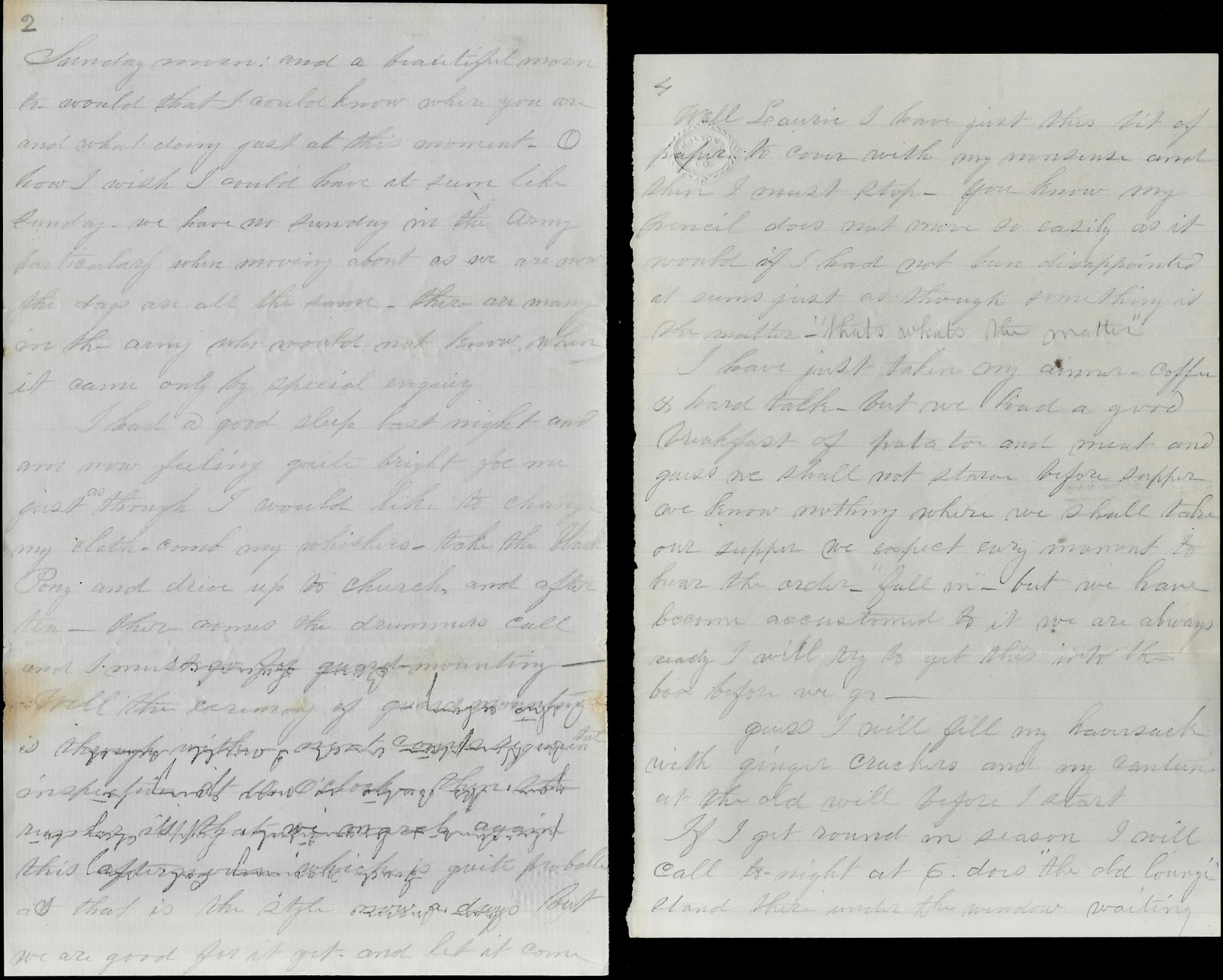
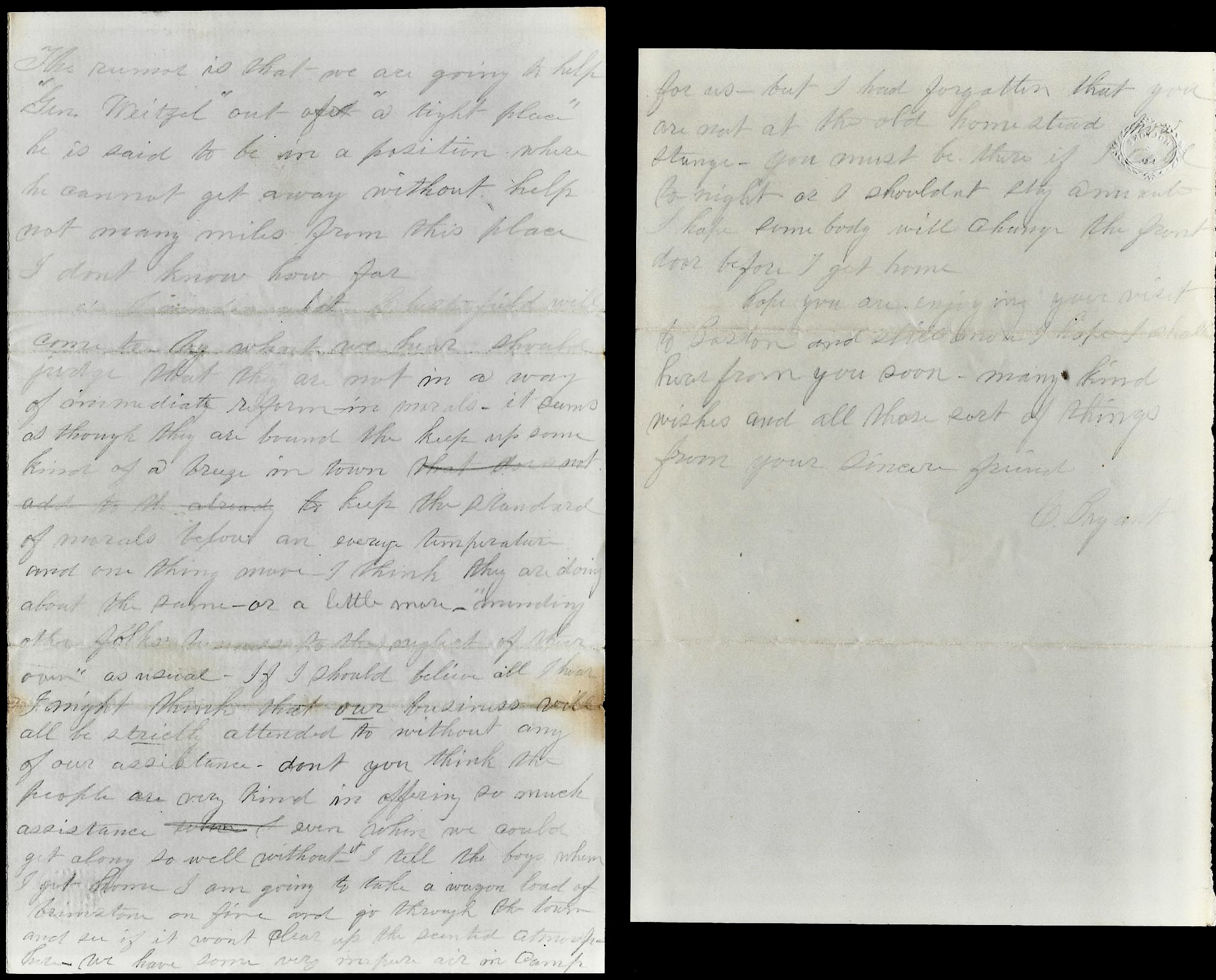
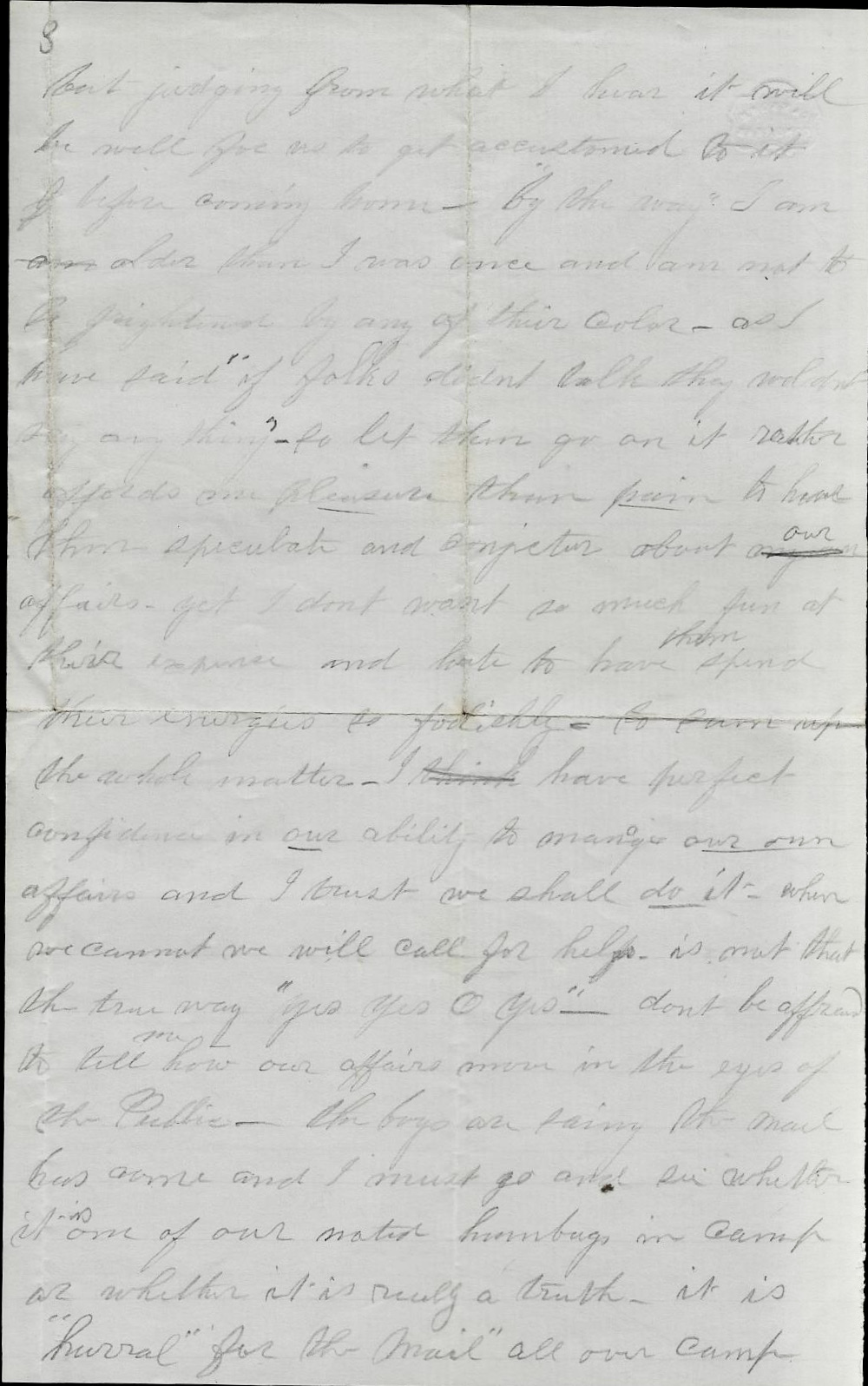
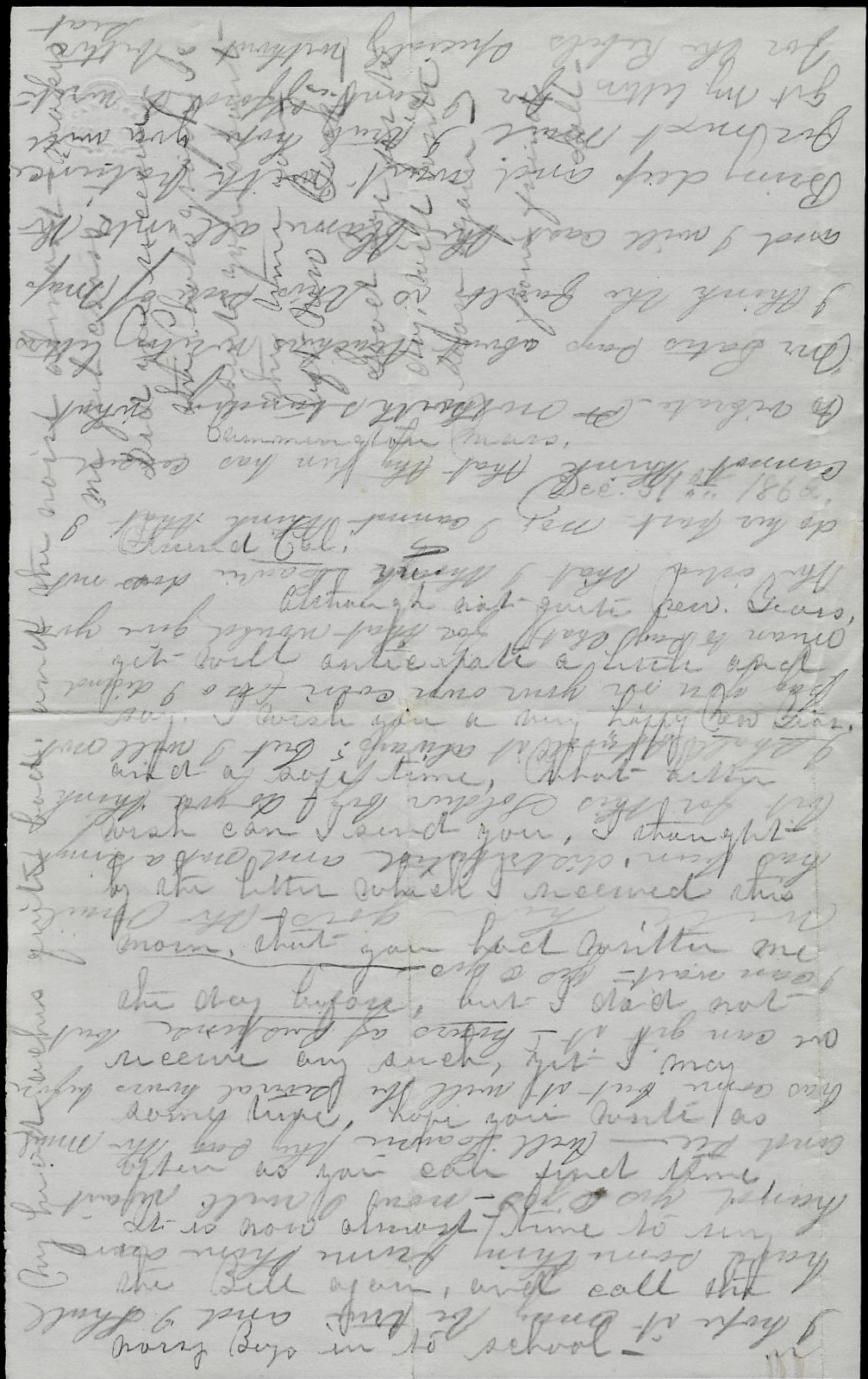
 Spared & Shared 23