Category Archives: Donaldsonville, Louisiana

1863: Alfred H. Bryant Letter, 18th NY Light Artillery

The following partial letter was penned by Corp. Alfred H. Bryant (1840-1902), a 23 year-old machinist in Rochester, New York, when he enlisted in the 18th Independent Battery—Capt., Albert G. Mack. This battery, known as the “Black Horse artillery,” or “Billinghurst battery,” was recruited and organized by Capt. Mack at Rochester, where it was mustered into the U. S. service for three years on Sept. 13, 1862.

The 18th Independent Battery left the state on Dec. 2, 1862, and joined Sherman’s division, Department of the Gulf. It was attached to the 19th Army Corps and was active at Fort Bisland, the Amite river, Plains store, and the siege of Port Hudson, La., where it participated in the assaults of May 27 and June 14. After the surrender of Port Hudson it went into the defenses of New Orleans; was engaged at Bayou La Fourche in July, 1863; took part in the expedition to Clinton and Liberty creek, La., in Nov., 1864; and in the spring of 1865, participated with Gen. Canby’s forces in the siege of Mobile, engaging at Spanish Fort, and at Fort Blakely and Mobile. It was mustered out under Capt. Mack, at Rochester, N. Y., July 20, 1865, having lost during service 4 men mortally wounded, and 23 men by disease and other causes, a total of 27.

In July 1863, the fort and buildings burned during the Bayou Lafourche campaign were associated with Fort Butler (pictured below) at Donaldsonville, Louisiana, and the surrounding Kock’s Plantation. The destruction occurred during the Battle of Kock’s Plantation on July 13, 1863, after Confederate forces under General Tom Green engaged Union troops. Fort Butler, an earth-and-log fortification designed to guard the confluence of the Mississippi River and Bayou Lafourche, was the anchor point of the Union stronghold in Donaldsonville. Union troops and gunboats shelled and burned portions of the surrounding town, while retreating or attacking Confederate forces also destroyed nearby government and plantation buildings.

T R A N S C R I P T I O N

[Editor’s note: This partial letter begins on page 5 of an eight page letter. It was probably datelined from Donaldsonville, Louisiana in mid July 1863.]

..and attacked Banks force here. They had an idea that they could draw our force away from Port Hudson but their plan didn’t work. This place is situated on the bank of the Mississippi River about 100 miles from New Orleans.

We have had two terrible battles here—one while we was at Port Hudson and one the day before we arrived here. They tried to take the place but our troops kept them back at the point of the bayonet until our gunboats arrived and burned the place down. We have a small fort here but there wasn’t men enough to man the guns at the time of the fight. It was a terrible sight the day we arrived here. The buildings was all burned to the ground and was still smoking while the dead still lay upon the ground, unburied, left there for their friends to recognize them while there was hundreds of man made graves all along the road while the wounded was being carried to the hospital at Baton Rouge.

How long we will remain here, I do not know. The rebel force is about 15 miles from here. I do not think they will give us a chance to try our big guns again right away. We have a large force in their rear and I think we will be apt to bag them all. Fighting is about played [out] in this state and I guess it is all over. I think the rebels have found out that the Yankees are too much for them, If they hain’t, it is about time they had. I told a reb in Port Hudson that I could whip 3 rebels and keep it up 7 days in a week.

I will have to finish this letter the same as I did my pants the other day—haft to patch it.

There is rumors in camp that there is proposals of peace at Washington. We have a few in our company who correspond with the Rochester paper. I will send you some papers as soon as I get some stamps. I have one or two letters that I will send you. One was taken from the New York Herald. It will give you a slight sketch of our doings. We have nigh 7 months pay due [us]. It is hard telling when we will get pay. My health is good at present. I have had a slight touch of the fever but I am better now.

I must close this letter for there is a dreadful shower driving up and I must try and fix my shelter tent so as it won’t leak. This is a dreadful rainy month. One hour the sun will shine dreadful hot and the next it will rain. It has rained every day for the last two weeks. Goodbye. Remember me to all my friends. Farewell from your ever affectionate brother. Write soon. Please direct to Mr. Alfred H. Bryant, 18th New York Battery, Care of Capt. A[lbert] G. Mack. General Banks’ Expedition, New Orleans

We are not in the 108th Regiment.

1863: Calvin Bryant to Laura Susan Nichols

A frock coat worn by Edward F. Hamlin who served with Calvin in Co. I, 52nd Massachusetts Infantry. Edward wore this coat as a sergeant in the 52nd Mass. and then later removed the chevrons and added the shoulder straps of a lieutenant in 1867.

This letter was written by Calvin Bryant (1839-1914) who enlisted on 15 September 1862 at the age of 23 as a musician in Co. I, 52nd Massachusetts Infantry. Calvin mustered out of the regiment on 14 August 1863 after 9 months service. The regiment spent their time in the service in the Department of the Gulf under Major General Nathaniel P. Banks. The regiment participated in the Bayou Teche campaign in western Louisiana during April and May 1863 and then saw combat during the Siege of Port Hudson. The 52nd Massachusetts remained on picket duty in an advanced location under the fortifications within rifle shot range of the Confederates on the ramparts. They remained on this duty for roughly three weeks until the Confederate at Port Hudson surrendered on July 9. During their time in this dangerous position, the regiment suffered casualties of nine men killed, twelve wounded, and two captured.

Calvin was the son of Patrick Bryant (806-1884) and Bricea Dumbolton (1807-1867) of Chesterfield, Hampshire county, Massachusetts. He wrote this letter to Laura Susan Nichols (1840-1901) with whom he would later marry.

After he was discharged from the service, Calvin went into the business of manufacturing washing machines in Keene, New Hampshire.

[Transcribed by Ann Melichar/edited and researched by Griff.]

Transcription

Addressed to Miss Laurie S. Nichols, Chesterfield, Hampshire County, Massachusetts

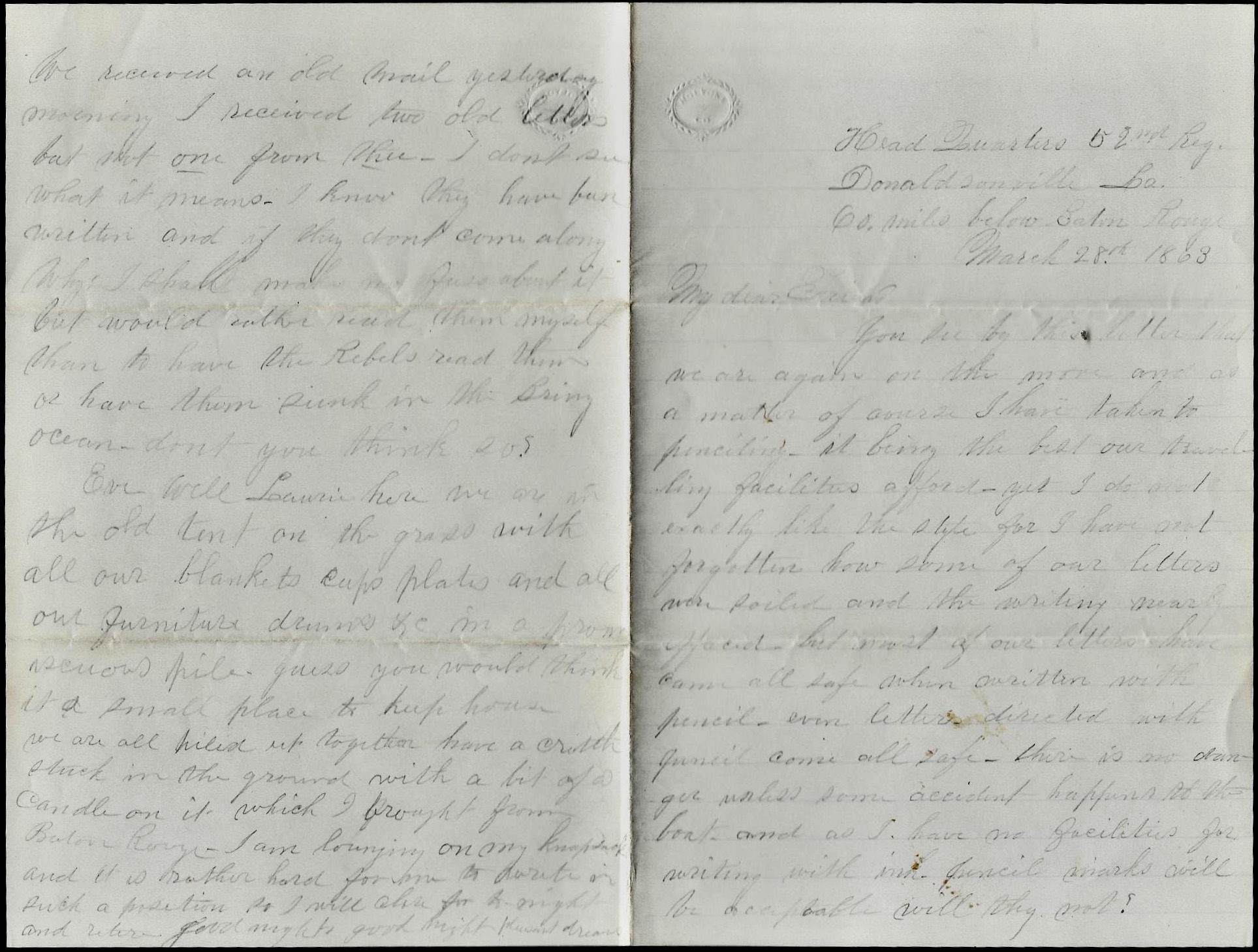
Headquarters 52nd Regiment
Donaldsonville, Louisiana
60 miles below Baton Rouge
March 28, 1863

My dear Friend, 

You see by this letter that we are again on the move and as a matter of course I have taken to penciling, it being the best our traveling facilities afford, yet I do not exactly like the style for I have not forgotten how some of our letters were soiled and the writing near effaced, but most of our letters have come all safe when written with pencil. Even letters directed with pencil come all safe. There is no danger unless some accident happens to the boat and as I have no facilities for writing with ink, pencil marks will be acceptable, will they not? 

We struck tents at Baton Rouge last night at sun down and after having a large bonfire of the old rubbish in camp, we took the boat for this place at about 10 o’clock. Arrived here some time before morning. Remained on the boat until morning when we came ashore and here we are in camp in a very pleasant place on the green grass. Probably shall stop here several days. Our camp ground is a very large level field close by the river and a large bayou runs past the camp back into the country so that large vessels run back several miles from the river. The water is now several feet higher than the camp ground [and] is kept in place by the levee which we used to read about in the old geography [class]. I used to think that was a curious arrangement and little did I think of ever seeing it under such circumstances. It is a very warm pleasant day and this is a very pleasant place but we can’t get any boards to make floors with but shall probably not stop long. Don’t know what the  next move will be. 

Billie Wilson’s famous New York 6th [Zouaves] are here under arrest. They left Baton Rouge the other day as they supposed for home thinking their time was out, but there was some misunderstanding about the matter and when they found they were to be landed here, they rebelled and raised mutiny, attempted to throw some of the officers overboard. They were immediately arrested and placed under guard without arms. What will be done with them I don’t know. Perhaps they will make a visit to Ship Island. They may not get home quite so soon as they expected. I tell you they are the roughest set of men I ever saw without exception.

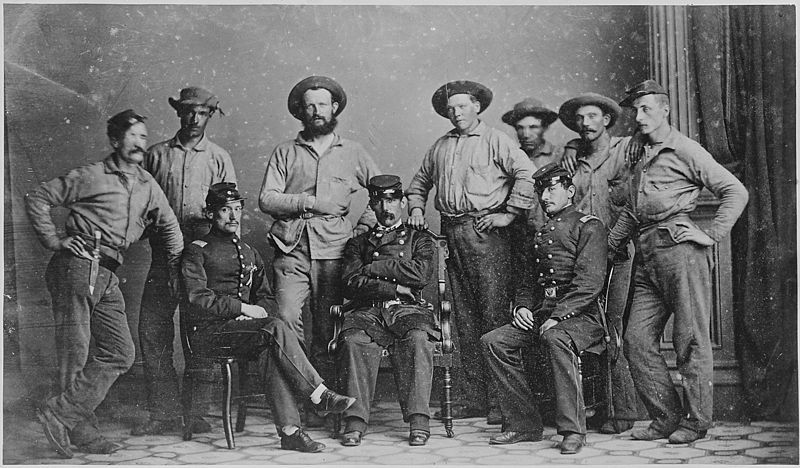
Colonel Wilson and some of his 6th New York Zouaves

We received an old mail yesterday morning. I received two old letters but not one from thee. I don’t see what it means. I know they have been written and if they don’t come along why I shall make no fuss about it but would rather read them myself than to have the Rebels read them or have them sunk in the briney ocean, don’t you think so?

Evening. Well, Laurie, here we are in the old tent on the grass with all our blankets, cups, plates and all our furniture, drums, &c. in a promiscuous pile. Guess you would think it a small place to keep house. We are all piled up together. Have a crutch stuck in the ground with a bit of a candle on it which I brought from Baton Rouge. I am lounging on my knapsack and it is rather hard for some to write in such a position so I will close for the night and retire. Good night. Good night. Pleasant dreams.

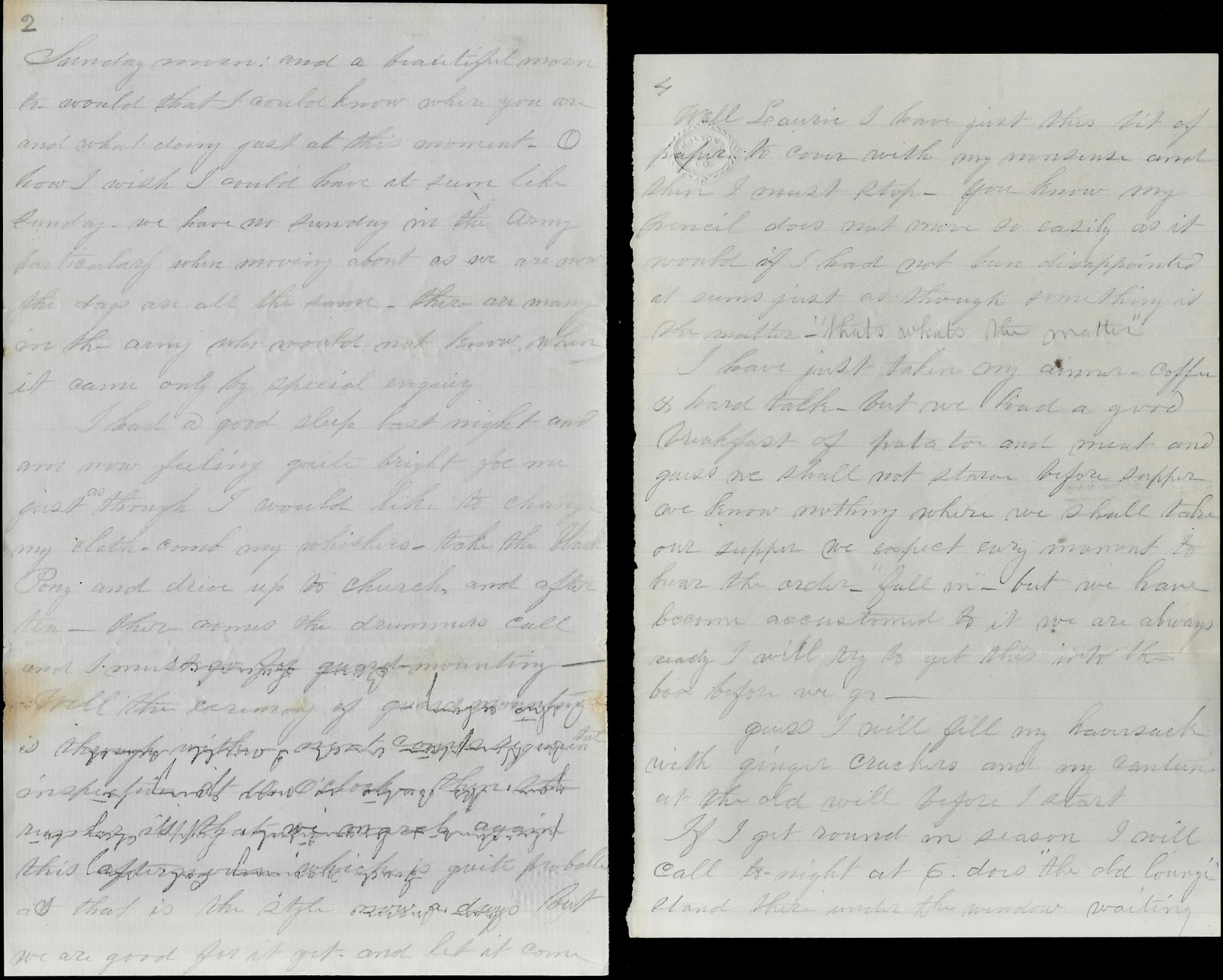
Sunday sermon and a beautiful morn too. Would that I could know where you are and what doing just at this  moment. O, how I wish I could have it seem like Sunday. We have no Sunday in the army particularly when moving about as we are now. The days are  all the same. There are many in the army who would not know when it came only by special inquiry. I had a good sleep last night and am now feeling quite bright for me, just as though I would like to change my clothes, comb my whiskers, take the black pony and drive up to church and after that——-there comes the drummer’s call and I must go for guard-mounting.

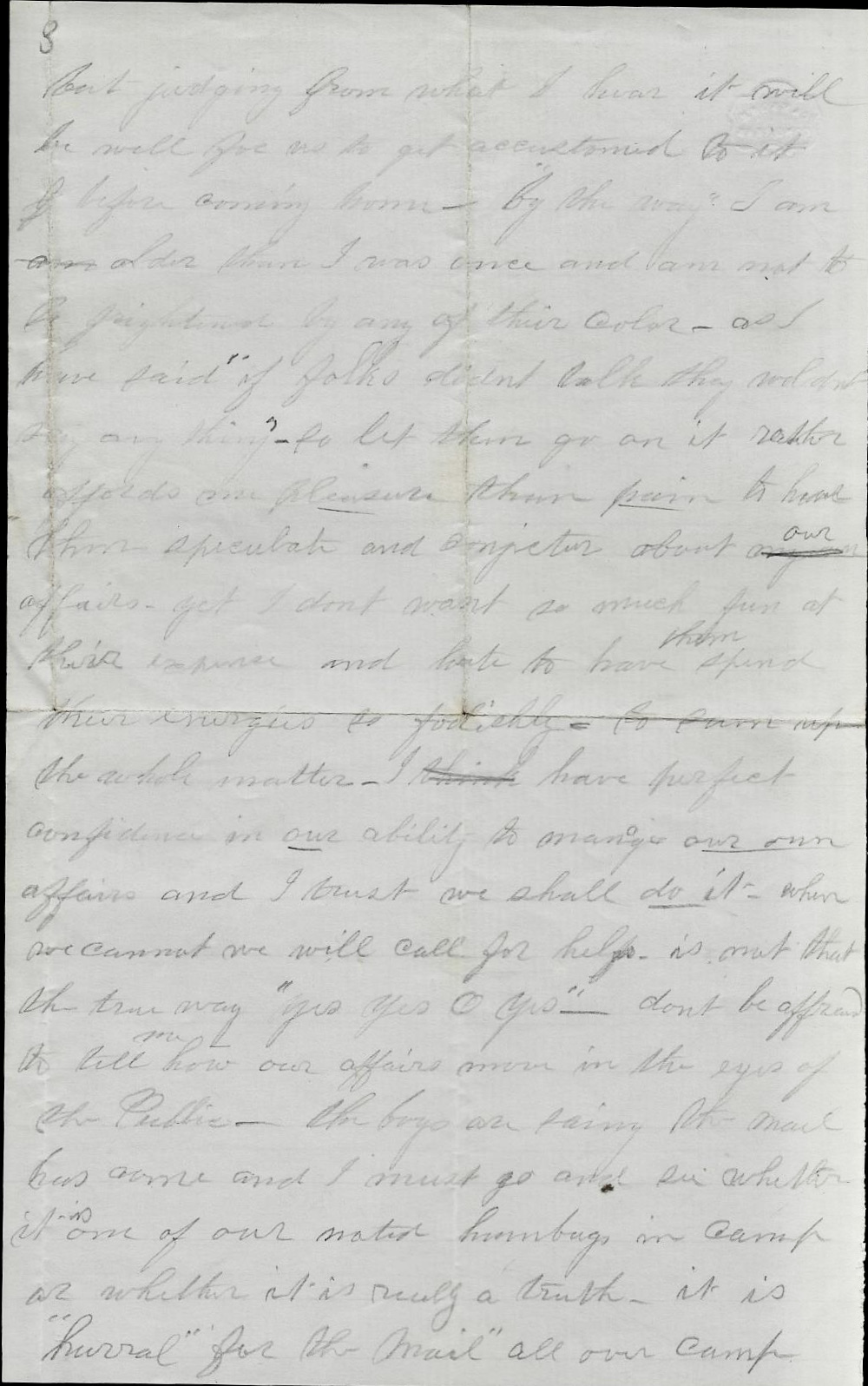
Well, the ceremony of guard mounting is through with, Next, cap regimental inspection at 10, o’clock ….. which is the style nowadays but we are good for it yet and let it come. But judging from what I hear, it will be well for us to get accustomed to it before coming home. By the way, I am older than I was once and am not to be frightened by any of their color. As I have said, “if folks didn’t talk, they  wouldn’t say anything.” So let them go on. It rather affords me pleasure than pain to have them speculate and conjecture about our affairs, yet I don’t want so much fun at their expense and hate to have them spend their energies so foolishly. To sum up the whole matter, I have perfect confidence in our ability to manage our own affairs and I trust we shall do it. When we cannot, we will call for help. Is that not the true way? “Yes, yes, O, yes.” Don’t be afraid to tell me how our affairs move in the eyes of the public. The boys are seeing the mail has come and I must go and see whether it is one of our noted humbugs in camp or whether it is really a truth. It is “hurrah for the mail” all over camp. 

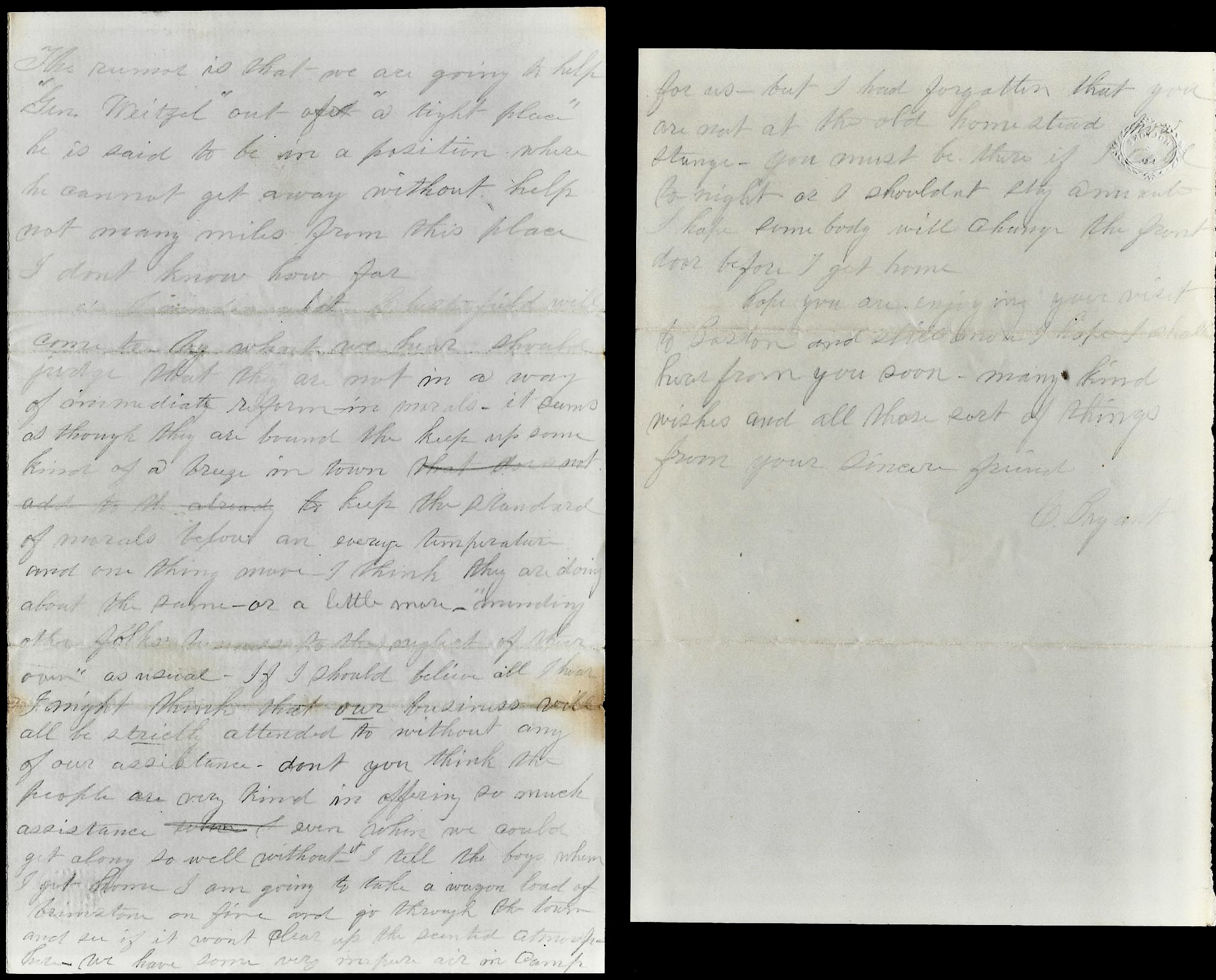
The rumor is that we are going to help Gen. Weitzel out of “a tight place.” He is said to be in a position where he cannot get away without help not many miles from this place. I don’t know how far…….field will come to by what we hear. Should judge that they are not in a way of immediate reform in morals. It seems as though they are bound to kick up some kind of a breeze in town to keep the standard of morals below an average temperature and one thing more, I think, they are doing about the same—or a little more—“minding other folks business to the neglect of their own” as usual. If I should believe all I hear I might think that our business will all be strictly attended to without any of our assistance. Don’t you think the people are very kind in offering so much assistance even when we could get along so well without it. I tell the boys when I get home I am going to take a wagon load of brimstone on fire and go through the town and see if it won’t clear up the scented atmosphere. We have some very impure air in camp.

Well, Laurie, I have just this bit of paper to cover with my nonsense and then I must stop. You know my pencil does not move so easily as it would if I had not been disappointed at sums just as though something is the matter —“that’s what’s the matter”. 

I have just taken my dinner coffee and hard tack but we had a good breakfast of potatoes and meat and grass. We shall not starve before supper. We know nothing where we shall take our supper. We expect every moment to hear the order “fall in” but we have become accustomed to it. We are always ready. I will try to get this into the box before we go.  Guess I will fill my haversack with ginger crackers and my canteen at the old well before I start. If I get round in season I will call tonight at 6. Does “the old lounge” stand there under the window waiting for us? But I had forgotten that you are not at the old homestead now. Strange. You must be there if I call tonight or I shouldn’t stay around. I hope somebody will change the front door before I get home. 

Hope you are enjoying your visit to Boston and [ ]. I hope I shall hear from you soon. Many kind wishes and all those sort of things.  From your sincere friend, — C. Bryant