My passion is studying American history leading up to & including the Civil War. I particularly enjoy reading, transcribing & researching primary sources such as letters and diaries.
It seems improbable that the identify of the author of this letter will never be revealed. From the content we learn that he was a resident of Georgetown, District of Columbia; that both of his parents were still living in 1861; that his father held some “office” of importance, and that he voted Republican despite having his job threatened for doing so. This implies to me that held a political patronage job in the central government. His initials appear to read “G. W.” but was it his first and last name or his first and middle name?
The author was likely affiliated with the Democratic Party and benefited from a political patronage position during the Buchanan administration; however, he assigns full responsibility to the Democratic Party for its inability to secure victory in the 1860 Presidential Election, attributing this failure to the party’s lack of unity in supporting a single candidate against the Republican nominee.
T R A N S C R I P T I O N
[Georgetown, District of Columbia] October 29th 1861
My dear Uncle,
Your welcome letter has been received. We were all delighted to hear from you & yours & that you were all well. I wrote a short time ago in regard to those articles of furniture. Do you not think it best to dispose of them? particularly the carpets? The moth will eat them up. I really do not think they will ever get them again though no one can tell. I trust they may indeed.
You wrote me word that you were going to write Cowan a letter. I think upon reflection you had better not as he threatened to have Father turned out sometime ago. He may probably do more harm than good. Is Senator Cowan of Pennsylvania a brother of his? I should like very much to have some good paying place. I think after the treatment of the Democratic Party, I ought to have something. Although holding only a temporary place under government, I voted for the opposition candidate to the Democratic & at the last election for a regular Republican, when all were told they would be removed from their office if they either time, & I boldly & fearlessly did it in both instances.
I have always bitterly opposed Democracy in every shape & form, and was delighted when they were defeated & hope & pray to God they may never have the reigns again. They have broken up the glorious Union—one which could never be surpassed in this world & one which every American should be proud to live in. I glory in the Stars & Stripes. Oh! what a shame that such a country as ours should be degraded by a civil war. Had Old Buchanan only reinforced Fort Sumter, then, in my opinion, all this would have been prevented. I should have reinforced it at all hazards had I been the President.
There is a tremendous army here and General McClellan so far has proven himself a great man. It looks very lively here in Georgetown.
There is nothing new. I trust this may find you and yours all well. All are well here except Father. He has an awful cold. I am beginning to feel uneasy about him. He is advanced in life now and of course we cannot expect him to live a great while longer. His memory is a good deal impaired. Mother is unhappy about him. Please do not name it because should he hear it, he will give me beans. I trust his memory may last as long as life lasts. Otherwise, he may lose his Office & that would be a very sad thing & a melancholy one too. He looks very well but the slightest change gives him cold.
Well, I must close. Love to all. I tell you my little growing family makes me scratch my head some now. Reply soon & believe me yours sincerely, — G. W.
Your letter postmarked the 22nd I never received until the 27th, making five days. What is the cause? I presume the times makes a difference.
The following letter was only signed “John” and leaves us with too few clues to confirm his identity but he was most certainly a member of the U. S. Signal Corps attached to Gen. Benjamin F. Butler’s Army of the James which was encamped on Bermuda Hundred.
“Although telegraphy was used extensively during the Petersburg campaign, signal trees, towers and buildings remained vital tools for each army to observe the movements of the enemy from an elevated vantage point. Information gained from such observations could then be relayed through all available means of communication, including signaling by flag or torch. Military uses of these locations included artillery spotting, mapping, and photography. The fourth estate also climbed these posts as special artists drew the siege lines and battlefields and reported war news.”
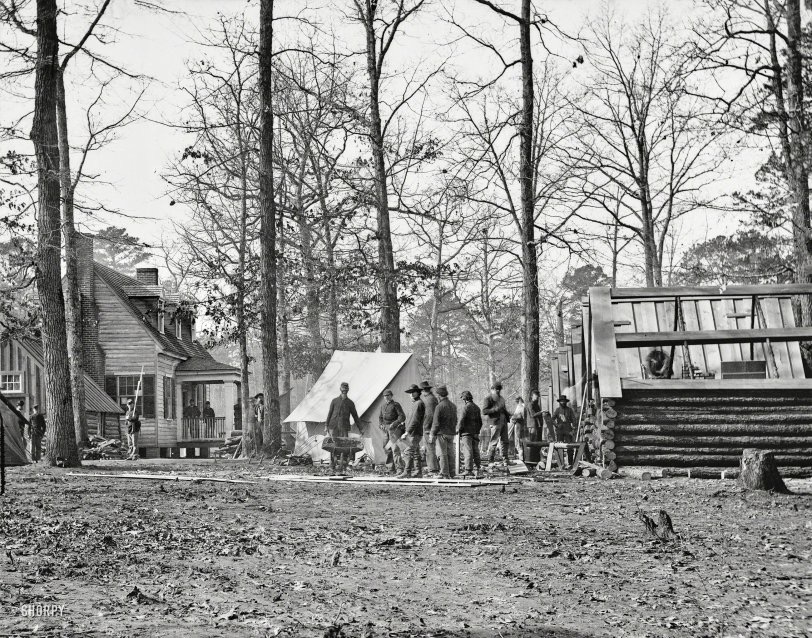
1864. “Bermuda Hundred, Virginia. Headquarters of Gen. Benjamin Butler.” Future congressman and governor of Massachusetts. Wet plate glass negative from the Civil War Photograph Collection, Library of Congress.
T R A N S C R I P T I O N
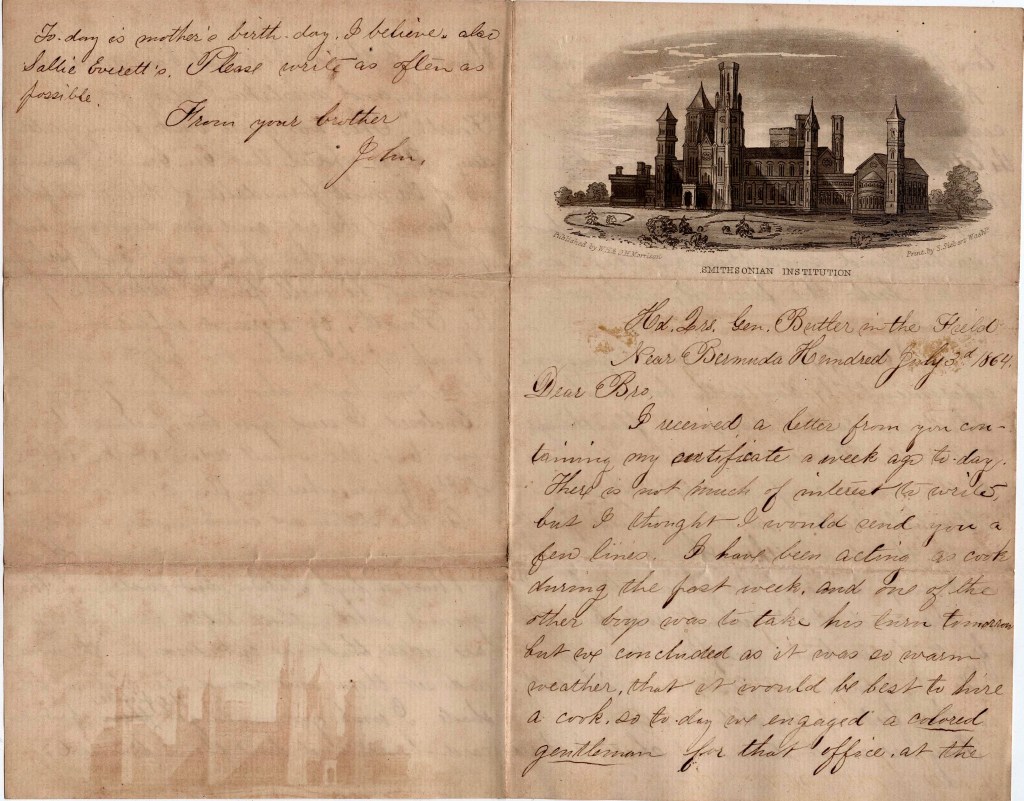
Headquarters Gen. Butler in the Field Near Bermuda Hundred July 3rd 1864
Dear Brother,
I received a letter from you containing my certificate a weeks ago today. There is not much of interest to write but I thought I would send you a few lines.
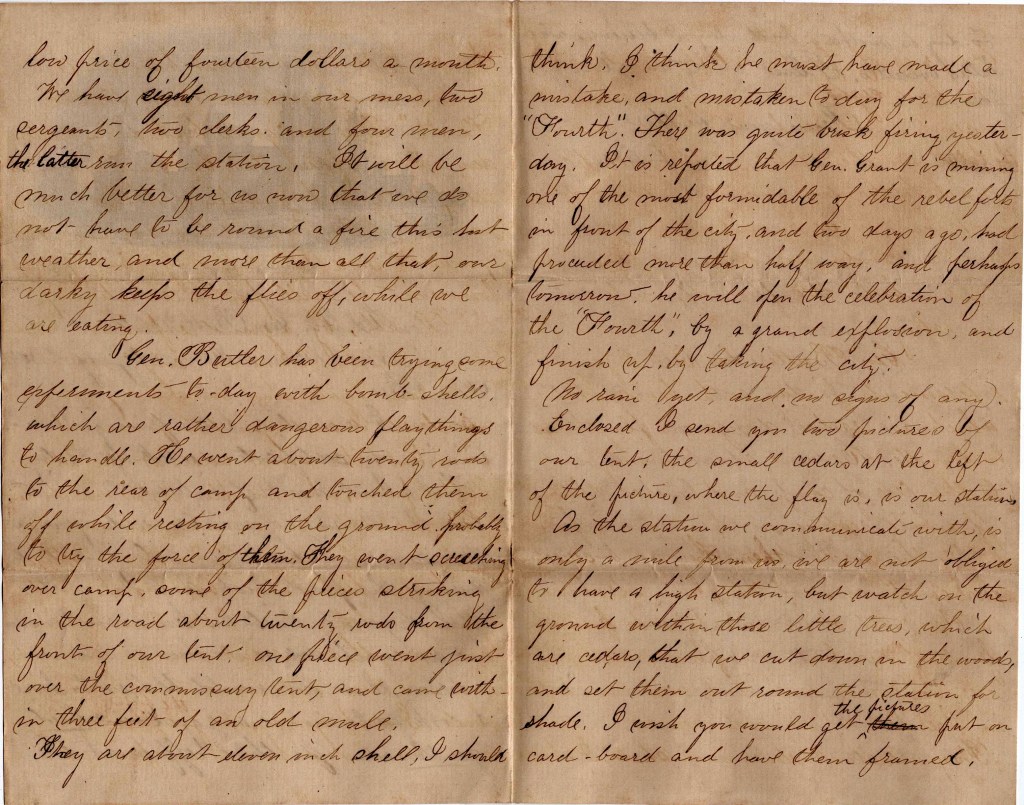
I have been acting as cook during the past week and one of the other boys was to take his turn tomorrow but we concluded as it was so warm weather that ut would be best to hire a cook, so today we engaged a colored gentleman for that office at the low price of fourteen dollars a month. We have eight men in our mess—two sergeants, two clerks, and four men. The latter run the [signal] station. It will be much better for us now that we do not have to be round a fire this hot weather and more than all that, our darky keeps the flies off while we are eating.
Gen. [Benjamin F.] Butler has been trying some experiments today with bomb shells which are rather dangerous play things to handle. He went about twenty rods [110 yards] to the rear of camp and touched them off while resting on the ground, probably to try the force of them. They went screeching over camp, some of the pieces striking in the road about twenty rods from the front of our tent. One piece went just over the commissary tent and came within three feet of an old mule. They are about eleven inch shell, I should think. I think he must have made a mistake and mistaken today for the “Fourth.”
There was quite brisk firing yesterday. It is reported that Gen. Grant is mining one of the most formidable of the rebel forts in front of the city and two days ago had proceeded more than half way 1 and perhaps tomorrow he will open the celebration of the “Fourth” by a grand explosion and finish up by taking the city.
No rain yet and no signs of any. Enclosed I send you two pictures of our tent. The small cedars at the left of the picture, where the flag is, is our station. As the station we communicate with is only a mile from us, we are not obliged to have a high station, but watch on the ground within those little trees, which are cedars, that we cut down in the woods and set them out round the station for shade. I wish you would get the pictures put on cardboard and have them framed.
“As the station we communicate with is only a mile from us, we are not obliged to have a high station, but watch on the ground.” William Waud Sketch. Night signalling by torches across the James River.
Today is mother’s birthday. I believe also Sallie Everett’s. Please write as often as possible. From your brother, — John
1 Digging the mine for the Battle of the Crater started on June 25, 1864. The Union miners, primarily from the 48th Pennsylvania Infantry Regiment, including many experienced coal miners, made rapid progress, sometimes digging 40 feet a day. By July 17, 1864, they had excavated a shaft reaching 511 feet (510.8 feet according to one source), bringing the mine to a point 20-22 feet below the Confederate position at Elliott’s Salient. Although the exact date when the mine was “half done” is not specified, it can be inferred from the available information that the main shaft, which extended under the Confederate lines, was approximately completed by mid-July, around July 17th. The lateral tunnel was then dug and completed by July 23rd, and the mine was packed with explosives by July 27th. The explosives were detonated on the morning of July 30, 1864.
The following letter was written by William Fletcher Lehew (1821-1892), son of Thomas Lehew and Catherine Fletcher of Zanesville, Ohio. On 28 October 1841, William and Mary Roberts were married in Muskingum County, Ohio. In 1850, census records show William and wife Mary living in Union Town, Newton Township, Muskingum County, Ohio. By 1857, William and Mary had moved with their four children from Ohio to Henry County, Iowa.
In the fall of 1861, at the age of 41, William F. Lehew and his son Thomas left Henry County and traveled to Davenport, Iowa. On September 18, 1861, William enrolled into the 11th Iowa Volunteer Infantry and was then mustered into Co. G on 15 October 1861. During this time, William was elected to the rank of Lieutenant. From September 15 through November 15, 1861, the 11th Iowa was equipped and drilled at Camp McClellan, Davenport, Iowa. On November 16, 1861, Co. G left Davenport on the Steamer “Jennie Whipple” and proceeded to St. Louis, Missouri.
Lt. Lehew and his company were quartered at the Benton Barracks from November 19, 1861 to December 9, 1861, when the regiment left St, Louis and marched to Jefferson City, Missouri. Lt. Lehew was present with his company during its campaign in Missouri during late 1861 and early 1862. In the spring of 1861, Lt. Lehew, along with Co. G participated in the Battle of Shiloh, Tennessee. After the battle, Lt. Lehew was sent to the hospital with intermittent fever followed by camp diarrhea and piles. He was treated by the Regimental Surgeon William Watson, and on June 9, 1862, sent a letter of resignation to Major Abercombia, Commander of the 11th Iowa. On June 11, 1862, Lt. Lehew’s letter of resignation was signed by Major General U.S. Grant at the Headquarter of the Army of the Tennessee. He then returned to Iowa where he spent the rest of the war.
Hon. Samuel Sullivan Cox
William wrote the letter to Samuel Sullivan Cox (1824-1889), a contemporary of William’s who also grew up in Zanesville, Ohio. Samuel attended Ohio University at Athens and then transferred to Brown University where he delivered speeches in support of temperance and Fourierism and in opposition to abolition of slavery. He graduated in 1846 but left the college with negative feeling about Yankees. He practiced law for a time in Ohio after college but in 1853 purchased a controlling interest in the Ohio Statesman (a Democratic paper in Columbus) and pursued journalism and politics. In 1856, Cox narrowly defeated the Republican candidate for a seat in the US House of Representatives as a Democrat and supported Stephen A. Douglas’s popular sovereignty principle. Reelected to Congress, Cox initially supported the Lincoln Administration but opposed the evolution of the war from one of merely preserving the Union to one of liberating the slaves. In 1864, he joined with the Copperheads to oppose Lincoln’s reelection.
T R A N S C R I P T I O N
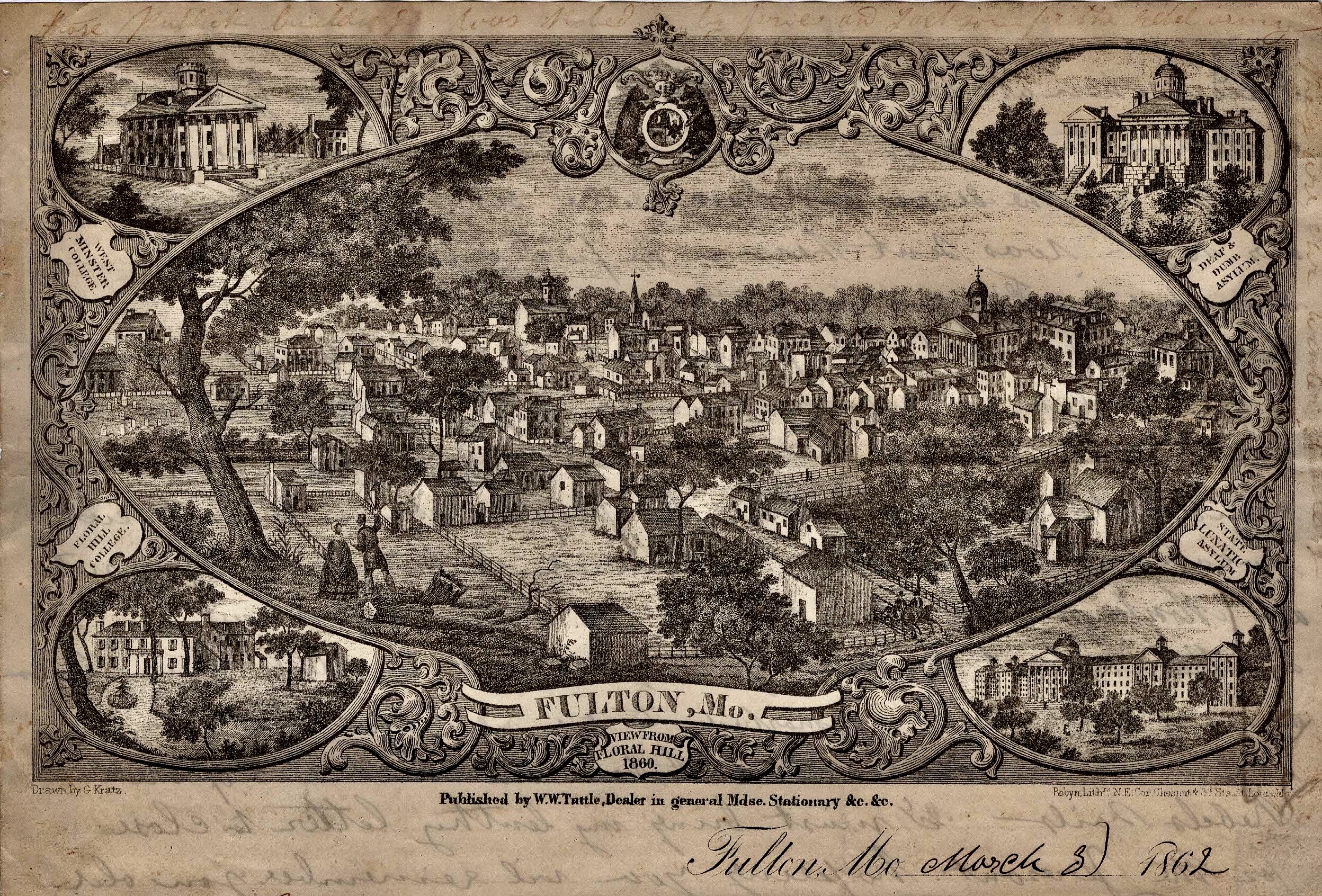
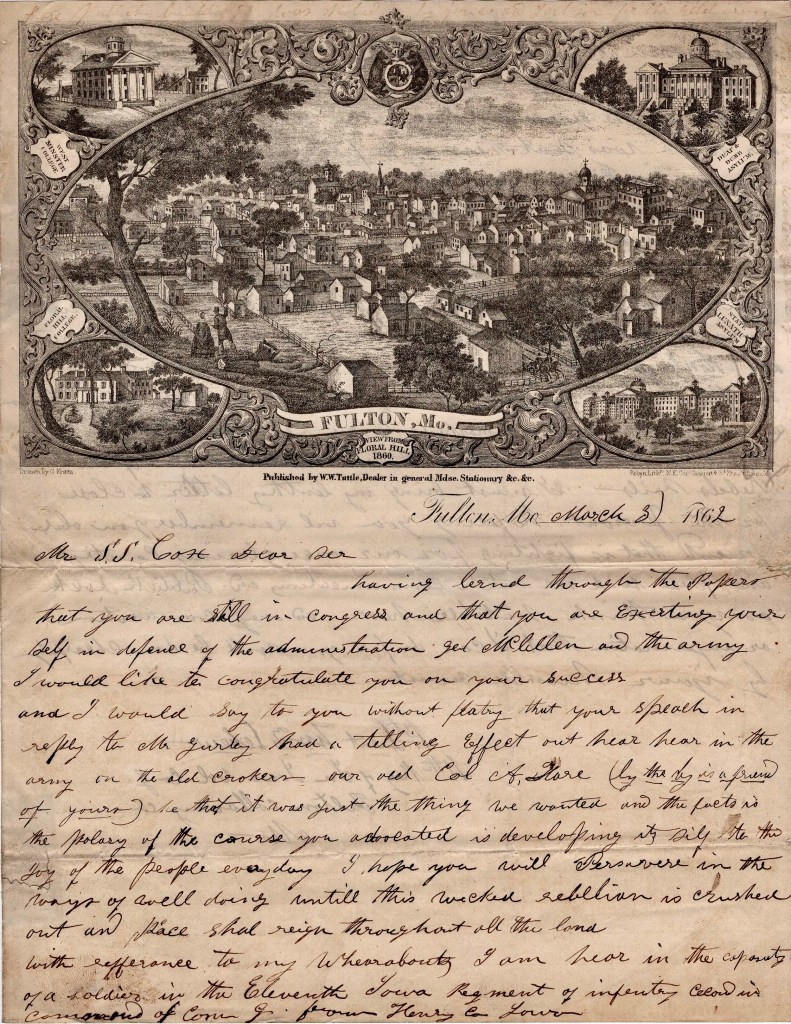
William’s letter was written on stationery with an incredible lithographic view of Fulton, Missouri (“View from Floral Hill, 1860”) that I have not seen before. Barely legible over the top of the lithograph, William has written, “Those publick buildings was robed by Price and Jackson for the rebel army. They are our winter quarters.”
Fulton, Missouri March 3, 1862
Mr. S. S. Cox, dear sir,
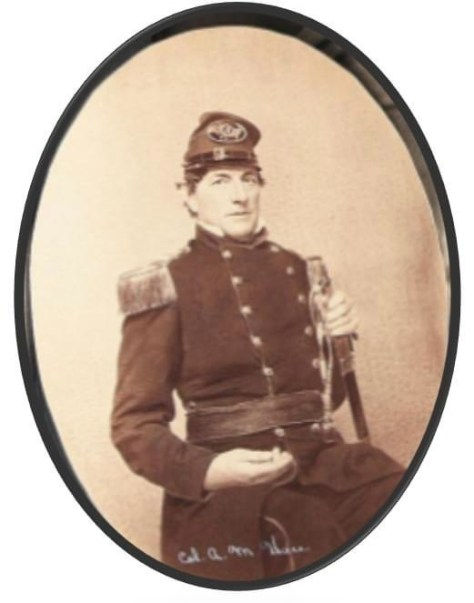
Col. Abraham M. Hare, 11th Iowa Infantry
Having learned through the papers that you are still in Congress and that you are exerting yourself in defense of the administration, Gen. McClellan and the army, I would like to congratulate you on your success and I would say to you without flattery that your speech in reply to Mr. Gurley had a telling effect out here in the army on the old croakers. Our old Col. A[braham M.] Hare (by the by is a friend of yours). He thought it was just the thing we wanted and the facts is, the policy of the course you advocated is developing itself to the joy of people every day. I hope you will persevere in the ways of well doing until this wicked rebellion is crushed out and peace shall reign throughout all the land.
With reference to my whereabouts, I am here in the capacity of a soldier in the Eleventh Iowa Regiment of infantry, second in command of Co. G from Henry county, Iowa. I live when at home near Mt. Pleasant, Henry county, Iowa, a neighbor to the Hon. J[ames] Harlin. I have been over six months in the service and have seen service. Our regiment was sent here on the first of January and have succeeded in the purpose for which we was sent.
“Quite a change has come over the people within the last few weeks. One thing they have learned is that the North is not all Monkeys nor Nigger stealers or Rabid Abolitionists and that it is not the object of the government to steal their Negroes…”
1st Lt. Wm. F. Lewhew, Co. G, 11th Iowa Infantry
Secession has nearly all played out here which was one of the worst holes in Missouri. A number of prisoners that we have want to go into the service of the U. S. Government. Quite a change has come over the people within the last few weeks. One thing they have learned is that the North is not all Monkeys nor Nigger stealers or Rabid Abolitionists and that it is not the object of the government to steal their Negroes, as one of Price’s Majors remarked to us yesterday that Gen. Halleck’s last order had taken the wind out of the Rebel’s sails. 1
I must bring my lengthy letter to a close for the present hoping you will remember your old friend that is fighting for our once glorious country and please send me such communications and public documents as you think suitable here and any communication or information that I can do for you will be done cheerfully by your humble servant.
— 1st Lieutenant Wm. F. Lehew, 11th Regt. of Iowa Vol. , Co. G, Fulton, Calloway county, Mo.
1 Gen. Henry W. Halleck commanded the Department of the Missouri early in the war. On 20 November 1861, he issued General Order No. 3 which directed that no fugitive slaves be permitted to enter the lines of any Union camp or forces on the march. The order was met with opposition from Abolitionists and some members of Congress who felt it went against the Union cause.
The following letter was written by Felix J. Williams (1844-1863), the second son of eight children born to Henry John and Mary (Weaver) Williams of Elk Creek, Alleghany County, North Carolina. Felix enlisted in Co. K, 37th North Carolina Infantry on 15 August 1862. He joined his regiment near Martinsburg in the Army of Northern Virginia on 26 September. This letter, from a private collection, was written shortly after his arrival.
A tintype of an unidentified soldier wearing the 1861 North Carolina pattern sack coat. (Chase Rhodes collection)
Twenty letters authored by Felix, acquired in 1995, are preserved within the North Carolina Digital Collections. These correspondences were predominantly directed to his entire family, although select letters were intended specifically for his mother or father. For a duration of two months, Williams endured the rigors of camp life and arduous marches. In late October, he and his regiment were assigned the task of dismantling the Baltimore and Ohio Railroad between Hedgesville and North Mountain Depot in West Virginia, and on December 13, 1862, Williams encountered the harsh realities of warfare at Fredericksburg.
After the battle, the regiment took up winter quarters in Camp Gregg at Moss Neck, positioned on the Rappahannock River approximately eight miles downstream from Fredericksburg. Here, Williams and the regiment endured the harsh conditions until the commencement of the 1863 campaign at the close of April. On 1 May 1863, the regiment advanced towards Chancellorsville. On May 3, during a fierce engagement, Jackson’s corps, commanded by Gen. Stuart, repelled Hooper and the federal forces, resulting in severe casualties for the 37th Regiment—19 officers were wounded and 1 was killed; among the ranks, 175 men were wounded and 35 were killed—-including 19 year-old Felix J. Williams.
“Though not from a wealthy family, Williams had come from a prosperous and self sufficient one. He and his father had raised grains and hay on the family farm of 100 acres of cleared land and 250 acres of woodland. The farm had also produced wool, butter, honey, nuts, and fruits for the family. The young soldier’s letters hearken back to apples, dried peaches, chinkapins, eggs, and other good things at home when he writes from his comfortable but hungry winter quarters at Camp Gregg. He reports the visit of his father and grandfather with boxes of food just at the time that soldiers convicted of desertion are being shot in the camp (letters of Feb. 23 and 28, 1863). A subsequent letter (March 8) mentions two desertions from the regiment and assures his family that he’d never desert—“I will come out of this war like a man or I will die in it.” Other letters refer to the issue of Austrian rifles to replace his company’s old muskets (Feb. 18, 1863), contain reflections on his captain as a company commander (Mar. 19, 1863), and speak of sickness and religion in the camp (Apr. 18, 1863). A final letter written to Mr. and Mrs. Williams on September 4, 1863, by a cousin, H. B. Williams of the 48th Regt. (Va. Vols.), speaks at greater length on the subject of religion in the camp, and condoles with the parents on the death of their son.” [Source: N. C. Digital Collections]
T R A N S C R I P T I O N
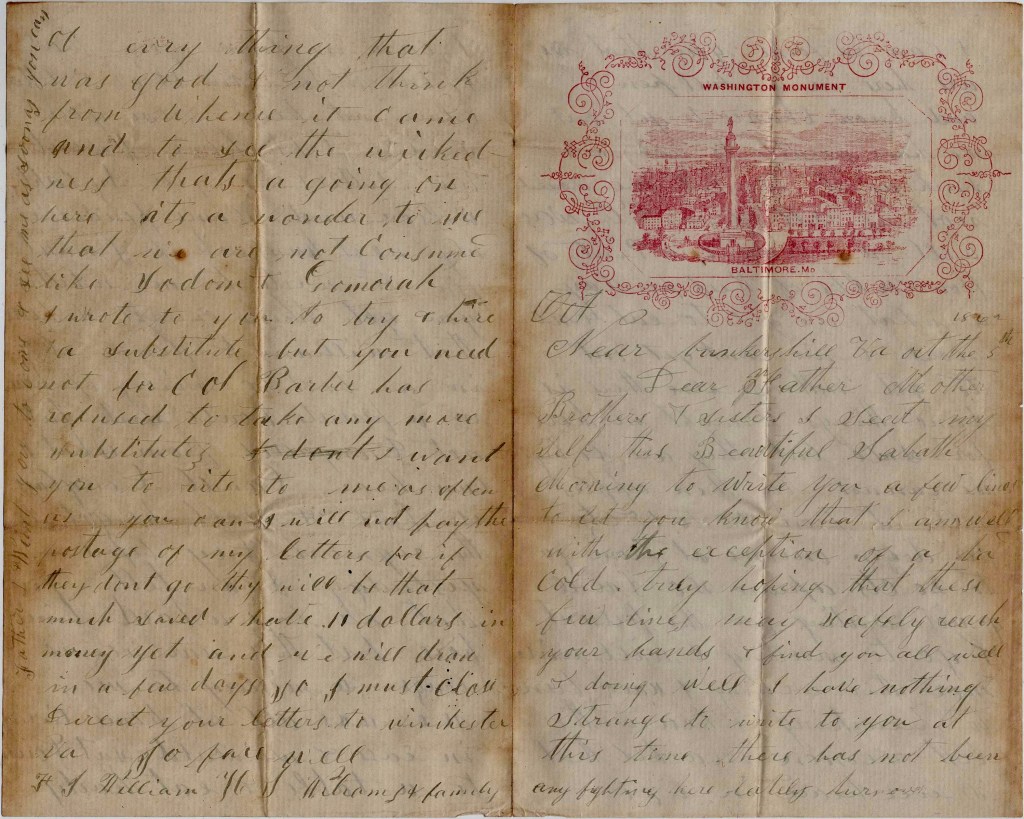
The stationery used by Felix displays a lithograph of the Washington Monument in Baltimore, Maryland. It’s unusual to find Confederate letters written on stationery customarily used by Union soldiers. This stationery may have been taken from a Union soldier’s knapsack at Harpers ferry or elsewhere by a comrade in the 37th North Carolina.
Near Bunker Hill, Va. October 5th 1862
Dear Father, Mother, Brothers & Sisters,
I seat myself this beautiful Sabbath morning to write you a few lines to let you know that I am well—with the exception of a bad cold—truly hoping that these few lines may safely reach your hands & find you all well & doing well. I have nothing strange to write to you at this time. There has not been any fighting here lately.
I can inform you that we are here in a bull pen and no chance to get out. We have plenty to eat here—such as it is, but we would not if all of our company was well. We draw one pint of flour & one and a half pounds of beef per day is what we get to eat & no more & we can’t get out to get nothing else. There is some things brought in here for sale but they are so high we cannot buy them. Apples sells at from 50 to 75 cents per dozen. Onions at from 10 to 20 cents apiece. So I will quit writing for the present & go to meeting & will write more this evening.
I have been to preaching and heard the best sermon preached that I ever heard in life. I can inform you that I have wrote four or five letters & have not heard from you since I left home. I sent two letters to you by Capt. Wilson and some powder and my neck handkerchief. I want you to write to me whether you got them or not. I hear that William D. Jones is in about 30 miles of here in a private house sick but not dangerous from what I can hear. Daniel Douglass is here & well. He got to the regiment day before yesterday.
I can tell you that we boys have a hard time here but this war is no longer a mystery to me. We was all at home living in ease & we would sit down to a table & eat hearty of everything that was good & not think from where it came. And to see the wickedness thats a going on here—it’s a wonder to me that we are not consumed like Sodom and Gomorrah.
I wrote to you to try & hire a substitute but you need not for Col. [William Morgan] Barber has refused to take any more substitutes. I want you to write to me as often as you can. I will not pay the postage of my letters for if they don’t go, they will be that much saved. I have 11 dollars in money yet and we will draw in a few days. So I must close. Direct your letters to Winchester, Va. So farewell. — F. J. Williams to H. J. Williams & Family
Father, I want you to come and see me as soon as you can.
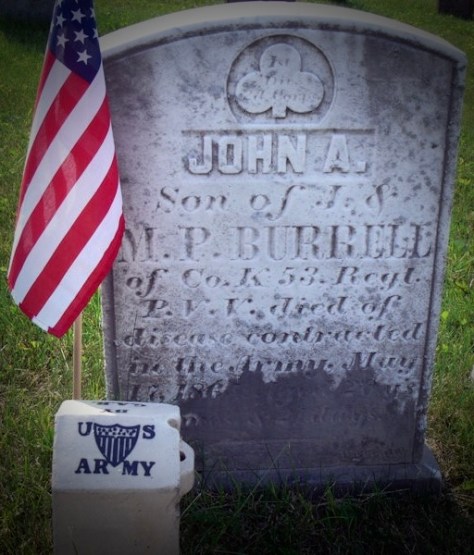
Headstone of John Amos Burrell (1845-1865) who died of disease while in the service. Pleasant Grove Presbyterian Cemetery, Ligonier, Westmoreland County, PA.
These letters were written by John Amos Burrell (1845-1865), the son of Jacob Burrell (1816-1883) and Mary (“Polly”) Withrow of Youngstown, Westmoreland county, Pennsylvania. John served in Co. G, 135th Pennsylvania—a nine-month’s organization that was quartered in Washington D. C. to guard key locations around the Union capitol until February 1863 when it was attached to the I Corps of the Army of the Potomac and headed south toward Fredericksburg. They took part in the Chancellorsville campaign in May 1863, but saw little action before being mustered out of the service on May 24, 1863. John later joined his brother James William Burrell (1842-1929) who served in Co. K, 53rd Pennsylvania Infantry but his disability soon landed him in Co. H, 9th Veteran Reserve Corps. While serving in this regiment, he died on 17 May 1865.
John’s letters were addressed to his father or to his siblings, Nancy (“Nan”) J. Burrell (b. 1840) or Jacob Grove Burrell (1848-1925).
Letter 1
City of Washington October 3, 1862
Dear Sister Nan,
I seat myself to let you know that I am well and to answer that [ ] letter of yours. Well, I will send [ ] pocket case. The man that got his is gone but is to be home this evening but if he don’t come, I’ll send him mine and take his. I can get his easy. The man is gone to Frederick City with prisoners. They have been gone four days. The stamps I used a part of them but I have the stuff to buy more if I can get them and if I can’t, I can send you the [ ] and you can get them and send then if you please. And if you don’t, you can [ ] it. I have the towels. I’ll send them and the bible and the books on. When you write, tell me how all the tender-hearted folks are. Pity they wasn’t here to awhile to learn something about war…
I guess Coulter’s boys will leave in the morning for Alexandria. The costly scissors are an inch thick with rust and the case is spoiled a good bit. The paper was black as old Charley. I’ll send all to James and whatever belongs to the rest, he can give them. There was a hymn book in Isiah’s box but it was all rotten and [ ] are part rotten.
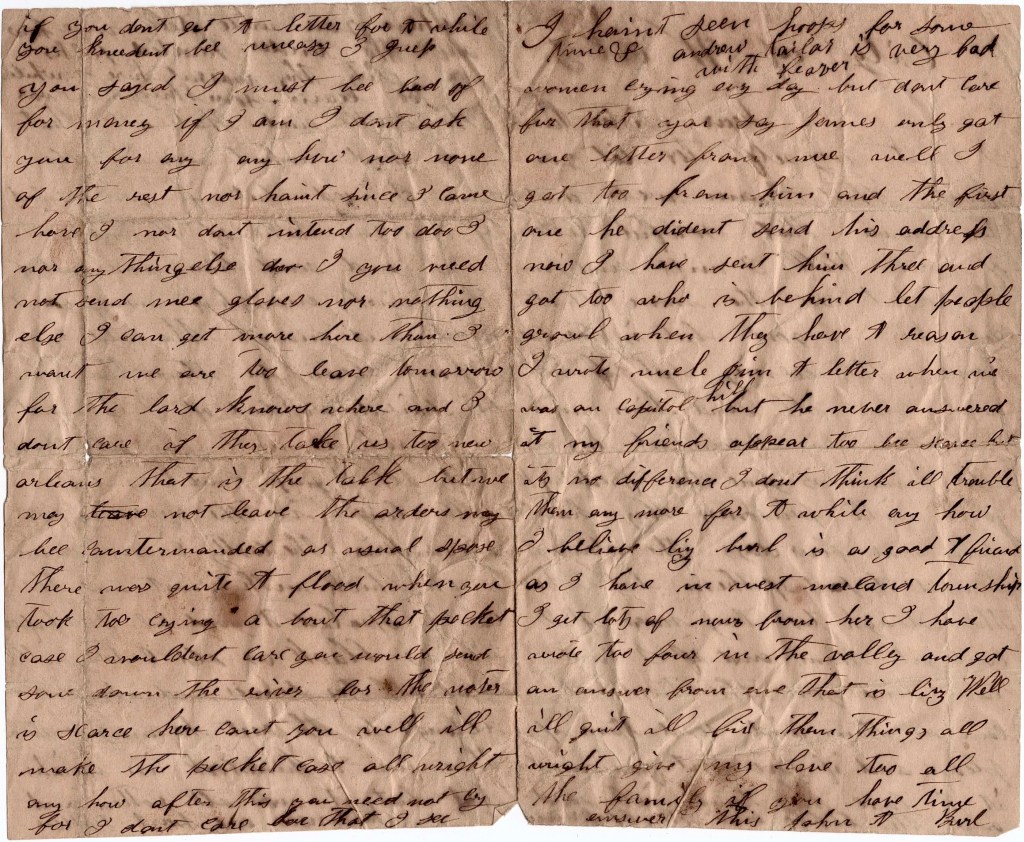
If you don’t get a letter for a while, you needn’t be uneasy, I guess. You said I must be bad off for money. If I am, I don’t ask you for any anyhow nor none of the rest not haint since I came, have I? Not don’t intend to do, nor anything else. I can get more here than I want.
We are to leave here tomorrow for the Lord knows where and I don’t care if they take us to New Orleans. That is the talk. But we may not leave. The orders may be countermanded as usual.
I suppose there was quite a flood when you took to crying about that pocket case. I wouldn’t care you would send some down the river for the water is scrace here. Can’t you? Will, I’ll make the pocket case all right anyhow. After this, you need not cry for I don’t care…
I hain’t seen hoops for some time & Andrew Tailor is very bad with fever, women crying every day, but don’t care for that. You say James only got one letter from me. Well, I got two from him and the first one he didn’t send his address. Now I have sent him three and got two. Who is behind? Let people growl when they have a reason.
I wrote Uncle Jim a letter when we was on Capitol Hill but he never answered it. My friends appear to be scarce but it’s no difference. I don’t think I’ll trouble them anymore for a while anyhow. I believe Liz Burrell is as good a friend as I have in Westmoreland township. I get lots of news from her. I have wrote to four in the Valley and got an answer from one. That is Liz. Well, I’ll quit all but them things all right. Give my love to all the family. If you have time, answer this. — John A. Burrell
Letter 2
Washington City November 7, 1862
Dear Sister Nan,
I sit me down to write some to you to let you know that I am still able to write anyhow and I hope you are all well. I just now got a letter from you and was glad indeed to hear that you was all well. For my part, I hain’t been so very well for some time but I am mending slowly. I have had the worst cold I ever had in all my born days and somehow as fast as I get better, I get a lot of recruits again, but I took two relief of salts last night adn I think they will dress it. There is a bone in my back too that has got wrong somehow.
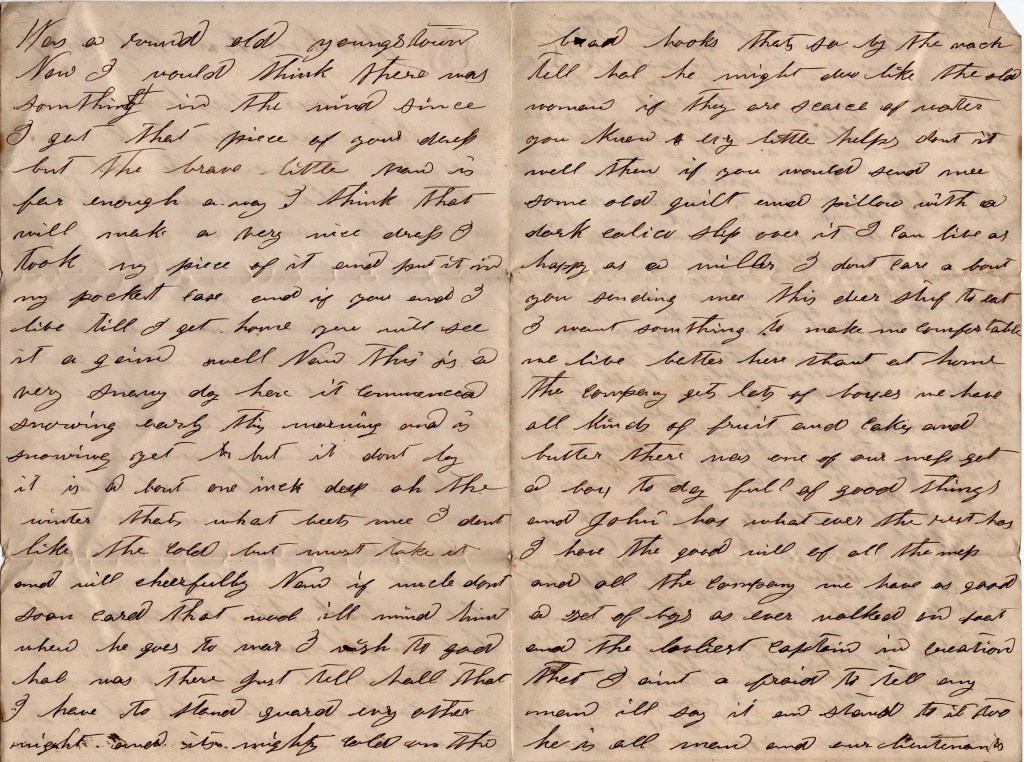
Well, Nan, if J. M. was around Old Youngstown now, I would think there was something in the wind since I got that piece of your dress, but the brave little Nan is far enough away to think that will make a very nice dress. I took my piece of it and put it in my pocket case and if you and I live till I get home, you will see it again.
Well, Nan, this is a very snowy day here. It commenced snowing early this morning and is snowing yet, but it don’t lay. It is about one inch deep. Oh the winter—that’s what beats me. I don’t like the cold but must take it and will cheerfully. Nan, if Uncle don’t soon card that wool, I’ll mind him when he goes to war. I wish to God Hal was there. Just tell Hal that I have to stand guard every other night and it’s mighty cold on the [ ] hooks. That’s so. Tell Hal he might do like the old woman if they are scarce of water. You know every little helps, don’t it? Well then, if you would send me some old quilt and pillow with a dark calico slip over it, I can live as happy as a miller. I don’t care about you sending me this deer stuff to eat. I want something to make me comfortable. We live better here than at home.
The company gets lots of boxes. We have all kinds of fruit and cake and butter. There was one of our mess got a box today full of good things and John has whatever the rest has, I have the good will of all the mess and all the company. We have as good a set of boys as ever walked on foot. and the loveliest captain in creation that I ain’t afraid to tell many men. I’ll say it and stand it too. He is all man and our lieutenants are just ditto. The Orderly [Sergeant] I didn’t like very well at first but the longer I am with him, the better I like him. Now I think he can’t be beat.
John Emmet was here today. He looks fine. He is going to the regiment. He was a prisoner but is exchanged and Grove is in the [ ] Hall Hospital here. It is handy here. I will go to see him some day.
Well. you wanted to know whether J. M. write to me—never. But he still tells James what to say so I can forgive him. I think he is O.K. anyhow. I got a letter from James the other day. He was pretty well when he wrote. I hear from him regular now every week and write to him every week. You know we send some of them kind to each other—good ones, I mean. About tell that youn man to come and see you, well in the first place firstly and second place lastly, verily I say untio you, beware of that young man if he is a soldier that says nothing. I have seen some soldiers in my time I think a heap of, but they ain’t all O.K. That’s so. Now, here is what I have to say…
— John
Letter 3
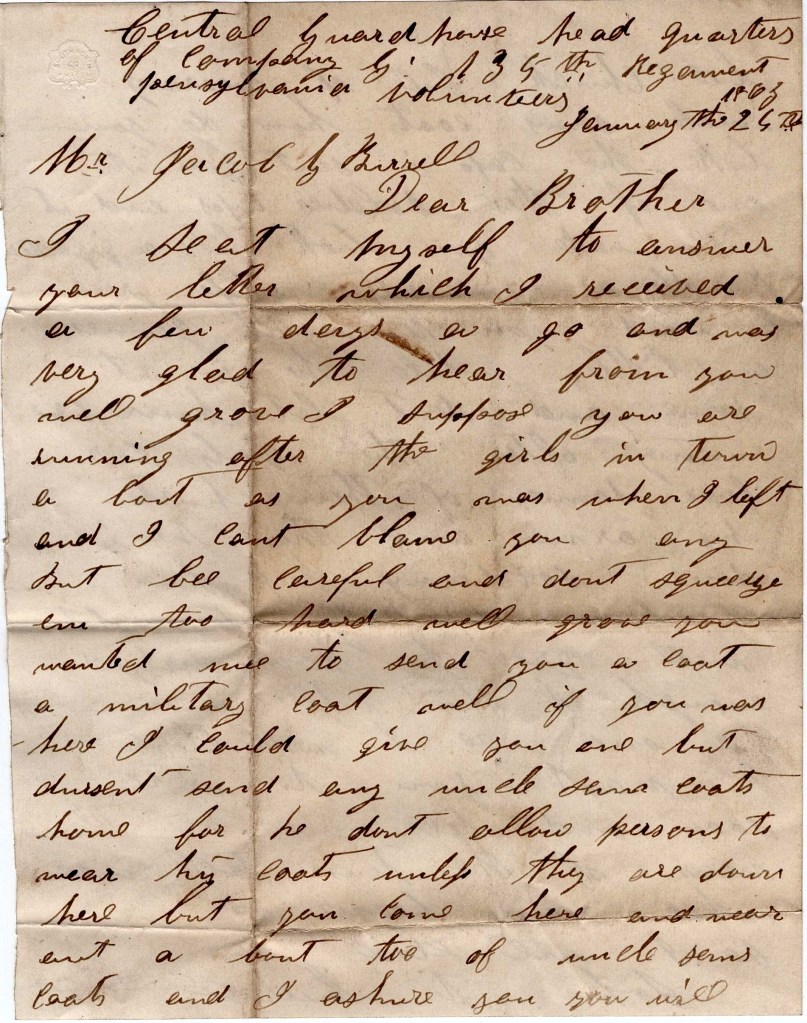
Central Guardhouse Headquarters of Co. G, 135th Regiment Pennsylvania Vols. January 25th, 1863
Mr. Jacob G[rove] Burrell, dear brother,
I seat myself to answer your letter which I received a few days ago and was very glad to hear from you. Well, Grove, I suppose you are running after the girls in town about as you was when I left and I can’t blame you any, but be careful and don’t squeeze ’em too hard.
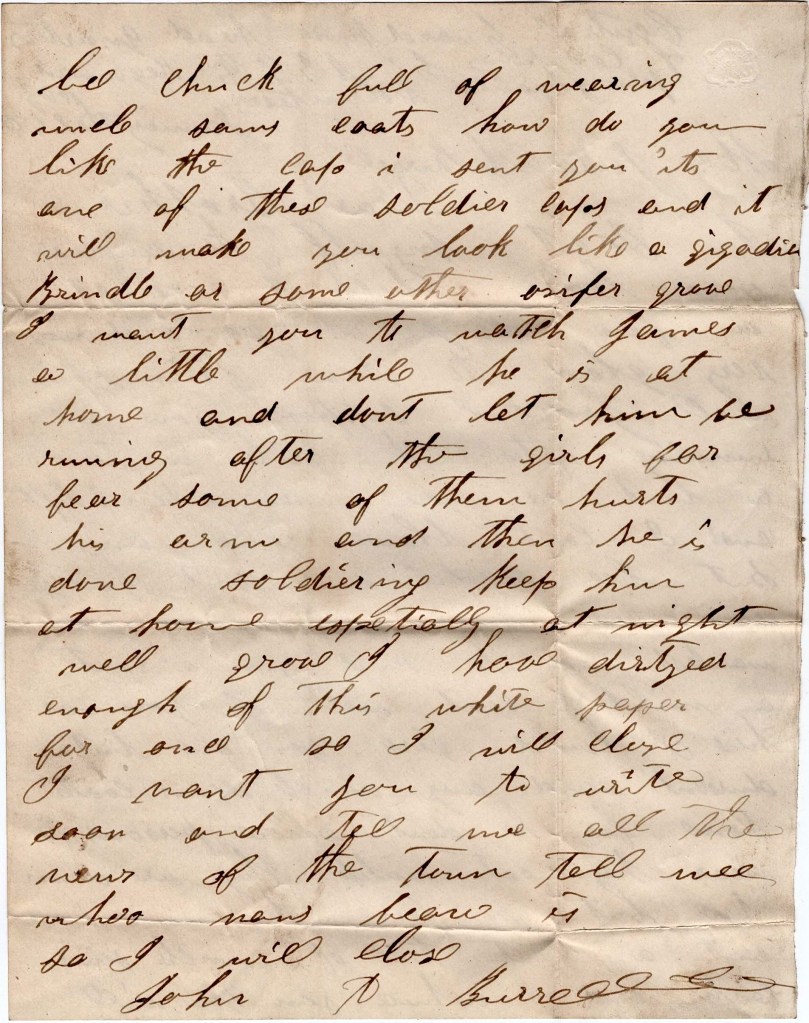
Well, Grove, you wanted me to send you a coat—a military coat. Well, if you was here I could give you one but I dare not send any Uncle Sam’s coats homes for he don’t allow persons to wear his coats unless they are down here. But you come here and wear out about two of Uncle Sam’s coats and I assure you, you will be chuck full of wearing Uncle Sam’s coats. How do you like the cap I sent you? It’s one of the soldier’s caps and it will make you look like a Gigadier Brindle [Brigadier General] or some other osifer [officer].
Grove, I want you to watch James a little while he is at home and don’t let him be running after the girls for fear some of them hurts his arm and then he is done soldiering. Keep him at home—especially at night. Well, Grove, I have dirtied enough of this white paper for once so I will close. I want you to write soon and tell me all the news of the town. Tell me who Nan’s beau is. So I will close, — John A. Burrell
Letter 4
Camp of the 53rd [Pennsylvania] Regiment April 5th 1864
Dear Father & Family,
I seat myself for the purpose of letting you know where I am and how I am getting along. I am now with the regiment and am in very good health but ain’t getting along very well for I have a house to build and it’s so wet I can’t work at it. But I still sleep and eat with [brother] James and it’s too much crowded to be comfortable.
I left Camp Copeland on the 31st at 4 p.m. and got to Harrisburg the next morning. I took breakfast and laid around till 7. We took the cars for Baltimore where we landed at noon and took dinner and at 4 o’clock we took the cars for Washington where we landed about dark and stayed all night. And the next morning we took a transport for Alexandria and we stayed there in the Soldier’s Rest till Sabbath morning. We got on the cars and came out to Brandy’s Station which is seven miles from here. We got out here on Sunday evening at dusk. Our Brigade is away out here by itself an we are all alone but I like it very well and would like it much better if I had my house built.
I gave Lieutenant Anderson $44 to give to you. I want to know if you got it. Now there is one thing I want to tell you and that is to keep plenty to keep the family and not to go to work till you are entirely well. Mind and keep plenty for it may be some time before I can draw [pay] again. But when we do, I will will draw 50 dollars of bounty. James says he sent some money home some time ago but has not heard of it since.
The boys from Youngstown are all well and some of them are in good spirits. I tell you, there was some bright-looking recruits came out this call. I don’t mean from around Youngstown for I think they are all good soldiers.
I don’t know whether there will be a fight here soon or not for I am no gramarian [?]. I must close for the mail will soon go out. Please write soon and give me all the news. Give my love to mother and all the family. Give my regards to cousin Lou and Doctors and beards. From your affectionate son, — John A. Burrell
James H. Douglas is well. [Brother] James sends his love to all. Please write siin. Direct the same as to James.
Letter 5
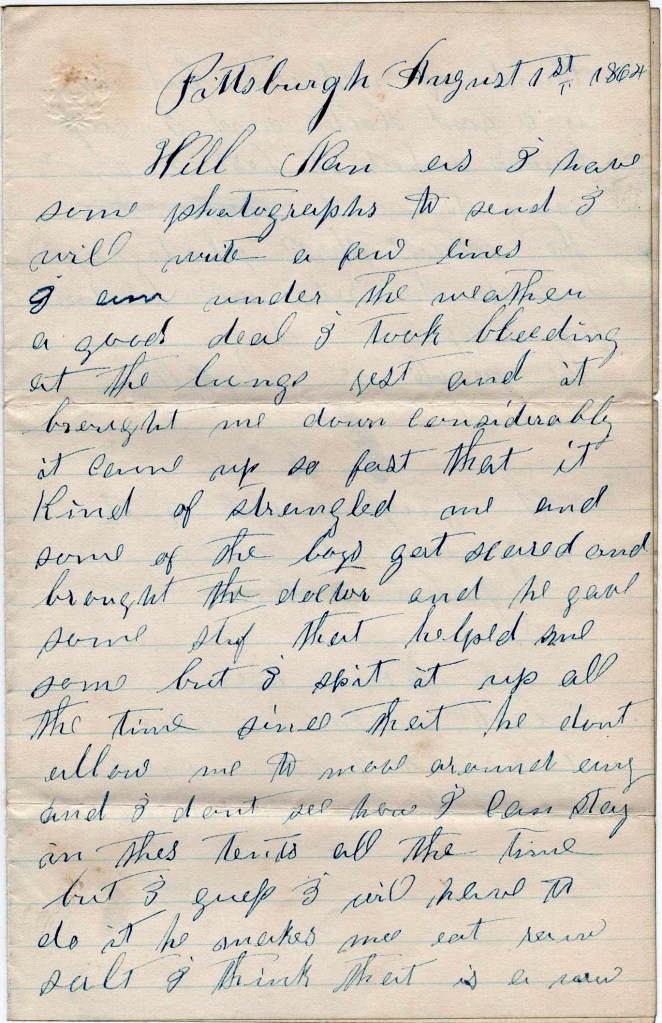
Pittsburgh [Pennsylvania] August 1st 1864
Well Nan, as I have some photographs to send, I will write a few lines. I am under the weather a good deal. I took bleeding at the lungs yesterday and it brought me down considerably, It came up so fast that it kind of strangled me and some of the boys got scared and brought the doctor and he gave some stuff that helped me some but I spit it up all the time. Since that he don’t allow me to move around any and I don’t see how I can stay in these tents all the time but I guess I will have to do it. He makes me eat raw salt. I think that is a raw kind of medicine but he is a good doctor and I guess knows what is best.
I am going to send the other three photographs. I guess the rebs will be here for supper today. The people are awfully scared. I guess I will quit. My love to all, — John A. Burrell
I have been looking for a letter ever since I came back but hain’t got any.
Letter 6
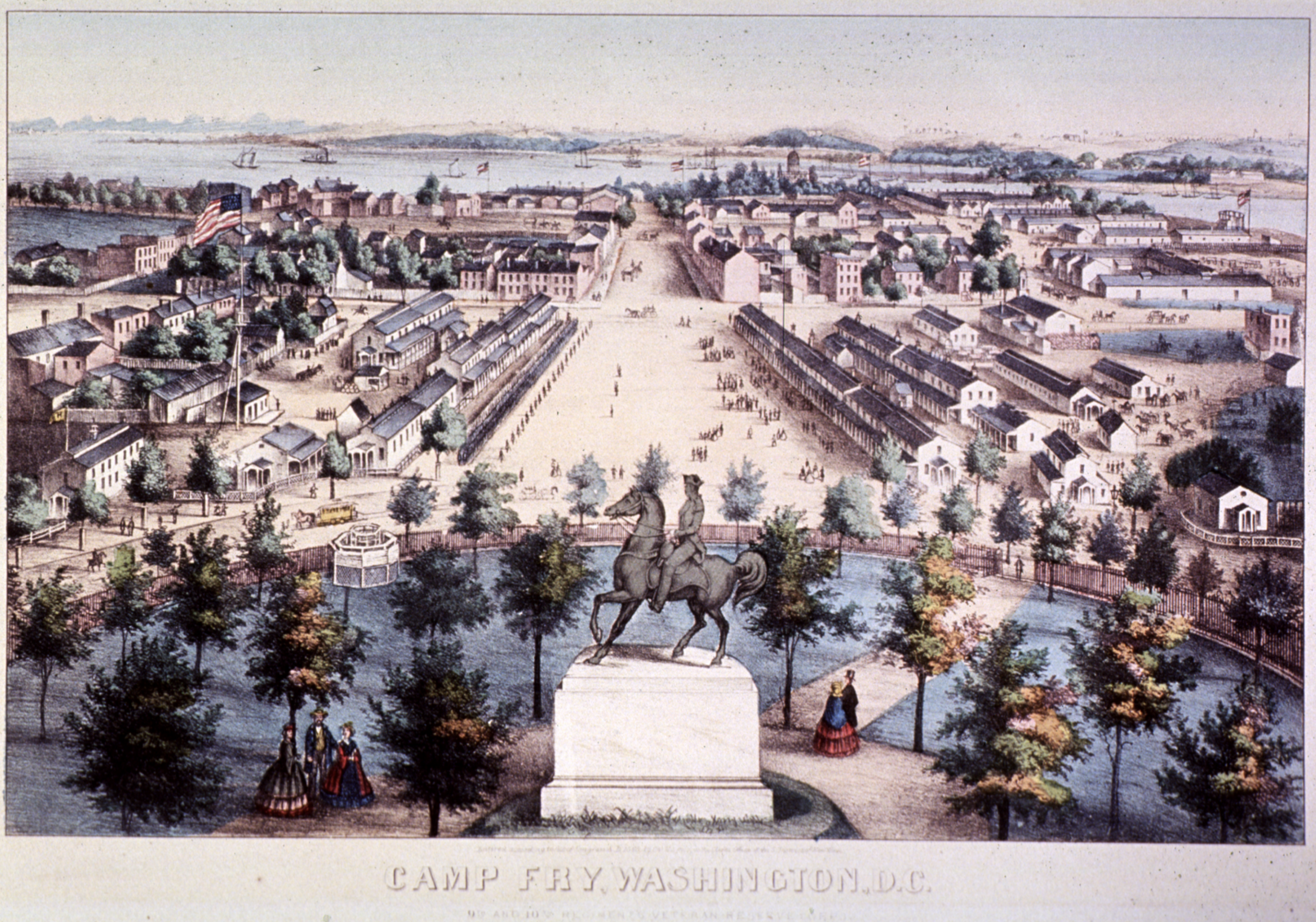
Camp Fry was the home of the 9th & 10th Veteran Reserve Corps in WDC. The view is from Washington Circle south along 23rd Street, with the equestrian statue of George Washington in the foreground and the Potomac River and the Virginia shore in the background. There appears to be a faint representation of Robert E. Lee’s house, now the site of Arlington National Cemetery, on a small hill overlooking the river.
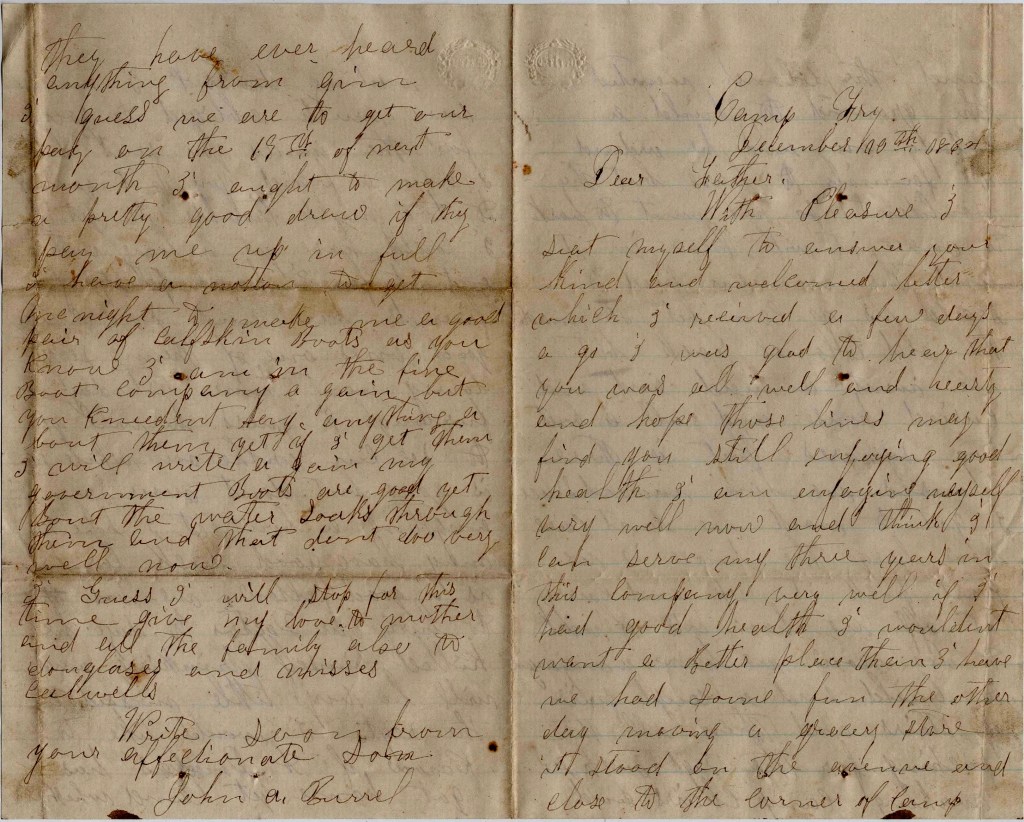
Camp Fry [Washington D. C.] December 10, 1864
Dear Father
With pleasure I seat myself to answer your kind and welcomed letter which I received a few days ago. I was glad to hear that you was all well and hearty and hope these few lines may find you still enjoying good health. I am enjoying myself very well now and I think I can serve my three years in this company very well. If I had good health, I wouldn’t want a better place than I have.
We had some fun the other day moving a grocery store. It stood on the avenue and close to the corner of camp and the Colonel [George W. Gile] wanted the ground to build a cottage on and he ordered the family to leave but they wouldn’t so we went to work to move it with them in it and the women tried to scold us. You can bet they made the old colonel rack [?] but we went ahead and carried house and all about two squares. That is three houses we have moved since I got to work. We don’t care how large the house is, we just pick it up and carry it off. We have lots of work to do now. We have a magazine to build and a couple pair of stairs and then all the puching [?] for the regiment such as making camp chairs and writing desks.
I am very much obliged to you for the money you sent but I am afraid you put yourself to too much trouble to get it. I could have got along without it for I have plenty of friends here and some very good ones. One of them, Sergt. Lowry, went home yesterday on furlough. I guess he will go to see [ ] Witherow while he is gone but don’t never say anything about it. I hope he may have good luck for he is a good fellow.
We had to bury our doctor today. He killed himself drinking and will be very little missed in the regiment. I would like to know if A. Douglas has got home yet and whether they have ever heard anything from Jim.
I guess we are to get our pay on the 19th of next month. I ought to make a pretty good draw if they pay me up in full. I have a notion to get me McKnight to make me a good pair of calfskin boots as you know I am in the fine boot company again, but you needn’t say anything about them yet. If I get them. I will write again. My government boots are good yet but the water soaks through them and that don’t do very well now.
I guess I will stop for this time. Give my love to mother and all the family. Also to Douglas’ and Mrs. Caldwell’s.
Write soon. From your affectionate son, — John A. Burrell
Letter 7
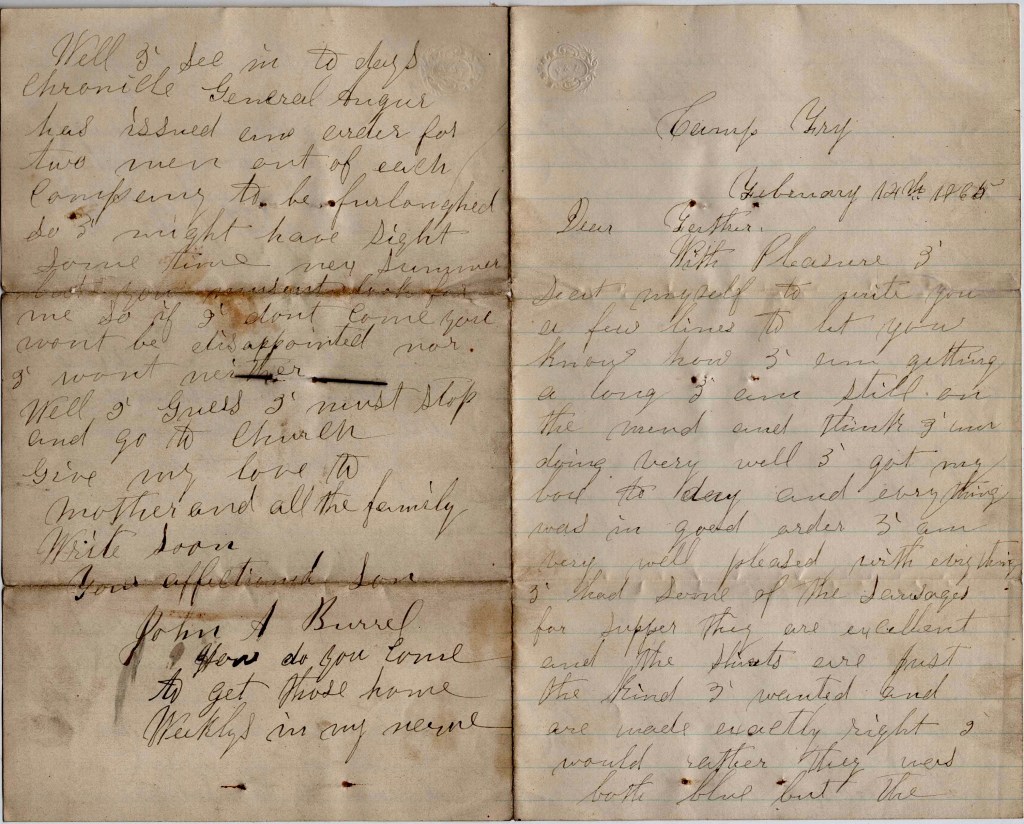
Camp Fry [Washington D. C.] February 14th 1865
Dear Father,
With pleasure I seat myself to write you a few lines to let you know how I am getting along. I am still on the mend and think I am doing very well. I got my box today and everything was in good order. I am very well pleased with everything. I had some of the sausages for supper. They are excellent and the shirts are just the kind I wanted and are made exactly right. I would rather they was both blue but the red one is a very nice shirt, They both please me very well. Making those collars was labor for nothing but I suppose the women thought they would be an advantage. But there is no harm done. I will wear them.
I got my discharge and everything right. Tomorrow is monthly inspection and we carpenters have to appear as pioneers. I don’t like it very well but can’t help it. I am willing to do my duty as long as I am able. I am as contented now as the day is long. I begin to feel like myself again and hope I will get good health again. And another thing, I never had better company than I have here. I don’t associate with anything but good, pious men and we have all the enjoyments men can wish for there is a nice church here and we have now preaching or prayer meeting every night. And we have a nice division of the Sons of Temperance—one of the best orders in the world. I wish there was ten divisions for every one we now have there is 24 in this district and last year there was about 10,000 members initiated in the order here, principally all soldiers, and the order is still growing. I think it is doing a great deal of good to the soldiers here.
Well, I see in today’s Chronicle [that] General Auger has issued an order for two men out of each company to be furloughed so I might have sight sometime next summer but you must look out for me so if I don’t come you won’t be disappointed nor I won’t neither.
Well, I guess I must stop and go to church. Give my love to Mother and all the family. write soon. Your affectionate son, — John A. Burrell
How do you come to get those Home Weeklies in my name?
The following letter was signed “J. W. Hamilton” and I’m inclined to attribute it to James W. Hamilton of Co. G, 3rd Maryland Infantry though I am unable to corroborate his identity by anything in the letter. I believe James was from Baltimore, Maryland, but I could not find an ancestral record for him. Whomever wrote the letter likely belonged to Gen. Nathaniel Banks army and so I looked for soldiers named Hamilton among the regiments in the II Corps who participated in the 9 August 1862 battle at Cedar Mountain though the author was not present for the battle because he accompanied the baggage train as a guard and arrived in camp “near Culpeper” on 12 August where Pope “had taken up what he thought was a strong position in the triangle formed on the left by the Orange & Alexandria Railroad, on the right by the Rappahannock River and at the bottom by the Rapidan River. While awaiting reinforcements and pondering a move on Richmond, Pope separated his forces, positioning Maj. Gen. Franz Sigel’s division at the foot of Cedar Mountain, Brig. Gen. Irvin McDowell’s division north of Rapidan Station, Maj. Gen. Nathaniel Banks’ division near Culpeper and Brig. Gen. Jesse Reno’s division near Raccoon Ford. In doing so, Pope unwittingly presented Robert E. Lee with an unparalleled opportunity to crush his army.” [Source: Pope’s Narrow Escape at Clark’s Mountain” by John Lam]
Some enlisted men of the 3rd Maryland
T R A N S C R I P T I O N
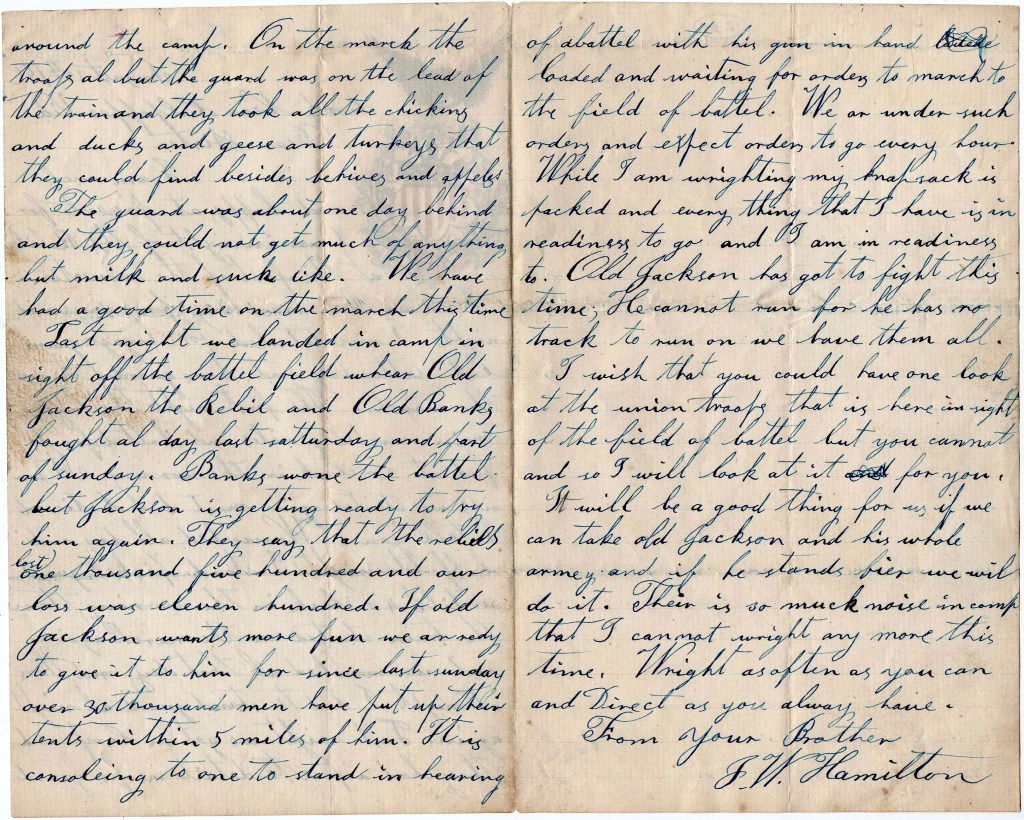
Camp near Culpeper, Va. August 13th 1862
Dear Sister,
I am well and happy at present for I am in sight of the Rebels at the foot of the mountain. I have been marching for 3 days and nights. I was detailed for baggage guard last Saturday [9 August] and have guarded it on the march. The first night the baggage train marched 9 miles and halted for to feed at 2 o’clock in the morning. At sunrise we started again, most damned tired, I tell you. We marched all day and half the night. I stood picket guard until 4 o’clock in the morning. Then the train started on the march again and we marched all that day and then at night I had to stand guard all night again. Last night we got in camp and they had a face to detail me for guard around the camp.
On the march the troops—all but the guard—was on the lead of the train and they took all the chickens and ducks and geese and turkeys that they could find, besides beehives and apples. The guard was about one day behind and they could not get much of anything but milk and such like. We have had a good time on the march this time.
Last night we landed in camp in sight of the battlefield where Old Jackson—the Rebel—and Old Banks fought all day last Saturday [9 August] and part of Sunday [10 August]. Banks won the battle but Jackson is getting ready to try him again. They say that the rebels lost one thousand, five hundred and our loss was eleven hundred. If Old Jackson wants more fun, we are ready to give it to him for since last Sunday over 30 thousand men have put up their tents within five miles of him. It is consoling to one to stand in hearing of a battle with his gun in hand, loaded and waiting for orders to march to the field of battle. We are under such orders and expect orders to go every hour.
While I am writing, my knapsack is packed and everything that I have is in readiness to go and I am in readiness too. Old Jackson has got to fight this time. He cannot run for he has no track to run on. We have them all.
I wish that you could have one look at the Union troops that is here in sight of the field of battle but you cannot and so I will look at it for you. It will be a good thing for us if we can take Old Jackson and his whole army and if he stands fire, we will do it. There is so much noise in camp that I cannot write any more this time. Write as often as you can and direct as you always have. From your brother, — J. W. Hamilton
The following letter was written by William T. Elwell (1837-1898), the son of John Elwell and Mary Gould of Caton, Steuben county, New York. William enlisted on 18 September 1861 as a private in Co. K of the 50th New York Engineers. On 1 November 1861 he was transferred to Co. D. In 1863 he was transferred to the 81st Company, 2nd Battalion Veteran’s Reserve Corps (VRC), and later still to Co. E of the 12th VRC. In 1869, he filed for an invalid’s pension.
William died in 1898 and was buried in Loudonville Cemetery in Loudonville, Ashland county, Ohio.
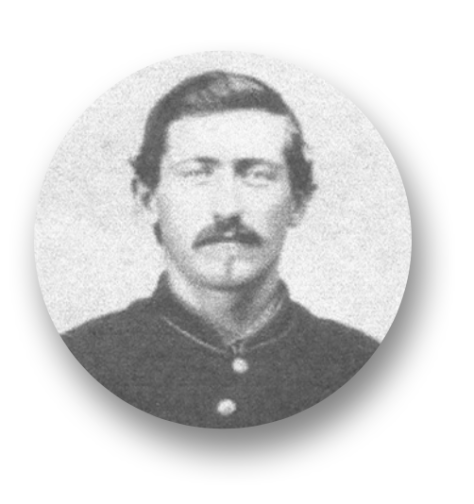
I could not find an image of William but here is one of Harrison Carl Johnson (1840-1922) of Co. G, 50th New York Engineers. (Ancestry.com)
T R A N S C R I P T I O N
Camp Lesley 1 Washington D. C. June 3rd 1862
The Picket Guard [a poem]
“All quiet along the Potomac,” they say except now and then a stray picket is shot as he walks on his beat to and fro by a rifleman hid in the thicket. Tis nothing. A private or two now or then will not count in the news of the battle, Not an officer lost—only one of the men moaning out all alone the death rattle.
All quiet along the Potomac tonight where the soldiers lie peacefully dreaming. Some thought it was fun to get whipped at Bulls Run but wait till they get to Manassas. With bullets and lead at the side of the head Your’ll see the brave 50th a running. — W. T. E.
Camp Lesley Washington D. C. June 5th 1862
Dear friend,
I received your letter of the 3rd and was glad to hear that you was all well as it found me enjoying good health at heart but leaves me a cripple in my leg. I am quite lame so that I cannot do any duty but I have not been to the doctor but once and I have got to wait till the young doctor comes home for I won’t go to the old doctor, and then I shall either get a furlough or my discharge for I cannot do anything here.
I shall know after my payday. Tell Anna not to send me anything. If that box has not gone to Dennis for I do not want anything more from home. I have just found out where father is and found also [where] my brother-in-law is, but have not seen either of them. But I have sent father a letter and shall see him before long.
We have just received our tents. They are the Sibley tents with 20 in a tent which akes it very disagreeable now, I tell you. We are all well at present and I hope that we will stay so. We are in hopes that we will have a neat little fight before long so that we can try our pluck to see whether we are good for anything or not.
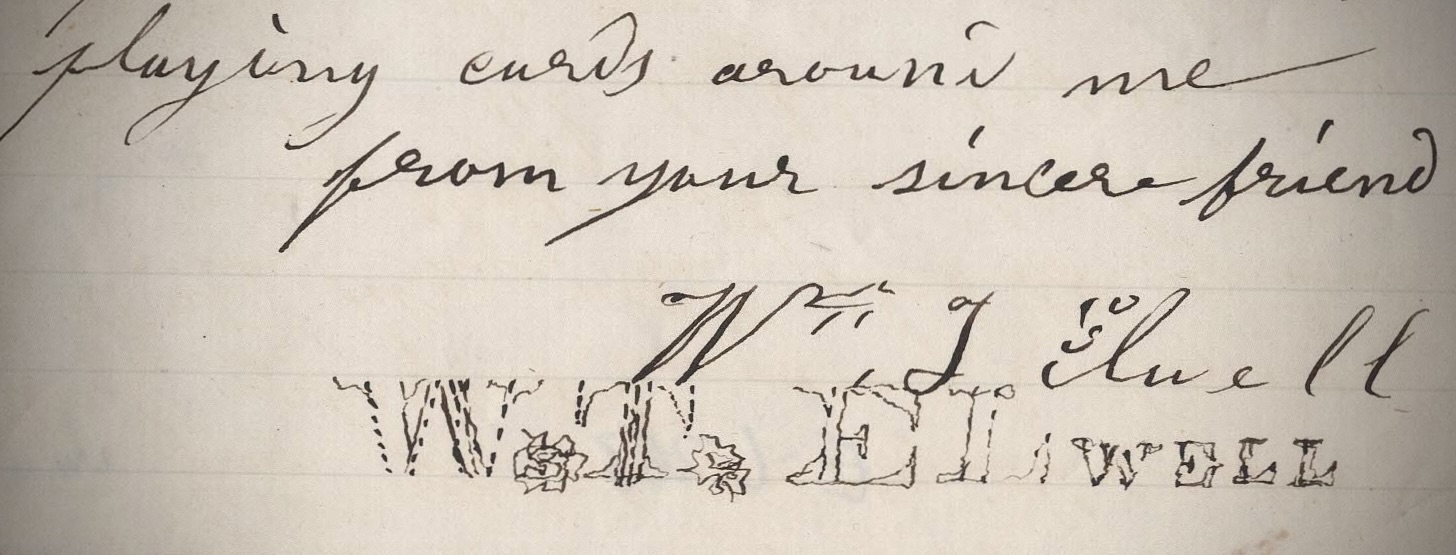
I shall have to stop for I sit here cramped up in a corner and the rest playing cards around me. From your sincere friend, — Wm. T. Elwell
1 Camp Lesley was located about a half mile north of the Navy Yard on the Anacostia River. It eventually became known as the Washington Engineer Depot. It was the camp of the 50th New York Engineers.
I could not find an image of Blydon but here is one of Leonard W. Gaddis who also served in Co. G, 25th OVI (Photo Sleuth)
This letter was written by Cpl. Blydon H. Boyce (1836-1899) of Co. G, 25th Ohio Volunteer Infantry (OVI). Blydon was the son of William Boyce (1791-1858) and Hannah Rice (1795-1867) of Sharon, Schoharie county, New York.
Blydon enlisted as a private on 18 June 1861. Co. G was recruited from Seneca, Muskingum, and Jefferson counties in Ohio. During their service they saw action in such battles as 2nd Bull Run, Chancellorsville, Gettysburg, Fort Wagner, and Honey Hill. Blydon was wounded in the Battle of Chancellorsville but survived. He lived out his days in Arkansas after the war.
Blydon wrote the letter to his niece but does not state her name. He also does not give the location or date of his letter but based on the content and the patriotic stationery used, my hunch is that it was written in the fall of 1861.
T R A N S C R I P T I O N
The unusual patriotic stationery used includes the phrase, ” Roam Over Every Mountain and Plain,” — “Union Forever.”
My Dear Niece,
I acknowledge the receipt of a few lines from you enclosed in your mother’s letter which was gratefully received. We soldiers welcome every message which comes, as it were, from the outward world having (after the usual military plan) a cordon of sentinels around our camp which regulates our intercourse with the world outside. Our opportunities for seeing specimens of the fair sex are quite limited indeed, and when one makes their appearance in our midst, we gaze upon her with all the amazement and inquisitiveness that would do credit to a long haired celestial when a foreigner intrudes upon their sacred soil.
We had a call yesterday from a couple of ladies, the wife of one of our officers and a single lady who happened to come into our barracks as we were dining. We were taken entirely on surprise. You ought to have seen the flutteration it caused for we were after the usual nonchalance and negligee which characterize our sex when alone and uncontrolled by the fair sex, carelessly masticating our bacon and hard bread and rehearsing some warlike operations. Our table being nothing but two rough boards sustained on legs, our seats to match, and our table (minus) the porcelain and silver spoons; but in their places, tin plate, tin cup, knife and fork and pewter spoon comprising the sum total of our table furniture. And then the surroundings matched; which reminded one of the primitive ages. Our beds were steamboat fashion, one rising above the other on one side of our barrack, capable of reposing 18 men, with a hard board to lie upon with simply a blanket beneath and a blanket to cover us, and our door and windows to correspond, a space in front left sufficiently large for the egress and ingress of its inmates, and holes cut out the sides and ends to let in the sunlight and fresh air. And thus you have a miniature description of our barracks and condition of things when those ladies, aforesaid mentioned, called upon us.
We had nothing to do, however, but to make apologies and with all the courtesy and gallantry we were in possession of, let them depart, not forgetting to give three cheers for their patriotic and benevolent feelings in the way that they have provided for us, havelocks and other comforts. Hurrah! I say for the patriotic ladies of the present crisis, when in glorious and gallant imitation of the women of revolutionary memory, they make themselves useful by their efforts and labors to fit out the soldiers for war, when wives part with their husbands, lovers with their affianced mothers from their sons and their relatives and others who depart from the social circle with a “God be with you!” Who cannot be inspirited and encouraged when far away by such reflections?
Woman, though the first to yield to the tempter in the Garden of Eden, are now and have been from time immemorial the first to make amends for their transgressions, are always found, with few exceptions, upon the right side. I cannot wish them any better fate than I trust the war will be short, and they will all be permitted to return home ( the young and unmarried men) and that every unmarried lady will unite her fortune and heart to a husband who will ever love, cherish, and protect them in their position as wives.
If I mistake not, dear niece, you intimated to me some time ago in your letter that you had found a congenial companion who you thought could make you happy and in fact, I almost expected to have addressed you by another title by this time. Please write about the matter aforesaid. Consider me not, I entreat of you, intrusive upon this matter for such matters must be talked of and rehearsed as much as matters of food and clothing, for the Creator who first ordained a similar condition of things for all coming time until this world ceases to be. You may rely upon me as a confidant for separated as I am by a thousand miles, I shall not be apt to annoy by divulging any secrets.
I have, notwithstanding all the privations and hardships which have to be endured here, had excellent health and enjoyed myself excellently well, animated as I am by patriotism and the righteousness of the present cause, and as confident as I am of the approval of Almighty God in this present struggle, I feel as though I could wade through fire and sword, if necessary, for the redemption of our happy land to its wonted peace and quietness though unaccustomed to a soldier’s life and quite sensitive to pain and ingratitude on the part of my fellow man.
I now have so far entered heart and soul into this present struggle that I begin to handle the instruments of death as familiarly and as playfully as the child handles its toys, and I expect that the opened mouth canon belching forth its missiles of death and destruction have no terrors for me for I foresee such a procedure will have to be gone through before peace and quietness is restored, that God in his infinite mercy will make all these afflicting dispensations will make them redound to His glory and for the spread of His kingdom is my sincere prayer.
Please give my respects to all the friends and write all the important news from “Old Schoharie.” I will write my address on a separate slip of paper so you will know my address, Your affectionate Uncle, — Blydon H. Boyce
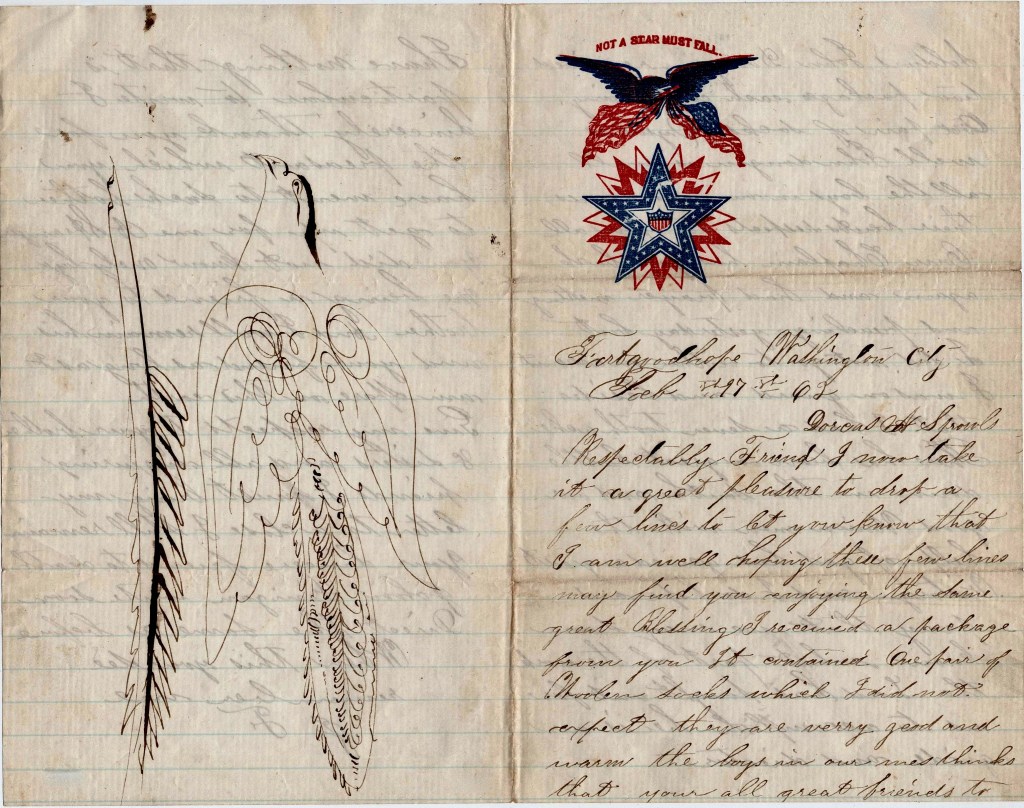
The following letter was written by Pvt. John Finegan of Co. E, 85th Pennsylvania. It was written from Fort Good Hope, described by one member of the regiment who wrote an anonymous letter on 20 February 1862 to the Monongahela Valley Republican, as one “the largest and most important [forts near Washington D. C.]…Our regiment has charge of many of those fortifications; sixty men under command of Lieutenant are each day detailed for guarding there, the furthest from camp being distant about five miles. Our camp is rather pleasantly situated and our men have generally fared well. Six deaths have occurred among them since we left home nearly three months ago; there are only sixteen cases in the hospital at present.”
“The 85th Pennsylvania was formed in late 1861 in Uniontown, PA. The men hailed from the southwestern corner of the state. After building forts on the east side of Washington, D.C. for several months, they found themselves in the aforementioned Casey’s Division, headed for the Virginia, Peninsula. The 85th PA was in the rear at Yorktown, and only just came up as the fighting was ending at Williamsburg. They saw their first real combat at the Battle of Seven Pines and it was a devastating blow. Author Dan Clendaniel offers up a compelling defense of the men and Casey’s larger organization. They were also involved in the Seven Days and the retreat to Harrison’s landing. Here their war took a hard left turn when compared to most of the regiments involved in the Peninsula Campaign. As has been said, McClellan scapegoated Casey’s Division, and they were removed from the AotP and sent to North Carolina for the remainder of 1862, where they were involved in the Kingston Expedition. They moved to the Charleston area and participated in the Siege of Charleston on Morris Island for most of 1863. Here the Pennsylvanians were held in readiness to assault Fort Wagner not once but twice, though ultimately they were not sent in after the initial assaults failed. In December 1863, they were then moved to Hilton Head, SC and stayed there until April 1864…
“The 85th Pennsylvania was part of the 10th Corps, Army of the James during these campaigns until mustering out in November 1864. Although not a part of the Army of the Potomac, which they had left in August 1862, they fought alongside that famous unit in these final battles against the Army of Northern Virginia. The 85th Pennsylvania was at Port Walthal Junction and in the Battle of Ware Bottom Church during the Bermuda Hundred Campaign. They saw major action at Second Deep Bottom, Chaffin’s Farm, and Darbytown Road during the Richmond-Petersburg Campaign. Members of the regiment whose time had not yet expired when the organization’s veterans mustered out went on to serve at Fort Gregg and in the Appomattox Campaign.” [Source: 85th PA: Such Hard and Severe Service by Dan Clendaniel]
John Finegan (or Finnegan) was a resident of Washington, Washington county, Pennsylvania, when he enlisted on 12 November 1861. He wrote the letter to Dorcas A. Sprowls (1841-1910), the daughter of William Sprowls (1794-1868) and Dorcas Towne (1797-1870) of Washington, PA. Dorcas never married.
T R A N S C R I P T I O N
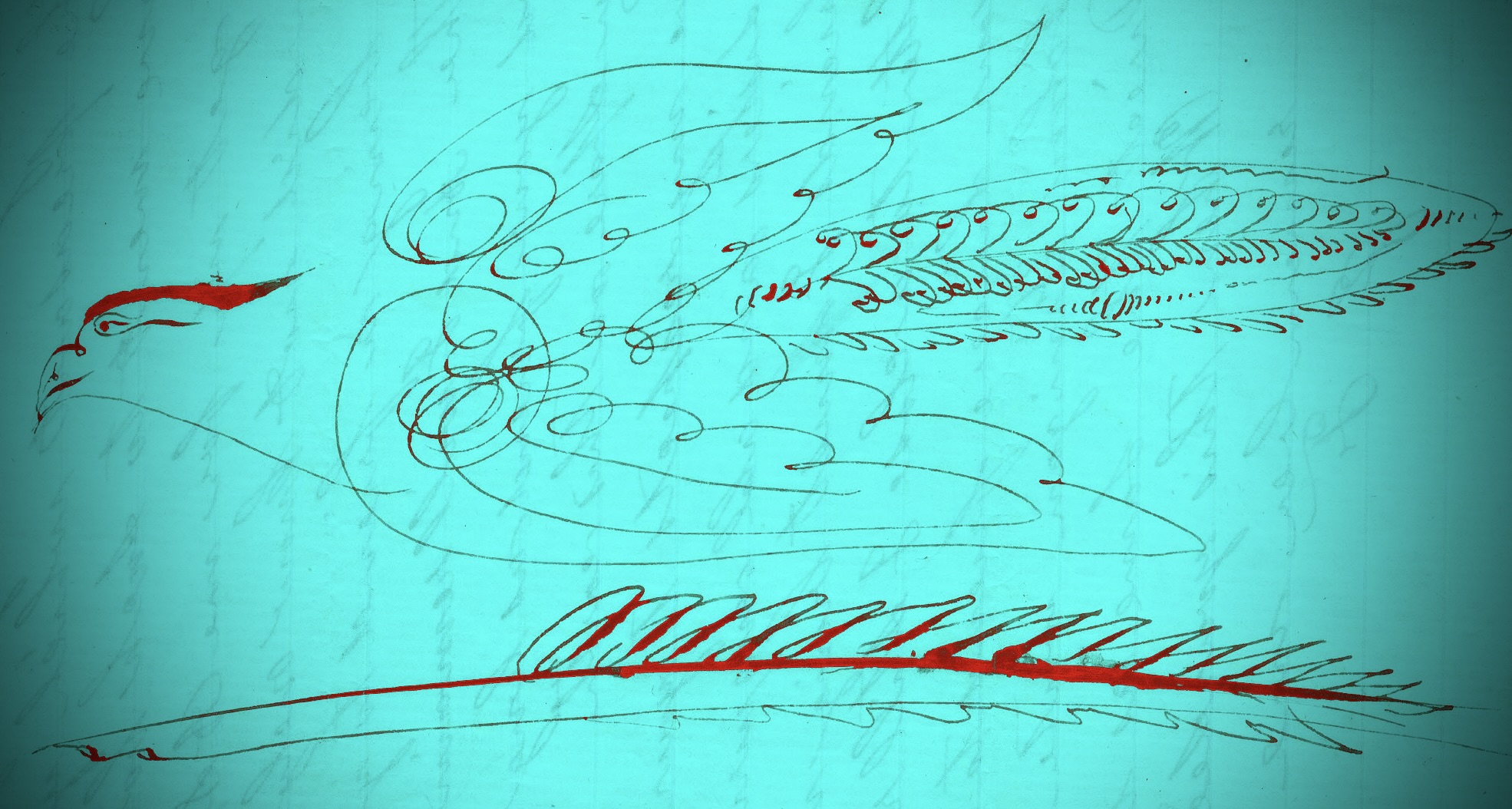
John’s artwork
Fort Good Hope Washington City February 17th 1862
Dorcas A. Sprowls, respected friend,
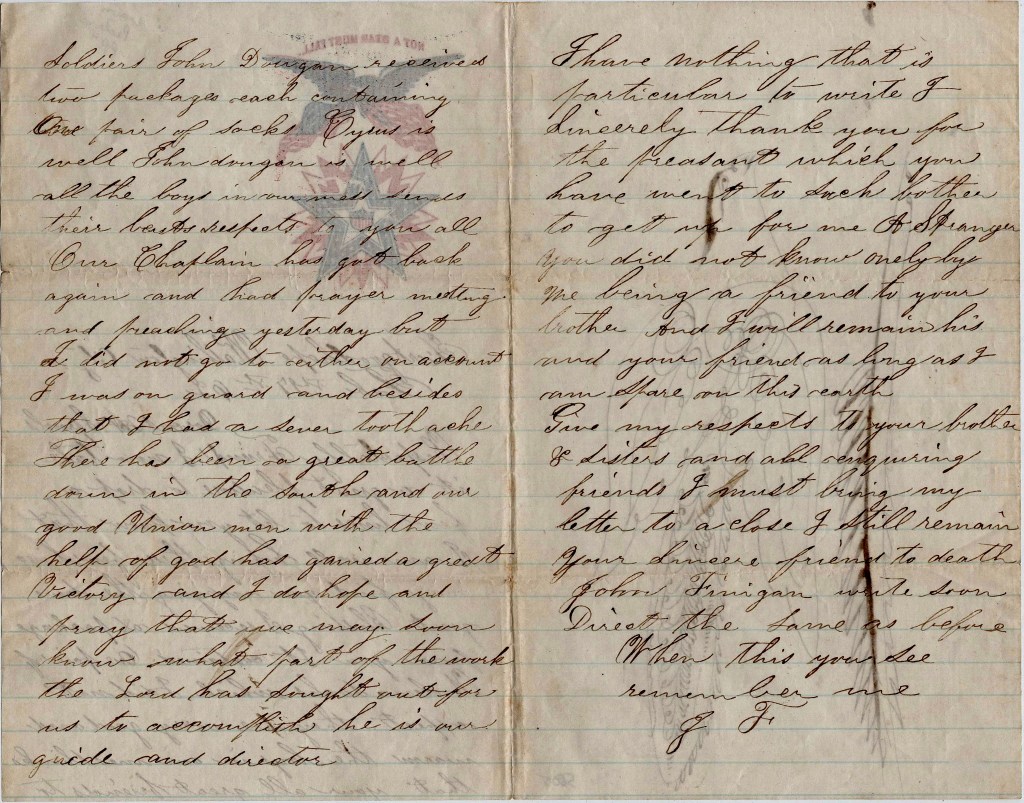
I not take it a great pleasure to drop a few lines to let you know that I am well, hoping these few lines may find you enjoying the same great blessing. I received a package from you. It contained one pair of woolen sicks which I did not expect. They are very good and warm. The boys in our mess thinks that you’re all great friends to soldiers. John Dougan [Dugan] received two packages each containing on pair of socks. Cyrus is well. John Dougan is well. All the boys in our mess sends their best respects to all.
Our chaplain [John N. Pierce] has got back again and had prayer meeting and preaching yesterday but I did not go to either on account I was on guard. And besides that, I had a severe toothache.
There has been a great battle down in the South and our good Union men with the help of God has gained a great victory and I do hope and pray that we may soon know what part of the work the Lord has sought out for us to accomplish. He is our guide and director.
I have nothing that is particular to write. I sincerely thank you for the present which you have went to such bother to get up for me—a stranger you did not know—only by me being a friend to your brother. And I will remain his and your friend as long as I am spared on this earth.
Give my respects to your brother and sisters and all enquiring friends. I must bring my letter to a close. I still remain your sincere friend to derath. — John Finigan
Write soon. Direct the same as before. When this you see, remember me, — J. F.
I could not find an image of James but here is one of Pvt. George Hepenstall of Co. G, 2nd Iowa Cavalry (Iowa Civil War Images)
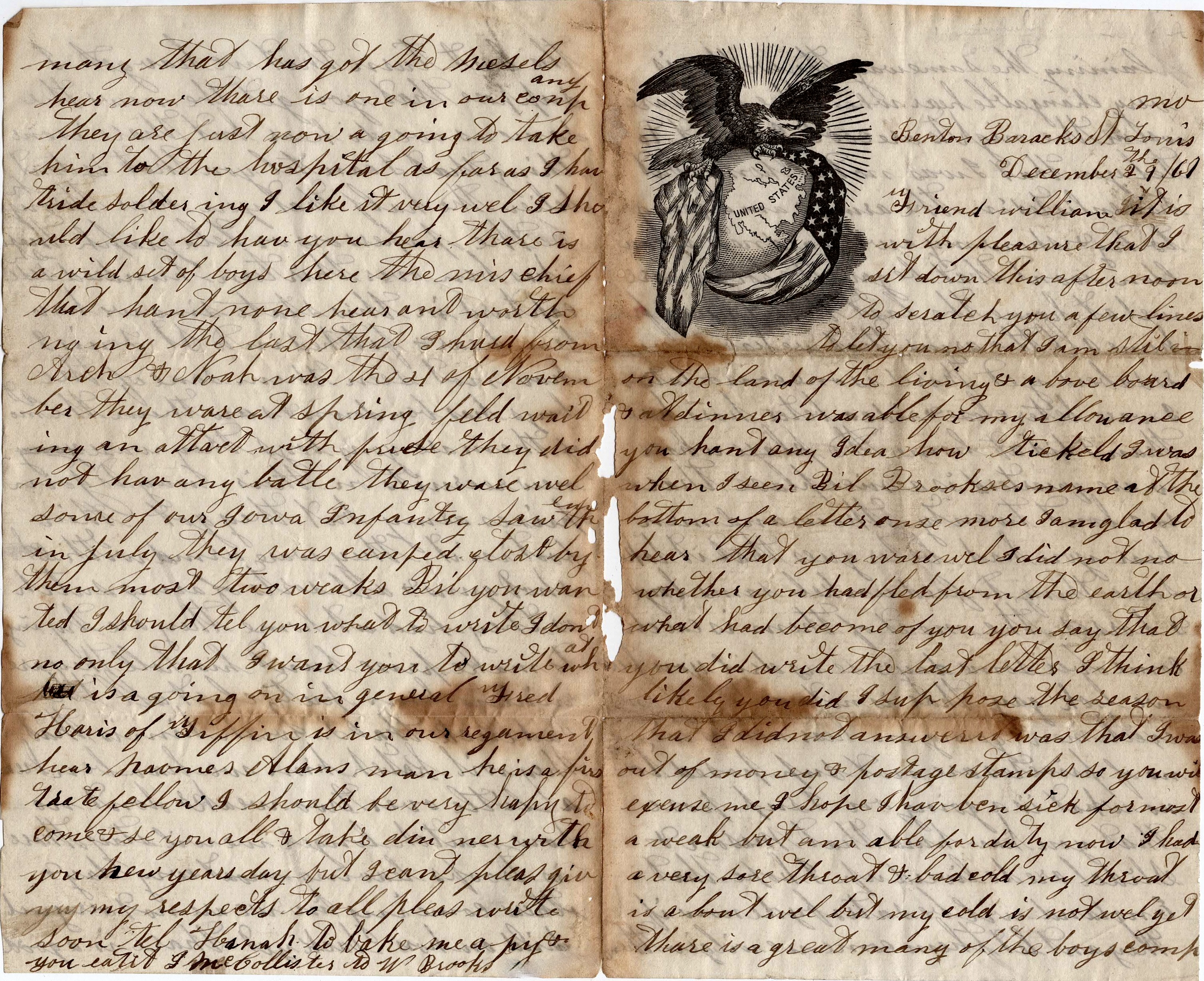
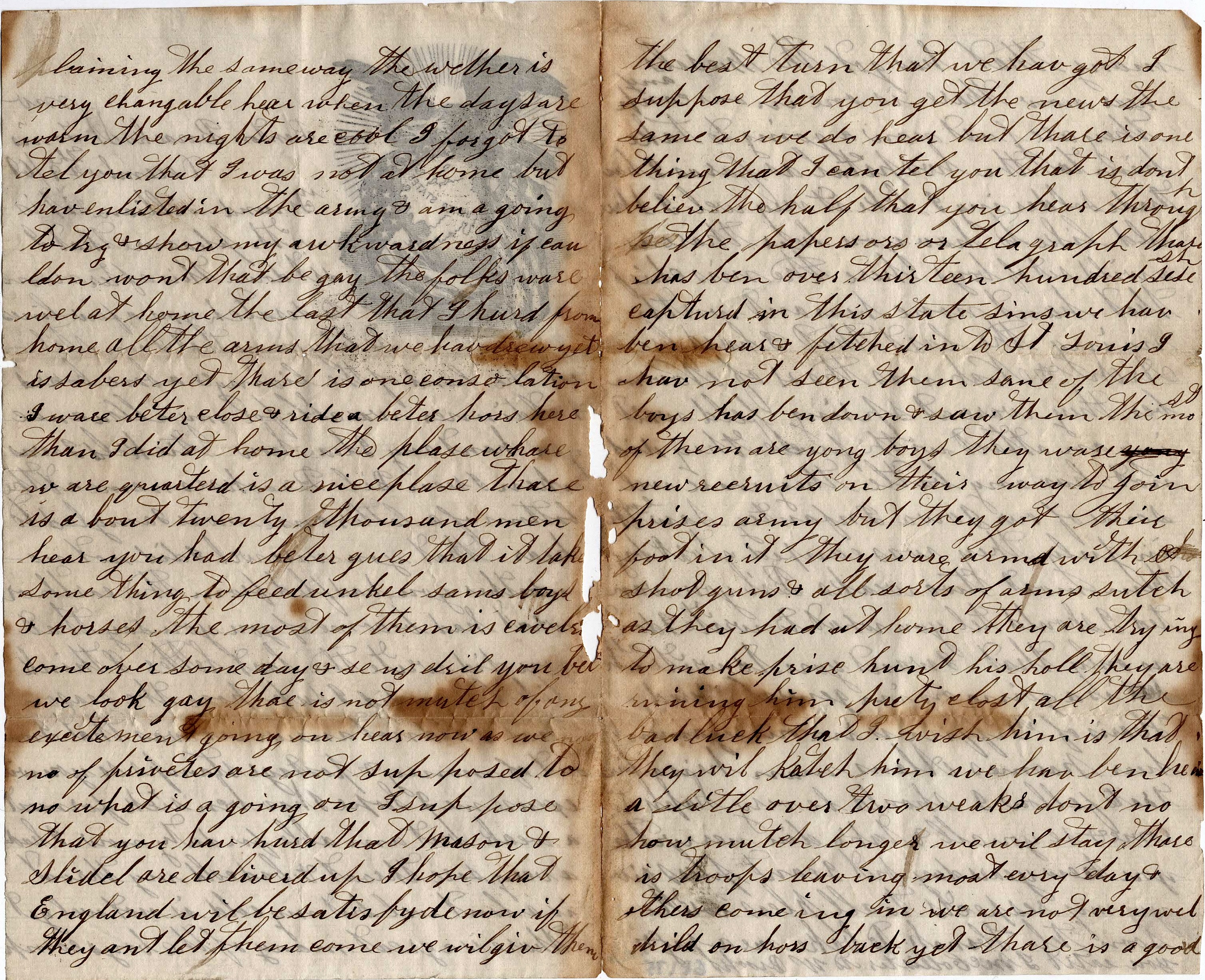
The following letter was written by 29 year-old Pvt. James McCollister of Co. B, 2nd Iowa Cavalry. The regiment was organized in the fall of 1861 and left the State for Benton Barracks, Missouri, on 7 December 1861. They remained on duty there until mid-February 1862. In his book, Hawkeyes on Horseback, author Stephen Z. Starr described the regiment as being composed of “lawyers, politicians, newspaper editors and businessmen who had been instrumental in raising the regiment. Their single common characteristic—apart from patriotism—was a total ignorance of all things military. For that reason, and with a display of moral and political courage not at all common among state governors, then or later, Kirkwood offered the colonelcy of the regiment to an “outsider,” an officer of the Regular Army, Captain Washington L. Elliott of the Third United States Cavalry.”
James McCollister (1832-1920) was born in Seneca county, Ohio, the son of John McCollister and Rachel Martin. In the 1860 Census he was enumerated in Story City, Story county, Iowa, with his 55 year-old mother, Rachel McCollister. He was married in 1865 to Ruth Amanda. Adams (1840-1880) and resided in Seneca county, Ohio, after he was discharged from the service. He died in Jerry City, Wood county, Ohio, and lies buried next to his second wife, Sarah McLaughlin (1844-1931).
T R A N S C R I P T I O N
Benton Barracks St. Louis, Missouri December 29th 1861
Friend William,
It is with pleasure that I sit down this afternoon to scratch you a few lines to let you know that I am still in the land of the living & above board & at dinner was able for my allowance. You han’t any idea how tickled I was when I seen Bill Brooks’ name at the bottom of a letter once more. I am glad to hear that you were well. I did not know whether you had fled from the earth or what had become of you. You say that you did write the last letter. I think likely you did. I suppose the reason I didn’t answer was that I was out of money & postage stamps so you will excuse me. I have been sick for most a week but am able for duty now. I had a very sore throat & bad cold. My throat is about well but my cold is not well yet. There is a great many of the boys complaining the same way. The weather is very changeable here when the days are warm. The nights are cool. I forgot to tell you that I was not at home but have enlisted in the army & am a going to try and show my awkwardness if called on. Won’t that be gay? The folks were well at home the last that I heard from home.
All the arms that we have drew yet is sabers, yet there is one consolation. I wear better clothes and ride a better horse here than I did at home. The place where we are quartered is a nice place. There is about twenty thousand men here. You had better guess that it takes something to feed Uncle Sam’s boys & horses. The most of them is cavalry come over some days since drill. You bet we look gay. There is not much of an excitement going on here now as we know of. Privates are not supposed to know what is a going on.
I suppose that you have heard that Mason & Slidel are delivered up. I hope that England will be satisfied now. If they ain’t, let them come. We will give them the best turn that we have got. I suppose that you get the news the same as we do here but there is one thing that I can tell you [and] that is don’t believe the half that you hear through the papers or telegraph. There has been over thirteen hundred secesh captured in this state since we have been here & fetched into St. Louis. I have not seen them. Some of the boys has been down & saw them. The most of them are young boys. They were new recruits on their way to join Price’s army but they got their foot in it. They were armed with shotguns & all sorts of arms such as they had at home. They are trying to make Price hunt his hole. They are running him pretty close. All the bad luck that I wish him is that they will catch him.
We have been here a little over two weeks. Don’t know how much longer we will stay. There is troops leaving most every day & others coming in. We are not very well drilled on horseback yet. There is a good many that has got the measles here now. There is one in our company. They are just now a going to take him to the hospital.
As far as I have tried soldiering, I like it very well. I should like to have you here. There is a wild set of boys here [full of] the mischief. There ain’t none here ain’t worth knowing. The last that I heard from Arch & Noah was the 21st of November. They were at Springfield waiting an attack with Price. They did not have any battle. They were well. Some of our Iowa infantry saw them in July. They was camped close by them two weeks.
Bill, you wanted I should tell you what to write. I don’t know—only that I want you to write what is a going on in general. Fred[erick A.] Harris 1 of Tiffin [Ohio] is in our regiment here—Naomia Allen’s man. He is a first rate fellow. I should be very happy to come & see you all & take dinner with you New Year’s Day but I can’t. Please give my respects to all. Please write soon. Tell Hannah to bake me a pie & you eat it. — J. McCollister
to W. Brooks
1 Frederick A. Harris (1825-1892) married Naomia R. Allen (1836-1908) in March 1854 in Seneca County, Ohio.In 1860, the couple were enumerated in Cass, Hamilton county, Iowa. Frank enlisted in Co. F, 2nd Iowa Cavalry and was soon promoted to 3rd Battalion Commissary Sergeant.





















 Spared & Shared 23